
The BLUETTI FridgePower (↗) doesn’t just back up a fridge, it keeps it running for around 21 hours on a single charge, and can stretch that to two days with one expansion battery. Add three, and you’re looking at up to four days of runtime depending on load.
That kind of performance defines what the system is really about. The Bluetti FridgePower (↗) is built around a single priority: Keeping refrigeration alive when the grid goes down. It is not a general-purpose power station. Instead, it is a focused backup system designed specifically around fridges and essential household appliances, and that intent shapes everything from its design to how it operates in practice.
The base unit runs a 2016 Wh LiFePO₄ battery paired with 1800W of continuous output and 3600W of surge capacity, enough to handle compressor startup spikes without issue. Idle draw is rated at just 4W AC, helping minimise wasted energy when the system is on standby. When the grid drops, it switches over in 10ms, fast enough to keep connected devices running without interruption.
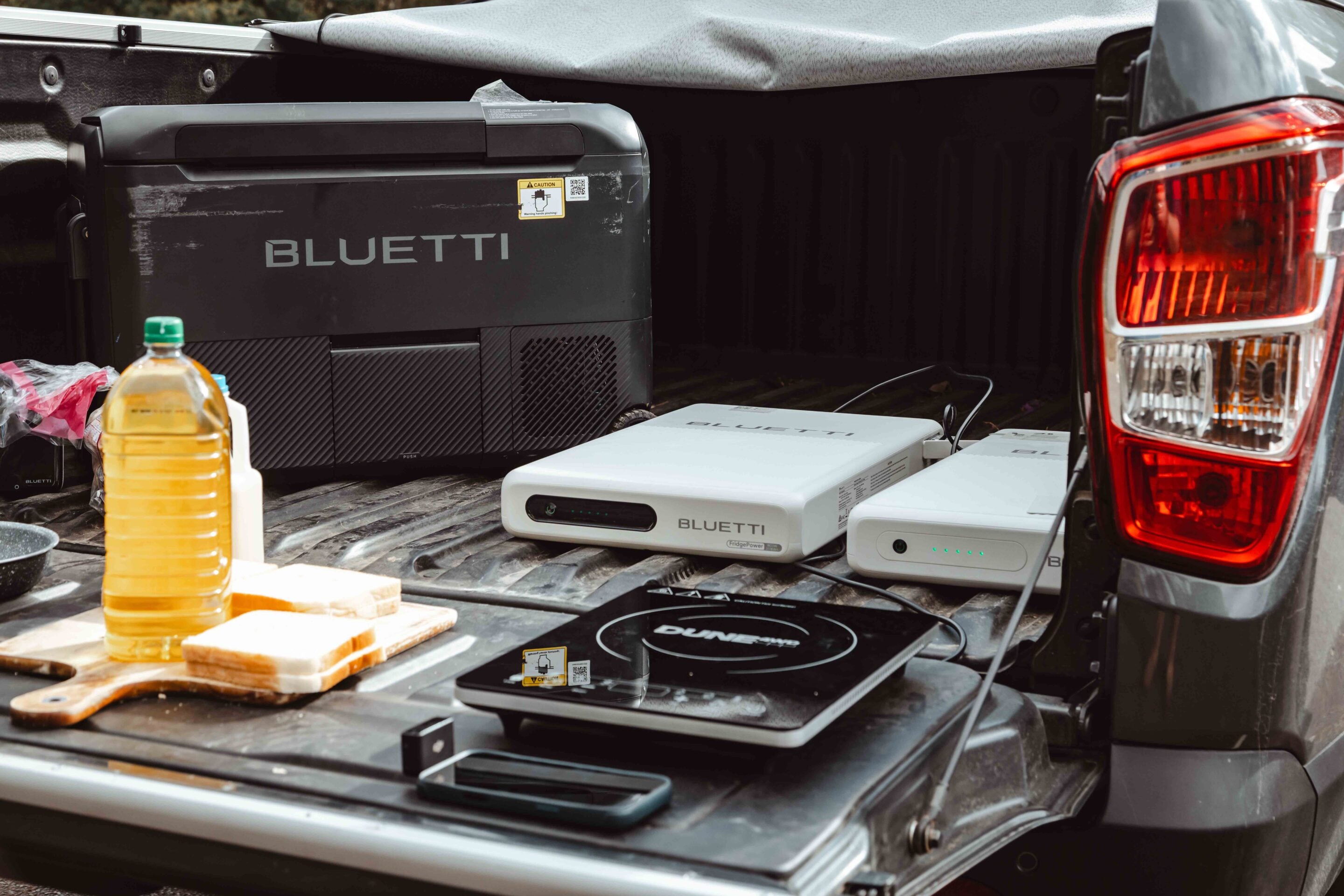
The physical design is one of its strongest advantages. At just 75mm thick, the FridgePower (↗) sits flush against a wall or tucks neatly into tight utility spaces, but its usefulness extends beyond the home. In a touring setup, it can also be mounted or carried in the back of a ute or SUV without eating into valuable load space, making it a practical option for extended trips or remote travel. Bluetti claims compatibility with 99 percent of fridge types, and installation is a claimed 10-minute DIY process. The result is a unit that blends into both home and vehicle setups.
Where things become less flexible is portability. The base unit weighs 19.7kg, which is manageable but not something you would want to move regularly. Each BlueCell 200 expansion battery adds roughly 20kg. In base form it can still be transported if needed, but once expanded to three batteries it effectively becomes a semi-permanent installation. The trade-off is runtime, with full configurations shifting the system from short-term backup into multi-day outage coverage depending on load.
Charging options include 1440W AC input, 1000W solar input, and a combined 2200W mode. Fast charging can take the system to 80 per cent in around an hour, with an alternator charging option also planned. The LiFePO₄ cells are rated for more than 4000 charge cycles, with 80 per cent capacity retention claimed after 10 years of use. Smart features are handled through the Bluetti app and an optional magnetic display, covering battery level, load draw, power flow, and maintenance prompts. Integration with Alexa, Google Home and Home Assistant is also supported.
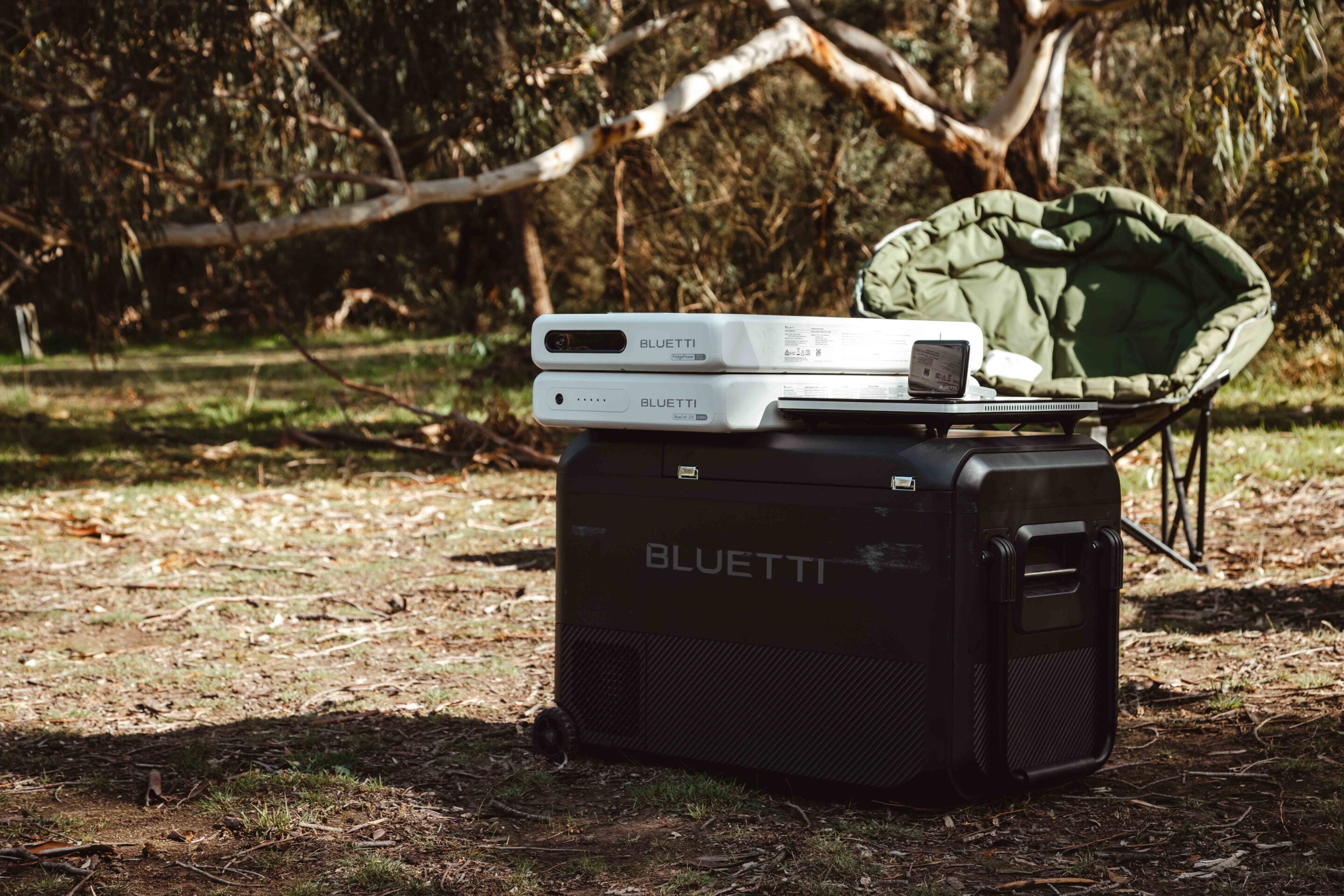
We connected the unit to a hot plate to feed the crew to see how it would fare as a portable power solution, and it handled this ancillary use without issue, which gives a practical sense of the headroom available beyond its core role. More importantly, it proved genuinely simple to live with in practice. Setup is straightforward, with a plug-and-play style installation that gets it running quickly without needing any technical tuning.
Once in use, monitoring is equally easy, with key information such as battery level, load draw and power flow clearly visible through the app or optional display at a glance. Operation is largely hands-off, with the system managing switching and power delivery automatically.
The Kickstarter campaign has officially ended, but the FridgePower remains available through a “Late Pledge” period until June 16 (↗). Pricing is a touch higher than the original early-bird offers (US$899, or roughly AU$1300), but it is still the most affordable way to buy a FridgePower before wider release.
For Australian customers, Kickstarter (↗) remains the only purchasing channel until June 16. After that, FridgePower will not be available through BLUETTI’s website or retail channels for some time.
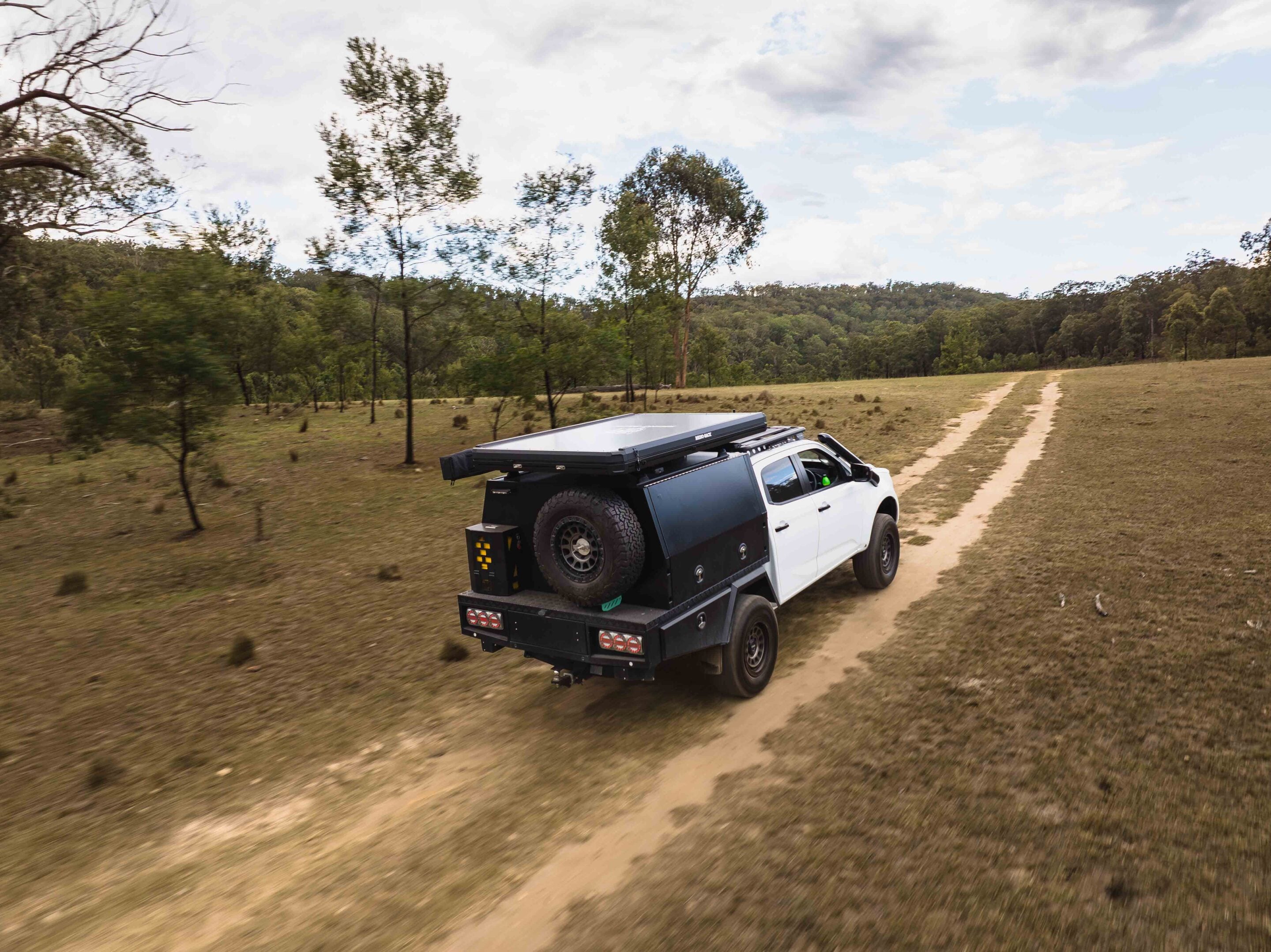
The Isuzu D-MAX has built a strong following among Australian 4×4 enthusiasts on the back of a straightforward formula built on a capable diesel drivetrain, a solid platform for modification, and a reputation for reliability that holds up in remote conditions.
The builds collected here reflect the breadth of what D-MAX owners are doing with the platform. Some are simple and purposeful with a lift, some protection and the essentials for weekend touring. Others carry comprehensive setups built around extended travel, with integrated power systems, expedition-ready storage and the full suite of recovery and communication gear needed to spend weeks away from sealed roads.
What connects them is a practical outlook. These rigs are built to go places: Alpine tracks in Victoria, desert routes through South Australia and the Northern Territory, coastal sand and everything in between. The D-MAX has proven adaptable enough to suit all of it, and the builds on this page show how owners have matched their modifications to the country they want to explore.
SUBMIT YOUR HILUX BUILD
Want to see your HiLux build here? Jump on over to the 4X4 Australia Facebook page and show us your rig!
2018 Isuzu D-MAX LS-M
Submitted by David Williams
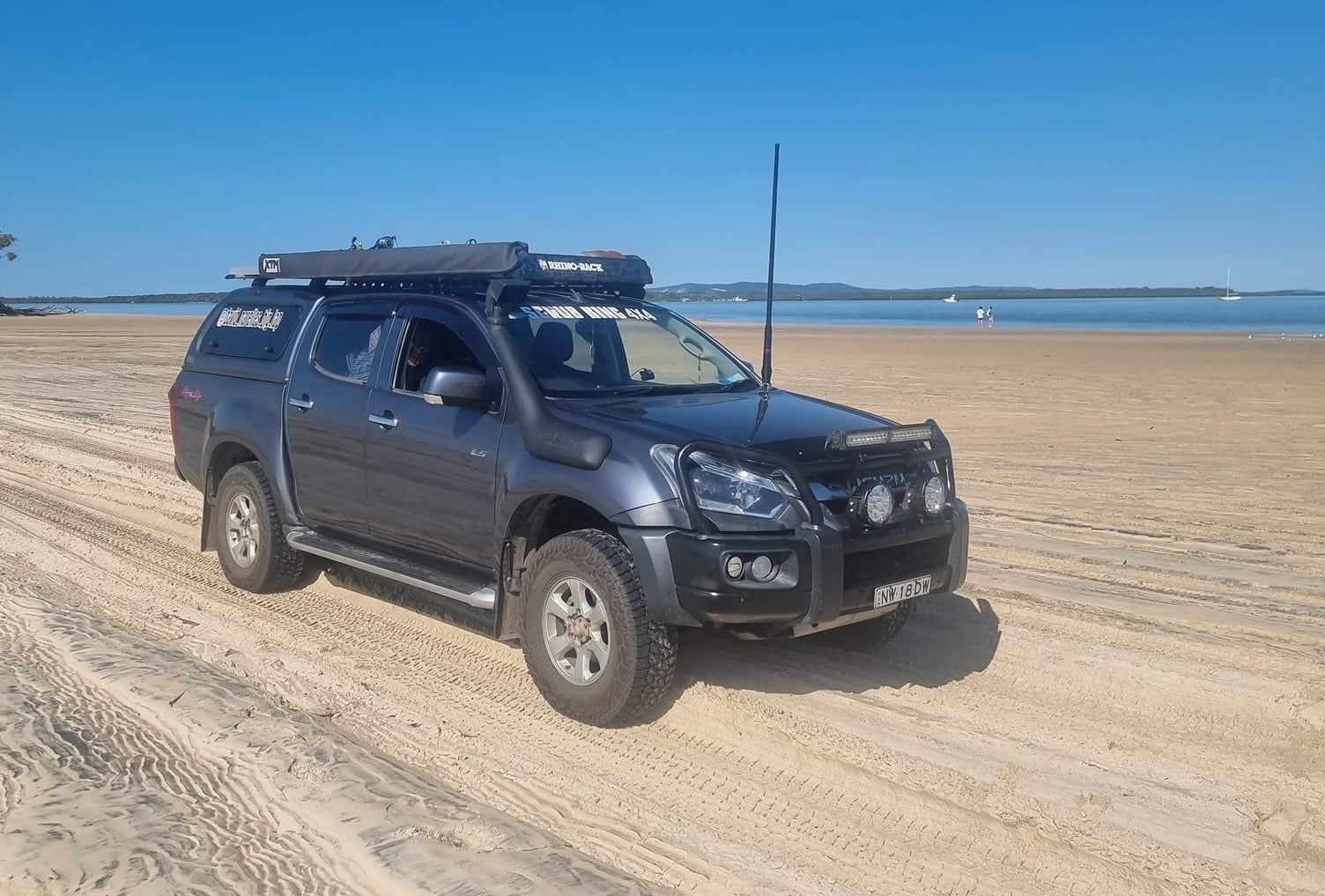
David Williams’ LS-M is a lightly but purposefully built tourer, already ticking off two bucket-list destinations.
The D-MAX runs a two-inch suspension lift, snorkel, second fuel filter catch can, UHF radio, diff breathers, and a Rhino-Rack roof platform. The setup is practical and trail-ready without overcomplicating the platform. K’gari and the Oodnadatta Track are already in the logbook.
2022 Isuzu D-MAX
Submitted by Steven Fenech
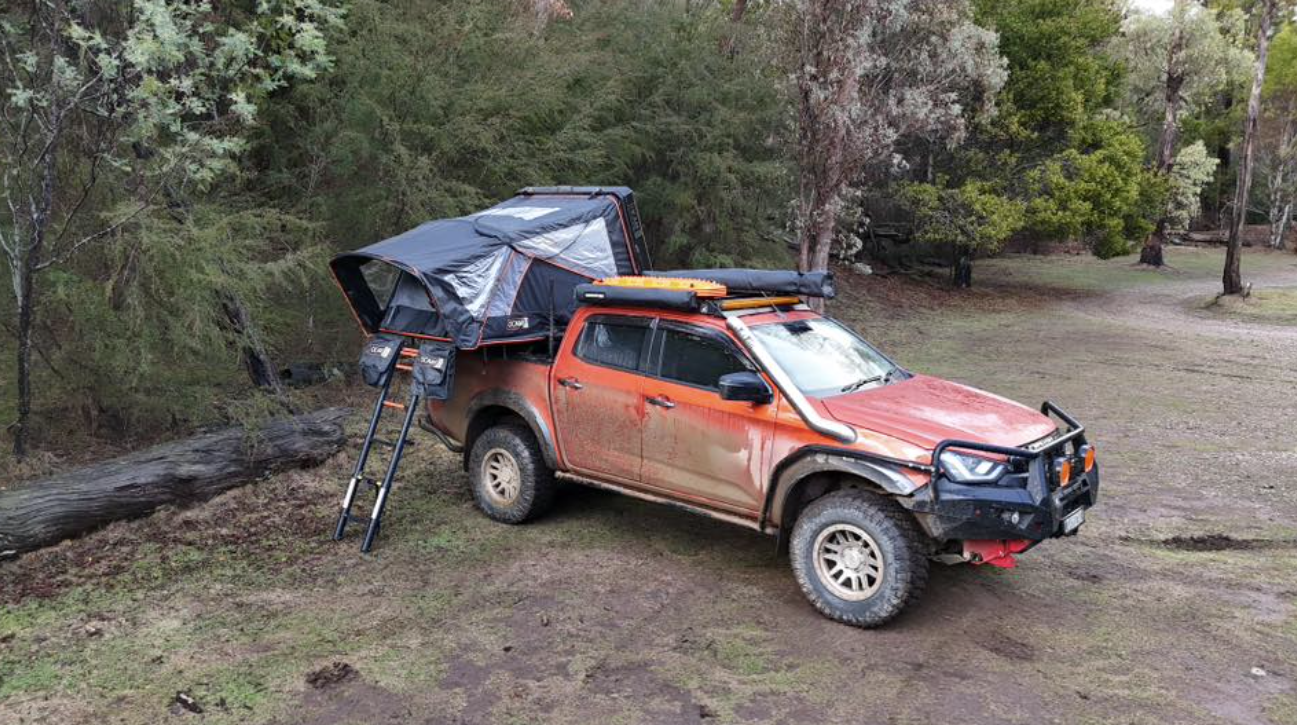
Steven Fenech’s D-MAX has been put to work across some of Victoria’s most demanding terrain, and the spec list is growing to match.
The build runs 33-inch tyres, a front locker, snorkel and airbox, and long-travel shocks, with more modifications in progress. The Victorian High Country, Border Track, Big Desert, Mt Disappointment, Tallarook, Toolangi, Kinglake West, Mount Terrible and Matlock have all been crossed off the list.
2016 Isuzu D-MAX
Submitted by Mark Staley
Mark Staley keeps the build simple but sorted, with more in the pipeline for this north-east Victoria local.
The D-MAX runs an EFS suspension lift with matching wheels and tyres, a bull bar and a light bar. An exhaust and snorkel are planned as the next steps. Based close to Alpine National Park, Mark recently made the run to K’gari for a change of scenery, and the shot in front of the Maheno shipwreck sums it up.
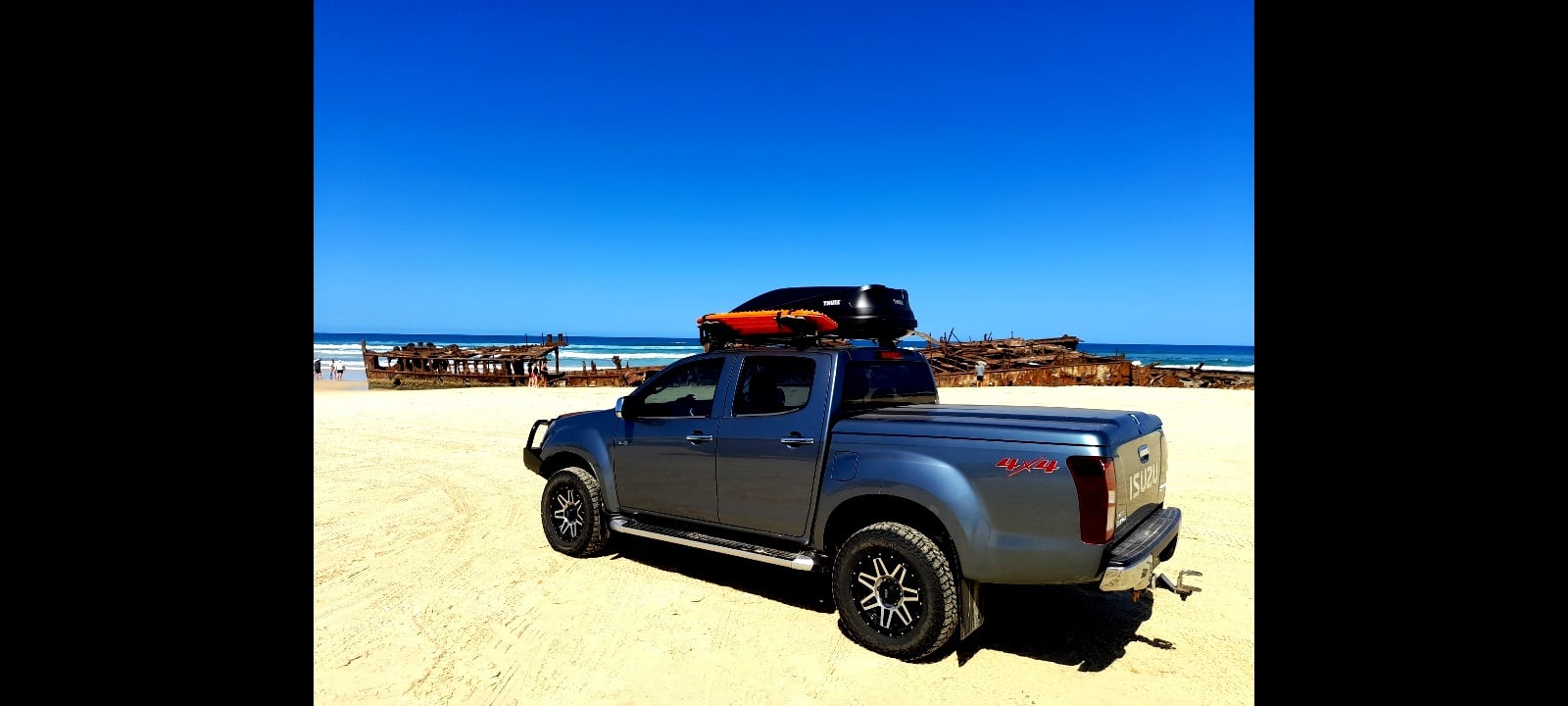
2013 Isuzu D-MAX
Submitted by Johnny Washbay Williams
Johnny Washbay Williams’ Canberra-based D-MAX is a properly sorted rig covering everything from local trails to serious towing and remote touring.
The build sits on a two-inch lift on 33-inch tyres with a GVM upgrade and a front locker. The 2.4-litre five-speed manual has been dyno-tuned for reliable output on the road and off it. Recovery is covered by a Kings winch up front, with spotties for night driving. The canopy runs a budget 12V setup with solar, keeping the fridge cold on fishing trips. A K’gari run is on the radar, and the rig is ready for it.
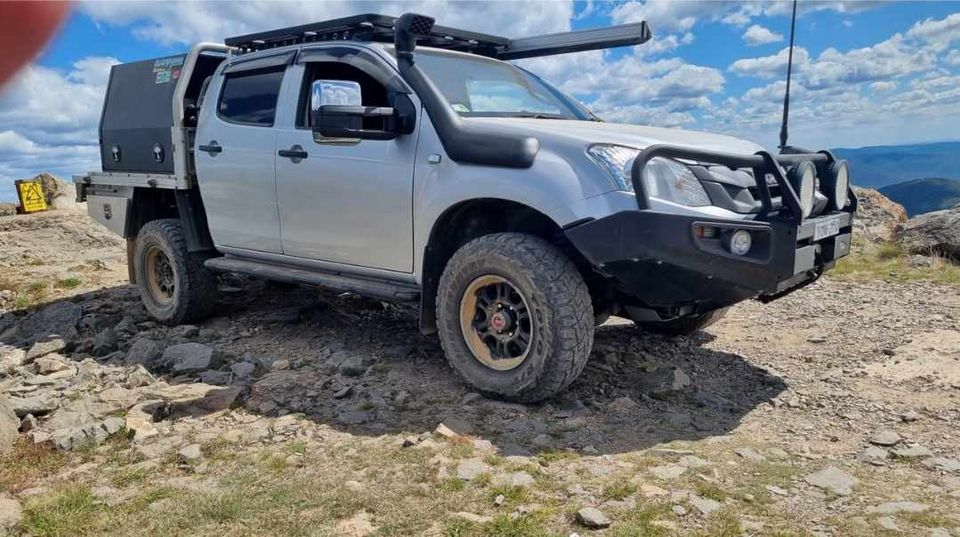
Isuzu D-MAX LS-U
Submitted by Terry May
Terry May’s crew-cab LS-U is a well-accessorised tourer that has already worked its way through three South Australian destinations.
The build runs a Runva winch up front, Maxxis AT812 all-terrain tyres, a Safari snorkel, Ironman 4×4 recovery points, Custom Offroad underbody protection, and a two-inch Tough Dog suspension upgrade. Goolwa Beach, Eagle View 4×4 Track and Deep Creek National Park in South Australia are all in the logbook.
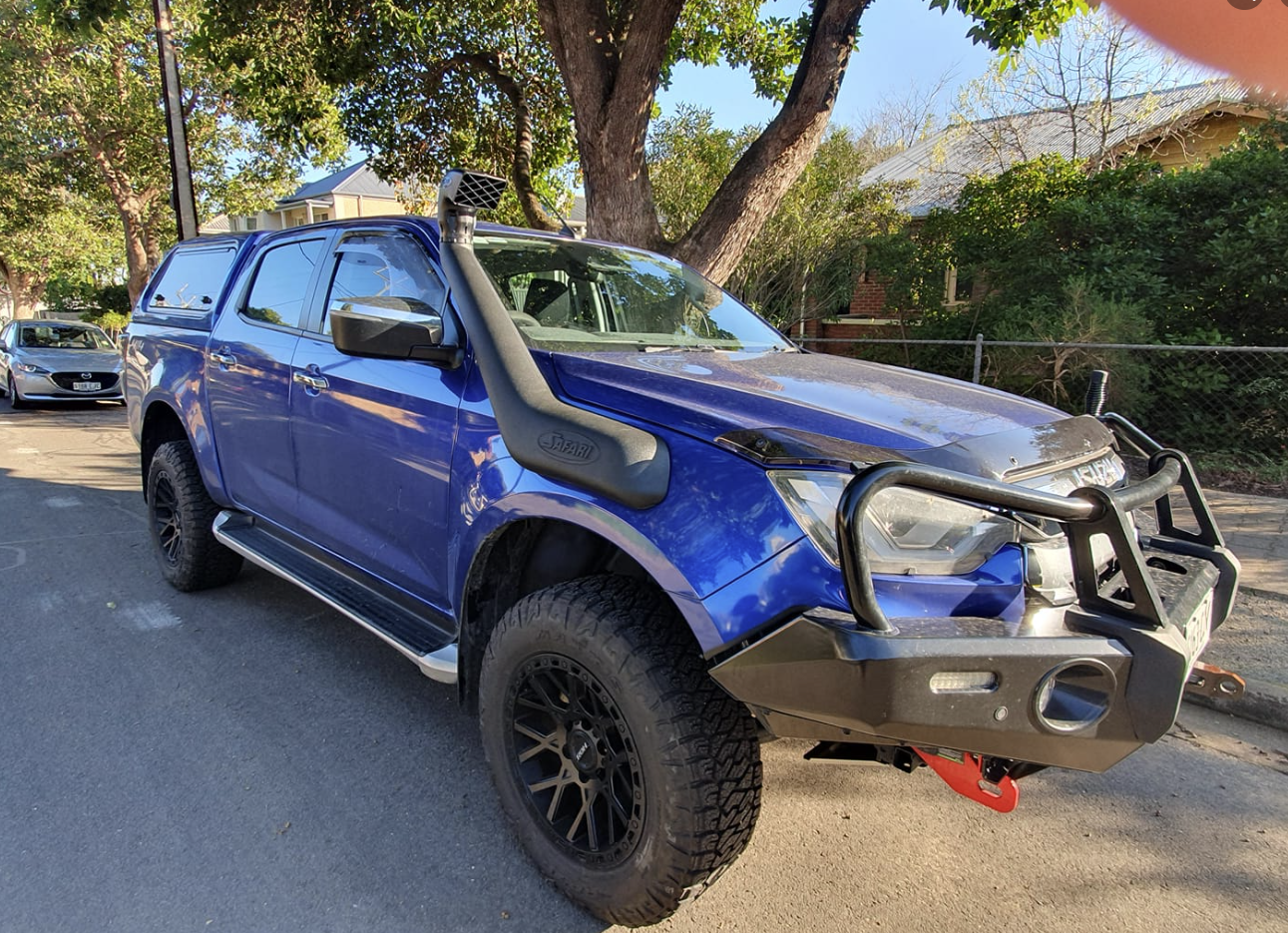
Isuzu D-MAX
Submitted by Luke Vigh
Luke Vigh built this D-MAX as a family touring rig, and a well-considered system of tray, van and accessories means they can set up camp and still use the ute to explore.
The tray is a PCOR unit carrying an ARB Baserack, ARB twin air compressor, and ARB long-range tank. Out front is an AFN bull bar; lighting comes from a Stedi light bar. The rig sits on 33×12.5 KM3 tyres with EGR flares, a Munji steering rack drop and wheel alignment brace kit, Dobinsons adjustable remote reservoir shocks, and a Blackhawk Ultimate adjustable UCA for the suspension setup. A Hayman Reese X-Bar, rear airbags by Airbag Man and a Fabulous Fab snorkel and airbox round out the practical side, while communications are handled by a GME XRS.
Luke and the family tow a Lotus Off Grid camper. The strategy is to unhitch at camp and take the ute exploring, a setup they have tested across the Great Ocean Road, Yorke Peninsula, Flinders Ranges, Murray River and the Newcastle area, with a Gold Coast trip currently underway.
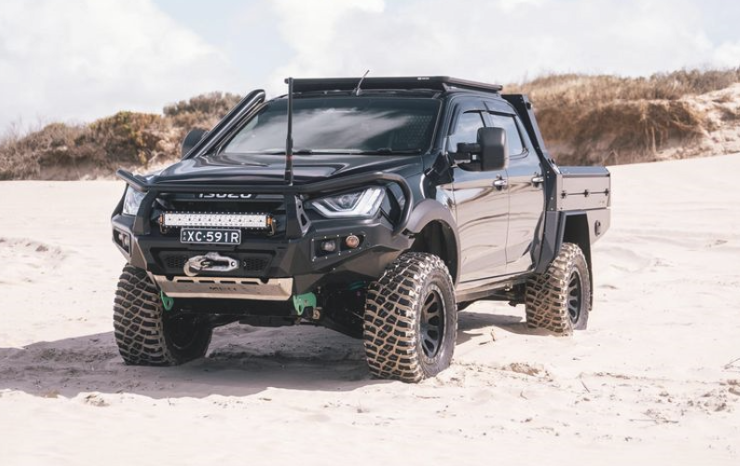
2017 Isuzu D-MAX LS-M
Submitted by Rhys Kretschmer
Rhys Kretschmer’s LS-M is a fully self-sufficient tourer with a strong accessory list and a long destinations wishlist to work through.
The build runs ARB bar work, a Warn winch, Lightforce spotlights, a GME XRS, Safari snorkel, ARB canopy, MSA 4×4 drawers, an ARB 60-litre fridge, a 120-amp dual-battery system with 170W solar panel, two-inch OME suspension, and a Darche 270 awning. Bendleby Ranges has been the proving ground so far, with most of the tracks there done and dusted.
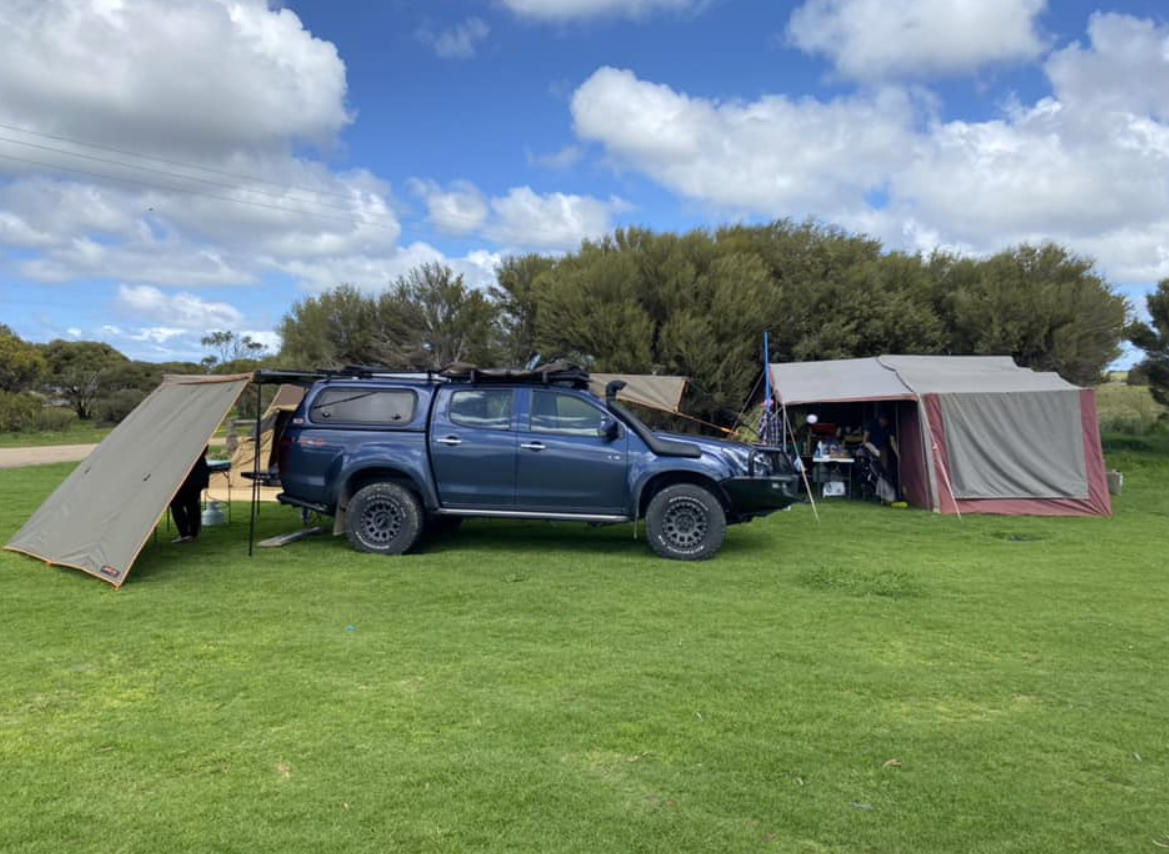
2023 Isuzu D-MAX
Submitted by Stephen Gurman
Stephen Gurman’s 2023 D-MAX is a comprehensively built tourer stacked with gear across every category.
The body carries a Trojan tray and canopy, a Rhino-Rack Pioneer 6 Platform on the roof, a TJM Airtec snorkel, and TJM Outback bull bar, side steps and rails. Lighting comes from Lightforce HTX spotlights and a 40-inch light bar mounted under the roof rack. Suspension is Outback Armour, rolling on Toyo AT3 tyres. Recovery is handled by a Runva 11XP winch.
Internally, a TJM twin compressor and five-litre air tank are hidden in the rear quarter toolbox. Camp comfort comes from a Darche 270 freestanding awning, a Ridgeback Highrize RTT, a 50-litre Dometic fridge, a Travel Buddy oven, a Slide-It Solutions tilt slide, and Black Duck 4Elements seat covers. Communications are covered by a Uniden XTRAK 80 UHF.
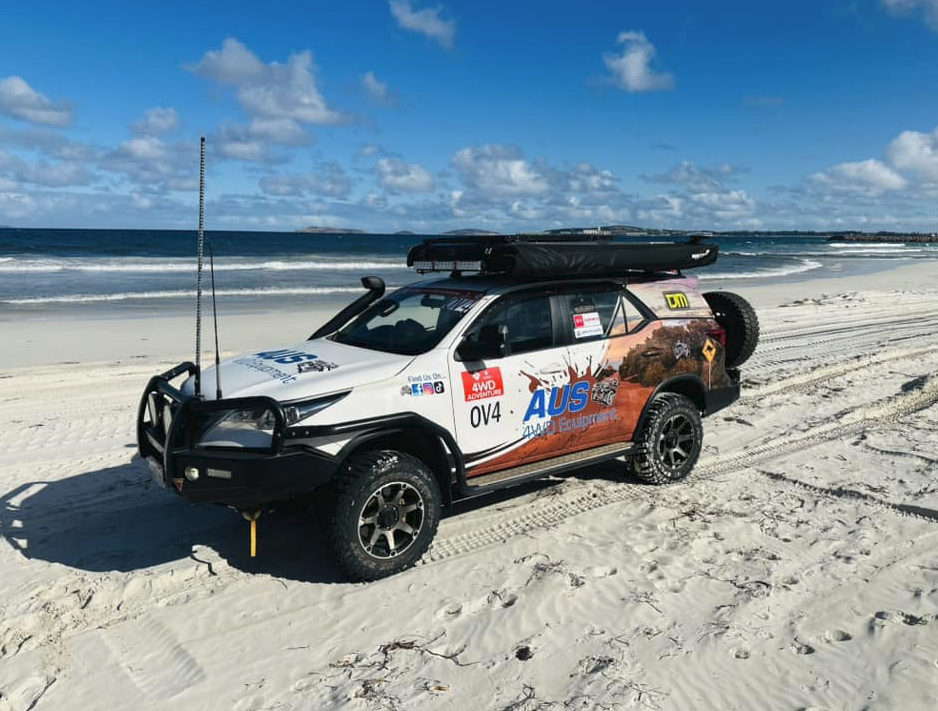
Anyone who’s spent time touring in a Suzuki Jimny knows just how quickly space disappears. Recovery gear, camping equipment, cooking gear and everyday essentials all compete for room in a compact cabin, and before long, the little Suzuki starts to feel cluttered.
That’s why clever storage and touring accessories matter so much in the Jimny world. It’s not just adding more gear; it’s about using the available space more efficiently without piling unnecessary weight onto an already compact platform. That’s the design strategy behind the AIR Drop Down Table from Get Good Gear (↗). Purpose-built for the JB74 Jimny, the AIR table focuses on being light and simple for real-world touring, instead of packing in over-complicated gimmicks.
After spending time with the setup across beach runs, corrugated access tracks and general weekend touring duties, it’s easy to see why this minimalist rear-door accessory is gaining attention among Jimny owners chasing a cleaner and smarter camping setup.
AIR Table quick specs
- Vehicle compatibility: Suzuki JB74/JC74 Jimny
- Construction: 2.5mm aluminium
- Hardware: Stainless steel hinges and fixtures
- Weight: 4.5kg
- Mounts using factory holes
- No factory tool well modification required
- Recommended working load: 15kg
Why lightweight matters in a Jimny
One of the biggest talking points with the AIR table (↗) is the weight.
At just 4.5kg, Get Good Gear says the AIR is one of the lightest drop-down tables currently available for the Jimny platform. A point that matters more than some people might think.
Anyone building a touring-focused Jimny quickly learns that every kilogram counts. Add drawers, recovery gear, roof racks, larger tyres, and camping equipment, and the GVM climbs fast. Heavy accessories mounted to the rear door can also affect long-term wear on the hinges and rear door strut mounts.
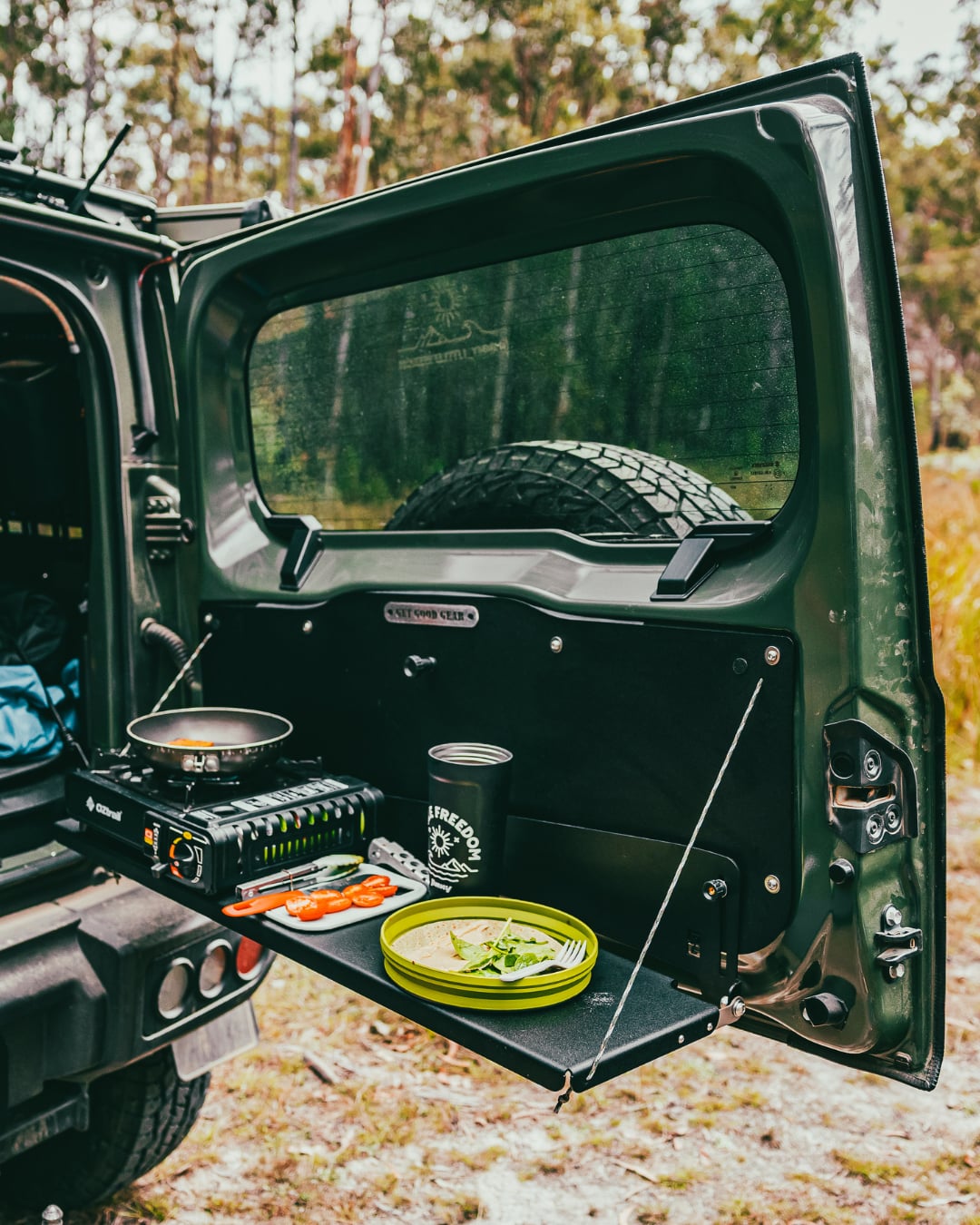
Rather than going down the traditional steel route, Get Good Gear (↗) has opted for a 2.5mm aluminium construction paired with stainless hinges and hardware. The result is a table that feels properly solid in use without adding unnecessary bulk to the back of the vehicle. Importantly, it doesn’t feel flimsy or compromised simply because it’s lightweight.
During testing, the table remained stable during meal prep, coffee stops, and campsite duties, while the aluminium construction kept overall weight under control, something many Jimny owners will immediately appreciate.
Designed for beach runs and harsh touring
The choice of corrosion-resistant aluminium also makes plenty of sense for Australian touring conditions.
Unlike steel setups that can eventually show corrosion where coatings become chipped or scratched, the aluminium construction naturally resists rust. Combined with stainless hardware throughout, the AIR table is king on beach runs, coastal touring, or wet-weather camping where salt and moisture can quickly punish poorly protected accessories.
That corrosion resistance also helps reinforce the product’s practical philosophy. This isn’t an accessory built purely to look good in photos, it’s designed to handle regular touring use without becoming a maintenance headache later down the track. For plenty of Jimny owners, especially those cruising the beach or heading away for a weekend in the bush, that simplicity is a genuine advantage.
Simple design that actually works
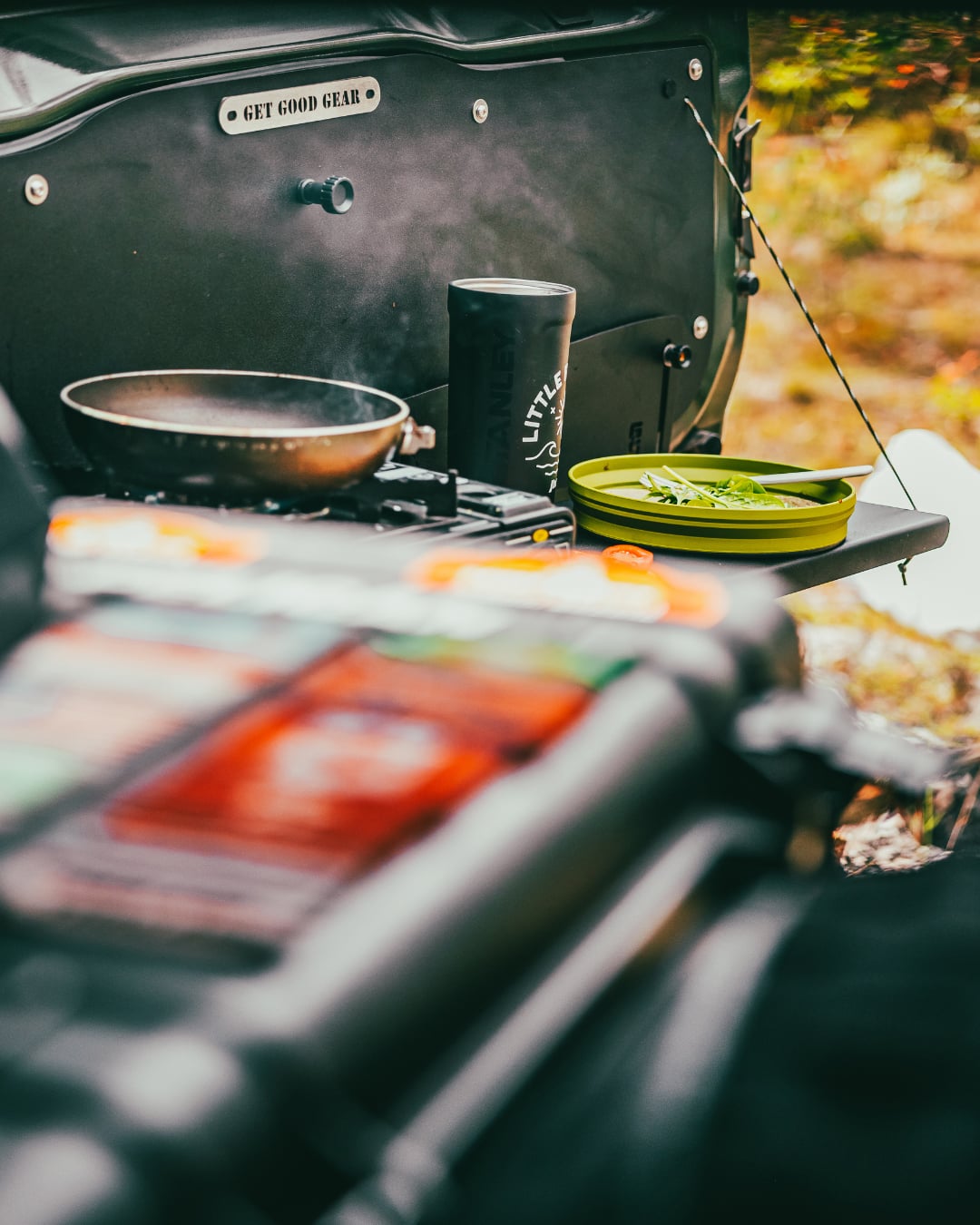
One of the more refreshing things about the AIR table is that it doesn’t try too hard.
Rather than packing the setup with unnecessary mechanisms or overly complicated folding systems, Get Good Gear (↗) has deliberately kept the design straightforward and functional. There are minimal moving parts, operation is simple, and the whole setup feels intentionally uncomplicated. That’s something experienced tourers tend to appreciate.
Complex accessories might look impressive, but more moving parts can also mean more rattles, more wear, and more potential failures as the kilometres start adding up. The AIR table (↗) instead sticks to the basics: easy access, practical usability, and straightforward operation. It’s a good reminder that not every touring accessory needs to reinvent the wheel.
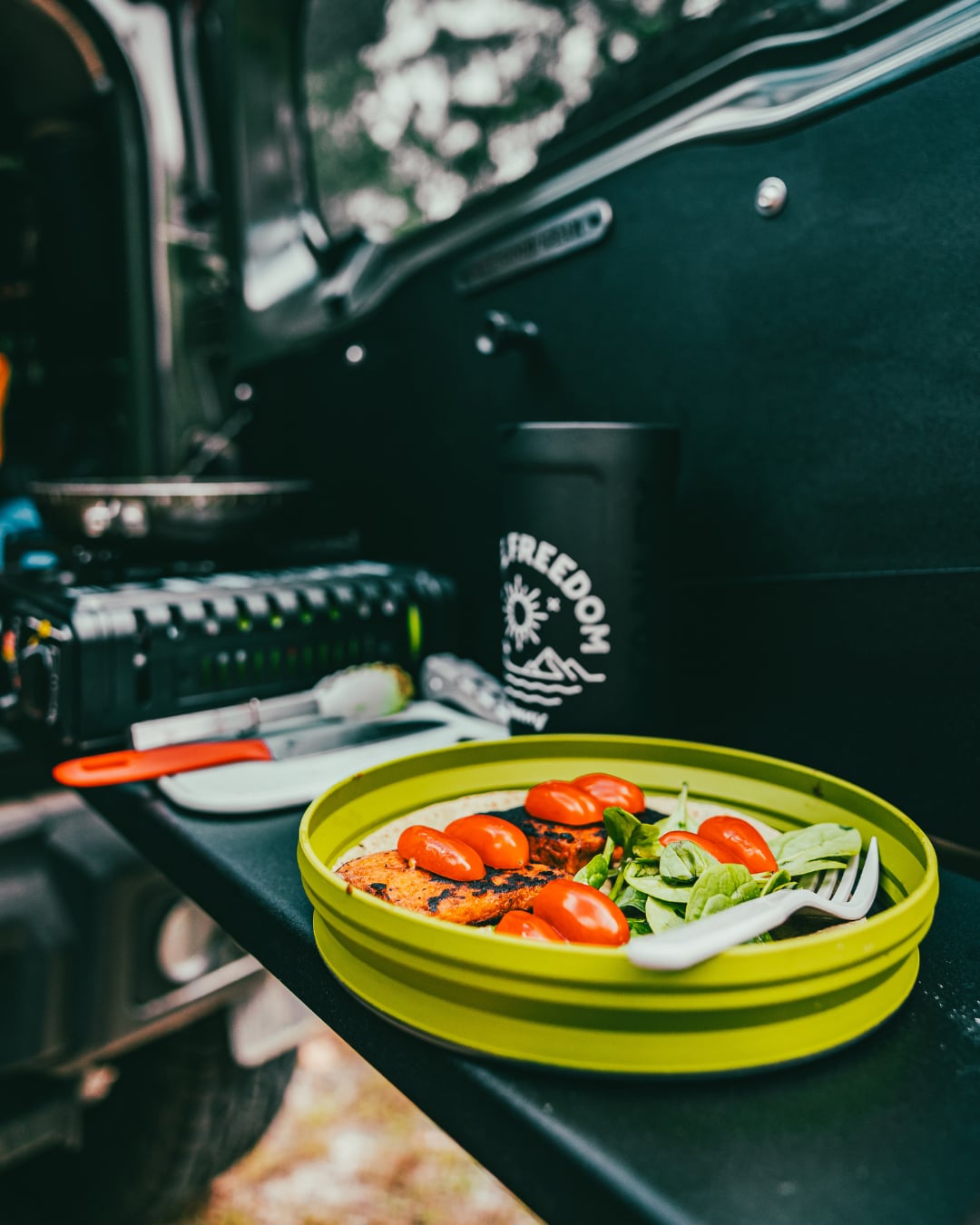
Straightforward installation and fitment
Installation is refreshingly simple.
The AIR table (↗) mounts neatly to the Jimny’s rear door using factory holes from the standard plastic trim. Fitment can be completed with basic tools in a relatively short amount of time. Once installed, the table folds away neatly without heavily intruding into the rear cargo area, an important consideration in a vehicle where every bit of space matters.
The minimalist design also helps reduce unnecessary bulk on the rear door, which suits the lightweight touring philosophy many Jimny owners aim for.
“We often get asked if the table will hit the factory plastic tool well. We are one of the few designs on the market that does not require the factory well to be modified or removed” – Get Good Gear
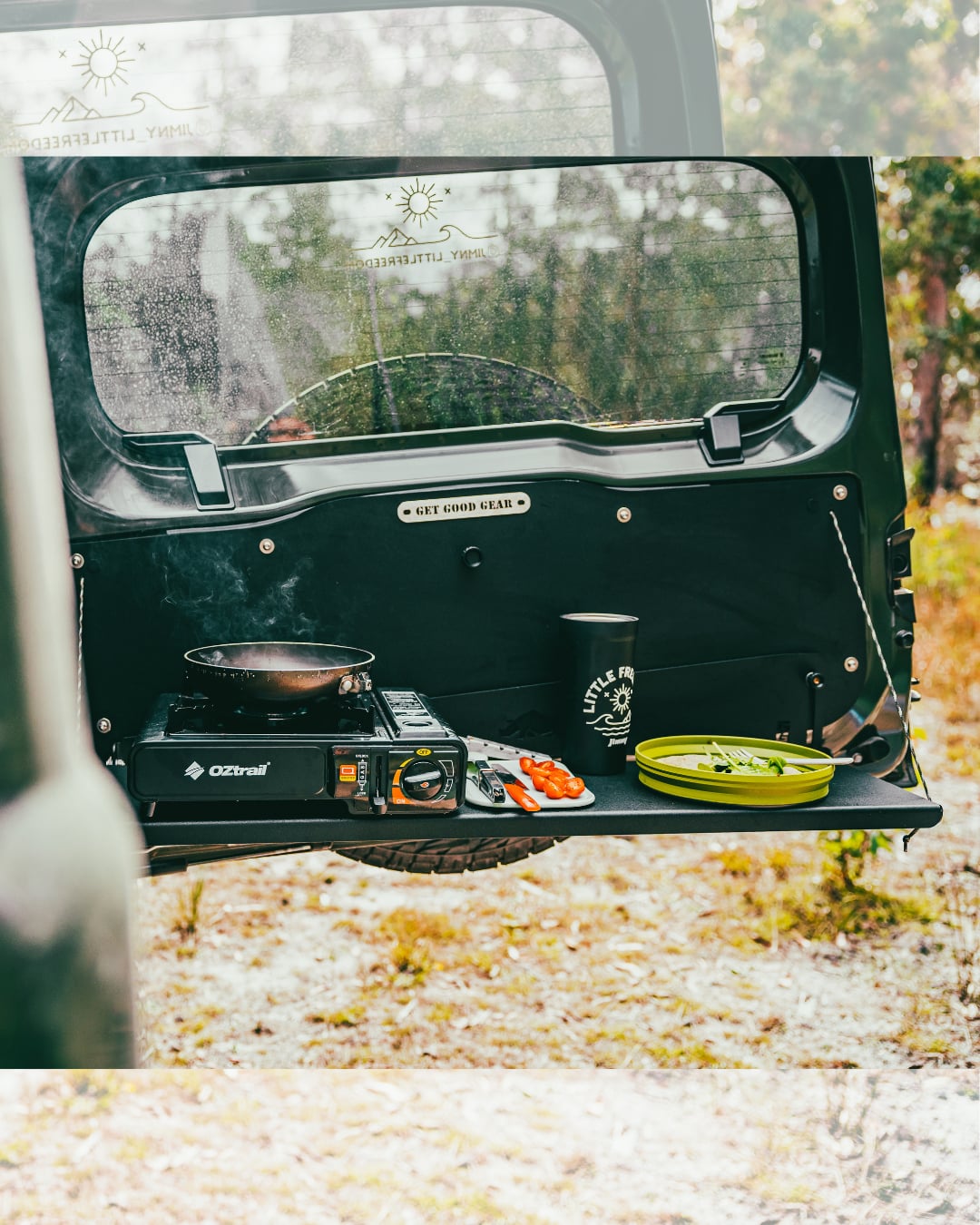
A rear table you’ll actually use
Out in the real world, the AIR table (↗) quickly becomes one of those accessories you end up using more often than expected.
Whether it’s making coffee during a roadside stop, prepping lunch at camp, organising recovery gear, or simply creating extra workspace at the rear of the Jimny, the 5-minute setup adds useful functionality in an instant, making your time on the track that little more enjoyable.
The rear table can become an instant must-have from cooking your main meals to a quick snack or just keeping the wine and cheese board out of the sand while enjoying the sunset.
Another advantage is how naturally the setup suits the Jimny itself. The compact dimensions and minimalist design feel properly matched to the little Suzuki’s lightweight touring ethos, rather than trying to force oversized touring solutions onto a smaller platform.
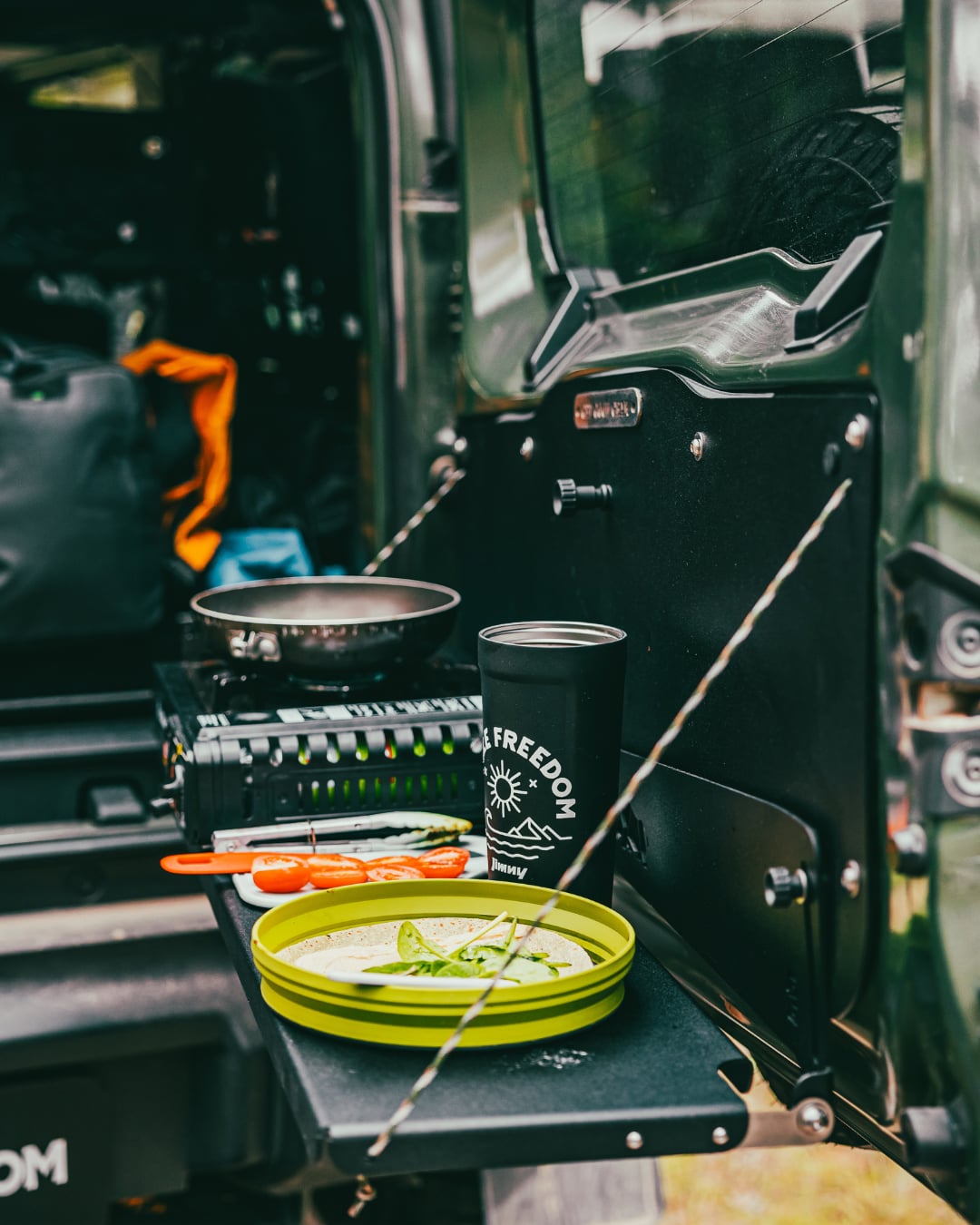
Who this setup suits
- Lightweight touring builds
- Beach and camping setups
- Minimalist Suzuki Jimny owners
- Weekend tourers
- Owners avoiding heavy rear-door accessories
- JB74 Jimny touring setups chasing smarter storage solutions
A gateway into smarter Jimny setups
What also stands out is how neatly the AIR table (↗) fits into the broader idea of modular Suzuki Jimny touring setups and lightweight JB74 Jimny rear storage systems.
For owners after a simple, lightweight solution, the AIR works perfectly well as a standalone solution. But it also acts as a natural entry point into more comprehensive rear-door storage and organisation systems. Complementing the entire Get Good Gear range (↗). For those wanting a more capable touring rig over time, the full system can be easily built in stages. That flexibility is part of the appeal.
Some owners will want the simplest possible setup with minimal added weight, while others may eventually lean toward more integrated storage, M.O.L.L.E mounting, and expanded touring organisation systems as their builds evolve. The AIR table feels like it knows the Jimny audience well.
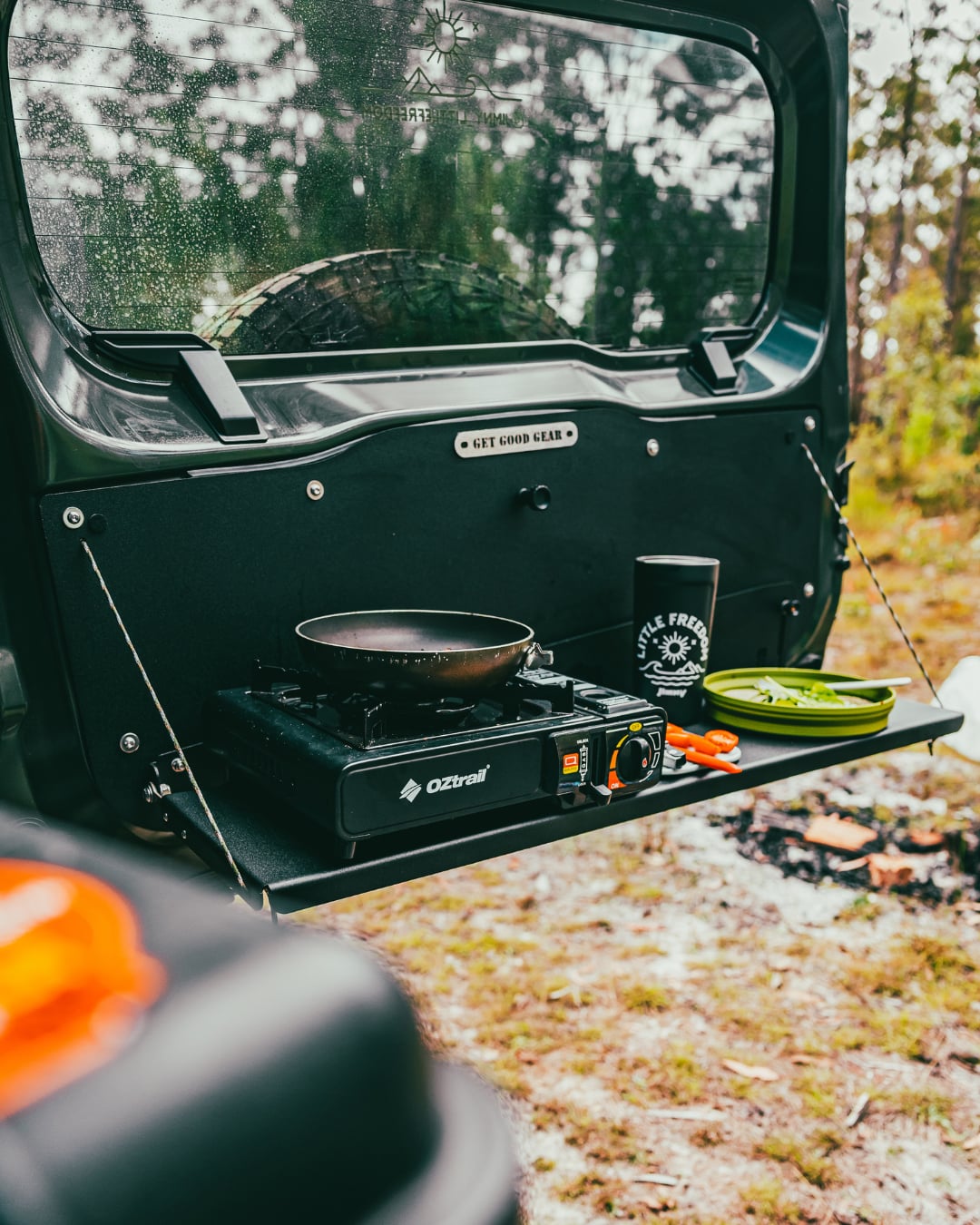
The verdict
The Get Good Gear AIR Drop Down Table (↗) succeeds because it focuses on the simple things that actually matter to Jimny owners: Low weight, corrosion resistance, simplicity, and practical touring usability.
It doesn’t rely on flashy gimmicks or over-engineered complexity. Instead, it delivers a clean, lightweight and thoughtfully designed solution that genuinely improves day-to-day campsite and touring functionality. Owners chasing heavily integrated rear-door storage systems may still prefer larger or more feature-packed alternatives, but for lightweight touring simplicity, the AIR table strikes a very smart balance.
For Jimny owners looking to maximise usability without compromising the vehicle’s lightweight character, the AIR table makes a strong case for itself.
For many Australians, buying a 4WD unlocks the potential to tour the country, not just handle school runs and grocery trips.
Trips to Cape York, the Kimberley or the islands of SE Queensland are a big part of the appeal, built around getting off the beaten track. However, new research from insurer Club 4X4 suggests those plans are increasingly being delayed or scaled back by cost-of-living pressures.
The Australia Unlocked Report found that 94 per cent of 4WD, SUV and ute owners are primarily using their vehicles for everyday duties, with many Australians spending upwards of $100,000 on vehicles built for the bush but ultimately using them for daily commuting, from school drop-offs to grocery runs and sitting in peak-hour traffic.
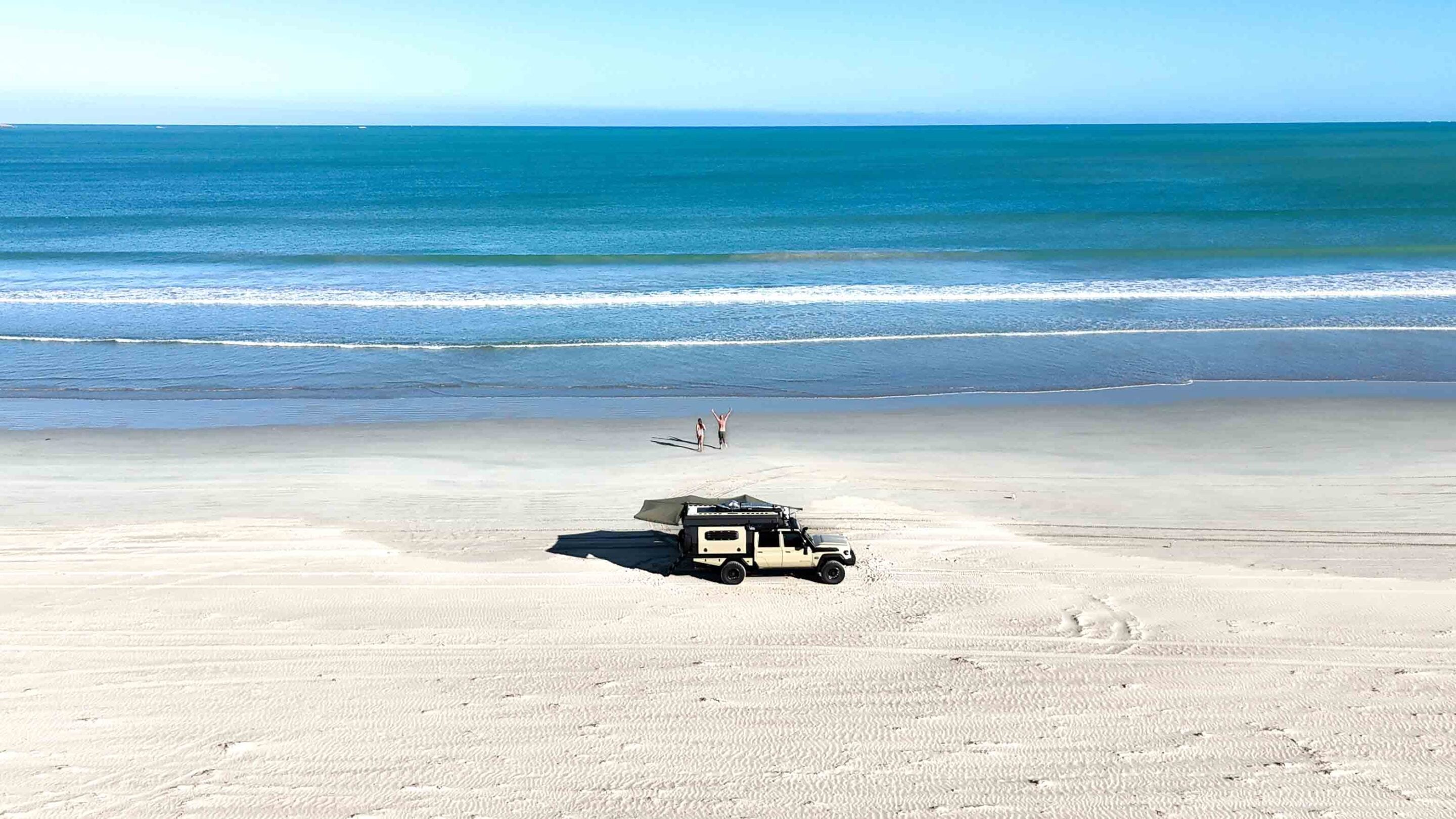
That is not because interest in road trips has faded. Nearly eight in 10 respondents said they would take their dream road trip within the next 12 months if financial pressures were removed, while more than a quarter said they would head off within three months. Cost remains the key barrier. Almost seven in 10 owners cited fuel prices and broader living expenses as the main reason they had scaled back travel plans, while nearly two-thirds said they had taken fewer road trips over the past year.
The findings help explain why many capable and often expensive adventure vehicles spend more time in suburban driveways than on remote tracks. The average Australian household now spends around $23,500 a year on vehicle-related costs, including close to $3000 on fuel, according to the report. For those planning a lap of Australia, Club 4X4 estimates fuel alone now costs more than $3000.
The impact is not evenly spread across the country. Queensland recorded some of the highest levels of inactivity, with more than one in five 4WD owners saying they had not taken a single road trip in the past 12 months.
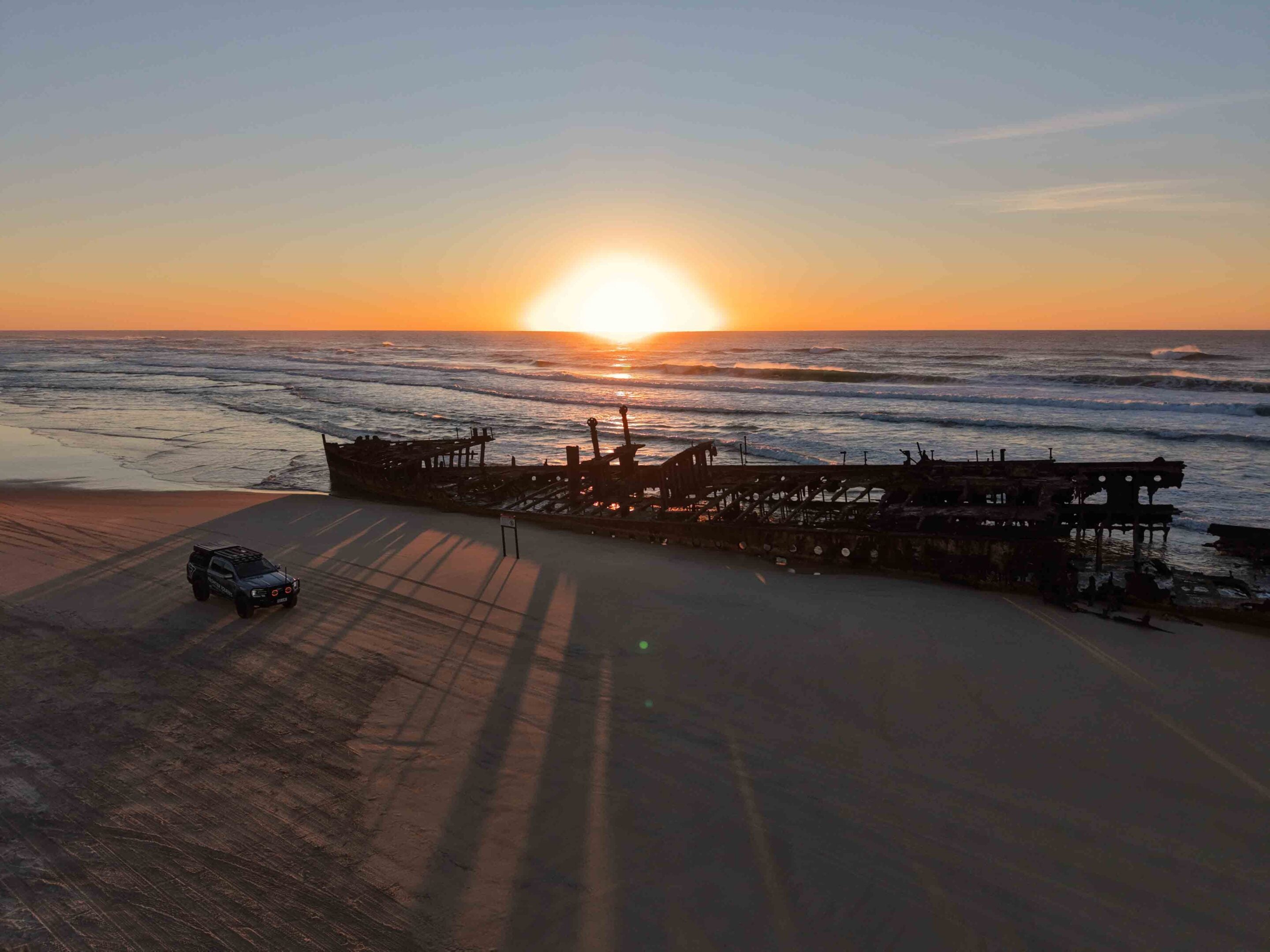
Western Australia reported the highest cancellation rate nationally, with 17 per cent of owners saying they had cancelled all road trips, and one in four not taking any trips at all. Fuel costs were also the top barrier in WA at 37 per cent.
Victorian owners were also pulling back, with 67 per cent saying they had taken fewer road trips over the past year, and one in six reporting they had cancelled trips entirely. While South Australia stood out as the most resilient state, with 21 per cent of owners saying they had not reduced their road travel at all.
Younger Australians are also shifting travel patterns. One in five under-30s said they had taken more overseas holidays than domestic trips because it was cheaper, compared with 11 per cent across all respondents.
Despite this, demand for domestic road trips remains strong. The Great Ocean Road was the nation’s top bucket-list drive, nominated by 31 per cent of respondents, followed by an East Coast coastal road trip (23 per cent) and a lap of Tasmania (22 per cent). The Red Centre and Uluru (16 per cent), Coral Coast (15 per cent), Flinders Ranges and SA outback (13 per cent), Kimberley (12 per cent), Victorian High Country (12 per cent), K’gari (11 per cent) and Cape York (11 per cent) rounded out the list.
To coincide with the findings, Club 4X4 has launched its Mod Grant competition (↗), offering one winner $30,000 worth of ARB accessories. Other prizes include fuel vouchers and vouchers to use at BIG4 Parks around the country.
“We’re doing this to help give Aussies an added boost, so they can begin their next adventure sooner,” said Tony Mitchell, Club 4×4 CEO. “For some it’s a lift kit. For others, it’s the fuel. Whatever the barrier, we want to help more Australians actually use these vehicles the way they were intended.”
Australia Unlocked by the numbers
- 94% of 4WD, SUV and ute owners primarily use their vehicles for commuting, school runs and errands.
- 64% have taken fewer road trips in the past 12 months.
- 67% cite fuel and cost-of-living pressures as the main barrier to travelling.
- 18% of under-30s travel overseas more than domestically because it is cheaper (vs 11% overall)
- Nearly 8 in 10 would take a dream road trip within 12 months if financial pressure was removed
- More than 1 in 4 would leave within 3 months
- Average household vehicle costs: $23,500 per year (around $3,000 fuel)
- Lap of Australia fuel cost: $3,000+
The Australia Unlocked Report was conducted by Pureprofile on behalf of Club 4X4 in May 2026, surveying a nationally representative sample of 1009 Australian 4WD, SUV and ute owners.
BYD believes it can become the world’s largest automaker by scale within five years, driven by rapid export growth, vertical integration and continued investment in battery, charging and driver-assistance technologies.
As reported by CarNewsChina (↗), chairman Wang Chuanfu framed the target as part of a long-term strategy to expand international sales while strengthening the company’s position across both domestic and overseas markets.
Overseas growth is being supported by localisation efforts and tighter logistics control. In Australia, BYD’s dedicated car carrier Zhengzhou, part of its expanding shipping fleet, moves vehicles directly from China to local ports on its own schedule, helping match supply with rising demand as exports scale.
The company is also leveraging a large connected-vehicle fleet to generate driving data at scale, feeding development of its driver-assistance systems. This sits alongside ongoing investment in software and chip development. Vertical integration across batteries, power systems and software remains central to its cost-efficiency and global expansion strategy, with fast-charging and battery technology key to its roadmap.
BYD has evolved from a small domestic player into a global heavyweight in just five years, with sales rising from roughly 190,000 vehicles in 2020 to more than 4.6 million in 2025. That reflects a sharp early growth phase, including triple-digit increases in 2021 and 2022, followed by more moderate gains as volumes scaled in later years.
The trend points to a shift from hyper-growth to sustained expansion as BYD pushes deeper into global markets. In Australia, sales rose 155 per cent year-on-year in May 2026.
Walk into a ute showroom in the last fortnight of June and you can feel the maths happening in real time.
The salesperson wants the deal signed before the books shut. The buyer wants a number their accountant will nod at. Between them sits a Ranger, a HiLux or a D-MAX wearing a drive-away price a fair bit sharper than it looked back in March.
In 2026 there is more reason than usual to be in that room. Diesel is at record prices, a clutch of big nameplates are mid model-change, and the newer brands are knocking five figures off stickers to buy their way onto driveways. Kia has just cut up to $13,000 off the Tasman. Ford has taken almost $15,000 off parts of the Ranger Hybrid range. The deals are the real thing. So are the traps, and the biggest one is the tax story almost everybody gets wrong.
- Last updated May 2026. Prices are drive-away or before on-road costs as noted, current at time of writing, and they move. Confirm everything with the dealer before you sign.
JUMP AHEAD
- Before you sign
- Ford Ranger
- Toyota HiLux
- Toyota Tundra
- Isuzu D-MAX
- Mitsubishi Triton
- Mazda BT-50
- GWM Cannon
- BYD Shark
- Kia Tasman
- Nissan Navara
- Ineos Grenadier
- Ram 1500
- Volkswagen Amarok
- Wildcards worth a quote
- How to land a deal before June 30
- FAQs
Before you sign: the EOFY ute tax reality in 60 seconds
Sort this out before you fall for a discount, because the most repeated EOFY tip is simply wrong.
- The $20,000 instant asset write-off does not cover a new ute. It is a federal measure, not a state one, and it only applies to assets that cost under $20,000. Every new ute costs more, so it is depreciated through the small business pool (15 per cent the first year, 30 per cent each year after), not written off in one hit. The toolbox and the UHF qualify. The ute does not.
- The car limit for 2025-26 is $69,674. If your ute is classed as a “car”, that is the most you can use to calculate depreciation no matter what you paid, and the most GST you can claim back is $6,334.
- The one-tonne rule decides everything. A ute built to carry one tonne or more, and not designed mainly to carry passengers, escapes the car limit (you depreciate the full cost) and can sit outside fringe benefits tax for genuine work use. Under one tonne and it is a “car”, capped. Most diesel single- and dual-cabs clear the line. The plug-in utes, BYD Shark included, often do not. Check the build-plate payload, not the brochure.
- Delivery date is the real deadline. To claim in the 2025-26 financial year, the ute must be delivered, registered and ready for use by 30 June 2026, not merely ordered or paid for.
- This is general information, not tax advice. Your structure, turnover and business-use percentage all change the answer. A ten-minute call to your accountant before you shop is worth more than any showroom pitch.
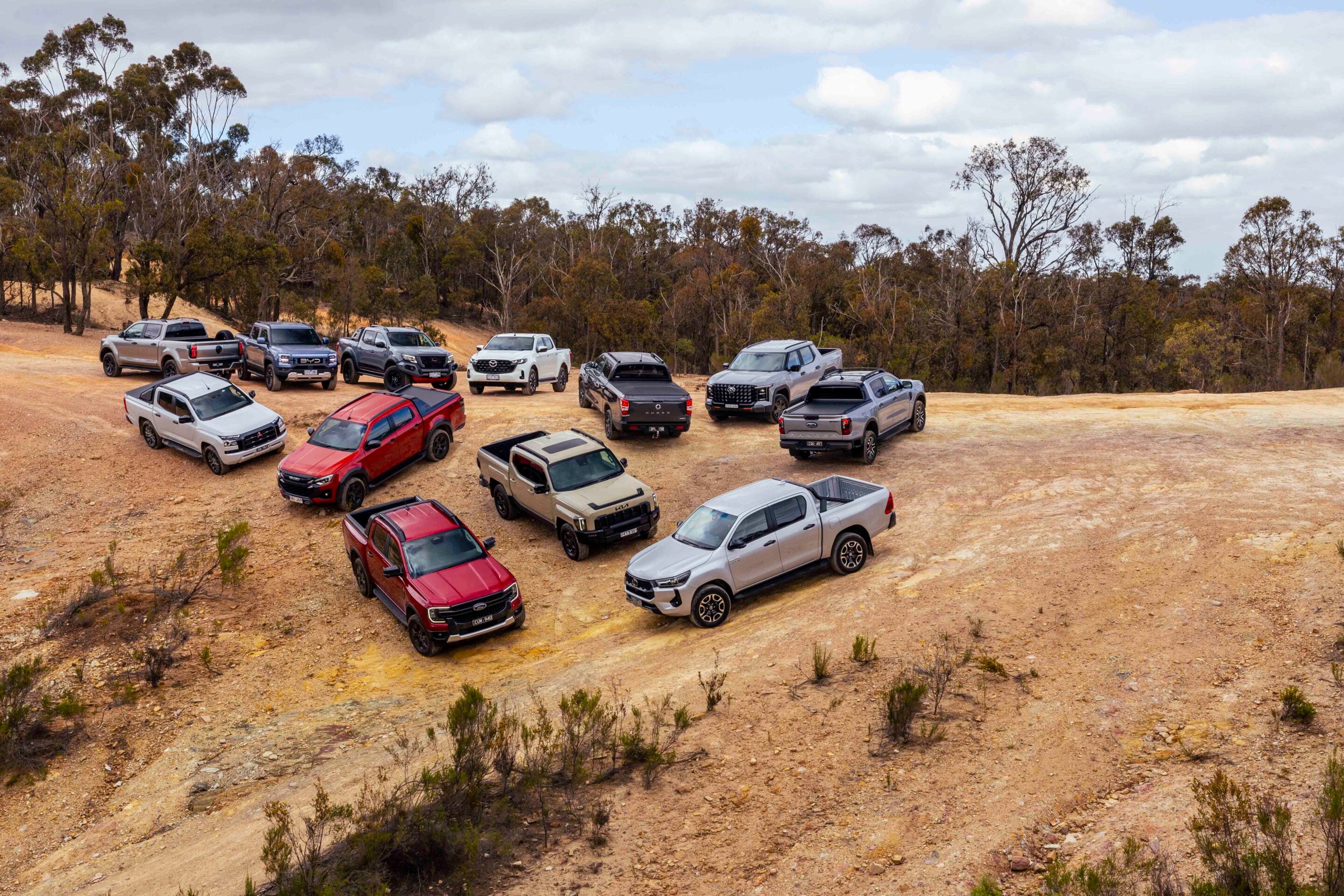
Ford Ranger
Ford is leaning on fuel cards and big cuts to the Hybrid range rather than touching the core diesel sticker. The Ranger is still the best-selling vehicle in the country, though its 4×4 sales slipped 7.4 per cent over the first four months of 2026 as rivals piled in. Ford’s EOFY headline is a $5000 fuel card on selected models, a direct answer to record diesel prices and arguably worth more to a high-kilometre tradie than a token discount.
On top of that, Ford has taken up to almost $15,000 off the new Ranger Hybrid range, with the XLT Hybrid now from around $62,000 drive-away and the Ranger Sport Hybrid (PHEV) from around $66,000 drive-away. The Wildtrak Hybrid sold out as fuel prices climbed and returns for the MY26.5 update at about $70,000 drive-away in the September quarter. There is run-out value on existing diesel stock, too.
For a high-kilometre operator, the fuel card or the Hybrid is the smart choice right now. For the cheapest Ranger, hunt the run-out diesel sitting in the yard.
Finance offer (↗)
Ford is offering competitive EOFY finance across selected Ranger (and Everest) models. Ranger Platinum and Ranger Raptor buyers can access a 6.99% p.a. finance offer for approved ABN holders, while selected Everest and Mustang variants are available with a 5.92% p.a. interest rate and 6.99% p.a. comparison rate.
- Available on: Ford Ranger Platinum and Raptor (also Everest Sport V6, Tremor and Platinum)
- Offer period: 20 May 2026 to 30 June 2026
Fuel card offer (↗)
Ford is throwing in prepaid fuel cards worth up to $5000 across selected Ranger and Everest variants. MY26 and earlier models score up to $5000, while selected MY26.5 variants receive up to $4000.
- Available on: Selected MY26 and MY26.5 Ranger and Everest models
- Offer period: 1 April 2026 to 30 June 2026
MY26.5 Ranger driveaway offer (↗)
Ford’s updated MY26.5 Ranger range is available with driveaway deals including the Ranger Wolftrak V6 4×4 Double Cab from $73,000 driveaway.
- Available on: MY26.5 Ford Ranger range
- Offer period: 1 May 2026 to 30 June 2026
Toyota HiLux
Toyota almost never blinks on HiLux pricing, so your leverage is at dealer level on stock that is already run-out. The HiLux is the one nameplate where you should temper your expectations. Demand has always been strong enough that Toyota seldom runs aggressive factory drive-away campaigns, and that has not changed.
The diesel 4×4 range opens around $57,990 before on-road costs for the SR and tops out near $71,990 for the Rogue and Rugged X, now with a 48-volt mild-hybrid in the mix. The new electric HiLux BEV lands from $74,990 before on-roads and is squarely aimed at fleets and mine sites.
The wrinkle worth knowing: an all-new HiLux on a fresh platform is due late 2026 or early 2027, which makes current stock effectively run-out. An in-stock HiLux gives you something to negotiate on, but do not sit on your hands waiting for Toyota to gut the price. It is not that kind of brand.
There are currently no specific EOFY deals running for the new HiLux
Toyota Tundra
Toyota is backing the Tundra with a simple EOFY package aimed at new and demonstrator stock, combining on-road cost relief with a cash bonus on eligible vehicles.
Buyers can access free on-road costs plus a $10,000 EOFY bonus on new and demonstrator Tundra models built up to July 2025. The offer is designed to move existing inventory rather than change list pricing, with value applied at the point of purchase on qualifying stock.
The campaign runs from 1 May 2026 through to 30 June 2026, giving a short, targeted window to secure the bonus on available Tundra vehicles before EOFY wraps up.
Tundra EOFY offer (↗)
Toyota is offering free on-road costs plus a $10,000 EOFY bonus on new and demonstrator Tundra models built up to July 2025.
- Available on: Toyota Tundra
- Offer period: 1 May 2026 to 30 June 2026
Isuzu D-MAX
The benchmark work ute, where the six-year warranty and flat-price servicing are as much the deal as the drive-away number. The D-MAX is the tradie and fleet favourite for good reason, and the ownership package is hard to argue with: a six-year, 150,000km warranty, five years of flat-price servicing and seven years roadside assistance.
Drive-away pricing has been running across the range, from the SX 4×2 single-cab chassis (2.2-litre) at $36,990, to the X-RIDER 4×4 crew at $56,990, up to the TOUR MATE LS-U at $72,990 and LS-U+ at $75,990.
The new 2.2-litre is the volume engine. The 3.0-litre starts attracting penalties under the New Vehicle Efficiency Standard from 2026, which may nudge pricing on those variants, so watch that space. The SX single-cab carries up to 1,350kg of payload, which clears the one-tonne line that matters for the commercial-vehicle tax treatment. Worth confirming whether the current drive-away campaign, scheduled to run to 31 May, has rolled into June.
Test drive gift card offer (↗)
Test drive a new 2.2-litre D-MAX (or MU-X) and receive a $50 digital gift card after completing a short survey.
- Available on: 2.2L D-MAX and MU-X
- Offer period: 1 November 2025 to 30 June 2026
Mitsubishi Triton
The most improved ute in the class is also among the sharpest on price, and the new Raider is the standout. The current-generation Triton is selling strongly, with 4×4 sales up 10.4 per cent year-on-year in 2026 while bigger rivals went backwards.
The headline for EOFY is the new Raider flagship at $74,990 drive-away, with suspension and steering tuned by local engineering firm Premcar and a chosen wheel-and-all-terrain-tyre package. That price undercuts the Ford Ranger Tremor and the Toyota HiLux Rugged X once on-road costs are added to the rivals. Mitsubishi has historically sweetened EOFY with bonus cash cards on Triton, so ask what is current, and its conditional warranty runs up to 10 years or 200,000km when the ute is serviced on schedule within the Mitsubishi network.
For a tough-spec dual-cab without stepping up to V6 money, the Triton is the rig that makes the others justify their premium.
MY25 Triton runout sale (↗)
Mitsubishi’s MY25 Triton runout campaign includes promotional driveaway pricing across the range, plus a $2,000 fuel card on selected variants.
- Available on: MY25 Mitsubishi Triton range
- Offer period: 1 May 2026 to 30 June 2026
Triton EOFY event (↗)
The latest Mitsubishi Triton lineup is also available with EOFY driveaway pricing, with selected GLX-R and GLS variants including three years of free servicing.
- Available on: Mitsubishi Triton range
- Offer period: 1 May 2026 to 31 May 2026
Mazda BT-50
The same hardware as the D-MAX in a sharper suit, often with a slightly keener deal, so cross-shop the two. Mechanically the BT-50 is a D-MAX, which means proven underpinnings and the same 3.5-tonne braked towing. Mazda’s EOFY sale runs to 30 June, with dual-cab drive-away pricing from around $53,990, plus Mazda Assured finance options sitting near a 2.99 per cent rate with balloon structures aimed at business buyers. New Thunder and Boss variants have arrived for 2026.
If you are looking at a D-MAX, get a BT-50 quote on the same spec before you decide. The Mazda often comes in a touch sharper, and the cabin finish is a step up for the family-and-work crossover buyer.
BT-50 finance offer (↗)
Business buyers can access a 2.99% APR finance offer on eligible Mazda BT-50 XS Dual Cab models over a 36-month term.
- Available on: Mazda BT-50 XS Dual Cab
- Offer period: 1 May 2026 to 30 June 2026
GWM Cannon and Cannon Alpha
The value pick, where a seven-year warranty and a cash-or-finance choice do the heavy lifting. GWM has gone after the segment with a seven-year, unlimited-kilometre warranty and aggressive drive-away pricing. The Cannon Alpha Ultra has been listed from $56,990 including $2000 off, with Cannon Alpha PHEV variants carrying up to $6000 off. National offers have included a choice of an extra $2000 cashback or a 1.99 per cent comparison-rate finance deal over three years with no deposit and no balloon.
As with several brands, the campaign deadline was 31 May with finance settling by mid-June, so confirm the June position before you bank on it. The Cannon Alpha PHEV is the cheapest established way into a plug-in ute, and for a buyer who leads with the budget and can live with a newer brand, the numbers do a lot of the talking.
Trade-in and loyalty offers (↗)
Existing GWM owners and their families can access a $3,000 trade-in bonus on selected models including the Cannon Alpha PHEV and Tank 500 PHEV. Current GWM owners can also claim a $1,000 garage loyalty bonus.
- Available on: Existing GWM and HAVAL owners
- Offer period: 15 April 2026 to 30 June 2026
BYD Shark 6
Australia’s best-selling plug-in ute now has a cheaper entry point, a tougher flagship, and finance that undercuts the diesel establishment.
The Shark 6 has muscled into the top five best-selling utes on the strength of its plug-in hybrid drivetrain. For 2026 the range has grown to three. The new Dynamic cab-chassis opens from $55,900, the Premium pickup holds at $57,900 (about $63,838 drive-away in Sydney), and a Performance flagship tops it at $62,900, all before on-road costs. EOFY brings $3000 cashback on the Premium and a 1.88 per cent comparison-rate finance offer over three years with no deposit or balloon, running to 29 June with settlement by 30 June. Warranty is six years or 150,000km on the vehicle and eight years or 160,000km on the battery, with vehicle-to-load to run tools straight off the tray.
Two caveats for work buyers. The Premium tows 2500kg where the diesel establishment and the new Performance hit 3500kg, and payload sits under one tonne (roughly 760 to 825kg), which means the Shark 6 is most likely taxed as a “car” rather than a commercial vehicle. Brilliant around town and on fuel, but read the towing and payload before you assume it replaces a diesel one-for-one.
Cashback offer (↗)
Receive $3000 cashback on selected new BYD plug-in hybrid models.
- Available on: BYD Shark 6 Premium
- Offer period: 13 May 2026 to 30 June 2026
Finance offer (↗)
BYD is also offering a sharp 1.88% p.a. comparison rate finance deal across selected plug-in hybrid models on a 3-year loan term, with no minimum deposit and no balloon payment.
- Available on: BYD Shark 6 Premium
- Offer period:1 April 2026 to 29 June 2026
Kia Tasman
Slow sales have triggered the biggest discounts in the segment, and the flagship is now genuinely sharp. The Tasman’s styling splits opinion and its sales started slowly, with about 1,658 registrations to the end of April 2026 against a 20,000 annual target. Kia’s answer is heavy drive-away cuts of up to $13,000, valid to 30 June 2026.
The flagship X-Pro 4×4 dual-cab is now $64,990 drive-away, down $13,000 from its $74,990 before-on-roads launch price. The X-Line sits at $59,990, the SX+ at $54,990 and the SX at $51,990, with the S 4×4 holding at $49,990 and a $1,000 deposit contribution on Kia Finance across the range. At $64,990 the X-Pro undercuts the Isuzu D-MAX X-Terrain 3.0 and the Toyota HiLux SR5.
The 2.2-litre diesel is among the most fuel-efficient in the class, the cabin is best in class, and Kia’s seven-year warranty applies. A redesign has already been flagged. Ignore the styling debate and look at the value: for $65,000 drive-away the X-Pro is one of the most equipped utes you can buy, and on these numbers it is a serious EOFY play.
Deposit contribution offer (↗)
Kia is offering a $1000 deposit contribution through Kia Finance across all in-stock new and demonstrator vehicles.
- Available on: New and demonstrator Kia vehicles
- Offer period: 1 May 2026 to 30 June 2026
Tasman driveaway offers (↗)
Kia dealers are advertising EOFY driveaway pricing across the Tasman ute range, with the Tasman X-Line listed from $59,990 driveaway and the flagship X-Pro from $64,990 driveaway.
- Available on: Kia Tasman range
- Offer period: Until 30 June 2026
Nissan Navara
The deepest run-out discounting of the established players. The past-gen Navara is at the end of its life, with an all-new, Triton-based model landing earlier this year. Nissan has reworked the work-focused variants and offered existing-owner finance near 1 per cent. Expect the sharpest clearance numbers of the mainstream pack here, because the brand is moving on old stock.
As a price-led work hack the Navara can stack up, but you are buying yesterday’s ute and resale will reflect that. Go in with eyes open and let the discount do the talking.
Navara finance and driveaway offers (↗)
Nissan is running EOFY deals across the MY26 Navara lineup, including low-rate finance offers for ABN holders, driveaway pricing on selected Navara SL variants, and deferred repayments for up to six months on eligible finance contracts.
- Available on: MY26 Nissan Navara range
- Offer period: Purchase by 31 May 2026 and delivery by 30 June 2026
Ineos Grenadier
INEOS is leaning into EOFY with a straightforward finance deal across the Grenadier range, targeting ABN holders looking to lock in a low-rate commercial purchase before 30 June.
Approved business buyers can access 1.99 per cent finance over 36 months on selected MY25 and MY26 stock, covering the Grenadier Station Wagon, Quartermaster, Cab Chassis and Black Edition. It is a clean, no-frills structure aimed at buyers prioritising cash flow over upfront discounting, particularly in the commercial and small business space.
The offer runs from 1 April 2026 through to 30 June 2026, giving a limited window to secure the rate across the core Grenadier line-up before EOFY conditions reset.
Grenadier finance offer (↗)
EOFY finance deals are available across the INEOS Grenadier range, with approved ABN holders eligible for 1.99% finance over 36 months on selected MY25 and MY26 vehicles.
- Available on: INEOS Grenadier Quartermaster and Cab Chassis (and Station Wagon and Black Edition)
- Offer period: 1 April 2026 to 30 June 2026
Ram 1500
RAM is keeping its EOFY push focused on finance, offering a straightforward low-rate deal on its flagship full-size ute for eligible buyers.
The RAM 1500 Rebel is available with a 4.99 per cent finance offer and no deposit required for a limited time, aimed at approved buyers looking to spread the cost without an upfront payment. The structure is designed to support business and lifestyle buyers who want predictable repayments rather than headline cash discounts.
The offer runs from 1 April 2026 through to 30 June 2026, giving a defined EOFY window to secure the finance rate on the Rebel before the campaign period closes.
Mates Rate finance offer (↗)
The RAM 1500 Rebel is available with a 4.99% finance offer and no deposit required for a limited time.
- Available on: RAM 1500 Rebel
- Offer period: 1 April 2026 to 30 June 2026
VW Amarok
Volkswagen is continuing its driveaway pricing strategy across the Amarok range, with a broad MY25 campaign covering the full lineup from work-focused variants through to flagship models.
The Amarok range is available with driveaway pricing from $55,990, spanning Core, Life, Style, PanAmericana and Aventura variants. The offer effectively sets a floor price across the range, with final driveaway cost varying by grade, spec and dealer stock rather than separate short-term bonuses.
The program runs through to 30 June 2026, giving an extended window for buyers to access consistent pricing across the MY25 Amarok line-up leading into EOFY.
Amarok driveaway offers (↗)
Volkswagen’s MY25 Amarok range is available with driveaway pricing from $55,990, spanning Core, Life, Style, PanAmericana and Aventura variants.
- Available on: Volkswagen Amarok range
- Offer period: 1 December 2024 to 30 June 2026
The wildcards worth a quote
Three more utes that will deal hard if your decision is led by the bottom line, not the badge. The JAC T9 is following Ford’s lead with a $4,000 fuel card. The KGM Musso (formerly SsangYong) offers diesel value, with a Musso EV from around $60,000 drive-away. The LDV T60 remains the budget benchmark. None of them carry the dealer network or the resale of the majors, but on price alone they force the conversation, and at EOFY that is leverage you can use elsewhere.
JAC T9 EOFY offer (↗)
Every JAC T9 ute purchased during EOFY comes with a $4,000 fuel card, with the deal available across the full T9 range.
- Available on: JAC T9 range
- Offer period: 1 May 2026 to 30 June 2026
LDV T60 MAX driveaway offer (↗)
Selected LDV T60 MAX variants are available with driveaway pricing from $36,990 and include a free tow bar, with savings of up to $2,500 off RRP.
- Available on: T60 MAX Pro and MAX Plus
- Offer period: 1 November 2025 to 30 June 2026
MGU9 savings offer (↗)
MG’s EOFY campaign includes savings and cashback offers ranging from $500 to $3,000 across a broad selection of models.
- Available on: Selected MG models including U9
- Offer period: 1 April 2026 to 30 June 2026
MGU9 free servicing offer (↗)
Selected MG models are also available with five years of free scheduled servicing on new and demonstrator vehicles.
- Available on: U9
- Offer period: 1 April 2026 to 30 June 2026
How to actually land the deal before 30 June
The buyers who win at EOFY are the ones who sort the tax and the delivery before they ever talk price.
- Sort the tax first. The deduction depends on your business structure, your turnover and your genuine business-use percentage, not on the salesperson’s pitch. Confirm it with your accountant before you shop.
- Buy stock that is in the yard. If you want the deduction this financial year, the ute has to be delivered and ready for use by 30 June. A factory order that lands in July does nothing for your 2025-26 return.
- Check the build-plate payload. If the commercial-vehicle tax treatment matters to you, confirm the one-tonne figure before you add a heavy bar, a canopy or a long-range tank that could push you under it.
- Match the offer to how you use the ute. A fuel card beats a small discount when diesel is dear and you cover serious kilometres. A low finance rate matters more than a token cashback if you are borrowing. Work out which lever moves your numbers most.
- Read the expiry date. Plenty of campaigns badged “EOFY” actually expire on 31 May and reset for June, while others genuinely run to 30 June, and some finance offers must settle by mid-July. Ask exactly when the deal ends and what counts as meeting it.
- Negotiate the whole deal. The advertised drive-away number is the start of the conversation. Trade-in value, accessories thrown in and an in-stock ute the dealer wants gone before stocktake are all live. Keep your records straight afterwards: logbook, tax invoice and finance paperwork.
EOFY ute deals 2026: quick answers
The questions every tradie and business buyer asks at this time of year, answered straight.
Q: Can I claim the $20,000 instant asset write-off on a new ute?
A: In almost all cases, no. New utes cost more than $20,000, so they do not qualify for the instant write-off. They are depreciated through the small business pool instead, at 15 per cent in the first year and 30 per cent each year after.
Q: What is the car depreciation limit for 2025-26?
A: $69,674. If your ute is classed as a “car”, that is the most you can use to calculate depreciation, and the most GST you can claim back is $6,334.
Q: Do dual-cab utes avoid the car limit?
A: Only if they are built to carry one tonne or more and are not designed mainly to carry passengers. Many diesel utes qualify, but some, including most plug-in hybrid utes, sit under the line once accessorised. Check the payload on the build plate.
Q: Do I have to take delivery before 30 June?
A: Yes, to claim the deduction in 2025-26. The ute must be delivered, registered and ready for use by 30 June 2026, not merely ordered.
Q: Is EOFY actually the best time to buy a ute?
A: Often, for stock already in the yard, because dealers are chasing volume targets. The genuine bargains tend to be on run-out models, and the best total deal is not always the one with the biggest sticker discount.
The end of June rewards the buyer who did the homework in May. Sort the tax, find the stock, then talk price. A deal is only a deal once it survives contact with your accountant.
This article covers general information, not tax advice. Speak to a registered tax agent or accountant about your own circumstances before purchasing.
Rhino-Rack has introduced a new Low Profile Roof Top Tent (↗) built with a focus on lighter weight, quicker setup, and more usable roof space.
At 69kg excluding the ladder, it sits slim and low on the roofline while still packing in a range of practical features. The headline feature is the integrated accessory channels built into the hard top. Rather than a dedicated sleeping space, the tent doubles as a mounting platform, useful for 4WDers already building out their kit with extra lighting for the Simpson or a solar panel setup for extended Kimberley runs.
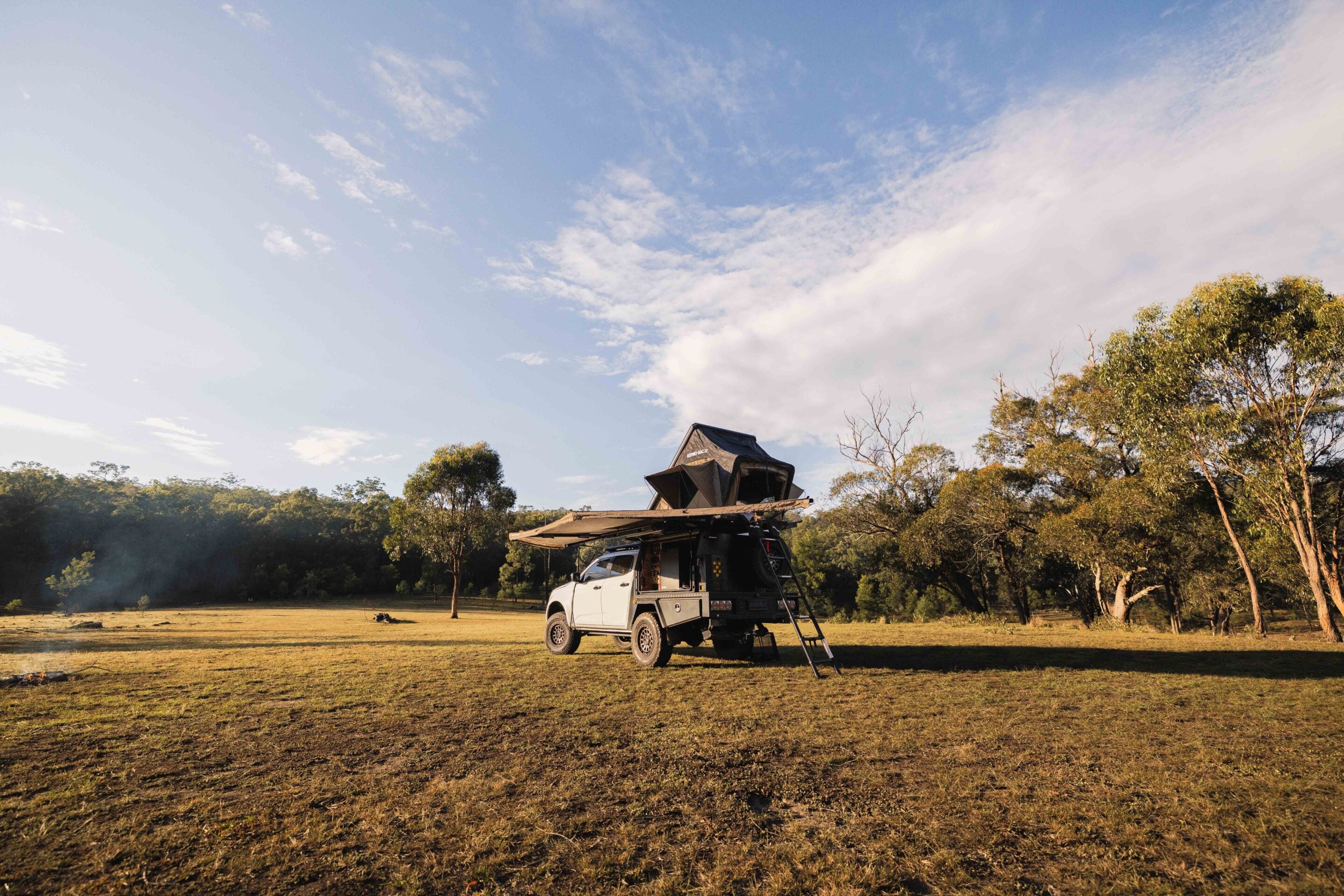
Setup and pack-down have been prioritised. Gas struts handle opening and closing, and a quick release mounting system comes supplied with brackets for fast installation and removal. For travellers swapping between a roof tent and a canoe on the Murray or a bike rack for High Country weekends, it should slot into most existing touring builds without much fuss.
Inside, dual-side mesh windows keep airflow and visibility sorted, which counts for a lot on warm nights. Integrated LED lighting connects to an external power source with adjustable brightness, and a built-in USB power board handles charging duties for devices or accessories. A dedicated pass-through via the heater tubing port keeps cabling tidy when wired into a vehicle or canopy battery system, a detail that matters on longer runs.
A dedicated heat tubing port and internal lighting channels support all-season use, handy for seasonal trips through the Vic High Country or Snowy Mountains. Ladder mounting points on both the side and rear provide flexible access to suit different vehicle setups. Inside there’s an organiser with multiple storage pockets plus a clear pocket sized for a tablet.
Boot bags on the outside keep muddy footwear out of the sleeping area after a day on the snotty tracks around Moreton Island or the Flinders Ranges, and a 70mm double-layer mattress rounds out the package.
The Low Profile Roof Top Tent from Rhino-Rack (↗) ships as a complete kit with the tent, ladder, mounting system, and all hardware and tools needed for installation.
Traditional 4×4 builds have generally put function over form as we modify cars to be stronger, more versatile and more capable for remote area touring and off-road escapades.
Sure, most of us appreciate a well-built, tidy rig, but paint and polish usually plays second fiddle to usability. Still, I found it interesting to check out the four-wheel drives on display at MotorEx (↗) recently. Put on by our good mates at Street Machine, MotorEx is a showcase of the best and most incredible show cars, street rods, cruisers and performance cars. However, with the growing popularity of the 4×4 segment, the event organisers are actively enticing off-roaders to their events. And some of them are truly mind-blowing!
While most of the 4x4s are parked up on a grass section of the Showgrounds, a few made it into the show halls and none was more amazing than the Ford F-100 pre-runner from Feketie Fabrications. With a supercharged Ford Coyote V8 engine set away back in its fabricated chassis that looks like it’s ready for the Finke Desert Race and back on black paint, this truck is totally mind-blowing! And the owner tells us that it was built to be approved for road use. It’s a truck that has to be seen to be fully appreciated.
There was also a swag of old-school LandCruisers at the show, many of them with 80 Series chassis swaps, V8 powerplants and hardcore touring set-ups. This style of vehicle is becoming more popular and we love seeing them. Liam’s LC79 was on display on the grassed area, where there were all types of 4x4s to be appreciated.
I found it interesting to see the way some builders are detailing their 4x4s with hot-rod or street-machine style and creating rides that are both stunning to look at while also being built to be capable.
We love seeing 4x4s that are built differently and to what their owner wants. We love featuring them here at 4X4 Australia too. So if you have a custom-built 4×4 you reckon is worthy of appearing here, get in touch and let us know about it.
Who knows, maybe your 4×4 could even be our next cover star!
Could the Feroza be the 4×4 comeback nobody saw coming? A stripped-back compact 4×4 like the Feroza could be exactly the kind of simple, capable off-roader the modern market is drifting back toward.
The Daihatsu Feroza was a compact 4×4 built around function first. It had proper low range, narrow proportions, and mechanicals simple enough to understand without a diagnostic laptop. It was never aimed at urban image buyers, instead finding use on tracks, in the Vic High Country, and on fire trails where size and weight mattered more than refinement. Today, clean examples are starting to command stronger prices than their original positioning would suggest, pointing to a renewed appreciation for simple, purpose-built off-roaders.
That resurgence mirrors a broader shift in the market. Compact off-roaders are back in demand. The Suzuki Jimny has proven there is strong appetite for small, capable 4x4s, often with long wait times in Australia. At the same time, more buyers are questioning whether large dual cabs are necessary for recreational touring, particularly for trips like the Gibb River Road or Victorian High Country. In that context, a smaller, lighter 4×4 becomes less of a compromise and more of a rational alternative.
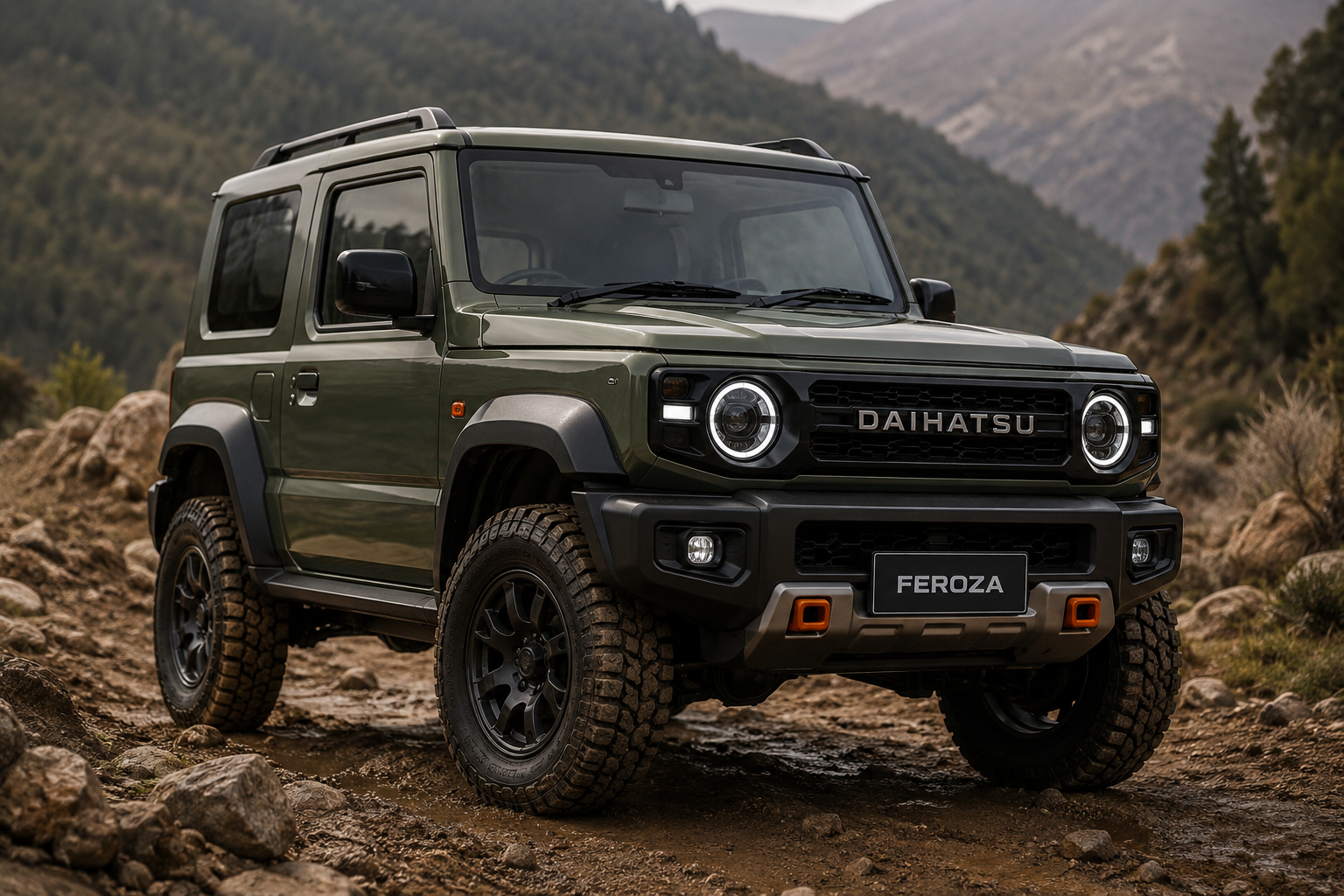
A revived Feroza would need to sit in that space: compact, durable, and genuinely off-road capable. The most realistic direction would be a reinforced lightweight SUV platform with proper low range 4×4 capability rather than a soft-roader layout. Wheelbase would likely sit close to the five-door Jimny, allowing seating for four and modest luggage space behind the rear seats.
Design would inevitably lean functional rather than decorative: upright glass, simple surfacing, and squared off guards. A removable or semi open roof option could be a strong differentiator, provided structural requirements could be met.
From day one, it would be an aftermarket canvas rather than an off-the-shelf touring package. Owners would lean straight into a mild lift and bull bar from ARB or Ironman 4×4 to suit tight bush tracks, and all-terrain tyres from BFGoodrich or Falken. Add recovery points, underbody protection, and a simple roof rack setup, and it would quickly take on the familiar shape of a properly equipped compact tourer. Nothing about it would require overthinking, just incremental upgrades to match intent.
Powertrain wise, a small turbocharged petrol engine with mild hybrid assistance is the most realistic approach. Outputs in the 100 to 130kW range would be sufficient, with torque delivery and gearing more important than peak figures. Keeping kerb weight under roughly 1400 to 1500kg would be critical to preserving capability and efficiency. Full electrification remains possible in theory, but would need careful consideration given long range touring across remote Australia.
Towing capacity in the 1000 to 1200kg range would position it for light campers and trailers without pushing the platform beyond its intended size or weight envelope.
Pricing is where the opportunity sits. If it could land around the low 40,000 dollar drive away mark, it would sit directly against the Jimny, entry level dual cabs, and compact soft roaders. The key differentiator would not be outright performance, but genuine off road hardware in a compact footprint.
For Australia specifically, success would depend on specification discipline: all terrain tyres from factory, proper recovery points, meaningful roof load rating, and a clear accessory pathway. The aftermarket already exists for this type of vehicle, with brands like ARB and Ironman 4×4 ready to support anything that proves itself mechanically sound.
The competitive landscape is clear. The Jimny sets the benchmark for compact capability. Larger 4x4s dominate towing and touring. Soft road crossovers dominate sales volume. A revived Feroza would need to sit deliberately between those categories rather than trying to outdo any single one.
The concept arrived ahead of its time. In the 1990s, buyers wanted bigger and faster. In 2026, the brief has shifted toward lighter, simpler, and more efficient vehicles. If executed correctly, the idea is no longer out of step with the market, it fits it.
When people start building a touring rig, the focus usually lands on suspension, tyres, power systems and recovery gear. But one of the most important parts of any long-range setup is often overlooked: water storage.
Because once you leave towns behind, water quickly becomes more important than almost anything else you carry. Whether it’s drinking water, cooking, washing up or a quick camp shower after a dusty day on the tracks, having a reliable water setup can make remote travel far easier and far more comfortable.
The good news is there are now more options than ever for fitting 4WD water tanks into modern touring setups, from compact cabin-mounted systems through to larger underbody tanks and modular canopy setups. These systems are designed to make water storage safer, cleaner and far more practical than loose containers or jerry cans.
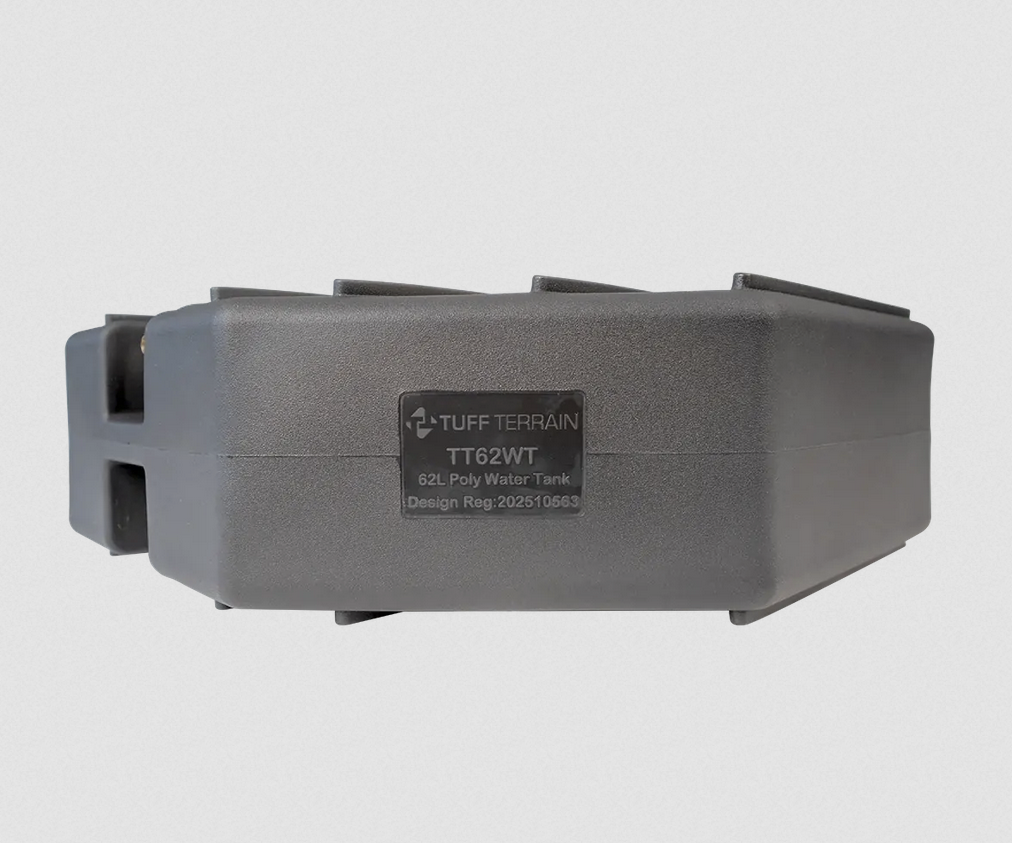
Products like the Tuff Terrain Spare Wheel Water Tank 62L (↗) and modular Outback Explorer water storage solutions (↗) are helping modern tourers maximise unused space while carrying more water safely for off-grid travel.
JUMP AHEAD
- Why a proper 4WD water tank setup matters
- How much water do you need for 4WD touring?
- Types of 4WD water tanks for touring setups
- What to look for in a 4WD water tank
- What about grey and waste water systems?
- Weight matters more than most people think
- Caravan and camper trailer setups
- Why a water tank can be essential
- FAQs
Why a proper 4WD water tank setup matters
Portable jerry cans still work, but dedicated water tanks offer a far cleaner and more practical solution for touring vehicles, especially once you start travelling longer distances or spending multiple nights off-grid.
A properly mounted tank doesn’t just store water, it changes how usable your setup is day to day. Instead of lifting heavy containers in and out of the vehicle, you get a fixed system that’s always ready to use, often with taps or pumps integrated directly into your setup. A properly installed tank:
• Keeps weight lower in the vehicle, improving handling on rough tracks
• Frees up valuable storage space in canopies or cabins
• Makes water access quicker and more convenient at camp
• Reduces movement and noise over corrugated roads
For longer trips, the biggest advantage is reliability. Water becomes a constant requirement in remote travel, and a fixed system ensures you’re not constantly managing loose containers or worrying about leaks and spillage.
How much water do you need for 4WD touring?
Water requirements vary significantly depending on trip length, climate and how self-sufficient you want to be.
In cooler conditions with minimal cooking, usage can be relatively low. In hot or remote environments, consumption increases quickly, especially if you’re washing up, showering or staying off-grid for extended periods. Most touring setups use water for:
• Drinking and hydration
• Cooking and food preparation
• Washing dishes and utensils
• Basic hygiene and cleaning
As a general baseline, 3 to 5 litres per person per day is considered the minimum for drinking and cooking only. However, once you factor in washing and comfort, real-world usage often sits closer to 5 to 10 litres per person per day. This is why 4WD touring water tanks typically fall into a few common ranges:
• 20 to 60L compact systems for weekend trips or solo touring
• 60 to 80L setups for mixed use and short off-grid stays
• 80 to 120L+ systems for extended remote travel or family touring
The right capacity comes down to balancing water independence with payload limits and available storage space in your build, whether it be underbody, portable or modular.
Types of 4WD water tanks for touring setups
Modern touring setups use a range of tank styles depending on layout, space and intended use. Each design solves a different storage challenge, and many builds use a combination of systems rather than a single tank.
Footwell water tanks (cabin-mounted storage)
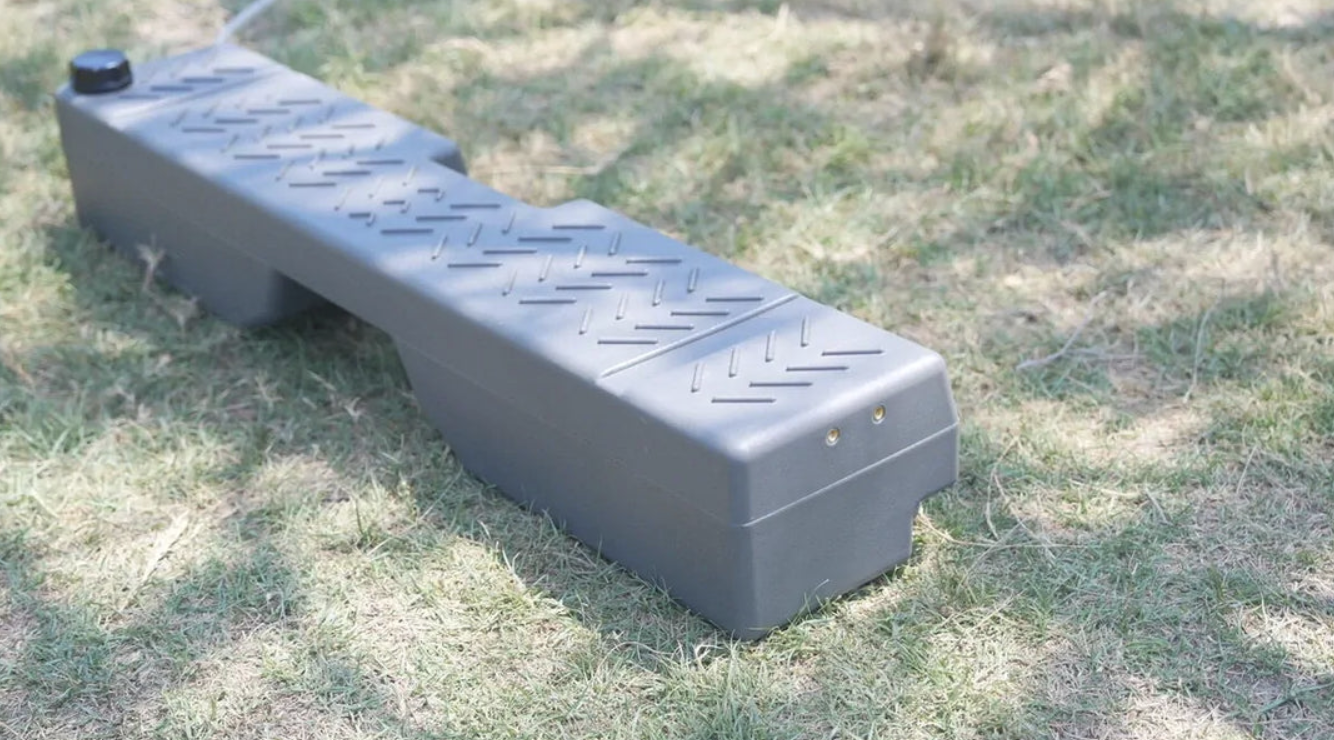
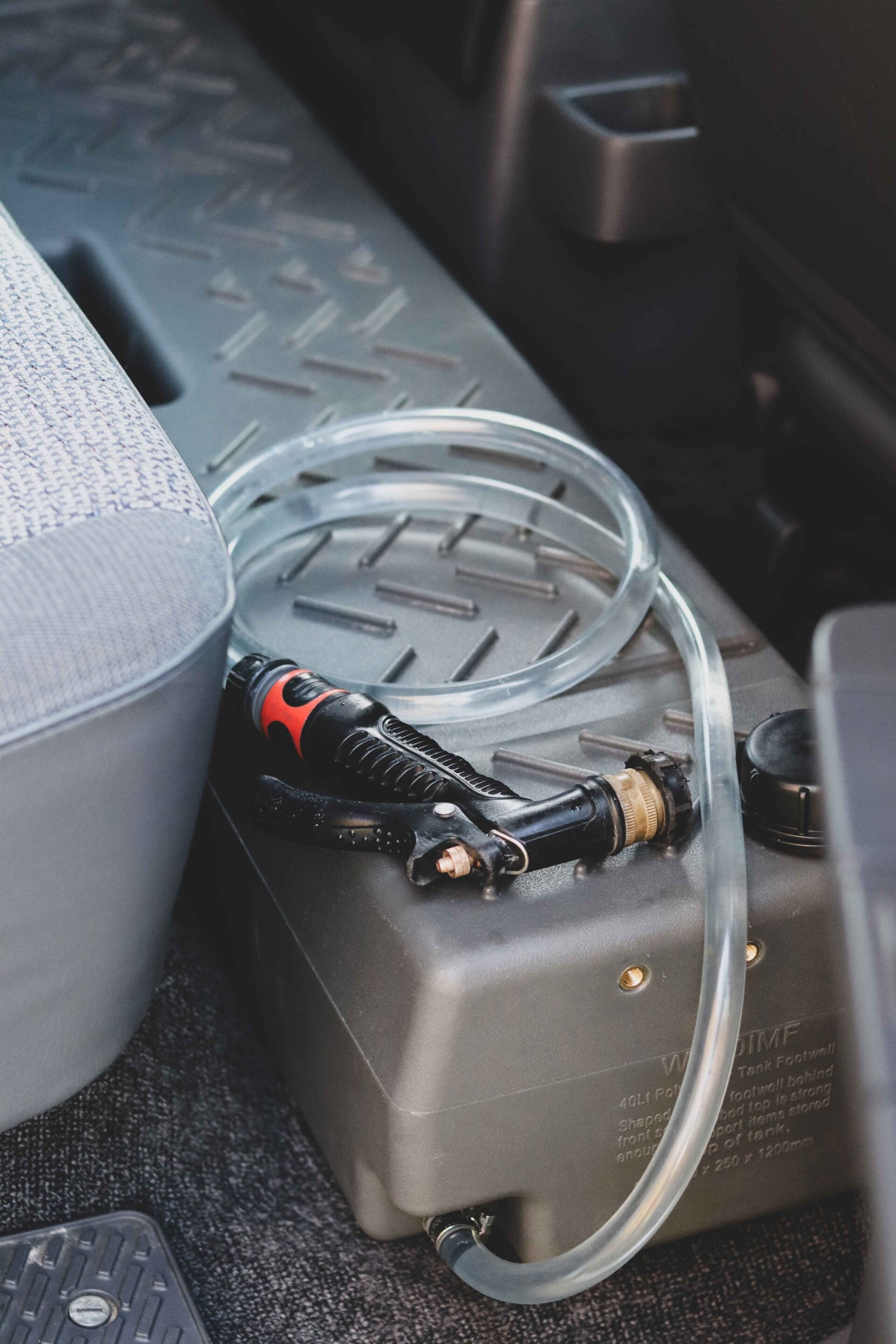
Footwell water tanks are designed to fit into unused cabin space, typically behind seats or in rear footwells. They have become especially popular in dual-cab touring setups where canopy space is already heavily used for drawers, fridges and gear storage. Compact solutions like the Tuff Terrain Poly Footwell Water Tank (↗) are increasingly used in dual-cab touring builds where every bit of canopy and drawer space counts.
Because they sit inside the cabin, these tanks are protected from external damage and temperature extremes. They also help centralise weight in the vehicle, which can improve balance on uneven terrain and reduce load on suspension components. They are best suited to weekend touring setups, compact dual-cab builds, and vehicles where canopy space is limited or fully utilised.
Underbody water tanks (long-range touring setups)
Underbody water tanks are mounted beneath the tray or chassis rails, allowing you to carry larger volumes without sacrificing internal storage space. This makes them particularly popular in long-range touring builds where space efficiency is critical.
These systems are often used in tray-back 4WDs, canopy builds and camper trailers where maximising usable storage above is a priority. The biggest advantage is capacity, you can carry significantly more water without affecting cabin or canopy layout. Underbody systems are particularly effective when paired with larger touring setups, while space-saving designs like the Tuff Terrain Spare Wheel Water Tank 62L (↗) utilise otherwise wasted spare wheel cavity space for high-capacity water storage.
However, because they are exposed, they must be properly mounted and protected. On rough tracks, they are subject to rocks, debris and impact, so build quality and installation are critical.
Vertical and modular water tank systems (canopy setups)
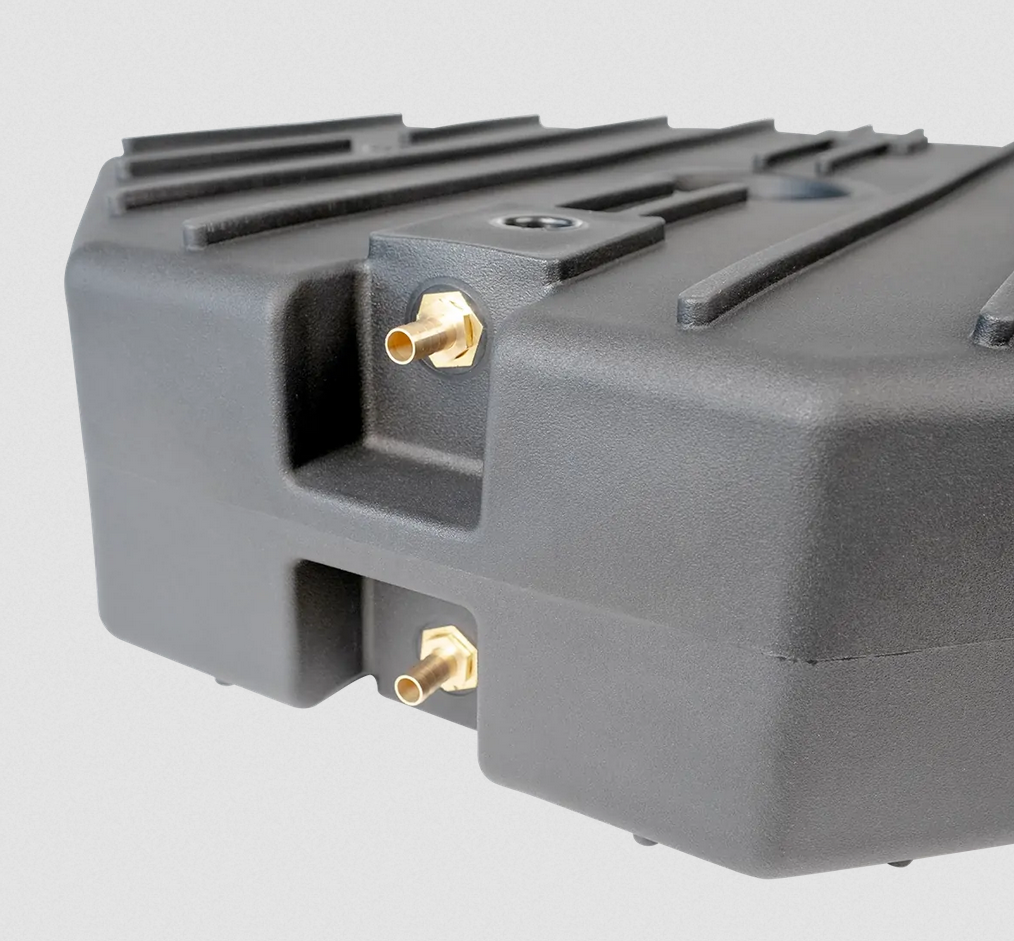
Vertical and modular tanks are designed to fit into tight or custom canopy layouts where space is limited or irregular. These systems are increasingly common in modern touring builds because they allow owners to tailor water capacity around their gear setup.
Modular systems are particularly useful because they can be expanded or reconfigured over time. This makes them ideal for evolving builds where storage needs change as trips become longer or more remote. Space-efficient designs like the Tuff Terrain 45L Vertical & Flat Water Tank (↗) and Tuff Terrain 42L Vertical Mount Tank (↗) are designed for tight canopy and tray setups, helping maximise usable storage space while still carrying practical water capacity for touring and camping.
These systems can also be paired with optional pump kits for easier pressurised water access at camp, making them ideal for washing up, showers and general off-grid use. Outback Explorer pump kits (↗) are also commonly used in touring setups for similar applications. They also help distribute weight more evenly throughout the canopy, rather than concentrating it in a single area.
What to look for in a 4WD water tank
Choosing the right water tank is about more than just size, it’s about durability, compatibility and long-term reliability in off-road conditions.
Food-grade material quality: Most quality touring water tanks use food-grade polyethylene designed for potable water storage. This is essential for maintaining water safety over long periods, especially in warm conditions where lower-quality plastics can affect taste or encourage algae growth. Good-quality materials also improve resistance to cracking, UV exposure and long-term wear, which is important in vehicles exposed to constant movement and vibration.
Mounting strength and off-road durability: Water weight increases quickly, and a full tank places consistent load on mounting points. This is especially important on corrugated roads where vibration is constant. Because 1L of water equals approximately 1kg, even a mid-sized tank can add significant weight once filled. Poor mounting systems often fail not from static load, but from repeated vibration over time. Secure mounting and proper bracing are essential to ensure the tank remains stable and safe under off-road conditions.
Shape and space efficiency: Efficient tank design plays a major role in modern 4WD builds. Instead of using generic rectangular tanks, many setups now rely on purpose-shaped designs that fit into unused or awkward spaces. This includes footwells, wheel arches and vertical canopy gaps that would otherwise go unused. These designs help maximise water capacity without compromising storage for other essential touring gear.
Water pumps, fittings and touring accessories: Once a water tank is installed, additional components can significantly improve usability and convenience at camp.
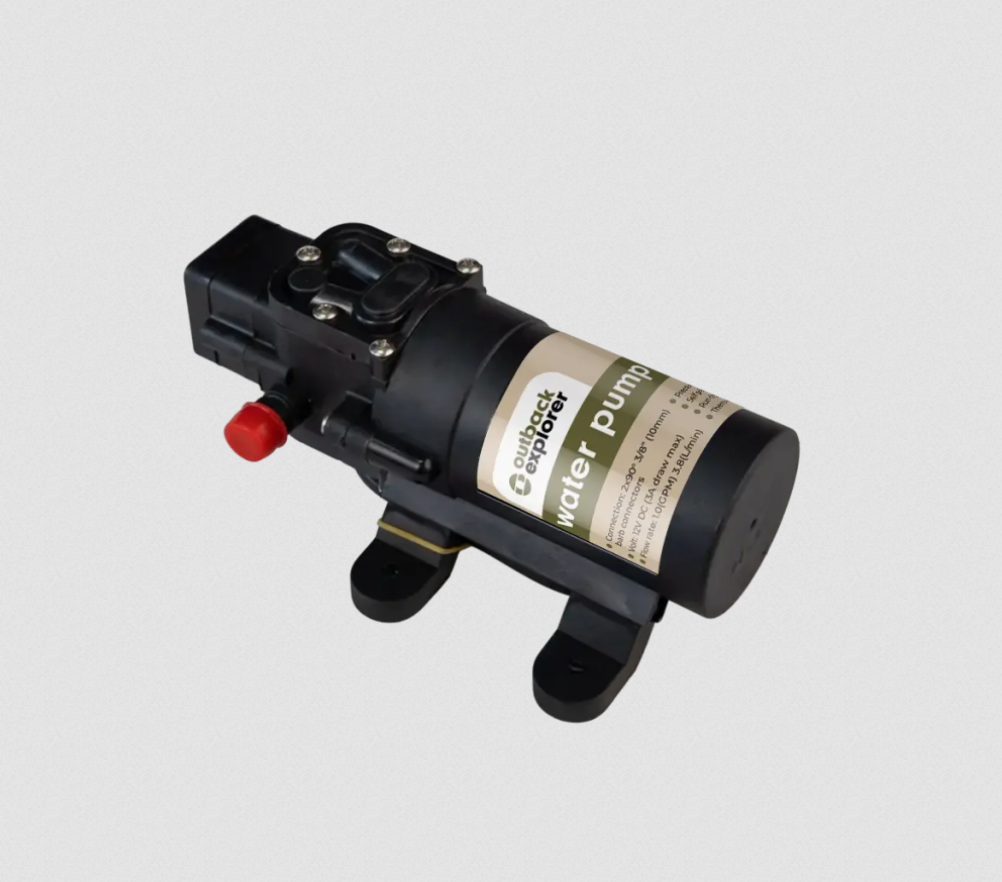
12V water pumps: A 12V pump allows for pressurised water delivery, making tasks like washing dishes, filling bottles or running camp showers far easier. Instead of relying on gravity-fed systems, pressurised setups provide consistent flow similar to household taps. This is now a standard upgrade in many touring builds because it dramatically improves usability without adding much complexity. Reliable pump systems such as the Outback Explorer 12V Water Pump (↗) are commonly used in touring and caravan setups to provide consistent pressurised water flow for camp kitchens, showers and general use.
Quick-connect fittings and hose systems: Quick-connect systems simplify water transfer between tanks, jerry cans or external sources. This becomes especially useful on longer trips where refilling is frequent and efficiency matters. They also reduce mess and spillage, which is a common issue when handling water in remote or uneven terrain. Pairing tanks with quality hose kits, quick-connect fittings and portable pumps can make refilling and camp setup significantly faster, especially on extended remote trips.
Tank level monitoring: Water levels are difficult to estimate accurately, especially in opaque tanks or modular systems. Simple gauges or digital monitoring systems provide real-time feedback, helping avoid unexpected shortages. This is particularly important in remote areas where water access is limited or unreliable.
What about grey and waste water systems?
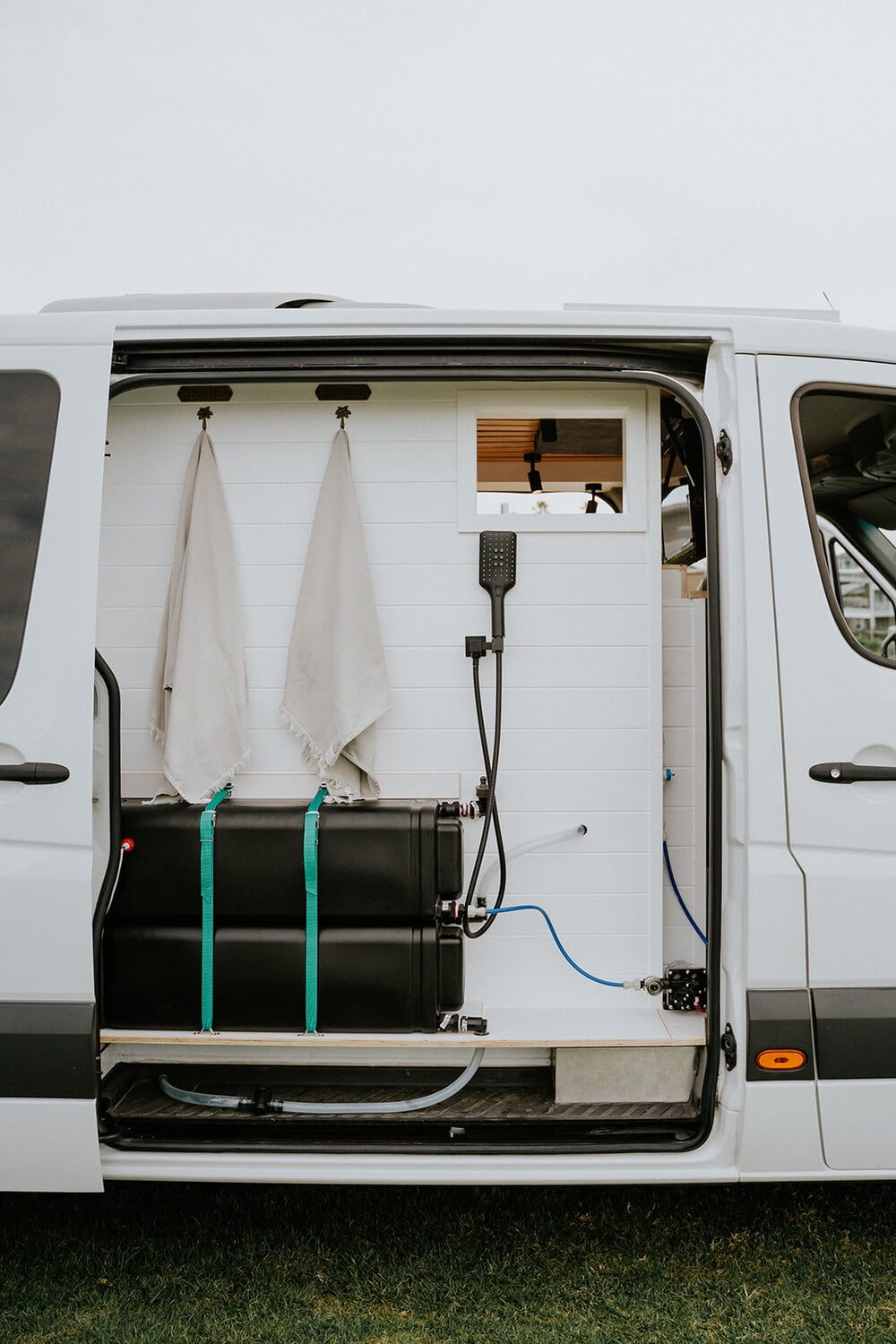
Grey water refers to wastewater from sinks, showers and washing up, while black water comes from toilets in camper trailers and caravans.
In most 4WD touring setups, grey water management is the more relevant consideration, especially when camping in areas with strict environmental rules or sensitive ecosystems. Simple diversion systems can route sink or camp kitchen runoff into a dedicated container, allowing it to be disposed of responsibly at approved dump points.
More advanced setups integrate underbody grey water tanks that store waste temporarily while travelling. Black water systems are typically only found in caravans and camper trailers, where sealed holding tanks and regulated disposal points are required.
Weight matters more than most people think in touring setups
Water is one of the heaviest consumables in any 4WD build, and its impact on vehicle dynamics is often underestimated.
When combined with other touring gear such as drawers, fridges, dual batteries, rooftop tents and recovery equipment, payload can be consumed quickly. Poor weight distribution can also affect handling, braking and suspension wear, especially on uneven or corrugated tracks. That’s why placement is just as important as capacity. Keeping water low and central helps maintain stability and reduces strain on the vehicle.
Caravan and camper trailer water tank setups
Water storage principles are similar in caravans and camper trailers, but capacity and usage patterns are often larger due to extended stays in one location.
Because caravans carry more overall weight, distribution becomes even more critical, particularly in relation to tow-ball load and axle balance. Most setups include combinations of:
• Fixed underbody tanks such as the Tuff Terrain Spare Wheel Water Tank 62L (↗)
• External fill points
• 12V pump systems
• Hot water systems for showers
Why a water tank is essential
A well-designed water system is one of the most underrated upgrades in any touring build. While it does not get the attention of suspension or tyres, it has a direct impact on how long and how comfortably you can travel off-grid.
Modern 4WD water tank systems make it far easier to carry enough clean water safely, without wasting valuable storage space or relying on loose containers. Whether it’s a compact footwell setup for weekend trips or a full underbody system for long-range touring, the right setup adds genuine independence once you leave sealed roads behind. When you’re days from the nearest town, reliable water storage stops being a convenience and becomes essential.
FAQs
What size 4WD water tank do I need for touring?
Most touring setups range from 20 to 40L for short trips up to 80 to 120L+ for extended remote travel, depending on occupants and usage.
Are 4WD water tanks better than jerry cans?
Yes. Tanks offer better weight distribution, easier access and improved storage efficiency compared to loose containers.
Where should I mount a water tank in a 4WD?
Common locations include underbody mounting, cabin footwells and inside canopy storage systems depending on vehicle layout.
Do I need a pump for a 4WD water tank?
Not always, but a 12V pump greatly improves usability for washing, drinking and camp showers.
Are underbody water tanks safe off-road?
Yes, provided they are properly mounted, reinforced and protected from impact and debris on rough terrain.
What is a spare wheel water tank?
A spare wheel water tank is a space-saving water storage solution designed to utilise the unused cavity inside a spare wheel location. Products like the Tuff Terrain 62L Spare Wheel Water Tank (↗) allow tourers to carry large water capacity without sacrificing valuable canopy or tray space.