







Brochures covering Kelly Country touring are available throughout the region.
Gregory Powell is the author of Bushranger Tracks and Bushranger Tracks – Beyond the Legends.

The diminutive 4×4 has been so popular that long wait times became normal if you wanted a new Jimny and Suzuki soon upped prices to match the demand.
With its cute yet boxy styling being such a hit for fans there was soon talk of expanding the range of Jimny variants from just the three-door wagon. Talk and computer-generated images of long wheelbase and ute versions of the Jimny were popping up everywhere, and the public couldn’t wait to see them happen, prompting some enthusiasts to create their own versions.
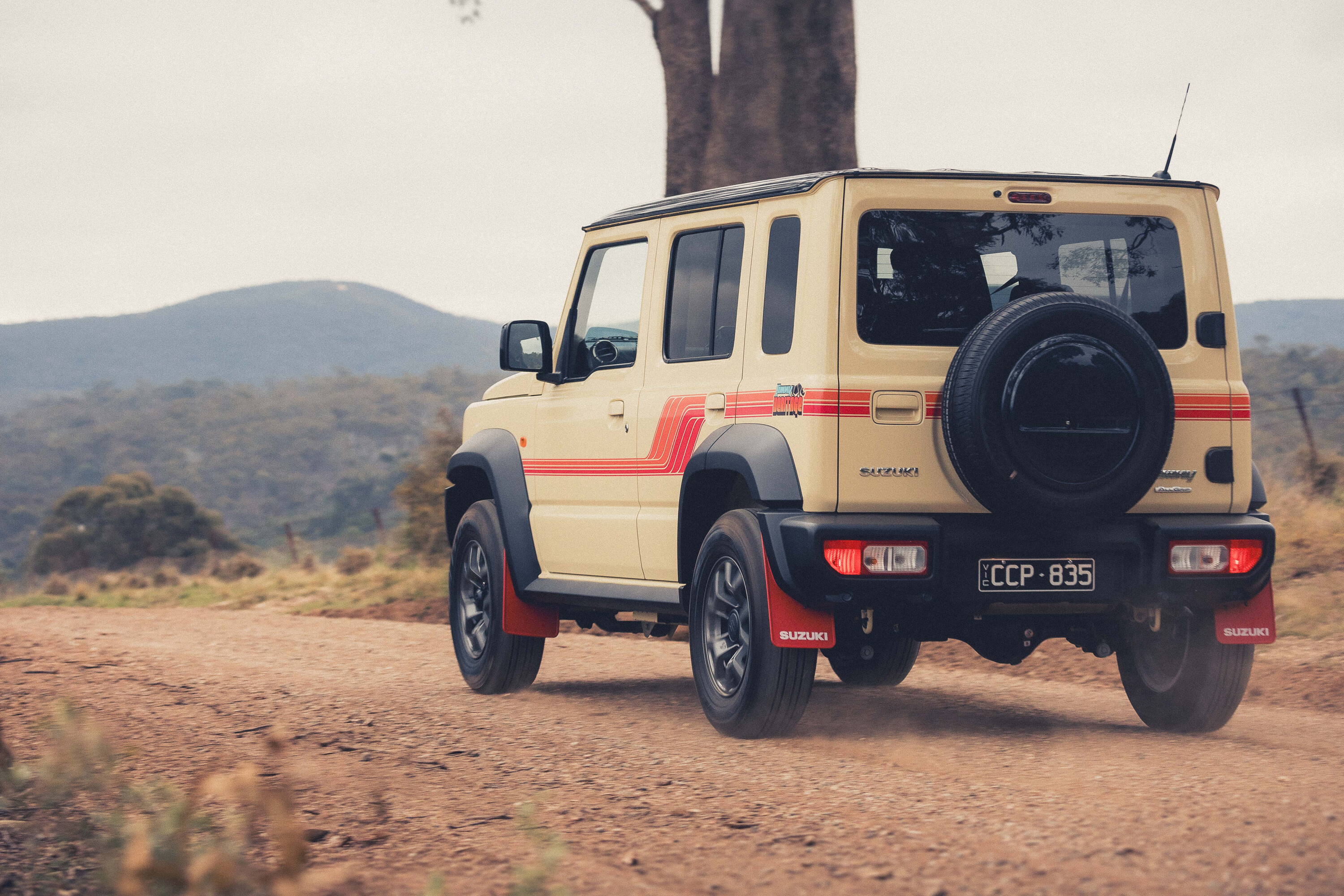
This is a five-door wagon that makes the Jimny more versatile by adding extra space for both passengers and luggage, and easier access via a second set of doors.
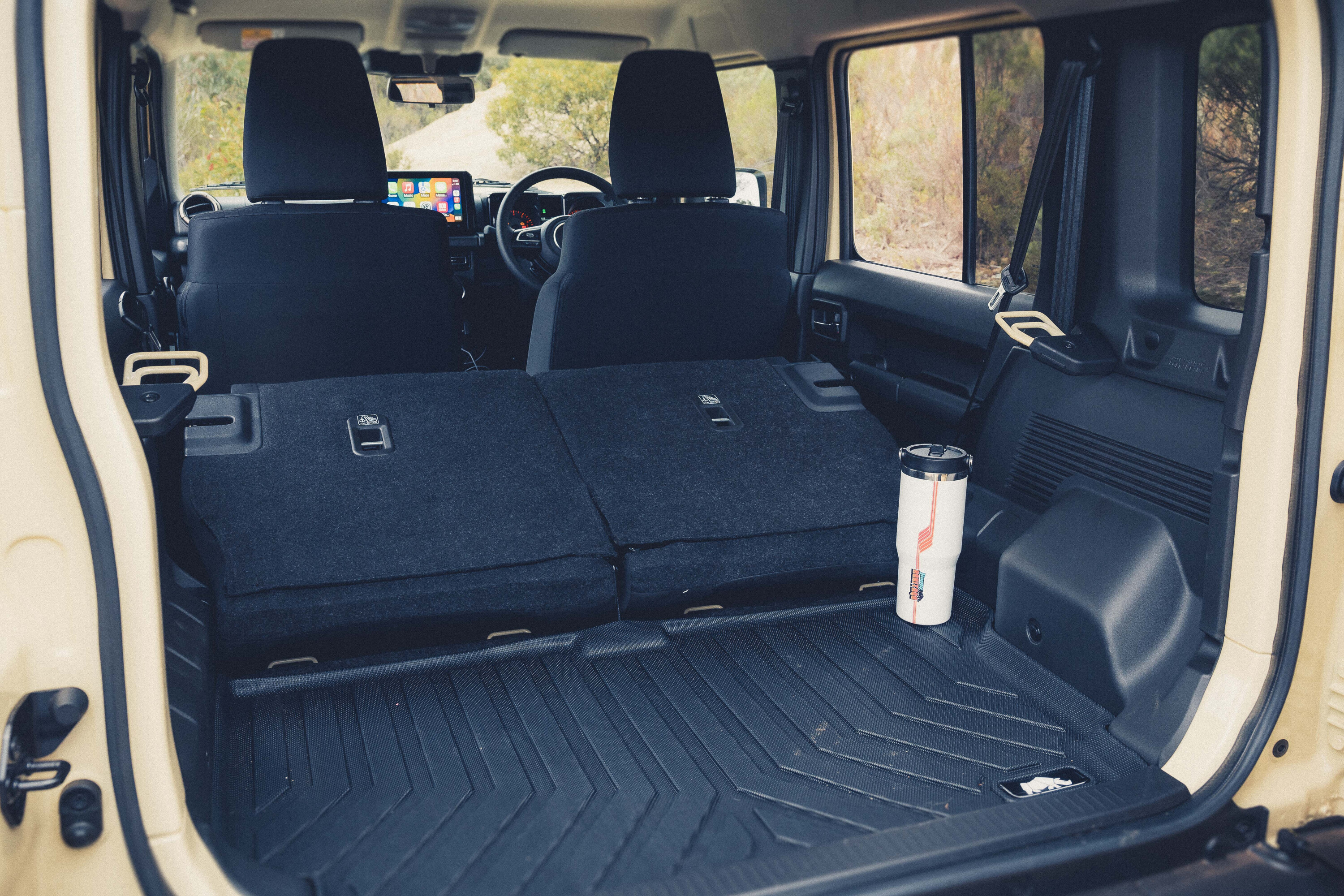
The XL adds 340mm to the overall length of the Jimny with the same amount between the axles to give it a 2590mm wheelbase. The Jimny XL still only has seats for four passengers but the luggage capacity behind the rear seat is up to 211-litres from just 85L in the SWB model.
For our first test of the Jimny XL we’ve scored the Heritage limited edition which adds extras including model-specific retro decals and badge, red front and rear mud flaps, luggage tray, and a Jimny Heritage merchandise pack.
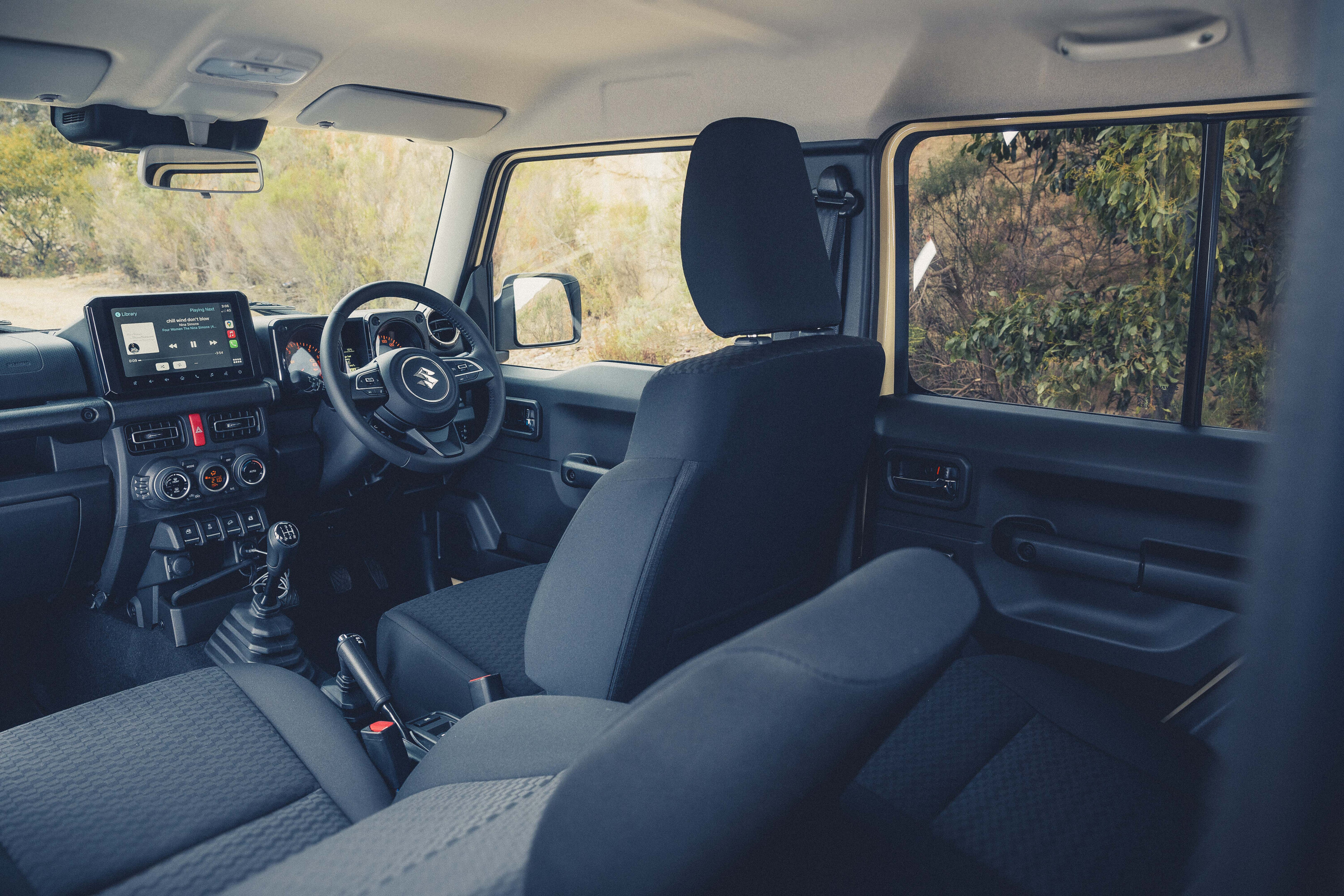
That’s a $1500 jump over the regular price of the Jimny XL but the Heritage edition of the three-door Jimny sold out so fast we expect this one to do the same.
An automatic transmission is available in the regular Jimny XL priced at $36,490. Automatic models also get adaptive cruise control while the manual Jimny makes do with regular cruise, so no great loss.
The Jimny hasn’t lost any of its cuteness with its growth spurt; it’s still a small wagon when compared to any other off-road capable vehicle on the market. The Mahindra Scorpio and Tank 300 would be its closest competitors in terms of size and price.
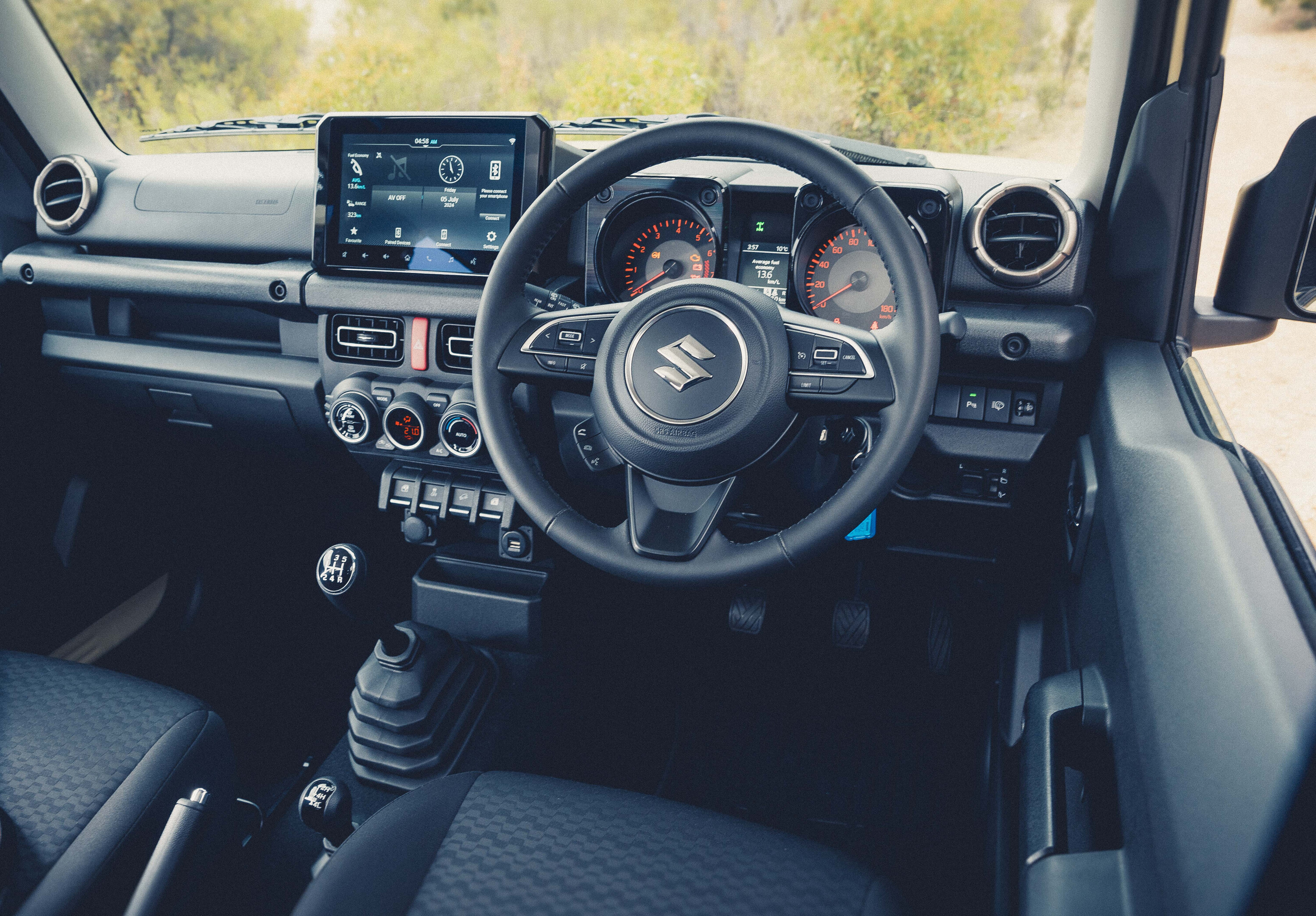
It is however lacking any seat height adjustment which has me sitting higher than I would like and looking down at the bonnet instead of straight ahead at the track. This also means that the numbers at the top of the speedometer are obscured by the steering wheel for me.
The steering column is adjustable for height but not reach, but lowering it at all would have the bottom of the steering wheel in my lap. Being able to lower the seat around 60mm would be great, not for headroom but for improved vision out of the windscreen and side windows.
The size of the cabin means that the screen is literally a short reach from the steering wheel for the driver’s left hand. From here you can control the Apple Carplay and Android enabled system. Only the Apple system is available wirelessly.
The added wheelbase of the XL gives rear seat passengers a bit more legroom so that now it’s actually usable for an adult, although I wouldn’t want to be sitting there for too long; it’s still better suited for kids. The XL is also bigger behind the back seat and there’s a usable space there to carry a large case.
With its diminutive size and tinny feeling the Jimny doesn’t feel as safe as many SUVs but is equipped with AEB, ABS, ESC, six passenger airbags and rear parking sensors and camera.
The XL is powered by the same naturally aspirated 1.5-litre engine as is found in the three-door model. It makes just 75kW and 150Nm, which is enough to get it along at a steady pace but the five-speed gearbox would benefit from an extra ratio to lower the revs at highway speeds. As it stands, the engine is spinning at 3000rpm at 100km/h which is loud and annoying.
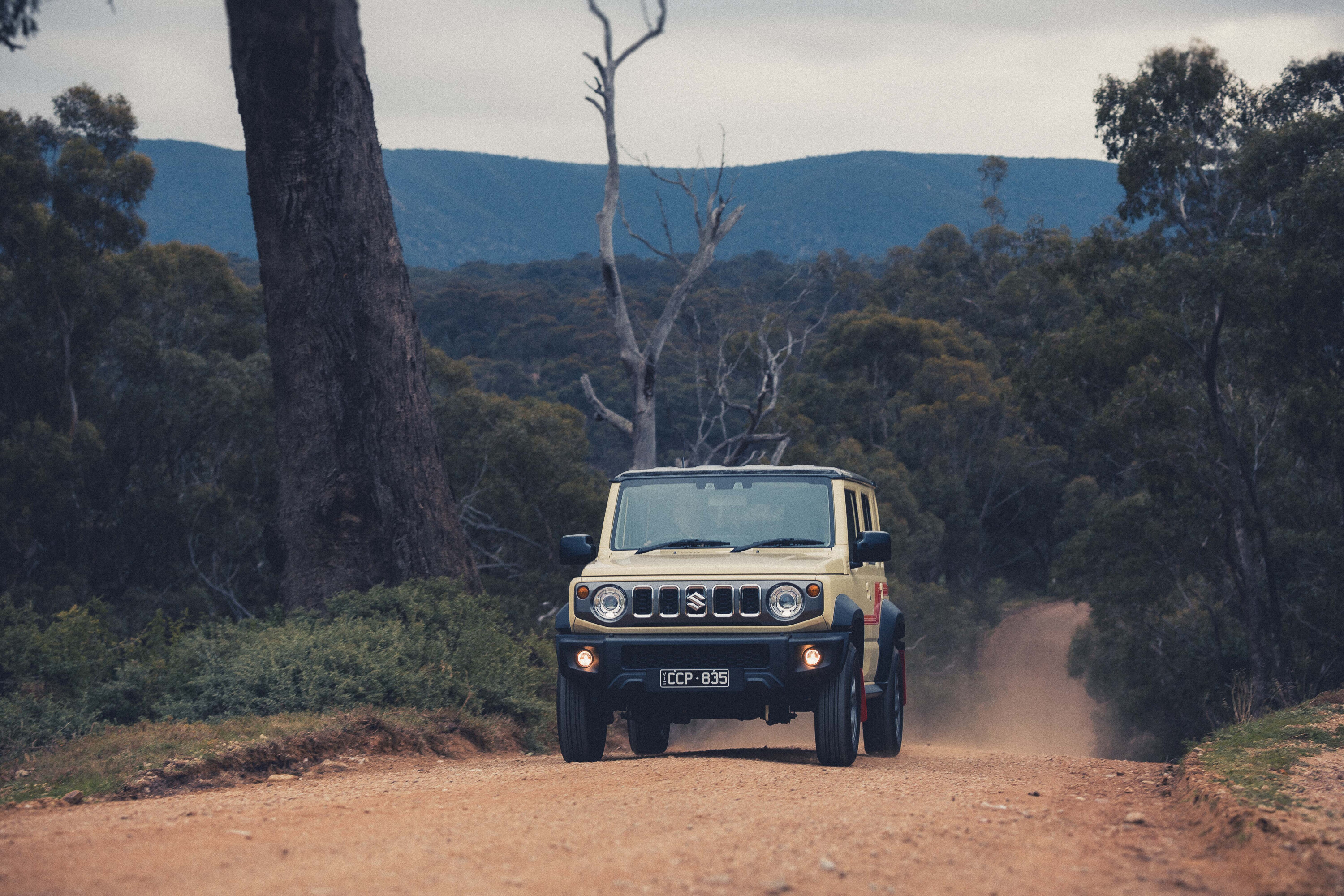
The revs needed on the highway mean fuel consumption doesn’t drop as much as it would in a vehicle with a more relaxed engine when you get out of the suburbs.
For their part, the manual gearbox and clutch are light and easy to operate – they just need that sixth gear. Past experience driving both the manual and automatic transmissions in the three-door Jimny revealed that the auto was a bit better on the highway with lower engine speed even though it has a shorter final drive ratio, but it too is still busy at 110km/h. In the manual ’box fifth gear is 1:1 while with the four-speed auto top gear is a 0.697:1 overdrive.
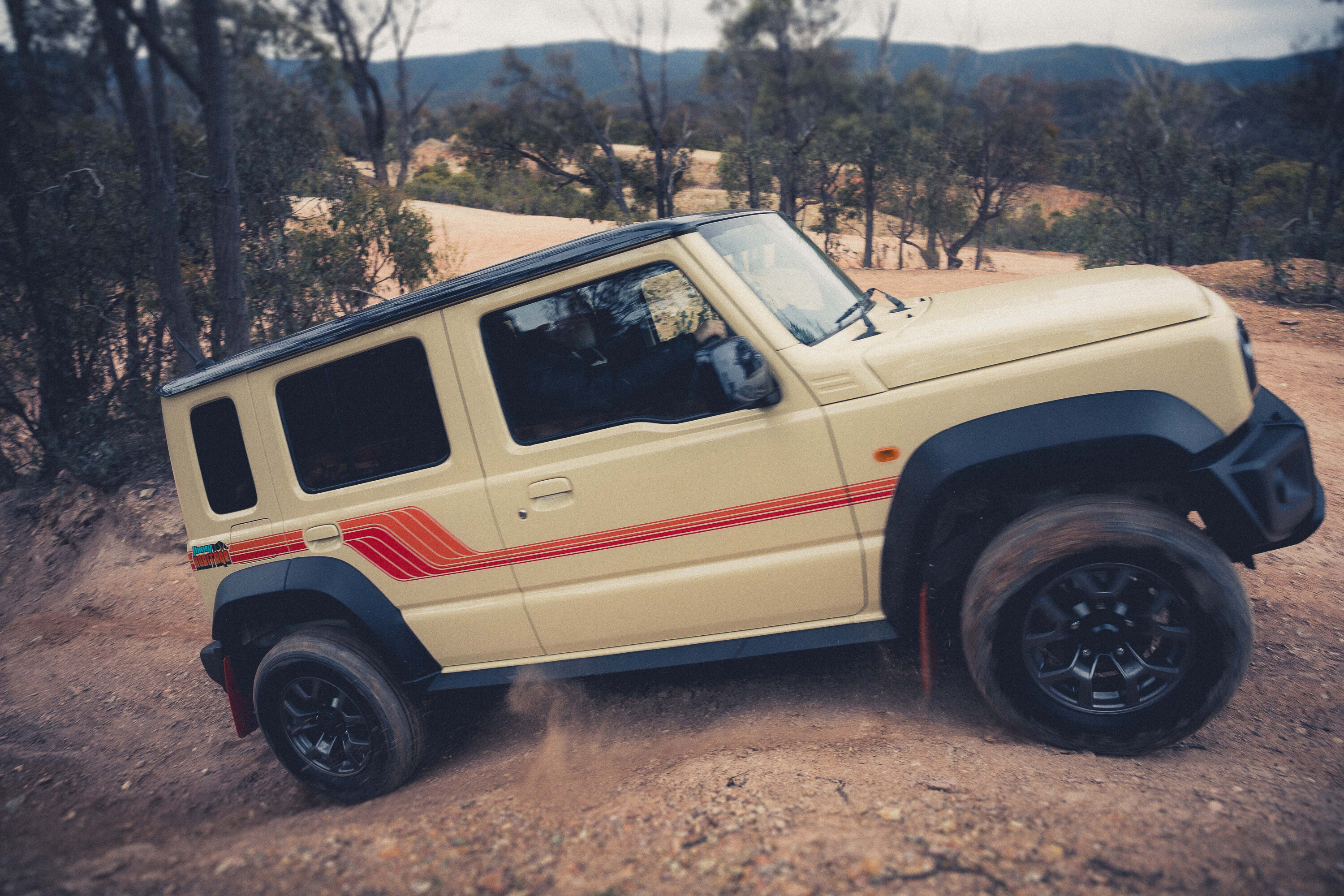
These features will get it to places no other small SUV will go, but it still falls behind bigger 4x4s when the going gets rough. The small 195/80R15 tyres fall into ruts and holes and have to climb back out of them making harder work of rough tracks over which a vehicle with bigger tyres would simply roll over.
There’s not a lot of travel from the all coil-spring suspension meaning it picks up its wheels more readily than bigger 4x4s would over the same tracks, which in turn inhibits progress as there’s no traction from wheels in the air. The ETC works to send the drive to the tyres with grip, but it’s slower to react than more modern ETC systems.
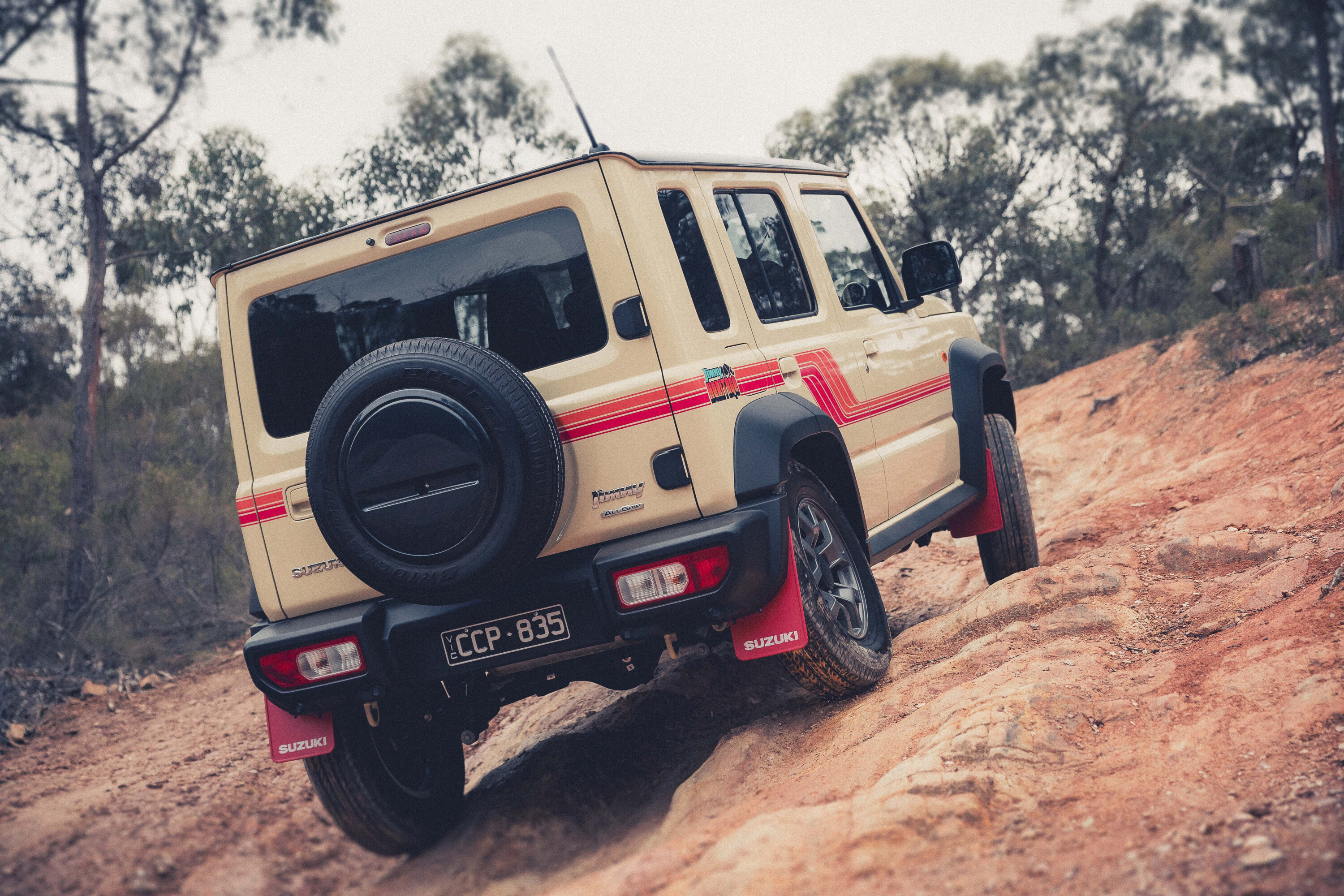
The XL version of the Jimny adds a lot more usability by increasing interior space and improving ride quality thanks to the longer wheelbase. At the same time, it has lost none of its cuteness and the Heritage model amps up the retro styling with its graphics and features. But you’d want to be quick if you want to snap up one of the 500 Jimny XL Heritage models as they are bound to sell out fast.
| 2024 Suzuki Jimny XL Heritage specifications | |
|---|---|
| Price | $36,990 +ORC |
| Engine | Inline 4-cylinder petrol, OHC, 16-valves |
| Capacity | 1462cc |
| Max power | 75kW @ 6000rpm |
| Max torque | 130Nm @ 4000rpm |
| Gearbox | Five-speed manual |
| Crawl ratio | 36.23:1 |
| 4×4 system | Part-time with 2WD (rear); locked 4×4 high and low range |
| Construction | 5-door wagon on separate chassis |
| Front suspension | Live axle, 3-link leading arms with coil springs |
| Rear suspension | Live axle, 3-link trailing arms with coil springs |
| Tyres | 195/80R15 on alloy wheels |
| Kerb weight | 1185kg |
| GVM | 1545kg |
| Towing capacity | 350/1300kg |
| Payload | 360kg |
| Seats | 4 |
| Fuel tank | 40L |
| ADR fuel consumption | 6.4L/100km |
| On-test fuel consumption | 12.2L/100km |
| Approach angle | 37u00b0 |
| Ramp over angle | 24u00b0 |
| Departure angle | 49u00b0 |
| Ground clearance | 210mm |
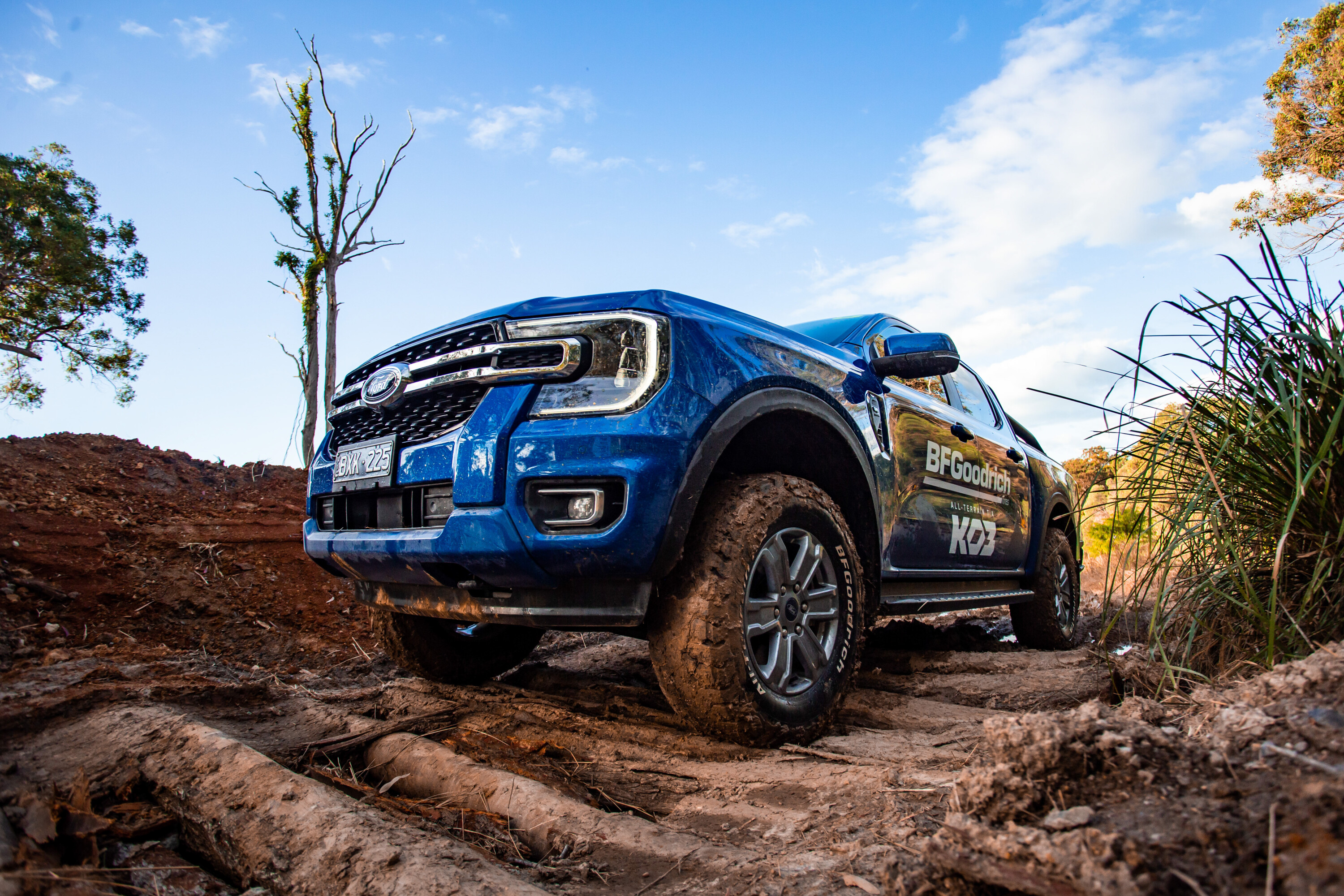
Off the back of the success of its well-renowned KO2, BFGoodrich has launched its All-Terrain T/A KO3 tyre which will be available to purchase from Monday September 2.
Said to outperform the K02 in regards to treadwear, traction and toughness, the KO3 incorporates the latest tyre tech including CoreGard Technology to give it superior sidewall toughness. Plus, an Advanced Deflection Design is said to help prevent objects from snagging and splitting the sidewall.
The KO3 has been engineered with a new tread pattern and all-terrain tread compoint, to make it more durable. Other features to optimise performance include full-depth 3D locking sipes; a serrated shoulder design; and mud-phobic bars. As a sum of its parts, BFG says the KO3 stops a total of 4.2 metres shorter than its predecessor.
“We’ve done a lot of racing and research in the 10 years since we launched the KO2 tyre, so a decade of data, feedback, technology and experience went into the development of the KO3 tyre,” said Harold Phillips, BFGoodrich Global General Manager. “We are our own competition, and we knew it was time to take the all-terrain tyre to another level. It will be exciting to see what consumers will do – at work and at play – with the KO3 tyre.”
BFG states that 38 tyres will be released in three phases, once the tyre launches on September 2. Following that, an additional 18 sizes will be added in 2025, with four more sizes arriving in 2026. In total, more than 60 sizes will be available over the next two years.
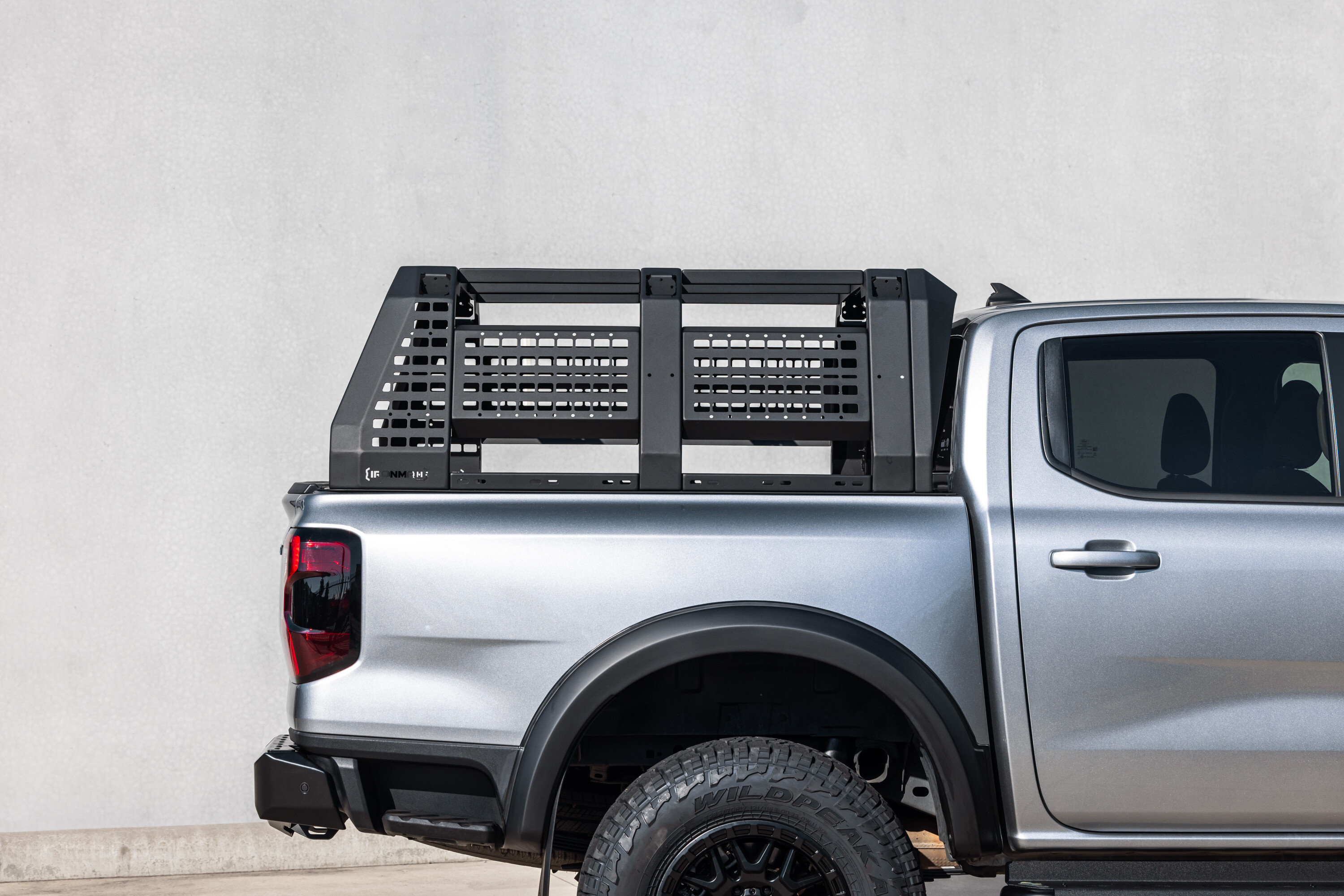
Designed to complement the all-new Raid canopy and Raid roof rack, the Raid tub rack by Ironman 4×4 will give a next-gen Ford Ranger extensive storage and customisation options.
The modular system is specific to the Ranger, allowing the vehicle’s tub to remain accessible when fitted. It measures 1575mm x 557mm x 550mm and weighs 54kg.
When combined with the just-launched Raid roof rack, the versatile set-up provides a full-length storage solution. Mounting a roof-top tent is simple once the rack is installed; plus it also features an integrated tub-strengthening kit. The Raid tub rack comes with a three-year warranty.
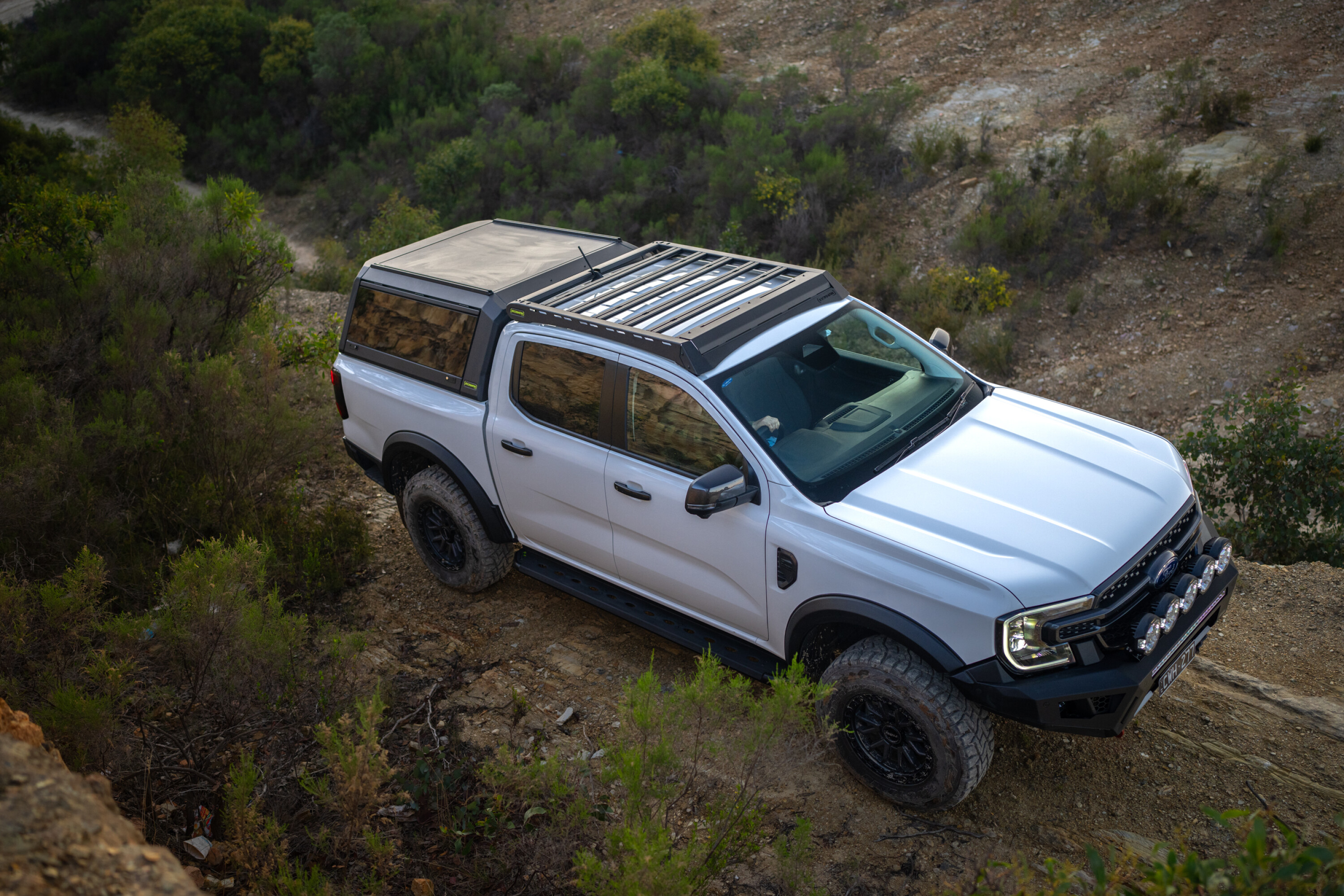
In combination with the release of the Raid canopy and Raid tub rack, Ironman 4×4 has also debuted its Raid roof rack. The aluminium roof rack u2013 currently available for the current-gen Ford Ranger and Mitsubishi MV Triton u2013 is slated to be available in showrooms in December.
Designed to follow the natural curves of the vehicles’ roofline, the Raid roof rack features a sleek, low-profile design; hidden cross-beam fasteners; folded aluminium blades for increased strength; and a built-in wind deflector to minimise noise.
The customisable modular system is also designed to be compatible with light bars and accessories. Plus, each cross beam can hold up to 25kg and features a standard T-slot on the top and incorporated drainage paths. The Raid roof rack comes with a three-year warranty.
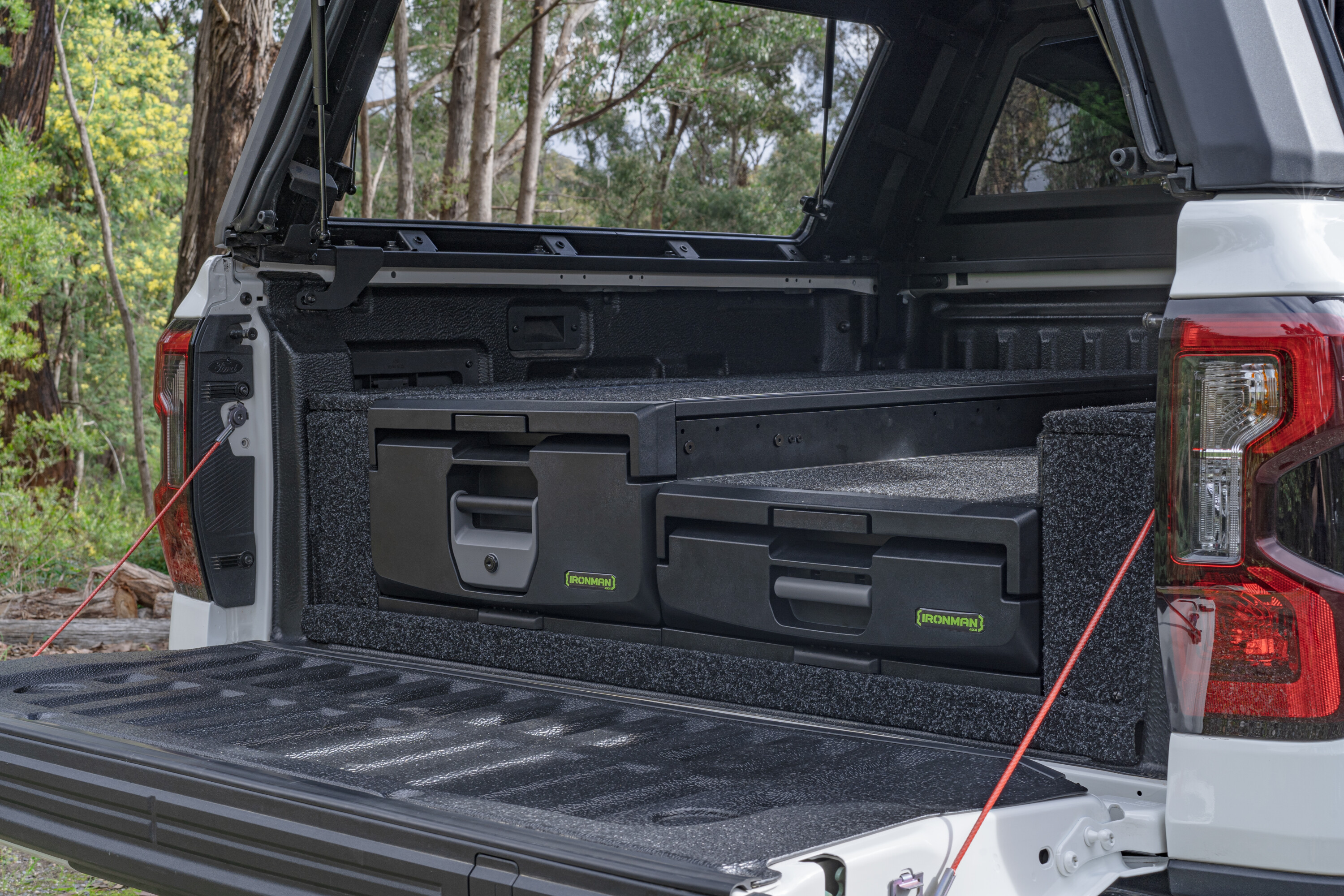
Ironman 4×4 has unveiled a brand new set of roller drawers, at the 2024 Melbourne 4×4 Show held recently.
The drawer system has been designed and built from the ground up, utilising a combination of 6051-T5 and die-cast aluminium. This combo results in a weight of just 18kg for the single mid-height drawer – or just 23kg for the mid-height roll-top variation. In fact, Ironman 4×4 states that you can expect a 20 to 25 per cent weight saving compared to a like-for-like system. Great for strict payloads.
Despite these weight savings, the units remain strong – the full length, full-height drawers can hold up to 120kg per drawer; and, when fully extended, the roll-top flooring can handle 100kg (that’s easily a fully stocked fridge/freezer).
The drawers utilise a patented roller-bearing slide system, and all drawers feature a lock-out mechanism when extended for safety and convenience.
Appearances are important, and Ironman has opted for a neat-looking black mottled carpet on the top and sides; the fascia is made from automotive-grade ABS; and the handles are cast alloy. Other features of the drawers include two T-slot channels with rubber trim; internal strip lighting (AA battery-powered); and all drawers can be mixed and matched to create a system that works for you.
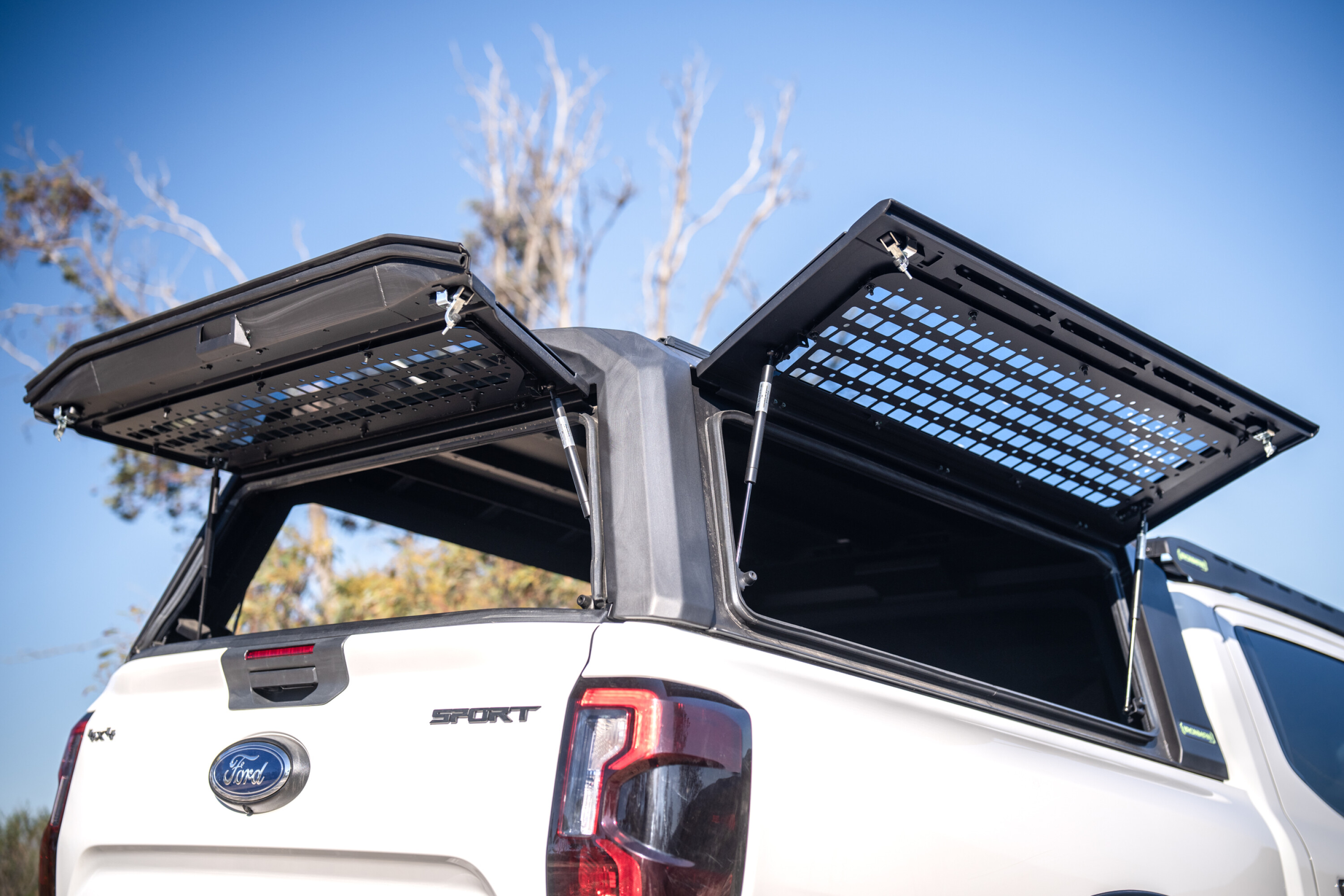
Ironman 4x4u2019s all-new Raid canopy is manufactured using precision-folded and braced 2mm 5058-grade aluminium and weighs just 65kg (give or take) but comes with a dynamic load limit of 180kg and a static load limit of 350kg. However, just to be certain, Ironman 4×4 loaded 2000kg on the roof during testing and the canopy held its shape.
Captive nutserts set into the roof of the canopy allow for the easy fitment of additional accessories; while cable management paths wind through the length of the canopy to keep things nice and tidy. A patented air-pressure vent at the front of the canopy reduces dust ingress, and integrated roof rails are standard.
Two Raid options are available: the Trade Pack (aluminium panels on all four sides); and the Premium Pack (front glass window and rear glass door, but panels and windows can be mixed and matched).
Ironman 4×4 says that fitment will take a two-person team about two hours, with difficulty rated as medium. It comes with a three-year warranty.
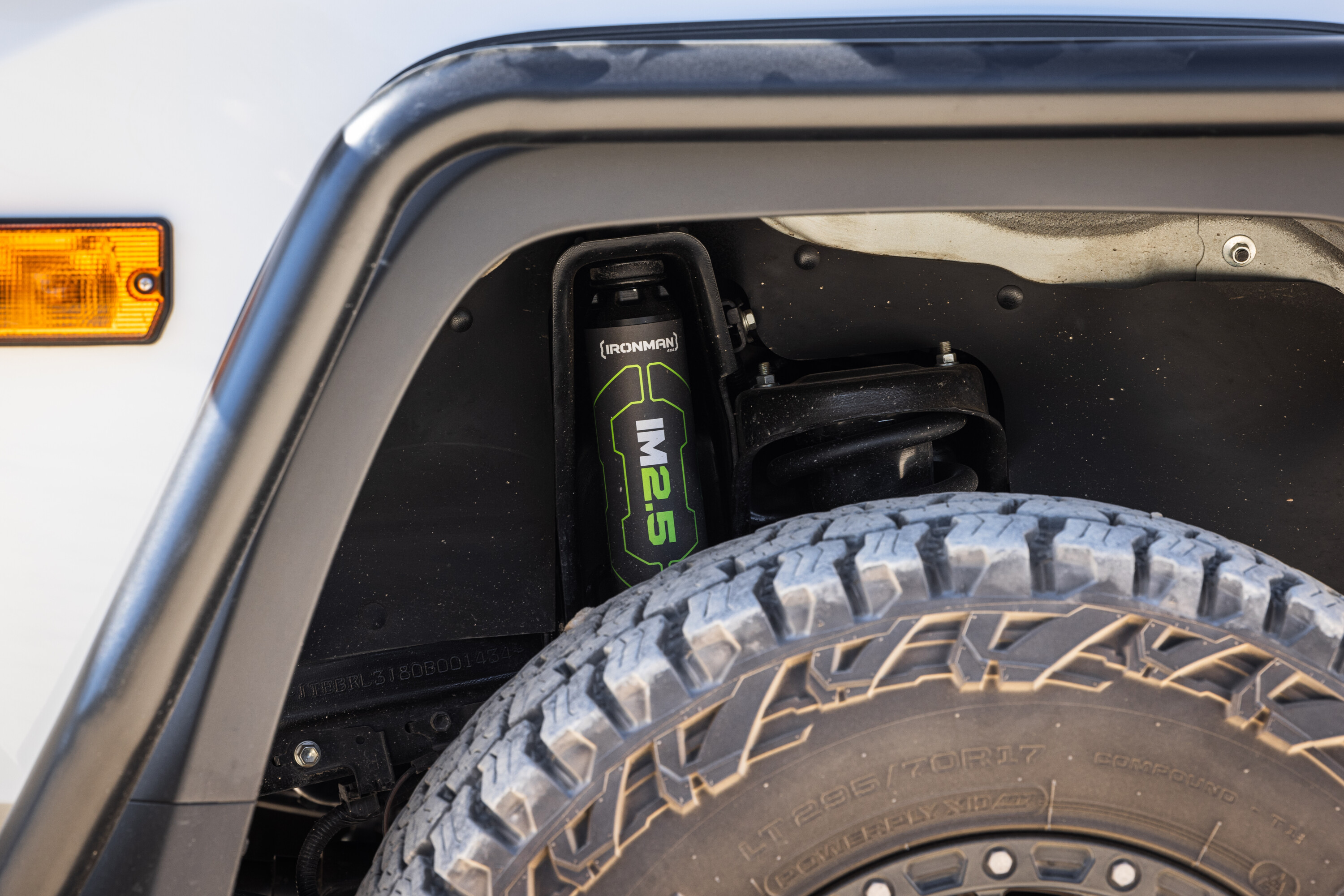
Ironman 4×4 has introduced its all-new IM2.5 monotube shock absorber at the 2024 Melbourne 4×4 Show, held at the Melbourne Showgrounds.
The 2.5-inch extruded aluminium monotube – manufactured from 3-4mm 6061-T6 aircraft-grade aluminium and finished with a Type 2 hard-anodising – has been designed with comfort in mind, with Ironman that the IM2.5 is the “perfect suspension companion for 4×4 owners who really value all-day ride comfort and plush off-road performance”.
In addition to creating a smooth ride over all sorts of terrain, the monotube shock is designed to better handle harsher surface changes typically encountered when off-road.
This ride comfort is achieved in part thanks to the addition of a 57mm piston that has a 60-per-cent larger surface area than the Foam Cell Pro unit.
The IM2.5 monotube strut assemblies will be sold with black coils. Black coil springs will also be available for vehicles such as 300 Series (rear) and 70 Series (front and rear).
Specs include:
The shocks are backed by an unlimited kilometre, four-year warranty.
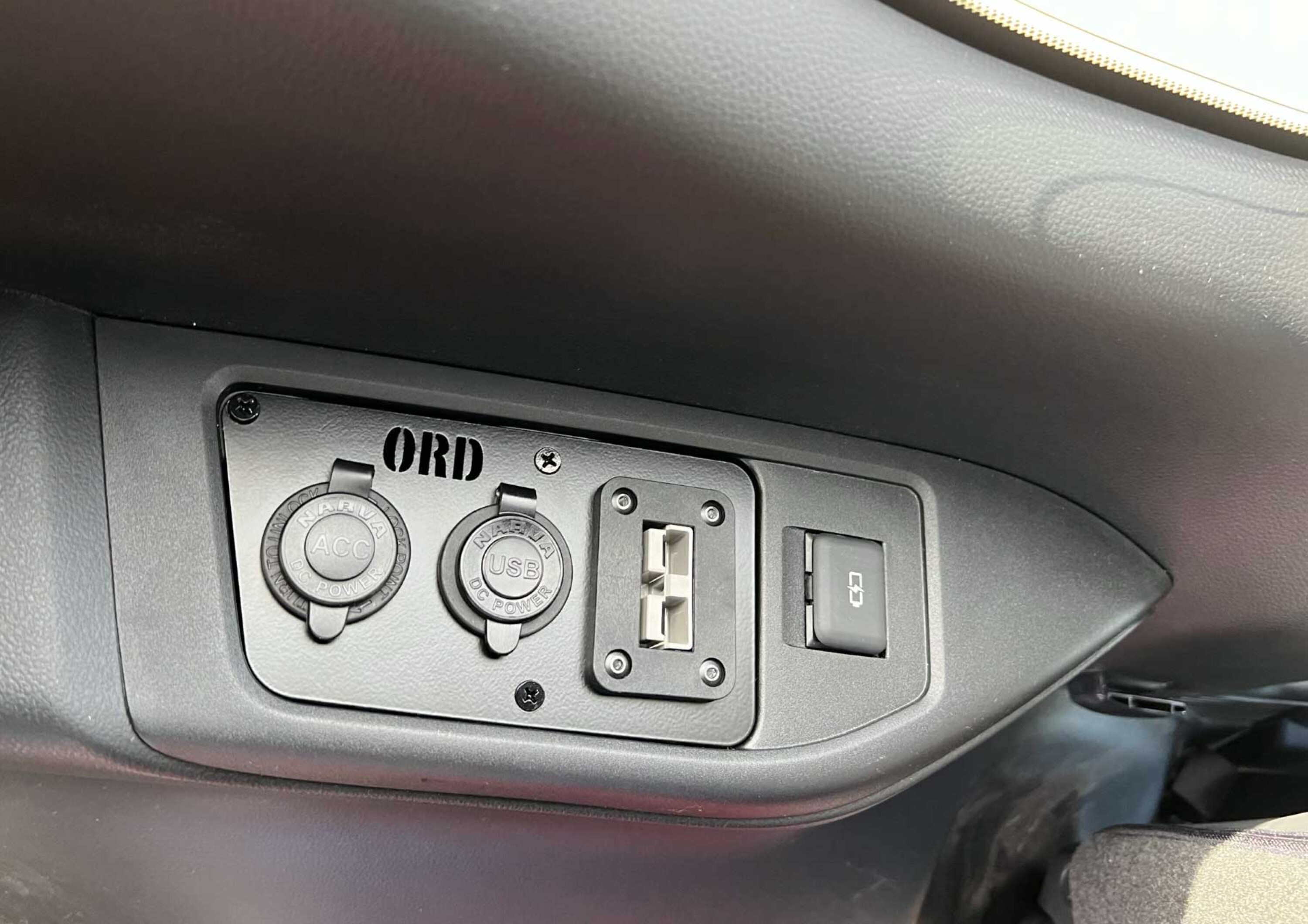
Off Road Downunder has introduced a Cup Holder Power Socket Panel designed for third-row seat cupholders in the cargo area of the Toyota Landcruiser 300 Series. This Aussie-made product is available as a plain panel or as a kit with all the sockets installed into the panel, although wiring is not included. There are models to suit mounting on the left or right side of the vehicle.
The Plain Panel is made of precision laser-cut aluminium and powder-coated in black to complement the interior of the Landcruiser and it includes all necessary mounting hardware. In addition, the Panel Kit adds a Narva Dual USB socket, a Narva ACC socket, a genuine 50amp Anderson plug, and an OEX flush-mount fascia. These components come pre-fitted into the panel so it’s ready to be wired up.
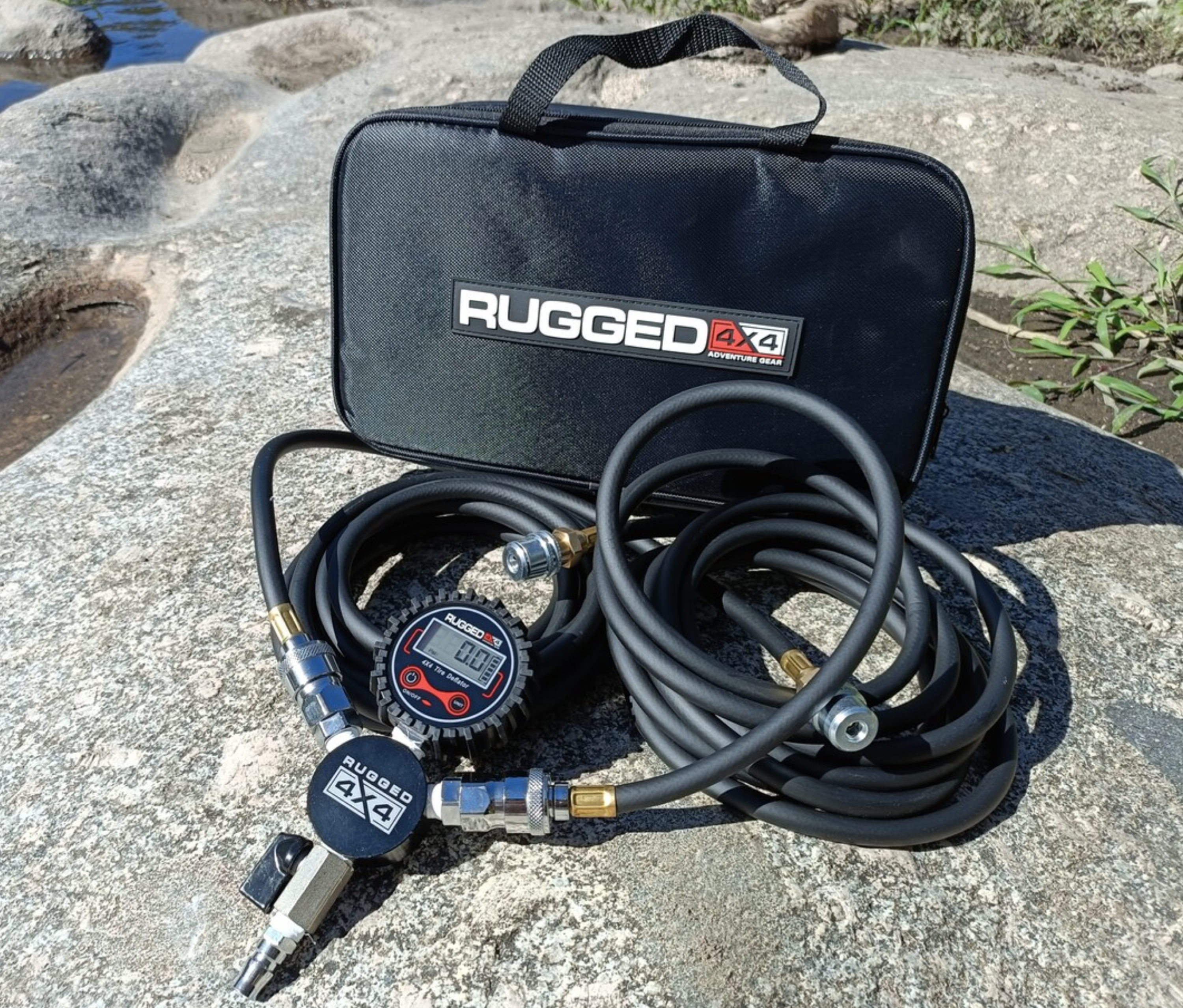
The Rugged 4×4 Adventure Gear Twin Digital Tyre Inflator/Deflator is designed to make inflating or deflating tyres a breeze, and with its bright background light, you can even monitor tyre pressures in the dark.
Key features include quick-connect and disconnect tyre valve connectors, anti-tangle hoses, an easy-to-read digital gauge display, standard air connections to suit most air-compressor hoses, and a large storage/carry bag for easy packing and storage. Additionally, the included batteries ensure you can use this device right out of the box without any hassles.
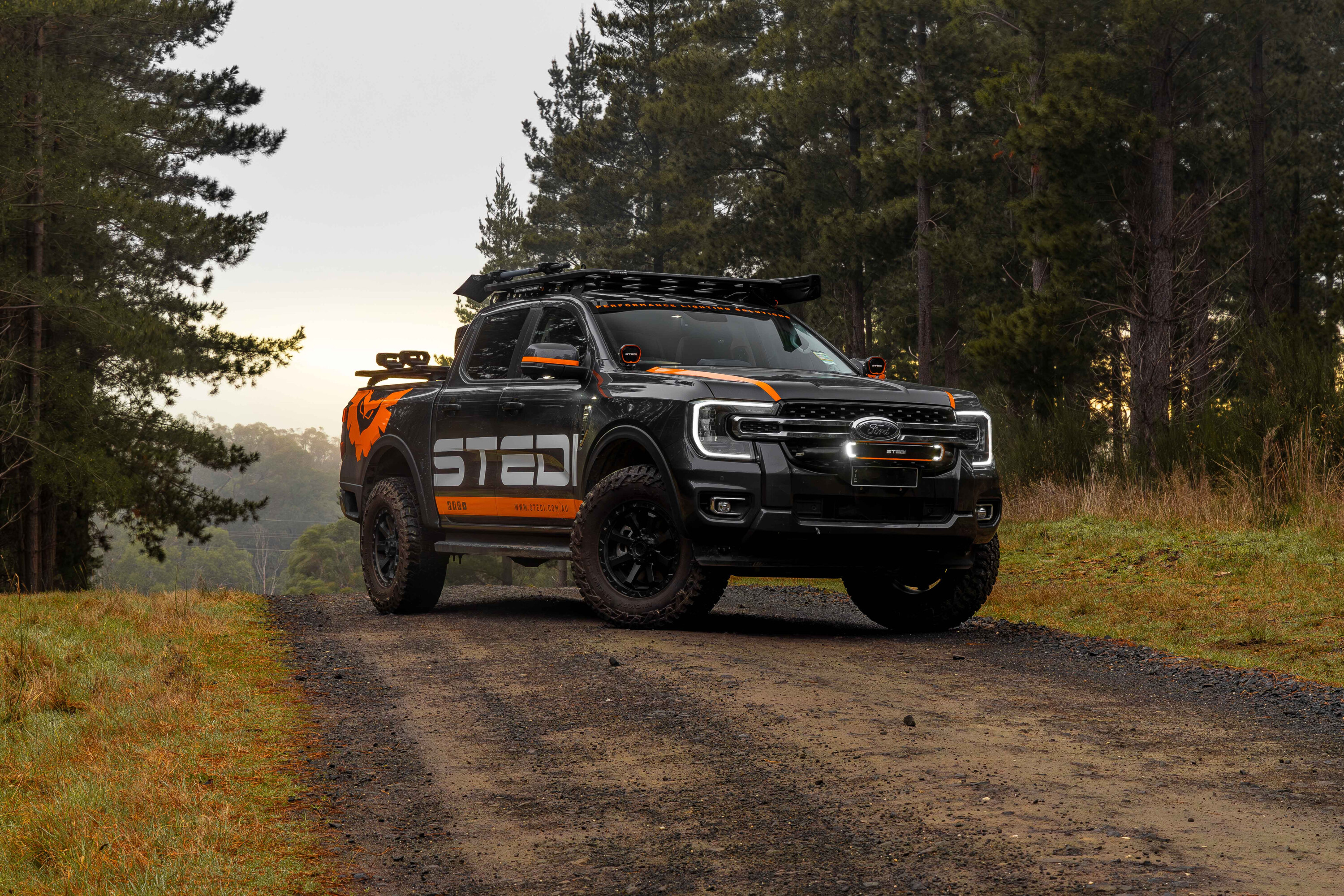
The STEDI EVO Light Bar is said to offer an impressive beam throw and optional DRL, turning traditional light bar weaknesses into strengths. It features 36 CREE LEDs that deliver a claimed 960m of light from a 22-inch bar. The 5000 Kelvin temperature reduces glare on road signs while providing a soft, consistent light output.
Inspired by the flagship Type-X EVO Driving Lights, the EVO Light Bar shares similar characteristics and a unique silhouette. Optional side DRLs accentuate the iconic EVO family silhouette.
Customisation options include brushed stainless coloured fascia, a custom key that doubles as a bottle opener, the STEDI Black Out Cover, and optional STEDI Carbon Fiber Print Covers and amber lenses.
The EVO Light Bar’s innovative mounting bracket system offers a variety of mounting solutions, including tube-style mounting positions and traditional side brackets with various tube-style clamps available, along with rubber inserts to minimise vibration.
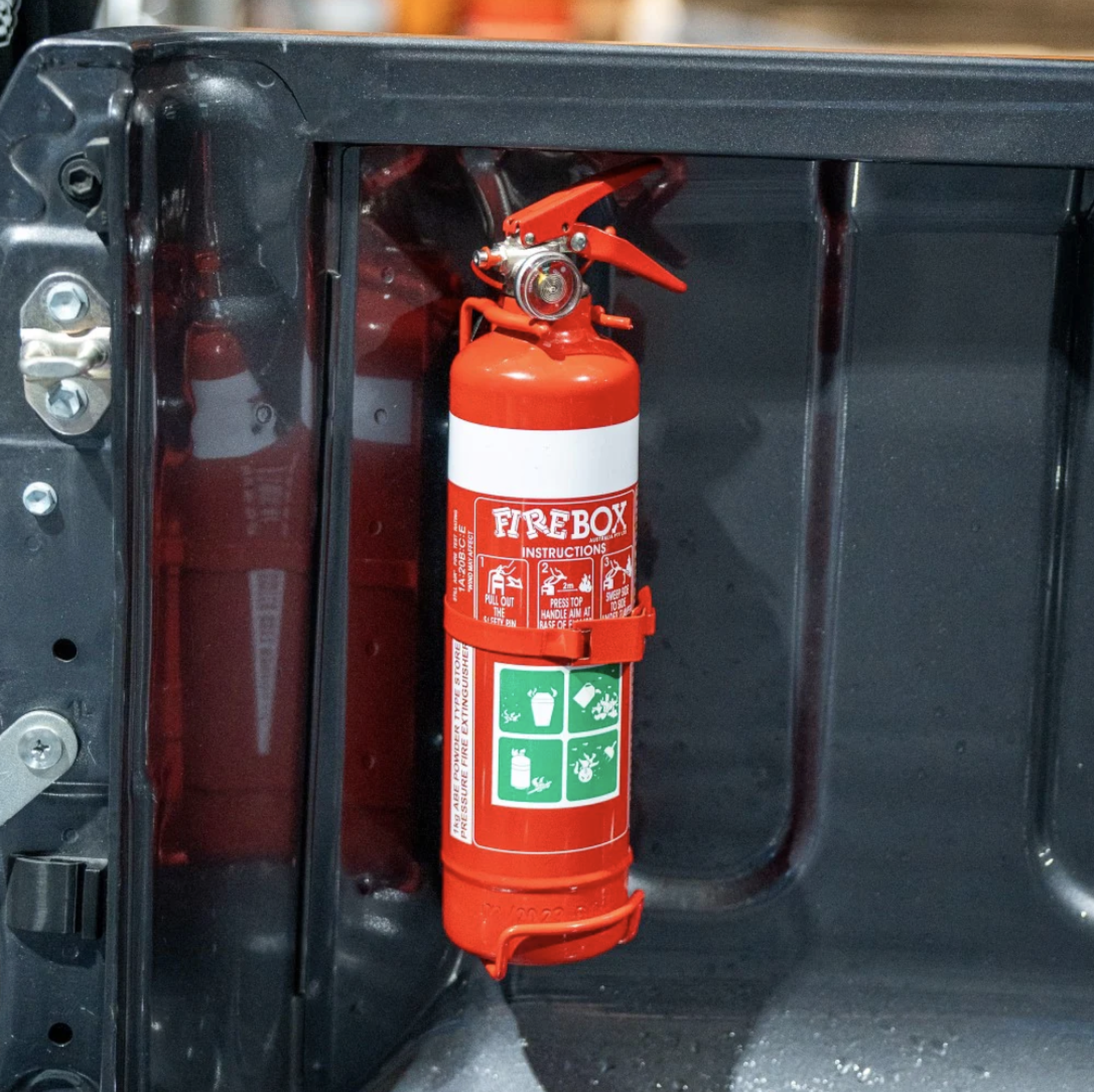
A recent and unexpected car fire made Pirate Camp Co. realise just how essential it is to be prepared for any situation on the road. Thatu2019s why they decided to develop a bracket that is both easy to use and practical.
Their Vertical Tub Fire Extinguisher Mount ensures quick access during emergencies while remaining discreet and space-saving when not in use. Now, you can secure your fire extinguisher without interfering with the tie-down rail. The vertical mount feature has been specifically designed to fit tubs with roller shutters and cargo management systems.
The Vertical Tub Fire Extinguisher Bracket accommodates a variety of 1kg extinguishers. It is crafted from durable mild steel and powder coated texture in timeless black. Mounting bolts are included for easy installation, and it is designed to fit left and right-hand sides of the tub.
There is a Vertical Tub Fire Extinguisher Bracket to suit most vehicles, including Toyota Prado 150, HiLux N80 and Landcruiser 70 Series, Volkswagen Amarok 2023+, and Ford Ranger and Raptor 2022+.
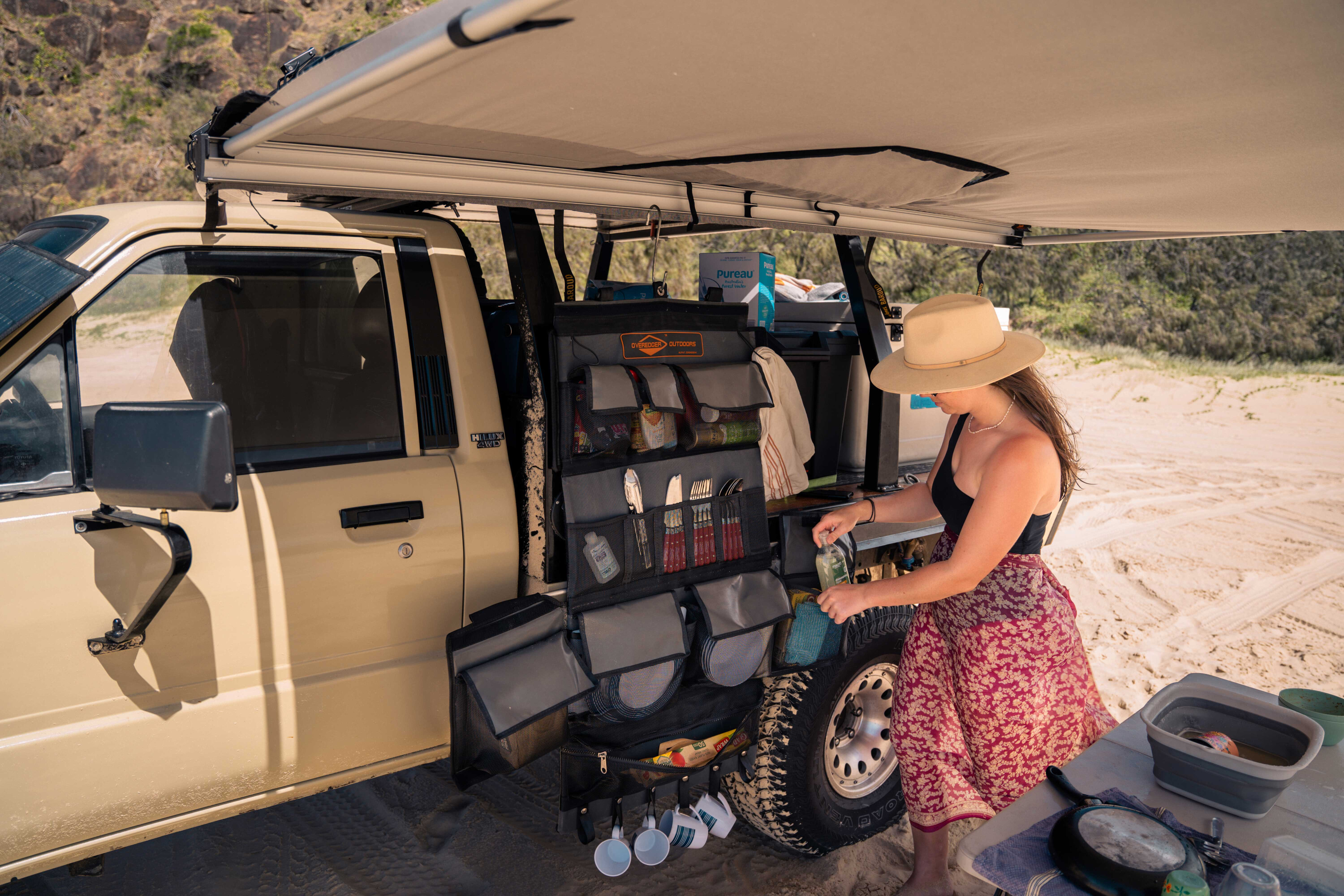
The Series 2 Overedger Camp Kitchen Pack is a versatile and durable solution for outdoor adventures. Made from waterproof and UV-rated heavy-duty PVC vinyl, this pack ensures your gear remains clean and dry.
Quick to set up and easily accessible, it eliminates the need for plastic boxes, making it ideal for day trips, road trip lunch stops, and quick access to outdoor essentials.
The pack’s high-quality materials are UV-rated and waterproof, with convenient features such as wet area wing pockets for quick drying, anti-slip scuff pads, and dedicated storage space for various items. The pack’s design includes plate pockets and snap fasteners for cup hangers.
When packed, the dimensions are 600mm (l) x 300mm (h) x 300mm (d), and the setup dimensions are 1250mm 9h) x 1250mm (w). The pack weighs 4.8kg when empty and has a maximum capacity of 11kg for your gear.
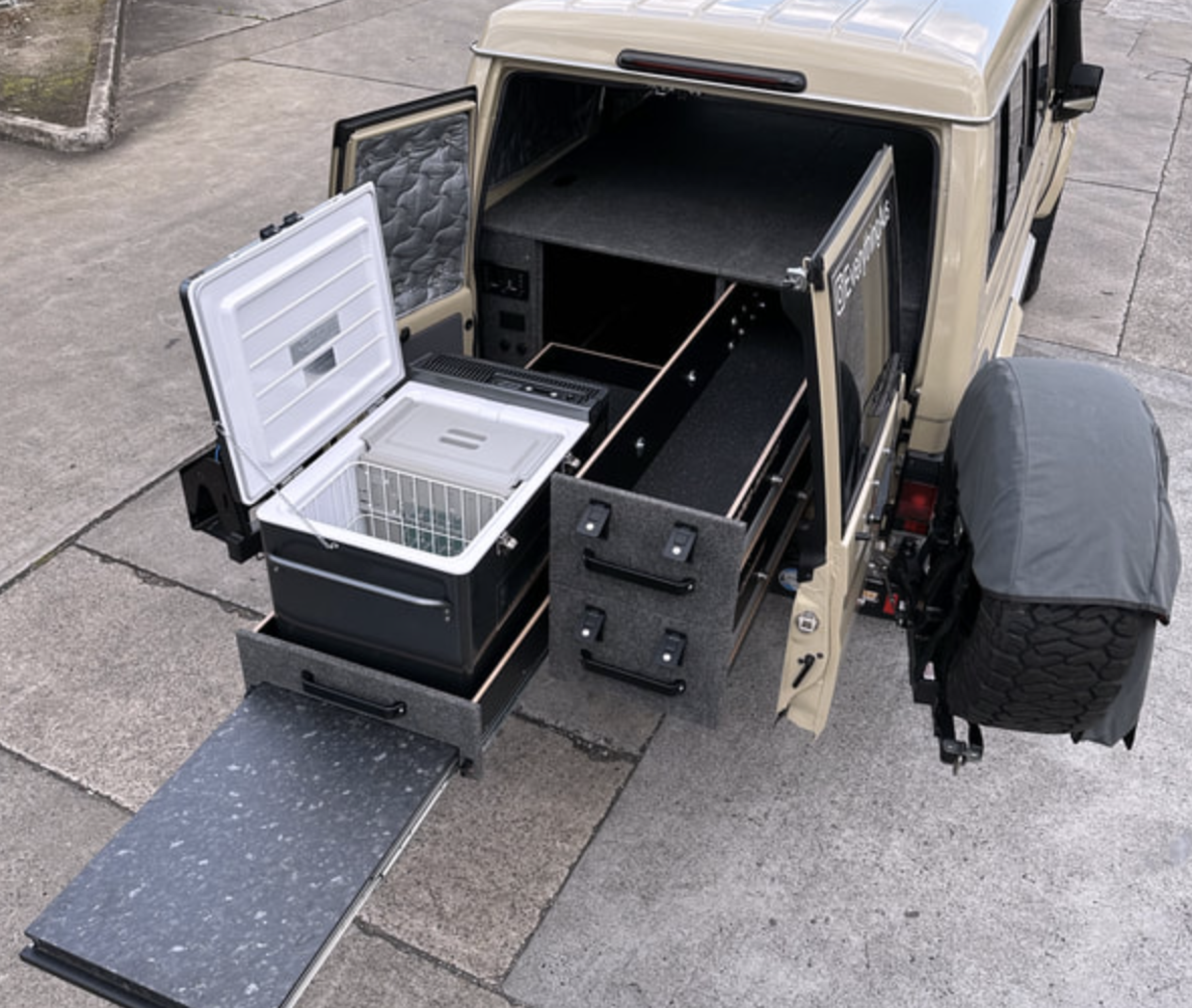
Loaded Drawersu2019 Expedition System for the 78 Series Troop Carrier is an all-inclusive package that incorporates high-capacity storage, a large fridge drawer, a laminated sliding table, cabin-accessible storage, electric system integration, and generous bedding space.
The Expedition System is constructed from exterior grade birch plywood with black heat-pressed laminate (HEXA pattern), externally covered in heavy-duty 3mm grey carpet and removable rubber mat inserts. It includes dual black compression locks and black D-handles, precision CNC cut components and rebated joints for maximum strength.
The layout includes double-stacked cargo drawers with heavy-duty bearing runners, a full-length fridge drawer to suit a 60L Engel fridge, an integrated sliding table finished in food-grade laminate, and under-table storage for the collapsible sink.
There is provision for fitment of a Redarc Redvision control panel, GPO and 12v and dual USB sockets, as well as mounting provisions for an ARB twin compressor and tank, Redarc 2000W inverter, 200Ah Enerdrive Lithium battery and Redarc Manager 30.
The custom mattress is a 100mm dual-density item with Australian-made Dunlop memory foam and a removable canvas cover.
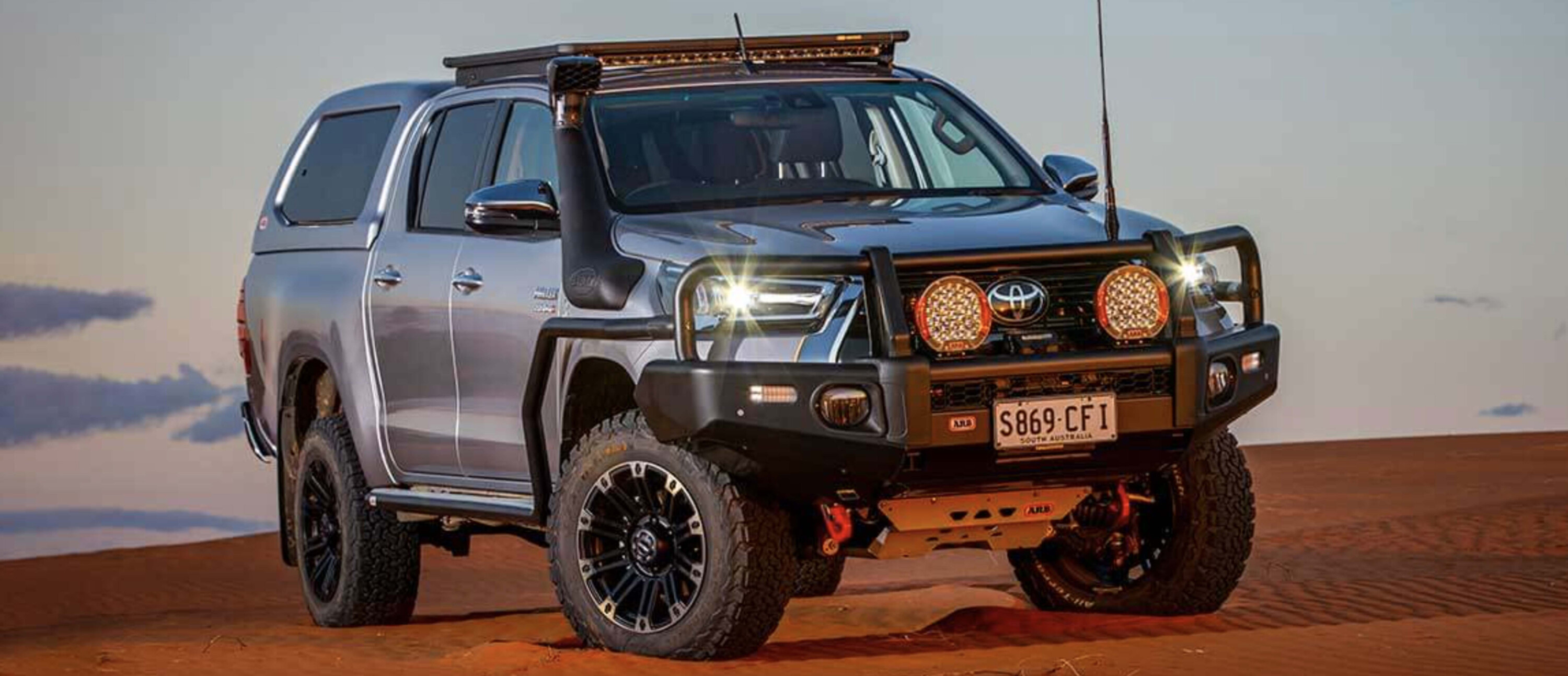
Old Man Emu has announced its GVM upgrades are now approved for all 4×4 variants of HiLux sold in Australia, including the 48V and MY23+ Rogue and GR models.
If you consistently carry heavy loads, you need to upgrade your suspension to suit. Improving safety and drive quality, a GVM upgrade helps reduce stress on suspension components and allows you to safely transport heavy loads. Old Man Emu’s GVM upgrade lets you legally carry more weight.
If you have an OME GVM upgrade fitted prior to a vehicle’s first registration, it will be federally recognised and certified, which means you won’t need to engage a third party engineer.
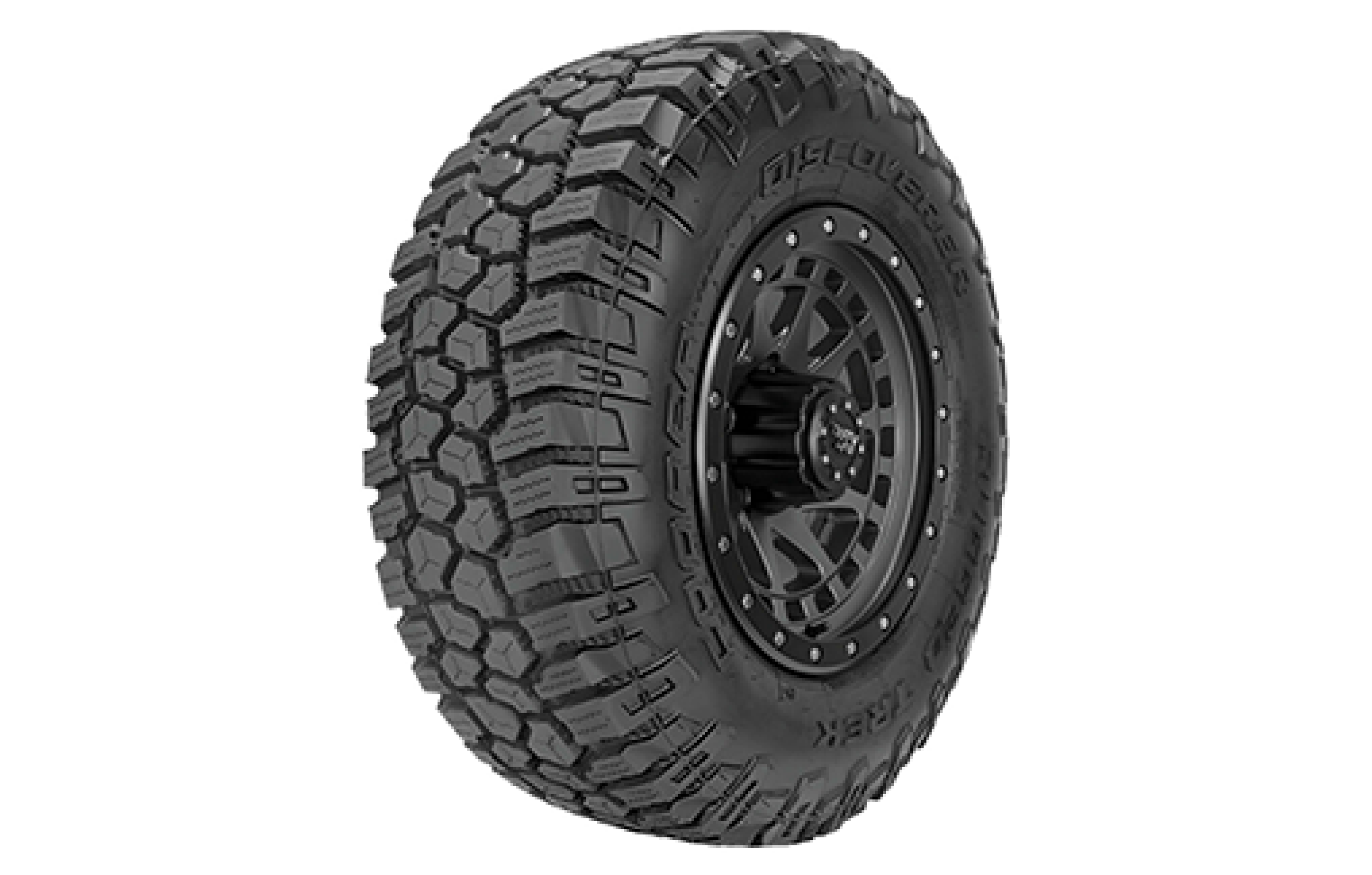
Cooper reckons it has solved the age-old problem of choosing between an all-terrain tyre and a mud-terrain tyre by introducing the Rugged Trek, which it describes as a hybrid tyre.
While most all-terrain tyres are good on gravel and on- and off-road, they can lack traction in the mud; whereas mud tyres are great off-road but noisier on-road and with a higher wear rate. The Cooper Rugged Trek is said to offer the characteristics you look for in an aggressive mud-terrain tyre, while still giving you the mileage and performance of an all-terrain.
It features a four-rib design, open shoulder blocks and side-biters for off-road traction. The latest tread design provides a larger footprint, and unique internal siping improves wet-road performance. The tyre comes with a 14.7mm tread depth and a mileage guarantee of up to 80,000km.
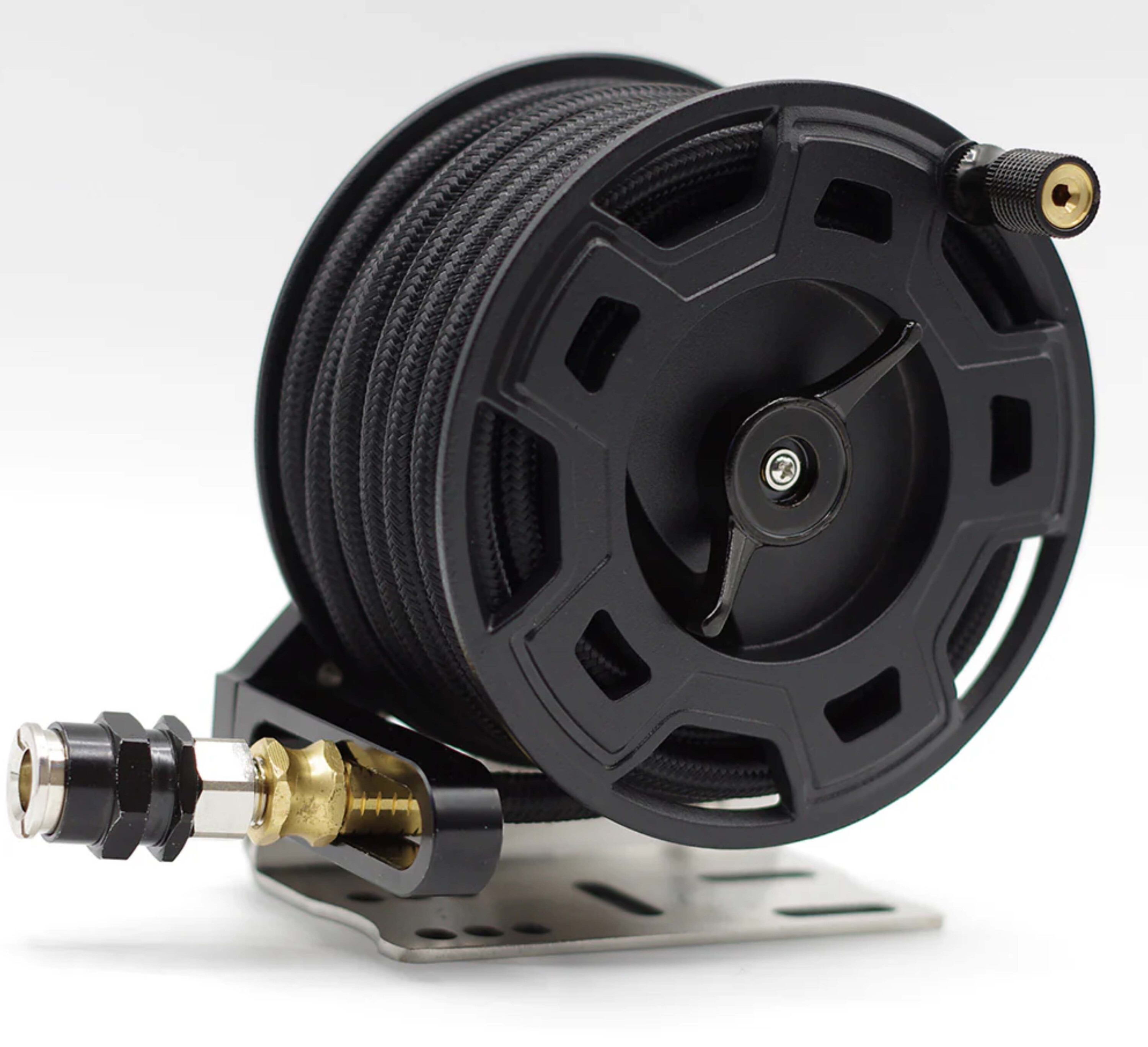
This compact air hose reel features an aluminium main body and can be mounted either flat or at 90-degrees, with the included mounting bracket providing versatile installation options.
A seven-metre air hose comes with a patented quick-connect air fitting, making connections fast and secure. Wrapped in a protective nylon braid cover, the internal rubber hose is flexible and tough; plus the reel’s lock system keeps the hose firmly in place during transit.
The hose reel has a 150mm diameter and 800mm width, and the overall size including the 90-degree bracket is 150mm (L) x 160mm (W) x 175mm (H).
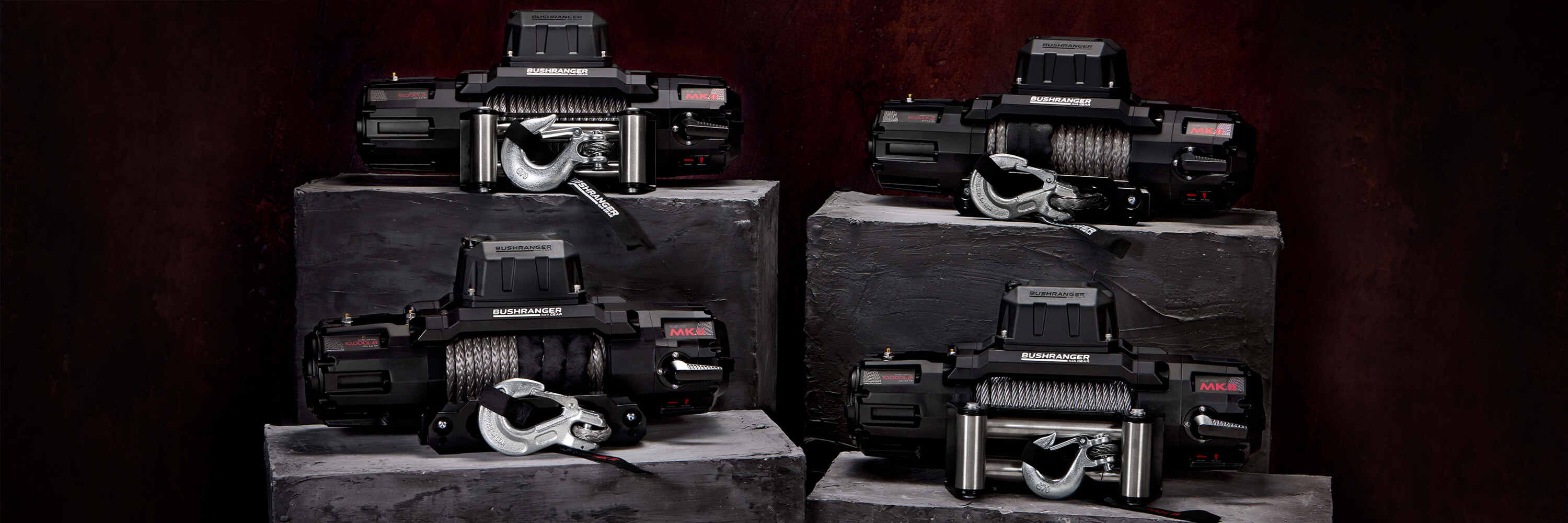
The Bushranger REVO MKII winch has a compact and lightweight control box and numerous threaded insert locations for easy installation in confined areas.
It features a tough aluminium alloy body finished in a durable satin black powder coat, an Albright DC Contactor, a no-lift clutch handle, an IP67 rating, and hardened steel gearing for improved load distribution, maximum strength and durability. It is available in 10,000lb and 12,000lb models with wire or synthetic rope.
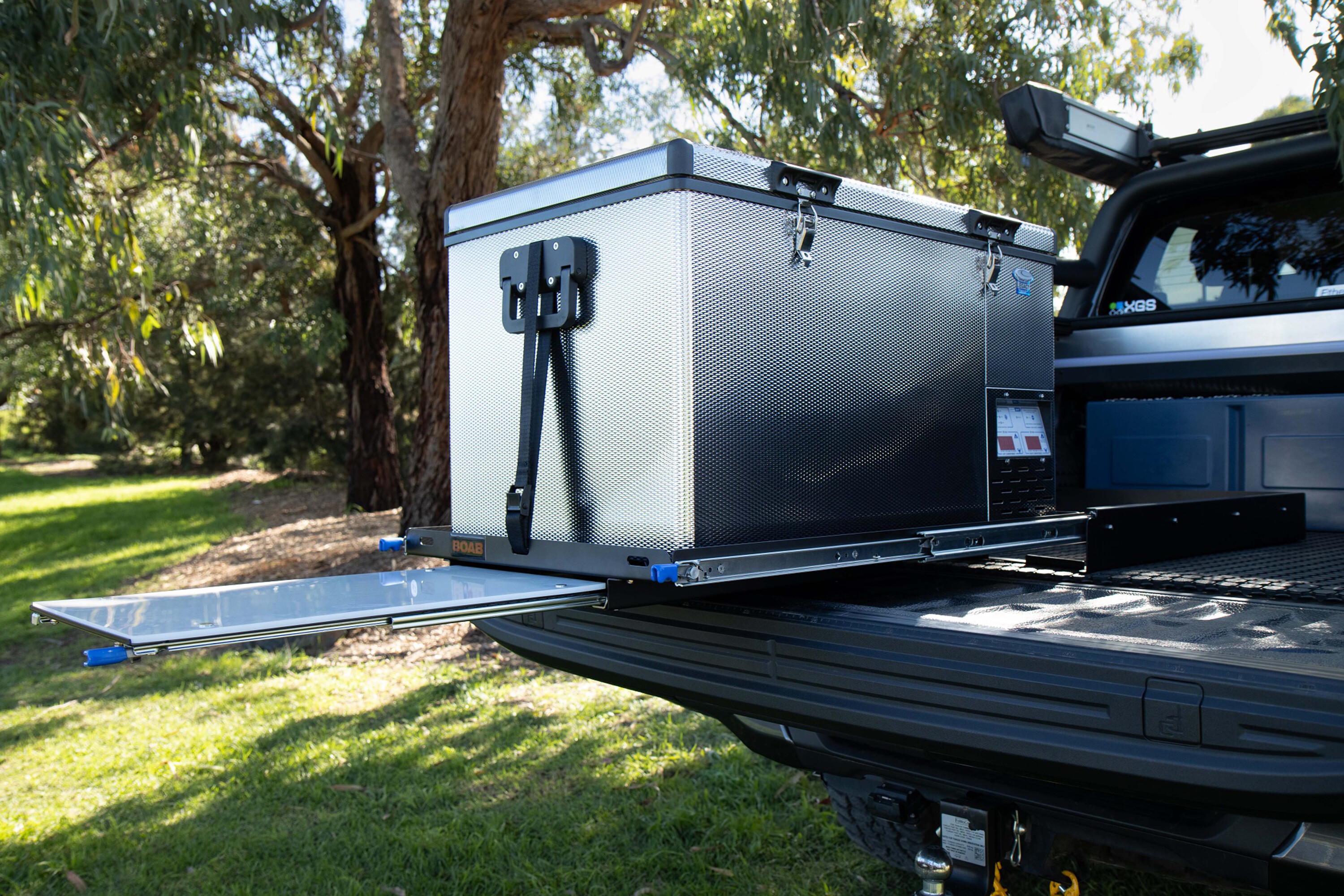
This new BOAB fridge slide can be used in wagons, utes, trailers and campers, securely holding a fridge in place while providing convenient access.
It includes a retractable table/cutting board (made of food-grade PE), providing a convenient space for a camping stove, for loading and unloading fridge items, or for preparing food. The slide also features a locking mechanism so it can be secured when retracted, as well as four quick-release tie-down straps for easy tethering.
With inner tray dimensions of 846mm (L) x 527mm (W), the fridge slide accommodates a wide range of fridge sizes up to 70L and handles weights of up to 100kg. It is made from powder-coated steel with zinc-coated ball-bearing slide runners, and is covered by a three-year warranty. It is supplied with fitting hardware including stainless-steel bolts.
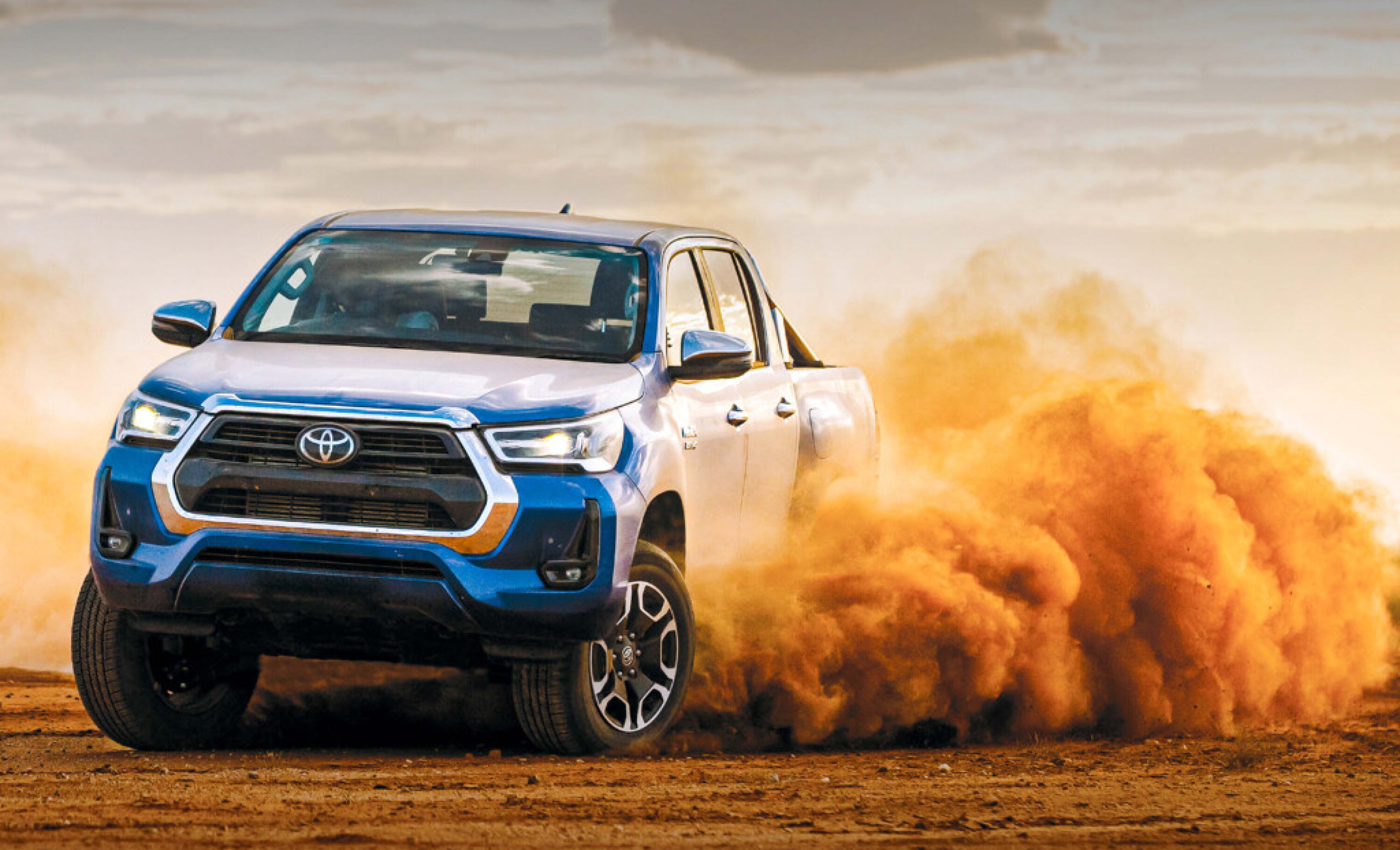
CalOffroad Nitro Pro is a new off-road suspension kit aimed at four-wheel drivers seeking a suspension upgrade for a higher load-carrying capacity, more comfort and a lift of up to two inches.
Designed and tuned by CalOffroad, and manufactured in Australia, the Nitro Pro boasts twin-tube shocks for maximum oil capacity and a lower gas rate to minimise shock temperatures. Plus it has an 18mm induction hardened chromed piston rod for maximum strength and durability.
CalOffroad also offers Platinum Series shocks that have been developed in collaboration with Bilstein. Locally designed, then manufactured in Germany, Platinum Series are claimed to be amongst the world’s most advanced shocks for off-road reliability and performance.
CalOffroad is also an authorised Fox off-road suspension distributor and service centre, offering the brand’s world-renowned extreme high-performance shocks and racing suspension products.
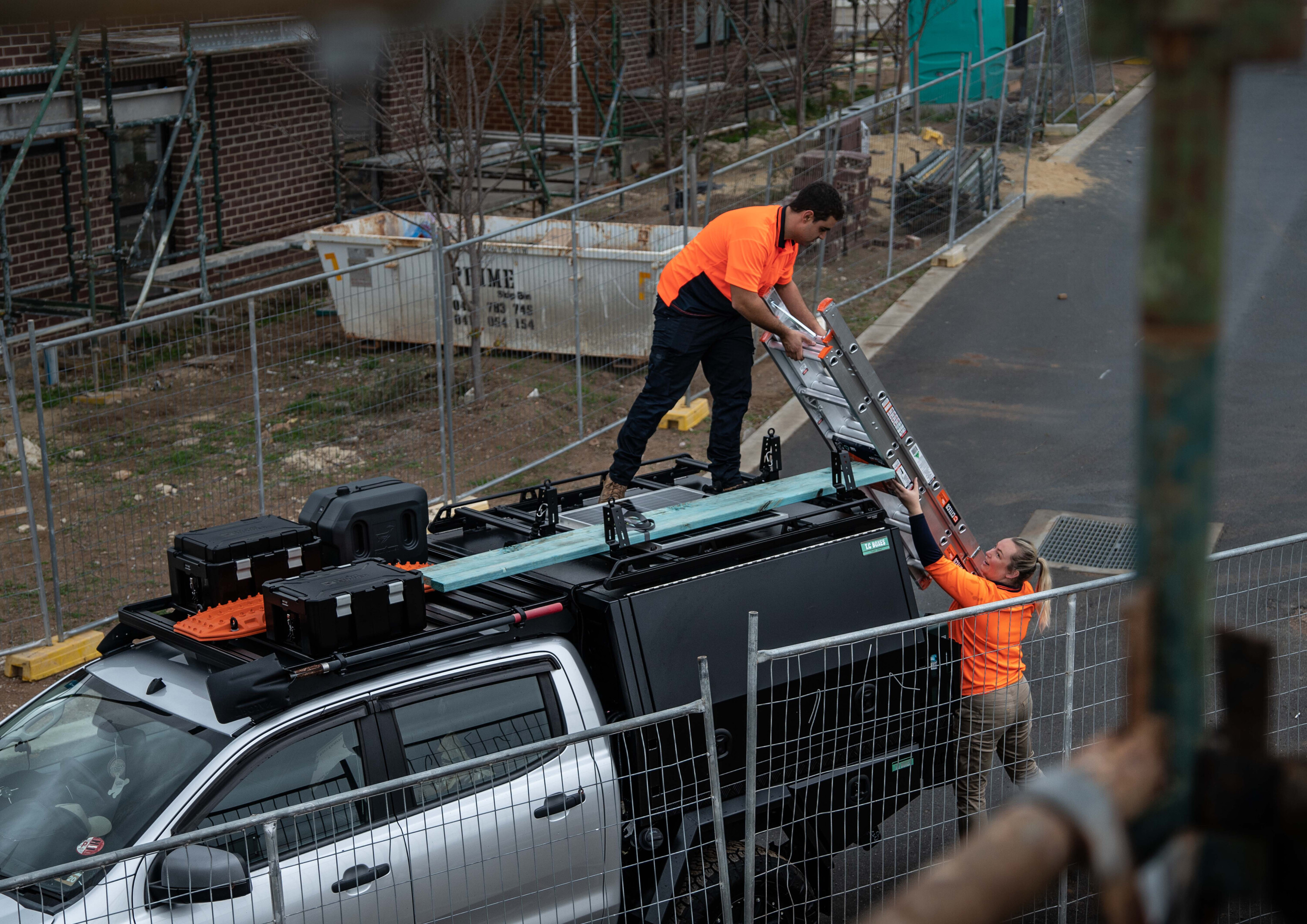
The new Slimpro canopy rack from Front Runner is a robust solution with a range of practical accessories tailored to the Australian market. It features an adaptable slat configuration and side-access T-slots for straightforward accessory mounting.
Designed specifically for fitment to a range of popular alloy canopies, the Slimpro boasts durability, reliability, lightweight construction and a low profile. Its intelligent design and wide range of available accessories allows users to customise their rack set-up, whether transporting heavy-duty construction materials or gearing up for a weekend adventure.
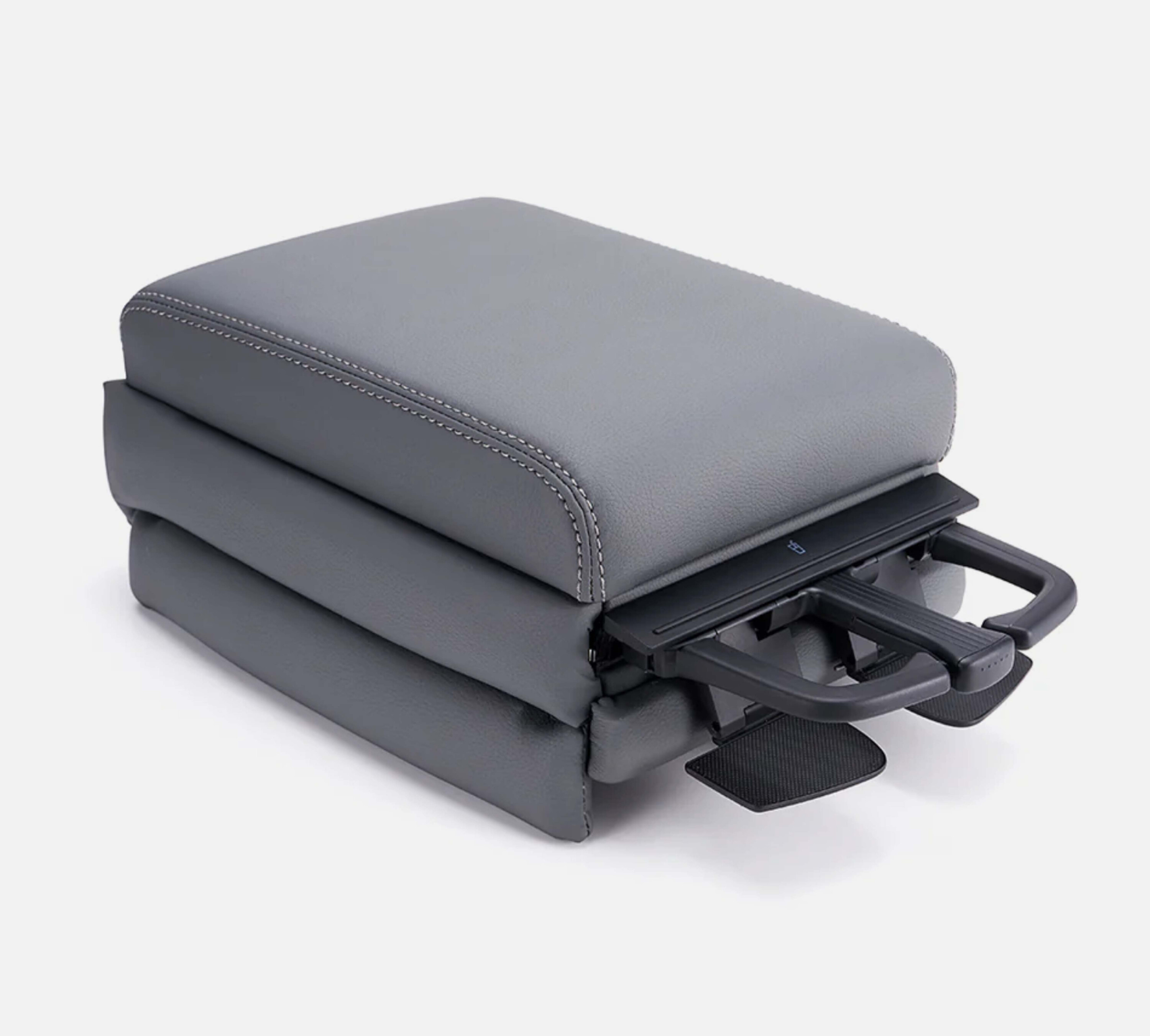
Have you ever felt your stock 70 Series LandCruiser centre console lacks the elbow support needed on extended drives? Matt from the 70 Series Store did, so the team developed the 70 Series centre console armrest that increases the height of your standard console by 14cm, to align it with your elbow for improved comfort.
The centre console armrest includes two extra cupholders and an extra storage compartment for daily essentials. It is compatible with centre consoles that have a lid, including on the 76 Series, 79 double cab, some older 70 Series (Prado, Bundera), 60 Series and 80 Series.
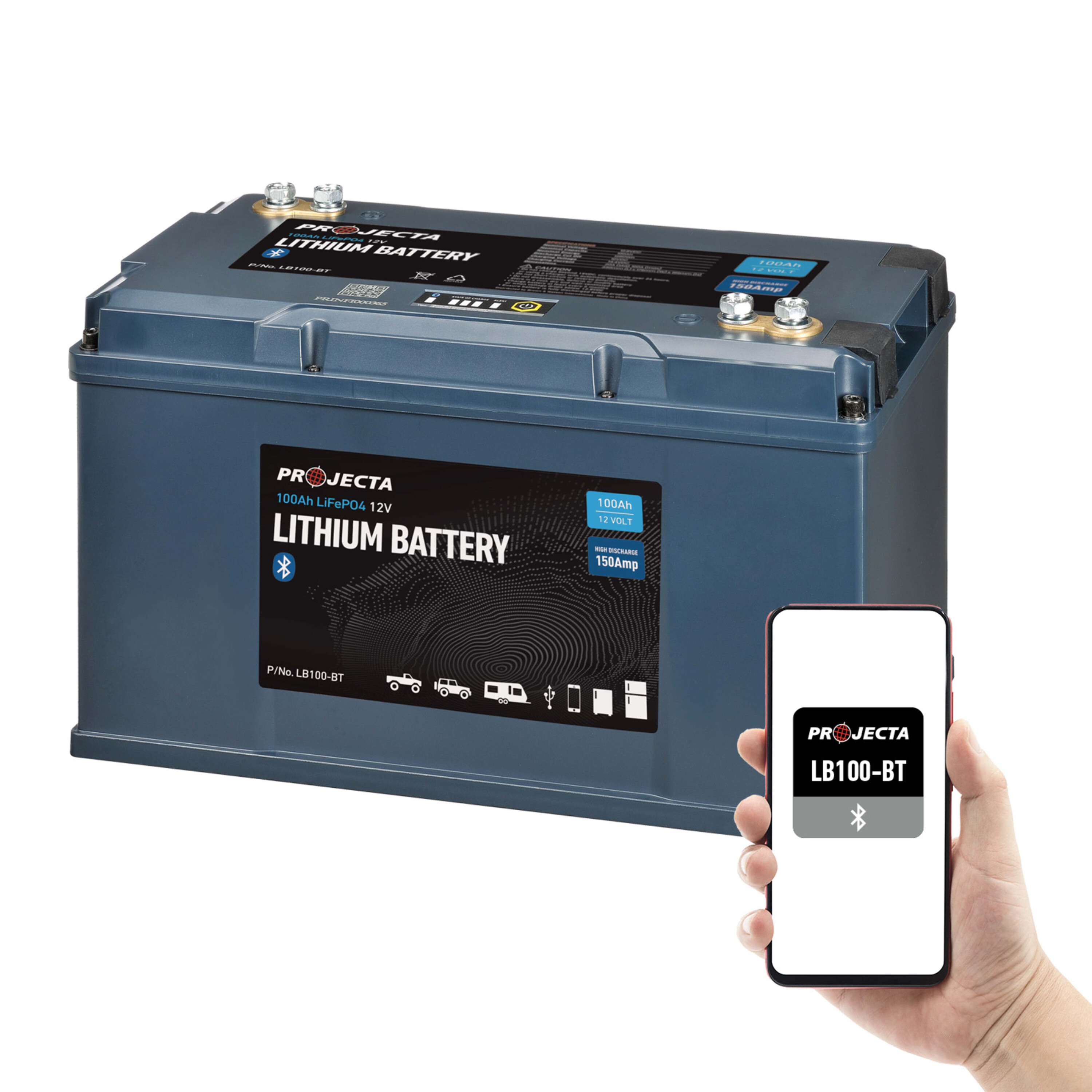
The Projecta LB100-BT lithium battery is packaged in a N70-size casing and has a 150A high-discharge functionality. It allows you to monitor battery status via smart devices with built-in intelligent battery monitoring, and it’s capable of powering 2000W inverters.
Features include overvoltage, undervoltage, overcurrent, high/low temperature and short-circuit protection, as well as LEDs to show state of charge and Bluetooth connectivity. The battery is covered by a five-year warranty.
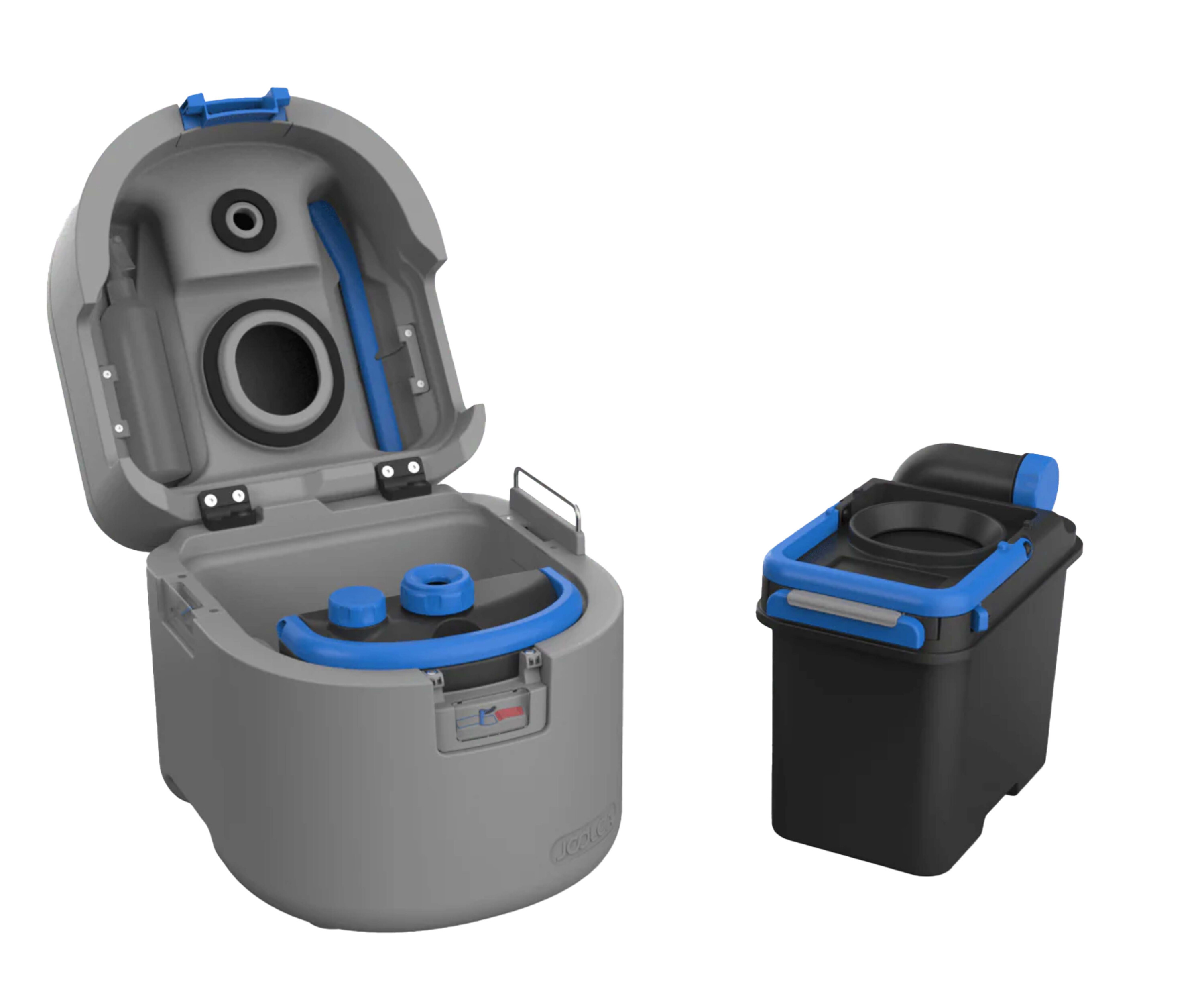
Separating solids from liquids, the Joolca GottaGo is a modular separating chemical toilet that doesnu2019t fill up the solids tank with urine and flush water, so you can use a bag when there are no dump points. It can also be used as a composting toilet.
The GottaGo is airtight and leak proof, doing away with the smell, and is a lot easier and safer to empty than a standard camping toilet. It is also a non-flush toilet, as a spray of vinegar is all it takes to keep the bowl clean. Both tanks feature a level indicator to prevent overflow.
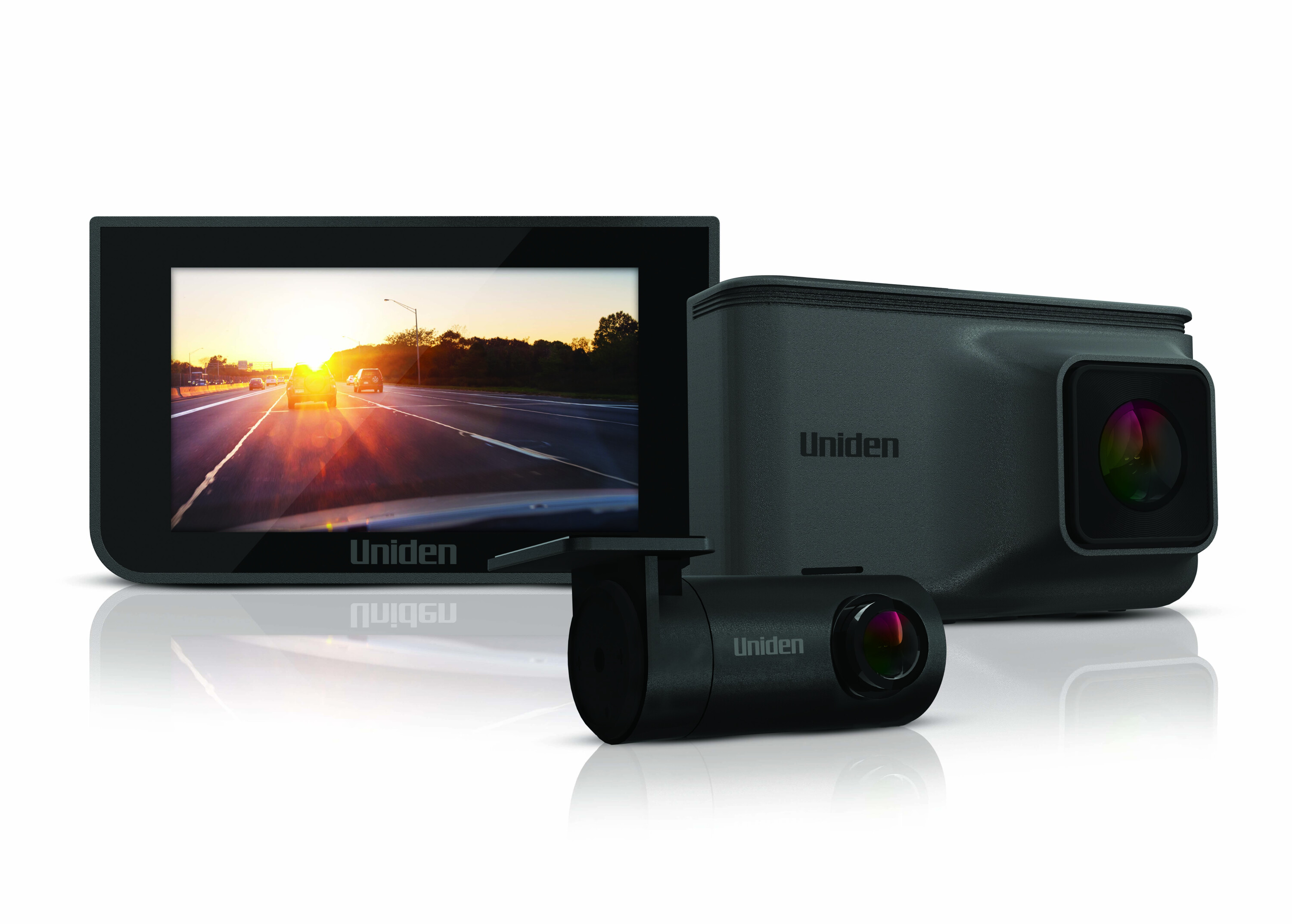
Uniden‘s latest iGO Cam smart dashcams, the iGO Cam 35 and iGO Cam 45R, are compact units that use the latest in-car accident recording Black Box technology, with 130-degree wide-angle view cameras to record more of the action around your vehicle.
A three-axis G-sensor measures and captures acceleration and G-force impacts in three different dimensions, while an inbuilt parking sensor detects sudden vibrations that triggers footage recording even when the engine is off.
The iGO Cam 35 features a two-inch LCD colour screen and a full HD camera. For more visibility, the iGO Cam 45R has a three-inch colour screen, a 2K front camera and a full HD rear camera with Wi-Fi for easy data transfer. Both iGO units come with a sticker mount with a rotating design, for optimal visibility and stability.
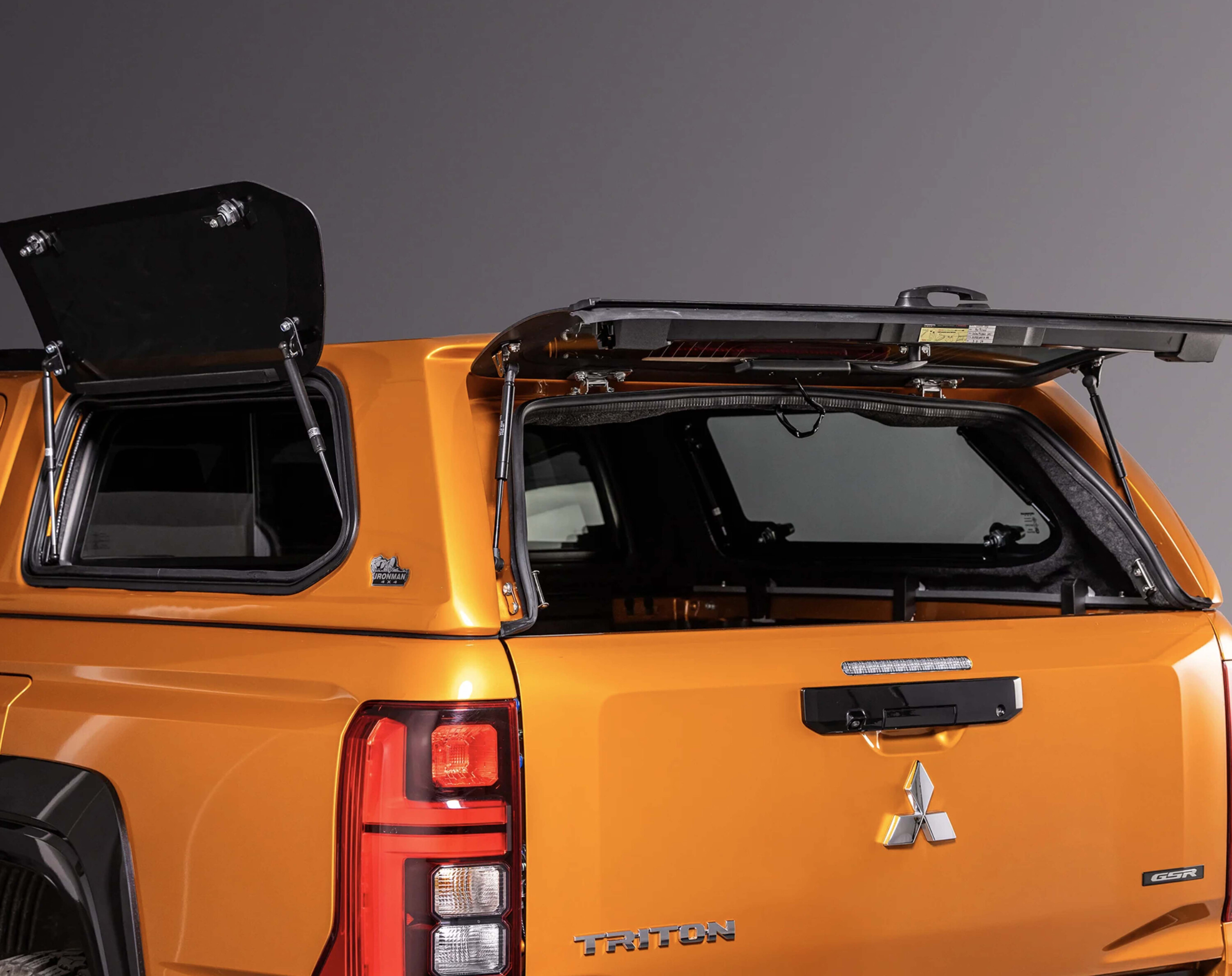
Ironman 4×4 has released its Pinnacle 2 Canopy to suit the Mitsubishi MV Triton. The canopy provides secure storage space for all your gear, tools and equipment, and it includes interior lighting and an automotive-grade carpet finish.
The Pinnacle 2 is equipped with a robust locking mechanism to keep your belongings safe and secure, and it is built tough with high-quality materials to withstand the rigours of off-road travel and harsh weather conditions. It has a 100kg roof load limit, allowing for the safe fitment of a roof rack to host your tent, awning and camp lights.
The Pinnacle 2 is designed to enhance the appearance of your Triton with a sleek and aerodynamic profile complementing its rugged capabilities. It comes with two lift-up side windows which can be opted out for sliding windows.
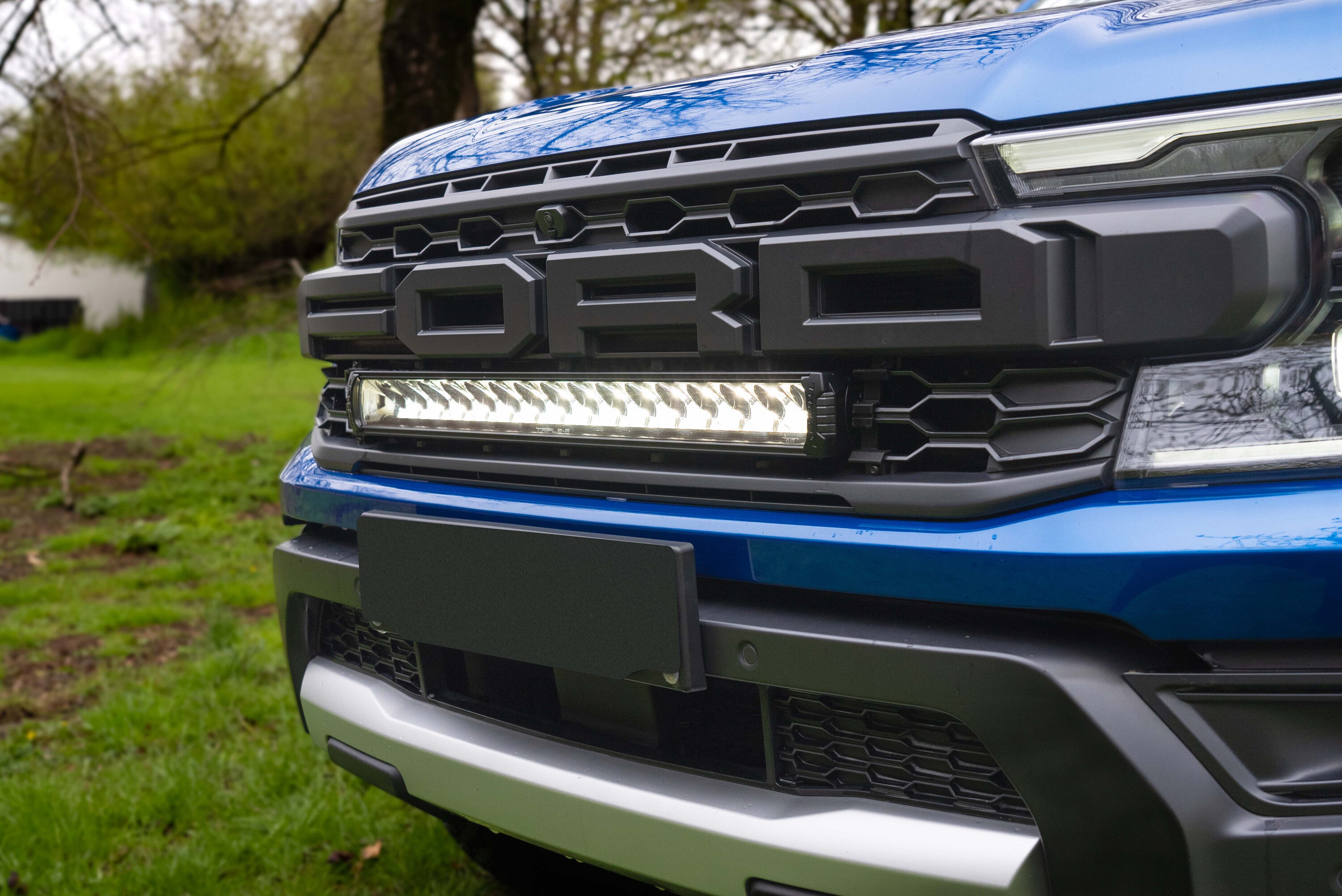
Lazer Grille Integration kits include mounting brackets that allow for quick and easy fitment of Lazer High Performance LED light bars within the front grille of a vehicle, resulting in an integrated lighting set-up.
The Ford Ranger Raptor kit (MY2023+) includes a Triple-R 16 Elite High Performance LED driving light, wiring kit, and brackets precision-engineered to engage perfectly with the standard centre grille of the vehicle. The brackets are made from high-strength, UV-stable and chemically resistant composite material. The kit is covered by a five-year warranty.
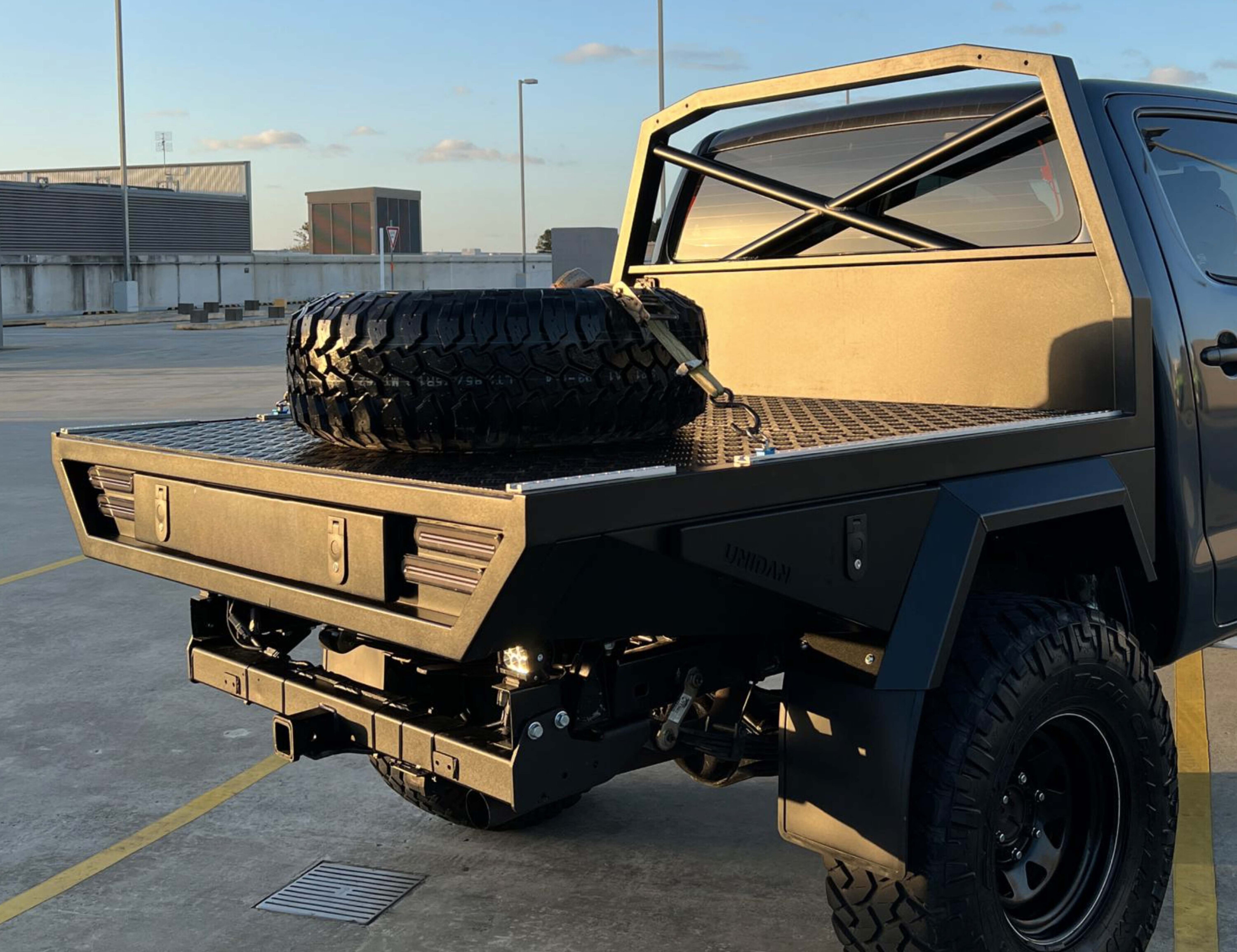
Unidan Engineeringu2019s DIY tray kits are designed to simplify the fabrication process, enabling customers to create their own accessories effortlessly.
Whether you’re an experienced welder or a passionate DIYer, Unidan tray kits provide everything necessary to bring your unique vision to life. Each tray kit includes pre-cut, folded and deburred materials ready for a straightforward tab and slot assembly, eliminating the need for drafting designs or sourcing laser cutter and brake press suppliers.
The company’s first DIY product is a custom tray designed specifically for the Toyota HiLux dual cab, and is available with optional add-ons such as side storage boxes, a rear drawer, and a versatile ladder rack or canopy loop. Unidan Engineering says it is committed to expanding the range of accessories and models based on customer feedback and interest.
Well, tourism has well and truly been invented and many towns in north-east Victoria and southern New South Wales certainly benefit from visiting tourists seeking bushranger history.
The sites that now cater for visitors are well worth looking at, but it is still possible to get away from these popular places to get a true feel for the spirit of the life and times of the Kelly gang.
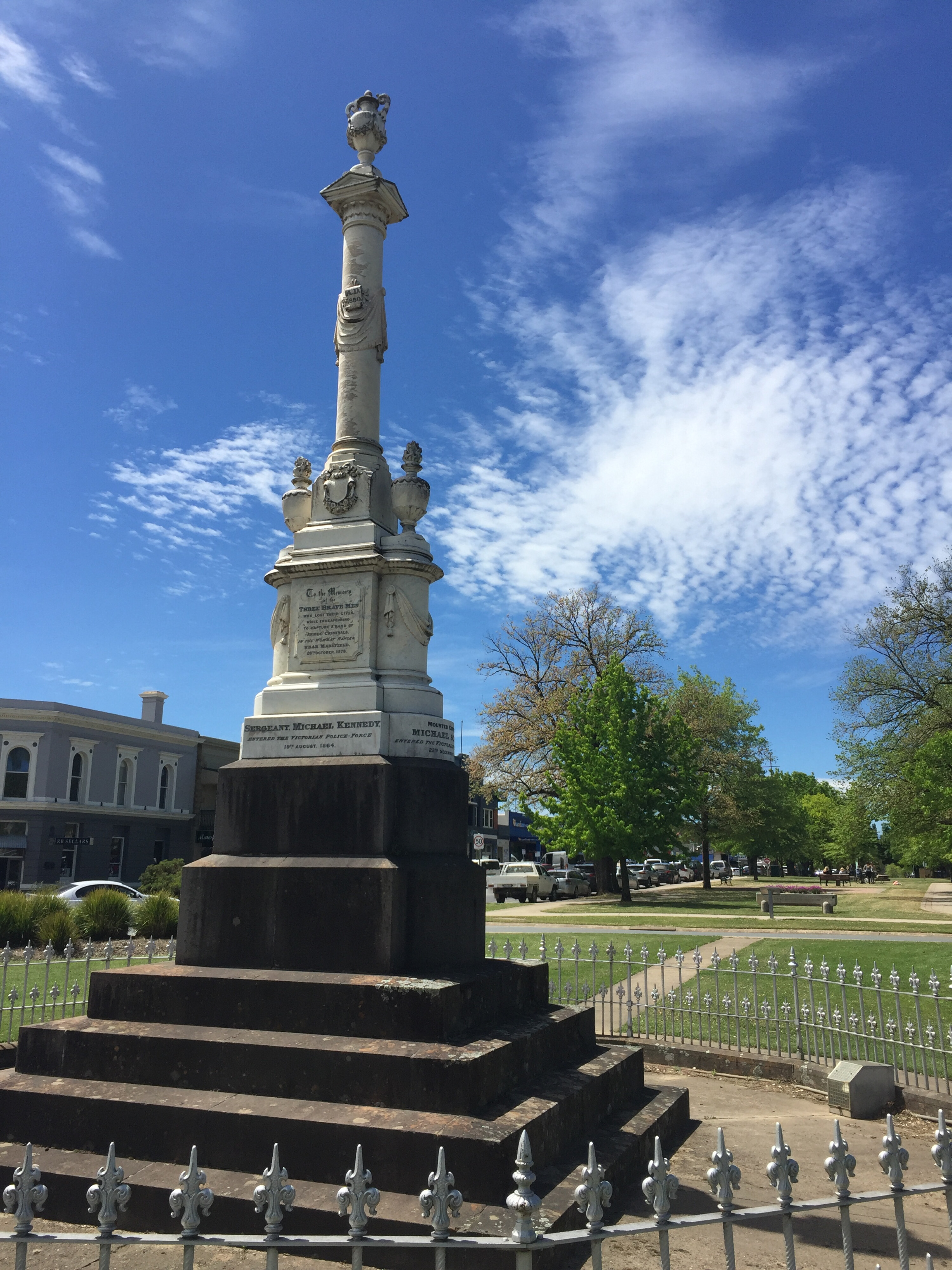
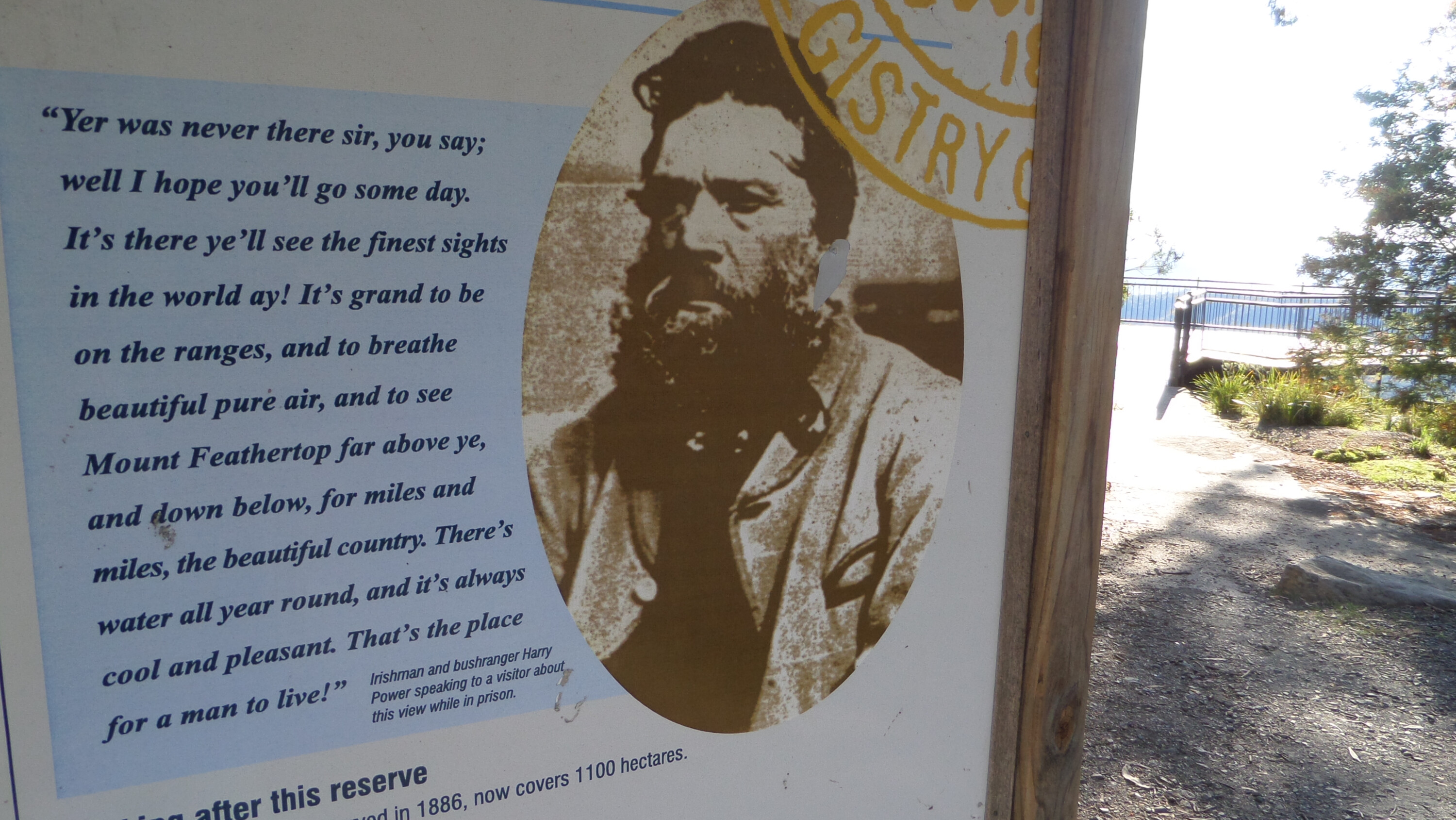
A young Ned Kelly served as his assistant. In May 1870, three police officers acting on information captured Harry at his hideout near what is now Powers Lookout.
Roads from Mansfield, Benalla and Myrtleford provide scenic access to Powers Lookout. Parks Victoria has recently made big improvements to the tracks, steps, ladders and lookout platforms which provide visitors with spectacular escarpment views over the Upper King River Valley and the Alpine National Park.
Picnic tables, fireplaces and toilets are available, but camping and dogs are not allowed. It is possible to seek out further trails and campsites in surrounding reserves, or camp at Stringybark Creek and drive across to Powers Lookout for the day.
The site of this house was once visible from the road, marked by two obvious brick chimneys. These are now gone, and no sign of the house remains. Greta is still worth a visit though, as the final paragraph in the saga can be found here.
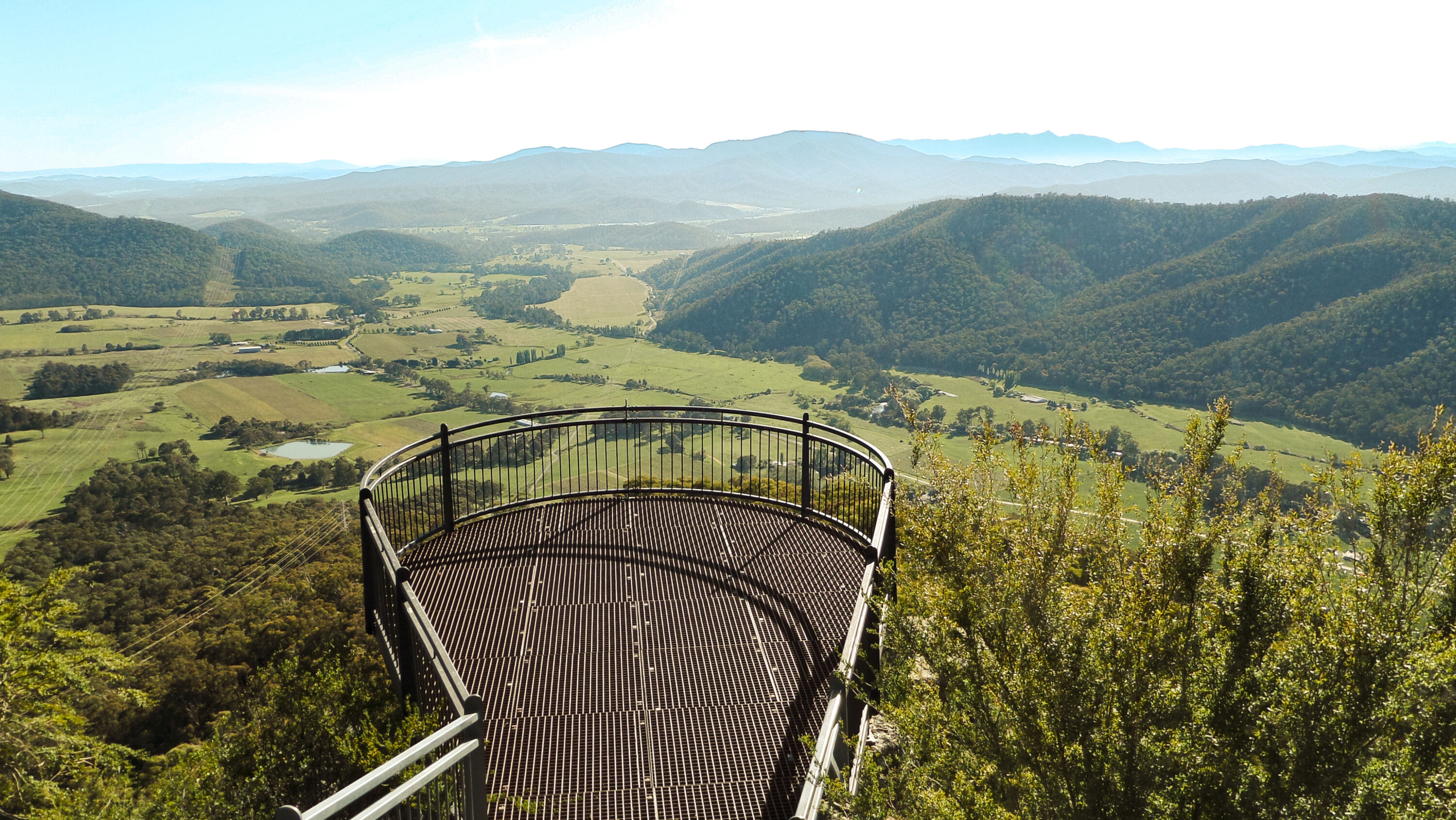
Ned was eventually hanged on 11 November 1880 in Old Melbourne Gaol and the body was buried on site. In 1929 Ned’s and other remains were exhumed and reburied in Pentridge Prison. In 2013 Ned’s remains were removed again and reburied in an unmarked site in Greta Cemetery. A headstone by the gate commemorates the event.
Following the incident at the house in Greta, Ned, brother Dan, Joe Byrne and Steve Hart took to the bush and the two-year Kelly Outbreak began.
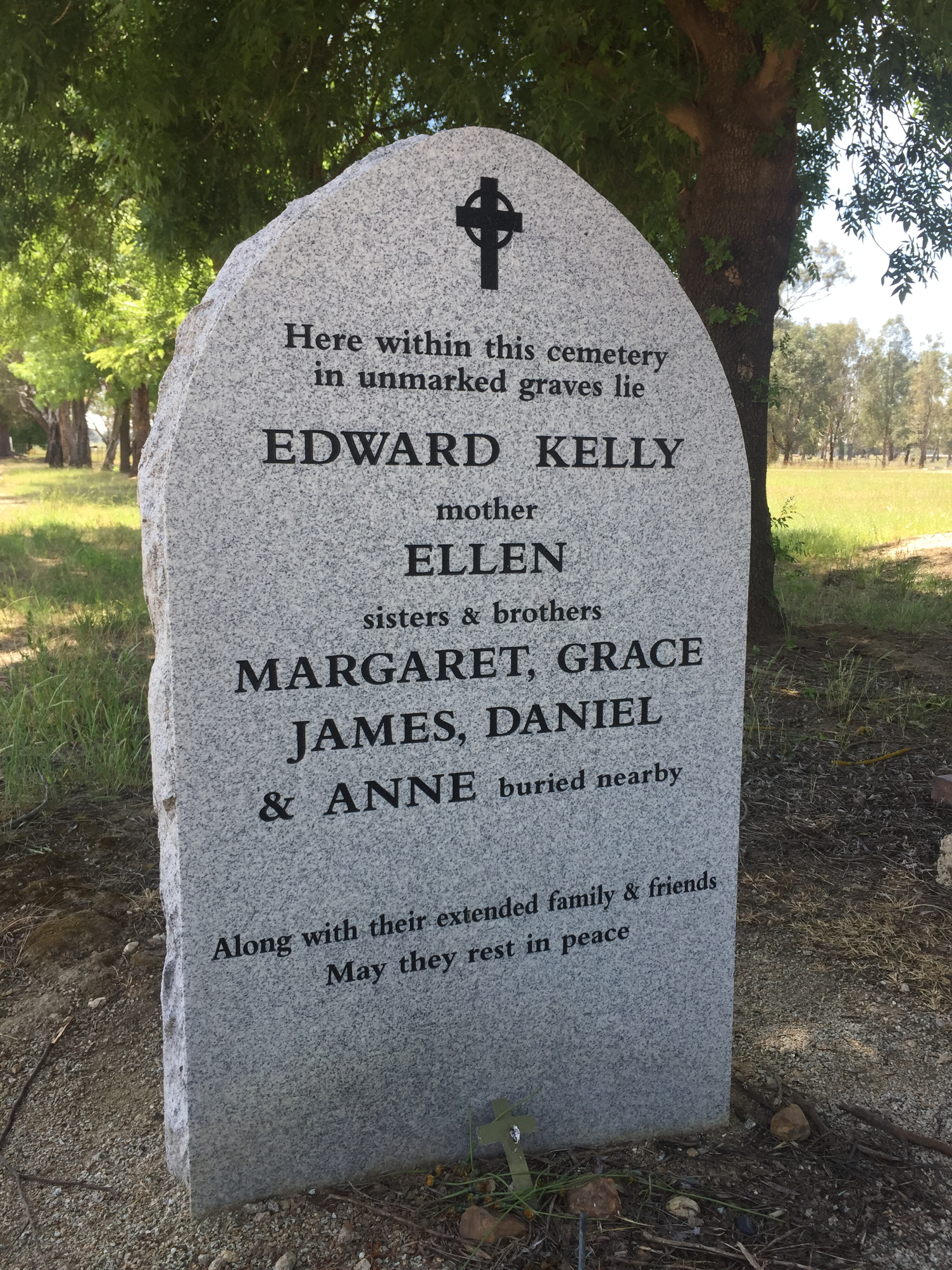
On 26 October 1878, Sergeant Michael Kennedy, Constable Thomas Lonigan and Constable Michael Scanlan were ambushed and killed in their isolated bush camp. Only Constable Thomas McIntyre survived to tell the tale.
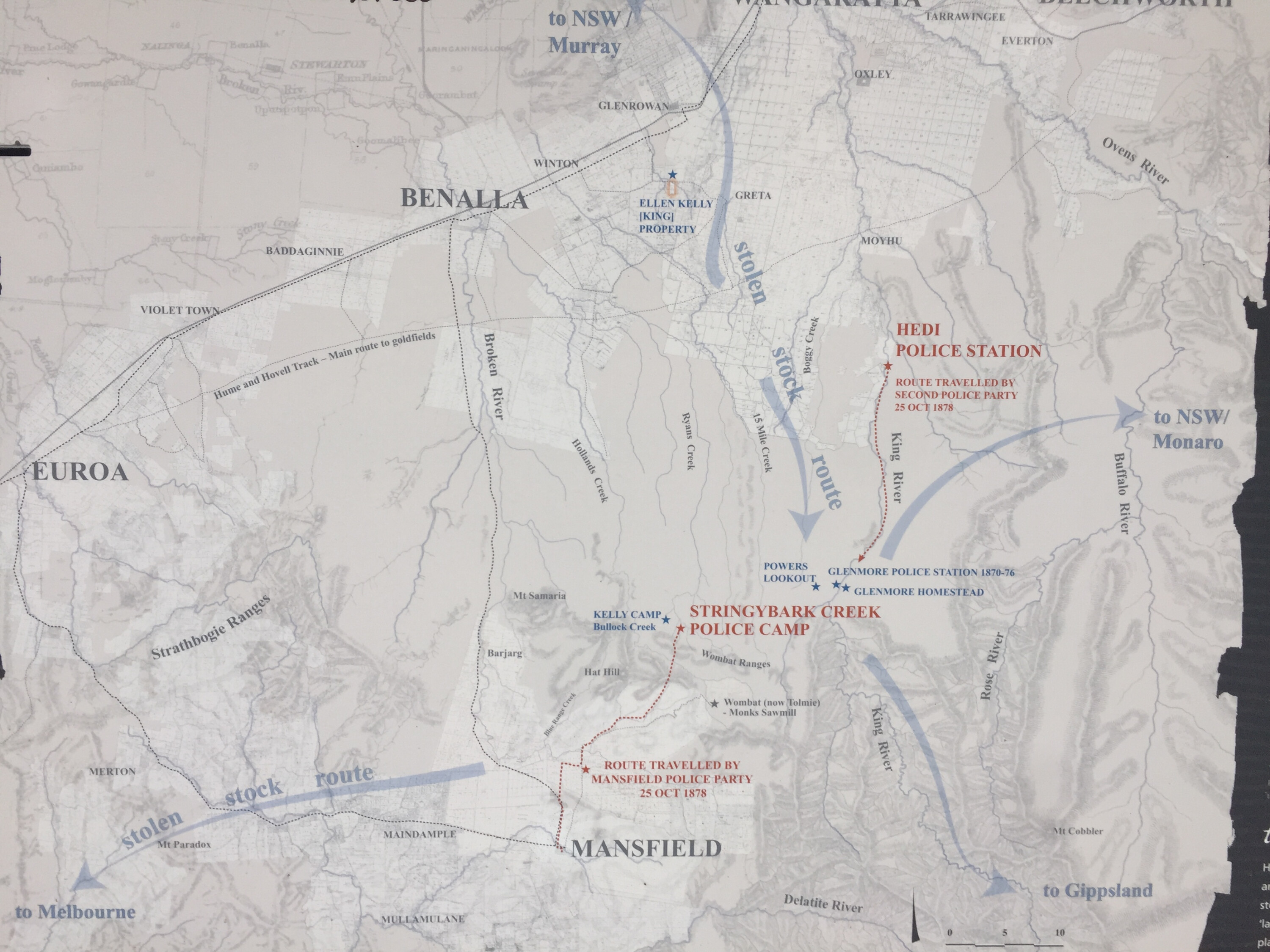
Warrants had been issued for the arrest of Ned and Dan Kelly and two police parties were to converge on the suspected hideout in the Wombat Ranges. The southern party from Mansfield under Sergeant Kennedy was well ahead of the northern patrol. Kennedy’s party made camp at a clearing in the thick bush that had been used by gold miners in the past.
Ned and Dan and two mates, Joe Byrne and Steve Hart, were camped very close by and knew of the police presence and decided to strike first. They attacked the police camp and shot Constable Lonigan while McIntyre was taken prisoner.
When the other two policemen returned from patrol they too were attacked and shot dead. Sergeant Kennedy retreated while firing his pistol, but he was followed and shot by Ned. In the confusion, McIntyre escaped on Kennedy’s horse and eventually made his way back to Mansfield after a miraculous and fearful journey.
Ever since that day, visitors have been attracted to the site of the bush battle. At first a tree was marked and when it was cut down another was marked. It too fell to old age and so a nearby giant forked gum was carved with the inscription ‘1878 KELLY SHOT LONIGAN’.
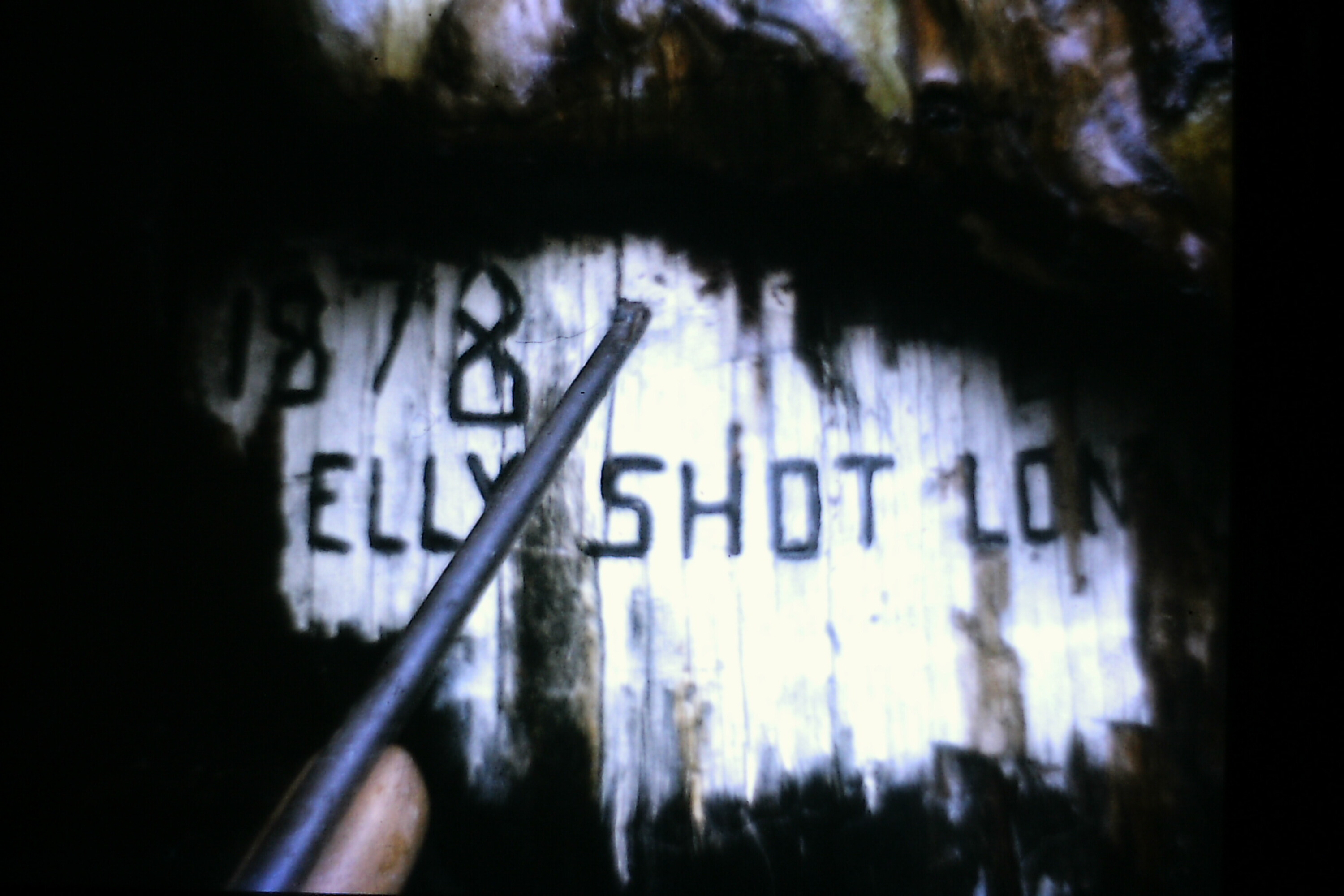
As the decades rolled by, the actual site of the camp and the battle was forgotten and now many interested people have different theories as to its precise location. A picnic area was developed last century at the most likely site and today that site is seen as the most probable location.
In 2017 the official Victorian government comment was, “Significant research over many years by individuals and groups has suggested different sites as possible locations where events unfolded. Much of this research continues and remains contested.”
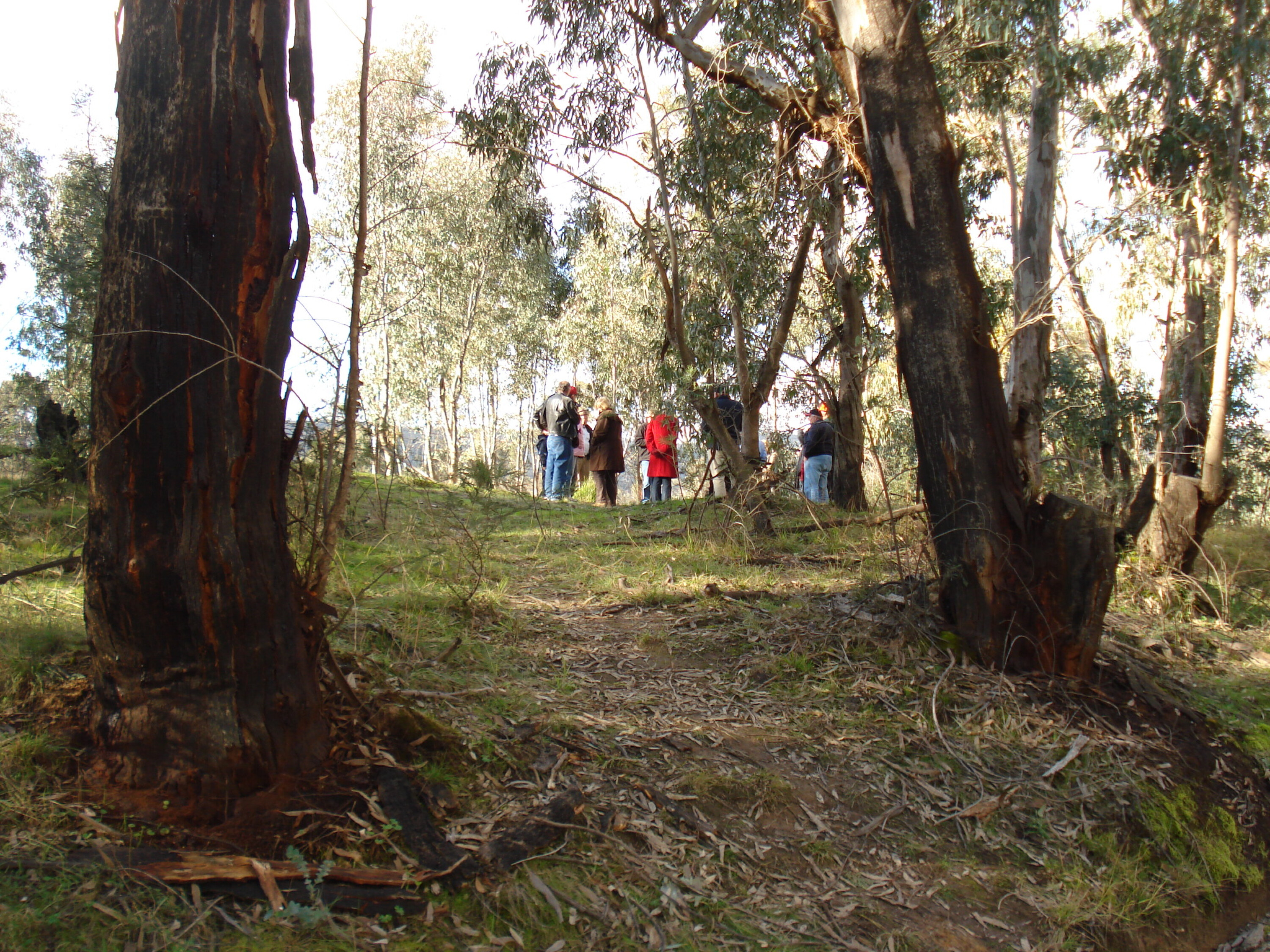
Work commenced in August 2018 to enhance infrastructure and signage at the site to better reflect the historical importance of the location. Wonderful results have been achieved.
Where previously the site was mainly a picnic area with a memorial plaque, it is now mainly a memorial zone with a couple of picnic tables in one corner.
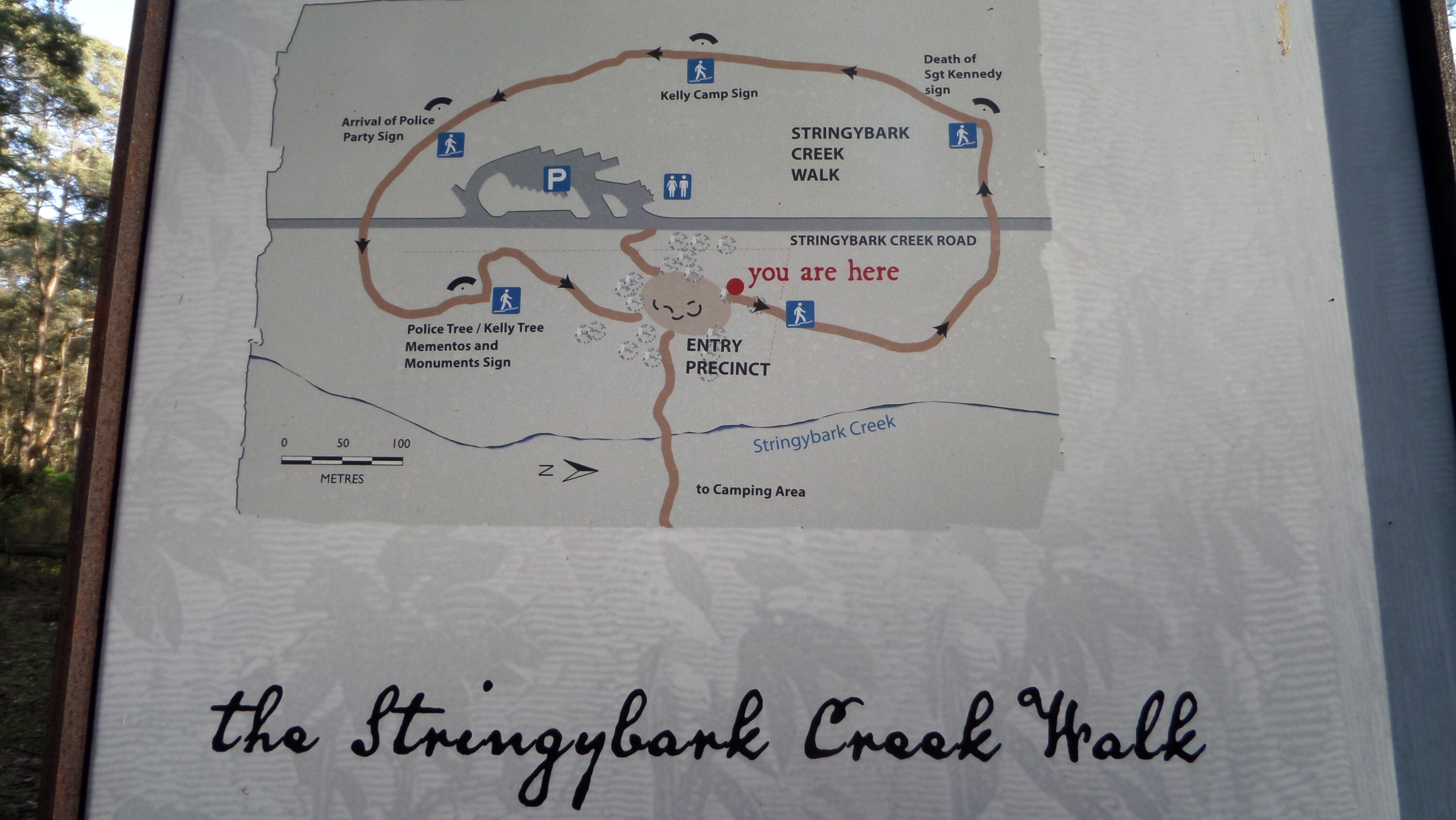
The location now has the feeling of quiet contemplation and reverence. The carpark and toilet are up on the roadway and as you cross the road and read the large information board, which overlooks the clearing, the spirit of the place starts to overtake.
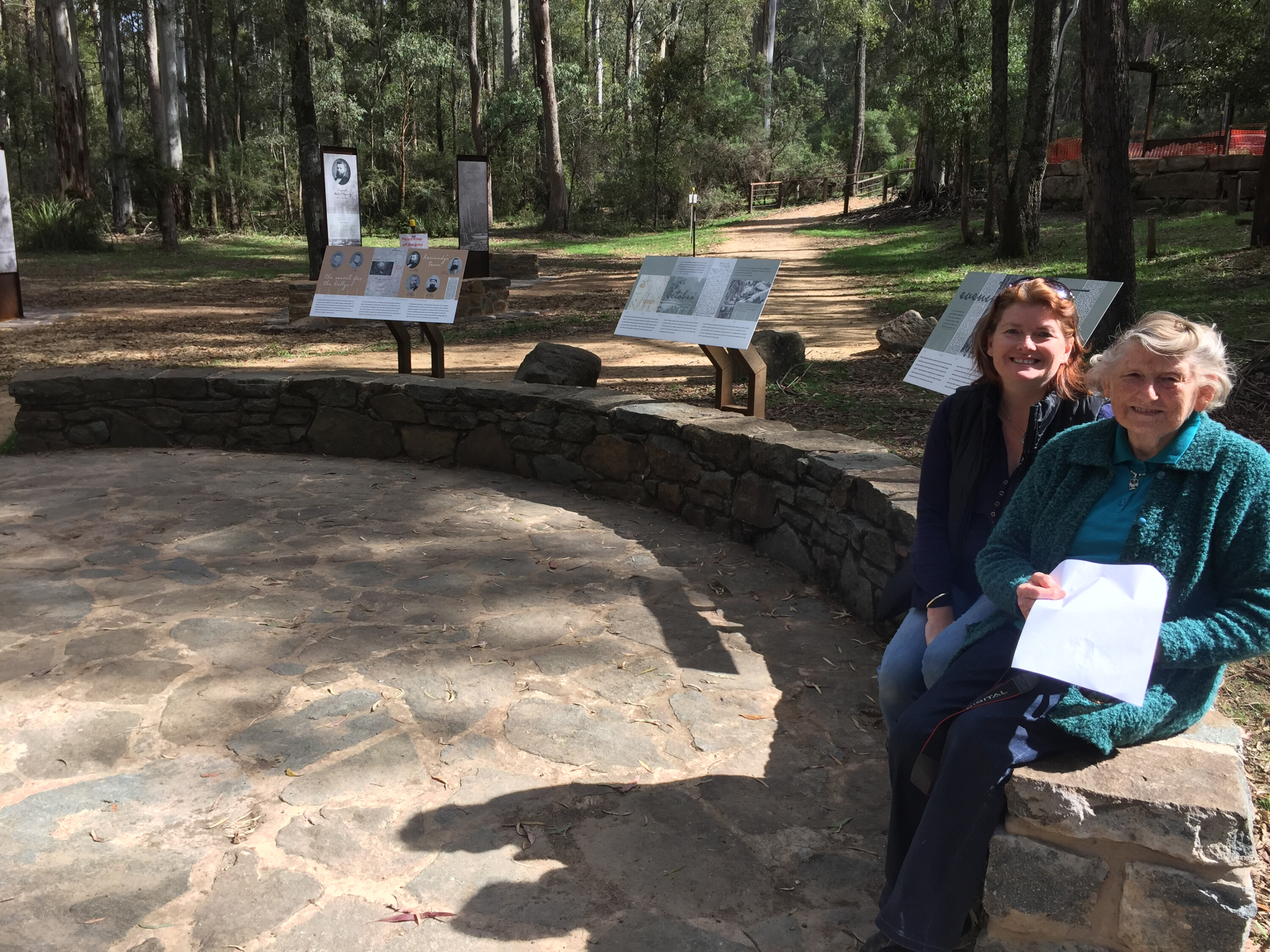
Three tall markers describe the three slain officers with stone curved benches to aid contemplation as you read. The spirit of the site can be very strong here at dusk, the time of the ambush.
Adjacent to the memorial is a circular stone wall with six information panels describing the events of those tragic days in chronological order. Here too the stone wall provides contemplation space.
Perhaps the most innovative aspect to the whole site and the most interactive for visitors is the pathway leading northward out of the clearing following the last desperate attempt by Sergeant Kennedy to escape destruction. This is also McIntyre’s escape route, and his information board is located here.
Adults can use their imagination to try to understand what was going through the mind of the pursued Kennedy and the minds of the pursuers, Ned and Dan Kelly.
This is a real historic interactive experience for visitors. No bells and whistles, just the wild bush, and the imagination can span those 146 years. Children will appreciate the real experience if it is explained well to them.
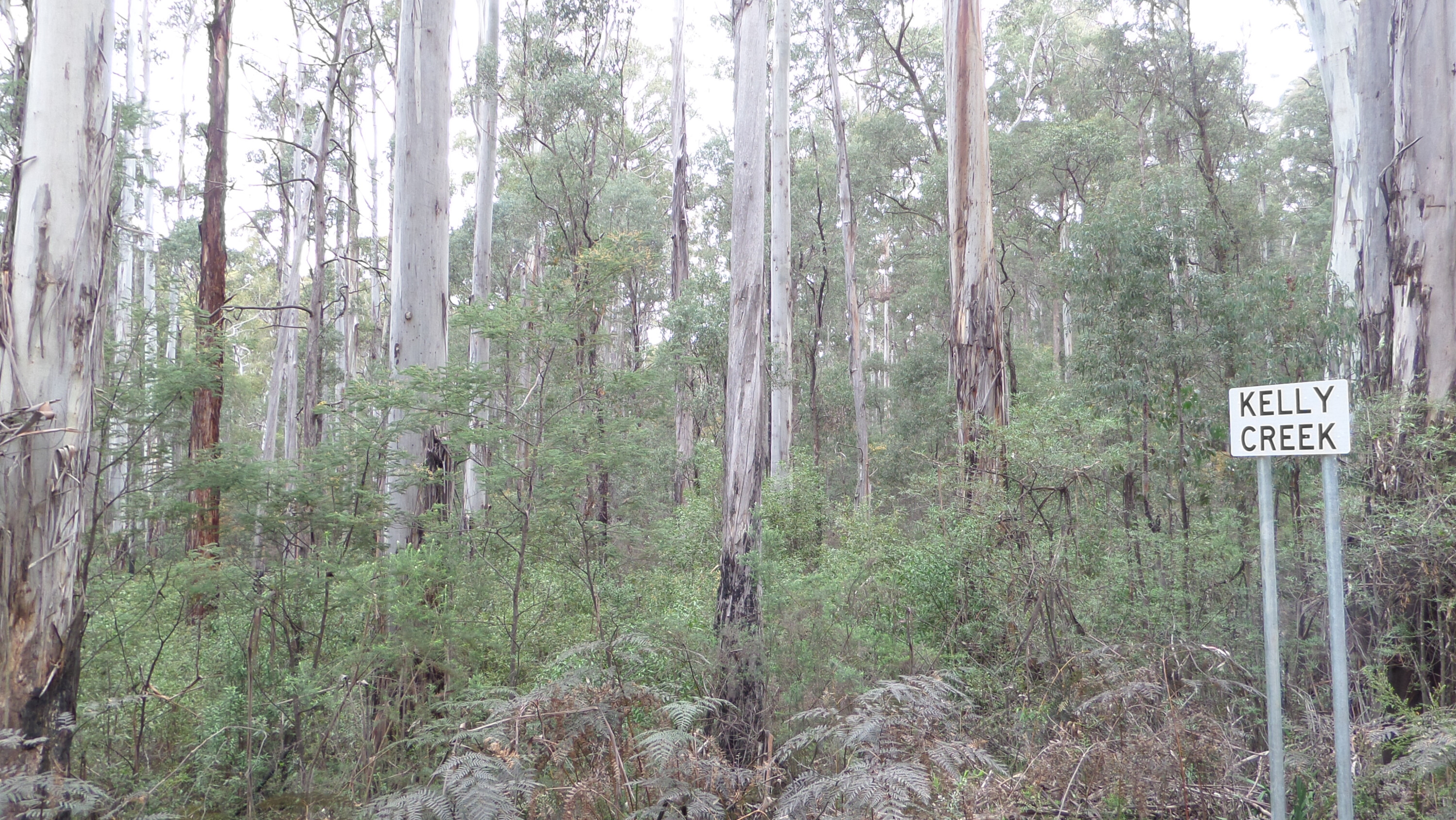
Kennedy reached a point somewhere in this thick bushland before he was overtaken by Ned and shot at close range. An information sign marks a possible site and of course there is a large contemplation rock bench.
The track continues to a sign explaining the fortified Kelly hut and hideout that was located across the Germans Creek divide at Bullock Creek (now Kelly Creek).
The circular walking path now crosses the road and descends some steps to follow Stringybark Creek down to the Kelly Tree. Some researchers think that the police camp was in this area. The tree has an information sign, and it is fun for kids to discover Ned’s helmet peering out from the encroaching bark tomb.
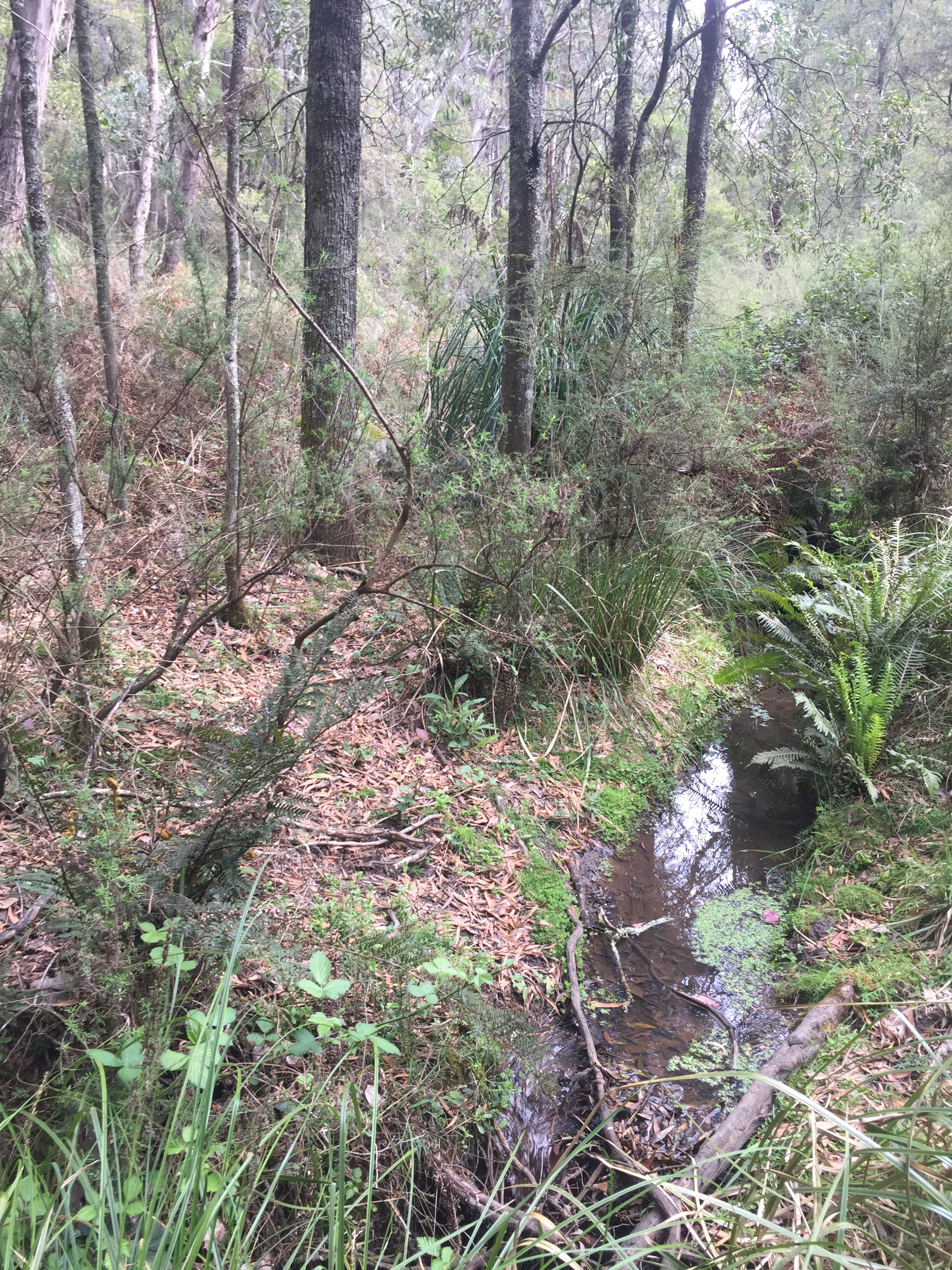
The track now returns to the memorial clearing. A track over a small bridge across the creek leads a short distance up to the adjacent camping area which is not visible from the memorial site.
This is one of the best free isolated forest camping areas that you will find. There are plenty of bushy nooks or wide-open grassy spaces to choose from. Toilets and a picnic shelter are provided but no water. Firewood from the surrounding bush is plentiful. The access road is just south-east of the Stringybark Creek Road.
Follow the rough track just north of the Germans Creek crossing almost opposite Madhouse Road.
Take the right branch at the dirt pile. There is nothing left at the scenic bushland site. When the creek is reached the hut was thought to be located to the right where the old sawmill sawdust pile can be seen.
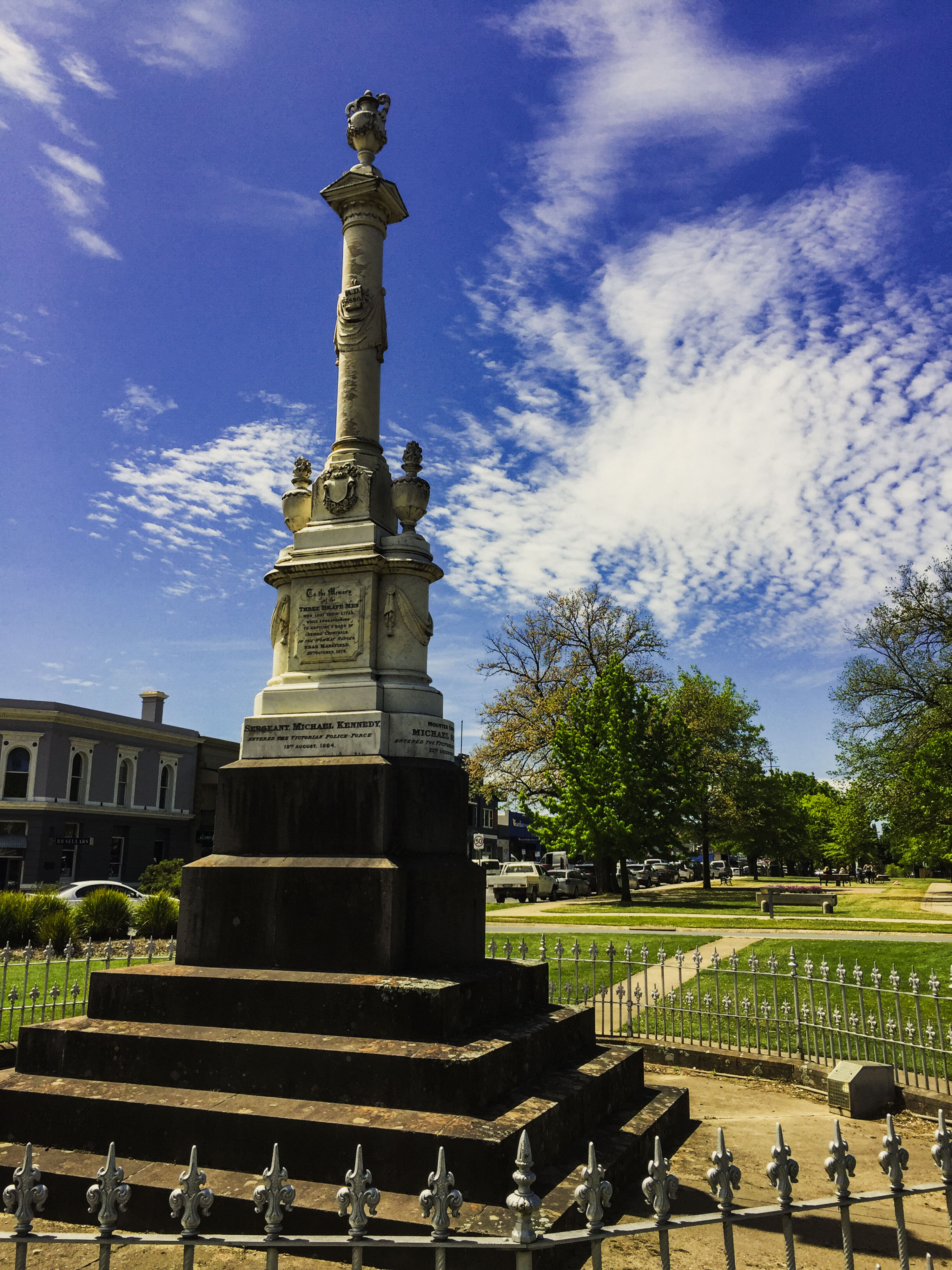
In Mansfield you can visit the graves of the policemen and see their monument in the main street. It was dedicated while the Kelly Gang was still at large.
Stringybark Creek is well signposted. From Benalla, travel into the Toombullup State Forest via Tatong. From Mansfield travel via Tolmie. Both access routes have steep sections with narrow gravel roads. Timber trucks work in the area. If towing, the Tolmie access may be best with 11km of dirt road to the site.
Robbing a bank or two would solve the financial problems and these raids were carried out with utmost skill and planning. A base of operations was established, hostages taken, surveillance undertaken, and worthwhile proceeds stolen.
No one was physically injured, and the gang got away clean. In both cases, similar amounts were stolen – over 2000 pounds. This amount has been compared to an average worker’s lifetime earnings over 50 years.
Jerilderie, NSW, like Euroa, is also now minus the bank building, though some sites and buildings remain. These include the Post and Telegraph Office which was disabled by the gang.
Other sites are the police station and stables, the courthouse, the Royal Mail Hotel and the Bank of New South Wales site.
To entice the police train to a derailment site of his choosing, he plans the murder of Aaron Sherritt, who was once a friend but who has now turned police informer.
Sherritt is murdered at his hut in the Woolshed Valley below Beechworth and the trap is set. The Woolshed Road can be accessed from Beechworth via the Wodonga then Chiltern Roads. Many sites along this old goldfields route have been marked with information signs.
A little way on after cresting a small rise and cutting is the site of the Sherritt hut on the right, between the road and the fence. Look for ground depressions. The site is usually not marked, as signs disappear. A day can be spent exploring the history along rough roads through to El Dorado.
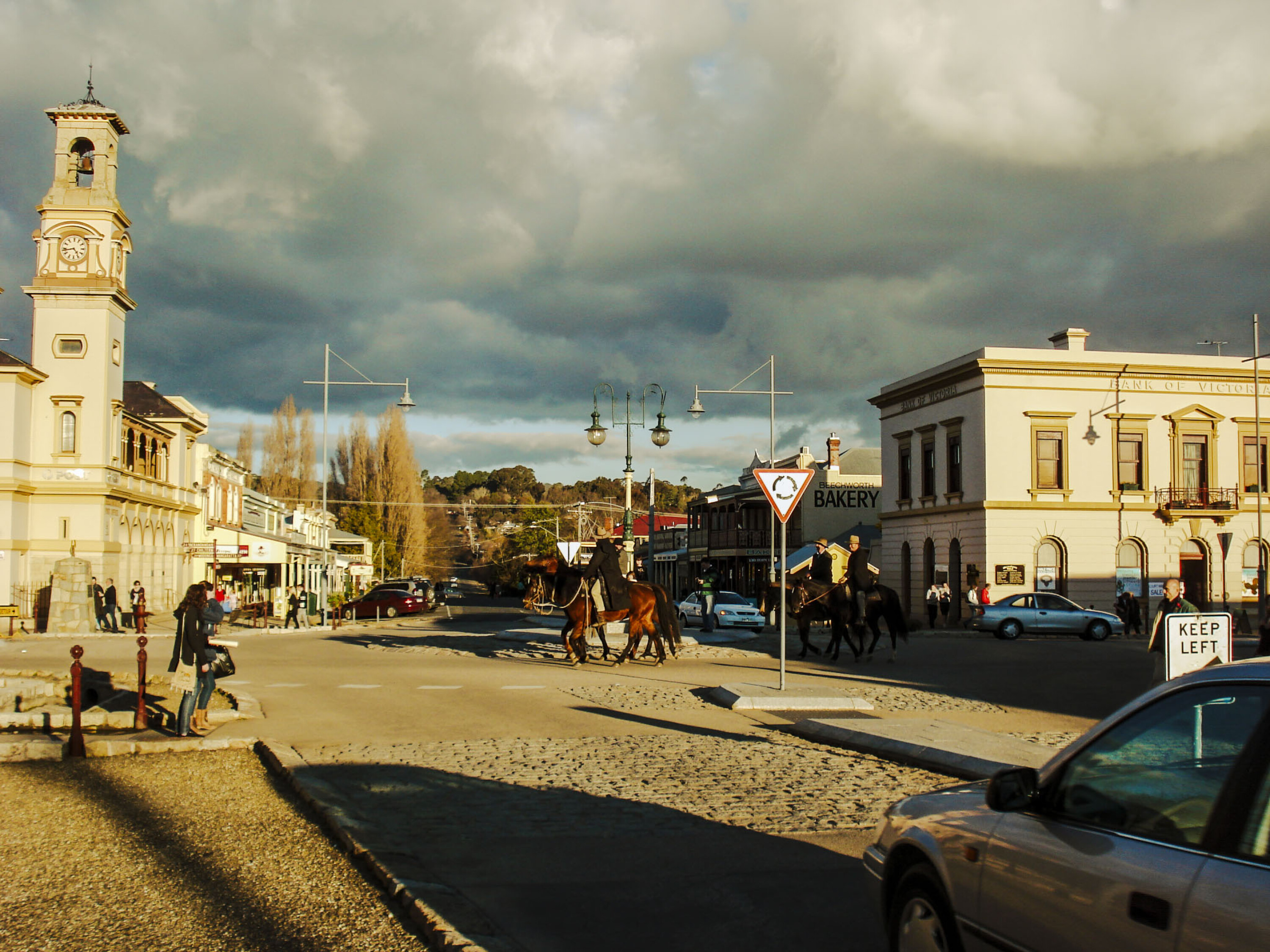
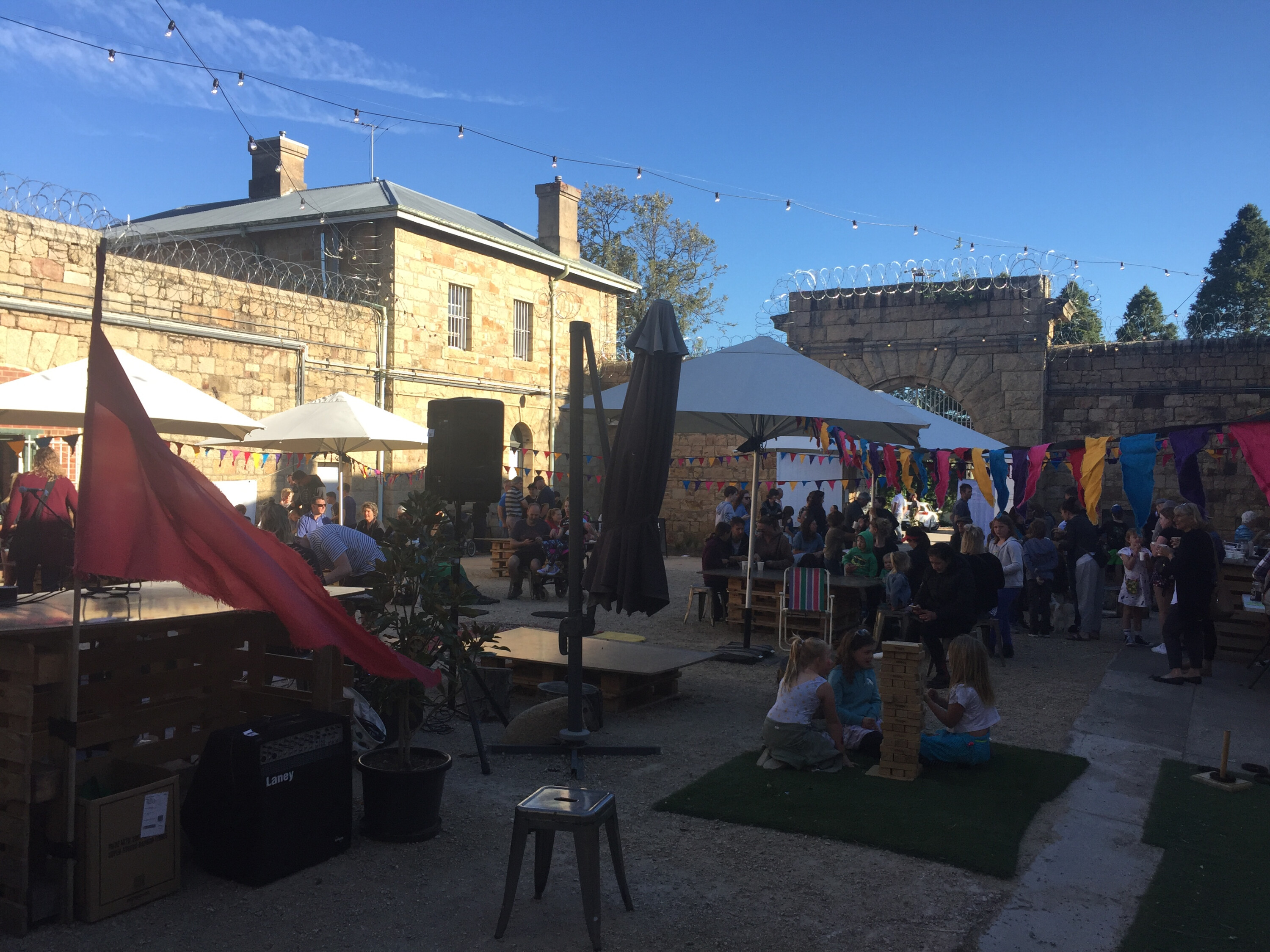
Beechworth retains numerous Kelly buildings and sites, and caters well to visitors. Historic buildings and sites include the gaol, now open for tours, courthouse, museums and historic walks and drives.
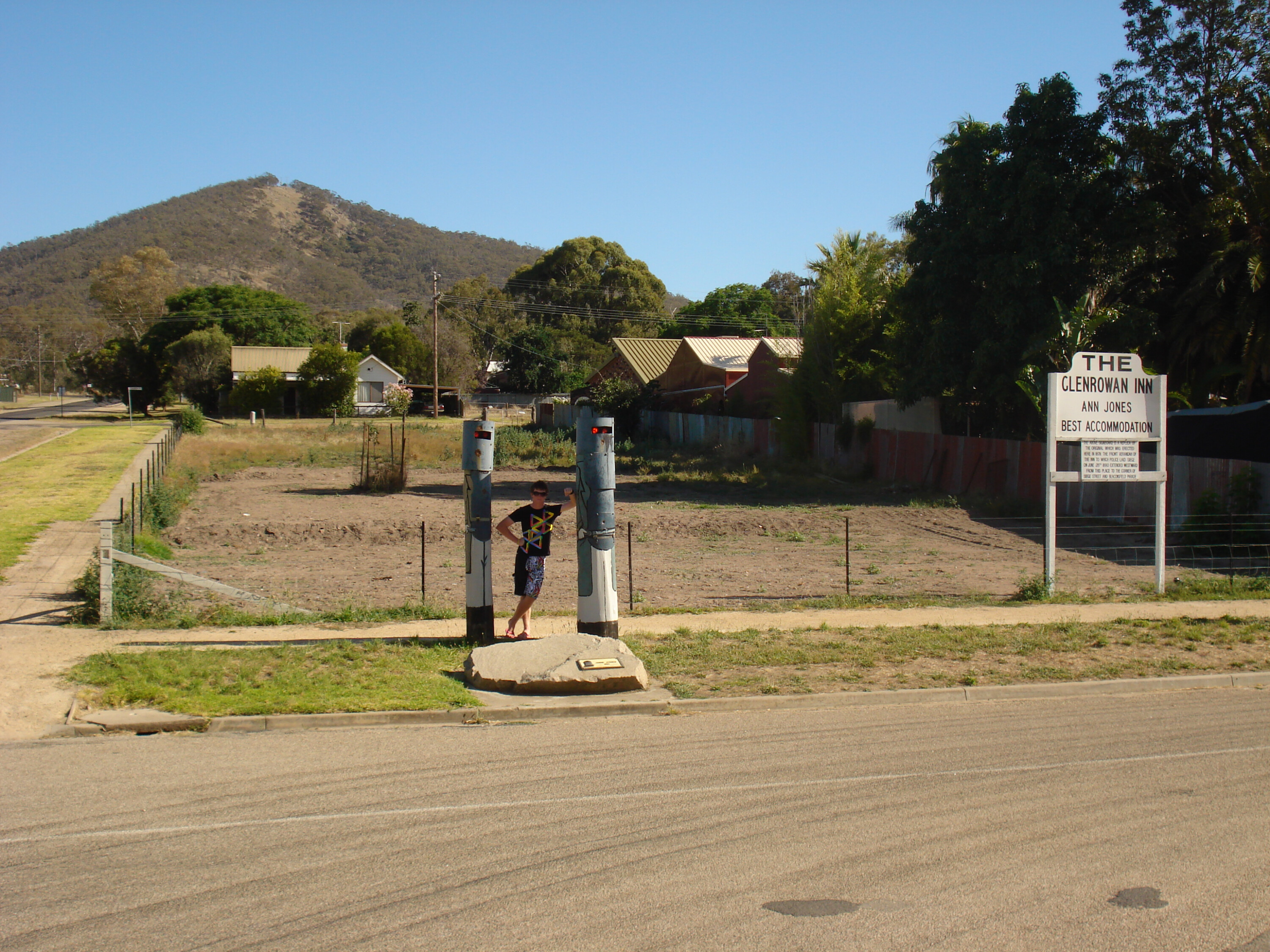
Now this has all come together with the new Glenrowan Viewing Tower, a circular elevated platform, located in the Lions Park in the centre of town. The tower gives an overview of the battlefield, as well as information on the events of June 1880.
Glenrowan is where the Kelly story reaches a climax. The police train was saved from derailment, the outlaws in their bush-made armour fought the police, three outlaws died along with civilians caught in the crossfire, and the besieged hotel was burnt down.
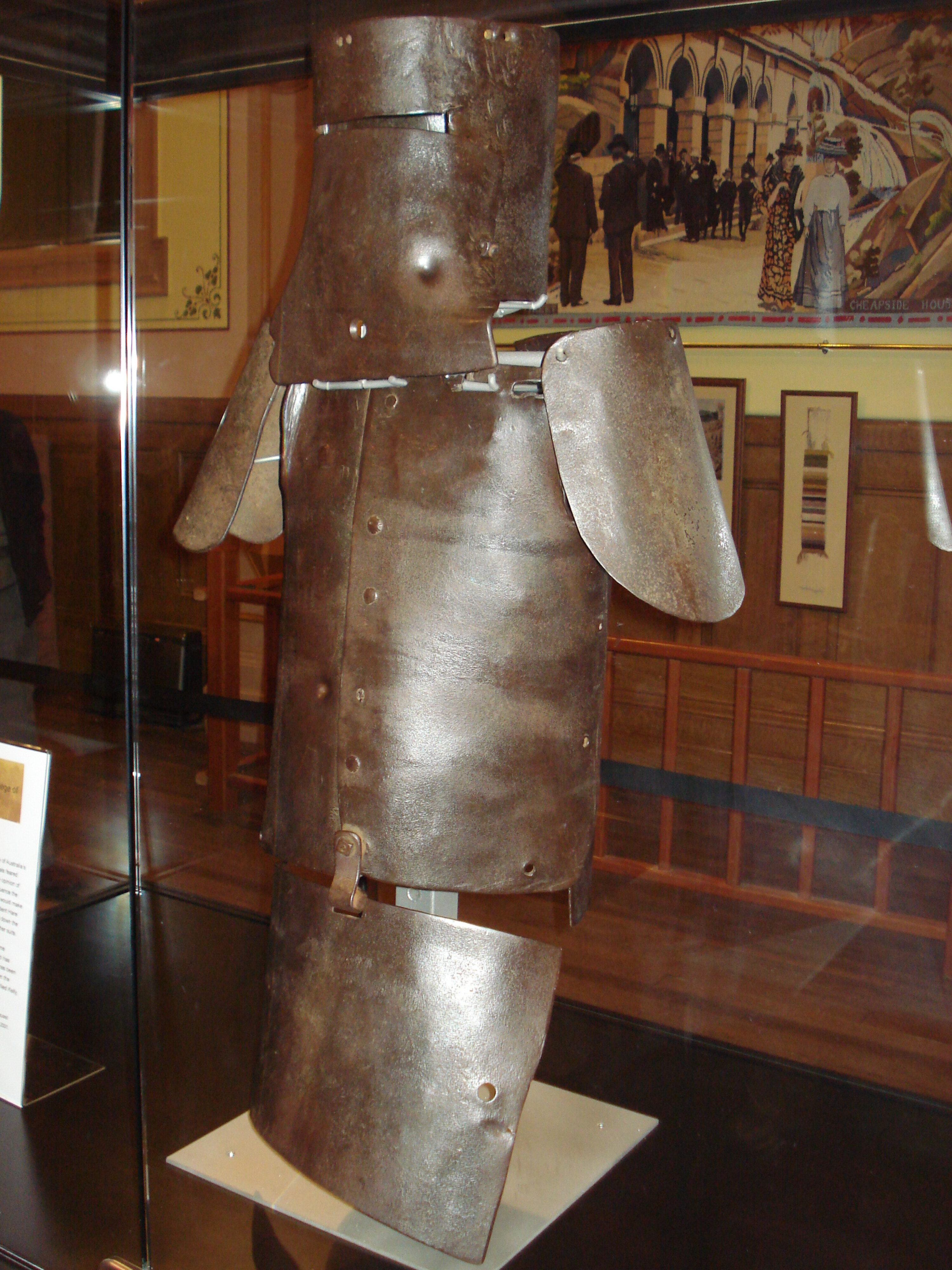
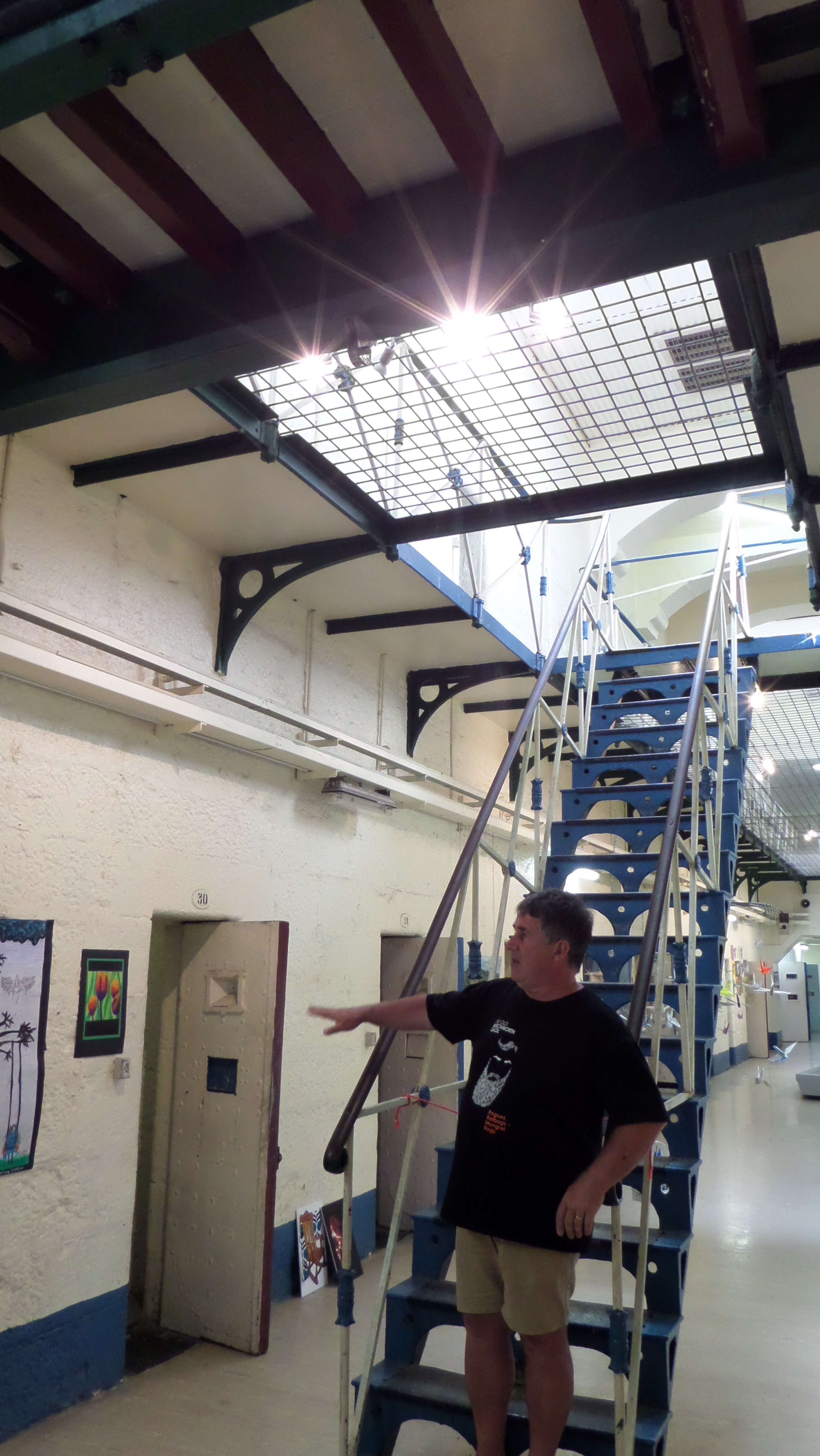
For the complete story, a visit to the big smoke is required, where you can visit the gaol and view the armour. Ned’s suit is in the State Library, Joe Byrne’s is in a private collection, while Dan Kelly’s is in the Police Museum and Steve Hart’s armour can be seen in Old Melbourne Gaol.
Amazingly, it took until 2002 to reassemble the pieces, the first time since 1880, into the probable original configuration. On rare occasions the four sets are displayed together. I have been lucky to experience this event twice.
Brochures covering Kelly Country touring are available throughout the region.
Gregory Powell is the author of Bushranger Tracks and Bushranger Tracks – Beyond the Legends.
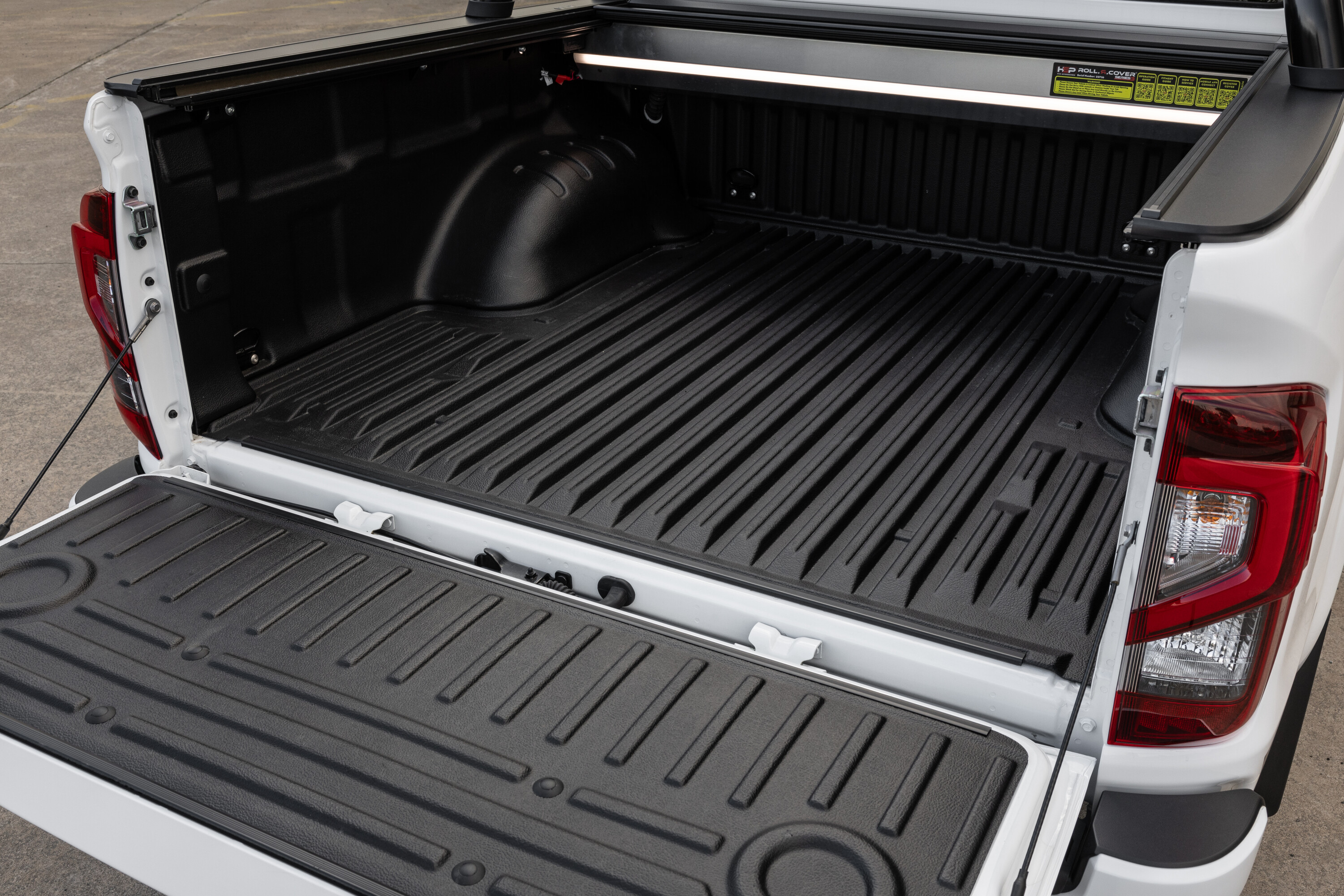
The Victorian company has brought to market two new Navara-specific Aussie-made products: the HSP electric roll-top cover, and HSP rear tailgate central locking system.
The HSP electric roll-top cover – designed, engineered and manufactured in Australia – provides an ideal storage solution. The automatic cover retracts or covers at the push of a button, either via the tub itself, a key fob, or the HSP mobile app. Two models are available, to suit Navara models fitted with and without a sports bar.
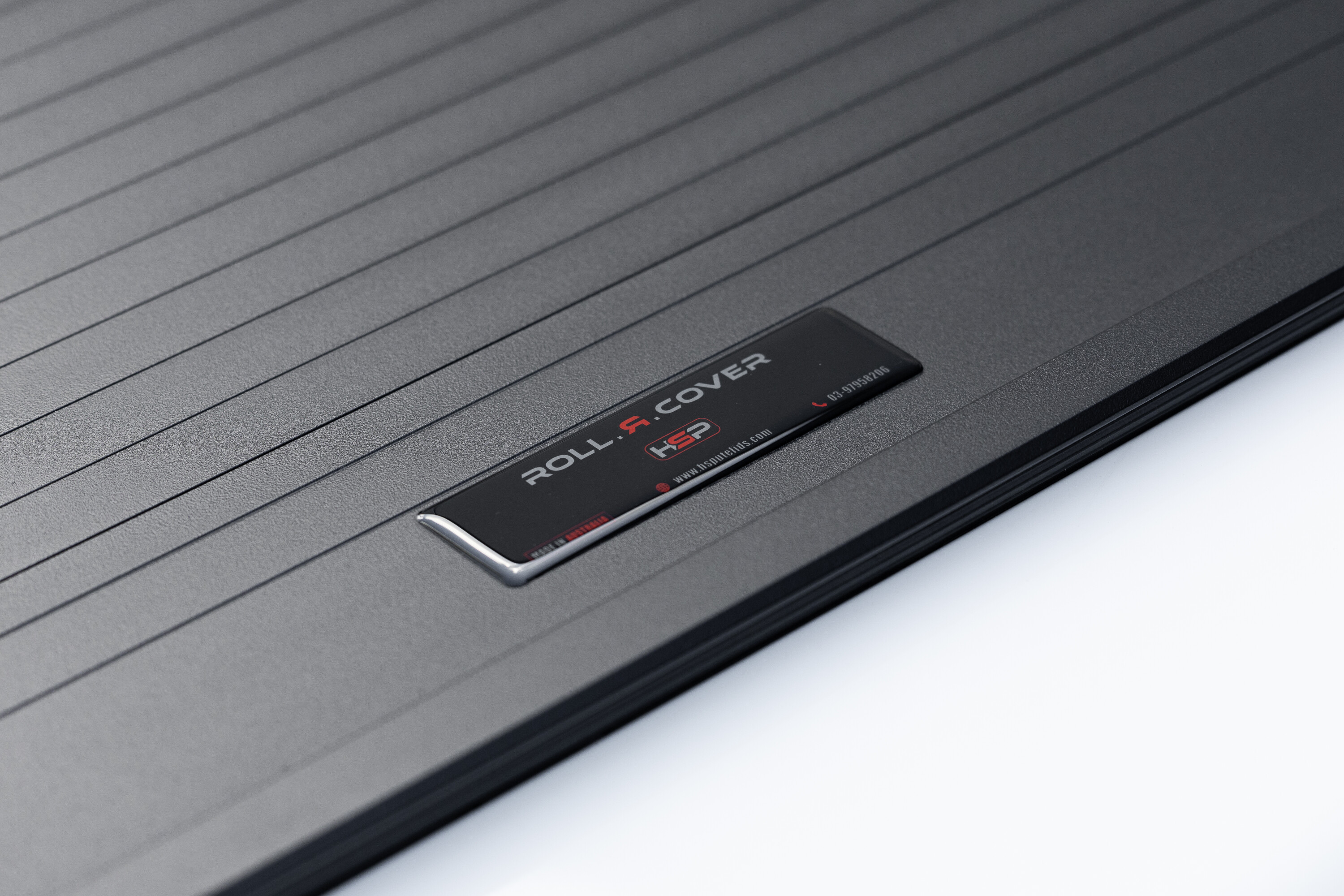
The HSP rear tailgate central locking system simply adds the convenience of locking or unlocking the rear gate with a key fob.
“We know how important accessories are to our Navara owners, which is why we’re always looking to grow our extensive catalogue with options that make Navara ownership even more rewarding,” says Nissan Oceania’s Aftersales Director, Michael Hill.
“HSP is an Australian company that’s been producing quality equipment for three decades, with a wide range of Navara-specific accessories adding further versatility to this proven workhorse.”
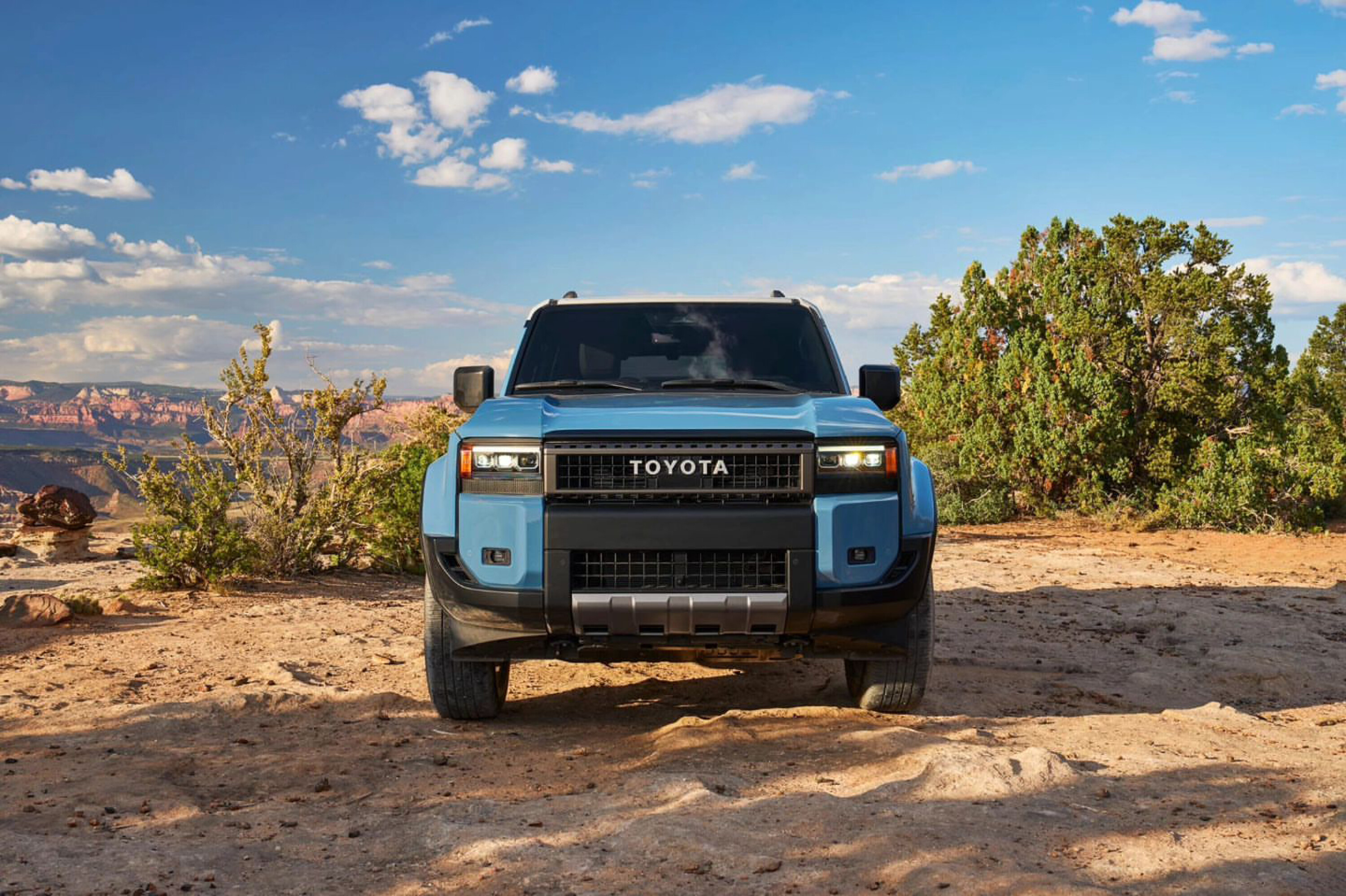
The new off-roader is based on the brand’s TNGA-F underpinnings shared with the ‘full-size’ 300 Series Cruiser and Lexus GX. Those reading in other parts of the world may be a little confused – in the United States, there is now only one LandCruiser, the 250 Series that we call the Prado.
With the new 250 Series Prado adopting the same GA-F underpinnings as the 300 Series, the gap between jumbo and junior has closed significantly – the pair share identical wheelbases.
The 250 Series moves its spare tyre under the floor with no on-the-door option. It’s 95mm longer than the old Prado and the same interval wider, as well as 10mm taller and riding on a 60mm longer wheelbase. Toyota’s bigger LandCruiser also boasts better off-road credentials, with an extra 24mm ground clearance and preferable approach/departure angles.
| Dimension | Landcruiser Prado 250 Series | LandCruiser 300 Series (Sahara) |
|---|---|---|
| Length | 4925mm | 4980mm |
| Width | 1980mm | 1980mm |
| Height | 1870mm | 1950mm |
| Wheelbase | 2850mm | 2850mm |
| Ground clearance | 221mm | 245mm |
| Approach/departure angles | 31/22u00ba | 32/25u00ba |
Back to top ⬆️
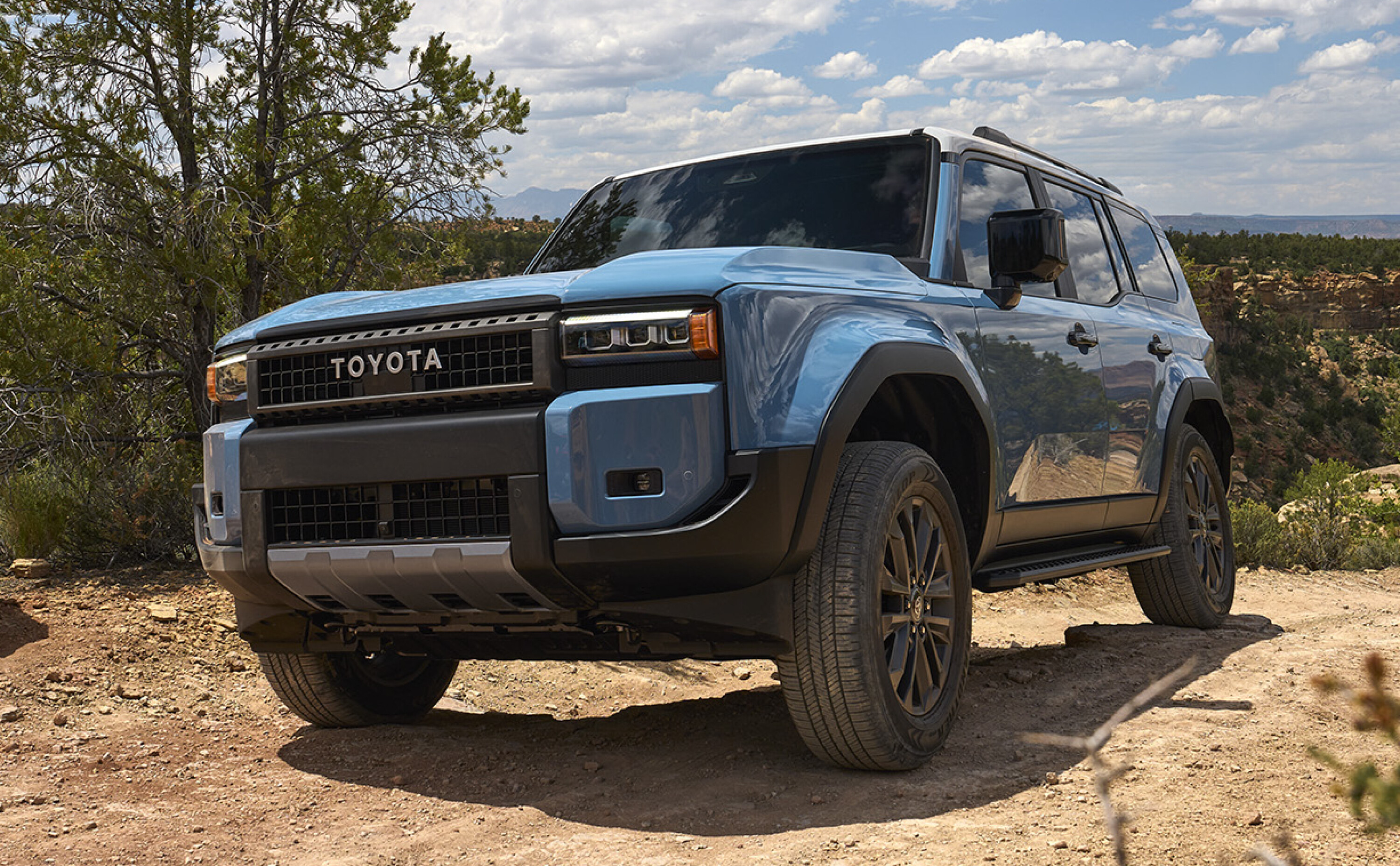
Its 50 per cent more rigid frame promises to increase the Prado’s overall stiffness by 30 per cent compared to the old 150 Series that was launched in November 2009, aiding ride, handling and response. The Prado also scores a new button-controlled front sway-bar disconnect feature (different to the old hydraulically-operated KDSS) that allows greater articulation for the double wishbone independent front axle. A four-link solid rear axle remains at the back.
This is a very similar setup to the 300 Series, which also has a double-wishbone front and solid rear axle. The 300 Series’ E-KDSS (on GR Sport variants) is also electronically controlled, but not by the driver. Instead, software calculates when sway bars need to be disconnected.
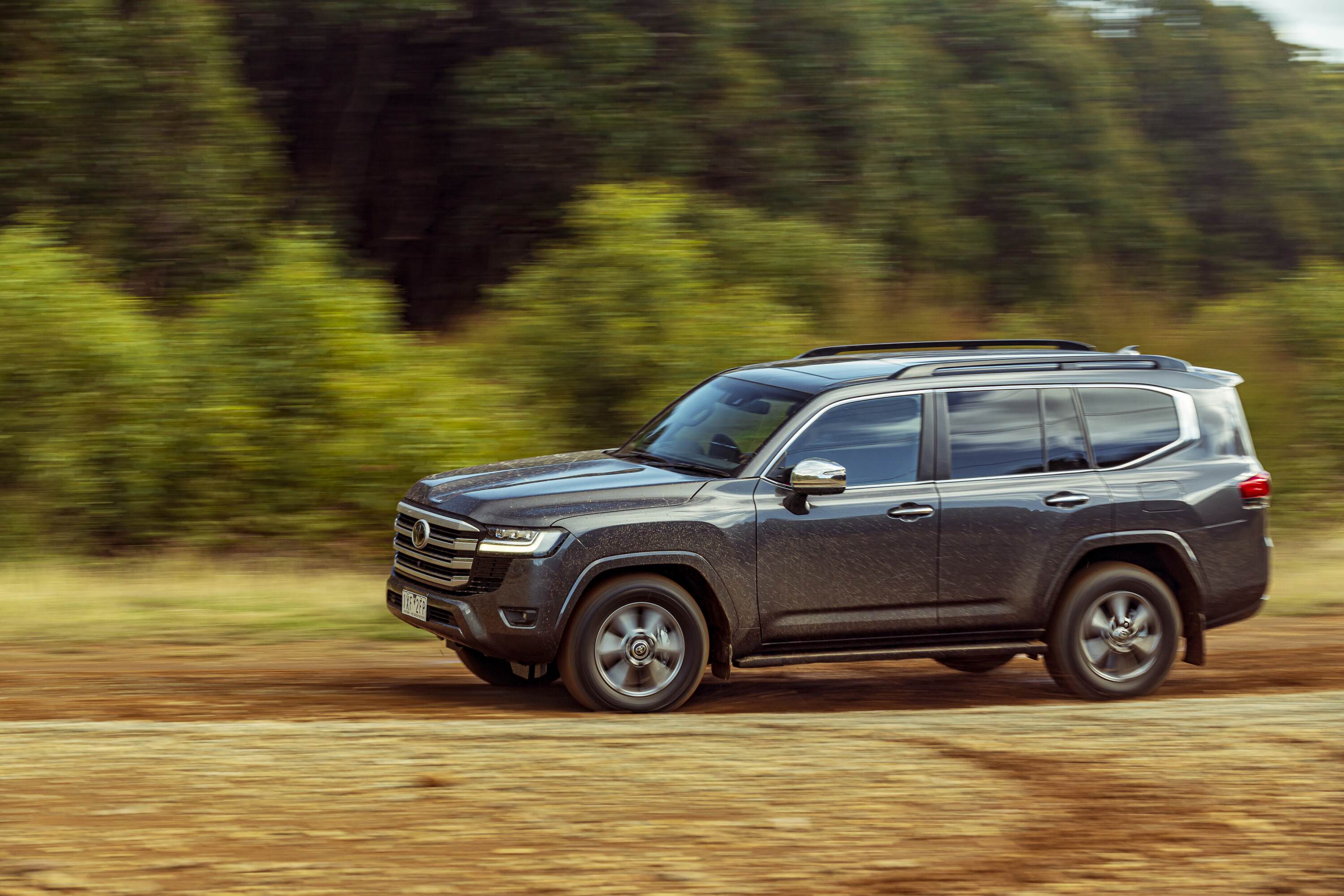
The new LandCruiser 300 Series is certified to tow a load up to 3500kg with trailer brakes installed. An unbraked trailer maxes out at 750kg. Depending on the variant, the 300 Series LandCruiser’s payload fluctuates between 650kg (VX/Sahara/GR Sport) to 785kg (GX).
Toyota Australia has officially announced the new Prado will offer a 3.5-tonne braked towing capacity, matching the latest Ford Everest and Isuzu MU-X.
Back to top ⬆️
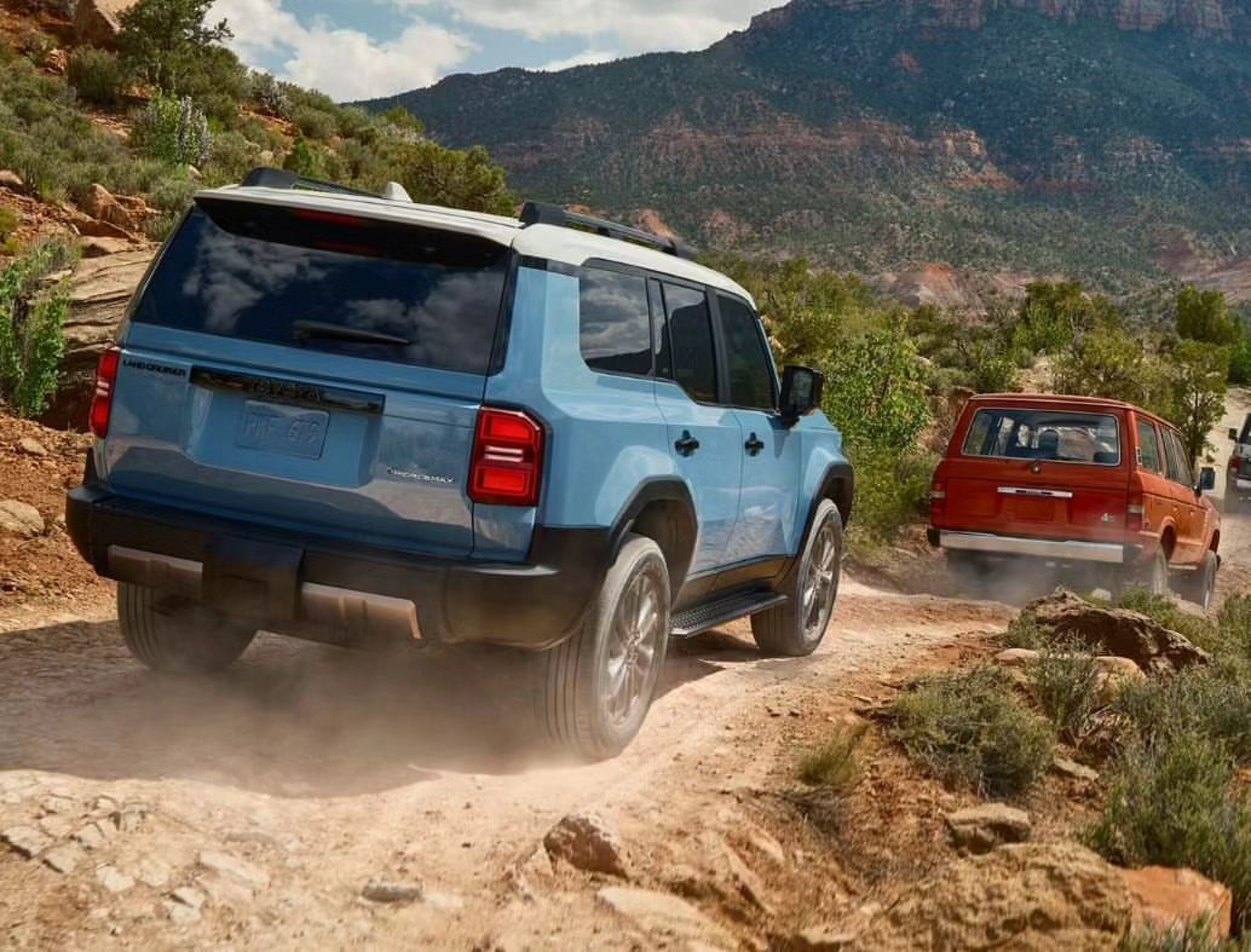
In Australia, the new Prado moves from its old sturdy six-speed automatic to an eight-speed Aisin unit. In North America, the Prado employs a 2.4-litre turbo-petrol hybrid that produces 243kW and 630Nm. This limits towing capacity to around 2700kg – not ideal for Australia’s demands, so it’s off the cards for now.
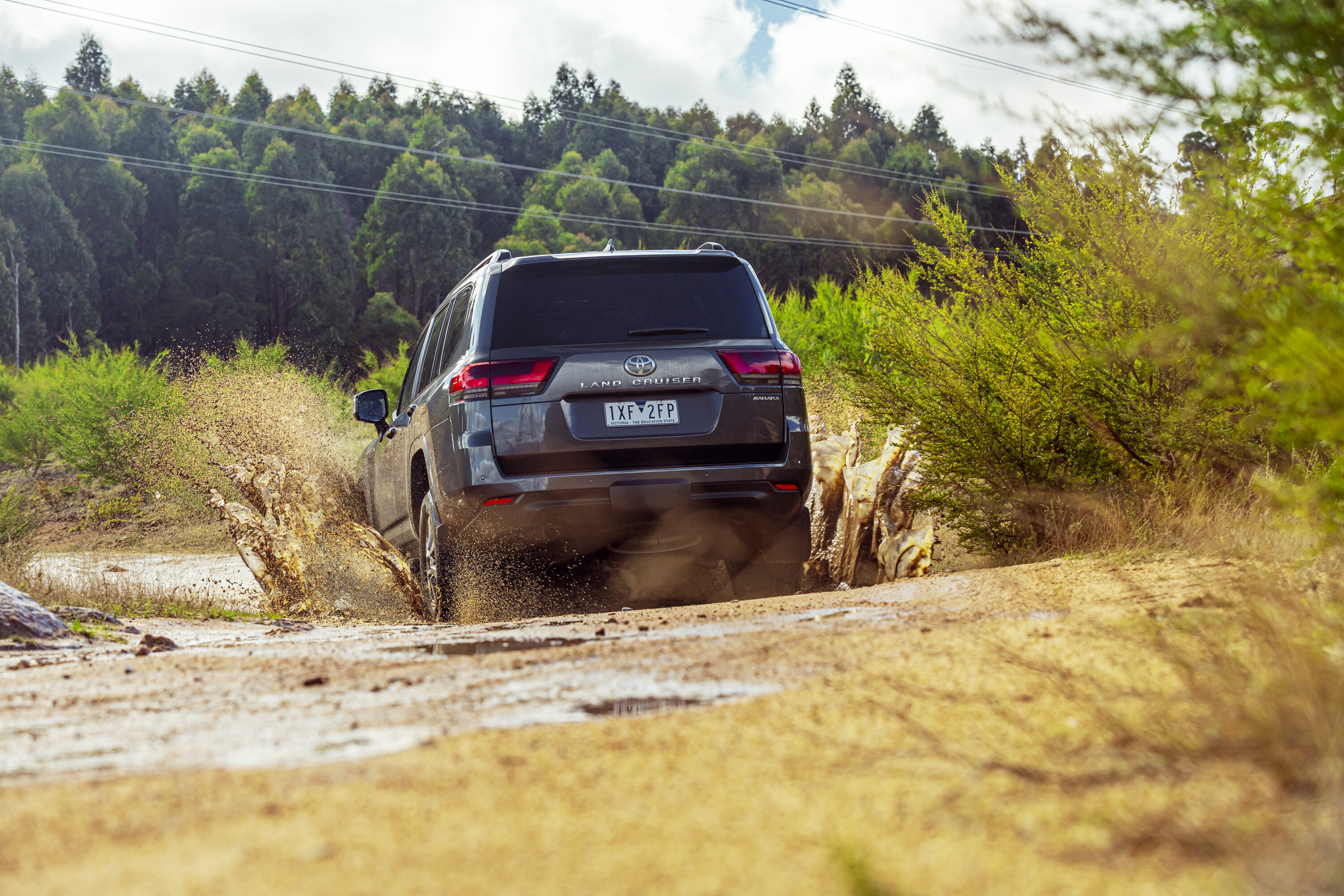
It is a little unfortunate the Prado isn’t equipped with a turbo V6, or hybrid petrol, to give it a leg up on rivals such as the torquey Ford Everest, and further differentiate it from the Fortuner/HiLux. The LandCruiser 300 Series, though, does get the big motor. A 3.3-litre twin-turbo diesel V6 effortlessly churns out 227kW and generates 700Nm between 1600-2600rpm. With a 10-speed torque converter auto onboard, the tractable 300 Series retains on-paper supremacy over the junior Prado.
Toyota confirmed the new Prado’s combined average fuel consumption is now 7.6L/100km, an improvement on the outgoing model’s 7.9L/100km. This 0.3L/100km change is largely thanks to the addition of V-Active technology.
| Specifications | LandCruiser Prado 250 Series | LandCruiser 300 Series (Sahara) |
|---|---|---|
| Engine | 2.8L turbo-diesel four-cyl mild-hybrid | 3.3L twin-turbo diesel V6 |
| Transmission | 8spd automatic | 10spd automatic |
| Power | 150kW | 227kW |
| Torque | 500Nm | 700Nm |
| Claimed fuel use | 7.6L/100km | 8.9L/100km |
| Kerb Weight | TBC | 2630kg |
| Payload | TBC | 650kg |
| Towing Capacity (braked) | 3500kg | 3500kg |
Back to top ⬆️
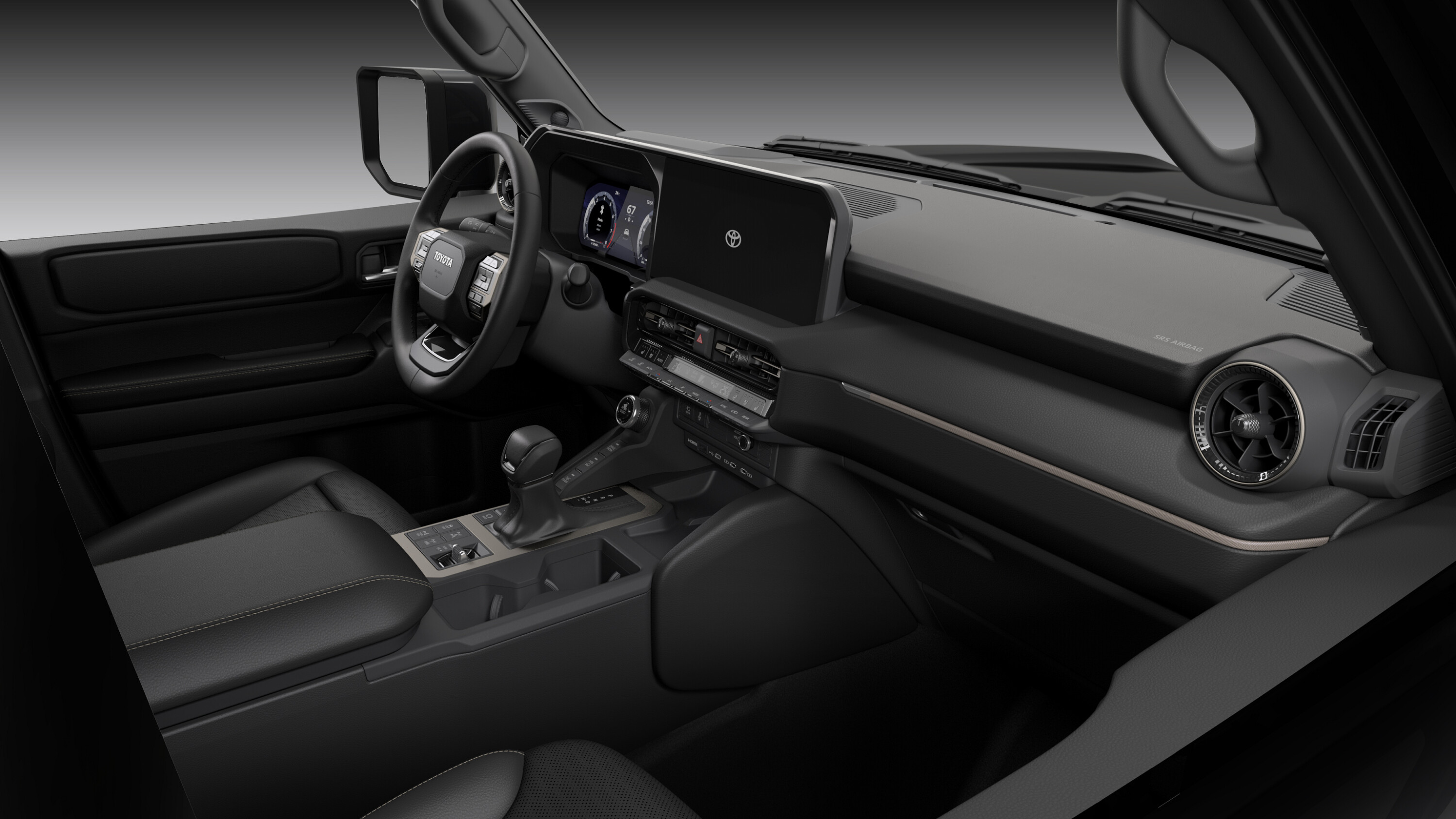
Blocky squoval cabin design details, integrated twin screens, and Toyota’s signature automatic gear-shift feature in both. Choosing either the 250 Series or 300 Series means you can have five- or seven-seats, variant dependent. Various trim levels of Prado will be offered, with exact grades to be determined next year.
New features across the Prado line-up include a larger 12.3-inch infotainment system, a 7- or 12.3-inch instrument cluster display (up from 4.2-inch), wireless Apple CarPlay and Android Auto, Toyota Connected Services, a 360-degree camera system, front and rear parking sensors, USB-C ports, a 220-volt power outlet, and standard climate control.
Back to top ⬆️
| 2025 Toyota LandCruiser Prado | |
|---|---|
| GX | $72,500 |
| GXL | $79,990 |
| VX | $87,400 |
| Altitude | $92,700 |
| Kakadu | $99,990 |
| 2024 Toyota LandCruiser 300 | |
|---|---|
| GX | $94,301 |
| GXL | $106,101 |
| VX | $118,301 |
| Sahara | $135,501 |
| GR Sport | $142,101 |
| Sahara ZX | $142,101 |
*All prices exclude on-road costs
Back to top ⬆️
The crossing has a reputation for housing large quantities of these reptiles nearby. Even in this video crocs can be seen lurking in the water … and that’s not to mention the ones we can’t see which might be even closer.
It’s an urgent reminder to always be vigilant and remain safe when travelling these areas of Australia.
Cahill’s Crossing is a well-known causeway within Kakadu National Park in the NT. Crossable at low tide, the area is a popular spot to witness crocodiles in the wild. A high-clearance 4×4 is required for touring this region, and do not cross if the water is too high (above 0.5m) or flowing too quickly!
Rated as the most dangerous crossing in Australia, Cahills Crossing is named after pioneer settler Paddy Cahill who was known as the “Buffalo Bill” of Australia due to his prowess as a buffalo shooter.
While the original ‘Cahills Crossing’ is a couple of kilometres upstream in the freshwater reach of the river, the existing causeway was named after him when it was constructed in 1956 – and while some sources claim it’s the original, it’s not.
In May 1975, my wife Eileen and I drove into Darwin in our Series 3 Land Rover tray-back to find a city in despair and broken from its disastrous bout with Cyclone Tracy on Christmas Eve, 1974. We had permits for Mount Borradaile and Malay Bay. It was the first time I drove over Cahills Crossing and into forbidden Arnhem Land, the beginning of a grand adventure and love affair that has endured.
Arnhem Land is different to other parts of Australia as there is something primaeval, mystic and uplifting in the monsoon woodlands, the stone country of the Arnhem Land Escarpment, the rivers and beaches, that is unmatched anywhere else.
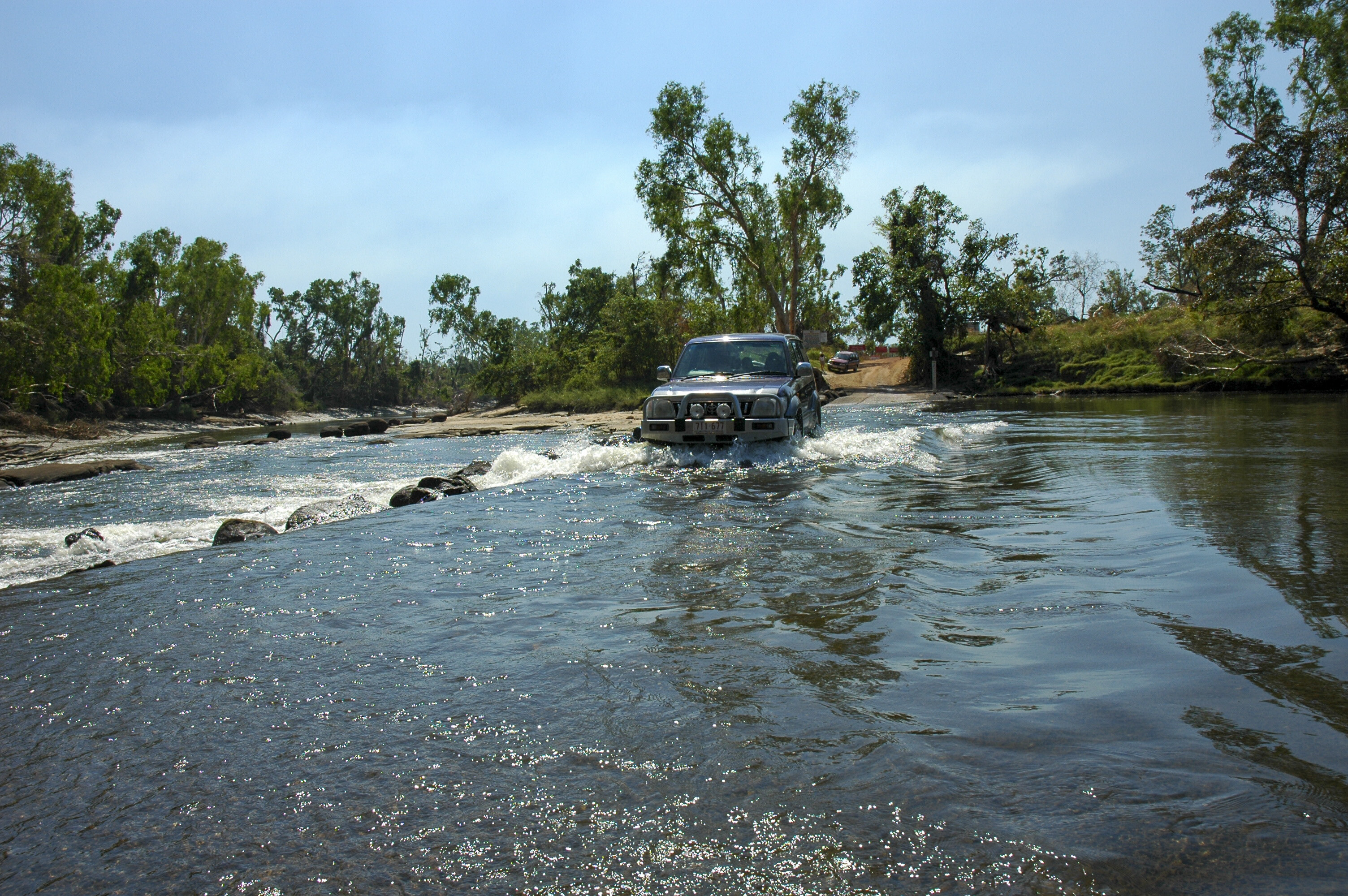
On the return, we fished and caught barramundi while standing knee-deep in the tidal waters on Cahills Crossing. It was déjà vu for three years in a row before we moved to the new town of Jabiru in 1979. In those days, the road from the Arnhem Highway junction was unsealed and badly corrugated.
A day before May Day 1976, the Magela Creek was high enough for the run-off water to sweep over the Land Rover’s bonnet in the deeper sections, but there was little flow in the creek or in the 500m S-bends melaleuca swamp and Hady’s Flats beyond.
The water was clear, and the hard dirt road was easy to follow. It’s now sealed. At the time, the Border Store had a liquor licence, and it was our first port of call. Locals from across the river had already swum or waded across and had drunk the store almost dry. The proprietor was surprised to see us and must have made a few phone calls.
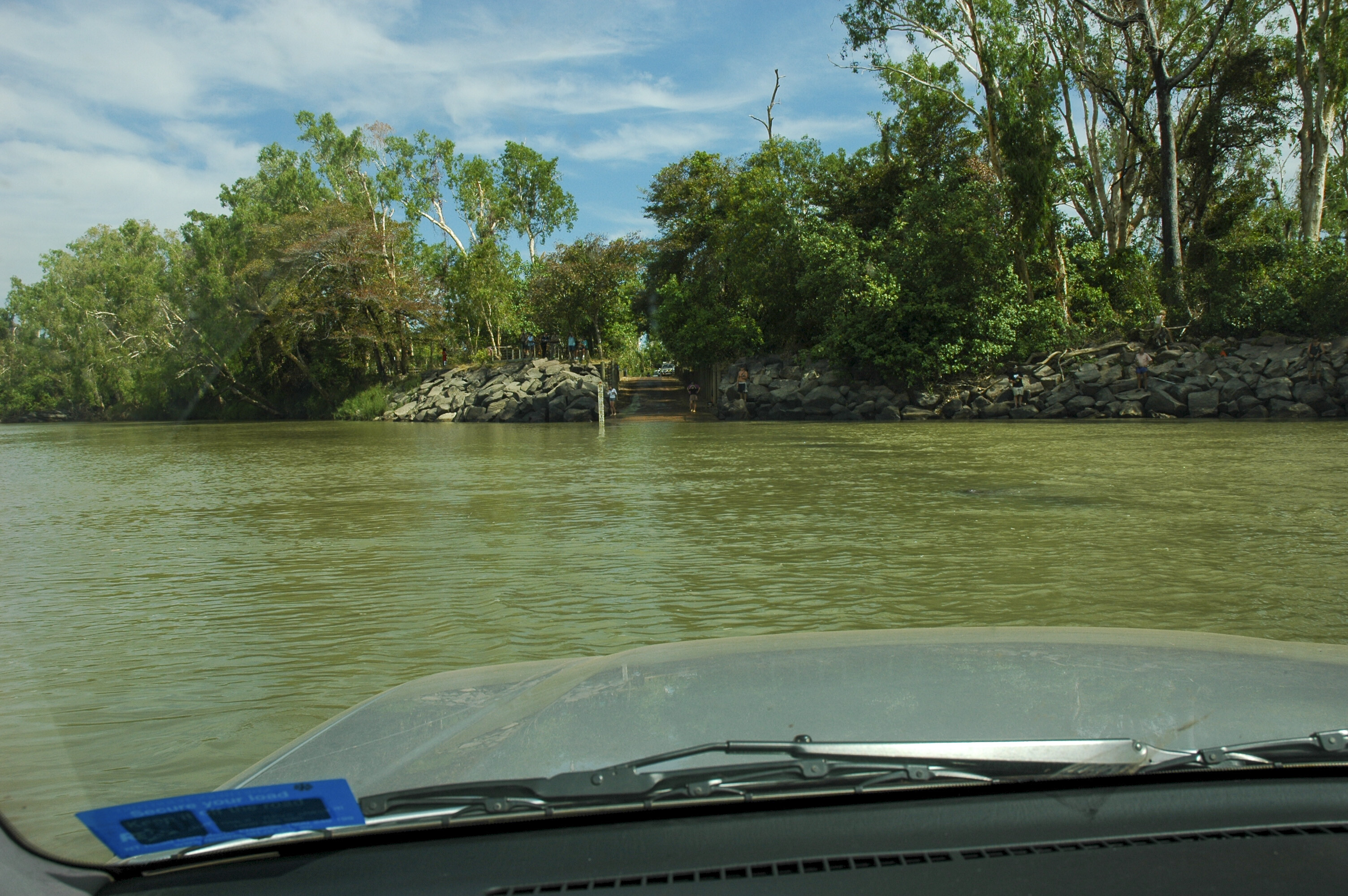
We were the first vehicle in for the season, but by evening there were dozens and others kept coming in during the night, including more grog supplies for the store. The word was out in Darwin: “Cahills Crossing is open.” Camping space was tight but, being first, we picked the spot where the viewing platform is now located.
At daylight, we tackled the crossing when the tide ebbed and drove to Red Lily Lagoon to enjoy some of the best barramundi fishing ever. We returned the following year. The fishing was excellent, but due to a couple of late ‘knock-em-down’ storms, the river was running high and uncrossable. But the locals still managed to wade the slippery causeway back and forth in chain-link fashion, carrying money across and cartons of beer back to thirsty mates.
During our time at Jabiru we made the East Alligator River home but rarely fished from the causeway, preferring the comfort of my solid Savage Jabiru 3.7m tinnie powered by a 25hp outboard. With it, I explored the upper and lower region of the river, often alone, and I became acutely aware just how many large crocodiles lived in it.
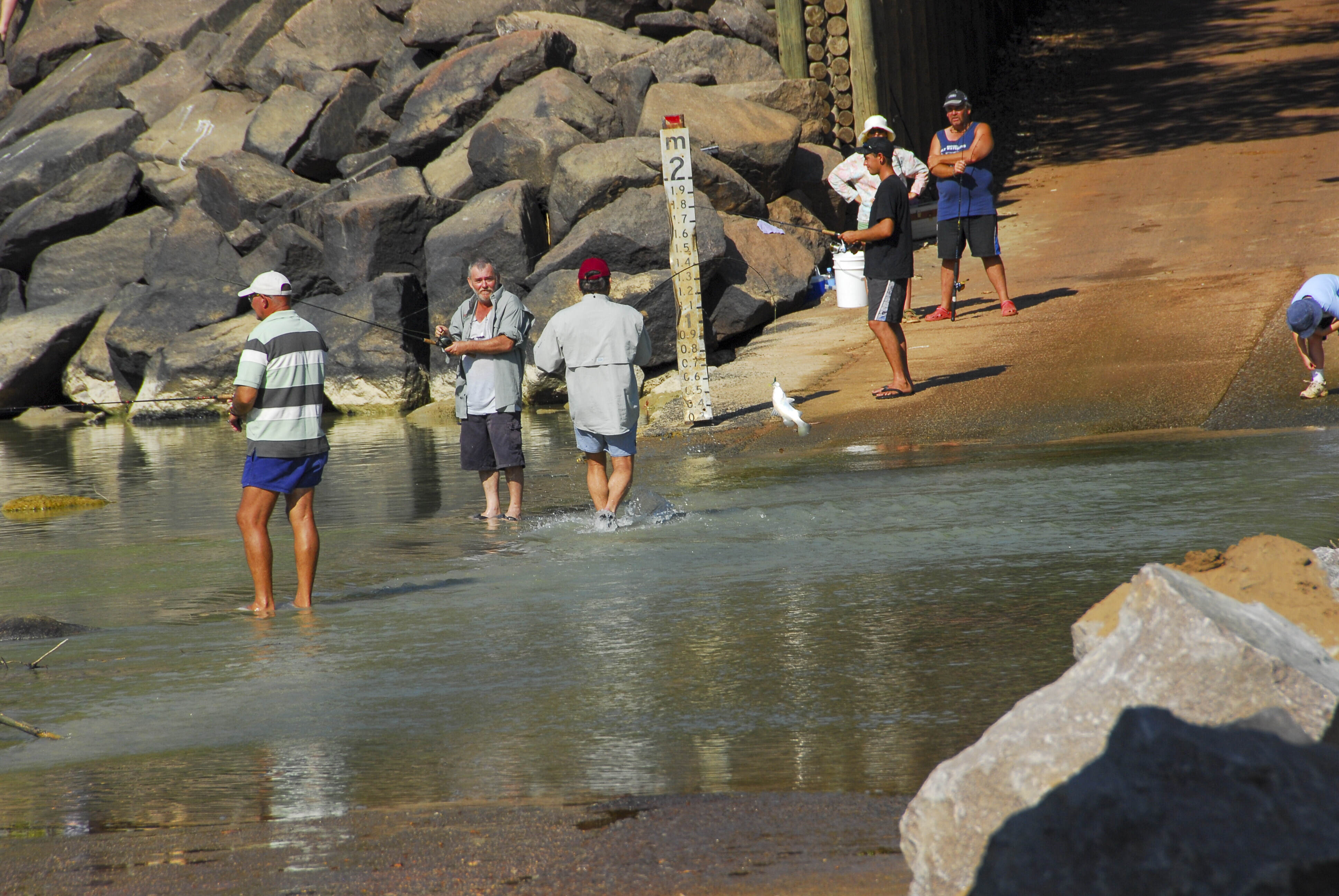
The probable explanation was that the presence of so many people about the crossing kept them away from it, while warning rifle and shotgun shots were not uncommon when one did appear, nor was the odd floater …
In the meantime, the locals, boosted by government money and royalties from the two uranium mines, Ranger and Nabarlek, were buying cars and 4WDs. They were coming to grief on the crossing, having no idea how to tackle the high water, and judging by the continual annual mishaps, they still don’t …
Old mate and I were coming back from a trip 50km downriver and had just crossed the rock bar some 2km downstream from the crossing when we noticed beer cans and an esky bobbing in the current. We scooped most of them out with a landing net – free beer!
There was more stuff floating downstream, before it hit us – someone had turned a boat over. I twisted the throttle, sped up and saw a large local sitting on a wheel below the crossing, the only part exposed from his 4WD. A woman cried out from a tree near us. She was sitting on the leaning trunk of a paperbark tree, while a small croc was eyeing her off below. I steadied the boat under the trunk and old mate lifted her into the boat. She immediately claimed the beer cans as her own … bugga!
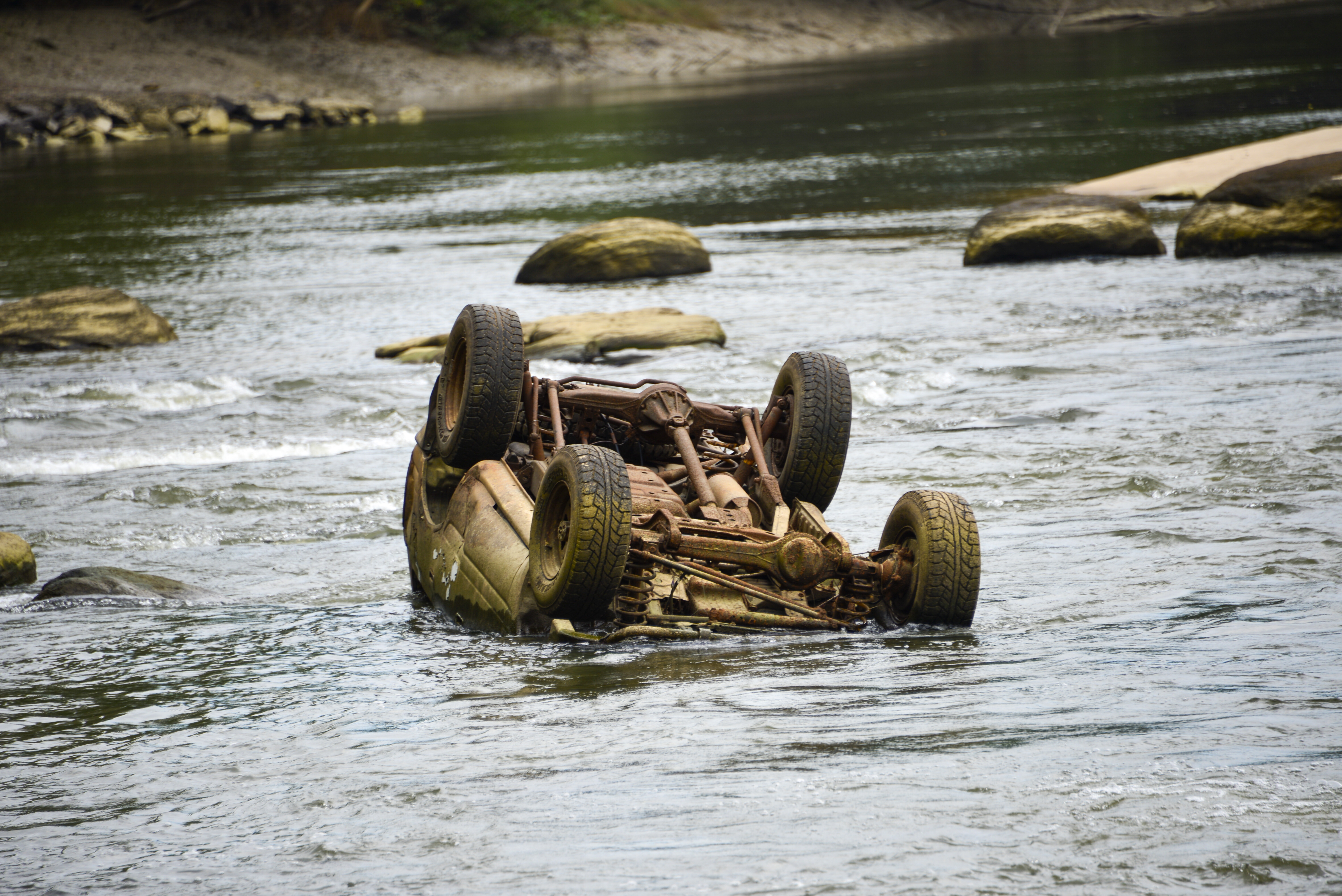
We picked up two men from the muddy bank, before we turned our attention to the bloke on the tyre, but someone had pushed a tinnie into the river and was helping him into it. Nothing to do but take photos. Turned out that he had picked up a brand new Nissan Patrol in Darwin that day, one of those early box-like models that were called ‘bog machines’.
On a recent visit, there were three vehicles in the river and another two that had been pulled out with a loader on the bank of the Arnhem Land side. One year, a dump truck with two trailers went over the side. The driver thought he was okay with the heavy truck and trailers, but the river was high, unkind and punished him for his ignorance and lack of respect.
Before the 1980s, there were few crocodiles about the crossing, but in May 1987, old mate, Kerry McLoughlin, was fishing the run-off, the period after the Wet when the plains and rivers drain and the barramundi come on the bite.
There were other people fishing on the causeway as the road had just opened. Kerry waded across and had a few casts on the Arnhem Land side before returning, the water knee-deep and running strongly. Upstream, the head of a big crocodile surfaced alongside him. Those who saw it yelled warnings, but the current noise was too strong – the cries went unheard.
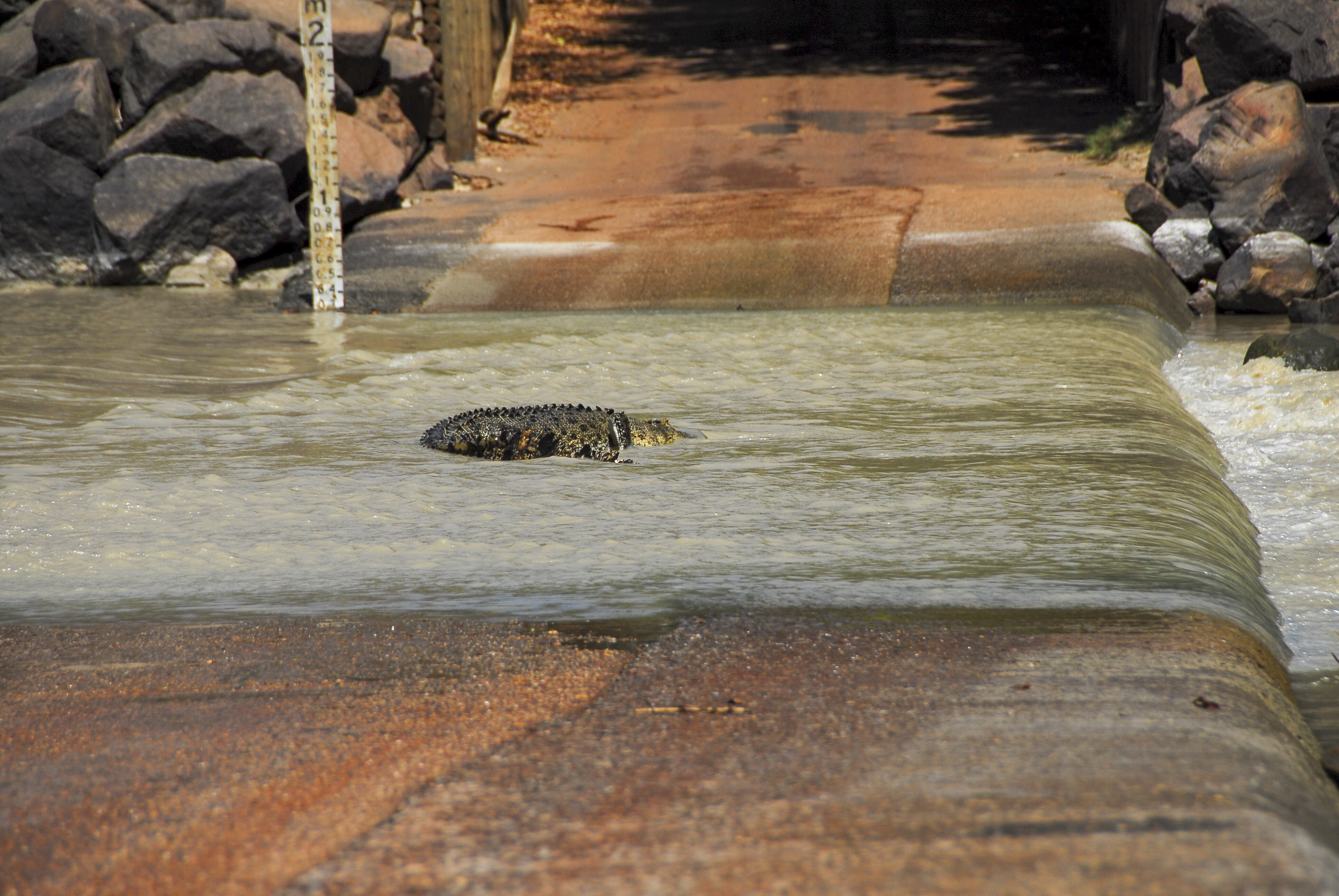
Suddenly Kerry saw the croc and ran forward, the high water and current hindering his progress. He fell and slipped off the crossing and swam to the high muddy bank where willing hands were reaching down to help him up, but to no avail as the living nightmare of the tropics leaped up, grabbed him about the head and shoulders and performed the dreaded death roll below the horrified witnesses. There have been more attacks, and due to the nature of stupid people, others will become victims.
Today, there are more than 120 crocodiles within 2km of the crossing. Twice a day the tide (up to 8m) pushes up from the Van Diemen Gulf, 100km downstream, to a few kilometres upstream from Cahills. When currents collide with the crossing, it creates powerful and dangerous conditions and drivers, mostly locals, end up in the water when vehicles are washed off it.
As far as I know there have been no serious attacks on people in the water, even though they swim for their lives in the deeper sections – some clutching desperately on to their children.
The incoming tide at Cahills is six hours behind Darwin’s tidal times, and knowledgeable drivers use it to their advantage. The most dangerous period is during the run-off season when huge volumes of run-off floodwaters rush over the causeway, but some drivers insist on challenging the river – and losing.
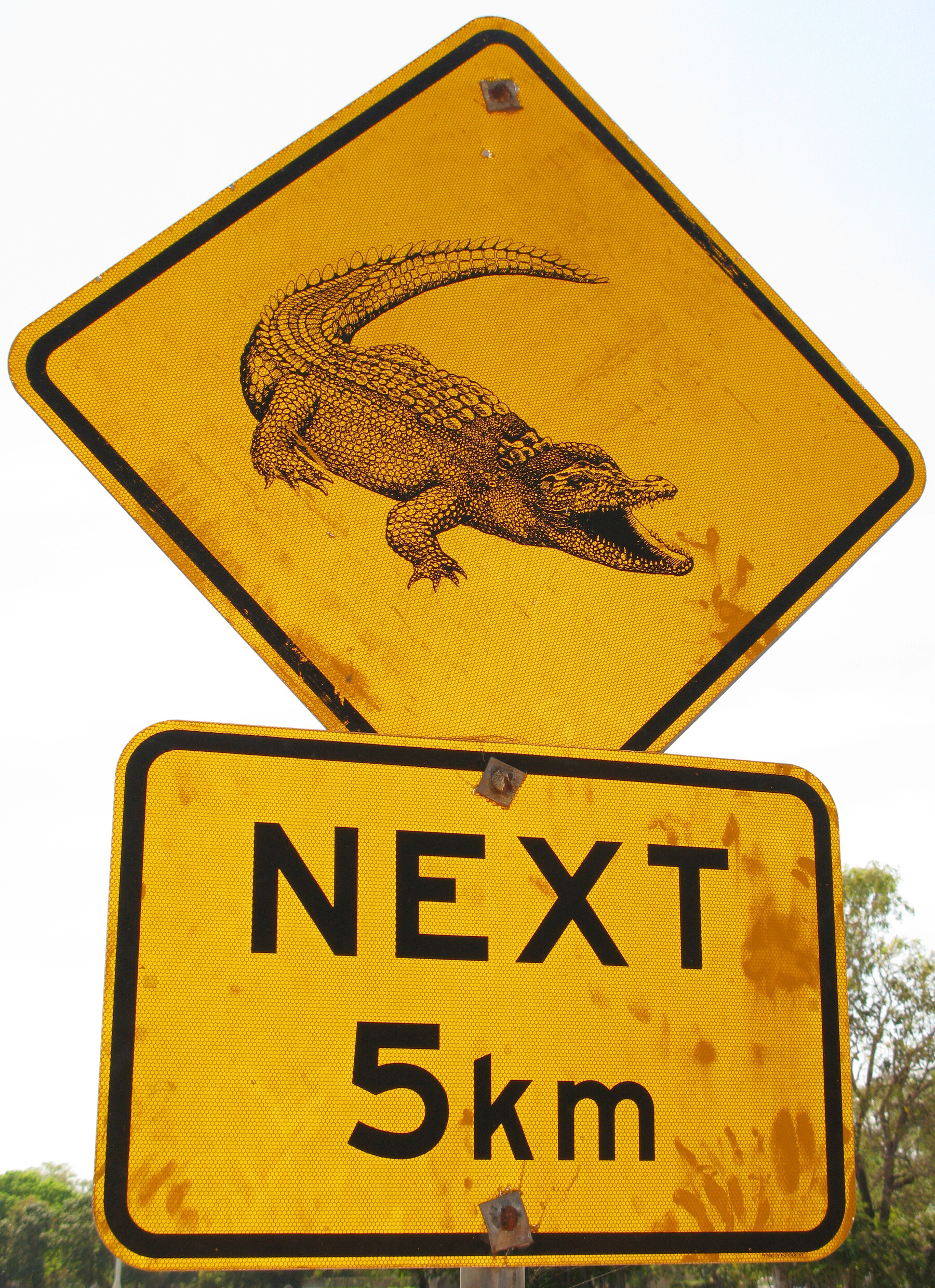
Having driven to Arnhem Land and back many times, I have found that the best time to cross during the run-off season is when both the incoming tide and river peak when, for a few minutes, there is no current before the tide turns and the fun begins. Water depth is generally below 80cm and easy to cross. But once the water speed picks up, forget about it or end up as lunch for the hungry crocodiles who wait with open mouths for fish to swim downriver.
Make no mistake, the crossing is only possible on the ebb tide in the run-off and during the dry season when there is little freshwater flow in the river. Hungry crocodiles are ever present, waiting for the tide to push fish in on the upstream side, before switching over to the downstream side when the tide turns. It’s truly an amazing spectacle that is unmatched anywhere else in the country, perhaps the globe. Check out the film clips on YouTube, especially the one that shows a drunk woman challenging a croc with a thong.
To lure early buyers, INEOS is offering the first wave of customers a $7000 contribution when they place a deposit.
The five-seat Quartermaster Cab Chassis is available with the choice of three trays from Norweld, an Australian manufacturer with 53 years of experience in the industry.
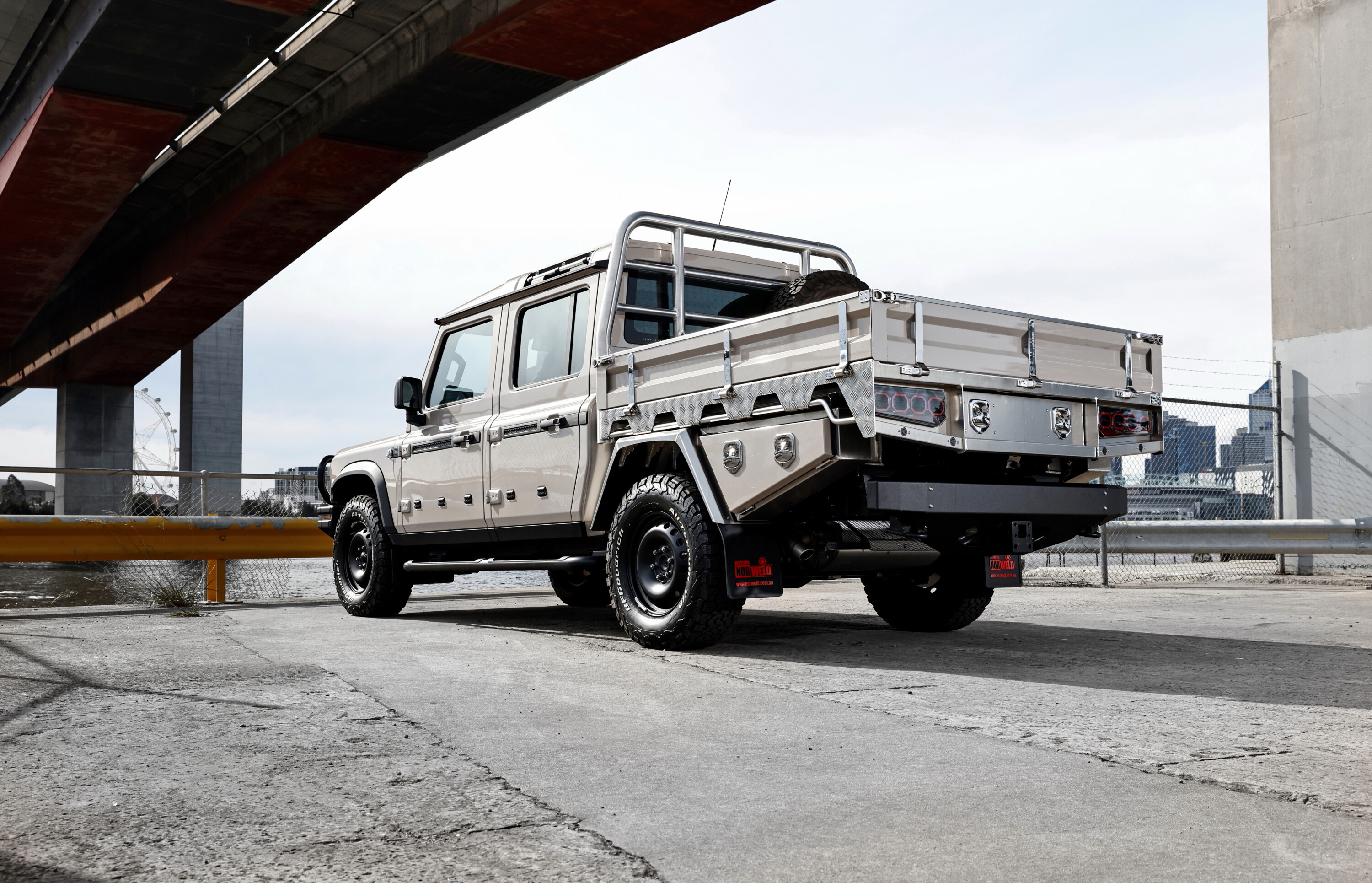
The entry-level Deluxe measures 1826mm x 1850mm and features a 4mm one-piece floor; 76mm tube headboard; extruded sideboards; a 40-litre poly water tank; under-tray toolboxes; and a 1200mm trundle drawer. The Deluxe Plus is identical to the Deluxe, but is painted in a matching finish to the cab.
Upgrading to the top-of-the-line Elite tray gets an additional locking drawer slide and drop-in table (included on the rear trundle drawer), as well as premium constant torque toolbox hinges and colour-coded painted side plates. All trays are delivered with a lifetime warranty on workmanship.
The Cab Chassis will use the same BMW-sourced petrol (210kW/450Nm) and diesel (183kW/550Nm) six-cylinder engines as the other Grenadiers in the line-up, both mated to an eight-speed automatic transmission.
The Chassis Cab features a 3227mm wheelbase, the same as the Quartermaster pick-up but 305mm longer than the Grenadier wagon. The vehicle retains a maximum towing capacity of 3500kg. It also features a full box-section ladder frame chassis, heavy-duty solid beam axles, two-speed transfer case, and up to three locking diffs.
| Length | 5440mm |
|---|---|
| Width with mirrors | 2146mm |
| Width without mirrors | 1943mm |
| Vehicle height | 2019mm |
| Track width | 1645mm |
| Front overhang | 847mm |
| Rear overhang | 1328mm |
| Wheelbase | 3227mm |
| Petrol | Diesel | |
|---|---|---|
| Gross vehicle weight | 3550kg | 3550kg |
| Kerb weight | 2643kg | 2718kg |
| Dynamic roof load | 120kg | 120kg |
| Static roof load | 375kg | 375kg |
| Maximum unbraked trailer load | 750kg | 750kg |
| Maximum braked trailer load | 3500kg | 3500kg |
| Maximum trailer nose weight | 350kg | 350kg |
| Ground clearance | 264mm |
|---|---|
| Approach angle | 35.5u00b0 (petrol); 36.2u00b0 (diesel) |
| Ramp breakover angle | 26.2u00b0 |
| Departure angle | 22.6u00b0 |
| Gradeability | 45u00b0 |
| Wading depth | 800mm |
| Front axle articulation | 9u00b0 |
| Rear axle articulation | 12u00b0 |
| Wheel travel | 585mm |
The T9 received scores of 85 per cent (adult occupant protection); 87 per cent (child occupant protection); 87 per cent (vulnerable road user protection); and 89 per cent (safety assist).
The independent body said the JAC T9 demonstrated strong overall safety performance, with the vehicle scoring full points for protection of the driver in the full-width frontal, side impact, far side impact, and whiplash tests.
Full points were also awarded for its protection of child occupants in the frontal offset and side impact tests. However, ANCAP did note that installing child restraints in the rear centre seating position is not recommended as there is no top tether anchorage.
Full marks were also given in the autonomous emergency braking (AEB) and lane support systems tests, and ANCAP stated in the report that the JAC T9 is well-equipped with a broad suite of active safety features on both the Oasis and Haven variants. “The systems fitted to the T9 are capable of detecting and reacting to other vehicles, motorbikes, pedestrians and cyclists,” it said.
“JAC has clearly committed to bring high levels of safety performance to the Australian market with the T9 and are to be commended for achieving these strong results with their first offering,” said ANCAP Chief Executive Officer, Carla Hoorweg.
The T9 has seven airbags including a front-centre airbag. Active safety features include forward and reverse autonomous emergency braking; lane-keep assist; lane departure warning; lane change assist; blind-spot monitoring; rear cross-traffic alert; traffic sign recognition; a driver monitoring system; and adaptive cruise control with traffic jam assist.
Exclusive to the top-spec T9 Haven are front parking sensors; and a 360-degree camera system. Plus it also gets non-safety kit including roof rails; rear privacy glass; puddle lamps; auto-folding side mirrors with chrome caps; black/brown leather-accented upholstery; and an auto-dimming rear-view mirror.
The base-spec Oasis is priced at $42,662 before on-road costs, and the top-of-the-range Haven at $45,630. Both variants are powered by a 125kW/410Nm 2.0-litre single-turbo four-cylinder diesel engine matched to an eight-speed automatic and part-time four-wheel-drive system.
Ford updated the Ranger with a new-generation model in 2022 and it set new benchmarks in its segment for driving dynamics, technology and cabin quality/comfort. That update also added a gutsy new V6 diesel engine, a more capable chassis, a stack of fresh off-road features and an improved active safety offering.
Available in a wide range of body styles and price points, the Ranger has earned a reputation as one of the best mid-size utes currently on the market. It won the 2022 Wheels Dual-Cab Ute Megatest and is a regular comparison test winner. The Ranger is also as close as you can get to an ‘Australian made’ vehicle. While it’s manufactured in Thailand, the design and engineering of its T6.2 platform was led by Ford Australia.
| Single-cab | |
|---|---|
| XL single-cab cab-chassis 2.0TD 4×2 auto | $36,880 |
| XL single-cab cab-chassis 2.0TD 4×4 auto | $47,980 |
| Super-cab | |
|---|---|
| XL super-cab cab-chassis 2.0TD 4×2 auto | $39,380 |
| XL super-cab cab-chassis 2.0TD 4×4 auto | $50,480 |
| XLT super-cab cab-chassis 2.0TTD 4×4 auto | $61,390 |
| Dual-cab | |
|---|---|
| XL dual-cab pick-up 2.0TD 4×2 auto | $43,280 |
| XL dual-cab cab-chassis 2.0TD 4×4 auto | $48,980 |
| XL dual-cab pick-up 2.0TD 4×4 auto | $50,880 |
| XL dual-cab cab-chassis 2.0TTD 4×4 auto | $52,480 |
| XL dual-cab pick-up 2.0TTD 4×4 auto | $54,380 |
| XLT dual-cab pick-up 2.0TTD 4×2 auto | $56,190 |
| Black Edition dual-cab pick-up 2.0TTD 4×4 auto | $56,680 |
| XLS dual-cab pick-up 2.0TTD 4×4 auto | $57,380 |
| XLT dual-cab pick-up 2.0TTD 4×4 auto | $63,390 |
| XLT dual-cab cab-chassis 3.0TD V6 4×4 auto | $65,690 |
| Sport dual-cab pick-up 2.0TTD 4×4 auto | $65,690 |
| XLT dual-cab pick-up 3.0TD V6 4×4 auto | $67,590 |
| Wildtrak dual-cab pick-up 2.0TTD 4×4 auto | $69,390 |
| Sport dual-cab pick-up 3.0TD V6 4×4 auto | $70,090 |
| Wildtrak dual-cab pick-up 3.0TD V6 4×4 auto | $73,590 |
| Platinum dual-cab pick-up 3.0TD V6 4×4 auto | $79,390 |
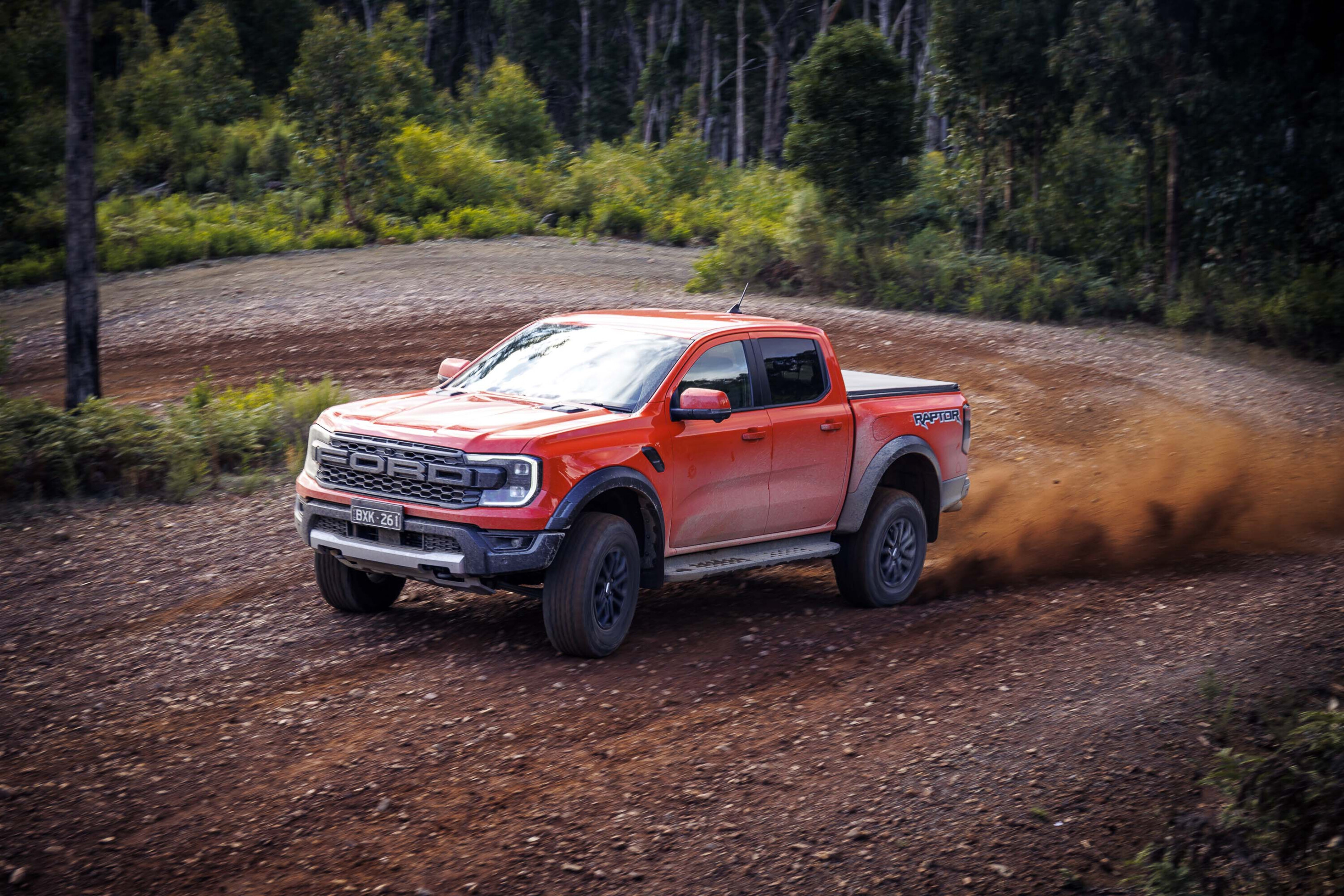
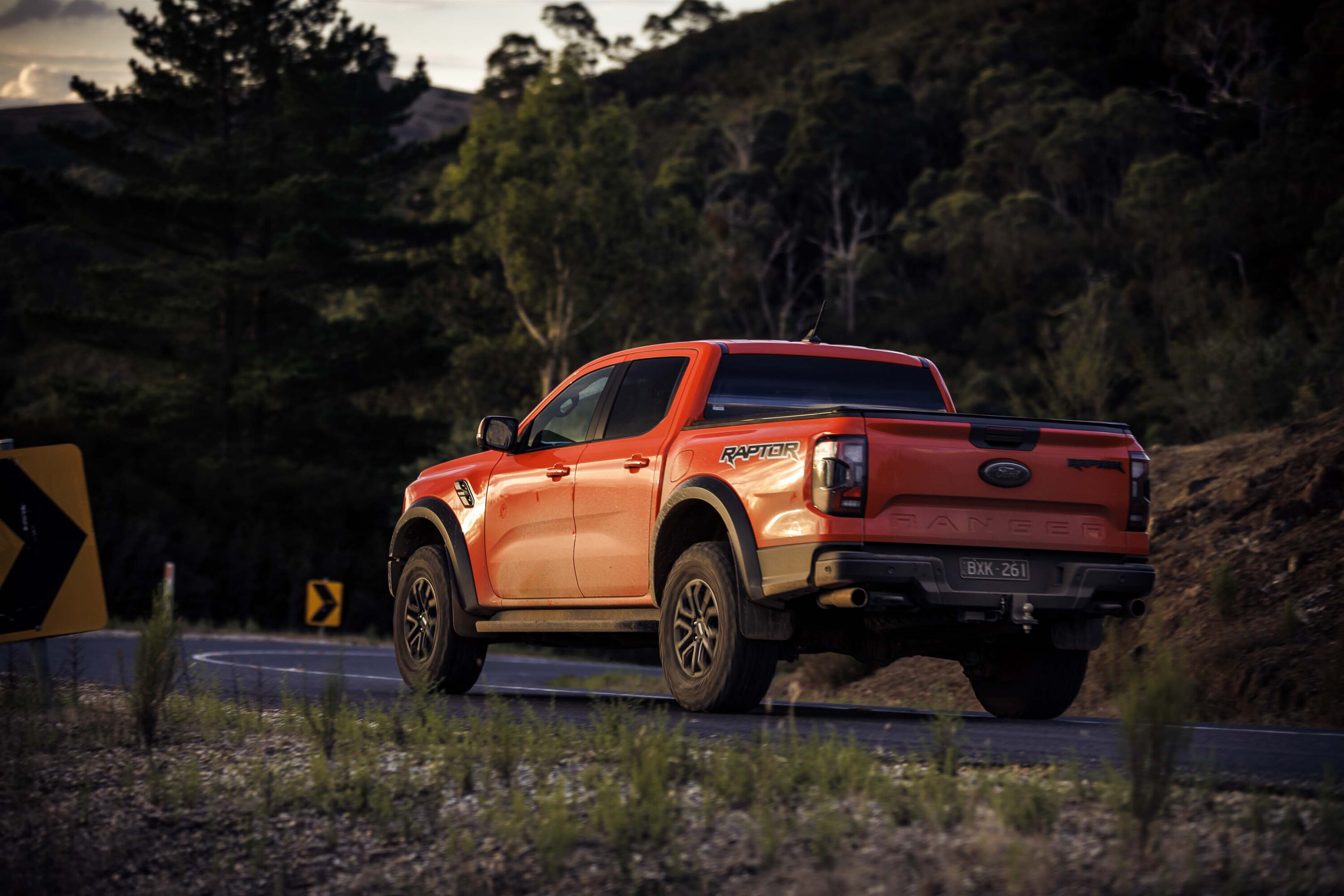
| Raptor dual-cab pick-up 3.0TT petrol V6 4×4 auto | $89,190 |
Prices exclude on-road costs
Cab-chassis models allow buyers to fit the tray of their choice, including designs tailor-made for specific applications. Single Cab models come only in this form but you can have the Super Cab and Double Cab either as a cab-chassis or a pick-up which includes an enclosed factory tub at the back.
Single Cab models only have room for two passengers, while Super Cab versions add two extra rear ‘jump seats’ accessed through shorter, rear-hinged back doors and can seat four. Double Cab models have larger, more conventional rear doors and can seat five.
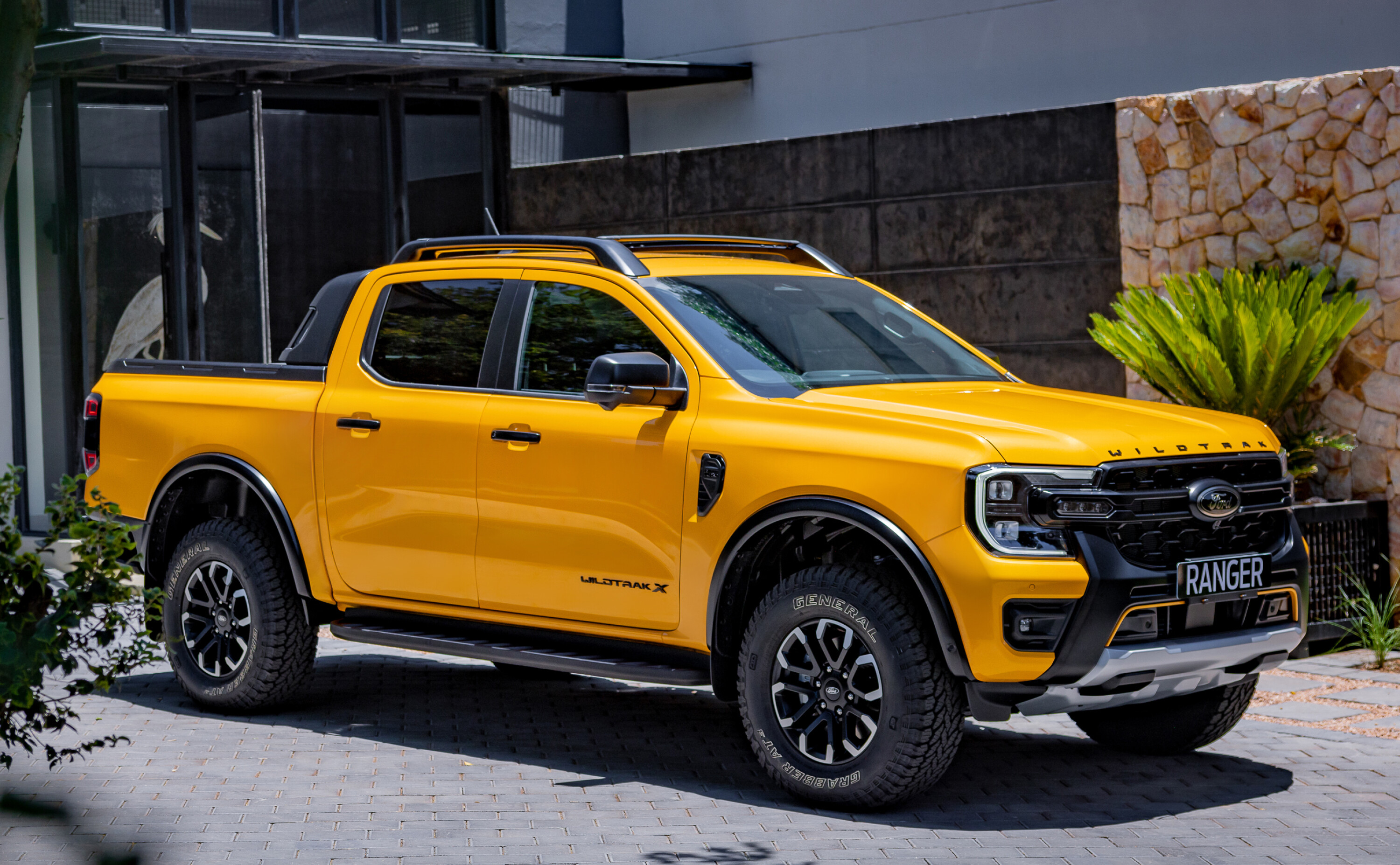
Buyers have the choice of seven model grades: XL, XLS, XLT, Sport, Wildtrak, Platinum and Raptor. A Black Edition model based on the XL double-cab 4×4 ute debuted in Q3 of 2024, while a number of limited edition variants – Wildtrak X and Tremor – have been released.
These include a single-turbo 2.0-litre diesel, a bi-turbo 2.0-litre diesel, a 3.0-litre V6 turbo diesel and a 3.0-litre twin-turbo V6 petrol. The V6 petrol engine is only offered in the performance-focused Ranger Raptor.
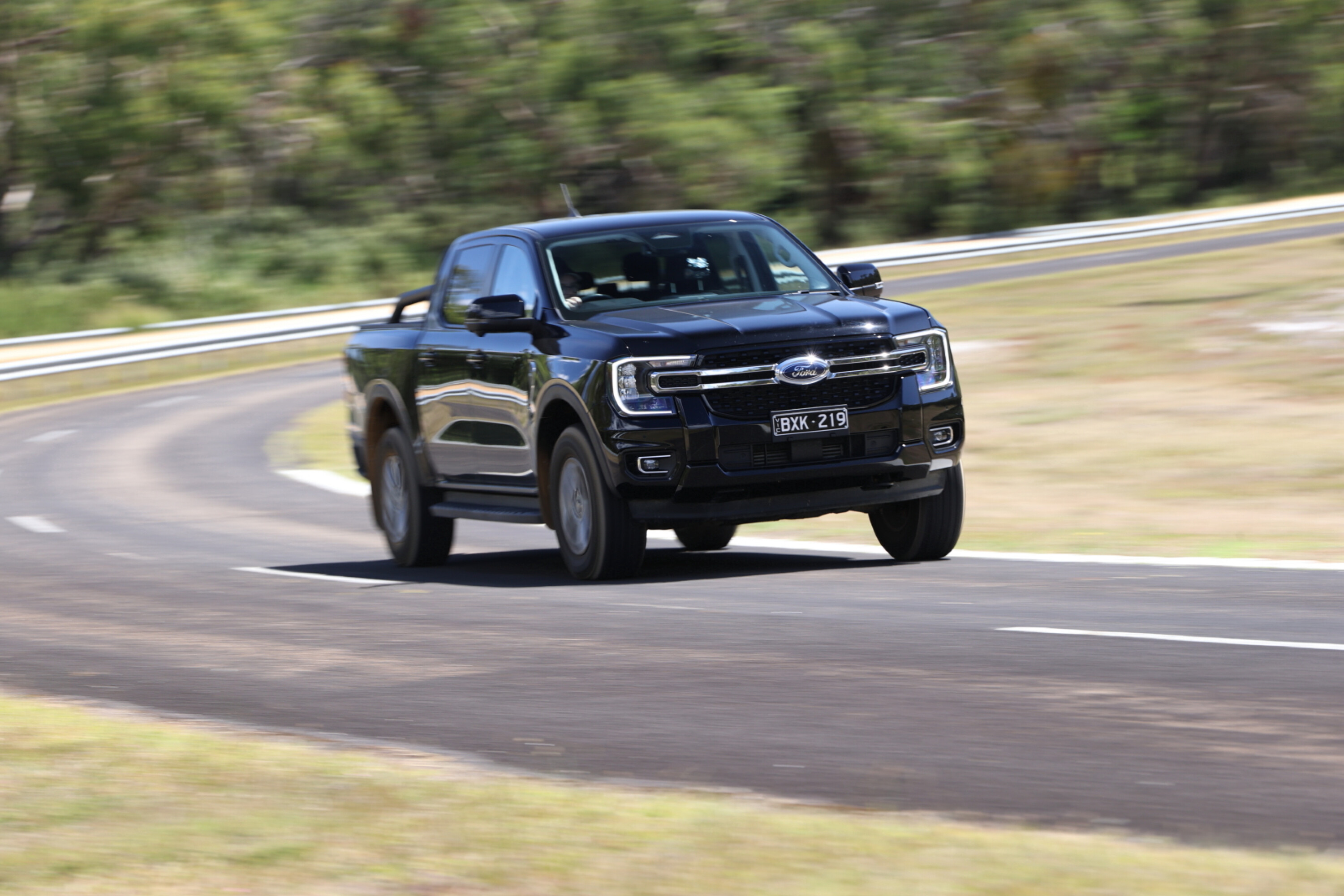
An update in 2024 saw the entry-level XL equipped with heavy-duty suspension, which added thicker rear springs and new front and rear dampers tuned for heavier loads.
| 2024.5 Ford Ranger XL features | |
|---|---|
| 16-inch steel wheels with full-size spare | Steel underbody protection including transfer case |
| 10.1-inch Sync 4 infotainment system | Halogen headlights and daytime running lamps |
| Wireless Apple CarPlay and Android Auto | LED tail-lights (pick-up), halogen tail-lights (cab-chassis) |
| 8-inch digital instrument cluster | Tailgate with lift assist (pick-up only) |
| FordPass Connect with embedded modem | Vinyl floor covering |
| Remote start (via FordPass application) | Cloth upholstery |
| Locking rear differential (standard on 4×4, optional for 4×2) | Eight-way manual driver seat and four-way manual front passenger seat |
| Front disc brakes, rear drum brakes | Power rear windows (dual-cab only) |
| Trailer tow body wiring (tow bar optional) | Single-zone climate control |
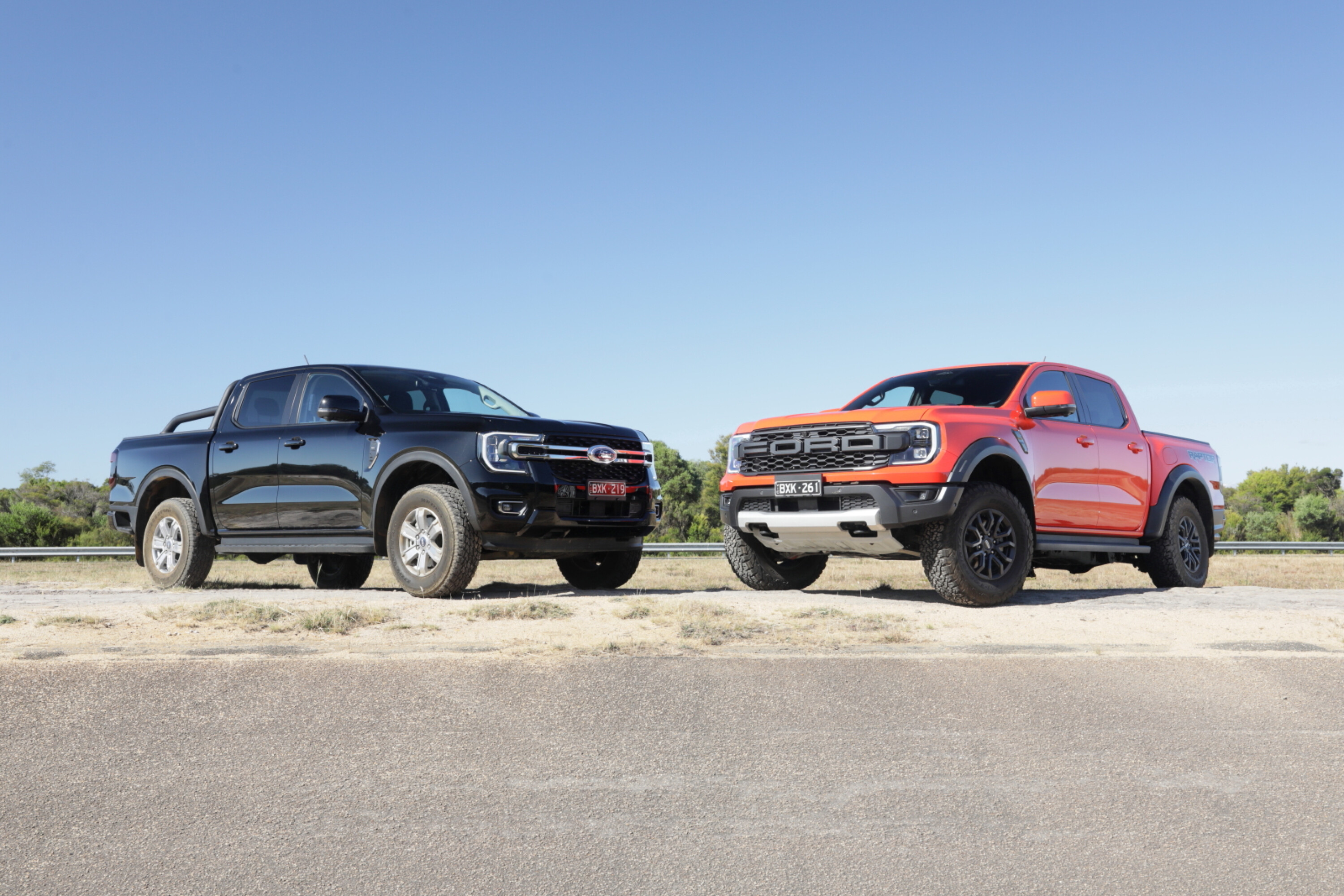
This includes a tow bar, keyless entry and push-button start, dual-zone climate control with rear seat air vents, connected satellite navigation, and DAB+ digital radio. Moving up to the XLS model grade also brings the following equipment:
| In addition to XL | |
|---|---|
| Tow bar and tongue | 16-inch alloy wheels with full-size steel spare |
| Trailer light check | Four drive modes (normal, eco, slippery, tow/haul) |
| Integrated trailer brake controller and extended blind-spot monitoring | Black side steps |
| Body-coloured door handles | Halogen front fog lamps |
| Keyless entry and push-button start | Black front grille with silver accents |
| Dual-zone climate control with rear seat air vents | Powered tailgate lock |
| Built-in connected satellite navigation | Carpet flooring |
| DAB+ digital radio | Driver floor mat |
| Voice-activated controls | Six-speaker audio system |
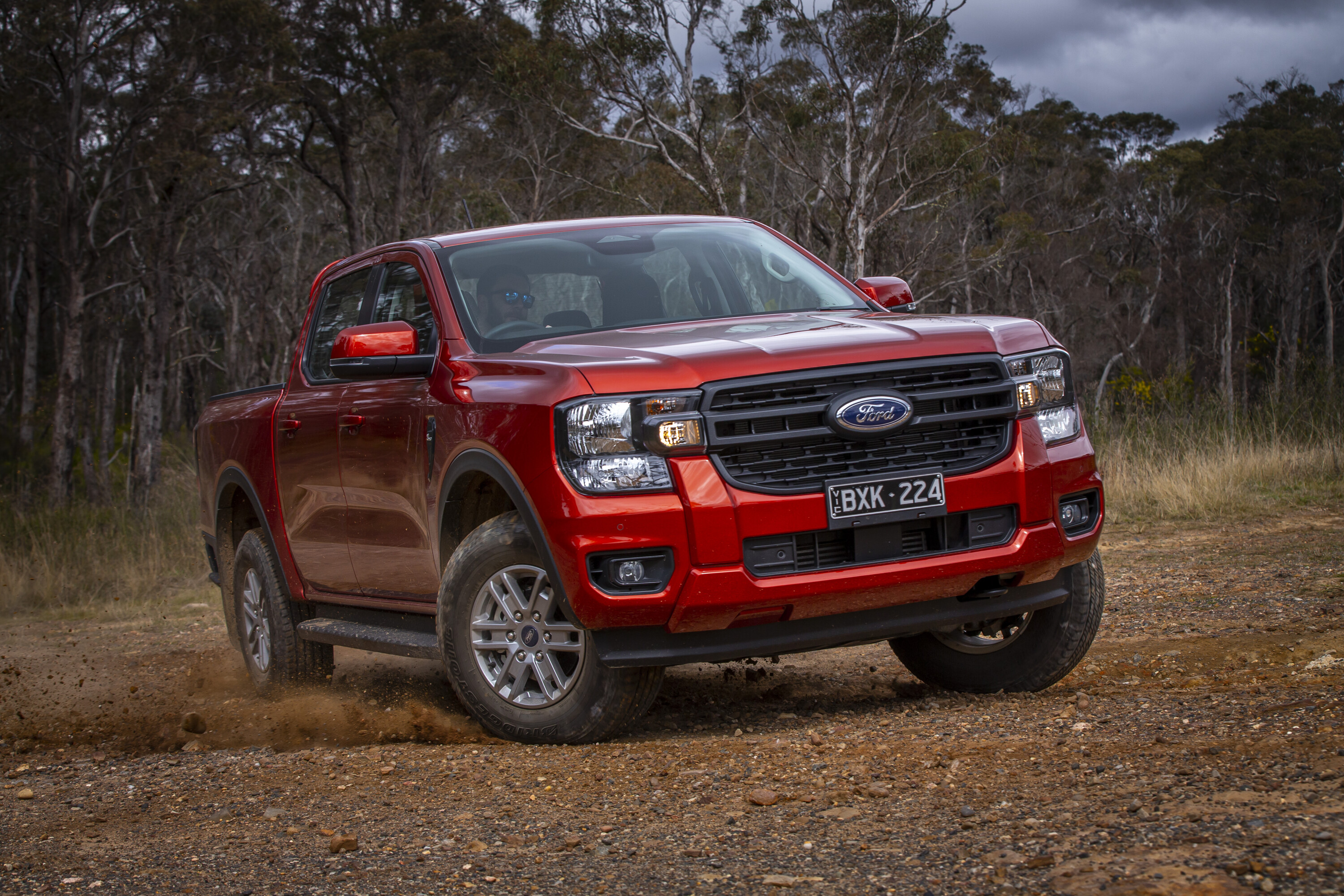
| In addition to XLS | |
|---|---|
| 17-inch alloy wheels with full-size steel spare | 4×2 locking rear axle |
| LED headlights and daytime running lamps | Black sports bar (pick-up only)u00a0 |
| Electronic gear shifter (V6 only) | Tub illumination (pick-up only) |
| Electronic parking brake | Bed-liner and 12-volt socket |
| Rear disc brakes | Leather-wrapped steering wheel and gear shifter |
| Body-coloured side mirrors | Auto-dimming rear-view mirror |
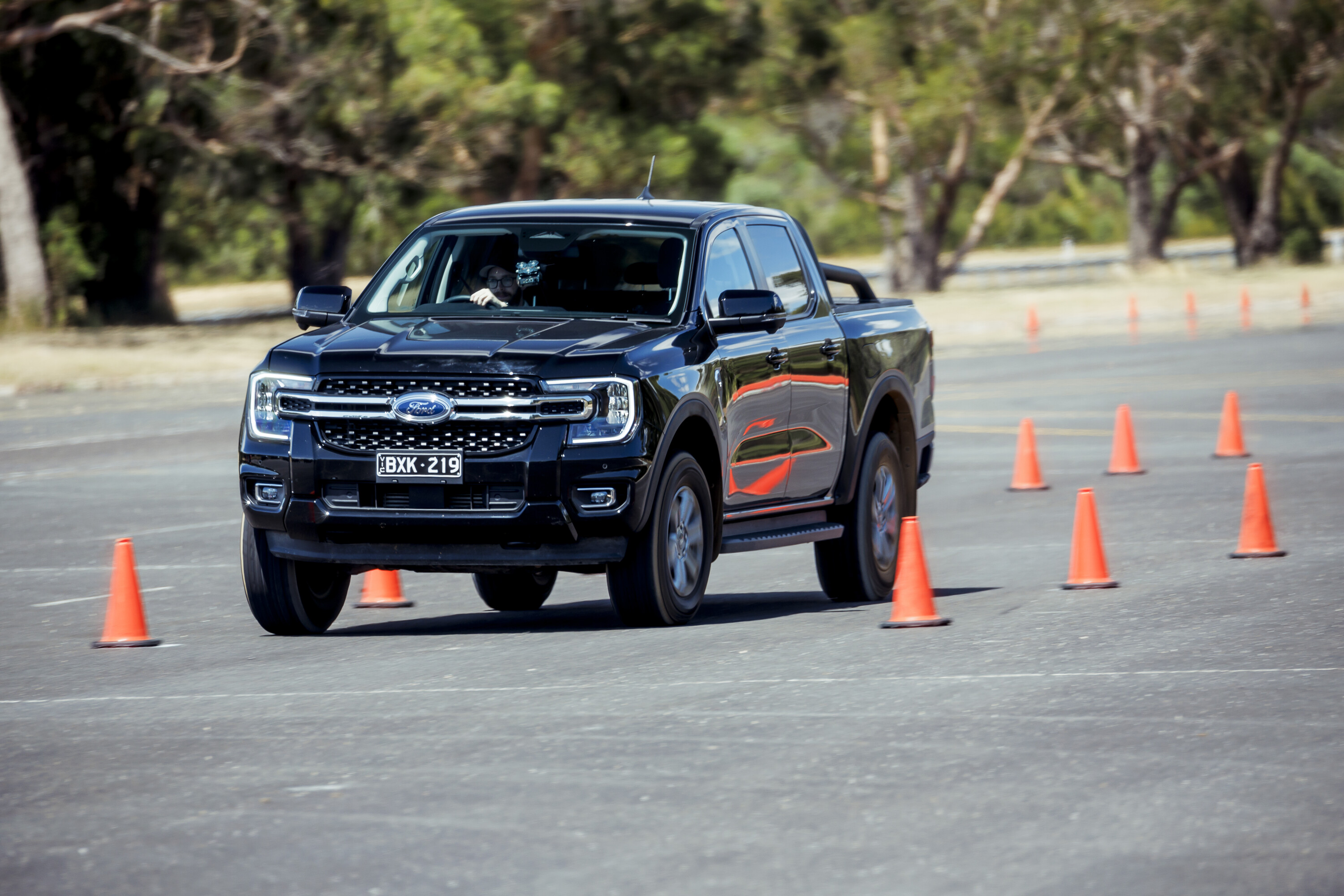
| In addition to XLT | |
|---|---|
| 18-inch alloy wheels and spare | Skid plate |
| Six rotary select drive modes (normal, eco, slippery, tow/haul, sand, mud/ruts) | Two front floor mats |
| Dark accent grille | Wireless phone charger |
| LED front fog lamps | Off-road screen |
| Dark exterior accents | Leather upholsteryu00a0 |
| Two front-mounted tow hooks | Eight-way power driveru2019s seat and eight-way manual passenger seat with u2018Sportu2019 embossing |
| In addition to Sport | |
|---|---|
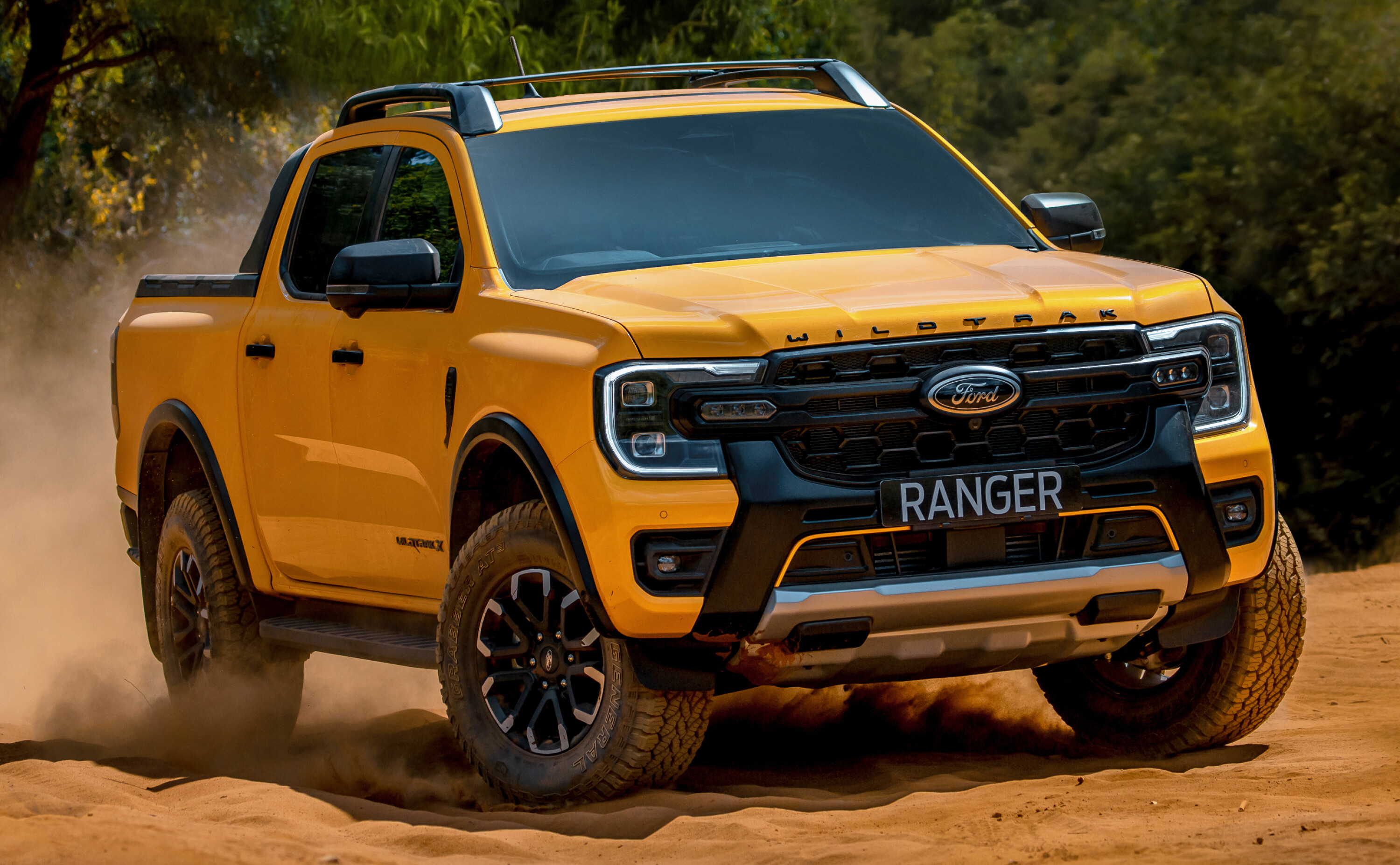
| 18-inch alloy wheels with Goodyear Wrangler all-terrain tyres | Wildtrak moulded sports bar |
| 12-inch infotainment system | Power roller shutter |
| Unique Wildtrak grille design | Ambient lightingu00a0 |
| Exterior mirror with puddle lamps and zone lighting | Cargo management system |
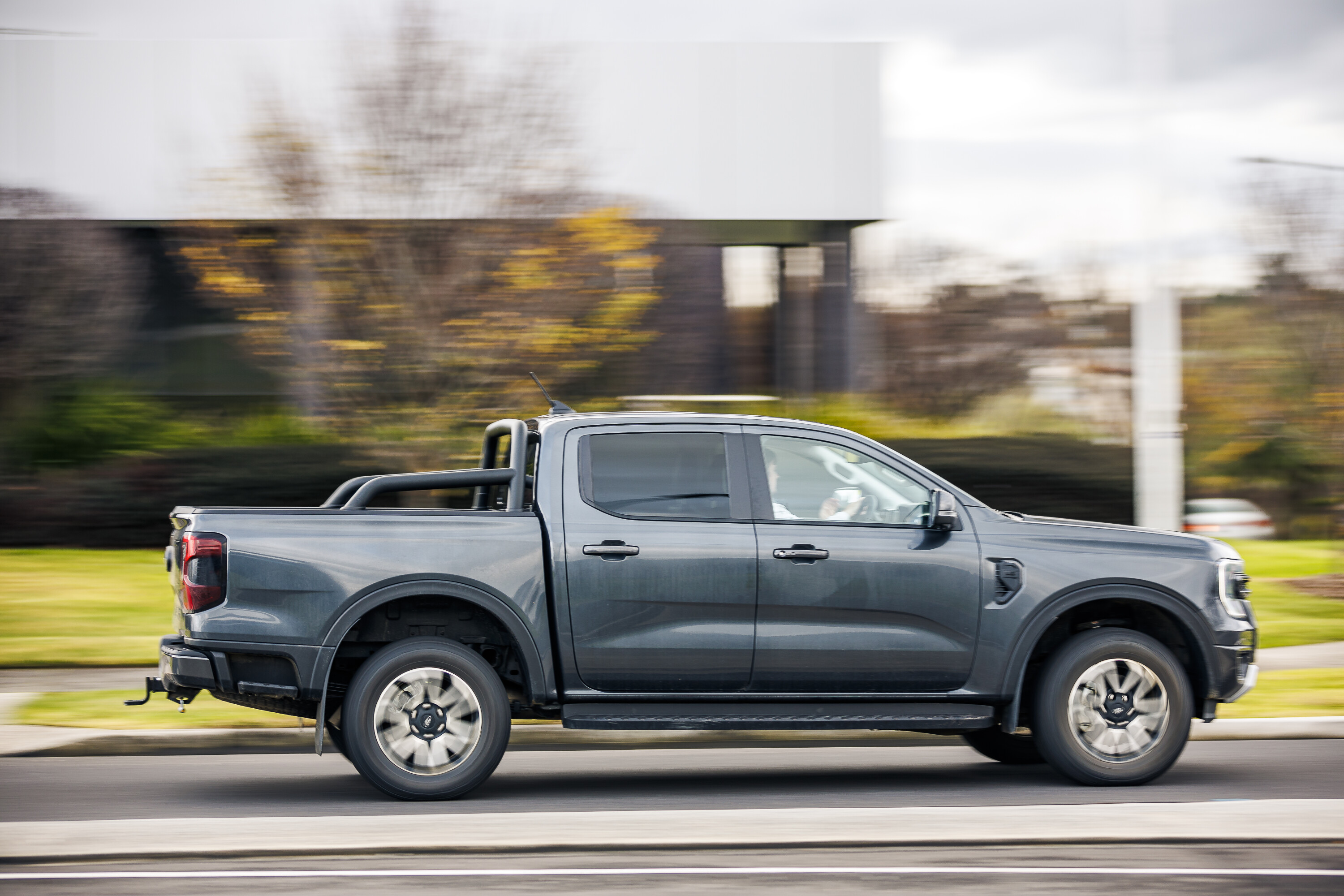
| Roof rails | Pull-out cup holders |
| Aluminium load box tie-down rails | Leather upholstery with orange stitching |
| Heated front seats | Eight-way power-adjustable passenger seats |
| In addition to Wildtrak | |
|---|---|
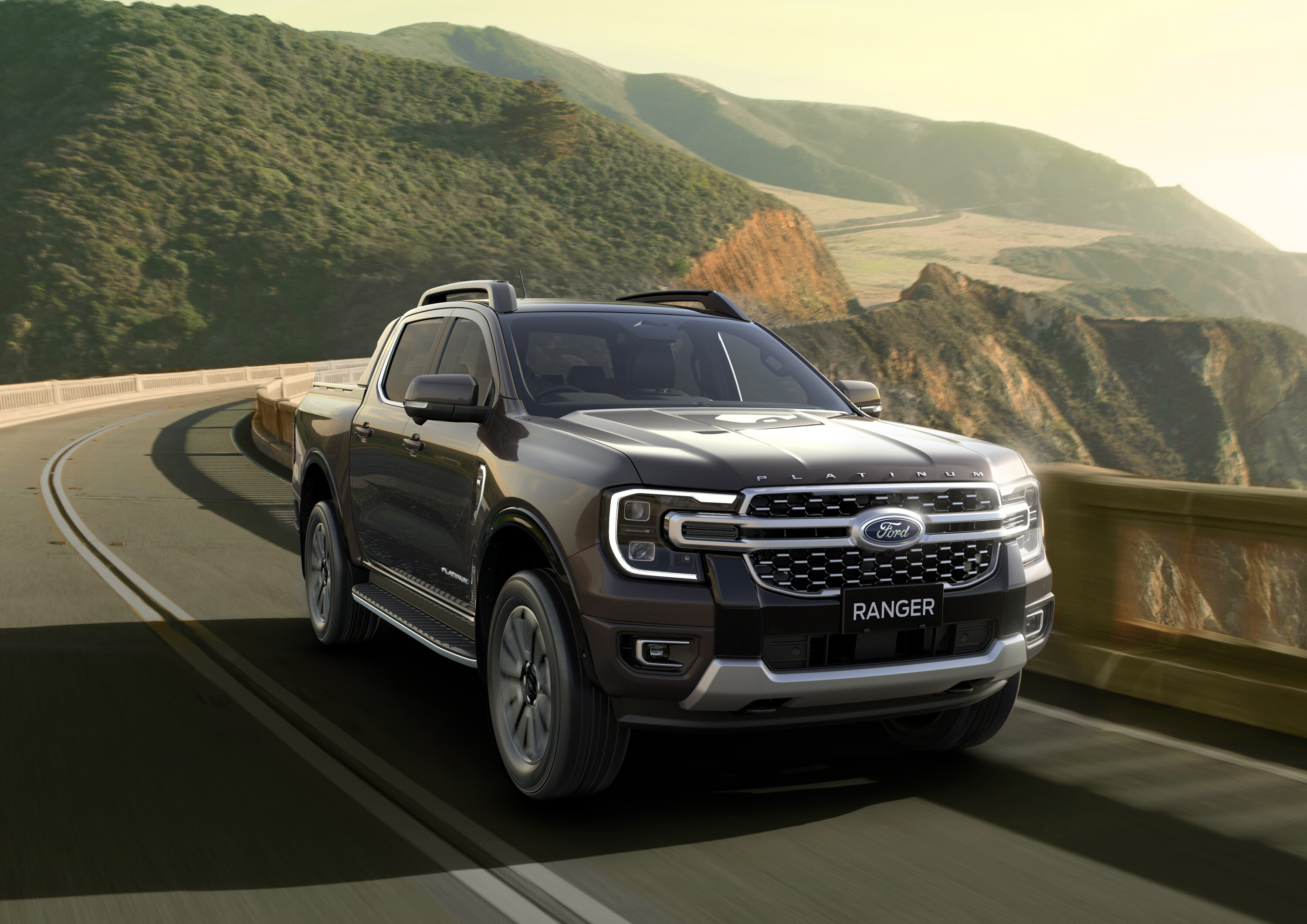
| 20-inch alloy wheels | Quilted leather-accented upholstery |
| 12.4-inch digital instrument cluster | Premium carpet floor mats |
| 10-speaker Bang and Olufsen audio system | 10-way power-adjustable front seats with driver’s seat memory function |
| Flexible rack system | Matrix LED headlights |
| Heated and ventilated front seats | Full LED tail-lamps |
| Heated steering wheel | Overhead auxiliary switch bank |
| Chrome exterior trim | Damped gas-strut tailgate |
| Black-painted roof (body coloured available as no-cost option) | Interior accent stitching |
| Platinum badging on the bonnet, front doors and tailgate | |
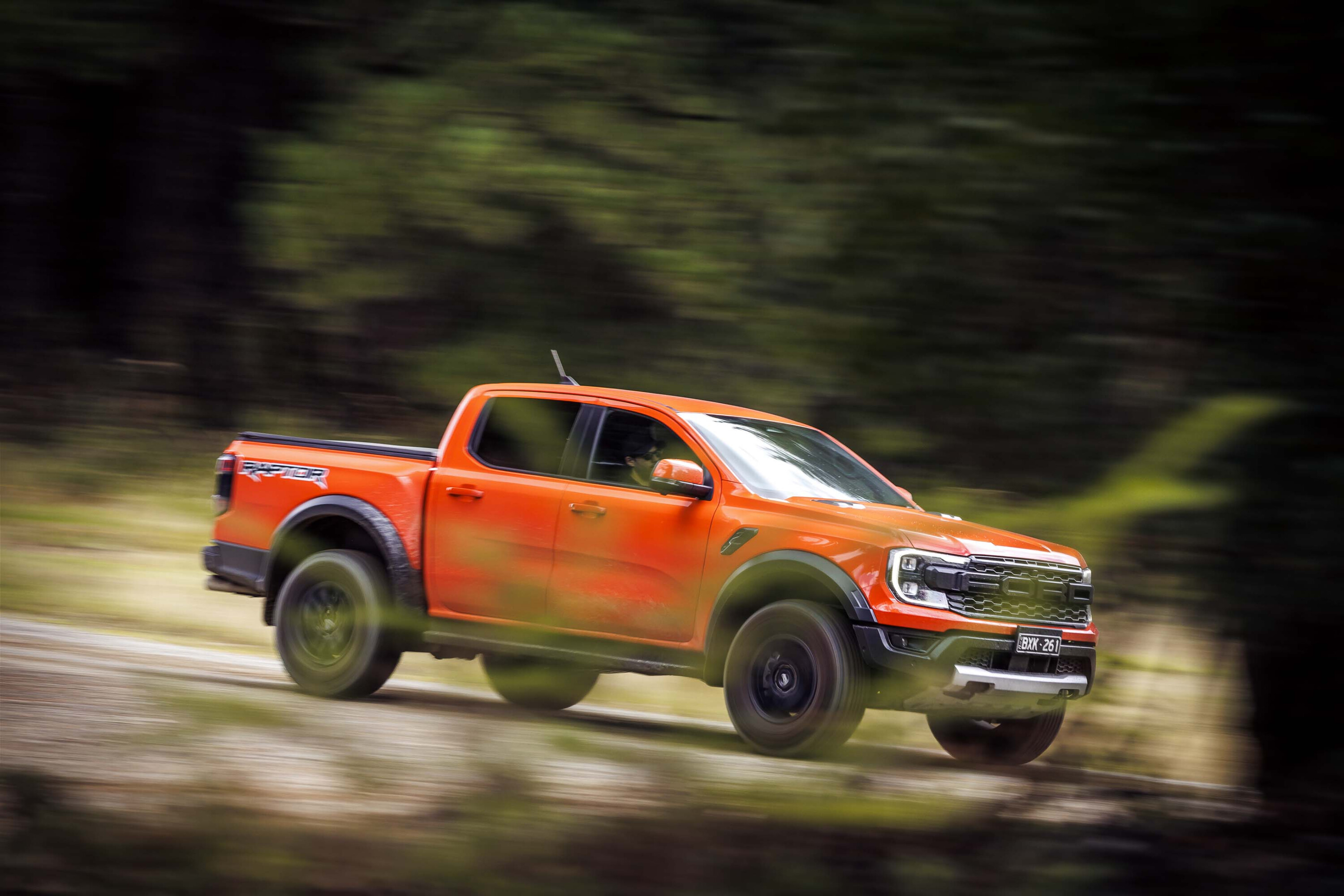
It’s the only Ranger to use a powerful 3.0-litre V6 twin-turbo petrol engine and brings a number of other performance upgrades, including:
| In addition to Wildtrak | |
|---|---|
| 17-inch alloy wheels with T285/70 R17 BF Goodrich K02 High Performance All Terrain tyres (beadlock capable wheels optional) | Matrix LED headlights |
| 12.4-inch full-digital instrument cluster | Full LED tail-lights |
| Active exhaust | 2.3mm-thick front bash plate |
| Fox racing 2.5-inch live valve suspension and Watts Link coil suspension | Raptor dual tow hooks |
| Electronic locking front differential | Spray-in bed-liner |
| Full-time 4×4 | Paddle shifters |
| Unique u2018F-O-R-Du2019 block letter grille | Seven drive modes (normal, sport, slippery, mud/ruts, sand, Baja, rock crawl) |
| 2024.5 Ford Ranger options | |
| Commercial canopy | $4700 |
| Dual lift canopy | $4700 |
| Lift and slide canopy | $4500 |
| Power roller shutter u2013 Raptor | $3800 |
| Manual roller shutter | $3000 |
| Flexible Rack System u2013 Sport/Wildtrak | $2800 |
| Premium Pack u2013 Wildtrak | $2000 |
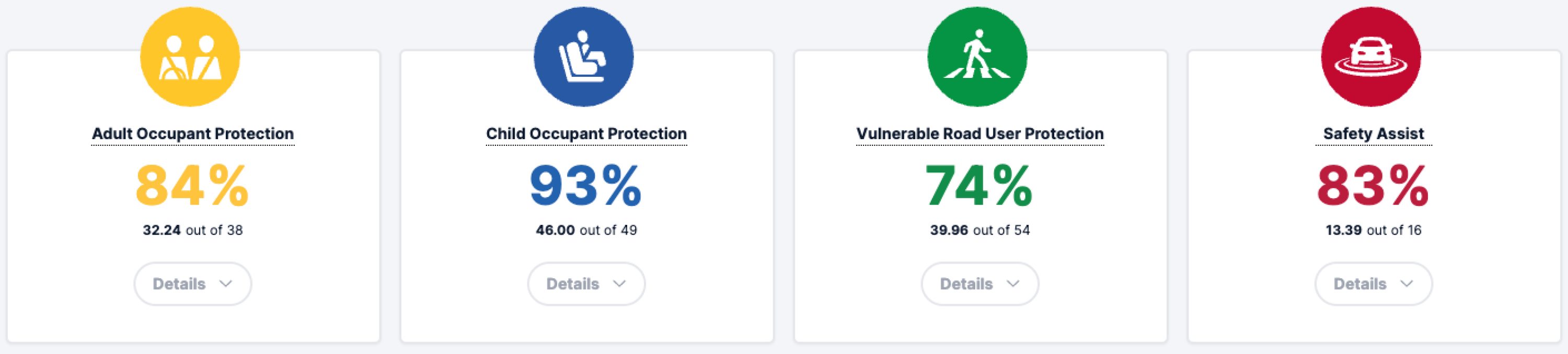
That rating applies to all model grades and body styes, except for the Ranger Raptor which has not been crash tested.
In crash testing, the Ranger scored well for protection of adult occupants in frontal offset, side impact and far-side impact tests, although a result of ‘marginal’ was assigned for protection in the full width frontal crash test and for the chest of the driver in the oblique pole test.
Likewise, maximum scores were awarded recognising the Good levels of protection offered to child occupants in the frontal offset and side impact crashes. All body styles with rear seats feature two ISOFIX anchorage points in the outboard seats.
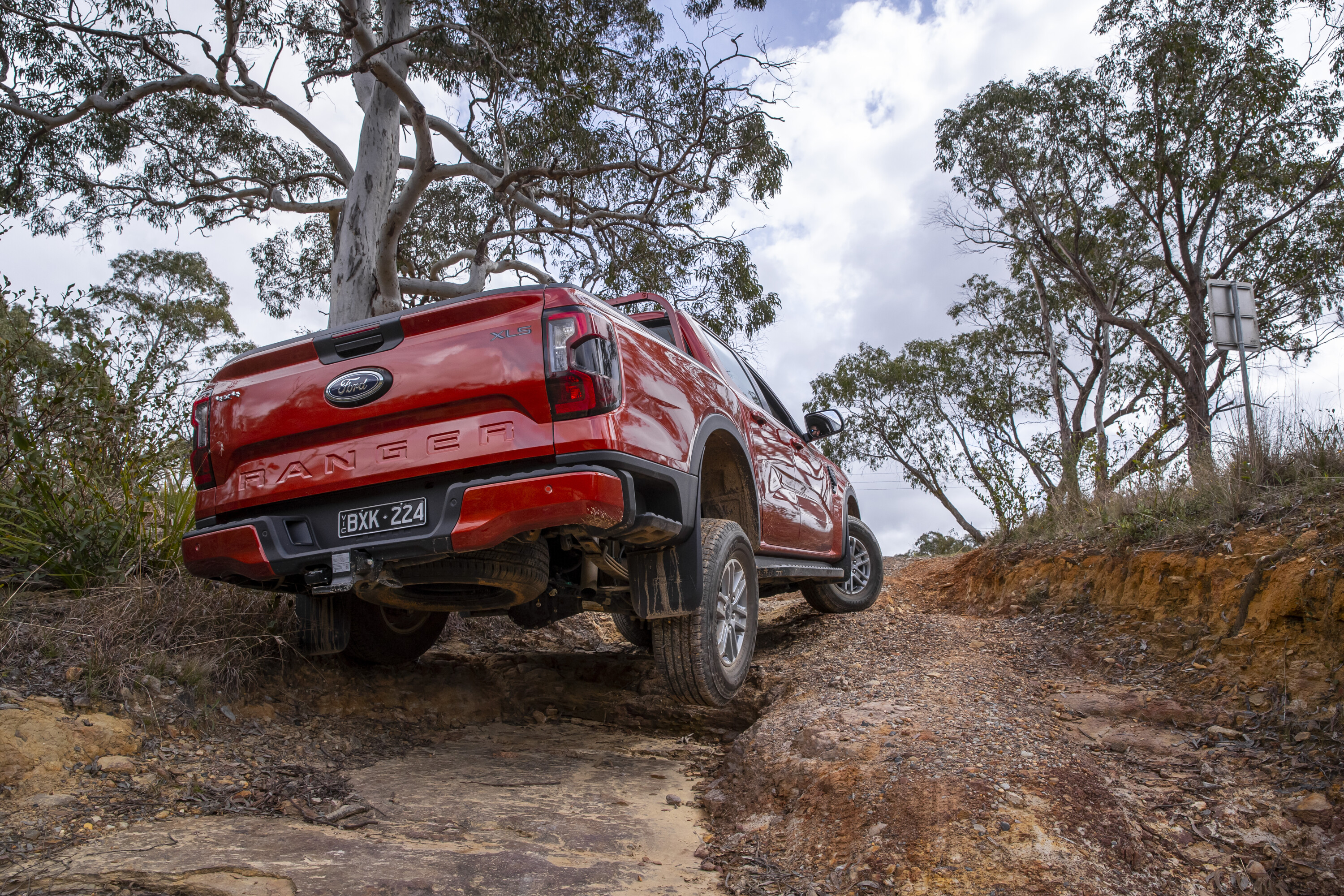
Every Ranger carries a high level of standard safety gear including dual frontal, side chest-protecting and side head-protecting curtain airbags, along with a driver and passenger knee airbag. A front centre airbag is also standard, which protects front seat occupants in side impact crashes and also prevents front occupants from clashing heads.
Features such as pre-collision assist, post-impact braking, blind-spot monitoring with trailer tow function and cross-traffic alert, reverse brake assist and evasive steer assist are all available.
Adaptive cruise control is standard across the range and from XLT upwards there’s intelligent adaptive cruise that features lane centreing, traffic sign recognition and a ‘Stop & Go’ function that will allow the vehicle to come to a complete halt in traffic and then automatically resume its cruise setting. There’s also Active Park Assist 2.0, which will help with parallel parking.
| 2024.5 Ford Ranger active safety features | |
|---|---|
| Autonomous emergency braking (vehicle, pedestrian, cyclist, junction) | Adaptive cruise control |
| Lane-keep assist | Post-collision braking |
| Lane departure warning | Reverse autonomous emergency braking* |
| Evasive steer assist | Blind-spot alert* |
| Traffic sign recognition | Rear cross-traffic alert* |
| * Pick-up models only | |
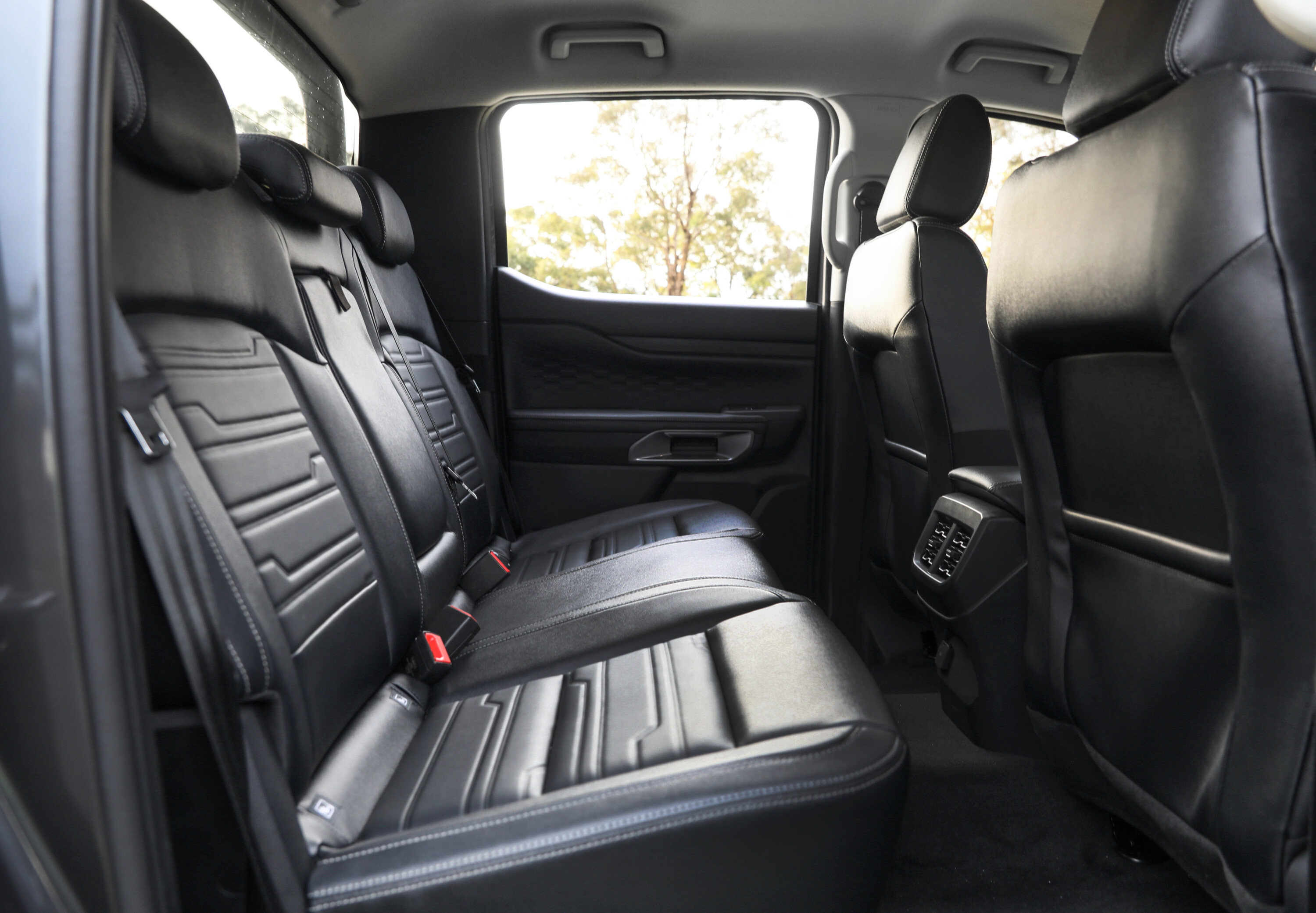
The current generation model (released in 2022) is larger inside than models that have gone before it and Ford has also used the available space more smartly. The seatbacks, for example, are slimmer to allow more knee room for rear passengers and the door cards have a thinner design which helps to make the cabin feel wider.
The mix of materials is also impressively high for a mid-size ute. Entry level XL and XLS models have a strong workhorse focus but mid-spec XLT models and above feel far more premium thanks to a greater use of soft-touch surfaces and an increased use of more expensive feeling materials.
The cabin design also feels far more modern than most offerings in this segment. The dashboard is dominated by large 10.1-inch portrait style touchscreen that offers easy smartphone integration and every Ranger also features a digital instrument pack ahead of the driver.
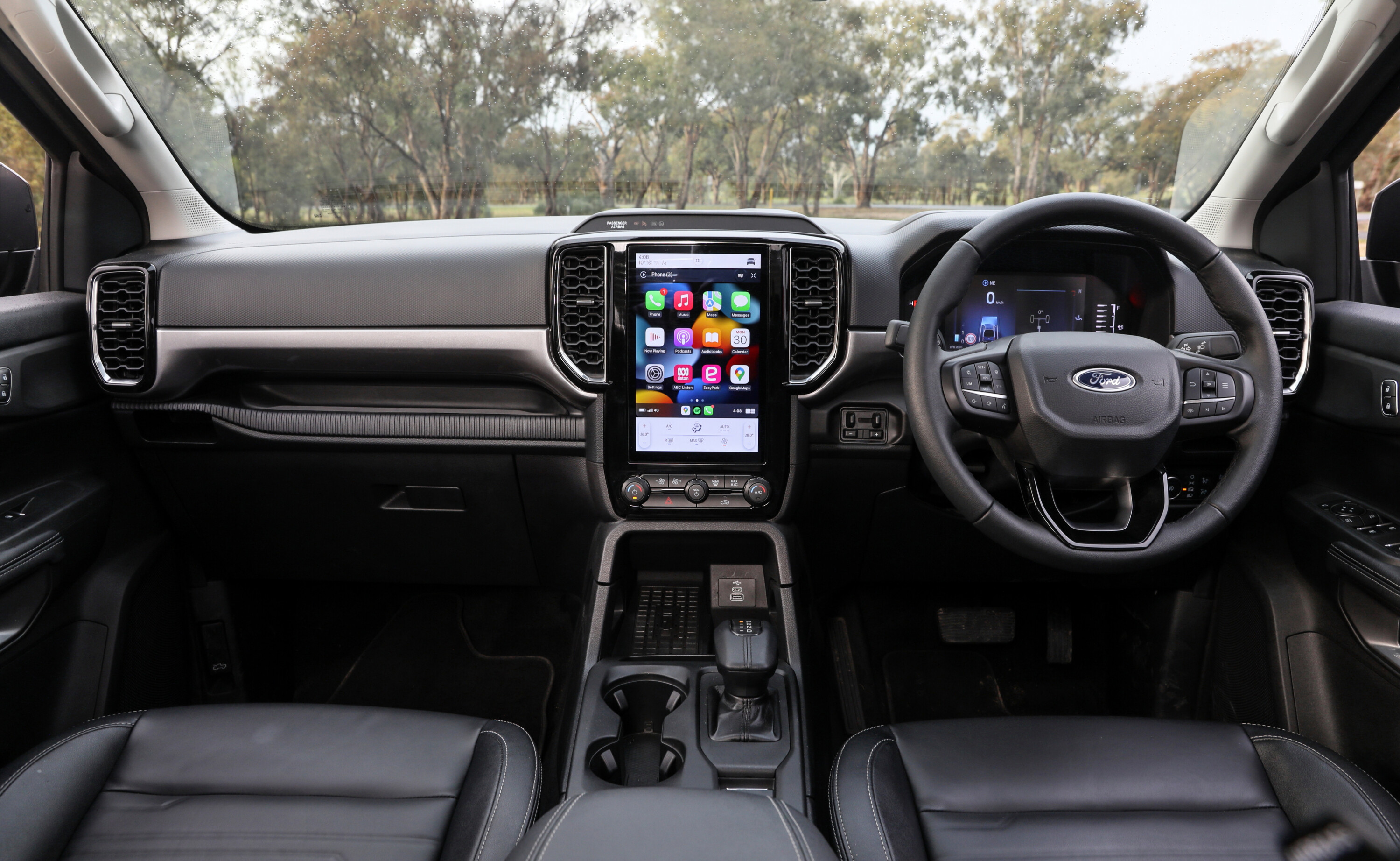
The interior feels tightly screwed together and there’s a good amount of storage courtesy of twin glove boxes, generous door bins, a large centre console and additional storage cubbies beneath the seat base of the second row in dual-cab pick-up versions.
Both front and rear seats offer decent headroom, with knee room and shoulder space being increased in the rear compared with older Ranger models. Rear passengers also get air conditioning vents for the first time which will make longer family trips far more comfortable for the kids. Despite the Ranger’s additional rear room, however, some rivals do have more space in the back seat for adults.
All-round visibility is good which helps to make Ranger easy to manoeuvre in traffic despite its relatively large size, especially in double cab pick-up guise, and the driving position is also excellent thanks to a steering wheel that can be adjustable for reach and rake.
A European pallet that is 1200mm wide can now fit between the rear wheel arches meaning it is one of the best dual-cab utes on sale for lugging stuff about.
| 2023 Ford Ranger tray dimensions | |
|---|---|
| Length (at floor) | 1547mm on dual cab pick-ups, 1845mm on super cabs |
| Width (between wheelarches) | 1224mm |
| Width (rear opening) | 1584mm |
| Height (at centreline of axle) | 529mm |
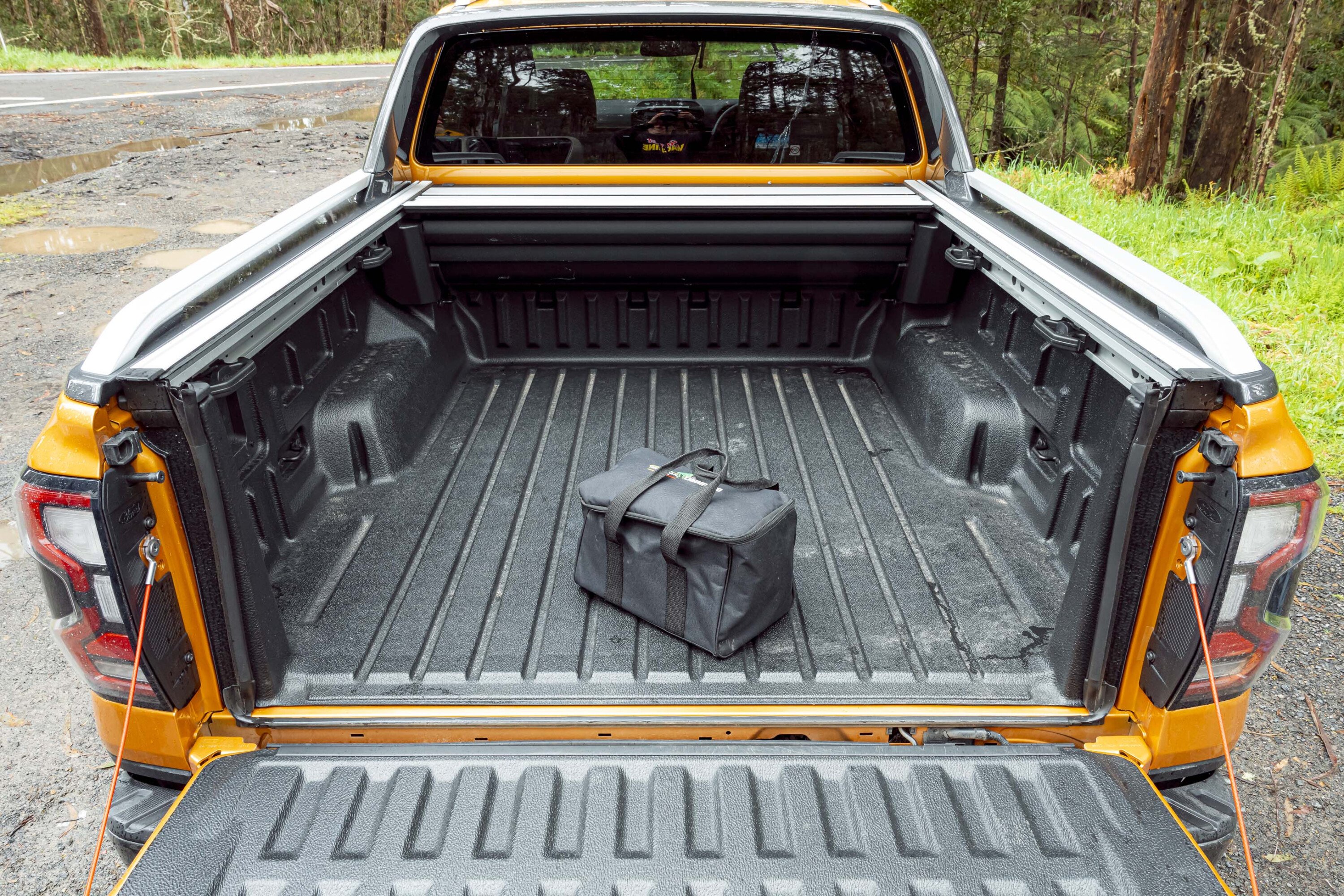
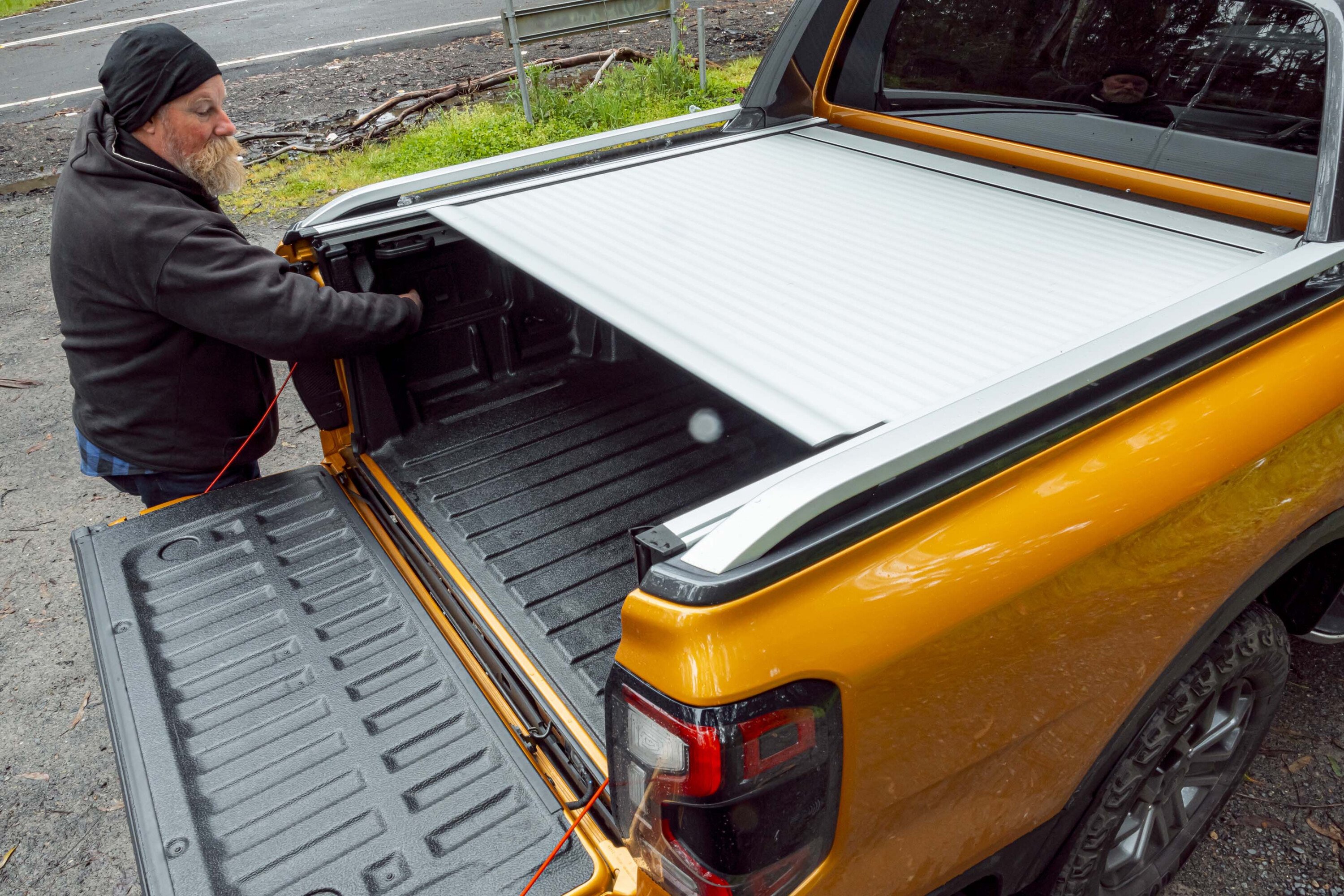
The tray itself is also well equipped with most double-cab versions featuring six tie-down points, which is more than average for this segment. Additional side steps for easier access to the tray also feature, as do clamping pockets and a ruler with 10mm increments along the tailgate.
A 240V power socket and LED lighting to illuminate the tray are also available on most versions and Wildtrak variants are fitted with aluminium rails inside the tray on which additional tie-down cleats can slide.
A Flexible Rack System that was introduced with the Platinum variant in 2023 is available as a cost option for Sport and Wildtrak models. The system replaces the standard sports bar and load box access points for the Sport, or sailplane and box rails for the Wildtrak.
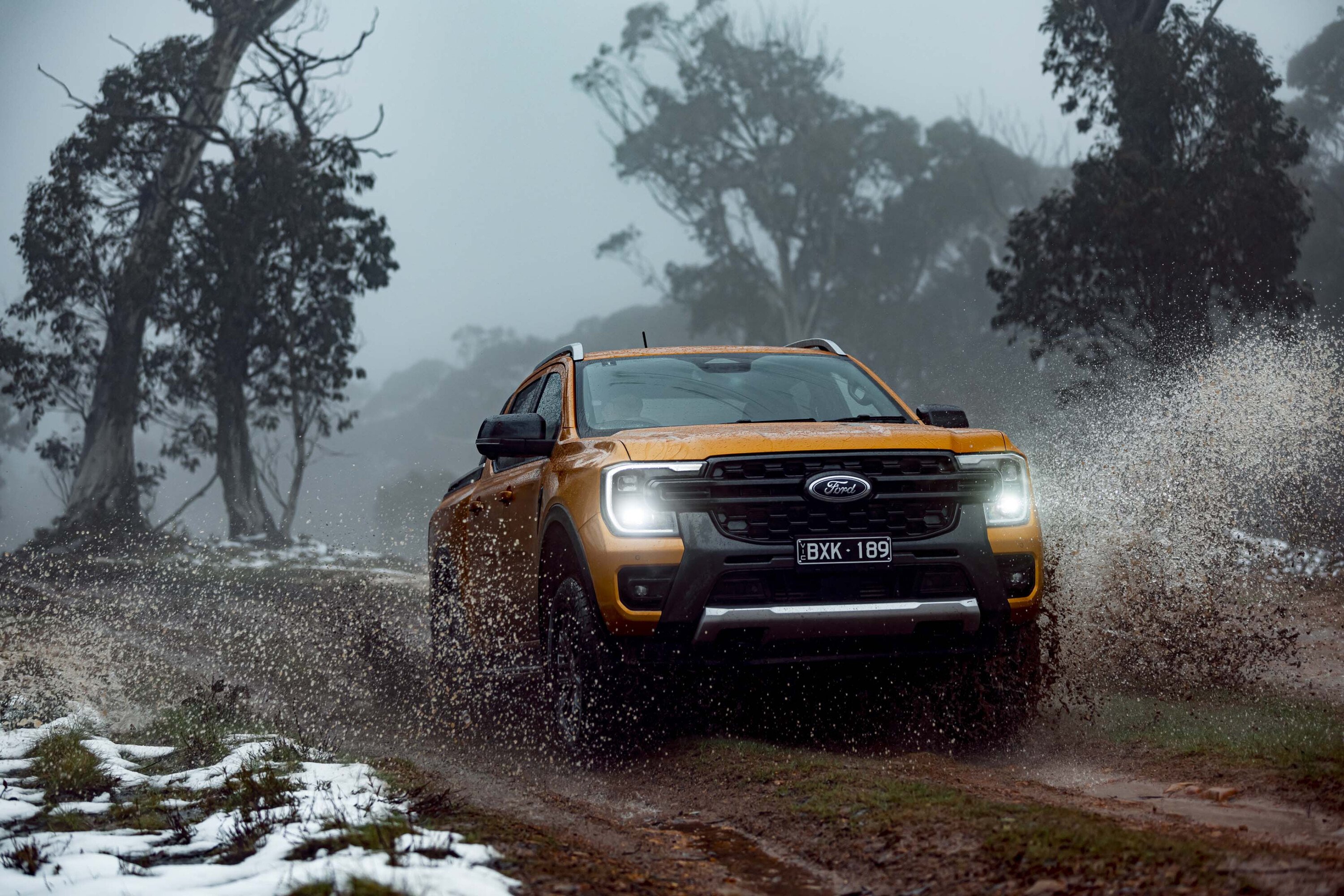
Typically, mid-size utes can feel a little agricultural to drive given they also have to be capable off-road and are built to carry and tow heavy loads. Vague steering and ride quality that can be stiff-legged and brittle without a load in the tray are fairly common in this segment, however the Ranger is one of the most ‘car like’ utes to drive.
The calibration of its electronic stability system is also superb which helps to make the Ranger feel safe and secure, even on wet roads.
The Ranger is also impressively capable off-road. Approach, departure and breakover angles are among the best in class and campers and tradies will love that there’s plenty of room in the engine bay to fit a second battery. There’s also space for a snorkel and the standard 80-litre fuel tank aperture can accommodate an aftermarket 140-litre unit.
This allows the driver to quickly manipulate the rear diff lock, switch off the parking sensors, activate and deactivate the hill descent control and also displays the view from a forward facing camera.
The camera is a particular boon when attempting to crest a ridge or dune, as its angle of view is so wide that while you’ll merely have a windscreen full of sky, the lens can see down the other side and you can steer the vehicle accordingly.
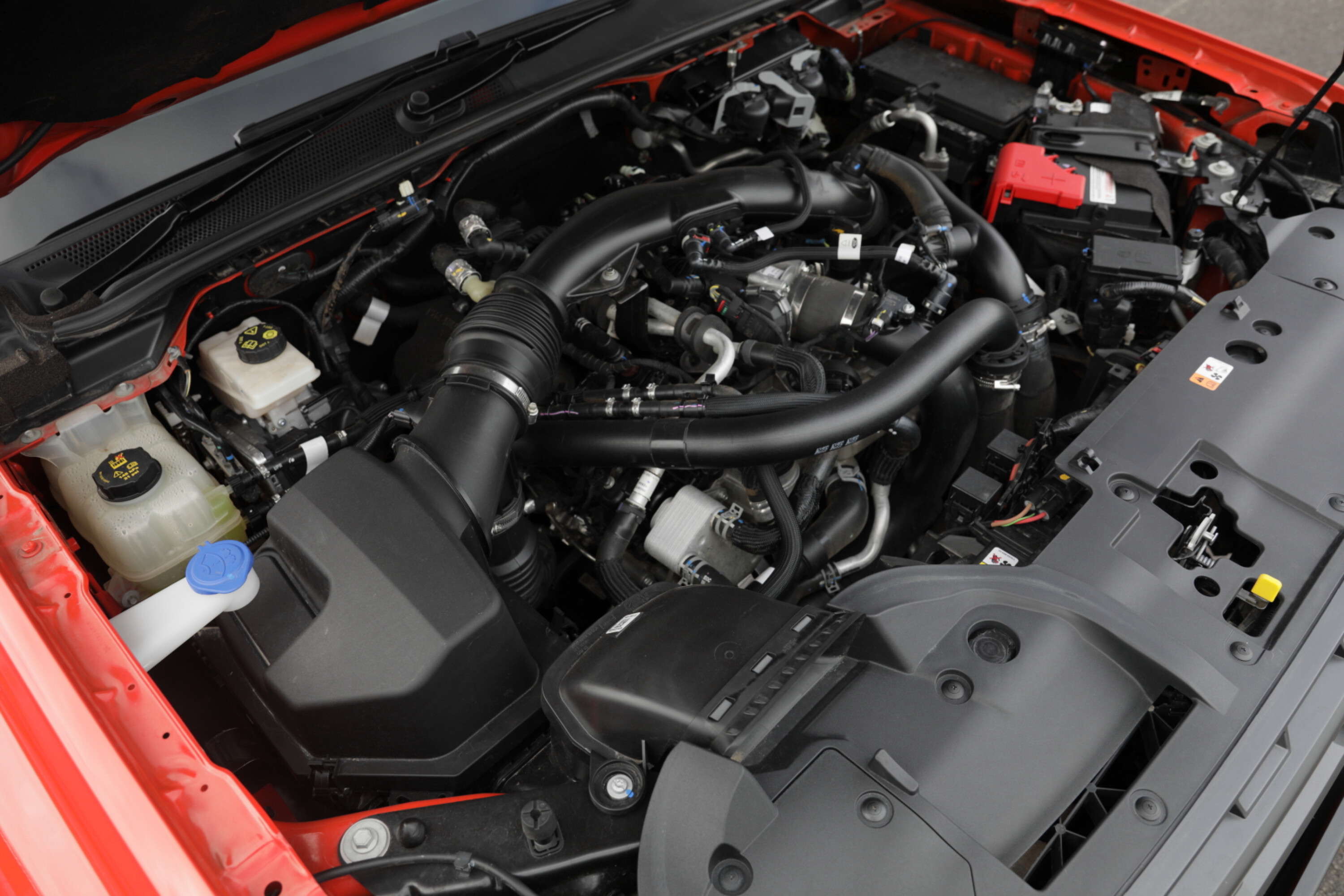
Of the engines available, it’s the 2.0-litre bi-turbo diesel and larger capacity 3.0-litre turbo diesel that are the most desirable. Both are paired to an improved 10-speed automatic gearbox and they’re also amongst the quietest and most refined engines available in this segment.
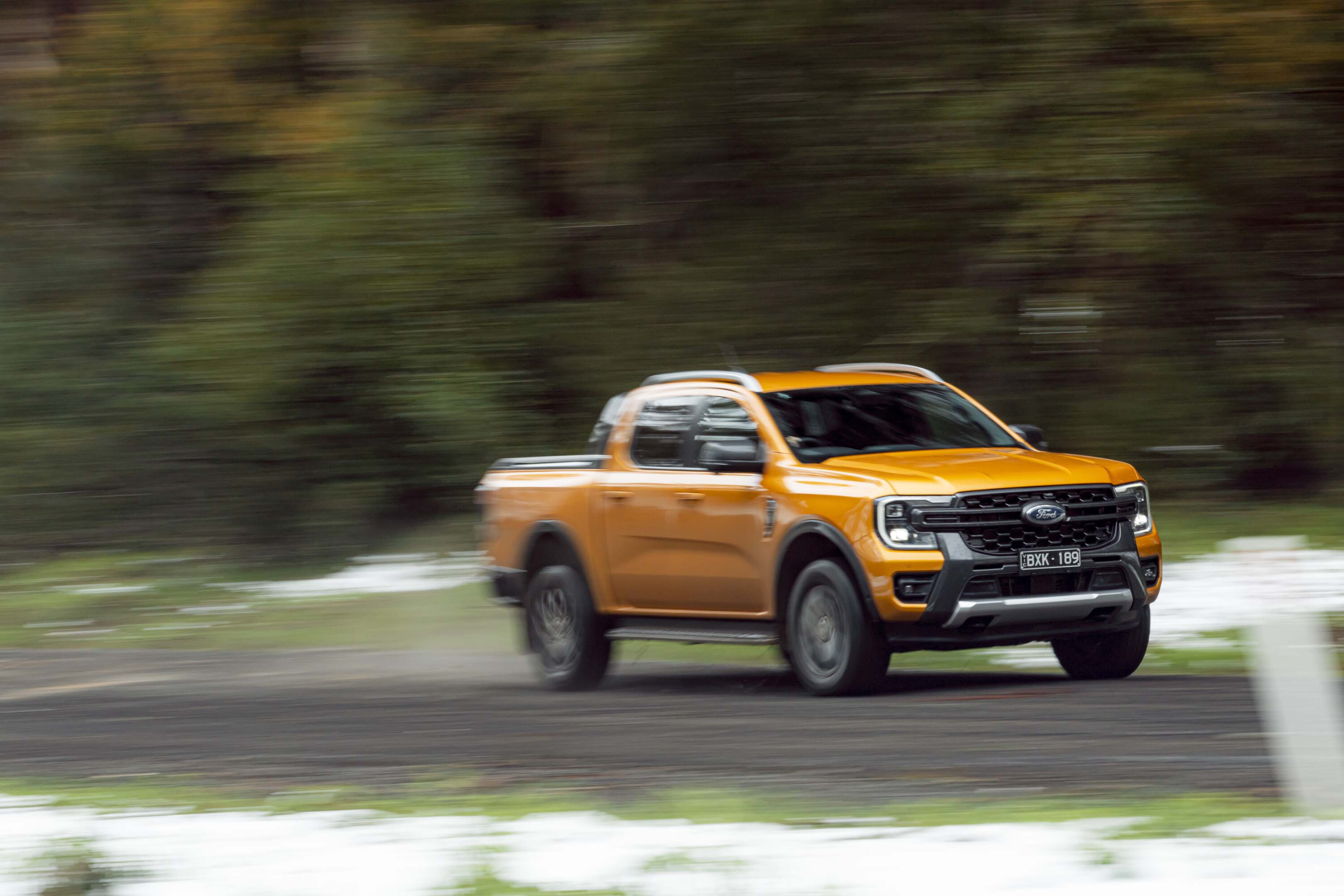
The V6 is smoother and more muscular, making it the engine to pick if you plan on towing things on a regular basis, but it’s only available on mid-spec XLT models and above meaning you’ll need to spend at least $63,000 (before on-road costs).
If it’s driver engagement and fun you’re chasing, though, the flagship Ranger Raptor is the model to buy. It’s the most expensive variant in the line-up but it’s also the fastest and most capable. And its turbocharged V6 petrol engine sounds great.
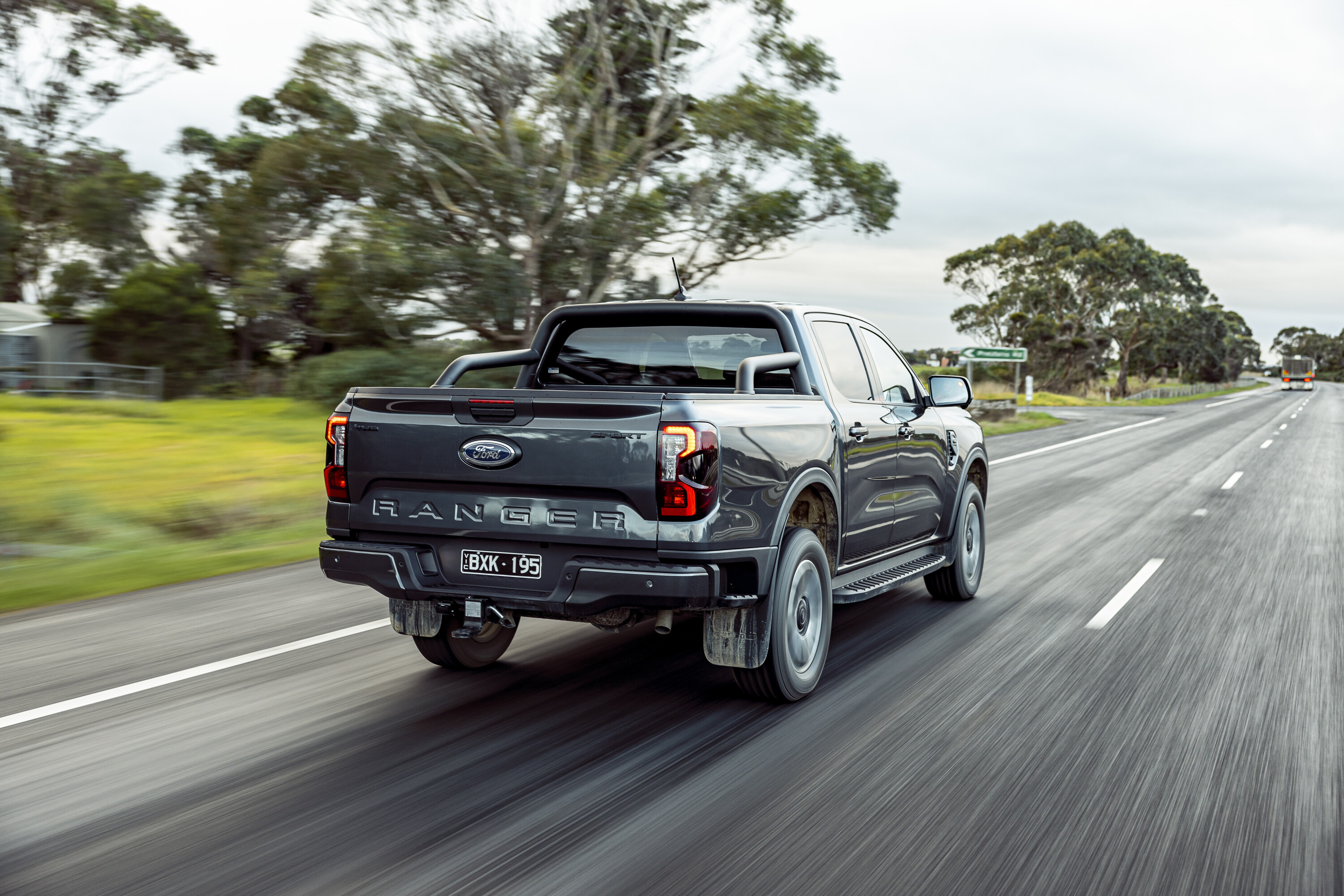
The single-turbo 2.0-litre diesel engine, which is only available on entry-level 4×2 XL variants, has an official fuel rating of 7.6L/100km meaning it’s pretty line-ball between the two 2.0L diesels when it comes to fuel use.
As you’d expect, the more powerful 3.0-litre V6 diesel is thirstier and it has a combined fuel rating of 8.4L/100km.
The thirstiest engine belongs to the flagship Ranger Raptor. Its 3.0-litre twin-turbo petrol engine drinks 11.5L/100km on the combined cycle.
No matter which engine or body style you choose, the Ranger has a braked towing capacity of 3500kg with a 350kg tow ball weight limit. The one exception to that is the performance-focused Ranger Raptor which has a lower braked towing capacity of 2500kg due to its independent rear suspension set-up.
Payloads vary across the model range. The V6 Sport, for example, has the lowest payload of the Ranger double-cab pick-up line-up at 934kg, while the 4×4 XL has the highest at 1023kg.
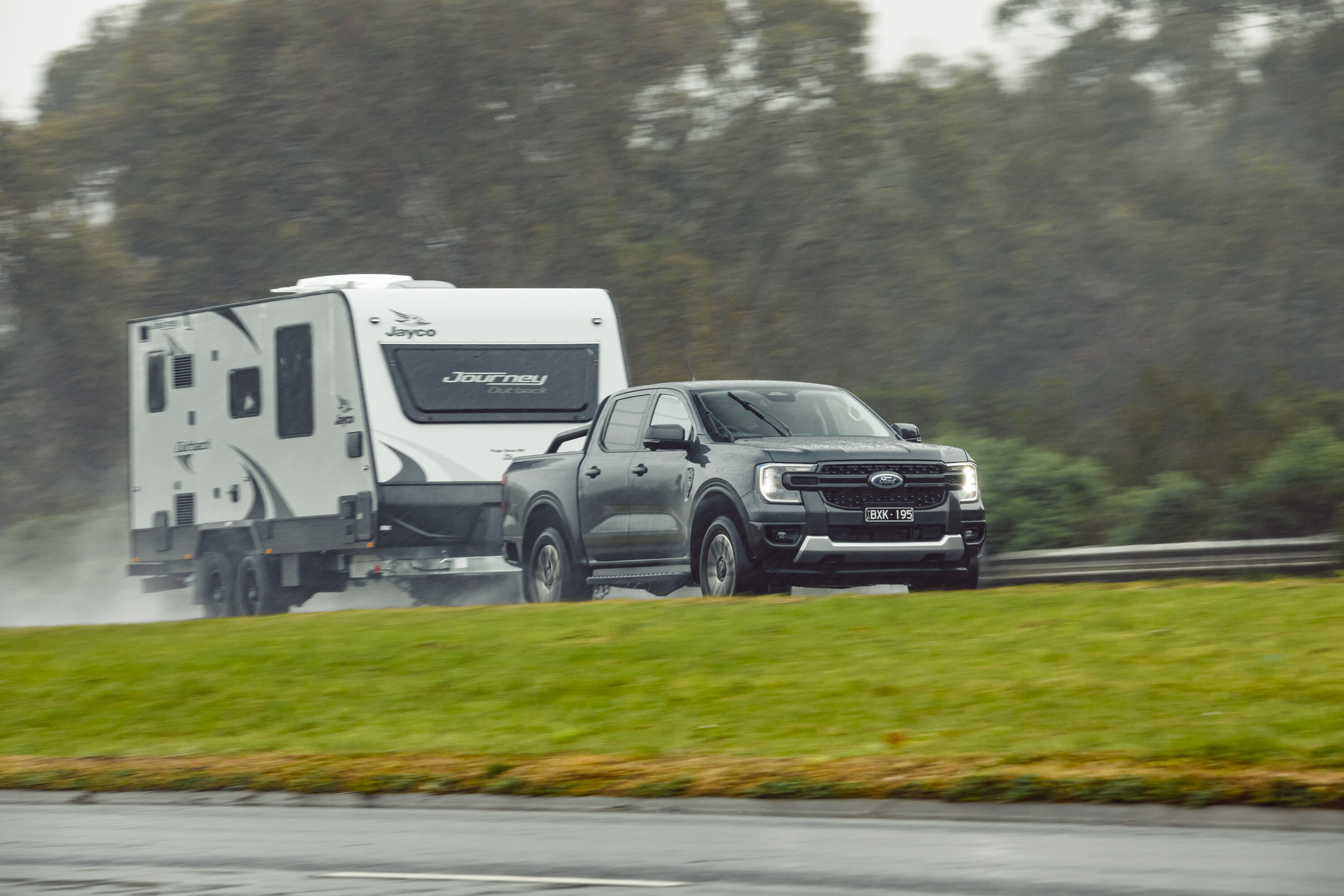
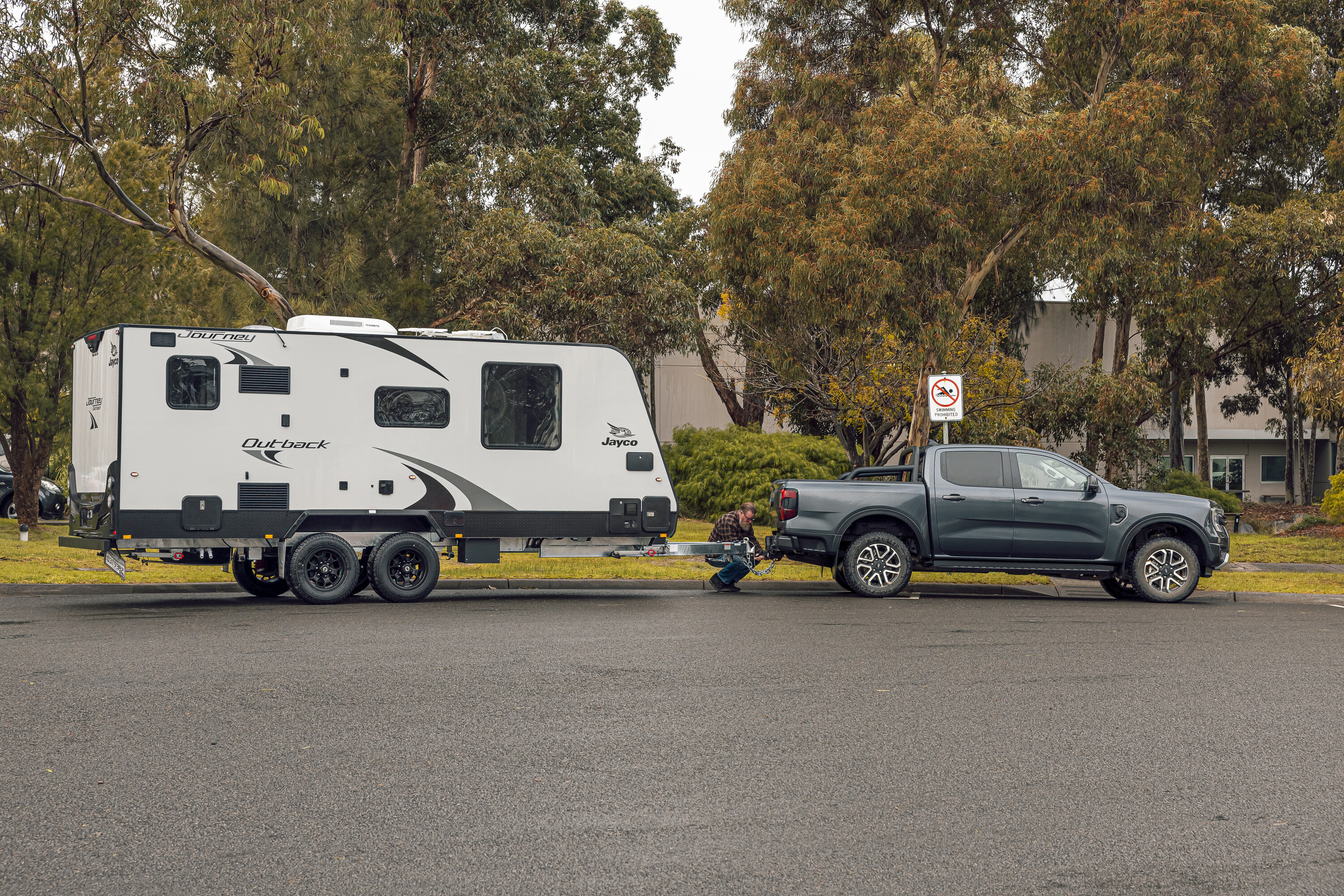
The infotainment system features an easy-to-understand checklist to run through, and there’s also an integrated trailer brake controller fitted as standard to the Wildtrak and optional with other models.
This can power a trailer’s electric brakes using a proportional output corresponding to the Ranger’s braking pressure.
What’s more, the centre screen also features a trailer coverage system. The dimensions and names of up to 10 different trailer types can be entered into the system, and the blind-spot monitoring will then adjust to account for the combined dimensions of vehicle and trailer.
Pro Trailer Back-Up Assist is standard on Ranger Wildtrak, Platinum and Raptor models, as of a 2024 update.
Service intervals are every 12 months or 15,000km – whichever is sooner – and Ford’s capped price servicing scheme means that the most you’ll pay for each of the first four visits to the dealer is $329.
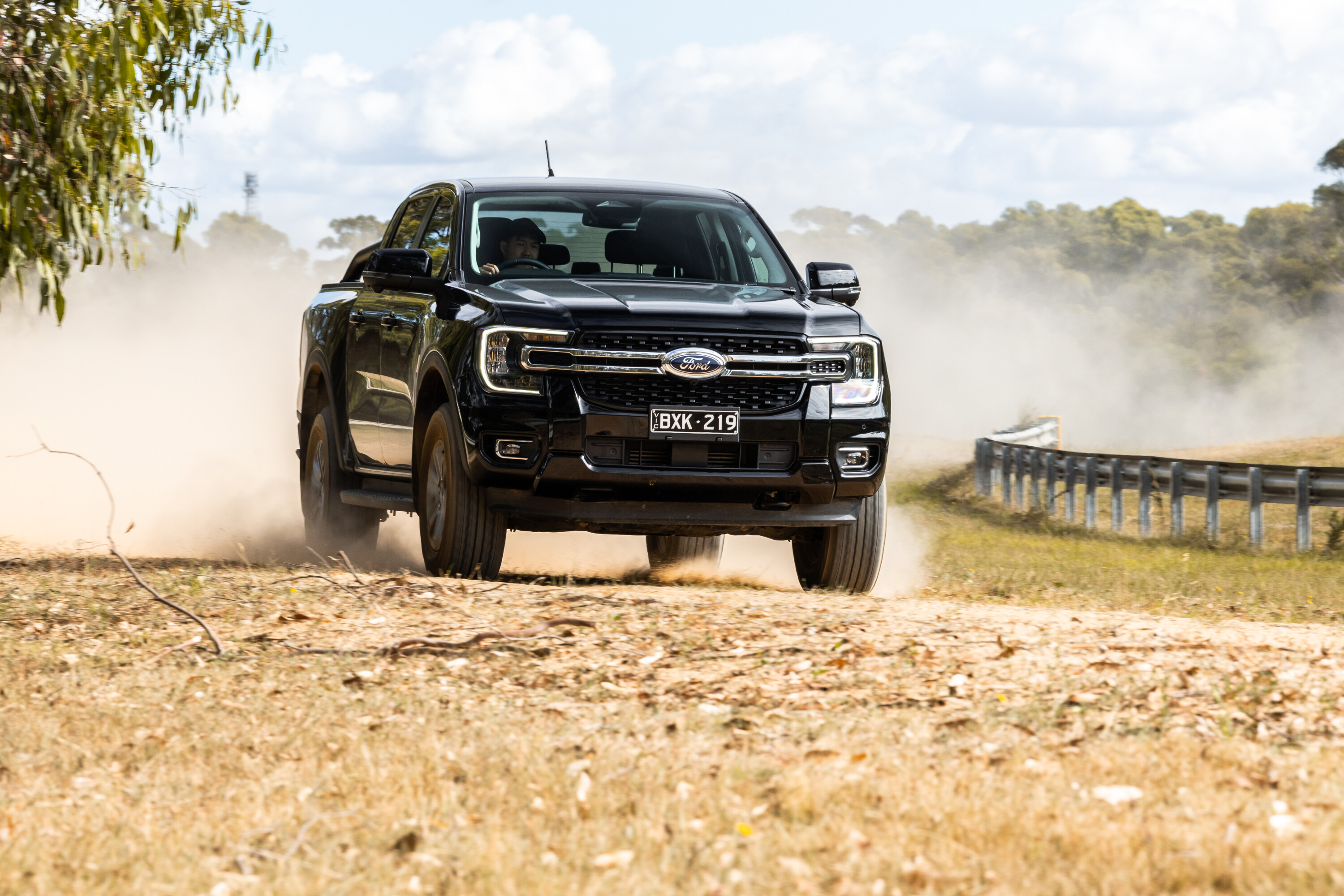
It feels far more premium and feature packed than the lower spec XL and XLS model grades and it’s also powered by the more powerful V6 engine.
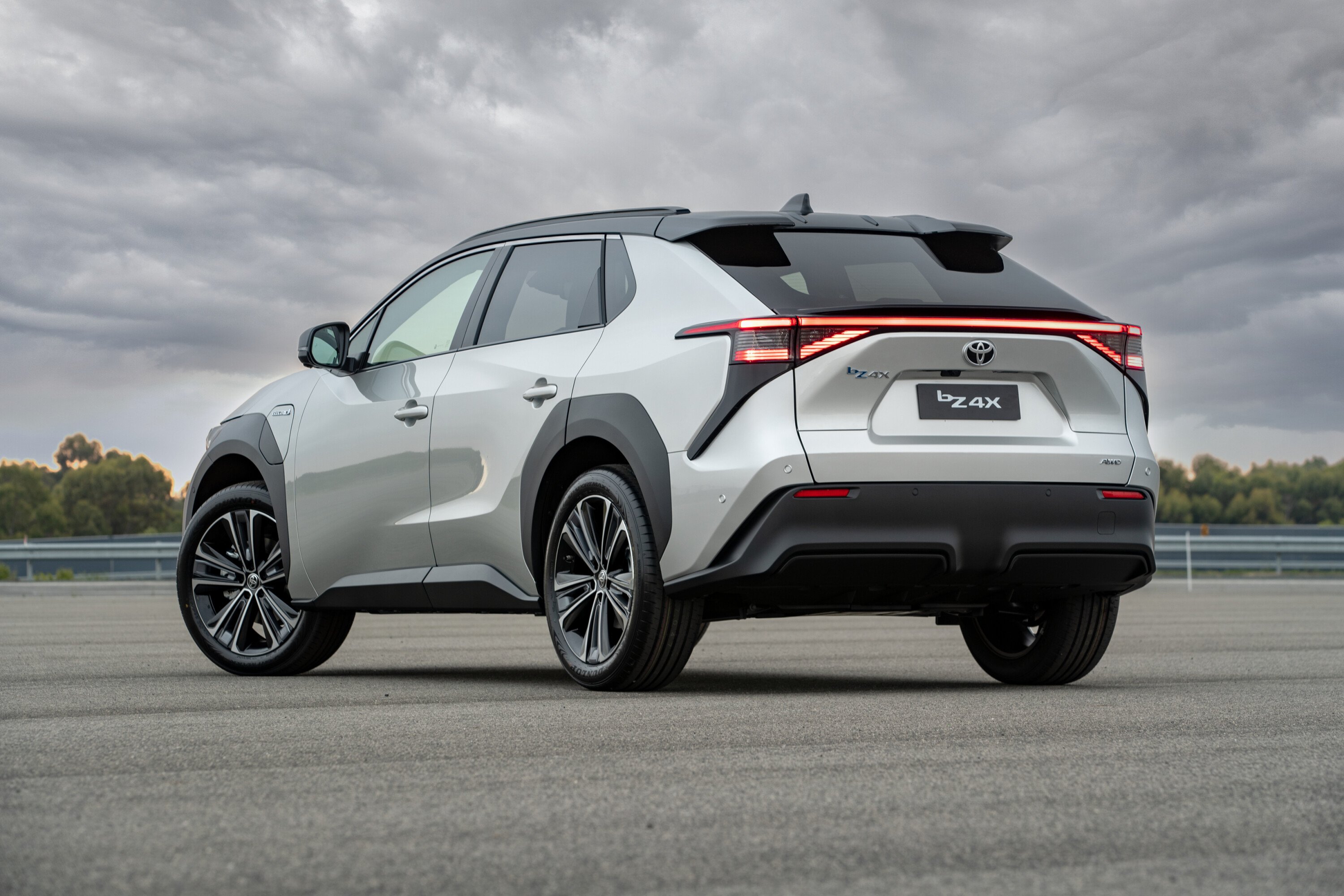
Not only is the Japanese carmaking giant number one on the sales chart for new cars in Australia, it’s held that position for the past 20 years. Biggest carmaker on the planet? Toyota, by a generous margin.
Diversity of product certainly helps it achieve that degree of popularity, with the brand offering something for almost every mainstream segment there is. One of the broadest portfolios of hybrids also helps that appeal, with more and more Aussies looking to lower the running costs of the family vehicles. Demand for petrol-electric product has been so strong, in fact, that in mid-2024 Toyota Australia announced that it would only offer its regular cars and unibody SUVs as hybrids – only performance vehicles and body-on-frame SUVs and commercial vehicles would continue with combustion-only power.
So, what’s around the corner for Toyota in Australia? Here’s what’s in the foreseeable future, and what you can expect beyond that:
The 250-series LandCruiser Prado is an all-new renewal of Toyota’s fan-favourite offroader, which has historically sat alongside the Kluger as the top-seller in the large SUV segment. Prices are going up for the new-gen Prado, however, with a $9670 increase in the price of entry and even greater price rises across the board, prospective Prado owners will need to stump up more to put one in their driveway.
Balancing that out is a massive increase in standard equipment and the adoption of a more efficient eight-speed automatic, though power will continue to be supplied by a HiLux-spec 2.8-litre turbo diesel inline four with 150kW and 500Nm.
The ninth-generation model will arrive on our shores with a three-grade lineup, consisting of base Ascent, mid-spec Ascent Sport and the top-shelf SL – the SX grade of the outgoing generation has been deleted.
Non-hybrid powertrains have also been cleaved off the Camry. As with the rest of the Aussie Toyota car and unibody SUV range, the Camry will be exclusively hybrid, with power coming from a 2.5-litre petrol engine and electric motor combo.
Essentially an extensive facelift of the eight-gen model, the new Camry carries over a lot of sheetmetal but sports more dramatic styling to its front and rear end. Inside, there’s better infotainment software running on bigger screens, fresh interior furnishings, and mare electronic safety aids. Expect pricing to increase to reflect those changes.
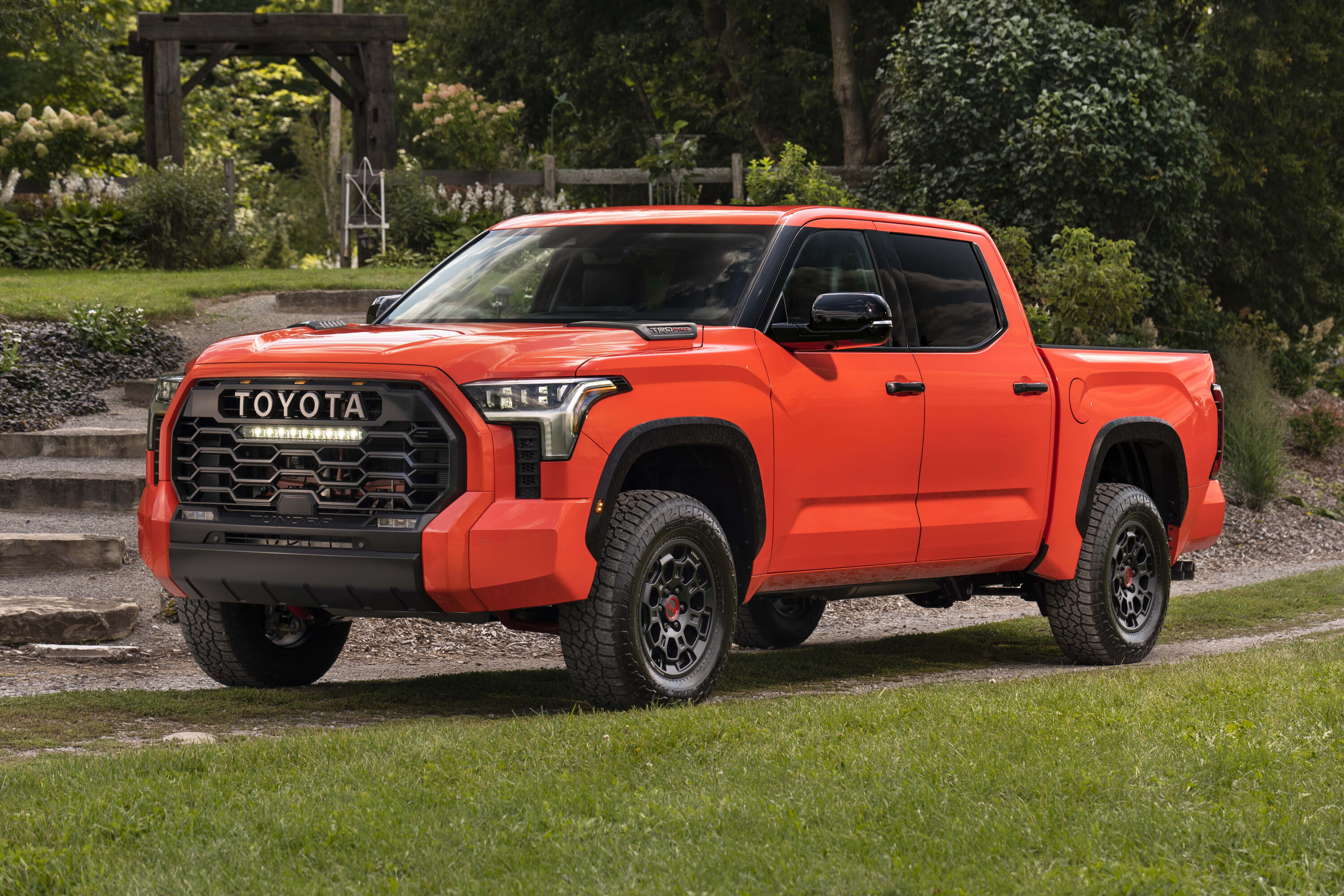
The hulking pickup is set to come here as a RHD-converted Yankee pickup to do battle with its compatriots the Chevrolet Silverado, RAM 1500 and Ford F-150, and it’ll be here with the full weight of official Toyota Australia aftersales support as well.
To get to showroom-ready status, it’s partnered with Walkinshaw Automotive Group to locally convert the biggest truck in the Toyota stable to right-hand-drive, and with the Tundra now based on the same TNGA-F platform as the 300 Series LandCruiser, the task will be made easier, with the team able to poach RHD parts that are already in production.
While it’s not completely locked in, the Toyota Tundra is already creating a stir with punters, especially those looking for a rig that can tow 4500kg. Toyota is also taking the unconventional approach of leasing out the first 300 examples to customers rather than selling them outright, with those customers required to provide feedback to Toyota – essentially making them part of the pickup’s test and evaluation programme. If all goes well, expect a more conventional sales debut sometime in 2025.
Beyond freshened-up cosmetics and a comprehensive interior restyle for the GR Yaris, these updates will also herald the introduction of an automatic transmission option for both cars – music to the ears of driving enthusiasts who’d rather not bother with a clutch.
Power also gets bumped up for the Yaris, with an extra 24kW and 30Nm being squeezed from its 1.6-litre turbo three-pot. The GR Corolla also gets a 30Nm boost, generating a torque tally of 400Nm, though power remains at 221kW. A suspension retune also tones the GR Corolla’s handling further.
Full pricing and specifications for both the GR Yaris and GR Corolla facelifts will be announced closer to the end of 2024.
In its second generation, the C-HR is now supplied from Europe, with only hybrid powertrains on offer. It’s not cheap, but it could prove very popular with style-focused singles.
Read our Australian launch review at the linked story above.
The only change in 2024 for the Toyota’s ever-popular RAV4 has been the shift to an all-hybrid range, with petrol-only variants being discontinued and put into run-out earlier in the year.
Are there further changes coming for the top-selling midsize SUV? 2025 will mark the sixth year of the RAV4 being on sale in Australia, which is the traditional age of retirement for most unibody cars and SUVs, but so far there’s no word about what’s in store for the next generation RAV. Expect to start hearing more about that one either toward the end of this year or sometime in 2025.
Drive configurations include front- and all-wheel drive, and In the case of the former, there’s a single big front-mounted motor providing motivation. But, where other brands use all-wheel drive as a welcome excuse to add a lot more power and speed, the AWD version of the BZ4x will swap the big single motor for two smaller ones – one at the front and one at the rear – to develop similar overall power.
That means there’s a 150kW motor in the FWD model, which is fairly close to standard – but only two 80kW motors in the AWD for a total of 160kW.
Both versions pack a 71.4kWh battery system, with the FWD model offering 516 kilometres of driving range. As with all AWD EVs, the all-wheel-drive model will give you surety, but reduce driving range to 460 kilometres.
All of that fresh product is making the HiLux look old and wrinkly by comparison, but there’s building buzz about what’s next for Toyota’s globally important utility.
While Toyota’s HiLux battles it out for the ‘best-seller’ spot every month with its Blue Oval foe, it’s clear the HiLux’s next reboot can’t come fast enough. When? Probably not terribly soon, as the HiLux received a modest facelift in early 2024 and welcomed the arrival of its mild-tune GR Sport variant, and Toyota will likely want to give the refreshed Hilux family a good length of time to marinate in showrooms.
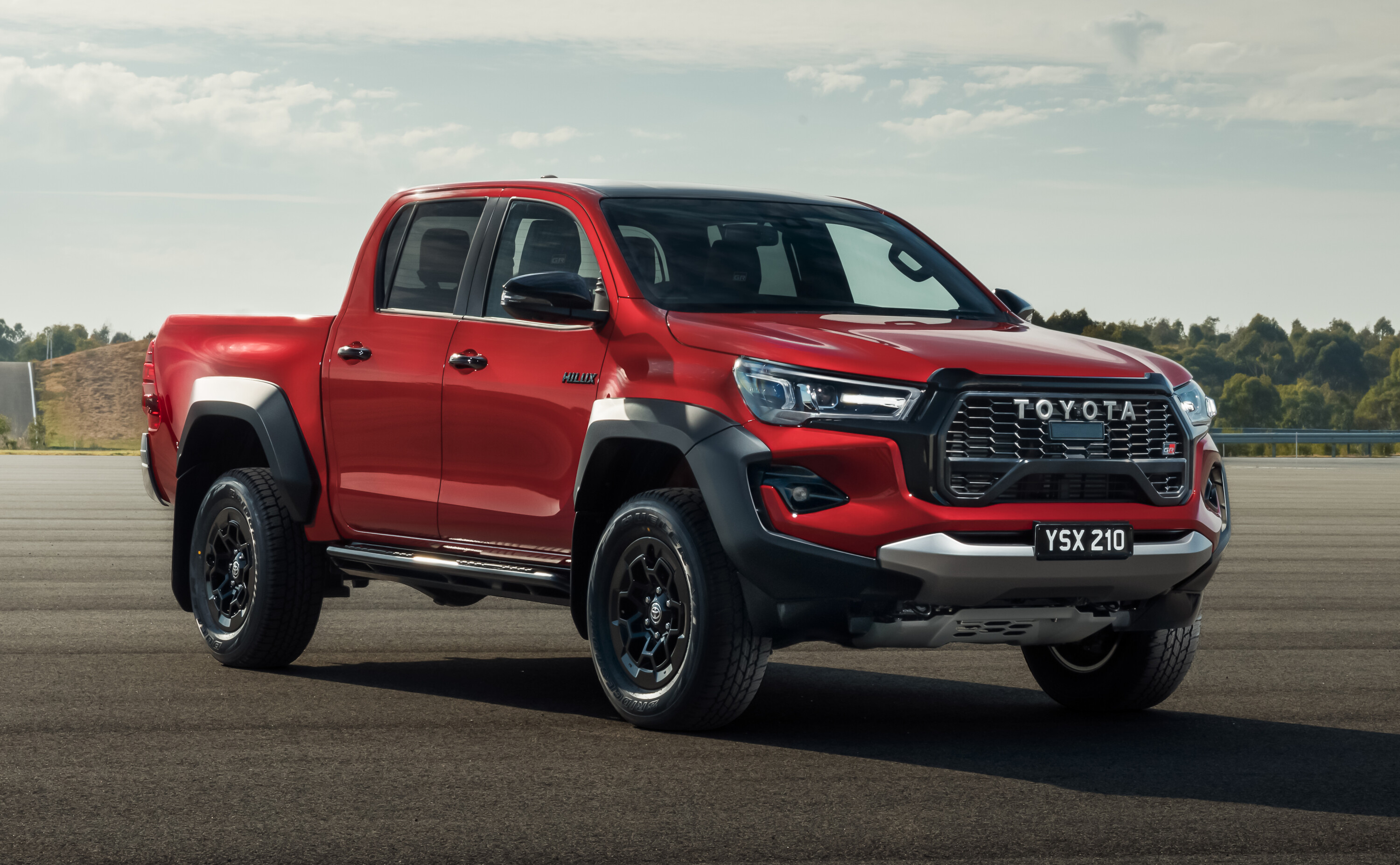
Perhaps we’ll hear about an all-new replacement sometime in 2025, but 2026 seems more likely. While Toyota is yet to confirm it, expect to see a version of the company’s most recent ladder-frame platform, the TNGA-F, underpinning it.
The TNGA-F frame currently rides underneath vehicles like the 300 Series LandCruiser and the incoming Prado, as well as the large, US-based Tacoma ute in the US.
This means that the next HiLux will be taller, longer and wider than the current version. As well, the newer platform will enable Toyota to incorporate hybrid-compatible gear like electric motors and 48-volt batteries, and potentially even larger plug-in style batteries. With Toyota already flirting with a fully-electric HiLux (we’ve driven the concept), a more battery-centric ute seems like a logical next step for the Big T.
Believed to debut either late this year or sometime in 2025, with styling based on the spunky Compact Cruiser concept of 2022 and mechanicals drawn from the Asian-market HiLux Champ, the LandCruiser FJ could be just the thing to grow Toyota’s family of offroad wagons.
The timing would make sense. The new Prado is moving up in price, creating a bigger gap below it for an enthusiast-focused, shorter-wheelbase 4×4 to slide into. The LandCruiser FJ could also take the place of the HiLux-based Fortuner when Toyota’s ute transitions into its next generation (see above).
How real is this? Well, Toyota Australia has already trademarked the LandCruiser FJ name, which at least shows that a local intro is somewhere on the product plan. We should find out more soon – potentially before the end of 2024.
Development on two new performance coupes is reportedly well underway at Toyota, and the intent is apparently to stick two very recognisable badges to them: Celica and MR2.
But nostalgia won’t be the only thing fuelling their appeal. Rather, a new 2.0-litre turbo petrol engine with a stout 294kW of power and 550Nm of torque in road car form (and north of 440kW for a race-ready version) are slated to feature under the bonnet.
The MR2 is expected to be the more powerful of the pair, and potentially wear a six-figure pricetag. The Celica would complement it as a more accessible sports coupe, sitting somewhere between the current 86 and Supra in Toyota’s performance car hierarchy.
When? An official reveal is rumoured for 2025.