
Toyota has launched a three-pronged attack on the 4X4 dual-cab market with the release of a trio of new HiLux ‘halo’ (or hero) models – Rogue, Rugged and Rugged X – that will sit above the SR5 in the HiLux range.
The trio is launched as HiLux celebrates 50 years on the market, and is aimed at the prospective buyer who is looking for a vehicle that is ready to go off the beaten track straight from the showroom floor, with each model featuring integrated touring accessories that buyers would otherwise have to go to aftermarket suppliers for.
In terms of drivetrain, the HiLux’s 130kW 2.8TD powerplant and six-speed auto and manual gearbox carry over into these new models.
The two Rugged variants (both available in manual and auto form) are the result of three years of development and are aimed at the bush tourer (and were developed and engineered in Australia, with this market in mind), while the auto-only Rogue variant targets the burgeoning lifestyle/family market, and thus includes features unique to that buyer.
The Rogue is the urban adventurer’s choice, according to Toyota, and was designed in Australia, but engineered in Thailand for a global market.
Toyota is confident of selling 6000 of these new models (roughly 60-70 per cent Rugged variants, 30-40 per cent Rogue), and is confident they address the current market’s demands. The addition of the Rogue was part of a dual strategy from Toyota where one model would account for the style and sophistication of the urban-based buyer, while the other for those keen to get well off the beaten track.
“With their distinctive styling and modular inclusions, these new HiLux variants meet customer demands that go above and beyond our current HiLux range,” Sean Hanley, Vice President Sales and Marketing, Toyota Australia, said at this week’s outback South Australia launch. “They introduce components that are totally integrated and engineered into the core vehicle, and they attract the full factory warranty.”
The decision to offer these three new vehicles was influenced by Toyota’s research into dual-cab ute sales, where it was found that the top-end SR5 accounted for one quarter of all HiLux sales, with buyers spending an average of $2000 on further accessorising their rigs after initial purchase.
Each of the three new Hiluxes offers a different mix of equipment, with the two touring-oriented vehicles sharing many, while the Rogue offers a more selective equipment list, and some unique additions.
Rugged X and Rugged
The top-end model, HiLux Rugged X, is based on the previous range-topping SR5, with a raft of equipment added as standard. Pricing starts at $61,690 for the six-speed manual version, and tops out at $63,690 for the auto.
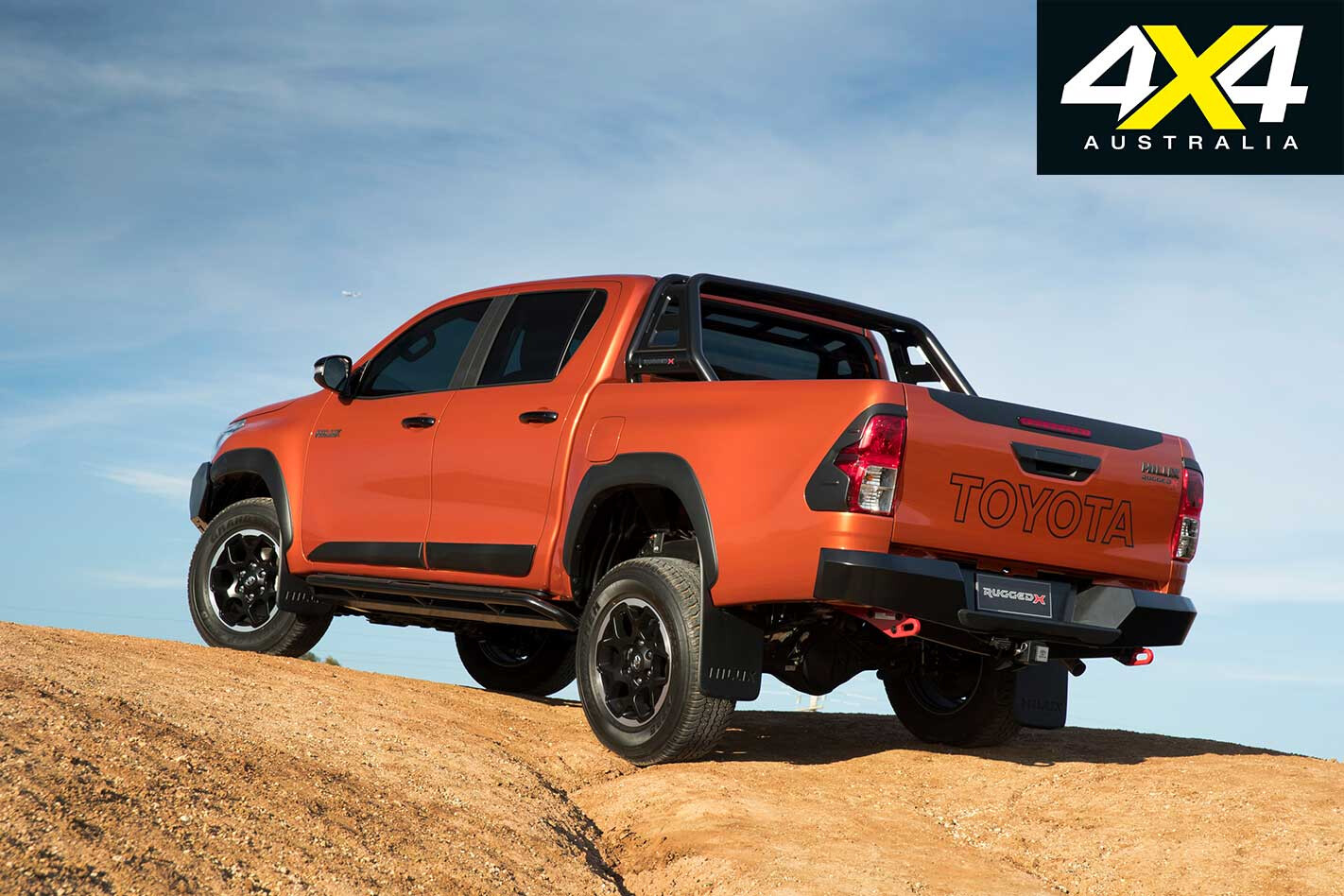
The Rugged X features plenty of standard off-road goodies – all Aussie-designed and engineered – that include a low profile steel front bullbar with integrated 660mm LED light bar (Rugged X only and punching out 120 watts), 20W LED driving lights, bash plates (made from 5mm-thick high-tensile alloy, rated recovery hooks front (8000kg; made from 20mm steel plate and including cross-vehicle bracing) and rear, chassis-mounted side rock rails (with tread sections to aid passenger ingress), snorkel, sports bar (with a 75kg vertical load weight rating and 200kg load weight rating for gear secured to it; tie-down points feature on this as well), steel rear bar (Rugged X only), tub liner, front/rear all-weather floor mats, towball and tongue (tow rating is 3500kg for manual, 3200kg for auto), a seven-pin wiring harness, reverse camera, leather seats (powered driver seat) and black-accented exterior mods, including door handles, wheel arches and body side mouldings. The 17-inch alloy wheels are shod with Dunlop Grandtrek 265/65R17 rubber.
To compensate for the additional weight up front with fitment of the bar, bash plates and recovery hooks (the vehicle is about 200kg heavier than the SR5 model), Toyota has included uprated front springs. These springs are the same ones that have been used by Toyota previously for fitment to HiLux models that owners have added factory bullbars to, so are well proved.
All up – and in short – it’s a bush-ready fit-out by Toyota that you can drive from the dealer with full factory warranty cover on all equipment.
The new equipment is more than cosmetic; the low profile front bar on the Rugged X is manufactured by Brisbane-based Frontline 4X4, while the side rock rails and recovery hooks are ARB designs. The idea behind the front bar was to ensure that front overhang – and thus, approach angle – was not unduly affected, while the fitment of the integrated light bar provides a much tidier appearance.
The Rugged X approach angle is 28 degrees (down from the SR5’s 31 degrees sans front bar) but it is the side/corner approach angle that has been most affected – in a positive way. The standard HiLux corner approach angle is 35 degrees; the Rugged X bar’s aggressively cut-in corners lifts this up to an impressive 49 degrees. The steel rear bar is also a – excuse the pun – rugged unit that keeps the overhang short and the ute’s rear well protected, while offering a step section for easy rear tub access.
The rear tub’s sports bar is more than just a tacked-on visual accessory; Toyota engineered this bar to cope with a vertical load of up to 75kg, or a secured (tied-down/attached) load of 200kg. The bar is a sturdy four-piece jobbie that is floor-mounted for the additional strength needed for these load ratings. Clever, we reckon.
Just as clever is the standard rock rails; during the off-road testing section of the launch program, we were asked by Toyota to drive over a large pile of rocks specifically to test the rails’ effectiveness and they performed perfectly; the rails’ strong flat section, closest to the vehicle’s undercarriage, slid the HiLux over the obstacle easily, while the up-swept outer tubing of the rails was barely touched – or damaged at all – making them a huge step up from the stock items on regular HiLux models.
Cosmetically, the Rugged X cops a blacked-out bonnet (complete with love ’em or hate ’em RUGGED lettering across the front of it), while all bar work and rock rails are powdercoated black. The black-out theme continues with the rear mirrors and door handles in black gloss, with black matte tail-light surrounds finishing it off.
The Rugged X gains a model-specific colour – Inferno Orange – on top of Glacier White, Crystal Pearl, Silver Sky, Graphite and Eclipse Black, all of which are available across the three models.
Hop inside the Rugged X and its more black; leather-accent seats (the driver’s seat is eight-way power-adjust and is quite supportive, with plenty of side bolstering), black dash, metallic black highlights on doors, gear lever, console and steering wheel and the headlining is also black. Batman would be all over it…
Instrumentation is, yep, blacked-out to an extent as well, and includes tacho, speedo and a 4.2-inch multi-info read-out. The infotainment system utilises a seven-inch screen and features sat-nav, radio, Bluetooth, CD player (yes, really), and the Toyota Link app that gels with your smartphone.
The Rugged model is based on the HiLux SR and priced at $54,990 for the manual, with the auto a $2K premium. The Rugged loses some top-spec features, such as rear passenger air-con vents, power-adjust driver’s seat and leather accented pews (they are cloth in Rugged), while adding a little bit more to the bush-tough side of the ledger, mainly in the protective sense.
The steel front bar on Rugged is unique to this model and includes a tubed top section for maximum front-end/headlight protection, with Toyota aiming this bar design specifically at hard-core outback tourers and rural owners. The Rugged also has a slightly different rear steel bar, but shares the same uprated front springs, side rock rails, black body mouldings, snorkel, sports bar, tub liner and rear-view camera as the X. Instrumentation is a tad more basic than X, although the Rugged does still get sat-nav, Bluetooth and infotainment setup.
Rogue
Toyota believes the auto-only HiLux Rogue, at $61,90, best addresses the emerging ‘urban adventurers’ buyers’ market that comprises owners aspiring to a vehicle capable of the ‘big trip’ but actually spend most of their time in urban environs, with semi-regular weekend adventures (read: camping, hiking, fishing, biking, etc.) their outdoor outlet. As a result of its global market aims, the Rogue’s design and style is fairly well removed from its ‘rougher’ stablemates.
Standard features differ significantly from the two Rugged variants; gone are the steel bullbar, rock rails, and steel rear bar, but the clever sports bar stays – as does the towbar/towball and seven-pin wiring setup.
A Rogue-only feature that, surprisingly, is not an option on Rugged and Rugged X, is the hard-shell tonneau cover. This cover operated on gas struts and includes an interior light, as well as being able to be locked via the vehicle’s central locking system. Upping the luxo feel, its tray-liner is marine-grade synthetic carpet material.
Styling-wise, the Rogue offers a slightly aggressive appearance, thanks to its bluff front end (accentuated by the trapezoidal grille) and the use of black paint accents around the vehicle. The Rogue’s shorter side-on profile at the front also contributes to a better approach angle – at 30 degrees – than that of its bush-oriented stablemates (both Ruggeds measure 28 degrees).
The Rogue rolls on 18-inch alloys – as opposed to 17s on the two Ruggeds – and runs 265/60R18 rubber, but does have less ground clearance: 216mm as opposed to 251-253mm.
The Rogue interior is identical to Rugged X, with the heated front leather-accent seats (driver power-adjustable), comprehensive infotainment system, and rear air-con vents, all surrounded by plenty of black (roofliner, floor mats, etc.).
Drive impressions
The test loop at the Flinders Ranges launch event comprised a mix of on-road and off-road driving, with the latter a mix of flat outback roads and rocky tracks, as well as a dedicated off-road loop that included plenty of short and steep ascents and descents, and the aforementioned rock rails obstacle test.
As expected the HiLux’s unchanged 2.8TD donk does its job effectively and without fuss – mainly thanks to the ample torque on tap low down in the rev range. On the highway, cruising at the legal 110km/h limit in top gear, the tacho sat at around 1750rpm, with the auto quick to respond to any right-foot push; the additional 200kg of weight seems to have next-to-no effect on the overall performance of the vehicle.
On- and off-road the engine just works; up some of the steeper short ascents on the short low-range off-road loop it was possible just to idle up with no throttle input whatsoever.
There’s no doubt that front bar on the Rugged X aids in minimising front bumps and scrapes when reaching the bottom of a sharply angled descent, while those rock rails are simply brilliant in the way they do exactly as designed.
The only (slight) negative from fitment of this bar was noted during the drive sections: the steering seemed less direct and sharp in the Rugged models compared to the Rogue without its bar. Yes, the uprated springs definitely keep the front end up and level, but we think a bit more damping would improve the steering performance notably. Other than that, it was business as usual in terms of how these new models drove – a definite case of when you’re on a good thing, stick to it…
Smart move
For those looking for a HiLux-based ‘Raptor beater’ these three new HiLux models may be a disappointment. And with what initially appears to look like just another ‘bright paint and stickers’ going-over of a current model, it would be easy to share some of that disappointment.
However, delve deeper into the features and these vehicles –most notably the two Rugged variants – can be seen for what they are: the result of clever thinking from Toyota. By tapping into the owner demand for bush-tough, functional accessories, and offering these features in bespoke models – with factory warranties attached – Toyota can offer vehicles that retain all that HiLux is renowned for (and has been for decades), while improving the functionality of the vehicle, all the while grabbing a slice of a market (off-road accessories) it didn’t have before.
Like we said, smart.
2018 TOYOTA HILUX RUGGED X AUTO SPECS
- Engine: 2755cc I4 diesel, 16-valve DOHC
- Power: 130kW @ 3400 rpm
- Torque: 450Nm @ 1600-2400rpm
- Transmission: 6-speed automatic transmission with dual-range, part-time 4×4
- Suspension: IFS with double wishbones, coil springs and stabiliser bar (front); live axle, leaf spring (rear)
- Brakes: ventilated disc front/drum rear
- Steering: hydraulic rack and pinion power steering
- Wheels: 17-inch
- Tyres: Dunlop Grandtrek 265/65R17
- Price: $61,690 (manual); $63,690 (auto)
ISUZU UTE Australia (IUA) has tuned its focus to achieve 30,000 annual sales of its D-Max and MU-X in the year 2020.
The ambitious plan is based on an upward trend in the market, which has seen Isuzu Ute Australia achieve double-digit growth for nine-consecutive years. Last year, for example, IUA shifted 25,804 units – a 10.4 per cent growth compared to 2016.
For 2018, IUA has planned to sell 28,300 vehicles (19,400 D-Maxes and 8900 M-UXs), and so far in Q1 IUA is tracking 31.9 per cent better than Q1, 2017. Overall sales in Q1 are up by 1432 units – 5928 versus 4496.
To help achieve this ‘30,000 by 2020’ milestone, the Japanese brand has appointed Mr Koichiro Yoshida to oversee its sales, marketing and PR department.
“The appointment of Yoshi as an additional director of IUA is testament to the fact that Isuzu recognises the Australian market as the most important export market in the world,” IUA’s managing director, Mr Hiro Kuramoto, said. “Our recent sales achievements in Australia have been duly recognised and the growing management team here is now well positioned to drive the brand forward into its next stage of growth.”
Of the 30,000 annual sales target, Mr Yoshida said: “… I look forward to the exciting challenge of double-digit growth for the 10th year since our inception in Australia, as well as our goal of 30,000 unit sales in 2020.”
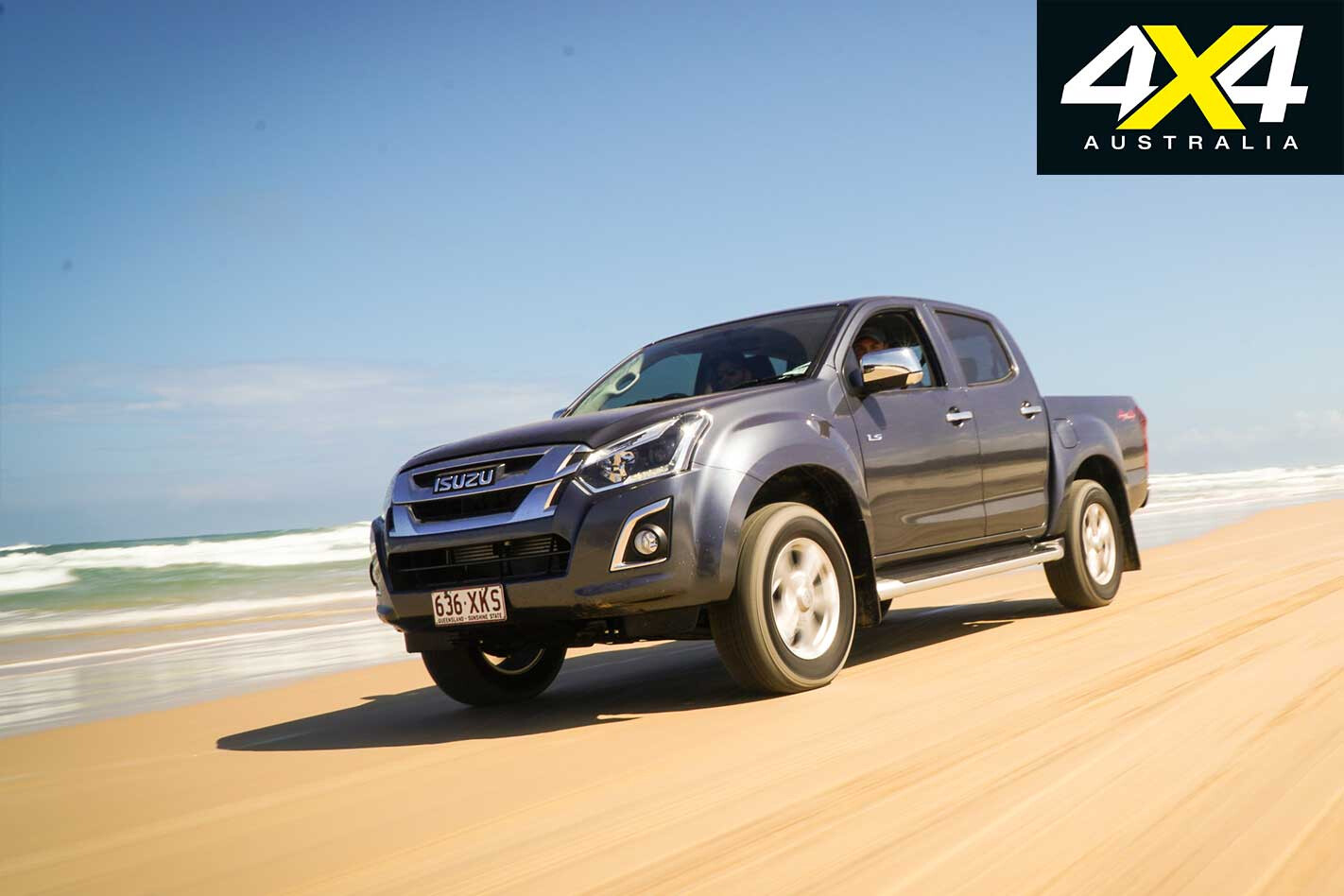
When people think of doing the big lap they typically think one of two things.
The grizzled grey nomads, skin beaten by a lifetime of adventures, retirement funds cashed in, inheritance sunk into diesel and a slow ambling lap around the continent stopping off at all the places they never got to the first time. The other thing that springs to mind is the young adventure family.
Raised on a diet of Steve Irwin and The Wild Thornberrys, they’ve packed it in for a life on the road before the kids hit school, the last taste of freedom before facing a 30-year slog in a mortgage.
They’re both the perfect way to see Australia, and something more and more of us are doing every year. But Kane doesn’t think that way, he’s a little freer spirited.
Despite lining his immaculate BT-50 up for a shoot just north of Sydney, he’s now a fair chunk farther north. Somewhere between Bundy and Mackay, with a few hundred kilometres between him and the closest thing resembling a city.
Despite only being 22, Kane figured there’s no time like the present, so he built the right vehicle, roped in a mate, and started circumnavigating one of the most remote continents in the world. By the time Kane’s BT ambles its way through Sydney again it’ll no doubt be sporting more than a few new battle scars and endless red dirt inside and out, but, for now, the set-up to see Australia is far simpler than you might expect.
The foundation for everything Kane’s done is his 2016 BT-50 dual cab. “I’d been eyeing off the Rangers,” he tells us with all the urgency of a man with no alarm clock. “After pricing them up, I figured I could get the same spec in the BT and put $13,000 into mods for the same price. Now, I’ve spent some time with it I actually prefer the look of the BTs as well.”
So what does $13,000 worth of mods look like? While lift and tyres grab attention, Kane reckons the must-have modifications so far have been the bar-work. “I don’t want to have to turn around because the track gets too gnarly,” Kane says with a laugh. “I built it to get me where I want to go without breaking shit.”
Kicking off the protection package up front is none other than the venerable ARB bullbar. The colour-coded Sahara unit blends in seamlessly with the BT’s lines, and, with the blacked-out top hoop, provides ample protection for the radiator against rural animal strikes. The ARB’s bash plates line up with the factory offerings underneath to protect the BT’s unmentionables all the way back to the gearbox.
The ability to self-recover is a get-out-of-gaol-free card when solo travelling, so Kane’s stuffed the ARB bar with a 12,000lb winch and synthetic rope. Also nestled within the top hoop are a pair of Narva Ultima 225 HID lights.
Moving down the flanks of the BT and the vulnerable sill panels have been beefed up, thanks to a combination of round and box tube from the guys at Southern Cross Fabworks in the form of their angled-up sliders. While they double as a sidestep they’re also a handy high-lift jacking point and have already glanced off countless rocks and ruts.
Up top the black-on-silver theme continues. Kane’s fitted up a Rhino-Rack Tradies rack for additional storage when the tray and back-seat are bursting with tea-towels from the croc-tent. It’s mounted on their slim-line Backbone System that braces the rack against the full length of the roof and looks horn in the process.
While the tub’s quarter panels remain vulnerable for now, it’s above where it really shines. With the factory roll bar blacked out, Kane turned his attention to a rack for his set-up. The unique arrangement takes advantage of two stock sports bars modified into something fit for the big lap.
The set-up clamps on and off with a few over-centre latches, letting Kane go from overland travel mode to dirt bike in the back in just a few minutes. The rack not only holds the standard fitment roll-out awning, but it also sports a roof-top tent. There’s a set of Treds mounted along the driver’s flank, too, if Kane’s ambitions outweigh his talents.
Of course, standard rolling stock will last about 300 metres when the going gets seriously tough, so Kane’s thrown the silver beauty up on a hoist and gone to town.
The most noticeable upgrade is the chunky Baja ATZ P3 tyres. Mickey Thompson’s relatively new aggressive all-terrain is the perfect companion for the big lap and, coming in a hair under 33 inches at 285/75R16, provides Kane with an extra few inches of clearance under the diffs. He’s wrapped them around a set of 0-offset 16-inch Dynamic D-lock steel wheels with a clip-on steel ring protecting the tyre’s bead.
Now tyres that size were never fitting inside the wheel arches at standard height, not unless they were persuaded with a ball-pein hammer. Rather than taking to his new ute like Tony Soprano in a dimly lit laneway, Kane instead opted for a 50mm lift all-round.
Up front, mono-tube Bilstein struts swap out the stock offerings and provide a much improved ride over stock, with plenty of grunt to take on endless corrugations. They’re shod in heavy-duty coils from CalOffroad, perfectly matched to the exact weight of the BT’s nose. Up the back Kane’s opted for another set of Bilstein’s finest, this time they’re controlling a set of comfort-rated EFS leaf springs.
Kane has taken that less-is-more approach to everything in 2018: the interior is standard, shy of a dual-battery set-up and GME UHF; the drivetrain is stock, with just a Fabulous Fab snorkel; and the calendar is free.
“We’re just heading north, all the way to the tip,” Kane tells us. “If we come out without anything too broken we’ll head across the Savannah Way over to Darwin.”
Six months from now Kane could be rolling into Perth or working on a fishing boat in the Gulf; he doesn’t know and that’s what’s inspiring. When we’re all constantly told you can’t head off for a weekend on the tracks without $150,000 worth of 6×6 conversions, Kane’s turned his phone off and headed off to do it his own way.
Less is More
THE term mono-tube is a term that doesn’t accurately describe the differences between twin-tube and mono-tube shocks, and what’s better for your needs. A shock absorber works by pushing a piston with small holes in it through oil. The harder for the piston to move through oil, the stiffer the shock.
Mono-tube shocks have a second piston keeping pressure on the oil with high-pressure gas on the other side. That piston keeps the oil pressurised, stopping it from foaming and passing through the piston easier (shock fade). The design fits inside one solid tube, so it loses heat quicker (perfect for corrugations) and gives you more dampening force for the thickness of the shock.
Traditional twin-tube shock absorbers have an outer sleeve with low-pressure gas trying to control the oil. They’re more prone to fade but considerably cheaper. Without a second piston in line they typically have longer travel for the same overall length; the outside tube also gives a layer of protection from dents stopping the piston working.
Volkswagen Australia has confirmed that a more powerful version of the Amarok V6 will be available here in Australia in the third quarter of this year.
The range-topping Amarok V6 will feature an improved version of its current 3.0-litre V6 turbo diesel with its power outputs upped from 165kW/550Nm to 190kW/580Nm, with an additional 10kW on overboost to round out that figure to 200kW.
Full torque is slightly more accessible over a wider power band as it is served up at between 1400 and 3000rpm (down from 1500rpm), whereas full power is now available from 3250 to 4000rpm (up from 2500rpm).
The new EU6-compliant V6 engine went on sale in Europe yesterday and is only available on the Amarok Highline and Aventura variants. The engines in either variant will be paired to an eight-speed automatic and permanent 4MOTION all-wheel drive as standard.
Volkswagen Australia says the engine will be first available here in Ultimate specification, and will cop a slight premium over the current Ultimate variant’s $68,490 price tag.
However, Volkswagen Australia will be looking to adding more variants with the new V6 engine to its line-up, on top of introducing further additions to the Amarok range later in the year.
The new engine’s increased power output puts it ahead of the upcoming Mercedes-Benz X350d’s 190kW/550Nm 3.0-litre V6 turbo diesel in the power ballots.
Volkswagen Group Australia director of commercial vehicles, Carlos Santos, was clear with their intent of introducing the new engine here.
“As we’ve promised before, we have no intention of giving up the mantle of the most powerful ute in its class,” Carlos said.
“Amarok continues to be a huge success story for Volkswagen in Australia, winning fans in Birdsville and boardrooms alike.”
To travel along the Matilda Highway is to step back in time and experience the real Aussie outback.
This feature was originally published in 4×4 Australia’s August 2011 issue.
Few towns in Australia have a history that has touched the people of an entire nation. It was in Winton that Banjo Paterson wrote the ballad Waltzing Matilda which for many people typifies the spirit of Australia and is the unofficial anthem of this rugged country. Our international airline, Qantas, was also born in Winton and is testimony to the spirit of endeavour that is so typical of the Aussie character.
A short drive from Winton is Bladensburg National Park where you can camp out under a star-filled sky and learn about outback characters like Scrammy Jack. The town of Longreach is home to the Australian Stockman’s Hall of Fame; this is a spectacular tribute to the people of the outback. Longreach is also the only town in the world where you can tour a fully operational 747 jumbo jet and experience a wing walk on this giant of the sky.
The tiny town of Ilfracombe is the hub of the west and full of pioneering history and heritage. Barcaldine was the site of the Great Shearers’ Strike of 1891, a monumental revolt that lasted four months and resulted in the imprisonment of many of the leaders.
Personally, I reckon every person who calls themselves an Aussie should venture into the Queensland outback and learn about the fascinating history of this spectacular country. This nation was built by ordinary people who simply wouldn’t give up in the face of adversity and made a living in even the worst of circumstances.
Banjo Paterson visited Winton in 1895. In no time at all Banjo learned a new lingo from one of the locals. Stories about a “swagman who had just killed a jumbuck” were new to him.
The Shearers’ Strike and major union upheaval at the time brought turmoil culminating in events such as shearer Samuel Hoffmeister shooting himself near a billabong after being chased by police. No doubt good old Banjo would have had a bit of a culture shock but he turned his outback experience into a ballad that every Aussie can relate to: Waltzing Matilda.
For a true outback experience you must drive out to Bladensburg NP; it is only 12km from Winton. If you don’t have a high-clearance 4X4 you can follow the Route of the River Gum which is a 56km loop drive that will take you past various waterholes, the camping area at Bough Shed Hole and back to Winton.
For an awesome off-road experience leave the Route of the River Gum and take the left turn to the information centre and the original Bladensburg Homestead: this is where the real outback experience begins.
The homestead is definitely worth a look and tells the story of the family who ran the sheep station in this rugged country. There was even a racecourse where races were held in the late 1940s to raise money for returned WWII soldiers.
Like most families living in the harsh outback tragedy was never far away and here there is a story of eight-month Delia Dalrymple dying of an infection while she was teething. Her little grave can be seen six kilometres from the homestead.
The old homestead is the starting point for Scrammy Drive which will take you through rough country and up rocky mesas to where waterholes nestle among hardy acacia trees and the views over Mitchell grass downs and the Channel Country seem endless.
This 40km return drive will take you into remote and isolated country so it is very important to stick to the marked roads and follow the signs. There are many unmarked tracks in the area so getting lost is a real possibility. In any case, carry plenty of drinking water because it gets extremely hot out this way with little to no shade in most places.
Scrammy Drive will take you past the racecourse (2.1km) where a few white stakes remain of those that once marked the old Bladensburg racetrack. Another 5.1km will take you to the lonely grave of Delia Dalrymple. The 10.8km remainder of the drive will take you to Scrammy Gorge, Scrammy Rockhole and Scrammy Lookout. The next landmark will be a broken windmill where the track starts to climb and then levels out on a jumpup.
At the turn-off to Scrammy Gorge you will see a fascinating ghost gum that resembles an octopus. The gorge has unstable cliff edges so it is wise to stay at least 20 metres away from the rim.
Jump back in the car and drive to Scrammy Rockhole, which is around two metres deep and rarely dries up. The track from the rockhole to the lookout has an interesting stretch where the track becomes rocky and possibly a bit wet. The scratch marks on the rocks tell the story of some people who either had a low-clearance vehicle or simply drove too fast; take it easy and there is no reason to bottom out.
The view from Scrammy Lookout is amazing as the Channel Country stretches out in front of you and you realise the vastness of this spectacular landscape. Under the cliff’s edge we were standing on we discovered the bones of a kangaroo that had lay down there to die. The outback can be captivating and unforgiving at the same time.
From Winton it is a 180km drive to Longreach, which lies geographically and figuratively at the very heart of the outback. This friendly town is famous for its tribute to the many outback pioneers – the Australian Stockman’s Hall of Fame.
This mammoth project was conceived in the early 1970s by artist and poet Hugh Sawrey who felt it was necessary to commemorate those who did so much in rural and outback Australia; one of whom was his mum. In 2003, the museum underwent a complete re-development and extensive renovation project, and in early 2010 the Cattlemen’s Bar & Grill opened.
Driving into Longreach from the east you are not going to miss the Qantas museum: the great red tail of a decommissioned Boeing 747 dominates the landscape. Qantas is the world’s second oldest airline; it was registered in Winton on November 20, 1920 as Queensland and Northern Territory Aerial Service Ltd. The company and operational headquarters were moved to Longreach in February 1921.
Under federal government Qantas became Australia’s international airline. Many of the secrets of this great aircraft are revealed on the tour. It is possible to sit in the cockpit and if you are up for a bit of excitement, strap on a safety harness and take a wing walk. It is only 27km to the historic town of Ilfracombe which prides itself on freely sharing its heritage; there is no entry charge on any of the attractions or facilities.
Ilfracombe was originally called Wellshot, after the famous sheep station that was once Australia’s largest (460,000 sheep in 1892). Drought heavily affected this area and in 1900 Wellshot Station lost 130,000 sheep, with 90,000 more the next year.
In 1914, 29 young men from Wellshot enlisted to serve in WWI. Ilfracombe is also home to the Romani Hall Memorial which is a tribute to the brave men of the Australian Light Horse. The tiny shire of Ilfracombe farewelled many of its young men who left all that they loved to embark on a journey into the unknown.
Another interesting place to visit is the Langenbaker House. Harry and Mary-Ann Langenbaker brought the house to Ilfracombe in the 1890s and raised their 11 children there. One child (Les, born 1904) was blind as a result of an accident in about 1921.
After this time, the family took care to change the layout and features of the house as little as possible so that Les could easily find his way around. It has resulted in a house which is a great example of outback living conditions in the early 1900s.
Our last stop along the Matilda Highway was Barcaldine, home to the Tree of Knowledge. The tree was a place of inspiration for the striking shearers and has always held a special place in the history of Australia.
Unfortunately, someone poisoned the tree in May 2006 and it never recovered. A memorial was constructed including preserved elements of the tree.
After the shearers’ strike, thirteen of the leaders were sentenced to three years of hard labour on St Helena Island, in Moreton Bay. The strike is acknowledged as the starting point of political and social processes which led to the formation of the Australian Labor Party and subsequently to the election of the first Labor representative to government. For us, this meant the end of our trip along the Matilda Highway but it’s one we will do again.
It is inspiring to travel through these towns that are full of pioneering history and heritage. It is the best way to learn about and experience the Aussie spirit, the one that never gives up and the one that pays honour to the many men and women from the outback who made this incredible country what it is today.
Duncan’s Me Mate
I met Duncan in the town of Longreach and there was no doubt in my mind that this bloke was a fair dinkum Aussie. With his Drizabone coat, hat and Aussie slang he was probably the most Australian fella I’ve ever met. You have to listen to his stories and wonder if any of them are true and crikey, they are!
Duncan is another Steve Irwin, working with snakes, crocs and any other reptile you can think of. They have a fancy name for it: herpetology. Duncan prefers to be called a wildlife keeper and thinks it is absolutely fabulous to work with crocs and snakes. He lived in Port Douglas for ten years where he worked with reptiles until he got sick of the lousy pay and decided to stack shelves in Woollies instead.
He is a real gentlemen who will remove snakes from people’s homes free of charge to release them away from human habitation. He recalls one lady who called him out to remove a non-venomous tree snake. He had to walk up her 500-metre driveway to even get to the snake which was in her lounge room. After catching the snake he then had to walk back down the entire driveway with the lady driving behind him all the way because she wanted to make sure that he would release the snake far away from her house!
Duncan’s travelling around Oz with his wife Penny in a minivan and caravan, so make sure you say G’day if you meet them.
Scrammy Jack
Scrammy Jack lived at Scrammy Rockhole in what is now Bladensburg National Park. He was a boundary rider who became a hill top hermit. He was known as a ‘hatter’; in reference to his hat covering his entire family because he lived alone. Jack became Scrammy Jack after his hand was crushed by a wagon wheel (scrammy is an old English term meaning left-handed). He worked for neighbouring Vindex Station around the year 1900.
Someone used to take him supplies every month and found him dead one morning. Old posts, scraps of wire and rusty nails are all that is left of his simple hut and horse yards. One can only wonder who he was and how he survived but he was an Aussie who made a home in the outback and lived there until the end of his days.
Captain Starlight
Talk about legend and Longreach and you will certainly get to hear about Henry Arthur ‘Harry’ Readford who became known as Captain Starlight. This name was drawn from Rolfe Boldrewood’s Australian classic Robbery Under Arms with the central character, Captain Starlight, based on a combination of bushrangers of that period, as well as the renowned cattle-duffer, Harry Readford.
He became an outback legend when in 1870 he stole 1000 head of cattle. The mob included a white bull which became a bit of a problem for Readford. He sold it at Hill Hill Station, in South Australia, so that he could purchase supplies from the station store. The bull was later shipped back to Queensland as evidence against Readford at his trial in Roma.
Harry faced charges of cattle stealing but the jury returned a verdict of not guilty, thus ending one of the most daring escapades in recent outback history. Apparently, the judge at the time was stunned at hearing the verdict and exclaimed: “I thank God that verdict is yours, gentlemen, and not mine.”
It is believed Readford and his men gathered together the 1000 head of stolen cattle at what’s now called Starlight Lookout and split them into three groups to avoid a suspicious dust cloud. He would have been wiser to leave the white bull behind.
Travel Planner
WHERE The Matilda Highway is part of a tourist route that runs from Cunnamulla, in south-west Queensland, to Karumba in the far-north Gulf Savannah.
CAMPING Camping is available all along the Matilda Highway with caravan parks in each town. There is bush camping in Bladensburg National Park at Bough Shed Hole; there is only a pit toilet and camping fees apply ($5.15/p/n). Longreach has an Apex park on the Thomson River where you can camp for four days at no charge (has toilets).
WHAT TO TAKE If you intend to go bush camping, bring a shower tent and drinking water. You need to take your rubbish out with you.
SUPPLIES AND FACILITIES All the towns have a supermarket and a petrol station.
TRIP STANDARD All the main roads are sealed. The roads in Bladensburg National Park are dirt and become quickly impassable after rain. Scrammy Drive in Bladensburg NP is for high-clearance 4X4s only.
CONTACTS AND INFORMATION Regional information is available at the following websites: – experiencewinton.com.au – longreach.qld.gov.au – ilfracombe.qld.gov.au – barcaldine.qld.gov.au
PERMITS AND RESTRICTIONS Permits are necessary for bush camping in Bladensburg NP. Phone 13 74 68 to make a booking or use the self-registration permits available at Bough Shed Hole campground. Alternatively you can book online at derm.qld.gov.au/parks/bladensburg.
IT’S THE only ute to have been driven to both the North and South Poles; it has competed in the world’s toughest cross-country rallies including the Dakar; it is the only ute to ever top Australia’s annual new-vehicle sales charts; and it has been on sale here for nearly five decades, with more than 750,000 units sold.
It is, of course, the ‘unbreakable’ Toyota Hilux, a vehicle that is found on rural properties, worksites, cattle stations, highways and in garages all over Australia.
Used by tradesmen, farmers, miners, government organisations, telecommunications companies, recreational four-wheel drivers, fishermen, caravanners, and anyone who needs a load-carrying vehicle to get them to the far-reaching corners of Australia; the versatility of the Hilux is the key to its unrivalled success. It has plenty of challengers for its throne, but no other ute comes close to the Hilux’s popularity both here and around the world.
Now in its eighth generation, today’s Hilux is available in more than 30 variants: single-cab, extra-cab and double-cab bodies; ute back and cab-chassis; two- and four-wheel drive; and three different engine options with a choice of automatic and manual gearboxes. There’s a Hilux to suit everyone, no matter your use for it.
The success of the Hilux in Australia came from early on. As the swinging ’60s drew to a close, Japanese cars were still feeling their way in the Australian market. Funny brand names such as Datsun, Toyota and Honda were relatively new and few buyers were keen to purchase the unknown cars built in Asian countries.
Australians drove Holdens, Fords, Chryslers, Vauxhalls, Morrises and anything else derived from the USA or the Old Dart. Certainly our utes came from the popular Ford and Holden brands, as only they were deemed tough and durable enough to handle the harsh local conditions. But Japanese utes from Datsun, Isuzu and Toyota were edging in, finding their niche and destined to take over the Aussie utility market.
First-Gen
The first Hiluxes were imported to Australia by then Toyota commercial vehicles distributor Thiess. Sir Leslie Thiess was the forward-thinking chap who saw the need for a good four-wheel drive vehicle in Australia, and he imported the first Land Cruisers here in the 1950s for his workers toiling on the Snowy Mountains Scheme.
Thiess also had mining and construction interests in Queensland and, shortly after the first Hilux was launched in Japan in 1968, Thiess brought them to Australia.
The first-generation RN10 Hilux replaced the Toyota Stout and was only available in two-wheel drive, single-cab configuration. Power came from a 1.5-litre four-cylinder petrol engine that made just 57kW, a far cry from the 225kW supercharged V6 that powered the TRD Hilux 40 years later.
The RN10 Hilux used a body-on-chassis configuration that remains the class standard to this day. It utilises a live axle with leaf springs at the back for optimal load bearing, and independent front suspension with wishbones and coil springs to provide a better ride for the passengers. Updates to the RN10 Hilux in 1971 included a long wheelbase model and a bigger 1.6-litre engine.
Second- and Third-Gen
The second-generation Hilux ran from 1972 through to 1978 and included updated styling and a more comfortable cabin. In ’75 a mid-model upgrade saw changes that included a bigger 2.0-litre petrol engine.
The Hilux line-up took off with the introduction of the third-generation model in 1978. Running through to 1983 the more spacious and refined third-gen Hilux saw the introduction of the four-wheel drive variants, a diesel engine and double-cab body. Since then more than half of the Hiluxes sold in Australia have been 4WDs, giving the versatile ute the go-anywhere ability of the bigger Toyota Land Cruiser.
During the 1980s the Hilux overtook the Land Cruiser as the most popular light commercial utility vehicle in Australia, a title it has a stranglehold on today.
Like the early petrol engines the new diesel of the ’80s was no powerhouse. It made just 46kW and 126Nm from its 2.2 litres. The petrol engine grew from the 2.2-litre 20R to the 2.4-litre 22R, while the 1.8-litre continued in the 2WD model. These Hiluxes were built to work hard at low speeds, and high performance was never a priority.
The four-door double-cab added greatly to the versatility of Hilux. Not only could you now haul a load in your ute, but you could carry three passengers in the backseat. This gave the ute more appeal to private buyers, where the double-cab Hilux could serve double-duty as a workhorse during the week and be a family car on weekends.
While the tray might be filled with ’barrows and tools on weekdays, it would still take push bikes, surfboards or backpacks on Saturdays, while your trusty hound could hang his head proudly from the tray on any day.
Fourth-Gen
The fourth-generation Hilux of 1983 saw another body style introduced. The Xtra-Cab was, and still is (but now simply called extra-cab), a two-door cab that is extended at the back to provide space for occasional seating or a secure spot for tools and valuables.
You wouldn’t want to carry passengers in the back for long distances, but the rear seat comes in handy. The extra-cab also has a longer load bed than a double-cab, making it great for carrying dirt bikes in the back and your mates up front.
Engine choices had by this time grown to four, with two petrol and two diesel powerplants. More powerful 3.0-litre V6 and turbo-diesel engine options also appeared for the first time during this period, as did an automatic transmission.
These later options were designed to add further appeal to the private buyer (more so than the farmer or tradie) and, at first, were only offered on top-of-the-line SR5 double-cab models.
Features such as power windows, air-conditioning and floor carpets made the utes more liveable, and Australians were coming around to the idea of using a ute as a family vehicle – but their popularity in this segment was still nothing like what it is today.
At the other end of the market Toyota introduced a basic version of the Hilux aimed squarely at tradies, with bare essential features, a 1.8-litre engine and a manual gearbox only. The interestingly named Hilux Grinner was the ute the apprentice drove to the worksite, while the boss got around in his upper-spec SR5 model. This base-spec version is called the Workmate in today’s Hilux range and has been broadened to include various engine and body configurations.
The popularity of the Hilux was also feeding a booming aftermarket industry that met the needs of owners to tailor their vehicle to their specific requirements. As a car that can be both a hardworking tool of the trade or one to conquer the Australian Outback, there is swag of parts that can be added to it.
Canopies became popular to convert the ute to a wagon-like vehicle and secure the load area, while items like bullbars, raised suspension, big tyres and driving lights were what recreational off-road enthusiasts wanted.
Specialist camper conversions are now available to fit on to the back to provide all the comforts of home to the bush traveller, while racks and bars are manufactured to support ladders, pipes, lengths of timber and other work-related hardware.
The fourth, fifth and sixth generations of Hilux continued to take the vehicle forward in terms of refinement, usability and size. The four-wheel drive models lost their truck-like, leaf-sprung live front axles for independent front suspension with torsion bars, to improve their on-road driving characteristics.
The range grew to accommodate more models to suit the growing number of buyers, and the Hilux was made in factories all over the world and not just Toyota’s native Japan.
In 1991 Toyota did a deal with Volkswagen to sell a variant of the fifth-gen Hilux in Germany badged as a Volkswagen Taro. The name signified VW would one day release its own ute, even if that didn’t come for another 20 years with the Amarok.
The seventh-generation Hilux appeared in 2005 and was manufactured in Thailand, where the majority of utes of this style are now made. With coil-sprung independent front suspension and levels of performance, safety, style and comfort to match many conventional passenger cars – while maintaining its rugged purpose-built demeanour and unbreakable reputation – it was a far cry from the humble mini-truck that debuted more than 40 years earlier. It rode the wave of popularity as more buyers chose the versatility and functionality a dual-cab ute can provide.
The modern engines used included a 2.7-litre petrol engine only available in the 4×2 Workmate, while most of the models used either a 4.0-litre V6 or a 3.0-litre turbo-diesel.
In 2008, Toyota Australia debuted the TRD (Toyota Racing Development) brand, with the TRD Hilux being one of two TRD models alongside the TRD Aurion sedan.
The TRD Hilux SL4000 featured a supercharged 4.0-litre V6 petrol engine, Bilstein-tuned sports suspension and a bespoke body kit, but the project was short-lived, getting axed at the end of 2008 with just 351 TRD Hilux models produced.
Seventh-Gen
The seventh-gen ’Lux scored a few facelifts during its tenure before it was replaced by the eighth-gen model towards the end of 2015. The new and still current model saw the venerable 1KD 3.0-litre diesel replaced with a new 1GR 2.8-litre engine that was also fitted to the Prado and Fortuner wagons around the same time.
The 4.0-litre petrol V6 continued to sell alongside the four-cylinder diesel in low numbers until it was axed at the end of 2017, while the 2.7-litre petrol and a 2.4-litre variant of the 1GR continue to be sold in lower specification and 4×2 models.
The huge range of current Hilux models and variants are priced from around $21,000 for the Workmate 4×2 cab-chassis, up to more than $55,000 for an SR5 4×4 double-cab. Compare that with the $2000 a brand-new RN10 Hilux would have set you back in 1969 and you can see how far they’ve come; although, a good condition, road-going RN10 is now rare and would fetch more than its original price if you could find one.
In the face of fierce competition from new utes – VW Amarok, Ford Ranger, Isuzu D-MAX, Mazda BT-50, Holden Colorado, Mitsubishi Triton, Nissan Navara, and a new wave of vehicles coming from China – the Hilux continues to develop to maintain its spot in the minds of fleet and private buyers, hence why it remains in the top spot on the sales charts.
Hilux vs The World
With the Ford Ranger challenging the Hilux’s top spot in 4×4 ute sales and, in fact, taking it in 2017, Toyota isn’t resting on its laurels.
Fresh Hilux variants go on sale this month with the Rogue, Rugged and Rugged X editions accessorised to appeal to a broader market than the traditional tradie and man-on-the-land buyer. Top-of-the-range utes such as the Hilux SR5 continue to grow in popularity, showing an appetite for utes that are more refined, safer and, in some ways, more sporty.
New utes such as the Mercedes-Benz X-Class and Ford Ranger Raptor will see prices higher than the segment has ever seen before, and you can bet Toyota will deliver a Hilux to compete with them. As such, we can expect more of these top-end models to be launched to market, taking the price of the Hilux and its competitors well into the $70,000 bracket and beyond.
The traditional Aussie ute might be dead, but our appetite for 4×4 light trucks is as aggressive as ever, and as long as that is still the case, light trucks like the Hilux will continue to be an important part of the landscape.
MORE: Toyota Hilux Range Review MORE: Toyota Hilux Specs, Range & Price
The picturesque Richmond Range in north-east NSW is home to some of Australia’s most spellbinding rainforest scenery.
This feature was originally published in 4×4 Australia’s July 2011 issue
Covering an area of around 40,000ha, the region was all state forest up until 1995, when two new national parks were formed to protect biodiversity of the forest and its amazing wildlife. Toonumbar National Park (NP) at the northern end of the range protects just over 15,000ha of land, while the adjoining Richmond Range NP protects about the same area to the south.
Although the range was heavily logged for many years, most of the forest is in remarkably good condition. Three small sections that were designated flora reserves in the old state forest due to their pristine rainforest are now part of the World Heritage Listed rainforests of northern NSW and offer fantastic bushwalking opportunities.
Visiting these parks is an ideal weekend trip for anyone from south-east Queensland or north-east NSW.
Using the small city of Casino as a base, head west along the Bruxner Highway for 37 kilometres until you see the turn-off to Richmond Range on the right. For the first 6km the narrow dirt road winds along the top of the range through lush green pastures used for cattle grazing.
Once you hit the boundary of the national park you enter tall forests of spotted gum, blackbutt and tallowwood with a wattle understory. Bird life in these eucalypt forests is prolific and if you stop for a few minutes you will hear the melodious calls from a number of species echoing through the canopy.
It’s 6km from the park boundary to the Cambridge Plateau picnic area. This is a pleasant spot to take a break and go for a walk on the 2.5km Culmaran Valley track that winds its way through dense World Heritage Listed rainforest.
Many of the huge forest giants growing here are hundreds of years old and festooned with lianas, orchids, birds-nest ferns and elkhorns. The track can be slippery in places, so be sure to wear reasonable hiking shoes for the walk.
Heading north, the road meanders through a mixture of rainforest and eucalypt forest for another 20.5km until you arrive at an intersection where you can turn left to Peacock Creek camping area or right towards Toonumbar Dam and Toonumbar National Park. Make sure you stop on the way and check out Old Spotty, a magnificent 300-year-old spotted gum that dwarfs most of the other trees around it. The tree is located on the left side of the road about 12km from Cambridge Plateau.
You can either camp at Peacock Creek, a peaceful open grassy area 2.5km west of the intersection or head north to Toonumbar Dam then on to Iron Pot Creek camping area in Toonumbar NP, which is right in the rainforest.
If you decide to go north, turn right and drive about 300m towards Kyogle then take a very sharp left-hand turn onto Iron Pot Creek Road. Follow it for about 8km until you come to a T-intersection with Benns Road where you turn left towards Toonumbar Dam 2km away.
If you’re after a bit of luxury, you might want to stay at Toonumbar Waters Retreat. Surrounded by lush forest and only a stone’s throw from the water, these lovely self-contained cabins cost $110 a night for two people.
From the dam head east towards Kyogle for 7km until you see the sign to Toonumbar NP. Turn left here and drive for a few kilometres before veering right onto Murray Scrub Road which you follow for about 12km until it ends at Iron Pot Creek camping area.
Make sure you go for a hike through the Murray Scrub, as it is one of the best examples of lowland sub-tropical rainforest in NSW. The 5.5km circuit that winds past huge red cedars, rosewood and teak trees is relatively flat and can be completed in around 3-4 hours.
From the camping area, head 6km back along Murray Scrub Road until the intersection with Coxs Road. Hang a left here and drive up through the pristine rainforest. Don’t attempt it in wet weather since the red soil can become extremely slippery. About 8km along the way you reach a lookout that provides panoramic views over Murray Scrub.
Keep driving up through the forest for another 2km until Coxs Road meets the intersection with Toonumbar Forest Drive. Turn right here and follow the track east through the rainforest for 16.5km to the national park boundary.
From here it’s a steep 4.5km descent through state forest followed by grazing country, until you reach the bitumen on Summerland Way about 6km north of the tiny village of Wiangaree.
Travel Planner
WHERE The Richmond Range is north-west of Casino in north-eastern NSW.
CAMPING Head 37km west along the Bruxner Highway from Casino to access the range.
FACILITIES Camping costs are $5 per adult per night. Children are $3. For more info call the ranger on 02 6632 0000 or email [email protected].
OTHER INFO Toonumbar Waters Retreat: contact the resident managers Annabelle and Paul Studders on 02 6633 9140.
WHAT TO BRING Food and drinking water.
MAPS Hema North-East NSW is ideal.
PERMITS No permits are required.
It must be one of the loneliest graves in Australia, hidden by the travesty of history, the remoteness of the Australian inland and the vastness of one of the biggest privately-owned cattle properties in the Outback. And to get there isn’t a walk in the park, with our Patrol stirring up the deep bulldust which billowed behind us like a heavy, dark smothering cloak of fine grey powder.
The track we were following was more a set of cowpats than a 4WD route across the flat, dry black-soil plains, and none of the tracks shown on either of our GPS units had any similarity to the tracks on the ground.
That was probably not surprising as we were on the floodplain of the Bulloo River in southwest Queensland, and any track lasts only as long as the next silt-laden flood oozes down this outback river. We came to a dam or turkey nest tank, its high banks a marker looking more like a small mesa on these flat lands.
Here amongst the churned-up dust of a few thousand cattle, most of whom were milling around us, we lost the track completely.
We circled the enclosed water point a few hundred metres out from the tank, bumping across the crab-hole country, before picking up the track once more, this time heading east to the distant tree-line of the main channel of the Bulloo River.
We had received permission from Bulloo Downs Station to visit the grave of Dr Ludwig Becker, one of the scientists and the artist of the Burke and Wills (B&W) 1860-61 expeditions, and now we were trying to find this lonely grave.
In fact, two other members of that fateful expedition are buried here as well – Charles Stone and William Purcell – and all had died from the effects of scurvy and the privations they had suffered in this lonely place.
All had been part of the ‘Supply Party’ that had been told to follow Burke’s main party up to Cooper Creek from Menindee, but this slower moving band of men and animals had struck difficult times and had been relegated to a forgotten sideline in Australian history.
For our visit we had first phoned the manager and then visited the homestead and, after receiving a briefing on ‘biosecurity measures’ that we needed to follow (as well as nearly being attacked and eaten by a bloody big pig dog), we were given a rough mud map and directions to the grave. But, like most mud maps which make perfect sense to the person who drew them, you need to take them with a grain of salt and add a bit of intuitive guesswork and luck to make them work.
On the ground our route swung north then back to the east, where we floundered amongst some lignum scrub before we picked up the main track once more and turned south for the final bumpy drive to the Koorliatto Waterhole.
On the edge of this long, muddy stretch of water the Supply Party became trapped here for around a month in March/April 1861, only moving on when warlike Aboriginal bands began harassing them.
Today, a small fenced grave lies a short distance from the waterhole beside the trees that line the riverbank, while the barricade the explorers had built for their protection from Aboriginal attack, sadly, there is no sign of it. It’s a lonely, isolated spot rarely visited by anyone, but we were happy we had made the effort.
After checking out the nearby drying waterhole, well down from its maximum level but still with a lot of water in it, we backtracked to our camp on the Bulloo – near where today’s main dirt road crosses the channel – and watched the sun sink into oblivion.
We had left Melbourne a couple of weeks previously and had battled wet, slippery dirt roads for much of our time through north-central Victoria and across the border into NSW.
From Balranald we took the old Prungle Mail Road before skirting alongside the Darling River to Pooncarie and on to Menindee, which was the first town on the Darling and the oldest European settlement in western NSW. Of course, the town has a couple of pubs, the most famous being the Maidens Hotel, where ol’ Burke ensconced himself for a few days while splitting his expedition.
The rest of Burke’s party were camped at Pamamaroo Creek, near the lake of the same name, well away from the attractions and vices of the hotel. We camped out at the lake as well, where there are dozens of spots along the water’s edge to enjoy; but with today’s speed of transport we slipped back into the Maidens for a beer and a meal one night.
At Menindee, the grave of one of the Burke and Wills cameleers can be found.
Dost Mahomet had been recruited by George Landells when he was organising camels from India for the expedition. Mahomet and three other camel handlers had accompanied B&W from Melbourne, and Mahomet had gone to Cooper Creek and the depot there with the main party.
Returning from the Dig Tree with Brahe (who’d been in charge of the Depot Camp at the Dig Tree), Mahomet had stayed at Menindee looking after the camels and equipment that William Wright had also brought back from Koorliatto Waterhole to the Pamamaroo Depot.
Alfred Howitt, in charge of the search party sent out by the Victorians to find B&W, had reached Menindee in early January 1862, and, just a couple of days later, one of the bull camels attacked Mahomet, where he lost the use of his arm, which effectively disabled him for life.
Mahomet appealed to the Victorian government for compensation but was only ever paid £200 (about $20,000 in today’s money). He returned to Menindee and worked in the local bakery and, when he died in 1881, he was buried just out of town where he used to pray each day.
Today his grave lies beside the Broken Hill road just a short distance from the centre of Menindee, and in 2006 the local shire restored the headstone and fence around the gravesite.
From Menindee we headed north and, from Tibooburra, we again took a lesser-used route and headed up via Wompah Gate through the famous Dog Fence, where we crossed the border into Queensland; then we turned east along the Thargomindah Road to our subsequent search for Becker’s grave. After swinging through Thargomindah and turning west we stopped at the Noccundra Pub, camping down on the waterhole of the Wilson River.
From there we headed to the Cooper Creek and on its northern bank we stopped at the famous Dig Tree, where much of the drama of the B&W expedition played out. You probably know the story of what happened here – if you don’t, have a read of the book by the late Sarah Murgatroyd, The Dig Tree. In amongst the plethora of books by numerous people over the 150-odd years since the expedition, this is one of the best and most readable.
We then headed for Innamincka and camped on the Cooper on the ‘town common’ in the shade of some tall old red gums, making sure we weren’t too close to any overhanging branches. This is a top spot to camp whatever you enjoy about inland Australia, and everyone should come to this idyllic stretch of water sometime in their life.
Of course, the Innamincka pub is a mighty fine attraction and always a top spot for a coldie and a meal, especially on a Sunday night when the weekly roast is on the menu. If you are into the B&W saga, though, then there is no more important place to visit.
Spend a few days wandering the creek, not only visiting the Dig Tree but also checking on the places where Burke and Wills both died. It’s also here where John King, the sole survivor of the party that reached the Gulf, was found.
While Will’s grave site and the spot where King was discovered are downstream from the small township, Burke’s grave is east of the town beside a waterhole just downstream from Cullyamurra Waterhole, one of the longest and deepest stretches of water to be found anywhere on our inland. Most of the time the tracks to these sites are graded and very dusty, but when heavy rain is in the area or the Cooper floods then the access tracks get closed off.
The bodies of the explorers and the survivor, King, were found in September 1861 by the relief party led by Howitt. Howitt had buried the bodies of Wills and Burke and then returned to Melbourne, but he was back on the Cooper in February 1862, tasked with the job of recovering the bodies of B&W and taking them back to Melbourne.
Charlie Grey, who was the fourth member of the small party that crossed the continent to the Gulf, lies buried somewhere near or at Lake Massacre, west of Innamincka and south of the track that leads to Coongie Lakes.
There’s quite a bit of conjecture about Charlie’s final resting spot, but there is a plaque on a steel post at Lake Massacre, near where a tree blazed by the explorer John McKinlay was discovered. McKinlay had been sent out by the South Australian colony to search for the B&W party in late October 1861 and had found the grave of a European here; possibly Grey’s. McKinlay, fearing the worse, gave the dry lake the ‘Lake Massacre’ moniker.
We have been to this lonely site a couple of times over the years, but if there is a grave here it is hard to find. Sometime in the 1950s or early ’60s, Alex Towner, an early B&W devotee, had erected a sign close to the northern end of the lake on a tall steel pole, while a friend of mine, the late Roger Collier, believed he found the grave and the tree blazed by McKinlay that marked the site of the burial, in 1983; others aren’t so sure!
We went back together in 1993 (see 4X4 Australia October 1993 issue) and found the sites again, but on our most recent visit a few years ago we found neither the tree or the sign. You need special permission of the local station and the NP&WS (National Parks and Wildlife Service) to get to here and, while there are no obvious tracks to the lake, a fence line will get you close to the southern shores of the ephemeral lagoon.
From Innamincka we headed north to the Gulf, where there is one other grave associated with the B&W expedition. But you can’t come this far when you have an interest in the B&W expedition and not take the short diversion to B&W Camp 119 on the edge of the Bynoe River.
This was B&W most northerly camp and the one where leader Burke and his young 2IC, Wills, walked to and reached the Gulf; although, because of the mangroves, they couldn’t see the sea.
While that was a bit of a bugger for them, today it is easy and we had headed to Normanton and then Karumba to enjoy a view of the ocean and the setting sun – a magical moment in our crossing of the continent. The ill-fated explorers turned south from here and headed back to their depot at Cooper Creek, walking into the history books … not as the most successful explorers Australia has seen, but certainly the best known.
The last and most northerly camp of B&W was discovered by Frederick Walker, who was the leader of one of the two parties sent out by the Queensland colony at the time.
Walker had gained a pretty notorious reputation while in charge of the Native Mounted Police in Queensland during the 1850s, but he was a good, tough bushman.
Leaving Rockhampton in August 1861 he headed for the Gulf, where he rendezvoused with Captain Norman of the HMCSS Victoria, which had also been sent out by the Victorians to look for B&W. Walker discovered traces of the B&W expedition on the Flinders River, as well as their most northerly camp on the Bynoe River where he blazed a tree and mapped the site.
He later went on to survey the route of the telegraph line that came ashore at Burketown. While here he caught blackwater fever, dying a few days later in 1866, not far from the homestead of Floraville Station, close to the falls on the Leichhardt River.
We continued westward from Camp 119 and camped on the Leichhardt River near the falls of the same name. There was hardly a trickle of water over them; although, large pools lay at the base of the now dry cliffs.
Close by is the grave of Frederick Walker, and the station allows access to the site. We took the main track into the homestead and then, a few hundred metres before the main buildings on the property, swung left onto a graded track which led a short distance to Walker’s final resting spot.
We paid our respects and, with our enjoyable travels in finding the graves of these early brave pioneers over, reluctantly turned south; but that’s another story for another time.
Travel Planner
Travel Planner Following Burke & Wills Across Australia by Dave Phoenix is a great guide if you want to follow the explorers. To find out more and for the latest info regarding the Burke and Wills expedition, check out: burkeandwills.net.au The best maps for a dirt-road journey across the continent are Hema Maps’ Outback NSW, Outback Qld and the Top End & Gulf Country maps.
YOU HAVE to admire the cooling systems on modern four-wheel drives.
Think about it: you’re chugging away on a loose, sandy track on Fraser Island, 18lb in the bagged-out tyres, the turbo boosting pretty much constantly, an ambient of 35°-plus, bugger-all airflow and the kids screaming for the air-con to be running flat chat. And yet that little red needle on the temp gauge doesn’t budge.
Miraculous, when you think about it. But there are still times when a replacement radiator is suddenly on your shopping list.
Maybe you’ve upgraded the engine for more power and, therefore, more heat. Maybe you’ve fitted a different powerplant and none of the plumbing lines up. Maybe your vehicle is older with a less effective cooling system or one that’s simply worn out. Hell, maybe you just made it home to find a dirty great stick has gone through the core.
Whatever the reasons, a replacement is sometimes the only fix. But, like anything else in this world, it’s not as simple as that. You have choices, you see.
You can stick with the standard Original Equipment (OE) unit designed for your make and model, or you can go aftermarket in the search for even better cooling performance or to get the level of cooling your new setup demands.
We’re often told that OE parts are best for fit and function, and there’s no problem with that logic. In fact, given that the original radiator in your vehicle probably gave years of fault-free service, it stands to reason that another just like it will do the same. We have no problems with that, and provided you haven’t made changes to the rig that will increase its heat production (or altered the air-flow), you’re on pretty solid ground with an OE radiator.
Carmakers are very careful with the reputation of their genuine replacement parts, too, so you’re unlikely to find that the new part is of any less quality than the unit the car was born with.
Toyota Australia confirmed for us that the people who make its OE radiators are the same folks who make the genuine replacement units. But that doesn’t rule out going with an OE-style radiator of equal or better quality that just happens to be made by somebody else. Which is where outfits like Terrain Tamer come in.
Terrain Tamer recently entered the replacement-radiator sector with a line-up of units that it says fit just like an OE replacement, but are even tougher. Terrain Tamer’s Brent Hutchinson says the range is designed to work as a drop-in replacement for the OE radiator, so everything lines up and fits properly. But, he says, there are also performance and durability bonuses over an OE unit.
“Our radiators have roughly eight per cent more cooling capacity, which we achieve through a higher fin count (which equates to greater cross-section). All our top and bottom tanks are alloy with stainless steel brackets, but the added strength really comes from the construction which is fully pressed rather than welded,” said Brent.
“At the moment our range is quite small, but we’ll be expanding it over time. The 80 Series Land Cruiser is probably our next part number. But all of our units use the standard hoses, mounting points and shrouds, so they’re a straight drop-in.”
Your other option is to go aftermarket and go big. One of this country’s best-known radiator specialists is Melbourne-based Aussie Desert Coolers, headed-up by all-round petrol-head Norm Handinge.
The outfit has been building one-off, specialist radiators for more than two decades and, according to Norm, there’s not really anything such as an off-the-shelf Aussie Desert Cooler radiator, because all his work is for custom installations, usually as a result of an engine transplant where an OE unit either won’t fit or won’t cope.
“We’re seeing a lot of blokes putting 6.2 and 6.5-litre GM turbo-diesel V8s in four-wheel drives these days,” says Norm, “along with people adding big aftermarket turbos or building vehicles to tow big loads. So all we do is heavy-duty. Typically, the stuff we build is around 30 per cent up on the OE core capacity.”
The big argument for the ages, of course, has been whether to use aluminium or a brass-copper core in a radiator for a rough-and-tumble gadget like a four-wheel drive. But Norm reckons it’s a bit of a no-brainer these days.
“We do both brass-copper and aluminium, but with four-wheel drives now, 99 per cent of the stuff we’re doing is aluminium. We’re just getting way better results.”
And that, says Norm, is all down to the superior heat transfer thanks in part to the fact that a radiator achieves its maximum heat transfer at the point where the tube joins the fin.
“That’s the critical area, and in a brass-copper radiator, you join the tube to the fin with solder. And solder is made of a lead-tin mixture, so you end up with an insulating layer of lead and tin right where you should be getting your maximum transfer.”
So what about the question of vibration (a typical scenario in a four-wheel drive operating in Australia) when crossing the inevitable corrugations?
“If a radiator is built properly with the right wall-thickness, you shouldn’t have a problem,” says Norm. “In fact, we even go to the trouble of adding gusseted corners in the core to eliminate another potential stress point. I reckon a lot of the other problems people have had over the years with aluminium cores is that a lot of shops don’t know how to repair them properly. You also have to use the right coolant. We specify the organic type used by GM or Toyota, and we don’t have problems at all.”
According to Norm, it’s often a case of user-ignorance, like the wrong coolant, that brings the vehicle’s original radiator undone.
“The other thing that will result in tears is poor vehicle maintenance, particularly bad wiring where somebody has added equipment but not earthed it properly. When that happens, you get what’s called stray-current corrosion. Brass-copper radiators are less prone to stray-current corrosion, so if you’re the lazy type, maybe brass-copper would be better.”
Gold Coast-based PWR’s Dave Mawson reckons that stray-current issues are pretty much the only way to kill a PWR radiator these days. PWR uses alloy construction exclusively and while the company is best-known for its motorsport exploits (it supplies every NASCAR team and all but one Formula 1 team with cooling products, and has its own wind tunnel) it also has 10 or 15 four-wheel drive part numbers that are the hot sellers.
“Funnily enough, ” says Dave, “the majority of our radiator sales are to people with older vehicles; stuff like GQ and GU Patrol and 80 Series Land Cruisers. It’s the die-hard market. But it was put to me the other day that these older vehicles are kind of like forklift engines driving army tanks. And that’s pretty much right, so a reliable radiator with the right cooling capacity is an absolute necessity for these guys, because they’re the vehicles that are still getting used hard in the middle of nowhere.”
Dave’s main piece of advice (aside from avoiding the el cheapo online ‘bargain’) is to be sure to buy a radiator from somebody who knows what they’re talking about.
“Talk to the experts: What’s your application? How will you be using the vehicle? What’s your expectation? It’s a critical part of the puzzle. We often get blokes who want the biggest, thickest radiator they can buy. But then you discover that they’ll be running around at low speeds in low-range, at which point what they think they want is actually too big.”
So what about those bargain-basement rads? The radiator you should really give a wide berth to is the one that comes from an unknown supplier (often online and often from somewhere like China).
Hey, maybe you’ll get lucky; maybe you’ll be the Golden Child that buys a quality radiator from an online auction site at a too-good-to-be-true price. But more probably, you’ll get stuck with a heap of junk that fails spectacularly, miles from home and not only costs you a big recovery fee, but toasts your engine into the bargain. Your call…
What Ron says…
The elder statesman of this magazine, former editor Ron Moon, has never really been short on opinions. But unlike those of the armchair expert, Ron’s views are the result of having been there and done that. And when it comes to replacement radiators, Ron’s a bit leery of the alloy stuff.
“A few years back, I had to replace a radiator in my truck, so I fitted an alloy unit from a reputable company,” Ron recalls. “But long before it should have failed, the mounting studs pulled through the bottom tank. As you can imagine, the water didn’t last too long at that point. To make it worse, I was somewhere up near the Somalian border in Kenya. So not ideal.”
Ron replaced that radiator with the best he could find in deepest, darkest Africa: another alloy unit.
“That lasted until somewhere in Mongolia when it failed, too. When we got back to Australia I went to a specialist place and asked for a one-off radiator that would do exactly what I wanted. Again, against my better judgment, I got talked into another alloy-core unit which lasted until the next trip north. When it failed in Townsville, I went to a radiator shop and asked for it to be repaired. But the bloke running the shop told me he could replace it with a copper unit or I could take my alloy piece of crap and drive to Rockhampton to find somebody to fix it. So now I have a copper-core radiator and it’s been faultless.”
“I reckon a lot of the blokes making alloy cores are using too-thin material to help with faster heat dissipation. Which is fine in a road car, but these thin alloys won’t cop being pounded over a thousand kays of corrugations. So it’s copper or nothing for me from here on in.”
TO celebrate its 60th anniversary, an Ultimate XTERRAN camper valued at more than $60,000 is up for grabs as part of Ironman 4×4’s The Ultimate Giveaway competition.
The comp kicked off at 12.01am on March 1 and is open to all customers who purchase Ironman 4×4 products to the value of $1500 or greater. To enter, all the customer has to do is fill out a quick entry form.
Runner-up prizes are also available: the second prize is an Ironman 4×4 camping accessories package valued at up to $5000; and the third prize is an Ironman 4×4 camping accessories package valued at up to $3000.
The competition closes at 11:59pm (EST) on August 31, 2018, and the draw will take place at 10:00am on September 28, 2018. The winner will be notified via phone before October 5, 2018.
The comp is open to Australian residents aged 18 years and over.
Enter here: www.ironman4x4.com