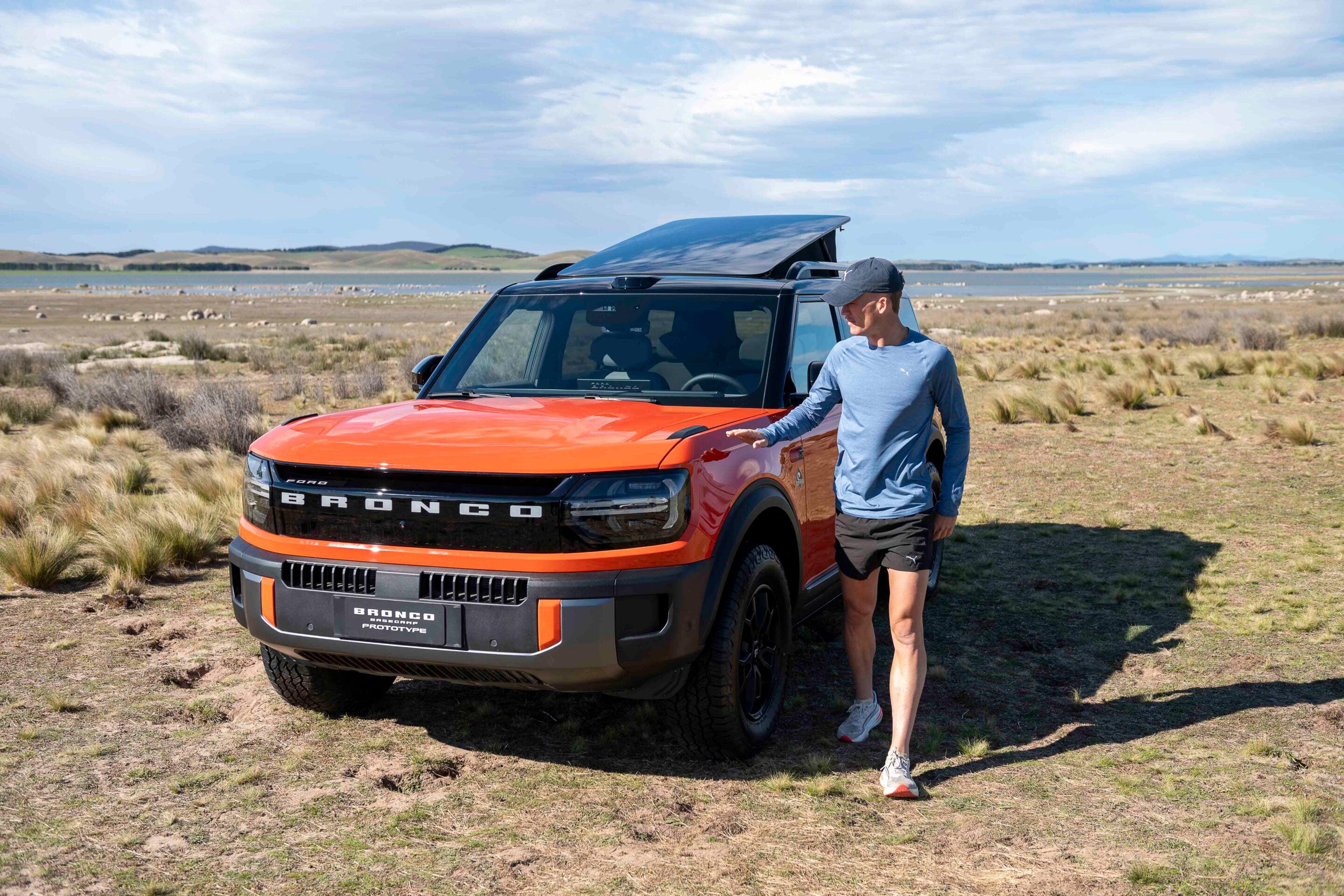
The Chinese-made Basecamp is a light-duty plug-in hybrid SUV, with electric motors driving the front and rear axles rather than a conventional mechanical four-wheel-drive system. Its 49kWh usable battery is paired with a 1.5-litre turbocharged petrol engine that can charge the battery when required, while the battery can also be charged using home or commercial chargers. Ford estimates a combined touring range of 800 to 900km.
The Basecamp also gets several features aimed at camping and extended trips, including vehicle-to-load power for appliances and power tools, an induction cooktop integrated into a tailgate-mounted mini kitchen, and a food heater/chiller box. The rear seats fold flat to create a double bed, while a pop-up roof provides ventilation and allows occupants to sit upright inside.
“When we looked at how Aussies and Kiwis spend their time outdoors, the national parks, the coastal trails, and the distances they travel, the fit was immediate,” said Ambrose Henderson, Marketing Director at Ford Australia. “Outdoor life here isn’t a trend, it’s just life. Bronco Basecamp was purpose-built for these customers.”
The Basecamp is not the same vehicle as the Bronco Sport sold in the US and other markets. Instead, it is part of a Ford-JMC joint venture in China, with styling that draws from both the Bronco Sport and sixth-generation Bronco. The round headlights and traditional Bronco grille are among the styling cues carried across.
3
Ford Bronco Basecamp: what we know
Australian arrival: Second half of 2027
Built: China
Powertrain: Dual electric motors + 1.5-litre turbocharged petrol engine
Battery: 49kWh usable
Charging: External charging + petrol engine
Estimated range: 800-900km
Drive system: Electric motors on front and rear axles
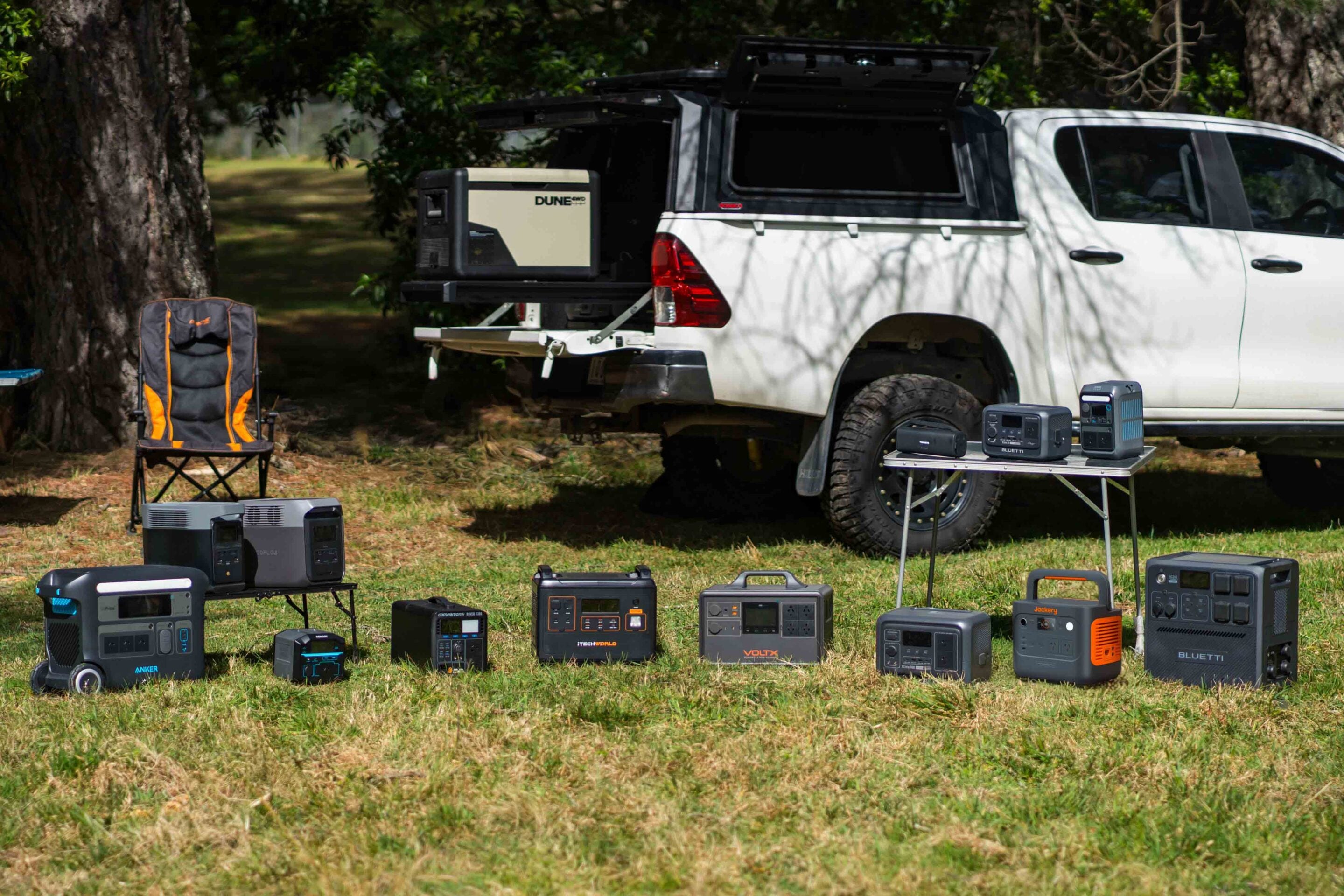
There has been a quiet revolution happening in the way we get electrical power to run our fridges, lights, coffee machines and induction cooktops at camp. Where most of us run dual batteries and standalone lithium systems that are hard-wired to our 4x4s, more and more people are choosing portable power stations.
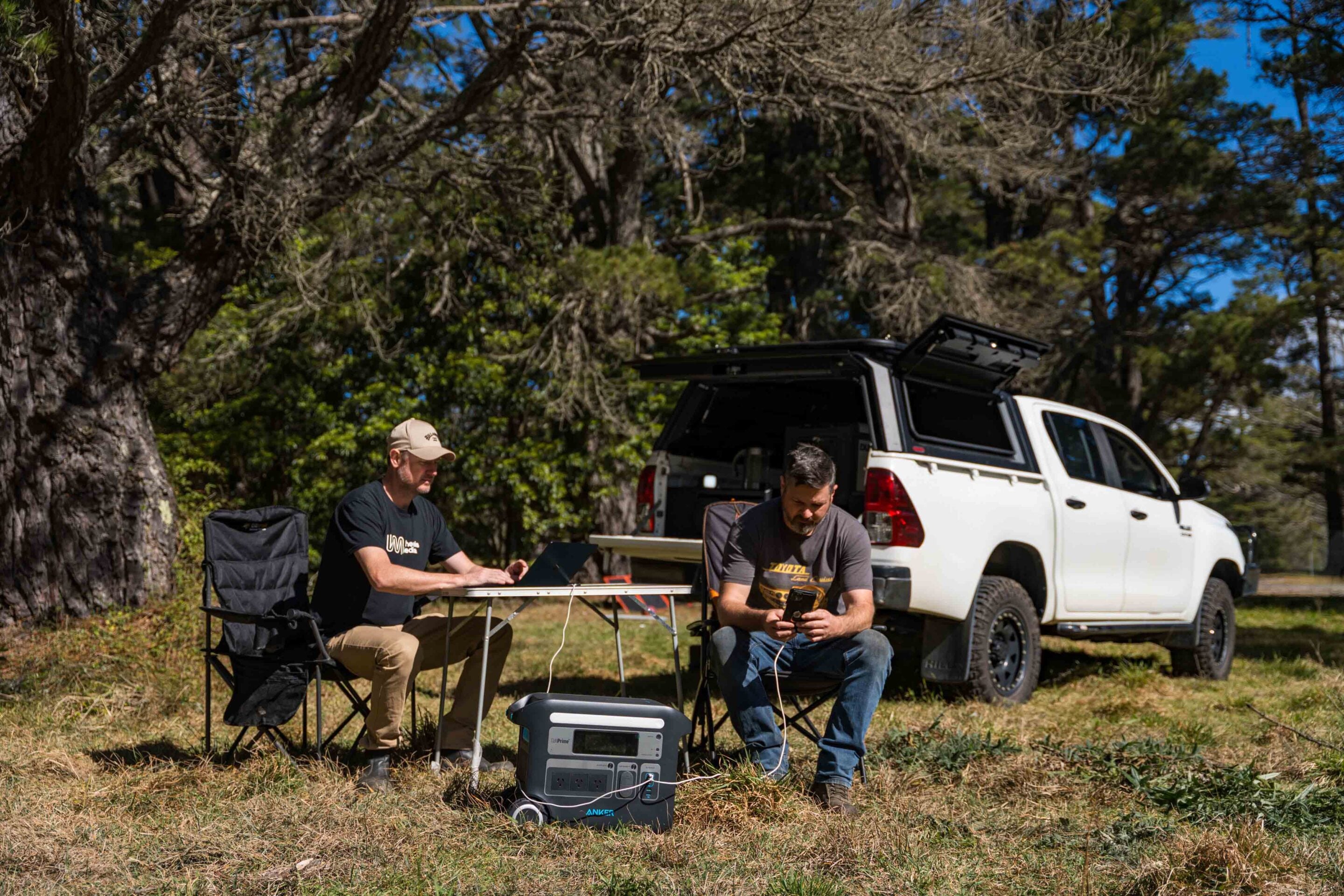
These lithium-based systems can deliver 240V and 12V power and can be charged from the rig’s alternator, solar panels at camp or precharged at home. And the true value lies in the name: they’re portable. If you have more than one vehicle or want to power up your camper or boat, you only need to buy one product to handle them all. They can also run your tools on a job site or even provide backup power to your house during a blackout. In other words, the versatility is off the charts.
Our testing found the Bluetti Elite 30 (↗) was the pick of the compact 200-300Wh units, the EcoFlow Delta 3 1500 (↗) won the mid-capacity 1000-1500Wh category, and the iTechworld PS2000 (↗) took out the high-capacity 2000Wh+ class. We also gave the Bluetti AC240, now superseded by the AC240P (↗), a Highly Recommended rating.
But what’s the difference between portable power stations? They range in output, size and price, and it can be hard to tell what they can actually do. What made these units stand out from the competition, and which one should you be looking at?
Every unit went through the same lab in Canberra, run by retired Australian National University engineer Colin Dedman, before Dex Fulton took them bush to see how they live in the back of a ute. More on who tested them, and how, below.
Portable power stations vs traditional 12V systems
Look, we’re going to completely exclude standalone petrol generators because they’re loud, they smell like a servo, they’re not really viable to run overnight and they’re a great way to ensure you’re the most hated person in the immediate vicinity.
A typical vehicle-mounted auxiliary battery setup will consist of one or two lithium batteries, a DC-DC charger, an MPPT solar input, heavy-duty cables, fuses and a distribution panel with gauges to keep an eye on things. Let’s quickly compare such a system with a portable unit.
In-vehicle systems are reliable and will last a good long time. They’re also able to be repaired easily if a component fails. If something dies on a portable unit out the back o’ Bourke, you’re probably cooked. In-vehicle batteries can be charged quickly from the alternator. Portable power stations rely on a low-and-slow charge via a cigarette-lighter socket.
1
Hard-mounted systems take either a lot of skill or a lot of money – or both – to put together. While portable systems aren’t exactly cheap, they’re often less expensive overall and don’t require installation. Plus, they can be removed when you sell the vehicle or swapped between several different vehicles quickly and easily.
In-vehicle batteries also have constraints on where you can use them. You’re basically limited to the back of your rig. If you want to run your CPAP machine, for example, next to your bed in your camper trailer, or your campsite is in a national park and you’re a short walk from your wheels, portable power makes a lot more sense.
Finally, when they’re not required, portable power stations can be removed from the 4×4 and stored in the shed, freeing up valuable real estate. On top of that, the applications extend beyond camping, as they can power 240V jobsite appliances and tools or provide backup power in the event of a blackout.
Understanding portable power station capacity
Real quick: all of the power stations are rated in watt-hours (Wh).
They range from 200Wh up to 3600Wh (3.6kWh) of energy capacity. If you want to express that in the more familiar amp-hours (Ah), you can divide the Wh figure by the voltage. So 1200Wh is equivalent to 100Ah at 12V. Or you could just go with: the higher the Wh number, the more energy available. Whatever works.
Who tested them and how
THE LAB: Colin Dedman
Colin started at the Research School of Physics at the Australian National University in 1979, providing the engineering behind physics research. Much of that work was designing precision temperature control systems, including enclosures held stable to within 0.02 degrees Celsius, and the instruments to measure them. When he retired and the research lab he worked with closed, he kept a lot of the equipment. It now lives in his test room in Canberra, along with years of experience testing solar panels against their nameplate output.
That matters here because battery capacity changes with temperature. A number taken in a hot shed on a summer afternoon can’t be compared with one taken on a cold morning. Colin’s room holds 25 degrees Celsius to within half a degree, and every electrical reading is referenced back to professional-grade 6.5-digit multimeters.
1
What he measured
Running a 35L fridge off a 2000Wh unit until it goes flat would take more than a week, per unit. So Colin measured the one number everything else comes from: How many watt-hours each station actually delivers at the 240V outlet, drawn down over two hours. Fridge runtime, laptop and phone recharges, kettle boils and induction cooking time are all calculated from that figure.
Then he went after charging, which is where he reckons the real story is. “Any fool can discharge a battery,” Colin says. “What matters out in the bush is how effectively the station can be charged, from solar panels and the vehicle electrical system, and this is where some power stations shine and others fall on their face.”
No manufacturer publishes how its DC input port behaves. The manuals just say plug your solar panel or car charging cable in here. So Colin mapped every unit’s input on a 60V, 50A lab power supply at the three voltages that matter in the real world: 13.2V from a running alternator, 18V from a single solar panel and 36V from two panels in series. He also measured what each 240V charger actually draws, and threw a mitre saw, an angle grinder, a metal cut-off saw, a drill and a cement mixer full of sand and gravel at every inverter.
1
THE FIELD: Dex Fulton
Lab numbers can’t tell you whether a unit slides around the tub, or whether you can read its screen in full sun. On August 21, Dex took the units into the Blue Mountains to check what the lab couldn’t: How each one fits and ties down in a ute, whether it uses standard connectors and ships with a cable to charge it in the bush, how well it’s sealed against dust and water, how noisy the fans are at camp and how the auto-off settings behave. He also weighed up local support and warranty.
The category winners come from Colin’s lab data and Dex’s time in the field, together.
Best compact units: 200-300Wh
Roughly the same size as a brick, with a capacity of 200-300Wh, you can literally pick these units up with one finger.
They don’t have the capacity or power to replace an in-vehicle system or provide all your campsite needs. However, unlike a larger system, a unit of this size can be by your side, exactly where you need it, at all times. Your own personal power station.
And these little fellas charge fast, so when you do run them down, recharging takes only a few hours. Fast car chargers are not available and there’s no need for them, as a recharge time of around three hours using the cigarette-lighter cable is adequate. Average weight is around 4kg.
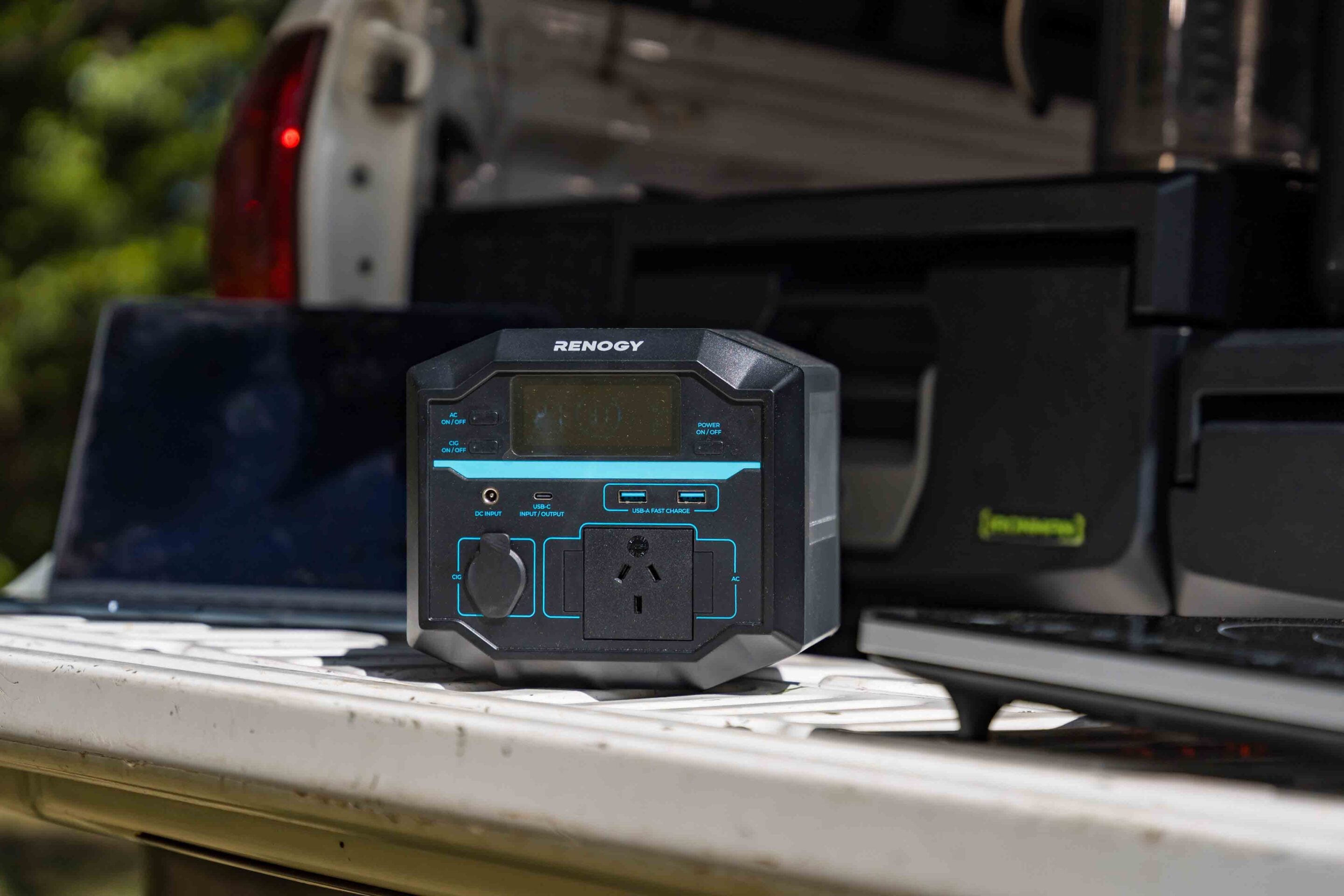
If tiny size was the criterion, then this would win. Unfortunately, the Renogy Phoenix 222 (↗) performs so badly across every metric that it is hard to recommend. A short 12-month warranty and short-lived Li-ion cells, rather than LiFePO4, are a bad start, and it gets worse from there.
There’s a clunky and slow external brick charger, no modern high-power USB-C ports, only 200W of AC output, only 60W of solar charging, only 33W of in-car charging and an unregulated DC output that varies from 11V to 17V. Spend the extra few bucks and get the Anker or Bluetti.
5
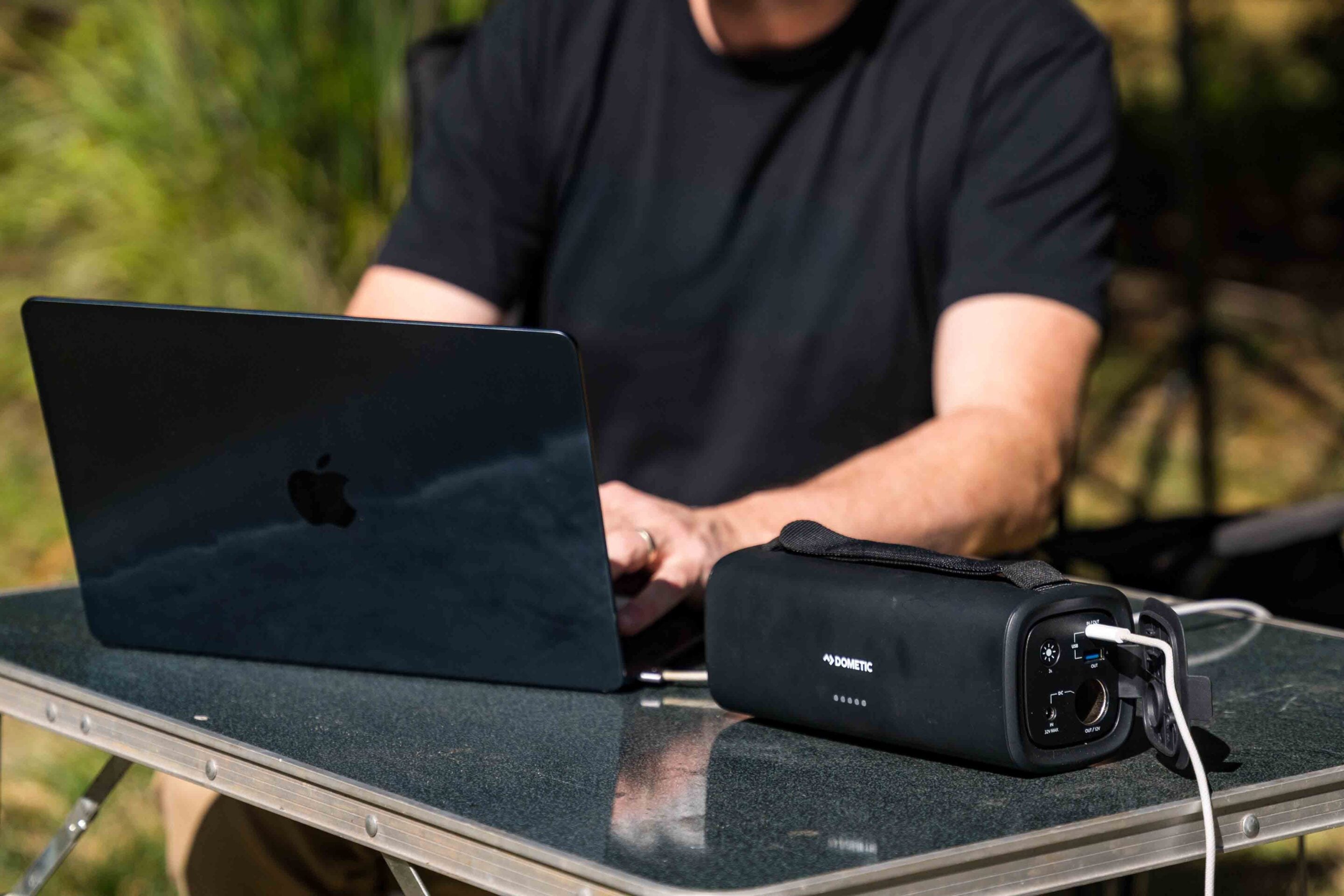
Dometic PLB15
We were sent this one for testing, but the Dometic PLB15 (↗) is actually a portable battery pack rather than a power station. Presumably, the intended application is running a 12V fridge and recharging from a solar panel, as there’s no 240V charger, no 240V output and no information screen. The Dometic PLB15 has a pair of USB ports maxing out at 60W in or out, a torch in one end and a 24-month warranty. That’s it.
But for the same money, the Anker or Bluetti can do all of that and so much more, making the Dometic PLB15 hard to recommend. In its defence, it does provide 15A at the 12V output, while the others only provide 10A.
6
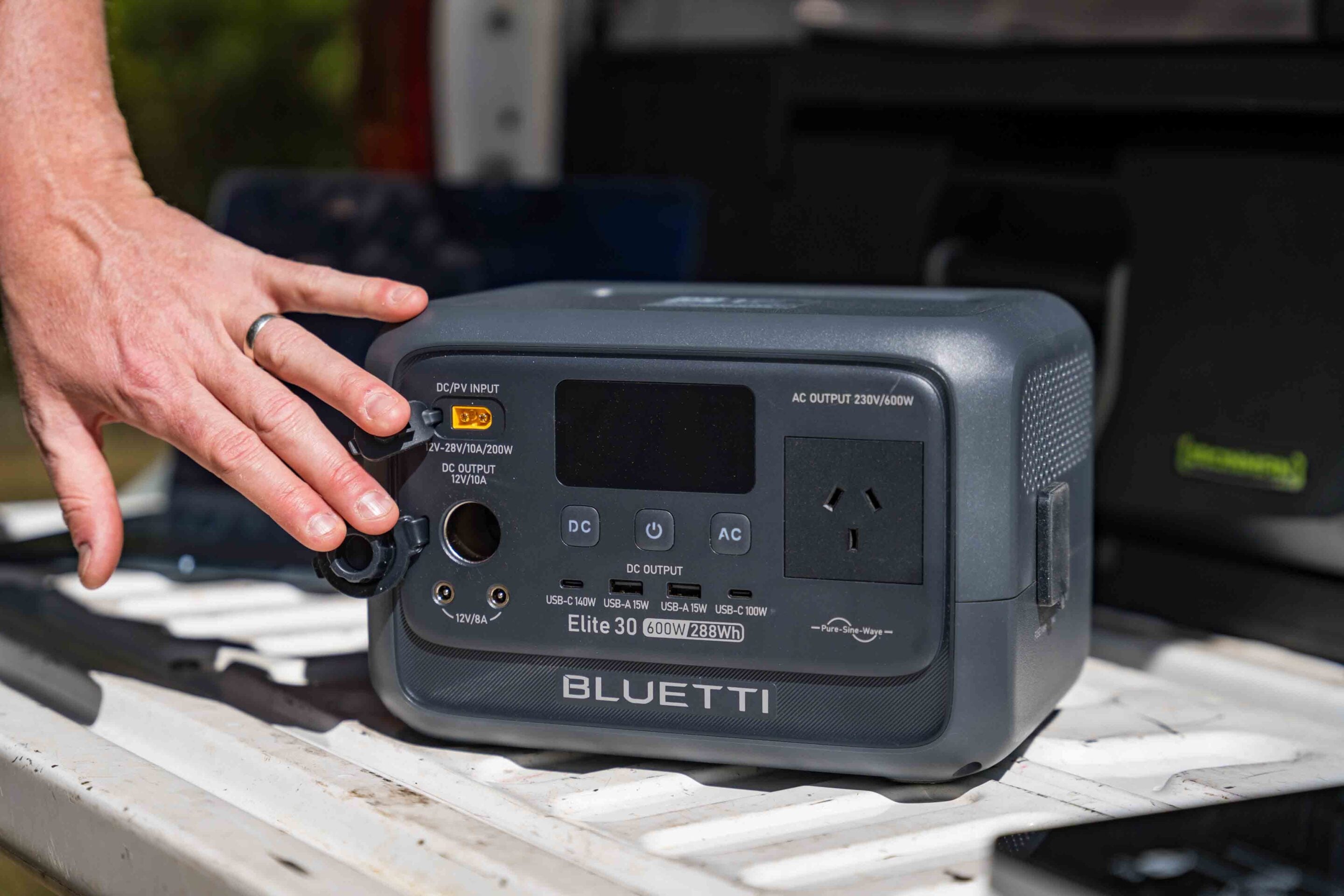
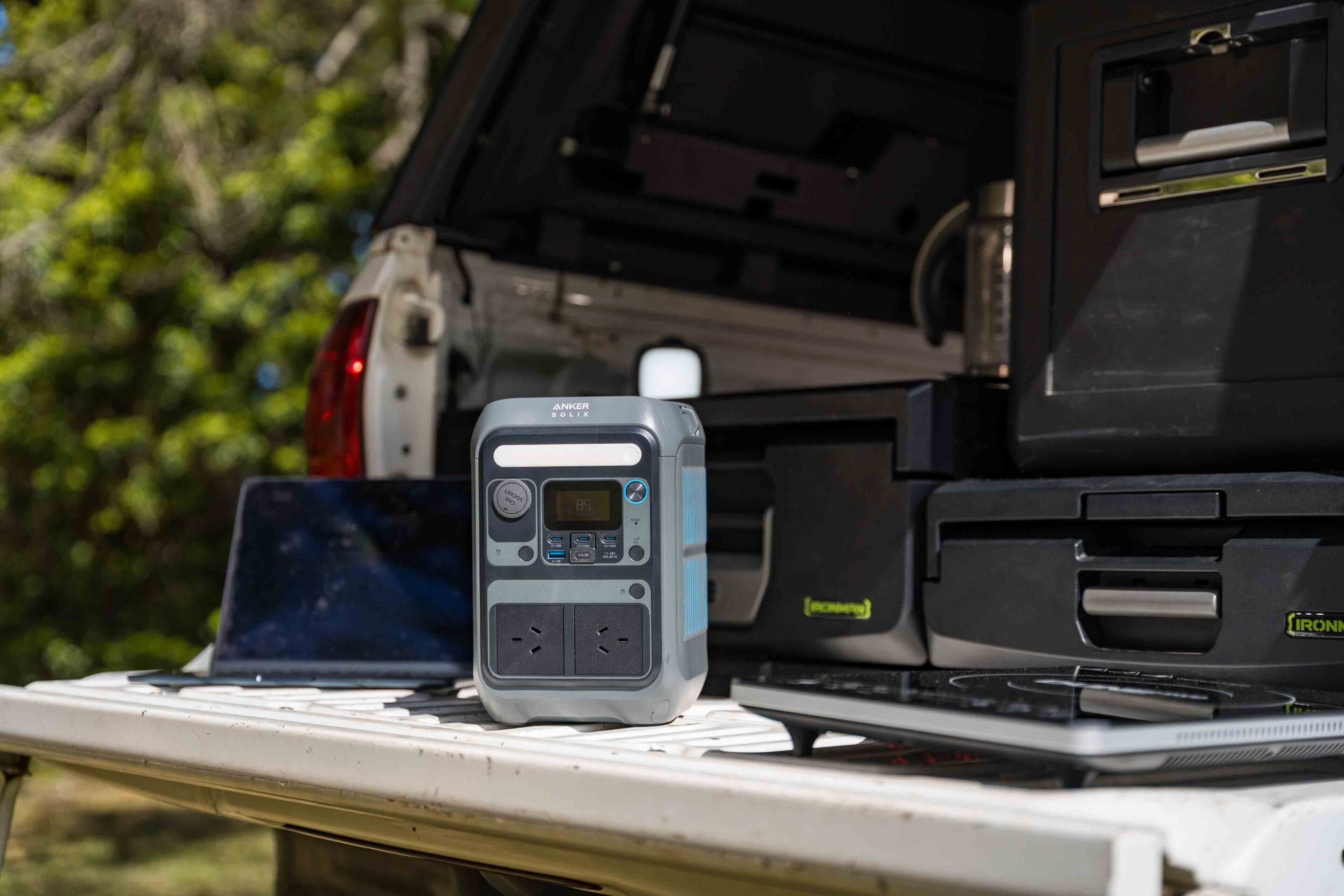
Bluetti Elite 30 vs Anker Solix C300
The Bluetti Elite 30 (↗) outperforms the competition across all metrics. Its nearest competitor is the Anker Solix C300 (↗). Bluetti versus Anker, respectively:
240V output: 600W vs 300W
240V charger: 980W claimed vs 300W
Solar charging: 200W vs 100W
In-car charging: 8.2A vs 7.4A
Percentage of rated capacity: 92% vs 82%
5
For the Bluetti Elite 30, we were not able to achieve more than 355W of 240V charging power, despite playing with the menu settings, so we question the claimed 980W figure. But it is academic. The measured 355W is still more than the 323W we recorded for the Anker Solix C300, and both are adequate, providing a recharge time of around one hour.
The Bluetti Elite 30 also has a 1500W ‘power lifting mode’ for resistive loads, but it is of limited use in practice because of the small 288Wh capacity. The Anker Solix C300 is still a nice unit, and it has the benefit of two AC outlets rather than one, as well as a light. Both ran a 240V 800W drill but nothing bigger.
4
Specs
Bluetti Elite 30
Anker Solix C300
Renogy Phoenix 222
Dometic PLB15
RRP
$399
$399
$249
$399
Weight
4.3 kg
4.1 kg
2.4 kg
1.8 kg
Warranty
60 months
60 months
12 months
24 months
Rated capacity
288 Wh
288 Wh
220 Wh
192 Wh
Rated AC output
600 W
300 W
200 W
None
240VAC charger
980 W
330 W
65 W plug pack
None
Measured capacity
265 Wh
235 Wh
190 Wh
182 Wh
Capacity (% rated)
92%
82%
86%
95%
35L fridge runtime
25 hr
23 hr
18 hr
17 hr
Laptop recharges
x3.8
x3.4
x2.7
x2.6
Phone recharges
x12
x11
x9
x8
240V kettle
No
No
No
N/A
Induction cook @1200W
No
No
No
N/A
Large power tools?
A few
A few
No
N/A
Measured DC voltage
13.3V 10A
13.3V 10A
11-17V 10A unregulated
12.5V 15A
Max DC voltage
28V
28V
25V
32V
XT60 @13.2V
8.2A / 108W
7.4A / 98W
2.5A / 33W
4.9A / 65W
XT60 @18V
8.2A / 148W
5.4A / 97W
3.0A / 54W
5.0A / 90W
XT60 @36V
N/A
N/A
N/A
N/A
Fast car charger
No
No
No
No
Best mid-capacity units: 1000-1500Wh
With a capacity of more than 1000Wh and AC outputs of around 1800W, these units will power most 240V appliances, though an induction cooktop or kettle will deplete the battery fairly quickly. For reference, 1000Wh is equivalent to about 83Ah at 12V.
These have enough capacity to actually replace many entry-level in-vehicle systems and meet most folks’ campsite needs, especially when teamed with a decent solar panel and fast alternator charging. They’re also small and light enough to carry in one hand, with an average weight of 12.5kg. So, which one performed best?
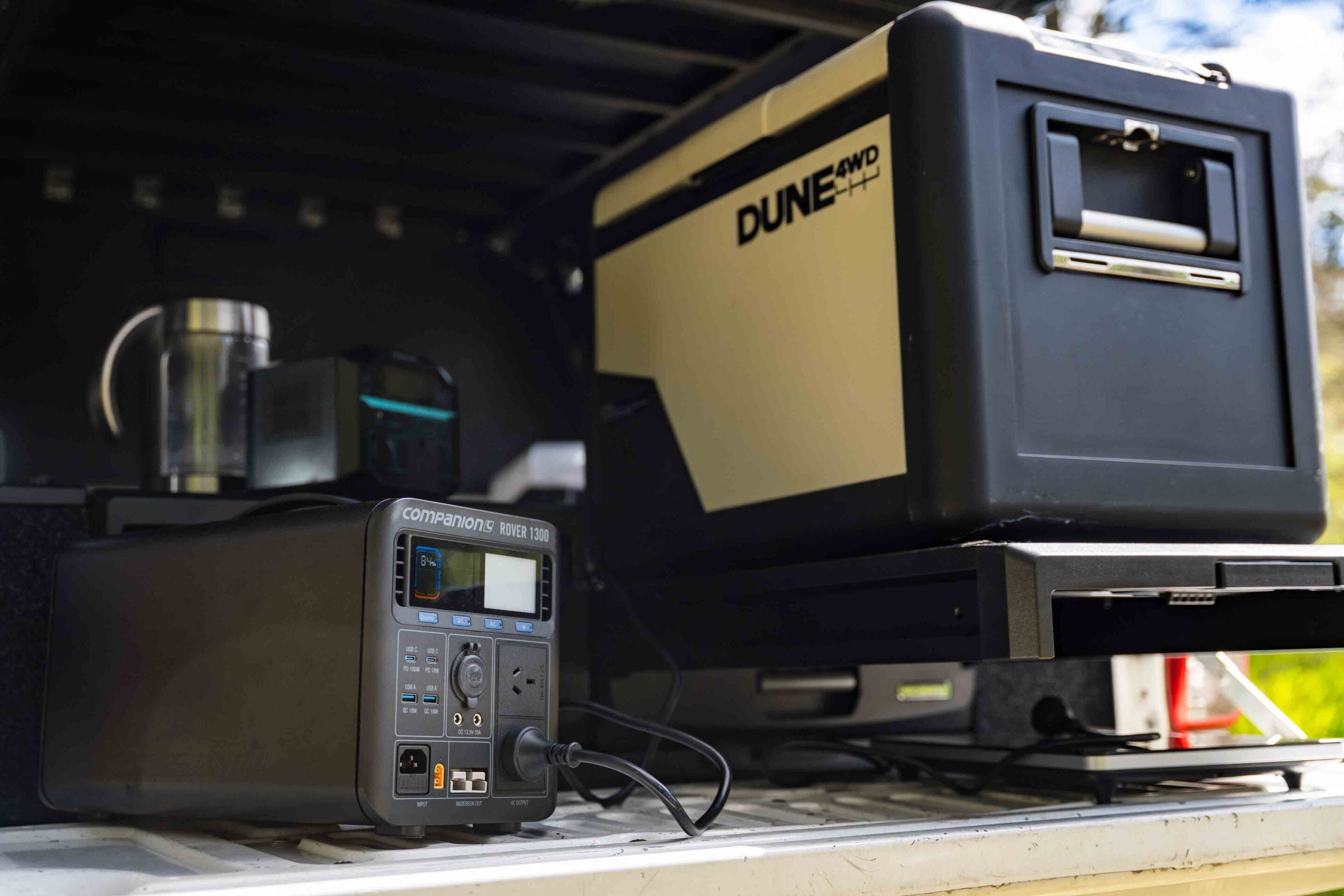
At 1344Wh, the Companion Rover 1300 (↗) has the greatest rated capacity in this category, but it is also a slightly larger and heavier unit. The extra capacity could be useful, but the Companion Rover 1300 falls short in other areas. The warranty is only two years, and the 240V charger and output are less powerful despite the larger capacity. The 1200W inverter output is not really enough to run our 2000W angle grinder and 2300W cut-off saw under load, so the fact that it started them okay is moot.
The solar input is the least powerful at 400W. That may sound like a lot, except that you are stuck with an 8.7A limit, so a single panel is limited to 8.7A x 18V = 157W, or double that for two panels in series. Unfortunately, there is no fast charger module available, so you are stuck with a maximum in-vehicle charge of only 8.7A and 115W, which will take about 10 hours of driving to fully charge the battery.
The 12V Anderson connector DC output is a much better option than the cigarette-lighter sockets, and the Companion Rover 1300 also comes with an Anderson-to-XT60 cable, so you are not locked into proprietary connectors and solar panels. Other manufacturers take note. Even so, the Companion Rover 1300 falls short of the others.
6
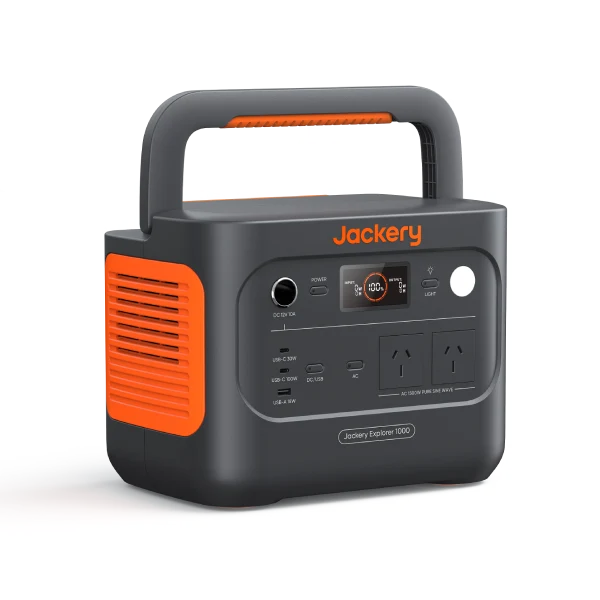
Jackery Explorer 1000
At just 10.8kg, the Jackery Explorer 1000 (↗) is the lightest in class and the handle is the easiest to use, while neatly folding away. It does not ship with a cig-plug or solar cables, so there is no way to charge it out in the bush. The DC charging port uses a pair of coaxial DC8020 connectors that are uncommon. If you buy Jackery solar panels with 8020 connectors, then it all works well, but if not, you will need to buy adaptor cables that are uncommon and expensive.
The port itself is good for up to 400W of solar. Others were limited to less than 9A or 160W for a single 18V panel, but the Jackery is good for 21A or 380W, so in principle a single panel of up to 380W would work. In practice, though, the 8020 connectors are only rated to 10.5A, so you would need to use them in parallel. Doing so will be messy and expensive because suitable 8020 hardware is scarce.
The bottom line is that, because of the non-standard connectors, using your own panels is a pain. To charge the Jackery Explorer 1000 while driving, you need to buy your own cig-to-8020 cable, which is also a pain. Even then, like most units, the in-car charge current is limited to 8A, which is really slow, and you are stuck with that because a fast-charging module is not available.
The 240V AC output is 1500W, while the EcoFlow and Bluetti offer 1800W. They also use the more common XT60 connector, provide 15A of in-vehicle charging and are supported by fast alternator charging. All in all, the Jackery Explorer 1000 is outgunned, leaving the EcoFlow and Bluetti as the stronger options.
1
Bluetti Elite 100 vs EcoFlow Delta 2
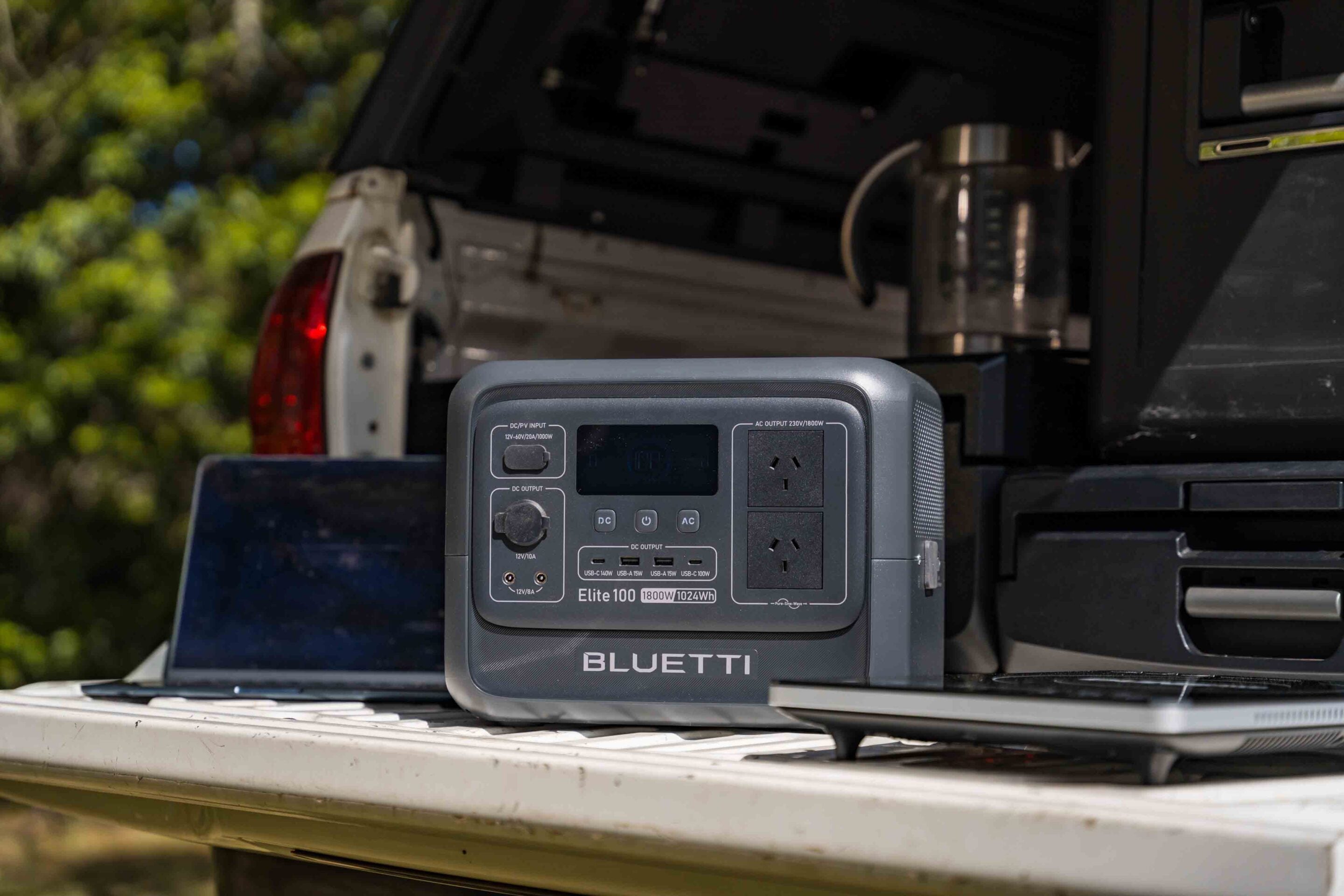
The Bluetti Elite 100 (↗) solar input can handle up to an impressive 1000W of series- or series-parallel-connected panels, though a single panel is still limited to 8.2A and 146W. The EcoFlow Delta 2 (↗) can handle ‘only’ up to 500W of series- or series-parallel-connected panels. The EcoFlow Delta 2 ships with only a mains cable, while Bluetti also provides an XT60-to-MC4 solar-panel cable. However, because the XT60 connector is so common, cables are cheap and plentiful.
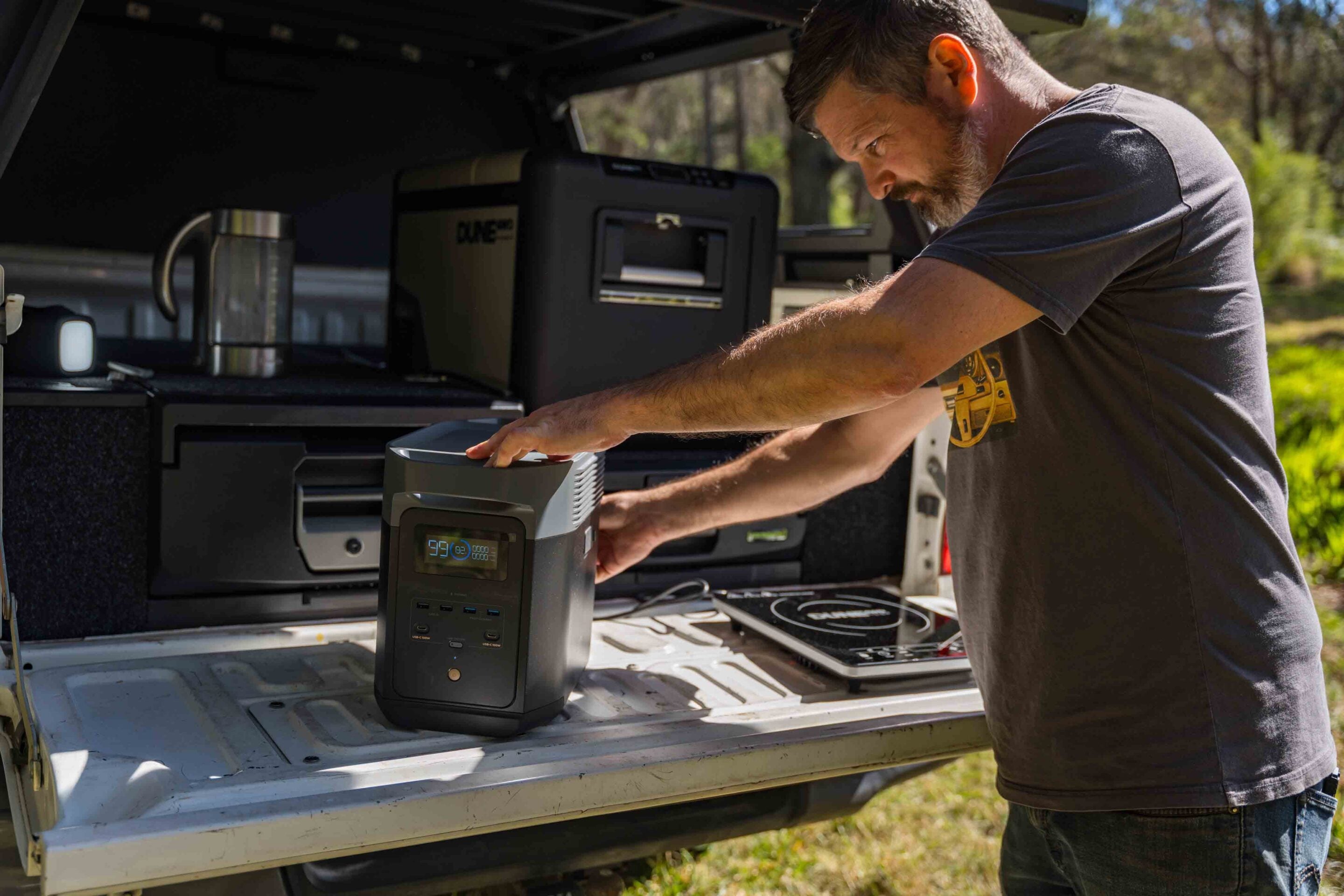
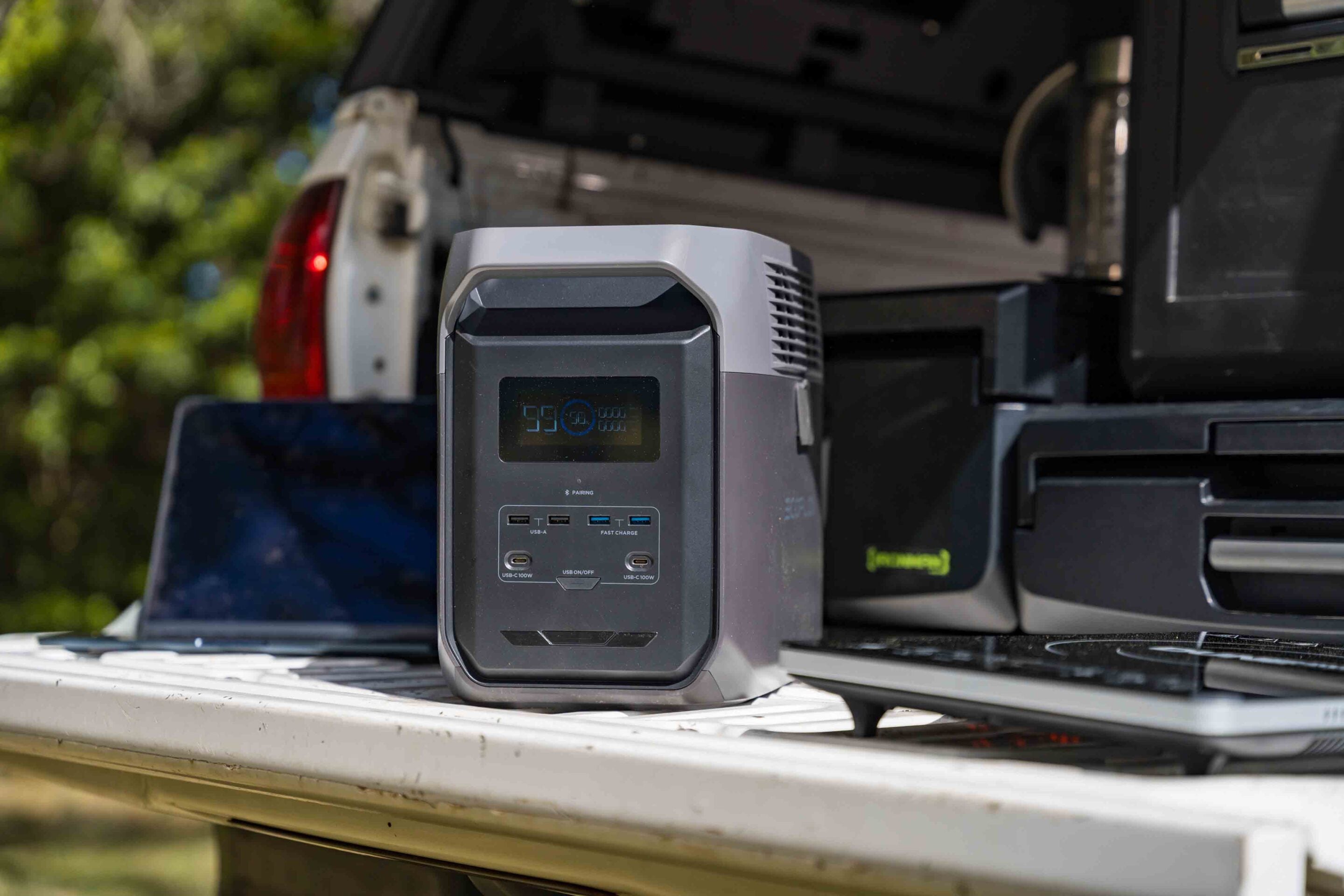
But the EcoFlow Delta 2 has an ace up its sleeve: the XT60i (note the ‘i’) DC input connector. This version of the XT60 connector has a third centre pin for programming the charge current. Specifically, if this pin is shorted to the ground pin, it unlocks the full 15A charge capacity at all voltages. Clearly, this cannot be used with a cig-plug cable that will only handle 8A. However, it is a real bonus for solar panels, allowing a single 18V panel to provide up to 15A, or 18V x 15A = 270W. Most other stations tested are limited to half of that for a single panel. You can also use two panels in series, right up to the 500W limit.
6
But unlocking that 15A limit also almost doubles the maximum in-car alternator charging rate from 8A to 15A, provided, of course, you have dedicated 15A wiring back to the alternator. This is a cheaper – though less powerful – option than buying a fast-charging module, and only the EcoFlow Delta 2 has it.
This unlock feature is not mentioned in the EcoFlow manual, but we have lab-tested it and it works perfectly. You don’t need to make your own cable. If you buy an XT60i-to-solar or XT60i-to-Anderson cable from EcoFlow, it will be unlocked with the centre pin shorted. But an XT60i-to-cig-plug cable will always be locked to 8A, with the centre pin unconnected.
If you do choose to almost double the car-charging rate in this way, you will need an ignition-switched relay to disconnect the power station when the engine is switched off because the unlocked port will continue to draw 15A right down to 10V. You don’t want a flat car battery. Be aware that EcoFlow does not provide any cables for the XT60i port with the power station, so be sure to buy an XT60i – not XT60 – cable for connecting to solar or the alternator.
Unless you really need 1000W of solar input, the EcoFlow Delta 2 has the edge over the Bluetti Elite 100 thanks to the useful features of its smart XT60i input port, and would thus win the crown in this category. Except that, at the last minute, an EcoFlow Delta 3 1500 turned up for testing.
8
EcoFlow Delta 3 1500
The EcoFlow Delta 3 1500 (↗) is essentially identical to the EcoFlow Delta 2 reviewed above, but has 50% more battery capacity. It is a little heavier, the same compact size and still easy to carry. If the money’s there, you would never regret that extra 50% capacity. Being a new model, the price is likely to drop. If you can’t afford it, then go with the EcoFlow Delta 2. But that extra 50% capacity in the same compact size just can’t be ignored.
4
Specs
Companion Rover 1300
Jackery Explorer 1000
Bluetti Elite 100 V2
EcoFlow Delta 2
EcoFlow Delta 3 1500
RRP
$1,399
$789
$899
$899
$1,899
Weight
15.2 kg
10.8 kg
11.5 kg
12 kg
16.5 kg
Warranty
24 months
60 months
60 months
60 months
60 months
Rated capacity
1344 Wh
1070 Wh
1024 Wh
1024 Wh
1536 Wh
Rated AC output
1200 W
1500 W
1800 W
1800 W
1800 W
240VAC charger
800 W
1000 W
1200 W
1200 W
1500 W
Measured capacity
1179 Wh
931 Wh
884 Wh
916 Wh
1356 Wh
Capacity (% rated)
88%
87%
86%
89%
88%
35L fridge runtime
113 hr
89 hr
85 hr
89 hr
130 hr
Laptop recharges
x17
x13
x13
x13
x22
Phone recharges
x54
x42
x40
x42
x62
240V kettle
10 times
8 times
8 times
8 times
12 times
Induction cook @1200W
59 min
47 min
44 min
46 min
68 min
Large power tools?
Many
Almost all
Almost all
Almost all
Almost all
Measured DC voltage
13.6V 10A
12.9V 10A
13.6V 10A
12.8V 10A / 15A 198W
12.8V 10A / 15A 198W
Max DC voltage
60V
60V
60V
60V
60V
XT60 @13.2V
8.7A / 115W
7.9A / 104W
8.2A / 108W
7.9A / 104W
8.0A / 106W
XT60 @18V
8.7A / 157W
20.9A / 376W
8.2A / 148W
7.9A / 142W
8.0A / 144W
XT60 @36V
9.7A / 349W
11.2A / 403W
16.8A / 606W
7.9A / 284W
8.0A / 288W
Fast car charger
No
No
560W
500W or 800W
500W or 800W
Best high-capacity units: 2000Wh+
These beasts will power almost any 240V tool or appliance you throw at them and have enough capacity for induction cooking, though gas may still be necessary as a backup.
They will even run a caravan air-conditioning unit, albeit not all day. At typically 22–30kg, this class is still light enough to be lifted and carried by one person. They’re basically the same as the previous category, just with more of everything. You get roughly double the capacity, letting you actually use the station without constantly worrying about whether a few cloudy days will flatten the battery. If you can afford the cost and the weight, the extra grunt is well worth it.
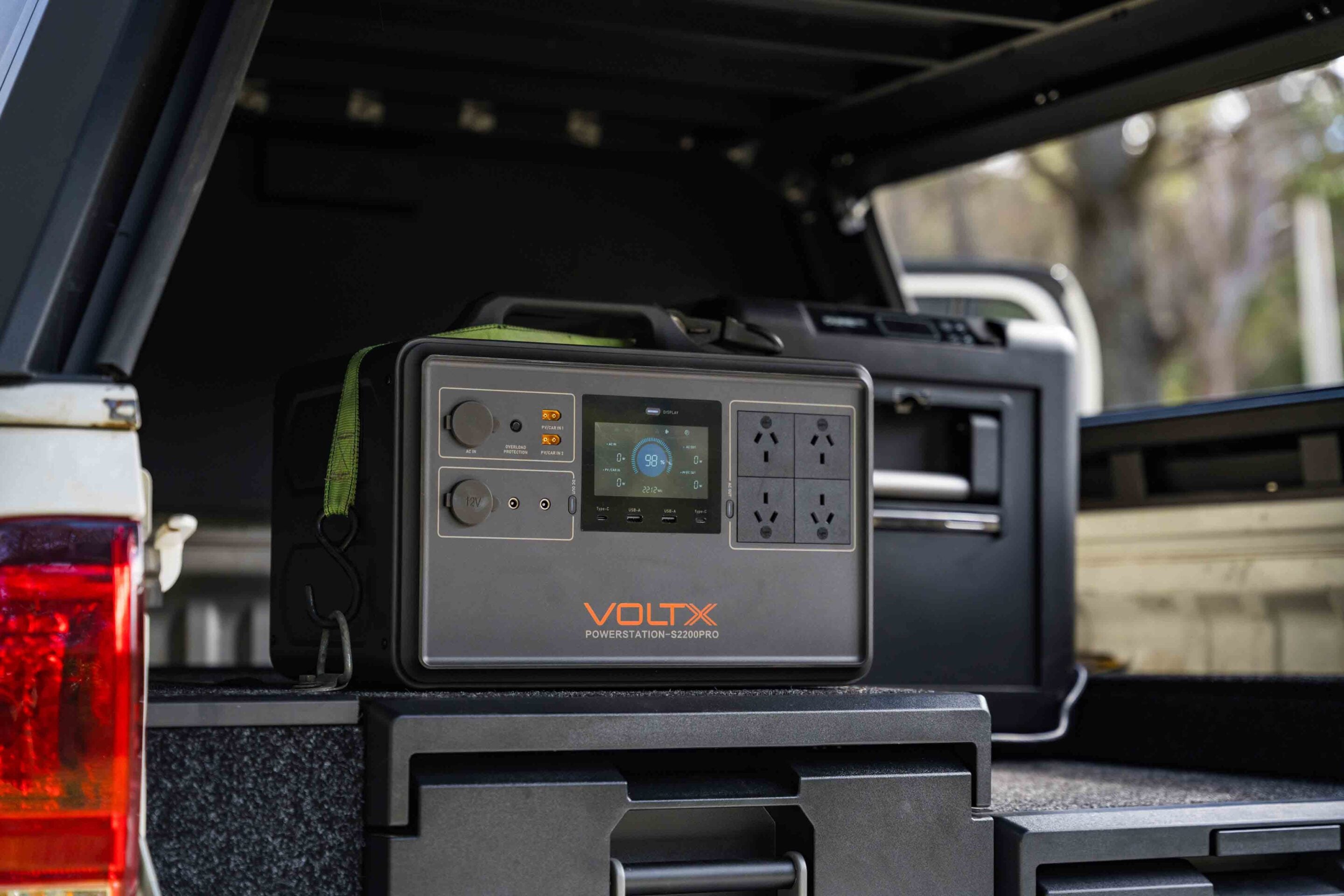
At 2240Wh, the VoltX S2200 Pro (↗) has more rated capacity than any other unit in this category, yet tips the scales at only 27kg. That extra capacity is a useful bonus. The VoltX S2200 Pro sports a massive single handle, while others have a handle on each end intended for two people. In practice, the size and quality of the handle mean it can be carried comfortably by one person, though it also means you can’t easily place or stack items on top. The VoltX S2200 Pro also does everything you’d expect, with 2400W of AC output and 2200W of AC charging.
Where the VoltX S2200 Pro really stands apart is DC charging. It has two fully independent XT60 DC inputs that can be run in parallel, doubling the DC input current. So, if each XT60 will accept up to 9.7A at 13.2V, running them in parallel with a high-current cable back to your alternator gives you an in-vehicle charge rate of 19.4A. That’s enough to be genuinely useful, and no other station we tested can match it for raw alternator charging without an add-on module.
The VoltX S2200 Pro is also in a class of its own for connecting solar panels. By using the two inputs in parallel or independently, you can achieve high input power with a very wide range of panels. It also ran all the power tools without complaint.
On the downside, the fans are somewhat unrefined and noisy. Normally, that won’t matter because they run slowly or not at all unless the unit is working hard. However, for no apparent reason, the fans always operate at full speed when the XT60 ports are in use – which is exactly when you’ll be charging it at camp or on the move. The warranty, at 24 months, could also be better. And unlike the iTechworld, there is no fast alternator-charging module available.
7
iTechworld PS2000 and Anker Solix F2000
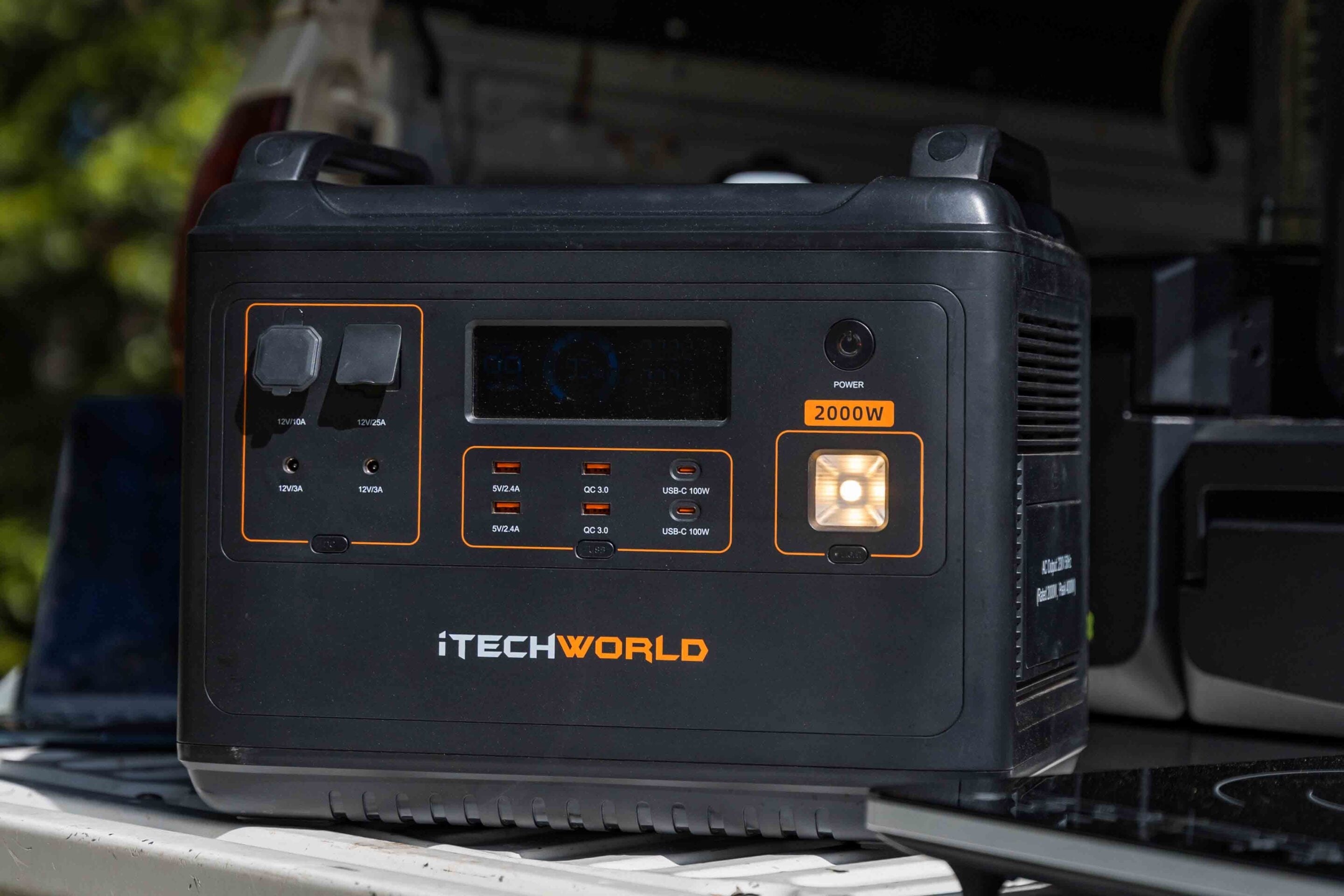
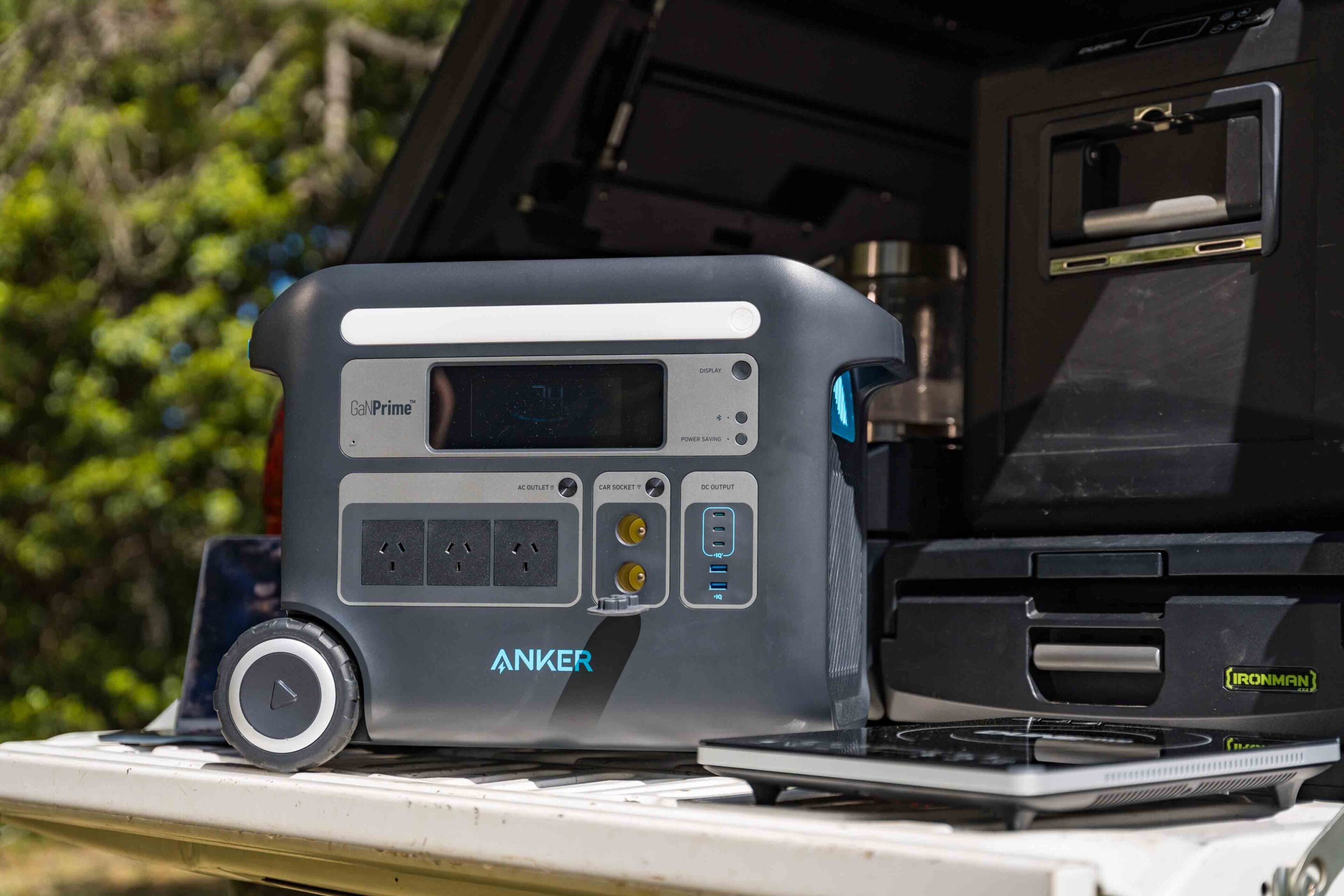
These two are similar, so we compared them against each other. The iTechworld PS2000 (↗) weighs 22kg and is pleasantly manageable and easily carried by one person. The Anker Solix F2000 (↗) is heavier but has wheels, which were surprisingly handy. But they’re a double-edged sword. Combined with a pull-out handle, the wheels are great for moving the unit once it’s on the ground, but they also make it easier for it to slide around in the back of your vehicle unless it is tied down securely. With the protruding handles, they also increase the footprint of the unit. The iTechworld PS2000 is definitely more compact.
Both have a generous rated battery capacity of 2048Wh. In the real world, the Anker Solix F2000 delivered slightly more energy – 90% of rated capacity versus 87%. The Anker has a massive 2300W mains charger versus 1100W for the iTechworld PS2000, which might sometimes be handy, but not out in the bush where solar and alternator charging are more important. Strangely, the Anker’s 240V output was 60Hz, even though the display read 50Hz. From here on, however, the PS2000 pulls ahead.
The iTechworld PS2000 has a socket delivering a DC output of 13.6V at 25A, useful for 12V devices that draw more than 10A, as well as the normal 10A cig socket. The Anker Solix F2000 has only a 10A cig socket. If you only want the 12V output for a fridge, then either is okay, but having 25A available can be useful, allowing you to run a small-to-medium 12V compressor or pie oven.
7
Both have similar inverter power: 2300W for the Anker and 2400W for the iTechworld. The PS2000 was able to start and run every large power tool we threw at it. The Anker shut down trying to start the 230mm grinder and cut-off saw. Consistent with this excellent surge performance, the PS2000 has 15A 240V outlet sockets, while the rest all have 10A. For tradies or anyone who uses power tools seriously, the iTechworld and VoltX are the better choices.
When it comes to solar, the Anker will accept up to 1000W of input, but with caveats. It is really designed for use with Anker’s own non-standard high-voltage solar blankets. Up to five can be plugged in parallel to its proprietary connection block, producing around 1000W – a clever turnkey solution if you buy Anker’s panels, but one that commits you entirely to its proprietary ecosystem. If you prefer to use standard 18V camping panels, you’re restricted to 9.4A and 169W from a single panel, which is limiting.
The iTechworld PS2000 supports a maximum of 500W of panels. If this is enough for your needs, then the PS2000 is actually better because it supports 20A and 360W from a single panel, as well as two panels in series up to 500W.
But the real crunch comes with charging speed from the vehicle alternator while driving. The PS2000 offers a 500W fast-charging module at a reasonable cost, bringing recharge time from the alternator down to around four hours. The Anker doesn’t have one, limiting alternator charging current to a paltry 9.4A – or around 18 hours of driving for a full charge. The VoltX achieves better raw alternator charging through its dual-XT60 setup, but it doesn’t have a fast-charging module available either. For genuine outback touring, where you’re covering distance each day, the iTechworld’s fast-charger option is the difference between arriving at camp with a full unit or still waiting.
Overall, the iTechworld PS2000 edges out both the Anker Solix F2000 and VoltX S2200 Pro. The combination of a 25A 12V output, 500W fast alternator charging, 15A power sockets, tool-starting capability and a compact form factor that actually fits in the back of a 4×4 is hard to beat. The Anker’s 60-month warranty is the one area where it genuinely betters the iTechworld’s 24 months.
As a quick note, Anker now has a new C2000 model with an 800W fast alternator-charging module, which would be worth looking at, but it wasn’t available for testing.
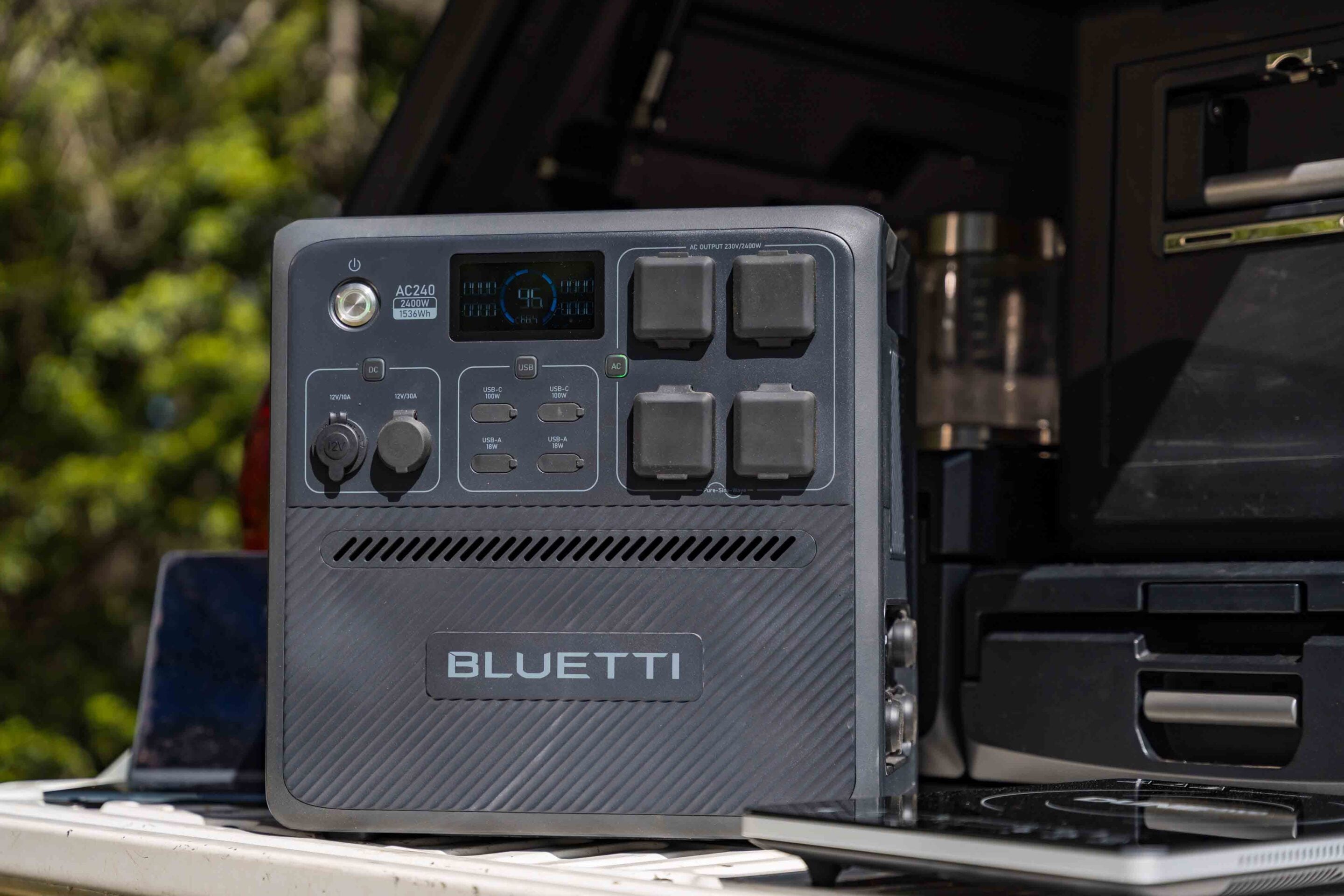
Every other power station in this test lets dust and moisture enter through its cooling vents. The Bluetti AC240 does not. With full IP65 certification – sealed against dust ingress and direct water jets from any angle – it is the only unit we tested that has been genuinely engineered for the harsh, wet and filthy conditions that serious four-wheel driving actually produces. All input and output connectors have rubber boots. The connectors themselves are waterproof with sealing O-rings. The chassis is sealed. There is even a pressure-relief valve to manage air expansion inside the unit. A six-year warranty – the longest in this test by a significant margin – backs it up.
The Bluetti AC240 also has a dedicated 30A 12V output capable of running a 12V compressor. Its 2400W AC output handled all our power tools without complaint, and it has four 15A sockets rather than the standard 10A found on most competitors.
6
Its limitations are real. At 33kg, it is the heaviest unit in the test. At 1536Wh, the Bluetti AC240 has less rated capacity than the other top-tier units despite a price that competes with the best of them. Solar input is limited to 8.2A from a single 18V panel – use two in series for up to 752W. A fast in-car charging module is available, but all cables use non-standard connectors that you will not find at a roadside hardware store.
These are trade-offs worth understanding rather than dealbreakers. The Bluetti AC240 was designed with a specific customer in mind: someone who leaves the bitumen for weeks at a time, operates in dust, mud, rain and heat, and for whom reliability and longevity outweigh raw capacity numbers. For that customer, nothing else in this test comes close.
The Bluetti AC240 has since been superseded by the Bluetti AC240P, which features a larger 1843Wh battery and faster Turbo charging, while retaining the same IP65 rating, six-year warranty and sealed connector design. Buyers should seek out the AC240P as the current model.
Specs
Bluetti AC240
RRP
$2,499
Weight
33 kg
Warranty
72 months
Rated capacity
1536 Wh
Rated AC output
2400 W
240VAC charger
800 W Turbo
Measured capacity
1312 Wh
Capacity (% rated)
85%
35L fridge runtime
126 hr
Laptop recharges
x19
Phone recharges
x60
240V kettle
11 times
Induction cook @1200W
66 min
Large power tools?
Almost all
Measured DC voltage
13.5V 10A / 13.5V 30A
Max DC voltage
60V
XT60 @13.2V
8.2A / 108W
XT60 @18V
8.2A / 148W
XT60 @36V
20.9A / 752W
Fast car charger
560W
Buying advice
These power stations offer a real alternative to traditional bolt-in 12V power systems and, in some ways, are actually better. However, you need to choose very carefully if fast solar and in-car charging are priorities.
Once you leave home, the ability to charge at a reasonable rate while driving is important. We marked down some stations because in-car charging was slow and a fast charger was not available. However, in many cases, a workaround may be to use a fast charger from another manufacturer.
The genie is out of the bottle. You’ll be seeing more of these power stations as they continue to evolve and improve.
Portable power station components explained
In simple terms, the power stations were made up of a lithium battery, 240V charger, 240V inverter, 12V outlet (cig-plug), USB ports and XT60 DC input ports.
Lithium battery
At the heart of these power stations is typically a 24V to 51V battery, not 12V like the one in your in-vehicle system. Most use LiFePO4 chemistry and are typically good for 2000–4000 cycles, with a lifespan of around 10 years. A small number do use lithium-ion cells that are only good for around 500 cycles. LiFePO4 chemistry is also safer.
A higher-voltage battery reduces the required battery current, increasing efficiency at high power levels. Unlike a traditional auxiliary system, the user does not get direct access to the battery terminals. All inputs and outputs are via step-up or step-down converters.
240V charger
Unlike traditional 4×4 systems, all portable power stations have a high-power 240V charger, often rated at 1.2kW to 2.4kW, typically capable of charging the battery in two hours or less. This allows fast pre-trip charging at home or at a powered site when travelling. However, for extended remote travel without 240V access, this feature is of limited use.
240V inverter
These are typically rated at 1.2kW to 2.4kW on the higher-tier units, enough to power most 240V appliances and even large power tools. The practical limitation has more to do with battery stamina than power. In practice, what you can realistically run is determined by your ability to recharge the unit when out bush.
Discharging the battery is easy, and fast charging from 240V is simple too, but many of the stations we tested charged slowly from solar panels and extremely slowly from the vehicle electrical system. But we’ll get into that more in a sec.
Be aware that inverters draw significant current at idle. It is very inefficient to use the 240V output to power light loads of less than, say, 50W. Use the USB or 12V outputs instead. Even with no load connected, just having the 240V output turned on will typically flatten the battery at around 1% per hour.
Also, when you get home, make very sure every output is off or the battery may be completely discharged and even damaged. Most units can be set to turn off outputs automatically when not in use, but this feature must be used with care or it may turn off intermittent loads like your fridge, or very light loads like a phone being charged.
12V outlet (cig-plug)
Usually, these are limited to 10A. In part, this is because that is the limit of a cig-plug and socket, although a higher-current socket could have been provided in principle. Why wasn’t it? Because the internal battery is typically 24V to 51V, not 12V, so the 12V output is actually obtained from a step-down converter, and it would be expensive to include a powerful converter capable of more than 10A.
The only exceptions among the units we tested are the iTechworld PS2000 and Bluetti AC240, with dedicated high-current outputs of 25A and 30A respectively.
The other reason the 12V output is limited to 10A is efficiency. The 12V output will typically be used for low-power devices like a fridge or Starlink Mini, while higher-current appliances would be powered via the 240V inverter.
USB outputs
Almost all of the units provide an extensive selection of USB outputs, including high-power USB-C PD up to 140W. It is much more efficient to charge a device using USB power than to use a 240V brick adaptor. As mentioned, the idle power consumption of the inverters is quite high.
If a Starlink Mini is to be powered, do so from the 12V outlet rather than the 240V AC output. If efficiency and battery stamina are important to you, don’t use the 240V inverter for light loads unless you need to, and never leave it on unless it is actually being used.
XT60 multi-purpose DC input port
Most power stations we tested use a three-prong XT60 connector for all DC inputs. This style of connector was developed for RC models but has been embraced by the power station industry for its high-current capability. A couple of stations do use a different connector, but the XT60 is the most common, so we’ll just use the term “XT60” for simplicity.
The XT60 is used for DC charging from solar panels or via the cig-plug in the vehicle. The speed at which the power station can be charged from solar or your vehicle’s alternator – rather than from 240V – is really important.
While it would be great to know the charging current and available power from the cig-plug or solar input, this information is generally unavailable and there’s no industry standard for XT60 connections. All you can do is plug her in and wait, with no data on how long it’ll take to charge your power station from your vehicle. Obviously, this sucks.
That’s why we lab-tested each XT60 input port to understand how it works and what charge current you will actually get in the real world. 4X4 Australia is the only one to have done this.
Now, the intelligent XT60 “looks” at the applied voltage at the port and sets the maximum charge current it will accept according to that voltage. In the real world, there are three situations where this information is beneficial:
1. When charging from the vehicle alternator while driving
The charging voltage with the engine running will be around 13.2V. In general, the XT60 will accept no more than 8–9A at 13.2V to protect your vehicle’s cig socket. Even with heavy cabling to the XT60, the current will still be strangled to about 8A. For the larger power stations, that means a recharge time of 10 to 20 hours while driving, which is near useless.
The industry solution is to buy a ‘fast alternator charge module’ at extra cost. These basically step up the alternator voltage to 36V or more. The XT60 will accept much more DC charging current and power at this voltage.
2. When connecting a single 12V solar panel
A panel, or multiple panels wired in parallel, operates at about 18V. For most units tested, the maximum current the XT60 will accept at 18V is also 8–9A, due to the smart (dumb) XT60 thinking it still needs to protect the cig socket. This means the largest single panel or blanket the XT60 port can fully utilise is around 18V x 9A = 162W.
Plugging in a larger panel than that does not help – the port will refuse to draw more than 9A. The iTechworld PS2000, Jackery 1000 and VoltX S2200 are exceptions, allowing around 20A or 360W from a single panel, which is pretty good, while the EcoFlow Delta 2 can be programmed to accept 15A or 270W. But with the other stations, be very careful, because if you own or buy a single solar panel rated at more than about 160W, any capacity above that will be wasted. The solution is to use two panels in series.
3. When connecting two 12V solar panels in series
Two 12V solar camping panels or blankets wired in series operate at about 36V. At this input voltage, much higher charging power – from 350W up to 750W – can be utilised. The reason is that the smart XT60 knows the vehicle’s cig socket cannot be as high as 36V and therefore raises the current limit. Combined with the increased current capability and the doubling of voltage from two panels in series, seriously beneficial solar inputs become possible.
As a quick case study, consider the iTechworld PS2000. When charging from the alternator at 13.2V, the maximum charging current into the XT60 is 8.2A, which equates to a piddling 108W. However, a 500W fast alternator charger is available, which is almost five times faster.
When a single 18V solar panel is connected, the maximum current accepted by the port is 20A, equating to 360W, which is very acceptable and roughly double that of competing power stations. However, by wiring two panels in series – or four panels in series-parallel – to produce 36V, the port will accept up to 13.9A, which equates to 500W. Chicken dinner.
Just quietly, also of interest is the maximum power the XT60 port will accept, regardless of voltage. For the PS2000, for example, the maximum XT60 input voltage is 50V, so two solar panels in series is fine, but three is not, and there is an absolute 500W limit regardless of voltage.
This wealth of information is simply not available in the power station manuals or anywhere else. On our part, it took a lot of lab work to measure this information, but we reckon it was worth it.
Testing notes
All testing was conducted at 25°C ambient temperature.
Boiling one litre of water in an electric kettle, starting at 15°C, requires 0.116kWh based on direct measurement.
A typical 13-inch laptop with a 55Wh battery requires about 69Wh from the USB port for a full recharge, assuming 80 per cent USB charging efficiency.
A typical mobile phone with a 5Ah battery requires about 22Wh from the USB port for a full recharge. This is based on 5Ah × 3.75V = 18.75Wh, divided by 85 per cent USB charging efficiency.
For USB charging, the USB port inverter is assumed to have the same efficiency as the 240V inverter at the two-hour rate, so the measured 240V Wh figure can be used.
For the 35L fridge, power consumption is calculated as 0.8A × 13V = 10.4W.
For the 12V output, the inverter is assumed to have the same efficiency as the 240V inverter at the two-hour rate, so the measured 240V Wh figure can be used.
Hybridisation appears to have put petrol-fuelled combustion engines back on the menu for 4×4 vehicles.
I don’t know if that’s simply because hybrid systems are easier to adapt to petrol internal combustion engines (ICE) than diesel-fuelled ICEs, or because hybrid systems are improving efficiency to bring it closer to diesel performance. It should be noted that we will be seeing hybrid-boosted diesel-fuelled powertrains in 4×4 vehicles very soon, but so far they all operate with petrol ICEs.
When Toyota fitted its hybridised, turbocharged 3.5-litre V6 engine to the Toyota Tundra pick-up truck and the Lexus LX 700h, Toyota Australia saw the opportunity to give petrol fuel another try in the popular LandCruiser model.
Toyota discontinued the petrol V8 engine during the reign of the 200 Series due to a lack of sales, but as the brand now likes to spruik that it offers some form of electrification across all of its models, this powertrain provided the perfect opportunity to bring petrol back to LandCruiser. It must have helped the cause that the Tundra and Lexus both ride on the same TNGA-F platform as the LC300, so the transplant should have been relatively easy and cost-effective.
1
Petrol-hybrid powertrain
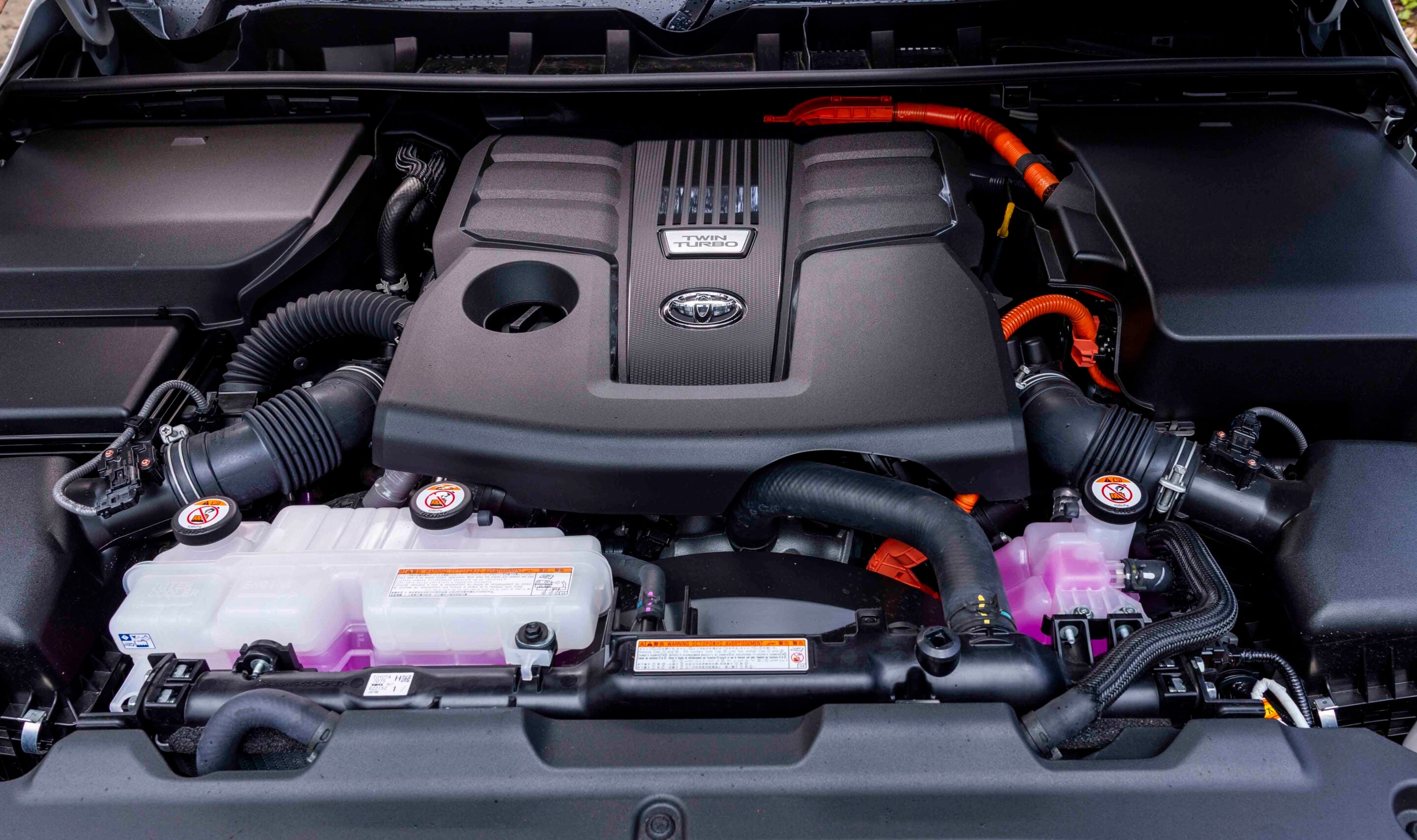
The twin-turbo 3.5-litre V6 single-motor hybrid system generates claimed combined outputs of 341kW and 790Nm to deliver performance to the LandCruiser.
The combination of petrol engine and hybrid power means you get the performance with relative efficiency. The electric power system uses an air-cooled 6.5Ah, 288V nickel-metal hydride (NiMH) battery that is installed in a waterproof tray beneath the rear luggage space. For this reason, the Performance Hybrid powertrain is only offered in five-seat versions of the LC300 and only in the high-end grades. The placement of the battery does raise the floor height in the cargo area a smidge, but it’s not enough to be a real negative.
By comparison, the diesel-fuelled variants of the same two models cost $137,790 for the GR Sport and $138,790 for the Sahara ZX, so the price of the hybrid is a big step up.
After sampling the Sahara ZX Performance Hybrid at the launch earlier this year, this was our first chance to try out the drivetrain in the GR Sport on familiar Melbourne tracks.
Off-road equipment
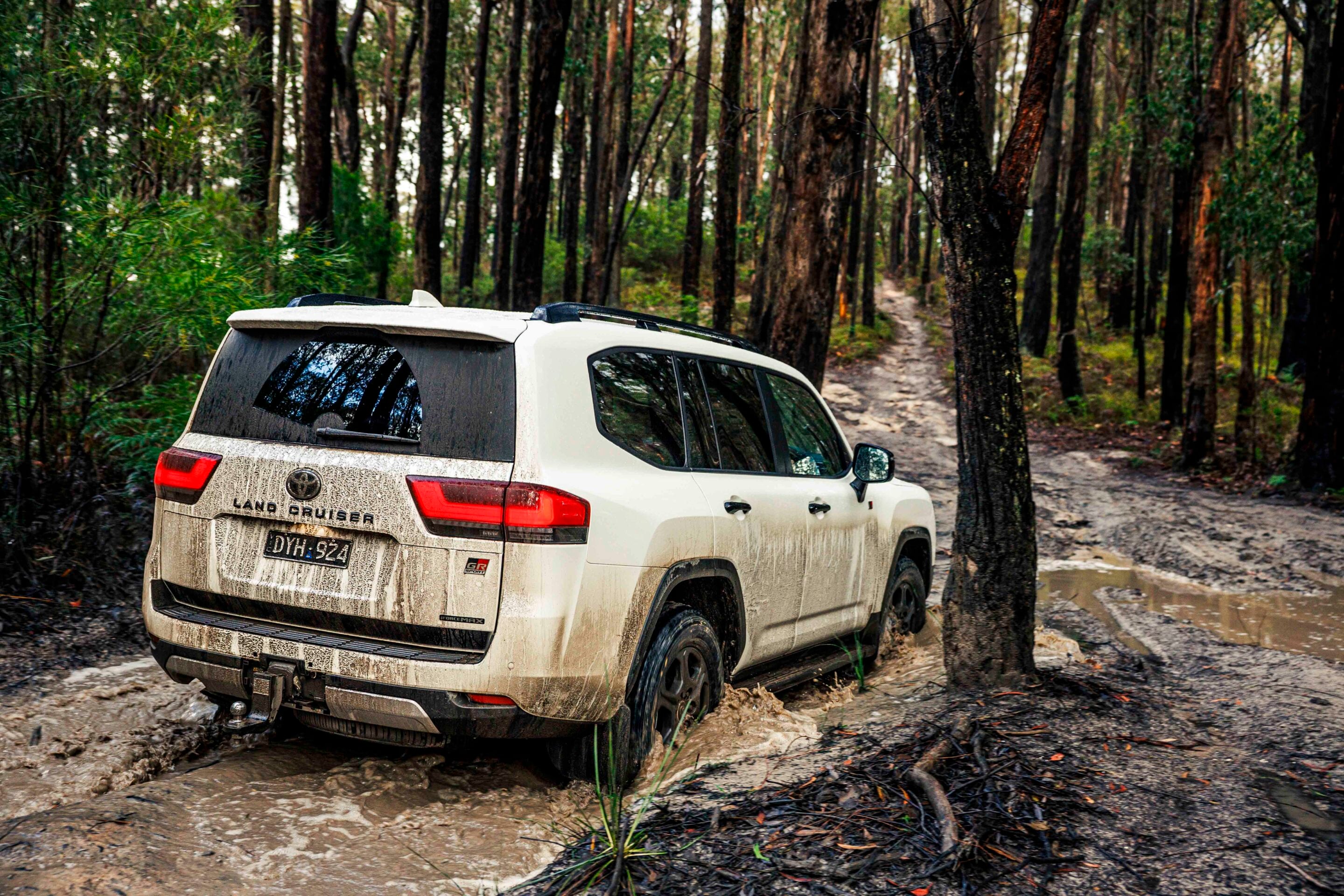
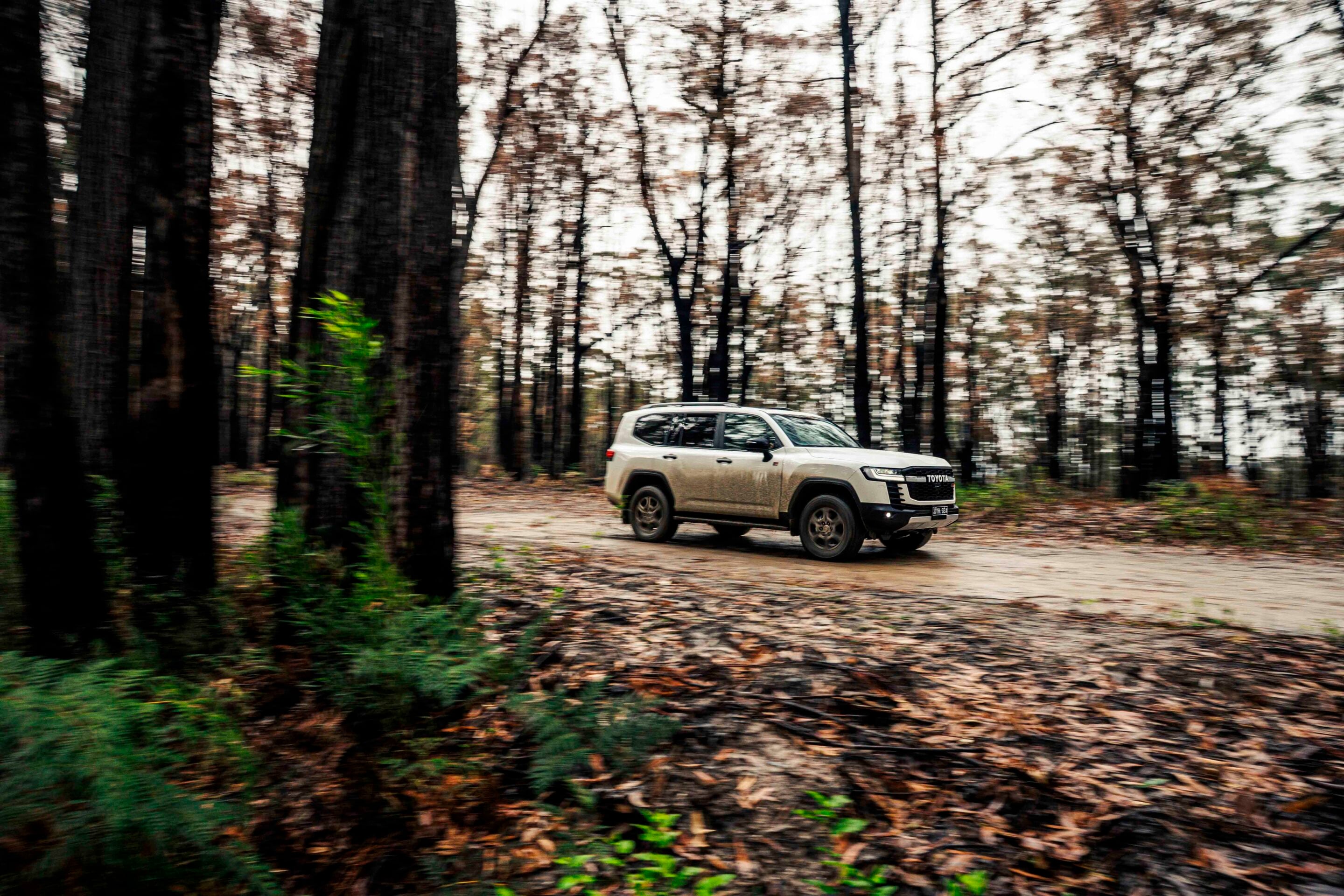
The GR Sport is the most off-road-ready model in the LC300 showroom, regardless of the fuel used.
This is thanks to front and rear locking differentials for improved traction, 18-inch tyres for more choice and a better ride, and e-KDSS suspension that adds extra wheel travel for improved traction off-road. There are also additional modes in the Multi-Terrain Select system to make the most of the hardware.
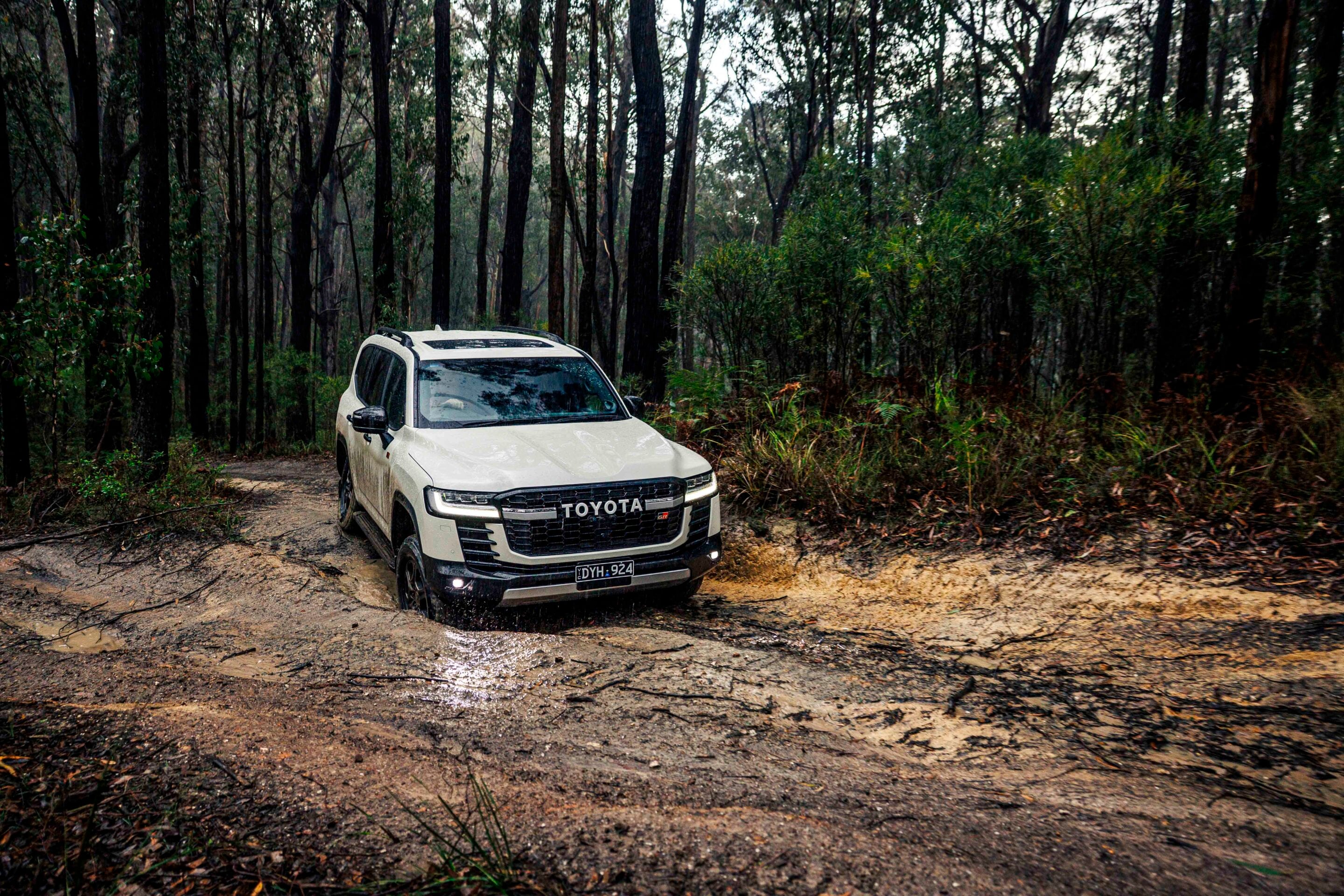
The GR Sport also gets a model-specific grille, wheels, badging and red highlights in and around the Cruiser. The Performance Hybrid Cruisers are five-seat only, while some other models in the LC300 range offer seating for seven.
1
Off-road performance
It’s those added extras in the GR Sport that give the driver the confidence to take on more difficult off-road terrain or unexpected obstacles.
On our drive we came across a track with flooded ruts and holes, but we had a fair idea they weren’t too deep. Still, they looked boggy, so we activated the Cruiser’s full off-road armoury just to be sure: low range, front and rear diff locks engaged and Mud & Ruts selected in the MTS.
LandCruisers have always had pretty good articulation from the rear live axle, but this is enhanced by the clever e-KDSS controlling the sway bars, allowing the heavy LC300 to crawl through the ruts while the locked diffs limit wheelspin in the boggy conditions.
1
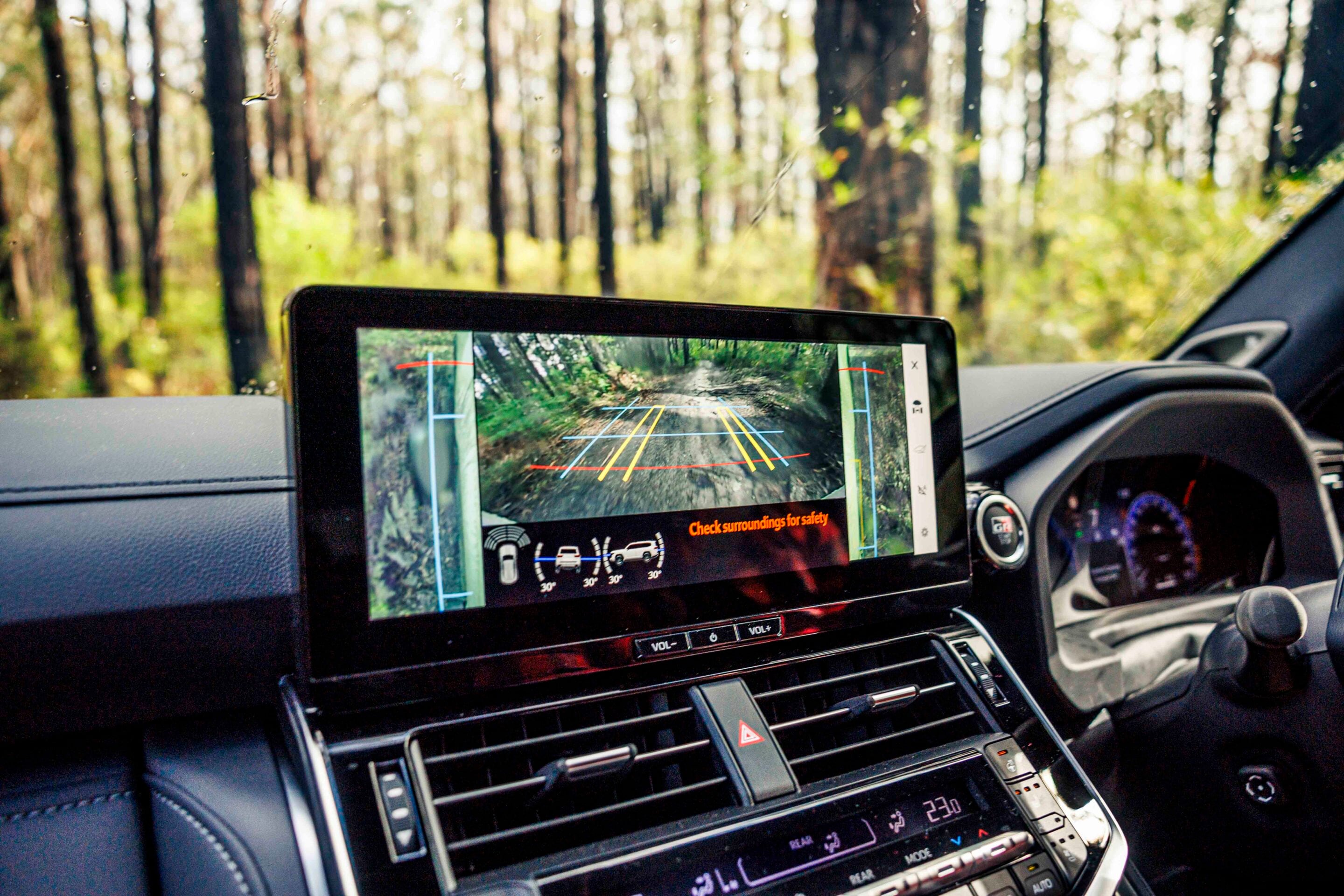
You could feel the suspension working beautifully, slinking its way across the crevasses in a way you wouldn’t expect of a big wagon that also has excellent on-road dynamics. It’s a system that works, and works well, which is all the more appreciated when driving on the modest OE tyres. We didn’t need Crawl Control or the tight-turn function, but they’re only a button press away if required.
If there was any complaint, it was the time it took to get the three lockers to engage after selecting them. It took longer than I would have liked, with the locker lights flashing on the dash until they could be coaxed in.
Off-road specification
Measurement
Approach angle
31
Ramp-over angle
21
Departure angle
24
Ground clearance
231mm
Wading depth
700mm
On-road performance
As mentioned, the LC300 is an accomplished on-road tourer, with e-KDSS again playing its part in the dynamics.
The GR Sport delivers a sure-footed and stable performance on wet gravel roads and highways alike. The performance of the petrol-hybrid powertrain is a revelation compared with previous Cruisers, and the electric assistance provides diesel-like torque at the bottom end while the turbocharged V6 carries that performance through the upper rev range. The LC300 Performance Hybrid is the most powerful and quickest LandCruiser ever offered in Australia, and drivers will appreciate its strong performance.
Interior and equipment
As the two Performance Hybrid LC300s are both high-end models, they come loaded with features. Both are luxurious inside, while the GR Sport gets red trim accents and GR badging to give it a sportier look.
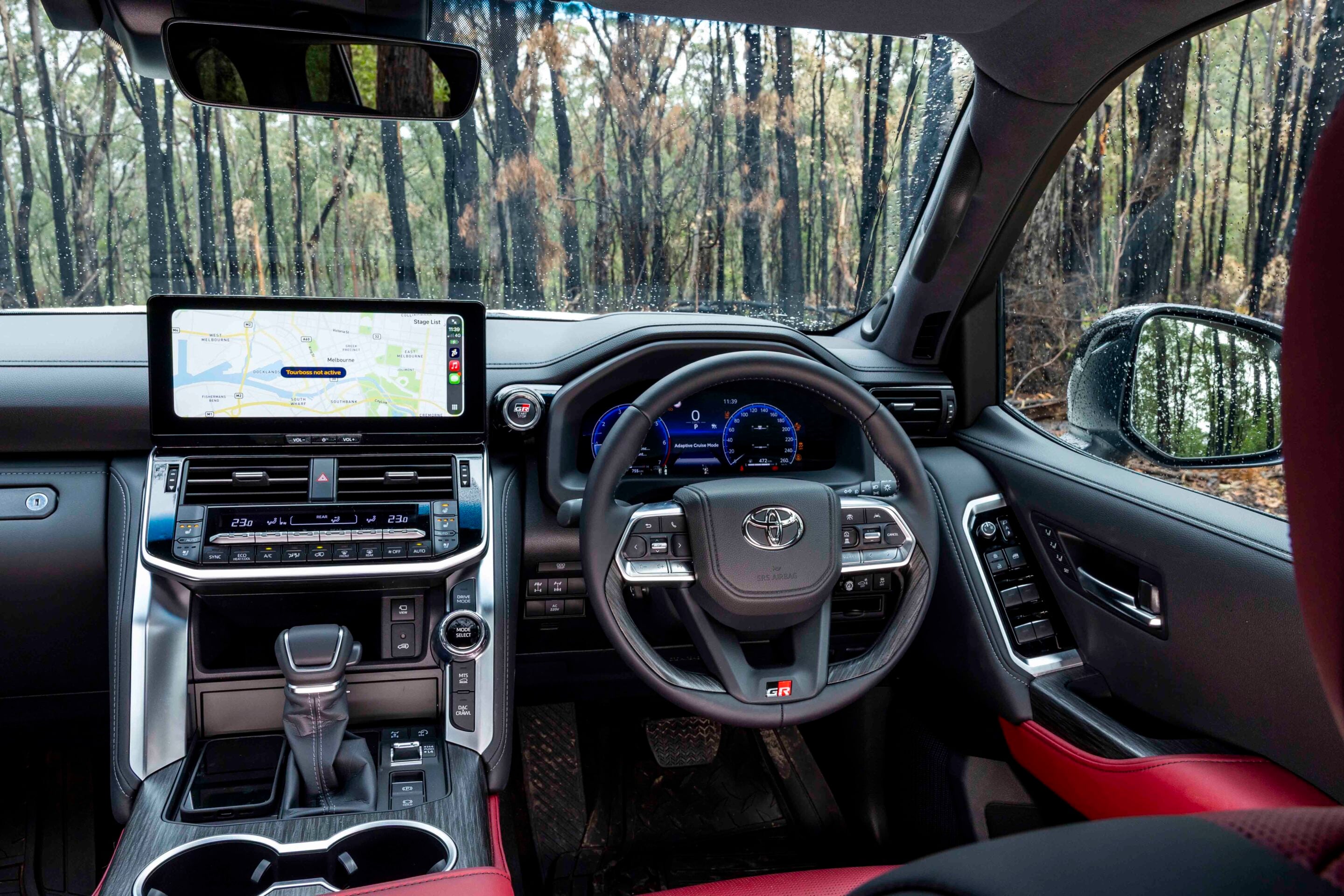
Inside, passengers are made comfortable with leather-accented seats with heating and cooling, heated outboard seats in the second row, a 14-speaker sound system, head-up display, heated steering wheel, cooler box in the console, rear-seat entertainment (headphones not included), four-zone climate control and wireless phone charging among its features. It’s the same cabin specification as the diesel GR Sport LandCruiser.
4
Verdict
That’s the good thing about the Performance Hybrid versions of the LandCruiser 300: Aside from the bigger fuel tank, the petrol model carries over all the 4×4 hardware and technology of the diesel models.
For the GR Sport, that means class-leading off-road equipment to get the Cruiser through tough terrain or around the country on your lap of the map.
The LandCruiser Performance Hybrid models share the same five-year/unlimited-kilometre Toyota warranty as the rest of the range, along with capped-price servicing for the first five years or 100,000km at $450 per service. Those services come every six months or 10,000km, whichever comes first, which is the same as the diesel-fuelled LC300, so there’s little, if any, cost saving there.
The Performance Hybrid powertrain requires 95RON or higher fuel, so depending on current prices, fuel costs will probably be higher for the petrol than the diesel once you factor in the petrol model’s higher consumption.
Most touring four-wheel drivers will still choose the diesel engine option, but it’s good to know there’s an alternative for those who don’t want diesel for whatever reason – and it’s a bloody good one.
5
Specs
Specifications
Price
$156,060 + ORC
Engine
Twin-turbo petrol V6 with single-motor hybrid system
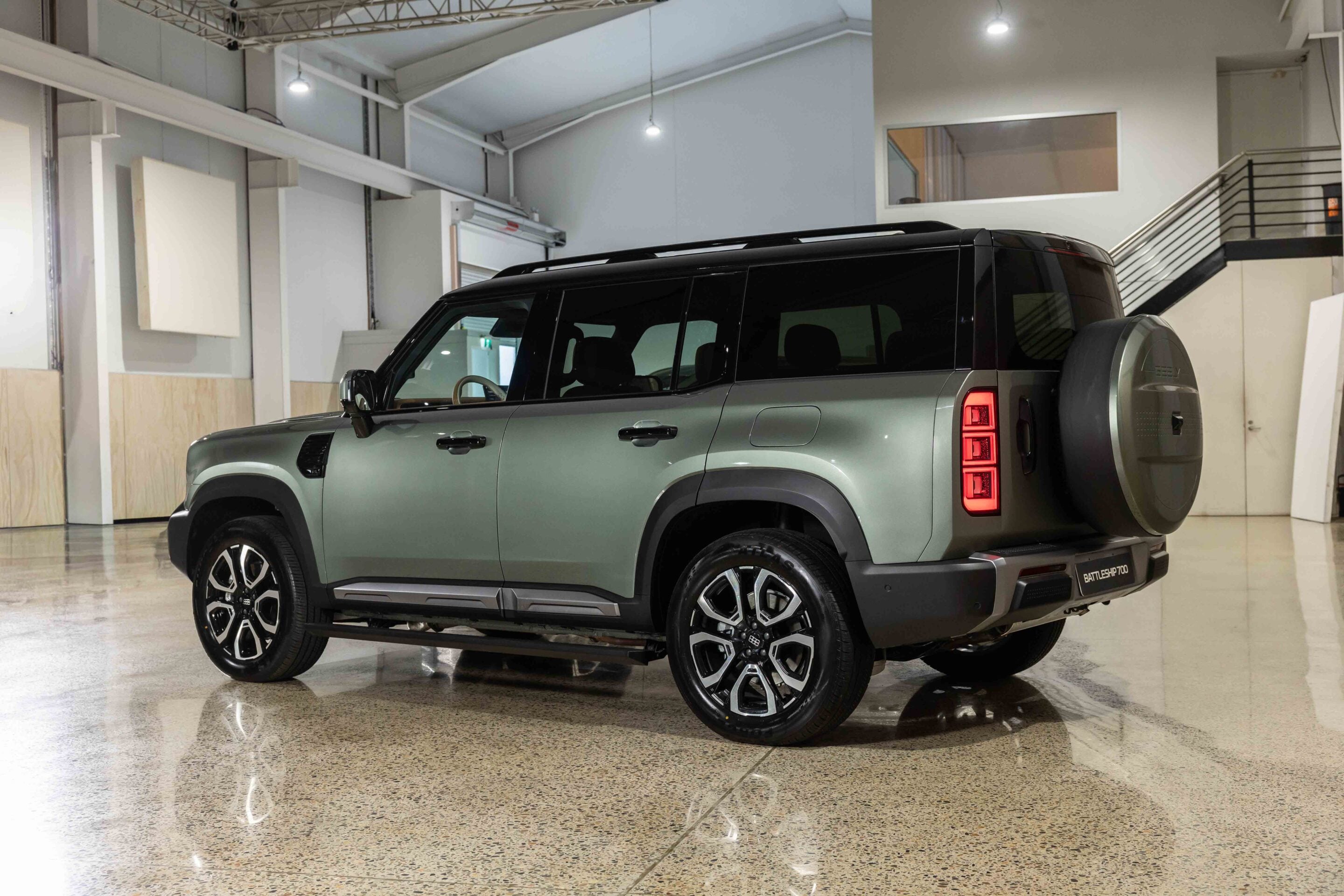
Geely has confirmed its Battleship 700 PHEV off-road SUV will launch in Australia in the second half of 2027, with a tri-motor all-wheel-drive system producing a claimed 830kW.
The five-seat Battleship 700 is powered overseas by a 2.0-litre turbocharged four-cylinder engine paired with a 47kWh battery pack. Its tri-motor all-wheel-drive system incorporates an integrated differential lock, with Geely claiming up to 170km of electric-only driving range.
The SUV has 233mm of ground clearance and an 800mm claimed water-wading depth, along with 20-inch wheels. It also features a ‘Waltz’ U-Turn function designed to allow the vehicle to manoeuvre on the spot.
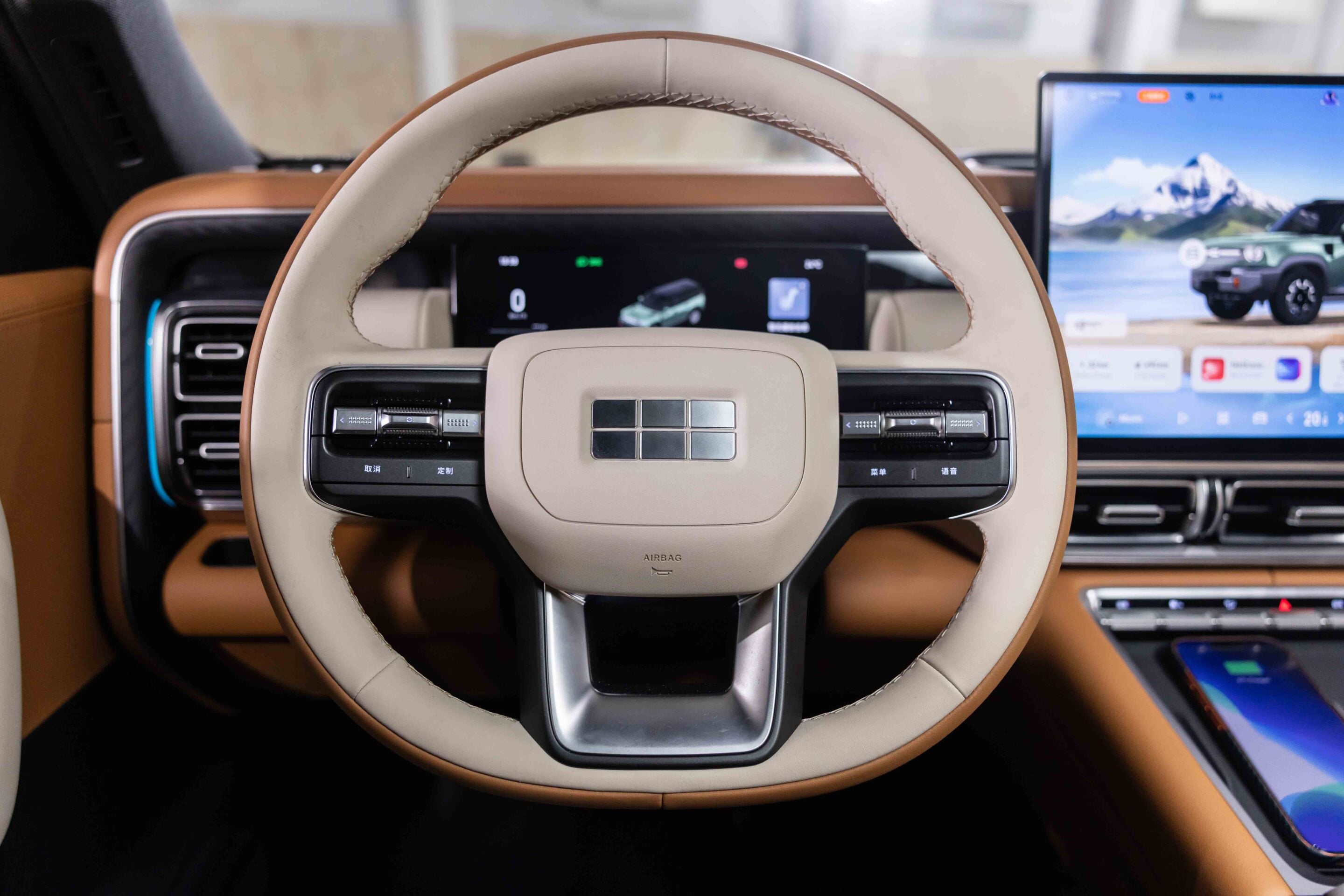
Cabin equipment includes a panoramic sunroof, 12.3-inch and 15.6-inch screens, a centre-console heating and cooling compartment, independent rear air-conditioning and a 23-speaker sound system.
Australian specifications, pricing and the exact launch timing will be announced closer to its arrival in the second half of 2027. The Battleship 700 is one of six Geely models planned for Australia in 2027, with the MONJARO EM-i SUV and Emgrand L EM-i sedan also confirmed for local launch in the first half of the year.
Geely Auto Group is a Chinese automotive company headquartered in Hangzhou and part of Zhejiang Geely Holding Group, with vehicle brands including Geely, Lynk & Co and Zeekr.
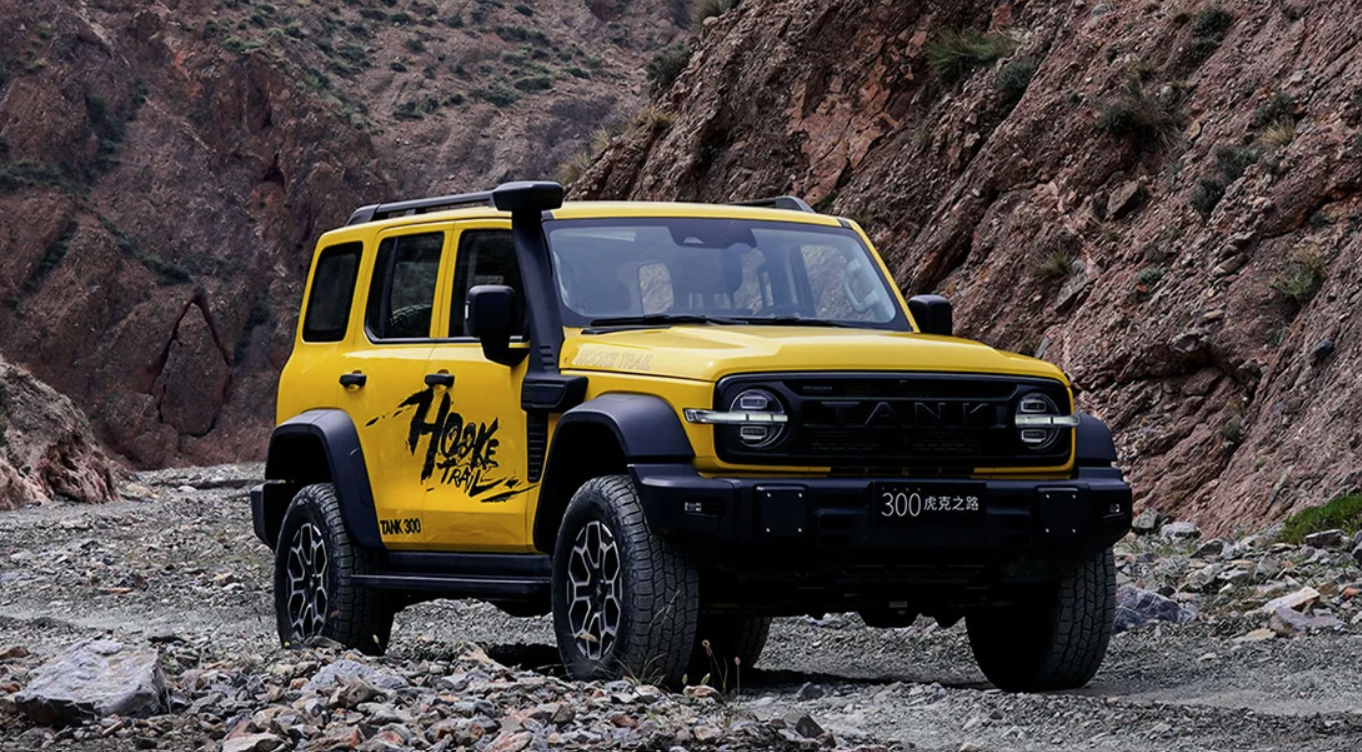
GWM has started taking pre-orders for the Tank 300 Hooke Trail Edition in China, a heavily reworked version of its off-road SUV aimed at the Jeep Wrangler that replaces the standard model’s independent front suspension with a solid axle.
First shown at the 2025 Shanghai Motor Show, the production Hooke Trail Edition is based on the longer-wheelbase Tank 300L (a Chinese-market model) and uses solid axles front and rear, along with three locking differentials, low range and increased suspension travel.
The front axle has been redesigned with strengthened components and an electronically disconnecting anti-roll bar. GWM claims more than 500mm of wheel articulation, while ground clearance is 245mm. Other claimed off-road figures include a 41-degree approach angle, 34-degree departure angle and 850mm wading depth. The Hooke Trail Edition runs 18-inch wheels with 265/70R18 tyres, while the revised suspension can clear 35-inch tyres and accommodate 40-inch rubber with modifications.
Despite being shown alongside GWM’s new 4.0-litre twin-turbo V8 at Shanghai, the production Hooke Trail Edition uses the 2.0-litre turbocharged four-cylinder, producing 170kW and 400Nm and driving through a nine-speed automatic. The vehicle has a 3010mm wheelbase, compared with 2750mm for the standard Tank 300, and measures 4886mm long, 1984mm wide and 1960mm high.
1
What are the chances of it coming to Australia?
GWM has not confirmed an Australian launch for the Hooke Trail Edition.
The Tank 300 is already sold locally, but there is currently no Australian timing or specification for the live-axle variant. If GWM does pursue an Australian launch, the Chinese-market vehicle would need to meet Australian regulatory and homologation requirements before it could be sold here.
Tank 300 Hooke Trail Edition key specs
Engine: 2.0-litre turbo petrol four-cylinder
Power: 170kW
Torque: 400Nm
Transmission: Nine-speed automatic
4WD: Mechanical four-wheel drive, low range and three locking differentials
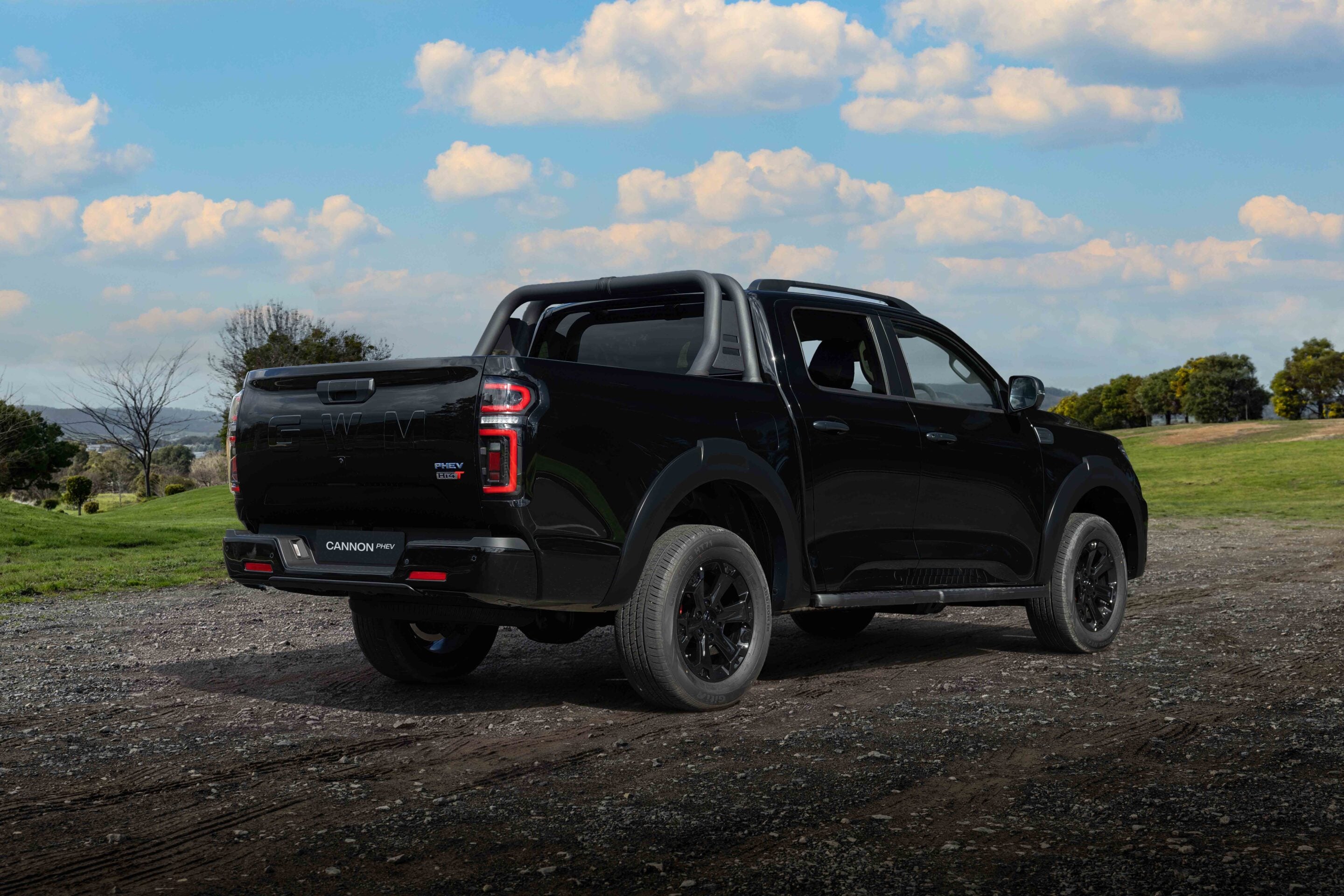
GWM has confirmed Australian pricing for its new Cannon Hi4-T plug-in hybrid ute, with the dual-cab available from $47,990 driveaway for eligible ABN buyers until October 31, 2026.
The $47,990 figure comes from a limited-time $2000 driveaway bonus. The standard ABN driveaway price for the Lux is $49,990, while private buyers pay $50,990 before the bonus, or $48,990 with it.
The Ultra is priced from $53,990 driveaway for ABN buyers, dropping to $51,990 with the bonus. Private buyers pay $1000 more, and customers who choose the standard driveaway price can instead receive a $2000 fuel card.
Once the launch offer expires, the Hi4-T Lux will start at $49,990 driveaway for eligible ABN buyers, making it Australia’s cheapest PHEV 4×4 ute on a standard ABN driveaway price. The JAC Hunter PHEV Pro is priced at $49,988 plus on-road costs, while the Hunter X costs $54,844 plus on-roads. The BYD Shark starts at $55,900 plus on-road costs for the Dynamic, rising to $57,900 for the Premium and $62,900 for the Performance, while the Ford Ranger PHEV starts at $59,000 driveaway for the XL.
The Hi4-T will be offered in Lux and Ultra grades, with both using a 2.0-litre turbo-petrol engine and GWM’s Hi4-T plug-in hybrid system. Combined outputs are rated at 310kW and 750Nm, while the ute retains a mechanical four-wheel-drive system and is rated to tow up to 3500kg braked.
Model
ABN holders
Private buyers
Launch offer
Cannon Hi4-T Lux
$49,990 driveaway
$50,990 driveaway
$2000 driveaway bonus or $2000 fuel card
Cannon Hi4-T Ultra
$53,990 driveaway
$54,990 driveaway
$2000 driveaway bonus or $2000 fuel card
3.5-tonne towing and 115km EV range
The Hi4-T combines plug-in hybrid power with a conventional mechanical 4WD system.
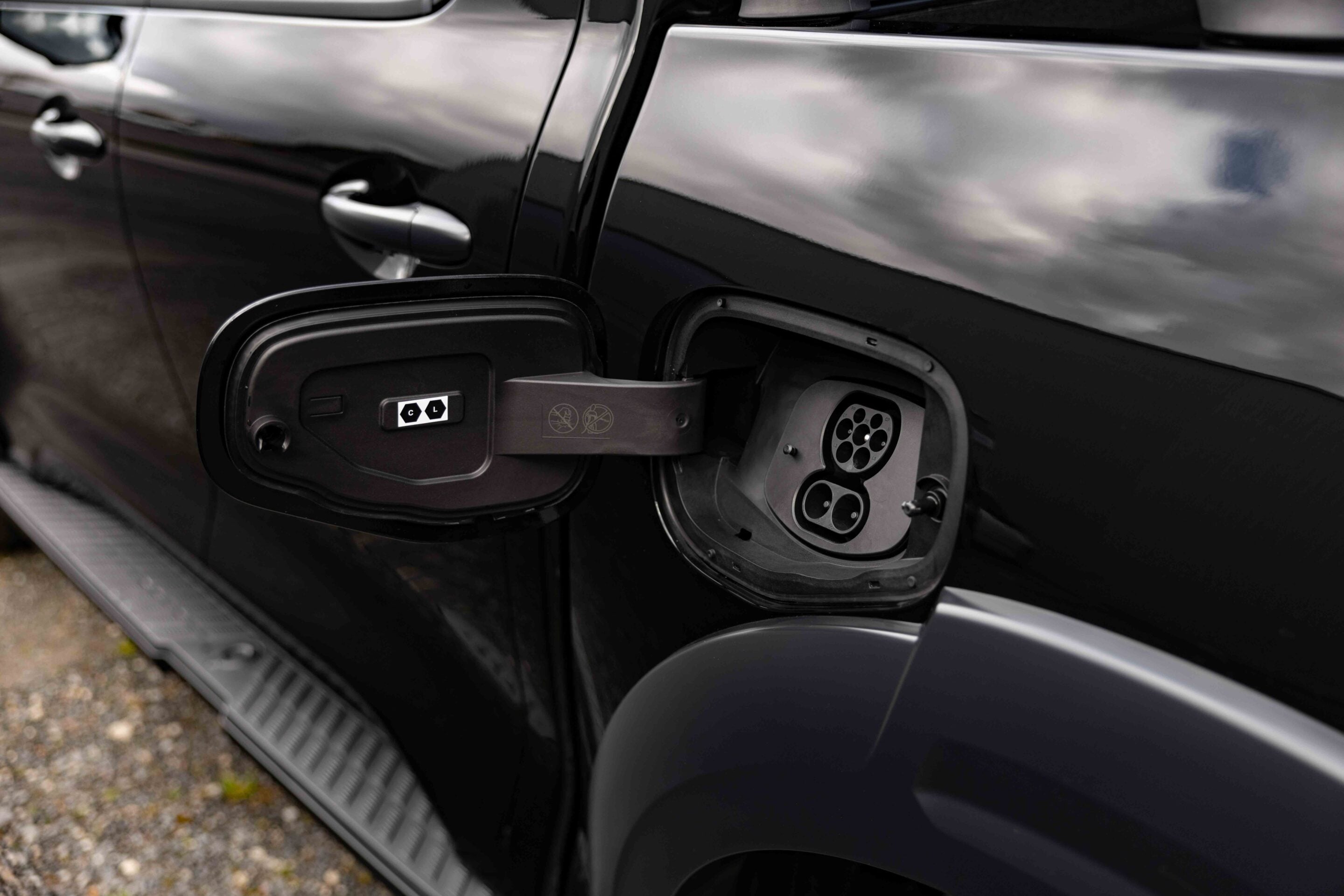
The Hi4-T architecture uses electric drive alongside a mechanical transmission and 4WD hardware, giving it the capability for towing and off-road driving rather than relying solely on electric motors. A 33.1kWh battery provides up to 115km of electric-only range on the NEDC test cycle. DC charging is supported at up to 110kW, with GWM claiming the battery can charge from 30 to 80 per cent in as little as 18 minutes.
For longer trips, GWM claims a combined petrol-and-electric driving range of up to 1037km from a single tank and charge, with claimed fuel consumption of 2.4L/100km. As with all lab figures, real-world range and consumption will vary according to driving conditions, load and how frequently the battery is charged.
1
The 3500kg braked towing rating puts the Hi4-T among the higher-capacity electrified utes available in Australia. It also gets Vehicle-to-Load functionality, with 230V outlets in the tub and up to 6kW of discharge power, which could be useful for running electrical equipment while touring or camping.
“GWM is taking a very deliberate approach to building a ute range that gives Australian customers genuine choice, rather than asking them to compromise around a single powertrain or specification,” said John Kett, GWM Australia Chief Operating Officer.
“The Cannon Hi4-T PHEV is an important part of that strategy. It gives us a second PHEV ute with a distinct proposition, complementing the Cannon Alpha while broadening the choice available to customers. Alongside the arrival of our new-generation 3.0-litre diesel, it demonstrates that GWM is prepared to invest across different technologies and segments to meet the changing needs of Australian drivers,” Kett said.
Specification
Cannon Hi4-T PHEV Lux Dual Cab
Cannon Hi4-T PHEV Ultra Dual Cab
Gross Combined Mass (GCM)
6400kg
6400kg
Gross Vehicle Mass (GVM)
3420kg
3420kg
Vehicle Tare Weight
2525kg
2530kg
Kerb Weight
2585kg
2585kg
Payload
835kg
835kg
Max Braked Towing Capacity
3500kg
3500kg
Unbraked Towing Capacity
750kg
750kg
Downball Weight
350kg
350kg
Blacked-out styling and new interior tech
Both grades get the same black exterior treatment, including a black sports bar, matte-black grille, door handles and mirror covers, black side steps, 18-inch black alloy wheels and red brake calipers. The Hi4-T also becomes the first GWM vehicle in Australia to use a 15.6-inch touchscreen running the company’s Coffee OS software.
The ute is expected to arrive at Australian GWM dealers from mid-October 2026, with pre-orders now open. Equipment levels and Australian specifications are listed below.
Specification
2026 GWM Cannon Hi4-T PHEV Lux Dual Cab
Length
5416mm
Width
1947mm
Height
1884mm
Wheelbase
3230mm
Minimum ground clearance
232mm
Wading depth
500mm
Approach angle
26°
Departure angle
23°
Breakover angle
19°
Turning circle (kerb to kerb)
13.1m
Fuel tank
75L
Seating capacity
5
What the Lux gets
18-inch black alloy wheels
Full-size steel spare wheel
Black front grille
Black side steps
Black roof rails
Black door handles and mirror caps
Black sports bar
Spray-on tub liner
Auto LED headlights with DRLs
LED tail-lights and sequential indicators
15.6-inch touchscreen infotainment system
GWM Coffee OS
Wireless Apple CarPlay and Android Auto
DAB+ digital radio
Six-speaker audio
10.25-inch digital instrument cluster
Wireless phone charger
Comfort-Tek leather seats
Adaptive cruise control and Intelligent Cruise Control
Electronic park brake with auto hold
Hill ascent and descent control
Rear parking sensors and reversing camera
Blind-spot monitoring
Rear cross-traffic alert with braking
Seven airbags
Full suite of collision avoidance and lane-keeping systems
The MGU9 EV will be priced from $78,990 plus on-road costs when it arrives in Australia from Q4 2026. Australia will be the first market globally to launch the electric ute.
“At $78,990 plus on-road costs, we believe the MGU9 EV offers a compelling combination of capability, performance and technology, and we’re excited that Australia will be the first market globally to be able to get behind the wheel,” said Dimitri Andreatidis, Marketing Director at MG Motor Australia.
As reported earlier this week, the MGU9 EV uses a 102.2kWh LFP battery and dual electric motors producing 325kW and 700Nm, with all-wheel drive.
It has a claimed 430km WLTP driving range, 3500kg braked towing capacity, 750kg unbraked towing capacity and 685kg payload. Four-wheel Electronic Air Suspension is fitted. The 325kW/700Nm powertrain delivers a claimed 0–100km/h time of 5.8 seconds.
The MGU9 EV has a 236-litre frunk and 6.6kW vehicle-to-load (V2L) capability, with 2.2kW available through an internal power outlet. Charging is supported at up to 11kW on AC and 115kW on DC, with MG quoting around 42 minutes for a 20 to 80 per cent DC charge.
The cabin gets leather front seats, dual 12.3-inch displays, wireless Apple CarPlay and Android Auto, 15W wireless charging and an eight-speaker JBL sound system. The driver’s seat has heating, ventilation and massage functions.
The MGU9 EV will be sold through MG’s nationwide dealer network and covered by a seven-year warranty when serviced within the MG dealer network.
The new Nissan Patrol will have more room for passengers and luggage than the outgoing Y62, while its braked towing capacity increases to 3700kg across the Australian range.
Nissan Australia has released more details of the new Patrol ahead of its arrival here, with the biggest practical changes centred on passenger space, cargo capacity and towing.
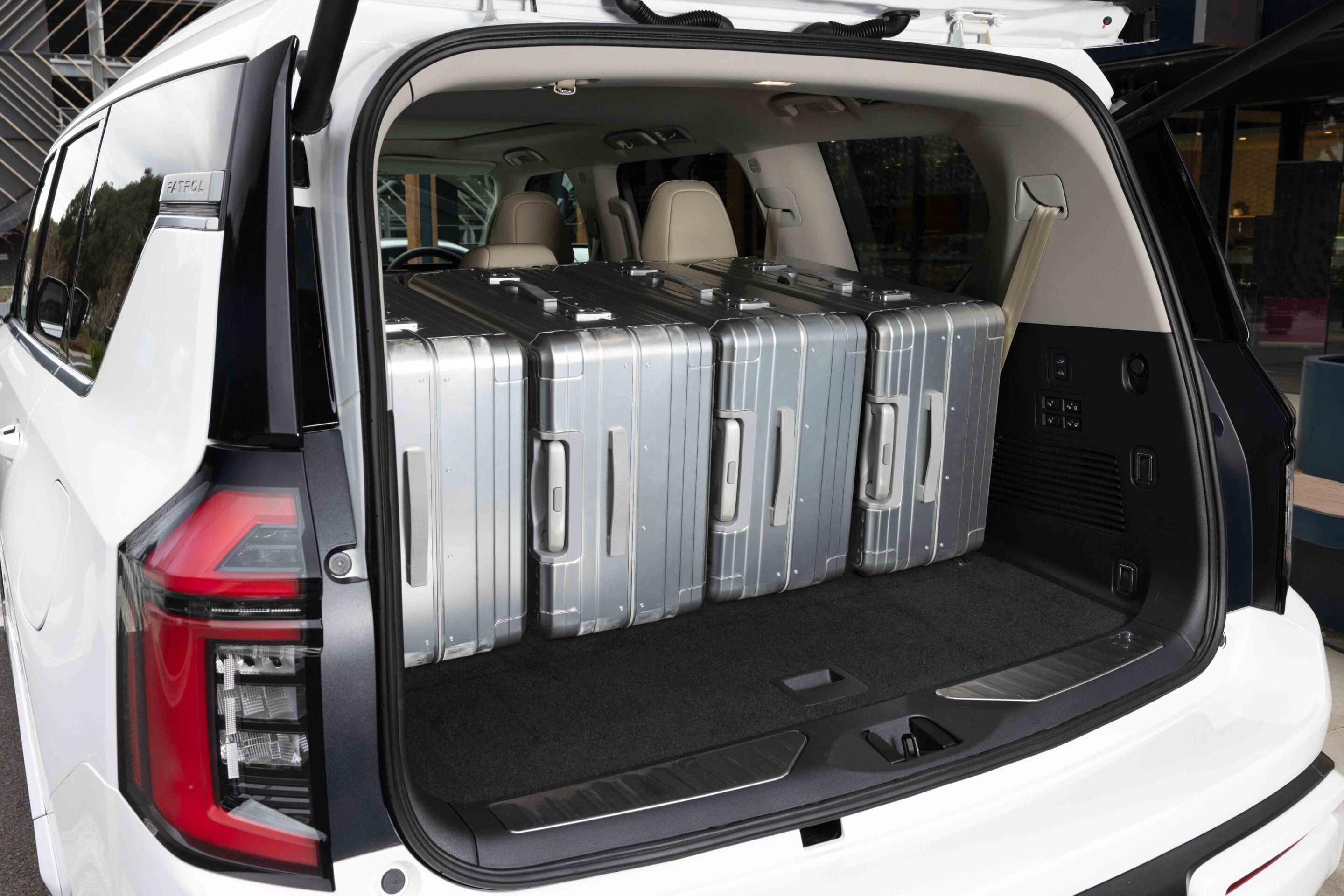
Cargo capacity increases to 577 litres with all three rows in use, 1594 litres with the third row folded and 2749 litres with both rear rows folded. Those figures represent increases of 110, 181 and 127 litres respectively over the outgoing Y62 Patrol.
The second and third rows can also be folded to create a near-flat cargo floor, which should make it easier to load larger items. PRO-4X and Ti-L Reserve grades get adaptive air suspension that can lower the vehicle to make loading the cargo area easier.
4
Nissan Oceania Managing Director Steve Milette said the changes were focused on improving the Patrol’s practicality for passengers and families.
“The all-new Patrol’s improvements extend beyond its exterior design and powertrain, with particular attention given to the needs of passengers and families. The Patrol has always been valued by Australian families for its space, comfort and versatility. With the all-new model, we’ve taken those attributes to another level.
“From significantly increased third-row space and greater second-row legroom to more usable cargo capacity and 3,700kg braked towing capability‡ across the range, the all-new Patrol has been engineered to be even more capable of meeting the demands of Australian families.”
1
More room across all three rows
The second row can slide fore and aft, giving passengers up to 250mm more legroom than the Y62 when positioned at the rear of its travel.
A new tilt-and-glide function also makes access to the third row easier, including when a child seat is fitted to the second row. Third-row space gets a substantial increase, with 75mm more hip room and 66mm more knee room than the Y62. Moving the second row to its forward-most position provides up to 253mm more legroom, while outboard third-row passengers gain 84mm of heel clearance.
The third row also gets a flatter floor, while a wider sidestep is fitted across the range to make getting into and out of the rear seats easier. Nissan says the changes are intended to make the third row more suitable for three passengers rather than simply serving as occasional seating.
Up front, all grades gain more hip, shoulder and legroom, along with a higher driver eyeline. The front and second-row seats use a new ‘Zero Gravity’ structure with high-damping foam designed to reduce vibrations over rough and corrugated roads. Seat massage is available for the driver on Ti-L+ and for both front occupants on Ti-L Reserve.
1
3700kg towing across the range
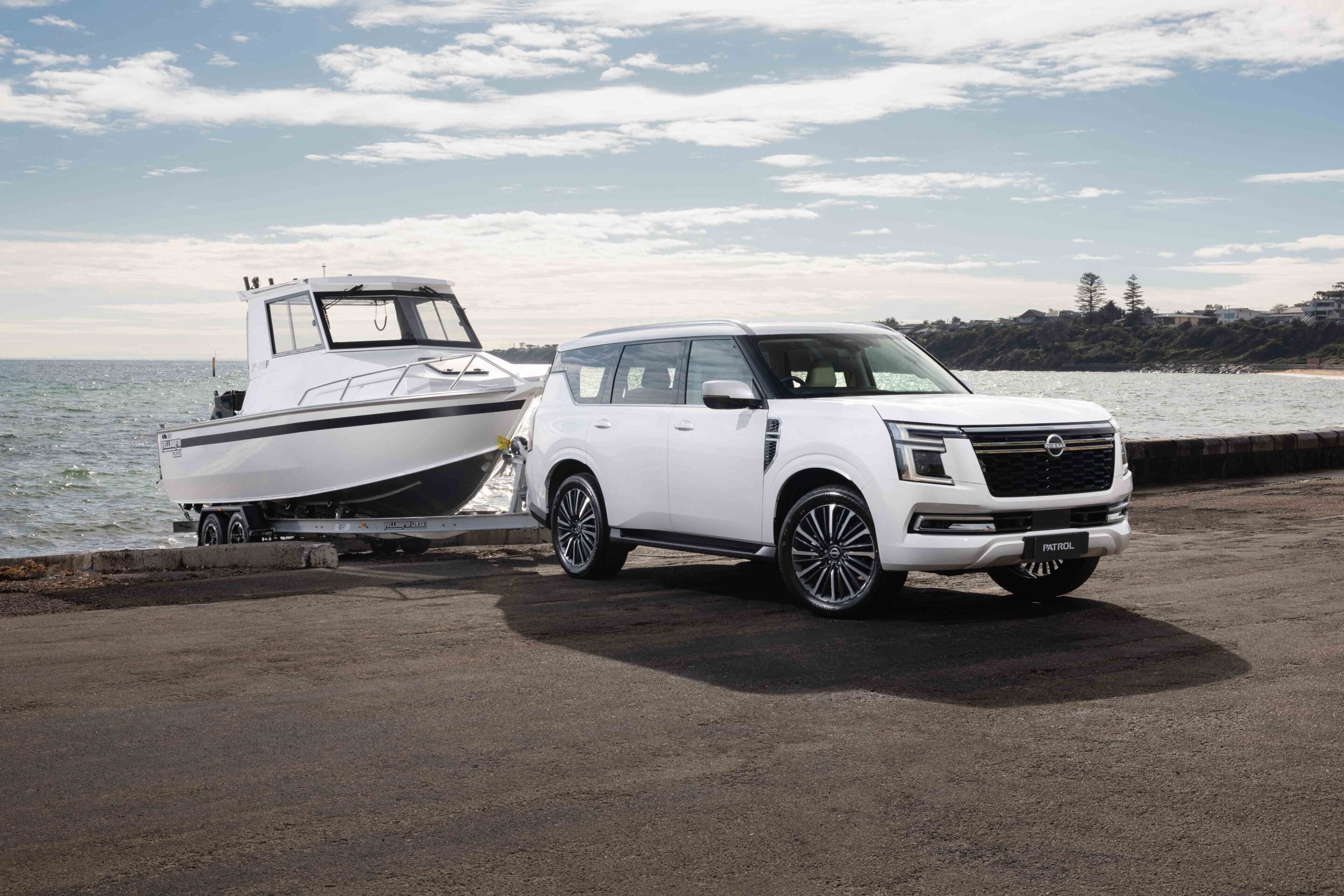
The new Patrol’s braked towing capacity increases by 200kg to 3700kg across the range.
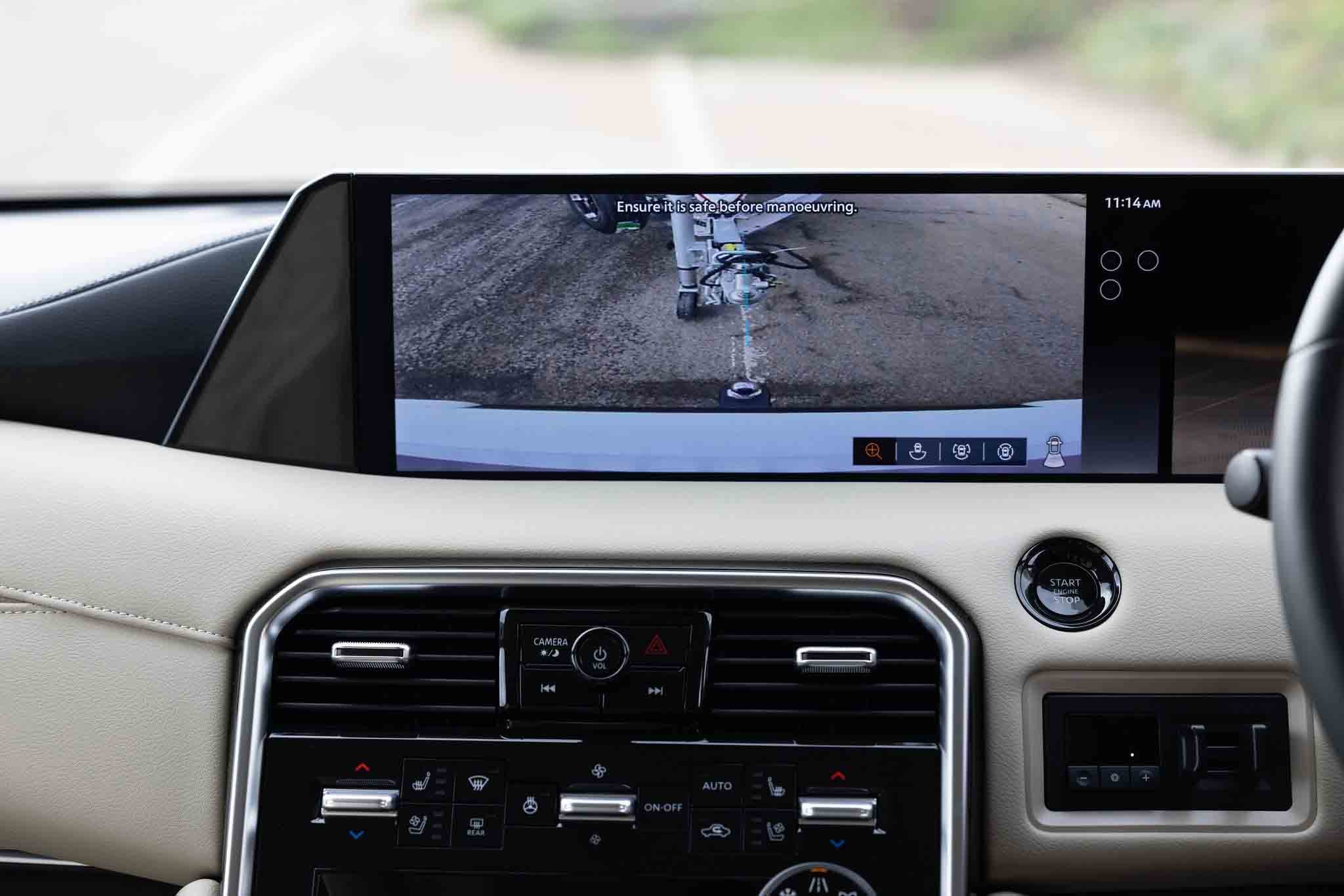
Nissan will offer a range of tow tongue and tow ball configurations as at-cost accessories, including a configuration supporting the full 3700kg rating. Trailer Blind Spot Warning is now fitted across the range, joining Trailer Sway Control. PRO-4X and Ti-L Reserve grades add Trailer Docking Support to help align the tow bar with a trailer coupling, while both grades get an electric trailer brake controller as standard.
The Patrol range starts at $98,990 for the Ti and extends to $145,990 for the Ti-L Reserve, with the range powered by a 3.5-litre twin-turbo petrol V6 producing 317kW and 700Nm, paired with a nine-speed automatic and full-time 4WD with 4H and 4L. The range also gets an electronic rear differential lock, while the PRO-4X adds adaptive air suspension, all-terrain tyres and a dedicated off-road front bumper.
The all-new Nissan Patrol is due to reach Australian customers in the first quarter of 2027.
The essential info
Cargo capacity: 577L with all three rows in use
Cargo capacity: 1594L with third row folded
Cargo capacity: 2749L with second and third rows folded
Second-row legroom: Up to 250mm more than Y62
Third-row hip room: 75mm more than Y62
Third-row knee room: 66mm more than Y62
Third-row legroom: Up to 253mm more with second row moved forward
Third-row heel clearance: 84mm more for outboard occupants
A touring 4WD can place far greater demands on its suspension than a standard vehicle.
A canopy, drawers, fridge, rooftop tent, recovery gear, extra fuel and water all add weight, while towing a camper trailer adds another load to the vehicle. That extra weight changes how the 4WD sits, rides and handles. It can also affect suspension travel, braking and how much capacity is left within the vehicle’s weight ratings.
Choosing suspension for a loaded touring 4WD isn’t simply a matter of picking a lift height or ordering the heaviest springs available. The setup needs to suit how much weight the vehicle carries, where that weight sits and whether it’s there all the time or only when you’re heading away.
The best place to start is with actual vehicle weights. Weighing the 4WD in its normal touring configuration, including front and rear axle weights, gives you the information needed to select springs and shocks for the vehicle you actually drive.
A stock or lightly modified 4WD and a fully loaded touring rig can have very different suspension requirements.
A vehicle carrying permanent touring equipment needs to support that weight every kilometre, while one that only gets loaded for occasional trips needs to cope with a much wider range of weights. Add a camper trailer and the suspension also has to deal with the extra load transferred through the towball.
The vehicle’s accessories, passengers, fuel, water and camping equipment all contribute to its laden weight, while their position affects how that weight is distributed between the front and rear axles.
The most useful numbers when selecting load-specific suspension are the vehicle’s actual weight and its front and rear axle weights. Weigh the 4WD in the condition you expect to travel, including passengers, fuel, water, camping equipment and permanent accessories. If you’re towing, include the trailer ball weight in the assessment. A heavy bull bar and winch can increase front axle weight, while drawers, a canopy, fridge, spare wheel and water can add plenty of weight at the rear.
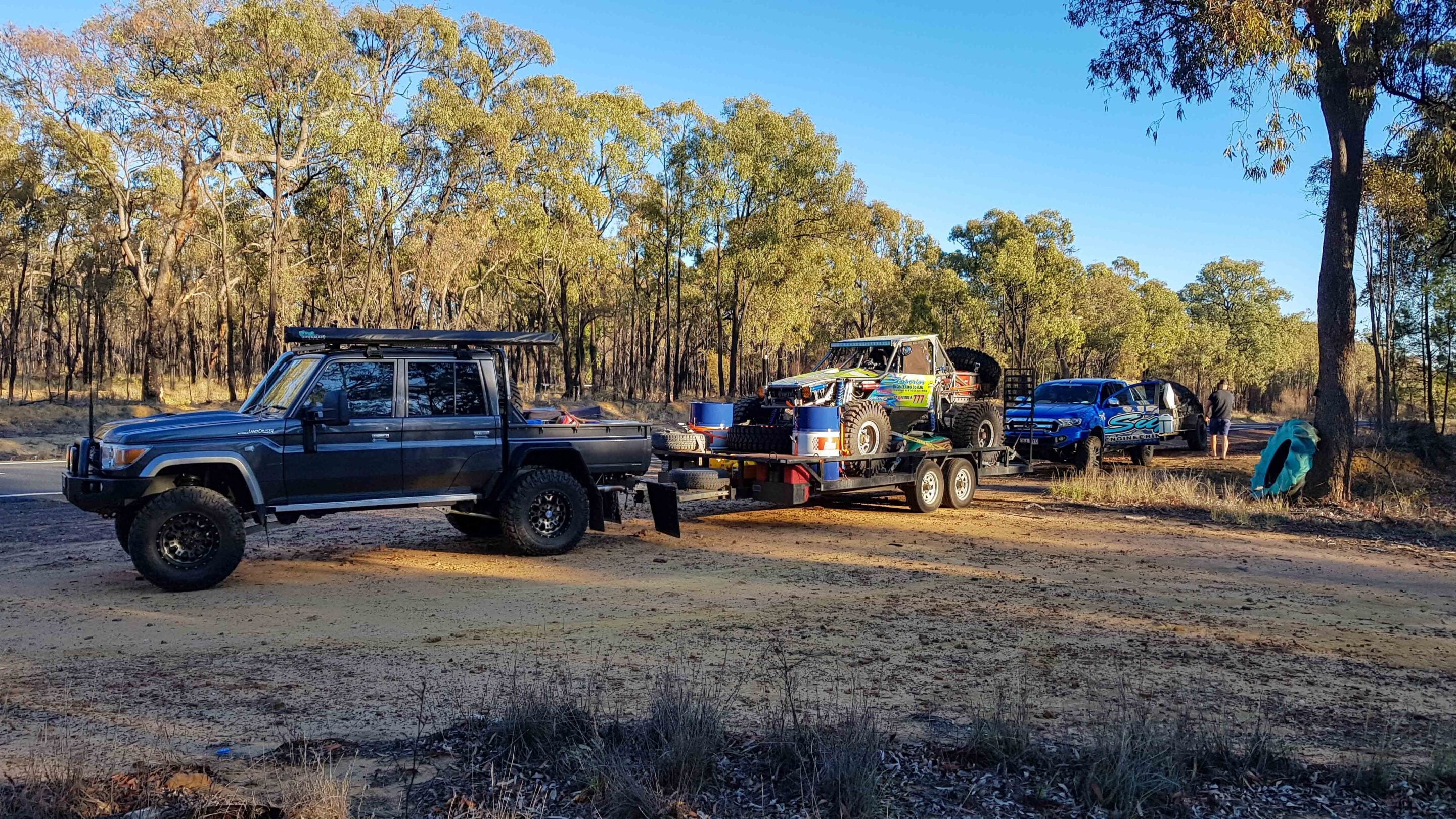
Those figures give a suspension specialist like Superior Engineering a much better basis for selecting spring rates than the vehicle model or a generic “heavy-duty” recommendation.
Use
Suspension considerations
Light touring
Balanced spring rates and good ride quality
Permanent touring load
Springs matched to constant front and rear loads
Heavy touring load
Appropriate spring rate and shock valving
Touring plus camper trailer
Vehicle load and trailer ball weight considered together
Heavy modified touring rig
Payload, axle ratings, GVM and compliance requirements
Spring rate matters more than lift height
When suspension is being selected for a loaded touring vehicle, spring rate matters more than simply deciding how much lift you want.
The spring needs to support the actual load while maintaining appropriate ride height and usable suspension travel. A spring that’s too soft can allow the vehicle to sag under load, while one that’s unnecessarily stiff can make the 4WD uncomfortable when unloaded and limit suspension movement.
Front and rear spring rates also need to be considered separately. A heavy bull bar and winch add weight at the front, while drawers, a canopy, fridge, water and other touring equipment can put considerably more weight over the rear axle.
There isn’t one universal “touring” spring rate. It comes down to the vehicle’s actual load and how that load is distributed. Constant-load springs are designed for vehicles that carry extra weight most of the time. They’re suited to a 4WD with permanent touring equipment where the extra load is always present. Variable-load setups are better suited to vehicles that spend much of their time relatively lightly loaded but gain a lot of weight when preparing for a trip.
Going for the heaviest spring available isn’t necessarily the better option. If the spring rate is too high for the vehicle’s normal load, the result can be a harsh unloaded ride and reduced ability for the suspension to articulate over uneven ground.
1
Matching shocks to the load
Springs support the vehicle’s weight, while shock absorbers control suspension movement.
Once a 4WD is carrying a lot more mass, the shocks need to control that extra weight. Shock valving needs to be considered alongside spring rate rather than treating shocks as a one-size-fits-all component.
A vehicle carrying a constant heavy load can require different valving from one that only carries that weight occasionally. Terrain and intended use also matter, particularly for vehicles spending long periods on corrugations or tackling demanding off-road tracks.
More specialised shock designs can suit certain applications. Remote-reservoir shocks can provide extra oil volume and heat-management capability, while bypass shocks, more commonly seen in high-speed off-road use, offer greater scope for specialised damping control. Neither is automatically required for a touring 4WD. The shock needs to suit the vehicle, load and type of driving.
Adding weight can change how a 4WD responds to steering inputs, corners and uneven terrain. The effect can be more noticeable when a vehicle carries a heavy touring load high on the body or when its suspension has been modified.
Sway bars and other load-related handling components can form part of the overall suspension package, including disconnectable sway bars where extra articulation is needed for off-road touring. Their suitability needs to be considered alongside spring rates, shocks, vehicle weight and intended use rather than treated as an isolated upgrade.
Towing adds another load
A camper trailer changes things because some of the trailer’s weight is transferred through the towball.
That ball weight is transferred into the tow vehicle and contributes to its axle loading. A 4WD with a heavy canopy, drawers, fridge and water system may already have significant rear axle loading before the trailer is connected. A setup designed around the vehicle’s camping equipment alone may not be appropriate once a camper trailer is added. The vehicle’s actual towing configuration should be part of the suspension assessment from the beginning.
Airbags or auxiliary load-assist systems can be useful where the vehicle’s load varies a lot or extra rear support is needed for a particular application. They don’t remove the need to select an appropriate primary spring. A vehicle carrying a constant heavy load still needs a spring rate suited to that load rather than relying on airbags to compensate for an unsuitable setup.
For vehicles that alternate between unloaded daily driving and heavily loaded touring, an auxiliary system can be one way of managing the change in load. The best option comes down to how much the vehicle’s weight varies and what it is being used for.
1
When does a GVM upgrade become necessary?
A suspension upgrade doesn’t automatically increase how much weight a vehicle can legally carry.
Every 4WD has applicable weight ratings, including its GVM and axle ratings. Once accessories, passengers and touring equipment are added, the available payload can reduce quickly.
For heavily modified touring vehicles, a GVM upgrade kit may be necessary where the extra equipment and intended load would otherwise push the vehicle beyond its original rating. These kits can involve specific suspension components and compliance requirements, depending on the vehicle and the applicable approval.
A GVM upgrade also doesn’t mean axle ratings or other applicable limits can be ignored. Requirements for GVM upgrades and their legal recognition vary between states, territories and countries, so check the requirements that apply to your vehicle before making modifications.
The suspension setup should reflect how the vehicle is actually used, not just how much lift it has.
Light touring: If the vehicle only carries camping equipment occasionally and spends most of its time unloaded, a variable-load setup can avoid unnecessarily stiff suspension during everyday driving.
Heavy touring: A vehicle with permanent drawers, canopy, fridge, fuel, water and other equipment needs springs matched to those constant loads, with shock valving suited to the resulting weight.
Touring and towing: If the vehicle carries a heavy touring load and regularly tows a camper, both the laden vehicle and trailer ball weight need to be considered when selecting the suspension.
What suspension does your touring 4WD need?
For loaded touring, suspension isn’t about chasing the highest spring rate or greatest lift. It needs to support the vehicle’s actual load while providing appropriate damping, handling and suspension travel.
Before buying, get the 4WD weighed in its touring configuration and obtain front and rear axle weights. Take those figures, along with details of any trailer and its ball weight, to a suspension specialist or experienced fitter like Superior Engineering.
That gives you a suspension setup based on the load the vehicle actually carries, helping avoid springs that are too soft for the job or unnecessarily stiff for the way you use the 4WD.
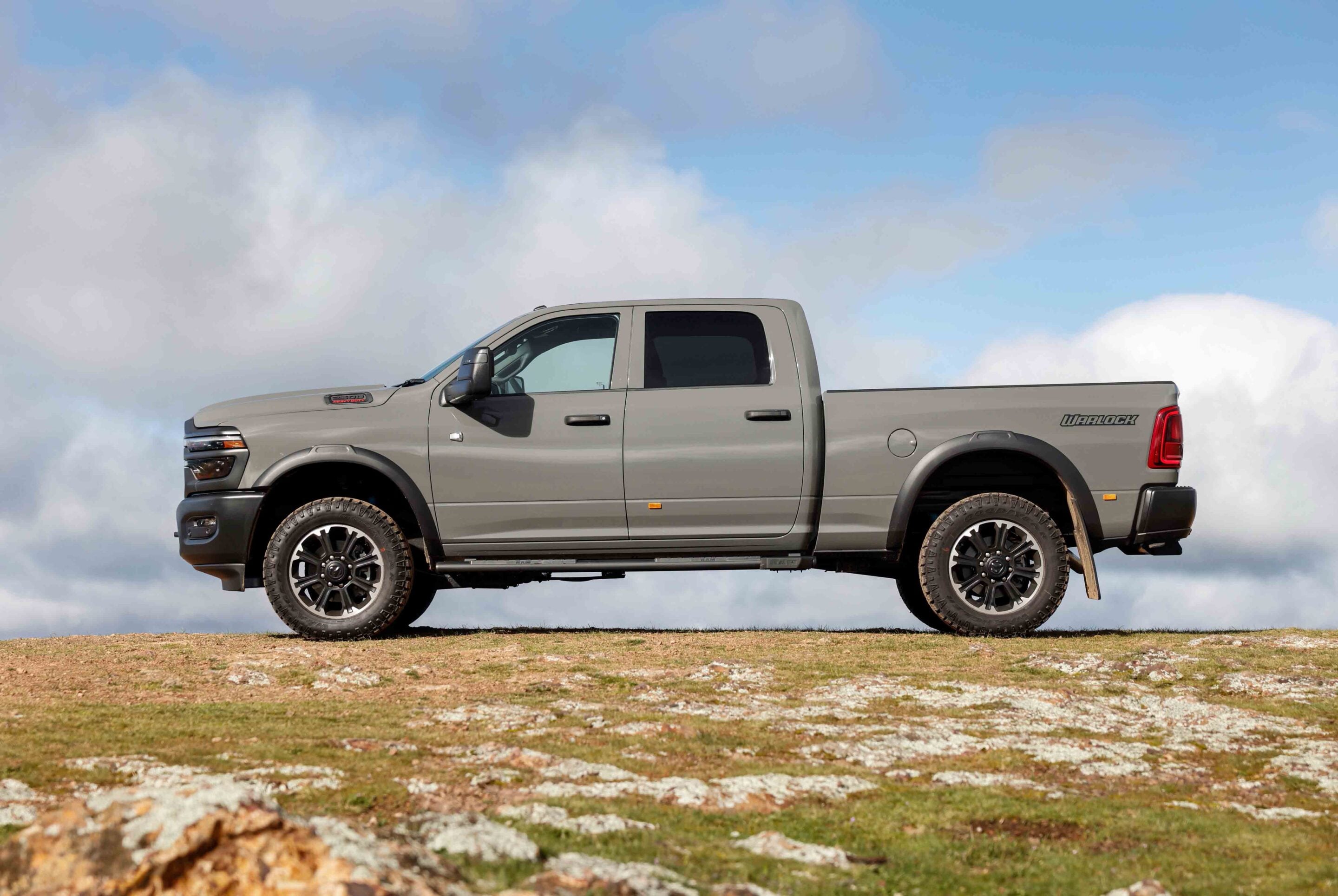
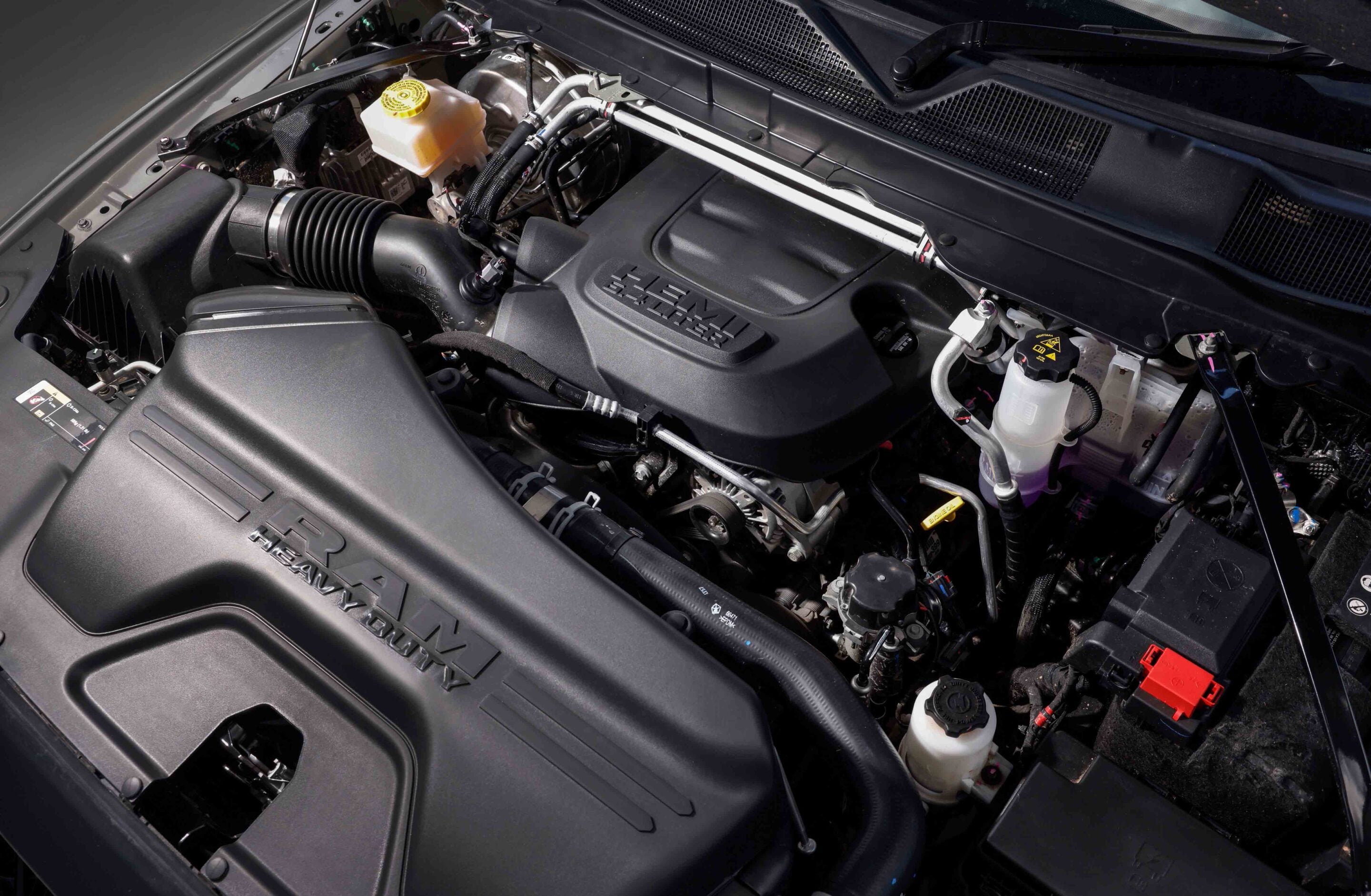
The HEMI V8 is returning to the local Ram line-up after a two-year production hiatus, with the 6.4-litre petrol engine joining the Ram 2500 Heavy Duty range in the new Warlock variant.
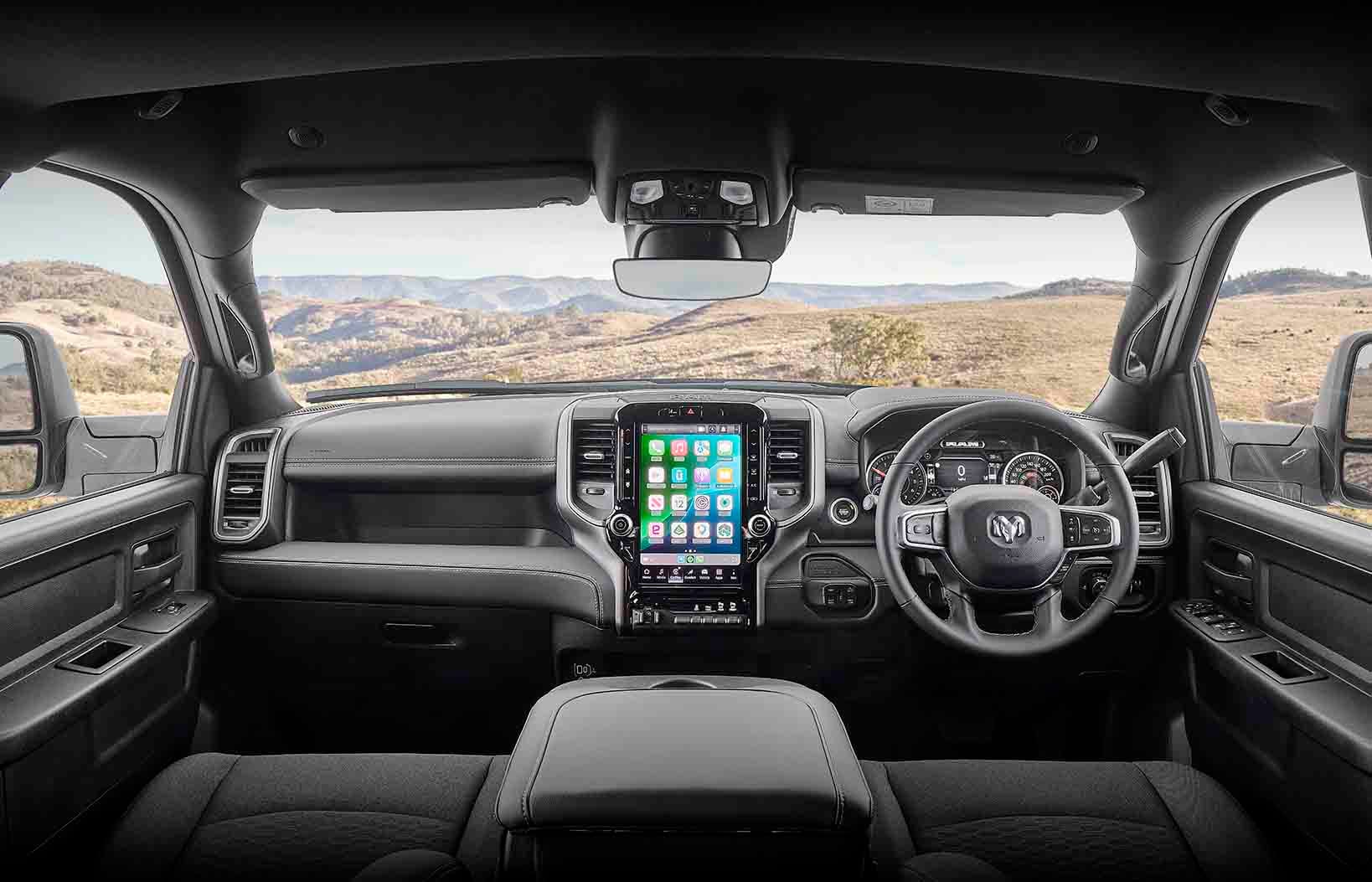
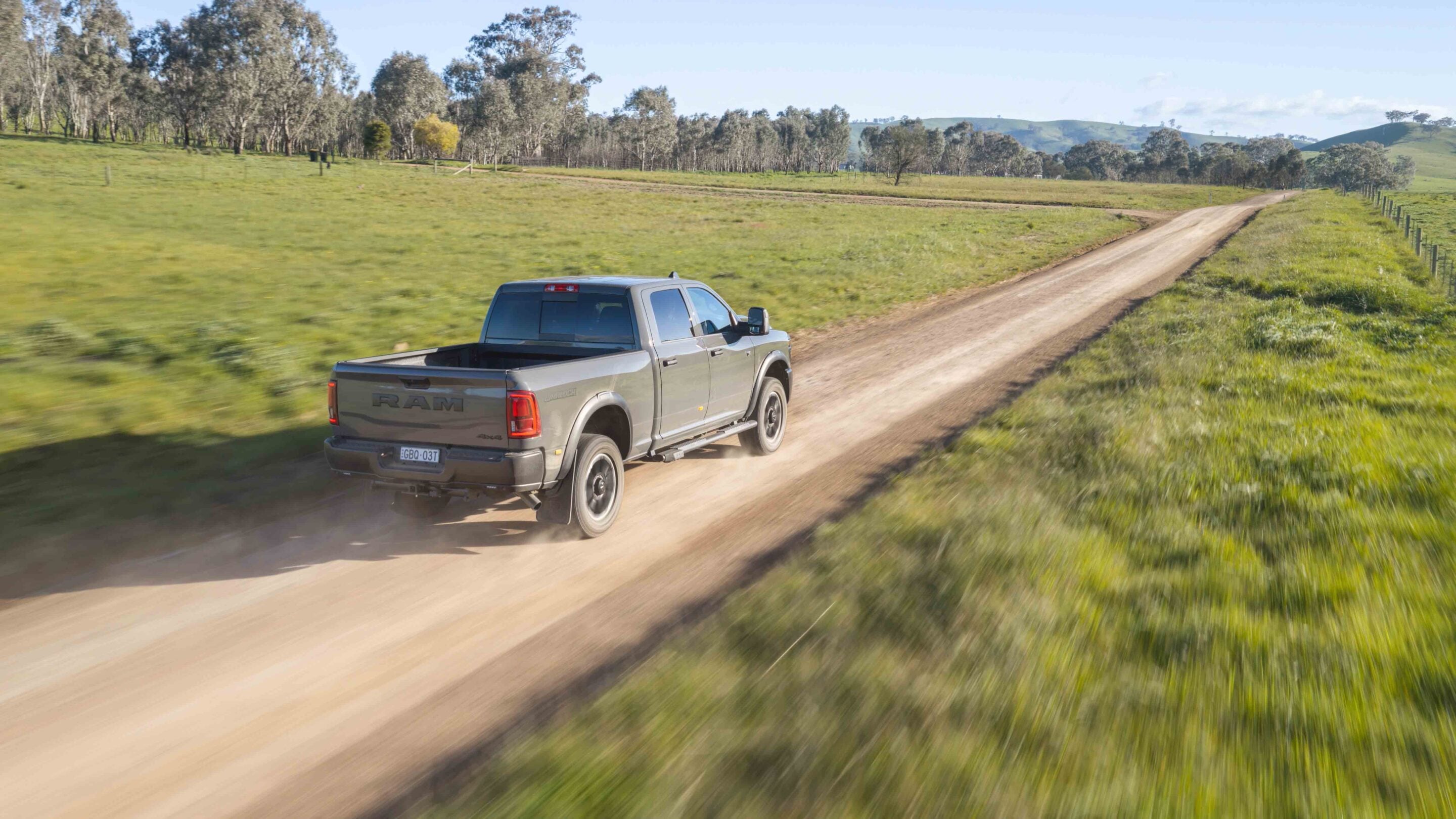
The Ram 2500 Warlock will be sold in Australia for the first time, priced from $157,950 plus on-road costs. Customer deliveries are due to commence next month, with the first examples rolling off Ram Trucks Australia’s remanufacturing assembly line in Melbourne earlier this month.
The 6.4-litre HEMI V8 produces 306kW at 5600rpm and 582Nm at 4000rpm, with an eight-speed automatic transmission and selectable two-wheel-drive high, four-wheel-drive high and four-wheel-drive low modes. The petrol V8 sits alongside the Cummins diesel in the Ram Heavy Duty range rather than replacing it.
1
The Warlock is an off-road-inspired version of the Ram 2500 Heavy Duty, with Bilstein suspension, 20-inch alloy wheels and 285/60 R20 all-terrain tyres. It also gets black fender flares, side steps, bumpers, mirror scalps and a black front fascia, along with Warlock decals and a spray-in bed-liner.
The 2500 measures 6066mm long, 2220mm wide excluding the mirrors and 2043mm high, with a 3785mm wheelbase. It has a 4495kg GVM and 1275kg payload, while kerb weight is listed at 3220kg. Towing capacity is rated at 3500kg with a 50mm tow ball and 4500kg with a 70mm tow ball. That rises to 6700kg when fitted with a genuine gooseneck accessory and air brakes, while GCM is listed at 10,001kg.
1
“Australian customers told us loud and clear they wanted the HEMI V8 to come back, and the Warlock was our first opportunity to do so,” said Jeff Barber, the General Manager of Ram Trucks Australia. “We had also been exploring the option of an off-road inspired Ram 2500 Heavy Duty model for some time, so the Warlock was the perfect opportunity to bring the HEMI V8 back and deliver customers a broader choice.
“The Cummins diesel is still very much a part of the Ram 2500 and 3500 Heavy Duty line-up, but we know there are also customers who want the HEMI V8. We have seen a market shift towards Heavy Duty in recent years, as customers get even more serious and more demanding with what they want from a truck – whether it’s for work or play.
“So when we were assessing the suitability of the Warlock for our market, we decided to go all in and bring the HEMI V8 back with it.”
1
The Warlock last appeared in Australia in July 2020 in 1500 guise, priced from $104,450 and powered by the 5.7-litre HEMI V8 with 291kW and 556Nm. The locally remanufactured special edition featured a factory one-inch suspension lift, Rebel-style grille, 20-inch alloys, RamBox storage and a 4500kg braked towing capacity. The Warlock name has continued in the US, where it is now applied to the current-generation Ram 1500 and remains part of the 2026 range.
The return of the 6.4-litre HEMI also comes as Ram prepares to bring the Ram 1500 TRX back to Australia in the first half of 2027. The performance pick-up will use an uprated supercharged 6.2-litre HEMI V8 and is priced from $259,950 plus on-road costs, with initial Australian production allocations set to be limited.
1
The previous HEMI V8 offered locally was a 5.7-litre Ram 1500 Limited, with the last example remanufactured in late 2024.
Five colours will be available, with metallic paint adding $950 to the manufacturer’s recommended retail price. Service intervals are set at 12 months or 12,000km, whichever comes first, while warranty coverage is three years or 100,000km, whichever occurs first.