
THE SEMA Show doesn’t slow-up for its full four days of official running. Even before the show opens on the Tuesday there are meetings and conferences organised for international guests to liaise with US brands and buyers.
As we hit Wednesday, Day 2, we get some time to venture away from the 4×4 and truck halls to check out some of the hot rod and performance products and incredible machines.
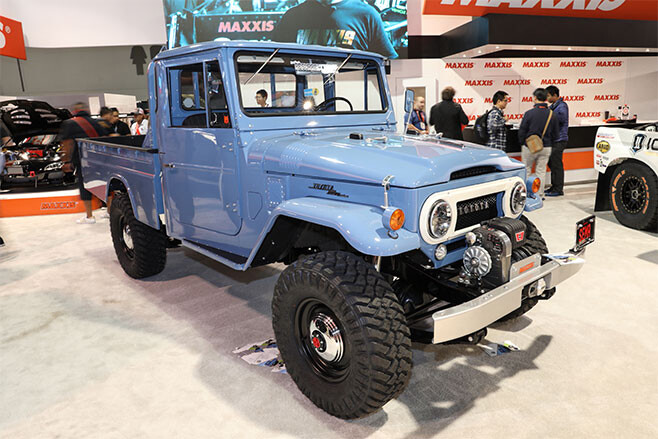
However, the show isn’t all about static displays and networking. Out in the parking lots there is action aplenty with Mustangs drifting and Raptor F150s jumping in the Ford Performance arena, Euro exotics drifting on the Continental Tyres lot, and there’s an off road track and other areas where vehicles are in action.
Also on Day 2 the Global Media Awards were presented, and a few Aussie brands scored well including Patriot Campers, MaxTrax and Turbosmart. We’ll have a full wrap of the awards list in the magazine soon.
DAY 1 of the SEMA Show is done and dusted and we’ve been pounding the floors to check out all the latest new product and cool cars.
There’s no doubt that the Jeep Wrangler JL is the 4×4 of the show as it appears there is one of them on every stand in the SUV, 4×4 and Truck Hall.
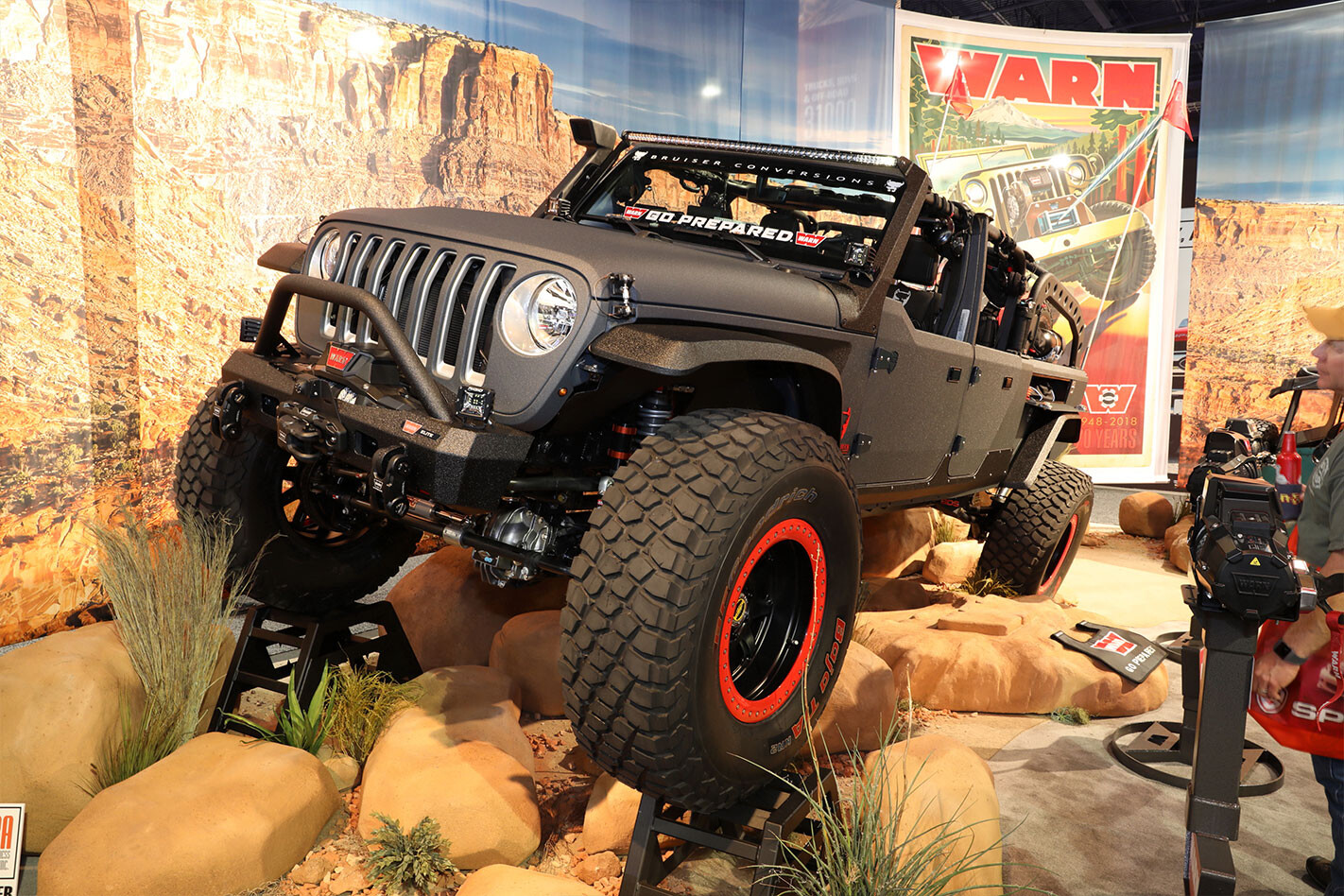
They are modified in just about every way you could imagine and others in ways you could never dream up. From mild to wild, if there’s a mod for Jeeps you will see it here at the SEMA Show. In fact, The Jeep Wrangler picked up its ninth SUV of SEMA award on the night before the show started on Tuesday.
The other car that is interesting is the just released here 2019 Ford Ranger. Ford Motor Company has a few of the new mid-sizes on its stand, kitted up in various ways and there were a couple scattered around on vendor booths.
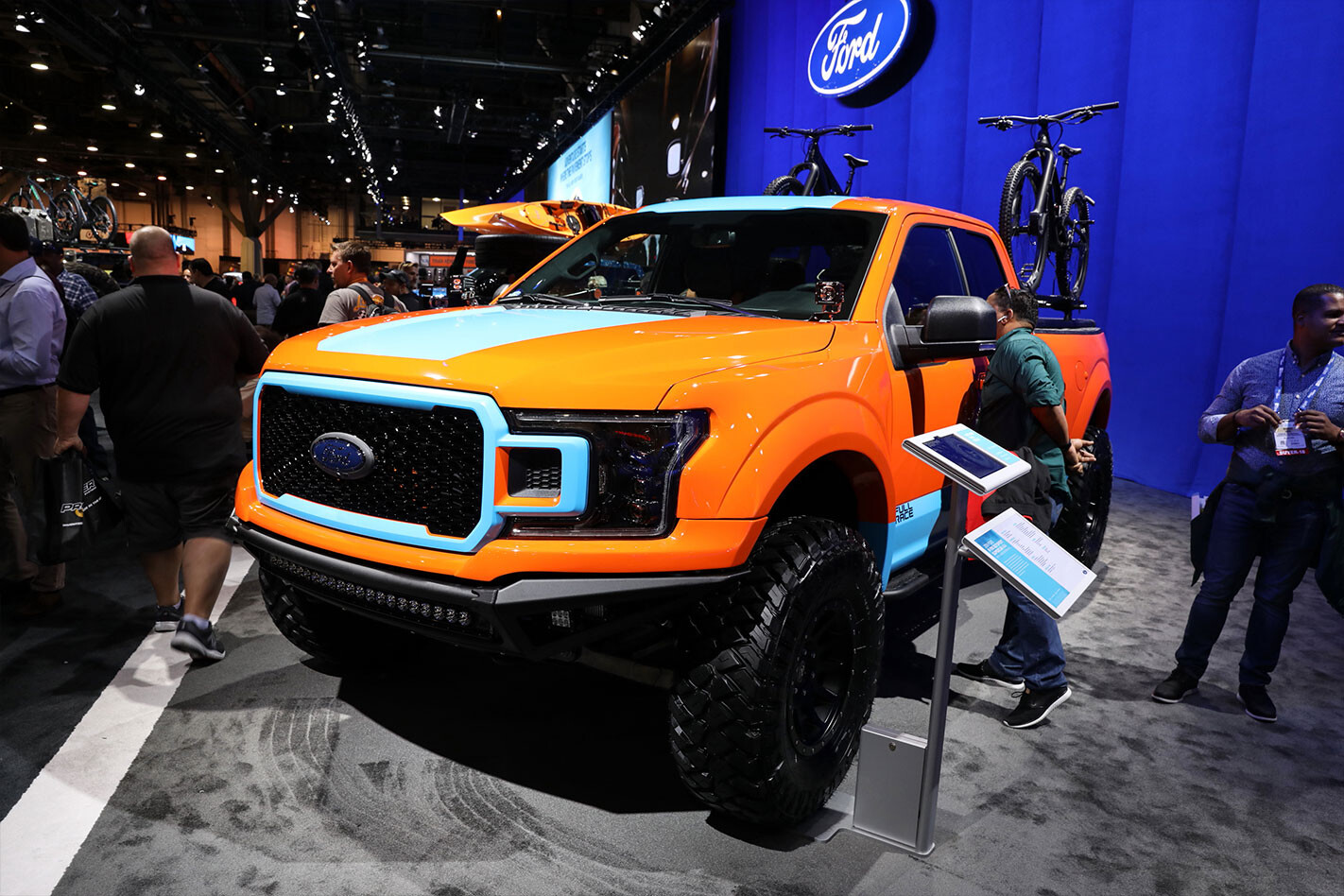
There’s a lot of talk around the overlanding and 4×4 sector here about Ranger so we’re expecting to see a lot more of it in the coming year.
Before you turn away muttering, “idiots, why compare a ute with a wagon”, consider this: both of the Ford Ranger Raptor and Jeep Wrangler Rubicon will set you back the high-side of $70K on road; both are super capable off-road yet are also loaded with luxury, convenience and safety kit, and both are conceived for recreational buyers.
The only other showroom stock 4x4s this capable off-road, the LandCruiser 70 and the Mercedes G-Wagen, are significantly more commercial or service in origin and presentation.
More 4×4 gear guides
Both Raptor and Rubicon also have high-tech powertrains with small-capacity turbo-diesel engines and automatic gearboxes with more ratios than you would have thought possible a few years back – 18, in fact, between the two of them.
Significantly, they are also factory ‘customs’, both a good deal removed from the bread-and-butter models in their respective model line-ups. And in both cases the factory ‘modifications’ are aimed at making a more capable off-road focused 4×4, not necessarily a better on- and off-road vehicle.
The Raptor is also the reigning 4X4 Of The Year and this all-new Rubicon may well be the next 4X4OTY; although, that’s a contest that won’t be decided until the end of the year. In the meantime, is it Raptor or Rubicon that wins this bout?
Ford Ranger Raptor – Suspended in Heaven
Serious chassis re-engineering, not extra power, is the ford ranger Raptor’s killer punch.
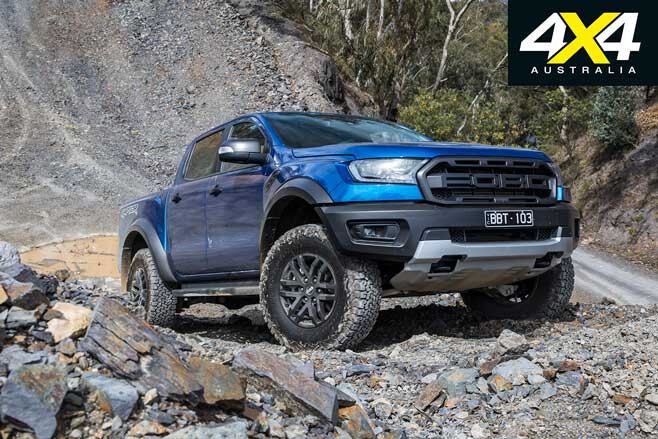
The Ranger Raptor was conceived by Ford Australia off the back of the success in the USA of the F150 Raptor, a desert-racing-inspired factory custom version of Ford’s hugely popular F150 Pick-Up. With help from Ford Performance, Ford’s global high-performance division, the Ranger Raptor was then locally developed off the back of the Ranger ute, which just happens to be largely Australian designed and developed anyway.
If it wasn’t for the phenomenal sales success of the Ranger in Australia, where it now has even toppled the long-term best-selling Hilux, the Raptor may not have got off the ground. Fortunately it did, as serious factory customs like the Raptor don’t come along too often.
Powertrain & Performance
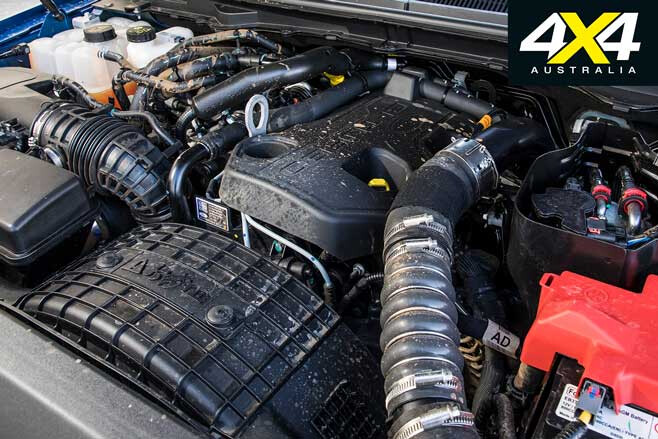
For a ‘hero’ ute it may come as a surprise that the Raptor uses a standard Ranger powertrain, aside from a lower axle ratio to compensate for the taller tyres. That means the same 2.0-litre four-cylinder bi-turbo-diesel and 10-speed auto you’ll find in XLT and Wildtrak Ranger models that’s offered alongside the long-serving 3.2-litre five-cylinder turbo-diesel.
Still, this ‘little’ high-tech 2.0-litre diesel, with its sequential bi-turbo arrangement, is refined, smooth and punchy. The bi-turbo arrangement makes the engine more flexible, with a solid 500Nm available from just 1750rpm and peak power (157kW) not arriving until 3750rpm, both bigger numbers than the 3.2 and achieved over a wider engine-speed range.
Pressed to give its all, it actually sounds more like a bigger diesel than a small diesel, with quite a deep throaty voice. At the same time it also spins through the revs quickly as you’d expect of a smaller engine, helped in this by the relatively close ratios of its 10-speed automatic.
In most part the 10-speed automatic does its job largely undetected with smooth, seamless and timely shifts, but it can sometimes be a little indecisive in picking what gear it wants, and it can produce the odd rough shift.
Side by side, the Raptor just pegs the slightly less powerful but lighter Rubicon, but there’s not much in it. More noticeable and perhaps more significant is the Raptor’s engine is a little smoother and more refined, and generally doesn’t sound or feel as ‘diesel-like’ as the Rubicon’s engine.
On-road ride & Handling
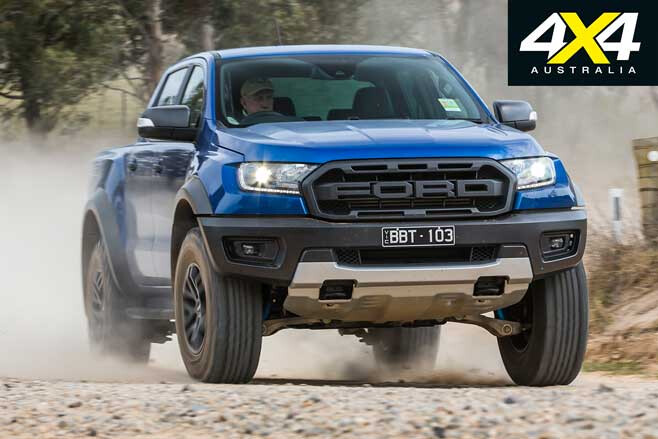
What makes the Raptor special isn’t its engine but its chassis, which has been totally re-engineered from that of a standard Ranger. And while the idea behind that was to make a better off-road vehicle, the ‘new’ chassis actually works brilliantly on-road – the rougher the better.
You can put this down to the extra suspension travel, some 30 per cent all round, that soaks up bumps beautifully.
Coils springs at the rear, replacing the Ranger’s leaf springs, and bespoke Fox-brand racing-technology bypass dampers (the rears have ‘piggy-back’ reservoirs) contribute to the compliance and control.
Longer A-arms up front and a different axle housing at the rear widen the stance (by 150mm) to compensate stability-wise for extra ride height. Finally, the rear axle is laterally located by a sophisticated Watt’s link, a far superior arrangement in terms of chassis control – there’s no rear bump steer compared to the commonly used, cheap, simple but dynamically flawed Panhard rod.
The Raptor then tops all this off with nicely weighted electric-power steering with lots of feel. All this puts it well ahead of the Rubicon in terms of on-road finesse and poise.
Off-road
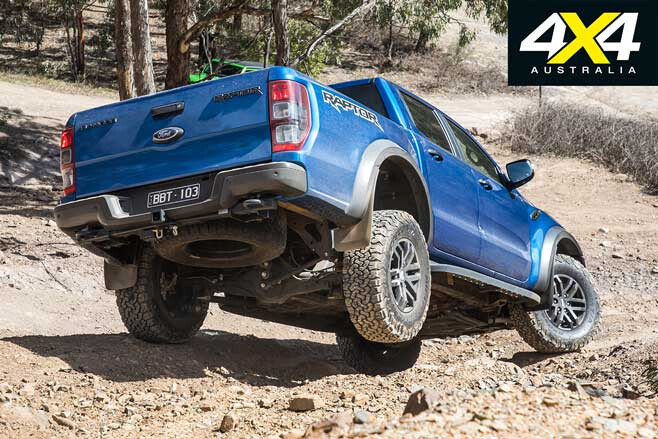
Head off-road in the Raptor and the lofty ground clearance and BFGoodrich LT285/70R17 K02 All Terrains, which surprisingly blunt the Raptor’s on-road dynamics very little, become your best friends. The longer suspension travel is welcome, too, as is the extra underbody protection.
Compared to most showroom-stock 4x4s, the Raptor feels unbreakable; although, with the engine’s air intake under the bonnet lip a snorkel would be good insurance even if Ford claims an 850mm wading depth. Four heavy-duty recovery hooks are also a nice touch.
The Raptor retains the Ranger’s part-time 4×4 system, complete with a driver-switched rear locker. Usefully, when the rear locker is engaged, the electronic traction control (ETC) stays active on the front axle.
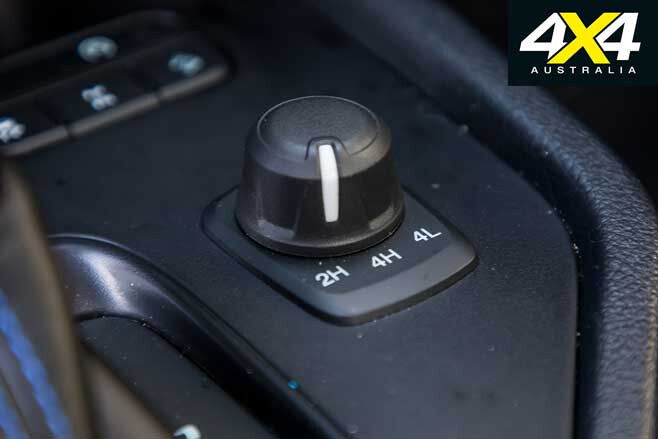
The Raptor also comes with paddle shifters for ‘manual’ gear selection, which is handy off-road, and a ‘Terrain Management’ system to fine-tune the powertrain and chassis for different driving environments.
The settings run to Normal, Sport, Grass/Gravel/Snow, Mud/Sand, Baja, and Rock. All modes bar Rock are available in high range, while all modes bar Sport and Grass/Gravel/Snow are available in low range. These modes vary engine throttle mapping, gearbox shift protocols and electronic traction and stability control calibration.
To get a measure of Raptor and Rubicon off-road, we pointed the two up an off-road pinch that you wouldn’t dream of tackling in any other showroom stock 4×4, except perhaps a LandCruiser 70 or a G-Wagen. The Raptor managed to get up and down with very little fuss, without much more than lifting a wheel and scrabbling sideways a bit as it grabbed for traction here and there.
The over-bonnet vision could be better – it feels like a big vehicle off road, which it is – and the engine braking isn’t great, something you’ll notice compared to the tractor-like gearing in the even more off-road-capable Rubicon.
Accommodation & Safety
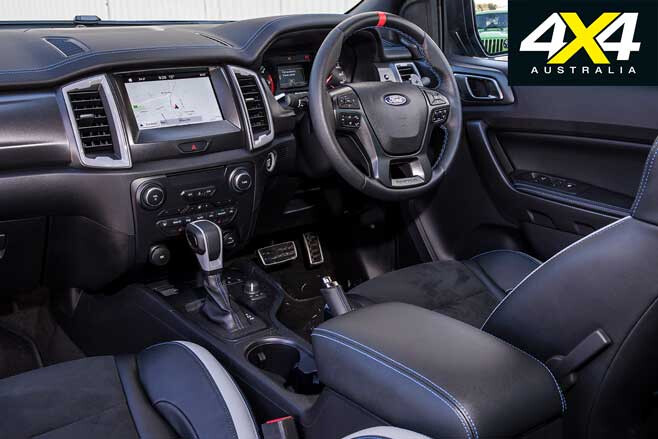
The Raptor has a spacious and long cabin and comes with bespoke leather seats and a heap of kit, none nicer in winter than the heated front seats.
Despite not having steering wheel reach adjustment (tilt only), getting comfortable is easy and the seats are some of the best you’ll find in any 4×4.
If it’s five people you wish to seat, the Raptor also has a spacious back seat that’s actually better for three than the rear-seat of the Rubicon; although, the Jeep gets air vents for the rear passengers, a notable omission in Raptor.
Practicalities
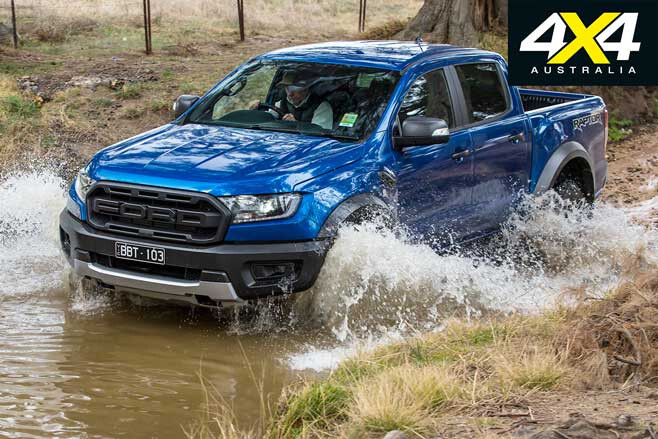
Perhaps the most practical thing about the Raptor is the fact it’s a ute, so it can do things like carry large items you’d never fit into a wagon.
Compared to bread-and-butter Rangers, the Raptor has a lower payload capacity (only 758kg) and reduced towing capacity, from 3500kg to 2500kg. Still, that’s a way better payload than the Rubicon, even if the towing capacity is as good as the same.
What You Get
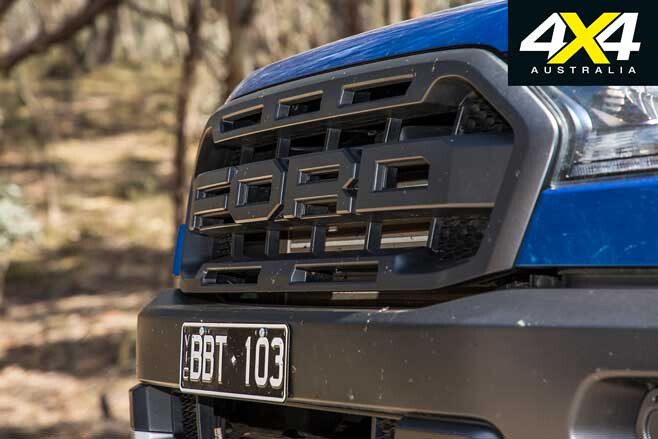
Raptor has keyless entry/start, power adjustable and heated front seats, leather/suede trim, tilt steering wheel adjustment, auto headlight/high beam, rain-sensing wipers, eight-inch touchscreen, USB ports, sat-nav, Apple CarPlay/Android Auto, reversing camera, dual-zone climate, cooled centre console, paddle shifters, tubliner, 12V tub outlet, and a work light. Safety kit includes AEB, lane departure warning and assist, traffic-sign recognition, and six airbags (front, side and curtain).
Jeep Wrangler Rubicon – The Godfather
Nothing says “4×4” louder than a Jeep Wrangler Rubicon.
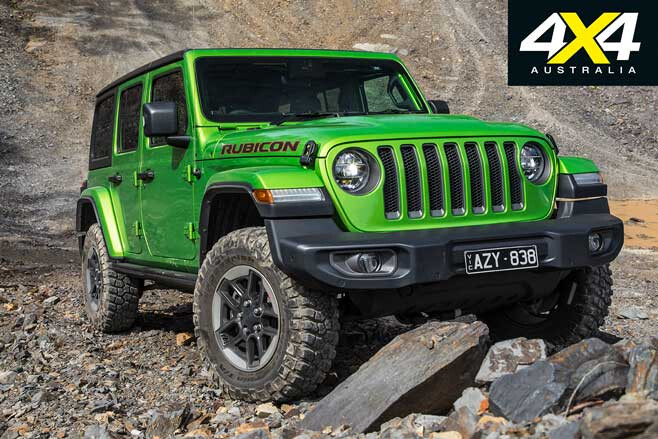
The Toyota LandCruiser, the Nissan Patrol and the Land Rover company all owe their existence in one way or another to the original World War II Jeep. And the Wrangler Rubicon is the latest and ultimate embodiment of the go-anywhere spirit of that very same, original Jeep.
These days the Wrangler is the only current Jeep model to retain the basic design principles of a separate chassis and live axles at both ends that defined the original WWII Jeep.
The latest – 2019 – iteration of this iconic 4×4 is called the Wrangler JL and it replaces the JK that first appeared in 2006, bringing a new 2.2-litre diesel which is only available in the Rubicon; all the other models have the now long-serving 3.6-litre petrol V6. There’s also a new ZF-sourced eight-speed automatic, the only gearbox offered on Australian models.
The Rubicon, which is also offered with the petrol V6, is only available in four-door, long-wheelbase guise – unfortunately there’s no short wheelbase model – and is distinguished from ‘lesser’ Wrangler models by its impressive off-road arsenal that runs to front and rear lockers, a bespoke transfer case with deep low-range gearing, lower axle ratios, a front swaybar disconnect and mud tyres.
Powertrain & Performance
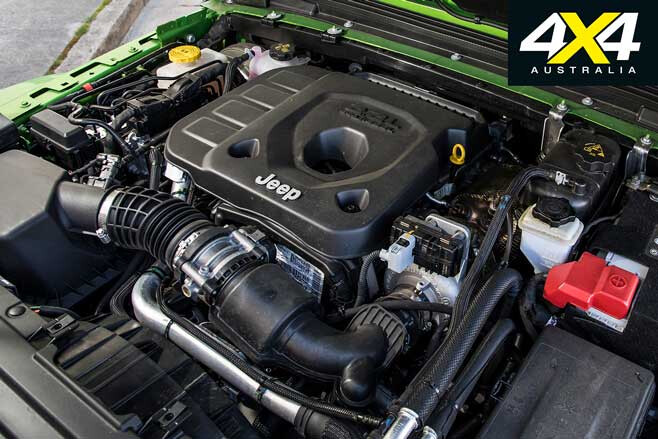
The Rubicon’s new 2.2-litre diesel, which shares no history with the previous model’s 2.8-litre VM diesel, comes from Fiat Powertrain and has been used previously in the KL Cherokee and some Alfa Romeo models. It’s a modern, Euro 6-compliant single-turbo four-cylinder that claims 147kW and 450Nm.
It’s a much quieter, more refined and more revvy diesel than the old 2.8. With the advantage of the new and slick eight-speed automatic transmission (the 2.8 had a five-speed auto), the general response is much better, even if the power and torque numbers are effectively equivalent.
The Rubicon’s 147kW and 450Nm still can’t match the 157kW/500Nm Raptor, but the Rubicon is a little lighter, so there’s not much difference in terms of outright straightline performance, even if the Raptor has its nose in front.
The Rubicon’s engine can’t quite match the Raptor for refinement, either; it isn’t quite as smooth or quick-revving and has more of a diesel rattle.
Full marks, however, for the Rubicon’s eight-speed auto, which is the slicker all-round performer than the sometimes not-quite-perfect 10-speed in the Raptor.
On-road ride & Handling
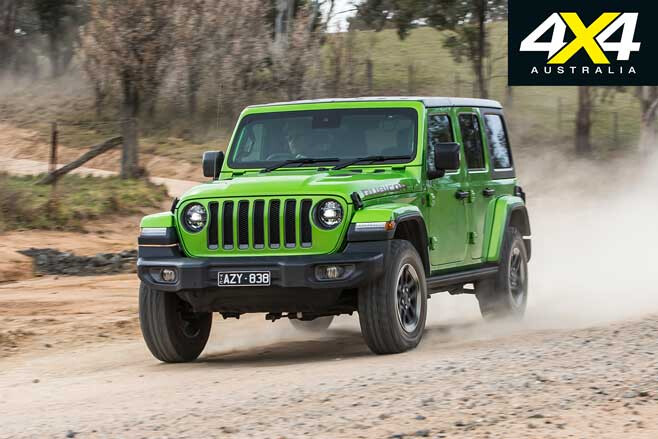
Live axles front and back, as the Rubicon has, has never been a recipe for sharp and stable on-road handling, especially at higher speeds on bumpier roads. And while previous Wranglers have never been particularly good in this regard, the JL feels a bit better than before thanks to retuned dampers and springs and revised suspension mounting points.
More significantly, the JL offers a full-time 4×4 setting in the transfer case, which gives better drive and steering stability on wet bitumen and gravel. There’s still a two-wheel drive mode, but what Jeep calls ‘4H Auto’ is a set-and-forget driving mode that can be used on any road surface, sealed or unsealed, wet or dry. This alone makes this new Rubicon distinctly better as an all-conditions touring 4×4 than the previous model, and its full-time 4×4 is something that can’t be matched by the Raptor.
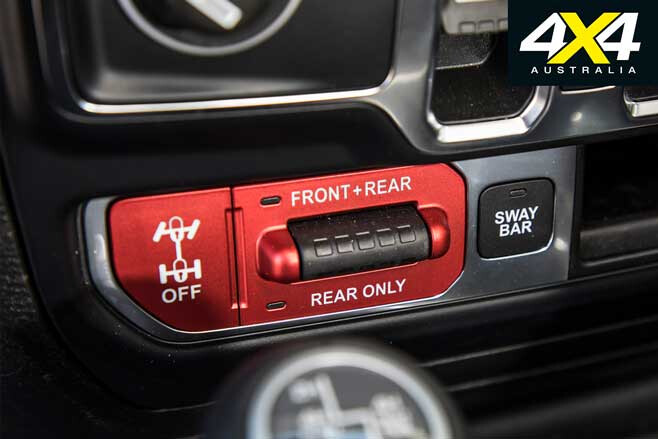
Still, the Rubicon isn’t a particularly dynamic on-road drive. The steering is too light and lacking in feel and precision and there’s some bump steer from both front and rear axles on rough roads. The faster you go and the bumpier the road, the worse it gets; and in this regard the Rubicon is several levels below the high standard achieved by the Raptor under the same demanding driving conditions.
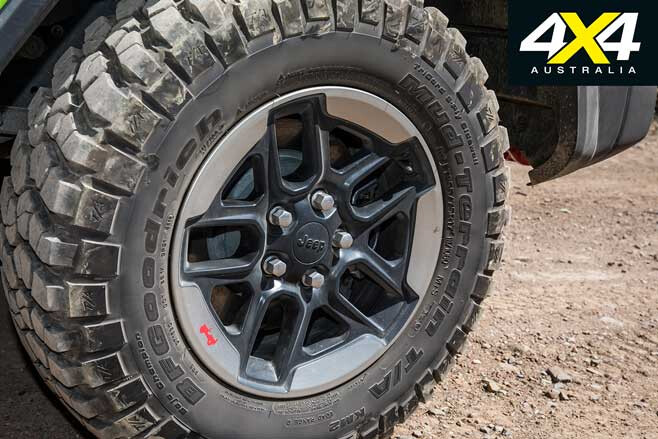
The BFGoodrich Mud-Terrains, as you’d expect, are also not the last word in on-road grip. Plus, they are noisy on the highway, as is generally the case with mud terrains. It would be interesting in more ways than one to drive a Rubicon fitted with good all-terrain tyres like the Raptor, rather than its mud terrains. At least the ride quality is comfortable, even if it doesn’t match the plush Raptor.
Off-road
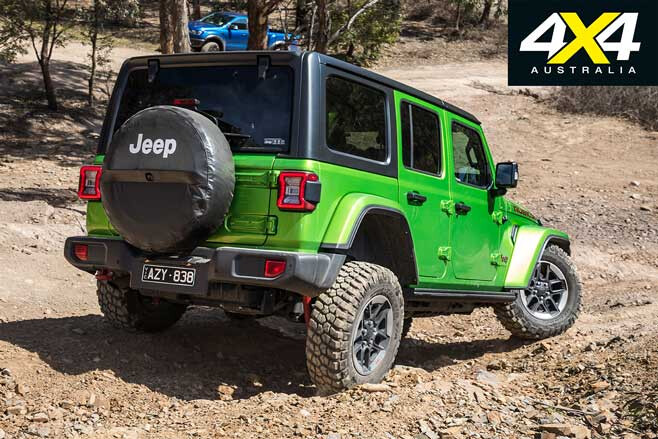
Live axles front and rear may not be what you want for on-road driving, but they underpin the Rubicon’s off-road prowess. As part of the evolution from JK to JL, there’s even more suspension travel than before, which makes it better than before.
These changes aside, the new Rubicon carries over the defining elements of the old Rubicon, namely front and rear driver-switched diff locks and a front swaybar release which, when activated, adds to the already impressive front wheel travel.
The Rubicon also gets lower axle ratios than non-Rubicon models, and the diesel has an impressive 70.3:1 crawl ratio thanks in part to the 4.0:1 low-range reduction ratio in place of the 2.72:1 in the non-Rubicon models.
If there’s one shortfall with the Rubicon it’s with the ramp-over clearance, which could be better as the chassis crossmember has a tendency to touch down. US-model Rubicons actually get taller all terrain tyres than the 255/75R17s (32-inch) BFGoodrich KM3 mud tyres fitted to the Australian Rubicons, which would help in this regard.
Apparently the axle joints (universal vs CV) used in conjunction with the part-time-only transfer case are stronger, which may compromise the fitment of notably bigger tyres (35-inch, etc.) on Australian models without some aftermarket re-engineering.
Still, this clearance issue aside, the Rubicon out-pointed the Raptor in the tougher off-road conditions we tackled. Its vision is better, too, so it’s easier to place around obstacles, there’s far less wheel lifting, which means better grip, and you can mechanically fully lock the drivetrain, which you can’t do with the Raptor.
The super-low crawl ratio also makes for much better engine braking on steep descents, and it’s handy for climbing, too. Last but not least, the Rubicon’s mud tyres also offer more off-road grip.
Accommodation & Safety
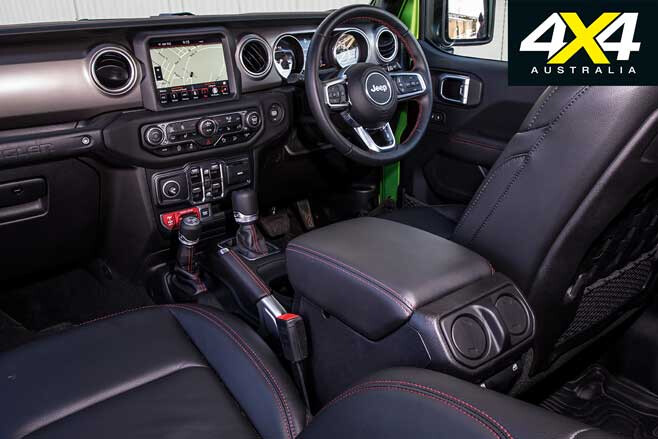
Our test Rubicon was fitted with the optional Luxury Pack, which means leather seats in addition to a long list of other standard kit (see ‘What You Get’) in what is a busy feeling but reasonably well-finished cabin.
The Rubicon has tilt-and-reach steering wheel adjustment and lots of seat height adjustment, which makes it easy to get comfortable. But the driver’s footwell is a bit cramped and the seats are not as comfortable as those of the Raptor, while the cabin also feels more ‘upright’ and traditional 4×4-like compared to the more passenger-car feel of the Raptor. It has a roomy rear seat, and adjustable tie-downs in the cargo area are a nice touch.
Removable roof panels above the driver and passenger make for a unique open-air driving experience and the entire roof can be removed if desired; although, this is not a one-person operation. This feature, which takes the Rubicon from 4×4 wagon to off-road ‘buggy’, is a significant part of its appeal.
When initially assessed, the Wrangler JL (Rubicon included) only gained a one-star ANCAP safety rating, but since that time new safety systems such as AEB have been fitted and to date the vehicle hasn’t been retested.
Practicalities
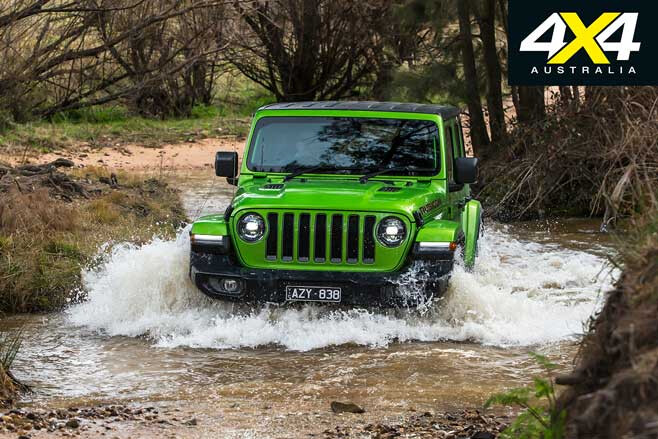
The Rubicon can’t carry all that much legally, with its payload potentially soaked up just by driver and passengers alone. It’s rated to tow just shy of 2500kg, which is useful enough.
The 81-litre fuel capacity is useful without being exceptional; although, fuel consumption isn’t excessive, even with the upright body and mud tyres, which results in a reasonable touring range.
What You Get
The Rubicon gets keyless start/entry, leather seats (Luxury Pack), tilt and reach steering, 8.4-inch touchscreen, sat-nav, dual-zone climate control, Apple CarPlay/Android Auto, auto headlights, reversing camera, nine-speaker audio with subwoofer, USB ports front and rear, 230V/150W outlet in the rear seat, and adjustable cargo points out the back. Safety kit includes AEB, blindspot monitoring, rear cross-traffic alert, adaptive cruise, and four airbags (two front and two side).
Conclusion
Almost equals?
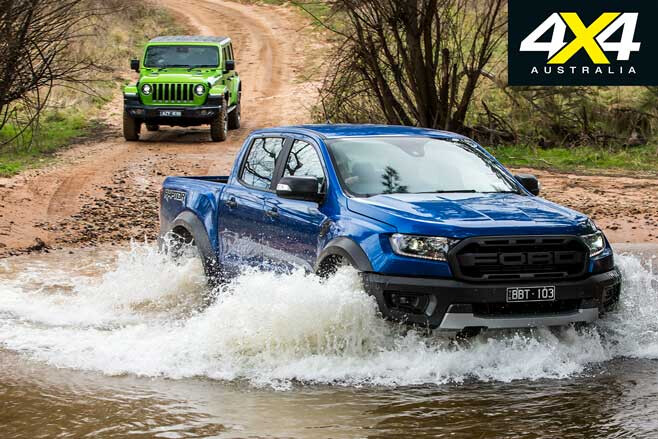
Both of these vehicles have dual personalities, but in very different ways. Like all dual-cab utes the Raptor is both five-seater passenger 4×4 and a 4×4 ute, with all the broad-spectrum functionality that brings.
For its part the Rubicon is both a 4×4 wagon, yet with the roof off it takes on more of the persona of an off-road or beach buggy. This is a notable feature of the Rubicon that not only sets it aside from the Raptor but also every other 4×4 you care to name.
This difference between dual-cab ute and ‘adaptable-body’ wagon may well decide this issue here for you. The Raptor is also $7K more expensive; although, $2K of this is eaten up if you add the leather pack to the Rubicon.
Despite these differences both Raptor and Rubicon are genuine factory-custom models pitched squarely at off-road use. And to this end both succeed … but by varying degrees. Both also work well on-road; although, again to varying degrees.
The best on-road drive is clearly the Raptor, where its steering precision, handling, stability and ride are all superior to the Rubicon. There’s a smidge more performance too from an engine that’s also more refined and more endearing.
For its part, the Rubicon’s superior wheel travel, fully ‘lockable’ drivetrain, better vision and deep low-range gearing make it the better off-road weapon, even if a little more ground clearance would be handy. Regardless, both of these 4x4s are very good at what they do, but it feels like the Ranger Raptor gains more on-road over the Wrangler Rubicon than it loses off-road, making it the better all-rounder.
Specifications
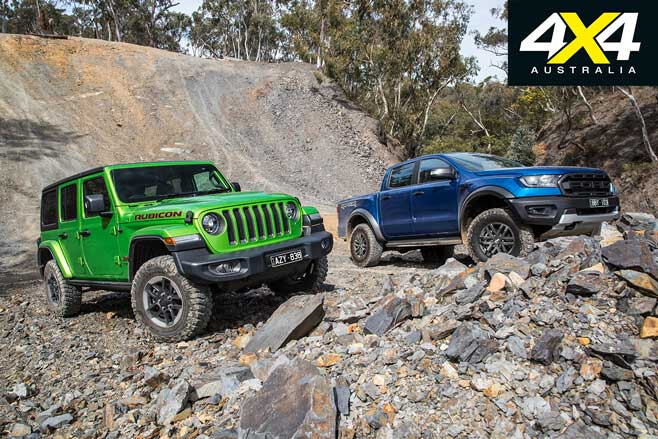
| u00a0 | Jeep Wrangler Rubicon | Ford Ranger Raptor |
| Engine | 2.2-litre 4-cyl turbo diesel | 2.0-litre 4-cyl bi-turbo diesel |
| Power | 147kW at 3500rpm | 157W at 3750rpm |
| Torque | 450Nm @ 2000rpm | 500Nm @ 1750-2000rpm |
| Gearbox | 8-speed automatic | 10-speed automatic |
| 4×4 System | Dual-range/selectable full-time | Dual-range part-time |
| Crawl Ratio | 70.3:1 | 47.6:1 |
| Construction | Separate-chassis | |
| Suspension (f) | Live-axle/coil springs | Independent/coil springs |
| Suspension (r) | Live-axle /coil springs | |
| Wheel/tyre spec | LT255/75R17 111/108 Q | LT285/75R17 116/113 S |
| Departure Angle | 31.9u02da | 24.0u02da |
| Rampover Angle | 21.2u02da | 24.0u02da |
| Approach Angle | 41.7u02da | 32.5u02da |
| Wading Depth | 760mm | 850mm |
| Ground Clearance | 252mm | 283mm |
| Kerb Weight | 2221kg | 2332kg |
| GVM | 2630kg | 3090kg |
| Payload | 409kg | 758kg |
| Towing capacity | 2495kg | 2500kg |
| GCM | 4876kg | 5350kg |
| Fuel capacity | 81 litres | 80 litres |
| ADR fuel claim | 7.5L/100km | 8.2L/100km |
| Test fuel use | 11.5 litres/100km | 11.6 litres/100km |
| Test fuel range | 654km | 640km |
| Price | $68,950 ($73,275 as tested) | $75,990 |
4X4 Australia's project builds
MANY roads and tracks in the Victorian High Country have reopened in readiness for the warmer months.
The seasonal road closures in the region typically take place between June and the end of October, but there are a few closures that have been extended.
In addition to vehicle safety, the tracks are seasonally closed to maintain water quality and prevent erosion during the wetter months “as rain and snow soften the tracks, making them vulnerable to damage,” explains Parks Victoria.
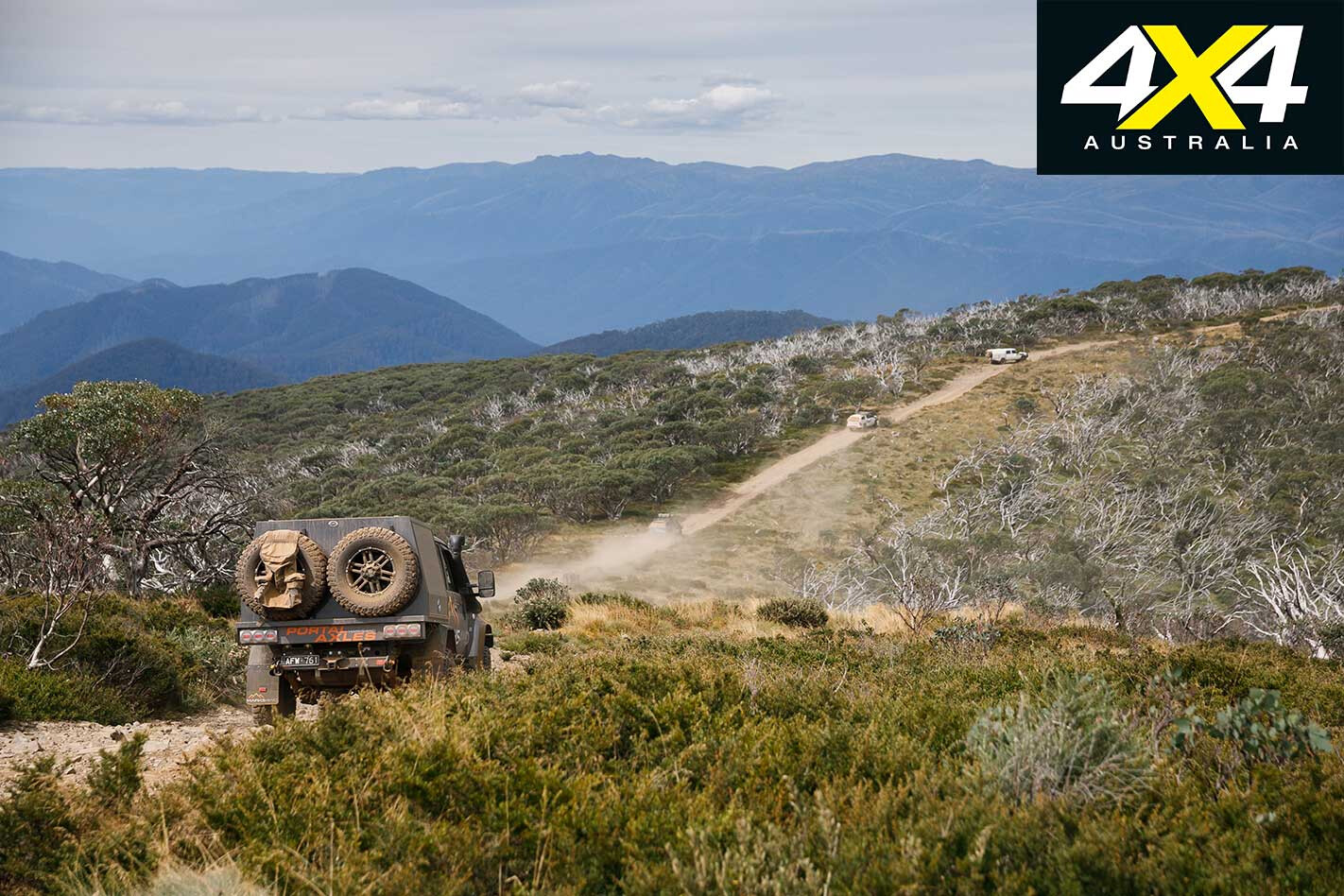
If you plan on travelling the blissful High Country tracks, be adequately prepared, maintain your vehicle and remember to always be safe.
It’s also going to be a stinking hot summer this year, so be vigilant around campfires and remember to ALWAYS follow the fire safety announcements and adhere to fire restrictions. Information can be found here: https://www.ffm.vic.gov.au/visiting-state-forests/forest-and-road-closures
Also, please keep the High Country clean and remember to take out what you take in: https://www.4wdvictoria.org.au/index.php/436-take-out-what-you-take-in
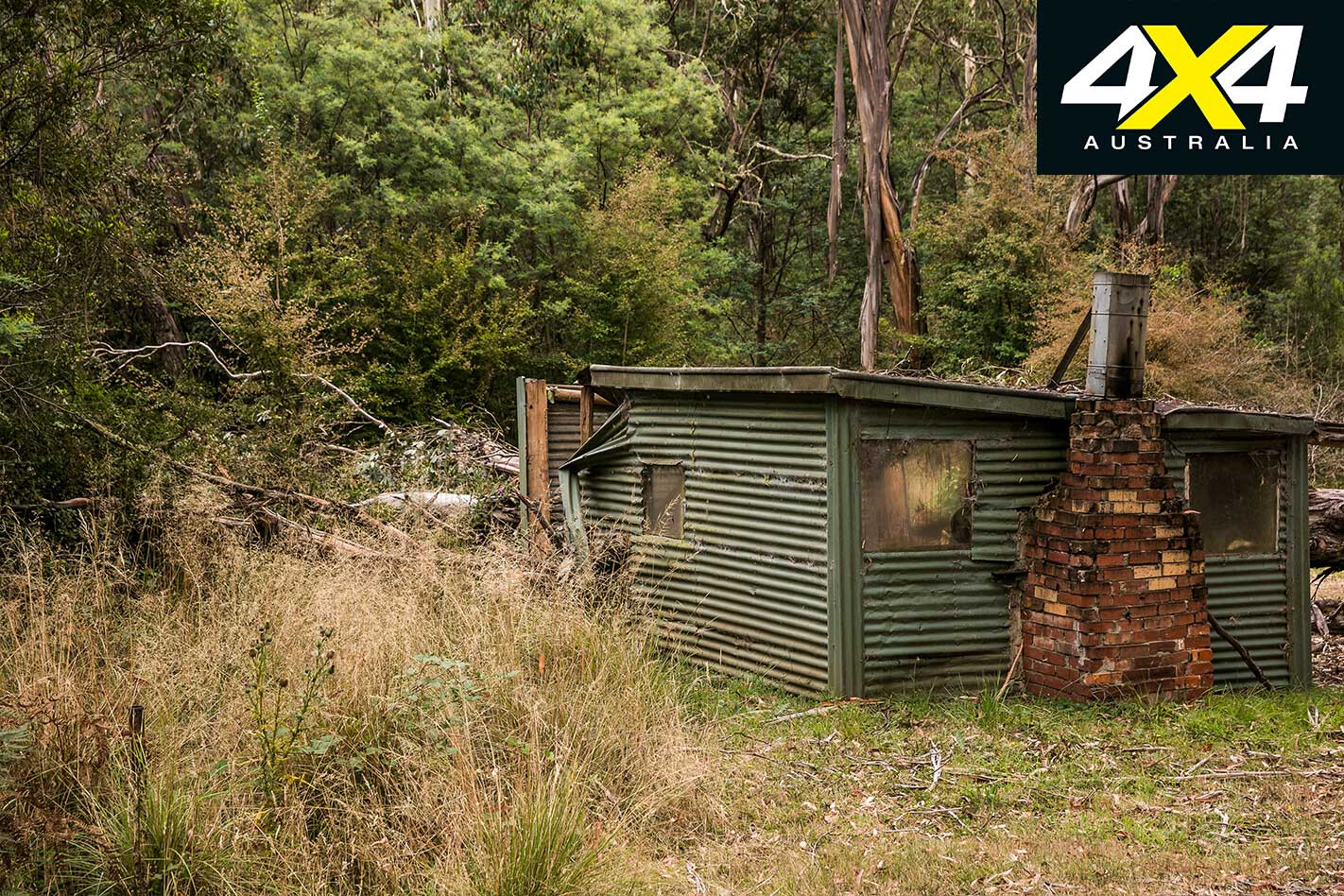
Some tracks, including the Davies High Plains, remain closed. For a complete list of road closures and information, visit: www.parks.vic.gov.au/get-into-nature/safety-in-nature/seasonal-road-closures
The concept of a “jack of all trades” is something most of us come across frequently, on the tracks or in our day-to-day lives. It’s the idea of a person or vehicle that’s competent at more than one thing.
The downside, and it’s a doozy, is it’s normally followed by the qualifier “master of none”. It makes sense, too. The skilled carpenter renowned for building log cabins probably isn’t the go-to for high-rise office fitouts, just like a 4×4 built for long-distance touring isn’t all that likely to be a gun rock crawler.
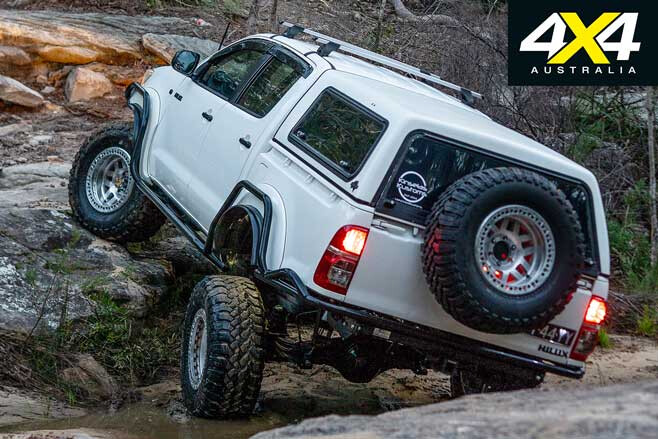
It’s no surprise then that 4x4s, much like tradies, work best when they specialise in one particular area, and that concept of specialisation is perfectly represented in Dilhan Otay’s clean-as-a-whistle custom Toyota N70 Hilux.
While the N70 Hilux can still hold its own as a daily driver and an outback tourer, Dilhan wanted one that would go above and beyond when the stubby lever was pushed into low range with endless rock steps to be negotiated. And he saw the 2006 N70 as the perfect platform; modern enough to be comfortable as a daily driver but simple enough that he could slice and dice it, turning it into the perfect rock crawler without having to face endless issues due to complicated electronics and safety systems.
Starting from the ground up, Dilhan and the boys at Kinselas Kustoms in Sydney’s south pared the Hilux back to near-bare chassis rails to give it a solid foundation. Up front, the independent suspension was relegated to the scrap heap and in its place now resides a full custom sheetmetal diff housing based on an 80 Series Land Cruiser’s front diff.
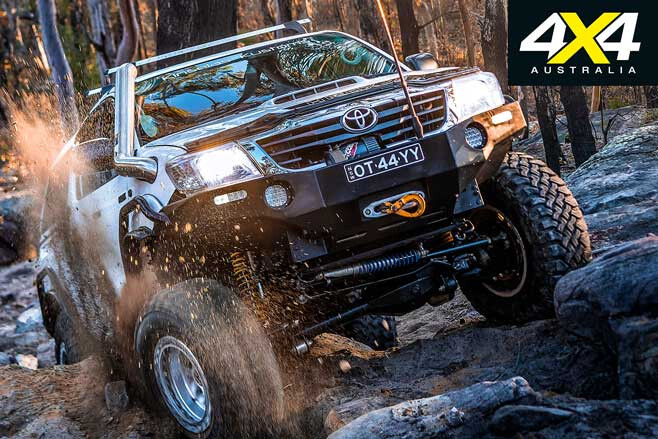
It’s pieced together by the guys at Buds Customs and not only offers significant strength improvements over an OEM housing, it also relocates the diff centre to the passenger side, allowing it to line up with the Hilux’s transfer case output.
It’s kept in place thanks to custom mounts from the Kinselas team, with an OEM LC80 radius arm on the passenger side teaming up with a Superior Engineering Superflex arm, allowing the front-end to flex its way through the rocks. An 80 Series steering box has been mounted up to the chassis with PSR chromoly steering arms, ensuring it’ll take any abuse Dilhan can throw its way.
While the welder was out to mount the steering box, custom mounts were made on both the frame and the axle for huge 12-inch travel Fox 2.0 coil-over shocks and their remote reservoirs. Matching Fox 2.5-inch body hydraulic bump stops were also grafted in, guaranteeing a smooth landing if the track needs a more aggressive approach.
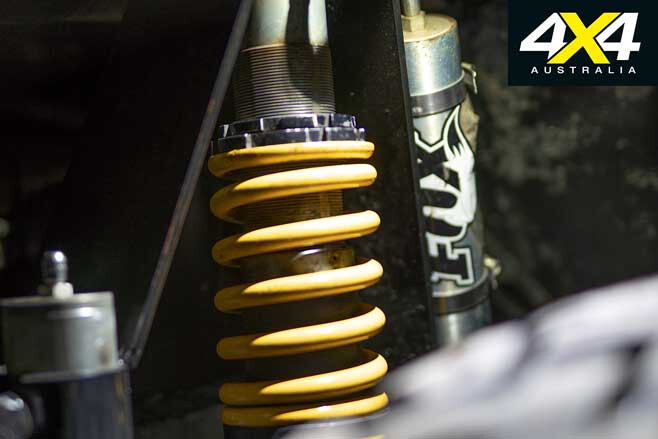
Moving rearwards and the Hilux’s final drive has copped a significant upgrade, too. The standard rear centre was sent packing; although, it was removed with a grinder rather than a ratchet, allowing a Kinselas Kustoms hybrid axle to take its place. This axle utilises the diff centre and housing from an LC80, grafted to axle tubes and outers from a Hilux, giving a track increase and significant strength upgrade in the process.
There’s still a leaf spring pack holding the rear-end in place; although, Dilhan has used a set from an RG Colorado, as their increased length results in more articulation. A couple of LN106 leafs have been thrown in to stiffen the ride up, as well as extended shackles to let the big leafs work. An anti-wrap bar stops the dreaded axle wrap associated with soft leaf springs, and a set of 12-inch Fox remote res shocks have been custom-mounted up through the tub floor, helping with ride quality and articulation.
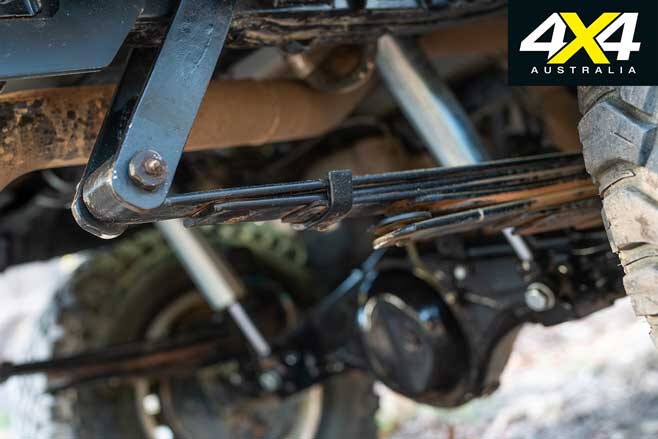
The Hilux runs 4.11 diff ratios and, sharing the love, it has an ARB Air Locker up front and a TJM Pro Locker in the rear. They’re sent drive by the factory mechanical standard 1KD-FTV 3.0L common-rail turbo-diesel engine, which is fitted with a three-inch exhaust. There’s an Exedy Safari clutch and the Hilux runs the stock five-speed cog-swapper, before 35-inch Falken Wildpeaks put power to the ground through 17 x 9 KMC Machete beadlocked alloy wheels with a -38 offset.
The rest of the engine bay is relatively simple. Aside from the oh-so-sexy Radius Fabrications stainless steel snorkel poking in through the side, the bay looks near factory. On the passenger side, an auxiliary battery teams up with the cranking battery to not only ensure the Toyota will fire into life at any angle, but will provide plenty of juice to power the winch on hard tracks … and the fridge on long tracks.
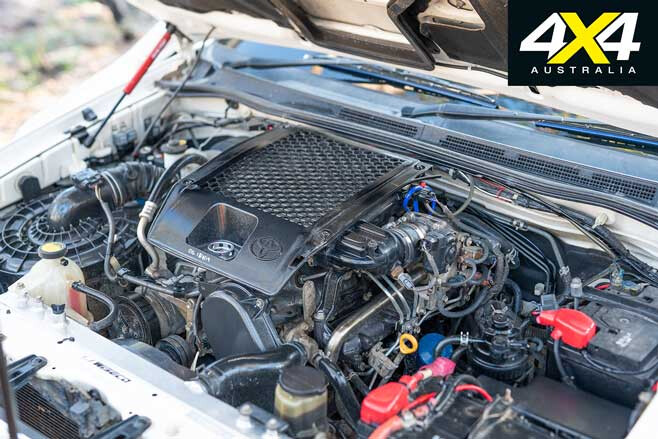
Front and rear diff breathers poke their heads up next to the air box, with an ARB single-piston air compressor engaging front and rear air lockers, as well as providing a convenient port for airing the Falkens back up from single digits after a hard day’s wheeling.
Giving the Hilux its signature look is an über sleek low-profile Muzzbar from South East Queensland Fabrication. It houses a pair of LED driving lights to complement the Narva headlights, but hides something much more powerful behind it. Peering through the strategic cuts in the grille is one of the most widely revered and upgradable winches of all time, the Warn 8274, or high-mount as it’s more commonly known.
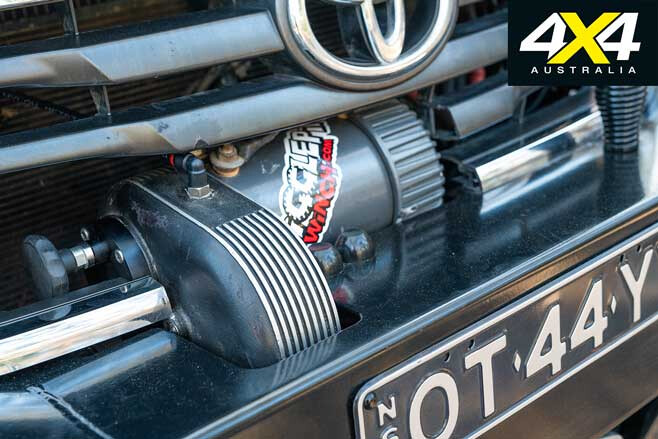
Like the rest of the rig it’s been purposefully customised to suit Dilhan’s needs. The brake shaft has been drilled, tapped and capped to replace the factory weak-link circlip, which can pop off under load, and it’s running an upgraded motor with a 6.4hp Warn unit taking over duties from the stock 4.6hp motor. The electrical feed has been upgraded too, with a Gigglepin-spec Albright solenoid providing juice through an in-cab and on-bar push-button arrangement. A Gigglepin freespool block has also been fitted.
Flowing down the Hilux’s flanks are custom scrub bars front and rear built off heavy-duty sliders along each side. In the rear they tie into a tube rear bar that takes full advantage of the improved ground clearance afforded after lopping off the factory tub’s low-hanging quarter panels. The tub is capped with a colour matched Flexiglass canopy, with a set of drawers inside holding Dilhan’s recovery gear and camping needs.
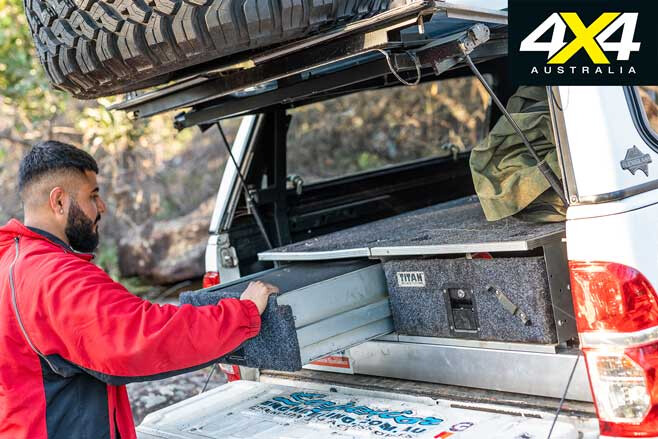
If you’re eyeing off the spare tyre carrier, it’s a trick unit built by Kinselas Kustoms that ties it into the canopy’s rear window. A gas-assisted frame supports the weight and significantly simplifies access to the rear-end. Inside the cabin is the same simple-does-it approach; a few basic gauges, a GME UHF and a half roll cage should things turn pear-shaped.
While Dilhan’s Hilux doesn’t have the shopping list of touring modifications, it’s more a reminder of the old days of car culture. He’s spent his money wisely, saved where he could, and together in the shed with his mates, Jono, Ben, Mitch and Brad, he’s pieced together a 4×4 that puts a smile on his dial every time he locks the hubs, and that sounds a lot more fulfilling than an inverter he didn’t really need.
Soft Landing
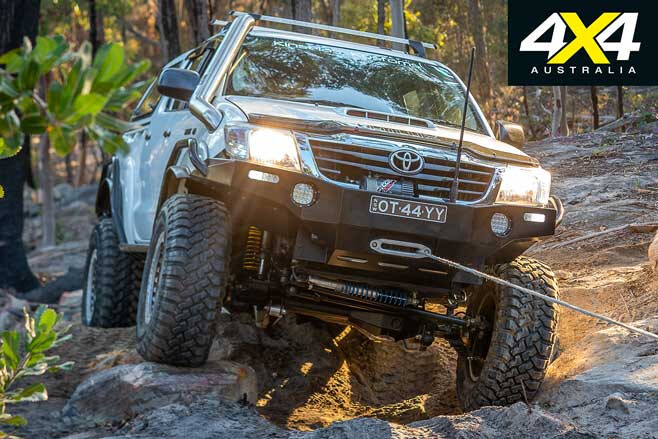
A hard rubber pad is the final limitation on suspension articulation. You know when you’ve hit them because every bone in your body will feel the hard jolt, but they help limit metal fatigue and stop axles smashing into frame rails. Some manufacturers offer progressive bump stops that have a small amount of give before they go bang. Hydraulic bump stops, like those fitted to the front of Dilhan’s Hilux, take things to the next level.
They’re essentially a miniature shock absorber inside. When the suspension compresses enough to touch the bump stops, hydraulic fluid is pushed through a series of ports that slow the fluid flow down, becoming progressively stiffer as they’re compressed. It’s a whole lot of work mounting them but it means there’s never a hard bang at full compression.
This is race technology that’s slowly filtering down to touring 4x4s, but mean rigs like Dilhan’s have an extra layer of protection from big hits and hard washouts.
FAMOUS Texan tuning house Hennessey Performance is set to unveil the first production Jeep Gladiator Maximus 1000 at the 2019 SEMA Show.
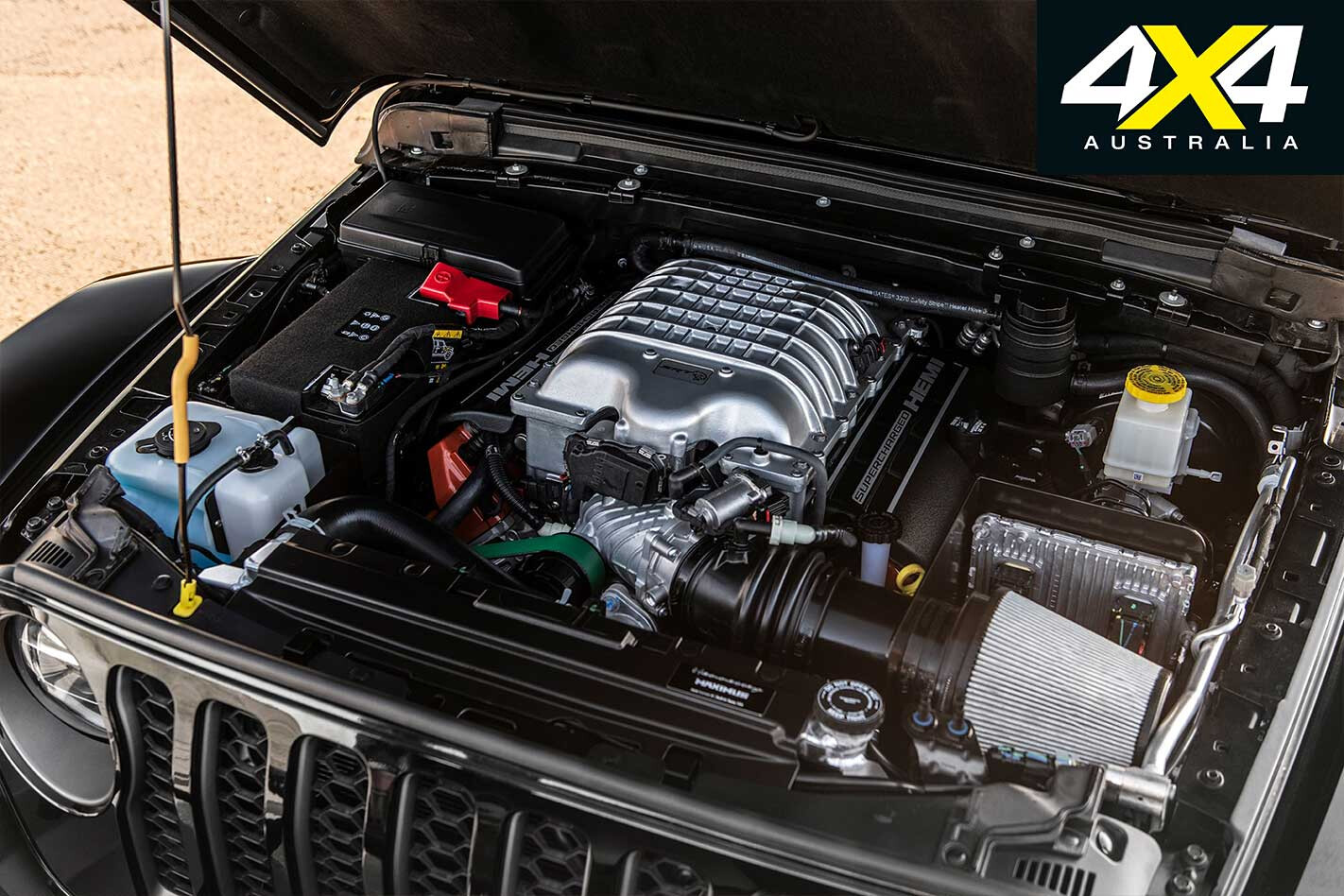
Hennessey has dialled up the Gladiator to ‘God’ mode by dropping in a 6.2-litre supercharged V8 Hellcat engine, with an HPE1000 engine upgrade upping output to a whopping 1000hp (746kW) and 933lb-ft of torque (1265Nm). The V8 runs through an eight-speed automatic transmission, and the vehicle is claimed to accelerate from 0-60mph (97km/h) in just 3.9 seconds.
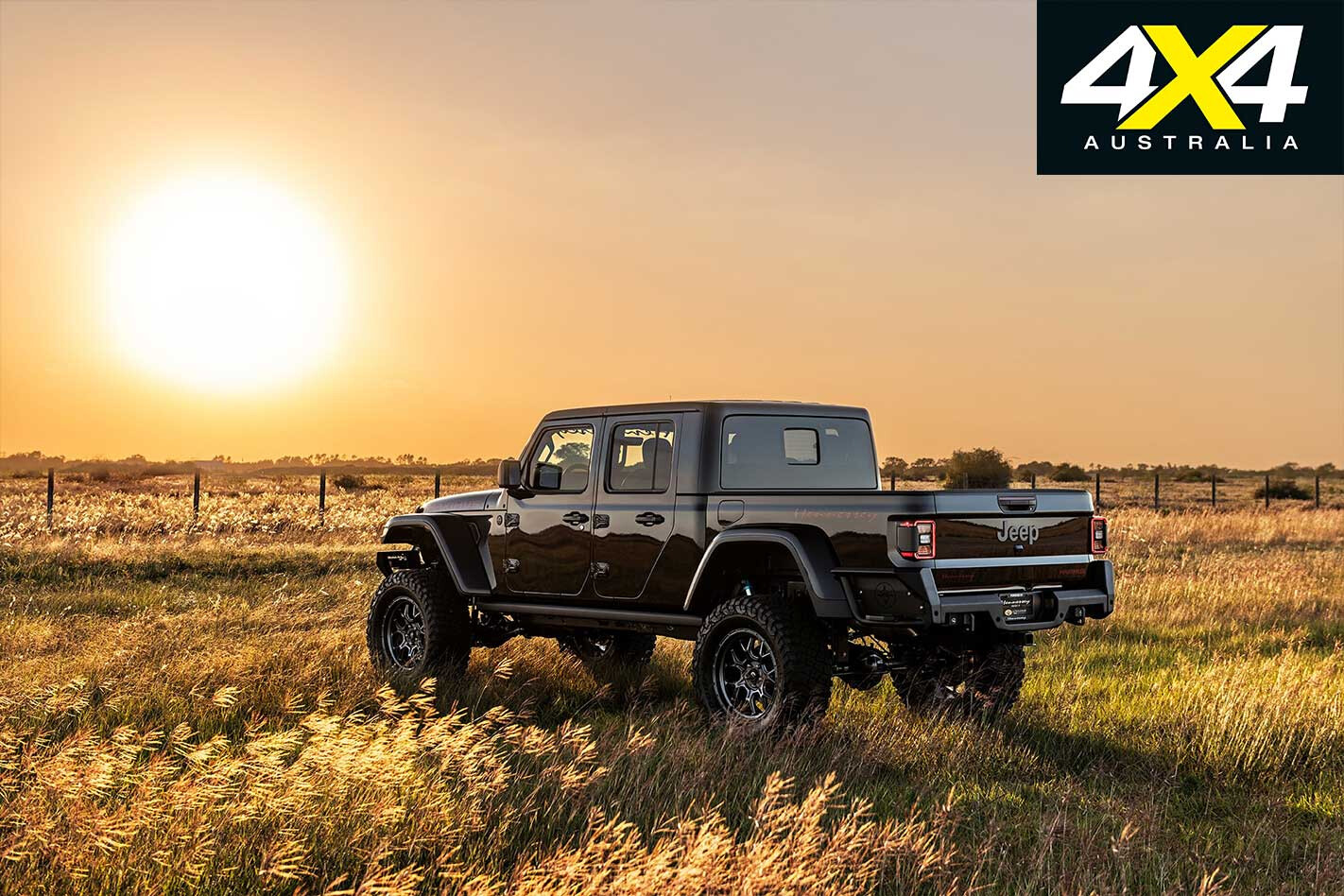
While it might win the traffic light GP, the Gladiator’s off-road credentials are also improved courtesy of a King off-road suspension system with a six-inch lift, heavy duty off-road axles and heavy duty front and rear driveshafts, Dana 60 diffs (4.88) front and rear, and Maximus front and rear bumpers with LEDs.
“We wanted to create the ultimate Jeep Gladiator,” said company founder, John Hennessey. “The name says exactly what it is: badassery on four wheels.”
Other additions include a stainless steel exhaust system, drop-down running boards, upgraded leather interior with Maximus seats, and Hennessy and Maximus logos scattered throughout the vehicle. Hennessey-branded aluminium wheels are wrapped in BFGoodrich off-road tyres.
The Maximus 1000 is limited to just 24 units and is priced at US$225,000, which includes the price of the 2020 Gladiator. It comes with a three-year/36,000-mile warranty.
Hennessey Performance, with the Shell Pennzoil team, will officially unveil the Gladiator Maximus at the 2019 SEMA Show, held at the Las Vegas Convention Centre from November 5 to 8.
SATELLITE phones have been around for a few years, and there are several providers offering different handsets with different capabilities and user packages at varying prices. I’ve used them all over the years but have only ever owned one: an Iridium unit on the Telstra satphone network.
The Iridium satphone network, with its 66 active satellites in low orbit around the earth, gives the best, most reliable coverage of any satphone network, both here and around the world.
I bought this Iridium Extreme after my old satphone packed it in after near 20 years of service, and it’s a smaller, more robust unit with better voice clarity, faster SMS messaging capability and an easier, more intuitive interface.
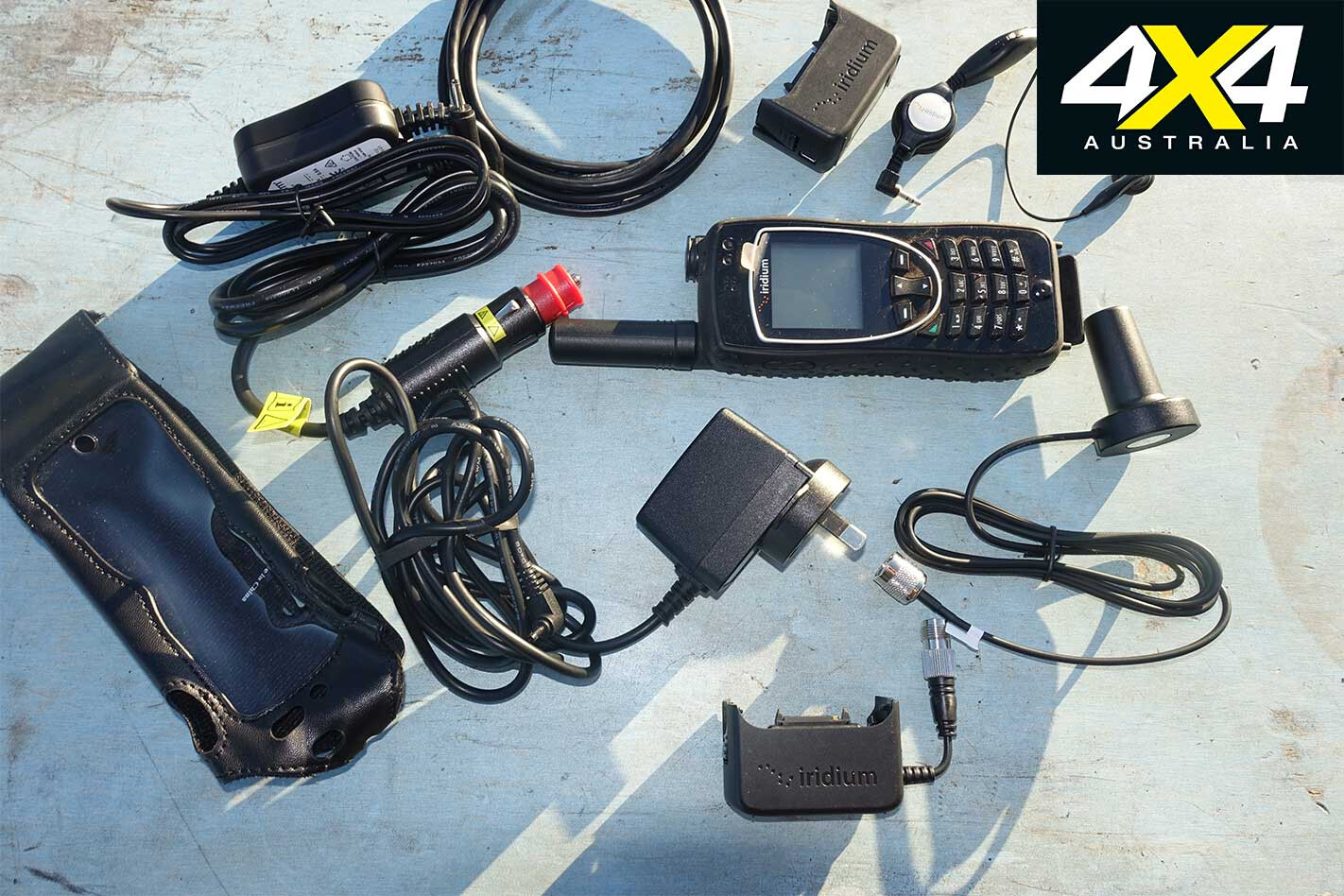
The Iridium Extreme comes as a complete kit with included 12V DC and 240V AC chargers, a vehicle kit with antenna and a hands-free headset unit. The handset itself is robust and IP65-rated to withstand the blast of a water jet, and it is shock- and dust-resistant to MIL-STD-810F.
The Extreme features inbuilt GPS tracking and location-sending via SMS, as well as an integrated GPS-enabled SOS button where you program who you want the SOS message sent to in an emergency.
The unit weighs less than 250g, and the standard battery provides you with 30 hours of standby time or four hours of talk time. Some may see the 30 hours of standby time as an issue but, with the 12V charger, four-wheelers shouldn’t have any problems keeping it charged up and ready.
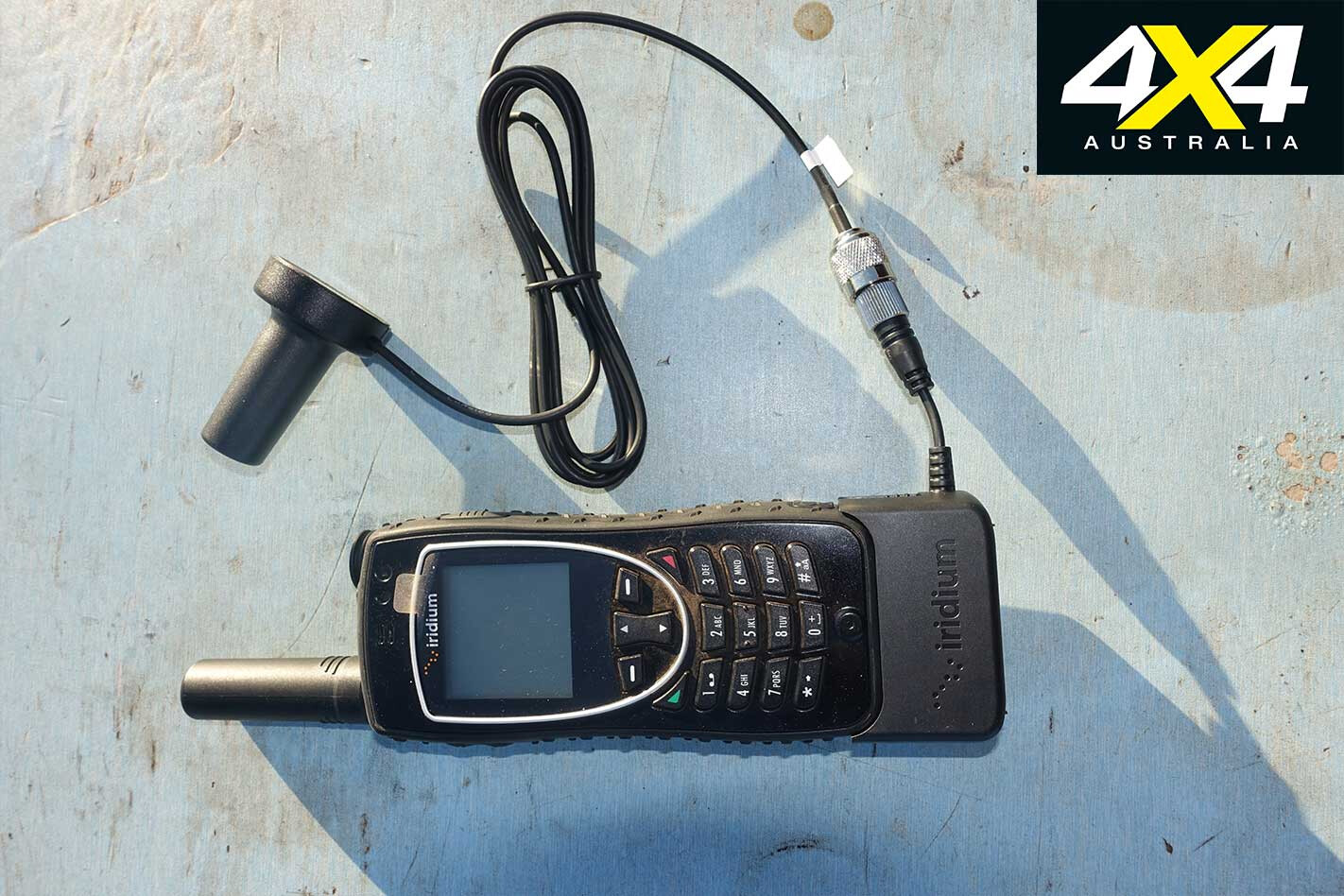
Now don’t expect this phone, or any satphone in fact, to be as versatile as your normal smartphone – it isn’t. And while you can send and receive SMS message and short emails, don’t expect to be streaming the latest movies or playing with your favourite apps.
You can connect the phone to a laptop where it will act as a data modem, but at a maximum speed of 13kbps you’ll only be able to check emails – without pics. Still, it does what a satphone is supposed to do: make and receive phone calls from anywhere on the planet. And, as far as I’m concerned, it does that better than any of the others.
AVAILABLE FROM: www.trtelecom.com.au
RRP: $2100 plus phone/data plans
WE SAY: Easy to use, reliable and around-the-world capability.
GERMAN-BASED tuning crew, Brabus, has turned the wick up on the G-Wagen by launching the Adventure Package, and it’s available for all variants of the current Mercedes-Benz G-Class range.
Revealed earlier this year at the Frankfurt Motor Show, the Adventure Package shows a clear focus by Brabus to transform the G into a more potent wagon when tarmac turns to mud and rocks.
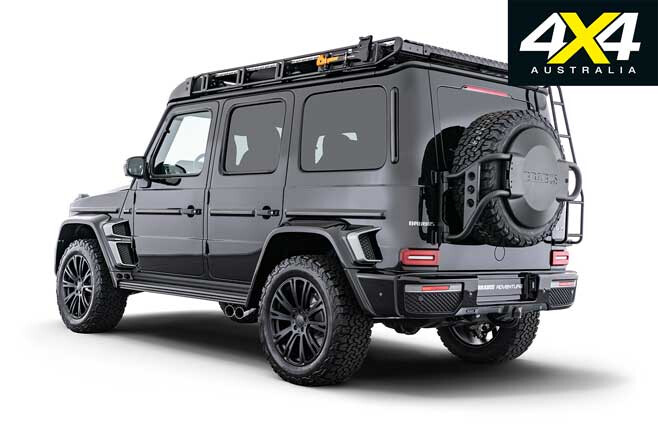
To this end, a raft of equipment has been added including neat Brabus Widestar widebody fender flares that widen the vehicle by 100mm. The flares protect 20-inch Monoblock R wheels wrapped in 285/55R20 rubber, and a fifth wheel located on a pivoted spare-wheel carrier is guarded by a carbon-fibre cover.
Height-adjustable Brabus Adventure sport springs complement the vehicle’s electronically controlled suspension and result in a ride-height increase of 40mm. The front-end is protected by a brush-guard, and the underbody by a skid plate.
There’s a full-length roof rack up top and access to gear is aided by the inclusion of a ladder at the rear. The rack also features axe and shovel brackets.
A Brabus performance upgrade – a plug-and-play ECO PowerXtra D35 module – is available for G350d models and lifts peak output of the 3.0-litre turbo-diesel engine from 210kW and 630Nm to 243kW and 690Nm. As a result, straight-line speed has quickened, with the 2.5-tonne Brabus wagon reaching 100 clicks in 7.2 seconds.
Not only did Brabus boffins make the vehicle more of a competent tourer, they also made a few key aesthetic changes to match the added brawn: a Widestar fascia with large air intakes, a carbon-fibre Brabus hood attachment, two chrome tailpipes, LED lighting and plenty of Brabus logos. The 350d turbo-diesel model also gets an all-stainless Brabus sport exhaust system.
For more information head to www.brabus.com
TEXAS-BASED tuner, PaxPower, has tinkered with Chevrolet’s Silverado 1500 to create the F150 Raptor-fighting Jackal.
“We set out to build a Silverado that would legitimately rival the Ford Raptor,” PaxPower says on its website. “After many months of development, we created the PaxPower Jackal!”
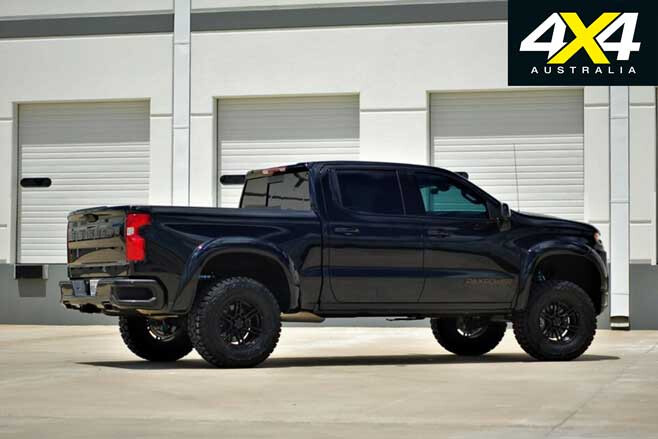
To put the Chevrolet in the same realm of the V6-powered Raptor, PaxPower offers three trim ‘stages’, the first of which is priced at US$15,000.
For that coin, the buyer nets an upgraded suspension set-up – King 2.5-inch front coilovers with remote reservoirs and 2.5-inch rear shocks with remove reservoirs, as well as Baja Kits upper control arms with uni-ball joints – to provide four inches of lift. In addition, other PaxPower add-ons include a custom hood, custom fender flares and 35-inch Toyo R/T rubber.
The Stage 2 kit is US$10K steeper at US$25,000 but, in addition to the King coilovers and rear shocks, gets a Baja Kits Prerunner Suspension set-up that provides “three inches wider long travel suspension”. This kit gives the vehicle a six-inch-wider stance.
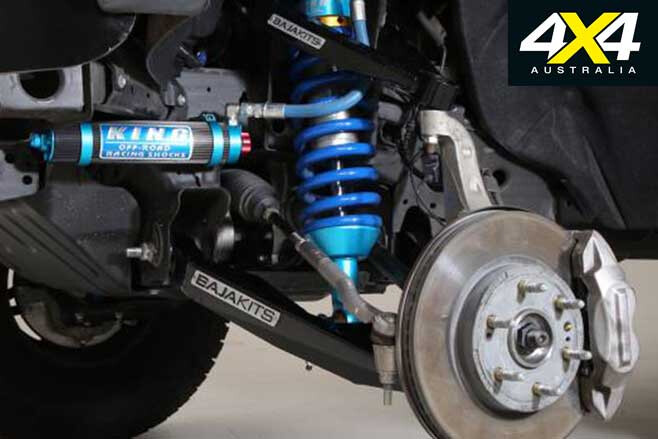
Equipment unique to the Stage 3 kit, priced at US$35,000, includes King 3.0-inch coilovers and shocks with internal bypass, a Baja Kits Front Prerunner suspension kit, Deaver rear leaf springs, a Baja Kits rear shackle, Addictive Desert Designs Stealth Fighter bumpers, Rigid lighting and bigger 37-inch Toyo R/T tyres.
The 6.2-litre V8 engine has been tweaked for a 22hp power gain, courtesy of a GM Cold Air Intake, Stainless Steel Exhaust System and Performance Computer Calibration. The Jackal kits maintain full factory drivetrain warranty.
Available only in the States, the build time takes approximately three weeks. Customers can source their own Silverados, or use PaxPower’s partner dealers located in Houston, Texas.
IT MAY BE more giant buggy than ute, but what you’re looking at could become the US Army’s next Infantry Squad Vehicle (ISV), which is based on the US-market Chevrolet Colorado ZR2.
Developed by GM Defense, General Motors’ division for military products, the ISV has been picked by the US Army for further assessment, with plans for the acquisition of 650 units from as early as 2020.
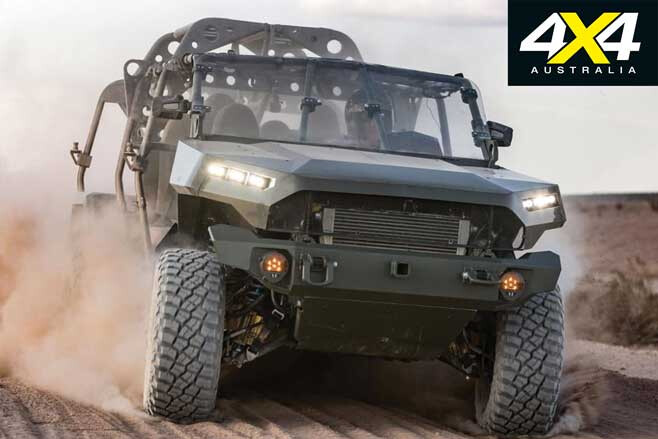
The ISV utilises the Colorado’s architecture for its occupant and cargo superstructure, with propulsion coming from a 139kW 2.8-litre diesel powerplant mated to a six-speed automatic. According to GM Defense, around 70 per cent of the ISV parts are using commercial off-the-shelf components.
One such component used on both Colorado ZR2 and ISV is the Multimatic DSSV dampers developed by Chevy Performance, which GM credits as one of the high-performance solutions that allows the ISV to meet the US Army’s requirement of being able to carry nine soldiers and accompanying gear at highway speeds, both on- and off-road “under extreme conditions”.
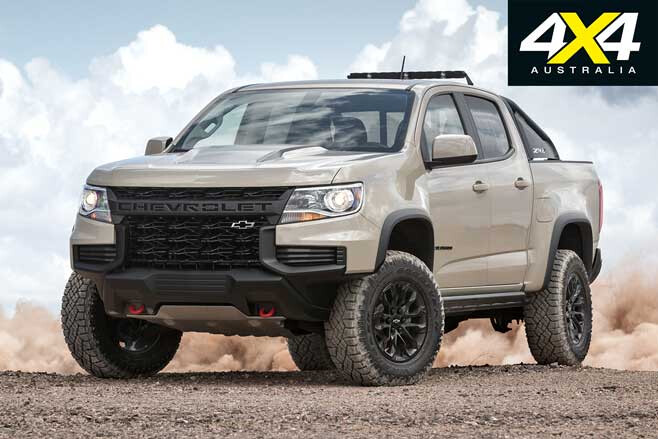
Other Chevy Performance high-performance parts used on the ISV include long-travel rear leaf springs, “jounce” shocks, front upper control arms, steel driveshaft, underbody skid plates, and ball-spline half-shafts.
The ISV is also designed to meet the US Army’s requirement of being light enough to be sling-loaded from a UH-60 Black Hawk helicopter and compact enough to fit inside a CH-47 Chinook helicopter.
“We’re very proud of the opportunity to move forward in this competition and continue our development of a vehicle that will enable Army units to move around the battlefield with greater ease and reliability,” said David Albritton, president of GM Defense.
According to GM Defense, the US Army has so far confirmed the construction of two more ISV prototypes, with testing to commence in the fourth quarter of 2019.