
Whether you’re a seasoned adventurer or a first-time explorer, Facing Island promises an unforgettable escape into nature. And what better way to enjoy it than bringing your four-legged friends along, with dog-friendly camping on offer.
Although there are permanent residents on the island, there are no shops, so you’ll need to be fully self-sufficient. Stock up in Gladstone before boarding the barge.
Lining up in Gladstone Harbour, excitement builds as you roll onto the Curtis Island barge – especially if it’s your first visit. The experienced deckhands work quickly to keep loading on schedule and avoid delays. Once the ferry departs, it’s the perfect time to air down your tyres. The ferry also services Quoin Island and Curtis Island, so depending on the load order you may have a few detours en route.
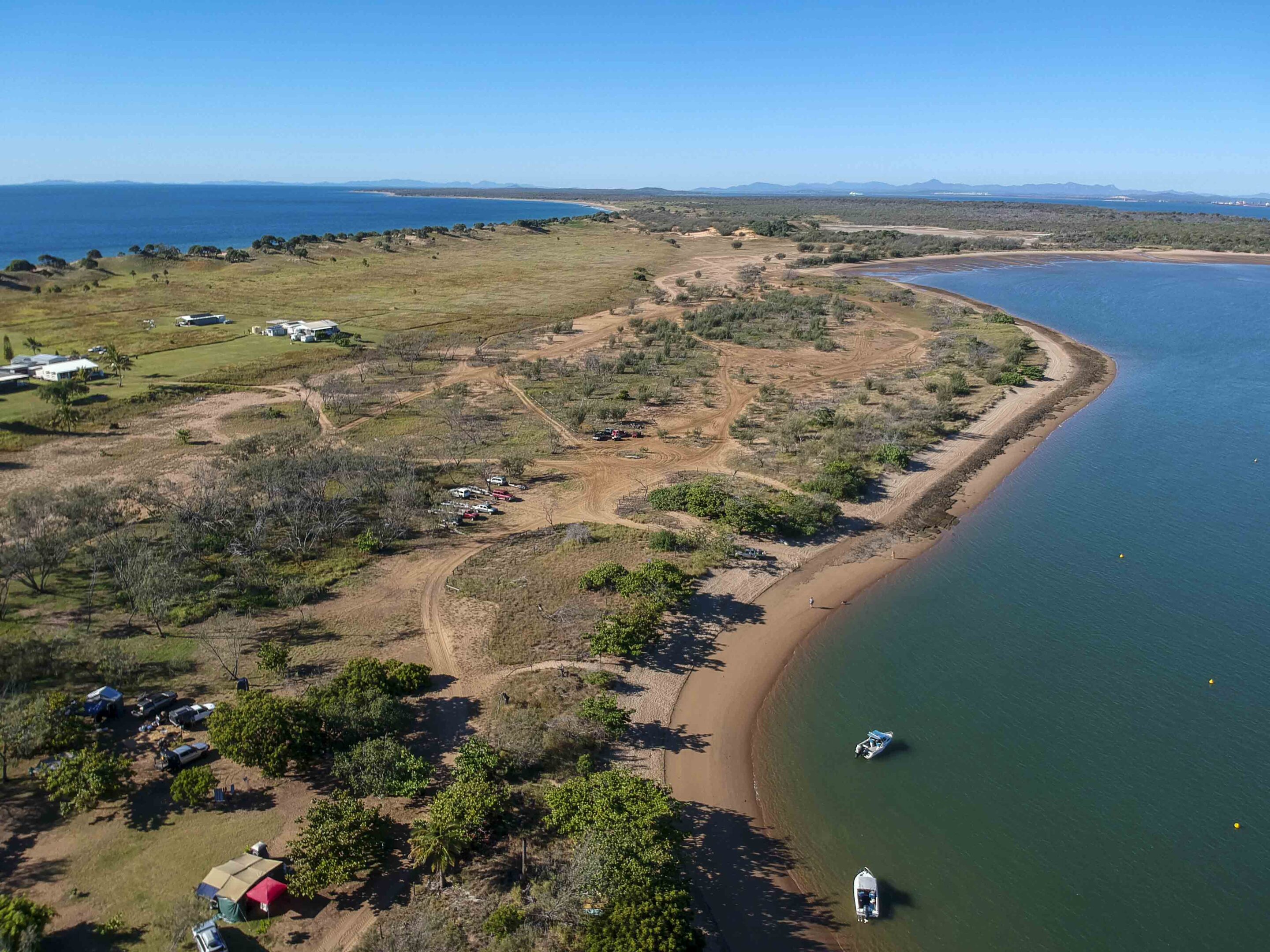
After about an hour, the drawbridge lowers and you drive straight onto the beach. Hook a right to avoid campers waiting for the return ferry, roll the windows down and let the island breeze in – your holiday has begun.
It’s a short seven-minute sandy drive before you pop out onto the beach, splash through a washout, then head inland again. When you see the line of boat trailers, you’ve reached the campground entrance.
Campsites are easy to find thanks to large numbered pegs. Take your time setting up and soak in the view – every angle of the facilitated campground offers something different. Mornings come alive with the island’s wildlife, from red-tailed black cockatoos to other feathered locals, their sunrise chorus signalling the start of a new day and fresh adventures.
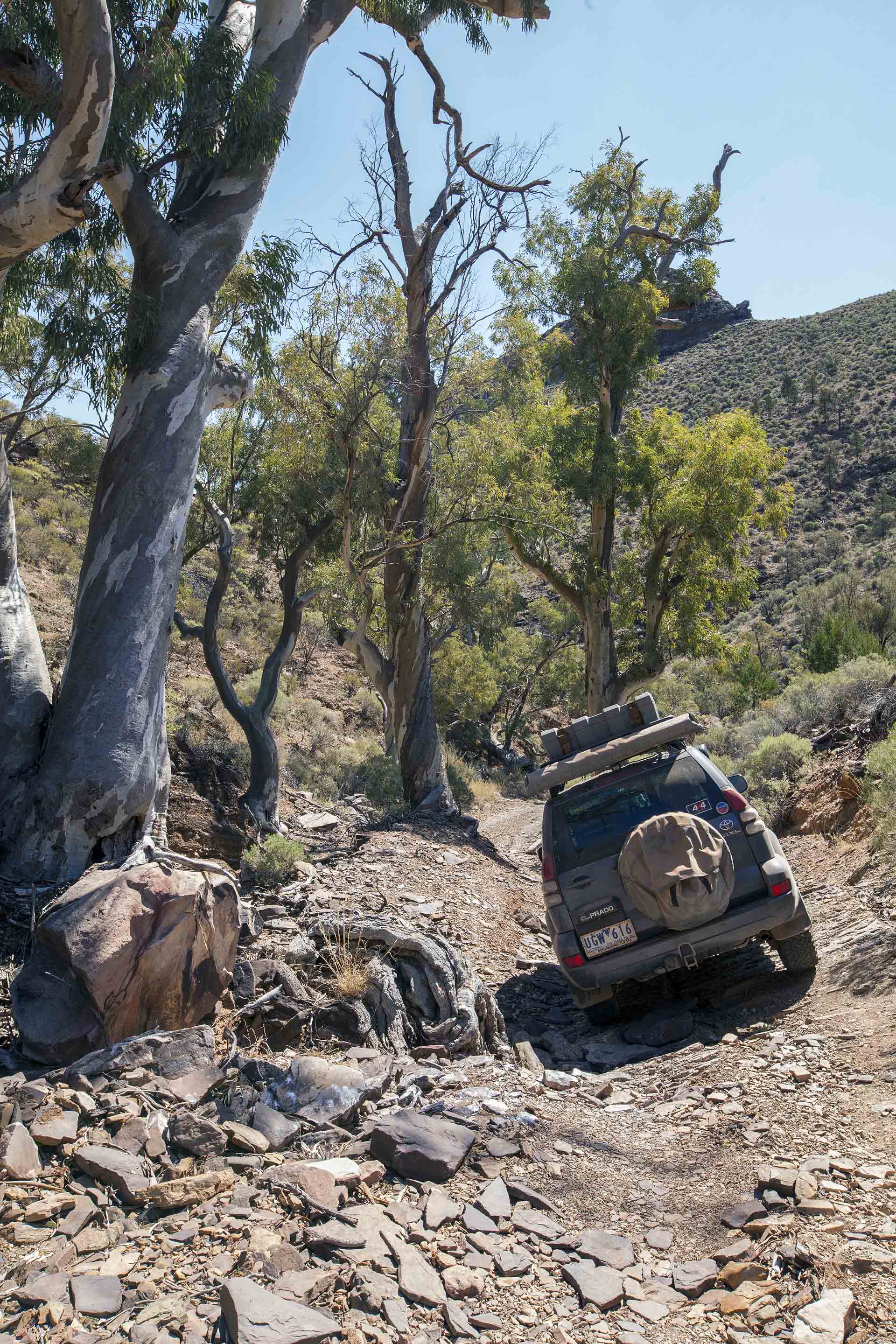
A short walk from camp takes you to wild, untamed shores where you can launch your boat straight off the beach. Drop anchor nearby so you can keep an eye on it – perfect for spontaneous fishing trips right from camp. Whether you’re chasing flathead from the sand or rock cod and tuskfish in the bay, the surrounding islands and ocean side deliver plenty of species to keep you busy.
Golden hour is best enjoyed on the beach with a cold drink as the sun melts into the horizon – the perfect photo op. But don’t forget the bug spray; midges and mozzies arrive in relentless waves after dark.
When you feel like swapping boat keys for car keys, the island offers a web of 4×4 tracks. One standout run traces the east coast south to the township of Gatcombe, delivering beach runs, rocky outcrops, natural caves, bush tracks and secluded beaches. It’s a great day trip that adds variety to your stay.
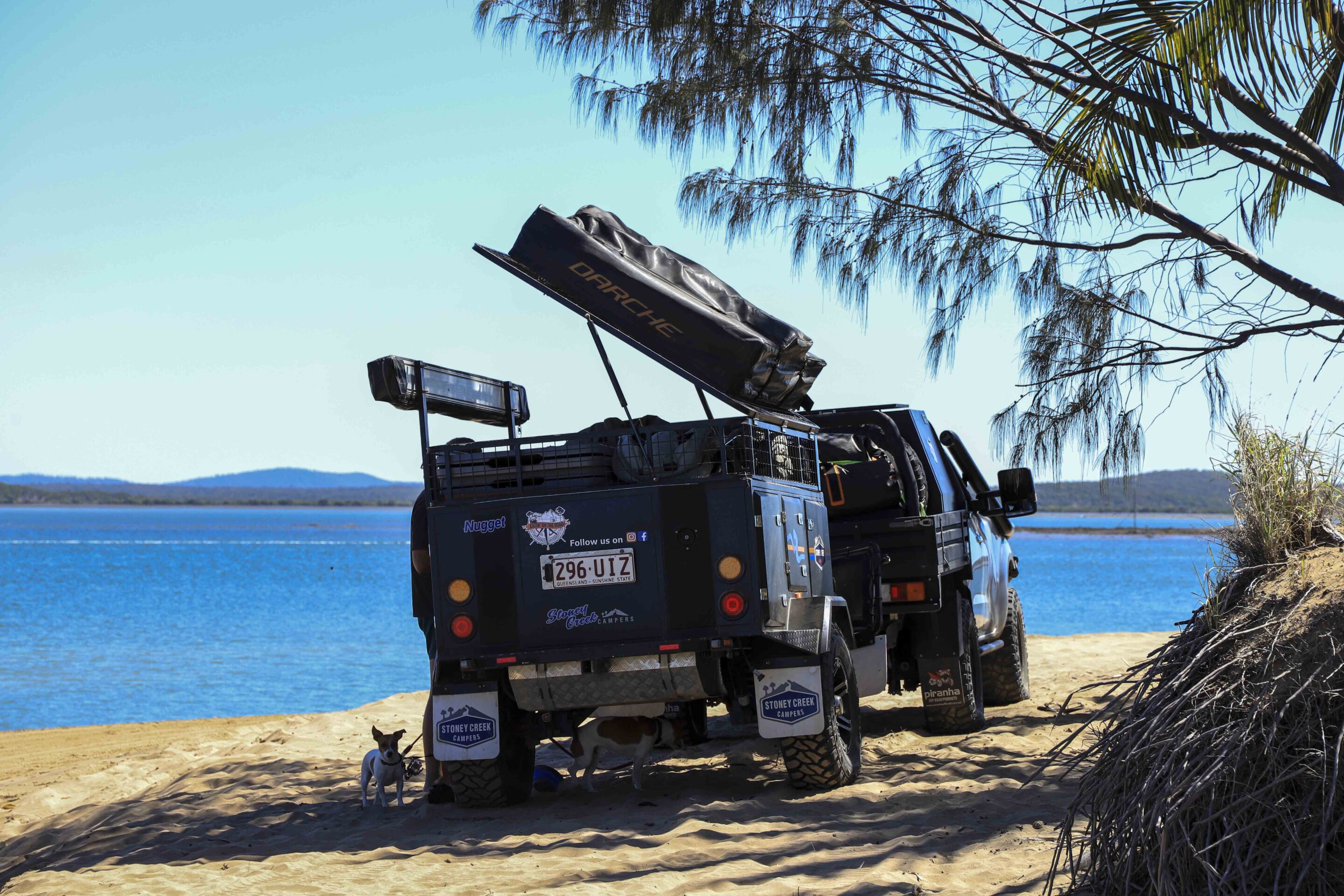
Tracks criss-cross the island, and getting “lost” is half the fun. The changing landscapes – from beach to bush to cliffs – will have you hunting for more spots to explore.
Facing Island has something for everyone, whether you’re chasing adventure or simply want to read a book in the sunshine. You’ll leave refreshed, reset, and armed with memories, photos, and stories to make your mates jealous.
What you need to know
- Where: Facing Island, QLD
- Camping: $7 pp/pn for unpowered beach sites
- Facilities: Toilets, no showers
- Getting There: Travel from Gladstone via Curtis Ferry Services. Boarding requires reversing onto the ferry – the deckhands are very helpful. The trip takes about an hour, dropping you directly on the beach, so air down before arrival. The Oaks Campground is a seven-minute drive from the drop-off point. Ferry cost: $346 for a vehicle and 4m trailer.
- Getting Back: Same process for the return trip – reversing onto the barge from the beach. The crew will assist to get you onboard safely.
- Camping Permits: The Oaks Camping Ground
- More Information: No vehicle access permit required. No shops on the island – you must be self-sufficient. Stock up in Gladstone before departure.
If it’s flooded… forget it.
That’s the catch-cry across Australia whenever rain falls and creeks flood. It’s a simple, clear message meant to keep people safe when water covers city streets or country roads. But I’m not a great lover of it. Why? Because it’s too bloody simple and all-encompassing.
I’ve previously received flack on Facebook for posts showing the Stuart Highway cut by floodwaters and vehicles filmed passing through the flooded section.
“What happened to ‘if it’s flooded, forget it’?” keyboard warriors railed. Others got personal, saying with my vast experience I should know better and was setting a bad example. One comment, which alarmed me, claimed that just a few inches of water could sweep a vehicle off the road. Geez, the water would have to be flowing bloody fast and you’d need a light, low-slung vehicle with hardly any ground clearance for that to happen.
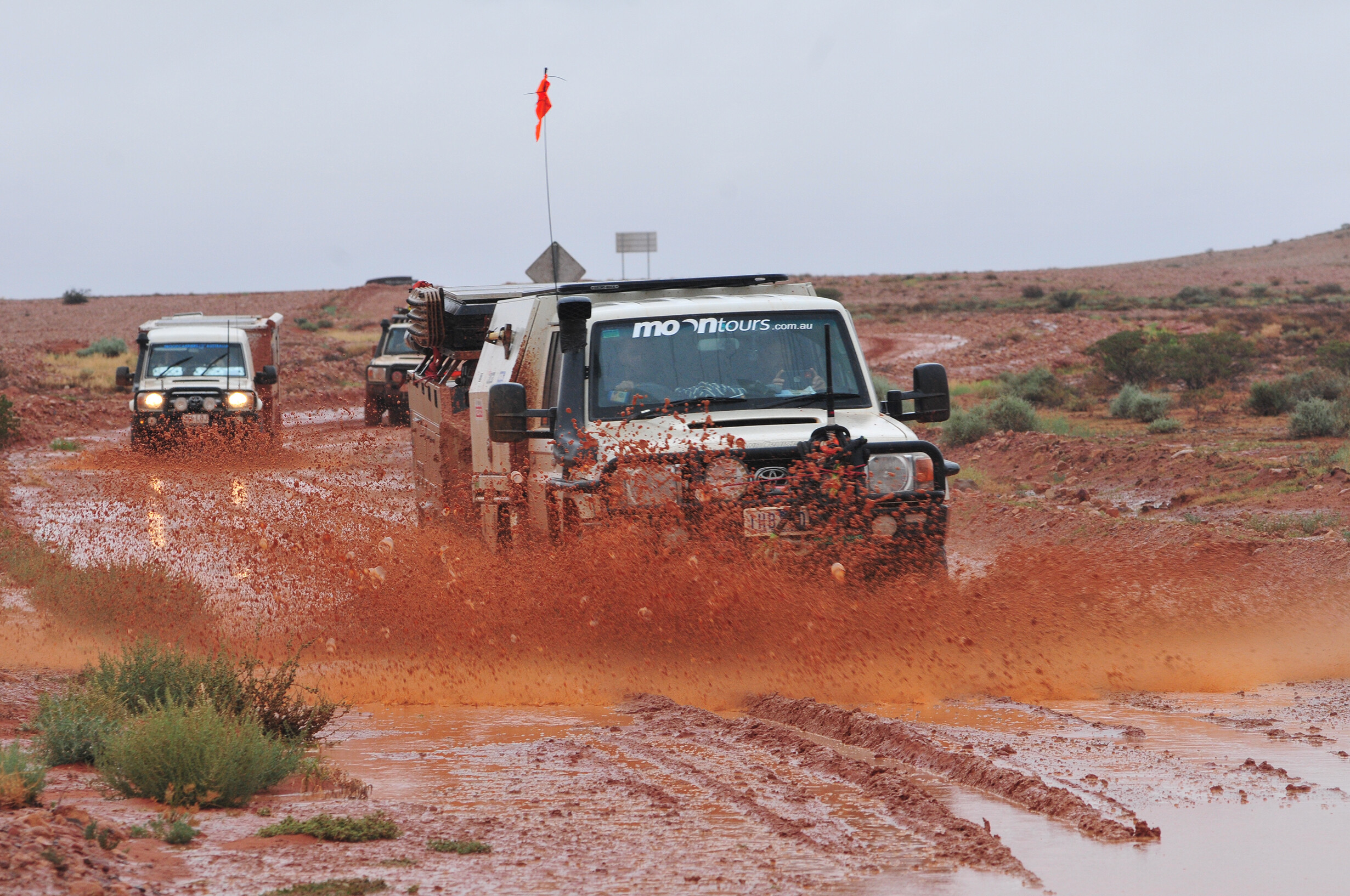
The video that drew criticism showed a convoy of trucks and four-wheel drives crossing a flooded section of the Stuart. As I pointed out to those who hadn’t read the article, police had checked the road and approved the convoy to cross.
Yes, the water was flowing, but hardly at breakneck speed – and it was about 30cm deep at the time. Police had obviously checked to ensure there were no washed-out sections under the water before allowing the convoy through. And if you were in a normal low-slung car, you were obliged to stay put. The fact that police okayed the crossing brought more online criticism, with some saying, “So the police don’t practice what they preach!”
Dear Lord, give me strength! Could some people really be that bloody stupid, or are they just stirring the pot? Either way, it shows a lack of knowledge about 4WD driving, outback conditions, and crossing flooded roads.
I recall being in the Ashburton region of Western Australia, caught in monsoonal rains and flooding streams and tracks. We dodged around trying to escape the mess, then gave up and waited while the tracks dried and the creeks dropped. We didn’t see a soul during that time — no surprise given the state of the roads and moving water.
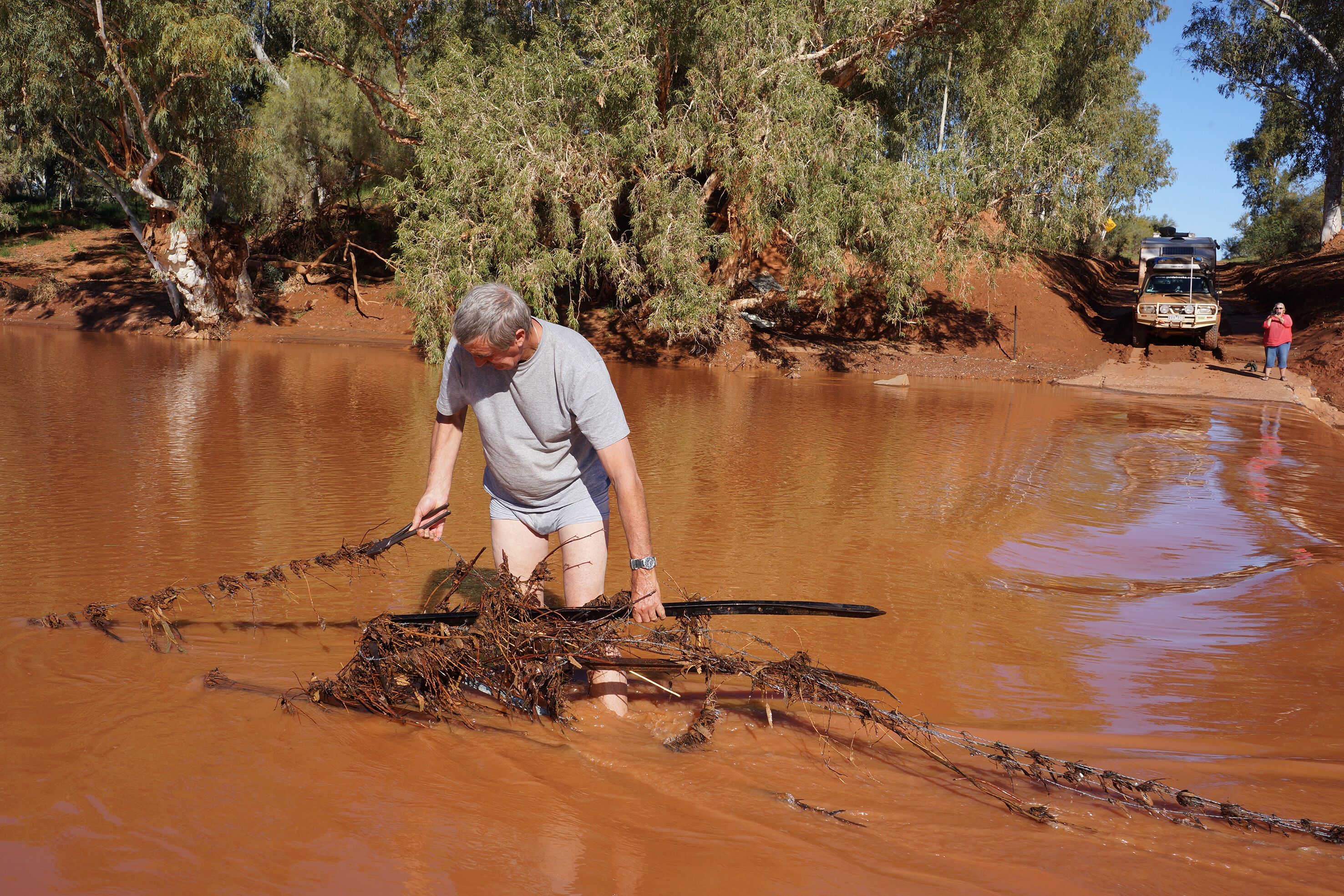
When we reached the Ashburton River crossing, still flowing strongly but shallow over its concrete causeway, we walked the route first to check that nothing had been washed away – but what we found was unexpected.
A barbed wire fence, complete with star pickets, had been washed downstream and tangled underwater in the centre of the river, out of sight. With pliers and some mucking about, we cleared the wire and pickets from the road, then crossed easily once the causeway was clear.
So, if you come across a flooded road crossing, check the water and make sure the surface beneath is intact and free of obstructions like barbed wire or star pickets. If the water is too deep – say, up to your thighs – and flowing quickly enough to make you lose footing, don’t even think about crossing in a 4WD. Turn around, go back, or wait for the stream to drop.
And if you’re in doubt about your vehicle’s capability or your skill level – remember, if it’s flooded, forget.
Ford has thrown its upcoming Ranger Super Duty into a deliberately brutal mud test, with the so-called “mud-pack test” designed to replicate real-world, wet-weather punishment that can destroy components over time.
The test – created at Ford’s You Yangs Proving Ground in Victoria – involved repeatedly driving a pre-production model through a bespoke loop of deep ruts bog holes and sticky clay. The goal was simple, according to Ford: to pack on as much performance-sapping mud as possible.
As can be seen in the above video, Ford’s engineers repeatedly lapped the course to allow the mud to build up in layers. Over time, the truck was carrying more than 600kg of caked-on sludge – a weight that can strain critical components.
“Mud is one of a truck’s greatest enemies,” said Rob Hugo, product excellence and human factors supervisor at Ford Australia. “It can add significant weight, prevent airflow, and act as an insulator, causing components to heat up much quicker. It’s highly corrosive and can clog up fans and alternators, preventing them from running correctly.”
Ford says the point was to see what breaks when a vehicle is used hard and not cleaned between runs. The accumulated mud chokes airflow, adds load to moving parts, and tests every seal, clip and connector. Things snap, overheat or bind when they’re not designed for this kind of abuse.
For people who use their utes in clay pits, creek beds or work sites where the truck doesn’t get a wash between jobs, this kind of testing shows how the Super Duty handles real-world scenarios.
“Our mud-pack testing is a key part of our ‘Built Ford Tough’ validation,” Hugo added. “So, for the Ranger Super Duty, we knew we had to turn it up to 11. We packed more mud onto this vehicle during development than we ever have before.”
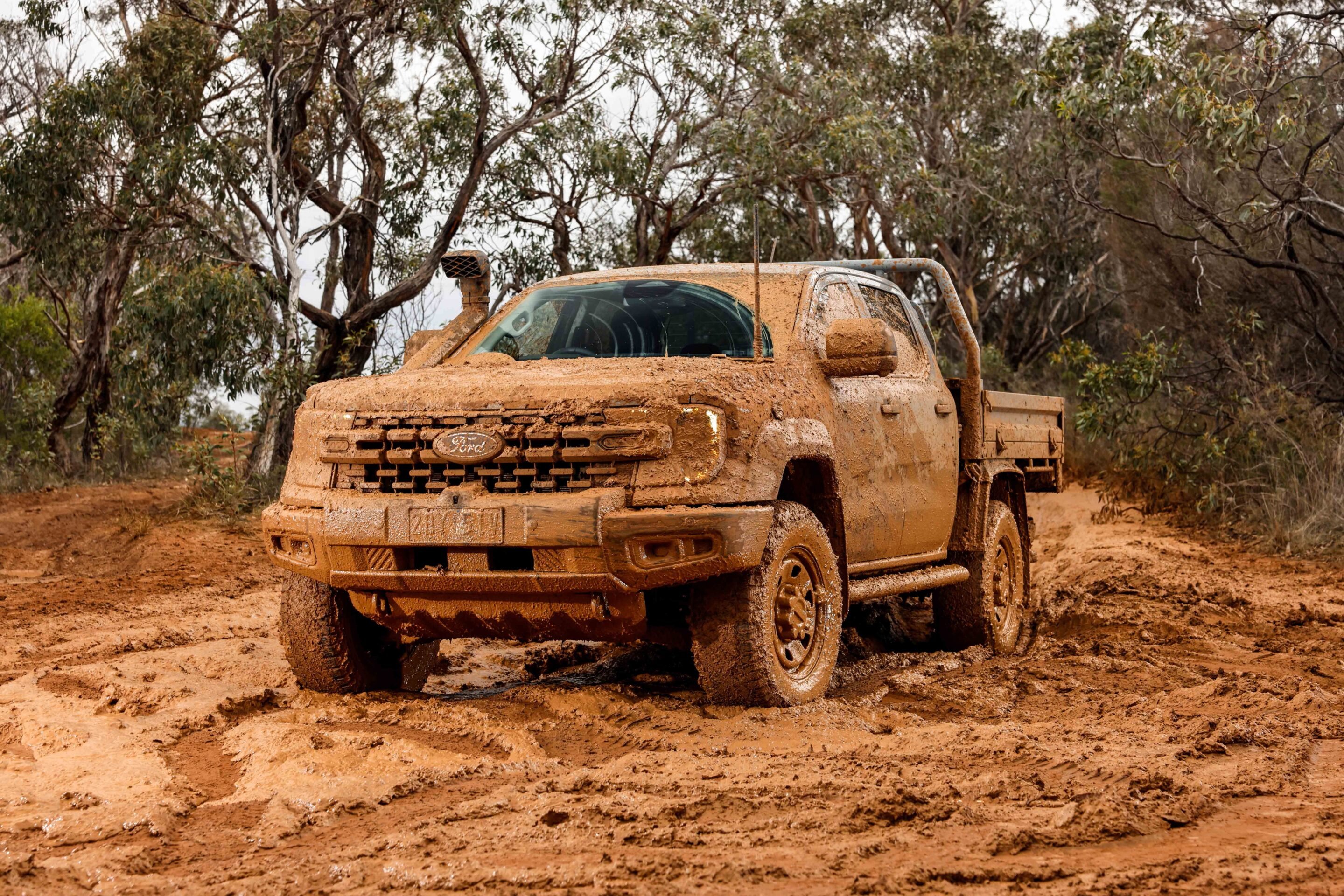
The upcoming Ranger Super Duty offers a 4500kg GVM, 4500kg towing capacity, and 8000kg GCM. The chassis has been reinforced with thicker rails, upgraded suspension mounts, heavy-duty axles and a 130-litre fuel tank.
Other features include a steel front bumper, underbody protection, front and rear diff locks, and a wider track. Power comes from an updated version of Ford’s 3.0-litre V6 turbo-diesel (154kW/600Nm), backed by a 10-speed automatic. The engine is tuned to meet Euro 6 emissions and uses AdBlue.
Cab-chassis models will be offered in single-, extra-, and dual-cab formats. Pricing is set at $82,990 for the single cab, $86,490 for the extra cab, and $89,990 for the dual cab (manufacturer list pricing, tray not included). XLT and pick-up variants will follow mid-2026, with pricing unconfirmed for these models.
The Ineos Grenadier is already a seriously capable off-roader straight off the showroom floor – with solid axles, a proper ladder chassis and proven hardware.
However, like any good 4×4, it’s also a blank canvas. With the right upgrades, you can push it even further – improving everything from storage and touring comfort to protection and suspension performance. Whether you’re building a long-range tourer or a weekend rock-crawler, these accessories will help transform your Grenadier into a purpose-built rig, ready for whatever lies beyond the blacktop.
When it comes to Grenadier-specific gear, Expedition HQ’s in-house XSPEC range has quickly become the go-to for Aussie owners chasing tough, well-engineered kit. Built for real-world off-road use, XSPEC products strike the balance between form, function and proper field-tested reliability.
XSPEC Combo Kit
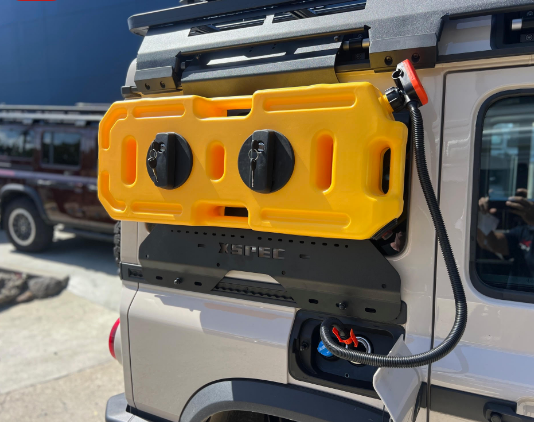
The XSPEC Xframe / 30L Diesel Tank / Transfer Pump combo is a solid option if you want to carry extra diesel in your Grenadier without chewing up interior space. It’s a bolt-on setup that mounts externally using two XSPEC Xframes and includes everything you need to get going.
The 30L tank locks in place and can be filled while mounted. When it’s time to transfer fuel, the included pump and adapter funnel let you top up straight into your main tank – no need to lift or mess around with jerries. The second Xframe can be set up to carry other gear like Maxtrax Lites, a pantry unit or a jerry can holder. It’s a tidy way to expand your touring range and keep essential gear on hand.
XSPEC Pantry and Jerry
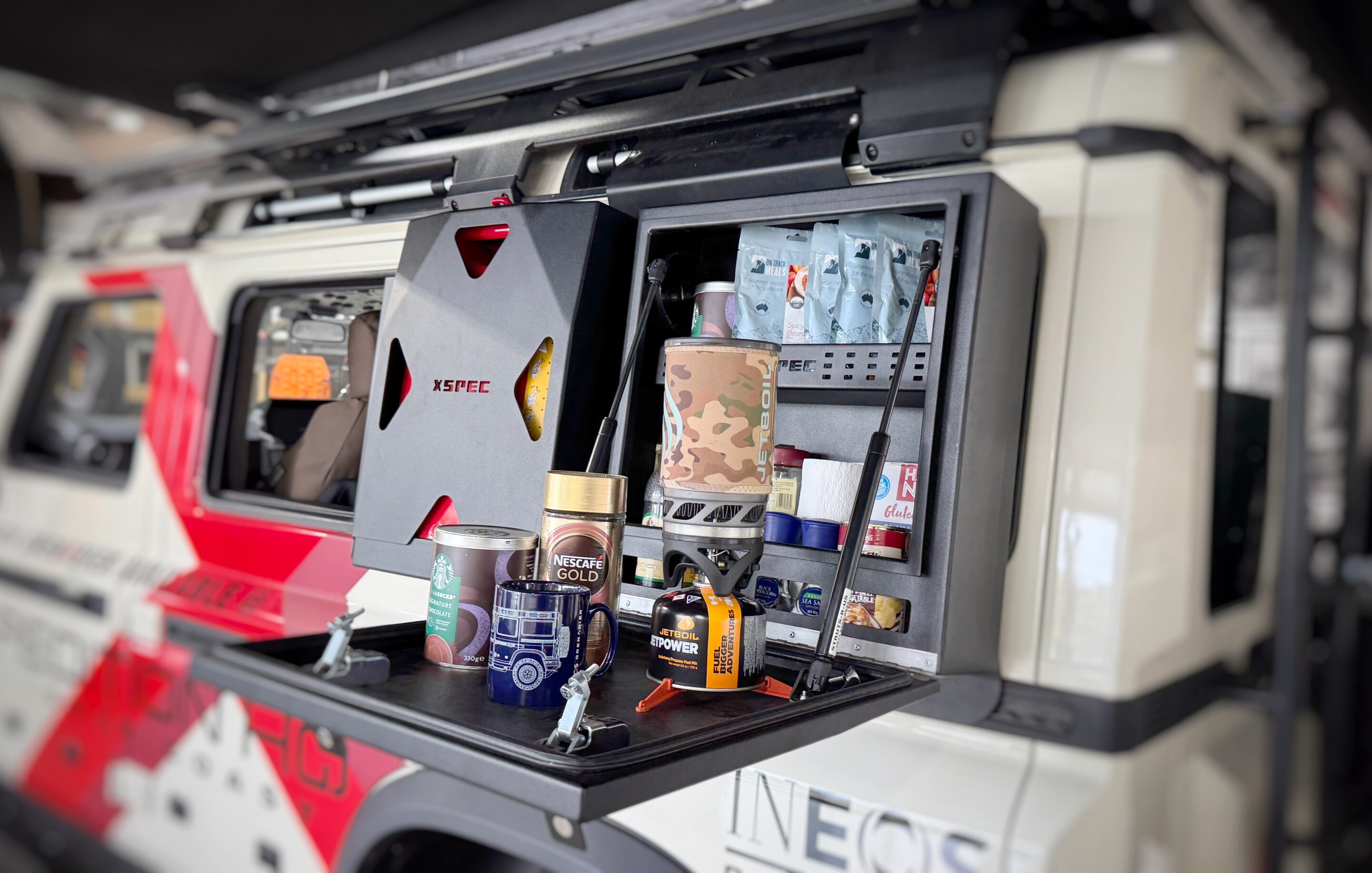
The XSPEC Pantry Box gives you about 25 litres of extra storage, mounted to the XSPEC window utility frame (sold separately). It fits either side of the Grenadier and comes with an aluminium shelf for two-tier storage.
You can choose a lift-up lid for quick access or a fold-down door that doubles as a table. The box is built from powder-coated aluminium and includes a lockable lid. Its smaller size means you can still run another XSPEC accessory beside it – like a jerry can holder. All mounting hardware is included and it’s been cleared for use with the standard Grenadier mirrors.
XSPEC Drawer System
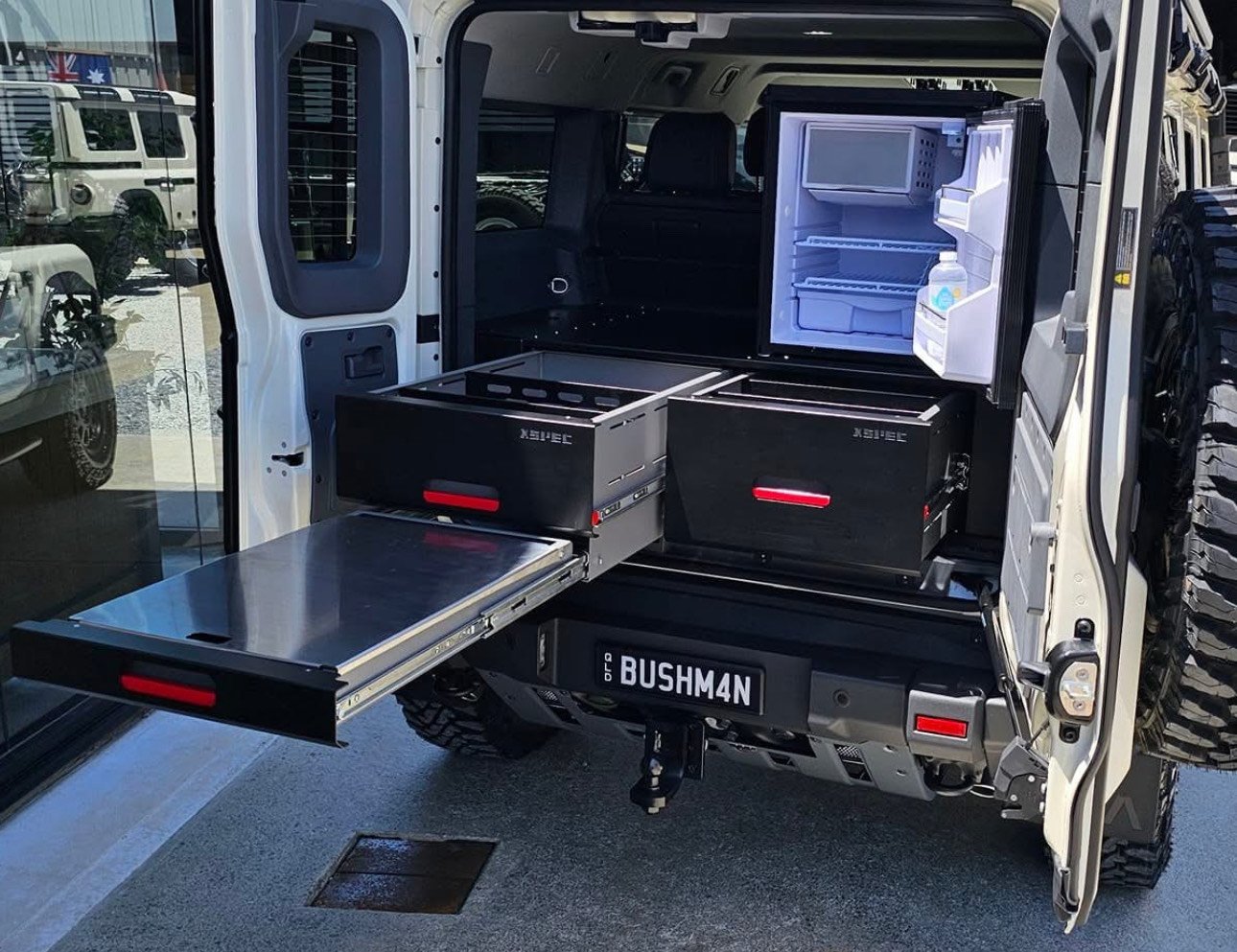
This full-width twin-drawer system is designed specifically for the Grenadier’s boot layout, making use of every inch without interfering with rear seatbacks or anchor points. The drawers are deep, lockable, and mounted on heavy-duty runners that won’t complain under a full load of tools, recovery gear, or kitchen kit.
The top deck is rated for stacking – ideal if you’re running a fridge slide, battery system or simply want to keep your storage layered. No rattles, no wasted space, and solid enough to handle constant corrugations or a few seasons of red dust.
XSPEC Electric Side Steps
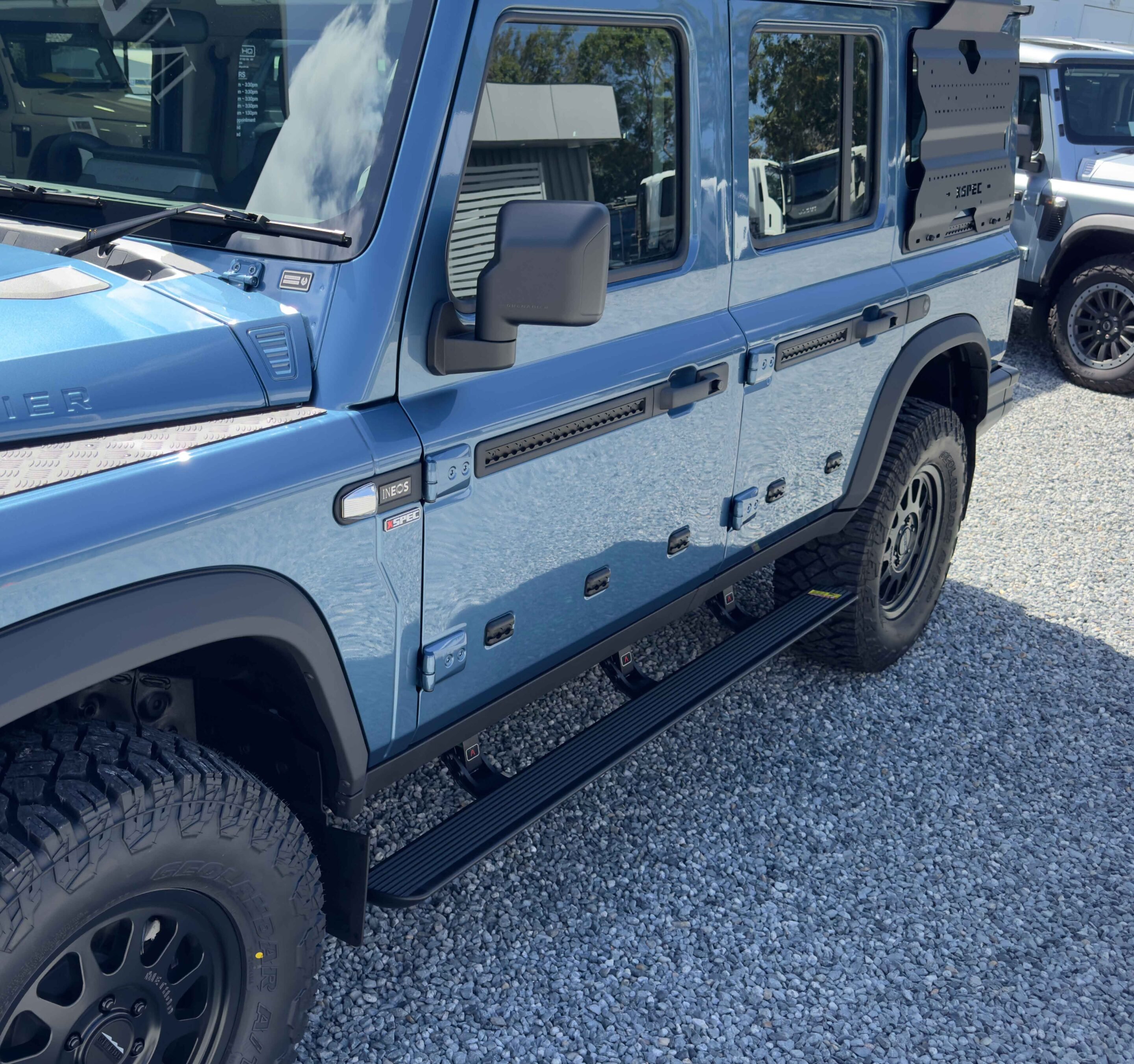
A solid upgrade for anyone running lifted suspension or just wanting easier access day to day. These electric steps sit flush against the sill when not in use, then drop down automatically when a door opens – giving you a wide, sturdy step without dragging through mud or rocks.
They’re properly sealed against dust and water ingress, with a motor unit built to take knocks from dust, gravel or the occasional misjudged rut. Ideal if your build is doubling as a family vehicle or if you’re regularly loading rooftop gear and don’t want to keep climbing in like it’s a telegraph pole.
XSPEC XFRAME Rear Utility Panel
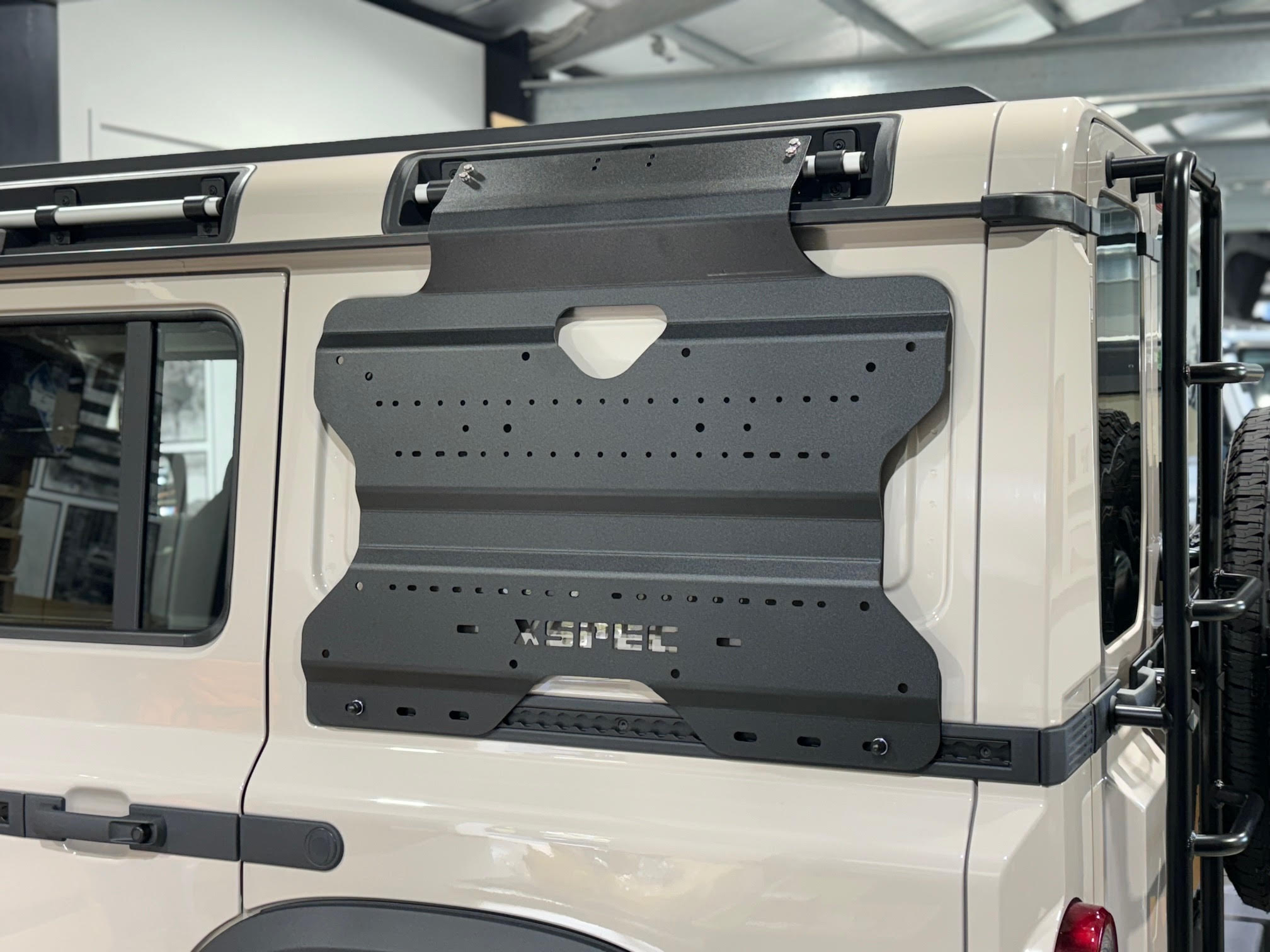
This external panel replaces the rear quarter window with a solid, mountable aluminium sheet that’s pre-drilled for MOLLE and accessory brackets. It’s a good way to shift essential but dirty kit – spades, high-lift jacks, Maxtrax, tool rolls – out of the cabin and onto the outside of the vehicle where it belongs.
Keeps your interior clean and free for passengers or fragile gear. Powder-coated to take the elements and stay looking sharp, even after a year in the scrub. Especially useful for serious tourers, tradies or anyone building a utilitarian work-travel setup.
TROOP roof-top tent
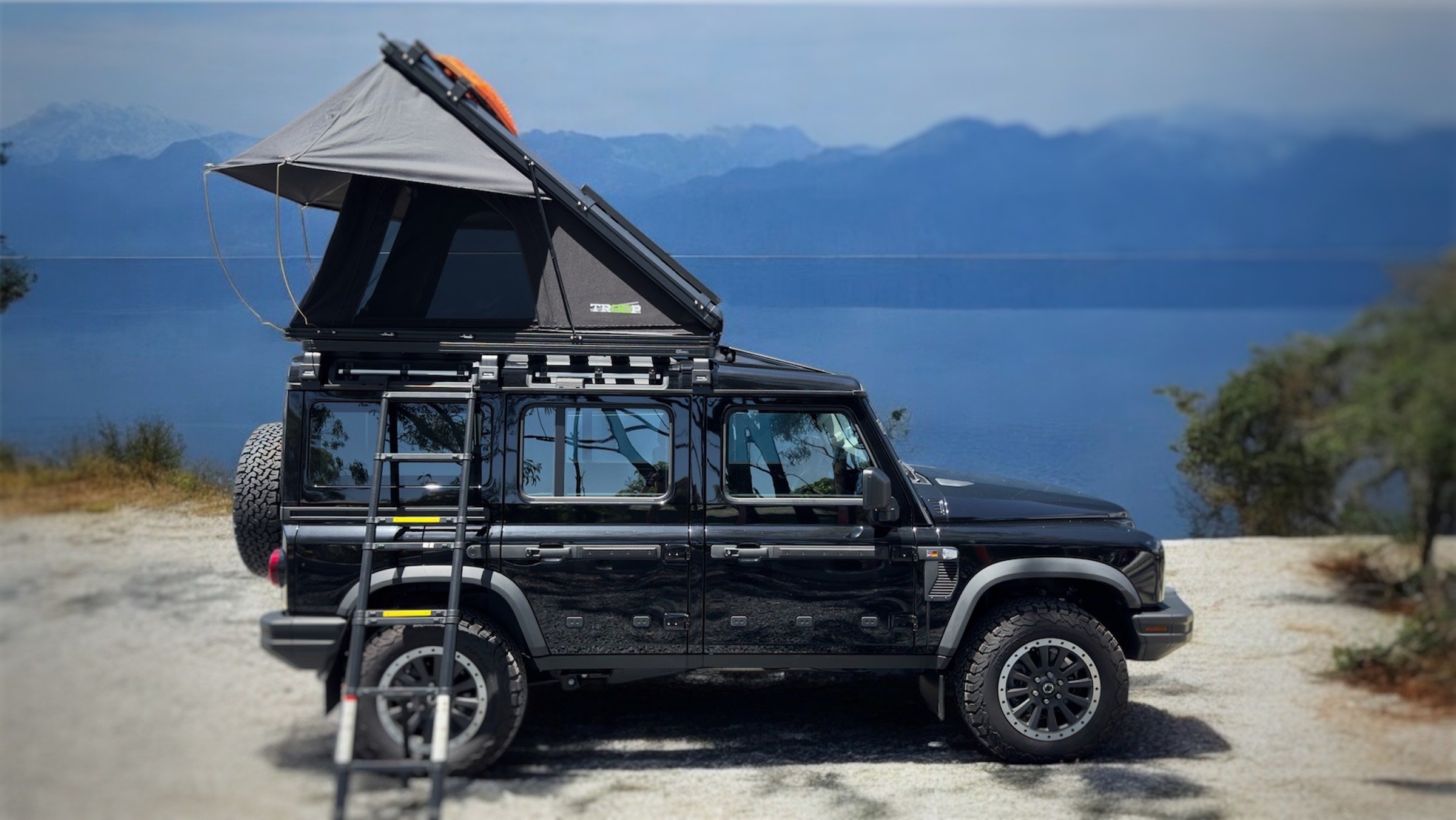
The TROOP hardshell rooftop tent is built for quick setup and pack-down, with gas struts that make deployment easy. It’s compact, low-profile and suits 4WDs, utes and trailers where space and weight matter.
The canvas body is waterproof and includes a small fixed awning for shade and weather protection. Openings on three sides with flyscreens allow good airflow. Inside, you get a memory foam mattress with an anti-condensation underlay, LED strip lighting, storage pockets and a telescopic ladder. External storage bags and a clear iPad sleeve are also built in.
Tent dimensions are 2100 mm x 1300 mm x 180 mm, with roof rails adding 60mm. The tent weighs 70kg, and the solar panel 12kg. The integrated roof rack is rated to carry 30kg.
XSPEC Under-Seat ARB Air Compressor
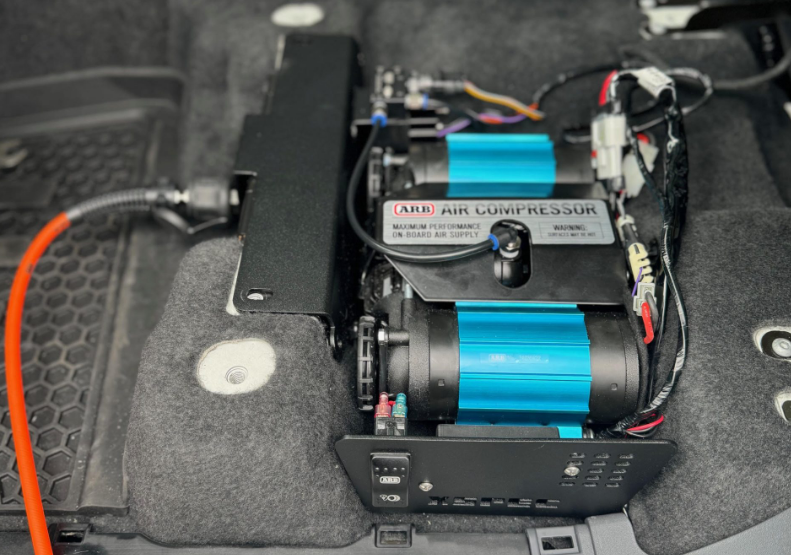
This hidden install tucks a full-size ARB compressor under the front seat – out of the way, protected from dust and weather, but always ready when you need it.
Whether you’re re-inflating after a beach run or topping up after rock work, having it hardwired and plumbed into a quick-connect outlet saves time and hassle. It’s powerful enough for 35s, doesn’t need a separate box bouncing around the rear, and frees up your load space for more important gear. One of the smartest low-visibility mods for any serious 4WD.
XSPEC TowPro Kit 2 with REDARC Brake Controller
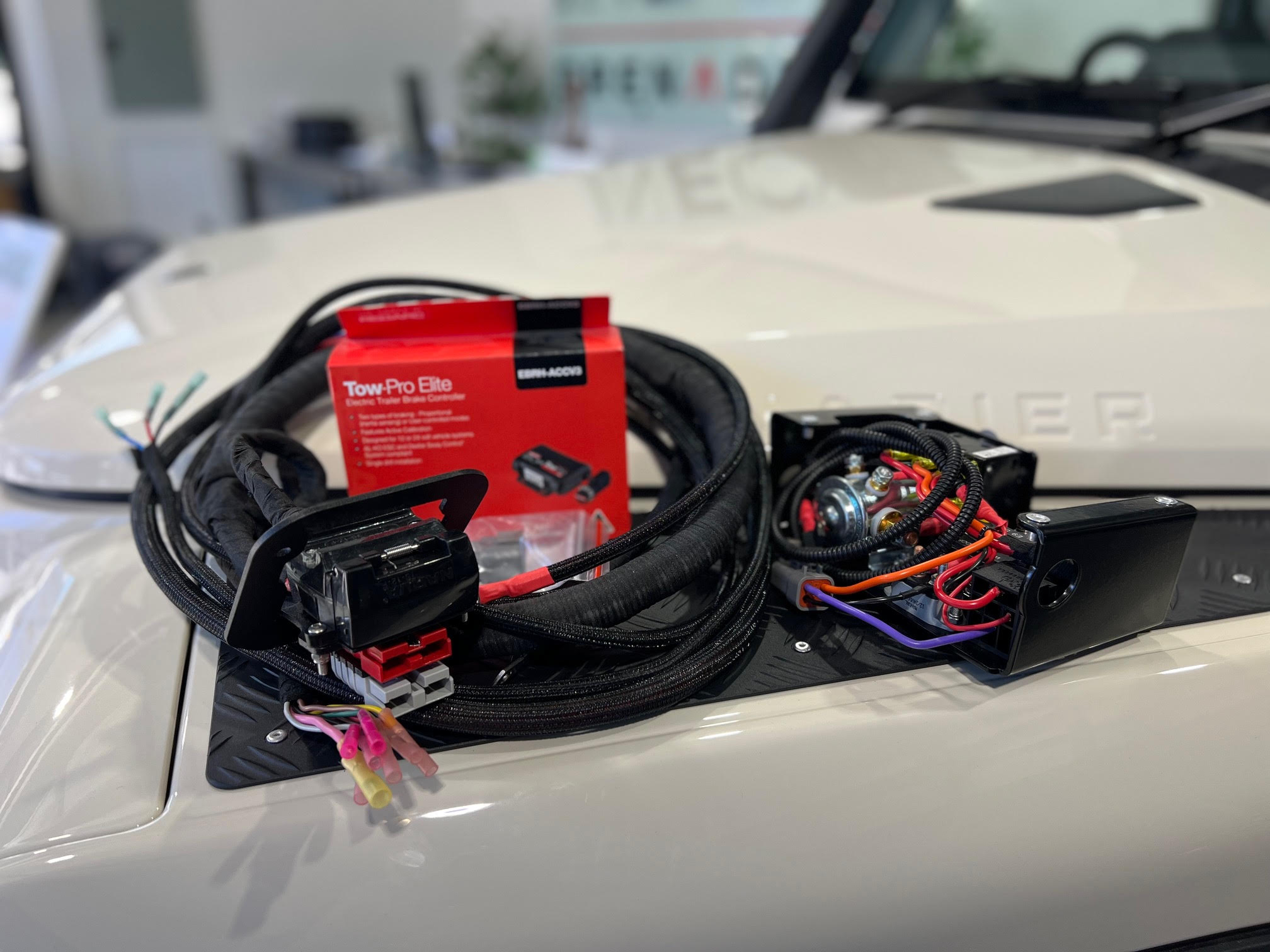
Towing a trailer, boat or van through the hills or out bush? This kit includes the REDARC TowPro Elite – widely considered the best trailer brake controller on the market. It gives you proportional braking on-road and a fully manual mode for steep descents or loose off-road surfaces.
The dash-mounted rotary dial is simple to use and keeps the cabin neat, and the wiring is designed to integrate cleanly into the Grenadier’s loom. Whether you’re towing daily or once a month, it’s a solid, legal and hassle-free upgrade.
Front Runner ¾ Low Profile Roof Rack
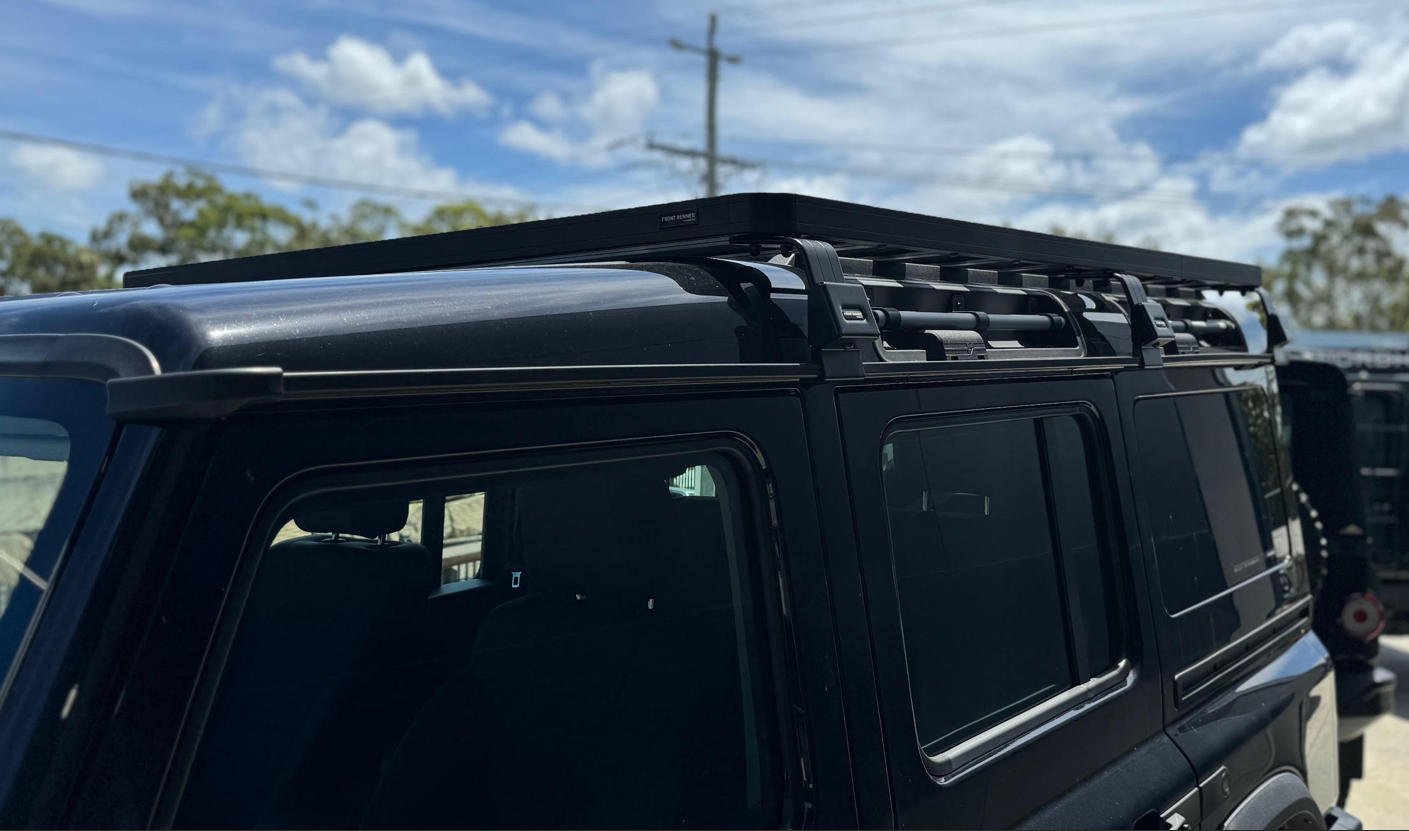
Front Runner’s ¾ rack gives you a strong, versatile platform without taking over the whole roof. It keeps the centre of gravity low and the overall vehicle height down – especially useful if you’re still trying to fit in a carport or navigate tree-lined tracks.
Compatible with a huge range of Front Runner accessories – including jerry mounts, recovery brackets, rooftop tents and more – and built with off-road abuse in mind. If you’re not going full expedition rig but still want rooftop storage and flexibility, this is a well-balanced option.
METHOD Race Wheels – 703 & 707
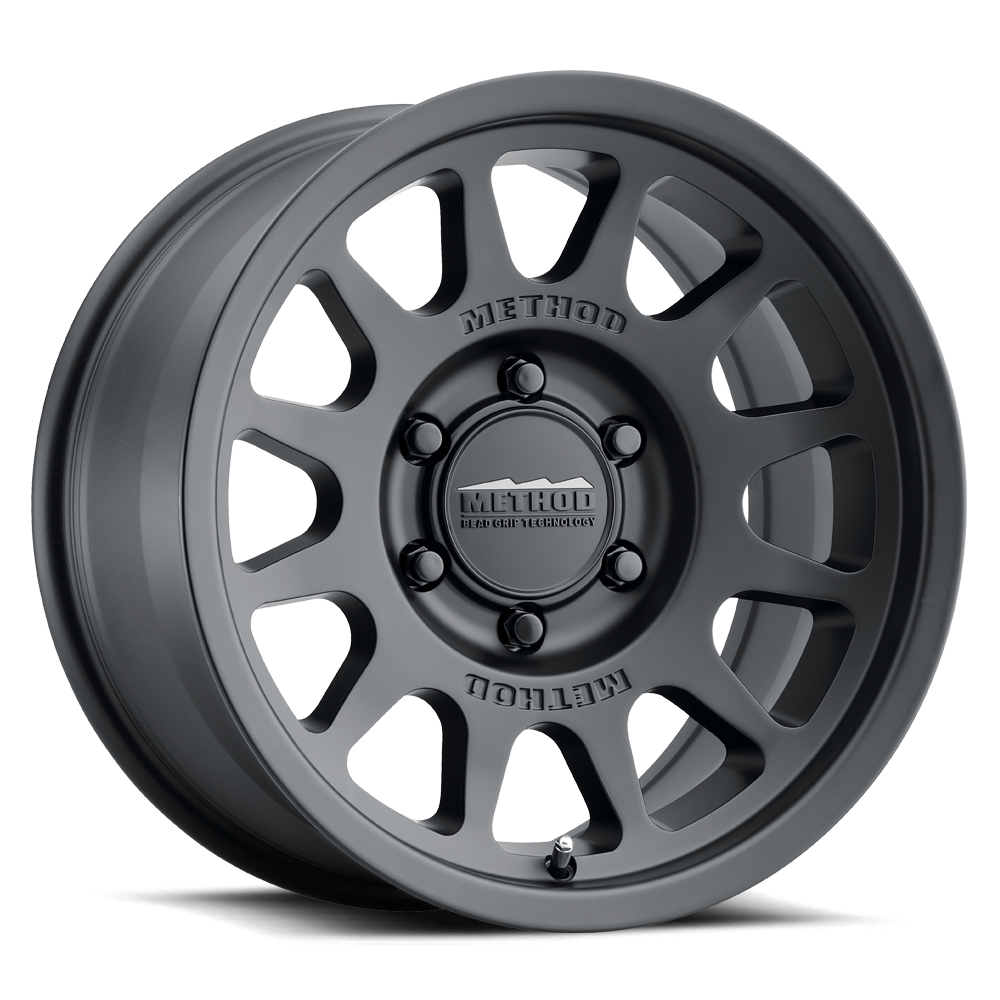
703 → | 707 →
Built for real-world off-roading, not just for looks. The 703s are a great match for sand and rocky terrain, thanks to METHOD’s patented Bead Grip design – giving you the confidence to air down without the full faff of a beadlock.
The 707s lean more into rally-inspired styling, with similar strength but a cleaner finish for dual-purpose use. Both are forged alloy, load-rated for heavy touring setups, and come in offsets that suit the Grenadier with or without flares. Whether you’re chasing functionality, looks or both – they’re a proper step up from stock.
Chelsea Truck Co Styling Upgrades
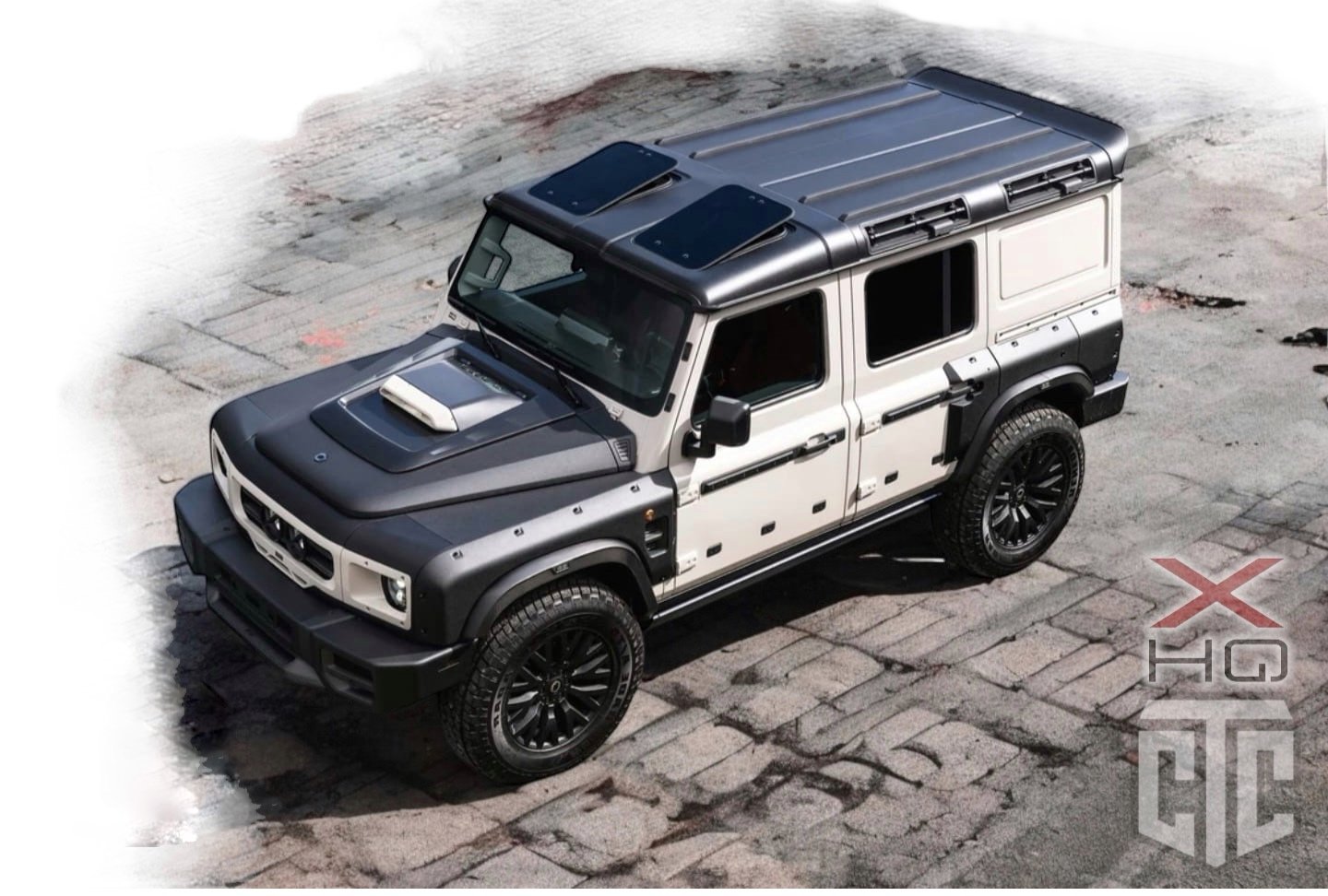
If you want your Grenadier to stand out – or lean a bit more towards urban custom than farm ute – the Chelsea Truck Co offers a well-built styling package that goes beyond bolt-on tat. Options include redesigned grilles, extended arch sets, interior finishes and unique alloy wheels.
It’s all tailored to fit without messing with your panel lines or getting in the way of practical mods like sliders or roof racks. Doesn’t affect off-road capability if chosen right – just adds a bit more presence, whether you’re in the city or stuck in mud.
Eibach ProLift Suspension Kit
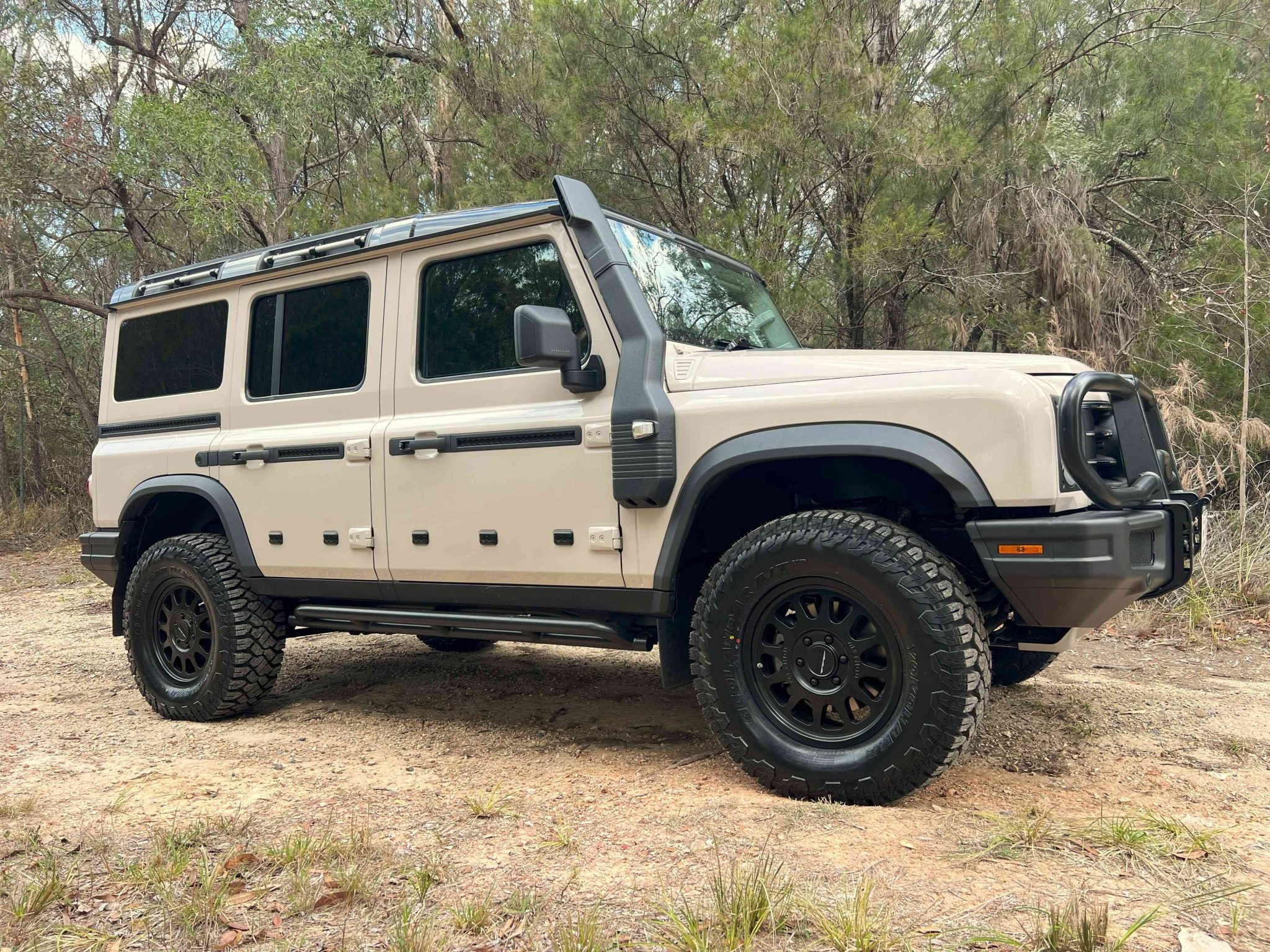
A mild, usable lift that’s designed to work with the Grenadier’s factory geometry. Gives you a bit more clearance under the diffs – especially handy for bigger tyres or loaded touring setups – without ruining ride comfort.
Springs are progressive-rate, meaning better handling when unloaded and improved support when you’re carrying weight. It’s not trying to turn your truck into a comp rig, but for most owners doing a mix of road, track and light touring, it’s the kind of reliable suspension upgrade that improves capability without bringing compromises.
King Shocks External Reservoir Suspension
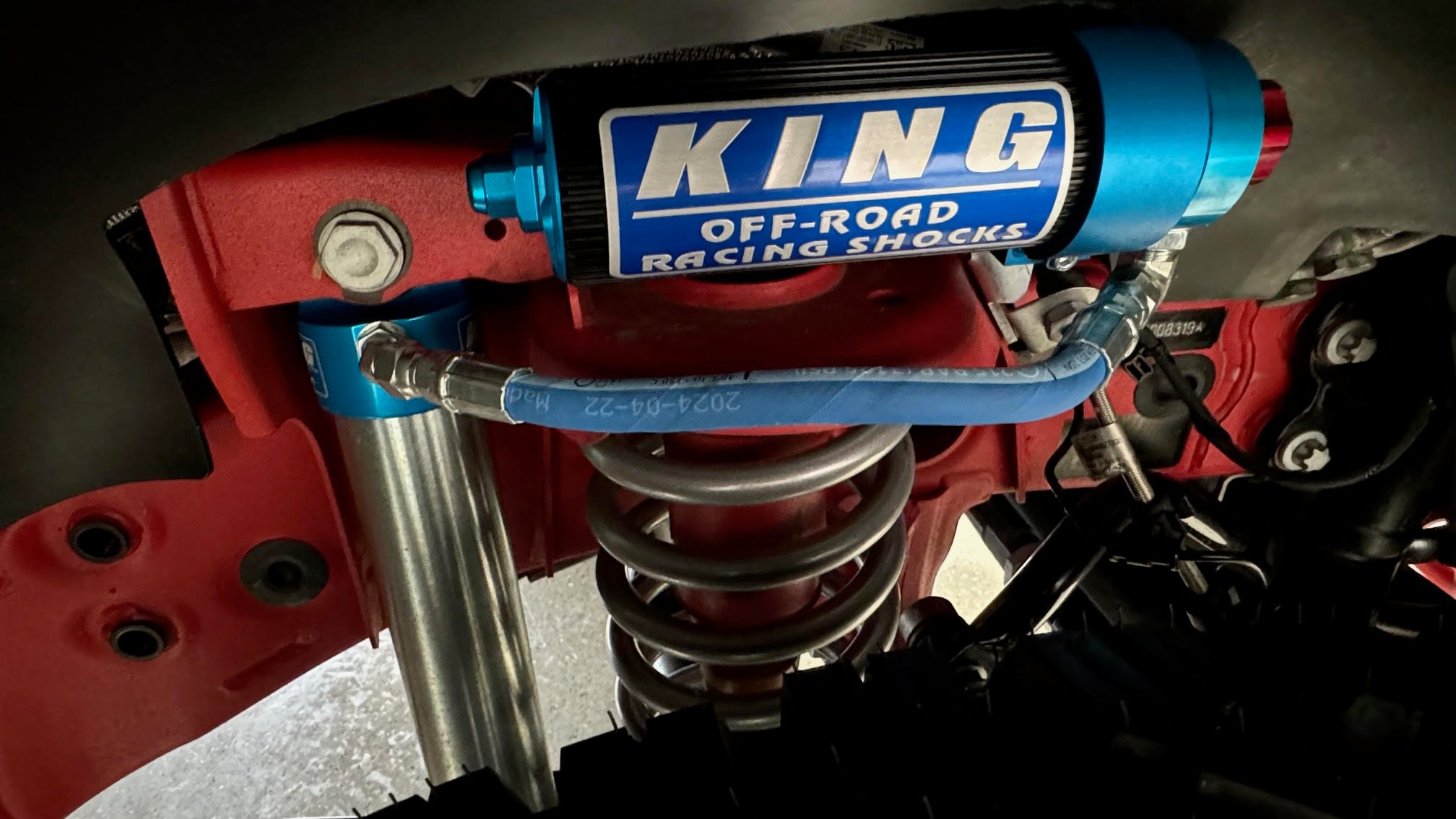
For those pushing the Grenadier harder off-road or carrying serious weight over long distances, King Shocks are in a different league to basic suspension kits.
These race-proven dampers come with external reservoirs to manage heat build-up – critical when you’re dealing with long stretches of corrugations, big payloads or aggressive terrain. Fully adjustable for both compression and rebound, they allow proper tuning to match your driving style and setup.
They’re also fully rebuildable and backed by decades of off-road heritage. A top-tier choice for touring builds, remote-area travel or anyone who wants the best handling and control in demanding conditions.
Clevershade 270º Ultra Lite Awning
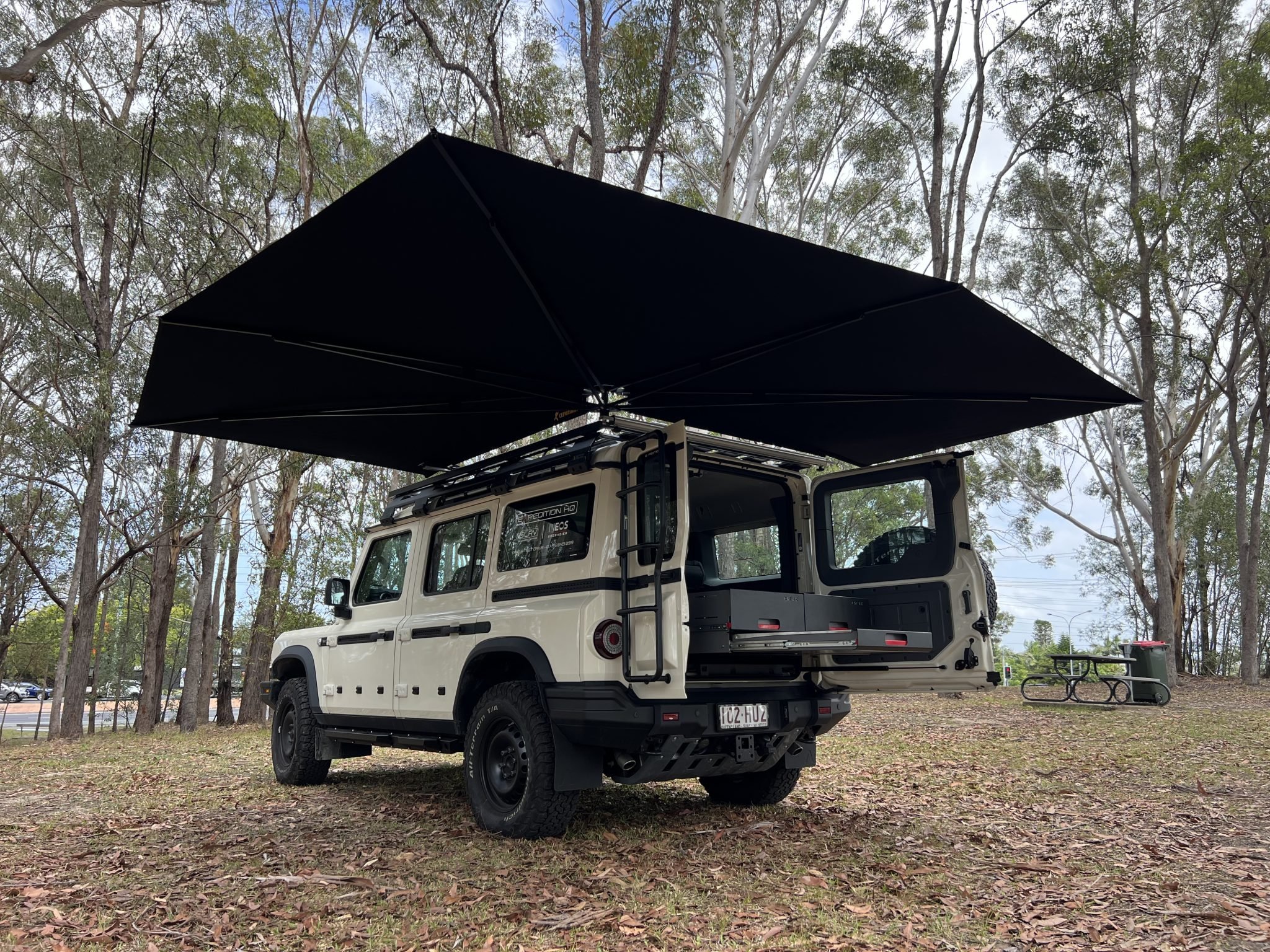
Covers you down one side and across the back in a single swing – ideal for quick stops or setting up a full touring camp. The 270º Clevershade gives you wide, usable coverage without taking up too much roof space or needing a team to deploy it.
Freestanding design makes it fast to set up solo, and its lightweight alloy arms and durable canvas make it more stable than many heavier awnings. Built with touring in mind – whether you’re stopping for a brew or covering the back of a drawer system – it’s a practical bit of kit for sun and light weather protection.
Black Sheep Rock Sliders
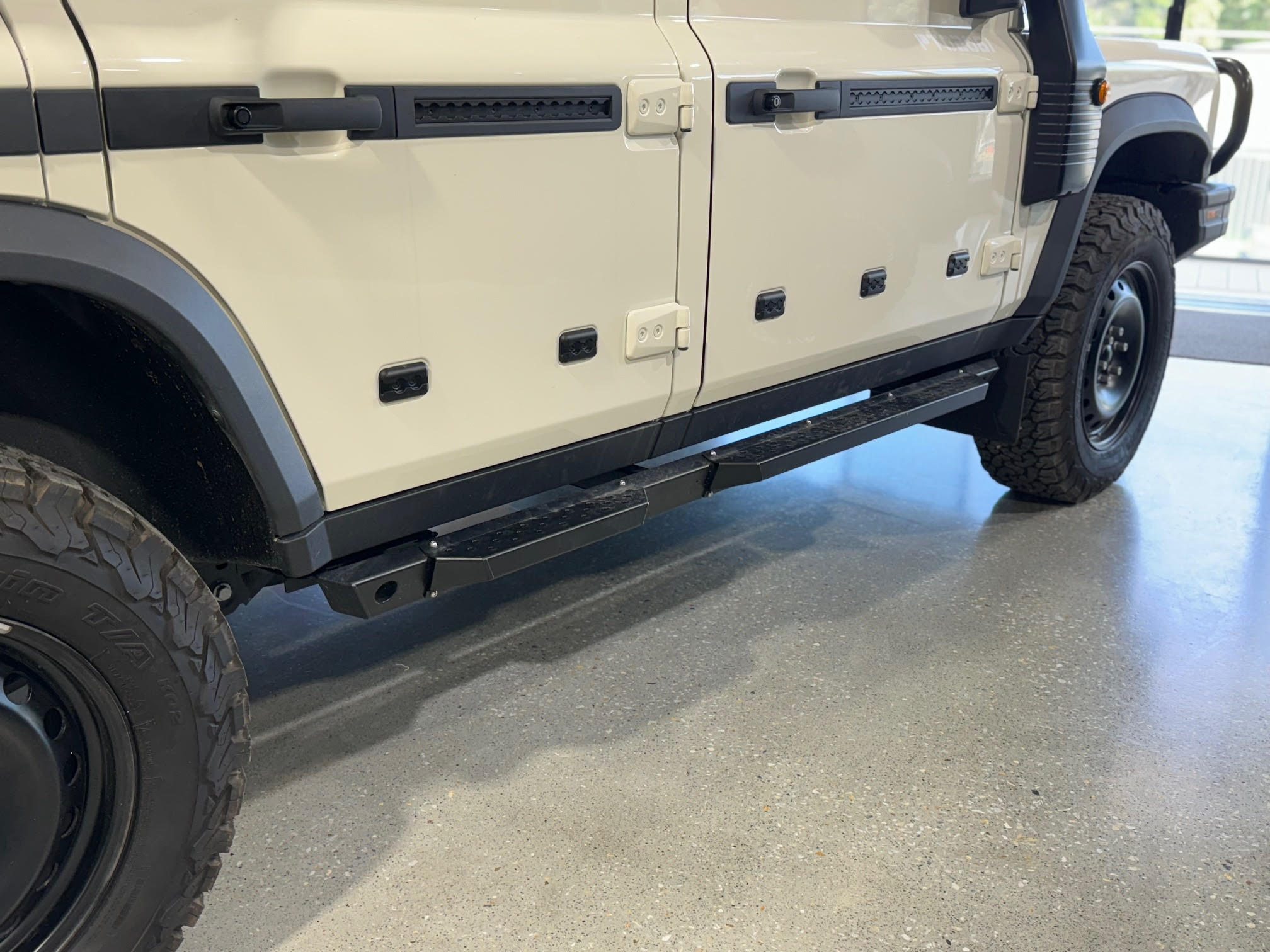
Hand-built in Australia and designed to cop real punishment, these steel rock sliders are a genuine layer of protection for your Grenadier’s sills and lower panels. Welded box-section construction makes them rigid enough to take hits from stumps, rocks or washouts, and they double as a side step with grip plate tops – ideal when loading the roof or getting passengers in and out.
They’re built with off-road reality in mind: high-clearance design, chamfered ends, and properly gusseted mounts that won’t bend at the first knock. A serious addition for those tackling technical tracks or overgrown trails.
LeTech Rear Ladder
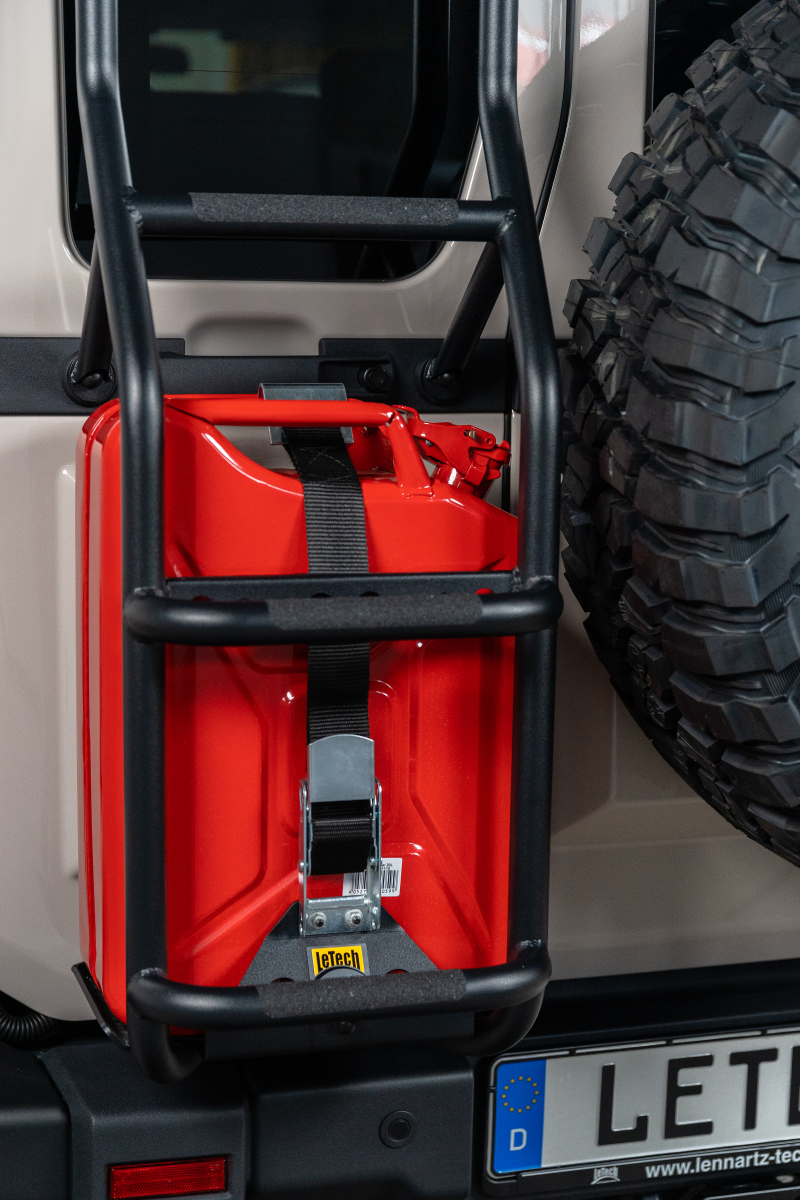
This ladder bolts securely to the rear door, giving you safe and easy access to your roof rack or rooftop tent. Designed specifically for the Grenadier, it doesn’t interfere with door function, tail-lights or rear cameras, and the anti-slip rungs provide good footing even in wet or muddy boots.
Unlike universal ladders, it follows the bodyline cleanly and doesn’t require guesswork or modifications. For anyone regularly hauling gear up top, it’s one of those simple upgrades you’ll quickly wonder how you did without.
LeTech Full Roof Rack System
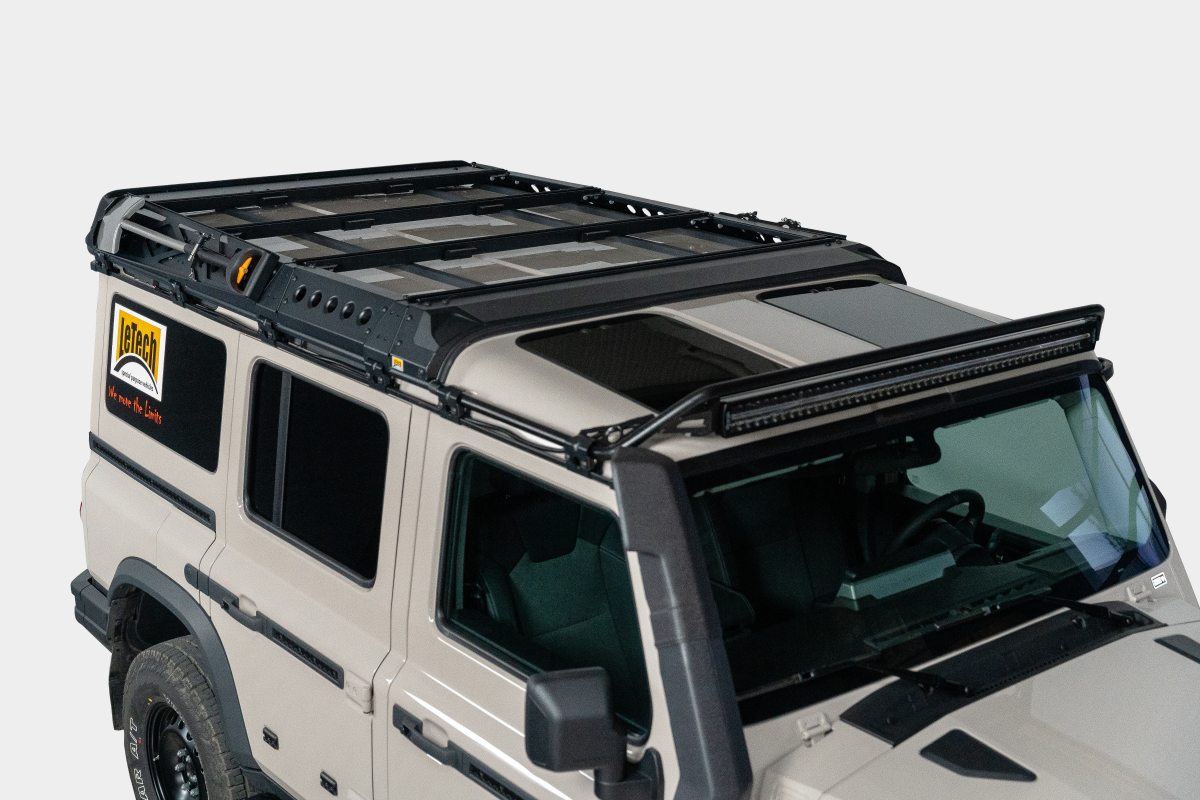
LeTech’s full-length roof rack is built to match the Grenadier’s roof profile and load ratings, offering a sturdy platform for anything from rooftop tents and solar panels to firewood and fuel drums.
Made from powder-coated aluminium, it strikes a good balance between strength and weight, with multiple tie-down points and side channels for mounting accessories like awnings, shovels or work lights. It’s a proper long-distance touring rack – no flex, no rattles, and no weird overhangs. Built with modularity in mind, it’s the kind of rack you fit once and keep for the life of the vehicle.
LeTech 6 x LED Spotlight Bar
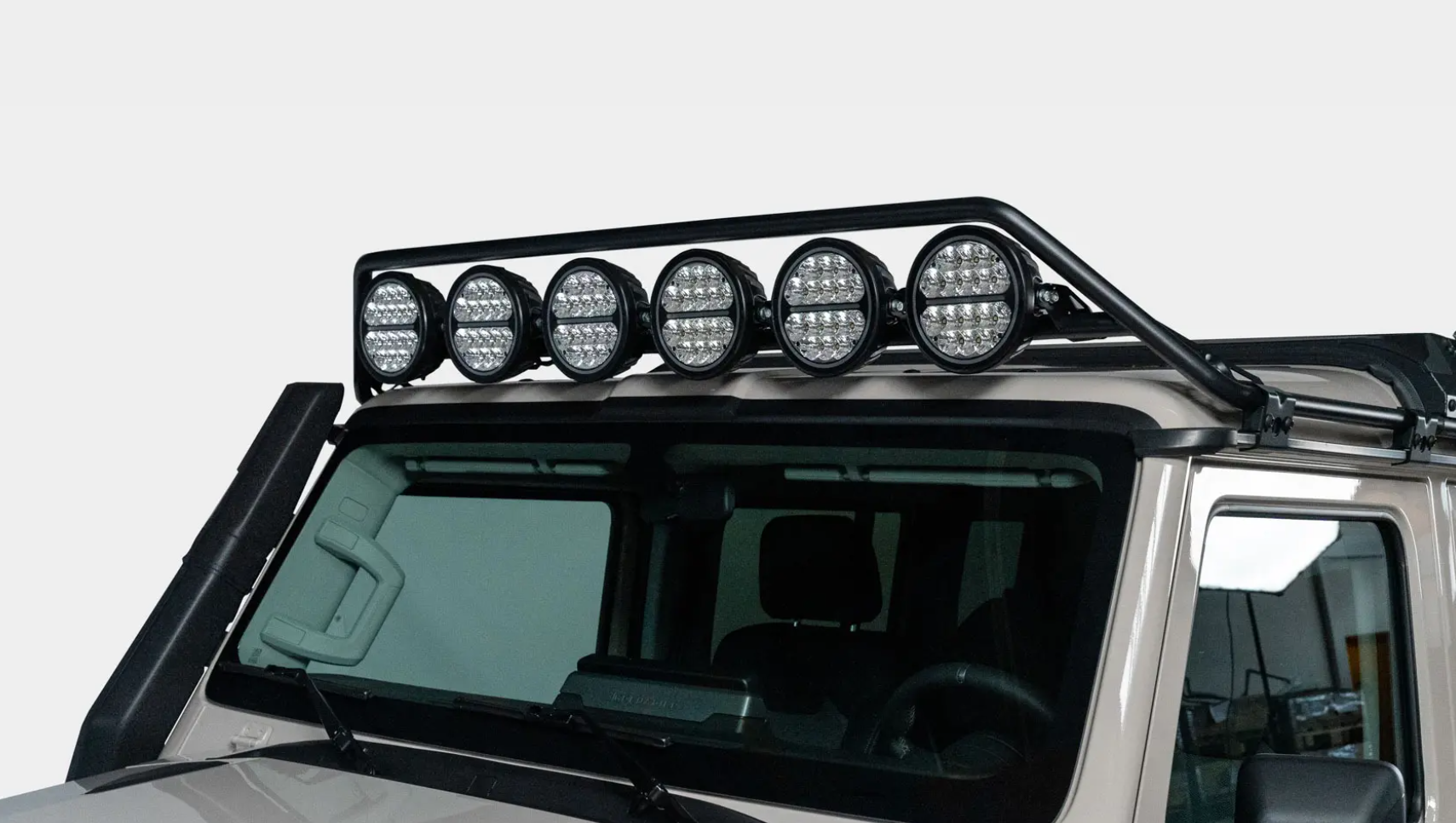
This light bar is designed to integrate cleanly with the Grenadier’s factory roof lines, avoiding the usual headache of aftermarket brackets or ugly wiring runs. With six high-output LEDs, it throws a wide, usable beam pattern that works just as well on tight tracks as it does on open desert runs.
The housing is built tough – waterproof, dustproof and resistant to vibration – and it mounts securely without interfering with roof loads or front windscreen vision. A neat solution if you’re after proper lighting performance without the bolt-on look.
LeTech Rock Sliders / Quartermaster Running Boards
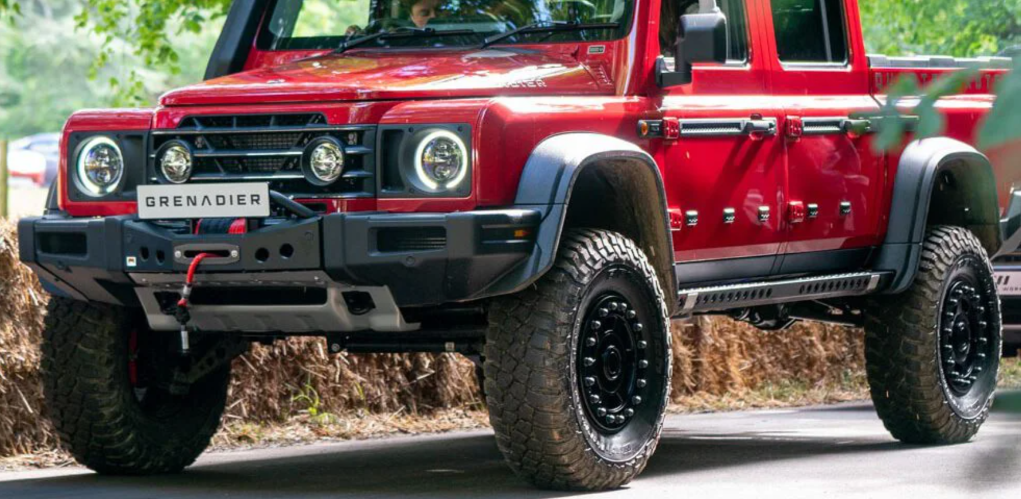
A more subtle alternative to full-blown rock sliders, these side steps give you a blend of everyday practicality and real trail protection.
The integrated tread plate provides solid footing for daily use or roof access, while the underlying structure protects the sill from the kind of knocks that can ruin your day off-road. Designed to look like they belong on the vehicle, not bolted on as an afterthought – and tough enough to handle actual use, not just carpark kerbs.
Agile Offroad Underbody Protection
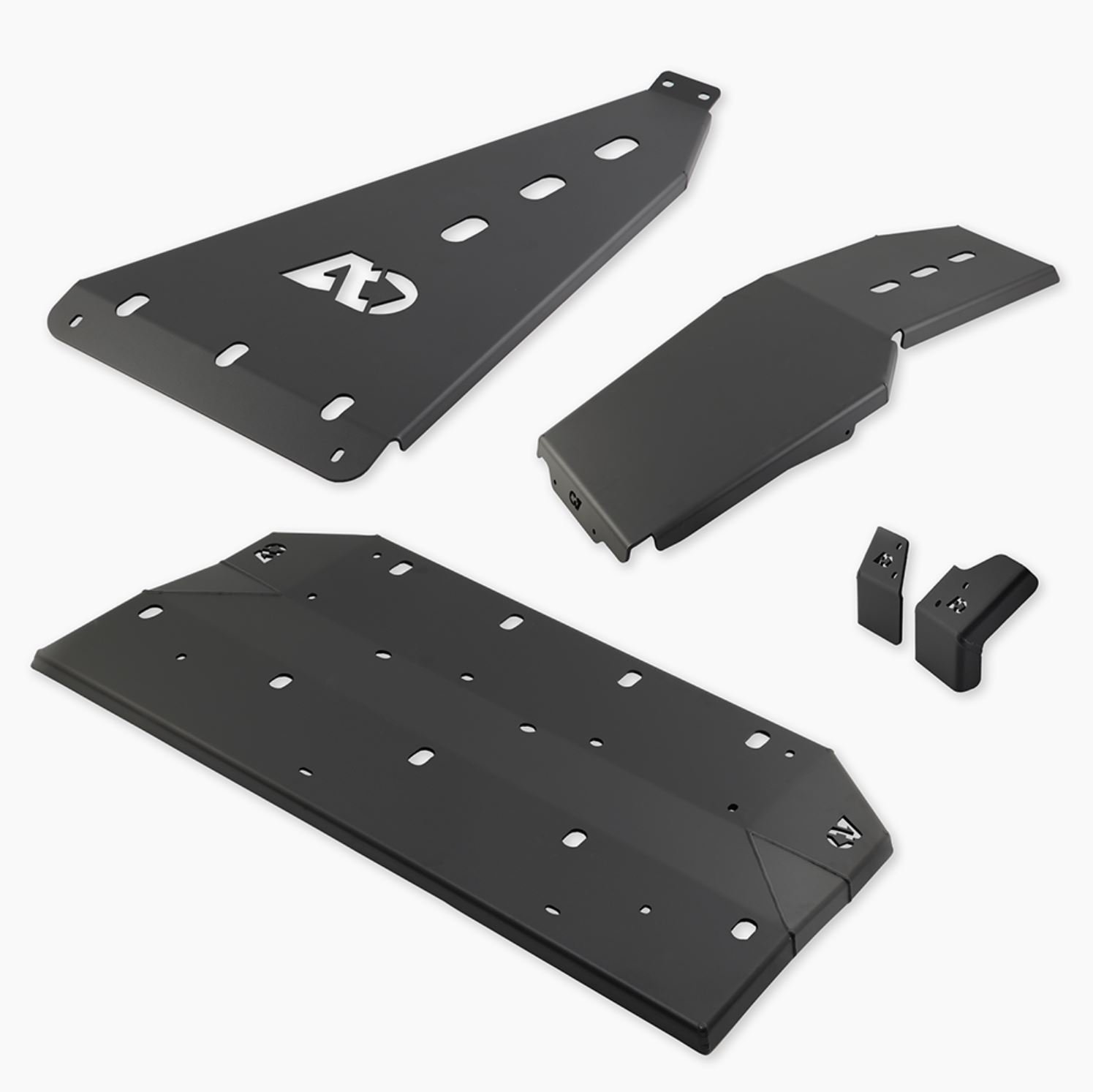
The Grenadier’s undercarriage is solid, but it’s still vulnerable in rocky or remote terrain. This full skid plate kit from Agile Offroad replaces the factory guards with thicker, more comprehensive protection – covering your engine sump, gearbox, transfer case and fuel tank.
Made from high-grade aluminium, it’s strong without adding excessive weight, and designed to shed impacts rather than catch on obstacles. It bolts to existing mounts, so no cutting or welding needed. A proper investment if you’re heading into unknown country or just want peace of mind on remote tracks.
KAON Internal Side MOLLE Panels
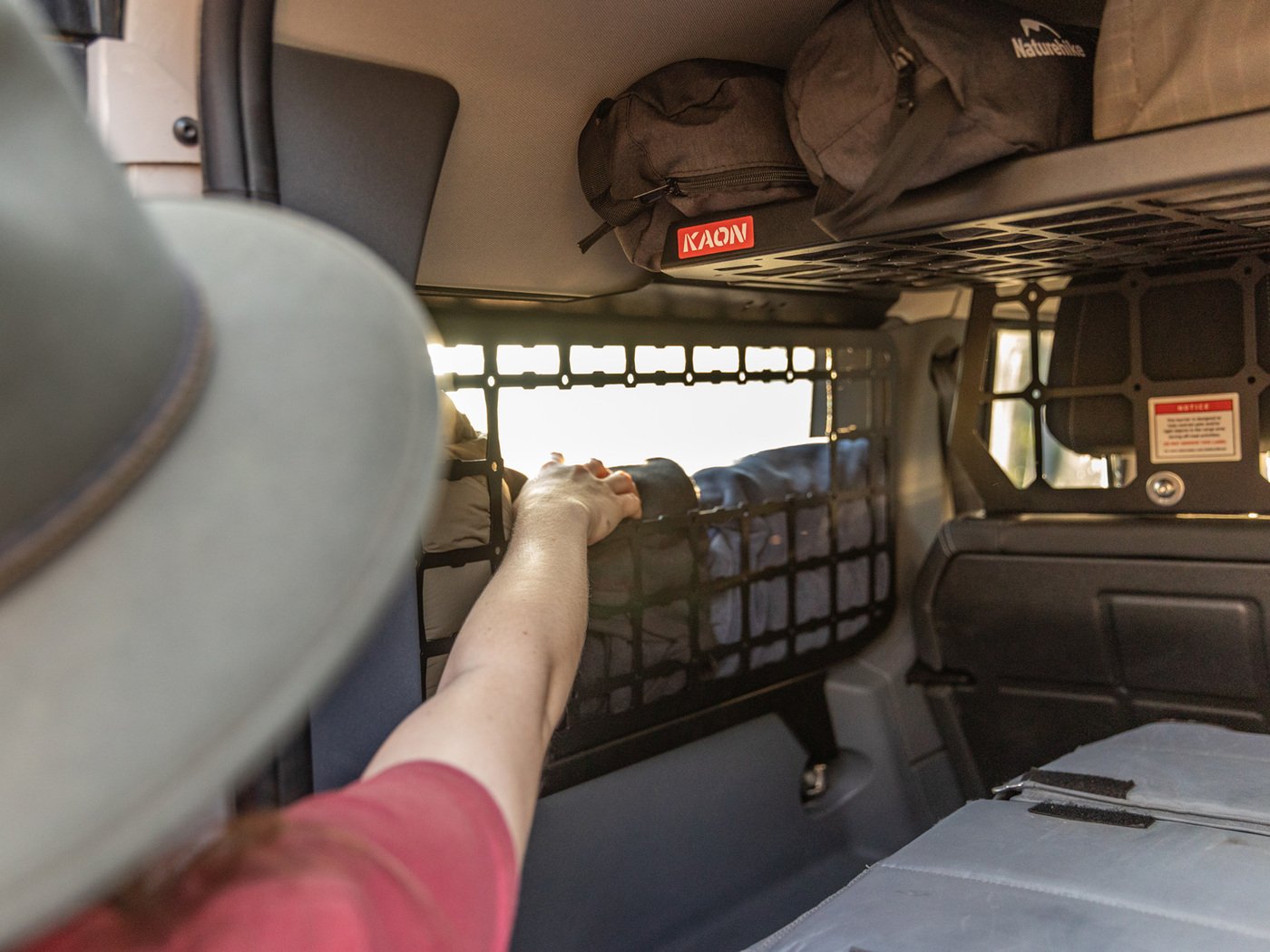
These Australian-made MOLLE panels bolt directly to the inside of the Grenadier’s rear cabin area, turning unused wall space into modular storage for tools, recovery gear, first-aid kits or spares. The laser-cut steel frame is powder-coated and designed to avoid rattles, even when loaded.
You can clip on pre-made pouches or build out your own system depending on your setup. Keeps your gear out of footwells and off the floor, but still easy to grab when you need it. Perfect for anyone building out a tidy touring interior or remote response vehicle.
Nissan has increased the price of its Patrol range by $5000 across all variants, with the hike taking effect from August 1.
The entry-level Ti now starts at $95,600 before on-road costs, the Ti-L sits at $107,100, and the Warrior tops the range at $110,660. This marks the second price rise for the Patrol in 2025, bringing the Ti’s year-to-date increase to $6340. The earlier bump came in April when the updated MY25 Patrol landed in Australia with a range of interior and tech upgrades.
Those updates included a new 12.3-inch central infotainment screen with wireless Apple CarPlay, Android Auto, built-in sat-nav and a wireless phone charger. A 7.0-inch digital driver display was also added, alongside an off-road monitor to improve visibility in technical terrain, and an updated 360-degree camera system with moving object detection.
The cabin received a minor overhaul with two interior trim options now available: black leather or a chestnut-and-woodgrain combo with quilted leather upholstery. The higher-spec Ti-L also gained a 13-speaker BOSE audio system, a digital rear-view mirror and a centre console cool box.
There were no mechanical changes as part of the update. The Patrol continues to use the same 5.6-litre naturally aspirated petrol V8 making 298kW and 560Nm, paired with a seven-speed automatic transmission.
Nissan attributed the price rise to several factors including raw material costs, logistics, foreign exchange rates, market conditions, and regulatory pressures like the New Vehicle Efficiency Standard (NVES). The NVES, which took effect on July 1, fines carmakers $100 for every gram of CO₂ per kilometre their new vehicle fleet exceeds the target – currently set at 216g/km for large 4WD wagons and light commercials.
With its 5.6-litre V8 producing 334g/km of CO₂, the Patrol sits well above this limit, likely increasing Nissan’s fleet emissions penalties and contributing to the price hike.
The next-generation Y63 Patrol has been revealed overseas with new twin-turbo V6 engines, but the current V8 remains on sale in Australia for now. With no hybrid or lower-emissions option available, more price increases may follow as emissions standards continue to tighten.
Despite the $5000 price rise, the Nissan Patrol still undercuts the Toyota LandCruiser 300 Series across all comparable variants. The Patrol Ti starts at $95,600 before on-road costs, making it cheaper than the entry-level LandCruiser GX, which now starts at $97,990. The mid-spec Patrol Ti-L ($107,100) sits below the GXL ($110,820). The top-spec Patrol Warrior ($110,660) is well under the VX ($122,510).
Higher-end LandCruiser trims like the Sahara ($139,310), Sahara ZX ($146,910) and GR Sport ($146,160) are in a different price bracket entirely.
A new player has joined Australia’s busy 4WD aftermarket space, with the launch of Adventure Industries – an Australian-owned online store supplying gear for four-wheel drivers, tourers and weekend warriors.
The range covers the basics and beyond: dual battery systems, solar panels, inverters, wiring kits, lighting, recovery gear, bull bars, bash plates, snorkels, roof storage, awnings, and maintenance parts like filters and brake components.
Well-known brands like REDARC, HULK 4X4, BMPRO, Safari Snorkels, GME, Ignite, Lightforce, Sakura, ROLA and Loctite are all on board. Whether you’re fitting out a new rig or keeping an old one going, the store aims to be a one-stop option for quality gear that’s built to last.
Adventure Industries is run by people with first-hand 4WD experience – not marketing teams – and the focus is on gear that’s actually useful in real-world conditions, not just showroom upgrades.
The online-only setup keeps things simple, with fast shipping available across the country.
Chery sub-brand iCaur revealed the full-size V27 REEV SUV earlier this month at its global launch event in Dubai.
The V27 is a hybrid wagon built as an alternative to large SUVs like the Toyota LandCruiser. It uses a 1.5-litre turbo petrol engine paired with an electric motor in a range-extended electric vehicle (REEV) setup.
The vehicle measures 5045mm long, 1976mm wide, 1894mm tall, with a 2900mm wheelbase. The hybrid system does not require plug-in charging; the petrol engine charges the battery to power the electric motor continuously, suitable for long-distance travel without external charging.
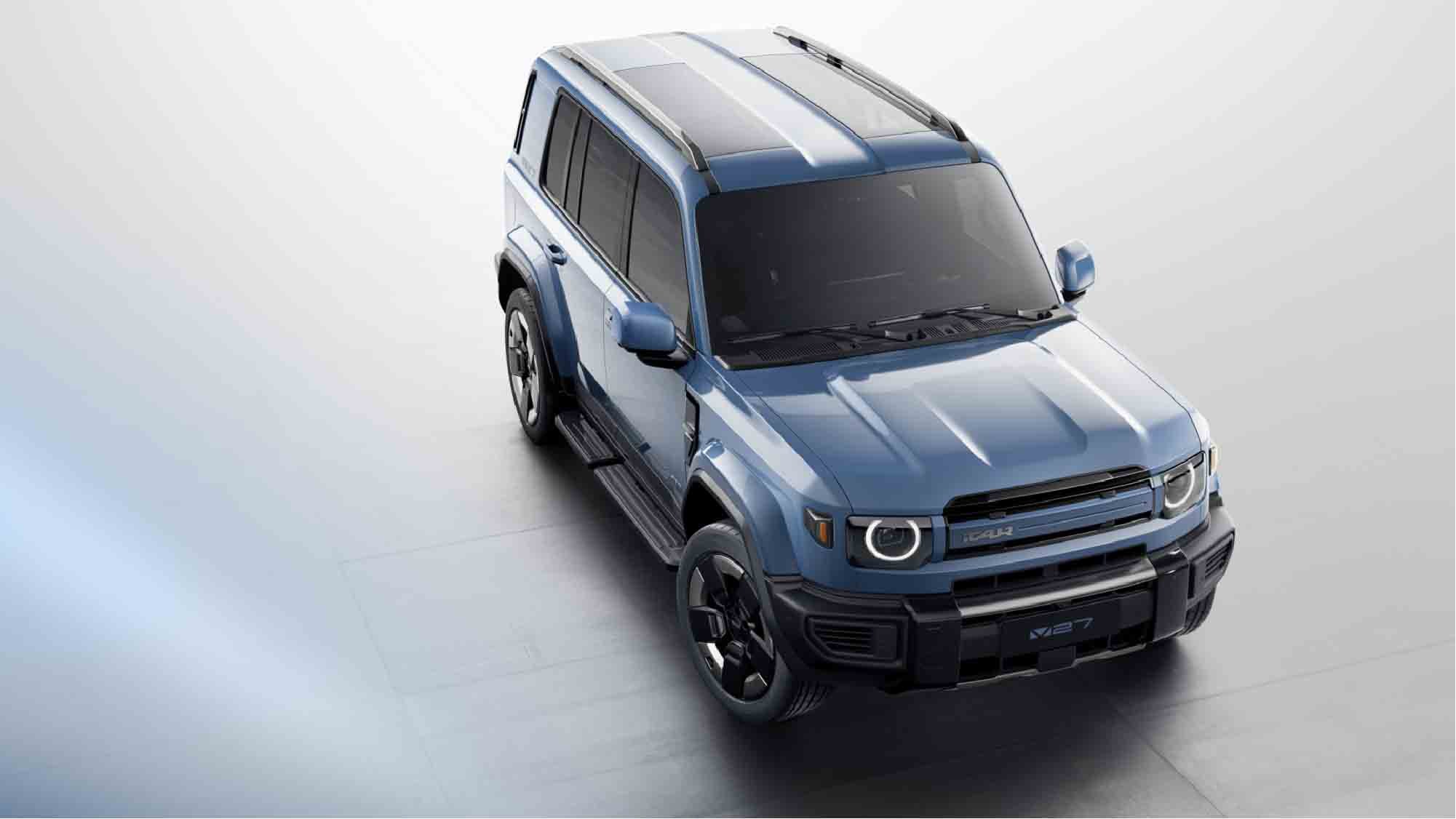
iCaur claims the system produces 3.71kWh of electricity per litre of fuel, supported by a 44.5 per cent thermal efficient engine and a hybrid transmission with 97.3 per cent peak efficiency. Power and range figures are yet to be released.
The V27 features retro-inspired styling with squared wheel arches, round headlights, and a wide horizontal grille. It uses a unibody or semi-unibody platform, not a traditional ladder frame. It is designed for family touring, load carrying and light off-road use, targeting markets with stricter emissions standards.
There’s no confirmed Australian launch date, but with parent company Chery expanding locally and growing interest in hybrid SUVs, the V27 could be a contender for buyers seeking an alternative to established large 4WDs.
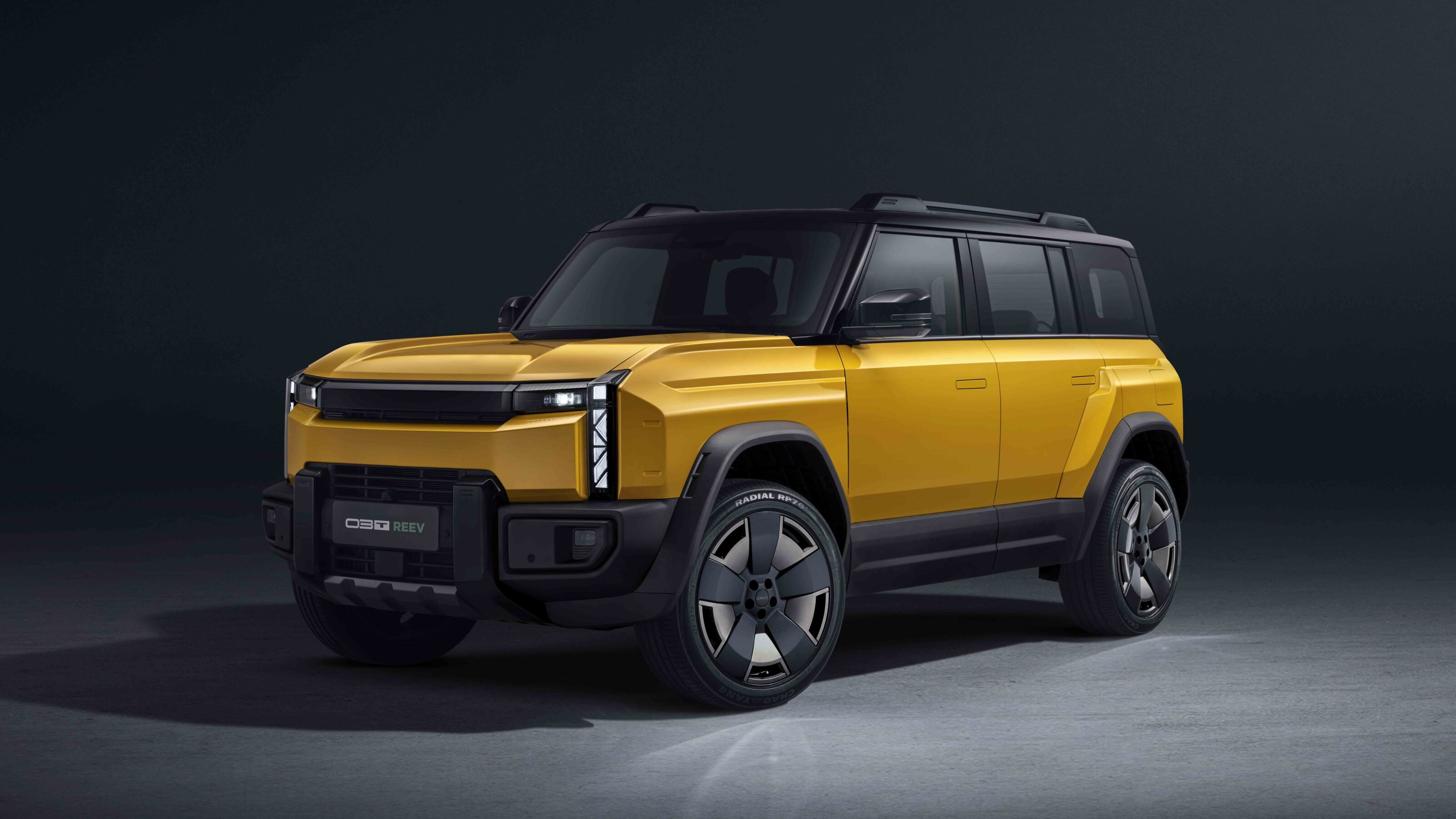
Also revealed at the event, the iCaur 03T REEV is a compact boxy SUV equipped with an i-AWD system that adjusts power distribution based on road conditions. It uses an all-aluminium multi-cavity cage body with honeycomb-style beams for structural integrity and crash energy absorption. Safety features include six airbags, 540° panoramic imaging, an ultra-HD driving recorder, and 11 active safety systems.
The 03T runs on a Qualcomm Snapdragon 8155 chip, supporting a smart cabin with a central touchscreen integrating vehicle info, navigation, and entertainment.
iCaur is a global automotive brand backed by Chinese manufacturer Chery.
Foton has locked in key specs and pricing for its upcoming Tunland hybrid dual-cab ute, which is set to land in Australia showrooms from the third quarter of 2025.
The hybrid diesel dual-cab will start from $39,990 before on-road costs for the 4×2 variant, and go up to $49,990 for the top-spec V9-S 4×4. The range will include four variants:
- Tunland V7-C 4×2: $39,990
- Tunland V7-C 4×4: $42,990
- Tunland V9-L 4×4: $45,990
- Tunland V9-S 4×4: $49,990
All variants will be powered by a 2.0-litre Aucan turbo-diesel engine producing 120kW at 3600rpm and 450Nm between 1500-2400rpm, backed by 48V mild-hybrid assistance and an eight-speed ZF automatic transmission. Braked towing capacity is 3500kg, and all 4×4 models come with a rear diff lock – the top-spec V9-S adds a front locker as standard.
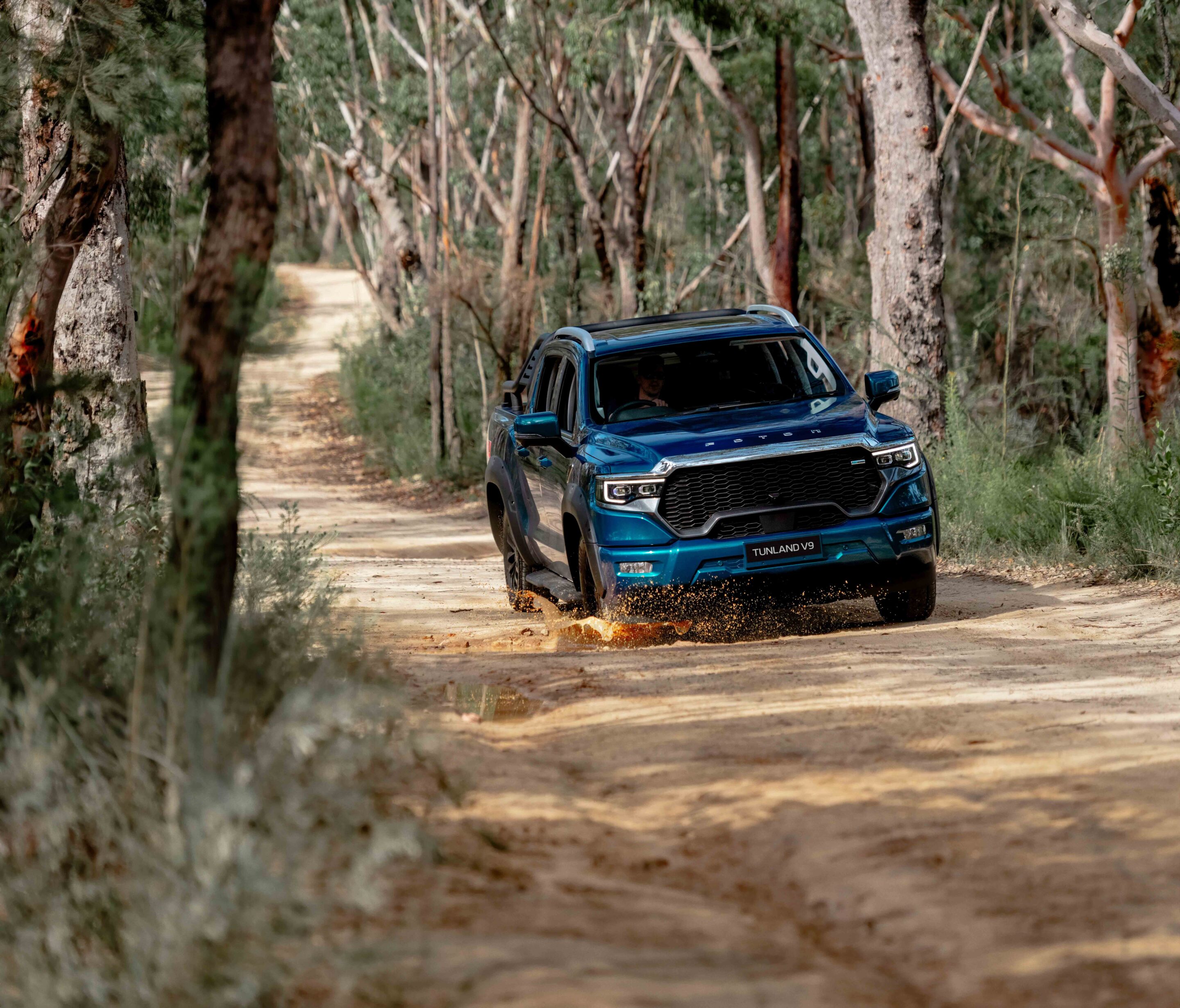
The wading depth is rated at 700mm, all models are listed with a ground clearance of 240mm, an approach angle of 28 degrees and a departure angle of 26 degrees. Full specs and features can be seen below!
The suspension set-up differs by grade. The V7 variants use a double wishbone front and leaf-spring rear, targeting work use and offering a payload over 1000kg. The V9 models retain the double wishbone front but upgrade to a multi-link coil-sprung rear for improved everyday ride comfort.
“It draws on Foton’s global truck-building expertise to deliver commercial-grade durability, real-world capability with SUV-like comfort – all wrapped in a value-packed offering tailored to Australian drivers,” Foton said in a statement.
Foton says the Tunland has undergone extensive local testing across sealed roads, rough tracks, steep terrain, sand and mud to ensure it’s suited to Australian conditions.
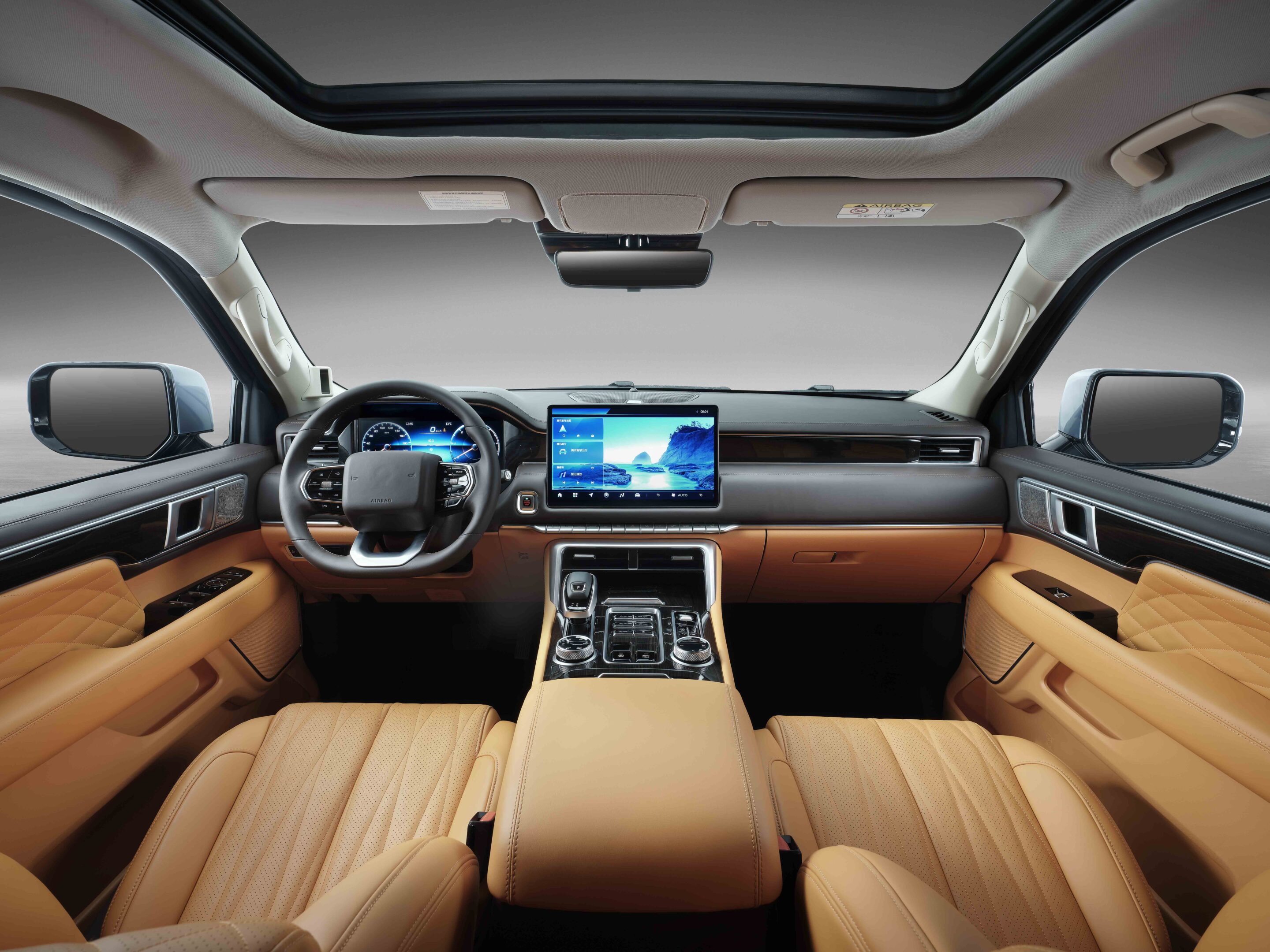
“The all-new Tunland is a fresh and capable new contender in the ute segment, offering commercial-grade space and toughness, combined with the comfort and technology modern drivers expect,” said Glen Cooper, General Manager of Foton Australia. “We’ve backed that up with tens of thousands of kilometres of local testing to help ensure it’s tuned for Australian conditions and built to deliver exactly what drivers need – whether it’s for work, play, or everything in between.
“We see real potential for the Tunland to shake up the category by delivering greater versatility, space, and refinement in a truly value-packed offering,” Cooper said.
All models will be covered by a seven-year, unlimited-kilometre warranty. Dealer coverage has been confirmed across NSW, Victoria, Queensland, SA, WA and the ACT, with more locations expected ahead of launch.
Final specifications and equipment lists will be released closer to the Q3 2025 arrival.
2025 Foton Tunland: Key specs and features
V7-C 4×2
Interior
- 12.3-inch digital instrument cluster
- 14.6-inch infotainment screen
Collision Avoidance Features
- Electronic Stability Program (ESP)
- Anti-Lock Braking System (ABS)
- Electronic Brakeforce Distribution (EBD)
- Vehicle Dynamics Control (VDC)
- Traction Control System (TCS)
- Hill-Hold Control (HHC)
- Hill Descent Control (HDC)
- Auto Vehicle Hold (AVH)
- Electronic Parking Brake (EPB)
- Panoramic 360° View Camera with Integrated Dash Camera
- Front & rear parking sensors
Advanced Driver Assistance (ADAS)
- Adaptive Cruise Control (ACC)
- Autonomous Emergency Braking with Pedestrian & Cyclist Alert (AEB)
- Front Collision Warning (FCW)
- Lane Departure Warning (LDW)
- Pedestrian Collision Warning (PCW)
- Lane Keep Assist (LKA)
- Lane Centring Control (LCC)
- Traffic Sign Recognition (TSR)
- Emergency Signal System (ESS)
- Blind Spot Detection (BSD)
- Door Open Warning (DOW)
- Rear Cross Traffic Alert (RCTA)
- Trailer Stability Assist (TSA)
Lighting & Convenience
- Daytime Running Lights (DRL)
- Dusk-sensing LED headlights with Follow Me Home
- LED taillights
More features
- 2WD
- Highway terrain tyres
- Leaf spring rear suspension
- Manual-fold mirrors
- Single-zone A/C
- 4 speakers
- Front USB-A x2
- Manual driver’s seat (6-way)
- Manual passenger seat (4-way)
- Driver window auto up/down
- Spray-in tub liner
- Voice recognition
V7-C 4×4 (adds/differences):
- Part-time 4WD
- Selectable four-wheel drive modes – 2H / Auto / 4H / 4L
- Additional drive modes: Sand / Mud / Snow
- Rear differential lock
- All-terrain tyres
- 4×4 badge on rear quarter
V9-L 4×4 (adds/differences):
- Unique front-end styling
- Premium sidestep
- Wheel cladding
- Heated mirrors
- Power folding mirrors
- 18″ premium wheel design
- Sports bar & lockable tray
- Dual-zone A/C
- 6 speakers
- Rear USB-A x2
- V2L power socket (220V / 300W outlet)
- Automatic anti-glare mirror
- Wireless charger
- Heated front seats
- Driver’s seat – powered 6-way & 4-way lumbar
- Front passenger seat – powered 4-way
- Multi-link coil suspension
V9-S 4×4 (adds/differences):
- Driver Monitoring System – Distraction & Fatigue Warning
- Front differential lock
- Position memory mirrors
- Roof rails
- Panoramic sunroof
- Privacy rear glass
- LED rear reading light
- All windows – auto up/down
- Facial recognition
- Ventilated front seats
- Driver seat – memory
- Heated second-row seats (outboard only)
Dimensions
| Overall Length (mm) | 5617 | |||
|---|---|---|---|---|
| Overall Width (mm) | 2000 (V7); 2090 (V9) | |||
| Overall Height (mm) | 1910 (V7) ; 1955 (V9) | |||
| Wheelbase (mm) | 3355 | |||
| Minimum Ground Clearance5 (mm) | 240 | |||
| Break Over Angle (degrees) | 21 | |||
| Approach/Departure Angle (degrees) | 28/26 | |||
| Wading Depth (mm) | 700 | |||
Tub dimensions
| Length (mm) | 1577 | |||
|---|---|---|---|---|
| Width (mm) | 1650 | |||
| Height (mm) | 530 | |||
| Internal Gap Between Wheel Arches (mm) | 1240 | |||
Weights
| Specification | V7-C 4×2 | V7-C 4×4 | V9-L 4×4 | V9-S 4×4 |
|---|---|---|---|---|
| GVM (kg) | 3335 | 3335 | 3306 | 3306 |
| GCM (kg) | 6835 | 6835 | 6806 | 6806 |
| Tare Mass (kg) | 2190 | 2255 | 2255 | 2255 |
| Kerb Weight (kg) | 2246 | 2311 | 2311 | 2311 |
| Payload (kg) | 1089 | 1024 | 995 | 995 |
| Max Braked Towing Capacity (kg) | 3500 | 3500 | 3500 | 3500 |
The Toyota HiLux flipped the script in July, replacing the Ford Ranger as the best-selling vehicle in Australia.
A total of 4676 Toyota HiLux units landed in driveways last month, placing the venerable ute above the RAV4, Ranger, Everest and D-MAX on the monthly charts. It’s an incredible feat considering the bones of the HiLux date back to 2015, despite facelifts and updates in the years since.
Overall sales for the Ranger (4×4 and 4×2 combined) dipped to 3930 units in July – a 20.0 per cent drop compared to July 2024. Looking only at the 4×4 charts, Toyota shifted 4000 HiLuxes and Ford sold 3696 Rangers.
The Kia Tasman continues to be in its infancy on the sales charts, with the launch of the vehicle taking place toward the end of July. Still, a total of 653 4×4 variants and 30 4×2 variants were registered for the month. However, August VFACTS results will provide a much clearer picture. The same can be said for the LDV Terron 9, with 102 sales secured since its recent launch.
Taking a look at the budget-focused brands, GWM appears to have taken a strong grip on that segment, with a substantial 870 Cannon 4x4s sold in July and 258 Cannon Alphas. It’s an impressive result, especially when putting it side by side with the JAC T9 (102 sales), KGM SsangYong Musso (155 sales) and LDV T60 (316 sales).
| Best-selling 4x4s in July 2025 | |
|---|---|
| 1. Toyota HiLux | 4000 |
| 2. Ford Ranger | 3696 |
| 3. Ford Everest | 2425 |
| 4. Toyota LandCruiser Prado | 2339 |
| 5. Isuzu D-MAX | 1818 |
| 6. Isuzu MU-X | 1635 |
| 7. Toyota LandCruiser 300 | 1406 |
| 8. Mitsubishi Triton | 1332 |
| 9. BYD Shark | 1233 |
| 10. Toyota LandCruiser PU/CC | 916 |
Toyota continues to dominate the sales charts, ending July with 21,722 sales – well ahead of its nearest rivals: Mazda (7452), Ford (7249) and Kia (7402). Year-to-date, Toyota has shifted 142,700 new vehicles, securing a commanding 20 per cent share of the market. In comparison, Mazda sits at 56,394, Ford at 54,579 and Kia at 48,152.
To put that in perspective, five of the 10 best-selling vehicles in Australia in July wore a Toyota badge: HiLux, RAV4, Prado, LandCruiser 300 and Corolla.
Continuing a familiar trend, the passenger vehicle segment is down 19.3 per cent compared to the same time last year, while both the SUV (+11.5 per cent) and light commercial (LCV) (+3.3 per cent) categories saw growth. Digging deeper, the PU/CC 4×4 segment rose 7.4 per cent for the month.
Plug-in hybrid vehicles are also enjoying a purple patch, with sales up 183 per cent year-to-date compared to 2024.
Until the Ranger PHEV arrives, the BYD Shark remains the poster child for PHEVs on the 4×4 charts. In July, a total of 1233 Sharks were sold, down from the 2993 sales registered in June. So far this year, a total of 11,657 Sharks have been sold in Australia. On the flipside, EV sales remain sluggish, accounting for less than eight per cent of new vehicle sales so far this year.
In total, 103,097 vehicles were sold in July – the strongest July on record.
| Best-selling 4x4s YTD (as of July 2025) | |
|---|---|
| 1. Ford Ranger | 30,367 |
| 2. Toyota HiLux | 26,245 |
| 3. Toyota Prado | 17,922 |
| 4. Ford Everest | 14,719 |
| 5. Isuzu D-MAX | 12,774 |
| 6. BYD Shark | 11,657 |
| 7. Mitsubishi Triton | 9539 |
| 8. Isuzu MU-X | 9453 |
| 9. Mazda BT-50 | 7131 |
| 10. Toyota LC79 | 6182 |
His arrogant attitude would give anybody a bad name under any circumstance.
But the fact that he was towing a trailer across the Simpson Desert, and was bogged in the middle of a wet claypan, only exaggerated the idea that many people believe trailers are a pain and should be banned. Most of all, those people believe anyone towing a trailer should get out of the way of the ‘real’ four-wheel drivers – the ones who never tow trailers anywhere, yet somehow still consider themselves experts at towing and trailers in general. I’m not one of them, and I’m sure I’ll ruffle a few feathers with my stance.
For the last 40-odd years, I’ve been towing trailers whenever we head off on a long trip – whether that’s into the desert, along a beach, through the Victorian High Country, or anywhere in between. Thinking about it, back when I was in the Army, I was towing trailers through the desert in the 1970s, so that makes it close to 50 years of experience in all sorts of environments.
If you have a trailer, you need to change your attitude and understand your limitations – both with the trailer and the environment you’re driving in. You also need to know what changes to your driving style are required when you’ve got a trailer on the back. There are times when you may need to leave the trailer behind – like on the Ingeegoodbee Track in the far east of the Victorian High Country. Still, there are plenty of places a trailer will go, regardless of what the naysayers reckon.
Over the last couple of years, I’ve joined my son on trips across the Madigan Line in the Simpson, through the deserts of WA, and along the toughest trails on Cape York – with trailers on the back of nearly every vehicle in our small convoys.
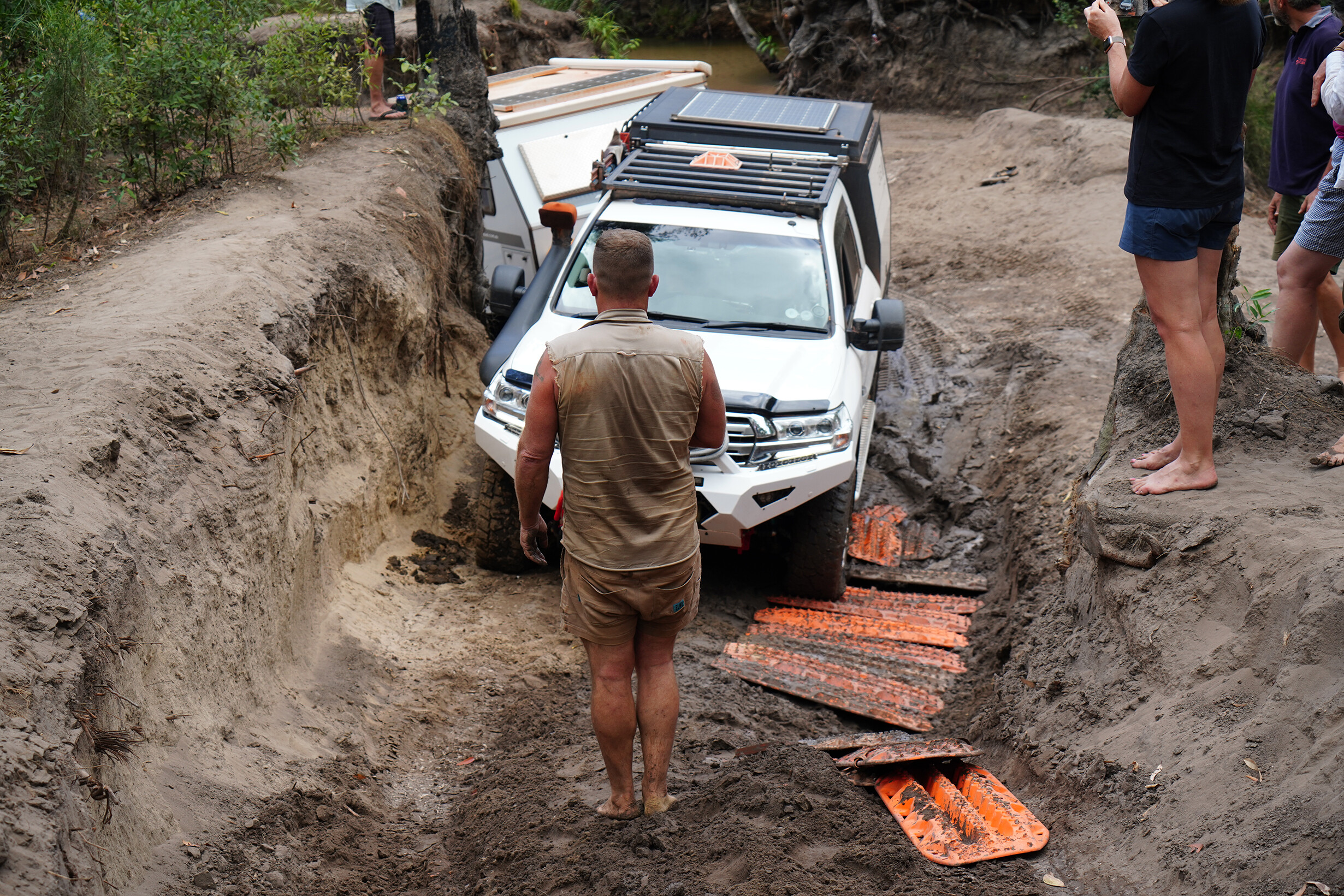
Not only have we traversed these iconic tracks, but with low tyre pressures and the use of shovels and MaxTrax on numerous occasions, we’ve managed to get through with minimal wheelspin. In the case of the Simpson, we’ve actually left the track in better condition after going over a dune than it was before we came along. That’s no bull.
On the Cape, we’ve done far less damage to the tracks with trailers on than the often-seen hoons – V8s roaring, big mud tyres spinning, tearing up the approaches to crossings like Gunshot and Cannibal Creek. They’ve never heard of ‘slow and steady’ – and if they have, that kind of behaviour does little for their ego, which in most cases is much bigger than their brains.
So, before you head off with a trailer on the back, it might be worth doing a towing course and learning how to reverse – and practising that often. Sooner or later, you’ll be caught at the dead end of a track where you might not be able to turn around.
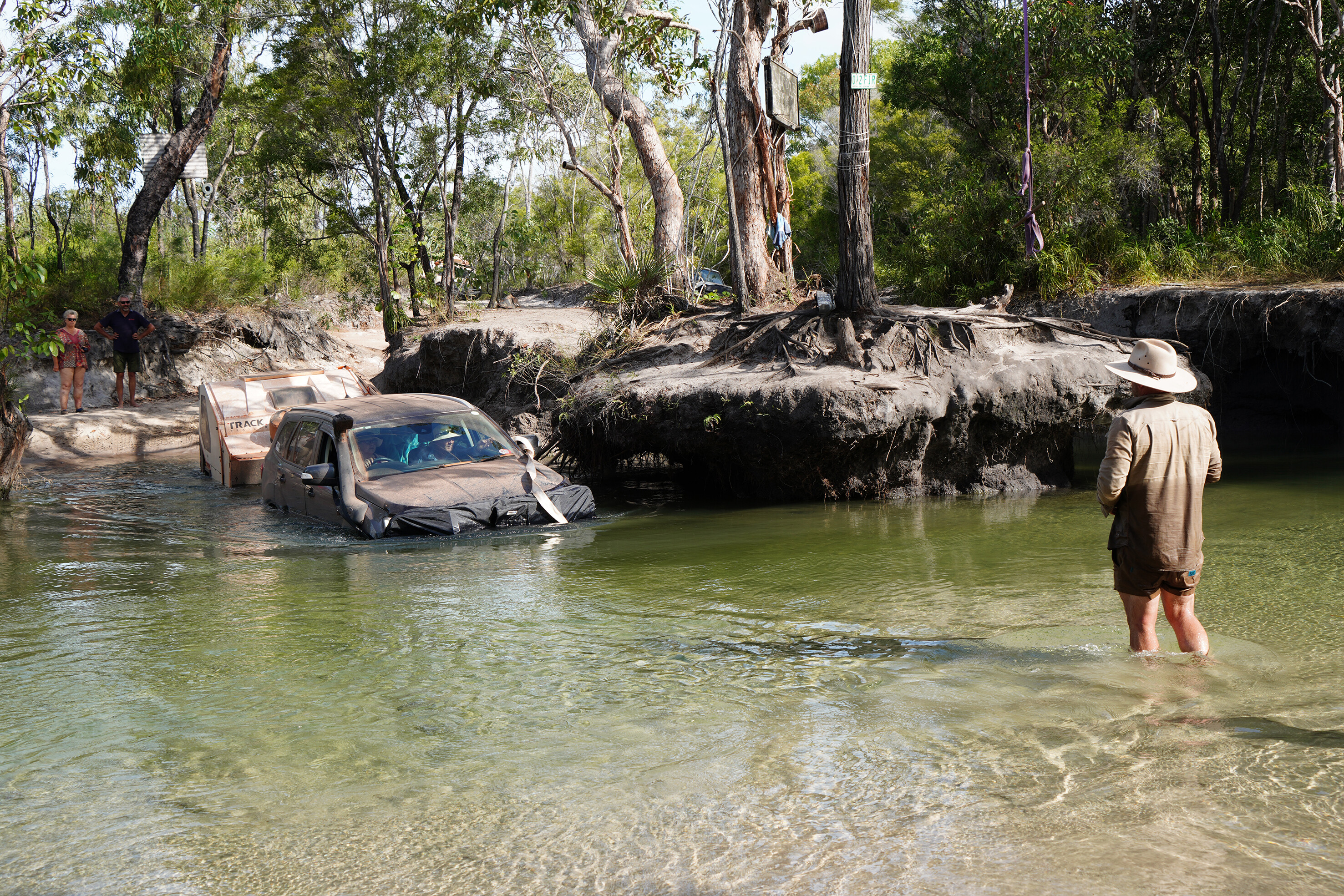
Learn the limitations of your trailer, how it cuts corners, and how best to recover it if the need arises. A set of MaxTrax might just be the thing that gets you out of trouble. Drop your trailer tyre pressures. We often run them considerably lower than the tow vehicle’s, but it depends on the trailer’s size and weight. Start at 20psi and don’t be afraid to go lower.
So, what happened to old arrogant mate? We offered help – water and a sat phone – but he wasn’t having any of it. We left him to his own devices, although some other travellers – more generous with their time – were already helping.