
EFS 4WD, an Australian company that specialises in off-road suspension, has launched a range of Adventure Series rear bars onto the aftermarket scene.
This is sponsored content.
EFS accessories has been building heavy duty off-road suspension solutions for more than 50 years, but earlier this year expanded into the world of 4×4 accessories.
Designed and developed in Australia, the stylish Adventure Series premium steel rear bar range is made to survive harsh outback conditions.
63mm side protection tubes maximise protection when cutting through rocks and mud, while recessed LED lights are incorporated to prevent damage.
The rear bar also comes with a tow hitch, a checker-plate rear step, a trailer light plug cut-out and twin tow points.
The rear bars come complete with mounting hardware. The bars are ADR-compliant and the asking price is $950.00
The EFS Adventure Series rear bars are available for Toyota Hilux (2005+), Nissan Navara NP300 (2014+), Mazda BT-50 (2011+), Ford Ranger (2012+), Mitsubishi Triton (2015+), Holden Colorado (2012+) and Isuzu D-MAX (2012+).
Check out EFS’s range of Adventure Series barwork at: www.efs4wd.com.au or call 1300 EFS 4WD.
Located in the far south-west of New South Wales, Lake Mungo dried up some 18,000 years ago and what now looks like a largely barren plain hides the story of a very different ancient history.
This was first published in 4×4 Australia’s January 2014 issue.
We left Melbourne in light rain and true to prediction the sky cleared as we crossed the Murray River near Swan Hill and continued our journey north towards Balranald. Rather than take the conventional route to Lake Mungo via Mildura, we opted for the shorter direct run which saw us leave the bitumen 55km north of Balranald and head west on secondary roads.
This area saw significant rain early in 2012 on top of downpours of biblical proportions in 2011. The significant damage suffered by the minor roads was immediately apparent.
Some sections that had been repaired were good for 100kph, while others were like driving on cobblestones because the surface clay and gravel had been washed away exposing the larger rocks below.
None of this would present an issue for a four wheel drive with good all terrain tread, but lesser vehicles with low profile rubber or those towing vans would be advised to check out the conditions with the park Ranger before venturing into this area. Lake Mungo has only one camping area other than a bush camp some 20 kilometres away on the other side of the lake from the main entrance.
The main camp was surprisingly busy considering it was winter and very cold at night, but being more or less half-way between Sydney and Adelaide, Lake Mungo is a convenient stopover spot. We arrived just before dusk and got the last site with a fireplace that we could back our camper into.
By 10am the next morning 80 per cent of the campers had packed up and moved on – so the moral of the story is plan to arrive early. The camp has a couple of drop toilets but no shower – although you can drive 3 kms to the visitors centre and use the public showers located there. The visitors centre also offers bunkhouse accommodation in their refurbished shearers quarters.
Half our group decided to opt for the (warmer) luxury of cabin accommodation at Mungo Lodge 2 kms west of the camping ground. The Lodge has a bar and restaurant and a dozen or so self contained cabins – much more civilised than crunching through the frost in the dark on your way to the drop toilets!
The main attraction of Lake Mungo is the sand sculptures formed by the erosion of an ancient dune on what was the lake’s eastern shore before it dried up some 18,000 years ago as a result of climate change. These formations present in different colours (yellow, orange, red, grey) depending on when the sand was originally laid down.
In the early morning or evening light they take on an eerie appearance and make great photographic subjects. Ancient history is also being revealed by the erosion of the dune – much of which was started by rabbit plagues in the late 1800’s. As the wind slowly peels away the layers of sand, the bones of prehistoric wombats the size of cattle are being revealed.
The skeletons of Mungo Woman and Mungo Man who were discovered here in 1969 and 1974 respectively represent the oldest known human remains found in Australia. Mungo Woman is also the oldest evidence of human cremation in the world. Human habitation of Lake Mungo has been shown to exist as far back as 40,000 years ago.
A must do for any visitor to Lake Mungo is the discovery tour run by the aboriginal owners and managers of the National Park. Those participating in the tour are taken into areas closed to the public (which is practically all of the dune) and shown relics of previous habitation – 30,000 year old fire sites, stone knives, middens, along with the unique erosion Lake Mungo is famous for.
The rangers also explain what the various trees and shrubs were used for – most had medicinal or dietary value to the original inhabitants. Bush tucker is everywhere when you know where to look – such as the bush tomato with its small red tomato-like fruit.
I’d never really noticed this small unassuming plant but now realise it is very common and must have been great source of nourishment for the original inhabitants. The tour ends on the top of live dunes which are slowly moving with the prevailing winds into the plains to the east of the lake.
The old Mungo Woolshed near the visitors centre was built by Chinese labour around 1869 from local Cyprus pine which is resistant to termites. When you consider all the wood in this large building was cut locally and hand sawn into planks you get an idea of the effort involved. The Chinese came from Victoria seeking work after the gold diggings down south began to show poorer returns.
Apparently the dune on the eastern bank of the lake was named the Wall of China by these workers as some of its features supposedly reminded them of their homeland. Beyond the Wall of China a 70 km one way gravel road takes visitors into the grassland and mallee country to the east of Lake Mungo before looping around to the north and returning to the visitors centre.
Half-way along this track a 500 metre long “Mallee Walk” has been established with the different types of trees and shrubs labelled with their names. The low mallee trees were covered in blossom and alive with parrots and honeyeaters. Smaller birds such as pardalotes and wrens could be seen chasing the insects attracted by the flowers.
It’s well worth stretching your legs for 30 minutes or so to get a little closer to nature. A little further on is Beulah Camp, a large shady camp site set in a grove of Sheoaks. The camp has a drop toilet, but open fires of any type are prohibited.
At the northern most section of this ring road is a short side track to Vigars Well which was originally a watering site for the Cobb & Co coach run from Broken Hill to White Cliffs. Apparently the compressed impression of wagon tracks can be still be seen in the area (unfortunately the information didn’t say where to look!).
From the well you can walk onto the live dunes at the back of the Wall of China (the only place public access to the dunes is permitted). The moving sand shows a record of what has walked across it since the last breeze wiped it clean.
While the dunes seem devoid of any life the sand shows that not to be true with tracks of emus, kangaroos, foxes, wild cats and goannas everywhere. Again the occasional tell tale sign of ancient human habitation was evident – the dark stain of an old fire place, animal bones and stone shards in the sand.
Once back on the lake bed the road passes the ruins of Zanci Homestead. Little remains of the homestead except the stables and an underground coolstore. However, the nearby Zanci Woolshed, built in 1922 and originally part of the larger Mungo Woolshed some 6 kms away has been well maintained and is now used as an interpretive centre.
A days drive from Adelaide, Melbourne or Sydney, Lake Mungo is steeped in history and whether you’re a bushwalker, photographer or just looking for a few days away with the tent or camper it’s an interesting place to stop off.
CONTACTS
Lake Mungo Visitor Centre: (03) 5021 8900 Web: visitmungo.com.au/visitor-centre
Mungo Lodge: (03) 5029 7297 Web: mungolodge.com.au
PATRIOT Campers flicked us the keys to its insane LC79 6×6 this month, and we got first dibs on pointing it towards a tricky hill-climb.
We also settled a debate between mates over which customised ride is best: Defender, FJ or Wrangler. Plus, we took Benz’s G300 Professional on an east-west crossing of the Simpson.
Get your copy of 4X4 Australia from newsagents or by subscribing to 4X4 Australia in electronic or print format.
What else you’ll get this month:
PATRIOT CAMPERS’ LC79 6X6 We got to belt this next-level 79 Series Land Cruiser.
MY17 NISSAN NAVARA SERIES II: PAYLOAD TEST Putting the Navara’s revised suspension set-up to an 800kg payload test.
CUSTOM SHOWDOWN Land Rover Defender v Toyota FJ Cruiser v Jeep Wrangler Rubicon
MERCEDES-BENZ G300 PROFESSIONAL CROSSES THE SIMPSON An east-west crossing of the Simpson Desert in a convoy of G Wagens.
CUSTOM TOYOTA HILUX A lack of funds couldn’t stop the build of this SAS Hilux.
CUSTOM TOYOTA LAND CRUISER FJ45 Restomod FJ45 is a neat mix of old and new.
VW AMAROK HITS THE BIG BASH A convoy of VW Amaroks invade Toyota territory.
SOUTHEAST ARNHEM LAND, NT Penny Wells descends on some of Arnhem Land’s cultural hotspots.
CAPITAL CITY ESCAPES, SYDNEY Top 4×4 getaways within cooee of NSWs’ capital.
MUNGERANNIE HOTEL, SA We stop for a frothy at one of Australia’s greatest watering holes.
YUNTA TO HAWKER, SA Avoid the main roads for a truly scenic route to the Flinders Ranges.
SOMME BATTLEGROUNDS, FRANCE Greenlaning through the Somme region’s historic battlegrounds.
THE POINT OF RECOVERY POINTS We explain why a rated recovery point is an essential off-road requirement.
THE REST We put a bunch of fresh gear under the microscope this month, including the Primus Portable Power Pack, the Quick Fit Bracket and Mickey Thompson Deegan tyres.
Roothy continues to encounter deadlines during the build of Milo2, Fraser reckons the plans to ban fossil-fuelled cars are politically motivated, Ron provides a toolbox checklist for the well-prepared traveller, and Deano has had some very high – and very low – 4WD moments.
This month, Readers’ Rigs includes a 1995 80 Series Cruiser, a 1989 Nissan Y60 Patrol and a 4.5-inch-lifted Wrangler Rubicon – post your rig here.
The November issue of 4X4 Australia is in stores Thursday, October 5.
Get the latest info and all things 4X4 Australia by signing up to our newsletter.
EXHAUST systems are more efficient than ever and, with stainless- or black-steel construction, they rarely rust out.
This was first published in 4×4 Australia’s July 2013 issue.
Yet older 4X4s, with full or partial mild-steel exhausts, still suffer from corrosion, and most petrol-powered 4X4s have a catalytic converter in their exhaust system. Over time, this will become partially blocked as the ceramic material inside slowly crumbles. This can cause restriction and reduce performance.
We joined John Chamoun at Precision Mufflers in Croydon, NSW, as he custom-fabricated a new exhaust system from the engine pipe back on an XJ Jeep Cherokee.
As well as the Cherokee’s muffler and tailpipe, it was also decided to replace the cat converter with a high-flow, stainless-steel metal core cat. The metal cat flows at about 97 percent efficiency, compared with 60 percent for a new ceramic cat.
The bolt-in flanges ahead of and behind the catalytic converter were left in place in case the system needed to be unbolted later – it would be difficult to remove if it was welded together. Then the old catalytic converter was cut out using a gas cutter. The new 2.5-inch diameter high-flow cat was shorter than the OE Jeep item it replaced, so John had to cut a short length of steel pipe and weld that to the cat.
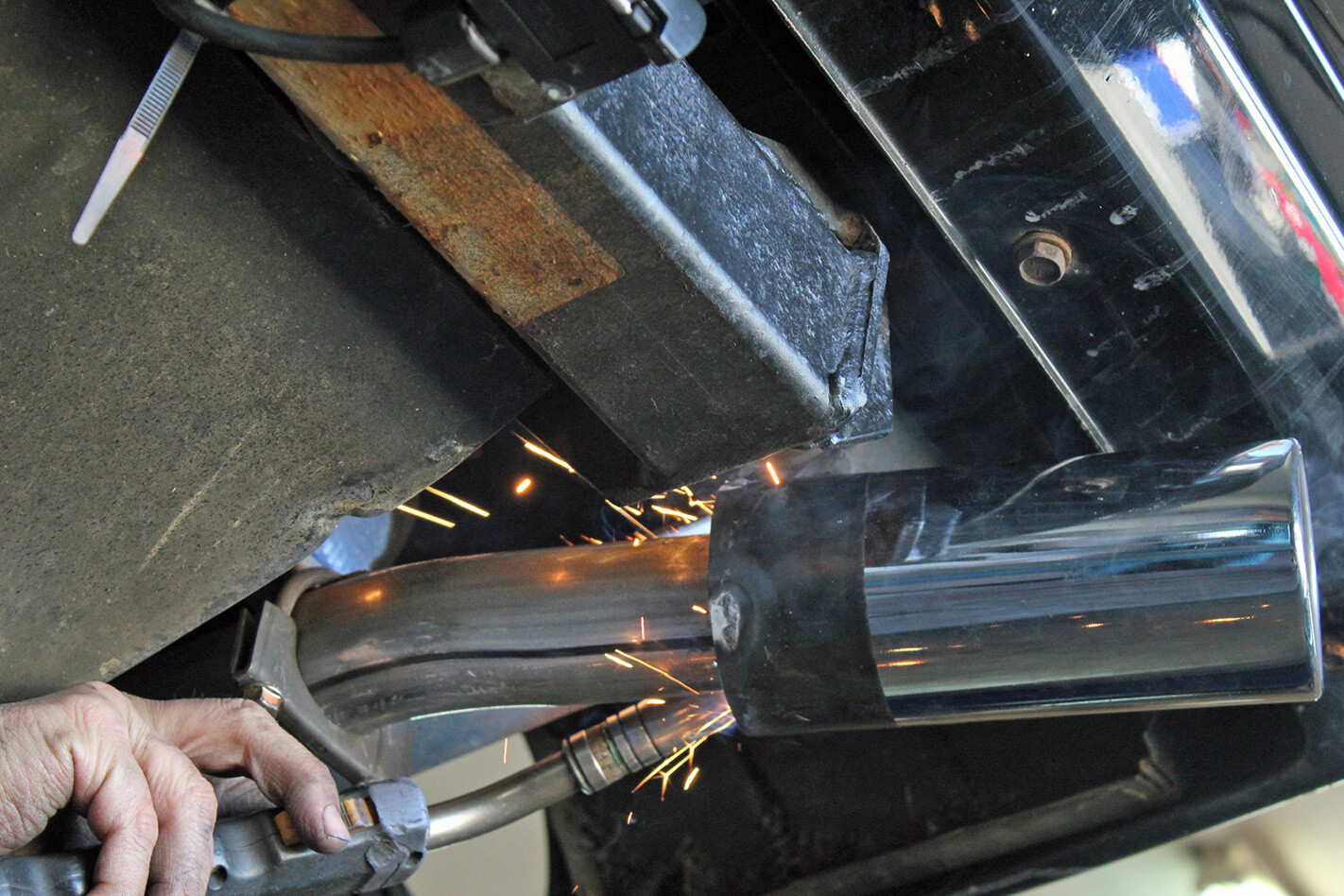
Once the cat was welded into place, the rear muffler and tailpipe were cut out and a high-flow muffler, resonator and 2.25-inch diameter exhaust pipe installed. John used a pipe-bending machine to shape the tailpipe section, using the old pipe as a template.
The final fitment was a Remus exhaust tip, designed to reduce noise with its baffled internals. This vehicle is intended for fire trails and on the beach, but if rocky tracks are on the cards the exhaust tip will need a re-think as it may affect departure angle.
After a few hours on the hoist, there’s now a freer-flowing, meaty-sounding exhaust system to aid efficiency.
Here’s how to do it:
1. Prefab parts include free-flow muffler, high-flow catalytic converter and exhaust tip.
2. The old cat is cut off using a gas cutter.
3. The old cat will be replaced by the metal cat, which flows 30 percent more air.
4. The weld area is heated and cleaned before the new cat is MIG-welded in.
5. The new cat is shorter so an extension tube is cut from a length of pipe.
6. The join is flared so it will slip over the existing pipe.
7. The extension joint is welded to the cat.
8. The cat is welded into place on the existing stainless-steel exhaust pipe.
9. The old muffler and tailpipe are cut off.
10. The new tailpipe section is shaped using the old one as a template.
11. The new muffler and tailpipe are welded into place.
12. The Remus tailpipe tip (with integral resonator) is welded into place.
A bunch of neat new gear that’s landed on the pages of aftermarket catalogues this month.
IRONMAN 4X4 CAMP CHAIRS The team at Ironman 4×4 has released four new camp chairs, effectively offering a model for everyone in the family. All models include a robust frame of steel construction, with wide stabilising feet and durable fabrics. The Deluxe Soft Arm is lightweight with soft arms, both of which include an integrated can holder and pocket.
The Deluxe Hard Arm includes a rear locking tab system that is fast to set up and ensures a solid chair. It also includes a side can holder off the seat base. This chair is wider and has a 150kg weight capacity rating. Also available is the Mid Size Low Back (rated 130kg), which is compact and light but still offers high-construction levels. All have a carry bag and are super quick to set up. Website: www.ironman4x4.com RRP: $59 Deluxe Soft; $69 Deluxe Hard; $79 Deluxe Lounge; $39 Mid Size Low Back
ARB ADVENTURE LIGHT 600 When is a light more than just a light? When it’s ARB’s new Adventure Light 600. Packed with numerous features, this light source would be one we’d pack in the 4×4 and leave there at all times, ready for the next trip. The Adventure Light’s dual magnetic mounts make any night-time under-bonnet check-over a doddle, while the two flexible (hi-vis) nylon hooks (that neatly fold away when not in use) ensure it is just as easy to hang in whatever place it’s needed.
It’s powered by rechargeable lithium-ion batteries via an inbuilt 5V USB port, 240V or 12V DC (there are supplied adaptors for both these). The light has two output levels – 300 and a huge 600 lumen – that are easily changed via the digital switch. You can check the battery level via the LCD digital battery indicator. As you’d expect from ARB, the light is tough. With a moulded exterior housing that is both dust and water resistant, it’s going to last years. Website: www.arb.com.au RRP: $89
TJM SIGNATURE BAR – TRITON MQ TJM’s new bar for Mitsubishi’s MQ Triton has arrived. The alloy Signature Bar design features a large polished centre loop (76mm) bookended by two 63mm side loops (also polished) for optimum headlight protection. The bar is airbag- and winch-compatible (it can take a winch of up to 9500lb capacity), and includes a high-strength steel mount system. The bar has been designed to ensure the best airflow.
LED indicators and fog lights are included and the recovery points are rated to 8000kg (when used in a straight-line pull, with 8000kg equaliser strap and two 4.75T bow shackles). There are two optional kits available: a LED combo lamp Plug and Play wiring harnesses for GLS and Exceed models, and an identical kit for the GLX model Triton. Available from all TJM outlets. Website: www.tjm.com.au RRP: $2640 (excluding freight and fitment)
THUNDER COMPRESSOR Pushing out 150L/min via its six-litre tank, the Thunder can be mounted in your vehicle or carried in the cargo area. The Thunder features a digital pressure gauge, air hose, and the six-litre tank which can also be removed and reconfigured to fit beside the compressor if space is an issue. The normal working current range is 35amp and it can work up to a current of 45amp. The maximum continuous runtime (at 40psi) is an impressive 30 minutes, allowing plenty of time to top up tyres and any other gear.
The air flow is pressure controlled and the compressor includes protective pressure valves for extra insurance. You can even remove the main compressor and use it as a stand-alone, on-demand unit, or you can top-mount it for fitment to a narrow part of the engine bay or cargo area. The dimensions of this set-up are 47cm long x 40cm tall x 13cm wide. Website: www.ashdown-ingram.com.au RRP: $416
K&N ENGINEERING 33-3062 AIR FILTER For Toyota Prado 2.8TD owners, K&N has released a new replacement air filter, claiming fitment of this filter will up a Prado’s power. The standard Prado air filter is a ‘surface loading’ filter, so over time it accumulates dirt that eventually inhibits airflow through to the engine, effectively ‘robbing’ power. K&N’s replacement air filter is constructed from multiple layers of cotton gauze; dirt removed by this filter is stored inside the filter material itself. Dubbed a ‘depth loading’ design, this assists in minimising airflow restrictions; with the filter’s proprietary oil treatment ensuring dirt particles soften and dissipate in the filter element itself.
The replacement air filter is claimed to remove up to 97 per cent of airborne contaminants, with a claimed improvement in engine airflow of up to 50 per cent. The dirt particles stay stuck to the adhesive cotton fibres of the filter until they are removed by cleaning/washing of the filter before it is reinstalled. The replacement air filter comes with a 10 year warranty. Available at all good aftermarket automotive retailers. Website: www.knfilters.com.au RRP: $119
THE Defender is the very essence of Land Rover. It’s where the company started, though not by name.
The Defender name came into being in 1990 to distinguish the existing commercial/utilitarian Land Rovers – the only Land Rovers you could buy since day one in 1948 – from the just-introduced Discovery. The latter was very much aimed at family and recreational buyers.
Before that, Land Rovers were merely distinguished by their Series name (Series I, II, etc.) and later by wheelbase measured in inches (90, 110, etc.). The production of these essentially commercial Land Rovers that dated back to 1948 wound up on January 29, 2016, when the last Defender rolled off the production line.
It was effectively killed off by high production costs and upcoming pedestrian safety standards, which is ironic given a Defender is anything but a vehicle designed for places where pedestrians abound.
If Land Rover’s corporate history was as stable as Toyota’s (see Rocky Road to Success) there would have been a new Defender ready in 2016 to take over seamlessly as the old one was phased out, but as it turns out, that’s not the case. Right now, if you want to buy a new vehicle that is the very heart and soul of Land Rover, you can’t.
Land Rover says it has been too busy bringing to market high-volume models like Discovery Sport and Range Rover Evoque, as well as the new Discovery and Range Rover Velar. Given the current Range Rover and Range Rover Sport were also only introduced in 2013, Land Rover has indeed been busy.
This flurry of new models has come off the back of huge financial investment by India’s Tata Motors, which has owned the British icon since 2008. And while the Defender may have seemingly fallen along the wayside amidst all this activity, the good news is that a new Defender is taking shape somewhere in Land Rover’s development facilities and will appear around 2020.
However, what form a new Defender will take is open to speculation. One option would be to base it on the existing Discovery 4 platform. This uses a separate chassis and is essentially the same platform as the Discovery 3, a design that dates back to 2004.
Certainly, a Defender wagon could be based on a Discovery 4. First, junk the big brakes so you can fit a 17- or a 16-inch wheel/tyre package. Then, junk the costly and complex height-adjustable air springs and replace them with cheaper and more robust coil springs that give good ground clearance – 240mm, or thereabouts – and are sufficiently firm to carry a decent load (even if all that comes at the expense of on-road dynamics and the unladen ride).
This is a Defender, after all. Inside the cabin, junk the third-row seats, carpets and all but the essential interior inclusions, which may require a new and simpler dash. The body’s rear-side windows could also go to save on cost, weight and build complexity.
The D4’s V6 diesel would have to go, if for no other reason than upcoming emission restrictions – its place taken by one of the new, lighter and cleaner Ingenium four-cylinder diesels that offer either 110kW/380Nm or 132kW/430Nm in single-turbo form. Either should be sufficient.
These are volume-production engines for Land Rover, which should help with cost. Also, in the interest of cutting costs, the D4’s eight-speed ZF automatic could be replaced by the widely used ZF six-speed auto. A six-speed manual – perhaps the one available in the early days of the Discovery 3 – could also be offered.
The D4’s full-time 4×4 system would be retained, though the rear electronic locker, an option on the D4, would have to come standard. Remember, this is a Defender, so you don’t wish to skimp on off-road ability.
The D4’s body-on-chassis construction would also lend itself to the production of ute variants; although, you’d probably want a longer wheelbase for a double cab, which would require a rejigging of the D4’s somewhat complex hydroform chassis.
While this may make sense from a cost and ease-of-design point of view, Land Rover seems to be indicating it won’t go this way and will base the new Defender on a platform developed from the new Discovery, effectively a Discovery 5. This is an aluminium monocoque platform, which in turn was developed from the current Range Rover and RR Sport.
By doing many of the same things to this new Discovery as mentioned above in modifying a D4 – smaller brake package to accommodate 16s or 17s, coil springs, basic powertrain and stripped-out, no-frills interior – it would be easy enough to make a Defender wagon.
However, making ute derivatives using this monocoque platform is far more difficult and costly if you wish to provide different cab options and the easy fitment of specialised rear trays, which is an essential part of the commercial ute market.
Perhaps Land Rover will only address the booming recreational market by offering a dual cab with an in-built tub, a range with different engine options, single- or dual-range 4×4, and varying equipment levels.
Rocky road to success
LAND Rover arrived in 1948 in the receding shadows of the World War II and was inspired by the Jeep, a hero of that same war.
That first Land Rover was a product of the Rover Car Company, which was subsequently taken over by Leyland Motors (later British Leyland) in 1967. In 1975, British Leyland collapsed financially and was bailed out by the UK government, which reorganised the company and Land Rover emerged as its own brand for the first time in 1978.
Ten years later, Land Rover was privatised as part of British Aerospace and then sold to BMW in 1994. Six years after that, BMW on-sold Land Rover to Ford, who did the same thing to India’s Tata Motors in 2008. BMW, and more so Ford, both contributed to Land Rover success, but the British 4×4 icon has never been in a better place than it is now thanks to the substantial financial backing it’s now receiving from Tata.
THE other day I caught myself doing something I used to do when I was a little kid, either in the back of the car on a family holiday or in the back of a bus on a school excursion.
I used to gaze out the window and whittle away the hours watching the verge on the side of the road rise and fall as it sped by, imagining myself riding along it on my Honda XR75, jumping culverts and skillfully negotiating any other obstacles that might get in my way.
My internal monologue would mimic an incredulous commentator, while at the same time generating the accompanying soundtrack of Soichiro Honda’s screaming little 75cc overhead cam single, revs quickly climbing and falling as I shifted through the imaginary gearbox as the changing terrain demanded.
Roll on 40 years or so and I find myself driving a well-equipped Holden Colorado through the Victorian High Country.
As I amble over steep and bumpy tracks, my mind drifts and I imagine that I’m instead behind the wheel of my Land Rover Defender.
I keep thinking how much more ground clearance I’d have, how the gearing would be better suited to the steepness of the country, how I’d have a better view through the Landy’s upright, flat windscreen and over its shorter, stubbier bonnet, and how I’d have access to front and rear lockers should the need for more traction arise.
While there is no commentary going on in my head, I can certainly imagine the sound of my Landy’s rattly old 300Tdi over the reality of the Colorado’s barely audible VM Motori diesel.
You’d reckon that at some stage you’d reach an age when you stop being a kid. As I recently notched up a half ton, I can assure you that 50 is not it. In fact, to celebrate my 50th birthday I met a few mates in town and proceeded to drink like an 18-year old – so much beer, in fact, that I swore off the grog for the remainder of the month.
If my juvenile behaviour that night wasn’t enough to convince me I hadn’t yet “grown up”, then the birthday presents my family and friends lavished upon me certainly were. In amongst the usual drinking paraphernalia and bottles of wine was a pair of chequer-plate wings for my Defender and a Traxxas TRX-4 1/10th scale RC rock crawler. Yep, I might be 50, but I still love playing with RC crawlers.
I already have a 1/10th scale RC4WD Gelande II Defender rock crawler (piloted by none other than Evel Knievel) with a heap of aftermarket goodies including roof rack, snorkel, Baja Designs light bar, OME suspension, G4 Challenge tent and more, but the Traxxas TRX-4 is next-level.
This thing has a dual-range transmission, portal axles, remote locking front and rear diff locks, and standard accessories such as bullbar, roof rack, jerrycan, Hi-Lift jack and more. If you haven’t already seen one of these, you should check out the videos on the Traxxas website.
So if 50 is not the age at which one grows up, what is? My dad assures me it’s not 84. Sure, he complains from time to time that his body doesn’t let him do all the things he could do as an 18 year old, but assures me his mind is still that of a youngster.
I reckon there’s good reason for this; in all his years he has never stopped doing the things he loves, such as fishing, travelling, playing tennis, reading sci-fi books and tinkering with his tinnie. So long as we maintain the passion and keep doing the things we love to do, I don’t reckon we ever have to grow up. I’m certainly not planning to.
VOLKSWAGEN’S Amarok is one of, if not the best, driving one-tonne utes available.
This was first published in 4X4 Australia’s July 2013 issue.
There, I said it. But it’s not just me saying it. The ’Rok has been 4X4 Australia’s Ute of the Year for the past two years and widely commended for its on- and off-road performance, dynamics and drivability. These facts were just some of the drawcards for Queenslander Ashley Gibbons when he made the decision to purchase a new Amarok.
“I wanted a dual-cab ute,” he told us. “So I drove all of them and the Amarok ticked the boxes. It’s proved to be the nicest to live with, and it’s also good to be different.”
Being different is tough for a ute buyer as Japanese models dominate the market. Not one to be led by the masses, Ashley bought one of the earliest 2011 Amarok Trendlines to arrive in the country with the aim of building a competent and comfortable touring vehicle. Choosing to be different posed some difficulties, as aftermarket gear for the VW was relatively scarce at that time.
“I went looking for an owner’s forum to see what other people were using,” said Ashley, “But being so new there weren’t any forums yet. So that’s why I started one.”
That forum is AusAmarok.com.au and it now has more than 2500 members, with Ashley continuing to run it. It’s a great source for information on buying, owning and modifying VW’s ute.
The lack of available parts made getting started a problem and Ashley was forced to think outside the box and away from the usual 4X4 accessory suppliers.
If the licence plates don’t already give it away, Ashley is a proud South African, and in South Africa (RSA) they love a ute, or “bakkie” as they are called over there. As such, there is a thriving aftermarket industry for bakkie parts. Volkswagen’s ute had been on sale in RSA for some time before it reached Australia and was proving popular in that market.
South Africa is a large country, with thousands of kilometres of harsh gravel roads and off-road terrain that is very similar to here in Australia. This, plus the fact 4X4 equipment made in RSA tends to be built to cope with these tough conditions, made sourcing aftermarket gear from RSA a no-brainer.
To achieve his goal, Ashley was looking for protection equipment, upgraded suspension, load-carrying gear, navigation gadgets and off-road-capable wheels and tyres. All the usual kit you want for your outback tourer.
Starting from the ground up, the Amarok now wears Cooper S/T Maxx tyres in the 275/70R18 size. These are dual-action tyres: aggressive enough for off-road use but relatively quiet and tame for everyday road driving. Ash fitted them to matte-black 18 x 9-inch Delta 4×4 Klassik alloy wheels, giving the black Amarok a stealthy appearance. Body-coloured flares from Bushwacker cover the big tyres.
The Amarok’s suspension tune is excellent right off the showroom floor, but more ground clearance and room for the upsized tyres was needed. A 40mm lift was achieved with a Dakar kit from German brand Auto Seikel. This kit includes heavy-duty replacement struts, made from cast iron and fitted with Eibach coil springs, and remote reservoir Bilstein gas dampeners.
The rear end cops four remote reservoir Bilsteins, mounted fore and aft of the axle, with the bracketry needed to fit them. The springs and shocks alone give a 25mm lift – add in the kit’s 20mm body lift and you have plenty of clearance; it settles at around 40mm.
The Seikel suspension kit was developed for the Dakar Rally Amarok support and media vehicles (hence the name). The company also supplied the underbody protection for Ashley’s Amarok, with another Dakar kit comprising 6mm aluminium plates under the engine and gearbox and 8mm protective bracing on the rear axle. The rock sliders/side steps are from Bud’s Customs and protect the sills from potential damage.
Front-end protection comes from a MCC Rocker steel bulbar that is airbag- and winch-compatible. The winch is a Runva 11XP 11,000-pound electric unit, fitted with Dyneema synthetic rope. The rear bar is another MCC item, with a swing-out spare-wheel carrier and jerry-can holder.
The comprehensive lighting package includes a pair of Baja Designs La Paz HID spotlights, supplemented with a 15-inch LED light bar, also from BD. A 40-inch BD light bar is mounted at the front of the roof rack, while two BD LED work lamps provide light at the back.
The roof-racks – yes there are two – are a Baja Rack Mega Mule, over the VW’s roof, with the smaller Mule mounted on Rhino Rack cross bars atop the canopy. Combined, the racks mount a Polaris awning on the driver’s side of the car and a high-lift jack and shovel mount on the near side. The canopy is a Sammitr stamped steel piece, and being made of steel, it has the same shiny black paint finish as the Amarok’s body panels.
Inside the canopy, a set of MCC roller drawers contain recovery gear and other essentials, while a 55-litre Primus fridge is accessible via an MSA drop-down slide. An ARB air compressor is mounted on the right-hand side of the drawers, with an outlet at the rear, while the left-hand drawer houses the second battery, as there’s no room for it under the bonnet.
A National Luna dual-battery kit manages the batteries, with a National Luna monitor showing the state of charge in each of them.
MSA seat covers protect the seats in the cabin and the audio system has been upgraded with a Zenec head unit and satnav system with a JL Audio 300W amplifier feeding a Focal sub-woofer and JL Audio speakers. A GME TX3340 UHF radio provides the comms and a remote readout displays the fridge temp to ensure the bevvies are always cold.
Under the bonnet, the factory 400Nm, bi-turbo 2.0-litre diesel engine remains unchanged, except that its air now comes via a Seikel snorkel. A retuned ECU is on the agenda to extract the most out of the already grunty little engine that Ashley says has been trouble-free for its first 47,000 kilometres. The only problem he’s had with the car was a clutch slave cylinder, which was replaced under warranty.
Riding shotgun in what must be one of Australia’s most impressive modified Amaroks, it was pleasing to discover that the upgraded suspension hasn’t messed with the standard vehicle’s impressive ride and handling; it remains soft and compliant, and keeps bodyroll well controlled while cornering, despite the higher centre of gravity.
It is testament to the quality of the components used in the build that it achieves this while improving the vehicle’s off-road ability with raised height and added ground clearance. Just what you want in an outback tourer be it in Australia or Africa.
RATHER than cry into our beers over the loss of a diesel-fueled Nissan Patrol, we’ve taken the bull by the horns and saddled up the Y62 Patrol for a Cape York adventure.
The petrol-only Y62 V8 is the sole Patrol left on the Australian market, and it initially received a lukewarm reception when launched back in 2013. It looks like a bloated X-Trail, there’s no diesel engine option and, when launched, it was a little pricey.
However, there has been a significant price drop since its launch, as well as a realignment of the model range. We wanted to see how a completely stock Y62 Patrol would handle one of this country’s most iconic trips, so we headed to Cape York to tackle the Old Telegraph Track and onwards to the tip of Australia.
The V8 Patrol is often written-off by many as a 4×4 tourer because of its preference for premium unleaded fuel and its thirst for the stuff. Y62 owners are a delicate lot, and they get a bit cranky if you point out just how prodigious a thirst this baby can have.
Around town, when driven unsympathetically,it drinks like there’s no tomorrow, and we managed to hit 30.0L/100km at one stage. Admittedly, this was due to driving with the sunroof open and listening to the glorious engine note of that naturally aspirated 300kW/560Nm bent-eight under acceleration.
Nissan’s 5.6-litre VK56VD VVEL mill is a beautiful bit of machinery. It comes from the same engine family as the engine used in the Nissan V8 Supercar (the American-built VK56DE, which is also E10 fuel-friendly). VVEL stands for Variable Valve Event and Lift system, which allegedly helps with fuel economy and performance especially under wide-open throttle.
It’s an all-alloy 32-valve twin-cam engine that uses direct injection to get petrol to the pistons; it’s smooth, powerful and a lot of fun. There’s also the added benefit of this Patrol being quite reasonably priced considering the amount of kit it offers, and it’s a lot cheaper than its big diesel wagon rivals.
A 200 Series Land Cruiser VX diesel (its closest rival in terms of options) has a price of $99,170 – even opting for Toyota’s 4.6-litre petrol V8 only drops the price to $94,070. The eight-seater Patrol Ti you see here drives away for $78,393, and you can buy a lot of juice for that price difference.
Maybe in this new Euro 5 environment, the case for shelling out a premium price for a diesel fourbie isn’t quite as compelling as it used to be? The thing about Cape York is that, unless you live in Cairns, it’s a big drive from anywhere. So, with a full load of camping gear in the back, we pointed the big wagon north and rolled out of Brisbane.
As a mile-eater, the Patrol is awesome; it cruises effortlessly on the open road and is impressively comfortable, plus having 300kW on tap made for effortless cruising and overtaking. Open road fuel average to Cairns was a respectable 12.5L/100km.
Cairns proved to be the last time the Patrol was going to see PULP for more than a week, so with the 140-litre tank full to the brim, we pointed it over the Great Dividing Range and beyond to the Peninsula Development Road. Many bemoan the drive to the Cape isn’t the adventure it used to be, which is easy to say unless you have to live there.
The PDR can be corrugated, but it’s wide, has plenty of sealed sections these days and, with a bit of care, you could do it in a two-wheel drive hatchback. It’s on the PDR where one of the Patrol’s best assets shines through.
The Nissan uses a Hydraulic Motion Body Control (HBMC) suspension system – the coil-sprung independent suspension feeds hydraulic fluid to remote accumulators mounted between the front and rear axles. This allows the system to direct more hydraulic pressure to the wheels that are under the most pressure.
On the road, this makes for flatter cornering at speed and virtually no bodyroll. The big wagon just floats over the gravel at speed and provides an impressive ride with sensational handling. The Bramwell Junction Roadhouse is a last chance for a coffee and fuel before tackling the OTT.
The poor, old stock Patrol looked a little goofy alongside the barred-out and lifted Cruisers, utes and old-school Y61 Patrols. However, it turned out that Palm Creek, the first major obstacle on the track, was going to be too much for a stock Patrol with no winch and only one load-rated tow point at the rear.
As it was early in the season there was still plenty of mud and water around – and plenty of traffic. An attempt to get close saw the rear of the Nissan come into contact with the ground – there wasn’t even a tow bar to protect it – which popped the entire bumper panel out from the body on the right-hand side.
Some duct tape and zip-ties neatened up the panel so we could keep on moving. After collecting a wallaby on the front RHS near Coen on the PDR, the Nissan was starting to look a little bedraggled. However, these hits pointed out the importance of a good body protection when out in the back blocks.
Damage on our minds, we elected to head up Bamaga Road and take the Gunshot Bypass track to the OTT and then head south back to the creek and turn around – this way we’d still do the bulk of the track. Gunshot Creek is famous for its nosedive crossing so, with visions of dropping over the edge of Gunshot, hitting the bottom with the nose and the airbags going off, we took the chicken track.
The Patrol was in its element rolling north through sandy heathland, and it tackled the various creek crossings and fords with aplomb. The HBMC system came into its own here, too. It tries to emulate the performance of a live axle off-roader by pushing the wheel that is off the ground down to full stretch.
For double wishbone independent suspension, the Patrol does have pretty impressive articulation. There was plenty of water around, which meant the Patrol’s 700mm wading depth and 287mm ground clearance were put to the test a couple of times. The engine breathes through a sensibly located intake high up on the left-hand front ’guard.
Unlike competing vehicles, it’s not easy to modify the HBMC suspension and, given its performance on- and off-road, I can’t really see a reason to muck around with it anyway. However, the aftermarket caters for some extra lift to the HBMC system by using custom lower control arms.
THAT ENGINE! SOME smaller capacity modern petrol engines rely on sequential turbocharging to try and create a diesel-like torque curve. This naturally aspirated Nissan engine, however, isn’t one of them.
We wouldn’t go so far as to call it old school, but peak torque is at 4000rpm and peak power at 5800rpm, and we’d be lying if we said it didn’t sound awesome as we scrabbled out of Cockatoo Creek. Having all that power on tap means, for the most part, you rarely have to wring its neck.
The last ford before Nolan’s Brook was the deepest we encountered and it saw the Patrol float a little at the rear as the front wheels clawed at the creek bed. We can confirm the Patrol’s door seals work well. Off-road antics saw fuel consumption rise a little but not as much as expected, averaging 13.8L/100km – the worst fuel figure for the entire 6497km trip.
A steady diet of regular unleaded only took a little edge off the performance of the Nissan once north of the Jardine River, but this kind of rough road touring is right up the Patrol’s alley. The big fuel tank meant range wasn’t an issue at all on this route.
From Bamaga we took the track through Roma Flats and got bogged (photographer’s fault), before triumphantly parking the Patrol on the beach near the tip. There are plenty of reasons to hang on to the diesel for those out bush, but for everyone else the case for buying an oil-burner starts to look a little less attractive.
On many vehicles there’s a premium price for ticking the diesel box at purchase, and there’s also the premium price paid for servicing. In some parts of the country, you’ll even pay more at the pump for diesel. And now there’s added complexity that has the potential to tarnish a diesel’s reputation for reliability and durability.
We’re not talking about your old 1HZ Land Cruisers and TD42 Patrols that have done a million kays and are still ticking over, but brand new vehicles on the market. With those factors in mind, we reckon opting for petrol power could be a compelling case in the future, particularly if you don’t live in town and commute in the suburbs.
TOWING AND HAULING
ONE of the biggest assets of a diesel engine is its ability to lug a load. A couple of years ago I had a yarn with Dr. Wolfgang Warnecke, chief scientist for Shell’s global mobility fuels division.
Aside from being a Unimog tragic he also had some interesting things to say about diesel engines. “As far as thermal efficiency under load is concerned, there’s nothing better than a diesel engine. Light vehicle fuels may change in the future due to local air quality concerns, but in heavy commercial applications nothing comes close to a diesel.”
WHERE’S THE DIESEL?
IT PROBABLY didn’t show up on many people’s radar, but the Australian car market moved to Euro 5 exhaust emissions in September 2016. So what’s the big deal? If you’re in the market for a diesel 4×4 or LCV, it’s quite a big deal. Many manufacturers have dropped petrol powerplants from model line-ups over the last few years due to lack of demand.
For example, if you want a dual cab 4×4 ute you’ll be buying a diesel. The thing is, these engines – save Volkswagen’s Amarok – use Exhaust Gas Recirculation and Diesel Particulate Filters to trap exhaust particulate (Ford’s Everest wagon uses SCR and thus takes AdBlue).
EGR engines equipped with DPFs at Euro 5 emission levels now need to regenerate or burn-off to clear the trapped particulate in the DPF. Of all of the mainstream diesel light commercials and 4×4 wagons on the Australian market at this point in time, only one has the option of doing a manually selected, parked DPF burn-off if the filter is clogged.
That’s the 70 series Toyota Land Cruiser. The rest rely on the vehicle being regularly driven on a highway to get enough heat in the exhaust system to perform the burn-off. Even the 200 Series Land Cruiser has auto regen. This wouldn’t be so much of a drama if it were just country folk buying these vehicles.
However, the growing popularity of diesel 4x4s as family cars and urban transport makes this a little more of an issue. After all, last year’s best-selling vehicle in Oz was the turbo-diesel Hilux, and that 2.8-litre engine, also used in Prado and Fortuner wagons, uses EGR like the rest of them.
There are already reports of DPF issues – some are just clogged DPFs and a warning light on the dash followed by limp mode. Under warranty, a dealer will probably just clear the code and give it a good run on a freeway. Some may also have to deal with a sticky EGR valve or three.
There’s also the risk of oil dilution. Speak to any busy 4×4 mechanic and they’ll happily show you the soot-covered internals of a choked-up EGR diesel induction system that’s been rumbling around the ’burbs more than what’s good for it. Don’t think for a minute I’m advocating for polluted skies, hazy horizons and carcinogenic particles in the air.
However, the increasing mechanical complexity of the modern diesel engine is starting to tarnish its attractiveness in many 4×4 roles. Traditionally, diesel engines have had a following because of their economy, simplicity, durability and low-down torque when hauling a load or off-roading.
Trouble is, diesels aren’t that simple anymore. They’ve become incredibly mechanically complex. Then there’s the modern petrol engine. Not exactly simple anymore, either, but it’s not constrained by the level of emissions hardware needed by diesels.
As more and more countries have started talking tough on diesel emissions, some manufacturers have moved to drop automotive diesel altogether in overseas markets, preferring to concentrate on petrol engine technology and (in some cases) electrification.
I AM A great fan of Coleman stoves, having used them exclusively for many years. Coleman’s HyperFlame FyreKnight two-burner stove has been around for a year or two, and we’ve been using it for the past few months.
The stove’s high quality is reflected in its build, construction and its price. Made from thick steel, the 7kg unit will easily stand up to the abuse it’ll cop on camping and four-wheel drive trips. The stove comes with two burners rated at 12,000BTUs each (which means a lot of heat), a gas regulator, InstaStart lighting for ease of use, and a locking carry handle.
Like all Coleman gas products, the unit’s designed to run on Coleman’s disposable propane gas cartridges, but these are expensive here in Australia (I carry one or two of these cartridges for emergency use only). Due to this, the unit is also provided with a gas hose that adapts the regulator to a standard 3/8-inch gas-bottle fitting.
What makes this stove unique is the wind protection offered by the windshield-pan supports that enclose each gas burner. These windshields protect the flame from wind and do away with the need for vertical wind shields that are normally part of gas-stove lids. As such, the HyperFlame can easily accommodate two pans up to 30cm in diameter, while the windshield-pan supports can easily be removed for cleaning.
So, how well does the stove work? When on high, each burner will boil a litre of water in around three minutes, which puts its capability up the top end of camp stoves. Negatives? Depending on the size of your pot or pan, it can be a bit noisy.
And we initially had an issue with adjusting the flame when it was down low, but experience has taught us how to do that effectively. One of the things you’ll notice is that the flame comes from the centre of the burner (not the side like most camp stoves), which may cause a hot spot for delicate cooking.
A standard heat mat solves that issue. Breeze has minimal impact on the flame, but that’s not to say you can sit it in a gale and expect it to heat at its optimum level. All in all, this is a great stove and you won’t be disappointed with it.
AVAILABLE FROM: www.colemanaustralia.com.au RRP: $280 (but you can get it as low as $180). WE SAY: Well-made to last a lifetime.