
A build like this requires a fair amount of team effort, and Darren wanted to thank the guys from Legendex for all of the mechanical and diff work; DMW Industries for the chop and HardKorr for all of their help with the 12V gear.
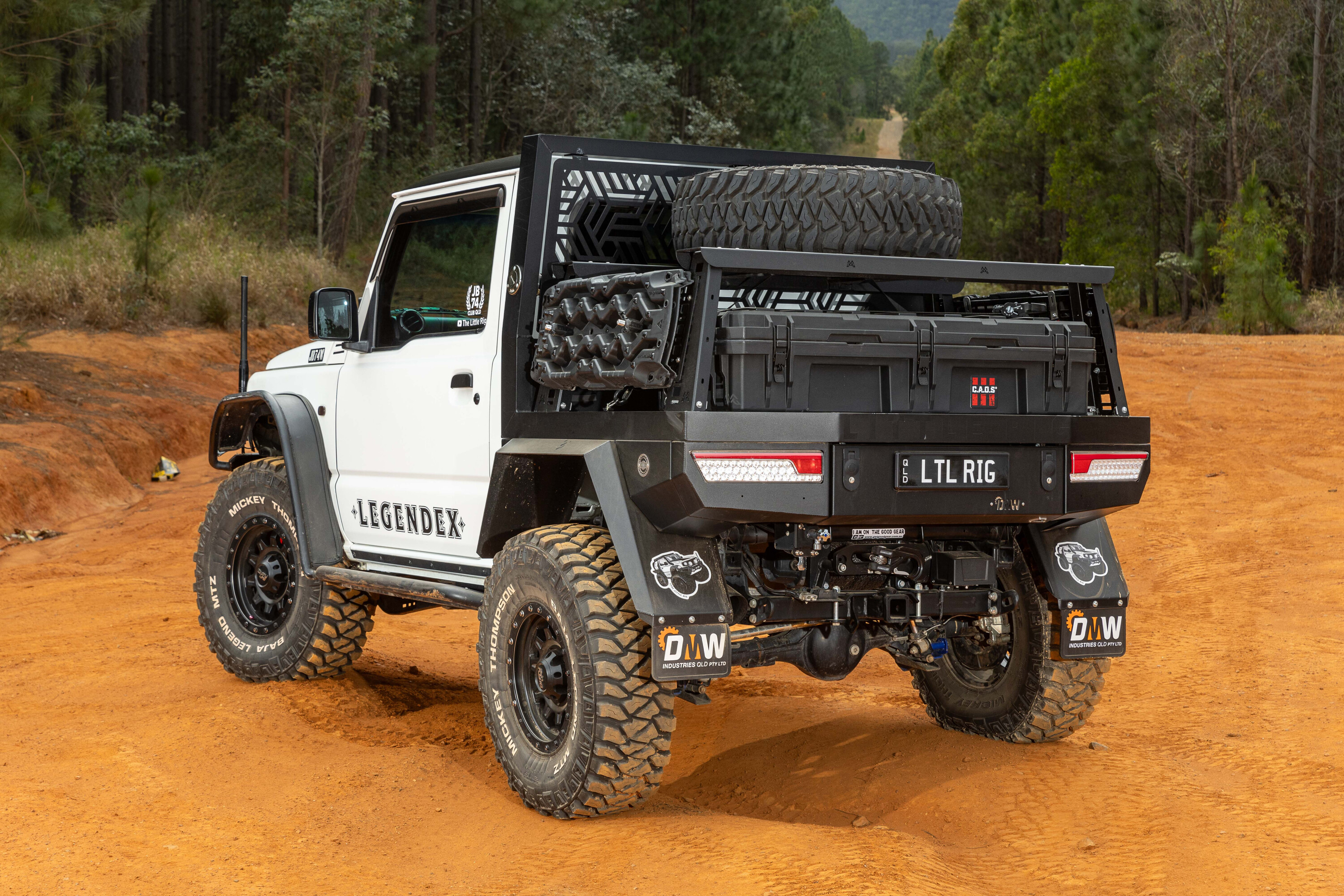
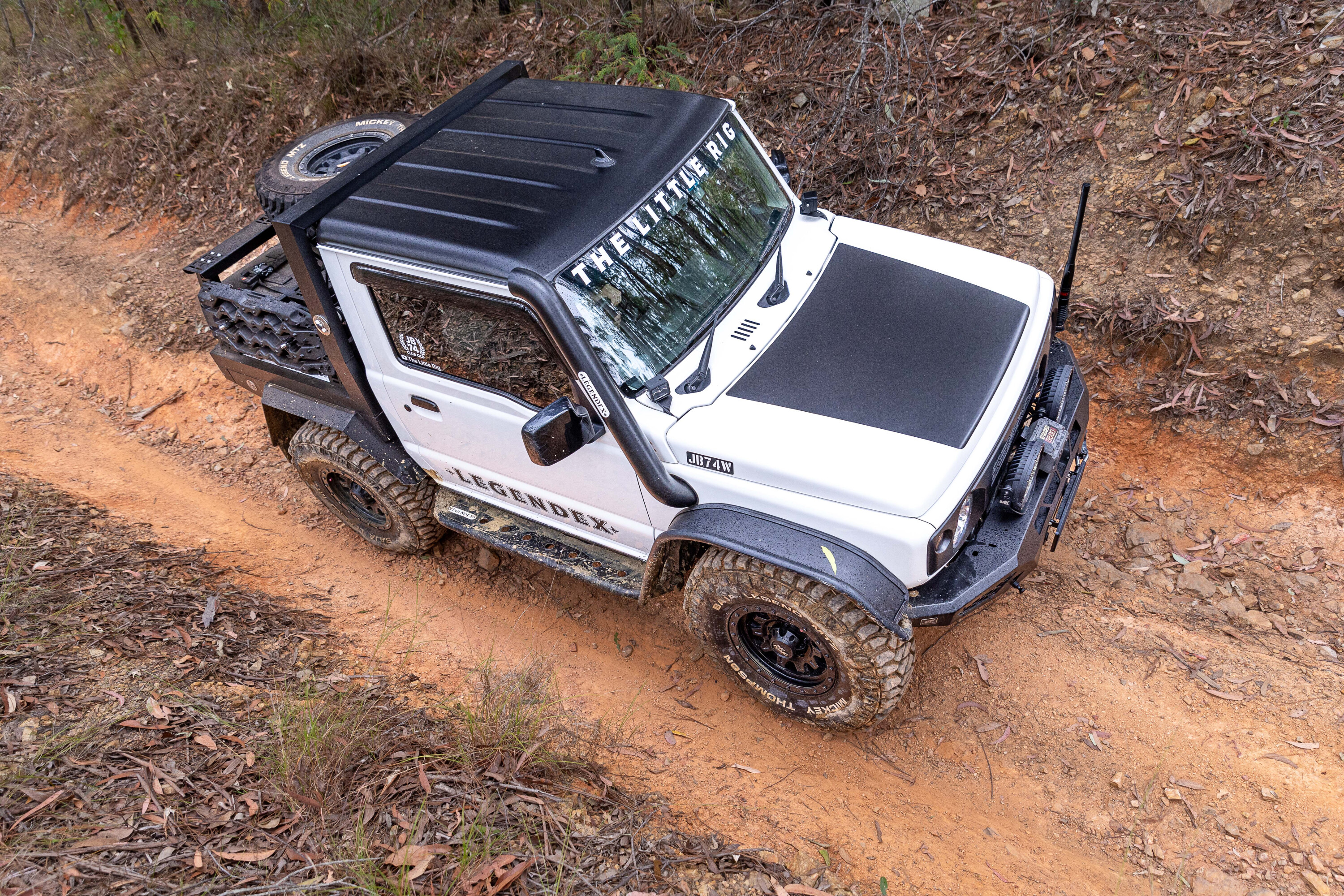
Nope, you’re not losing your bickies, you’ve definitely seen this Jimny before. Only the last time we caught up with Darren Young to shoot his wild JB74 Suzuki it looked a hell of a lot different.
When we last met it still had all its panels, was running around on 30-inch rubber and was, for all intents and purposes, a completely different rig to what’s on the page in front of you now.
Darren built this Jimny for two reasons: to have fun on the harder tracks around his home in South East Queensland, and for touring with his family.
1
What’s that? Touring in a Suzuki?!
Yep, you read it right, but we’ll get to that in a minute. What initially caught our eye was the extent Darren had taken his then-new vehicle to, and how unafraid he was to push it to its limit. He did all the right things when modifying a Zook. Lift, tyres, lockers and gearing. It’s a tried-and-true recipe and for good reason. It works.
However, sometimes having your cake just isn’t enough. Sometimes you just get hungry and feel like eating it too. Which is the position Darren found himself in after one fateful trip to the Glasshouse Mountains. Not one to be hindered by a little speed bump on the modification road, Darren took his already highly modified Jimny and went absolutely bonkers.
1
Half-cut
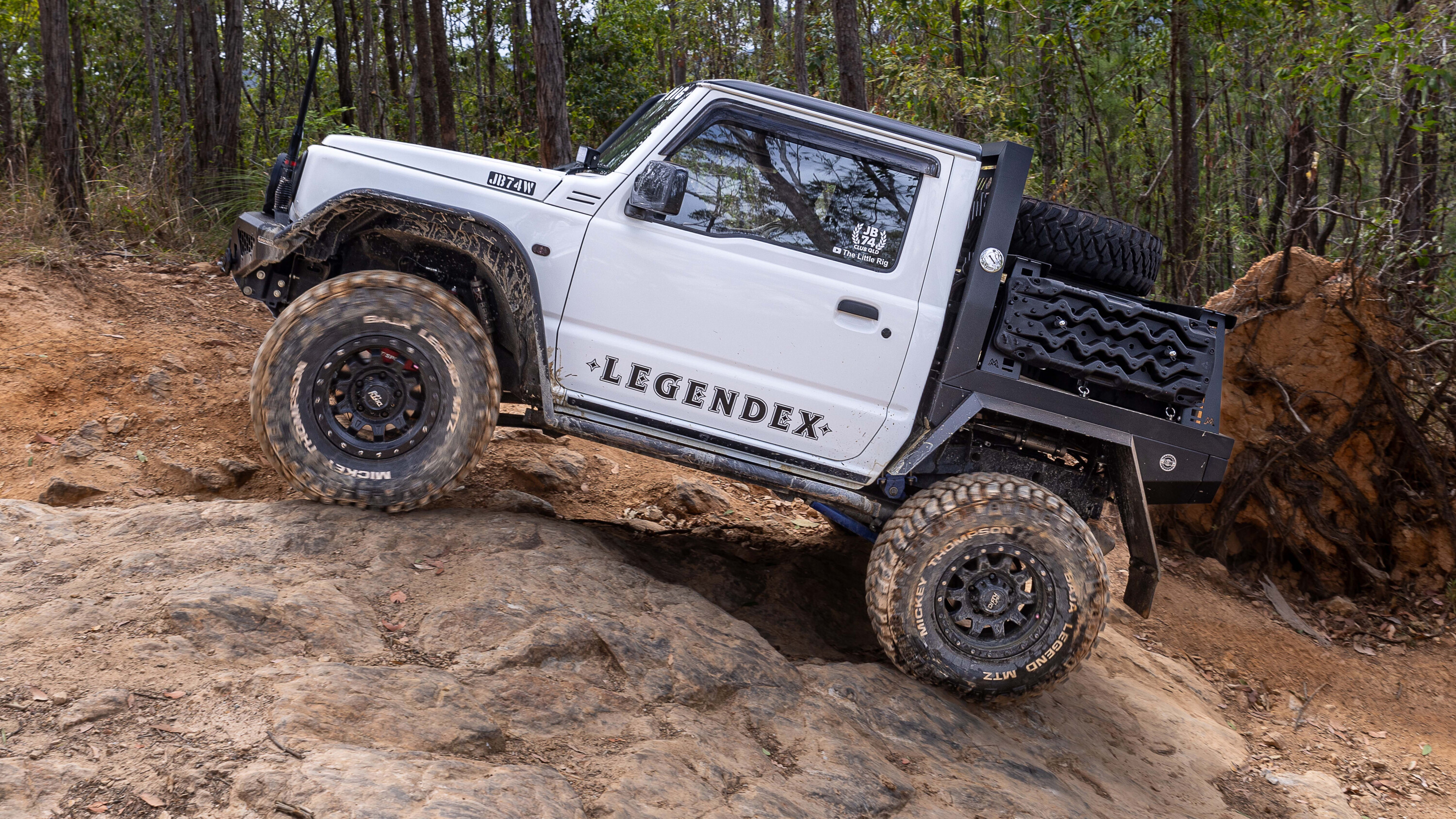
What happened at Glasshouse, you ask? Well, the details are a little thin on the ground but let’s just say that it involved getting a little fast and loose with the vehicle’s centre of gravity, a rock wall, and all of the Jimny’s left-hand rear panels.
The result was some wadded up sheet metal and a crossroads. Down one path lay an uncomfy call to Darren’s insurance agent. Down the other, a date with the plasma torch and mig-welder.
Obviously, Darren went with option B and had DMW Industries slice his Zook’s cab neatly in half, turning it into a one-off ute. It’s easy to say, but a lot harder to do. The conversion also involved a mountain of custom work that we could likely fill this whole mag with.
1
Hurdles like having to delete the rear curtain airbags without making the ECU think they’d gone off (solved using a special module from NZ) and incorporating a bunch of rollover protection into the rear bulkhead all had to be tackled in due course.
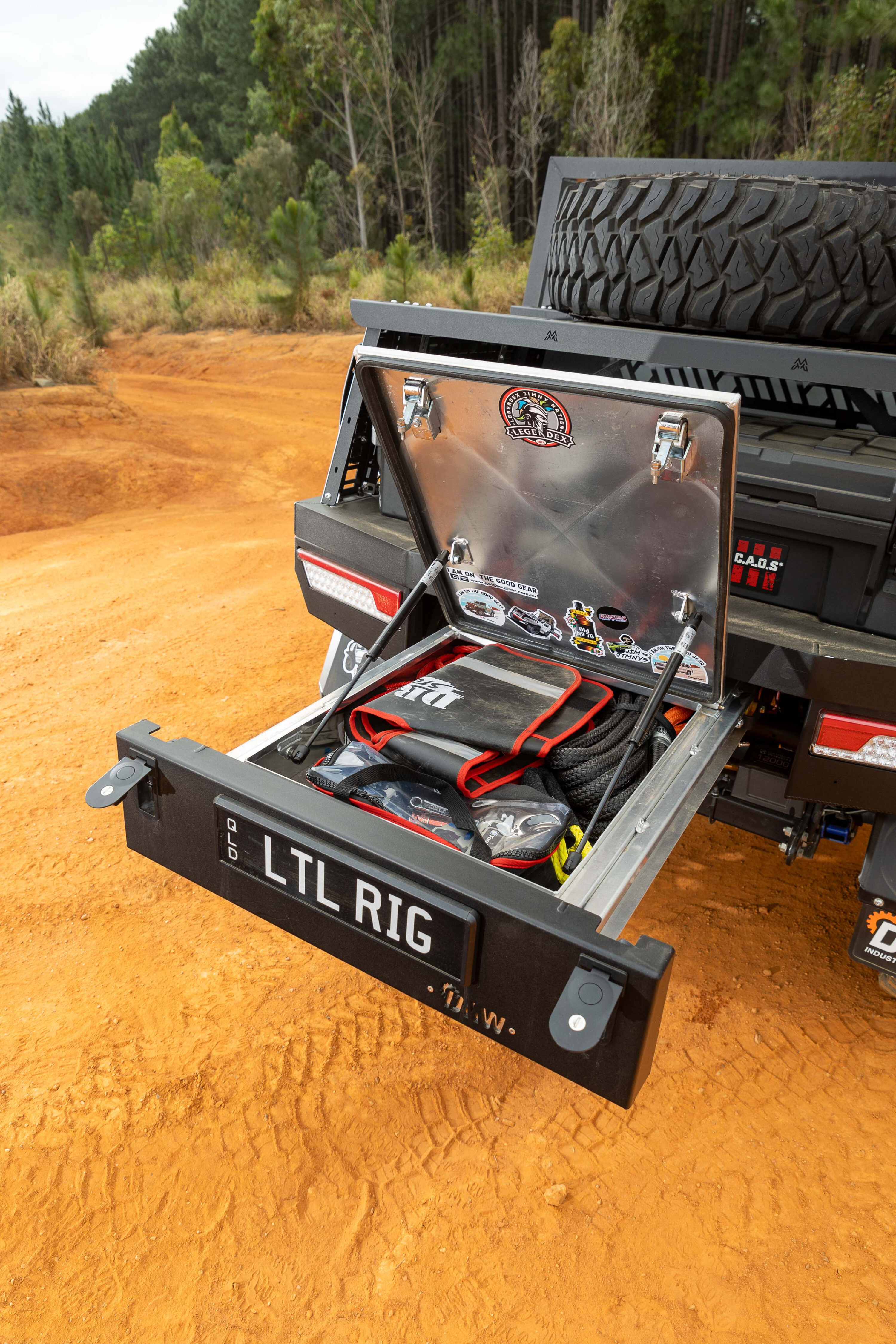
Then there was the alloy tray, including the trundle drawer, water tank and pump, having to be fabbed up from scratch. Nonetheless, Darren and the team persevered and eventually had a fully engineered and mod-plated ute chop done.
Now he could turn his attention to the rest of the vehicle.
1
The mechanical story
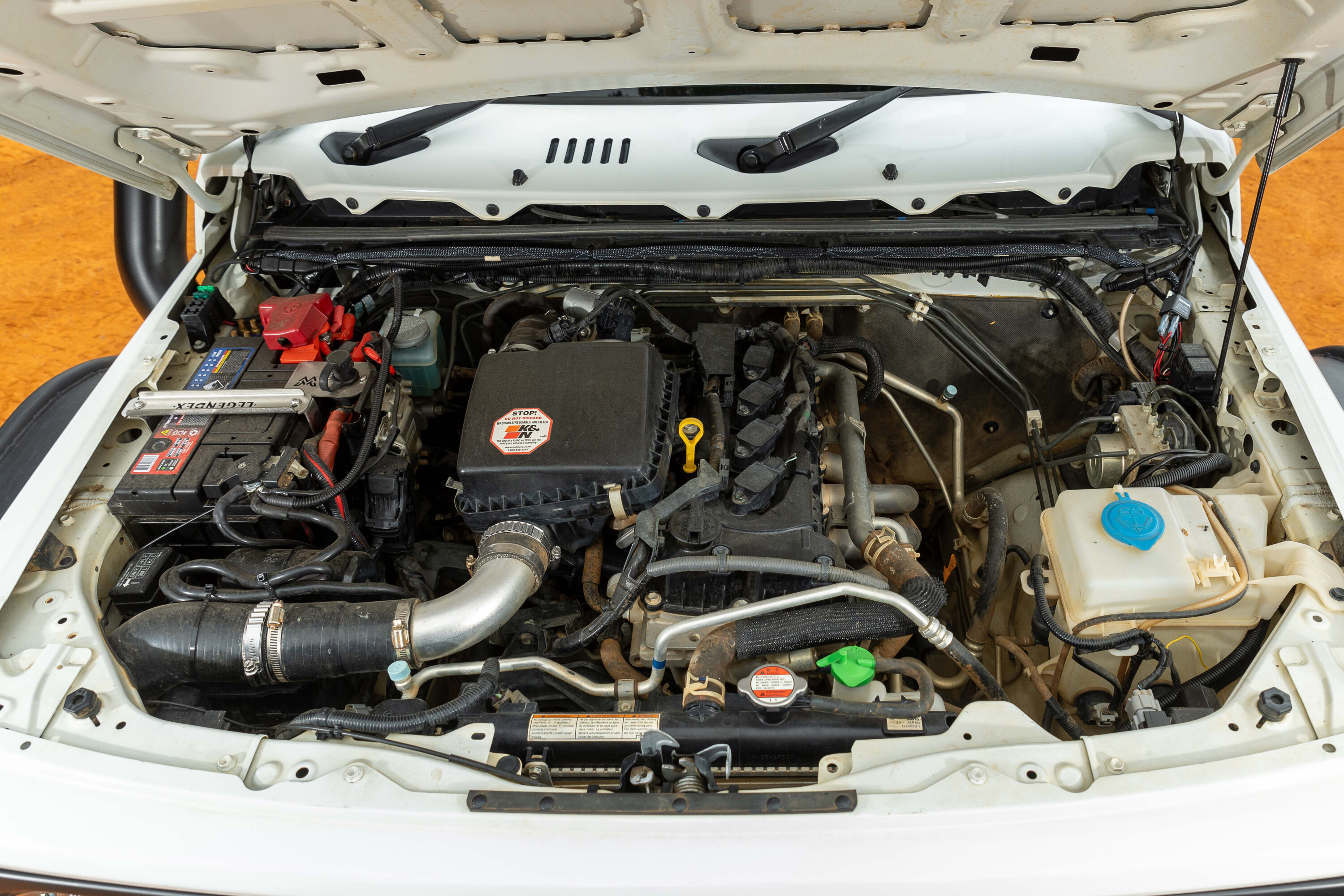
The stock (for now at least) engine is fed by a long-range 80L tank, which given the frugal nature of the 1.5L’s drinking tendencies, should be enough range for a quick trip to the moon and back.
Protrack reduction gears have been stuffed into the transfer case, dropping low range gearing by 87 per cent – which provides more than enough torque to comfortably turn the big 33-inch tyres nice and slowly over the rougher sections of track.
The diff ratios were swapped out for those from an auto Jimny, which give a 4.3:1 ratio versus the manual’s 4.1:1. It may not sound like much, but when you’re running big rubber, every little bit counts. Darren reckons the Jimny used to scream on the highway but now runs nicely in the fat part of the torque band.
1
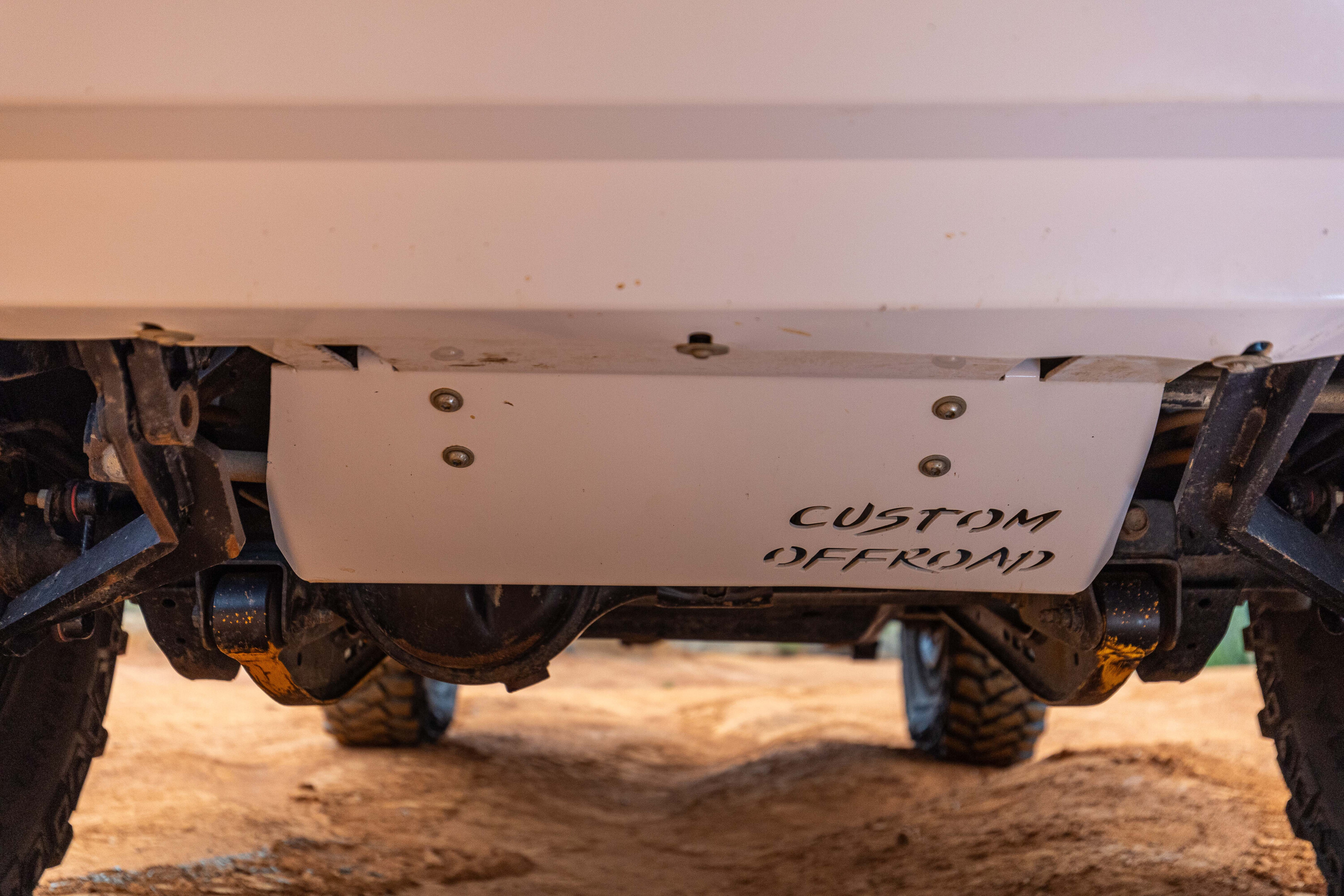
Both diffs are twin-locked thanks to Uncle ARB, and with the bigger rubber, provide enough traction and clearance for this thing to glide over ruts that’d have much larger rigs testing their bash plates’ structural rigidity.
For the naysayers that’ll get online and tell everyone you can’t run 33s on a Jimny without breaking stuff, Darren is way ahead of you. Both CVs and axles have had the full chromoly treatment, which, while not completely indestructible, go a hell of a long way towards letting him hit the steeper terrain with more throttle and less stress.
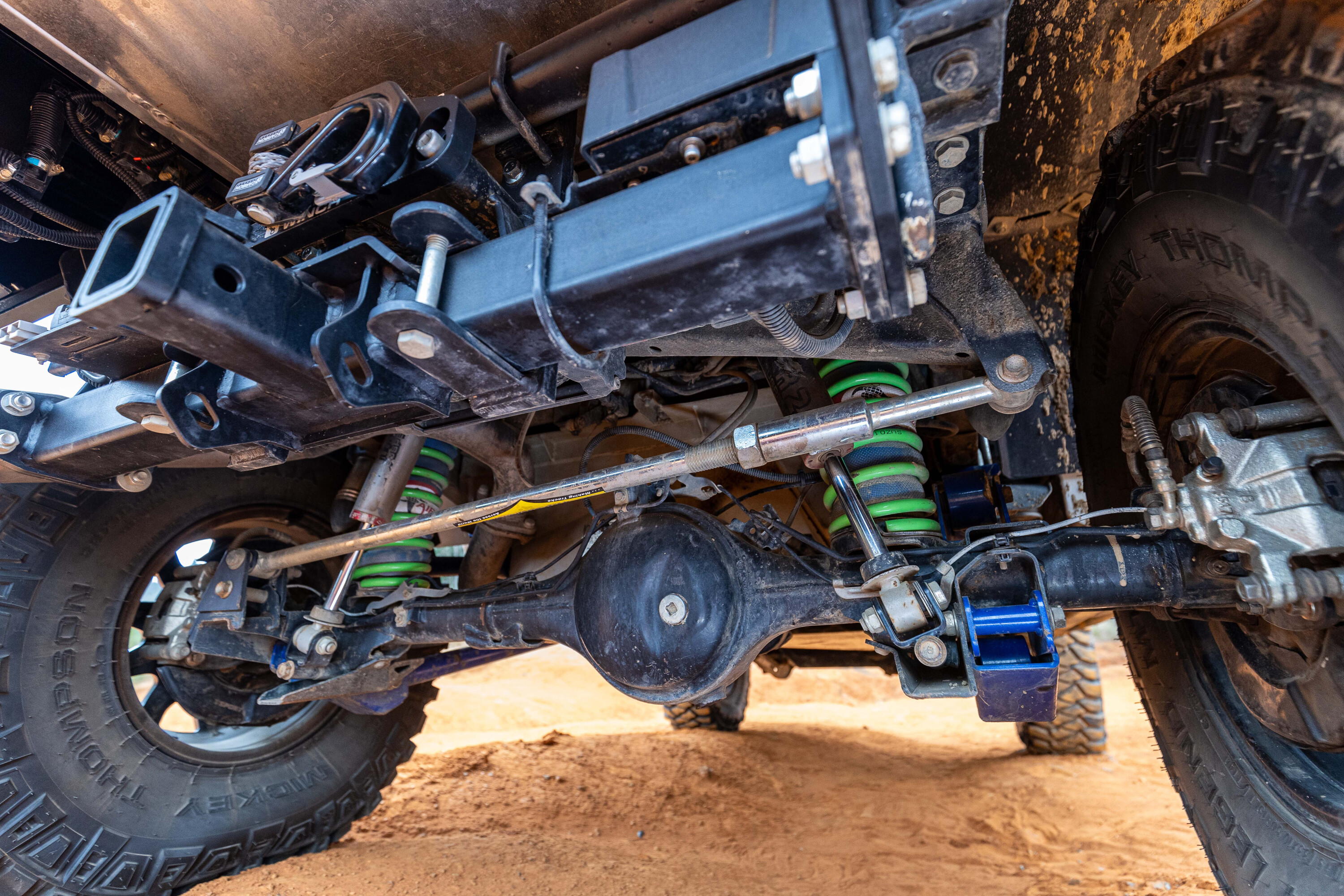
A Hardrace 4-link kit (really a 5-link) has been bolted up to the rear-end to get away from the, frankly, heinous radius arm set-up from the factory.
1
Darren reckons that combined with the fatter tyres, the whole vehicle now feels a lot more planted on the off-camber sections of track and is generally just a more stable and nicer vehicle to drive.
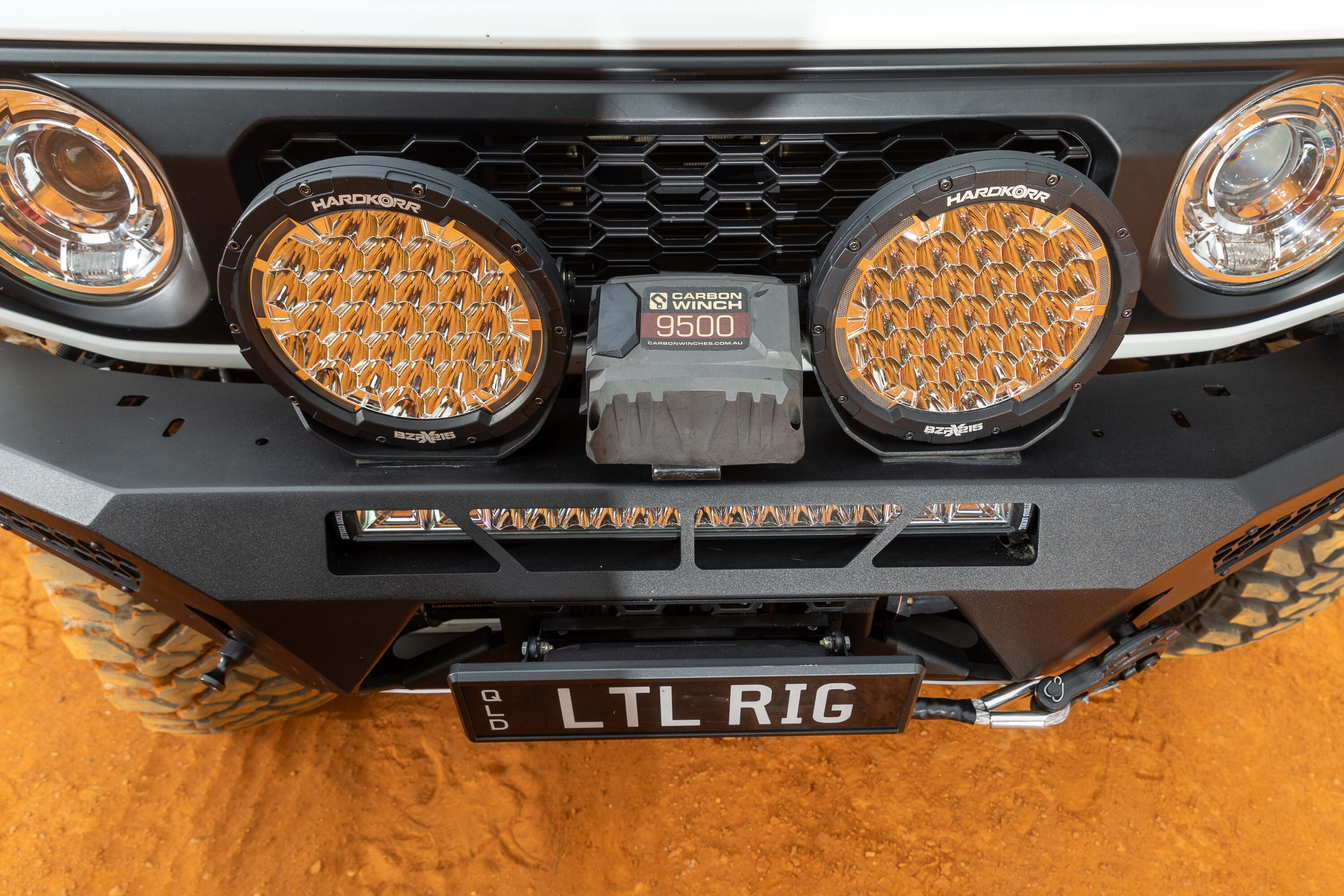
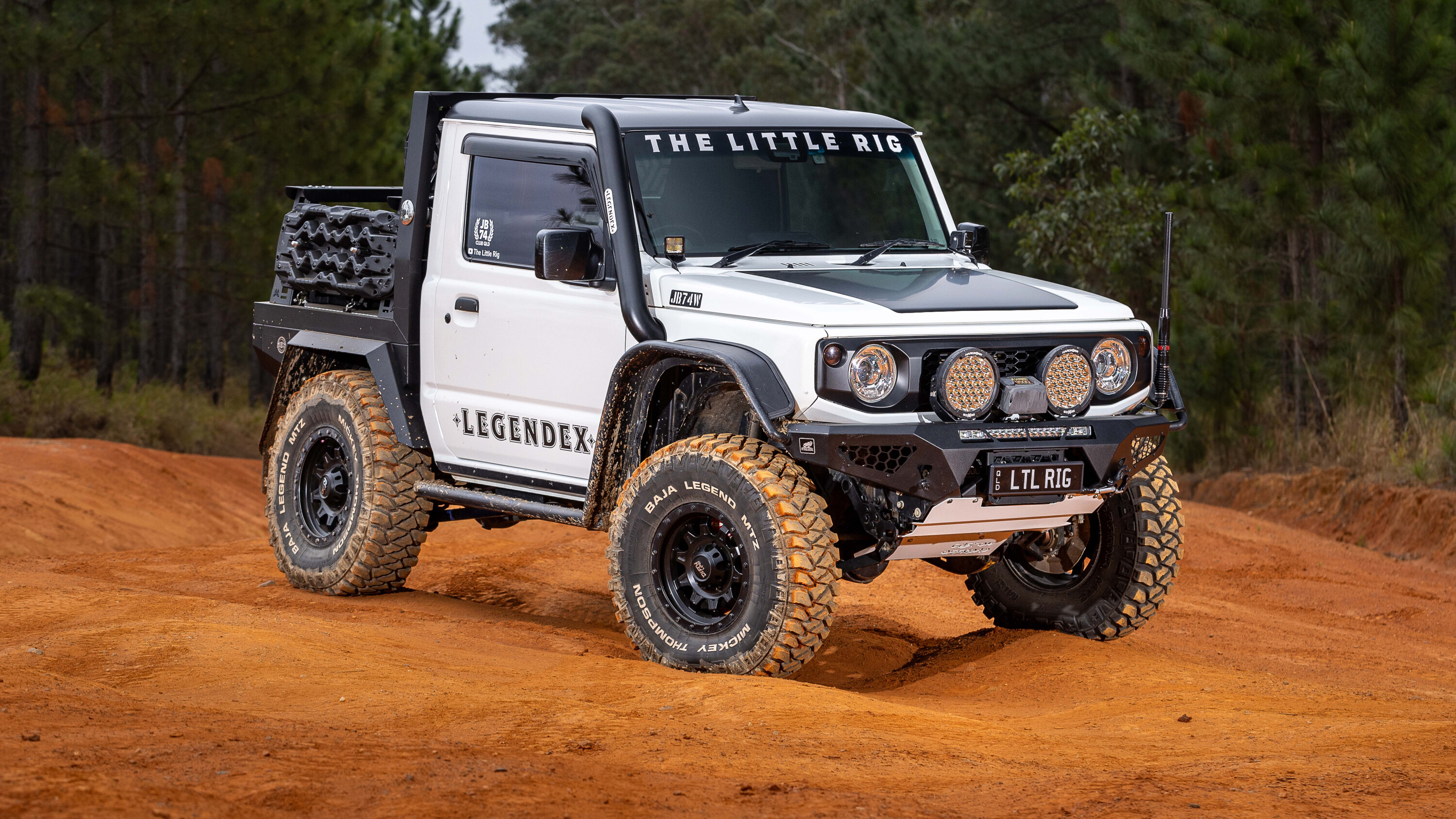
When we last saw this rig it was sporting an AFN front bar, which has now been replaced by an Offroad Animal item that was fitted simply because it was a lot lighter than the previous unit. When you’re dealing with a limited amount of available GVM, every kilo counts.
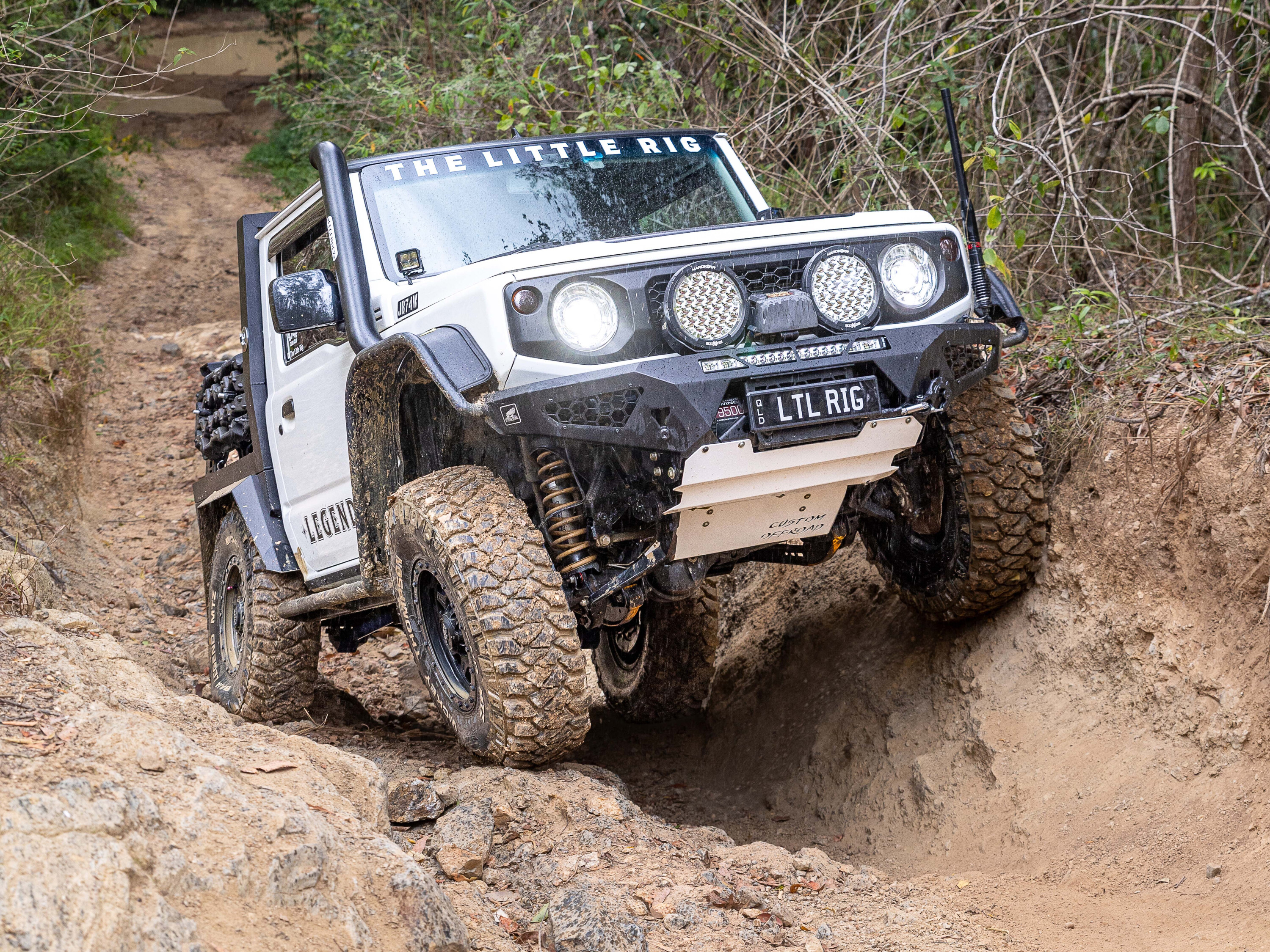
The beaut-looking scrub-bars-into-steel-flares were knocked up by Darren and his mate Josh from JJ Custom Fabrication to keep the panels from any more errant rock walls.
1
Combined with the sliders from Legendex, and the bash plates underneath make this one well-wrapped Zook.
All of the lighting is by Hardkorr, and there are twin Carbon winches, front and back which are fed by the hefty 800CCA (more than double the stock cranking amps) battery that required a new cradle to be fabricated to suit.
Interestingly, the rear winch is a chunky 12,000lb unit. It might seem like overkill for the lightweight Jimny, but Darren mentioned that he often heads out with much larger vehicles, so being able to anchor himself with the front winch then pull his mates out with the rear has made his group’s recoveries heaps easier.
1
Touring in a Zook
Taking a look at this thing, you’d be forgiven for thinking it was just a play 4×4, built for hitting the hard stuff on the weekends and parked up when Darren, his wife and son want to head out on remote trips. But you’d be dead wrong.
In fact, the Jimny gets used for camping and touring just as much as it does for recreational wheeling. While it gets punted over the hard stuff in trayback form, there’s a fully decked-out canopy with a rooftop tent that gets bolted on for touring duties.
But wait, it’s a two-seater, how do three of them go camping? We’re glad you asked. It turns out Darren’s wife also likes to drive her own Jimny to places like K’gari (the island formerly known as Fraser) and the Sunny Coast hinterland, so she and her son travel in the family’s second Jimny while this one gets to be the pack horse. Why tow a camper when you can drive it eh, mate?
1
What’s next?
Given that this already has to be one of the most (if not the most) modified JB74 in the country, you’ll be unsurprised to learn that Darren still has plenty to tick off on the old to-do list.
In fact, by the time you read this the AVO Turboworld kit that’ll see a comfy 50 per cent increase in power at the wheels, will have been installed. If you’re driving up Double Island one weekend and a Jimny that sounds suspiciously like it has some wastegate flutter coming from under the bonnet blows by you, try not to feel too bad, hey?
Also, it’s highly likely by now that Darren will be running 35s and 4.871:1 diffs on this rig, in case you were wondering.
1
Oh, and as we were speaking, he had also lined up a comprehensive slimline lithium 12V set-up from HardKorr that was moments from going in too. Just the ticket for those longer trips into the bush with the family.
Jeez, give us a call when it’s all done, mate. Sounds like we’ll need a third revisit soon enough.
Thanks
MORE
Everything Suzuki
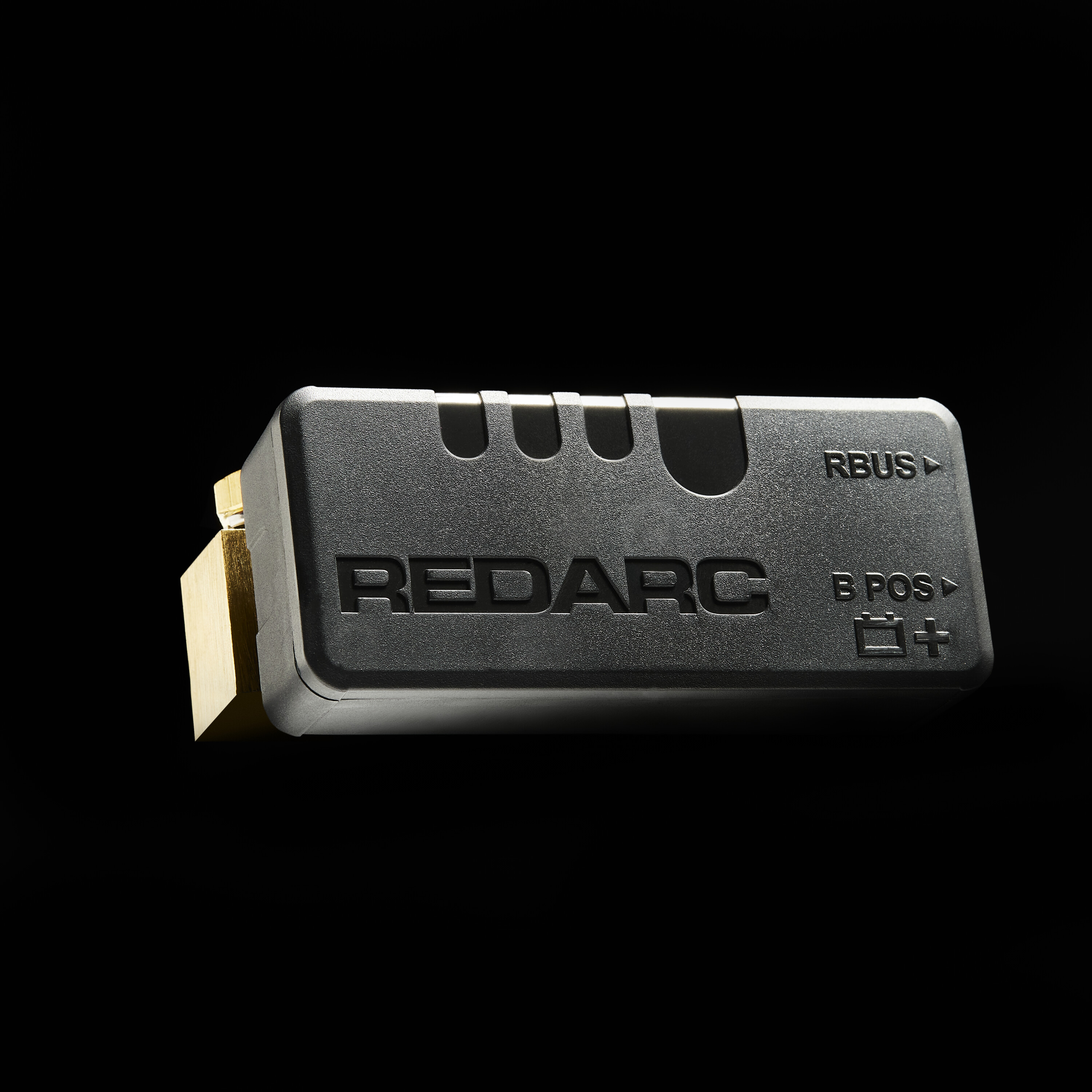
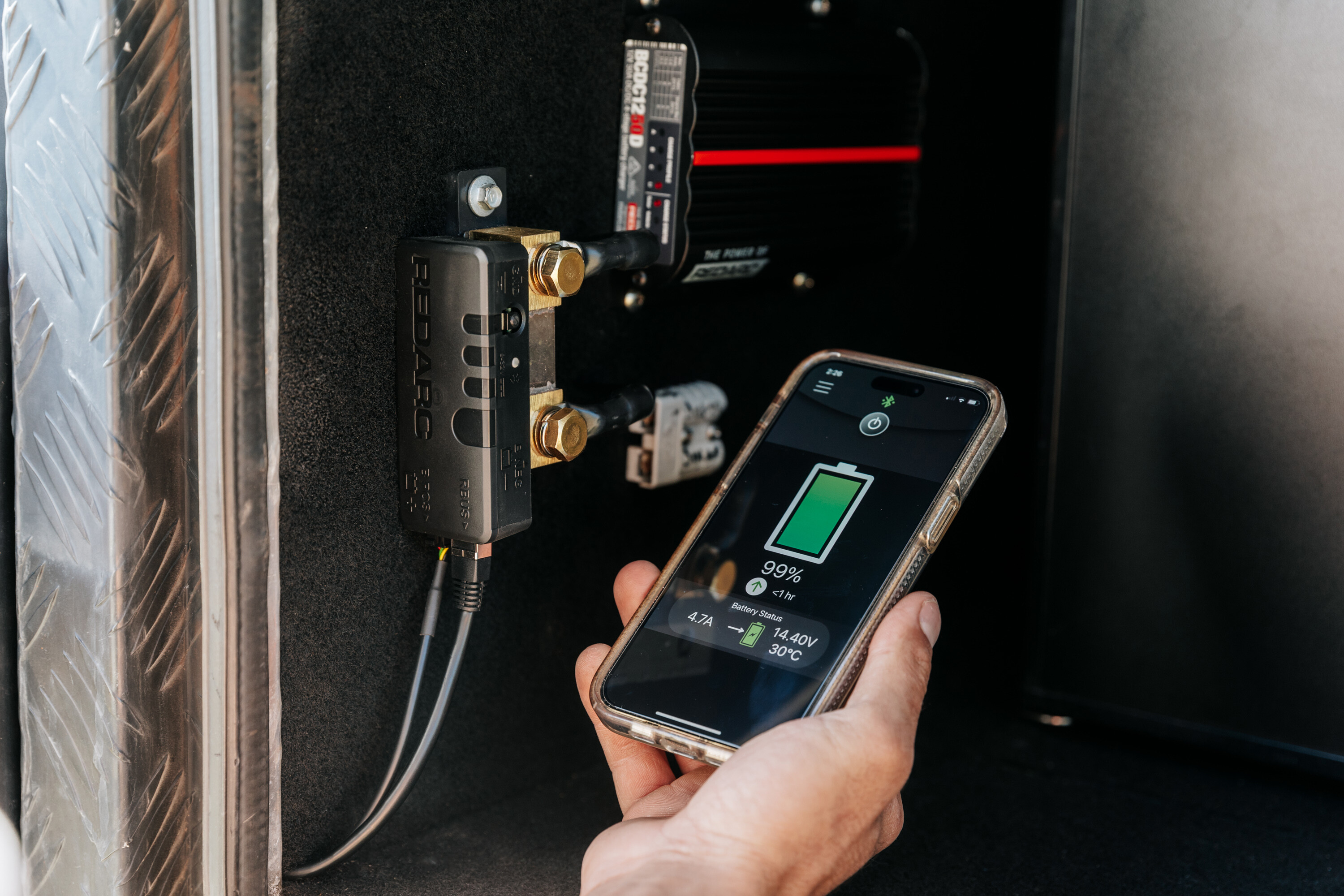
Redarc Electronics has launched its all-new Smart Battery Monitor.
The BSEN500 is the most accurate battery monitor on the market with up to five times more accuracy under the most common operating conditions, so you can trust that ‘two hours left’ means two hours left.
The Smart Battery Monitor takes the guesswork out of tracking your battery levels, measuring the state of charge of your battery, time remaining and current flow. This is welcome news as I don’t know a 4WDer who isn’t often checking the state of their auxiliary battery and wondering if what they see is what they are getting.
1
The Smart Battery Monitor provides solid connectivity to the RedVision Smartphone App via Bluetooth 5.1, with up to 42m of range and twice the transfer speed of Redarc’s competitors. The simplified user interface features one-touch access, so when you open the RedVision App your battery data appears instantly. The BSEN500 has a compact footprint of only 120mm x 52mm x 45mm, which makes it perfect for mounting in tight spaces for a compact vehicle monitoring system.
Dylan Pinkard, Redarc’s product management team leader, explains, “One of the most common requests from our consumers is a way to monitor auxiliary battery charge levels. The Smart Battery Monitor addresses this request, allowing fast, reliable and accurate battery monitoring.
“We focused heavily on ease of use, with one-touch access and data that doesn’t require an electronics degree to understand. The Redarc Smart Battery Monitor is the perfect addition to any new or existing dual battery system or RedVision installation.”

1
The Smart Battery Monitor allows you to step into every adventure with complete confidence, thanks to its unrivalled accuracy, Bluetooth connectivity range and easy monitoring. Compatible with all common chargers and battery types, the Redarc Smart Battery Monitor is here to help you focus more on adventure and stress less on your battery levels.
Installation is as quick as it is easy. With only three connection points and a user-friendly configuration app, you can start monitoring within minutes. A simple addition to any 12-volt power system, the Smart Battery Monitor is the easy choice for keeping track of your batteries.
Redarc puts its products through a rigorous testing procedure to ensure that they will not let you down when the road gets rough. They provide reliable and adventure-ready solutions, and they’re made in Australia for the harshest environments, so you know you can go the distance with more accuracy.
The Redarc Smart Battery Monitor is priced at only $299.
Get your 4×4 plastered on the pages of 4X4 Australia magazine by sending a photo to our Facebook page, and we’ll publish it online and in an upcoming issue.
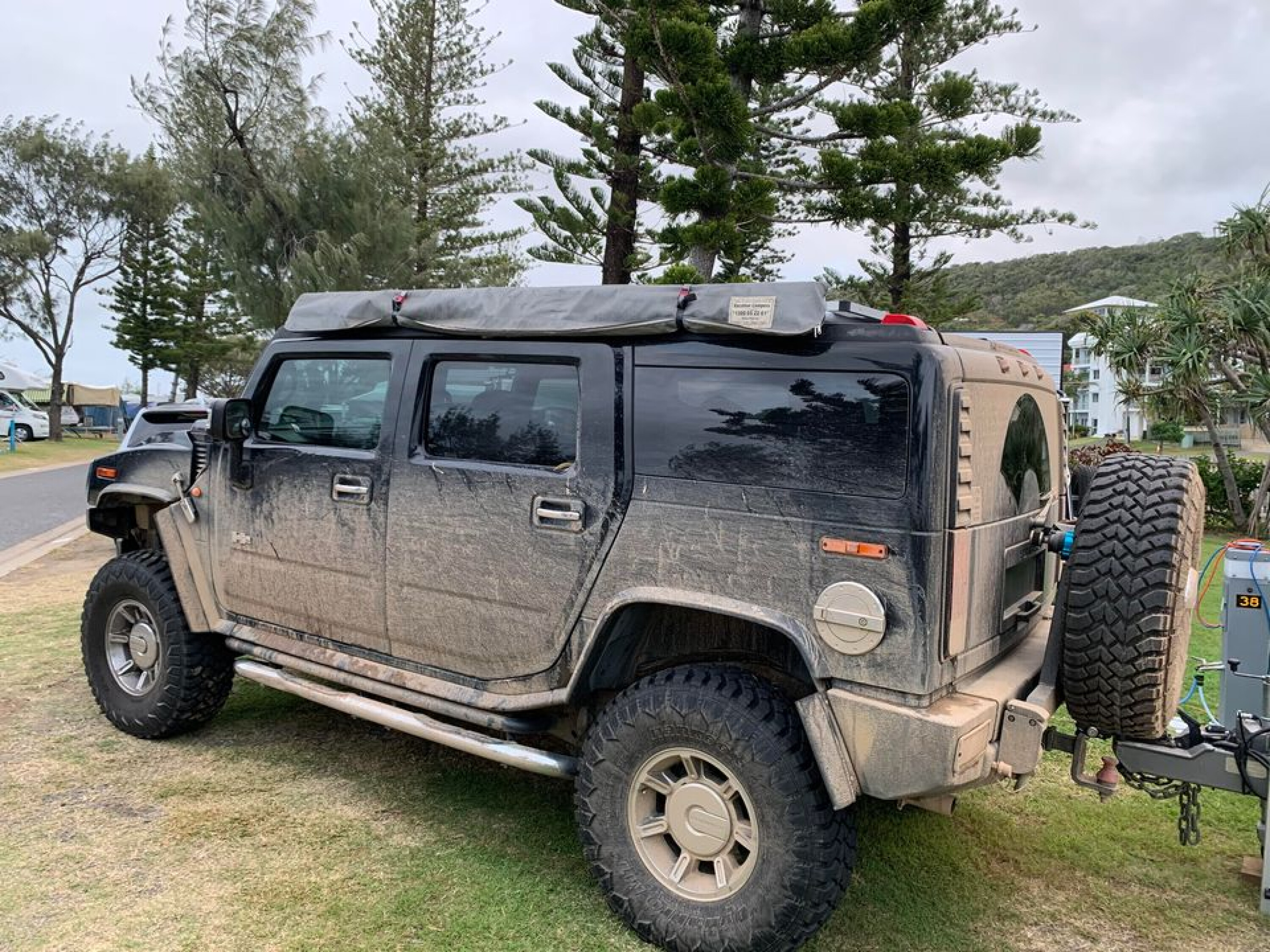
2006 Hummer H2
1
I love taking it to the 4WD parks and beaches around south-east Queensland, and I love being able to tow a full-size triple caravan to amazing places like the Blue Mountains, Carnarvon Gorge and Yeppoon, and then being able to hit the harder stuff once at destinations like Byfield National Park. It has a front ARB air locker, rear factory locker, a smallish lift and 37-inch tyres – Gavin Pratt
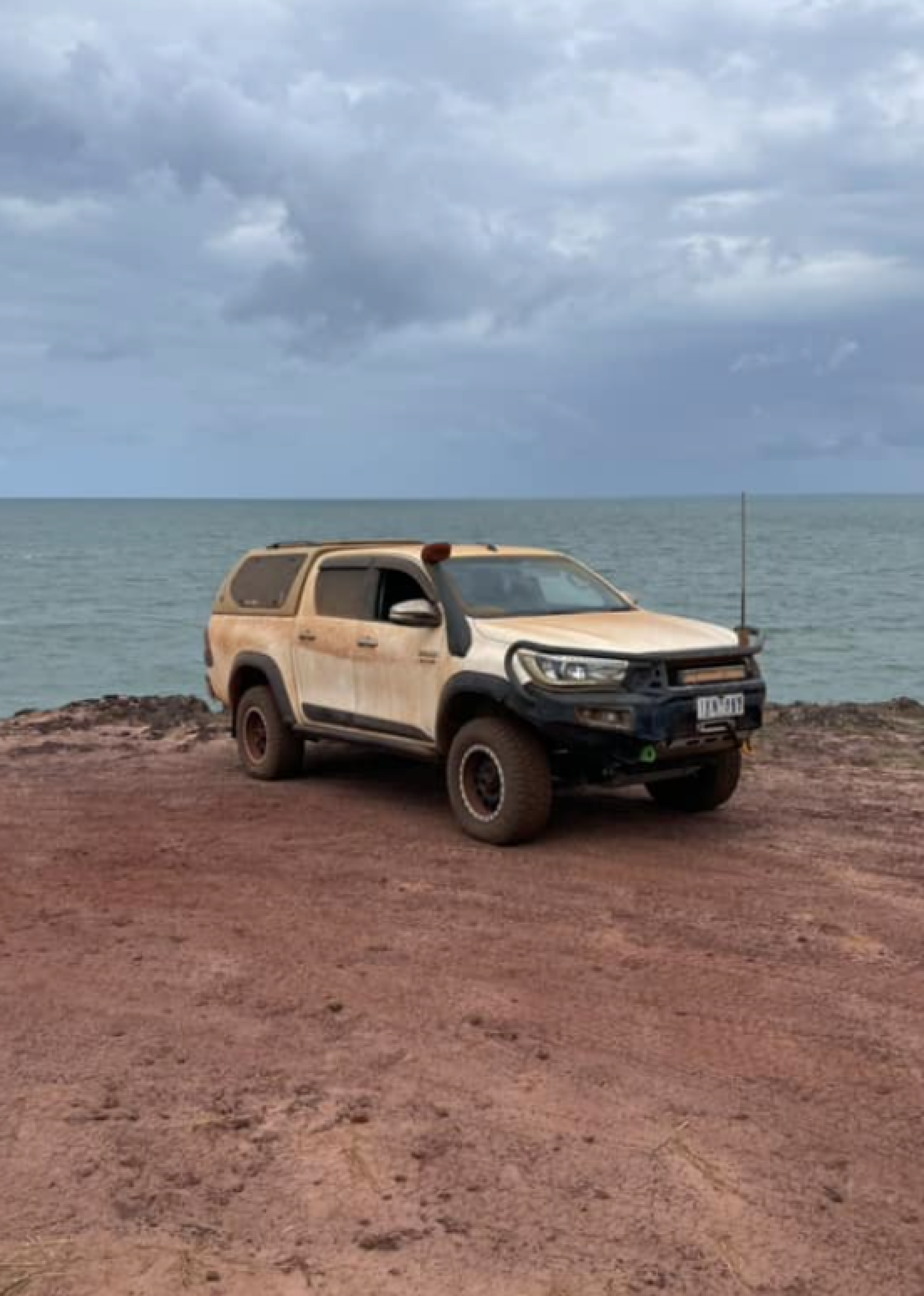
2017 Toyota HiLux
1
I’ve had a tow tune put in it and DPF-back three-inch exhaust, but mods and accessories are otherwise minimal. They include a two-inch Pedders lift; Method wheels; Maxxis A/T tyres; AFN bullbar; winch; snorkel; UHF; extended breathers; a solar panel on the roof; 200Ah lithium battery; and a canopy to keep the drawers and Engel dry and dust-free. I’ve done Cape York twice in the HiLux and it performed well both times, completing the Old Tele Track trouble-free. It has done the Oodnadatta Track as well – Brett Munday
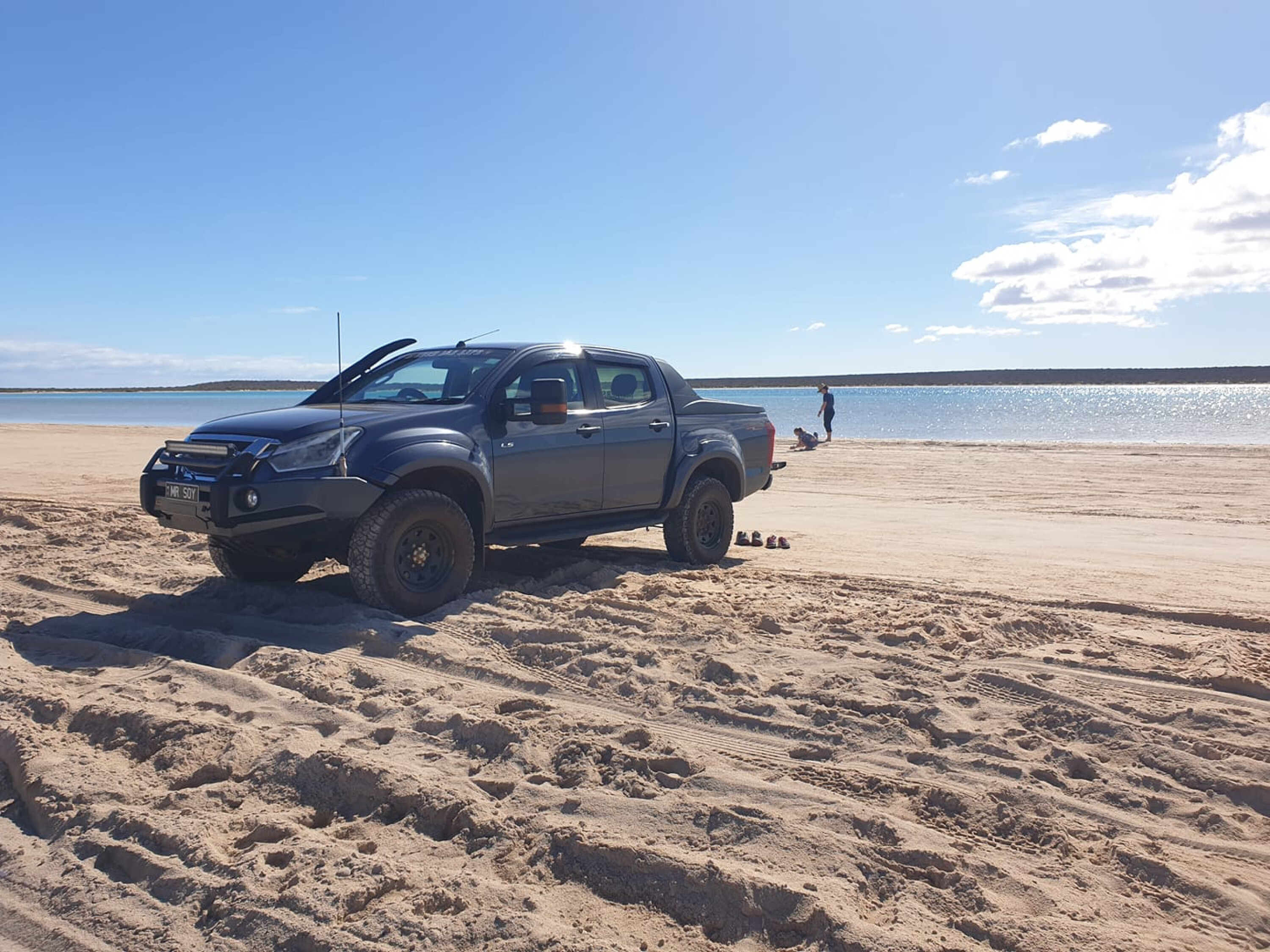
2019 Isuzu D-MAX
1
This beast tows a 22-foot family caravan, and she has done most of WA and the NT. This photo is at the Little Lagoon in Shark Bay, WA. It is fitted with an Isuzu Motorsports Dakar Bar, wheel arches, aerodynamic sports bar and snorkel, plus it has a two-inch lift – Soy Dave Green
2020 Toyota LandCruiser 76
1
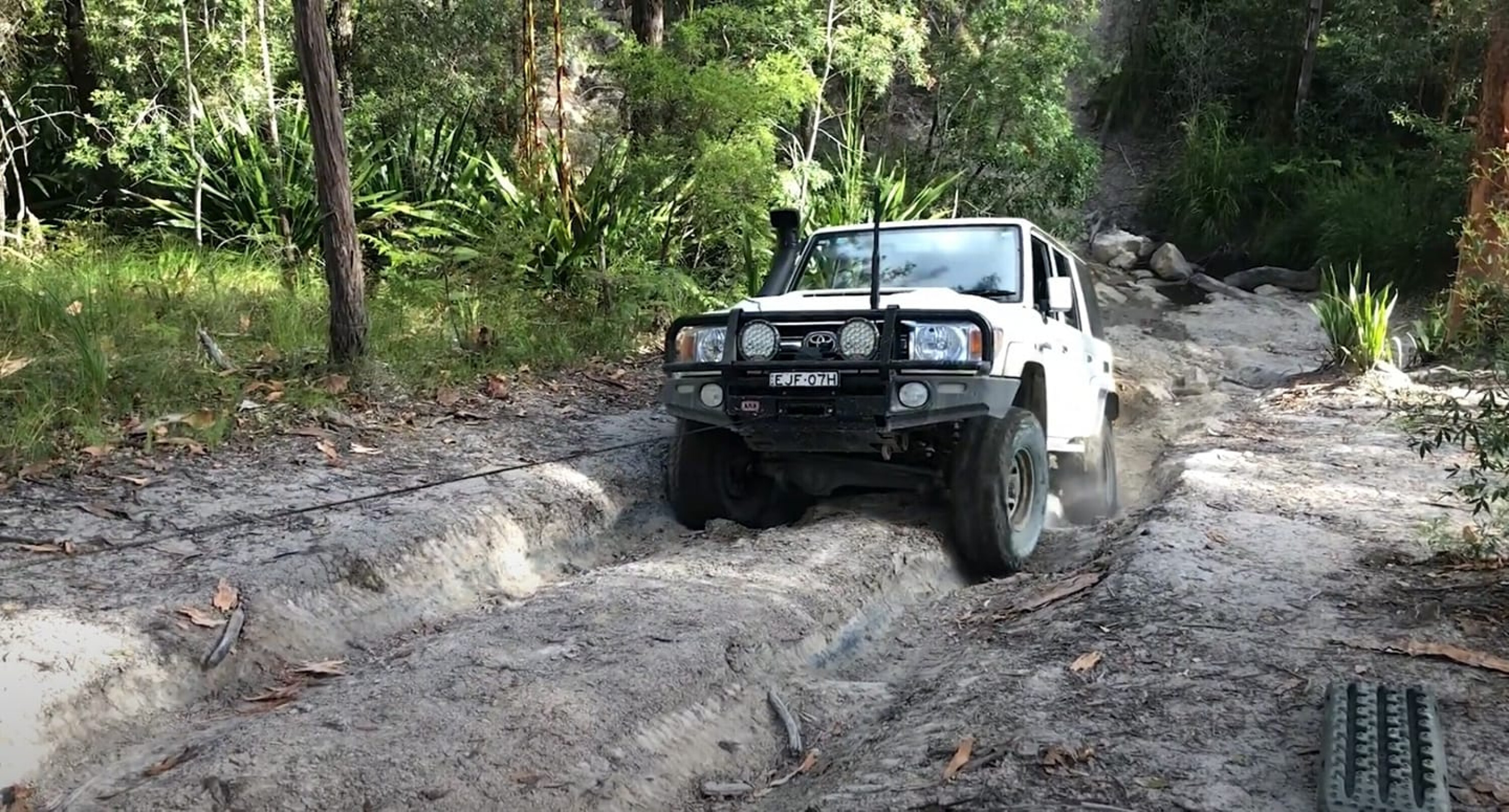
My 76 LandCruiser has OME BP-51 shocks; 285/75R16 BFGoodrich All-Terrain tyres; ARB front bar with Intensity Solis lights; Kaymar rear bar; rear track correction with an MDT Tru Tracker setup; Safari Armax snorkel; new centre console from Cruiser Consoles; and a GME XRS370C Connect UHF. It has a 3660kg GVM upgrade (2420kg Tare) with an engineering certificate. I added a Drifta drawer setup in the rear and an 80L water tank behind the back seats. It also has a catch can and secondary fuel filter.
The best place I’ve taken it was probably Fraser Island in March 2022. That was an epic seven-day adventure with three other vehicles. I’ve taken it many other places including Port Macquarie, Bago Bluff, Barrington, many times to the Watagans to explore the tracks, and a road trip to Broken Hill with extended family. This photo was taken on Greens Break Road in the Watagans, NSW – Andrew Goodwin
1993 Toyota LandCruiser 80
1
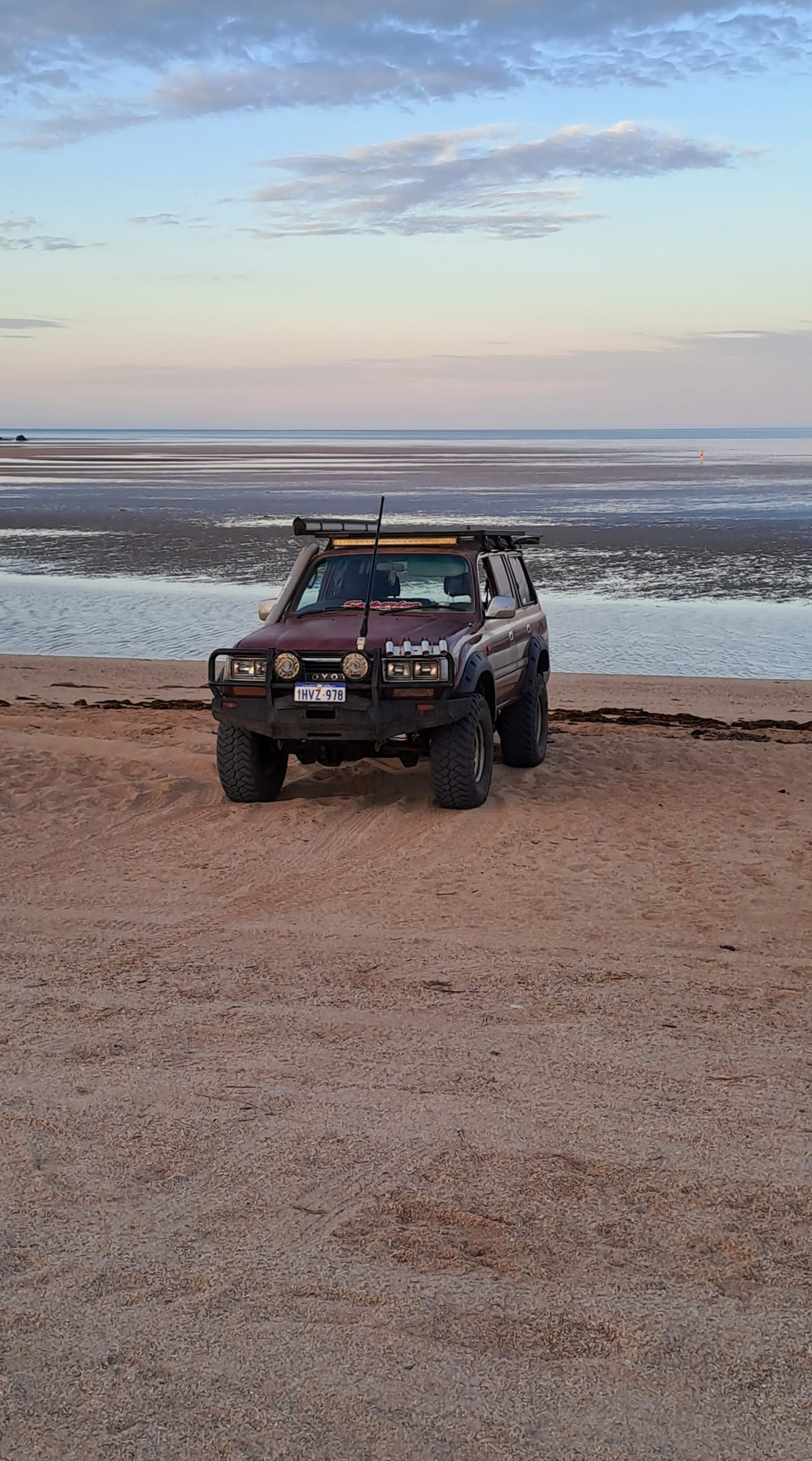
It has a three-inch lift, 35s and a roof rack with an awning. The best place I’ve taken it would have to be Broome in northern Western Australia – Zach de Boer
2013 Toyota LandCruiser GXL 79
1
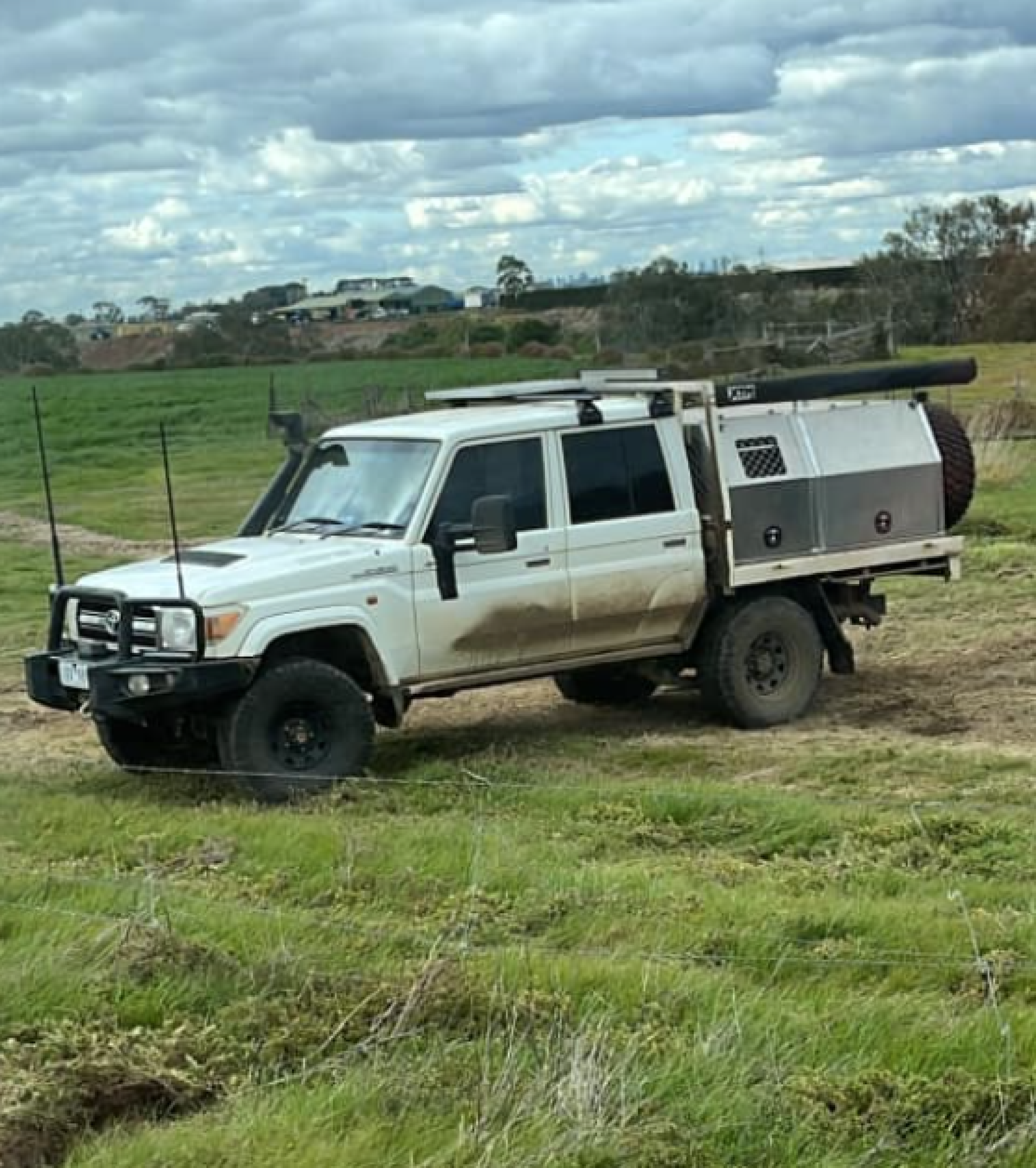
I just moved to Victoria from the Northern Territory and a lot of its driving was on a cattle station, but it has crossed the country north-to-south and west-to-east a few times. Crossing the Gunbarrel Highway and the Anne Beadell Highway was one of the best cross country trips I have done with her. On the road she tows a 40-foot caravan, as well as a boat on a lot of the trips through the Top End.
Mods include a three-inch lift with GVM upgrade; re-map; three-inch exhaust; custom-built canopy; Clearview mirrors; Redarc electric brakes; and a Century lithium slimline battery with XTM solar. If I was to list all the mods, the list would be incredibly long – Tony Dusty Grant
Latest Gear Guides
For time immemorial empires have risen and rulers have fallen. Ancient cities once beacons of prosperity for countless generations now lay silent under dirt. While the descendants of king’s so rich they could buy and sell countries now live a life no more extraordinary than any other.
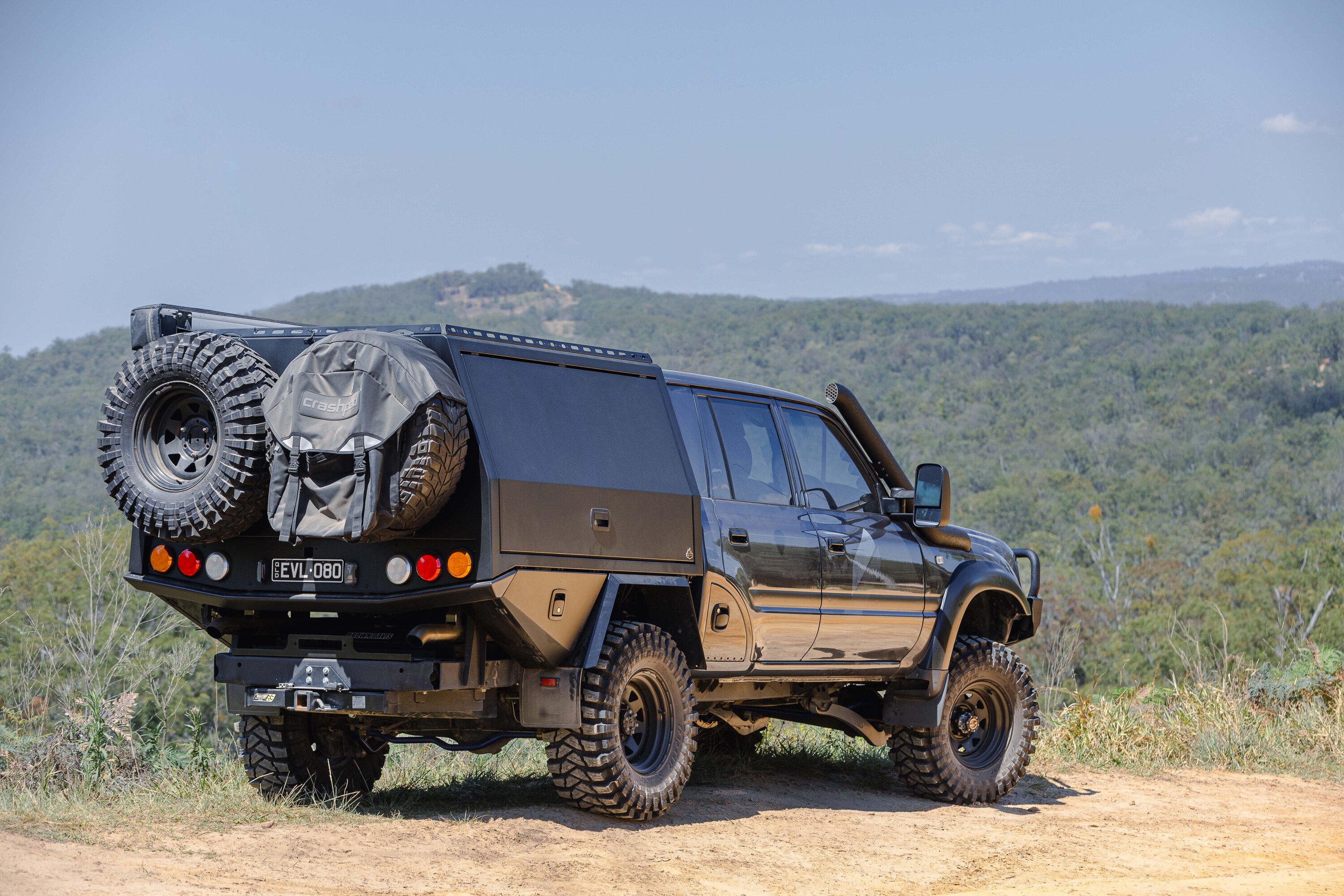
It’s a tale literally as old as time, and it’s something that couldn’t be more relevant when it comes to the once proud king off the road, the mighty 80 Series LandCruiser.
Once the reigning monarch of Australia’s off-road kingdom, it was sidelined by a parade of shiny newcomers, touting touchscreens over torque.
1
The 80 Series LandCruiser (yeah, yeah… and the GQ Patrol) was the default 4×4; it drove every track, camped on every beach, was the aspiration for every family with a taste for red dirt and the inspiration for every 17-year old with dreams of rock ledges.
Like so many kings before, the 80 was exiled and forgotten, but it’s now back and ready to reclaim its place on the throne.
Armed with grinders and spanners, keen enthusiasts like Ben Madden are determined to remind people what made these vehicles so good 30 years ago, and how they can still be the stuff of royalty today.
1
A king is born
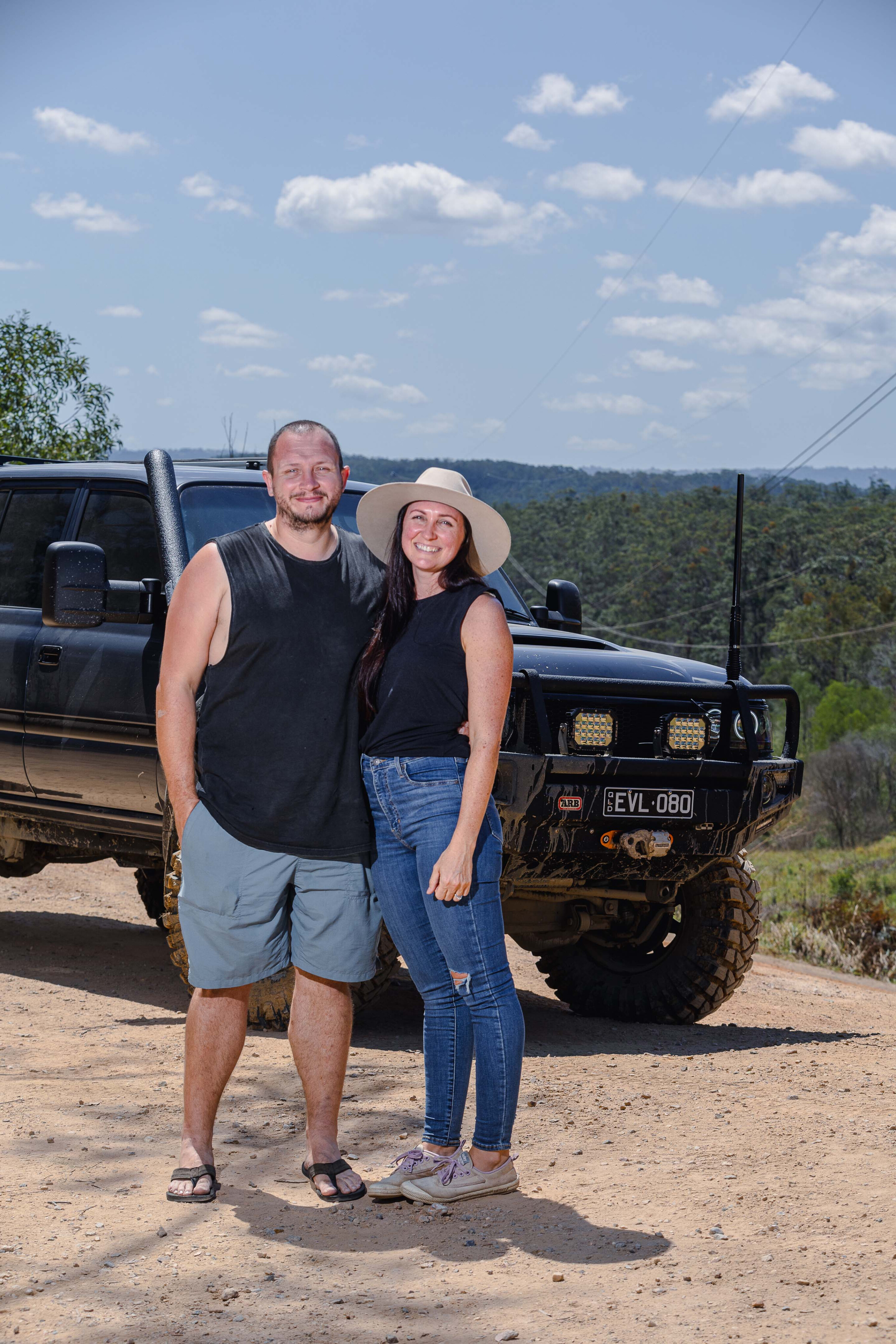
When Ben first got this 80 it’d seen better days; wheeled hard and put away wet, the then 22-year old 1991 Cruiser had ticked over 420,000km on a rebuilt 1HDT and was more homebuilt than hardcore.
Ten years later and while the epoxied-on screwdriver gear shifter is a clue to the Cruiser’s past life, it’s now living a new life and beating with a new heart.
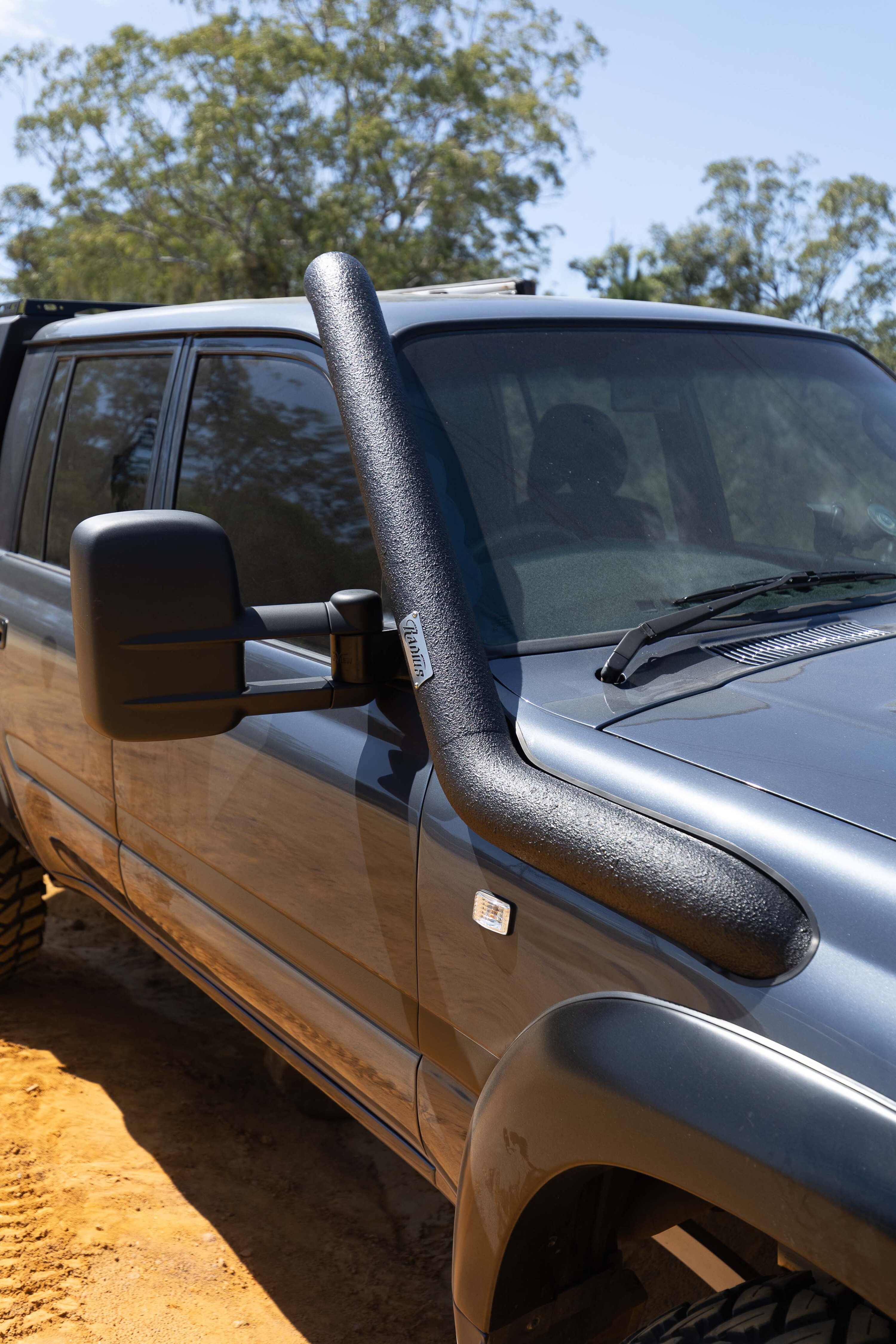
Follow the Raptor-lined Radius Fabrication snorkel down through the 80’s guard, sneak your way past the matching airbox and you’ll find nestled between the rails Toyota’s 1HD-FTE in place of the original 1HDT.
1
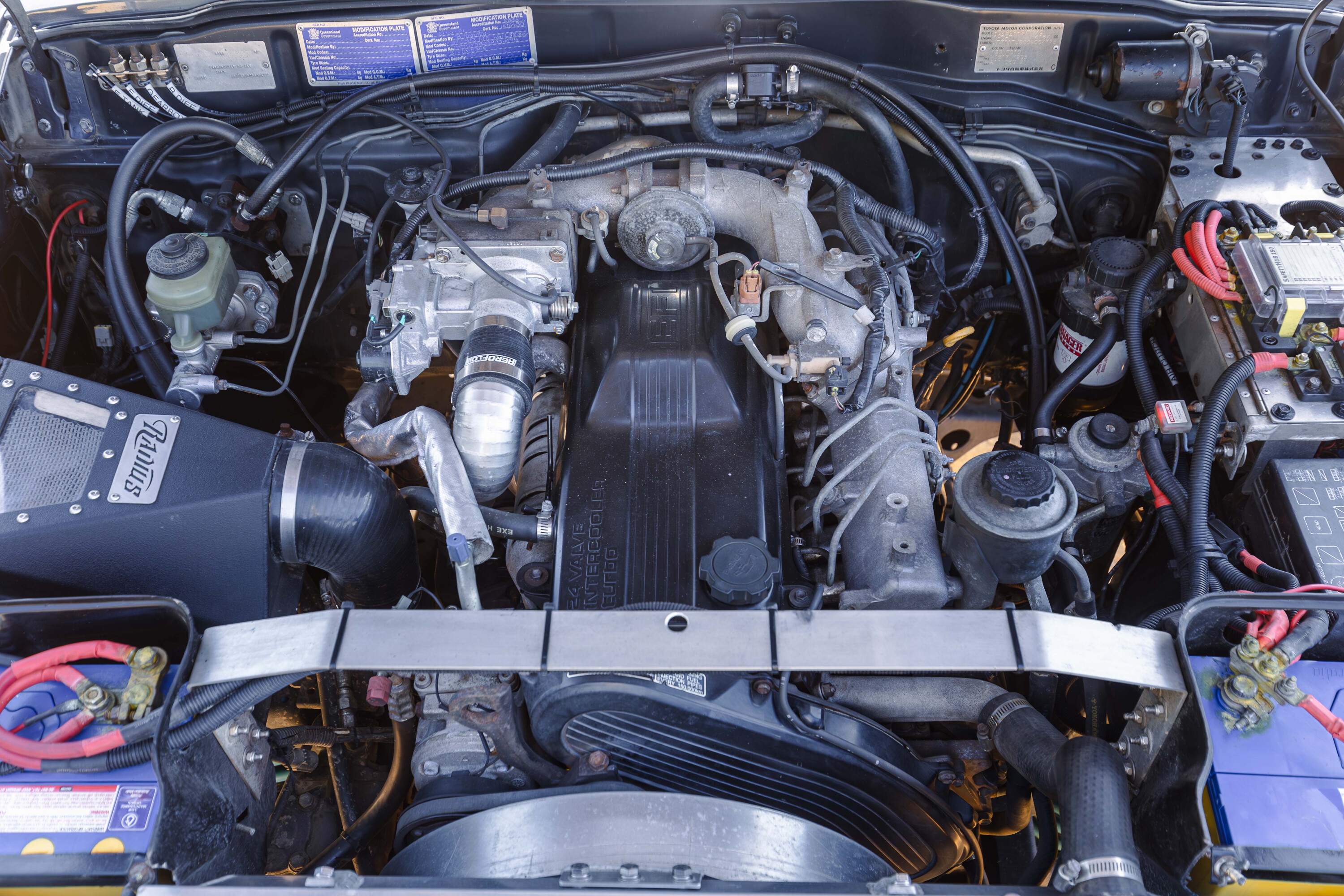
Pried from the clutches of a later model HDJ100, the newer engine added electronic engine management and a 24-valve head compared to the original 12-valve powerplant.
“Me and one of my best friends Benny Jones were on a Cape York trip by ourselves,” Ben tells us. “As I was coming out the exit of Gunshot, it snapped a crank. It sounded horrific but it still ran. We camped at Gunshot for the night and somehow managed to limp it to Bamaga where we made a plan.
We sent the car on a ferry to Cairns, flew ourselves to Cairns and drove a hire car back to my hometown of Airlie Beach. About a week later the car showed up on a truck and the engine conversion began.”
1
Giddy up
The conversion itself was relatively straightforward. Bolting straight in, Ben used the flywheel from the 1HD-FTE engine paired with the 4Terrain clutch from the 1HDT engine.
The factory Toyota CT-26 turbo is still serving duties faithfully and runs a little cooler thanks to a 316-grade mandrel-bent stainless exhaust Ben whipped together himself, while a PWR 55mm radiator helps keep those temperatures in check. For now, the factory five-speed gearbox and transfer case still have a home, but Ben’s converted it from full-time to part-time 4×4 with a Marks 4WD kit and pair of Aisin hubs.
To ensure the new-found power will actually make it to the ground, Ben’s given both front and rear axles a complete top to bottom.
1
Both have been rebuilt with ARB’s Air Locker centres, while the rear has copped larger 12mm dowel pins and 12.9 cap head bolts fixing one of the 80’s few weak points.
While Ben was up to his elbows in axle grease the brakes copped a serious working over too. Front and rear are sporting Bendix vented rotors, with the front axle copping larger units off the later model 80, as well as larger pads from a 105 Series Cruiser.
A Marks 4WD hydraulic brake booster and braided brake lines on all four corners round out the stopping power, while a Boosted & Built Garage electric handbrake makes this the first 80 in existence that actually stays where you leave it. Alright, maybe the platform has a few shortcomings.
1
Raised well
When it comes to setting the 80’s stance there’s a whole lot of wheel and tyre package, and even more suspension getting it done.
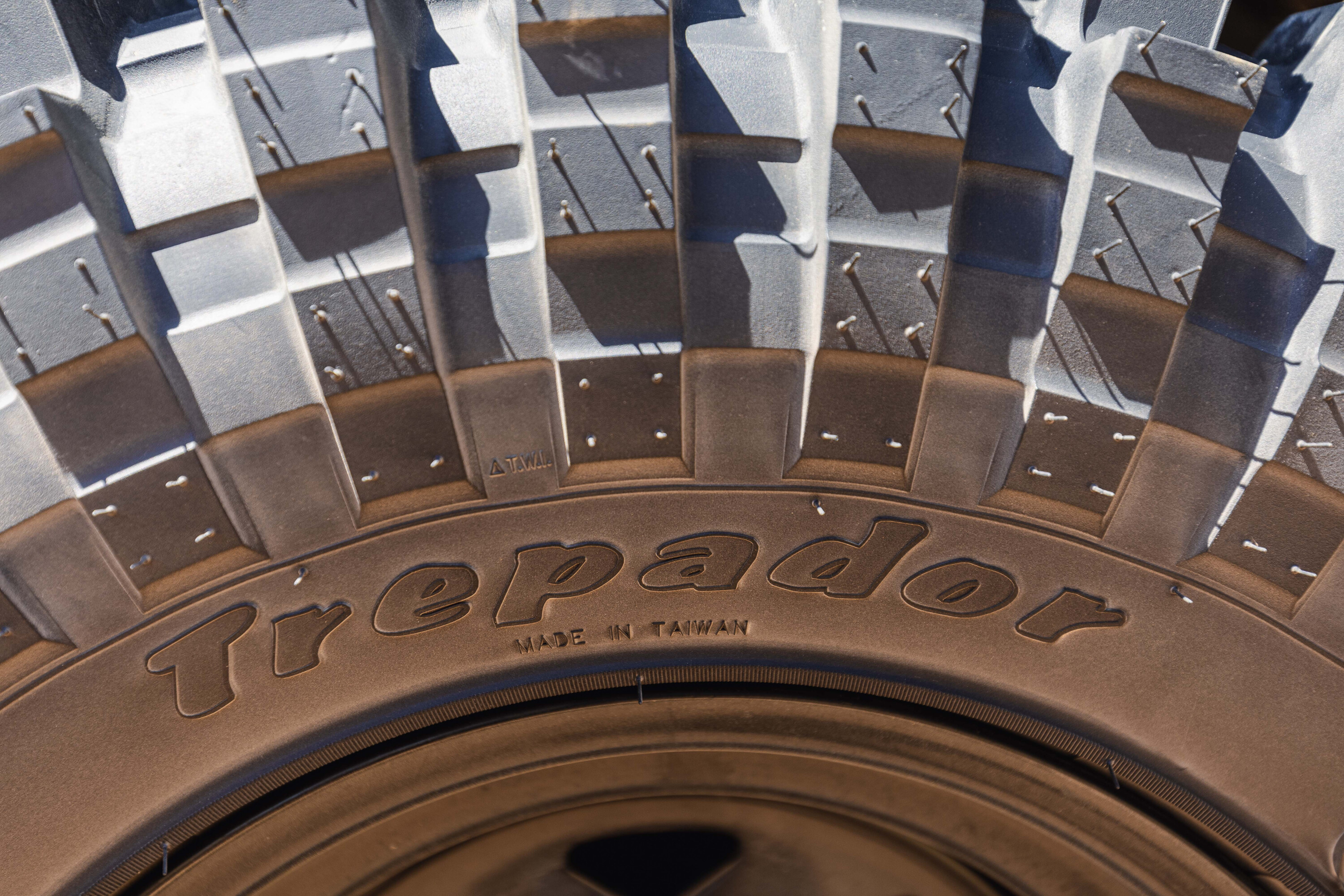
When it’s time to hit the hardcore trails Ben’s got a set of super aggressive Maxxis Trepador tyres punching in at 325/75R16 (a little over a 35-inches) and a set of Mickey Thompson Baja Boss in 317/75R16s for touring duties (a little under a 35-inches).
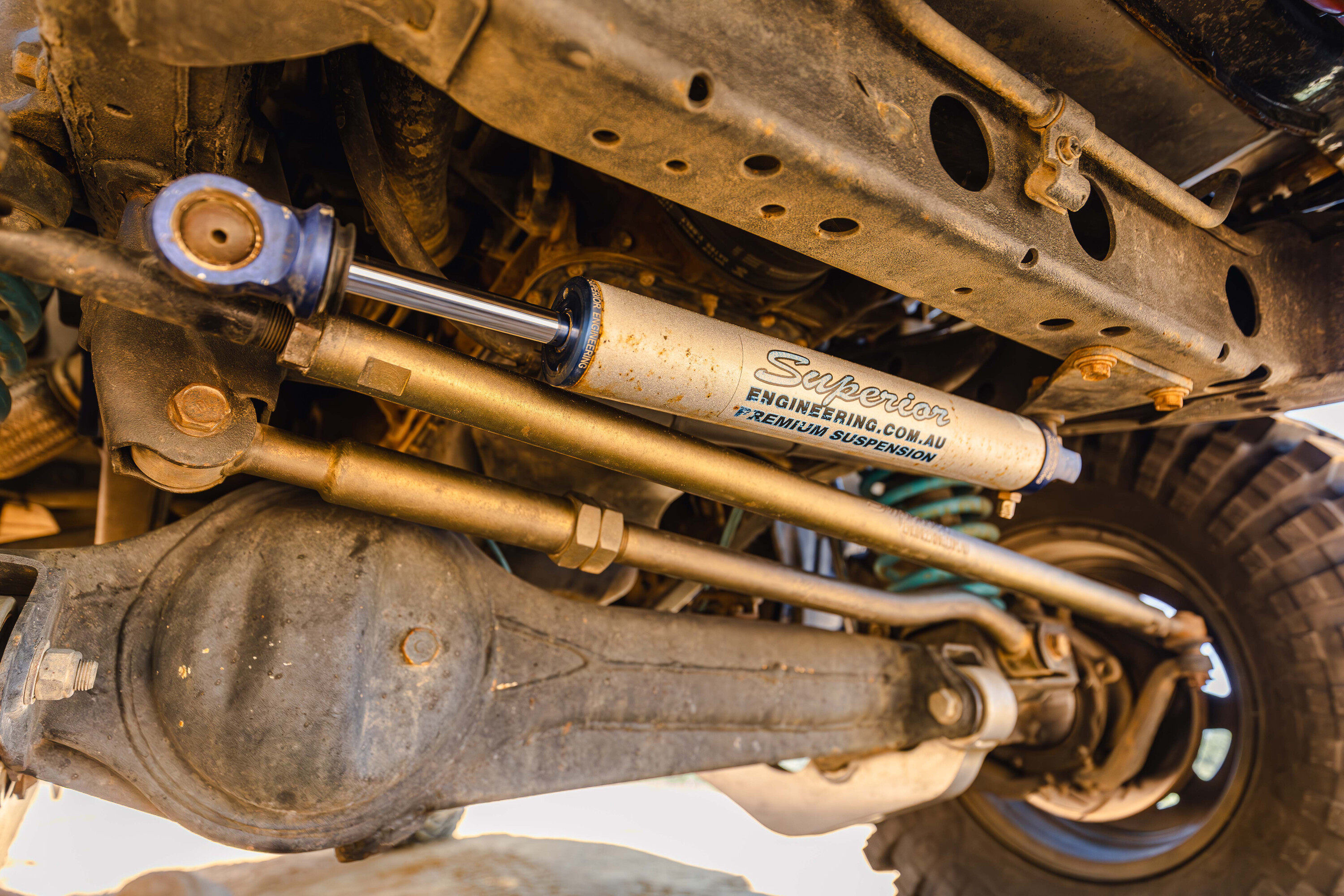
While the Cruiser is sitting 3-inches higher than stock, it’s a little more complicated than that, so we’ll start at the front. Both the tie-rod and the draglink have been replaced with Superior Engineering items for an upgrade in strength, and there’s an IFP steering damper keeping steering shimmy under control.
1
The front axle’s got 3-inch Dobinson coils reined in with Superior Engineering 2.0 remote-res shocks.
There’s also a set of Superior Engineering radius arms correcting castor and adding articulation, a SuperPro 33mm sway bar adding a little handling ability, a Superior Engineering adjustable Panhard rod and extensions on the sway bar, and bump stops.
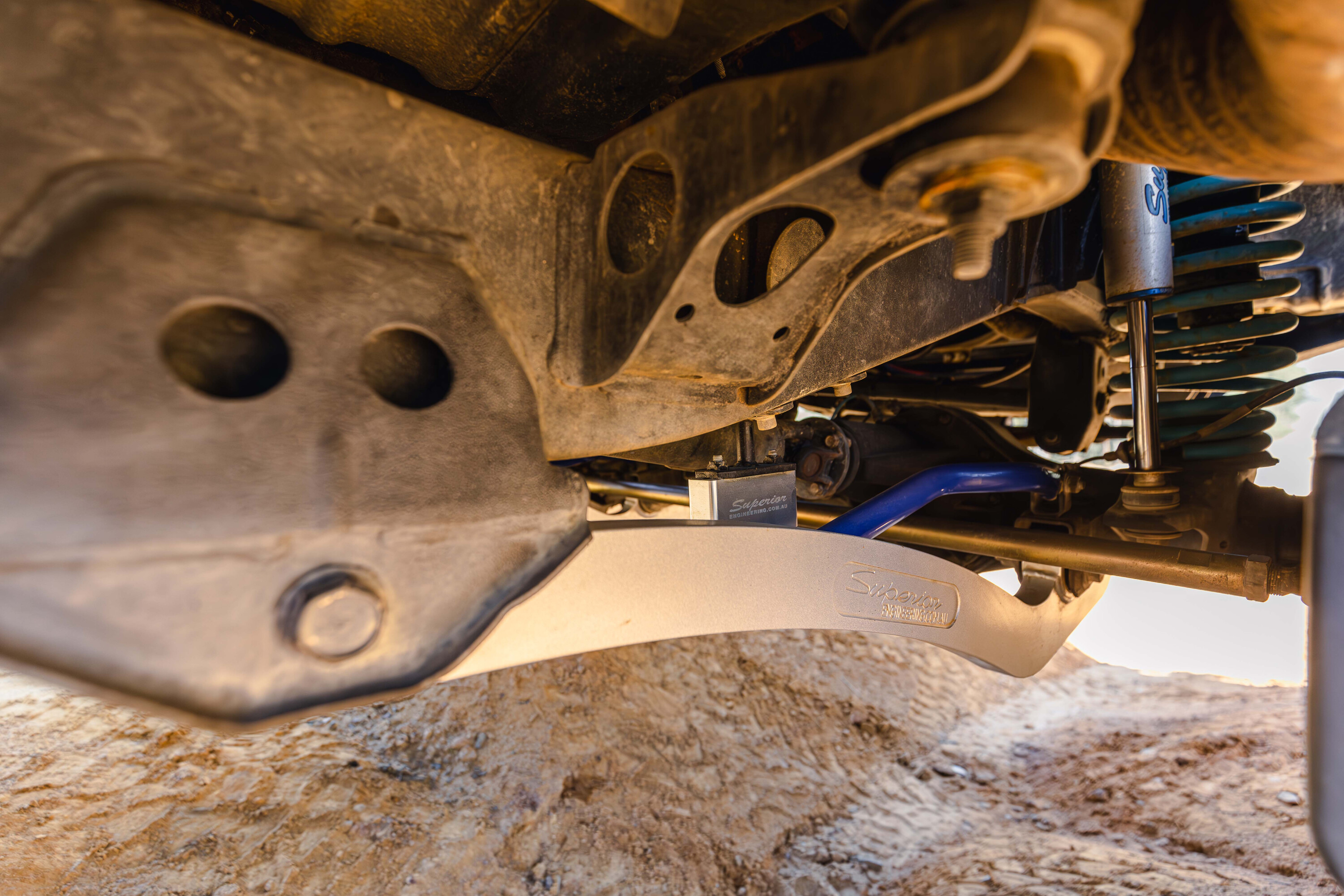
Moving down the back and things get a little more involved. Sure, there’s 3-inch 400kg constant-load Dobinson springs and more Superior Engineering shocks, but there’s also a full suite of upper and lower adjustable and heavy-duty Superior Engineering trailing arms.
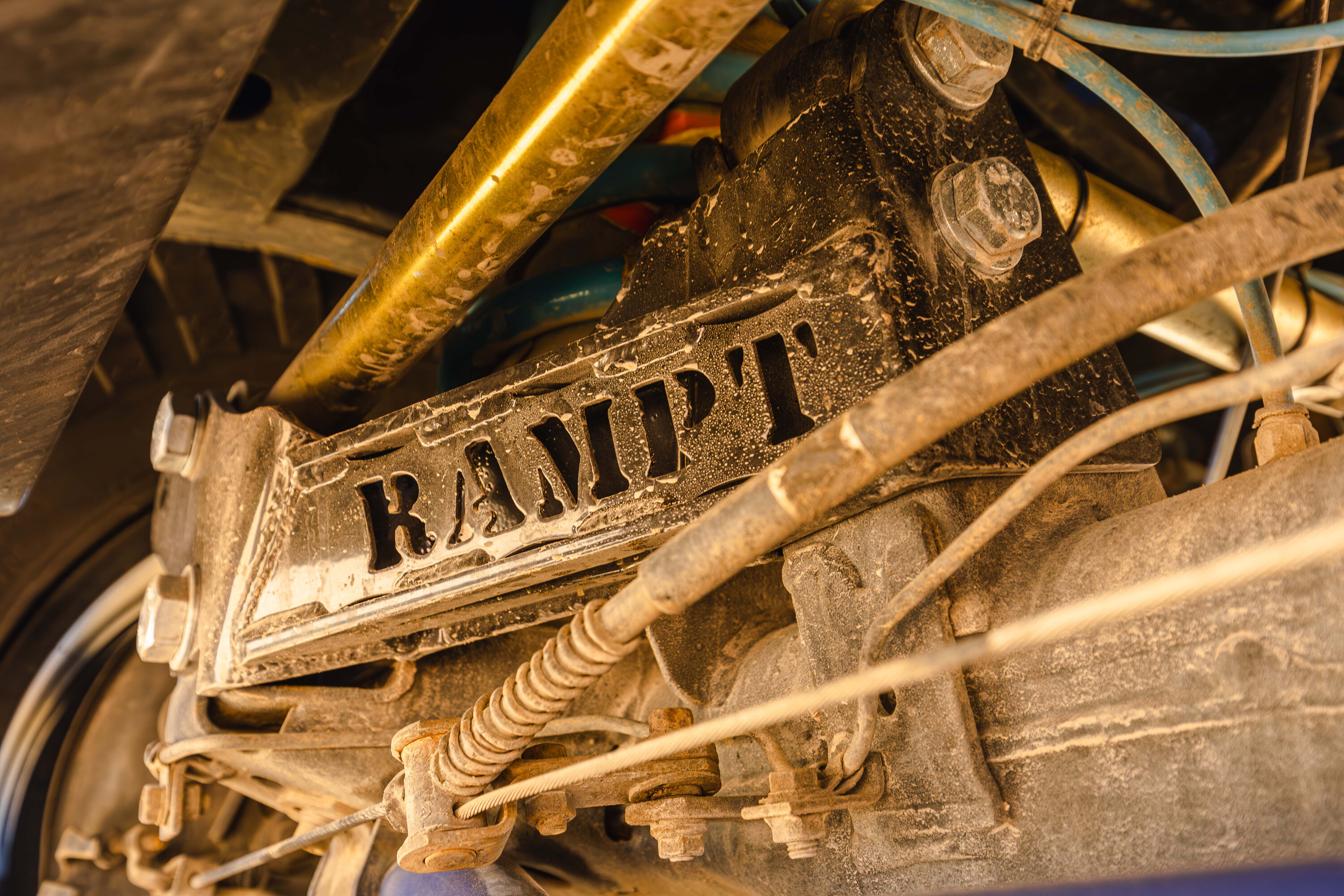
There’s another Superior Engineering Panhard rod, although it ties into a Rampt Customs Panhard relocation kit, raising the roll centre to give a planted, more stable drive. Matching Rampt Custom bump stop extensions also get the nod.
1
Fit for a king
With the performance and ride quality on point, it’s no surprise that Ben has put in just as much effort into making the 80 a nice place to be.
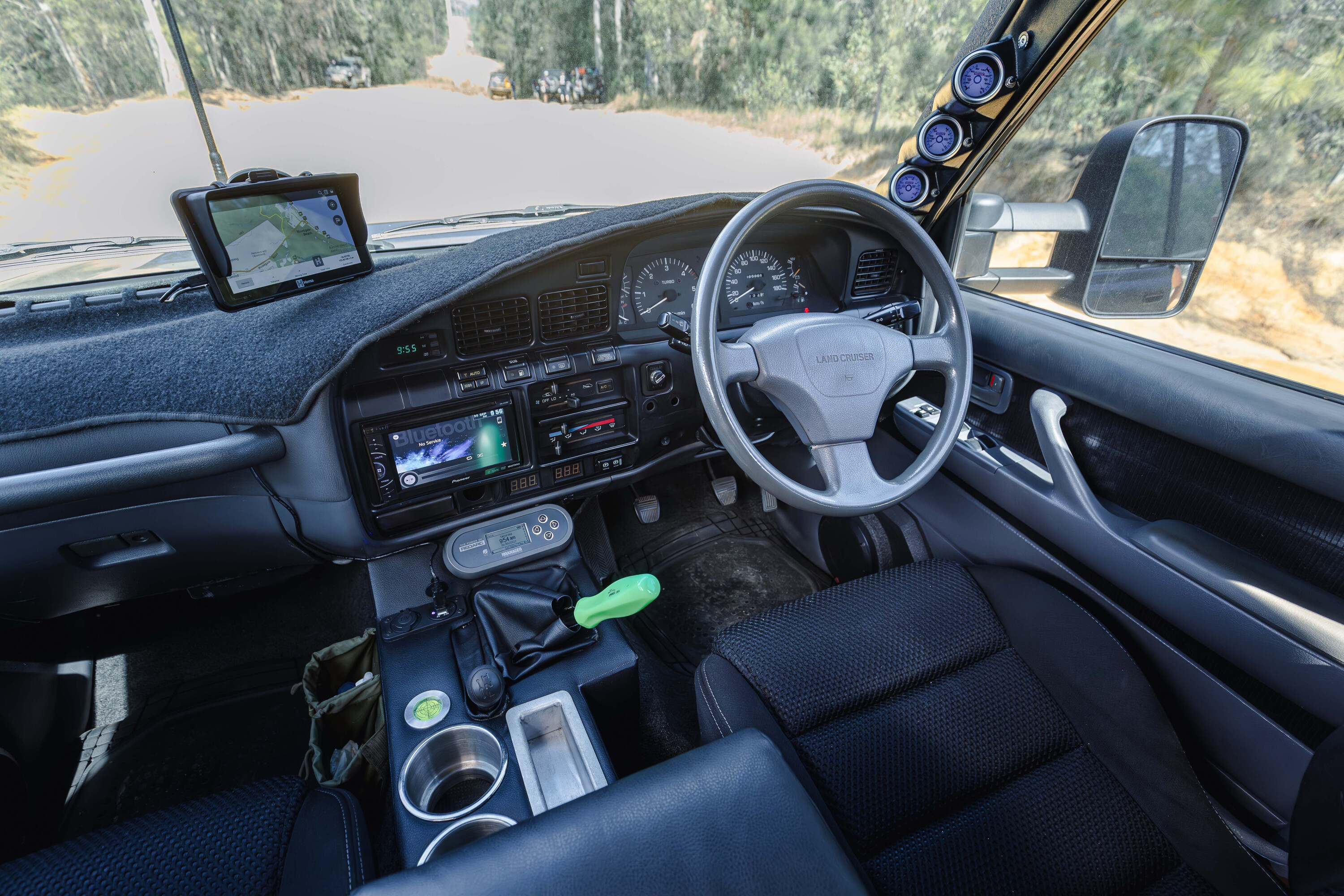
On the inside, there’s a pair of seats lifted from an XR6 Falcon with Huracan adaptors bolting them in place. The roof liner and pillar posts have been retrimmed and painted black with a custom centre and overhead console upping the spec.
A full suite of Redarc gauges and a trick stereo ensure Ben’s having a great time while still keeping an eye on things.
1
Royal armoury
Moving onto the outside and things only get more serious. The front bar sits high and tight on the 80 now but was originally designed for a GU Patrol before Ben sliced and diced it to perfection.
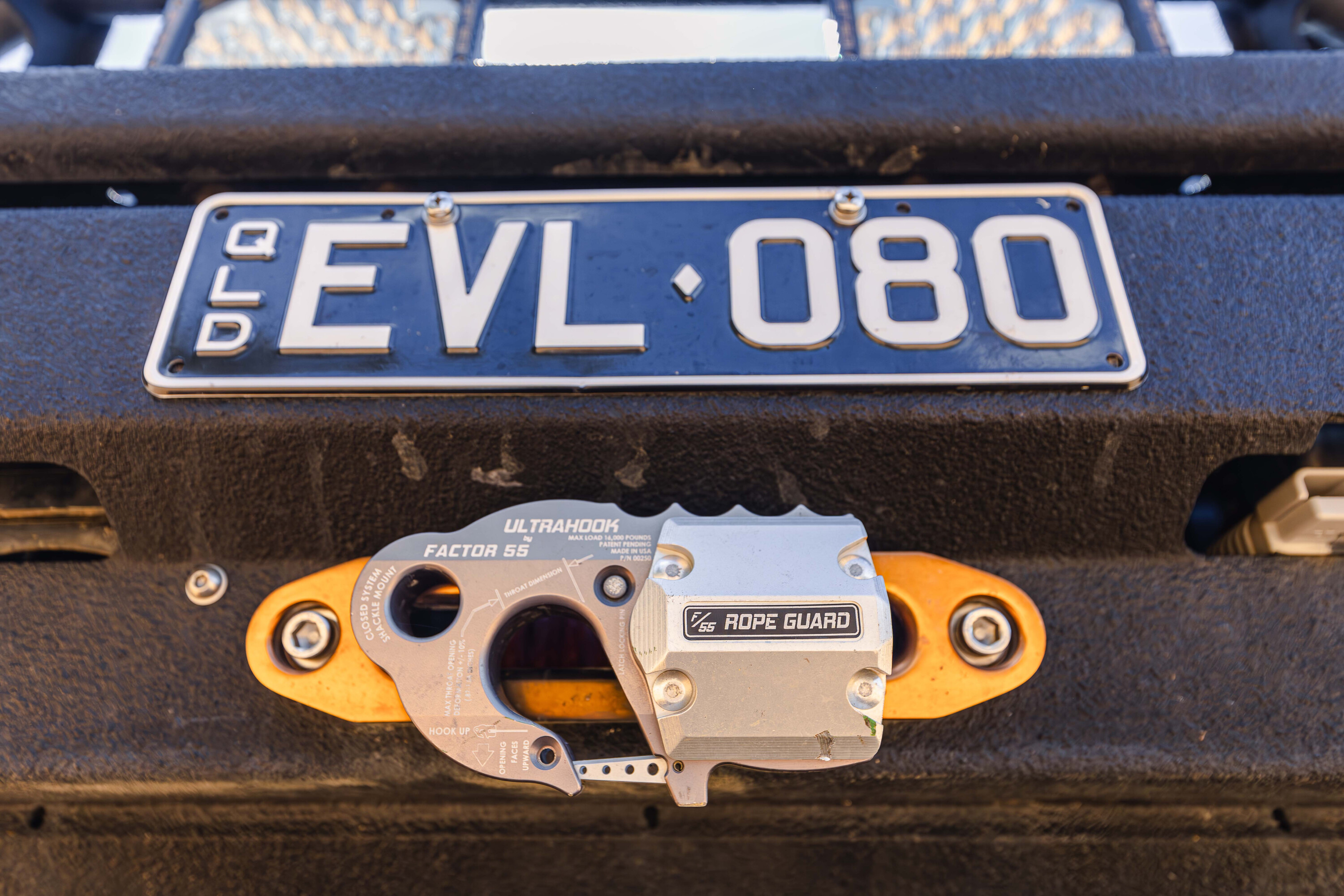
It’s welded up to a custom winch cradle that houses a Runva XP13 winch, a couple of Road Safe 4WD recovery points, and no less than four forward-facing LED lights from Stedi.
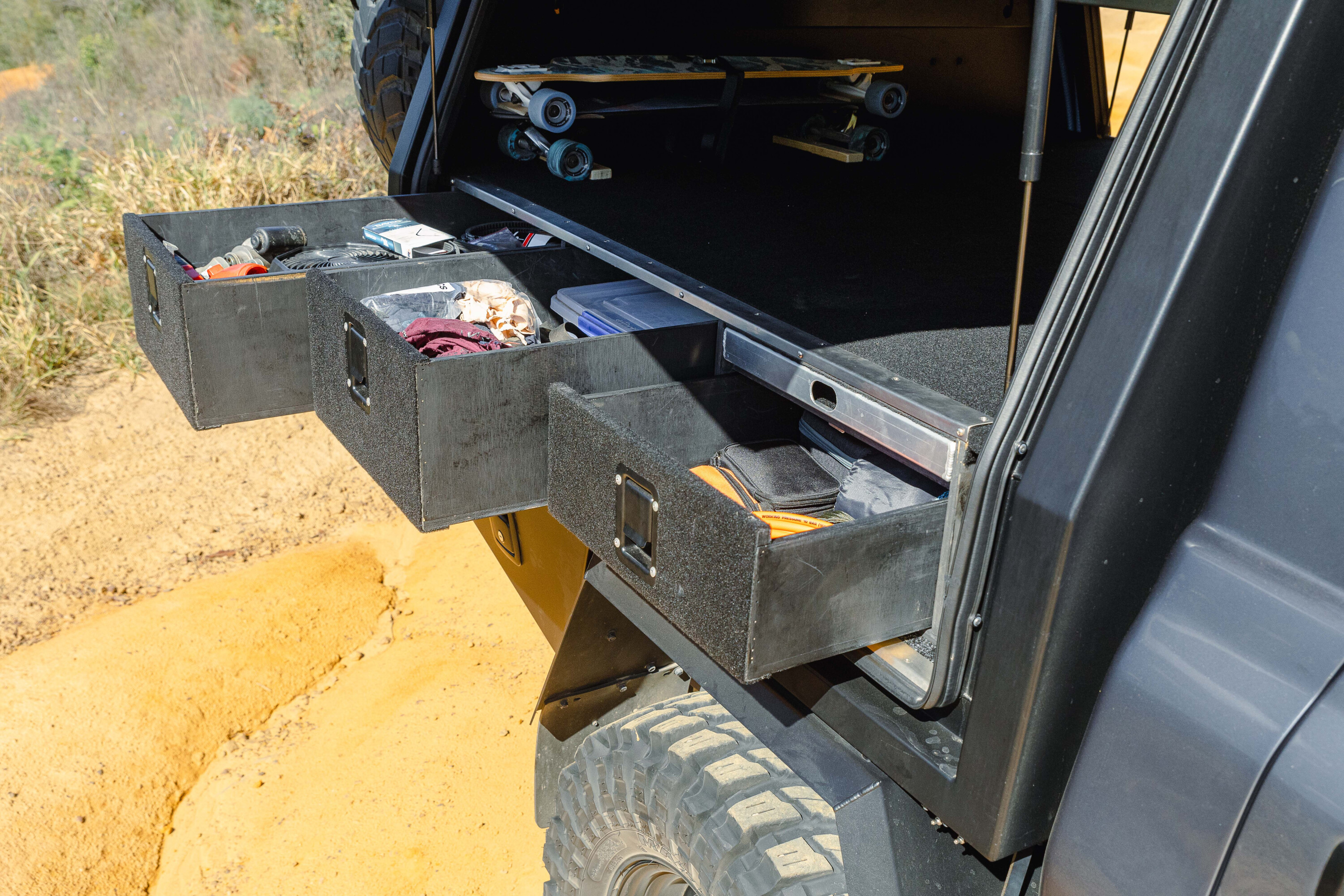
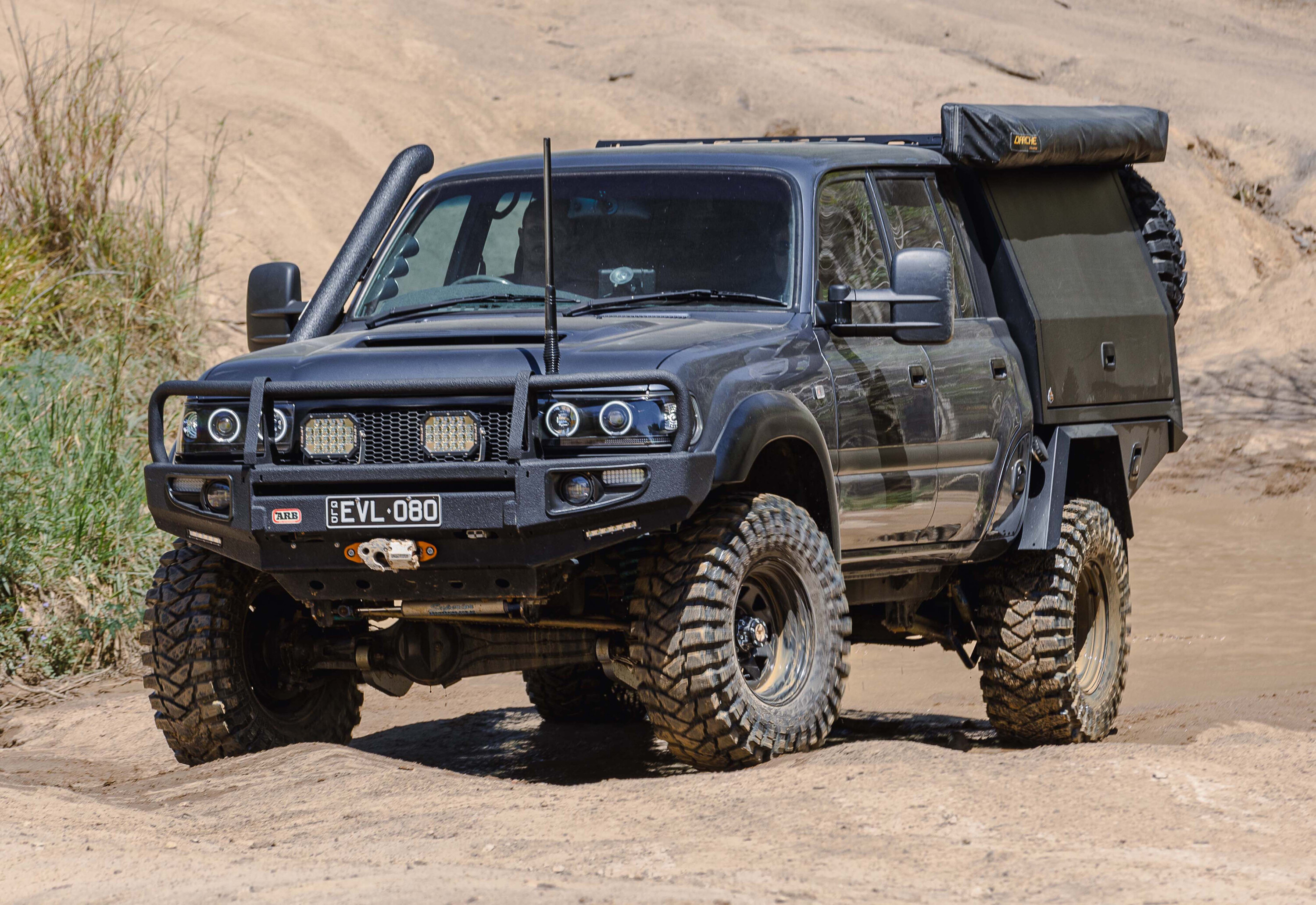
The body was in rough nick when Ben first got it so he had his work cut out there too. A full new front-end has been hung, the cracked and failing body mounts repaired and rebraced, and new body blocks to prevent it happening again. But the real star of the show is a whole bunch of 1.6mm and 2mm zinc steel sheet that’s transformed the 80 from wagon to dual cab.
1
“I learned a lot from this chop,” Ben reckons. “I ended up doing every panel two or three times, I made mistakes, and wasn’t really happy with it so I chopped it out and started again.”
Once it met his standards, including the wheel arch toolboxes and 79 Series bonnet scoop, Ben roped in Ash from Prossie Smash Repairs in Prosperine to coat it in Toyota’s 183 Slate Blue.
1
Built to the nines
Before Ben could dial in a killer camping setup he’d need a little more room to get the job done.
A 500mm chassis extension was the order of the day, fully braced from radius arms to tow ball on the angry end of Ben’s welder, coated in Raptor liner and powered by a custom driveshaft it was just the ticket to give the Trig Point canopy a little real estate to call home.
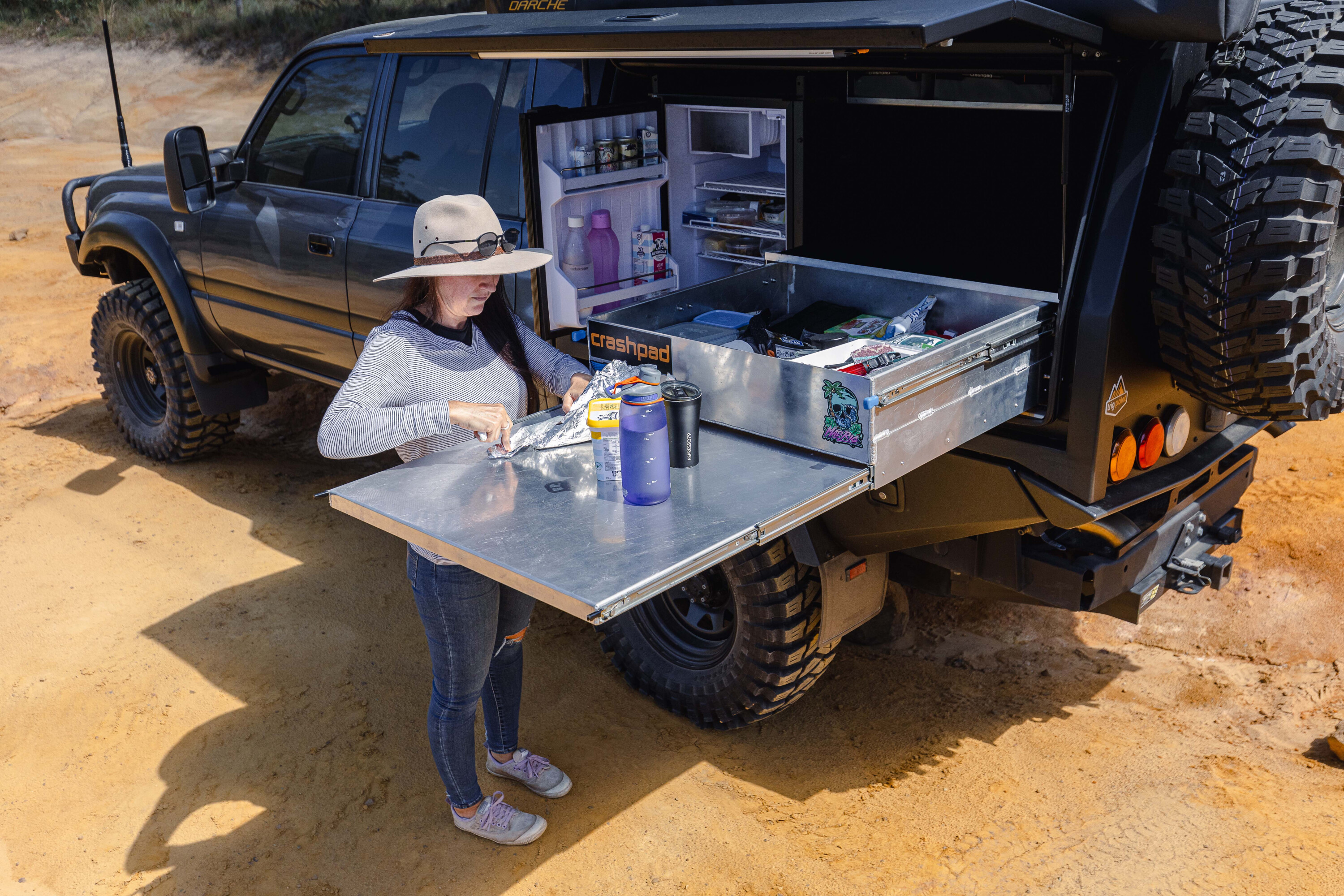
The canopy itself has a built-in rack, space for an awning, and a couple of spares swinging off the back, but inside is what makes this a real campsite winner. A full Redarc BMS Manager 30 keeps a 100Ah lithium battery charged up and the fridge running late into the night.
1
There’s extensive camp lighting throughout as well as a pull-out kitchen, bulk storage and smart battery monitoring through the Redarc RedVision screen.
Ben’s rig may be built to the nines, but it’s built for a different generation. A simpler time when wheel lifts and campfire cook-ups were more important than keeping up with the Joneses.
It’s a stark reminder that the king hasn’t abdicated, it’s just been in the garage. The resurgence of these iconic LandCruisers proves that true royalty never fades, it simply reinvents itself. Long live the king!
1
MORE
Everything Toyota
The Oodnadatta Track isn’t merely a playground for dust-covered 4x4s or a pilgrimage route for adventurers — it’s a heritage-listed travel artery, pulsing with the history of Australia’s past.
Covering 614km from Marree to Marla, this well-worn path has layers of history that date back thousands of years. Ancient aboriginal inhabitants used the natural springs as a connect-the-dots route through the red centre, Mother Nature’s rustic hydration stations that make a desolate world far more forgiving.
Following this exact route helped John McDouall Stuart become the first European to cross Australia’s interior from south to north in 1859.
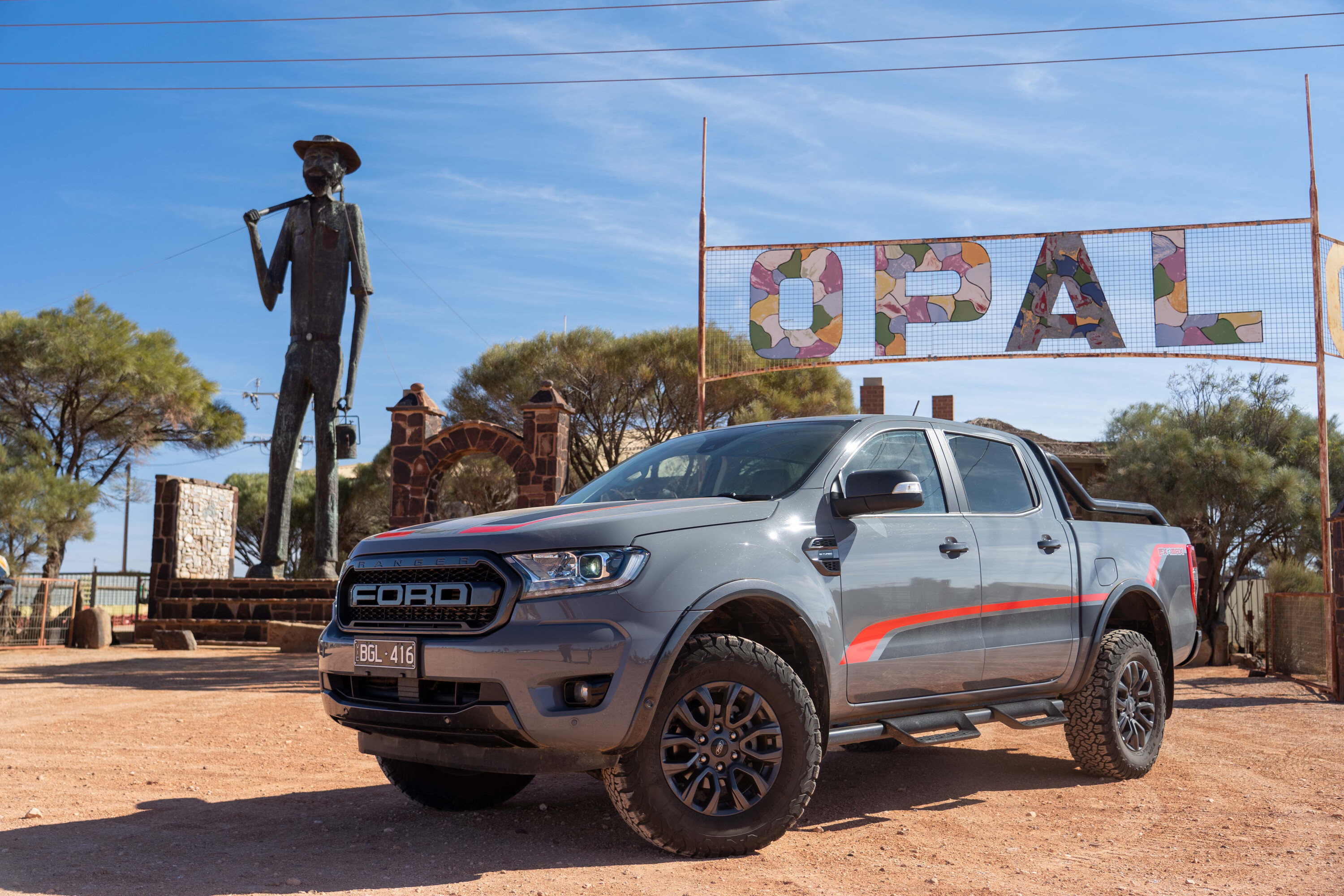
1
The late-1800s was an era marked by the clang of hammers and unique silhouettes of Afghan cameleers and their camels stretching along the Central Australian sands.
The Ghan Railway, a moniker in tribute to the Afghans, followed much of what we now call the Oodnadatta Track. More than a set of carriages rattling along the outback, it was an engineering marvel connecting people and places. Stopping at vital springs for water, the train became a lifeline for much of Central Australia.
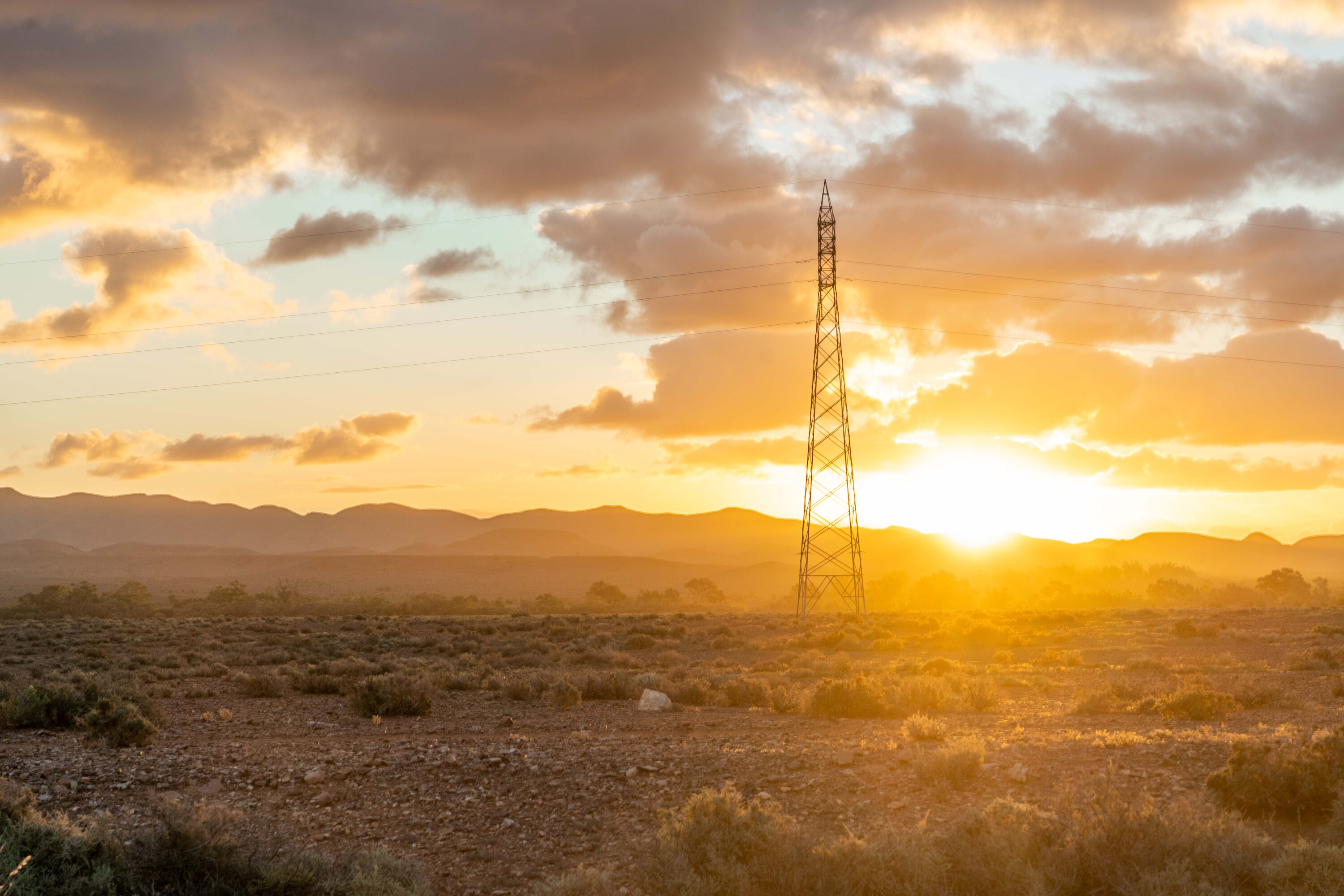
While the Ghan Railway was putting down its tracks, another game-changing venture was unspooling alongside it – the Overland Telegraph line. This ambitious project, completed in 1872, was Australia’s version of the Internet 1.0, connecting Adelaide to Darwin and through an underwater line to Java in Indonesia, thereby hooking Australia up to the rest of the world.
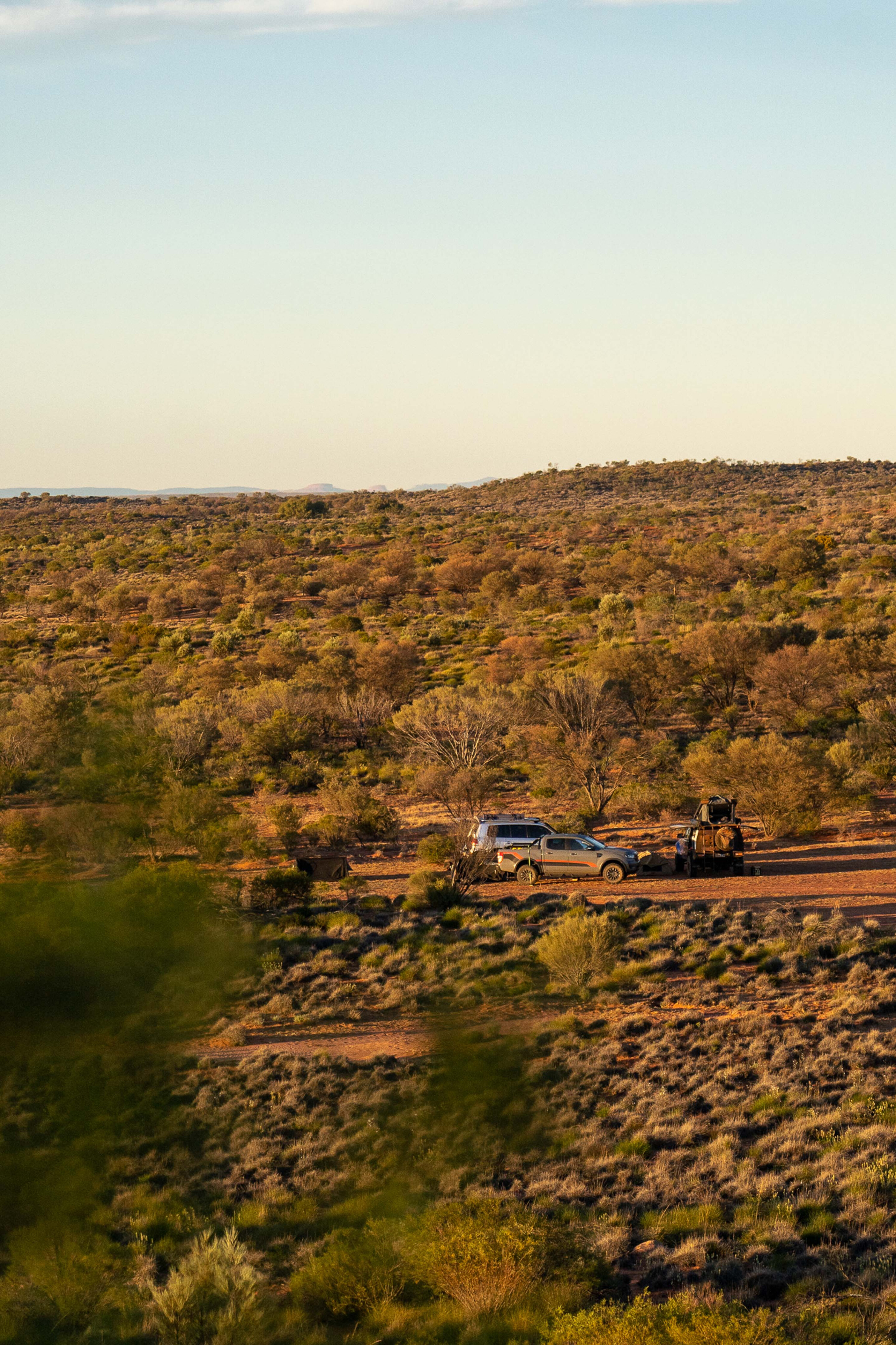
1
The telegraph line was laid alongside the early Ghan Railway route, and the two shared common stops, usually near mound springs or other water sources.
This line didn’t just transmit messages; it transmitted the dreams and fears of a nation that was rapidly hurtling into the modern age. Several ruins of old telegraph stations can still be seen as you traverse the Oodnadatta Track, testimony to this bygone era of ingenuity and ambition.
When you’re wheeling your way along the Oodnadatta Track, spare a thought for the world you’re passing through. It’s not just red dirt and shrubbery; it’s the canvas upon which the Aboriginal traders, Afghan cameleers, railway engineers and telegraph operators painted a vibrant, albeit rugged, picture of Australia’s indomitable spirit.
1
South to north along the track
One hundred and fifty years ago, travelling the Oodnadatta track was literally a life-or-death kind of experience.
These days, you’d be hard pressed to knock the stubby lever into high-range 4×4 along the track’s 614km of corrugations, let alone need low-range. Heck, it’d be weird if you didn’t pass a dodgy old Hiace full of backpackers with some questionable graffiti masquerading as a paint job.
But it’s one hell of a road trip, especially for people new to remote-area travel. Here’s what’s worth seeing along the way?
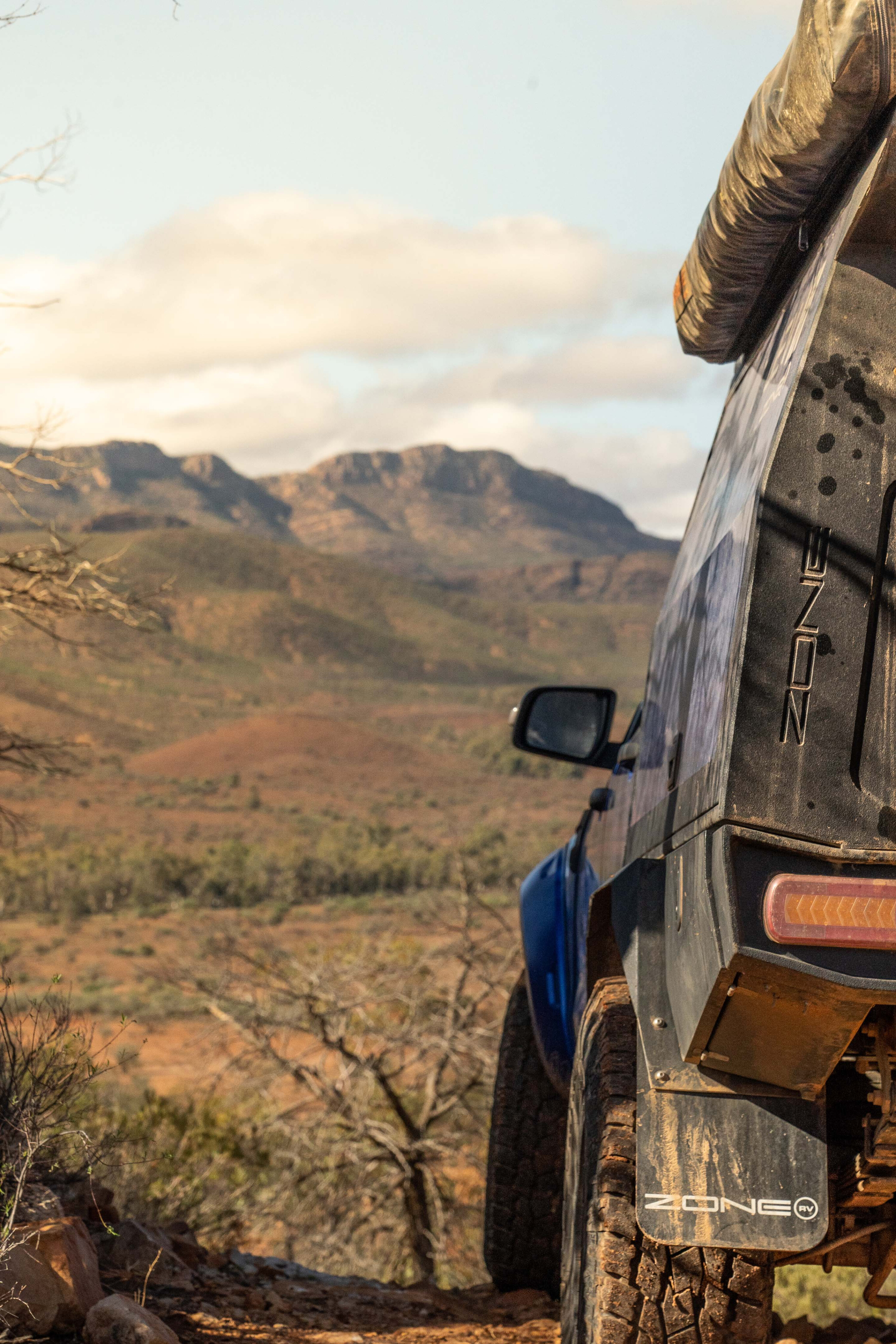
1
Marree
Think of Marree as the gateway to your Oodnadatta adventure. This isn’t just a pitstop, it’s a living history book, the pages full of the Afghan cameleers and the Old Ghan Railway.
It’ll be one of the last places to get any semblance of supplies, but realistically it’ll be a tank full of diesel and a stomach full of counter-feed before heading off into the wilderness.
Like most country towns, it’s a little cooky, in the best of ways, so make sure you head over to the Lake Eyre Yacht Club for a look around. It’s good for a laugh, but after rains, the locals hit the lake in their yachts.
It’s worth poking your head into the Tom Kruse Museum too. The literal link between the heart of Australia and the rest of the world, Tom braved dust storms, soaring temperatures, desert crossings and floods to make sure the mail got through.
1
Coward Springs
After polishing off a counter feed at the Marree Hotel you’ll trek north 130km to a little place called Coward Springs.
If you blink you’ll miss it so make sure you plot out your GPS waypoints for this literal desert oasis that’s nestled in the middle of nothing half an hour past nowhere.
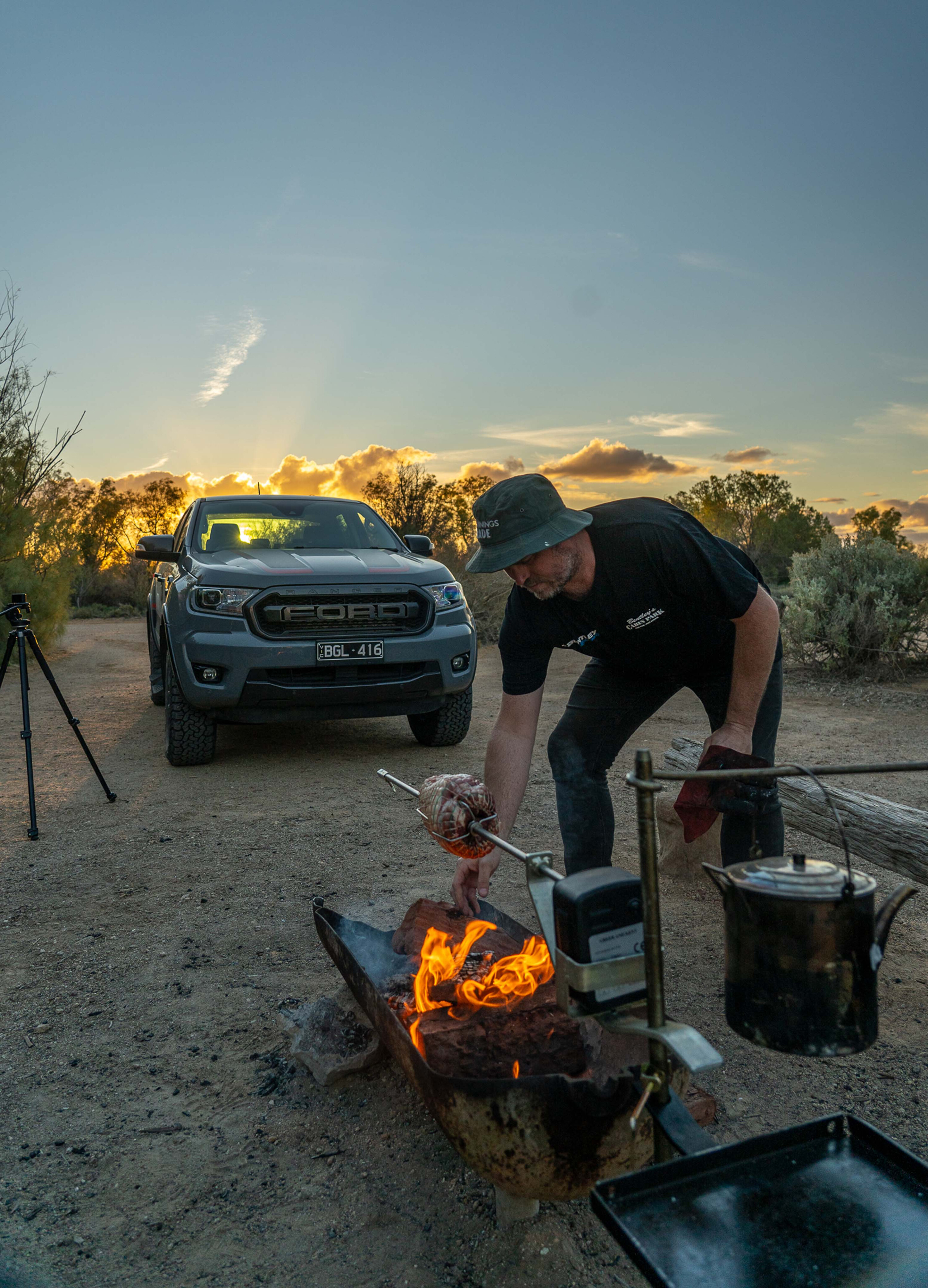
The property is a working date farm, many of the plants harking directly back to the old Afghan cameleers, and the original rail siding was built for the Old Ghan back in 1888 when it was probably known as the New Ghan. Even if you’re not camping, it’s worth paying the $2 entry fee to duck in and check out the thermal pools, and the old train driver’s cabin.
1
William Creek
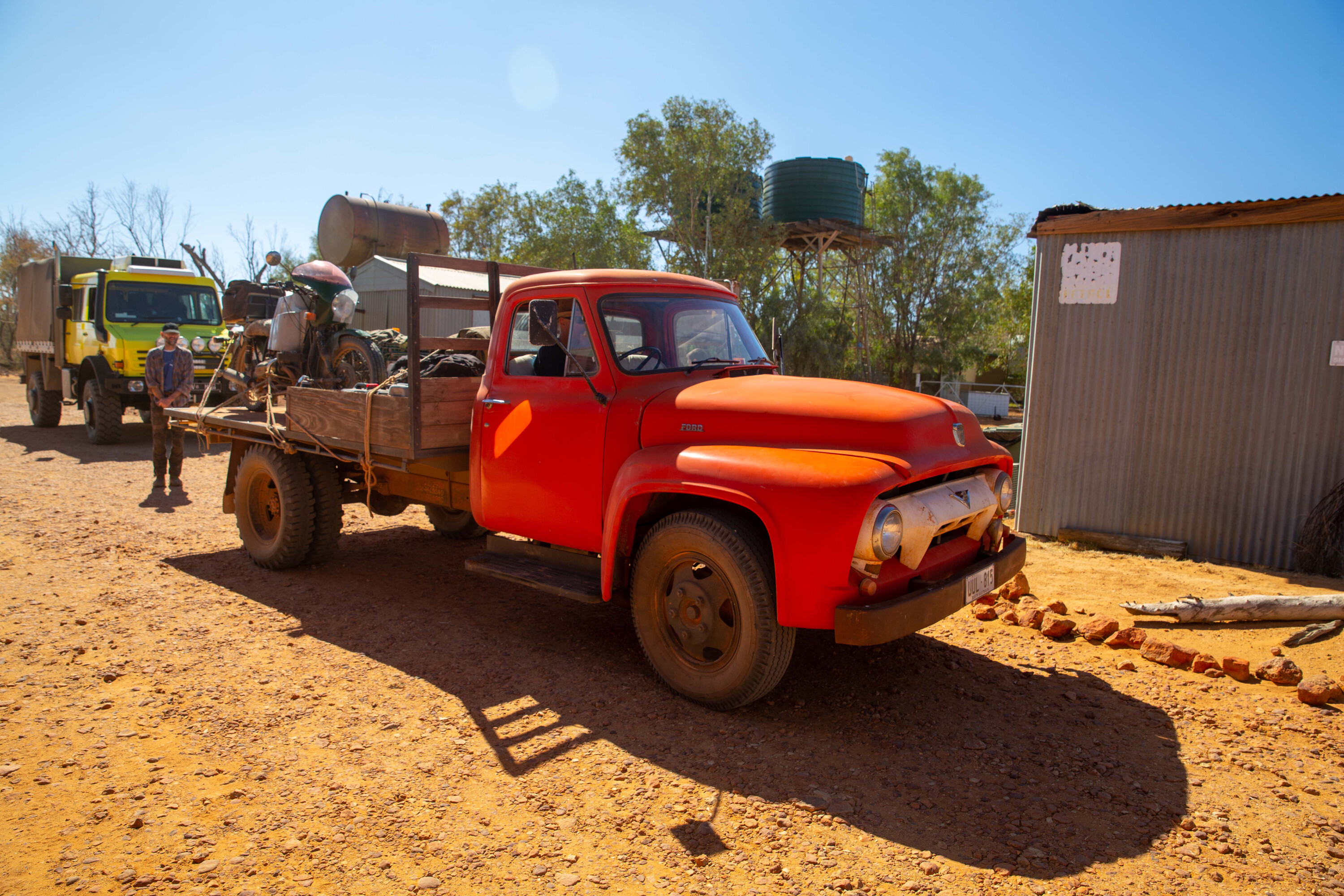
Halfway along the track you’ll have another couple hundreds clicks on your dash as you stroll into a little town called William Creek, although to be fair it’s more of a loose collection of buildings and characters than a town.
The William Creek Hotel has the usual outback roadhouse kit, so you can bank on diesel, petrol, basic mechanical repairs and an endless supply of cold beers. It also happens to be on Anna Creek Station, the world’s largest cattle station. John Dutton would be green with envy.
Time it right, and the town is teaming with aviation nutters from every corner of the country for the annual fly-in. Otherwise, take a stroll through the memorial park, have a gander at 100 years of history in the pub, and enjoy all the modern amenities of South Australia’s only 100 per cent solar-powered town. How’s that for progress?
1
Oodnadatta
Ah, the end of the Oodnadatta Track. What a coincidence it happens to finish at a place of the same name.
Many travellers take a hard left at William Creek, heading west to Coober Pedy, so for the last leg of the journey you’ll get to experience good and proper isolation like you’ve never seen it before.
Legend has it the town derives its name from the Aboriginal word Coodnadatta, which roughly translates to Dead Man’s Poo, a reference perhaps to an artesian bore near the town responsible for some truly atrocious liquids.
1
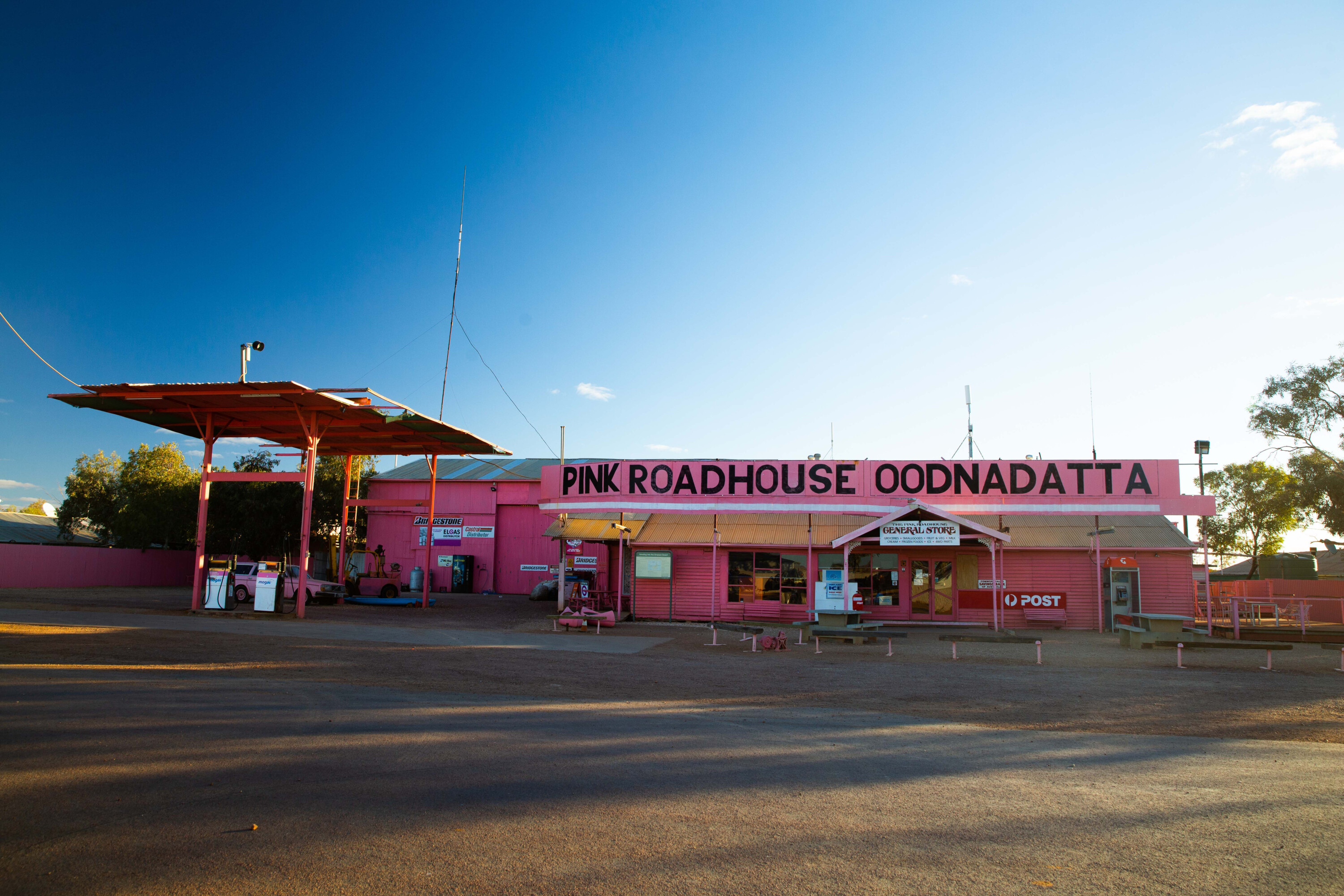
Regardless, you’ve bloody made it, so treat yourself to a world-famous Oodna-burger at the Pink Roadhouse.
While you’re there grab yourself the must-have Instagram shot and ask behind the counter for a key to the Old Ghan Museum across the road; it’s well worth the price of admission for a peek behind the curtain on days gone by.
So there you have it. The Oodnadatta Track is not just a journey; it’s a near-literal gateway to the outback. It’s where your 4×4 stops being a machine and becomes a companion. Where you stop being a driver and become a pilgrim in the temple of dirt and sky.
Pack your bullbar with enough lights to impersonate a UFO, charge your satphone, and fill your fridge with enough tinnies to survive an apocalypse. The Oodnadatta is calling, and trust us, you want to answer.
1
Essentials for an Oodnadatta odyssey
Now that we’ve tantalised your adventurous spirit with the allure of the Oodnadatta Track and its surroundings, it’s time to discuss the essentials you’ll need to ensure a safe and enjoyable expedition.
Reliable 4×4 vehicle
The Track isn’t exactly 600 kays of gunshot creek but it still demands a robust and well-maintained 4×4 vehicle equipped for outback travel. Ensure your vehicle is serviced, and all essential components are in top shape. If it can rattle off it will.
Communication
Due to remote areas with limited mobile coverage, a satellite phone or personal locator beacon is a lifeline in case of emergencies. At a bare minimum, have a UHF with a high-gain antenna.
Navigation
GPS devices and detailed maps are essential. While the Track is relatively straightforward, its isolation means navigation mistakes can have serious consequences if you get yourself turned around.
Water and food
Always carry ample drinking water and non-perishable food supplies. The outback heat is unforgiving, and you’ll need to stay hydrated.
Camping gear
The outback can get mighty hot, but it can get mighty cold too so pack appropriately – a decent sleeping bag, a way to get off the ground, a fridge to keep your drinks cold and a way to cook your steaks.
Fuel and spares
Fuel stops can be few and far between, so carry a few jerry cans. Also, have spare parts and tools for common issues with your rig.
First aid kit
Carrying a comprehensive first aid kit is important: knowing how to use it is even more important. The nearest medical assistance can be hours away.
1
Look out for this
Old Peake Ruins
These aren’t just piles of stone; they’re ancient text messages saying, “We tried, okay?” Abandoned since 1906, the Peake Ruins mark the remnants of Mt Margaret Station, once the most remote European settlement in Central Australia.
Lake Eyre
It’s either a shimmering inland sea or a cruel, salty illusion, depending on when you visit. Either way, it’s mind-blowing and well worth a visit. The first 50m are filled with tourists’ footprints but go for a wander around the edges for an experience like no other.
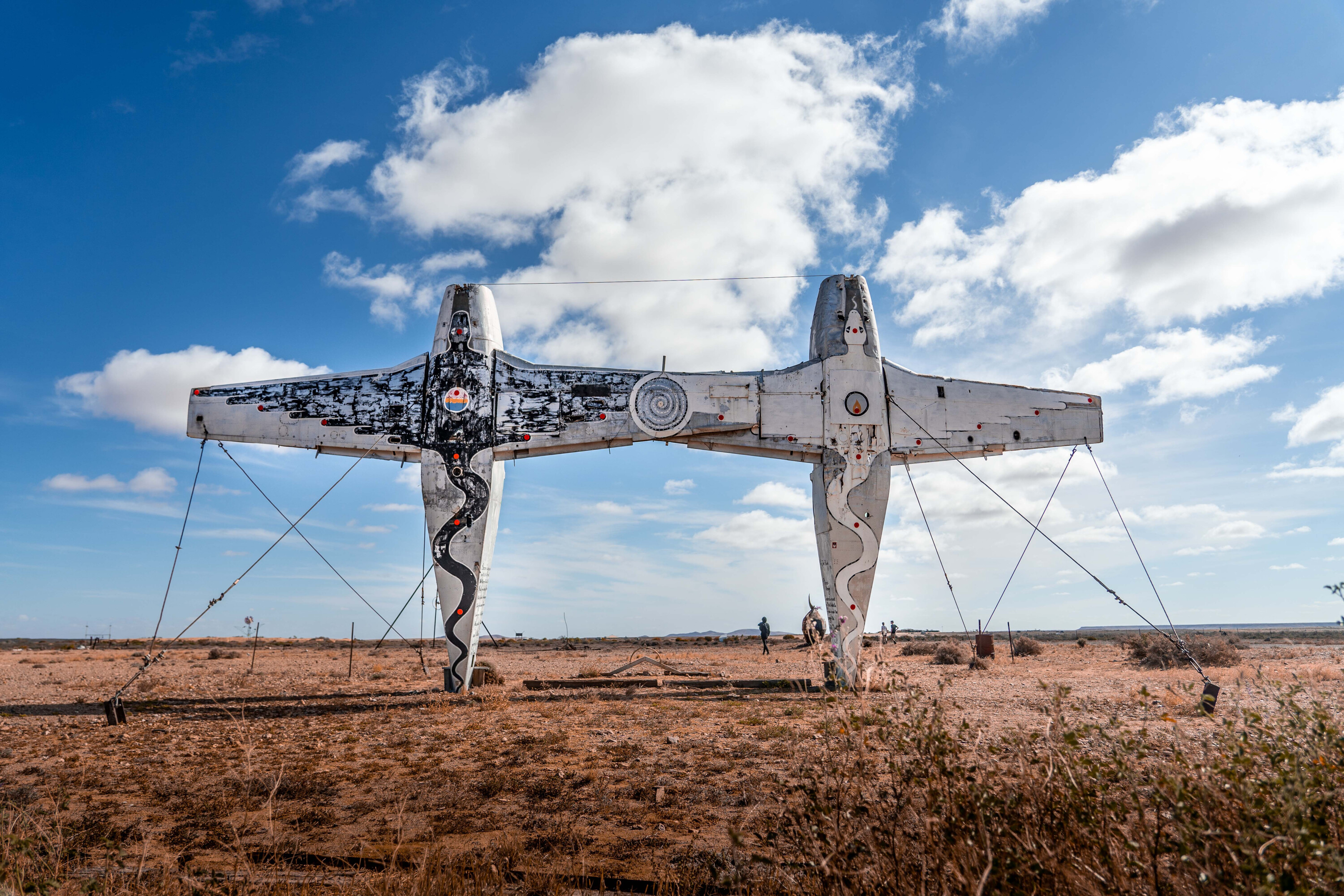
Plane Henge
It’s like Stonehenge but with, well, planes. Found near William Creek, this is a quirky must-see. The robot man out the front catches all the attention, but the space shuttle is our favourite.
The Painted Desert
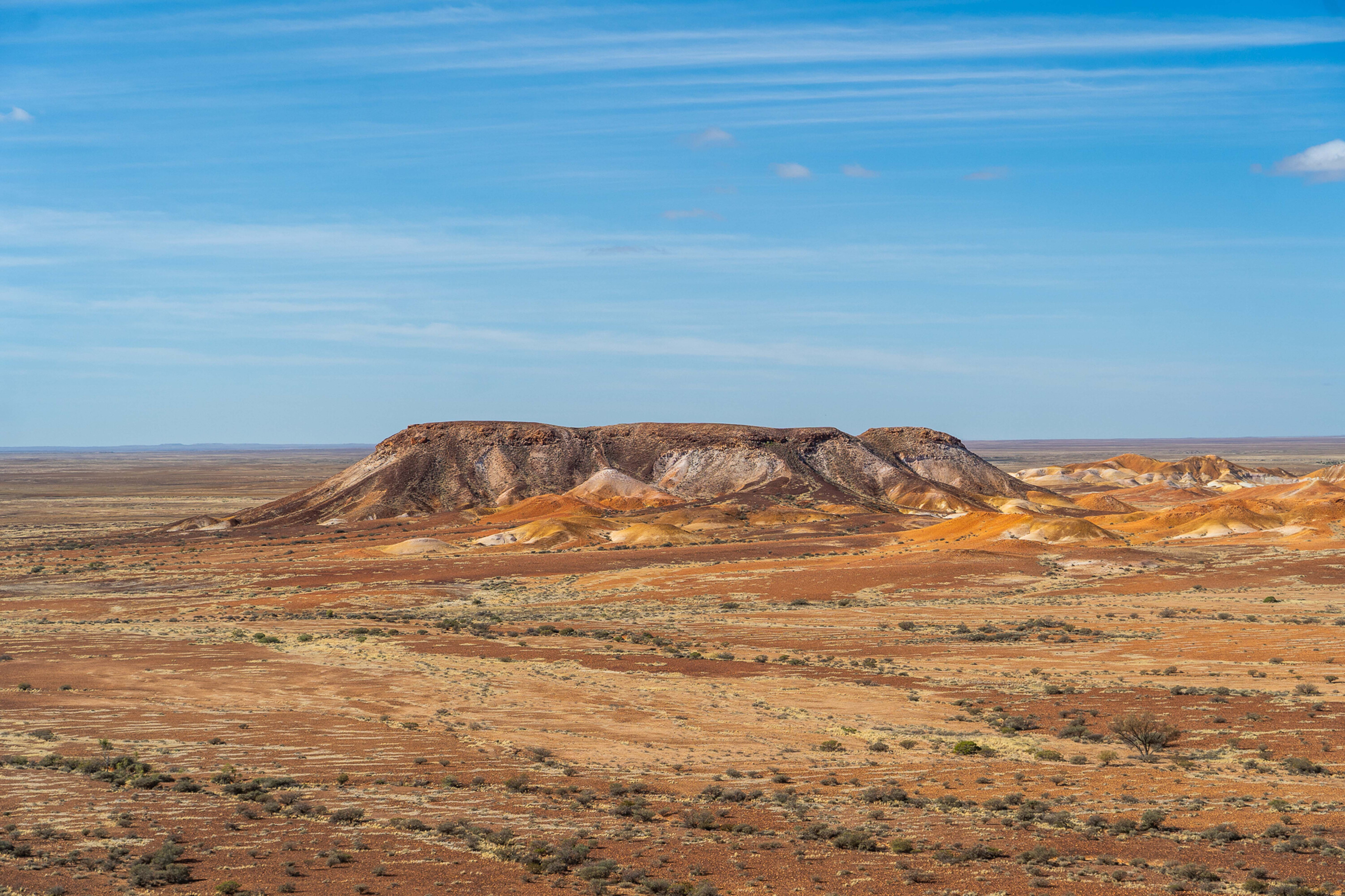
An optional detour off the track will bring you to this landscape that’ll make you question everything you know about the endless South Australian plains. Gorgeous multi-coloured hills that seem to glow in the morning and afternoon sun.
Wabma Kadarbu Mound Springs
Nature’s own spa treatment, only without the cucumbers and exorbitant prices. If you’re keen for a dip to wash the dust off consider the springs a non-negotiable.
Where to kick out your swag
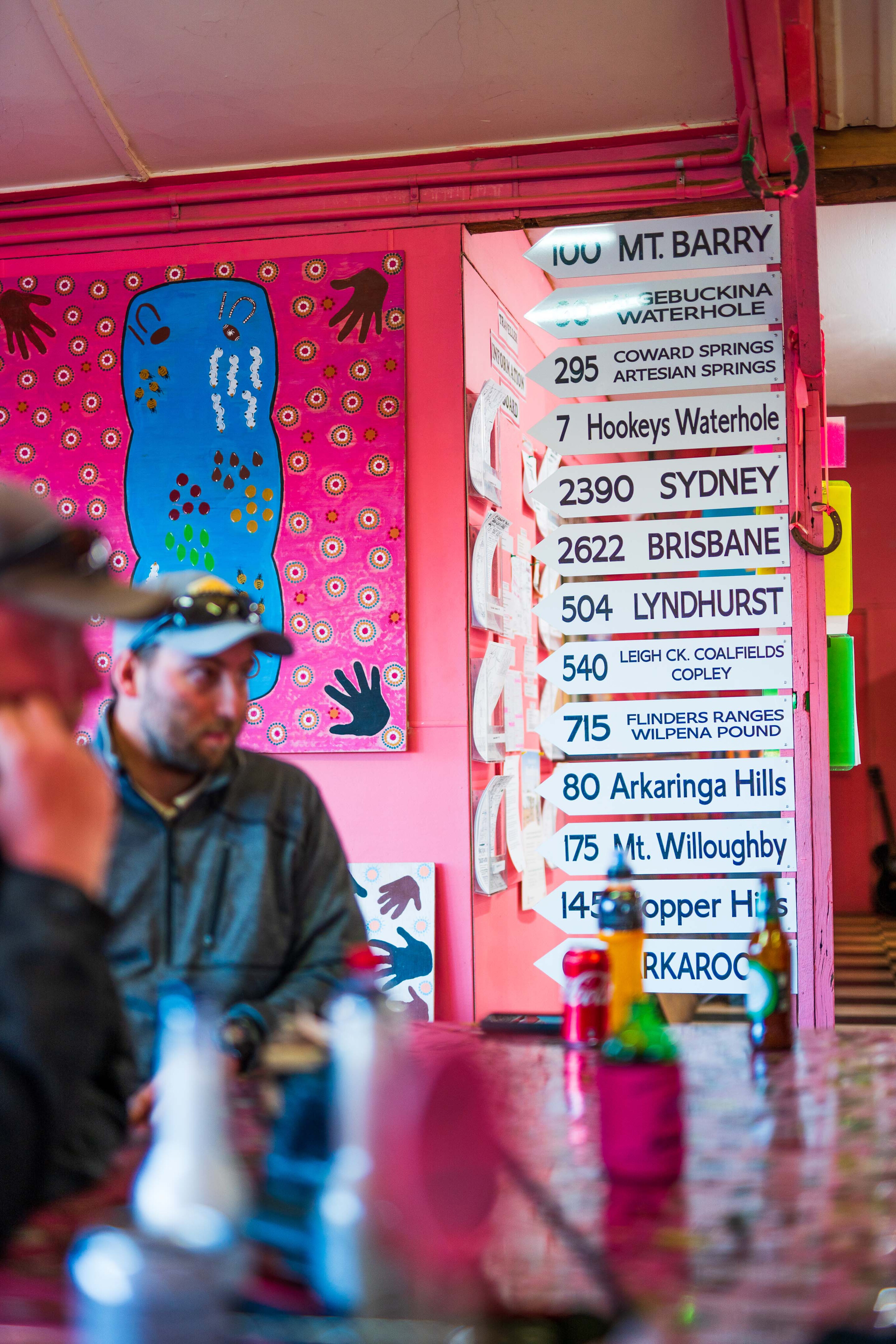
William Creek Campground
GPS: -28.8944, 136.3319
Facilities: Hot showers, camp kitchen, fire pits.
What makes it special: Alongside its claim to fame as Australia’s smallest town, William Creek has the mystic allure of being near Lake Eyre. During flood years, this dry salt lake fills up and attracts birdwatchers and photographers from around the globe. So, when you’re not ogling the night sky or bantering with locals at the William Creek Hotel, you can take a scenic flight over Lake Eyre to make your friends jealous.
1
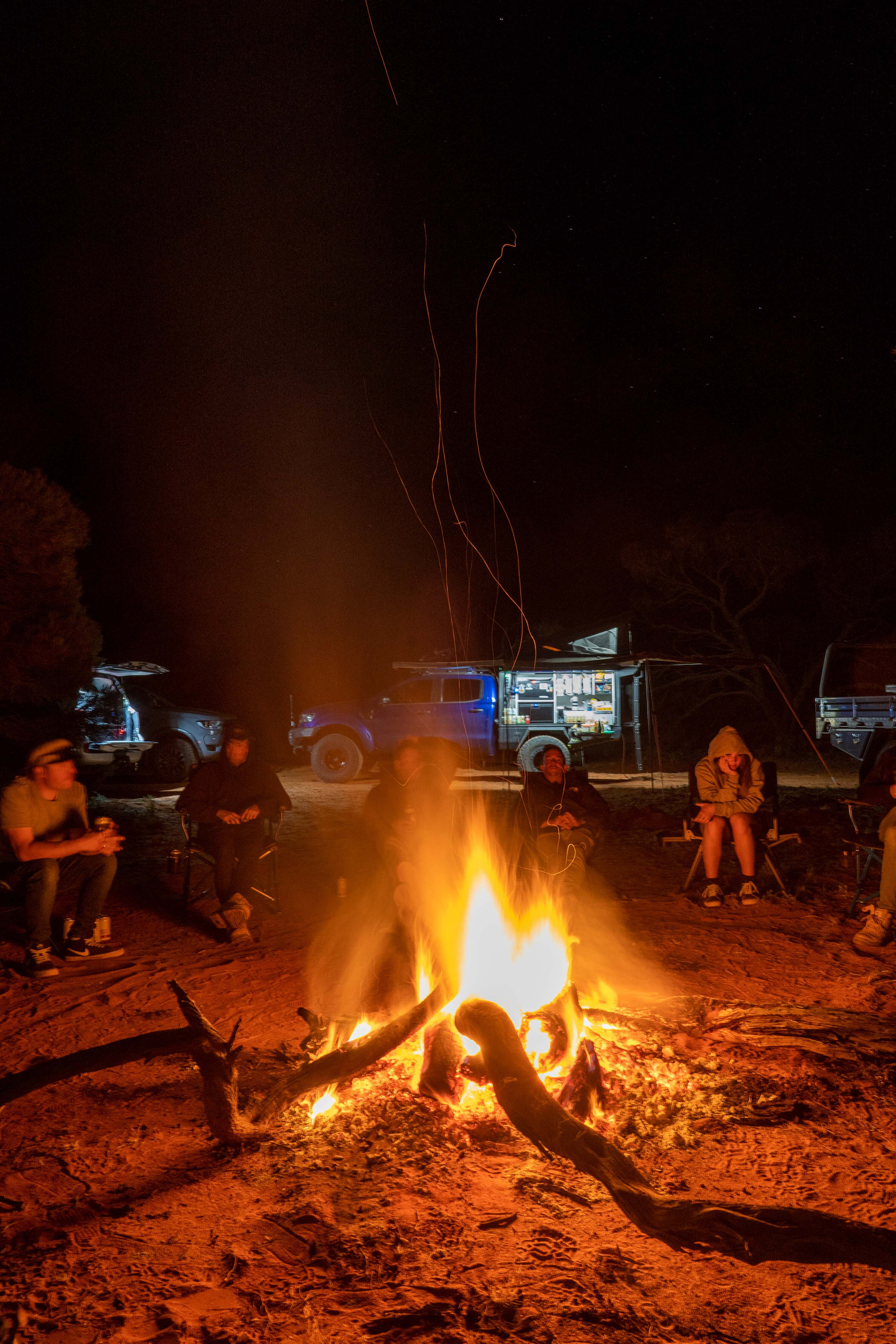
Algebuckina Waterhole Camp
GPS: -27.87947, 135.83506
Facilities: Basic, meaning you’ll want to bring your own amenities.
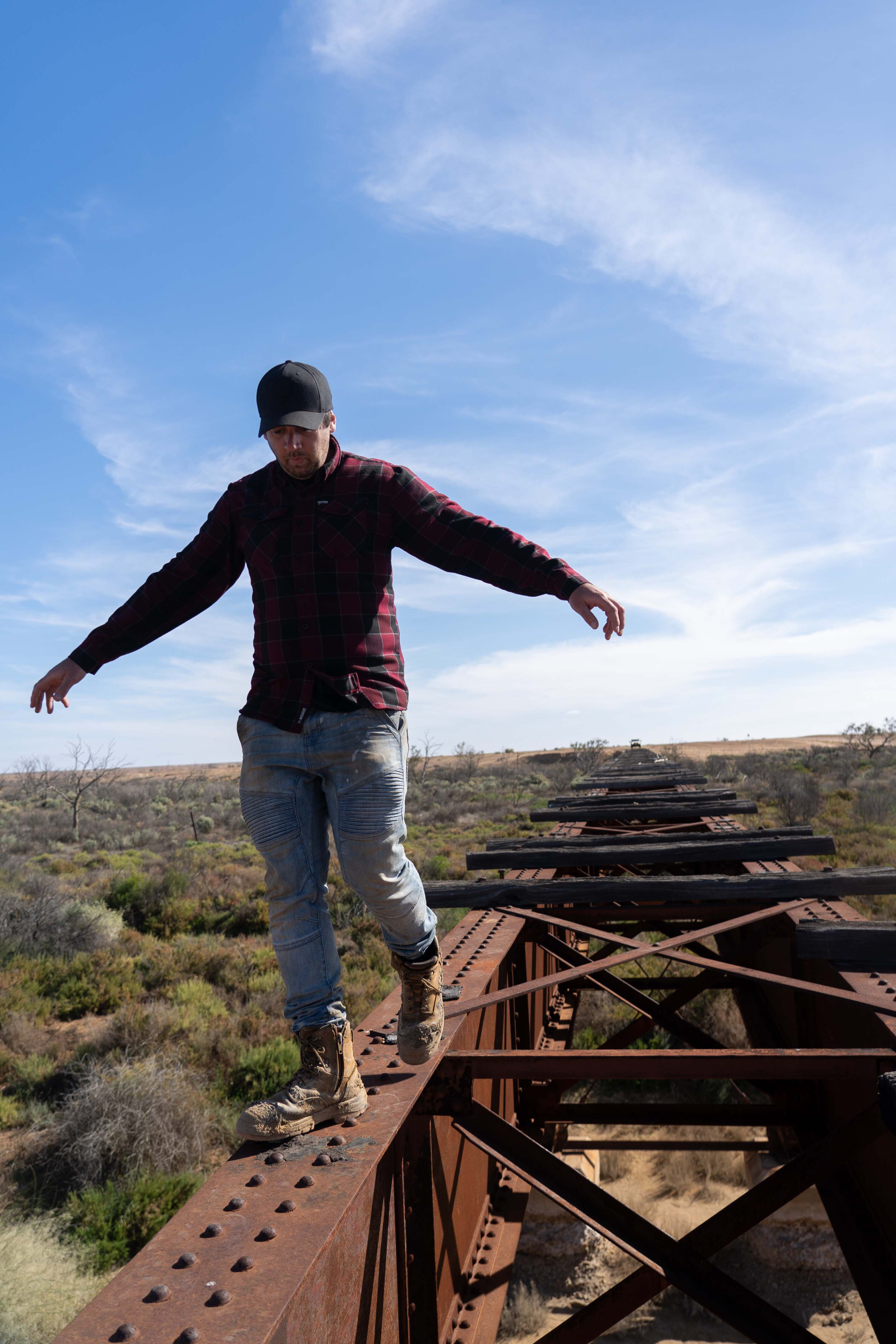
What Makes it Special: This site is more than just a waterhole; it’s a refuge for the soul. You’ll find dozens of bird species here, making it perfect for anyone who appreciates our avian friends. Plus, the historic Algebuckina Bridge, one of the longest in South Australia, offers an eerie but captivating backdrop.
1
Dalhousie Springs Campsite
GPS: -26.42146, 135.50434
Facilities: Toilets, warm showers and picnic tables.
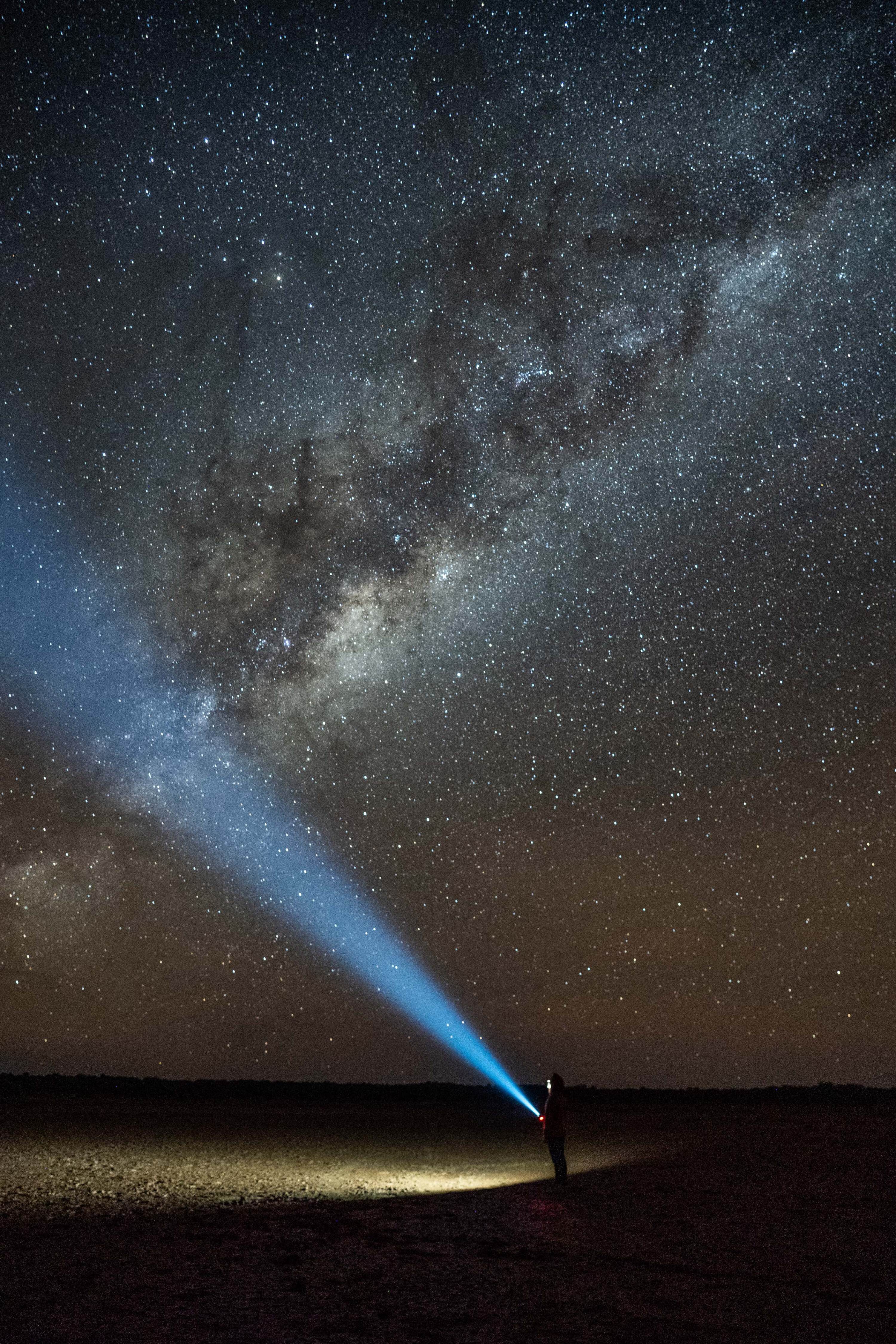
What Makes it Special: Not only do you get to soak in 38°C natural springs, but you’ll be doing so in an area steeped in indigenous significance. With more than 60 springs in the area, you’re basically at a natural spa. Make sure you also wander around to discover the ruins of the Old Dalhousie Homestead.
1
Coward Springs
GPS: -29.39741, 136.81283
Facilities: Toilets, and that’s about it.
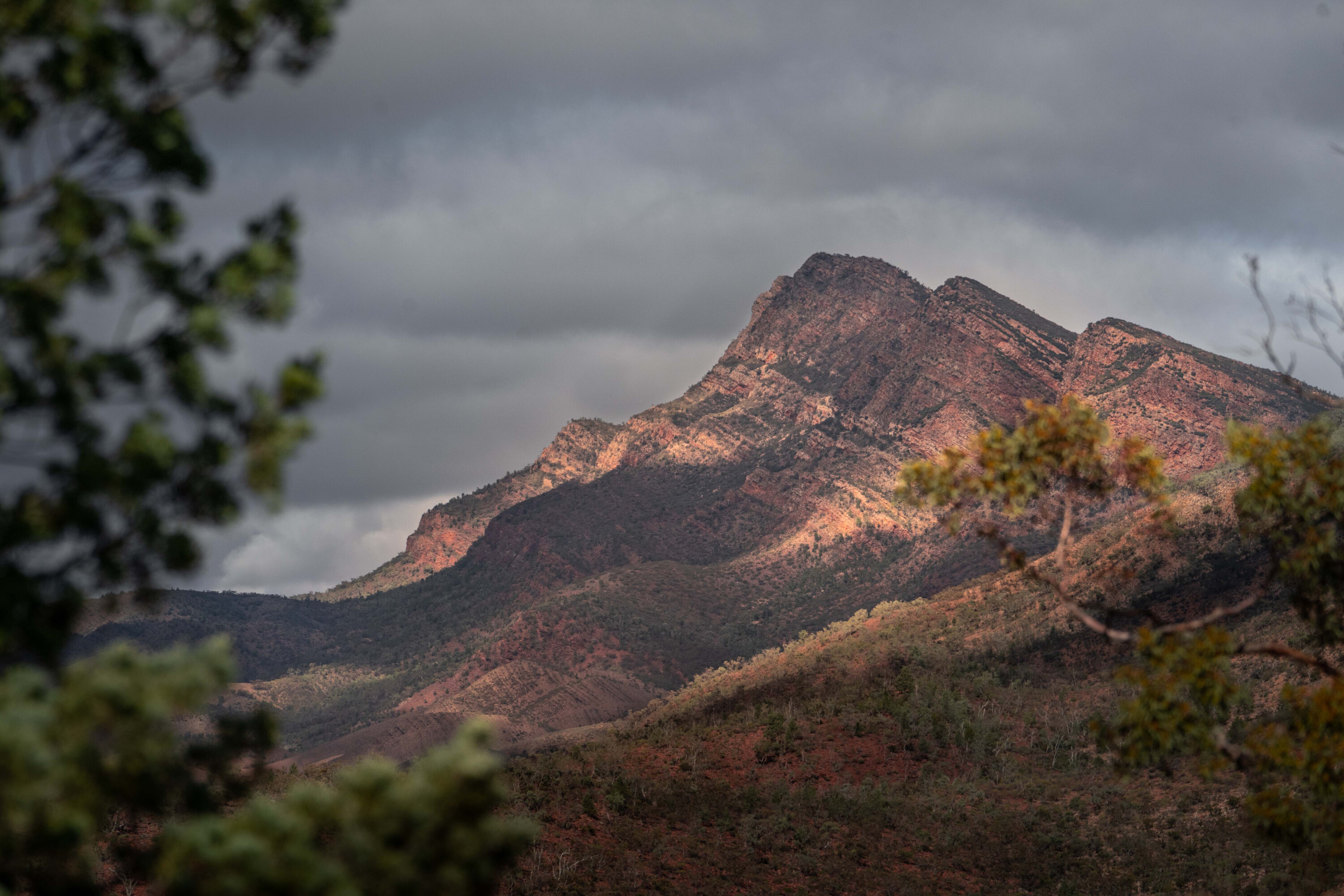
What Makes it Special: Coward Springs is an oasis with palm trees, a natural spa, and an old locomotive water softener; it’s like walking into a time machine. Camp here and you can soak in the springs while pondering the site’s rich history, which includes its role as a stopover for the Old Ghan.
1
Mount Dare Hotel Bush Camp
GPS: -26.06853, 135.24769
Facilities: Toilets, showers and a fully stocked pub.
What Makes it Special: Push far enough north and Mount Dare is your gateway to the Simpson Desert. It’s your last chance to take a hot shower and fill up your tank before you brave the great sandy expanse. Plus, the Mount Dare Hotel offers a little luxury, whether it’s an ice-cold beer or a hearty steak meal.
Woodslane Press and Boiling Billy Publications have for many years published some of the best four-wheel drive guidebooks you could wish for and you’ll find them in the gloveboxes and libraries of travellers around the country.
The latest guide book in the series is titled 4WD Treks of Northeast NSW and it focuses on one of my favourite parts of Australia. Often overlooked by adventurers, the NSW coast has many and varied tracks and destinations to explore by 4×4 and most of the ones contained in the book can be accessed by light-duty all-wheel drive vehicles.
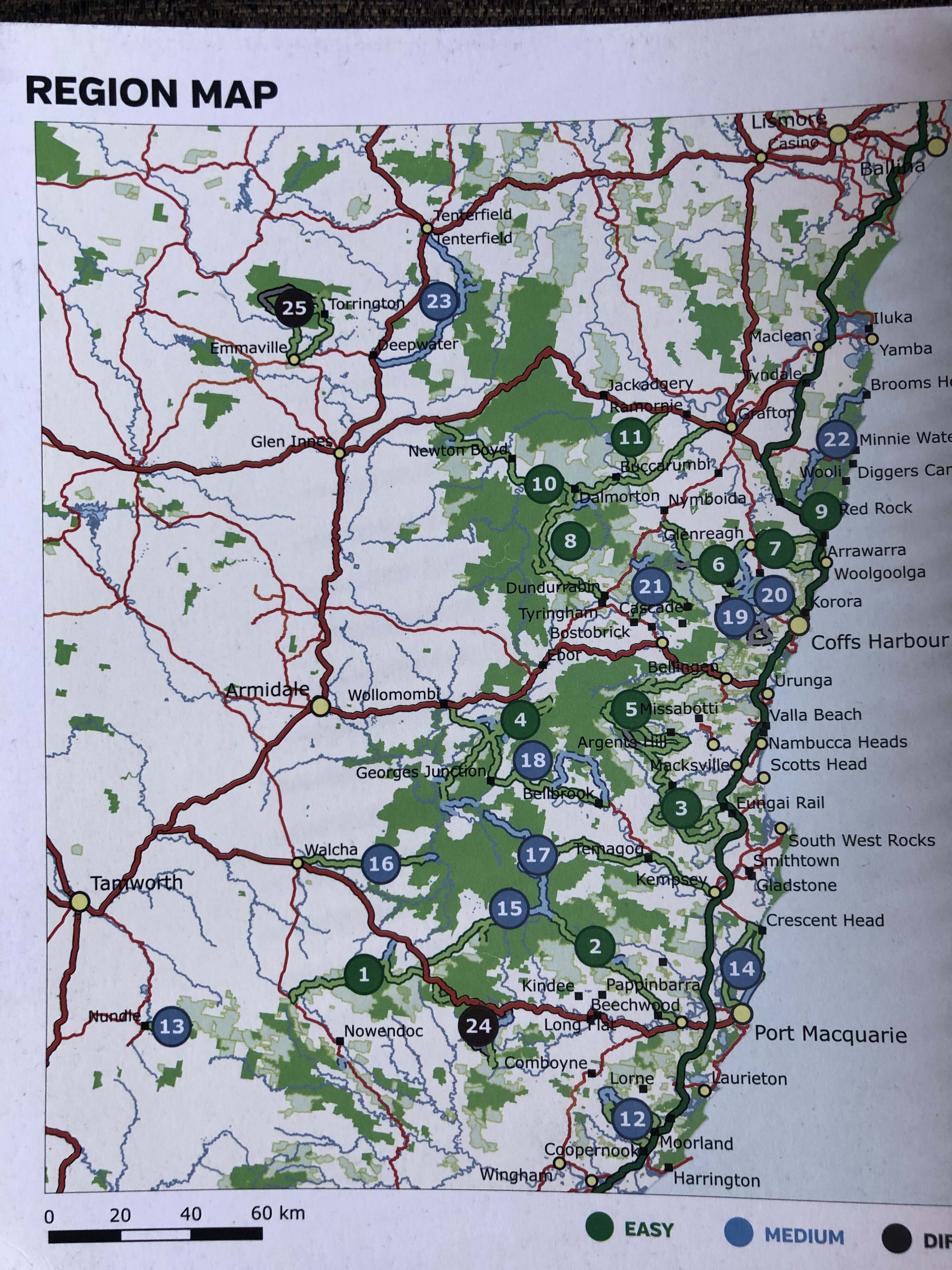
From Coopernook in the south to the beaches of Brooms Head in the north, and as far west as the Carpet Snake Trail near Emmaville up in the New England, the book covers a wide expanse of terrain focusing on 25 treks in total.
1
Each trek is rated for difficulty and SUV suitability, while only two of them are rated as difficult 4WD treks. They range from day trips to overnight destinations with details of camping and available facilities, nearest towns and supplies, and some local history supplied for each.
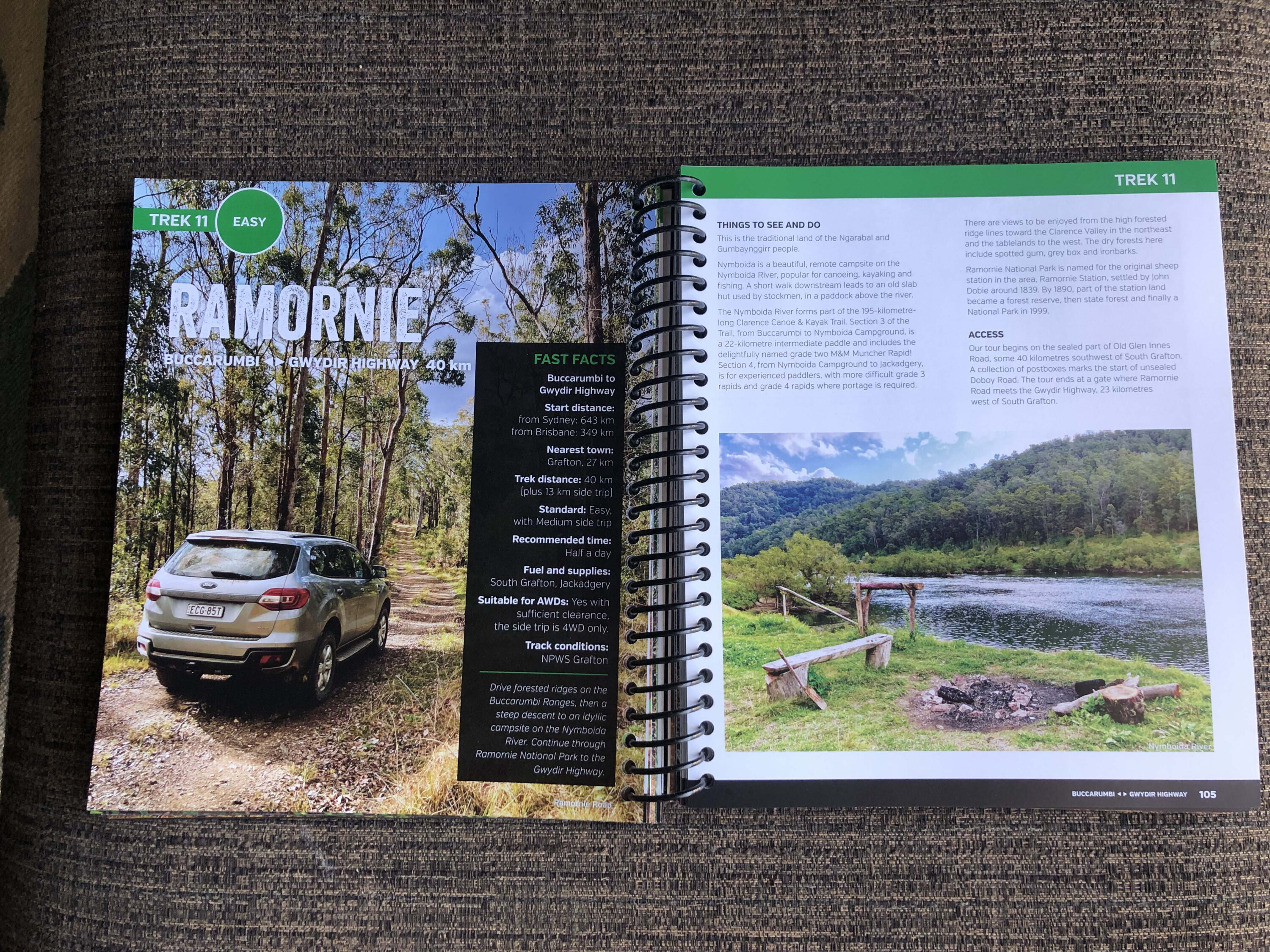
Simple, easy to read ‘mud maps’ are given for each trek as well as detailed turn-by-turn directions with travel distances and drive times.
Whether it’s beach or bush, there’s something for every traveller on the NSW north coast and they are all here in this guidebook. Some of my favourite locations listed among the treks include Station Creek camp at Pebbly Beach, the river and rainforest experiences around Nymboida, the tracks of Yuragir and the deep valleys reached within The Cells.
1
Author Yvonne Everett’s experience and knowledge of the area comes through in the details and tidbits of information shared for each trek.
This encourages the reader to get out and explore the northeast with the confidence of knowing what to expect, what to look out for and what not to miss along the way. With careful planning you can link multiple treks to create an adventure lasting weeks, and taking in all this amazing part of Australia has to offer.
4WD Treks of Northeast NSW is a spiral bound, full-colour, 134 page book with many photos from each place and destination, as well as plenty of information.
It is available online along with other Woodslane and Boiling Billy publications at www.woodslanepress.com.au [↗].
Rated
RRP: $44.99
AVAILABLE FROM: www.woodslanepress.com.au [↗]
WE SAY: A great guide to 25 of the best and most varied treks showcasing one of the best parts of Australia.
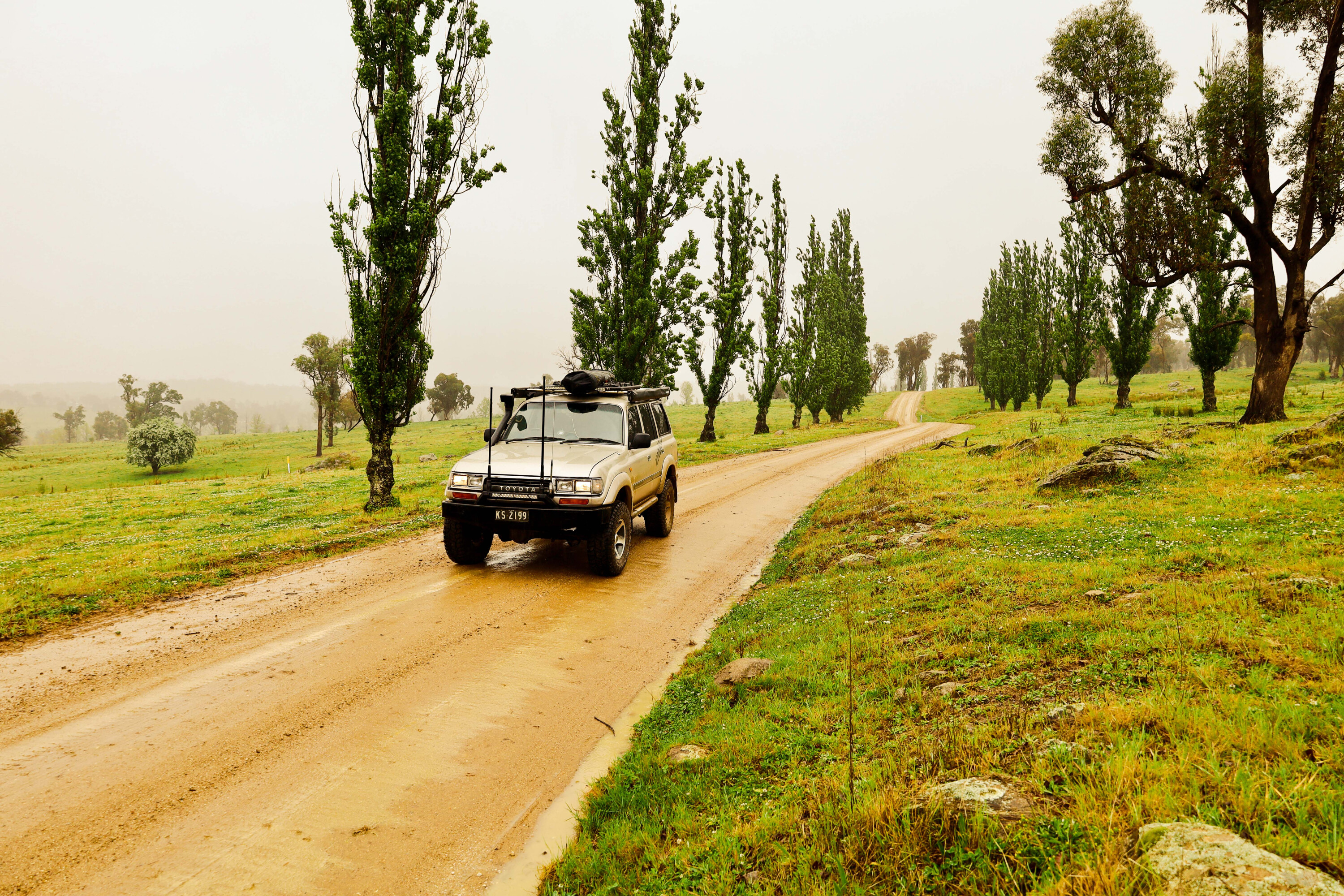
One of my favourite spots is not far from home, just a couple of hours west of Coffs Harbour, heading into the heart of the New England region.
It’s a place where early explorers deemed the land perfect for pastoralism, and bushrangers roamed. Today the whole area is a mix of tourist drives, farmlands and boutique villages.
The New England region covers an area from Newcastle in the south up to the Queensland border on the top of the Great Dividing Range. Across the west side the farmland is very much similar to the UK, with wet winters with blizzard conditions and pretty warm summers.
1
To the east where the Great Divide drops down to the coast there’s some cool forest regions with a diverse range of plants and animals.
The tourist trade flocks to these areas for the multitude of wineries, coffee emporiums, boutique stays, natural wonders and festivals.
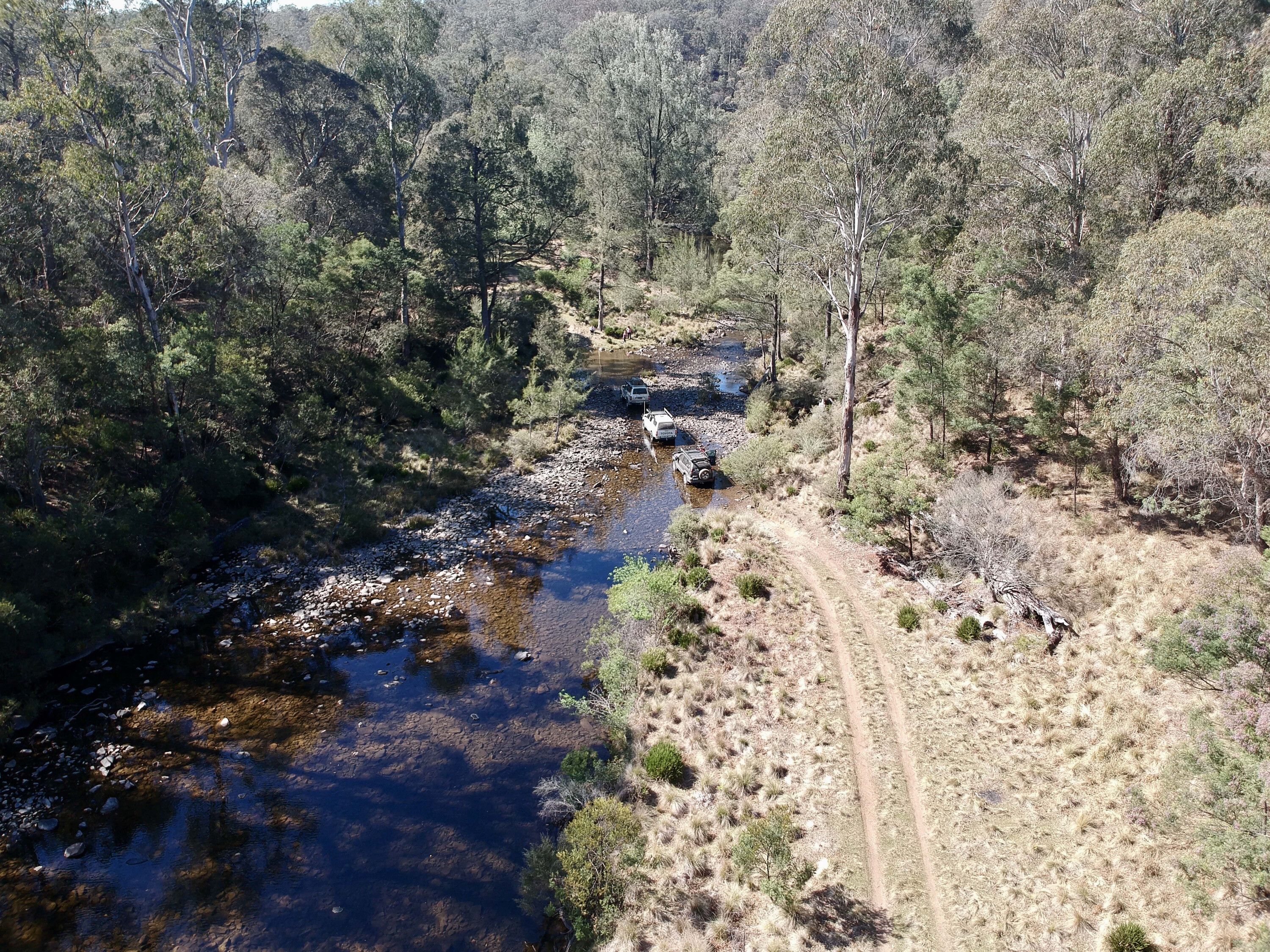
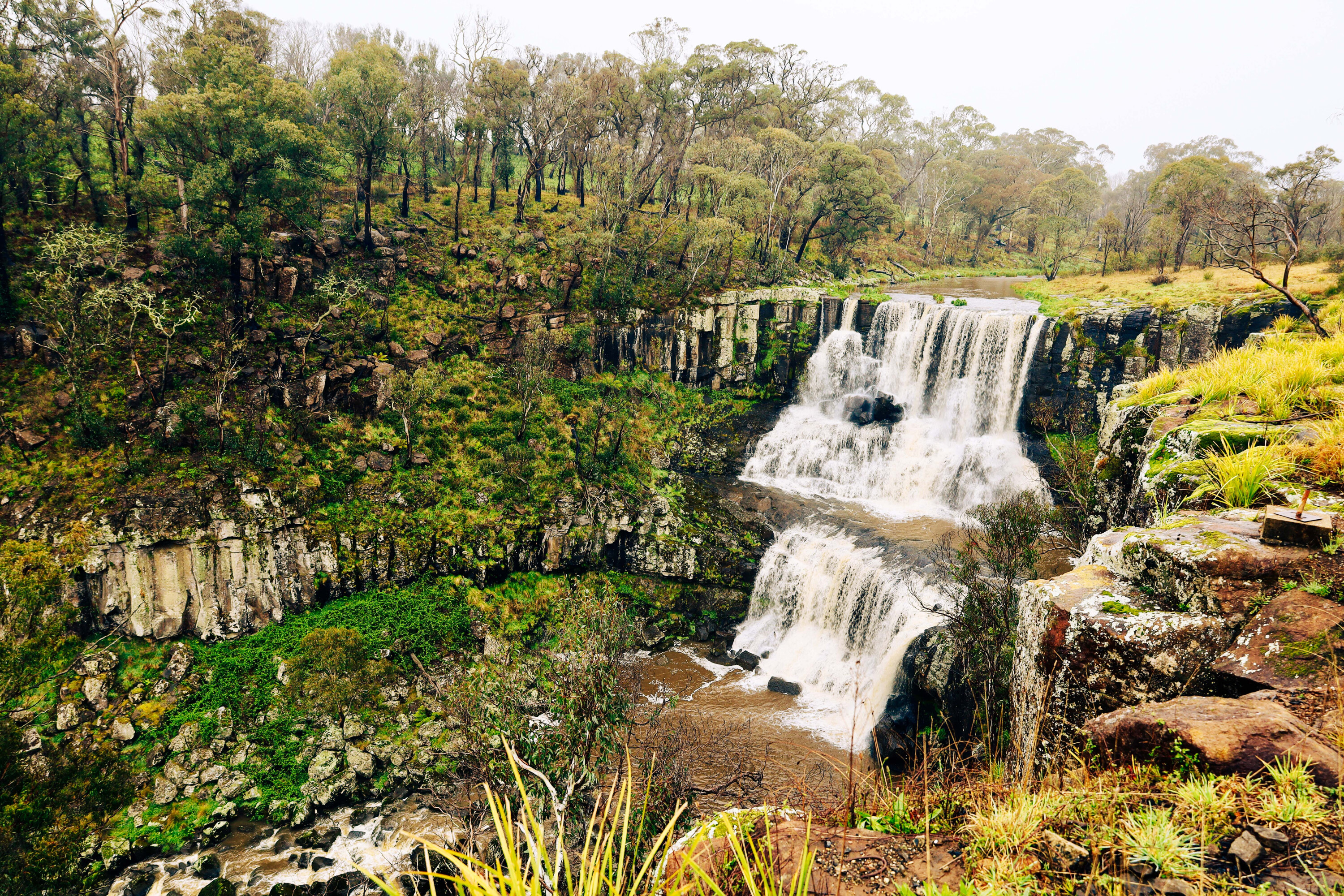
Now while there’s not really a lot of challenging four-wheel driving in the area, it’s a great place to explore for a few days. One area in particular is around Ebor, midway between Sydney and Brisbane on the tablelands. This is true gorge country, where over millions of years the constant weathering has carved out an amazing landscape.
1
Grab one of the many tourist maps and create your own adventure out here.
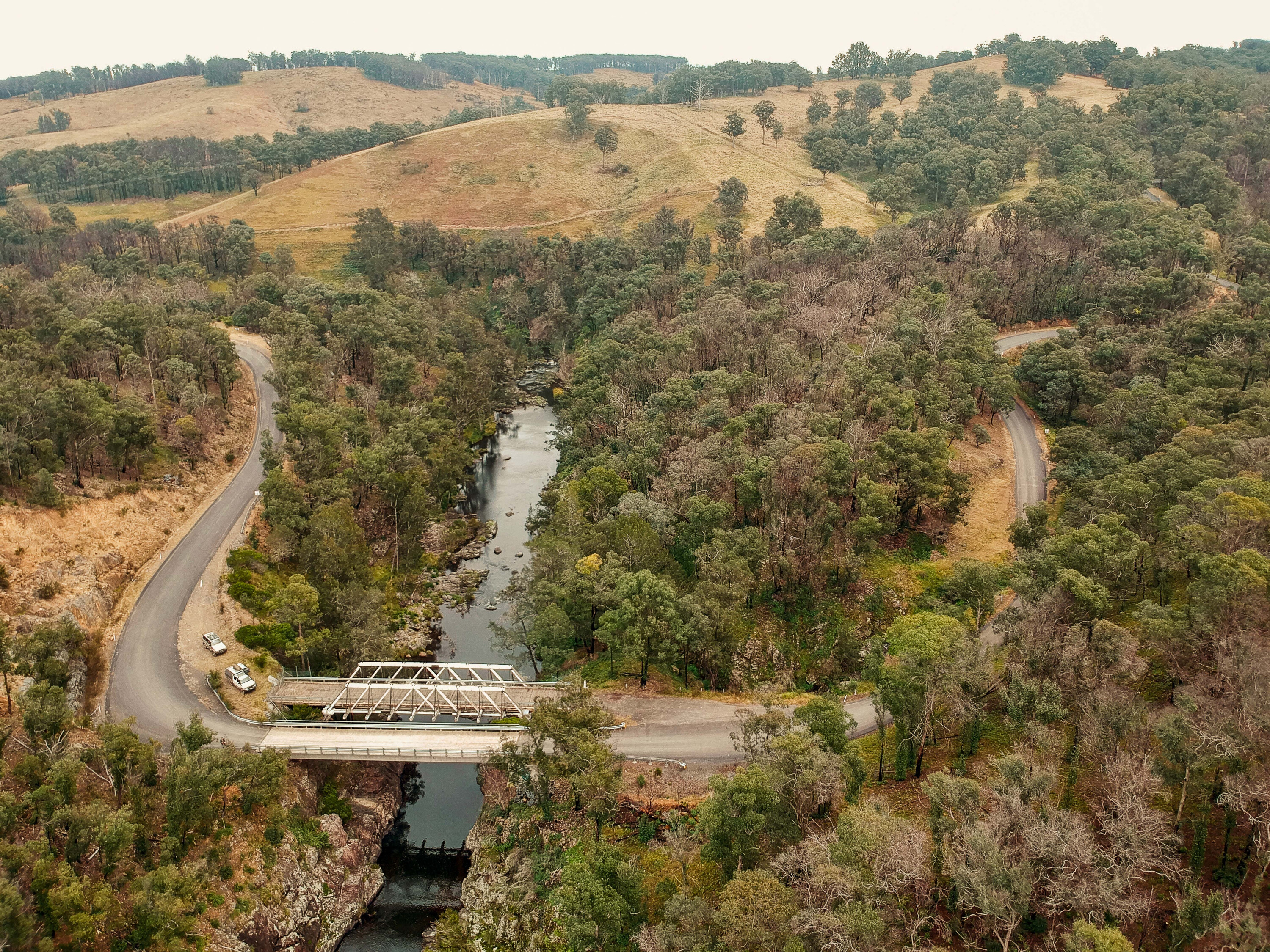
The area is surrounded by national parks and wilderness areas, but there’s still some amazing touring tracks, plenty of history to explore and the waterfalls in the area are said to have some of the longest drops in the country, while Round Mountain in Cathedral NP is the highest point north of the snowfields.
One of our favourite camping spots is in Styx River State Forest. Surrounded by national parks it’s a beautiful little pocket where tree ferns grow under tall gums in the cool climate and where camping is free down on Wattle Flat beside the river. The area is peaceful and while you won’t find much in the way of diff-busting tracks, it’s all about exploring the region and winding down.
My advice for exploring New England? Grab one of the many tourist maps and create your own adventure out here. With a good GPS or the right map, the listed locations are easy to find. Be prepared for weather changes as you can get three seasons in one day.
1
The Ebor volcano
Many, many years ago before man walked the earth, the east coast of NSW was alive with active volcanic eruptions and upheaval.
One of the most significant in the area was the Ebor volcano, 65km east of Armidale. It’s reported to ahev been very active over a period of 30-60 million years ago.
The lava flows from the massive upheavals that this volcano created extend for several hundred kilometres in a 360 degree arc all the way to Barrington Tops and west to Mount Kaputar. This is evident from the rich red farming and grazing land that the mid-north coast is renowned for, and the floodplains to the west where the basalt soils are black.
1
From the potato growing area near Dorrigo to the lush rainforest areas that run along and meet the coast to the north and to the south, this is known as Gondwana land.
The New England National Park, which surrounds the Ebor Volcano, plays a significant part in the protection and preservation of a wide diversity of flora and fauna, and this was recognised in the late 1980s when it was declared a World Heritage listed area.
While there’s no four-wheel driving here, the walking tracks and lookouts make up for it. Some walking tracks wind their way into the wilderness areas and others loop around the ridge through the cold climate forest.
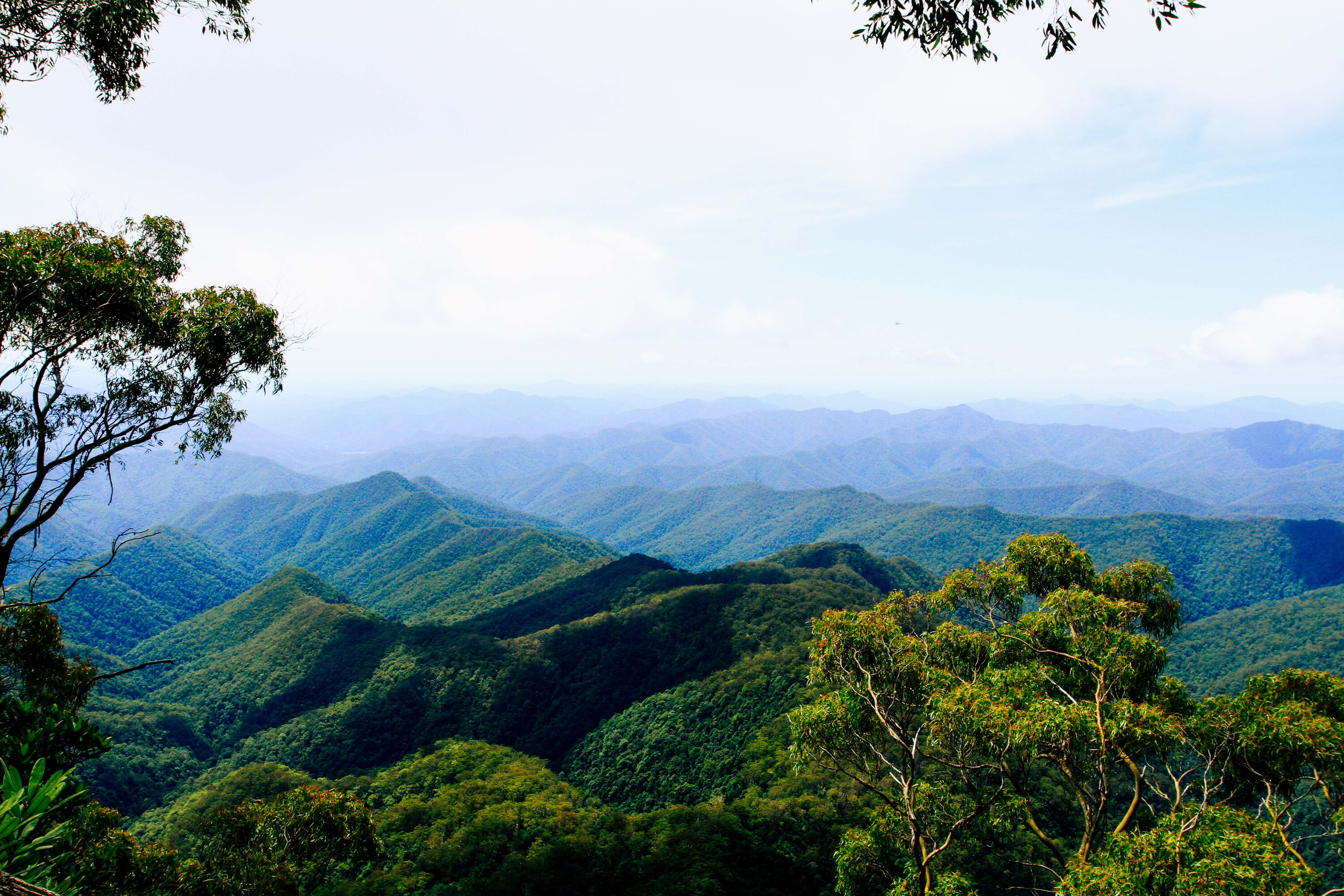
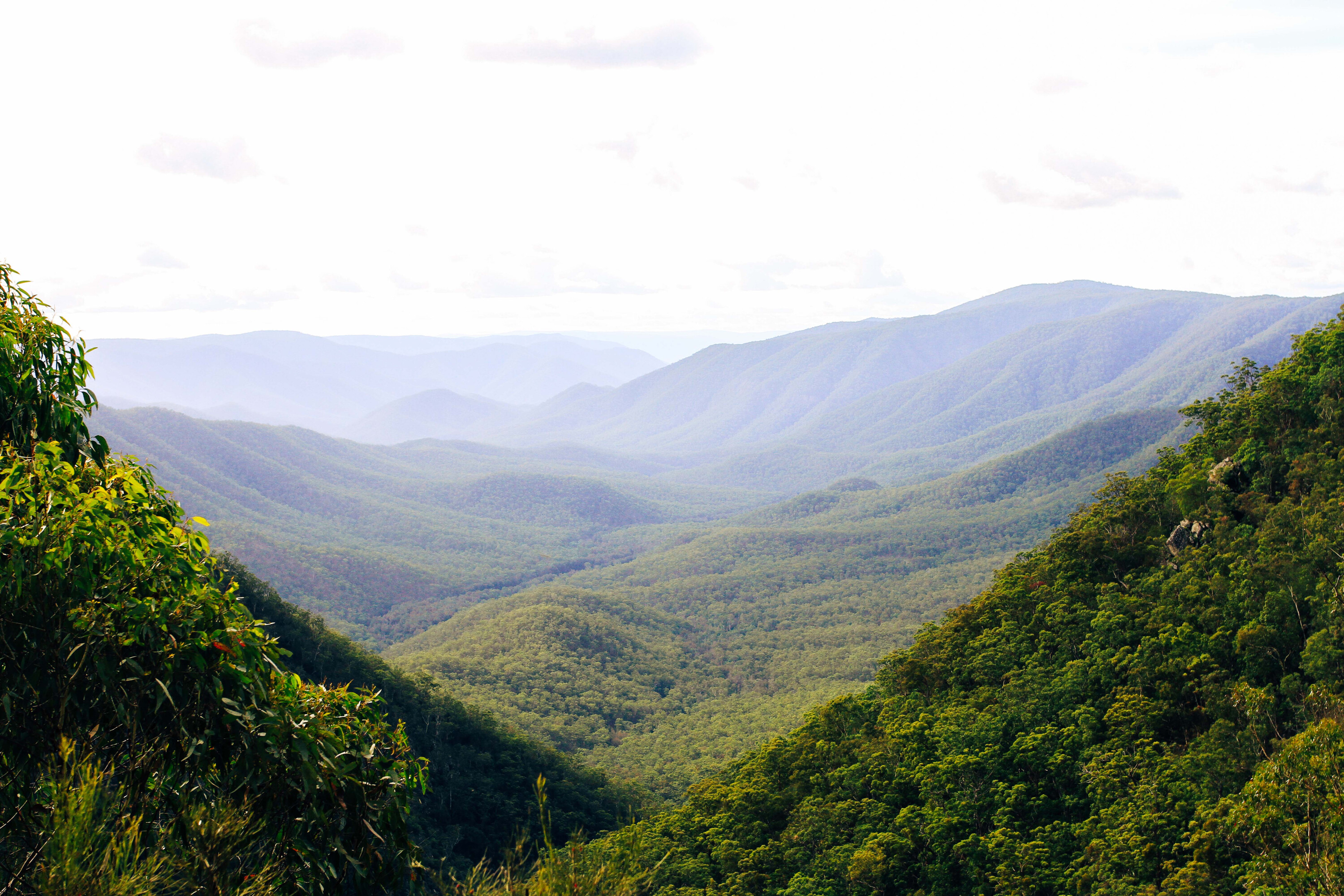
The 300m thick rim of the Ebor Volcano can be viewed from the nearby Point Lookout on a clear day, which at 1565m above sea level offers stunning views into the wilderness areas that surround the rim and down across the coast.
1
The afternoon is the best time to visit but as it’s so high the mist and clouds can roll in unexpectedly, hiding the valleys below.
At this altitude you can see cold-tolerant snow gums covered in thick moss, yet in the valleys below the gorges are filled with near inaccessible rainforest pockets. This area has created its own environment: there are high rainfall periods that flood the surrounding lower lying land; freezing winters where snow falls on a regular basis; and summer periods where the dry heat can leave you feeling dehydrated.
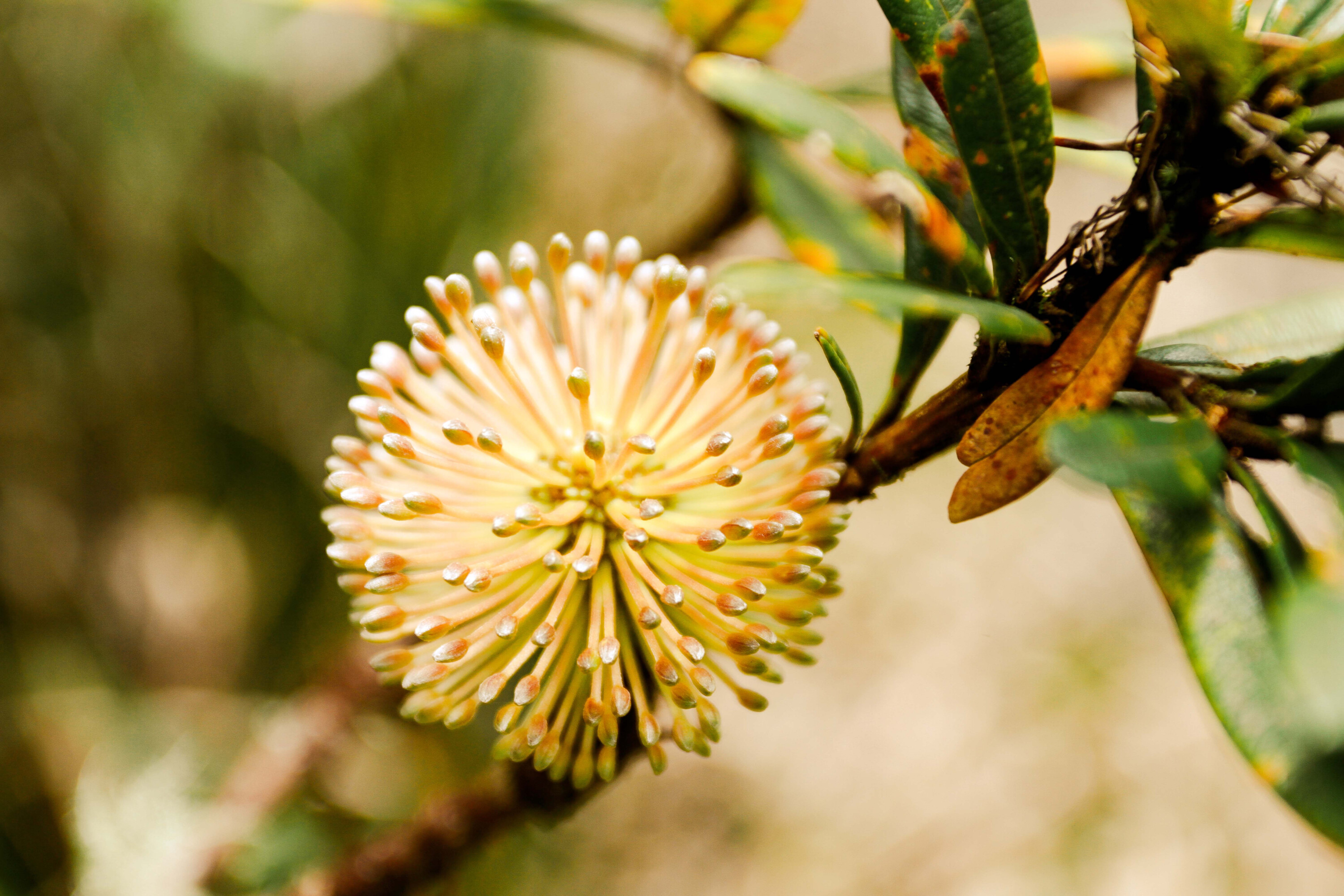
This volcanic area is reportedly home to more than a thousand different species of plants and trees, with the altitude ranging from sea level to 1610m, and some species are found nowhere else in Australia.
1
Cathedral Rock NP
Cathedral Rock NP is a relatively small park and some may find it an underrated destination. The only vehicle entry into the park is located 65km west of Armidale, towards Ebor.
Entering the park there’s a great information board that provides an insight on what you can expect to find within the park, such as camping, history and the ecology of the area. It’s an easy 8km drive that winds its way around huge granite boulders and through the cold-climate forest to the camping areas.
Barokee Campground caters for both daytrippers and campers, with a pit toot, fire places and supplied firewood. The main focus of the park is the three-hour return walk to the top of Cathedral Rock.
1
Getting to the base of the rock climb is pretty easy but it’s the last gut-busting 500m that will have you questioning your decision to take it on.
The track follows the rock formations, and you’ll be ducking under overhangs before the final challenge of scrambling over boulders. You’ll need to grab the chain to pull yourself up the last rock.
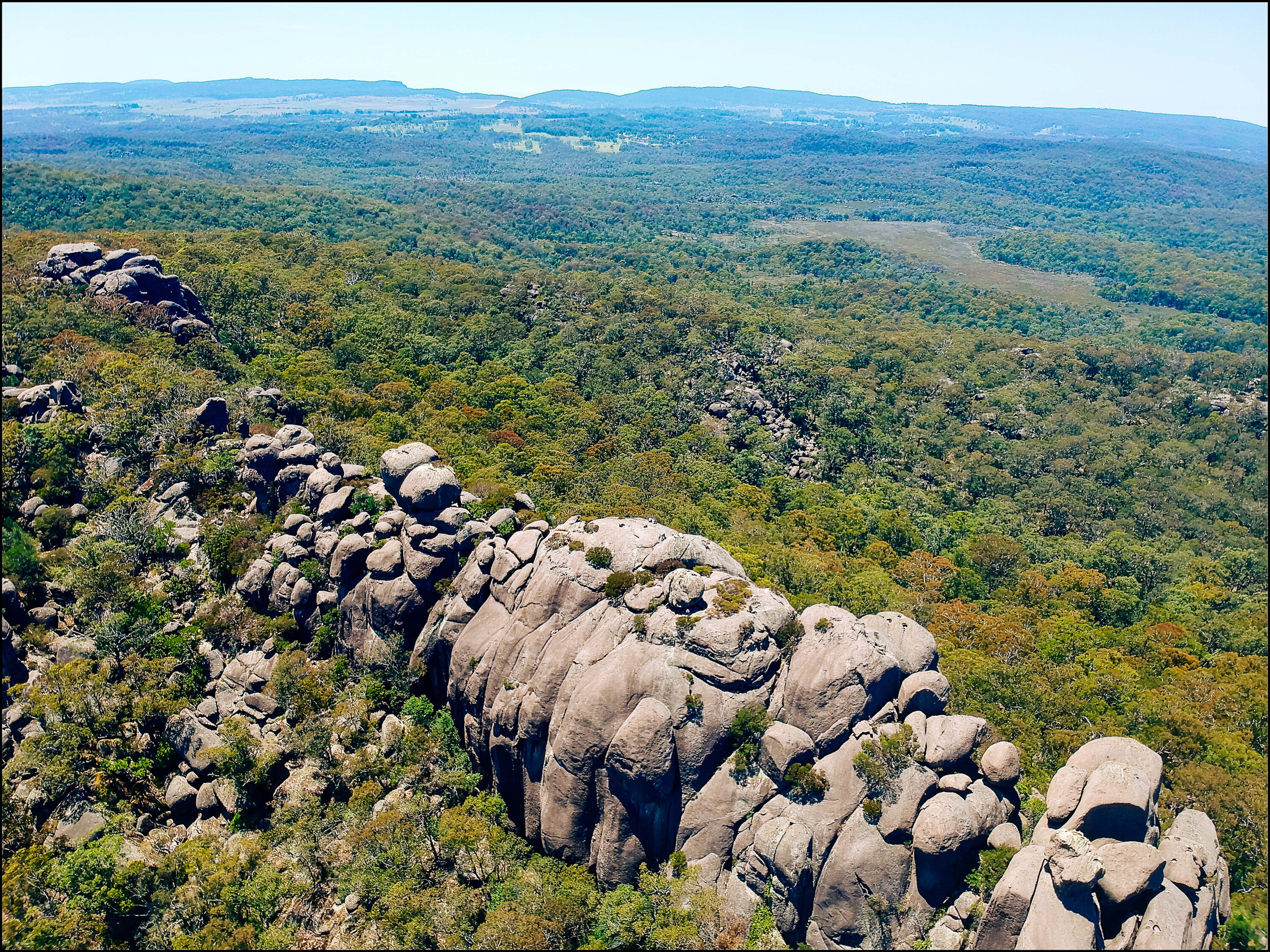
When you reach the summit the 360° views are stunning, looking over valleys and across to other granite tors (free standing rock formations) in the distance. It’s interesting to note that these granite formations are located only within Cathedral Rock NP, and nowhere else in the region.
1
On our last visit we sat here for more than an hour trying to comprehend the area with its breathtaking views in every direction, and just how peaceful it is at 1550m above sea level.
We watched soaring raptors at eye level as they looked down for prey, and also spotted some of the biggest rock skinks we have ever seen, scrambling around on the rocks and keeping an eye on our every move.
After the scramble back down, the loop track heads around the base of these giant granite boulders and back to camp. You will pass the walking track to Native Dog campground on the outskirts of the park. The rocks here are from the Ebor Volcano eruptions that occurred millions of years ago.
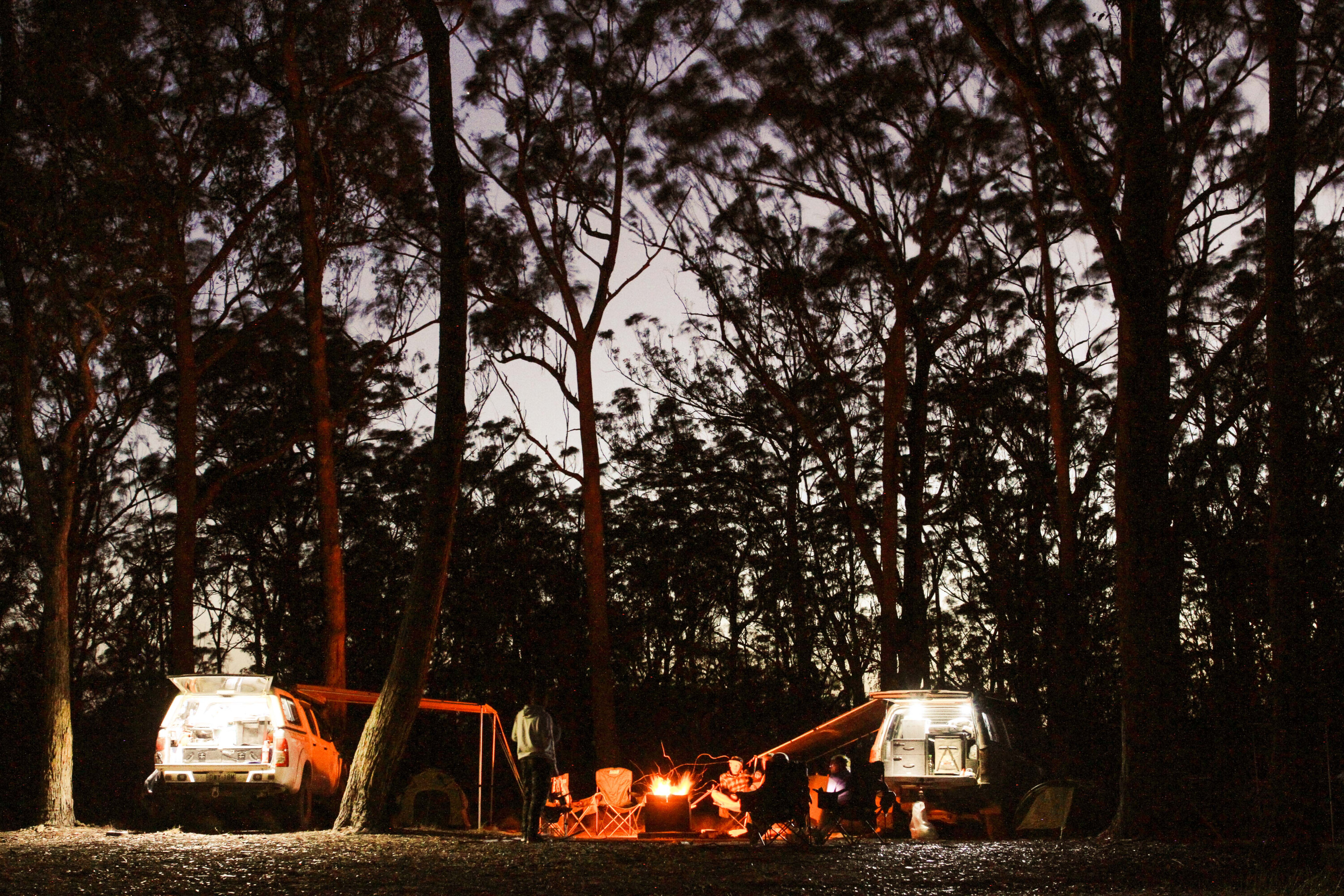
1
Yooroonah Tank Trap Barrier
Located in the New England Tablelands 12km southwest of Ebor, the Yooroonah Tank Trap Barrier is well hidden from modern day traffic, located well away from the main road.
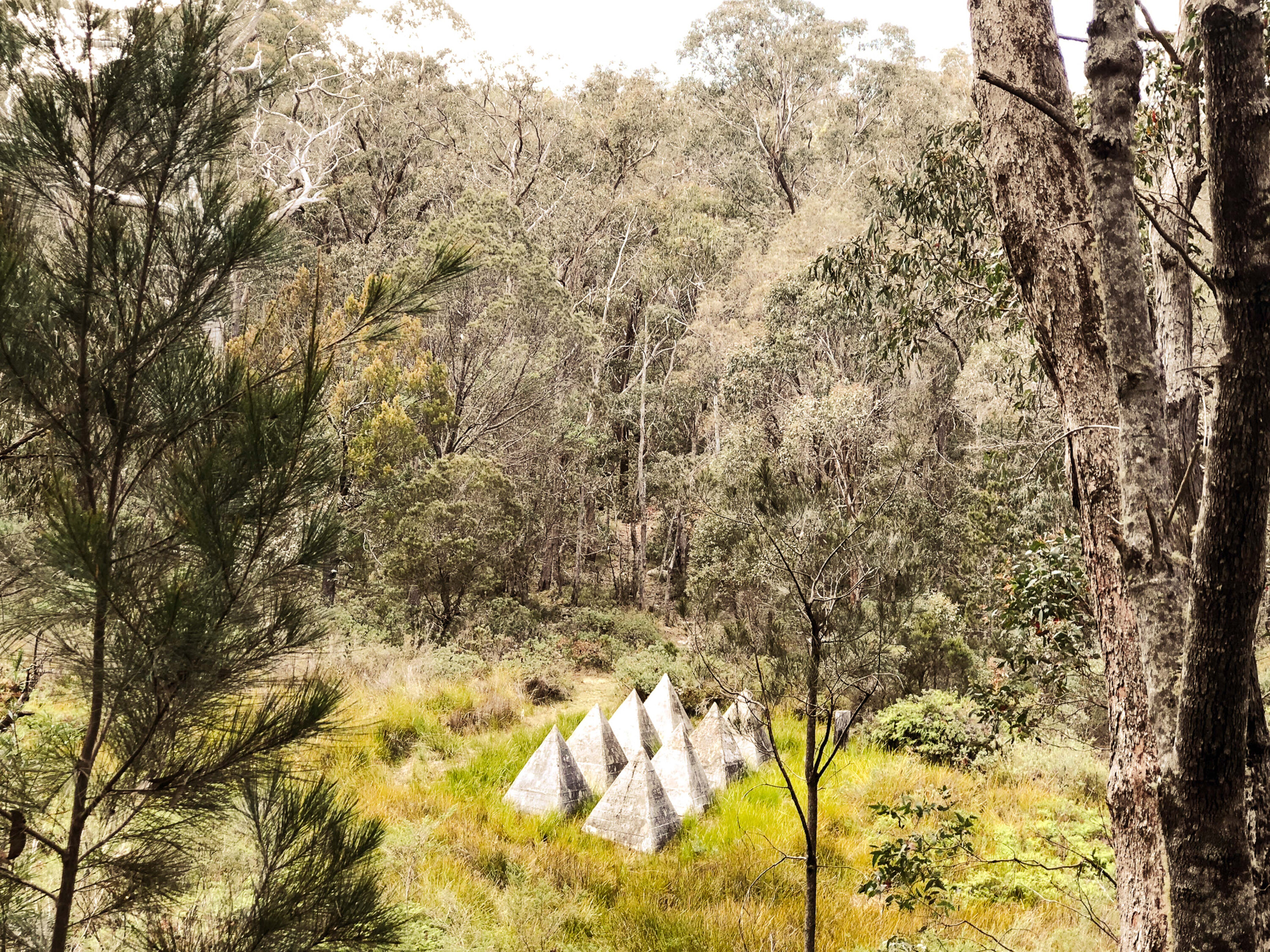
Strategically placed here back in 1942 in case the Japanese were to invade Australia, the barrier was designed to slow progress to the tablelands. Reportedly a 75-post barrier, we spotted about 50 odd, as several others had been burnt, attacked by white ants or had been knocked over.
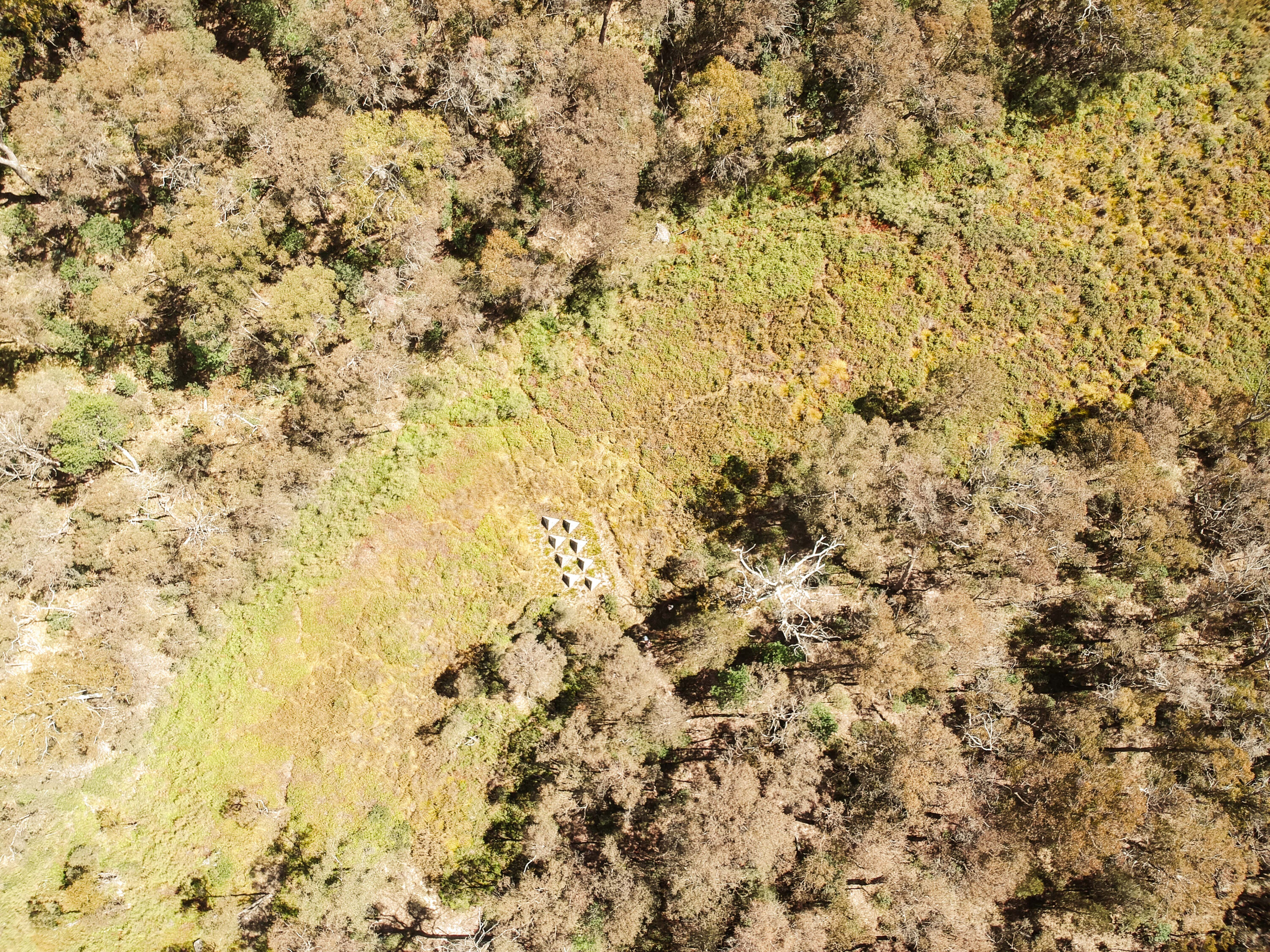
There are eight triangle tetrahedra (triangle blocks) placed on the higher ground down near the swamp area, and these were positioned to force the tanks into the marsh areas.
1
We found several rock lookout platforms and funk holes (where the troops would lie if there was an attack) but unfortunately we couldn’t find the foundations of several buildings that were here, or the old stone chimney.
One amazing find, however, was the tunnel under the old road that would have been loaded up with explosives and ignited if the enemy was on the road. There would have been a ton-and-a-half of explosives set for charge in the steel boxes that can still be seen inside the tunnel.
The digging of the tunnel initially involved two shifts of two men each, working 15 hours per day, six days per week. The tunnel is about 60-feet long with two arms branching off the end, and reports say it was 10-feet high; it’s now about 5-feet high and seems to be about 4 feet wide.
1
Historical records say that in nearby Armidale, there was a system in place to race the explosives out here to the tunnel if the enemy was approaching.
It’s hard to believe walking around here that this might have actually happened so far down the coast. I’m not sure why the enemy would want to target the cold New England area instead of staying down on the coast, but it was certainly viewed as a real threat.
This enemy deterrent was one of many along the east coast of Australia and in fact the steepness of the terrain from the tableland to coast, combined with the prevalence of deep gorges, the absence of navigable rivers and the heavily forested nature of the surrounding countryside, meant that the few easterly roads that existed in 1942 were of critical strategic importance. Now this area is listed by the National Trust. There are several walking tracks around these points of interest, and it’s an easy walk for the kids too.
Look at this
Ebor: https://www.visitarmidale.com.au/explore/ebor [↗]
Ebor Falls: https://www.nationalparks.nsw.gov.au/things-to-do/lookouts/ebor-falls/learn-more [↗]
New England NP: https://www.nationalparks.nsw.gov.au/visit-a-park/parks/new-england-national-park [↗]
Cathedral Rock NP: https://www.nationalparks.nsw.gov.au/visit-a-park/parks/cathedral-rock-national-park [↗]
Yooroonah Tank Trap Barrier: https://www.nationaltrust.org.au/news/yooroonah-tank-traps-listed-on-national-trust-register [↗]
The Gulf Town of Normanton is popular when the weather gets too cold in the southern states and the silver nomads head north to nearby Karumba for the winter.
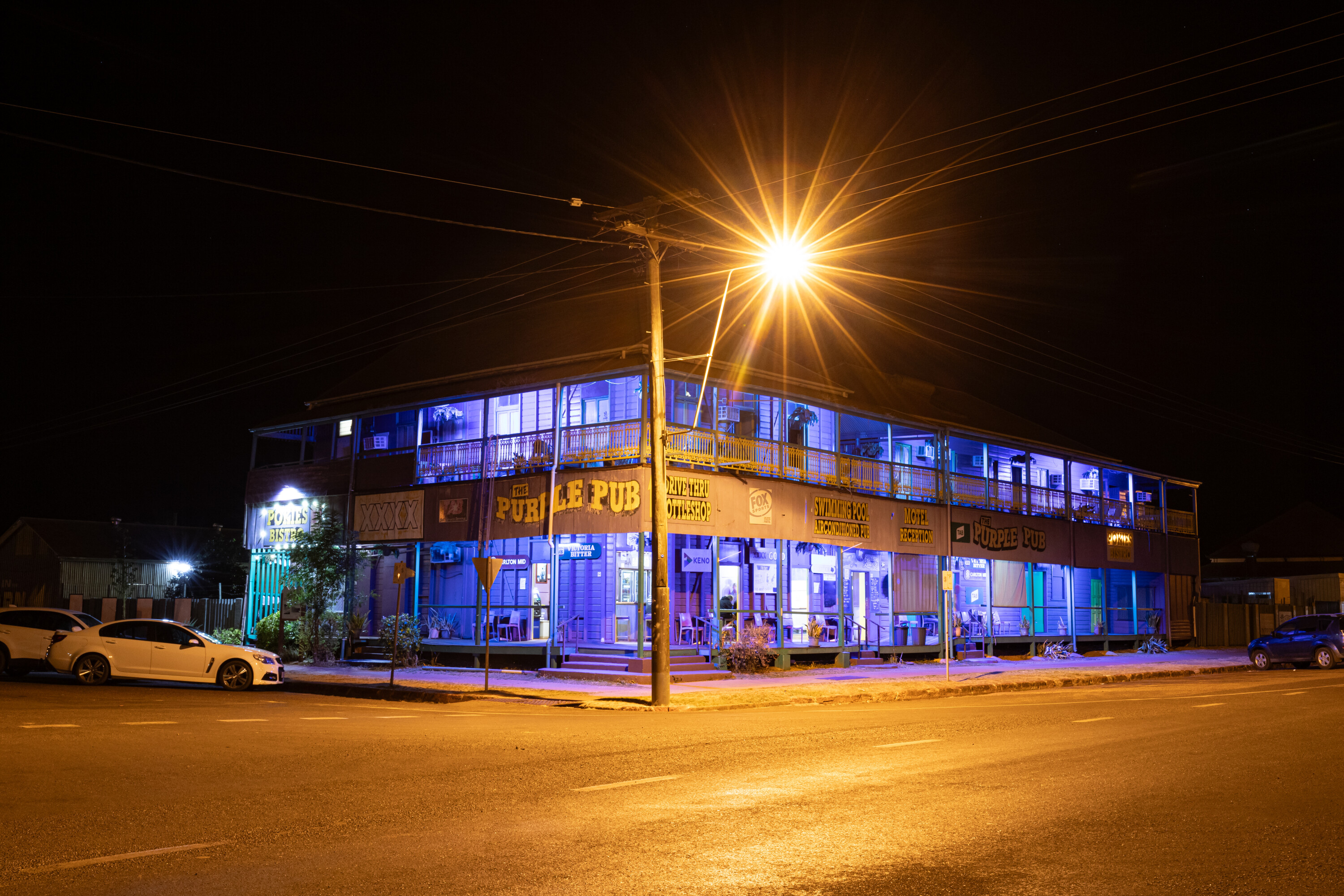
They have to pass through Normanton on their way there, so the National Hotel, better known as the legendary Purple Pub, is like a magnet.
It’s not just the silver nomads that enjoy a quiet beverage in the bar or maybe a meal in the beer garden, it’s also the families tackling the Savannah Way and the backpackers who are finally reaching our shores again.
1
In fact there’s a cracking sign in another of Normanton’s pubs that reads ‘Use of the word COVID results in shouting the bar!’
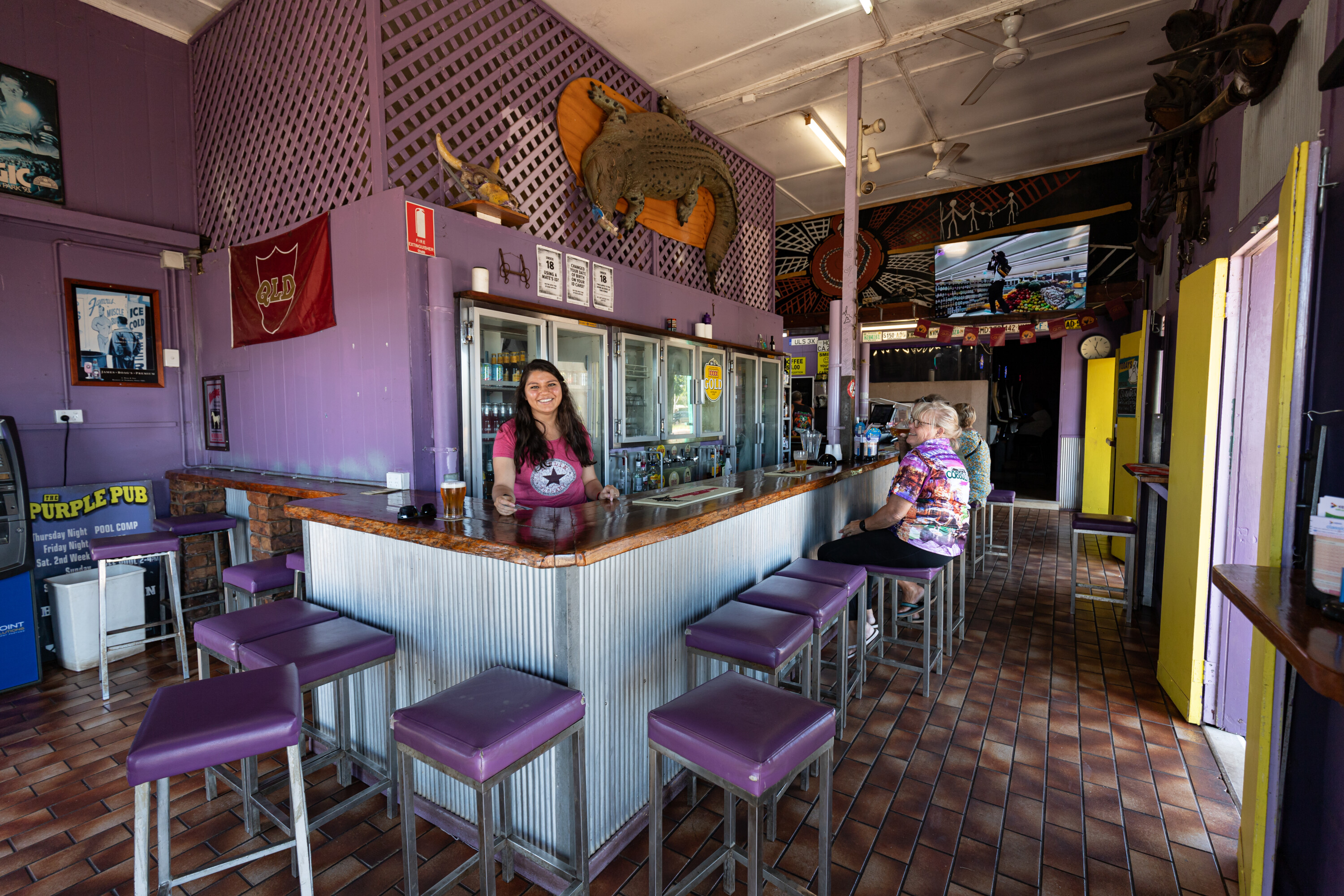
While sitting at the bar enjoying a cold beverage, I got talking to a mix of people, including a couple from Sydney on their first trip out here, an author from Brisbane who’d lived in Bali for 10 years and was now here trying to finish another novel, and one of the locals who enjoys meeting new people as they pass through.
It was great to be able to relax with a beer and talk about life with strangers.
1
The first edition of the National Hotel was built in the early 1900s and then the west wing, previously part of the Exchange Hotel in Croydon some 150km away, was relocated here and added to the original structure.
The building was painted a light mauve in 1968, and then in 1975 it was painted a few shades darker before the current purple was applied in 1979. The story goes that the order for paint was put in and it took a few months to arrive due to floods, and so by the time it arrived in Normanton, it had morphed into its current purple shade.
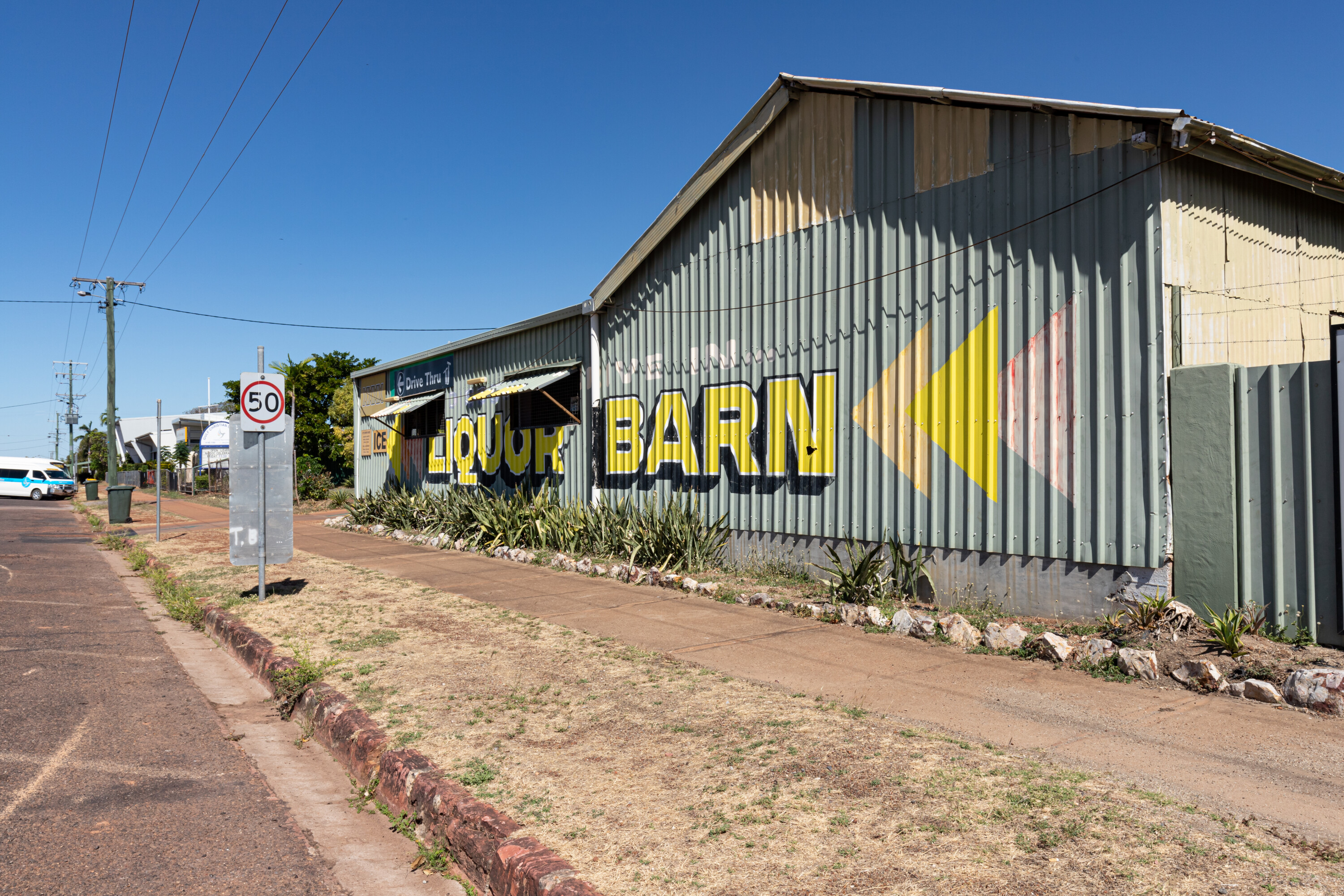
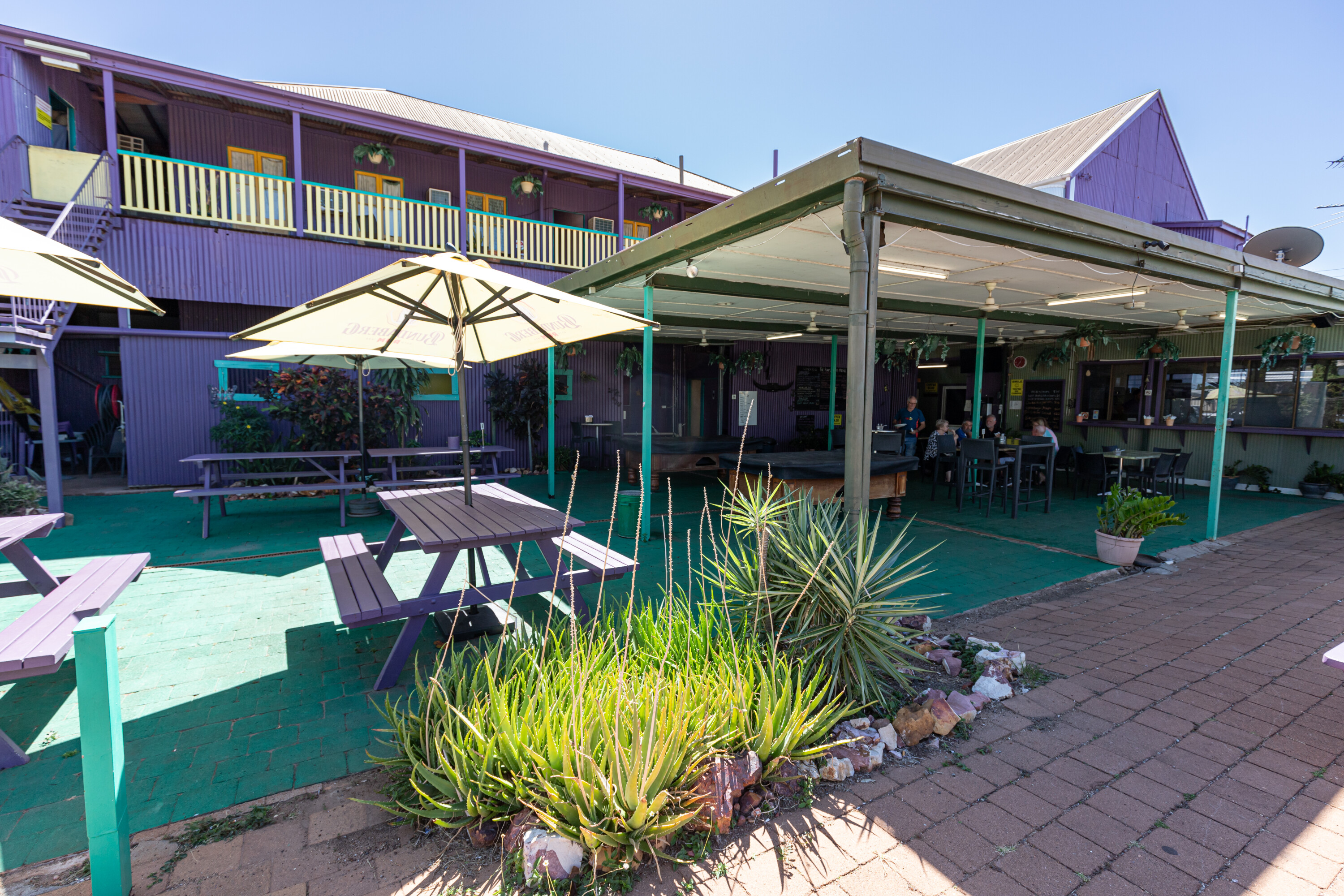
The Purple Pub has it all with a bar, bistro, beer garden, drive-through liquor barn and a motel. The beer garden includes a couple of pool tables and the menu is quite extensive with reasonable pricing for a pub this remote.
1
The motel has several rooms from $90 per night, all with air conditioning, ensuite, tea and coffee-making facilities, and telly, with guests also provided access to the pool.
From January to March the Purple Pub is open from 10am to 6pm daily and from April to December from 10am to 7pm daily. The drive-through liquor barn supposedly has the same hours however it was closed on the Sunday we dropped by. Fortunately takeaways are available from the bar when the liquor barn is closed.
There’s a pool com held on Thursdays with plenty of people signing up to battle for ‘Top Gun’ status, and for those with good singing voices there’s a Karaoke Night on Fridays. From the racket I heard when camped across the road, I can assure you it doesn’t take much talent to have a go.
1
The bistro is open for lunch from 12pm until 2pm and dinner from 6pm to 8pm, with a special roast night on Sunday nights.
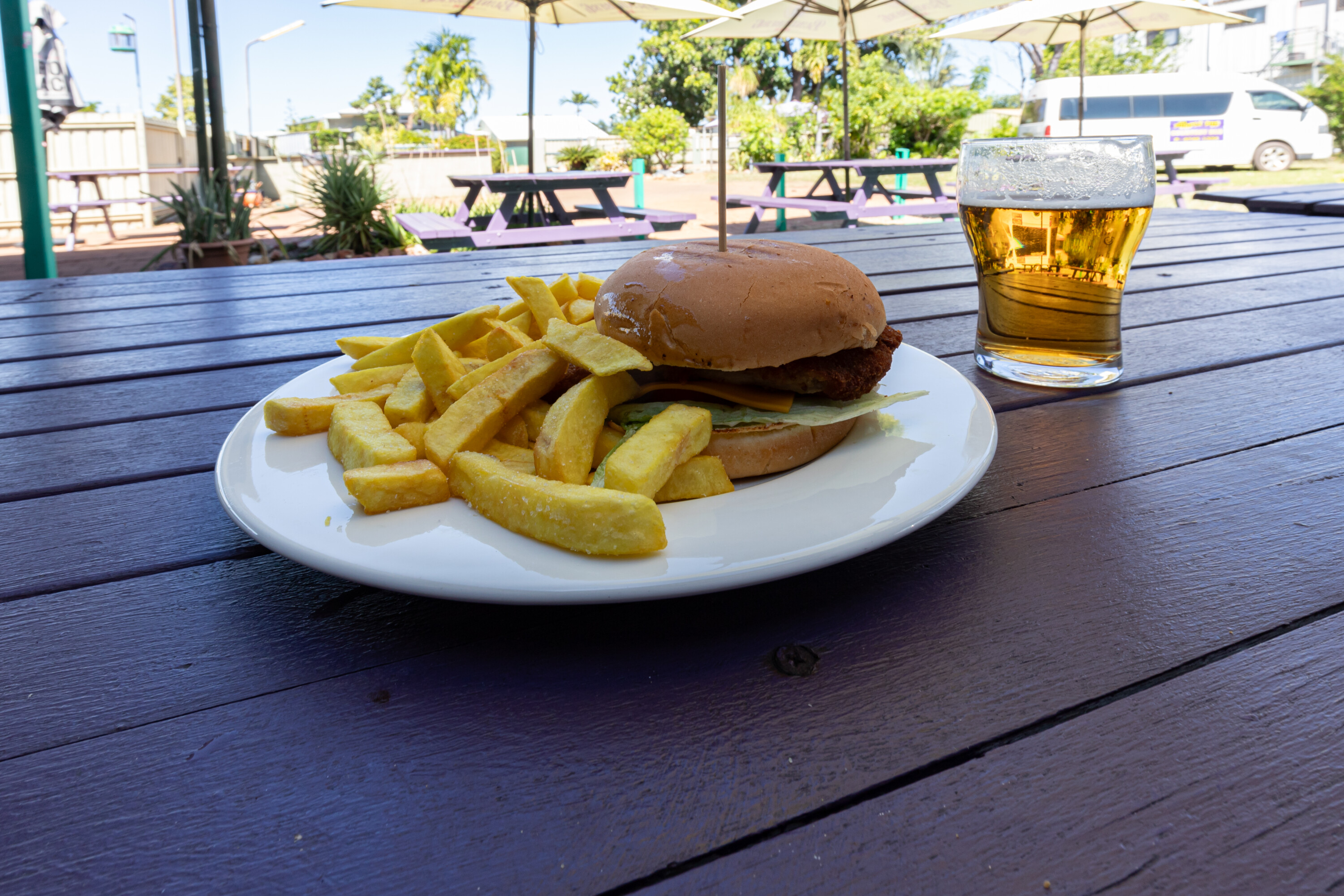
I sampled the Chicken Burger with chips for $12. The chips were crispy and seasoned perfectly and the schnitzel was larger than the bun. The tomato, chipotle mayonnaise and fresh lettuce added moisture and it was all washed down with an ice-cold Super Crisp.
You can’t miss the iconic Purple Pub as you drive through Normanton. It is a great spot to relax and chat with whoever else is in the bar, and if you can’t be bothered cooking, the bistro offers a good feed, including pizzas, while you can dine in or take away. It’s also a good idea to check out the pub after dark as the lighting is spectacular.
1
Essentials
Hours: 10am to 6pm (Jan-Mar); 10am-7pm (Apr-Dec)
Beers: Great Northern Super Crisp, Great Northern Original, XXXX Gold, Brookvale Union Ginger Beer
Meals: Lunch and dinner from $12; pizzas also available. Dine in or takeaway. Coffee or tea.
Pub Of The Month
Pub: National Hotel (Purple Pub)
Phone: (07) 4745 1324 or (07) 4745 1009
Email: [email protected]
Website: www.purplepub.com.au [↗]
Address: 92 Landsborough St, Normanton, Qld
As a motoring journalist, most of us could be forgiven for thinking we’d seen it all. We’ve written dozens if not hundreds of articles on every permutation of a custom 4X4 anybody could imagine, and there’s very little we have not seen.
Every now and then, however, we come across a gem. A vehicle that’s so comprehensively built that it beggars belief. A rig that is not only finished to the utmost standards but resets the modification bar a notch or two higher than it was before.
They can render even the most steely-eyed journos weak at the knees and incapable of coherent thought.
1
They blow you away with every conceivable mod you could ever imagine. Then they melt your face with the custom work that’s been done.
By the time you’re considering the sheer audacity of expending so much time, energy and cost on a rig, none of which will ever be regained, you’re breathing with the aid of a paper bag.
This is one such build.
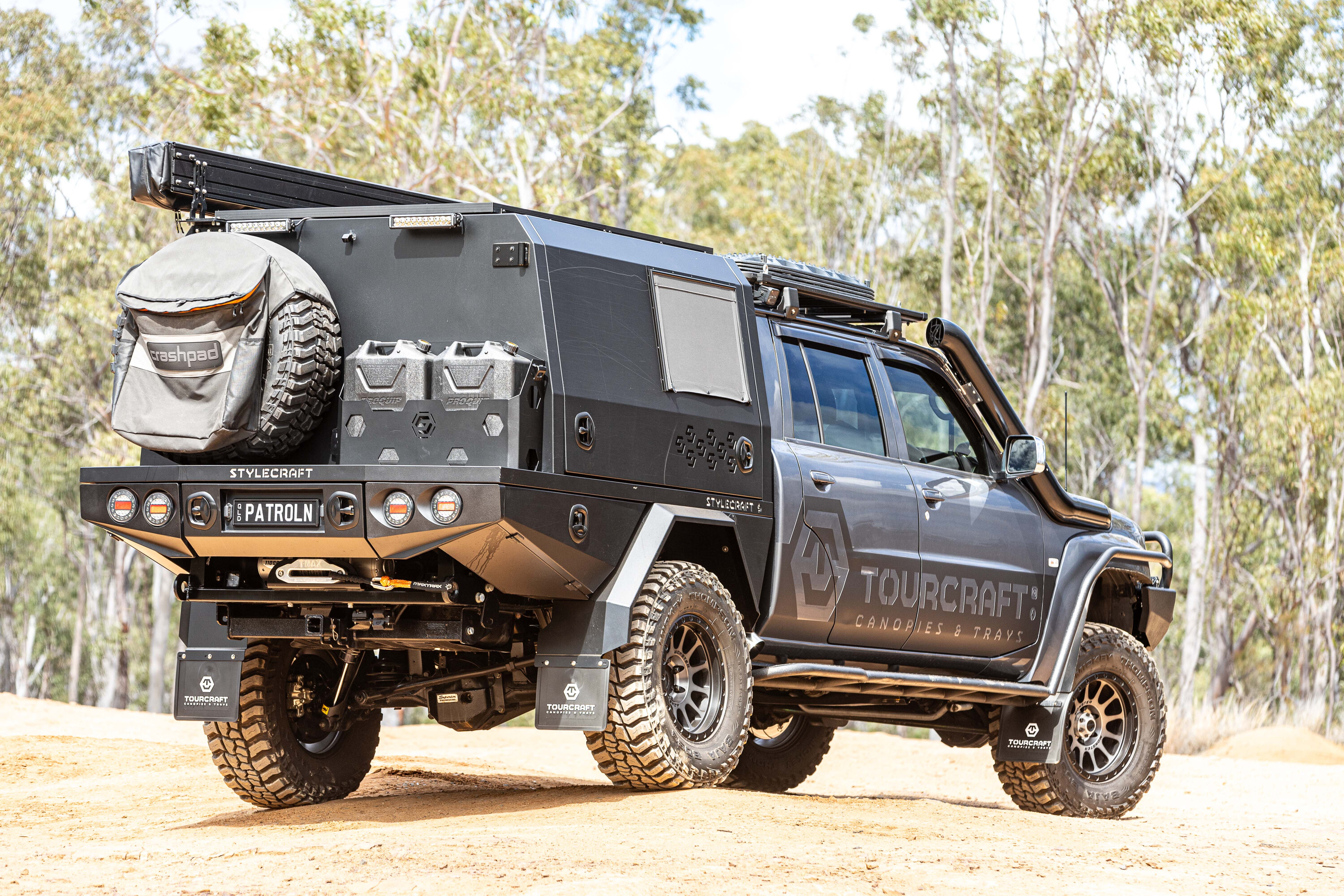
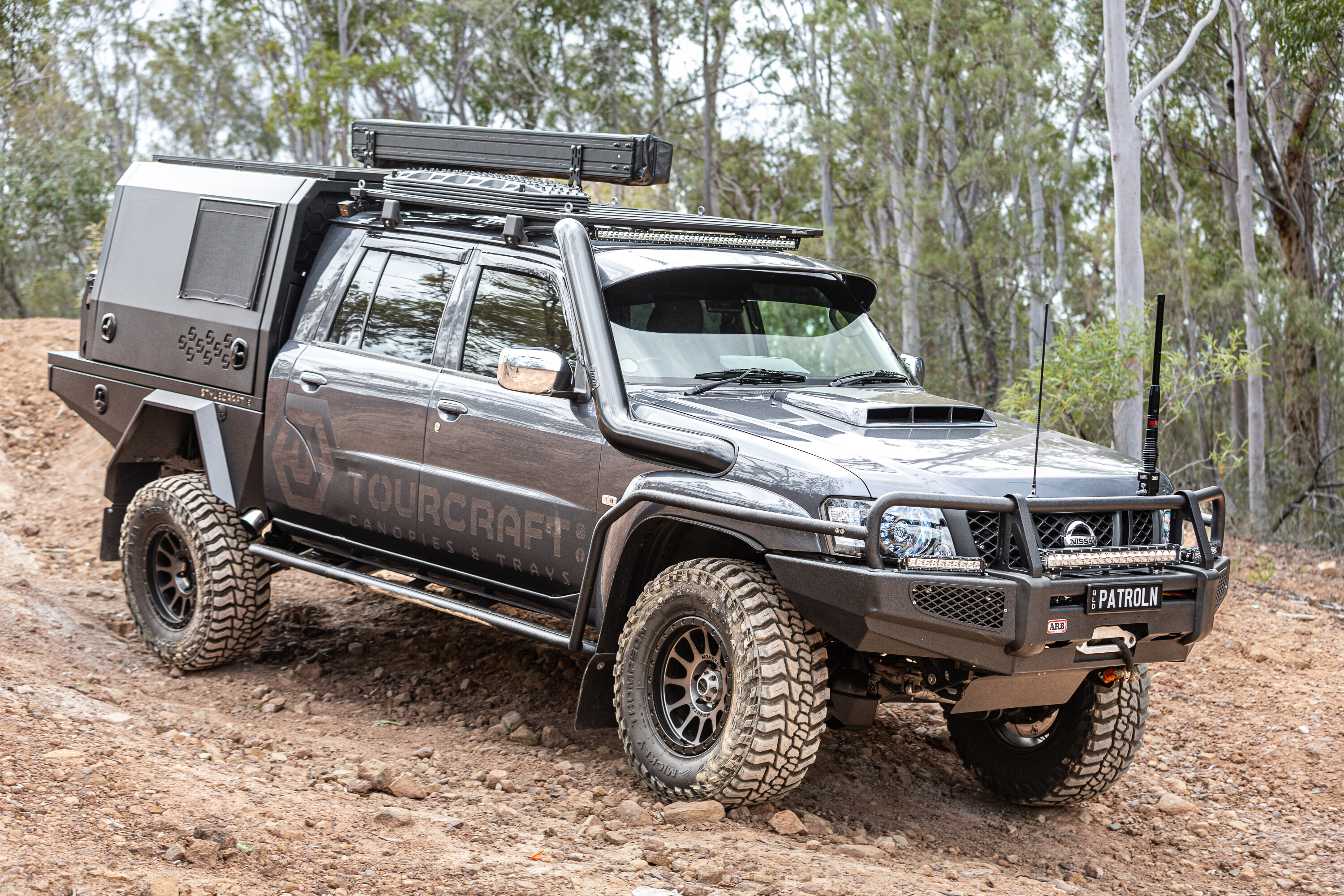
Modified GU Patrols are nothing new – people have been tweaking Nissan’s workhorse since they first came out – but very few are taken one to the level Mat Saban has taken his.
1
Ask anyone who has done an engine swap, or a ute conversion, or a custom paint job, or just thrown a bunch of suspension and 12V gear at a rig – it takes time, money, commitment and a lot of work.
Mat has done them all to his Patrol, and much of it in the form of one-off custom touches that can take days, weeks, even months of work, so to use the word impressive would be to undersell it.
Take a look at the pics and tell us this isn’t one of the most comprehensively built rigs you’ve ever seen. Hats off to you Mat; it takes a lot to blow our minds but mission accomplished.
1
Body mods
Mat is no stranger to modified 4WDs, having owned no less than four Nissan Patrols before this one, not to mention a sneaky V6 HiLux with a SAS (solid axle swap) thrown in the mix as well, so he knew exactly what he wanted out of his latest steed.
The GU’s chassis was stretched by a healthy 700mm, as well as being braced, and the much-needed coil-tower reinforcement welded on at the same time.
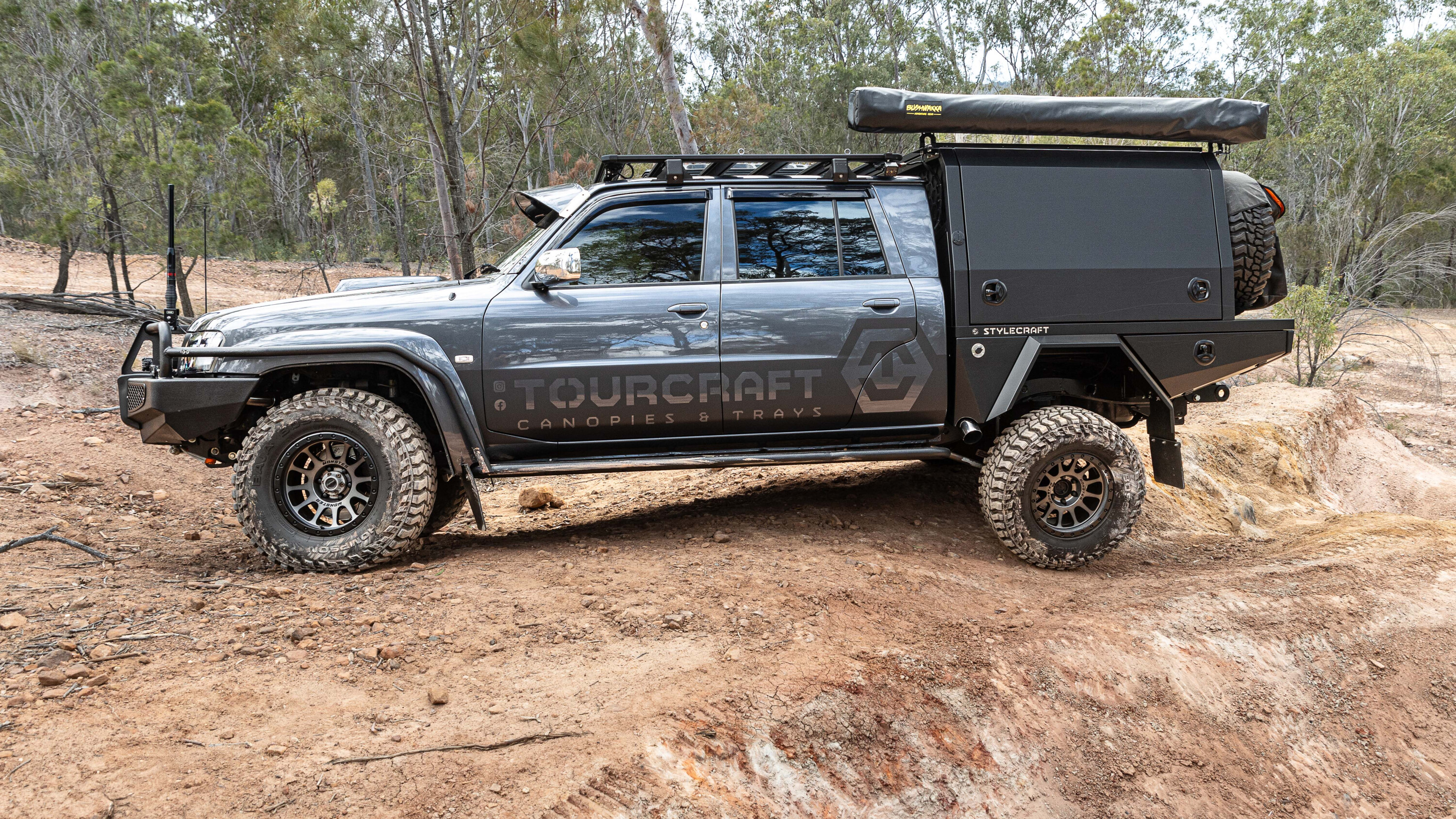
The standard Patrol wagon was artfully diced and sliced into dual-cab length and a standard Patrol rear wall grafted in. Sounds easy, but there were dozens of little tweaks and a slew of custom-made panels that had to be fabbed up to get it all Mickey Mouse, with Mat and his mate Jake handling the workload.
1
The original champagne bodywork was rubbed back and the custom Graphite Grey applied in its place, making the whole conversion look seamless and more than just a little bit pretty.
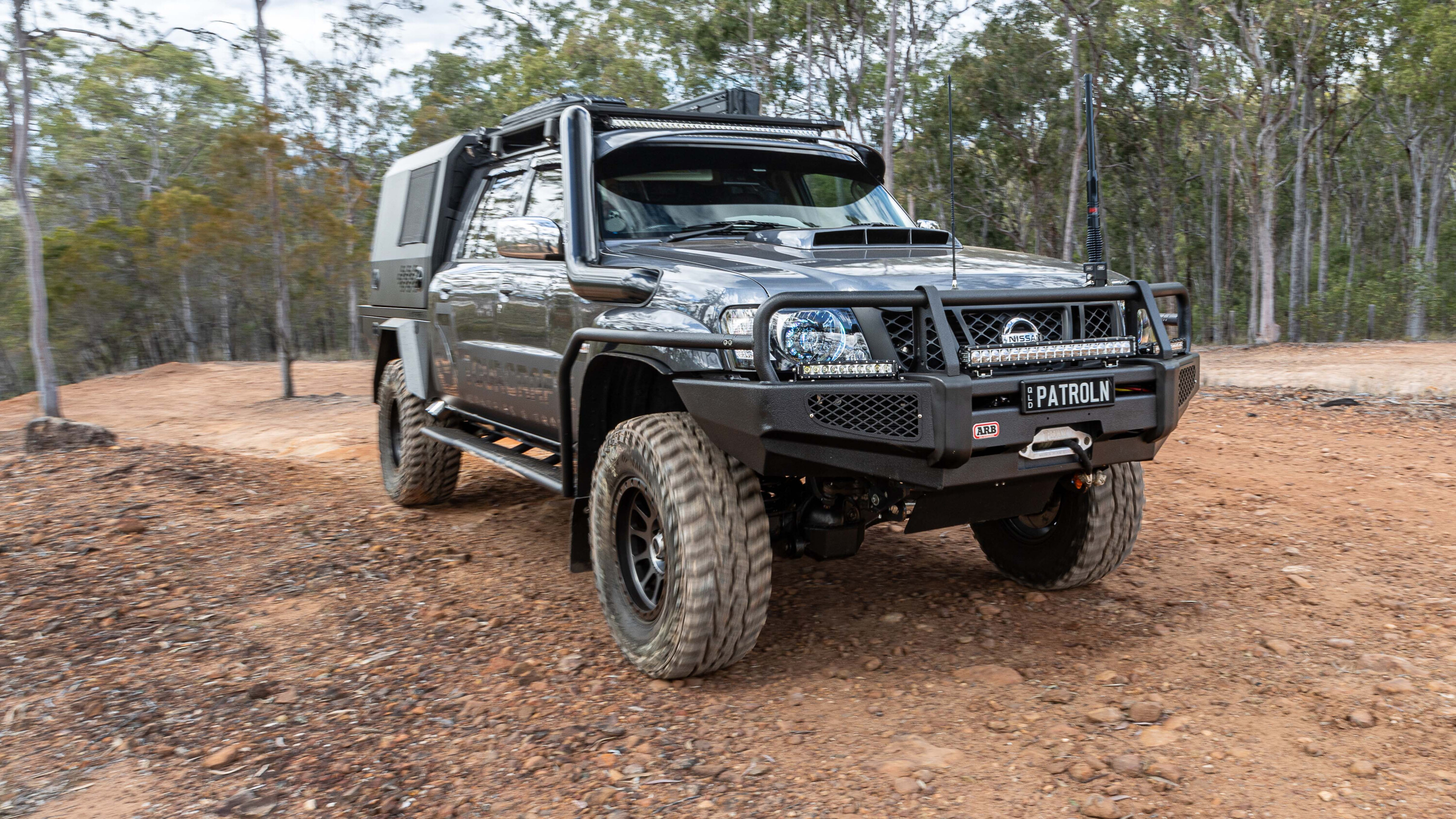
A standard ARB steel bullbar was modified to suit the gearbox coolers on either side and custom grille front pieces in either wing of the bar.
Mat then had DJZ Fabrications knock up a set of schmick-looking brush bars and sliders out of cold-drawn steel pipe – making the guards and sills essentially untouchable while off-road.
1
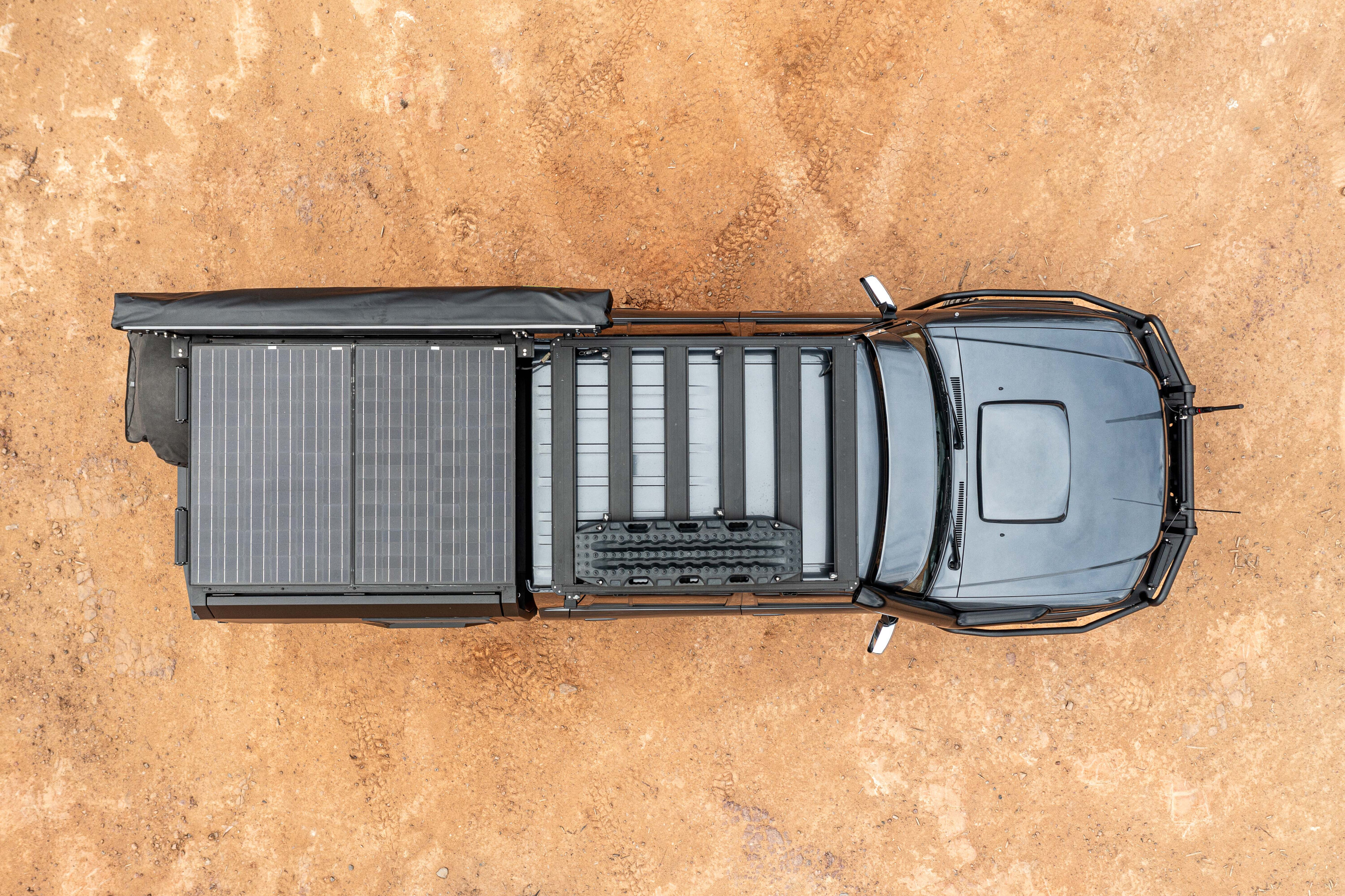
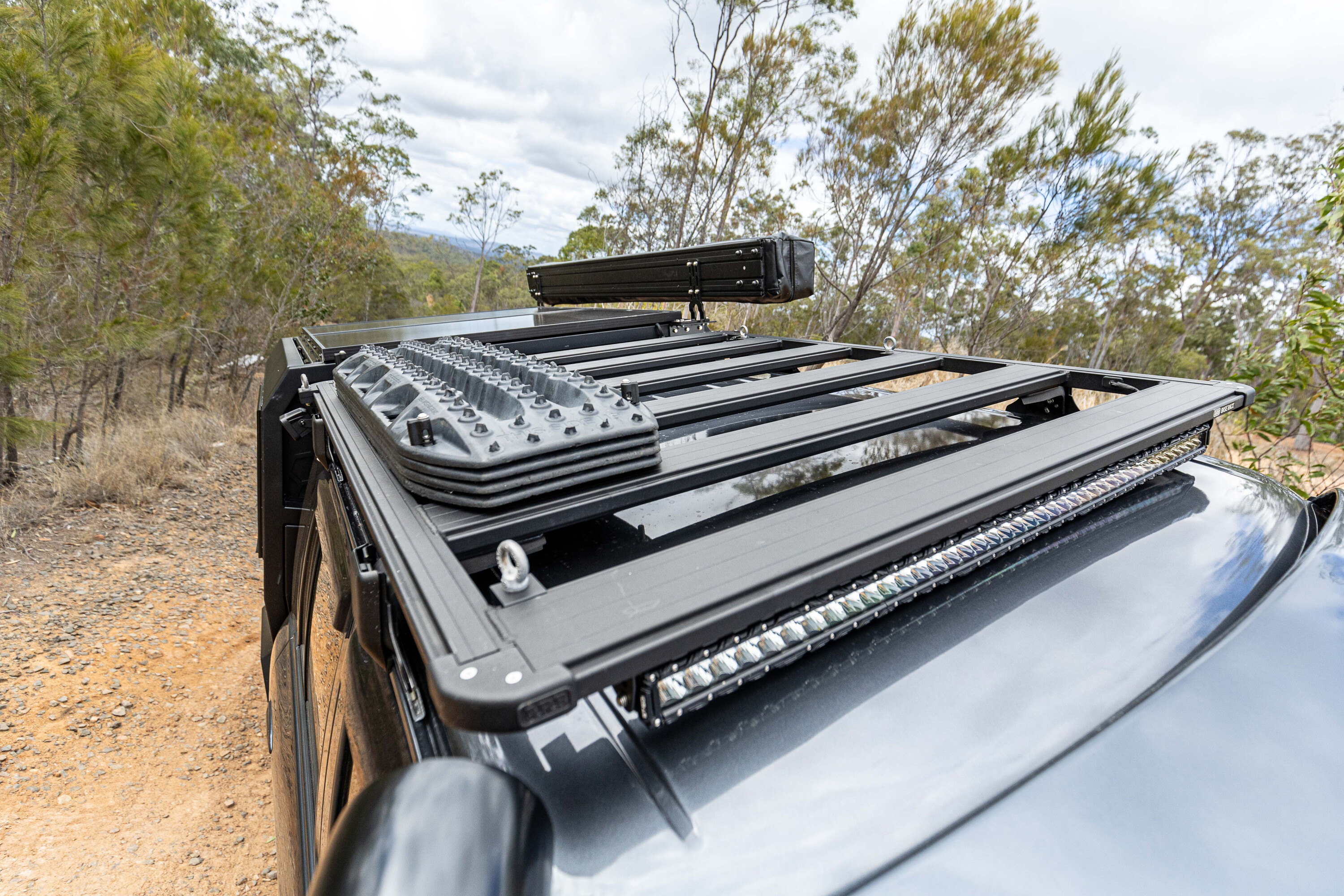
Up top, an ARB Baserack facilitates roof storage and provides the mounting point for the 40-inch Stedi light bar, while there are a pair of 11-inch Stedi LEDs on the front bar and a further 24-inch model to turn the track in front of Mat brighter than stumbling in to a 7-Eleven at 3am.
Roadvision work lights are placed strategically around the canopy and rack for camp or recovery lighting duties while the factory headlights have been turfed and replaced with Custom Steering Solutions replacement units, which literally outshine the stockers in every way.
Given Mat clearly does not do things by halves, he’s fitted up a T-Max 12,000lb electric winch on the front bar, and then a second T-Max 11,000lb electric winder out back, because that’s what all the cool kids do (and it really makes a lot of sense given a heap of recoveries require a rearwards pull).
1
Powertrain
When Mat first bought his 2006 model, it was a ZD30 backed up by the RE4 four-speed automatic.
He picked it up with the plan to swap in a TD42 backed up by the RE4, mating the better Patrol engine with the better transmission option – the best of both worlds, really. This plan worked extremely well, with Mat bumping power up in the old TD to a hefty 240hp and 700Nm through the auto on 35-inch rubber (for reference, that’s better than decent numbers for a TD42).
Unfortunately, as with a lot of worked TDs, the main bearing cap and block became victims of the crack epidemic, so Mat went back to the drawing board and decided to go with a computer controlled common-rail engine as a replacement.
1
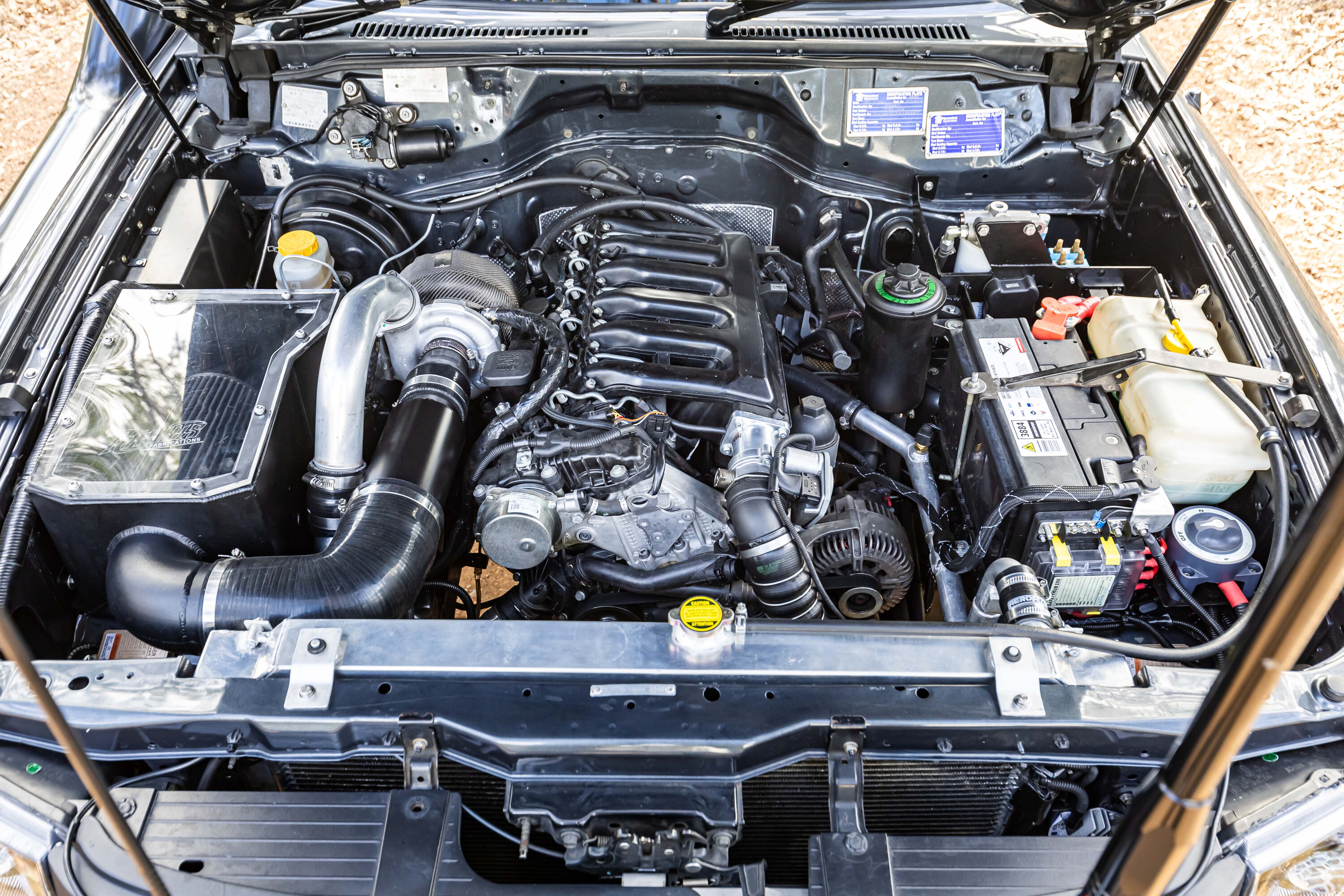
He bought a 2008 BMW X5 and extracted its M57 TUE2 3.0L straight-six, all-alloy turbo-diesel, threw a new set of timing chains and seals at it, then relocated it into the GU’s engine bay.
Of course, it’s never that easy. The RE4 was sent to JD transmissions for a full rebuild and billet torque converter, along with a Compushift 2 computer to make the internals do their thing. ASLmods supplied the M57 to RE4 adapter plate, but it had been designed around the older M57 iron blocks so Mat had to tweak the mounts to make it work with his alloy-block engine.
As with any conversion, there were a few niggles that needed sorting along the way. An electronic boost actuator that was earthed through the ECU needed to be grounded to the body, which caused a few late-night head-scratching sessions, but with the help of Ash from Fusion Fab Industries,
1
Mat worked his way through them and got it all running better than a stocker.
With only 136,000km on the new engine and with a full service history, the Beemer powerplant was barely run in and more than capable of putting out some big numbers on the dyno.
Despite that, Mat has been too busy enjoying driving his Patrol to worry too much about it, but he did mention a high-flow turbo and possibly larger injectors are next on the cards.
1
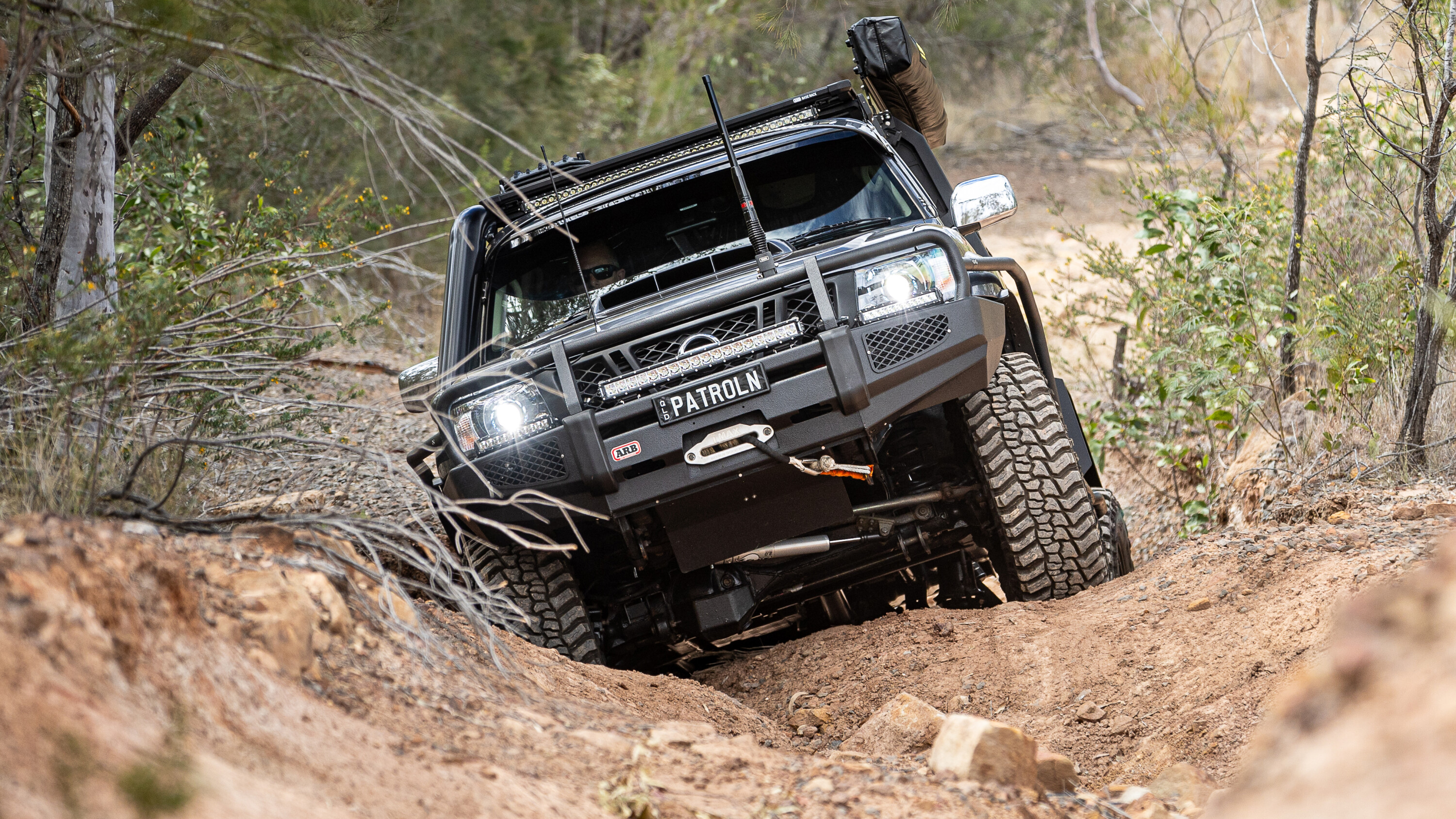
Still, he did add a 5-inch stainless steel snorkel to get the air in through a Radius Fabrications airbox, then the air-charge gets shot through the Dats Cool Fabrication front mount before being shoved into the combustion chamber, and the spent gasses are pushed out the back via a 4-inch custom stainless exhaust built by Mark from Tourtec and Derek from DJZ Fabrication.
The exhaust exits from twin 4-inch side pipes and Mat mentions it took 26 custom pieces in the new dump and crossover pipe, you know, just in case you were thinking something like this was easy.
A TB45 alloy radiator and twin 16-inch Spal fans were fitted up and the vehicle was then delivered to Dale at Performance 4X4 to be given a tune that saw it put down over 266hp and 690Nm to the rollers. That’s on 35s, too!
1
Suspension and driveline
All that power travels down a custom two-piece tailshaft (necessitated by the frame stretch) via the standard Patrol transfer case.
Well, standard transfer housing anyway; the interior has all been rebuilt and stuffed full of Marks Adaptors 63 per cent reduction gears by Hart Transmissions. The diff centres have been re-geared to 4.6:1 to account for the 35s, and the stock spider gear assemblies were replaced with TJM Pro Lockers at both ends.
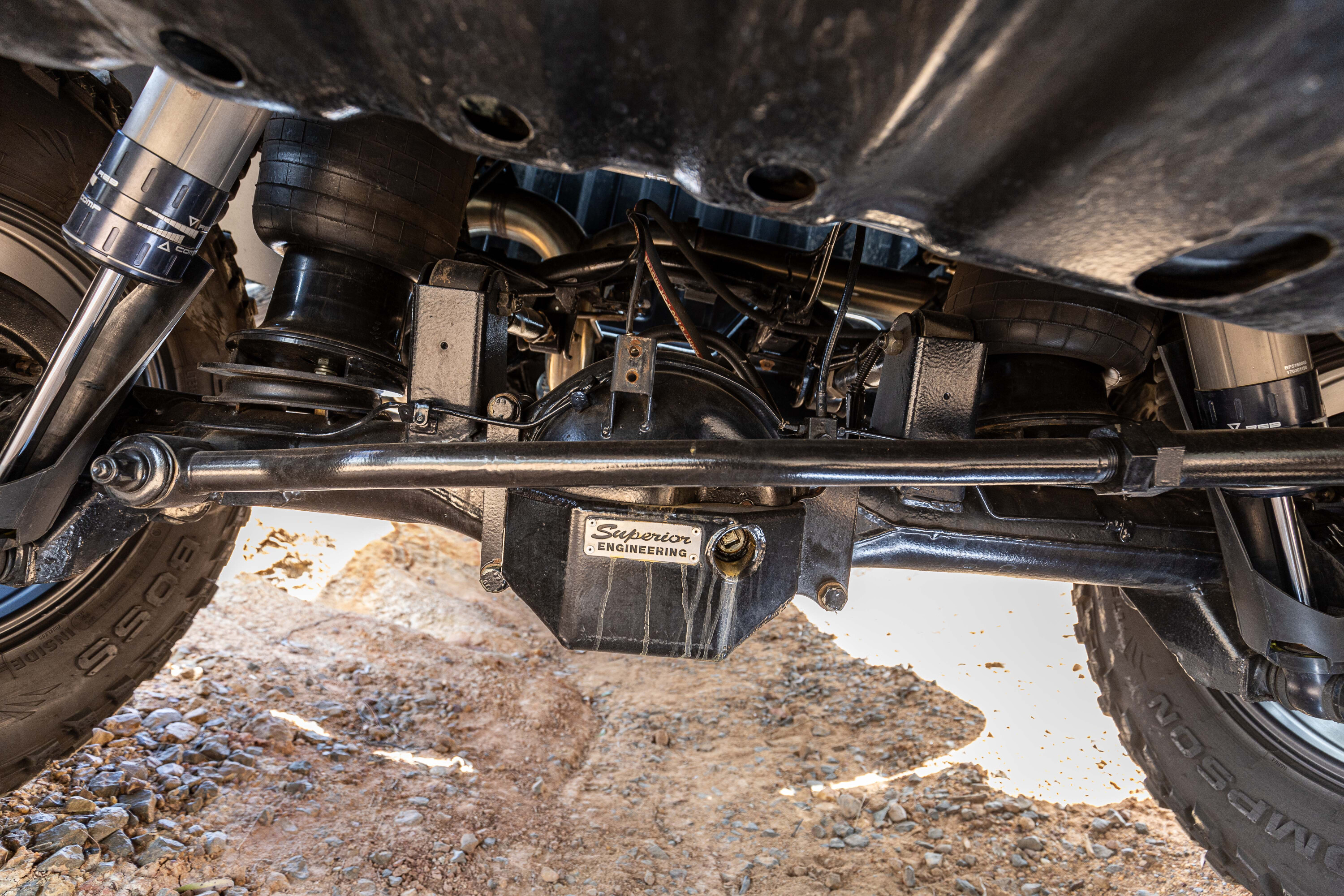
Since he was there, Mat braced both diffs with Superior Engineering gear to make them as close to bombproof as it gets. And while the shopping cart was open on the Superior website he went ahead and ordered upgraded steering links and a Fox steering damper, which he installed at home.
1
Mat ditched the coils out back and bolted in a set of custom length Airbag Man rolling sleeve airbags
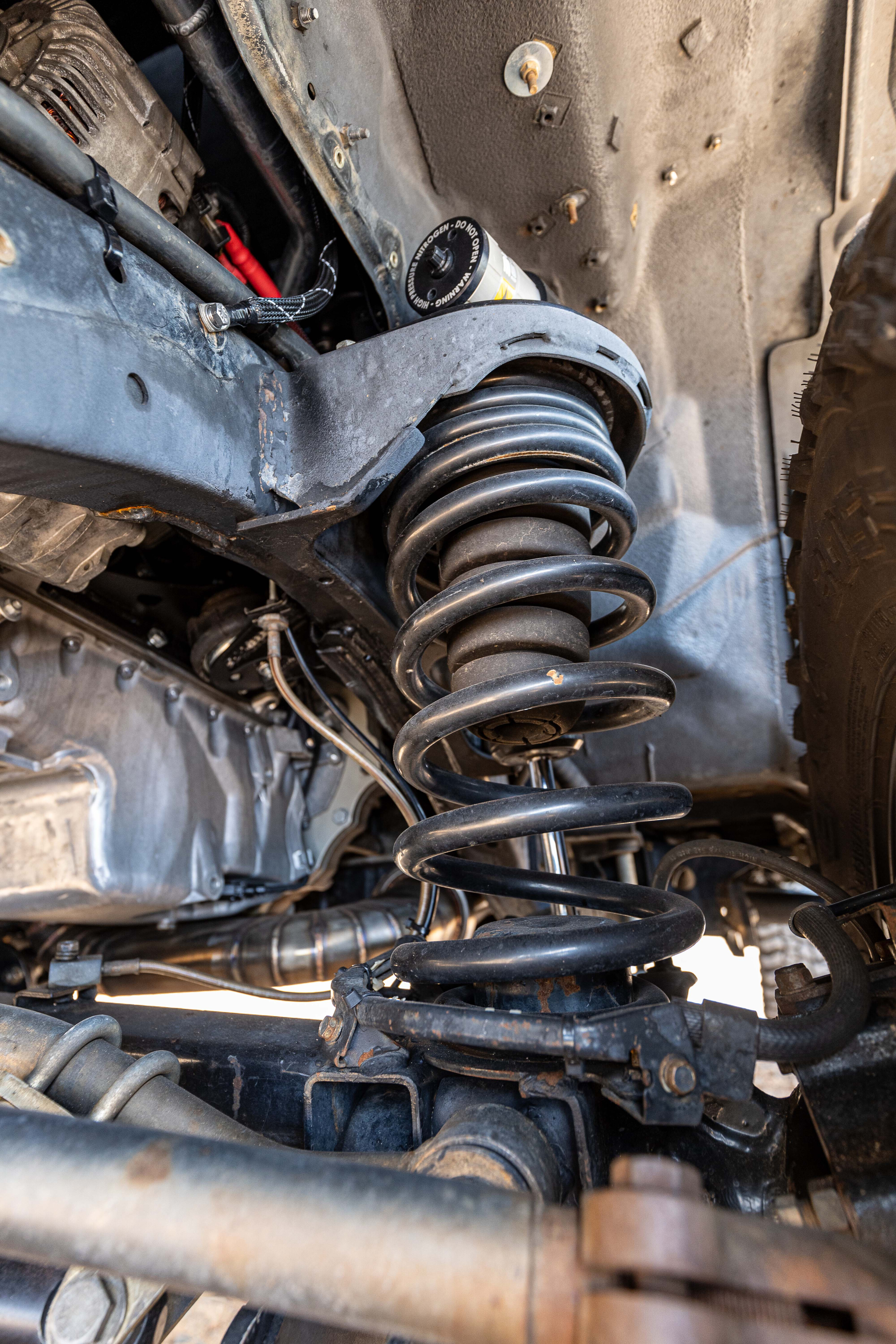
Superior Engineering was also called upon to hook Mat up with suspension; 4-inch higher coils went in at the front along with Superflex radius arms – which function to make the usually wheel-lift-happy factory arms work much better for off-road driving – as well as extended bumpstops and a Superflex swaybar to keep body roll to a minimum.
OME BP51 shocks control the compression and rebound over corrugations or larger rocks at all four corners.
Mat ditched the coils out back and bolted in a set of custom length Airbag Man rolling sleeve airbags, which are fully height adjustable and controlled from a remote keyfob.
1
They’re pumped up by one of two on board ARB compressors – one for tyre inflation, one for the lockers and bags.
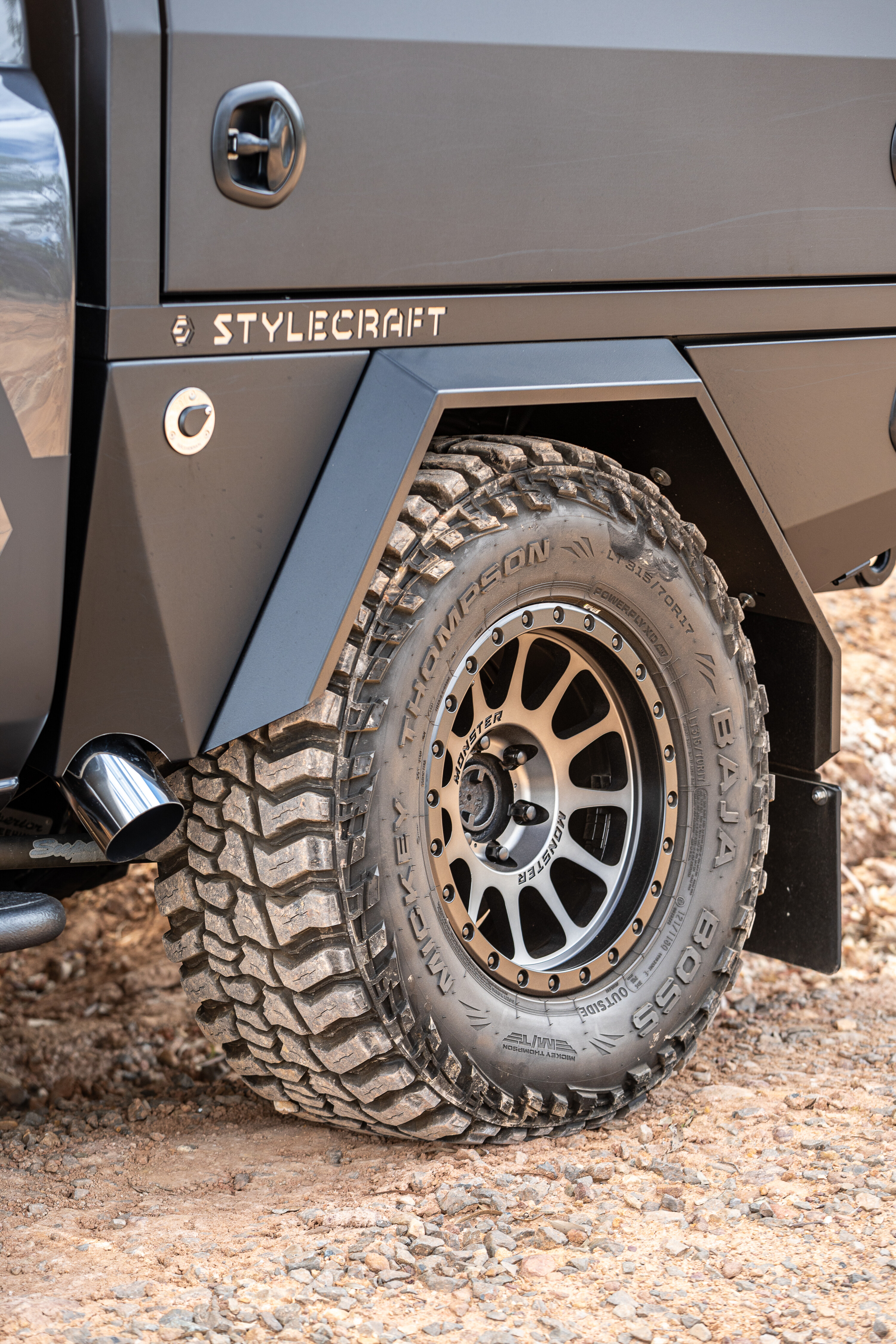
All of this suspension work allowed easy fitment of the 17×9 Monster Ammo alloy rims and 315/70R17 Mickey Thompson Baja Boss MTZ rubber.
And because Mat doesn’t like to leave any boxes unticked, the front brakes have also been replaced with custom made 355mm slotted rotors and six-piston callipers built by Rugged Brakes – the first Patrol in the country to have them. Rear brakes are controlled by a modified bias valve, with slotted rotors ramping up the cooling ability nicely.
1
Inside
Come on, you didn’t think Mat left the interior stock, did you? He tells us the only thing he hasn’t modified on this rig are the mirrors, so yeah, the inside of the Patrol is just as bananas as the outside.
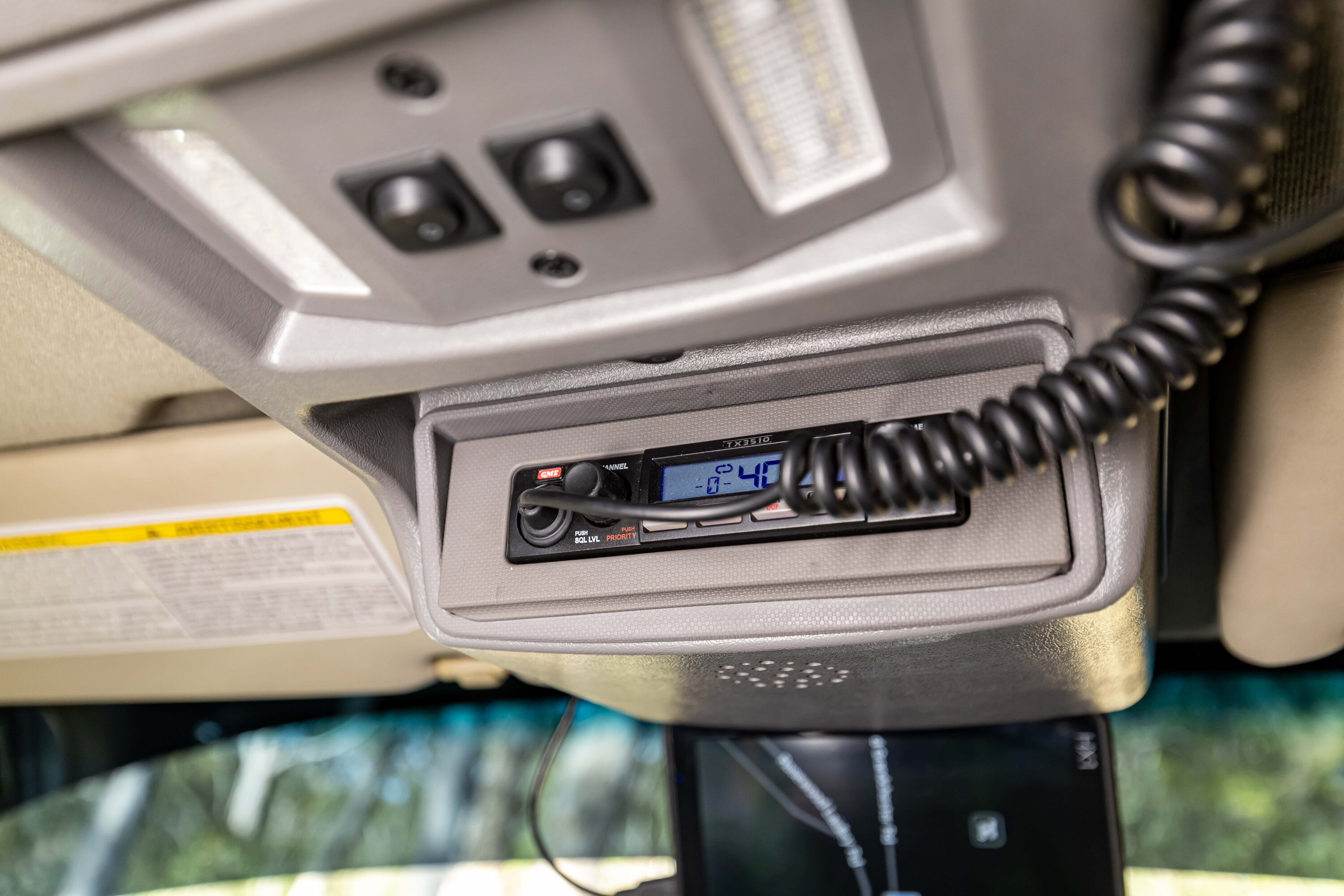
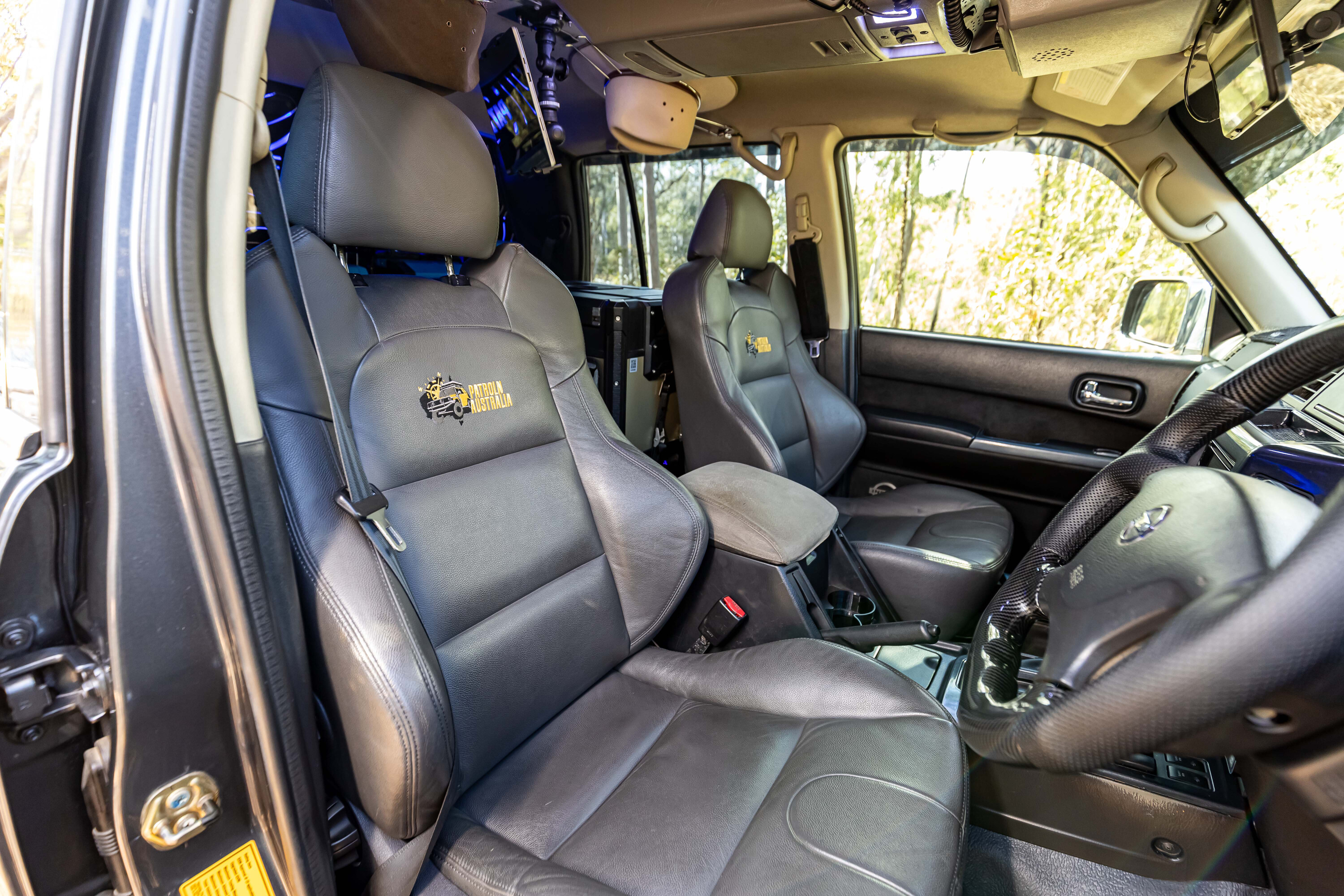
The front seats are custom made by Incharge Automotive and bolted in place with Hurricane adapters. The stereo has been upgraded with a comprehensive Pioneer sound system and the JRP 14in1 multi-gauge tells Mat pretty much everything he needs to know about what his vehicle is up to at all times.
The tiller is a Custom Steering Solutions unit, and the comms are seen to by an array of GME products. A Hema HX-1 tells Mat how lost he is while a Thuraya SatSleeve lets him make calls if he feels like bragging about his latest adventure.
1
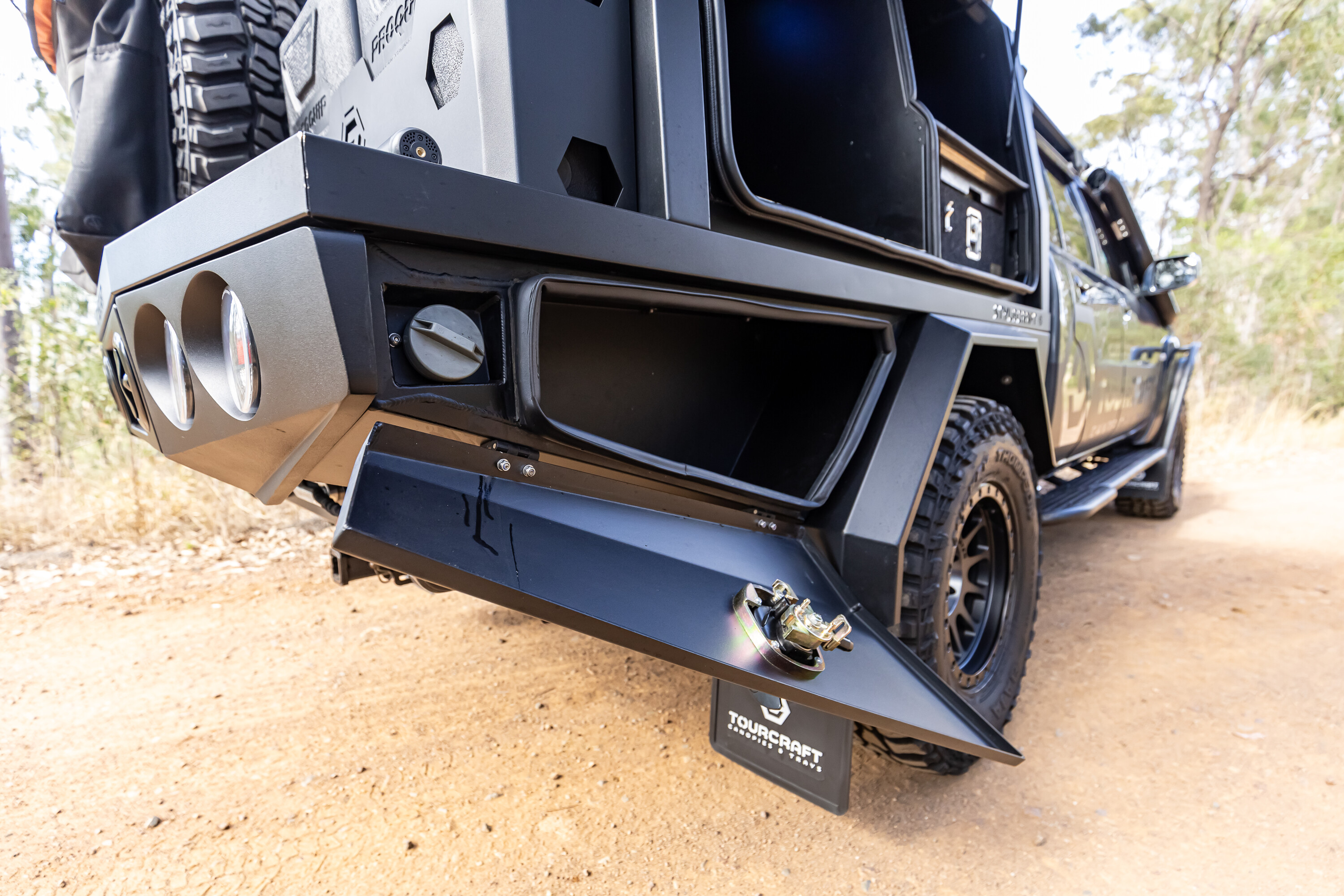
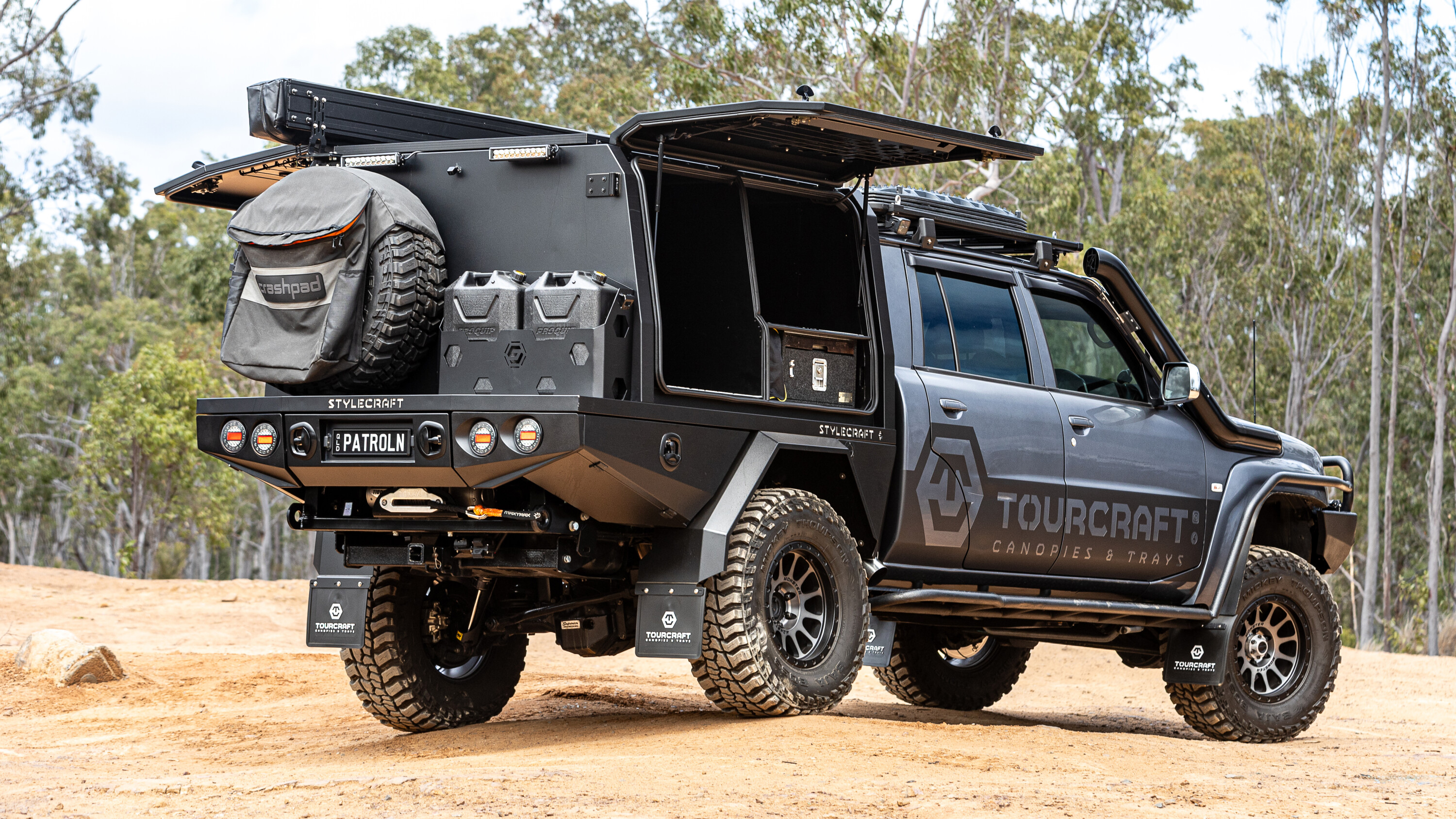
The Tourcraft Canopy has revolutionised the way Mat and his family go camping.
There’s a Drifta Drawer with table, a Tourtec custom kitchen and pantry, and a 40L poly water tank in the headboard fed by a 12V under-tray pump. There’s 300W of solar on the roof and a Smarttek hot water system for remote country showers.
The rear bulkhead holds twin jerries and the spare, a mount for the shower tent, 240V outlet and a pair of storage boxes.
1
Electrickery
Mat reckons his battery system was initially designed for an off-grid caravan to live remotely almost indefinitely, so it should be just enough for his Patrol for a few weeks (or years) in the scrub.
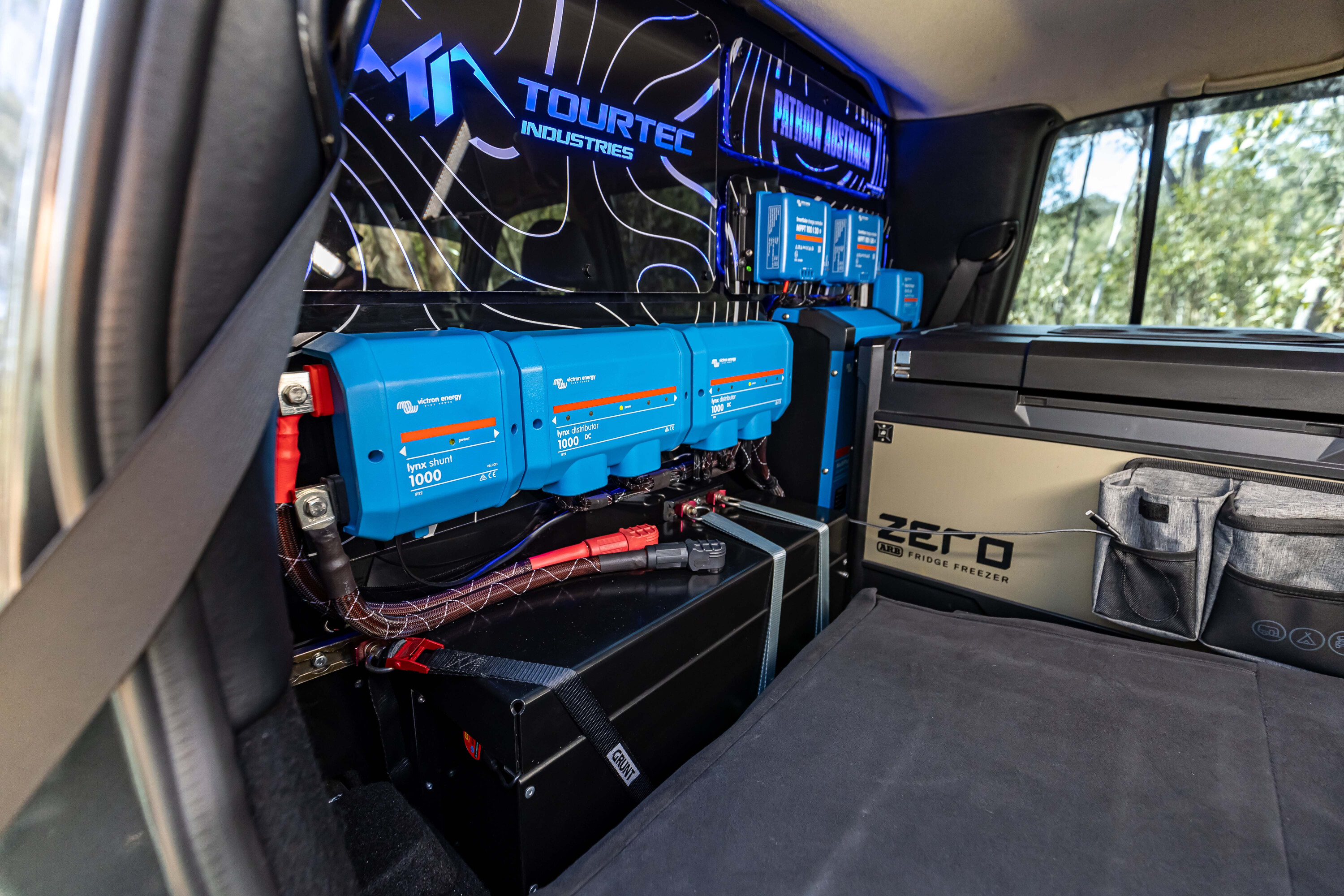
The heart of the system is a behind-the-back-seat custom-built 560Ah Lithium by Tourtec Industries.
The brains are courtesy of top-shelf Victron gear – twin 30A Smart Chargers, two 30A MPPT solar controllers, twin Lynx distributors, a Lynx shunt, a Multiplus 300W inverter and a Cerbo-S GX 9-inch screen to tell Mat what’s going on. Probably needed if he ever decides to power up his own Iron Man suit in a cave on the west coast of Tassie…
1
Where to from here?
Speaking of Tasmania, Mat has already conquered it in his Patrol and is keen to put a lot more remote miles on the odometer before long.
If this isn’t pretty much the ideal vehicle for the job we’d be hard-pressed to think of a better one. Of course, he has a few more things he wants to get done, but that’s to be expected from a build of this magnitude – they’re never finished.
We have to take our hats off to you mate; this has to be one of the most versatile, practical and downright impressive vehicles in the country. The most modified Patrol in the country? We’d love to see another rig step-up to challenge for the title.
1
MORE
Everything Nissan
Four-wheel drives, utes and the like aren’t known as being the quietest vehicles on the road.
While 70 Series LandCruisers take interior noise levels to new heights, its cavernous interior makes the Troopy not much more than an unrefined boom box. Having previously owned a 79 Series Cruiser, which I had lined myself with a well-known brand of sound deadening material, for this new Troopy with its wide open and bare interior, I knew I wanted something more effective.
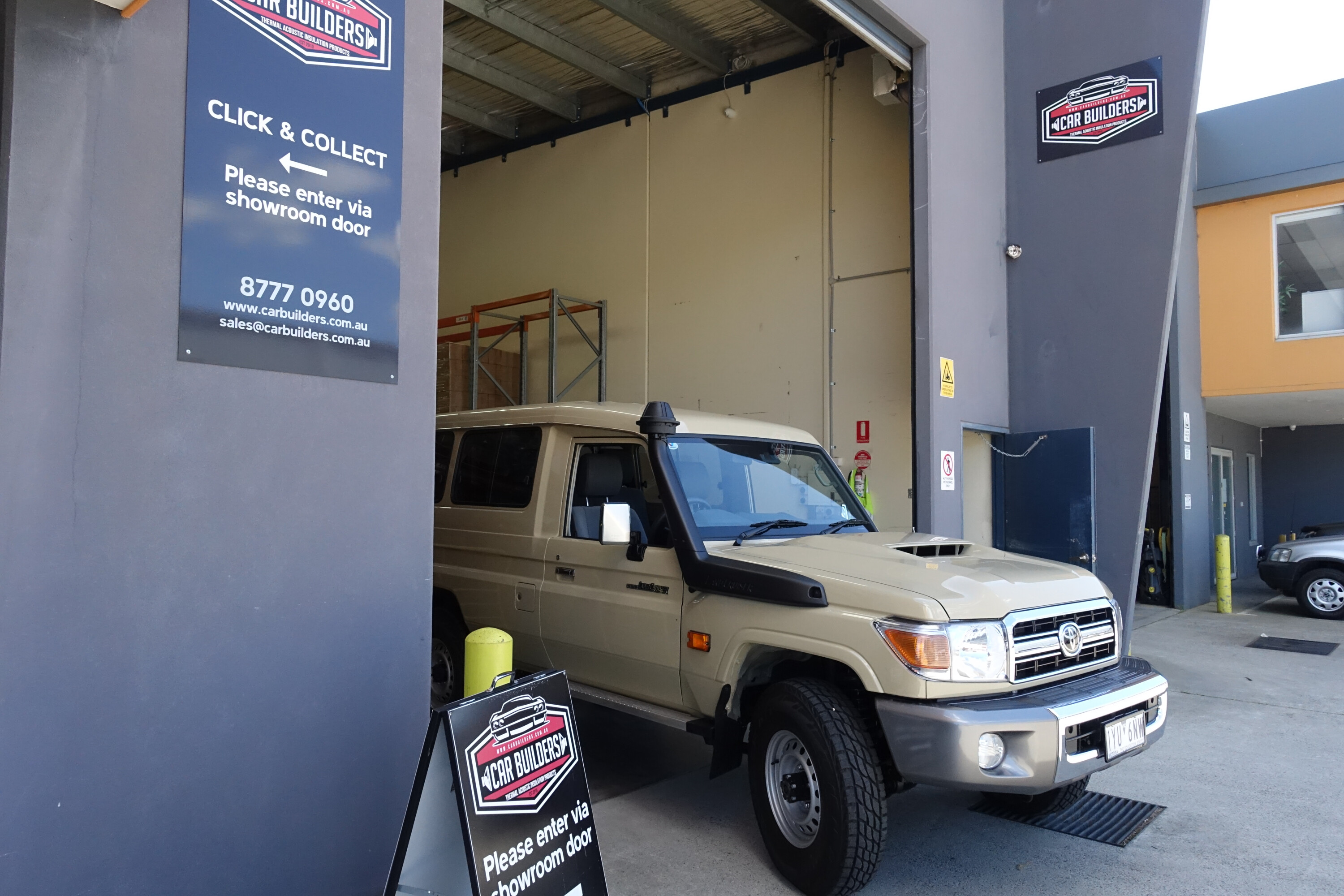
I ended up at Car Builders in Bayswater, Victoria, which specialises in supplying kits for DIY-type people wanting to reduce the noise levels in their vehicles. While there are a number of kits specifically for the Toyota TroopCarrier, there’s also a heap of vehilce-specific options for other 70 Series models, as well as all the popular 4×4 utes and wagons. For those doing the installation themselves, Car Builders can also supply all the equipment needed for installing the product.
3
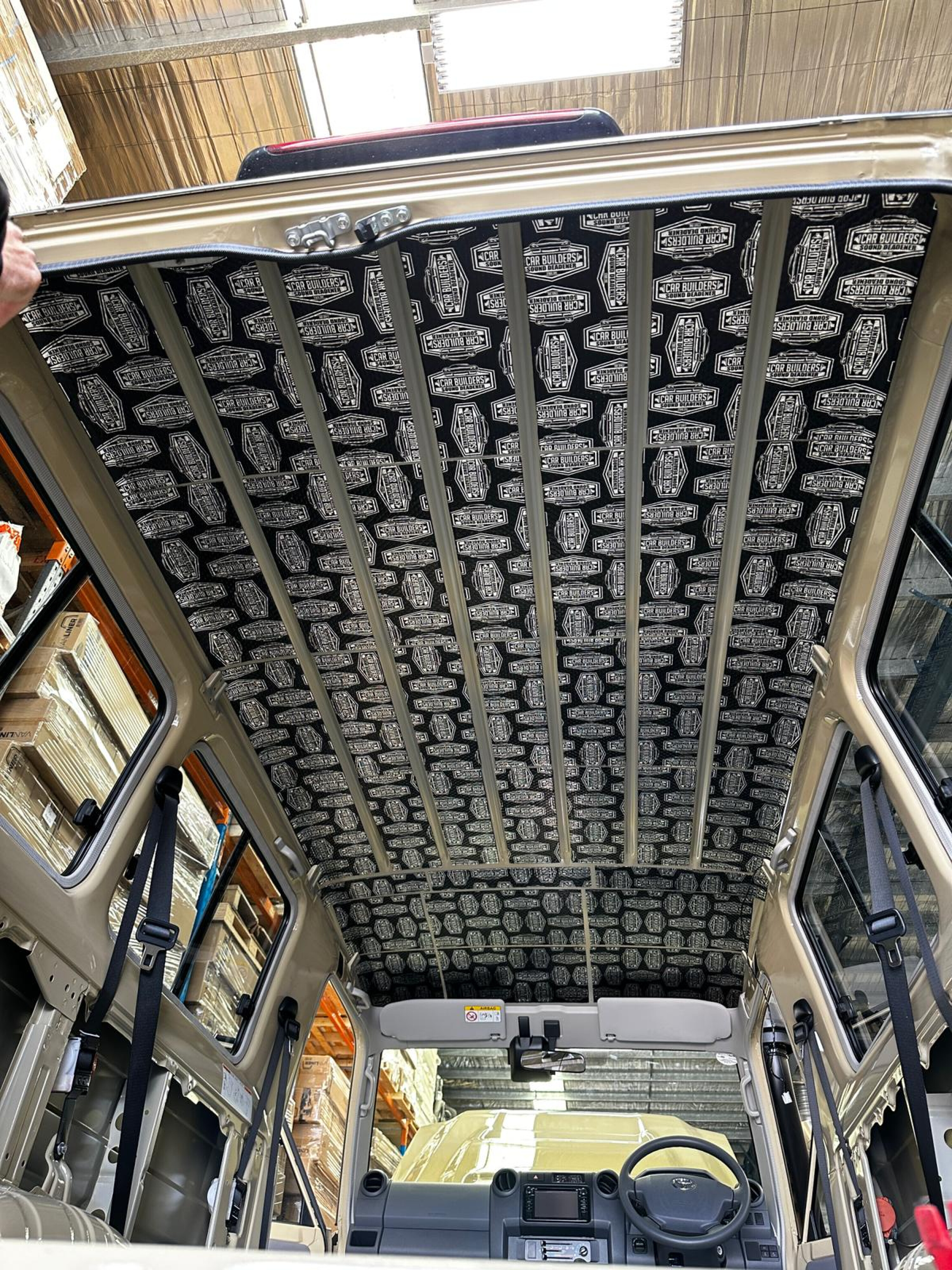
I opted for Car Builders to do the whole job, which was to supply and fit a premium pack which includes Sound Deadener that’s applied to the floor pan, rear firewall, roof and door skins, and a Mass Noise Liner which is a premium carpet underlay to cover the entire floor pan from front to rear firewall.
The Mass Noise Liner is laid over the top of the Sound Deadener and really helps tame the noise level in the Troopy. For the vast expanse of roof that the Troopy has, we fitted Sound Deadener only, which fits under the factory headliner. You can fit a 6mm thick Insul-Layer but you then have to replace the factory headliner with carpet or fabric, and that was something I didn’t think was really necessary.
All seats, internal skins on doors, and floor carpet, along with the factory headliner, are removed to fit the insulation and once installed everything is fitted back in place. The job was so neat and tidy that you couldn’t tell that anything had been added without a close inspection and lifting the edge of the factory carpet… but the driving experience was something else!
2
After the job was complete, I drove out onto the highway and immediately noticed the difference in the noise level inside the vehicle. Engine noise and road noise was greatly muted, as was wind noise once up to speed.
I didn’t even have to crank up the radio when cruising at 100km/h. The kit installation made a huge difference and it was a pleasant change from how the Troopie comes out of the factory.
Pricing
- Single-cab ute: from $389
- TroopCarrier: from $570
- Roof Sound Deadener: $190
- Quarter panels only (Troopy): $175
- Premium kit, plus roof liner, plus floor underlay kit (Troopy): $1157