4x4 Comparisons


Gallery 1
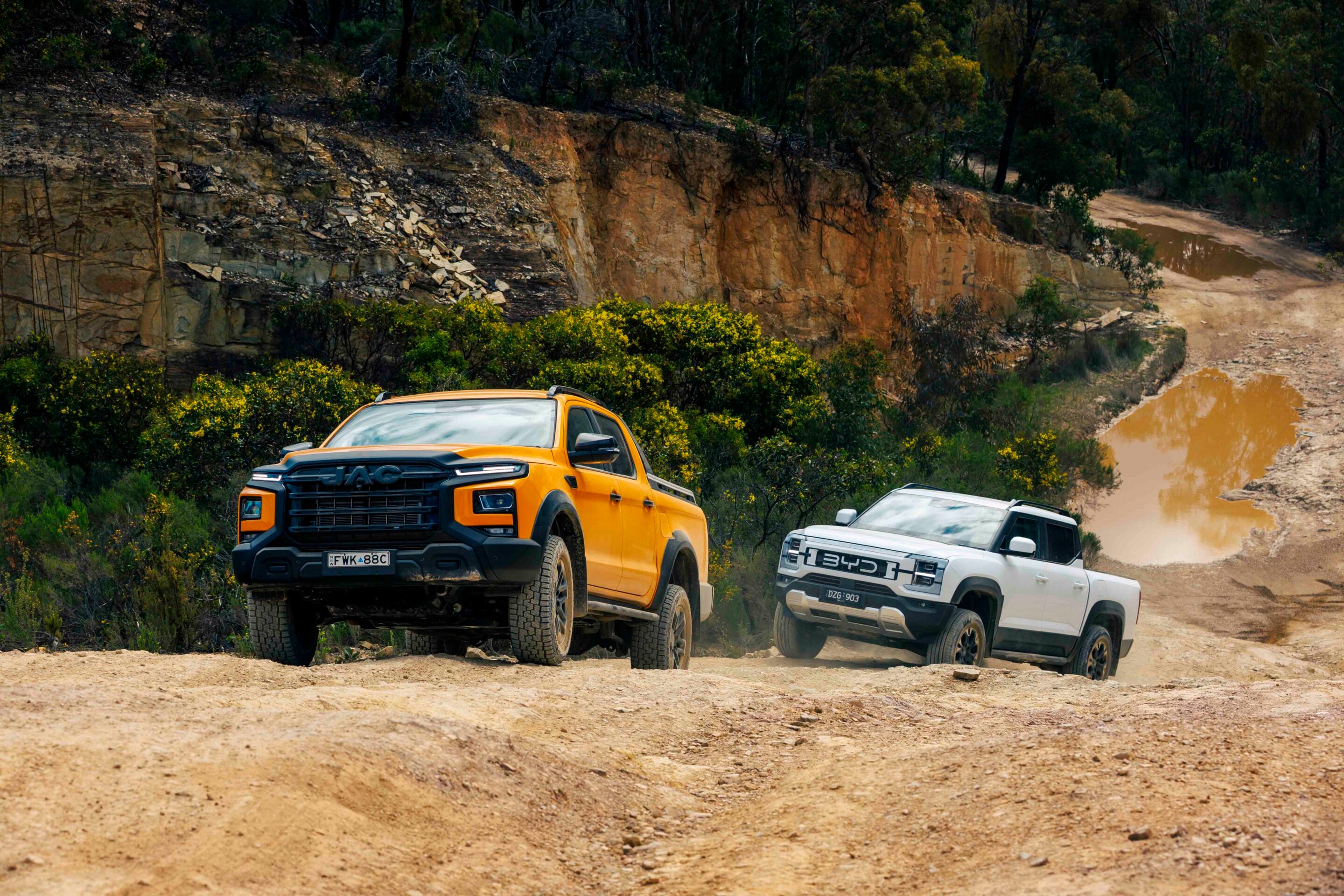
For decades, choosing a dual-cab ute meant choosing between different versions of essentially the same recipe: Diesel engine, automatic gearbox, ladder chassis and a mechanical four-wheel-drive system. Then BYD threw the recipe in the bin and set fire to it.
The Shark 6 proved Australians were prepared to buy a plug-in hybrid ute that prioritised performance, refinement and electrification over tradition, and buy it in serious numbers. More importantly, its aggressive pricing has forced everyone else to respond.
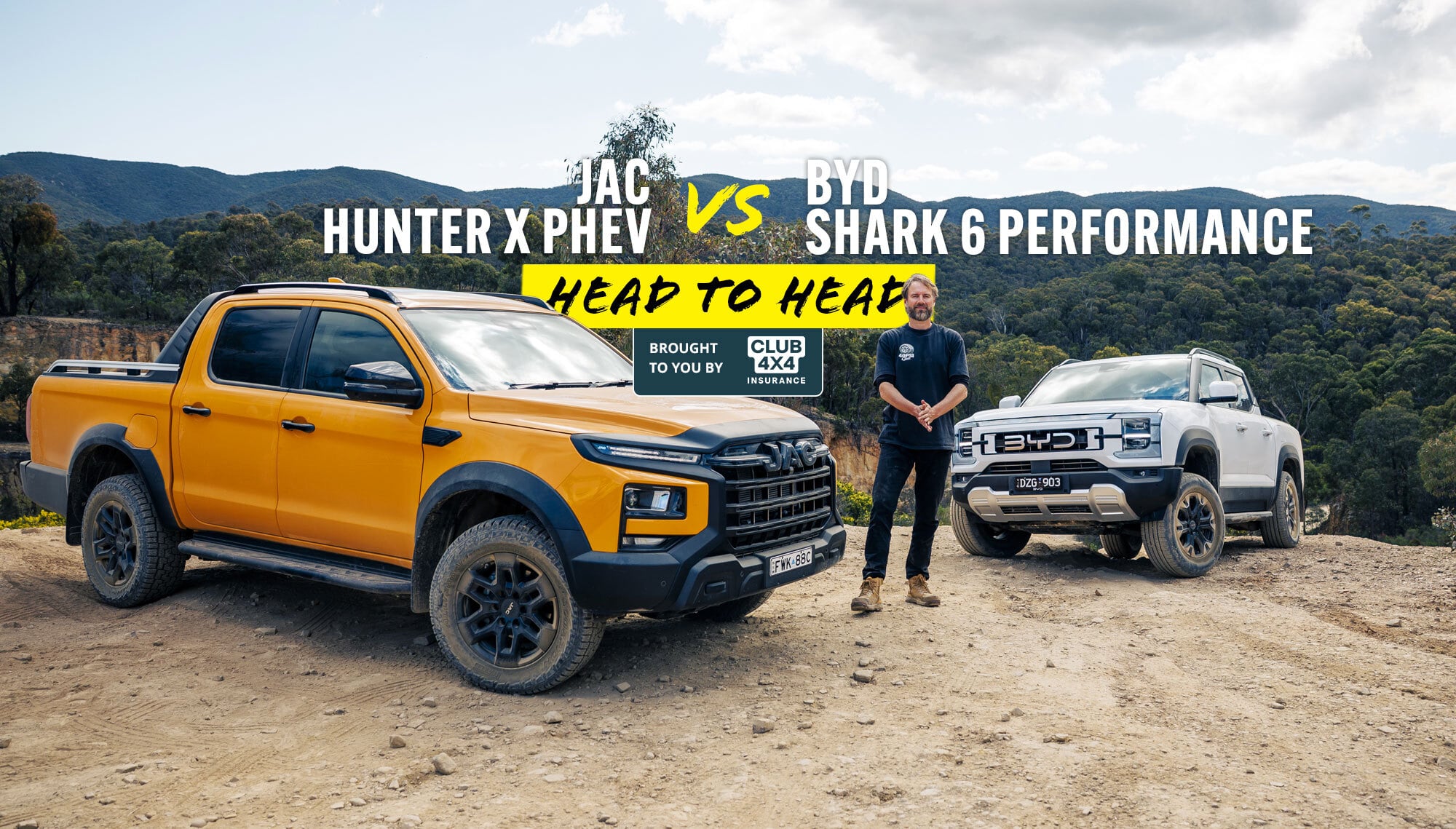
The JAC Hunter X might be the clearest evidence yet. At just $54,844 before on-roads, it brings PHEV performance to an even lower price point, but wraps it in a package that feels considerably more familiar to the traditional ute buyer. And that’s what makes this comparison interesting. The Hunter isn’t simply a cheaper Shark. In several important ways, it’s actually the more conventional and capable ute.
But utes aren’t just workhorses anymore. They’re family cars, tourers, commuters and weekend toys. So, does sticking closer to tradition make the Hunter the smarter buy, or has BYD already shown us what the modern ute should be?
Meet the contenders
The BYD Shark 6 didn’t just arrive in Australia’s dual-cab market, it effectively created the affordable plug-in hybrid ute segment. More than 30,000 Australian sales later, the formula has clearly found an audience, and competitors are arriving quickly.
A PHEV combines a conventional petrol engine with a sizeable battery and electric motors, allowing shorter trips to be completed largely or entirely on electricity while retaining petrol power for longer journeys. In a ute, that also means enormous performance potential and a useful source of electrical power at camp.
BYD proved Australians were ready for the idea. Now JAC wants a piece of it. At $54,844 before on-road costs, the Hunter X undercuts the $62,900 Shark Performance by $8056. Its 2.0-litre turbo-petrol PHEV system produces a claimed 360kW and 1010Nm of calculated driveline torque, against the BYD’s 350kW and 700Nm.
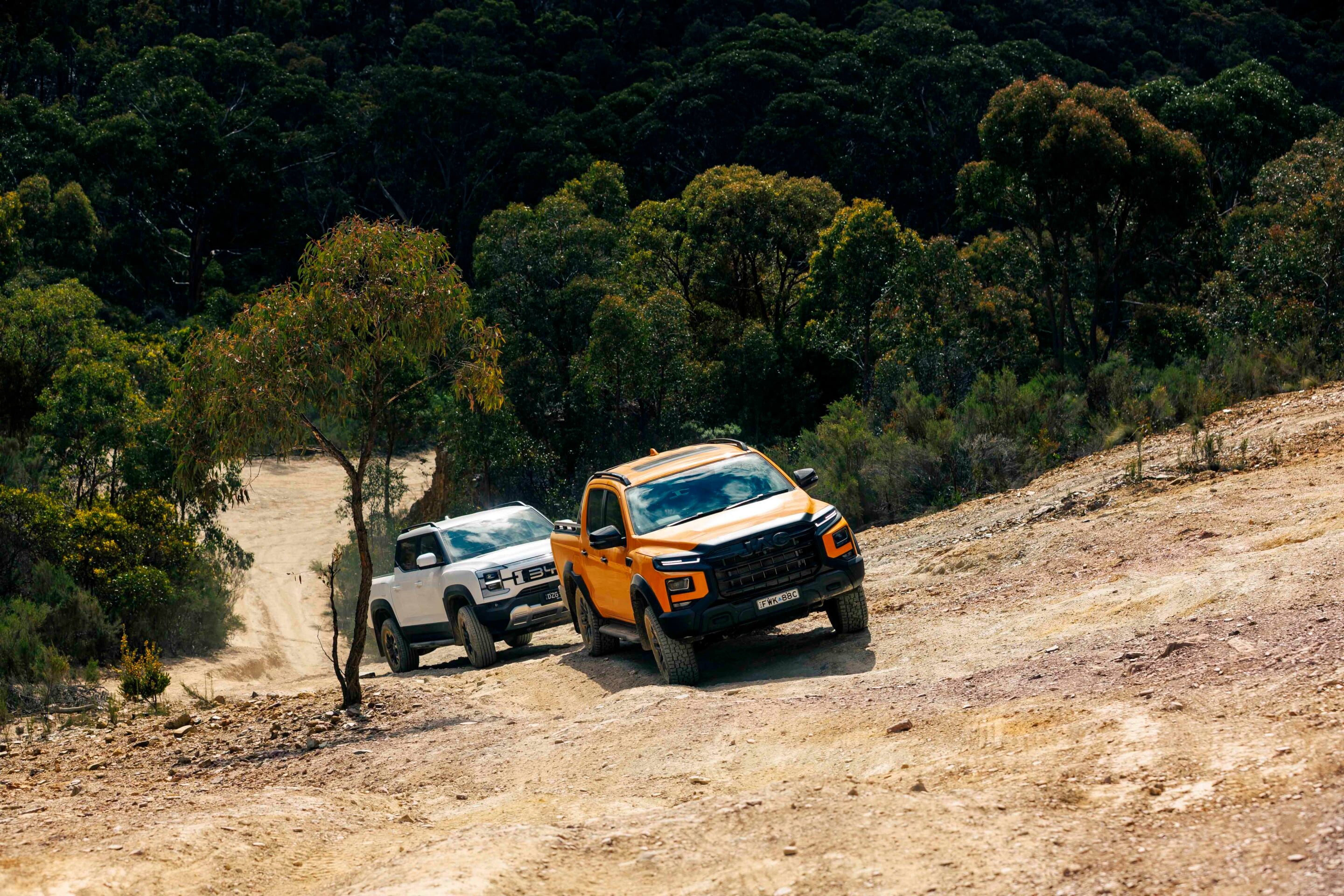
But the numbers disguise two very different approaches. The Hunter brings a live rear axle, front and rear differential locks, 915kg payload and Pirelli all-terrain tyres. The Shark uses independent suspension, sophisticated electronic traction management and serious performance. Essentially, JAC is applying PHEV technology to a fairly traditional ute formula; BYD has already shown the ute itself can be reinvented.
1
Payload, towing and practicality
The biggest practical difference between these two starts with kerb weight.
The Hunter X weighs 2555kg, a substantial 220kg less than the 2775kg Shark Performance. Despite very similar GVMs – 3470kg for the JAC and 3500kg for the BYD – that weight saving translates directly into payload: 915kg for the Hunter versus just 725kg for the Shark. That’s a significant advantage once you start treating them like utes.
Hook up a 2000kg camper with around 200kg of towball download and the Hunter retains roughly 715kg of payload, compared with 525kg for the Shark. There’s useful capacity in both, but considerably more breathing room in the JAC for passengers, accessories and camping gear. At the full 3500kg tow rating, however, GCM becomes the equaliser. The Hunter’s 6430kg GCM and Shark’s 6650kg limit leave both with only around 375kg above kerb weight for everything added to the vehicle.
We didn’t tow them, but the lighter Hunter, substantially greater payload and live rear axle gives it the stronger towing proposition on paper.
| JAC Hunter X | BYD Shark 6 Performance | |
|---|---|---|
| Kerb weight | 2555kg | 2775kg |
| GVM | 3470kg | 3500kg |
| Payload | 915kg | 725kg |
| GCM | 6430kg | 6650kg |
| Braked towing | 3500kg | 3500kg |
| Fuel tank | 77L | 60L |
| Battery | 31.2kWh LFP | 29.6kWh |
| Length | 5330mm | 5457mm |
| Width | 1965mm | 1971mm |
| Height | 1920mm | 1925mm |
| Wheelbase | 3110mm | 3260mm |
| Ground clearance | 200mm | 230mm |
| Wading depth | 550mm | 700mm |
1
Cabin, comfort and everyday driving
At two metres tall, I notice driving positions quickly.
In the Hunter I’m perched high, knees closer to the wheel than I’d like, but the payoff is a commanding view down the bonnet and along the vehicle’s flanks. Jump into the Shark and I immediately drop down into it rather than sit on it. It feels wider, quieter and more enveloping.
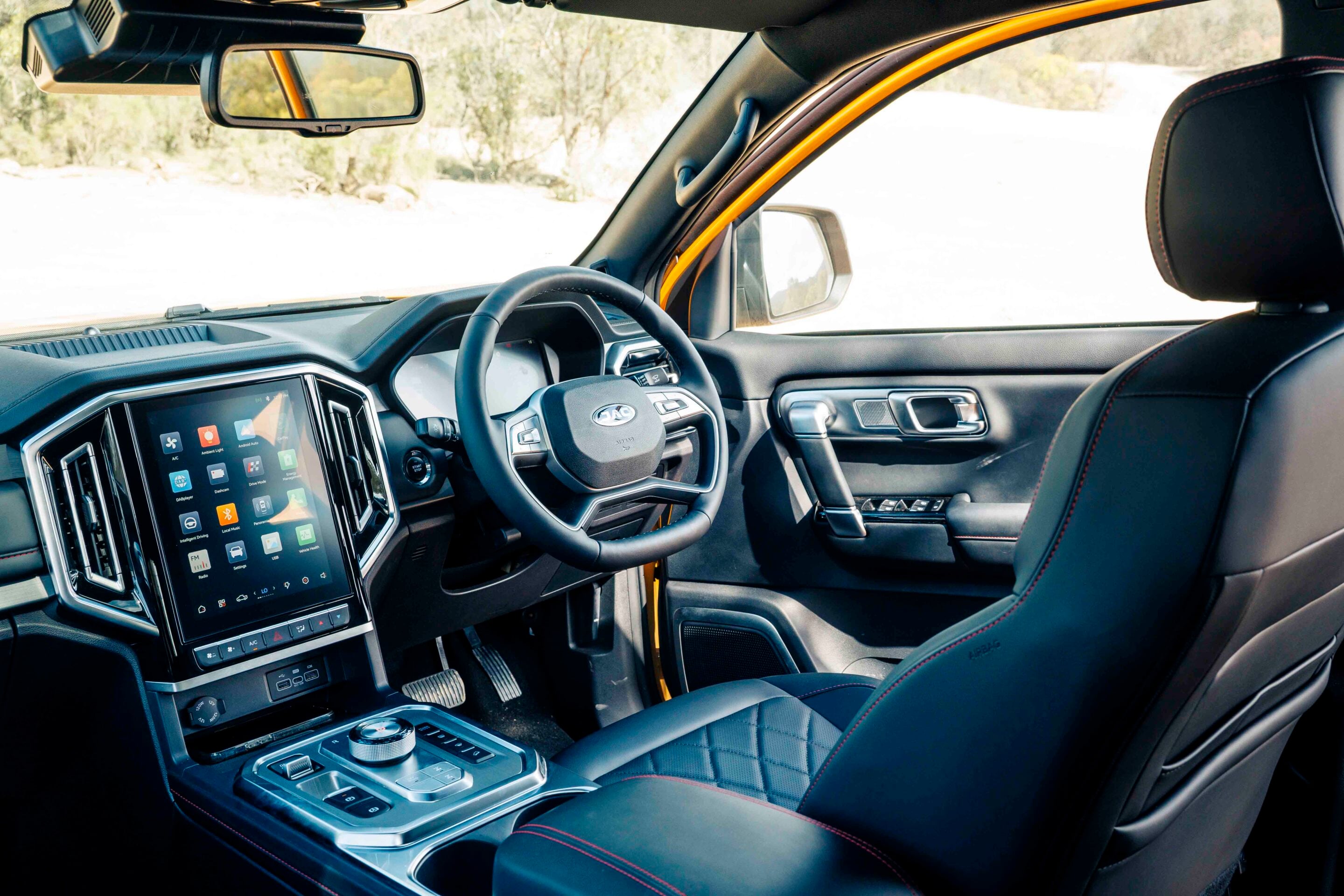
The Hunter X is considerably better inside than its $54,844 price suggests. Soft-touch materials cover much of the dash and doors, the seats and steering wheel feel appropriately premium, and our test vehicle remained free of the squeaks and rattles reported elsewhere.
1
JAC has also resisted burying everything in the touchscreen. Climate temperature and fan speed retain physical controls, while drive modes and differential locks are operated from the centre console. Even the more intrusive driver-assistance systems can be quickly accessed by swiping down on the infotainment screen.
The central display itself is clear and responsive, with wireless Apple CarPlay connecting quickly and working without fuss. The digital instrument display is similarly straightforward and avoids overwhelming the driver with information. There are weaknesses too. Wind noise is noticeable, and the bonnet visibly shakes over imperfect surfaces.
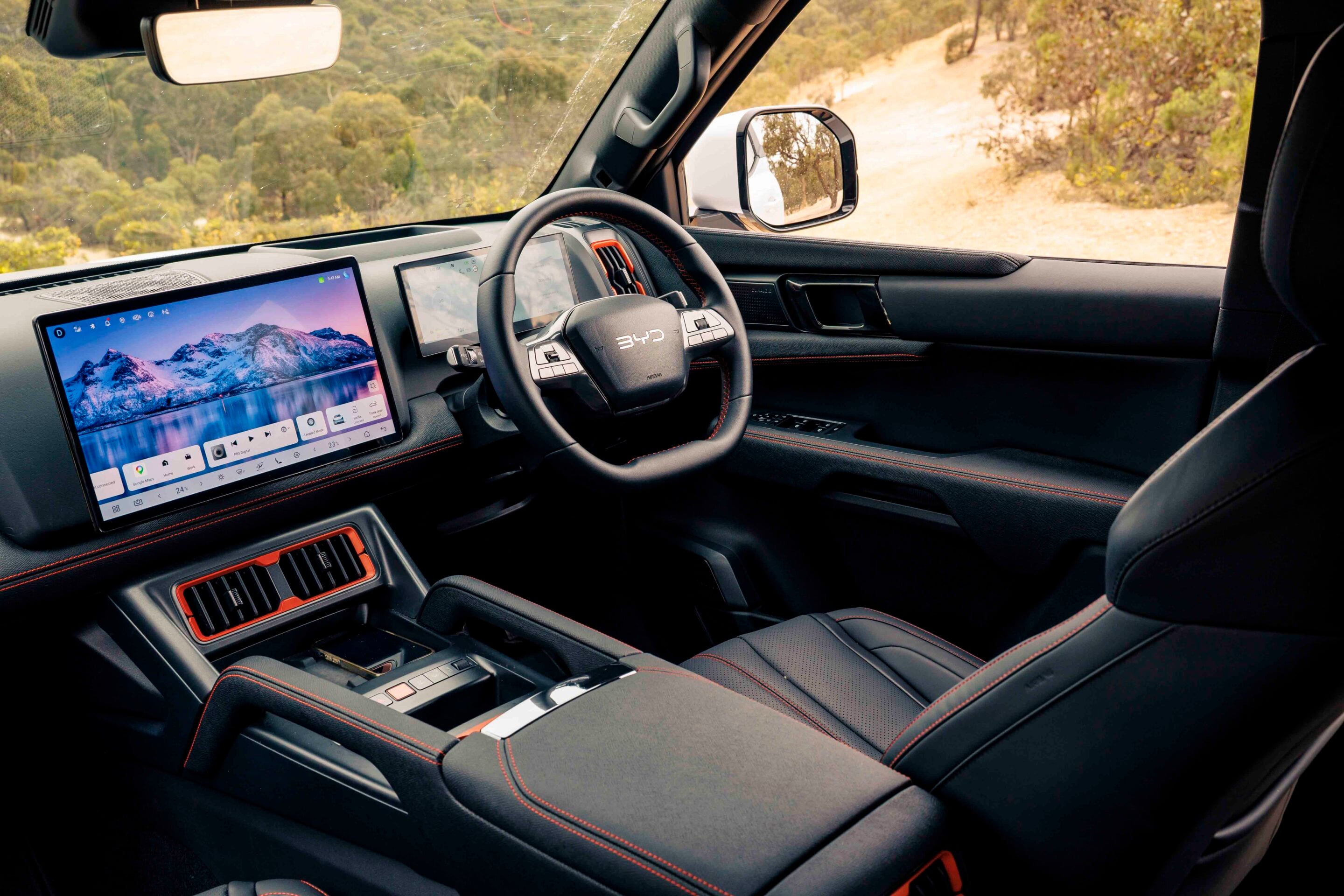
The Shark immediately feels a class above. It’s quieter, wider and more cocooning, with better-bolstered seats, a lower and more comfortable driving position, ventilated front seats and a noticeably more premium overall finish.
1
Performance and driveline
For anyone coming from a conventional diesel ute, the Hunter X will feel properly fast. Its electric motors deliver the sort of effortless acceleration that makes most traditional dual-cabs suddenly feel very old.
It’s only when you drive it alongside the Shark Performance or other powerful PHEV utes that the JAC’s unusual character becomes apparent. On paper, 360kW and 1010Nm sounds outrageous, but if you’re expecting it to rearrange your internal organs, temper those expectations. From a standstill there’s a slight hesitation as the drivetrain gathers itself before delivering the goods. Once rolling, particularly from 80 to 100km/h, it’s properly strong.
That 1010Nm also needs context. It’s calculated driveline torque, combining outputs delivered through different motors and ratios, rather than the crankshaft torque figure traditionally quoted for a diesel. It’s impressive, but don’t read it as simply having twice the torque of a Ranger V6; it doesn’t feel like it.
The Shark Performance is different again. Its 350kW and 700Nm arrive with an immediacy the JAC can’t match. Squeeze the throttle and it simply goes like a cat cut loose. That’s the perspective that matters: The Hunter makes traditional utes feel slow. The Shark 6 Performance makes almost everything feel slow.
| JAC Hunter X | BYD Shark 6 Performance | |
|---|---|---|
| Engine | 2.0L turbo-petrol | 2.0L turbo-petrol |
| Engine output | 160kW / 370Nm | 180kW / 380Nm |
| Front motor | 130kW / 300Nm | 200kW / 360Nm |
| Rear motor | 150kW / 340Nm | 150kW / 340Nm |
| Combined output | 360kW / 1010Nm* | 350kW / 700Nm |
| Transmission | 4-speed DHT | DMO hybrid system |
| Rear suspension | 5-link live axle, coils | Independent double wishbone |
| Diff locks | Front + rear | Electronic traction management |
| 0-100km/h | – | 5.5sec |
*JAC’s 1010Nm is calculated driveline torque and isn’t directly comparable with conventional engine torque.
Dirt roads: Where the Shark pulls away
Leave the technical obstacles aside for a moment. Most 4×4 utes spend far more time on fast gravel roads, corrugated tracks and the dirt access roads leading into campsites, and this is where the differences between these two become much clearer.
The Hunter is actually good. Its Australian suspension tuning shows, with a soft, comfortable ride that deals particularly well with sharp-edged bumps. Steering is light but accurate and gains sensible weight with speed. For a ute with a 915kg payload and live rear axle, there’s an impressive amount of compliance built into it. Push harder across larger undulations, though, and the Hunter’s softness starts working against it. The front can float and wallow, requiring more time to settle after each movement.
The Shark Performance feels fundamentally different. Its independent suspension keeps the body noticeably more controlled, with less pitching and lateral movement, while the chassis feels more planted and connected to the surface beneath it. There’s more grip, more confidence and ultimately more enjoyment.
The Hunter is a good ute on dirt. The Shark makes you start looking for the next corner exit to give it a squirt.
| JAC Hunter X | BYD Shark 6 Performance | |
|---|---|---|
| Ground clearance | 200mm | 230mm |
| Approach angle | 27 | 31 |
| Departure angle | 22 | 19.3 |
| Ramp-over angle | 19 | 17 |
| Wading depth | 550mm | 700mm |
| Wheelbase | 3110mm | 3260mm |
| Rear suspension | 5-link live axle | Independent double wishbone |
| Diff locks | Front + rear | Electronic |
| Test tyres | Pirelli Scorpion AT (Dealer option) | Continental road tyre |
Off-road: Hardware versus software
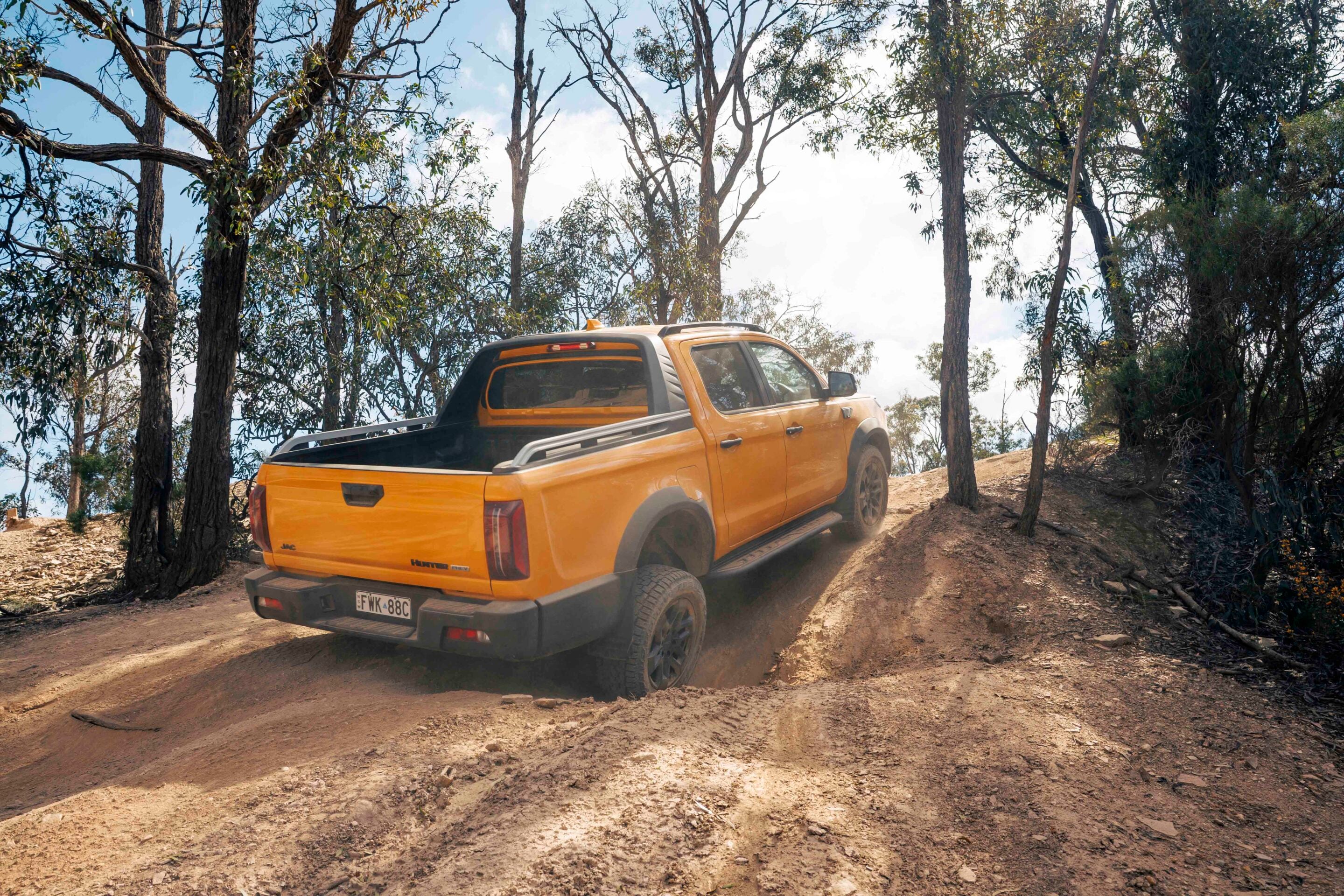
Off-road, the Hunter has the hardware advantage. Its coil-sprung live rear axle, physical front and rear differential locks and optional Pirelli Scorpion all-terrain tyres give it the sort of equipment traditional 4×4 buyers understand – and it works.
Through wombat holes, deep offset ruts and steep, loose climbs, the Hunter found excellent traction. Lock both diffs and you can feel the tyres clawing while the live rear keeps pushing, often beyond the point where its disappointing 200mm ground clearance thinks it’s a good idea. Then comes the scrape underneath. And another. The lockers keep asking you to go further; the belly keeps reminding you why you shouldn’t.
But clearance was the limitation, not traction. The Hunter consistently made the difficult sections with less fuss, needed less momentum and ultimately pushed further into the harder obstacles. Even when it was dragging its belly, the combination of wheel travel, locked diffs and those Pirelli all-terrains kept it moving.
1
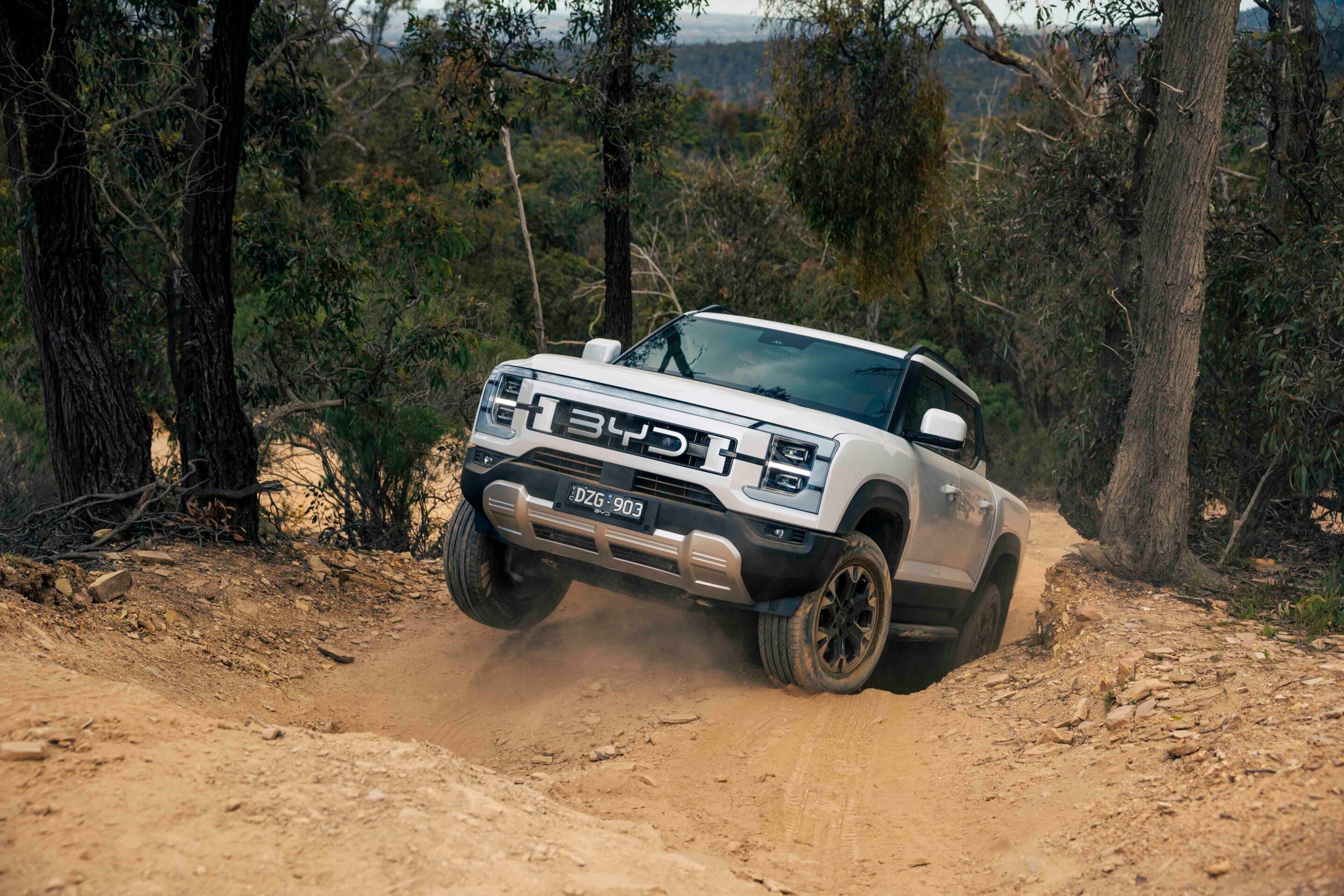
The Shark takes almost the opposite approach: independent suspension, road-biased Continental tyres and electronics doing much of the heavy lifting. Its 230mm clearance helped through the centre of obstacles, but the long rear overhang and 19.3-degree departure angle saw the towbar dragging regularly.
I’ve pointed an earlier Shark at these same ruts and steep climbs and had to admit defeat. This time it completed obstacles it previously couldn’t, but with more fuss and less confidence than the Hunter X. Where the JAC could simply claw its way through, the Shark required more care with line and throttle, and ultimately couldn’t follow it quite as far.
So off-road honours go to the Hunter. Not because the Shark couldn’t get through – remarkably, it usually could – but because the JAC did it more easily and kept going when the terrain got harder.
1
The Shark’s biggest weakness has been fixed by software
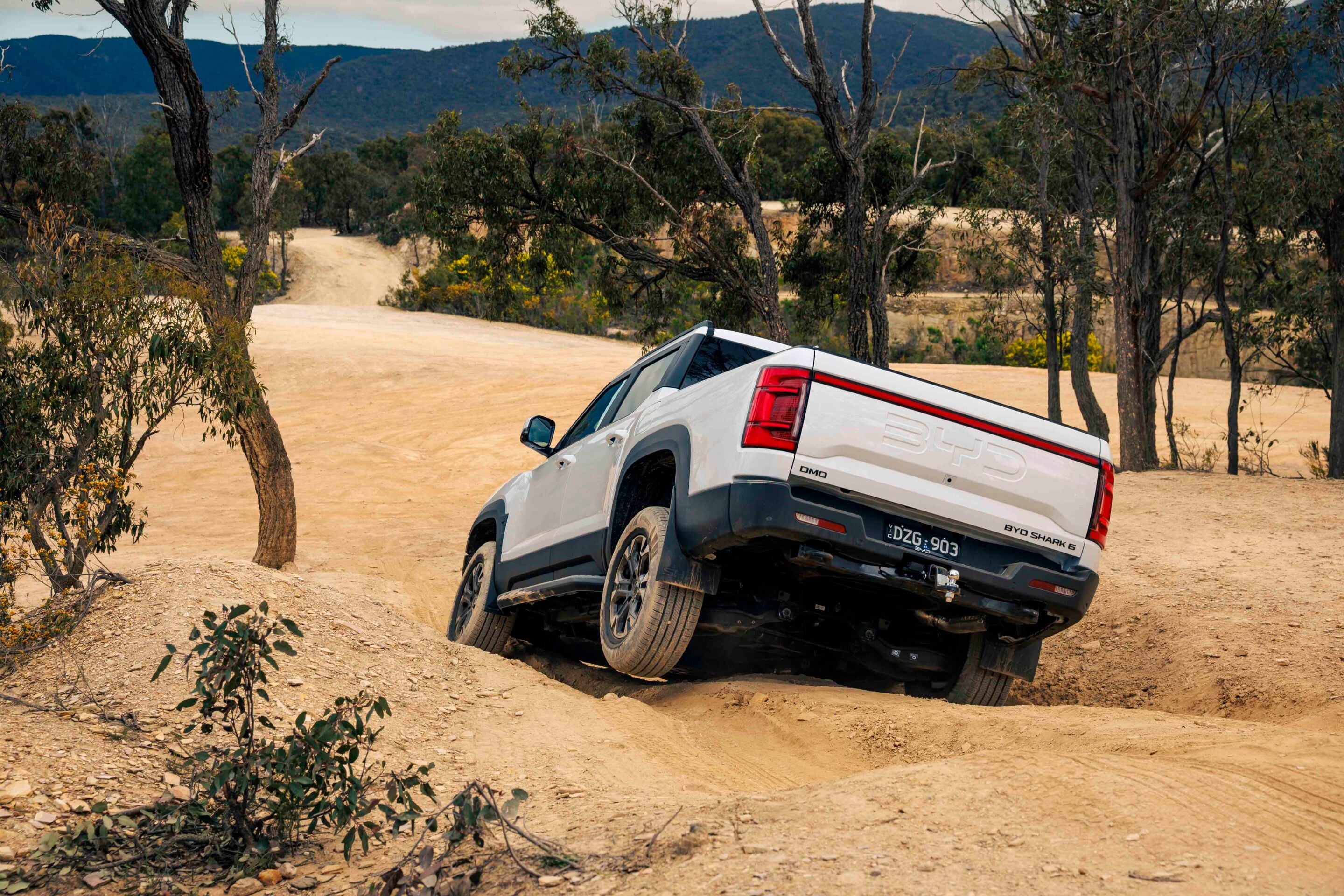
The difference isn’t a new suspension system, differential lock or clever new tyre. It’s largely software.
Leopard Mode completely changes the Shark’s behaviour at low speed. Throttle response is stretched out, giving far finer control over how much power reaches the ground, while the traction-control system intervenes earlier and far more effectively when a wheel starts to spin. The result is almost counterintuitive for traditional 4×4 thinking: the hardware hasn’t fundamentally changed, but the vehicle has. Try explaining that around a campfire to someone who still thinks a proper 4×4 needs two gearsticks.
Better still, BYD has confirmed the new Crawl Mode and its revised traction-control calibration will be offered to existing Shark 6 Premium owners via a free over-the-air update.
1
Ownership: Servicing, warranty and campsite power
There’s little separating them on servicing and battery coverage.
However, JAC’s seven-year/unlimited-kilometre vehicle warranty and seven years of roadside assistance are compelling at this price. BYD’s six-year/150,000km warranty is competitive, but just 12 months of roadside assistance isn’t good enough on a $62,900 vehicle.
At camp, BYD hits back hard. Both provide vehicle-to-load power, but the Shark Performance offers up to 6.6kW total V2L, including convenient 230V outlets in the tub. The Hunter’s 3.3kW external V2L requires an adaptor, although it does provide an internal 220V outlet. Ownership is close. Campsite practicality isn’t, and the Shark wins that one comfortably.
Verdict: Is the Shark worth another $8056?
The Shark wins this comparison, and if I had the extra $8056, it’s where my money would go. But that doesn’t make the Hunter X the wrong answer.
In fact, for the traditional 4×4 buyer, the JAC arguably makes more sense. It’s lighter, has substantially more payload, a live rear axle, physical differential locks and straightforward controls. It feels more like the ute we’ve known for decades, just with a seriously potent PHEV drivetrain underneath.
The Shark asks you to embrace something different. Independent suspension, electronics doing work once reserved for mechanical hardware, and even software updates materially improving its off-road ability. But a modern ute also has to be the family car, commuter and touring vehicle. Away from the job site and campsite, the Shark is quieter, faster, more comfortable, more composed and more polished.
At $55K, the Hunter is remarkably compelling. If you can stretch another $8056, the Shark is the better all-round vehicle.
| JAC Hunter X | BYD Shark 6 Performance | |
|---|---|---|
| Price before ORC | $54,844 | $62,900 |
| Vehicle warranty | 7yr / unlimited km | 6yr / 150,000km |
| Battery warranty | 8yr / 150,000km | 8yr / 160,000km |
| Roadside assistance | 7 years | 12 months |
| External V2L | 3.3kW | 6.6kW total |
| Tub 230V outlets | No | Yes – 2 |
What else should you consider?
Ford Ranger PHEV XL
The arrival of the $59,000 drive-away Ranger PHEV XL tells you plenty about the price pressure BYD has brought to this segment. Its 2.3-litre turbo-petrol PHEV produces 207kW/697Nm, retains full-time 4WD and 3500kg towing, while Pro Power Onboard can deliver a substantial 6.9kW from its three plugs.
At Ute of the Year I gave the Ranger PHEV the win because it remained the most convincing ute of the electrified contenders. That’s still its appeal: it feels familiar, works like a Ranger and asks traditional buyers to make fewer compromises. But with the updated Shark Performance now around similar money, considerably more powerful and much improved off-road, the Ford’s value equation has become tougher.
GWM Cannon Alpha PHEV
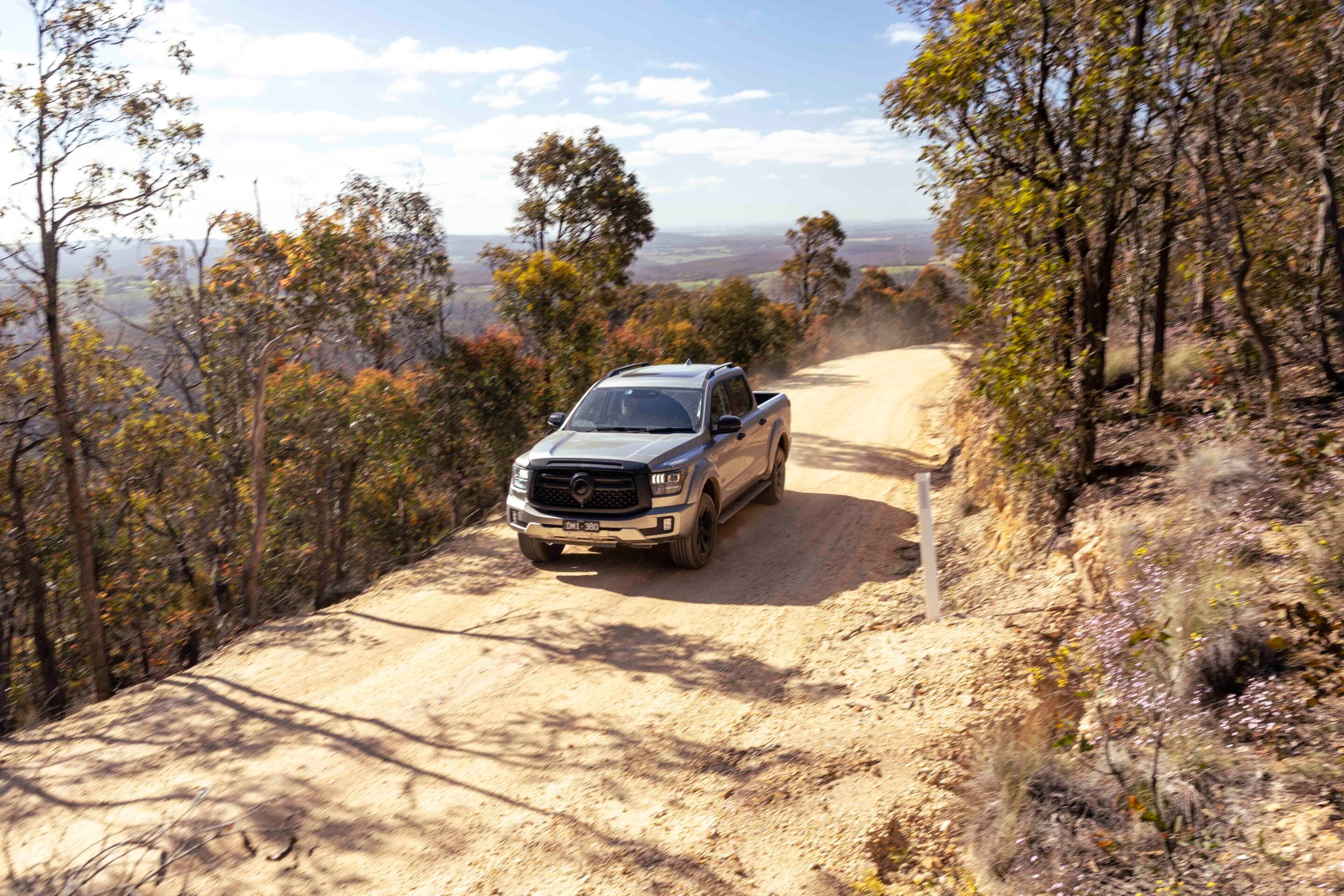
The Cannon Alpha PHEV starts at $57,490 drive-away for the Lux, with the Ultra at $64,490 drive-away. Its 2.0-litre turbo PHEV produces 300kW/750Nm, uses a 37.1kWh battery and offers up to 6kW V2L, plus a proper mechanical 4WD system with low range.
And it has immense shove. The problem is packaging: it’s big, with a long wheelbase, yet sits too low for something intended to tackle serious terrain. It’s another compelling interpretation of the PHEV ute, but against the updated Shark, its compromises are harder to ignore.
1
Follow 4X4 Australia on Google
Get more 4x4 news, reviews and gear stories from 4X4 Australia in your Google feeds.

We recommend
-
 4x4 Comparisons
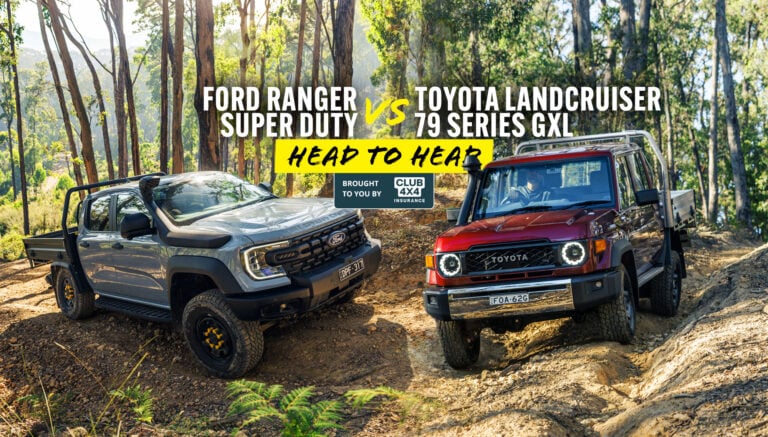
Ford Ranger Super Duty vs Toyota LandCruiser 79: Can Ford topple the ultimate work ute?
Has Ford's new Ranger Super Duty got what it takes to knock the iconic LandCruiser 79 off the top of the mountain?
-
 4x4 Comparisons
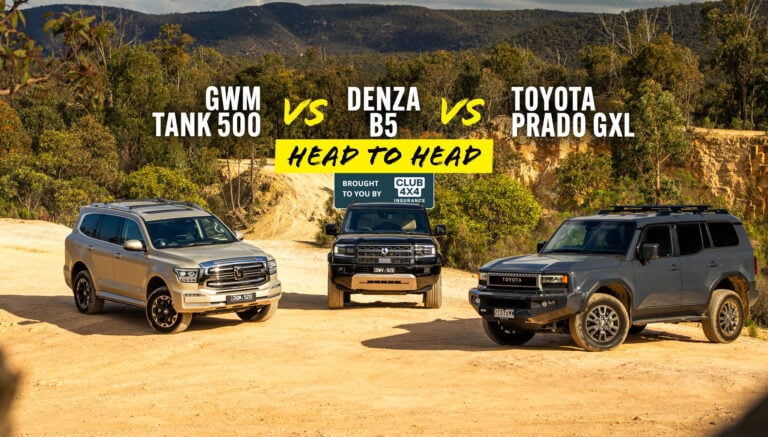
Toyota Prado GXL vs Denza B5 vs GWM Tank 500: Has China finally built a Prado rival?
Three $80K 4WD wagons, three very different approaches and one brutal test. Can the Chinese challengers knock the Prado off its throne?
-
 4x4 Comparisons
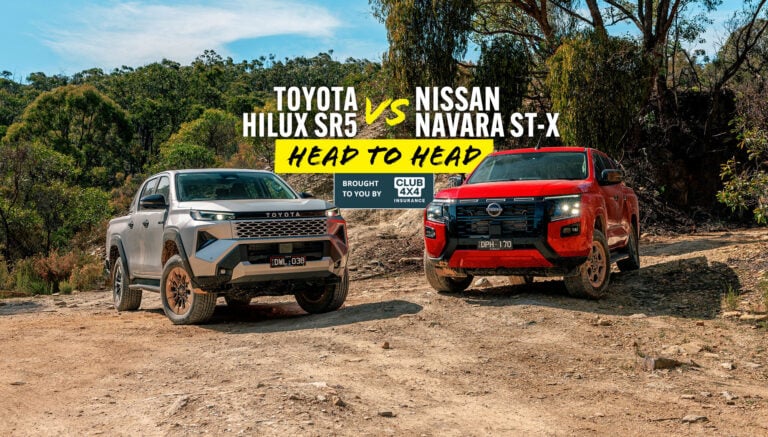
Toyota HiLux vs Nissan Navara: Can the new Navara topple Australia’s perennial favourite?
Nissan has thrown everything at its latest dual-cab, but the HiLux’s decades-long reputation won’t be easy to overcome