
GWM has successfully beaten one of Australia’s most infamous off-road challenges: Beer O’Clock Hill.
A total of three GWM vehicles – the Cannon Alpha PHEV, Cannon XSR diesel and Tank 300 diesel – reached the summit in a show of strength for GWM, a brand out to prove it should no longer be underestimated when the going gets rough. All three of the vehicles were essentially showroom-stock – the XSR wearing factory tyres; the Cannon Alpha shod in Mickey Thompson Baja Boss all-terrains.
By reaching the summit, the Cannon Alpha PHEV made history by becoming the first PHEV of any kind to ascend Beer O’Clock Hill. Powered by GWM’s Hi4-T platform, the system combines a 2.0-litre turbocharged petrol engine (180kW/380Nm) with a 120kW electric motor (400Nm) to deliver a combined output of 300kW and 750Nm. It uses a nine-speed hybrid automatic transmission with full-time 4WD.
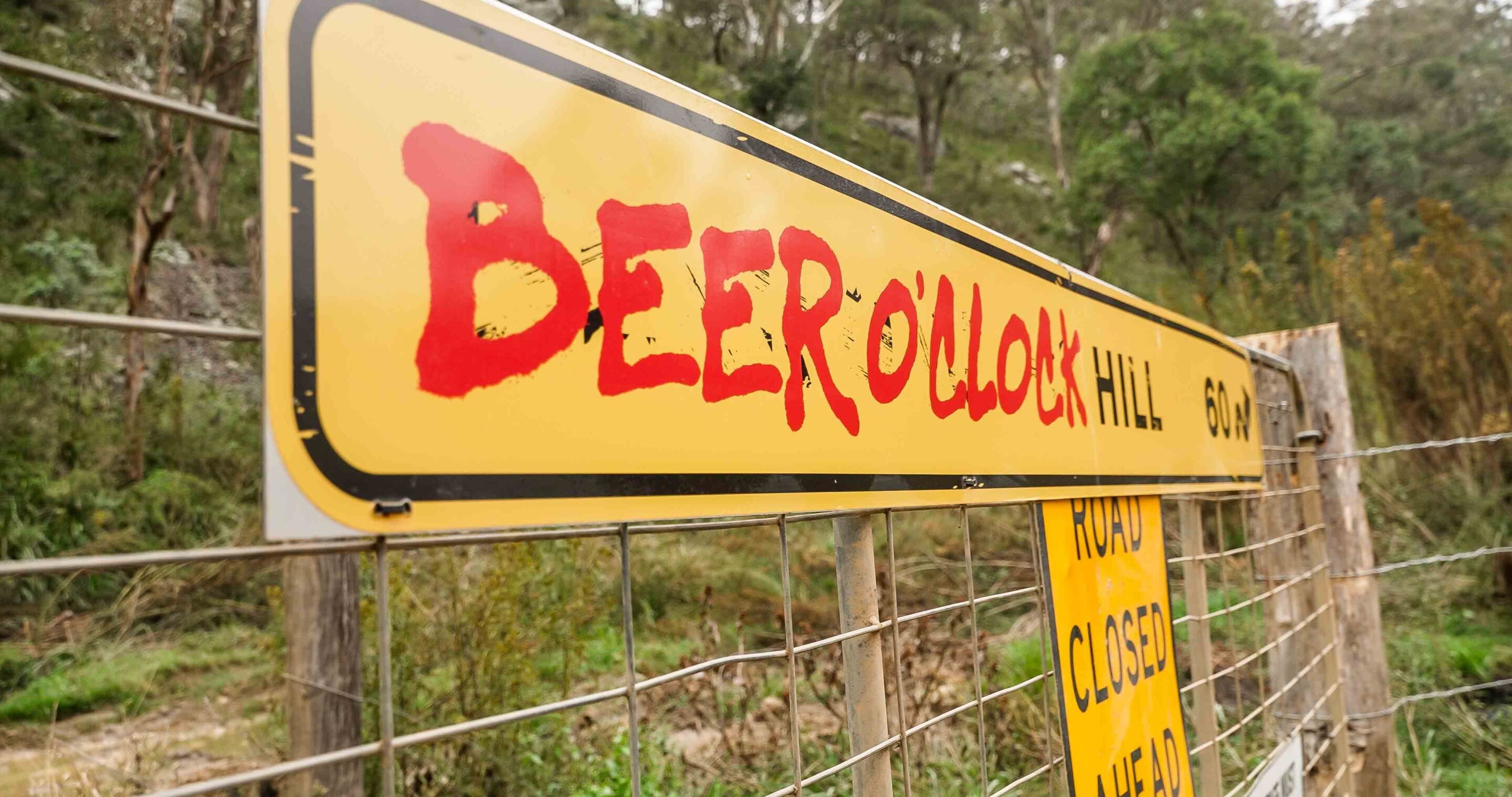
In addition, the Cannon XSR became the second full production-spec vehicle ever to officially conquer Beer O’Clock Hill – following the INEOS Grenadier. The Cannon XSR is powered by a 2.4-litre single-turbo diesel engine, producing 135kW and 480Nm and paired with a nine-speed automatic transmission.
“Successfully conquering Beer O’Clock Hill is no small feat. Many try, few succeed,” said Steve Maciver, Head of Marketing and Communications at GWM Australia. “For GWM to take multiple vehicles across different powertrains – including the new PHEV – to the summit speaks volumes about the strength, technology and real-world engineering behind our 4WD line-up. We’ve always known what our vehicles are capable of, but this achievement doesn’t just back up the promise, it delivers the proof.”
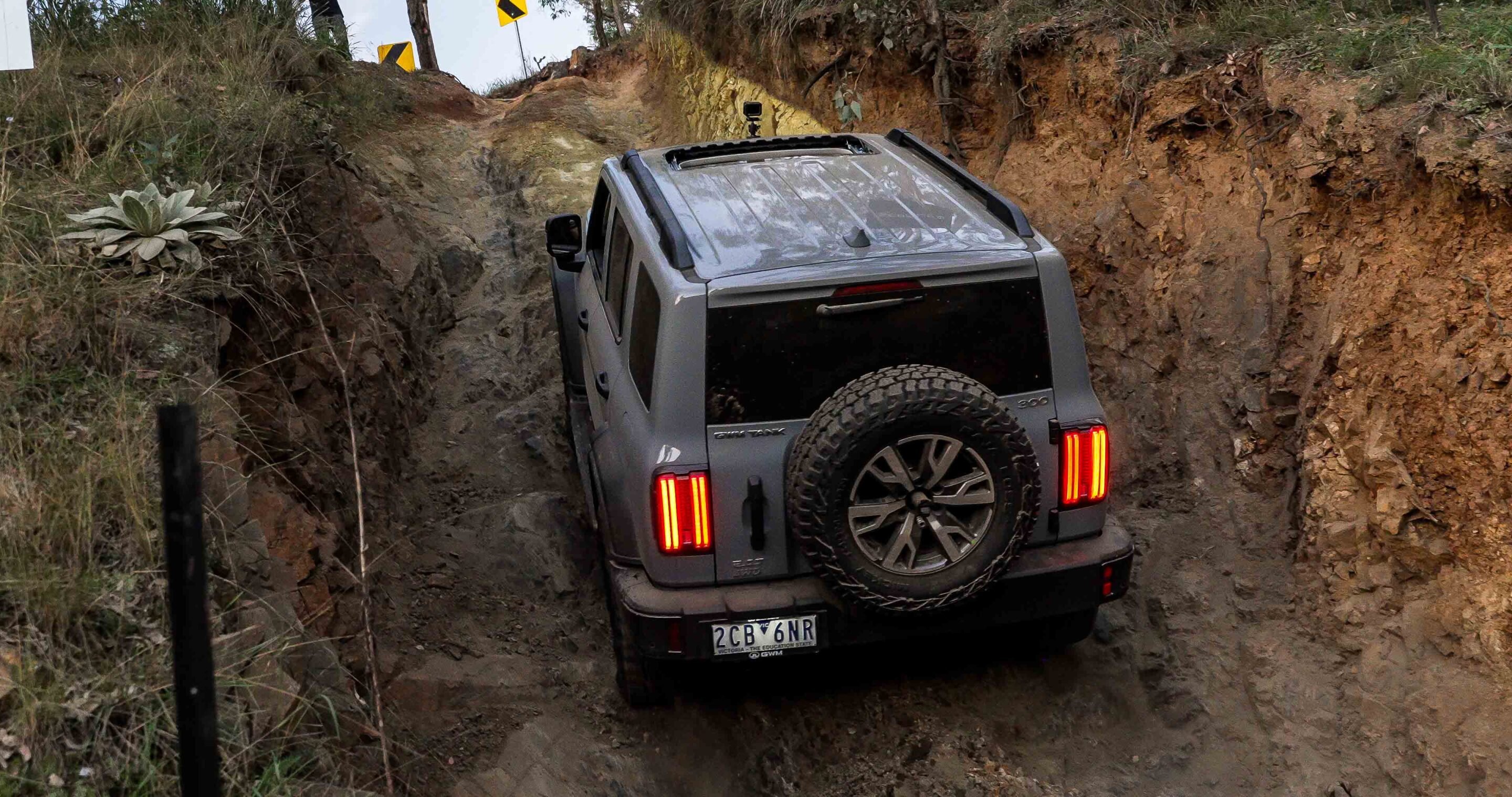
Located within the Springs 4×4 Adventure Park in Queensland, the technically demanding 100-metre ascent features gradients of up to 50 degrees, three separate rock steps, and a difficult rock ledge as steerers approach the summit.
It’s a climb that has caused plenty of vehicular damage over years, according to the park’s owner, Lucas Bree: “I reckon Beer O’Clock Hill has caused hundreds of thousands of dollars in vehicle damage over the years.
“[It has] shut down some of the most heavily modified rigs I’ve seen, so watching showroom-spec GWM vehicles, including a plug-in hybrid, make it to the top has completely changed my view of the brand,” Bree said.
The successor to the FJ Cruiser may be a step closer to production, with a newly uncovered design patent revealing what is believed to be Toyota’s next compact off-roader.
The design images discovered by Top Gear Philippines showcase a boxy SUV with a silhouette reminiscent of both the 70 Series LandCruiser and the discontinued FJ Cruiser. It remains unnamed in the filing, but rumours suggest it will carry the LandCruiser FJ badge.
Key visual elements include squared wheel arches, a high beltline, an upright windscreen, and a tailgate-mounted spare wheel. The compact SUV also features rugged bumpers and production-spec wing mirrors.
The upcoming model is widely believed to sit on Toyota’s IMV-0 ladder-frame platform, the same chassis that underpins the Hilux Champ pick-up. This platform provides a robust foundation for off-road capability, signalling that this vehicle will be built to handle challenging terrain.
Powertrain options are expected to include tried-and-tested engines from Toyota’s global workhorse line-up: the 2.4-litre and 2.8-litre GD-series turbo-diesels, along with a naturally aspirated 2.7-litre petrol engine. Transmission choices are likely to include a five-speed manual and six-speed automatic, both proven in other IMV-based models.
According to Japanese media reports, the compact LandCruiser could be officially unveiled by late 2025, potentially making its public debut at the Japan Mobility Show in October. If that timeline holds, production could begin in early 2026.
As winter sets in and power bills start to rise, BLUETTI’s End of Financial Year Sale is here to help Australians cut energy costs – with discounts of up to 43 per cent across portable power stations, solar panels and home backup systems.
Running from June 1 to 30, it’s the best time to upgrade your energy setup for camping, road trips or simply staying warm at home.

Pack light, power anywhere
For quick outdoor adventures, BLUETTI’s lightweight models like the AC2A and AC70 are built for grab-and-go power.
The AC2A weighs just 3.6kg – lighter than a house cat – yet powers laptops, routers and even mini heaters. Many tech users rely on the AC2A’s 20ms UPS function to keep routers, game consoles and security cameras online – even during outages. The AC70, with its ergonomic handle and compact design, is a camper favourite. One happy user said: “It ran my CPAP machine overnight, humidifier on and all!”

Off-grid power for the long haul
Embarking on a road trip or setting up a van workspace? The AC180 and Elite 200 V2 are trusted choices for caravans, 4WDs and remote job sites.
Praised as a highly versatile solution for 4x4s, boats and remote sheds, the AC180 proves its worth wherever reliable power is needed off the grid. These units offer high power output with a surprisingly compact footprint – plus ultra-fast recharging that gets you from 0 to 80 per cent in just 45 minutes, fast enough to top up while you’re packing or stopping for coffee.
Recharging on the road is a breeze when you’re equipped with both the BLUETTI alternator charger Charger 1 and portable solar panels. The Charger 1 delivers up to 560W straight from your vehicle while driving – perfect for cloudy days or overnight top-ups. When the sun’s out, the foldable, water-resistant solar panels harness clean energy with high efficiency. Use them separately or together for a reliable, uninterrupted power supply – so you can say goodbye to energy worries, wherever the road takes you.
Winter comfort, lower bills
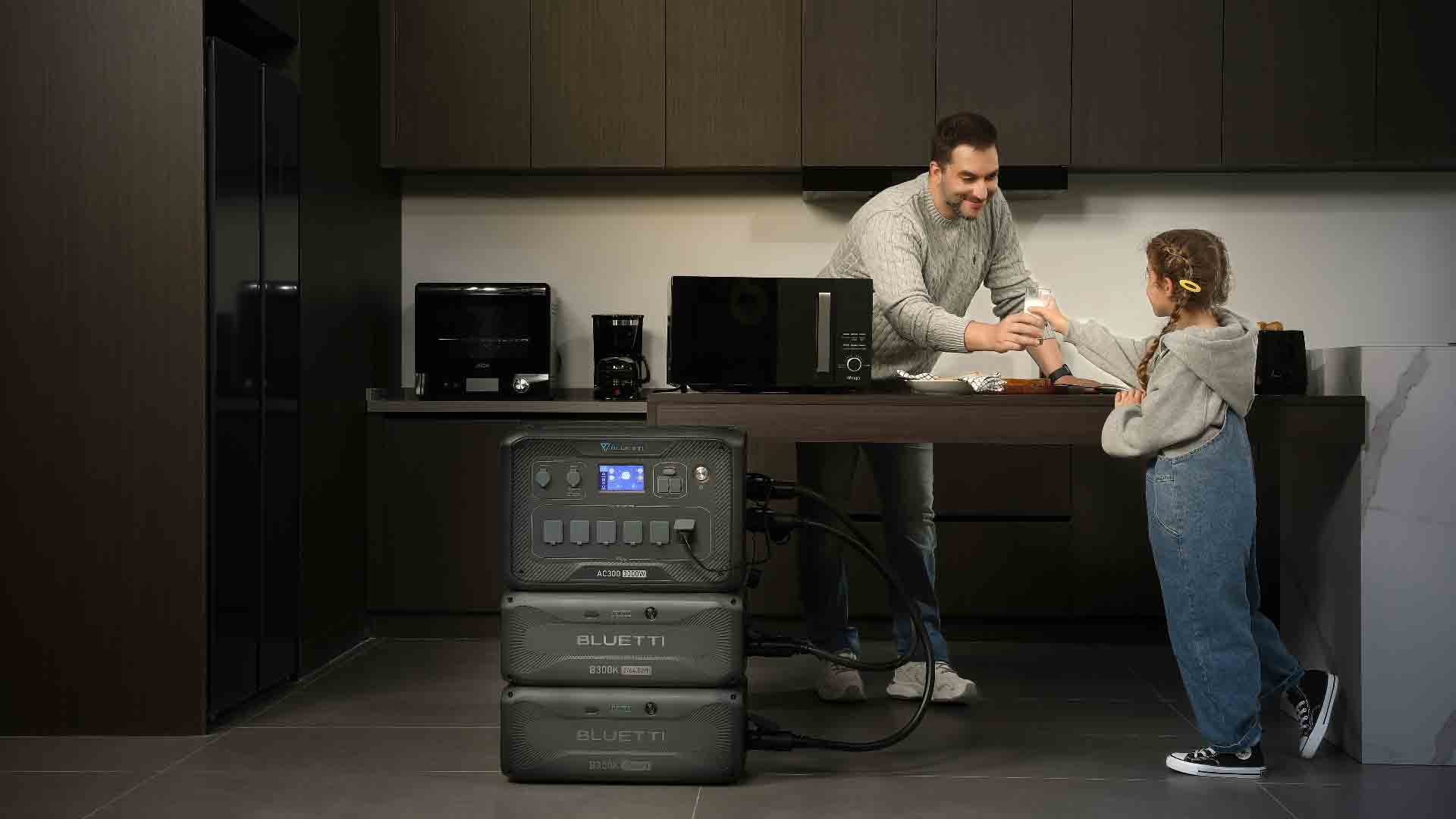
At home, the AC300+B300K modular system offers peace of mind during outages and peak tariff hours.
You can customise your set-up based on how much power you need – from running a heater on cold nights to keeping your fridge and coffee machine humming. And if your needs grow, expanding the system is easy with plug-and-play battery modules – no rewiring, no hassle. As BLUETTI user Paul put it: “Massive capacity, compact design – the amount of power in such a small space is insane.”
Don’t miss BLUETTI’s huge EOFY deals!
From grab-and-go units to full-home systems, BLUETTI’s EOFY Sale offers real savings and real power. Head to BLUETTI’s official website to score the best deals before June 30 – and start powering smarter this winter.
The 250 Series Toyota Prado is the fourth generation of the 4×4 wagon to be sold in Australia following on from the 150, 120 and 90 Series models that set the framework for what has become one of the country’s most popular 4x4s for off-road adventures and school drop-offs.
Not widely known is that there was a Prado well before the 90 Series, but it was never sold by Toyota in Australia. The 70 Series Prado first appeared in 1990 when it was sold in Japan and other south-east Asian markets as the 77 and 78 Series and, although it was never sold in Australia by Toyota, there are a few grey-import examples here now.
The 70 Series Prado used what is essentially the four-door wagon body that we eventually got here as the VDJ76 in 2007, but it was fitted with unique front sheetmetal, grille and headlights, plus it had coil-spring suspension and lighter duty axles borrowed from the HiLux of the time. The light-duty wagon was sold as the Prado in some markets and as the LandCruiser II in others.
This adaptation of light-duty underpinnings was similar to what we saw under the Bundera in Australia. The Bundera was a short-wheelbase, two-door 70 Series that got coils and HiLux axles, and was available here with a removable top. Other LandCruiser 70 Series of the time were commercial vehicles that rode on leaf springs and big diffs for hard work, and in the case of the Bundera the inclusion of coil-spring suspension and light-duty axles was made to make the basic vehicles better suited to family and recreational use.
The 70 Series Prado you see here is a 1999 KZJ78 model owned by Saul Zuvic. Saul imported the Toyota from Japan and he uses it for off-road adventures mainly in Victoria.
As the model name suggests, Saul’s car is powered by the 1KZ 3.0-litre turbo diesel engine which we are familiar with from early HiLux models and also the 90 Series Prado. The engine is backed by a three-speed automatic transmission and dual range transfer case that is push-button/vacuum operated.
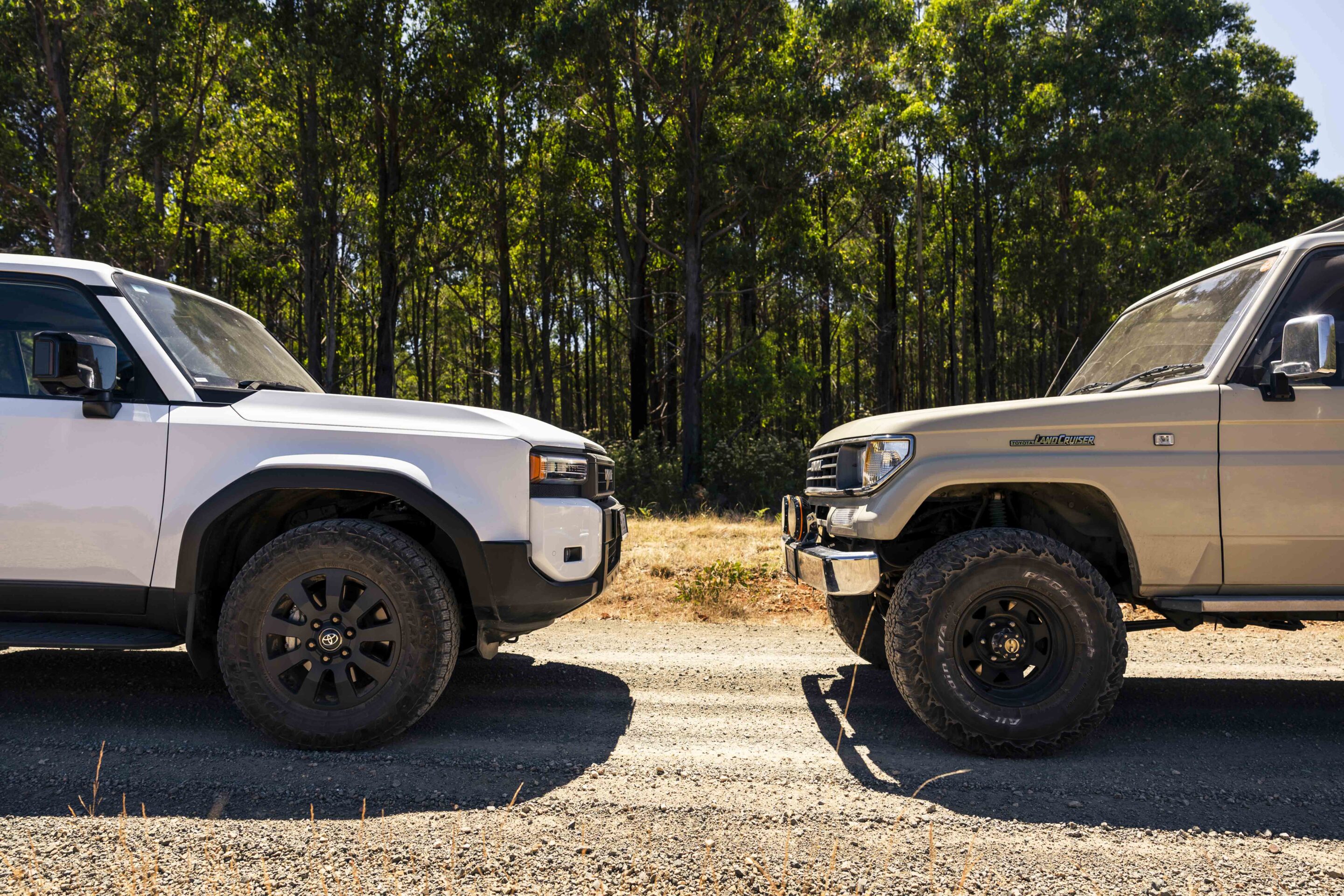
Retro 4x4s are becoming collectible and there’s a certain cool factor that comes with driving one. That coolness is amplified when the vehicle is something different, and the Prado front end differentiates the KZJ78 from the VDJ and now GDJ76s that are common in Australia. Saul says it always raises eyebrows and promotes questions from those that see it when he is driving.
Toyota has gone retro with the look of the 250 Series but it is something that’s hard to manufacture and get the right level of cool. That said Saul recognises the touches made by Toyota’s design team
“I love the exterior of the 250,” he commented. “It harks back to the best-looking LandCruiser in my opinion, the 62 series with the rectangle headlights. The proportions seem similar to the 80 Series, and the rear also reminds me of the 80.
“It’s refined and classy, but tough looking at the same time. But when I hop back in the 70 Series, I find the 250 lacks character. I wonder if in 30 years enthusiasts will be fighting to get their hands on a 250, if of course they last that long.”
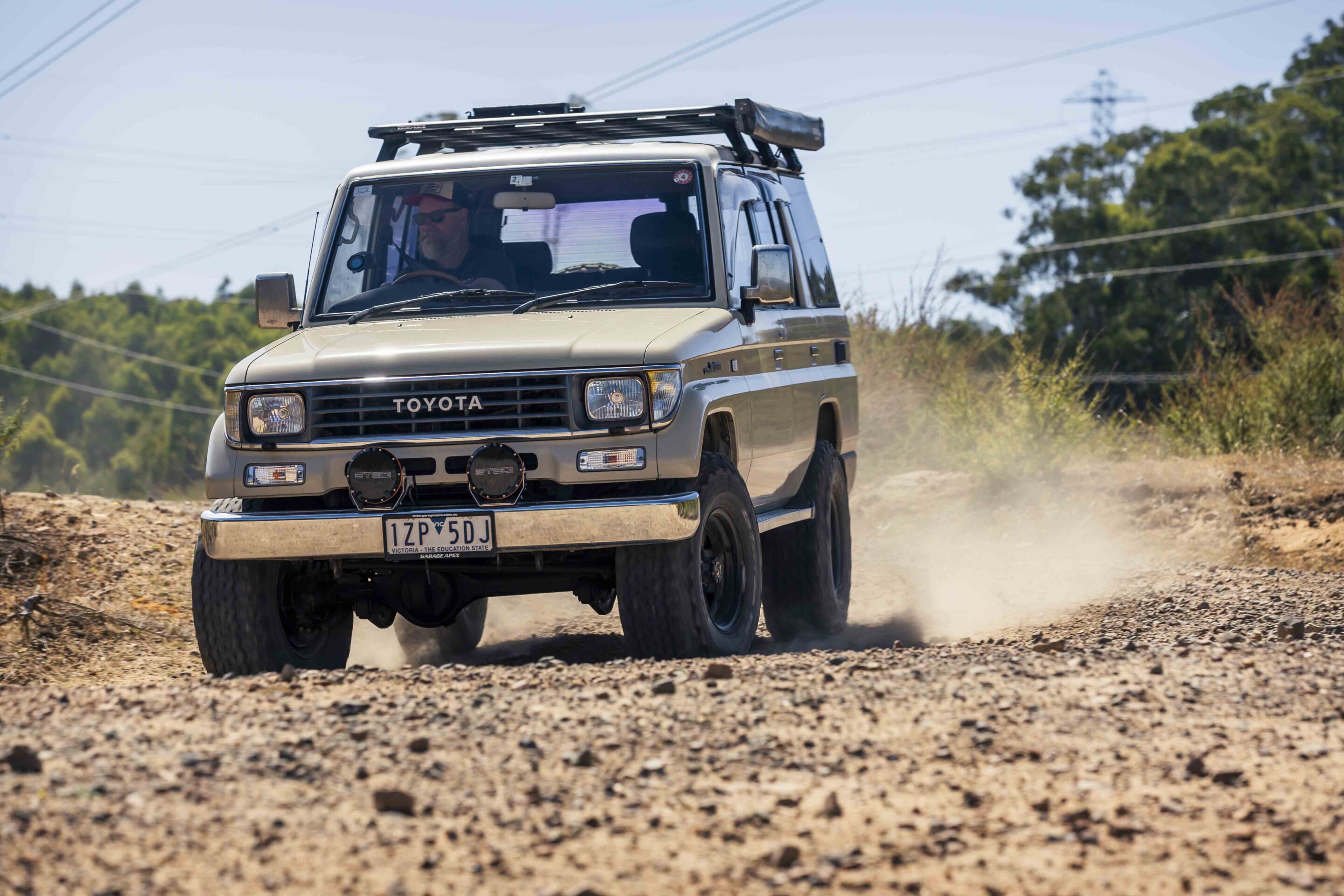
The old 78 Prado is highly specified considering its age and the fact that it is a 70 Series. As well as the auto transmission and push-button transfer case, it has power windows with an auto-up function, something you don’t even get in a new 70 Series, while the cloth trim is also plush by 70 standards.
The dash panel is a unique mix of 70 and 80 Series style featuring a soft-touch padded top that curves over the old school analogue gauges. Saul has added a double-DIN sound system for a touch of modernity but it remains a far cry from what you find in the 250 Series Kakadu.
The interior of the 250 Series, on the other hand, is loaded with tech and features starting with a premium 12.3-inch multimedia screen with wireless Apple CarPlay and Android Auto, Bluetooth, cloud-based in-built sat-nav, a panoramic moon roof, leather-accented seat trim with eight-way power adjustment and power lumbar support and memory for the driver and four-way power adjustment for the passenger seat, heated and ventilated front and second-row seats, manually-adjustable driver seat cushion length, digital rear view mirror, heated steering wheel and heads-up display. There’s also a digital instrument cluster, a refrigerated console chiller, power adjustable steering column and a JBL sounds system blasting out through 14 speakers.
It’s a full on luxury interior worthy of the $100k price tag of the top-of the line model, but it will be many decades before the 250 will ever be as cool as Saul’s retro 78.
Off-road performance
After a stint behind the wheel of the Kakadu Saul said, “It’s a world away from where the Prado started, as a rugged, simple four-wheel drive. The suspension in the 250 soaks up rough unsealed roads, making them feel like fresh tarmac would in the 70 Series Prado. It’s comfortable and quiet in the cab, and feels like a luxury yacht, as you would expect from a modern four-wheel drive pushing a $100k price tag.”
Meanwhile, we jumped into Saul’s 78 on the same tracks. Getting behind the wheel the seating position is much like that in my own 1985 BJ73 but the dash pad is a more modern and softer design. The 1KZ engine sounds more like the BJ engine in my Cruiser than the 1GD powering the 250 but it gets along with a similar feel. The auto transmission feels great for its age and the updated suspension is doing a great job.
Saul has upgraded the suspension under the Prado with Tough Dog 50mm raised coils and Pro Comp monotube shocks. There’s a familiar rattle and squeak from the rear doors of the 70 but it just adds to the cacophony that comes with a classic old off-roader, adding to the character.
Saul has set up the 78 as a touring 4×4 and to date it has taken him to Coffin Bay in South Australia, as well as Victorian High Country staples like Mt Buffalo, Mt Buller, Howqua Hills, Alpine National Park, Mt Wellington, the Avon Wilderness area and Licola.
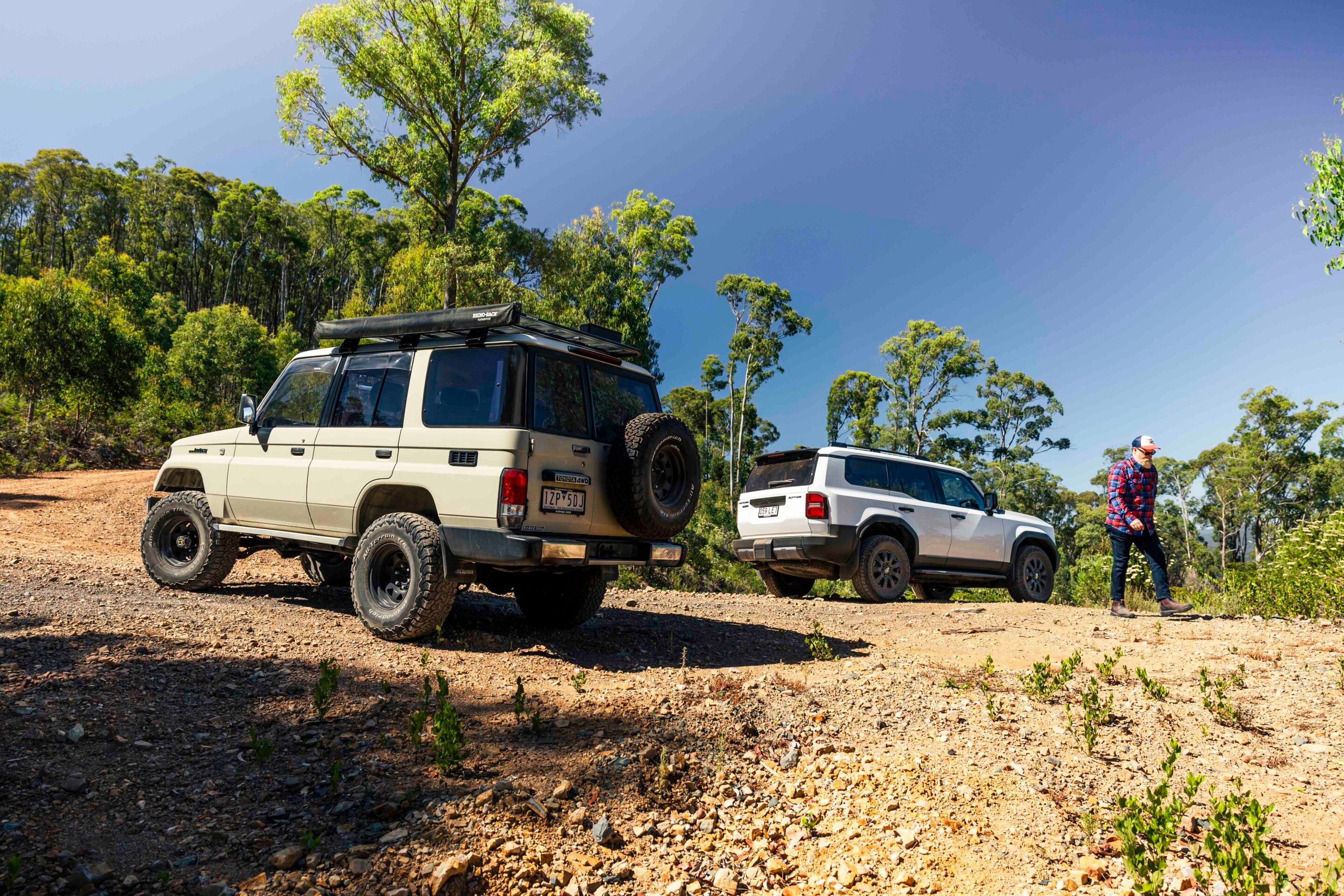
Touring kit includes a set of drawers with a fridge slide holding a MyCoolman fridge, a 100Ah lithium battery, a Rhino-Rack and platform, and a set of Stedi spotlights on the factory Toyota front bumper. Saul had a set of steel wheels wearing 33×10.5-15 BFGs on it the day of our shoot but we’ve also seen it wearing skinnies with retro Toyota hubcaps, which look super cool.
Verdict
“Would I trade it for my 70?” said Saul of the 250. “Yes, of course, it would be daft not to. But would I love it as much and will it be spraining necks with a street presence you can only get from a 1990s vintage Cruiser? No way!”
It will be many years before a 2025 model 4×4 could ever be considered cool or vintage, and would the authorities let us drive old cars by that time? It can be argued that keeping an old vehicle like Saul’s Prado on the road is much better for the environment than building an all-new one, with all the plastics, chemicals and precious metals required, no matter how much alternative fuels and technology you throw at it.
General Motors has announced it will invest $US888 million (almost $AU1.4 billion) in its Tonawanda Propulsion plant in Buffalo, New York, to support production of its next-generation of V8 engines.
The move – counter to the global shift toward electrification and zero-emissions vehicles – marks the largest single investment GM has ever made in an engine facility. The funding is set to go towards new machinery, tools and facility upgrades needed to manufacture the sixth generation of GM’s V8 engines used in the company’s full-size trucks and SUVs.
The updated engines are expected to offer stronger performance, improved fuel economy, and lower emissions, driven by advancements in combustion and thermal management technologies.
“Our significant investments in GM’s Tonawanda Propulsion plant show our commitment to strengthening American manufacturing and supporting jobs in the US,” said Mary Barra, Chair and CEO of General Motors. “GM’s Buffalo plant has been in operation for 87 years and is continuing to innovate the engines we build there to make them more fuel efficient and higher performing, which will help us deliver world-class trucks and SUVs to our customers for years to come.”
Tonawanda becomes the second GM propulsion plant selected to produce the new engine line, following a $500 million investment announced in January 2023 for the company’s Flint Engine plant in Michigan.
While gearing up for the launch of the new V8 engine in 2027, Tonawanda will continue producing GM’s current fifth-generation V8 engines.
The 2023 GMC Yukon and Chevrolet Silverado 1500 in Australia both use a 6.2-litre V8 petrol engine producing 313 kW and 624 Nm, paired with a 10-speed automatic transmission.
In April 2025, General Motors issued a global recall affecting more than 720,000 vehicles – including the Chevrolet Silverado 1500, GMC Sierra 1500, and GMC Yukon – fitted with the 6.2L L87 V8 engine from model years 2021 to 2024.
The recall addressed manufacturing defects in the connecting rods and crankshafts that could lead to engine failure.
The problem with the HiLux is that it hasn’t offered a decent engine since the mighty 3RZ, and the latest AN120 models just don’t do much to change that.
They’re still a great ute, but for the love of everything holy, Toyota, give me something that’ll make me smile when I put my foot down. Okay, that’s off my chest and I’ve had a lie down, I feel better.
To be fair, the HiLux is still a great vehicle that can be built into anything your heart desires, as long as your bank account is cool with it too. Therein lies the huge appeal of the mighty Lux. Not only is there massive support for it on the aftermarket, including engine swap kits if you really want to go HAM, but the resale on them is the envy of pretty much all other ute-owners, so there are a bunch of good reasons to own one.
Me, I want something that’ll take me anywhere on the continent, from the High Country to the Pilbara, and I want to do it comfortably, and I don’t want to bypass any of the hard tracks. The SR5 and up models are all north of $60K, and there’s only one model of extra-cab, the SR5 Styleside. The rest are all dual-cabs, which I don’t want (long story short: they’re too much of a compromise for my needs. All mid-size dual-cabs are a jack of all trades, master of none, which is not my bag).
That leaves the SR cab-chassis extra-cab, which rings up at $50,695, saving me $25K over a GR Sport. Which is $25K I can put to much better use.
I travel light, so a Norweld Basic extra cab canopy for $13,325 is more than enough to house my fridge and camping gear. I’d fit it out with an entry-level 100Ah lithium system for $1800 and bolt up a San Hima hard-shell RTT for $2000 and a 30sec Wing Awning for $995.
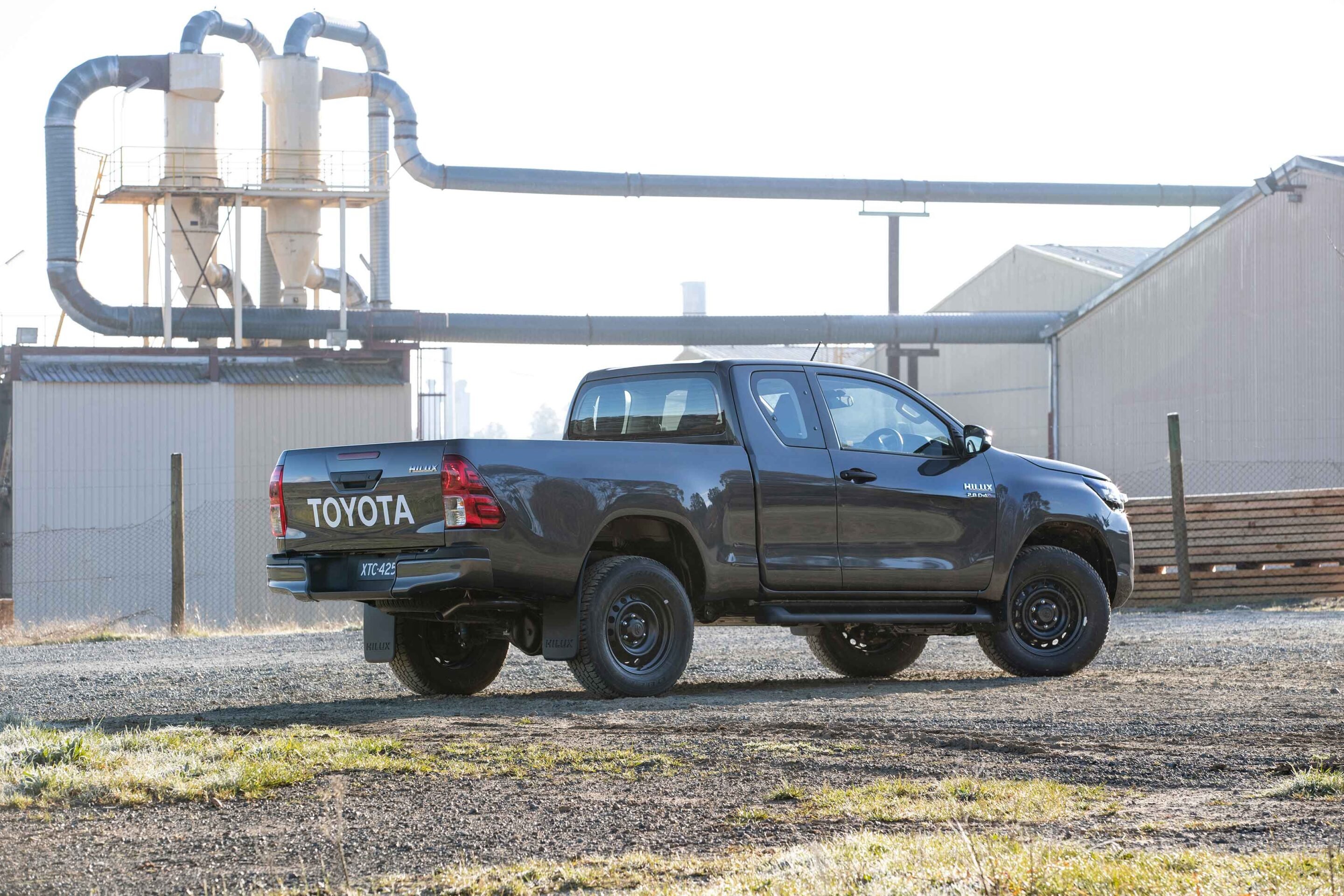
Out front I’d bolt up a custom-fabricated pre-runner-spec lightweight tube bar with steering protection and a winch mount for the Frontier winch ($3000 all up). I’d wire in a 40-inch Stedi lightbar ($480) which I’d mount up on the roof.
I’d then run two-inch lift coils up front and a 25mm spring spacer on the rear with Bilstein B60 shocks at each corner, which would give me the ability to bomb over washouts on Outback dirt roads at a buck-twenty in comfort ($5500). I’d also throw on a set of 285/75R17 Nitto Ridge Grapplers ($2400).
Last but not least, I’d get my local ARB to throw in a front Air Locker for around two-grand. This would give me go-anywhere ability for a few grand more than a stock GR Sport, which would have nowhere near the capability or comfort of my super-tidy SR.
KGM Australia has officially completed its transition away from the SsangYong brand.
Effective June 1, 2025, the company will no longer operate under the name “KGM SsangYong,” instead moving forward as “KGM Australia,” aligning fully with its global parent company, KG Mobility.
This final phase comes after the initial rebrand in September 2024, when SsangYong Australia first adopted the dual-brand identity of “KGM SsangYong.” The move was part of a broader strategy by South Korean conglomerate KG Group, which acquired SsangYong in 2022 and began repositioning the brand globally under the KGM (KG Mobility) banner.
KGM Australia Managing Director Joseph Lee said the timing was right to retire the SsangYong name completely, coinciding with the launch of its all-new KGM Actyon SUV.
“Unveiling new vehicles is always a highlight for us all, particularly when it’s something as striking and appealing as Actyon, a modern revival of the world’s first coupe-style SUV,” Lee said. “It’s timely we fully embrace the KGM branding here in Australia and celebrate the latest vehicle design language with a brand logo refresh, to align with KGM’s global identity and better reflect our commitment to design excellence.”
KGM Australia has also introduced a new slogan, ‘Korean built to last’. Plus, the SsangYong winged logo is being retired in favour of a refreshed KGM badge.
KGM Australia continues to offer the Musso ute and Rexton SUV locally, both powered by a 2.2-litre turbo diesel engine. The Musso delivers up to 133kW and 400Nm (420Nm with the XLV Pack), paired with a six-speed automatic. The Rexton ups the output to 148kW and 441Nm with an eight-speed automatic. Both are capable of towing 3500kg.
The Mitsubishi Triton has officially earned a five-star ANCAP safety rating across its entire model range, including the newly added dual cab chassis, club cab pick-up and cab chassis, and single cab chassis variants.
This recognition comes under ANCAP’s latest and most rigorous testing protocols, which made the Triton the first dual-cab ute to achieve such a rating under the current criteria when it launched early in 2024.
The sixth-generation Triton performed strongly in ANCAP’s crash tests, scoring 86 per cent for Adult Occupant Protection, 89 per cent for Child Occupant Protection, 73 per cent for Vulnerable Road User Protection, and 70 per cent for Safety Assist. The vehicle was praised for its solid crash structure, extensive airbag coverage, and advanced safety features, including autonomous emergency braking and lane support systems.
Despite the strong overall performance, some variants lack top tether points for child restraints, limiting installation options. Pedestrian head protection and full active safety coverage – such as cyclist detection – are also areas where improvement is needed.
All variants are powered by a 2.4-litre bi-turbo diesel engine producing 150kW and 470Nm. Transmission options include a six-speed manual or automatic. The 4×4 models feature Mitsubishi’s Super Select 4WD-II system, which offers multiple drive modes for on- and off-road capability, enhancing versatility across the range.
A total of 1006 Triton 4×4 models were sold in Australia last month, with 5038 units sold so far year-to-date.
Chinese electric vehicle giant BYD has announced it will assume direct control of its passenger vehicle distribution in Australia, ending its current arrangement with local partner EVDirect. The transition is set to take effect from July 2025.
The move will see BYD Australia become the official importer and distributor of its vehicles, marking a significant shift in the brand’s local operations.
“EVDirect have been brilliant partners acting as the distributor of BYD passenger vehicles in Australia,” said Wing You, General Manager of BYD Australia. “BYD Australia would like to thank EVDirect for its service and look forward to its new partnership as the brand continues to grow in Australia.”
EVDirect will step back from its importer role, bit it will maintain a presence in BYD’s Australian operations through a minority stake in a retail joint venture with Eagers Automotive Limited. The joint venture, known as EVDealer Group (EVDG), will handle BYD’s retail operations nationwide.
In a statement, EVDirect confirmed it will pivot its energy into building Australia’s largest new-energy vehicle retail platform alongside its JV partner, Eagers Automotive.
Luke Todd, Founder of EVDirect and incoming Executive Chairman of EVDG, said the company is entering a new chapter. “Now is the time to further unlock BYD’s immense potential for Australian drivers,” he said. “Phase One proved the BYD brand would thrive here; Phase Two will make new-energy vehicle ownership easier and more accessible than ever.”
Reflecting on EVDirect’s role in BYD’s market entry, Todd added: “As the inaugural importer, EVDirect is extremely proud of the role it has played in the launch of BYD into the Australian market, overseeing what has been one of the most successful new car brand launches in Australian history.”
Looking forward, Todd said EVDG will play a central role in the brand’s expansion. “We are investing heavily in our people, our systems, and expanding our dealer network to support BYD’s growth ambitions,” he said. “The JV partners will combine the best of both companies to provide an industry-leading sales and aftersales experience for BYD customers.”
The restructuring signals BYD’s confidence in the Australian market and its long-term commitment to local EV growth.
In April 2025, the BYD Shark recorded 1293 sales in Australia, making it the top-selling PHEV for the month despite a broader market downturn following the end of the Fringe Benefits Tax (FBT) exemption.
Australian tuning specialist Killa Conversions & Performance has officially launched its most powerful creation yet: a 750hp (560kW), supercharged V8 Ford Ranger Raptor, dubbed the Raptr8 S.
Announced via the company’s social media, the Raptr8 S is powered by a Gen 3 5.0-litre Coyote V8 paired with a Roush supercharger, producing 750hp (560kW) and 670 lb-ft (907Nm) of torque. To handle the extra muscle, the standard transmission is swapped for the more robust 10R80 10-speed automatic, commonly found in higher-performance Ford models.
“It’s what you’ve been waiting for… the only way to make your next-gen Raptor sound good. Plus it gets a huge gain in power!,” Killa said on its Facebook page.

The engine and transmission upgrade package is priced at $AU89,000 fully installed. When combined with the cost of a new next-gen Ranger Raptor, the full vehicle comes to approximately $AU190,000. Killa Conversions positions this as a serious performance bargain, especially when compared to imported full-size V8 utes.
“Now if you compare that to a Ram TRX at $260,000 or an F-150 Raptor R at $360,000, a brand new next-gen Raptor with the engine swap will be around $190,000 and will outperform the other two in nearly every way,” Killa said in a statement.
This isn’t Killa Conversions’ first crack at building the Raptor Ford wouldn’t. In 2021, they developed the original Raptor8, a V8-swapped version of the first-generation Ranger Raptor. That build used a Ford Performance 5.0-litre Coyote crate engine producing 345kW and 570Nm, retrofitted with custom mounts, electronics integration, and full ADR compliance.
The project retained the factory Fox suspension but added spacers, a beefed-up transmission, custom exhaust, and optional Pedders brakes. Despite its complexity, the result looked and drove like a factory product – only with V8 power and a deep growl to match.
The new Raptr8 S builds on that legacy with even more power, better refinement, and a focus on keeping factory systems like terrain modes, stability control, and autonomous braking fully operational. While the suspension and brakes remain stock in the base package, upgrades are available.