
Sometimes a 4×4 workshop completes a build for a client that makes its team incredibly proud of what they’ve achieved.
With countless hurdles and challenges over the past two years, this immaculate Cruiser is one of those special builds for the team at Pinnacle 4×4, an Australian-owned and family-run business based in Queensland.This particular client was familiar with the venerable 79 Series, owning one previously, so choosing a vehicle was the easy part … it just needed to be taken to a completely new level.
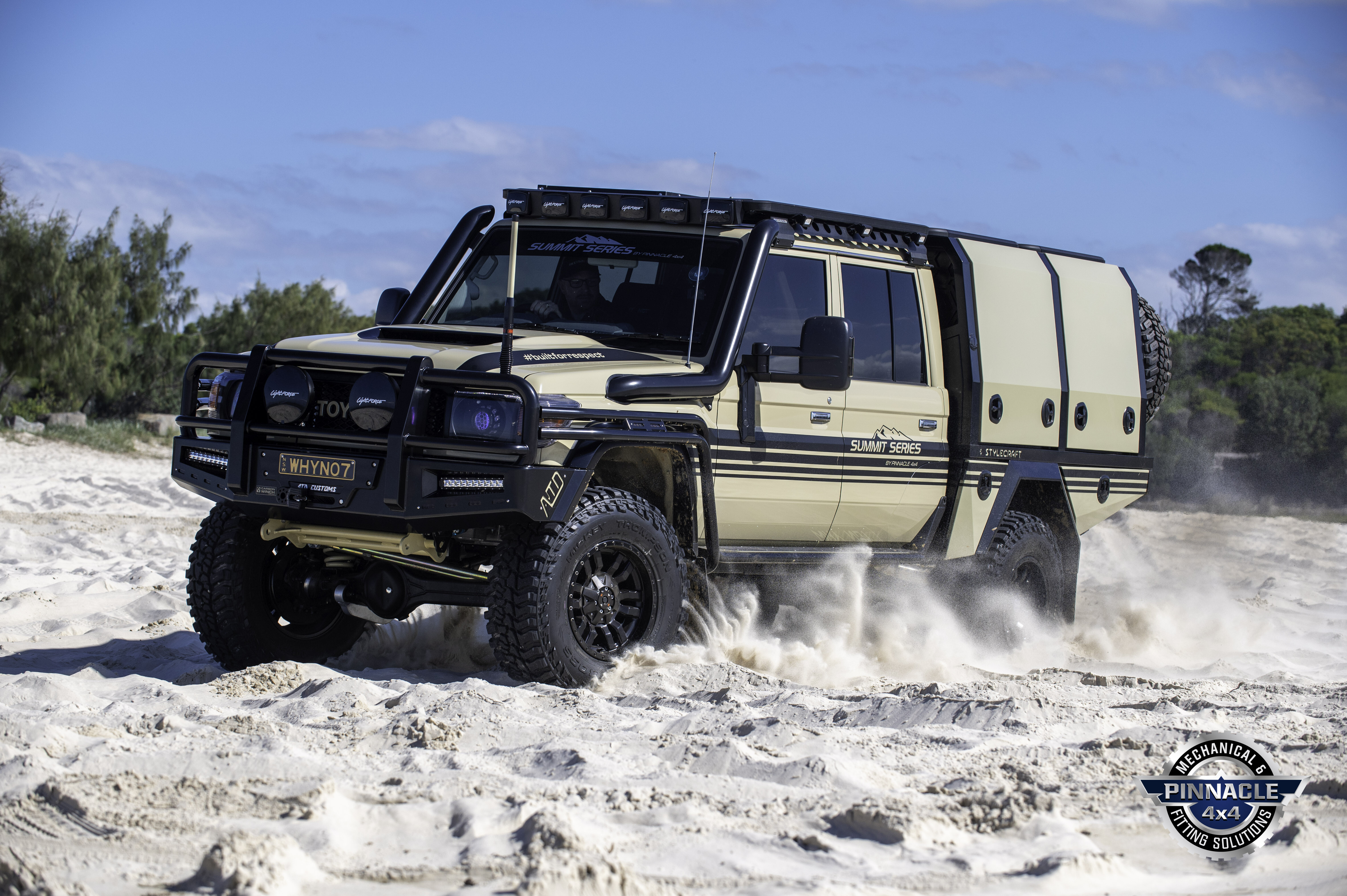
Enter Pinnacle 4×4’s 2019 Toyota LandCruiser 79 Series build, aptly named ‘Why Not’ and draped in Toyota’s famous Sandy Taupe hue. The brief of the build was simple: It needed to be a comfortable full-time tourer for a family of five and their four-legged companion, and it needed to be stylish yet remain practical.
“During the early quoting and design process, there were a lot of discussions between Darren – Pinnacle 4×4’s Summit Build manager – and the client,” said Stephen Cowling, owner of Pinnacle 4×4.
“We worked together to get the ball rolling on this project. Once the vehicle arrived at Pinnacle and our creative juices started to flow, direct lines of communication with the customer were happening on an almost daily basis.
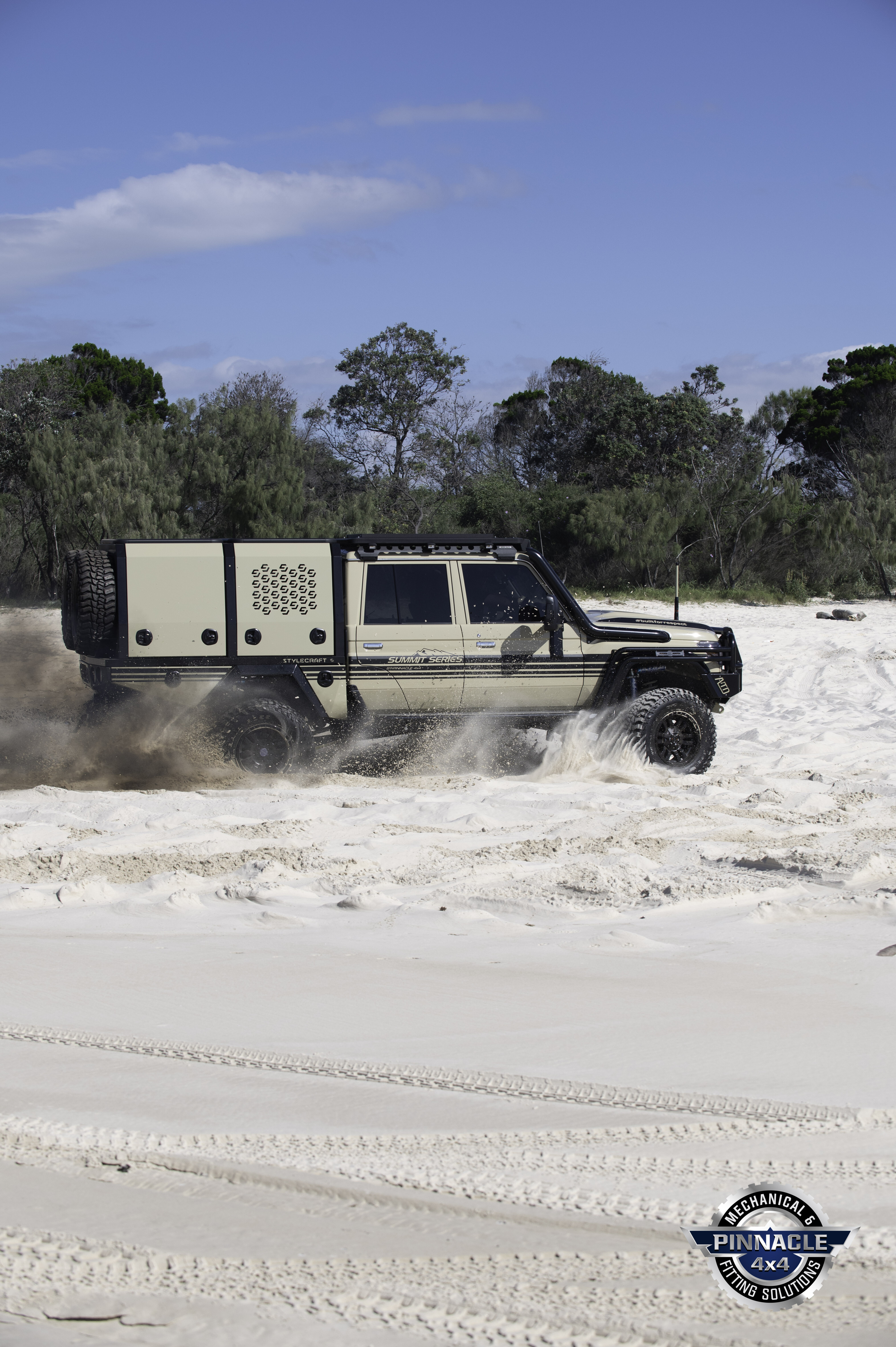
“After a few weeks of the Cruiser being here, the customer felt more than comfortable enough in handing over the reins to Pinnacle 4×4 to continue to design, modify and get creative on the build.”Now with complete discretion, Pinnacle 4×4 paid particular attention to ensure accessories chosen for this build were best suited to both the vehicle’s and the family’s needs. This is best illustrated by the lengthy consultation process undertaken for every aspect of the build.
Take the seating, for example. Pinnacle 4×4 consulted with its own auto trimmers on a particular foam insert and pattern design, to complement the rest of the vehicle but remain comfortable and unobtrusive.
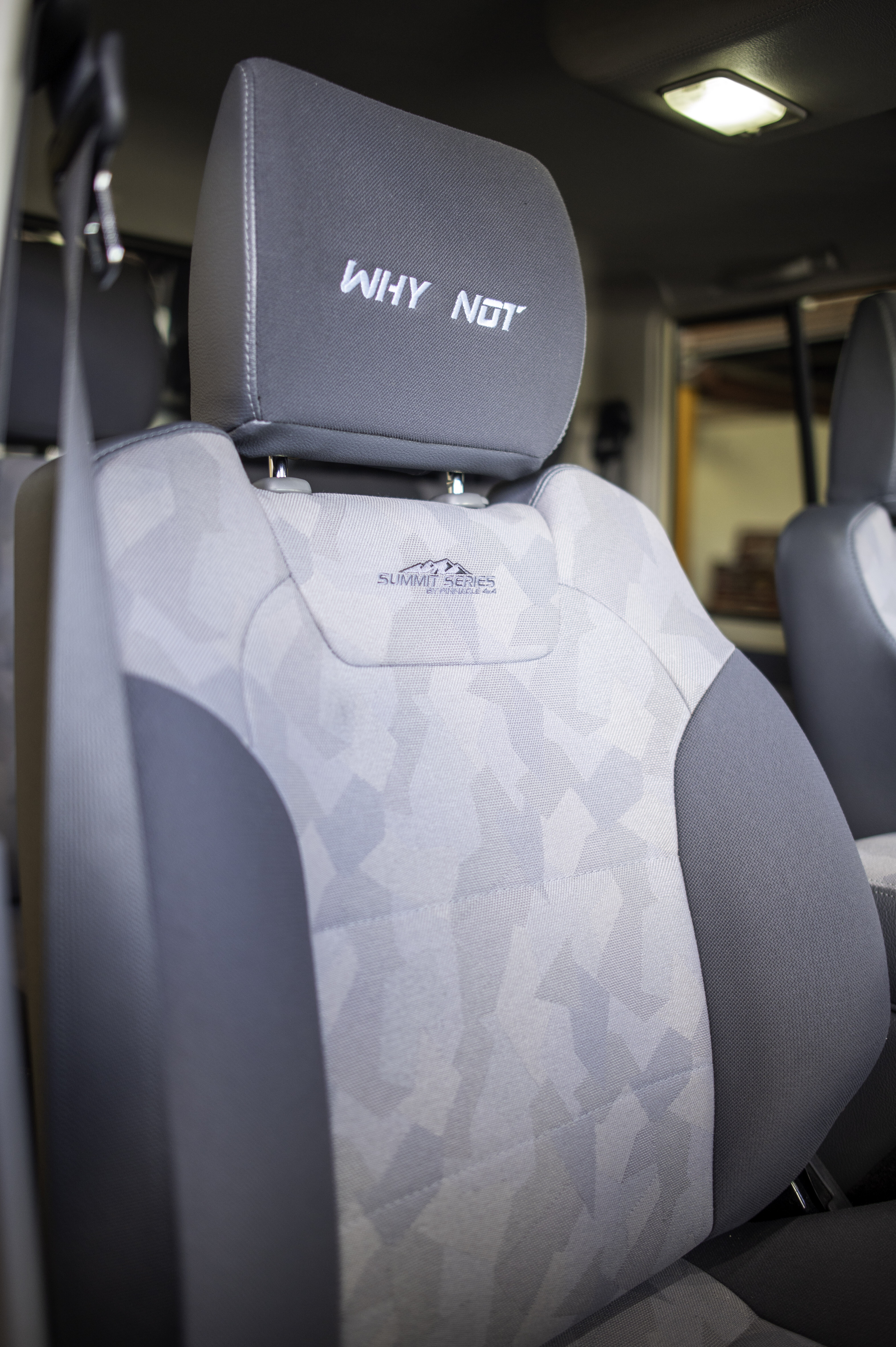
“We trimmed the seats with Recaro fabric as well as the centre console and door cards, to give an overall fit and finish deserving of a build such as this,” Stephen added. “Multiply this design and thought process across the entire build and you start to understand the level of thought, effort and complexity involved.”A build of this magnitude takes an enormous amount of planning and work, so it’s fraught with challenges, especially during a global pandemic.“Co-ordinating the external suppliers so work is completed in the correct sequence, is always challenging, especially during a world pandemic where parts and lead-time are blown out from the normal,” Stephen said.
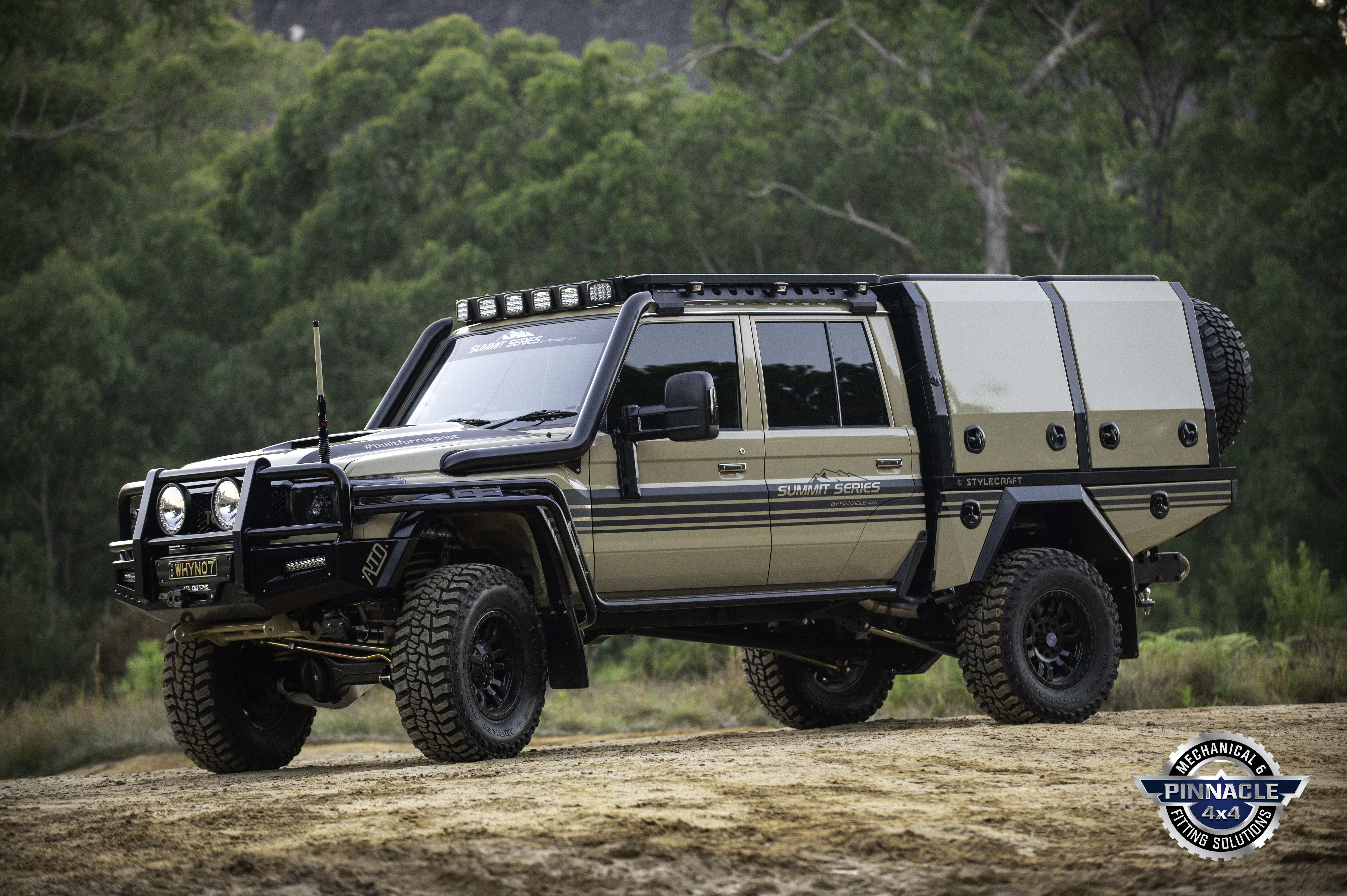
Of the build itself, Stephen told 4X4 Australia that the biggest challenge was completing the first 300mm chassis extension with that specific tray/canopy combo (read canopy breakout), while also fitting the rear winch underneath and maintaining roof-rack height from front to back.The build took eight months overall – three if you exclude time spent waiting for parts. But despite the issues encountered along the way – unavoidable on a job this big – the end result makes it all worthwhile.“When you work with a bunch of talented, creative and passionate people like we have at Pinnacle 4×4, the end result is always going to be amazing,” Stephen said. “Everybody at Pinnacle 4×4 is super proud of what we have achieved with the building, innovation and attention to detail of Why Not.
WHY ‘WHY NOT’?Stephen Cowling told 4X4 Australia the 79 Series actually got the name Why Not because of the owner’s wife. “He would go to her with his and Pinnacle 4×4’s ideas for the vehicle and she would inevitably say, ‘why not’, so it seemed fitting to call this amazing Cruiser Why Not.”
SUSPENSIONSuspension tweaks include a Superior Engineering coil conversion, with four-inch coils front and rear that are colour-coded Sandy Taupe. King Shocks’ remote res 2.5-inch shocks were opted for front and rear, with a King Shocks steering dampener.
A four-inch lift was performed under a pre-rego second-stage manufacturer (SSM) compliance plate. Other improvements include a Superior Engineering rear sway bar, front swaybar extensions, and a Superior Engineering rear coil cradle welded in to place.SOUND SYSTEMAn Alpine stereo upgrade with a hideaway amp and Type-R speakers drown out in-car comms chatter, with Cruiser Consoles door speaker pods (front and rear) and full Dynamat sound deadening (roof, doors, floor and rear wall) to create the perfect environment to listen to banging tunes. Sound deadening also reduces road noise and heat transfer.WHEELS AND TYRESThe 17-inch King Hurricane wheels live within chunky 35-inch Mickey Thompson Baja Boss mud-terrains.
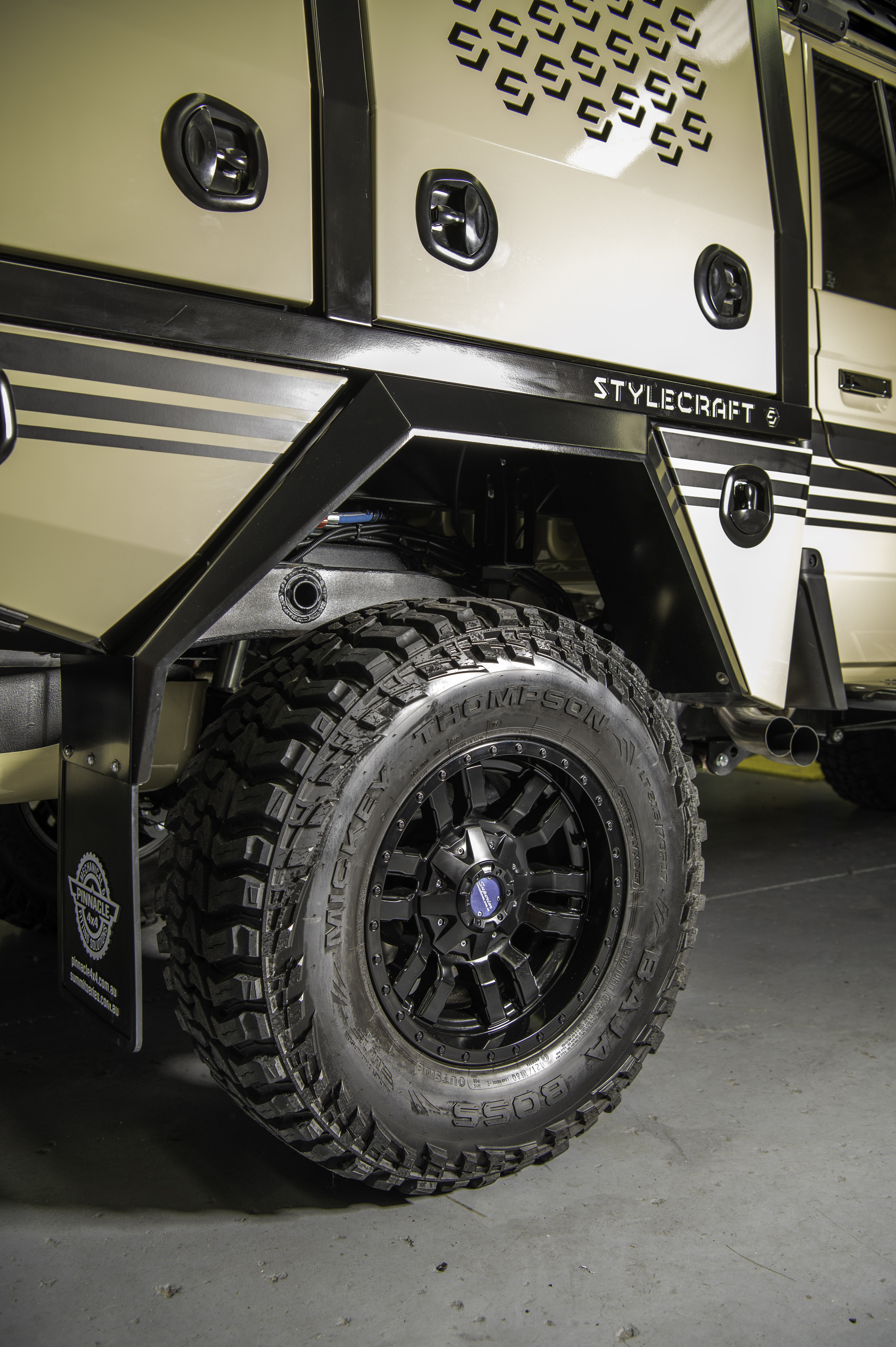
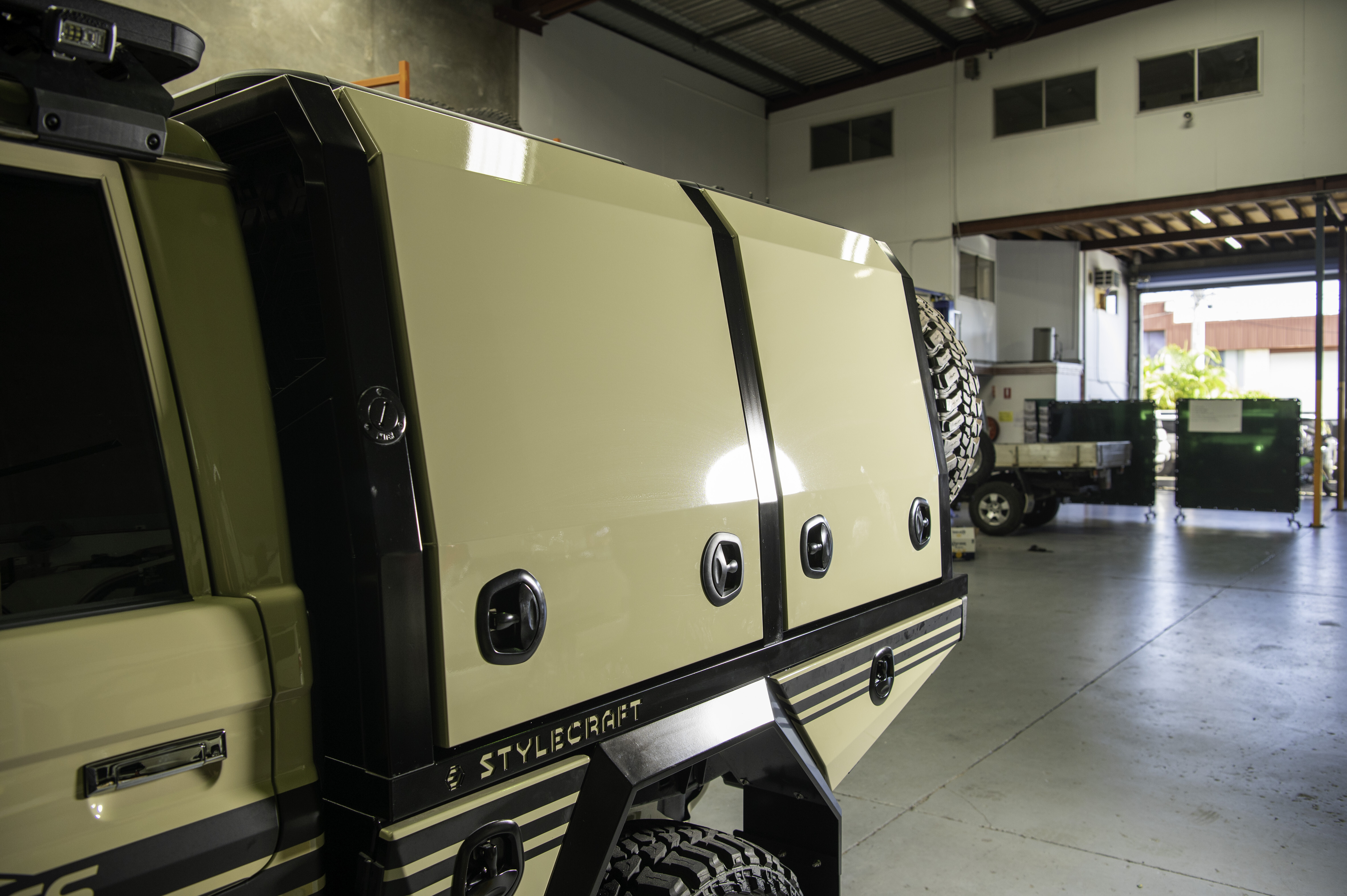
COMMSThe client opted for a GME UHF, which sits in the roof console. It’s mated to a 2dB antenna which is colour-coded Sandy Taupe to match the vehicle’s exterior. Redarc gauges live in a pillar pod, controlling exhaust gas temps, boost and battery levels.VEHICLE ELECTRONICSA PVS upgraded centre switch-panel features OE-style switching, and Pinnacle 4×4 installed a custom wiring harness and an electrical panel with fusing and winch isolators. There are 12,000lb Carbon Winch winches fore and aft, with dash-mounted switch controls and Factor 55 pintles. Also fitted are an Redarc Tow-Pro and an upgraded cranking battery.CANOPYThe Style Craft canopy houses an ARB twin compressor, 9L alloy air tank, 4WD Evo tyre-inflation system, Bushman 130L fridge, 9m retractable air reel, water tank, toolbox, Lightforce drawer lighting, touch switches throughout, ample USB and power sockets, and carpeted floors. Two 200amp/h Enerdrive lithium batteries, an Enerdrive 40+ DC Charger, Enerdrive 60amp AC Charger, Enerdrive E-Pro+ battery monitor and Redarc 2600W Inverter keep accessories alive.
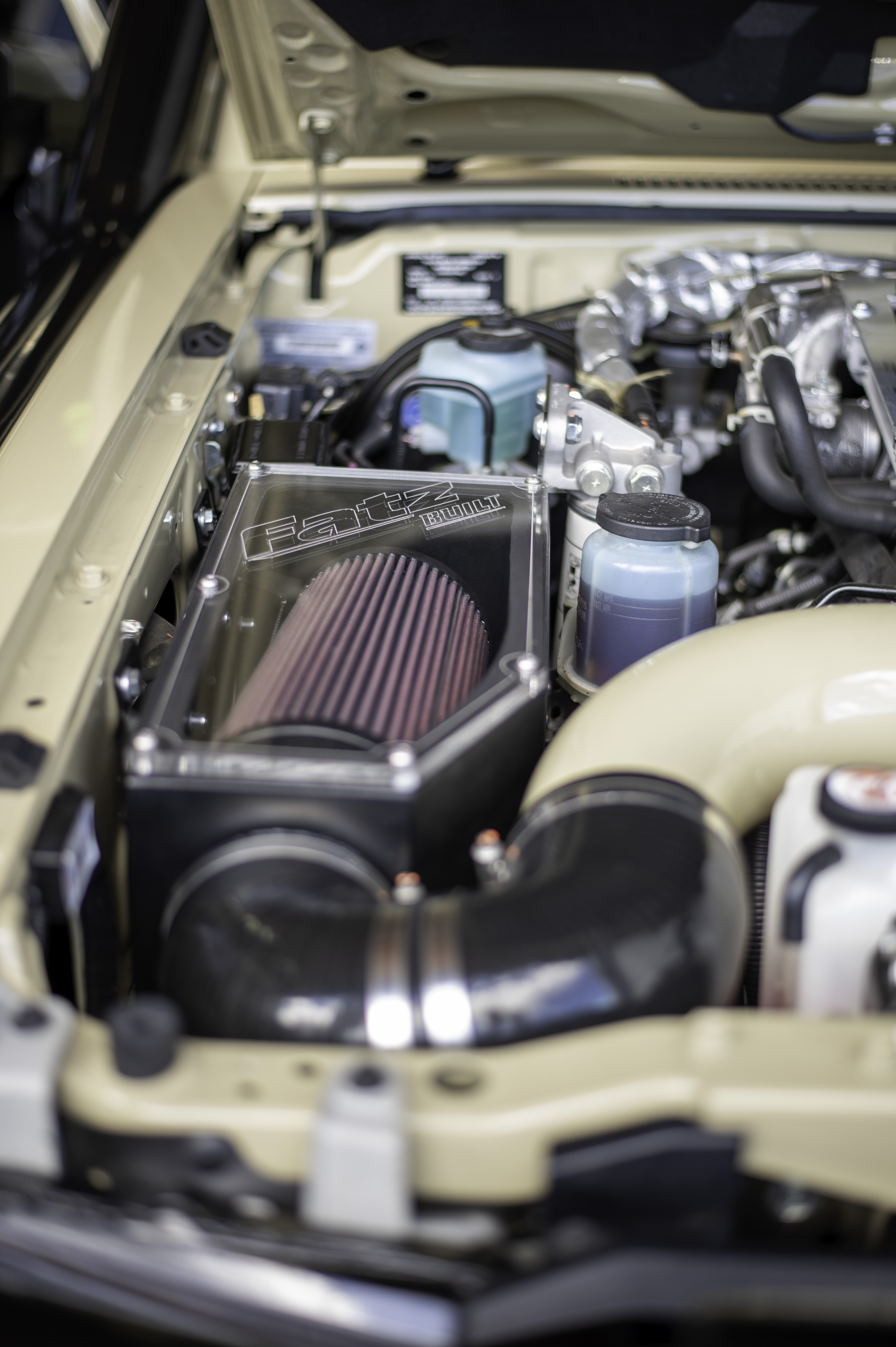
DRIVETRAINPinnacle 4×4 installed a PWR intercooler fan kit to keep temps down. On the dyno at G&L Performance, it made 232hp (173kW) and 305lb (414Nm) of torque at the rear wheels thanks to an ECU remap.
To aid performance Pinnacle 4×4 installed a Fatz Performance Airbox; a Phat Bars Twin Snorkel (only one is connected); an Ultimate 9 throttle controller; a Process West catch can; and a Direction Plus Aux Fuel Filter with water alarm. Pinnacle also added its stainless-steel turbo crossover pipe; and an NPC 1300nm clutch upgrade.
EXHAUSTA dual-exit exhaust system with the custom crossover pipe was fabricated in-house by Pinnacle 4×4; it runs from the DPF and exits behind the ATD side-steps. The twin tubes were recessed together to give a sleek look and a style which complements the rest of the vehicle build.VEHICLE LIGHTINGThe Cruiser is beaming with an assortment of lighting solutions, including two Lightforce HTX2 spotlights; six Lightforce Strikers in a Zennith light pod; six Lightforce Ultra floods on the roof for side lighting; and wheel-arch lighting.INTERIORPlenty of work went in to ensuring Stephen’s client was comfortable on long off-road stints. To this end, custom seat foams were added to all pews, with Summit Series seat bolstering increasing both lumbar support and comfort levels – as does electric lumbar support in the front seats.
Stephen and the crew also retrimmed the seats and door card, to get them looking brand-new again, and Recaro fabric inserts were added to the seats, door cards and centre console. The steering wheel is a limited-edition Sandy Taupe tiller.
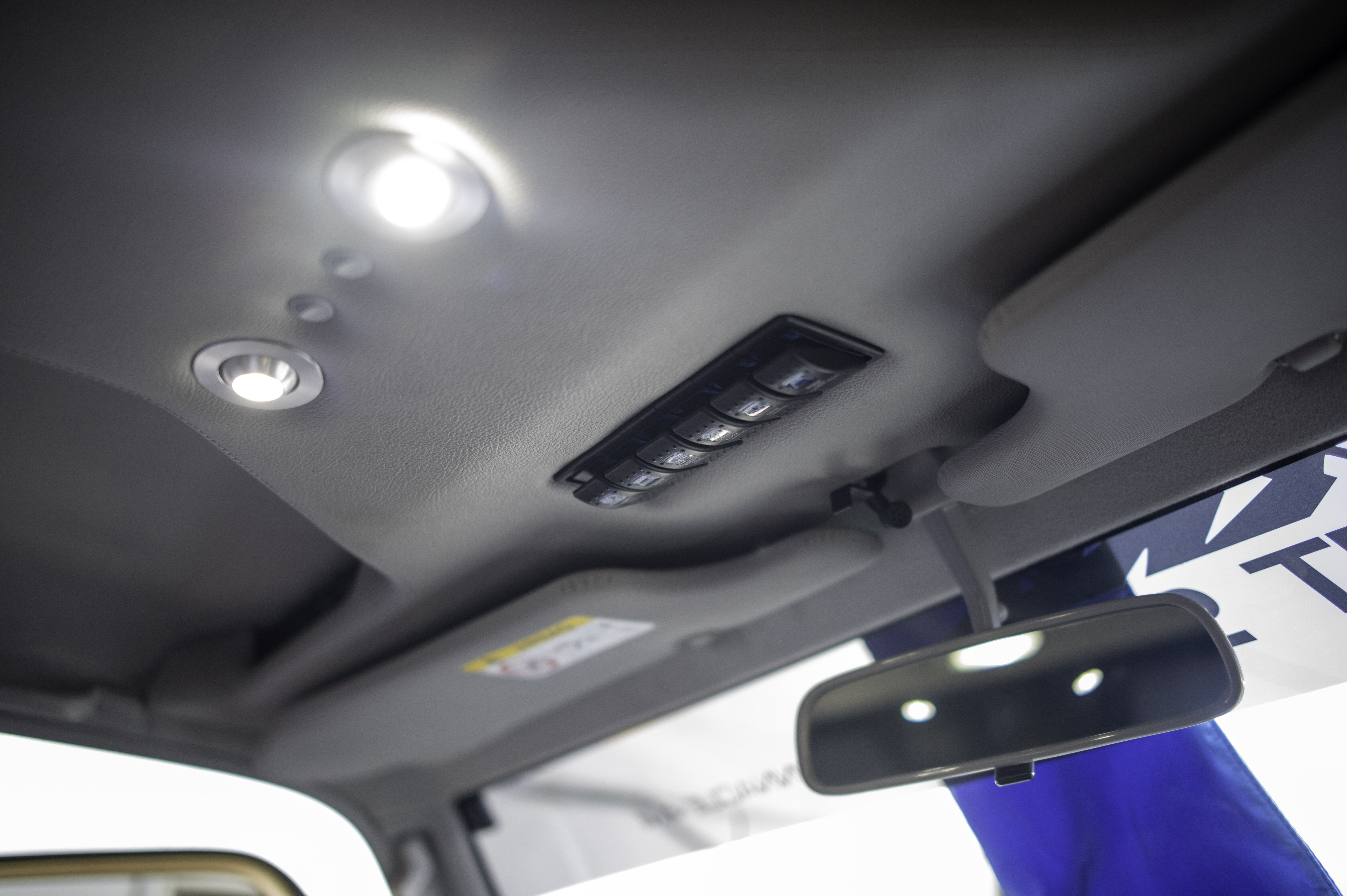
Also new is a Department of the Interior full-length floor console, and a T-shaped roof console sits snugly above. The rear wall is carpeted, and ceramic window tint fends off prying eyes.
ENGINE 4.5-litre V8 turbo dieselSUSPENSION Four-inch lift, King Shocks remote res shocks, Superior Engineering coils and sway barCLUTCH NPC 1300nm clutch upgradeEXHAUST Dual-exhaust system w/ custom crossover pipeWHEELS/TYRES 17-inch Hurricane / 35-inch Mickey Thompson MTsSPECIAL THANKS Darren U, John M, John C Andrew C, Brendon S, Brad G, Riley L, Marib R, Jacob G, Tamara G, Lachlan MMORE INFO W: https://www.pinnacle4x4.com.au/ E: [email protected] P: (07) 3808 4200
April 26, 2023: Scorpio now in Australia, and we’ve driven it
The new Mahindra Scorpio SUV is now on sale in Australia, and we’ve driven it. See our full review at the link below.
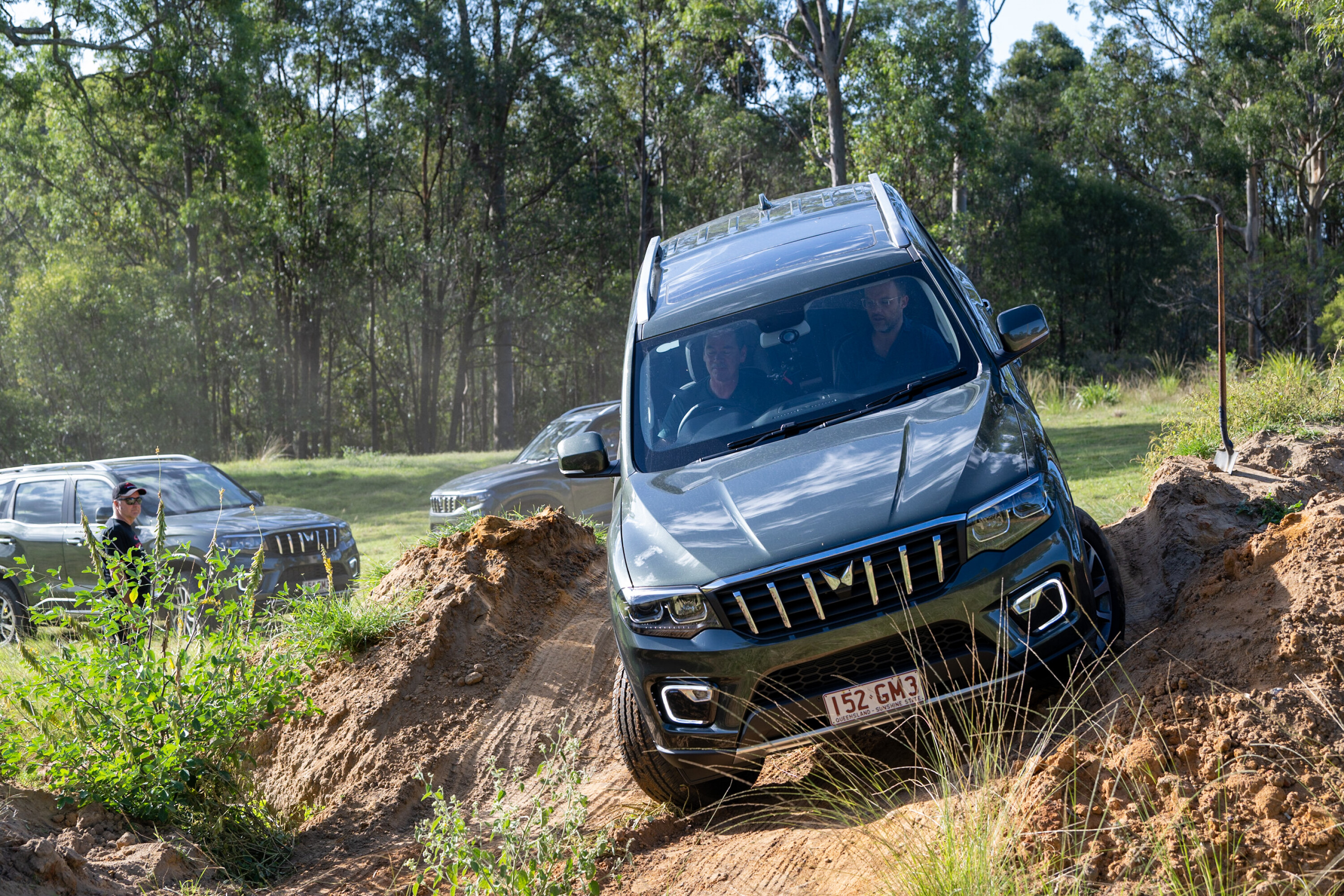
June 28, 2022: Mahindra Scorpio-N Australian launch confirmed
Snapshot
- Mahindra Scorpio-N revealed for Indian market
- Body-on frame underpinnings; petrol or diesel powertrains
- 2023 Australian launch confirmed
Mahindra has confirmed its Scorpio-N SUV will launch in Australia next year.
Revealed late last month (see below), the Scorpio-N is Mahindra’s answer to body-on-frame SUVs, such as the Ford Everest and Isuzu MU-X – albeit at a much lower expected price.
Designed by Pininfarina and Mahindra India Design Studio, the SUV will be produced in Pune, India, for the global market, with its Australian debut slated for 2023 – barring any further supply chain delays.
Mahindra will confirm local pricing and features closer to the Scorpio-N’s local launch.
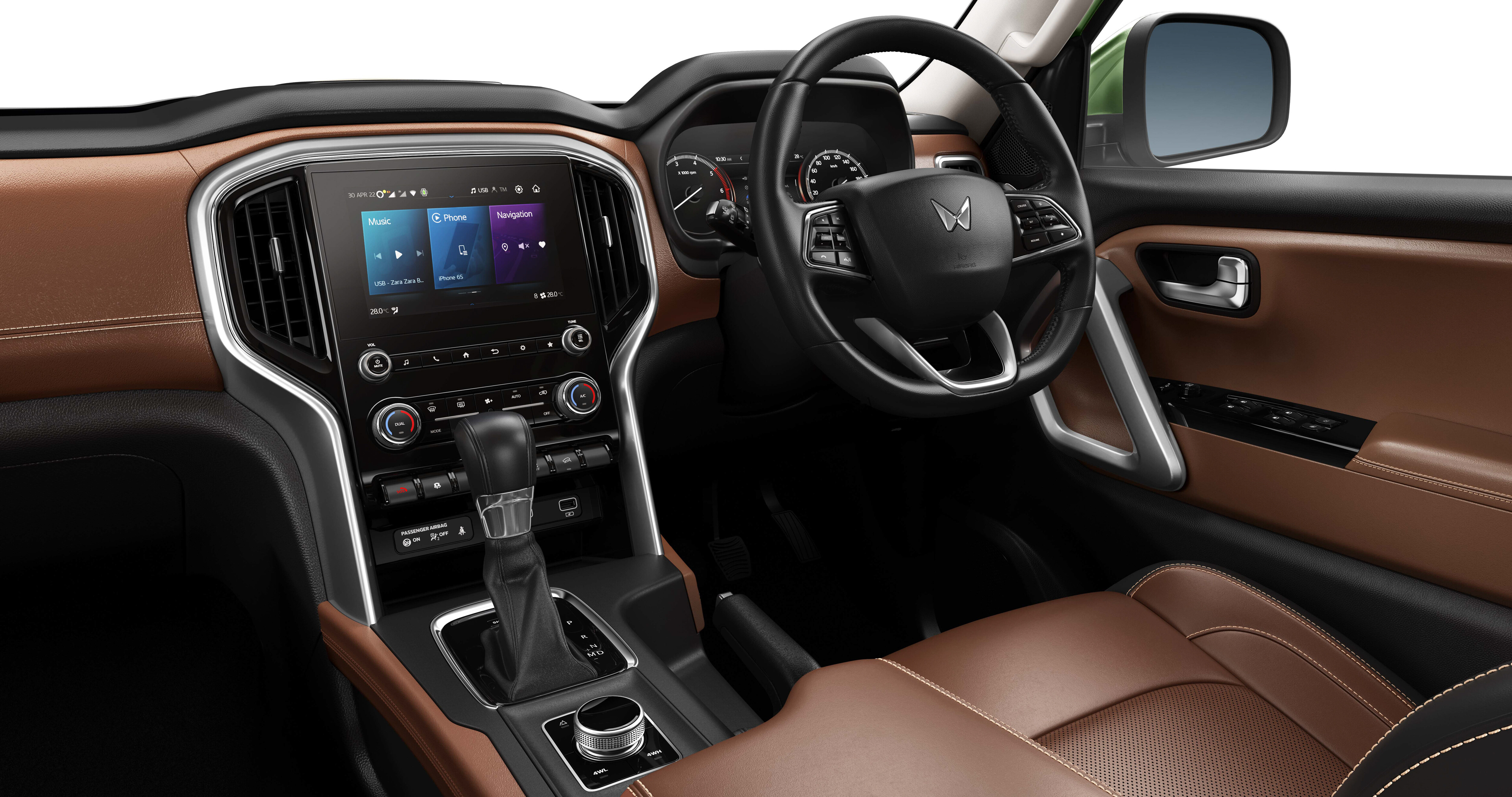
The story to here
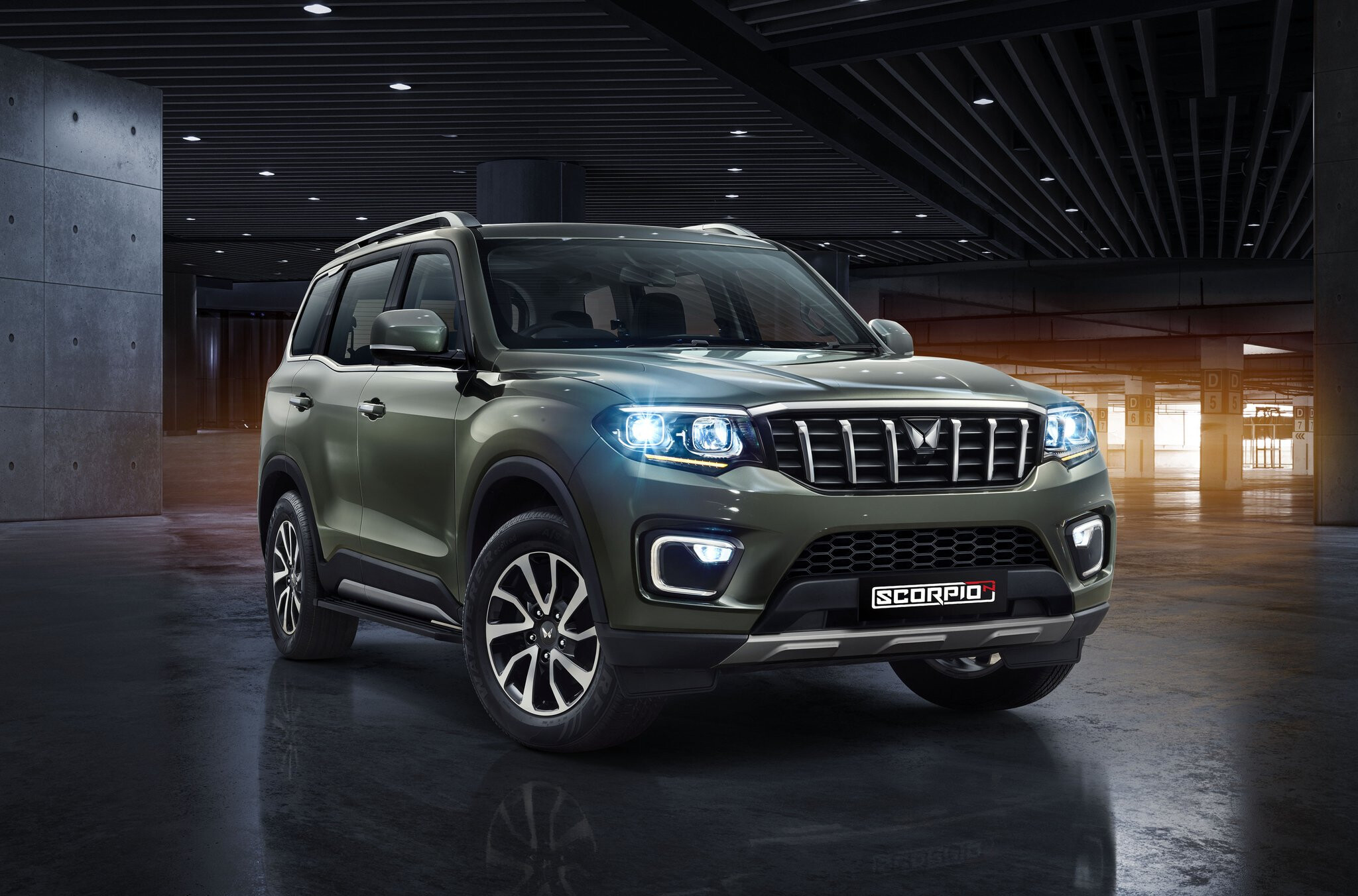
May 25, 2022: Mahindra Scorpio-N revealed for India
Indian vehicle manufacturer Mahindra has taken the covers off its first all-new Scorpio four-wheel-drive SUV in 20 years.
Officially known as the Scorpio-N, the redesigned SUV is billed as a smaller, more-affordable rival to the Ford Everest, Isuzu MU-X, Mitsubishi Pajero Sport and other body-on-frame large SUVs.
The off-roader will be sold alongside the existing Scorpio – the crossover version of the Pik-Up utility sold in Australia – which has been in production since 2002 and will be renamed Scorpio Classic.
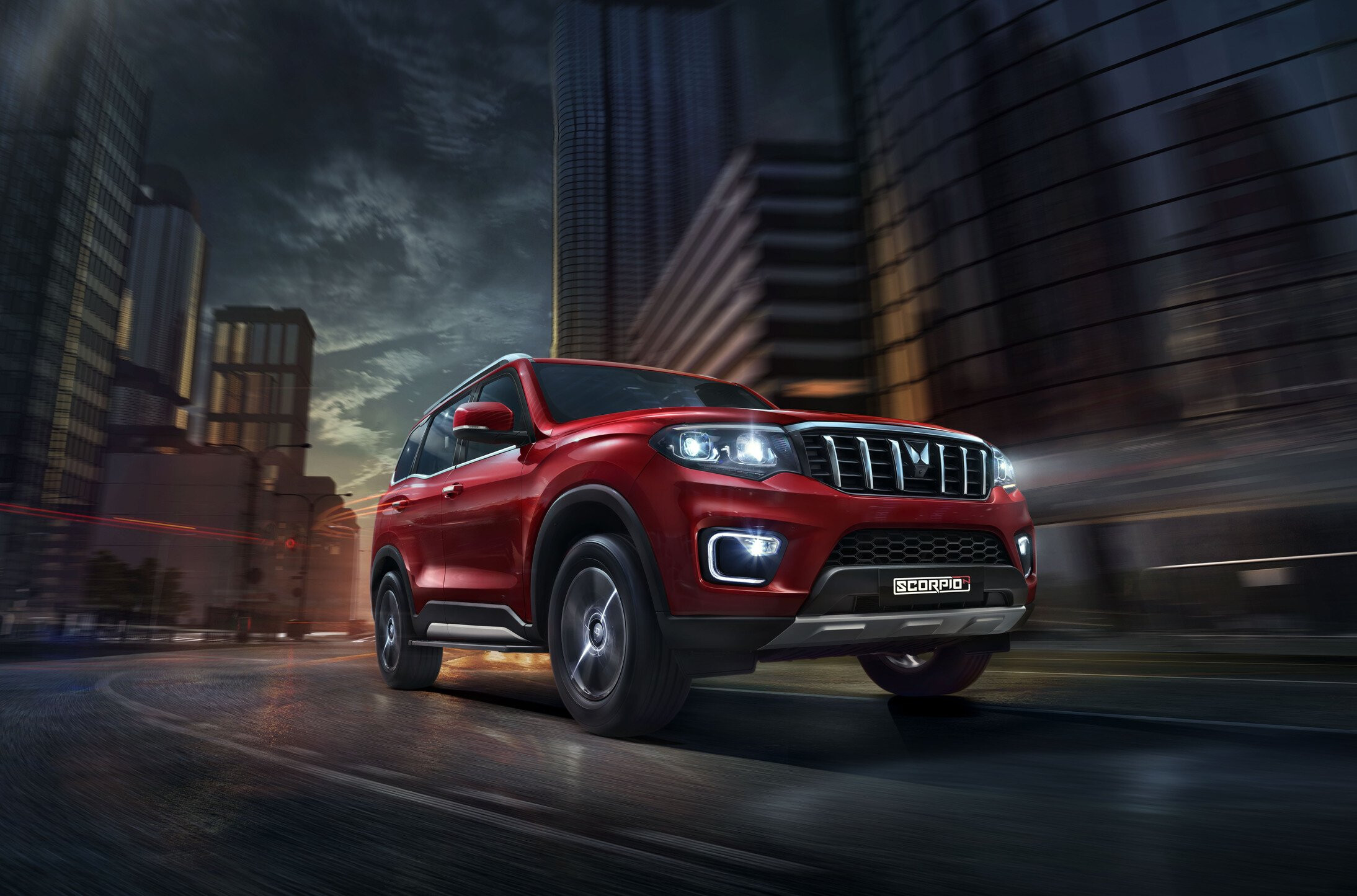
Although many details remain unconfirmed, the marque has announced the Scorpio-N will be offered with both petrol and diesel powertrains, each matched with a manual or automatic transmission.
A local launch is yet to be announced, however, more details are expected on June 27, 2022, when the Scorpio-N officially launches in India.
The unibody XUV700 revealed in mid-2021 to replace the XUV500 will arrive in Australian showrooms later this year, potentially to be joined by the Scorpio-N.
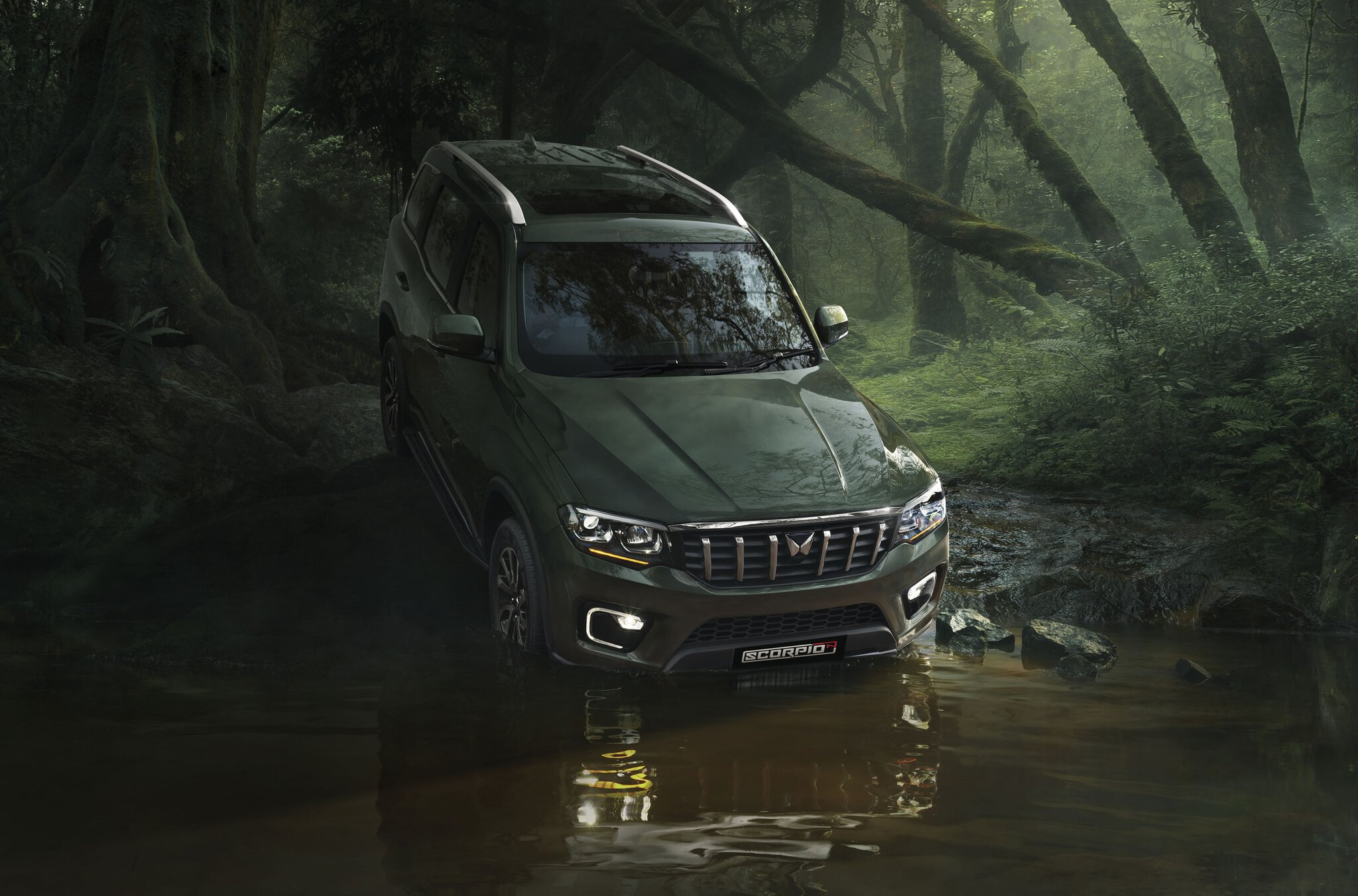
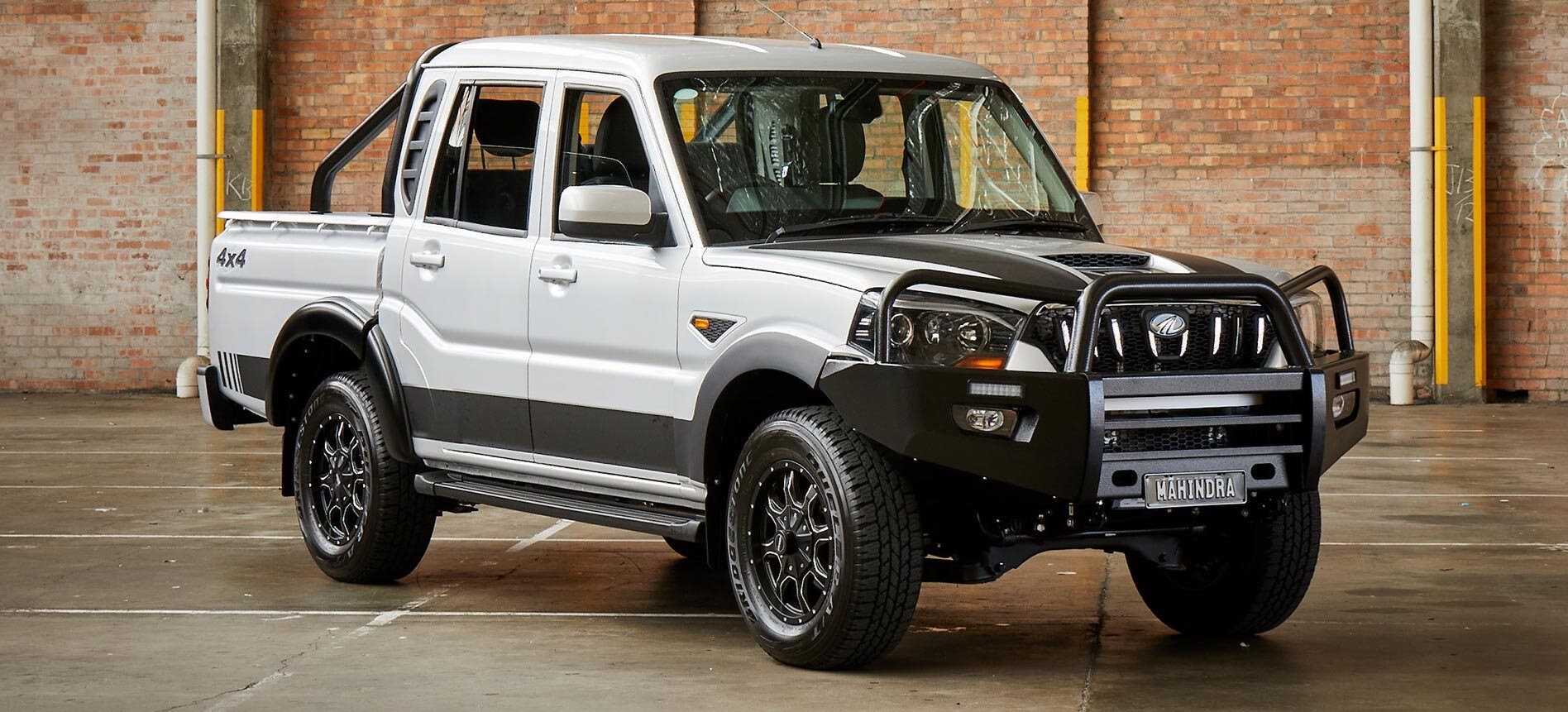
The current Scorpio Classic is not sold in Australia, however Mahindra has held the Scorpio trademark locally since February 2019.
Plans to launch the Thar have been thwarted by legal action from Fiat Chrysler Automobiles Australia in recent months due to similarities to the Jeep Wrangler, currently leaving the brand with only the ageing Pik-Up utility.
Although the Scorpio-N features a ‘new’ chassis, the brand has retained the boxy styling of the previous model – albeit with modern touches, including LED headlights and chrome finishes.
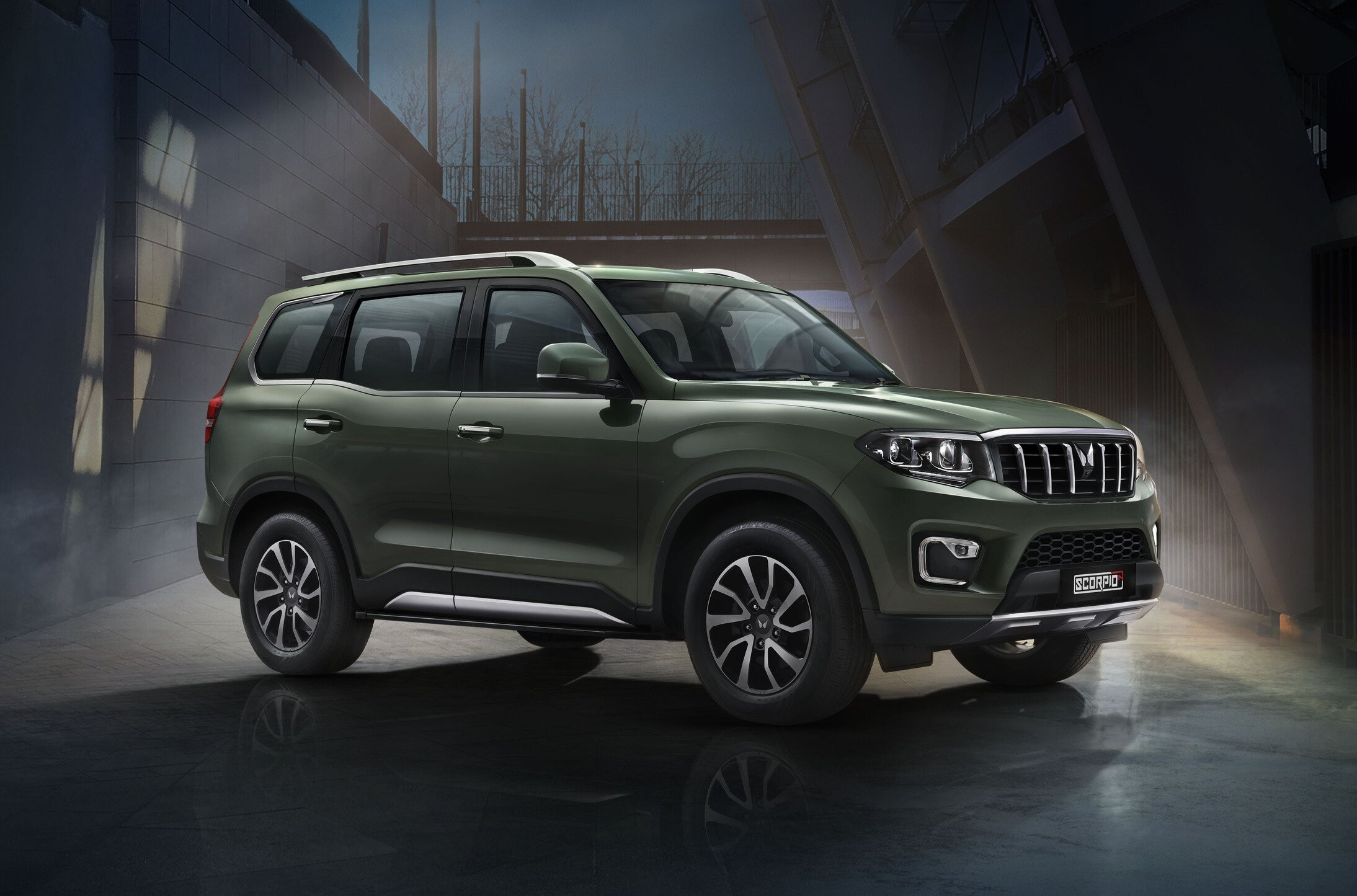
The engine lineup is expected to be familiar to the XUV700, as seen in the Indian media, consisting of a 147kW/380Nm 2.0-litre turbocharged petrol or 2.2-litre turbo-diesel engine with multiple states of tune.
Entry-level diesel variants output 114kW of power and 380Nm of torque, with the more-powerful tune producing 136kW/420-450Nm, depending on transmission.
Both engines are mated to a six-speed manual or six-speed automatic gearbox.
No official images of the interior have been released, but spy photos published by Autocar India suggest it will adopt; a touchscreen infotainment system, digital instrument cluster, climate control, and multiple USB ports.
The 2022 Mahindra Scorpio-N will go on sale in India in the coming months.
Stay tuned to 4×4 Australia for any further information surrounding local prospects for the Scorpio-N.
It can be a weird old gig, this 4×4 journo game; some days you’re wading through press releases about cosmetic updates to 10-year-old vehicles, other days you’re being whisked around the country attending launch events driving the latest and greatest in off-road machines.
While bipolar in nature, it’s also the best job in the world as far as I’m concerned, especially after receiving the phone call for this article you are reading right now.
Simon Vella, the tech guru from four-wheel drive suspension company Tough Dog 4WD Suspension, called out of the blue one day.
“Ev, I’ve got a new 300 Series we’ve just finished fitting an upgraded suspension on, and we’ve got a 200 Series with some fruit on it … would you be keen to take them both for a spin; we’d love to get your feedback?”
Naturally, the only logical option was to say yes and, before I knew it, we’d arranged to meet at the excellent Mountain High Pies in Wentworth Falls for a morning pie and a bit of a chat, before heading out to the proven off-road testing grounds of Lithgow and its surroundings.
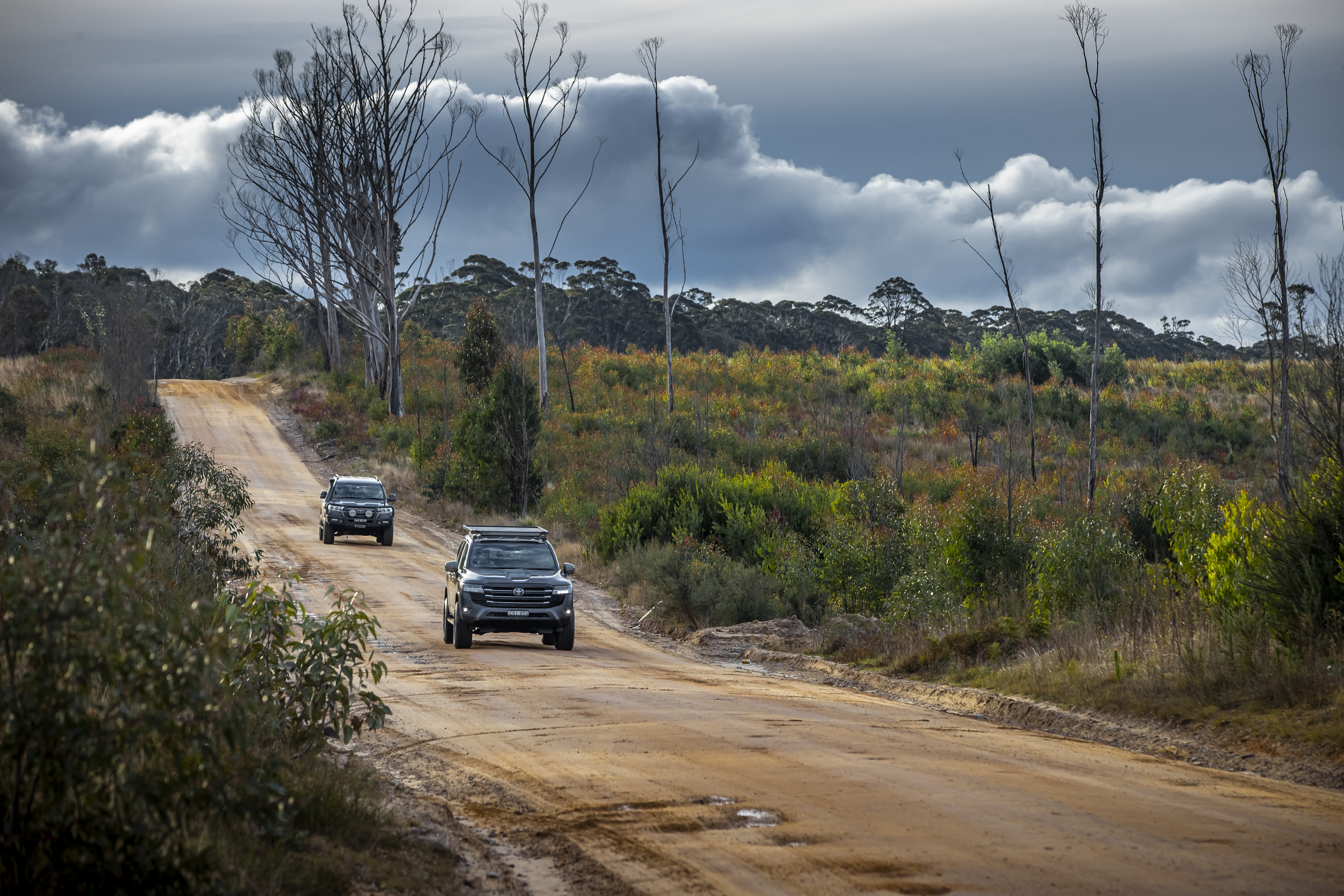
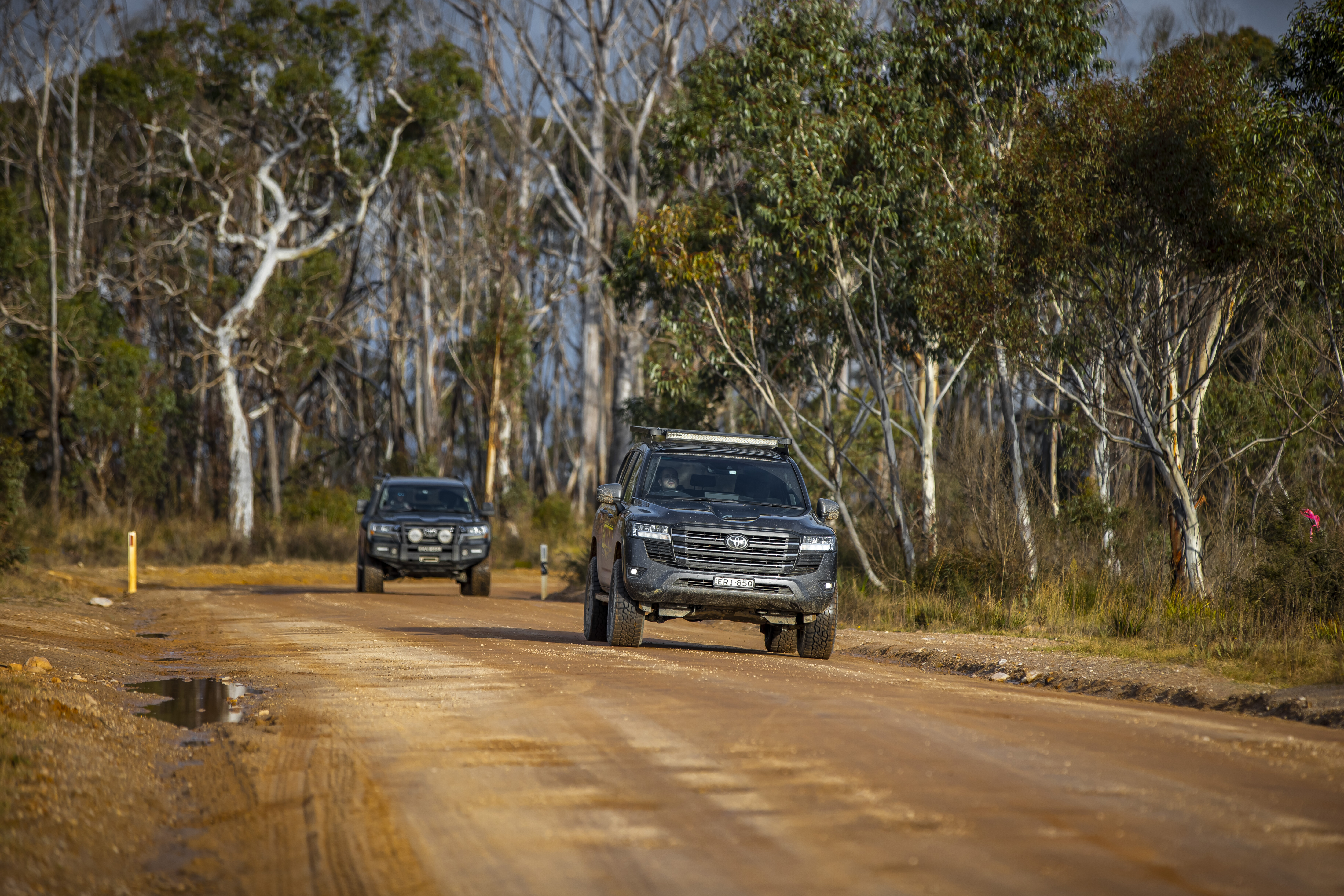
The aim of the game was to drive both vehicles on road, on fast dirt and through technical terrain, to see how both the 200 Series and 300 Series fared. Plus, I’d get my first chance to drive a new 300 Series fitted with aftermarket suspension.
I’ve been fortunate to have plenty of seat time in the 300 Series already, attending the launch, reviewing a base-spec GX, then having nine or so days testing one through the desert and outback roads on the recent 4X4 Australia 4X4 Of The Year awards.
However, this was my first chance to drive a 300 Series with aftermarket suspension fitted to it, and this was going to be interesting, as I am a fan of the factory suspension tune found in the 300 Series, which is a rarity. Normally, factory suspension is the first thing I’d ditch, but credit where credit is due, Toyota has done a great job.
Aftermarket suspension companies like Tough Dog now had the hard task of making its suspension better than what Toyota offers. Spoiler alert, Tough Dog has done a brilliant job of developing a suspension kit that rides better than stock and provides more suspension travel. Time to hit some corrugations at speed for some good, old-fashioned back-to-back testing.
Toyota LandCruiser 200 Series GXL
This particular 200 Series had nearly 100,000km on the clock and was hiding this well. It looked and drove like new, and had a bit more gear on it compared to the 300 Series – more of a traditional touring package.
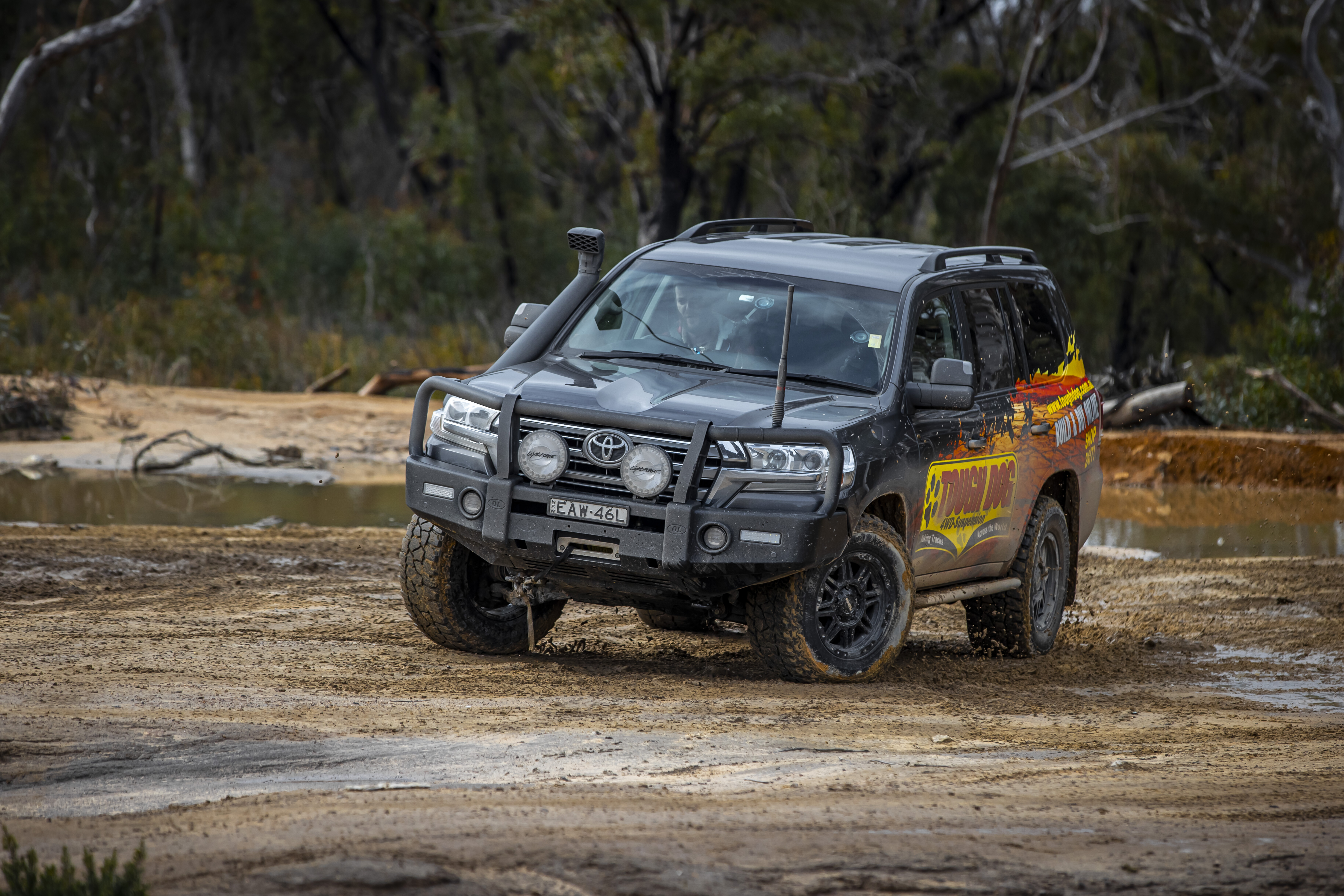
Additional accessories comprise Tough Dog suspension, lifted 40mm in the front and 20mm in the rear; a steel bullbar; a winch with synthetic rope; a set of Lightforce HTX 2 driving lights mounted on the bullbar; Mickey Thompson ATZ P3 all-terrain tyres for extra traction off-road; and a Safari snorkel for protection in dusty conditions and during water crossings.
It’s a great touring package, ticking many boxes for off-road use. Considering the 200 Series has been around for so long, there isn’t much you can’t accessorise or modify to suit your needs. This is one area the 200 Series has an advantage over the 300 Series, but this will no doubt change in time as the aftermarket industry continues to develop new products to suit the new platform.
Toyota LandCruiser 300 Series GXL
The 300 Series Simon was kind enough to let me drive (it’s his actual daily driver) was mild in comparison, modifications wise. It sports a Front Runner Rack with Lightforce LED light bar, a set of Falken Wildpeak tyres and upgraded suspension from Tough Dog.
While both vehicles are carrying different amounts of weight, Simon was quick to point out the suspension had been tailored to suit the weight difference for each vehicle. As most vehicles are set up differently, it’s critical to focus on spring rates and have plenty of options available to cover these varying loads. This is why we always say to add the weight to your four-wheel drive before fitting aftermarket suspension, so you can select the correct spring rate for your requirements.
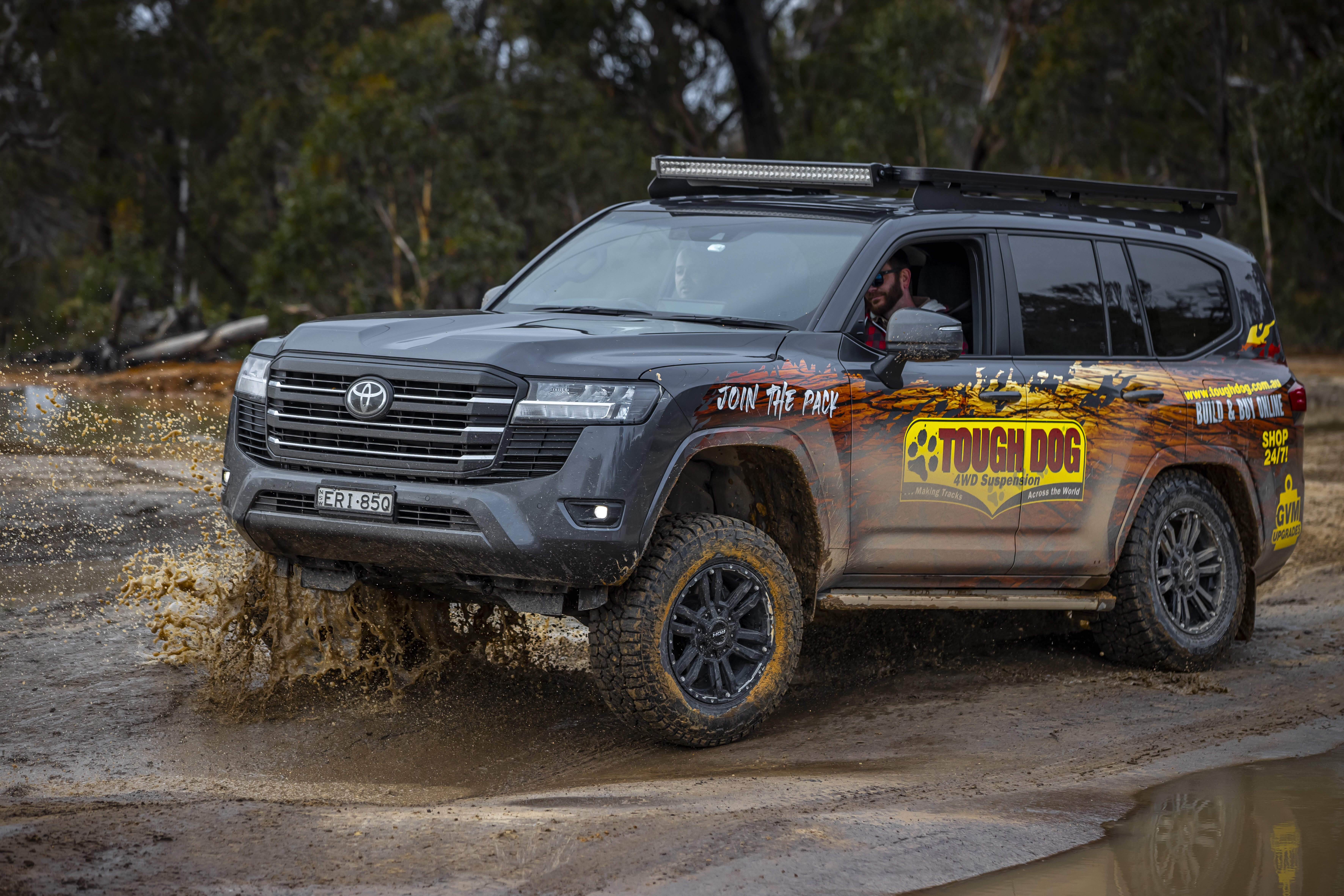
It’s important to note this suspension kit in the 300 Series is a final stage production kit, but the colours are different on the items fitted to this actual vehicle. By the time this article is released, Tough Dog will have production kits on the shelf ready to go, which will be silver and not black.
With 50mm of lift in the front of the 300 Series, Simon commented a diff drop isn’t required, and while aftermarket upper control arms would be beneficial, they aren’t absolutely required. This lift height will work well with factory components and has been engineered to operate within factory alignment parameters for tyre longevity and overall excellent ride and handling.
Research and development
As Simon mentioned, the 300 Series is not just a facelifted 200 Series LandCruiser; there are many differences that required him and the Tough Dog team to develop solutions. Starting with the front end, the strut is physically located differently to the 200 Series. The 300 Series front struts are mounted on a 24mm peg which is welded to the front of the
lower control arm; on a 200 Series, the strut sits in a clevis mount inside the actual lower control arm.
At the rear end of the big 300 Series, Toyota has basically redesigned the way the suspension is packaged. While retaining a live rear axle and coil springs, the way the coil springs and shocks are positioned is completely different. Starting with the shock absorbers, the stock 300 Series shocks are longer than the 200 Series from the factory – a good thing.
Simon tells us they are able to make the shock longer again by up to 15mm when developing a shock for the 300 Series, which allows for greater wheel travel off-road. Plus, the shocks can carry more oil, which results in better performance on corrugated roads.
Coil spring and shock absorber positioning is also different on the rear end, with the coils sitting farther outboard (away from the diff centre) for a more stable ride. Rear shock absorbers have been mounted outwards of the chassis rails, and lean forward on the 300 Series. So, it was back to the drawing board to develop suspension packages from scratch to suit these changes found in the 300 Series.
Additionally, Simon tells us Tough Dog has developed a sway bar relocation bracket, which lowers the sway bar back to its factory setting, restoring the alignment of the sway-bar link rod after raising the 300 Series. Tough Dog also offers a heavy duty adjustable Panhard rod for the 300 Series, providing a complete suspension package.
Driving dynamics
The boat-like soft feeling is gone from the 200 Series that’s fitted with the Tough Dog suspension, making fast cornering manoeuvres far more confident. Over fast dirt roads and corrugations, the confidence both vehicles exhibit is amazing, and it’s easy to see why LandCruisers are so popular in Australia – they just work in Aussie conditions. Option them up with upgraded suspension and bigger, more aggressive tyres and you feel damn near bulletproof!
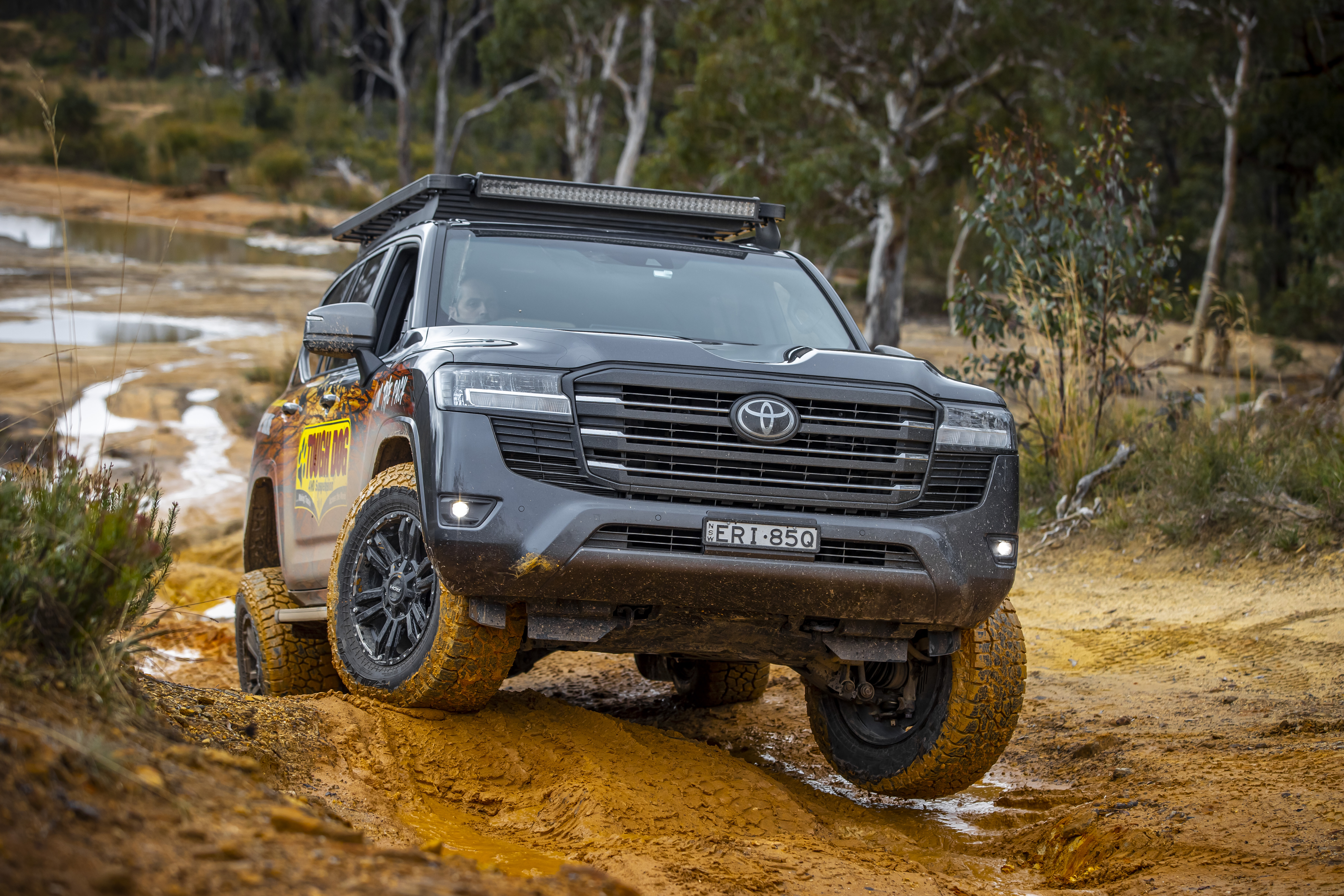
In technical terrain, the rear end of the 300 Series has more wheel travel compared to the 200 Series, something Simon mentions is due to the longer shock absorbers and shock absorber configuration used in the 300 Series. It certainly works too, being able to get power down to the ground better than the 200 Series.
As mentioned, I was really excited to have a steer of a modified 300 Series with the Tough Dog suspension, and it’s safe to say I wasn’t disappointed. Control over corrugations is superb, and you’re able to hit them at greater speeds without fear of shock fade or lack of control.
300 Series knock
Editor Matt has reported a few times he has experienced a knock in the front end of a stock 300 Series. He’s experienced it in at least two separate vehicles, but I’m yet to experience it.
As we had an industry expert at our disposal, we asked Simon if he’s experienced this before, and he mentioned that he has. He’s played with wheel alignment, different wheels and tyres, and has changed the factory suspension out for Tough Dog struts and back to factory struts multiple times as part of the research and development process, and we can confirm the suspension has nothing to do with it.
Simon mentioned it seems to happen when pulling in to a driveway at speed, not in a straight line. While we haven’t been able to work out exactly what component is making this noise, it seems to be steering-rack related. Again, fitting raised suspension has nothing to do with it, as the noise seems to be a quirk of the 300 Series LandCruiser.
Chat with Simon Vella
“You have to pay respect to Toyota for developing such a four-wheel drive for Australia, this vehicle just does it better than the 200 Series LandCruiser,” says Simon. “From ride quality, seating comfort, interior design and off-road ability, the 300 Series in my opinion is an improvement on the 200 Series.
“And that’s not to say the 200 Series is a bad thing at all, nor am I saying that you should sell your 200 Series today and put a deposit on a 300 Series if you are happy with the 200 Series. However, I get to drive these vehicles daily, and I always look forward to jumping in to the 300 Series.
“From a suspension development point of view, working on the 300 Series certainly presented a few challenges, however it was a brilliant exercise to really focus on the vehicle and how we could improve on it.
“We spent considerable amounts of time testing both in the field and in-house on our shock dyno, and have produced a product that enhances the 300 Series all-round, as well as providing load-carrying options depending on your requirements. There’s a big difference between someone who tows a horse float versus a weekend warrior, so it was vital we had options available to suit the demands of Australian four-wheel drivers.”
Verdict
Hands down, the 300 Series drives better than the 200 Series. Simon from Tough Dog, who drives these vehicles daily, went so far to say the 300 Series is a better vehicle overall.
The internet went wild when the 300 was launched, saying it was just a revision of the 200 Series with a smaller capacity engine, but when you get the chance to spend time with someone responsible for developing products for these vehicles, there are many more changes than first meet the eye.
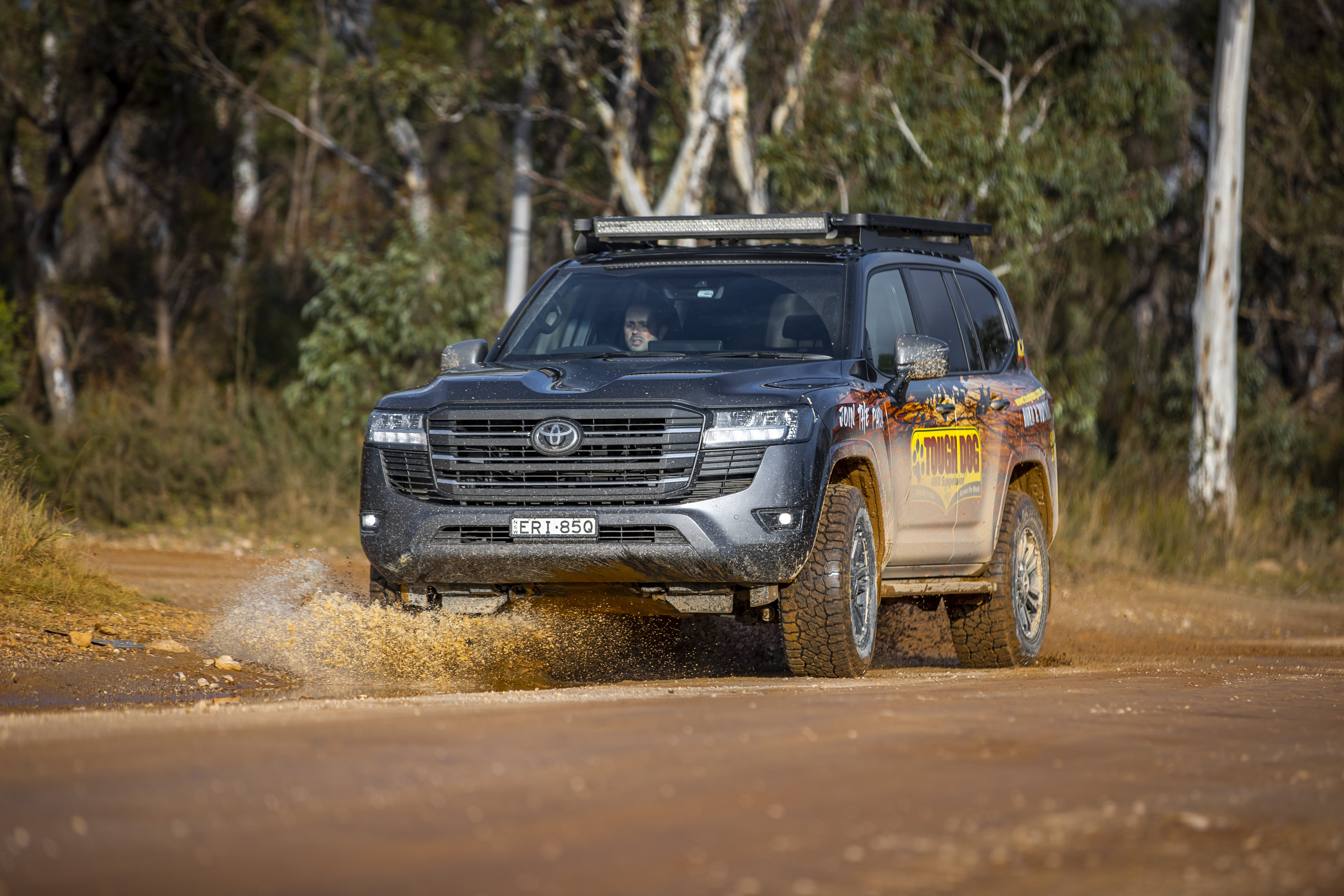
The 300 Series is more comfortable, the dash and interior more modern (funny that) and the power produced from the 3.3L V6 matched to the 10-speed auto easily pulls away from the 200 Series under acceleration testing. That’s not to say the 200 Series isn’t a brilliant vehicle, but everybody wanted to climb back in to the 300 Series … and that’s saying something.
I am really excited to see the platform develop, as knowledge and aftermarket accessories expand. As Simon said to me on the day, we really are lucky in this country to receive such vehicles, as it allows for the Australian four-wheel drive industry to not only grow, but thrive.
Snapshot
- Figures revealed for entire Ranger line-up
- Conducted under Australian ‘ADR81/02’ testing protocols
Preliminary fuel economy figures for all vehicles in the upcoming 2023 Ford Ranger line-up have been revealed.
Uploaded to the Australian Government-run Green Vehicle Guide (GVG) website, the listed figures cover the 2.0-litre (single- and bi-turbo), 3.0-litre V6 diesel and 3.0-litre V6 petrol powertrains in both 4×4 and 4×2 guise.
All testing was conducted under Australian ‘ADR81/02’ testing protocols, which means testing was controlled in laboratory conditions.
UPDATE, July 2022: New Ford Ranger review – it’s here at last
The new 2023 Ford Ranger is now on sale in Australia, and the local media launch has been run. The Wheels and 4×4 Australia teams have both driven the new Ranger, and you can find their stories at the links below.
Story continues…

The 3.0-litre V6 variants (XLT, Sport and Wildtrak), as well as the 3.0-litre V6 petrol in the range-topping Ranger Raptor, all feature an automatic stop-start feature – which will help temper expected fuel figures for these models.
The cheapest entry point into a 2023 Ford Ranger 4×4 is $47,030 for the Single XL C/C, while a dual-cab XL pick-up will set you back $49,930. Opt for a newly-minted V6 diesel version and pricing starts at $62,290 for an XLT cab chassis. The V6 petrol-fuelled Ranger Raptor tops out at $85,490.
The complete list of fuel consumption figures – combined, urban and extra urban – for the 2022 Ford Ranger are listed below.
Upgrade your Ranger
2023 Ford Ranger: Fuel consumption figures
| Model | Combined | Urban | Extra Urban |
|---|---|---|---|
| Single XL C/C 4×4 2.0L bi-turbo | 7.6L/100km | 8.7L/100km | 7.0L/100km |
| Super XL C/C 4×4 2.0L bi-turbo | 7.6L/100km | 8.7L/100km | 7.0L/100km |
| Super XL P/U 4×4 2.0L bi-turbo | 7.6L/100km | 8.7L/100km | 7.0L/100km |
| Double XL C/C 4×4 2.0L single-turbo | 7.9L/100km | 9.9L/100km | 6.8L/100km |
| Double XL C/C 4×4 2.0L bi-turbo | 7.6L/100km | 8.7L/100km | 7.0L/100km |
| Double XL P/U 4×4 2.0L single-turbo | 7.9L/100km | 9.9L/100km | 6.8L/100km |
| Double XL P/U 4×4 2.0L bi-turbo | 7.6L/100km | 8.7L/100km | 7.0L/100km |
| Double XLS P/U 4×4 2.0L bi-turbo | 7.2L/100km | 7.7L/100km | 6.9L/100km |
| Super XLT P/C 4×4 2.0L bi-turbo | 7.2L/100km | 7.6L/100km | 6.9L/100km |
| Double XLT P/U 4×4 2.0L bi-turbo | 7.2L/100km | 7.7L/100km | 6.8L/100km |
| Double XLT C/C 4×4 3.0L V6 | 8.4L/100km | 10.0L/100km | 7.5L/100km |
| Double XLT P/U 4×4 3.0L V6 | 8.4L/100km | 10.0L/100km | 7.5:/100km |
| Double Sport P/U 4×4 2.0L bi-turbo | 7.6L/100km | 8.7L/100km | 7.0L/100km |
| Double Sport P/U 4×4 3.0L V6 | 8.4L/100km | 10.0L/100km | 7.5L/100km |
| Double Wildtrak P/U 4×4 2.0L bi-turbo | 7.6L/100km | 8.7L/100km | 7.0L/100km |
| Double Wildtrak P/U 4×4 3.0L V6 | 8.4L/100km | 10.0L/100km | 7.5L/100km |
| Ranger Raptor P/U 4×4 3.0L V6 petrol | 11.5L/100km | 14.0L/100km | 10.0L/100km |
4X4 Australia's project builds
Snapshot
- Can be fitted to any version of Gladiator
- Available via Australian dealers now
- Soft Tonneau cover, Sports Bar and electric RollTrac can be had as bundle
Jeep Australia if offering a new range of accessories for its Gladiator ute.
The haul, which includes a soft tonneau cover, sports bar setup and fully-electric RollTrac unit, is now available through Jeep dealerships across Australia.
Chosen on its own, the soft tonneau cover will set buyers back $935, while combining it with the sports bar bumps that figure up to $2424.
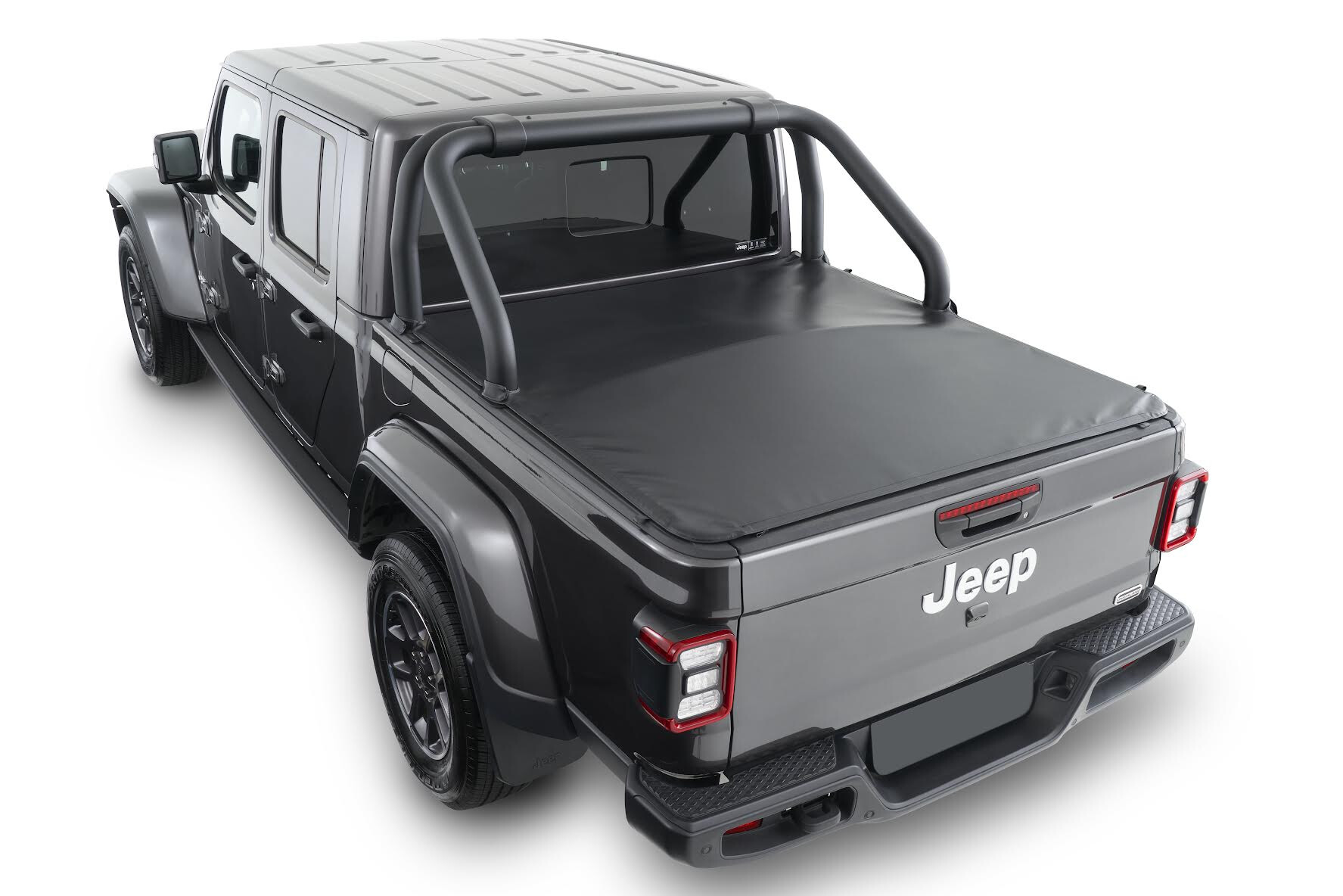

The electric RollTrac tonneau cover however costs $4617 when bought individually, and $5351 when teamed up with the sports bar.
“This is a great opportunity for our customers to simply and easily accessorise our hugely capable Gladiator ute with these practical personalisation options – at any one of our Jeep dealerships,” said Stephen Lester, director of aftersales and customer experience at Stellantis Australia.
“Now even more owners in the thriving Jeep community can fully embrace the ‘Live like a Gladiator’ mantra and put their own mark on their vehicle.”
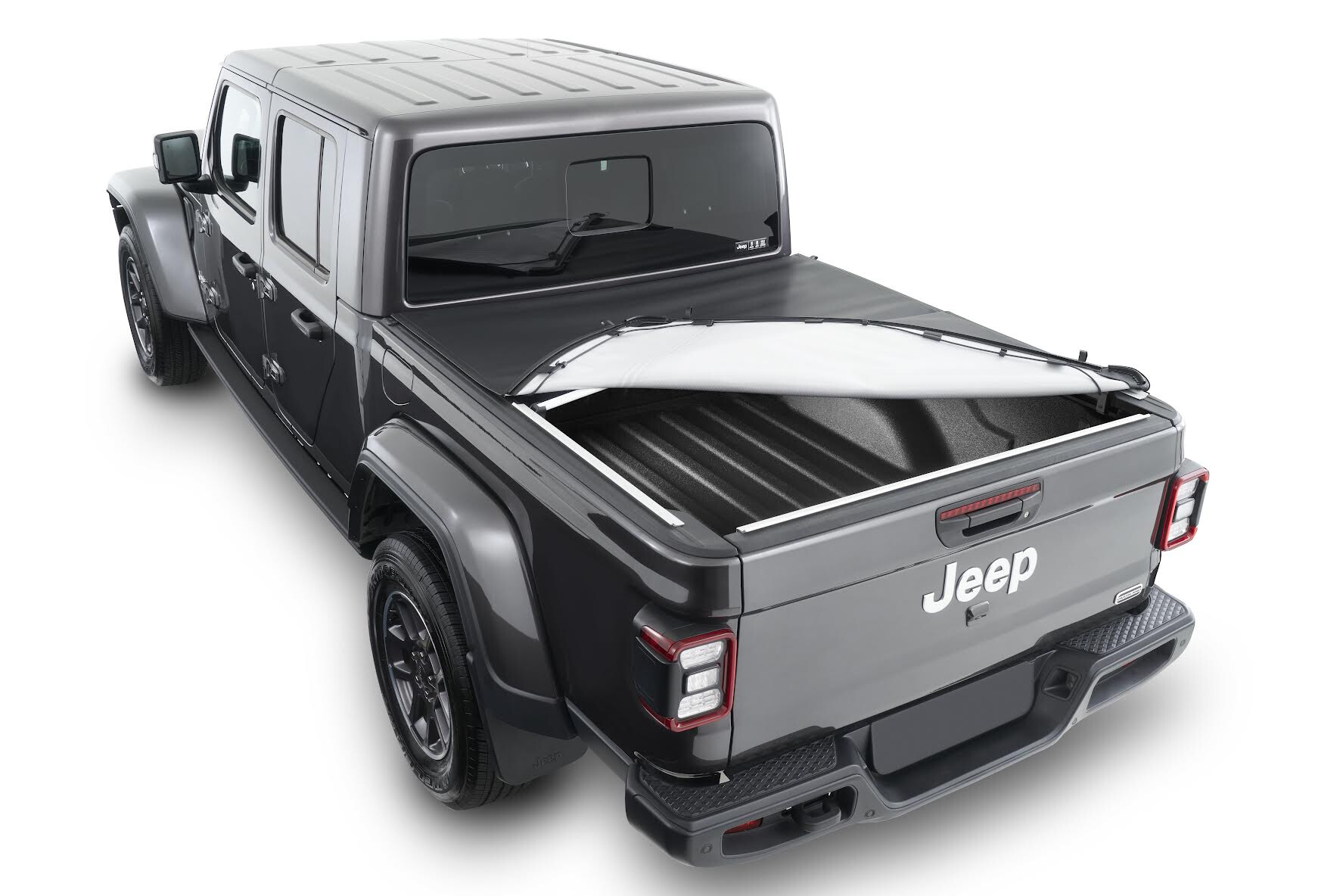
The soft tonneau cover offers adjustable tension and a bungee system for transporting bulky or over-sized loads. It’s also said to be simple and quick to remove, fold, roll and stow when access to the full cargo box is needed.
It can be had by itself or fitted in combination with a sports bar finished in matte black, and can also be used to add other accessories – such as light bars or antennas.
Topping off the range, the electric Gladiator RollTrac cover can be opened, closed or paused at the push of a button from either side of the rear corners of the cargo box, and has an anti-pinch/jam function built in.
There’s also a separate lockable storage box at the front of the RollTrac unit to keep valuables safe when travelling, and it allows quick and easy access for items like recovery kit when it’s time to hit the dirt.
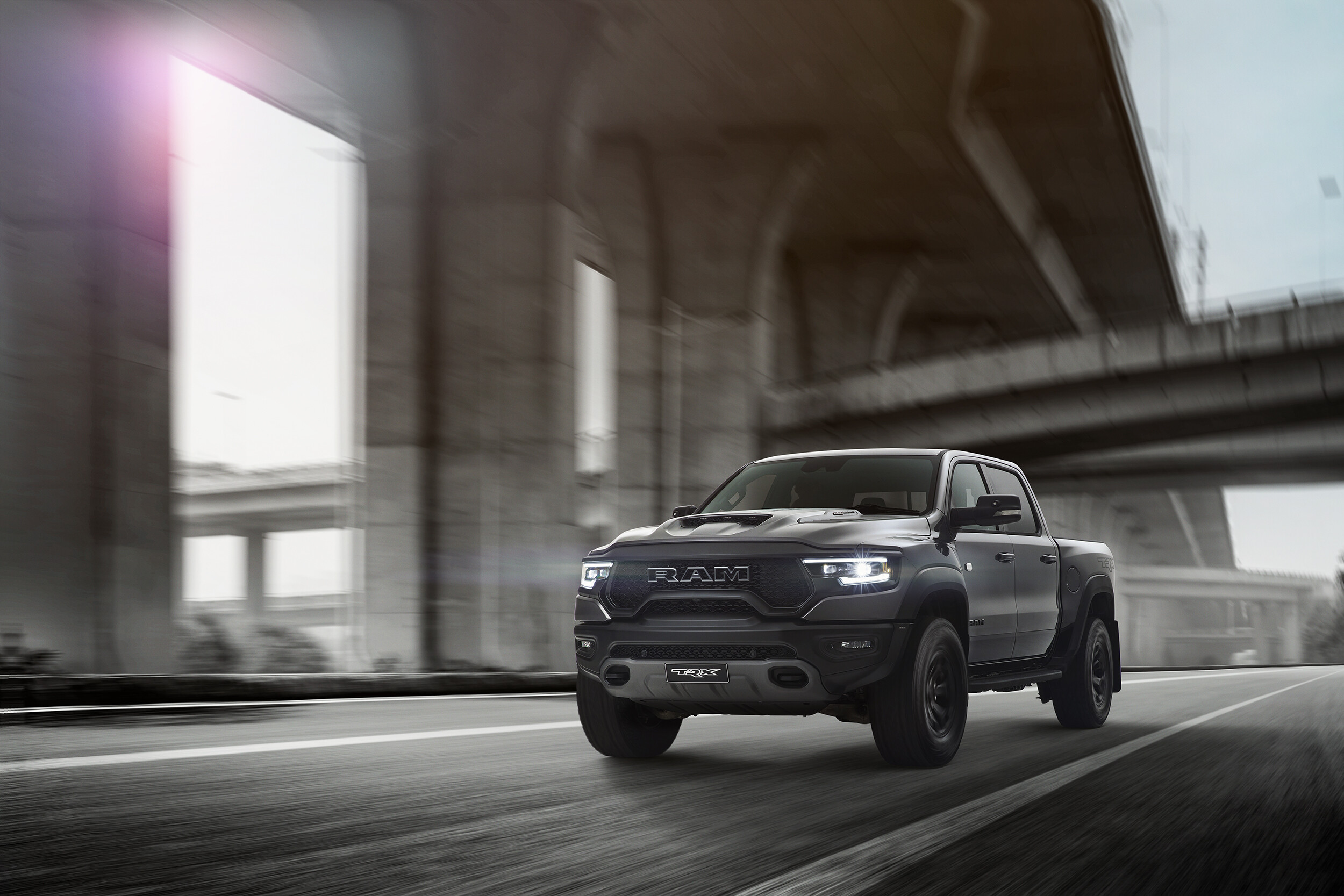
The Ram 1500 TRX, the ultimate version of the renowned US truck series, has been priced from $199,950 by its official Australian distributor.
A circa-$200,000 price tag had been anticipated for what Ram labels the world’s fastest mass-produced truck, with a claimed 0-60mph (0-97km/h) time of 4.5 seconds, a quarter-mile time of 12.9 seconds, and a top speed of 190km/h.
Although some specialist Australian conversion companies have imported TRX models privately for sale, this marks its debut via Ram Trucks Australia – the importer backed officially by Ram US.
The TRX is being converted from left-hand to right-hand drive by the Walkinshaw Automotive Group in Melbourne, as with other Ram vehicles.
The DT-series TRX is powered by a supercharged version of its world-famous Hemi V8, borrowed from vehicles such as the Dodge Charger Hellcat and here producing 523kW and 882Nm.
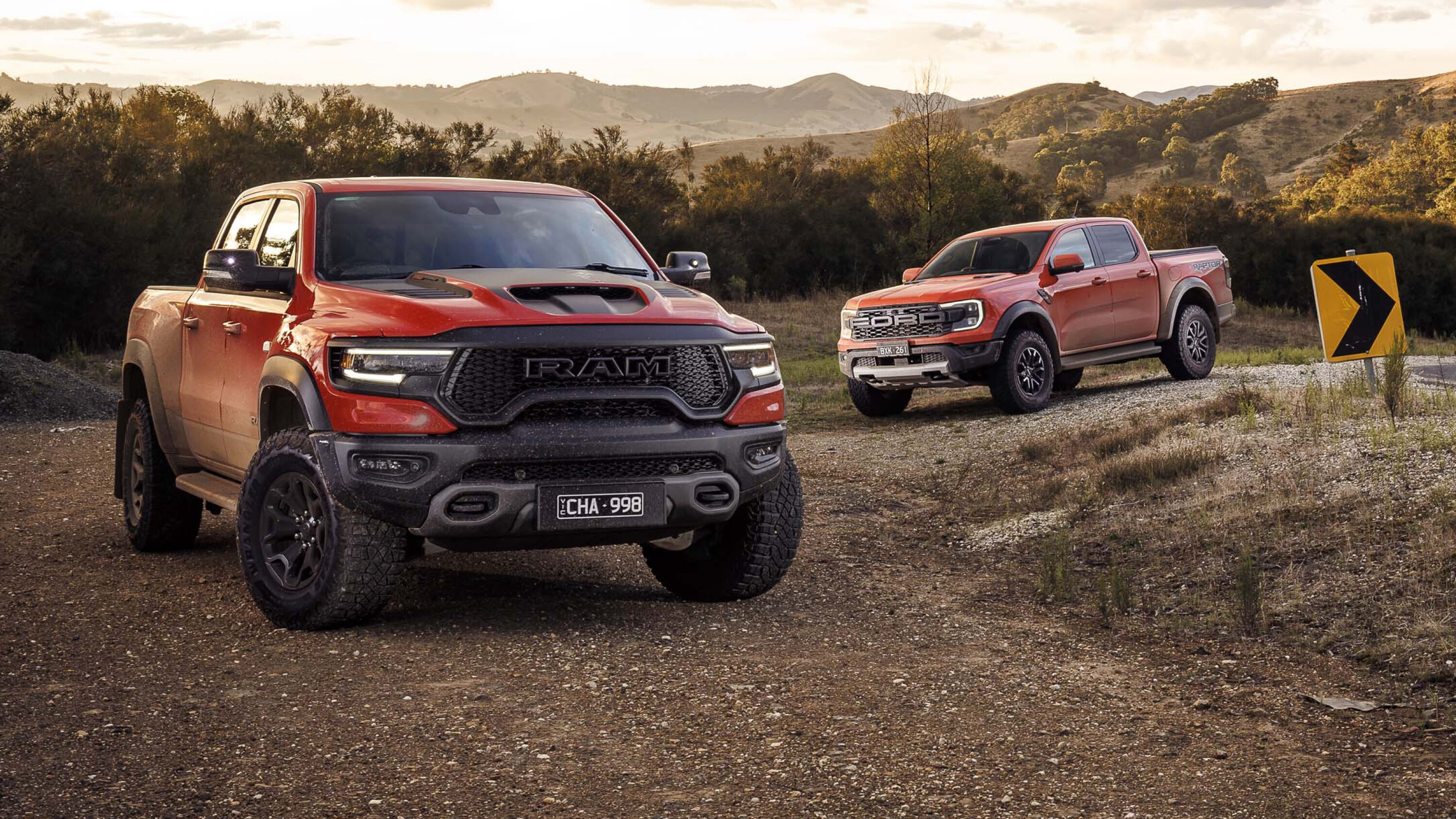
UPDATE, May 2023: Ram 1500 TRX v Ranger Raptor
?♂️ Australia’s most outrageous utes face off in a rock-spraying, fuel gargling celebration of excess. Strap in, it’s about to get noisy!
STORY CONTINUES: 1500 TRX arrives in Australia
Those outputs are huge increases over the 291kW/556Nm offered by the regular 1500’s 5.7-litre normally-aspirated Hemi V8.
They also dwarf those of the new Ford Ranger Raptor, though the 292kW/583kW 3.0L twin-turbo V6 Raptor is significantly cheaper at $85,490.
The rest of the drivetrain includes a TorqueFlite 8HP95 eight-speed automatic gearbox and a Borg Warner full-time active transfer case to distribute all that power between the axles.
The TRX features a large, 29-litre airbox that gulps more than 30 litres of air per minute. Fed by dual intakes – a bonnet scoop and through the upper grille including an enlarged Ram badge sharing the effort – the company says the airbox filters dirt, sand, debris and water to ensure performance isn’t hindered.
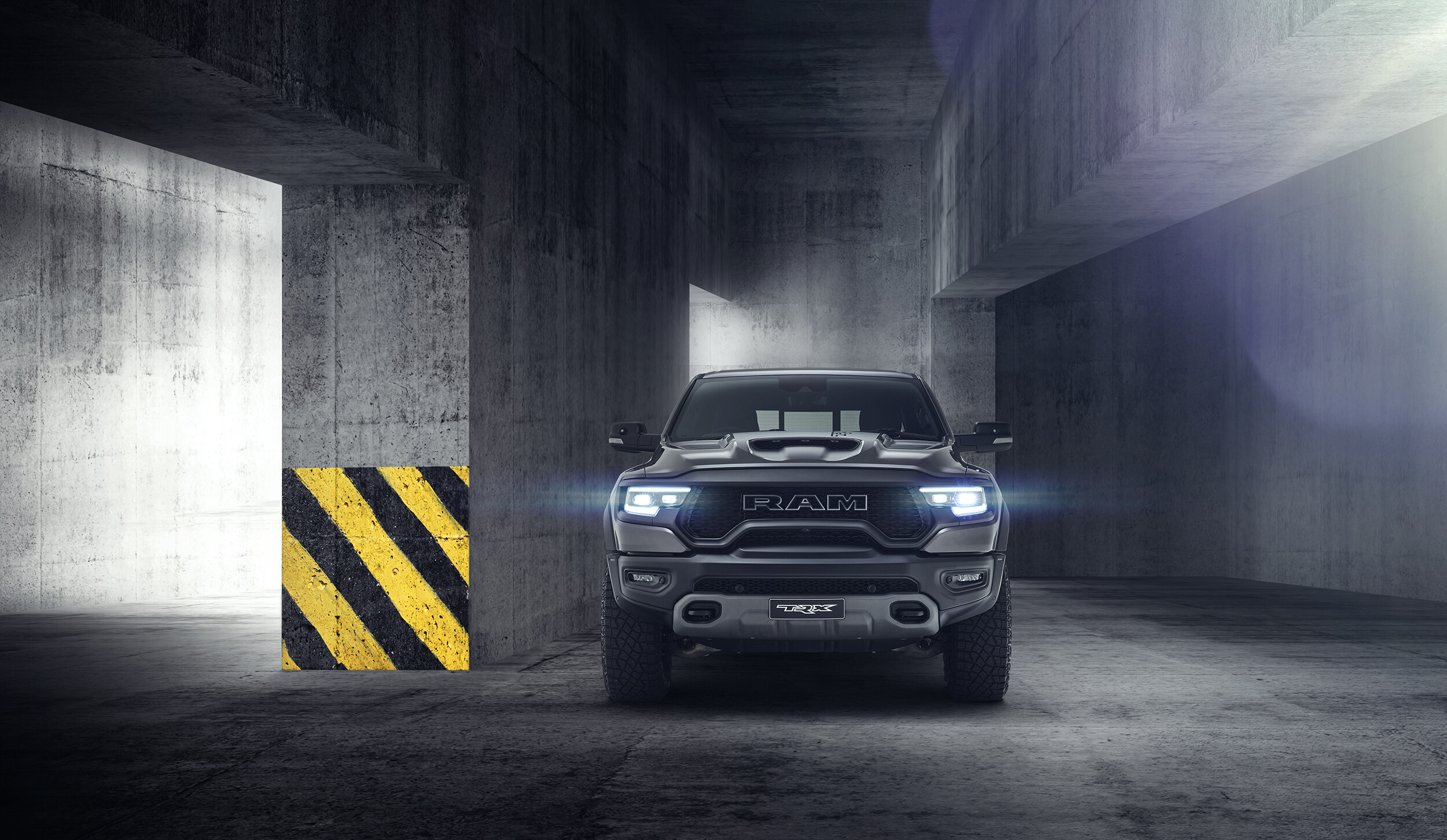
As with the Ranger Raptor and F-150 Raptor, the Ram 1500 TRX has been engineered to be super-quick both on road and off.
The centrepiece of an all-new suspension is a set of big-piston, quick-response Bilstein Black Hawk e2 adaptive dampers with electronically controlled valving and remote reservoirs.
Upper and lower control arms for the independent front suspension are constructed from forged aluminium, while at the rear there’s a TRX-exclusive multi-link set-up combining with a Dana M250 full-floating solid axle with 3.55:1 gears and an electronic locking differential.
Ram says the Dana axle allow for 330 millimetres of wheel travel – 40 per cent more than a regular 1500.

Each corner of the TRX is shod with exclusive 325/65/R19 all-terrain 35-inch Goodyear Wrangler Territory tyres.
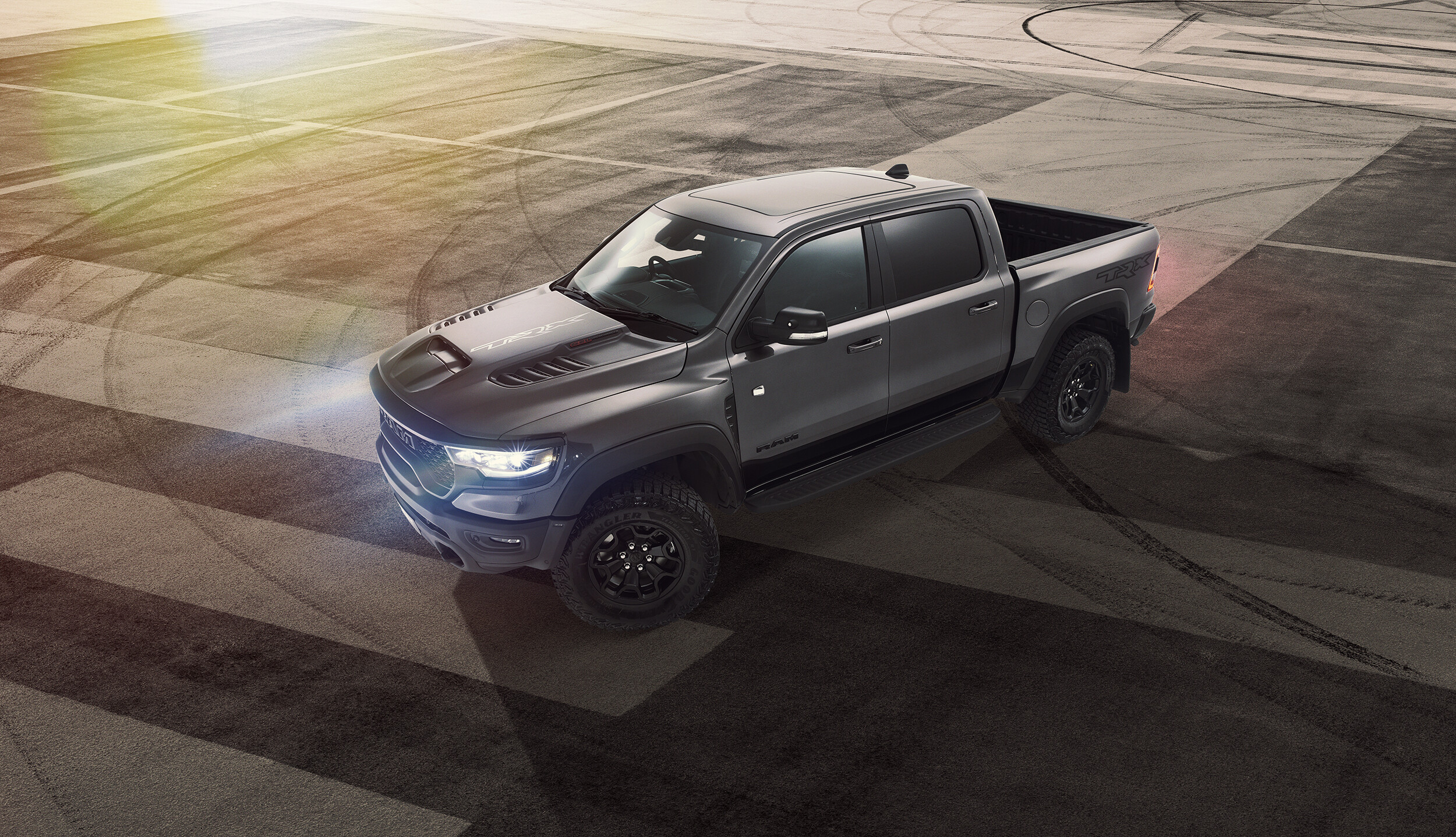
The front axle was moved forward 20mm to help accommodate the big wheels. Most of the TRX’s extra 203mm width over a regular 1500 is accounted for by its composite flared guards.
Ram’s desert racer has been designed to cope with big jumps and large obstacles while delivering good on-road handling.
The TRX frame – 75 per cent new compared with other 1500 variants – is beefed up with thicker, high-strength steel for increased rigidity and durability.
There’s an extra 50mm of ground clearance – 295mm – compared with the rest of the 1500 range, and the TRX features no less than five skid plates to protect crucial components.
Maximum wading depth is 812mm.
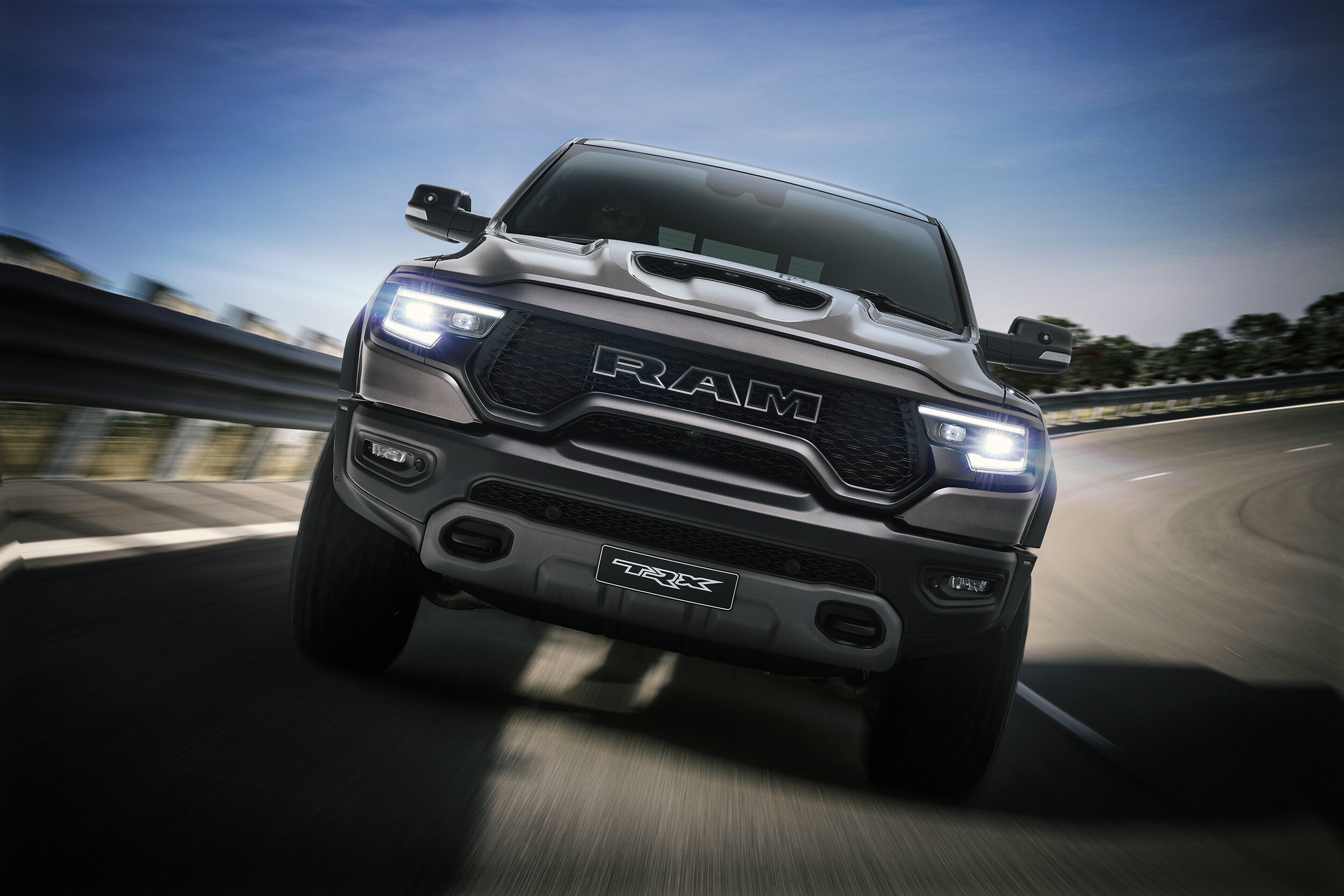
As with the Ranger Raptor, the Ram 1500 TRX features a Baja driving mode (among eight selections) to give it “ultimate desert performance”.
The TRX’s driving modes allow the driver to adjust parameters including drivetrain response, stability control, all-wheel-drive system, and the adaptive dampers.
Jump Detection is an additional feature that Ram says can detect when the TRX is airborne and adjust damping rates, transfer case torque split, gear selection and other components to deliver an optimum landing.
For slower, trickier terrain, a 2.64:1 low range brings respectable crawling ability.
The TRX’s rear suspension design is said to offer better articulation than a leaf-spring arrangement without compromising carrying and towing capabilities.
The 1500 TRX has a braked towing capacity of 3500 kilograms and a maximum payload of 767kg.
Inside, the TRX’s interior is based on the luxury-focused 1500 Limited, but with its own distinctive elements. The all-black interior mixes leather and suede, while also incorporating carbon fibre inserts in areas such as the dash.
An SRT steering wheel comes complete with long aluminium paddle-shift levers.
A dedicated console to the left of the steering wheel groups the driving mode selector, transfer case switches, and Launch Control button.
Leather and suede upholstery is applied to the front and rear seats that come with heating and ventilation functions.
The only option offered on the TRX is a $10,000 full-length panoramic roof.
The TRX’s 4.5-second 0-60mph time eclipses the circa-5.0-second claim of its 2004 predecessor, the Dodge Ram SRT-10. However, the two-door, rear-drive SRT-10, which was powered by a 8.3-litre V10 from the Dodge Viper and left-hand-drive only, had a higher top speed of 241km/h.
2022 RAM 1500 pricing
- 1500 Express Quad Cab – $82,950 (4th-generation DS)
- 1500 Express Crew Cab – $95,950 (4th-generation DS)
- 1500 Express Crew Cab RamBox – $100,450 (4th-generation DS)
- 1500 Warlock Crew Cab – $106,950 (4th-generation DS)
- 1500 Warlock Crew Cab RamBox – $111,950 (4th-generation D
- 1500 Laramie Crew Cab – $123,900 (5th-generation DT)
- 1500 Laramie Crew Cab RamBox – $128,850 (5th-generation DT)
- 1500 Limited Crew Cab – $138,950 (5th-generation DT)
- 1500 Limited Crew Cab RamBox – $148,950 (5th-generation DT)
- 1500 TRX – $199,950 (5th-generation DT)
I recently bought this swag from my mates at Advanced Installation Service in Sydney, because I needed a bigger swag to fit in my wife and our nugget of a Staffy on camping trips.
I was seriously looking at rooftop tents, however the idea of lugging a 22kg dog up a ladder wasn’t terribly appealing.
My wife put my quest to rest with one simple sentence: “There’s nothing wrong with sleeping in a swag.” She’s right, we’ve been spoiled for the last four years sleeping out of my Hilux camper, but it was time to set that free and go back to a simpler set-up.
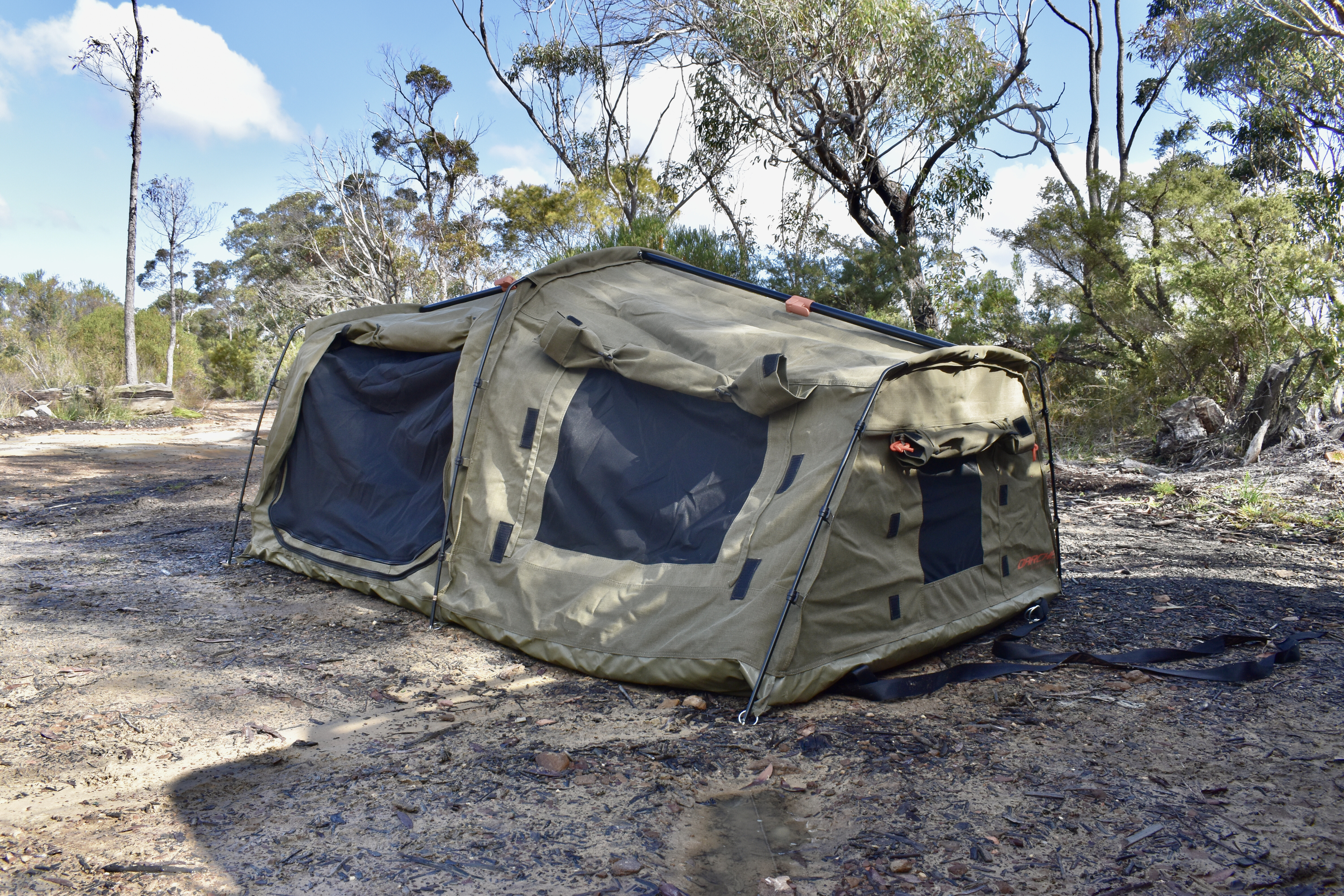
Why did I choose the 1400 Dirty Dee? There are a few reasons, namely the large amount of space offered. This swag is the largest in the Darche range and measures in at 2150mm long by 1400mm wide.
I’ve owned a smaller Darche Dusk To Dawn swag for six or so years, and have had nothing but good times with it. The only issue in all that time is that one of the clips used to secure the swag when rolled up snapped, so I just tied a knot in it. It’s been everywhere from the Vic High Country, the Blue Mountains and every beach you can camp on in NSW.
Another reason I went this way is that I asked mates of mine, who basically travel full-time for work, what swags they use. Darche seemed to keep popping up as a solid option that, while not cheap – retailing at $659 – offers great bang for buck. I’ll have this swag for the next ten years, if not more.
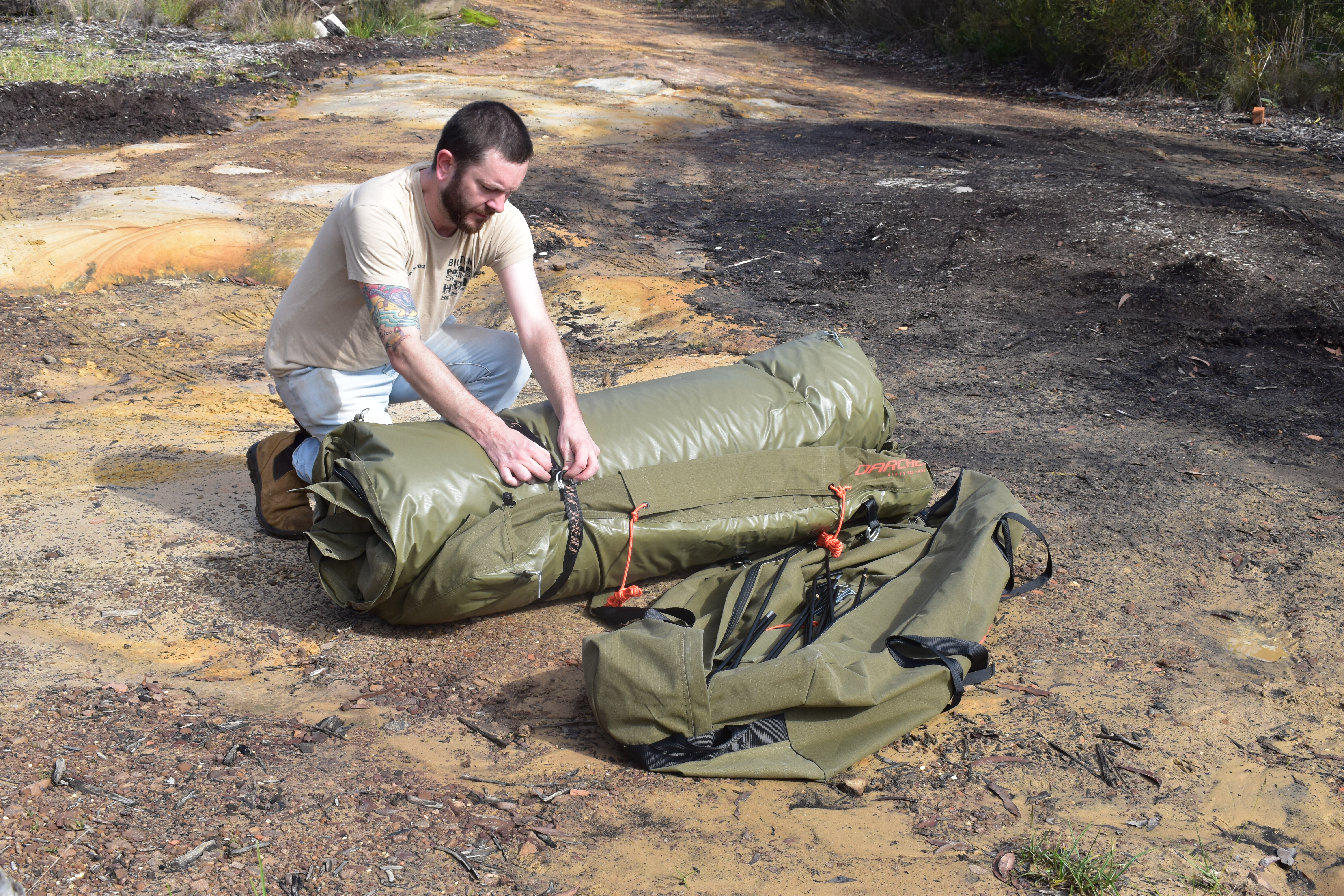
The swag’s design is what sealed the deal, though. The vertical walls provide more space inside, and there’s plenty of headroom, both of which are important. I also really like the ease of set up; once you get the three flexible poles clipped in place, you simply add two spreader bars the length of the swag, and you’re done.
The mattress will probably get turfed for a self-inflating unit down the track, but all-in-all I’m happy with how the swag comes from the factory. The storage bag is a decent size too, and I had no issues rolling the swag up and putting it back in on my own – but it would be much easier with the help of another person.
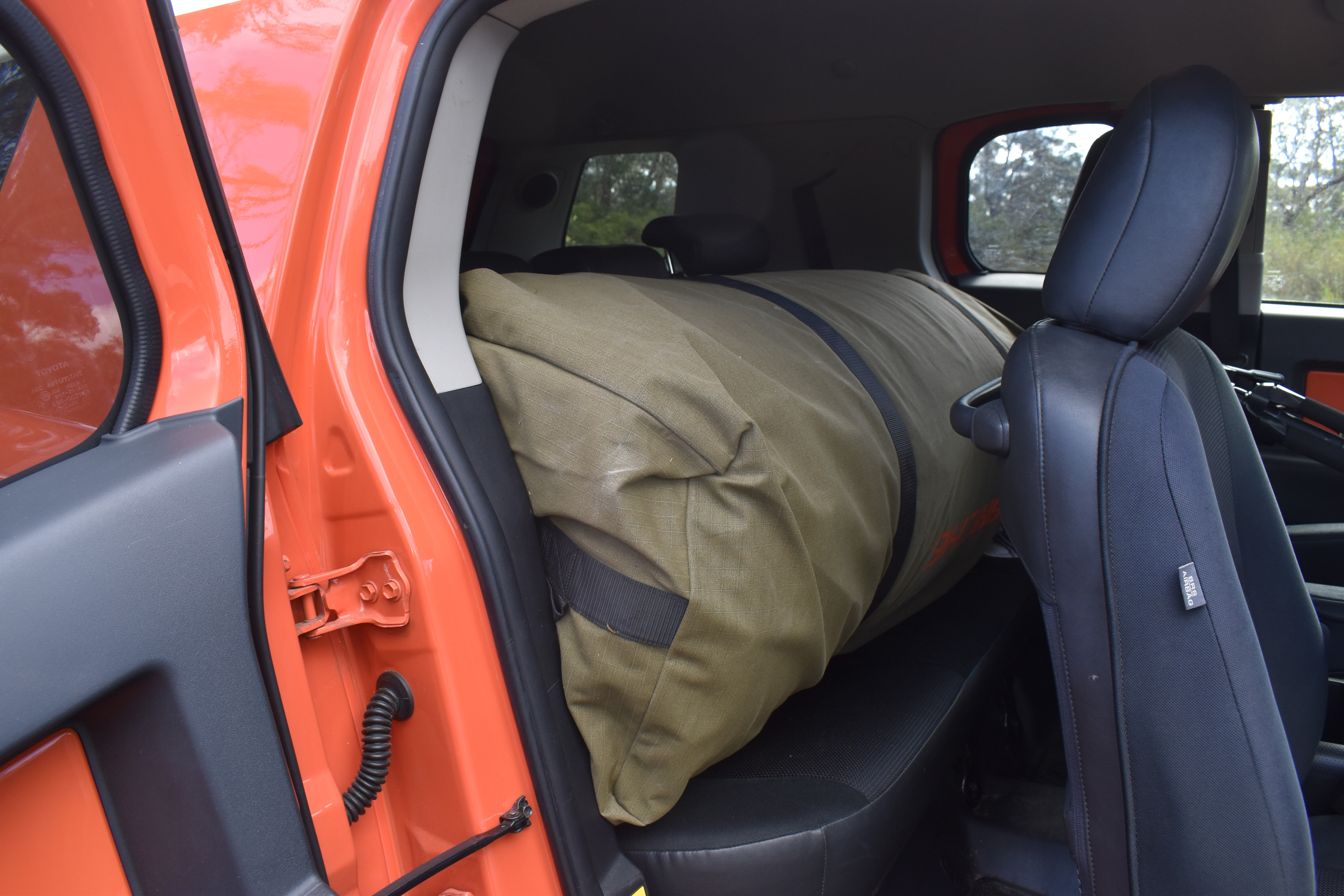
Any negatives? Well, it’s a big swag (which I wanted) and rather heavy, tipping the scales at 15kg. So, if my wife and dog aren’t coming along, I’ll probably stick with my smaller swag unless I feel like camping in luxury – with so much internal space, this is nearly a canvas tent.
I’ll keep you up to date with how the Dirty Dee swag performs, especially in the cooler months. Just a note: This isn’t a sponsored piece, I purchased it with my own money. So if it’s not up-to-task, I’d be sending it back – something I have no intention of doing.
AVAILABLE FROM: www.darche.com.au RRP: $659
Isuzu’s MU-X family wagon is in big demand, so much so that – as with most manufacturers at the moment – demand is exceeding supply. As a result, buyers are waiting up to 12 months for their new MU-X from the time they order it, and are happy to do so.
The MU-X is the second-best seller in the mid-size 4×4 wagon segment behind the always popular Toyota Prado, but ahead of great rigs like the Ford Everest, Toyota Fortuner and Mitsubishi Pajero Sport. It will be interesting to watch the effect the new V6 Everest has on this segment in the next year.
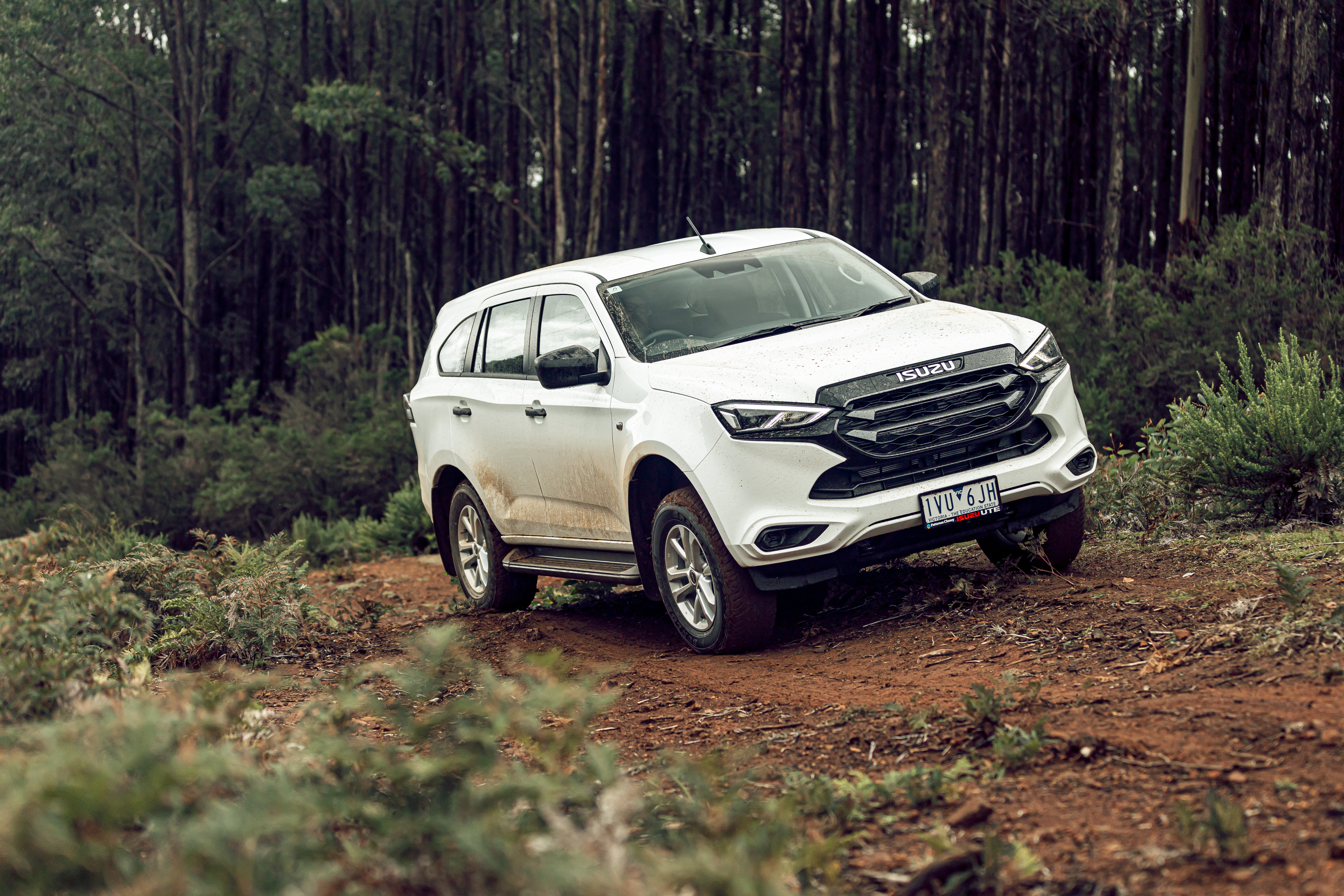
It seems many buyers opt for the higher specification of the three MU-X grades, and this is where the longest waiting times are. But do you really need the top model? Is it worth saving a few dollars by choosing the base model just to get your MU-X sooner?
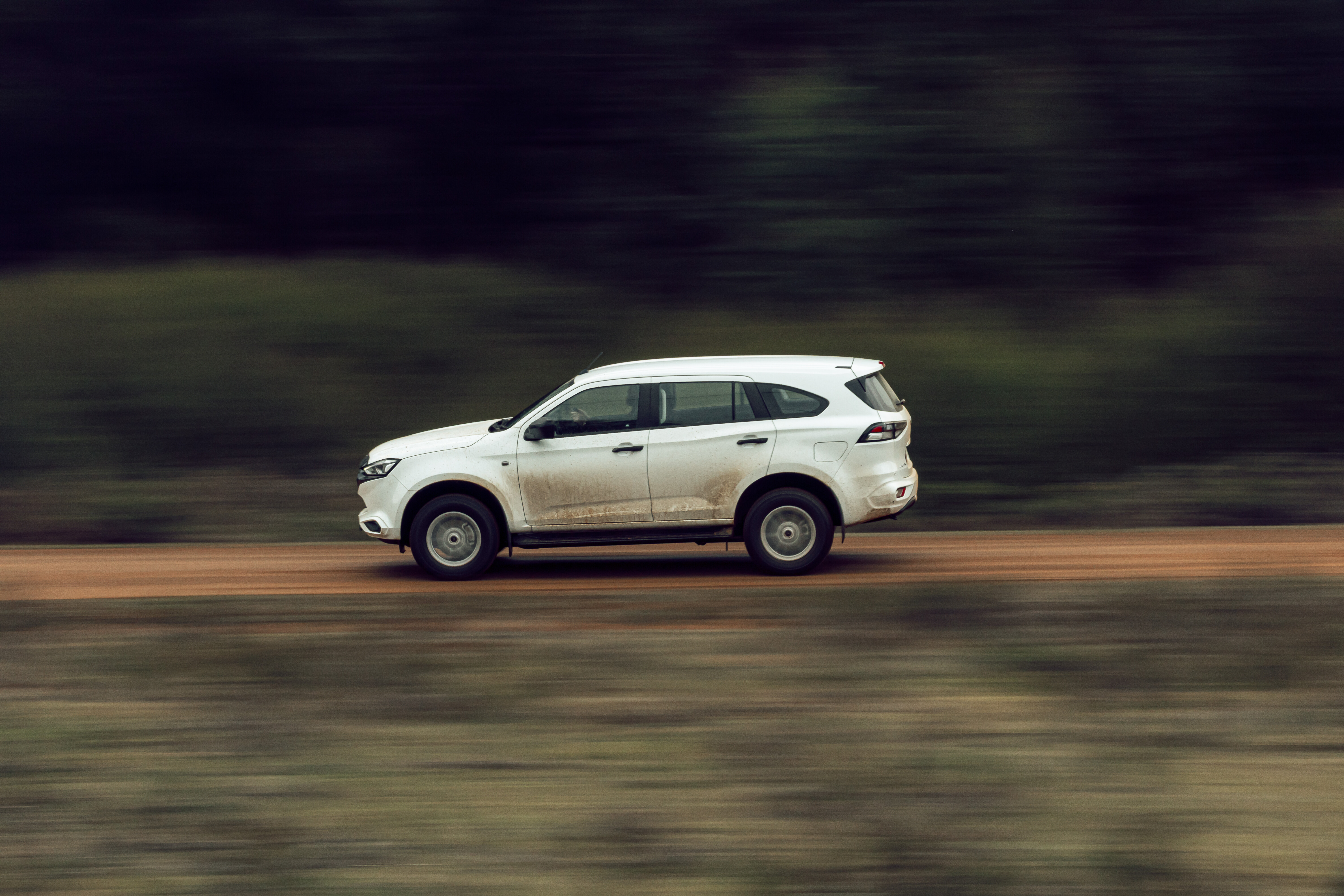
Here, we’re looking at the entry-level 4×4 MU-X LS-M, which hits the market at $54,900 plus on-road costs. Keeping it bare-bones basic, we’ve bought one in basic white as the next 4X4 Australia project vehicle.
Powertrain and performance
A big part of the MU-X’s and its D-MAX sibling’s popularity, is the reputation of its venerable 3.0-litre diesel engine. In an era of decreasing engine size, three litres is considered big in this size vehicle and buyers like that.
Then there’s Isuzu’s reputation as a long-time builder of reliable diesel engines for both its passenger cars and trucks, and this is certainly the case with the 4JJ engine used in the MU-X and D-MAX.
Despite modest outputs compared to some of its competition – Everest, Fortuner and Pajero Sport – the 140kW and 450Nm engine does a fair job of moving the 2100kg MU-X along. It’s also well-suited to hauling and Isuzu rates the MU-X as being able to tow 3500kg, a feat not all of those competitors can brag about.
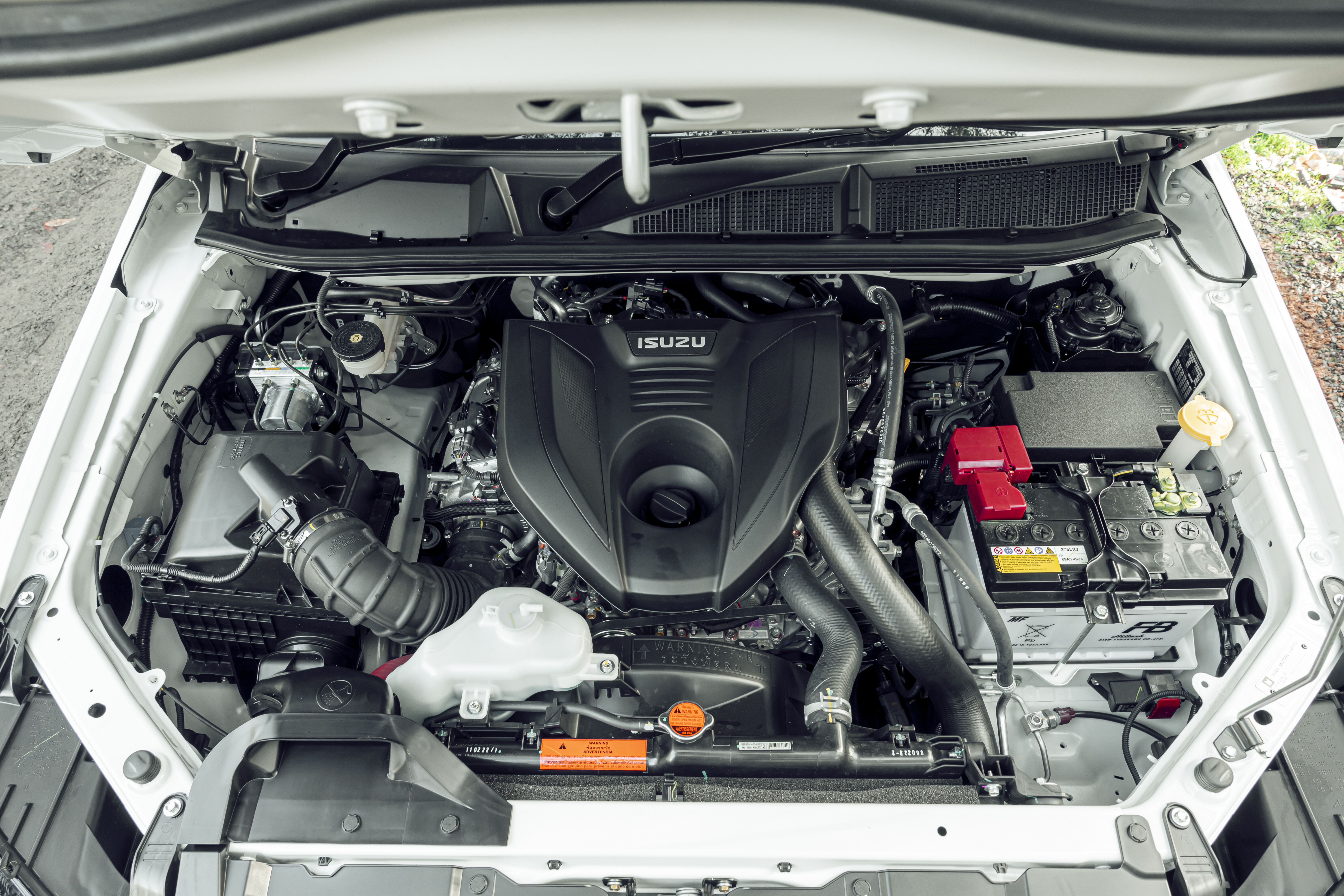
The Isuzu reminds you of its truck heritage every time you fire up the engine and put your foot down on the highway. It’s a relatively vocal engine by modern standards, and we find ourselves turning up the radio volume higher when in this car than we might normally do.
The four-cylinder engine is backed by a six-speed automatic transmission and there’s no manual gearbox offered in the MU-X. The Aisin-manufactured transmission is a gem and works well with the engine to get the job done.
It is a bit aggressive on its downshifts when you get off the throttle, which can be annoying at times, but rewarding if and when you are punting the MU-X along with a bit of spirit. That said, the MU-X is no sports car, it’s a high riding, four-wheel drive, seven-seat family wagon.
On-road ride and handling
Based on a platform derived from the one that underpins the D-MAX ute, the MU-X’s five-door wagon body rides high on a separate chassis with a live rear axle and IFS; both ends employing coil springs in their suspension.
It’s a package that manages the balance between load-lugging workhorse, off-road tourer and family wagon very well; although, it does feel a bit underdamped at times on uneven roads. Again, this is a family wagon not a sports car, and it does what it is designed to do.
Off-road
The MU-X inherits its part-time, dual-range 4WD system from the D-MAX and is typical for this class of wagon. Selecting 4×4 is done using a dial on the console, which is not always instantaneous in its operation and can take a few seconds to click it. This car was brand-new when driven for this test, so hopefully the transfer case operation will loosen up a bit with some more use.
The suspension gives moderate wheel articulation when the going gets more difficult and the electronic traction control is slow to react and not as effective as some others. The rough-terrain button does sharpen the calibration of the ETC, helping the MU-X along, but the question remains: Why do you need a rough-terrain button? Shouldn’t that calibration activate whenever you select low range and need the most traction possible? It seems like something the marketing department came up with, not the engineers.
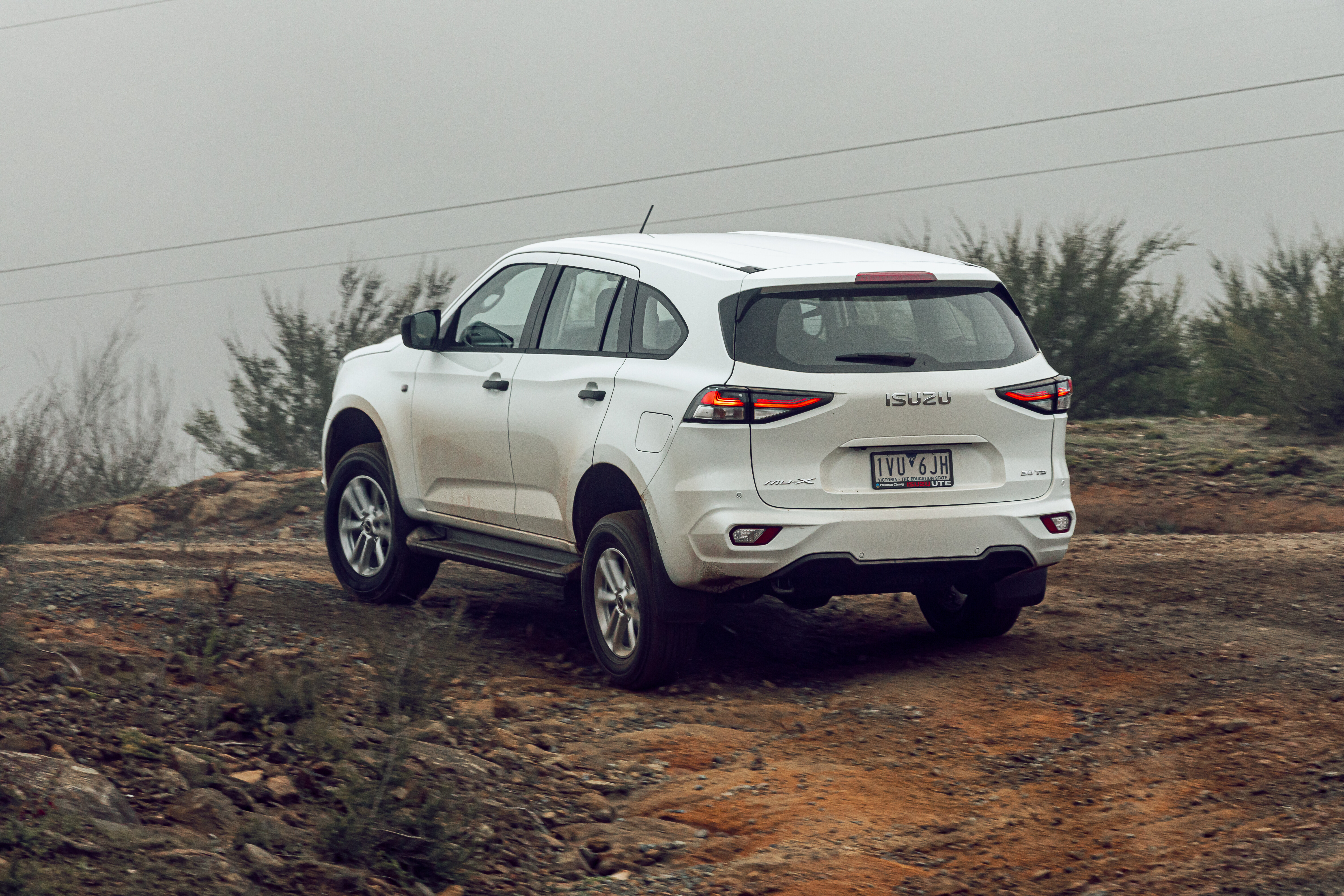
There is a rear differential lock on all 4×4 MU-X models, but engaging it disables the ETC completely, resulting in the front wheels becoming almost redundant and unable to help with forward momentum. This system seems a generation or two old and holds the MU-X back from being as good as it could be when off-road. Hopefully, our plans for some more suitable tyres and aftermarket locking differential for the front axle will fix this.
Isuzu’s quoted wading depth of 800mm is handy to know; although, the front-facing air intake for the engine means I’d always take any water crossing with caution. Factory-fitted high-reaching breathers for the differentials help here and show that Isuzu does think about what’s needed for off-road use.
Cabin and accommodation
The MU-X fills the role of a three-row, seven-seat family wagon very well. The cabin is one of the larger ones in its class and, if you’re buying it to haul bodies in all three rows, the rear seat passengers will be happier in the MU-X than they would be in a Fortuner or Pajero Sport.
Access to the third-row seat is also good, giving the MU-X a most accommodating interior. It’s also a well-appointed cabin with features such as wireless Apple CarPlay and Android Auto, plus a full suite of safety kit all as standard.
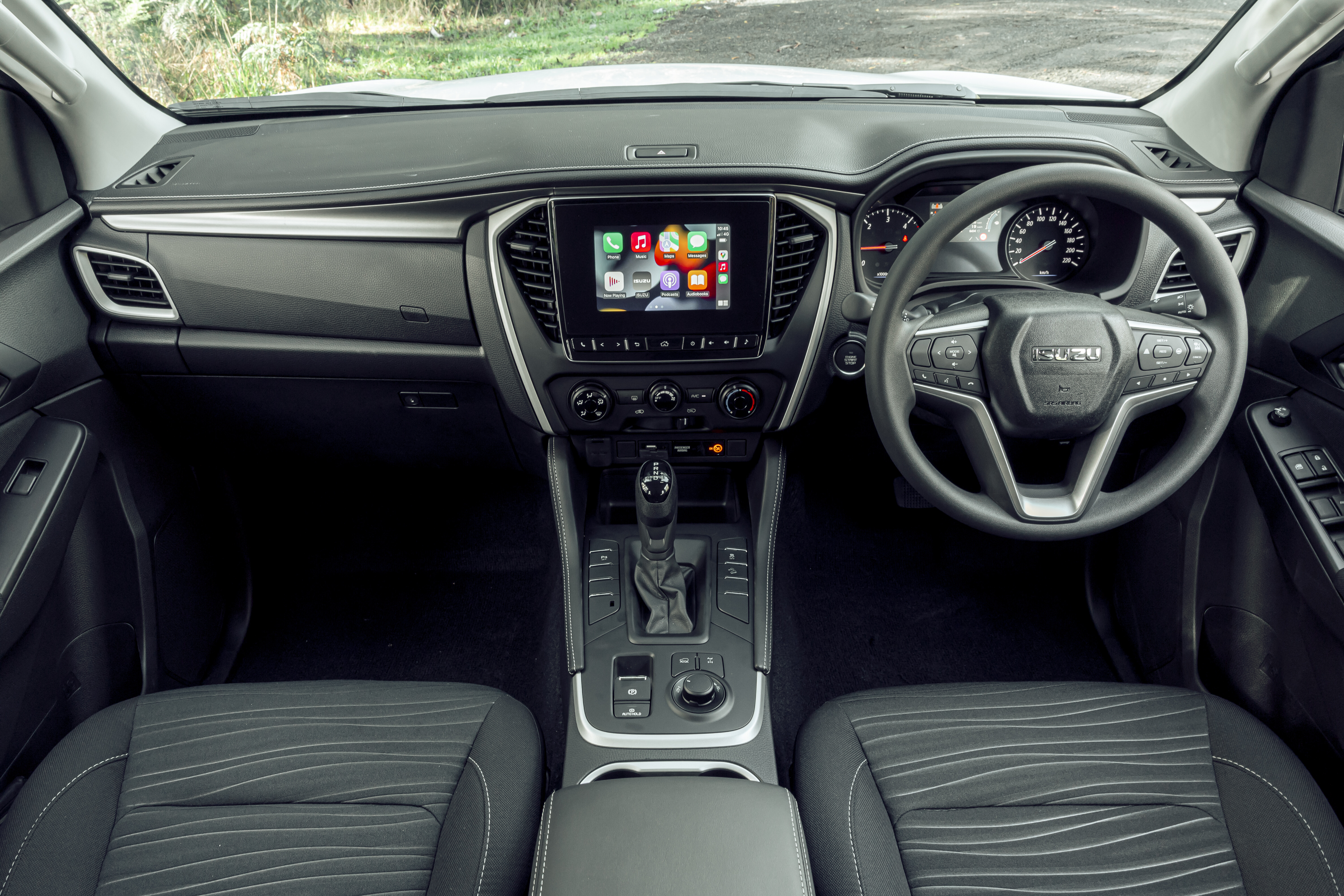
The LS-M misses out on a few niceties like a full-size centre screen, heated front seats, leather trim and automatic climate control, but nothing we’d consider essential. The manual HVAC gets a thumbs up for its large, easy-to-use dials to control the heat and fan speed, but it’s then let down by the feel and function of the dials that feel cheap and clunky in their operation. Some of the other interior trims are made of similar cheap-feeling plastics that let the cabin down.
Fiddly, little slow-acting buttons in lieu of dials for the audio system are another negative, while the home screen of the audio system looks unfinished, until you enable any apps.
Practicalities
With its spacious, well-appointed cabin, relatively economical fuel consumption, adequate on-road performance and off-road ability, the MU-X stacks up as a pretty practical rig. Add in its 3500kg towing rating and it becomes a jack-of-all-trades.
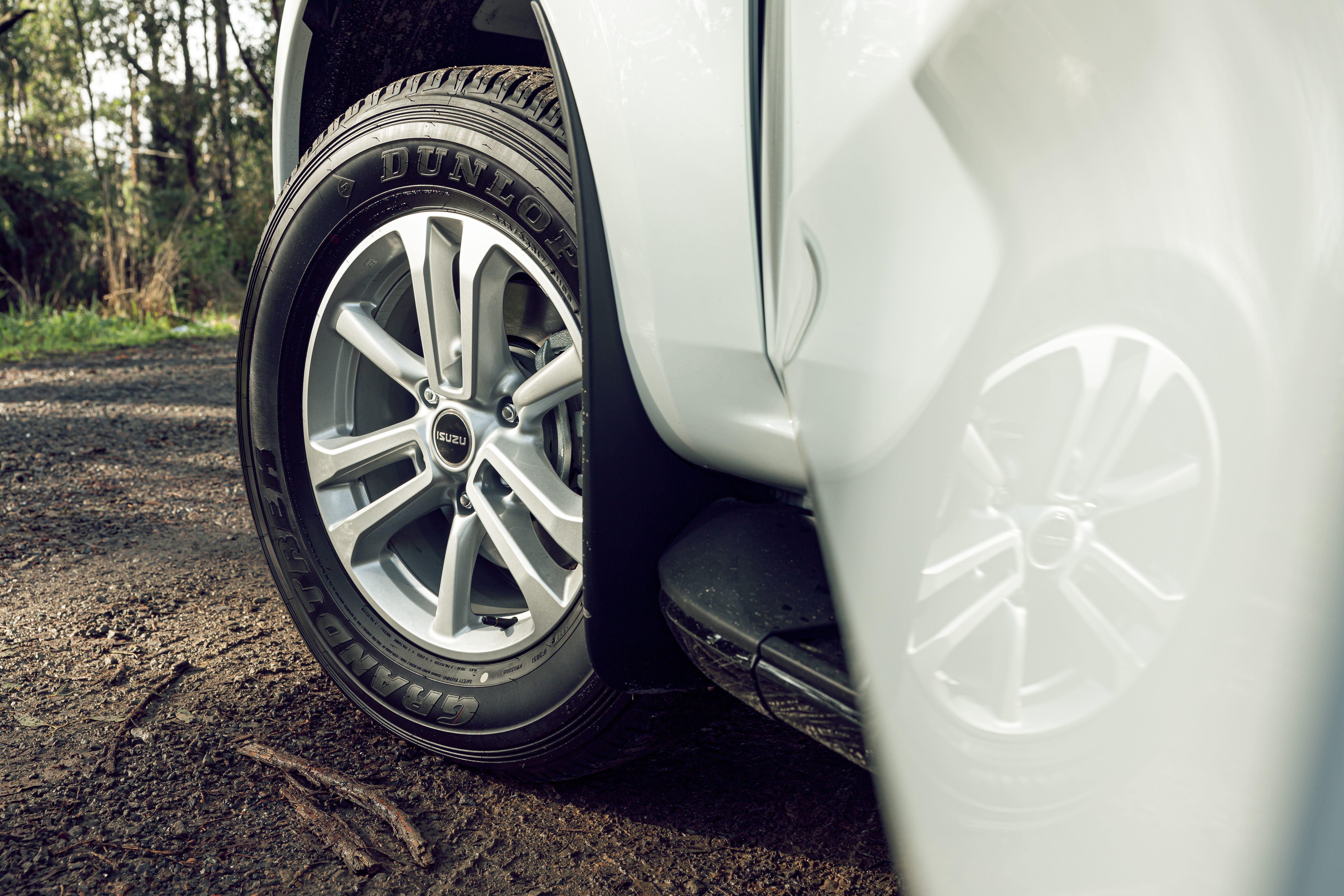
The 17-inch wheels and all-terrain tyres make it more suitable for off-tarmac venturing than the bigger rims with thinner sidewall tyres, and that 800mm wading depth is better than almost any other four-wheel drive wagon.
The range of factory Isuzu accessories includes nudge bars, alloy and steel bullbars, roof racks, an intake snorkel, and even Clearview extendable towing mirrors. The MU-X has always been reasonably well-supported by the aftermarket accessories suppliers, too; although, there’s some kit still to be developed for this latest generation of MU-X.
Like most 4×4 wagons, the MU-X is limited by payload, and being the base model the LS-M gets the best of the 4×4 models with 665kg. That’s certainly something owners need to keep in mind when planning the weight of accessories they want to fit as you could take up that payload with seven large passengers, a suitcase and tank of fuel. GVM upgrades are available from some aftermarket suspension companies to improve this situation.
Verdict
While you do miss out on a few luxuries by choosing the LS-M over one of the higher-appointed models, it doesn’t really miss out on any features you need. Sure, we’d like the bigger centre screen and heated front seats of the LS-T, or even the proximity key for unlocking, but none of these are deal breakers.
We’re more than happy to live without the annoying powered tailgate, and the simple HVAC controls are much easier to use than the fiddly little buttons on the automatic climate control-equipped models. We’d even live without the third-row seats and, as this is our car, we’ll be removing these to install better cargo storage.
More than anything, we’re happy to have the 17-inch alloy wheels of the LS-M and not the 18s or 20s found on the more expensive models, as the taller sidewalls of these tyres are more durable off sealed roads and give a smoother ride quality. They call these tyres all-terrain, but they still have a very tame-looking tread pattern.
The mechanical package of the engine, transmission and driveline are all the same across the range, so we’re not sacrificing anything there with the LS-M.
Isuzu cars, both the MU-X and the D-MAX, are not the budget options they once were, and the higher prices combined with the current long delivery times might tempt potential buyers to shop around, which would be remiss if you didn’t, no matter what you are buying.
But the Isuzus remain solid, dependable and practical 4x4s, and are now better equipped than ever with all the features you could want and plenty that you may not. It might just come down to how much you’re prepared to compromise on specification and how long you are prepared to wait for it.
2022 Isuzu MU-X LS-M specs
| Engine | In-line 4-cyl diesel |
|---|---|
| Capacity | 2999cc |
| Max Power | 140kW at 3600rpm |
| Max Torque | 450Nm at 1600 to 2600rpm |
| Gearbox | 6-speed automatic |
| Crawl Ratio | 33.33:1 |
| 4×4 System | Part-time, dual-range |
| Construction | 5-door wagon on ladder chassis |
| Front Suspension | Double wishbone, coil spring IFS |
| Rear Suspension | Multi-link coil-sprung live axle |
| Tyre/Wheel | 255/65R17 / alloys |
| Kerb Weight | 2135kg |
| GVM | 2800kg |
| Payload | 625kg |
| Towing Capacity | 3500kg |
| GCM | 5900kg |
| Seating | 7 |
| Fuel Tank | 80L |
| Adr Fuel Claim | 8.3L/100km |
| On-Test Fuel Use | 9.1L/100km |
| Departure Angle | 26.4u00b0 |
| Approach Angle | 29.2u00b0 |
| Rampover Angle | 23.1u00b0 |
| Wading Depth | 800mm |
| Ground Clearance | 235mm |
Snapshot
- 292kW/583NM V6 twin-turbo V6 petrol engine
- 10-speed automatic and full-time 4×4
- Front and rear locking diffs
- Electronically adaptive Fox racing dampers
UPDATE, June 24: Ranger Raptor takes on the Goodwood hillclimb
Ford of Europe has shown off the upcoming Ranger Raptor in public for the first time, letting its high-performance dual-cab loose at the Goodwood hillclimb.
Having been revealed earlier this year in February, the next-generation Ford Ranger Raptor is the first of its breed to be powered by a petrol engine, with Ford’s 3.0-litre, twin-turbo V6 ‘EcoBoost’ now shoehorned under the bonnet.
Producing 292kW and 583Nm, the latest Ranger Raptor boasts serious performance credentials for a nearly two-tonne ute, with the first examples of the popular model expected to arrive on Australian shores next month.
The story to here
February 22: Ford Ranger Raptor revealed
Ford has pulled the covers off its all-new Ranger Raptor, but before it did, we got a sneak peek at it in their Melbourne Design Centre which you can see in the video.
No on-sale date or pricing has been revealed as yet, but what we can tell you is that the next Raptor has a 3.0-litre V6 petrol ‘EcoBoost’ engine which makes 292kW of power at 5650rpm and 583Nm of torque at 3500rpm. This engine is taken from Ford’s North American line-up where it powers several SUVs including the Explorer.
“The 3.0-litre brings a different dynamic to the Ranger Raptor that will satisfy even the most hard-core performance enthusiast,” says Dave Burn, Ford Performance chief program engineer for Ranger Raptor.
“The acceleration and raw performance of the new powertrain leaves you grinning from ear-to-ear.”

For Aussie owners, it brings the powertrain performance the current Raptor has always lacked from its four-cylinder diesel engine, with power to match and make the most of Raptor’s exceptional chassis.
Like Ford’s ‘Lion’ V6 diesel engine which we will also see in the new Ranger and in the past in the Ford Territory as well as multiple Land Rover models, the petrol mill uses a compacted graphite iron (CGI) block which is claimed to be up to 75 per cent stiffer and stronger than regular iron castings.
This was big news back when the Discovery 3 debuted in 2004 and it’s still relevant today.
As in the 2022 Ford Ranger, the V6 engine will be backed by a 10-speed automatic transmission and a two-speed transfer case.
Hardcore Hardware

Big news for Raptor drivers who like to get off road is the fitment of driver selectable locking differentials to both the front and rear axles – a first for Ranger in Australia. This will give the new Raptor improved low-speed ‘crawling’ performance to rival its high-speed abilities.
Those high-speed blasts are again supported by Fox Racing shock absorbers at each wheel. These units are a step up from the Fox shocks used on the previous Raptor in that they are electronically adaptive to the driving and terrain conditions.
The Fox 2.5-inch Live Valve Internal Bypass shock absorbers use cutting-edge control technology offering position-sensitive damping capability. Not only do they adapt to the driving conditions but also have specific mapping to suit the various selectable drive modes in the vehicle.
Another feature of them is Fox’s race-proven Bottom-Out Control which applies maximum damping force in the last 25 per cent of shock travel for situations like when landing after jumps, to maintain the best control.
They can also sense when the shock is fully extended as a result of the wheels leaving the ground and prepare the dampers for the hit back to terra firma, and can stiffen the rear dampers to prevent Raptor from squatting under hard acceleration, further improving vehicle stability.

Like the current model, new Raptor’s rear suspension is an adaptation of the Ford Everest’s coil spring and Watt’s link design to provide superior control and ride quality compared to what could be achieved by the regular Ranger’s leaf spring rear-end design.
The Fox shocks are similar to those used on the current generation of F-150 Raptor and recently previewed Bronco Raptor but these USA-only vehicles use the bigger 3.0-inch units to control the bigger and heavier 35- and 37-inch tyres available on those rigs. Ford says the 2.5-inch dampers are perfectly suited to the lighter 33-inch BFG KO2s fitted to the Ranger Raptor.
Speaking of American vehicles, a major reason the new Ranger Raptor has been bestowed with the petrol engine is that it is set to be launched in the USA where it will join the rest of the Ranger line-up there.
The USA is a petrol market and a diesel was never going to rate a mention over there. Not that we expect to be complaining about the performance of the EcoBoost V6 when we get behind the wheel here in Australia.
What will be interesting is the Raptor’s touring range in Australian conditions. The Raptor is heavier than regular Ranger models and with its available performance always on tap under the right foot, the V6 petrol Raptor could be hampered by its consumption.
New Raptor is said to be 30 to 80kg heavier than the current model, depending on the spec for different international markets.
Multi-modes
New Raptor’s drive modes now have seven driver selectable settings; three for on-road use and four for off road. These optimise the engine, transmission, steering and shock absorber calibrations to suit the selected conditions and include Baja mode for the best high-speed off-road performance.
“While Ranger Raptor was inspired by desert racing, it’s also a supremely capable overlanding vehicle. Out of the box we’ve created an off-road vehicle that you don’t need to modify to get you where you need to go and back again safely,” said Burn.
Raptor’s V6 engine breathes through a full-length dual-exhaust system and it too has four modes to adjust the sound level and tone to suit the driver. Keep it quiet for creeping away from camp and open it up fully for the Baja-mode blasts.
“We really wanted the Baja mode to be the ultimate expression of the off-road high-speed capability,” said Burn.

Obviously new Raptor adopts all the features of the 2022 Ranger with its bold new front-end styling, wider wheel track and user-focused cargo tub. No word yet on what the payload capacity of that tub might be, or the towing capacity, but these were areas that the Raptor was compromised on in the past.
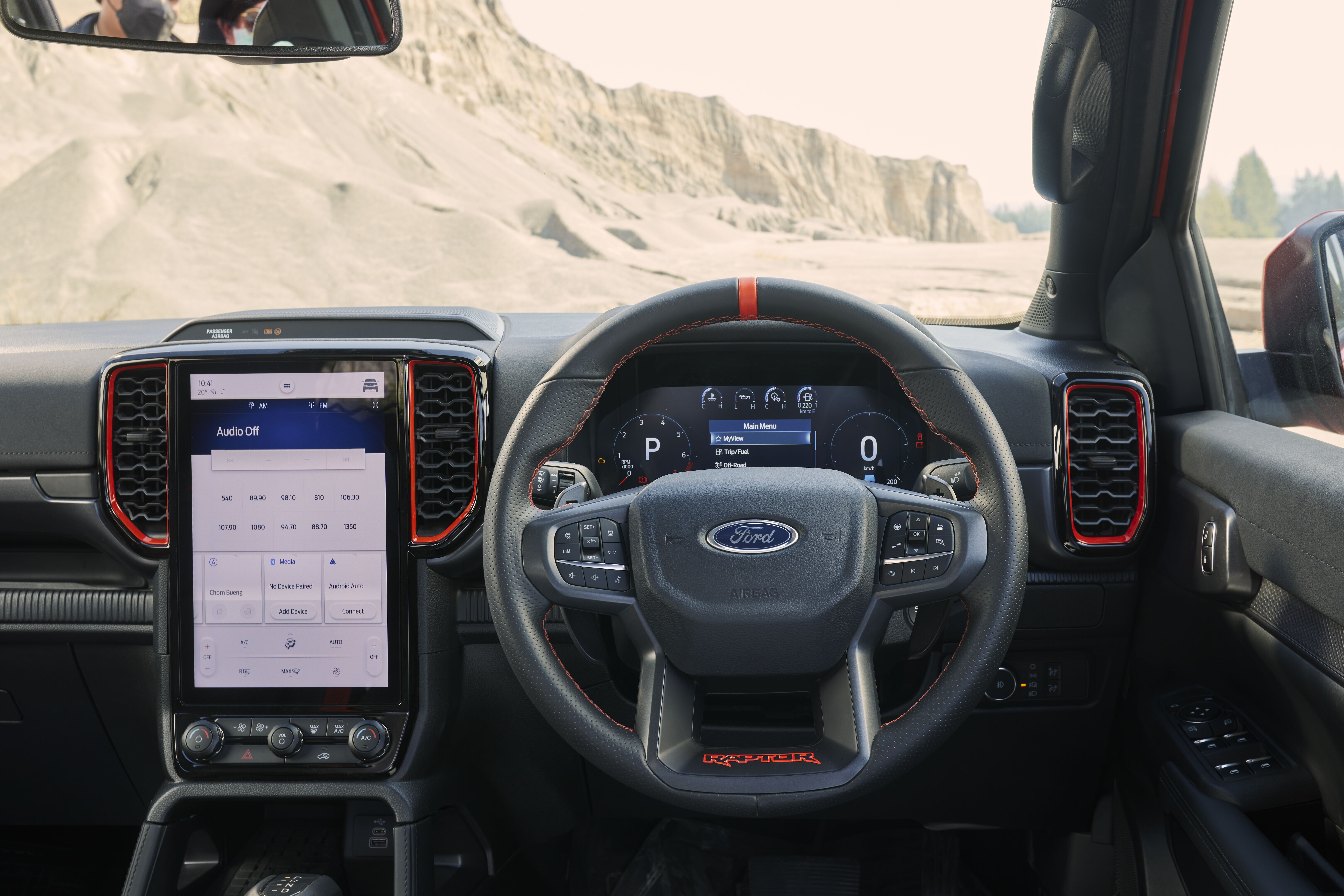
The interior features the large 12.4-inch centre screen of the premium models in the new Ranger line-up, and the new 12-inch gauge screen. Front seats that were inspired by those used by fighter pilots have tall backs and side bolsters to support the driver and passenger, and even the rear seat of the Raptor gets exclusive added bolsters to cradle its passengers.
More to come
While the new Raptor is promising so much more in terms of performance and features, we still don’t know when it will arrive to market.
New Ranger is on schedule to launch around June/July and we expect the Raptor won’t be too far behind the regular models.
As mentioned, also yet to be revealed are the payload and towing capacities, fuel tank size and fuel consumption.
We also have no indication of price from Ford but considering the current model is in the mid-$80K range and the new one is promising so much more, we expect the price will climb even higher.
Will we see the first $100,000 mid-size 4×4 ute in the Ranger Raptor? Time will tell and only a test drive can show us if it’s worth the money.
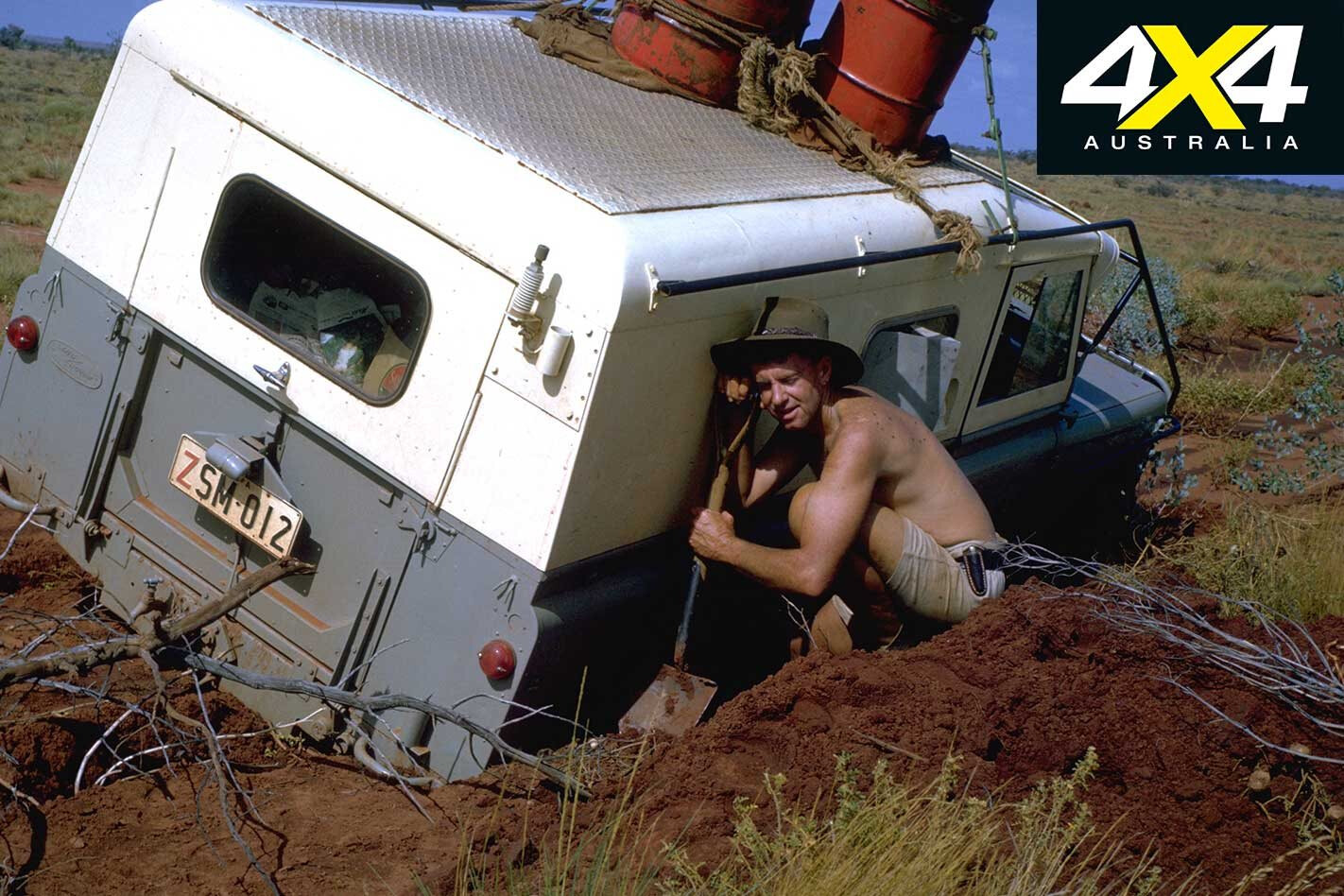
I have been reading a few travel stories of late (as I do) and I suddenly realised they had one thing in common – all these great adventures had been undertaken in Land Rovers.
Not the glitzy thing they call a Defender nowadays, but the original Land Rover – basic, utilitarian, uncomfortable to a fault, but capable and endearing.
Of course, many people would have read the series of books – Blast the Bush; Bush Bashers; Too Long in the Bush; Beating about the Bush; Still in the Bush; and End of an Era – by Len Beadell.
These yarns tell of his and his team’s, the Gunbarrel Road Construction Party, exploits as they surveyed and graded roads across the Outback, west of today’s Stuart Highway, in the 1950s and ’60s. The six books are a great read, full of history, adventure and all told in Len’s laconic and humorous style. While the Landies don’t feature prominently, they are always there in the background, whether in the prose or in the accompanying pics, doing the job as unsung heroes, as what they were.
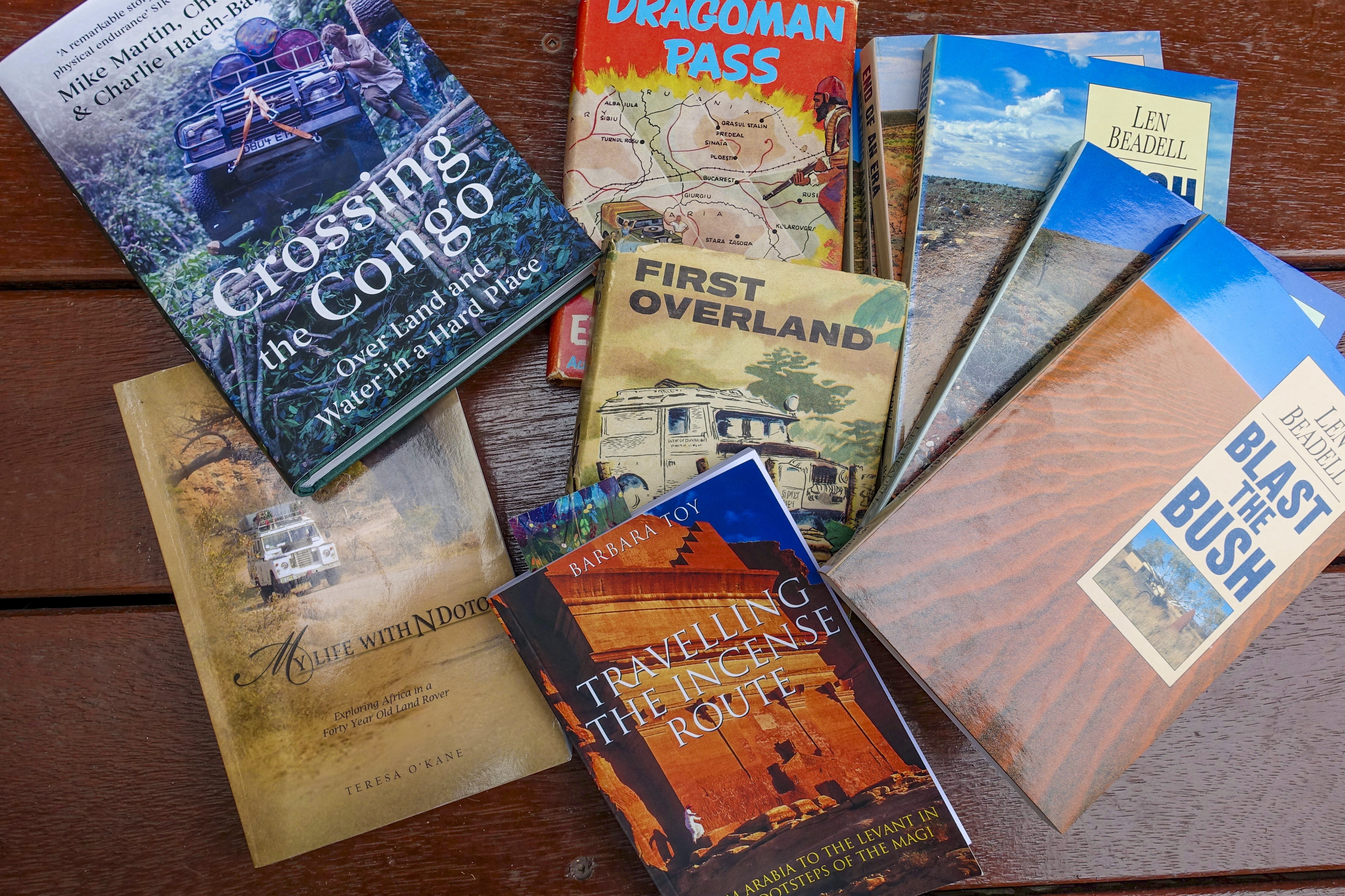
Then there’s First Overland by Tim Slessor, an account of the grandiosely named, The Oxford & Cambridge Far Eastern Expedition. While not the first motorised trip from London to Singapore (as often claimed) this journey undertaken in 1956-57 has taken on more of a life of its own, helped along, no doubt, by the marketing gurus at Land Rover. It’s not a bad yarn though and well-worth reading, the latest 50th anniversary edition of the book having a forward by Sir David Attenborough.
Then there is Dragoman Pass by Eric Williams. What a life this bloke had, even though you probably have never heard of him. A navigator in Bomber Command in WW2 he was shot down over Germany and taken prisoner, before escaping and making his way back to England. His second book and his great escape story, The Wooden Horse, made him famous.
In 1956 he and his wife left England and travelled behind the Iron Curtain which had descended over Europe after WW2. Written in a fiction style to preserve the life of people in the communist countries that helped them, it’s still a good yarn; although I’m not sure where fact ends and fiction begins.
Teresa O’Kane’s book, My Life with N’Doto, is a story of a five-year love affair with Africa undertaken in 2010 in a 40-year-old Landie. It’s her second book on travelling through Africa, her first being, Safari Jema, A Journey of Love and Adventure from Casablanca to Cape Town. They are both pleasant reads, evocatively told, which will make the most chair-bound of us get up and want to travel to this incredible continent.
A darn sight more adventurous is, Crossing the Congo, by Mike Martin, Chloe Baker and Charlie Hatch-Barnwell. Setting off in 2013 from Kinshasa, they travelled from south to north through the Congo basin, on a journey they were told wasn’t possible. It’s a great modern-day adventure well-told, with fabulous photos.
Finally, there are the stories of Australian born Barbara Toy, who from the early 1950s did some of the most incredible solo voyages I have ever heard of. While I’m reading Travelling the Incense Route, she wrote nine books all told on her exploits, and what exploits they were.
Loving desert country, her first major trip took her from London to Baghdad in 1950, followed by a seven-month expedition through Libya in 1952. In 1953 she explored Saudi Arabia and in 1956-57, she drove around the world, including a stint in Australia where she drove from Perth to Sydney – and don’t think it was as easy then as it is today!
Her 1959 expedition took her through Libya to Kenya, while her sixth major expedition was in 1961 from Timbuktu to Tripoli. In 1990 at the age of 81, she again circumnavigated the world as well as retracing the route of Hannibal and his elephants over the Italian Alps.
Most of those trips were in her much loved 1950 80-inch Series 1 Landy, nicknamed, ‘Pollyanna’. In 1960, Rover, who had started to sponsor her, insisted she change vehicles for a more modern Land Rover, which she didn’t want to do and considered the later model less reliable. She later bought Pollyanna back and drove it around the world again in 1990. After her death in 2001 the vehicle was sold to a keen Landie owner and takes pride and place at selected car shows.
So, while you’re home or sitting on a beach somewhere, get your nose out o the iPad or iPhone and read about some great adventures … all in old-style Land Rovers!