
RAM Trucks has added a new variant to its 1500 range known as the Laramie Sport, obliged by the full-size American pick-up brand’s explosive sales growth in Australia.
Snapshot
- Mid-spec 1500 Laramie Sport added to range
- RamBox storage solution fitted as standard
- Brought about by 60+ per cent year-on-year sales growth
Sitting above the regular 1500 Laramie ($127,950) and below the 1500 Limited ($153,950), the Laramie Sport is priced from $136,950 before on-road costs.
Under the bonnet is RAM’s 291kW and 556Nm 5.7-litre Hemi petrol V8 with selectable 4X4 and an eight-speed torque converter automatic.
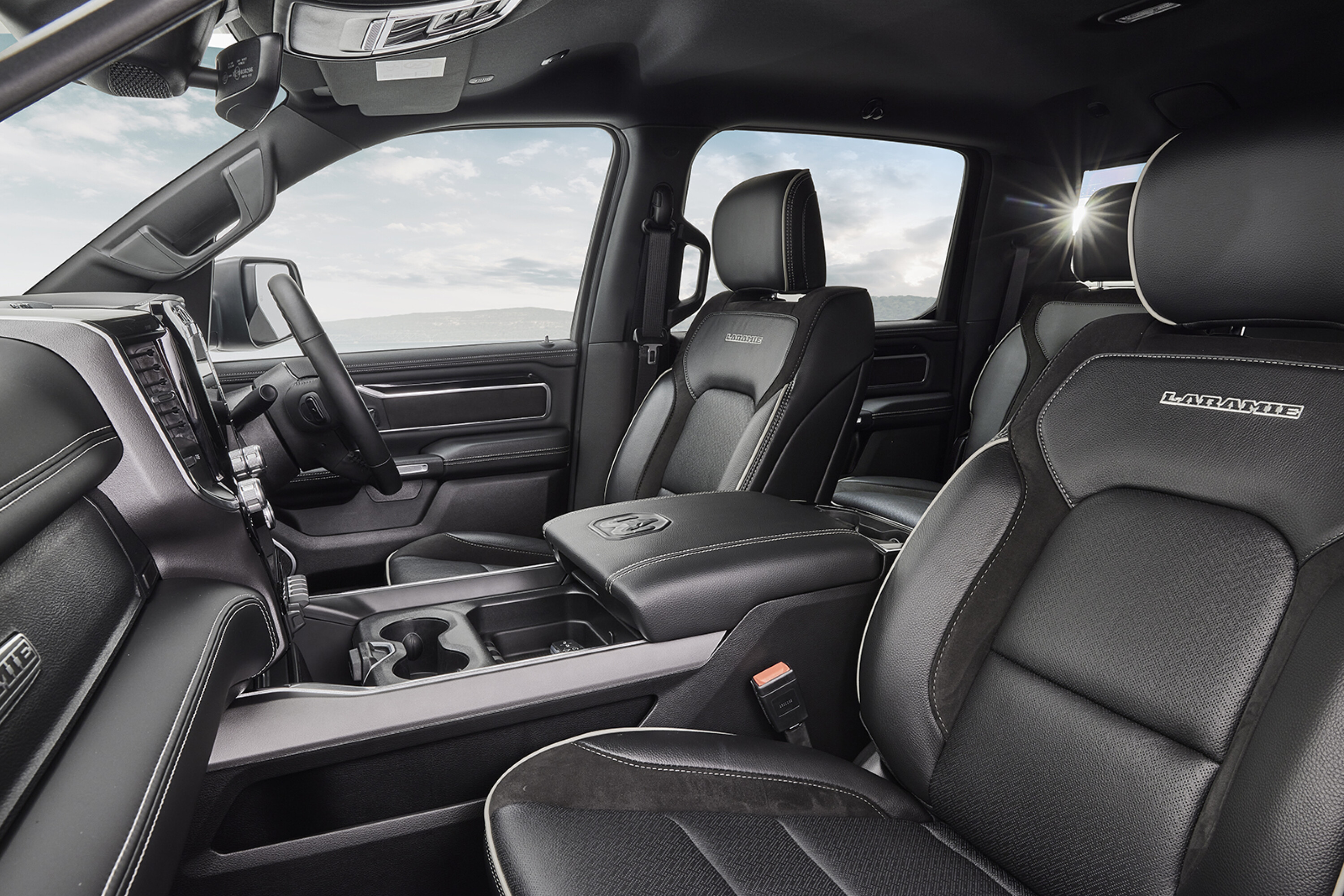
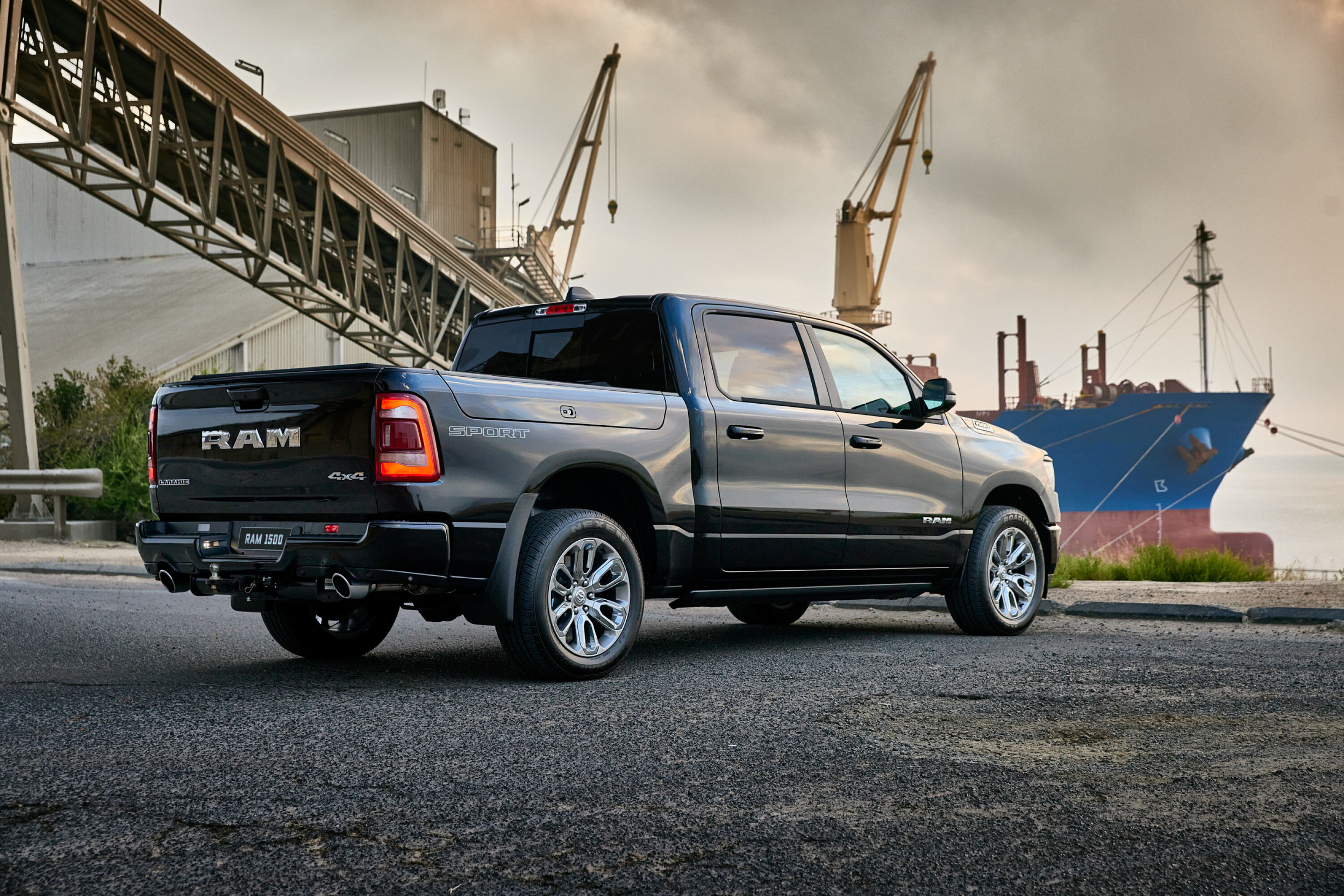
The Laramie Sport’s visual identifiers include 20-inch alloy wheels with a high-gloss finish, colour-matched bumpers and grille and RamBox storage solution – that can be converted to a drink-chilling Esky – as standard (usually a $4950 extra).
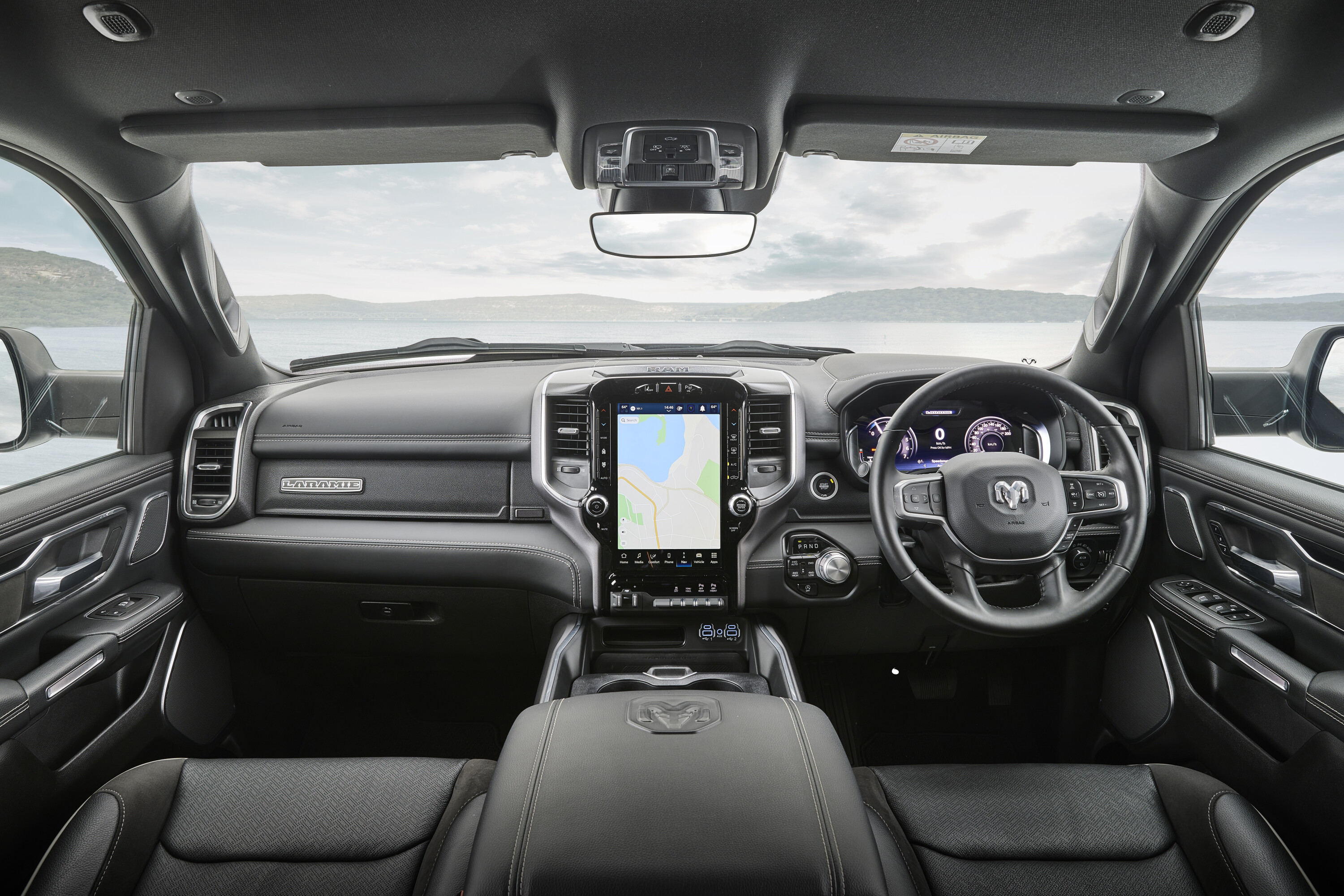
Meanwhile, the cabin scores a black headliner and carbon-fibre trim inserts. Leather upholstery, a 12.0-inch digital driver’s display, adaptive cruise control, park assist, and blind-spot monitoring finishes off the Laramie Sport package.
“The 1500 Laramie Sport full-size pickup combines all the benefits of a ute with the comfort, space and premium finishes of a luxury SUV”, said Jeff Barberm RAM Trucks Australian national manager.
“This unique proposition allows a range of customers to travel business class whether they’re towing, on work sites, on family road trip adventures, or even doing the school run”, added Barberm.
RAM’s V8 utes stand in the face of fluctuating fuel prices and increasing EV sales. Australian importer Ateco delivered 1172 vehicles in June, up 85.2 per cent over last June for a 61.6 per cent improvement year-on-year.
This bodes well for full-size ute rivals on their way to Australia, such as the Ford F-150 and Toyota Tundra. It’s also encouraging to see RAM’s local right-hand drive conversions continue to employ Aussie workers.
| 2023 RAM 1500 DT pricing (before on-road costs) | |
|---|---|
| RAM 1500 Laramie | $127,950 |
| RAM 1500 Laramie Sport | $136,950 |
| RAM 1500 Limited | $153,950 |
| RAM 1500 TRX | $209,950 |
Creating turn-key touring 4×4 vehicles is the bread-and-butter business for Queensland’s Rambler Vehicles, and we’ve seen plenty of stunning examples of its work at 4X4 Australia.
Often the start point for these builds is a brand new 4×4 wagon such as a Toyota LandCruiser or Nissan Patrol, and these are converted into double-cab utes to create the base vehicle to build on.
Over the years, Rambler has partnered with Toowoomba-based re-manufacturer, ASG 4×4, to handle the engineering side of these conversions, which includes chopping the back off the wagon body to form a ute and sectioning the chassis to create a longer wheelbase.
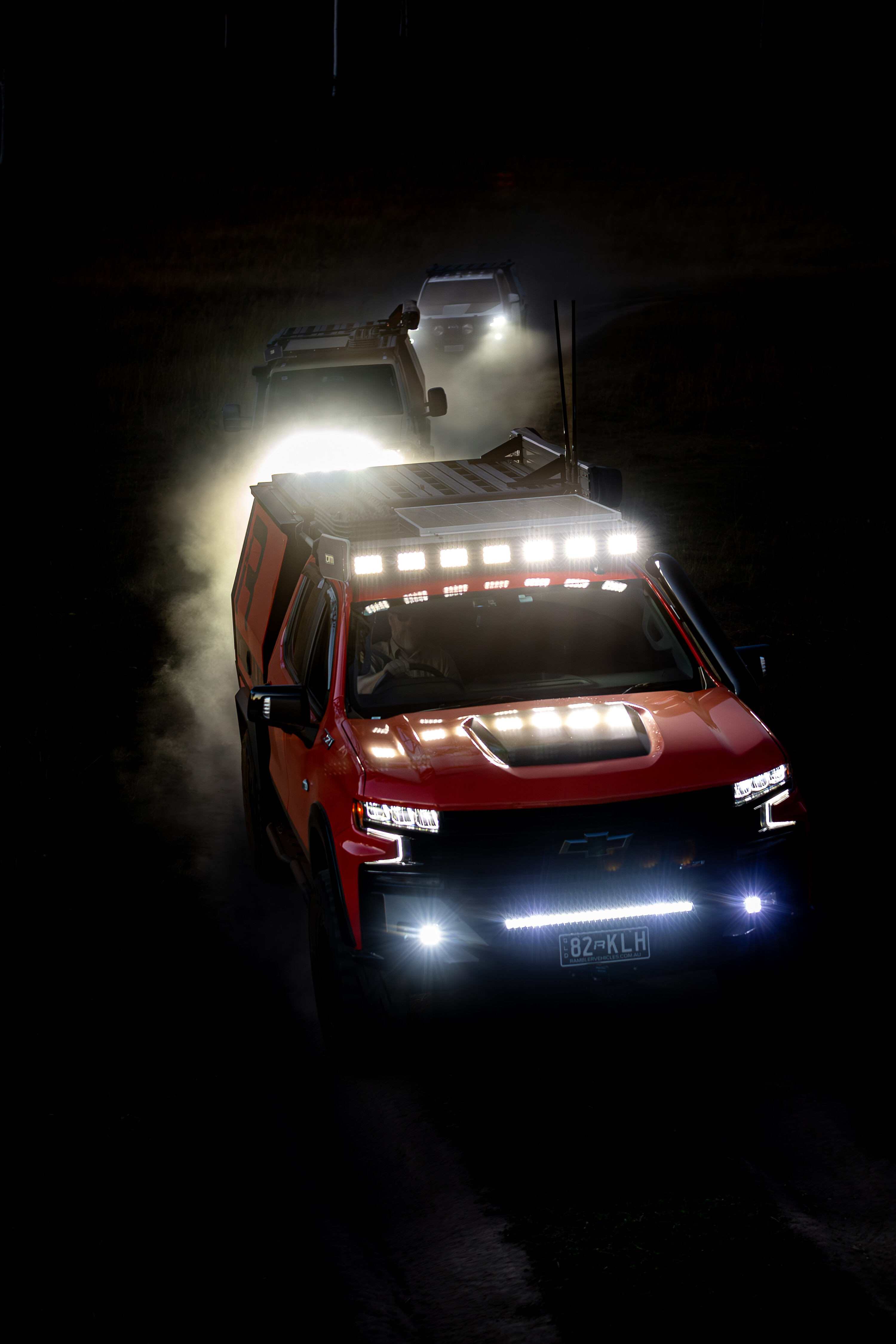
In exciting news, ASG 4×4 is merging with Rambler Vehicles and Spinifex Manufacturing to truly become a one-stop shop for new turn-key custom touring four-wheel drives that will be known as the Recre8 Automotive Group.
The entity will soon move into a new premises at 53 Suscatand St, Rocklea, Queensland, where prospective buyers can see the vehicles and discuss their vehicle requirements with the qualified team. ASG 4×4’s manufacturing facility will remain up the range in Toowoomba.
James Jauncey, Director of ASG 4×4, and Kris Humphrys, Director of Rambler Vehicles and Spinifex Manufacturing, will spearhead the new venture, pooling their expertise and unwavering passion for the automotive industry.
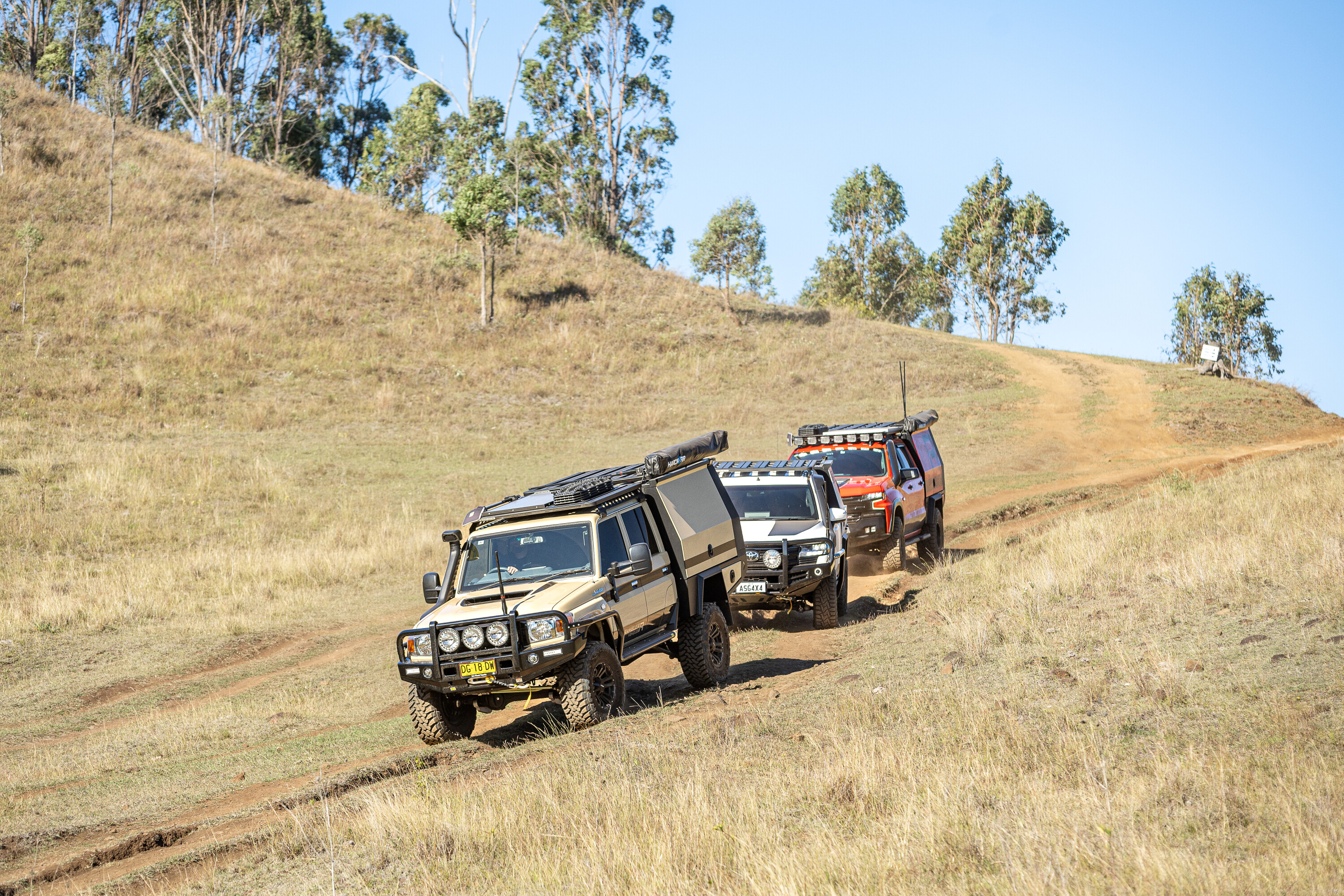
“We are thrilled about the prospects and opportunities that this venture brings,” stated James Jauncey, expressing his enthusiasm for the merger. “By keeping manufacturing in Toowoomba, we contribute to the local economy while ensuring better access to our brand and support for our customers through our presence in Brisbane.”
Kris Humphrys echoed the sentiment, saying, “The businesses will transition to new facilities that enhance operational efficiencies and deliver an improved consumer experience. We eagerly anticipate the benefits that this merger will bring.”
Since its establishment in 2013, ASG 4×4 has gained a strong reputation for its exceptional quality in converting 200 Series LandCruisers into dual cab commercial vehicles primarily for the farming industry.
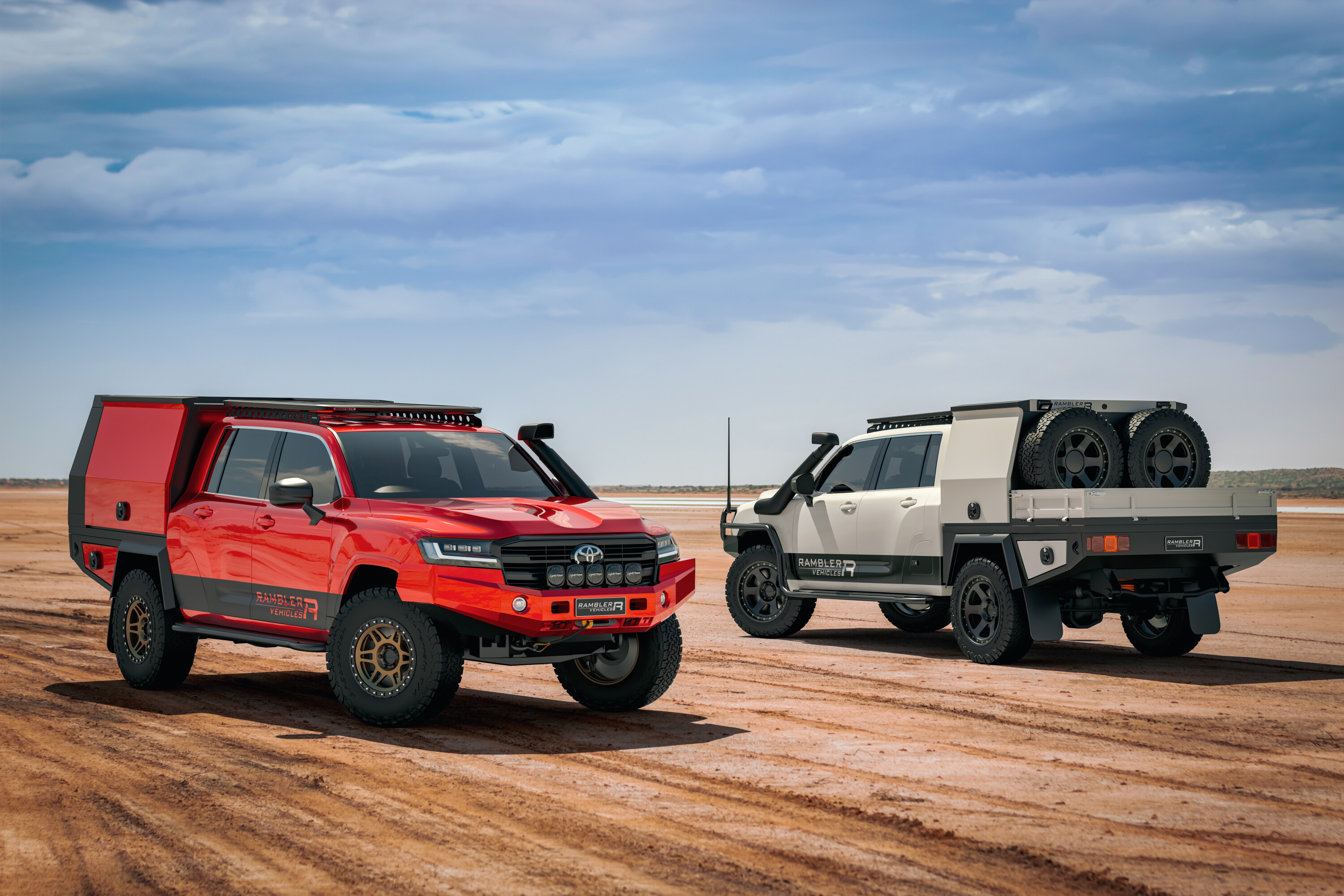
Over time, the brand expanded into the commercial and recreational sectors, incorporating chassis extension capabilities for other dual-cab utes to enhance its offerings. Notably, ASG 4×4 has recently invested significantly in equipment and engineering capabilities to accommodate the evolution of the 300 Series LandCruiser, resulting in three dedicated conversion lines and a chassis extension line. Additionally, ASG 4×4 provides a range of tray solutions to complement its conversions.
Established in 2018, Rambler Vehicles identified an opportunity in the market for comprehensive turn-key vehicle builds. As a fully licensed motor dealer, Rambler Vehicles stands out in the industry by offering vehicle procurement, build management, finance, insurance and registration services under one roof, streamlining the purchase and build process.
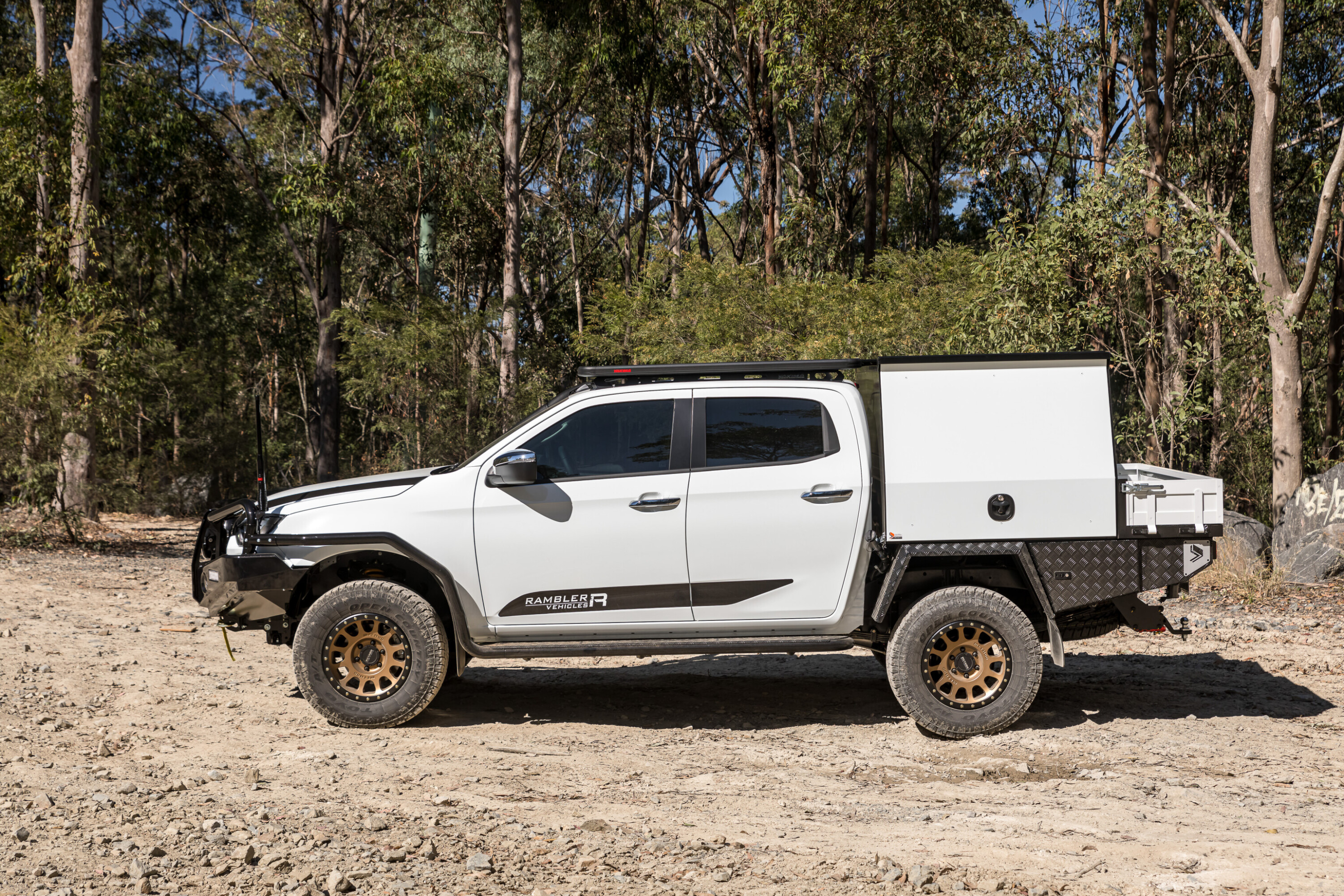
Initially focused on 79 Series LandCruisers, Rambler Vehicles has adapted to market demands by expanding its offerings to include dual-cab 200 and 300 Series LandCruisers, dual-cab Nissan Y62 Patrols, Toyota Hiluxes, and Isuzu D-MAXes.
Since 2015, Spinifex Manufacturing has been a prominent producer of Australian-made tray and canopy bodies. Originating from the decline of the mining industry, its products leverage the expertise of manufacturing technicians who have honed their skills in some of Australia’s harshest conditions.
Spinifex Manufacturing’s trays and canopies are not only lightweight but also sturdy, evolving in design to harmonise with modern vehicle aesthetics.
- The new website can be found here: Recre8.net.au
- ASG 4X4: www.ASG4x4.com.au
- Rambler Vehicles: www.ramblervehicles.com.au
- Spinifex Manufacturing: www.spinifexmanufacturing.com.au
They say adversity breeds innovation. For all of human history, the harder the situation, the more we fire up the grey matter to come up with a solution.
In famine we build smarter farming practices, in war we build smarter communication equipment, and you best believe that rainy England is all over umbrellas compared to us here in sunny Australia.
It might seem like a long bow to draw, but that innovation through adversity is also why we’re so bloody good at designing and building cars in Australia, and the engines that drive them.
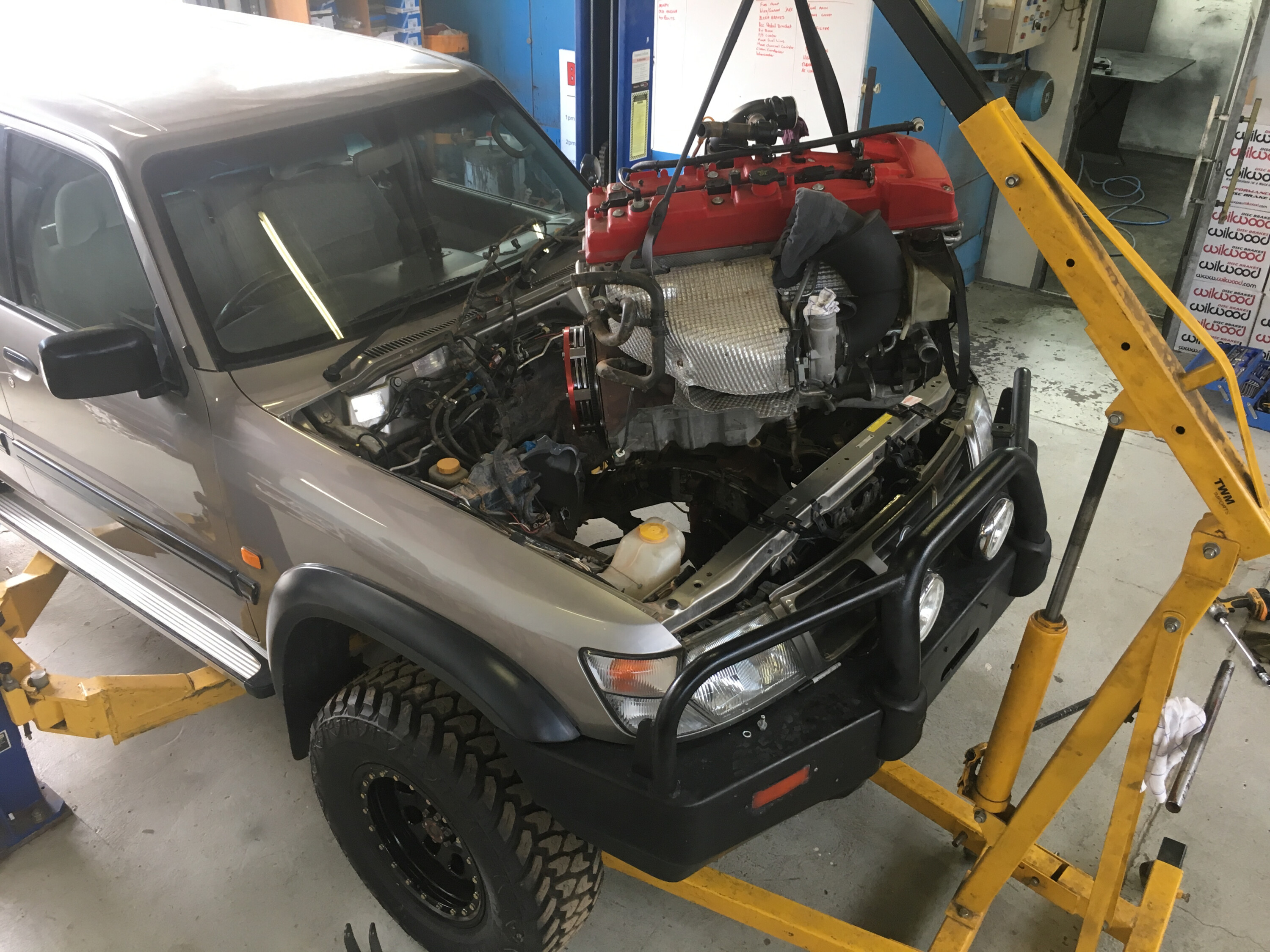
A world away from any of the traditional manufacturing powerhouses, we’re a land of limited population, wide open expanses, and very different needs to any of our neighbours. The Ford ‘Barra’ engine is the culmination of that ingenuity, at least when it comes to internal combustion engines.
As strong as an ox to handle the massive kays between population centres, reasonable on fuel due to our higher fuel prices, and goes like a rat up a drainpipe because, quite frankly, we’re a nation of rev heads.
But what is it about the mighty Barra that makes it renowned the world over, and why would you want to shoehorn one into your LandCruiser? We’re glad you asked.
Barra building blocks
Ford has a long history with the venerable straight six. While the flat-head V8 may be what put the company on the map for power, its six-pots were renowned for reliability.
The FoMoCo dipped its toe in the water with a few different designed sixes from 1906 through to the 1950s, but the third generation known as the ‘Thriftpower Six’ introduced in 1960 is the first in the line of unbroken development that eventually finished with the Barra.
With a 144ci (2.4L) capacity, the Thriftpower Six ran a unique in-head intake setup that severely restricted its power potential – just 67kW from the factory floor – but resulted in miserly fuel consumption as low as 8L/100km in early Compact Falcons. Australia imported both the 144ci and 170ci versions.
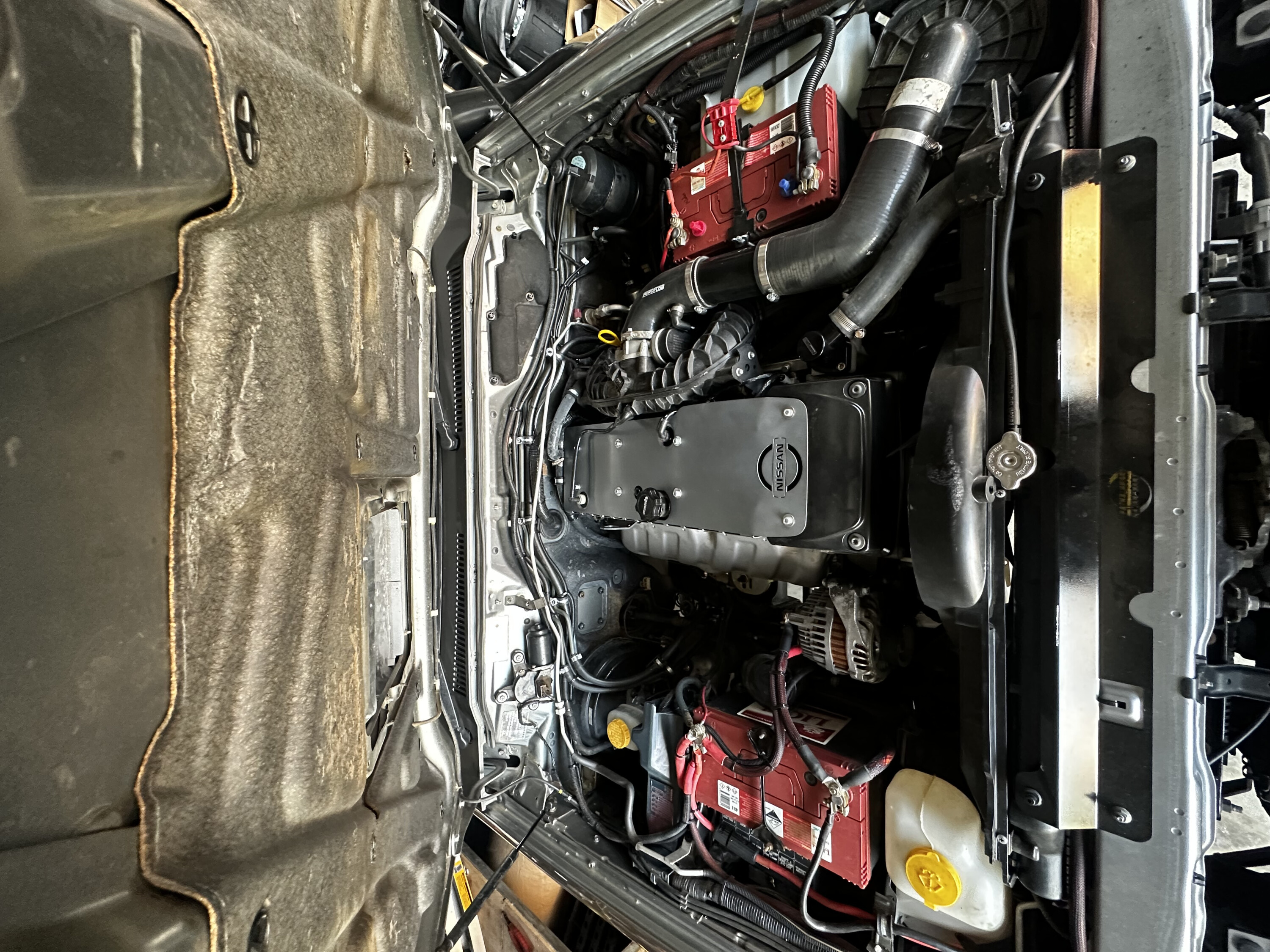
From here, the Yanks kept developing this platform with limited success on the power front, but ultimately finished the range up in 1996 with a 300ci (4.9L) version.
On Aussie shores, we went our own path. Think of two identical twins, one receiving the best education and physical training possible, the other living in a trailer park.
Through the 60s, 70s, and 80s we tweaked and modified the basic design of the straight six through a bunch of minor revisions and capacity increases. Up to 250ci (4.1L) with a newly designed head featuring a freer flowing external intake, the 250-2V was the final iteration with 128kW, which is nearly double what the initial Thriftpower was capable of.
Latest Gear Guides

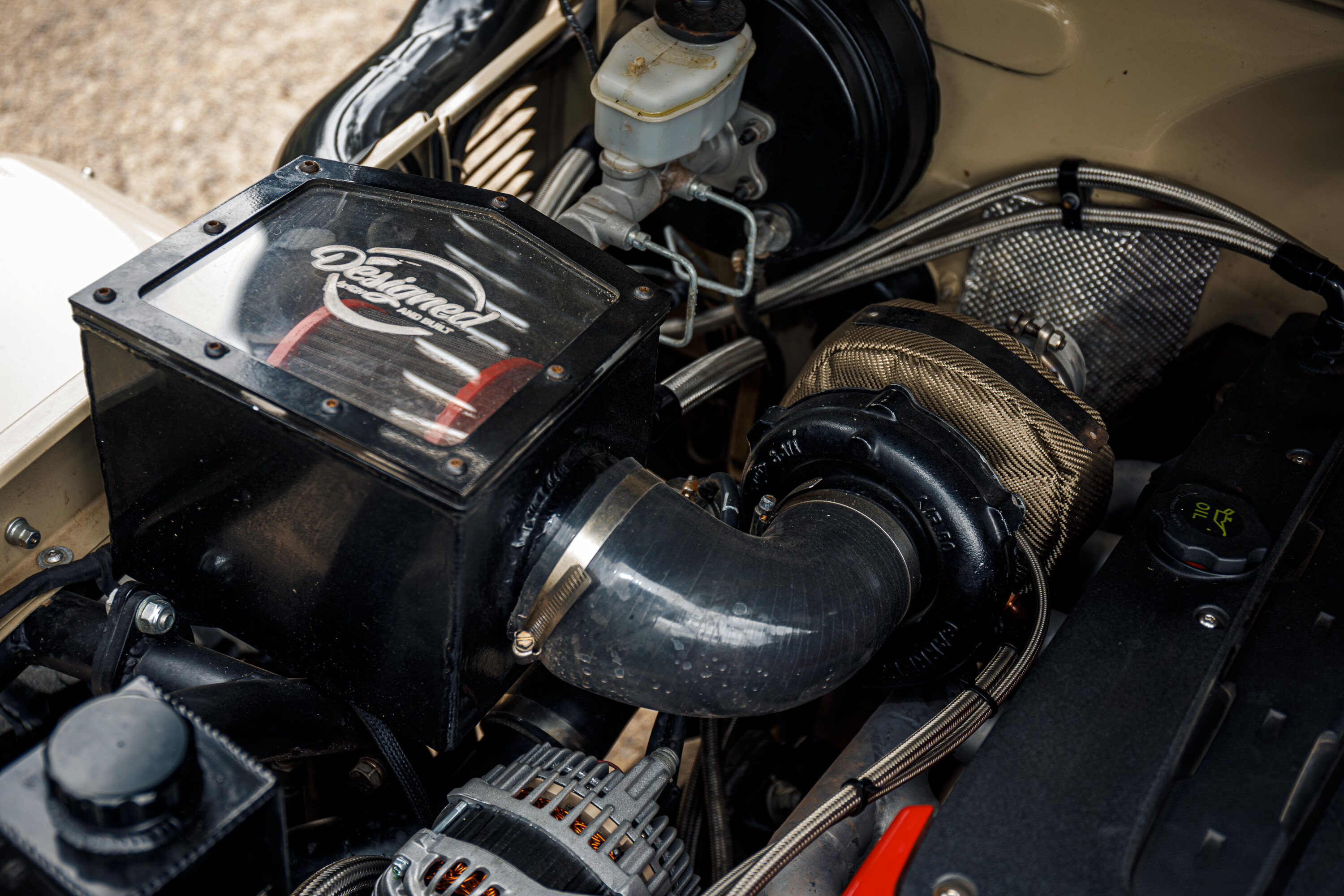
From here, the roller coaster starts picking up speed. The previous generations were what’s known as a reverse flow head. Essentially the air mixture would come in the driver’s side, go through the combustion process, then about face and head back out the exhaust on the driver’s side. The new Crossflow model had the air mixture come in on the passenger side, and out the driver side.
Revolutionary, hey? Over the years the cast-iron head was swapped for alloy, and carburettors for multi-point fuel injection. Factory power levels remained largely unchanged, but the improvements in flow meant that with aftermarket goodies hot-rodders started paying attention to the engine.
In the late 80s, a redesign saw a conversion from pushrod to overhead cam in the SOHC range, which topped out in the EL XR6 making 164kW. For reference, the 5L Windsor V8 of the time made just 6kW more. The Aussie six was starting to get seriously impressive.
The AU Falcon received an update known as the ‘Intech’, adding variable cam timing and sequential fuel injection, which bumped power up to 172kW and torque to 374Nm. This was the last generation of the Aussie Six before the Barra came along to change the game completely.
What makes it so good?
So what makes the Barra stand out from 42 years of minor tweaks, and why is it named after a fish?
Well, the name is easy: Barramundi was the code name while the engine was in development. An opportunistic predator, the Barramundi is known for “eating everything”. The ‘Gull’ was also floated, noted for flying high and “shitting on everything”, but it may not have been as palatable to the public.
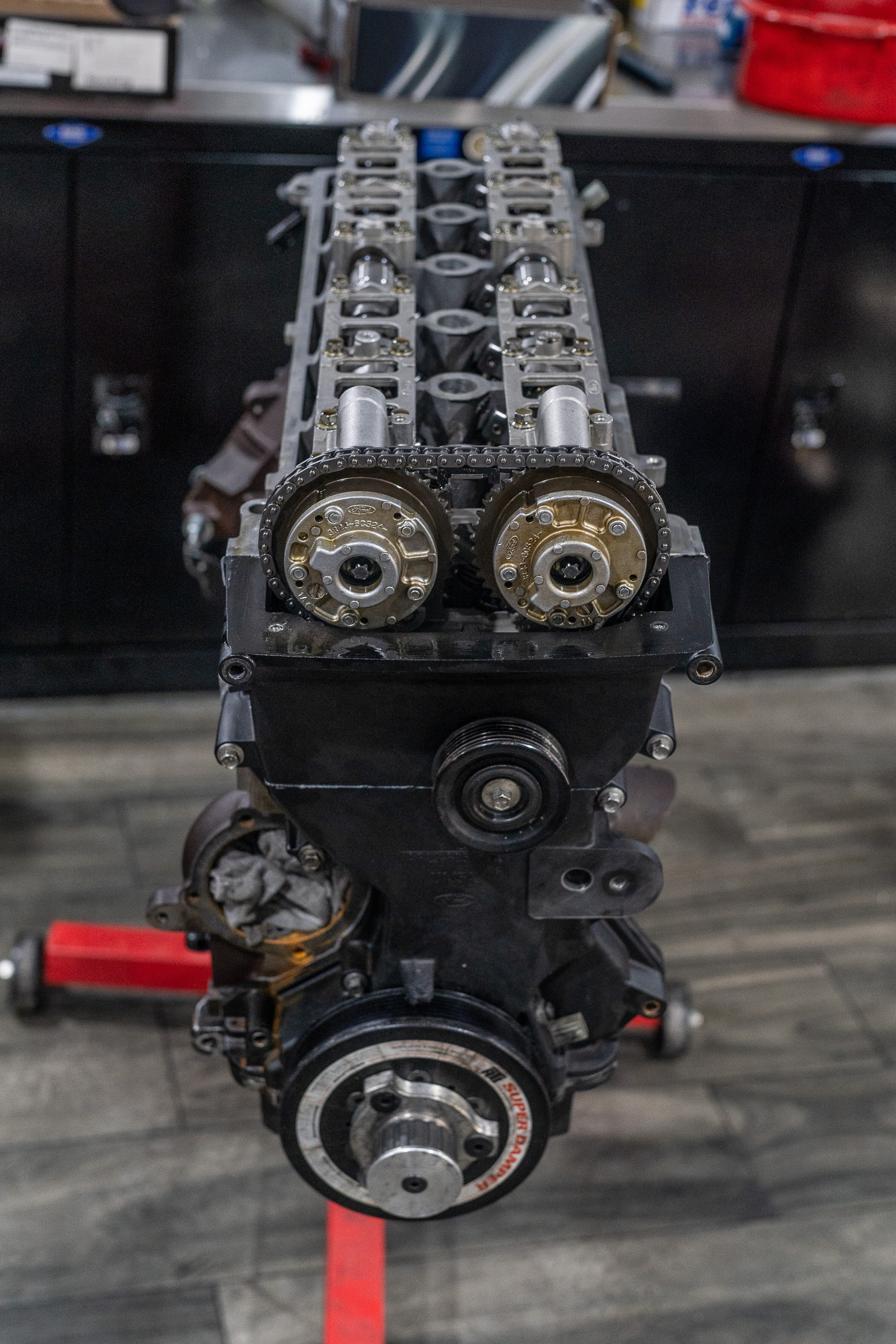
Built in Ford’s Geelong, Victoria plant from 2002-2016, the Barra’s bottom-end was initially left largely unchanged from the earlier Intech engine, but the top-end copped double overhead cams, coil-on-plug ignition and four valves per cylinder.
Output immediately jumped to 182kW and 380Nm… in the base model. The entry-level turbocharged Barra 240T amped that up to 240kW and 450Nm. The final iteration boasted 370kW and 650Nm in the limited edition XR6 Sprint.
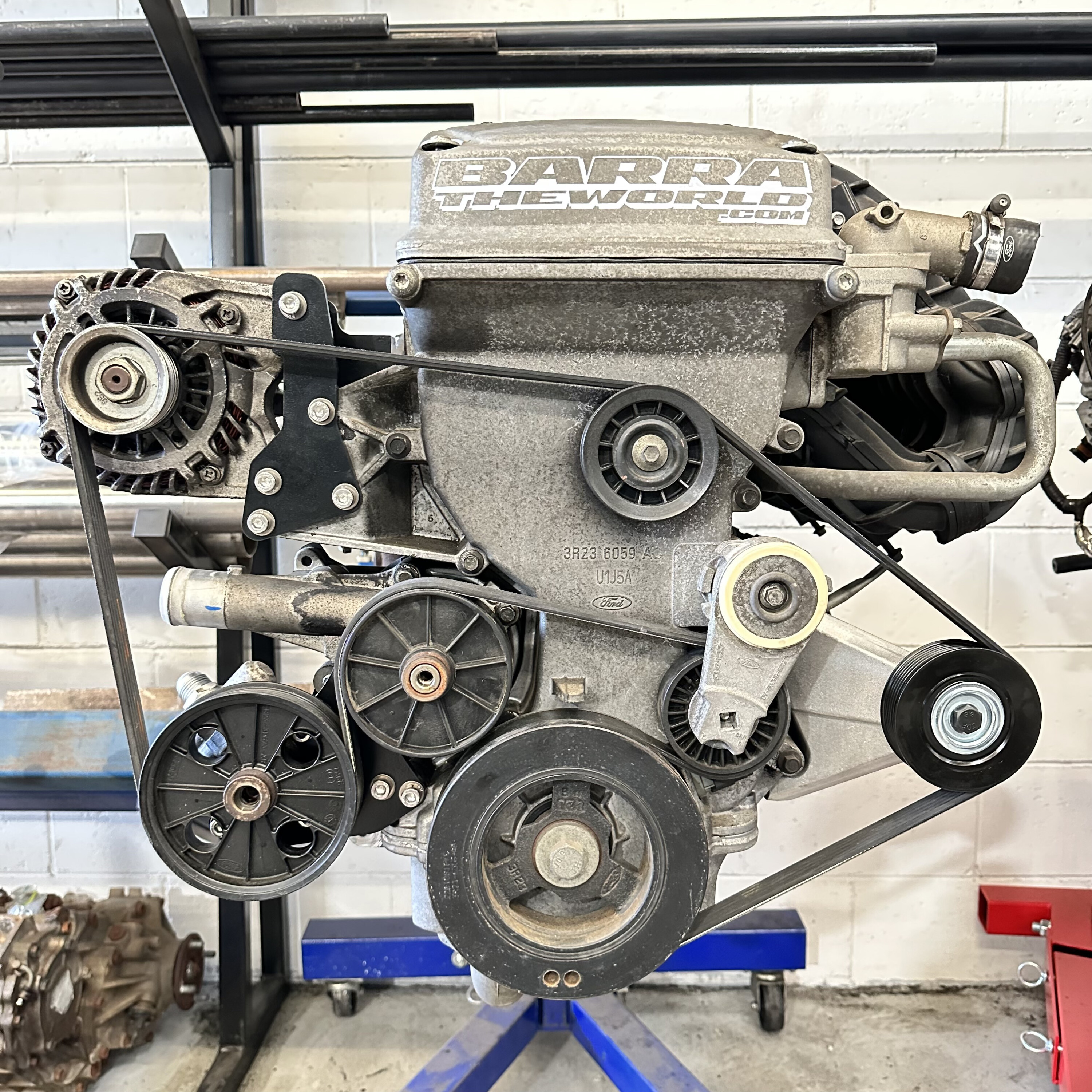
“I think Ford just got the Barra right,” says Joe Tummarello from Precision Racing while he leans over a 1600hp offering he’d previously built. “It’s a big capacity, modern tech six-cylinder designed to last over a million kays in a taxi, handle over 300kW in the F6, and meet strict emission standards.”
Despite being a big robust Aussie 4.0L six with a cast-iron block, the engine is a genuine competitor for performance with the very best engines to ever leave Japan or Germany.
Tech-wizard Richard Swindel-Hurst from LCS 4×4 adds, “They’re just a very driveable engine, especially when paired with the ZF six [speed] transmission. Smooth power delivery, modern enough to have engine protection, and endless amounts of off-the-shelf mods for big power upgrades.”
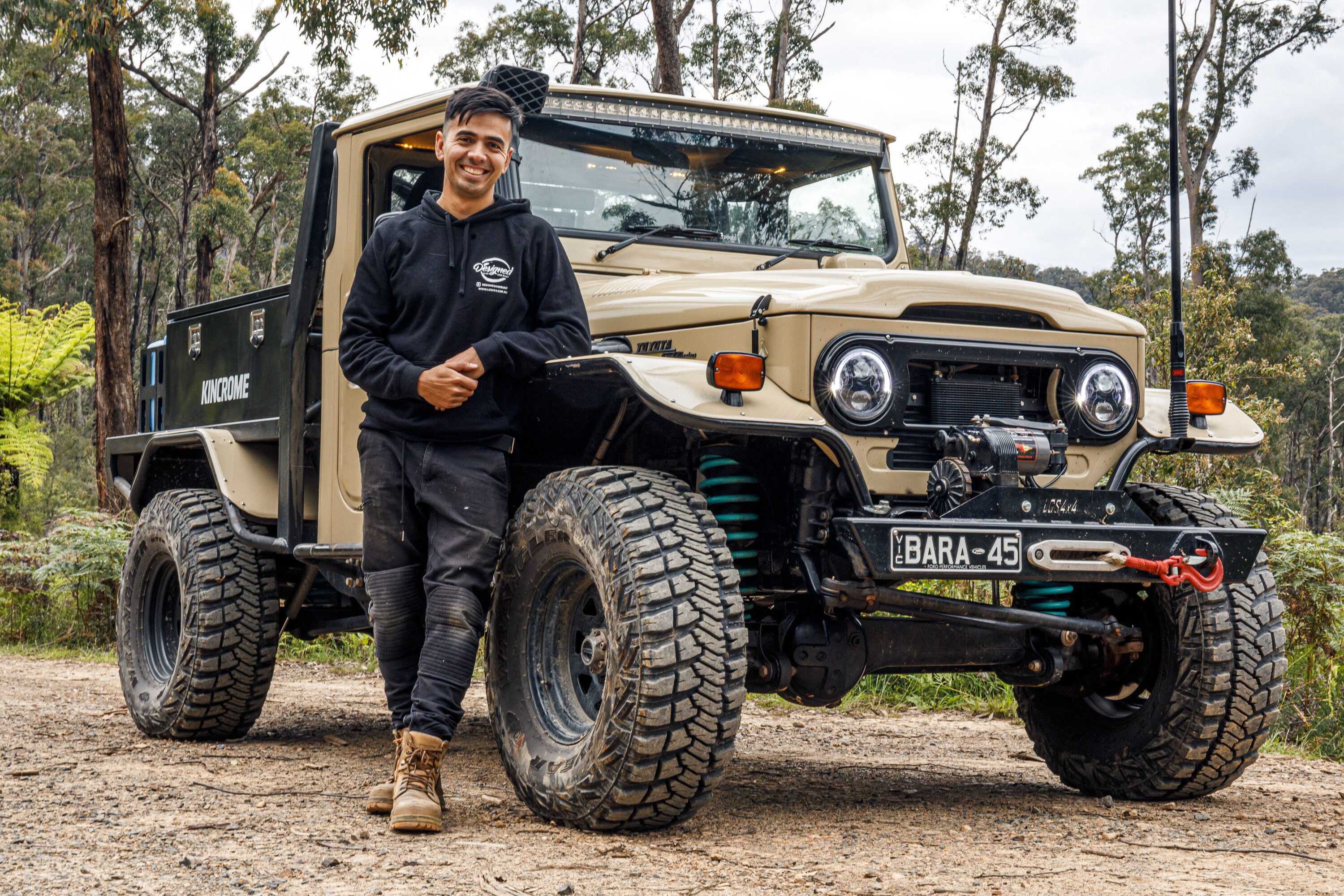
While all this sounds great in a performance sedan, those numbers translate fantastically into 4×4 land as well. A junkyard non-turbo Barra produces 60 percent more power, and five percent more torque than a factory turbocharged TD42 Nissan Patrol. They’ll rev for days, last forever, tow, and be reasonably fuel efficient in the process. Starting to see why the Barra is on a pedestal?
The best Barra for you?
If you’re eyeing off the ideal Barra donk for your 4×4 there are a few considerations you’ll need to make along the way.
First of all, as a general rule, the engine you’re swapping in needs to be at least as new as the vehicle you’re swapping it into. You’ll be hard pressed getting a 2002 engine legally into a 2012 4×4, but a 2016 that looks identical won’t be an issue.
Secondly, the engine was produced for 14 years, and used in utes, sedans and SUVs. In other words, from low-performance LPG-only taxi variations right through to limited-run offerings with eye-watering performance. The more you spend, the better base engine you’ll get.
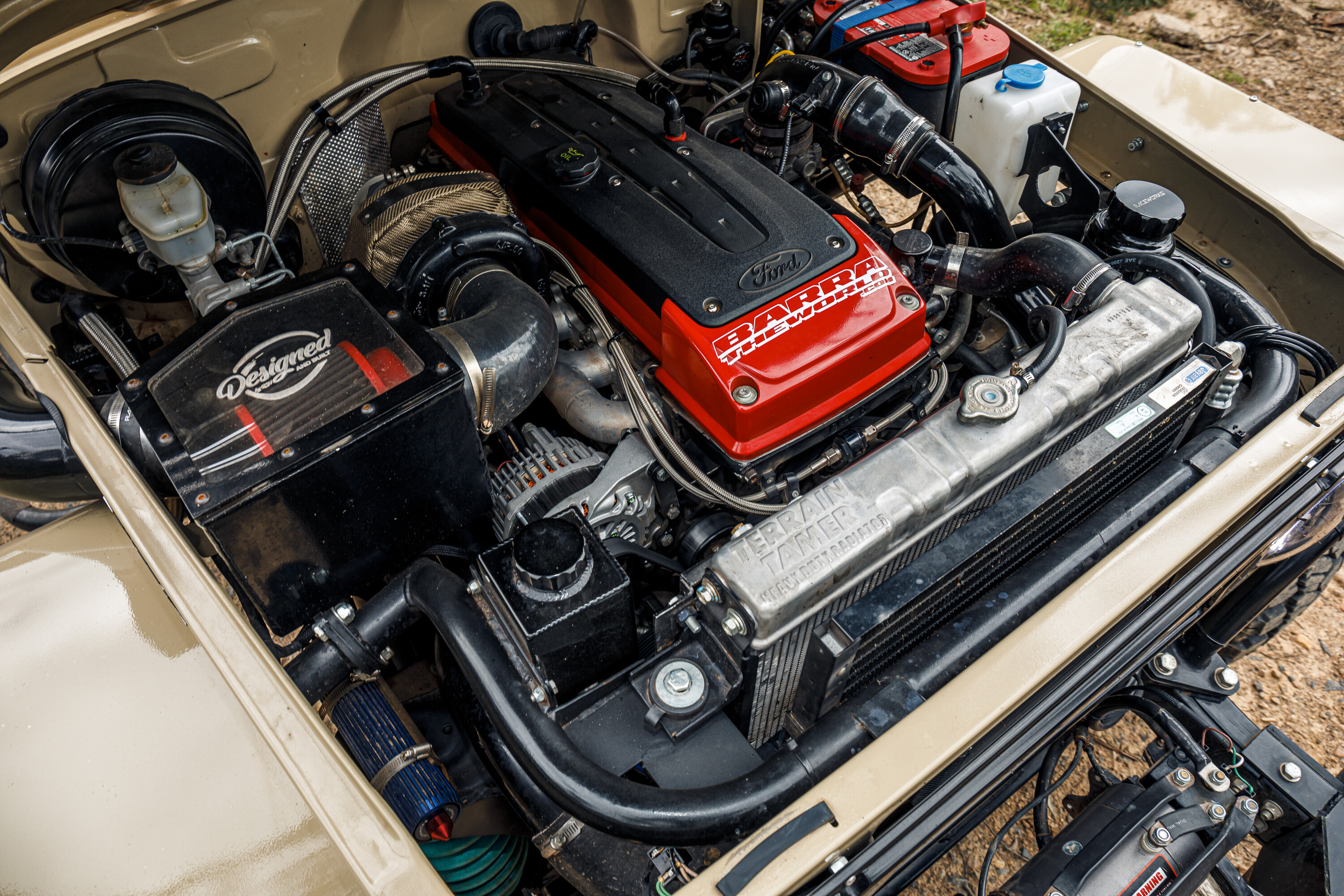
“The main difference between a naturally aspirated (NA) and a turbo engine is the piston and rod combination” Joe tells us. “NA engines have higher compression ratios and skinny rods, turbo engines have low compression and heavier duty rods. There’s also an LPG variant that has larger turbo-style rods and high-compression NA pistons.”
As each generation progressed, minor changes and improvements were made. The BF series (2005-2008) has stronger rods than the BA (2002-2005), while the newer FG and FGX which ran from 2006-2016 have stronger again.
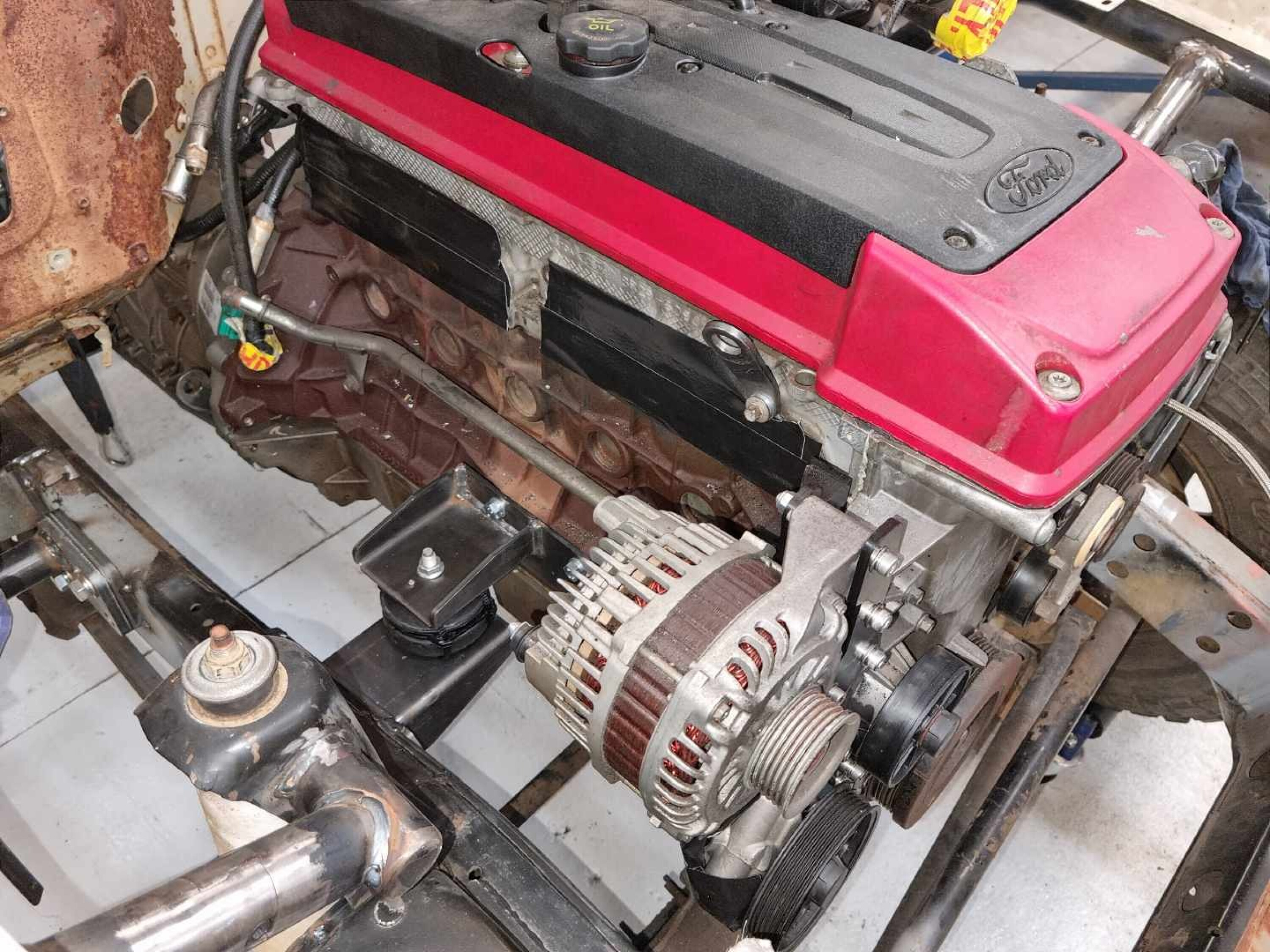
Joe added “You’ll need to consider whether you’ll need a front hump sump from the BA and BF, or a rear hump from the FG. It changes the dipstick location on the block. The BA only has provision in the block for a front sump, most BF blocks can run both, and later FGs can only run rear hump.”
In short, buy the newest engine that’ll fit in your 4×4. Even if you’re staying naturally aspirated, the FGX NA engine offers 195kW over the first generation 182kW BA engine.
Things that’ll go bang
“If anyone tells you this engine is unreliable they’ve probably done a shit job of the conversion,” Richard tells us with a laugh. “With the right mods, and the right person doing the conversion, they’re one of the best options for a petrol swap at the moment.”
“If anyone tells you this engine is unreliable they’ve probably done a shit job of the conversion”
With Ford designing these engines right from the outset to handle the absolute punishment a taxi sees while still lasting the distance, it’s really not surprising the platform is seriously robust right out of the gates. But there are a few key modifications you can make for peace of mind.
If you’re going to rev your Barra it’s worth knowing the sintered metal gears in the oil pump don’t cope well with the harmonics of high revs or limiter bashing. When they fail they explode catastrophically, likely taking your engine with them.
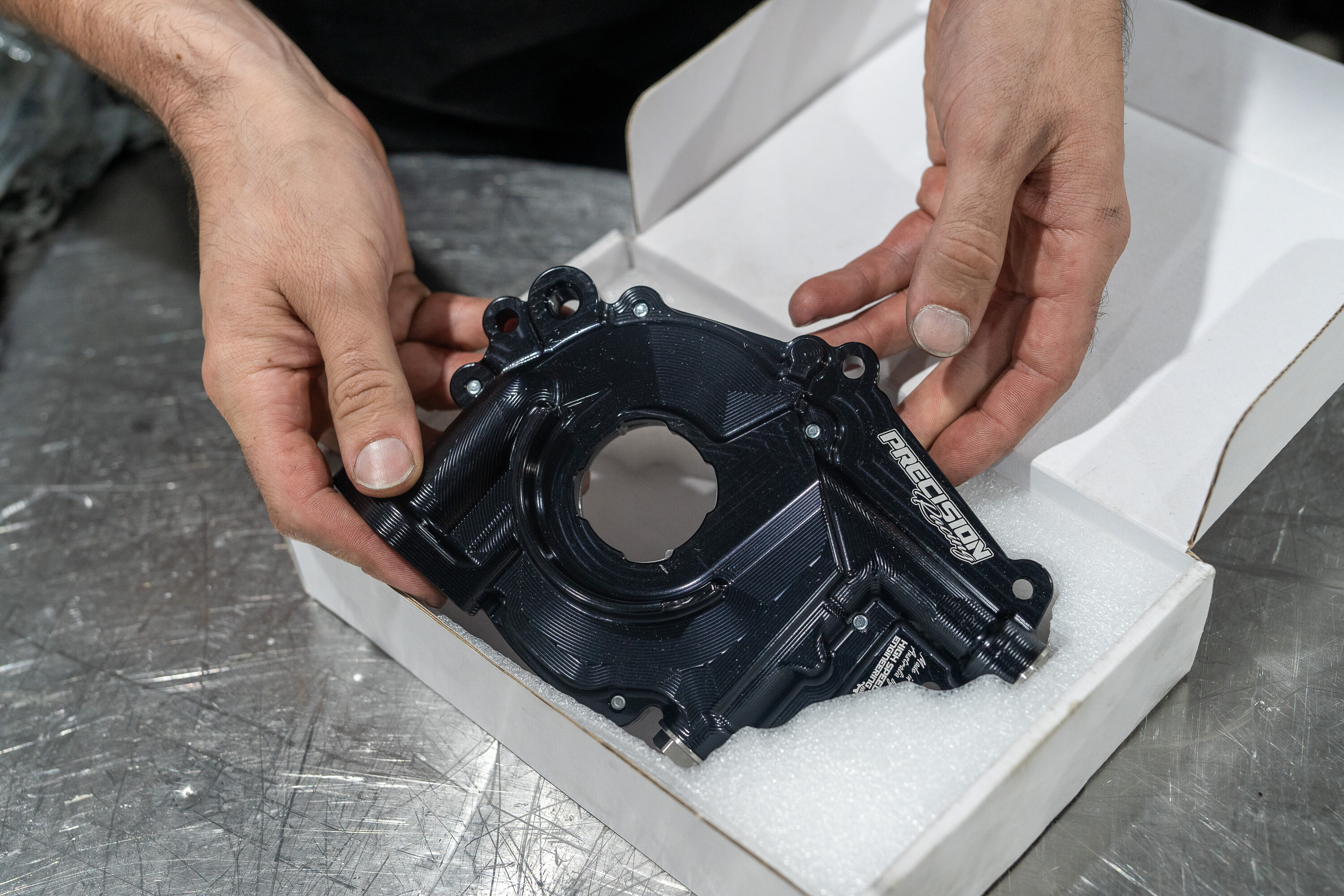
Precision Racing offers a few different upgrades with billet gears and redesigned pumps to reduce oil cavitation and oil pressure drop-off. If you own a pair of Pit Vipers or have ever drunk out of a shoe you should consider these pumps a must have.
From here, if you’re aiming for 300kW or less, the only other upgrade you need to consider is upgraded valve springs. Factory valve springs can only cope with around 10-12psi of boost pressure. A broken or failing valve spring can potentially grenade your engine and can be swapped out without lifting the head, so is cheap insurance.
Aside from that, you should swap out the stock oil-feed line for the turbo one as they tend to clog. Also run a quality oil, and swap out the front and rear main seal as well as the water pump before you slot the engine in.
Impress your mates
Let’s get one thing clear right from the get-go: the sky’s the limit with a Barra. Precision Racing can build you a 1600hp package every day of the week, and that’s running a factory block and head. Pony up for billet options and the platform is capable of 3000+ horsepower.
But unless you’re planning on doing time trials around Fraser Island your power goals, and budget, should be far more realistic.
One downside to the good design of the Barra from the factory is limited scope for improvement in naturally aspirated form.
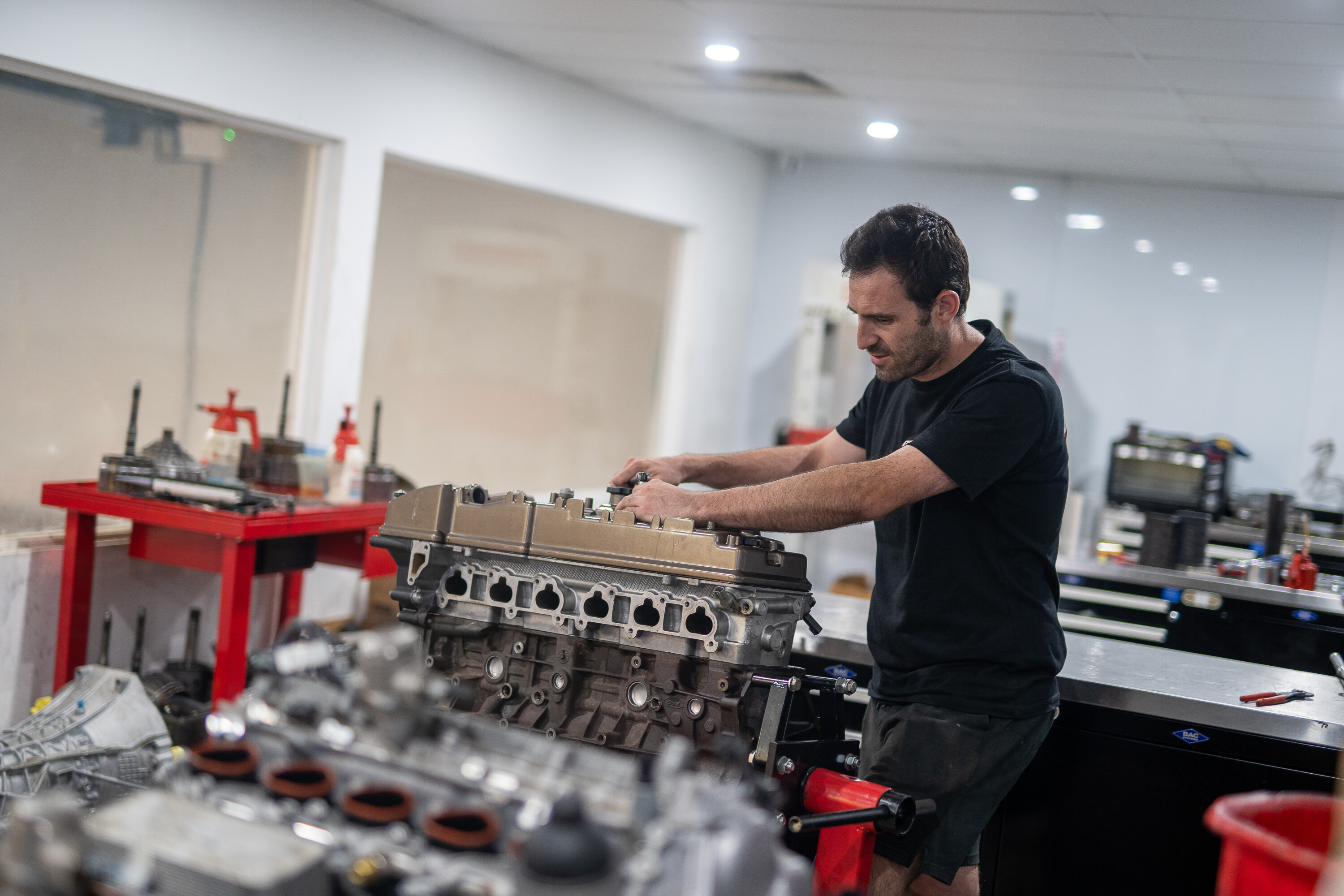
“Modern ECUs are actually quite advanced,” says Joe. “They use features like an electronic throttle, dual manifold runner controls, knock sensors, oxygen sensors, and torque modelling, allowing the factory calibrations to get the tune quite good.”
With air intake and exhaust modifications and a tune on a late model FX XR6 non-turbo you’d be lucky to see a 15 percent increase in power. When it comes to boosted applications things get a whole lot easier.
“Boosted applications are going to require a tune regardless,” Joe says. “So you might as well add some injectors at the same time. Typically, a stock XR6T will make around 220 rear-wheel kW, and closer to 300 rear-wheel kW with injectors and a tune.”
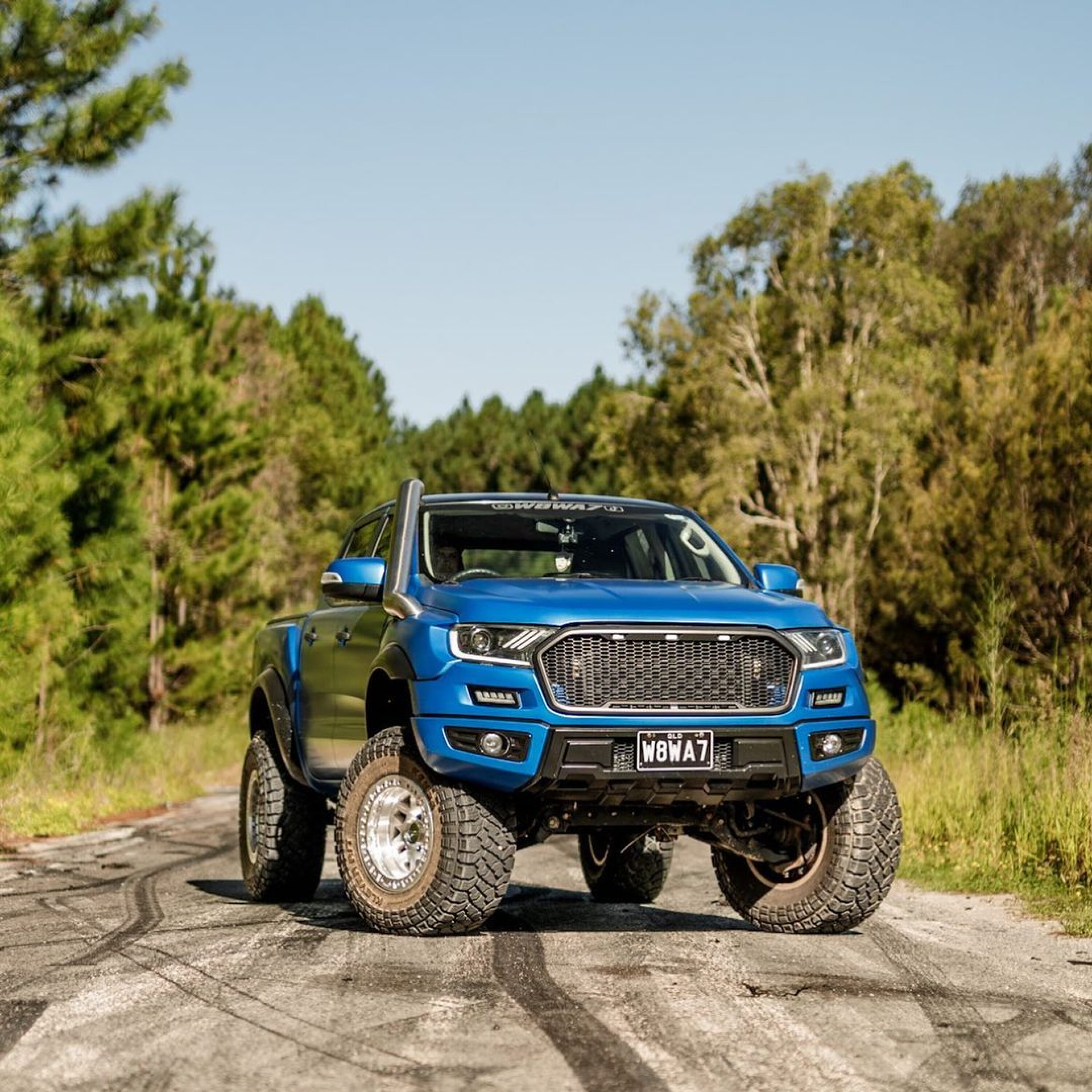
That setup alone will see your loaded GU or 100 Series ’Cruiser comfortably outpacing even tuned Y62 Patrols.
If you start ticking the upgrades box you can easily spend another $10-15,000 to get yourself over 400 rear-wheel kW, but you’ll be deep into the territory of diminishing returns, reliability, driveability and fuel economy all starting to suffer without any real improvements in day-to-day performance in a 4×4.
What will it cost?
The part you’ve all been waiting for, and unfortunately one of the hardest to answer. The old adage ‘how long is a piece of string’ comes up. How much it’ll cost to get a Barra in your 4×4 depends on a whole bunch of variables. What the setup is going into, who’s doing the work, and what you want the final result to be.
On the low end, if you’re DIY-ing, budget conscious and driving a simple Patrol or ’Cruiser, you can pick up a rough BA Falcon for around $2000. That’ll give you the engine, ECU, and a few odds and ends.
You can expect to spend another $2500 adapting the engine to your gearbox, $500 on some basic mounts, $1000 on wiring, and another $2000 on bits and pieces like an exhaust, fuel system, airbox, gaskets etc. All up, you could expect to spend around $10,000 DIY-ing a simple NA setup at home, or around $20,000 at a drive-in-drive-out shop.
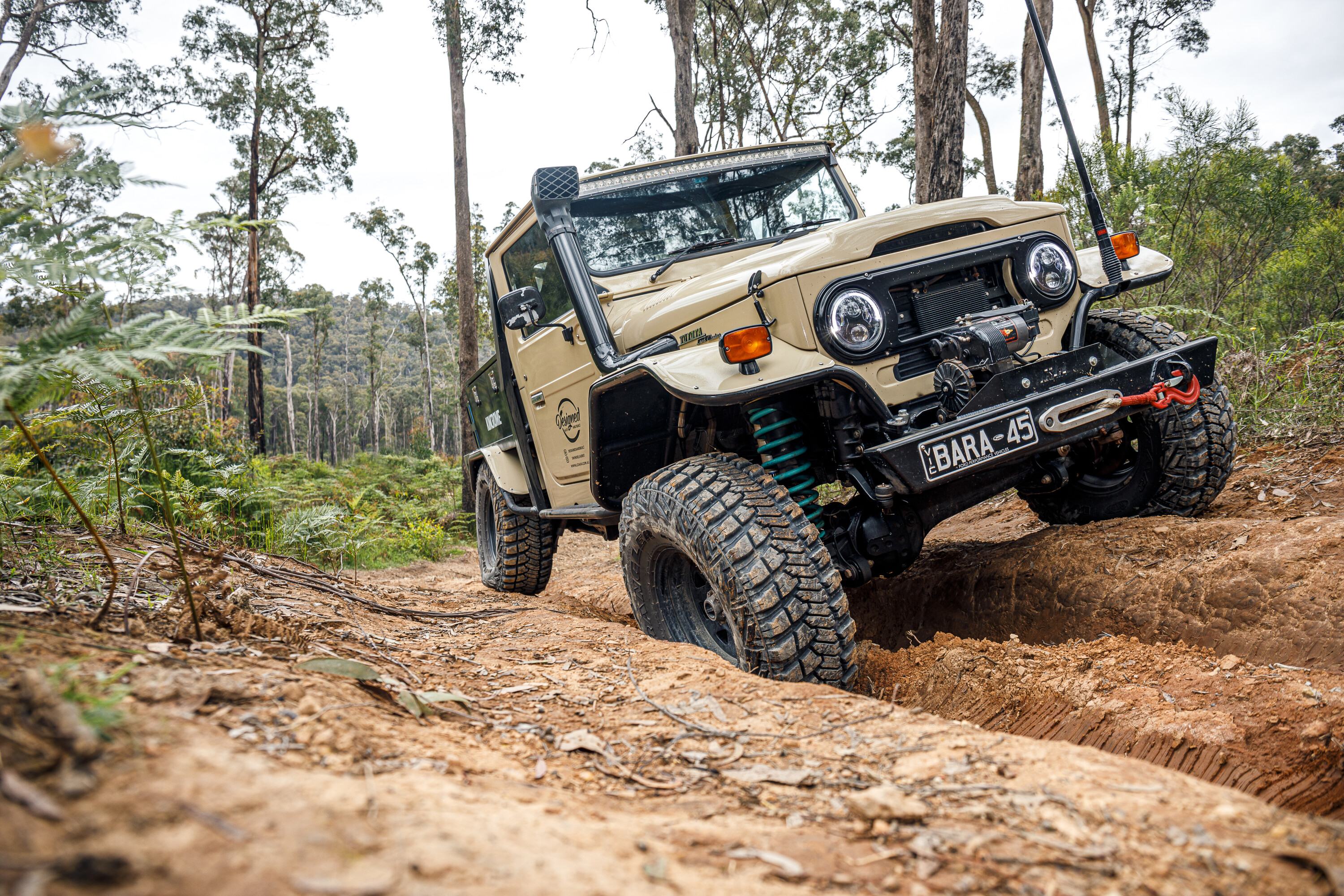
If you’re looking at a turbo setup, you can expect to spend double that, with double the performance. Drive-in-drive-out shops will sting you around $35-40,000 for a tidy FG turbo package with a professional fit and finish. If you’re DIYing a turbo setup you can expect to spend around $15-20,000. The price difference is eaten up with a higher initial purchase price of the drivetrain and more money in supporting modifications such as intercoolers, valve springs and oil pumps.
While you can buy stand-alone ECUs from companies like Haltech, and adaptors to sync Barra CANBUS signals with your factory gauges, engine conversions into later model vehicles like Rangers can become complicated, and as a result incredibly costly.
Running costs
While you might have to pony up some big bucks to get your Barra’d beast on the road, once it’s out terrorising the neighbourhood they’re surprisingly cheap and easy to run. “The maintenance is really quite easy,” says Richard. “Taxis were everywhere in Australia so parts are very easy to get; I just do my regular oil changes and that’s about it”.
With the Barra engine Ford bumped service intervals out to every 15,000km due to a bigger sump than the previous Intech version with a 6.8L capacity. Ford recommends halving that service interval for high performance or high load vehicles (like modified 4x4s) so drop it down to 7500km intervals, which should be twice a year for most owners.
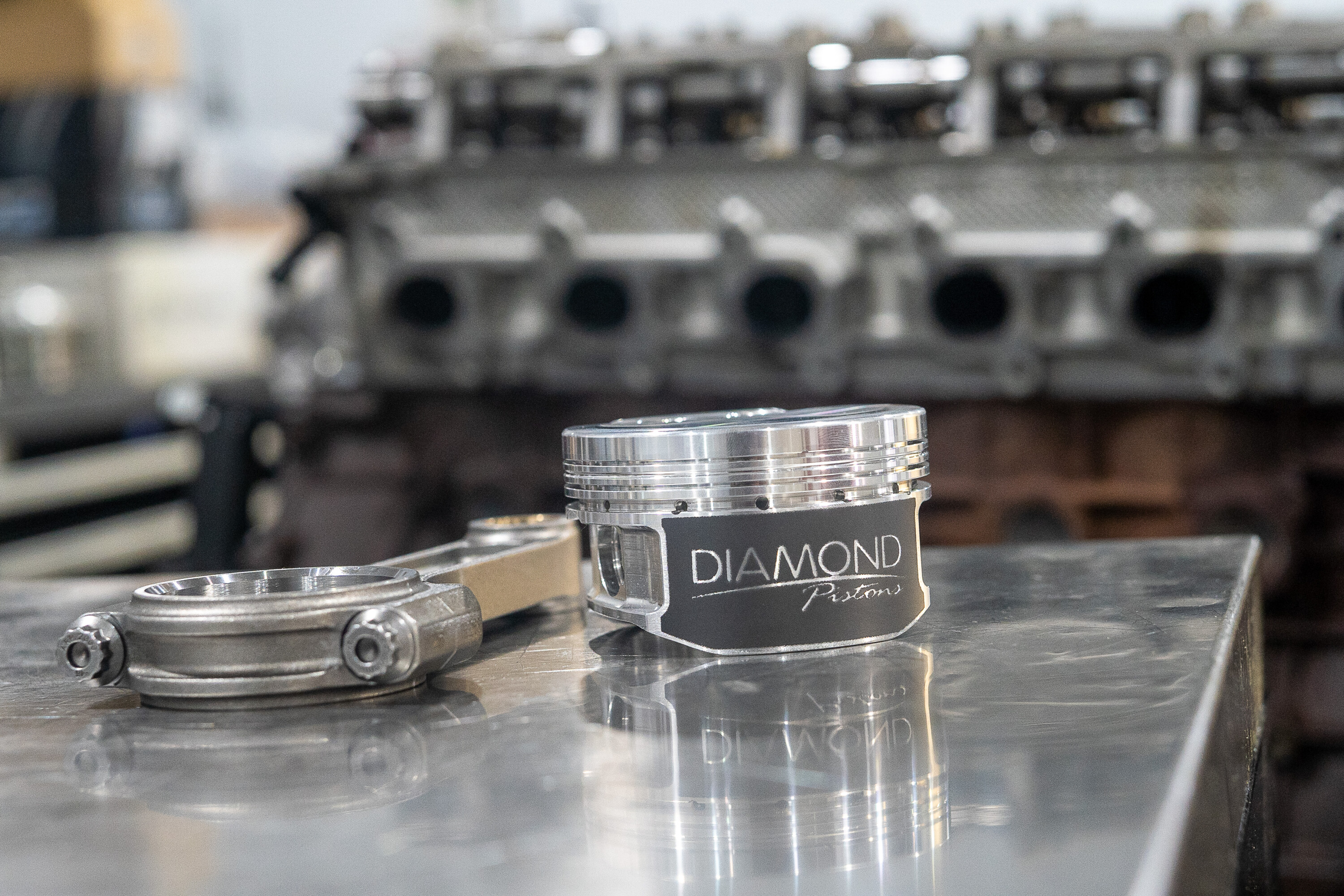
All up, with oil, spark plugs, coolant swaps, oil, fuel, and air filters, you can expect to spend around $400-$500 per year on servicing. Swap in a new oil pump and timing chain while the engine is out and you should have no major surprises or expenses once the engine is in.
On the fuel consumption front you can expect a reasonably modest cost too. Depending on the specification, a Barra Falcon had a claimed fuel consumption of 11.5-12.8L/100km. Of course, they’re a good 1000kg lighter than most 4x4s so you can expect a significant increase over that.
With 300kW and 600Nm in his Barra’d ’Cruiser Richard averages a respectable 17.5L/100km. That puts it slightly under the factory petrol-powered ’Cruisers and Patrols, with far more go under your right foot.
Is it worth the hassle?
Like any conversion, the value prospect ultimately comes down to what you want and what you’re willing to spend to get it.
If you’re after lower running costs, spending $20,000 to get them probably doesn’t make financial sense. But if you’ve got an old rig you want to modernise there’s a lot to be said for a Barra engine conversion. “
If you want to crawl they’re an excellent package,” Richard tells us. “The ZF six-speed is one of the best auto transmissions going. It’s one of the main reasons why I chose the swap. The ZF is out of the Falcon and native to a Barra so required no additional control modules or calibration. Right from the get-go my car was extremely drivable.”
Paired with a modest size turbo and reasonable power outputs the Barra really is a remarkable engine. Silky smooth, reasonable fuel consumption, plenty of low-down grunt compared to diesels and ample room high in the rev range.
If you’re keeping an older rig on the road, or just want to show your Aussie pride by bouncing off the rev limiter, it’s a hell of a path to take.
Build a Barra
Looking for advice or the kit to build your ultimate Barra? Hit up:
- Richard: lcs4x4.com.au
- Mez: barratheworld.com
- Joe: precisionracing.com.au
Have you spent time at Kingoonya? For a remote one-pub town, it punches well above its weight.
The caravan park is quaint and well-run, it’s also where you can fuel up before or after tackling Googs Track. The Kingoonya Hotel is a friendly spot to hang out with the owners, locals and happy-to-chat fellow travellers, the beer is icy cold and the tucker is top-notch. Kingoonya is also a great spot to kick off a Lake Gairdner and Gawler Ranges adventure.
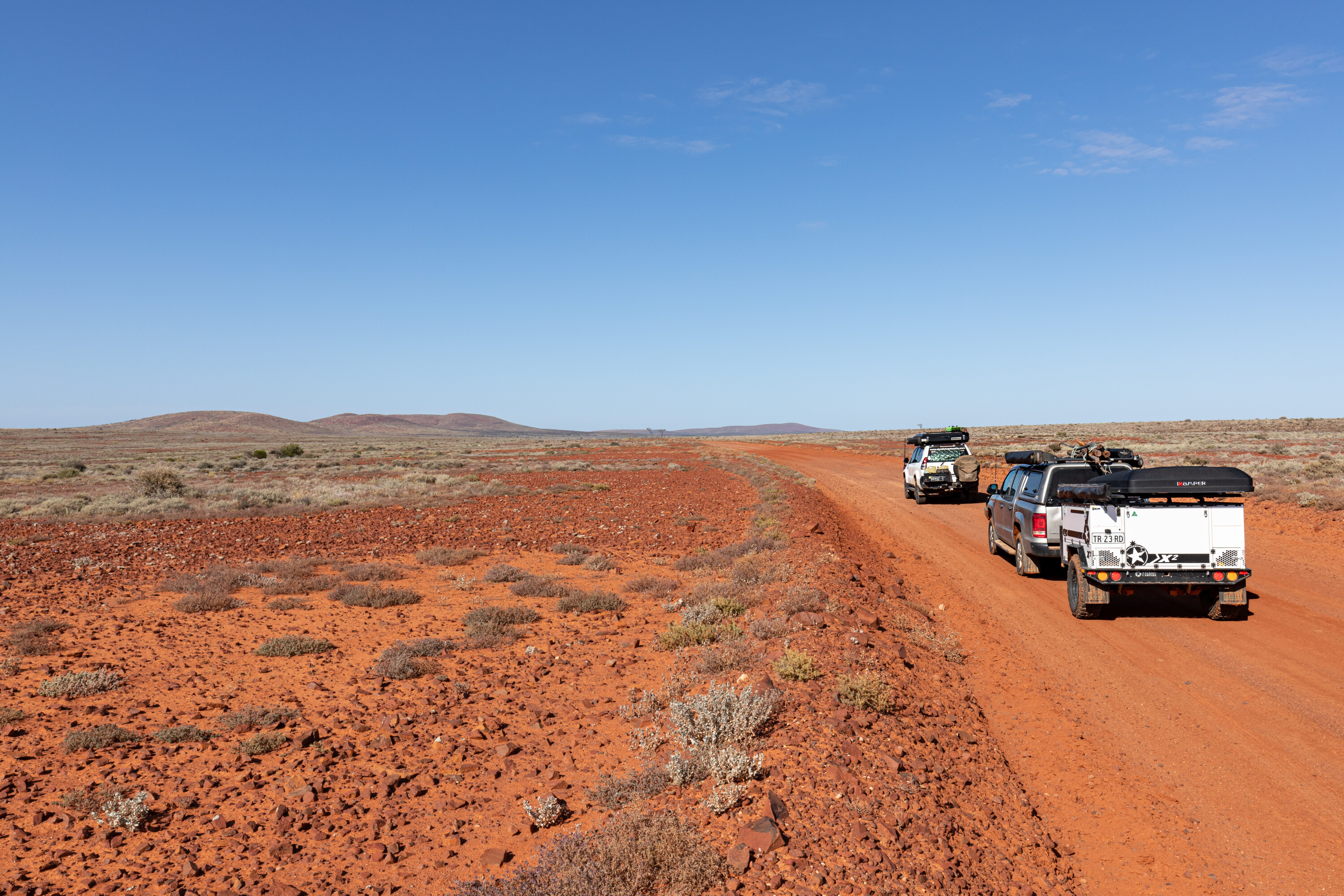
As we headed south along the Gawler Ranges Road, there was still plenty of pooled water but thankfully it could be bypassed so there was no damage to the road, while the open saltbush plains were home to more emus than sheep. The sandy track was in good condition, except on corners and cattle grids, where the corrugations were harsh.
A small western grey kangaroo tried to play chicken, eventually bounding away when we got too close. The sheep that we did see looked healthy, and a small flock crossed the road in front of us making their way to the shade offered by a clump of gidgee. A patch of Sturt Desert Pea caught my eye and so we stopped to take a few photos.
Explore Australia








As the road led us across a low range, we spotted our first goats as they darted away once they’d heard the rattle of our vehicles. The track soon became sandy again with desert oaks, spinifex and gidgee dominating.
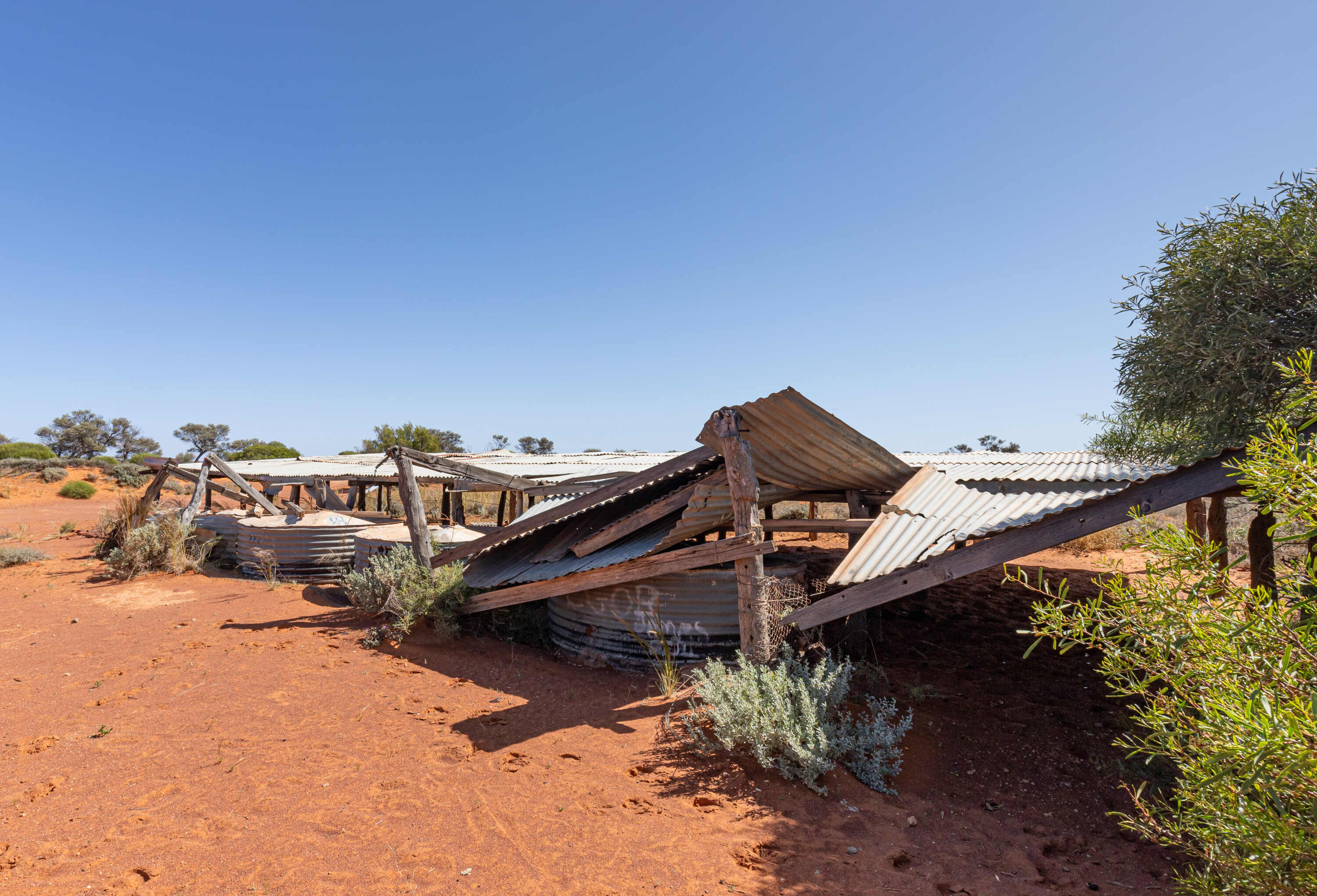
After crossing a few dunes, we reached the turnoff at Skull Camp Tanks Road. After checking out the old wells at the junction and filling the Travel Buddy with some pies and sausage rolls, we made our way along the side road.
Lake Gairdner
Skull Camp Tanks Road is a real beauty with a mostly smooth surface making it as comfortable a drive as a country bitumen road.
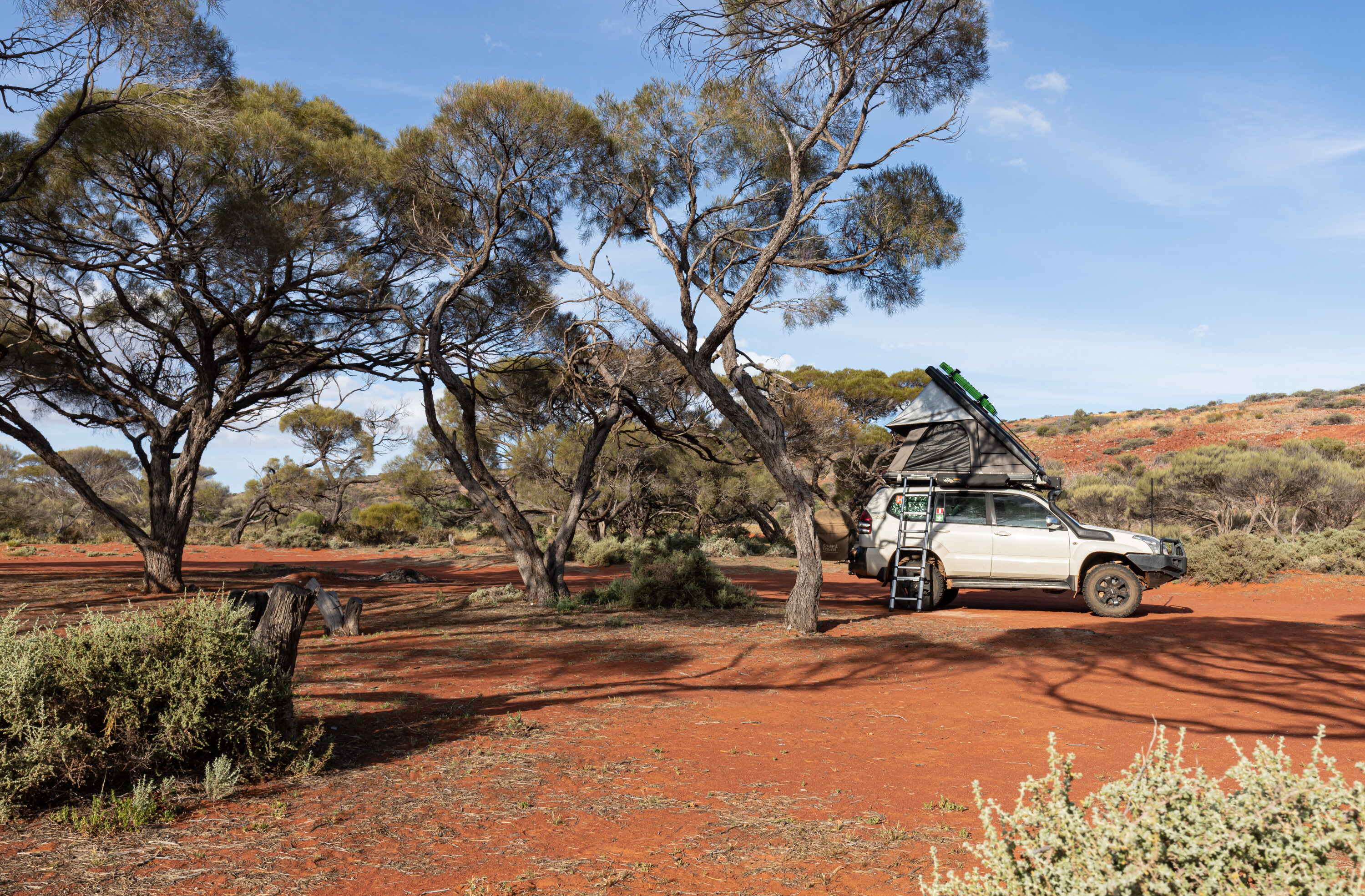
It only took us 90 minutes to reach the Waltumba Tank Campground beside Lake Gairdner, by which time lunch was perfectly cooked.
It was nice to sit back and relax in the shade of the gidgee with the only sounds the birds singing and the flies buzzing. We had a very relaxing afternoon before enjoying some Moroccan lemon and spice chicken thighs (thanks Harry Fisher) and then heading to bed early.
I awoke to a peaceful dawn with the flies still asleep along with Mick, so it was just me and the birdcalls. No crows or spinifex pigeons, just small tweeters that put a smile on my face. I took a drive to the small parking area at the end of the track and followed the walking trail to the top of the nearby hill. It was a bit of a climb but the views from the top over Lake Gairdner were spectacular, and certainly worth getting up early for.
Eating brekky wasn’t entirely enjoyable due to the mass of flies that joined us for bacon, eggs and mushrooms on English muffins, and I don’t think I’ve ever eaten so fast.
Once the camper trailer was packed up, we checked out the old Waltumba Tank and were surprised to find the hand pump still worked, although the water was very rusty to start with. We ended up filling the RoadShower on the roof of the Amarok as the water would come in handy for washing dishes and such.
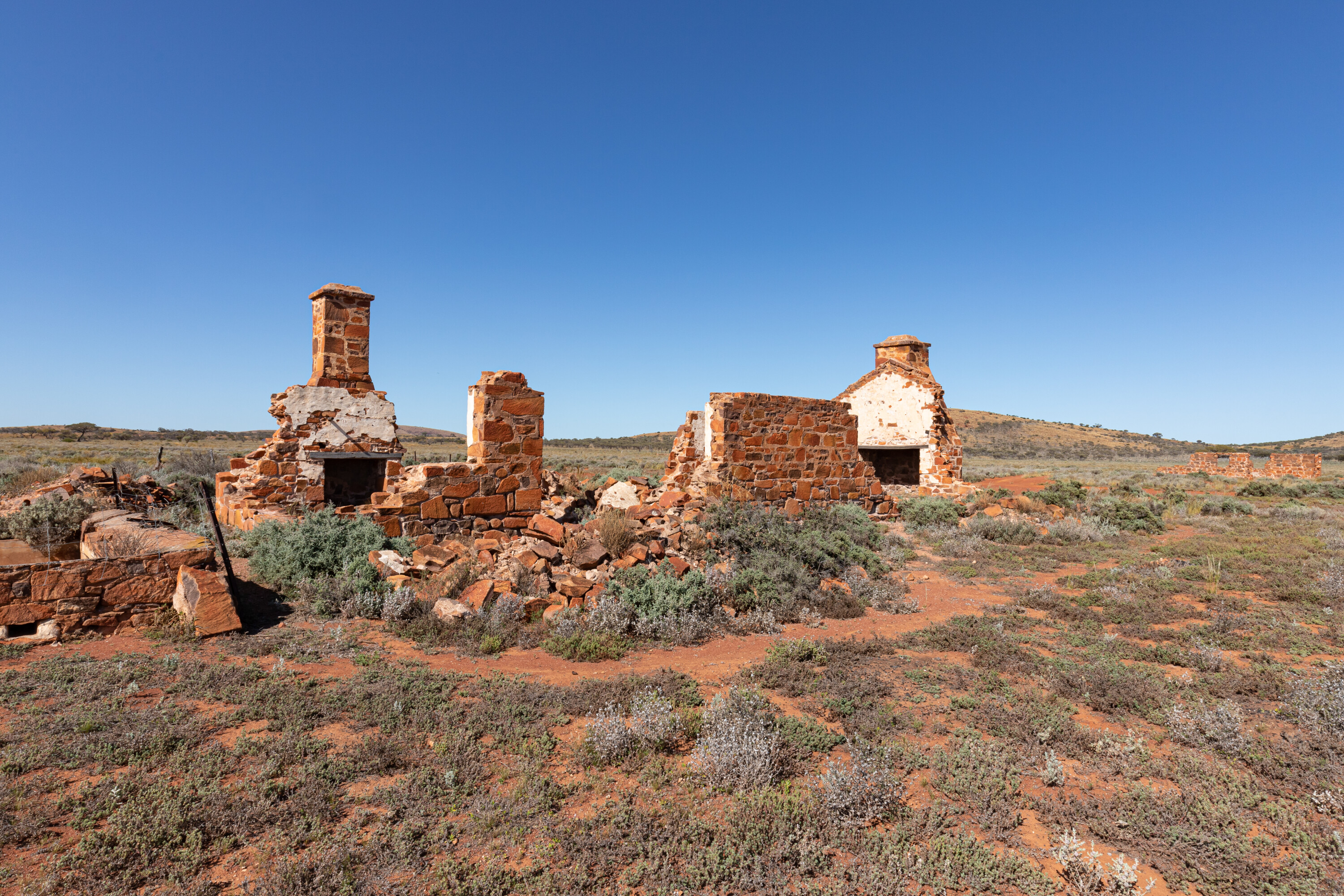
We continued south along Skull Camp Tanks Road before stopping to explore the Pondanna Ruins where a shearing shed, quarters and cookhouse were constructed around 1880. It would have been a harsh livelihood out here back in the day, so remote and so lonely.
Entering the park
Following Hiltaba Road we tracked towards the Gawler Ranges where the flat plains became hillier.
We turned southwest just past the homestead and the track led us into the Gawler Ranges National Park. Reaching the Yandinga Campground track, we decided to find a good site and unhitch the camper before exploring the area more thoroughly.
Back on the road, we made the call to head south to the township of Minnipa so we could fuel up the Amarok and top up our water and supplies. I was disappointed to find that neither of the two water points marked on WikiCamps existed.
Then, not realising it was Sunday, we found that nothing was open, so after cooking up some hamburgers for lunch at a roadside stop,we headed to Pildappa Rock, a place I’d been told about previously.
Geological marvels
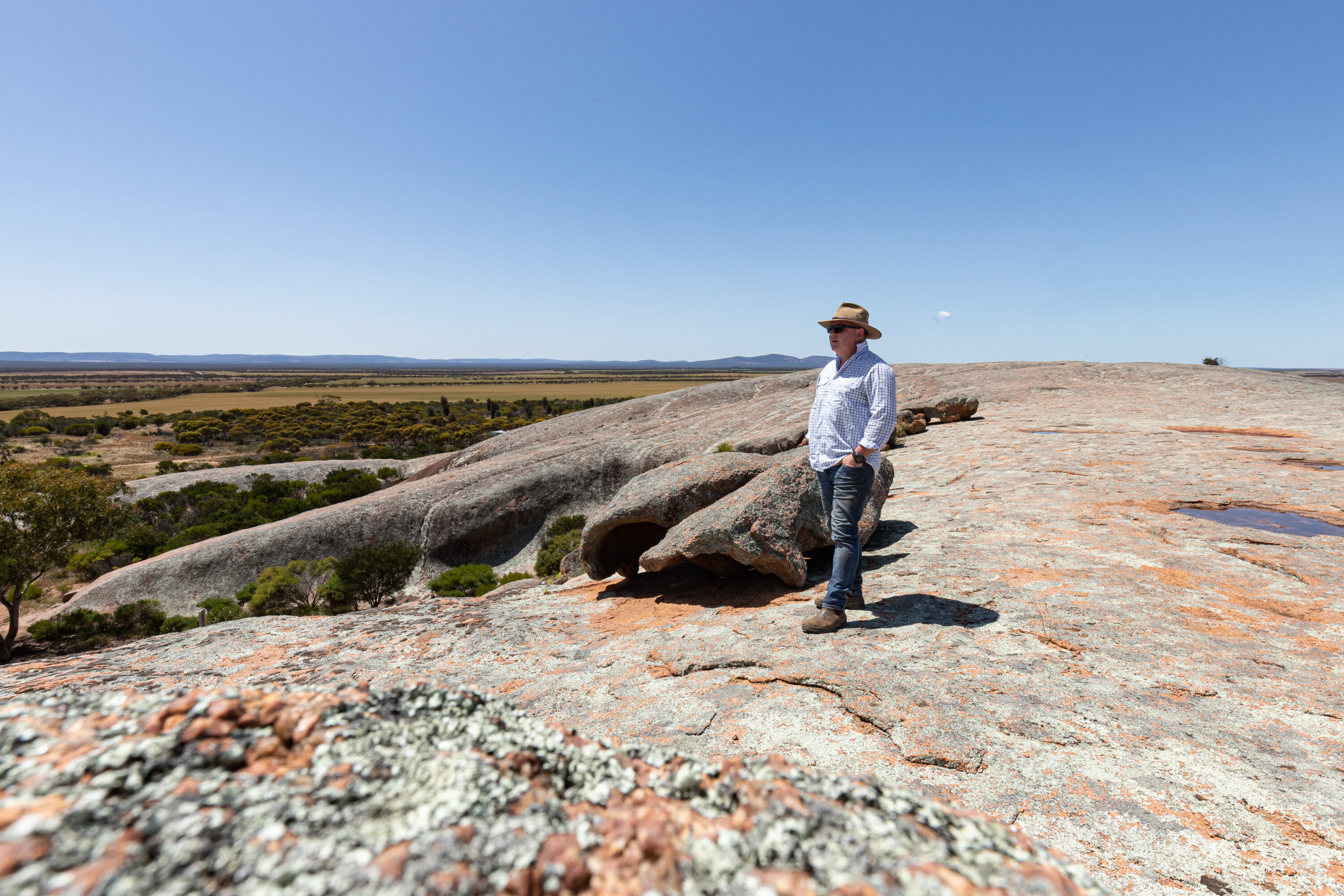
Pildappa Rock is a unique pink inselberg or, in layman’s terms, an expansive exposed granite outcrop with the highest and longest wave formations on the Eyre Peninsula. Only 15km off the highway from Minnipa, it is a popular free camping area, with plenty of spots to choose from around the rock.
Making our way back to the national park, we took a detour to the Organ Pipes, something the Gawler Ranges is famous for. These rhyolite columns were formed more than 1500 million years ago as a result of volcanic eruptions. It’s an easy 1.4km return walk from the carpark, although you can go the extra mile and climb to the top for some spectacular views.
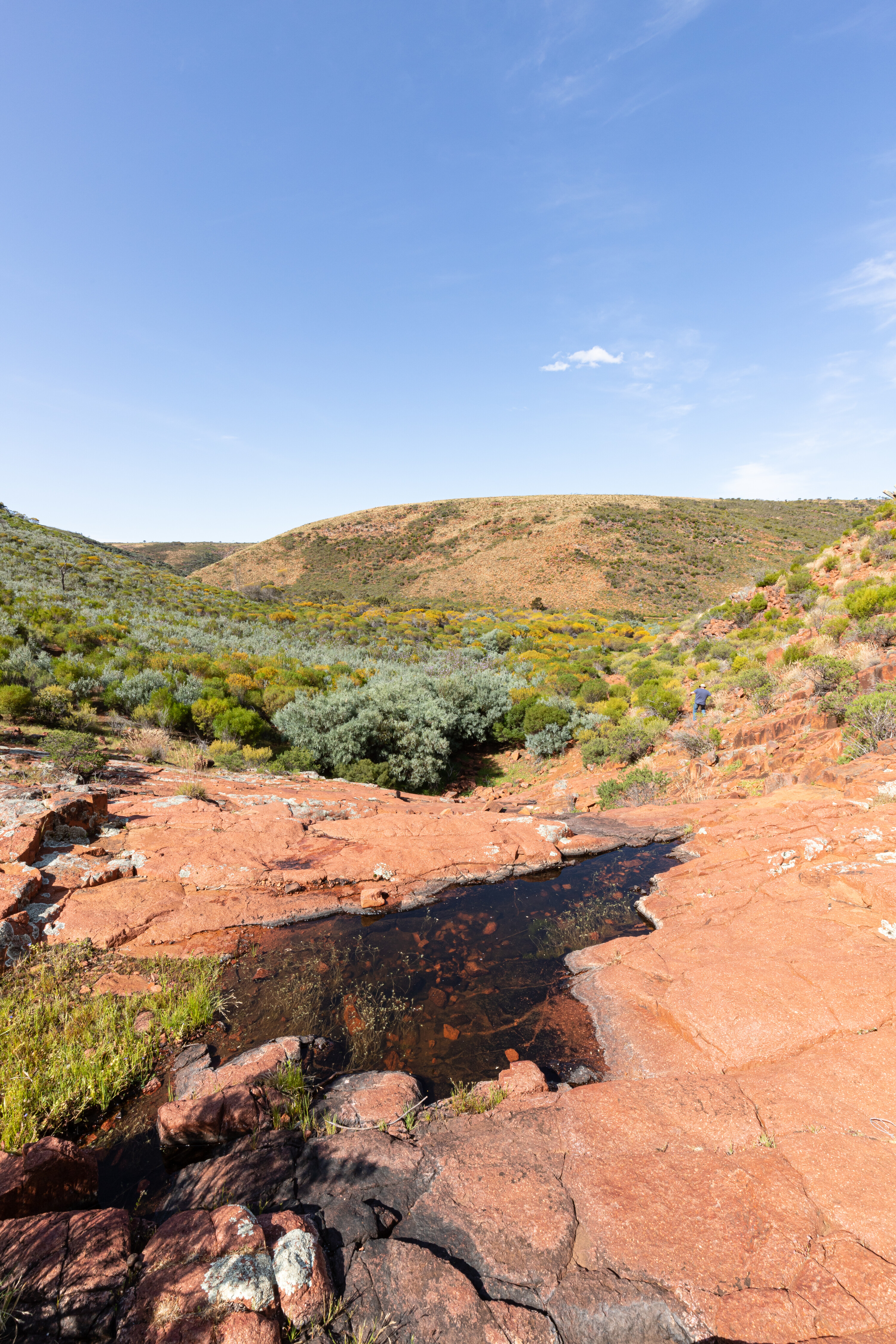
Yandinga Falls has a few walking trail options as you follow the watercourse from the highest point down past some waterfalls. The creek wasn’t flowing when we were there though, so with little to experience, we headed back to camp to set up and relax by the fire. I cooked up another delicious Harry Fisher recipe, this time a pepper and pecorino fettuccine, and we washed it down with a glass of red.
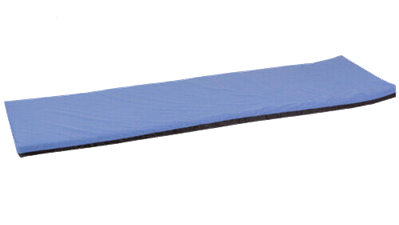
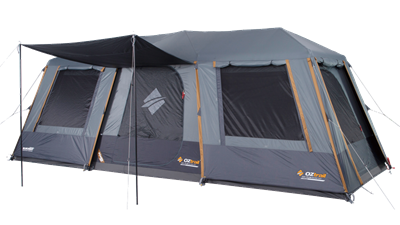
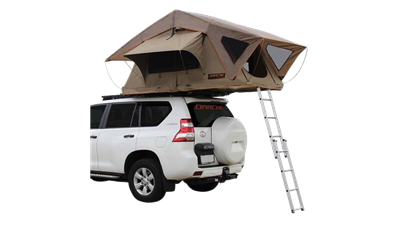
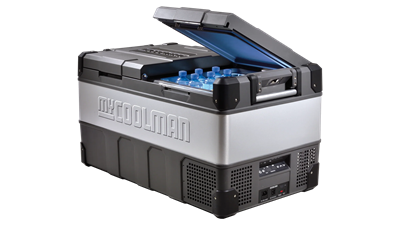
The next morning, we packed up camp and made our way to Peterby Rockhole, an important place for indigenous people who used to hunt kangaroos, euros and other animals that came here for a drink. Not far away is Stone Dam, which is a good early-1900s example of how European settlers trapped water for livestock, but is now little more than a relic of a bygone era.
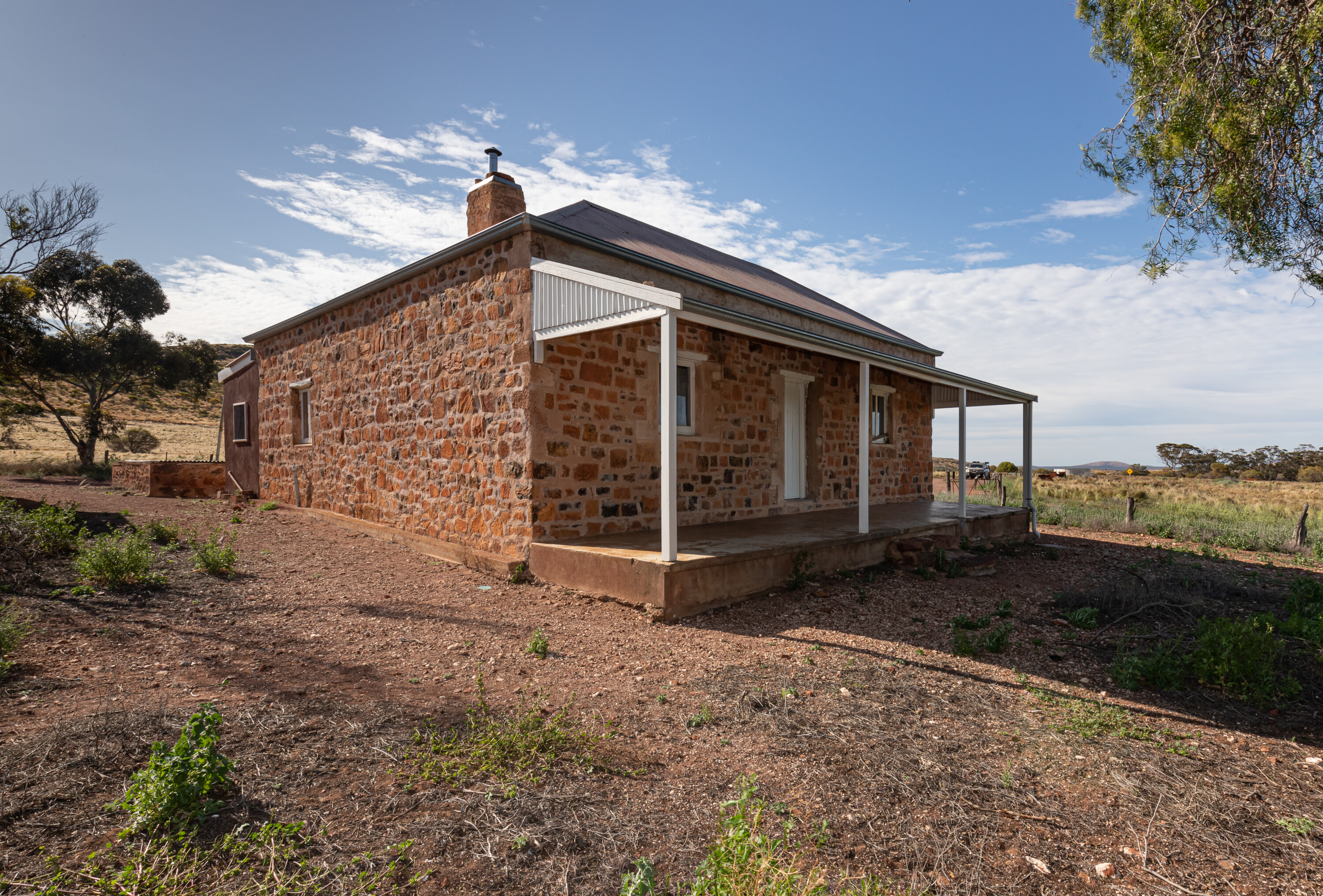
Old Paney Homestead was a blast from the past and we spent a couple of hours exploring this site and poring over the information boards. Thought to have been built in the 1870s by the respected pastoralist William Crawford, Old Paney did very well for some years before drought, low wool prices, rabbits and dingoes made life too difficult to get by here, and by the 1900s Crawford had abandoned Old Paney.
Continuing along the Old Paney Scenic Route, we decided to divert onto Mattera Track to see where it would take us. Mattera Campground is a good place to base yourself if tackling the steep, unmarked route to the top of Mattera Bluff. The reward is the extensive views across the surrounding ranges.
There is an easier walk around the base of the bluff that is popular with twitchers, while the dispersed campsites are reasonably flat with firepits and a clean drop toilet.
Mattera Track terminates at the junction with LP Track, and turning left leads to Pondanna Outstation, which groups can book out as an accommodation option. We turned right and continued across the plains before a nice climb over the range near Kolay Mirica Falls.
The Kolay waterhole was hard to spot due to the plant growth and only a trickle of water was dribbling down Mirica Falls. This would be a cracking one to see when it is really flowing.
Weather warning
The nearby Kolay Hut was our campsite for the night… or so we’d planned. After dropping the Patriot camper off, we continued along LP Track before reaching the Paney woolshed and shearer’s quarters. Despite shearing ceasing here back in 2001, the smell of lanolin within the shearing shed was almost overpowering.
This is another place you could spend an hour or so reading through the many information boards dispersed throughout the shed and yards; they are very descriptive and explain the heritage of life on a sheep station for both whites and indigenous people.
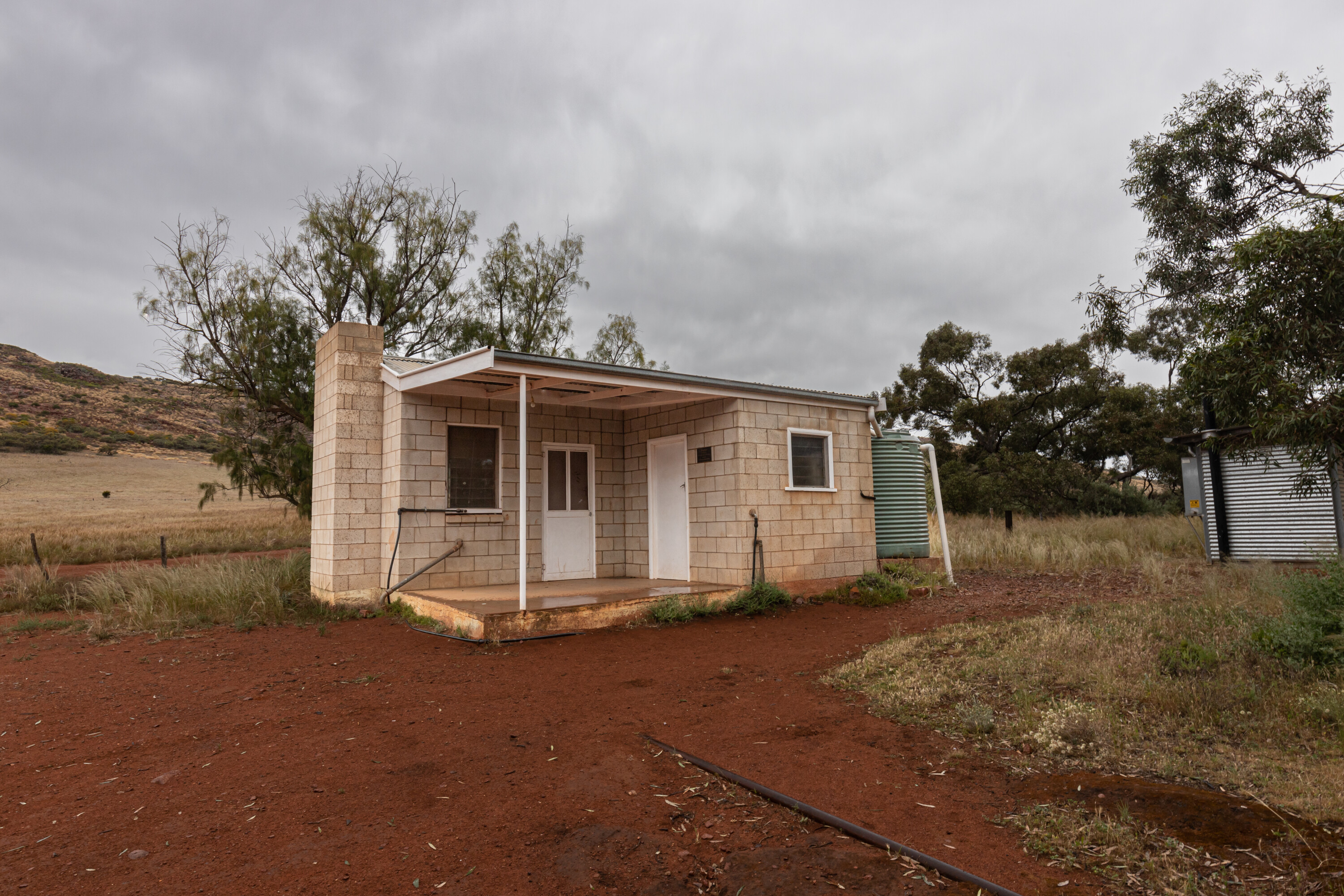
There is 3G phone coverage at the shearing shed so it was a good time to check in with loved ones. Roxy advised me that heavy rain was forecast for the area and after checking the weather app and seeing the aggressive storm front approaching, Mick and I agreed it was time to get the hell out before the roads might be closed.
We zipped back to Kolay Hut via Turkey Flat Track, a route that wends its way through a couple of creek beds before opening up and heading across the plains. It started raining as we approached camp, and we quickly hitched the camper to the Amarok.
The rain was heavier as we passed the shearing shed for the second time that day, and mud was flying as we turned onto Par No. 11, which led us the 26 clicks out of the national park and on to Buckleboo Road.
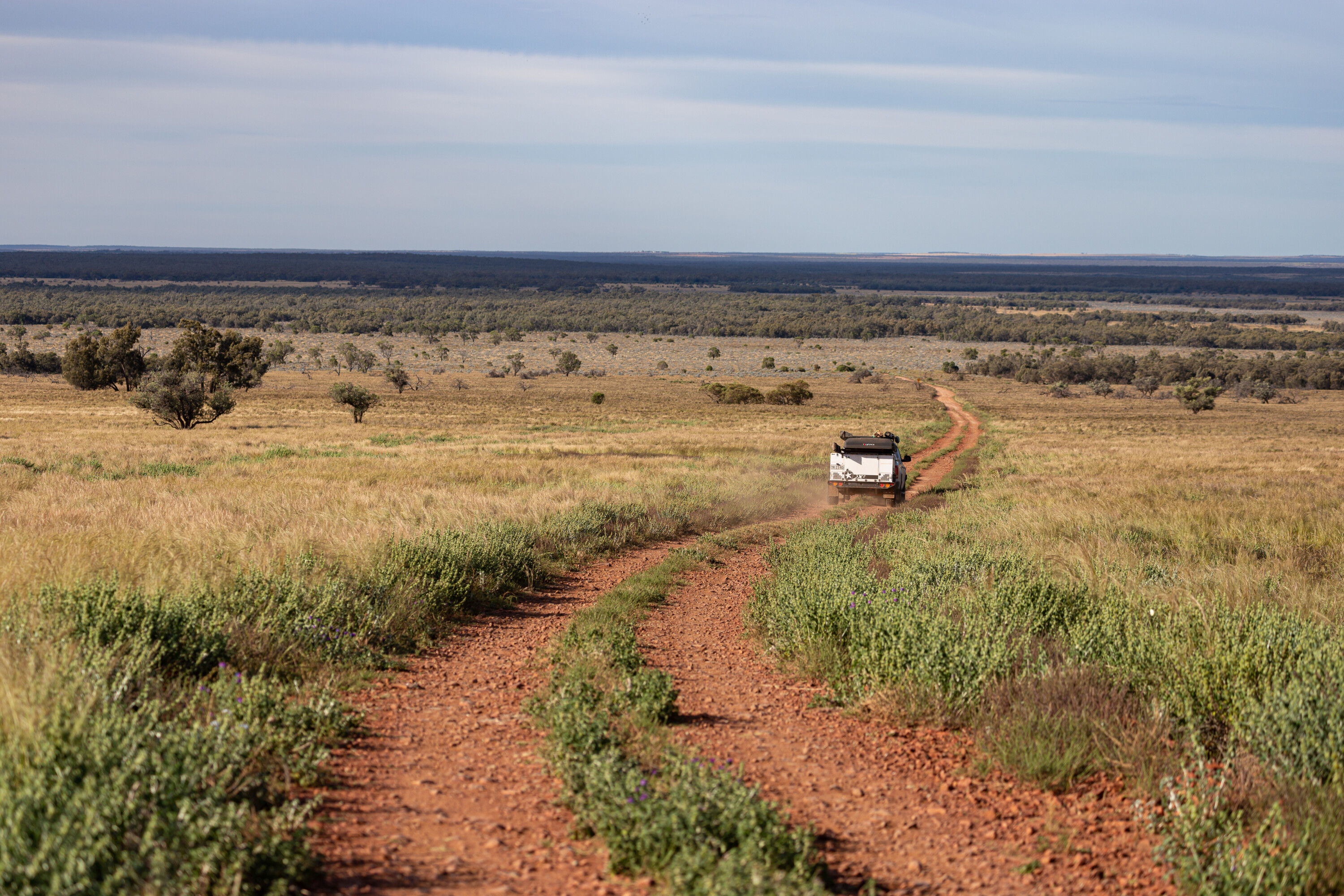
We made our way to Mt Ive Station as the rain continued to fall, as we decided this would be a better place to be stranded if the roads were closed. With accommodation options and a bar, this was a better option than sleeping in a wet rooftop tent, and while we were disappointed we couldn’t spend another night or two bush camping, sometimes it is better to be safe than sorry.
Gawler Ranges National Park is a great place to spend a few days, especially when the creeks are running and the falls are flowing. It was very lush when we were there, a rare sight indeed, and with recent rains this is a good time to go and check it out for yourself – you won’t be disappointed.
Travel planner
Region: Gawler Ranges, South Australia
Nearest town: The park is 40km north of the Eyre Highway and road access is from Iron Knob, Kimba, Wudinna or Minnipa.
When to go: The cooler months from April to September are the best times, but access can be restricted after rain.
Access and camping fees: A vehicle entry pass is required, currently $12.50 per vehicle per day. Camping fees are currently $13.50 per campsite per night. All fees must be paid online before entering the park.
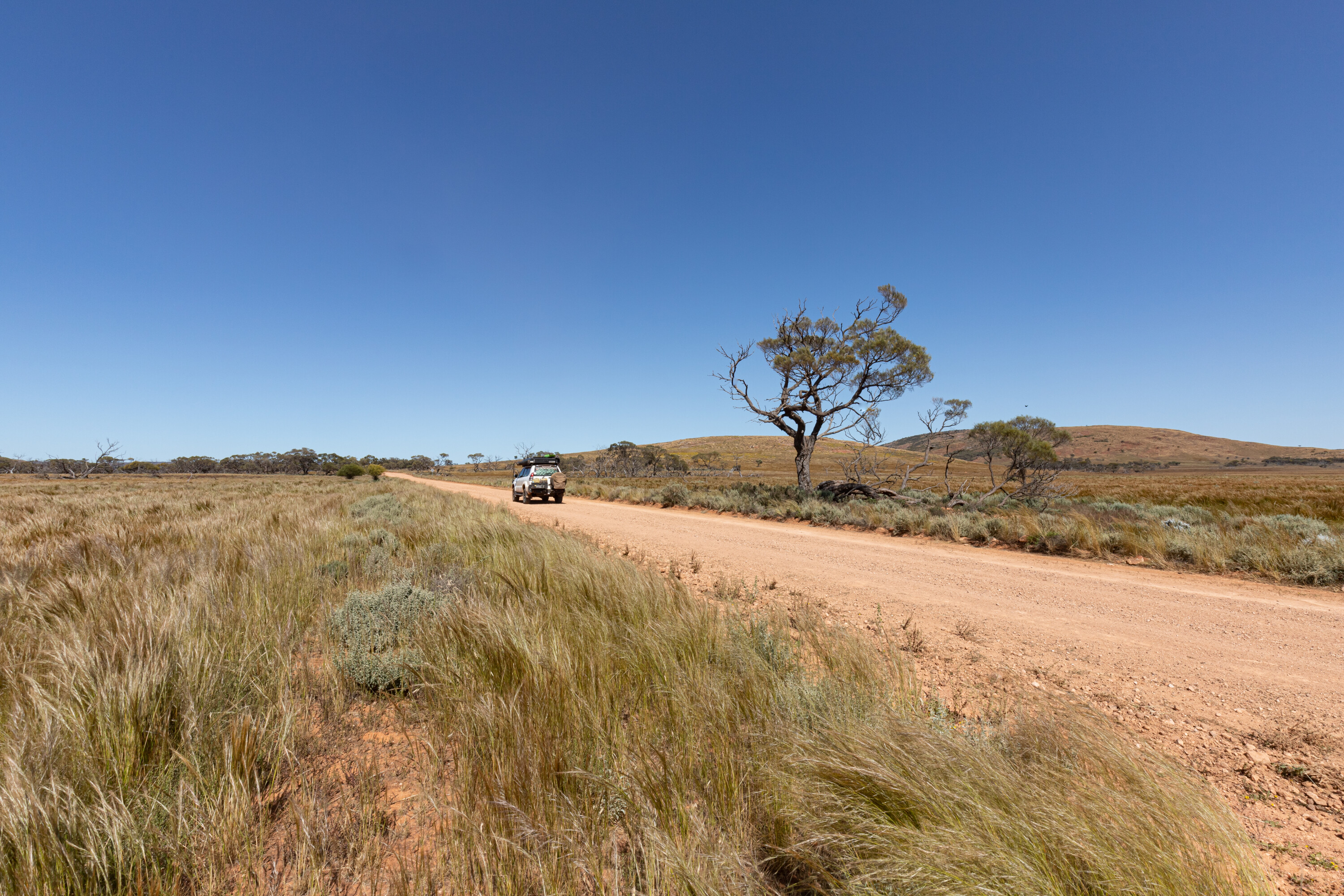
Camping:
- Chillunie Campground: 4WD access only, suitable for tents and camper trailers.
- Kolay Hut Campground: 4WD access only, suitable for tents and camper trailers.
- Mattera Campground: 4WD access only, suitable for tents and camper trailers.
- Scrubby Peak Campground: 4WD or high clearance 2WD, suitable for tents, camper trailers and caravans.
- Waganny Campground: 4WD or high clearance 2WD, suitable for tents, camper trailers and caravans.
- Yandinga Campground: 4WD or high clearance 2WD, suitable for tents, camper trailers and caravans.
Difficulty: A 4WD is recommended to enjoy the best bits of the park while the roads are well maintained.
Contacts: NPWS South Australia: www.parks.sa.gov.au/parks/gawler-ranges-national-park#about; Outback Road Warnings: dit.sa.gov.au/OutbackRoads
Top five spots in the Gawler Ranges
- Old Paney Homestead
- The Organ Pipes
- Paney Woolshed
- Kolay Mirica Falls
- Pildappa Rock (not in the National Park but not far from it)
Up at 4.30am, not to set off on an adventure but instead to get to the desk before the rest of the corporate world pries its eyes open, with a plan to kick our Wednesday afternoon up a notch.
Ten minutes is exactly how long it takes to roll out of bed, throw coffee in the machine and wait for the loud beep that indicates it’s time to pour up and hit the desk.
The predicament is that both my partner and I were struck down by a nasty case of the flu a week earlier, leaving us home-bound and itching to get out. We’d recovered, gone back to work, but we felt cheated.
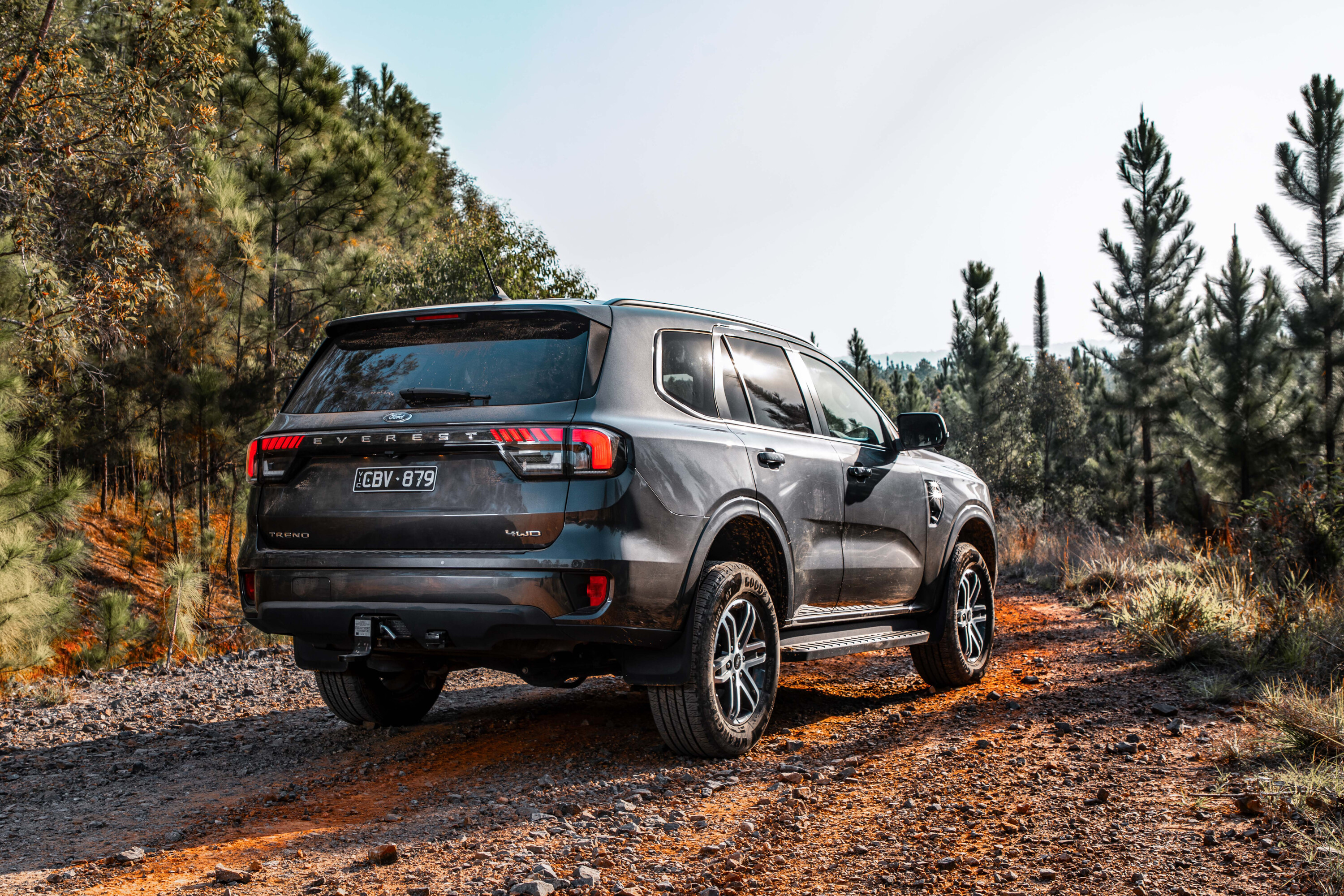
We were overdue an escape to nature, craving the Vitamin D and serenity that comes with a foray into the wilderness, and our preferred method is in a fourby.
I can generally get an impromptu off-road jaunt over the line with my better half if I pack a picnic basket, stop at an artisan bakery along the way, and avoid getting us stuck half way up a track.
I was willing to tick all three boxes, but the conundrum was that we had a packed weekend and didn’t want to wait another week to chase some adventure.
Hence our early start, hoping to slam the laptop closed by midday and burn up to the Glasshouse Mountains for an afternoon of off-road fun…sold as a ‘picnic, atop a not-too-gnarly hill’.
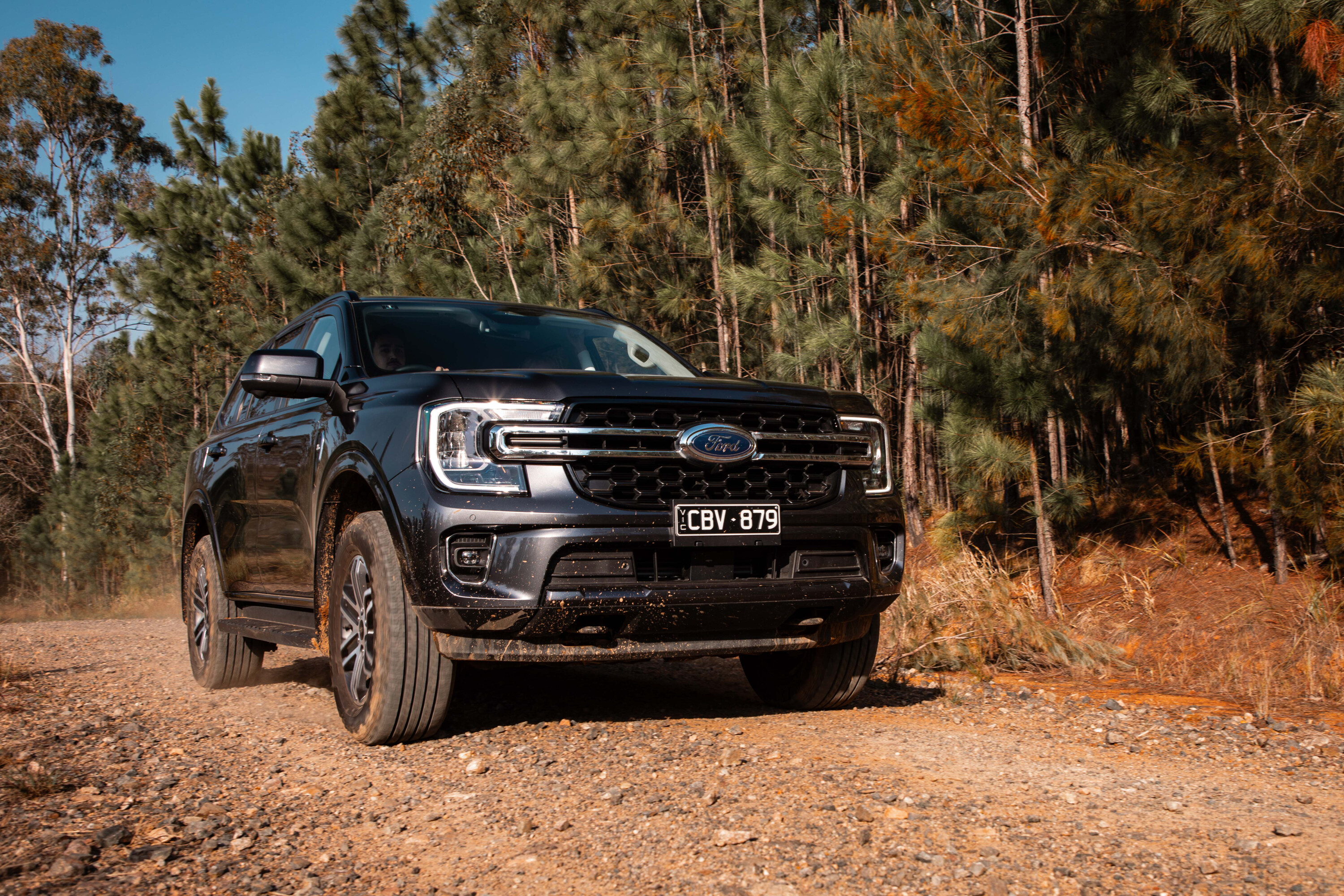
As it’s known by locals, ‘Glassy’ turns on the action for 4×4 and trail bike enthusiasts with tracks that range from mild to wild, and plenty of ‘how does anyone possibly get up there’ climbs.
It also turns on a spectacular autumn sunset, provided you get above the wall of pine trees, illuminating the various peaks of the mountain range in a golden hue.
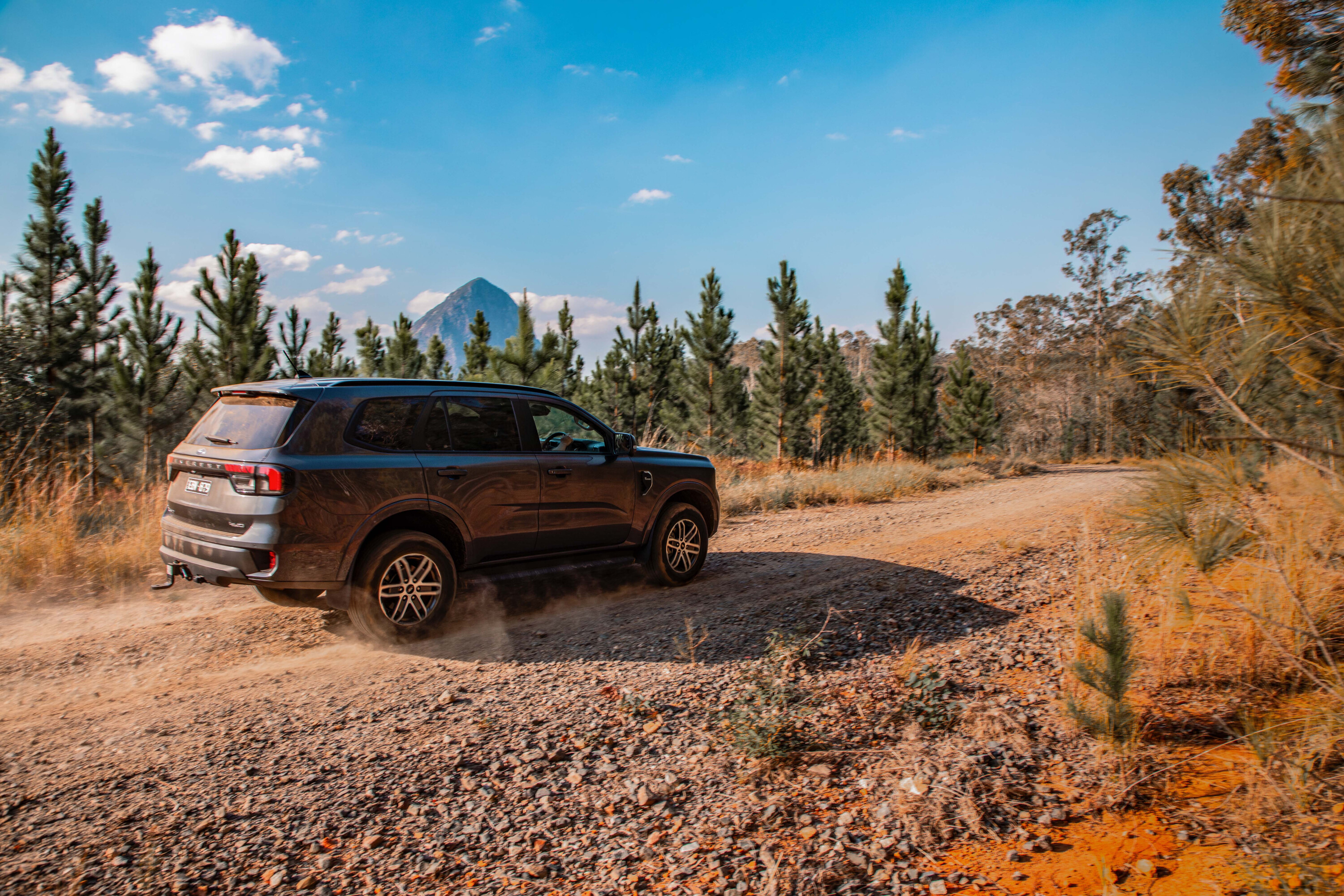
The weapon of choice for our mid-week recharge was a Ford Everest but, rather than opting for a high-spec Sport or Platinum, the mid-range Trend would do just fine.
Its familiar 2.0-litre Bi-Turbo, producing 154kW/500Nm and mated to the ten-speed automatic transmission we’ve come to love, dominates in the dirt and best of all – sips in moderation! Perfect…
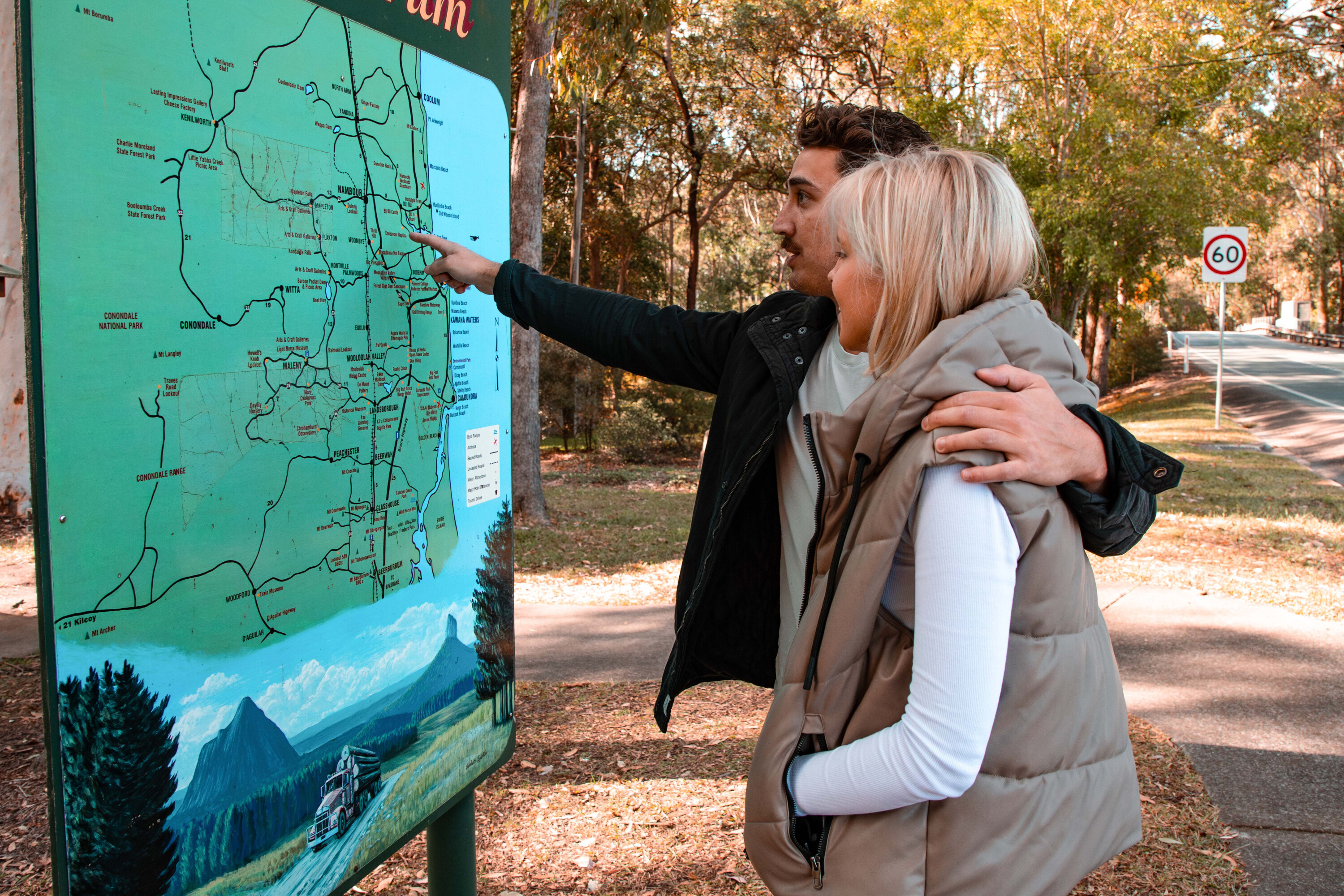
We shot north from inner-city Brisbane around noon, adaptive cruise making light work of the M1, in what was an unusually clean run up to Beerwah.
We’d neglected to pack an iPhone cable but the charging pad and wireless CarPlay in the Everest meant that didn’t matter, with tunes and maps good-to-go the moment we got in.
About an hour into the drive, just outside of Beerwah where we’d planned to stop for a bakery lunch, a car cut across two lanes of traffic – including ours – to get to the off-ramp.
The adaptive cruise meant we were a safe distance from the car in front, giving us ample time to dab the brakes and let the careless traveller through. Mind you, the Everest is also packed with the latest safety tech, which gives you the ultimate peace of mind on highway runs like this.
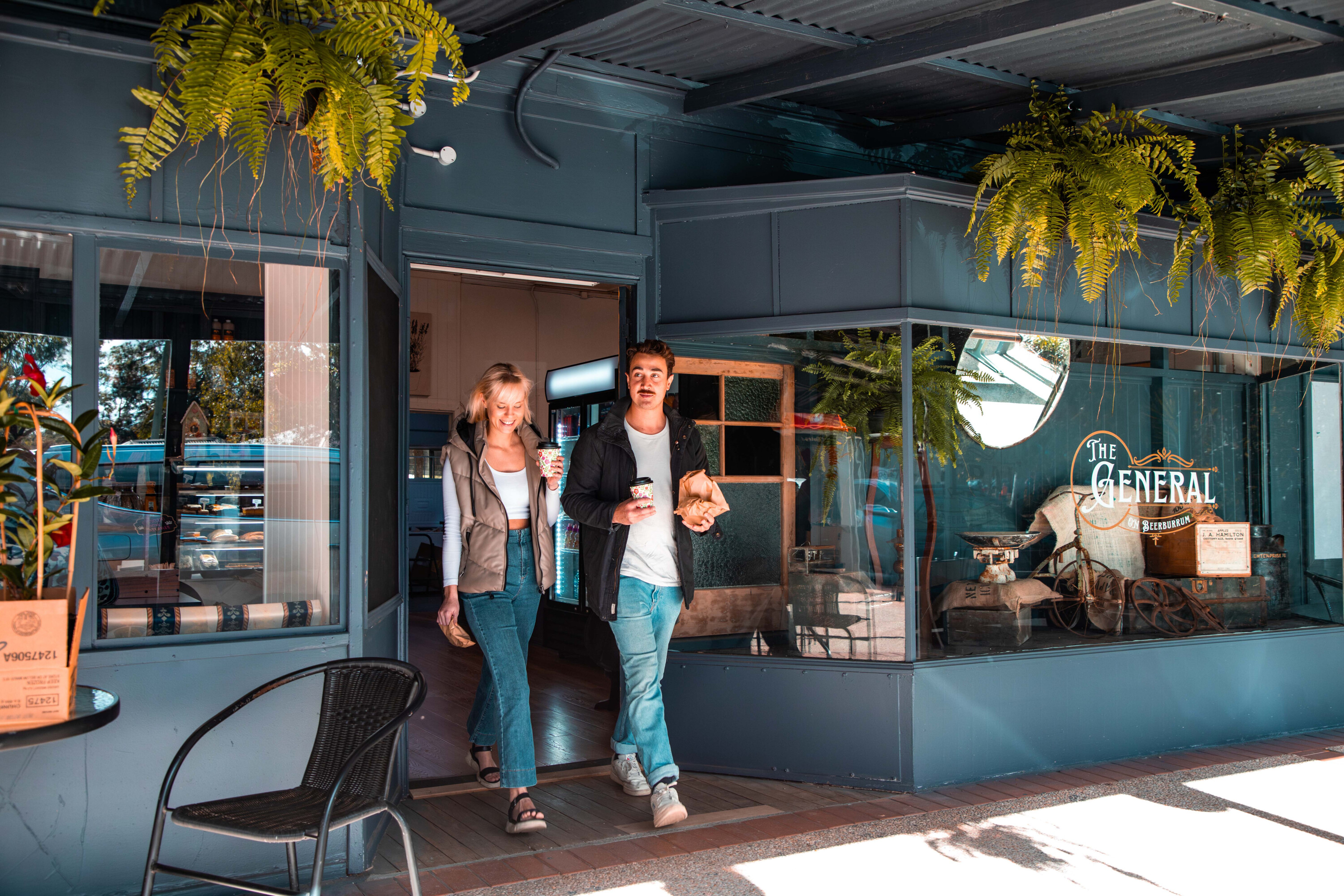
We made it to the bakery for a late lunch, before loading the esky up with baked goods and tucking into a couple of small-town meat pies.
From Beerwah, we took Beerburrum Road up into the expansive Glasshouse Mountain region – littered with tracks, creeks and climbs throughout the thick forestry.
It always shocks people to learn that this off-roader’s playground, with something for every skill level and vehicle type, is just an hour-or-so out of Brisbane.
Not far out of Beerwah, I spotted the track I wanted to take and we stopped to air down the tyres. Of course, I’d forgotten my tyre gauge so a stick would have to do this time. I had an inflator in the boot, so we’d be right.
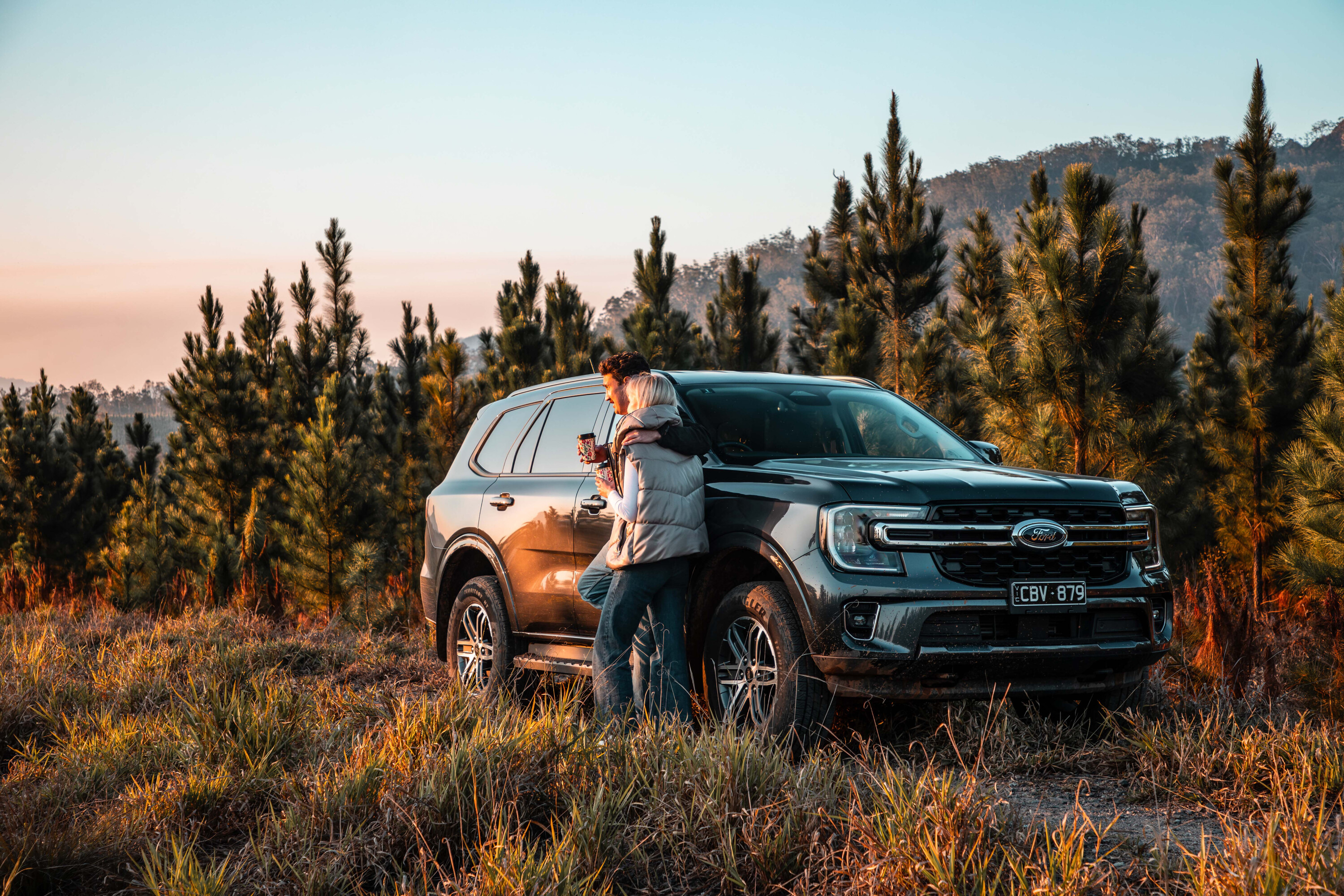
Next, I spun the centre dial to 4H but I didn’t fiddle with drive modes, of which there are plenty to choose from with options like ‘sand’ or ‘mud/ruts’. You could honestly leave the Everest in 4A (auto) for all but the most rugged tracks, and call it a day, as the Everest’s techno-smarts constantly shuffles torque between wheels for maximum grip on- and off-road.
As we took the dirt road up into the forest, I was instantly reminded of how quickly Glasshouse traps you in its maze-like network of trails. I thought I saw the one I wanted but, wait, was it the right one?
“I could drive up and down here all afternoon, with a view like that,” my partner assured me, after I’d clearly taken two wrong turns in a row giving us serious deja vu.
She was right though, the view of the mountains in the distance was like a scene from a movie.
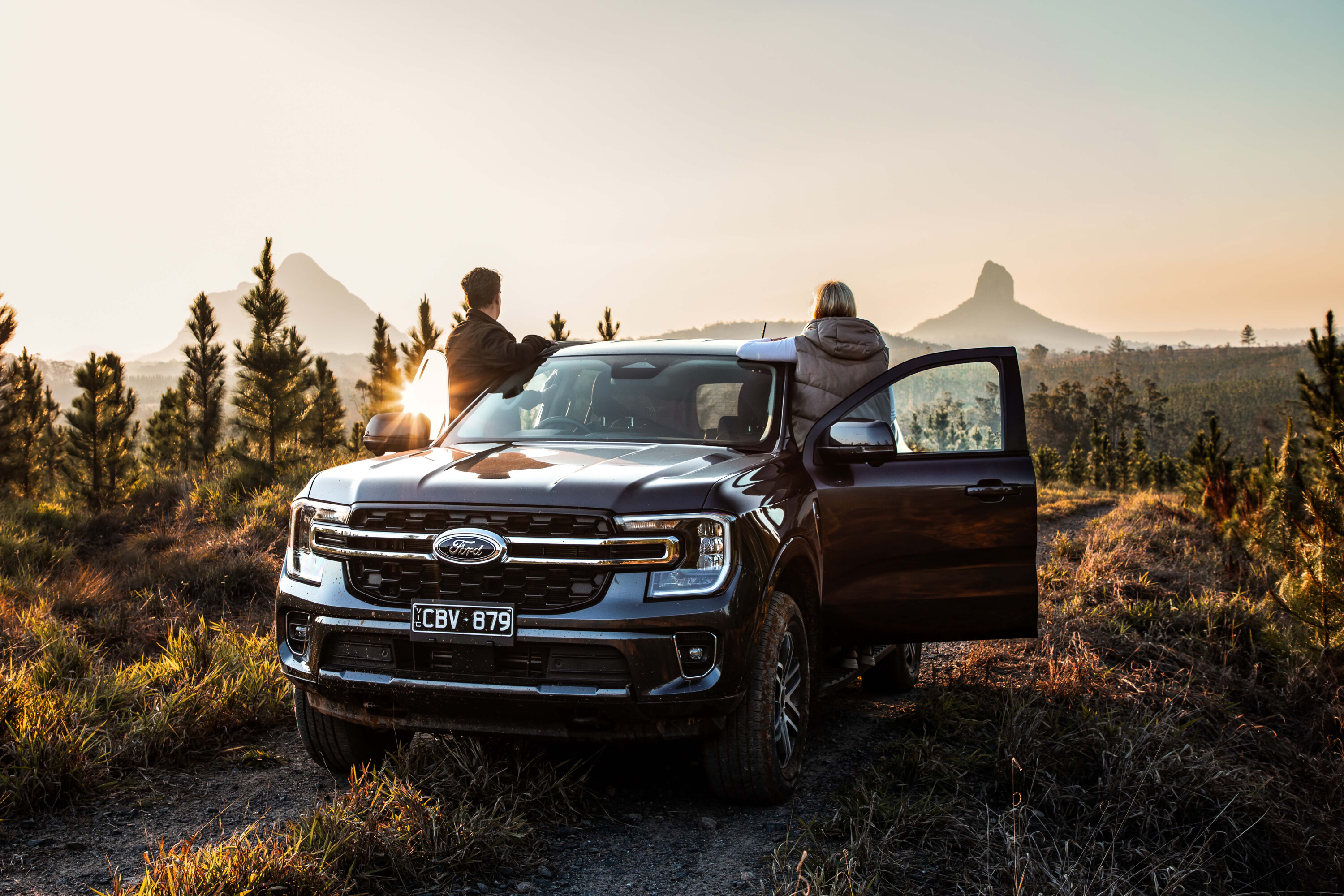
This was a reminder of why we do it, the chaos of the city washing away as we headed out onto the loose dirt roads, trying not to get lost but not really caring if we do.
The inevitable wrong turns at glasshouse, and “all roads lead to Rome” mentality one must adopt, are all part of the fun out here.
One thing I have learnt the hard way, after being flung over the handlebars a couple of times when trail riding, is that a seemingly shallow puddle can be a waist-deep bog hole at Glassy. The safe option? Take the boring route around, or test the depth with a stick.
In this Everest, we opted to avoid puddles and bog holes altogether. Well, we set out to keep the tyres dry – but more on that later.
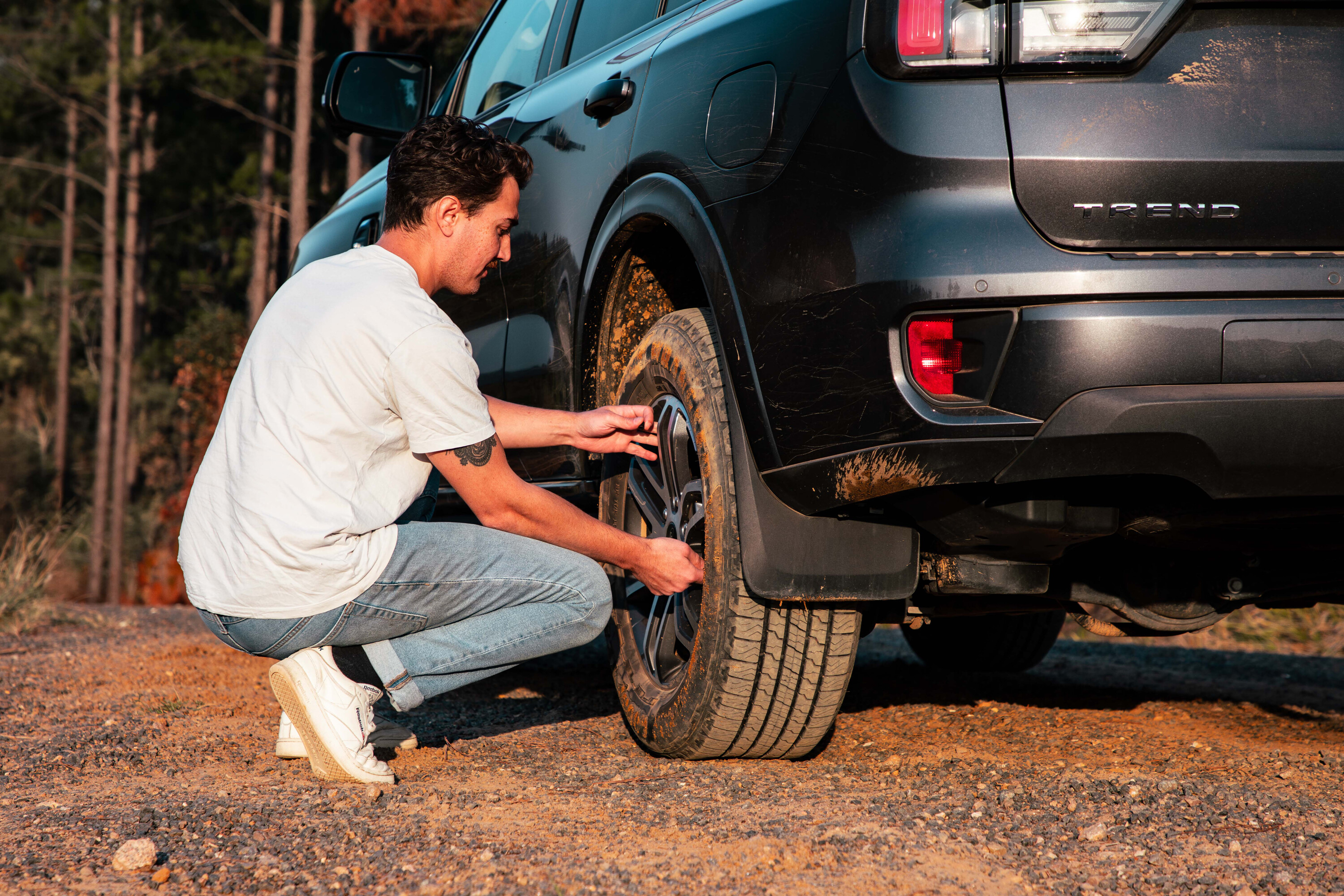
This Everest Trend is optioned with 18-inch wheels and the the more rugged all-terrain tyres, helped along by 226mm of ground clearance and an 800mm wading depth, making it suitable for just about anything we could throw at it.
For smooth-riding tracks, leaving the Everest to its devices gets the job done. Along some of the trickier tracks though, where traction was tested even after airing down, we played around with drive modes to let the car flex its techno-smarts.
I prefer to use the well-trodden fire trails at Glasshouse, shooting down a few of the many branch-off tracks as they catch my attention. You can usually pick a climb that’s suitable, but there’s always the risk of getting half way up to find it’s beyond the limits of your vehicle.
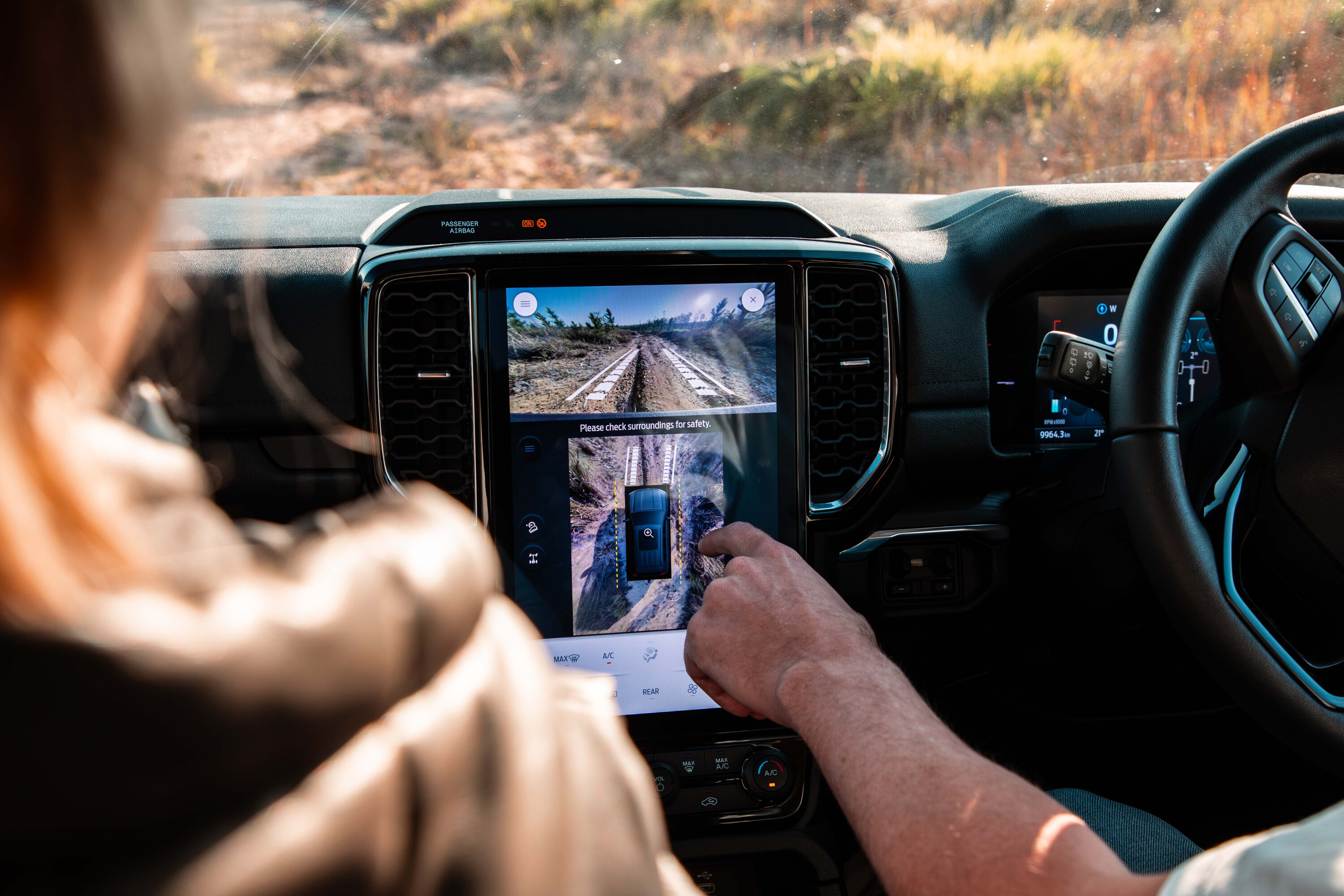
With 360-degree views around the Everest, courtesy of a series of cameras, you rarely need to leave the comfort of your seat.
That was never the case in the Everest, not because it’s lifted sky high or wearing 35-inch rubber – but because it has the tech to keep you within the safe limits. While purists might prefer the “suck it and see” method of off-roading, we think the tech takes the intimidating guesswork out and I wouldn’t want to live without it.
With 360-degree views around the Everest, courtesy of a series of cameras, you rarely need to leave the comfort of your seat. If you do end up having to turn around on a trail – because we all know reversing out isn’t fun – the 360-degree camera view is a lifesaver.
A dedicated off-road view that shows your line, steering angle and any obstacles in front of you means no more walking the trail or relying on a spotter. It’s also nice to be able to see the pitch and roll angles of your vehicle, more a novelty on mild tracks but important if pushing the limits.
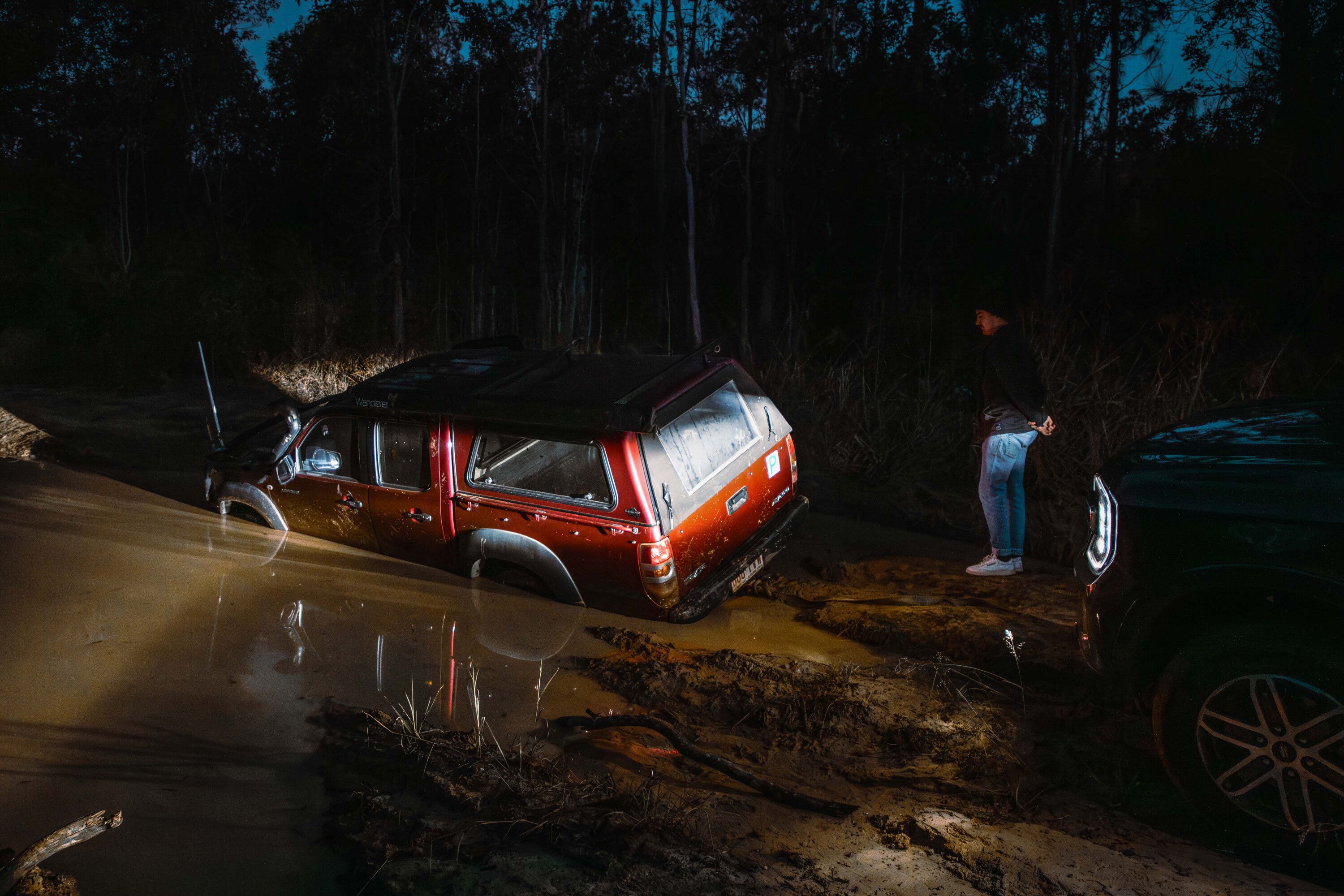
I mentioned we didn’t intend to get water near the tyres, nor did we expect to need low range, but towards the end of the day as we were stuffing our faces and watching the sunset, we heard yelling in the distance.
I stood up to see a young man covered in mud, almost camouflaged, flustered and in need of help. He’d got himself stuck in what he called a “small bog hole” and he needed a “quick tug” to get out.
He’s lucky we were parked up where we were – with the sun quickly setting and nobody else likely to travel these tracks ‘til morning. This was the perfect opportunity to use 4L and see what the Everest could do!
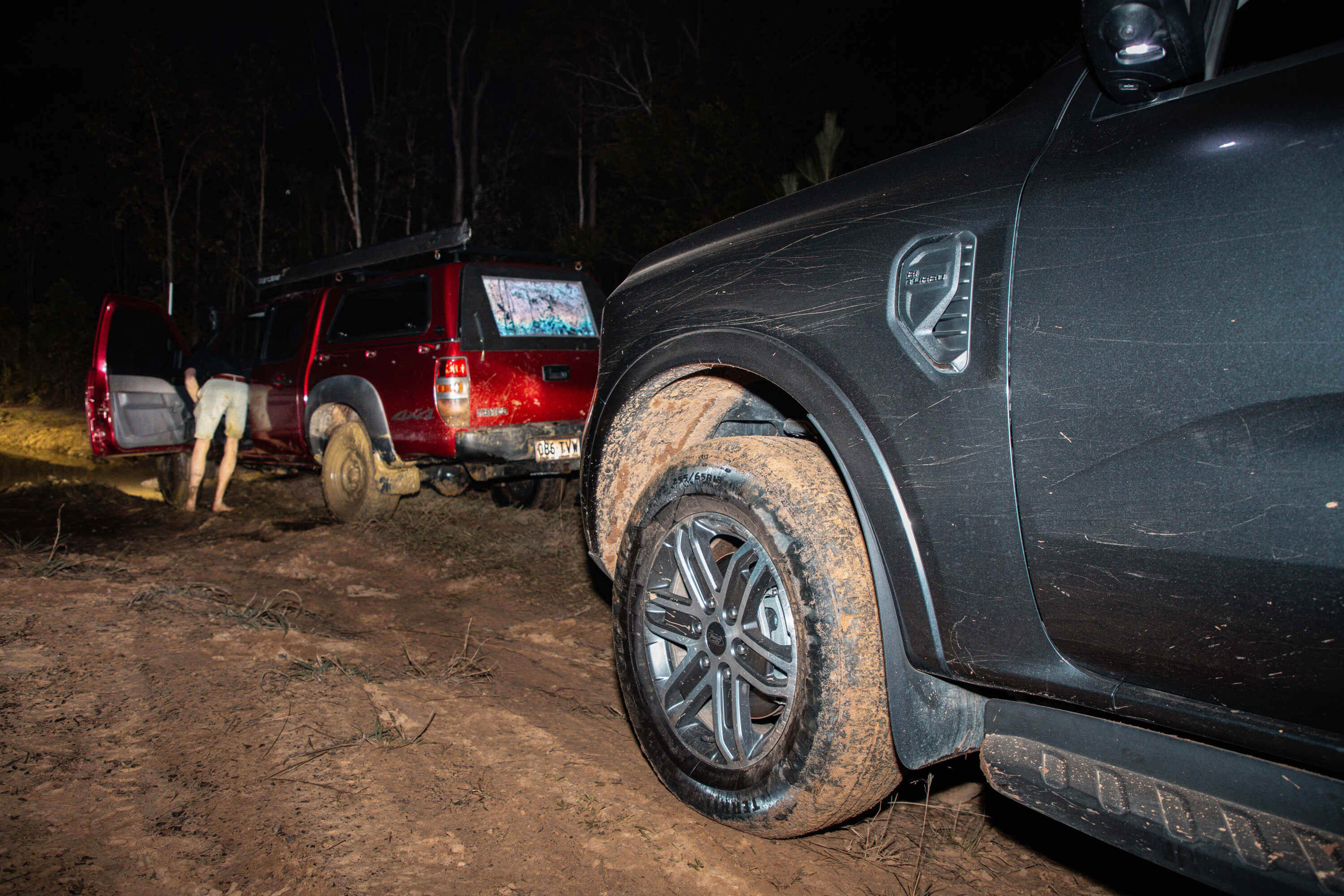
We secured the snatch strap, using one of the two front recovery points on the Everest, and flicked the dial to low-range as well as locking the rear diff using the touch screen.
I made it clear that I’d reverse until he beeped to let me know he was clear. I didn’t want the rear-end of his ute kissing the bumper of this new Everest!
“Alright, let’s do it,” I yelled from the Everest, giving him a quick honk. “Up it!”
We took up the slack on the snatch strap before a quick jolt of throttle saw the old fourby resurface and exit the bog hole. It was almost too easy.
The young fella smiled and gave us a thumbs up, water gushing from every orifice of his poor ute as he opened the doors. Better him than us, we thought, and it was a reminder of why I never trust “puddles” at Glassy.
The only way out was the way we came in on this track, being too narrow to spin around and with plenty of spots to come unstuck. This didn’t feel like the good karma we were expecting.
Navigating a trail in reverse, in the dark, is never a relaxing experience but it was easier than it should have been with the cameras, lights and onboard smarts of the Everest helping us.
And on that, the zone lighting feature allows you to illuminate front, rear and side sections of the Everest independently, which is extremely handy for campsite setup, off-road mishaps like this one, or even a dropped grocery bag in a dark driveway (don’t ask).
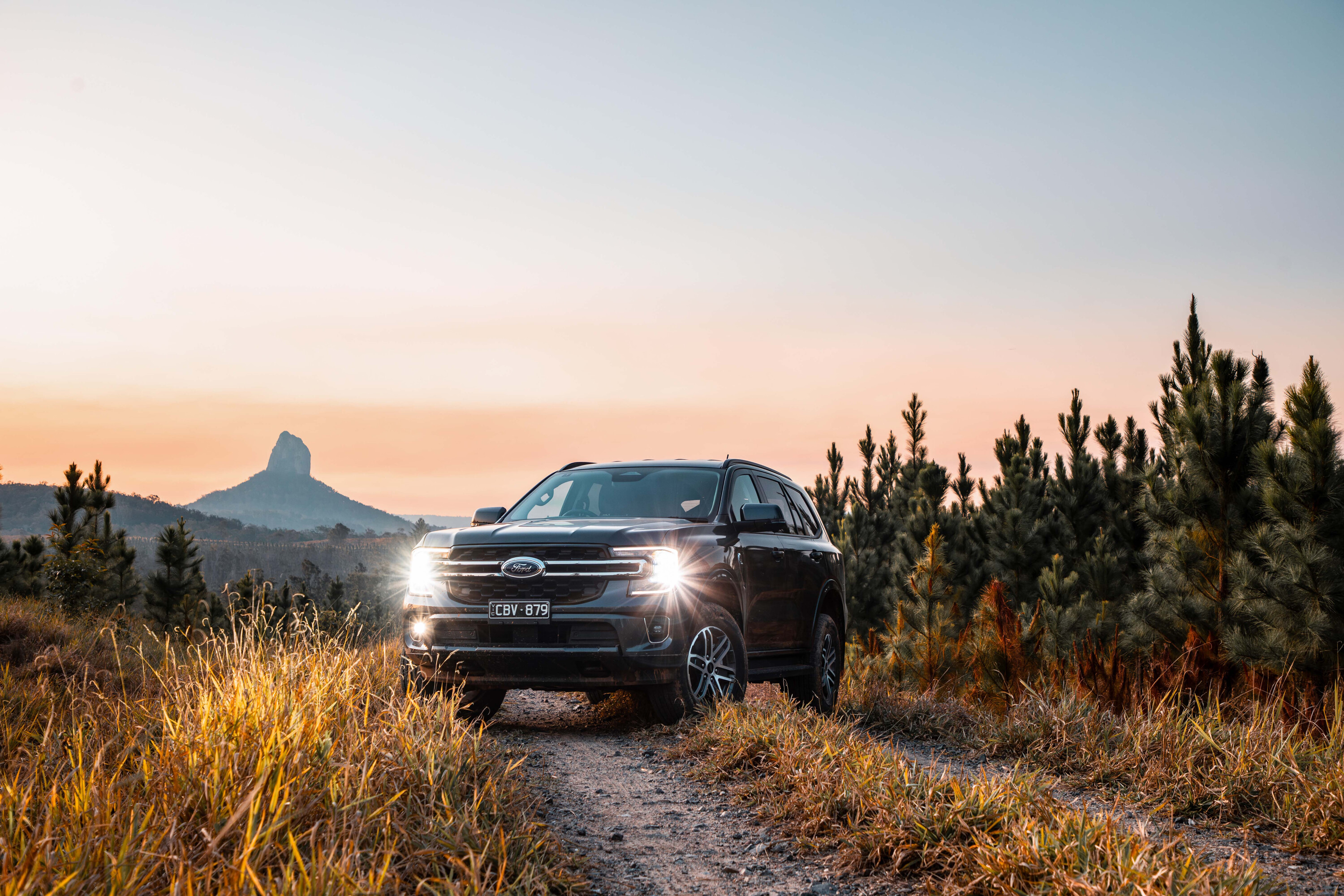
Helping old mate out of the “small bog hole” was worth it.
Well, we left after dark, muddier than expected and due to miss the start of the State of Origin – but we didn’t care one bit. Helping old mate out of the “small bog hole” was worth it.
We’d had our little mid-week taste of freedom, even if our picnic was cut short, and we could carry that zen into the rest of the week. Was it worth the 4am wakeup? You bloody bet.
For information on the Ford Everest range and features please visit here [↗].
The August 2023 issue of 4X4 Australia will be available from July 20.
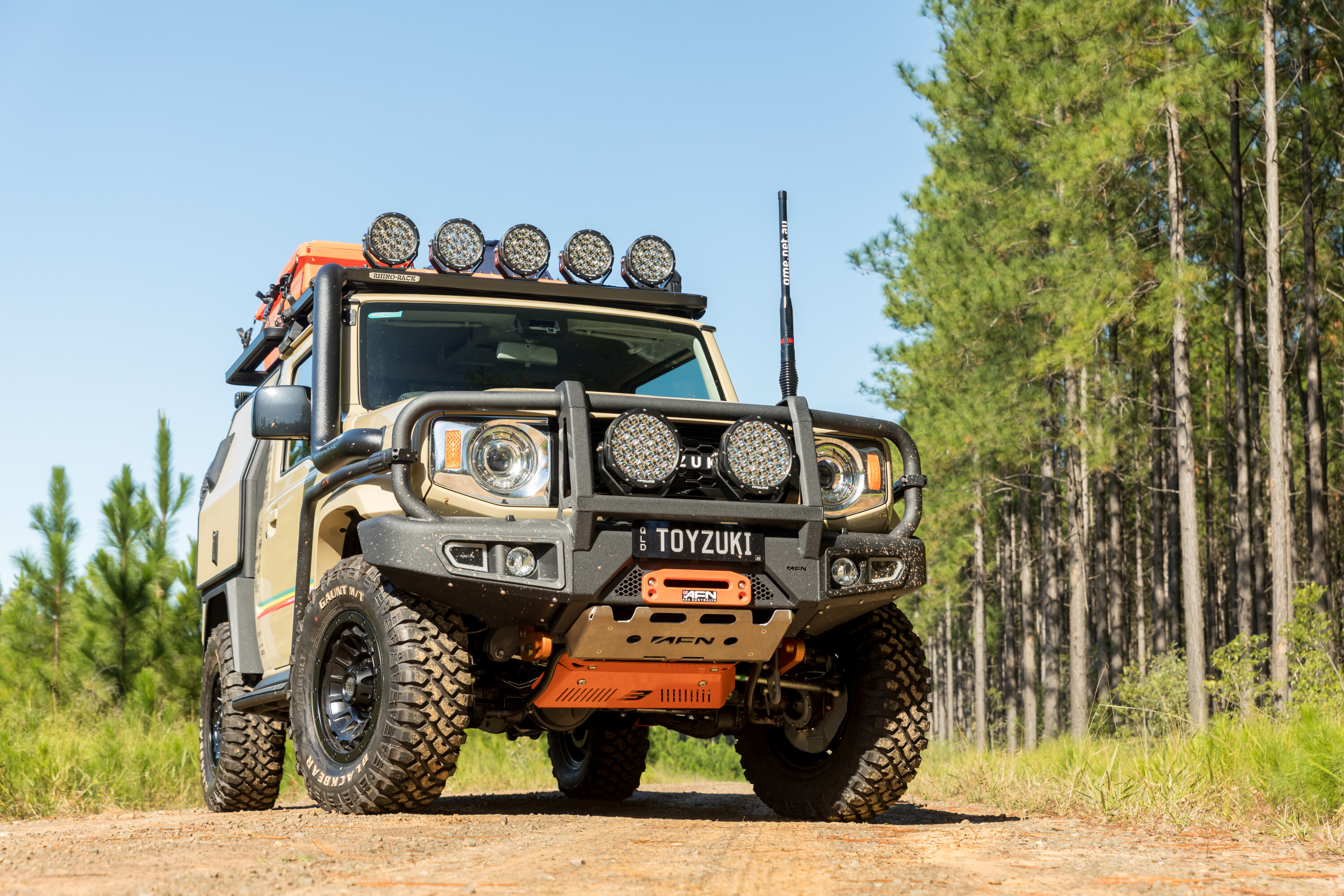
Masterminded by the talented folks at Maxtrax and AEV, the Toyzuki ‘39.5’ on the cover of this issue was meticulously pieced together with the help of Australia’s world-class aftermarket suppliers.
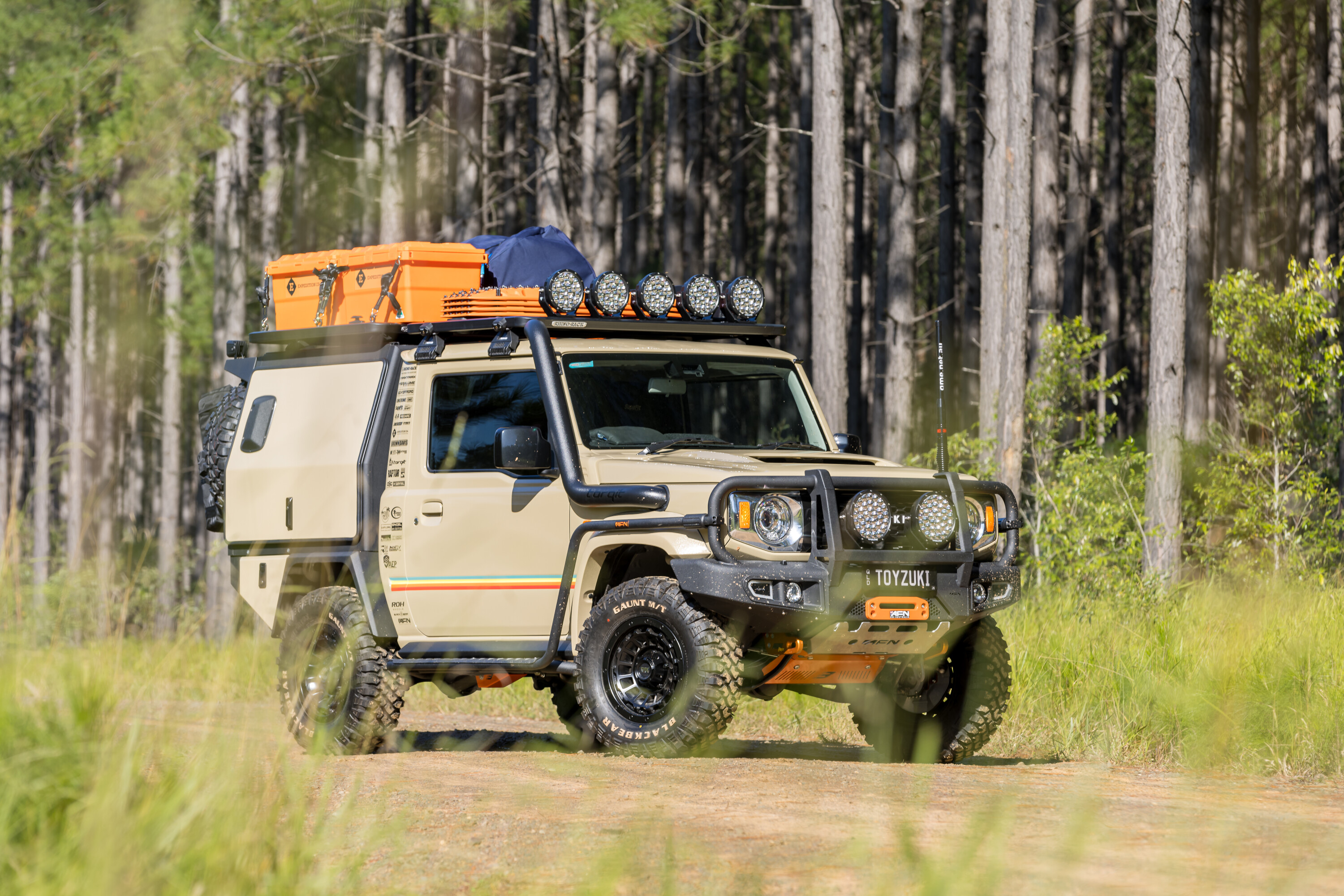
The team transformed a Suzuki Jimny into a off-road-ready, half-sized LandCruiser 79 Series ute, and the best part about it is that you could win it!
The Toyzuki will be on display at the National 4×4 Show in Sydney this weekend, and the winner of the pint-sized 79 will be drawn at the National 4×4 Show in Melbourne on 18-20 August. To enter, simply visit https://toyzuki.com.au/ and enter your details.
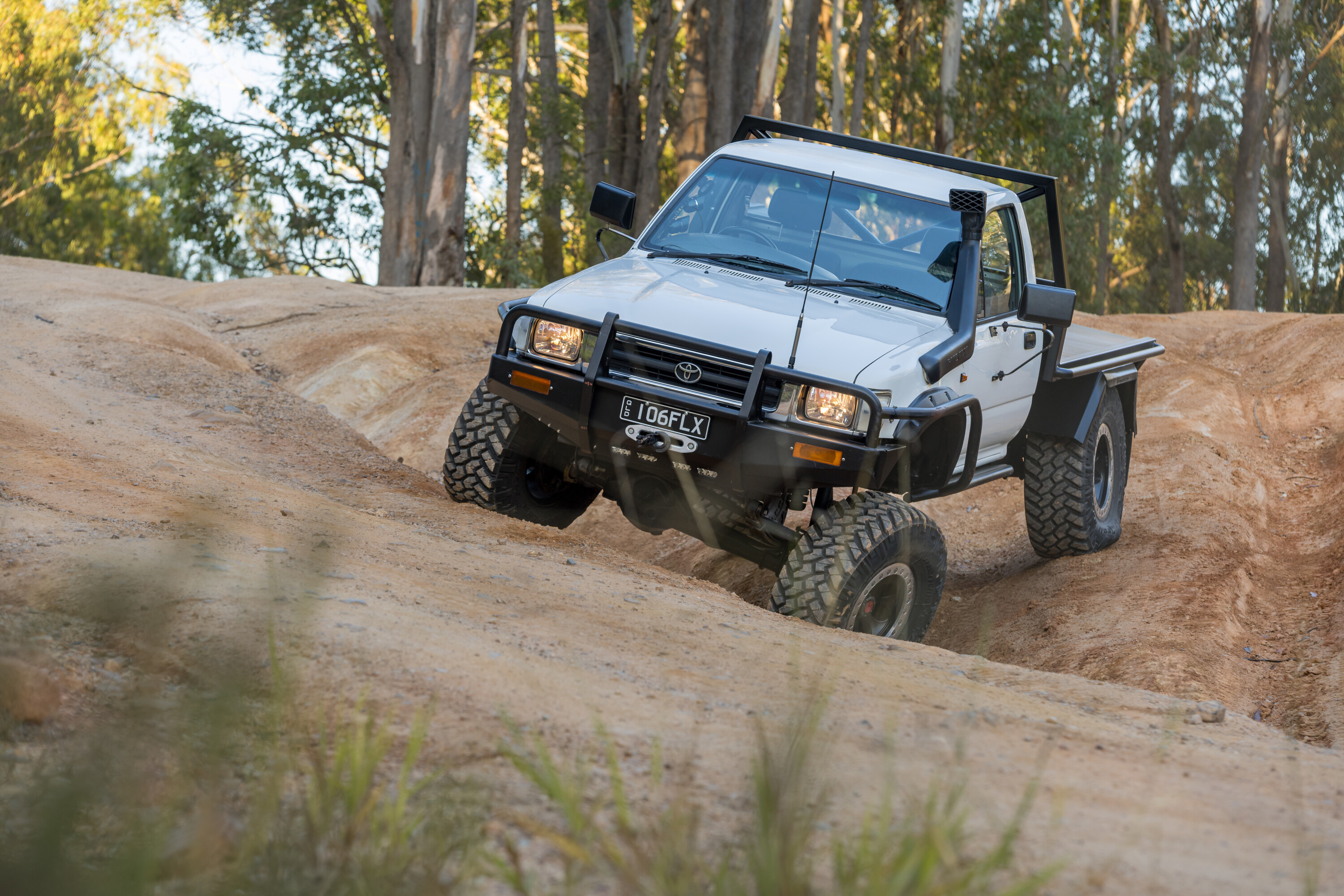
We’ve also included a 30-year-old custom HiLux that was purchased by its current owner with nearly 400,000km showing on the odometer. Plenty of long days and nights in the shed have converted it into an absurdly decent vehicle loaded with quality kit, proving that creativity and hard work far outweigh one’s budget.
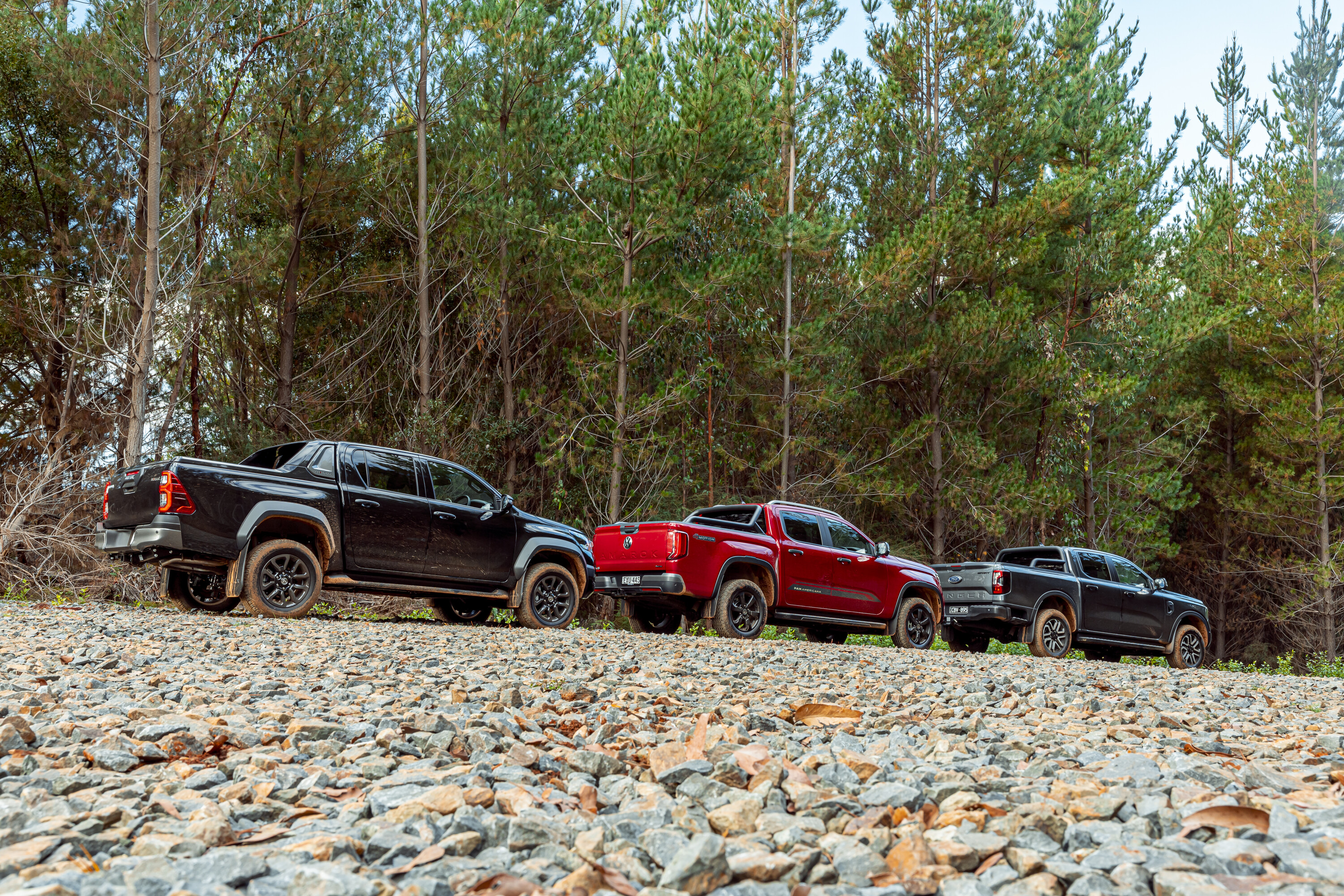
Matt Raudonikis was busy this month testing the new Amarok against its strongest competition – on the sales charts at least – in the form of its twin-under-the-skin Ranger and the ever-popular HiLux. To see how the new ‘Rok compares with the leading vehicles in its class, we took an Amarok PanAmericana out with a Ranger Sport and a HiLux Rogue.
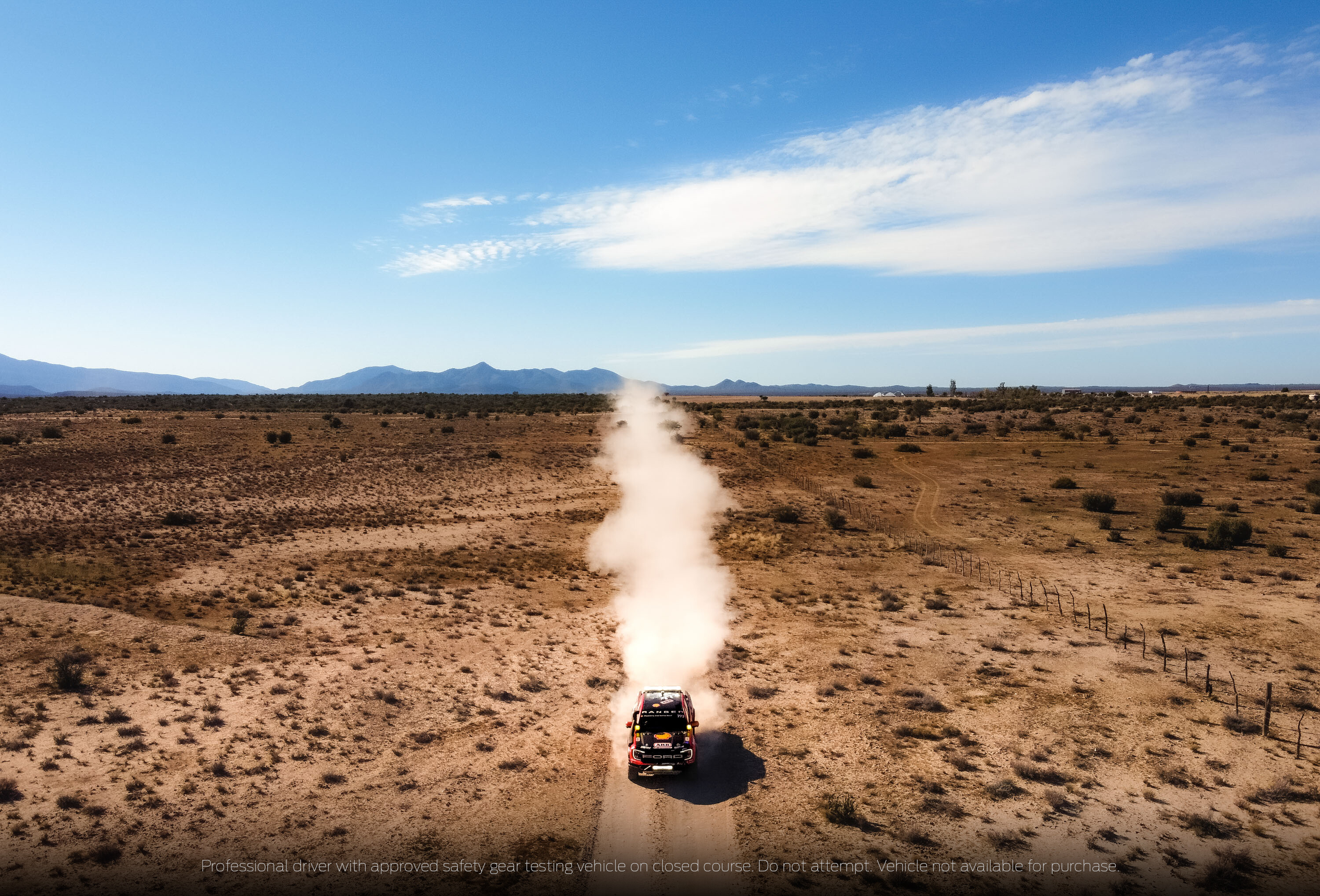
The 2023 Finke Desert race has been run and won for another year, and we’ve included plenty of behind-the-scenes coverage of the Ford Ranger Raptor’s path to glory in the Class 7 event. There are bigger and better things to come for the Ford Performance team!
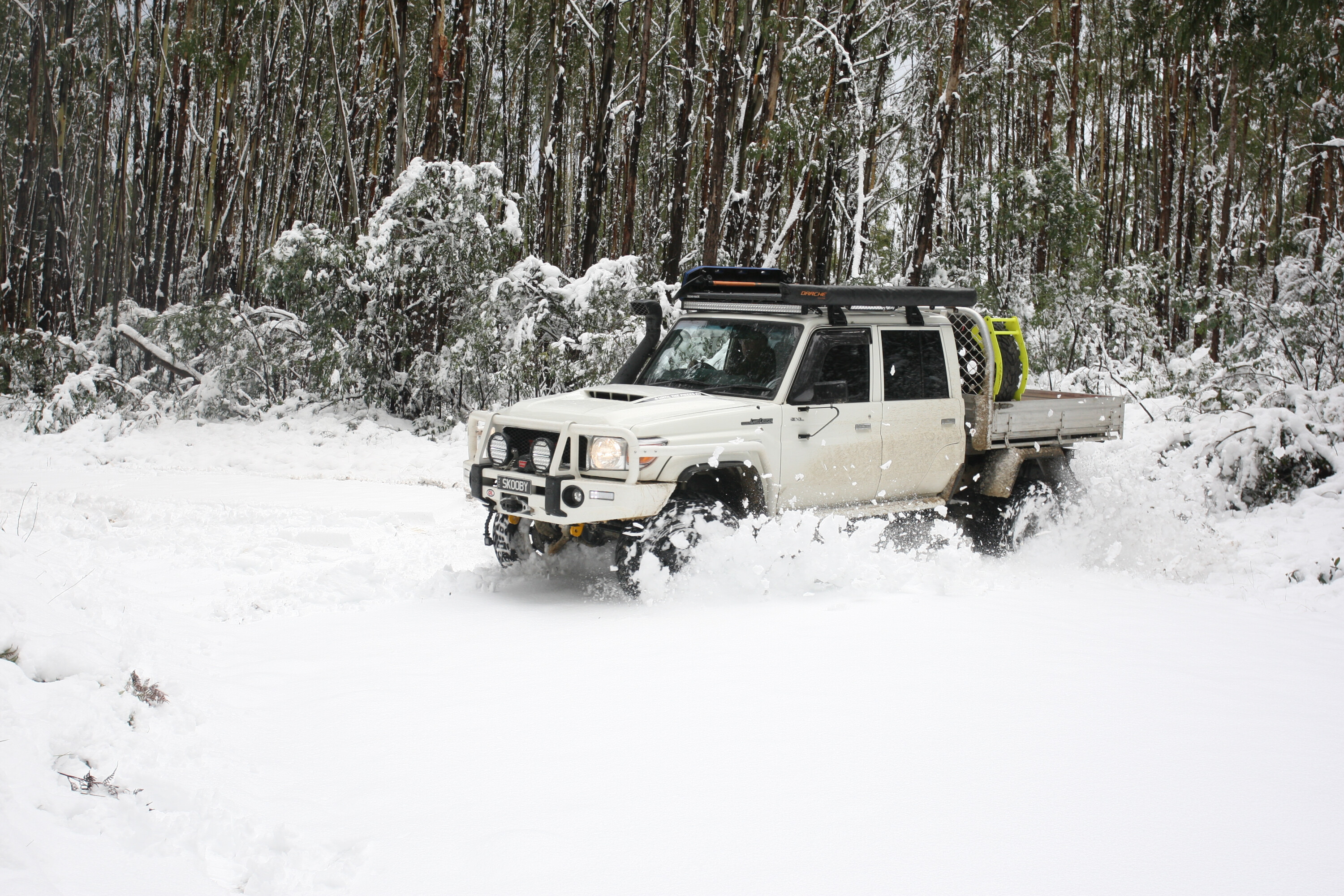
With snowfall prominent in the mountains at this time of the year, we thought it would be timely to include a quick refresher on how to drive on the fluffy stuff. If you’ve never done it before and the thought of driving on snow induces anxiety, then a read of this should help prepare you for your first snow adventure.
Once you’re ready, a trip to the Snowy Mountains should be on the agenda, and Dan Everett has listed all the unmissable 4×4 destinations in this wonderful part of the world.
What else is there?
- Catch Cans explained
- Gorgeous Gundabooka
- Ranger XL driven in Alice Springs
- Amarok Core and Life reviewed
- Product reviews, news and more!
The August 2023 issue of 4X4 Australia is out July 20!
Yep, this thing is crackers.
Who’d have thought, in their wildest dreams, that a Suzuki Jimny, one of the smallest 4x4s on the market, could be transformed into an uber-capable, touring ready, half-sized version of a LandCruiser 79 Series ute?
Well, to find out the why and how the Toyzuki ‘39.5’ (see what they did there) came about, we need to take a step back in time.
The second coming
Keen readers will remember the ‘Jeepny’, the Suzuki Jimny built up by Maxtrax’s then-owner Brad McCarthy and Paul Toohey in honour of Brad’s awesome restored (and still regularly driven) 1943 Willys Jeep.
That first modified Jimny was a success, but it was easy to tell that there was something more tickling the minds of the Maxtrax team; something that came to fruition in the most unlikely of circumstances in mid-2022.
It was during a drive in the Jeepny that the Maxtrax boys spotted a 79 Series coming the other way. No sooner had the big Cruiser rumbled past than the thought passed through their minds, “How good would this be?”
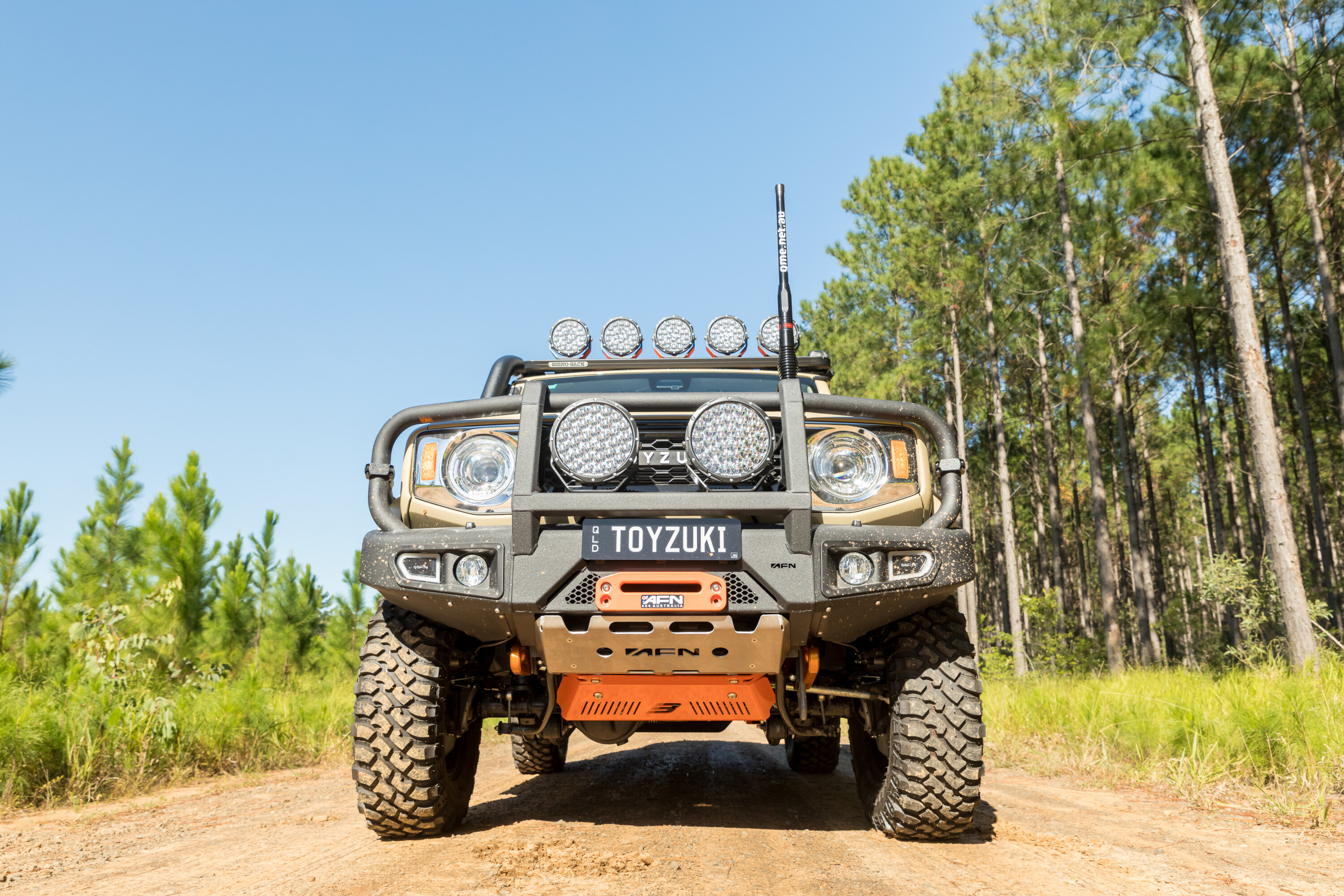
The idea of a Jimny, chopped and modified to replicate the popular 79 Series touring utes that proliferate the Aussie off-road scene, was born. Now it just had to become a reality, which would seem – from the outside looking in – no easy task.
Until, that is, you realise Paul Toohey’s determination to make this happen, beginning with some cool Photoshop mock-ups he created, and then followed with more than a little help from his friends.
A passing thought becomes real
‘The phone call’ has already become a bit of an urban myth but it is one fully grounded in truth.
Michael McMillan, from Australian Expedition Vehicles (AEV) was in his office when the phone rang, upon which he answered it to hear Paul Toohey say, “Mate, I’ve got a build idea for you…”. After hearing Paul’s seemingly crazy idea, Michael’s short reply was “Absolutely not”.
His only problem: it was already too late; as Paul said in reply to Michael’s initial refusal, “It’s on the way.” And it was. The Jimny arrived, on the back of a truck, at AEV HQ that very same day. The ‘build idea’ was under way.
Chop and change
The AEV team pulled the Jimny apart, gutting the interior as well, before starting on the first cut-job, just in front of the Zook’s rear wheel arch.
After the chop, the team had to custom manufacture a new rear window/cabin section (as well as a recreated rear gutter lip along the roof) then re-attach it. The end result, of what is a bloody big job, is a cabin that looks like it’s straight from the factory.
Adding to that factory look is the 79 Series bonnet scoop. Again, this looks like it’s always been that way but was another big job, with the AEV team combining the original Jimny bonnet with their own custom fabricated 79 bonnet scoop to achieve the desired appearance without sacrificing functionality.
We’re sure AEV’s Michael McMillan spent more than a few hours shaking his head at Paul Toohey’s ‘build idea’ as the chopping and welding progressed, but we’re also sure he’s incredibly proud of what his team achieved to get the result – it’s awesome.
Keeping it on the level
The dream vision of the Toyzuki was an extensive one, and one grounded in practicality.
This rig not only had to look the goods, but it had to be functional and perform well in both on-road and off-road touring scenarios. With the addition of a canopy, which would mean more gear packed, which means bigger loads, the solution to assist on- and off-road ride and handling was to opt for a custom Airbag Man air-suspension setup.
This system is trick, too, featuring the company’s auto-levelling system (with heavy-duty rolling sleeve air springs) that has three pre-set height levels – ideal for maintaining a level ride when this mighty mite is fully loaded.
Latest Gear Guides!
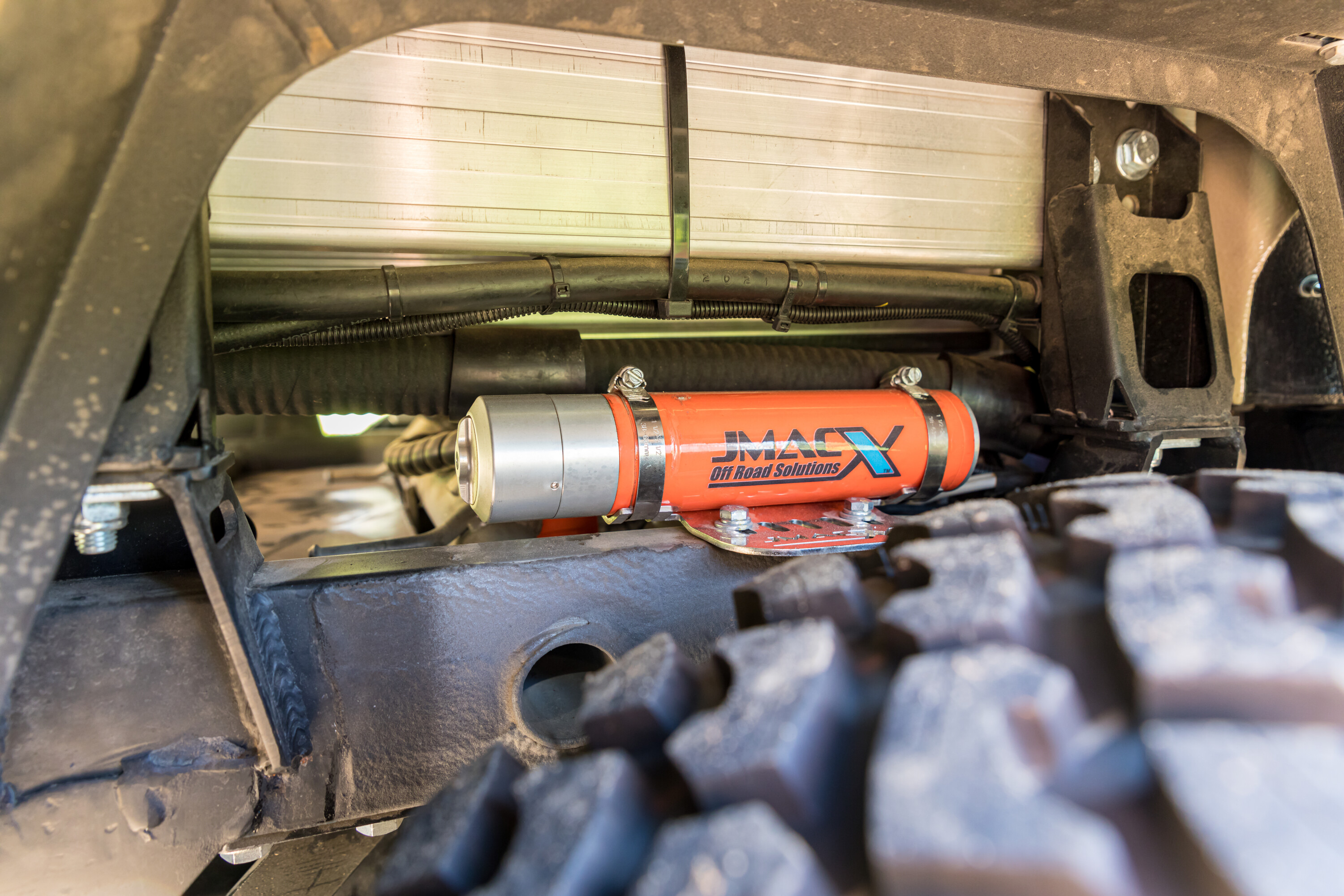
The air springs are combined with custom – and seriously schmick – JMacx Offroad Solutions dampers. Keeping the whole thing rolling is a set of ROH wheels with chunky (but not overtly over-sized) Black Bear Gaunt 235/75R15 muddies.
Yeah, you will notice we’re mentioning ‘custom’ when referring to a lot of components on the Toyzuki, and this is simply due to the fact a lot of this gear is one-off and designed specifically for this mad and crazy project.
This not only shows how clever the Aussie off-road manufacturing scene is but reflects the passion of all the businesses involved in the build. Impressive stuff.
Fully loaded
If there’s one standout (and, really, there are many) of this custom mini-bruiser, it is the way the 4×4 aftermarket scene has jumped on board with numerous accessories.
The ‘standout’ qualification comes from the fact that a lot of the accessories fitted are fully custom, too, so invariably involve a lot more hands-on work to manufacture. It’s nearly a question of where you start; the bodywork from AEV is, in itself, amazing, and then you add in the work involved to fit the air suspension and those one-off JMacx dampers.
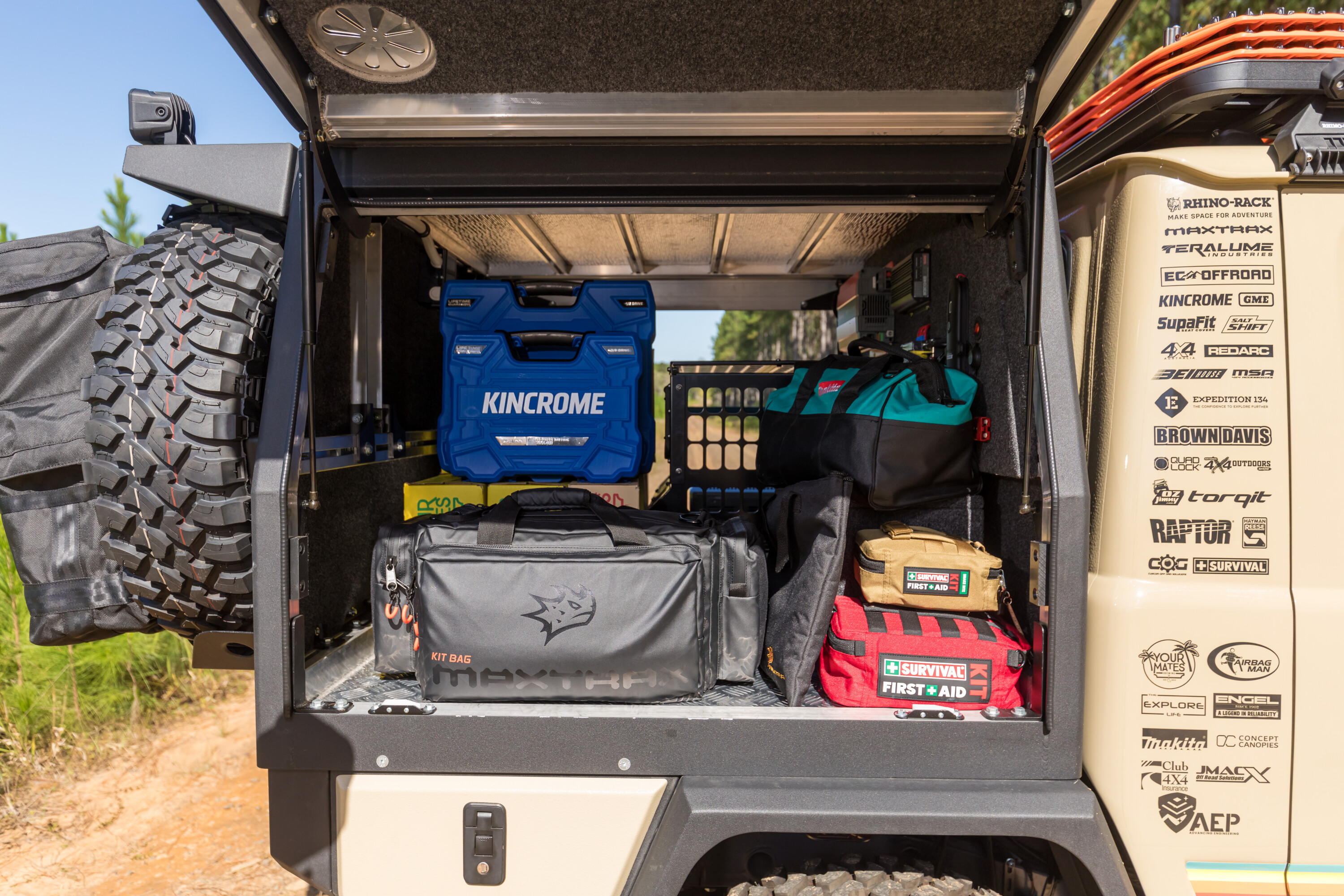
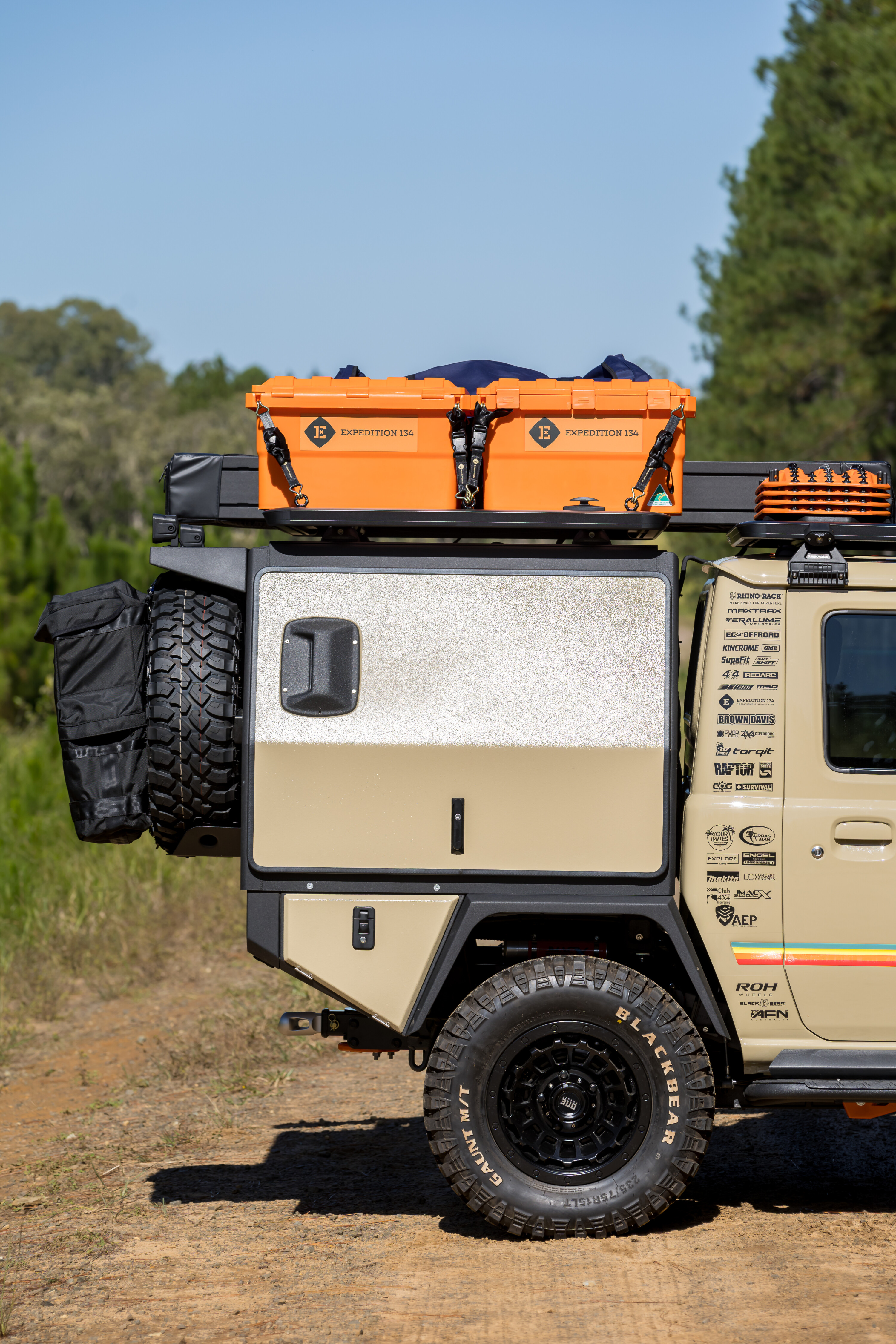
Equally impressive is the canopy. Again, it looks like it just rolled out of the factory – the team at Concept Canopies nailed it; accounting for its compact size, they smartly went with two single doors (one either side) and a metal chequer-plate floor, allowing optimum room for other ‘goodies’.
Those other goodies include an MSA 4X4 drop fridge-slide (with Engel fridge/freezer) that also includes a fridge cage so you can still make the most of the remaining storage space. Fitted to the cabin-side of the canopy is a compact, fully featured Redarc auxiliary power system, installed by the team at Custom Off Grid Solutions.
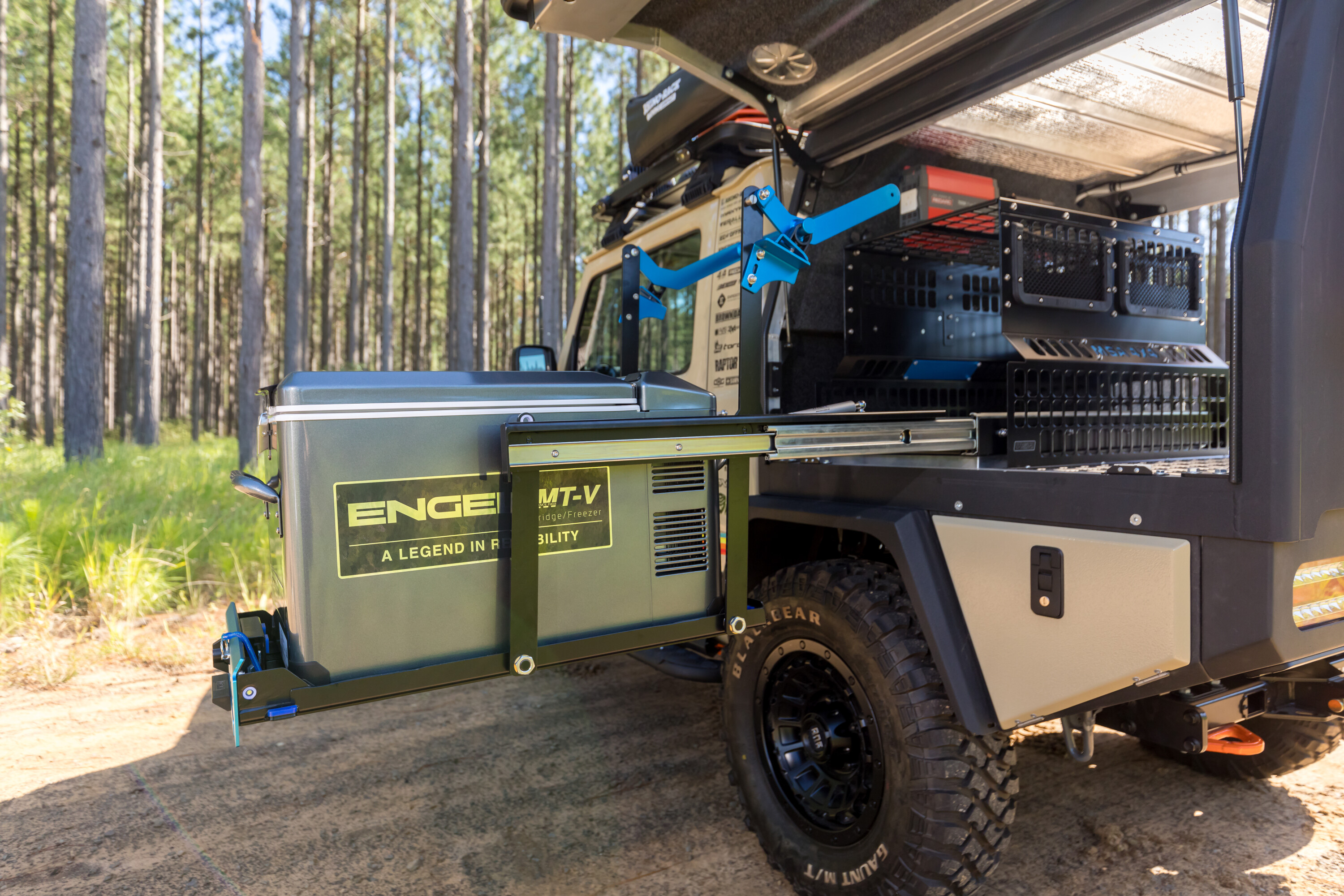
Speaking of space, even with these components fitted, there’s still plenty available for touring gear, too. However, if you do need more, Rhino-Rack built two – yep, you guessed it – custom size roof platforms, with a Compact Batwing awning attached to the canopy platform, with provision to fit things like Expedition 134 storage boxes (one of our favourite camp storage options) and, of course, a set of Maxtrax.
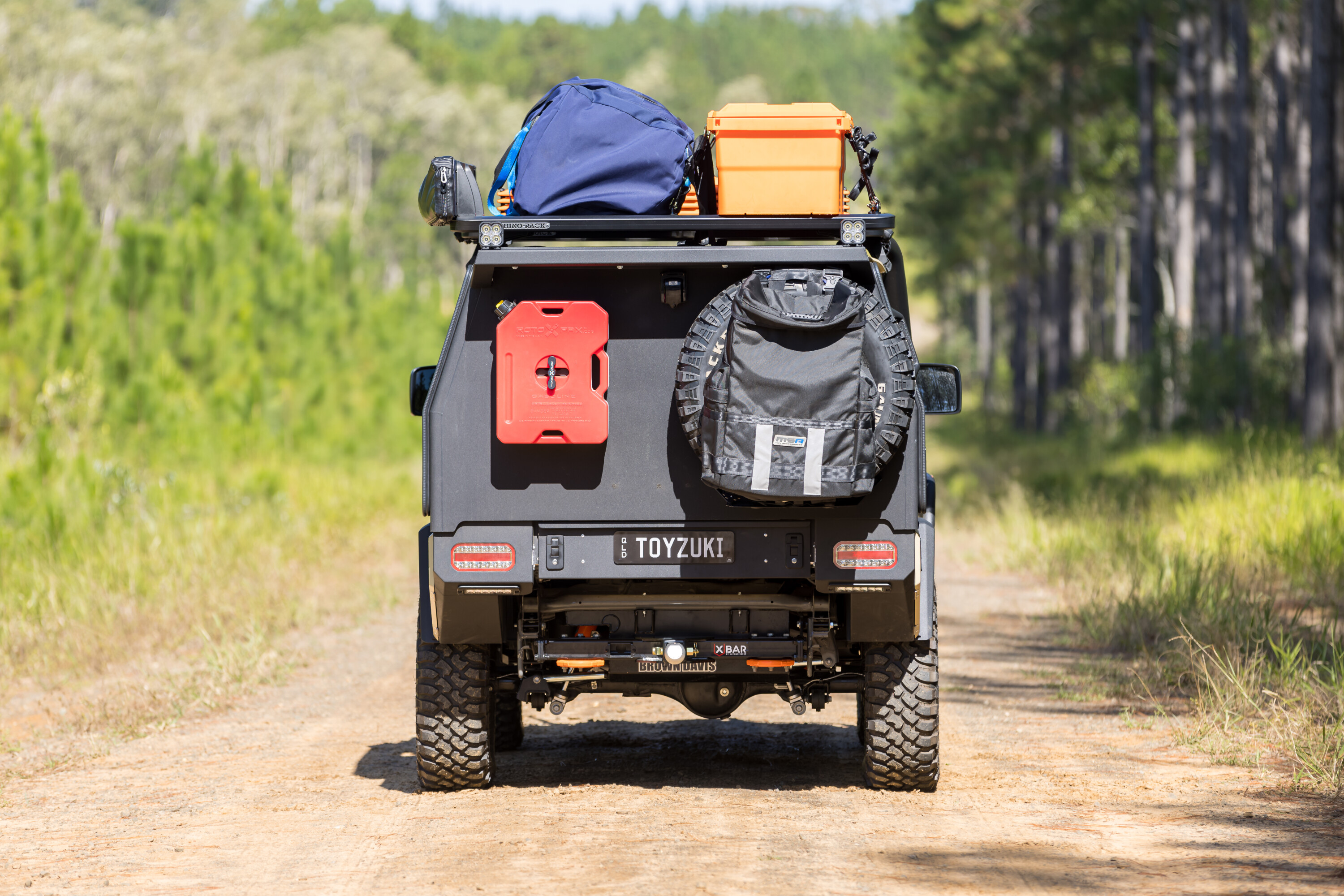
Cleverly, the canopy has a slight ‘extension’ lip at the rear, again to optimise storage up on top of the vehicle. It only looks like a little bit more, but it all counts for this mighty mite. The rear wall of the canopy includes a spare wheel/tyre on the driver’s side and a jerry-can mount on the left.
On the outer and looking in
For frontal protection, the team at AFN went to town, supplying a Jimny front bar and rock-slider, as well as – yes, yet again – fabricating side brush-bars for a comprehensive protection package for the vehicle.
Upping the protection ante underneath, Bei House underbody protection combines with rated recovery points for those just-in-case moments when off-road. Mounted to that black AFN front bar is a set of Teralume Industries LED spotties (a set is also mounted up on the roof) for night-driving illumination.
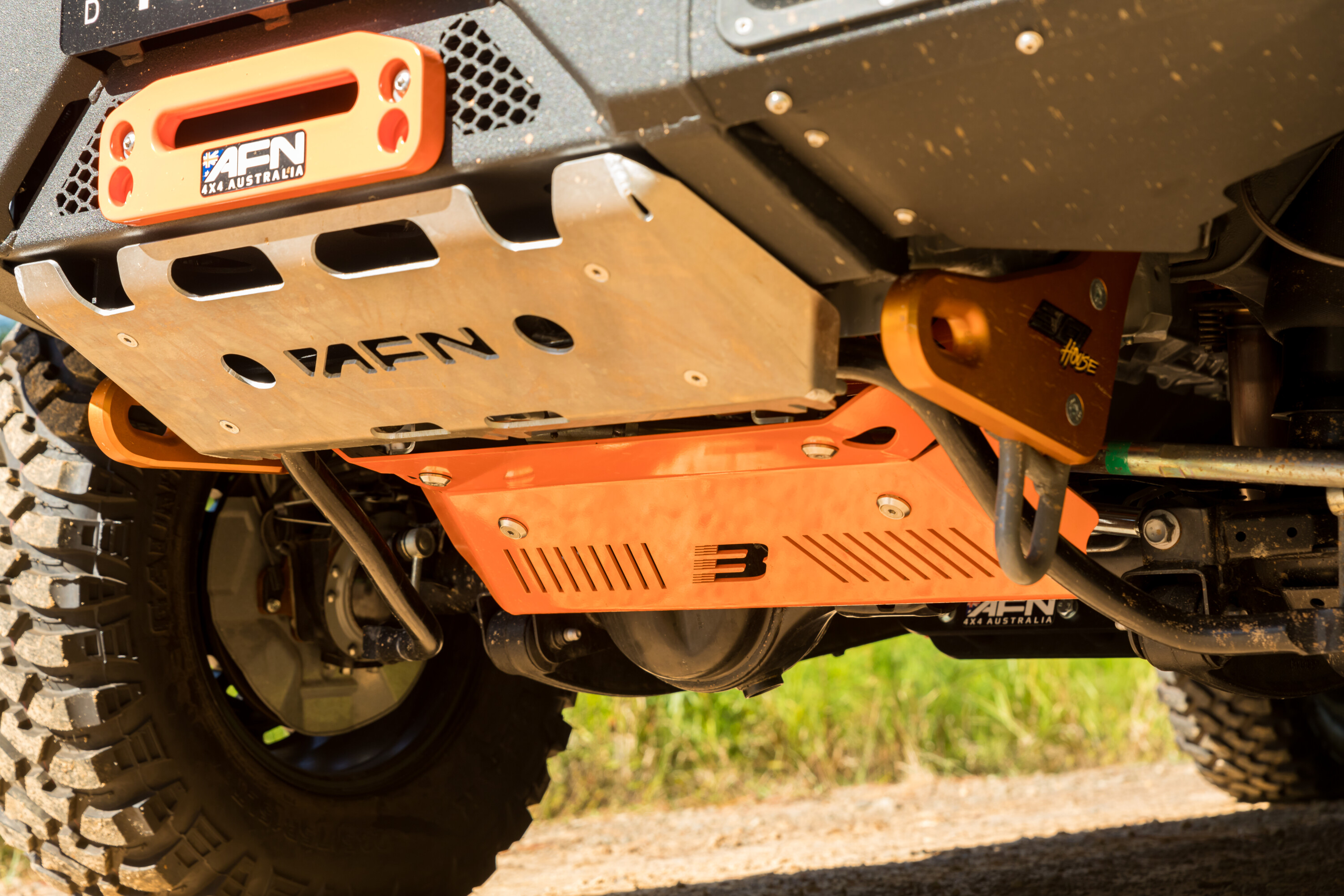
Finishing off the exterior mods is a custom-size auxiliary fuel tank from the expert team at Brown Davis and a custom Hayman-Reese X-Bar at the rear.
The interior is relatively standard – after all, the Jimny cabin is not a bad place to spend some time – but it has still received a slight tweak, with improved sound deadening and an upgraded sound system, courtesy of EC Offroad, plus a GME UHF radio for bush comms and a Quad Lock phone mount.
Underbonnet, the Zook’s donk has received plenty of attention, with Torqit manufacturing a custom snorkel and airbox, along with a custom exhaust, to help move this pocket-sized tourer along at a more than decent clip. Oh, and then there’s the supercharger.
A winning combo
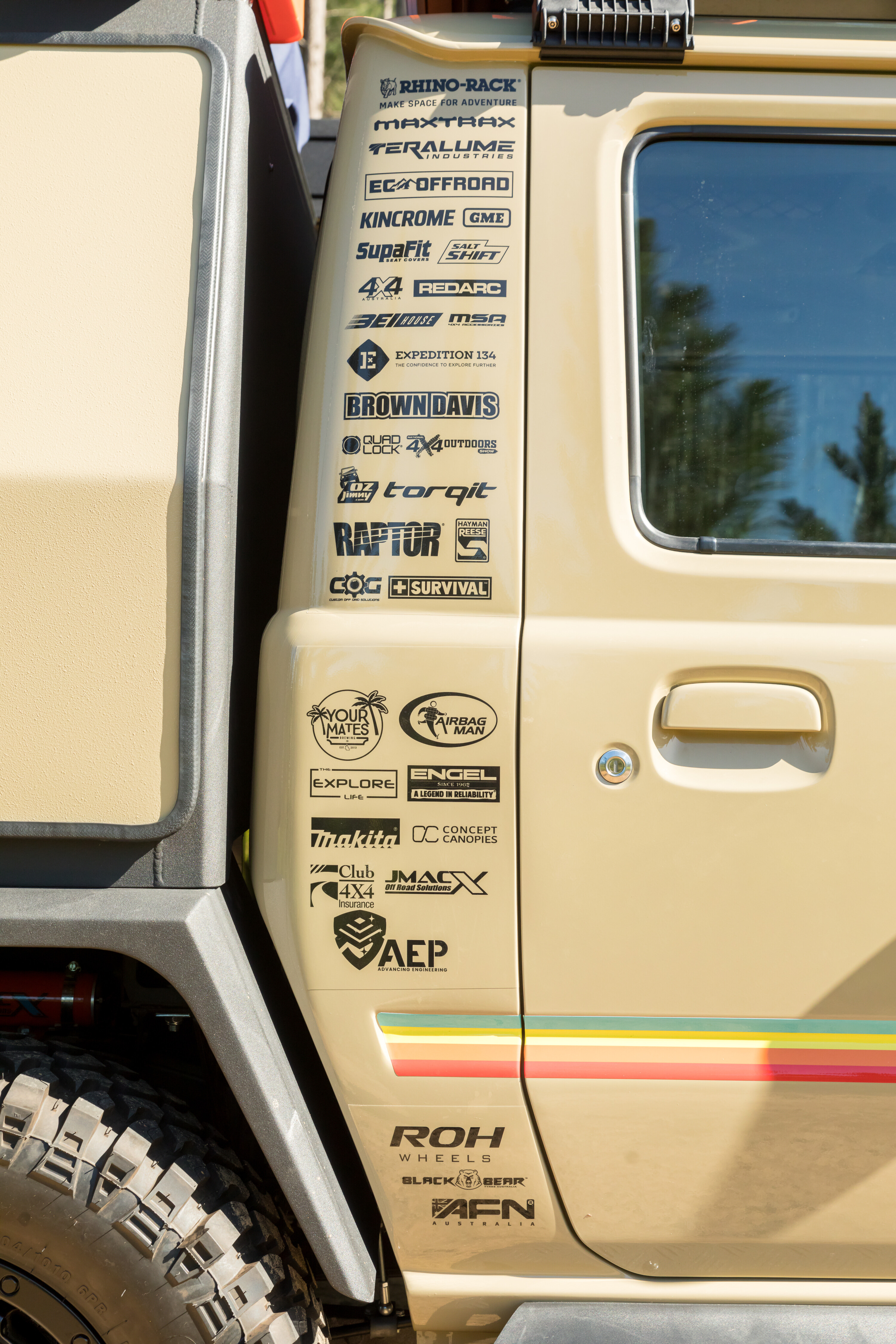
To call this rig ‘cute’ is to do a disservice to the incredible vision, and the hours and hours of brainstorming needed to make that vision a reality – as well as the hard work from all the brands (and their employees) that has resulted in this toughest of off-road tykes.
The Toyzuki is an extremely clever and effective custom off-roader that is also the physical embodiment of that ‘dream come true’ from when Paul and Brad first saw that 79 drive past the Jeepny. Its diminutive size combined with its all-round capability and clever mods has proved the age-old adage that size does not matter.
The hydrogen fuel-cell powered Ineos Grenadier off-roading SUV has publicly debuted at the Goodwood Festival of Speed overnight.
Snapshot
- Ineos Grenadier FCEV shown off to public for the first time
- Project only started one year ago
- Adopts BMW hydrogen tech
The demonstrator model looks identical to the regular six-cylinder petrol and diesel Grenadier, save for the bonnet bulge which (sadly) won’t appear in the final production model.
Similar to its internal combustion engine counterpart, the hydrogen-powered 4×4 Grenadier adopts the latest drivetrain technology from the BMW Group.
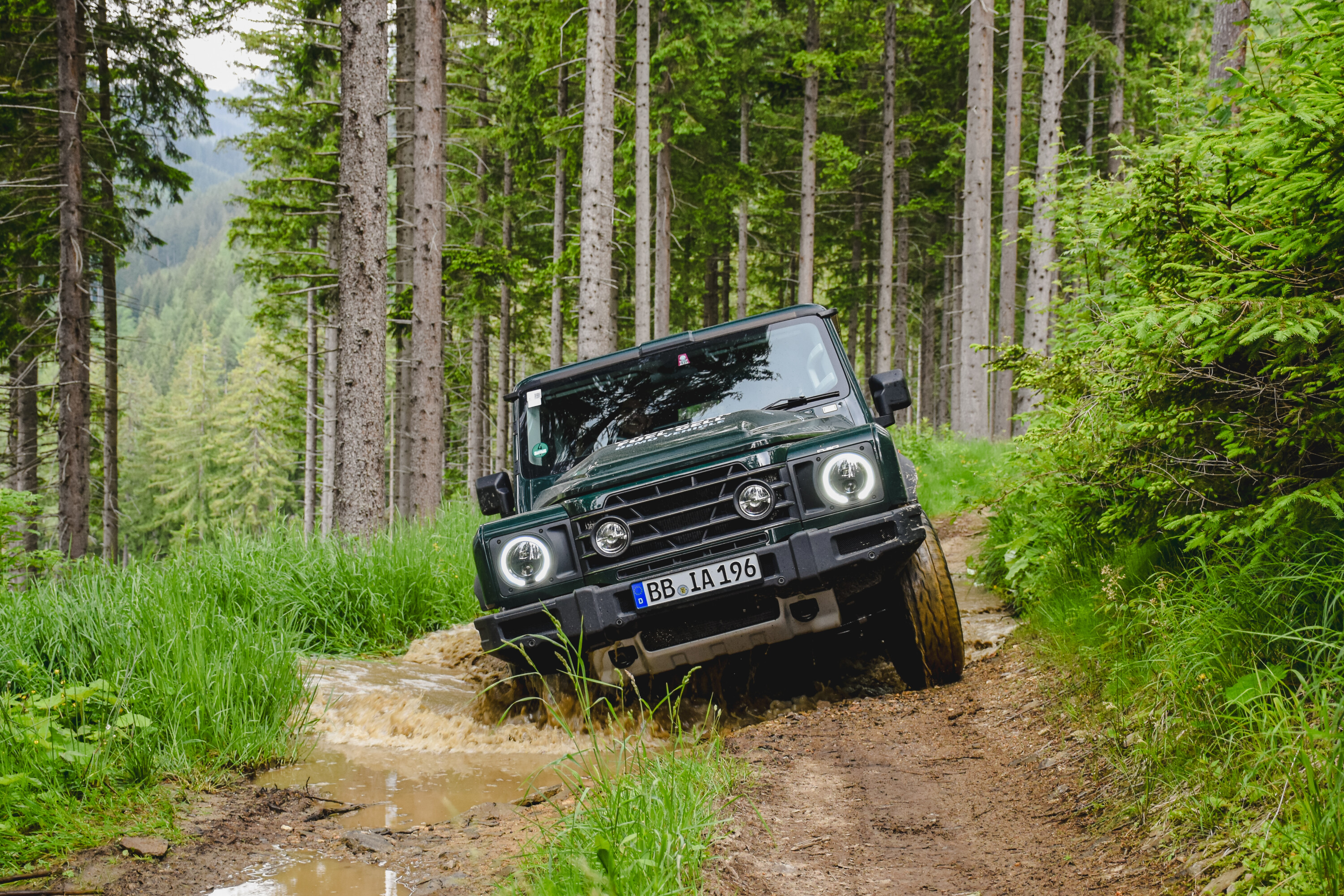
While Ineos hasn’t detailed specific power outputs, the latest BMW iX5 Hydrogen‘s electric drive unit produces 295kW.
The hydrogen fuel-cell electric vehicle (FCEV) is run off a 125kW fuel-cell, a pair of 700-bar hydrogen tanks, and a small lithium-ion battery to offer up to 504 kilometres of claimed WLTP driving range. Refuelling takes around three to four minutes.
To fit the hydrogen powertrain, Ineos modified the Grenadier’s ladder frame and rear axle to accommodate the drive units which feature a torque vectoring system.
The British chemicals company – which also produces 400,000 tonnes of hydrogen per year – began the Grenadier FCEV project in mid-2022 with Austrian engineering supplier and consultancy, AVL.
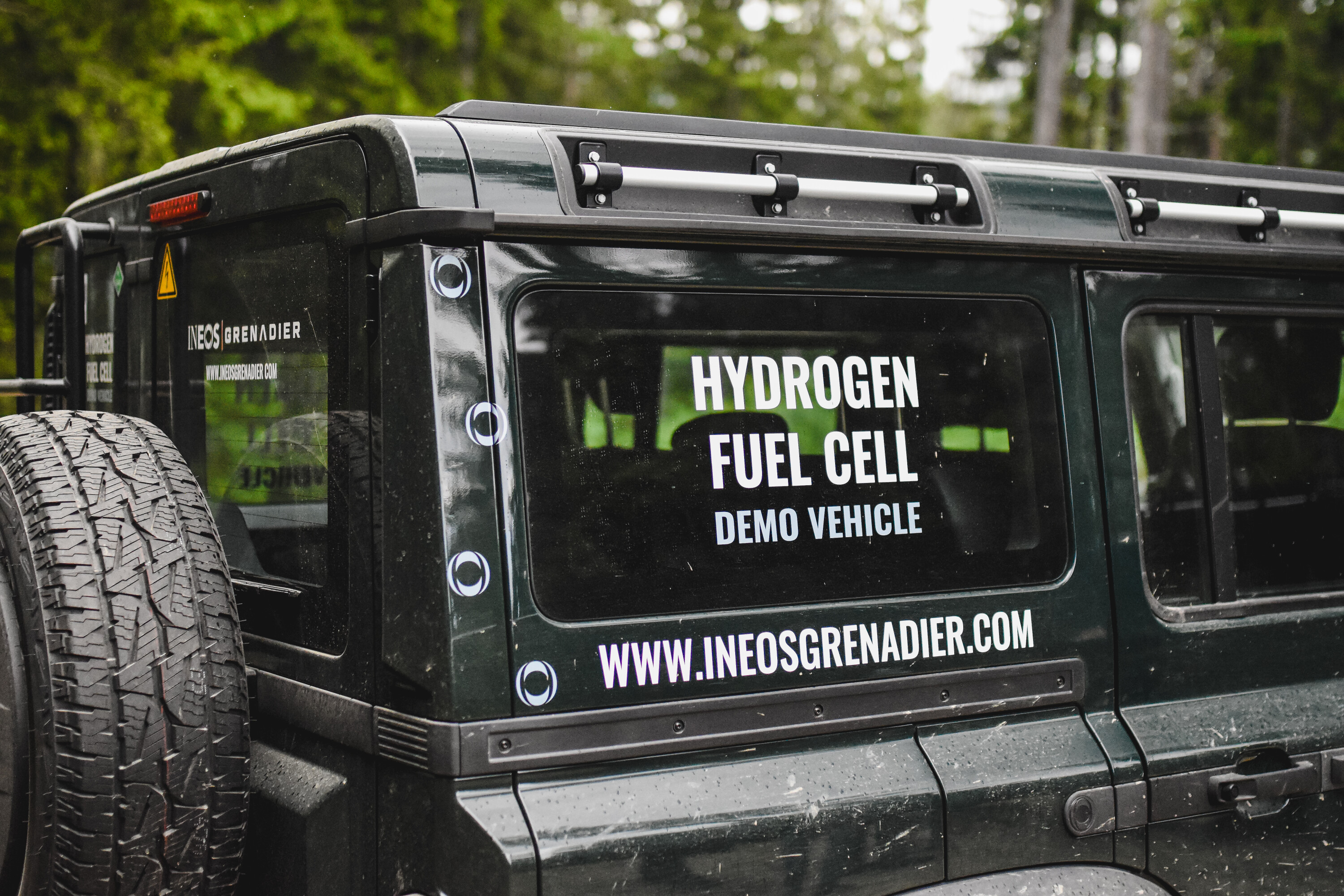
However, it admits policymakers need to better support and build public refuelling infrastructure in order for hydrogen fuel-cell electric vehicles to be a viable alternative.
As at the time of publication, only three hydrogen refuelling stations are publicly available in Australia – in Canberra by ActewAGL, Melbourne by Toyota, and the Port of Brisbane by BOC.
Snapshot
- Claimed class leading off road performance
- Model range mirrors Grenadier wagon
- Australian order books are now open
The Grenadier Quartermaster pick-up, the second model in the Grenadier line-up from Ineos Automotive, had its first official outing at the Goodwood Festival of Speed in the United Kingdom this week.
As expected, the double-cab pick-up looks just like the Grenadier wagon, with a cargo tub tacked onto the back of it. Think Land Cruiser 79 Series pick-up from LC76 wagon and you’re in familiar territory.
The Quartermaster’s ladder-frame chassis is 305mm longer than that of the Grenadier wagon, featuring a 3227mm wheelbase compared to the wagon’s 2992mm. A single-cab version of the Quartermaster has been mentioned by the company in the past, but no confirmation or details have been provided yet.
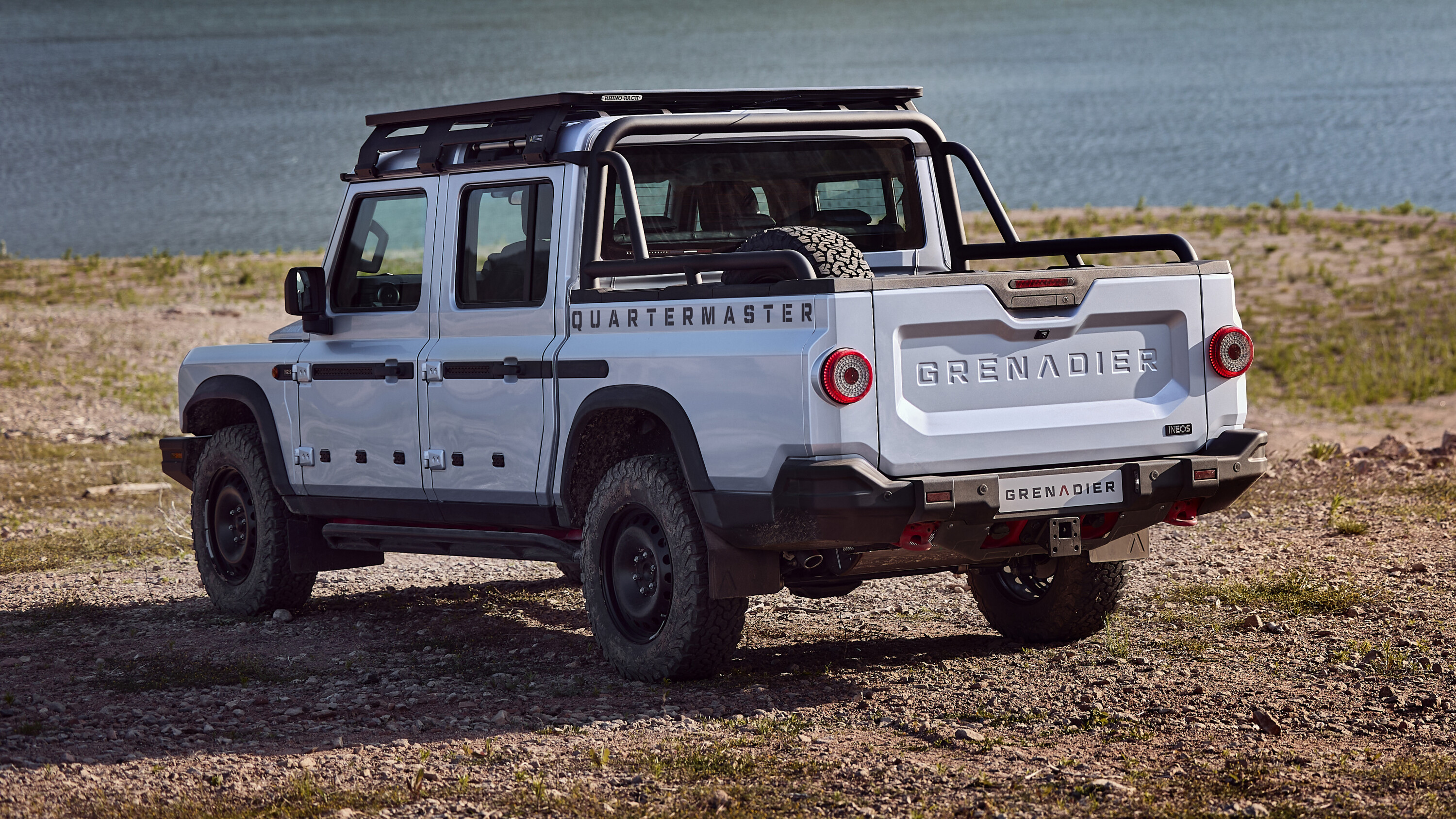
The factory load bed of the double-cab Quartermaster measures 1564mm in length, with a total width of 1619mm and height of 906mm.
In terms of payload, the five-seat Quartermaster four-door falls short of most mid-size 4×4 utes, offering just 907kg when powered by the petrol engine or 832kg with the diesel mill. It does, however, share the same 3500kg towing capacity and 7000kg GCM as the Grenadier wagon.
Also mirroring the wagon is the choice of BMW-manufactured, 3.0-litre, inline six-cylinder engines, paired with a ZF 8-speed automatic transmission and a full-time, dual-range 4×4 driveline.
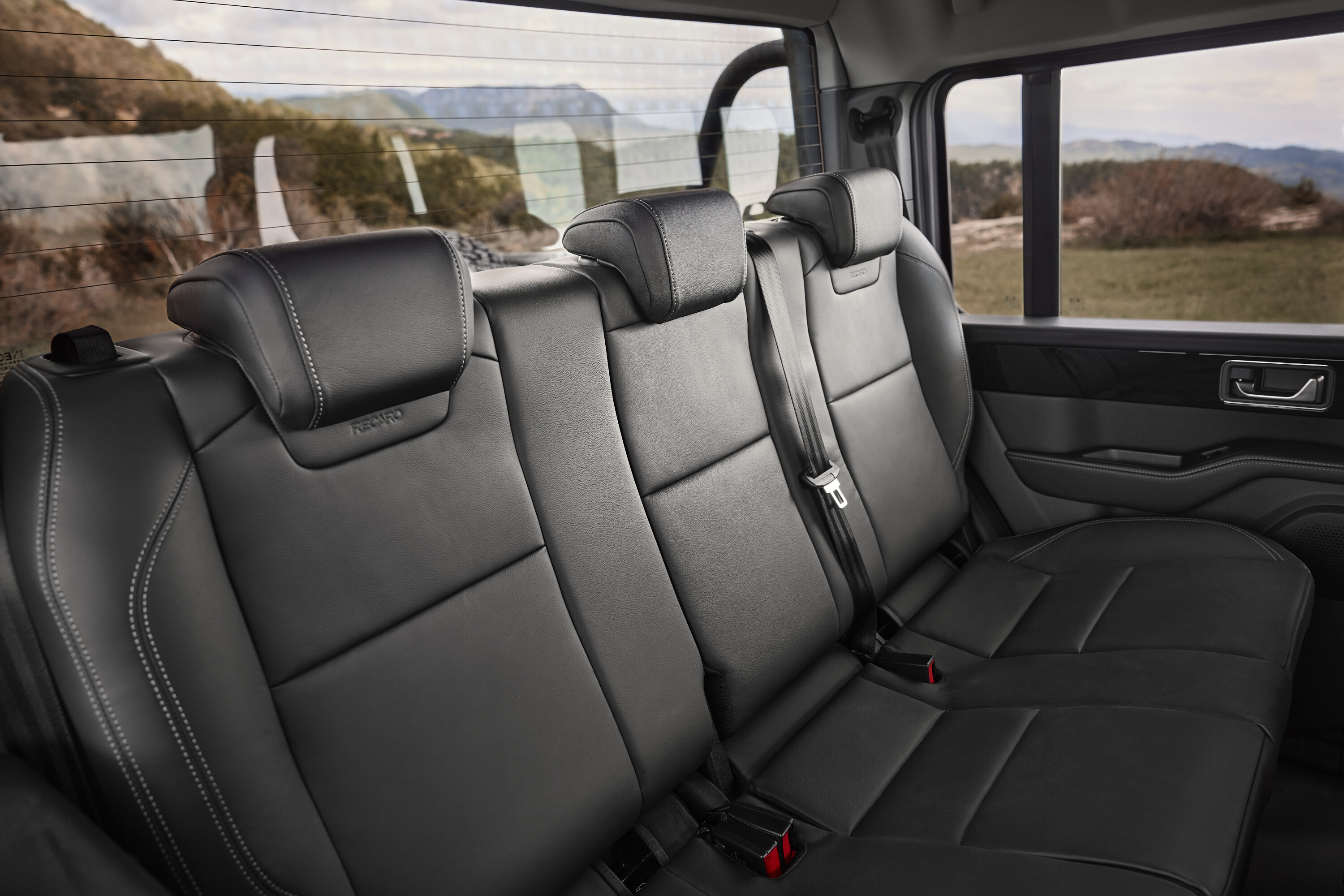
The suspension utilises the same live axles on coil springs both front and rear. Front and rear differential locks will be available as an option, along with a full range of factory-supported accessories.
Ineos claims that its Quartermaster offers class-leading off-road ability, with 264mm of ground clearance, 800mm wading depth and approach (36.2°), breakover (26.2°) and departure (22.6°) angles, which are unrivalled by any other production pick-up.
The Quartermaster will be available in three variants: the Standard entry-level model, the Trialmaster mid-spec, and the Fieldmaster top of the range, reflecting the offerings of the Grenadier wagon from which it’s derived.
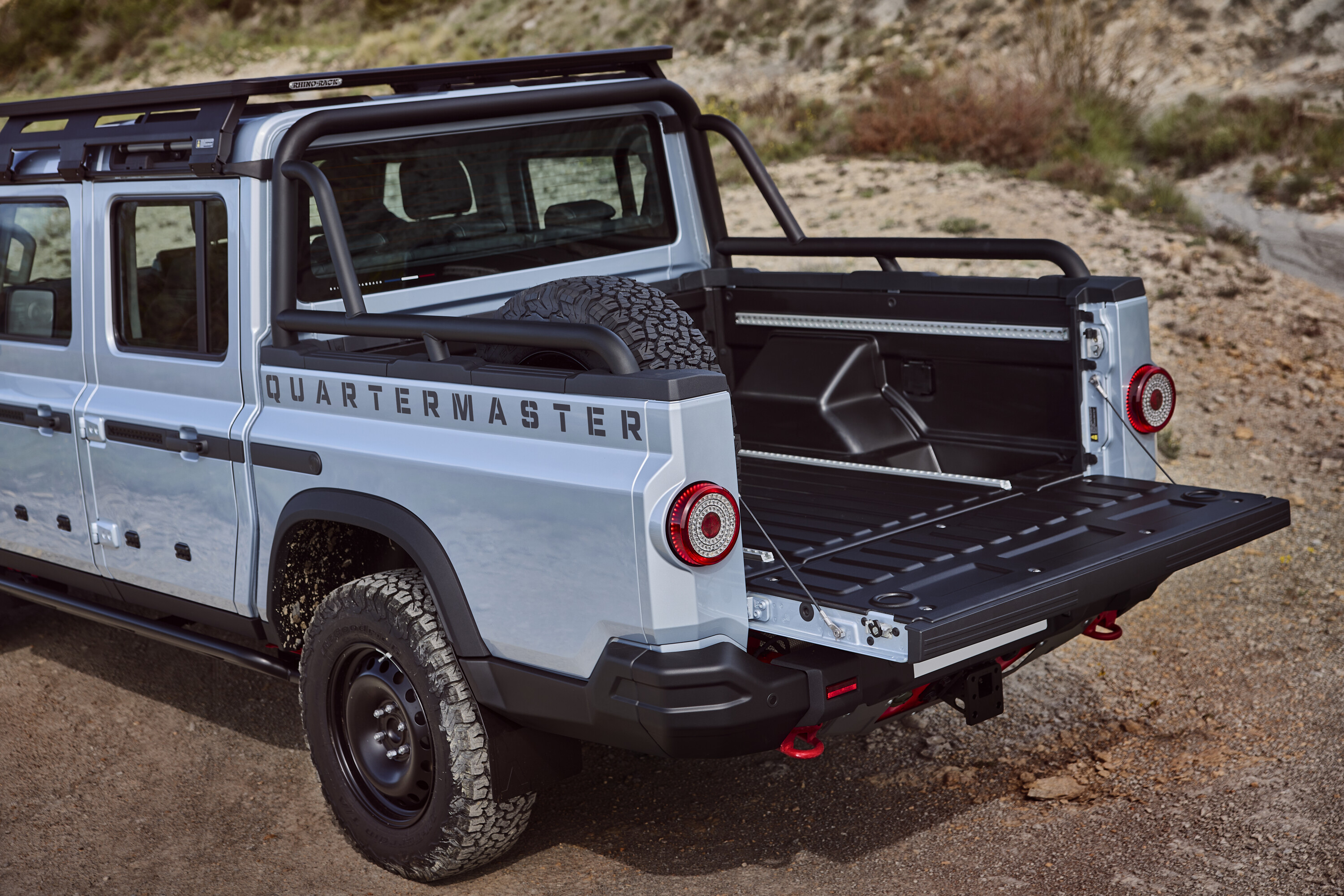
Ineos Automotive Australia has opened the order books for the Grenadier Quartermaster ute, but has not yet provided information on when the model is expected to arrive or when it will go into production.
Deliveries of the Grenadier wagon only just started arriving to customers in Australia in the past month.
When it finally reaches Australian shores, the Quartermaster should present a compelling alternative to the Toyota Land Cruiser 79 series utes, which have largely dominated the live-axle 4×4 ute market since the demise of the Land Rover Defender and Nissan Patrol utes.
With the long-term availability of Toyota’s V8 diesel engine remaining clouded, a strong inline six-cylinder diesel engine powering a live axled rugged ute would be very attractive to many Australian buyers.
Alternative action
Ineos Automotive also showcased its hydrogen fuel cell-powered Grenadier at the Goodwood FOS.
The zero-emissions FCEV uses BMW’s latest fuel cell EV powertrain, which has been adapted into the Grenadier’s ladder-frame chassis and at this stage remains in development.
“The hydrogen-powered Grenadier Demonstrator, along with our all-electric model due in 2026, underscores INEOS’ commitment to achieving net zero,” said Lynn Calder, CEO of INEOS Automotive.
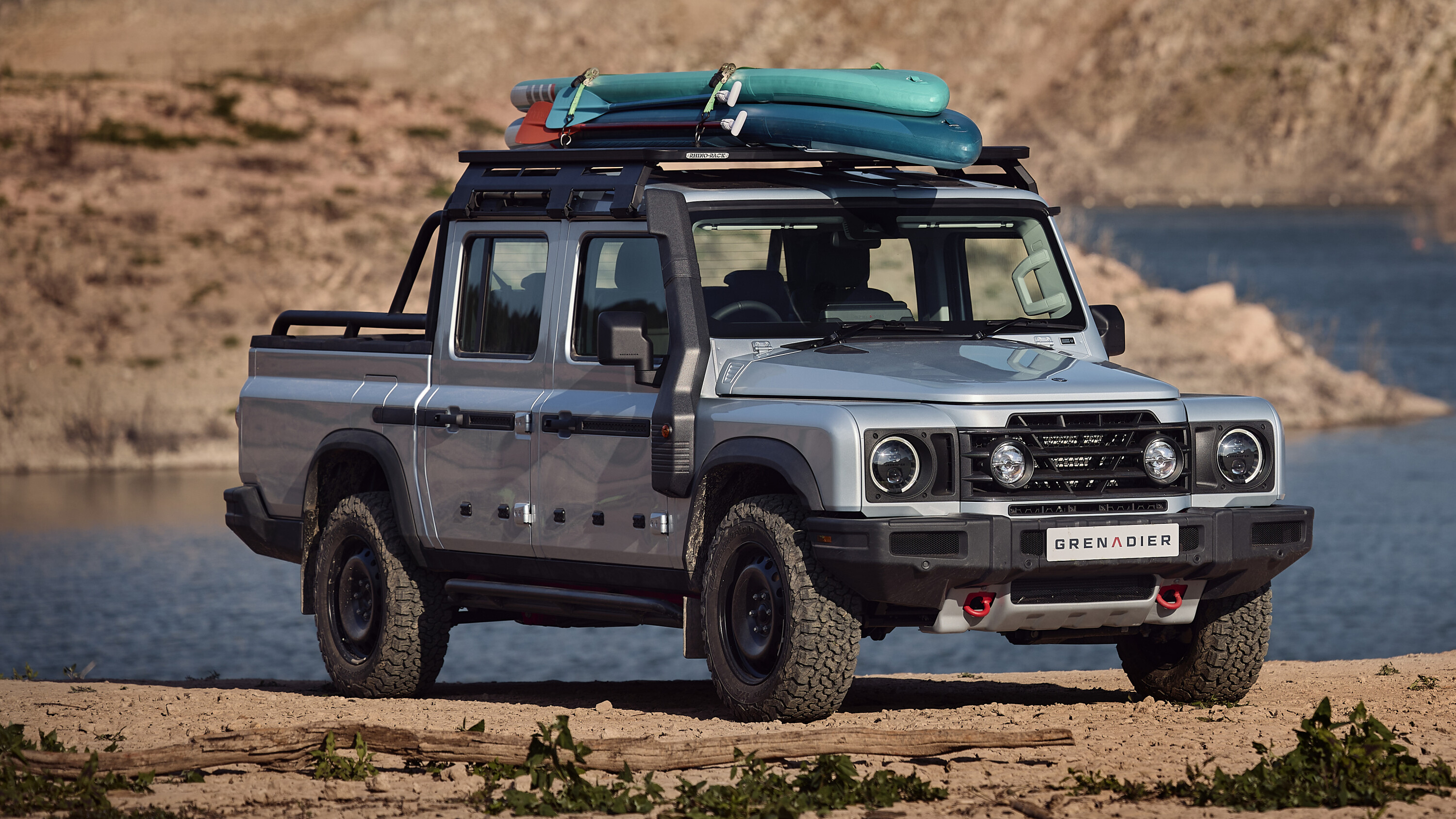
“Our demonstrator proves that the technology is capable”
“BEVs (Battery Electric Vehicles) are ideal for certain uses, such as shorter trips, most private car journeys and urban deliveries. On the other hand, Hydrogen FCEVs are more suited for longer trips and heavy-duty cycles where batteries could impact too much on payload and where long range between stops is necessary.
“INEOS, a manufacturer of petrochemicals, specialty chemicals, and oil products, currently produces 400,000 tonnes of hydrogen per annum and is committed to hydrogen as a vital fuel of the future.
“Our demonstrator proves that the technology is capable; what we need now is support from policymakers to help provide the infrastructure for the next generation of hydrogen vehicles.”
February 2024: Lexus GX Australian details confirmed
The 2024 Lexus GX – heavily based on the all-new Toyota Prado – is due in Australia soon, and now the company has confirmed more of what we can expect.
July 2023: GX confirmed for Australia
The 2024 Lexus GX off-road large SUV will arrive in Australia in the first half of next year.
Snapshot
- 2024 Lexus GX confirmed for Australia
- Believed to be heavily related to the new Toyota Prado
- Due in local showrooms in the first half of 2024
It is the first all-new GX in 14 years, with the vehicle believed to be heavily related to the forthcoming 2024 Toyota Prado expected in Australia at a similar time.
Lexus Australia has confirmed the GX – unveiled last month – will be “initially” offered with a 3.5-litre twin-turbo petrol V6.
A 2.4-litre turbo-petrol hybrid is expected in Australia later, while it is currently unclear if the GX will offer a diesel option.
The forthcoming 2024 Toyota Prado is tipped to have a carryover 2.8-litre four-cylinder, potentially with added power and 48-volt mild-hybrid tech.
“When it arrives in the first half of next year the GX will bolster our formidable luxury SUV line-up with its unmatched practicality,” said Lexus Australia chief executive John Pappas.
“Large families with active lifestyles will appreciate the GX’s flexibility of carrying up to seven occupants. It is a true all-rounder, offering superb on-road manners and true off-road performance.”
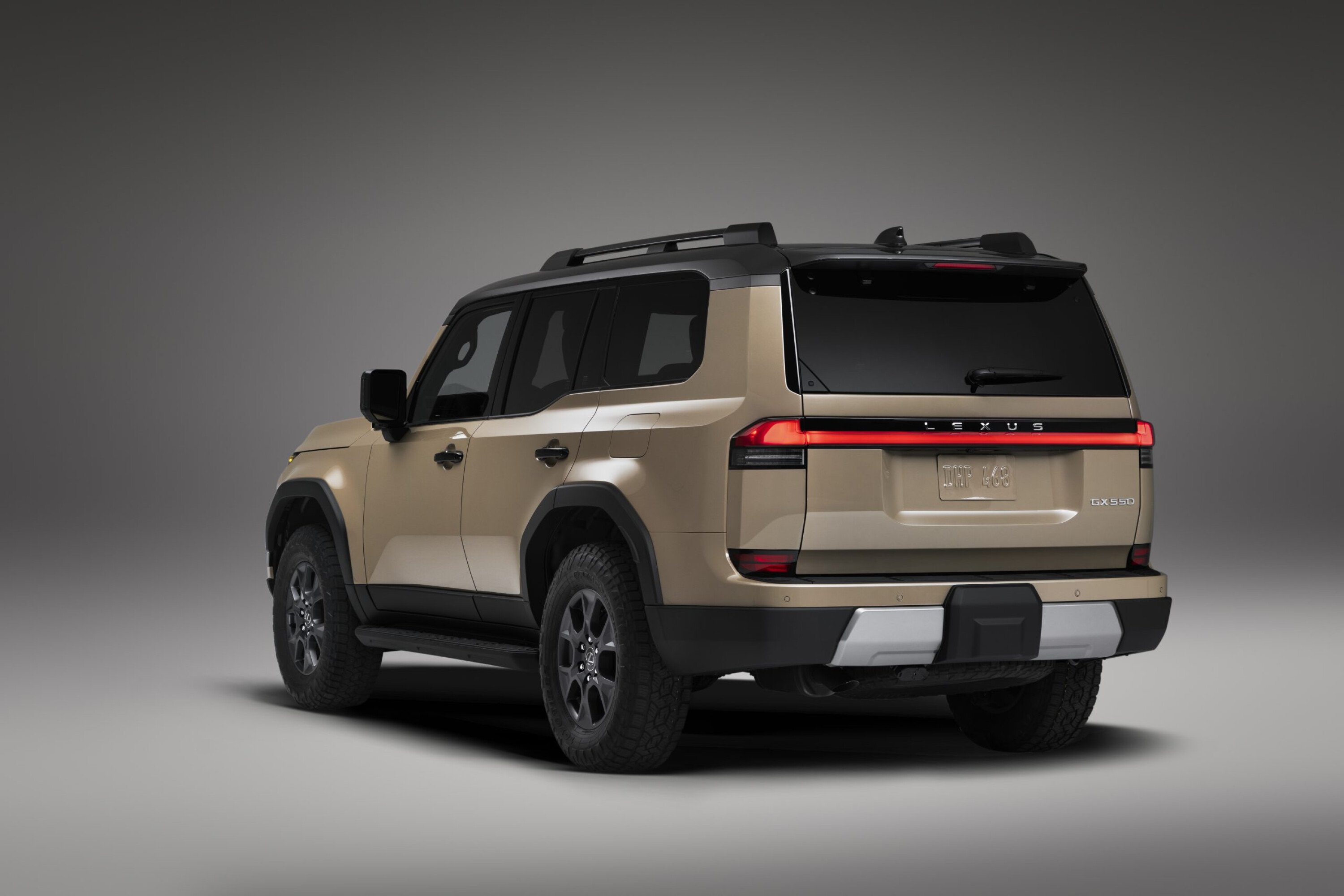
As standard, the GX will be offered with seven seats.
The off-road-focused Overtrail – exclusively available with five seats – will be sold locally, with 33-inch all-terrain tyres, 18-inch alloy wheels, and black extended wheel arches.
It also offers an aluminium skid plate, an electronic locking rear differential, and the E-KDSS system first introduced on the LandCruiser 300 GR Sport.
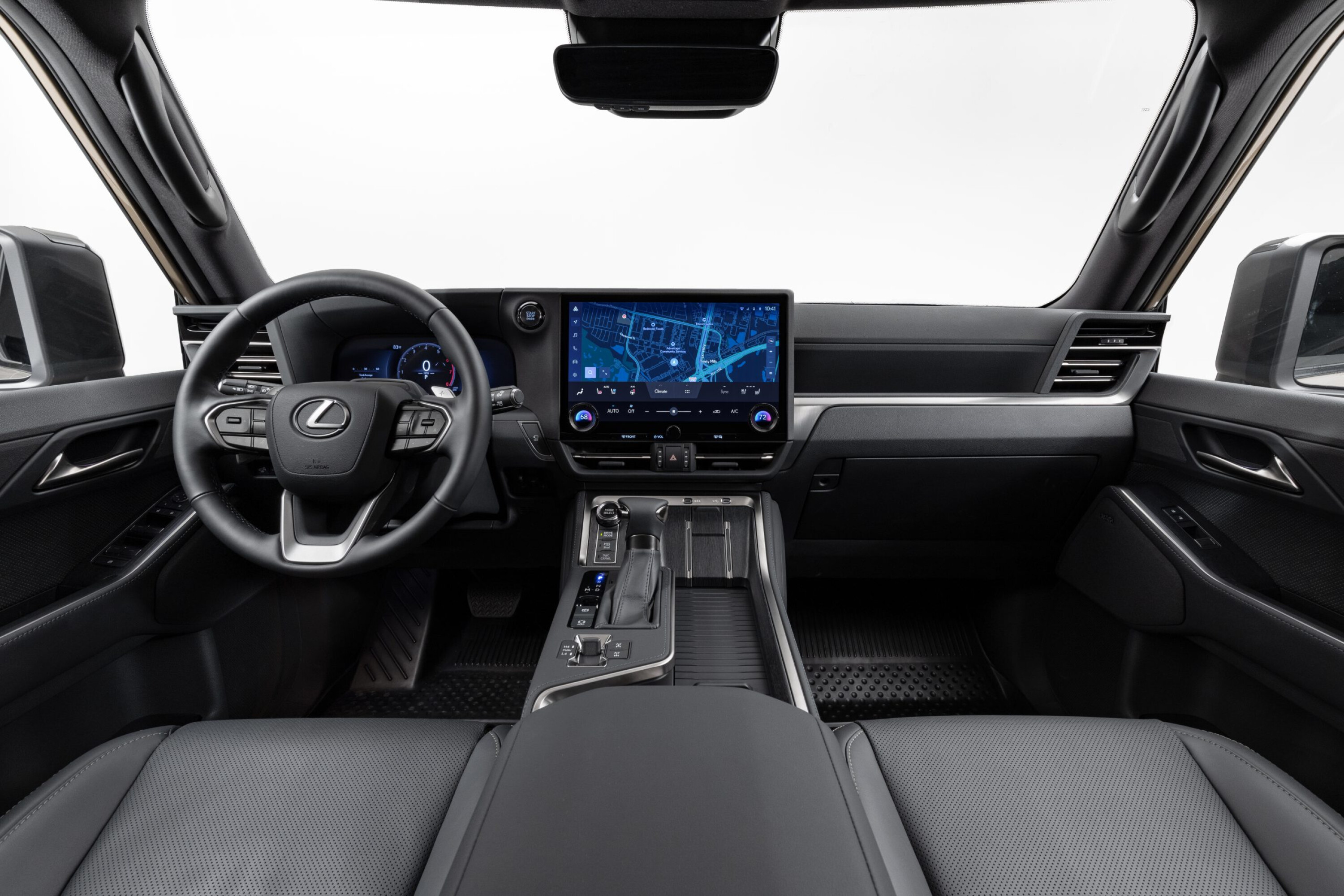
With the demise of the seven-seat Lexus RX L, the GX provides Lexus’s local arm with a more-affordable three-row SUV positioned below the larger, Toyota LandCruiser 300-based LX.
As such, it also helps to fill the difference between the RX and LX, with a circa-$27,000 gap from the flagship RX550h to the entry-level LX500.