
Some of you might remember Murray Brooks’ super-neat, cherry-red extra-cab GU Patrol we featured a few years back. It’s one of the best and most well set-up old-school Patrols in recent memory.
With a booming business designing and fabricating trays and canopies at Trig Point, and a growing family, the old GU just wasn’t going to service Murray’s future needs.
“I was looking for a car with similar capability as the Patrol, yet more seats and space,” Murray told us. “I considered building a dual cab version of the Patrol, yet time was tight and tidy 4,8 patrols were getting harder to find. We considered a 79 dual cab, yet as a business display vehicle they are very common and can be a lot of work to set up as a comfortable tourer. I also looked at everything from ute converted 200 series to American trucks.”
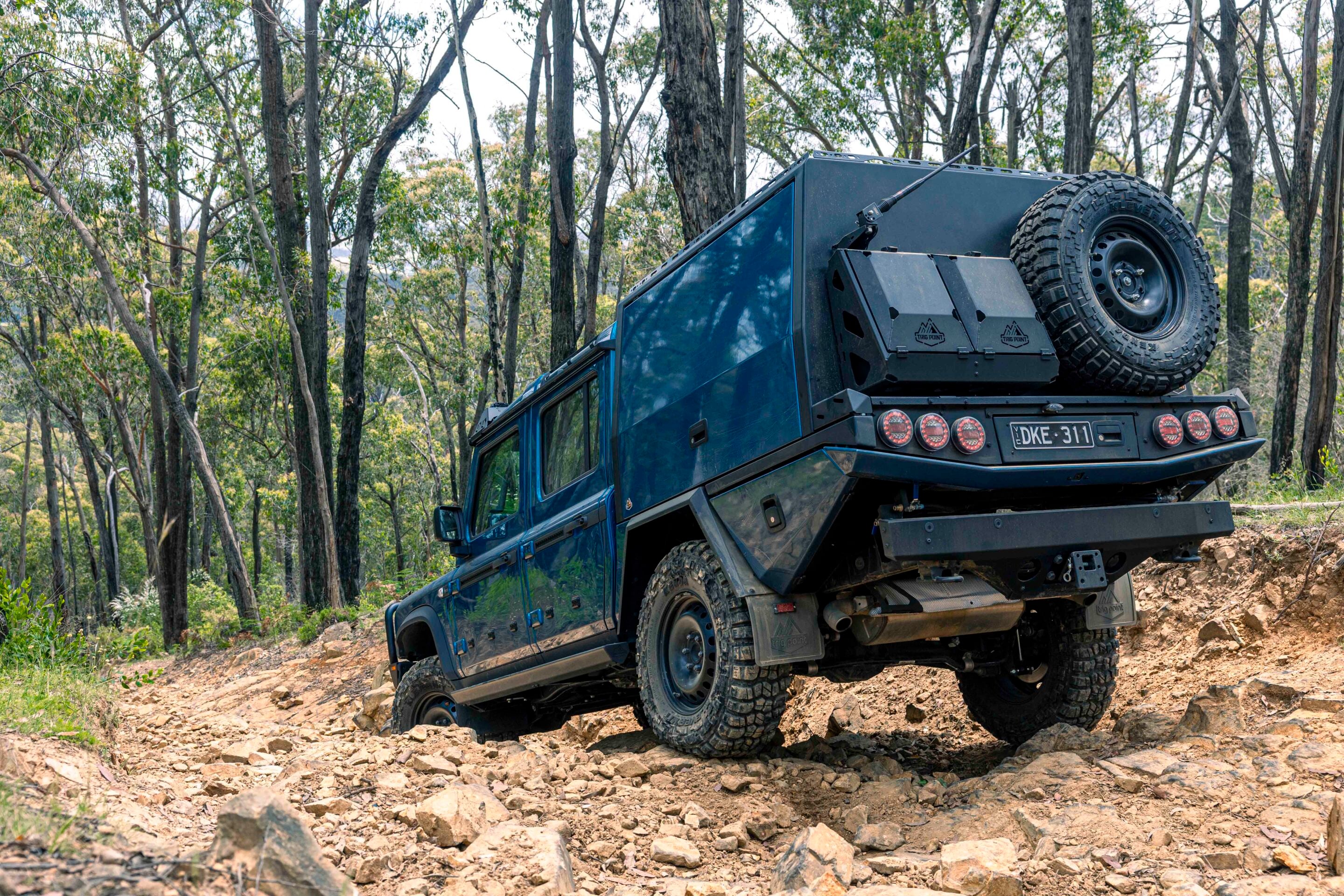
Casting his engineer’s eye over all the available options, Murray eventually settled on the then-new Ineos Quartermaster.
“It is large enough for family touring, yet small enough to still fit comfortably down High Country tracks,” said Murray. “I also really admired Ineos’ goals of bringing back some of the capability and durability which has been lost from some modern 4x4s.”
Why the Quartermaster Trialmaster was chosen
Murray chose his Quartermaster in Trialmaster specification, as it comes with much of the off-road hardware he wanted in a family 4×4.
“Live axles, factory diff locks, snorkel and coil springs all round. They (Ineos) have partnered with great manufacturers from BMW to Recaro and Magna Steyr to put together a unique vehicle,” Murray says.
He chose the diesel option of the BMW inline six-cylinder engine, which is vastly different to the 4.8-litre inline six in his old Patrol. Backed by an automatic transmission and dual-range transfer case, the driveline didn’t require any modifications for the style of off-road touring that Murray enjoys.
Bespoke canopy
Of course, the Quartermaster was going to serve as Trig Point’s development mule for its products and, while Murray was at work designing on the computer, the ute got by with a cut-down Toyota tray on the back.
“With such a unique shape to the vehicle, we had to develop a new canopy size to suit it,” recalled Murray. “Ineos has a unique way of doing everything from tray mounts to lights.”
This made it a significant job and investment for Trig Point, especially when you consider the size of the Ineos market compared to other utes on sale. The size and shape of the vehicle also required extra attention, with a larger-than-usual design.
“We settled on a 1790 tray base, which is longer than our standard 1700 dual-cab size, and a much more upright stance to match the Ineos cabin,” Murray told us. “We went with a 1550mm tray-mounted canopy on this.”
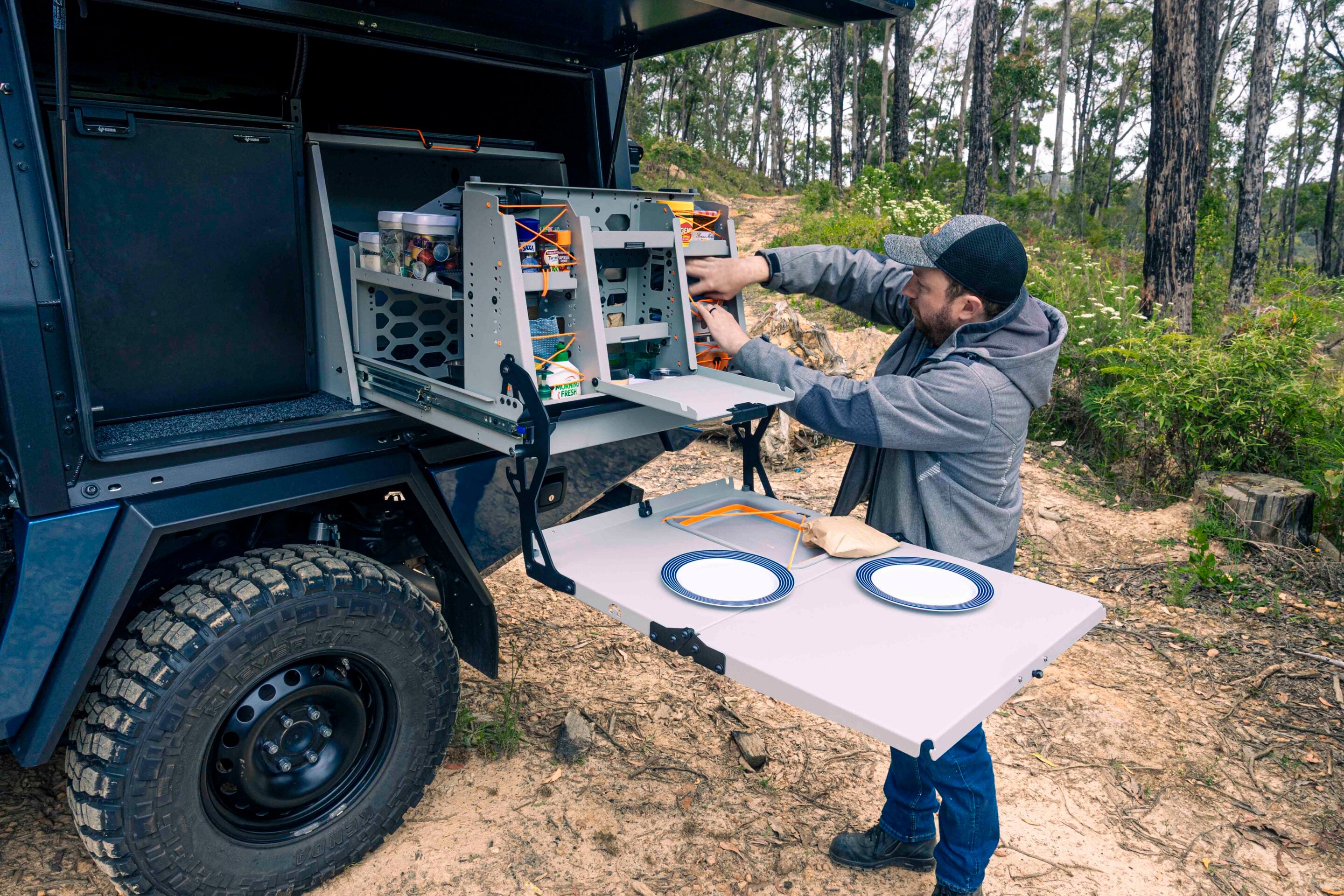
Inside the canopy is a showcase of Trig Point’s clever workmanship. There’s a trig Point fold-out kitchen with wash basin, Travel Buddy oven, fold down table and extra storage space.
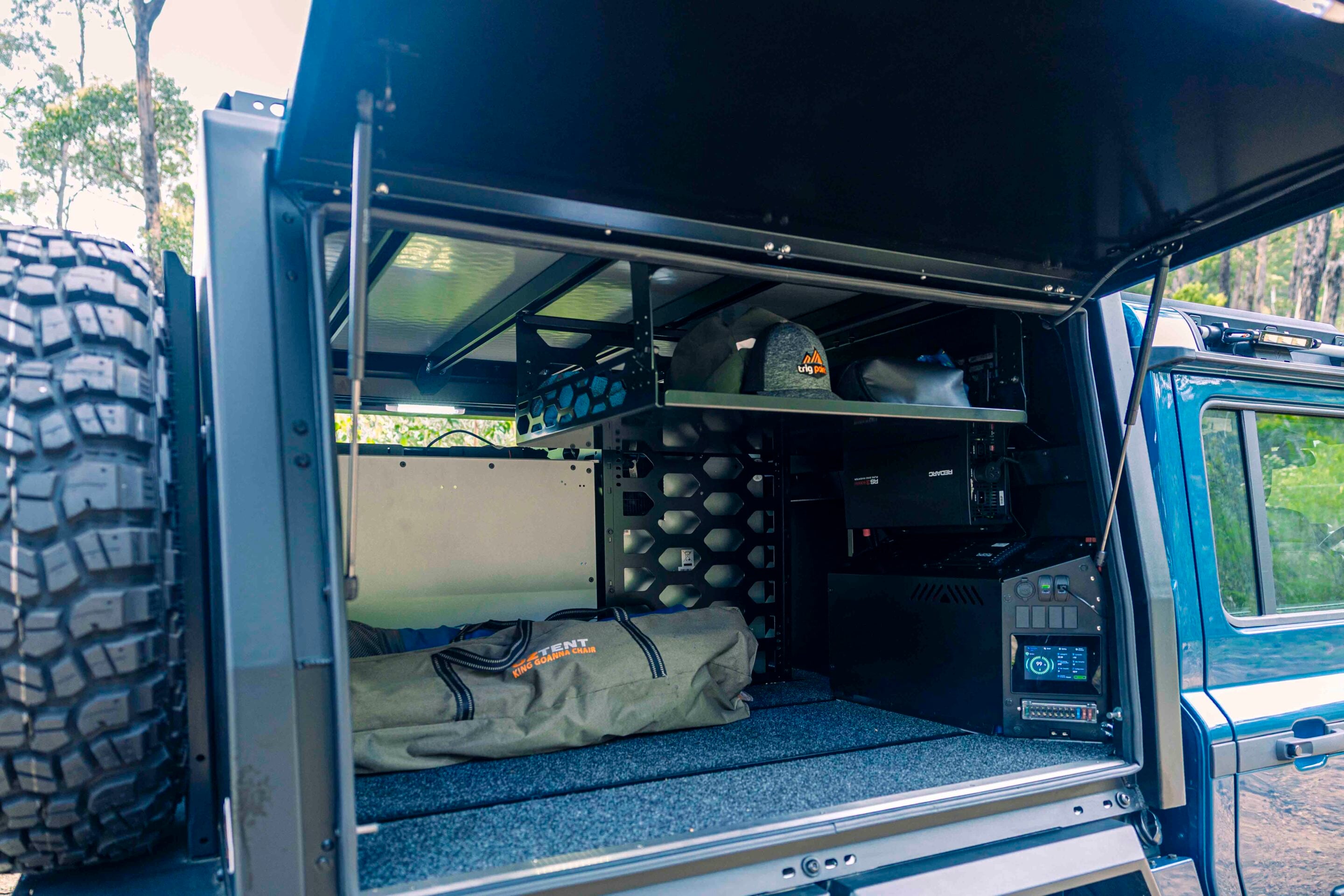
The Trialmaster runs a dual-battery system as standard, but Murray has added a third battery in the canopy to power the inverter and accessories. This is a 200Ah Invicta Xero lithium unit charged via a 50A Redarc DC-DC charger and feeding a Redarc 2000W inverter.
While the passenger’s side of the canopy is taken up by the Bushman fridge and kitchen setup, the driver’s side is left with more space for carrying additional gear when needed.
Underslung toolboxes house the ARB air compressor and hoses, while a trundle drawer at the rear provides additional secure storage. As you’d expect from the owner of Trig Point’s personal four-wheel drive, the canopy is a well thought-out and comprehensive setup. A pair of jerrycan holders are mounted to the rear of the canopy alongside a spare wheel and tyre, while a 50-litre water tank is mounted underneath and fed to the tap via an electric pump.
The rest of the build
The canopy for the Ineos was second nature to Murray and the team at Trig Point, but there’s plenty more involved in creating a competent off-road family tourer.
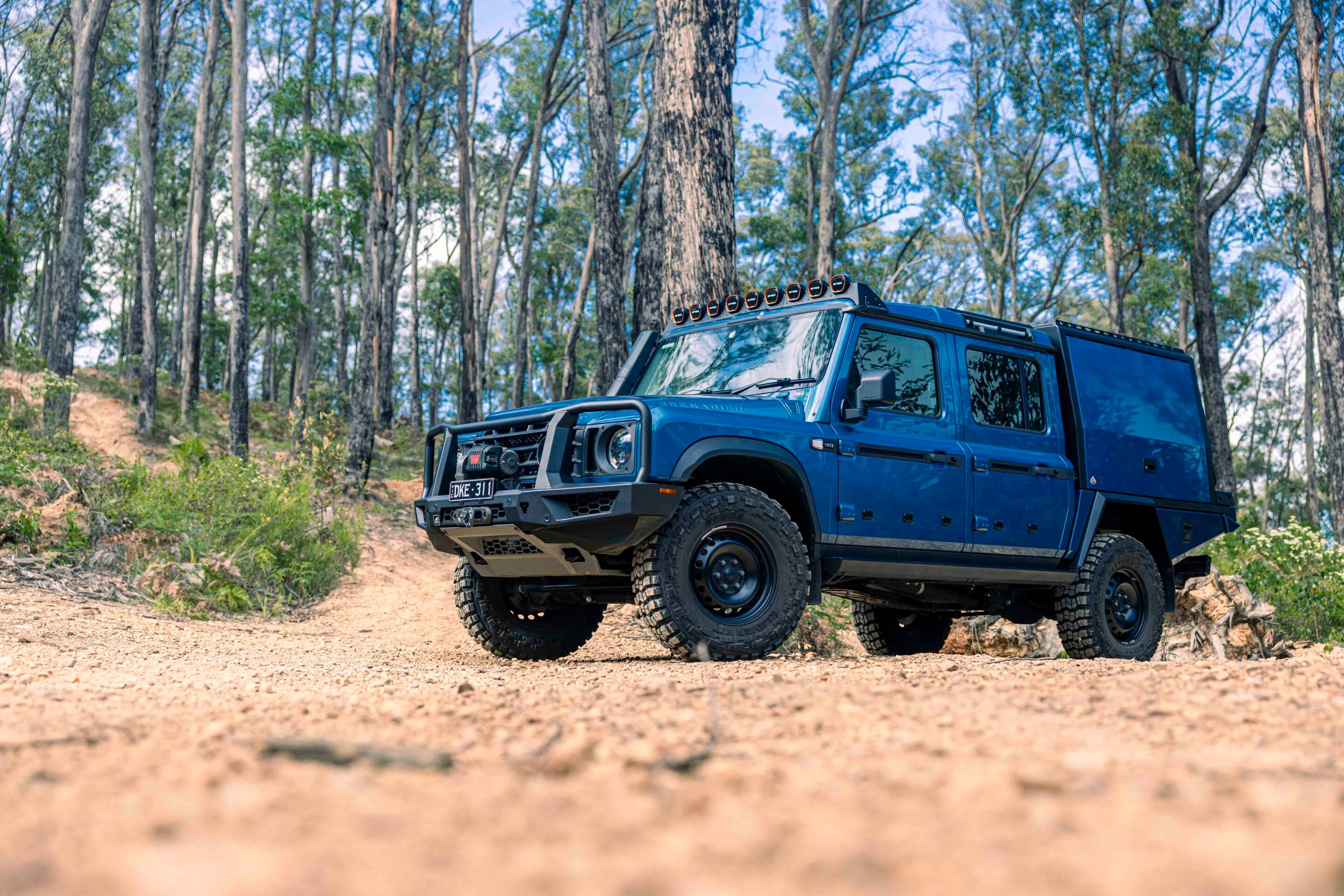
While Ineos delivers a solid base to build on, and the standard locking differentials and dual-battery system help, there’s always more to be done. A set of 35×10.5 Kenda mud-terrain tyres were fitted to the stock Ineos steel wheels, giving the vehicle that tall-and-skinny look. Underneath, Murray opted for a set of 50mm taller Dobinsons coils and Fox Racing 2.0 shocks.
There are very limited choices for bullbars and protection equipment available for Ineos vehicles, so protecting Murray’s Quartermaster came after working with local suppliers and designing and making his own. The bull bar is a Toro bar from local manufacturer Offroad Animal but it was modified to accommodate the Warn 8274 high-mount winch.
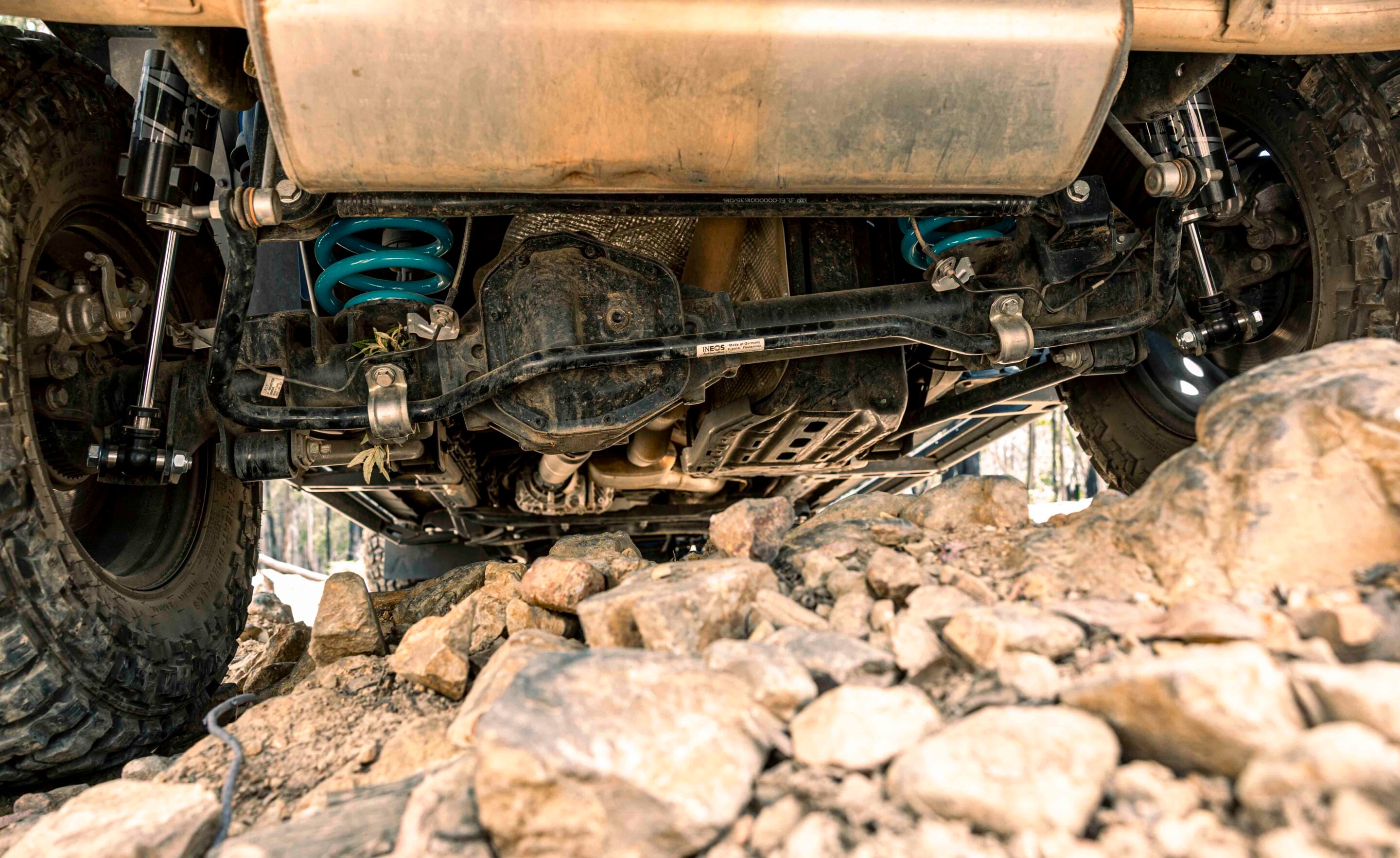
“The factory winch option on the Ineos only has 10m of usable rope, which really isn’t enough,” said Murray. “With the high-mount winch I get 45m-plus of usable rope and a nice fast line speed.”
More custom fabrication was needed when looking for side steps and sliders for the vehicle, and this was done in-house at Trig Point.
“We haven’t done side steps before, so we developed these simply because we couldn’t get anything we liked. They ended up being a great combination of steel and alloy – as strong as a rock slider, yet as light as a protection step.”
Build summary
There’s more custom fabrication from Trig Point up on top of the vehicle.
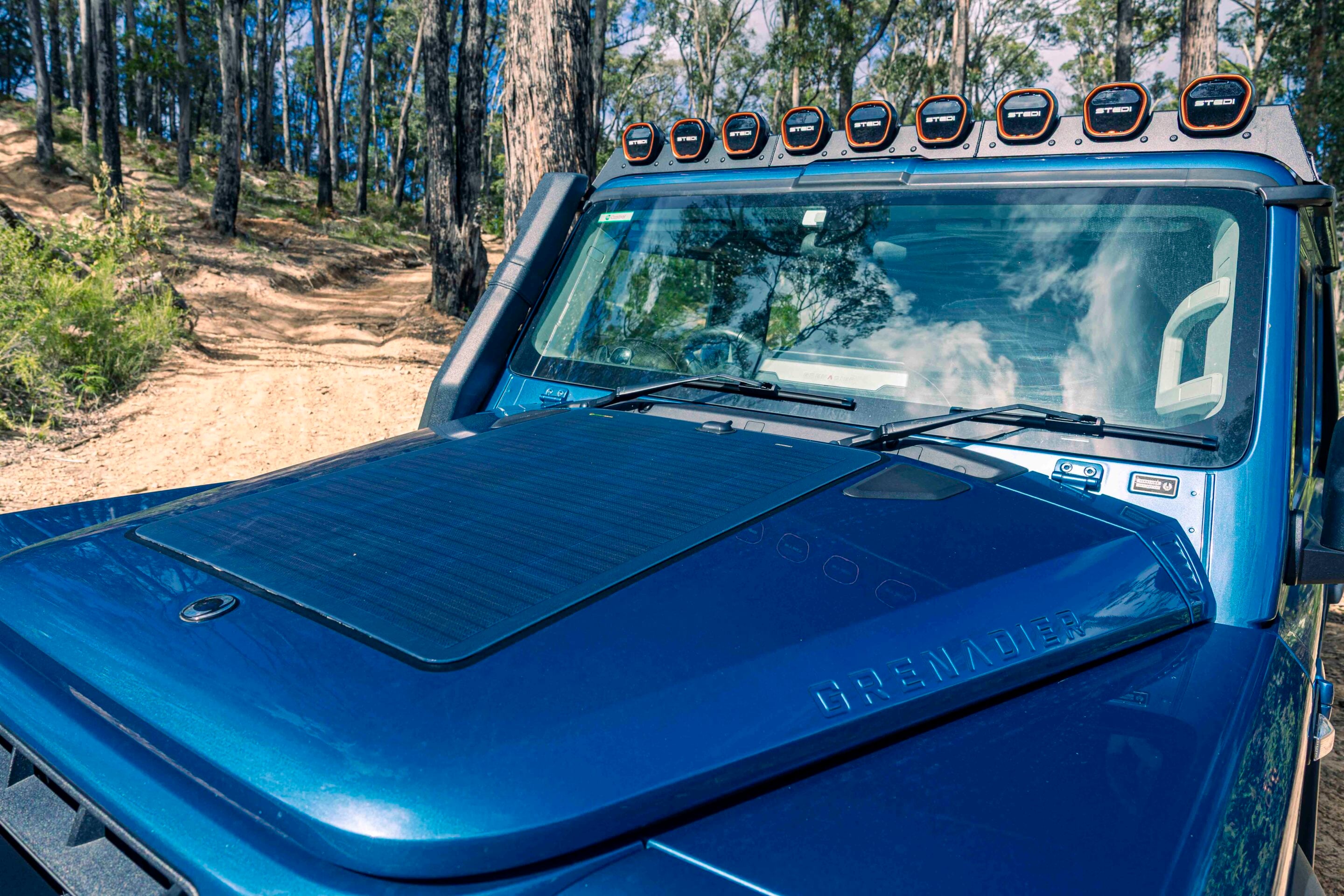
With the bullbar modified to accommodate the high-mount winch, it limited the space available for mounting driving lights, so Murray went to the roof where he designed and fabricated a housing for nine Stedi Evo Mini driving lights. Stedi Micro-Touch work lights are used down the sides, and they are all wired in using the pre-wiring included in the Ineos and the switches in the roof console.
The challenges of building a relatively new vehicle, and the limited products available for it, were partly overcome by having a world-class manufacturing team to assist with the build. Murray’s forethought and expertise have allowed him to create a vehicle that ticks all the boxes for family adventures while also showcasing the excellent work done at Trig Point.
All accessories and modifications
- Toro bull bar from Offroad Animal, modified to accommodate a Warn 8274 high-mount winch
- Warn 8274 high-mount winch
- Roof-mounted driving light housing (Trig Point custom fabrication)
- 9× Stedi Evo Mini driving lights (roof-mounted)
- Stedi Micro-Touch work lights (side-mounted)
- Trig Point custom side steps (steel and alloy construction)
- Trig Point custom tray-mounted canopy
- 1790mm tray base (custom development)
- 1550mm tray-mounted canopy
- Fold-out canopy kitchen system (wash basin, Travel Buddy oven, fold-down table, extra storage)
- Bushman fridge
- Underslung toolboxes (including ARB air compressor and hoses)
- Rear trundle drawer (canopy storage)
- Rear-mounted jerry can holders
- Rear-mounted spare wheel and tyre
- 50-litre underslung water tank with electric pump system
- 35×10.5 Kenda mud-terrain tyres
- Dobinsons coil springs (+50mm lift)
- Fox Racing 2.0 shock absorbers
- Third auxiliary battery (200Ah Invicta Xero lithium)
- 50A Redarc DC-DC charger
- Redarc 2000W inverter
- Custom electrical integration using factory pre-wiring and roof console switching system
Budget-focused 4×4 utes are the flavour of the month, as new brands flood into the Australian market, each wanting a slice of the lucrative and popular 4×4 ute pie.
Our favourite budget 4×4 ute has for a long time been the SsangYong – now KGM – Musso. We’ve liked it not just for being more affordable than most of its more popular competitors, but also for its simple and rugged construction and its ability to get the job done without fuss or fanfare.
Despite being eight years old now, and after a mid-life refresh, the current Musso has stuck to its guns and still delivers on what it promises.
To see how the KGM Musso stacks up against the latest competitors in the segment, we’ve paired it with one of the newest 4×4 utes (at the time of writing), the MG U9 pick-up in its top-spec configuration, the U9 Explore Pro, which retails for $61,000. Likewise, our KGM Musso Ultimate XLV is also the top-spec variant, but it comes in at a more affordable $53,000.
JUMP AHEAD
KGM Musso Ultimate XLV
The XLV in the model name designates a longer wheelbase and tray, with an extra 300mm of tub length, stretching to a huge 1600mm. The wheelbase is increased by 210mm, which leaves a bit more overhang at the back.
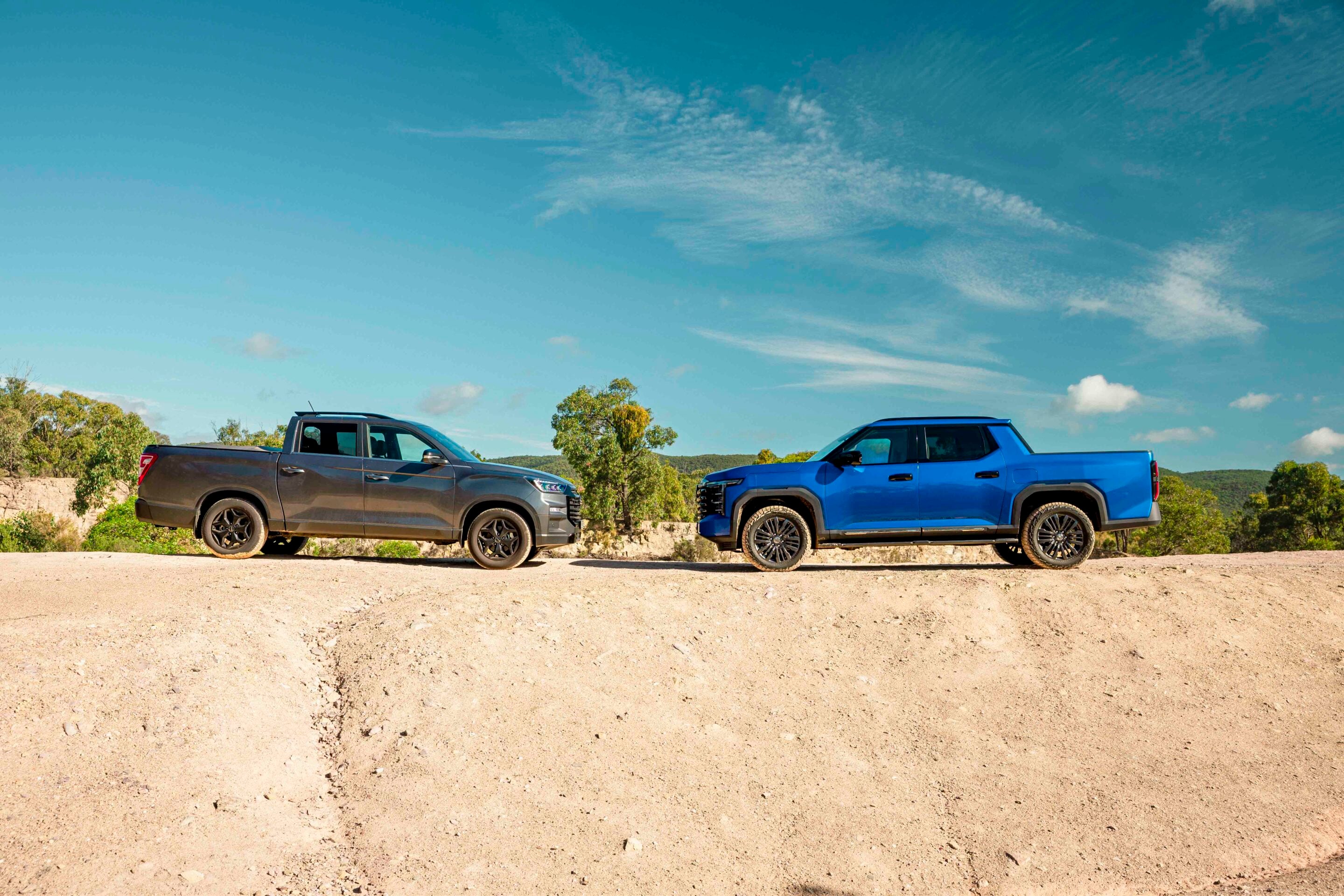
The XLV might be the longer of the Musso utes, but it looks small when parked next to the MG U9. The Chinese-made MG measures 5500mm long, 2265mm wide and 1874mm tall, while the Musso XLV comes in at 5415mm long, 1885mm wide and 1810mm high. It doesn’t help that the MG looks as though it was styled using Lego bricks. It’s big and brash and demands attention, while the Korean-made Musso appears more refined and stylish.
Musso powertrain and performance
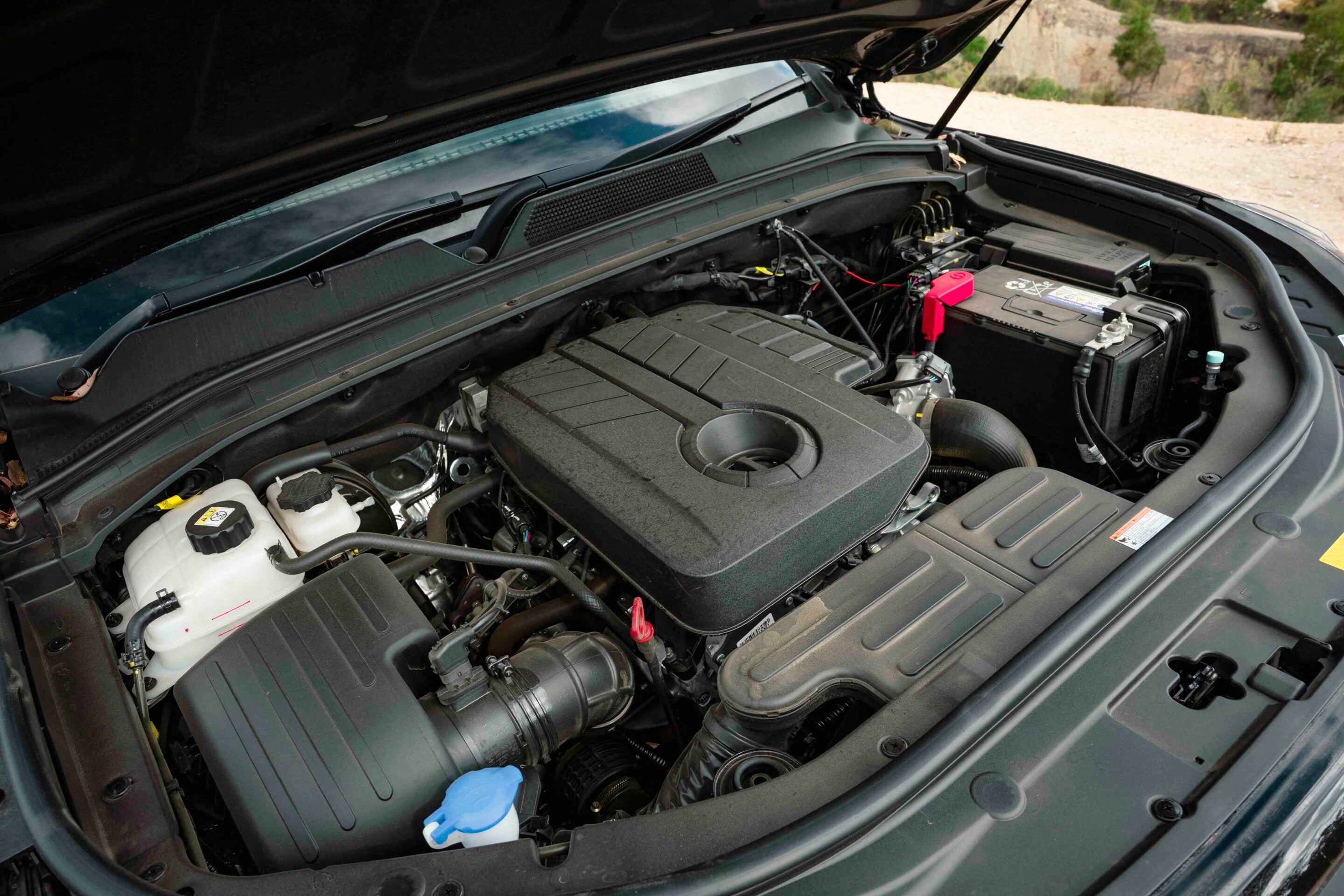
Under the bonnet of the Musso is KGM’s 2.2-litre single-turbo diesel engine that makes a claimed 133kW at 4000rpm and 400Nm of torque.
It’s not a powerhouse, but paired with the six-speed automatic transmission and part-time dual-range 4×4 system, it’s adequate for what’s needed. The rear differential is an auto-locker that senses wheel slip and locks when needed; there is no driver-selectable diff lock for off-road use.
We’ve done plenty of miles in these over the years, on all sorts of tracks and terrain, and have never had a fault to mention. It’s dependable, capable and will do most of what any owner will ask of it.
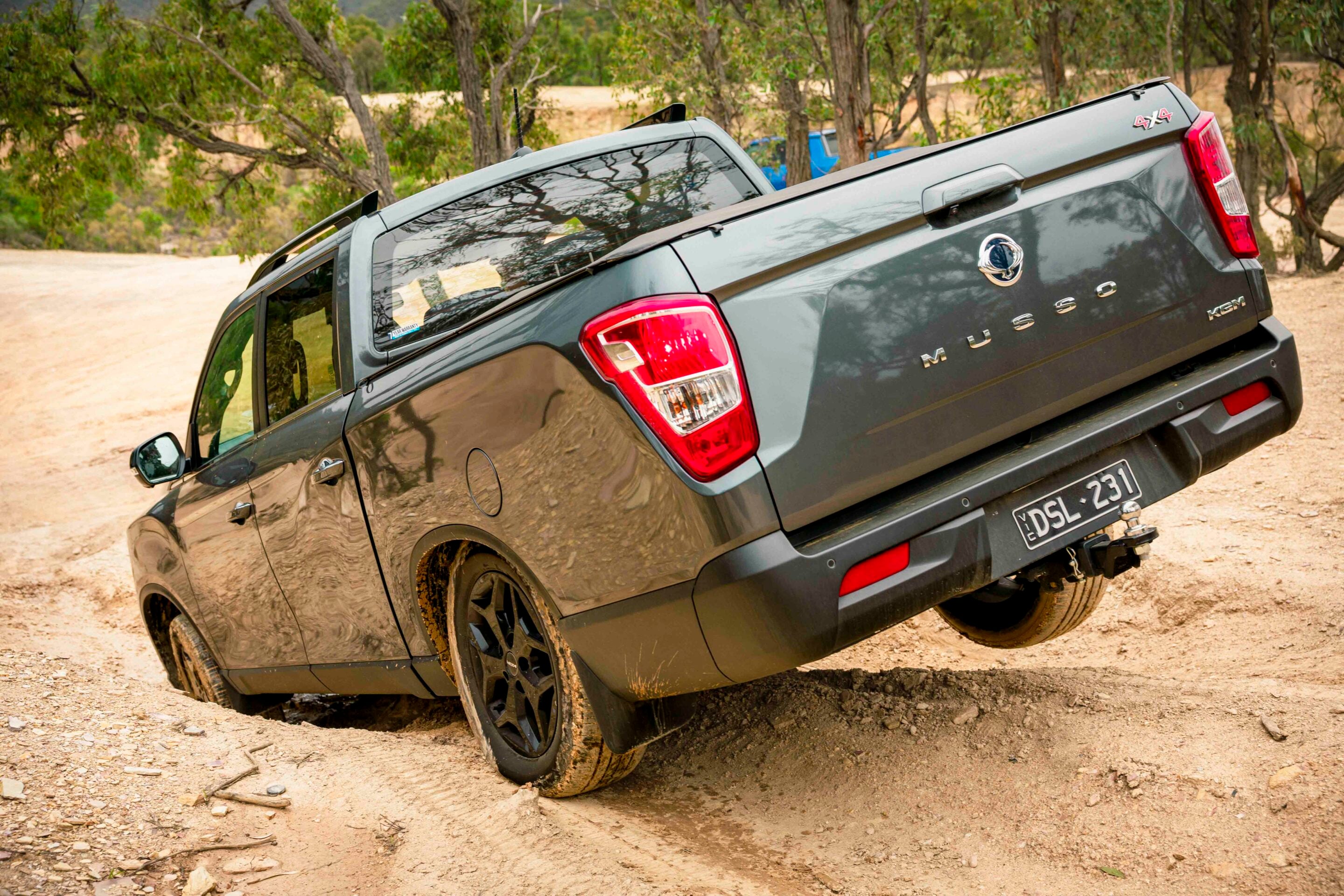
The wide cabin and tray ride on a ladder-frame chassis with an IFS front end and a live axle under the back. The Ultimate-grade Musso gets a multi-link coil-spring arrangement here, as opposed to the leaf springs under the back of lower-grade Mussos, and it works well on both sealed and gravel roads.
The Musso is a delight to drive on-road, be it for daily chores or heading out of town. The spacious and well-equipped cabin makes for comfortable travel, and the added features in the Ultimate bring a touch of luxury to the ride. The Musso’s wide stance gives it a solid grip on the road, making it a sweet touring vehicle, while the powertrain gets along well enough, even if it isn’t the gruntiest out there.
Off-road, the Musso is like most midsize utes in that its IFS lifts wheels easily, losing grip at the front end. The rear tyres stay planted; however, the ETC is slow-acting and the vehicle has an auto-locking rear diff instead of a driver-activated one. This means it needs to spin the wheels before it locks the axles, which could be the split second between getting stuck or not. With a driver-activated diff lock, it could be engaged before the obstacle, resulting in cleaner, safer and easier progression.
A huge plus for the Musso is the range of Australian-developed off-road accessories available from Ironman 4×4. The kit includes replacement suspension, which gives the vehicle more ground clearance – something that is certainly appreciated in the long-wheelbase XLV. This is a great partnership and the equipment can tailor your Musso for better performance, be it for work or off-road play. The 2100kg Musso Ultimate XLV has a 2880kg GVM, 6380kg GCM and a 3500kg towing rating.
It might be getting long in the tooth, but the Musso remains a great value-for-money proposition for a 4×4 ute. The 2027 Musso will arrive later in 2026 with a more modern look inside and out, and the rumour is that not a lot has changed under the skin – and that’s a good thing for the enduring Musso.
| Musso off-road specs | |
|---|---|
| Departure angle | 25 |
| Rampover angle | 20 |
| Approach angle | 29 |
| Wading depth | 550mm |
| Ground clearance | 220mm |
Musso interior
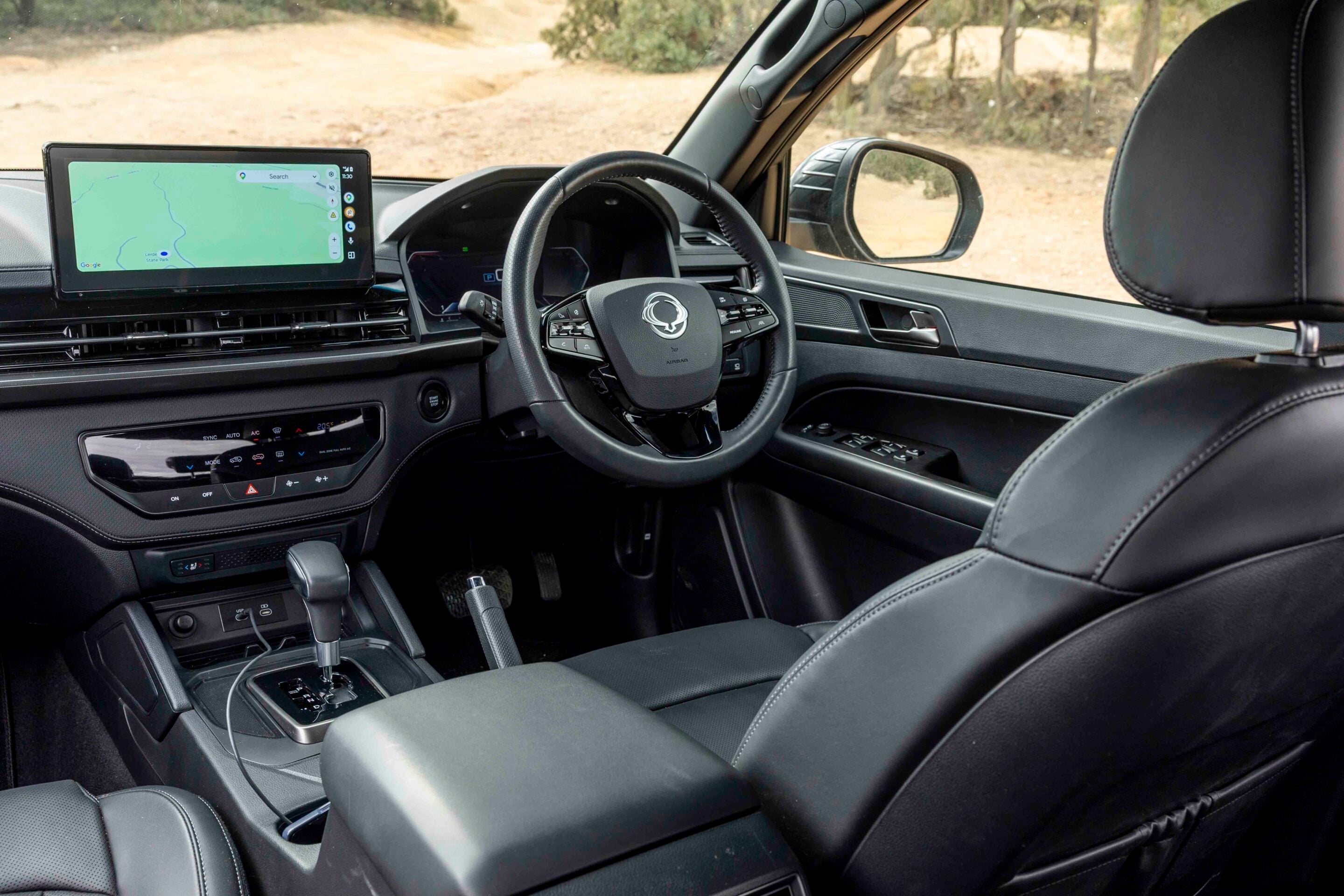
The Musso’s cabin was the widest in the class when the model debuted and, even though newer vehicles have matched it, we still appreciate the space it gives passengers in both the front and back.
The broad dashboard features 12.3-inch multimedia and driver’s display screens, the former offering Apple CarPlay and Android Auto connectivity, although Android is cable connection only. The multimedia screen is left largely black unless you connect to either of these third-party apps, but most users will subscribe to one or the other.
The seat trims are a leather-like material, and the front seats have power adjustment plus heating and cooling, while the rear pew offers heating for the outer positions. It’s a plain and unfussy cabin, but it’s not lacking anything you really want. The Musso features all the usual ADAS and safety systems you expect in 2026, plus a TPMS, which is more useful than most of the others.
Musso ownership and warranty
The Musso is covered by a seven-year, unlimited-kilometre warranty. Roadside assistance is available as part of KGM’s Travel Upgrade plan. Services are scheduled every 15,000km and are fixed-price as per the service schedule.
MG U9 Explore Pro
While the Musso might be showing its age, the U9 from MG is an all-new product for 2026. The platform, driveline and exterior design are shared with the LDV Terron 9, but there are some differences.
The reborn MG brand went about things a little differently to anything else in the market (except the LDV) when it came to designing its big utility. While it is a double-cab ute built on a ladder-frame chassis and powered by a four-cylinder diesel engine backed by an automatic transmission and a dual-range transfer case, things stray from the norm when you look under the skin.
MG U9 powertrain and performance
The U9 is powered by a 2.5-litre single-turbo diesel that MG claims is the most powerful in the segment, with a claimed 160kW and 520Nm coming from the four-cylinder engine.
They are big numbers, especially when compared to those of the Musso, but on the road and tracks it doesn’t feel that much more powerful than the established Korean ute. The engine is backed by a conventional eight-speed automatic transmission, a dual-range transfer case and triple locking differentials.
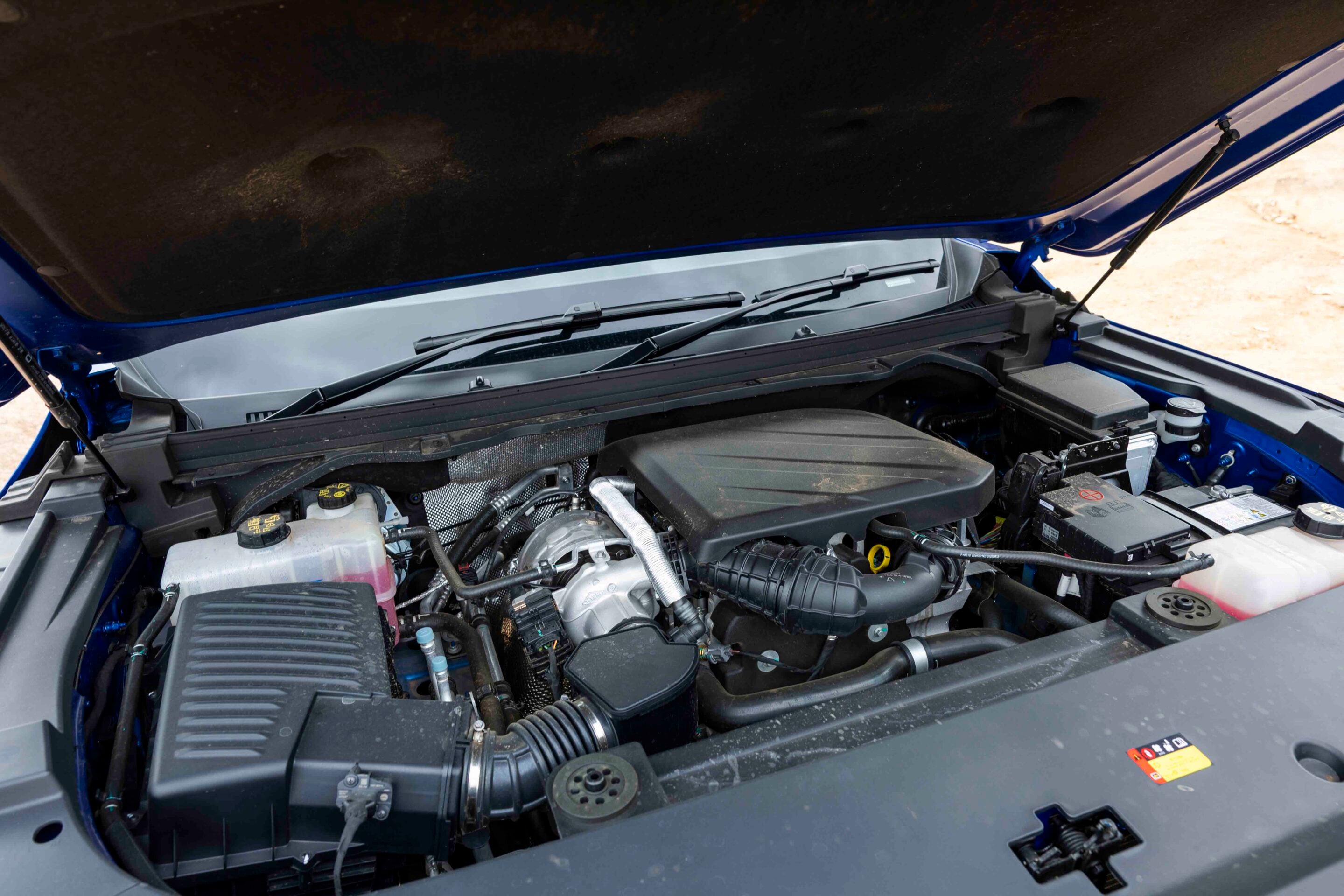
The diff locks are driver-activated after pressing a button on the console to bring up a menu on the screen to select the lockers. Strangely, there is no way to lock the centre diff in high range, which hobbles the MG on steep, loose tracks. The Explore Pro is the only model in the three-vehicle U9 range to get the locking front diff.
Another aspect of the U9 is its rear differential, which is part of an independent rear suspension set-up. While IRS set-ups are more commonly found under passenger cars and light-duty SUVs, where improved dynamics and comfort take precedence over load capacity, the U9 still manages a 3500kg towing capacity and a 770kg payload in the Explore Pro model, and up to 870kg in the entry-level Explore model. The rear axle under the U9 is rated to 1200kg.
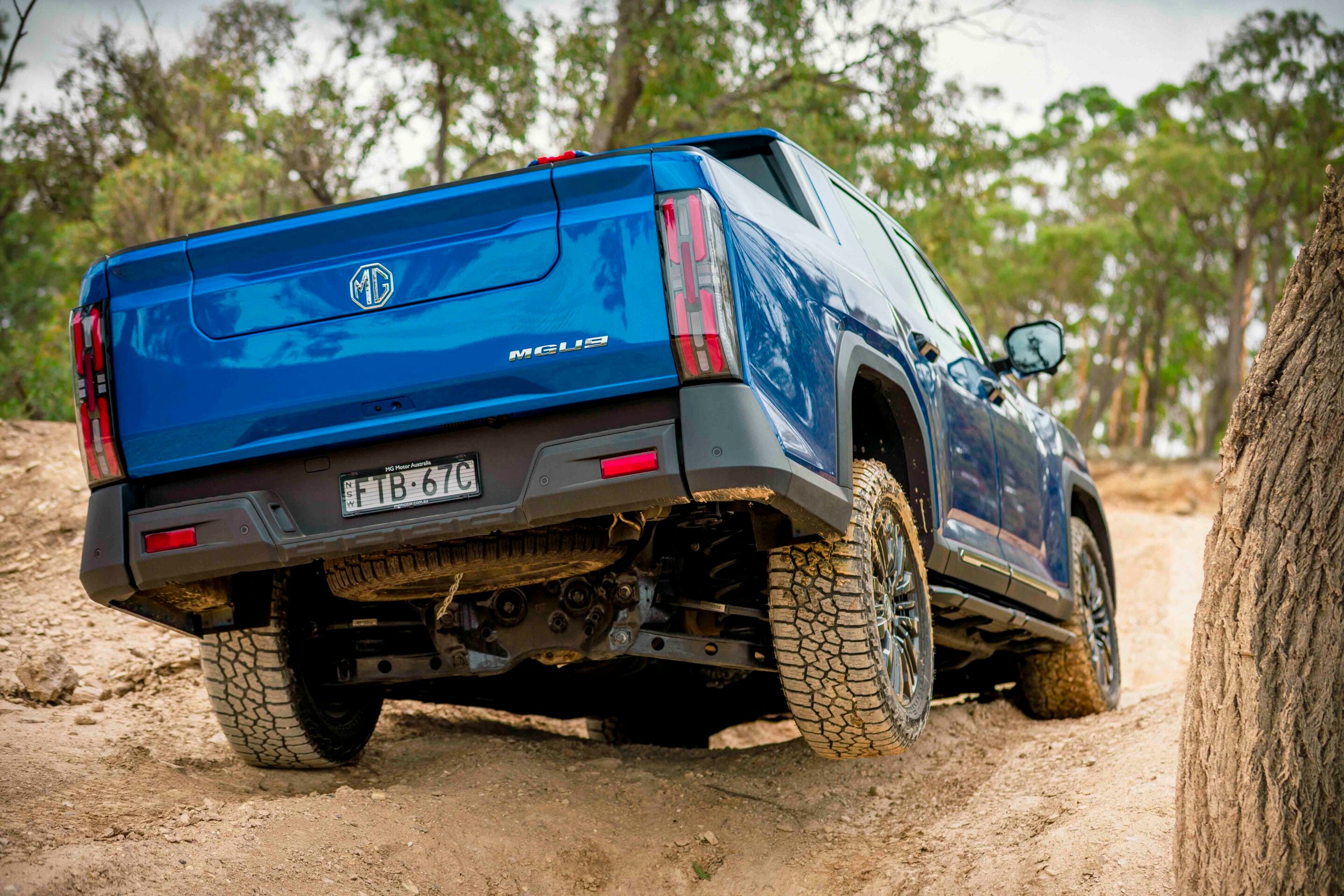
The front suspension is a conventional wishbone and coil IFS set-up.The short control arms of the IFS and IRS configuration severely limit wheel travel, so the U9 picks up its all-terrain tyres easily when off-road. The ETC is slow-reacting, so the U9 really needs its diff locks to tackle off-road terrain. When it’s all locked up, the U9 feels unstoppable. If you prefer gimmicks over lockers, the U9 offers eight drive modes for different track conditions, but they are made redundant by the locking diffs.
The short-travel suspension slams the tyres into potholes, giving a sometimes rough ride in the MG. The U9 Pro rides on 275/65R20 Falken Wildpeak tyres and, while we would normally stay away from 20-inch wheels and low-profile rubber for off-road use, the Falkens still have plenty of sidewall and give the ute a tougher look with improved off-road traction and durability.
| MG U9 off-road specs | |
|---|---|
| Departure angle | 23.4 |
| Rampover angle | 23 |
| Approach angle | 22.8 |
| Wading depth | 570mm |
| Ground clearance | 215mm |
MG U9 interior
The U9’s cabin is wide, spacious and loaded with equipment.
It’s probably one of the most tech-laden set-ups in any ute, but that’s not always a good thing, with some functions being overcomplicated. I found it annoying that some of the buttons on the console and HVAC controls still lead you to the multimedia screen to make your selection, rather than operating directly.
The front seats are leather-trimmed and are heated and ventilated, with power adjustment and massage for the driver. Front seat passengers are faced with a wide and bluff dashboard housing a pair of 12.3-inch screens, one each for the multimedia and the driver’s information.
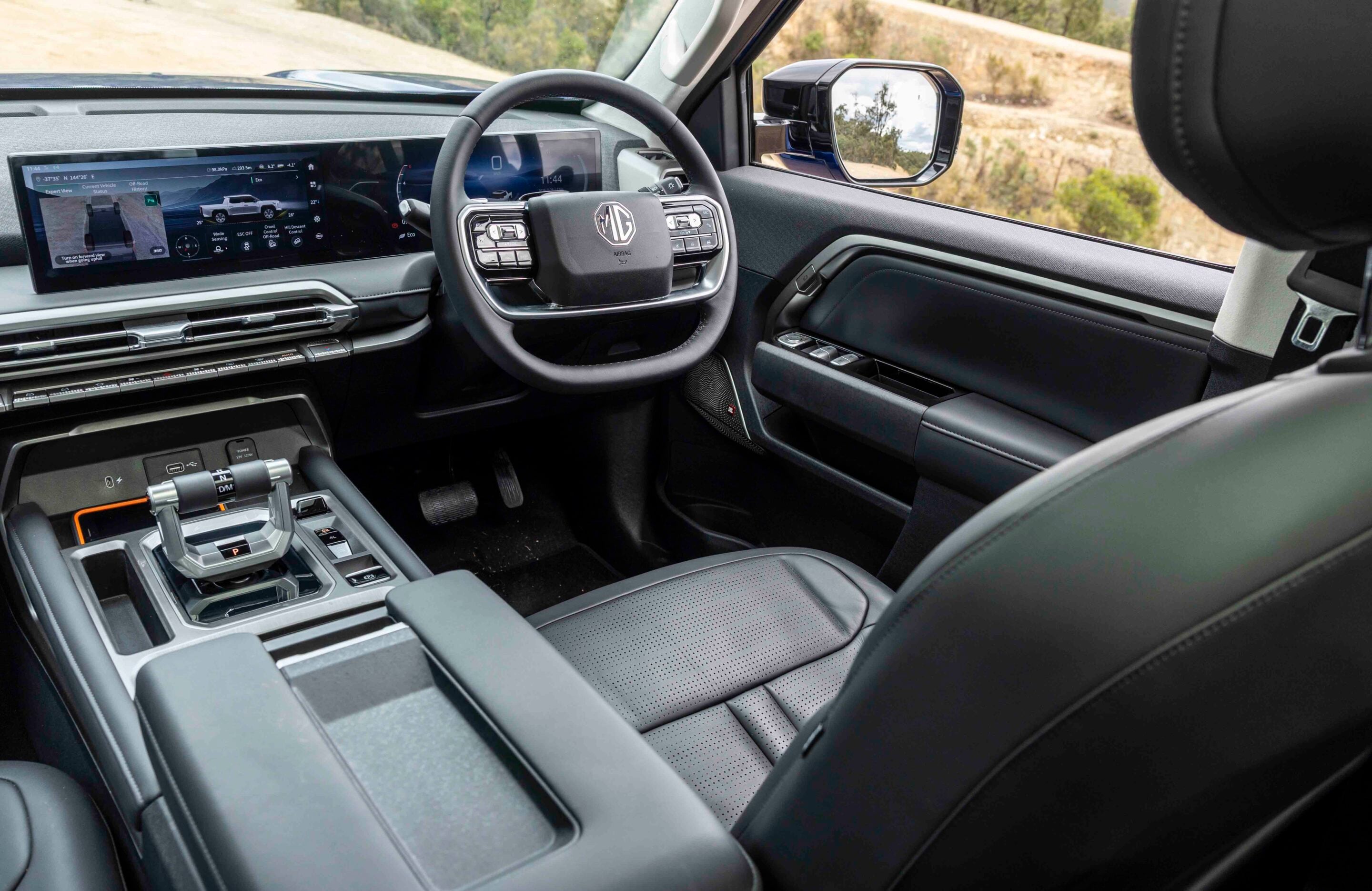
The digital rear-view mirror gives a poor and distorted view of what’s behind the U9 while driving. Luckily, the rear-view camera gives a clean and well-defined image on the multimedia screen when reversing the 5.5-metre-long ute. The back seat is likewise leather-clad and includes heating for the outer positions, as well as a recline function that gives a more comfortable seating position.
This is made possible due to the lack of a bulkhead between the cabin and the load bed. With no panel there, back seat users are able to open a flap between the folded rear seats and the tray to carry long items. It’s a useful feature that is unique in this category, made possible by the one-piece side panels running from the door pillars back to the rear of the tray. This also means that you can’t remove the cargo area to fit a tray or service body like you can on most other utes in the market.
MG U9 ownership and warranty
MG vehicles come with a seven-year, unlimited-kilometre warranty. This can be extended to 10 years or 250,000km (whichever comes first) for MG passenger vehicles intended for personal use, and up to seven years or 200,000km (whichever comes first) for MG light commercial vehicles, by completing scheduled servicing with an authorised MG dealer.
If you exceed these kilometre limits during the period of your standard warranty, the extended warranty will not apply. Roadside assistance is available, and service prices are fixed for the first 12 months.
Verdict
Sometimes it’s the simple things that do the best job. While the current KGM Musso might be getting old and is set for replacement later this year, it doesn’t miss out on anything you could want in a 4×4 ute, be it for work or play.
It’s a well-proven platform and drivetrain that includes all the safety and convenience features you would expect, and the ability to kit it up with off-road accessories from Ironman 4×4 puts it in a great place. Yes, the accessory range is limited, but it comprises a lot more than you will readily find for the MG U9.
The MG might be newer, bigger and certainly brasher, but the brand still has a way to go before it sorts its ute out. Some of the controls are overcomplicated, and other elements – like the digital rear-view mirror – feel like tech for tech’s sake and don’t work as well as simpler solutions.
The MG having front and rear locking diffs isn’t just a nicety in the U9 – it’s essential, as the slow ETC and short wheel travel would leave it compromised without them. Further refinement and development of the U9 platform will make it a killer 4×4 ute in the future, but for now the well-proven Musso gets our vote.
Specs
| KGM Musso Ultimate XLV | MG U9 Explore Pro | |
|---|---|---|
| Price | $51,550 drive away | $60,990 |
| Engine | I4 turbo-diesel | I4 turbo-diesel |
| Capacity | 2157cc | 2499cc |
| Max power | 133kW @ 4000rpm | 163kW @ 3800rpm |
| Max torque | 400Nm from 1400-2800rpm | 520Nm from 1500-2500rpm |
| Transmission | 6-speed automatic | 8-speed automatic |
| 4×4 system | Part-time 4×4 with high and low range | On-demand high-range 4×4 and locked low-range 4×4 |
| Construction | 4-door cabin and tub on separate chassis | 4-door cabin and tub on separate chassis |
| Front suspension | IFS with coil springs | IFS with coil springs |
| Rear suspension | Live axle, 5-link with coil springs | IRS with coil springs |
| Tyres | 255/60R18 on alloy wheels | 275/65R20 on alloy wheels |
| Kerb weight | 2090kg | 2450kg |
| GVM | 288kg | 3320kg |
| Payload | 1010kg | 770kg |
| Towing | 3500kg | 3500kg |
| GCM | 6380kg | 6500kg |
| Seating | 5 | 5 |
| Fuel tank | 75L | 80L |
| ADR fuel consumption | 8.6L/100km | 7.9L/100km |
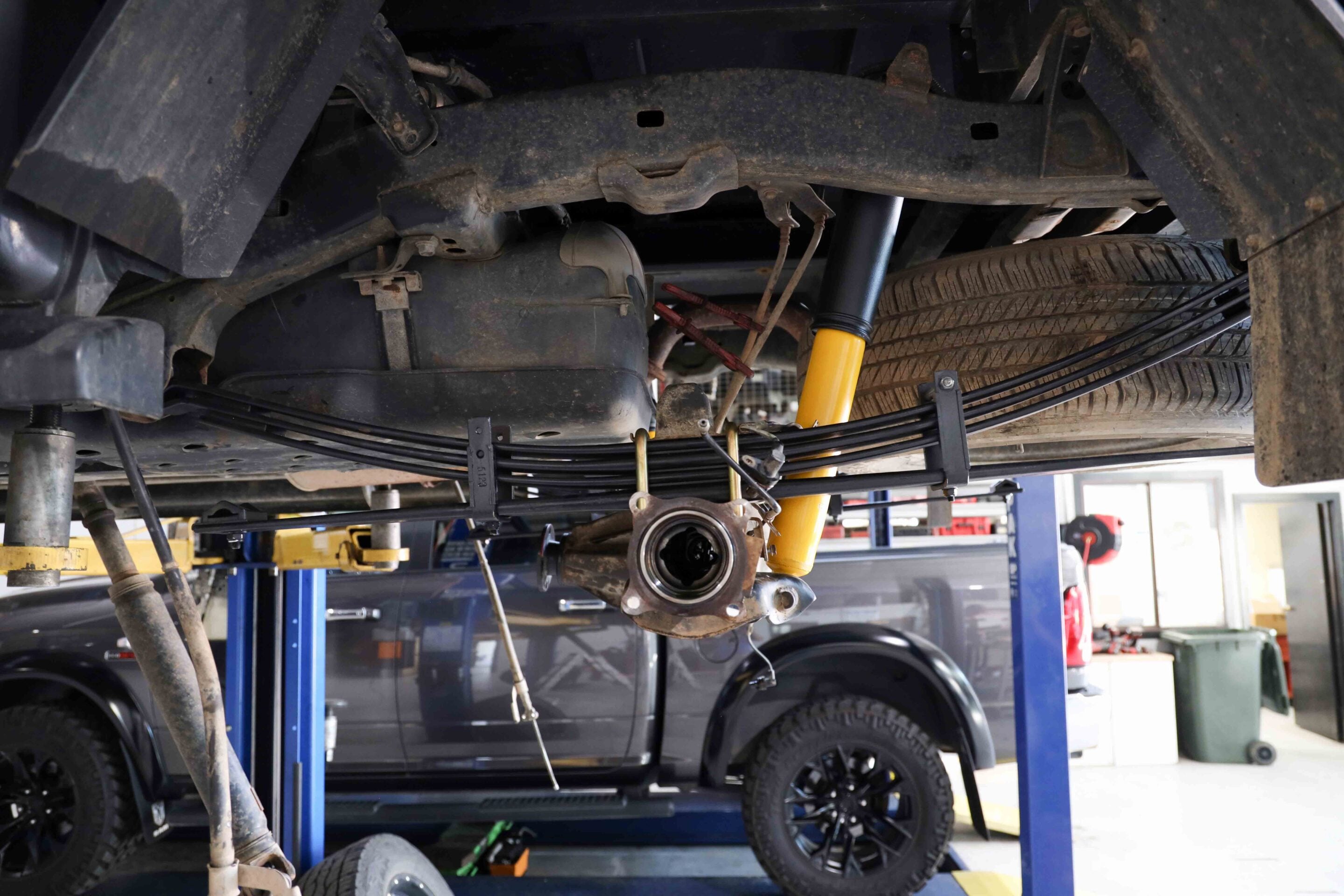
Given my success using Terrain Tamer front Smart coils (progressively rated coil springs) and rear parabolic leaves (progressively rated leaf spring packs), matched with their twin-tube shocks on my Troopy for nearly 10 years, it was an easy choice when it came time to fit suspension to my HiLux.
Yeah, I know there are plenty of higher-spec shocks on the market – monotubes, remote resi’s, bypass and adjustables – but I’m happy with the ever-reliable jack-of-all-trades twin-tube design. They work, and they’re reliable… simple!
Nope, there’s no way I’d step back in time to a standard semi-elliptic leaf spring pack, as per a horse-and-cart setup. Nor would I settle for a constant load rate in the coils. Having that progressive rate on both front and rear suspension helps iron out the smaller, low-speed thuds just as well as the heavier, high-speed hits, keeping the HiLux on track at all times – taming the terrain, as such!
Why I chose Terrain Tamer
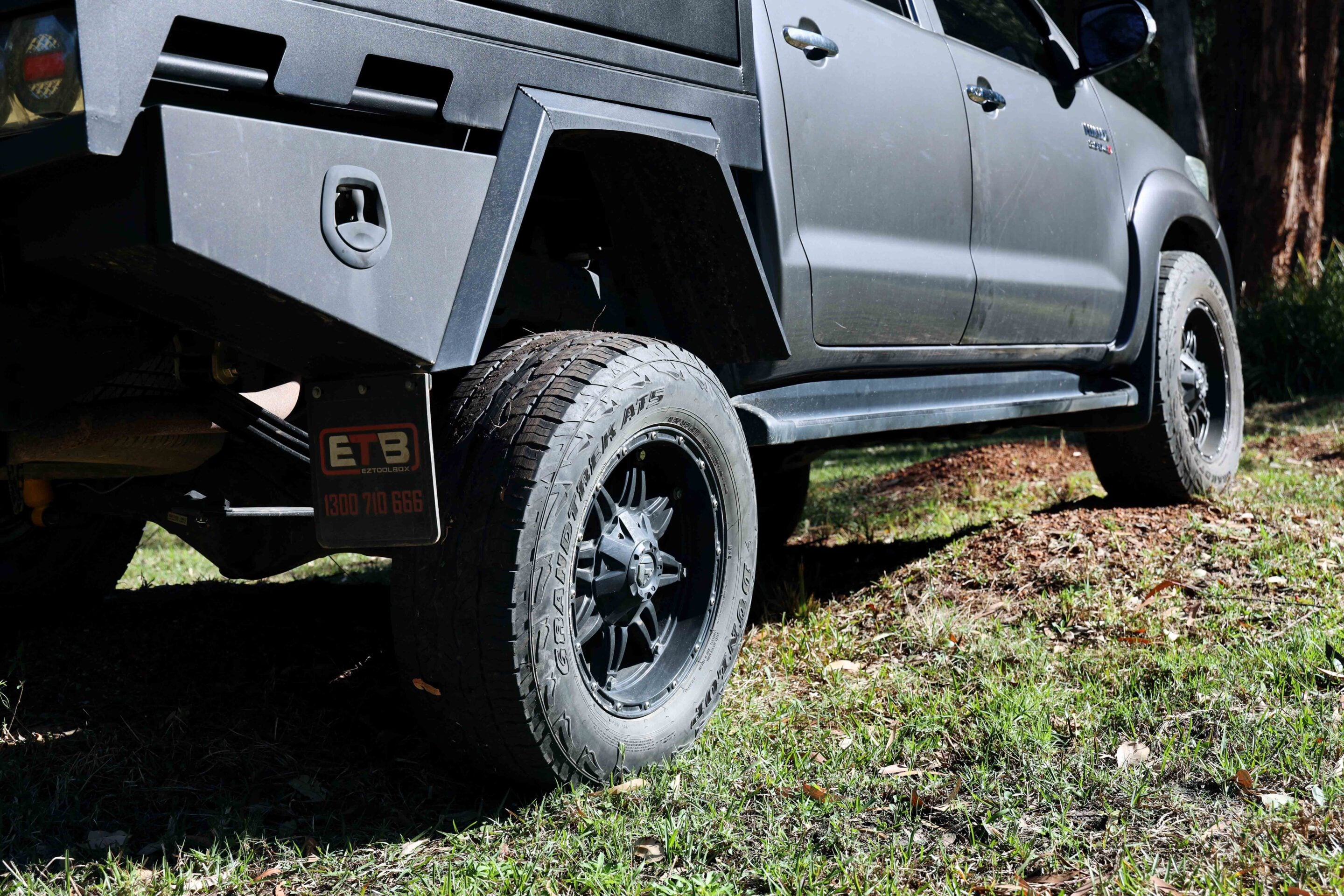
The Terrain Tamer kit I chose is rated to provide a 40mm lift with a load range of 400 to 700kg for the rear parabolic leaf packs. I also opted for the heavier-duty coil kit up front, rated for a 50–100kg load, to account for the bullbar and winch – more on that later.
When I purchased the HiLux, the condition of the existing aftermarket suspension was unknown. Yes, it was a quality Old Man Emu kit, but I didn’t know its load ratings or overall condition. Plus, it all looked low for my liking, suggesting it may have been a standard-height kit installed by the previous owner. Either way, the Terrain Tamer upgrade delivered a noticeable improvement in both ride height and stance.
Yeah, I know I should have added all the heavy gear to my HiLux before fitting the suspension. No, that didn’t happen! See, it turns out I’ve got a fair old wait ahead for my chosen bullbar to arrive. Same goes for the winch I wanted to run and test. Plus, the dual-battery system and general storage still need to be installed in the canopy.
Given that I know exactly what I’ll be adding weight-wise to both the front and rear, and how the HiLux will be used, I figured it was a safe bet to let the suspension jump the fitting queue. Besides, how long can a fella stare at mechanical presents sitting on the shed floor? The temptation was too much!
Heavy duty upper control arms
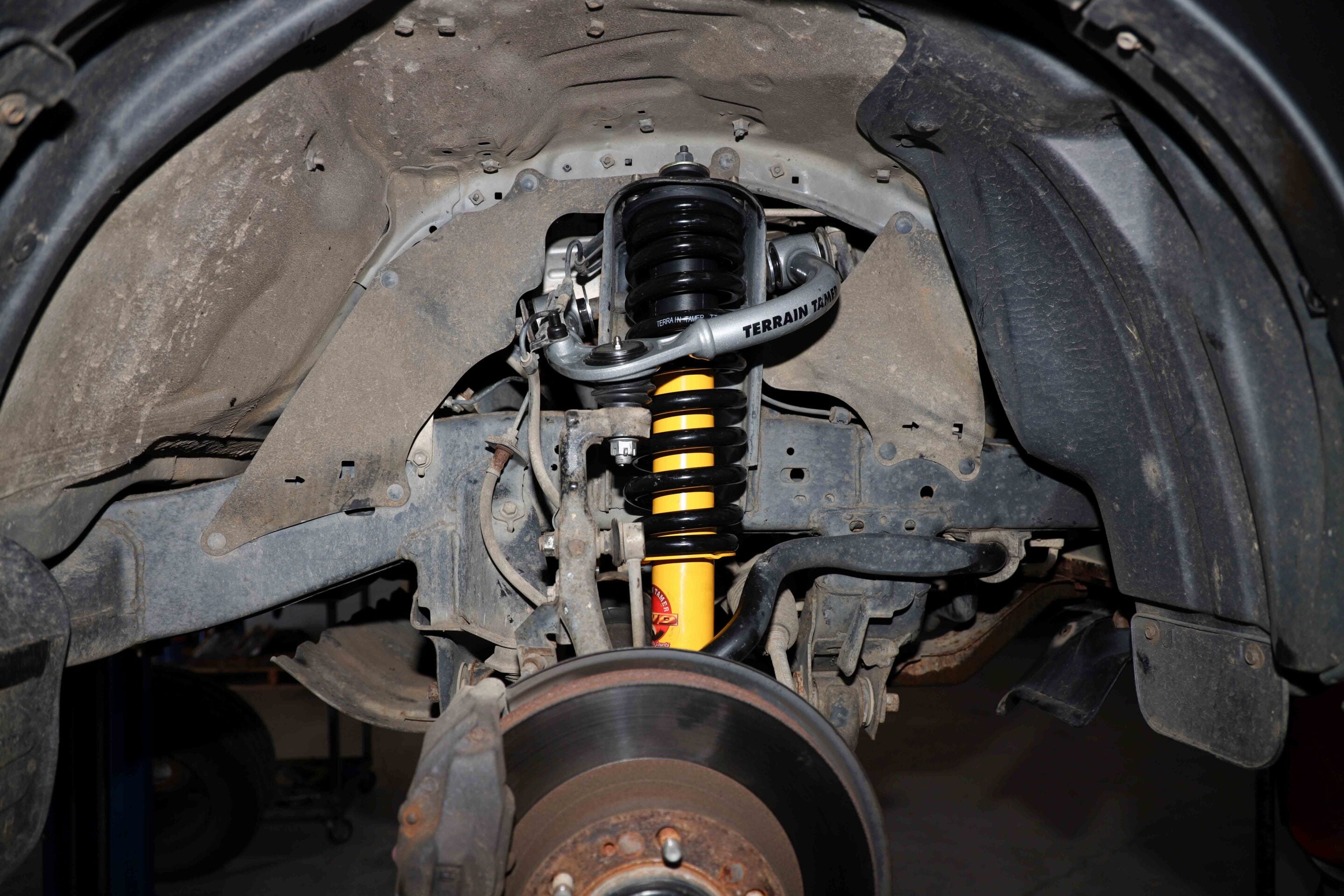
As well as the coils up front, I opted for a pair of heavy-duty Terrain Tamer upper control arms to be fitted at the same time. Put simply, they offer superior strength over OE, incorporate greaseable bushes, and enable the wheel alignment to be set correctly.
While it’s a whole article in itself, in brief the upper control arms allow caster and camber to be properly tuned to suit the new suspension height. They also provide increased articulation and help maintain an optimal tyre contact patch through correct wheel alignment, both on- and off-road, improving tyre wear and grip.
I believe upper control arms should be fitted to any independent front suspension vehicle at the time of a suspension lift.
How does it now perform on- and off-road?
Considering my HiLux is still empty in the canopy and doesn’t yet have the weight of a bullbar or winch, the ride is astonishingly good for a dual-cab ute – albeit a little firm without the load to settle it down.
Within 10 minutes of leaving the workshop, I spent an hour testing it on my local dirt tracks. Along with a stint on the freeway, medium-speed corrugations, dips and ruts, and some slow-speed crawling were all covered to ensure the ride quality and off-road ability met expectations.
The real test will come once the HiLux is fully kitted out and driven daily around town, along with the bigger trips out bush we have planned. So stay tuned for updates on how the Terrain Tamer gear fares with all the weight on board.
Chery’s electrified off-road sub-brand is officially heading to Australia, with the new iCaur marque set to launch locally in early 2027.
Currently sold in China as iCar, the brand is expected to adopt the iCaur name for Australia due to trademark issues, bringing with it a range of boxy electrified SUVs aimed at buyers chasing rugged 4×4-inspired styling with hybrid and EV drivetrains.
The local rollout is expected to begin with the V27 large SUV, followed by the smaller V25, as Chery expands its growing local SUV portfolio.
V27 leads the charge
First unveiled globally at a launch event in Dubai in 2025, the V27 shapes as iCaur’s flagship and recently appeared in right-hand-drive form at the 2026 Beijing Motor Show, a key step ahead of Australian production.
Positioned as an electrified alternative in the large-SUV segment, the V27 measures 5045mm long, 1976mm wide and 1894mm high, riding on a 2900mm wheelbase.
Under the skin is a 1.5-litre turbocharged four-cylinder petrol engine operating as a generator in an extended-range electric vehicle (EREV) setup, supplying power to the battery and electric motors rather than directly driving the wheels.
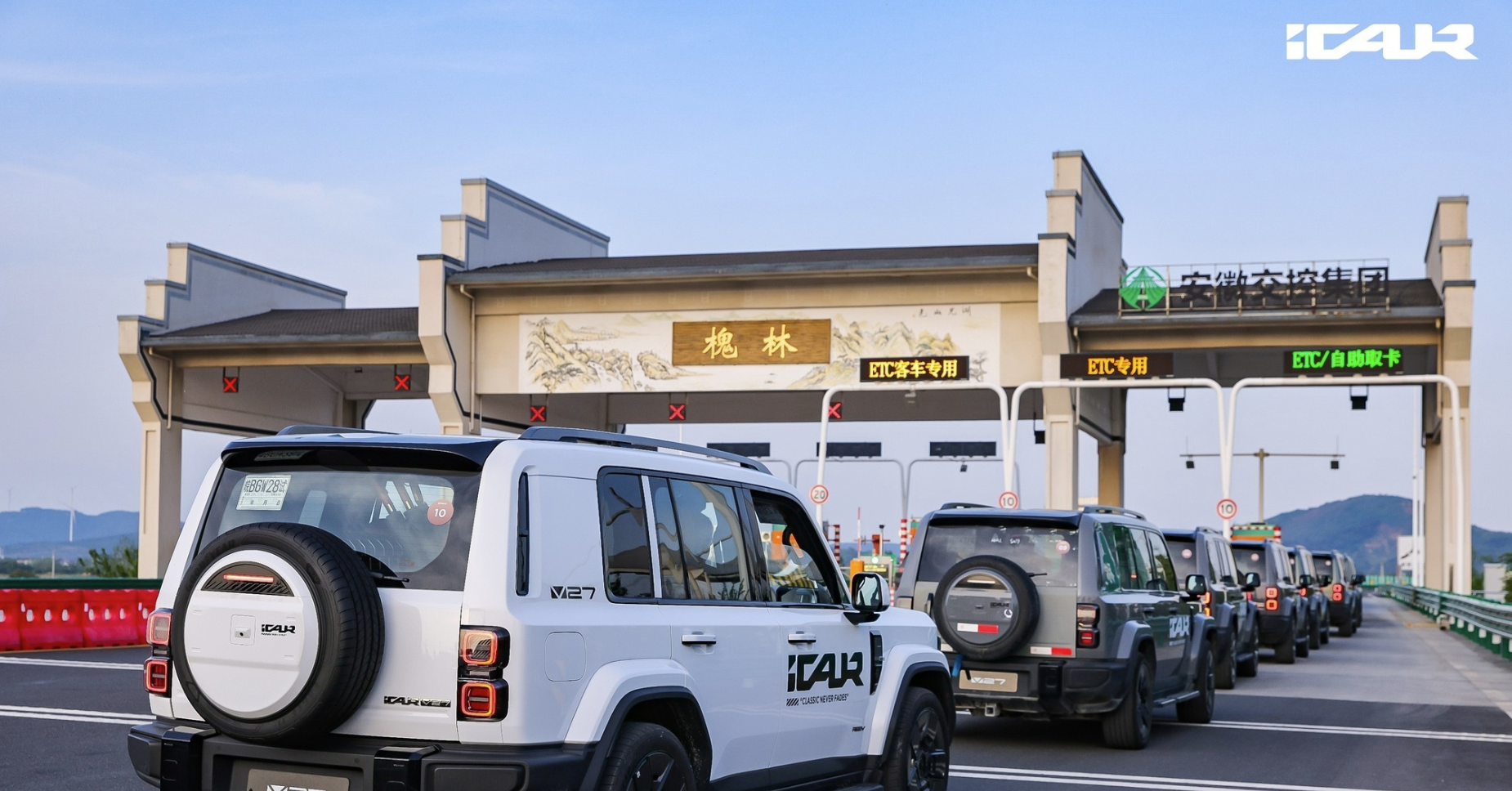
In all-wheel-drive form, the V27 produces 335kW, backed by a 34kWh battery pack. Claimed performance figures include:
- 150km electric-only driving range
- Up to 995km total range
- 0-100km/h in 5.9 seconds
Unlike a conventional plug-in hybrid, the petrol engine works to continuously recharge the battery, allowing extended touring capability without relying solely on external charging infrastructure.
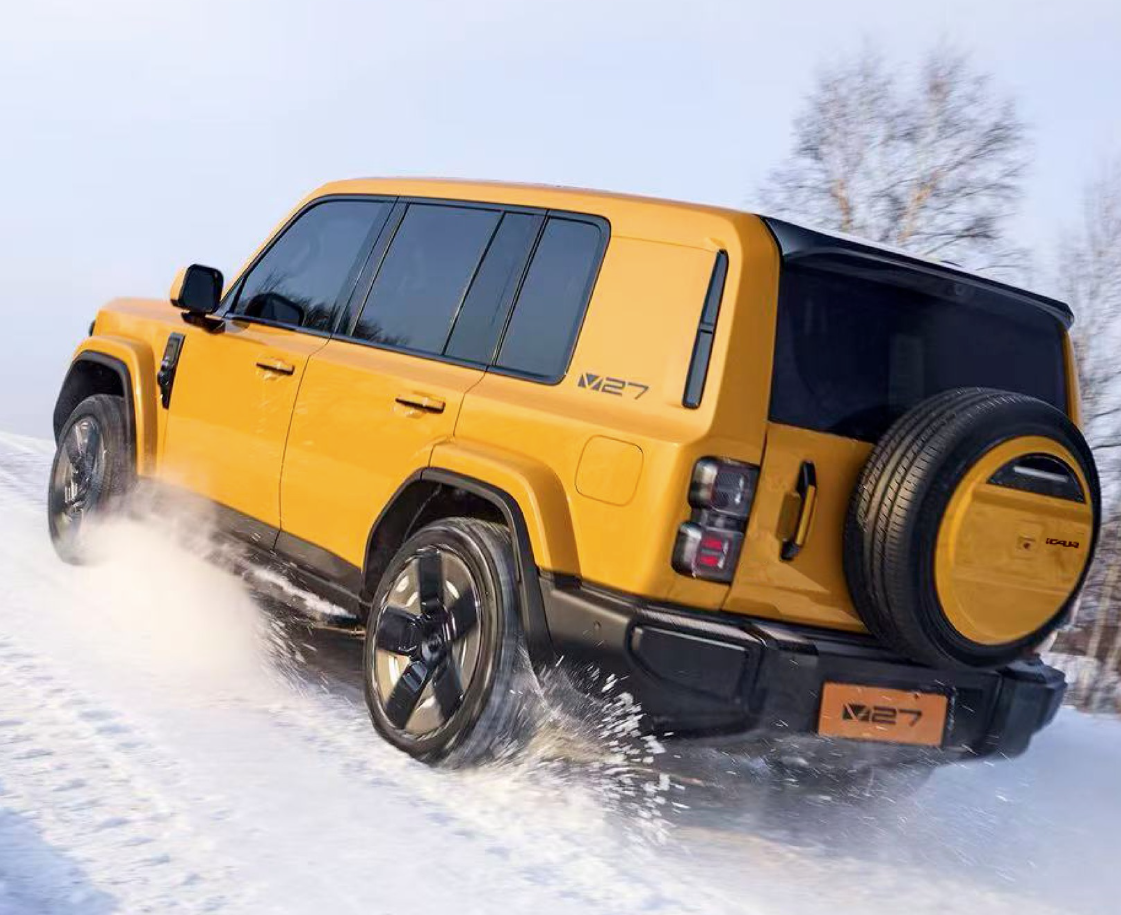
Styling leans heavily into retro off-roader cues, with squared wheel arches, circular lighting elements and upright proportions. While it wears the tough-truck look, the V27 uses a unibody-based platform rather than traditional body-on-frame construction, positioning it more as a family touring SUV with light off-road capability.
V25 also confirmed; V23 remains a possibility
Joining the V27 will be the mid-size V25, expected to measure around 4800mm long. Still under development, it is expected to use extended-range electric technology and is due for a global reveal in mid-2026, ahead of its local arrival.
The compact V23 remains under consideration for Australia. Already sold in China, it features an 81kWh battery, 155kW and 292Nm, and a claimed 430km driving range. Local timing has not yet been confirmed.
Dedicated dealer network planned
iCaur is expected to operate through its own dedicated retail network rather than sharing showroom space with Chery’s existing brands.
More details on Australian specifications, dealer locations and final launch timing are expected later in 2026, ahead of first local deliveries in 2027.
The Toyota Prado has been a mainstay of the Australian 4×4 scene for more than 30 years.
It’s a right-size 4×4 wagon that suits many users – from families in the city to those roaming the wide brown land. Add in that legendary Toyota four-wheel drive reputation and you can see why it’s been the chosen rig for so many Australians.
When a vehicle is popular in this market, our vibrant aftermarket industry quickly jumps on it to give owners the accessories and modifications they want and need. When Toyota launched the 250 Series Prado in 2024, Australian aftermarket players were scrambling to get their hands on one and start developing touring products.
The 250 Series delivered a bigger and better-equipped Prado that improved on its predecessor in most ways, but it also came with a major design flaw that the aftermarket was only too happy to rectify.
The 250 Series uses Toyota’s 48-volt starter-generator system and the components for that are mounted under the floor in the cargo area. This means the floor now sits higher than it normally would and, if your Prado has third-row seating, the seats fold on top of the floor instead of into it like they did on previous models.
This design has serious consequences for a touring 4×4 where you might want to mount a fridge, drawer system or other accessories in the back – let alone simply carrying gear there. This is where the aftermarket comes to the rescue.
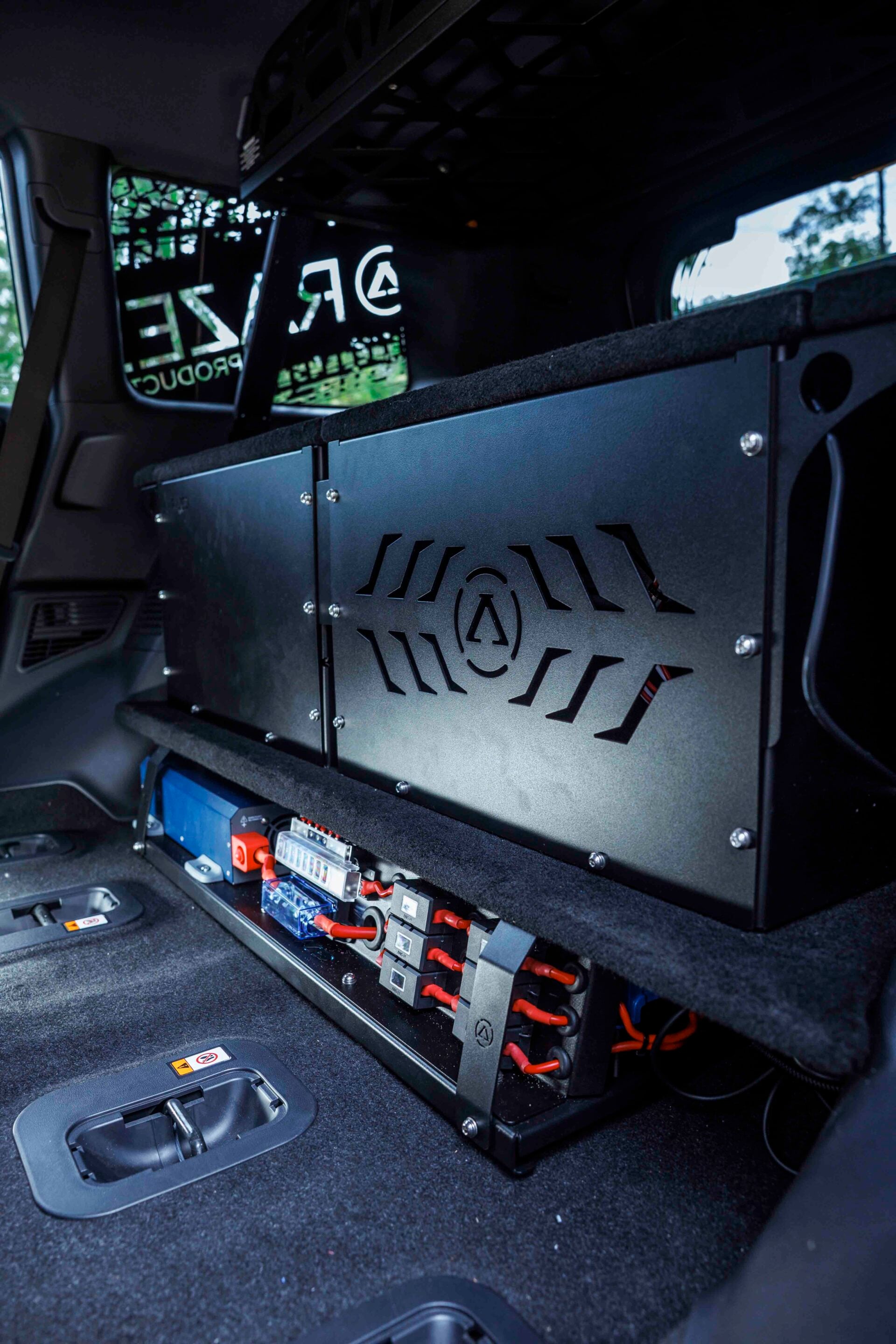
Razed Products has been designing and manufacturing clever storage accessories in its Melbourne factory for several years, and false floors and cargo fit-outs are among its specialties. Developing a solution for the back of the 250 was a priority when the model was released, and the team soon had a vehicle to work with and developed solutions for both five- and seven-seat Prados, as well as the Lexus GX550.
Designing and developing the cargo solution was only part of the plan for this Prado. Owner Rob wanted to turn his GXL Prado into a fully equipped touring rig with all the best gear on board.
Protection, touring hardware and rear-end integration
Starting with protection equipment, Rob turned to another innovative Melbourne company for front and rear bars.
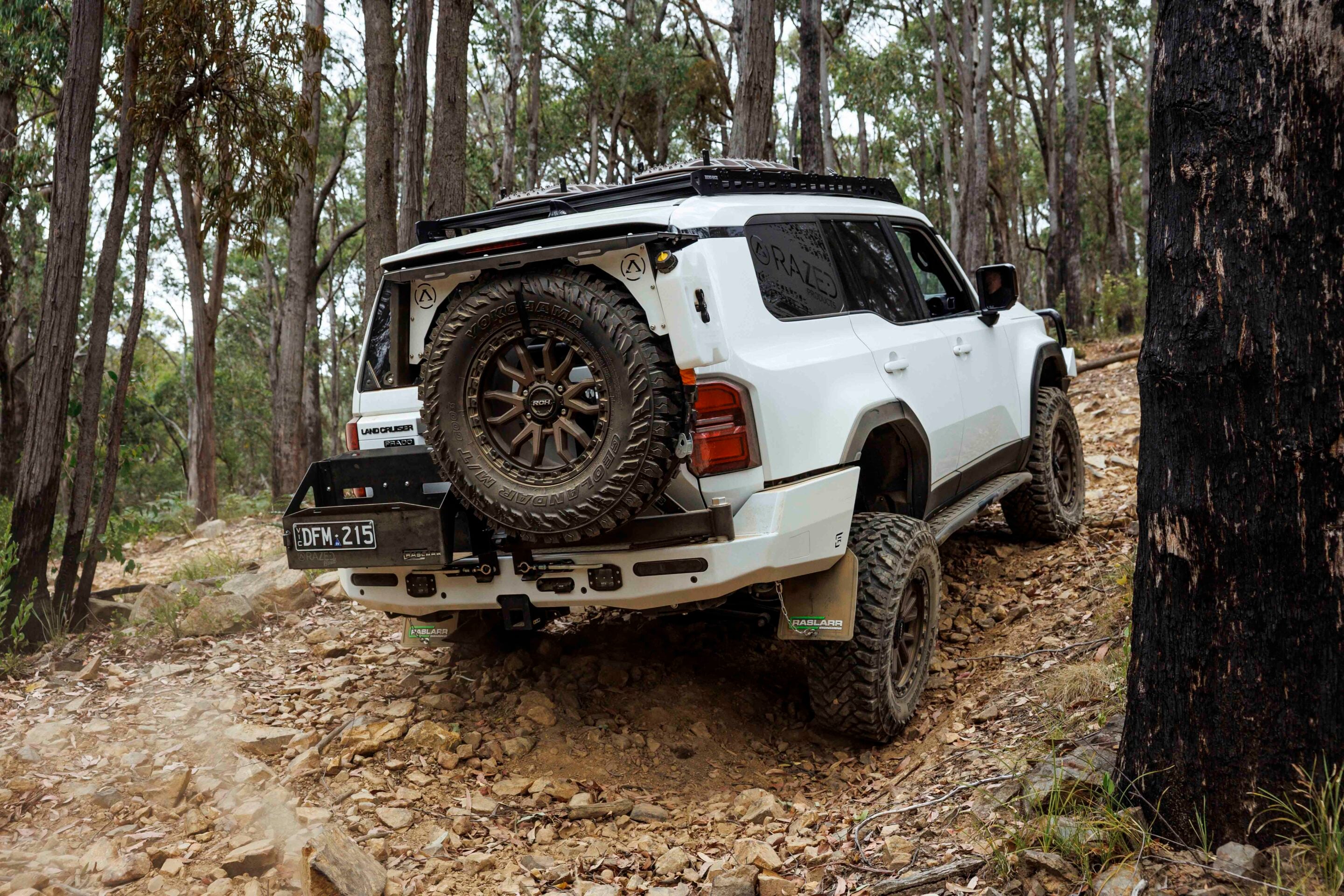
Raslarr Engineering used Rob’s Prado to develop products for the 250 Series. The Raslarr ‘Dallas’ bullbar is a full-bar design made using 3mm and 6mm steel and incorporates a winch cradle, recovery points, fog lights, driving-light mounts and provisions for factory ADAS sensors and cameras. The bars are ADR-compliant and proudly made in Melbourne.
The winch fitted is a Carbon 12K unit, while a pair of Stedi Evo Quad driving lights provide long-range illumination and suit the squared-off styling of the Prado.
Moving to the back of the vehicle we find more of Raslarr’s handiwork with the rock sliders and rear bar. The rear bar works with the factory towbar and retains the original sensors and cameras while adding steel protection across the rear and lower quarters. It also incorporates a swing-out spare-wheel carrier, a jerry can holder and the ability to carry a tyre up to 35-inches. Raslarr powder-coated the bars to match the Prado’s white paintwork.
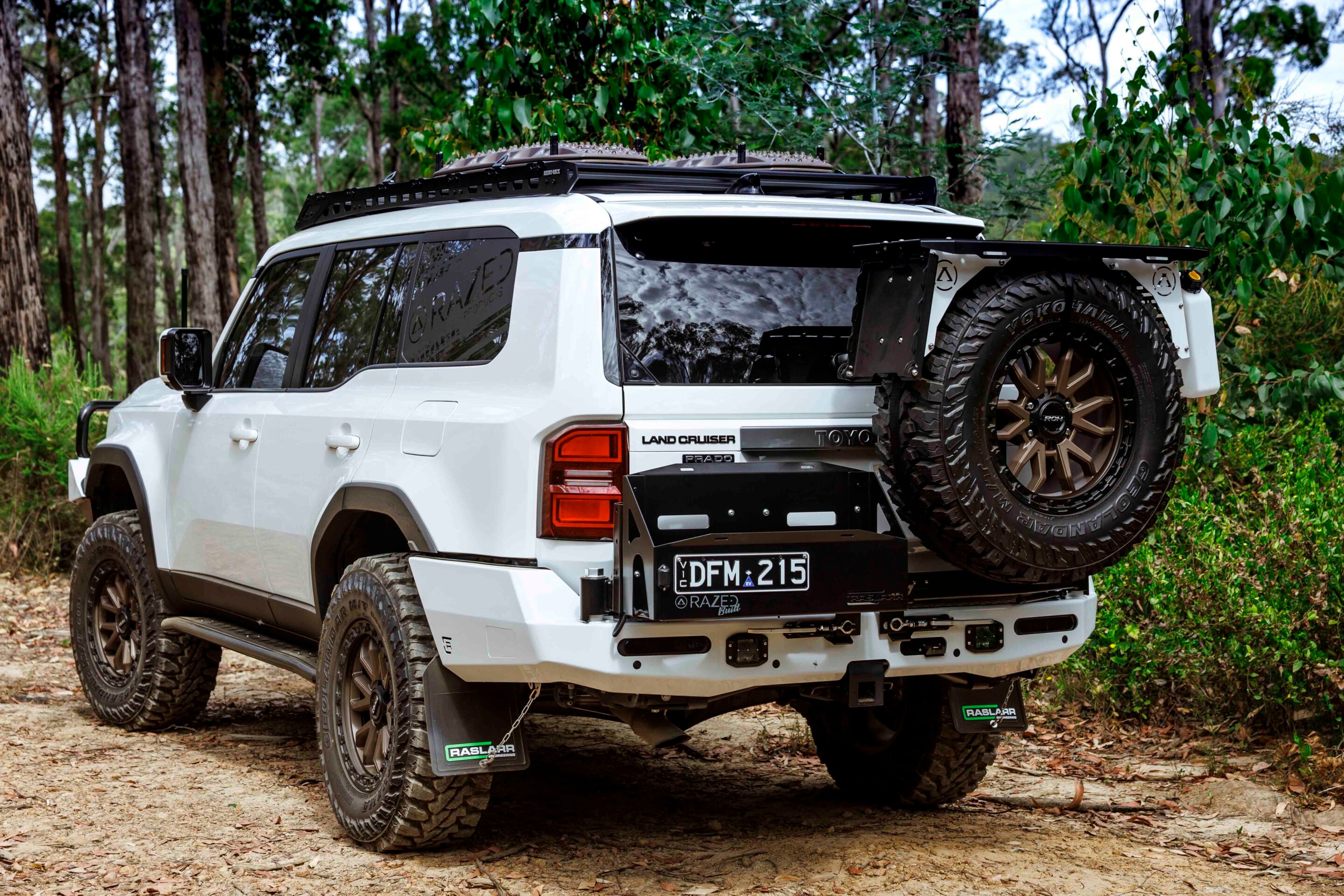
While looking at the rear bar it’s also worth mentioning the Razed Products spare-wheel tray, which creates a flat platform for carrying gear and offers additional storage options, including gas bottles and the Rotopax water tank seen on this vehicle.
Underbody protection again comes from Razed, with 5mm aluminium plates protecting the engine sump, radiator, front diff, driveshaft, transmission, transfer case and AdBlue tank. Diving further underneath we find a full Dobinsons MRR remote-reservoir suspension setup designed to keep the wheels and tyres in check and the body under control on rough tracks.
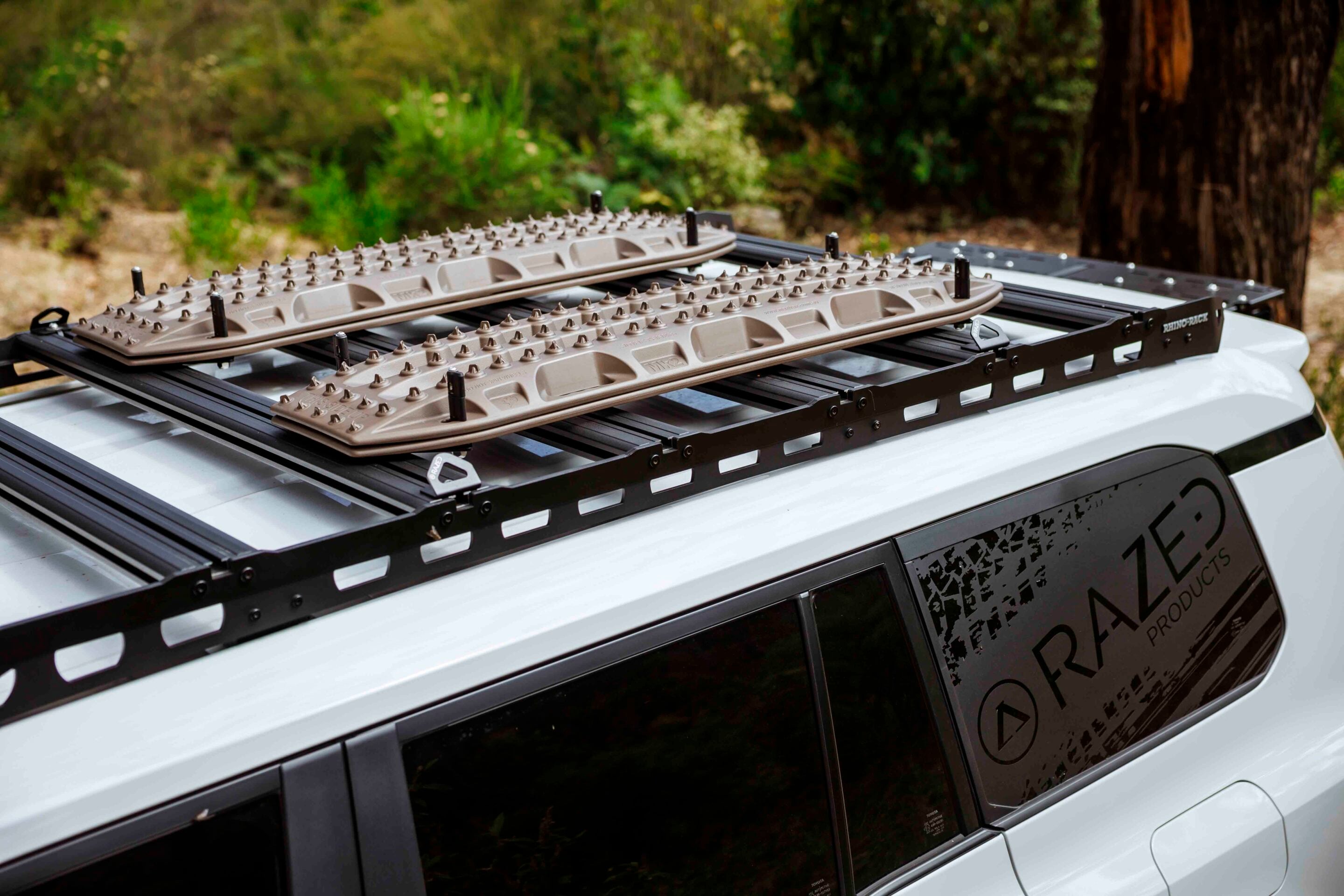
Up top there’s a Rhino-Rack Reconn platform developed specifically for the 250 Series. Razed also produces a range of handy attachments and tie-down points for securing gear to roof racks and you can see a few of them fitted here. The Maxtrax mounts are also from Razed and, cleverly, the mounting pins fold flat against the rack when you’re not carrying recovery boards.
A fully integrated cargo and electrical system
The height of Razed’s innovation is found in the back of the Prado.
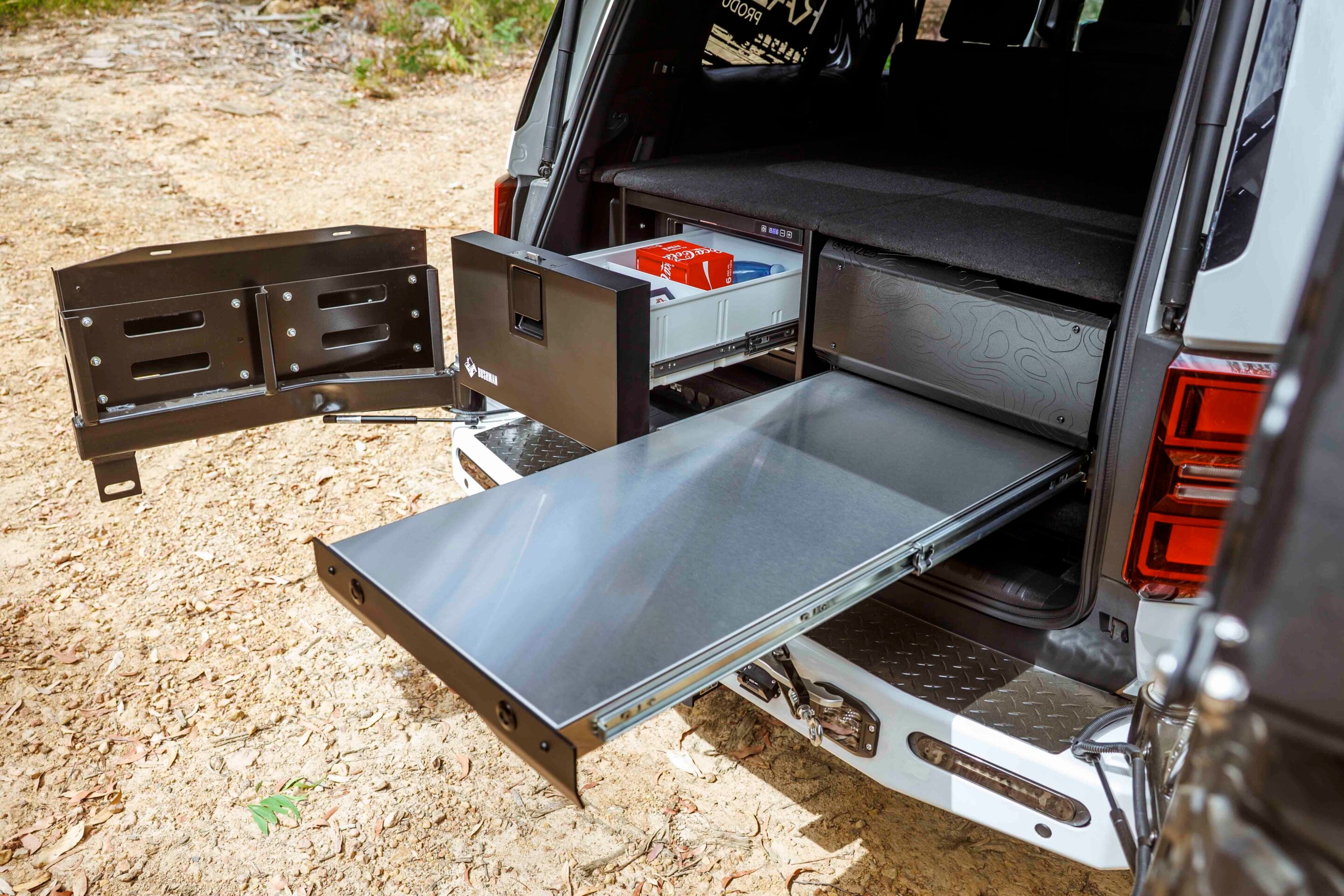
This GXL started life as a seven-seat model, so the appropriate kit was used. After removing the plastic floor Toyota fits, along with the side storage bins and the metal cover over the 48-volt system hardware, a steel frame is fitted around the electronics. A carpet-covered 17mm timber floor is then installed, along with aluminium storage bins and infills to replace the original plastic units.
That’s simplifying the process somewhat, but the kit is designed so it can be installed by anyone reasonably handy with tools. The floor leaves space underneath for auxiliary 12-volt system hardware, and mounting the floor to the steel frame gives it the strength and stability needed to securely attach items such as fridges and drawers.
In this build there’s a Razed ‘Altitude’ drawer on the driver’s side. Underneath sits the 12-volt setup comprising a Lifetek Lithium LiFePO4 (310Ah) battery, Victron Orion XS 50A DC/DC charger, Victron SmartSolar MPPT 100/50 charger, and an Invicta 2000W 12V–240V inverter. Also tucked neatly out of sight is an ARB air compressor mounted in the quarter panel on a Razed bracket, with an outlet at the rear of the cargo area.
A showcase of Australian aftermarket capability
The Australian aftermarket accessories industry is known globally for producing some of the best products for four-wheel drive vehicles, and Rob’s Prado is a prime example of that ingenuity and clever design. By teaming up with innovative local manufacturers and working with the Razed team, Rob has taken what is already regarded as one of the best 4×4 wagons on the market and improved it in almost every way.
All accessories and products
- Raslarr ‘Dallas’ bullbar
- Carbon 12K winch
- Stedi Evo Quad driving lights
- Raslarr rock sliders
- Raslarr rear bar (swing-out spare wheel carrier, jerry can holder, sensor integration)
- Razed Products spare-wheel tray
- Rotopax water tank
- Gas bottle mounting provision (spare-wheel tray system)
- Razed 5mm aluminium underbody protection plates
- Dobinsons MRR remote-reservoir suspension system
- Rhino-Rack Reconn platform
- Razed roof rack attachments and tie-down points
- Razed Maxtrax mounts
- Maxtrax recovery boards
- Razed false floor / cargo fit-out system (7-seat Prado kit)
- Steel cargo frame system (integrated 48V hardware housing)
- Carpet-covered 17mm timber cargo floor
- Aluminium storage bins and infills
- Razed ‘Altitude’ drawer system
- Lifetek Lithium LiFePO4 310Ah battery
- Victron Orion XS 50A DC/DC charger
- Victron SmartSolar MPPT 100/50 solar charger
- Invicta 2000W 12V–240V inverter
- ARB air compressor (quarter panel mounted)
- Rear cargo area air outlet system (Razed bracket)
The Ineos Grenadier wagon and Quartermaster pick-up have been designed and built with long-distance overland expeditions in mind.
Taking inspiration from the original Land Rover, Ineos has created a traditional four-wheel drive on a separate chassis, with live axles, coil springs, dual-range gearing, locking differentials, and a boxy but functional body and cabin.
It’s no surprise that as adventurous travellers have bought into the Ineos platform, aftermarket manufacturers and workshops have jumped on board to produce products, accessories and complete fit-outs to prepare these vehicles for whatever adventures their owners have in mind.
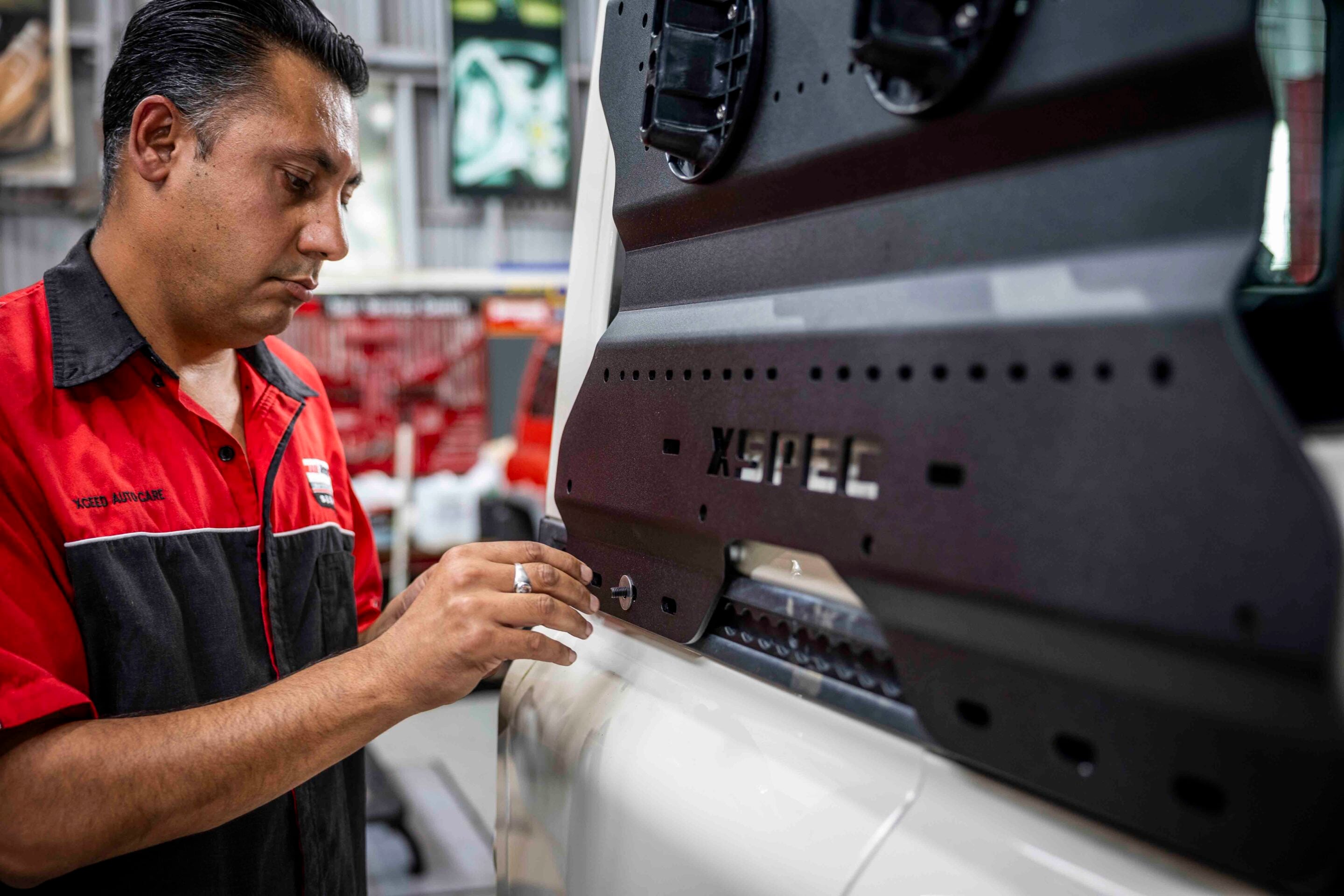
One such company is Expedition HQ in Queensland. Expedition HQ isn’t just an Ineos dealer; with a background in building fully outfitted expedition trucks under the SLRV brand, the team knows what’s needed for overland travel, not only in Australia but globally.
Not everyone wants a large expedition truck like the SLRV vehicles, so when the Ineos arrived it provided the perfect option for customers looking for something more compact but still highly capable. With the choice of the Grenadier wagon and Quartermaster double-cab pick-up, the Ineos is becoming an increasingly popular platform.
When the team at Expedition HQ saw that we had a new Grenadier Trialmaster in our shed, they jumped on board to supply some functional accessories suited to the way we use the vehicle.
Purpose-built Grenadier upgrades
Expedition HQ sources high-quality gear for Ineos vehicles from around the world, as well as manufacturing its own products under the X-Spec brand. Everything from storage solutions to suspension kits and even portal axles is available to build an Ineos to your specifications.
For our Grenadier, it supplied an auxiliary fuel tank with mounts and a transfer pump, a lockable pantry with a fold-down table, and a lockable jerry can holder with an On-Tap tank and shower. Just the sort of gear Cristian can use with his boys at the beach or when heading out mountain biking.
Simple fuel range upgrade
First up, we’re taking a look at the X-Spec 30L gravity-feed diesel tank.
Ineos fits the Grenadier with a 90L fuel tank. That might be sufficient for green-laning in Pomgolia, but it’s hardly enough for touring in Australia, let alone the global expeditions many owners will build a Grenadier for. While it’s not a full-size auxiliary tank mounted under the chassis, Expedition HQ’s 30L unit provides a handy addition to complement the factory fuel capacity.
Expedition HQ has designed and manufactured a mounting frame that positions the tank on the driver’s side of the wagon, directly above the fuel filler. This allows fuel to be gravity-fed into the main tank using a jiggler hose, without needing to remove the tank from its mount. Even better, you can use a 12-volt transfer pump to move fuel to the main tank, and Expedition HQ offers a pump kit to suit.
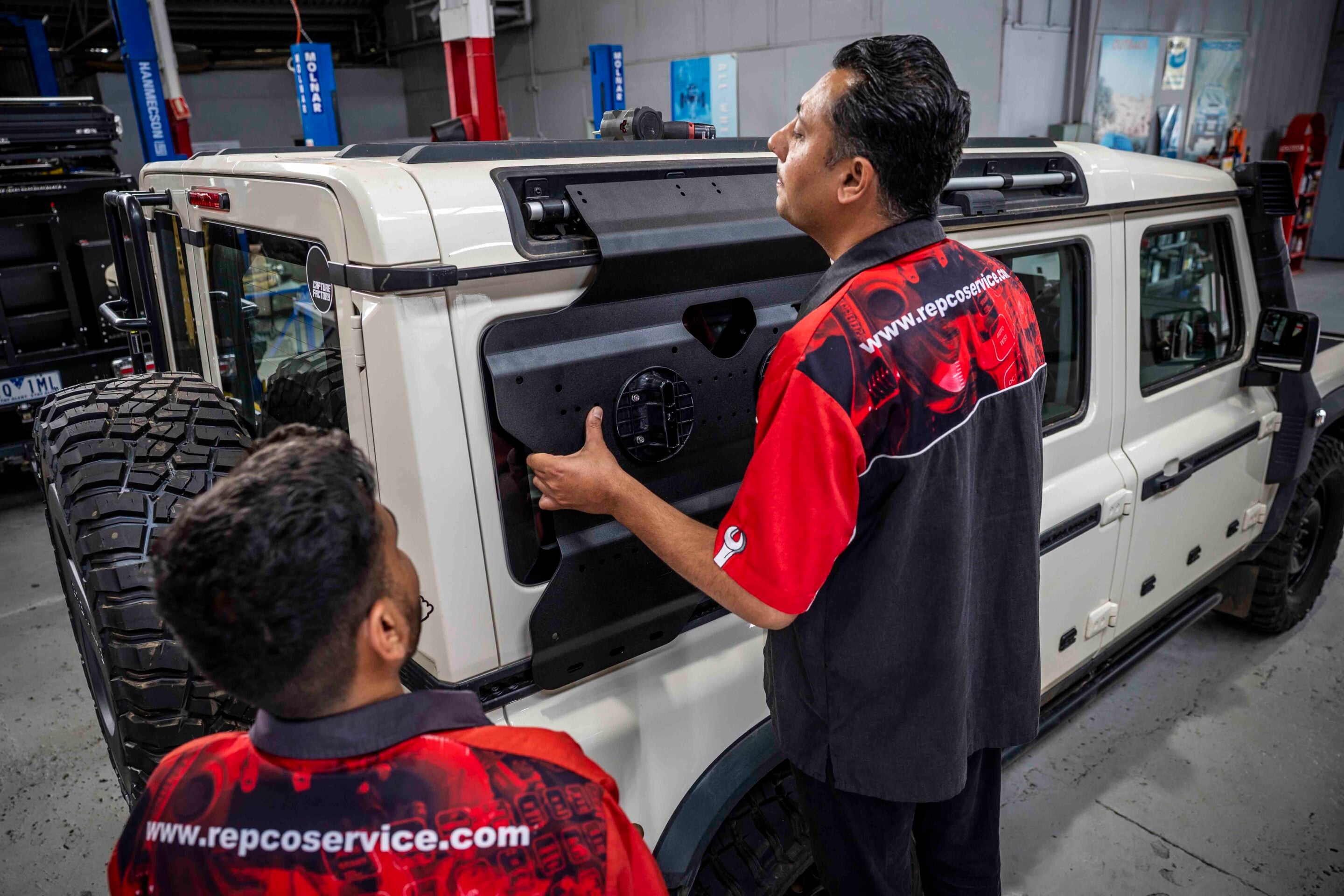
The mounting plate is designed to sit securely over the rear side window, following its shape, and is powder-coated for a durable and tidy finish. The tank itself is purpose-built for diesel fuel and locks securely to the mounting frame. It’s a simple, well-engineered solution for increasing fuel capacity. It is priced at $399 plus installation, and if you want the 12-volt pump that will set you back a bit extra.
Our X-Spec diesel fuel tank was fitted by the team at Xceed Autocare in Braybrook, who did an excellent job with great care and attention to detail.
Our Grenadier is fitted with a Rhino-Rack platform, and its mounts interfere with the X-Spec bracket mounting points, so a minor modification was required for fitment. We’re told this isn’t an issue with the factory Ineos roof rack.
- RRP: $399 plus installation
The Freelander name is back, but not in the way many will remember it.
At a global reveal in China, the first model from the revived brand – the Freelander 8 – has appeared in production-intent form, signalling a new direction for the once familiar badge as it moves into the premium, tech-focused SUV space.
Rather than a nostalgic reboot, this is a clean-sheet repositioning. The Freelander brand is now a joint venture between Chery and Jaguar Land Rover, built through the Chery Jaguar Land Rover plant in Changshu. The partnership combines Chery’s advanced automotive technology with Jaguar Land Rover’s design expertise, forming the basis for the new-generation SUV line.

Visually, the design retains links to the original Freelander through its overall silhouette and signature rear-quarter window, but updates the execution with a more technical lighting signature and a stronger, more upright stance. A “castle body” design theme defines the exterior, pairing a solid lower body with a lighter, more refined upper cabin.
Inside, the focus is on digital integration and cabin openness. A large-format Mini LED display dominates the dashboard, bringing vehicle information, navigation and driving data into a single unified interface. The layout is said to emphasise space and visibility while reducing traditional visual clutter.
The Freelander 8 also introduces the Intelligent All-Terrain System (i-ATS), designed to automatically adjust vehicle settings based on changing surface conditions. It offers nine terrain modes and operates alongside hardware including an electronic limited-slip differential, air suspension and a virtual centre locking function.
Together, these systems position the vehicle as a flexible SUV suited to mixed driving environments, from city use through to regional travel and light off-road conditions.
The Freelander nameplate first appeared in 1997 under Land Rover as an entry-level SUV aimed at combining everyday usability with light off-road capability. It ran through two generations before being phased out in 2014, when it was replaced by the Discovery Sport. The original model played a key role in broadening Land Rover’s appeal during the early growth of the modern SUV segment.
The Freelander 8 marks the first step in the brand’s relaunch strategy, with further details – including Australian timing – still to be confirmed closer to production.
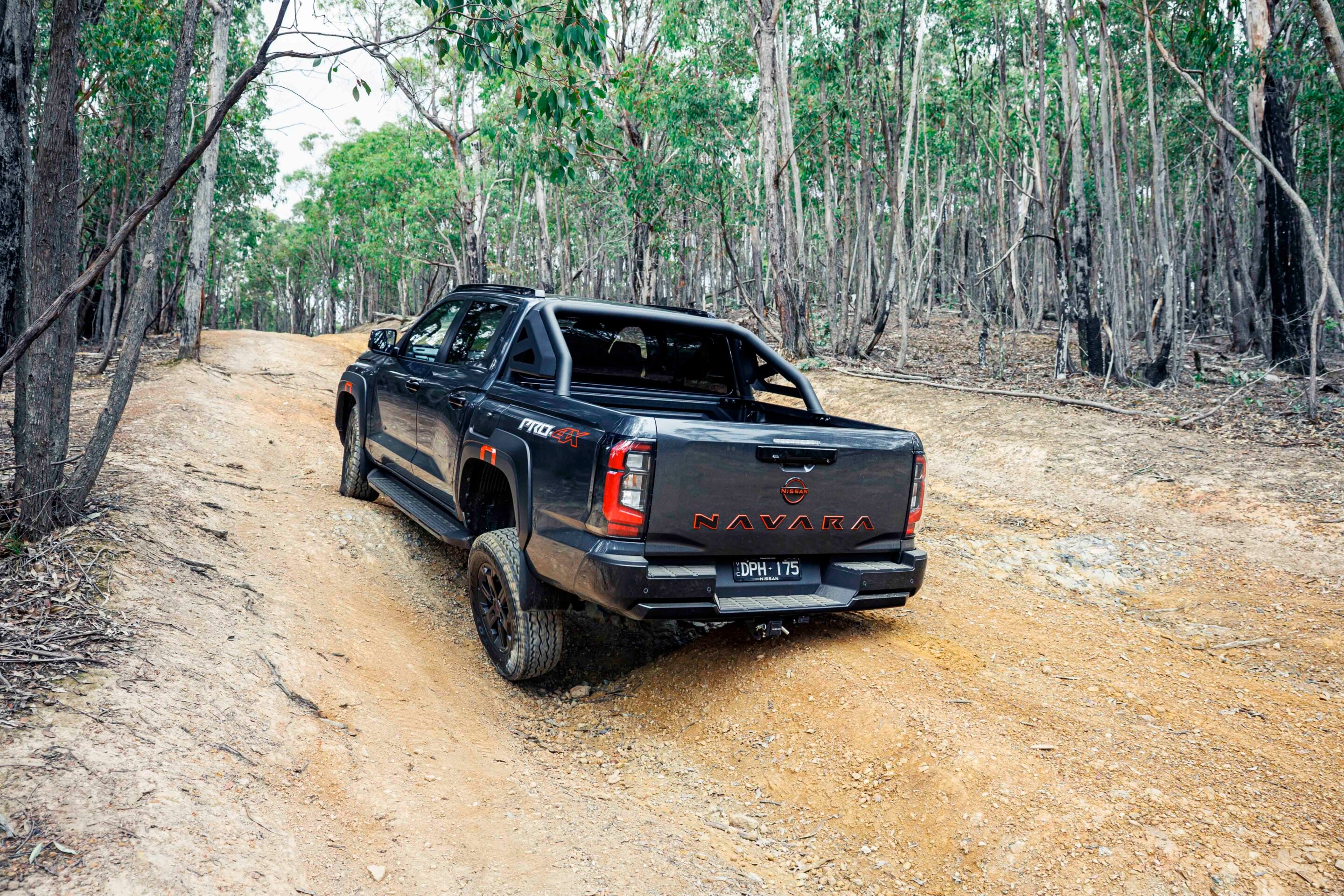
The PRO-4X is the top of the range for the new D27 Navara line-up for now. Nissan will be releasing a Warrior version of the PRO-4X in association with its partner Premcar later this year, but for now the $68,418 PRO-4X is the king of the hill.
It’s no secret that the new Navara is a product Nissan shares with its alliance partner Mitsubishi, and as a result the D27 is essentially a current-model Triton – a ute that has been on the market here for more than two years now.
If Nissan was going to partner with anyone, then Mitsubishi is a pretty good choice as it has been building utes and 4X4s for decades, and the current Triton is not a bad thing. Hence, the D27 Navara is also not bad.
JUMP AHEAD
Powertrain
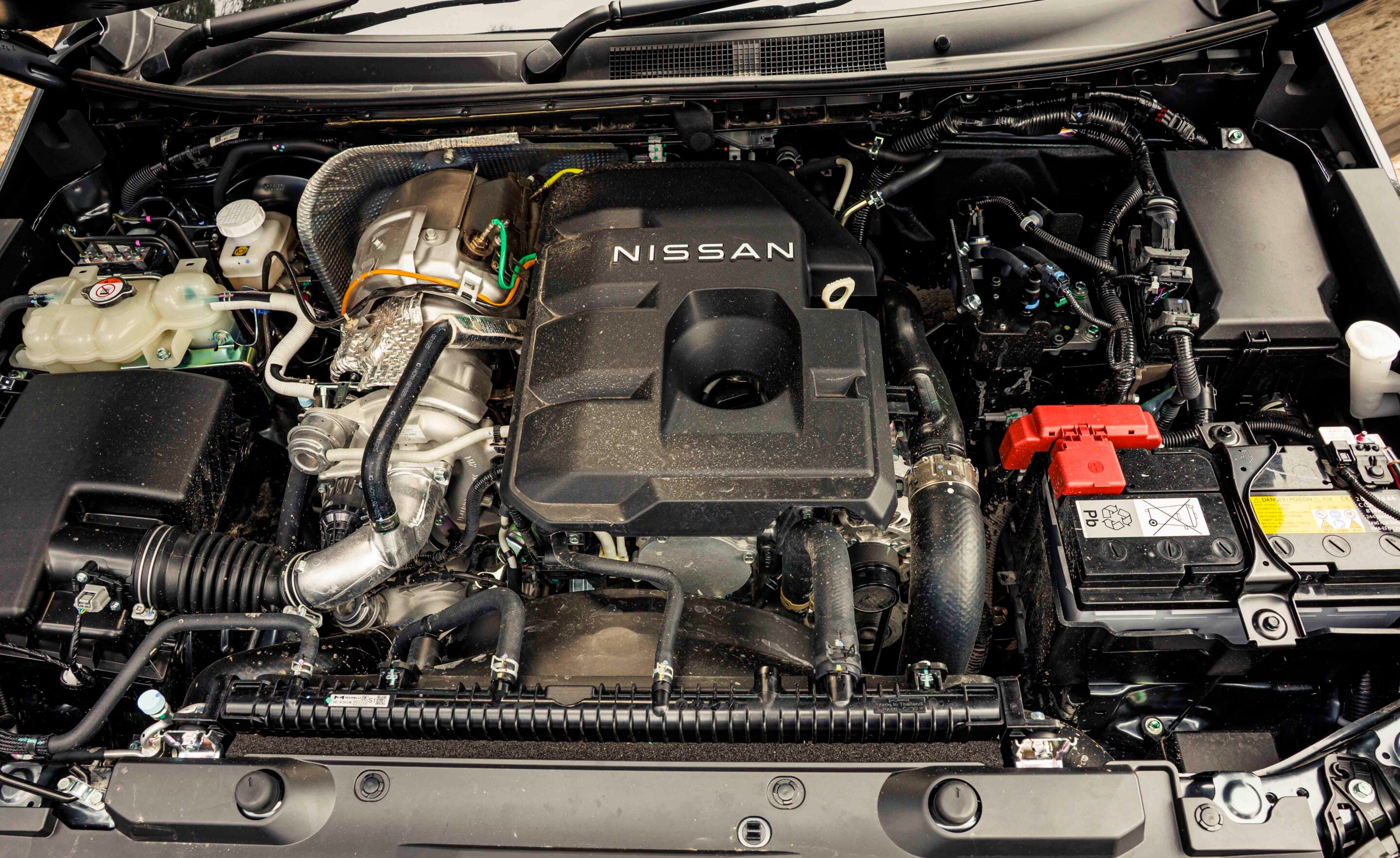
All D27 Navaras are powered by Mitsubishi’s 2.4-litre bi-turbo diesel engine, producing 150kW and 470Nm, with a claimed combined fuel consumption of 7.1L/100km. The engine is paired with a six-speed automatic transmission, with no manual option offered.
The lack of a manual gearbox is one of the key differences between the limited Navara range and the more extensive Triton line-up. Other options you won’t find in a new Navara are single- and extra-cab models, two-wheel drive or cab-chassis traybacks. That’s not to say you can’t remove the cargo tub and fit a tray yourself. The D27 Navara range is strictly double-cab 4X4 utes with an automatic transmission.
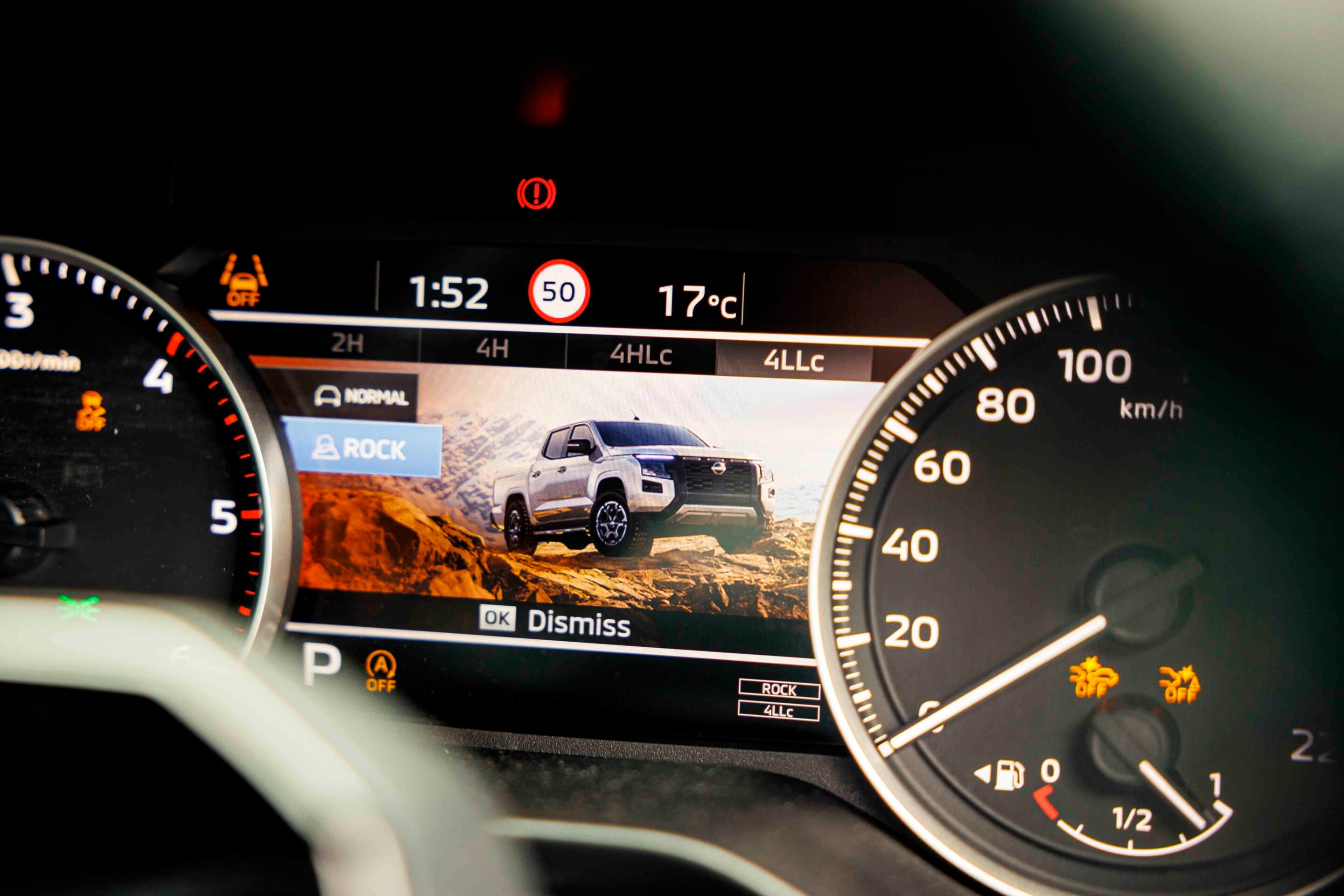
As the top of the range Navara, the PRO-4X gets the Super Select 4×4 system, which offers two- and four-wheel drive, high and low range and full-time 4×4 for on-road driving.
The engine’s peak torque of 470Nm doesn’t tell the full story of the Navara’s performance, as it’s the broad torque curve that gives the ute plenty of mid-range grunt where it’s most useful. It’s punchy and works well with the six-speed auto when you put your foot down to get on with the job.
On-road performance
Not so great is the performance of the transmission when driving around town at lower speeds.
Forty to 50km/h suburban meandering has the transmission overly busy shifting up and down through the ratios and being very annoying. Some drivers may not notice it, but for me, once I felt it I couldn’t miss it and it annoyed me every time I was driving around the local area.
Another annoyance that couldn’t be ignored is a vibration from the engine at low revs, particularly below 1500rpm. My co-driver and I both noted it on the launch drive when coming to a stop in traffic, but that drive was mainly open road and I didn’t mention it after that. Back in town and at low-speed suburban pace, in two different new Navaras, I felt it more often – when slowing down but also when the transmission shifts up to higher gears and drags the engine speed down. It’s something I feel the engineers should be able to tune out with transmission and torque converter calibration.
Off-road performance
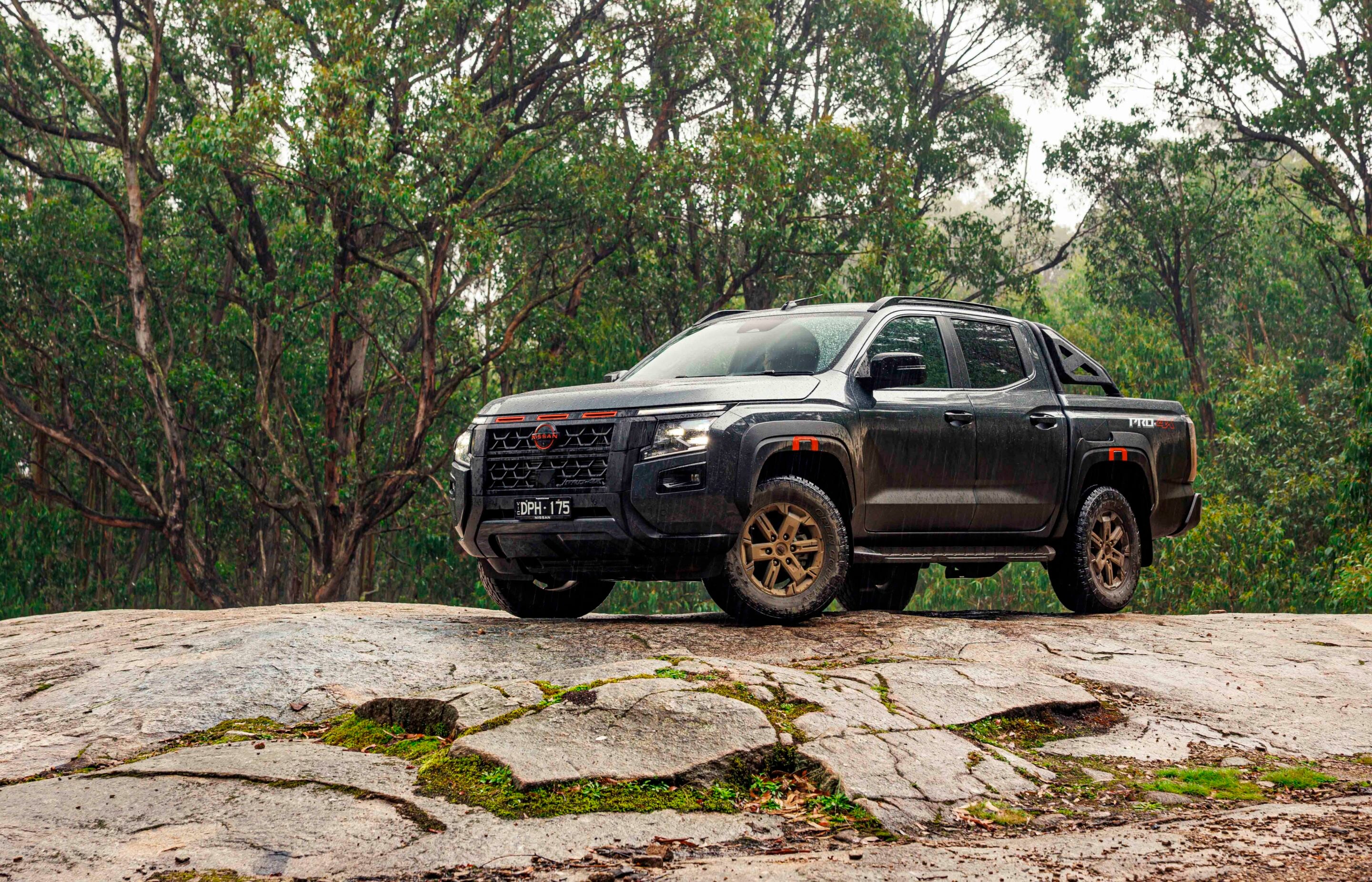
The Navara uses a conventional ladder-frame chassis with coil-spring IFS up front and a leaf-sprung live axle at the rear.
The two top models in the D27 range run a lighter rear leaf pack for improved comfort and drivability when unladen, and it gives the PRO-4X a composed and comfortable ride. Likewise, the front end does an excellent job on road and on snotty tracks to deliver precise and predictable handling.
The Navara has a locking rear diff, which made the traverse of our wombat holes easy, but the ETC also does a very good job of distributing drive without resorting to the RDL. All D27 Navaras have a 3500kg towing capacity. GVM is rated at 3190kg and GCM at 6250kg, plus a payload of 964kg for the PRO-4X. The PRO-4X comes standard with a towbar fitted, fully wired and ready to go.
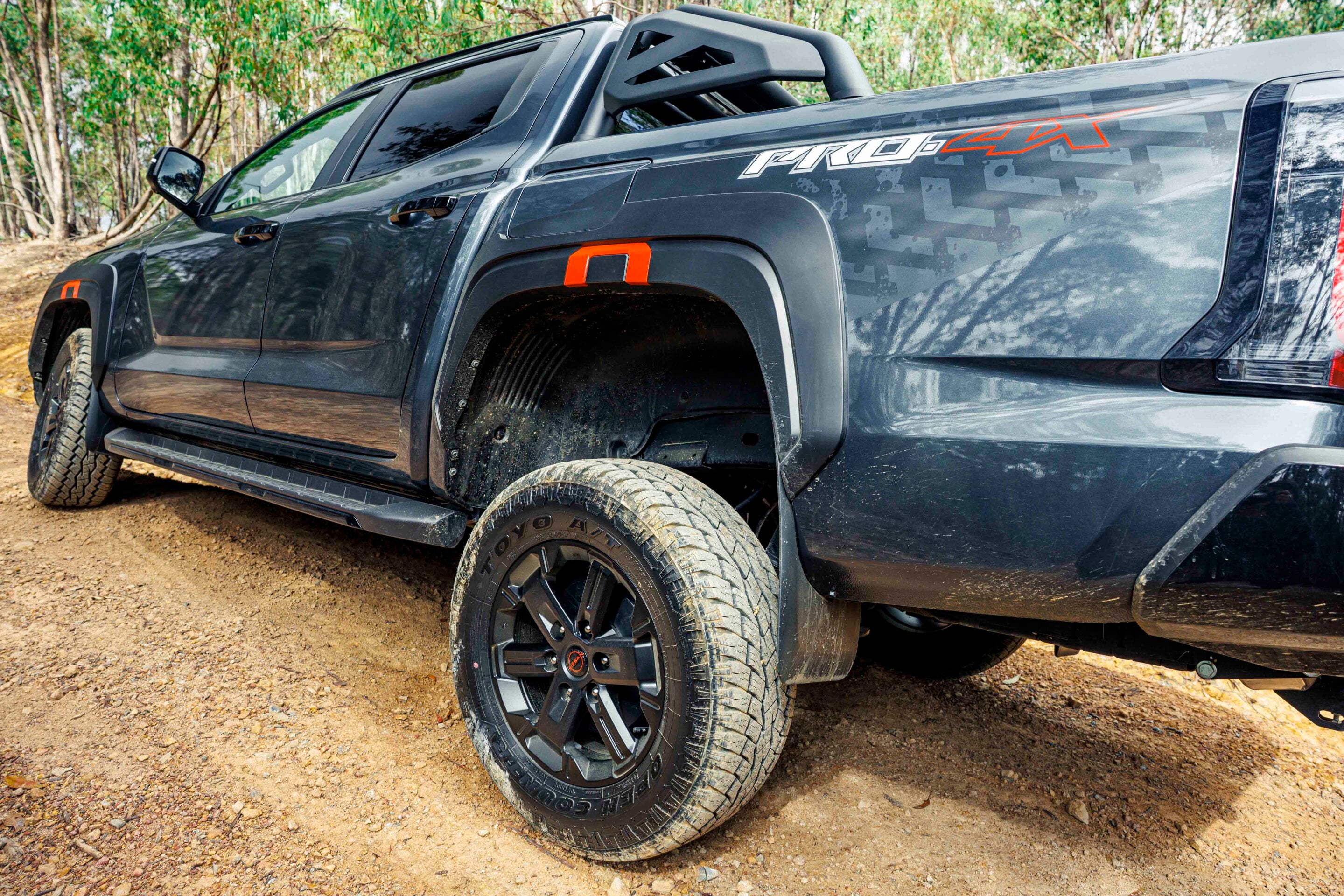
The PRO-4X is also the only model in the range to get Toyo all-terrain tyres as standard fitment, and their more aggressive tread pattern was appreciated in the wet and muddy conditions of our day out.
| Measurement | Value |
|---|---|
| Approach Angle | 30.4 |
| Rampover Angle | 23.4 |
| Departure Angle | 22.8 |
| Ground Clearance | 228mm |
Interior
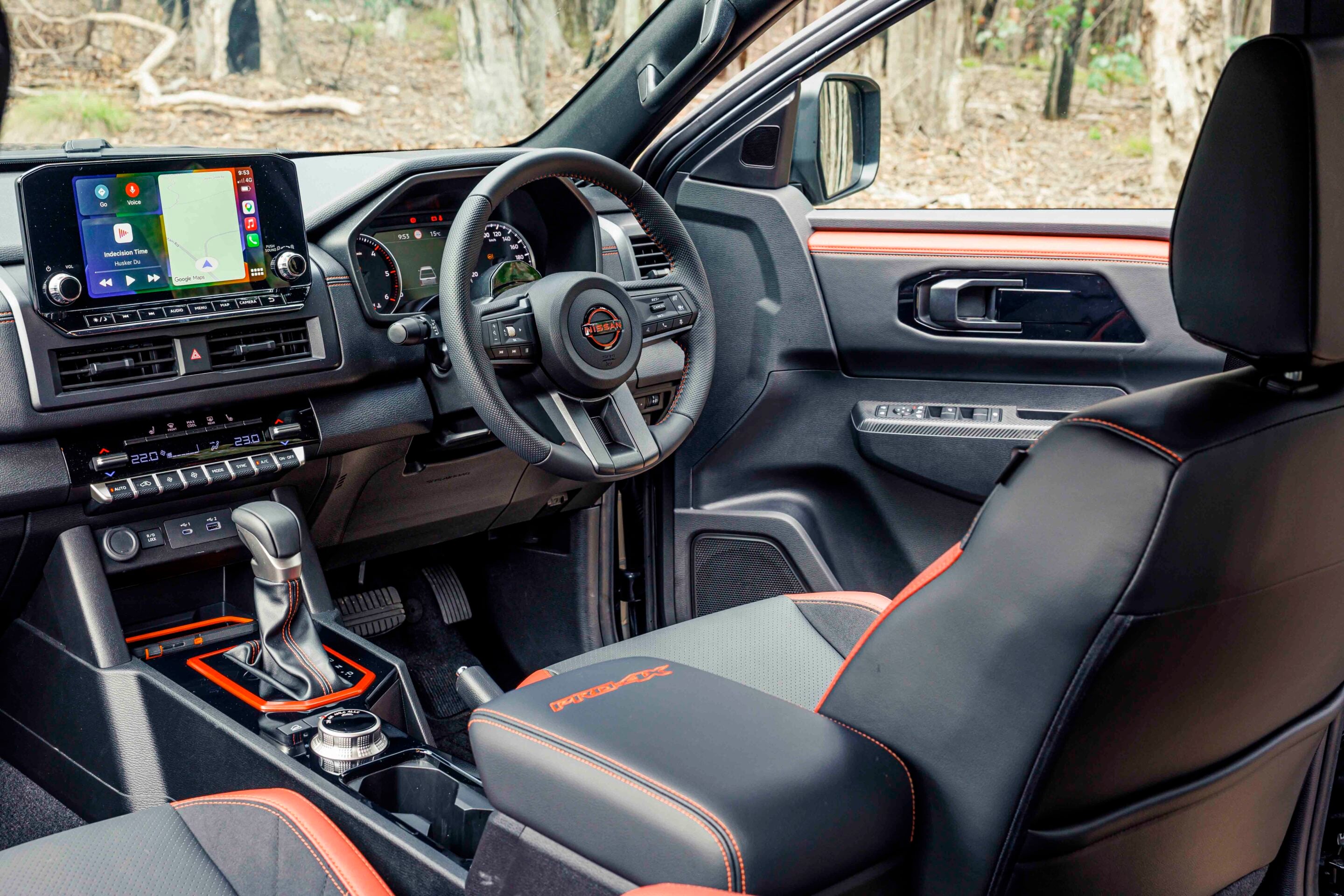
The PRO-4X’s cabin is well equipped and neatly laid out, with leather-accented seats featuring orange stitching and suede bolsters, a leather-accented steering wheel with matching stitching, and ‘PRO-4X’ logos embossed on the front seats. There are also black-painted inner door handles and orange accents on the centre console and door trims.
The 9-inch infotainment screen sounds small when compared to the 12.3-inch units that are popular in many utes these days, but the Navara screen is taller and squarer than those more horizontal ones, and it is well placed and easy to access and operate.
Safety
Safety-wise, the Navara gets eight airbags, autonomous emergency braking (AEB), lane departure warning with emergency lane assist, trailer sway control, front and rear parking sensors, a reversing camera, blind-spot warning, intelligent around-view monitor with moving object detection, driver monitoring, tyre pressure monitoring (TPMS), and front and rear cross-traffic alert. These features have earned the D27 a five-star safety rating, although this is based on 2024 testing.
Ownership and warranty
All D27 Navaras come with Nissan’s service-activated warranty of up to 10 years/300,000km (otherwise five years/unlimited kilometres). It also includes up to 10 years/300,000km of service-activated roadside assist (otherwise one year/unlimited kilometres), along with a five-year flat-price service schedule, with services priced at $499.
Verdict
The new Navara’s similarity to the Mitsubishi Triton with which it shares so much is not a bad thing. The Mitsubishi is a great base and the subtle changes to the Nissan give buyers more options and the ability to bargain with dealers when looking for a sale.
There’s nothing subtle about the PRO-4X’s orange accents and highlights both inside and out, and they won’t be for everybody, but those buyers might look at the ST-X Navara, which shares the same specification but with more subdued styling and different wheels and tyres.
The new D27 doesn’t raise the Navara’s standing among the ute rankings, and it remains a mid-class player. It is still no Ranger, HiLux or Tasman, but adds to the mid-range mix that includes Triton, D-MAX, BT-50, GWM and the emerging brands. It will be interesting to see what Premcar delivers when the PRO-4X Warrior arrives, especially in view of the recently unveiled Triton Raider, which was also developed by Premcar.
What’s great is that we are getting more choices when looking for a midsize ute and that ability to negotiate with dealers who all want your hard-earned.
Specs
| Specification | Nissan Navara PRO-4X |
|---|---|
| Price | $68,418 + ORC |
| Engine | Inline 4-cyl diesel, twin turbo |
| Capacity | 2442cc |
| Max Power | 150kW @ 3500rpm |
| Max Torque | 470Nm @ 1500-2750rpm |
| Transmission | 6-speed auto |
| 4×4 System | Part-time, dual range 4×4 with full-time 4WD |
| Construction | 4-door ute, ladder-frame chassis |
| Front Suspension | IFS with wishbones and coils |
| Rear Suspension | Live axle on leaf springs |
| Tyres | 265/65R17 on alloy wheels |
| Kerb Weight | 2105kg |
| GVM | 3200kg |
| Payload | 1095kg |
| Towing Capacity | 3500kg |
| GCM | 6250kg |
| Seating | 5 |
| Fuel Tank | 75L (17L AdBlue) |
| ADR Fuel Consumption | 7.5L/100km |
GWM has locked in a V8 for the Tank 700, signalling a more traditional, high-output direction for its flagship 4×4.
The Tank 700 sits at the top of GWM’s Tank lineup as a premium five-seat flagship, built on a body-on-frame 4WD architecture and designed to blend serious off-road capability with high-end cabin tech and long-distance touring comfort. It’s positioned above the Tank 500, pushing further into luxury territory while still maintaining the rugged hardware expected of a true off-roader.
It’s this positioning that makes the V8 decision significant. Rather than leaning fully into electrification, GWM is clearly carving out space for large-capacity performance in its global strategy – especially for markets like Australia and New Zealand where traditional towing and touring expectations remain strong.
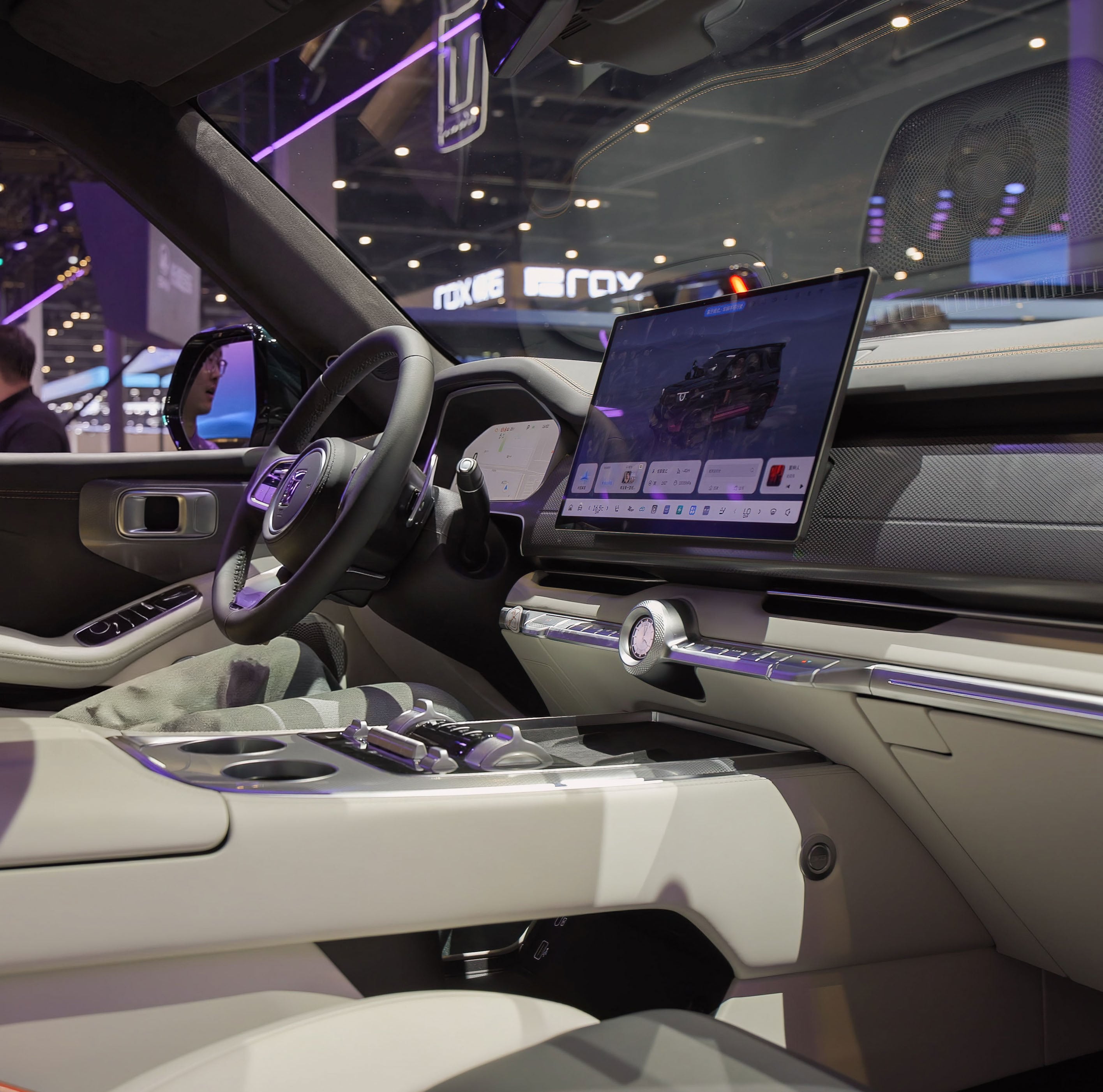
The update came out of the Beijing Auto Show 2026, where GWM Chairman Jack Wei confirmed the new engine direction and reinforced the Tank 700’s role in the brand’s expanding performance lineup.
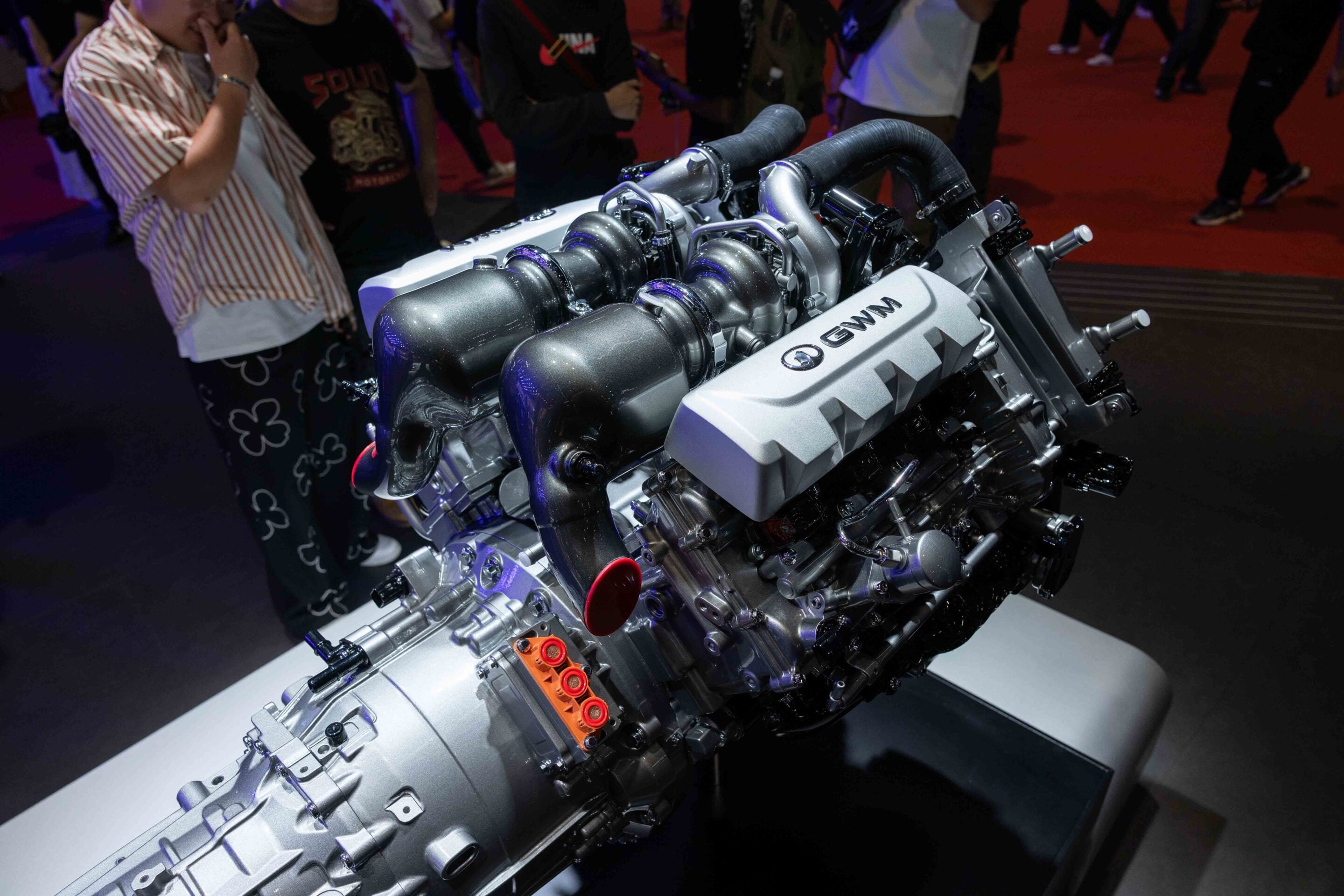
“In the future, the Tank 700 will also use a V8 engine. The supercar uses a high-performance V8, while the Tank 700 uses a normal V8,” said Mr Wei. “This is completely opposite to the current environment or trend in China; it does not fit the Chinese market. We developed this V8 to meet the needs of more global users, in markets such as Australia and New Zealand,” he said.
It’s not a left-field call either. The idea of a V8 Tank SUV has been floating around since the Shanghai Auto Show 2025, where GWM acknowledged growing demand for a more traditional high-capacity SUV in export markets. What’s changed is the level of commitment. GWM is now backing multiple V8 applications across its range, including a 4.0-litre twin-turbo hybrid V8 set for its upcoming GF supercar due in 2027.
Locally, the Tank brand is starting to get a stronger foothold. The GWM Tank 300 has led the charge as an accessible ladder-frame 4×4 with low-range capability, while the larger GWM Tank 500 pushes further into the touring and family SUV space with more size, tech and towing focus.
Underneath, the Tank brand is already expanding its drivetrain mix with platforms like Hi4-Z in China, leaning heavily into electrification alongside its traditional combustion options. A V8 variant would effectively sit above these systems, giving GWM more flexibility across different global markets.
There are still gaps – no timing, no confirmed rollout markets, and no final engine specs. But the direction is clear. GWM is preparing to broaden its premium 4×4 offering, and the Tank 700 looks set to lead that charge with eight cylinders.
Sharing of vehicle platforms – and even entire vehicles – is nothing new in the automotive industry. It just seems more prevalent these days as development and manufacturing costs escalate and some manufacturers run out of fresh ideas.
My first memory of it was riding the bus to school and seeing the shiny new Ford Mavericks on the lot at Fury Ford, and thinking, aren’t they Nissan Patrols? There have been many similar instances in the decades since, and as I said at the start, it’s far more common today.
Most recently, the new D27 Nissan Navara is essentially a Mitsubishi Triton; while the MG U9 is almost identical to an LDV Terron 9. And the D-MAX in past guises was sold here as Chevy LUVs, Holden Rodeos and Holden Colorados. Around that same era, Ford brought out the Courier ute, which was a rebadged Mazda B-Series. That sharing went on for years until Ford went its own way and developed the T6-based Ranger – now Australia’s best-selling vehicle – which is also shared with the VW Amarok.
While some of these shared vehicles seemed logical, given the brands were linked by ownership and partnerships, what about some of the more left-field collaborations?
Like the Mercedes-Benz MB100 van, which was made by a then-young upstart, SsangYong. The deal also saw Mercedes-Benz engines under the bonnets of the first Mussos. Who else remembers Musso owners – and even dealers – fitting the three-pointed star to the quirky-looking wagons at the time?
We never got the model here, but in Europe the Toyota HiLux was rebadged as a VW Taro in the late 1980s, long before the booming popularity of midsize utes or any thoughts of the Amarok.
Back in the 70s Toyota and Daihatsu shared a 4×4 called the Blizzard and Scat respectively, but these days Toyota protects its 4×4 products by largely keeping them to itself. There was also a time when the Big T shared its small and midsize passenger cars with Holden in the ’80s and ’90s in a deal that also gave us the Toyota Lexcen – which, of course, was a Holden Commodore.
In fact the ’80s and ’90s were prime time for product sharing, and around this time we also started to see wagons based on popular utes. I remember seeing Ford Everest-badged vehicles running around Ford HQ in Melbourne, based on an earlier Mazda platform. We never got that version here but eventually received the Everest on the T6 platform. We did, however, get the Ford Raider – a Courier/B-Series-based wagon. In name only, the Raider badge is back again – this time on a Mitsubishi Triton ute.