
The Easter holidays are looming, providing the perfect opportunity to stretch your four-wheel drive’s legs on an off-tarmac adventure.
The “official” break is only four days, so that puts limitations on where many of us can point our 4x4s. So we’ve compiled a list of destinations that are close(ish) to the capital cities, so that you’ll get there within a few hours and have plenty of time to enjoy the trip.
The beauty of some of these destinations is that you can also enjoy them as a day trip, so that you’re back home before the sun dips below the horizon. Let’s crack into it!
Brisbane, Queensland
Moreton Island
Located just 40km from the centre of Brisbane, Moreton Island is a haven for four-wheel drivers, anglers and bushwalkers. Of course, experience driving on sand is essential, as there are no sealed surfaces on the island – and always be aware of the tide! There are five campground sites in total, as well as another five camping zones.
A beach access permit is required, and Moreton Island can be reached by ferry, barge or boat – the MICAT ferry is your only means of transportation when touring with a 4×4. The ferry leaves from the Port of Brisbane and drops travellers off on the beach just north of the Tangalooma Island Resort.
Plenty of families take the trip to explore the many shipwrecks on the western side (18 in total), as well as to get up close with the area’s many dolphins. No matter your age, there are countless experiences to be had on the island; but whatever you choose to do, make sure you visit Tangalooma Wrecks, the Champagne Pools and the Moreton Island Lighthouse.
North Stradbroke Island
Known as Straddie to the locals, North Stradbroke Island is another quintessential sand-driving experience. Much like Moreton, Straddie offers swimming, surfing, fishing and plenty of off-roading – there’s even a golf course. Track difficulty varies depending on the route, with plenty on offer for both novices and experienced steerers.
Tripod Track is a great 4×4 route that strikes through the densely vegetated centre of the island, and it stops off at Tripod Lookout (worth it for the views it provides of the island). It’s a difficult trip, so only embark on it if you’re proficient at four-wheel driving. Just like Moreton, you’ll need a beach access permit, and you’ll need to follow strict rules about where and when you can drive – there’s no 4×4 access either side of high tide, for example (fines apply).
The ferry to reach the island is located about 40 minutes east of Brisbane at Cleveland, with the ferry itself taking about 25 minutes to reach the island.
Sydney, NSW
Abercrombie River National Park
At around 3.5 hours from Sydney, Abercrombie River NP is located in the NSW Central Tablelands and is perhaps a tad too far to be an ideal day-trip destination. Still, it’s known for its challenging off-roading, and with some of the steepest 4×4 tracks in the state, it’s a great option for a long-weekend getaway.
Most of the perfect views, remote attractions and riverside campsites are accessible via 4×4 tracks, so you’ll need to be proficient behind the wheel to reach them and a 4×4 is (clearly) essential. However, some sections of the park can be accessed in 2WD. To ease into it, the western access point leads to the tamer routes, but head to Felled Timber Road on the east side if you’re up for a fight.
There are four campsites within the park including the Beach and Silent Creek (both crackers) and an ideal time to visit is either during Spring or Autumn.
Coolah Tops National Park
If you thought Abercrombie was too far, Coolah Tops National Park is even further from Sydney – about five hours’ drive via the town of Coolah. However, that distance and the fact the park isn’t as well-known means it’s probably going to be quieter for a four-day jaunt.
The 4×4 tracks within the park aren’t difficult but lead to some amazing look-outs and through dense, lush forest with giant snow gums and waterfalls. With numerous trails throughout the park, it’s no surprise that bushwalkers and mountain bikers love to explore the area. Wildlife and birdlife is also prevalent in the area, with wallabies, eagles and owls often sighted.
The park sits between the Great Dividing and Warrumbungle ranges and there are three campgrounds within the park. You can also rest for the night at the rustic and historic Brackens Hut, situated on a grassy flat between the open forest.
Melbourne, Victoria
The Otways
The Otways, which comprises Great Otway National Park, Anglesea Heath and Otway Forest Park, is within a stone’s throw from Melbourne via the popular Great Ocean Road. Running alongside the Bass Strait, the mountainous forest is abundant with waterfalls, lakes, picturesque campsites in the forest or along the coast, bushwalking trails and, of course, plenty of 4×4 tracks.
Denham Track is a popular choice for tourers as it can be challenging at stages and does require the use of low range. However, remember to keep in mind that seasonal road closures are implemented – in 2024, Denham Track was closed from 13 June until 31 October. It’s open for Easter, though!
Various campsites are located within the Otways including Hammonds (quite popular but has basic facilities), Big Hill (more remote, with great views) and Jamieson Track Campground (secluded, as it can only be accessed with a 4×4 vehicle). The most popular access point is at the coastal town of Anglesea, and there are no shortage of sites to explore over the Easter break.
Grampians National Park
Located approximately three hours’ drive from Melbourne CBD, the Grampians is loaded with sights and hidden treasures for four-wheel drivers, rock climbers, hikers and cyclists. The views over the mountain ranges are breathtaking and are simply worth the drive out there alone.
Four-wheel drive tracks within the Grampians include Mount Zero Road, Victoria Range Track and Launders Track, if you’re up for a challenge. Again, remember to research road closures in advance. Popular destinations include MacKenzie Falls – one of the largest waterfalls in Victoria – and Beauchamp Falls (both accessed by short, scenic walks).
Grampians NP is best accessed from Halls Gap at the northern end of the park, which is another ideal spot to spend a night or two if camping isn’t your thing. The small town has a general store, accommodation, fuel and a great bakery.
There are plenty of campsites within the park’s boundaries including Lake Bell Campground and Halls Gap Campground; some are easy while others can be harder to reach. All are unpowered but include toilets and fireplaces. Plan ahead as you’ll need to reserve a spot online before you travel.
Adelaide, South Australia
Ngarkat Conservation Park
Just over three hours’ drive west of Adelaide along the Mallee Highway, Ngarkat Conservation Park provides a generous sample of outback touring. Scattered with sand dunes, mallee scrub and heathlands, this desert destination features 11 campground sites of which most are accessible by 4×4 only.
The challenging Border Track is the park’s most famous attraction and is well worth adding to the bucket list. The track is typically accessed from the north near Pinnaroo and it follows the border that straddles South Australia and Victoria. It’s an extremely popular route due to its true outback style of adventure, and it’s only recommended for experienced off-road steerers. Other tracks within Ngarkat Conservation Park include Centre Track and Mount Shaugh Track – plus it’s only a relatively short detour to reach Victoria’s Big Desert Wilderness.
While predominantly a haven for 4×4 exploration, there are some alternative activities to do within the park such as hiking and bushwalking, including the Tyms Lookout Hike.
Little Dip Conservation Park
Little Dip is located just two kilometres south of Robe, an iconic coastal town that takes about 3.5 hours on bitumen from Adelaide.
Definitely spend a day exploring Robe before lowering tyre pressures and venturing down the Limestone Coast to Little Dip Conservation Park. For a park that is small by comparison to others on this list (just 21.5 square kilometres), Little Dip packs in plenty including fishing, 4×4 touring, hiking, kayaking, swimming, surfing and camping at a handful of stunning sites.
The beach driving is extraordinary, and the sand tracks that offshoot from the beach can be equally challenging. Always remember to lower tyre pressures (and re-inflate when back on tarmac). There are four campgrounds within Little Dip – Long Gully, The Gums, Old Man Lake and Stony Rise. All of these sites are positioned close to the beach, so views will be abundant but resources will be limited.
Perth, WA
Walyunga National Park
It may be well-known as a perfect day-trip destination for Perth locals (it’s only 30km from Perth), but you could easily fill up a long weekend at Walyunga National Park. Four-wheel drive touring is in the easy category, and there are definitely better parks from a driving perspective, but the park makes up for it with its access to the Swan River and the swimming, paddling and fishing it allows.
It’s also a bushwalker’s paradise, with myriad trails winding through the park all leading to breathtaking, tranquil views. Trails include the 5.2km Syd’s Rapids Trail; the 11km Echidna Trail; the 4km Kingfisher Trail; and the 4km Kangaroo Trail. Tourers are also inclined to load a kayak or canoe on the roof racks so they can enjoy a paddle along the Swan.
A small, basic campground near the Swan River contains firepits and picnic facilities, but it does get busy during peak times.
Leeuwin-Naturaliste National Park
A popular haven for Perth residents, Leeuwin-Naturaliste is a massive National Park that lures visitors with a passion for surfing (world-class surf spots include Margaret River, Guillotines and South Point), swimming, diving, hiking, cycling, camping and fishing. Of course, it also entices 4×4 tourers thanks to its combination of sand dunes, beach driving along the Indian Ocean and forest tracks.
Four campgrounds are available – with varying levels of demand – but no doubt they’ll fill up quickly over the long weekend. These include Boranup, Point Road (4×4 access), Conto and Jarrahdene. The 4×4-only Point Road track is located on the edge of the Boranup Karri Forest and is a moderate to challenging route where low range is required.
Much like Walyunga National Park, Leeuwin-Naturaliste is also popular with kayakers and canoeists, while caving and abseiling are also popular in the area.
Hobart, Tasmania
Tarkine Wilderness area
Due to the small size of Tasmania, every destination could be considered “close enough” to the capital city of Hobart for a long weekend getaway. The wild west coast of Tasmania, notorious for its epic off-roading, is one such destination. It’s approximately a five-hour slog from Hobart, so you’re better off heading there from Devonport, where it takes about 2.5 hours behind the wheel.
The Tarkine Wilderness area is abundant with dense, ancient rainforests, eclectic wildlife and sweeping vistas at every turn. It’s also home to the famous Climies Track, a bucket-list 4×4 adventure known for its extreme difficulty and steep, slippery terrain. The remote trek covers a variety of terrain including loose gravel, mud and big boulders, and it’s almost impossible to conquer in the wrong conditions. It’s a relatively short trail, all things considered, but the memories will last.
Mount Wellington
A helluva lot closer to Hobart than the Southwest Wilderness region, Mount Wellington is only 30 minutes’ drive on the blacktop.
Also known as Kunanyi, the area provides the opportunity to head to the summit and be back home by lunchtime. Heading along the Kunanyi Summit Road will take you to the summit, resulting in beautiful panoramic views of Hobart and the Derwent River. However, if you want to enjoy some 4×4 action, there are several tracks that offshoot from the main road and venture into more isolated parts of the mountain.
Bushwalking and hiking are also popular on trails including the 21km Pinnacle Track, or the brief 2.5km Organ Pipes Track. The area also has several sites of cultural significance which can be explored.
Darwin, Northern Territory
Litchfield National Park
Located just over an hours’ drive from Darwin, Litchfield is packed with challenging 4×4 tracks to experience over the Easter break. A bite-sized sample of the nearby Kakadu NP, Litchfield is ideal for those who are short on time. The 4×4-only Greenant Creek Track includes numerous water crossings and is loads of fun, swaying from challenging to easy-going. The Reynolds River crossing is another unmissable section, famous for its winding path across the wide waterway.
Swimming in the park is generally forbidden due to saltwater crocodiles, but famous attractions such as Florence Falls, Buley Rockhole, Tolmer Falls and Wangi Falls in the park’s north-west corner do offer safe swimming spots in the pools at the base of waterfalls – but always check first.
Outdoor enthusiasts also enjoy the many hiking and walking trails – the 39km Tabletop Track is a popular multi-day hike – and campers can set up at many camping areas in the park including at Wangi Falls, Tjaynera Falls and Surprise Creek Falls.
Nitmiluk National Park
It’s a longer drive from Darwin compared to Litchfield, but Nitmiluk National Park – about three hours’ drive south of Darwin – is rich in cultural history and is an ideal destination for a long-weekend escape.
Your 4×4 skills won’t be put to the test here as the tracks are all subdued, but the scenic views and comfortable campgrounds make for a memorable getaway. The Katherine Gorge (also known as the Katherine River) is the centrepiece of the park, with canoes and kayaks endlessly exploring this beautiful landscape. Campsites trace the river’s course, and there are plenty of swimming spots along the way. Boat tours also run daily.
For keen hikers, the four-day Jatbula Trail is perhaps the most popular within the park, while Edith Falls Walk in the north of the park leads to great swimming spots in the upper and lower pools.








Hyundai is shaking up the off-road scene with its Boulder concept, unveiled at the 2026 New York Auto Show.
This rugged concept shows the brand is no longer content with city-friendly crossovers – it’s now turning its attention to enthusiasts who demand serious four-wheel-drive performance.
The Boulder rides on a robust body-on-frame chassis, reportedly the same foundation that Hyundai plans to use for a new mid-size pickup, expected to hit production by 2030.
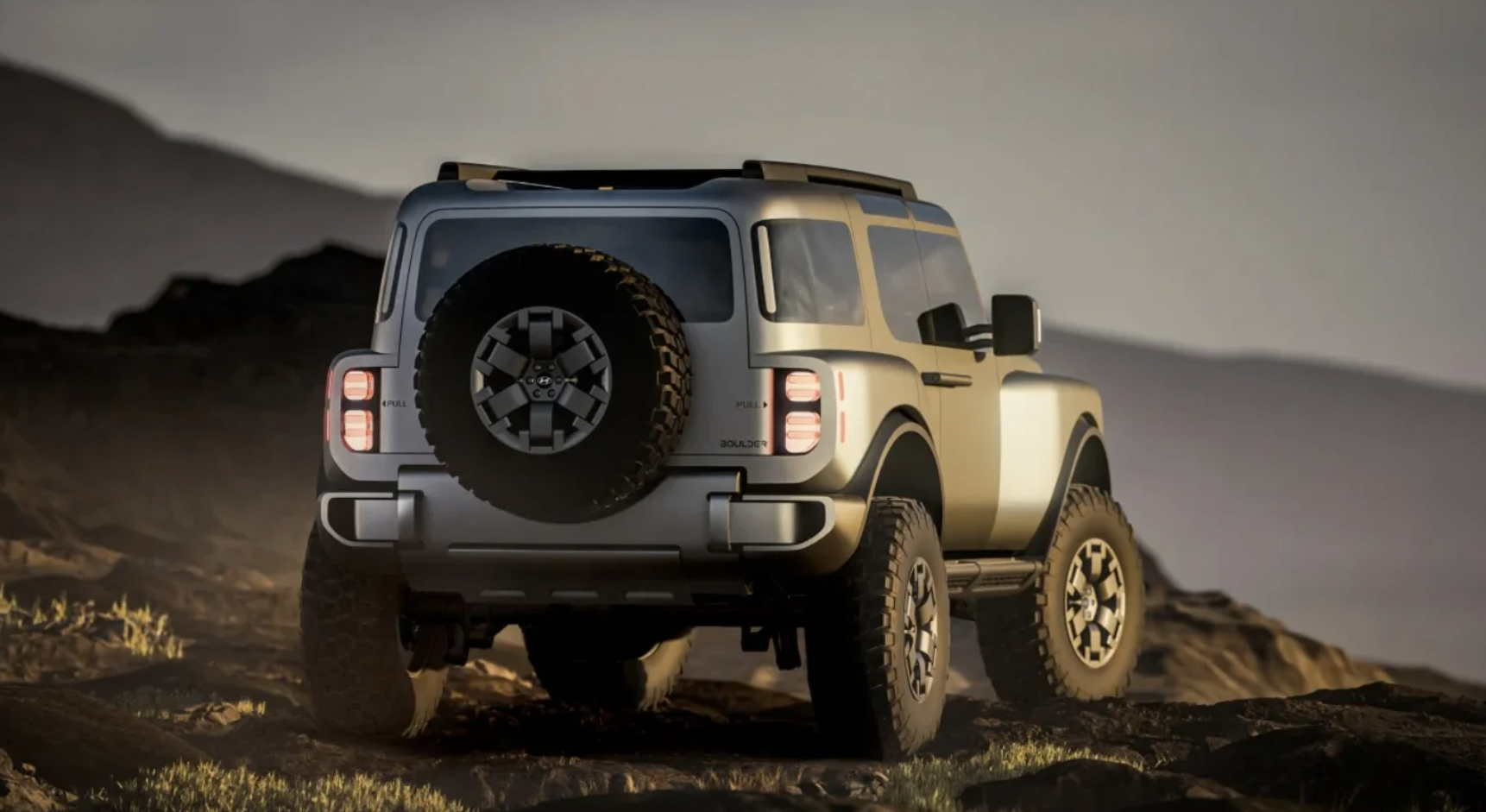
Despite massive 37-inch tyres, high ground clearance, and a tall stance, some elements will most likely be toned down for production – but the concept’s aggressive proportions and off-road-ready hardware give a clear picture of what’s to come.
Styling is a departure from Hyundai’s usual clean SUV lines. The Boulder sports wide arches, distinctive roof glass, and a wraparound rear window, giving it a bold, modern edge without losing its rugged, purpose-built character. Inside, the cabin is functional, with small digital screens and tactile controls for 4×4 functions.
Development of the Boulder platform is taking place in the United States, with both SUV and ute versions slated for American production. There’s no indication on an Australian release, but the popularity of off-road vehicles here suggests a strong potential market.
Mitsubishi has locked in pricing and updates for the 2026 Triton range, with the revised ute set to arrive in Australia in May.
The line-up opens at $44,440 (RRP) for the GLX single-cab chassis, with the GLX dual-cab pick-up priced from $51,640. At the top end, the GSR dual-cab pick-up lands at $65,590.
For 2026, reworked suspension has been applied across the range. Up front, Mitsubishi has introduced a lower spring rate and rubber body mounts, while new high-response ‘Various Performance Setting’ valves have been added to both front and rear shock absorbers. The rear dampers also increase in diameter to improve control. GLX and GLX+ variants continue with a heavy-duty four-leaf rear suspension, while GLX-R, GLS and GSR models retain a three-leaf arrangement.
The flagship GSR picks up additional hardware, now equipped with YAMAHA Performance Dampers mounted across the front and rear of the chassis. The system is designed to improve body control and steering response, while boosting high-speed stability and reducing vibration and cabin noise for smoother performance.
Tech has also been expanded at the top of the range, with Mitsubishi Connect introduced on the top-spec GSR. The system uses an embedded telematics control unit with 4G connectivity via the Telstra network, and includes SOS emergency assistance, breakdown call functionality and remote vehicle access through the My Mitsubishi Connect mobile app, with safety and security services available around the clock.
“Triton has long been a key link to our brand in Australia. It represents impressive capability, strong value and a dedication to reliability and aftersales support that is second to none,” said Bruce Hampel, MMAL GM of Product Strategy.
“The latest range of model year updates further strengthen these values, with refined specifications including new suspension componentry that is applied across the range, making this Triton more refined than ever, while still retaining impressive strength and durability.
“GSR also evolves with the key addition of Mitsubishi Connect, for the first time on Triton, while the introduction of the YAMAHA Performance Damper adds even further refinement with a new level of chassis control,” he said.
The Triton powertrain continues unchanged, powered by a 2.4-litre bi-turbo diesel four-cylinder producing 150kW and 470Nm.
2026 pricing
| Grade | Drive | Transmission | Body Style | Price (RRP) |
|---|---|---|---|---|
| GLX | 4×4 | 6AT | Single Cab Chassis | $44,440 |
| GLX | 4×4 | 6AT | Club Cab Chassis | $47,590 |
| GLX+ | 4×4 | 6AT | Club Cab Pick-Up | $50,690 |
| GLX | 4×4 | 6MT | Dual Cab Chassis | $47,940 |
| GLX | 4×4 | 6AT | Dual Cab Chassis | $50,190 |
| GLX | 4×4 | 6AT | Dual Cab Pick-Up | $51,640 |
| GLX+ | 4×4 | 6AT | Dual Cab Chassis | $52,690 |
| GLX+ | 4×4 | 6AT | Dual Cab Pick-Up | $53,990 |
| GLX-R | 4×4 | 6AT | Dual Cab Pick-Up | $57,440 |
| GLS | 4×4 | 6AT | Dual Cab Chassis | $58,590 |
| GLS | 4×4 | 6AT | Dual Cab Pick-Up | $60,140 |
| GSR | 4×4 | 6AT | Dual Cab Chassis | $62,590 |
| GSR | 4×4 | 6AT | Dual Cab Pick-Up | $65,590 |
JAC has launched the T9 Tradepro Cab‑Chassis, now available from $38,990 plus on‑roads. The entry‑level T9 is aimed squarely at tradies, farmers, fleet operators and small business owners.
For ABN holders, JAC is offering an exclusive drive‑away price from $40,990 ($41,990 in WA), which includes a free JAC Genuine Alloy Tray with fitment. This limited‑time offer is available on new T9 Tradepro stock to eligible ABN holders until April 30, 2026, or while stocks last from participating dealers.
The T9 Tradepro features an open platform for custom trays, toolbox fit‑outs or other body modifications. Standard specifications include:
- 18‑inch steel wheels
- 4×4 with rear differential lock
- Heavy‑duty fabric seating
- 1165kg payload (excluding tray)
- 3.2-tonne braked towing capacity
- 7.6L/100km fuel consumption (NEDC combined)
- Rear camera
- Apple CarPlay and Android Auto
- Wireless phone charging
- Keyless entry and push‑button start
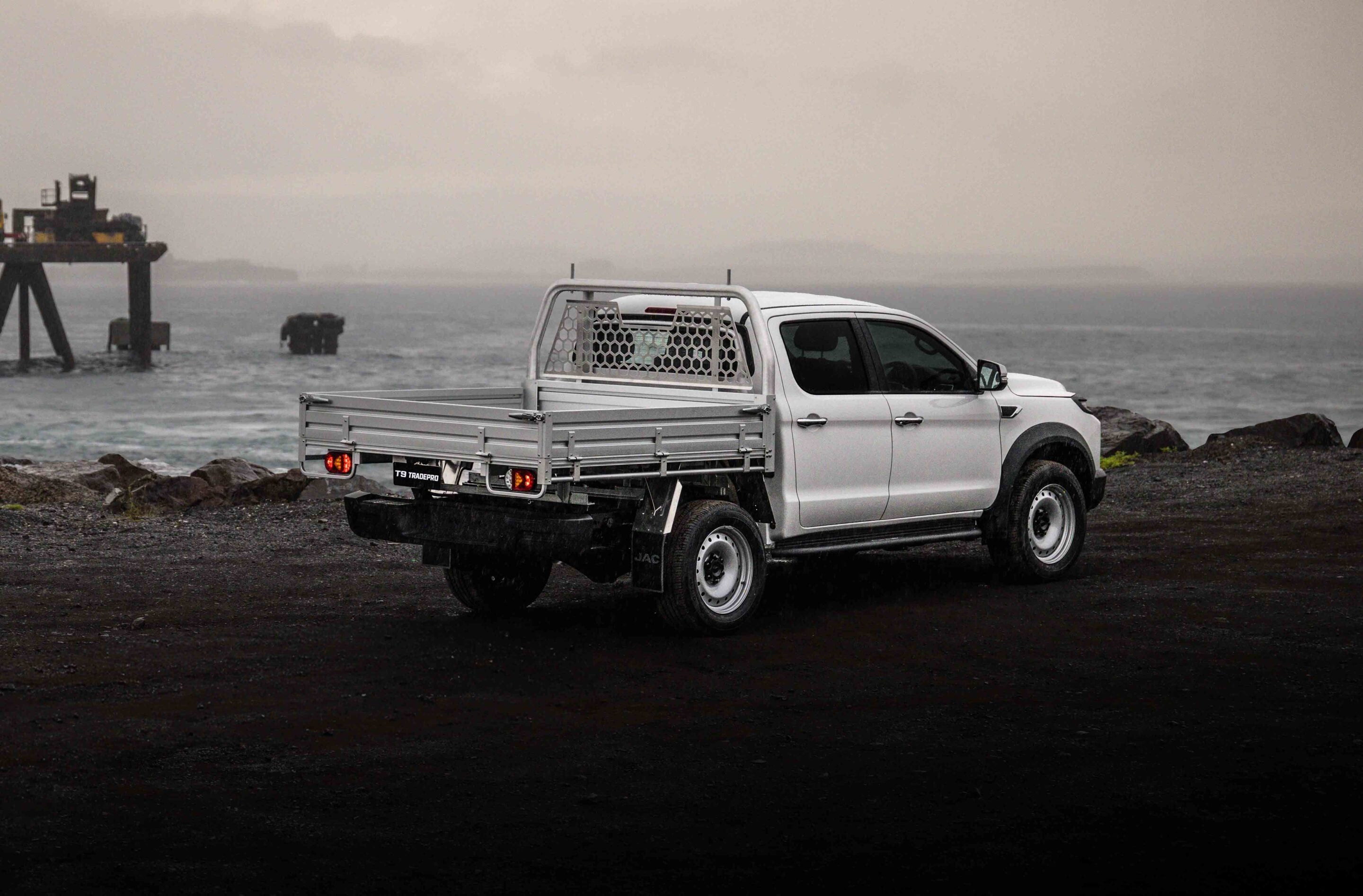
“The T9 Tradepro Cab-Chassis is exactly what we set out to build – a serious work vehicle that doesn’t ask tradies to pay for things they don’t need, or go without the things they do,” said Ahmed Mahmoud, JAC Motors Australia Managing Director. “Combining that with our ABN driveaway offer makes this one of the strongest value propositions in the segment right now.”
The T9 is powered by a 2.0‑litre turbodiesel producing 125kW and 410Nm, paired with a 4WD system featuring a BorgWarner dual‑range transfer case and locking rear differential.
JAC added the lifestyle‑focused T9 Osprey dual‑cabs to its Australian line‑up at the end of 2025. The standard Osprey starts at $46,629, with the darker‑trimmed Osprey X at $47,079. Both carry a 980kg payload to remain eligible for salary‑packaging and novated leases. They share the T9’s 2.0‑litre turbodiesel, ZF eight‑speed automatic and 4WD setup.
All models maintain a five‑star ANCAP rating and come with JAC’s seven‑year unlimited‑kilometre warranty, capped‑price servicing and 24/7 roadside assistance.
Last month, JAC also confirmed fuel‑efficiency and range figures for its upcoming Hunter PHEV, due in Australia mid‑2026. The Hunter is set to deliver a combined 1.6L/100km (NEDC) fuel consumption figure and 1005km combined driving range (NEDC), positioning it as a long‑range electrified option in the 4×4 ute segment.
It pairs a turbocharged petrol engine with dual electric motors and a 31.2kWh lithium‑iron phosphate battery, and it supports a 3.3kW vehicle‑to‑load (V2L) function for powering tools or gear.
Just about every motorist has (or should have) an understanding of the importance of running the correct air pressures in their vehicle’s tyres for on-road driving, no matter what type of vehicle they drive.
The correct tyre pressures ensure optimum vehicle performance in terms of traction, grip, ride quality and fuel economy, as well as optimum tyre life in terms of tyre wear across the tread face, as well as sidewall longevity. Throw off-road driving into the mix and the importance of setting the correct tyre pressures is even greater. Adjusting air pressure to suit different terrain types will not only improve vehicle performance and ride quality, and prolong tyre life, but it will also minimise track damage.
While many four-wheel drivers are well-versed in the need to lower tyre pressures for sand driving, many don’t understand the benefits of lowering pressures for driving on other surfaces such as gravel roads and dirt tracks, or through mud and over rocks.
Before we go any further, it should be noted that the recommended pressures listed in this guide are just that, recommendations. It should also be noted that these recommendations are for vehicles fitted with Light Truck (LT) construction tyres, which have a stronger carcass, both across the tread face and in the sidewalls, than the Passenger Car (P) rated tyres that are often standard fitment on many new 4x4s. Also bear in mind that heavily laden vehicles will need to run higher air pressures in their tyres than lightly laden vehicles will.
JUMP AHEAD
- Road pressures
- Gravel and dirt roads
- Rocky terrain
- Mud terrain
- Sand terrain
- Remember to reinflate
- Required equipment
- Expert opinion
- Tips and traps
- FAQs
Road pressures
To figure out a start point when it comes to setting the correct tyre pressures for on-road driving, just look at your vehicle’s tyre placard.
But bear in mind that while the tyre placard will list different tyre pressure recommendations for different OE tyre sizes, you might have to adjust pressures to suit aftermarket LT tyres if fitted. The placard will also likely list higher pressures for when the vehicle is carrying a load, and this is an important consideration, especially for 4×4 utes that have high payload capacities.
If a vehicle is carrying a heavy load, it might be necessary to run higher pressures in the rear tyres than the front. Likewise, a vehicle equipped with a steel bullbar, a winch and driving lights will likely need higher tyre pressures up front than what is listed on the tyre placard.
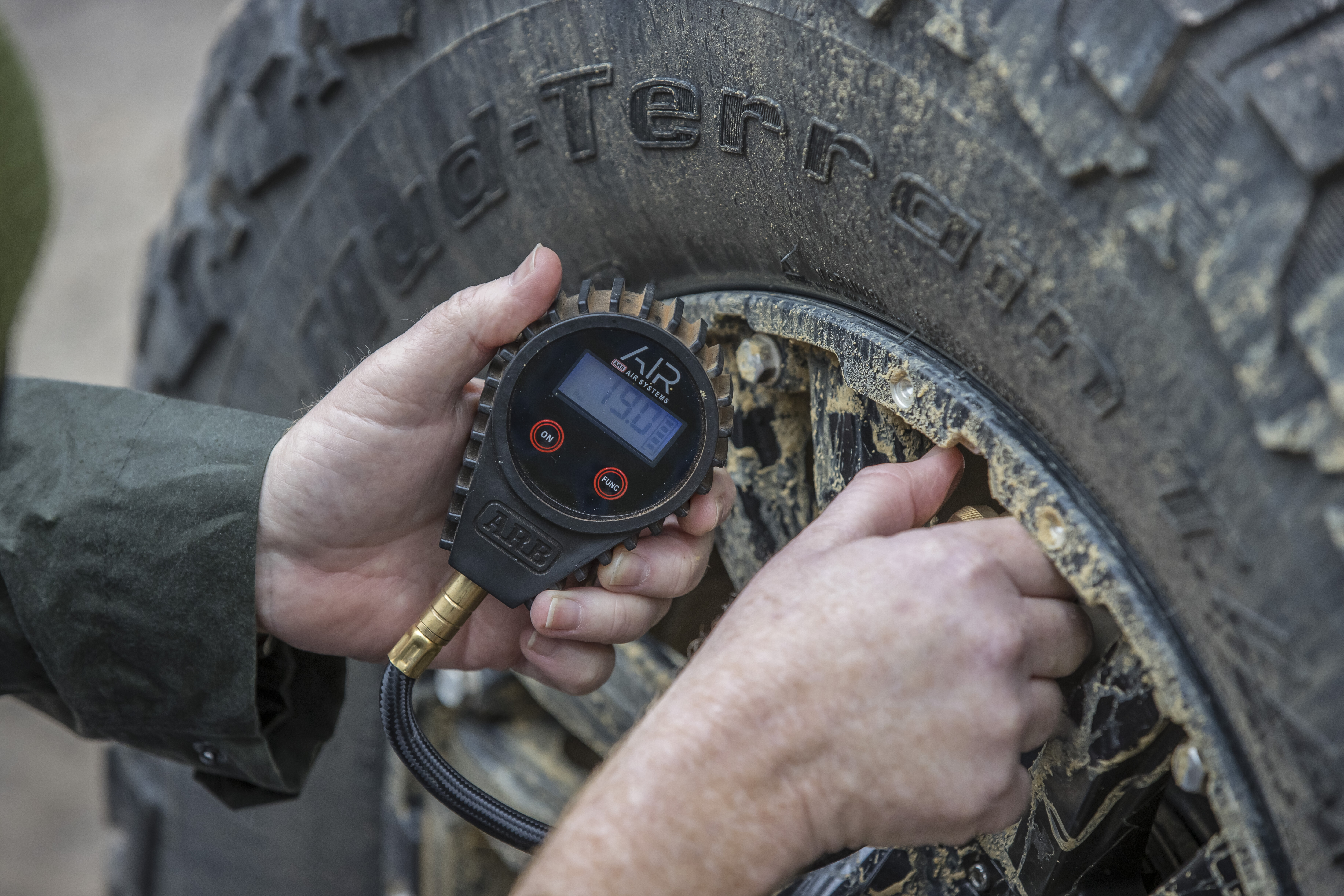
Figuring out the ‘perfect’ on-road tyre pressures to suit your vehicle is often a case of trial and error, and it will depend on how you want your vehicle to behave on the road in terms of ride quality, steering response and handling.
It is important not to go too extreme when adjusting tyre pressures for on-road driving. Go too low and the tyres will flex a lot in the sidewalls and generate too much heat, which can result in tyre delamination, which is essentially where the tyre separates in to its various components. Go too high with pressures and ride quality will suffer through a lack of sidewall flex, and the tyres will also be more prone to punctures.
Pressures also have a big effect on tyre life; overinflated tyres will wear prematurely in the centre of the tread area, whereas underinflated tyres will wear more on the outside of the tread area. With the right inflation pressures, the tyres should wear evenly across the tread face, assuming the wheels are correctly aligned and balanced.
Gravel and dirt roads
Driving on gravel roads and dirt tracks is very different to driving on sealed roads, so it’s important to adjust tyre pressures to suit the conditions.
For smooth and well-graded gravel roads on which you can easily maintain highway speeds, you might be able to stick to your on-road tyre pressures, but the loose surface will mean you have reduced traction and grip, resulting in compromised cornering capability as well as extended braking distances. Lowering tyre pressures results in a longer tyre footprint for improved traction and grip, and more flexible sidewalls for better ride quality.
How much should you lower tyre pressures? As a general guide, if you run 35psi on the road you might want to go down to 30psi on smooth gravel roads. And if the road surface deteriorates, you can lower pressures further still. From experience, I’d suggest somewhere between 32psi to as low as 26psi is suitable for rough gravel roads, depending on the load you are carrying.
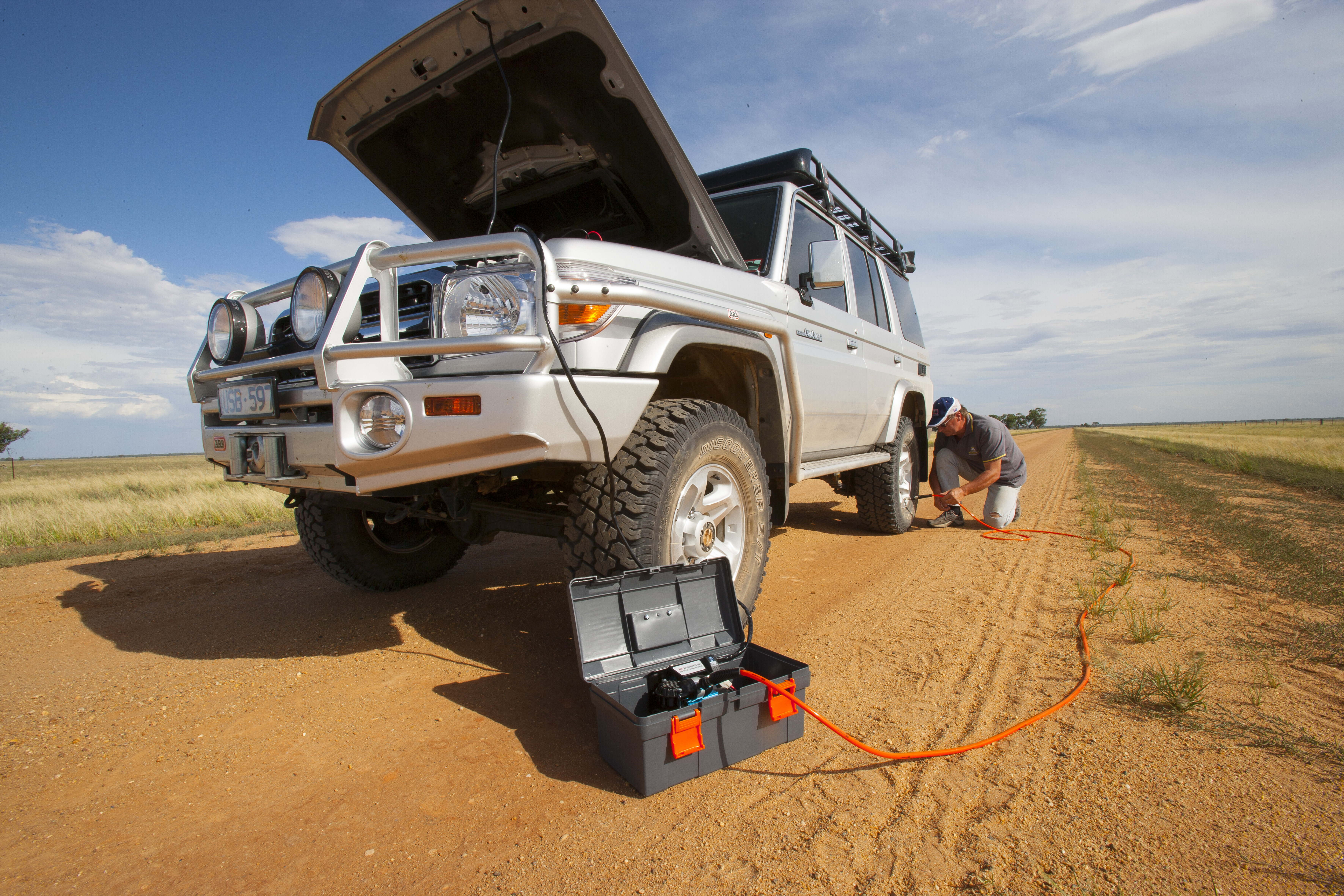
If for example, your on-road tyre pressures were at 38psi, drop to 32psi or so on rough gravel and see how the vehicle rides and handles. If you are running 35psi on the road, then maybe drop to around 26psi on rough gravel roads. You, your passengers and your vehicle will appreciate the many benefits of running lower tyre pressures on heavily corrugated roads.
The vastly improved ride quality you’ll experience by lowering tyre pressures is beneficial for the comfort of vehicle occupants and it makes driving less tiring. Lower pressures also minimise potential vehicle damage caused by incessant vibrations, and result in more grip, making the vehicle easier to drive. As well as offering better traction, grip and ride quality, lowering tyre pressures for gravel roads also reduces the risk of chipping across the tyre tread face, as the tyres are more flexible and therefore less prone to impacts from sharp stones and rocks.
Rocky terrain
Reducing tyre pressures in rocky terrain allows the tyres to flex, which means they can better conform to uneven terrain, in turn improving traction and reducing the chance of tyre damage.
As mentioned, lower tyre pressures also result in a longer tyre footprint, which means better traction. If you’re crawling over rocky terrain in low range, you can lower tyre pressures quite a lot, as heat generation from high-speed driving will not be an issue. How low? If you run tough LT tyres, 22psi is a good starting point for rock crawling, but make sure your throttle and steering inputs are gentle and well-considered, because abrupt acceleration or steering inputs can result in the tyres slipping on their respective rims, which can lead to deflation, or the tyres coming off the rims altogether.
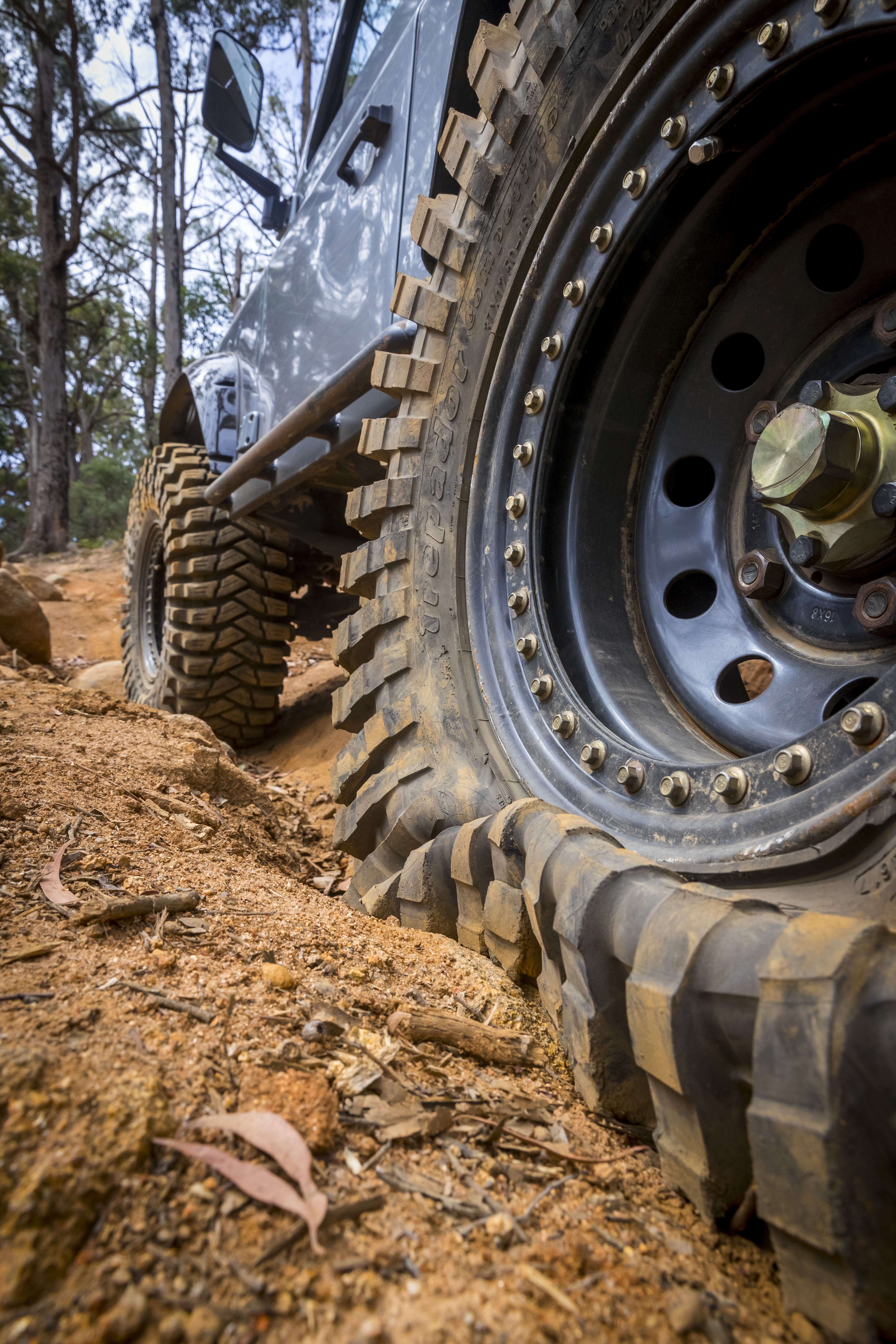
There is a downside to lowering tyre pressures in rocky terrain, and that is increased susceptibility to sidewall damage. As you lower pressures, the tyre sidewalls bag out, so make sure you keep an eye out for sharp rocks or protruding tree roots and the like in rocky terrain.When track conditions improve, remember to reinflate your tyres; as your speed picks up, so too will tyre temperatures, and therefore the risk of tyre damage.
Mud terrain
The right tyre pressures for mud driving depends on what type of mud you’re driving in.
What type of mud?! Well, if the mud is slippery and slimy on the surface, but you can feel a firm base underneath, then gravel-road tyre pressures (26 to 30psi) will allow the tyres to cut through the top layer and hopefully gain purchase on the firm base. If the mud is deep and gooey, and you can’t feel a firm base at all, dropping tyre pressures to as low as 22psi will hopefully give them a chance of gaining purchase in the slop, thanks to the resulting longer tyre footprint.
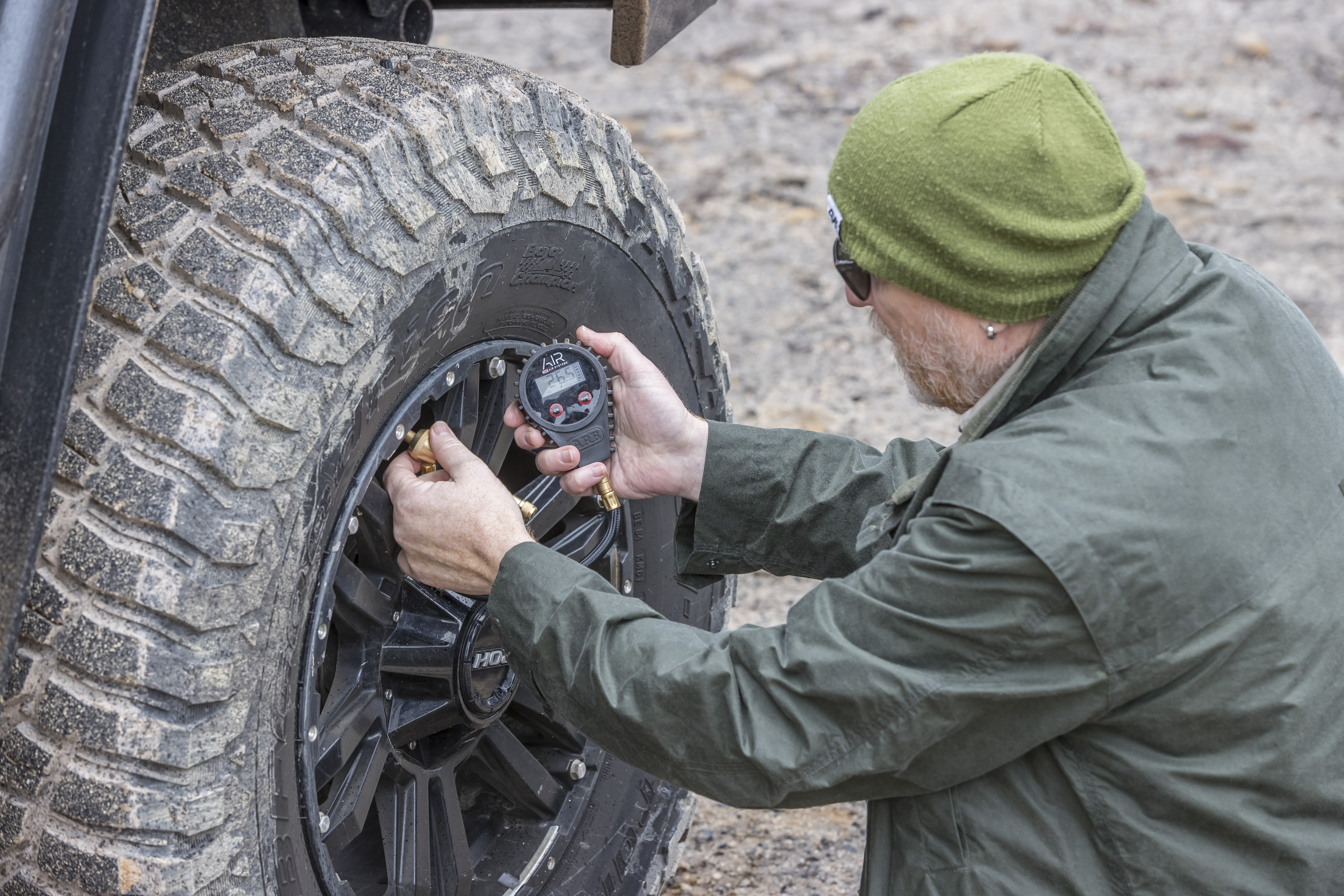
As with rock driving, if you have lowered tyre pressures significantly to get through mud, don’t make sudden throttle or steering inputs, as the tyre could slip on the rim or mud could work its way in between the bead and the rim, resulting in rapid tyre deflation.With bead-locks fitted, ensuring the tyres cannot slip or peel off their respective rims, you can drop pressures even further for mud driving, but check the legality of such devices in your state or territory before going down this route.
Sand terrain
Lowering tyre pressures for sand driving seems to be the one everyone knows about, but how low should you go, and why?
Let’s start with why. As already discussed, lowering tyre pressures increases the tyre footprint, and in sand this helps the tyres to float over the surface rather than dig in to it. So, how low should you go? In soft sand, you can safely drop tyre pressures to as low as 16psi without peeling them off their respective rims, so long as you don’t make sudden steering movements or corner at great speeds. And remember, don’t drive too fast on sand with low pressures as heat will quickly build up and cause tyre damage.
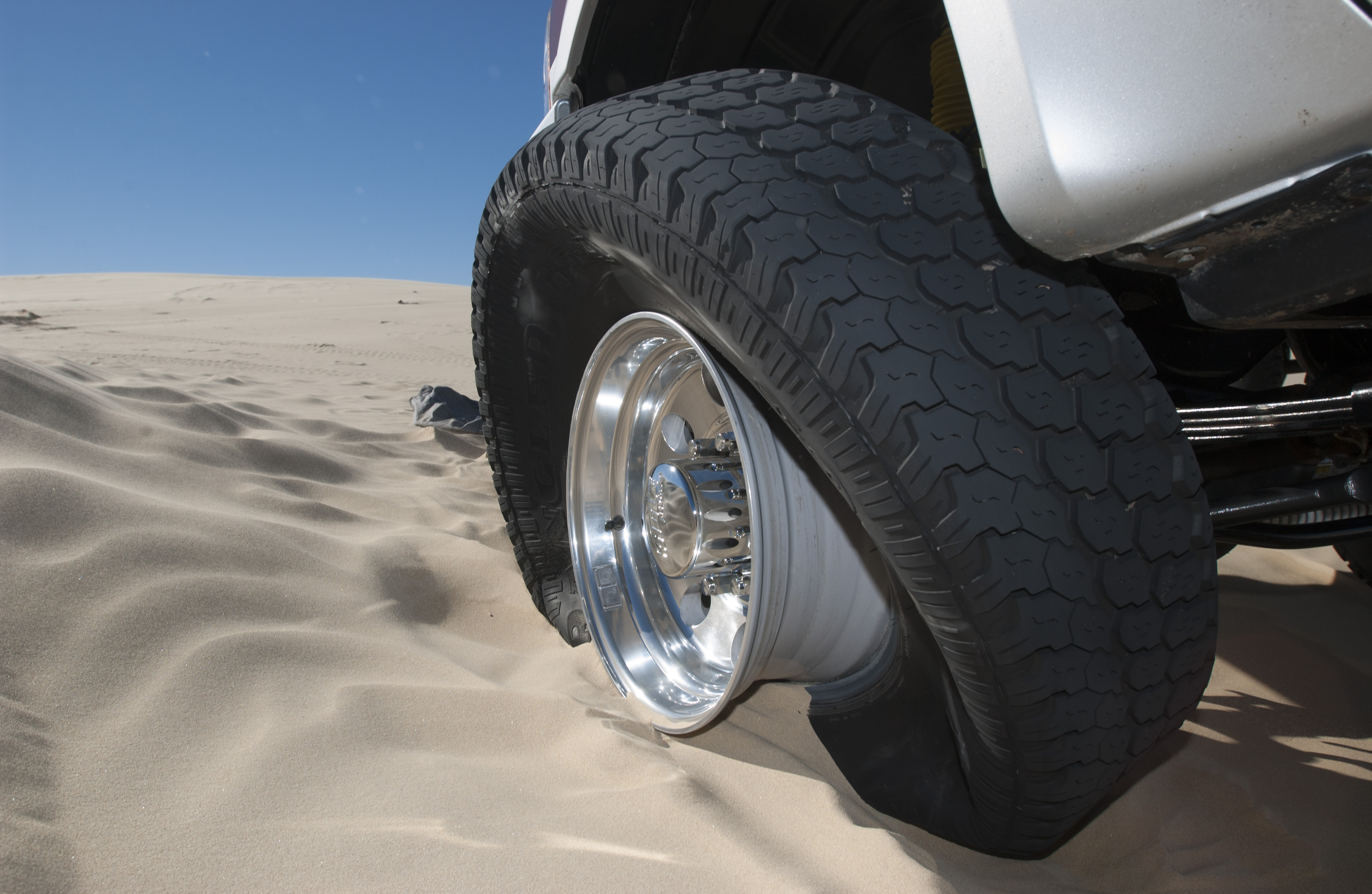
On harder-packed sand you might not have to lower pressures as much. You’ll figure it out as you go along by judging how easy or difficult it is to maintain forward progress; if it’s easy, don’t drop pressures too much, but if it feels like a hard slog, go lower.Dropping tyre pressures in sand not only reduces the chance of getting bogged, it also reduces the strain on your vehicle and it minimises the occurrence of track damage, so don’t be one of ‘those blokes’ who doesn’t feel the need to lower tyre pressures on sand.
Remember to reinflate
Make sure you reinflate your tyres to on-road pressures once you’re back on the blacktop.
While you’re pumping them up, have a good look over the tyres to see if there are any signs of damage, in which case you’ll have to repair or replace the tyre with a spare. Check the valve stems for leaks too, and make sure the dust caps are screwed back on once the tyres have been reinflated. If you only have a short distance of blacktop before you’ll be back on gravel again, you can maintain lower tyre pressures, but make sure you keep your speed down so your tyres don’t overheat.
Required gear
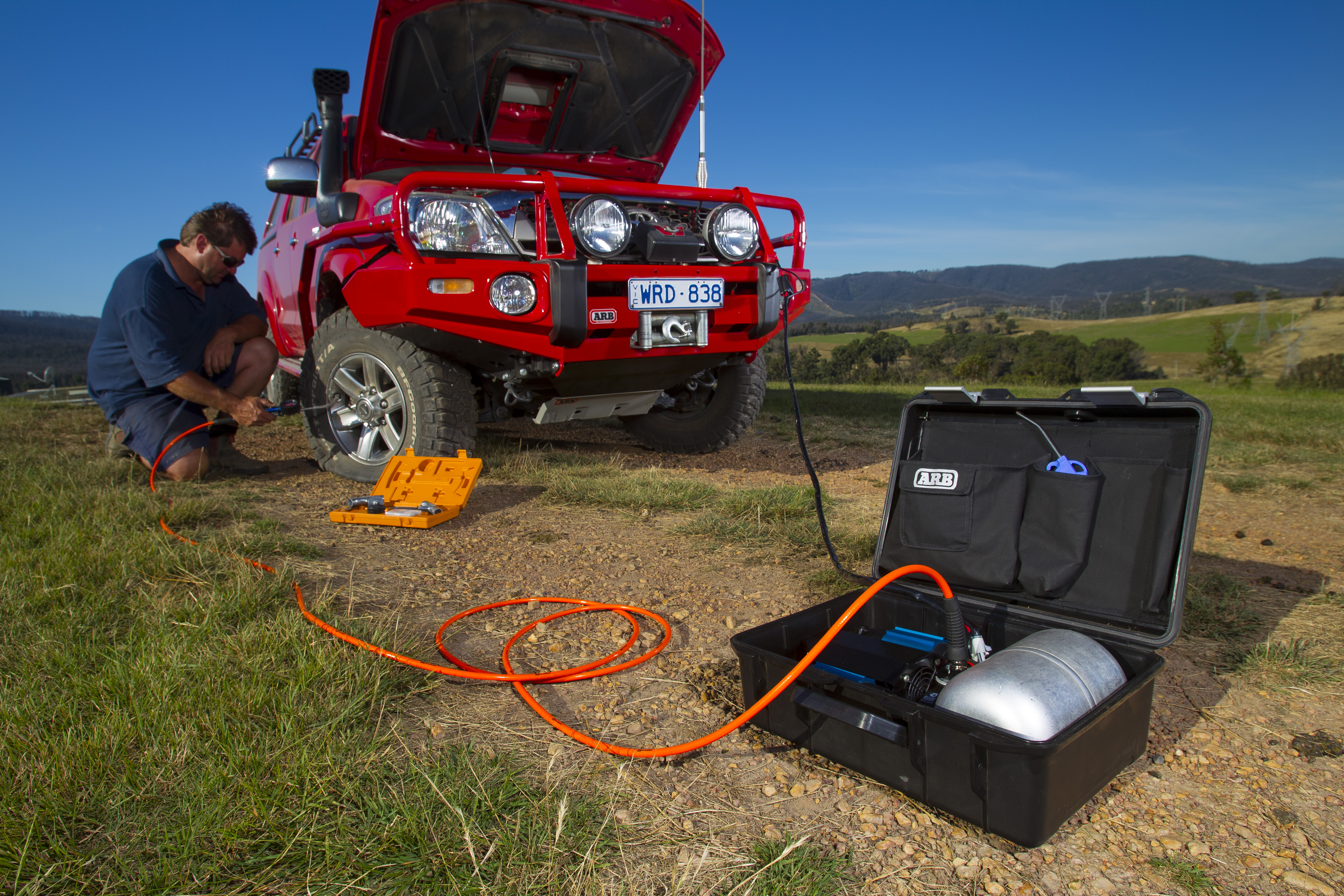
This is the gear you’ll need to regularly adjust tyre pressures to suit off-road terrain, and you should have in your kit in the case of tyre damage:
- Quality tyre pressure gauge
- Tyre deflator (or a stick if you’re in no rush)
- Reliable air compressor
- Tyre repair kit
- Spare tyre in good condition
- Functioning vehicle jack and wheel brace
- Tyre Pressure Monitoring System (TPMS)
Advice from a 4×4 expert
David Wilson has been a 4WD trainer since before Google was a thing. Here are his top five tips for managing tyre pressures:
- Start with your tyre placard: On bitumen, follow the tyre placard as your baseline. Most wagons and utes run 200–250 kPa (29–36 psi). Over-inflation wears tyres prematurely, increases puncture risk, and lengthens emergency braking distances.
- Follow the ‘20 per cent’ rule: On dirt roads, let out 20 per cent of the placard pressure and reduce speed by 20 per cent. This gives tyres flexibility to absorb bumps, reduces punctures, and improves comfort and braking.
- Keep adjusting down: As terrain gets rougher, gradually reduce pressure until traction and momentum return. Each reduction should be matched with a lower speed to avoid overheating tyres.
- Don’t go too low: Minimum pressure is 100 kPa (15 psi) except in emergencies. Below this, tyres can come off the rim, so steer, brake, and accelerate very carefully.
- Pump them back up: After off-road sections, restore tyres to the appropriate pressure for the surface. A fast air compressor and a reliable metal gauge make this quick and accurate.
Tips and traps
Tips
- Adjust pressures to suit terrain and vehicle load
- Fit LT tyres to your vehicle
- Regularly check tyres for damage
- Run a TPMS to warn of rapid deflation
- Remember to reinflate once back on the road
Traps
- Lower tyre pressures too much for conditions
- Drive too fast with lowered tyre pressures
- Make sudden throttle or steering inputs with low tyre pressures
- Leave your compressor and tyre repair kit at home
- Get lazy and forget to adjust tyre pressures
FAQs: Expert tips for off-roading
- How much should I air down my tyres?
The ideal pressure depends on wheel diameter, tyre aspect ratio, tyre type, vehicle weight, and terrain. Bigger wheels and low-profile tyres reduce sidewall height, limiting how much you can safely lower pressure. E-rated tyres are stiffer and better for heavier vehicles, while softer tyres work well for lighter rigs. Soft sand, snow, mud, and rocky trails all require different pressures.
Tip: Start with street pressure and gradually reduce it while monitoring tyre performance.
- Why is sidewall height important?
Lowering tyre pressure lets the tyre deform slightly, increasing the contact patch. On soft terrain like sand, snow, or mud, this improves floatation. On rocky trails, a softer tyre conforms to obstacles, giving better grip. Shorter sidewalls, which are common on large-diameter wheels, limit how low you can safely air down.
- What are the risks of airing down too much?
Lower tyre pressure increases the risk of losing a bead, damaging the tyre or rim, reduced ground clearance, and accidents or injury.
Tip: Air down slowly and in increments, especially on technical terrain.
- How do tyre types affect air-down performance?
Tyre load rating and construction matter. Choosing the right tyre type helps balance ride comfort, grip, and safety:- E-rated tyres: Stiffer sidewalls, higher weight capacity, better for heavier vehicles
- C-rated tyres: Softer, more flexible, better for lighter vehicles or technical off-road conditions
- What’s the best way to air down quickly?
A simple, low-cost method is to remove the valve core, which can drop a 35-inch tyre from 35 to 15 psi in under a minute. Always use a valve core tool and monitor pressure with a reliable low-pressure gauge. Carry extra valve cores and stems in case of loss or damage.
Tip: Reduce pressure incrementally to avoid sudden loss of control.
- How should I air up after off-roading?
Use a high-quality air compressor—electric or engine-driven—and check pressures with an accurate gauge. Multi-line inflation/deflation systems can make the process faster. Restoring tyre pressure after off-road sections ensures safety and prolongs tyre life.
- Are there any practical tips for testing pressures?
Experiment in a safe environment to find what works best for your vehicle and terrain. Reducing tyre pressure by around 50 % often improves ride quality and grip on soft terrain. Test tyres on obstacles to see how the sidewall deforms and handles at different pressures.
*This tyre pressure guide is not gospel. Always run recommended tyre pressures when driving on the road.
The last time I drove a vehicle wearing the iconic MG badge was about 35 years ago. It was a sweet little British roadster, even if the steering did have a habit of disconnecting from the front wheels, leaving the driver with no control over the vehicle’s direction.
If anyone had told me then that the next time I’d drive an MG would be in 2026 – and that it would be a gargantuan 4×4 ute made in China – I would have laughed harder than I did when the steering failed on that MGB. Yet here we are. The MG brand no longer represents Morris Garages but now sells a range of small cars, SUVs and this monstrous U9 ute, all built in China. Strange things are afoot at the Circle K.
There’s nothing sweet or little about this MG, but if it’s bang you’re chasing from your ever-devaluing buck, then this truck could be for you. It can be hard for any new model to stand out in the overcrowded midsize 4×4 ute segment, but the MG U9 demands attention. And once the U9 Explore Pro catches your eye, it’ll be chasing your $60K. That’s right – this massive, fully loaded, triple-locked and turbocharged ute, with more standard features than just about anything else in its class, sells for $61,000.
JUMP AHEAD
- Chassis, suspension and powertrain
- Exterior and interior
- How does it perform on- and off-road?
- Ownership value
- Specs
Chassis, suspension and powertrain
The reborn MG brand has gone about things a little differently to others in the market when it came to designing its big utility.
While it is a double-cab ute built on a ladder-frame chassis and powered by a four-cylinder diesel engine backed by an automatic transmission and a dual-range transfer case, things start to stray from the norm when you look under the skin. This is where the clever coves will be piping up, proclaiming that the MG U9 is just an LDV Terron 9 with a different badge – and they’d be right. To a certain degree, anyway. While they are essentially the same ute, the key difference between the MG and the LDV – and every other midsize 4×4 ute on the market – is that the U9 uses an independent rear suspension configuration in place of a live axle.
While IRS set-ups are more commonly found under passenger cars and light-duty SUVs, where improved dynamics and comfort take precedence over load capacity, the U9 still manages a 3500kg towing capacity and a 770kg payload in the Explore Pro model, rising to 870kg in the entry-level Explore variant. The rear axle under the U9 is rated to 1200kg.
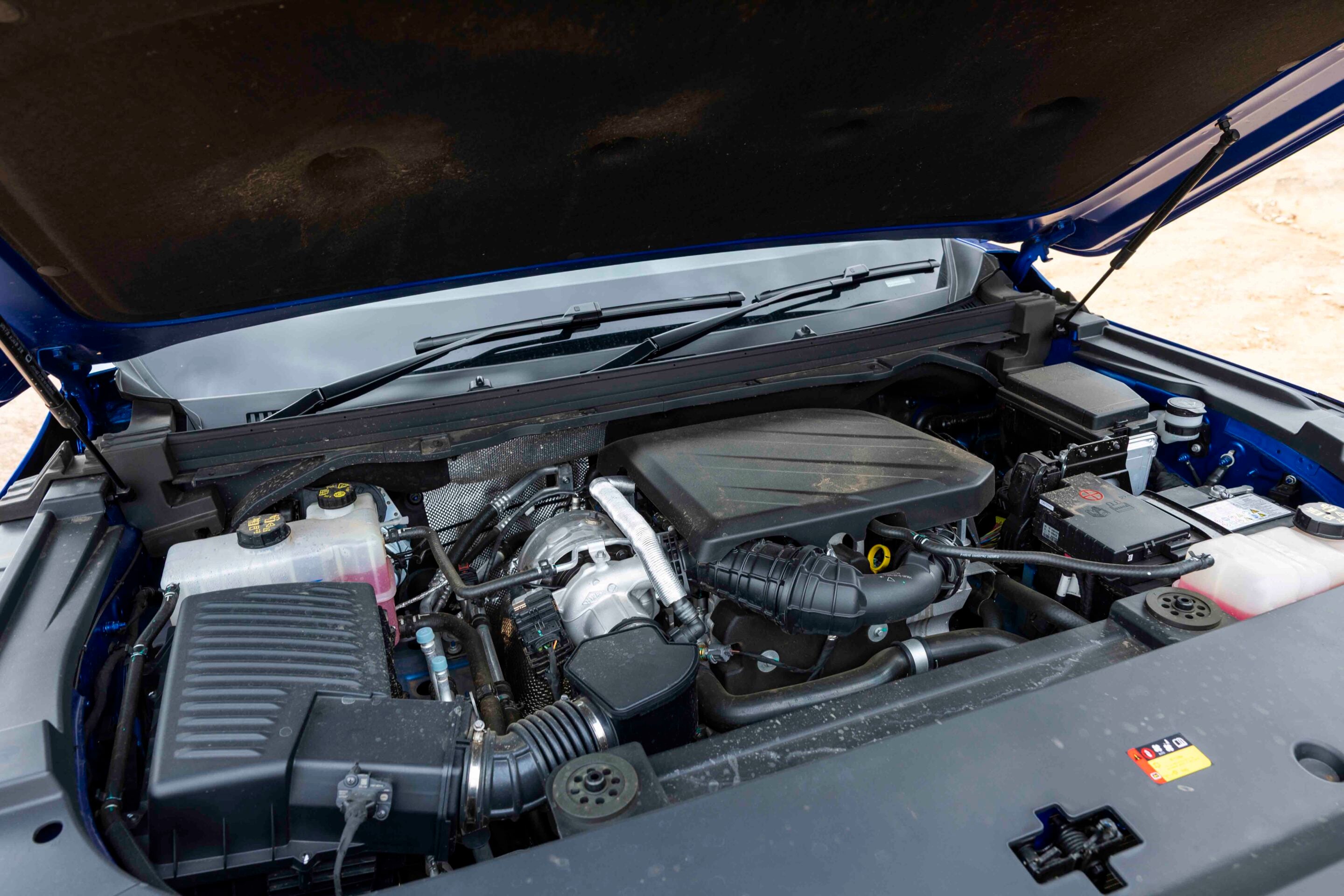
While we’re under the vehicle, we can tell you that the front suspension is a conventional wishbone and coil IFS set-up, and there’s an eight-speed automatic transmission behind the engine. All three differentials can be locked from inside the cabin, accessed via a menu on the screen after pressing a console-mounted button. Strangely, there’s no way to lock the centre diff in high range. The Explore Pro is the only U9 variant to get a locking front differential.
Up front is a 2.5-litre single-turbo diesel that MG and LDV claim is the most powerful in the segment, with a claimed 160kW and 520Nm from the four-cylinder engine. It’s an unremarkable engine that doesn’t feel any more powerful than the 2.8-litre in the HiLux, and certainly not as punchy as the now-discontinued Ford bi-turbo 2.0-litre. Maybe that big, blunt front end is pushing so much air that it stifles performance.
Exterior and interior
While the body of the U9 is big and blocky, and could be assumed to follow the status quo in the segment, it differs in that the side panels are one-piece, running from the door pillars back to the rear of the tub.
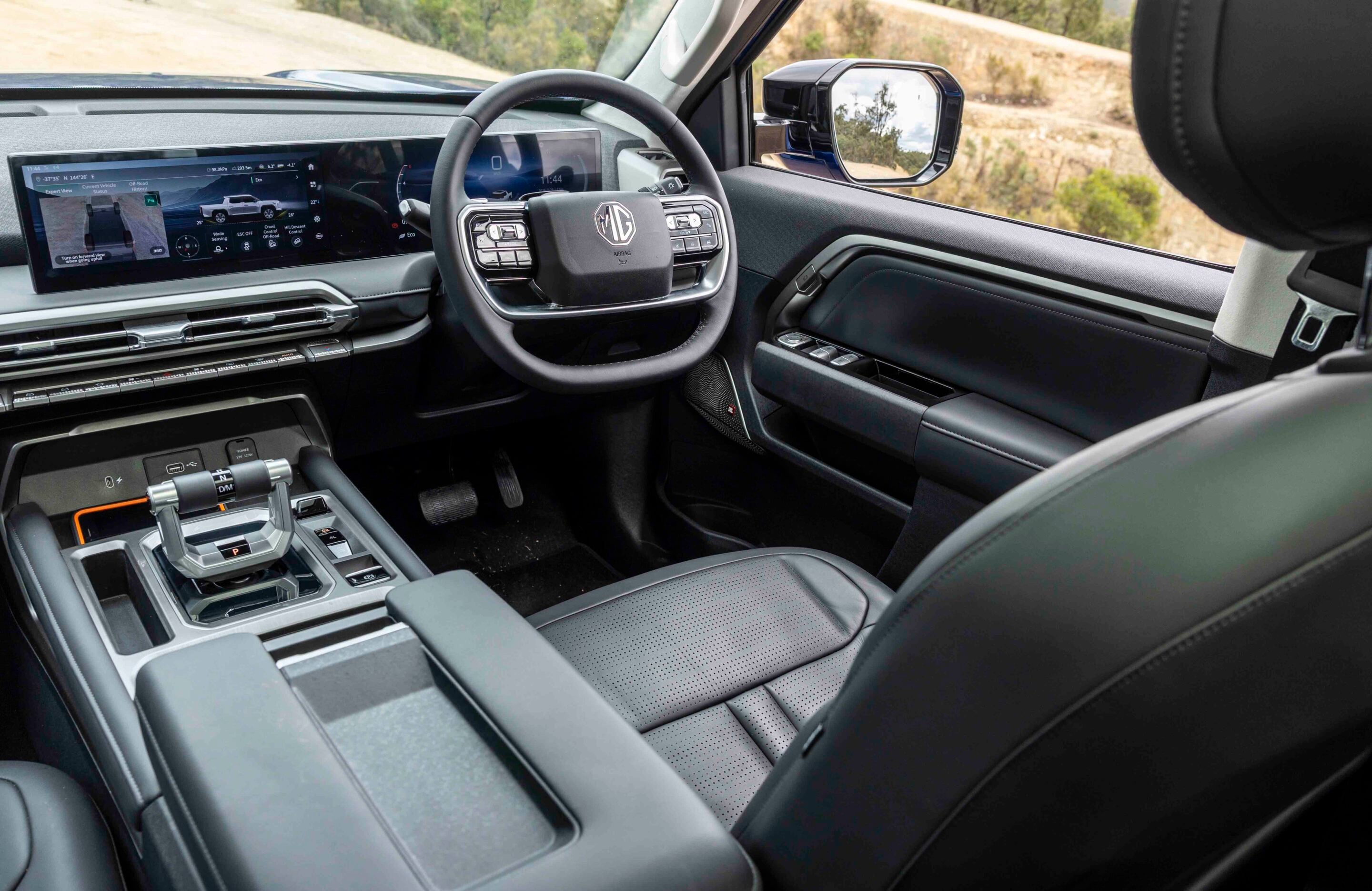
This means there is no bulkhead between the cabin and the load bed and, in fact, the U9 allows you to open a flap between the folded rear seats and the tub to carry long items. This design also allows for more rake in the rear seat backrest, improving comfort. Speaking of the back seat, it’s a wide, leather-clad pew with heating for the outer positions. The front seats are also leather-trimmed and feature heating, ventilation, power adjustment and a massage function for the driver. Front seat occupants are faced with a wide, bluff dashboard housing a pair of 12.3-inch screens – one for multimedia and one for driver information.
The cabin is wide, spacious and loaded with equipment, but I found it frustrating that some of the buttons on the console and HVAC controls still require input via the multimedia screen rather than operating directly. Why should you need two actions to perform a single function?
A few other small gripes include the harsh material on the windowsills – it was wearing a hole in the skin on my elbow after a few days of driving – and the digital rear-view mirror, which gives a poor and distorted view of what’s behind the U9 while driving. Luckily, the reversing camera provides a clean and well-defined image on the screen when manoeuvring the 5.5m-long ute.
How does it perform on- and off-road?
On the highway and sealed roads, the U9 tours well. The engine is strong and the transmission responds quickly to inputs. Ride quality is acceptable, however NVH levels are poor. The fact that the Pro runs all-terrain tyres doesn’t help, but their inclusion is appreciated on a 4×4 ute.
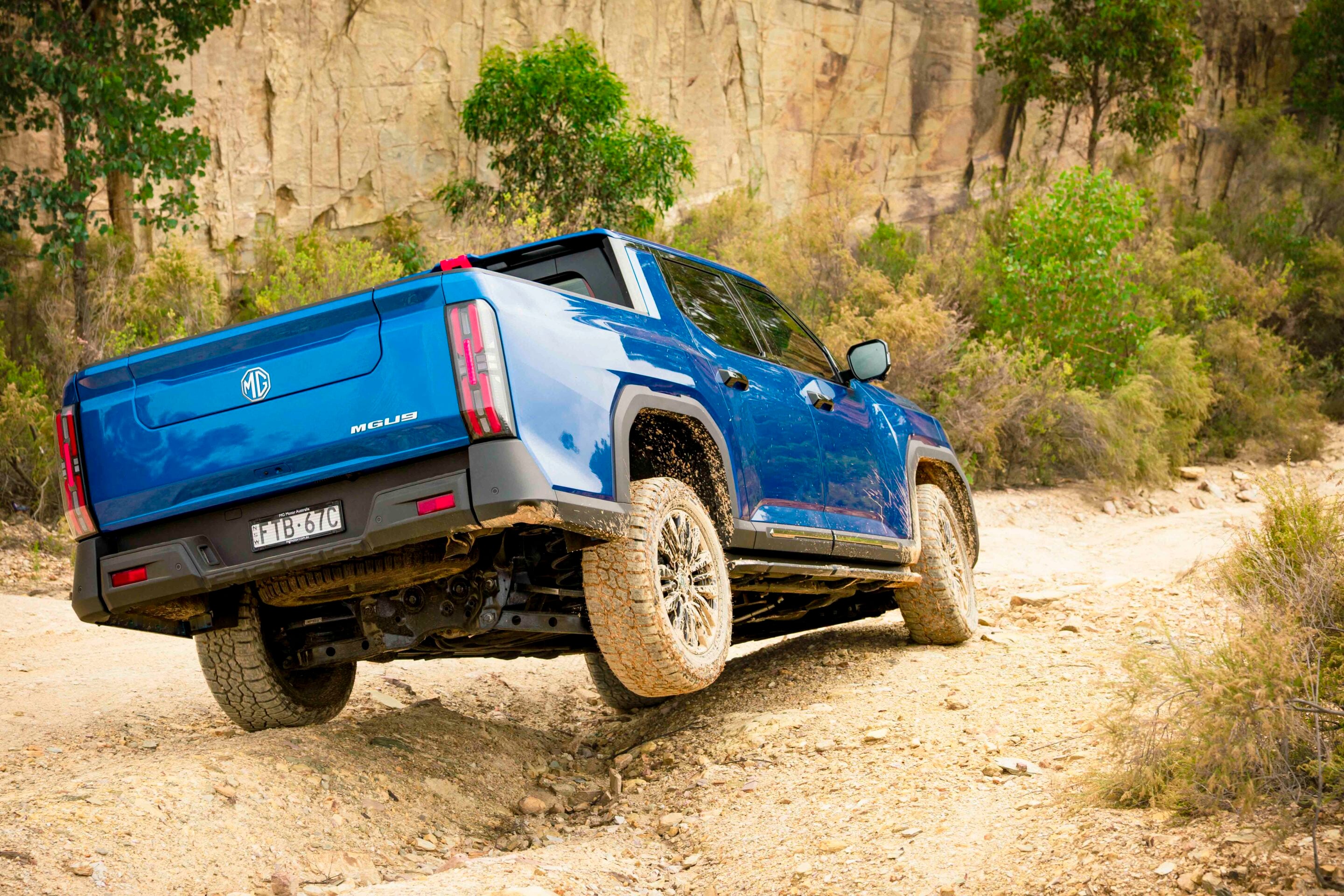
I was initially put off when I read that the U9 Pro rides on 20-inch wheels, but the 275/65 Falken Wildpeak tyres still offer plenty of sidewall and give the ute a tougher look. In practice, the tyre size wasn’t an issue at all. Once we left the sealed roads and hit gravel, the suspension’s shortcomings became apparent, as the tyres thumped into potholes and the short-travel independent rear suspension reached its limits.
On steep gravel climbs that we would normally tackle in high range, the U9 scrabbled for grip, as the calibration of the electronic traction control couldn’t keep up. With no ability to lock the centre diff in high range, selecting low range becomes necessary. This was also the case when we got into low-range moguls, where the short-travel suspension lifts wheels easily, requiring the centre and rear diffs to be locked. With all three diffs engaged, the U9 felt unstoppable.
| Off-road specs | |
|---|---|
| Approach Angle | 29 |
| Departure Angle | 25 |
| Rampover Angle | 20 |
| Ground Clearance | 220mm |
| Wading Depth | 550mm |
Ownership value
MG vehicles come with a seven-year/unlimited kilometre warranty.
This can be extended to up to 10 years/250,000km (whichever comes first) for passenger vehicles intended for personal use, and up to seven years/200,000km (whichever comes first) for light commercial vehicles, provided scheduled servicing is completed with an authorised MG dealer.
If these kilometre limits are exceeded during the standard warranty period, the extended coverage will not apply. Roadside assistance is included, and service pricing is fixed for the first 12 months.
Specs
| MGU9 Explore Pro specs | |
|---|---|
| Price | $60,990 drive away |
| Engine | I4 turbo-diesel |
| Capacity | 2499cc |
| Max Power | 163kW @ 3800rpm |
| Max Torque | 520Nm @ 1500-2500rpm |
| Transmission | 8-speed automatic |
| 4×4 System | On demand; high range 4×4 & locked low range 4×4 |
| Construction | 4-door ute on ladder chassis |
| Front Suspension | IFS with coil springs |
| Rear Suspension | IRS with coil springs |
| Tyres | 275/65R20 on alloy wheels |
| Kerb Weight | 2450kg |
| GVM | 3320kg |
| GCM | 6500kg |
| Towing Capacity | 3500kg |
| Payload | 770kg |
| Seating Capacity | 5 |
| Fuel Tank Capacity | 80L |
| ADR Fuel Consumption | 7.9L/100km |
Here’s one way to avoid the rising cost of fuel: Toyota’s first battery-electric HiLux, the HiLux BEV, will hit Australian showrooms in May, priced from $74,990 plus on-road costs.
Available exclusively in double-cab body style, the range starts with the SR cab-chassis and SR pick-up from $76,490, while the flagship SR5 pick-up is priced at $82,990. Both feature a dual-motor all-wheel-drive system powered by a 59.2kWh lithium-ion battery. The front motor delivers 82kW/206Nm, the rear 129kW/269Nm, giving a combined 144kW/468Nm. Toyota’s Multi-Terrain Select traction system offers six drive modes for off-road conditions.
Toyota says it has undergone extensive real-world testing in harsh Australian conditions, including remote outback operations and off-road environments, ensuring it can handle the same demanding work as its diesel counterpart.
Battery charging includes 150kW DC fast charging (10 to 80 per cent in 30 minutes) and 10kW AC charging (10 to 100 per cent in 6.5 hours). Driving range is 315km for pick-up grades and 245km for the cab-chassis. The HiLux BEV features reinforced suspension, ventilated disc brakes with regenerative braking, and a 2000kg braked towing capacity. Exterior updates include a closed-off grille and 17-inch aero wheels.
“Offering both Australian businesses and private buyers the choice of a HiLux with zero tailpipe emissions is a crucial step forward in providing consumers the right powertrain for the right application, at the right time,” said John Pappas, Toyota Australia Vice President Sales, Marketing and Franchise Operations.
“This is an exciting time for Toyota; bringing in an electric version of the much-loved HiLux pick-up finally gives businesses and fleets the option of low-emission motoring mixed with Toyota’s extensive parts and servicing network.
“In fact, Toyota has already been testing the HiLux BEV for months on mine sites in temperatures nearing 50°C, ensuring the performance of this new powertrain matches the tried-and-tested HiLux diesel. Private buyers looking to make the switch to an electric pick-up now have the backing of Toyota quality, durability and reliability.”
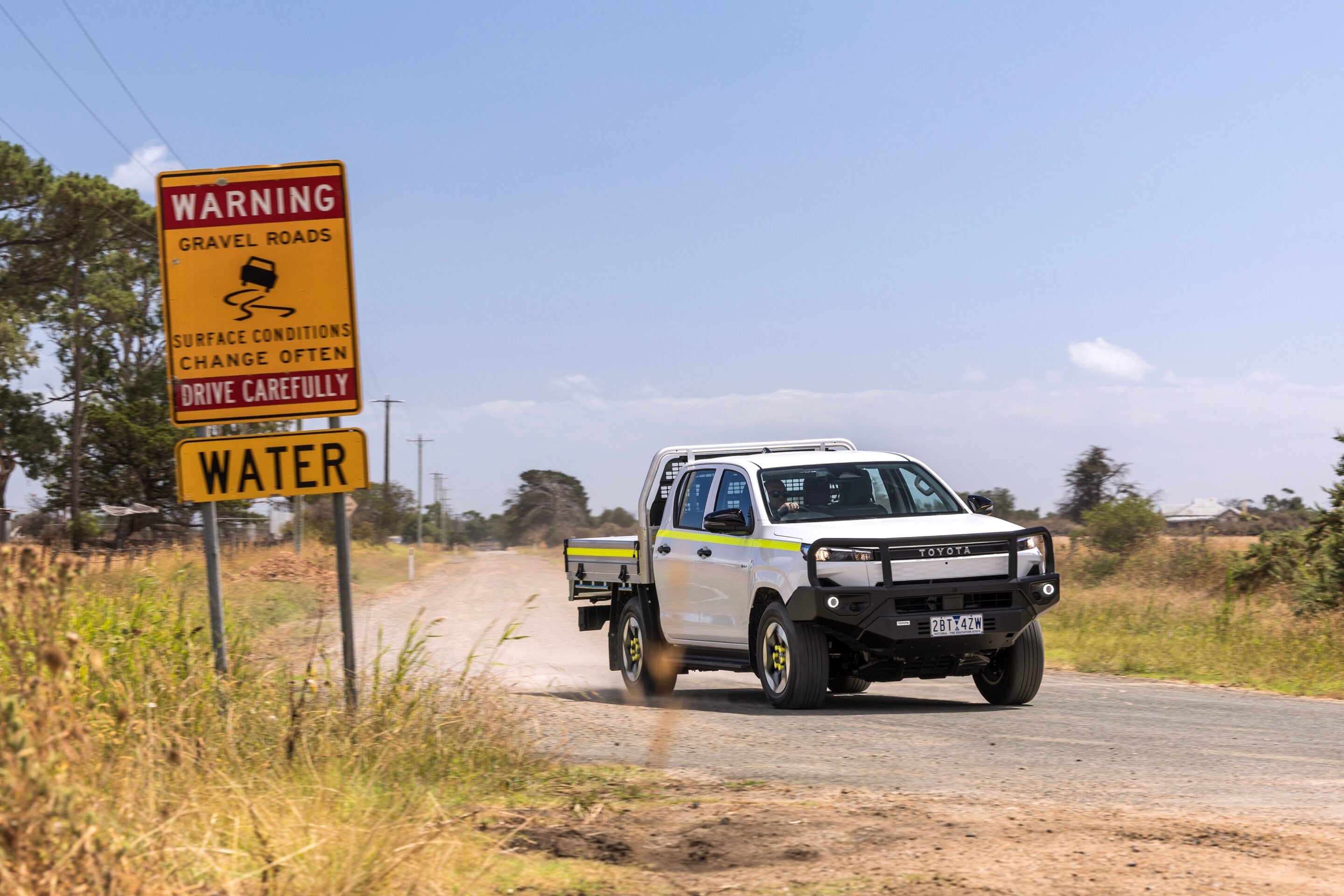
Inside, the HiLux BEV mirrors the practicality and comfort of its diesel siblings. The SR grade offers fabric upholstery, all-weather floor mats, a urethane steering wheel, shift-by-wire gear shifter, dual-zone automatic climate control, automatic windows, smart entry and start, and a 1500W inverter in the centre console capable of powering small appliances.
A 12.3-inch touchscreen multimedia system pairs with a 12.3-inch multi-information display and four-speaker audio, providing embedded satellite navigation, voice commands, wireless Apple CarPlay and Android Auto, DAB+ digital radio, and USB-C ports in the front and rear.
The SR5 pick-up adds a more premium interior with leather-accented upholstery, heated front seats with powered driver’s adjustment and two-way lumbar support, heated steering wheel, carpeted floor, electrochromatic rearview mirror, soft lidded instrument panel, silver door handles, eight-speaker audio system, and wireless phone charging. Exterior enhancements include high-grade LED headlamps with auto-leveling, auto-retracting and heated mirrors, LED fog lamps and tail-lights, rear privacy glass, and painted hood moulding with a lower radiator grille.
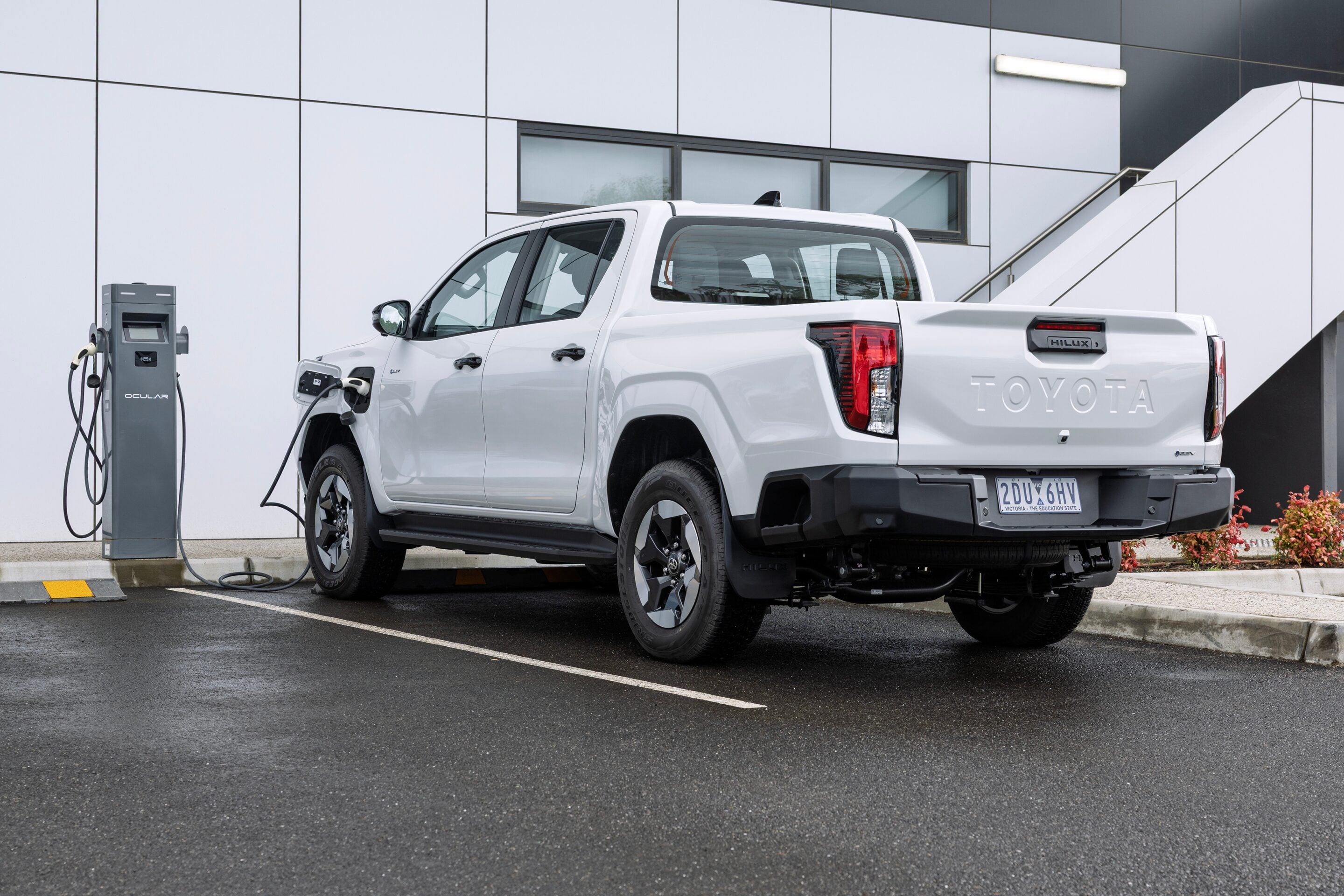
Safety comes via Toyota Safety Sense, including autonomous emergency braking, radar cruise control, lane trace assist, rear cross-traffic alert, and eight airbags. Toyota Connected Services allows remote vehicle monitoring through the myToyota Connect app.
Private buyers who purchase or lease through a novated arrangement receive a complimentary 7kW AC wallbox charger for home use. The HiLux BEV will be offered in Glacier White, Frosted White and Ash Slate.
HiLux BEV pricing
| Model | Price (before on-rost costs) |
|---|---|
| SR double cab-chassis | $74,990 |
| SR double-cab pick-up | $76,490 |
| SR5 double-cab pick-up | $82,990 |
Toyota Australia has issued a safety recall for 13,390 HiLux utes produced between August 28, 2025 and February 24, 2026. The recall affects vehicles fitted with a Toyota Genuine Accessory bull bar or nudge bar with a light bar.
The issue comes down to the wiring. On affected vehicles, the harness may have been installed incorrectly, which affect the earth connection to the Electric Power Steering (EPS) module. In the worst case, the EPS could fail entirely. That means your power steering could suddenly stop working. At low speeds, this makes the wheel heavy and could increase the chance of an accident, with serious injury or worse.
Toyota dealers will inspect all affected vehicles and fix the EPS earth terminal if needed. The work is free and should take around 30 minutes. Toyota will reach out to owners directly, but it’s a good idea to check that your contact details are current so you don’t miss the notice. If you’re heading away soon, this one’s worth a quick call to your dealer before your next trip.
Toyota’s new HiLux range arrived in Australia late last year. The ute sticks with the familiar 2.8‑litre turbo‑diesel engine, producing 150kW and 500Nm, paired with a 48‑volt mild hybrid system and the same platform and core mechanicals that have made HiLux a market staple.
Updates include Australian‑led exterior styling tweaks, an updated interior, and refreshed technology and safety suites across the line‑up. The range includes the familiar WorkMate, SR, SR5, Rogue and Rugged X grades in single‑cab, extra‑cab and double‑cab formats, with both 4×2 and 4×4 drivetrains.
Most models retain strong capability, including 3500kg towing, while enhancements such as new electric power steering and larger multimedia screens improve day‑to‑day usability.
Spend enough time on the tracks and you start to notice patterns – not just in the terrain, but in the people behind the wheel.
Every trip has a mix of personalities, from the keen rookies who are just learning the ropes to the experienced drivers who quietly keep everyone safe. Some make you laugh, some make you groan, and some make you rethink your own driving style. Here’s a look at the 10 types of 4×4 drivers you’ll always see on the tracks – and maybe a few you recognise.
1. The overloaded enthusiast
You hear them before you see them. Twin spares, four jerry cans, rooftop tent, awning, maxtrax, shovel, axe – all permanently mounted. Their rig could tackle almost anything, and they’re ready for every scenario imaginable. The catch? Half the gear never gets used, and the extra weight can slow them down. Still, when the unexpected happens, this is the driver everyone flocks to, because no one else has quite that level of preparation.
2. The it’ll be right” rookie
Bright-eyed, enthusiastic and often a little clueless, the rookie is usually underprepared. Tyres are overinflated, recovery gear is minimal, and their knowledge of low range or winching is mostly theoretical. They mean well and are eager to learn, but they’re often the reason trips run late, recoveries happen, and group patience is tested. Everyone starts somewhere, though, and with a few trips under their belt, this driver usually grows into someone much more capable.
3. The convoy commander
With UHF in hand and eyes on the whole group, the convoy commander treats every washout, rut, and puddle like a tactical operation. They love structure, spacing, and check-ins, and they thrive on keeping the group moving safely and efficiently. Add in their running commentary and quips over the radio – they’re often convinced they’re a budding stand-up comedian – and you might groan as much as you laugh. Still, deep down, everyone appreciates their organisation. Trips with a convoy commander are smoother, safer and usually less stressful.
4. The lone wolf
The solo adventurer prefers quiet tracks, minimal chatter, and the freedom to explore without a convoy. They usually come well-prepared, carrying the right gear and knowing how to use it. You rarely see them, except for tyre tracks fading into the bush, but when you do, they’re often navigating terrain with impressive efficiency. The lone wolf’s independence can be inspiring – or intimidating – depending on your perspective.
5. The camp set-up king
First to arrive and last to leave, the camp set-up king turns a simple stop into a full production. Awning up, walls installed, lights strung, table laid out, fridge slide deployed, cooker running – by the time they’re done, the campsite is the envy of the group. Everyone gravitates to their spot for comfort, food and a proper place to sit. Packing up the next morning is another story, but no-one complains – the campsite experience is always worth it.
6. The send-it specialist
Momentum is everything for the send-it specialist. Rocks, mud, climbs – they attack every obstacle with confidence, throttle steady, and minimal hesitation. Sometimes it works flawlessly, and they look like a hero; other times, it ends in wheelspin, bouncing, or a recovery that could have been avoided. Watching them is entertaining, occasionally nerve-wracking, and always a reminder of the fine line between skill and bravado.
7. The cautious crawler
Slow, steady, and deliberate, the cautious crawler approaches obstacles with careful planning. Tyres are aired down, lines are picked with precision, and nothing is rushed. Their methodical approach takes longer but significantly reduces the risk of damage or getting stuck. They may not be flashy, but they’re effective, reliable and often a calming influence on the group when conditions get tricky.
8. The social media shooter
Every stop is a content opportunity. Drone up, camera out, perfect bonnet shot, sunset reel – progress slows to a crawl, but the final footage is impressive. They’re the ones who later show everyone the trip highlights and make it look incredible, even if it took twice as long to capture the perfect shot. Trips with a social media shooter might test patience, but the memories are worth it.
9. The borrower
Always missing something, the borrower asks, “Anyone got a spare strap?” or “Can I borrow some water?” They’re usually underprepared, but the 4×4 community has their back. Over time, other drivers start remembering what the borrower might need, and somehow, with everyone’s help, they make it through the trip. Their good humour and reliance on teamwork often make them endearing rather than frustrating.
10. The quiet expert
Silent, calm and highly skilled, the quiet expert rarely speaks but always commands respect. They know terrain, recoveries and vehicle limits like the back of their hand. When something goes wrong, everyone looks to them for guidance, and they solve problems efficiently without drama or ego. Every convoy benefits from having one quiet expert on board – trips run smoother and safer with their steady presence.
Special mentions
Some drivers don’t fit neatly into the main categories, but they’re impossible to ignore:
- The gear tester: Always experimenting with new tyres, lifts, or recovery gear mid-track. Helpful at times, chaotic at others.
- The storyteller: Every puddle, rut or obstacle comes with a tale. Campfire chatter is their stage.
- The snack supplier: Always has chocolate, chips or cold drinks on hand. Instant hero.
- The weather watcher: Obsessed with forecasts, radar apps and cloud formations. Knows when it’s safe to push on – or call it a day.
Every off-road adventure is better because of the mix of personalities on the tracks. Some make things smoother, some more entertaining, and some downright challenging. Which type are you – and which one drives you mad?
Organisers of the 2026 Birdsville Big Red Bash have cancelled the music festival after heavy rain left the Big Red site unusable.
“After careful consideration of the available options, we decided that relocating the Birdsville Big Red Bash was not feasible for 2026. We surveyed our patrons to fully understand their feelings about a relocated festival and their attendance intentions,” said event founder and Managing Director of the Outback Music Festival Group, Greg Donovan.
“The survey achieved an incredible 95 per cent response rate, which provided comprehensive insight into their thoughts and opinions. The decision to cancel this year’s event, whilst difficult, is based on what we believe is in the best interest of the event and patrons.”
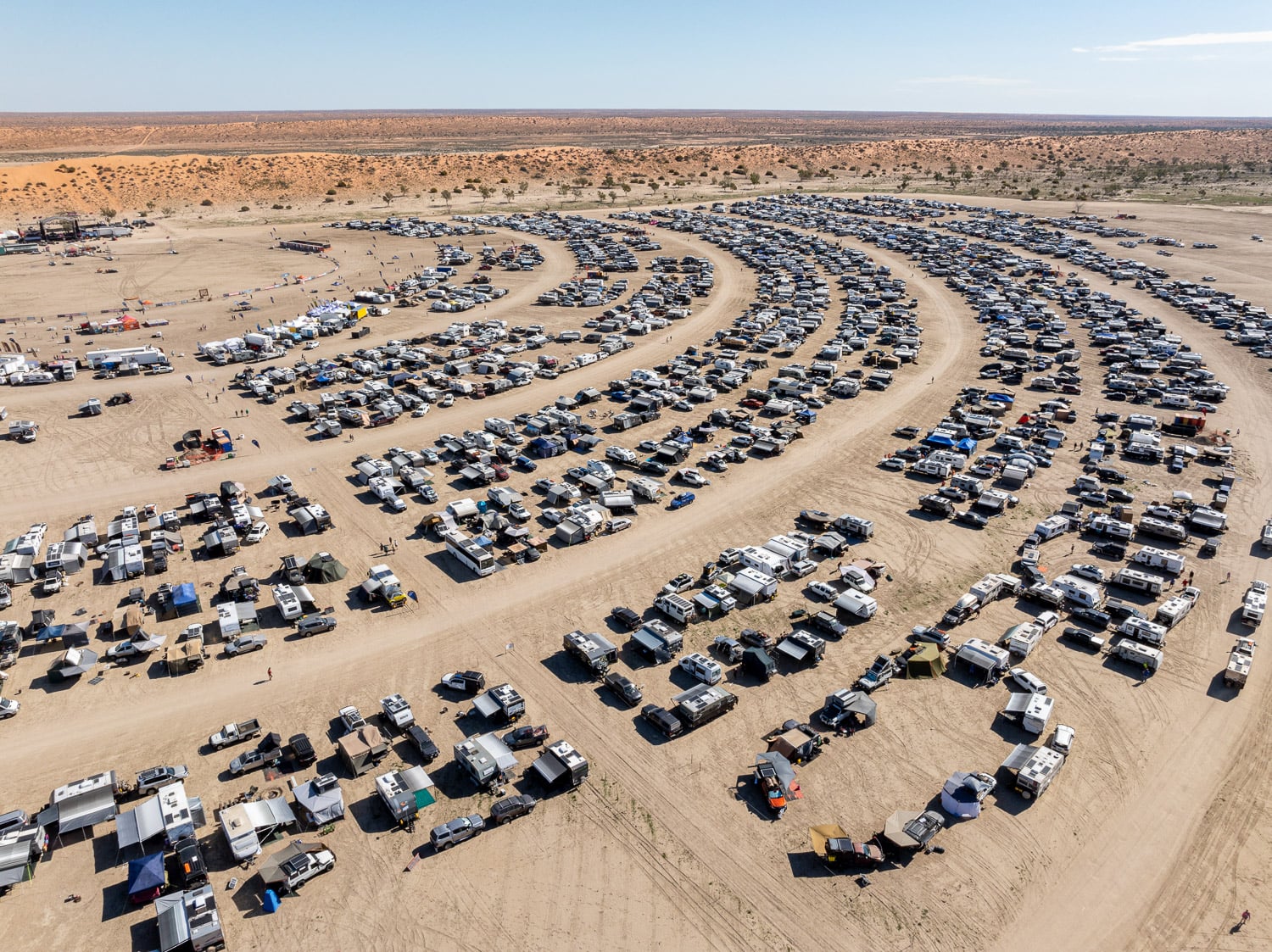
Ticket holders will have the choice of three options, available until 19 June 2026:
- Request a refund: Processed immediately by Oztix
- Transfer tickets: To the 2027 Birdsville Big Red Bash (July 6-8, 2027) – no action required
- Transfer tickets: To the 2026 Broken Hill Mundi Mundi Bash (August 20-22, 2026)
“We’ll be doing our part to ensure customer refunds are processed efficiently and importantly supporting Greg and the team to bring the Bash back next year,” said Stuart Field, Oztix Co-Founder and Managing Director. “Its significance on the Australian events calendar is unmatched – as one of the most unique and remote festivals in the world.”
The cancelled 2026 line-up included Missy Higgins, Hoodoo Gurus, The Teskey Brothers, The Living End, Birds of Tokyo, Jessica Mauboy, Shannon Noll, Kate Ceberano, The Whitlams, Tim Finn, Troy Cassar-Daley, Chocolate Starfish, Ross Wilson, Furnace and the Fundamentals, Shane Howard, Wes Carr, Jem Cassar-Daley, Tom Busby and Gypsy Lee.