
Our recent drive of the Defender D350 was done as part of the Defender Experience offered by Land Rover Australia to existing and potential customers and owners.
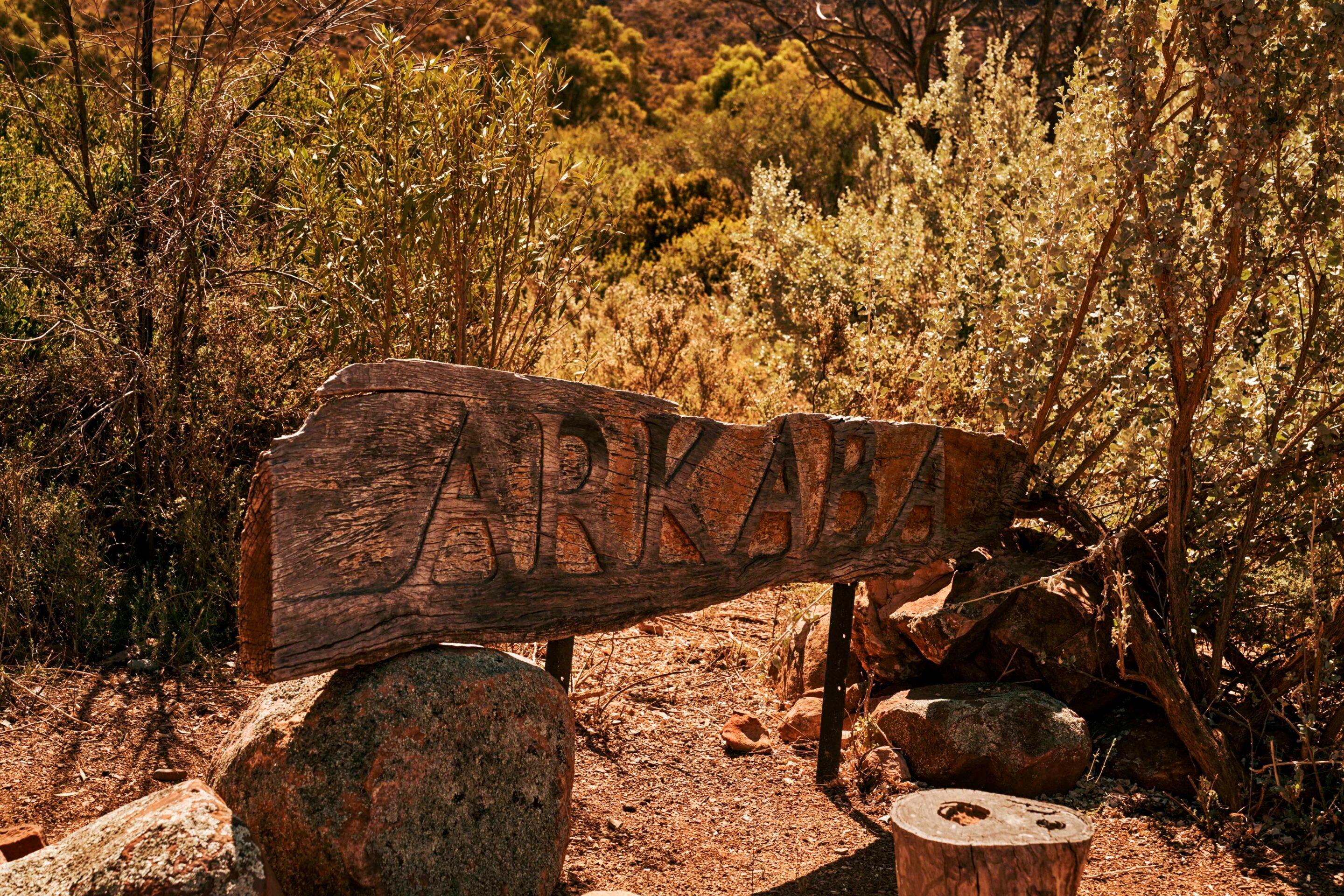
It’s a paid four-day experience on Arkaba Station in the stunning Flinders Ranges where participants not only get to drive the Defenders on the steep and rugged tracks of the property but also get to enjoy the luxury offerings of the station while learning about the land, its history and what the current owners of Arkaba are seeking to achieve.
Arkaba Station is just a short drive from Hawker in South Australia and like most settled land in the Flinders Ranges, it was once a pastoral property running sheep in the harsh conditions. Today it is owned by Wild Bush Luxury, a member of Luxury Lodges of Australia, and farming has made way for conservation and low-impact visitation to allow the land to return to its pre-farming state.
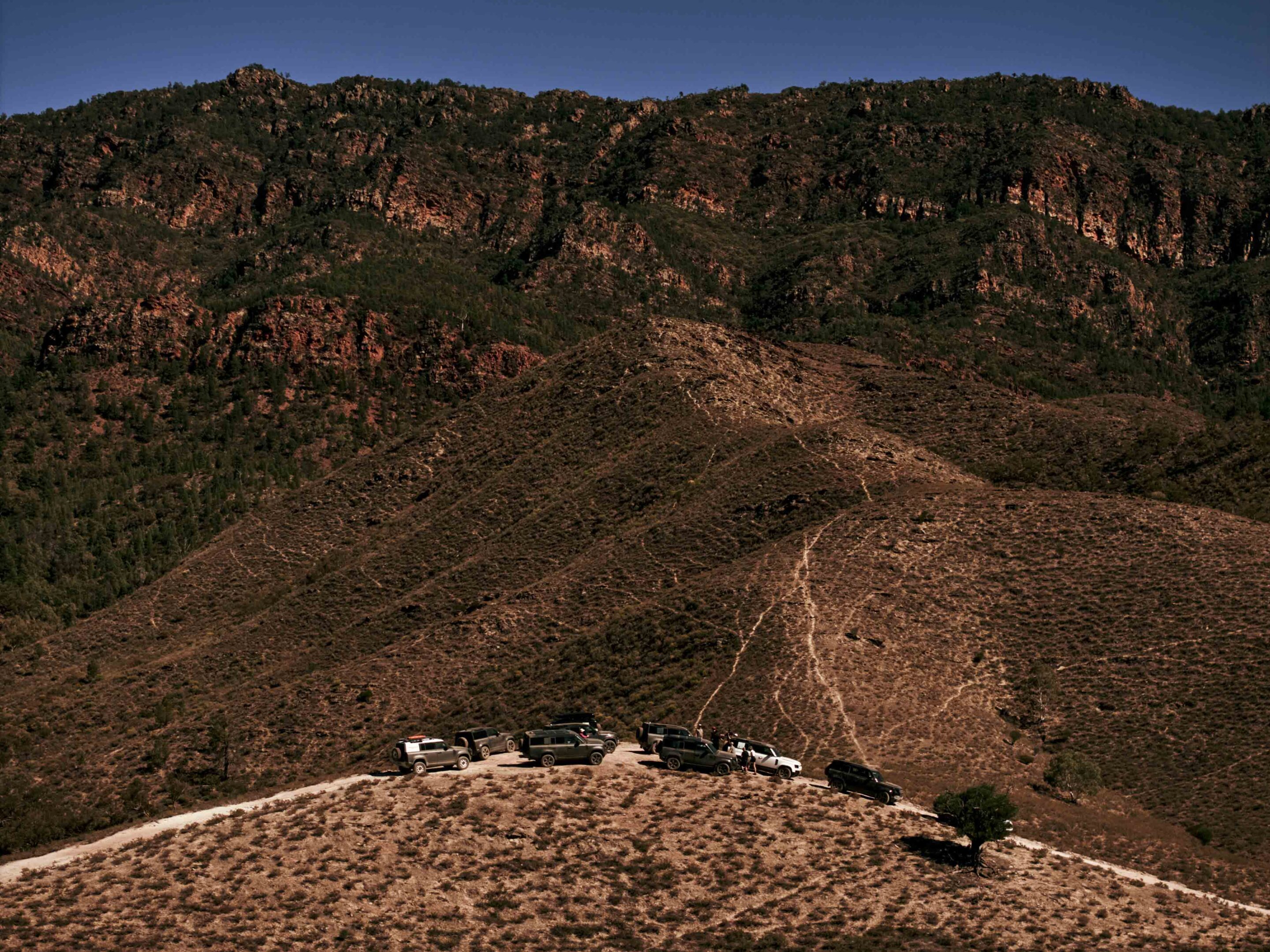
The sheep are long gone and goats, rabbits and other feral non-native animals are being eradicated as the team has turned to conservation and seeks to return the land of Arkaba back to what it was prior to settling and the damage caused by stock.
This conservation project includes maintaining fences only to keep ferals out, not stock in, replanting native trees, shrubs and grasses and reintroducing species that were thought to be lost to the area.
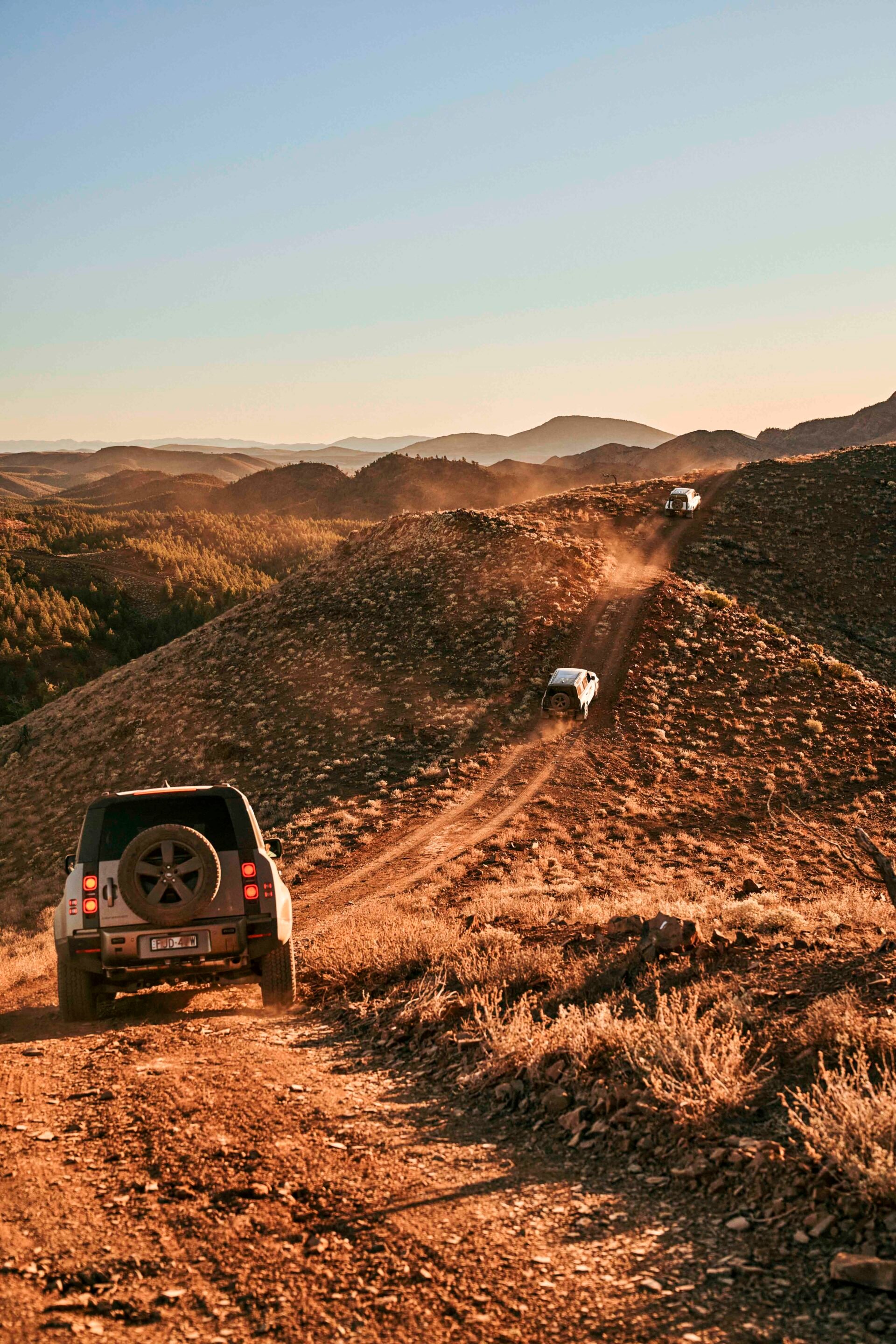
A visit to Arkaba can include guided walks where you learn about the country and what is being done to restore it, and guided drives to mountain ranges and ridgetops where you will enjoy spectacular sunsets (or sunrises if you are keen) and wildlife spotting.
The Arkaba Homestead has been beautifully restored and includes just five rooms for guests so the numbers there at any one time are very limited. The homestead has a full kitchen with an excellent chef to prepare meals featuring local produce and native ingredients. Local South Australian wines are also a key part of the experience.
Away from the homestead are remote camps that are used when on multiday walks or guided 4×4 tours . Unfortunately there are no self-drive tours of Arkaba available to four-wheel drivers.
While you might not be able to drive your 4×4 around arkaba Station unless you are on a Defender Experience trip, a surefire way to fully experience the property and all it has to offer is by joining the three-day walks that run through the cooler months of March to October, which are the peak times to visit the Flinders Ranges.
Led by experienced and informative guides, the walk takes you from Wilpena to Arkaba taking in the sights, sounds and smells of the Flinders, where you’ll learn about the terrain, flora and fauna, as well as the conservation work being done. It uses the camps set up on the station and your bags and clothes are transported to each camp by vehicle so you don’t have to carry everything yourself. The walk is graded as moderate, meaning it should be accessible to most able walkers. The Arkaba Walk finishes at the homestead with accommodation in the luxury rooms and a farewell feast.
On our Defender Experience at Arkaba, we spent our first night at the homestead where, after a drive to a highpoint to watch the sun set, we learnt about the history of the property and the work being done there, which was followed by a delicious meal.
Day two saw us exploring the ranges and tracks before stopping at a remote campsite where accommodation was in swags in open-ended shelters that looked out onto the bush. Again, the meal was fantastic and we enjoyed it out in the open while the last rays of the sun disappeared with a golden glow on the steep rocky ranges.
After an open-air shower in the morning and a short but informative bushwalk, we were back in the Defenders exploring the furthest reaches of the property including its border with Wilpena National Park, where we were in the shadow of the amazing Wilpena Pound.
An interesting part of this day’s drive was where we stopped at a high point in the terrain that offered a view of the adjoining property that is still running stock as Arkaba had in the past. The difference between the two properties couldn’t have been more stark with the dry brown dirt of the pastoral property contrasting to the much greener and lush scrub on Arkaba. This demonstrates the great work being done by the team at Arkaba in restoring the land there.
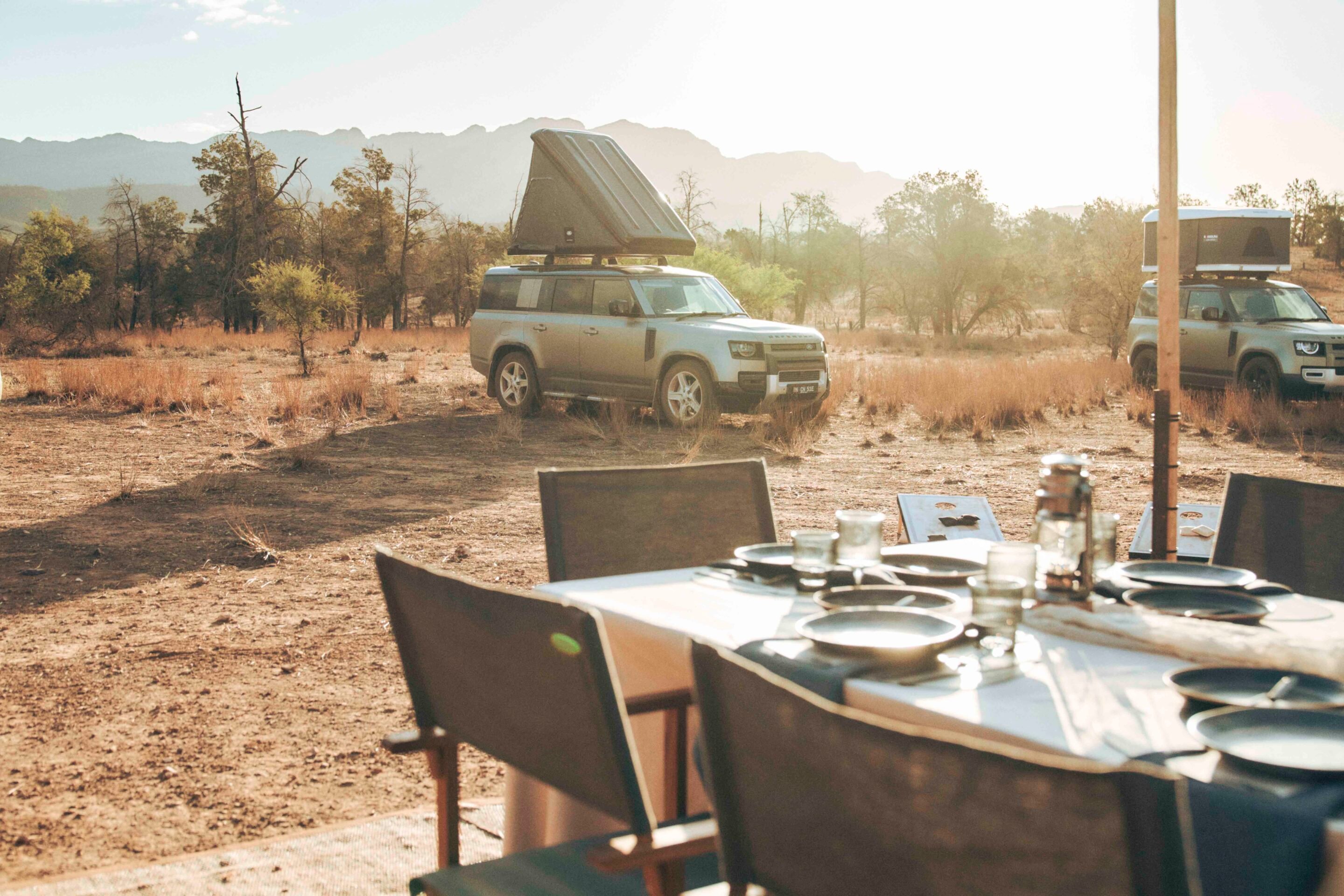
Our last night on Arkaba as part of the Defender Experience was a huge camp with large tables and plenty of food and refreshments. Again we slept under the stars, although this time it was atop the Defenders in rooftop tents. Certainly a great way to wrap up a few fabulous days.
You can do the Defender Experience at Arkaba as a standalone trip or as part of an extended stay in the Flinders Ranges, or when passing through on a longer adventure.
Land Rover Australia is currently planning its 2026 Defender Experiences and is looking at new locations to run them, as well as at Arkaba Station.
The modern Land Rover Defender has now been with us for more than five years and it’s been easy to forget about it since it arrived on the market to replace what for most people was the classic Land Rover.
With unibody construction, fully independent air suspension, modern powertrains and features, plus a much higher price than the original commercial-grade model, the new Defender fell off the radar of many 4×4 buyers. But more importantly, it has attracted a swag of new buyers to the marque with its mix of unique design, luxury and capability.
While you can spend more than $300,000 on a new Defender OCTA (no, that’s not a misprint!) there are more sensible options for adventurous buyers at the bottom of the range with pricing, specification and capabilities in line with alternatives including the Toyota LandCruiser 300 and Nissan Patrol Warrior.
JUMP AHEAD
What do you get?
Take the Defender D350 X-Dynamic SE we are driving here, which starts at just $108,795 +ORC. The D350 is now the entry-level model for the 110 five-door Defender wagon (excluding the Hardtop) but with its superb 700Nm/258kW inline-six cylinder diesel engine, fully independent height adjustable air suspension and a high level of luxury, it could hardly be considered an entry-level vehicle.
The D350 replaced the D300-spec Ingenium engine late in 2024 and most significantly upped the torque output from 500Nm to 700Nm. This sizable step up in grunt makes the Defender 110 a nicer and easier vehicle to drive on both the open road and mountain tracks, all while maintaining a high level of refinement.
As has become the case with modern Land Rovers, the base price isn’t a true reflection of what you will end up paying, as there are pages of option packs that when added jack up the final figure significantly.
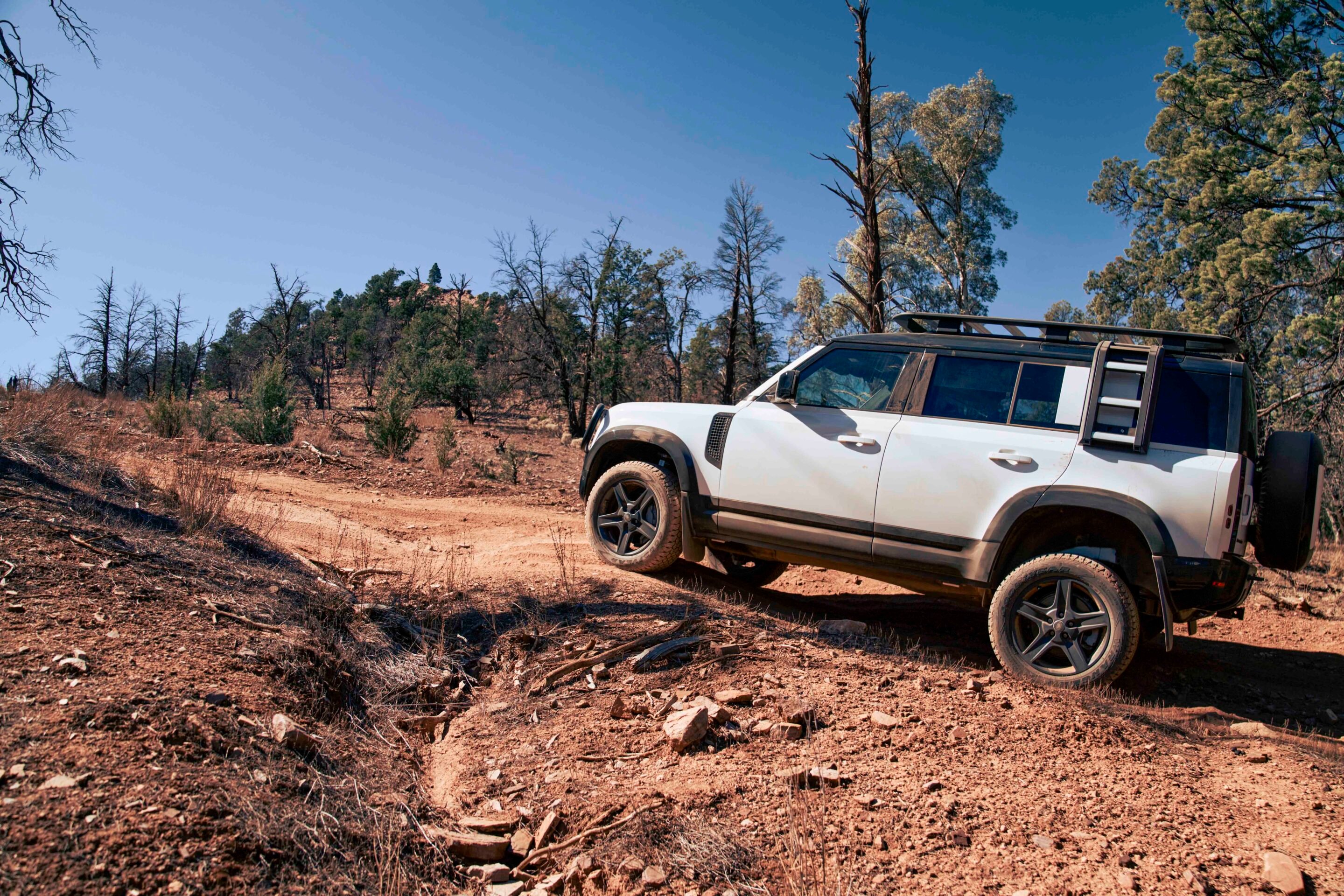
This particular Defender was equipped with the Capability Plus Pack which adds Terrain Response 2 (configurable) and All Terrain Progress Control (ATPC). The Air Suspension pack adds the height-adjustable suspension and adaptive dynamics; the Off Road Pack gives the D350 an Active Differential with Torque vectoring by braking, off-road all-terrain tyres, wade sensing, a domestic plug socket (GPO) outlet and black roof rails.
Inside, the Premium upgrade interior pack adds a full Windsor leather interior, leather steering wheel, power adjustable steering column, leather gear shift, 14-way heated and cooled electric memory front seats with four-way manual headrests, while the cold climate pack adds a heated steering wheel, windscreen and washer nozzles.
Add on the $4629 bull bar, front underbody shield, roof ladder, exterior side-mounted gear carrier, integrated air compressor, privacy side windows, a tow hitch receiver, body-coloured spare wheel cover, wheel-arch protection, rubber floor mats, mudflaps and tow hitch, and it jacks the total price for this particular Defender up to $144,891 +ORC.
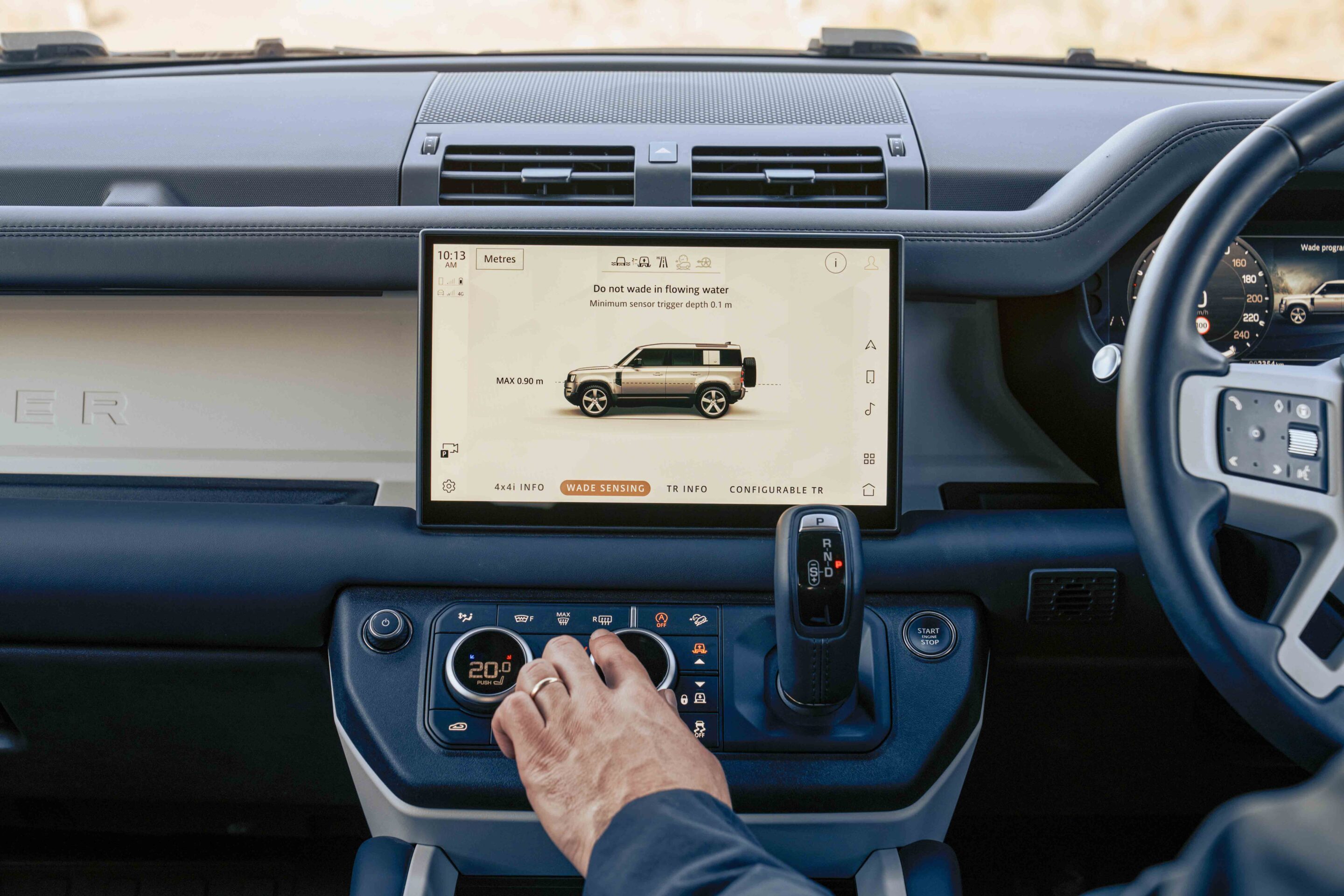
Almost $40k worth of accessories isn’t unusual for anyone doing a full fit-out on a touring 4×4 but these are all factory Land Rover accessories that are made specifically for the vehicle and covered by factory warranty. And, let’s be honest, there are a few in there that you could live without.
Standard kit includes a full suite of safety electronics including TPMS, a premium sound system that gives you inbuilt sat-nav plus Apple and Android mirroring and wireless phone charging, five seats with an optional third row, heated and cooled front seats, 20-inch alloy wheels, and a funky design inside and out that is sorely missing from most new 4x4s these days.
The second-row seat folds flat to give a long, flat cargo area; it’s large enough that I have rolled the swag out on it on a wet and windy High Country night on a previous trip, and I’m 185cm tall!
Off-road performance
There was no such inclement weather for this Defender drive in South Australia’s stunning Flinders Ranges. Much of the drive was done on Arkaba Station which provided a wide variety of terrain and track conditions.
The tracks allowed us to sample the various drive modes of the Defender in both high and low range, and to play with the suspension height settings to feel how they affect the wheel travel and hence the tractive ability of the vehicle.
When driving in the full-raised off-road height setting, the suspension runs out of travel sooner and can create a small amount of slip from the tyre, whereas covering the same terrain in the standard height setting (where ground clearance permits) allows the suspension to work better in keeping the tyre on the track. You shouldn’t think of this as a negative though, and the raised ride height gives the Defender more ground clearance than almost anything else in this class, and the rear locking diff quickly accounts for any loss of traction.
Land Rover invented Terrain Response when it introduced it on the Discovery 3 way back in 2004, and it has been copied by just about every 4×4 manufacturer since then but never bettered. Like many, I prefer the earlier Terrain Response interface, as it was easier to operate on the run with its tactile dial for simple mode selection.
Choosing the right Terrain Response mode for the conditions ahead optimises all the chassis and control systems for the best performance. For example, selecting the Grass, Gravel, Snow mode for the loose tracks on Arkaba instantly raises the ride height via the air suspension, sharpens up the activation of the electronic traction control (ETC) to better react to loose surfaces, and dulls down the throttle response for better control under your right boot.
Select a more aggressive mode like Rock Crawl and Terrain Response sets the centre and rear diffs to their most aggressive intervention level, gives maximum ride height and dulls the throttle pedal right down. Driving around the varied terrain on Arkaba showed that the most aggressive settings are not always the best for all tracks, and selecting the correct mode for the terrain will make your journey easier and more comfortable.
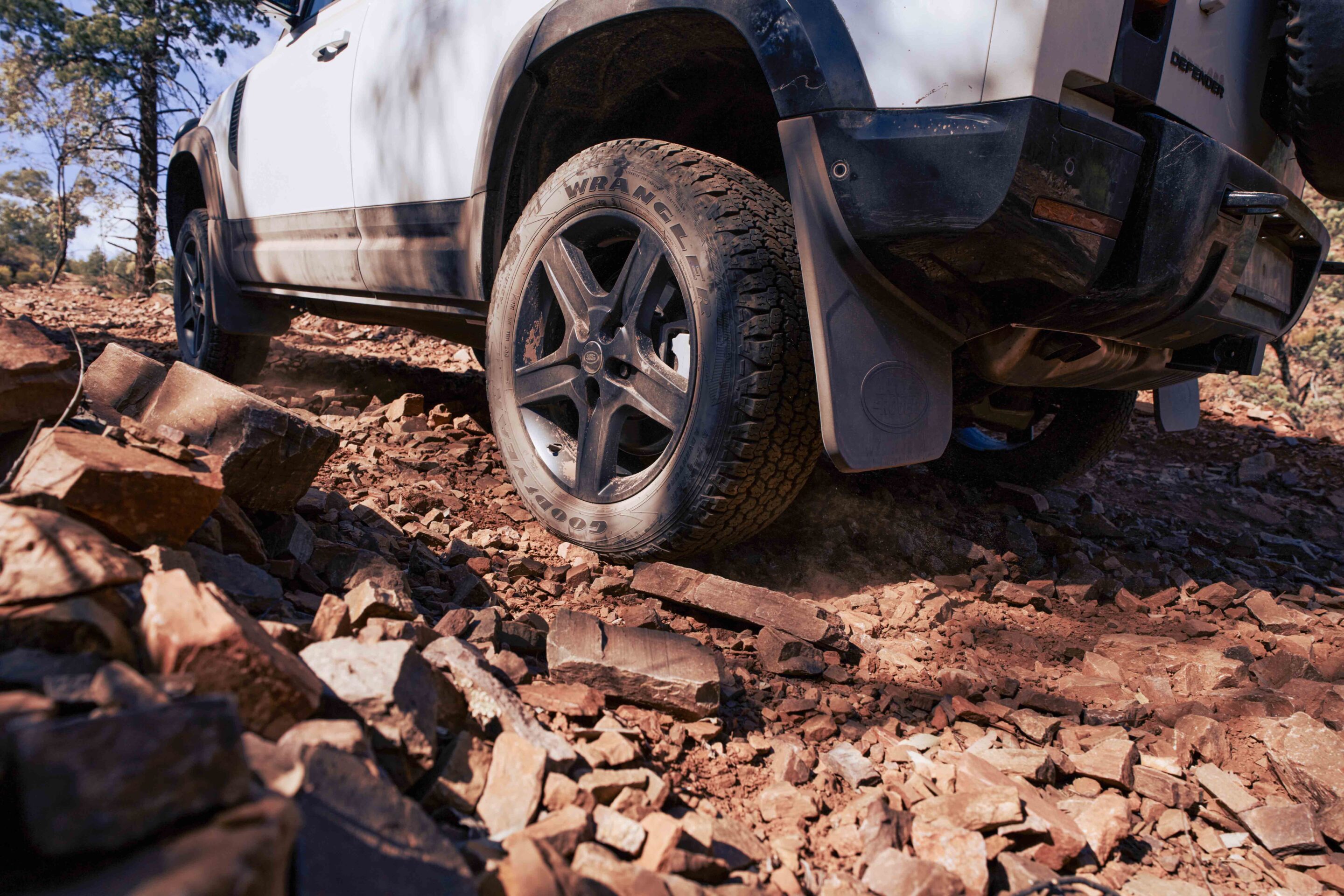
I’d be lying if I said I wasn’t concerned about the low-profile tyres on the sharp rocky tracks at Arkaba, but the Goodyear all terrains stood up to the punishment and gave us no problems. There’s a wider range of off-road tyre options for large diameter wheels these days than in the past, even if they are not ideally suited to gravel and rocky surfaces. You could fit 19-inch wheels to this spec Defender but there are more tyre options available for the 20s. The factory 18s will not fit on this Defender but there are some aftermarket 18-inch options that will.
As steep and rugged as Arkaba’s tracks are, the Defender D350 dodn’t raise a sweat and its off-road capability was never really challenged. Even when we intentionally took the wrong line on a track to try and trip up the Defender, it took it all in its stride and pushed on through without fuss.
| Off-road specs | |
|---|---|
| Approach angle | 37.6 |
| Rampover angle | 27.9 |
| Departure angle | 41.9 |
| Ground clearance | 293mm at max height |
| Wading depth | 900mm |
On-road performance
The road drive component of our Defender D350 test was on the open country between Hawker and Adelaide, and again the Defender showed its abilities by effortlessly overtaking slower vehicles, capably avoiding roadkill that sometimes required quick action, and delivering vehicle occupants safely and in comfort.
Phone pairing was a no-fuss affair providing tunes and navigation for the drive; the dual zone climate control kept the cabin temperature as set; and the drink bottle holders accommodated large vessels. It really is a fantastic long-distance tourer.
While the Defender range offers more powerful and refined petrol I6 and V8 engines, there’s absolutely nothing wrong with the Ingenium I6 diesel in the D350 – 700Nm of torque is nothing to be sneezed at, and it is delivered in a much smoother way than the LandCruiser 300’s V6 engine can manage.
Verdict
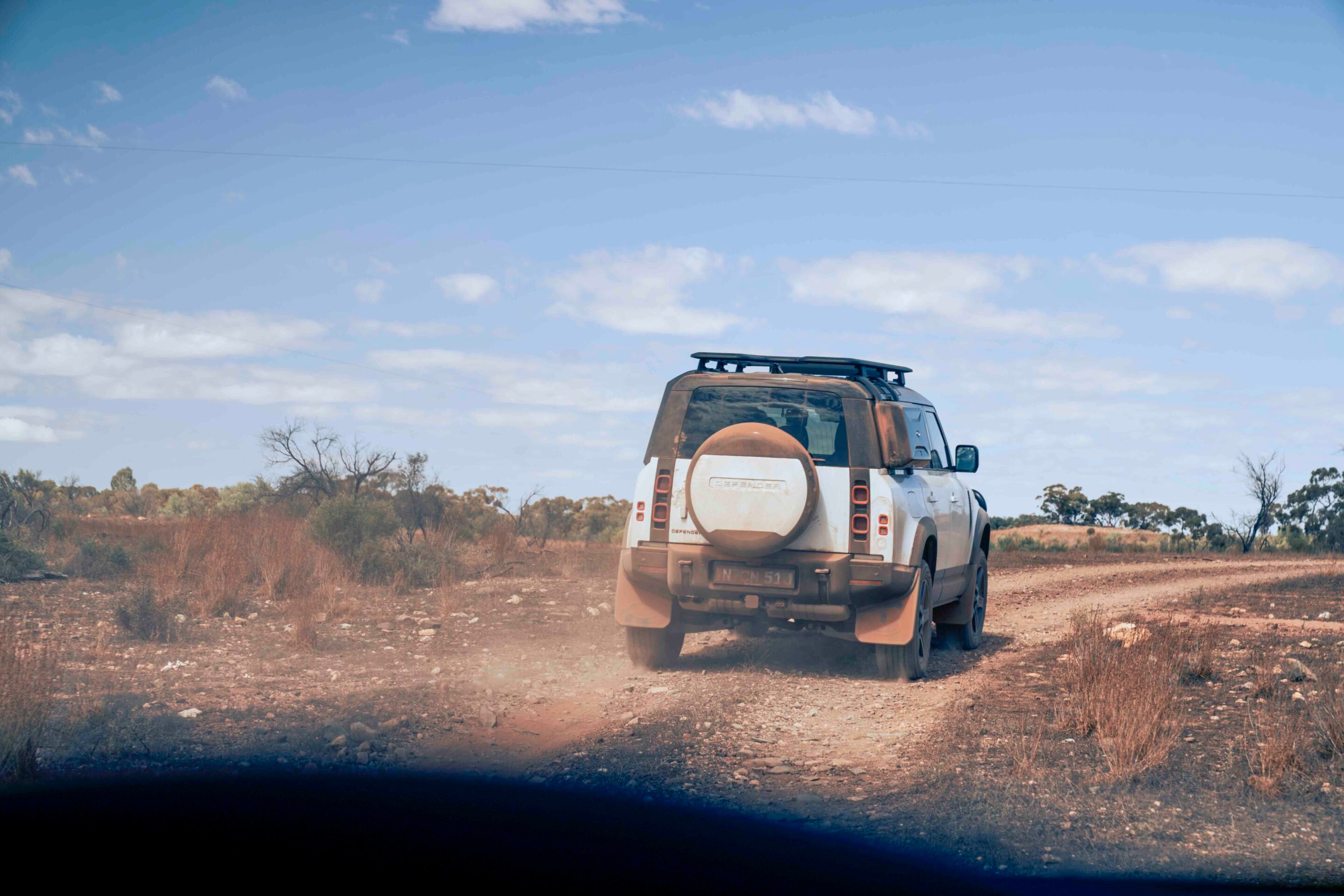
Optioned up as this vehicle is with the various packs and accessories, it makes an excellent touring and off-road wagon that offers more style and comfort than the popular Toyota or Nissan alternatives. The Defender might not be for everyone, but at this spec and price it deserves more attention from touring 4×4 buyers.
| Specs: Land Rover Defender D350 110 X-Dynamic | |
|---|---|
| Price | $109,880 (RRP); $144,891 (as tested) |
| Engine | I6 diesel twin-turbo |
| Capacity | 2997cc |
| Max power | 258kW @ 4,000 rpm |
| Max torque | 700Nm @ 1,500-3,000 rpm |
| Transmission | 8-speed automatic |
| 4×4 system | Full-time, dual-range |
| Construction | 5-door wagon on monocoque chassis |
| Front suspension | Independent height adjustable air |
| Rear suspension | Independent height adjustable air |
| Tyres | 255/55-20 |
| Weight | 2436kg |
| GVM | 3200kg |
| GCM | 6700kg |
| Towing capacity | 3500kg |
| Seats | 5 |
| Fuel tank | 89L (Ad-blue 20.7L) |
| ADR Fuel consumption | 8.1L/100km |
MG’s entry into Australia’s competitive ute segment appears one step closer to reality, with the upcoming MG U9 reportedly receiving Australian Design Rule (ADR) certification.
While the model is yet to be officially unveiled, reports suggest the certification documents outline two dual-cab variants slated for Australian release. The key difference between the pair lies in weight: one variant lists a GVM of 3500kg with a tare mass of 2398kg, while the other is slightly lighter, with a GVM of 3320kg and tare mass of 2498kg.
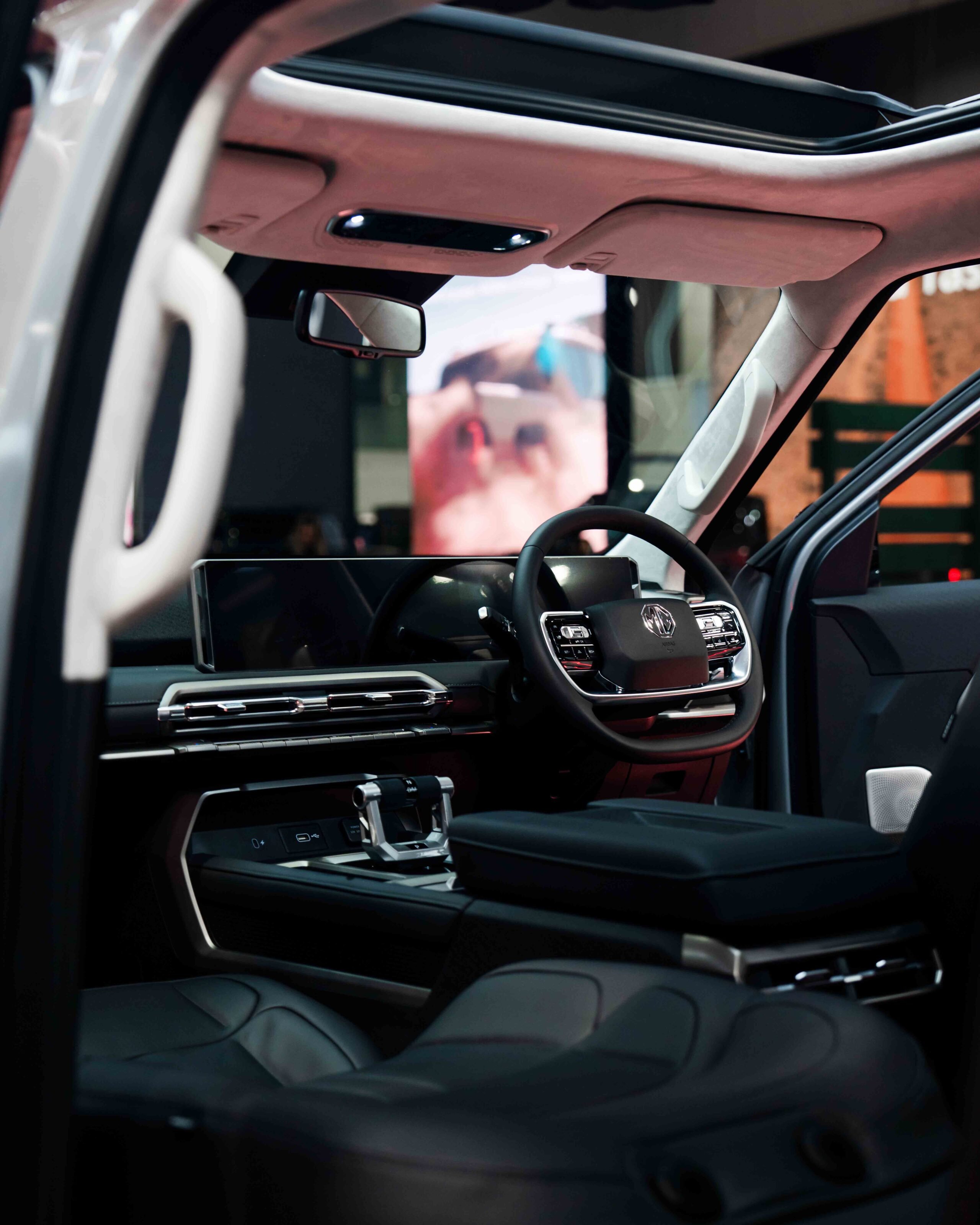
Both are said to feature an eight-speed automatic transmission and an automatic all-wheel drive system. Already confirmed by MG, the U9 will be powered by a 2.5-litre four-cylinder turbo-diesel engine producing 160kW and 520Nm.
The U9 is expected to measure 5500mm long, 1997mm wide and 1860mm tall, riding on a 3300mm wheelbase. A ground clearance of 220mm and wheel options from 18 to 20 inches add to its off-road-ready appeal.
As part of a rigorous local testing program, the U9 has reportedly travelled “from Broome to Albany to Cooktown and everywhere in between.” MG says the program was led by its in-house engineering team, aimed at ensuring the vehicle can handle Australia’s diverse and demanding conditions.
On the tech front, the U9 is expected to include the brand’s MG Pilot safety suite, offering 360-degree cameras, sensors and advanced driver-assist features. It will also come with MG’s iSMART app for remote access, along with wireless Apple CarPlay and Android Auto as standard. A hidden rear foldable step adds a practical touch.
With a Q4 2025 launch on the cards, full pricing and specifications are yet to be confirmed. However, if MG’s recent track record is anything to go by, the U9 could land with a price tag that significantly undercuts its more established rivals.
After a brief stint on the sidelines, Ram has officially announced the return of its 5.7-litre HEMI V8 engine.
Discontinued in 2024 and replaced by the 3.0-litre Hurricane twin-turbo inline-six for the 2025 model year, the HEMI V8 will be revived in the 2026 Ram 1500. European order books open from July this year.
It has been confirmed that the V8-powered Ram 1500 will be sold alongside the Hurricane inline-six in Europe, although it’s still unclear whether the HEMI will return to Australian showrooms.
“Everyone makes mistakes, but how you handle it defines you. Ram screwed up when we dropped the HEMI – we own it and we fixed it,” said Tim Kuniskis, CEO, Ram. “We’re not just bringing back a legendary V8 engine, we’re igniting an assertive product plan and expanding the freedom of choice in powertrain for our customers.”
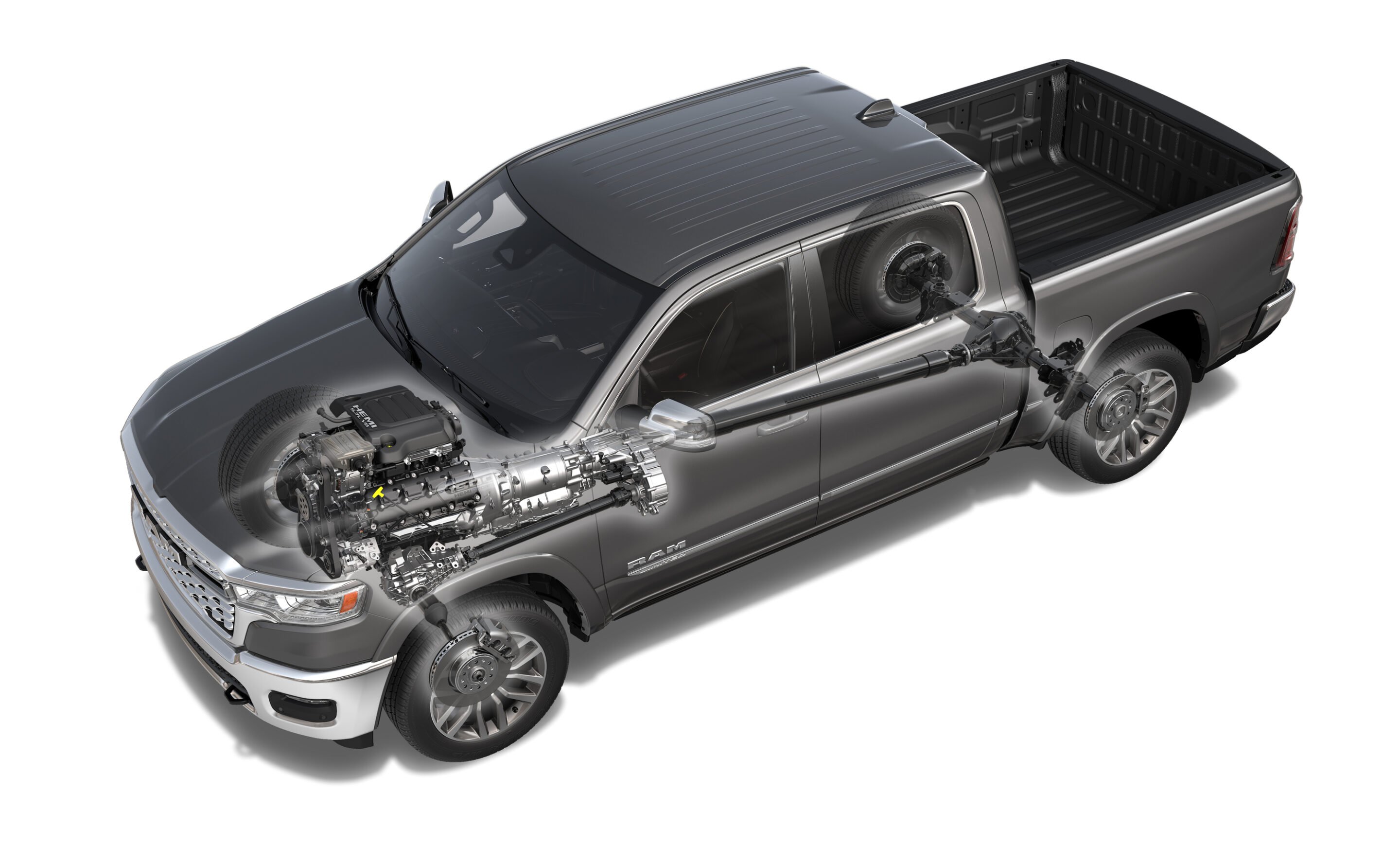
The 5.7-litre V8 produces 294 kW and 596 Nm, paired with an eight-speed automatic transmission. Its eTorque mild-hybrid system replaces the traditional alternator with a belt-driven motor generator unit powered by a 48-volt battery pack, providing up to 176Nm of additional torque during initial throttle input.
The V8 engine powering MY26 models will have a maximum towing capacity of up to 5200kg (European homologation up to 3500kg) and maximum payload capacity of 793kg.
As per the below table, the .3.0-litre Hurricane straight-six delivers significantly higher engine outputs.
| Hemi V8 eTorque | 3L Hurricane SO | 3L Hurricane HO | ||
|---|---|---|---|---|
| Displacement | L | 5.7 | 3.0 | 3.0 |
| Power | Hp / kW | 395 / 294 | 420 / 313 (+6%) | 540 / 403 (+27%) |
| Torque | Nm | 556 | 636 (+14%) | 706 (+27%) |
| CO2 emissions | g/km | 362 | 311 (-14%) | 338 (-7%) |
| Fuel consumption | l/100 km | 16 | 13.1 (-18%) | 14.2 (-11%) |
| 0-100 km/h | sec | 7.8 | 5.3 (-32%) | 4.6 (-41%) |
“Ram will continue to offer the more powerful and more efficient Hurricane Straight Six Turbo, but we heard loud and clear from consumers: there is no replacement for the iconic HEMI V8. At the end of each month, we count sales to customers, not statisticians or ideologues. Data be damned – we raise our flag and let the HEMI ring free again!” Kuniskis said.
The HEMI V8 will be available in MY26 Laramie, Sport (late availability) and Limited variants.
Bushman has earned a strong reputation among Aussie overlanders, and for good reason. Its fridges are simple, reliable and built to withstand extended off-road travel.
We put the DC85‑X Upright and DF30‑HD Drawer through their paces on a Simpson Desert convoy. While both kept food and drinks chilled, the Upright proved it was built for serious touring, with the Drawer playing second fiddle as reliable backup storage.
JUMP AHEAD
Bushman DC85‑X Upright: Practical and tough
I’ve never been much of a fan of upright fridges in canopies. They save space, but I’ve always found them awkward to stack efficiently. The Bushman DC85‑X changed my mind.
This unit is an absolute winner: Easy to access, surprisingly quiet, and with a freezer that punches well above its size – though ice can build up if you run it for long stretches in humid conditions. Built with a sturdy steel body, it stands up to corrugations and long-haul travel, proving it has been clearly designed for life on the road rather than weekend camping.
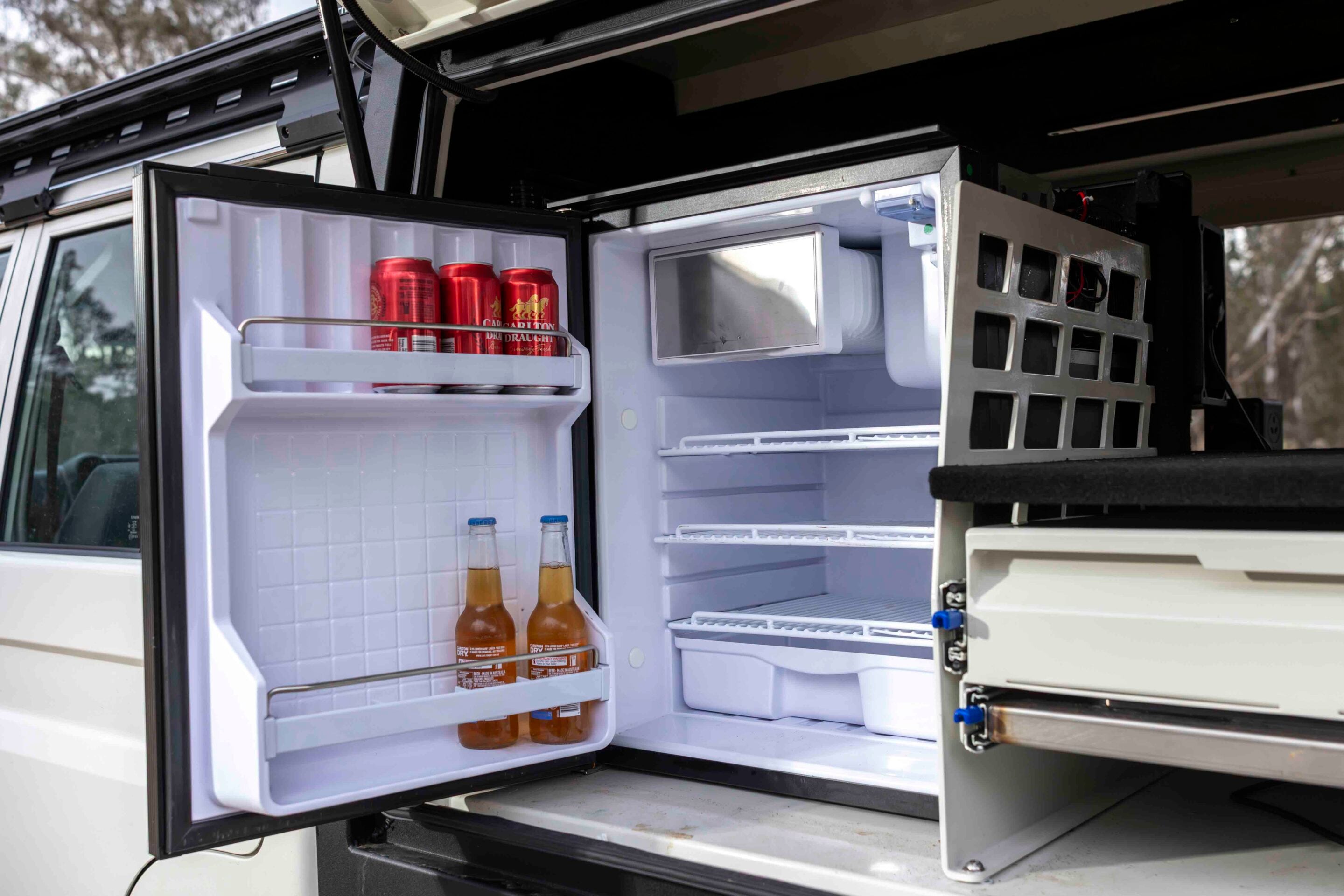
It’s surprisingly user-friendly in a canopy setup, with large door shelves that fit two-litre milk bottles, space for tall bottles, a plastic crisper tub, and a six-litre internal freezer to keep essentials organised. It also features a reversible door, Anderson plug, and full mounting kit to make installation flexible.
Designed for off-road use, the DC85‑X combines Bushman’s proprietary cooling system with a genuine Secop Danfoss BD35 compressor, which is tropical ‘T’ rated, German-designed, and Japanese-owned. The variable-speed drive compressor draws 2 to 4.5 A, averaging just 1.25 A/hr over 24 hours at 25°C ambient while maintaining 4 C inside the fridge. Extensive ventilation and low-power design ensure efficiency even on extended trips, and a five-year compressor warranty rounds out a package that’s both rugged and practical.
DF30‑HD Drawer: Compact but capable
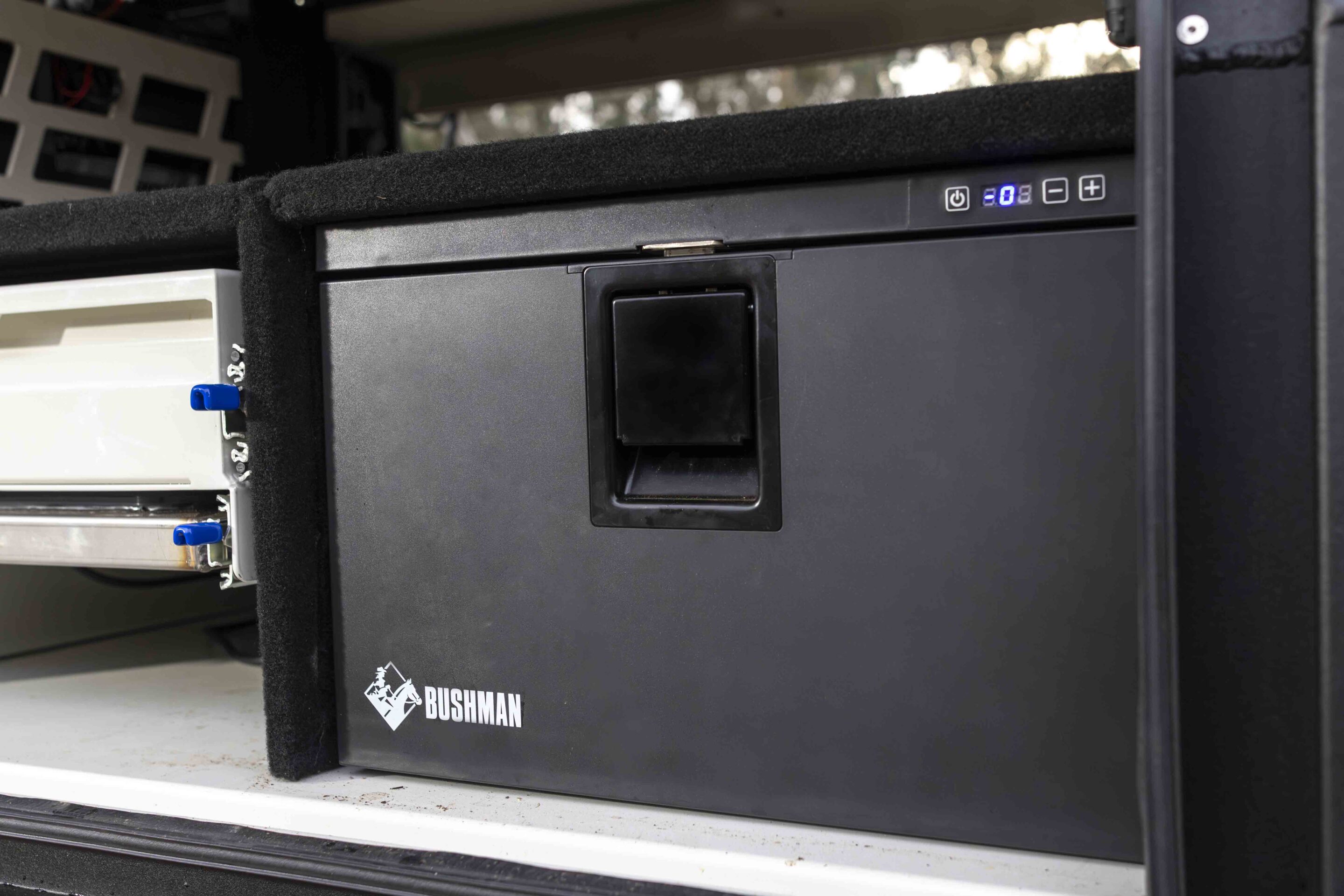
The DF30‑HD Drawer is compact, tidy, and fits neatly into most setups, but it doesn’t quite have the “premium Bushman” feel you might expect for the price.
It cools well, draws little power, and is a solid, reliable unit – just not especially remarkable compared with cheaper drawer fridges on the market. Small but surprisingly resilient, the DF30‑HD delivers –18°C freezing in up to 45°C ambient temperatures and +4°C refrigeration in 50°C. Closed-cell insulation up to three inches thick, twin cross-flow fans, 100 per cent stainless steel runners, steel hardware, slam latches, and a heavy-duty mounting bracket keep it secure and dependable under rough off-road conditions.
With a seven-year Secop Danfoss HD Series compressor warranty, the DF30‑HD is a trustworthy companion in extreme environments. While it doesn’t match the DC85‑X Upright for capacity or accessibility, it performs well as a secondary fridge.
Real-world verdict
The DC85‑X Upright is easily the star of the show. Efficient, rugged, and thoughtfully designed, it makes life on the road that much easier. The DF30‑HD Drawer works well, but it doesn’t quite justify its premium badge on its own.
Still, when you’re miles from anywhere, reliability is what matters most – and the Upright delivers on that and more. For touring rigs or canopy setups, the DC85‑X is the fridge you’ll rely on day in, day out. Pair it with the DF30‑HD Drawer, and you have a compact secondary fridge that adds extra capacity and extreme-heat resilience, creating a setup that can handle nearly any adventure.
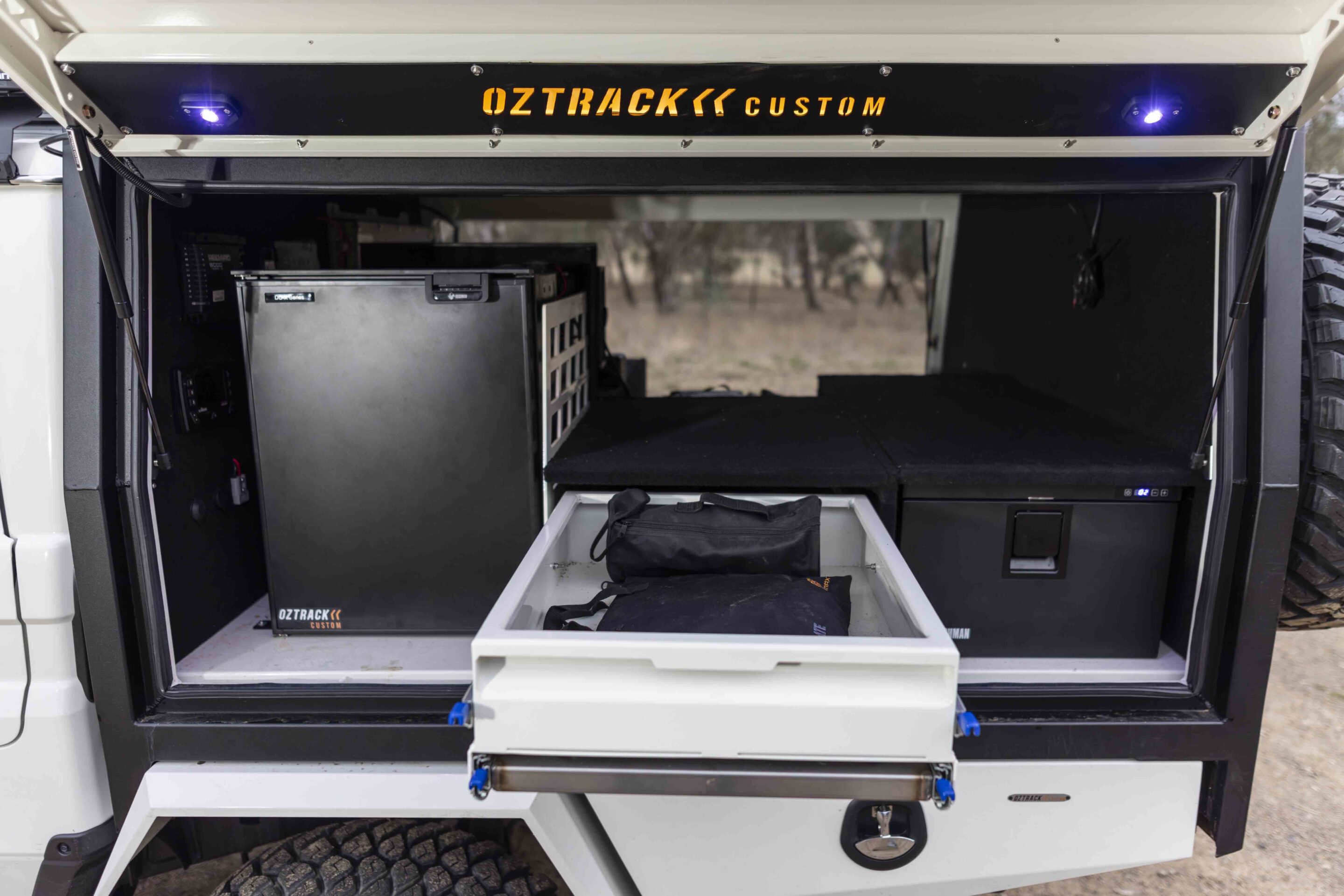
Both fridges proved dependable on tough tracks. The Upright stands out for usability, durability, and cooling performance, while the Drawer performs solidly as a backup, offering rugged reliability even in harsh conditions.
One minor gripe applies to both units: if you store metal cans inside, expect some rubbing on the plastic interior. After a few trips, the surfaces can scuff or mark up. It’s not a dealbreaker, but worth noting if you like to keep your gear looking pristine.
Pricing: Upright $1495; Drawer $1480
Depending on where you live, you should be able to pick up a new Toyota HiLux SR5 double cab cab-chassis for around $70K drive away, or even a bit less if you choose not to fit the genuine accessory alloy tray.
Of course, you will need something fitted to the rear of the HiLux before you can get it registered, but by opting for the cab-chassis variant you can fit pretty much any tray and canopy package you want, or a one-piece canopy that bolts directly to the chassis. This allows you to tailor the setup to perfectly suit your 4×4 touring needs.
The HiLux SR5 is powered by a 2.8L four-cylinder turbo-diesel engine (with V-Active 48V technology) that makes a claimed 150kW and 500Nm, mated to a six-speed automatic transmission. It is an impressive performer straight off the showroom floor, with a spritely and economical driveline for long-distance touring and an effective electronic traction control system for decent off-road capability. It also scores Toyota’s Multi-Terrain System (MTS) with six selectable modes (Auto, Dirt, Sand, Mud, Deep Snow and Rock) to suit different terrain types, a rear diff lock and Downhill Assist Control.
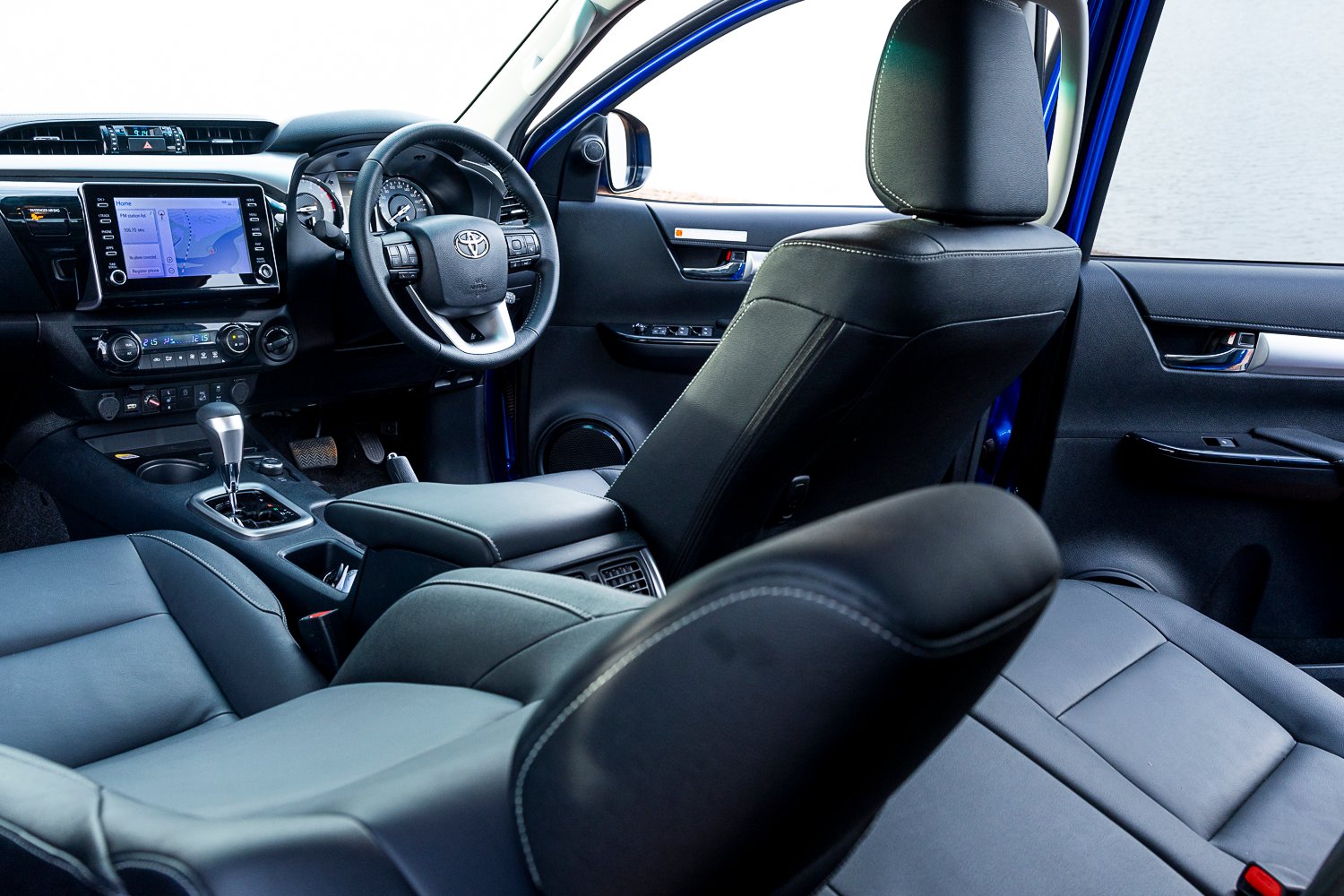
In SR5 spec, the HiLux is well-equipped with standard convenience and safety features including 18-inch alloy wheels, keyless entry/start, LED headlights, dual-zone climate control, and eight-inch touchscreen, sat-nav, wireless phone charging, a 220V accessory outlet, myToyota Connect, Stolen Vehicle Tracking, Automatic Collision Notification, SOS Emergency Call, LED lighting, rear privacy glass, seven airbags, Pre-Collision Safety System, Active Cruise Control, Lane Departure Alert, and Road Sign Assist.
As with any 4×4, the HiLux SR5 can be vastly improved upon for 4×4 touring. Being such a popular vehicle there are plenty of aftermarket goodies for it, and like any other dual-cab ute you should choose a suspension system designed to suit the accessories you intend to fit and the load you intend to carry. Most 4×4 suspension specialists have a vehicle configurator on their websites, so you can choose a setup to suit your vehicle. Expect to spend anywhere between $1300 to more than $3500 for a decent aftermarket suspension kit.
While the SR5 runs 18-inch wheels, there are still plenty of Light Truck (LT) tyre options available for it, in both all-terrain and mud-terrain tread patterns in the standard 265/60R18 size, including Toyo Open Country AT3s (about $420 each), BFGoodrich All-Terrains and Mud-Terrains (about $500 each) and Cooper AT3s (about $500 each). Alternatively, you could go up a size to 275/70R18s, or buy a 17-inch wheel and tyre package and fit LT285/70R17 tyres.
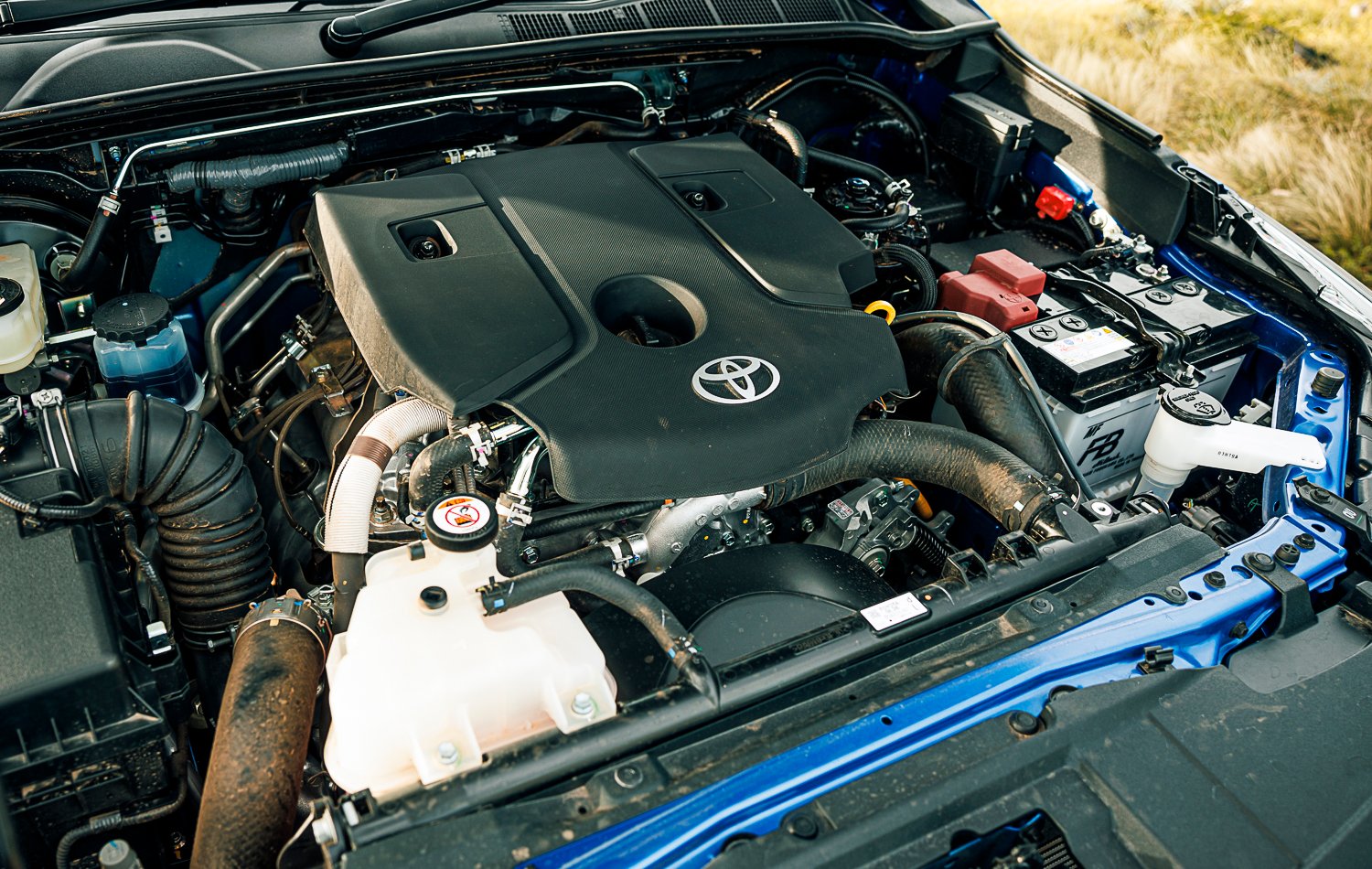
On the protection front, a quality steel bull bar can cost upwards of $2500, and a pair of side rails and steps another $1000. Throw in a decent electric winch and you’re up for another $1200-$3000, a good set of LED driving lights will cost $700+ a pair and an LED light bar another $350 or so.
A decent tray and canopy package for the HiLux SR5 double cab can cost anywhere from $5000 to $10,000, while a fully decked out one-piece chassis-mounted canopy can easily exceed $10K, especially once fitted out with drawers, power system, solar panels, fridge, slide-out kitchen, water tank, racks, ladder, spare wheel carriers, LED lighting, and just about any other convenience item you can think of for off-the-grid living.
Other accessories you might want to consider for 4×4 touring include a snorkel ($700), an auxiliary or long-range fuel tank ($1200-$1500), comms gear such as a UHF radio and antenna package ($400-$700), a dual-battery setup with lithium battery and charger ($1500+), under-vehicle protection ($800-$1000)… the list goes on.
Whatever you do, make a list of all the gear you intend to fit to your HiLux SR5 and figure out how much it will weigh before you buy and register the vehicle. You might just need to fit a GVM-upgrade suspension system ($3500-$5000), and this will only be legal in all states and territories if fitted prior to initial vehicle registration through the second stage manufacturer (SSM) scheme.
I’ve been a car person for many years, from street and rally cars, to tourers and 4x4s. Back in the day there wasn’t much of a range of cleaning products to keep your pride and joy looking good, but today there are so many products it can get confusing.
My 80 Series LandCruiser is nearly always off road, in some of the harshest conditions that our country can dish up, and it’s often dirty and dusty for weeks on end. But I find with the right products my 34-year-old Cruiser comes up a treat time and time again.
While I’m happy enough to use self-serve car washes for high pressure washing and rinsing while I’m on the road, I refuse to use those scratchy brushes on the paintwork. A few years ago I was introduced to the Bowden’s Own range of car care products, and just recently they released some special cleaning agents for 4x4s.
A bit of history behind the brand: with a shed full of unique cars the Bowdens used to use high quality cleaning products from the USA and Europe, but they began to notice issues with the products having cheap ingredients in the formulas. As a result the Bowdens decided to develop a range of their own and by the year 2000 they had a batch of four products to use on their own vehicles before, in 2002, they took the plunge and started to market this range to the public. Over the next few years the Bowden’s Own range grew and grew and the early products were hand made and bottled in a shed on the Sunshine Coast in Queensland.
Bowden’s Own makes it clear that it only uses local chemists to research and develop products, and uses local production companies for packing and distribution. Each product is custom made from scratch to be the best it can be. Some products like Wheely Clean and Tyre Shine each took over seven years to develop. The range is massive with everything you could ask for to clean the inside and out of your vehicle including interior protection, products to remove stubborn stains, anti-bacterial cleaners, engine cleaners, car care kits, buckets, a huge polish range plus a range of brushes and cleaning mitts.
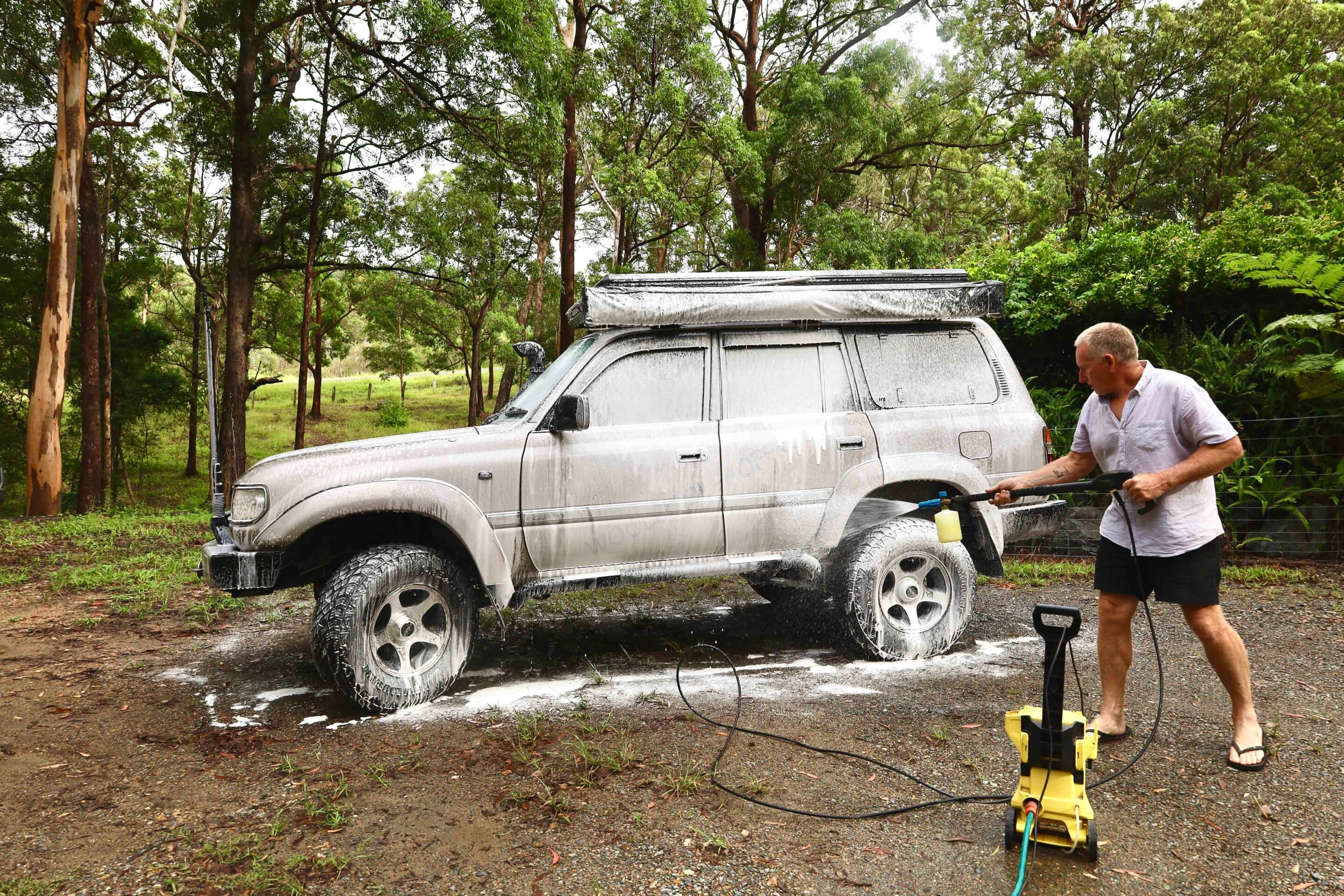
Due to constant demand from off-roaders, Bowden’s Own has now developed a range of products and tools for four-wheel drivers. With names like Dirty Times 4WD Wash, Down & Dirty, Under Armer and The Little Stiffy brush, I knew I was in for a good time cleaning. Generally the Bowden’s Own process is to pre-soak a vehicle (I used the Mega Snow Job ), let it soak and then high-pressure hose off, hand wash with Dirty Times 4WD Wash, dry and then apply a wax or paint protection.
The Dirty Times 4WD Wash has advanced rust inhibitors and minerals to dissolve salt build up. I find it breaks down the toughest of stains on my 80, especially the outback red dirt grime that tends to build up and stick to every orifice. This product is safe for all surfaces and won’t strip any ceramic coating off, and can be used on caravans, jet skis, boats and ATVs, plus it’s totally biodegradable.
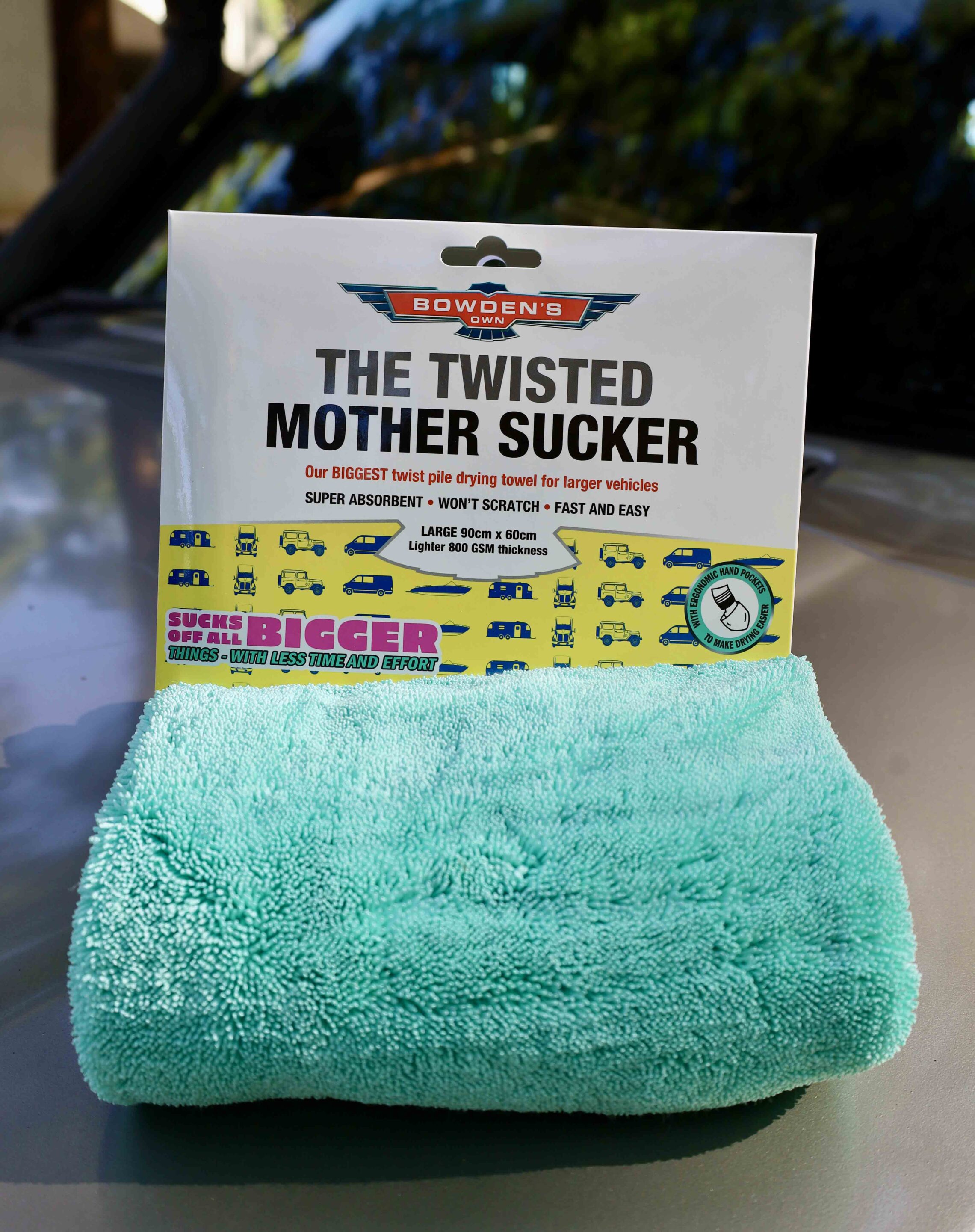
After a good wash I use the Twisted Mother Sucker (say that fast three times) to dry off and prepare for a coat of wax or prepare for paint restore.
The new Down & Dirty product is simply amazing; just spray on (wheels, tyres and chassis) then use either the Little Stiffy or The Chubby brush for extra penetration and hose off. As Bowden’s Own says, “Super effective for removing stubborn red dirt, grime, mineral deposits, grease and oil from vehicle underbodies and inner guards.” Down & Dirty is safe to use on all metals, plastics, rubber and non-porous surfaces. It’s also good for removing black exhaust soot, built-up road grime, and mud, grease and oil marks.
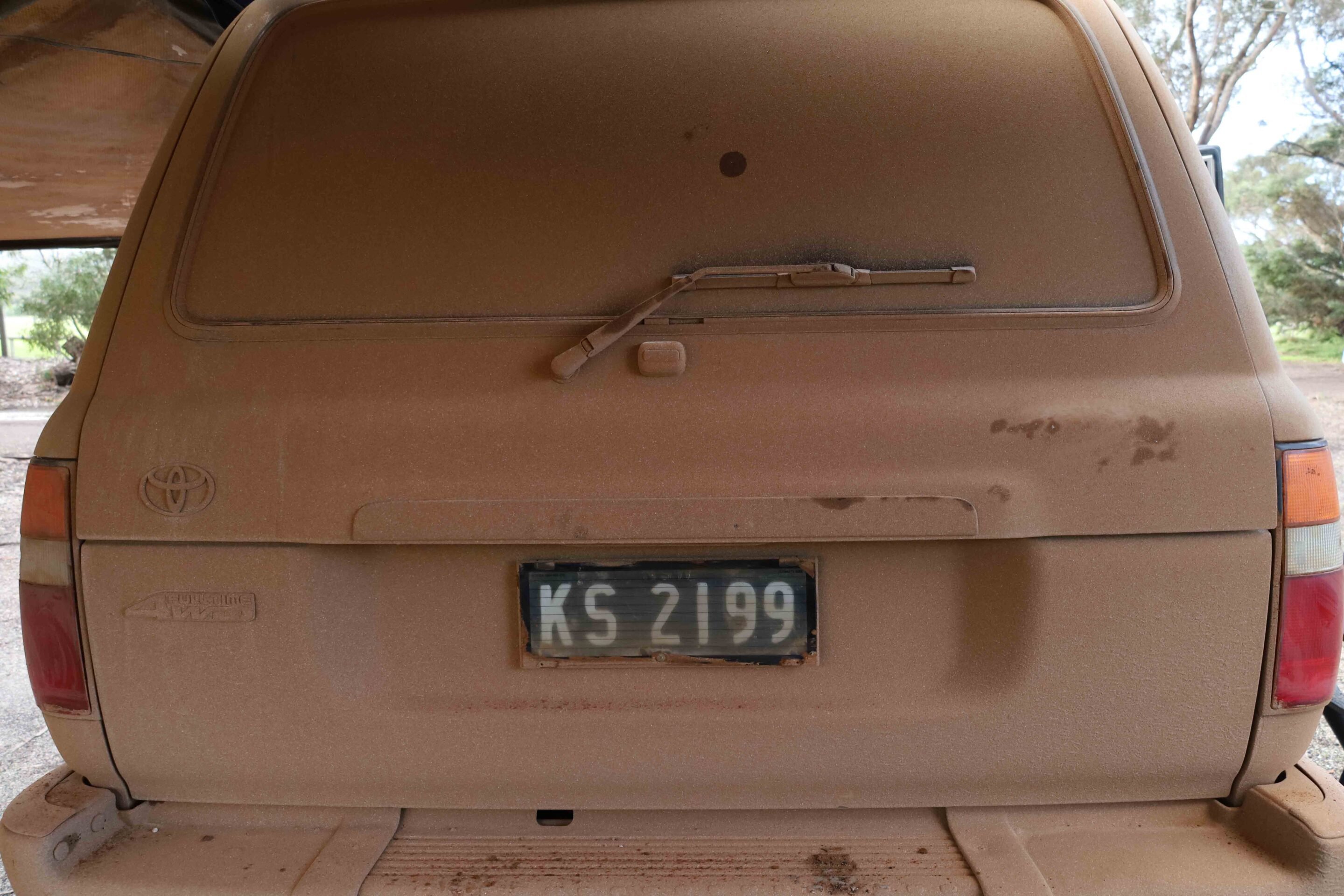
I am also a big fan of Under Armer, which I use prior to every big trip as it coats the underside and chassis with an anti-corrosion barrier that will last for two to three months. This formula has taken five years to develop and it works well at repelling mud, salt, sand and road grime. Application is straightforward; high-pressure hose the underside of your 4×4, spray Under Armer on all surfaces, let it dry then hose off. It will leave the underside clean and shiny but it won’t leave it tacky and sticky like some others do.
Bowden’s Own is an Australian family-owned and operated business that uses Australian companies to develop and make its products, right down to the caps, bottles and labels. As well as car and 4×4 products, there are bike-cleaning products, cannons for your home pressure washer and service kits, apparel, brushes and more.
Despite an increasing consumer preference for SUVs, the Ford Ranger and Toyota HiLux remain immovable atop the 4×4 sales charts.
Ford shifted a total of 4481 Ranger 4x4s for the month, increasing year-to-date sales to 20,719. Toyota sold a total of 4208 HiLux 4x4s in May, increasing its YTD sales to 16,970. However, these figures are substantially lower compared to 2024. At the same time last year, the Ranger 4×4 had accumulated 24,778 sales (-16.4 per cent compared to 2025) and the HiLux 4×4 had 20,004 sales in the bank (-15.2 per cent).
Market trends indicate the SUV segment is the only division showing growth compared to the same month last year (+3962 sales; +6.6 per cent). The LCV segment had 1835 fewer sales (-7.2 per cent); and the Passenger segment was down a whopping 7086 sales (-33.3 per cent).
| Best-selling 4x4s in May 2025 | |
|---|---|
| 1. Ford Ranger | 4481 |
| 2. Toyota HiLux | 4208 |
| 3. Toyota Prado | 2732 |
| 4. Ford Everest | 2369 |
| 5. Toyota LC300 | 2040 |
| 6. Isuzu D-MAX | 2022 |
| 7. Isuzu MU-X | 1643 |
| 8. Mitsubishi Triton | 1328 |
| 9. BYD Shark | 1302 |
| 10. Mazda BT-50 | 1059 |
Digging deeper reveals the SUV segment now holds a 60.4 per cent share of the overall market, up from 55.8 per cent in 2024 (YTD). The Passenger segment has declined from 18.0 per cent to 13.7 per cent; while the LCV segment remains steady at 22.3 per cent.
This is highlighted by the total sales for both the Toyota LandCruiser Prado (2732) and Ford Everest (2369) in May. This positions the two off-road wagons behind only the Ford Ranger and Toyota HiLux on the 4×4 monthly charts. This is reflected on the year-to-date charts, which sees Prado and Everest sales increase to a total of 13,406 and 9589 respectively. Again positioning them behind only the Ranger and HiLux on the 4×4 YTD charts.
Sales were also strong in May for the 300 Series LandCruiser, posting a total of 2040 sales for the month, up from 1022 sales registered in April. Its biggest competitor, the Nissan Patrol, posted 661 sales for the month.
BYD sold a total of 1302 Sharks in May, which is consistent with the total number of deliveries registered in April (1293). A total of 7431 BYD Sharks have been sold so far this year.
At the top end of the segment, Chevrolet Silverado posted 247 sales for the month, leading the Ram 1500 (223 sales), Toyota Tundra (31 sales) and Ford F-150 (28 sales).
Speaking of big-dollar buys, the FCAI has also partnered with the European Australian Business Council to advocate for the conclusion of a comprehensive Free Trade Agreement with the European Union, which could lead to the removal of the Luxury Car Tax and the elimination of the five per cent tariff currently applied to EU vehicle imports.
“Australia’s automotive sector strongly encourages all participants to deliver a trade outcome that is future-focused rather than prolonging outdated and inefficient policy arrangements, and one that allows Australians to share in world-leading mobility, safety and environmental technologies at the lowest possible prices,” Weber said.
Australia’s top-selling vehicles for the month (4×4 and 4×2 variants combined) were the Toyota HiLux (4952), Ford Ranger (4761), Toyota RAV4 (403), Toyota LandCruiser (3046) and Toyota LandCruiser Prado (2732).
Overall new-car sales in Australia decreased by 5.2 per cent in May 2025 compared to May 2024 (105,285 versus 111,099).
| Best-selling 4x4s YTD (as of May 2025) | |
|---|---|
| 1. Ford Ranger | 20,719 |
| 2. Toyota HiLux | 16,970 |
| 3. Toyota Prado | 13,406 |
| 4. Ford Everest | 9589 |
| 5. Isuzu D-MAX | 8565 |
| 6. BYD Shark | 7431 |
| 7. Mitsubishi Triton | 6366 |
| 8. Isuzu MU-X | 5785 |
| 9. Mazda BT-50 | 5199 |
| 10. Toyota LC79 | 4165 |
GWM has given the Tank 500 a facelift, unveiling a redesigned front grille aimed squarely at Australian buyers.
“This update reflects Australia’s influence in shaping the vehicle to better align with local consumer preferences,” the brand said in a statement.
The refreshed front end is bolder than before, featuring fewer horizontal slats while retaining a strong chrome presence. Despite the cosmetic changes, the Tank 500 continues to hold a five-star ANCAP safety rating.
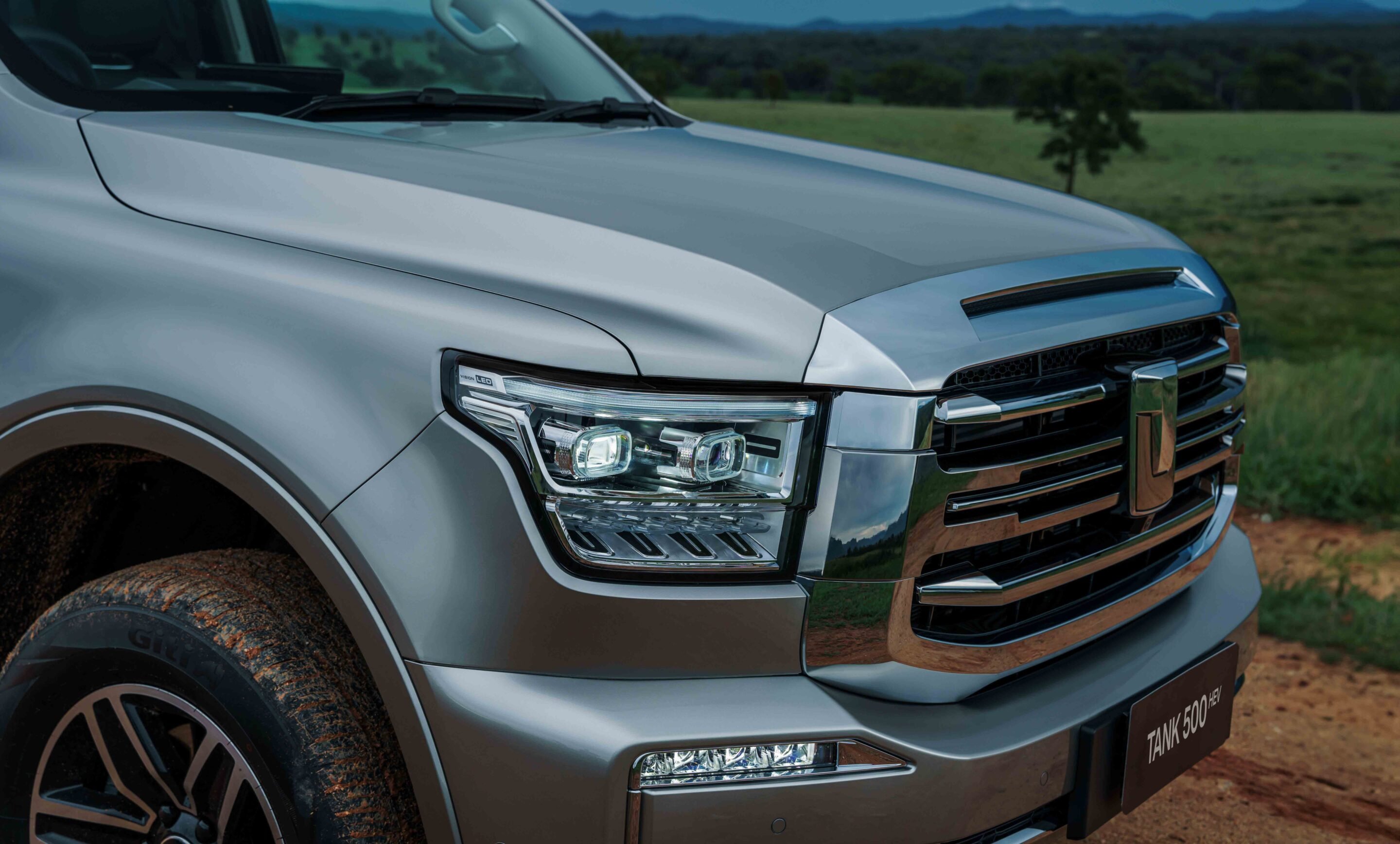
The new grille is part of a broader series of updates rolled out over the past 12 months. These include locally tuned suspension for improved ride and handling, and software enhancements – most notably to the adaptive cruise control system – to further refine its on-road performance.
The Tank 500 remains a well-equipped, three-row, seven-seat large 4×4 SUV that delivers strong value against higher-priced rivals like the Toyota LandCruiser 300 Series. It comes in two variants – Luxury and Ultra – both powered by a 2.0-litre turbocharged petrol-electric hybrid producing 255kW and 642Nm, paired with a nine-speed automatic transmission. Off-road capability is bolstered by front, centre, and rear locking differentials.
Production of the updated Tank 500 began in April 2025.
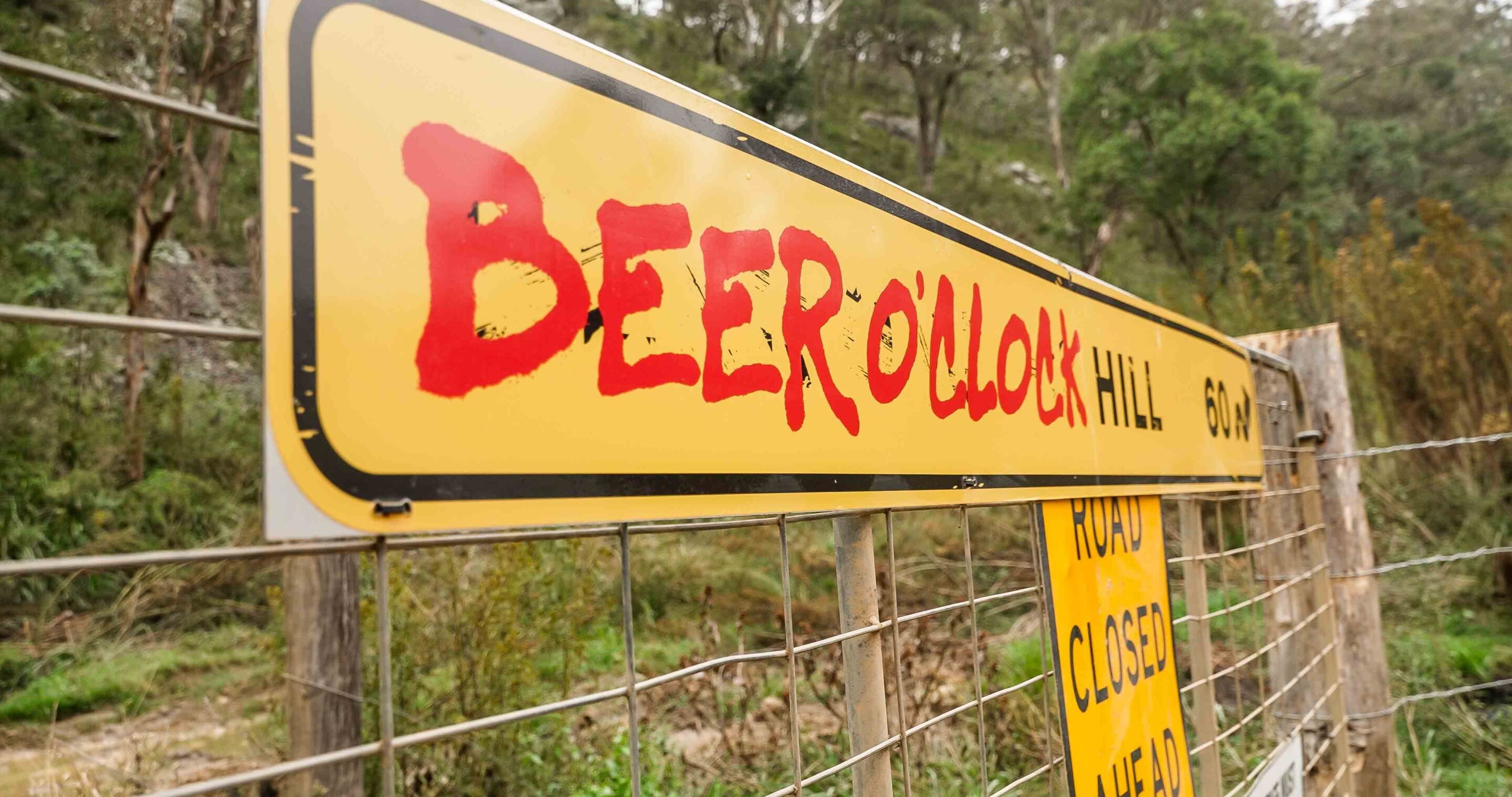
GWM has successfully beaten one of Australia’s most infamous off-road challenges: Beer O’Clock Hill.
A total of three GWM vehicles – the Cannon Alpha PHEV, Cannon XSR diesel and Tank 300 diesel – reached the summit in a show of strength for GWM, a brand out to prove it should no longer be underestimated when the going gets rough. All three of the vehicles were essentially showroom-stock – the XSR wearing factory tyres; the Cannon Alpha shod in Mickey Thompson Baja Boss all-terrains.
By reaching the summit, the Cannon Alpha PHEV made history by becoming the first PHEV of any kind to ascend Beer O’Clock Hill. Powered by GWM’s Hi4-T platform, the system combines a 2.0-litre turbocharged petrol engine (180kW/380Nm) with a 120kW electric motor (400Nm) to deliver a combined output of 300kW and 750Nm. It uses a nine-speed hybrid automatic transmission with full-time 4WD.
In addition, the Cannon XSR became the second full production-spec vehicle ever to officially conquer Beer O’Clock Hill – following the INEOS Grenadier. The Cannon XSR is powered by a 2.4-litre single-turbo diesel engine, producing 135kW and 480Nm and paired with a nine-speed automatic transmission.
“Successfully conquering Beer O’Clock Hill is no small feat. Many try, few succeed,” said Steve Maciver, Head of Marketing and Communications at GWM Australia. “For GWM to take multiple vehicles across different powertrains – including the new PHEV – to the summit speaks volumes about the strength, technology and real-world engineering behind our 4WD line-up. We’ve always known what our vehicles are capable of, but this achievement doesn’t just back up the promise, it delivers the proof.”
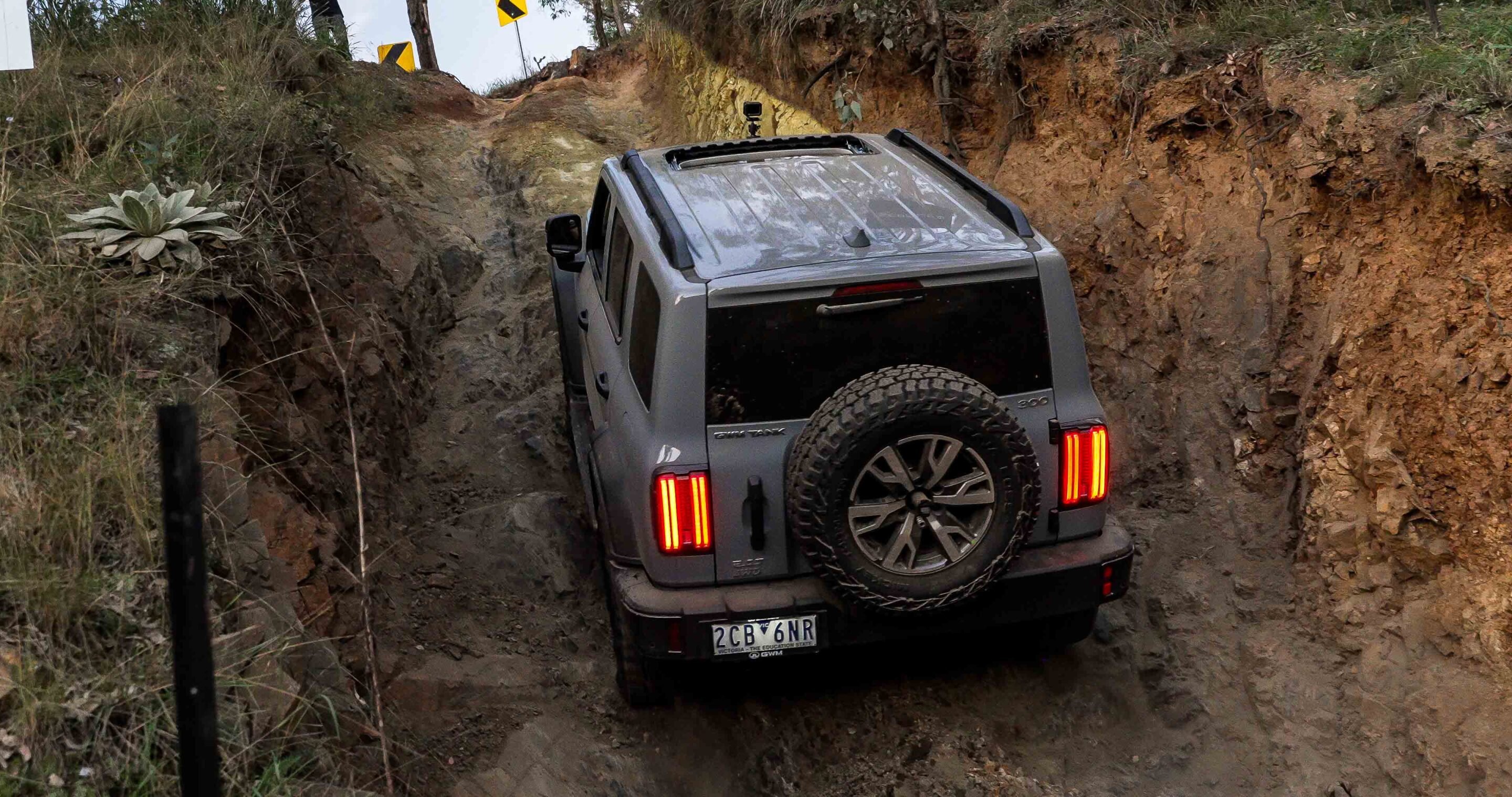
Located within the Springs 4×4 Adventure Park in Queensland, the technically demanding 100-metre ascent features gradients of up to 50 degrees, three separate rock steps, and a difficult rock ledge as steerers approach the summit.
It’s a climb that has caused plenty of vehicular damage over years, according to the park’s owner, Lucas Bree: “I reckon Beer O’Clock Hill has caused hundreds of thousands of dollars in vehicle damage over the years.
“[It has] shut down some of the most heavily modified rigs I’ve seen, so watching showroom-spec GWM vehicles, including a plug-in hybrid, make it to the top has completely changed my view of the brand,” Bree said.