
- Camp at Temple Gorge is you are keen to tackle the many and variued walking tracks that lead up into the Kennedy Range.
- Drive the Kennedy Loop Track that covers the top of the range, but note that it’s only suitable for high-clearance 4x4s.
- Camp at Winnemia station where an old workers’ cottage has been converted for campers with toilets, but be aware that it’s still a remote camp
- Take the 45km drive around the base of Mount Augustus to view this huge monster from different angles and to explore the variety of hikes into and up the mountain.
- Check out the petroglyphs at Mount Augustus that depict an amazing array of animal, human and dreamtime engravings.
We are pretty lucky in Australia with so many ‘big things’, whether they be manmade or natural, so while on tour in our biggest state I thought I’d check out one of the biggest natural wonders in the world: Mount Augustus.
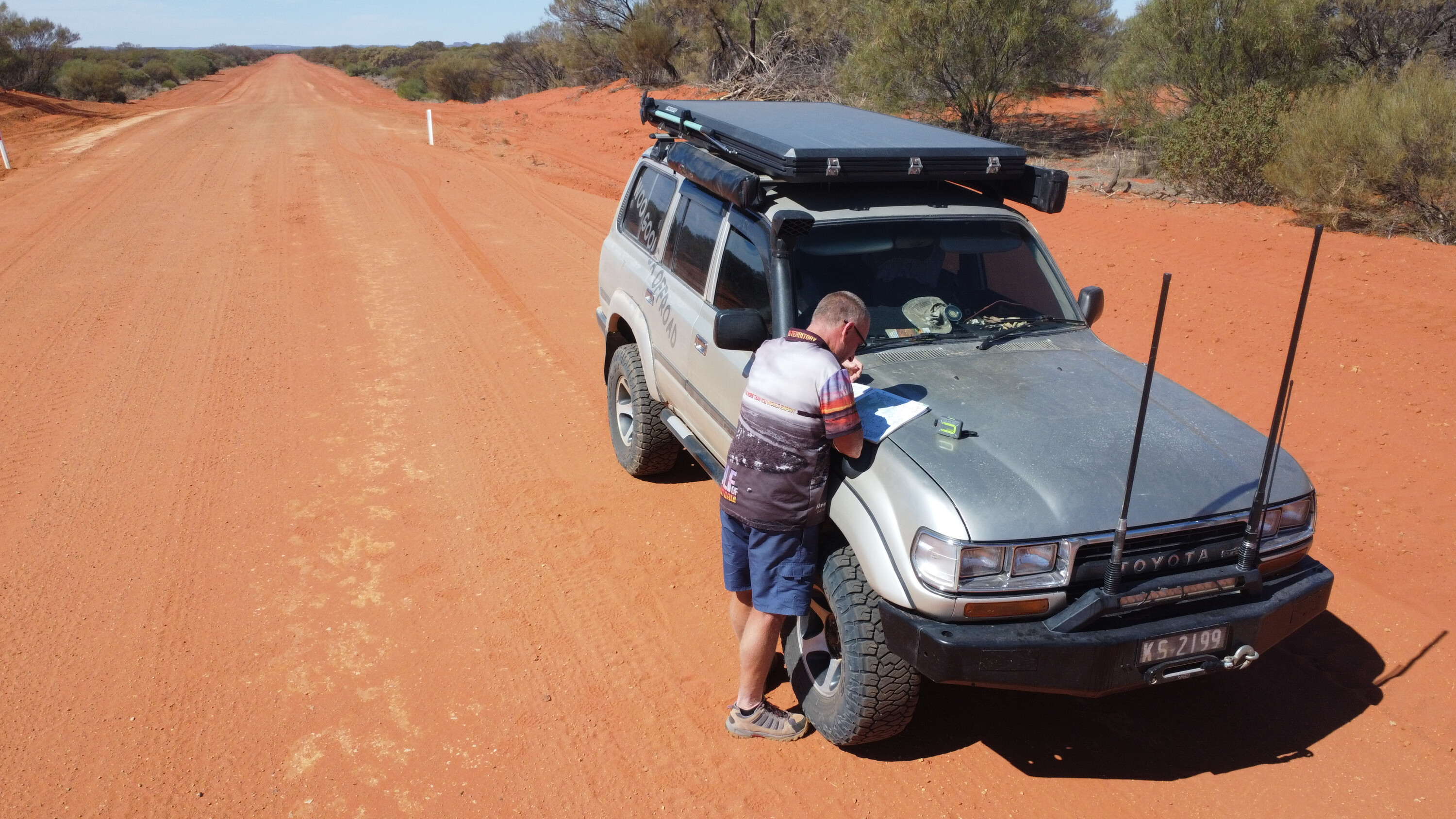
After fueling up, restocking and a quick service of the Cruiser at Carnarvon on WA’s mid-west coast, I headed east along the Carnarvon Highway towards Gascoyne Junction.
With a good 450km drive to the world’s biggest rock, I settled in for the long haul on what seemed like an endless sealed road running beside the Gascoyne River.
1
Taking a break at Gascoyne, I read up on the Kennedy Range, which was just 60km to the north, and where you can view stunning rock gorges and hike to natural waterholes.
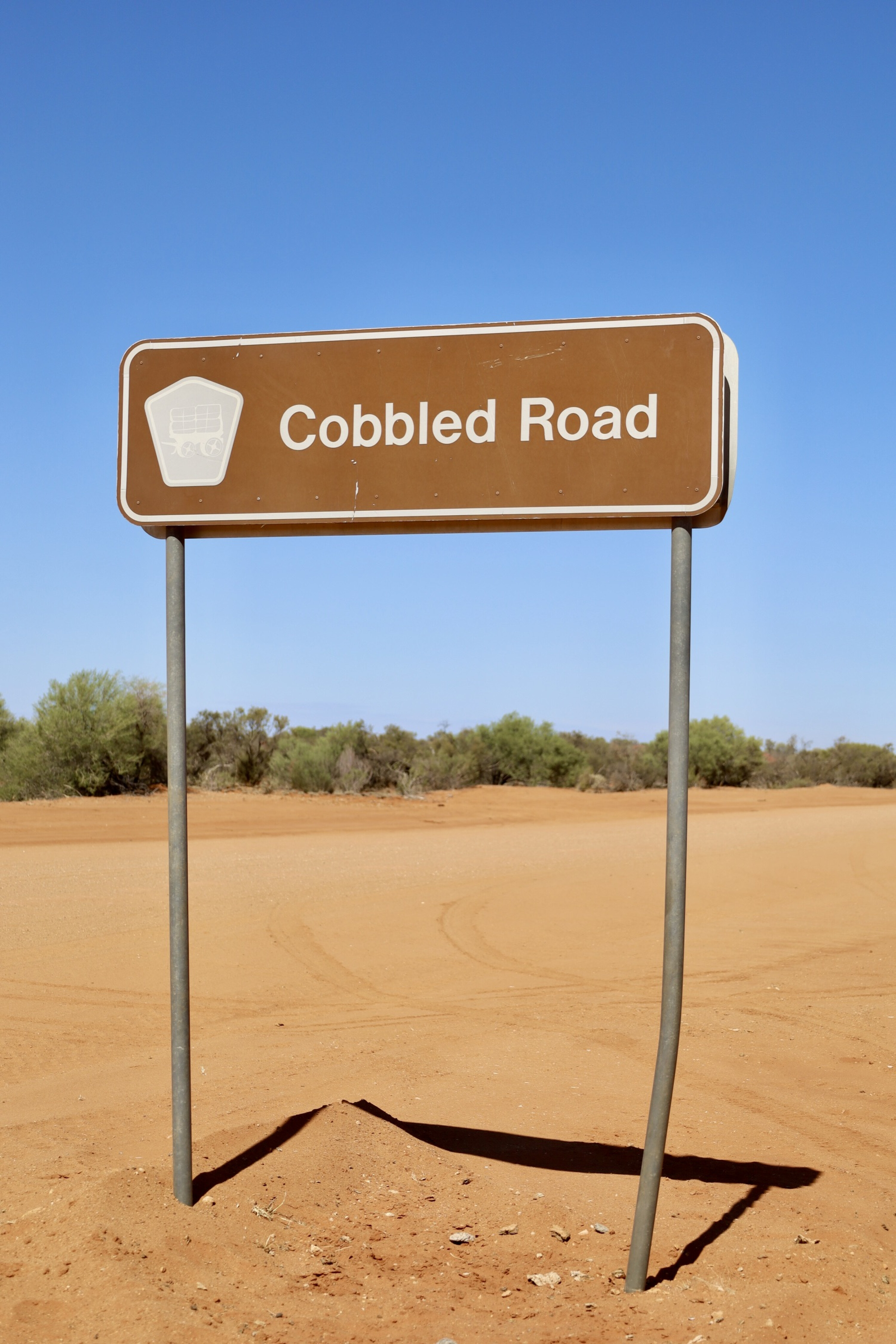
On the way to the Kennedy Range turn-off, there are remnants of an old cobbled road that early pioneers and drovers used. Constructed from local stone, the wool wagon pathway was built around 1920 for wagons on tracks that were little more than rough clearings through the scrub.
When it rained, all but the high or stony areas turned to mud, and when it was dry the sandy ridges were almost impossible to cross.
1
Kennedy Range
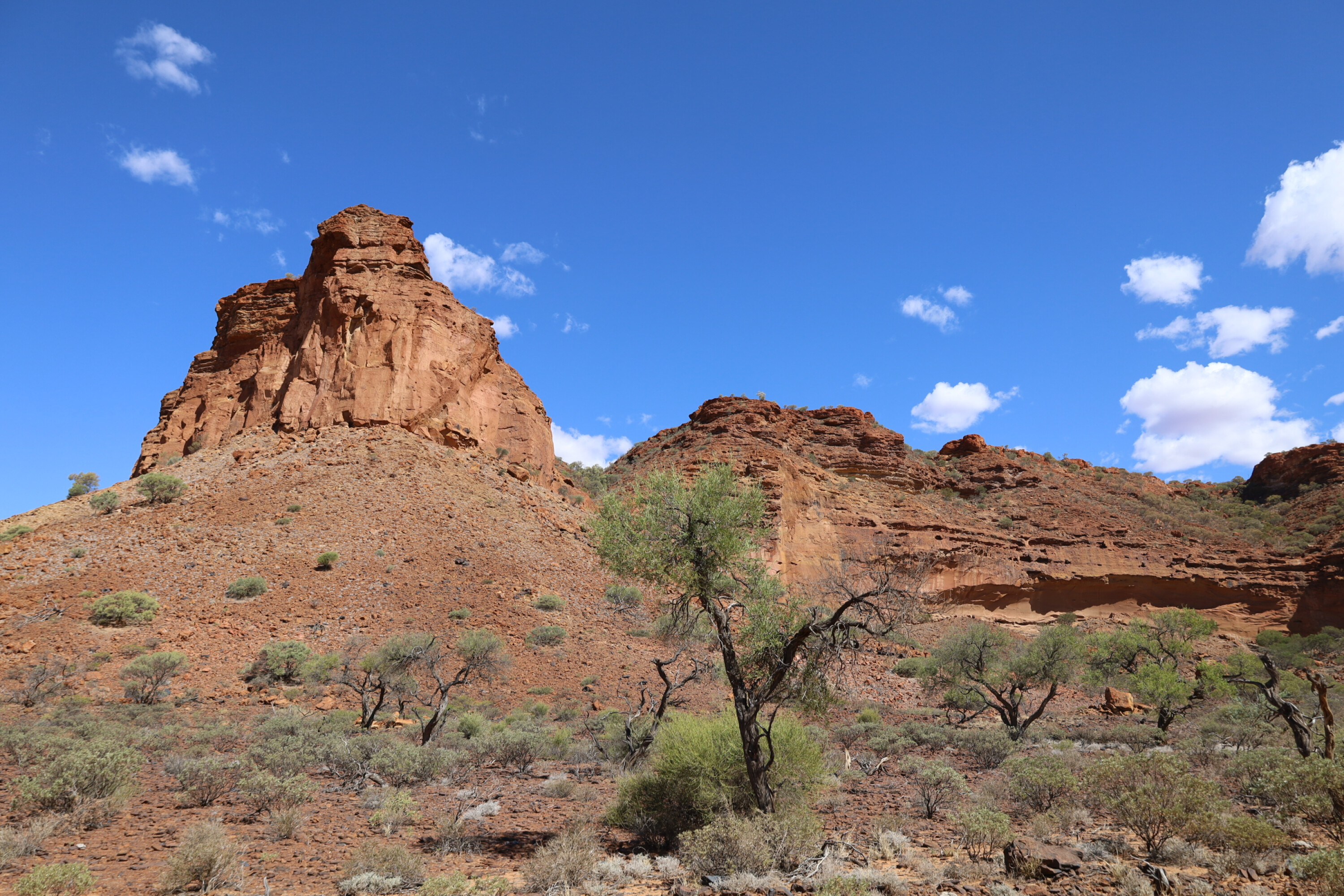
It’s a good dirt road into the park and straight away the eastern escarpment seems to loom above you as you head directly towards it, with its massive jagged outcrops and tall columns.
To describe it as an impressive sight would definitely be an understatement, as the 250 million year old weathered rocks glow in the sun no matter what angle you view them from.
Camping is allowed at Temple Gorge which is a good place to base yourself for the hikes into the ranges, whether it be the stunning Sunrise, Honeycomb, Drapers, Temple or the Escarpment trail.
1
Starting at the northern end of the park, the track heads into pastoral stations that have been bought to make up the 320,000ha park over the years.
Apparently this area was a shallow ocean basin over 200 million years ago and with the complicated movements of the earth and ocean receding, marine fossils can still be found in the sandstone throughout this huge mesa that measures an impressive 75km long by 25km wide.
Something else that caught my eye was the Kennedy Loop Track that covers the top of the range and is only suitable for high-clearance 4x4s. Starting at the northern end of the park, the track heads into pastoral stations that have been bought to make up the 320,000ha park over the years.
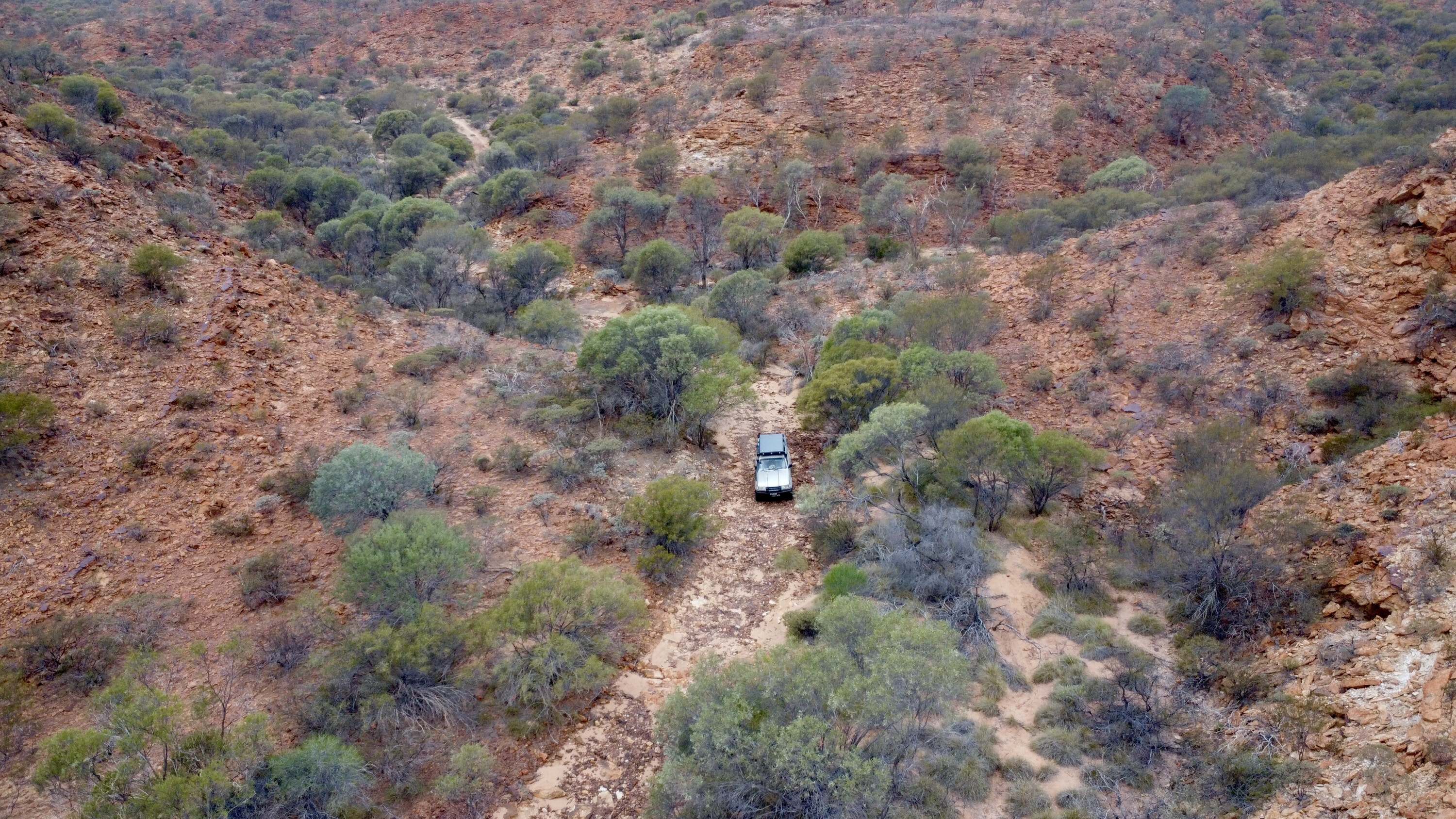
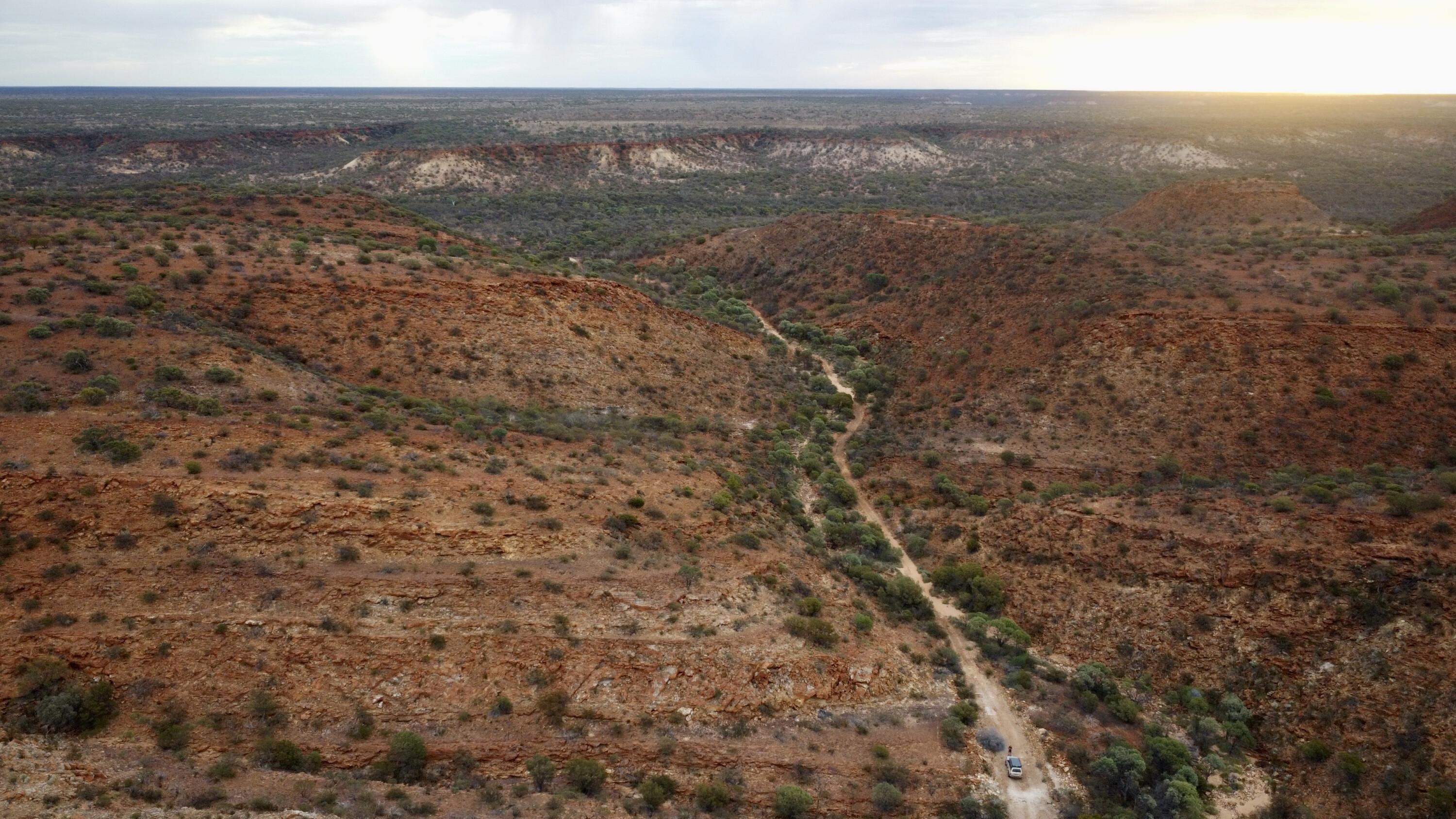
From the start the track covers a variety of terrain including rows of red dunes, narrow sections following steep cliffs with endless views to the east, and a maze of steep-sided canyons to drive through over sharp rocks and along washed-out creek beds.
1
All the way along the track the scenery is nothing short of spectacular with its ancient rock formations, huge slabbed rock and massive gums, and on the western boundary of the range a number of natural springs give life to little pockets of the park.
Free camping is allowed up here but not too close to the water, as the animals use it as their only water source, and to think it was formed by a substantial geological fault millions of years ago. More than 400 plant species, more than 100 different birds, and some 20 mammal species have been recorded across this unique plateau.
My drive along the Loop Track ended at the mighty Gascoyne River… and it should be noted that during the wet this river is totally impassable. I crossed it when it was relatively dry but it was still wheel depth, and then there was another 200m of dry river sand to cross out of the Gascoyne.
1
It would have taken decades of wet seasons and cyclone rain to carve the river to its current depth, even though it’s nearly 200km to the coast.
Just out of the Gascoyne River, new campgrounds have been opened up on Winnemia station. An old workers’ cottage has been converted for campers with toilets, but it’s still a remote camp and you’ll need to be pretty well set up and self-sufficient, as Gascoyne is still two hours away.
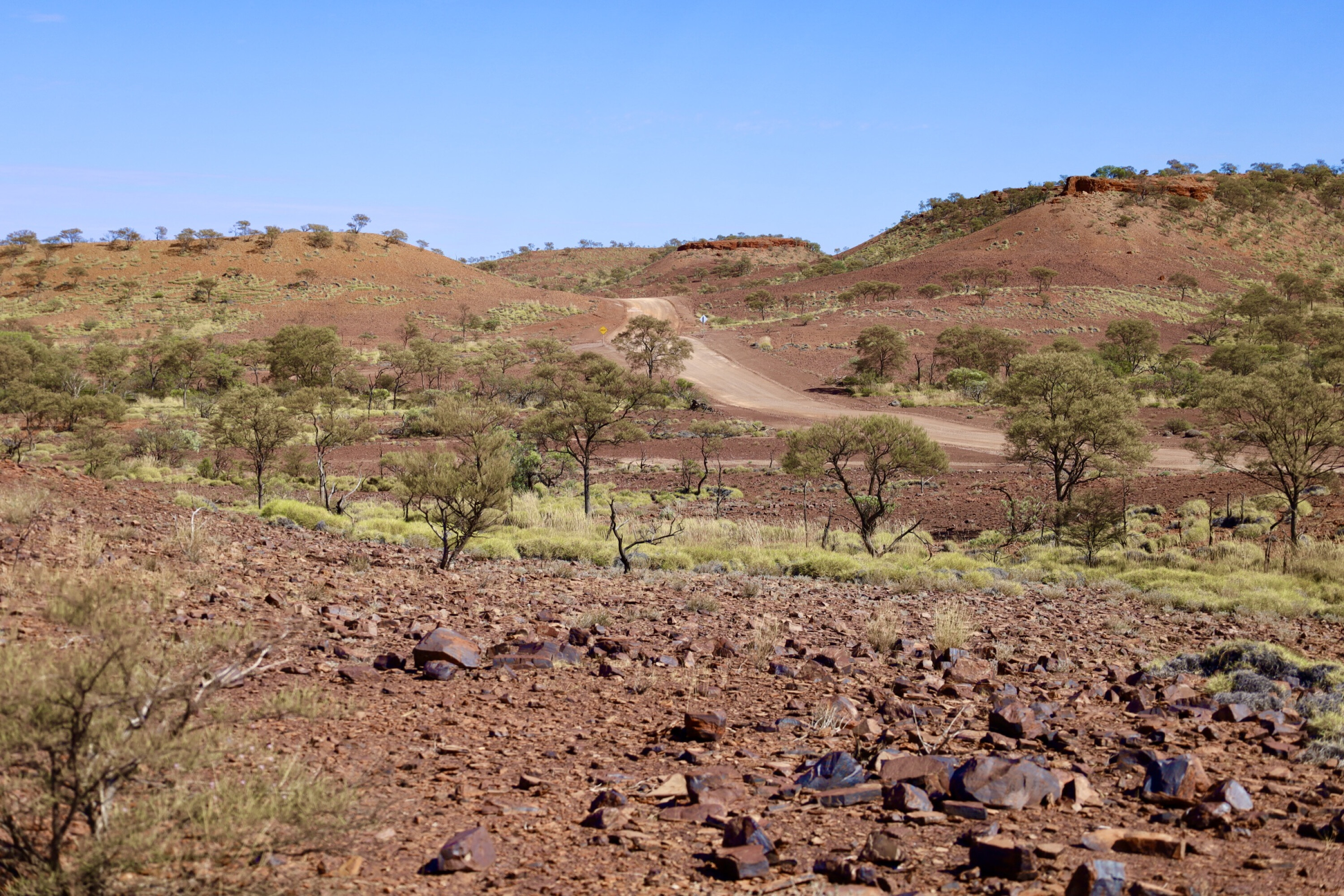
The Loop Track was about 100km long but with so much to see and do it took a good day to explore it. This is a remote and isolated track that should only be attempted by high-clearance vehicles and those who are confident with remote-area travel.
1
Mount Augustus
My priority on this trip was to head to Mount Augustus, which I did by heading back into Gascoyne Junction and taking the dirt Carnarvon-Mullewa Road and the Cobra Dairy Creek Road towards the rock for another 300km.
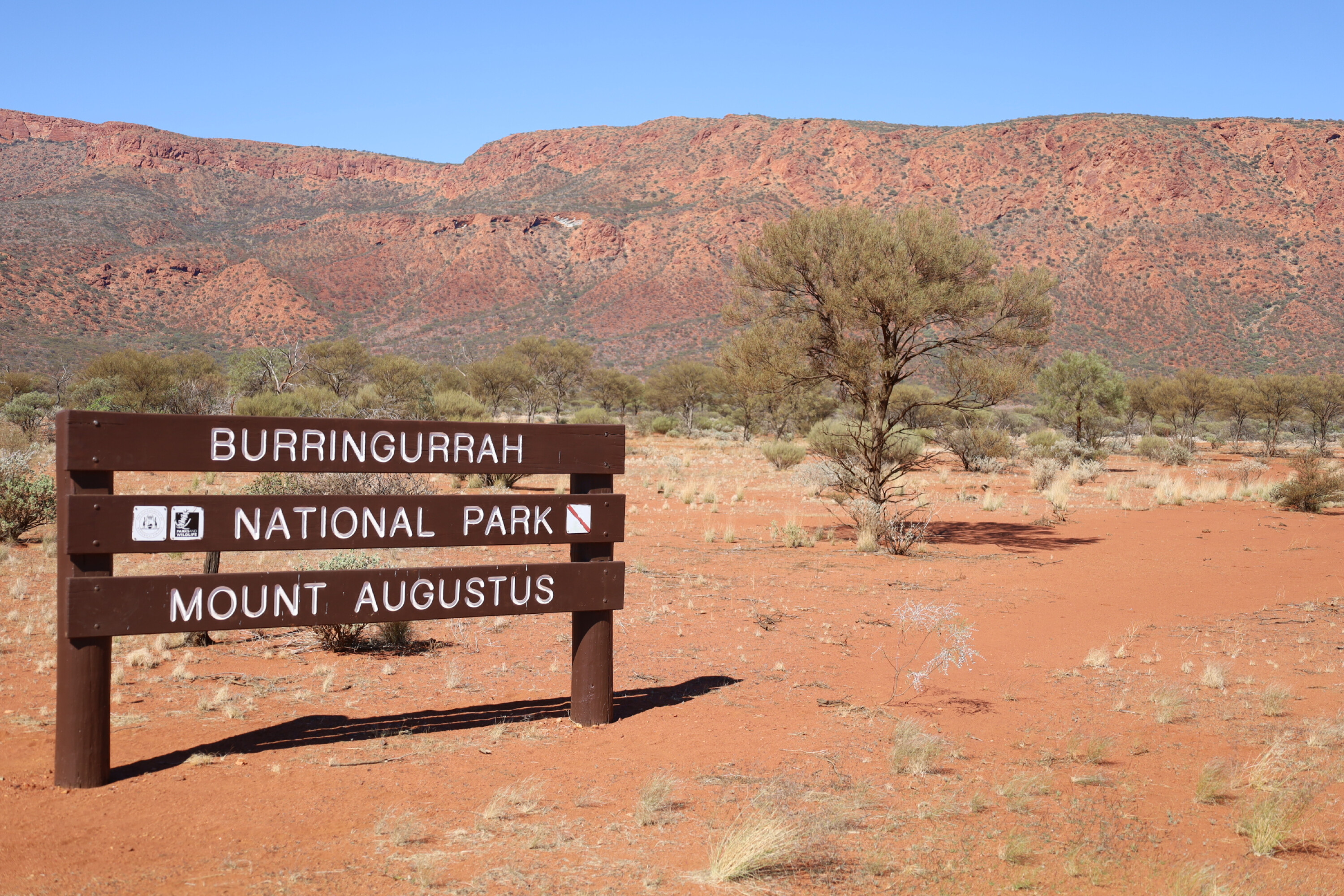
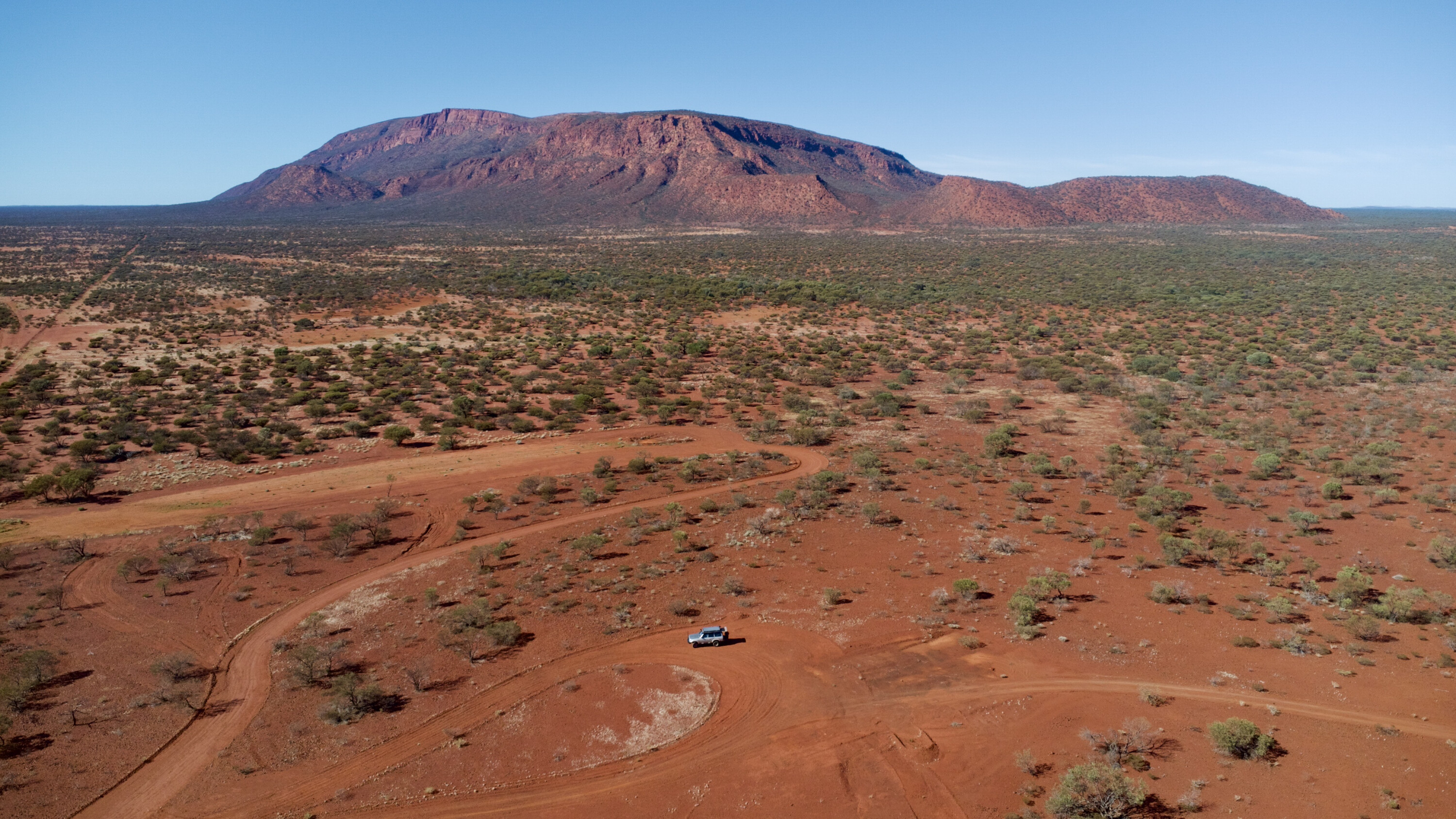
Of course, most people who have been to Uluru reckon it’s a pretty big rock but Mount Augustus is next level! It’s visible from 60km away and is two-and-a-half times larger than Uluru, and estimated to be over 1800 million years old.
Just like the Kennedy Ranges, it was formed by a complex process that began when the inland sea dried up, the earth moved and a weathering process started. Marine layers are still visible in the area away from the rock.
1
The only place to stay here is on Mount Augustus Station where you’ll have stunning views of the rock from your camp, especially at sunrise.
One of the best things you can do here is the 45km drive around the base of Mount Augustus to both view this huge monster from different angles and to explore the variety of hikes into and up the mountain. The hikes are graded 3 and 5, depending on their length.
Experienced hikers can attempt the summit walk but it’s an extreme and difficult hike; other smaller walks provide access to significant areas and are as short as 200m.
1
These petroglyphs depict an amazing array of animal, human and dreamtime engravings.
The Wajarri people call this area home and once upon a time they would roam across the Gascoyne region, rehydrating at the natural springs at the base of the mountain that always provided a reliable water source even in times of drought.
Some of the shorter walks around here lead to places where the Wajarri people left engravings in the rocks. These petroglyphs depict an amazing array of animal, human and dreamtime engravings.
There are plenty of areas to sit and ponder what the symbols mean, as well as who carved them and why they did so here. Other walks lead to cattle soaks and across dry waterways, and there are spectacular views across what seem like desolate plains.

1
Mount Augustus is an inselberg which means it’s an island mountain, just like one that would rise from the sea.
It bursts out of the arid landscape of mid-eastern WA and stands an impressive 715m high, surrounded by a mixture of wattles, spinifex and cassia.
While the underrated rock that is Mount Augustus might be figuratively overshadowed by that other rock called Uluru, it’s well worth the effort to visit this impressive landmark in the west, along with nearby Kennedy Range.
1
Top 5 things to see and do
- Camp at Temple Gorge is you are keen to tackle the many and variued walking tracks that lead up into the Kennedy Range.
- Drive the Kennedy Loop Track that covers the top of the range, but note that it’s only suitable for high-clearance 4x4s.
- Camp at Winnemia station where an old workers’ cottage has been converted for campers with toilets, but be aware that it’s still a remote camp
- Take the 45km drive around the base of Mount Augustus to view this huge monster from different angles and to explore the variety of hikes into and up the mountain.
- Check out the petroglyphs at Mount Augustus that depict an amazing array of animal, human and dreamtime engravings.
Mount Augustus is a further 260km past Gascoyne on good unsealed roads, which may be closed in wet weather. Or you can drive in from Meekatharra which is 350km away.
1
A seasonal adventure
Camping is available at Temple Gorge in the Kennedy Ranges and at Mt Augustus Tourist Park. Don’t attempt exploring this area during summer, as the daytime temperatures can cause a variety of health issues including death. Drink plenty of water and be safe.
More information
Most information for this area can either be found online, through the WA parks and wildlife service in Gascoyne Junction, or by contacting the Carnarvon information centre regarding the Kennedy Range or Mount Augustus Tourist park, phone (08) 9943 0527.
We’ve got it good these days. Just one generation ago your choice of 4×4 was limited, and it was likely rudimentary, agricultural, underpowered and underwhelming.
Despite the often-romanticised ideas of rugged simplicity, you’d be doing well to find a 4×4 that could pull the skin off a custard, and you’d probably be locked up in a looney bin if you expected one that could ride well on-road and still manage to work well off-road.
These days 4x4s have surged forward in leaps and bounds; power, ride quality and useful off-road features are the standard, but they’re still mass-marketed vehicles, designed for everyone, not anyone. If your needs fall outside the scope of the manufacturer’s ideas then the aftermarket is your source of salvation.
1
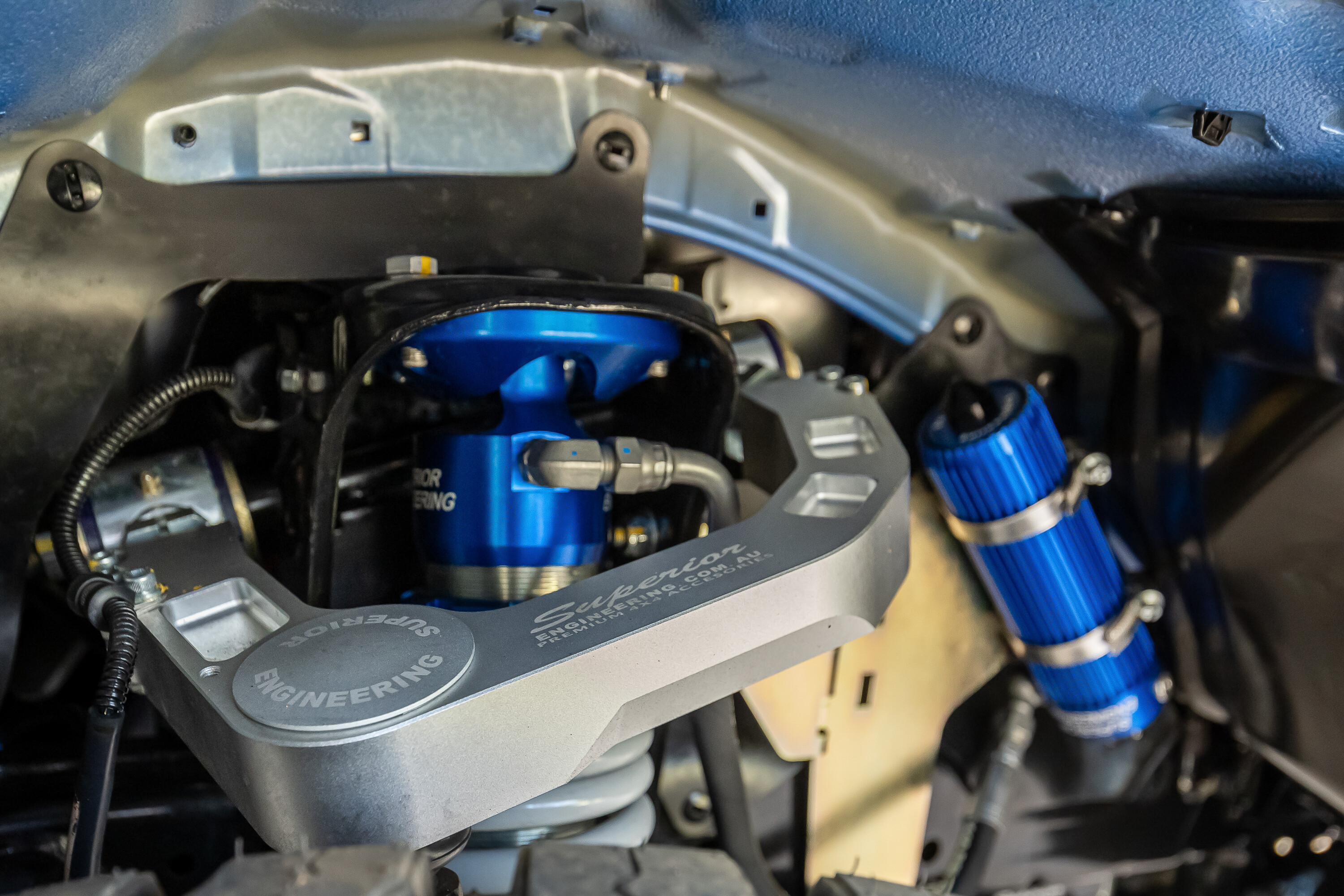
Enter Superior Engineering. This company has been slowly but surely redesigning every aspect of various 4×4 models to make them perform better. From the Superior’s early radius arm to its later high-tech electronically controlled shocks, it has been making 4x4s do things vehicle manufacturers never thought possible.
With the introduction of Superior Engineering’s coil-conversion kits, the company is essentially re-engineering vehicles to how they should have come from the factory. If you’ve ever fantasised about what a HiLux Raptor competitor would be, Superior has the answers.
But what exactly goes into its coil conversion kits, what are the pros and cons, and how much is it going to hurt the hip pocket to build a better HiLux than Toyota can? We caught up with Sam Turnbull, the General Manager at Superior Engineering to find out.
Jack of all trades
Forget the awkward stage in the 80s and 90s when vehicles came fitted with torsion bar springs.
These days, your 4×4 either has coils all around or coil front-end and leaf spring rear combination. Manufacturers tend to install leaf springs in the back of anything designed for load carrying, while four-wheel drivers tend to opt for coil springs. But what exactly is it that makes coil springs better for off-road use, and why is no one swapping out coil springs for leaf springs?
The answer is relatively simple: cost, complexity and versatility. Let us explain. Leaf springs are a jack-of-all-trades setup. They physically locate the axle front to rear, side to side, and provide the spring rate and thus load carrying capacity. They also resist the axle twisting, but more on that later.
1
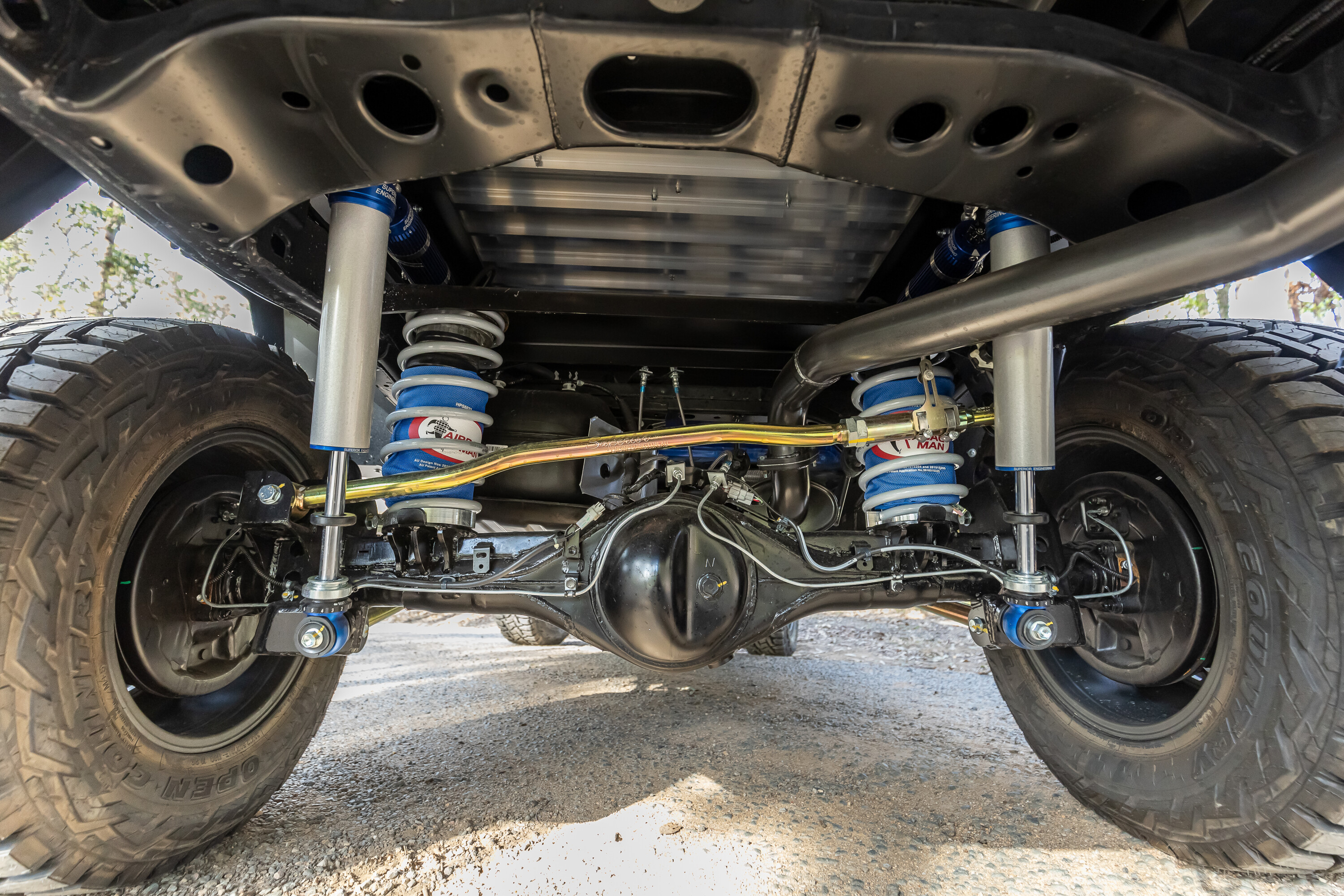
Coil springs, by comparison, just handle load carrying, so your axle will still require some kind of locating system. These are typically in the form of four forward-facing control arms to prevent axle twisting and locate the diff fore and aft, with a Panhard rod controlling side-to-side movement.
So it’s obvious how much simpler a leaf spring setup is than coil springs, but that comes at a cost. The leaf spring rate doesn’t just define how the 4×4 rides, but how well it holds the axle in place, and the two are tied together. Soften the spring to flex better and you’ll likely get axle wrap that can lead to your rig bucking and bouncing in terrain that a coil spring rig can effortlessly drive over.
1
Leaf springs are also heavy, cumbersome and more slowly than lighter-weight coil springs. That means side by side, in the case of coil and leaf springs both rated for +300kg, the coil spring will be able to cycle faster, absorbing more bumps in the road and allowing greater articulation and axle control off-road.
This is why manufacturers go to the extra expense of fitting coil springs all-round to more off-road focused models, while jack-of-all-trades utes get jack-of-all-trades leaf springs. If you’re building your rig for a purpose, and that includes either better articulation off-road or better ride quality on-road, then it’s easy to see why so many people are opting to up-spec to Superior Engineering’s coil conversion kits.
Whats in the box?
When you unbox one of Superior Engineering’s conversion kits, you’re met with a carefully curated set of components designed to transform your rig’s suspension.
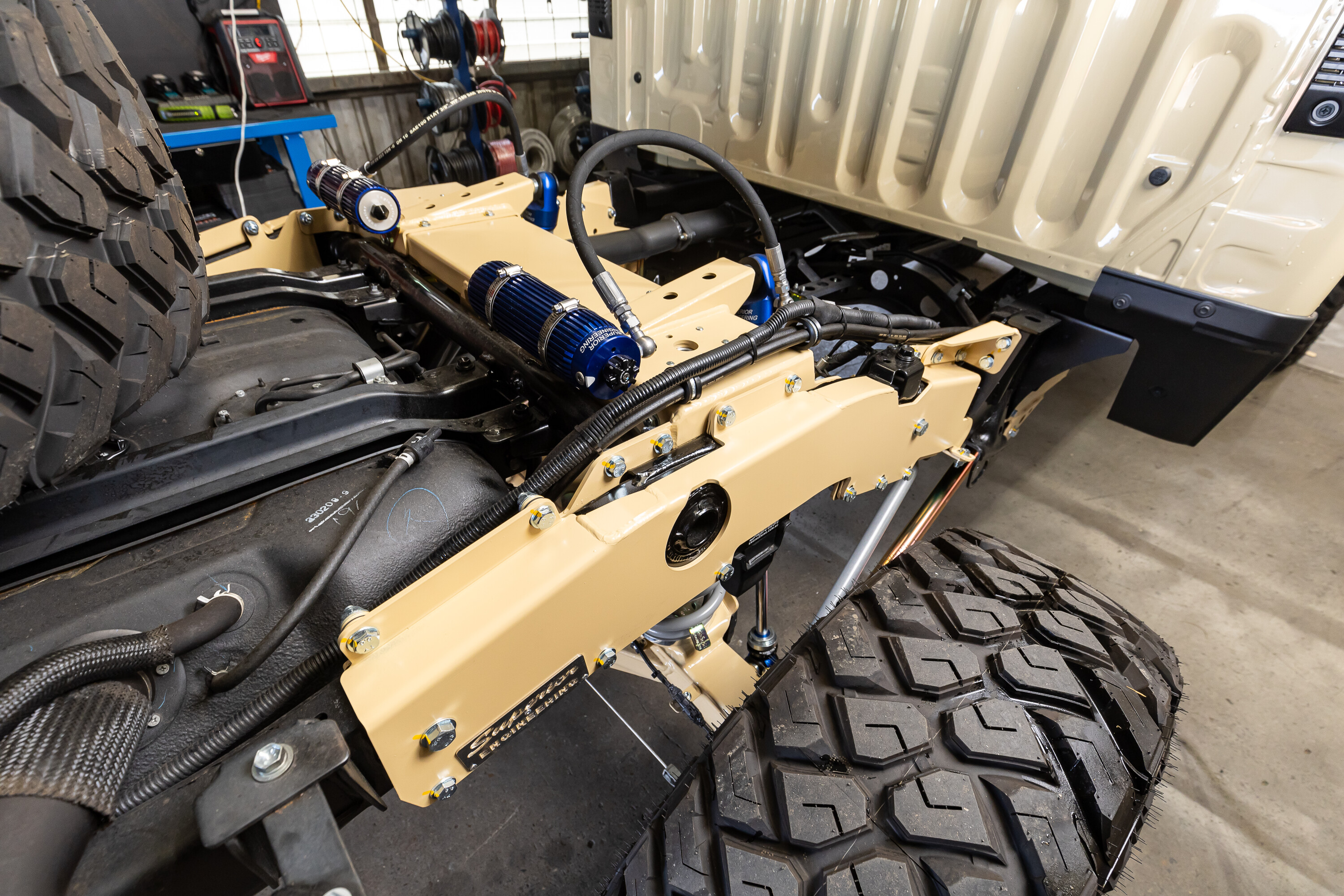
The core of the kit focuses on a whole heap of computer-designed bracketry intended to result in a near-factory finish, transforming your chassis from something that accepts leaf springs to something that accepts a coil and link arrangement.
The kits themselves are a weld-in design rather than the easier-to-install but not as rugged bolt-in designs, Superior favouring a little extra effort at the start for more peace of mind down the track. Included are a set of inner and outer chassis braces to ensure the chassis can handle the new loads and to provide mounting points for the new links.
1
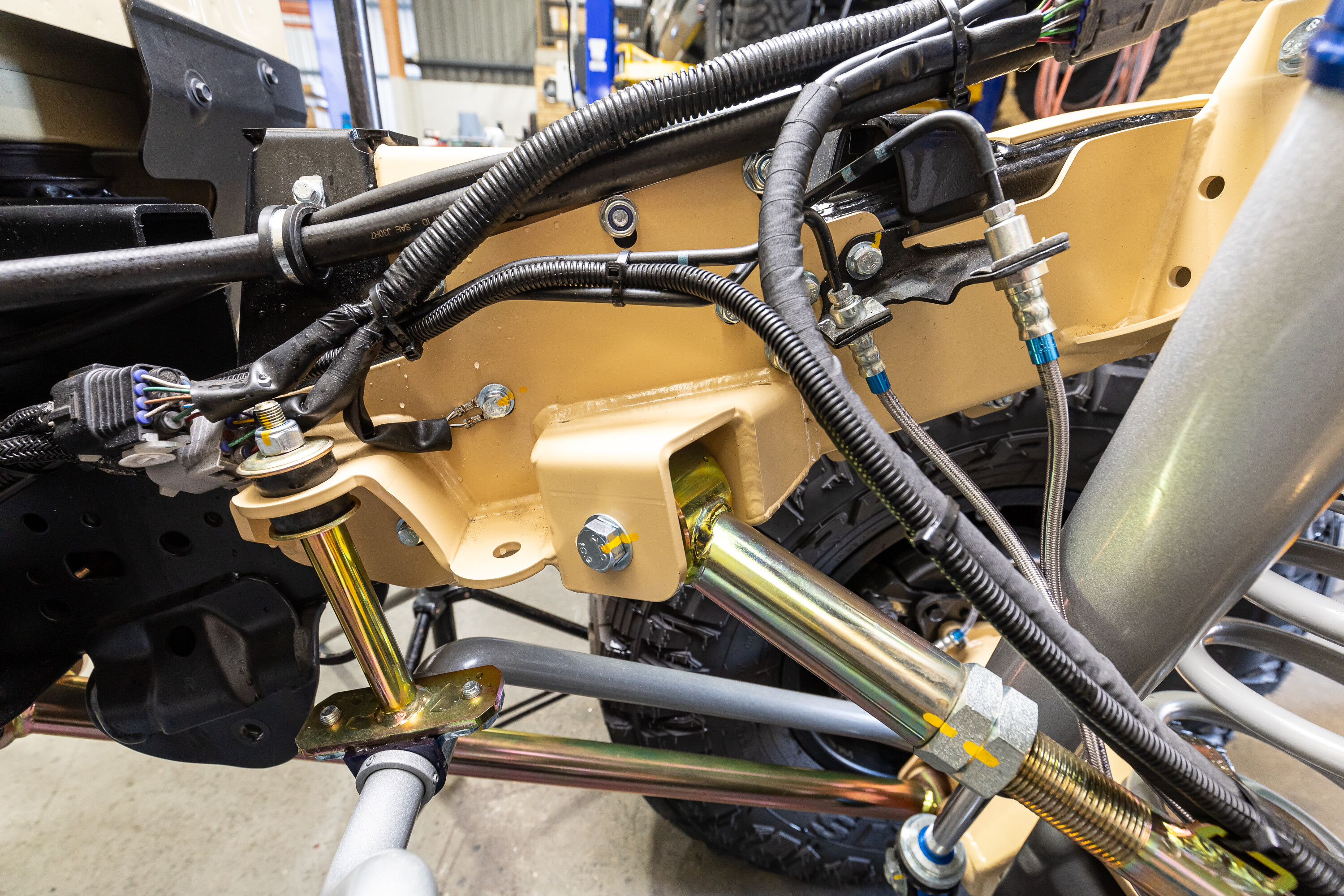
You’ll score 40mm OD fixed lower control arms and adjustable uppers so you can dial in your pinion angle to suit vehicle ride height, as well as an adjustable Panhard rod to aid in wheel alignment.
The Superior package will be familiar to anyone who’s worked on the popular five-link style suspension setups in LandCruisers and Patrols. You don’t get coils in the basic kits – Superior Engineering offers bespoke options to suit your needs rather than an off-the-shelf spring rate and height for everyone – although the kit to lifts up to five inches lift depending on the vehicle model, and it comes with lower spring mounts and a beefier upper coil mount.
There are shock mounts designed to suit Patrol shocks, providing a huge choice, and again the base kit comes with just the hardware so you can up-spec to shocks of your choice.
Depending on the model you’re installing the kit into, it can be supplied with extras such as sway bars and mounts, handbrake relocation bracketry, and upgraded diff housings to suit vehicles with GVM upgrades.
Can I get one for my rig?
The bad news is, the range of models the coil conversion kits are suited to is quite limited at the moment, but the good news is the models they do suit are popular on the tracks.
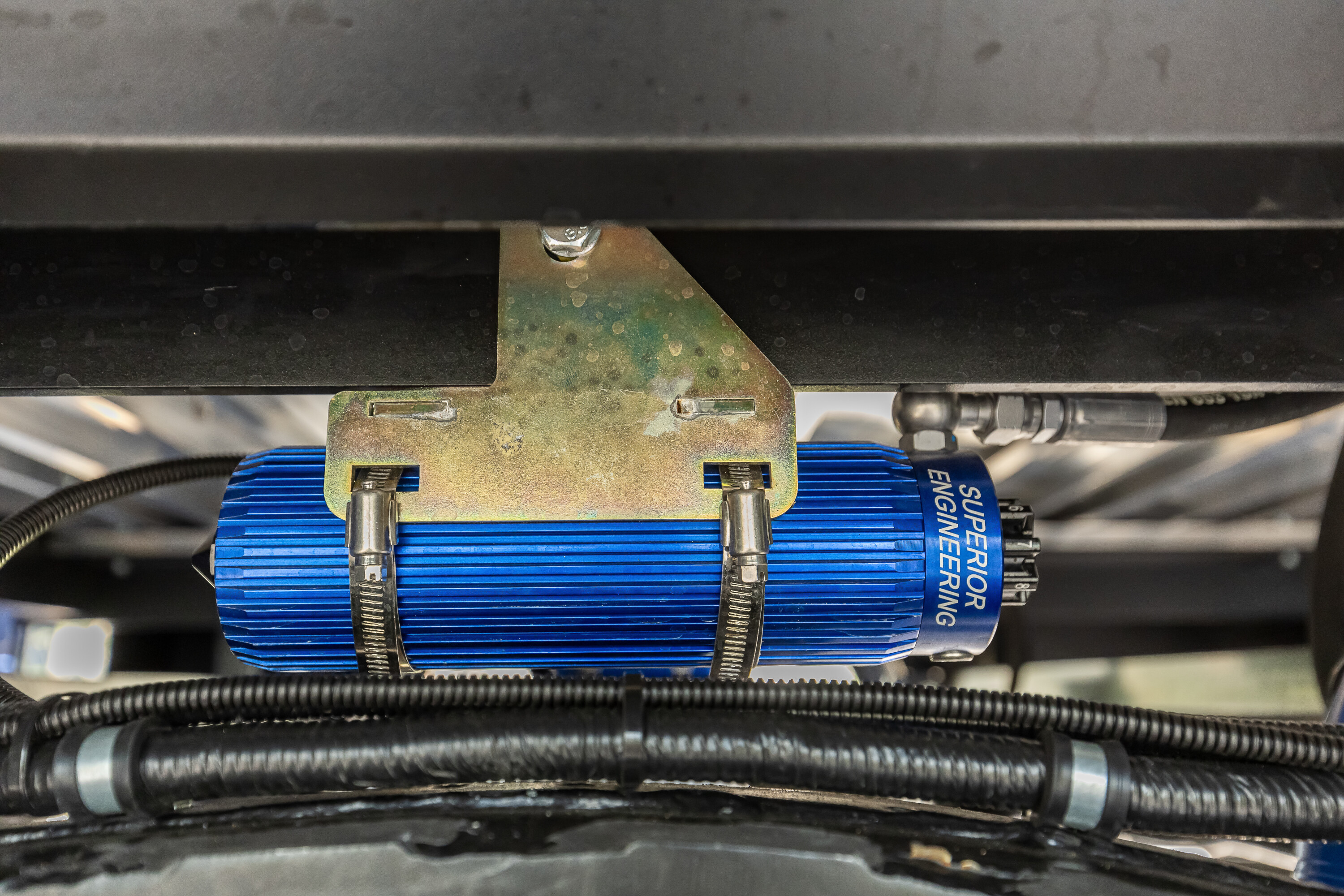
Convenient, eh? If you’ve got a 76 or 79 LandCruiser parked up in the shed you’re in luck. This is without a doubt the most looked-after model in Superior Engineering’s line-up and arguably the one that drove production, as these models are screaming for a more supple suspension system for touring comfort and articulation on the tracks.
1
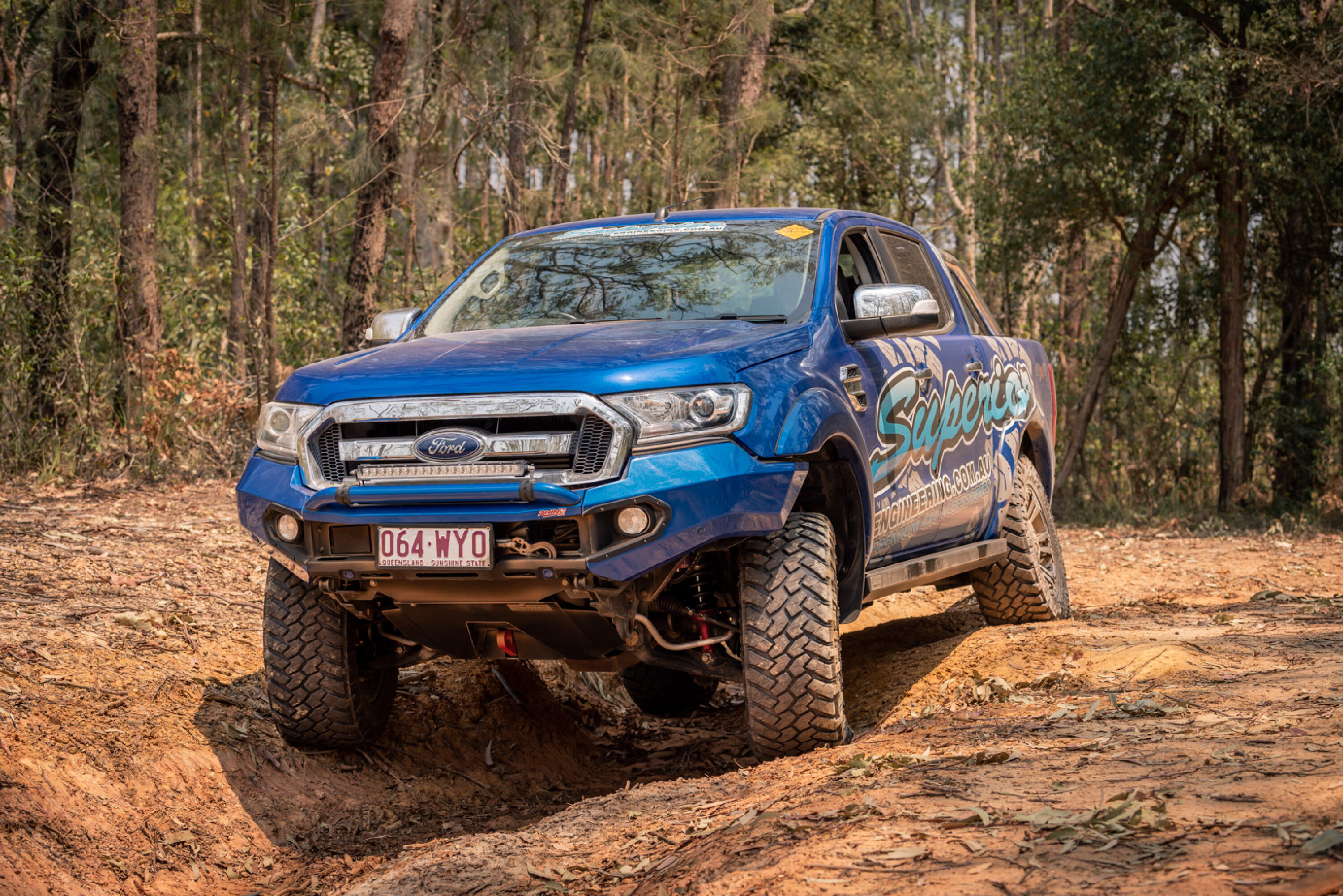
Coming in second place it’s no surprise to see both the 2015+ N80 HiLux and the PX1/2/3 Ranger/BT50 platform well looked after… with mild to wild kits. In addition, Superior has kits in the works for the D-Max, N70 HiLux, Holden Colorado, Mitsubishi ML/MN/MQ Triton, and the old faithful leaf-spring GU ute.
Before diving in, check with Superior for your specific make and model. There’s detailed information on the company’s website so you can confirm whether your 4×4 rig can join the coil-spring revolution or if you’ll have to wait a little longer.
What’s involved?
Taking a grinder and a welder to any vehicle, let alone a brand-spanking-new dual-cab ute can be a daunting prospect.
In years gone by, to coil-convert a leaf-spring setup you’d need to cut bracketry off a donor vehicle (typically an 80 or 105 Series LandCruiser) and then graft it onto your vehicle using a tape measure and a whole lot of praying.
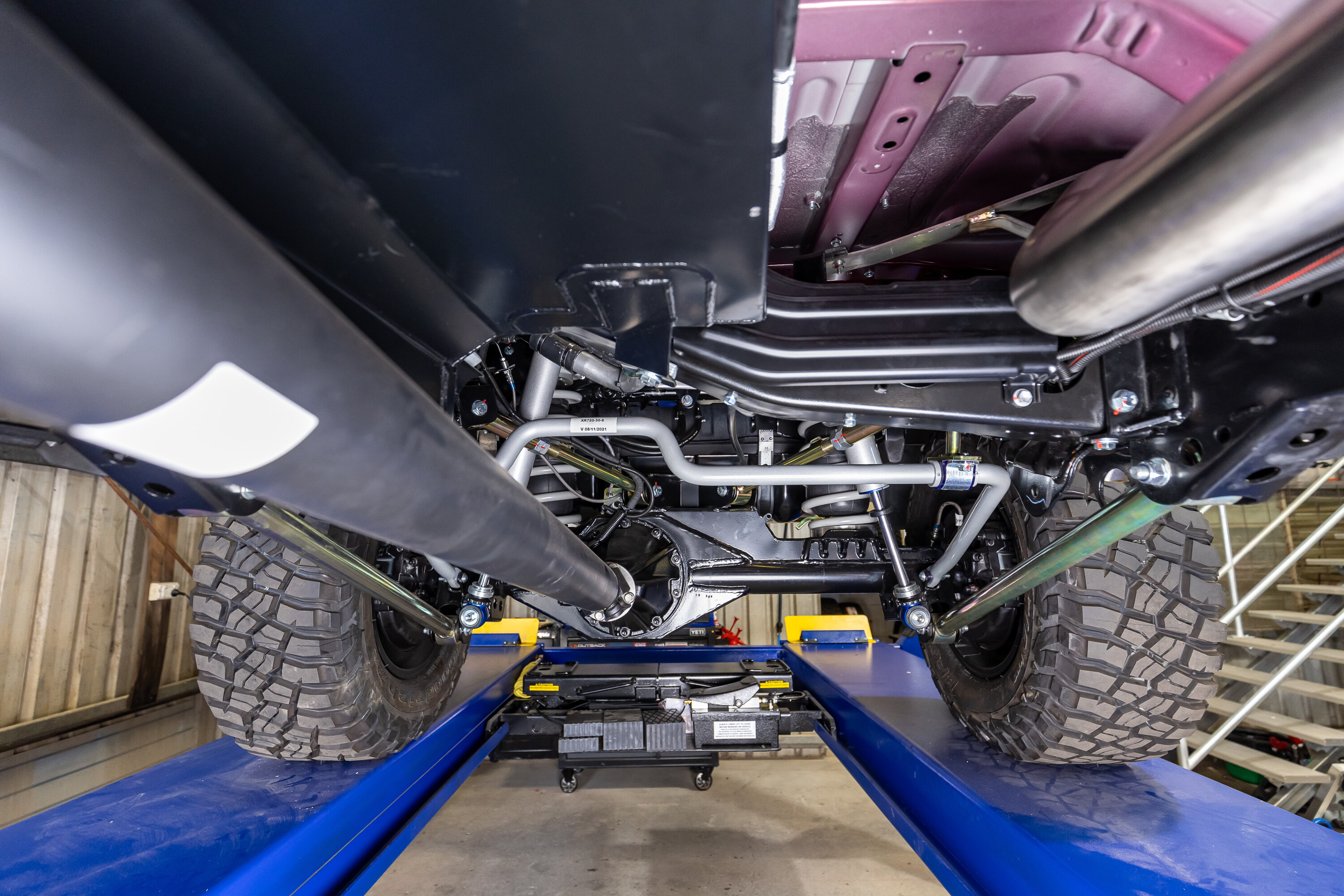
Thankfully, the Superior kits are a fair bit simpler these days complete with step-by-step instructions. Step one is always going to be jacking your rig up and stripping off the old setup. Depending on your make and model you may need to transfer the diff centre and hubs over onto a new axle housing, or you may simply need to remove the leaf spring bracketry from the factory housing to reuse that.
1
The new mounts and chassis plates have all been designed to pick up OEM holes on the chassis so near-enough fall into place to be welded right on, and this is the same with any bracketry fitted to the housing for picking up coil, shock and link mounts.
From here a lick of paint, fitting up of the links, coils and shocks, as well as any other ancillary kit like sway bars, brake lines and ABS wiring, and you’re ready to get it aligned and legal. All in, with a qualified boilermaker or welder on the trigger, the whole affair can easily be knocked over in a weekend.
Any way you like it
The whole point of the coil-conversion kits is that one size doesn’t fit all, so it’s not surprising to see Superior doesn’t just offer a one-size-fits-all kit regardless of your needs.
Instead it offers a range of optional upgrades that allow you to fine-tune your suspension system to match your specific requirements.
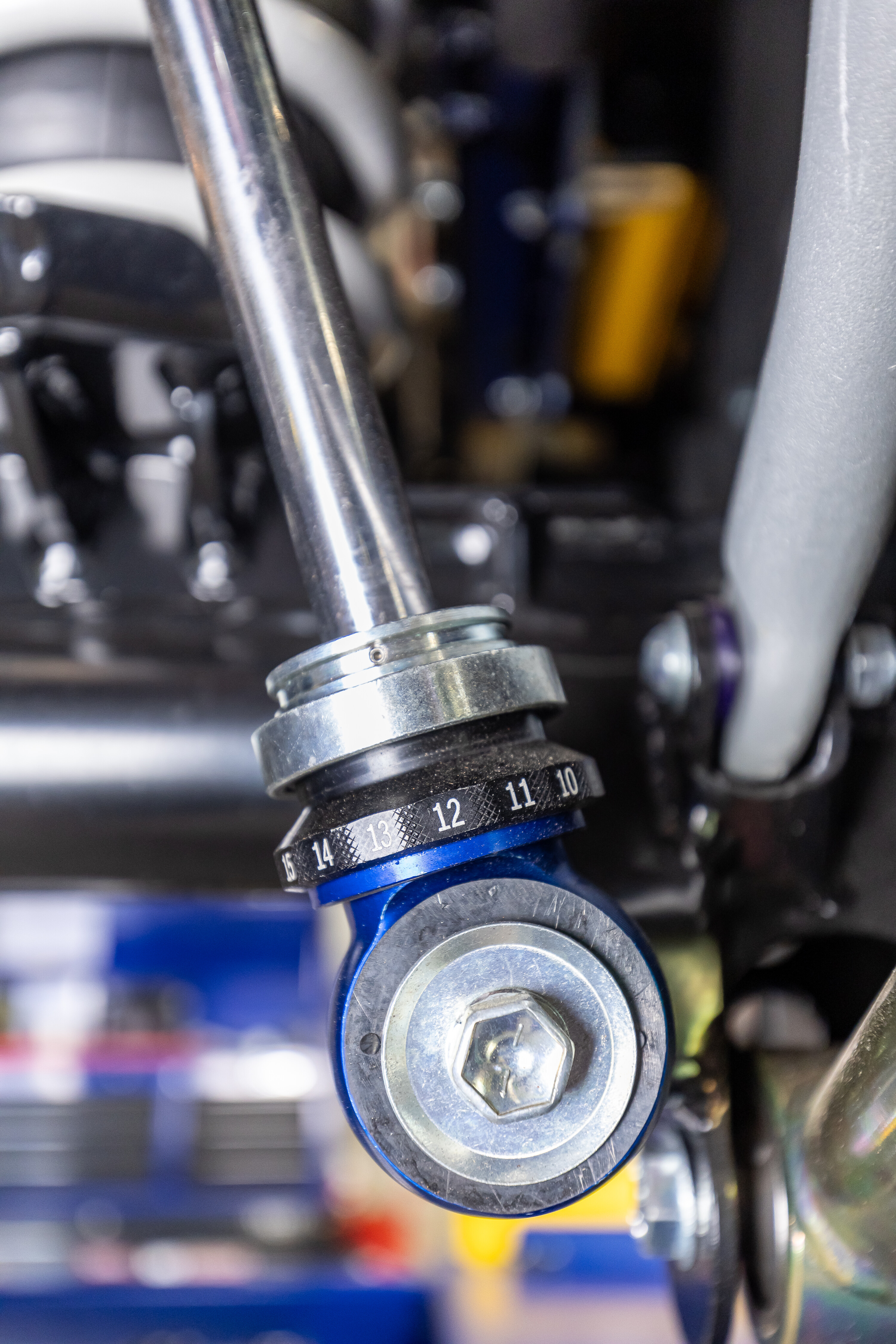
Among the popular upgrades are adjustable shock absorbers, which grant you the flexibility to tweak damper settings; this can be invaluable when transitioning between different terrains or when carrying varying loads.
1
For those who crave the ultimate in off-road performance, consider investing in adjustable remote reservoir shocks; these shocks offer increased oil capacity, enhancing their ability to dissipate heat and maintain consistent performance, as well as giving you the flexibility to dial in exactly how you want your rig to perform.
Depending on your make and model, there are also GVM upgrades, packages to suit front and rear suspensions, as well as the wild X-Track kit which adds 11-inches of wheel track to the HiLux platform to transform it into a serious Raptor competitor.
The fine print
While the advantages of coil conversions are abundant, it’s essential to acknowledge that no modification is without its trade-offs.
One potential drawback of a coil conversion, particularly when performed by inexperienced hands, can be an imbalance between front and rear suspension behaviour. Picture a marathon runner who wakes up one day and decides to train the living daylights out of their right leg, leaving the left one to keep up.
1
Slotting in a top-tier, uber-flexible coil suspension in the rear of your rig with a janky old eBay lift up front will give you some epic Instagram flex photos, but the ride, handling and stability on- and off-road will be questionable at best.
If you’re getting fancy with the rear, you’ll need to get fancy with the front end too. It’s not a one-size-fits-all affair so you’ll need to spend a little time on the phone with Superior Engineering, running through your exact needs and uses to ensure you get the right combination.
Of course, there’s the elephant in the room too with cost. For a straight out-of-the-box weld-in coil conversion you’re looking at around $6-7k supply only with basic shocks and coils.
1
If you want to up-spec to remote reservoir shocks front and rear, as well as any other accessories to give you a completely balanced ride, it will typically be around the $10-$16k mark for an IFS ute depending on any GVM upgrades and the shock specification. In a live-axle front and rear rig, cost can range up to and over the $30k mark due to the complexity and extent of components required.
Lastly, it’s essential to remember that modifying your 4×4 may have implications for your vehicle’s legality. Depending on the process you’re following, there’ll be some cost in having your rig signed off for road use, although Superior Engineering can help guide you through the process depending on the state your vehicle is registered in.
A hydrogen-fuelled version of the iconic Toyota LandCruiser could soon be a reality, according to a senior company executive.
Snapshot
- Hydrogen LandCruiser with diesel-rivalling range on the cards
- Executives see this as a crucial technology in Toyota’s multi-pathway approach
- Will only be 10 per cent dearer than petrol and diesel
- More vehicles, including HiLux, could transition to H2 fuel too
The president of Toyota’s hydrogen factory, Mitsumasa Yamagata, has revealed Toyota is currently exploring ways to fit the LandCruiser 300 Series with a hydrogen-to-ice powertrain and that other popular vehicles, like the HiLux dual-cab ute, could soon follow.
In Australia to help unveil a world-first program for a hydrogen-powered Toyota HiAce, Mr Yamagata says hydrogen power lends itself well to vehicles like the LandCruiser due to its long range and uncompromised towing ability.
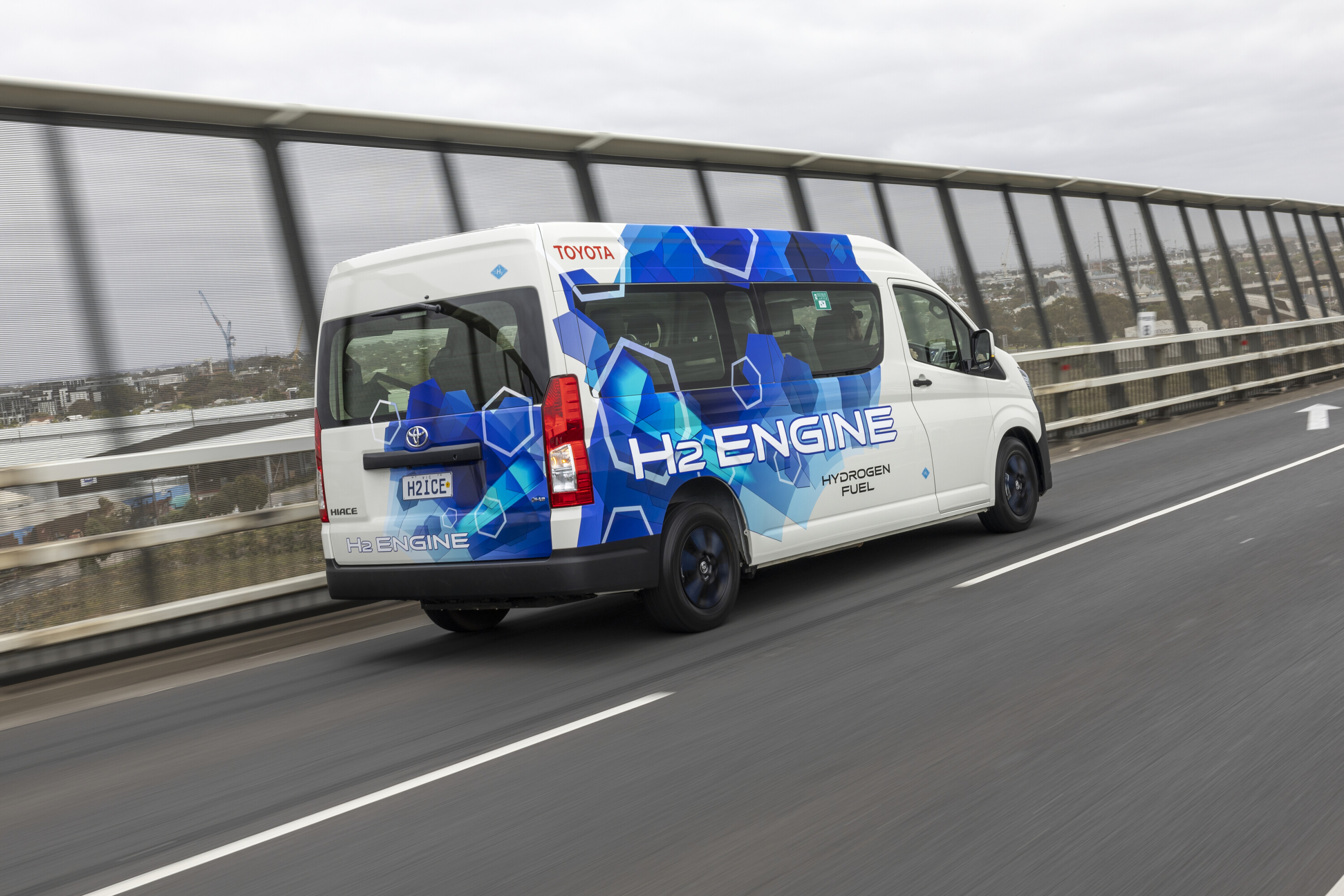
1
“Yes, there are possibilities to adapt [hydrogen combustion technology] into those big vehicles, including LandCruiser,” said Mr Yamagata at Toyota Australia’s hydrogen facility in Altona. “The advantage of this technology can be utilised for those vehicles including high towing and high loading. Including the adoption of FCEV [fuel cell electric vehicle] we are studying which vehicles will have the suitable technology.”
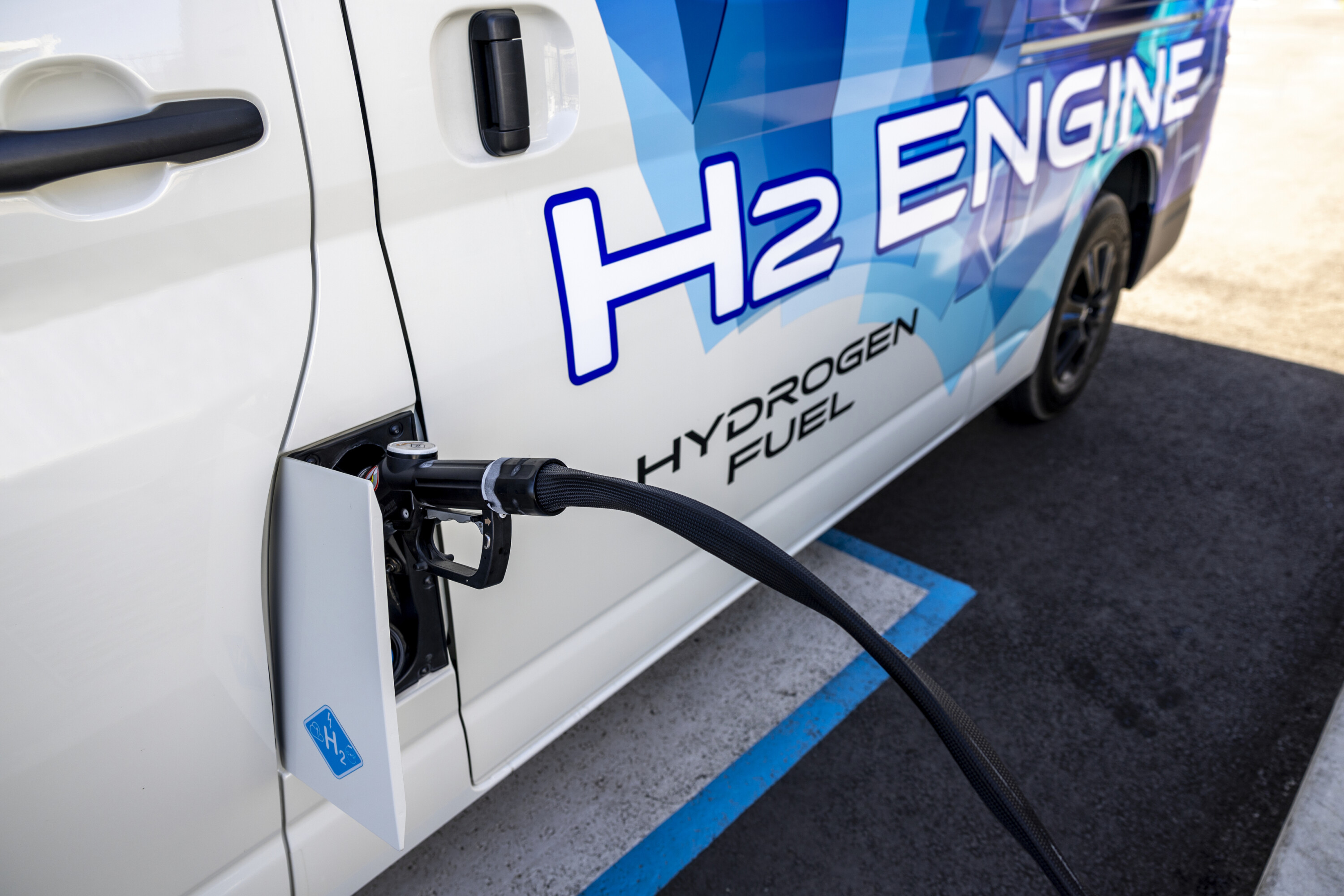
Another advantage of hydrogen-to-ice is it promises to be far more affordable than cars powered by hydrogen fuel cells (FCEV) or battery electric (BEV) because it doesn’t use electricity to turn the axles. Instead, it retains a conventional combustion powertrain that burns hydrogen rather than petrol.
“That reduces the amount we need to invest, which helps contain the overall development cost,” said Yamagata.
Toyota Australia’s vice president of sales and marketing, Sean Hanley, told Wheels that means any price premium should be around 10 per cent, or roughly the same as what Toyota charges for its hybrid models currently.
1
“There will be some ‘up spec’ because there’s some development costs, but they’re nowhere near what it would be if you started from scratch to develop a whole fuel cell electric vehicle,” said Hanley. “So it’d be fairly close, you’re talking about 10 percent close. Maybe similar to hybrid right now.”
Hanley also hinted the HiLux could also be a candidate for a hydrogen-to-ice powertrain, though it’s clear both projects are in their infancy.
“We won’t rule out any technologies,” he said. “And that’s the absolute benefit and positive of a multi-pathway strategy that Toyota has been talking about for a long-long time.”
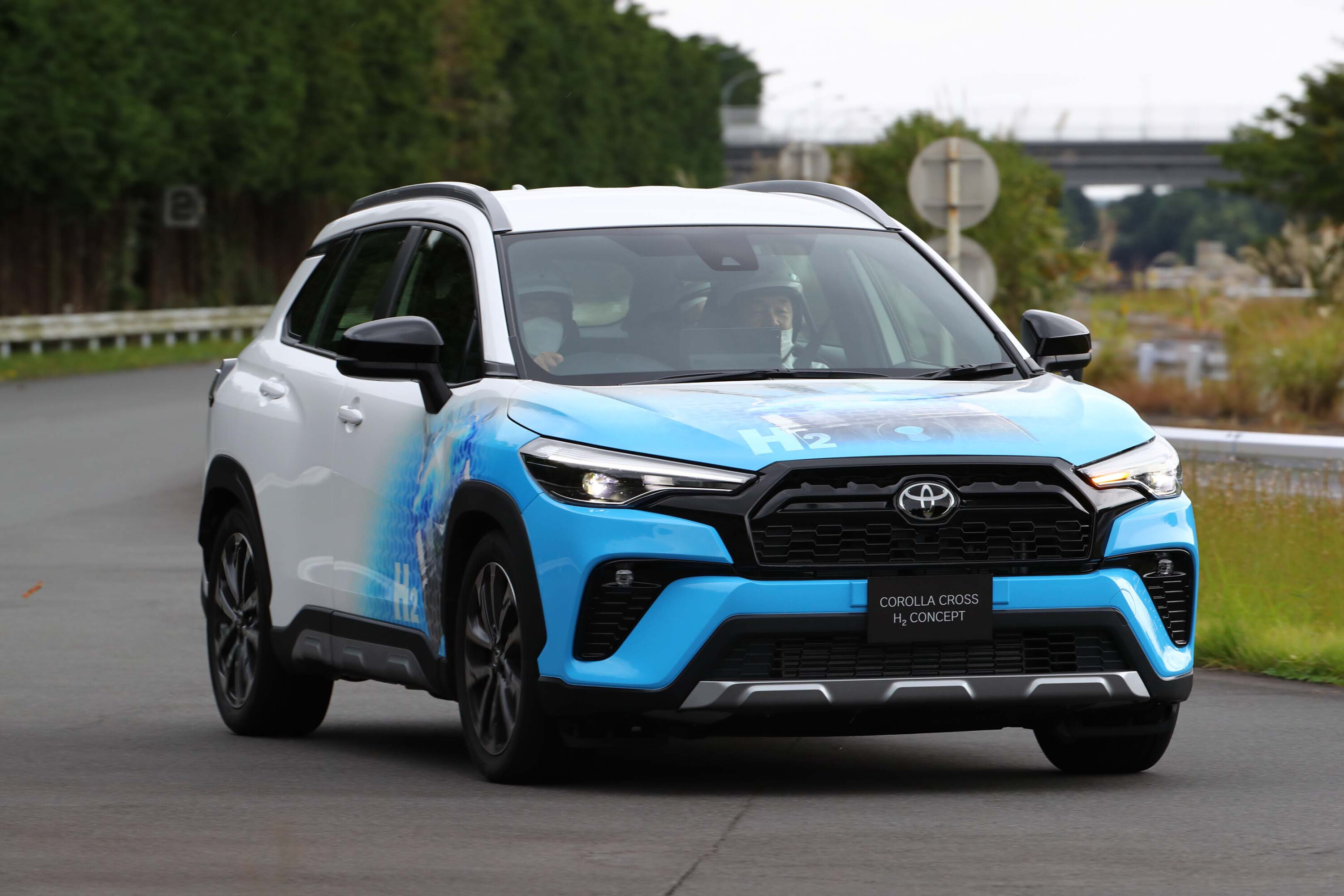
Toyota will soon add its first electric car to the Aussie range with the BZ4X and it has long been a pioneer of hybrid powertrains. It also has a small fleet or Toyota Mirai FCEV sedans on Aussie roads. Hydrogen-to-ice could soon be another solution for buyers looking to slash their emissions without the high price tag of an EV or FCEV.
1
“Toyota is firmly committed to developing hydrogen technology that has real-world impactful applications,” said Toyota Australia boss Matthew Callachor. “We believe that hydrogen powertrain technologies offer a practical solution to provide ultra-low emission vehicles with long-distance range and heavy off-road and towing capabilities.”
This isn’t the first time the Toyota LandCruiser has been linked with hydrogen power. Rumours of a hydrogen-to-ice LandCruiser first surfaced last year when Japanese magazine Best Car reported Toyota was working on a prototype vehicle.
1
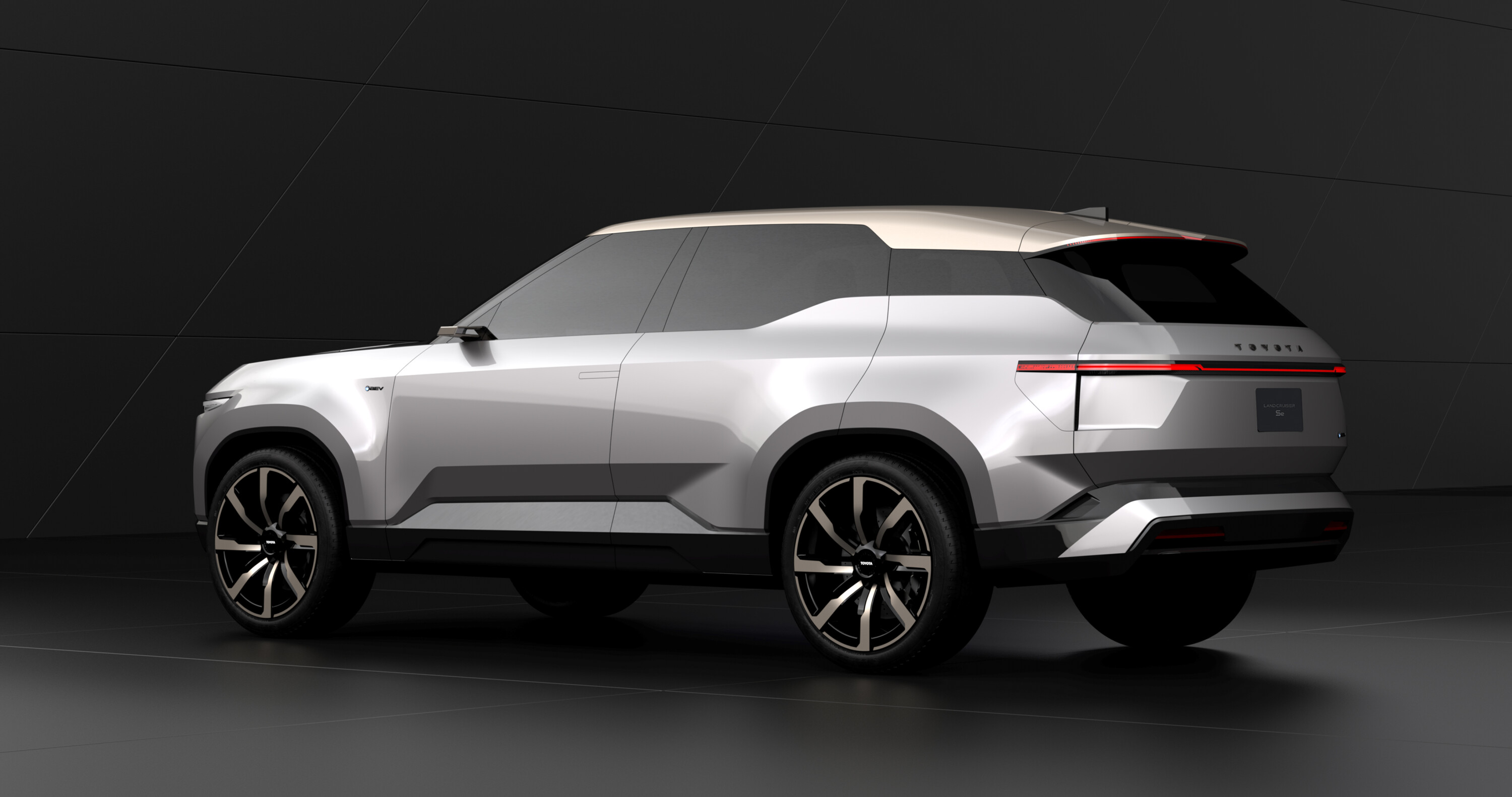
Toyota also unveiled the all-electric LandCruiser SE concept at this year’s Japan Mobility Show. That concept isn’t only larger than the 300 Series LandCruiser but is also understood to be built around a monocoque chassis rather than a traditional ladder frame.
MORE
Everything Toyota
Projecta has released a new range of Pro-Wave inverters that have been designed and engineered in Australia for our demanding local conditions.
The Pro-Wave inverters provide 4WDers, caravan and RV owners better options to connect to clean and reliable power on the go.
They’re the perfect power source – depending on the model purchased – for kitchen appliances, audio-visual and IT gear, power tools, and even large power-draw devices such as air conditioners and induction stoves.
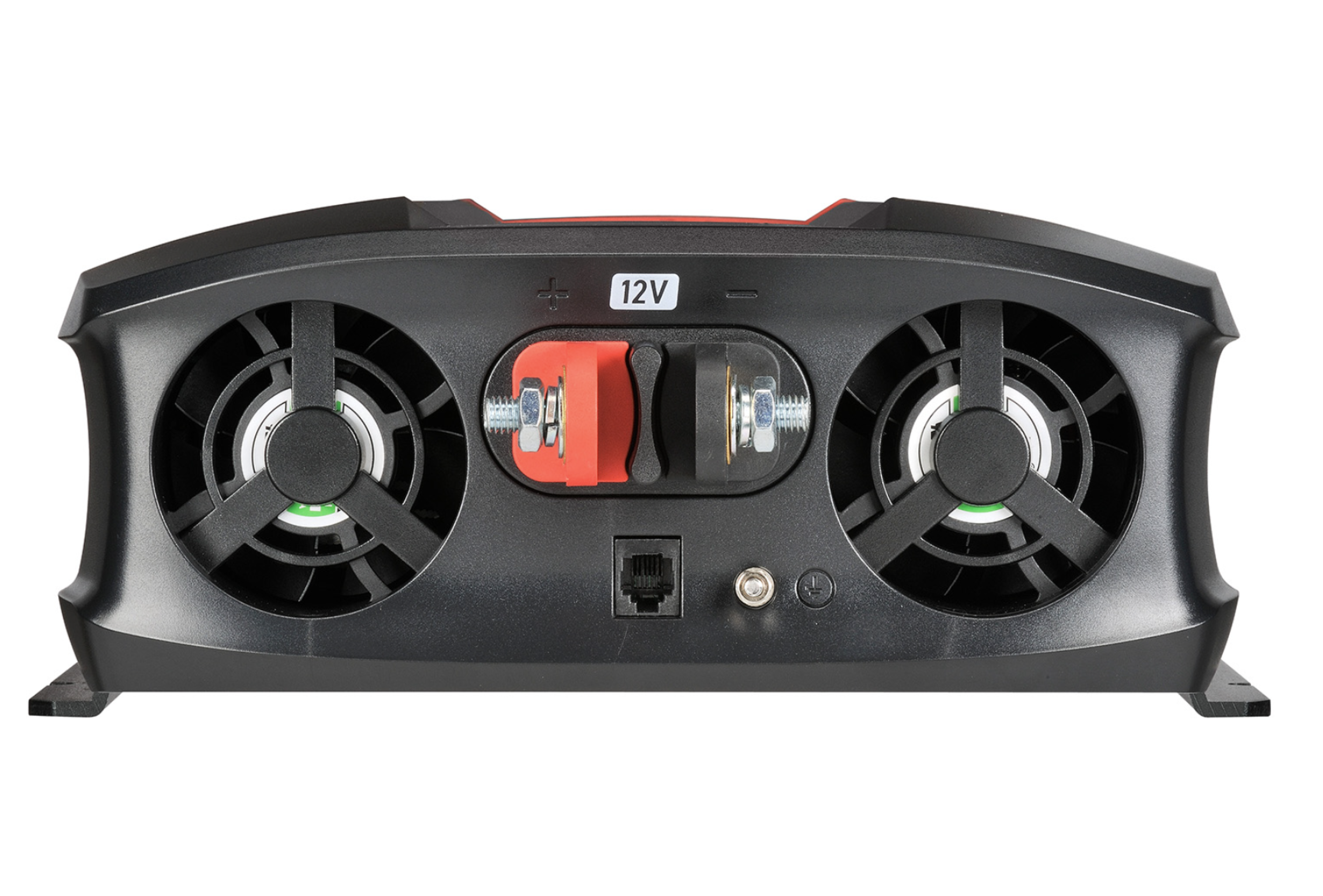
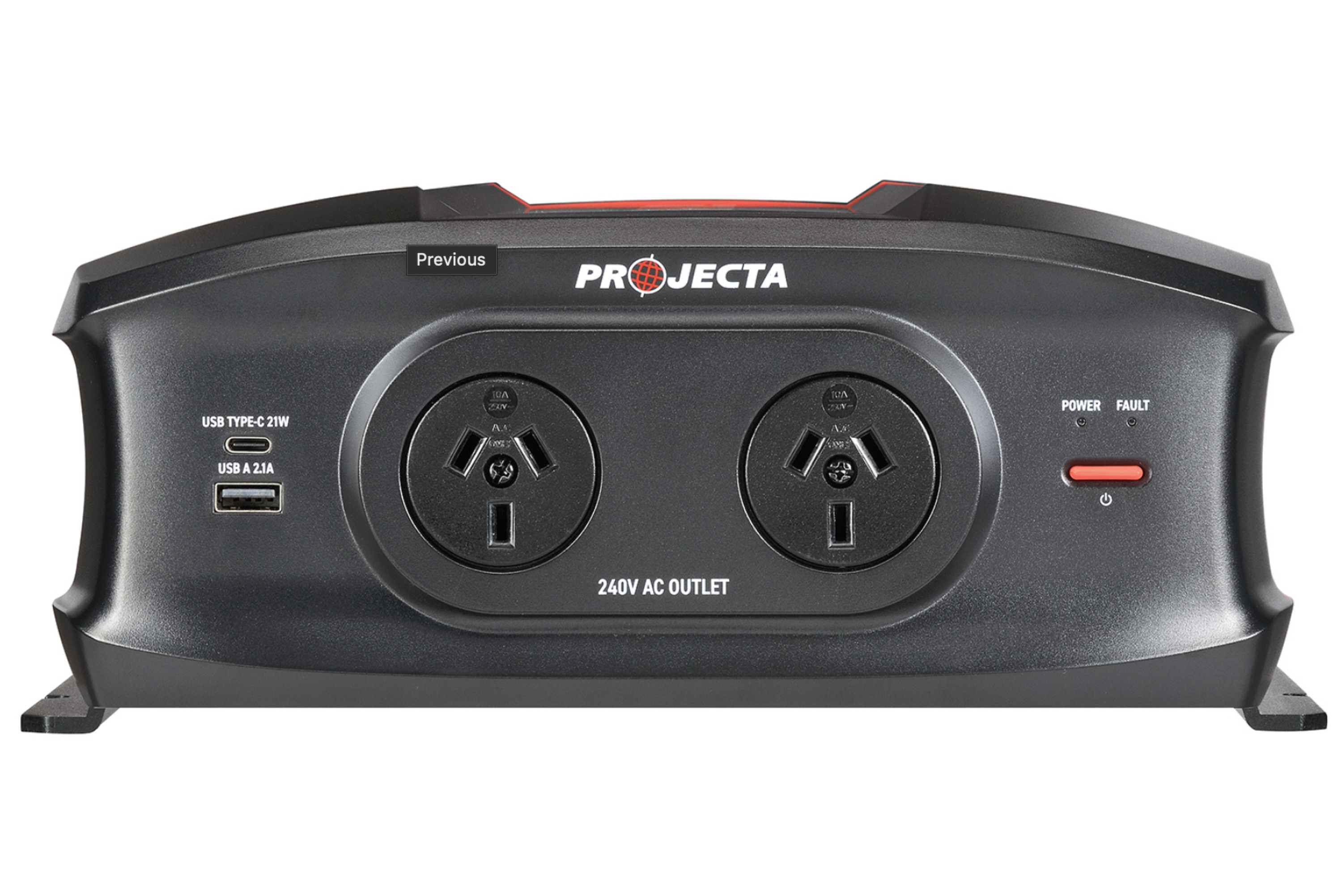
The Pro-Wave inverter range features larger wattages than standard models on the market: 1100W, 1600W, 2100W and 2700W. This gives the new Projecta Pro-Wave line-up the advantage of being able to power an extended range of appliances.
2
“Pro-Wave inverters are engineered for superior performance in the harshest conditions, delivering pure sine wave power that’s your trusted companion for all adventures, from remote travel to powering advanced tools on-site” said Dale McBride, marketing manager at Projecta.
Another impressive feature of the new range is a 200 per cent start-up power function that delivers a one-second output boost to kickstart appliances that draw more power on start-up. The inverter’s ultra-clean power mimics the power provided at home, which ensures safe, smooth and reliable performance without risking precious electronic equipment.
All Pro-Wave models are equipped with 2.1A USB-A and 21W USB-C ports that allow users to charge most mobile and portable devices. The GPO sockets, single on the PW500 model and double on all the other models, are approved to AS4763 standards and are fully electrically isolated and have equipotential bonding also to S4763 – so users can be assured of the units’ compliance and safe operation.


1
All models feature automatic temperature-controlled fans, a thermal shutdown function (at 65°C ±5) and are EMC approved. For simplifying installation, all the required cables are included.
Operating and monitoring the performance of the new range is simple, as each model features a stylish LCD remote that provides key information on the battery voltage, power usage and faults while allowing users to switch the inverter on and off remotely. Add to this a unique and futuristic design that features smooth lines and an inbuilt LCD display, and it’s clear the new range isn’t only functional, it looks impressive as well.
The new Projecta Pro-Wave inverter range is backed by a three-year warranty and is available from leading auto, camping, transport and trade outlets Australia-wide.
Pricing
- PW500: $500
- PW1100: $800
- PW1600: $1000
- PW2100: $1200
- PW2700: $1999
- PW2100-24V: $1250
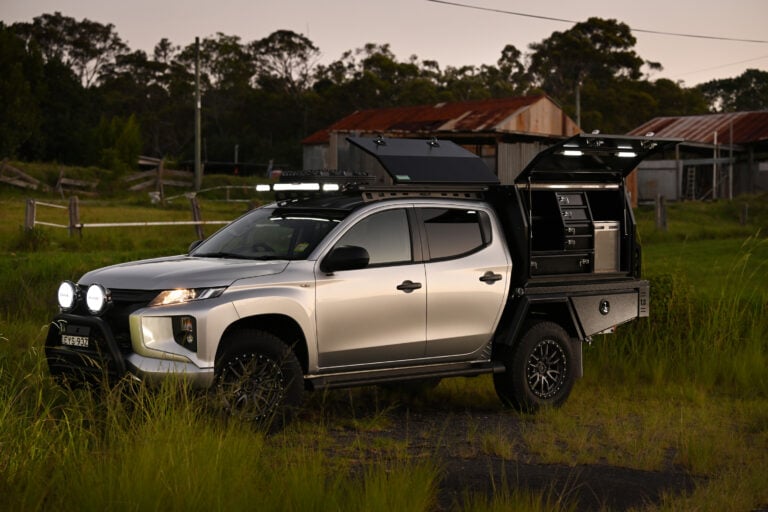
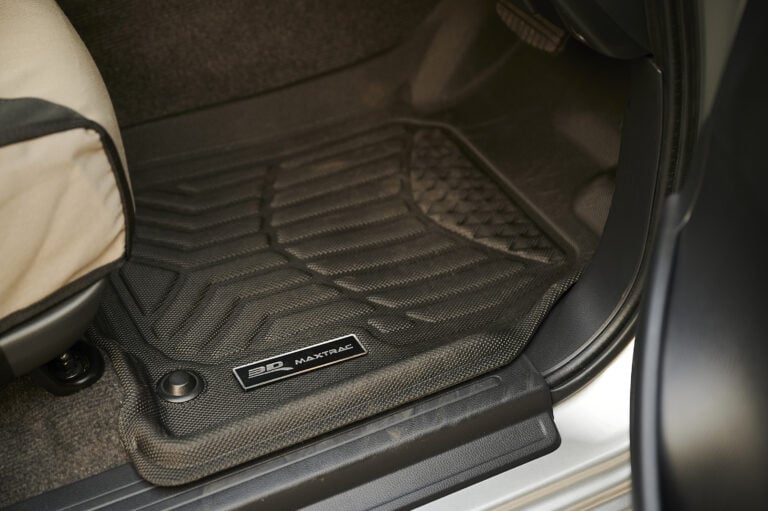
When looking for a set floor mats for our tradie Triton build we couldn’t go past TruFit 3D Maxtrac rubber mats.
Made from a patented 3D-moulded rubber compound, these mats are designed to fit your vehicle like a glove, so whether driving to work or on rugged off-road terrain, these mats offer unparalleled protection.
-
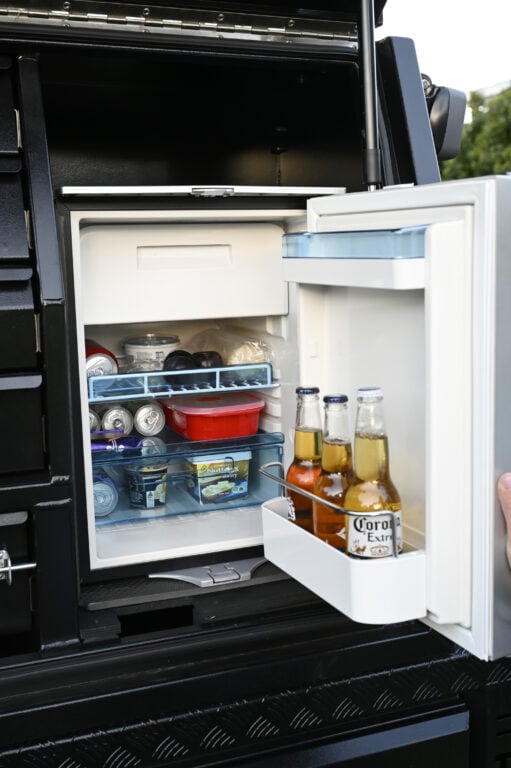
Dometic CoolMatic CRX 50 upright fridge
-
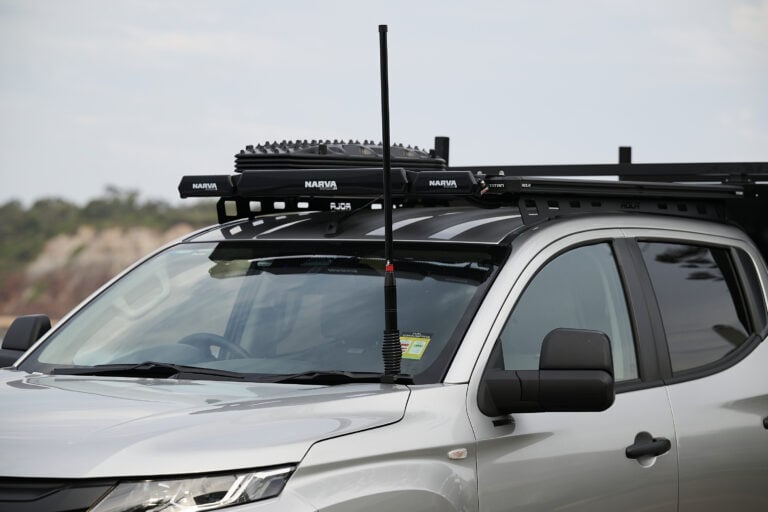
Cel-Fi GO mobile booster
-
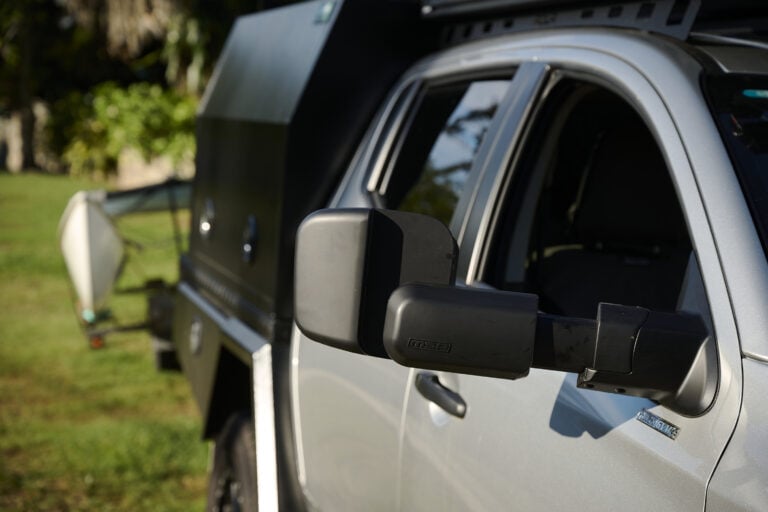
MSA 4×4 towing mirrors
-
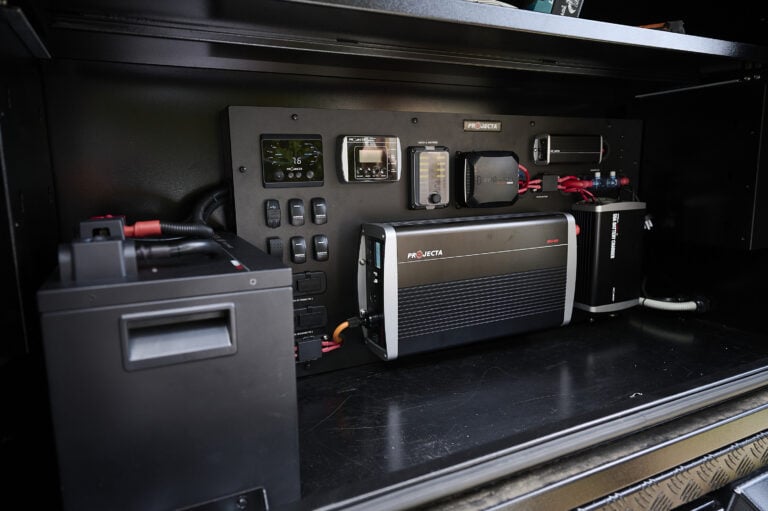
Projecta power management
-
Narva LED lights
-
Pedders GVM and brake upgrade
-
Maxtrax recovery kit
-
PIAK nudge bar
-
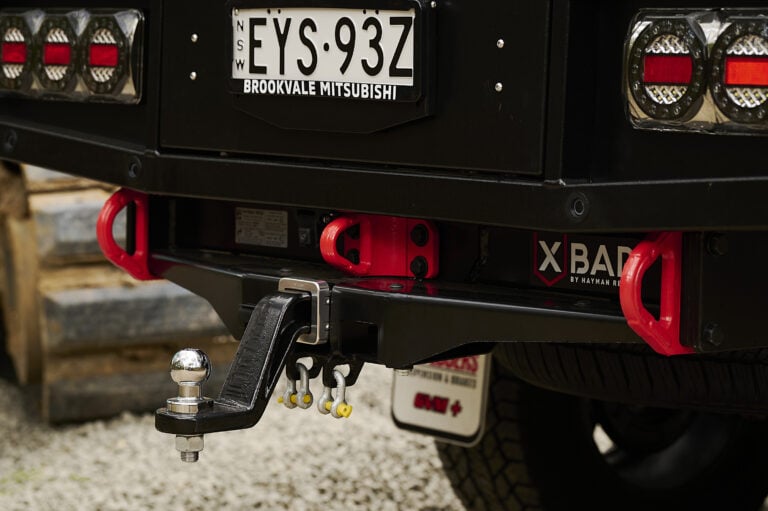
Hayman Reese X-Bar
-
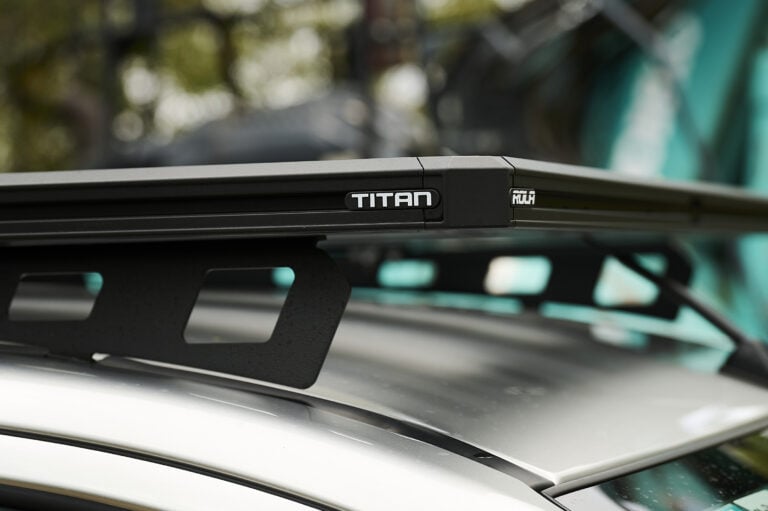
Rola MKIII Titan Tray
-
TruFit 3D mats
-
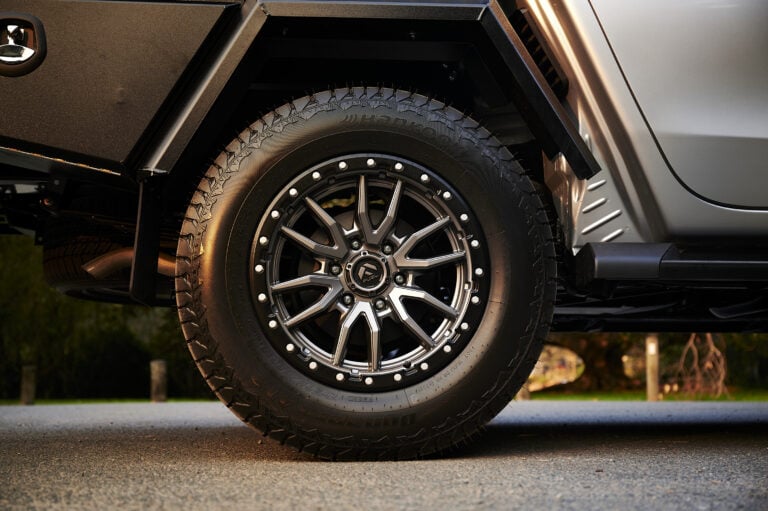
Fuel Rebel wheels
-
Hankook Dynapro AT2 tyres
-
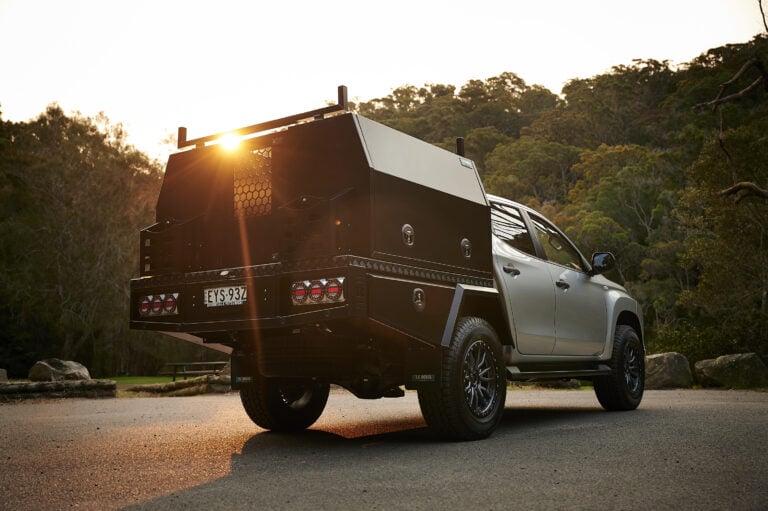
TC Boxes tray and toolbox
1
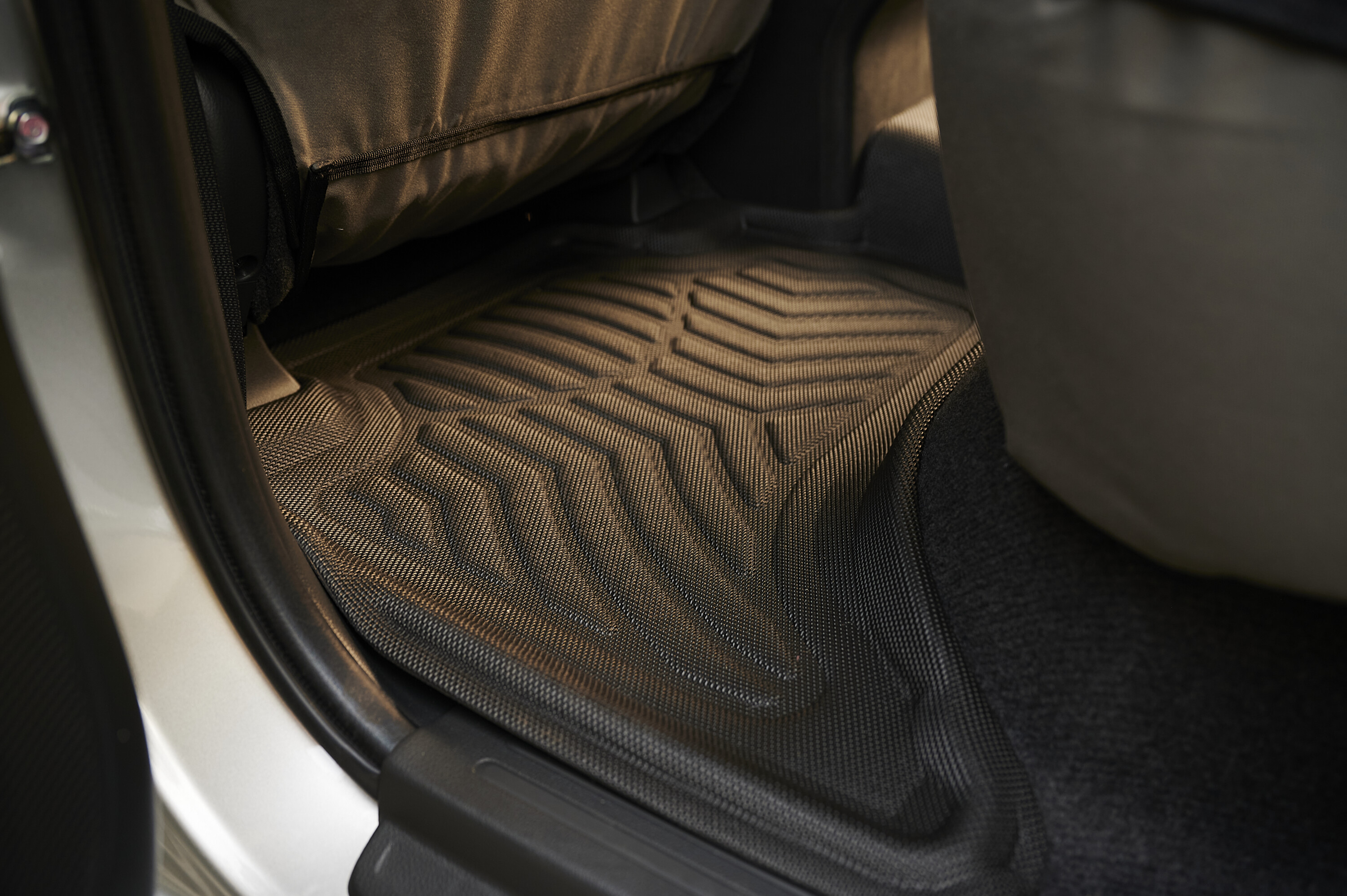
One of the standout features of TruFit 3D mats is their custom fit. They are meticulously designed to fit the footwell of your vehicle’s interior so they won’t slide around while you’re driving on uneven terrain … or if the apprentice is climbing in and out of the ute all day in their muddy size-14 work boots. In fact, the underside of the mats feature thousands of protruding fibres that help them to stay in place on the vehicle’s carpeted floor.
TruFit 3D floor mats are a game-changer for tradies looking to maintain their work ute’s resale value
On the top surface, TruFit 3D floor mats have a rubberised textured finish that adds to durability and ensures that any mess stays put. They also have a unique 3D shape with raised edges to help catch spills and retain mud and grit. When it’s time to clean up, simply remove the mats, shake them off, and they’re ready to be placed back in the vehicle.
1
TruFit 3D floor mats are a game-changer for tradies looking to maintain their work ute’s resale value. They combine style, protection and convenience in one innovative product.
Say goodbye to the endless struggle of keeping your carpets clean and looking like new; these mats are the ultimate solution for tradies and recreational off-roaders who demand the best for their ute.
Pricing: $279 (front and rear set)
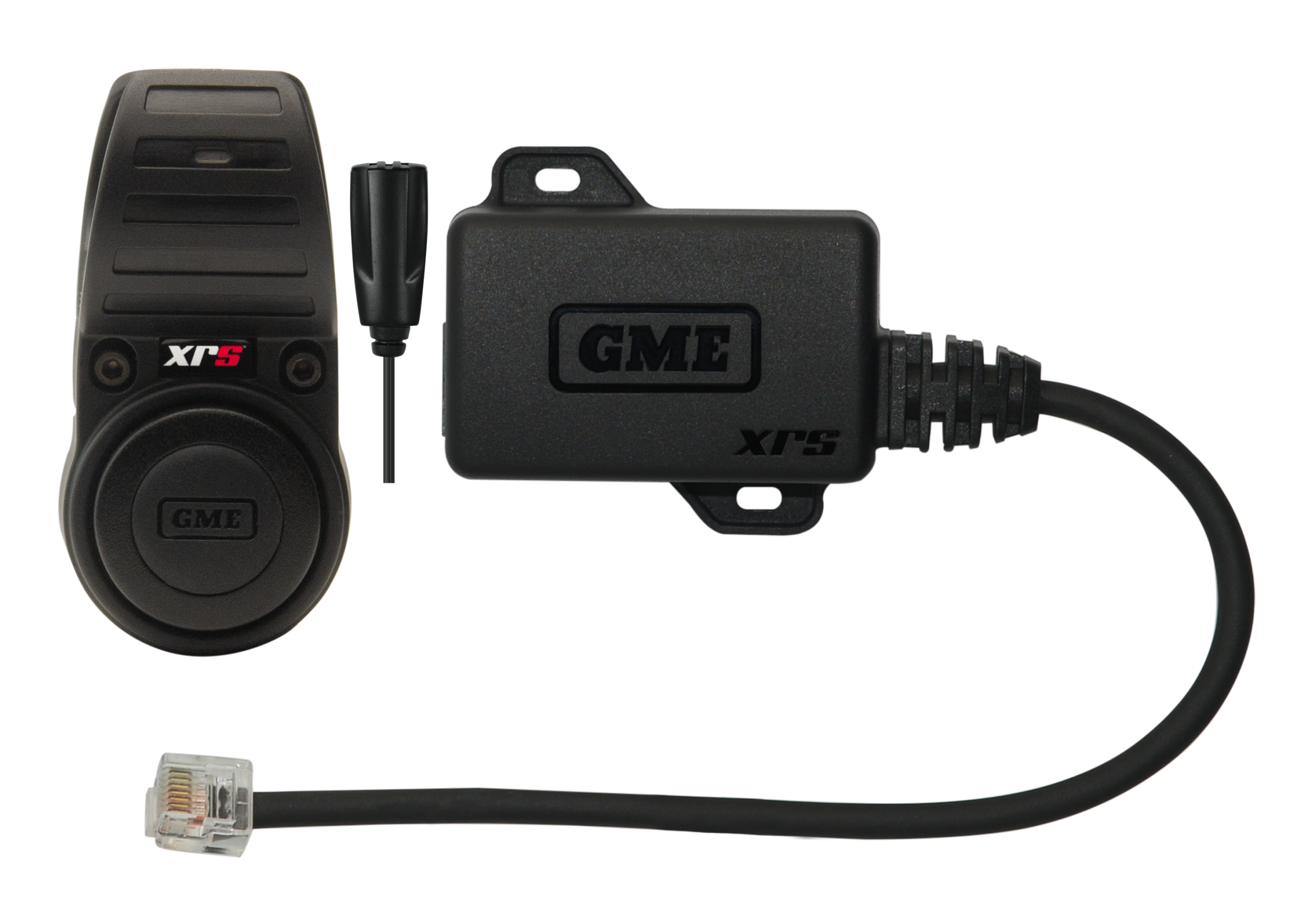
These days it’s hard for companies to manufacture a first-of-its-kind product, but GME has succeeded with the XRS-BT1.
The module brings Bluetooth audio connectivity and a wireless Push-to-Talk (PTT) feature to UHF radios, and it has been designed to make rural driving safer.
The XRS-BT1 provides a new and improved way for 4WDers to stay connected, as the push-to-talk button with IP67 Ingress Protection allows drivers to stay connected with others while navigating difficult driving conditions or rougher terrain. It also allows drivers the ability to keep two hands on the wheel while using their UHF.
1
Safety is at the core of this innovative device and users can connect their GME UHF radio directly to Bluetooth accessories such as headphones and vehicle stereo systems, which adds higher-quality audio for users.
The device also allows a Bluetooth connection between the UHF and compatible hearing aids, giving hearing-impaired people the ability to differentiate radio transmissions without any interference.
“We’re proud to introduce yet another market-leading product to help keep Aussies safe when they’re travelling out on the roads or in rural areas,” said Tony Crooke, GME’s head of marketing and product. “Customers can now talk on their UHF radio while driving, without even needing to pick up the microphone.
1
“Safety and quality is our passion, and like all of our products before it, the XRS-BT1 has undergone rigorous testing to ensure years of reliable performance in harsh Australian conditions.”
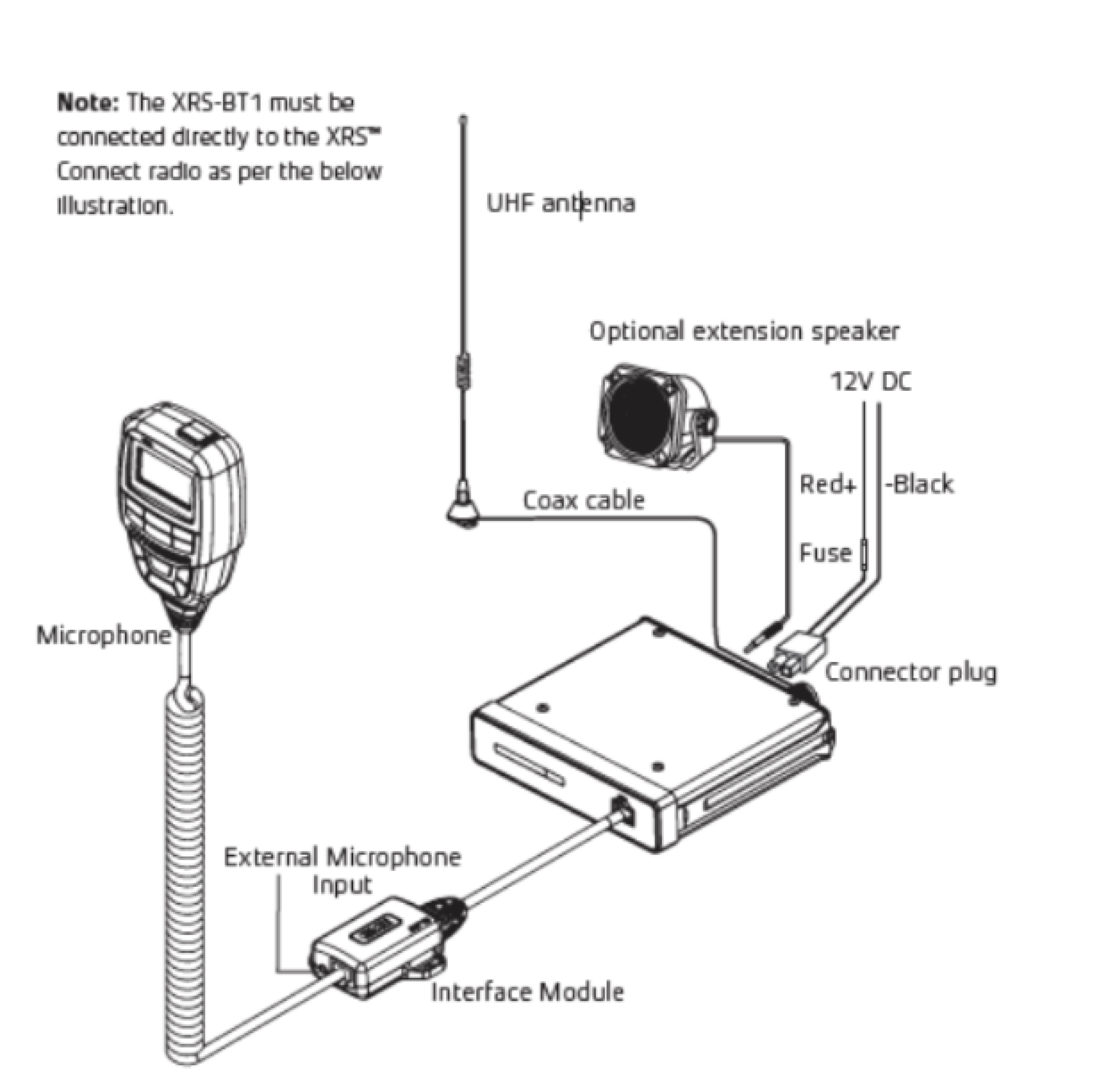
The XRS-BT1 kit includes a collection of accessories catering to the needs of all drivers, including an adjustable steering wheel clamp, dash mounting options, and a wired microphone for those who need quick, hands-free communications on the go – or for 4WDers who are navigating unknown tracks while staying on channel 10 to keep connected.
The all-new XRS-BT is the latest addition to GME’s broad range of RF communication devices and features an interface module that brings Bluetooth audio connectivity and wireless PTT functionality to the full range of XRS Connect UHF radios.
With a recommended retail price of $199, the XRS-BT1 kit can be purchased from recommended retailers.
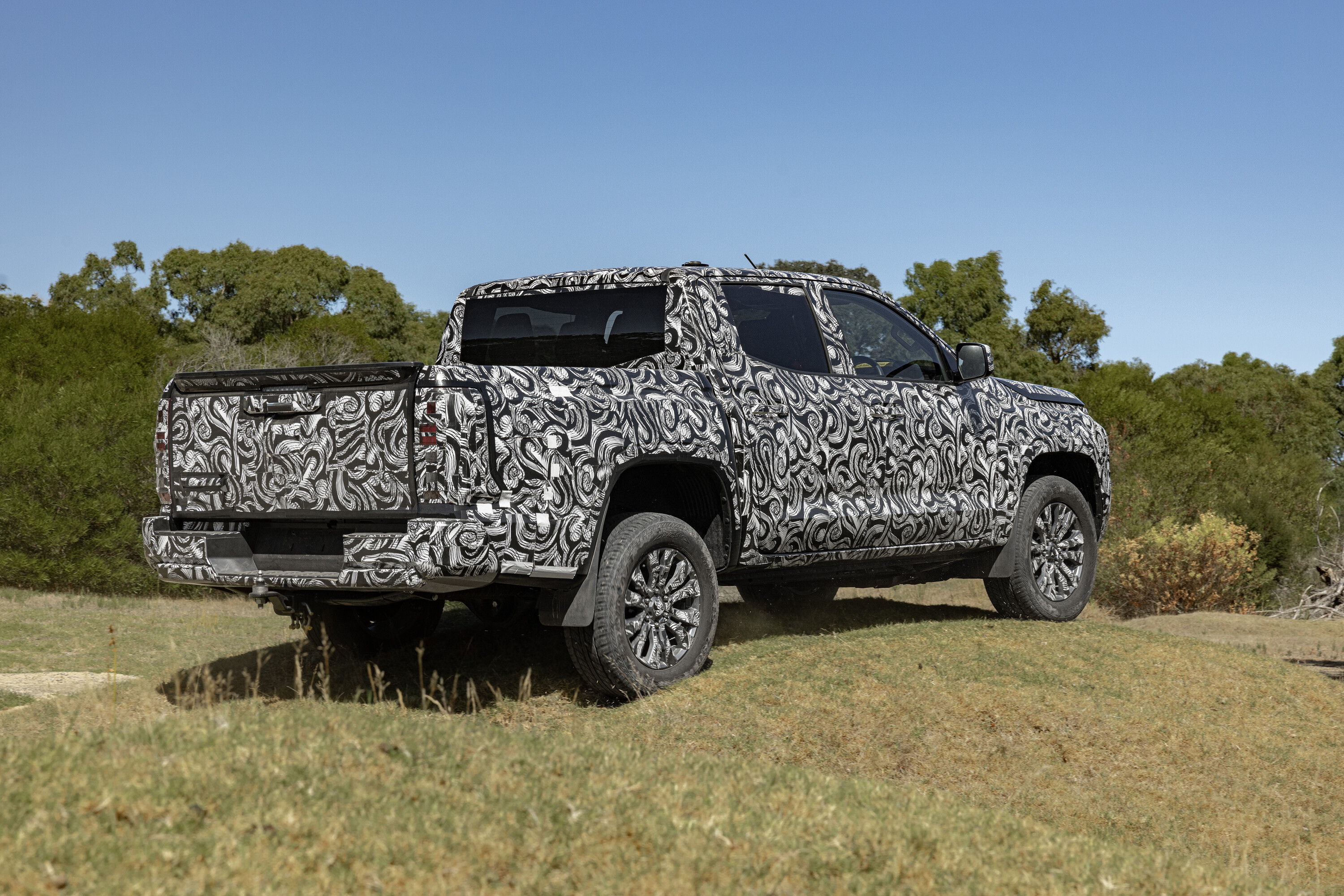
An ex-General Motors testing facility has assisted in the development of the 2024 Mitsubishi Triton ute, due in February.
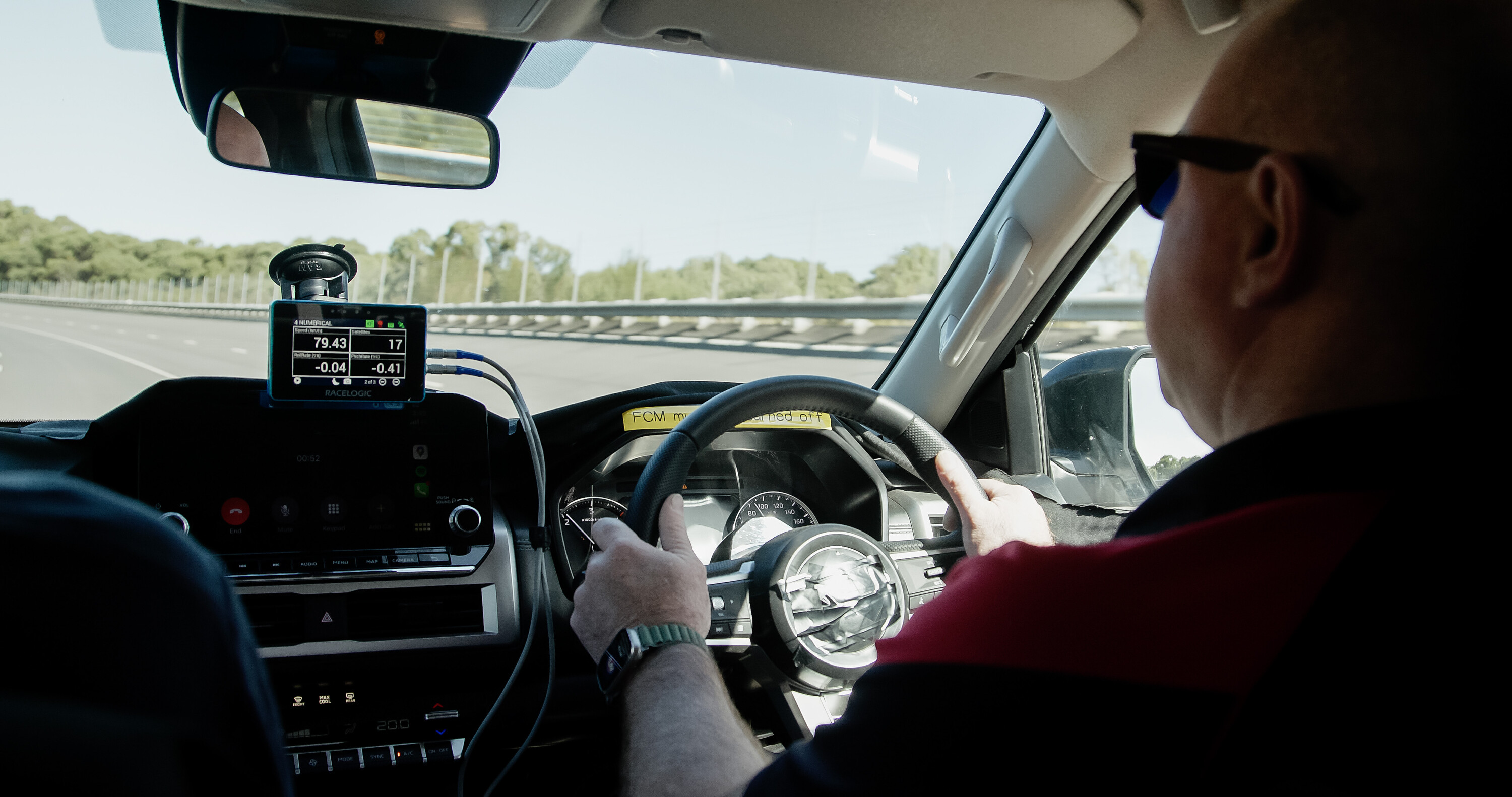
Mitsubishi Australia has detailed the “rigorous development and testing program” conducted locally for the next-generation Triton, which was completed on public roads and proving grounds – including the Lang Lang facility in Victoria, owned by GM Holden between 1957 and 2020.
Australia and New Zealand-bound versions of the new Triton will feature a bespoke suspension tune, while local engineers assisted Japan in the development of a global electronic power steering tune.
1
Mitsubishi said it tested “over 100 combinations of front and rear suspension options” over several months, with the final combination selected in time for a ‘key person ride’ attended by senior executives in Australia.
“Having access to somewhere like Lang Lang accelerates the process immensely. We could evaluate changes on multiple road conditions back-to-back to set accurate benchmarks,” said Mitsubishi Australia project manager Tony Dorrington.
Dorrington joined Mitsubishi in 2003, working closely with Japan on the development of the 380’s suspension and steering tunes. After working externally, he returned to the brand in 2019 to head localised engineering initiatives.
1
A unique front damper, spring combination, and rear shock will be fitted to local versions of the Triton, which was benchmarked against key rivals – likely including the top-selling Toyota HiLux, Ford Ranger and Isuzu D-Max – and the current model.
“The outcome of our collaboration is a significant reduction in impact harshness, improved body control, enhanced on-centre feel and more linear steering with good feedback,” said Dorrington.
Meanwhile, the adoption of electronic power steering is said to “reduce effort during parking and low-speed manoeuvres”, assist off-road, and improve feedback at higher speeds.
“With new-gen Triton we targeted a similar drive experience to a good SUV, with improved agility, responsiveness and ride comfort, but retaining Triton’s traditional off-road and workhorse capabilities,” he added.
1
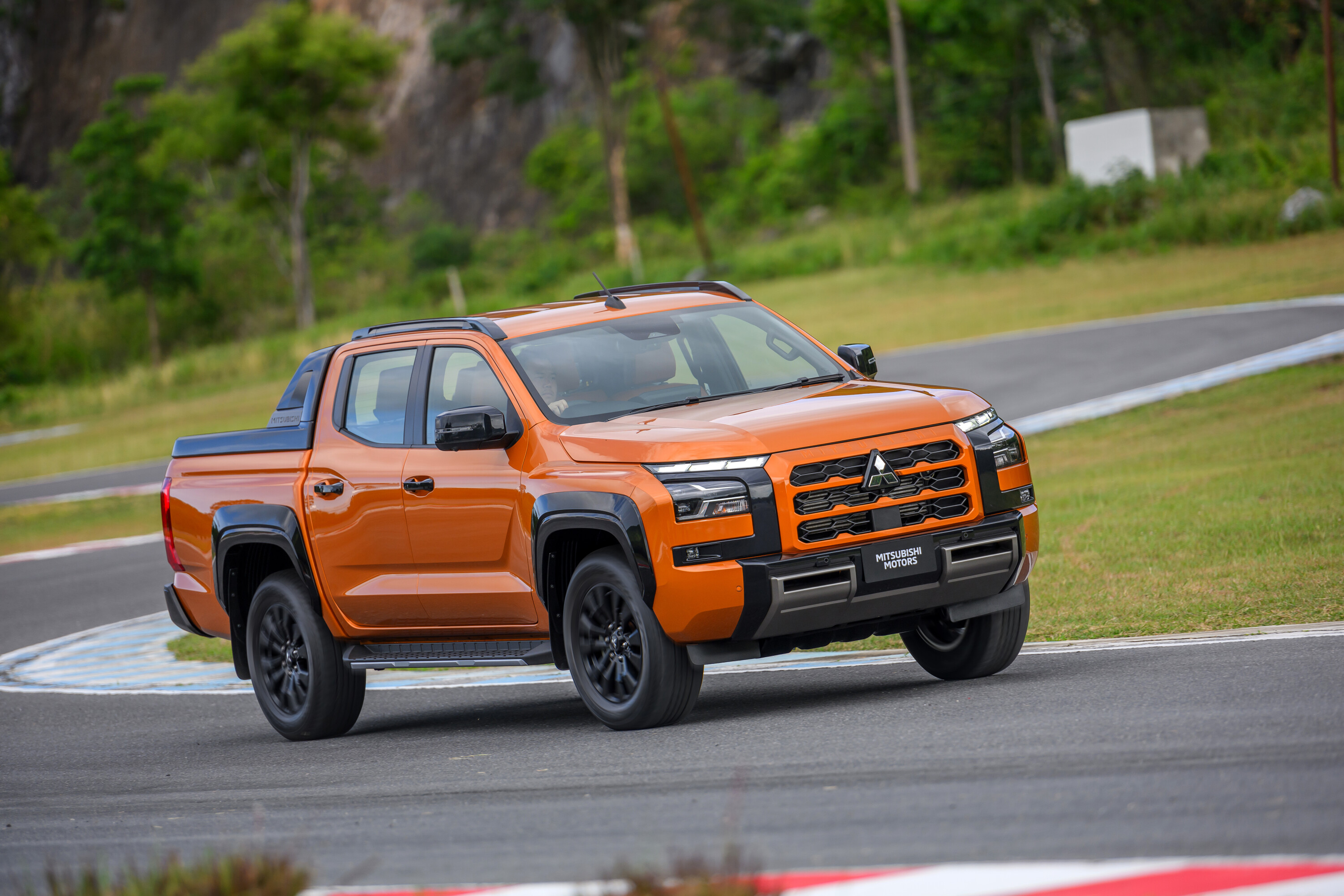
Due in Australia in February 2024, the new Mitsubishi Triton will be available in four trims: GLX, GLX+, GLS and GSR.
A revised 150kW/470Nm 2.4-litre twin-turbo four-cylinder diesel sits underneath the bonnet, initially matched to a six-speed automatic and later joined by an updated manual.
For all the details on the 2024 Mitsubishi Triton, click on the featured article below.
The cost of living is skyrocketing, so it’s more important than ever to drive your dollar further when looking for an off-road-ready large SUV.
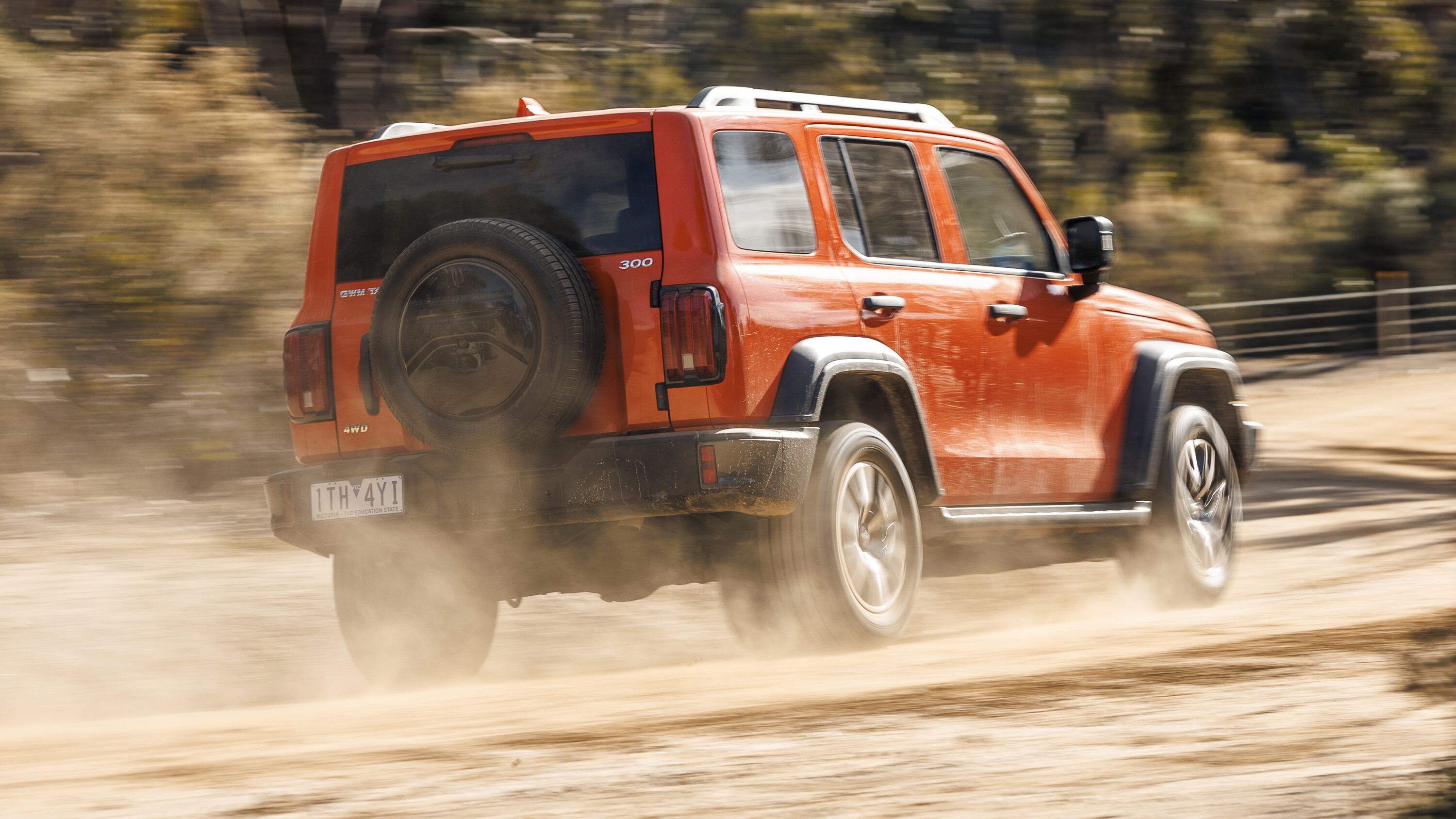
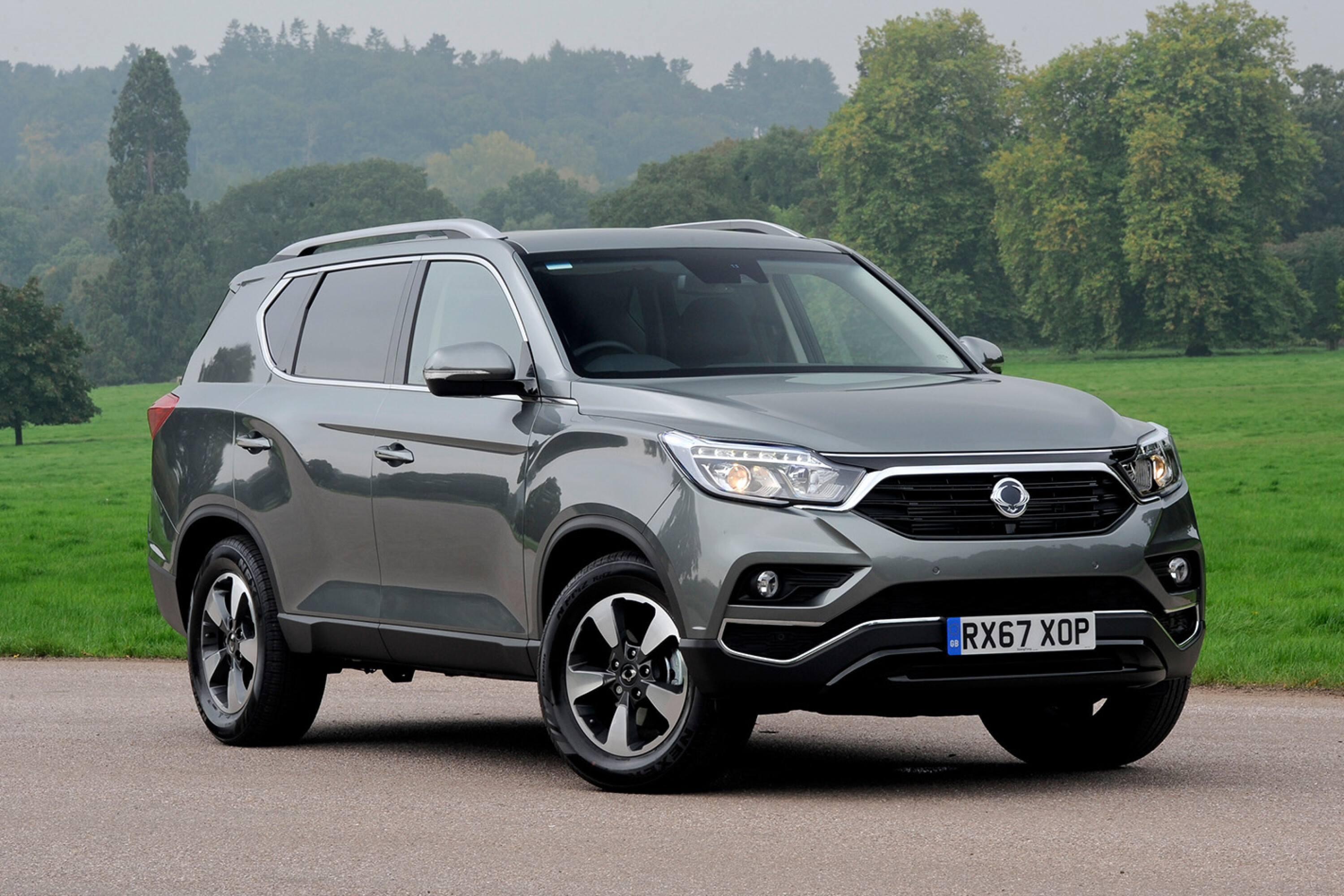
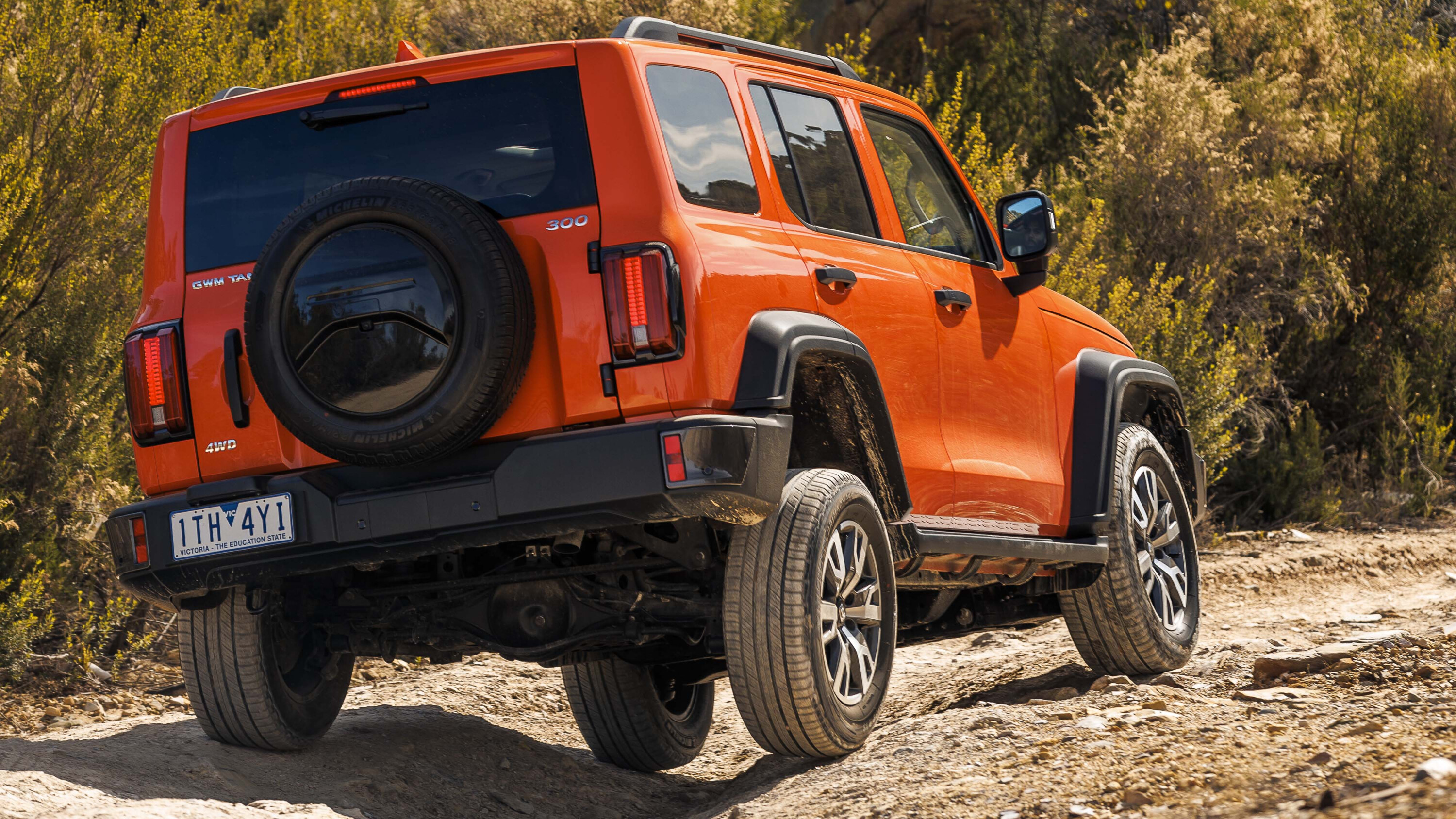
For those who’ve been out of the game for a while, there will be some unfamiliar faces here from China and Korea that stand out on paper with their low purchase prices. The LDV D90, GWM Tank 300, and Ssangyong Rexton all fall into this category.
But are they really cheaper to own than established nameplates like the Isuzu MU-X and Toyota Prado?
We dusted off the calculator to generate a ‘three-year ownership figure’ to compare each entrant.
The goal is to look beyond the purchase price and provide a clearer overall indication of how much each SUV will cost in your driveway. We’ve taken depreciation, servicing, insurance premiums, and fuel use into account and, as you can see, the results are surprising…
Correction 10/11/23
A calculation error had previously ranked the GWM Tank 300, LDV D90 and Ssangyong Rexton as the most affordable off-road large SUV to own. The story has now been updated. Wheels regrets the error.
1
Take the whopping $12,485 difference in drive-away price between the first-place Isuzu MU-X and third-spot GWM Tank 300.
It’s plain to see that the Isuzu commands a hearty number of extra pineapples. Yet, after three years when it comes to moving each car on, the MU-X’s penalty flips on its head to a $3621.59 advantage over the cheaper-to-buy GWM.
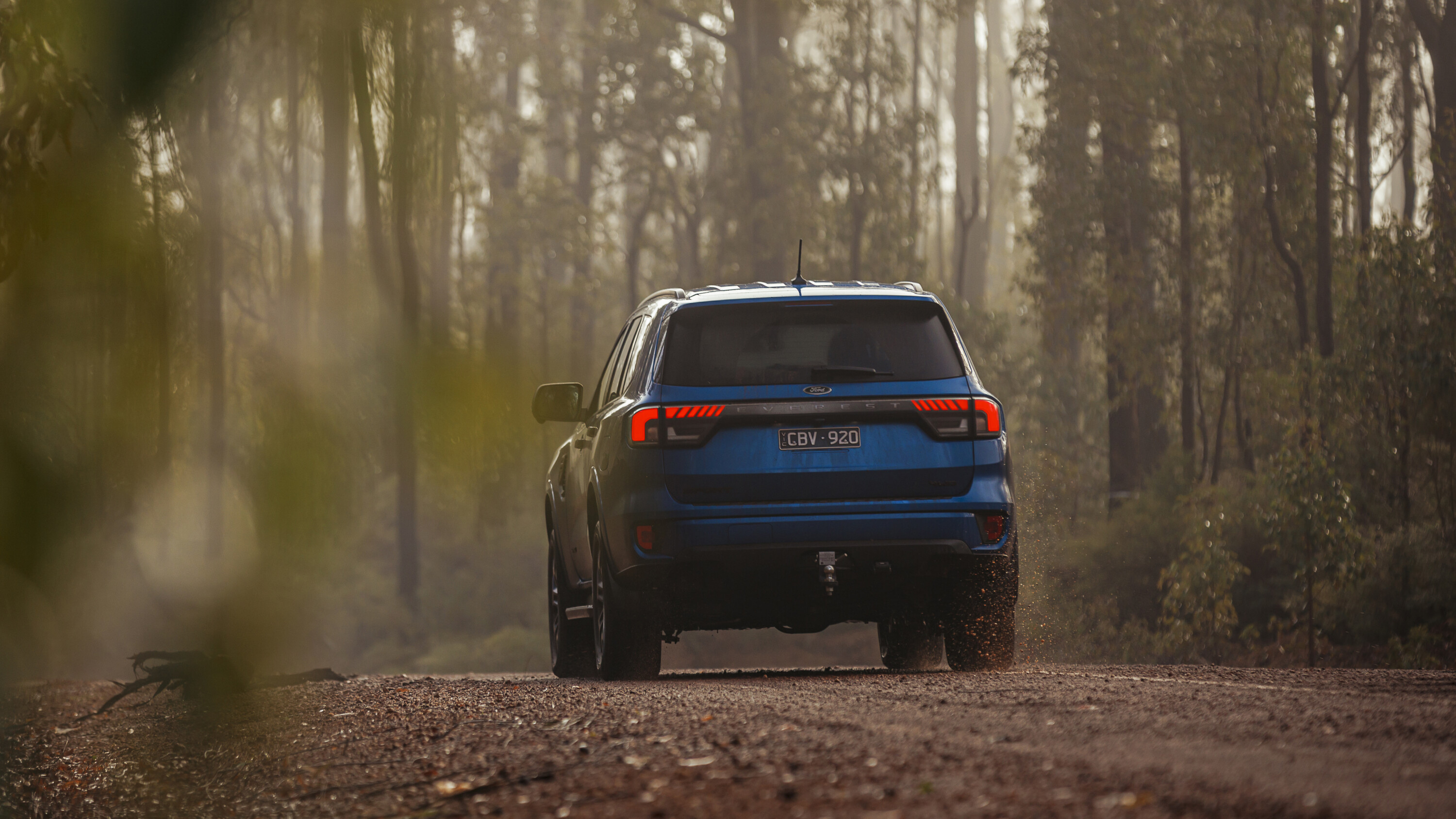
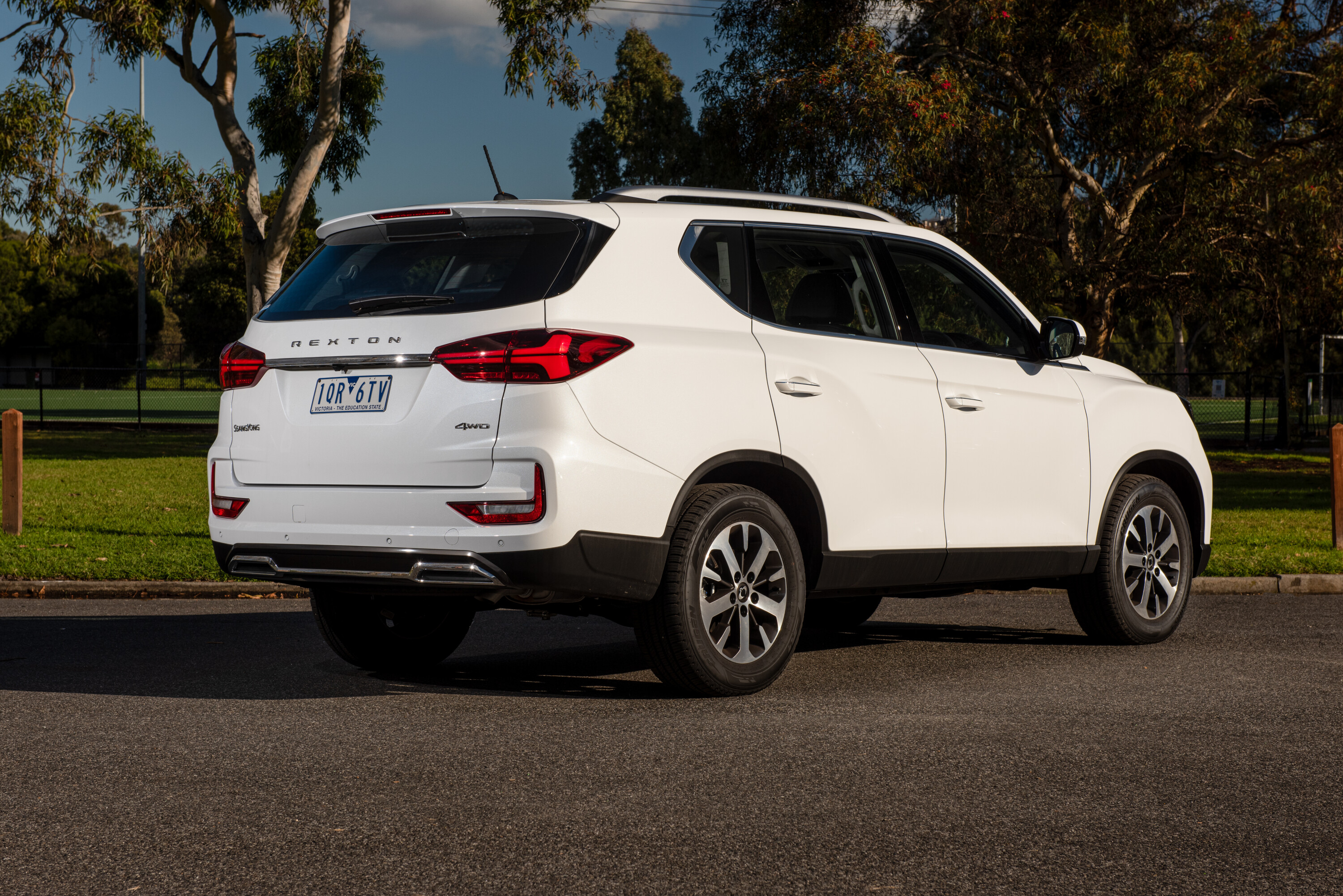
It’s a similar story with other new entrants. The Ssangyong Rexton ELX, for example, may be the third most affordable to buy yet its weak residual (51.5%) puts it a long way behind the second most expensive Ford Everest as an overall ownership proposition.
1
JUMP AHEAD
- How we calculate best value
- Isuzu MU-X
- Ford Everest Ambiente
- GWM Tank 300 Lux
- Other recommendations
- Ownership costs
- Specifications
How we calculate best value
Our full results are in the table below, and we’ve highlighted the three best-value off-road large SUVs you can get.
But first, an explanation of how we calculated our ownership figures.
We focused on the cheapest four-wheel drive variants on offer and used drive-away pricing for vehicles delivered in Sydney with no options fitted.
You can go even cheaper by selecting 4×2 variants – especially with the LDV D90 – though given these vehicles’ point of difference to comfort-oriented monocoque SUVs (ranked here) is rough-road and towing capability, it makes sense for private buyers to spend a little extra on 4×4 models.
1
Residual values (in percentage form) were gathered from Redbook and form the single largest cost of ownership. Insurance premiums were quoted for a 30-year-old male living in inner Sydney with a clean driving record.
Fuel bills were calculated based on each contender’s combined economy figure and the assumption that owners will drive 12,100km per year – the Aussie average, according to the Australian Bureau of Statistics. Diesel and 91 RON unleaded were $2.00 and premium 95 RON at $2.10 per litre in our calculations
These figures are a guide only, of course. While they’re based on historical data and official manufacturer figures, they will change depending on where you live, how far you drive, and other market forces such as the swings in used-car values experienced during and after COVID.
But if value is a high priority, here are three top picks to consider in each category…
1
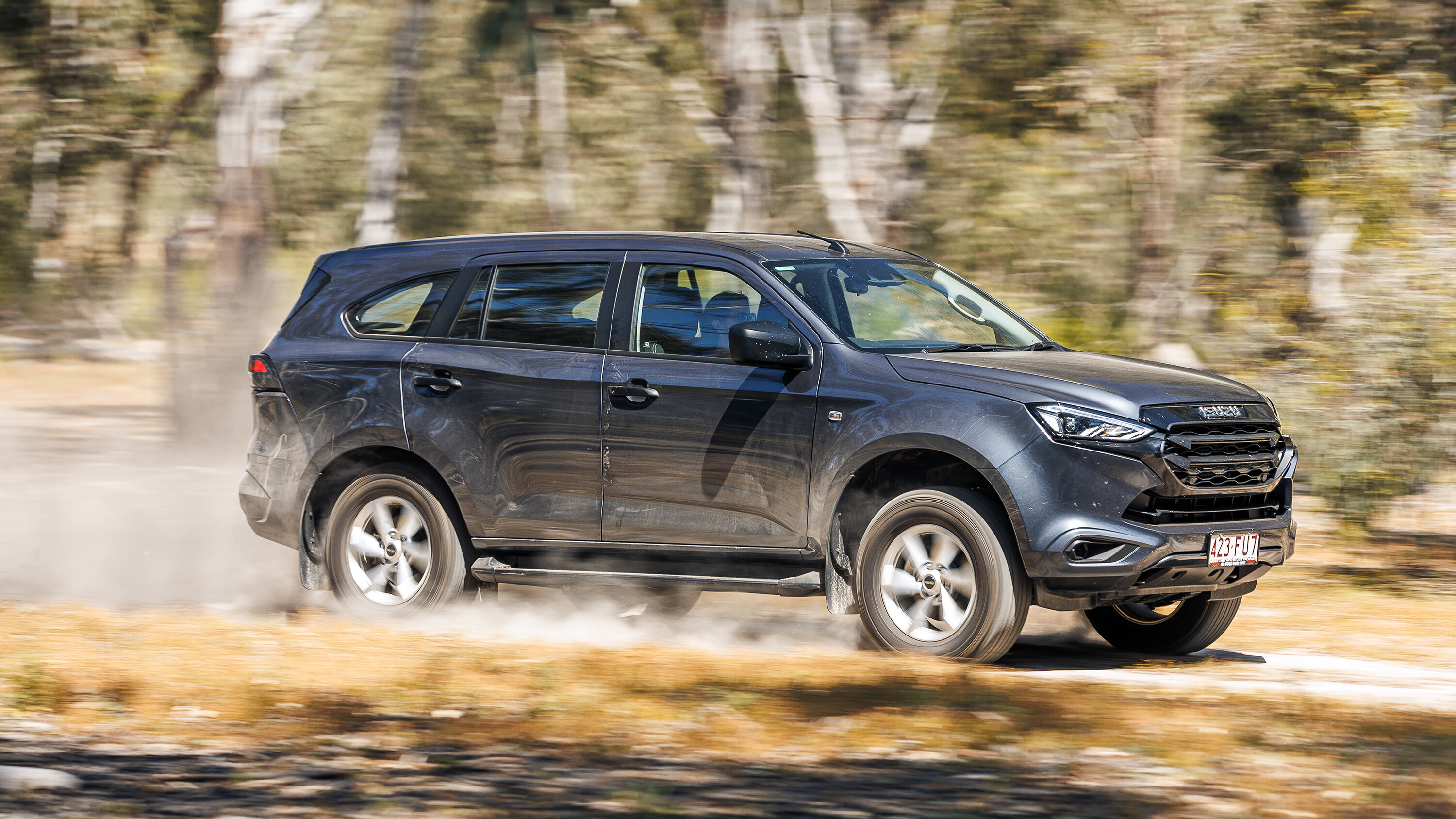
Isuzu MU-X LS-M
Isuzu offers consistently great value across its range when it comes to overall ownership.
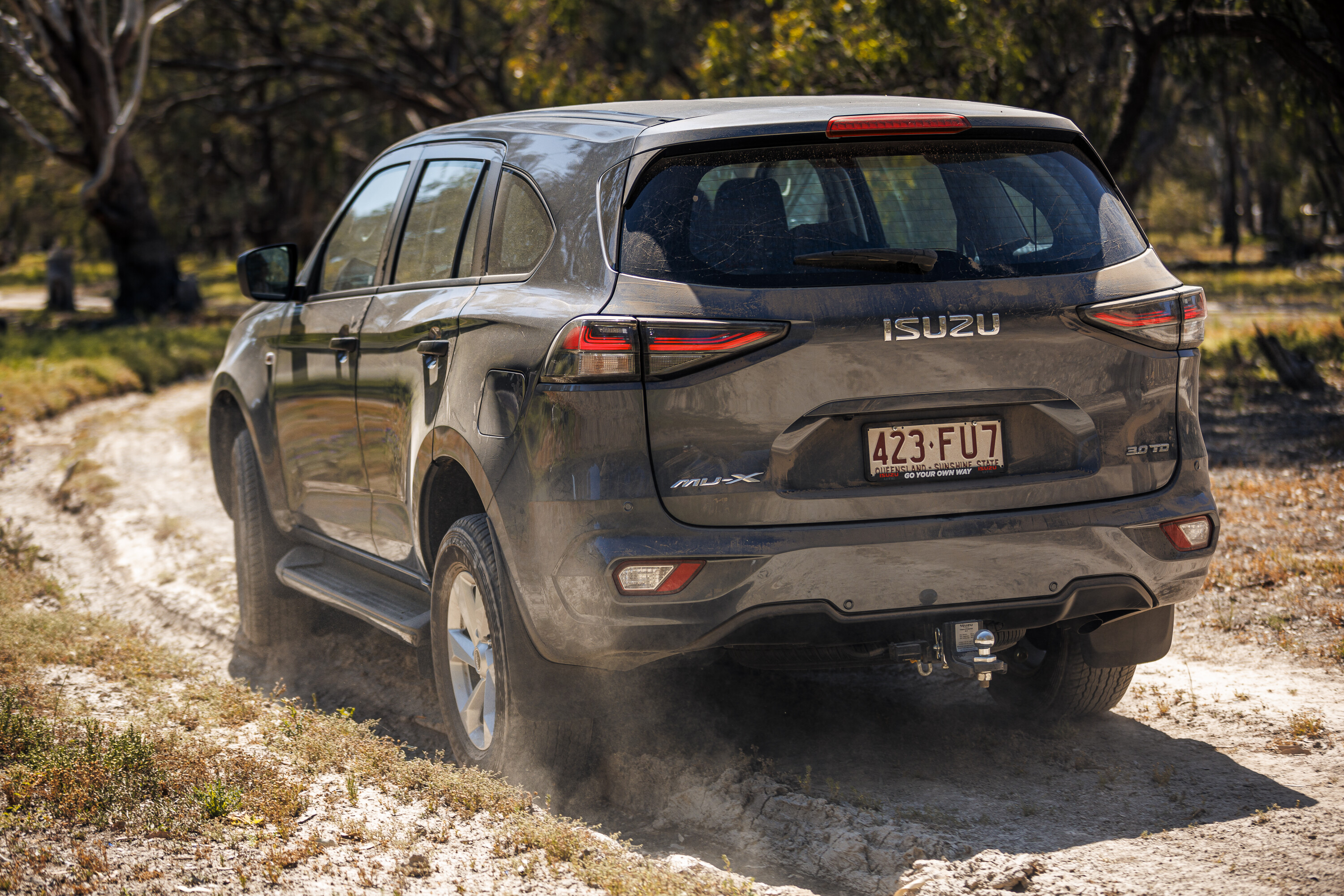
Following the related D-Max’s domination in our best value utes comparison, the MU-X pulled a $2192.07 lead over the Ford Everest over a three-year ownership period thanks to the best resale value (70.3%) of the group.
1
The second-place Ford clawed back some money when it came to servicing and fuel consumption, but the MU-X maintained a healthy lead overall.
In four-wheel drive guise the MU-X is well-equipped for rough Australian terrain and its reliable ‘4JJ3-TCX’ is a towing stalwart with 3500kg braking capacity.
MORE
Everything Isuzu Ute
1
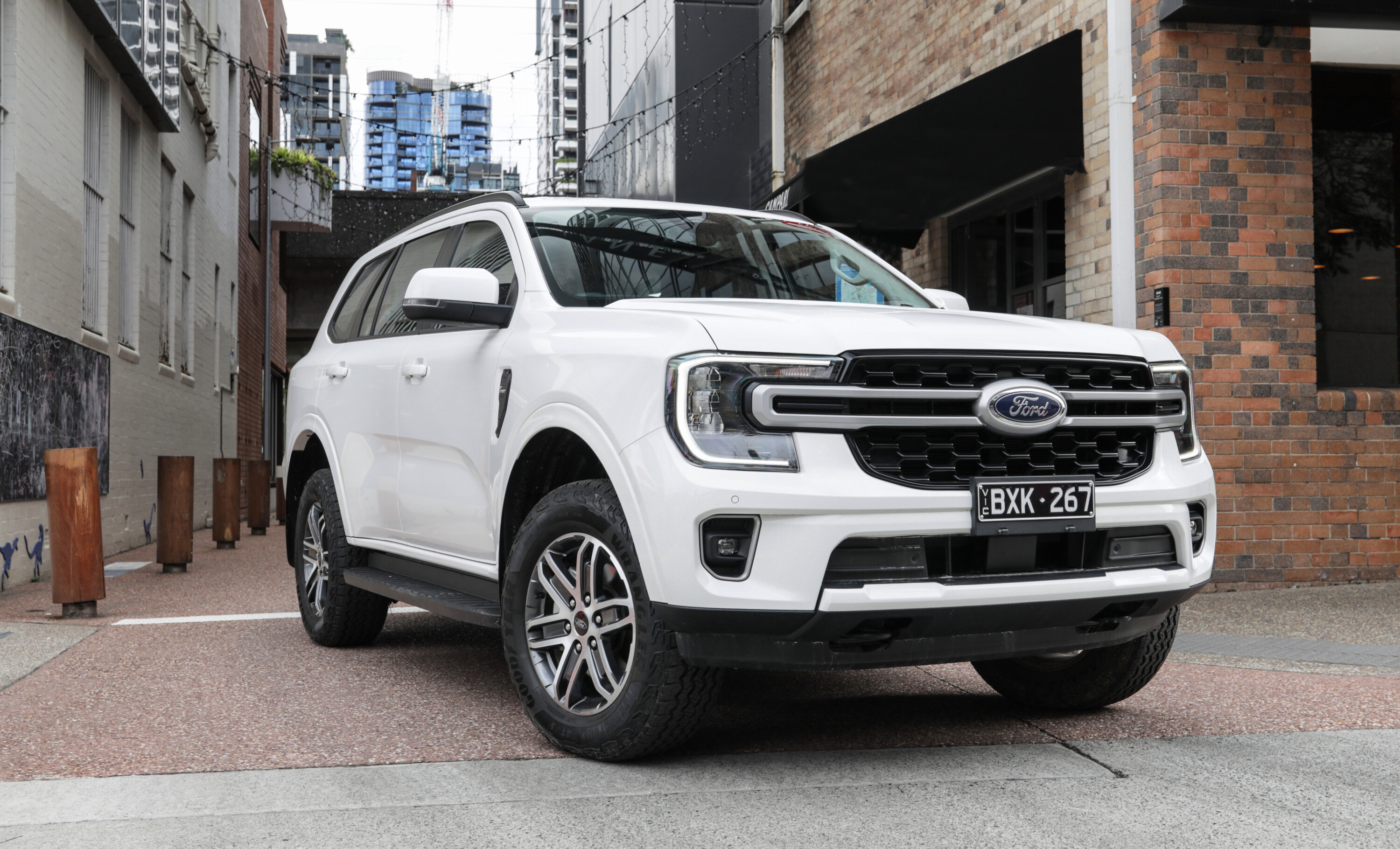
Ford Everest Ambiente
High purchase prices can be off-putting, but guess what? They can also mean better residuals.
Think about it, 68% of $64,714 is more than 68% of $50,000 – and a hell of a lot more than 51.5% of $50K.
So if you’re going to move a car on after three or five years anyway, it could be worth reaching a little further to get a vehicle with strong residuals such as the Ford Everest.
7
The Everest’s result is bolstered by best-in-class fuel consumption and the most affordable servicing here.
Of course, the Everest also happens to be not only our reigning Car Of The Year but also the overall winner of this test. It’s a good buy, even in base Ambiente trim.
MORE
Everything Ford
1
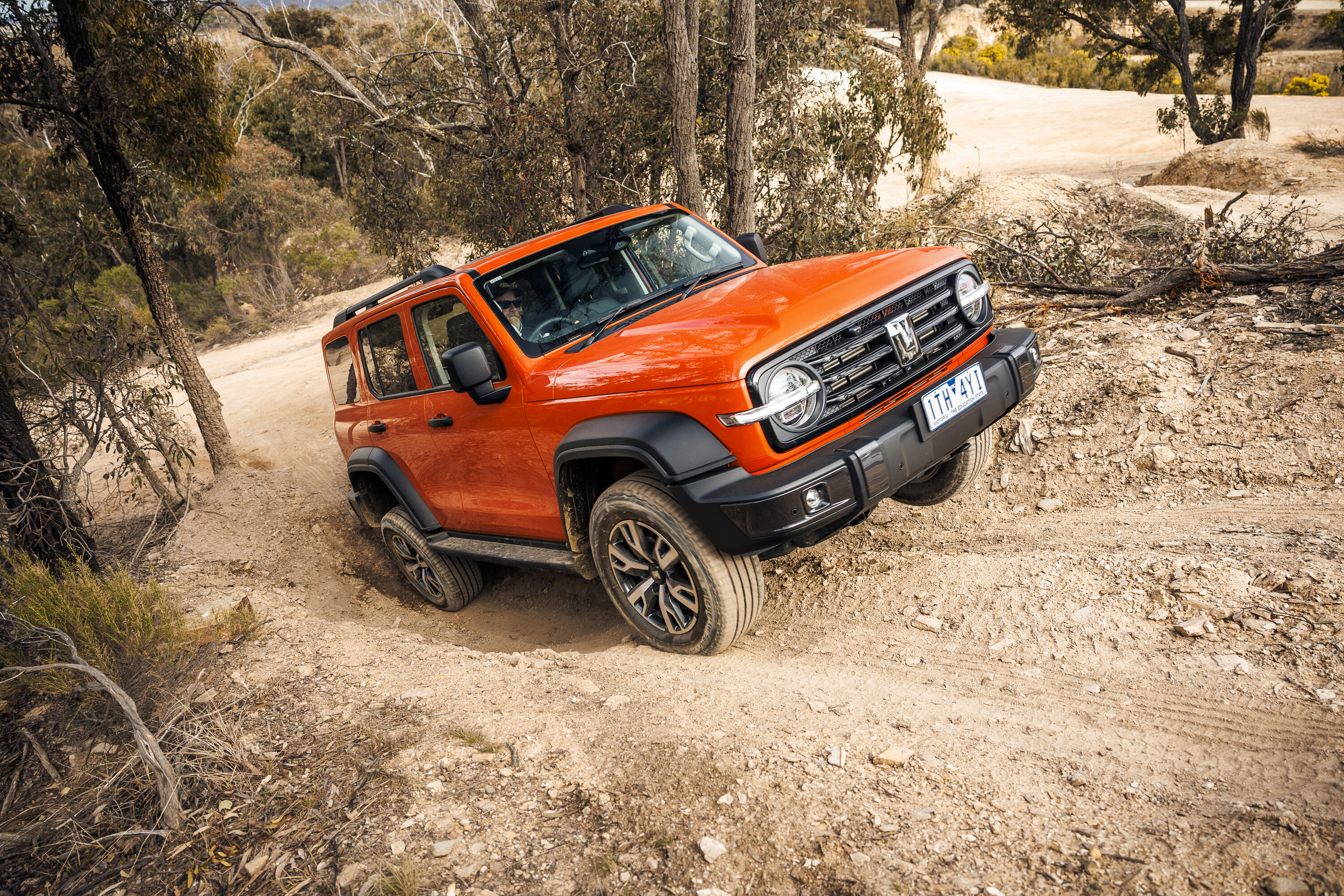
GWM Tank 300 Lux
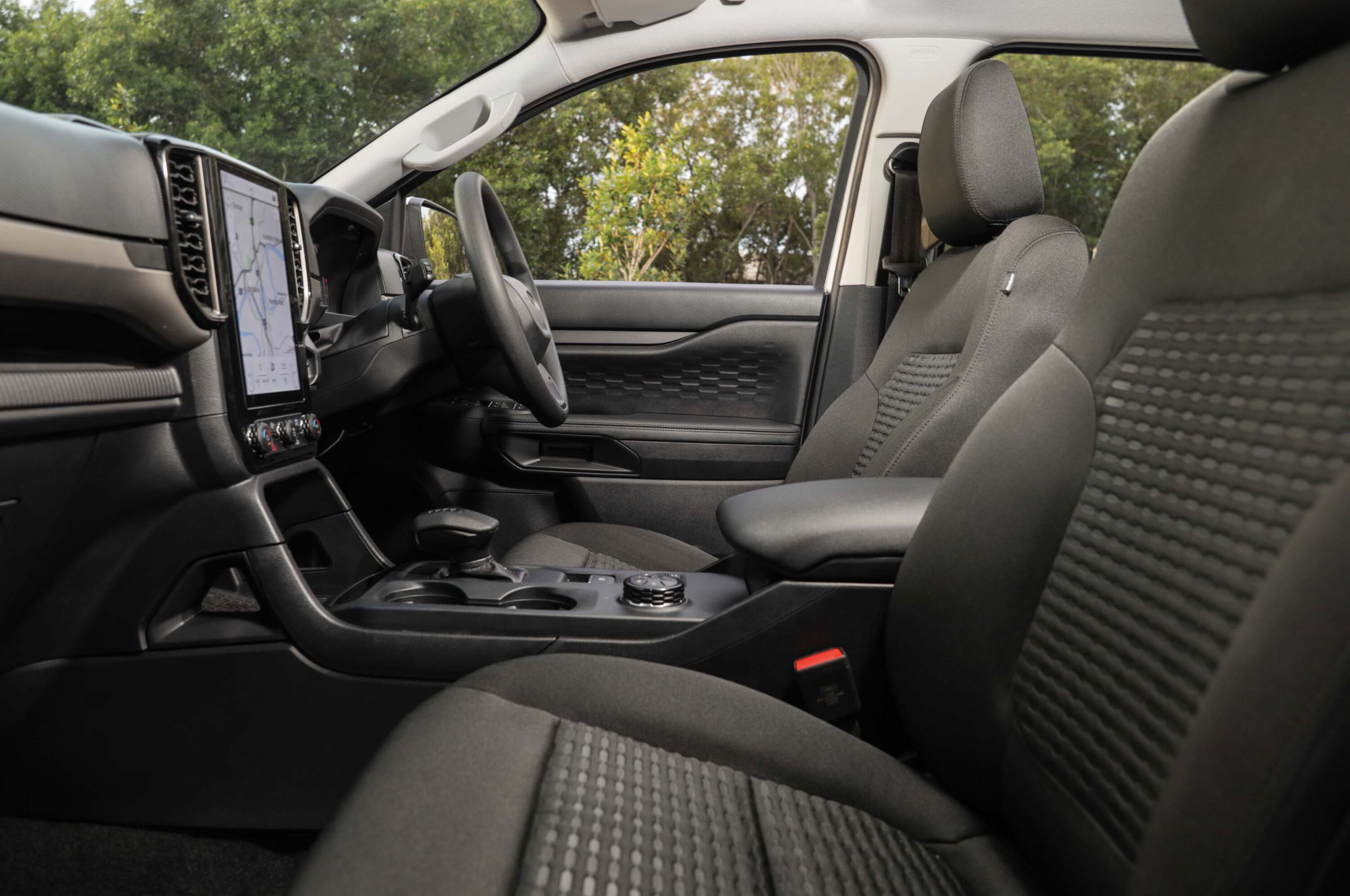
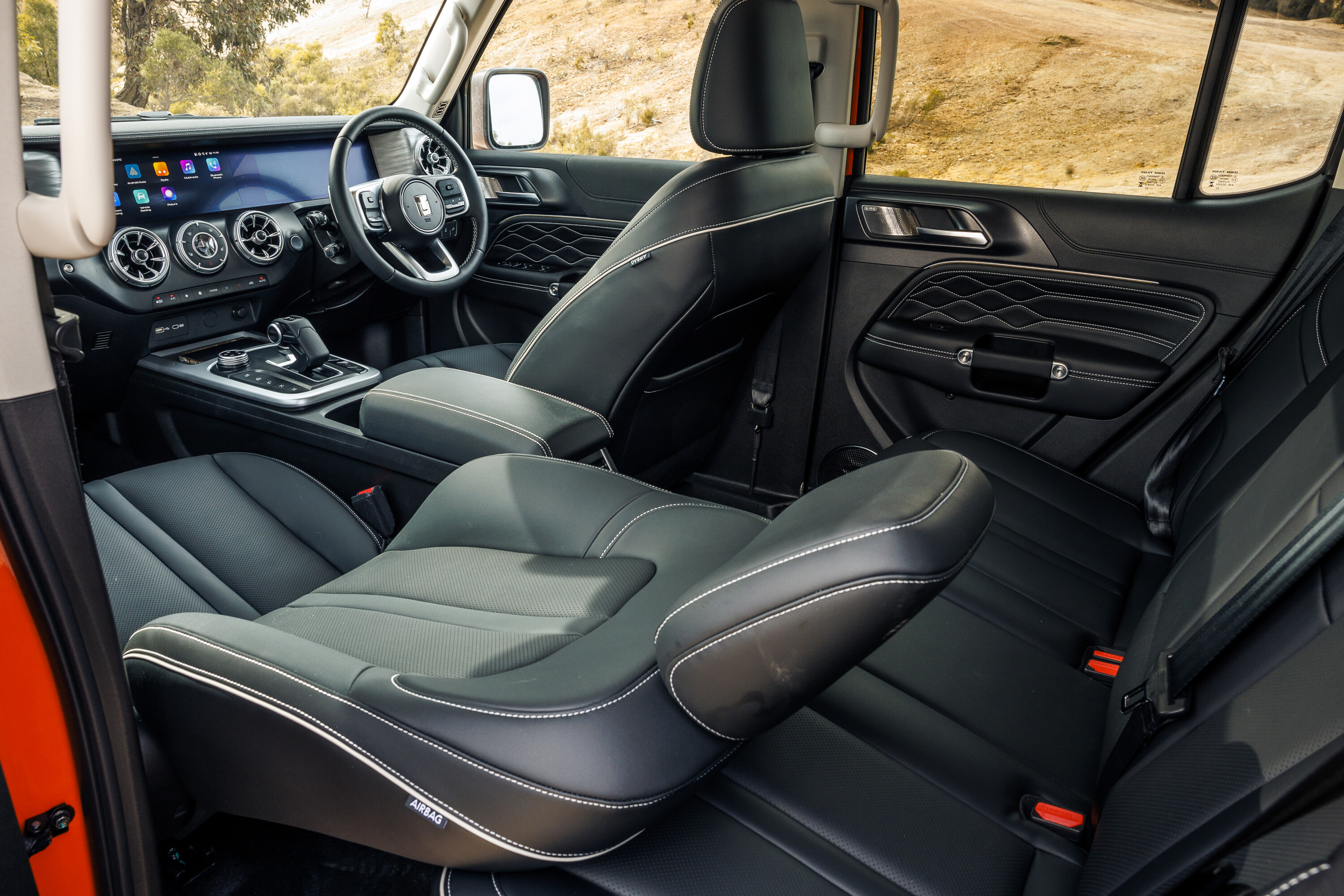
Not only are you buying Wrangler Chic, but the Tank 300 boasts the second-cheapest purchase price on test.
You can use even less fuel by moving up to the hybrid variant, though there isn’t much point stepping beyond the well-equipped Lux when it comes to interior presentation.
6
Stopping the GWM from taking a higher place was a weak residual – though it’s better than the Rexton and Pajero Sport.
It is worth noting that the GWM Tank 300 is one of the less well-equipped options here for long-range touring and towing. It’s only certified to lug a 2500kg load and its 397kg payload is far from best-in-class.
MORE
Everything GWM
1
Other recommendations
The LDV D90 is only $1593 dearer over three years than the GWM Tank 300 and it has seven seats.
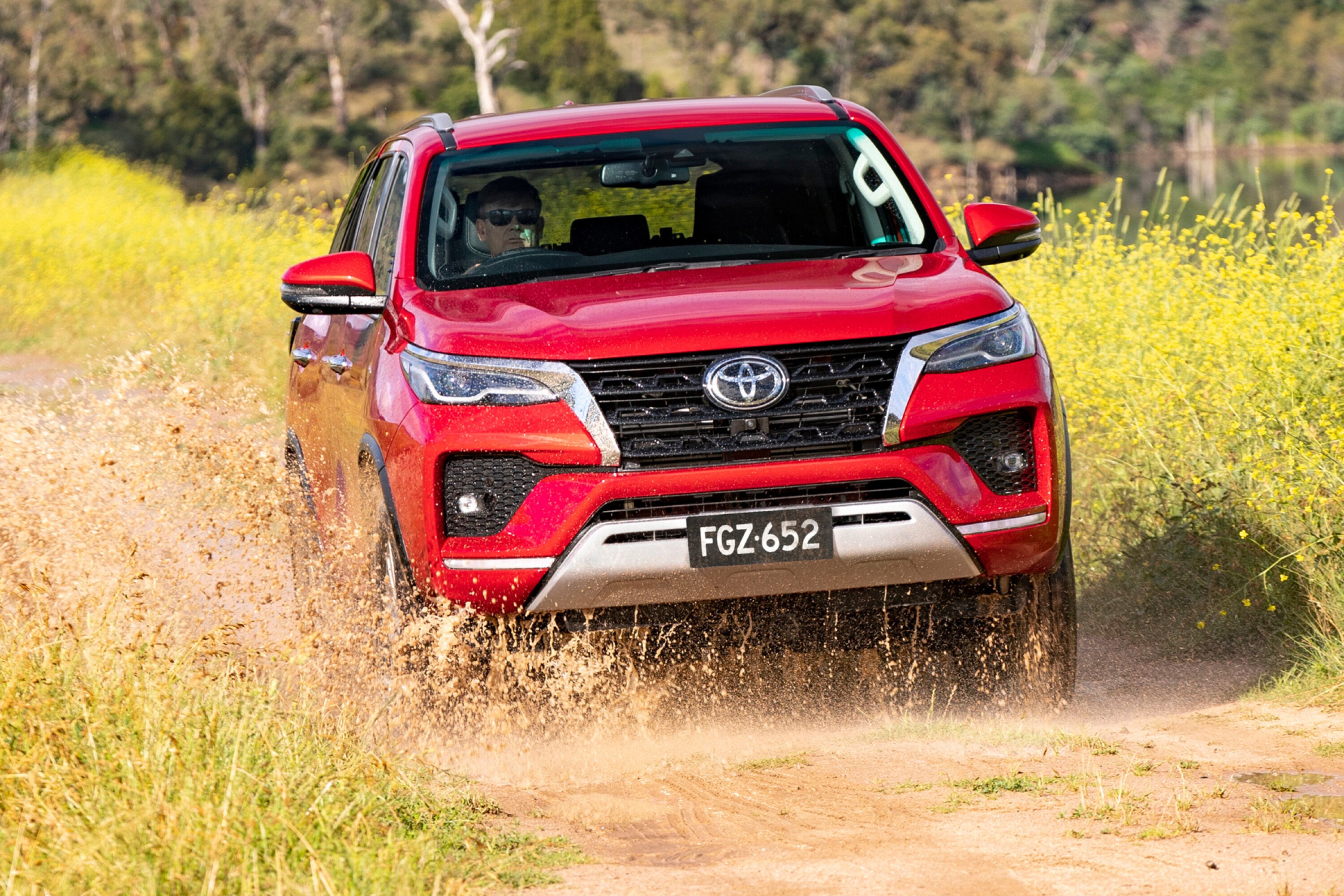
It remains hard to go wrong with a Toyota. The Fortuner may only be fifth but you know that 2.8-litre turbo-diesel will be a reliable companion for many years to come with plentiful parts supply if anything does go awry.
Finally, for those not looking to tow heavy loads or go hardcore off-roading, a monocoque road-focused large SUV may be a better value option – click here to see the best value family-oriented SUVs.
1
Ownership costs
Note: scroll across table to reveal full results
| RANK | Vehicle | Total 3yr ownership cost | Purchase price (including on-road costs) | Purchase price (including on-road costs for 2067) | Redbook 3yr resale | Depreciation cost after 3yrs | Servicing intervals | 3yr servicing costs | Combined fuel consumption | Fuel bills 1yr/3yr | Insurance premium 1yr/3yr |
|---|---|---|---|---|---|---|---|---|---|---|---|
| 1 | Isuzu MU-X LS-M 4×4 | $28,820.99 | $54,900.00 | $59,475.00 | 70.30% | $17,664.08 | 12 months/15,000km | $1545 | 8.3L/100km (D) | $2008.60 / $6025.80 | $1195.37 / $3586.11 |
| 2 | Ford Everest Ambiente 4WD | $31,013.06 | $58,290.00 | $64,714.00 | 68.00% | $20,708.48 | 12 months/15,000km*** | $900 | 7.2L/100km (D) | $1742.40 / $5227.20 | $1392.46 / $4177.38 |
| 3 | GWM Tank 300 Lux | $32,442.58 | $46,990.00 | $46,990.00 | 56.80% | $20,299.68 | 12 months/15,000km* | $1150 | 9.5L/100km (91) | $2299.00 / $6897.00 | $1365.3 / $4095.90 |
| 4 | LDV D90 Executive 4WD | $34,035.02 | $45,990.00 | $46,832.00 | 58.50% | $19,435.28 | 12 months/15,000km** | $1500 | 10.9L/100km (95) | $2769.69 / $8309.07 | $1596.89 / $4790.67 |
| 5 | Toyota Fortuner GX | $34,616.12 | $49,695.00 | $58,610.00 | 60.30% | $23,268.17 | 6 months/10,000km | $1740 | 7.7L/100km (D) | $1863.40 / $5590.20 | $1339.25 / $4017.75 |
| 6 | Ssangyong Rexton ELX | $36,019.66 | $50,000.00 | $50,000.00 | 51.50% | $24,250.00 | 12 months/15,000km | $1125 | 8.9L/100km (D) | $2153.80 / $6461.40 | $1394.42 / $4183.26 |
| 7 | Mitsubishi Pajero Sport GLX 4WD | $37,234.83 | $49,440.00 | $52,740.00 | 56.50% | $22,941.90 | 12 months/15,000km | $1497 | 8.0L/100km (D) | $1936.00 / $5808.00 | $1229.31 / $3687.93 |
| 8 | Toyota Prado GX | $38,978.88 | $62,830.00 | $68,120.00 | 59.50% | $27,588.60 | 6 months/10,000km | $1740 | 8.0L/100km (D) | $1936.00 / $5808.00 | $1280.76 / $3842.28 |
* First service at 12 months/10,000km
** Service pricing estimated as LDV does not publish capped-price servicing
*** Based on pre-purchased $1200 four-year service pack
1
Specifications
Note: scroll across table to reveal full results
| Specification | GWM Tank 300 Lux | LDV D90 Executive 4WD | Ssangyong Rexton ELX | Mitsubishi Pajero Sport GLX 4WD | Isuzu MU-X LS-M 4×4 | Toyota Fortuner GX | Ford Everest Ambiente 4WD | Toyota Prado GX |
|---|---|---|---|---|---|---|---|---|
| Price (drive-away for 2067) | $46,990.00 | $45,990.00 | $50,000.00 | $49,440.00 | $54,900.00 | $49,695.00 | $58,290.00 | $62,830.00 |
| Engine | 2.0T I4 petrol | 2.0T I4 petrol | 2.2TD I4 | 2.4TD I4 | 3.0TD I4 | 2.8TD I4 | 2.2TTD I4 | 2.8TD I4 |
| Max power | 162kW @ 5500 rpm | 160kW @ 5300 rpm | 148kW @ 3800 rpm | 133kW @ 3500 rpm | 140kW @ 3600 rpm | 150kW @ 3000-3400 rpm | 154kW @ 3750 rpm | 150kW @ 3000-3400 rpm |
| Max torque | 280Nm @ 1800-3600 rpm | 350Nm @ 2500-3500 rpm | 441Nm @ 1600-2600 rpm | 430Nm @ 2500 rpm | 450Nm @ 1600-2600 rpm | 500Nm @ 1600-2800 rpm | 500Nm @ 1750-2000rpm | 500Nm @ 1600-2800 rpm |
| Transmission | 8spd automatic | 6spd automatic | 8spd automatic | 8spd automatic | 6spd automatic | 6spd automatic | 10spd automatic | 6spd automatic |
| Body | 5-door 5-seat SUV, body-on-frame | 5-door 7-seat SUV, body-on-frame | 5-door 7-seat SUV, body-on-frame | 5-door 5-seat SUV, body-on-frame | 5-door 7-seat SUV, body-on-frame | 5-door 7-seat SUV, body-on-frame | 5-door 7-seat SUV, body-on-frame | 5-door 7-seat SUV, body-on-frame |
| Front Suspension | Double wishbone, coil springs | Double wishbone, coil springs | Double wishbone, coil springs | Double wishbone, coil springs | Double wishbone, coil springs | Double wishbone, coil springs | Double wishbone, coil springs | Double wishbone, coil springs |
| Rear suspension | Multi-link, non-ndependent | 5-link independent, coil springs | 5-link independent, coil springs | 3-link independent, coil springs | Multi-link, coil springs | 5-link independent, coil springs | Live axle with coils and Watts link | 4-link independent, coil springs |
| Weight | 2155kg | 2285kg | 2130kg | 2145kg | 2135kg | 2175kg | 2369kg | 2285kg |
| GVM | 2552kg | 2960kg | 2960kg | 2775kg | 2800kg | 2800kg | 3100kg | 2990kg |
| GCM | 5052kg | 4960kg | 6460kg | 5565kg | 5900kg | 5900kg | 6250kg | 5990kg |
| Payload | 397kg | 630kg | 830kg | 630kg | 665kg | 625kg | 731kg | 705kg |
| Towing capacity | 2500kg | 2000kg | 3500kg | 3100kg | 3500kg | 3100kg | 3500kg | 3000kg |
| Seats | 5 | 7 | 7 | 5 | 7 | 7 | 7 | 7 |
| Fuel / tank | 91 / 75L | 91 / 75L | Diesel / 70L | Diesel / 68L | Diesel / 80L | Diesel / 80L | Diesel / 80L | Diesel / 150L |
| Fuel use (ADR) | 9.5L/100km | 10.9L/100km | 8.7L/100km | 8L/100km | 8.3L/100km | 7.6L/100km | 7.2L/100km | 7.9L/100km |
2023 Best Large SUV series
Looking to get into a brand-new large SUV? Our stories below will guide you to the model that best suits your needs!
- GUIDE: Best Large SUVs
- 2023 Best Large SUV: Overall Winner
- Best Large SUV under $50K
- Best Large SUV under $60K
- Best Large SUV under $80K
- Best Value Large SUV
- Best Off-Road Large SUV under $ 70K
- Best Large Luxury SUV
- Best Large Hybrid SUV
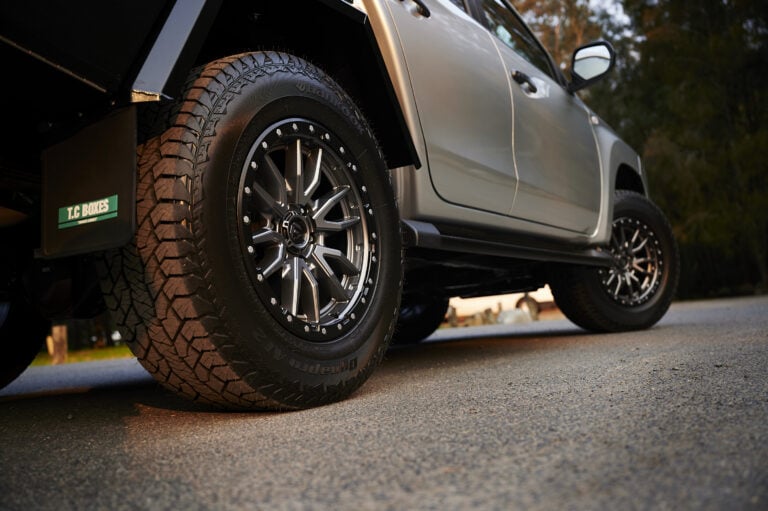
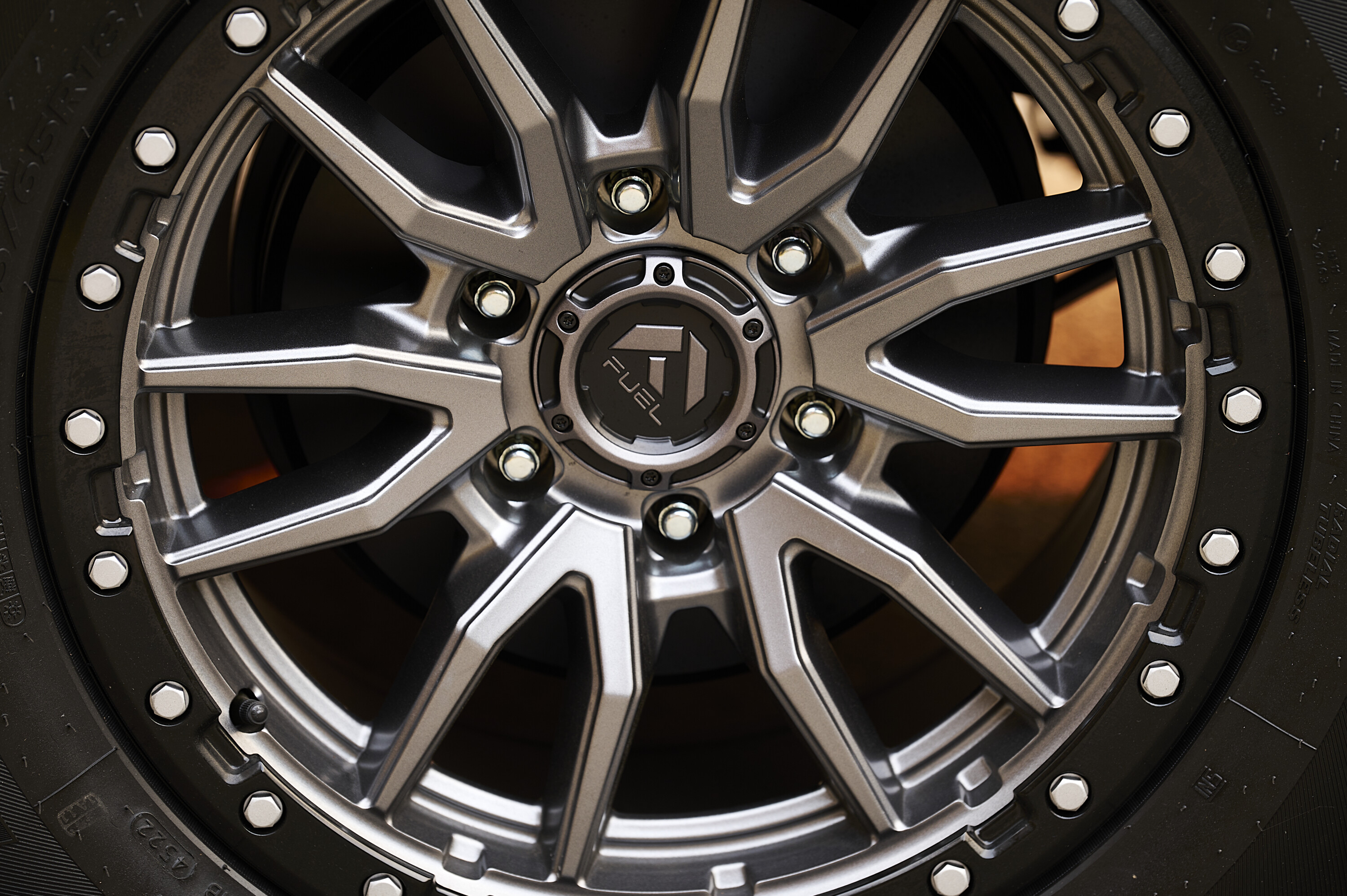
These Fuel Rebel wheels have added a tough yet stylish touch to our Triton work ute.
Crafted with cutting-edge engineering and featuring one-piece cast construction, the Fuel Rebels are manufactured from high-quality cast aluminium, ensuring strength and lightweight properties.
According to Fuel, the one-piece cast construction offers maximum stiffness and weight minimisation, which maximises durability and performance.
-
Dometic CoolMatic CRX 50 upright fridge
-
Cel-Fi GO mobile booster
-
MSA 4×4 towing mirrors
-
Projecta power management
-
Narva LED lights
-
Pedders GVM and brake upgrade
-
Maxtrax recovery kit
-
PIAK nudge bar
-
Hayman Reese X-Bar
-
Rola MKIII Titan Tray
-
TruFit 3D mats
-
Fuel Rebel wheels
-
Hankook Dynapro AT2 tyres
-
TC Boxes tray and toolbox
1
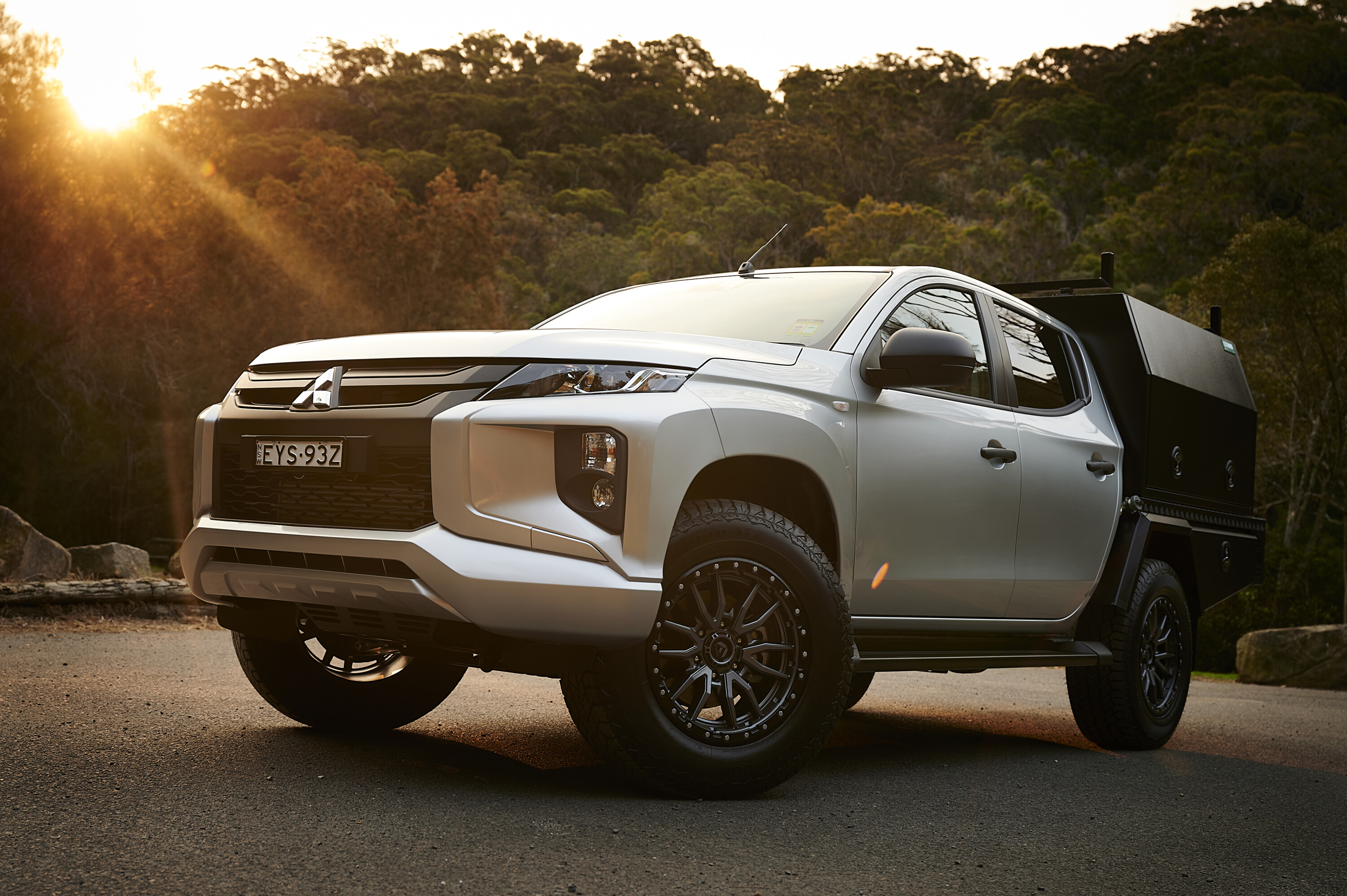
Our Triton work ute will no doubt be expected to carry heavy loads, whether that’s tools and hardware during the week or camping and recreational gear on the weekends, so it’s important it’s fitted with a set of wheels that can handle the load. The Fuel Rebels are no doubt up to the job at hand.
Of course, the other priority when selecting a new set of wheels for your rig is how they look, and we reckon these Fuel Rebels are top-notch in the looks department. They feature a covered lug centre cap that adds to the sleek and finished look, further enhancing their visual appeal, while a smooth-lip design contributes to the overall aesthetics.
1
The Fuel Rebel is available in a wide range of sizes and lug patterns to suit most popular 4×4 vehicles. The Rebel comes in 17-inch, 18-inch, 20-inch and 22-inch diameters, while there are five-, six- and eight-lug options as well as various offsets.
With the Fuel Rebels fitted, wrapped in a new set of Hankook Dynapro AT2s, the Triton is really starting to come to life
Fuel says the Rebel is one of the most popular wheels in its extensive line-up of off-road wheels, and this particular model is available in three finish options: Matte Black with Black Ring, Anthracite with Black Ring, and Bronze with Black Ring.
With the Fuel Rebels fitted, wrapped in a new set of Hankook Dynapro AT2s, the Triton is really starting to come to life, and we are well on our way to achieving our goal of transforming it from a basic 4×4 ute into something anyone would be proud to drive, either on the road or off it.
For those who own older 4WDs that predate LED technology, this new range of LED headlamp globes from Narva will change your driving experience for the better, with a major increase in light output and brightness.
With the same dimensions as halogen globes, the Surefit GEN II LED globes are designed to be an easy and hassle-free replacement, something DIYers will love.
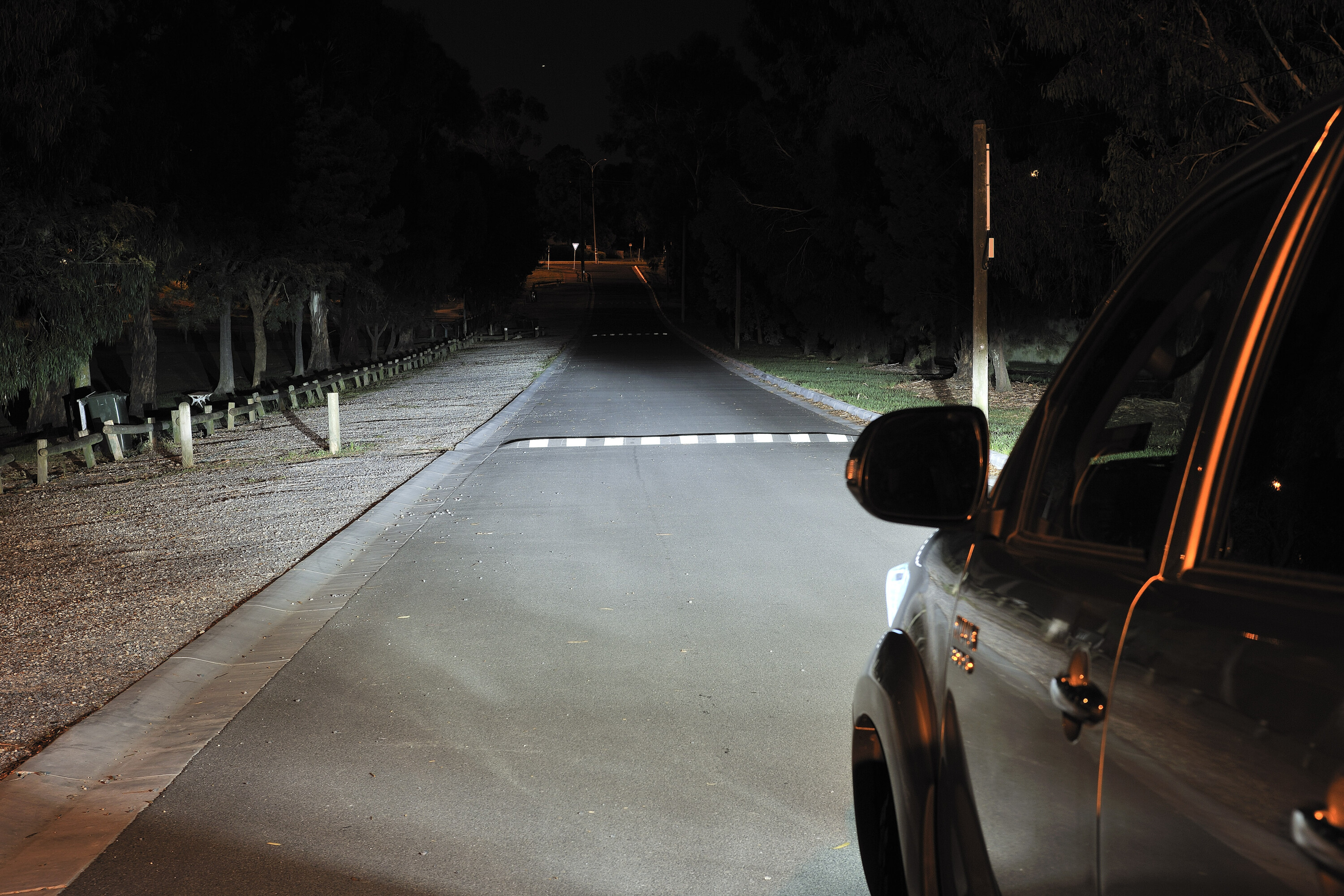
These globes offer an extraordinary 5000 lumens (per pair) of crisp white light at 5700°K, which closely resembles daylight and reduces eye fatigue. This is something important to those who drive long distances at night.
“A key feature of these new globes is their identical size to traditional halogen counterparts, ensuring a seamless fit in nearly any vehicle,” said James Pearson, Senior Brand Manager at Narva.
1
Another feature of the Surefit GEN II globe is its precise beam cut-off when using a low beam, as it directs the light on the road where it is most needed, reducing stray, wasted light. When the high beam is activated, the globes provide an increased beam width and distance combined with an extremely even pattern.
Surefit GEN II LED globes also excel in their longevity and reliability. The globes feature a reinforced housing with no filament and are fitted with low-draw LEDs which produce less heat than halogens. An in-built IP65-rated fan also assists cooling, and together this delivers an operational life that is up to 25 times higher than halogen equivalents.
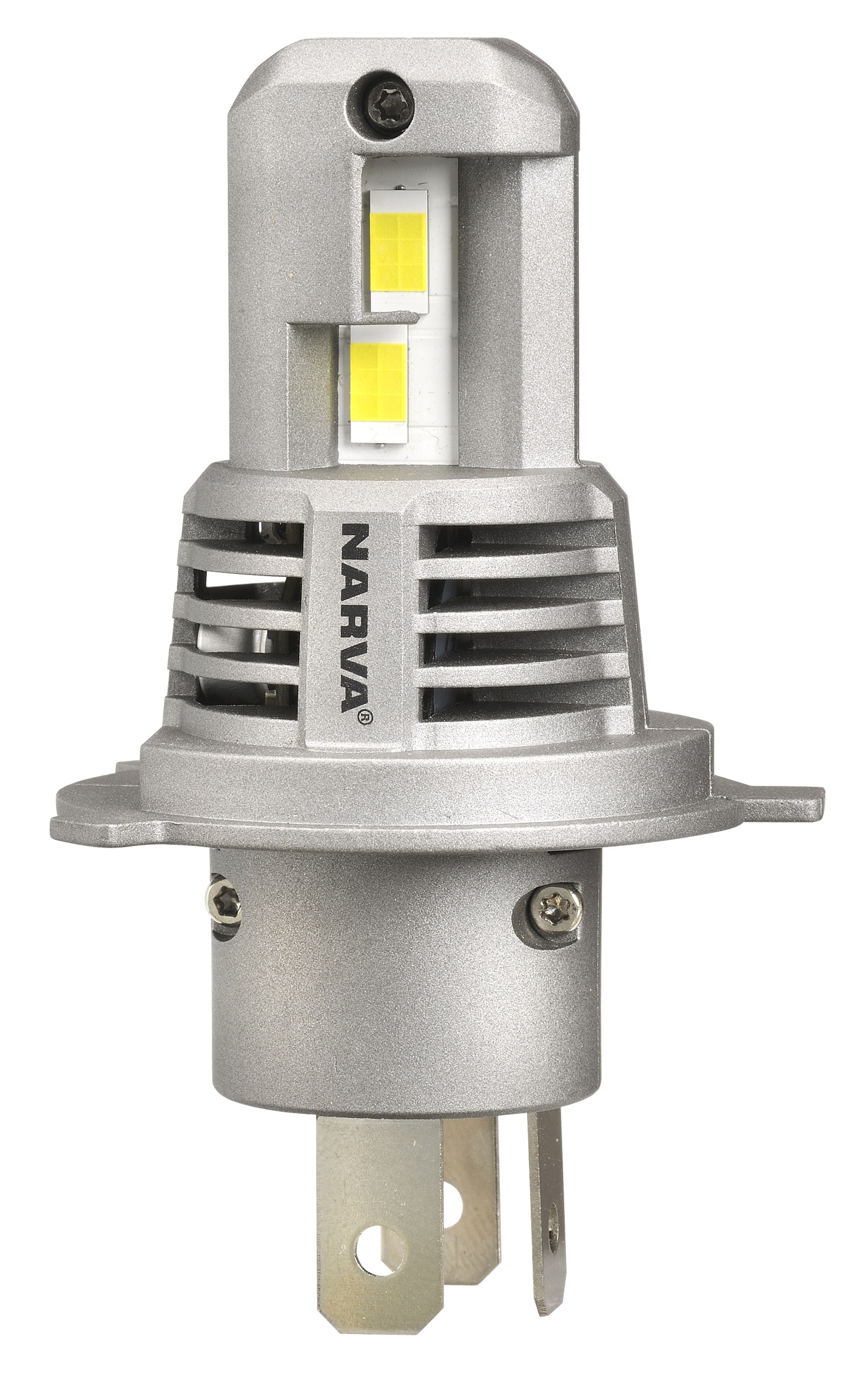
2
“Surefit GEN II outshines GEN I with a 20 per cent boost, making it 200 per cent brighter than halogen bulbs. High-power LEDs and an IP65-rated fan work together for superior performance. This fan sets Surefit GEN II apart from competitors, outperforming globes with extra heat sinks and drivers,” added Pearson.
The Surefit GEN II LED globes are suitable for many 4WD models and are available in a range of fitments: H4, H7, H8/9/11 and HB3 for standard headlights and H7 for projector-style headlights.
They retail for $129 per set and are backed by a three-year warranty. They are also EMC-approved, ensuring no radio interference when in operation. The globes are available from leading automotive, 4WD and transportation outlets nationwide.