When the weather warms up, it’s time for friends and family to gather around the barbecue and enjoy good company and food. A good friend makes this salad for such occasions, and not only does it look fabulous, but it’s also easy to make and tastes great.
INGREDIENTS
- ½ lettuce – washed and shredded
- 2 cups frozen peas (or if using a packet of dehydrated peas, cook and cool)
- 1 or 2 carrots – grated
- 2 or 3 hard boiled eggs – mashed lightly with a fork or thinly sliced
- 1 cup mushrooms – thinly sliced
- ½ cup grated cheese
- 1 cup mayonnaise and/or plain Greek yoghurt
- 2 tsp sour cream
- 2 tsp French mustard
- 1 tbs lemon juice
- 6 spring onions – thinly sliced
- 1-2 tomatoes – sliced or cut into wedges (or use cherry or roma tomatoes)
- 4 rashers of bacon – sliced/chopped and sautéed until crispy (can also use sliced ham)
- 1 tbs fresh parsley – chopped
- Get everything together and prepared before you start layering. Ingredient quantities can vary, depending on how many you’re feeding. This amount will serve a large group.
- Using a large bowl (if at home, use a glass one), place the lettuce evenly in the bottom of the dish.
- Arrange the following, layer upon layer: uncooked frozen peas, carrots, eggs, mushrooms and cheese.
- Combine the mayonnaise/yoghurt, sour cream, mustard, lemon juice and spring onions and mix until combined. Spread this mixture evenly over the cheese (it’s easier if you dollop spoonfuls over the cheese as close together as you can and then gently spread it out).
- Arrange the tomatoes over the mayo mix, than sprinkle over the bacon and parsley to finish.
- Refrigerate for at least an hour, and then serve.
You can mix up the layers before you add the mayo mix however you like. Also add whatever vegetables you like and substitute vegetables out that you don’t. Corn, snow peas and sliced radish mix well.
For more recipes: Check out Ron & Viv Moon’s website or follow their Facebook page.
VALE
I’d like to dedicate this salad to our very good friend, and Maz’s partner, Big Pete Dwyer, who passed away suddenly in September 2014. He was well known and respected throughout the four-wheel drive industry and Vic 4WD clubs, and he will be very sadly missed. He really enjoyed this salad and thought it looked great.
IT’S getting pretty rare these days to see a four-wheel drive without some kind of LED lighting on board.
The advantages over conventional filament lighting are many and start with low current draw and extend to light weight, compact/flexible designs, toughness, dustproof/waterproof construction and, increasingly, good lighting performance. Not for nothing did the trucking industry adopt LED technology some 20 years ago.
The catch is that a lot of the LED lights you see hanging off bullbars and roof racks these days amount to not much more than flood beam work-light stuff. The sort of thing you’d see on the back of a tractor or lighting up the forecourt of a wrecking yard to deter souvenir hunters.
Oh sure, those units send out plenty of light, but the beam tends to be scattered, lighting up the trees above and the paddocks to each side rather than just the road and its immediate surroundings. And, in an outright sense, those units can’t begin to match the beam penetration of a good set of conventional driving lights.
The solution is to get hold of an LED driving light that’s been designed for that purpose. You’ll still pick up all the benefits, but you’ll also be getting a light that sends its beam where you need it to be for driving in the bush after dark. Hella has a couple of likely suspects on the market, starting with a model called the 350 and now a new, bigger version called the Light Bar 470.
The 470 measures 528mm across and houses 16 automotive-specific LEDs. It weighs in at less than a kilo and draws 35 watts. There are also two variations on the 470 theme: a model that approximates a beefed-up high-beam pattern, and another with what amounts to the old-fashioned pencil-beam stuff.
We stuck a pair of 470s on our 80 Series (one high beam, one pencil) and headed out into the bush to see what happened. For a start, mounting them is pretty simple and you can get away with bolting them straight on to a bumper bar or whatever you like. However, I elected to make up a plate for each unit to sit on, to relieve any stresses across the body of the light.
I’m sure it was unnecessary, but I tend to go into overkill on this stuff. If nothing else, it gives a nice flat surface for the included mounting brackets to sit on. Don’t be tempted to do without a relay just because they’re LEDs either, as 35 watts is still a fair bit of current.
Parking the vehicle against a wall to aim the lights, it becomes immediately obvious these aren’t flood-beam work lights. Both the high beam and pencil beam have distinct, sharply focused beam patterns. The upshot of that is that the light is being concentrated where you want it and there’s much less distracting peripheral illumination and light-scatter.
Around town the lights are powerful enough to create glare from reflective road signs and, in built-up areas, you may want to isolate the Hellas and rely on the car’s standard lights. But out in the bush these things tear a hole in the night. A Cruiser with a 1HZ was never much of a bet to be able to outrun its headlights, but now there’s absolutely no chance.
RATED
Available from: www.sparesbox.com.au RRP: $504 per light WE SAY: A fine-performing LED driving light. Hella quality product.
For the past decade or so, dual-cab utes have been smashing it with Aussie buyers.
Many utes roll straight from the boats to the outback as mining and farming rigs. But there has also been an increasing number of private buyers unfurling fat wads of cash to get their hands on their idea of the perfect touring, towing or family rig. New or second-hand, a dual-cab ute has become the vehicle of choice for many of us who enjoy weekend camping or long-term travelling.
And it’s not just the traditional appeals of low pricing, relative simplicity and toughness that make utes a dollars-and-sense choice for touring. Utes are now better built, better equipped and more capable off-road than ever. With leaps and bounds in off-road performance thanks to traction control and ever-more responsive engines and drivelines, most are a no-compromise alternative to traditional wagons – that long, wide, deep tub behind the passenger compartment is the perfect platform for a top tourer.
When setting up a bush/outback tourer, most of the same guidelines apply for any vehicle, whether it’s a wagon or ute. For equipment such as upgraded wheels and tyres, frontal and underbody protection, and suspension, there is a stack of Aussie aftermarket brands offering complete catalogues of equipment, from nose to tail. So let’s get down to the nitty-gritty.
TAKE COVER With a bare tub in your straight-off-the-showroom-floor ute, you have ultimate freedom in equipment selection. There’s nothing to stop you throwing a swag, water drum, cup, plate, fork and tucker box in to the back of your ute to head bush – and many experienced travellers choose to travel light. But with the range of equipment on offer, you can have a little more comfort and convenience.
One of the first considerations – sometimes even before you’ve received the keys to your brand-new ute – is the choice of a tub liner, canopy, hard lid, or racking. Your choice here will be determined largely by how you will use your ute, in what conditions and over what terrain. If your idea of fun is lugging a couple of dirt bikes into a state forest every second weekend, you’ll want things set up differently to someone who intends to use their ute as a work rig all year before the annual desert trek holiday.
Hard lids have their applications, but a canopy is generally a more popular choice for touring. Canopies provide weather protection and basic security for your equipment. Dual-cab ute passenger compartments are usually more dust-proof than those of wagons – wagon tailgates are notorious for letting in dust – but the load area of a ute isn’t dust-proof, even with a canopy attached. Being separate from the cabin, it’s not pressurised, and the tailgate is missing the rubber seal of a wagon. These days, there are several aftermarket suppliers of dust-seal kits that will reduce or eliminate dust entry.
Canopies are available in steel or composite construction (generally colour-matched to the vehicle) and can be fitted with fixed, sliding or lift-up windows. Sliding windows can be fitted with security mesh to allow a breeze in when the vehicle is unattended; lift-up windows offer easier access for loading, especially to the forward section of the load area.
Tub liners are a great idea for a work truck – or for those sometimes grubby hobbies such as motorbike riding – but they can make installing touring hardware, such as drawers, fridges and water tanks, a little more difficult than with a standard steel tub. Most new-vehicle dealers will offer an optional tub liner for protection and, of course, there are aftermarket ones, too.
Moulded liners need to be installed before a canopy, but paint- or spray-on polyurethane protection – another smart choice for a working truck – can be applied later. Marine or other industrial-grade carpet can be installed, too.
POWER TO THE PEOPLE There aren’t too many of us who travel without a fridge and camp lighting these days, so having 12V power available in your vehicle’s tub – which is also often the kitchen area when you’re travelling – is usually a priority. Power supply requirements should be considered early in the vehicle’s build, before routing of wiring becomes difficult due to the fitting of a tub liner or canopy.
Because of restricted engine bay space, some vehicles need the second battery (for operating a power-hungry fridge overnight) mounted in the load area. Batteries, in general, last longer when they are kept cooler, and some battery types do not cope at all with the high heat of an engine bay. Most present-model vehicles with variable voltage charging will require supplementary hardware such as a DC-DC charger. The location of this hardware will need to be considered, too.
No matter what the ‘never-had-a-problem’ Facebook experts reckon, the second/dual battery wiring must be protected with circuit breakers or fuses adjacent to all batteries. This will prevent a short circuit (due to accidental wiring damage) from burning your new rig to the ground.
Depending on what accessories you plan to use, there are a wide range of suitable plugs and sockets that can be wired up to fire up your equipment, from old-school ciggy lighter plugs to USB ports for charging electronic equipment.
To make life easier for your second/accessory battery, it’s also a good idea to charge while you are travelling – when your vehicle’s engine and charging system is operating – and not when you get to camp each evening.
WEIGHT OF THE WORLD A roof rack is handy, even if it’s only used to install a side-mounted roll-out awning. Vehicles being set up for longer treks will often have stronger roof racks for carrying a second spare tyre. Once again, the intended use (or the weight it will carry) is an important factor in choosing what you need. It’s important not to exceed the vehicle’s rating or canopy’s rating for weight. Some canopies are built strong enough for a decent roof load – in excess of 100kg – while others are lighter (often a bonus when every kilo counts) but require internal reinforcing bars for heavy roof loads.
Open load-area racks are popular, too. They allow the space above an open tub to be used to carry items such as recovery boards and roof-top tents, while keeping most of the tub free for tools or camping equipment. They don’t have the security and dust-resistance of a canopy, but they provide a gear-carrying alternative, especially for vehicles being set up for weekender-type treks.
Usually integrated into a rear protection and tow/recovery bar, swing-away tyre carriers allow a second and third spare wheel – or extra fuel – to be carried on the vehicle’s rear. This can be convenient when the tyre or fuel is needed (it’s a little lower and easier to access than a roof rack), but keep in mind the spares must be swung clear of the tailgate every time you need something – such as a cool drink or lunch – from the rear of the vehicle.
Installed to the chassis the same way as a towbar, the equipment and accessory weight needs to be taken into consideration for both overall carrying capacity and tow ball download.
DRAWERS AND STORAGE Not long ago, 4WD drawers were the carefully crafted products of specialist vehicle outfitters. But these days, there’s more choice than ever, and it’s possible to buy universal-fit drawers from the local hardware warehouse. There’s also a wide range of materials used in their construction – and a wide range of quality, too.
Some drawer kits are remarkably strong and some are remarkably heavy, even when empty. Something else to think about is the roller-element drawer slides used for some drawers and fridge slides – they may not enjoy the dusty, gritty environment in the rear of a ute.
Some drawer set-ups feature removable boxes that make trip preparation – and use at camp – more manageable. The boxes can be lifted out for easier packing and use away from the vehicle. They’re also a good choice for tradies – put your tools in one set of boxes and camping gear in another. Too easy!
As with most other aspects of vehicle preparation, you get what you pay for – and sometimes you’ll keep paying for what you get!
Remote-area travel can throw life-threatening situations at you if something goes wrong, so when choosing products for your rig, it’s worth getting durable equipment of a decent quality that’s within your budget, rather than packing your vehicle full of shiny junk that you got for a ‘good price’.
THERE ARE a few extra things a 4X4 needs over a passenger car for maintenance and one of those things is regular differential oil changes.
The 4X4 diff not only has a harder time of it because it spins up more in off-road situations, but it is also often dunked into cold water when hot, and cops dusty conditions up close. All of this means that the diff oil can become contaminated and lose some of its lubricating qualities.
Manufacturers vary with their requirements for diff oil changes, but generally speaking they are in the region of 30,000-40,000km intervals. The type of oil used is important too; limited-slip differentials require a friction additive for their oil, which can be bought separately and added when filling the diff, or bought pre-mixed in the bottle with the diff oil.
Most diff oils are also gearbox oil, although it pays to check exactly what the manufacturer specifies and stick with those recommendations.
Changing diff oil is pretty simple. The only problem is differential gears don’t like contaminants, so attempting a diff oil change on a windy day out on the dirt is not a good idea. Also, it can be difficult to pump the fresh oil in if you don’t have an adequate pump – unlike engine oil or transmission oil, you can’t rely on gravity to feed in the new oil. Some prefer a dedicated gasket to seal up the diff hat while most rely on a good quality silicone sealant. The trick here is to not go crazy with the amount of sealant that is applied to the diff hat.
1. Nothing too tricky needed to tackle this job: diff oil, silastic sealant and an oil pump.
2. Remove diff’s 1/4 inch recessed plug. Most have hexagonal bolt-head or rubber plugs.
3. Then remove the half-inch bolts holding the diff hat on.
4. Use a screwdriver to prise the diff hat off as the old silastic is holding it on firmly.
5. Scrape any silastic remnants from the diff hat with a plastic scraper.
6. Put a clean, lint-free cloth in the diff centre so that debris can’t fall in.
7. Remove the old silastic on the diff housing with your plastic scraper.
8. With the bulk of the old silastic removed, clean up the remainder with wax and grease remover.
9. Apply a bead of silastic to the diff hat. The bead mustn’t be too thick or it’ll go everywhere.
10. Refit the diff hat and hand-tighten the bolts. Then torque those bolts up.
11. Add fresh diff oil to the diff to just below the oil filler hole.
12. Refit the diff filler plug and torque it to specification.
BACK in the days of yesteryear the cry of gold would start a ‘rush’ and people, full of hope and anticipation, would head to the new goldfield.
The well-to-do had wagons, carriages and horses, but the poor walked carrying their worldly possessions rolled up in a swag. Others did it even harder and pushed a wheelbarrow with supplies and mining equipment. Legend has it a bloke named Russian Jack pushed a wheelbarrow from the Palmer River in North Queensland to Hall’s Creek in the Kimberley.
The Hodgkinson Goldfields, northwest from Mareeba, became a natural extension of the Palmer and Groganville Goldfields when gold was discovered on the Hodgkinson River in 1874. But it was not only gold but other rich mineral strikes that attracted people looking for a better life; like at Chillagoe, where copper was discovered, mined and smelted from 1899 until 1942.
There were no tracks in the wilderness, let alone roads, but undaunted the pioneer miners carved one as they rushed successive finds. Roadside grog shanties were located on strategic resting places, generally waterholes, while on the field, tent townships were quickly replaced by iron shacks if the find was a rich one.
THE WHEELBARROW WAY THE northeast section of Burke Developmental Road (BDR) dates back to those heady gold days. The section from Mareeba to Chillagoe is known as the Wheelbarrow Way, and it commemorates a time when the nation was finding its foundations and roots. The road is sealed now, though to this day the pioneering spirit still prevails along much of its route. Chillagoe is 215km west of Cairns on the BDR which ends at Kowanyama, with the unsealed Normanton Road section of the BDR entering at Dunbar Station.
The BDR is largely ignored by Cape York Peninsula travellers, but there are five turn-offs that connect to the Peninsula Developmental Road. They offer exciting alternate routes going to the Cape – the road less-travelled. However, these routes are impossible early in the dry season as they traverse mostly lowland country, while the mighty Mitchell River is impossible to cross following the wet season. Check with the Mareeba and Cooktown Shire Councils if travelling before mid-June.
Mareeba is a good place to start your adventure and stock up, and the Mareeba Rodeo Grounds have free camping and ablution blocks. West from Mareeba the Wheelbarrow Way crosses the Great Dividing Range. It’s pretty scenic country, where rich farm fields are surrounded by hills and ranges. Further on is Mutchilba, which has fuel and basic food supplies, and then Dimbulah, a small township with fuel, shops, a hotel and a caravan park.
THE GOLDFIELD TRACK THE Old Cooktown Crossing is located as you swing north on a dirt road from Dimbulah to Hodgkinson Goldfields, where it crosses the Mitchell River at Onkaparinga Station.
Beyond the river, the road turns west to the ruins of Groganville and east to the Mulligan Highway north of Mount Carbine. Karma Waters Station has campsites on the Mitchell River. There is a track from Groganville to Palmerville Station, though last time I was out that way it was closed due to wash-outs, and unless someone starts a new mining operation and brings a dozer in to repair the track it won’t be fixed anytime soon. There are active mines in the area, so keep out and respect the “No Entry” signs.
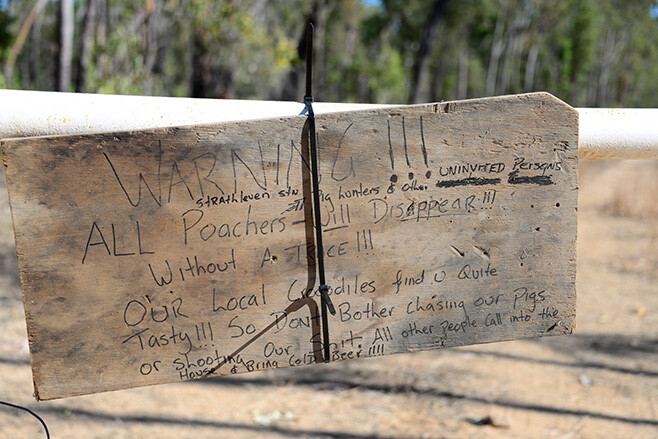
The many tracks that junction with the road are on private land. Several stations have successfully managed to have them closed to the public in an effort to thwart cattle thieves and to keep out vandals and idiots who give us all a bad name. If a track is signposted, turn back and do not proceed unless permission to do so had been given by the right people. A prospector vanished without a trace on Palmerville Station a couple of years back, and the owners were successfully charged with his murder and are in jail. The current operators are also far from friendly to trespassers.
Onkapringa Station has good campsites with grand views of Mount Mulligan, which matches Uluru in size. En route from Dimbulah, pay a visit to Wolfram Camp, and the Thornborough, Kingsborough, Tyrconnell and Mount Mulligan Mines. The Tyrconnel Mine is intact and still has the original gold stamper, and it also has a campground and period cottage accommodation. Up the road is Mount Mulligan, which was once a coal mine that supplied the Queensland Railways and Chillagoe Smelters.
However, Mount Mulligan has a dark past that started on a fine morning on September 19, 1921. It was 9.25am when a cloud of black dust suddenly propelled at tremendous speed from a mine tunnel. A second later a huge shockwave slammed the children and teachers of a nearby school to the ground. Sadly, 74 miners died in that dreadful coal-dust explosion, the third highest death toll of mine disasters in Australia. Every woman in town became an instant widow, and every child an orphan. Pause when passing the Mount Mulligan cemetery, lest we forget the huge toll mining has on its workers.
Still, it’s amazing wild hill country out there and well worth the detour when heading to the Cape. Here you can visualise what the prospectors, miners, and the women and children endured. Life was harsh and unforgiving and there was no law. Claim jumpers were shot, while race wars between the Chinese and Europeans diggers left dozens of people dead. In the bush, the long spears of the Aborigines ruled.
CHILLAGOE WEST of Dimbulah the rich farm fields soon retreat as the road enters hilly country highlighted by tall peaks, valleys and gorges. Emu Creek Station has nice campsites and farther on is Petford, once a railway junction that connected to Irvinebank. Next is the Lappa Junction’s ‘pub with no beer’. Bring your own and sit at the bar in the museum-like galvanised iron pub, drinking in the atmosphere of bygone days when travellers and railway fettlers made it their own.
Ahead is another junction, Almaden. It has a Railway Hotel with beer and a caravan/campground. Locally it is known as Paddy Town, not because of the Irish but the cow paddies that litter the little village. During the dry season cattle are attracted by the green lawns and camp about the perimeter of fenced gardens hoping for a handout.
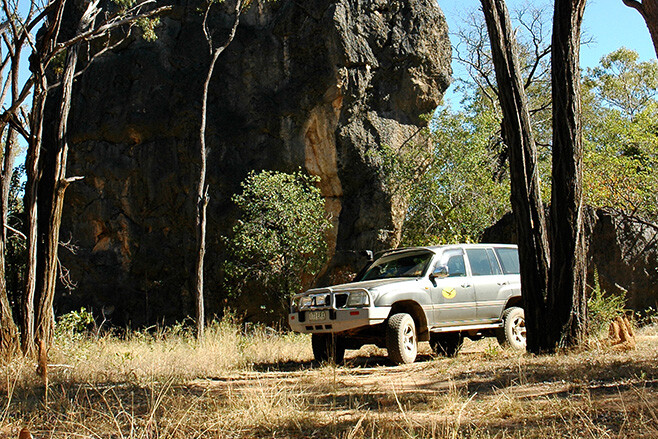
Chillagoe was founded on copper and has a history of being a bust and boom town. It’s currently undergoing a resurrection, with new mining projects underway. Chillagoe is sited at the southern end of a 200km-long limestone belt that starts just south of the town and ends at Musgrave Station to the north. The bulwarks of the limestone escarpments, karsts and spires surround you as you enter Chillagoe. Marble is also mined here, and while the mines appear to be deserted, they operate on markets and contracts.
Chillagoe has most facilities, albeit on a small scale, to cater for its floating 600-odd population. The Chillagoe Roadhouse and Caravan Park has the biggest and best burgers in the business, while the information centre and museum (The Hub) are well worth a visit. Book a tour for National Park and Wildlife conducted cave tours, as the limestone ranges have many grand caverns and tunnels that defy the imagination.
Day tours are conducted by experienced park guides in the Donna, Trezkinn and Royal Arch caves. In the caves you’ll find ancient marine fossils, cave corals, crystals, stalactites and stalagmites, and tiny insectivorous bats and the snakes and frogs that prey on them. You can also do your own cave exploration, provided you have a good pair of shoes and a torch.
The Archways, in the Mungana National Park, is very popular. There’s a picnic table – first come, first served – inside the entrance, which provides a great spot for lunch on a hot day. Some Aboriginal rock art is located near the first karst, and 600m to the west is the historically intriguing Mungana Township cemetery.
Bauhinia Cave near the Donna Cave carpark is better suited for the adventurous, being a tight squeeze to get into before opening up into large chamber. Nearby Pompeii Cave, noted for its roosting insect bats, is also accessed from the carpark.
There are also the amazing and rare panoramic views offered from high vantage points that overlook the maze of limestone ranges and karsts. Don’t miss Balancing and Dome Rocks, or the variety of wildlife – birds, wallaroos, wallabies and reptiles – that surprise at every turn.
NORTH OF THE BDR APART from short sections of bitumen to Mungana, west of Chillagoe, the BDR is maintained dirt road; its condition is dependent on how many road trains are using it at the time. It’s a 400km drive to the Aboriginal community of Kowanyama, which has four campgrounds that cater for visiting anglers and outdoor lovers. The sites must be booked ahead of arrival, and under no circumstances is alcohol permitted.
The country settles into monsoon woodlands after crossing the Walsh River, west of Chillagoe. The landscape near Wrotham Park Station changes to open plains and dispersed woodlands and scrub. A further 14km past the park, the Mount Mulgrave/Palmerville Stations Road turn north to Fairview Station and Laura, via Maytown, on the Peninsula Developmental Road.
It crosses the Mitchell River, one of the largest rivers in northern Australia. The river is a raging, mindless torrent in the wet season that at times washes away the causeways and crossings or covers them with sand, making the river impassable until they are cleared, repaired or replaced.
The next crossing is at Gamboola Station. This road takes you to Fairview or Artemis Stations, via King Junction Station on the Palmer River. Camping is permitted at the Junction with the owner’s permission. Shortly after crossing the Mitchell a road turns west to Koolatah Station, via Drumduff Station, where it junctions with the Dunbar/Artemis/Fairview Stations Road.
All these places and roads may be confusing, but study the Hema Cape York map and it all falls into place. Unlike the PDR, these roads and tracks see little traffic apart from local stations and illegal pig hunters who haunt these roads on long weekends in search of hogs.
The roads are maintained by both the Mareeba and Cook Shire Councils. As mentioned, the Mitchell River can wash away causeways, and sometimes it’s not until mid-June before these station access roads are open to vehicle traffic. It all depends on the duration of the wet season and the amount of flooding rains.
This is cattle country, with wild, open spaces that spread to far horizons, billabongs, swamps, and dry and wet rivers. There is an amazing display of wildlife, which make these alternate routes to the Cape a once-in-a-lifetime adventure. These roads and tracks are not for the meek, as the distances are long, though not difficult. The journey is best undertaken with another vehicle for added security and safety.
Check with both shire councils if tackling any of the above routes after the wet season. Check the distances and carry enough fuel – the last fuel is at Chillagoe and Kowanyama, with much distance between there and Laura and both the Hann River and the Musgrave road houses on the Peninsula Developmental Road.
BDR TO PDR
Route 1: Dimbulah to Mulligan Highway, via Old Cooktown Crossing (107km). Route 2: Wrotham Park Station to Fairview Station (128km). Alternate route from Palmerville Station, Maytown to Laura via Old Coach Road (111km). Permission required from Palmerville Station. Route 3: Gamboola Station to Fairview Station (157km). Alternate route to Artemis Station from Kimba Station junction (143km). Route 4: Gamboola Station to Koolatha Station (185km). Route 5: BPR to PDR, Koolatha Station to Artemis Station (206km).
USEFUL WEBSITES
Mareeba Shire Council Cook Shire Council Ranger-guided cave tours Kowanyama Aboriginal Shire Council
WHEN it came to choosing an engine for the Milo 2 project, I had to think long and hard. I had to do that for the original Milo, too, but the result was pretty different.
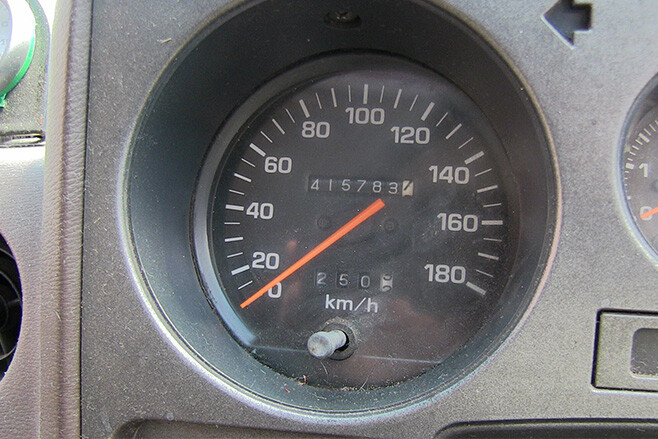
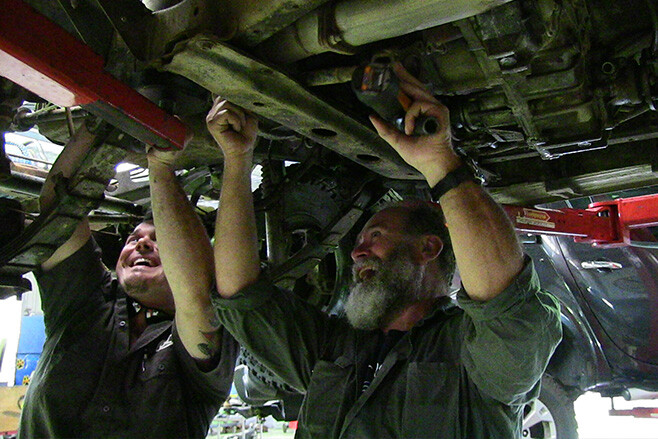
That was 20 years ago. I replaced the original 2F petrol with a 13BT diesel, and that motor, imported ‘grey’ from Japan, has now done more than 800,000km. It supposedly only had 80,000km on it when
I bought it, but there was no way of knowing other than a compression test which showed the cylinders were reasonably consistent as expected. A few years and 200,000km later it blew the rings off two pistons, but it was such a tough little jigger I made it back from Cameron’s Corner by catching the leaking oil and tipping it back in.
Terrain Tamer rebuilt it, Alan and I put it back in, and off we went again. It probably needs some work on the injectors now because it idles a tad rough and likes to blow a bit of smoke until warm but, hey, she’s done more than half a million very rough kilometres.
The best insurance to achieve great mileage out of a machine is to use plenty of good oil and filters. I use Penrite HPR 20W-60 diesel oil (blended here in Australia for our conditions) because nobody does oils better than a specialist company. Combine that with Terrain Tamer filters and I reckon I’ll squeeze a few more miles out of that 13BT before it’s rebuild time.
In order to understand the thought processes behind choosing Milo 2’s donk I need to take you through the same processes involved in choosing Milo 1’s 13BT in the first place. First priority, I needed something that’d make reasonable power, because nothing makes touring days longer than a lack of power. Ask someone who remembers the mighty Toyota H motor… yawn.
The old petrol 2F makes about 100kW and 270Nm on a really good day. It would also chew petrol at about 3.0km/L if you worked it hard, making for a range of 200km per tank – not ideal for a touring machine working in isolated regions. That, as well as needing something that’d run underwater, meant it had to be a diesel. But which diesel?
I’d seen plenty of Chev V8 conversions on Toyotas and, while I love the simplicity and sheer muscle of the big Chevs, I’m not a fan of engine swaps ‘out of the family’. Bunging a diesel V8 into a 40 Series means lengthening the front panels and using adapters on the bell housing – as well as myriad other problems like engine mounts and access to alternators and starter motors. Then if you break down in the middle of nowhere, you’re stuck trying to find that ‘special bit’ that’s not exactly standard.
Here’s another Roothy Lesson learnt early, in this case with a Vauxhall Wyvern on the farm. That Wyvern didn’t make enough power to pull the skin off a pudding, which is why it never broke down. It takes power to break things, ask a drag racer.
So power is nice, but it’s better if it’s gentle. In mining days the most reliable motors we ever had were industrial-type four-cylinder diesels like Perkins J Series motors. Industrial diesels are built tough to work at ten-tenths all day long, with service lives of a half a million kilometres or more.
A bit of mucking around at a wrecking yard and I knew I could swap the old petrol 2H for a 13BT using all Toyota parts, too. The four-speed gearbox would need rebuilding to take the longer input shaft from a 3B and the corresponding bellhousing fitted. Other than that it was just a question of swapping 24-volt truck components for their 12-volt equivalents. There are a few rare Land Cruisers that already run 13BTs, so how hard could it be?
It also required repositioning and welding the engine mounts back into the chassis. So the 13BT won because it ticked all the boxes. In standard turbocharged trim they make 90kW and 217Nm, less than the original 2F but it would only take an intercooler and a jiggle with the turbo to get equivalent power with more than twice the fuel economy.
Fast forward a couple of decades and I’m again looking for a motor to swap Milo 2’s 2F with. Another 13BT would be nice, but Milo’s had some issues: the turbo was almost on the firewall, and industrial direct injection diesels are slightly louder than a heavy metal concert. Ask Editor Matt, (who also owns a 13BT Cruiser), not once have I ever made a successful phone call from Milo while she’s been going.
For years the big debate in Land Cruiser circles has been which Toyota diesel was the best. Many people reckon it’s the 12HT, an almost industrial derivative of the old 2H that’s a whole lot stronger in construction to suit its standard turbocharger. They’re a straight six cylinder push rod engine with direct mechanical injection running a lower compression – all the good things for longevity. They make a genuine 100kW (even with the stock 7psi boost) and more than 300Nm – specifications that are right up there with that Chev V8, but with nothing tricky needed for fitment. They’re also relatively smooth and quiet, especially compared to a 13BT.
Unfortunately they’re rare – mostly fitted to 61 Series Land Cruisers built between 1986 and 1990 – and in demand because lots of people are looking for non-computerised engines. In the end I found and bought the whole Land Cruiser rather than just an engine. That meant getting the upgraded five-speed gearbox and transfer case. No more four speeds for me.
So all we had to do was pluck it and fit it. We got the plucking done anyway thanks to my mate Nick Flannigan. And I’ve got a feeling we might get it rebuilt, too, before bunging it in Milo 2. Like all good oils, it’d be cheap insurance for a long life. See you on the tracks, I hope.
YOU wouldn’t know from looking at it, but the Navara has just been updated.
It’s lost the NP300 badge and it’s copped a suspension tweak. A work-focused SL variant has also been added to the line-up and sits below the ST model.
The SL shuns the bling of higher-spec variants and offers a basic dual-cab on 16-inch steel wheels, yet still uses the higher output 140kW/450Nm twin-turbo incarnation of the 2.3-litre diesel donk – other work-spec Navara 4×4 models use a leaf spring rear and the 120kW/403Nm single turbo engine.
Dual-cab 4×4 payloads range from 941kg for auto ST-X models to 1147kg for manual RX models. Braked towing remains at 3500kg.
We took the newly sprung Nav for a run through the Snowy Mountains at the launch to see if it has benefited from all the fiddling underneath – the good news is, yes it has.
The Navara ST was loaded with 300kg, and we drove it towing around a tonne, as well as with an empty tub. Of course, these weights are nowhere near the claimed limits of the Nissan, but they provided an indication of the improvement.
The biggest improvement by far is the way the ute steers on the road. Front and rear shocks have been stiffened and, importantly, rebound dampening has been revised, resulting in a hell of a lot less wiggle and jiggle on the open road – the rear-end lateral kick of the previous state of tune has been tamed.
We didn’t do a great deal of off-road driving, but indications are that the improved on-road manners has resulted in less wheel articulation, so it doesn’t feel quite as surefooted in the dirt as it used to.
And, as per earlier drives, the Navara’s swooped-up front guards and low seating position still hinder visibility in the bush.
As before, the bi-turbo engine does a good job of feeding usable torque to the wheels without too much fuss, and the seven-speed auto is a slick, relatively intuitive unit.
My pick of the range is the new SL model. It forgoes the bling and offers a practical package that would make a good starting point as an off-road project. It also means you’re not paying for shiny bits that will end up either scratched or in the bin.
The updated Navara may not have shot to the top of the class, but it is much improved on the open road and a more appealing off-road option than before.
WHY THE CHANGE?
There was a lot riding on the 2015 arrival of the Nissan Navara NP300. In a year that saw most of the major players launch a new dual-cab workhorse, the Nissan stood apart with its much-touted coil-sprung rear end. A well-loved name in 4×4 circles as well as the commercial back blocks, many were expecting much of this new iteration of the Navara badge.
It was also common knowledge this ute would be the basis of not only Renault’s ute-based ambitions, but also the platform for Mercedes-Benz’s first foray into the 4×4 ute market.
Unfortunately, as time has shown, the Nissan’s coiled rear end was compromised. The NP300 didn’t handle or ride well when the tray was empty, and when loaded the tailgate had a tendency to plummet to the pavement. It was also launched on a platform of towing ability, and in the real world it didn’t deliver.
The rise of the ‘bloke’s SUV’ has seen increasing demand for these utes to be civilised enough to achieve second-car status with families. Some may have been more forgiving if the Navara was car-like on the road when empty, but trouble was it didn’t do empty or loaded very well.
STILL recovering after a few too many St. Patrick’s Day frothies last week? Then best tuck into some bush damper with an Irish twist.
4X4 Australia’s roving Irishman had added Guinness to the favourite Aussie campsite meal, and the result is… interesting.
Don’t knock it until you try it.
INGREDIENTS
- Self-raising flour
- Salt (a pinch or two)
- Guinness
- Sugar (preferably brown sugar)
- Unsalted butter
- Mix the flour, salt, melted butter and brown sugar in a bowl and make a well in the centre.
- Pour in the Guinness until the mix darkens.
- Knead the dough until it can be easily shaped.
- Grease the camp oven.
- Heat it on the campfire for 20-25 minutes, depending on the amount of heat generated from the coals.
- When cooked, take the damper from the oven and let it sit for 10 minutes.
- Cut good chunks from the damper and spread with butter, golden syrup or jam.
UTES are the tow tugs of choice for many travellers so we’ve grabbed six of Australia’s most popular utes and hitched each of them to a near three-tonne caravan for testing.
This article was originally published in the Utes 2016 issue of 4X4 Australia.
We had most of the heavy-hitters in the 4×4 ute category: the Ford Ranger, Isuzu D-MAX, Mazda BT-50, Mitsubishi Triton, Nissan Navara ST-X and the Toyota Hilux SR5. All were autos (the choice for heavy towing) and all but the BT-50 were dual cabs; Mazda supplied a Freestyle extra cab for this test. Mechanically identical to the dual-cab, the minor weight change will make no difference to the Mazda’s performance.
All the utes here had an after-market electric brake controller except Mazda,which offers a brake controller as an approved accessory.
Unfortunately, missing from the action were two other popular utes: Holden Colorado and Volkswagen Amarok. Holden had no Colorados on fleet with a towbar and electric brake controller and Volkswagen will not fit an EBC (necessary to lug an electric-braked trailer such as our 2.8-tonne caravan) to any of its press/media vehicles due to its global policy of not fitting non-genuine accessories.
Buyers' guides: 4×4 gear

WHAT WE DID
The test route was a varied 200km loop south out of Sydney, with the kays chewed up in city traffic, two-lane highways and freeways. There were plenty of steep climbs and descents, some broken road surfaces and winding secondary roads.
As well as general feel for the road, we performance tested against the clock. We also measured what speed the utes could hold hauling the van uphill and how well engine braking coped heading downhill. Accurate timing was provided by a Drift Box (as used by our colleagues at MOTOR and Wheels magazines for testing new cars) for standing-start and roll-on acceleration times.
Fuel use was also measured. We cruised at a maximum of 100km/h, as required by NSW law when towing with a Gross Combined Mass (GCM) of more than 4500kg. With the test route’s hilly terrain, performance testing and the needs for photography, our fuel consumption should be taken as a worst-case scenario: In other words, you will use far less fuel!
We tested two-up with 160kg of sand in each tray to replicate a typical holiday load. A Hayman-Reese break-away brakes remote battery monitor was plugged into a 12V accessory port to wirelessly monitor the caravan’s on-board break-away battery; again as required by NSW law.
Add-on towing mirrors are either door-mounted (the trucker style mirrors) or mirror-mounted. We used the Ora Rossa mirror-mounted units with Ora’s optional magnetic door-mounted bracing.
Let’s hitch up and go!
FORD RANGER WILDTRAK
The Ranger gets down to business with its equal-best (with the Mazda BT-50) engine power and torque making relatively light work of pulling the van. On the road, the Ranger is one of the more relaxed and quiet tow tugs at a steady cruise, although the inline five lets you know when it is working hard. The six-speed trans seems to have a big ratio gap between the crucial second and third gear change and it takes a while to up-shift after a hill climb levels onto flat terrain.
Using the sport mode makes the Ranger more eager to shift down, but it also holds gears after the extra revs are needed. The manual mode works best, including for engine braking; the transmission has a predictive mode that downshifts when it senses it is necessary (which works well when not towing) but it doesn’t downshift to a low enough gear when there’s something weighty on the towball.
The Ford has the equal-longest wheelbase (again with the BT-50) at 3220mm and shortest rear axle-to-towball stretch of 1330mm to provide a good foundation for stable towing. Also encouraging was the lack of front body rise with the bags of sand on board and the van hitched up; just 10mm. Rear suspension compression was more significant; the biggest droop in the group of 80mm.
The Ford is one of the most stable vehicles here; little affected by crosswinds, large trucks (with their destabilising bow wave of air) or yaw (sway) when changing direction or braking. Body pitching is minimal and the Ranger rode smoothly with the big box on the tail. The Ranger also was quickest accelerating, except in the 50-70km/h increment, where it was matched by the BT-50.
The Ranger’s reversing camera screen incorporates a centre-line marker to help line up the towball, and it works really well. Helping ease sway anxiety is the Ranger’s standard trailer sway control, although we never had the need to rely on its help. Making life easier for those who need to power accessories in their caravan, the Ranger comes standard with a 12-pin plug.
The Ranger’s side mirror casings had a lot of flex in them around the lip where the towing mirrors brackets were secured. This meant the towing mirrors vibrated a lot, making them hard to use at speed however permanent-fit truck-style towing mirrors would of course fix this.
SPECS Engine: 3.2-litre 5cyl turbodiesel Outputs: 147kW at 3000rpm/470Nm at 1500-2750rpm Transmission: Six-speed auto with manual mode Driveline: Part-time 4WD with high/low range Weight: 2137kg Max towing capacity: 750kg (unbraked) 3500kg (braked) Max towball download: 350kg Fuel tank capacity: 80 litres Price as tested: $57,890 (not incl on-road costs)
TOW TEST RESULTS 0-60km/h: 11.2sec 0-80km/h: 19.6sec 50-70km/h: 7.5sec Hillclimb speed (start 100km/h): 73km/h Descent speed (start 80km/h): 89km/h Test average fuel consumption: 20.6L/100km Towing range: (with 50km safety margin) 330km
WHAT WE RECKON The Ranger is a terrific tow rig and it shoulders a load without much fuss. Taking into consideration factors such as acceleration (an important consideration when sharing the road) economy and driver comfort (good for reducing stress levels encountered when towing) the Ranger is the best heavy hauler of this bunch.
MAZDA BT-50 FREESTYLE
With a powertrain and chassis very similar to the Ford (there engine hardware differences) the Mazda offers similar performance as a tow vehicle. Our test Mazda was a Freestyle extended cab, not a dual cab like the others, but this didn’t affect dynamics.
Like the Ranger, the Mazda BT-50 has a 12-pin trailer plug as standard. The Mazda has a rear-view camera display within its rear-vision mirror and, like the Ford, it has a black line marker to assist coupling up a trailer. The BT-50’s side mirrors are an awkward shape for clipping on the towing mirrors but held them tight with very little vibration.
The BT-50 isn’t quite as relaxed as the Ranger when touring, seeming more keen to pick up a lower gear than the Ford. Perhaps this is due to the Mazda’s different engine tuning, which sees it with a narrower torque band than the Ranger. The inline five-cylinder diesel is just as vocal as the Ranger’s when called upon for power or engine braking in the hills.
The BT-50, with an average of 20.88L/100km, was in the middle of the fuel consumption ranking; very close to the Ford. The transmission is less inclined to hold lower gears after the need has passed than the Ranger. Like Ranger, the lower ratios in the six-speed auto are spaced a little too far apart.
Like others, the Mazda’s sport mode doesn’t work so well with such a heavy caravan behind. You need to be more proactive with downshifts for engine braking, in particular. When hill climbing, the Mazda holds onto a taller gear when it would benefit from selecting a lower gear which you have to do manually.
The BT-50 (together with the Ranger) has the longest wheelbase at 3220mm, but its rear axle-to-towball measurement was the second longest, at 1420mm. The front ride height increased just 15mm, while the rear hunkered down by 35mm.
The BT-50 feels rock-solid on the road, with even less pitching than the Ranger and not much sway at all. We had the occasional wriggle as a B-double thundered past, but that was it. The BT-50 has trailer sway control as part of its stability control system but we didn’t have it kick-in.
The BT-50 was one of the better towing performers when asked to dig deep, clocking the fastest zero to 60km/h time, and either equalling or just trailing the Ranger in all other performance measurements. All in all, it’s a stout towing performer.
SPECS Engine: 3.2-litre 5cyl turbodiesel Outputs: 147kW at 3000rpm/470Nm at 1750-2500rpm Transmission: Six-speed auto with Sport and Manual mode Driveline: Part-time 4WD with high/low range Weight: 2005kg Max towing capacity: 750kg (unbraked) 3500kg (braked) Max towball download: 350kg Fuel tank capacity: 80 litres Price as tested: $49,675 (not incl on-road costs)
TOW TEST RESULTS 0-60km/h: 10.9sec 0-80km/h: 19.9sec 50-70km/h: 7.5sec Hillclimb speed (start 100km/h): 75km/h Descent speed (start 80km/h): 87km/h Test average fuel consumption: 20.9L/100km Towing range: (with 50km safety margin) 333km
WHAT WE RECKON The Mazda’s all-round competence when towing is almost a tie with the Ford, so in this competition it’s a solid silver medal. Recent updates to Ranger means it’s moved forward in real-world performance but the Mazda continues to hold a general price advantage. Yep, this is a very sensible tow car purchase
TOYOTA HILUX SR5
The Hilux was a surprise package as a tow tug. It likes a drink and isn’t the fastest of the lot, but it’s a relaxed and comfortable heavy-load hauler.
Trailer sway control is included in the Hilux’s chassis electronics safety armoury and the Toyota Accessory towbar comes with a seven-pin plug to suit most small-to-middling trailers. The reversing camera screen looks the goods with a blue centre line marking the spot where you should line up the coupling. The problem was (like all Toyotas we’ve tested recently with this feature) the line is about 100mm out. The Hilux’s side mirrors might look sexy but it’s awkward to get towing mirrors onto them. Once we got the mirrors on, they are held firm and only shake a little at speed.
On the road, the Hilux is the most relaxed, quiet performer of the bunch when settling into an easy cruise, and is the quickest to get off the mark, although it doesn’t keep up the good work beyond that. Even when heading for the hills and working the 2.8-litre diesel hard, it doesn’t intrude too much with shimmy or sound and remains smooth spinning up around 3500rpm. The only downside is that the Hilux sucks down more distillate than the others here, just pipping the Mitsubishi Triton with a figure of 22.4L/100km.
The Toyota’s six-speed auto has a power mode and a manual mode. It does work better in the Power mode when towing, but benefits from driver’s manual intervention for anticipating steep climbs or descents.
With a 3085mm wheelbase and a 1360mm distance from the axle line to the towball, the Hilux has the on-paper credentials to make a fair go of towing. Body attitude with sand and van at the back was pretty good too, with a 15mm rise at the front and a 45mm drop at the rear.
The Hilux was a team player with a van behind, getting on with the job with a smooth ride, next to no yaw movement and restrained pitching.
Performance is nothing to write home about; it was close to Isuzu’s D-MAX in the acceleration and equalled the Isuzu in its engine braking, toting up an extra 15km/h heading down the steep test hill.
SPECS Engine: 2.8-litre 4cyl turbodiesel Outputs: 130kW at 3400rpm/450Nm at 1600-2400rpm Transmission: Six-speed auto with Power and Manual modes Driveline: Part-time 4WD with high/low range Weight: 2040kg Max towing capacity: 750kg (unbraked) 3200kg (braked) Max towball download: 320kg Fuel tank capacity: 80 litres Price as tested: $55,990 (not incl on-road costs)
TOW TEST RESULTS 0-60km/h: 13.2sec 0-80km/h: 23.7sec 50-70km/h: 8.3sec Hillclimb speed (start 100km/h): 74km/h Descent speed (start 80km/h): 95km/h Test average fuel consumption: 22.4L/100km Towing range: (with 50km safety margin) 307km
WHAT WE RECKON The Toyota Hilux offers a relaxed, comfortable and quiet ride and good towing stability, strengths that can make a big difference on a big trek. But Hilux doesn’t shape up quite as well in performance and economy, which reins-in its overall appeal. In reality, the difference is less than 10 percent, hardly a deal-breaker.
MITSUBISHI TRITON EXCEED
The Triton had the lowest towing capacity here of 3100kg (still an incredible amount to tow behind a vehicle without a special licence!) and was the vehicle that seemed to work the hardest. In the main, it took on its towing duties well, with no unsettling behavior. The Triton has the typical seven-pin set-up on its towbar and a clear, large reversing camera screen but no markers.
The Triton’s mirrors are the power-fold type and are too flexible and weakly sprung to be satisfactory with clip-on mirror use. In fact, in past tests, without the towing mirrors’ magnetic arm supports, both mirrors usually folded-in at speeds beyond 75km/h. With the supports on this time, the mirrors didn’t wilt but the vibration was such that the towing mirrors were shaking too much to be of much use beyond 80km/h.
On the road, the Triton’s 2.4-litre diesel has to work hard to keep the rig on the go in hilly terrain. It was mostly the slowest, and second-thirstiest of the bunch. Also like most of the others, it was noisy while doing so. It was acceptably quiet when cruisingand the transmission (full-time capable; the only one to offer this) was very smooth and subtle in its shifts. Like the others, the Sport mode doesn’t really work aggressively enough when towing such a heavy van, but the Triton has the bonus of having steering-mounted gear-shift paddles, which makes using manual mode easy. Its engine braking put the Triton in the mid-field here.
With the shortest wheelbase (3000mm) and by far the longest axle-to-towball distance (1550mm) on-paper the Triton is not as rock-solid stable as some others. The front rose 20mm with the load on and the rear drop was 65mm. However, the Triton wasn’t significantly affected by passing trucks and felt stable and confident cruising. However, it was the only vehicle here that triggered its Trailer Stability Assist (TSA): While negotiating a series of open 70km/h bends, the yawing motion (which felt rather benign at that speed) set off the TSA twice; probably due to the short wheelbase/long overhang compared to some others.
The body pitched noticeably over undulations (though not as much as the D-MAX) and the ride was quite sharp over bumps. While the Triton is quite quick when unladen, when towing it’s a different matter. When the relatively small displacement 2.4-litre was called on to lug nearly 5000kg, it trailed the field except for the hillclimb, where it just bettered the D-MAX. As a guideline, there’s no substitute for capacity when towing, and the Mitsubishi’s peak torque at a relatively high 2500rpm doesn’t help either.
SPECS Engine: 2.4-litre 4cyl turbodiesel Outputs: 133kW at 3500rpm/430Nm at 2500rpm Transmission: Five-speed auto with manual mode Driveline: Super Select II dual-range with full-time capability Weight: 1875kg Max towing capacity: 750kg (unbraked) 3100kg (braked) Max towball download: 310kg Fuel tank capacity: 75 litres Price as tested: $47,790 (not incl on-road costs)
TOW TEST RESULTS 0-60km/h: 14.9sec 0-80km/h: 27.8sec 50-70km/h: 10.3sec Hillclimb speed (start 100km/h): 69km/h Descent speed (start 80km/h): 91km/h Test average fuel consumption: 22.3L/100km Towing range: (with 50km safety margin) 336km
WHAT WE RECKON The Triton does the job. However, as our no-nonsense test regime demonstrates, it doesn’t quite have the same stout as others in its class. But with a middle-weight van (say, 2000kg laden) this would be a perfectly competent tow tug for an around-Oz trek, the bonus being Mitsubishi’s sharp prices.
NISSAN NAVARA ST-X
The Navara turned out to be a competent mid-fielder for towing heavy stuff, shouldering the load of a big, heavy van and 160kg of sand quite well.
The Navara has a seven-pin plug as standard on its factory accessory towbar. The Nissan has a reversing camera with the screen incorporating a guidance line for coupling-up a trailer. The side mirrors are a tapered design that makes attaching towing mirrors awkward, but once they’re on they shake only a little. The Navara does not have trailer sway control in its stability control software.
On the road, the Navara’s engine is noisy when you dig deep for hills, but it’s very smooth and free-revving with a strong mid-range. The Nissan has the smallest displacement engine here (2298cc) but that doesn’t hurt fuel consumption; it’s the most fuel-efficient tow ute here, with the best touring range.
Helping the engine deliver its best is a seven-speed auto with sport and manual modes. The ratios are relatively tight and the shifts are smooth and decisive. The auto’s adaptive feature works the best of this group, offering quick kick-down shifts when needed and while not perfect, it makes a fair attempt at pegging descent speed with an assertive downshift.
The Nissan has a 3150mm wheelbase and 1350mm axle-to-towball measurement, both indications that it has good basic layout for towing. The front increased 20mm in height and the coil-sprung rear moved 65mm closer to the ground, putting the Navara towards the back of the pack for body attitude when taking on the weights involved here (160kg of sand and 280kg on the towball).
The Navara feels relatively planted on the road, with only a small amount of yawing motion going on when we encountered the bluster of a truck on the freeway. The body’s fore-aft movement is on par with the Mitsubishi Triton, which means that an undulating section of road sets off a pitching motion that, while disconcerting, doesn’t upset steering or chassis dynamics. The Nissan’s performance makes it the exception to the no-substitute-for-cubic-inches rule: it only just trailed the Ranger and BT-50 and was ahead of the D-MAX, Triton and Hilux.
SPECS Engine: 2.3-litre 4cyl turbodiesel Outputs: 140kW at 3750rpm/450Nm at 1500-2500rpm Transmission: Seven-speed auto with Sport and Manual mode Driveline: Part-time 4WD with high/low range Weight: 1921kg Max towing capacity: 750kg (unbraked) 3500kg (braked) Max towball download: 350kg Fuel tank capacity: 80 litres Price as tested: $54,490 (not incl on-road costs)
TOW TEST RESULTS 0-60km/h: 13.0sec 0-80km/h: 22.2sec 50-70km/h: 8.0sec Hillclimb speed (start 100km/h): 72km/h Descent speed (start 80km/h): 90km/h Test average fuel consumption: 18.1L/100km Towing range: (with 50km safety margin) 392km
WHAT WE RECKON We weren’t expecting the Navara’s coil-spring rear suspension (that in other testing has not coped well with a heavy load in the tray) to offer this level of stability. The small engine’s big heart was a surprise, too. Add the ratio-for-all-occasions seven-speed auto and the lightest fuel use here and the Navara is a good all-rounder.
ISUZU D-MAX LS-T
On paper, the D-MAX has the smallest output of this bunch but it does a good job of towing. The side mirrors were the best out of the six utes for securing towing mirrors, with only minor vibration.
The Isuzu doesn’t have trailer-sway control as part of its chassis safety net and it comes with a seven-pin plug standard on its factory-option towbar. The Isuzu’s reversing camera doesn’t incorporate a marker line to assist with lining-up the hitch.
On the road, the D-MAX’s 3.0-litre engine is noisy when revved (which in hilly terrain, it’ll do a lot of) but it remains smooth. Things quieten down significantly at cruise. The transmission ratios are evenly spread in the lower gears, where stepping through the cogs counts for load lugging. Despite the regular need to draw deep into the Isuzu’s power, it was second to only the Nissan Navara in fuel use.
The transmission has a sequential shift manual mode but no sport mode. Instead, in D, it has an adaptive learning function that uses various inputs to better cater for driving style and conditions. Like others here, the transmission is smart enough to change gears in a more predictive manner when it’s dealing with just the vehicle, but doesn’t seem so bright when towing a heavy caravan.
The D-MAX works well in hilly terrain in manual mode, although its engine braking is not that flash compared to the others, the Isuzu sneaking to 95km/h down the test hill. With a 3095mm wheelbase and 1340mm axle-to-towball measurement, the Isuzu has a pretty good platform for towing. The front rose only 10mm with the load and van behind and the rear dropped 35mm over the axle, the least here.
The Isuzu is stable with only a very slight yawing motion when large trucks pass. The Isuzu’s front end pitches significantly over undulations but otherwise the suspension does a good job of smoothing out road wrinkles.
Although it has the lowest quoted peak torque of the six, the Isuzu is in the middle of this group for acceleration. Despite this, off-the-mark it’s the slowest and loses more speed during steep hill climbs than the others.
SPECS Engine: 3.0-litre 4cyl turbodiesel Outputs: 130kW at 3600rpm/380Nm at 1800-2800rpm Transmission: Five-speed auto with manual mode Driveline: Part-time 4WD with high/low range Weight: 1940kg Max towing capacity: 750kg (unbraked) 3500kg (braked) Max towball download: 350kg Fuel tank capacity: 76 litres Price as tested: $53,000 (not incl on-road costs)
TOW TEST RESULTS 0-60km/h: 12.9sec 0-80km/h: 123.0sec 50-70km/h: 8.4sec Hillclimb speed (start 100km/h): 68km/h Descent speed (start 80km/h): 95km/h Test average fuel consumption: 19.0L/100km Towing range: (with 50km safety margin) 350km
WHAT WE RECKON The Isuzu D-MAX is the jack of all trades and master of none here; it has a well-rounded heavy-hauling repertoire with good fuel economy but doesn’t hit the high notes for performance, ride or stability of the others above. Said another way, this is a no-nonsense rig that will do a great job, probably until you’re too old for caravanning.
Can these dual-cab utes tow a 3500kg trailer and 1000kg load in the tub? Find out here
IT DOESN’T take a rocket scientist to realise there’s been a large paradigm shift in Australian motoring.
Where red-blooded young men used to strive for a night hooning around the back streets in an A9X Torana or GT Falcon with their Stubbies-wearing mates, they’re now buying up late-model dual-cabs en masse, donning their board shorts and heading to the beach to experience what Australia really has to offer.
Of course, with the shift in who’s actually buying and driving these 4x4s, the manufacturers themselves have had to drastically change.
Capable no longer cuts it, they need to be comfortable enough for daily duties (including family use) and exciting enough to catch people’s eye. “I had a 2005 Hilux extra cab before this,” Jay Gill, the owner of this adventure machine, told us.
“I had test-driven the new Hilux and the Nissan Navara and had all but settled on the Navara when the old man told me to give the Ranger a try. I loved it straight away and had to have one.”
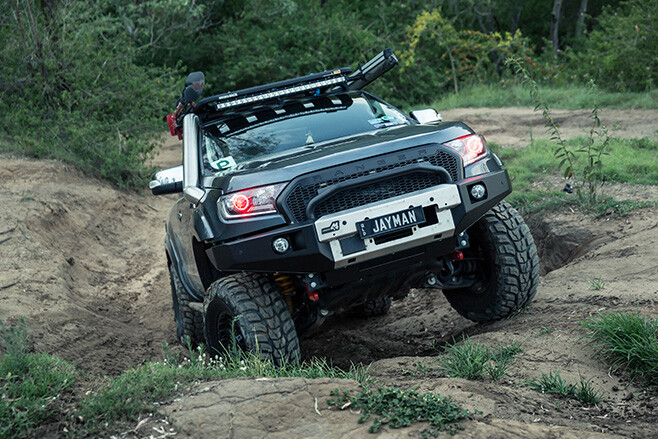
Spending his days between the Gold Coast and Brisbane it’s no surprise Jay has transformed his PXII Ford Ranger into a beach-eating adventure machine. It’s now capable of doing everything he could ask of it, and more. “The main reason I bought it was to tow boats and jet skis,” he said. “I love getting it on the beach as well and am doing a camping trip over to either Fraser Island or Double Island soon, too.”
To get the Ranger ready for its new adventure duties, one of the first modifications was a comprehensive suspension overhaul from the guys at Performance Suspension Racing (PSR) on the Gold Coast.
The team stripped it down to its bare bolts and proceeded to lift it 100mm with a combination of custom-built parts and specially tuned gear. Up front there are PSR-spec Bilstein struts sitting inside King springs; the rear end uses a second set of PSR-spec Bilstein shocks, this time in a remote reservoir flavour for increased performance on corrugations with reduced shock fade. These are teamed up with PSR-spec EFS leaf springs.
Lift kits were relatively simple with old-school vehicles, but with so much geometry to consider they now require a certain finesse. To account for this, Jay’s Ranger runs a set of PSR adjustable upper control arms in the front.
They’re a heavy-duty tube item that prevents fouling on the strut at droop, and with an adjustable ball-joint mount an extended ball joint can accommodate more suspension droop while keeping camber and caster specs in line.
Combined with a weld-in diff drop up front it’s a proven formula for lifting modern IFS 4x4s without introducing problems. To make the most of all the newfound real estate within the standard wheel arches, Jay optioned up for a set of aggressive mud-terrains from Kumho.
The Road Venture KL71s measure in at 305/70R16 and are wrapped around a set of 16x8in Pro Comp 32 Series flat black alloy wheels.
While the 3.2-litre five-cylinder turbo-diesel in Jay’s Ranger is no featherweight in stock form, a little more mumbo under the right foot is always appreciated. Starting from the throat of the intake system, Jay’s replaced the standard in-guard intake with a satin-finish stainless-steel snorkel from Fabulous Fabrications in Rocklea.
From there it feeds down into a PWR stealth black intercooler with the stock rubber intercooler hoses swapped out for Samco silicone units. With additional air available the engine makes the most of it by squeezing in extra fuel with a performance chip from DPChip, before finally expelling the spent gases through a full Fabulous Fabrications stainless-steel exhaust system.
Power is sent to the ground through the stock six-speed manual cog swapper with a factory electronically operated diff lock at the back. Jay told us the combination has netted him a little more than 200hp at the rear wheels, which is more than enough to make the space cab get up and boogie.
With the driveline taken care of Jay set his sights on making the outside as tough as the inside. Starting from the front he’s ditched the chrome XLT grille and replaced it with the ubiquitous blacked-out Raptor-style grille. The stock headlights have been cracked open and a set of Halo-style coloured daytime LED running lights from Dan’s Custom Car Lights have been installed.
Protecting the new gear is a Crawler bar from Uneek4x4, with powder-coated matte black wings on either side and a satin-finished stainless steel centre section to tie in with the XLT’s chrome highlights. Those with a keen eye might notice a large cut-out section on the driver’s side, a handy little trick from Uneek4x4 that allows Jay to protect the front of his Ranger with a stout bullbar without compromising the vehicle’s radar-controlled adaptive cruise control system.
Moving down the sides and the aggressive offset Pro Comp rims have been contained with moulded EGR flares. Rather than drilling through the ’guards like many aftermarket items, the EGR offerings bolt underneath into the stock holes then seal to the guards with adhesive.
To ensure the sides remain dent-free and to provide a platform for accessing the roof, a set of Buds Customs rock sliders have been installed down the flanks – with 6mm-thick mounts and 50×50 RHS construction they’ll hold up to any abuse Jay can throw their way. Up the back the rear quarters have been protected and the stock ground anchor tow bar replaced with an Ironman 4×4 steel rear bar.
On the roof there’s a Rhino platform rack for storing bulky items and providing mounting options for both a high-lift jack as well as a long-handled shovel, both compulsory items when solo travelling. It also houses a passenger-side roll-out awning and 40-inch LED light bar from Ironman 4×4.
Up the back over the space-cab tub is another PSR item, this time in the form of its low-profile Baja Rack. With a 33-inch spare scraping the ground on every washout in the stock location, the Baja Rack gives Jay a mounting platform for it up top. His recovery boards also reside here, helping keep the tray set-up clean and empty for camping gear.
While hardly one of the most modified vehicles you’ll find on these hallowed pages, Jay’s Ranger represents a new outlook Australians have on 4x4ing – no longer the sole domain of families and grey nomads, 4x4ing is alive and well in the youth of today, and they’re not holding back.