
AT a recent 4WD show we had the pleasure of bumping into Jim and Janet Crawford from Top End Campgear.
As we got chatting, we found that Jim had spent 40 years as a long-haul truck driver. Not wanting to spend all his hard-earned on meals at truck stops, he began to carry a tucker box and a gas cooker in the ’70s.
As the years went by, his mobile kitchen evolved from an old army ammunition box to one made of plywood and then of steel. Once he’d settled on his ideal requirements, he generated a stainless steel multipurpose camp kitchen and, on retirement as a truckie, this became the genesis of his Top End Campgear Camp Kitchen.
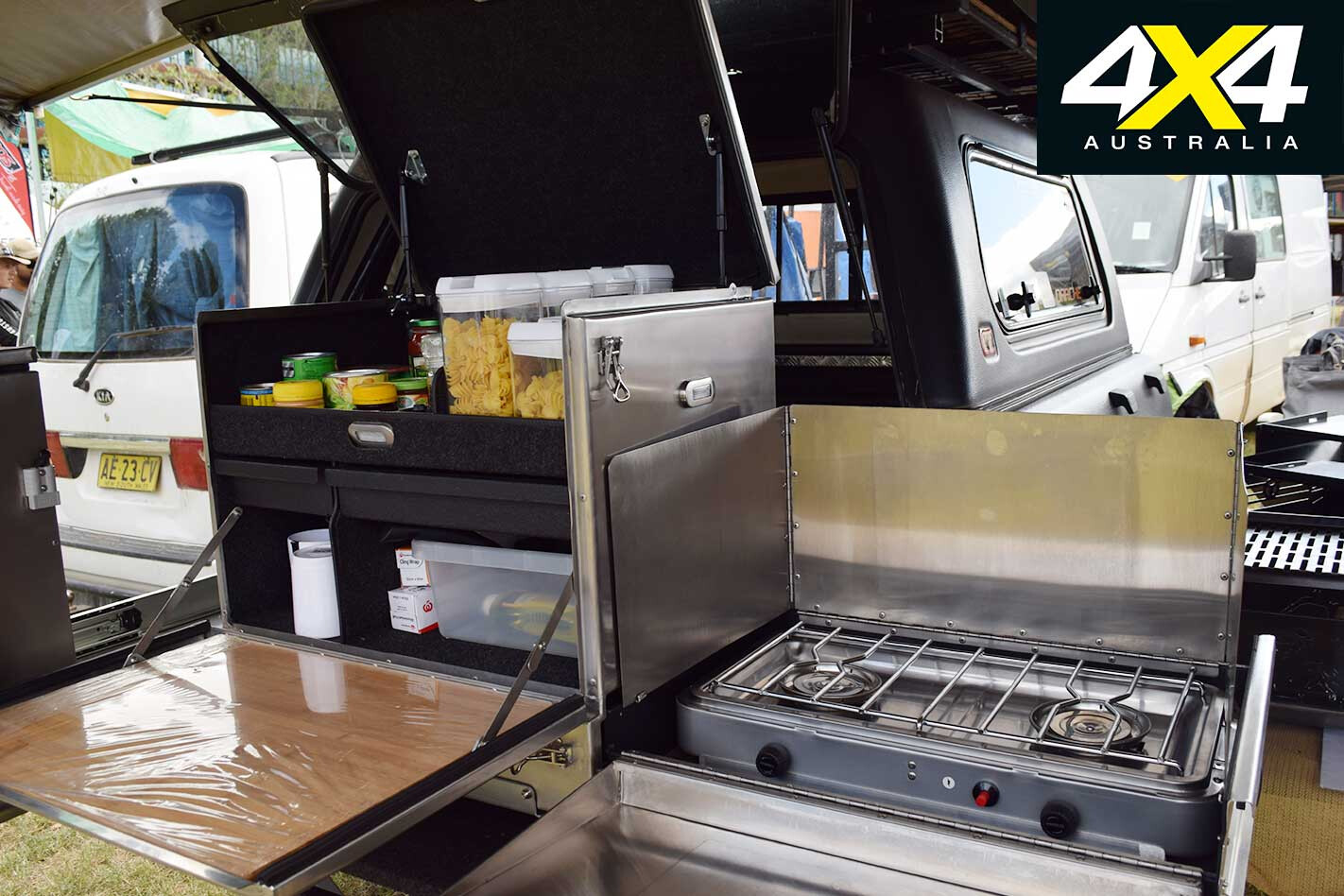
Jim has developed three versions to cater for different rig setups and user requirements: The Longhaul, The Overlander and The Squatter. They have roughly the same interior layout, but vary in height.
The Longhaul is the company’s flagship model. It’s 600mm high x 650mm wide x 520mm deep. It comes standard with a domed lid (a flat lid is optional) which provides 30mm extra height to accommodate taller containers.
This model includes eight canisters (for coffee, sugar, rice, pasta etc.), a washing-up dish, a two-burner gas stove, a bamboo chopping board, and an Anderson plug that feeds the three LED lights. The lights are strategically placed with one over the stove, one over the chopping board and the third on the lid to illuminate the storage area.
The gas stove is fitted to a slide which tucks it away into the base of the unit.
The Overlander and The Squatter kitchens feature a flat lid as standard, though the domed version is optional.
The Overlander measures 500mm high x 650mm wide x 520mm deep. The drop in height is due to the omission of the gas burner. However, it still has a slide that can be used as a prep bench or to place your own stove, but it lacks the Longhaul’s windbreak.
The Squatter measures in at 400mm high x 650mm wide x 520mm deep and suits vertically challenged rigs. Because of its low height, you’d probably want to be sourcing flat-pack, silicon-style bowls.
This model has the same slide as The Overlander for your own cooktop and preparation space. Within all models is a recessed area at the rear of the top storage area, which is suitable for your favourite sauce bottles that are taller than most.
The entire range can operate as standalone items and be taken out when needed. Alternatively, they can be fitted on a slide or pivot. To maximise space there’s an option to purchase a slide drawer for an additional $450.
RATED
Available from: www.topendcampgear.com.au RRP: From $1350-$1950 We Say: Tough, compact and convenient.
AFTER a month spent touring the highways we figured it was about time we took the Patrol off-road, and there’s no better place to do that than the Victorian High Country. But first we figured it needed a better set of tyres and some other extras.
In an alignment of the planets, our search for off-road rubber coincided with Toyo Tyres launching its new Open Country R/T range of tyres.
Toyo’s Open Country R/T combines the best attributes of mud- and all-terrain tyres to deliver the best of both worlds. It has the aggressive looks, tough three-ply carcass and tractive ability of Toyo’s Open Country M/T, and the quiet ride and on-road braking performance of the Open Country A/T; just the thing for our mix of on- and off-road usage.
Five new Toyo R/Ts in a 285/65R18 size were fitted to the Patrol’s standard 18-inch alloy wheels by the guys at Tyrepower Reservoir in Victoria, and the fitters were impressed with the balance of the Toyos straight off the bat.
Tyrepower’s clever balancing machine measures lateral pull of the tyre and wheel, so the four wheels were optimally positioned on the vehicle to suit the camber of our roads. It’s clever stuff that we haven’t seen before, and it’s valuable for four-wheel drives that use heavy wheel-and-tyre combinations.
The Toyo Open Country R/T tyres should be available for purchase in Australia, in a range of popular sizes, by the time you’re reading this.
We hoped to fit a bullbar to the Patrol before the trip, but minor changes to the late-2017 model’s front-end meant none of the major 4×4 outlets had updated their bars to suit. From what we could tell the only real problem is with the parking sensors of the Ti-L, but a bullbar will have to wait for this Patrol.
With nowhere to mount auxiliary lights on the front of the car – and with the good folks from Lightforce supporting our High Country adventure – we elected to go for a light bar on the roof.
The crew at Ironman 4×4 used our car to develop rack mounts for the Y62, and they supplied a 1.8m alloy rack. We also got Ironman to mount one of its updated 2.0 x 2.5m Instant Awnings to the rack, to keep the dew off the swag while camped in the mountains.
The lighter weight of an alloy rack increases the capacity for more cargo, even if it was only used to carry swags, camp chairs and firewood on this trip. The ease of set-up and protection afforded against rain, sleet and dew by the Instant Awning was greatly appreciated as we toured the mountains. Stay tuned for a full review on these.
The Lightforce light bar is a single-row 40-inch unit which was fitted at Ironman 4×4 and wired up by our good mate Phil Cochrane from On Track Automotive in Ferntree Gully. Phil recommends, sells and installs Lightforce gear to his customers every day, so getting this light bar working was a cinch for him.
How did the Patrol and its new accessories fare in the High Country? That full report is coming soon, but the miles spent running around town getting the gear fitted – in addition to the heavy-duty tyres and the gear mounted on the roof – did nothing for the Patrol’s fuel economy. It averaged 17.89L/100km for the month.
4×4 Shed Log: 2017 Nissan Patrol Ti-L Current mileage: 8380km Date acquired: Dec 2017 Price: $88,990 + ORC Mileage this month: 2304km Average fuel consumption: 17.89L/100km
OUR THANKS TO:
Lightforce 40-inch single-row light bar: $899.80 + fitting.
On Track Automotive Light bar wiring, general 4×4 accessories and servicing.
Ironman 4×4 1.8m Cage-Style Alloy rack: $880 + mounts & fitting. Instant Awning 2m by 2.5m: $270.
Toyo Tires Open Country R/T tyres: Price TBC.
Tyrepower Reservoir Tyre fitting and balancing.
THE Nissan Terra, a descendent of the Nissan Patrol, is officially on sale in Asian markets.
The body-on-frame SUV, designed and built in China, runs a Nissan ‘QR25’ gasoline engine, which pumps out 135kW at 6000rpm and 251Nm at 4000rpm (that’s 180 horses).
The Terra features a reinforced ladder-frame chassis, a five-link coil spring rear suspension and rear-wheel axle, and a four-wheel drive diff lock system. Hill Descent Control and Hill Start Assist are standard features. Ground clearance sits at 225mm, while the vehicle measures in at 4882mm long, 1850mm wide and 1835mm tall.
“The Nissan Terra builds on our strong SUV heritage while incorporating the needs of the Asian customer and the performance of our refined frame vehicles,” said Ashwani Gupta, senior vice president for Nissan’s Light Commercial Vehicle Business. “The Terra is a descendant of the Nissan Patrol, our tough off-road icon originally designed for police and military use.
“The Nissan Terra design is tough and practical, reliable for everyday use, while giving our customers the freedom to go anywhere and explore beyond the every day.”
Safety tech includes Lane Departure Warning, Blind Spot Warning, Around View Monitor with Moving Object Detection, and Intelligent Emergency Braking.
The Terra is the first frame-based SUV to be launched under Nissan’s midterm plan: Nissan M.O.V.E to 2022. According to Nissan, the aim of this six-year mid-term plan is to, “achieve sustainable growth and to lead the technology and business evolution of the automotive industry.”
When announced back in February, Tony Mee, Nissan Australia’s Corporate Communications Manager, told us: “This new SUV model is scheduled for initial release in China, and selected Asian markets, and is currently not planned for Australia or New Zealand.”
THE BIGGEST advantage of purchasing complete vehicles to use in any special or oddball project build is that you have access to all the minor, often forgotten, bits and pieces.
More so electrical components as found in the high-tech Maloo R8 ute; the wiring loom is a major must-have item to ensure the electronically managed and driven engine will work in the mechanically operated old Tonner.
Those smaller parts have to be sourced the hard way (via scouring the wreckers or online outlets) and often cost a lot more than having them included in the initial purchase package. So, for me, the easiest and most convenient way was to buy three complete vehicles and pick the parts I needed.
The next biggest advantage is the potential return on the unused and unwanted parts. I’m happy to put my hand up and say that I’m trying to build this Tonner project as cheap as possible. I don’t mind, and expect to pay good money for good parts and labour, but saving a few bucks here and there is kinda nice, too.
At the time of writing, I’ve managed to recoup almost three-quarters of the cost of the Maloo R8.
That means, roughly, the 6.2-litre LS3, auto six-speed cog swapper, wiring loom, seats and seat belts, plus a host of smaller parts, have cost me a mere $3000. Not bad compared to rocking up to a wrecker and laying twice or triple that amount down for just the engine.
As for the GQ, I’ve managed to get almost all my money back by selling the parts off. The 4.2-litre petrol engine and LPG system now reside in a forklift, the doors and front guards have kept other GQs lookin’ pretty, the 33-inch rubber and rims kept another GQ legal on the cheap, some seats were sold off and some are perfect in my kid’s cubby house – priceless!
The main GQ cab was pretty rusty at the top rear corners and might be perfect for anyone wanting to do a dual-cab chop on the cheap, so I’ll hold on to that temporarily.
The GQ chassis is to form the main underbody support for my project, which will ride on GQ diffs and coil suspension. I’ll reuse the tilt-adjustable Patrol steering column, which needs to be grafted into the Holden dash, plus I’ve decided on initially using the GQ disc brakes instead of the Maloo HSV stoppers.
While they are not as large in diameter as the Maloo’s, they are adequate and have been given the nod by my engineer, plus can be easily swapped later for upgraded Nissan units if the ‘want’ should appear.
I’ll admit to not initially knowing the GQ transfer case couldn’t be used in my project, so that caused a small problem. More on that fix in next month’s issue.
So to the GQ sway bars; they had been removed from the 1989 model I purchased, which is often the case for drivers seeking more suspension flex while off-road, and had some head scratching on the best way to fix that problem.
While the easy fix would be to pick up a pair from the wreckers, I wanted more flex than OE units can ever offer. Keeping in mind this whole project must be legally engineered and registered in NSW, I must have sway bars included in the finished package, but don’t really want to be playing around with sway bar disconnects every time I drive off-road.
I left the stripping and parts removal of the Maloo and GQ to Jason and his crew at Total Care 4×4, instead of tackling them myself. While I would have been happy tackling the GQ, I was pretty hesitant in touching the Maloo with all its wiring, not being overly sure what could be tossed or kept.
I felt much safer leaving that to experienced hands and dishing out the dollars to have it done right the first time. Not so with the old Holden One Tonner; I stripped that at home by myself in the side paddock, in the dirt, in the sun, over two long days. I do have air tools, plenty of hand tools and the major help of a rolling gantry with chain block to help lift both the alloy tray and cabin off the chassis.
My plan was to lift the cabin clean of the chassis with as much of the interior intact for use later, and leave the engine, gearbox and all other running gear behind.
I’d been driving the Tonner around for a few months and the whole show was working perfectly when I deregistered and stripped it. I’ll either sell it all in parts or whole, or, hmmm, perhaps a nice hot rod shell might magically drop onto it sometime in the future… Here’s where my plan went a little pear-shaped.
I had no problems with removing the cabin and I didn’t drop it when it was six-foot in the air. I easily lifted the cab over the engine to allow the rolling chassis to be pulled out from underneath with the Troopie’s RUNVA winch. That job was made easier by being able to walk around the car while winching an inch at a time using the wireless remote.
I managed to reverse my 10×6-foot trailer under the dangling cab, only to find the Tonner metal work was a few centimetres wider than the trailer body. My problem-solving 101 sprang into action with a half dozen pieces of hardwood timber from the back of the shed.
Not really knowing how heavy the Tonner cab was and how strong the side panels of my trailer are, I slotted a few timber braces down to the trailer floor to help take the Holden weight without bending my trailer – problem solved in a couple of hours. I figured a handful of old car tyres would be perfect for sitting the Tonner cab on to, to prevent damage during the five-hour transit to Jason’s shop in Sydney.
With the whole show strapped down to half compress the tyres, the stripped Holden didn’t move or get damaged during the drive.
In preparation for a few later jobs from Steve – my auto sparky at Powers Road Auto Electrical Services in Seven Hills, Sydney – I removed the oil and water temperature sensors from the 308 block to allow him to measure the resistance across them, in order to replicate that power drop in the new system that would combine parts of the old with updated wiring for dash-mounted tell-tales (clever, huh?).
He also requested the fuel sender unit from the old Holden petrol tank in preparation for having a larger custom fuel tank manufactured.
Steve was also relied on to solve a few other wiring issues, along with an easy and effective way of installing air-conditioning into my project. It certainly helps when the people you are dealing with are car enthusiasts, or nuts, and that is how Steve came to easily solve the air-con problem, as he had the exact same product in an old street machine he has been playing with.
With the three cars stripped, plenty of research and planning, discussions with the engineer, along with me telling Jason exactly what I wanted to achieve and him telling me what was realistically achievable with respect to engineering without costing a motza, the next stage of building my dream 4×4 went into action immediately.
’Til next month, if you have ideas on things like bullbars, trays, canopies or other whacky ideas, I’m all ears. Keep in mind this will be a capable touring 4×4, albeit with a huge engine, that will double as everyday transport. It won’t be a ballistic competition machine, so forget the ultra-high gangly suspension and 44-inch Boggers suggestions.
AHEAD of the release of Mazda’s “bold, new-look” BT-50 next month, the Japanese company has teased the public with a glimpse of the updated model.
Partnering with the EGR group, Mazda designed and engineered the updated BT-50 on local soil, so it has been specifically designed for Australia and is exclusive to the Oz market.
On sale from May 2018, the update is, according to Mazda, “the second and most significant update since its launch in 2011”.
What this involves will be known in detail later this month, but we do know is the BT-50 has received significant front-end design changes comprising of a more squared-off bumper, the addition of fog light surrounds and a large trapezoidal lower air intake with a skid plate, and a new-look grille with horizontal lines.
“The utility segment is a huge priority in Australia and for Mazda; we’re always looking to improve and enhance our product offering, to remain competitive and appealing to our customers,” said Mazda Australia’s Managing Director, Vinesh Bhindi.
“This upgrade gives the BT-50 a stronger and tougher bearing, which we know Australians look for in a ute,” he said.
Stay tuned to 4x4australia.com.au for a comprehensive write-up.
THE Australian Competition and Consumer Commission (ACCC) has issued a recall for Jeep JK Wranglers and Chrysler LX 300s (6730 units in total) manufactured between the years of 2014-2016 and 2014-2015 respectively.
The full VIN list of vehicles involved in the recall can be read here.
According to the ACCC, the recall is due to Takata-sourced passenger airbag inflators – the inflators identified for this recall are known as ‘beta’ inflators.
FCA will be contacting consumers when replacement parts are available in June. Consumers will then be able to schedule a service with their authorised Chrysler Jeep Dodge dealer to replace the inflator.
For further information, affected owners can contact FCA Australia at 1300 133 079, or contact their preferred Jeep dealer.
‘Beta’ airbag inflators were produced according to design standards, but high temperatures and humidity can cause the propellant to degrade over time.
The report indicates: “If an affected vehicle is involved in a collision triggering the airbag, the metal inflator housing may explode/rupture under too much internal pressure.
“In the event of an airbag inflator rupture, metal fragments could possibly shoot out, straight through the airbag cushion material towards the vehicle occupants causing serious injury or fatality.”
HERE’S are five reader-submitted 4x4s picks that was recently featured on the April issue of 4×4 Australia.
To get involved post a pic and a description of your rig on our special site here or post it to our Facebook page.
We feature a bunch of readers’ rigs in the magazine each month, where we award one lucky punter with a $200 voucher to spend at Piranha Off Road.
2015 FORD EVEREST: CHRIS NEWMAN (4×4 Australia Readers’ Rigs Winner of the Month)
It has all the usual touring bits: bullbar, sidesteps, roof racks and UHF. I’m looking forward to installing a long-range fuel tank soon, too.
We’ve taken it to Eldee Station, Gawler Ranges, Arkaroola, Murray Mouth and over to Melbourne to watch our beloved Adelaide Crows in last year’s AFL Grand Final. There’s a chance it was the first Everest up the Oodnadatta Track (July 2016?), so we’ll claim that title until someone else produces photo evidence.
Sorry Chris, we drove our Everest up the Oodnadatta Track in June 2016 on our way to the Finke Desert Race. Check the Sep ’16 issue for evidence – Ed.
2006 TOYOTA LAND CRUISER GXL 1HD-FTE: STEVE & BEC GUNSON
We’ve had it since new. It’s got two-inch OME suspension, with airbags inside rear springs to help with the weight when towing.
It also has a diff drop kit; chip; three-inch exhaust; larger cross-country intercooler; heavy-duty valve body and torque converter lock-up kit in tranny; snorkel; drawers; cargo barrier; fridge; Long Ranger fuel and water tank; Kaymar rear wheel carrier; full-length roof rack with Foxwing awning; GME CB radio; Alpine stereo with sub; reversing camera; ARB Deluxe winch bar and sidesteps; Warn winch with synthetic rope; dual-battery system; and front and rear ARB diff locks.
We’ve done the Canning Stock Route, Gibb River Road and many tracks around the Pilbara with our camper trailer in tow. It’s been a great wagon. We love it.
2010 TOYOTA LAND CRUISER 4.5L DIESEL: CAMILLO LATHAM
It’s fitted with a two-inch lift, Polyair bags, 33-inch MT ATZ P3s, ARB bar, 12,000lb winch, 22-inch light bar, 9-inch LED spotlights, 270L fuel tank, rock sliders, underbody protection, 60L fridge, rock rack, two awnings, and 3-inch exhaust.
There are plenty more mods. I took it to the Vic High Country and did Blue Rag, Billy Goats and Davies High Plains, and then back across to Tom Groggin.
1997 NISSAN GQ PATROL: LUKE PALMER
It was a 2.8-litre diesel now it’s a 4.2-litre turbo-diesel. Kit: four-inch lift; Garret ‘Disco Potato’ turbo; 11mm fuel pump; top-mount intercooler; 20psi boost; PatrolDocta front and rear bars; rear quarter chop; rock sliders; F&R Harris hard case diff protectors; 100W HID spotties; F&R light bars; 35-inch tyres; four-inch stainless steel snorkel; drawers; fridge; oven; cargo barrier; front leather seats; awning; roof rack, and more.
1997 LAND ROVER DEFENDER 300TDI: DAVE DEPARES
I have owned it for 10 years, and it started life as a 1997 300TDI. It now has a legally-approved Holden EFI 355ci V8 and auto trans.
It has a Detroit locker rear Salisbury with McNamara heavy-duty rear axles. Suspension is a combination of OME rear coils, Kenworth truck rear shocks, front Raw springs and shocks, and extended brake lines.
Features include: 280L fuel capacity; 35-inch BFG MTs; custom front bar and 12,000lb winch; custom sliders and tray; 40L water tank; removable canopy with two fridges; triple-battery setup; Lightforce and Narva lights all converted to 55W HIDs; UHF; and more.
The most memorable trip would be Oodnadatta, Simpson, Hay River, then back through West McDonnell Ranges’ boggy hole and back to Adelaide.
MERCEDES-BENZ’S foray into the 4×4 dual-cab ute market has begun, with the Australian launch of the X-Class.
The workhorse Benz is available in three models – Pure, Progressive and Power – with a total of 13 variants (including some 2WD variants in the base-spec Pure) across this three-model spread.
There is a choice of two diesel powerplants: a single-turbocharger 2.3-litre four-cylinder (dubbed X220d and putting out 120kW and 403Nm), or a 140kW/450Nm bi-turbo 2.3-litre four cylinder, aka X250d.
The pricing for 4×4 models starts at $50,400 for the Pure X220d with six-speed manual, and tops out at $64,500 for the fully-loaded Power X250d with the seven-speed auto option ticked. All four-cylinder X-Class 4×4 utes are dual-range, part-time 4×4.
A CLASS OF ITS OWN
Since first announced the X-Class has copped a tonne of negative comments, owing to Mercedes-Benz leveraging its partnership with Nissan-Renault to use Nissan’s Navara as its base vehicle.
Yes, the X-Class utilises the Navara chassis, but does so while adding its own improvements, focused primarily on strengthening the chassis with additional bracing and cross-member tweaks. The X-Class track is bigger overall than Navara (5340mm long, 1920mm wide; 50mm wider than Navara) with the track measuring 70mm wider than the Navara’s.
The X-Class also runs ventilated disc brakes front and rear across the range, as opposed to the Navara’s front disc/rear drum setup. The Navara suspension system – IFS with double wishbones and coils up front/multi-link coil-spring live axle rear – is carried over, but Benz has added its own suspension ‘tune’ to the X-Class, including a thicker stabiliser bar at the rear to aid on-road handling. It has also tweaked the steering.
As a result of the increased girth, all sheetmetal is unique to X-Class. The load area can be optioned as either a cab-chassis style or more traditional ute tub. The ute tray is bigger; length is 1587mm and width is 1560mm, with 1215mm width between wheel arches, allowing an Aussie-spec pallet to fit. Payload ranges from 1016kg to 1037kg. Towing capacity is 3500g, with a ball-weight limit of 350kg.
WHAT YOU GET
Mercedes-Benz believes the dual-cab ute market is split into three types of buyers, and its three-tier model range reflects this.
For its $50,400 asking price, the Pure X220d six-speed manual (the X220d is only available with the manual gearbox) is reasonably well kitted-out with standard equipment, including 17-inch steel wheels, halogen headlights, rubber flooring, black fabric (manual-adjust) seats, rear-view camera, four 12V sockets, trailer wiring, an Audio 20 CD infotainment system with touchpad controller and seven-inch colour display, console-mounted air ducts for rear passengers, seven airbags, a tyre pressure monitor system, Active Brake Assist (with autonomous emergency braking – the only one in its class with this feature), ESP, ABS, rear diff-lock, five-star ANCAP safety rating, and Lane Keeping Assist.
You can option the bi-turbo diesel donk if you wish, which then allows you to tick the seven-speed auto gearbox option. Stump up an additional $1300 for the Pure Plus option pack and you gain Parktronic park assist and the adjustable load securing rail system.
The mid-tier Progressive starts at $53,950 for the X250d six-speed manual variant (with cab chassis tray; the cheapest ute-tub Progressive is $54,900) and tops out with the ute-tub auto X250d at $57,800.
On top of the Pure specs, this higher price snares buyers colour-coded front/rear bumpers, 17-inch alloys, heat-insulated windscreen, rain-sensing wipers, a Garmin MAP PILOT GPS system, carpeted floor, dash accents such as a black-grained instrument panel and vents galvanised in ‘silver shadow’, leather steering wheel, shifter and handbrake, rain-sensing wipers, and the same infotainment system as Pure but with a digital audio system backed with eight speakers.
The Comfort option pack (electric-adjust seats, climate control, and stowage net) is $2490. There’s also a Style option pack (LED headlights, electric opening rear window, side running boards, roof rails and 18-inch alloys) for $3750.
The top-end Power (only available with the ute-tub rear) kicks off at $61,600 for the six-speed manual X250d, with Benz asking $64,500 for the seven-speed self-shifter version.
The Power ups the ante on standard kit with 18-inch alloys, LED headlights, heated (yes, heated) side mirrors, heat-insulated glass on the front windscreen, leather-accented instrument panel, leather seats, COMMAND Online multimedia system, sat-nav and touchpad, electric-adjust front seats, Parktronic park assist, automatic climate control, adjustable load rails, auto-dimming interior mirror (with inbuilt compass), a 360-degree camera, and additional sound deadening.
The Style option for POWER includes 19-inch alloys, roof rails, tinted rear windows, and electric back window.
LOOK AT ME
The X-Class styling is sleek, for what is a ‘workhorse’. The big Benz grille and badge up front offers an aggressive look, but not overly so, and it blends well into the front guards. The rest of the vehicle’s panels offer very good fit and finish.
The steel wheels are a let-down on the Pure, especially at the asking price, while the upper two models, with their colour-coded bumpers, look more impressive. The 17- and 18-inch alloys on the two upper-spec vehicles are well finished, and the wider stance of the X-Class adds a sense of purpose to the vehicle’s appearance.
The interior is even more impressive; the doors shut with a solid sound and the cabin (especially in the POWER) exudes that sense of luxury Benz is hoping helps differentiate the X-Class from others in its class.
Step inside the Power cabin and you can (sort of) start to justify the pricing, with a vast amount of leather and high-grade finishes surrounding you. Across the range, all essential instrumentation is easy to read and switchgear is close to hand. The steering wheel is, not unexpectedly, only tilt adjustable.
ON-ROAD
The Australian launch of the X-Class took place just out of Hobart, Tasmania, with a lengthy on-road loop comprising a mix of freeway, secondary and narrow (sometimes single-lane) country roads.
The re-working of the rear coil springs, along with fitment of MB-specific dampers plus the thicker rear stabiliser bar, all contribute to flat cornering (for a 4×4 dual-cab) and a firm but controlled ride. Yes, you still know you’re riding in an unladen dual-cab ute when driving over potholes and lumps in the road, but the feedback from these impacts is relatively benign, with the X-Class rarely thrown off-line.
The steering is, as Benz claims, direct, but it still has a slightly vague and light feel on-centre. It does, however, respond well to driver input when you turn the tiller more aggressively into tighter corners. That fat stabiliser bar out back certainly seems to have an effect on the rear-end’s response to road conditions; even in very tight corners approached at a decent speed, the X-Class sits flat, with little body-roll evident.
The bi-turbo X250d is the preferred powerplant and offers decent performance, with the seven-speed auto’s ratios well matched; overtaking is a brisk affair with not too much noticeable lag.
It’s when the engine is revving hard that you notice the excellent work Benz has done in terms of NVH levels in-cabin (in the Power variant). Engine and tyre noise is well muted, and it’s not a stretch to rate the Power interior as one of the quietest in the dual-cab market.
OFF-ROAD
The off-road test route was quite short but, allowing for rain and the tracks’ mud and clay surfaces, proved a decent workout. All X-Class models come with road-biased tyres which quickly filled with mud during the test route, but this didn’t affect the vehicles’ capabilities.
Hill descent control works very well on slippery descents, with its 5km/h lowest-speed setting keeping the vehicle to a suitable pace on steep hills. The standard rear diff lock is easily activated and adds tractive capability when needed, while the 360-degree camera – something this tester considered a bit of a gimmick initially – came in quite handy on a couple of short pinch climbs where the X-Class bonnet obscured forward vision of the upcoming track.
There was nowhere to really test the limits of wheel articulation (Benz claims rear wheel travel is unaffected by the thicker stabiliser bar) and ground clearance, but what was there to negotiate, the X-Class did so with minimal fuss.
Of course, most off-roaders won’t be going out bush with an unladen vehicle, so Benz had two test vehicles with 650kg of load in the rear trays available to drive.
The test course for this was a short, dirt road, so it is difficult to offer opinion on the vehicle’s load-lugging capacity. Having said that, the (very) short laden drive did give the impression that the variable-rate rear coils and dampers could cope with a decent weight, but more extensive testing is needed before a final opinion.
Speaking of off-road touring; the X-Class is launching with a number of accessories (backed by a factory warranty, of course). Towbars, three canopy types, bed liners (hard and soft cover), roll-cover, sidestep bar and steps, storage box, load-bed divider, tailgate water and dust kit, cargo area sliding floor, underbody protection, and electric trailer brake controller are available now.
THE END STORY
There’s no doubt the X-Class is up against it somewhat in regards to market perception. The fact that Benz has done a complete re-engineer on the Navara base vehicle will still be difficult for some buyers to comprehend, as will the heftier pricing range.
However, if you do look at the vehicle itself and dismiss the Navara comments, adding in the many unique features – four wheel disc brakes, revised suspension, wider track, wider body, fit and finish, spec levels, etc. – you will serve this latest entrant into the dual-cab 4×4 ute market more justice. And it deserves that.
2018 MERCEDES-BENZ X-CLASS X250D SPECS: Engine: 2298cc I4 diesel, 16-valve DOHC Power: 140kW @ 3750 rpm Torque: 450Nm @ 1500-2500rpm Transmission: 7-speed automatic transmission with dual range, part-time 4×4 Suspension: IFS with double wishbones and coil springs (front); multi-link live axle, coil springs (rear) Brakes: four wheel ventilated disc brakes Steering: hydraulic rack and pinion power steering Wheels: 17-, 18- or (optional) 19-inch Price: from $50,400 to $64,500
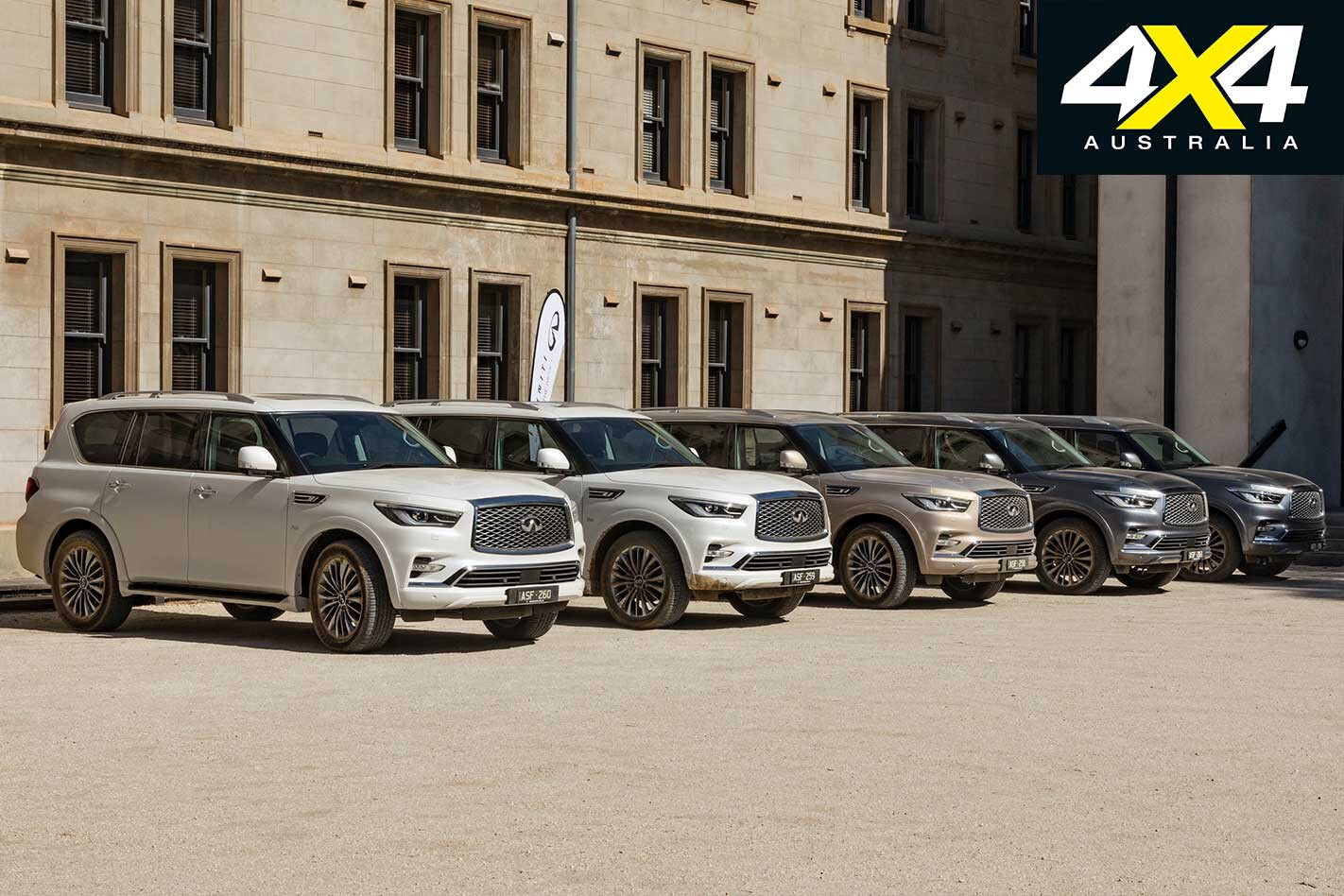
IT’S EASY to relate to the QX80: it’s big and bulky from the outside, and a little chaotic on the inside. Despite its reputation for being luxurious, its willingness and competency to kick up some dust gives it extra kudos.
The 2018 refresh of Infiniti’s off-roading SUV doesn’t offer much more than a facelift, doing away with its Beluga-styled nose and replacing it with a larger grille and LED headlamps that’ve had a slight lift. Its backside went under the knife as well, with a new tailgate, tail-lamps and bumper.
The inside has also been tweaked for a more luxurious feel, with quilted leather seats, larger 8.0-inch DVD screens in the back seats, and wooden trims. Still, the infotainment system isn’t great, with a busy-button facade letting it down.
The biggest change here is sound insulation, which provides a quieter ride – on- and off-road – than you’d expect of a vehicle this size. Even when rolling with hill-descent control, the crunch and grinding is calmer than many other 4x4s.
There’s only one model available and, with a price-tag of $110,900, you’d expect some pretty decent tech.
New to this model is the Intelligent Rear View Mirror, which is fed via a camera mounted to the top of the rear window. The footage provides drivers with clear views when the back window is blocked by people, ice, dust or cargo. But that’s where it ends for tech – despite its price tag, the QX80 feels lacking in the nerd department, missing out on standard features like smartphone mirroring and touchscreen control.
For some, the QX80’s size might be its biggest deterrent, but with its 5.6-litre VK56 V8 engine, which produces 298kW and 560Nm, the 2783kg SUV takes to the road with an elegance rare of a car its size.
On-road, the graceful giant glides through its seven-speed automatic transmission effortlessly, and, once it gets off-road, its full-time 4WD system shines. At the Melbourne 4×4 Training and Proving Ground it took to inclines, declines and water crossings without so much as a flinch, even with its stock 22-inch wheels. Offering further confidence is its locking rear diff and multiple drive modes: Rock, Sand, Dirt and Road.
It’s not all good news, though. The SUV’s flat and unsupportive seats lose it points for long-distance journeys, as does its thirsty 100-litre fuel tank which guzzles an uncomfortable 14.5L/100km to offer just 690km.
When it comes down to it, there wasn’t much we didn’t like during our soft drive to Mount Macedon and at the proving ground, and there’s no question the QX80 has dusted off its ugly-duckling feathers and started its transformation into a swan. However, although capable, it’s yet to prove itself as a long-haul off-roader.
WAVE Hill Station is a 50km² working cattle property positioned along the Clarence River within the foothills adjacent to the great Gondwana Rainforests, just out of Grafton in NSW.
The area is known for its excellent bass-fishing opportunities – more so at the waterfalls – as well as providing pristine views of the Clarence Valley.
Upon arrival at the property you’ll be greeted at the gate by the owner, Steve. If he isn’t home there are separate mailboxes labelled for every campsite and accommodation option, so you can grab all the info you need – especially the map of the property – from the correct box.
Once inside the property the terrain changes significantly, but the tracks are maintained and it’s easy to navigate. The campsites are approximately 9km from the homestead, and accessing all of them can take up to an hour because they are spread out.
On this trip we stayed at the Top Gorge Back Channel site, an open, grassy campsite with a huge, shady tree overlooking the back channel, located just downriver from the junction of the Mann and Clarence Rivers. It’s an incredible spot to pitch a tent for a week, and it’s within walking distance to the Safari Tents just over the hill.
Firewood is aplenty here, and some of the best views of the valley are on offer from where the fire-pit is situated. However, the campsite doesn’t have easy access to the water, and to go for a dip you need to climb down a slippery slope of rocks.
Kayaks can be launched a few hundred metres from camp, where the landscape is flatter; although, the current is very strong because you’re at the top of the waterfall, and Wave Hill Station strongly recommends wearing personal buoyancy devices and helmets at all times.
There is a walking track not far from the Back Channel campsite, which crosses just in front of the Safari Tents. The track is a thin, overgrown goat track with some handrails and stairs along the way.
It’s very steep in places, but when you reach the bottom you’re greeted by the pumping sound of water gushing over the rocks. This is a great place to cast a line, and the best spots for bass are in the backwash where the fish hide from the strong current, awaiting lunch.
The terrain can be quite difficult as you follow the edge of the river, so ensure adequate footwear is worn. Your best chance to catch a good one will be when you spot the waterfall, but fishing from the rocks here can be dangerous. Wave Hill Station offers catch-and-release fishing, so please abide by this request.
If camping isn’t your thing or you don’t have an adequate rig to explore the rest of the property, there are cottages located near the homestead, and while you’re there you can play tennis or arrange to see the property on horseback with a guided tour. There’s something for everyone here.
There is so much to do at this place that a couple of days isn’t long enough – if you’re planning to visit this spectacular piece of property, ensure you come for at least a week. It’s definitely worth it and, if nothing else, it’ll force you to put your phone down to take it all in.
Look this place up, book it and go; you won’t be disappointed.
Travel Planner
WHERE 543 Carnham Road, Fineflower (via Grafton), NSW, 2460
CAMPING There are three 4WD-access-only camping areas on the property, requiring high-clearance vehicles. During wet weather the tracks are closed for safety reasons.
FACILITIES Long-drop toilets are available at the campsites.
OTHER INFO Dogs allowed; fires allowed; no mobile reception; bring your own fuel and water.
CONTACTS Email: [email protected] Phone/Fax: (02) 6647 2145 Mobile: 0428 472 145 Website: wavehillfarmstay.com.au
RESTRICTIONS & PERMITS Strictly no motorbikes or guns are allowed on the property. Bookings are essential, and 50 per cent of the fee must be paid to secure the booking.
ACCOMMODATION If camping isn’t your thing there are four accommodation styles available, where you can stay in one of the cottages, lodges or Safari Tents.