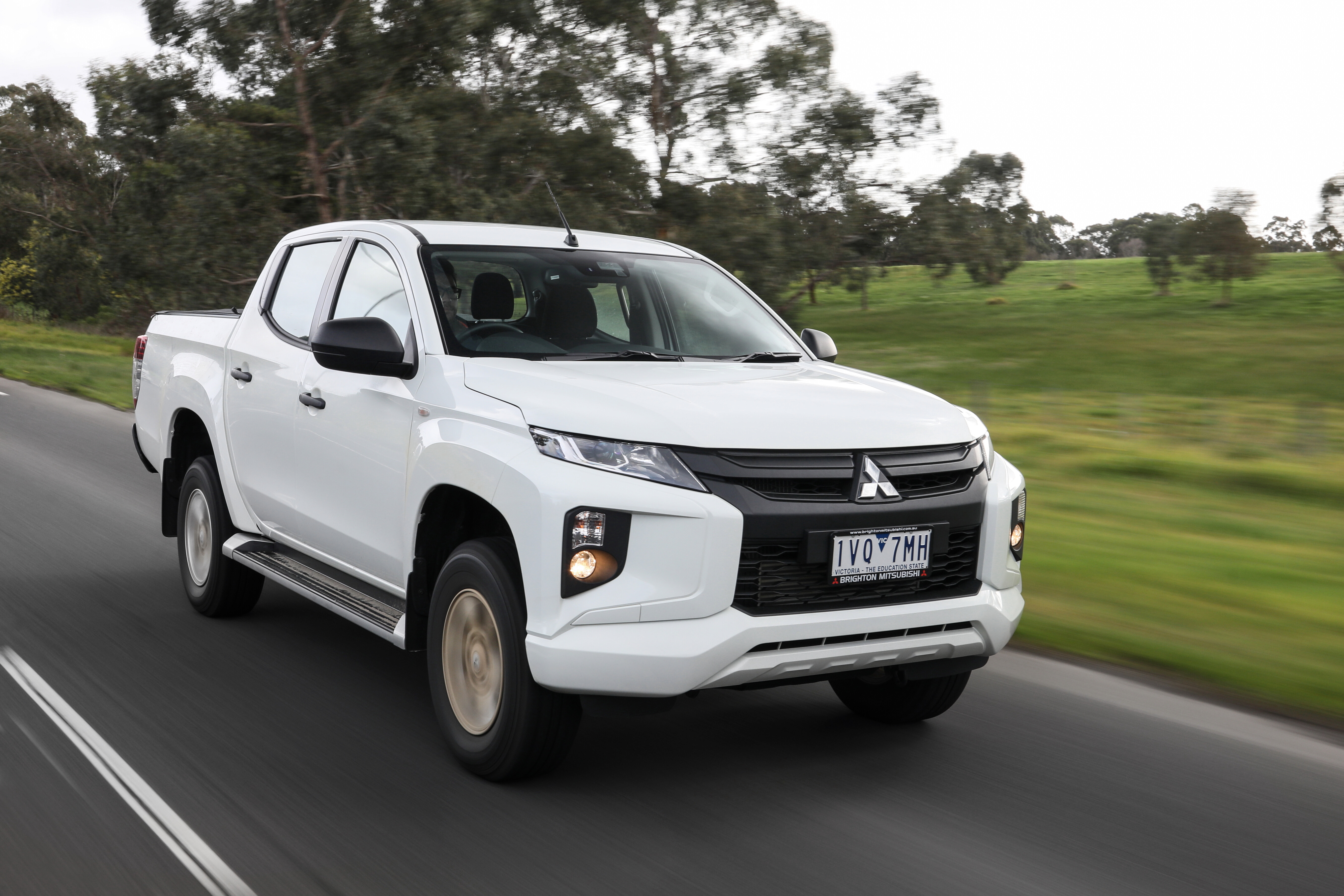
There’s a compelling reason why the Triton is a perennial placegetter on the 4×4 sales charts: it offers exceptional value for money.
Take the GLX+ variant we had on our recent Mega Ute Test, which, at its sub $50K price point, butts heads with the budget trio from the halls of SssangYong, GWM and LDV. And it’s arguably a much better proposition.
Depart with $46,190 of your hard-earned and you’ll get a utilitarian all-rounder best-suited for work and farm duties but also adept at ferrying the family for a weekend away.
In saying that, owning the GLX+ as a day-to-day family hauler does encompass a generous list of compromises.
Drive
The entire Triton range is powered by Mitsubishi’s long-serving 2.4-litre turbo-diesel four-cylinder diesel engine, which in this GLX+ spec is mated to a six-speed automatic gearbox, generating 133kW at 3500rpm and 430Nm at 2500rpm in the process.
Well-matched to the powertrain, the transmission will rarely hunt for gears, more often than not finding the sweet spot despite occasional high-rev droning. On test, it sucked up 11.0 litres of diesel per 100km.
At this price point, diesel rattle is well-known to be prominent, but the GLX+ feels rather petrol-like in its demeanour, compared to some of its similarly-priced contemporaries.
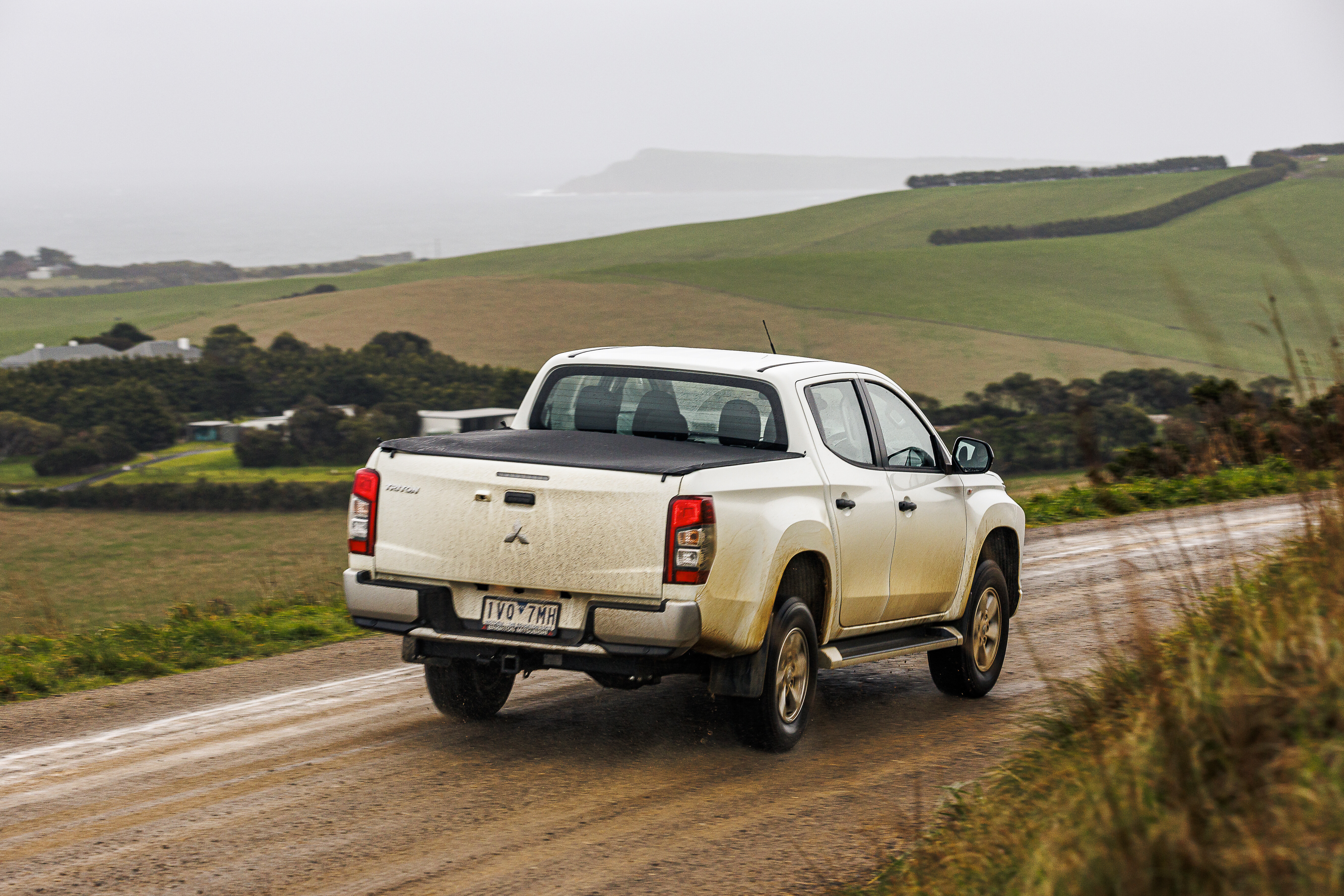
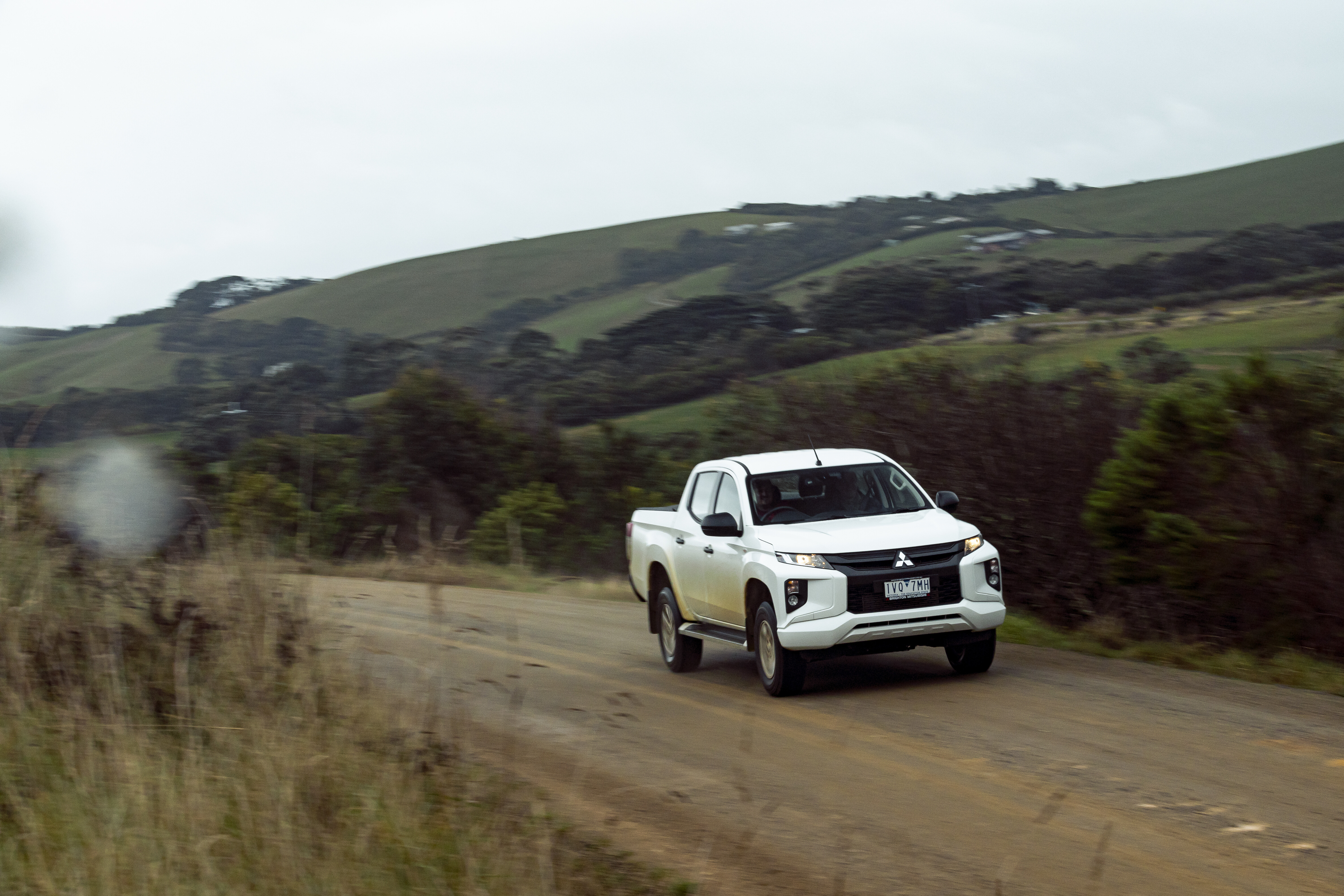
Fitted with leaf springs at the rear and coils up front, the GLX+ feels settled on both bitumen and mild dirt tracks, soaking up larger bumps with aplomb.
While proper off-roading was off-limits on this occasion (we didn’t get to activate the rear diff lock), we did point the Triton down a few damp dirt roads, and the hydraulically-assisted steering felt dialled in and well-connected to the rain-soaked terra firma, something which can’t be said of other utes in the around-$40K category … drive it back-to-back with the GWM Cannon-X and you’ll know exactly what we mean.
GLX+ models miss out on Mitsubishi’s Super Select II 4×4 system; instead relying on the more rudimentary Easy Select 4WD system to modulate between 2H, 4H and 4L via an easy-to-use rotary dial – flicking between 2H and 4H on the fly is a simple affair.
The GLX+ is also devoid of an Off-Road Mode selector, which adjusts engine output, transmission settings and traction control to best suit the terrain, be it Gravel, Mud/Snow, Sand or Rock. This is only available on GLS and GSR variants.
The GLX+ consists of a somewhat shallow ground clearance of 205mm, and approach, departure and rampover angles of 30, 22 and 24 degrees respectively.
From the factory, the GLX+ is fitted with 16 x 7-inch steel wheels inside 245/70R16 tyres. Opt for the GSR and you’ll get alloys in lieu of steel.
Interior
Where cost-cutting is most obvious is within the rather utilitarian cabin, which is forgivable considering the ute is targeted more at blue-collar tradies than families.
The steering wheel is plastic and feels cheap, the seats are cloth, and the trims and surroundings err more towards ‘thrifty’ than premium. Its single-zone air-conditioning system is almost unheard of with modern vehicles, as is the turnkey ignition – which some among us still prefer, mind you.
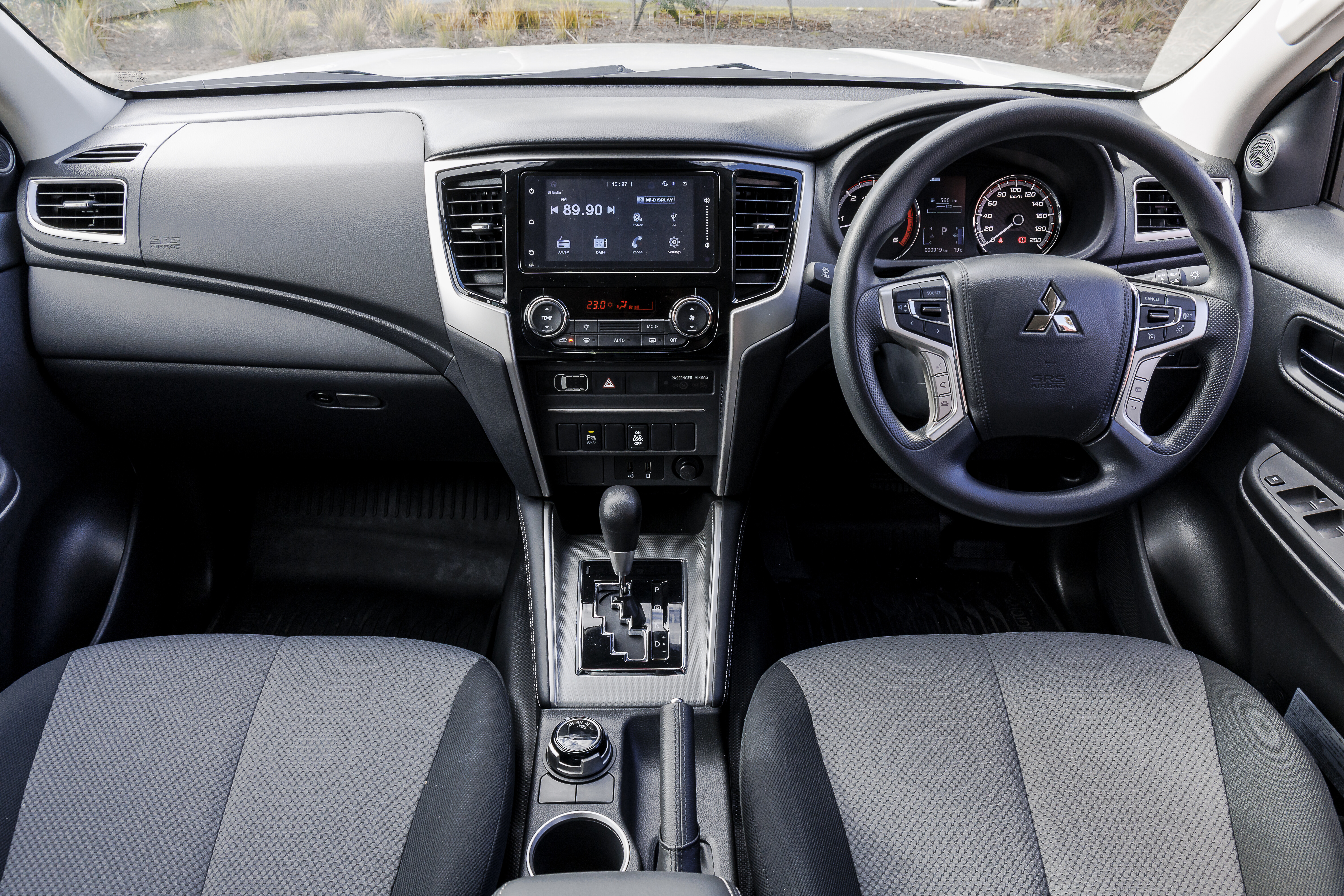
The infotainment system also drops the Triton back a few pegs, primarily because it’s outdated, slow to boot and Android Auto failed to connect on our test.
The touchscreen itself is small by modern standards – 7.0 inches – and the UI (user interface) is confusing in its layout and operation.
There’s an abundance of storage pockets and drink holders – big bottle holders in the doors – as well as two USB-A points and a 12-volt power port.
Practicalities
Despite these interior foibles, it’s important to remember the primary audience of this variant, and the lower-spec GLX+ makes plenty of sense as a work ute, be it for trade or farm duties.
It offers slightly more payload capacity than the more-premium GSR – 945kg versus 901kg – which may seem marginal but it’s nothing to sneeze at when every kilo matters.
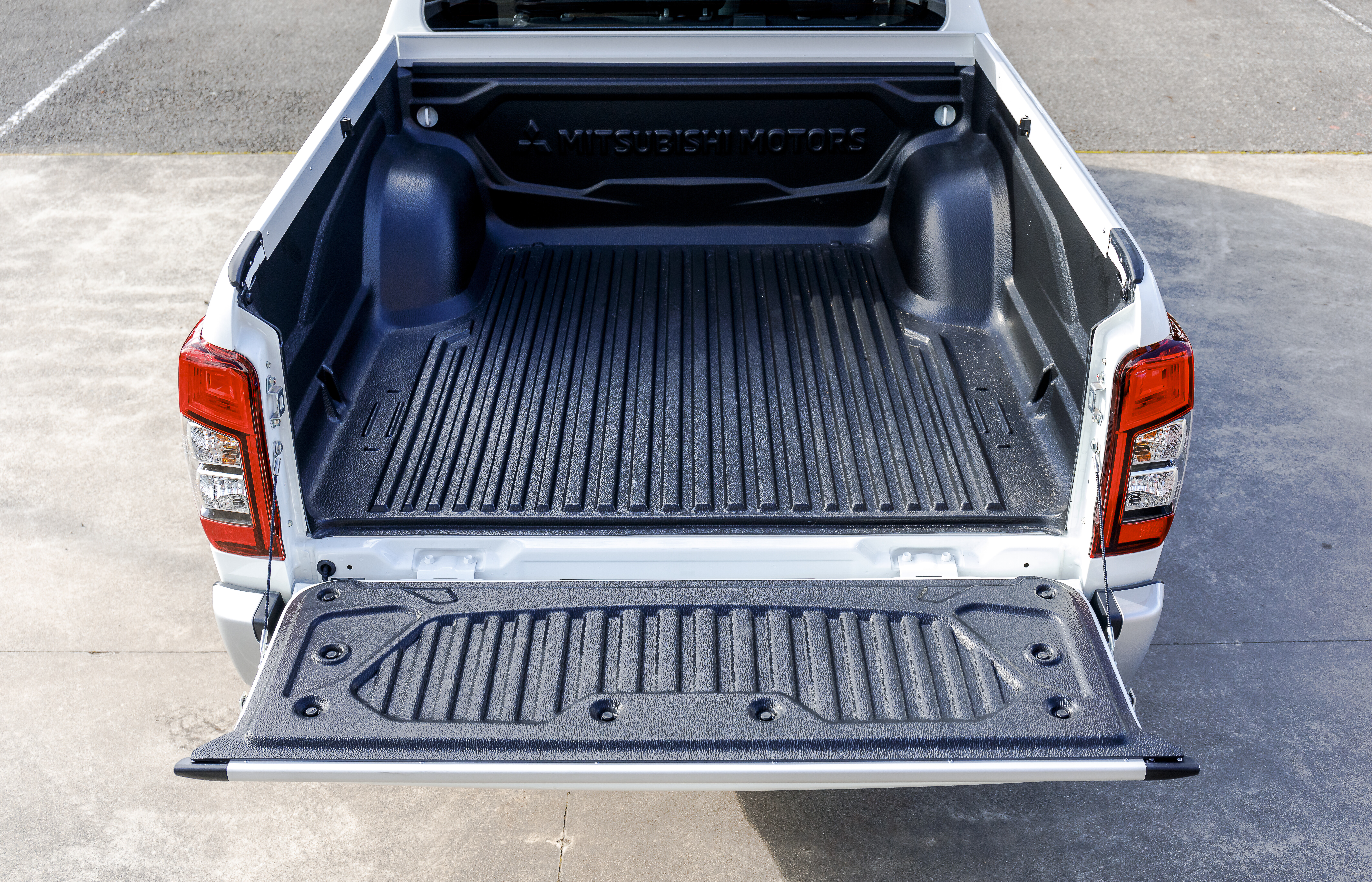
Coloured-coded tie-down points – four in total – are a nice touch, and while the soft tonneau can be de-robed quite easily, it is cumbersome to reattach. Thankfully, you won’t need to join the local 24/7 gym, as the cover does stretch over time.
The tub measures 1520mm (L) x 1470mm (W) x 475mm (H), with a modest 1085mm between the wheel arches.
The GLX+ records a 3100kg towing capacity, and a bedliner was fitted to our test vehicle.
Safety
The GLX+ shares its suite of safety equipment with the GLX, which means it comprises staples such as Lane Departure Warning, Forward Collision Mitigation with pedestrian detection, Emergency Brake Assist, Hill Start Assist, and Trailer Stability Assist.
It misses out on Hill Descent Control, Lane Change Assist, Rear Cross Traffic Alert, and Blind Spot Monitoring systems that are standard on the GSR.
Plus, it lacks the GSR’s Multi-Around Monitor and front parking sensors; rear sensors are standard on all models, though.
VERDICT
That it’s almost $10K cheaper than the GSR makes it a viable and enticing proposition, and it’s the spec we’d opt for to serve as our ute should we contemplate starting a landscaping business.
Forgo some of the nice-to-haves the GSR boasts and you’re still left with a great platform, albeit one with a stripped-back interior that does feel generations old.
However, overlook these shortcomings and the Triton GLX+ makes a lot of sense at this compelling price point.
2022 Mitsubishi Triton GLX+ specs
| Engine | 2.4L MIVEC turbo-diesel |
|---|---|
| Capacity | 2442cc |
| Compression ratio | 15.5:1 |
| Bore x Stroke | 86.0 x 105.1 |
| Transmission | 6-speed automatic |
| Poweru00a0 | 133kW @ 3500 |
| Torque | 430Nm @ 2500 |
| Front suspension | Double wishbone with coil springs |
| Rear suspension | Leaf springs (heavy duty) |
| Tyres | 245/70R16 111S RF |
| Kerb weight | 1955kg |
| GVM | 2900kg |
| Payload | 945kg |
| Towing capacity | 3100kg |
| Seating | 5 |
| Fuel tank | 75L |
| ADR fuel claim | 8.6L/100km |
| On-test fuel use | 11.0L/100km |
| Departure angle | 22.0 |
| Approach angle | 30.0 |
| Rampover angle | 24.0 |
| Ground Clearance | 205mm |
| Price | $46,190 |
Key Points
- Three different XGS Suspension ranges
- Venturer Bar with integrated 8000kg-rated recovery points
- Side bars feature heavy-duty 63mm steel tubing
JUMP AHEAD
- Suspension
- Front and rear protection
- Underbody guards
- Side bar and steps
- Snorkel
- Cost to build our ultimate TJM Ford Ranger
The team at TJM have been hard at work developing a full range of premium off-road focused accessories to suit the new model Ranger, and we can now reveal what some of these key items will look like.
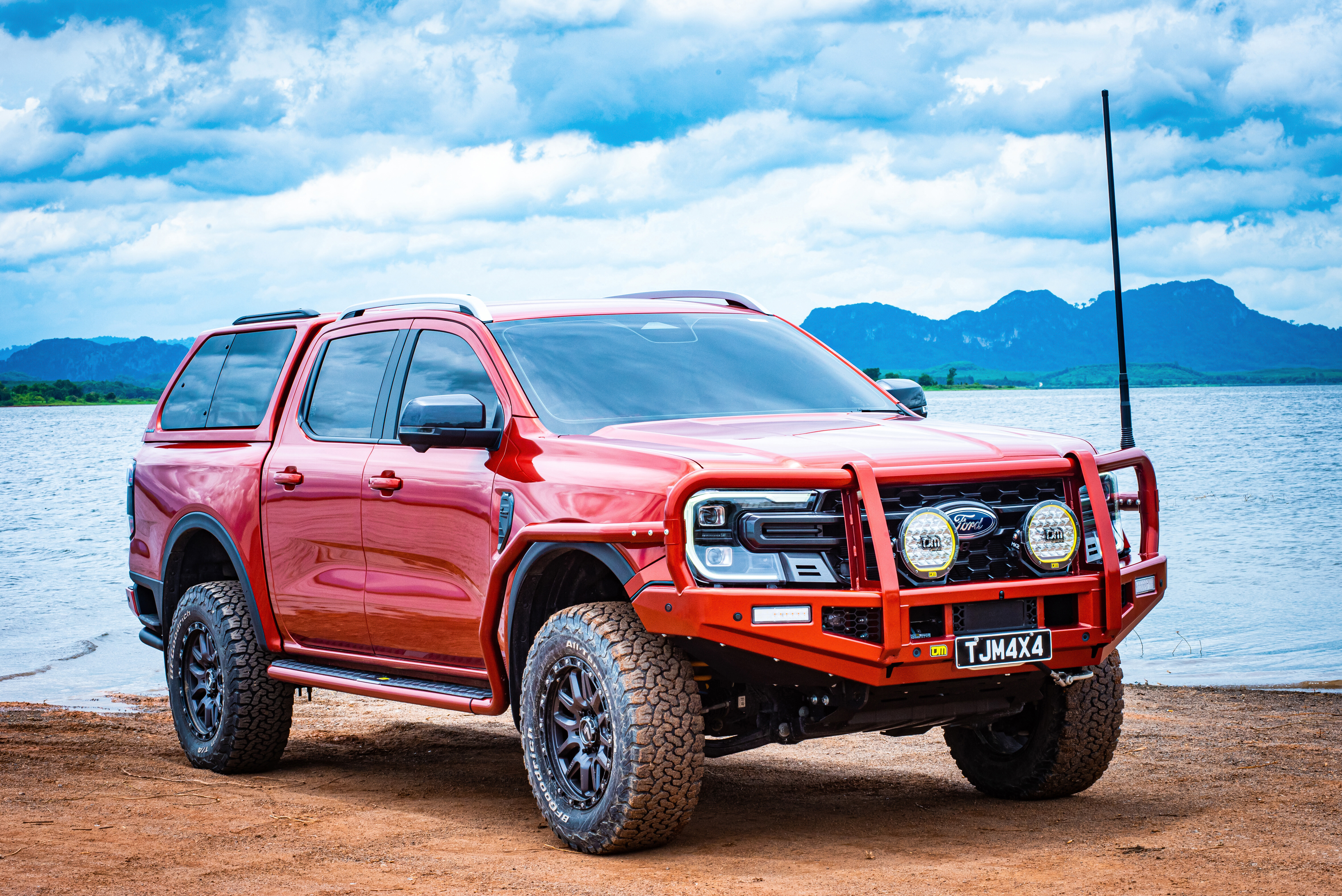
We all know building and accessorising our four-wheel drives is half the fun of owning one, especially an all-new model. While the new 2023 Ford Ranger is a good thing in stock trim, by adding the right quality 4WD accessories such as this new range from TJM, gives buyers the chance to transform the 2023 Ford Ranger in to an absolute weapon off road.
“Creating the 4×4 accessories for the new Ranger has been nothing short of incredible,” said Peter Sparkes, head of engineering at TJM.
“Building on the same premium quality and reliability our customers expect from us, we’ve pushed the boundaries, made new discoveries, unlocked new innovations and pioneered market firsts.
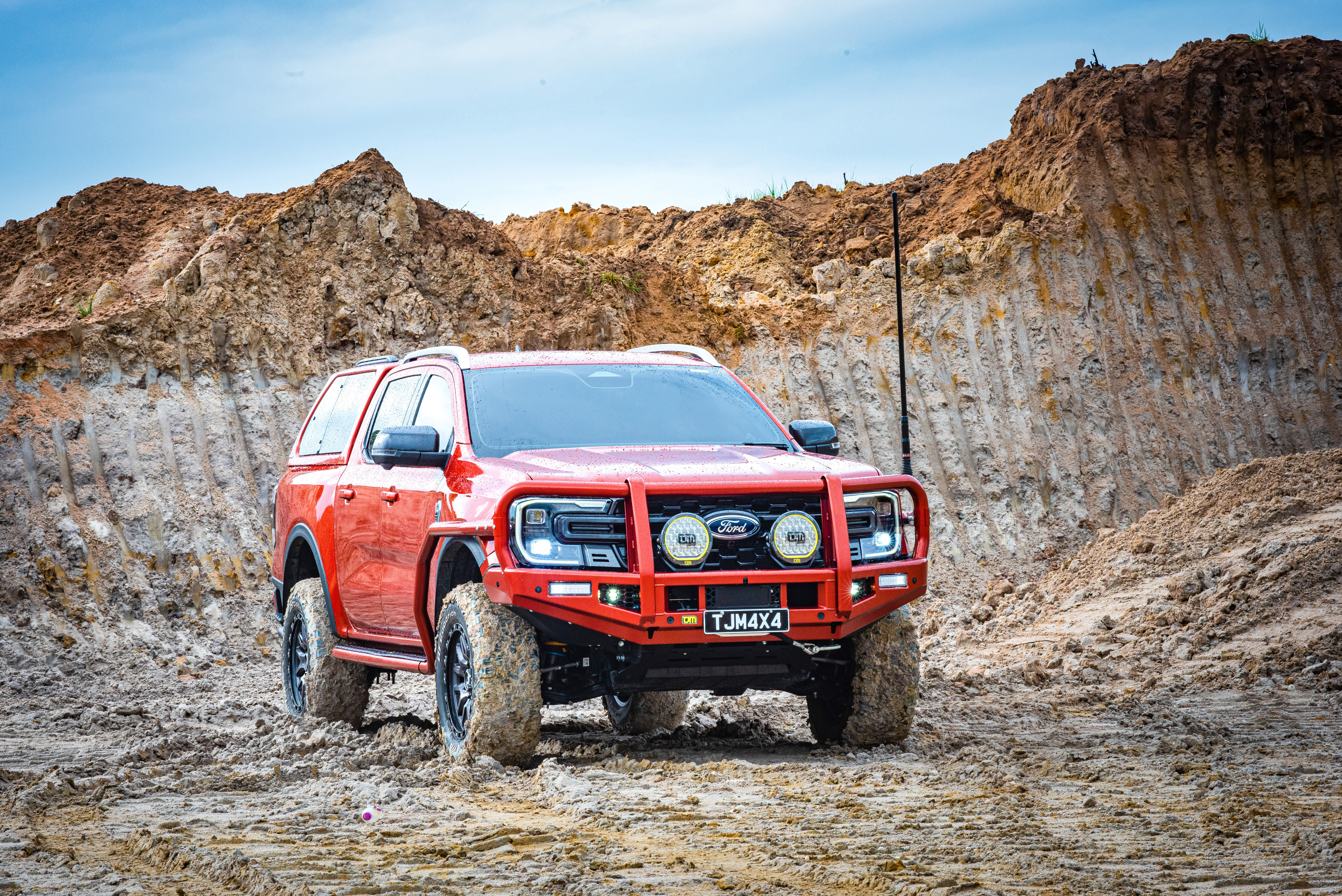
“And, in the next few months, we’re excited to be able to fit out these incredible vehicles and give new owners the accessories they need to be truly 4×4 equipped no matter where they end up.”
Pricing has also just been announced for the new range of 2023 Ford Ranger TJM accessories, so let’s take a closer look at what the TJM team has created for the new Ranger.
Suspension
The Ford Ranger is one of the best handling utes on the market, so it’s important to ensure any aftermarket additions enhance the way the vehicle performs on- and off-road. TJM tells us its engineers have worked tirelessly to develop and build upon its suspension systems, and their hard work has led to the development of an all-new suspension line-up.
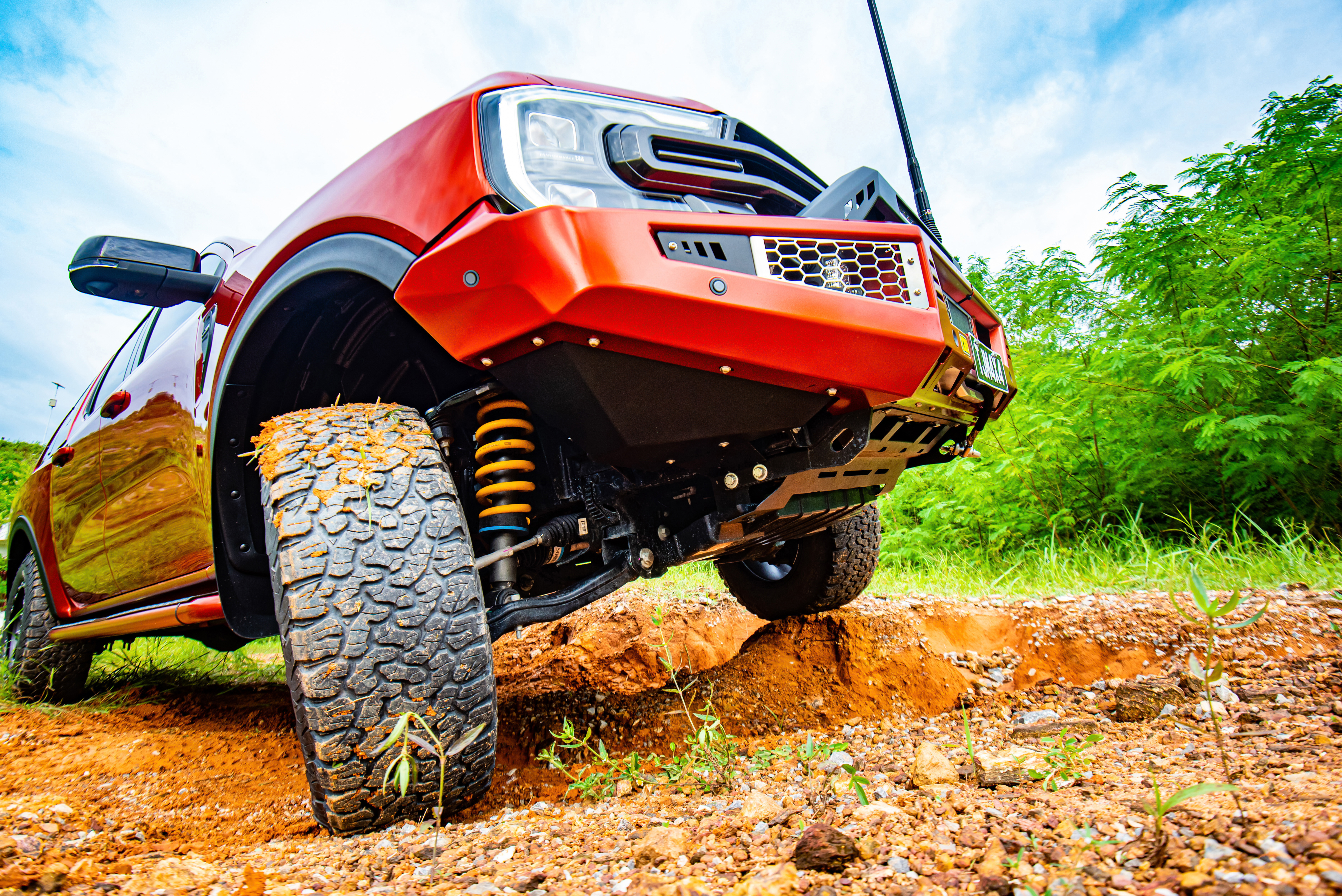
TJM has designed three different XGS Suspension ranges to cater for all 4×4 enthusiasts: XGS Rugged, XGS Roamer and XGS Remote. Key focus points during development include controlled bounce to improved control under braking, responsive and stable steering, improved towing performance and so much more. The XGS Suspension has been designed and engineered to ensure Ranger can handle absolutely anything.
Also, arriving in the next few months, are the XGS Upper Control Arms designed to solve castor and camber adjustment for every inch you lift your Ranger. Along with GVM Plus upgrades, new Ranger owners will be spoiled for choice when it comes to suspension upgrades.
Pricing
Various pricing, dependent on setup. See your local TJM outlet for the right suspension to suit your needs.
Front and rear protection
Modern bullbars need to not only look the part, but they also have a serious job to do, namely protect your vehicle from animal strike, and provide a solid platform to mount accessories such as winches and driving lights.
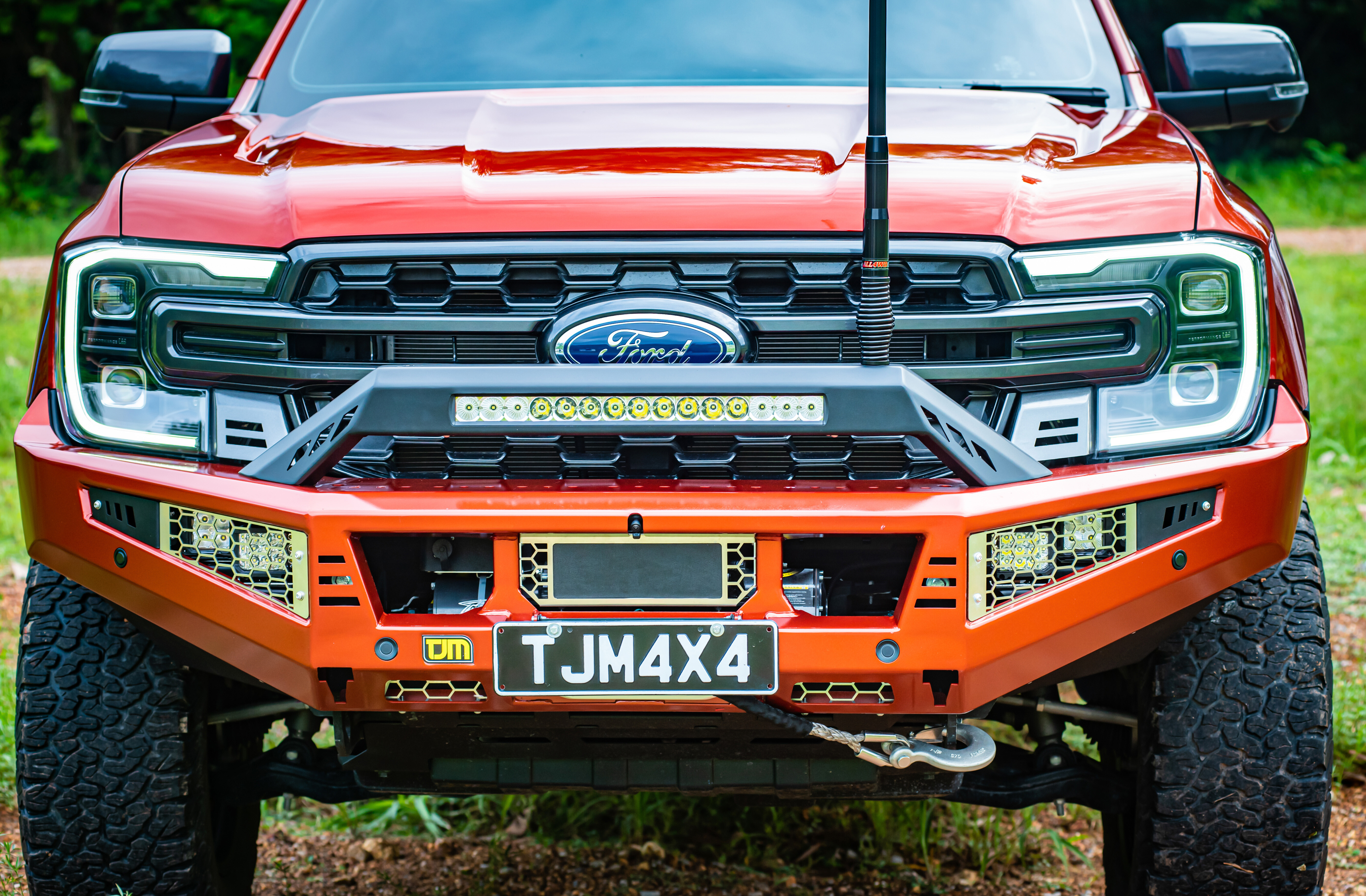
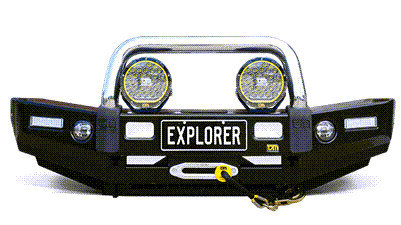
TJM’s Venturer Bar sports integrated 8000kg-rated recovery points as standard and an all-steel construction, just like the TJM Outback Bull Bar, the Venturer Bar is equipped with everything you need. From provisions for spotlights and off-road work lights to dual aerial mounting positions, winch compatibility and recovery jack points, all wrapped up in a one-of-one head-turning, tapered, angular design.
It is also airbag compatible, meets ADR compliance, and provides an improved approach angle when driving through technical terrain.
| Accessory | Price |
|---|---|
| TJM Outback bar | $3090 |
| TJM Venturer bar | $3350 |
| TJM rear bar | $1750 |
| TJM rear bar tubes | $420 |
Underbody guards
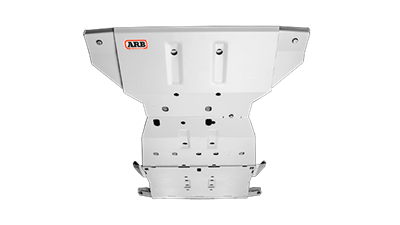
TJM has actually been designing and engineering 4WD underbody protection for more than 15 years now, so developing a system for the new Ford Ranger was a no-brainer. Its Underbody Guards are for those who regularly take their 4×4 off road, and want to protect vital and potentially vulnerable components underneath the new Ranger.
Backed by a press-formed steel construction for maximum impact strength, TJM tells us its Underbody Guards are equipped to take some serious brunt from rigid obstacles such as tree stumps, piercing rocks or loose logs with absolutely no fuss.
Finished in a special electro coating, TJM also mentions this provides up to 500 hours of corrosion resistance, while the unique design assists with ventilation and provides additional strength where it’s needed.
| Accessory | Price |
|---|---|
| TJM front guard set | $610 |
| TJM rear guard set | $520 |
Side bars and steps
Constructed from heavy-duty 63mm steel tubing and finished in a black satin powder-coating to maximise durability, TJM Side Bars are chassis mounted for increased strength and protection on- and off-road.
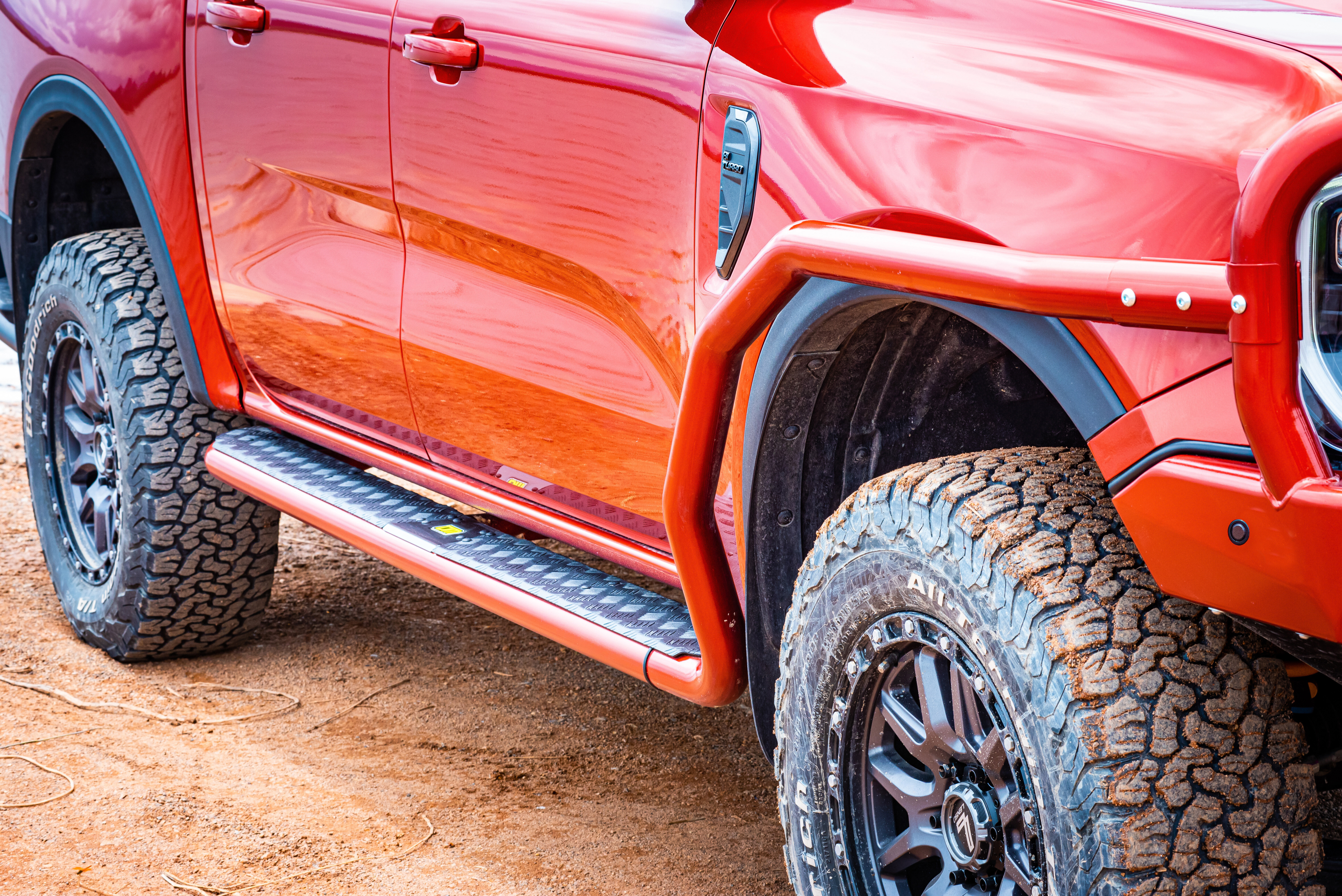
They are also of a modular design, allowing you to have Side Steps fitted to your Ranger and the option of adding Side Bars later on down the track. Not only do they look the part, and offer increased protection when off road; they also make accessing the vehicle far easier if you have kids or are how do we say … vertically challenged.
| Accessory | Price |
|---|---|
| TJM side steps | $1420 |
| TJM side bars | $490 |
Snorkel
Rounding off the range of TJM 4X4 accessories to suit the 2023 Ford Ranger, is the Airtec Snorkel. For any and all off-roading, preventing dust and water from entering your engine is an absolute must, fitting a snorkel really is cheap insurance for the life of the vehicle.
Being a new shape, developing an Airtec Snorkel to suit the Ranger’s unique body shape would be an engineering challenge, which TJM has done a great job with. TJM says the design itself offers incredible impact resistance and durability in extreme temperatures, as well as being sealed against water and dust ingress.
| Accessory | Price |
|---|---|
| TJM Airtec snorkel | $599 |
Canopies and liners
| Accessory | Price |
|---|---|
| Aeroklas Stylish canopy (full central locking) | $4499 |
| Aeroklas under rail liner | $529 |
| TJM Premium canopy | $4399 |
Bonus offer
Whether you’ve already made the down payment for your new Ranger or you’re hoping to grab one in 2022 or early 2023, you can head to your local TJM today to find out more about its complete range of off-road gear to suit the new Ranger.
Plus, you can also register your interest to be the first in line for TJM’s 2023 Ford Ranger accessories range, and go in to the running to win 1 of 5 $200 TJM gift cards to spend on its online store.
Cost to build our ultimate TJM Ford Ranger
Here’s a bit of a run-down on what it would cost to build our version of the ultimate TJM Ford Ranger, using the pricing available to us.
Please note, we haven’t included fitting costs and there are too many variables when it comes to suspension, so we’ve left that out of our list. However, it definitely helps get the ball rolling to see roughly what it would cost to deck out a 2023 Ranger with TJM gear.
| TJM Accessories | Price |
|---|---|
| TJM Venturer bar | $3350 |
| TJM rear bar | $1750 |
| TJM rear bar tubes | $420 |
| TJM front guard set | $610 |
| TJM rear guard set | $520 |
| TJM side steps | $1420 |
| TJM side bars | $490 |
| TJM Airtec snorkel | $599 |
| Aeroklas Stylish canopy (full central locking) | $4499 |
| Aeroklas under rail liner | $529 |
| Total (minus suspension and fitting) | $14,187 |
Stock availability
TJM has provided us with a timeframe for when you should expect its range of four-wheel drive accessories for the 2023 Ford Ranger to be available in-store:
• Canopies and storage solutions: late September
• Protection equipment and snorkel: late October
• XGS Roamer and Rugged suspension: late November
*Note: All pricing and availability dates were supplied by the manufacturer and were correct at time of publishing.
More information: https://www.tjm.com.au/ford-ranger-2022
One of the best things about owning a four-wheel drive is the spectacular locations you can access off the beaten track. Of course, the farther you drive off the beaten track, and the longer you are away from services, the more self-reliant you’ll need to be and the more gear you’ll need to carry.
And a lot of gear includes essentials like fuel, water, food, spare parts, tools and recovery equipment, to a power supply, cooking gear, camping equipment, clothes, electronic devices and personal items.
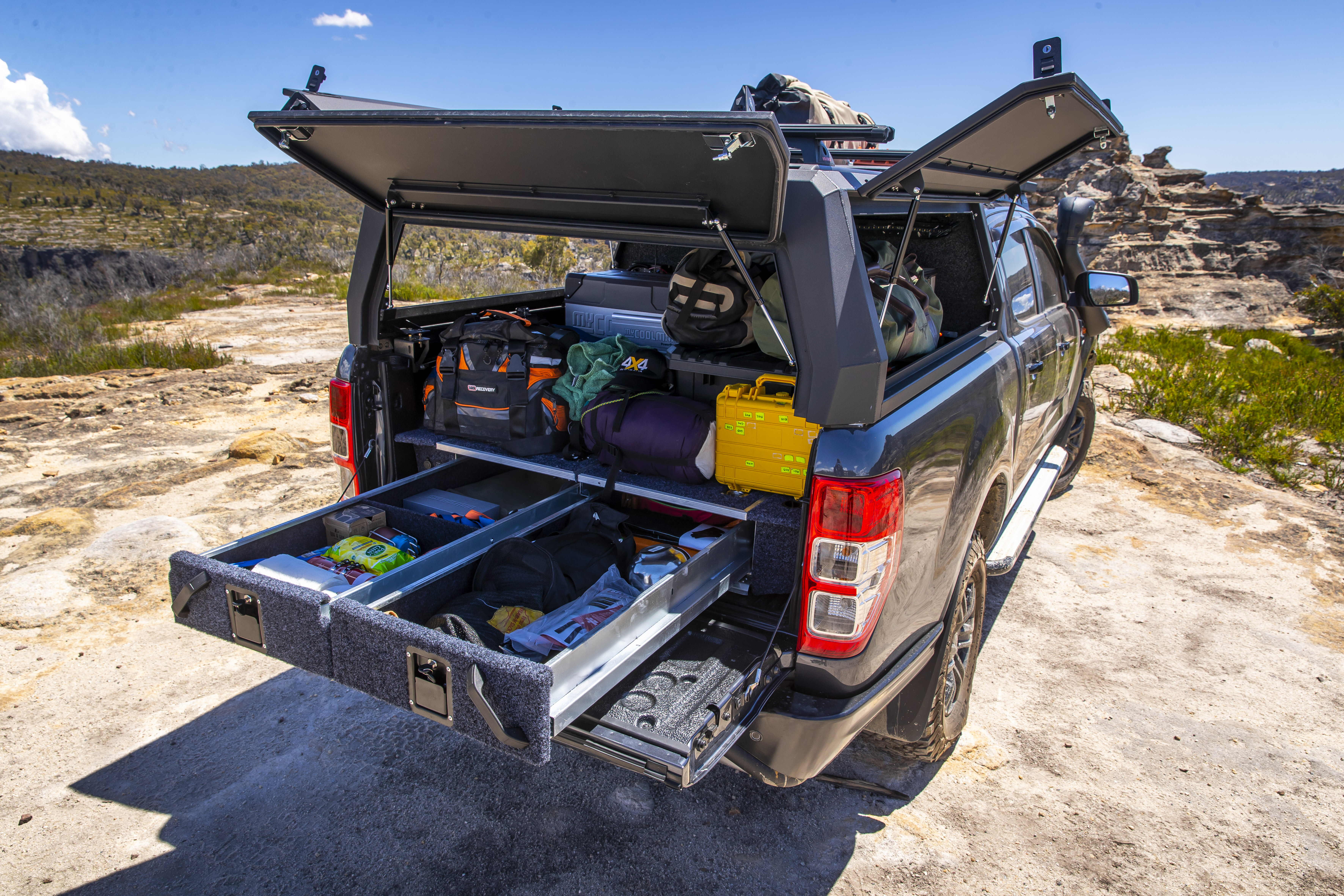
Even if you drive a large 4×4 vehicle, whether a wagon or a ute, you’ll soon find that packing all that gear in to your rig can be quite difficult, both due to the physical size of the items as well as their weight. And then, of course, there’s the gear that you need to access regularly, and the stuff you might seldom need but when you do, you need it quickly.
In this instalment of 4X4 Australia’s How To Series, we’ll take a look how to best pack a vehicle so you can carry everything you need to, safely and securely, and be able to access what you need when you need it.
Pack light
There are several reasons why you want to pack as light as possible when loading up for a trip away. Firstly, your vehicle has a limited payload, which is the maximum weight that it can carry.
The payload is essentially the vehicle’s GVM (Gross Vehicle Mass) less its kerb weight, and this can usually be found in the vehicle’s owner’s manual, or in the specifications section on the vehicle manufacturer’s website. A five-seat Toyota Prado GXL wagon, for example, has a 2990kg GVM and a 2285kg kerb weight, which means its payload is 705kg.
A 705kg payload doesn’t mean you can throw 705kg of gear in the back and be on your merry way, however, because deducted from that payload figure is the weight of vehicle occupants (driver and passengers), as well as any accessories fitted, such as bullbar, winch, side-steps, towbar, roof racks, drawer system and driving lights.
If you are a travelling family of four, for example, just two adults and a couple of youg’uns can easily add up to around 240kg, so your 705kg payload capacity is already reduced to just 465kg. A steel bullbar might weigh around 80kg, a winch with synthetic rope around 40kg, side-steps and towbar 70kg, a drawer system 50kg, a roof-rack system up to 25kg and a quality driving-light system up to 10kg. That adds up to another 275kg, reducing your available payload to just 190kg.
Just 190kg?! For food, water, tools, spares, recovery gear, tent/swags, clothes, electronics and personal items? It’s little wonder 4×4 utes are so popular, thanks largely to their greater payload capacities. But even if you drive a dual-cab 4×4 ute such as a Toyota Hilux SR5 auto with a 1050kg payload capacity, using the example above, and throwing on a 60kg canopy, you can still only pack in 475kg of gear before you’ll exceed payload capacity.
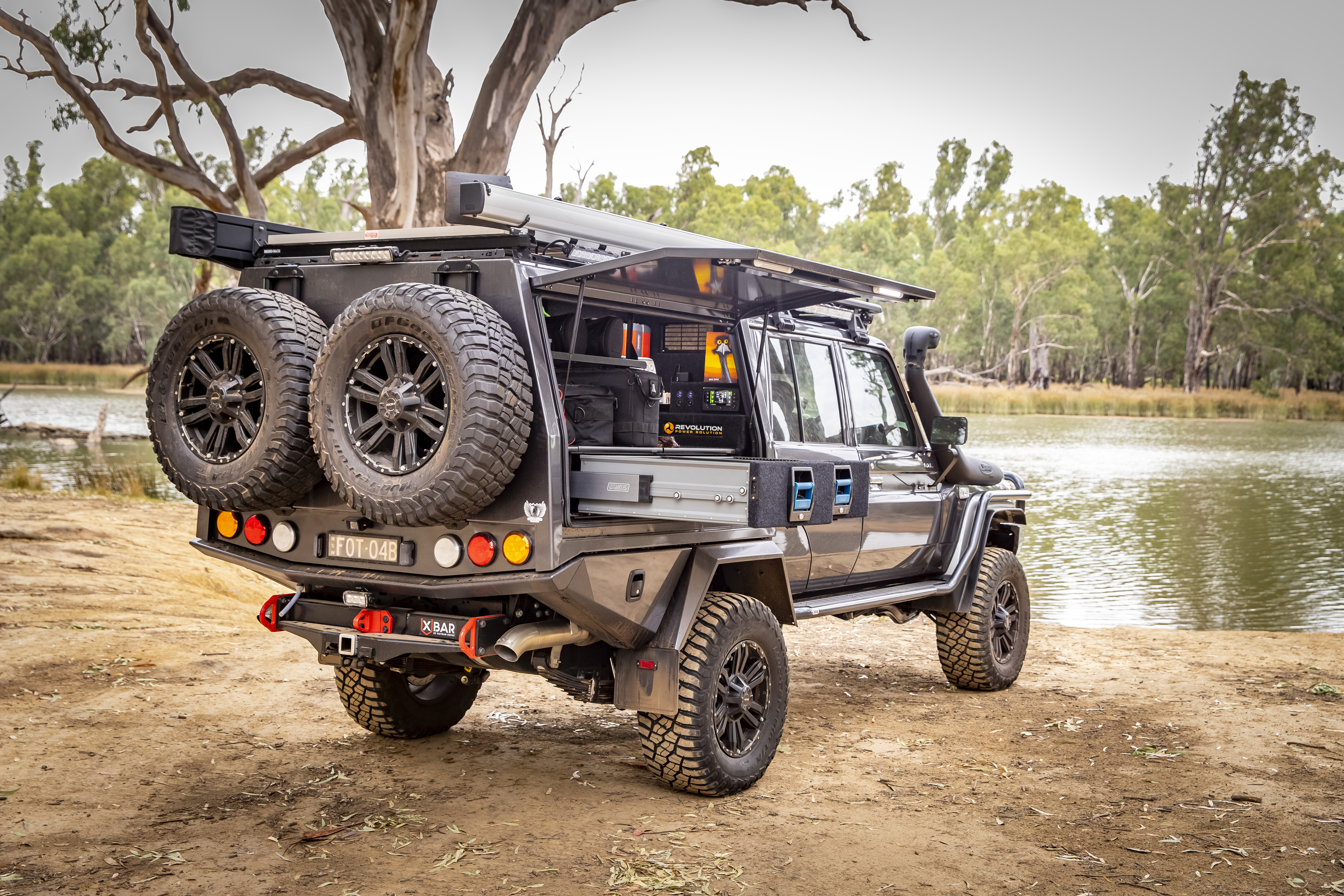
There are many very important reasons why you should avoid exceeding your vehicle’s payload capacity at all costs. Firstly, overloading your vehicle will have negative effects on the way it performs, handles and brakes.
It will also reduce off-road capability, result in excessive wear on mechanical components, increase tyre wear, mess up fuel economy and, most importantly, it can be downright dangerous. And if those aren’t reasons enough to not exceed payload, doing so is also illegal, it will void your vehicle’s warranty, and it will void your insurance policy should you have an ‘incident’.
The moral to this story? It’s vitally important to consider the weight of individual items when you’re purchasing equipment for your vehicle and your trip away.
Pack low
When you’re packing a 4×4, it’s a good idea to keep the heavy items as low as possible in the vehicle and the lighter stuff on top. The reason for this is to keep the vehicle’s centre of gravity as low as possible.
Raising the centre of gravity by packing too much heavy gear up high on a vehicle will adversely affect on-road ride and handling, resulting in more body roll when cornering, and more fore and aft pitching when braking and accelerating. It will also have a detrimental effect on a vehicle’s off-road performance, increasing the risk of a rollover in extreme terrain.
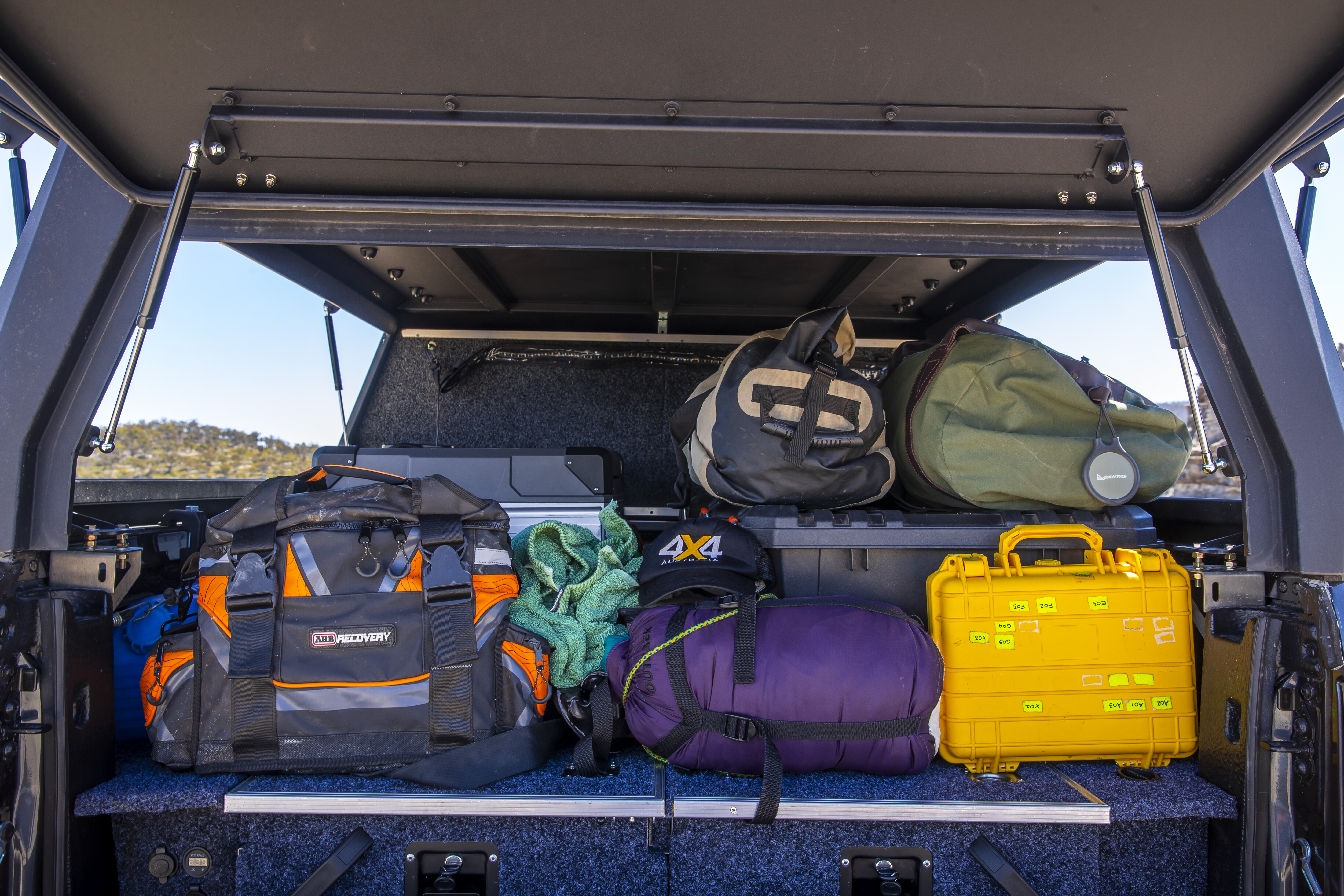
Heavy items that can easily be packed low in the vehicle include tools and spare parts that you might not need to access very often, if at all. Pack these things near the floor of the vehicle or at the bottom of the luggage area, and make sure they are properly secured.
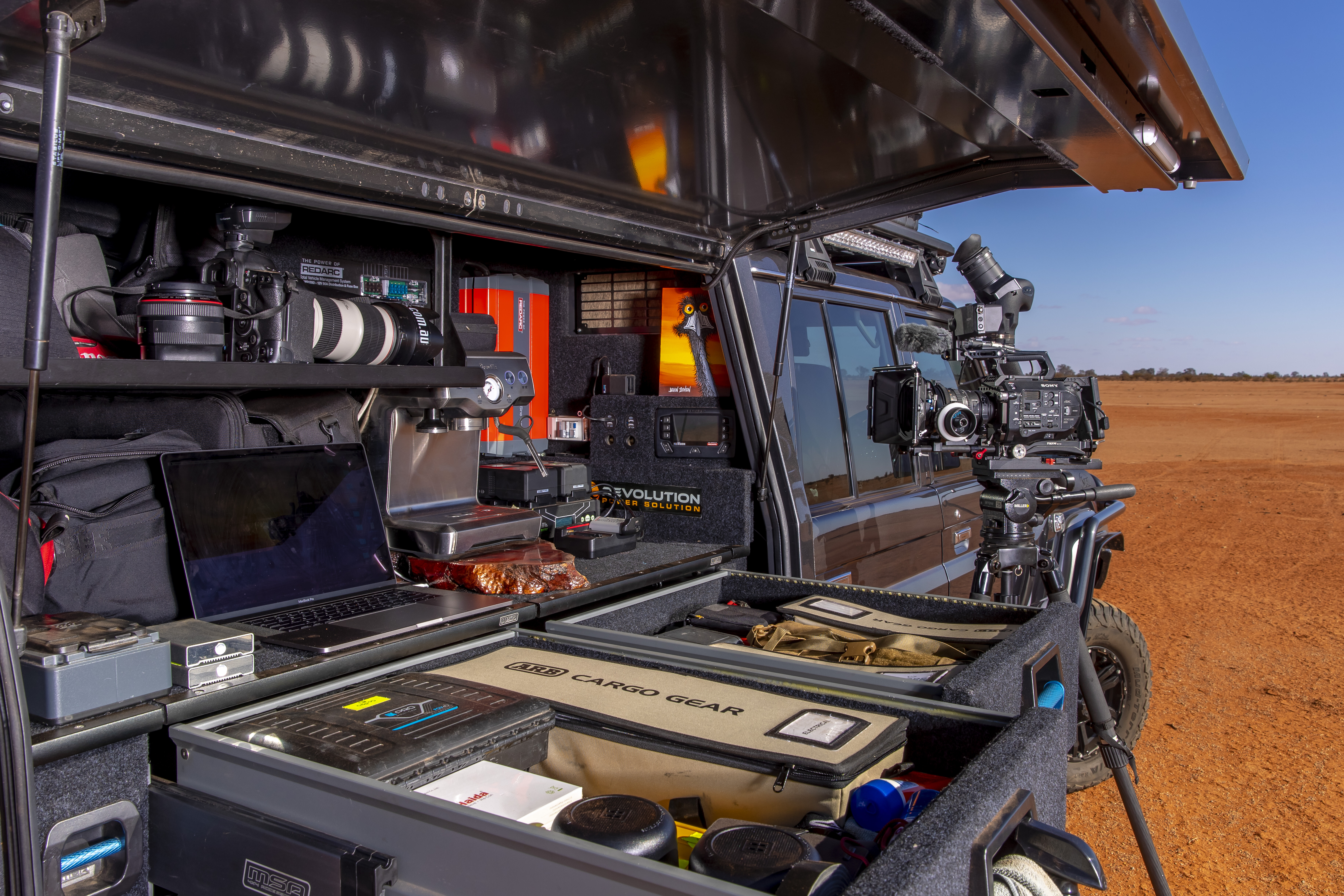
You also want to pack these items as close to the centre of the vehicle as possible, so if you have a drawer system fitted, for example, pack heavy tools and spares in first so that when the drawer is closed, they are situated between the vehicle’s axles rather than hanging out the back, which can also have a detrimental effect on vehicle handling.
Water is another heavy commodity that should be located as low as possible in the vehicle. Fitting a water tank down near the chassis rails of the vehicle is the best way to carry water. Other options include water tanks that can be situated behind the back seat of a wagon or up against the headboard of a ute, or water bladders that can be situated on the floor behind the front seats.
If you opt for jerry cans for your drinking water, try to situate them as low and as far forward as possible in the cargo area of a wagon or the tub of a ute; but don’t make them totally inaccessible as you will obviously need access to water daily.
Like water, the best way to carry extra fuel is in a dedicated long-range or auxiliary fuel tank. This means the weight of the fuel is down low between the chassis rails, and it is well away from vehicle occupants.
If you opt to carry fuel in jerry cans, you should ensure they are on the outside of the vehicle, as the last thing you want is leaking fuel inside the cabin, or even in a ute tub/tray, especially if there’s a potential ignition source in there such as a dual-battery system or electrical equipment such as a 12-volt fridge/freezer.
A dedicated jerry can holder at the rear of the vehicle is one option, but if this is not possible a jerry can holder up on the roof rack might be your only other option, which will, as mentioned, raise the vehicle’s centre of gravity, as well as potentially cause injury when you’re trying to load/unload it.
Like fuel jerry cans, gas bottles should also be carried outside the vehicle in case there’s a leak. Again, a dedicated holder is the best way to secure gas bottles.
Once all your heavy items have been secured as low as possible in the vehicle, you can now think about where the lighter stuff will go. Items like clothes and sleeping bags can be packed up high, and if they won’t fit in the cabin of a wagon or within the canopy of a ute, they will have to be packed up on a roof rack in a weatherproof cargo bag, space case or a roof pod, of which there are plenty of options on the market.
Pack the rack
When you’re packing gear up on a roof rack it’s important to know what the vehicle’s roof-load limit is, and also the carrying capacity of the roof rack system.
The vehicle’s roof-load limit will include the weight of the rack system itself, so if you fit an old-school steel tray, it will limit the amount of gear you can carry up top. Even if you fit a lightweight alloy roof-rack system, these can still weigh more than 25kg, which must be deducted from the weight you can carry up top.
The other thing to consider is that some vehicles have a static roof-load limit and a lower roof-load limit for when the vehicle is driving. This is especially important for those who run a rooftop tent, for example, as the static limit applies to the weight of the tent and the people sleeping in it, but only the tent for when the vehicle is in motion.
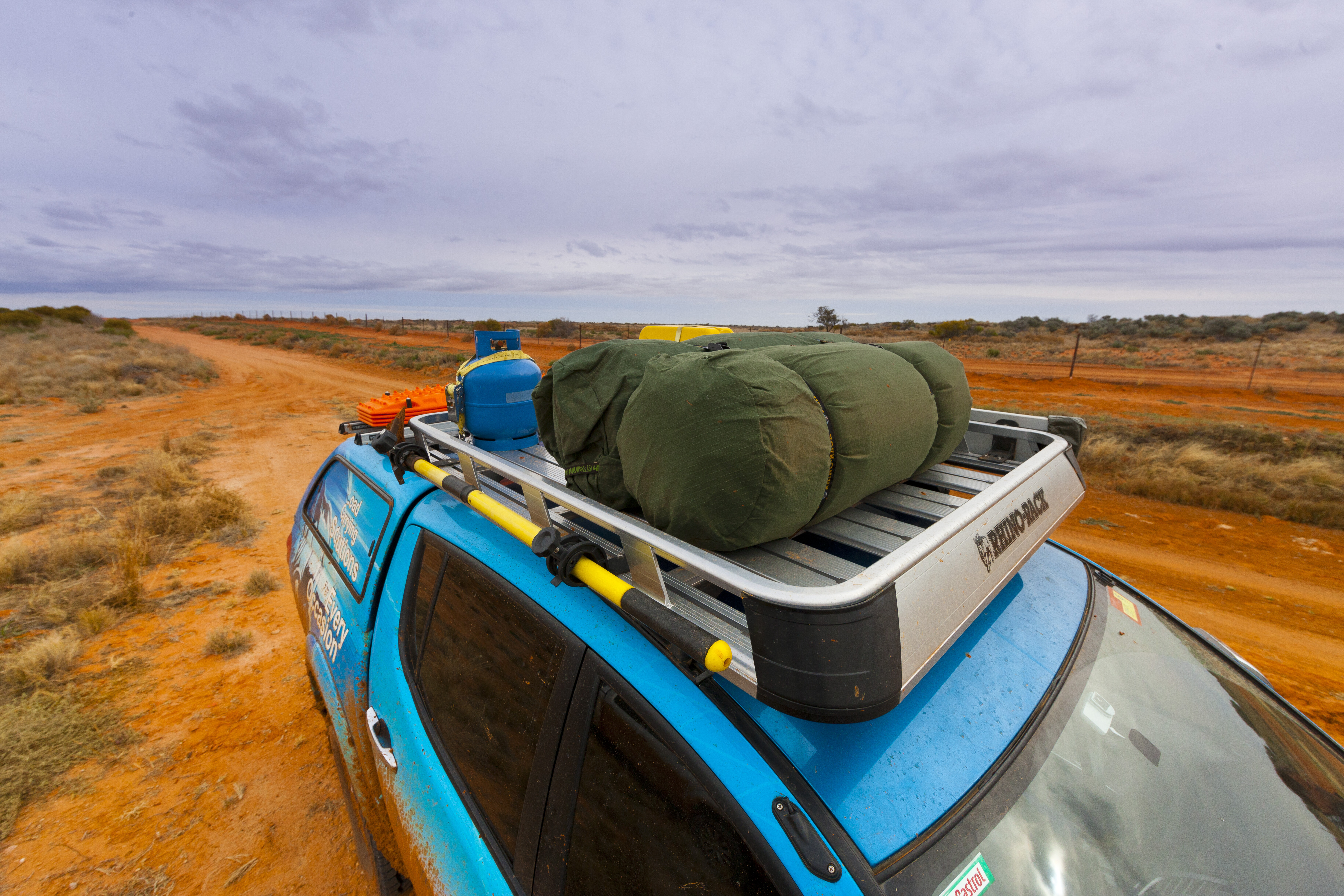
Additionally, some roof-rack system manufacturers list a lower roof-rack capacity when a vehicle is driven on gravel roads or in off-road situations, as vibrations from corrugations, or the action of the vehicle bouncing around when driven off road can place extra strain on the roof-rack system and the vehicle’s roof. It’s vitally important that you don’t exceed either the vehicle manufacturer’s roof-load limit or roof-rack manufacturer’s on- and off-road limits.
Bear in mind that many of the lighter items that are suitable for being carried up on a roof rack are quite bulky, such as tents, swags and gear bags. The bulkier they are the more wind resistance they will cause when driving at highway speeds, which will in turn affect vehicle performance and result in increased fuel consumption. And with the price of fuel well over $2/litre, fitment of a weatherproof and streamlined roof pod to carry some of your bulky gear could pay for itself after just a few trips.
Other items that are well suited to being carried up on a roof rack include recovery boards and shovels, and there are plenty of dedicated mounting systems for items like these that ensure they are both well secured and easy to access when you need them.
Pack for access
There’s some gear that regardless of size and weight needs to be packed for easy access rather than size and weight distribution, such as your first aid kit, fire blanket and fire extinguisher, and vehicle recovery equipment.
You should never travel off road without a well-equipped and up-to-date first-aid kit. Make sure everyone in the vehicle knows where it is and knows how to use it. All vehicles should also have a fire extinguisher mounted securely somewhere in the cabin where it’s easy to get at in the case of an emergency, and it’s a good idea to have a second fire extinguisher in the back of vehicles where cooking might take place or where electrical equipment is secured.
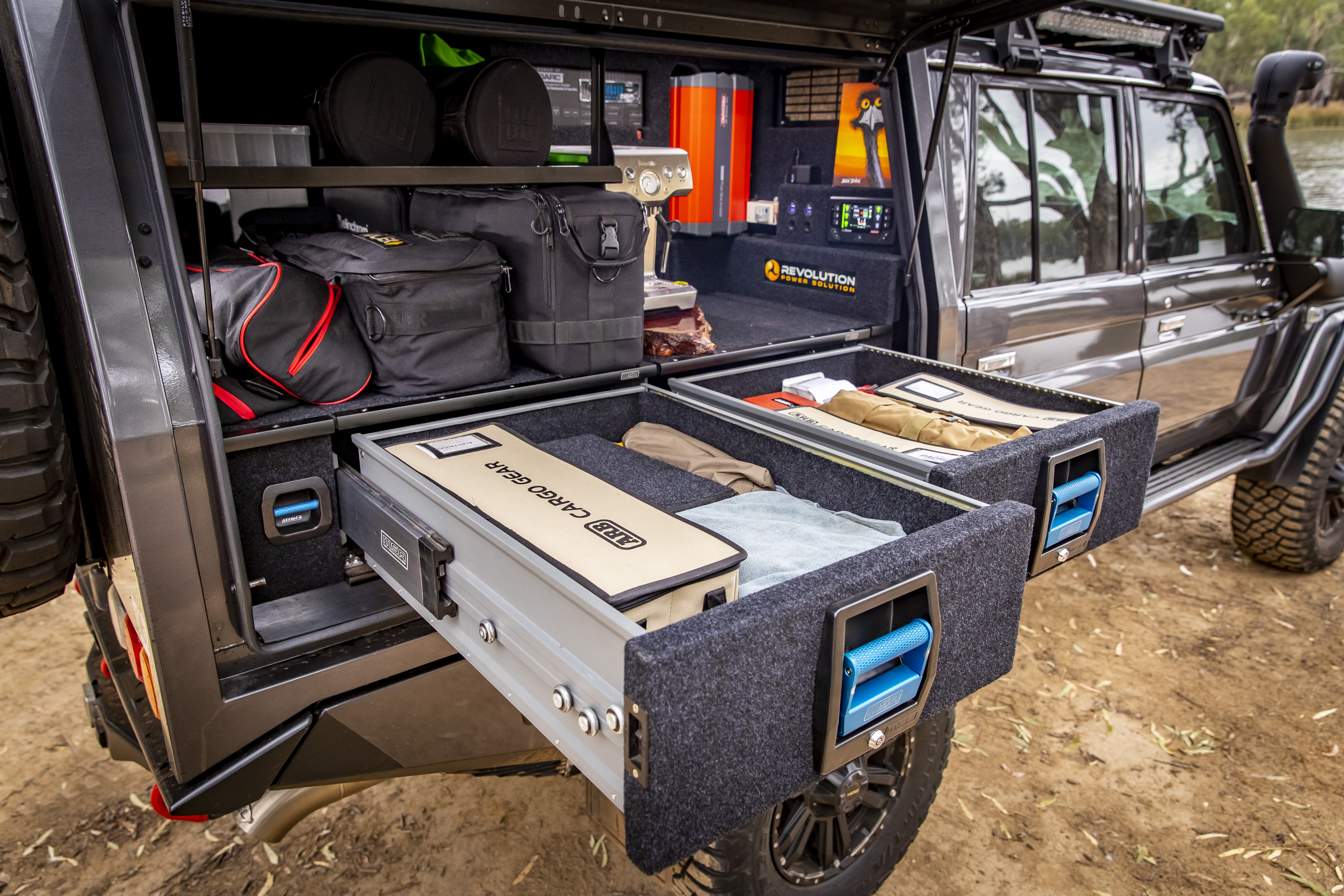
You will also need easy access to recovery gear. As well as the regular kit including gloves, snatch straps, shackles, snatch blocks and winch extension straps, make sure you always know where your winch controller is located. If you store all recovery gear in a dedicated bag, and pack it away properly after every use, you will have a better chance at being able to grab what you need when you need it than if you have bits and pieces scattered throughout your vehicle.
Likewise, always keep the air compressor in a handy, easy-to-reach location, along with the accessories that go with it, such as air-pressure gauge and air hose.
If you’re travelling in remote locations, make sure your satellite phone or satellite communicator is safely stowed, charged and within easy reach.
Pack tight
No matter whether you drive a wagon or a ute, properly securing gear is a must. The last thing you want is for heavy items to be flying around the cabin and whacking vehicle occupants when you’re driving off road, or worse still, in the event of a collision.
If you drive a 4×4 wagon, consider fitting a cargo barrier to keep heavy items separated from vehicle occupants. You’ll still need to tie stuff down, but a cargo barrier will also allow you to make the most of the available space inside your wagon, allowing you to pack in gear all the way up to the roof.
A drawer system is another fantastic way to secure gear, as well as to provide easy access. You can go a step further and use dedicated storage bags designed to work with different drawer systems. Just bear in mind that some drawer systems are heavy, and this weight will detract from a vehicle’s payload capacity.
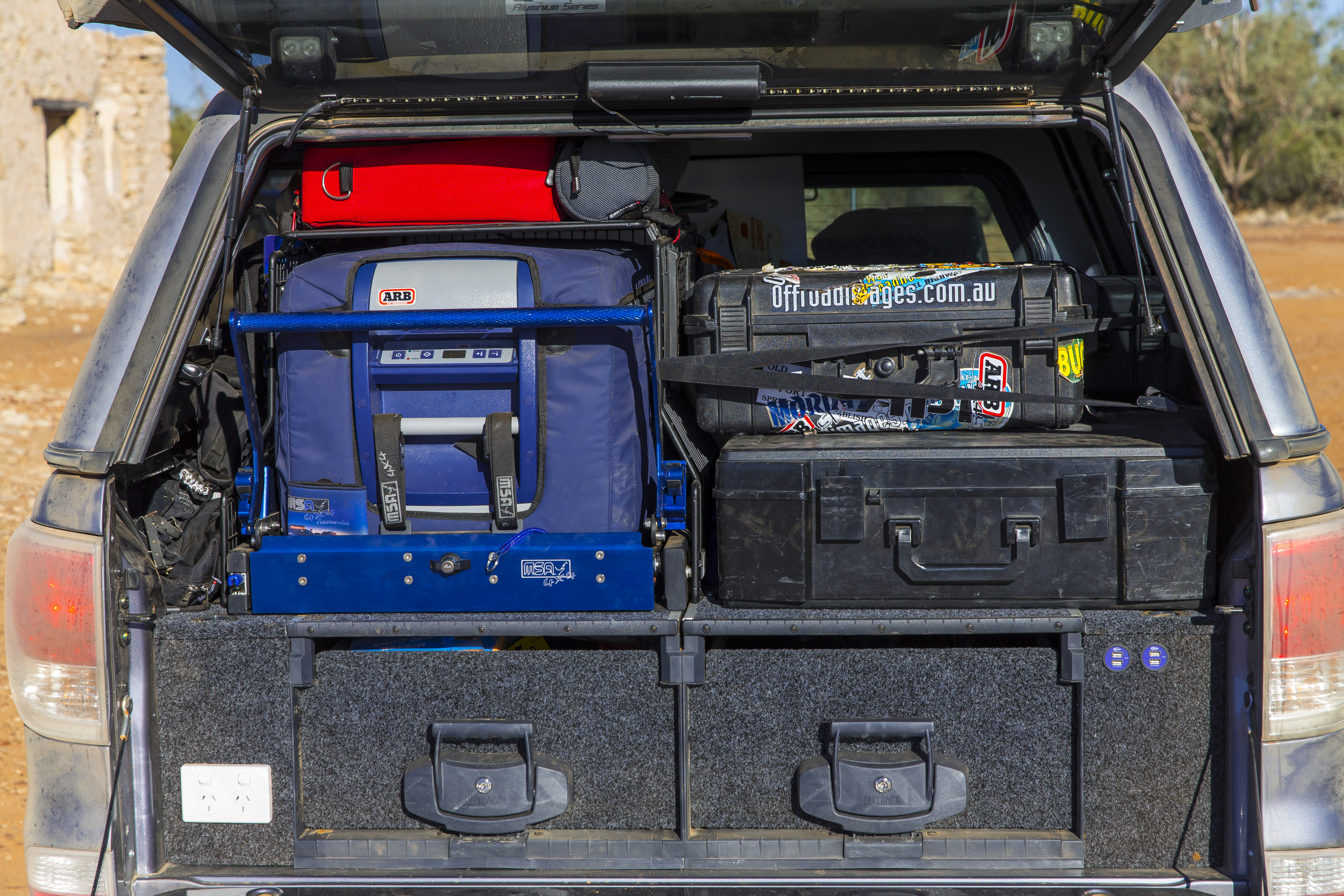
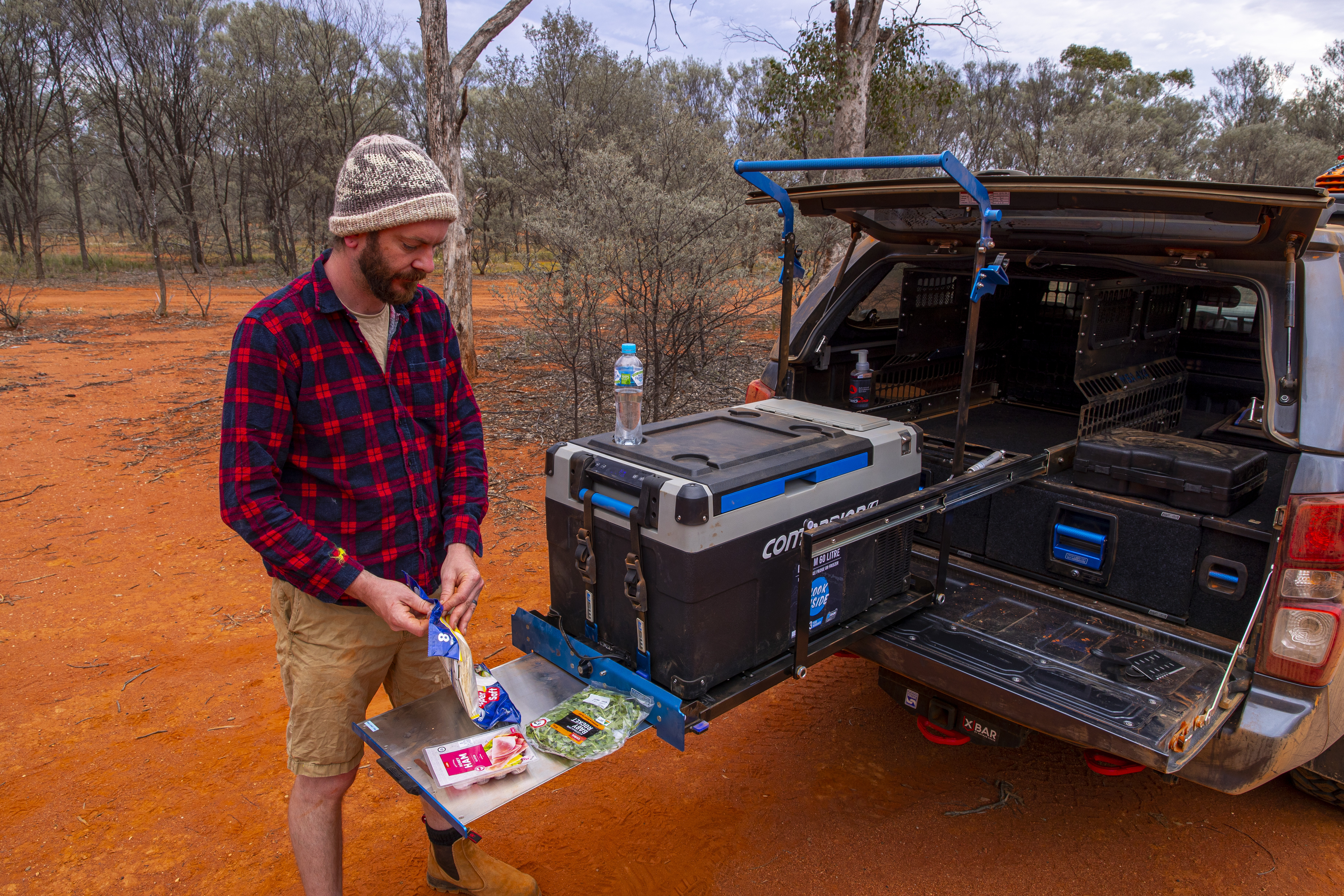
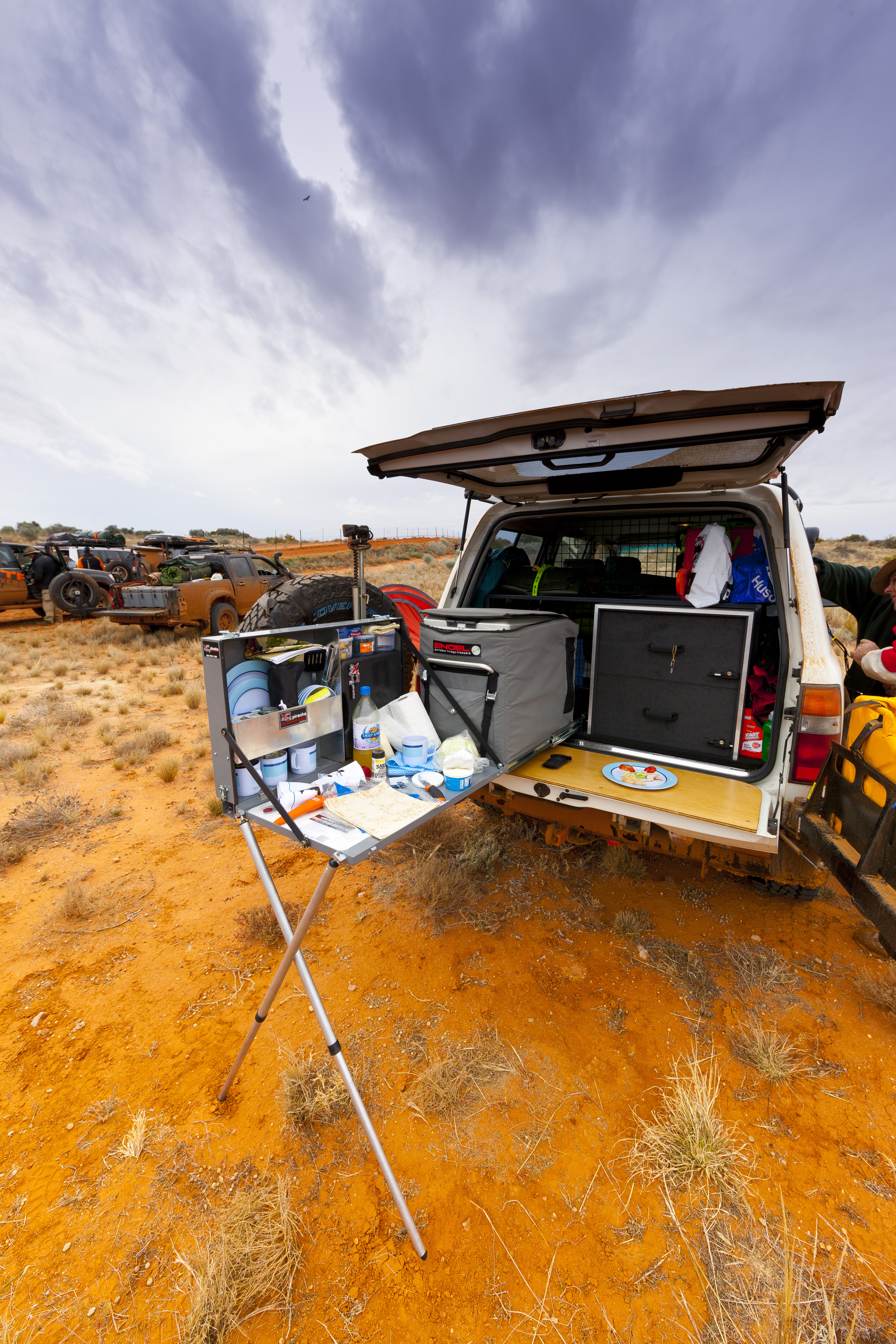
The portable fridge/freezer will also need to be secured properly within your vehicle, so a fridge slide will be a handy way to access chilled items. Some of the most convenient fridge slides drop down allowing for easy access to fridge contents, but again, bear in mind that some of these can be quite heavy.
If you have a fridge slide, you’ll probably want to fit a fridge barrier to stop other items from falling in behind the fridge when you pull it out. Again, these will add even more weight, but they are also convenient places to mount items such as fire blankets and fire extinguishers.
If you drive a ute, fitting a canopy is a great way to secure items in the tub. There are plenty of great designs on the market these days, manufactured from various materials. When selecting one for your rig, some things to consider include how it mounts to the vehicle’s tub, how heavy it is, how much access it provides through its doors and windows, and whether it can be fitted with a roof-rack system.
Pack right
No matter how you pack your own four-wheel drive, here’s a summary of the key points: keep weight down; keep weight low; keep dangerous goods away from vehicle occupants; keep safety equipment handy; and secure absolutely everything.
And if you think you might be nearing your vehicle’s payload capacity, load it up with passengers and gear, and put it over a public weighbridge; if it exceeds GVM you’re going to have to lighten your load.
Do
- Pack heavy items down low
- Pack safety items where you can easily access them
- Secure everything in your vehicle
- Put light stuff up top
- If in doubt, weigh your vehicle
Don’t
- Exceed vehicle GVM
- Exceed roof-load and rack-system limits
- Store fuel inside vehicle cabin
- Store heavy items up high or out the back
- Hurt yourself putting heavy gear on the roof
The September issue of 4X4 Australia is out now, and it’s dominated by more than 40 pages of quality Ford Ranger content.
Our Ranger rampage kicks off with off-road reviews of the V6 Wildtrak, V6 Sport and I4 XLT. And It didn’t take us long to line a next-gen Ranger Sport V6 up against the long-serving and popular Toyota Hilux SR5+. Does the Ranger set a new benchmark, and should Toyota be worried?

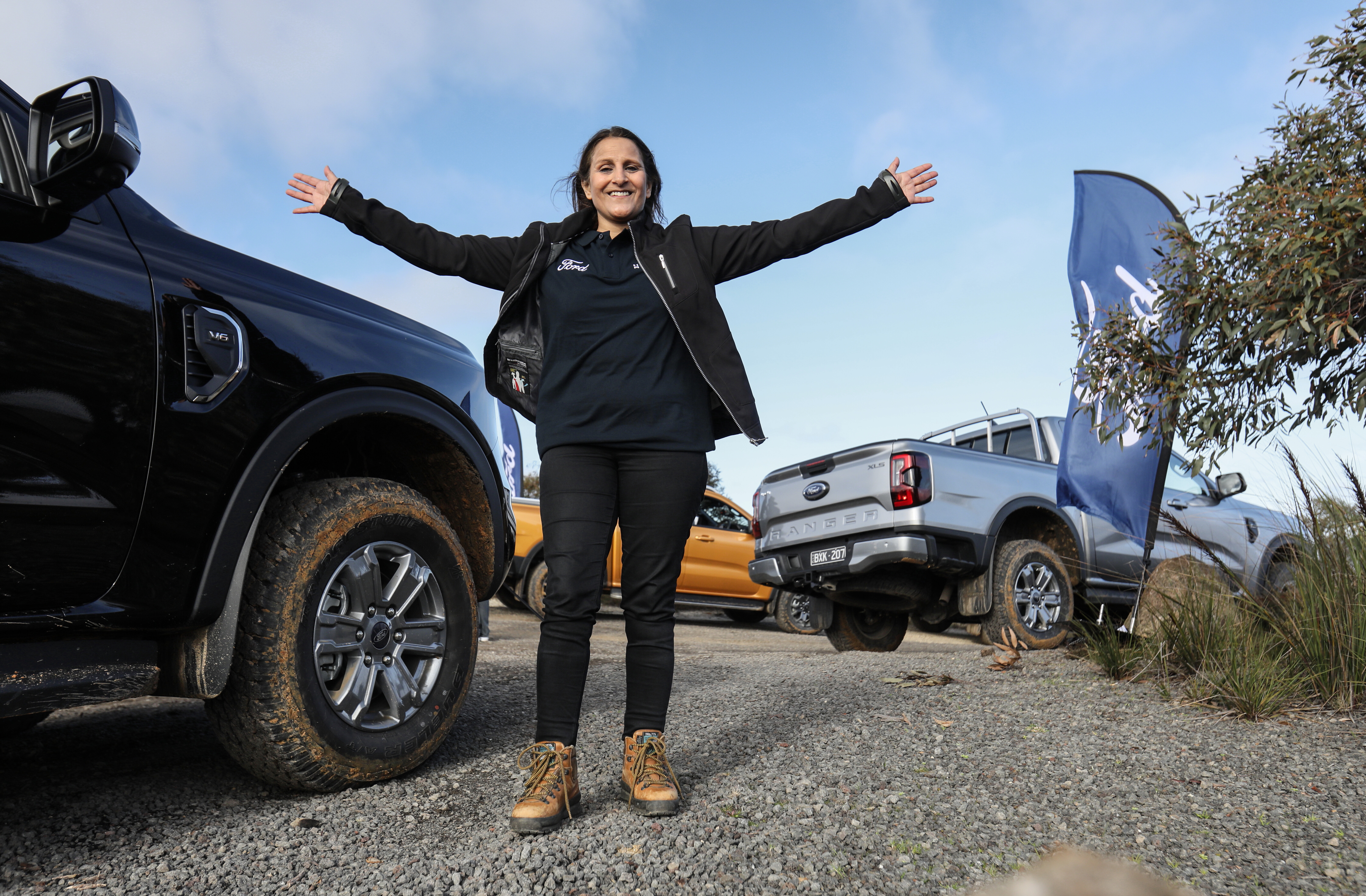
We then chat with Pritika Maharaj, Ford’s T6 global program manager, who talks to us about how her passion for engineering began and how she forged and delivered Ford’s bread-winning T6 platform.
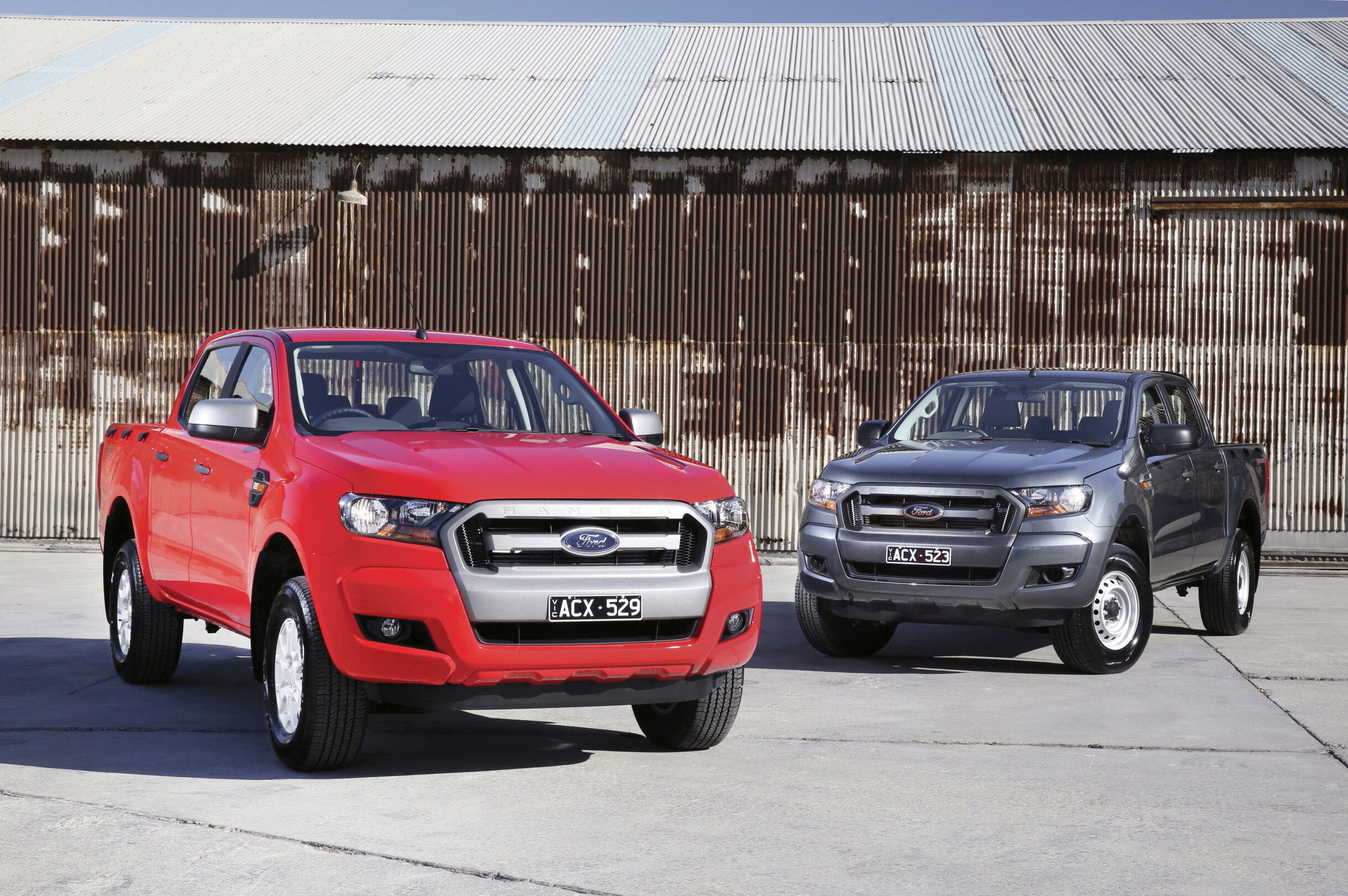
Not willing to wait for a brand-new Ranger? Fraser Stronach takes a trip down memory lane to deliver a comprehensive analysis of the used 2011-2022 Ford Ranger market, including the pros and cons of each generation.
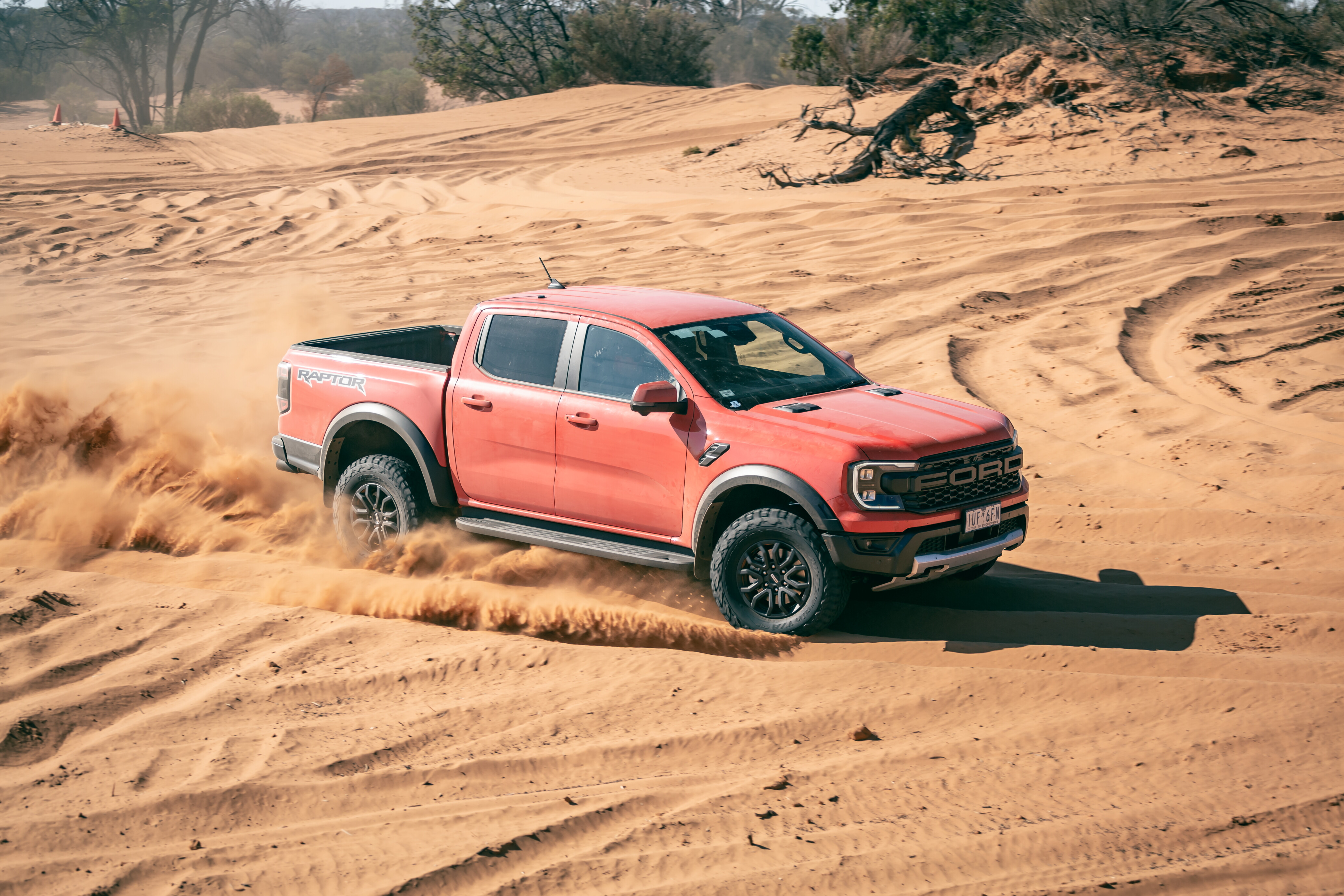
To cap off our Ranger coverage, Editor Matt scored seat time in an upcoming Ford Ranger Raptor, driving a prototype on secluded off-road tracks before sitting shotgun on a high-speed circuit. It’s a big step up from the outgoing model, he says.
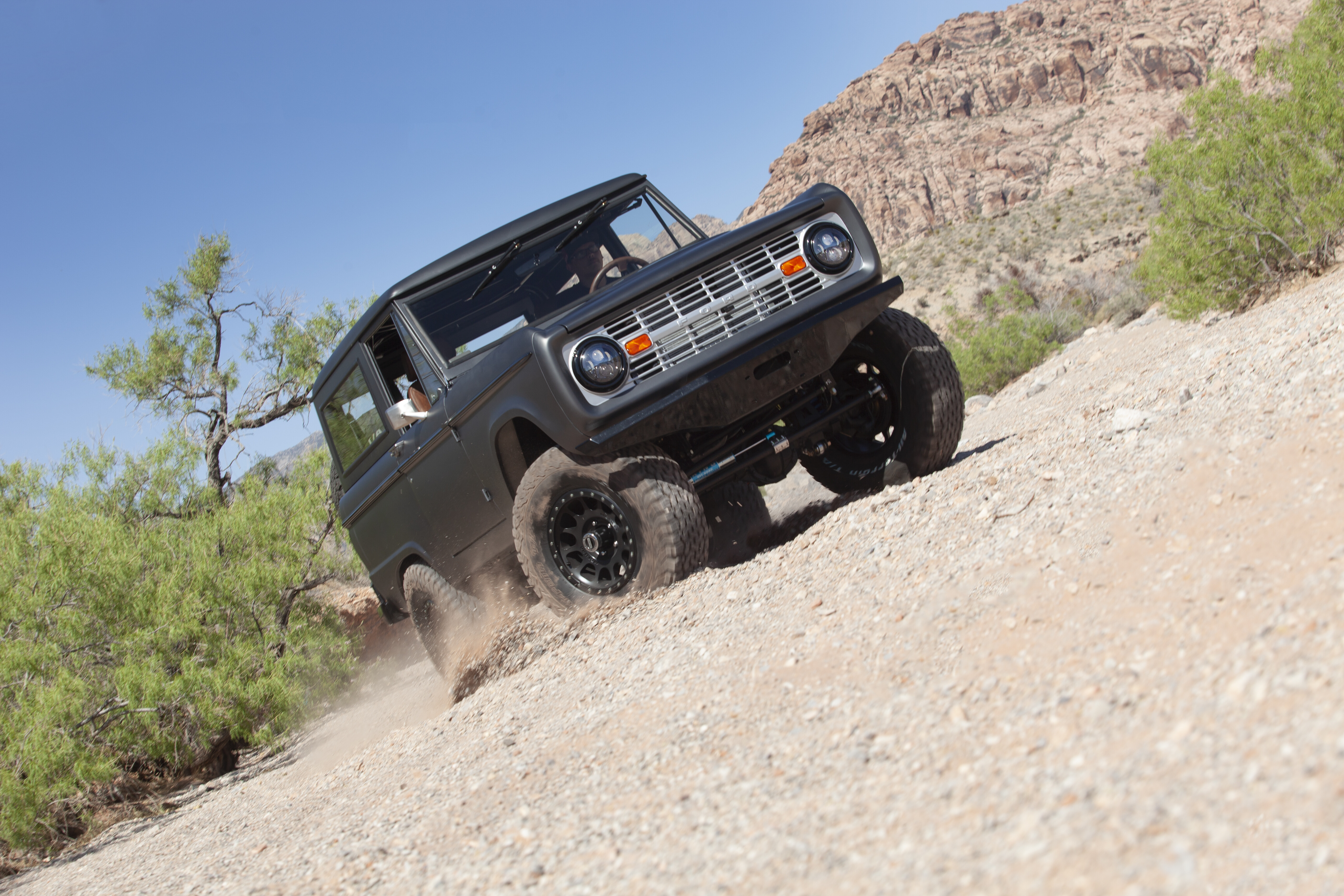
Continuing the Ford theme, we take an in-depth look at a restomod 1969 Ford Bronco with 460hp of V8 power on tap. It’s an expertly fettled vehicle, loaded with state-of-the-art aftermarket kit.
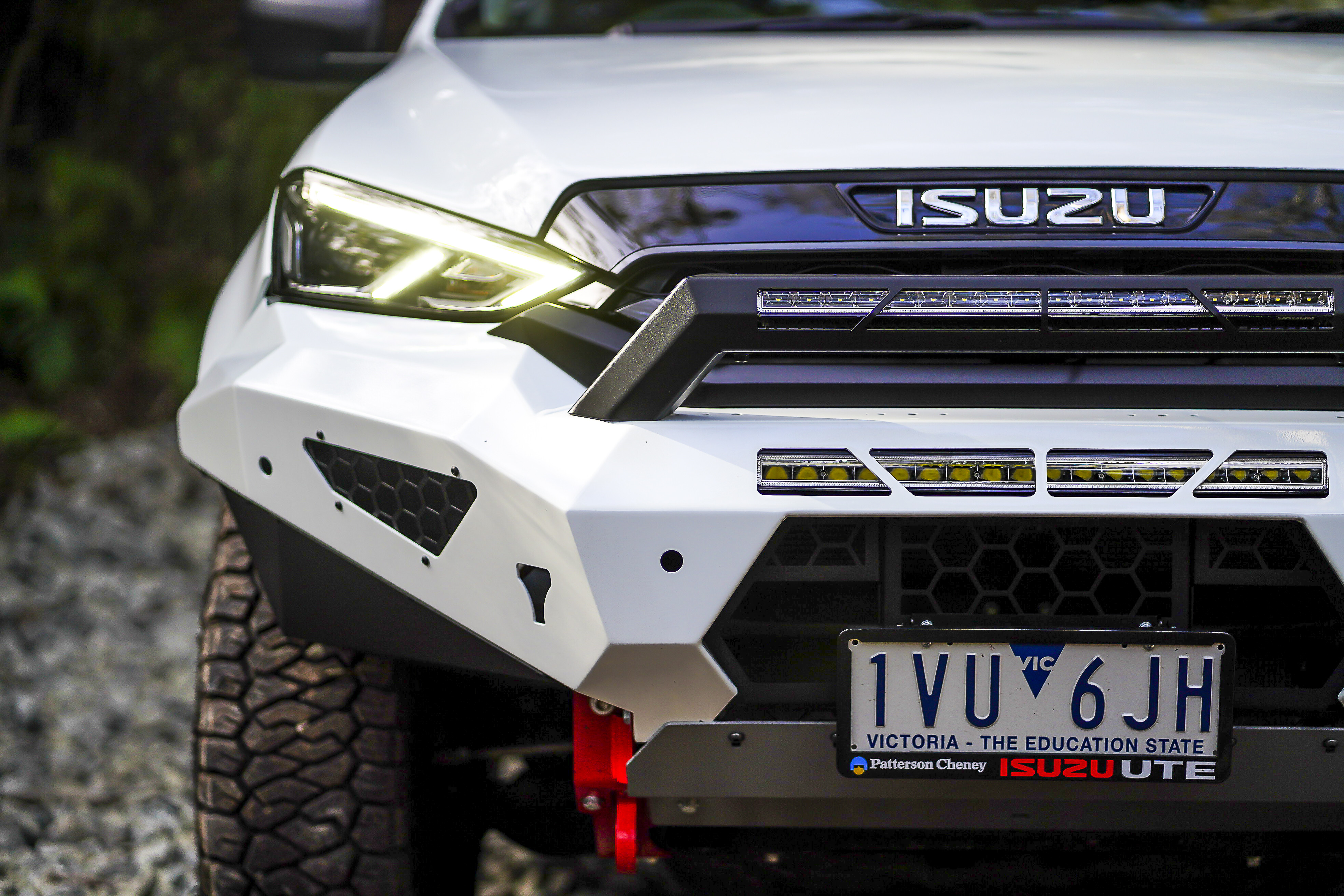
Last month, we installed an Offroad Animal Predator bar and Century Dual Force battery to our Isuzu MU-X. We’ve made a bit more progress with the build this month, adding new Maxxis RAZR AT811 tyres and ROH Trophy alloy wheels.
In the latest instalment of our How To Offroad series, Deano explains the best way to pack a 4×4 so you can safely and securely transport everything you need, and access what you need when you need it.
What else is there?
- How to survive in the wild
- Exploring Broken Hill
- FJ Cruiser and PRO-4X Navara in the shed
- Battery World jump starter tested
- New products, reviews and opinions
4×4 Australia is saddened to hear of the passing of Arthur Goddard in August 2022 at the age of 101.
Our thoughts go out to his family and friends. He will be fondly remembered by all classic Land Rover enthusiasts.
4X4 Australia editor, Matt Raudonikis
May, 2016: 4X4 Australia talks with the legend, Arthur Goddard
Editor’s note: in honour of our lively chat with Mr Goddard, the story below is presented in its original, unaltered form.
The godfather of the Land Rover is a crafty old bugger with a quick wit and a ready laugh. He’s a doer and a stirrer.
The mind is sharp and that infectious laugh punctuates yarns. He has much to chuckle about after years of automotive engineering and management tasks – none more poignant than being the development engineer for the original Land Rover.
Arthur Goddard, now 95, was the fixer, the minder and the leader of the English team that designed and built the first Land Rover – achieved in just ten months.
The project began with an idea from Rover’s technical director Maurice Wilks. The first chapter closed in 1948 with Arthur driving the square-jawed Land Rover to debut at the Amsterdam Motor Show, where he was snowed under with orders.
“I thought to myself, we’ve got an oil well here!” Arthur recalls.
It was an oil well that was capped when production of the Series 1’s successor, the Defender, ceased in January, 2016.
In between those two dates, more than two million of the iconic Series Land Rovers were sold around the world.
Arthur has a simple explanation for this four-wheel drive’s long life.
“We gave people what they wanted. It’s pleased a lot of people and it’s kept on pleasing people,” Arthur says. “We met a need. I must say some of the needs we met we didn’t know were there. On the other hand, some of the stuff we thought would be an absolute winner was an absolute woof.” He breaks into a hardy chuckle.
These days Arthur is an Australian living in Brisbane, but there remain hints of growing up in the north of England and working in Land Rover’s Solihull plant, outside Birmingham.
Here in 1947, Maurice Wilks, backed by his brother and Rover managing director, Spencer, decided Rover should build a go-anywhere, do-anything vehicle. The idea was partly inspired by the World War II Jeep on Maurice’s hobby farm.
Arthur, then chief development engineer on Rovers, recalls Maurice was also keen on an army vehicle after talking to pals in the Defence Ministry.
“They were looking for a Jeep-type vehicle, so it had to meet all the army requirements and it had to be a useful vehicle on the farm, where you could go off down the road to do a bit of shopping or you could take a bale of hay across a snow-bound field or whatever. And a much more useful combination than your tractor,” Arthur says.
Maurice wanted power take-offs (PTO), and a drive up the centre because he saw possibilities for industrial applications, arc welders and more.
“I said ‘how many vehicles is this?’” Arthur laughs.
He knew something about army vehicles. “But who the hell knew about tractors, who was working in the automobile industry in the UK?” Here he was grateful for help from the Ministry of Agriculture.
Arthur is sure that the first Land Rover wouldn’t have come together, certainly not in just 10 months, if not for teamwork and prompt decision-making.
He says the hardest part wasn’t the engineering, but building enthusiasm across the factory floor. Arthur even took to organising an open day – complete with strawberries and cream – for wives, families and girlfriends.
“Leadership was absolutely vital in this, a lot of things were being done at once; things normally done in sequence… having engines and gearboxes and body shapes and seats all done at once.”
Decisions were made smartly, most through informal meetings between Arthur, Maurice and Spencer twice a week.
“He’s (Maurice) no fool; knows perfectly well that I know the answer already… I wouldn’t be asking him if it mattered what he said,” Arthur chuckles.
For instance, that original, pale-green body colour was dictated by the canny Rover engineer. Understanding the potential for army orders, Arthur decided on a military shade. “What colour do you want?” he’d asked Maurice. “If you want more than one, put the date (for completion) back two months. Not putting pressure on you.”
While Maurice was the concept man – the one who decided the clock should go in the middle of the dashboard, as on his mother’s mantelpiece – his engineer understood how to pull it all together.
“Maurice knew, or appeared to me to know, what people would buy, I hadn’t got that. But I knew how to get it made.”
That included using the services of Jack Swaine, the engine man for Rover cars, and Frank Shaw, the gearbox man who designed the transfer case for drive to the front wheels and power to a PTO plus V-belt drive for implements.
“I could pick people to do the jobs,” a modest Arthur says. “I didn’t have to be all that good myself, because I had a suspension man, a steering man and so on.”
But this Land Rover chassis was all-new. “The chassis made it possible. You haven’t got a complete body, but you want a frame on which to mount everything. That was the engineering problem… what does that frame look like? Looks like nothing you’ve ever seen before.”
Credit for the chassis and bodywork went to Gordon Bashford and Olaf Poppe for the rare box-section chassis with upright pieces below the A-pillars.
Arthur says as much was learnt about what not to do, as what to do from the World War II Jeep.
“One was, if you wanted a rust bucket, you copied the Jeep. The fact that these (Land Rovers) were all aluminium and galvanised pretty much took us outside everything of the Jeep.”
Arthur and his team double-checked each component – from door locks to differentials – to counter risks when the Land Rover jigsaw was first assembled.
“We were trying to make sure everything got to the finish post at the same time – because Maurice finished up saying he wanted the job done in 12 months. For a normal vehicle it’s three years, never mind this fancy one that does all these different things. So I think it was a bloody miracle that he got it.”
Little details caught the Rover lads out when testing began in the paddocks and up and over old Nissen huts.
“You get stupid things, like that bloody clock. If you run over a certain thing, the clock jumps out, lands on the floor and gets smashed. There’s a little clip at the back which either clips into the groove or doesn’t. If it doesn’t, that’s the sort of thing that catches you.”
He’s proud of the Rover teamwork, but says his biggest mistake was not adding eight inches (20.3cm) to the original wheelbase of 80 inches and 86 inches (2.18m), something he did later to cater for army needs for a six-seater with two troopers either side at the rear.
That job done, Arthur left Rover in 1955, took up posts with other automotive concerns, including one in Australia in 1972. He liked the place and bought a small Brisbane engineering firm as a hobby, then semi-retired 16 years back. Now, with the aid of engineering son, Chris, the business, called Vehicle Components, is a designer of trailer suspensions and couplings.
Arthur is just about to move into a retirement village. He’s hung up his driver’s licence for his beloved Jaguars and packed away the golf clubs.
He’s sure there’ll be another Defender. He pats the dashboard of the Heritage 90 and looks for the door catch. It’s not where he put it at the rear of the door under the lock. It’s up front.
“Why did they put this over here? I hope they had a bloody good reason… they’d have needed one.”
Arthur breaks into a laugh, stirring the pot as he goes.
Launching a new vehicle in to nearly 200 markets for a global carmaker is riddled with complexities, challenges and downright hard work.
Supreme engineering talent is not enough; being a great people person alone won’t do the job. It’s a unique skill set that sees T6 global program manager Pritika Maharaj ensuring Ford’s Ranger and Everest are built to the demanded quality standard, with the right powertrains, capability and features – to a strict schedule. Watching the T6 line-up roll out around the world is her moment of truth.
“It’s tricky, but I wouldn’t call it the hardest time,” Maharaj tells 4X4 Australia. “I quite enjoy launch; I like it when it’s all about delivery and executing right. I wouldn’t say it’s harder, but certainly it’s more immediate and there’s a lot more immediate pressure because you’ve got to turn things around quickly, you’ve got to think quickly, get the right people engaged. A lot of what I do is trying to make sure that those people are engaged and that they understand the urgency, move fast and resolve what we need to.”
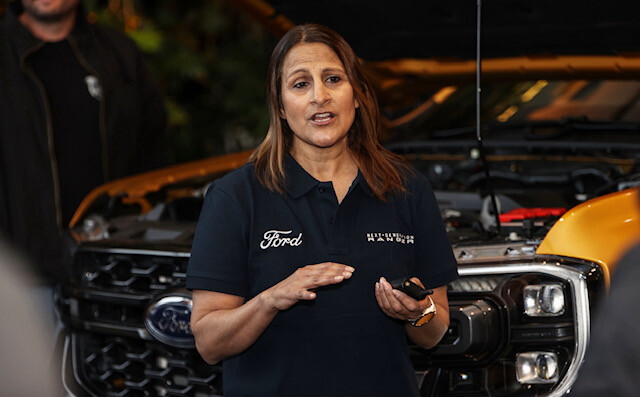
Maharaj is talking about what’s going on at Ford across the globe as T6 rolls out in the coming months. The big decisions, which include the broader program goal, were determined years ago, but as the plan unfolds it’s her job to sort any stifling issues or challenges that may put the team – and the final product – off course. Maharaj’s job title as T6 program manager is as literal as they come, she says.
“I spend a lot of time in what we call ‘change management’, which is where we review any changes that the engineering team want to make. We review them and either approve or reject,” Pritika explains, suggesting that it doesn’t mean the competing engineering teams are always buying her lunch.
“Quite the opposite! It’s all about making sure we get the vehicles on time and with quality, so anything that pops up along the way, and it may not be only an engineering issue; it may be a supply issue; it may be a supplier having trouble with a certain part or logistics – it could be anything.”
Again, literally anything: manufacturing challenges, factory logistics, currency fluctuations or global pandemics. “Anything that is important to delivering Ranger, Everest and Raptor on time and with quality comes under my remit. So most of the day I spend time working on managing and making sure that all of our deliverables are tracking to the plan and that we’re in support and ready to go.”
Early years
Part engineer, part people-person, part logistics, completely whatever it takes, it’s a serious accomplishment to deliver a program – across any brand, and any segment – but for Ford in Australia, the T6 is its breadwinner.
This underlines how critical Maharaj’s role is to the brand in this country and its standing with the global Ford ecosystem. It’s a gig that a young girl growing up in North Balwyn in Melbourne reached through curiosity, tenacity and talent.
“When I was really young, I enjoyed pulling things apart,” Maharaj explains. “Mum wasn’t the kind of mum that said, ‘Girls do this and boys do that’, but rather, ‘Whatever’s your interest let’s go down that path’.”
That saw Pritika’s mum gift her a Meccano set – the classic French kit made of metal, not plastic – which sparked an inquisitive young mind.
“That’s where it started: just tinkering, playing and building,” she says. “I have a bit of an analytical brain and I like to work out how things operate and what makes them go, whether it be a person or a mechanical system.”
That interest was apparent on trips with family friends to the Strathbogie Ranges in Central Victoria, where her mechanical mind-mapping developed. Every Easter, Maharaj’s family would head there and camp with other families on a large property.
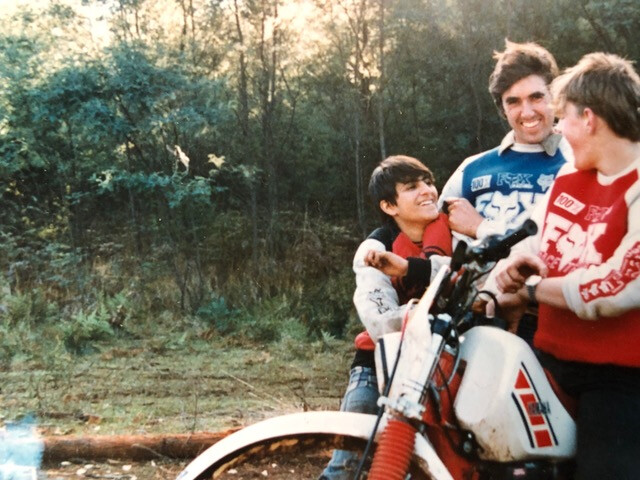
“That was when I first got to ride a motorbike,” Pritika says. “It was just an old clanger. I had a bit of a go, and I got the bug from there. After that, I started saving and I ended up buying myself a YZ80, the last of the air-cooled ones, and I started just mucking around.”
The problem was where to ride the Yamaha back home in Melbourne.
“We had an area behind our house where you weren’t actually legally meant to ride but you could get away with it and just had to be quick if the police came!” Pritika laughs. “So I just used to fang around there, and I got to meet other people that were keen on the same sorts of things.”
Carrying out mechanical work on her bike, tuning the suspension and figuring out how to go faster only solidified Maharaj’s passion for working out what made things tick. She decided to discover as much as she could, vehemently focussed on her goals. That led to her first part-time job while still at school.
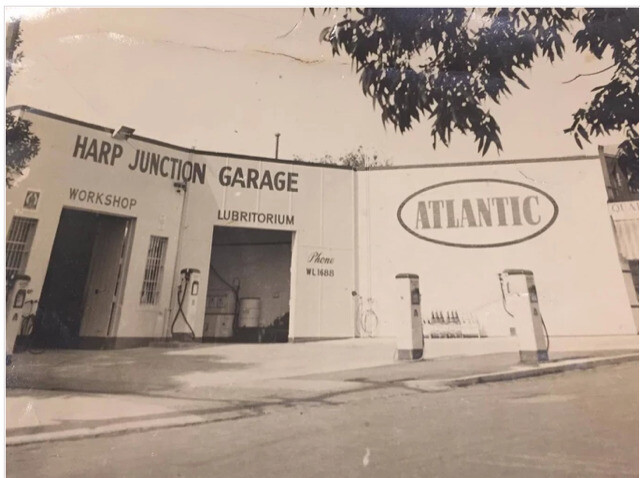
“I just wanted to learn more. School may’ve offered some kind of 101 in mechanics just to teach you the basics; how to service a car, the oil, those really simple things. So I got interested then, and we had a local garage, so I went up there one day and said, ‘Look, I’d love to work here part-time, just interested in anything, I don’t mind what I do, I just want to learn – would you consider giving me a job?’”
It wasn’t an instant success when approaching the owner, Alan, for a start, especially when men dominated the staff there. Yet Pritika wasn’t fazed.
“I might’ve had to hound him a couple of times to get him, but basically he was a really great guy and agreed to let me work after school and also Saturday mornings. I started off really very basic: initially they’d let me fill customer cars, check oil and water and pump the tyres and that sort of thing, and then as I got to know the team and they got to know me, I got to progress along, so I moved in to doing basic services.”
An epiphany
Pritika’s knowledge grew, again only stirring her to know more. Learning from the mechanics she worked alongside, the next milestone was an apprenticeship. The gutsy teenage Maharaj went back to Alan to see if he would support such a move.
“He said yes, but only if I finished my schooling,” Pritika says. That proved a sliding door moment for her.
“I finished school and by then I’d had a number of years in that learning environment. I’d had a good opportunity to work in the garage, but I could also then see that maybe I’d be keen to learn a bit more about how it all works and be involved in engineering and designing.”
That saw Pritika go on to engineering at the Royal Melbourne Institute of Technology (RMIT) – but continue tinkering. “I also got in to racing. The interest in motorbikes, the interest in mechanics, it was really the next step,” she says.
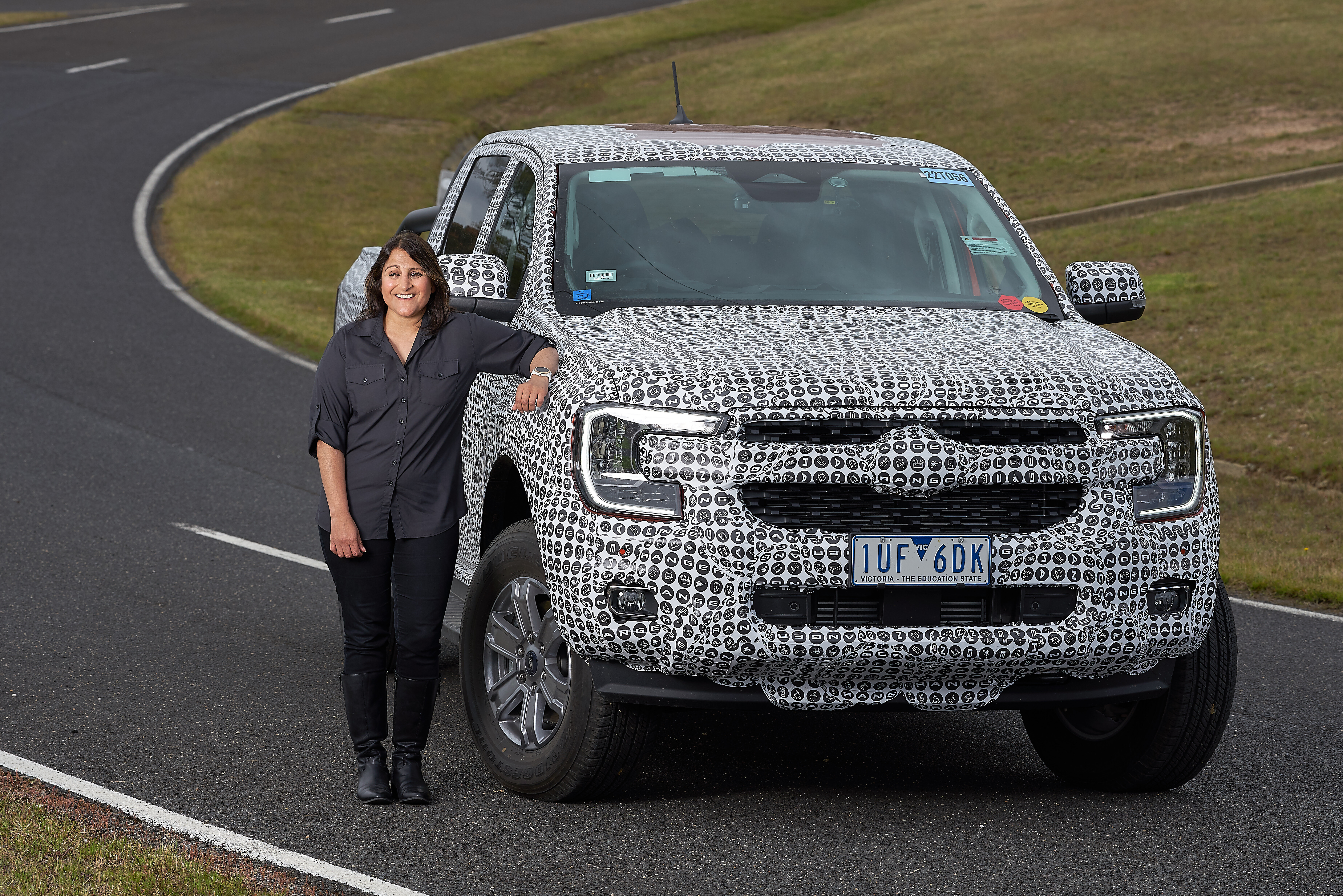
There was no holding her back – and she had full support from her parents, her father, a gynaecologist, her mother a research fellow at the Victorian Institute of Strategic Economic Studies.
“Nothing to do with cars, and they were never interested in cars or bikes or anything like that … I talk about my mum being fierce, she was fiercely independent and very much ‘you can do anything you want to do’. I got that from my mum. From my dad, he was always looking for ‘How can you do better?’. We always joked that you’d bring an assignment home and be so pleased, but dad would always be looking to see, ‘Well, could you have done any better?’ type thing, and that was a little tough at times, but it also meant that it’s kind of who I am now.”
The adventure had shifted the goal posts, which saw Pritika join Ford to work in powertrains, fiercely independent yet with her dad’s ‘how can you do it better’ ethos framing her work.
“As a kid it was about being a president of a company or something – but once I was at Ford and I was working in engine design, I was surrounded by so much experience. We had some really brilliant engineers in terms of engine engineers, so I went in to that team and was surrounded by all this intellect and experience, and at that point I wanted to be like those guys – there was Alex Mishura, Ken Stanford, Tony Boot – they were amazing; the knowledge between them, and that’s what I wanted to do, I wanted to become a technical guru or specialist on engines.”
Pritika worked on the legendary Ford in-line six, developing the Aussie-first liquid-phase injection (LPI) version for the FG Falcon, as well as developing an enduring crank design for the I6 that was never bettered.
“It had so many elements, and it doesn’t sound complex, but it is – there’s a lot to the crankshaft in terms of its design, there’s a lot of work a crankshaft has to do to deliver refinement and performance. When we finished the I6 engine, that crankshaft remained, so from the time I engineered it right through, it survived, and that really makes me smile and feel proud.”
The T6 call
That progress led to Maharaj’s regional role as the new Ranger, Everest and Ranger Raptor hit not only Aussie showrooms, but saw factories around the world ‘switched on’ as production kicks off. Any last-minute issues are about getting the right people in the room and making a rapid, effective call – that call’s on Pritika and her team.
That makes the rollout of the updated T6 models a unique and special time. “You have to ask so many questions, because, depending on which plant we’re talking about, at the moment we’re obviously in the middle of launch and ramp up for Thailand plants, so it’s all about stability now and trying to minimise change for only things that we absolutely must do, and a lot of that will come from the plant as they ramp up in to volume.
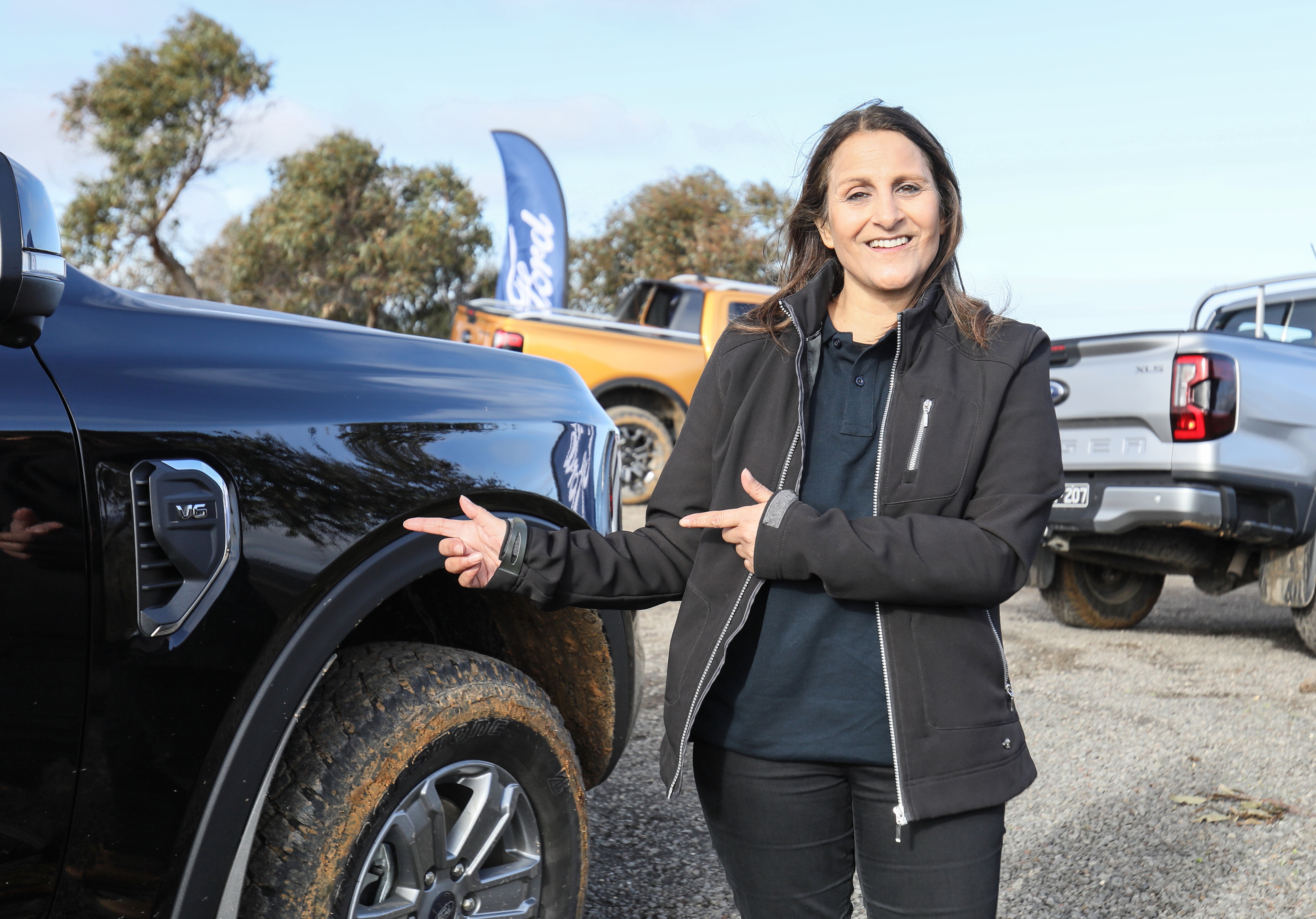
“They might hit some obstacles and they might reach out for help, and it’s really just trying to work out right, we don’t really want to change too much now, but it’s really important to support the quality execution and just try to sift through that; whereas, when you’re talking about some of our other programs, other plants that are yet to get to that point, then there is other general engineering change and work to be done as we progress.”
That mix of people management and technical knowhow is rewarding for Pritika as the new models roll out. She describes herself as very direct in her approach and won’t simply congratulate the team if the work isn’t what’s required; that can be a difficult challenge.
“You need to be very focussed and mindful about what motivates and how to get the best out of people, but at the same time, you’re right in the middle of launching a product and delivering a program so there’s a lot of good, technical interesting things to get stuck in to along the way. So I’m very strong on wanting to be honest, I don’t like to, you know, give people fluff and nonsense and just tell them, ‘Great job, keep going’, I’m not at all from that kind of school – I’d much rather honesty.”
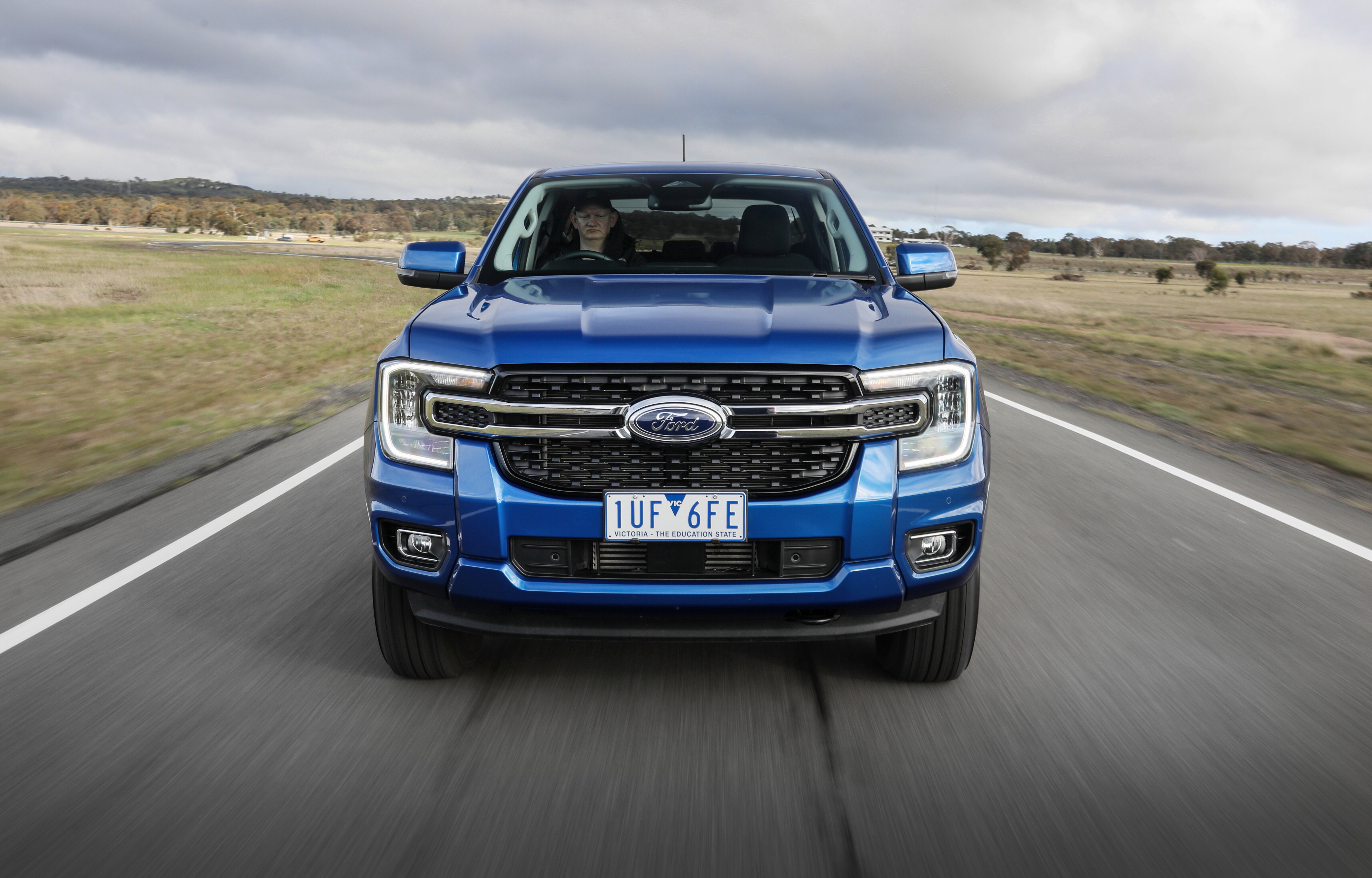
The introduction of V6 powertrains to the new Ranger and Everest line-ups is close to Maharaj’s heart, especially given her beginnings with Ford in engine design. She believes that there’s plenty of life left yet in internal combustion despite the popularisation of EVs. Regardless of what’s fashionable, the T6 team goals, she says, are always customer driven.
“At the end of the day I really want to deliver the best that I can or be part of the best delivering team. I love engineering, but what makes it all real are the people. That’s what really drives me. The next-gen T6 has absolutely been a dream experience because, and I mean this genuinely, working with people sharing a common goal, which is to deliver for our customers, is just a really dynamic, exciting successful environment to be operating in.”
Director’s cut
Given the intimate knowledge of the T6 models arriving in showrooms this year, what would the program director park in her own garage? It’s no surprise, really.
“The Raptor – it’s going to have the performance and also the off-road capability. Now that I don’t race on the motorbike, I’ve got to look for the adrenaline elsewhere, so off-roading is a lot of fun. The Raptor’s going to be a pretty awesome beast off road. Initially I’m going to get in to a Wildtrak with a V6, so that will be a good start, but eventually it will be a Raptor.”
Why a Wildtrak to start? Customers will have first preference, even over the team that created it.
On the bike
Pritika’s early years with her Yamaha YZ80 weren’t short-lived: they were merely the beginning.
“When I finished engineering, I started racing a 125 GP bike, and we had to play with the suspension to get it set up, especially for my weight and my size cause I’m not super tall and at that stage I was quite light – so there was quite a bit of tuning, and I had some fantastic help from experienced racers that helped me along the way,” she says.
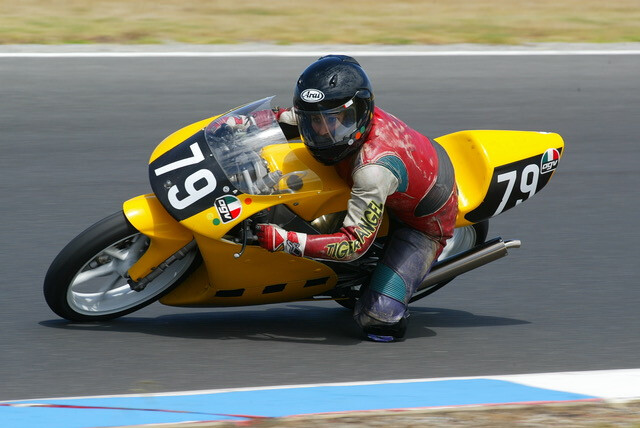
“The engine was fascinating, and it was so simple. You’re talking about a single-cylinder; what I loved was working on getting as much performance as you could out of it. The reason I like engines is that I like engineering, but I also like going fast, so it’s a natural combination if you like – that speed and mechanics.”
From lanterns to head torches, here’s a selection of the best devices to light up your camping adventures in 2024.
We’ve listed seven of the best camp lights in Australia – from Goal Zero, Coleman, Darche, Ledlenser, Zempire and Petzl – so you can spend less time searching for a camp-light solution and more time on the trails or preparing an end-of-day feast.
Camp lighting can mean the difference between continuing your adventures long into the night or having to hit the sack when the sun goes down. It can also be an important safety device and is essential for any camping kit.
However, there are many different camping lights out there and the best is generally one that fits your purpose – and your budget. In addition, you want to look for a light that is bright, durable and won’t run out of charge halfway through cooking your snags.
To help you choose the right light, check out our top picks for the best camping lights in Australia in 2024.
| Goal Zero u2013 Lighthouse 600 | Plusrite 25W Portable Solar Camp Light | Coleman u2013 Rugged Lithium-Ion | Darche u2013 RRT Solar Compact Light | Ledlenser u2013 ML6 Lantern | Zempire u2013 Megadome V2 | Goal Zero u2013 Torch 500 | Petzl u2013 TIKKA 300 | |
|---|---|---|---|---|---|---|---|---|
| Lumens: | Lumens: 600 | 3450Lm (1150 Lm per light) | 300 | 150 | 750 | 500 | 300 floodlight / 300 spotlight / 500 both | 300 |
| Weight: | 498g | 7kg | 640g | 117g | 280g | 350g | 363g | 82g |
| Run time: | One side (Low) 48 hours (High) 3 hours / Both sides (Low) 24 hours (High) 2 hours / 1 minute of crank = 10 minutes of low light | 5 – 12 hrs per light | 5 (High) or 20 (Low) hours | 5 hours (Bright) / 7 hours (Warm) / 20 hours (Warm Low) | Max 70 hours, Min 4 hours | 7 (High) 13 (Medium) or 45 (Low) Hours | Spotlight 38 hours (Low) 7 hours (High) / Floodlight 30 hours (Low) 8 hours (High) | 120 hours (Low) / 9 hours (Standard) / 2 hours (Max) |
| Charging: | USB / Hand crank / Solar Panel (sold separately) | 240V / 12V / Solar Charging Station (included) | USB port | USB port / Inbuilt solar pane | USB port | USB port | USB / Inbuilt Solar Panel | 3 x AAA/LR03 (included) / CORE Rechargeable Battery (sold separately) |
Goal Zero – Lighthouse 600
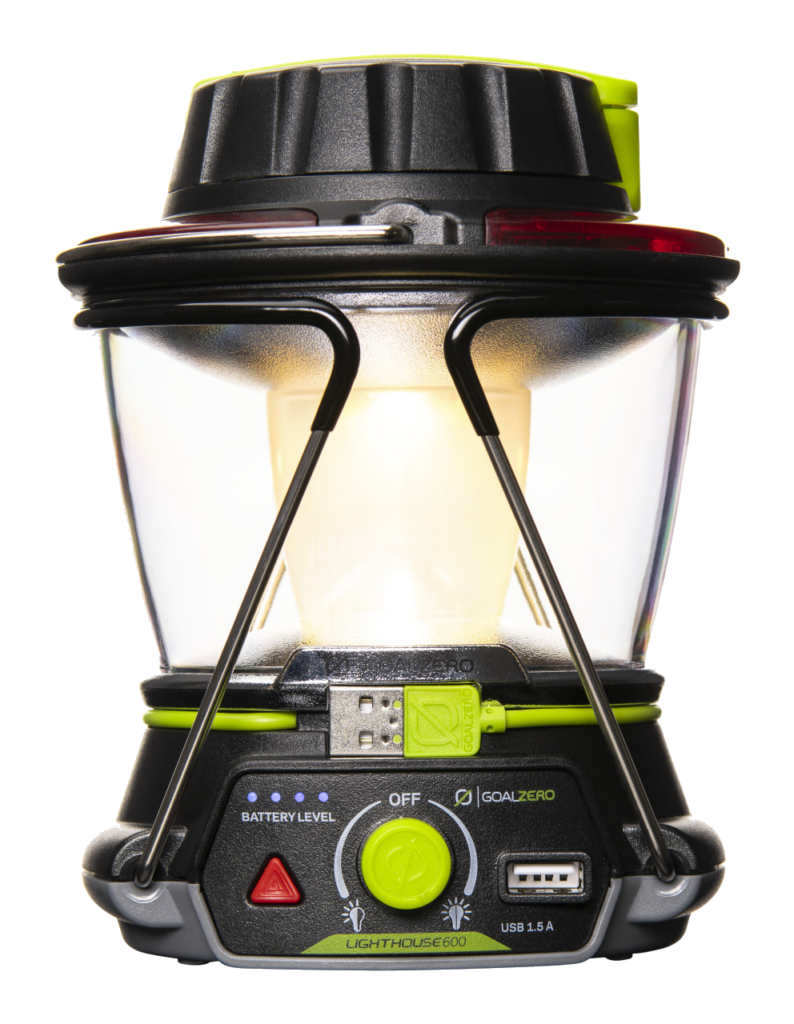
SPECIFICATIONS:
- Lumens: 600
- Weight: 498g
- Run time: One side: 48 hours (low) 3 hours (high)
Both sides: 24 hours (low) 2 hours (high)
One minute of crank = 10 minutes of low light - Charging: USB; hand crank; solar panel (sold separately)
Things we like
| Not so much
|
- Lumens: 600
- Weight: 498g
- Run time: One side: 48 hours (low) 3 hours (high) Both sides: 24 hours (low) 2 hours (high) One minute of crank = 10 minutes of low light
- Charging: USB; hand crank; solar panel (sold separately)
The Lighthouse 600, and its little brother, the Lighthouse Mini, both have a cool design feature that lets you illuminate half the lantern at a time. This light-saving – and therefore battery-saving – feature will extend your runtime when you don’t need 360-degree illumination. This feature is easy to operate, with just one switch.
The lantern can be charged by USB port or by connecting to one of Goal Zero’s compatible solar panels. The Nomad 10, for example, can charge the Lighthouse 600 in about six hours.
The standout feature of the Lighthouse 600 is the hand crank. One minute of winding yields ten minutes of light. For anyone heading off-grid or caught without power, this is the go-to lantern for getting you out of the dark.
Plusrite 25W Portable Solar Camp Light
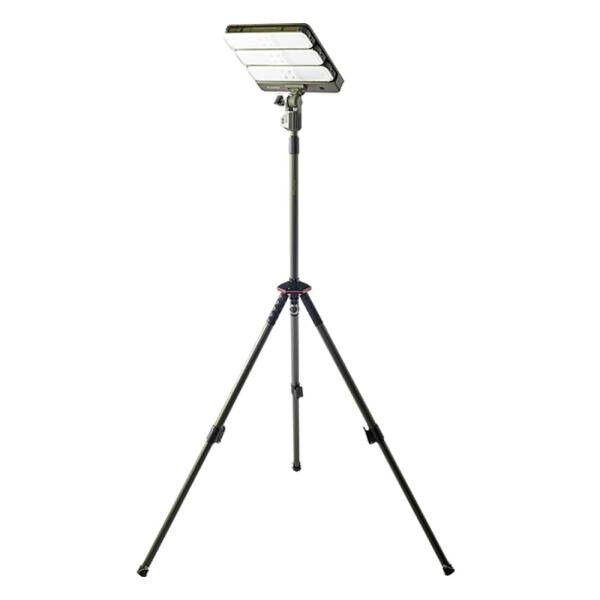
SPECIFICATIONS:
- Lumens: 3450Lm (1150 Lm per light)
- Weight: 7kg
- Run time: 5 – 12 hrs per light
- Charging: 240V / 12V / Solar Charging Station (included)
Things we like
| Not so much
|
- Lumens: 3450Lm (1150 Lm per light)
- Weight: 7kg
- Run time: 5 – 12 hrs per light
- Charging: 240V / 12V / Solar Charging Station (included)
This light is at the higher end of the price range for camping lights, but if you need a lot of illumination in a durable, long-lasting device, you’ll get your money’s worth. It comes in heavy at 7kg, but the PVC case makes it easy to pack, store and carry the lights along with the additional included gear.
The Plusrite 25W Light comes with a tripod so you can set your lights between 1-2 metres off the ground. It also comes with a solar charging station for an off-the-grid charging option.
Perhaps the best thing about this camping light is the three separate LED panels. They can be used together for maximum brightness, or you can use them separately in multiple configurations, to fit just about any purpose. Add to this the potential to dim the LED lights to three different levels and you have a very versatile camping light.
Coleman – Rugged Lithium-Ion
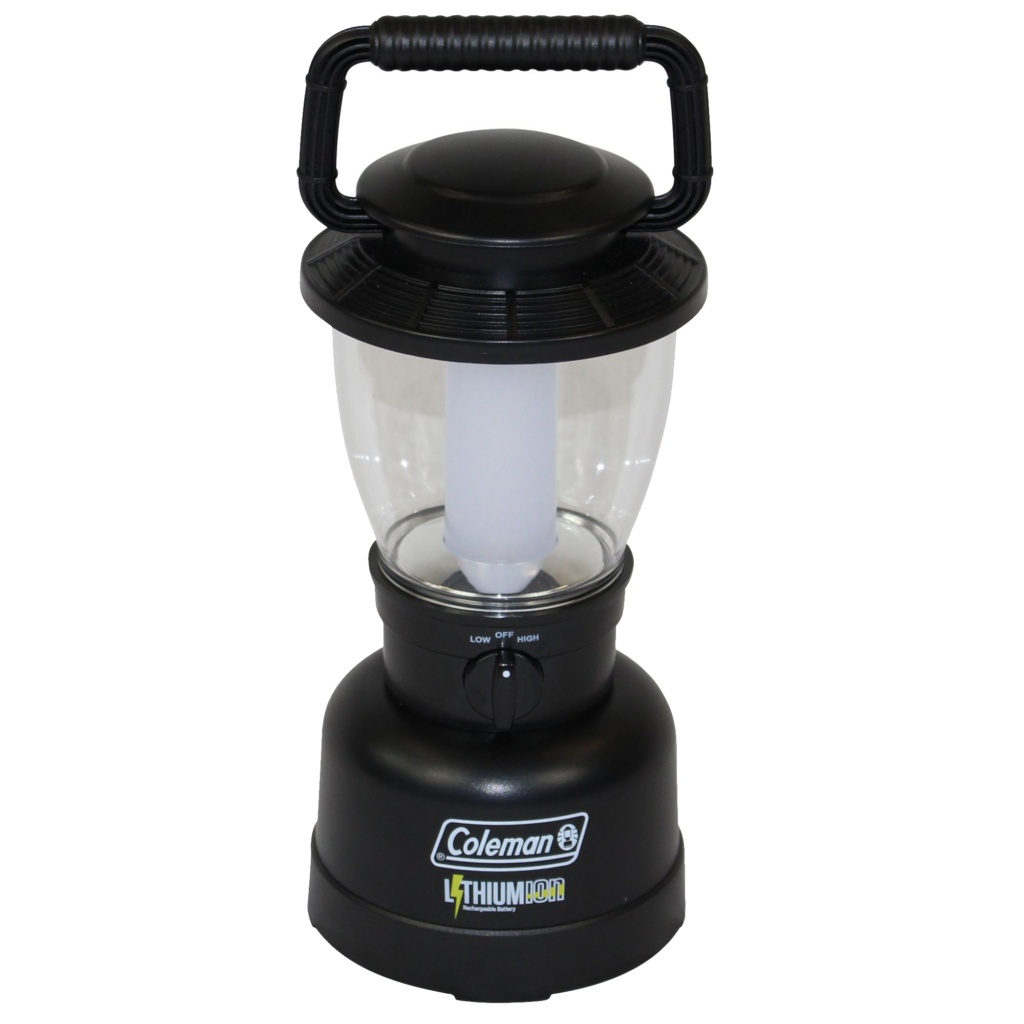
SPECIFICATIONS:
- Lumens: 300
- Weight: 640g
- Run time: 5 hours (high) or 20 hours (low)
- Charging: USB port
Things we like
| Not so much
|
- Lumens: 300
- Weight: 640g
- Run time: 5 hours (high) or 20 hours (low)
- Charging: USB port
With a shorter charging time and longer run time than previous models, Coleman has improved its already-reliable camping lantern range. On the highest setting you’ll get a light that shines up to 12 metres, more than enough to cover your campsite with just the one lantern.
It features a large bail handle for easy hanging and has storage in the base for the charging adaptor. It will also charge USB-compatible devices. If you’re after an affordable, fuss-free, multi-function lantern for your camping setup, this is a solid purchase that will last years.
Budget Choice
Darche – RRT Solar Compact Light
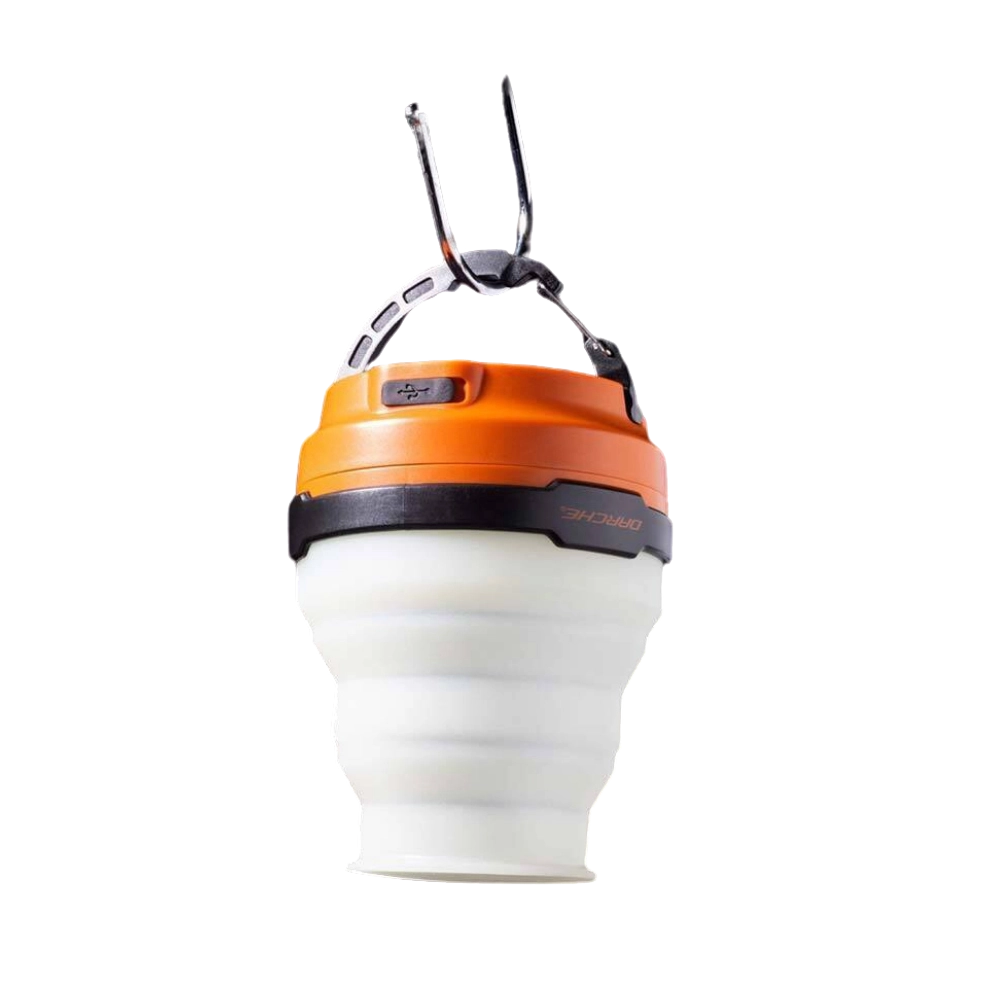
SPECIFICATIONS:
- Lumens: 150
- Weight: 117g
- Run time: 5 hours (bright) / 7 hours (warm) / 20 hours (warm low)
- Charging: USB port; in-built solar panel
Things we like
| Not so much
|
- Lumens: 150
- Weight: 117g
- Run time: 5 hours (bright) / 7 hours (warm) / 20 hours (warm low)
- Charging: USB port; in-built solar panel
Its dual light modes let you utilise the bright white up to 150 lumens for lighting up a dinner table; or cool it down to a more relaxed warm white or low-level warm white for inside your tent. It has a handy foldable hanging carabiner, and it even glows green to help you find it in the dark.
As an affordable option, the RTT Solar Compact Light is great for lighting up a tent, or small cooking or dining area. The built-in solar panel gives you the option to harness the power of the sun to recharge if you head off-grid.
Premium Choice
Ledlenser – ML6 Lantern
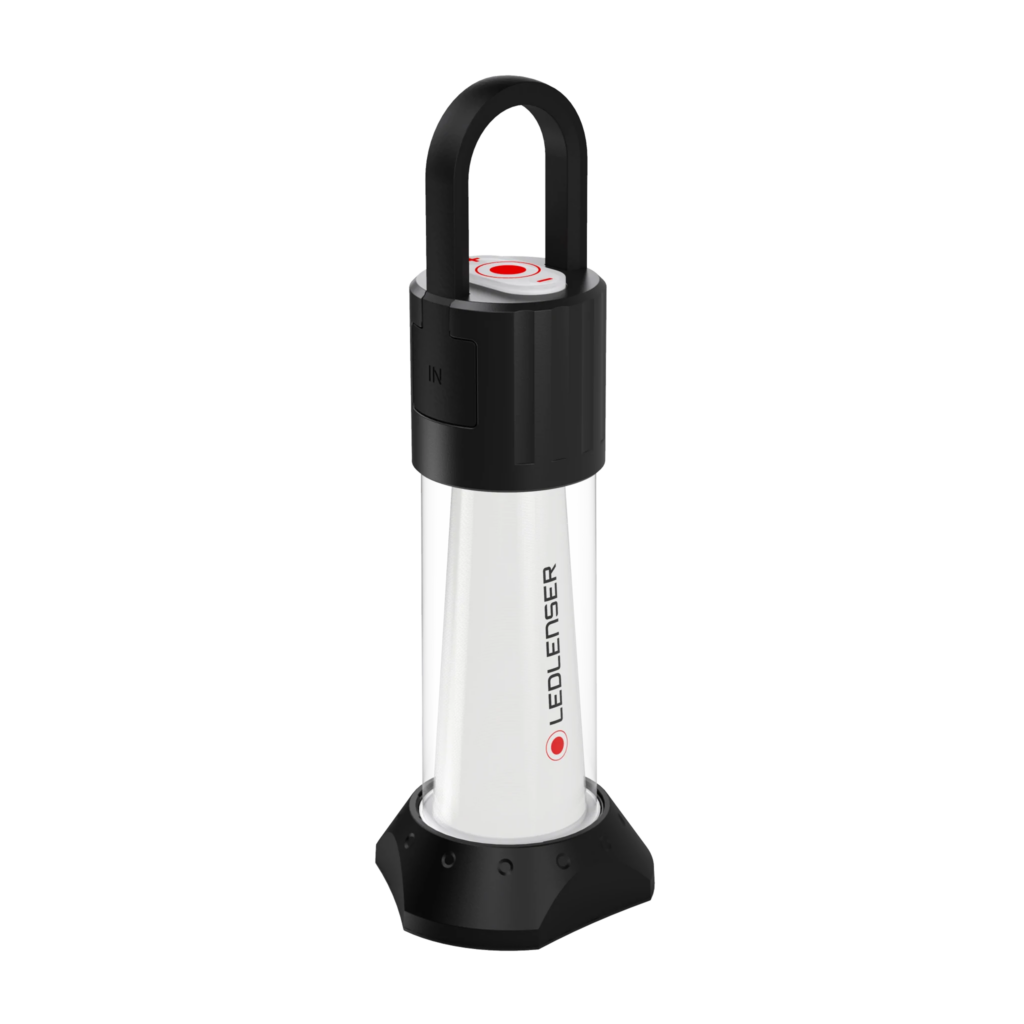
SPECIFICATIONS:
- Lumens: 750
- Weight: 280g
- Run time: 70 hours (max), 4 hours (min)
- Charging: USB port
Things we like
| Not so much
|
- Lumens: 750
- Weight: 280g
- Run time: 70 hours (max), 4 hours (min)
- Charging: USB port
The ML6 comes with different mounting options including a rubber hook for hanging, a magnet for mounting it on metal surfaces, and a removable stand. The latest lens technology guarantees energy efficiency and a temperature-control system prevents it from overheating, allowing it to burn brighter and longer.
The ML6 features seven different light modes plus a battery indicator, charge indicator and low power warning. It has a transport lock to prevent it turning on accidentally and draining your battery. You can purchase the ML6 in warm or white light, but this is not interchangeable – you have to decide at the time of purchase. With a seven-year warranty, it’s built to last.
Also Consider
Zempire – Megadome V2
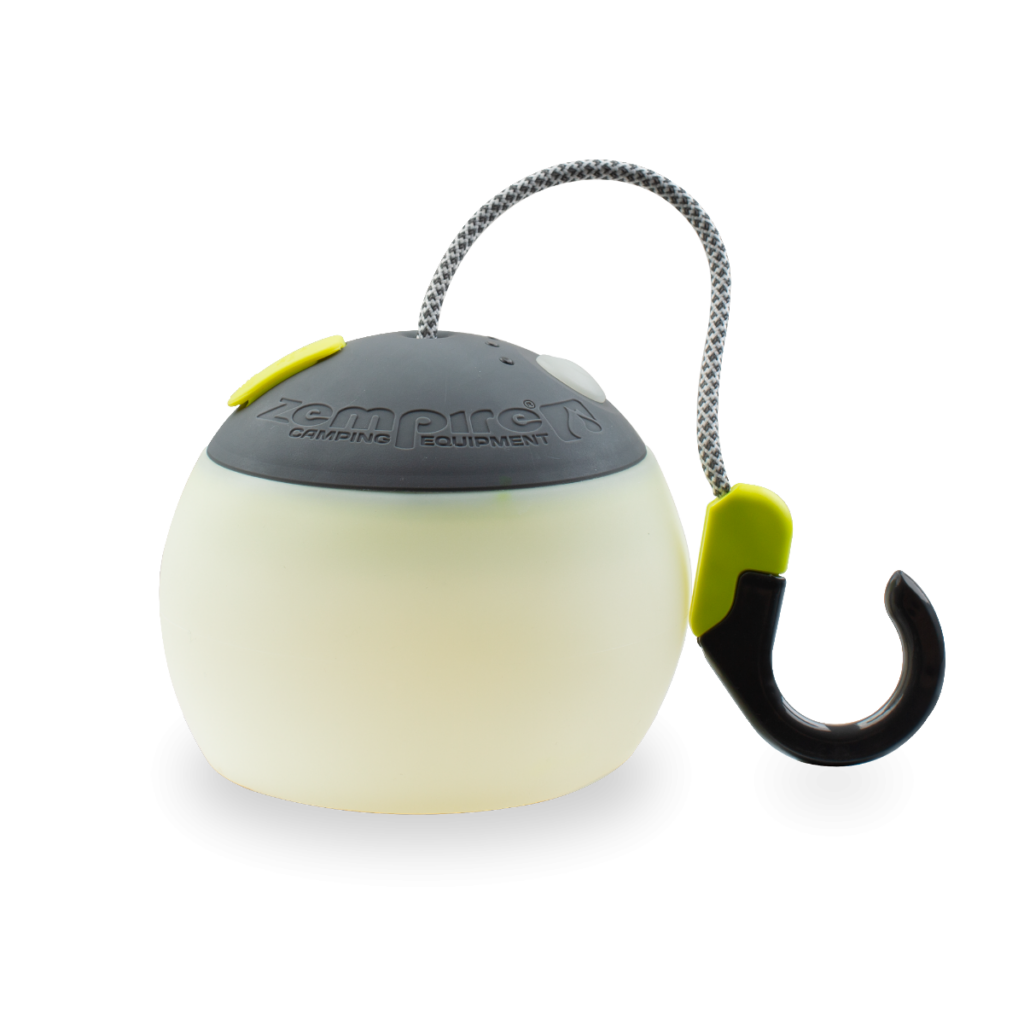
SPECIFICATIONS:
- Lumens: 500
- Weight: 350g
- Run time: 7 hours (high); 13 hours (medium); 45 hours (low)
- Charging: USB port
Things we like
| Not so much
|
- Lumens: 500
- Weight: 350g
- Run time: 7 hours (high); 13 hours (medium); 45 hours (low)
- Charging: USB port
The three different light settings provide versatility, and you can conserve battery by using lower settings if needed. It has a soft-touch diffuser to emit a warm light – useful for avoiding mossies – plus it’ll handle a bit of rough and tumble. The diffuser glows in the dark, making it easier to find when turned off.
The Megadome V2 lasts up to 45 hours on the lowest light setting. It’s USB-rechargeable and can also be used as a charging point for devices. There’s also a battery indicator that displays how much charge is remaining. Best of all, the reasonable price point means you can pick up a couple without breaking the bank.
Goal Zero – Torch 500
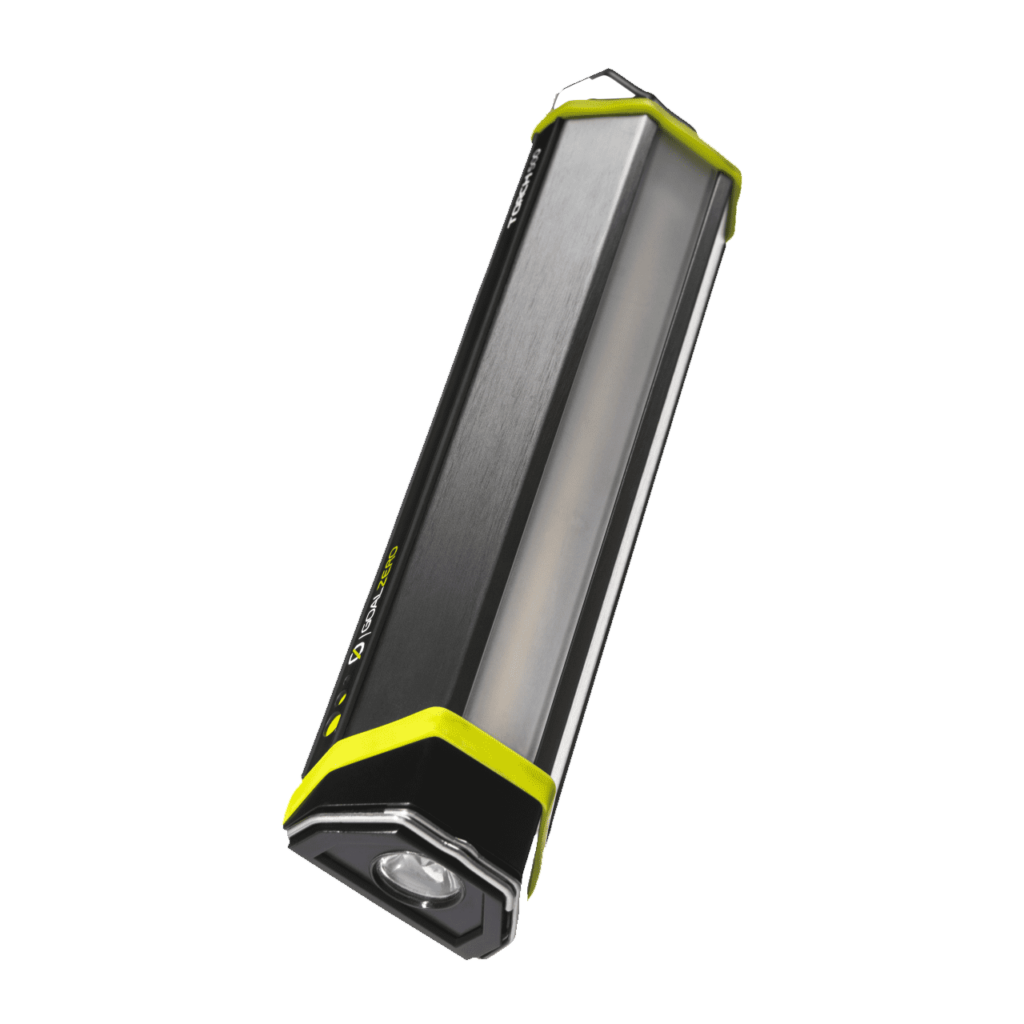
SPECIFICATIONS:
- Lumens: 300 floodlight / 300 spotlight / 500 both
- Weight: 363g
- Run time:
- Spotlight: 38 hours (low); 7 hours (high)
- Floodlight: 30 hours (low); 8 hours (high)
- Charging: USB; in-built solar panel
Things we like
| Not so much
|
- Lumens: 300 floodlight / 300 spotlight / 500 both
- Weight: 363g
- Run time:
- Spotlight: 38 hours (low); 7 hours (high)
- Floodlight: 30 hours (low); 8 hours (high)
- Charging: USB; in-built solar panel
The Torch 500 is a durable light with three levels of brightness on both the floodlight and spotlight settings. It comes with a built-in clip for hanging and has a high waterproof rating that will see it withstand 30 minutes of immersion in up to one metre of water.
If you are going off-grid, this is a great multi-use camp light. You can recharge from the sun with the built-in solar panel or from any USB source. It can also be used as a power bank – this new improved Torch 500 model has an increased 5200 mAh battery.
Petzl – TIKKA 300
SPECIFICATIONS:
- Lumens: 300
- Weight: 82g
- Run time: 120 hours (low); 9 hours (standard); 2 hours (max)
- Charging: 3 x AAA/LR03 (included); CORE Rechargeable Battery (sold separately)
Things we like
| Not so much
|
- Lumens: 300
- Weight: 82g
- Run time: 120 hours (low); 9 hours (standard); 2 hours (max)
- Charging: 3 x AAA/LR03 (included); CORE Rechargeable Battery (sold separately)
The TIKKA 300 can run on three standard batteries (included in the purchase) or you can buy a separate CORE rechargeable battery. Despite needing to make an additional purchase for the rechargeable option, it will beat carrying around extra back-up batteries. Plus, it’s a win for the environment.
The three lighting modes are for proximity, movement and distance – with 120 hours of burn time for the lowest setting. It also has a red vision setting and a glow-in-the-dark reflector, so you can find it easily when switched off. The low profile makes it comfortable to wear and it comes with a five-year guarantee.
HOW WE REVIEW PRODUCTS
4X4 Australia has been reviewing four-wheel drive vehicles, aftermarket products and camping gear for over 40 years. When looking for the best camping lights in Australia there are some things that are essential to make sure you are not left in the dark.
When we compared each of the products in the list with hundreds out there we looked at the brightness, size and weight, battery life, charging options and price. We also searched for additional features that make these camp lights stand out from the rest.
We looked at hundreds of user reviews and drew on our own experience with camping lights to make sure our recommendations are for the best on the market.
Disclosure: When you buy through our links, we may earn a commission. We also include products that we do not earn a commission from.
BUYER’S GUIDE TO CAMPING LIGHTS
There are many things to consider when choosing a camping light. Here are the main questions you should be asking before you purchase one. Plus we have a guide to the different types of camping lights – from lanterns to headlamps – so you can decide which one to add to your camping kit.
What do you need a camp light for?
The first thing to consider when choosing a camping light is: what do you need it for? Are you needing to light your outdoor area and barbecue, or the inside of your tent? Do you want a fixed light or something portable you can grab to read a book or take on an evening bush walk?
What you intend to use the light for is going to have an impact on what sort of device you should be looking for – be it lanterns, strip lights, a headlamp or a good ol’ torch.
How much light do you need?
Lights are rated in lumens and can vary from 40 lumens to a whopping 1000 lumens, which will light your camping area plus more. Generally you can look to get a camp light with 50-200 lumens for inside your tent (depending on your tent size), 200-300 for a small outdoor area (over the barbecue, for example), and 300-400 for a larger outdoor area.
What are your charging options?
You’d better not wait until you’re out bush to think about charging your camping light. Before you buy, consider how you are able to charge your camping light – will you have access to power or are you heading off-grid? Also consider how often you want to be charging, as LEDs last a lot longer than fluorescent lights. If you are planning an off-the-grid adventure, solar power might be a good option.
Other things to consider
Weight
Depending on your camping fit-out or what you intend to use the camping light for, weight can be a big factor. For hikers, the lighter the better, and there are plenty of great lightweight lanterns, torches and headlamps on the market. If you want a long-lasting, durable camping light that will see you through camping adventures for many more years to come, then investing in a more expensive device might be the way to go.
Safety
With plenty of LED lighting options out there, you can get your perfect camp lighting without too much concern for safety features. However, if you want to go old-school with a gas or fuel lantern, be aware that they can cause serious injuries and are not ideal if there are small children or pets around.
Types of camp lighting
Lanterns
Lanterns are a great lighting option for all camping set-ups, and modern lantern options are versatile and long-lasting. You can hang them outdoors to give 360-degree light coverage and extend your camping fun long into the evenings.
Look for lanterns that have rechargeable batteries or are solar-powered, and lightweight and portable options will be the most versatile for your camping needs. The best lanterns will provide this without compromising on run-time and durability.
Fuel or Gas Lanterns
Fuel and gas lanterns generally provide the brightest glow, so they work well for lighting large areas. Most are incredibly simple to use, but for long camping trips you’ll need to remember to pack additional fuel cylinders. Also keep in mind that gas and fuel lights can become very hot and should only be used outside.
Check fuel lanterns for high quality materials and durability before buying. It’s also good to have adjustable brightness and keep in mind that gas (propane) fuel lanterns are much lighter than liquid-fueled lanterns.
Strip Lights
LED strip lights are a great way to set and forget your camp lighting. They can be strung up under awnings, gazebos or even as deck lighting in a boat. Generally strip lights will not use too much power and have a long-life expectancy, so they can be a handy addition to your regular camp set-up for years to come.
The best strip lights are thin, lightweight and flexible, so you can customise them to your own camping setup.
Headlamps
Headlights are generally under-appreciated until you whack one on your own noggin’. There’s nothing like having your hands free to chop veggies for dinner, fire up the barbecue or even read a good book in the evening. For hikers, headlamps are a must. For car campers, don’t be too quick to bypass this option as a cheaper, lightweight addition to your camping kit.
Look for a head lamp that has different beam types (ie. long range or close-up) so you can use it for different purposes. It should also be lightweight but durable and have a long battery life.
Torches
Modern torches have upped their game, with features such as rechargeable batteries, solar power and built-in power banks for charging other devices. Whatever option you go for, they are perfect to throw in your car, boat or hiking backpack.
Look for a torch that is lightweight, compact and meets your needs for light output. Torches with a high battery capacity will last longer if you are wanting to go longer without charging or changing batteries.
When we took delivery of our MU-X at the start of June, we were raring to fit accessories and equipment from day one, but to our surprise there wasn’t the gear available for the Isuzu we wanted. Despite being on the market for more than a year, a lot of companies are still in the development stages of their products for the ‘new’ MU-X.
There are many reasons for this, including production and staff shortages that are currently affecting the industry, and the fact the MU-X probably isn’t high on the R&D list of aftermarket equipment manufacturers. This is despite it being the second best-selling mid-size 4×4 wagon in Australia, behind the trend-defying Toyota Prado.
One thing we could update on the MU-X straight away was the vehicle’s main battery. We’re not sure if we’ll be fitting a dual-battery system to this car, so we wanted to upgrade the main battery to one with some more grunt and longevity. This includes the ability to better withstand discharge and recharge cycles.
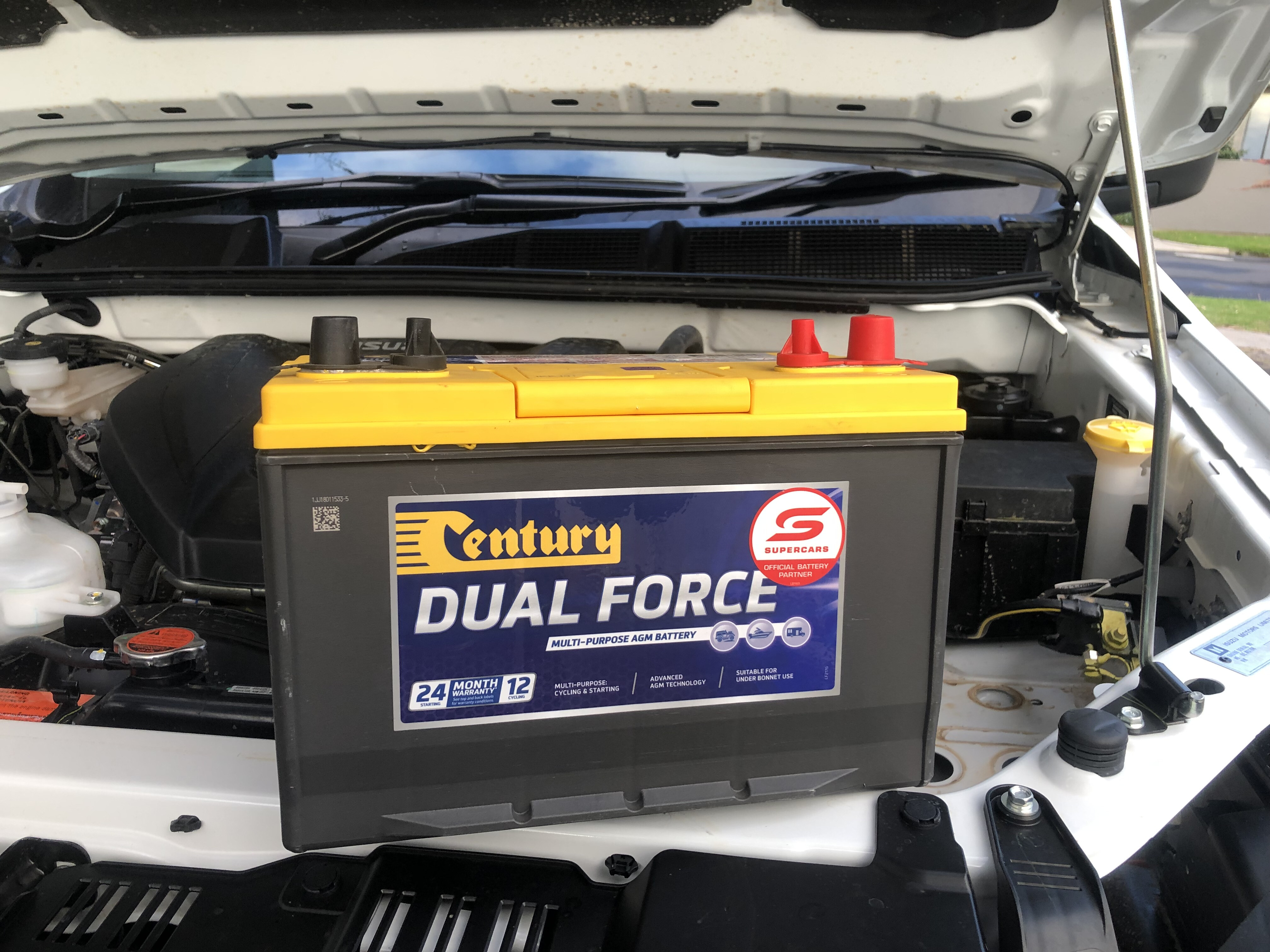
Fitting the bill for this upgrade is the Dual Force+ from Australia’s Century Batteries. The Dual Force+ is an N70-sized battery with quoted outputs of 90amp/h and 750CCA at 18°C. That’s up from the 69amp/h and 490CCA of the OE battery.
While not a substitute for a dual-battery system that isolates the vehicle’s starting battery from the auxiliary accessories battery, the Dual Force’s advanced Absorbed Glass Mat (AGM) construction is designed to better cope with the loads and charging cycles of a vehicle in a 4×4 that’s used to run accessories like fridges, winches and extra lighting. Think of it as a hybrid starter/deep cycle battery.
In an AGM battery the glass matting absorbs the electrolyte liquid around the lead plates. In the Dual Force+ battery these lead plates are 20 per cent thicker than in regular batteries and this, along with the use of high-density active paste around the plates, combine to increase the durability of the battery over a longer time and better cope with charge/discharge cycles.
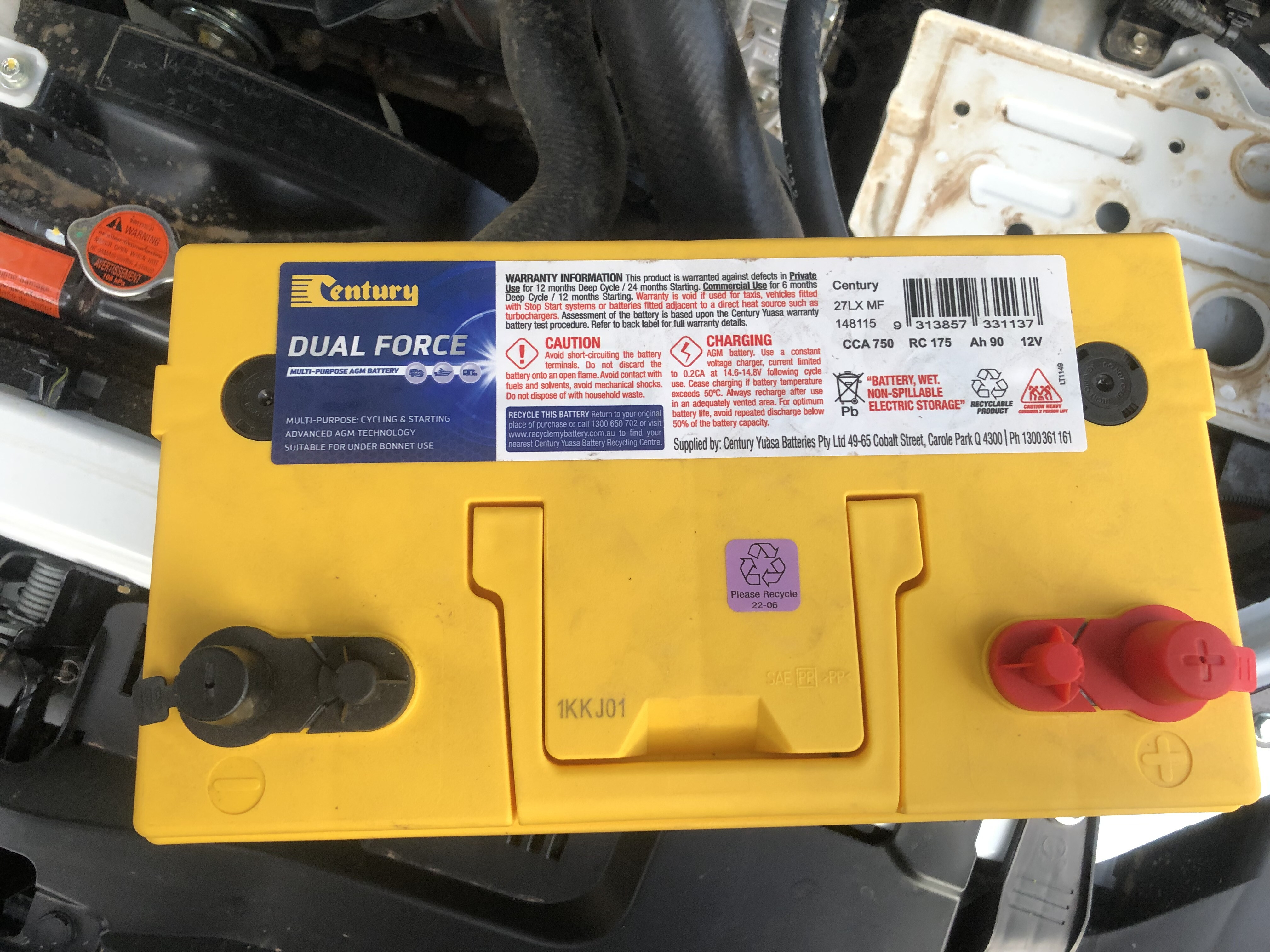
The high-porosity envelope AGM separators improve electrolyte dispersion, also increasing cycle life plus resisting vibration, which is extra important in 4×4 applications used on rough roads. The use of rounded-edge X-frames also improve strength and reduce the risk of internal punctures or short circuits.
Century Batteries packages all this in a reinforced and sealed polycarbonate case that further reduces the effect of vibration and heat, making the Dual Force+ suitable for most under-bonnet installations. Being a sealed case, the battery can be mounted on its side if needed, but not upside down. The N70 Dual Force+ is available in C or D type polarity to suit your mounting location. There is also a pair of threaded auxiliary terminals for tidy and secure connection of accessories or power cables.
Fitting the Dual Force+ in to our MU-X was relatively simple. Thankfully, Isuzu makes the battery tray bigger than the battery it fits, so it accommodates the N70 once you remove the plastic under-tray. The Dual-Force+ is around 20mm taller than the standard battery, so we had to get some longer bolts to secure it under the original clamp. Then it was just a matter of hooking up the terminals and kicking it in the guts.
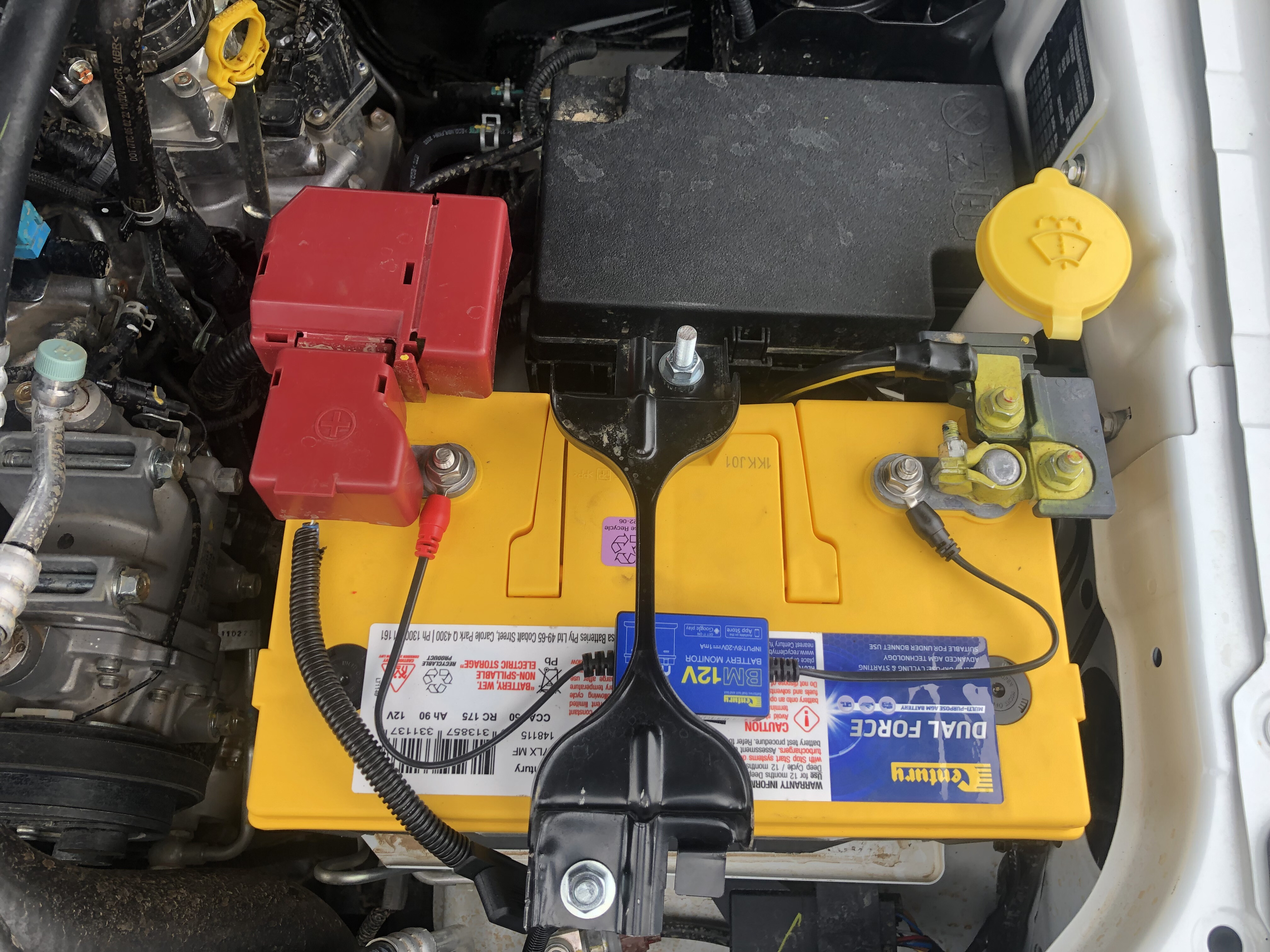
As we said earlier, this battery is no substitute for a dedicated dual-battery system and if you totally drain this battery, you won’t be able to start the car without some assistance. We won’t be looking to run fridges overnight or inverters to charge electrical tools, but we will be secure in the knowledge that this battery will be more durable under the loads of running those accessories than the standard battery. The Dual Force+ battery is covered by Century’s 24-month Starting / 12-month Deep Cycle warranty.
For further peace of mind on the condition of our battery, we’ve fitted Century’s BM12V Bluetooth battery monitor. As the name suggests, the BM12V allows you to monitor the state of your battery remotely from your mobile phone using an app.
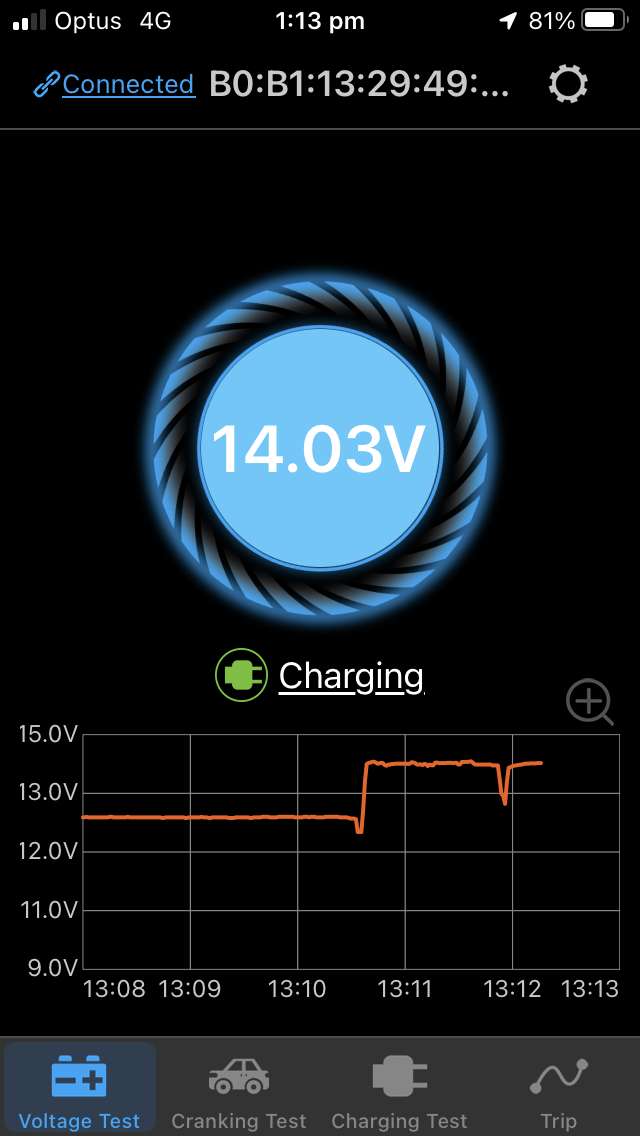
It sends the information of current voltage, discharge rates and the condition of the battery to the app and allows you to set up notifications to warn you about low battery voltage and take action to properly maintain the battery and protect its longevity. You can also conduct cranking and charging tests via the app.
Installation of the monitor is easy; simply hook the two leads to the respective positive and negative terminals and affix the unit using the supplied double-sided tape. The BM12V has an internal replaceable fuse to protect it against damage should you install it incorrectly, and it comes with a two-year warranty.
Available from: centurybatteries.com.au RRP: Dual Force+N70 from $440; BM12V battery monitor $59
The Ford Ranger PX that went on sale in Australia in late 2011 and has just been superseded, is a pivotal product in Ford’s history.
Despite carrying over the Ranger name from its predecessor, it was a genuine top-to-bottom Ford product and not just a rebadged Mazda as was the earlier Ranger and all the Ford Courier utes before that. This was Ford responding to the growing global demand for utes by making the new Ranger an in-house engineering priority rather than just relying on someone else’s design.
In what was a big-budget effort, Ford marshalled its considerable resources from all around the world to contribute to the design and then headquartered the development right here in Australia, which has subsequently proved to serve the Ranger well. This new Ranger was to be built on three continents and sold in no fewer than 180 countries, so it had to be ‘right’.
Upgrade your Ranger
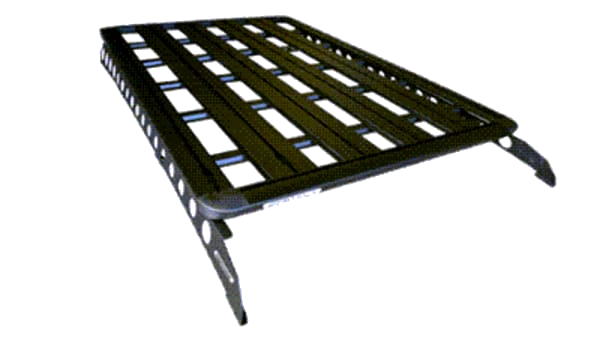
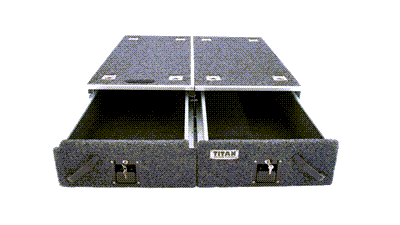
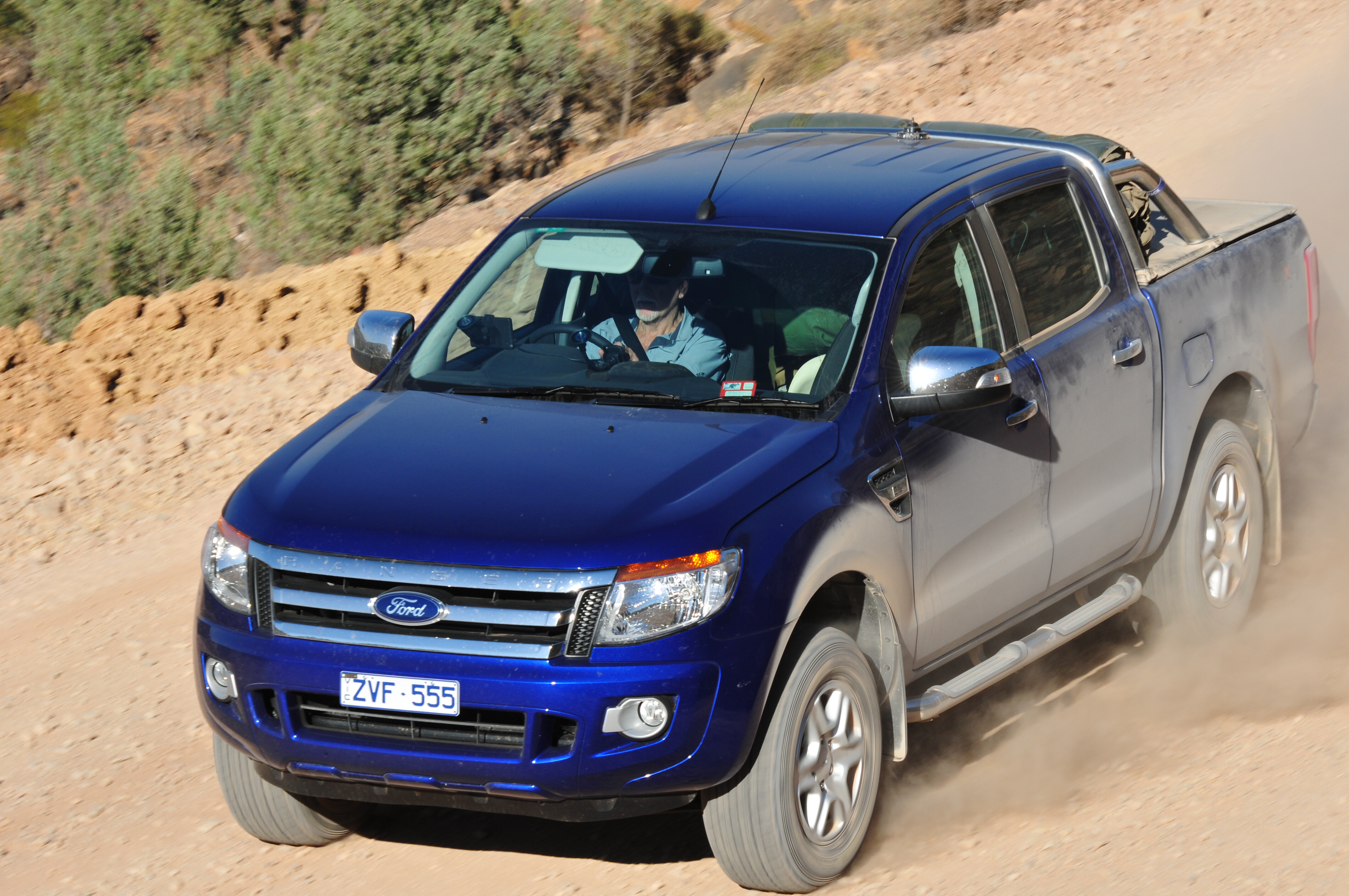
Thankfully all the effort was worthwhile as the PX proved to be a standout design, not only on debut in late 2011 but also against the flood of newer rivals that have subsequently arrived, namely new-generation Holden Colorado, Isuzu D-MAX, Mitsubishi Triton, Nissan Navara and Toyota Hilux models.
Against its contemporaries the PX Ranger is notable for many things but none more important than its long-travel suspension and long wheelbase chassis. The long-travel suspension is just the ticket for bumpy back-roads touring in this country and it also underpins the Ranger’s off-road excellence.
For its part, the notably long wheelbase means class-leading combined front and rear legroom in what is a very spacious cabin without compromise to the length of the rear tub, always the crucial point with a dual-cab.
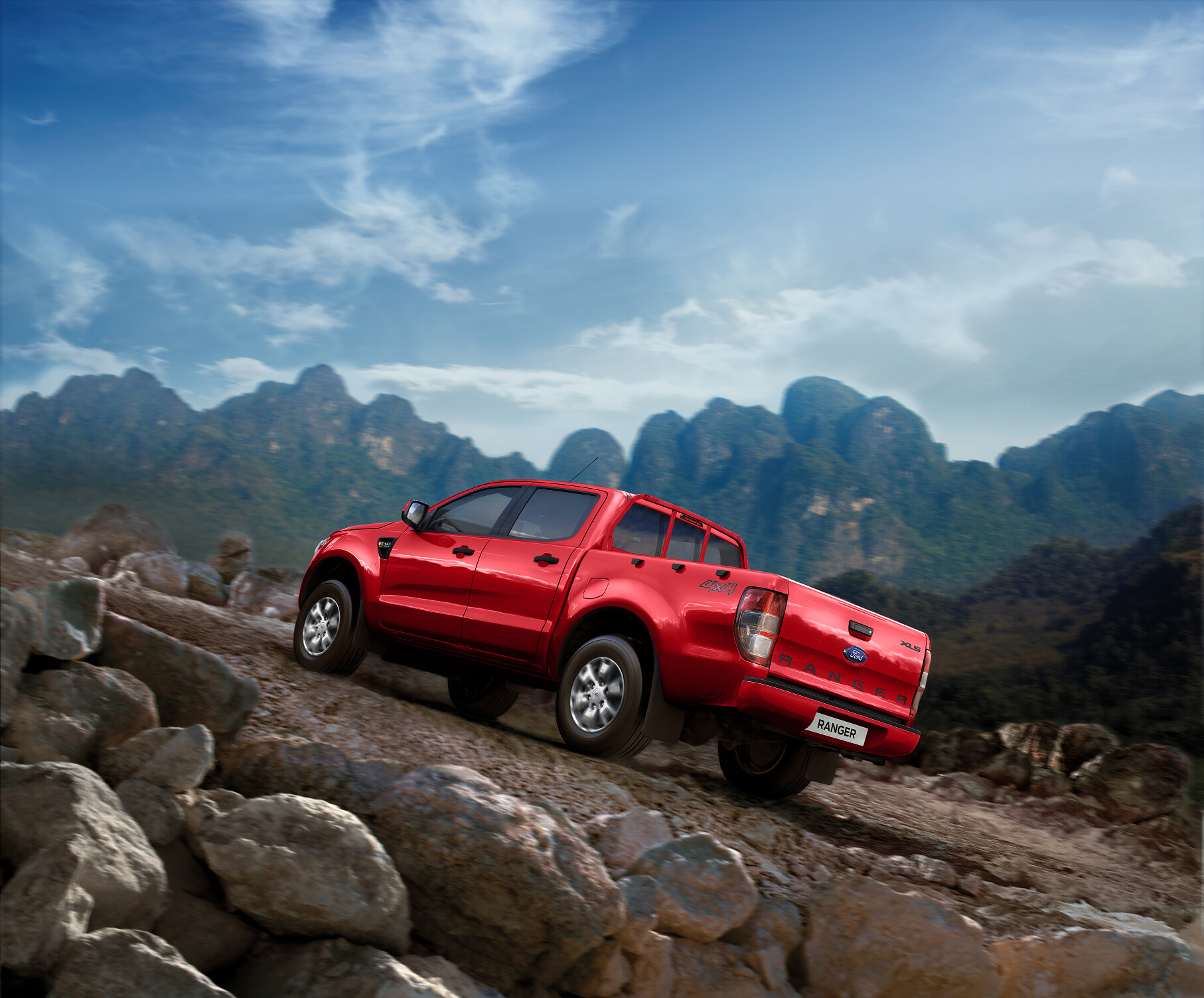
The PX’s 3.2-litre in-line five-cylinder turbo diesel, the biggest capacity engine to appear in the class, also sets it apart from its rivals, which are almost exclusively powered by smaller capacity four-cylinder turbo diesels. Even the V6 diesels in Amarok and Mercedes X-Class are smaller in capacity.
During its time the PX received two major upgrades, the first in 2015 (PX MkII) and then in 2018 (PX MkIII), and aside from the 3.2 five-cylinder was also available with a 2.2-litre four-cylinder turbo diesel and, from 2018, a 2.0-litre four-cylinder bi-turbo diesel mated to a 10-speed automatic. A petrol engine (2.5-litre four) was only offered in 4×2 models.
Given the five basic powertrain options in 4×4 models and the fact the MkII and MkIII upgrades involved significant engineering and not just tech add-ons and styling changes, it’s no surprise that not all 2011 to 2022 Rangers are created equal. Buyer beware!
Ford Ranger history
When released in October 2011, the Ranger came in 17 4×4 variants, two single cabs, three extended cabs and five dual cabs, with XL, XLT and Wildtrak equipment levels. Four models, the two single cabs and one each of the extended cabs and the dual cabs were commercially oriented cab/chassis models. Prices ranged from $38K to $57K plus on-roads.
The entry level 2.2-litre four-cylinder turbo diesel (a Ford ‘Puma’ design dating back to 2004 and also seen in Land Rover Defenders from 2011-16) claimed maximum power and torque figures of 110kW and 375Nm, and was offered with both a six-speed manual and a ZF six-speed automatic.
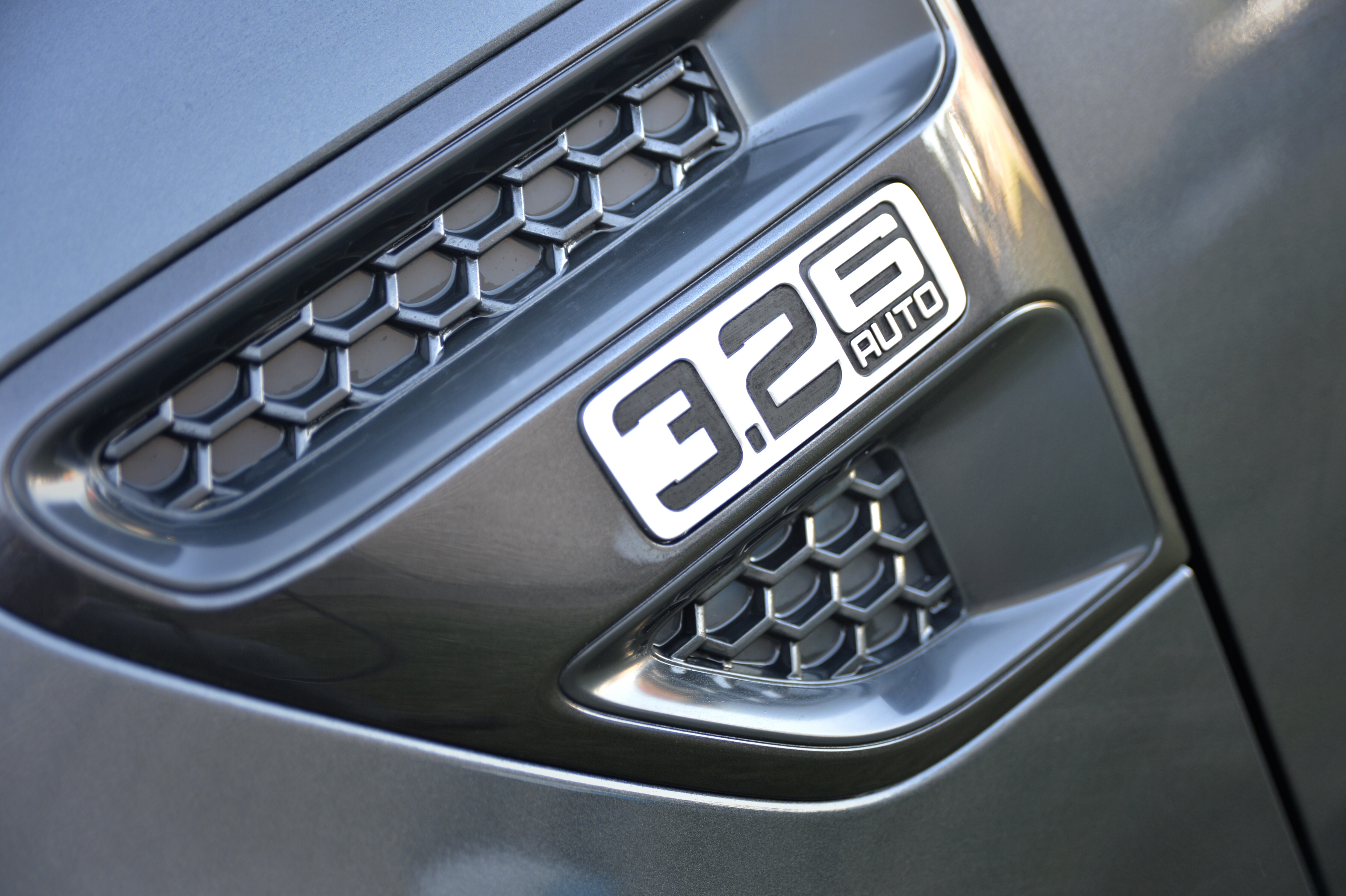
The optional 3.2-litre in-line five-cylinder diesel, also a Ford design that had debuted in the Transit van in Europe five years earlier, claimed a far beefier 147kW and 470Nm. Despite the significant difference in performance, especially useful for heavy towing or load carrying, the 3.2 only asked a $2500 price premium over the 2.2, which probably explains its runaway sales popularity over the 2.2 even if the 2.2 found favour with fleet buyers.
Like the 2.2, the 3.2 was also offered with either a six-speed manual or a ZF six-speed automatic, and with both engines the auto attracted a $2K price premium.
Standard equipment ran to what was then cutting-edge safety technology that included electronic stability control, electronic traction control, trailer-sway control and roll-over mitigation. Front, side and curtain airbags were also part of the impressive safety package.
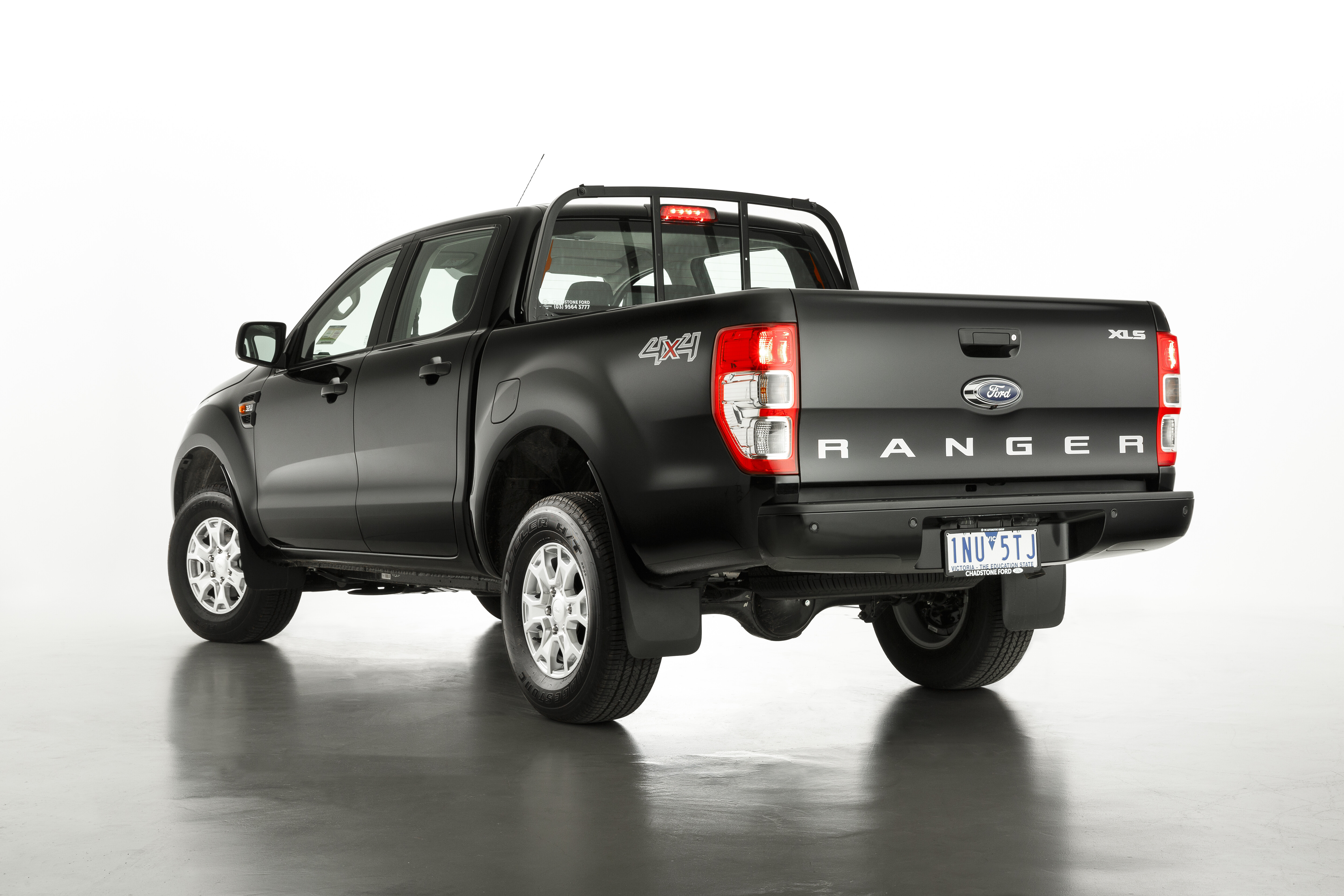
Most significantly for off-road use, four-wheel electronic traction control proved a game changer and was enormously more effective than a rear limited-slip, which was the standard traction aid up until that time.
A driver-switched rear locker, standard on XLT and Wildtrak and optional on most other 4×4 models, also added to the Ranger’s off-road weaponry and started the rear locker ‘trend’ in the ute sector.
The PX Ranger 4×4 also offered a 3350kg maximum towing capacity, a class-leading figure at the time, which was the first blow struck in the “towing capacity wars”. The Ranger’s maximum towing capacity was subsequently lifted to 3500kg.
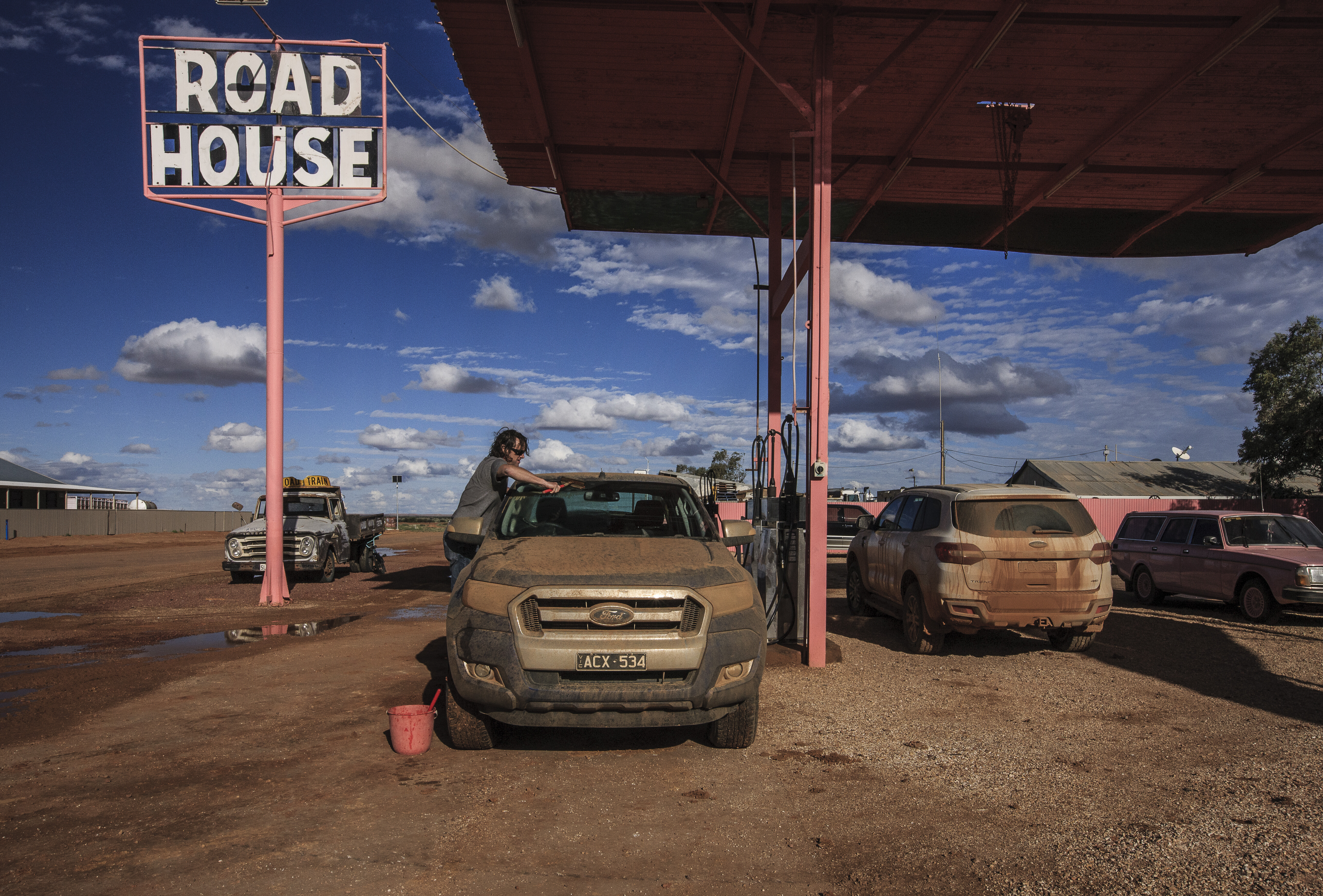
In 2015 the PX Mk II arrived with bolder front-end styling, a redesigned interior and various equipment upgrades, but the most significant changes were under the skin and started with pleasingly calibrated electric power steering that brought effortless wheel-twirling at parking and off-road speeds yet still offered excellent feel and feedback at highway speeds. Suspension revisions also helped improve the Ranger’s already impressive dynamics.
The 3.2 also gained a new turbo and revised fuel injection that fattened up the torque and power curves, even if the maximum figures remained the same. On the road the difference in response was obvious, as was the fact the 3.2 was now quieter and more refined than before, a welcome change.
Also welcome was the much better shift quality with the 3.2’s manual thanks to a change from a linkage to cable selector. The 2.2’s power and torque figures were also bumped to 118kW and 385Nm.
The MkII’s off-road performance was also significantly improved via a simple tweak of the powertrain and chassis electronics, where the activation of the driver-switched rear diff lock no longer cancelled the electronic traction control on the front wheels, as was the case previously. In practice it made a significant difference in tough off-road going where you’re scrambling for every bit of traction. The driver-switched rear locker was standard on all 4×4 dual cabs by that time.
The XLT with its larger touchscreen, Ford’s SYNC 2 connectivity, embedded sat-nav, tyre-pressure monitoring, a 12-volt outlet in the tub and standard 3500kg factory towbar was unsurprisingly the volume-selling model. Radar cruise control, forward-collision warning and lane-departure warning made up the optional ‘technology pack’ for XLT and Wildtrak.
In 2018 the PX Mk III arrived as the MY19 model and brought an all-new powertrain in the form of a 2.0-litre four-cylinder bi-turbo diesel that claimed 157kW and 500Nm, both stronger figures than the 60-per-cent-bigger-capacity 3.2 five, and backed by an automatic gearbox with no less than 10 speeds.
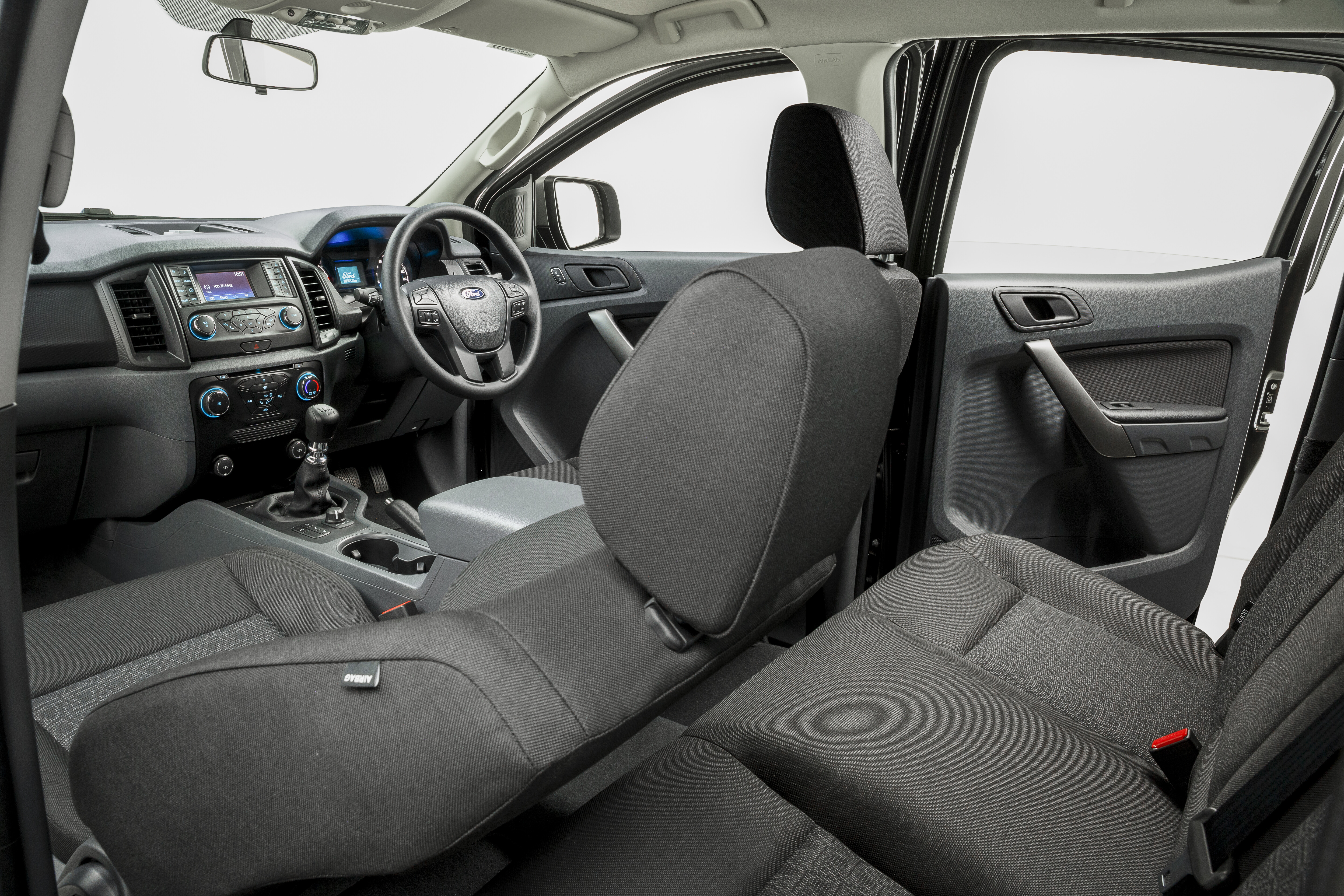
There was no manual with the bi-turbo and it was only available in XLT and Wildtrak models. Meanwhile the 2.2 and the 3.2, both still available with six-speed manual or automatic gearboxes, continued to be sold largely unchanged alongside the new powertrain.
The MkIII brought a second round of front-end styling revisions with the XLT and Wildtrak also getting LED daytime-running lamps and HID headlights.
In a sign of the times, automatic emergency braking was introduced on the Wildtrak as standard equipment and as an option on XLT. Radar cruise, lane-keeping assist and lane-departure warning and forward-collision warning also became standard on the Wildtrak but remained an option on XLT.
SYNC 3 connectivity with Apple CarPlay and Android Auto, previously introduced on XLT and Wildtrak, also became optional on XLS, while push-button start was introduced on XLT and Wildtrak. Significant suspension revisions for the MkIII across the range were claimed by Ford to offer better stability when towing yet more compliance for general and off-road driving. The impressively engineered bespoke-chassis Raptor capped off the MkIII update.
General driving
All Ranger models are good to drive and compare favourably with their immediate rivals in ride, handling and general road manners. MkII models with electric power steering and the revised suspension are a notable step up from the original offerings, while the MKIII suspension changes didn’t seem to really improve things notably, despite Ford’s claims.
The often-overlooked 2.2 performs better than you may think, and for general driving is fuss free and more frugal than the 3.2. The 2.2 probably mates best with the six-speed manual and the good news is the shift quality was good right from the start, unlike the 3.2 manual’s problem not fixed until the MkII update. The 2.2 also has sufficient power to work well enough with the automatic, if that’s your preference. The 2.2 is, however, only available in the lower-spec models.
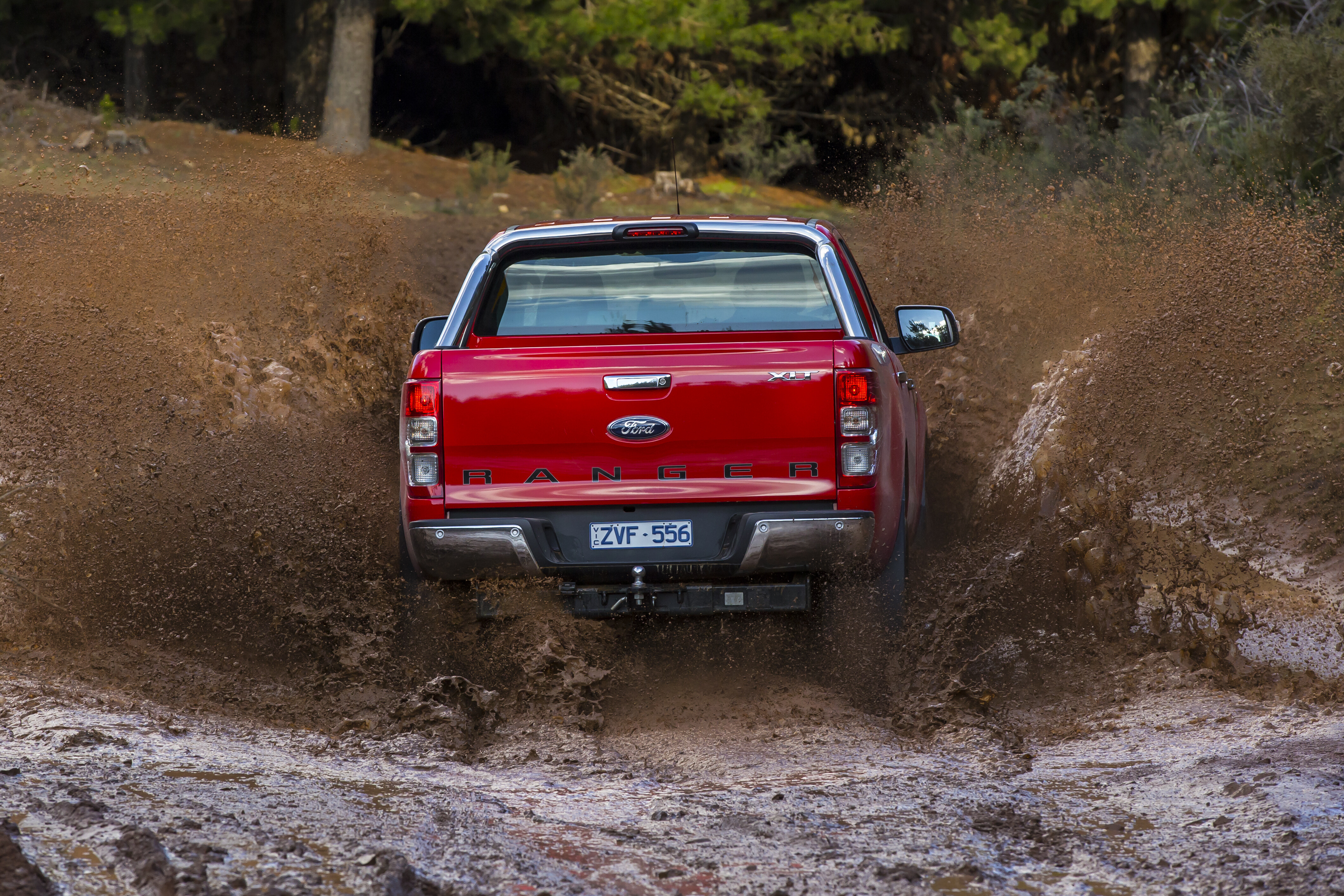
Moving up to the 3.2, it’s a notably better engine in the MkII than it was in the original model, thanks to its improved response and refinement. For manual 3.2 buyers the improvement with the MkII is even more notable due to the much-improved shift quality.
Compared to the improved 3.2, the 2.0-litre bi-turbo is both more responsive and more frugal, with its 10-speed automatic no doubt playing a role in both these achievements. The bi-turbo is also quieter and generally more refined than the 3.2, although the 3.2 has a more pleasing and relaxed manner compared to the more frenetic and revvy nature of the bi-turbo. The bi-turbo’s 10-speed auto isn’t perfect either, with an occasional hesitant and clunky shift, which detracts from its otherwise excellent refinement.
Off-road driving
The PX Ranger’s long-travel suspension is the secret to its considerable off-road prowess and makes it better off road than most of its contemporary rivals. In fact, it’s well ahead of Triton, Navara, D-MAX and the pre-2016 update Colorado. In its MkII iteration where the electronic traction control on the front wheels stays active even when the rear locker is engaged, the off-road ability is as good as it gets in terms of mainstream utes.
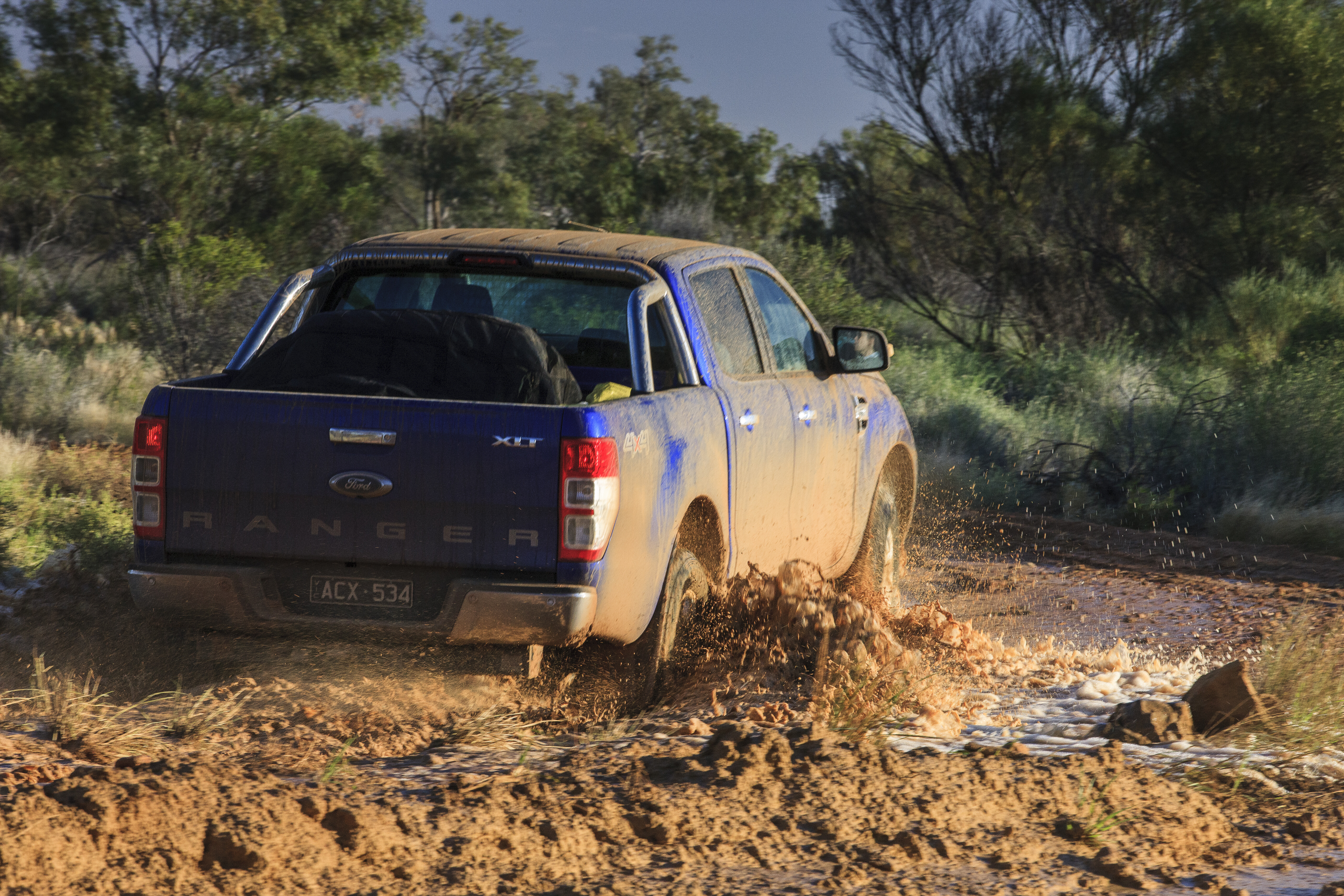
The best off-road models are MkII or MkIII 3.2s, with either the manual or automatic gearbox. The automatic is probably the best bet off road for ease of driving – especially for soft sand or steep hills – but some people just prefer a manual.
The bi-turbo isn’t quite as happy off road due to a less-than-slick performance from the 10-speed automatic in low range where it can struggle to get its shifts right even with ‘manual’ selection. It still does the job, but it’s not always happy.
Towing
If your requirement is for a heavy-duty tow vehicle then the 3.2, especially in the MkII or MKIII iterations, is again the best bet. Manual or automatic is again a personal preference, but towing with an automatic is just easier on the driveline and the auto’s manual-style override shift still gives you manual control in more demanding driving conditions, up or down steep hills.
Surprisingly the 2.2 has the same tow rating as the 3.2 (originally 3350kg and then 3500kg) but is probably best at towing more moderate loads up to something around 2500kg.
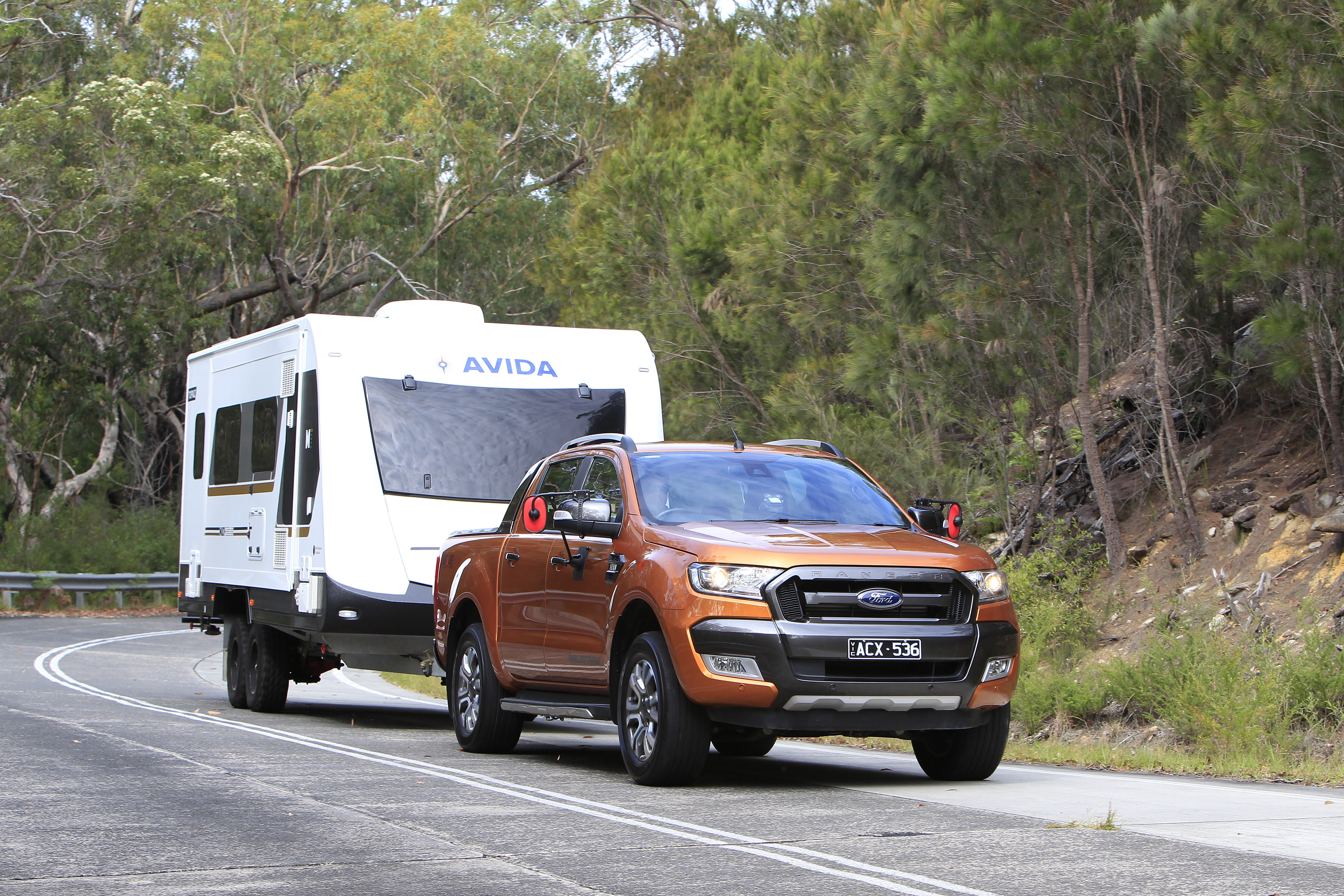
On paper the bi-turbo with its 157kW and 500Nm should be the best tow vehicle, but our heavy-duty tow testing has shown that the engine nor the gearbox likes very heavy tow loads in demanding conditions. In fact, many rival utes with lower power and torque figures outperformed it in our last tow test and it’s certainly well short of the 3.2 under more extreme conditions and probably best at light and moderate towing duties.
Reliability and service
In all its iterations the Ranger has proved to be generally problem-free and reliable, although it’s also fair to say the bi-turbo and 10-speed powertrain hasn’t been as reliable as the others. Perhaps that’s because both the 2.2 and the 3.2 and their respective gearboxes have been in service for five or more years when they debuted in the Ranger in 2011, whereas the bi-turbo and 10-speed was a brand-new design when it appeared in the PX MkIII and Raptor.
Not that the 3.2 has proved 100 per cent perfect. The fourth cylinder ran hotter and under extreme duress, would burn the top off the injector and potentially burn a hole in the piston. Exhaust gas regulators can also split on 3.2s and 2.2s, causing additional problems if not attended to. Like all high-pressure common-rail diesels, the 3.2 and the 2.0 react poorly to contaminants and water in fuel. The dual-mass flywheel on manual 3.2s was also prone to failure under heavy towing loads.
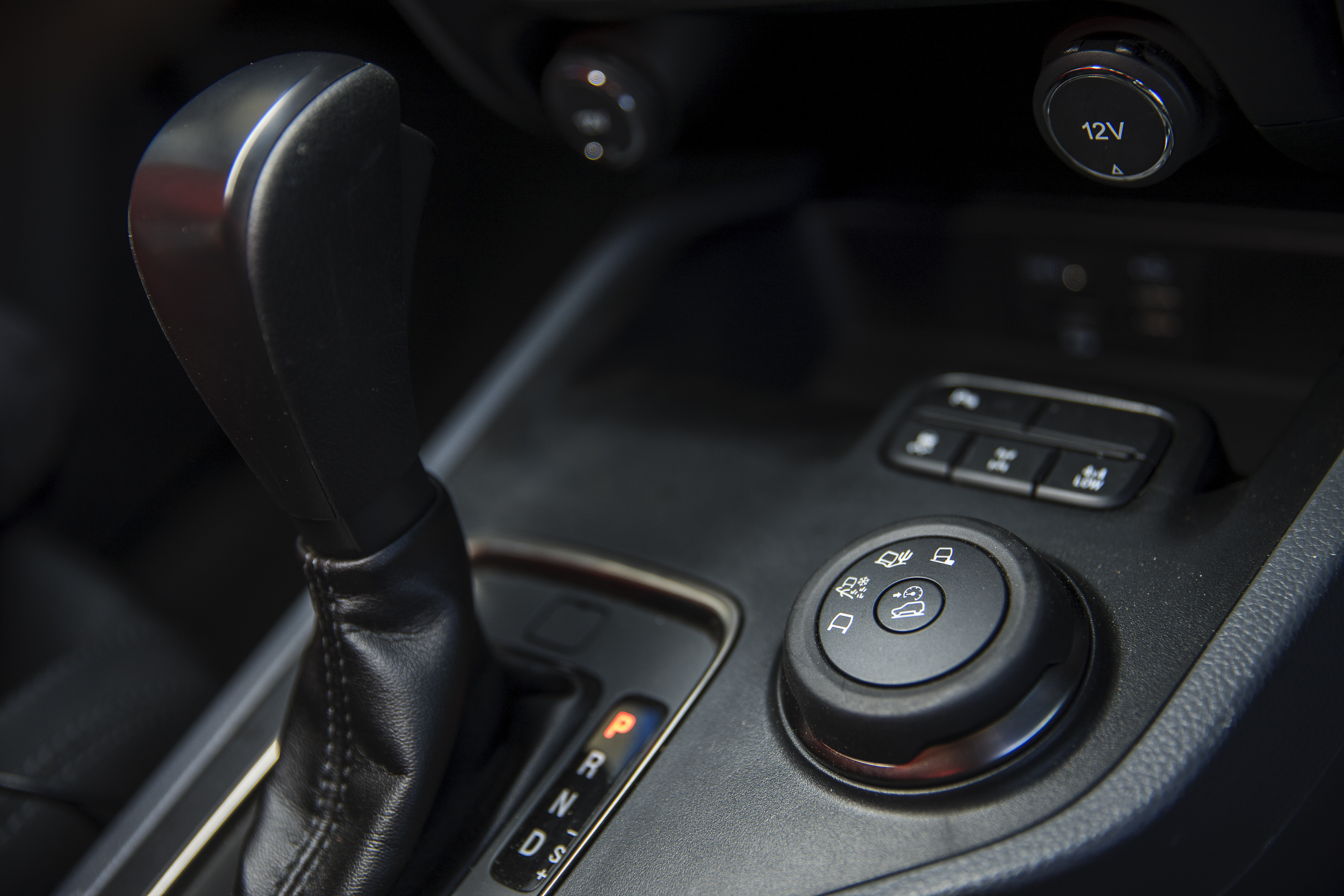
All the minor glitches of the original PX – like the standalone Bluetooth module – were addressed with the MkII. MkII owners who complained about the annoying door-open warning chime were also treated to a free software fix.
Service-wise there’s also a potential problem when doing oil changes on the 3.2. While it might seem right, if you let the oil drain for too long the pump bleeds out and won’t self-prime after the oil is replenished. That means no oil pumping through the engine on restart, which is a recipe for catastrophic engine failure. For DIY on 2.2 and 3.2 models, it’s worth noting that many Mazda BT-50 parts are cheaper than identical Ford-boxed parts.
In its still relatively young life the bi-turbo and 10-speed powertrain has suffered injector problems from early on with Ford doing two field-service campaigns to fix the same, while the gearbox problems (other than a clunky shift) have been serious enough to be the subject of a widespread safety recall.
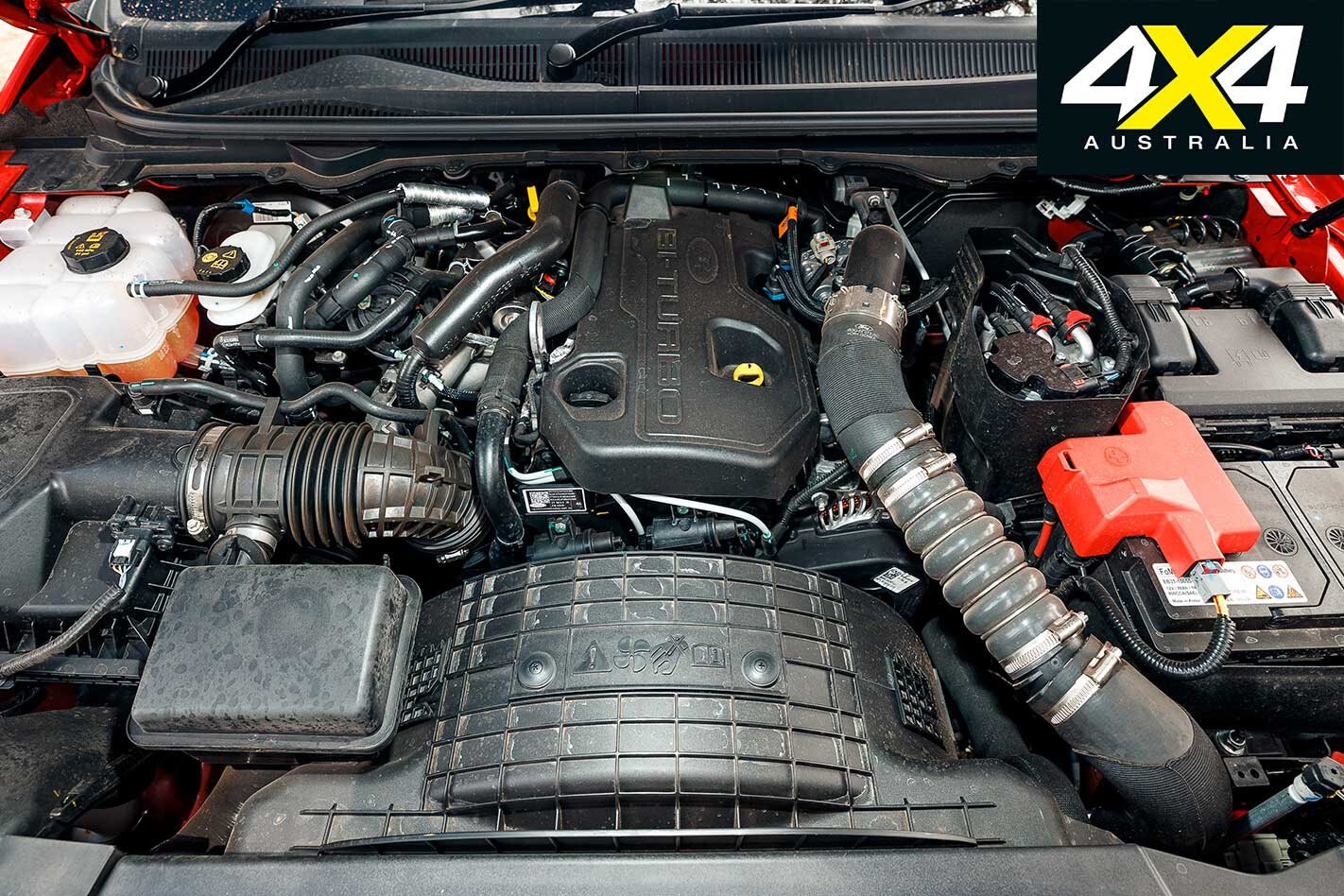
Seems also that the bi-turbo needs timely oil changes, and if you ignore the service reminders the engine can go in to a reduced power mode even if the dipstick says there’s plenty of oil. We also know of a recent case of a 126,000km bi-turbo engine with a blown head gasket where Ford didn’t just replace the gasket but replaced the engine. Read in to that what you may.
If you’re buying a second-hand bi-turbo you do, of course, have the reassurance of the five-year/unlimited km warranty that was part of the MkIII MY19 upgrade.
In all there have been 13 safety recalls across PX, PX MkII and PX MkIII models, and when buying second-hand you can’t take it for granted that the previous owner(s) actually had the work done.
And on a closing note, the electric power-steering may be nicer to drive but the old-school hydraulic power steering of the original PX is potentially more robust and gremlin free for rough and tough bush work.
Market snapshot
Given the long-term new-car sales success of the Ranger, there’s no shortage of second-hand examples for sale. Try around 5000 second-hand 4×4 Rangers for sale nationwide on just one used-car sales website alone, admittedly the biggest of many in Australia.
That’s the good news. The bad news is that second-hand prices are strong and demand is probably even stronger. The cheapest 4×4 Ranger on the sales site in question was asking $15,500. And it was a single-cab with 350,000+ kilometres on the odo, although it did have the 3.2 (manual ’box). The 3.2 (usually paired with the six-speed auto) is the most common engine available second-hand, although the 2.2-litre four (manual or automatic) is surprisingly common, while the later bi-turbo and 10-speed powertrain is surprisingly uncommon.
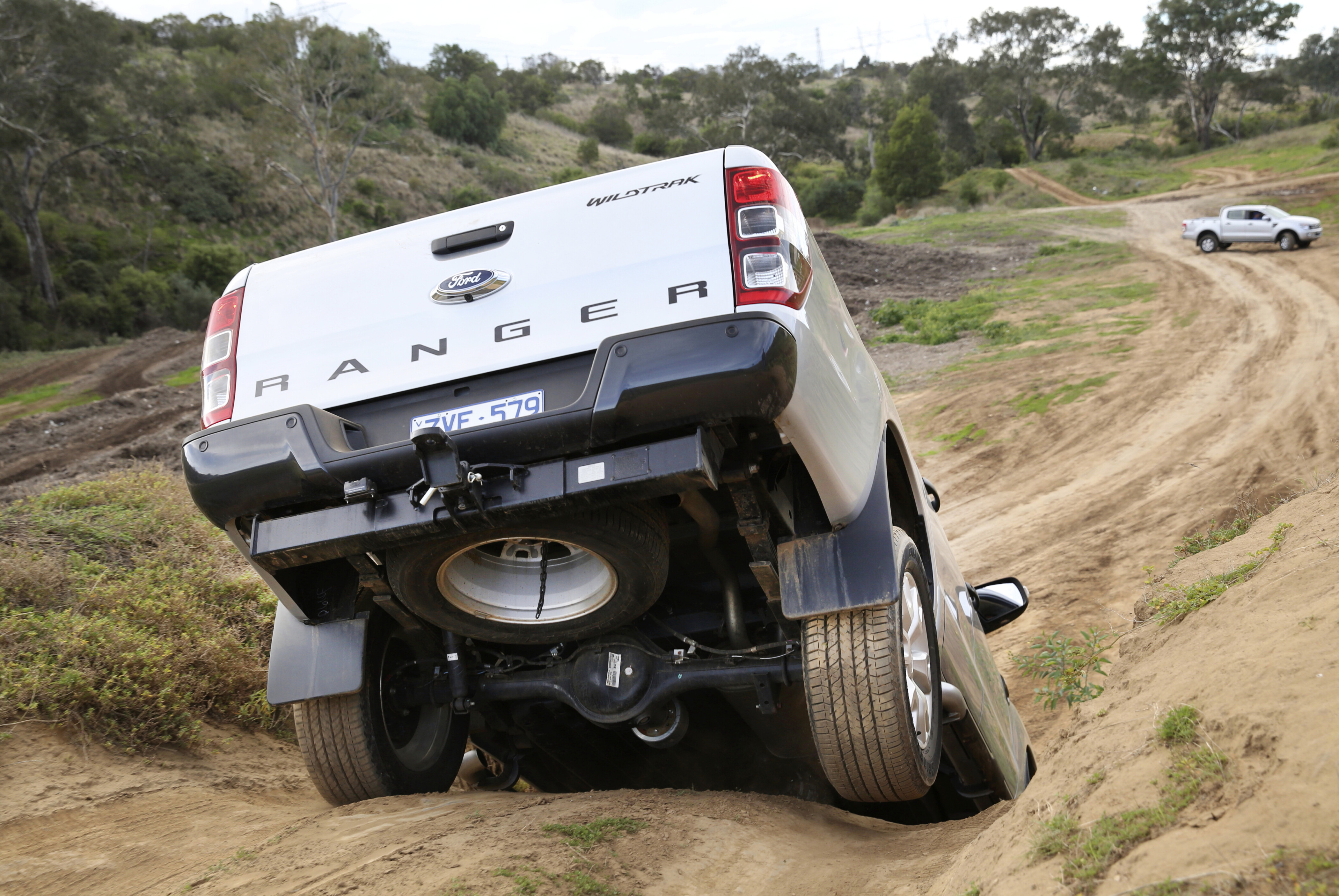
Moving up from that $15.5K single cab, the cheapest extended cab (a 2014 3.2L manual with nearly 400,000km on it) was $17K, while the cheapest dual cab (a 2014 2.2L auto) was asking $18K. The cheapest dual cab with the 3.2L (auto) was at $18.5K and that was for a cab-chassis and not a factory tub pickup.
Moving up to the PX MkII and prices start at $26K for a 2016 single cab or 2015 dual cab, both 3.2L autos. PX MkIII dual-cab prices started at $35K for a 2019 3.2 auto. Meanwhile, bi-turbo prices started at $45K for a 2018 extended cab, with the cheapest bi-turbo dual cab a 126,000km 2018 model for $46K.
Note that models listed as 2015 can be either a PX or a PX MkII, while 2018 models can be either a MkII or a MkIII.
Ranger Raptor
The Raptor, which appeared at the same time as the PX MkII upgrade, deserves and needs its own place in any discussion about buying a second-hand Ranger. It is a completely different beast – in the nicest of ways – to every other Ranger model.
Essentially it has a very different rolling chassis to bread-and-butter Rangers and that transforms the way it performs both on and off road. And brilliantly, the changes are that clever that the Raptor is both better off and on road. Aside from a reduced towing and load capacity (but still 2500kg and 750kg respectively) there’s no compromise here.
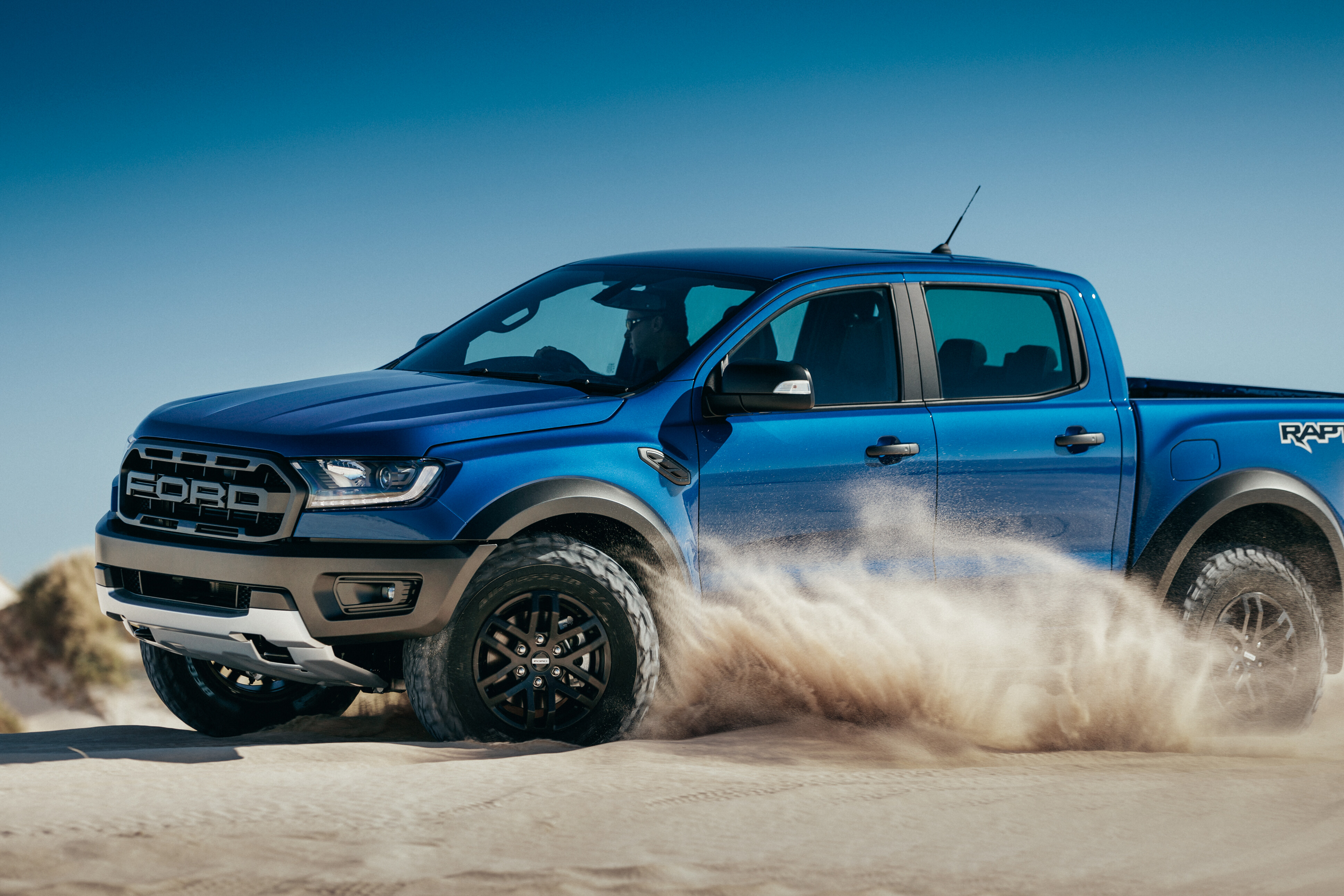
The Raptor is not just a Ranger with a lift kit and off-road wheel and tyre package. The Raptor’s chassis has been significantly altered with 150mm wider front and rear tracks via different front A-arms and a different rear axle housing, 46mm more ground clearance, 30 per cent more suspension travel at both ends, bespoke Fox-brand dampers (the rears have ‘piggyback’ reservoirs) and a sophisticated coil springs-Watt’s link rear suspension. No cheap and nasty Panhard rod here! The package is finished off with four-wheel disc brakes and 285/70R17 BFGoodrich All Terrains.
If the Raptor was open to criticism, it was that it used a standard 2.0-litre bi-turbo diesel, 10-speed powertrain and part-time 4×4 system, where the brilliant chassis was screaming out for a stonking big petrol V8 and full-time 4×4. Given that the new model Raptor answers both the call to more power (no V8 but a sizzling 292kW twin-turbo petrol V6) and full-time 4×4, this may have a notable impact on the second-hand value of first-generation Raptors.
Mazda BT-50: Twin under the skin
The Mazda BT-50 released just weeks after the PX Ranger in late 2011 was essentially the same ute save for a few details. The front and rear styling was obviously different, as was the cabin presentation and equipment details, but mechanical changes ran no deeper than a faster steering-rack ratio and slightly firmer suspension dampers.
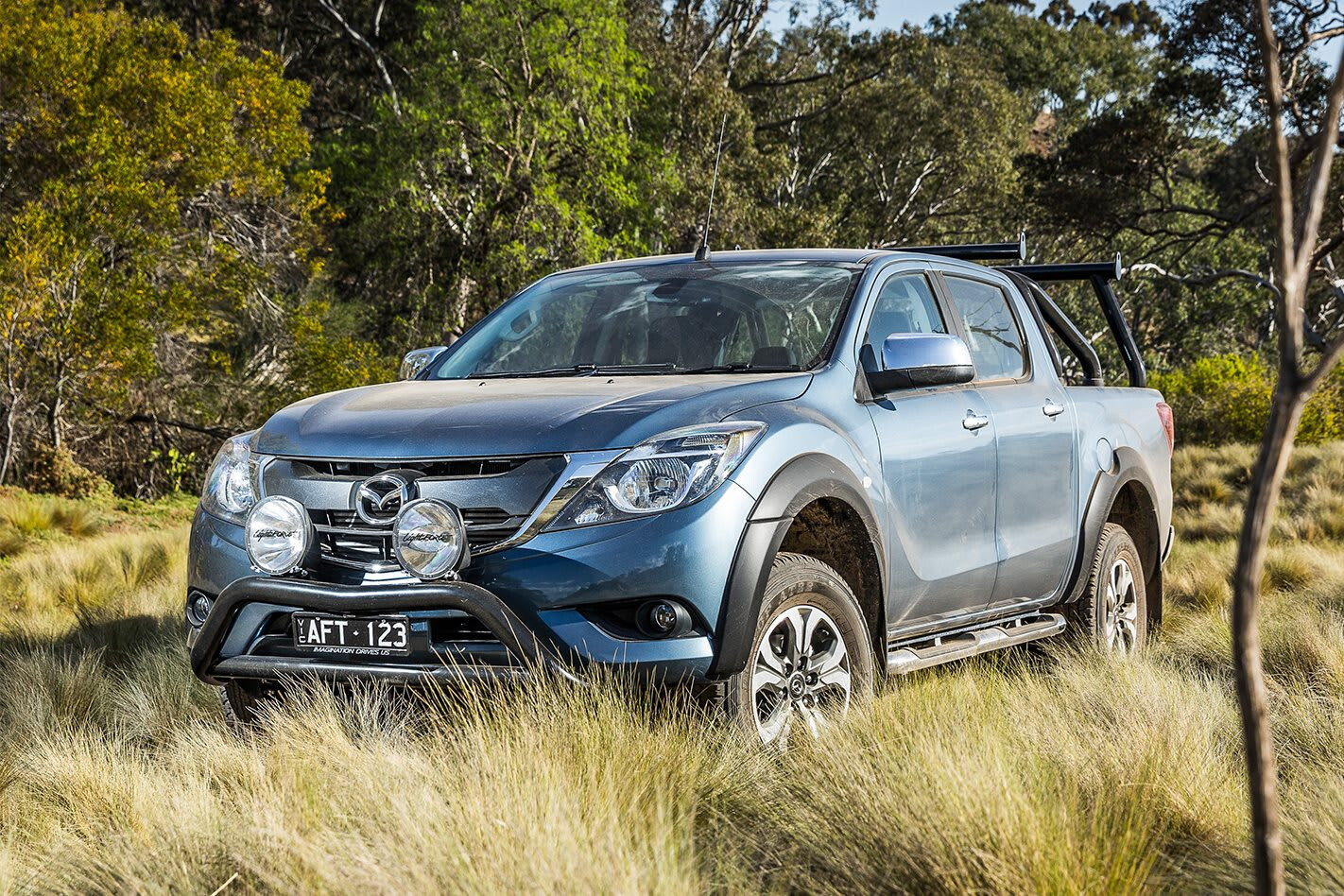
The notable difference between the BT-50 and the Ranger moving forward, was that Mazda didn’t adopt the PX MkII and MKIII changes so that the BT-50 remained essentially the same throughout its life except for styling and equipment upgrades. Last year the Ranger-based BT-50 made way for a new model, essentially a reskin of the new-generation Isuzu D-MAX that arrived here in late 2020.
The lesson here is that if you’re interested in a PX Ranger you should also look at BT-50s; although, the BT-50 never sold anywhere near the volume of the Ranger, so it’s far rarer second hand.
4X4 Australia's project builds
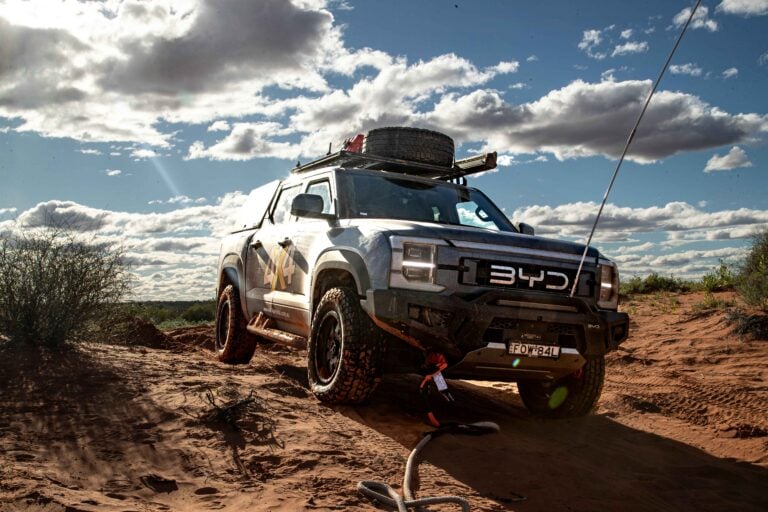
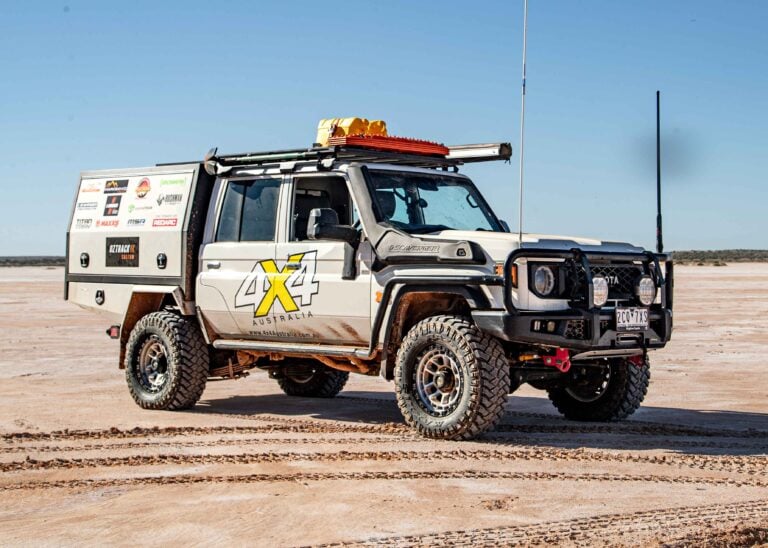
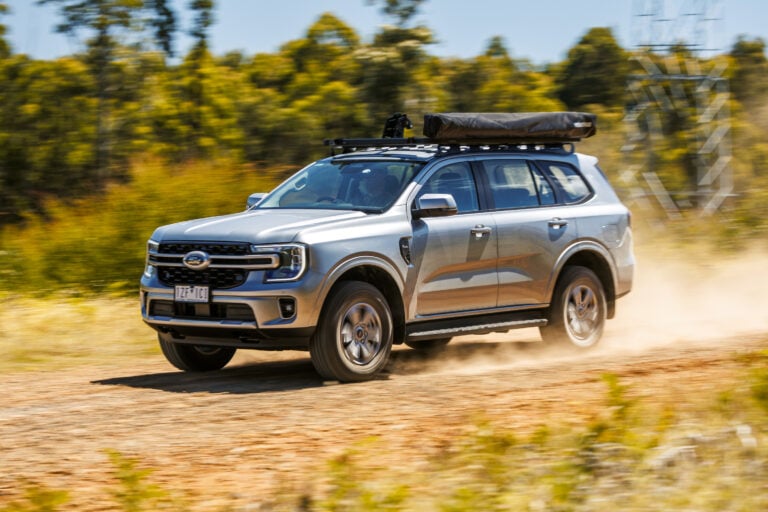
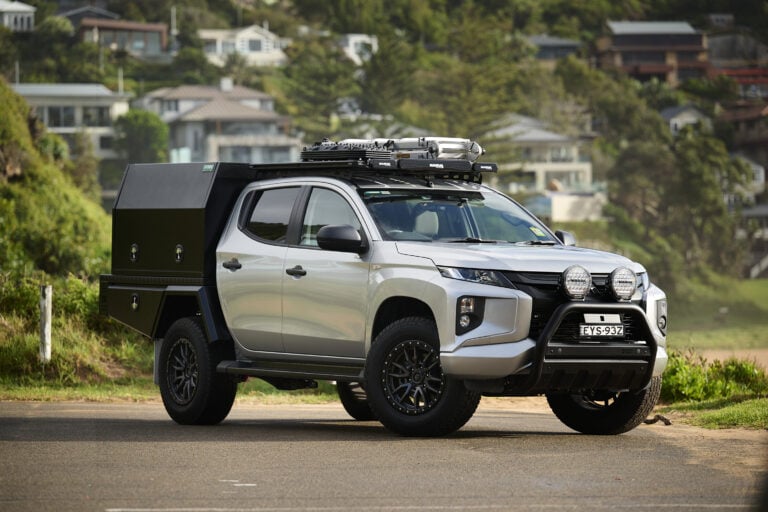
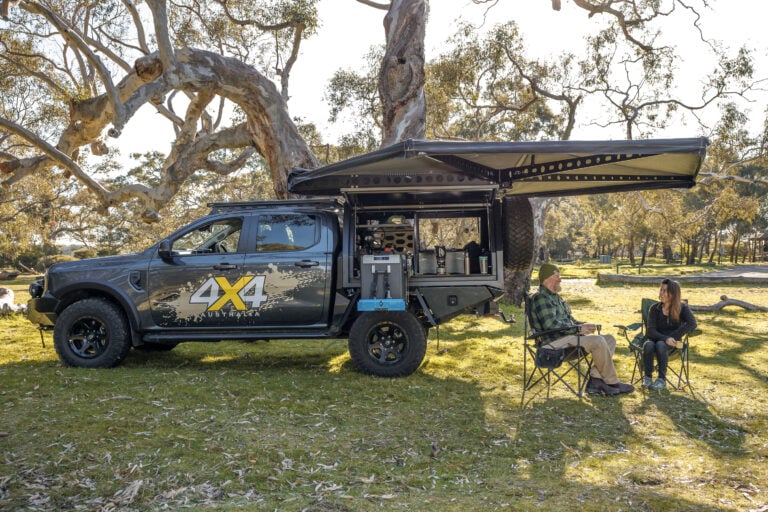
There is little doubt that chatting to friends on a log by a campfire while balancing a beverage on a nearby rock is a memory that draws many of us ‘back to the bush’, especially when peak-hour traffic gets a bit too much.
However, we often forget how the log grows hard, a cold breeze blows up our hunched-over back and our drink tumbles from that tippy rock, no matter how many twigs we stick under it to keep it level. And thus, the introduction of the camp chair.
Of late though, the simple ol’ camp stool now comes adorned with inbuilt coolers, fold-out trays, smartphone pockets and multiple obligatory drinks holders. Chuck two of these behemoths in your car, and you’d best boot the kids out to make room.
And so, with the advent of the new-age, super-lightweight, compact camp chair, we decided to grab a handful of the most prolific and put them through their paces to see whether they’re simply a backpacker’s luxury, or if they can replace that semi-broken service-station special you’ve been holding on to for so long.
We scored each chair (out of ten) in six categories: comfort, quality, design, packability, features and value. Here’s how they fared.
BEST BUDGET HIGH BACK CHAIR
Mountain Designs High Back Adjustable. The Poler comes in equal on points but loses top spot to the Mountain Designs based on chair-stability and price.
BEST LUXURY CHAIR
Nemo Stargaze Recliner Luxury Chair (large and hefty but super comfy). The Nemo Stargaze sits somewhere between a traditional heavy camp chair and newer lightweight trekking chairs. The Helinox Savanna rivals the Stargaze for quality and workmanship, but the Stargaze wins with a mass of features at a similar price point as the Savanna.
BEST COMPACT CHAIR
Nemo Moonlite Reclining Chair (ridiculously small and light). This was an easy win for the Moonlite as the only compact low-back on test. However, the Moonlite deserves praise for its clever design, comfort and quality of materials and workmanship. We suggest evaluating the Moonlite against other super-compacts like the similarly priced Helinox Chair Zero to allow comparison of apples with apples.
RISEPRO UPGRADED OUTDOOR CAMPING CHAIR
- SCORE 40/60
- RRP $59.90
Arriving in a small, zipped bag, the Risepro impresses with a nice simple hook-and-loop tab to hold all the poles together in a compact bundle.
Set up of the chair is straightforward, and immediately noticeable is the smaller diameter of the poles compared to some of the other chairs on test. Minimising diameter does reduce weight, but theoretically also reduces rigidity and strength. The Risepro opens to 104cm H x 45cm W x 45cm D and is noted to have a maximum weight capacity or 145kg.
The chair is compiled of aluminium poles, plastic joints and what is promoted as ‘waterproof’ denim fabric. The Risepro comes with a headrest cushion that attaches to the chair via a simple elastic strap. For a cheap offering, it is nice to see smart design features like sculpted plastic feet to reduce the legs sinking in to the ground.
Unfortunately, the smart design does not extend as far as the pole sleeves that are sewn quite narrowly and have no thumb/finger tabs to assist with chair assembly.
On use of the chair we found that it was the least comfortable on test, in part due to the narrow cut of the seatback, and after some use we noted stress and stretching of the fabric along some seams. While there was no catastrophic failure, we wonder how long the fabric and stitching will last with constant use in exposed Australian weather. Overall, the Risepro wins on price, but loses points for quality and comfort.
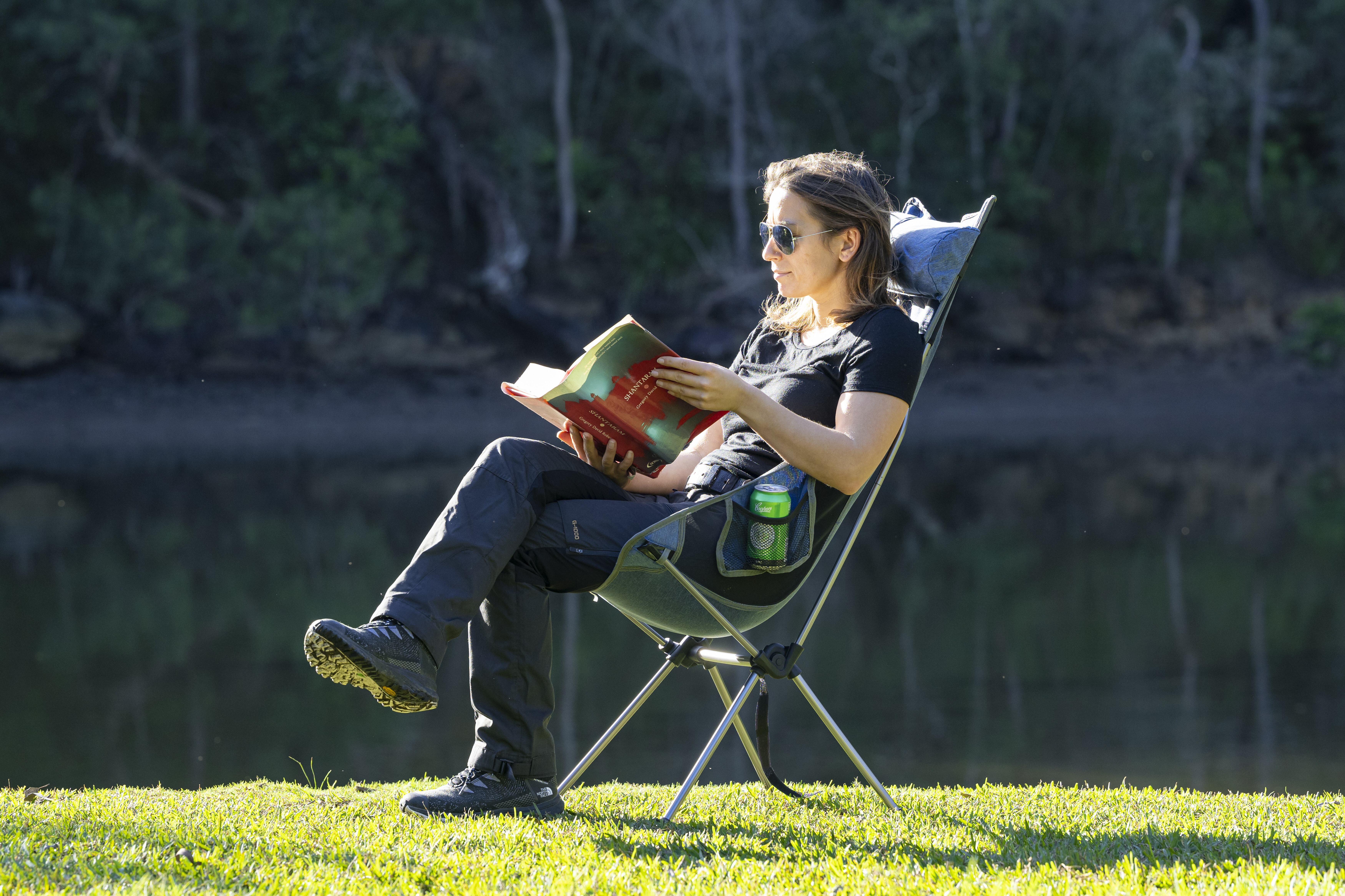
HELINOX SAVANNA CHAIR
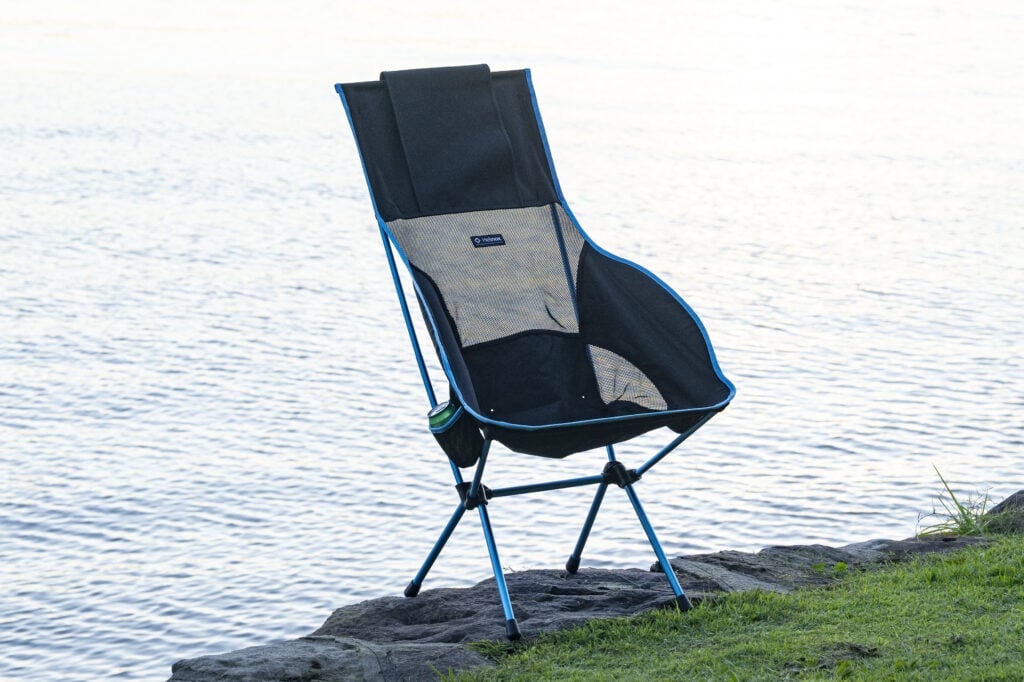
- SCORE 43/60
- RRP $279.99
Measuring 54cm H x 16cm W x 12cm D when disassembled, the 1.9kg assembled chair can expand to 112cm H x 68cm W x 60cm D and is capable of 145kg of occupant capacity. While the Savanna slots in as more expensive, larger and heavier than its counterparts in our test fleet, it is a larger chair overall and suits anybody carrying a few extra COVID-kilos.
The Savanna Chair incorporates a supportive top strut to aid form when open, as well as armrests, adjustable hook-and-loop headrest/pillow panel and dual drinks holders. Unfortunately, the Savanna Chair does not offer any sleeve-tabs for assisting set up, nor a Velcro strap for holding poles together. And if you want larger feet for soft ground, they are an add-on accessory.
The Savanna comes in at the very pointy end of the field for quality, workmanship and materials, and when used with a headrest or pillow it is fantastic, but without the pillow the Savanna loses some points on comfort.
As the most expensive of our standard-design high-back chairs in the group, it is hard to justify the extra dollars when compared to similar designs at nearly half the price. (Of note: Where the Savanna falls, the Sunset makes it up … see Helinox Sunset Chair.)
POLER AUSTRALIA STOWAWAY CHAIR

- SCORE 44/60
- RRP $133
Our Stowaway Chair weighed in at a relatively light 1.42kg (the second lightest high-backed chair on test) and packed to 48cm H x 20cm W x 20cm D. Well-considered design features like oversized sleeve-tabs on the pole-pockets make assembly of the Stowaway Chair a breeze, and once assembled the chair expands to a comfortable high-backed 110cm H x 45cm W x 40cm D with an inbuilt padded headrest.
The Stowaway offers a hydrophobic nylon seat with breathable mesh panels, but it lacks the media pocket or drink holders of other chairs on test.
A noticeable design advantage of the Stowaway Chair is its single-pole design. The aluminium frame is designed with leg and upright poles inserting directly to a cross-pole, and thus removing a need for plastic joints. Such a design achieves a reduced overall weight as well as a more compact packed unit, but unfortunately leads to a slightly top heavy and tippy chair when unweighted.
Fortunately, the chair offers a comfortable and stable platform when sat in. The Stowaway Chair scores well for comfort, design and ‘fun’, but loses a few points for lack of features.
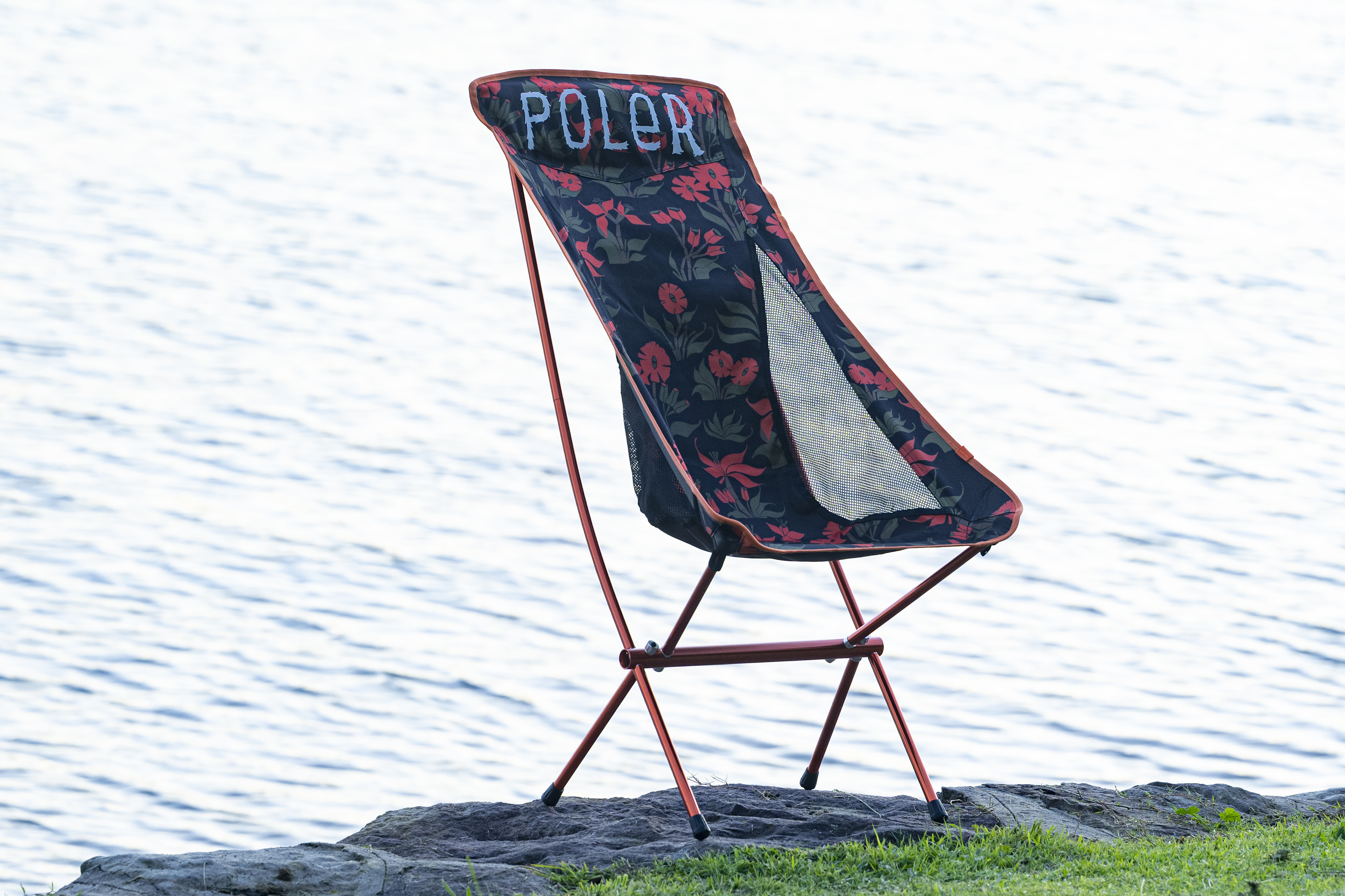
MOUNTAIN DESIGNS HIGH BACK ADJUSTABLE

- SCORE 44/60
- RRP $149.99
- SCORE 44/60
- RRP $149.99
A hook-and-loop tab holds the poles together in a compact bundle when packed, and the chair can be built in either an upright or reclined position. The chair does not offer sleeve-tabs to aid assembly, but the oversized pole-pockets allow for easy set up. Three tension-straps allow tweaking of both the seat height and rigidity, a feature that became relevant when a certain tester’s backside sank to rest on the cross-pole.
Expanding to 102cm H x 58cm W x 69cm D when assembled, the chair delivers a unique front-to-rear cross-pole that appears neither superior or inferior to the side-to-side design of the rest of our test chairs.
The High Back Adjustable Chair provides oversized mesh panels and a small accessory pocket, but no drink holder. The maximum 120kg weight capacity is less than other chairs we tested, but irrelevant to many users.
The Mountain Designs High Back Adjustable Chair doesn’t excel nor disappoint dramatically in any area, but rather delivers quality and consistency at a reasonable price point.
NEMO STARGAZE RECLINER LUXURY CHAIR

- SCORE 46/60
- RRP $299.95
- SCORE 46/60
- RRP $299.95
The Stargaze isn’t lightweight and weighs a hefty 3.9kg with packed dimensions of 60cm H x 17cm W x 17cm D. As such, the Nemo is predominantly a camping and picnicking chair that is unlikely to ever be stowed in your pack for a lengthy hike to a remote beach.
The Stargaze features oversized aircraft-grade aluminium poles with colour-coded joints and markers for ease of set up. Importantly, the design allows the frame to be set up independent of the non-absorbent monofilament-mesh chair body. Once the frame is assembled, the unfolding of two rear support poles establishes chair rigidity and the chair-unit clips easily to the frame with climbing-grade hardware. The result is a spacious 112cm H x 92cm W x 68cm D auto-reclining hammock-like structure, designed to flex while you swing.
Oversized rubber feet ensure the unit doesn’t sink in to the ground, and the chair features niceties such as an easily accessible accessory pocket, cupholder (that fits a full-sized water bottle), padded armrest and an adjustable, padded pillow.
We just loved the Stargazer. It is simple to use, easy to set up and stash, and super comfortable. We did have a few small gripes with the chair: one being its tendency to pitch forward as soon as you unweight your feet; secondly, the difficulty squeezing the unit back in the bag; and thirdly, the hefty price tag.
At nearly five times the cost of the Risepro and three times the cost of the Mountain Designs, many users will likely find it hard to justify such an expense for a camp chair. However, there is no doubt those willing to spend the dollars will not be disappointed.
NEMO MOONLITE RECLINING CHAIR
- SCORE 48/60
- RRP $199.95
- SCORE 48/60
- RRP $199.95
The Moonlite was the only sub-1kg chair on test, and as such places the chair in a category alongside others like the 510-gram Helinox Chair Zero (RRP $179) or the 860-gram Mountain Designs Lightweight Chair (RRP $69). Realistically, these chairs are more hiking chairs rather than car camping chairs, but if you prefer a Suzuki Jimny to 300 Series Cruiser, then maybe the Moonlite is for you.
What blew our mind most was its comfort. As a low-back, compact chair, we expected a severe compromise on comfort, but the Moonlight rivalled some of the high-back chairs, and even exceeded some, with a reclining feature that works.
The frame set-up is a similar pole design to many others, but the 65cm H x 51cm W x 52cm D mesh-seat locks to the frame via ball and socket joints rather than fabric sleeves. 100-per-cent post-consumer recycled materials are used for the webbing, and triple stitching is implemented to attain strength and allow for a 136kg max occupant capacity.
As a super-compact chair, there’s a noticeable lack of pockets or drink holders, and the seat-height which sits at 27cm off the ground is much lower than the high-backs on test. As such, the Moonlite has minimal use as a dining chair at a table but will work fine by the fireplace or sitting back in the sun.
It scores best for packability, design and quality of workmanship, but achieves its light weight by compromising on features – it’s certainly not a chair for those on a slim budget.

HELINOX SUNSET CHAIR
- SCORE 44/60
- RRP $229.99