
If you’re serious about 4WDing, you’ll know how important protecting the underside of your 4WD is. There’s a lot of vital components sitting under your feet, and a hole in your radiator or a damaged transfer case can be disastrous when you’re a long way from help.
Most 4x4s come from the factory with minimal underbody protection. At best, they’ll have thin sheetmetal guards. And many manufacturers only protect the engine sump, leaving the gearbox and transfer case completely exposed. Thankfully, the aftermarket guys have you covered. You can get a kit for just about any make and model of 4×4 running around our roads.
The kits vary from basic sump guards to full underbody protection (rear diff housing guards are extra). To narrow down the selection, we decided to focus on suppliers who provide full underbody protection kits. Once you’re armed with this information, you can decide whether you need the full kit or only selected components.
Note: We’ve included a ‘Typical Weight’ in our Specifications. It’s just an indication – weight will vary between vehicle makes. We took a ‘typical’ kit and used this to compare weights between the suppliers.
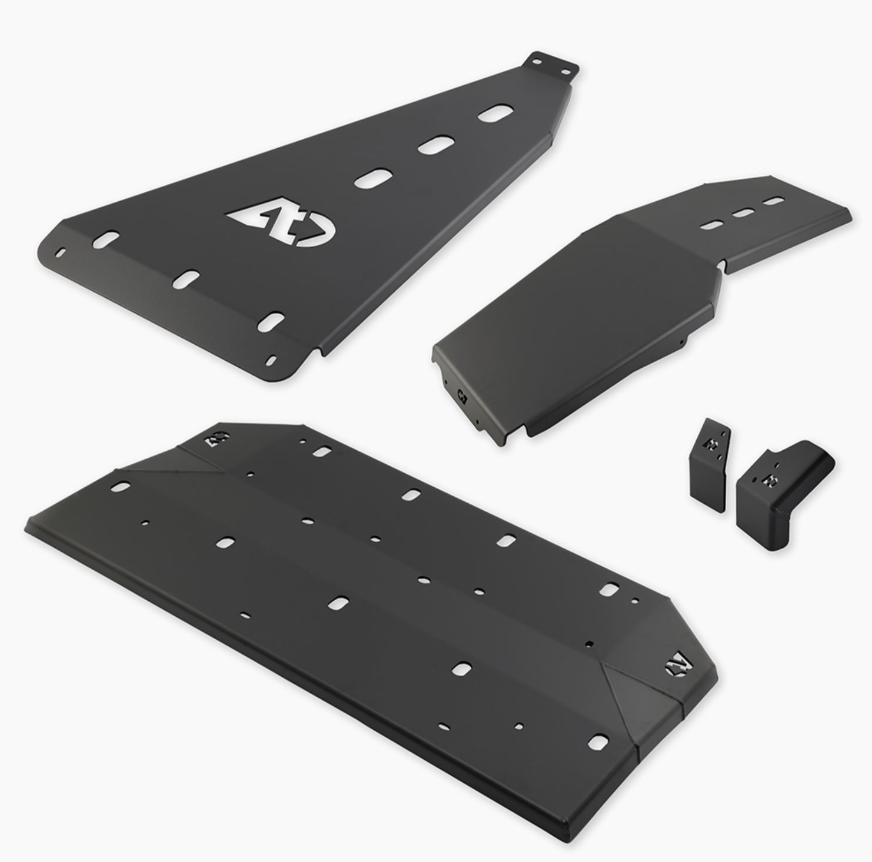
Expedition HQ Agile Offroad Complete Skid Plate Set for the Ineos Grenadier
The Agile Offroad Complete Skid Plate Set offers full underbody protection for the Ineos Grenadier, shielding vital components such as the differentials, control arms, and driveline.
Built from ultra-strong 5052 aluminium, the plates balance strength with malleability, designed to absorb and deflect impacts without compromising durability. Each plate is finished in a tough powder coat and available in black, orange, or red for added visibility and corrosion resistance. The system is designed for straightforward installation, covering the Grenadier’s vulnerable underside in one integrated package. Ideal for demanding terrain, it provides reliable armour against rocks, ruts, and other obstacles.
| Specification | Details |
|---|---|
| Material | 5052 Aluminium |
| Finish | Powder coated (Black, Orange, or Red) |
| Drill or no-drill | Likely bolt-on |
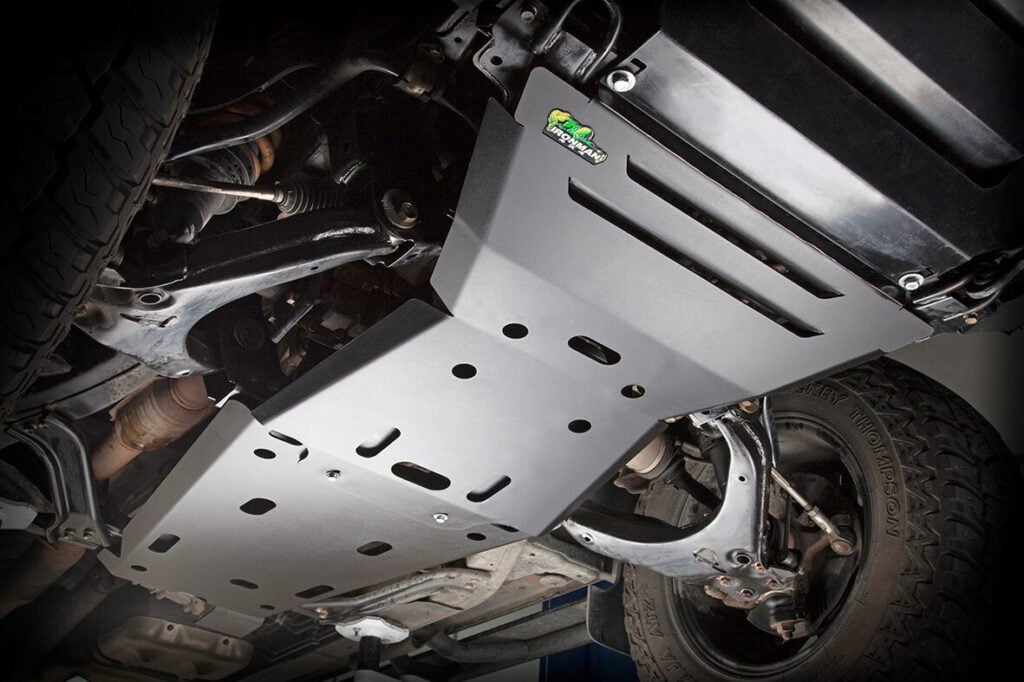
IRONMAN 4×4 UNDERBODY PROTECTION
- Material: Steel, EDP E-Coated and powder-coated
- Thickness: 4mm folded steel construction
- Typical Weight (indication only): 25-30kg
- No-drill: Yes
Things we like
| Not so much
|
- Material: Steel, EDP E-Coated and powder-coated
- Thickness: 4mm folded steel construction
- Typical Weight (indication only): 25-30kg
- No-drill: Yes
Ironman 4x4u2019s Premium Underbody Protection kits are made from 4mm-thick steel, EDP E-Coated and then powder-coated black for extra protection and looks.
They feature recessed high-tensile hardware which removes the chance of being hung up, and have been designed to far exceed the strength and protection provided by OEM equipment.
The Premium range of underbody protection from Ironman 4×4 incorporates service inspection holes, and is available for a range of popular four-wheel drives.
CUSTOM OFFROAD UNDERBODY PROTECTION
- Material: Stainless steel with 2B finish
- Thickness: 3mm or 4mm
- Typical Weight (indication only): 25-30kg (3mm), 35-40kg (4mm)
- No-drill: Yes
Things we like
| Not so much
|
- Material: Stainless steel with 2B finish
- Thickness: 3mm or 4mm
- Typical Weight (indication only): 25-30kg (3mm), 35-40kg (4mm)
- No-drill: Yes
Custom Offroad underbody protection kits are designed to bolt straight on. If a factory kit fits, then one of their kits will fit your 4WD.
They’re made from stainless steel, meaning no corrosion issues and greater strength than an equivalent product made from mild steel.
Depending on the level of protection you need, they’re available in either 3mm or 4mm thickness. Typically, a 3mm protection kit will weigh between 25 and 30kg. The 4mm version adds around 10kg when compared to the 3mm kit.
Custom Offroad makes its underbody kits at its Brisbane factory and deliver Australia-wide. You can fit them yourself or get one of their approved installers to do the job instead.
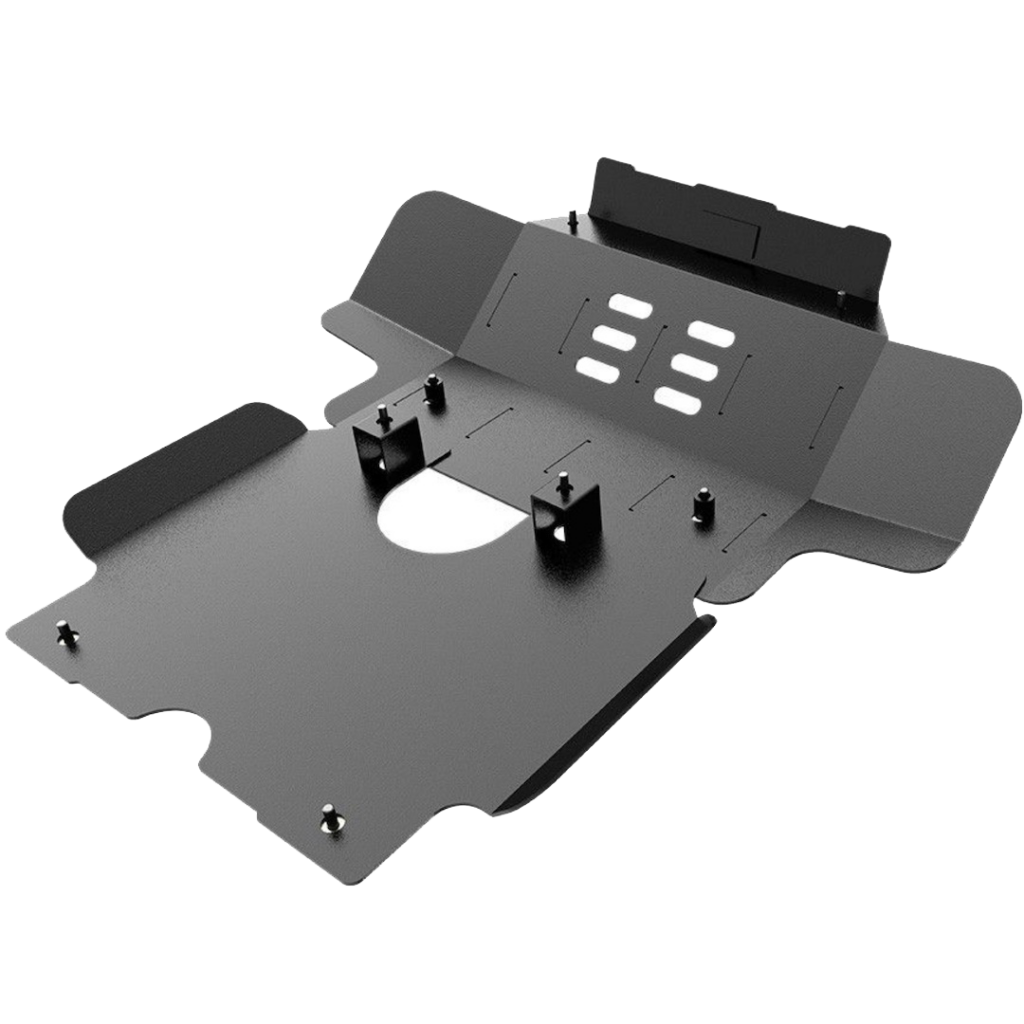
FRONT RUNNER UNDERBODY PROTECTION
- Material: Stainless steel, powder-coated
- Thickness: 3mm
- Typical Weight (indication only): 30kg
- No-drill: Yes
Things we like
| Not so much
|
- Material: Stainless steel, powder-coated
- Thickness: 3mm
- Typical Weight (indication only): 30kg
- No-drill: Yes
Front Runner is based in South Africa, with a proven background in supplying rugged gear for its local market.
Its underbody protection kits are made from 3mm-thick stainless steel, then powder-coated black for extra protection and looks. Instead of pressings, Front Runner folds the plates then uses welded ribs for extra strength where needed.
A quality product with a reputation for toughness in the worst conditions.
TJM UNDERBODY PROTECTION

- Material: Stainless steel, powder-coated
- Thickness: 3mm
- Typical Weight (indication only): 30kg
- No-drill: Yes
Things we like
| Not so much
|
- Material: Stainless steel, powder-coated
- Thickness: 3mm
- Typical Weight (indication only): 30kg
- No-drill: Yes
TJM supplies a range of underbody protection kits made from 3mm-thick mild steel. Theyu2019re electroplated then powder-coated for corrosion protection. The individual guards are pressed and folded for added strength. Ventilation slots allow cooling air to get in, and mud and water to get out.
Shrouded bolt heads protect the vulnerable bolt heads from damage, meaning you don’t need to worry about snapping off bolt heads or damaged bolts.
The only downside? Once you scrape through the electroplating and powder coating, the mild steel is exposed to the elements.
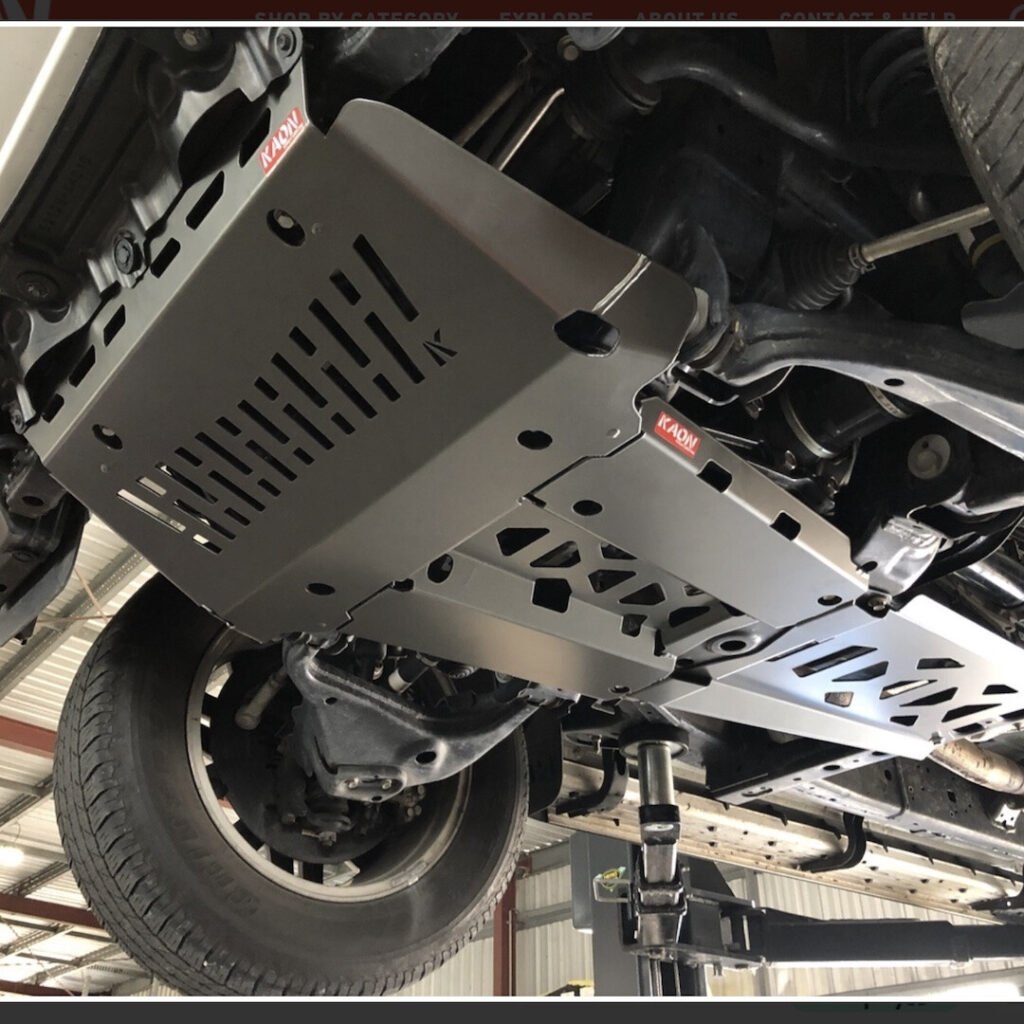
KAON UNDERBODY PROTECTION
- Material: High-strength mild steel
- Thickness: 3mm
- Typical Weight (indication only): 20kg
- No-drill: Yes
Things we like
| Not so much
|
- Material: High-strength mild steel
- Thickness: 3mm
- Typical Weight (indication only): 20kg
- No-drill: Yes
KAON is an Australian company based in Queensland. They use high-strength structural steel, which enables the underbody protection kits to be thinner and therefore less weight.
All plates are powder-coated after cutting and folding for additional protection … although once the powder-coating’s damaged, it exposes the bare metal underneath. KAON provides plenty of ventilation/drainage slots in the plates.
And it understands the importance of recessing the heads of the mounting bolts. This gives you peace of mind that you won’t snap off a bolt when you’re sliding over a large rock.
ARB UNDERBODY PROTECTION
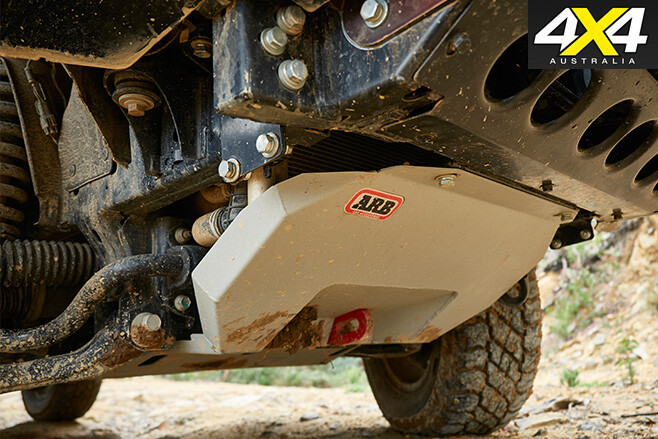
- Material: Mild steel, zinc plated or powder-coated
- Thickness: 3mm
- Typical Weight (indication only): 30kg
- No-drill: Yes
Things we like
| Not so much
|
- Material: Mild steel, zinc plated or powder-coated
- Thickness: 3mm
- Typical Weight (indication only): 30kg
- No-drill: Yes
Pressing enables ARB to incorporate stiffeners in the plates without additional components. So they can achieve maximum strength from the relatively lightweight 3mm steel.
Not so good is the use of zinc plating or powder-coating. Scratches aren’t easy to touch up without it being obvious you’ve done a patch-up job … and once the coating is damaged, the mild steel is exposed to the elements.
You’ll also need to remove the plates before an oil change. Not a biggie, but worth mentioning here.
On the plus side, ARB have incorporated a feature which should be a no-brainer on every underbody protection system. They’ve recessed the bolt heads in the areas where you could be scraping or sliding over obstacles.
There’s nothing worse than discovering you’ve either sheared off a bolthead or damaged it so badly you can’t get it undone. Thankfully ARB have solved this all-too-common problem, before it happens.
AFN 4×4 ACCESSORIES UNDERBODY PROTECTION
- Material: Aluminium
- Thickness: 6mm
- Typical Weight (indication only): 20kg
- No-drill: Yes
\n
Things we like
| Not so much
|
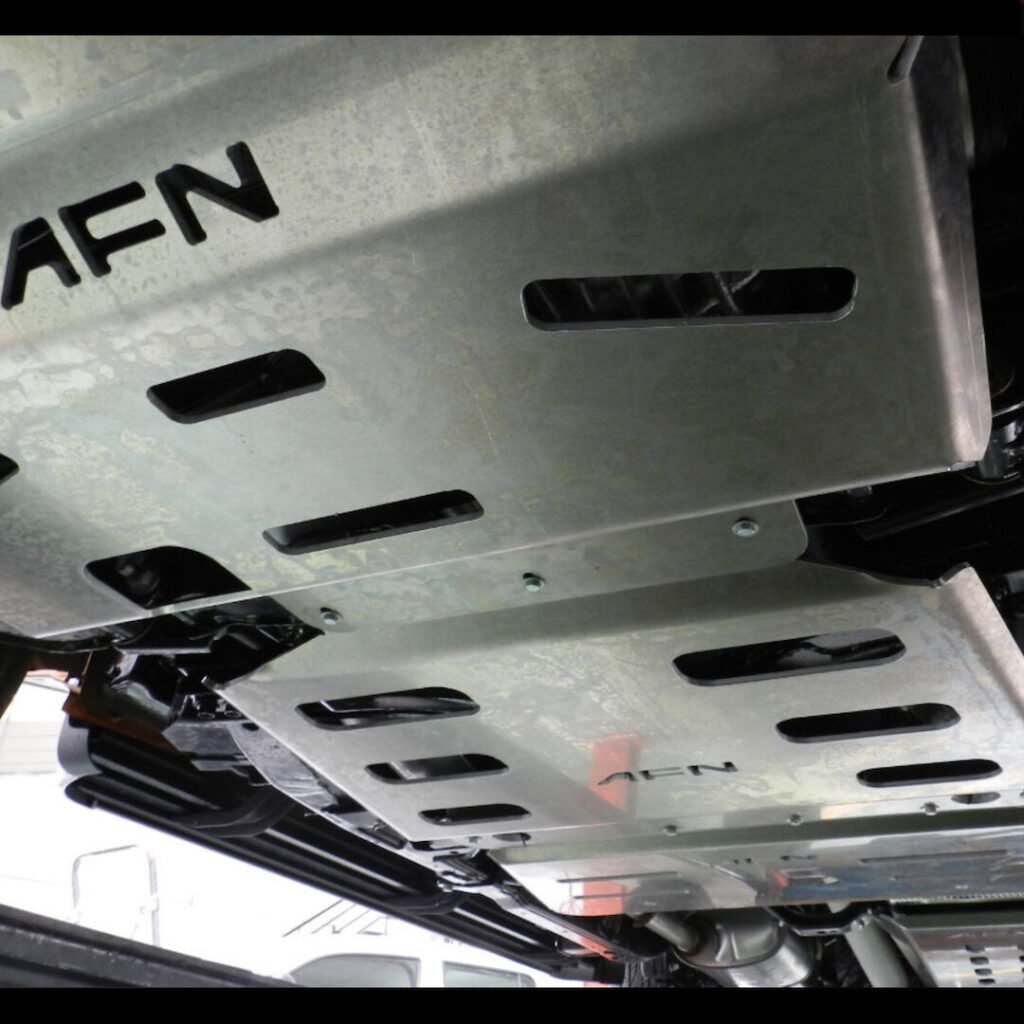
AFN 4×4 Accessories are better known for their quality bullbars. However, it also provides a wide range of underbody protection kits.
AFN is a European company, with years of experience in providing vehicle protection for military and United Nations’ vehicles. The Australian division feeds back information to its European engineering department, which designs all components in-house.
The kits are made from 6mm thick aluminium, meaning no issues with rusting. They come supplied with plenty of ventilation slots to keep your driveline cool. Typically, a full kit will weigh around 20kg.
ROADSAFE 4WD PROTECTION PLATES
- Material: Aluminium
- Thickness: 6mm
- Typical Weight (indication only): 20kg
- No-drill: Yes
\n
Things we like
| Not so much
|
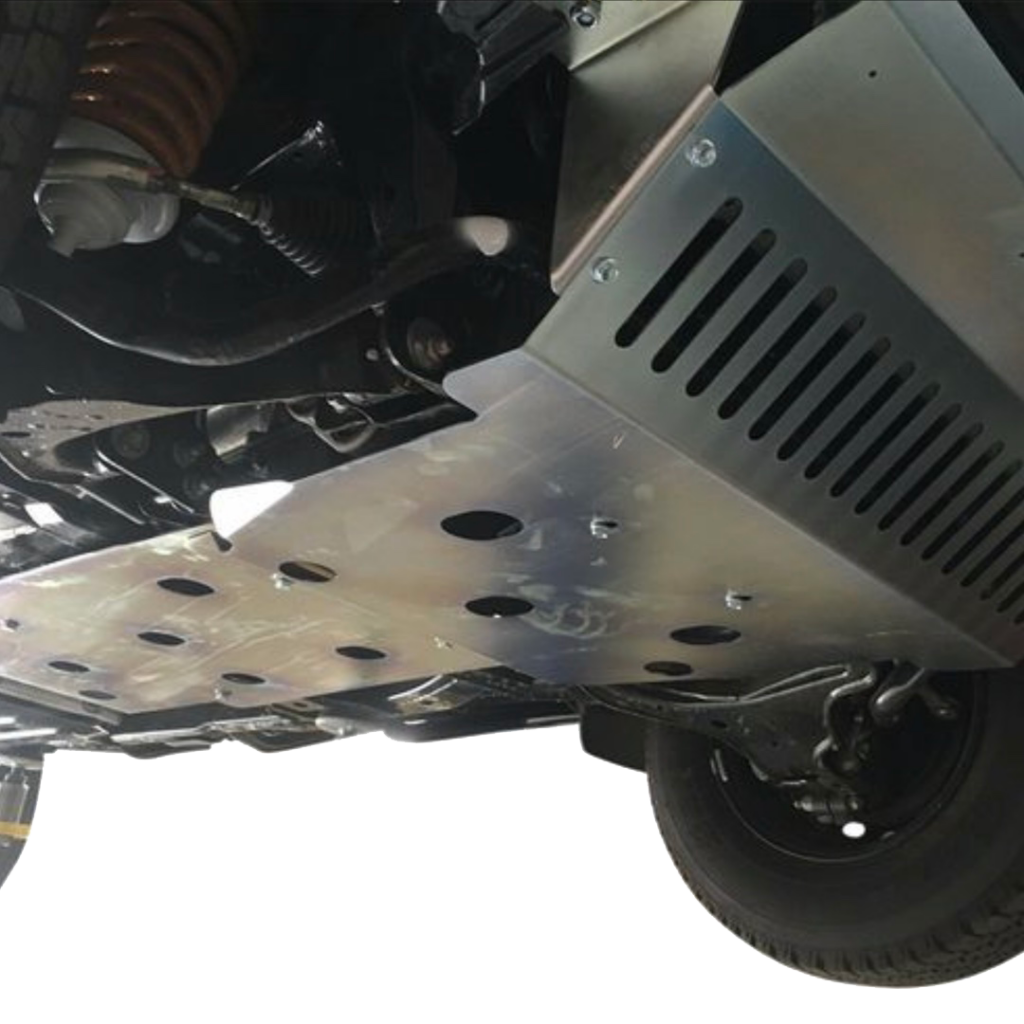
Roadsafe makes its underbody protection kits from 3mm-thick mild steel. It zinc plates them for protection against corrosion, meaning you can easily paint them if desired.
Where possible, Roadsafe allows access to oil filters and drain plugs without needing to remove the plates. Also provided are plenty of ventilation holes and points for water to drain away from inside the plates. Roadsafe also provides any bolts and nuts needed for installation.
While the zinc plating is a smart idea, it is only a surface coating. So once the zinc plating gets rubbed or scratched off, the bare metal underneath will be exposed to the elements.
These kits are comparatively heavy, typically around 40kg for a full protection kit.
RIVAL UNDERBODY PROTECTION
- Material: Alloy, powder-coated
- Thickness: 6mm
- Typical Weight (indication only): 30kg
- No-drill: Yes
Things we like
| Not so much
|
- Material: Alloy, powder-coated
- Thickness: 6mm
- Typical Weight (indication only): 30kg
- No-drill: Yes
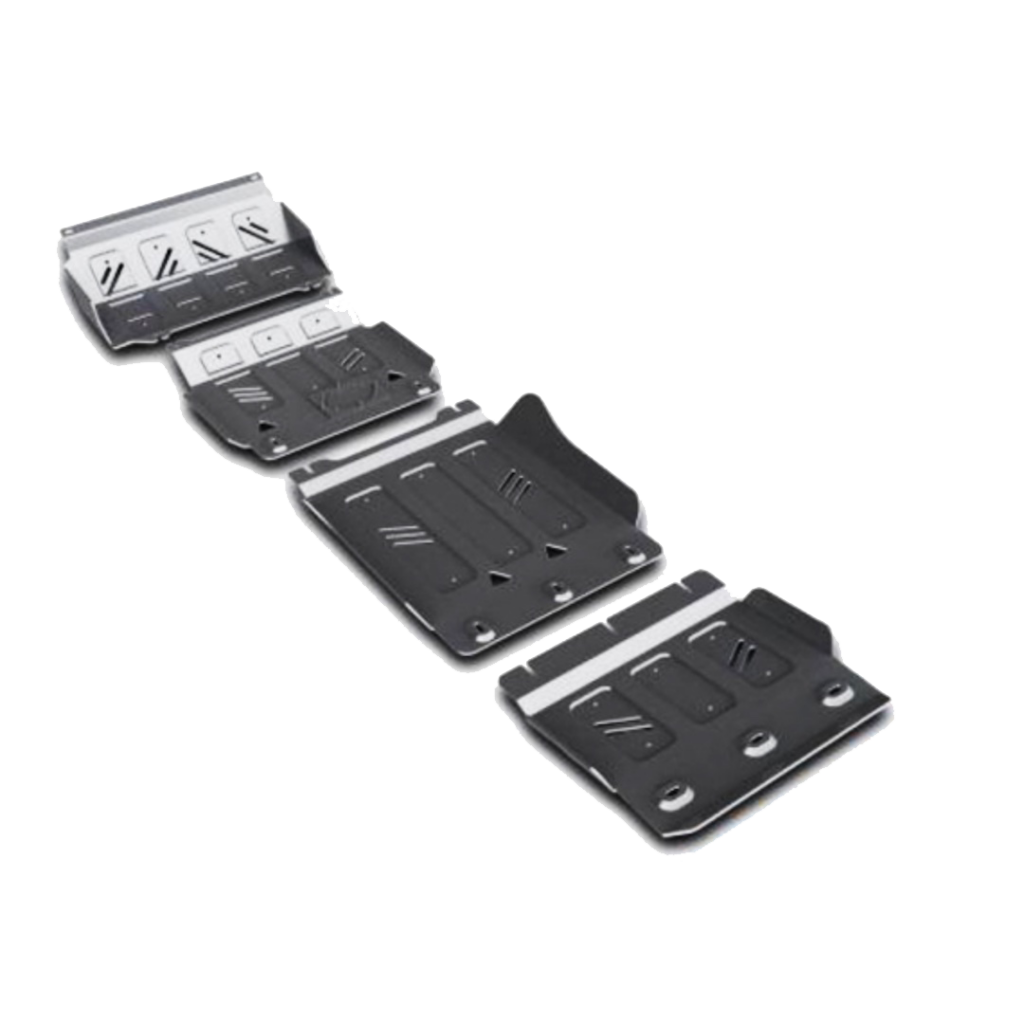
Rival has taken a different approach with its underbody protections kits. It uses a lightweight alloy rather than stainless steel, mild steel, or aluminium.
The beauty of alloy is it can be pressed, meaning Rival can incorporate strengthening ribs in the plates, without the need for additional welded or folded sections. And being lightweight, Rival uses a 6mm alloy for maximum strength.
The other benefit of alloy is it won’t rust. So even if you damage the painted surface, the underlying alloy won’t be affected by corrosion.
These kits come with isolation rubbers, meaning no more squeaky aftermarket bash plates. And they supply all the fasteners you need for installation.
How We Review Products
4X4 Australia has been reviewing four-wheel drive vehicles and aftermarket products for more than 40 years.
When looking for the best underbody protection kits in Australia, there are some things essential to making sure you have the best off-roading experience.
When we compared each of the products in the list with others out there, we looked at:
- What material they’re made from
- Corrosion resistance
- What coatings they use
- Whether the mounting bolts are protected or exposed to damage
- Overall weight
- Strength, and
- Ease of installation
to determine what’s the best product across each price point.
We also looked at user reviews and our own experience with these products to make sure our recommendations are for the best on the market.
Disclosure: When you buy through our links, we may earn a commission. We also include products that we do not earn a commission from.
Buyer’s Guide for Underbody Protection Kits
Most modern 4WDs are fitted with independent front suspension (IFS). This is a big improvement over the old-style front live axles, with better handling and ride.
However, it comes at a price.
Ground clearance under a vehicle with IFS is usually less than an equivalent live axle set-up. So protecting your radiator, steering components, sump and so on is more important than ever. Unfortunately, most new vehicles are supplied from factory with flimsy sheet metal or even plastic underbody guards.
A quality underbody protection kit (or bash plates) is pretty much an essential item if you’re planning on doing any serious 4WDing. It only takes one rock or to bottom out over a washout and you could be up for expensive repairs.
The aftermarket industry has recognised the need for decent underbody protection and provides a wide variety of options for you to choose from. We’ll take you through what to look for and how to select the best protection for your 4WD.
What to Look For
The first thing you need to consider is what type of 4WDing you’ll be doing. Aluminium guards are okay if you’re looking for peace of mind for general touring. However, you really can’t go past steel guards if you’re more in to tackling tougher tracks.
And if you’re planning on doing extended remote trips, mild steel is undoubtably the best option. Why? Well if the worst happens and you damage a bash plate, it’s a lot easier to bush panel-beat a steel plate back in to shape than an aluminium one. Aluminium tends to crack when you take to it with a large hammer!
The other consideration is welding. You’re far more likely to find a bush mechanic who can weld mild steel. But you’ll be lucky to find anyone who can weld aluminium or stainless steel … or to find someone with suitable welding gear.
Once you’ve decided on the right material, take a look at the finish. Zinc plating might look great when it’s new. But it’s easily scratched, which exposes the underlying steel to corrosion.
Powder-coating is tougher than zinc plating, but it tends to chip easily. After a few trips on gravel roads, your shiny new bash plates will likely be pockmarked with stone chips.
Many people shy away from stainless steel, as it has a reputation for cracking. This is true to a point … stainless steel is definitely more brittle than mild steel or aluminium. However, if the manufacturer knows its stuff, it’ll understand the tricks to avoiding creating weak points.
Look for long radius bends where the plate has been folded and radiused corners. These are indicators that the manufacturer knows its stuff.
If you’re concerned with looks, you can easily polish stainless steel and aluminium plates back to new condition. A liberal dose of WD-40 and a kitchen scourer pad under a random orbital sander, will have them looking like new in no time.
In contrast, painted, electro-plated or powder-coated surfaces aren’t so easy to bring back to as-new condition.
You’ve decided which material is best for your needs. Now we’ll let you in on a little secret …
Hide Those Bolts!
If you do a lot of 4WDing, sooner or later you’re going to bottom out on something. Hopefully your brand-new underbody protection kit will do its job and your vehicle sails through unscathed.
All good … until you need to take one of the plates off. That’s when you discover a bolt head has sheared off, or it’s completely mangled.
This is about the time when you wish your bash plates had recessed bolt heads.
Not many manufacturers do this … only KAON, TJM and ARB tick this box in our round-up of suppliers. TJM uses domed shrouds to protect the bolt heads instead of recessing them – a clever solution.
So if you want to spare yourself a lot of pain down the track, look for underbody protection kits with this feature.
Keeping Your Cool
Some of us have our own workshops or a mate with one. If so, it’s tempting to make your own underbody protection kit. And that’s fine, I’ve done this too – 3mm-thick stainless steel, laser cut and folded – perfect!
If you do decide to make your own, consider airflow around the engine sump, intercooler, radiator, gearbox and transfer case. Getting the airflow right can be tricky … and getting it wrong can be disastrous.
It’s easy enough to copy the manufacturer’s original bash plates. But if you make additional guards (gearbox and transfer case guards for example), you’ll be starting from scratch. Make sure there’s plenty of openings for adequate airflow – and that you don’t create places for mud and stones to build up.
Often, it’s easier and cheaper in the long run to go out and buy a ready-made kit. The manufacturers will have been through the learning curve already.
Does Weight Matter?
In our round-up, we included a typical weight for each underbody protection kit. It was intended as an indication only, so you could compare the various kits.
The heaviest kit is ‘only’ around 50kg, less than one person. Is weight even a consideration?
Yes, weight always matters. It’s so easy to keep adding weight as you add each accessory. Dual-cab utes tend to be front-heavy, so think carefully before throwing on the steel bullbar, winch and heavy-duty underbody protection kit.
Price
We didn’t list pricing in our reviews because there are too many variables. Some manufacturers sell a complete kit, some sell each bash plate individually, some offer options like diff guards.
Price varies widely. The kits we reviewed ranged from around $500 to nearly $1200. Ouch!
Consider your needs before forking out for the flashest brand-name underbody kit. You might find one of the cheaper options is more suited to your needs. In the process, you could save a whole lot of coin.
Speaking of money, underbody protection kits are cheap insurance in the long run. Spend a little now and you’ll potentially save big money in repairs somewhere down the track.
We’ve lined up the best sleeping bags in Australia so you can get the best night’s sleep on your camping adventures. We reviewed eight sleeping bags from Darche, Coleman, Wanderer, Marmot, Sea To Summit, BlackWolf and The North Face to see how they stack up (or should we say lie down).
Sleeping bags play a big role in enjoying the camping experience. With so many options on the market, it’s easy to prevent a bad night’s sleep from cold or discomfort. If you put some thought in to choosing the right sleeping bag for you, instead of just grabbing the cheapest option, you’ll appreciate it for many years to come.
The best sleeping bag is the one that will keep you warm and comfortable the whole night through. If you are hiking, you’ll want something that is lightweight and packs down small. If you are car camping, these points may not be your top consideration and you can go with a lower-cost sleeping bag.
Whatever your set-up, there’s a lot to consider when choosing the right sleeping bag for each individual camper. So check out our guide to choosing the best sleeping bag for you, as well as our picks for the top sleeping bags in 2024.
| DARCHE COLD MOUNTAIN 900 | BLACKWOLF HIKER 500 | COLEMAN PILBARA C-5 SLEEPING BAG | SEA TO SUMMIT TREK DOWN III | NORTH FACE ECO TRAIL SYNTHETIC 35 | MARMOT TRESTLES 30 | WANDERER XFLAME TOURER EXTREME | SEA TO SUMMIT QUEST I WOMENS | |
|---|---|---|---|---|---|---|---|---|
| Shape: | Rectangular with hood | Mummy | Rectangular without hood | Rectangular / Mummy | Rectangular / Mummy | Mummy | Rectangular with hood | Rectangular / Mummy u2013 w/ wider hip section |
| Filling: | Synthetic | Down | Synthetic | Down | Synthetic – recycled materials | Synthetic | Synthetic | Synthetic |
| Warmth rating: | -12u00b0C | -2u00b0C | -5u00b0C | -1u00b0C (Trek I), -8u00b0C (Trek II) , -12u00b0C (Trek III) | 2u00b0C | -1u00b0C | -10u00b0C | 3u00b0C |
| Weight: | 2.7kg | 1.2kg | 3.3kg | 1.109kg | 1.106kg | 0.918kg | 4.08kg | 1.030kg |
DARCHE COLD MOUNTAIN 900
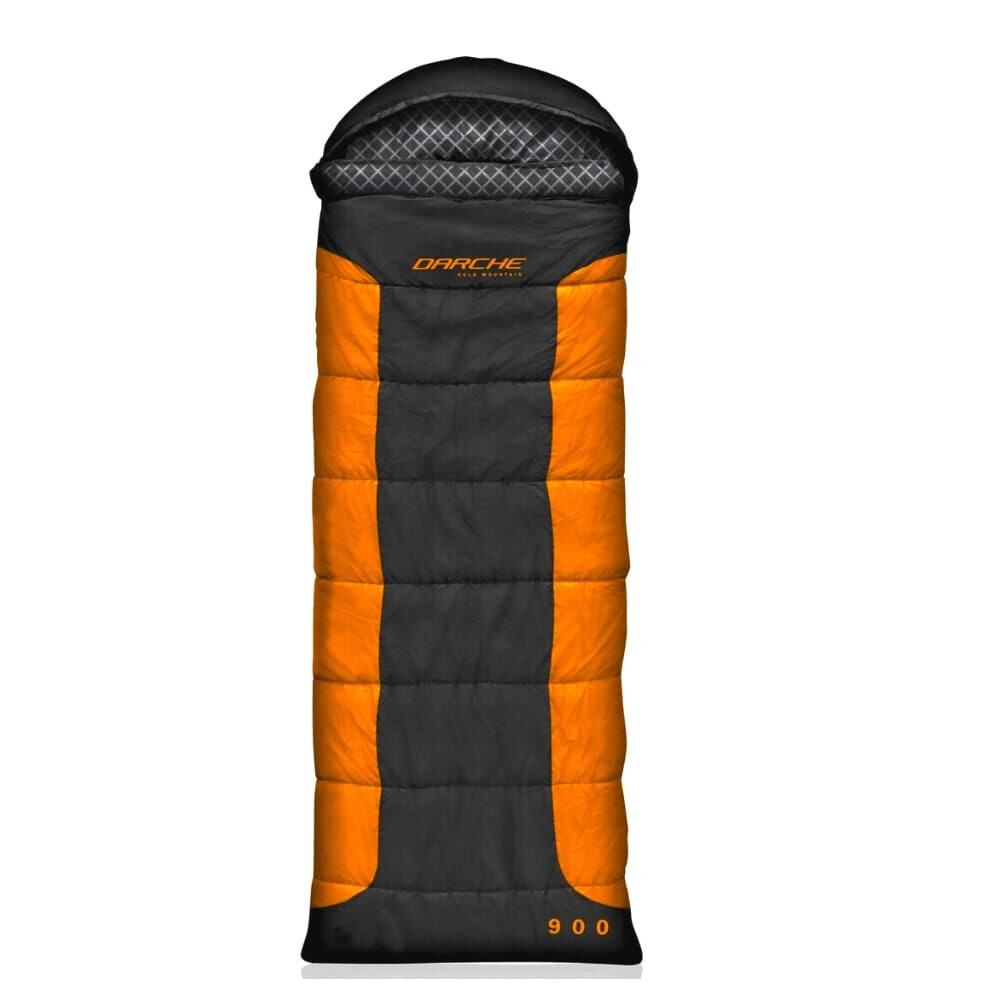
Specifications:
- Shape: Rectangular with hood
- Filling: Synthetic
- Warmth rating: -12°C
- Weight: 2.7kg
\n
Things we like
| Not so much
|
For a lower-priced sleeping bag, the warmth rating and versatility of the Cold Mountain 900 is hard to beat. Darche has designed this lightweight, rectangular-shaped sleeping bag with cold conditions in mind. The synthetic-filled, double-layered sleeping bag is rated to -12°C. It has a water resistant outer shell and a silk-like liner to keep you comfortable inside.
However, the Cold Mountain 900 is versatile enough to use through all the seasons. For warmer weather there is a foot-end zip to allow more airflow. Plus, you can unzip the sleeping bag completely to use it as a blanket, or to join two together.
Size wise, you can choose how much wiggle space you need from three options: 900mm, 1100mm or 1400mm wide. All three sizes come with a compression bag to shrink it down for storage and packing. Bonus points if you have a Darche swag or rooftop tent, as this sleeping bag was purpose-built to fit the Darche camping range.
BLACKWOLF HIKER 500
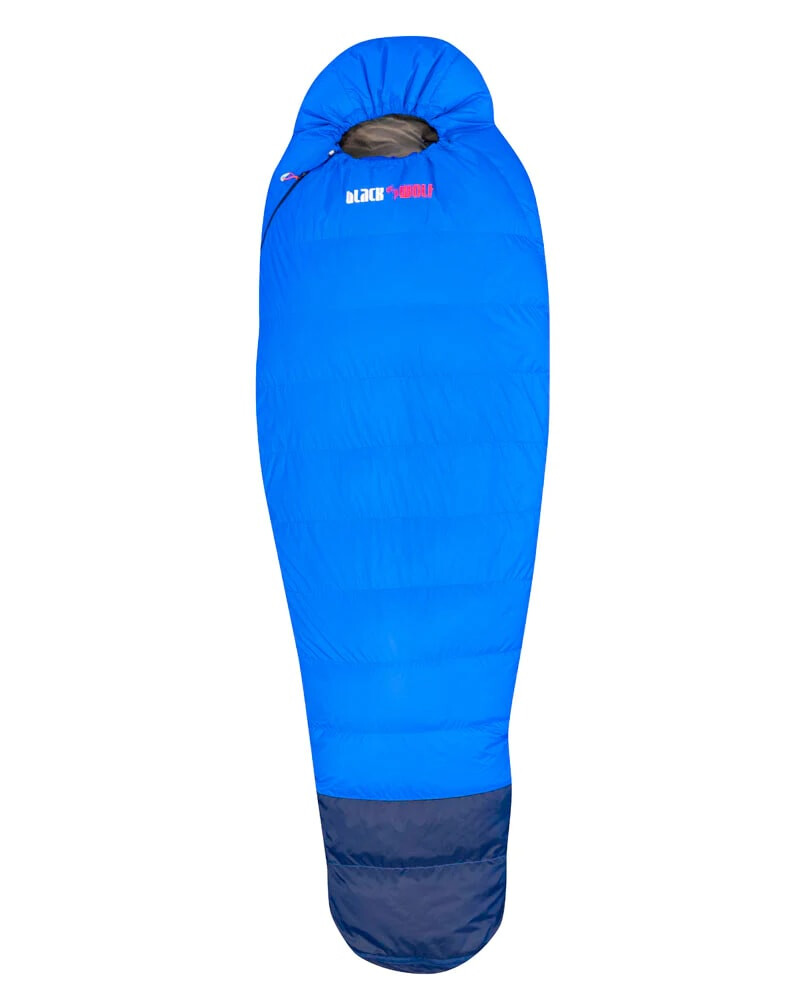
Specifications:
- Shape: Mummy
- Filling: Down
- Warmth rating: -2°C
- Weight: 1.2kg
\n
Things we like
| Not so much
|
BlackWolf’s Hiker 500 is a lightweight sleeping bag for hikers planning an adventure in colder conditions. We rate it because it’s a down-filled sleeping bag that won’t break the bank. The Hiker 500 is filled with responsibly sourced, water-repellent down and has a comfort temperature rating of -2°C, with a lower limit of -8°C. So it will give you peace of mind and a good night’s sleep on cold winter nights.
The team at BlackWolf had the cold, tired hiker in mind when adding features such as a one-handed hood adjustment and glow-in-the-dark zipper pullers. Size wise, the Hiker 500 is built to comfortably fit anyone to a height of 2 metres. It’s a quality hiking sleeping bag without the squish-factor. It also comes with a compression sack for packing it to hike and a mesh storage bag for airing it out in-between adventures.
COLEMAN PILBARA C-5 SLEEPING BAG
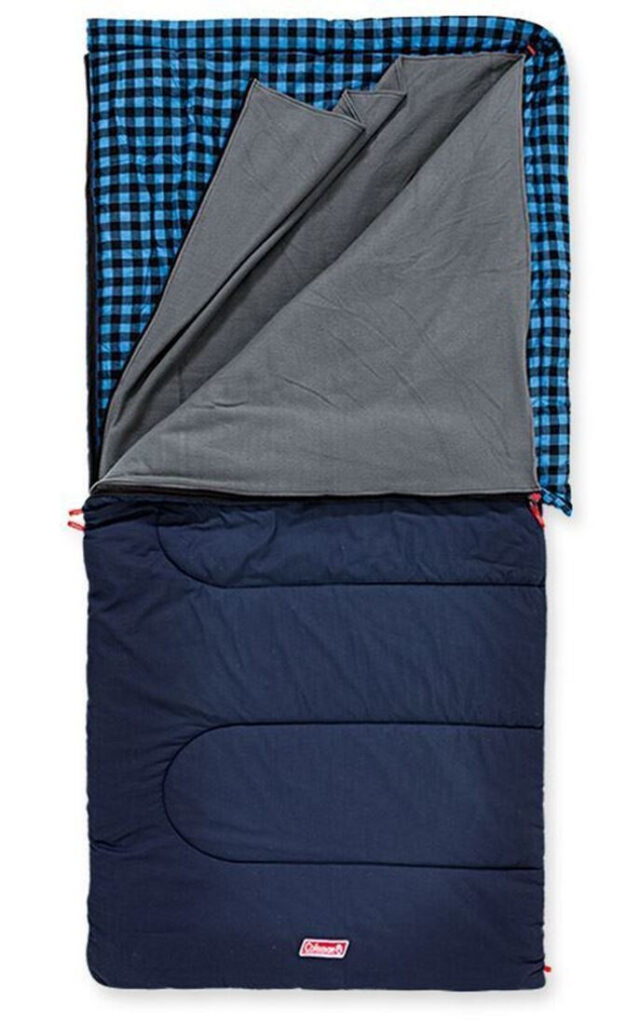
Specifications:
- Shape: Rectangular without hood
- Filling: Synthetic
- Warmth rating: -5°C
- Weight: 3.3kg
\n
Things we like
| Not so much
|
The Pilbara C-5 Sleeping Bag has been designed for anyone wanting an incredibly comfortable – and affordable – night’s sleep. Despite the low price you are still getting a comfortable, durable and spacious sleeping bag.
Coleman has created this sleeping bag entirely from cotton with a soft neck cuff for extra comfort. It is a rectangular shape, without a hood. However, there is a flannel inner sheet and cosy foot fleece at the bottom of the bag.
For warmer conditions the flannel liner can be removed and the foot zipper opened to allow more airflow. The entire sleeping bag is durable and machine washable. It’s a great all-rounder for camping trips in all seasons and it’s a sleeping bag that you’ll appreciate for many years to come.
SEA TO SUMMIT TREK DOWN III
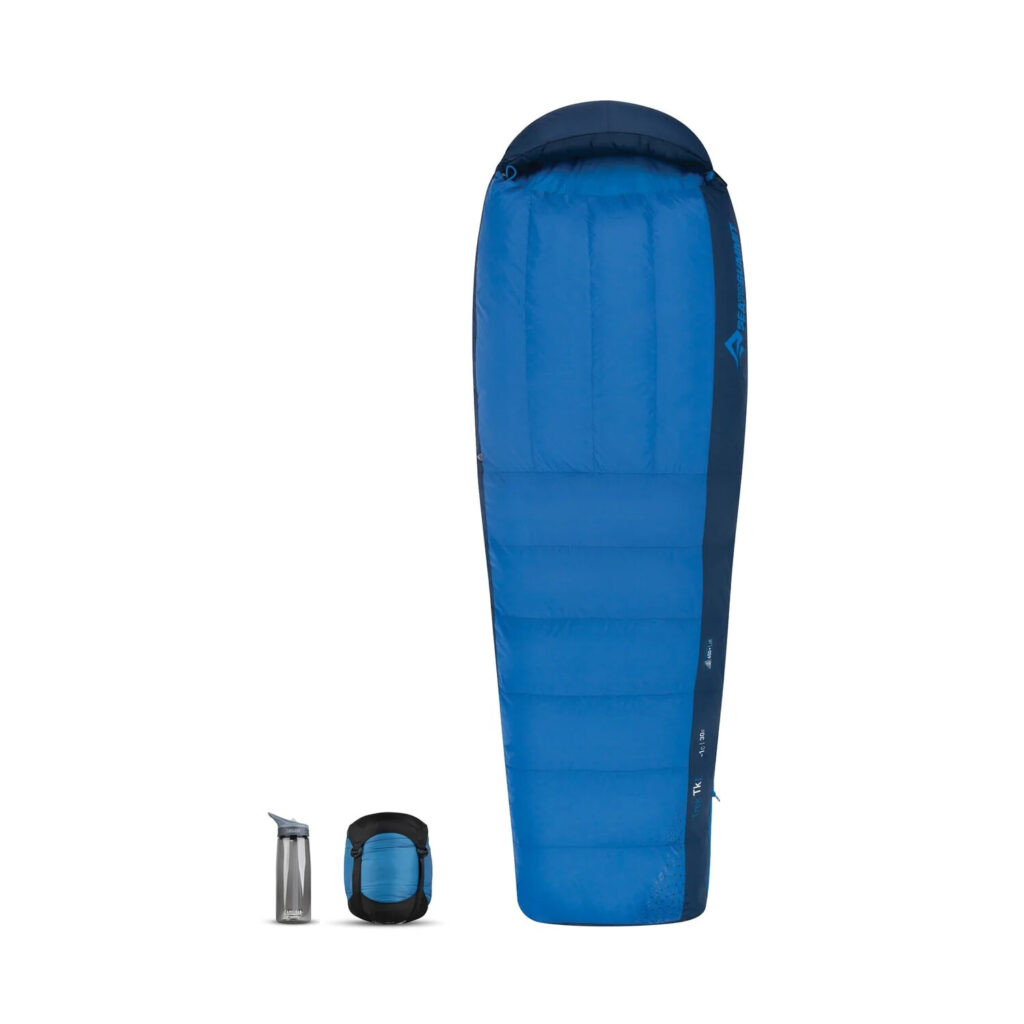
Specifications:
- Shape: Rectangular / Mummy
- Filling: Down
- Warmth rating: -1°C (Trek I), -8°C (Trek II) , -12°C (Trek III)
- Weight: 1.109kg
Things we like
| Not so much
|
- Shape: Rectangular / Mummy
- Filling: Down
- Warmth rating: -1°C (Trek I), -8°C (Trek II) , -12°C (Trek III)
- Weight: 1.109kg
The premium duck-down insulation is RDS certified, and the Trek III comes with a shaped hood and oversized zipper draft tubes. It also has a draft collar for a snug fit around the shoulders. If you don’t need this much warmth in a sleeping bag, there are two other Trek Down options with lower warmth ratings and even less weight – the Trek I and Trek II.
NORTH FACE ECO TRAIL SYNTHETIC 35
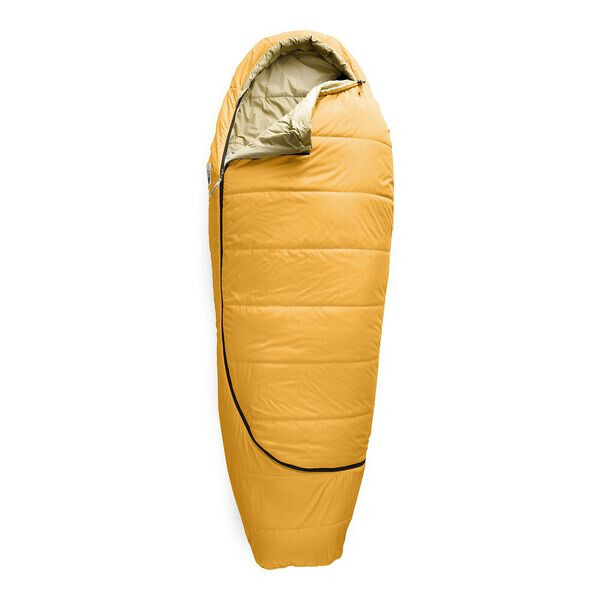
Specifications:
- Shape: Rectangular / Mummy
- Filling: Synthetic – recycled materials
- Warmth rating: 2°C
- Weight: 1.106kg
Things we like
| Not so much
|
- Shape: Rectangular / Mummy
- Filling: Synthetic – recycled materials
- Warmth rating: 2°C
- Weight: 1.106kg
The shape allows for a wider knee section – great for anyone who tosses and turns at night. The J-design zip works well to keep the heat in and allow for more mobility. The footbox also ensures extra warmth right down to the toes. As a warmer-weather sleeping bag, this is a value-for-money option that is going to keep you comfortable on many camping adventures to come.
MARMOT TRESTLES 30
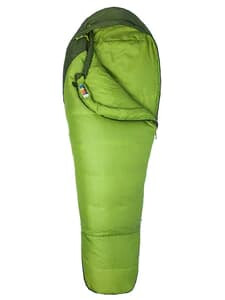
Specifications:
- Shape: Mummy
- Filling: Synthetic
- Warmth rating: -1°C
- Weight: 0.918kg
Things we like
| Not so much
|
- Shape: Mummy
- Filling: Synthetic
- Warmth rating: -1°C
- Weight: 0.918kg
The Trestles 30 is designed to withstand cool and damp conditions, with the synthetic insulation keeping you warm even if things get wet. It has a 3D footbox to keep your toes toasty and a secondary zipper to allow more airflow if needed. It’s an affordable, synthetic option for hikers. However, if you are after a lot of internal space, this is probably not the sleeping bag for you.
WANDERER XFLAME TOURER EXTREME
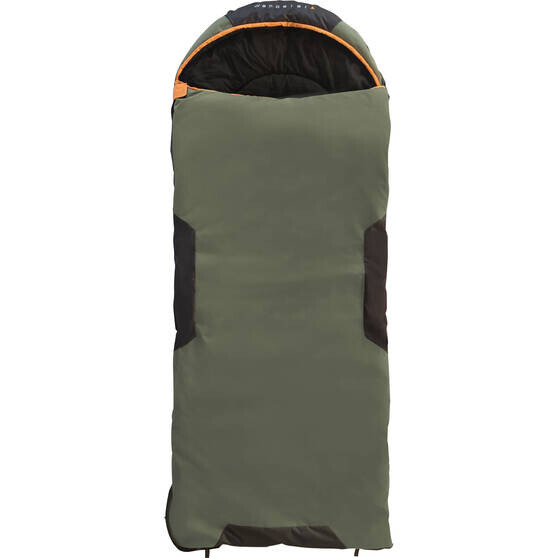
Specifications:
- Shape: Rectangular with hood
- Filling: Synthetic
- Warmth rating: -10°C
- Weight: 4.08kg
Things we like
| Not so much
|
- Shape: Rectangular with hood
- Filling: Synthetic
- Warmth rating: -10°C
- Weight: 4.08kg
The rectangular-shaped sleeping bag has a hood, a water resistant outer shell and a cotton flannel lining for maximum comfort. To make it more versatile the lower region of the sleeping bag can be unzipped in warmer conditions to allow more airflow.
SEA TO SUMMIT QUEST I WOMENS
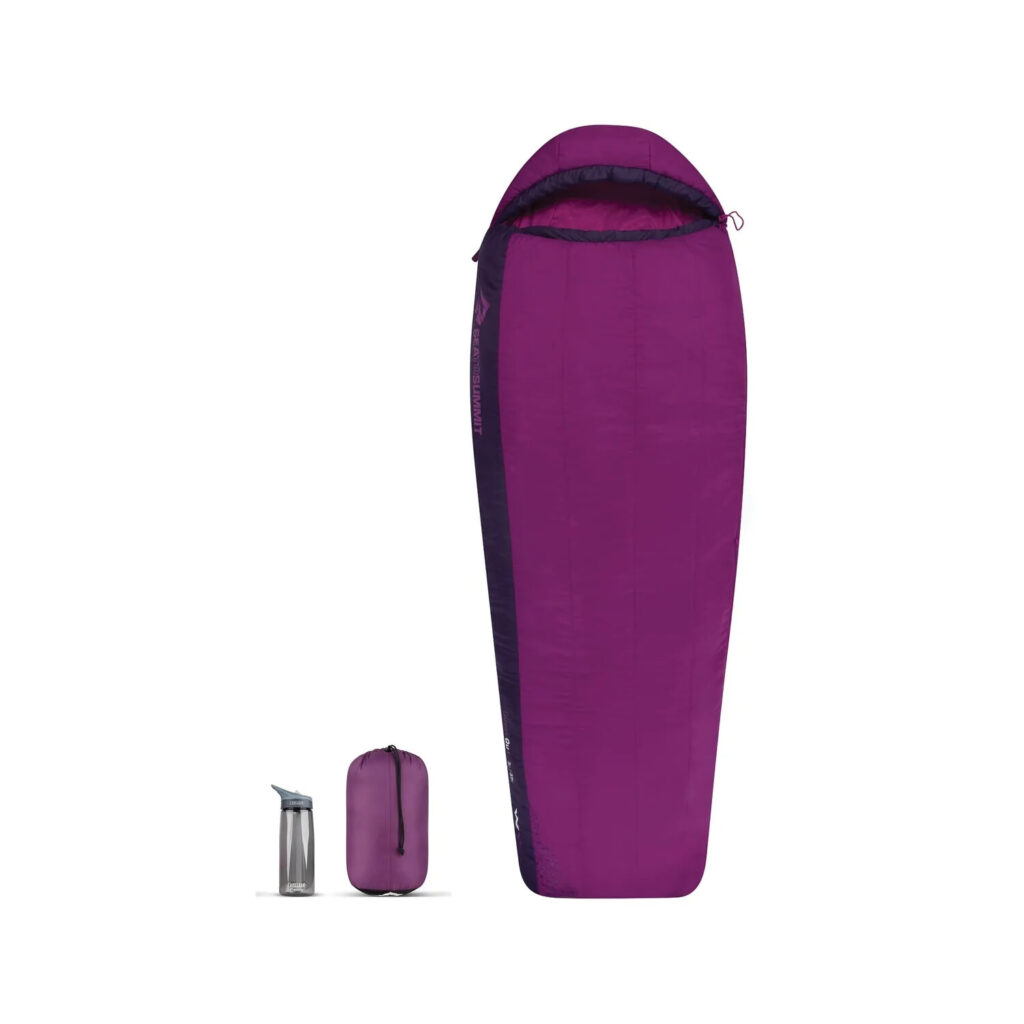
Specifications:
- Shape: Rectangular / Mummy – w/ wider hip section
- Filling: Synthetic
- Warmth rating: 3°C
- Weight: 1.030kg
Things we like
| Not so much
|
- Shape: Rectangular / Mummy – w/ wider hip section
- Filling: Synthetic
- Warmth rating: 3°C
- Weight: 1.030kg
It’s a good value sleeping bag that can also be opened up fully or just unzipped at the footbox to be used in warmer conditions. If you are after a warmer sleeping bag, the more expensive Quest II has a -3°C rating. Both Quest sleeping bags have a regular- or long-length option.
HOW WE REVIEW PRODUCTS
4X4 Australia has been reviewing four-wheel drive vehicles, aftermarket products and camping gear for more than 40 years. When looking for the best sleeping bags in Australia, there are some things that are essential to make sure you sleep soundly on your camping adventures.
When we compared each of the products in the list with hundreds out there we looked at the warmth rating, weight, filling, versatility and price. We also searched for additional features that make these sleeping bags stand out from the rest.
We looked at hundreds of user reviews and drew on our own experience with sleeping bags to make sure our recommendations are for the best on the market.
Disclosure: When you buy through our links, we may earn a commission. We also include products that we do not earn a commission from.
BUYERS’ GUIDE TO SLEEPING BAGS
How to choose the best sleeping bag
To choose the best sleeping bag for your snoozing needs, consider where and when you will be using it. For long multi-day hikes, you might want to invest more money in a lightweight option. For a throw-it-in-the-car-and-go option, you can generally get away with spending less.
However, in general, the best sleeping bags will be durable, comfortable and warm enough for the conditions you are planning to camp in. Consider the following things when choosing a sleeping bag.
What filling do you want in a sleeping bag?
Sleeping bags come with one of two fillings – down or synthetic. Down is a lightweight option which provides the best warmth-to-weight ratio. Synthetic is a cheaper option which retains its insulation better than down does in wet conditions.
Down sleeping bags
Down sleeping bags are filled with duck or goose down and are lighter and more compact than synthetic options. They also provide more warmth because of the way the down traps and holds air. However, they are more expensive than synthetic-filled sleeping bags.
It’s important to consider that down does not insulate well if exposed to wet conditions. Often the down in sleeping bags is water resistant but not waterproof. It can also be tricky to wash and it requires animal products to make. When choosing down products, check it complies with the globally-used Responsible Down Standard (RDS) certification.
Synthetic sleeping bags
Synthetic-filled sleeping bags are generally more durable, including withstanding exposure to moisture. The filling is made with synthetic materials such as polyester. Because of this, it is less expensive but still provides good insulation.
When choosing a synthetic-filled sleeping bag, keep in mind that it will likely be heavier than down-filled options and will not compress as well. However, if you have space in your camping set-up and are not concerned about weight, synthetic is a great option.
What shape do sleeping bags come in?
Sleeping bags come in three different shapes. The shape will affect the amount of airflow, the warmth rating and the weight. It is also important to choose a shape – and length – that fits your body type or you are not going to be comfortable when you close the zipper.
Rectangular
Rectangular sleeping bags have plenty of space, from the shoulders down to the toes. As they use more material, they are generally heavier and bulkier to pack down.
Mummy
Mummy sleeping bags have less space inside which decreases the airflow and therefore increases the warmth. They also are lighter due to using less material. However, the tight-fitting shape is not comfortable for everyone.
Combo: Rectangular / Mummy
Many sleeping bags now come in a tapered shape that is a cross between the rectangular and mummy shapes. This means less airflow and more warmth without restricting the comfort level.
How warm do you need a sleeping bag to be?
The warmth rating of sleeping bags is an important consideration. Knowing what conditions you plan to use the sleeping bag in will help you choose the best warmth rating.
However, the warmth rating of sleeping bags also depends a lot on the user. Consider whether you usually run hot or cold at night, what PJs you wear, and whether you will use a sleeping mat, swag or inflatable mattress underneath. All these things can affect how much warmth is retained.
As a quick reference, here’s our guide to temperature ratings of sleeping bags:
- 5°C to 10°C warmth rating: Perfect for summer camping
- 0°C warmth rating: Good sleeping bag for cooler conditions
- -5°C to -10°C warmth rating: Will last you through an Aussie winter camping adventure
How lightweight do you need your sleeping bag to be?
If you are planning on completing some overnight hikes, then the lighter the sleeping bag, the better. However, you still want to be sure it has a good enough warmth rating – and that it is a comfortable fit. Sometimes choosing the lightest sleeping bag option can compromise these two things.
For hikers, there are some ultra-light sleeping bags on the market that are down-filled and come with a hefty price tag. If you have a lot to carry on hiking trips, this might be worth the investment. However, there are plenty of lightweight options, around the 0.8 to 1kg weight mark, that are much more affordable.
While down filling might seem like the best option for hiking, there are a lot more lightweight synthetic options on the market these days which tend to be cheaper and will be better suited to potential wet conditions.
What are the best features of a sleeping bag?
Just like all camping gear, there are plenty of convenient features packed in to sleeping bags these days. Here’s an idea of some of the best features that are worth checking for when choosing your sleeping sack.
Separate foot zip: to air out your toes in the warmer weather.
This feature allows more versatility to use the sleeping bag in all conditions, as the extra airflow will keep you cooler in summer.
Optional bag lengths and width: to pick the best sized sleeping bag for you. The best sleeping bags will have options for larger sizing, so you can grab the perfect sleeping bag in the size that fits you best.
Draft tubes: for extra help sealing in the warmth.
Draft tubes run along the inside of the bag’s zipper to keep the air from escaping.
Sleeping bag hood: to prevent heat loss via your head.
Most, but not all, sleeping bags come with hoods these days, but if you are wanting a bag for colder conditions, a hooded sleeping bag is a good option.
Inner zippered pocket: to stash your valuables.
This common feature is excellent for having a safe place to keep your car keys, phone or other valuables, and prevent devices from losing their charge in cold weather.
Price considerations
Like most camping gear, there is a huge variation in price when it comes to sleeping bags on the market. Also, like most camping gear, it’s worth considering how much use you want to get out of your sleeping bag before needing to replace it. If you camp regularly and want value for your money, it’s worth investing in a more expensive sleeping bag that will last you for many more camping adventures to come.
- Part 1: GQ arrives in the 4×4 shed
- Part 2: GQ’s first camping trip
- Part 3: Hot under the collar
- Part 4: Keeping it simple
Part 1: GQ arrives in the shed
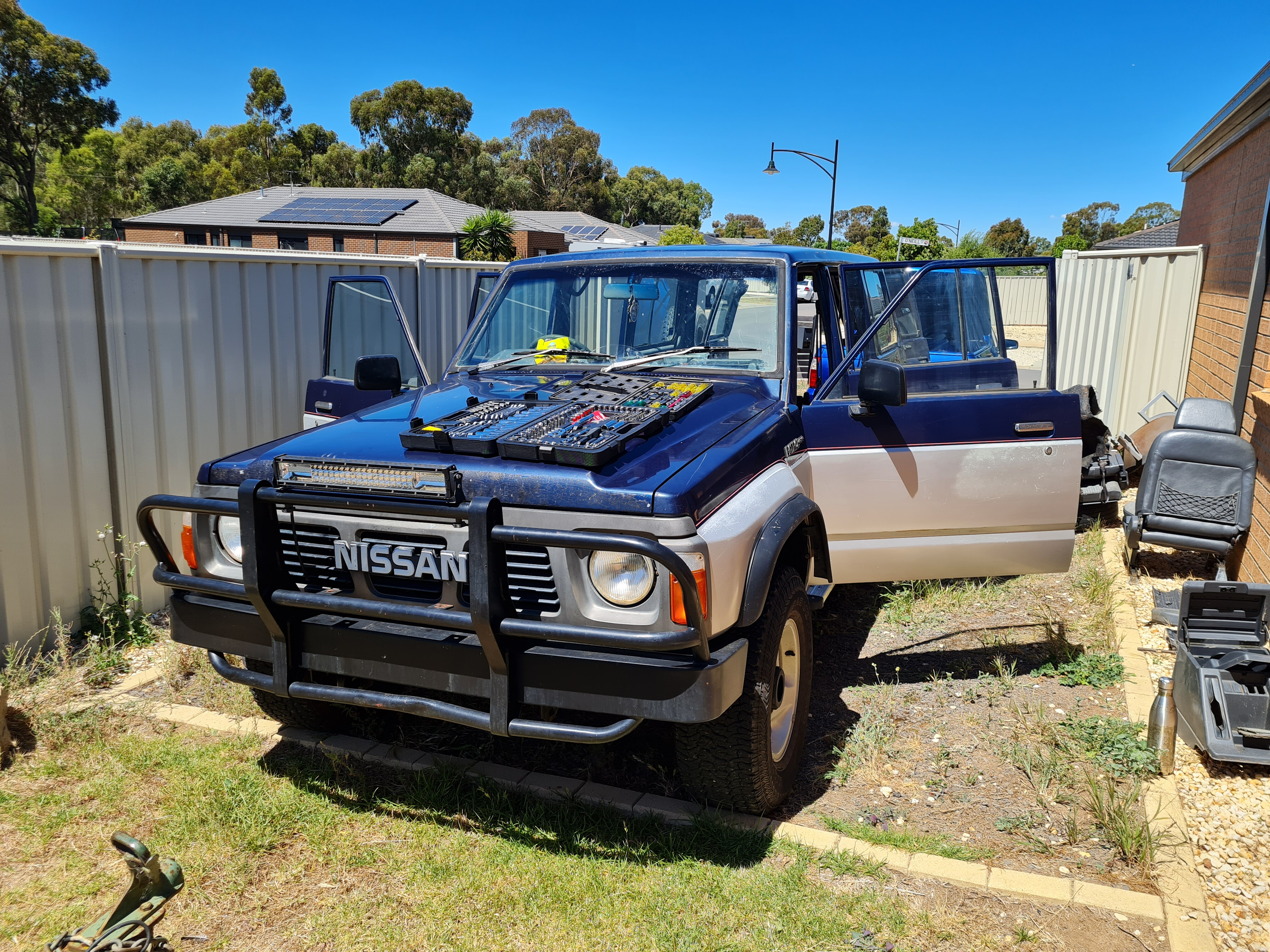
I recently bought myself a GQ Patrol, and it’s going to serve as my introduction in to this new world of raised suspension and intentionally getting dirty. But we’ll get to that in a moment.
I’ve been toying with life-size cars since I was around 13, mainly R31 Nissan Skylines, a Hyundai Excel rally car and Holden Commodore utes. I’m 24 years old now, and last year it occurred to me that in my 10-odd years of playing cars there was one gaping hole in my list: not a single 4×4.
Being a country boy meant there was really was no excuse as to why I didn’t have one, so straight away I started searching for a budget fourbie to fill the void in my stable. My criteria was pretty simple: I had a buy-in budget of $5000, it had to be 25 years or older so I could put it on a Club Permit, and it had to be reliable with a decent amount of aftermarket support. The body could be a bit beaten up and, because it wasn’t going to be a daily driver every day, luxuries like central locking and power windows weren’t necessities either.
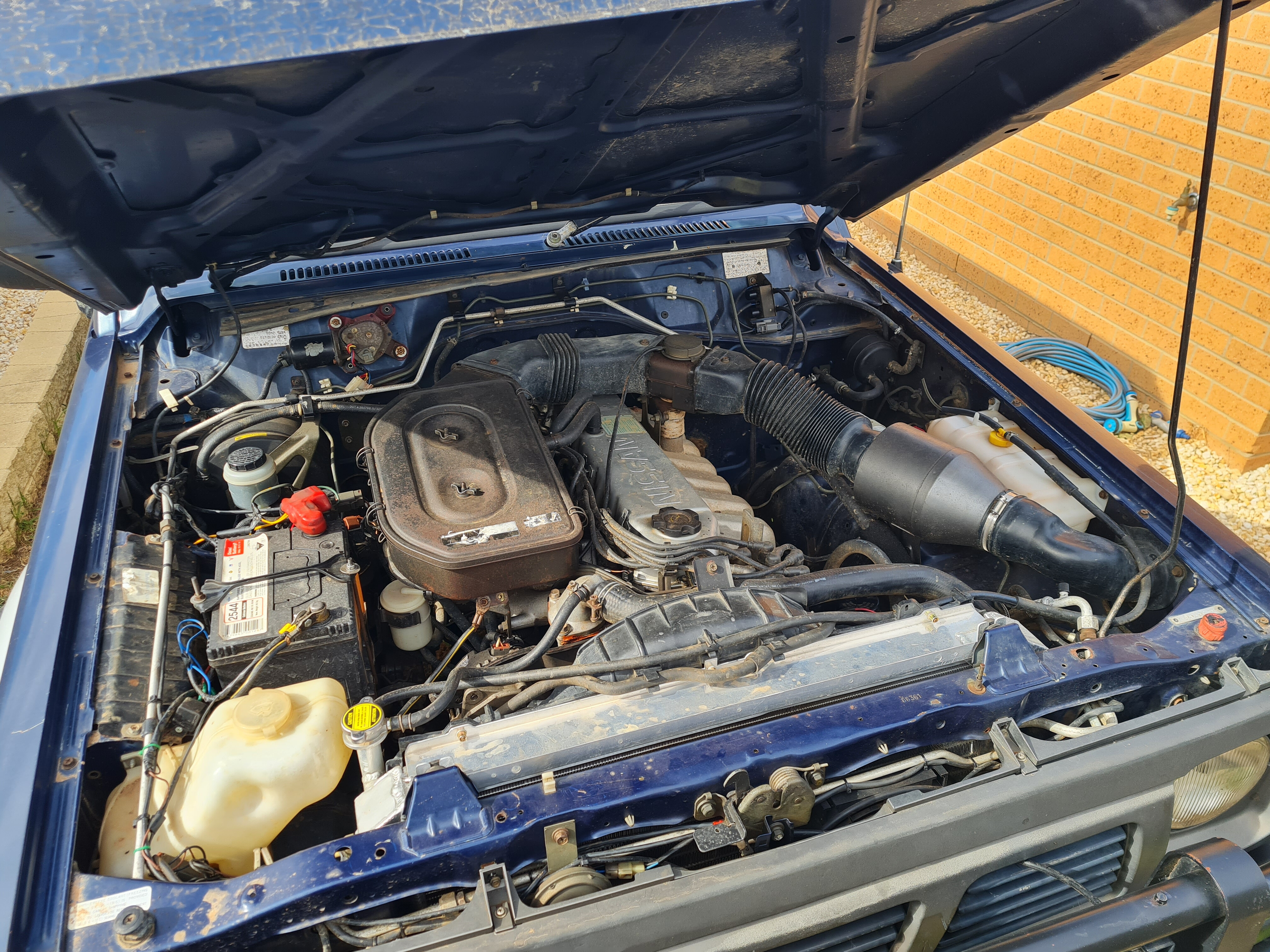
Being a lover of boxy old Nissans meant a LWB GQ Patrol wagon rocketed straight to the top of my list, so I spent a few months casually browsing to see what I could find. The market for GQs is massively varied, and a key part of that depends on what engine you want. My budget immediately ruled out the top trump TD42 turbo-diesel, but because I wasn’t planning on towing, I was happy to settle for the petrol TB42 powerplant instead.
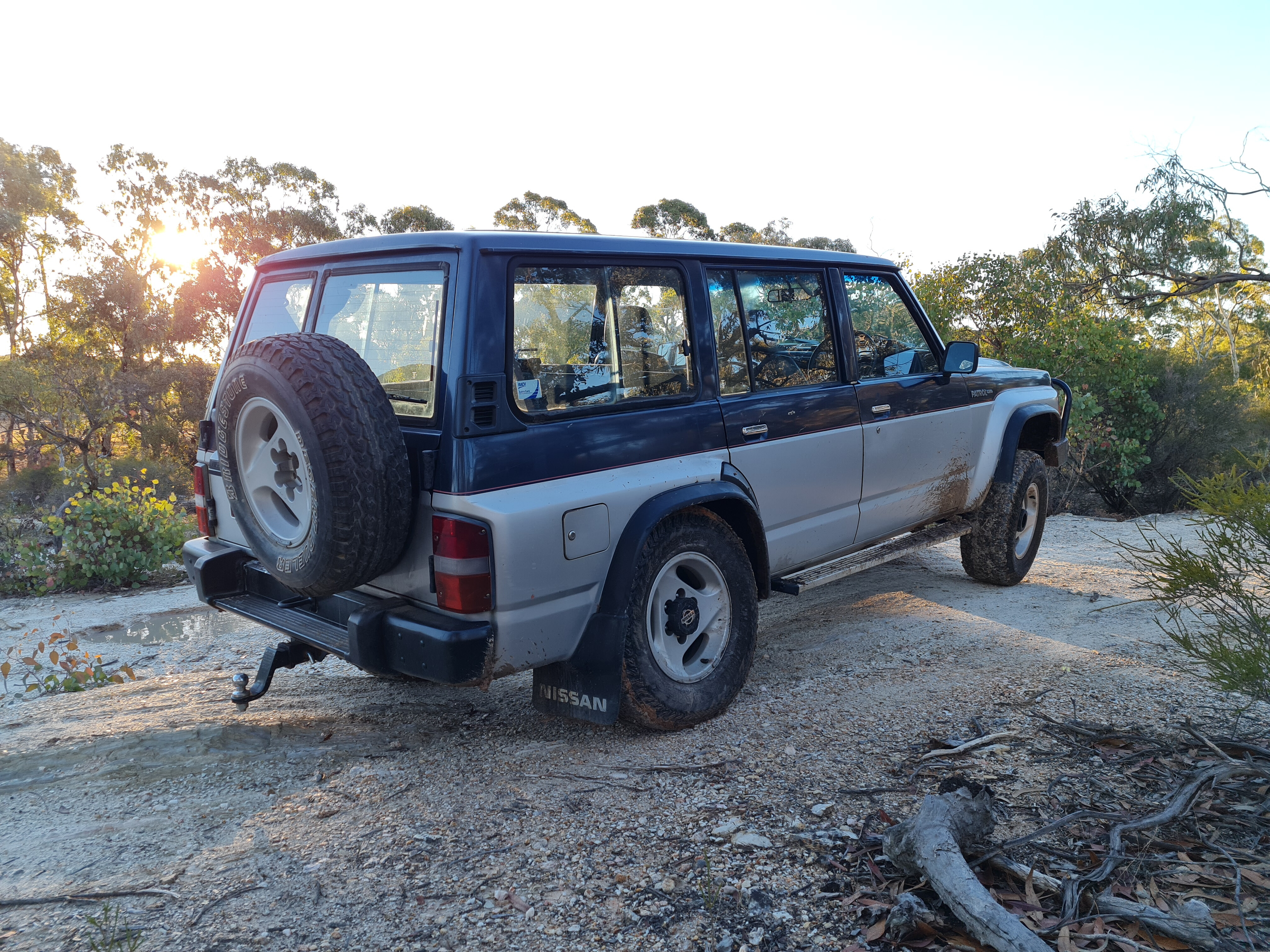
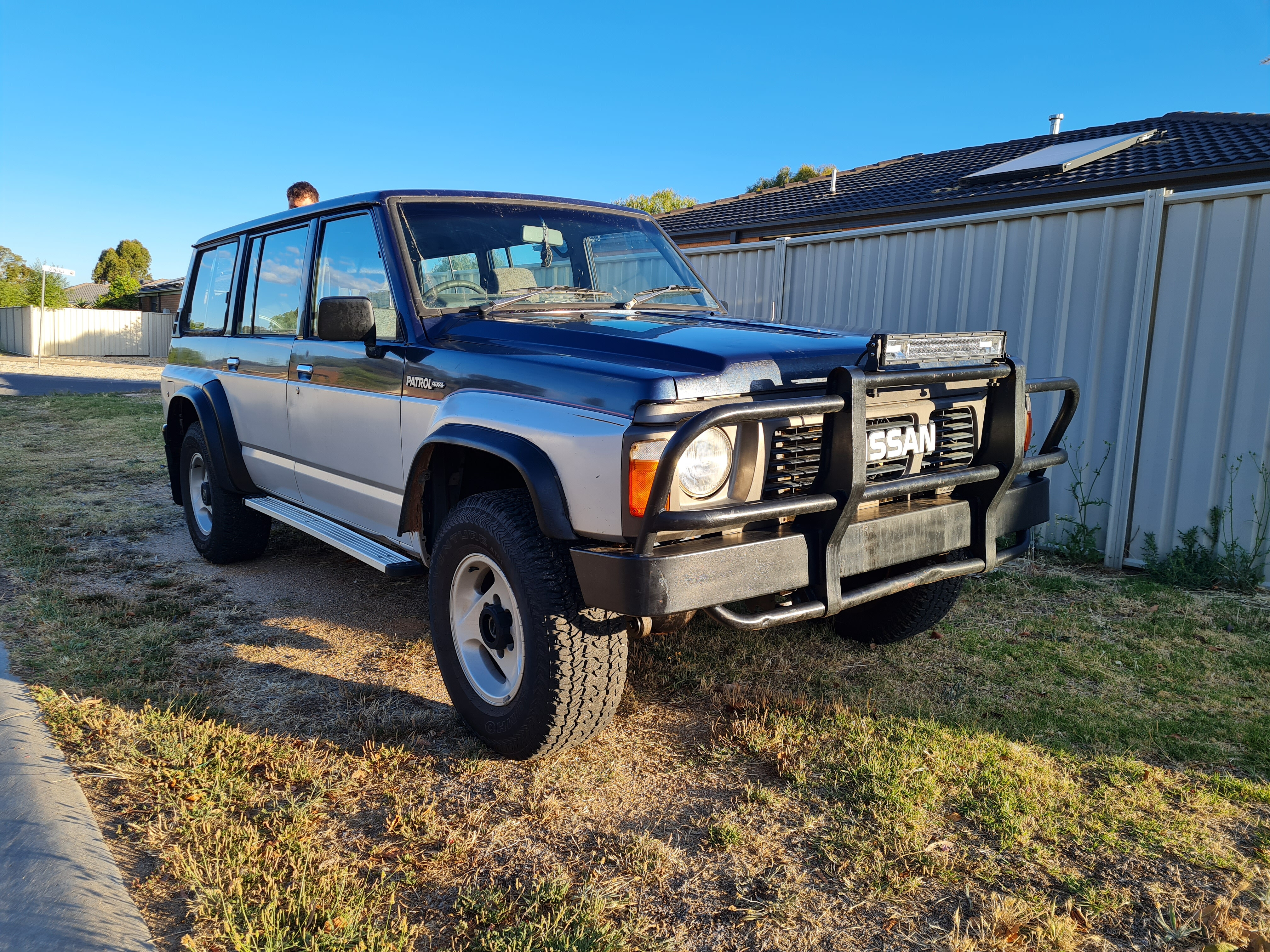
Just a few days out from Christmas last year, this GQ Patrol popped up on Facebook Marketplace and it fit the bill perfectly. A 1988 LWB wagon, TB42 carby, auto, with a beaten-up body but, critically, a valid Victorian roadworthy certificate, solid mechanics underneath and all for $4500! It was also pretty much standard save for a two-inch suspension lift, steel bullbar and a dodgy light bar. I think it’s safe to say I bought the cheapest useable GQ Patrol off Facebook Marketplace with walk-in rego – score!
So far we’ve racked up around 2000km touring around our local Bendigo region in the GQ with the family and it’s been nothing but smiles the whole time. The car has been pretty-well faultless except for a few carby gremlins, and despite the kettle warnings, it survived all summer without overheating. It’s also allowed me to see parts of my local area I never would’ve been to, and now I don’t have to worry about bottoming out my VZ SS ute when I go hunting for mountain-bike trails.
But I didn’t just buy it to go mountain biking. Being a country kid I’ve loved camping my whole life, and with a bunch of my friends recently buying 4x4s and hitting the dirt for lengthy camping trips, it seems like the perfect time to build a touring rig.
Because I know virtually nothing about modifying 4x4s or what it takes to go off-road, there’s been a lot of questions asked and Googling to find out what I’ll need to get the GQ ready. First things first, I’ve been told to bin the factory 31-inch all terrains in favour of some 33-inch mud terrains. I’ll also need a set of front and rear recovery points, a snatch strap, a proper set of side-steps and preferably a roof-rack (with awning) to strap some fuel to because the TB42 loves a drink! I’ve already got all the actual camping gear, so that’s no stress.
So feel free to come along – and probably laugh – at me on this journey as I build my first 4×4. I know it’ll be a steep learning curve, but I’m not afraid to get dirty and I haven’t been this excited about a car build in a very long time.
TOTAL KM: 314,000km DATE ACQUIRED: Dec 2020 PRICE: $4500 AV FUEL: 20L/100km
Part 2: First camping trip
After enjoying the car for around six months, it was time for the mods to begin. My mates and I set a deadline of the Queen’s Birthday long weekend in the middle of June to get the car ready for its first off-road camping trip in the Victorian High Country before the yearly winter closure.
I drafted up a list of essentials I knew I needed to make the GQ more capable on the trails and at the campsite. First was a set of recovery points because, despite what I initially thought, the factory Nissan ones aren’t to be trusted when snatching out of big bog holes. I bought the front one online and the rear one on-sale from Repco, and all up it was less than $100 for the pair.
Next was a new set of side-steps. Not only did I want a set of rock sliders to protect the sills on the hilly terrain, but the mounts for the flimsy factory side-steps rusted and snapped off! I originally wanted to go cheap and get a second-hand set, but after struggling to find a set, I ended up buying a brand-new kit from eBay for $650. The steps also came with a pair of brush bars, but I’ll wait until I get a winch-compatible bullbar later down the track before I cut them down and bolt them on. For a cheap kit, the side-steps bolted up relatively easily, but I did have to make a trip to Bunnings when I discovered the kit was missing half the bolts.
From factory, GQs already have a pretty solid diff breather set-up. The front diff, transmission and transfer box all meeting at a single breather right at the top of the passenger guard. However, the rear diff breather just goes straight into the chassis near the fuel tank, and that didn’t seem high enough if we needed to do some river crossings on the trip. So I got myself an ARB diff-breather kit for $95 and routed a new hose from the rear diff to the engine bay, with the ARB breather mounted right next to the factory breather location for the front. A snorkel will happen soon.
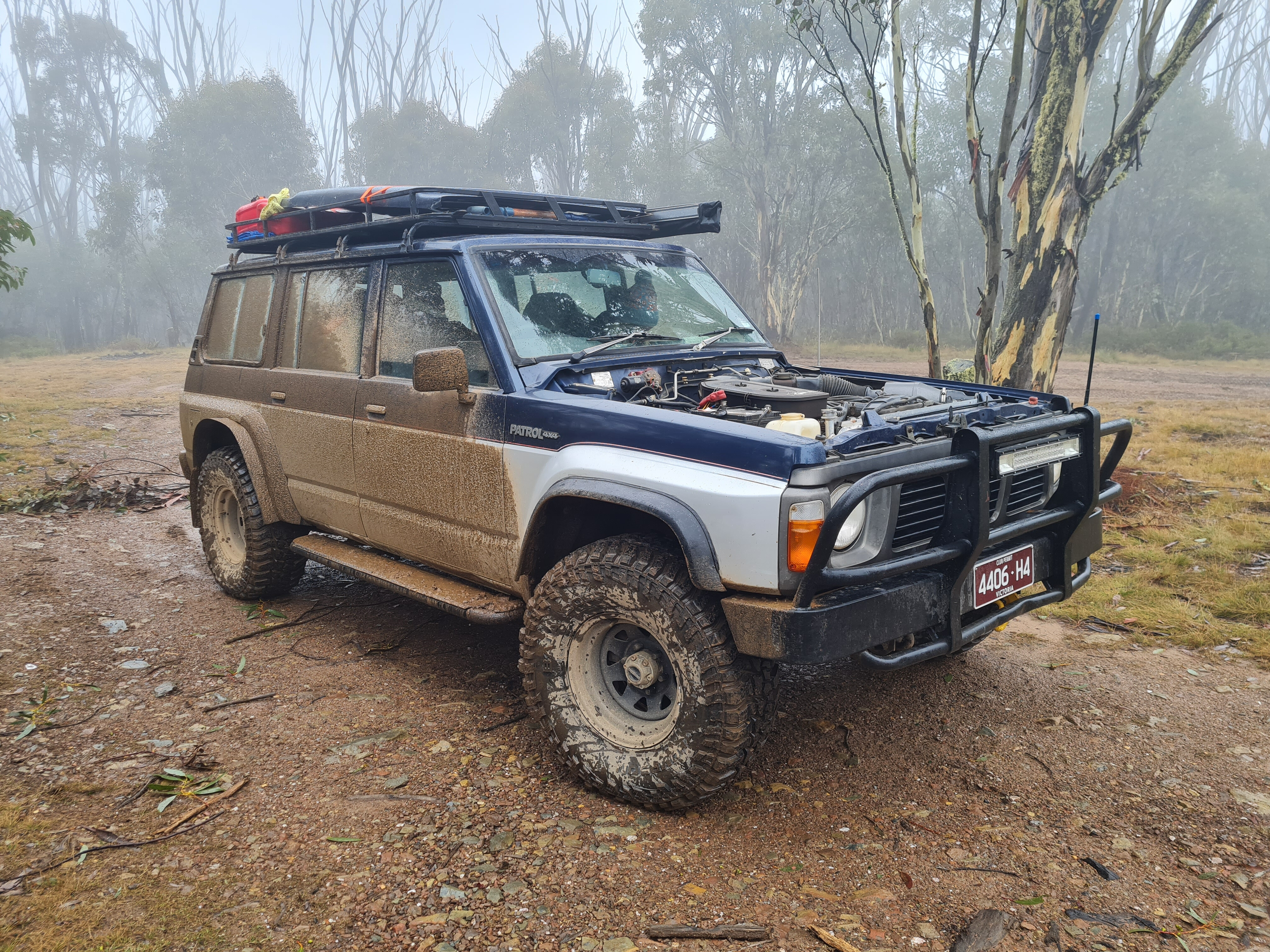
Next on the list was a roof rack and awning, because I knew I’d need somewhere to carry some extra fuel (the TB42 loves a drink!) and the awning would be perfect to protect the swag from nasty weather. The awning was a score from Facebook marketplace, a no-name 3×2-metre unit with an extra side wall that had never been used for only $80!
The roof rack, on the other hand, was less than ideal, because while it was only $150 second-hand, I made the mistake of picking it up with a tray-back ute rather than taking the GQ. Lo and behold, the rack with non-adjustable mounts that I was told would fit a GQ was about an inch too short. Bugger! So with the help of the missus and a good mate, we had to cut the old mounts off, extend them by an inch and weld them back into place.
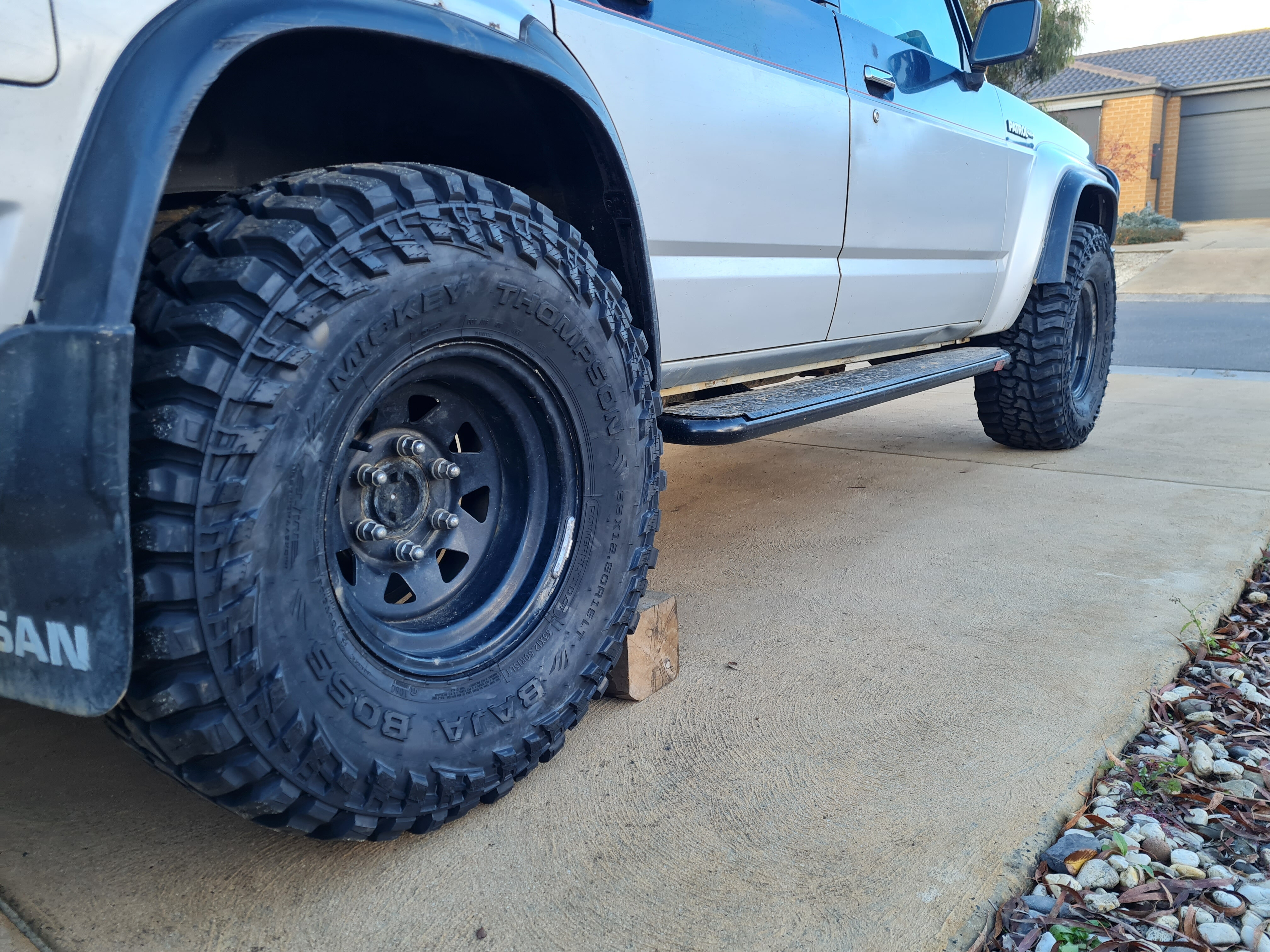
The last thing on the list was a new set of tyres, as the 31-inch ATs the car came with wouldn’t cut it in the High Country, especially with wintery conditions forecasting mud and even snow. Read the full write-up on the tyres in a separate story (see page 122), but the short of it is, tyres was the one area I was told not to cheap-out on, so I opted for a brand-new set of aggressive Mickey Thompson Baja Boss’s in 33×12.5R15 on some 15×8-inch Sunnys a mate gave me from his GU.
After a last minute thrash, the car was all prepped and ready to hit the road to the High Country, where I quickly found out the kettle memes about Patrols are all too real – but you’ll have to wait for a future issue to read about that debacle.
KM SINCE LAST UPDATE: 500km AVERAGE FUEL USE: 20L/100km
Part 3: Hot under the collar
It’s no secret that GQ-GU Patrols aren’t exactly famed for their cooling systems, having been the butt of ‘kettle’ jokes for all eternity.Sadly, during my very first off-roading trip in the Vic High Country, I found the memes all too true with the TB42 in our 1988 GQ Patrol wagon. The Pooey did the four-hour road trip from Bendigo to Jamieson with no problems, but as soon as we left the tarmac and started the climb to the top of Mt Terrible things went really south.The temp gauge rocketed to boiling point within minutes heading up the first track, and the Patrol proceeded to boil over three more times before making it to the top. This was just as much of a problem for the transmission as it was the engine, given the trans cooler is housed within the radiator. Granted, the car was fully loaded with four days’ worth of camping gear, water and fuel – but outside temps were barely hovering over 12°C (this was a June long weekend trip) with nice, cool air outside and the car still refused to stay cool.
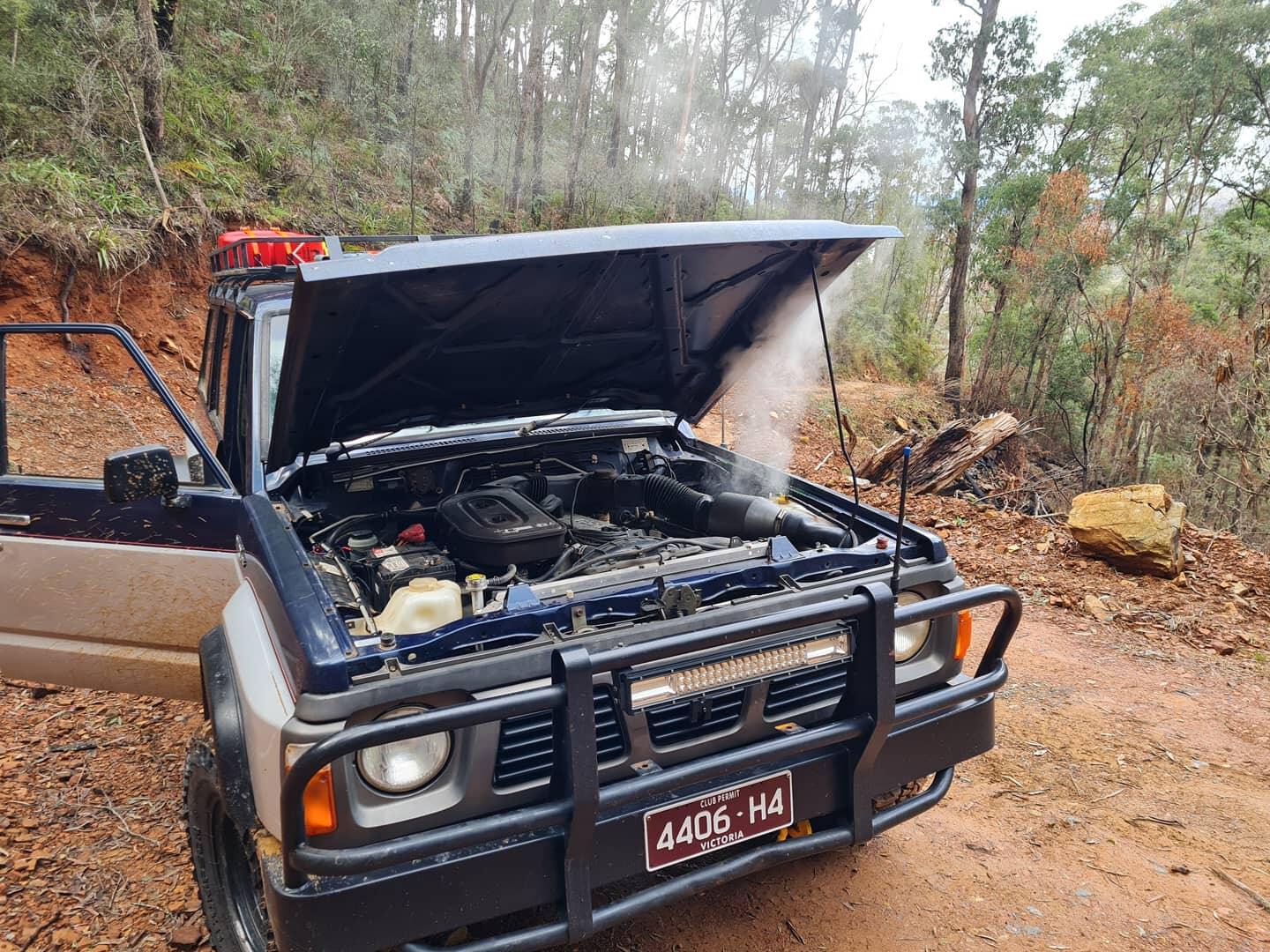
We managed to get it through the rest of the trip by taking the bonnet off for any climbs, but I knew even with all the kettle jokes about Patrol’s that surely a fully functioning cooling system shouldn’t be this bad.My first suspect was the radiator fitted by the previous owner. It may have been a big three-core alloy unit, but I wasn’t convinced about how well it actually flowed and it also didn’t seem to hold pressure very well.The other culprit in my sights was the clutch fan. The plastic fins themselves were fine, but the fan wouldn’t cool the car down at idle when it got warm and unless the car was moving quick enough to get airspeed through the radiator (such as normal road driving), and temps would rise.Rather than pay a fortune for a new viscous hub, I decided to ditch the current set-up and go all-new and improved. I’d read about an upgraded, bolt-on clutch fan kit from Qikazz 4×4 and Camping, which uses a Mitsubishi truck fan and custom-made adapter to bolt to the factory water pump. At $550 it wasn’t by any means cheap, but online research told me that this fan combined with a good radiator is the way to go.
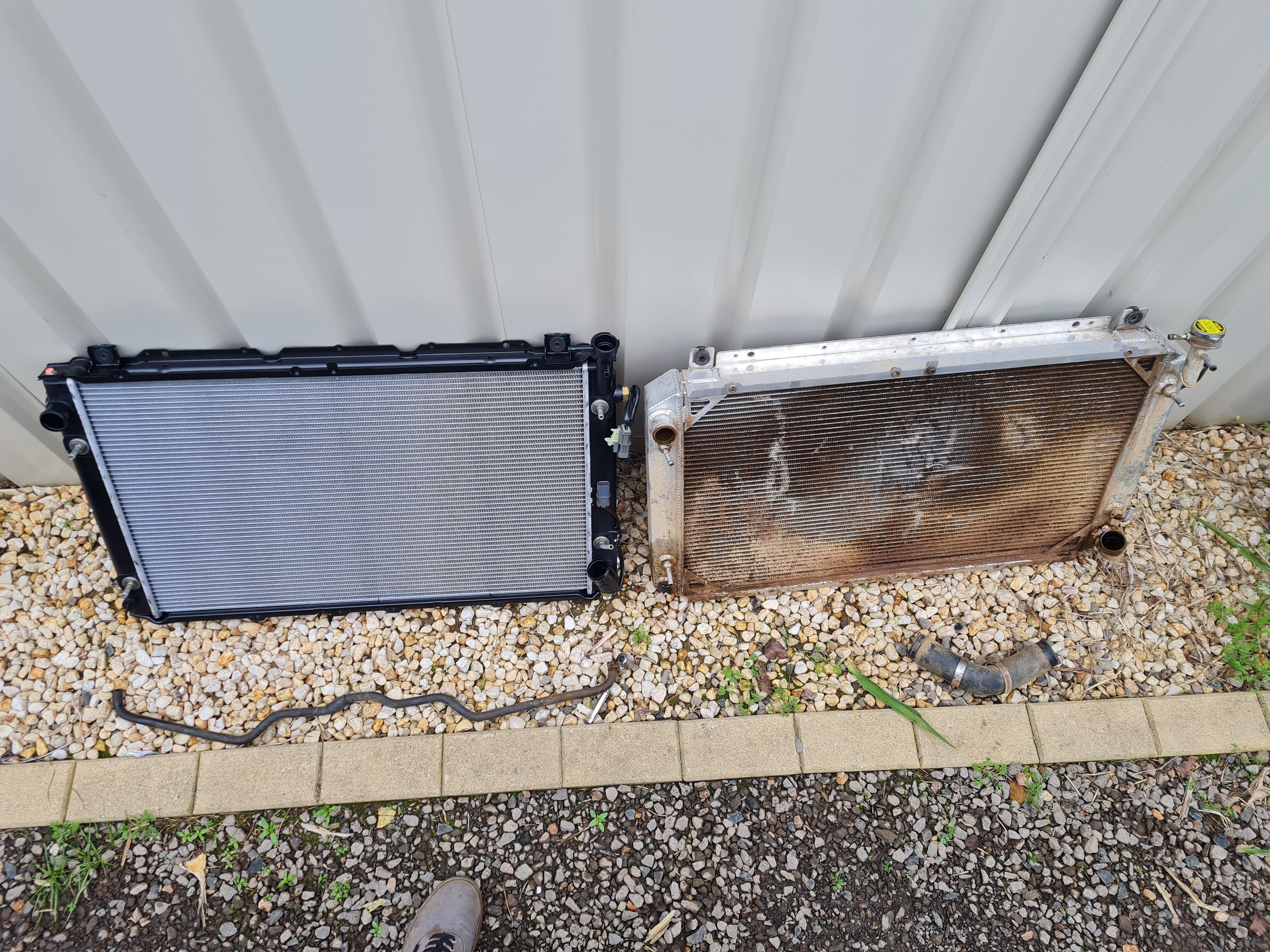
The upgraded fan kit only fits with a single-core standard-size radiator, but that was fine by me. I was more than happy to ditch the puss-nut eBay three-core alloy rad for a genuine one, and luckily enough I managed to get my hands on what was probably the last brand-new genuine Nissan TB42 auto radiator in the country.The install process was a fairly simple one, the radiator went straight in with no fuss and the only tricky bit was getting the fan shroud back down between the clutch fan and radiator without damaging the fins. I also used this opportunity to fix some leaky trans-cooler lines going to the radiator.The in-and-out job only took around two hours with some ball scratching, but I made sure I set aside an entire afternoon to bleed the cooling system. This step often gets glossed over, but make sure you take your time, put the heater on full blast and get all the air pockets out and give the car a decent drive to make sure it’s happy. Once that was done, I topped up the transmission and she was set.
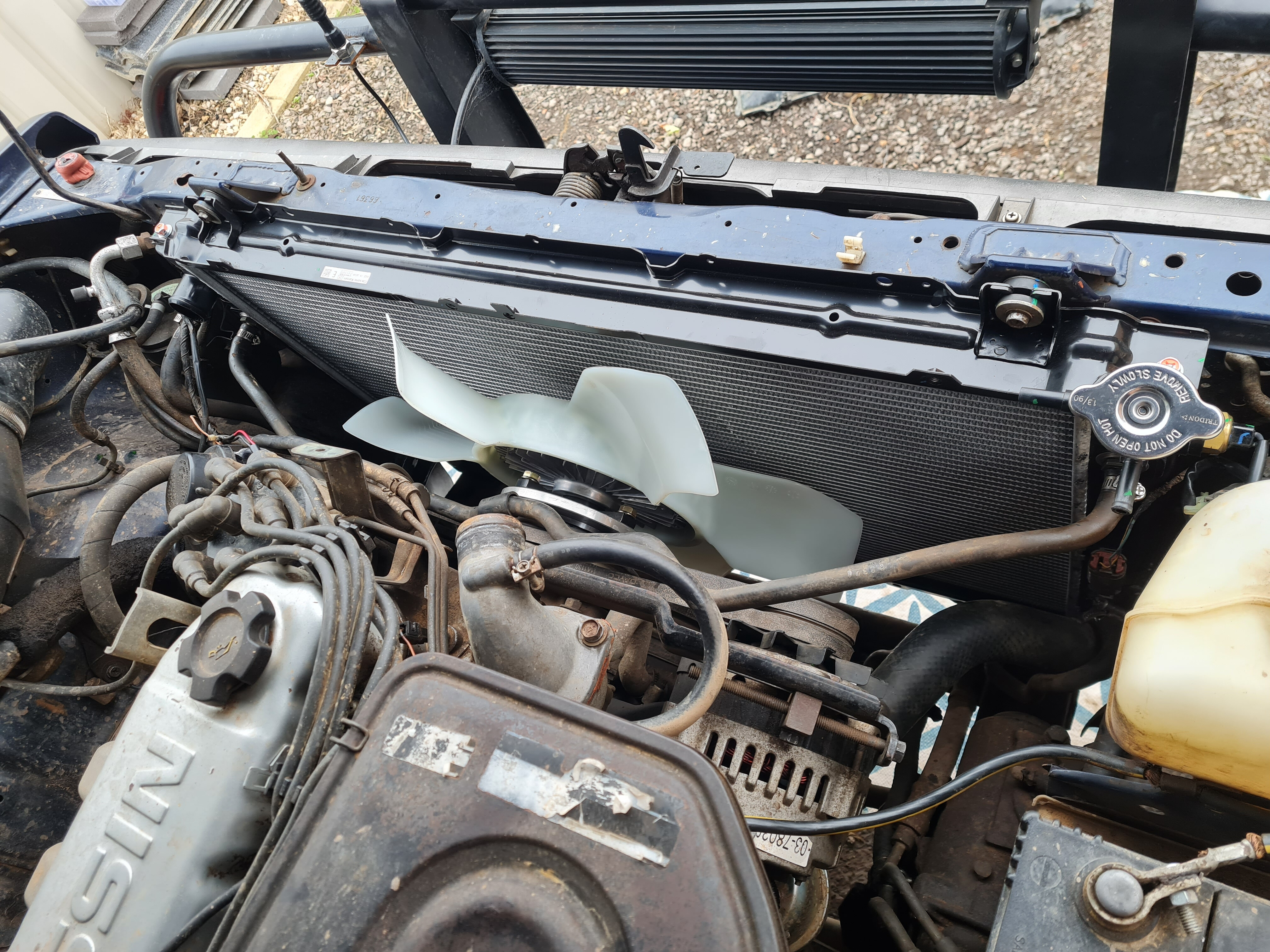
Since fitting the new radiator and fan, I’ve given the GQ a few solid stretches on some local tracks and I’m delighted to report that I haven’t even got close to boiling over. The car will happily idle for long periods without getting hot, and I recently took it through some very long and steep hill climbs in much warmer temperatures in the Pyrenees State Forest with no dramas at all. And the fan is much quieter than the factory unit too!The real test will come when summer hits and I give the cooling system a real workout on and off road but for now at least, I’m happy to say the issue is fixed! Now hopefully, the only time I’ll be boiling water when I go off-roading is for a nice cup of coffee in the morning.
KM SINCE LAST UPDATE: 700KM AVERAGE FUEL USE: 20L/100KM
Part 4: Keeping it simple
Since my boxy, cheap as chips GQ Patrol was last featured in these page, a fair bit has happened to turn this thing in to a functional camping, off roading and all ’round usable rig on the cheap.
The GQ spent all summer carting us out to the local swimming spot on the weekends, Esky in the back and the awning providing valuable shade. After the joys of summer faded, we decided our next big camping and off-roading trip would be over the Easter long weekend. The plan was to spend a good four to five nights out in the sticks exploring tracks in the Vic High Country, so I knew an Esky wasn’t going to cut it for provisions.
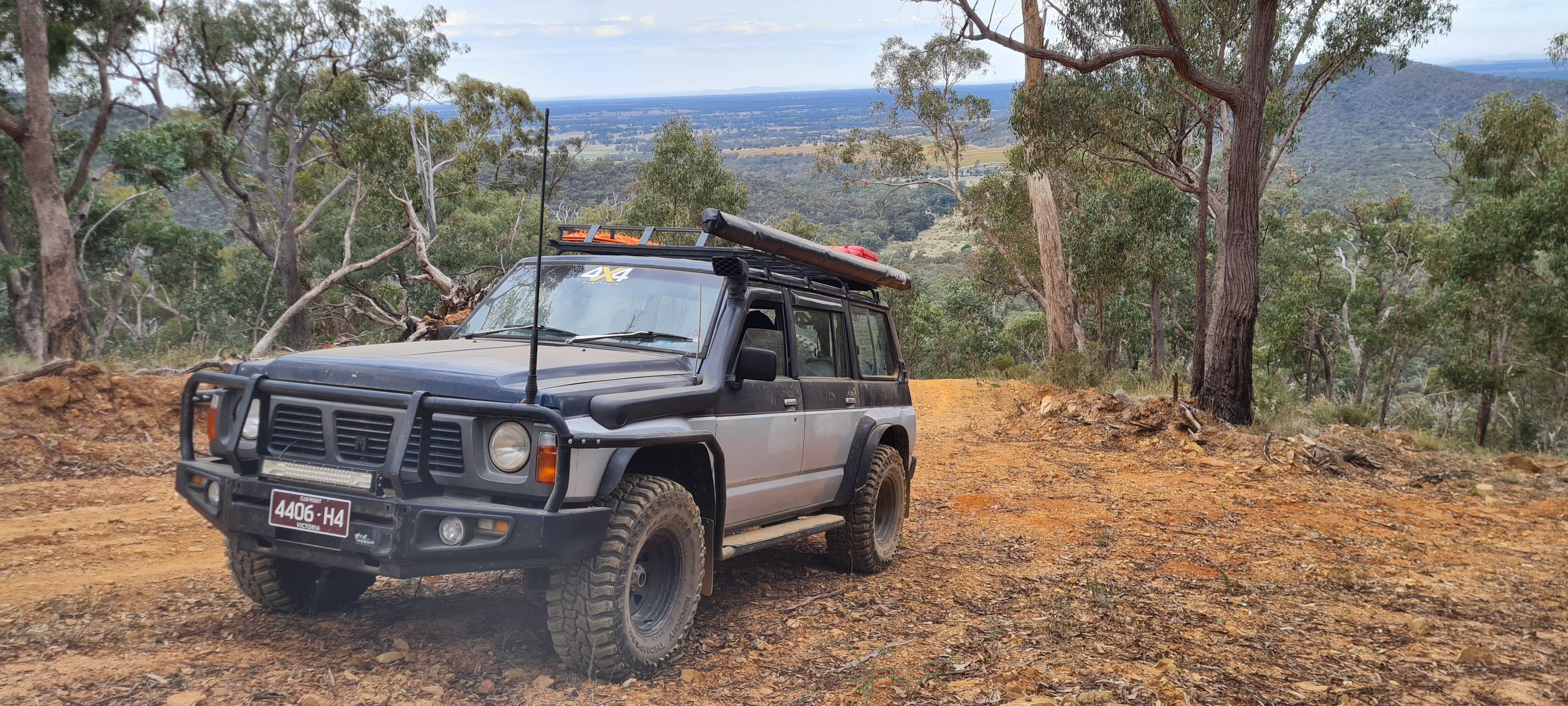
I started looking at a cheap 12-volt system for the GQ, preferably removable. The reason for this is, as the GQ is used as our camping toy, there are plenty of other tasks it does for me that have nothing to do with pitching a tent. I decided on a removable battery box in the car, and got myself a HardKorr Heavy Duty battery box and wiring kit.
All in, that cost around $250 (excluding the battery), and it’s a super simple system that’s removable for more interior space when the car is being used for jobs like carting kids and car parts around. I borrowed a Waeco fridge from the in-laws and job done! We had nice cool food storage for a week’s camping.
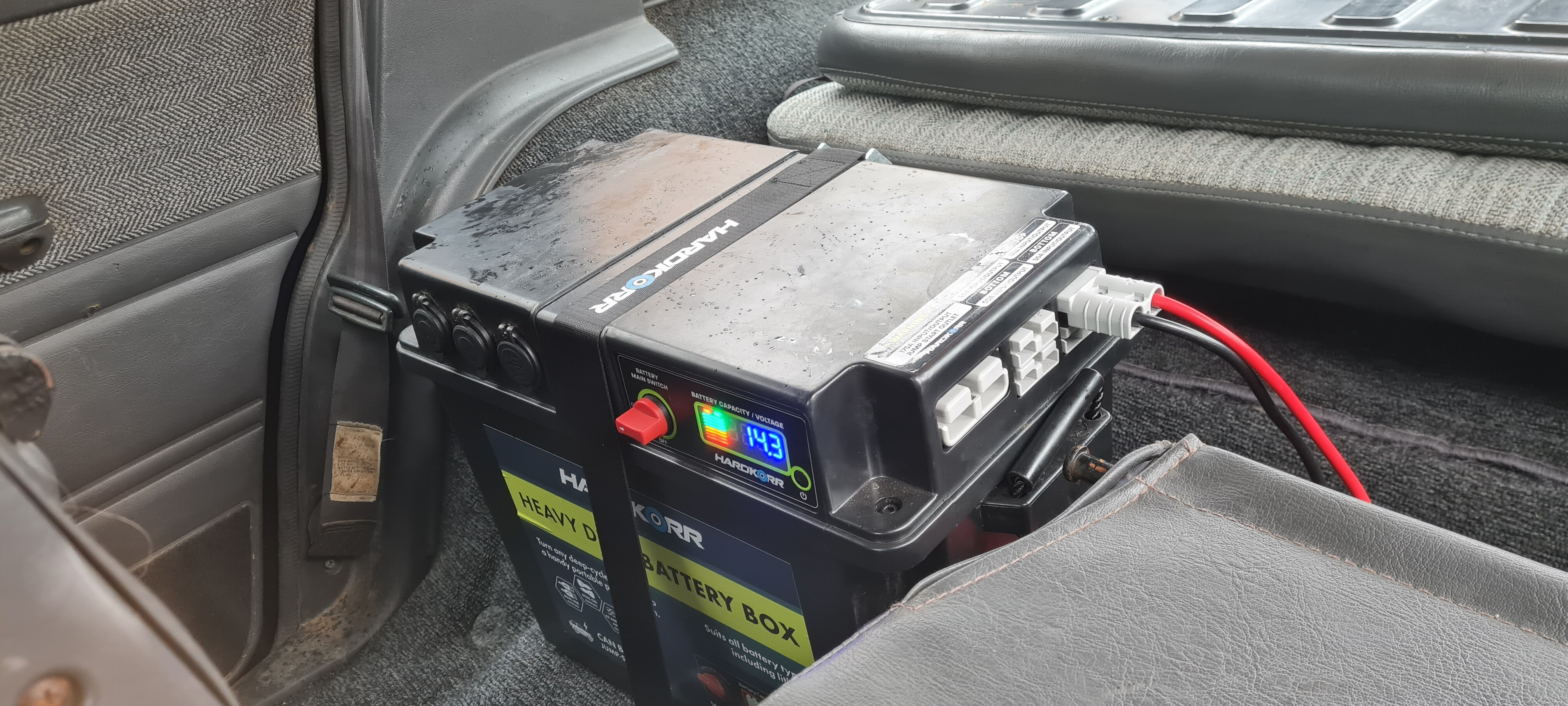
The next job was to fit a snorkel, as I’d been told our route in the High Country would involve a lot of river crossings. I did 100-per-cent the wrong thing and got the cheapest kit I could, and it didn’t take long for regret to set in. While it only cost around $80, the template was inaccurate that a half-a-day snorkel install turned in to a whole-day affair with some fabrication and trips to the parts store, completely outweighing the cost saving (you get what you pay for).
A final upgrade before the trip was a new bullbar, which actually wasn’t planned. A good mate of mine managed to score me an Ironman 4×4 winch bar for a slab of beer out of the scrap bin at a local panel beating shop, so we bolted that on, along with some brush bars I’d had sitting around. And with that, the car was ready to go.
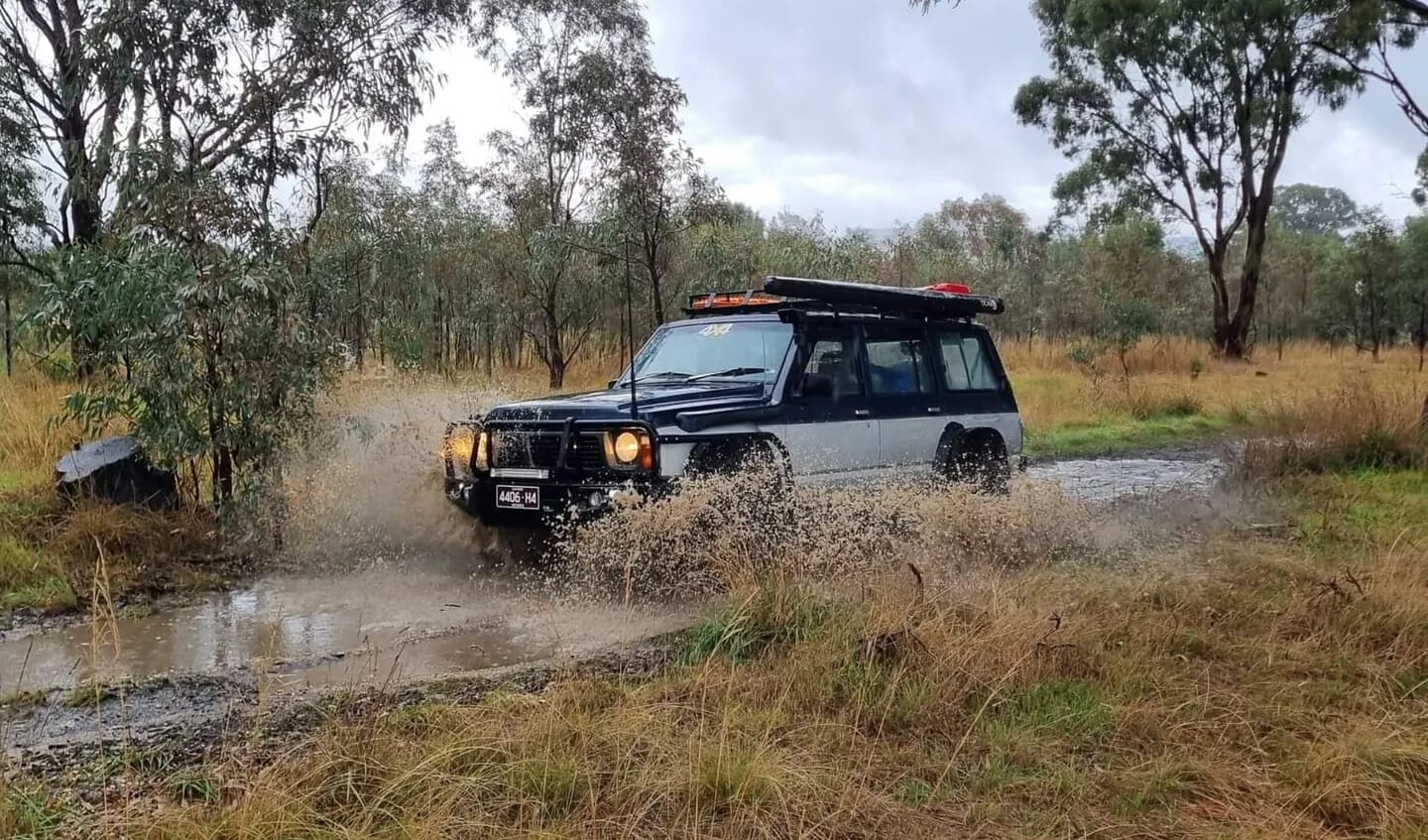
A sudden turn in the weather deviated our plans at the last minute, with nasty rain predicted for the majority of our trip. We decided to head west from our Central Victorian starting point to the Grampians via the Pyrenees Ranges, to escape the majority of the rain belt that soaked Victoria that weekend.
The Pyrenees offers heaps of intermediate and difficult 4×4 tracks just outside of Avoca, with plenty of camping spots. After a dry first day on the tracks, the second day gave us some slippery downhill tracks to contend with, but even fully loaded with camping gear the grippy 33-inch Mickey Thompson Baja Boss M/Ts never let the GQ slip out of line.
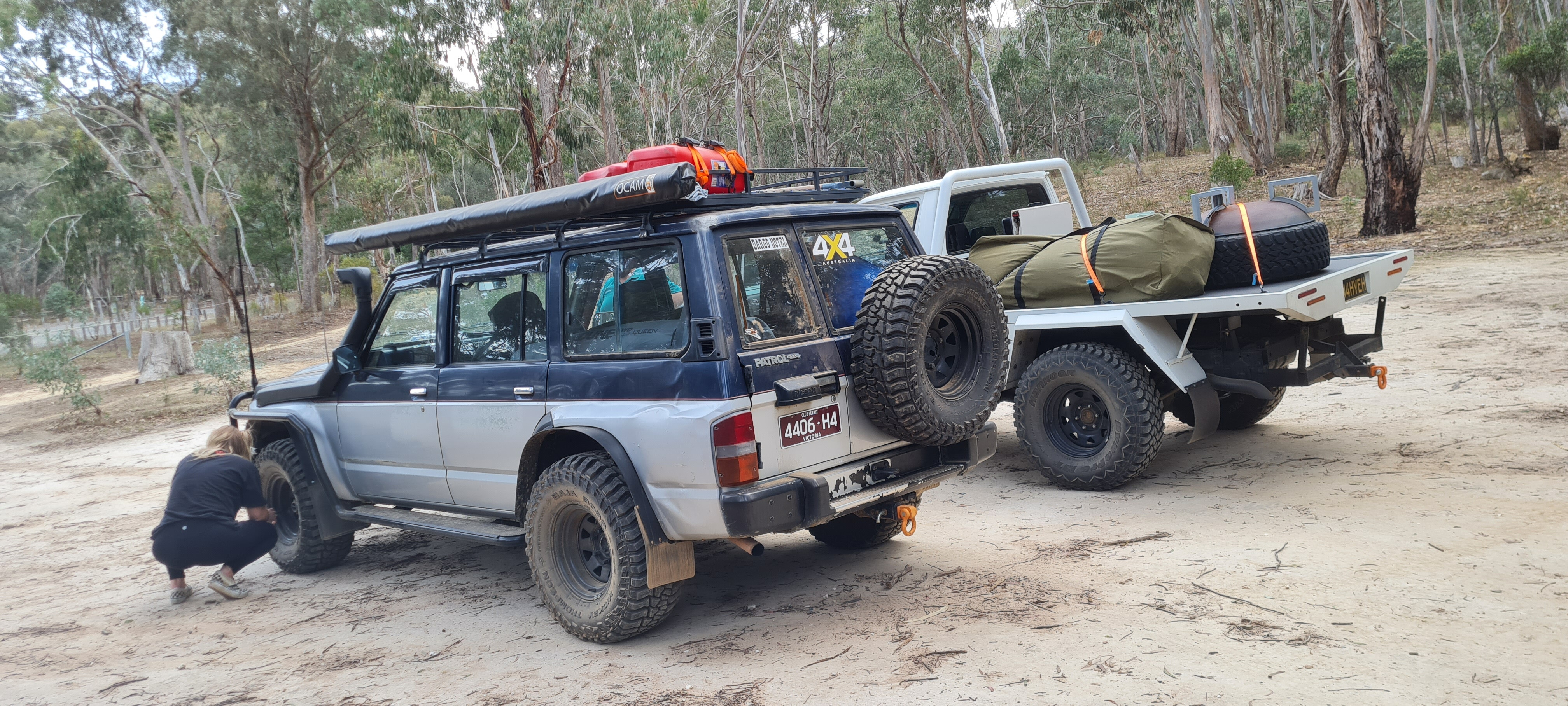
Our time in the Grampians didn’t involve any 4×4 tracks, but we did get a chance to test out the GQ’s camping merits with three days of sightseeing and exploring around Halls Gap. With the big awning and OZtrail stretcher tent, we had everything we needed without spending thousands on a set of drawers or rooftop tent.
On the route home back to Bendigo we had one last overnight stop at Mount Bealiba, just outside of Dunolly. A bit of an unknown on the Victorian 4×4 map, it has a heap of tracks to explore that lead to High Country-rivalling views over Central Vic.
We wrapped up the trip by spending the night at the base of the mountain, and it’s there where I had time to reflect on how the GQ had done. Other than a few carby hiccups and excessive fuel usage (a given with the old TB42) it ran great, got over every obstacle with ease, and the super simple 12-volt system and camping set-up proved you don’t need to remortgage your house on camping gear to spend a week away in the sticks.
TOTAL KILOMETRES: 317,300km
The iconic Toyota Landcruiser is as true-blue Australian as a Christmas Day pavlova and Barnaby Joyce – in other words, not very Australian at all. Trivia people will be able to tell you that the Pavlova was named after Russian dancer Anna Pavlova and may or may not have originated in New Zealand in the early 1900s but, in reality, the recipe is far older than that and probably came from Germany.
And, before an embarrassing revelation in 2017, many might also have assumed the same of Joyce, who claimed to be as Aussie as a Vegemite flavoured boomerang. But a discovery that he was equal parts Kiwi turned his ruddy face a brighter shade of red than normal. It’s kind of the same story for the ‘Cruiser.
Scuff through the red dirt of the outback into any bush garage worth its salt and I guarantee the sunburnt grease wizard will know the head-bolt torque sequence for a Landcruiser better than a Barra.
MODELS TESTED
Lexus LX 600 Sports Luxury v Toyota LandCruiser Sahara ZX
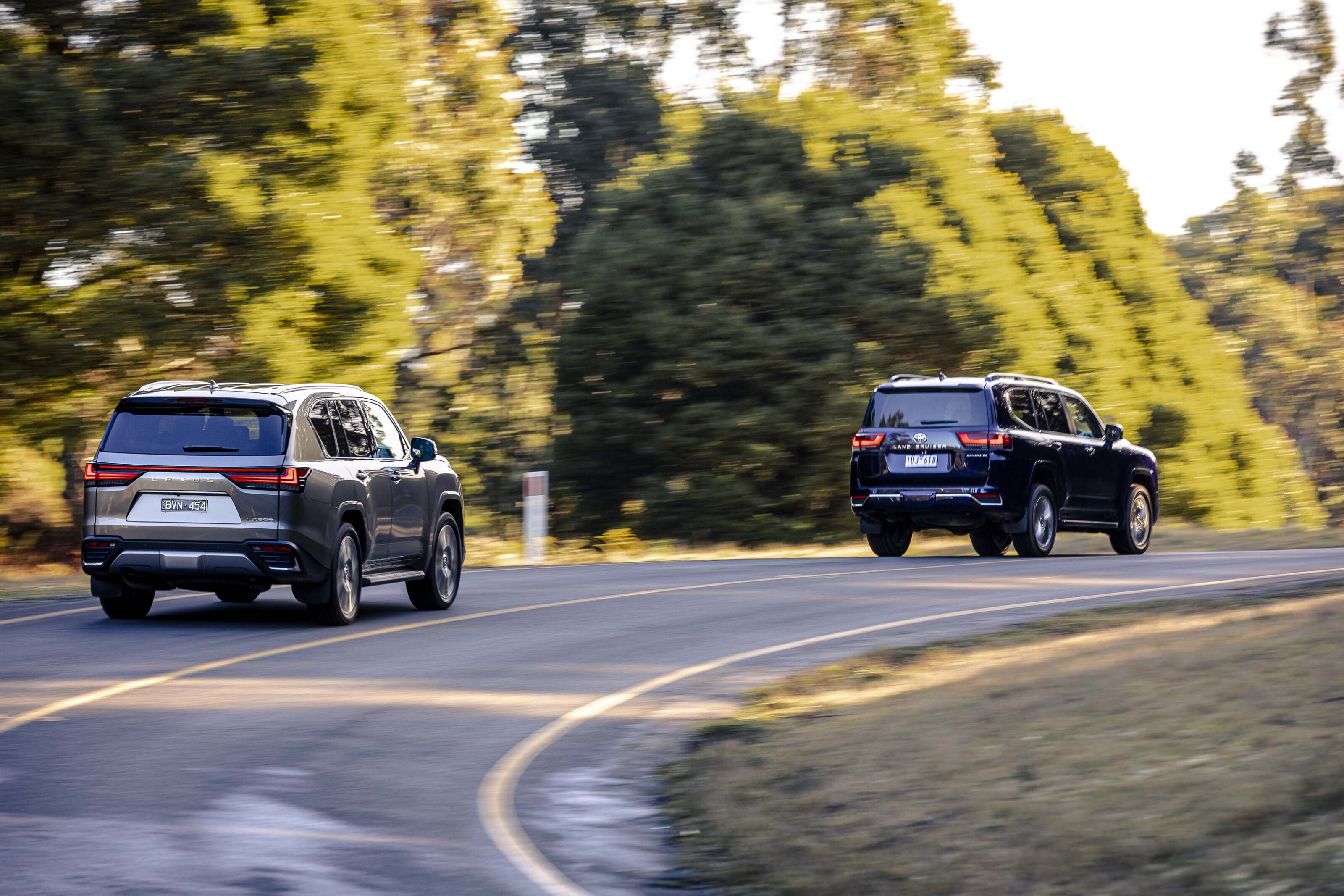
While, out on the track, many modified 4×4 enthusiasts are familiar with the humbling feeling of summiting a particularly tricky trail, only to find a completely stock Landcruiser has beaten them to it. The Landcruiser is so intrinsically woven into the Australian automotive tapestry that it’s very easy to forget that the Toyota, of course, harks from Japan. The same, however, cannot yet be said for its plus-size SUV sibling.
There’s been so much fanfare surrounding the introduction of the new 300 Series Landcruiser, that the very closely related Lexus LX has failed to grab anywhere near as much attention, but if you’re interested in Toyota’s honorary Australian, shouldn’t you also give the all-new Lexus a look too? The answer is yes – as long as you have the budget.
The 2022 Toyota Landcruiser range kicks off with the GX but regardless of which of the six variants interest you, all are powered by a new 3.3-litre twin-turbo V6 diesel. It’s the same story for the entry point of the LX range with three LX 500d options all powered by the same drivetrain. However, there are significant differences in pricing.
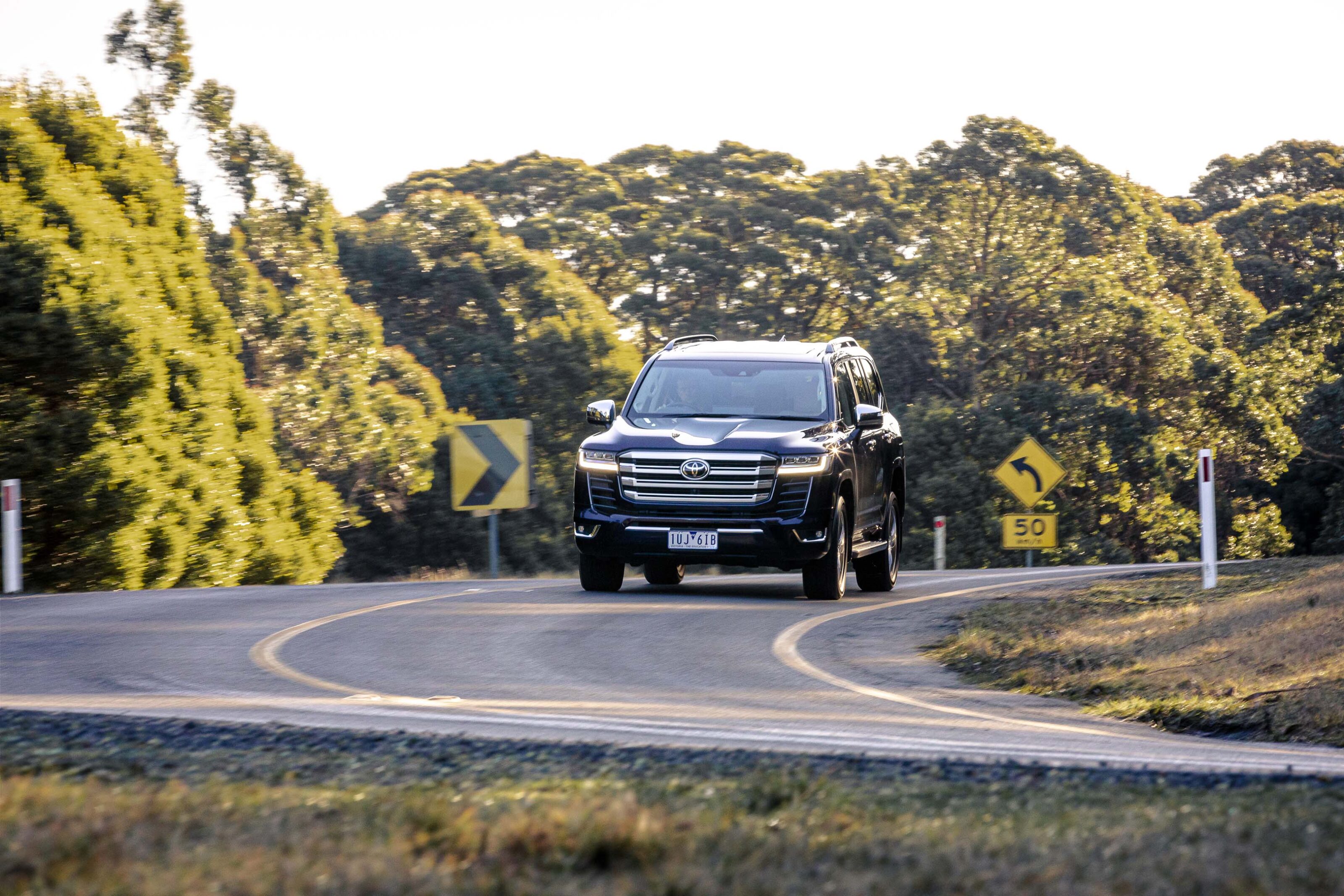
While the most affordable Toyota costs $89,990, the Lexus line-up kicks off from $148,800. To level the playing field in this evaluation, we’ve grabbed the range-topping Landcruiser Sahara LX which is priced from $138,790 and from the Lexus line-up we have the $169,300 LX 600 Sports Luxury.
If this comparison was purely about price we could have opted for the cheapest Lexus for a closer money match, but it’s not. Unlike the Landcruiser range, stepping up to the middle of the LX family introduces a new engine – a 3.5-litre twin-turbo V6 that sips on petrol rather than diesel.
There’s been so much fanfare around the 300 Series Landcruiser that the very closely related Lexus has failed to grab anything like as much attention
While diesels were once the indisputable hard-workers and petrols traditionally synonymous with sophistication, does this brace of box-fresh motors prove the rule or change it? We head to the vineyards around Macedon to find out.
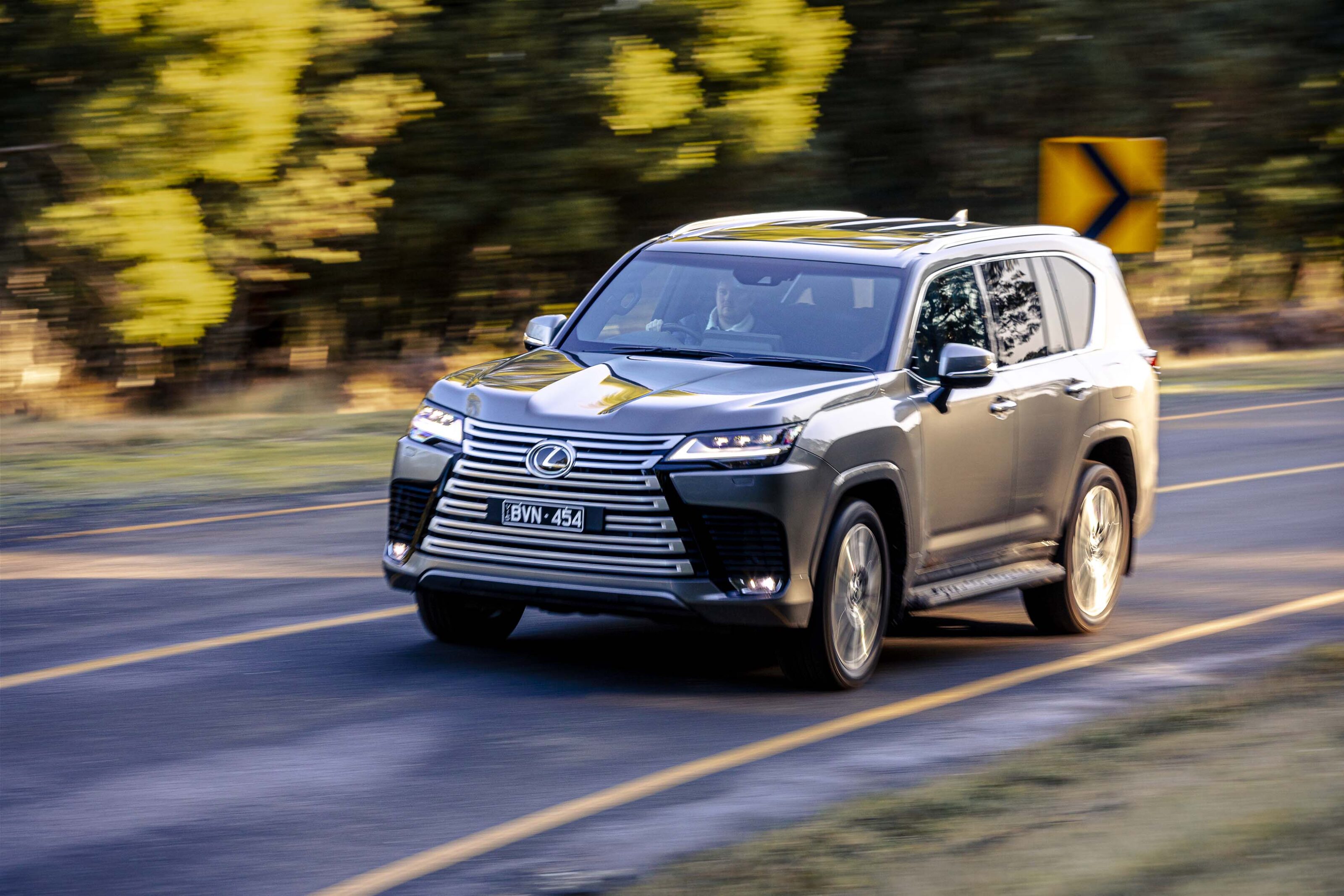
Let’s start with the proverbial engine elephant in the room. V8 diehards lament the passing of the 4.5-litre V8 diesel available in the previous Landcruiser 200 but they will find themselves decidedly dry-eyed after getting behind the wheel of the 300.
While the new donk is down on displacement, it is a vastly improved unit and the figures don’t lie. Compared with the old 4.5-litre V8, the new 3.3-litre V6 produces 227kW and 700Nm (27kW and 100Nm more) but asks for less fuel in the process.
The claim is just 8.9 litres per 100km – very respectable if true for a vehicle that weighs not a lot more than 2.6 tonnes and has proportions that definitely don’t prioritise minimal wind resistance. Engine performance is surprisingly not wildly different for the Lexus despite its opposite diet.
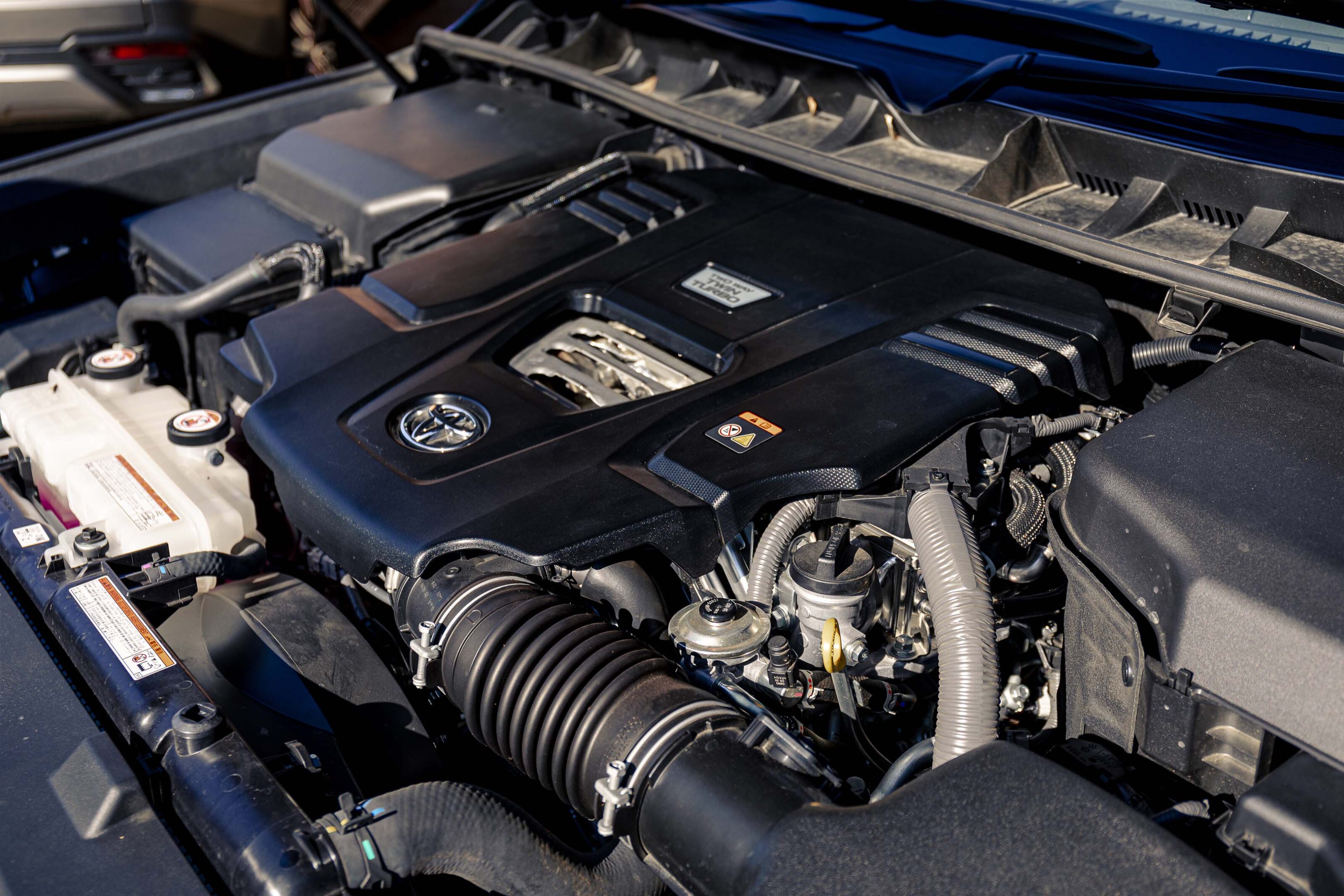
With 3.5 litres and a pair of turbos at its disposal, the LX 600 produces 305kW and 650Nm but where the numbers definitely don’t align is fuel consumption. With 2640kg to lug around, the V6 will use 12.1L/100km on the combined cycle, says its maker.
The surprises continue in practice. As you might expect, the six-pot diesel provides mountainous torque and pulling power when under the bonnet of the Toyota. A pair of small but eager turbos whisk up the full might of 750Nm from just 1600rpm and the Landcruiser builds speed surprisingly quickly for a 2610kg bruiser.
It’s by no means the most refined six-cylinder diesel with plenty of classic compression-ignition clatter throughout the rev range and a note that never mutes. What noise the V6 makes however, is pleasantly satisfying. It doesn’t mind a rev but hanging around the rafters with Toyota’s strong diesel is to waste its bountiful swathes of torque.
It pairs very nicely with the new 10-speed automatic transmission which, at low throttle, shifts almost imperceptibly and allows the torquey motor to hunt the higher gears and keep the revs low. An occasional reluctance to shift and a clunkiness when prodded were the only small anomalies.
Despite its heft, the LX 600 will crack 100km/h from standstill in 7.0 seconds
The similarities continue with the Lexus’s V6. Rather than some high-revving power player that wants to sit at 6000rpm all day, the 3.5-litre petrol has been engineered to deliver its performance in a more diesely fashion. There’s a little more lag than the Toyota’s engine but when its two small turbos are singing the grunt is impressive. Even more eye-opening is how the Lexus moves in a straight line.
Despite its heft, the LX 600 will crack 100km/h from standstill in just 7.0 seconds and there’s something deeply amusing about a slab-sided family mover cutting passes like a hot hatch. Unfortunately, the engine isn’t as happy revving as it is delivering low smooth performance with secondary vibrations starting to sneak in above 3500rpm.
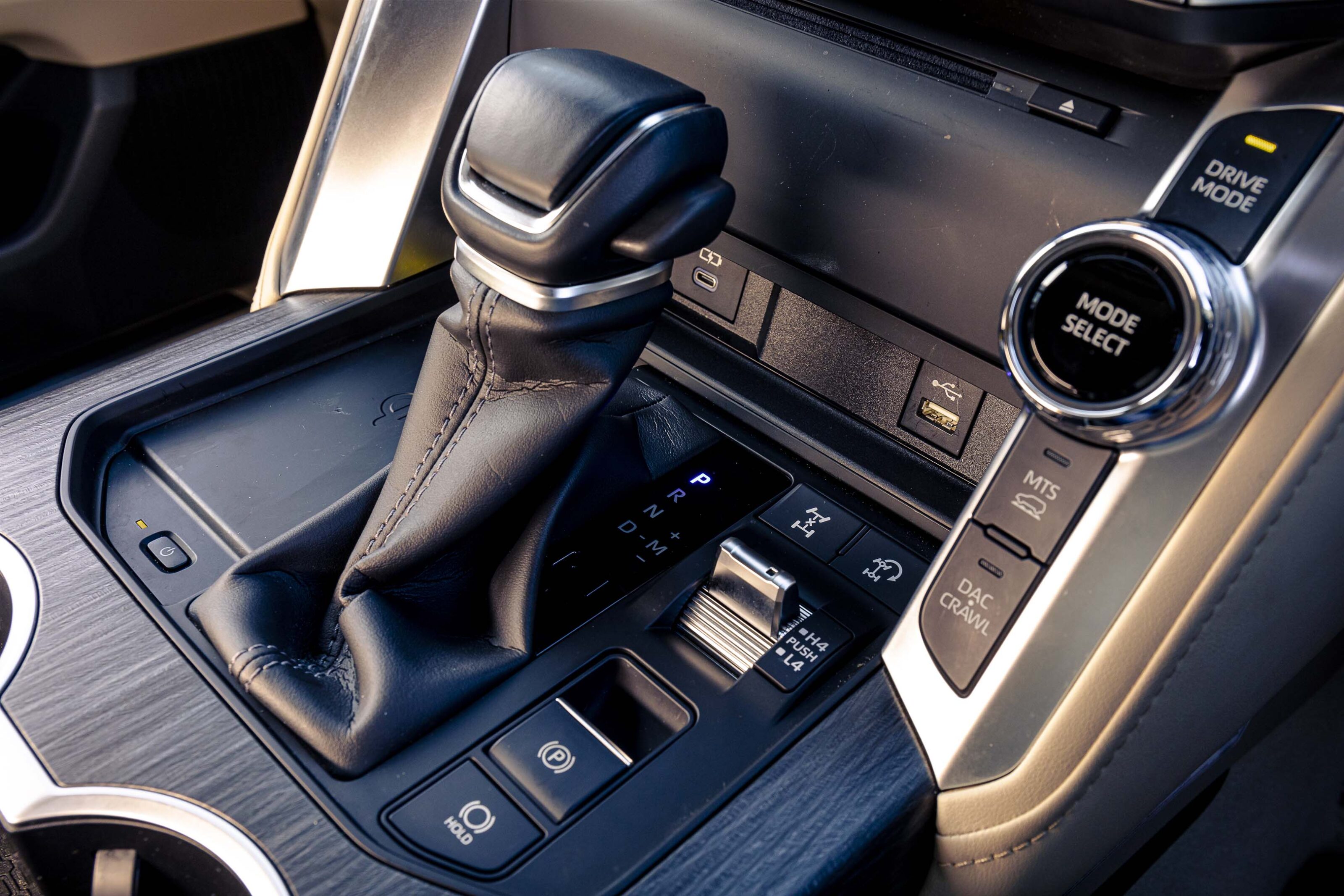
Unlike the Landcruiser, the Lexus has steering wheel paddle shifters and while they don’t really impart a sportier feel over the Toyota, they are useful for grabbing another gear to keep the revs in the sweeter part of the range. During our time with the pair of hulks both SUVs reported higher than average fuel consumption claims of about 11L/100km for the Toyota versus around the 14L/100km mark for the Lexus.
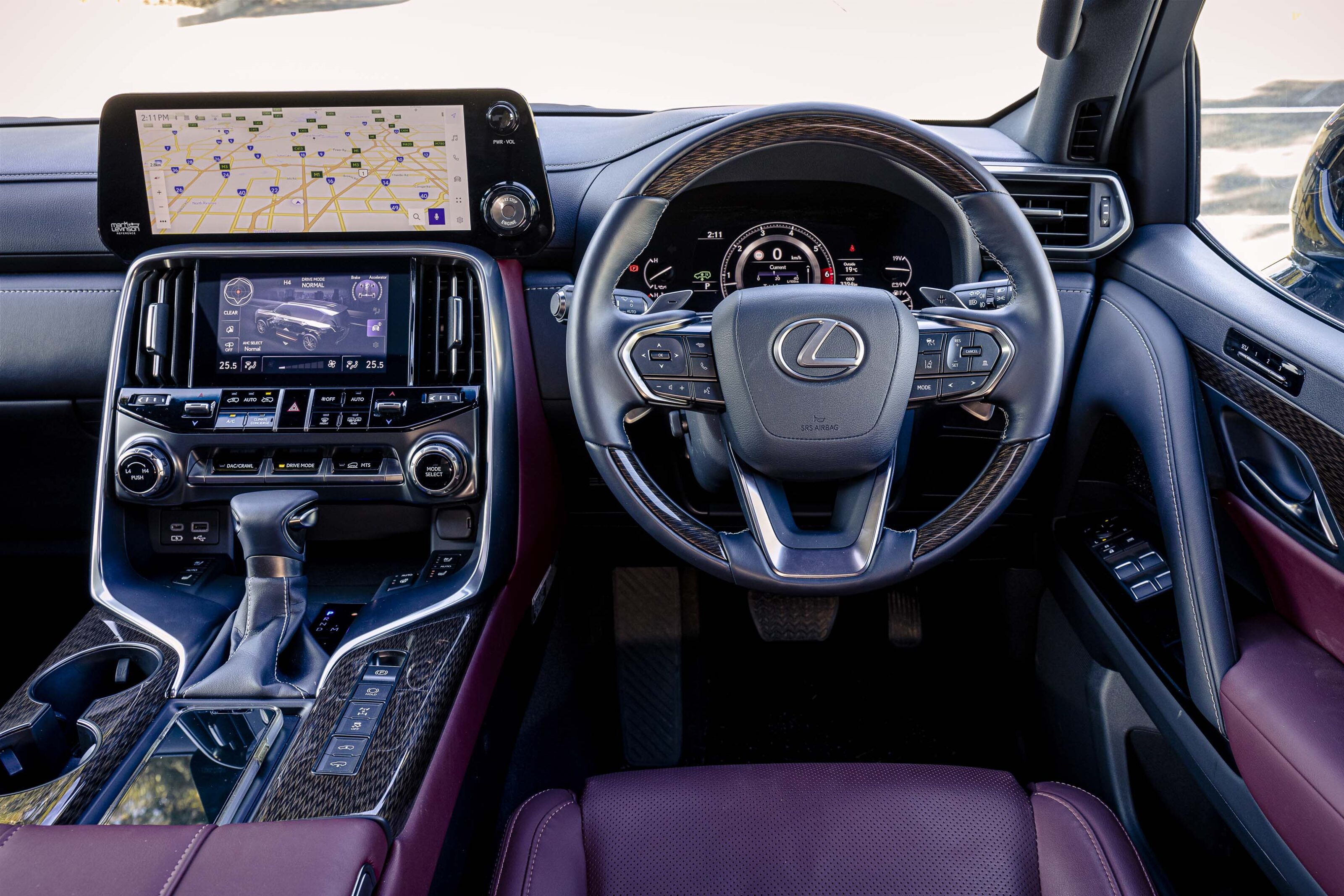
From the driver’s seat, both vehicles initially feel very similar from the bonnet philtrum and elevated driving position to the all-round visibility and cabin space, it’s obvious this pair has a lot in common but, that said, there is still plenty to set them apart.
While the Landcruiser has comfortable seating, the LX offers excellent support and ergonomics in typical Lexus form. Its dash is also a complete rethink of the Toyota’s with nothing to relate the two. Both feature 50/50 digital and traditional instrument clusters, wide touchscreen central displays and logical layouts, but the Lexus is better executed and feels more premium.
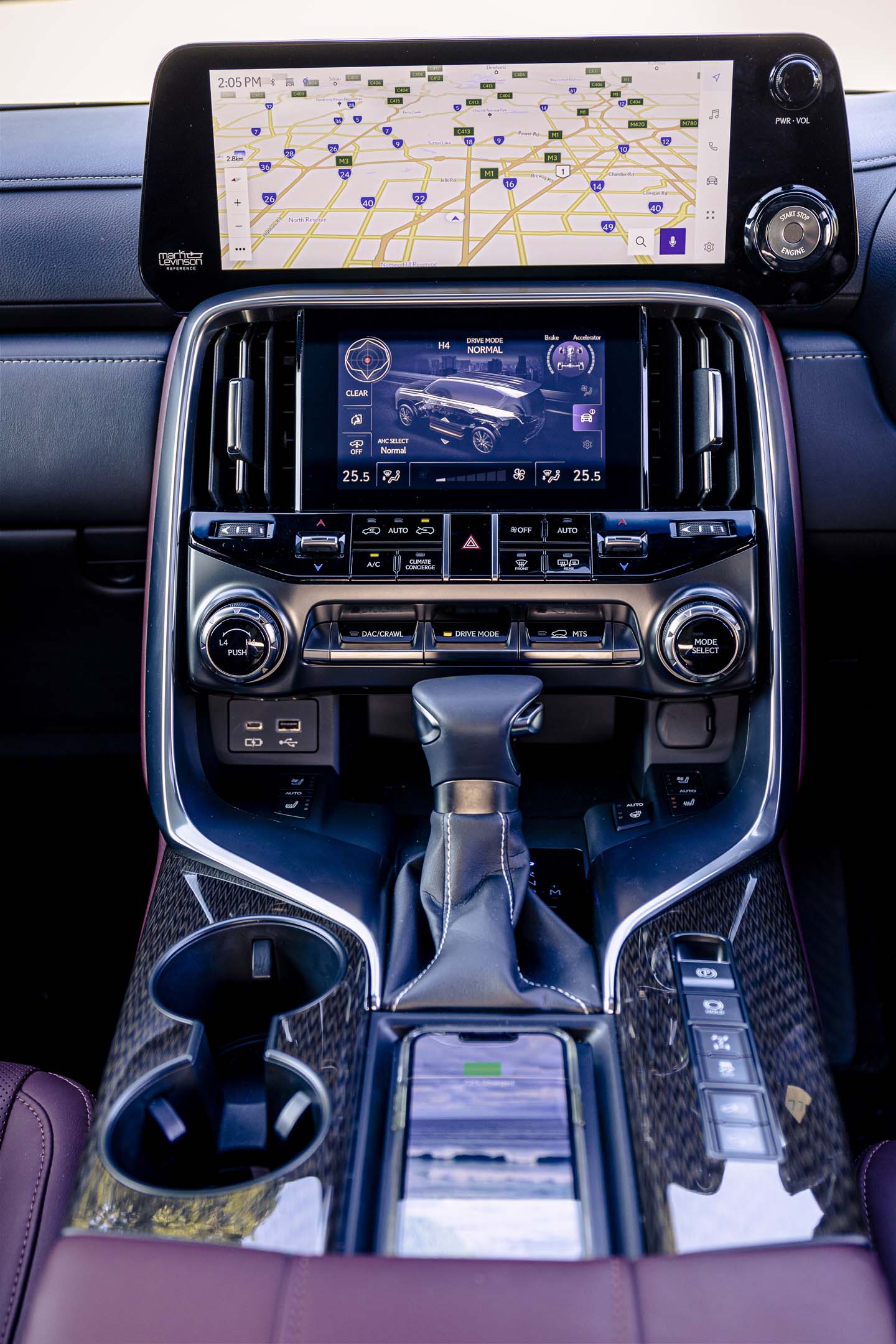
In place of the Toyota’s push-button climate controls, the Lexus has a third digital screen, while its main information and entertainment system is sharper and more intuitive. Other tech advantages over the Landcruiser include a digital rear-view mirror, a 360 degree camera that can make the Lexus appear transparent in the maneuvering display, and finer quality leather.
As a further indication of the Lexus’s more prestigious approach, the Toyota gets a decent JBL sound system and an amusing CD player, while the LX is equipped with Mark Levinson audio gear which is about the best in the ICE game.
Whether you go Toyota or Lexus, the new TNGA underpinnings cope well with a bit of pace
In the second row however, the experience is virtually identical. Both cars were fitted with the optional entertainment pack which adds a screen for each of the outer seats, the climate panel is unchanged and both get a clever third button that allows rear passengers to access the ice-box between the two front seats.
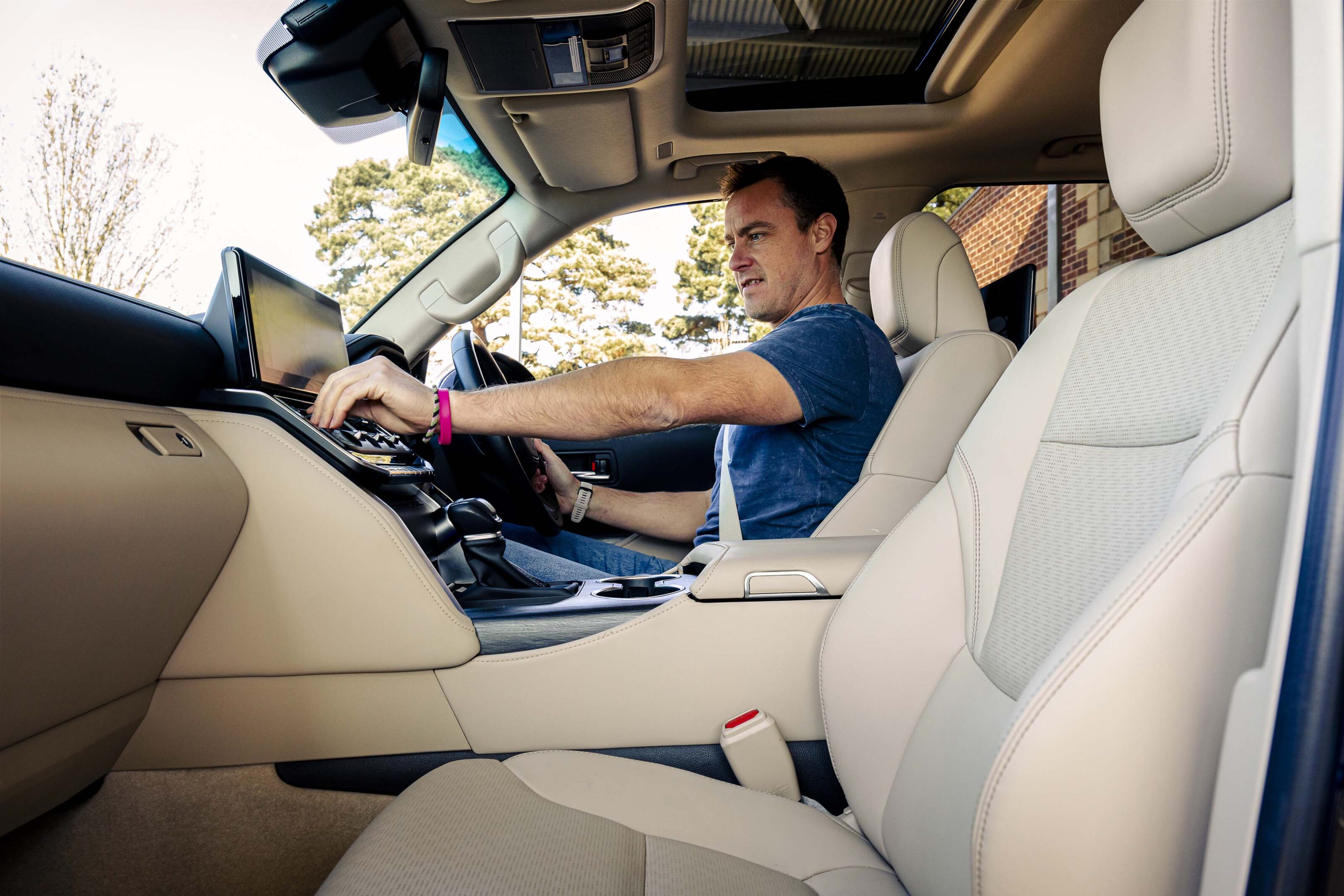
While interior space is generous including 1210mm of height and 1630mm in width, the overall cabin feel isn’t quite as cavernous as the exterior implies.
That is, however until you get to the boot where both cars offer in excess of 1100 litres of volume. A seven seat is available which shrinks space to just 174 litres when all three rows are in place or 982L when stowed. A clear practical difference becomes clear when wanting to exploit the maximum cabin space and fold the second row.
While the Lexus has remote seat release buttons which automatically roll the front seats out of the way, Toyota owners must manually move the front pew before the rear seat can be folded. However, the Toyota trumps the Lexus with seats that can be tumbled forward after folding liberating extra boot space – 2052L compared with 1960L.
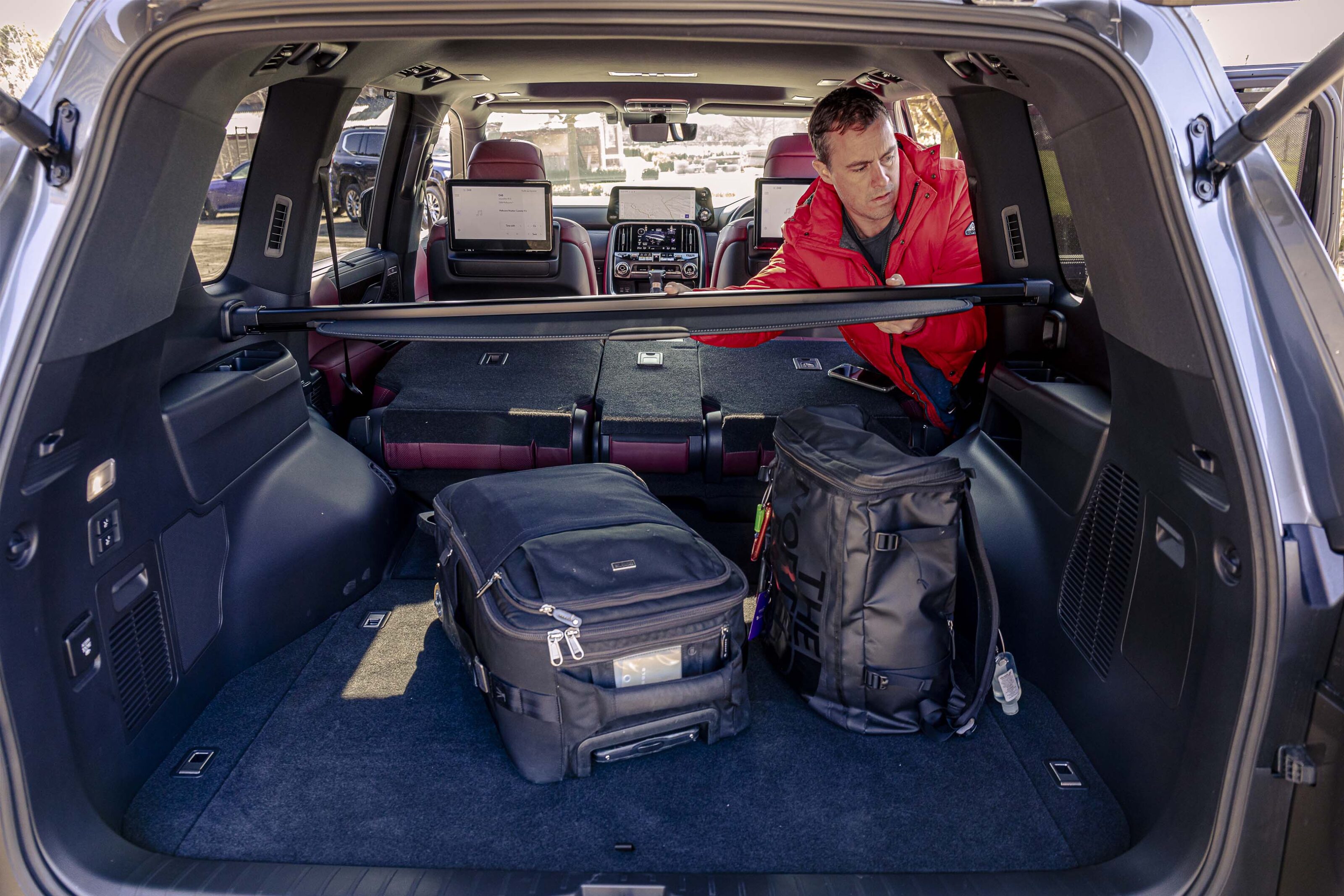
From the initial apparent similarities, the LX 600 and Landcruiser disparity is shaping up but even more so when it comes to ride. It’s unlikely these big bruisers will ever be hustled along with quite the gusto we subjected them to, but the new TNGA underpinnings cope well with a bit of pace.
Yes, there’s the roll and dive you will be expecting but also an unexpected composure. The Toyota negotiates twisty roads using weight transfer, roll and dive a little like a rally car, while the LX tries to stay flat and resistant in a more car-like manner. With less weight to haul up, the Toyota is the more confident under braking and its balance is more neutral in corners while the Lexus tries to understeer with the application of power mid corner.
The LX’s more sensitive steering is a redeeming feature as is its ride when the road straightens. Both cars ride on steel-spring suspension, but the Lexus gets adaptive and hydraulically linked dampers and adjustable ride height which has a dramatic effect on comfort.
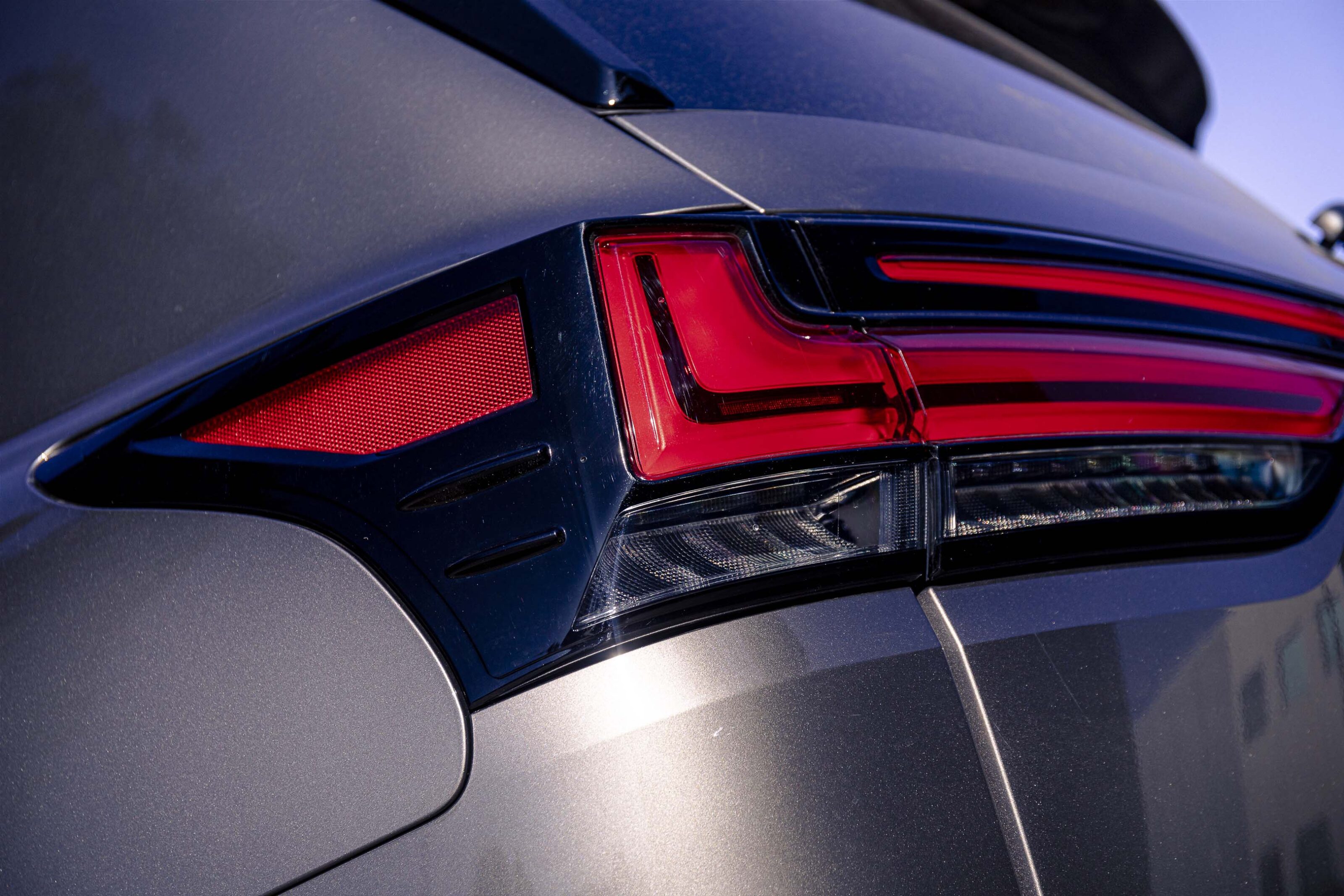
There’s still a little crash and judder to remind occupants they are sitting on a ladder-frame chassis, but the Lexus manages to smooth the road while the Landcruiser feels like it’s scaling bigger bumps like a mountain. Finally, the Lexus rolls on road-focused 22-inch wheels with low-profile rubber, while the Toyota’s intent is far more unsealed with 20-inch hoops and all-terrain tyres.
Lexus has gone to great lengths to distance its big SUV offering from the more prosaic Landcruiser
Lexus has gone to lengths to distance its big SUV offering from the more prosaic Landcruiser, leaning on the company’s USPs of quality, refinement and luxury, and resoundingly succeeded. Refreshingly, the LX is not just another case of commercialised badge-engineering and both models have their place, so which is the pick?
If you intend to do what this pair of behemoths pertain to with their vast cabins plonked on stilted stances then the Landcruiser is the obvious choice. Its diesel would make a snack of all towing duties, while its chunkier tyres, guarded steering and more robust chassis tune are obviously tailored for the path less travelled.
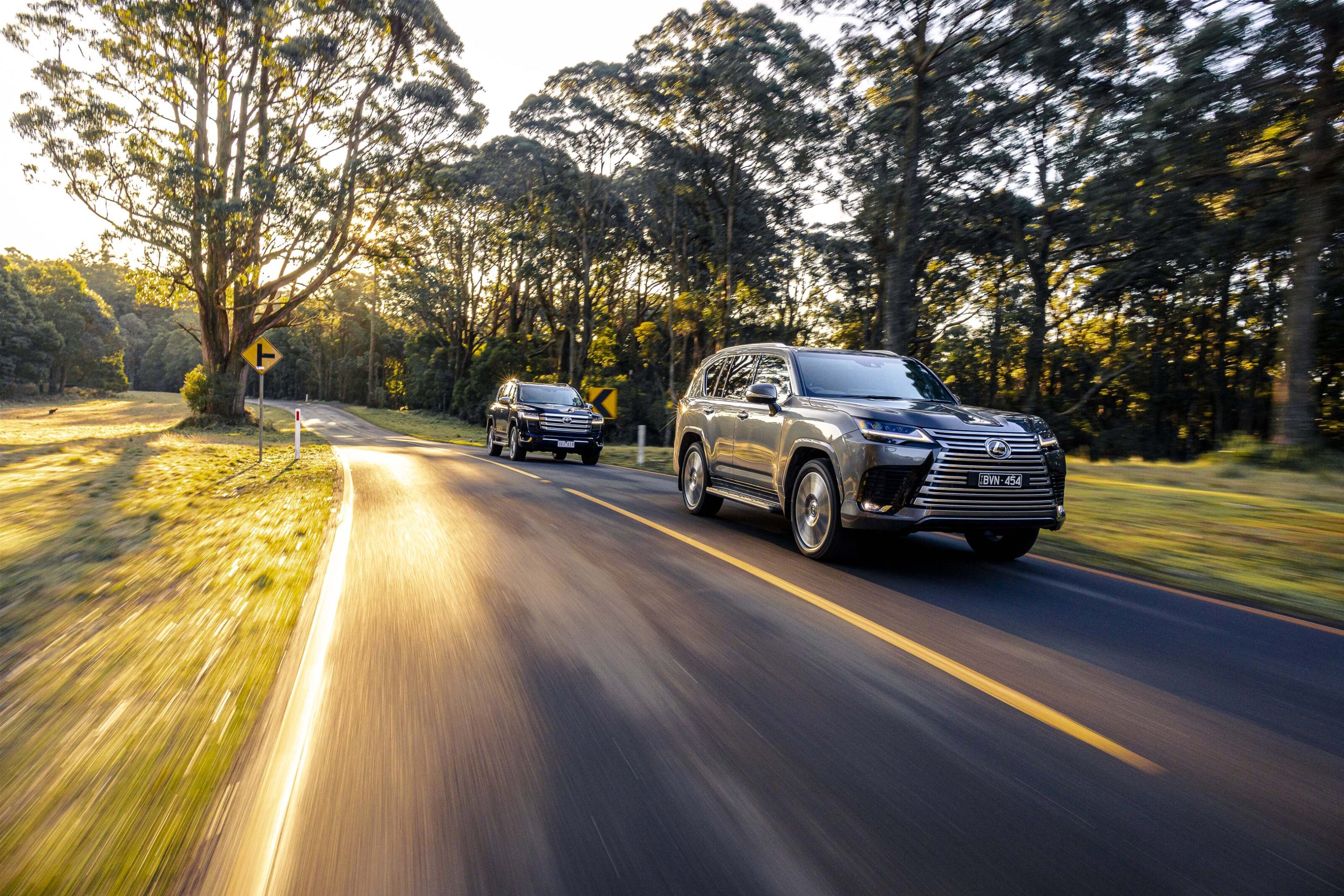
But that’s not what this particular journey was about. While they might make a weekly visit to a riding stable or occasionally drop a box of something at a farm, most upper-large SUVs spend a majority of their kilometers in suburbia and that’s exactly where the Lexus makes the most sense.
With all the off-road mechanicals of the Landcruiser, it’s unlikely to ever need a tractor to continue on its way, but on sealed surfaces its smoother ride, quieter engine and superior levels of quality and comfort really stand out. The Toyota Landcruiser is still, without doubt, the Australian born of Japanese parents, but it looks like we might have a new Keith Urban.
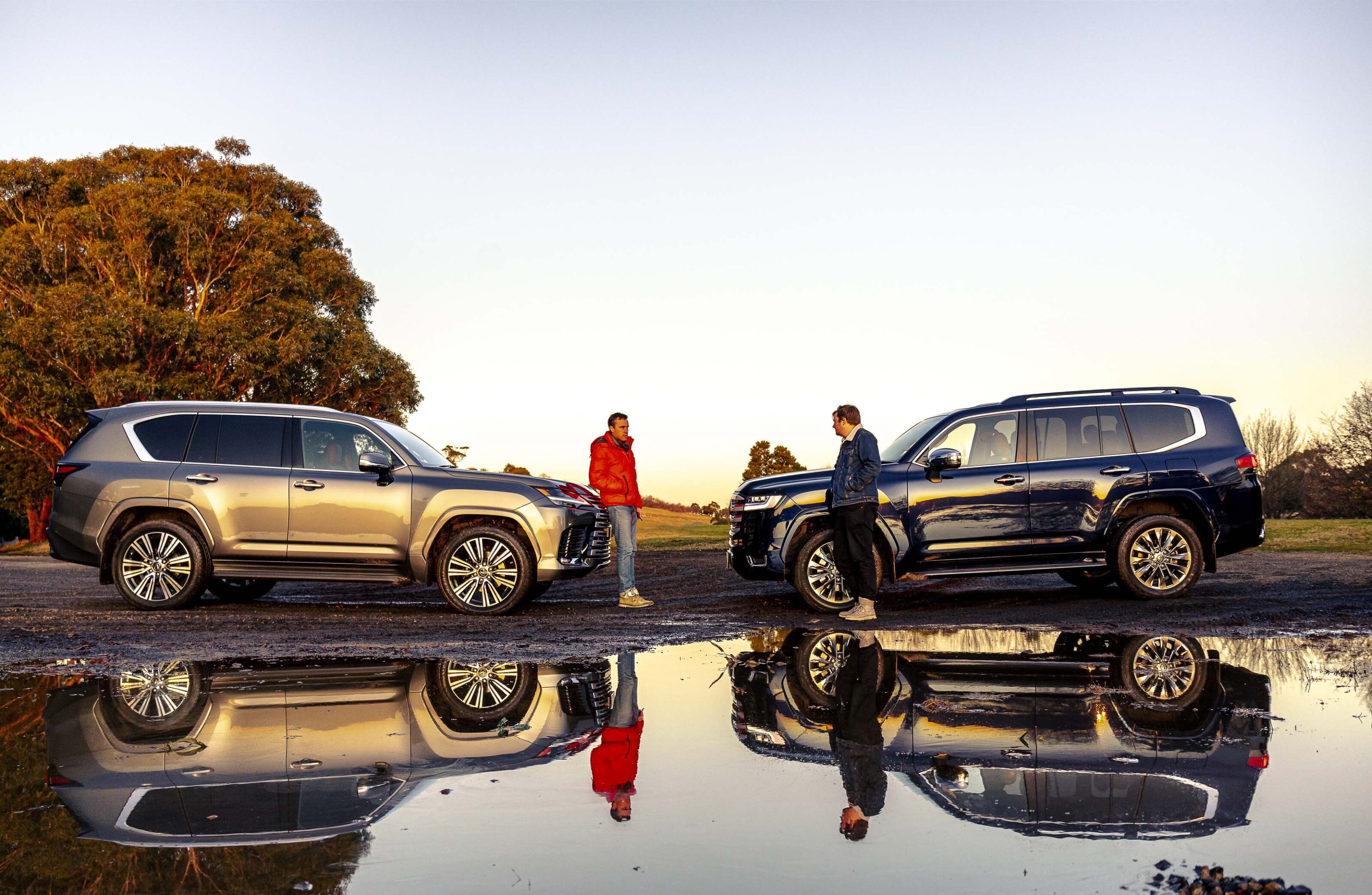
Land of the free, home of the brave…
Welcome to the Jeep seats
For another option that casts a similar shadow over the road as the Landcruiser and LX, Jeep’s freshly launched Grand Cherokee is worth a look.
The standard article will arrive later this year but, for now, the L offers a stretched wheelbase with a corresponding increase in interior space for people and things, and the range-topping Summit is heavily laden with kit and features.
It too has a V6 but with a lack of forced induction performance is down on the Japanese pair. However, the Jeep is big SUV that has decent off-road ability, surprisingly good on-road manners and a price that’ll save you about $50,000.
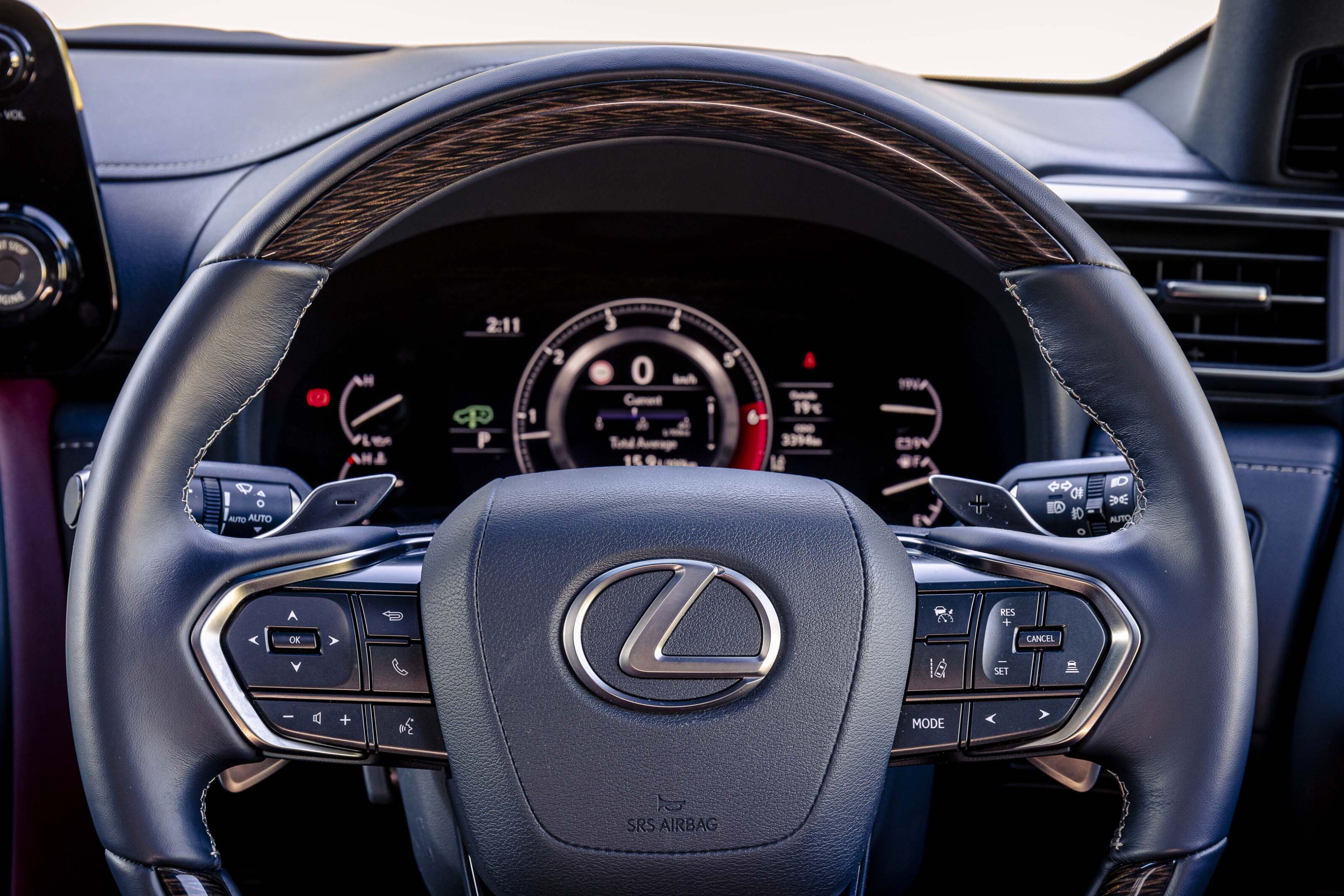
Lexus LX 600
The Lexus does a great job of infusing the LX cabin with the luxurious feel associated with its smaller models but is let down by a disappointigly small ‘moonroof’ that only graces the front occupants with a view of the heavens.
Like the Landcruiser, its central screen measures 12.3-inches corner to corner but is filled with nicer graphics and feels larger in practice. Fingerprint recognition on the start button is a cool security touch and the interior materials quality and finish is impressive.
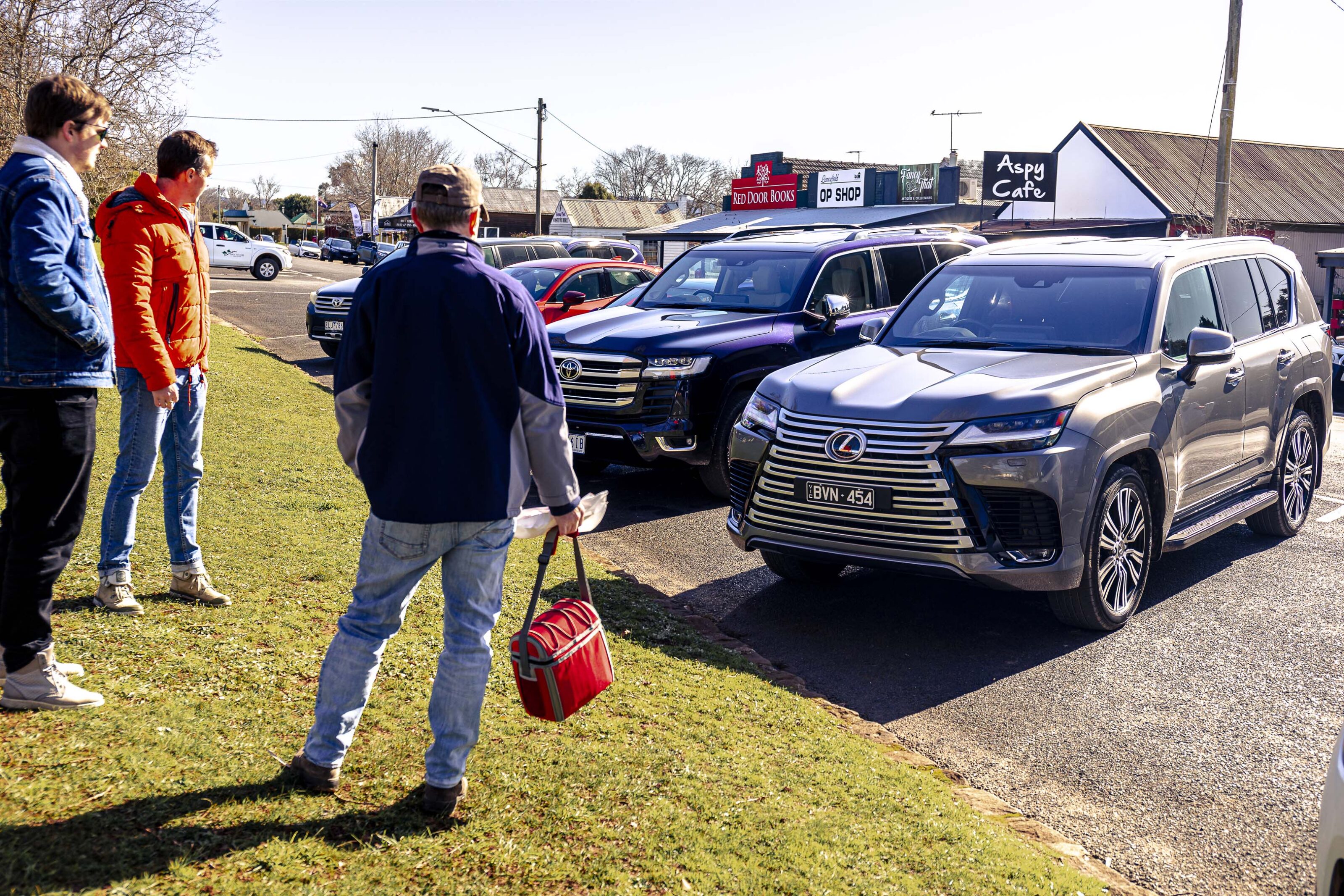
Toyota Landcruiser
Contrasting the LX’s wine red leather interior, the Toyota has been optioned with a lighter palette and beige leather and carpets which were already starting to look grubby.
Light upholstery would be a brave move if the Landcruiser was to spend much time in mud or ferrying children armed with crayons, axle grease or burritos. Like the Lexus, it has a large full-colour head-up display and a dashboard layout that’s vastly improved over the LC 200.
SCORING
Lexus LX600: 7.8/10
- Safety, value & features: 7
- Comfort & space: 7.5
- Engine & gearbox: 8
- Ride & handling: 8.5
- Technology: 8
What we like
- Road-friendly ride
- Torquey engine
- Extensive luxury features
Not so much…
- Stiff price premium over LC
- V6 rev reluctance
- Poxy sunroof
Toyota LandCruiser 300: 7.5/10
- Safety, value & features: 7.5
- Comfort & space: 7
- Engine & gearbox: 8.5
- Ride & handling: 7
- Technology: 7.5
What we like
- Diesel grunt
- Surprising fuel economy
- Solid build quality
Not so much…
- Fixed ride height
- Clunky infotainment
- No remote second row
2022 Lexus LX600 v Toyota LC300 specification comparison
This dark grey 79 Series, sitting proud on chunky Coopers, is country through and through. A serious four-wheel drive for touring, climbing out of farm bogs or maybe motivating another set of hit songs. This is country music star Lee Kernaghan’s fourth LandCruiser ute; back in 1993 the first inspired She’s My Ute –
Kickin’ past the dealers on the edge of town Saw a lot of pretty pickups Not a ute to be found Twin cam Jap fours A bloke’d be nuts Give me a six or an eight A four wheel mate The dents and the dust And the grasshopper guts …

Queensland-based Lee has long loved 4WD utes, well before the genre reached the suburbs.“It’s interesting that ute culture exploded in the early 1990s and it was around that time I wrote my first ute song, She’s My Ute, and that’s gone on to be like a classic,” he says.“It was an interesting time because, until then, utes were just like farm vehicles, utility vehicles,” says Lee, high up in South-East Queensland’s McPherson Range. “But then they became so much more, and they say a lot about the driver. I played at that first Deniliquin Ute Muster in 1999 and I’ve always felt a real affinity for ute culture.”

Raising back-road dust and utes often feature in Lee’s first 14 albums. His career took off with the release of The Outback Club in 1992, adding a rock ’n’ roll swagger and driving tempos to country music. Since then, he’s sold more than two million albums, has had 41 number one hits, won 38 Golden Guitars and four ARIA awards. He received the Order of Australia medal in 2004 and was Australian of the Year in 2008 for work raising funds, and spirits, for outback and regional ommunities in need.In 2022 there’s already a new three-CD set collecting 30 years of his music, songwriting and concerts, The Very Best Of Lee Kernaghan – Three Decades of Hits plus Live at the Deni Ute Muster, 23 tracks recorded at Deniliquin Ute Muster’s 21st anniversary. Plus, he is writing yet another album in his bolt-hole in the range.

Four-wheelin’

It’s up here in lush green bush paddocks, as much as it is out in the Channel Country or a weekend’s hardcore driving at LandCruiser Mountain Park, where Lee counts on a decent vehicle to get away with partner Robby and sons Rock and Jet.“I’ve tried to keep it as standard as possible and just do the necessary upgrades for extreme off-road,” Lee explains. He left Toyota’s V8 motor and transmission standard, then planned out what he wanted on this graphite-coloured dual cab – built in late 2020 and then wrangled out of a Darwin dealer – before handing over much of the outfitting to his mate Roger Vickery at ARB Caboolture.

Bullbar and side-rails, plus the winch, are Toyota factory fittings. Also up front are a pair of ARB Intensity driving lights and a Safari snorkel – all proven and reliable gear.Then there’s an Old Man Emu suspension lift with BP-51 shocks and steel Dynamic wheels with 25mm offset up front and 50mm offset on the rear, to square up the LandCruiser’s track widths.“It’s got everything tracking beautifully,” Lee says. “When these wheels and tyres went on, you couldn’t wipe the grin off my face, it was just so good.

“These Cooper STT Pros (315/70R17) are muddies, but they’re great on the highway as well. And incredibly capable off road. That was the thing that really took the ute to a new level. On the highway they’re really, really good and they’ve got maximum grip in the wet. I just love ’em so much.”Lee’s just as happy with the Gold Coast-built PCOR tray and its 60-litre pressurised water tank, twin compressors, slide-out drawers and “lots of lights which are really handy when you’re camping out”. He baptised this new ute with a trip to Birdsville and Old Cork Station; that’s where an ARB Elements fridge, fixed permanently to the tray, also came in handy.
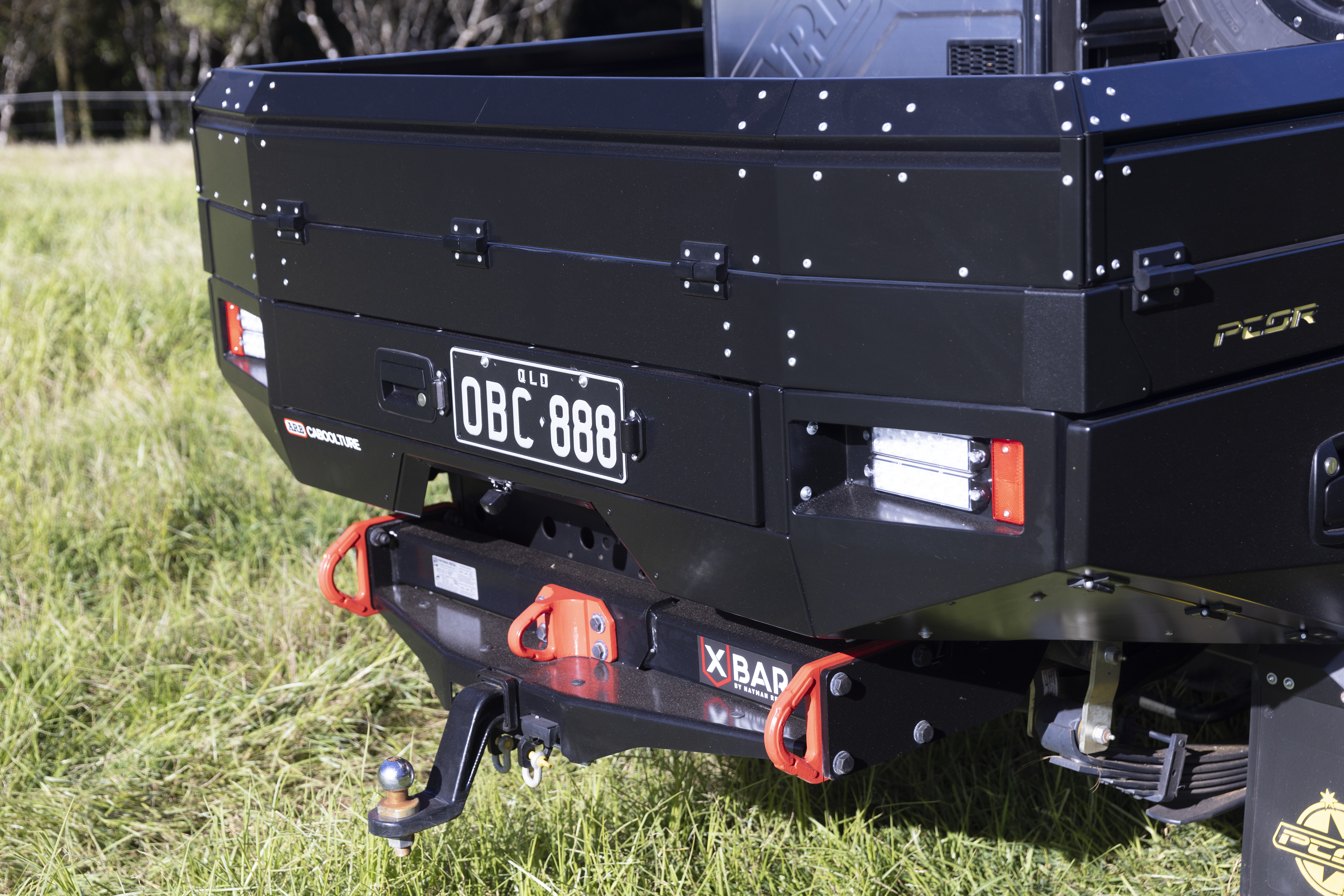
“It’s a ball tearer. It’s hooked up to an Invicta lithium battery, sits there and runs 24/7. Just awesome; keeps the drinks super-duper cold.”Helping out with power is a solar panel on the Rhino roof rack – minus the ARB awning for now after Lee slid off a greasy track and glanced a tree in his mountain paddock.For helping others out of sticky spots, Lee’s 79 Cruiser has a Hayman Reese X-Bar fitted with tow hitch and three recovery points.
It all adds up to a good-looking truck, a handsome marriage of style and substance with a meaningful road stance.
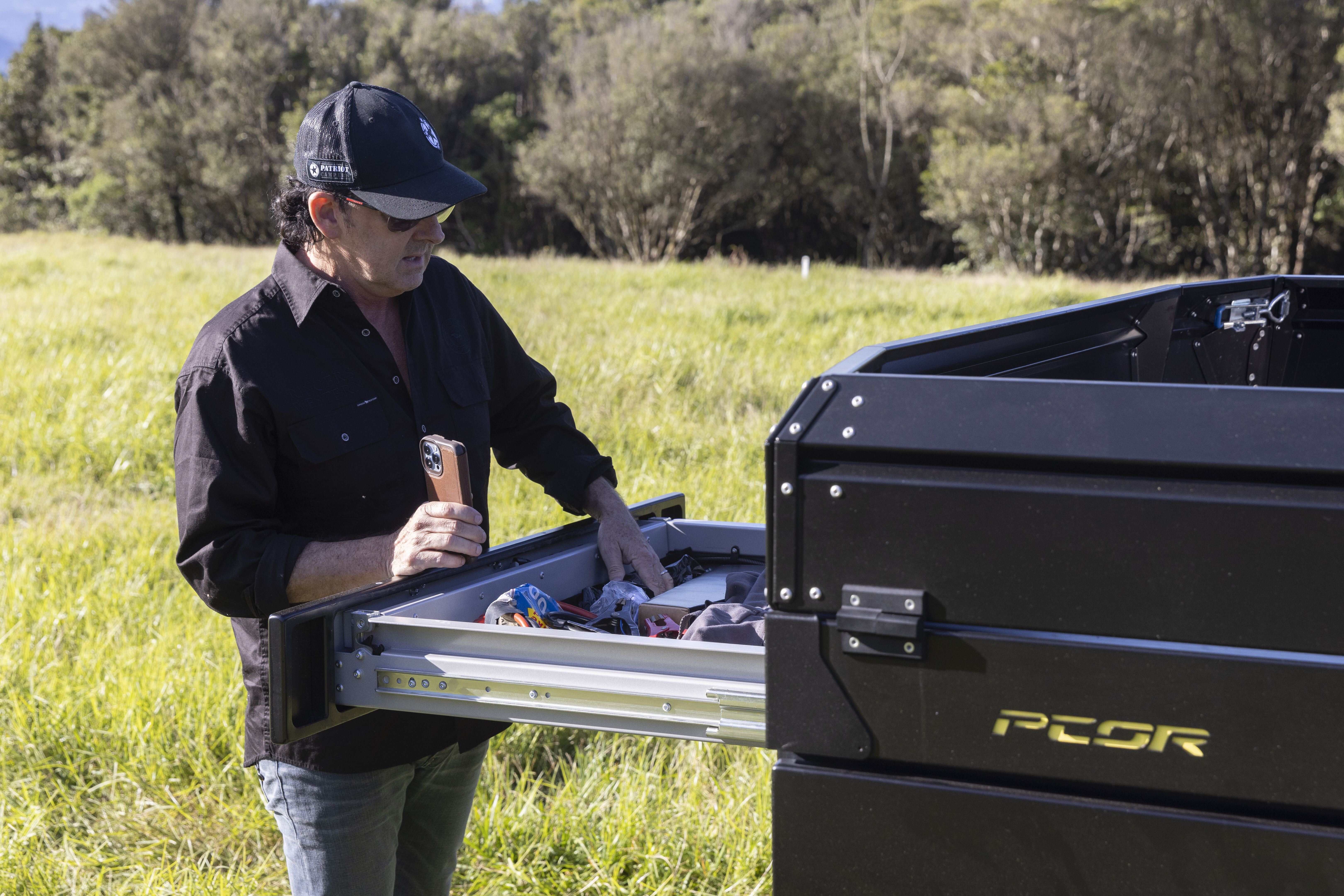
Departmentalised
The four-door cabin has been done over with Department of the Interior fittings from new centre console to overhead console for the GME UHF radio. Then there are extra USB outlets, more cupholders plus custom-made speaker pods front and rear. Hit-making musicians need a well-sorted stereo.“The boys from the Department of the Interior really went to town on this,” said Lee. “So I’ve got a Kenwood head with a Focal audio system with 1200-watt five-channel amplifier and 10-inch sub-woofer behind the back seat, and it just cranks.”
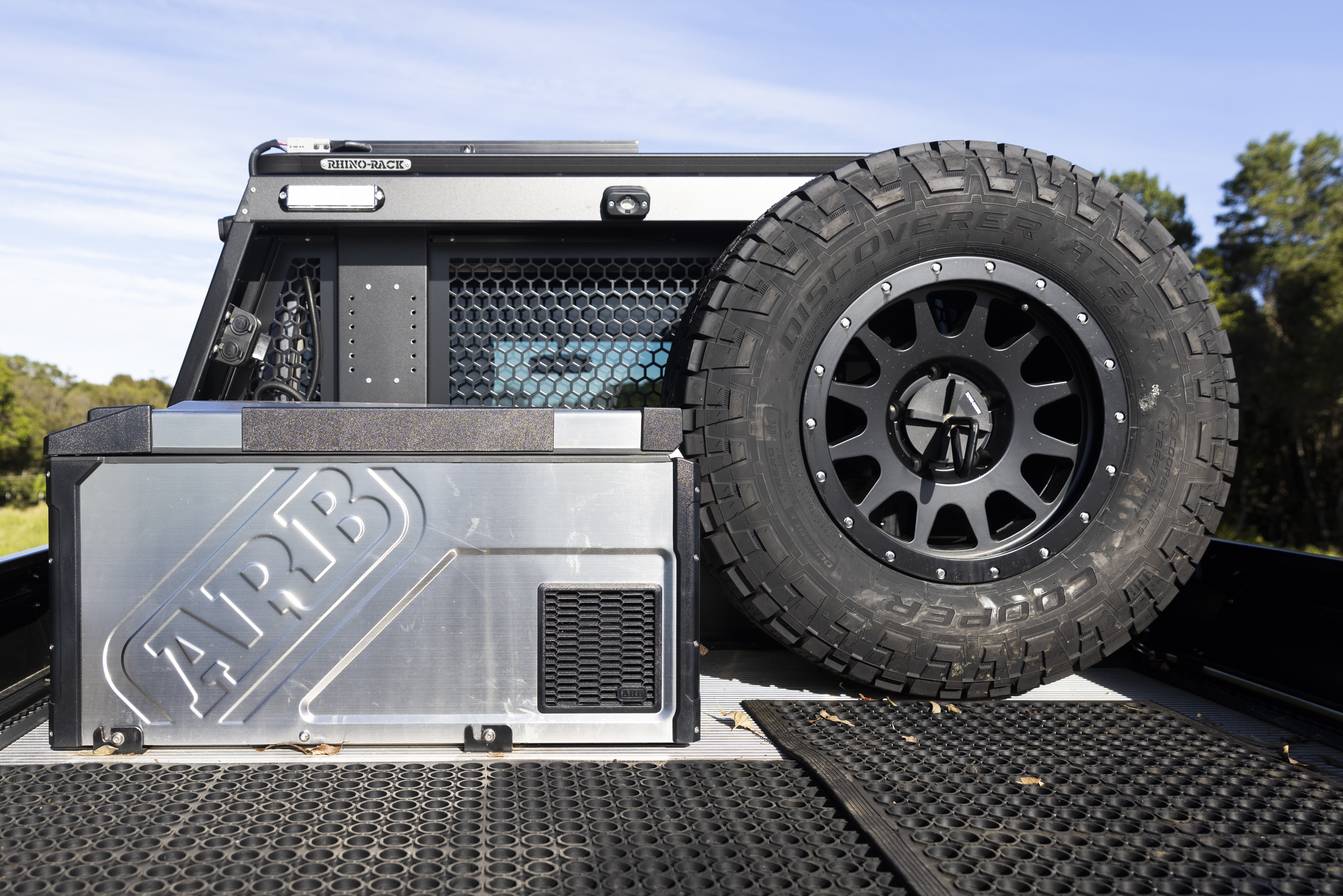
On the pragmatic side, the Cruiser’s cabin windows have a deep and solar-reflecting tint for the glass and there’s a set of Sand Grabba floor mats; Lee learnt the hard way not to get in to the mud without them. (And, through Queensland’s Big Wet of early 2022, those Cooper tyres were also much appreciated for traction on his 50-acre bush block.)For now Lee Kernaghan is not wanting for anything more on this latest ute, now with some 18,000km on the clock. It’s family friendly and capable, he says, for anything from a trip far back in to the mulga or poking around his mountain retreat.

“During that wet spell we had, I don’t think there’s any other vehicle that could’ve got through up here in the ranges,” Lee said. “It was horrendous.”
Up here, where locals believe the mountains have a special energy, has been home to much of Lee’s songwriting through the years. But ute and 4WD songs are more likely inspired by getting out and dirty; Baptise the Ute was released in 2002 after a weekend at LandCruiser Park. “It was almost like it wrote itself,” Lee revealed.
I saw the ute I heard the voice I knew I had to make her mine Shiny and red, on the showroom floor I scratched my name on the dotted line I’m on a mission, the Grand Tradition There’s only one thing left to do There’s a clay pan, there’s a big old mud hole Gunna take my brand-new baby right on through Baptise the ute Baptise the ute You won’t be satisfied until you do
Lee’s favourite escape remains a western Queensland run. “Out through Thargomindah, Noccundra, Innamincka, up through the Stony Desert, back up to Birdsville,” he tells us. “I feel the weight of the world comes off your shoulders the further west you head, there’s an incredible sense of freedom out there.”And Lee Kernaghan knows his well-dressed LandCruiser 79 Series will get him there, and back, with comfort and competence.
Mid-size 4×4 dual-cab utes are very popular choices with those who tow because most of them offer a 3500kg towing rating, their relatively long wheelbases are good for stability when towing, and they are more affordable than the big 4×4 wagons that also offer that 3500kg capacity like Land Cruisers, Patrols and Land Rovers.
ALERT! Get our full 2022 dual-cab ute comparison storyTowing is a huge piece of any ute test, particularly as a factor in helping buyers decide which model will prove safest and most capable for their needs. . No surprises, the towing component of our 2022 Dual-Cab Ute Comparison is a story in its own right – so to keep that main piece a little easier on the eyes and to save your fingers from scrolling fatigue, we’ve broken the tow test out into this big story you’re reading right now. To read the rest of our comparison, hit the link below. |
JUMP AHEAD
- Ford Ranger Sport V6
- Ford Ranger XLT
- Mitsubishi Triton GSR
- Mazda BT-50 GT
- Isuzu D-Max LS-U
- SsangYong Musso XLV Ultimate
- What about the cars we couldn’t tow test?
- Toyota Hilux SR5
- Nissan Navara Pro-4X
- LDV T60 Max
- GWM Cannon-X
2022 Dual-Cab Ute Comparison: Tow Test
Australians are spoiled for choice when it comes to dual-cabs utes to tow with. As some of the biggest-selling vehicles in Australia are in this category, manufacturers are falling over themselves to get product into the market and to eager buyers.
This gives potential owners plenty of choices no matter their budget, from lower-priced single-cabs in the $30,000 range right up to heavily-equipped sports utes like the Ranger Raptor or Volkswagen Amarok W580.
Ford’s Ranger is the newest mid-size 4×4 ute to hit the Australian market and it is the first such vehicle to really take towing seriously.
Not only does it offer the choice of the V6 diesel engine and a four-wheel-drive system that gives users the versatility and safety of full-time four-wheel drive, but it’s loaded with clever tech features to make towing easier and safer for all users, be they beginners or seasoned towing experts
The 2022 Ford Ranger V6 4×4 will be hot property for those who tow heavy trailers, so as soon as the chance arose we hooked a Ranger Sport V6 and a Ranger XLT 4×4 (with the carried-over bi-turbo four-cylinder diesel engine) to see how they compare to other popular utes in the class.
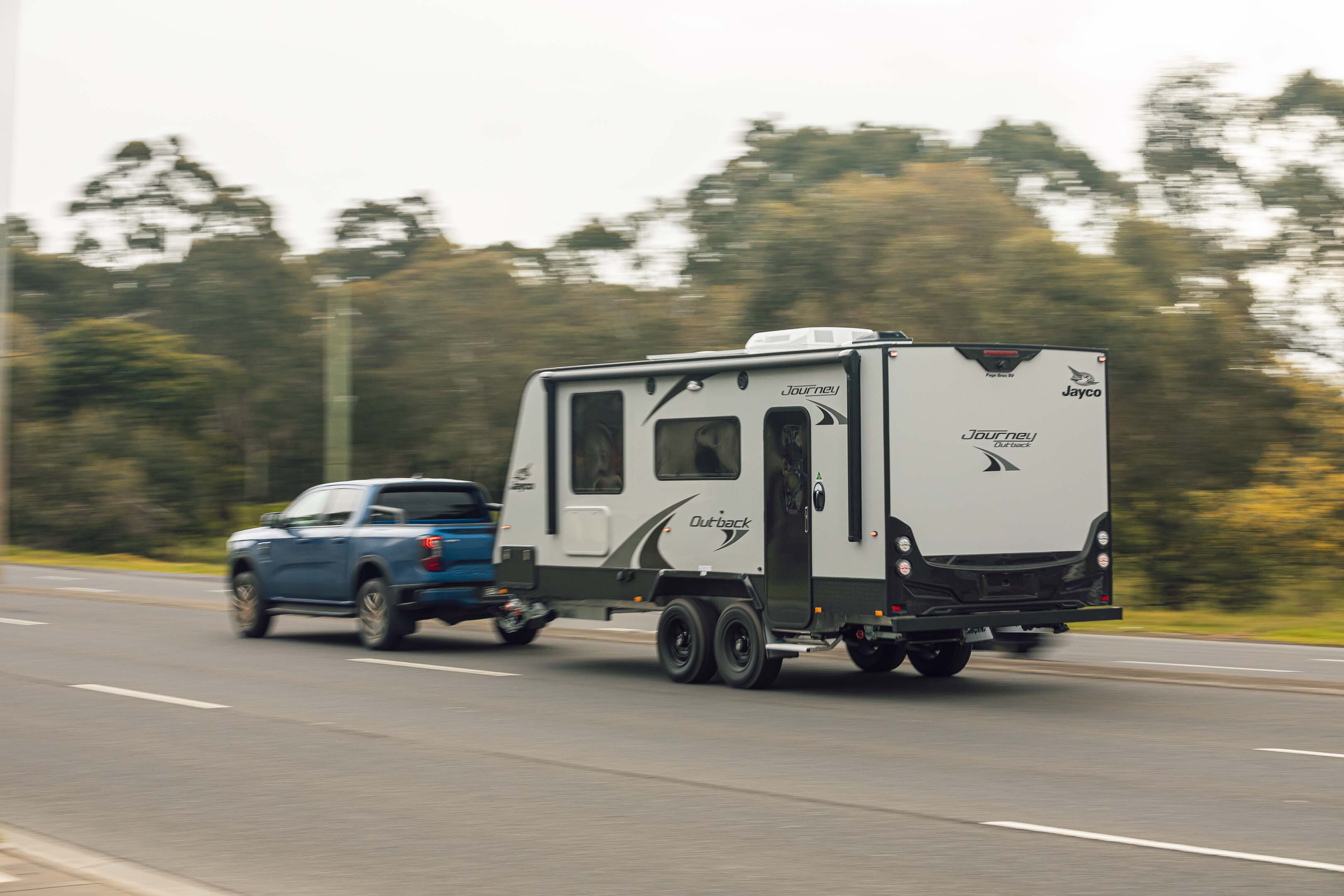
For this test, we borrowed a Jayco Journey Outback caravan from the team at Page Brothers Jayco RVs and Caravans in Moorabbin. This dual-axle off-road van is 6.1 metres long and weighs in at 2100kg, with approximately 140kg down on the tow ball. It’s a fairly typical example of the size and type of caravan you see being hauled behind utes all over Australia, so it suited our test perfectly.
All new Ford Rangers (except the Raptor) have a 3500kg rating for towing a trailer with brakes. The gross combined mass (GCM) – the maximum allowed weight of the Ranger, fuel, any cargo and accessories plus the weight of the trailer – varies depending on specification but for the Rangers tested here it is 6400kg for the Sport V6 and 6350kg for the Ranger XLT four-cylinder.
These important figures are at or near the top of the mid-size ute category and are sure to entice buyers who want to haul a boat, horse float, caravan or race car.

Engine outputs of the Rangers are also impressive. The 3.0L V6 diesel produces 184kW of power and 600Nm of torque, giving the V6 Ranger the most grunt in the class. Even the bi-turbo four-cylinder isn’t lacking in this regard with 154kW and 500Nm, making it one of the gruntiest four-cylinder 4×4 utes.
Both engines are backed by a 10-speed automatic transmission and only the V6 gets the 4×4 system that offers full-time 4×4 as well as rear-wheel drive, locked 4×4 high range and locked 4×4 low range modes.
Tech loaded
The new Ford Ranger brings a level of technology specifically designed for towing that you won’t find on any other ute in this segment.
From the starting point of hooking up the trailer, the Ranger has towing in mind. When reversing up to the trailer, the rear-view camera not only has directional lines showing you the steering angle but also a centre line you can follow to line up the tow ball directly under the tow hitch. This makes hooking up easier if you are solo and have no one to guide you back.
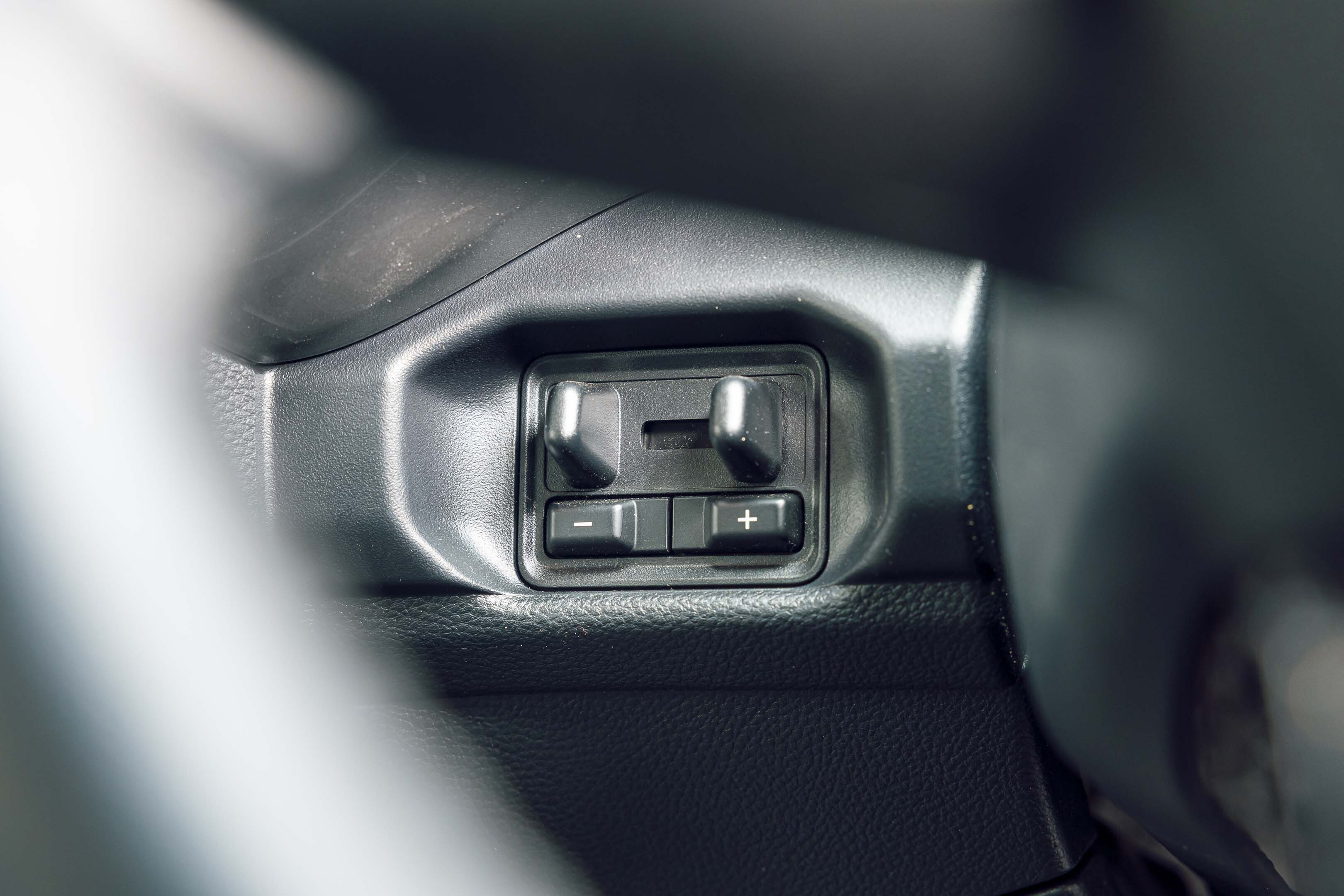
Both our Rangers were fitted with the optional Touring Pack, which includes the 360-degree camera and an integrated electronic brake controller.
You need a brake controller to operate the electric brakes on heavy trailers like the Jayco we have here, and in the past you had to buy an aftermarket unit. Ford has its own controller and it integrates neatly on the lower dash. The tow bar and associated wiring come standard on Rangers.
Once you have the trailer electrics hooked up, the centre screen will show you that it has detected a trailer and ask if you would like to configure it. You can configure your Ranger for multiple trailers of different sizes, for example, if you own a caravan, a box trailer and a boat.
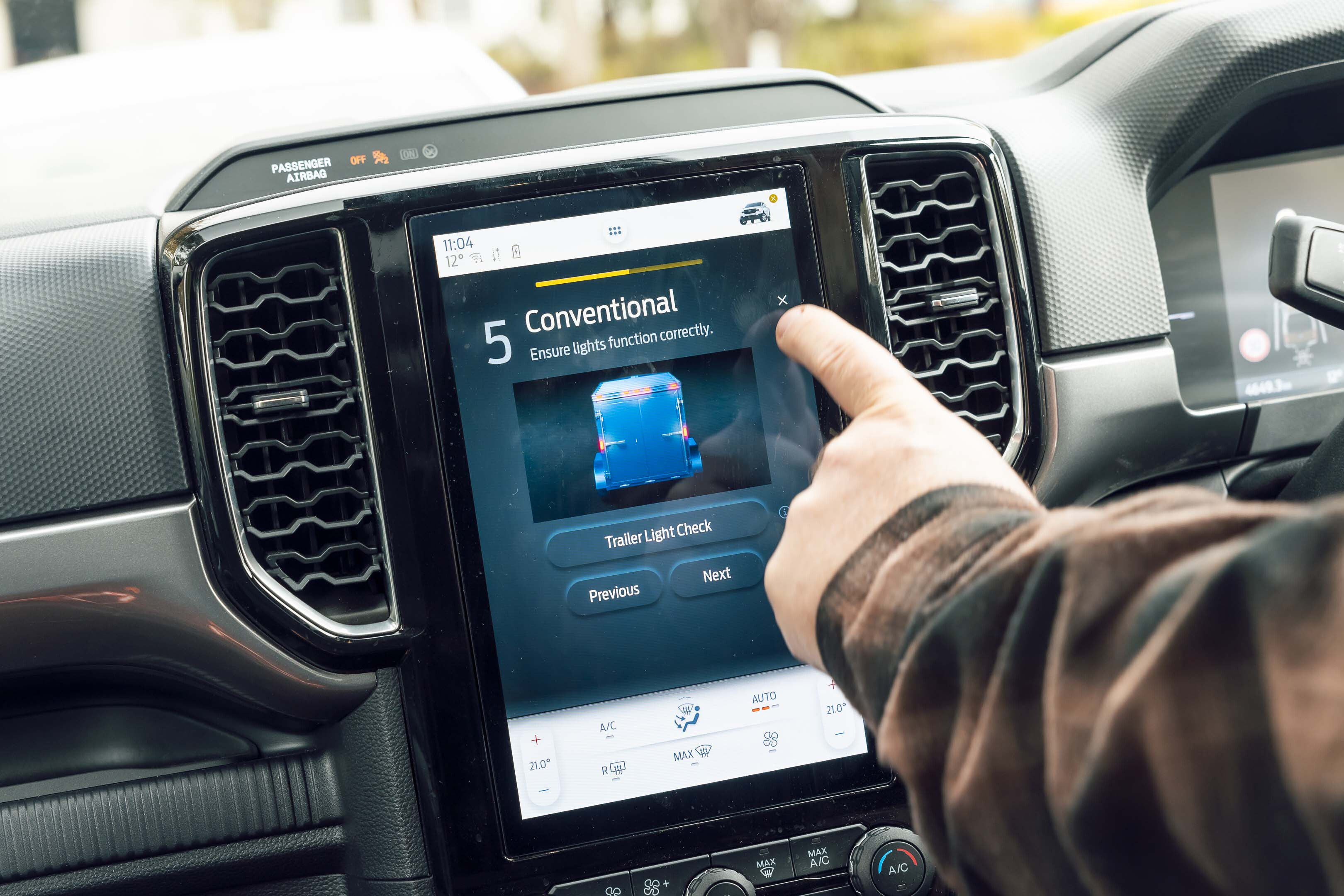
By inputting the length of your trailer when configuring it, the system will then calibrate systems such as blind-spot monitoring and rear cross-traffic alert to ensure they still work as they should with the added length of the rig. There’s also a default trailer setting, which is what we used for this test.
Once you are all hooked up and configured, the screen can then take you through a step-by-step towing checklist to make sure you’ve hooked up all the relative hardware and electrics needed. There’s even a trailer light check mode that once activated, cycles the rear lights so that you can check that all your trailer lights are working as they should without the assistance of a spotter.
This is all really clever but simple stuff that will make it safer and easier for any driver to tow any type of trailer
One last piece of tech available on most of the new Ranger models is the various drive modes, which include a ‘Tow-Haul’ setting that optimises the chassis and throttle calibrations for towing.
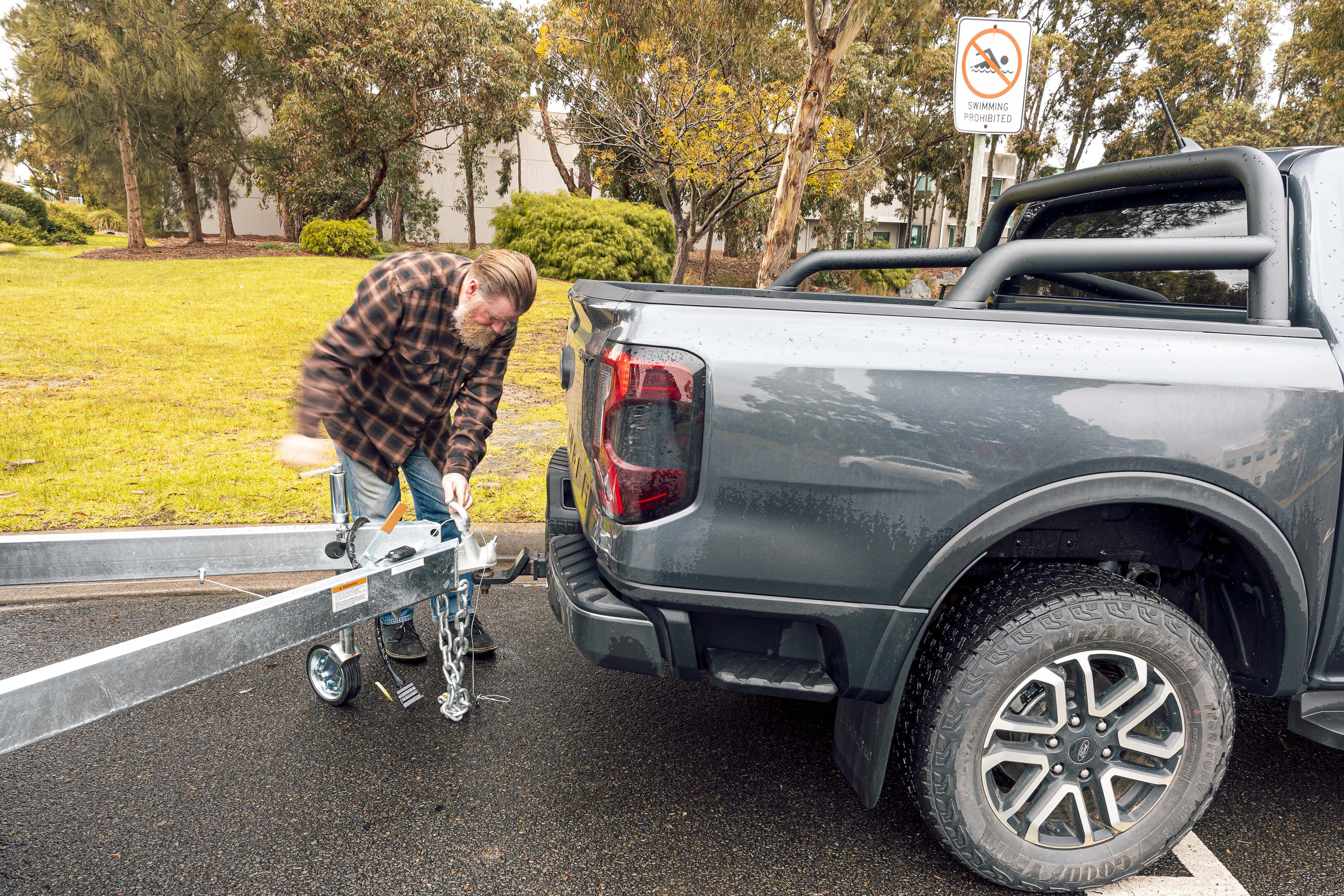
Ranger Sport V6
- Braked towing rating: 3500kg
- GCM: 6400kg
- Payload: 934kg
- Fuel consumption on test loop: 16.7L/100km
It all provides the Ranger with a large ‘footprint’ on the road and this works with a very well-calibrated suspension set-up to deliver smooth travel over rough roads.
There is very little, if any, of the pitching and porpoising that you get in many vehicles when towing on the factory-fitted standard suspension. The chassis remains smooth and balanced over the rougher terrain to give the driver control and a feeling of confidence in the Ranger’s abilities.
The roads were wet on the day of our test and pulling away from a standstill on a hill produced wheelspin with the Ranger in its rear-wheel-drive setting. Selecting 4A full-time four-wheel drive allows you to run in 4×4 on sealed roads and removed our problem of rear wheelspin in the wet.
Very few 4×4 utes offer this full-time 4×4 setting; only the Mitsubishi Triton and outgoing Volkswagen Amarok were among the popular models, so it’s great to now have it on the new Ford.
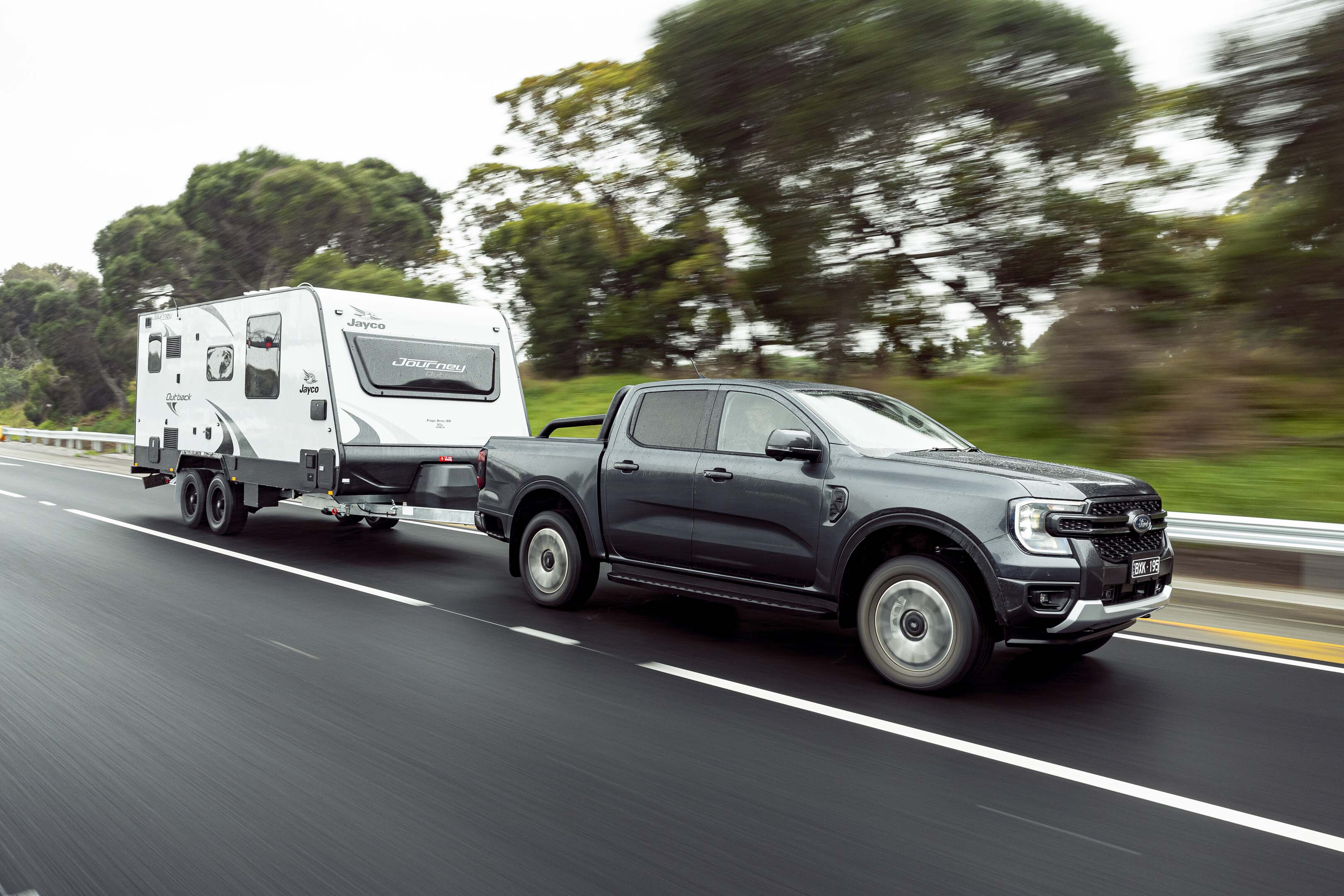
Ford’s V6 diesel engine pulls the 2100kg Jayco van with ease and has plenty in reserve for overtaking and climbing hills. It’s relatively quiet and refined in the way it gets on with its job, again making the job of the driver easier.
The 10-speed automatic transmission performs well when left to its own devices and manual shifting is done using buttons on the right-hand side of the gear selector knob. This is especially useful when you want to downshift to give a bit of trailer braking when slowing down.
We did find that the transmission was shifting through to higher ratios sooner than was ideal with the drive mode set to Normal but after switching it to the Tow-Haul mode, the transmission holds the gears longer and makes driving even easier.
The Ranger’s chassis electronics include trailer sway control, which works with the vehicle’s electronic stability control (ESC) system to detect if and when a trailer might start to sway or fishtail on the road. It didn’t happen on this drive with the Jayco but could occur with an incorrectly balanced or poorly set up trailer.
Interestingly, the Jayco Journey is equipped with its own ESC system but when plugged into the Ford, it is automatically disabled and didn’t present any issues on this drive.
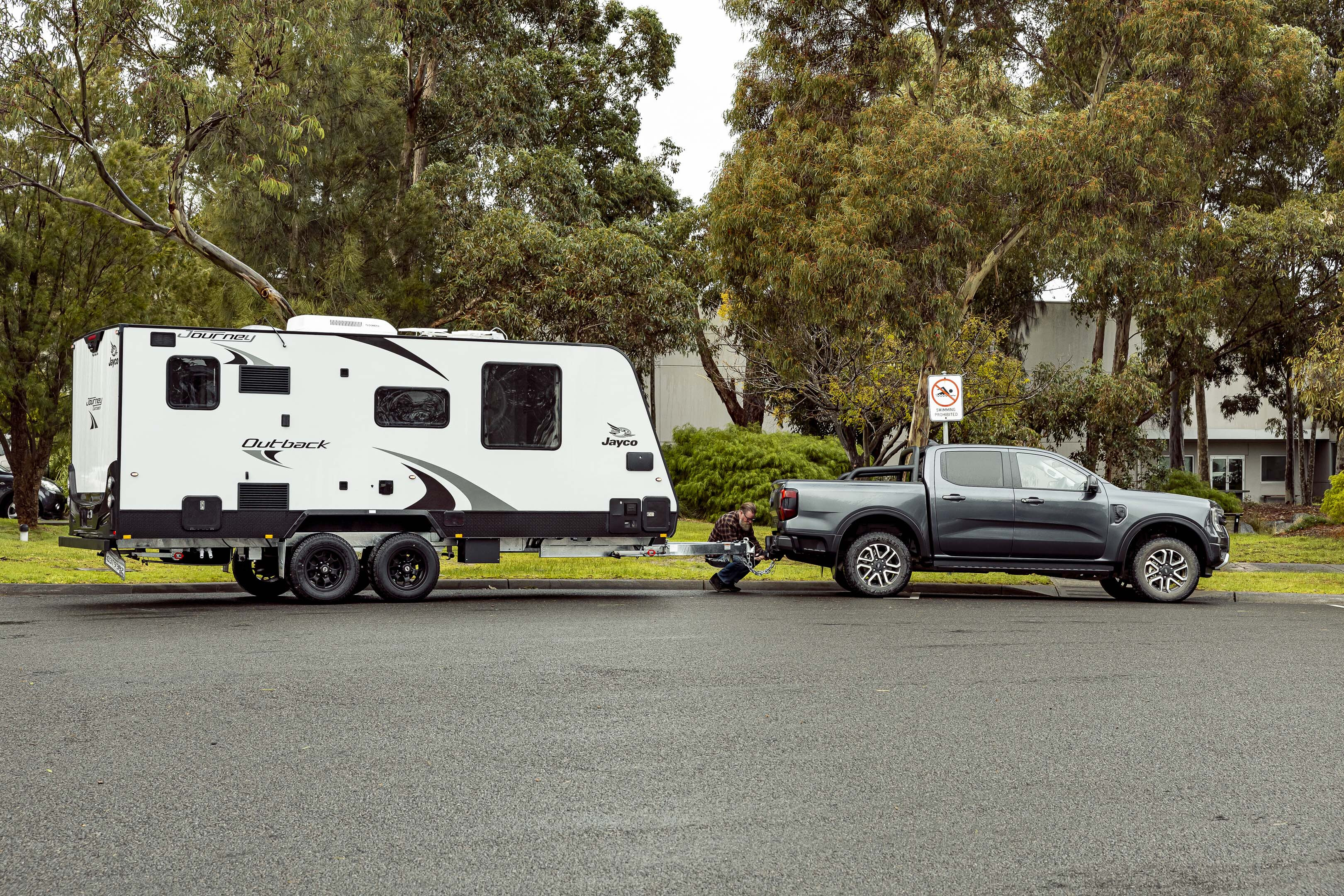
Ford Ranger XLT four-cylinder
- Braked towing rating: 3500kg
- GCM: 6350kg
- Payload: 959kg
- Fuel consumption on test loop: 17.3L/100km
Choosing the bi-turbo four-cylinder engine means you don’t just miss out on the performance and refinement of the V6 but a few significant features as well. The biggest omission is the full-time 4×4 capability, which is exclusive to the V6 models and brings benefits on wet and varied roads when towing. You also miss some of the driving modes but the Tow-Haul setting is still there.
The electronic towing aids and on-screen guides are also there when you have the optional Touring Pack fitted as our blue Ranger did.
Head out of town in the four-cylinder Ranger XLT with the Jayco on the back and you still get all the chassis benefits of the V6 Ranger. It’s stable and controlled and again really gives the driver confidence in the car’s abilities.
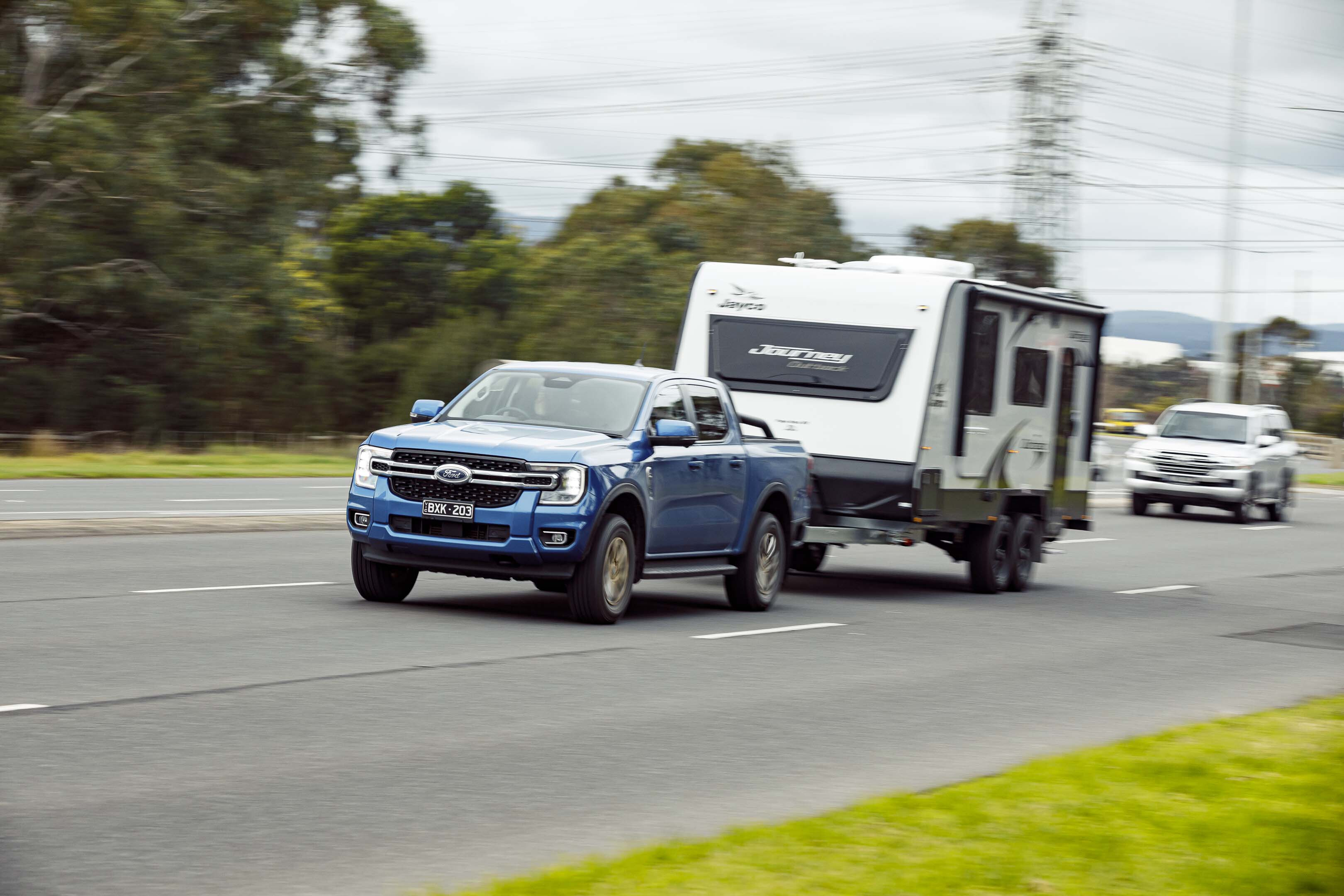
You need to put your foot down a bit harder to get the most out of the smaller engine but with 500Nm available, the XLT wasn’t left lacking on our drive. It was only on a longer hill climb that it was holding a lower gear and we could hear and feel the engine working harder – but not as if it was being flogged.
An indicator of how much harder the four-cylinder XLT Ranger worked than the V6 Ranger Sport was in the fuel consumption. The smaller engine used 17.3L/100km of diesel over the same road loop on which the V6 used 16.7L/100km. We’ve found similar results in the past when asking a smaller engine to do the same work in the same cars over the same route.
The new Rangers proved not only to be competent and relaxed towing vehicles but with the new technologies and features included, they made towing easier and safer.
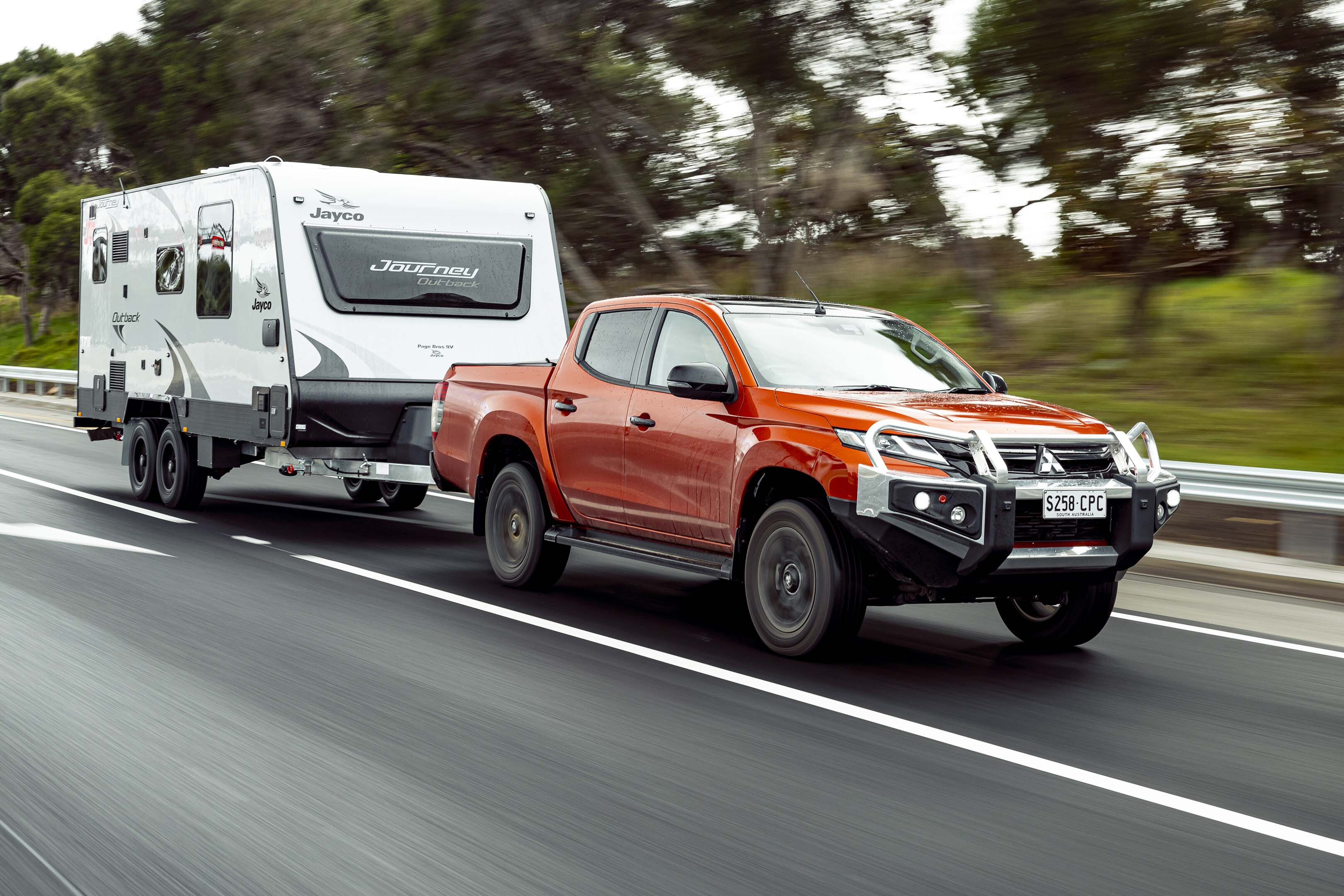
Mitsubishi Triton GSR
- Braked towing rating: 3100kg
- GCM: 5885kg
- Payload: 901kg
- Fuel consumption on test loop: 17.8L/100km
I say little because it is physically smaller than many of its competitors here and for many buyers, this is a positive. But its size and relatively short wheelbase of 3000mm means that Mitsubishi conservatively rates the Triton’s towing limit to 3100kg.
However, it does make up for this shortcoming somewhat with a generous GCM that still allows you to carry a bit in the vehicle if you are towing at the maximum weight.
That short wheelbase combines with a long overhang at the rear to give the Triton a bouncy feel when towing the 2100kg Jayco caravan. There’s a lot of leverage between the tow bar and the rear axle, resulting in a porpoising when travelling over uneven road surfaces.
As the upper-spec model of the Triton line-up, the GSR is fitted with Mitsubishi’s Super Select four-wheel drive system, which gives you the option of driving in full-time four-wheel drive on sealed roads.
The Ranger Sport V6 was the only other vehicle in the group to offer this and as we found with the Ford, having full-time 4×4 proved beneficial to reducing wheelspin on wet roads during our test. Having an unlocked 4×4 system can also be very beneficial when manoeuvring a trailer on some surfaces.
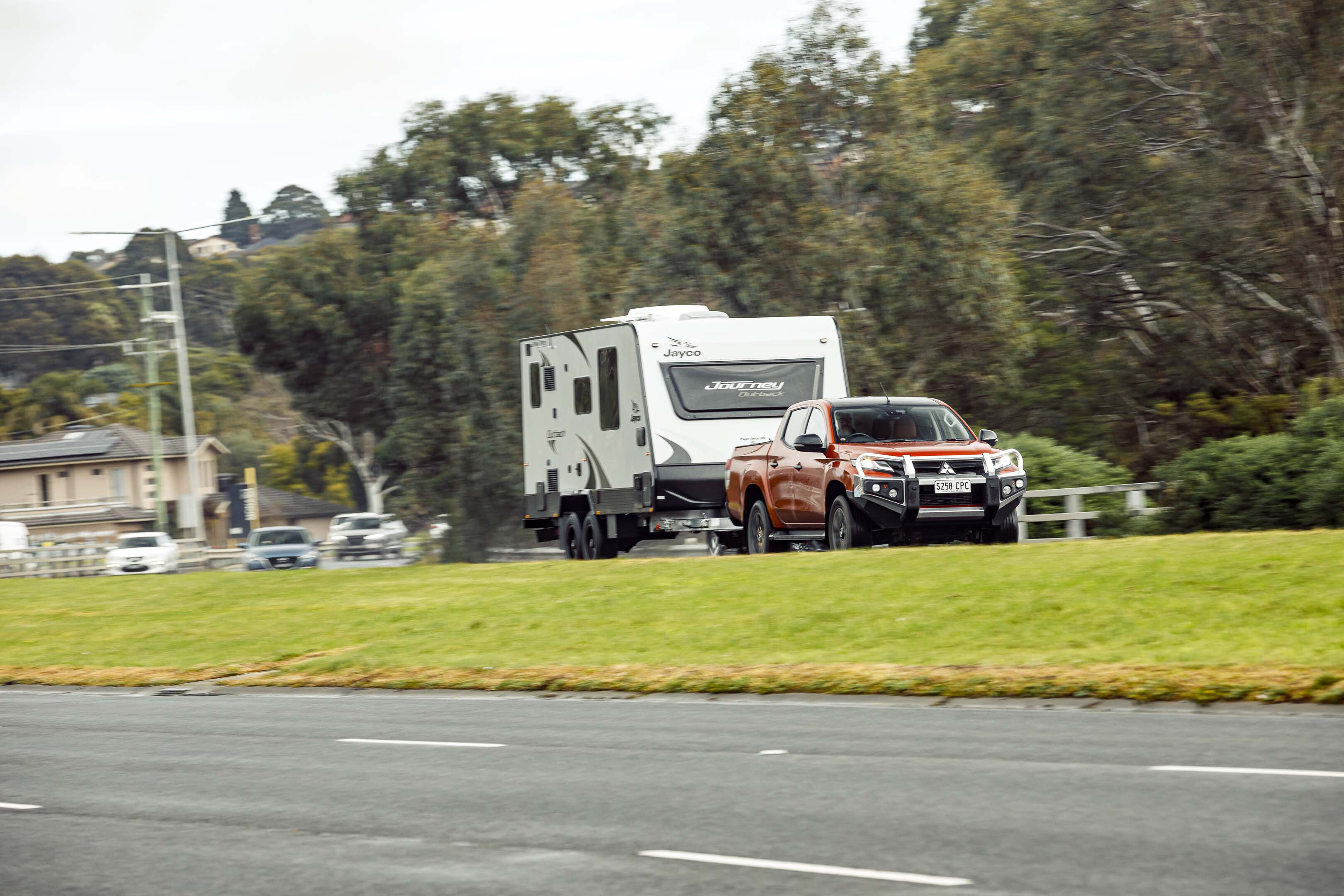
Also beneficial on the Mitsubishi are the transmission paddleshifters mounted behind the steering wheel. Affixed to the steering column so that they don’t move with the steering wheel, the shifters make it easy for tipping back a gear or two when you want a bit of engine braking. As the only vehicle in this group to have them, the Triton was the easiest to operate in this regard.
Mitsubishi’s single-turbo 2.4L engine makes just 133kW of power and 430Nm of torque, so is at the lower end of the outputs list but it did an admirable job.
We could feel it working harder than the other engines over the same loop and the transmission kicked right back to second gear, keeping the engine near redline on the long hill climb. The effort required by the powertrain resulted in high fuel use, with 17.8L/100km being the thirstiest on test.
As with most of the utes that needed to have an aftermarket brake controller fitted for this test, the Triton was fitted with a unit from Australian manufacturer Redarc. Mitsubishi and most other brands fit the Redarc unit as a dealer option.
The lower-spec Triton didn’t have the brake controller fitted so it didn’t get tested with the Jayco. Given it has the same powertrain, chassis and wheelbase, we’d have to expect that its performance would replicate that of the GSR.
A couple of things the GXL+ misses out on are two of the positives of the GSR; the Super Select 4×4 system and paddleshifters. Both are only fitted to the top two Triton grades, GLS and GSR.
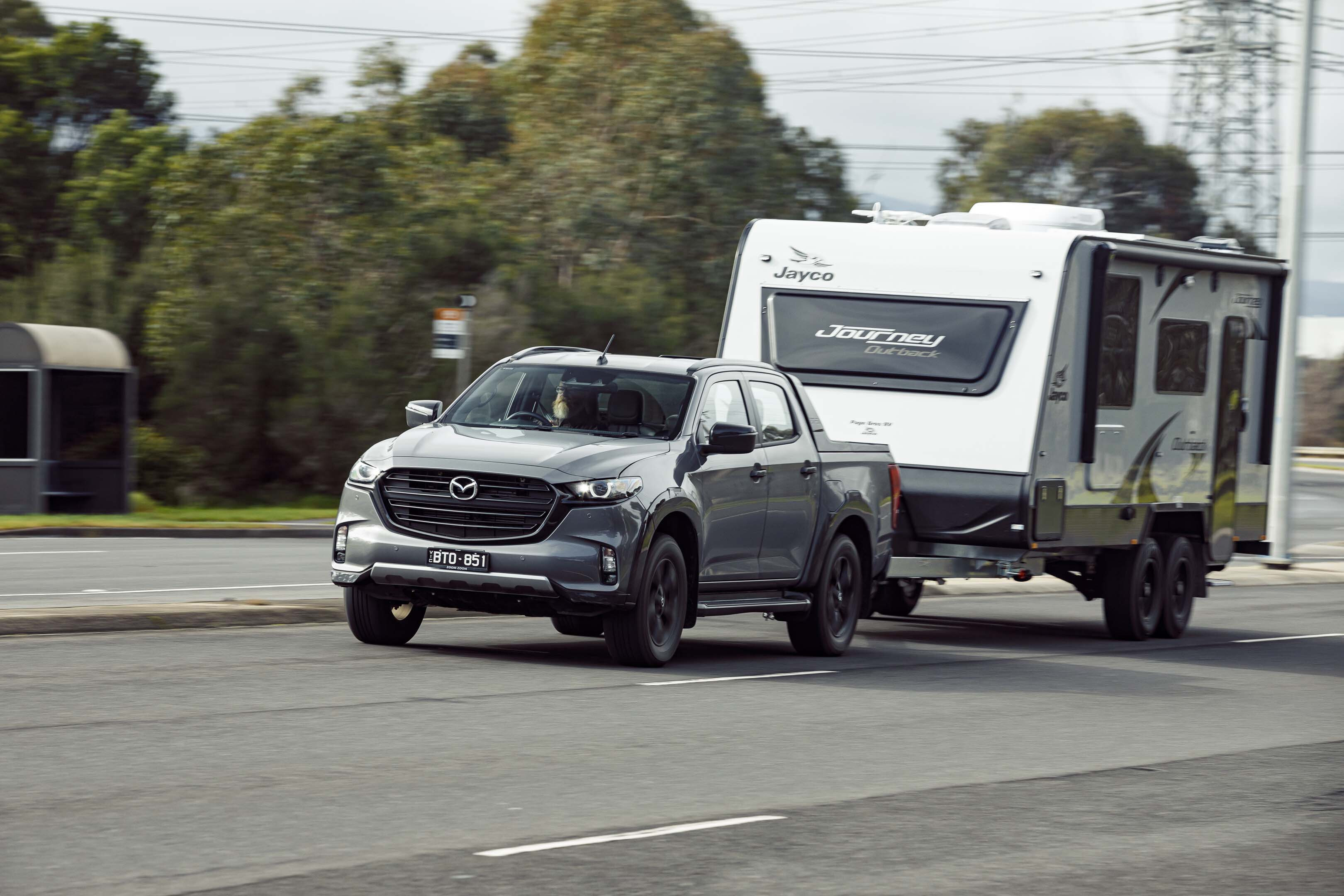
Mazda BT-50 GT
- Braked towing rating: 3500kg
- GCM: 6000kg
- Payload: 1065kg
- Fuel consumption on test loop: 15.5L/100km
Since 2020, Mazda’s ute has come from a collaboration with Isuzu so what you get is basically a reskinned D-Max with a bit of Mazda personality and style.
As such, the BT gets Isuzu’s trusted 4JJ diesel engine and Aisin six-speed automatic transmission backed by a part-time four-wheel-drive system, just like in the D-Max. It makes a modest 140kw of power and 450Nm of torque so it’s feeling the pinch against some of the newer and more sophisticated engines.
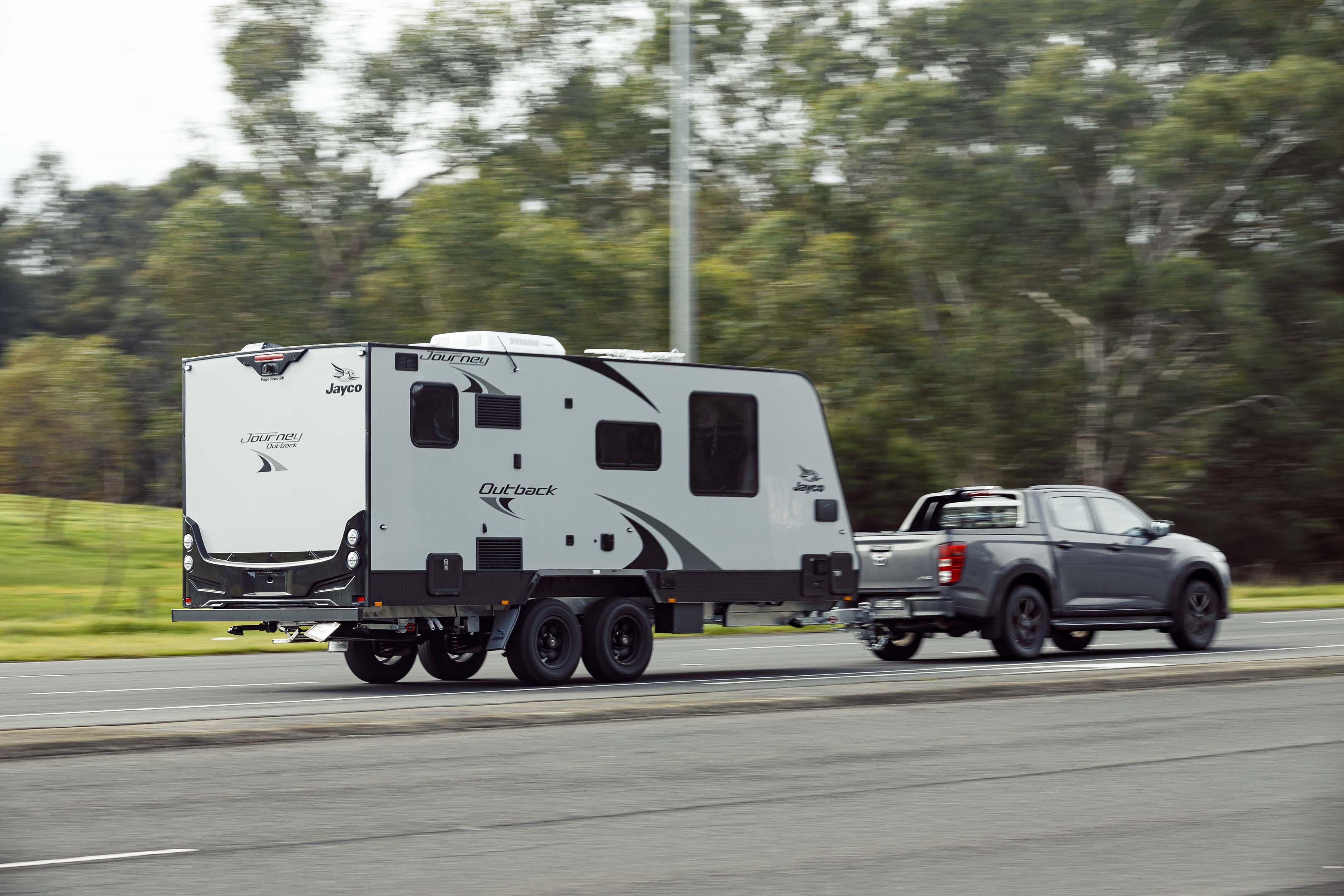
The BT-50’s chassis has a 3125mm wheelbase and Mazda has differentiated it from the D-Max with its own suspension tune, which is softer in the way it rides and controls a load. As a result, it pulled the Jayco caravan with composure but was a bit bouncy over the undulations. The BT-50 felt like it would really benefit from an aftermarket suspension upgrade to make it a better towing ute and many owners would be going down this route anyway.
Its Isuzu engine does an admirable job of pulling the 2100kg trailer considering its outputs but it does work hard on the hills. It also proved to be the most economical of all the utes we towed with, in both the Mazda and the Isuzu.
The transmission likes to shift through to the higher gears quickly, which helps with fuel economy but is not ideal when you want some engine braking. Thankfully the transmission shifter easily taps across toward the driver for manual gear selection and to hold the ratios you want.
The only time the transmission did kick back a few ratios was on the long hill climb where the engine was working its hardest.
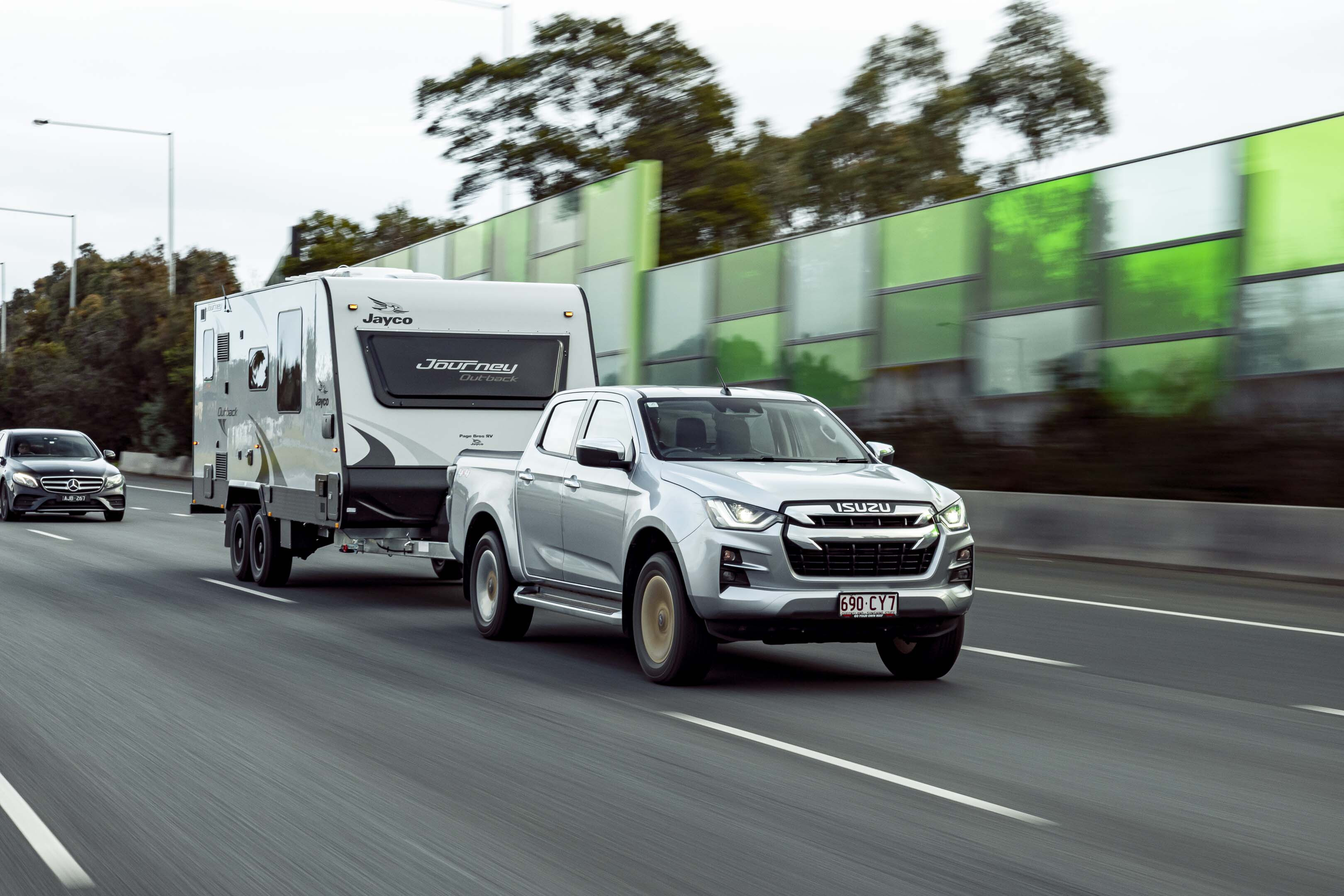
Isuzu D-Max LS-U
- Braked towing rating: 3500kg
- GCM: 6000kg
- Payload: 995kg
- Fuel consumption on test loop: 15.3L/100km
The real mechanical difference between the two shared platforms is in the suspension tune.
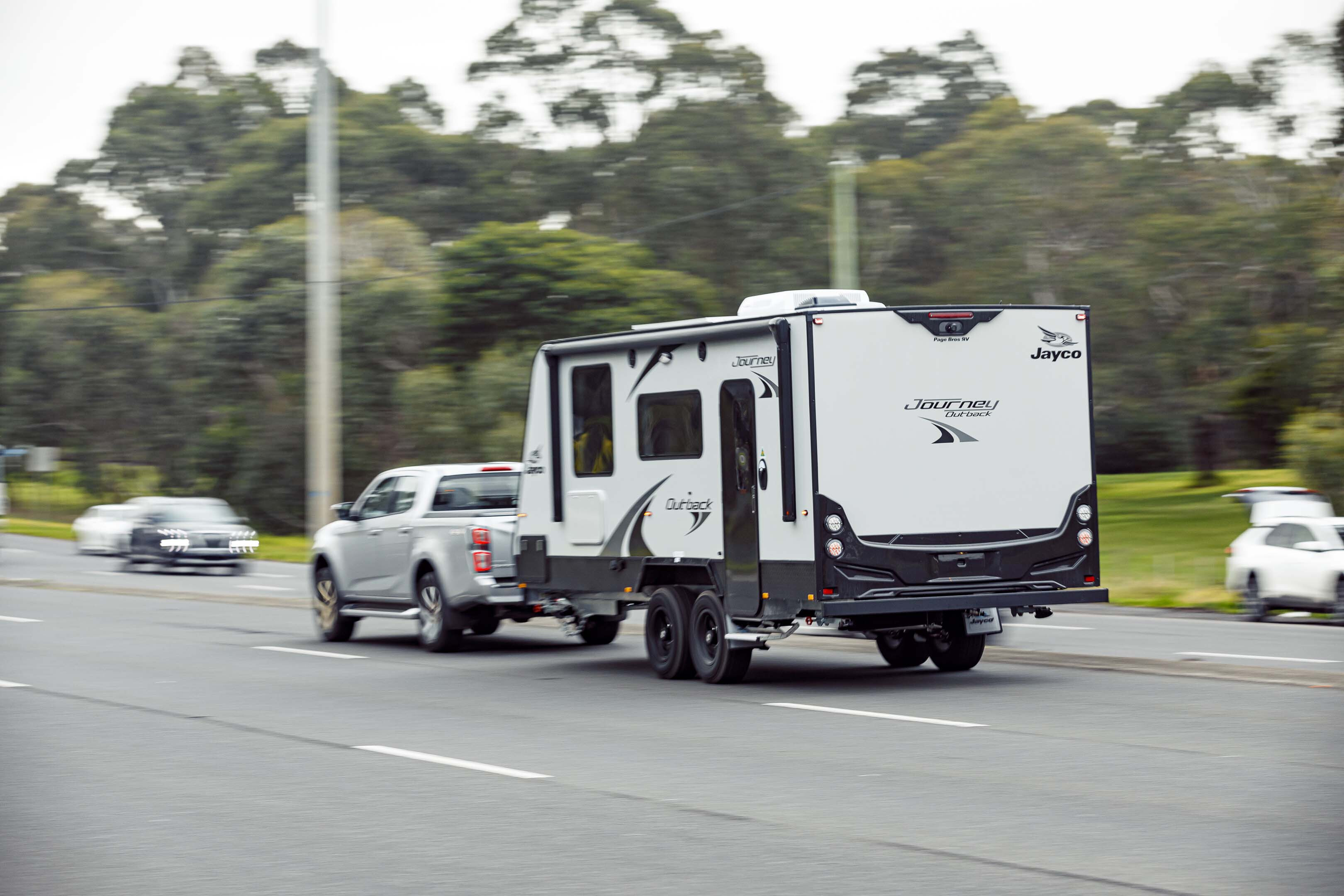
The D-Max is firmer in its suspension, which offers a more controlled composure when towing but is less comfortable when there is no load on the vehicle.
Its powertrain was the same as the BT-50, so modest performance, noisy on the hill climb and the transmission shifting through to higher gears rapidly.
The D-Max has the same gear selector as the Mazda, so holding gears manually was simple (and needed). The D-Max marginally bettered the BT in fuel consumption, recording the lowest figure of all the utes tested.
UPDATE, October: MY23 D-Max pricing announced
The updated 2023 D-Max has been detailed, with tweaks to styling, equipment and engine options. Get the full story at the link below. We’ll be driving the updated models as soon as they reach Australia, but mechanically they’re largely unchanged.
Story continues
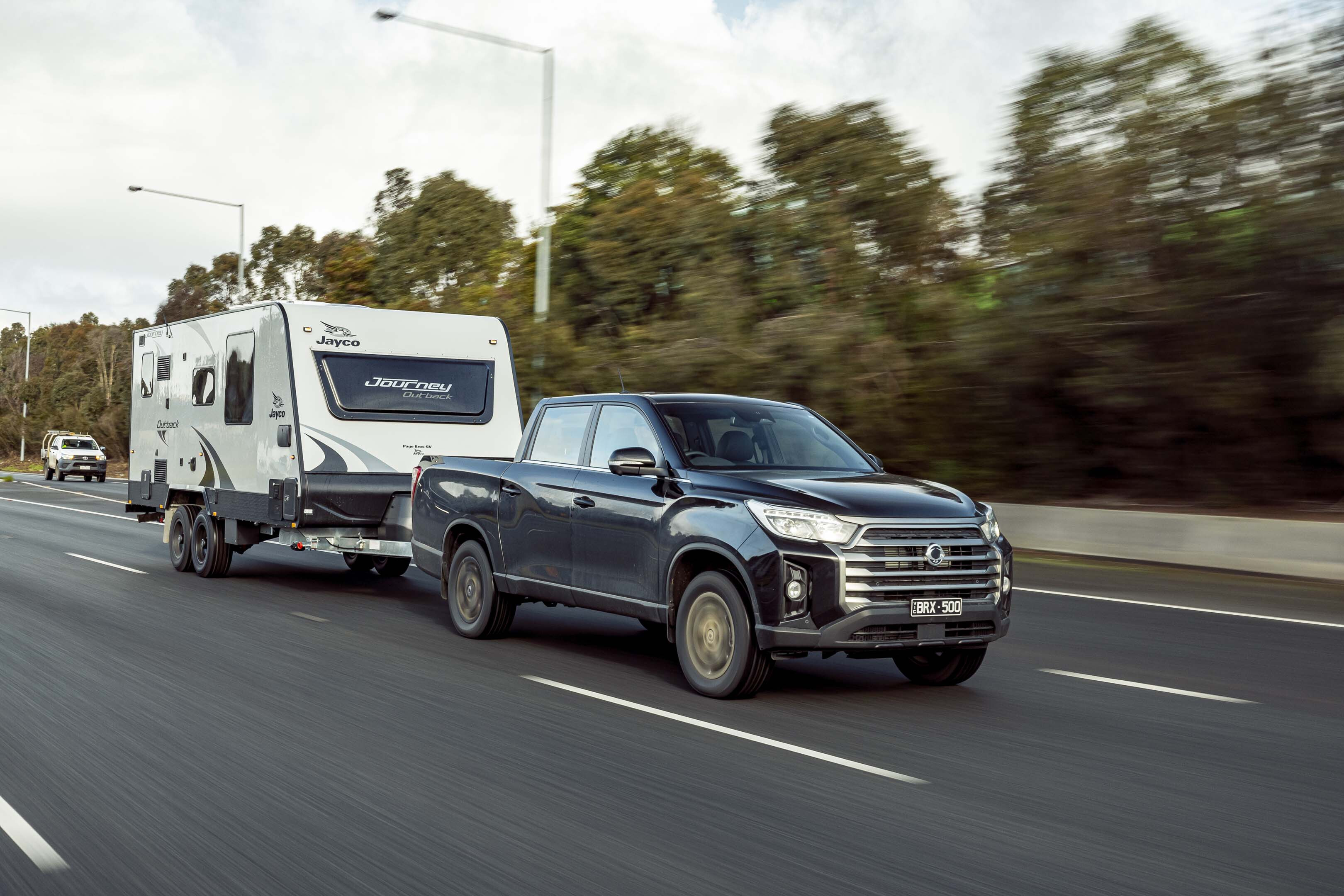
SsangYong Musso XLV Ultimate
- Braked towing rating: 3500kg
- GCM: 6130kg
- Payload: 880kg
- Fuel consumption on test loop: 16.8L/100km
What you most appreciate when you get inside the Musso is the space it offers, with the widest cabin in the class and it is loaded with features.
Towing-wise, the XLV benefits from a long 3210mm wheelbase, which is only outdone by the Ranger’s 3270mm between the axles. A bigger point of difference is that the Musso Ultimate XLV has coil spring rear suspension that offers better ride and handling than most of the leaf-sprung utes.
This particular Musso was equipped with the optional heavy-duty suspension package that was locally developed in Australia in association with Ironman 4×4, so this kit should have improved the chassis for towing duties.
As we’ve found when driving the Musso with this optional suspension in the past, it does deliver a firm ride when unladen although it’s never harsh or uncomfortable. It carries the 140kg download on the tow ball with barely any noticeable sag and that composure continues out on the road and over the undulations. This is a very stable platform that proved well-suited to towing this caravan.
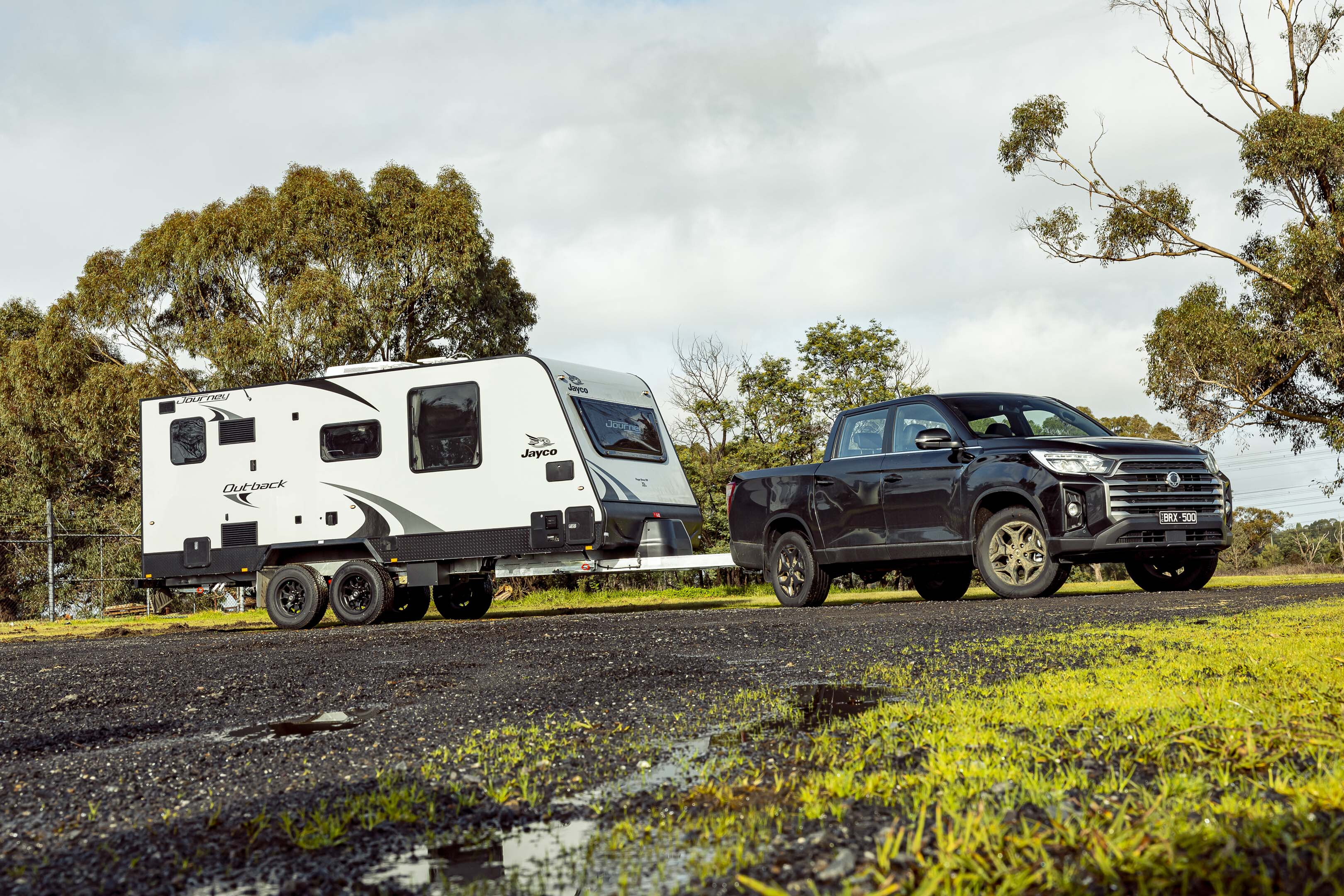
Where the Musso does fall behind is in the performance of its engine. The 2.2-litre single-turbo mill makes just 133kW of power and 420Nm of torque, and really felt the load of the van behind it. It was particularly slow heading up the steep incline and its workload was reflected in a 16.8L/100km fuel consumption result.
The Musso can’t get the 144kW/441Nm engine tune and eight-speed transmission from the Rexton wagon soon enough – we believe that SsangYong Australia is working to make that happen.
For its part, the Musso’s current six-speed transmission gave nothing to complain about on this drive. Manually selecting gears is done using a toggle switch on the side of the gear shifter, operated by the driver’s thumb. It’s relatively simple in operation and easier to use than the Ford’s buttons in the same location.
What about the cars we couldn’t tow test?
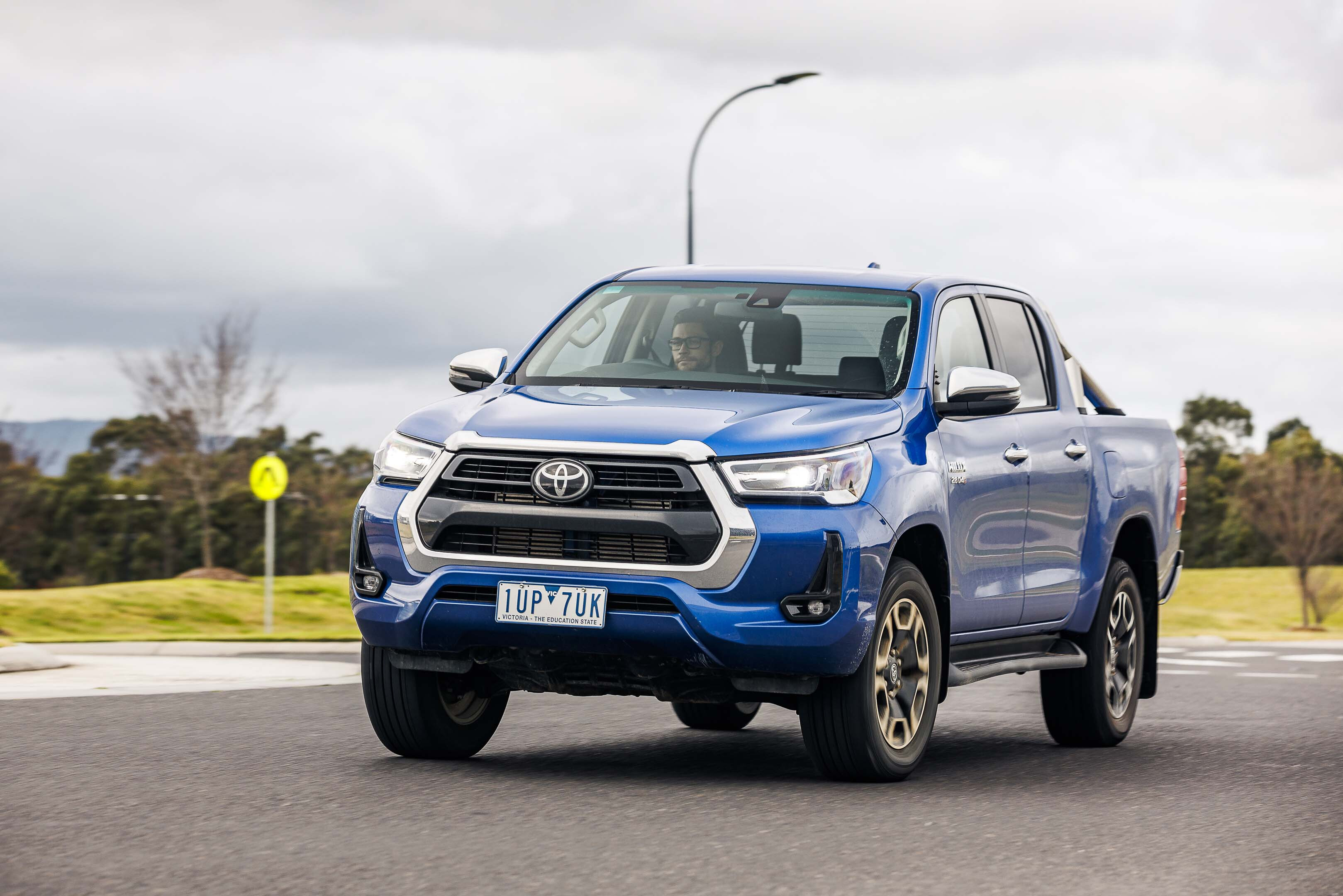
Toyota HiLux SR5
- Braked towing rating: 3500kg
- GCM: 5850kg
- Payload: 995kg
While our test car was fitted with a tow bar it did not have a brake controller for the electric brakes on the trailer, so we were unable to sample its towing ability on this occasion.
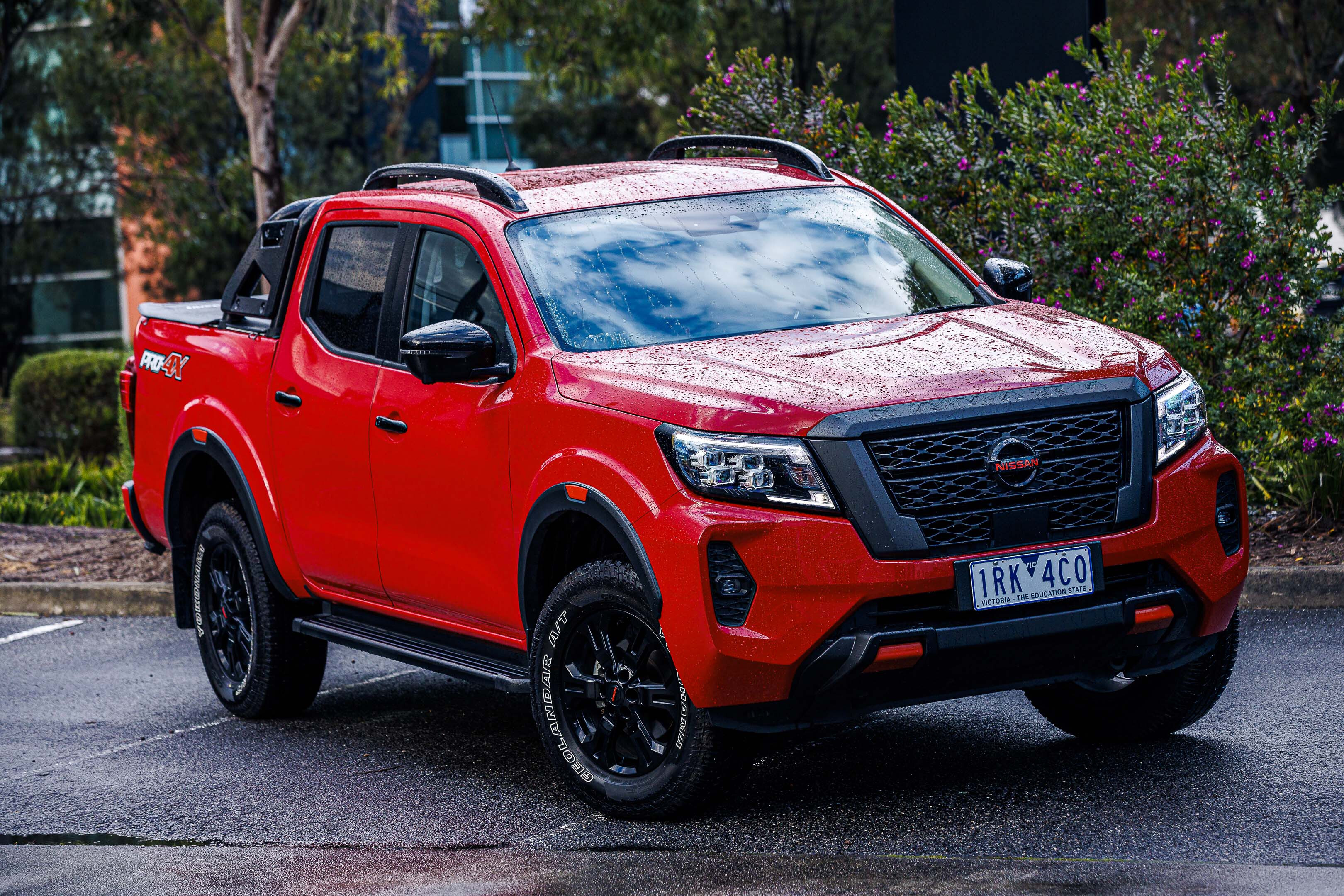
Navara Pro-4X
- Braked Towing rating: 3500kg
- GCM: 5910kg
- Payload: 1004kg
Nissan’s 2.3-litre diesel engine makes 140kW of power and 450Nm of torque but those numbers don’t tell the full story. The engine’s twin-turbo arrangement delivers the torque in a linear manner, with no peaks in the way the Navara accelerates.
Considering its capacity and clever forced induction set-up, the output figures are very modest when you consider that smaller bi-turbo engines in the LDV and Ford are producing 500Nm of grunt.
The Navara has a seven-speed automatic transmission and part-time, dual-range four-wheel-drive system.
Kudos to Nissan for giving this high-spec model a 5910kg GCM and more than one tonne of payload. Unfortunately, the vehicle supplied for this test didn’t have a brake controller fitted so it couldn’t be used to tow the caravan.
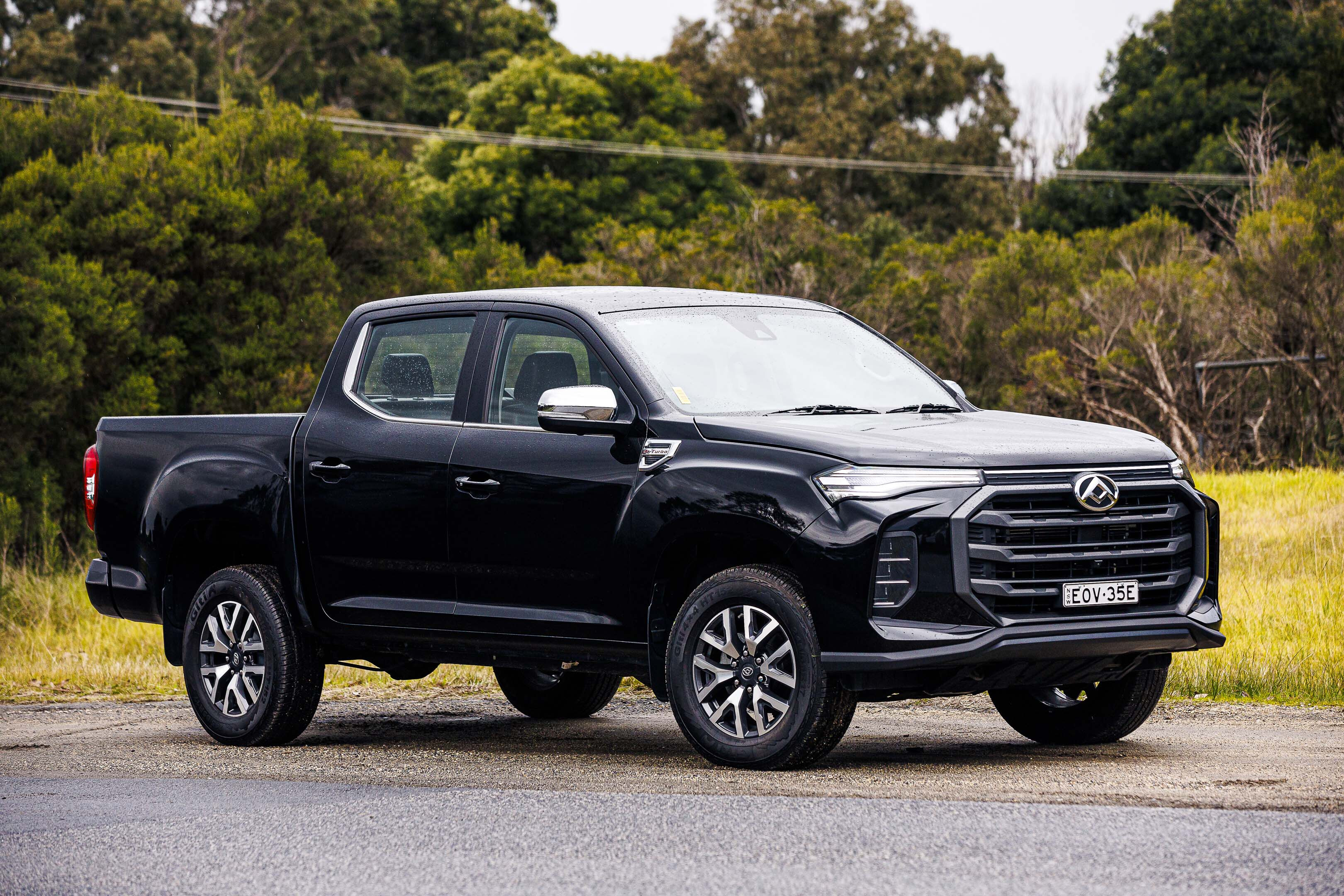
LDV T60 Max
- Braked towing rating: 3000kg
- GCM: 5900kg
- Payload: 750kg
Judging from its very firm suspension, we’d hazard to guess that the sharp-looking LDV should tow reasonably well but the test car wasn’t fitted with a tow bar or any other towing accessories so it couldn’t be used on the towing loop.
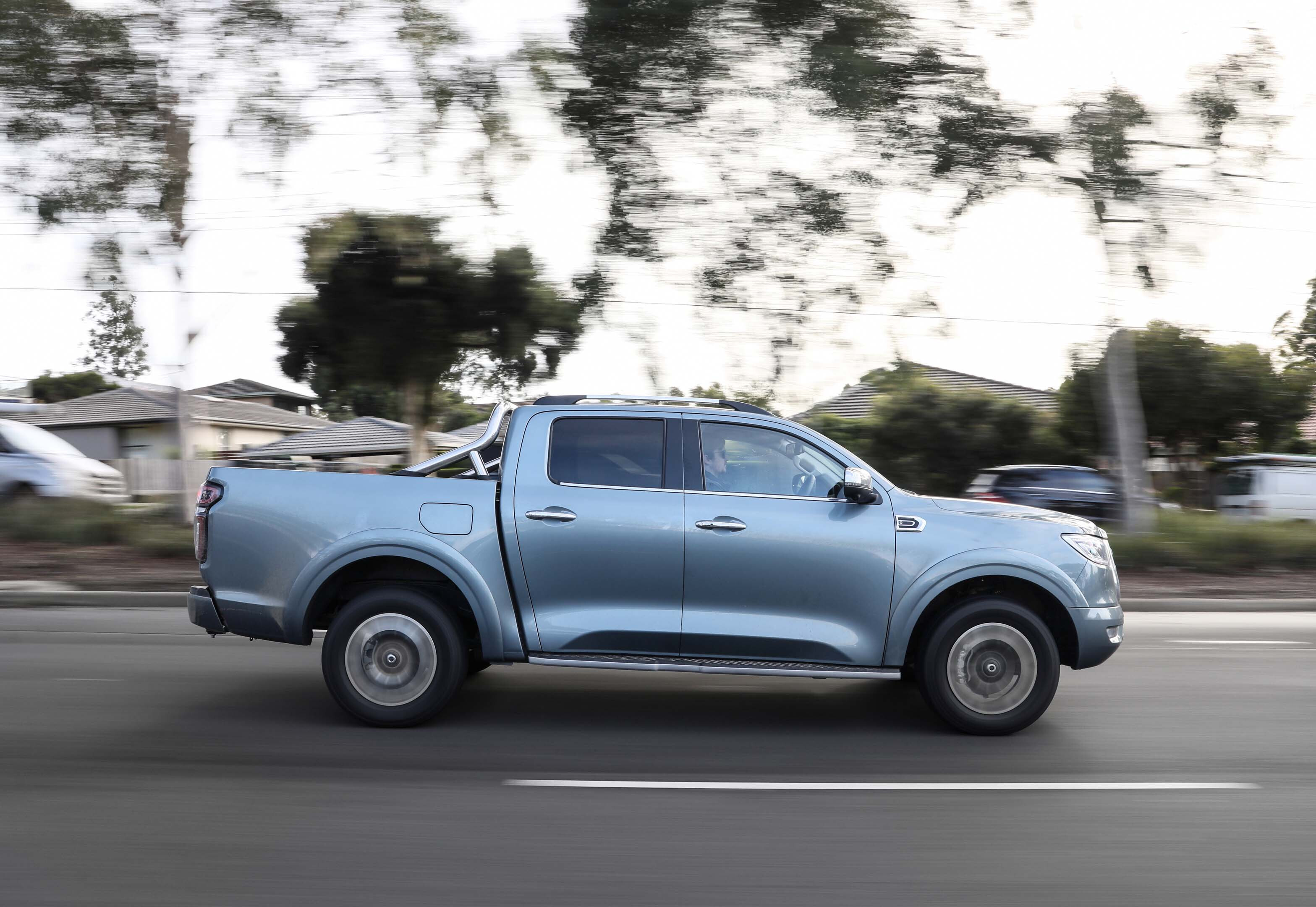
GWM Cannon-X
- Braked towing rating: 3000kg
- GCM: 5555kg
- Payload: 1050kg
Its 3000kg tow rating is low for the class, as is the 5555kg GCM, indicative of the engine outputs, but we didn’t get to hook the van up to it on this test as it wasn’t fitted with a brake controller.
To read the rest of our comparison, hit the link below.
Special thanks
A big thank you to the team from Page Brothers RV – Jayco in Moorabbin, Victoria for the loan of the Jayco Journey Outback Caravan.
Get in touch with them for all your RV and Jayco caravan needs at pagebrosrv.com.au.
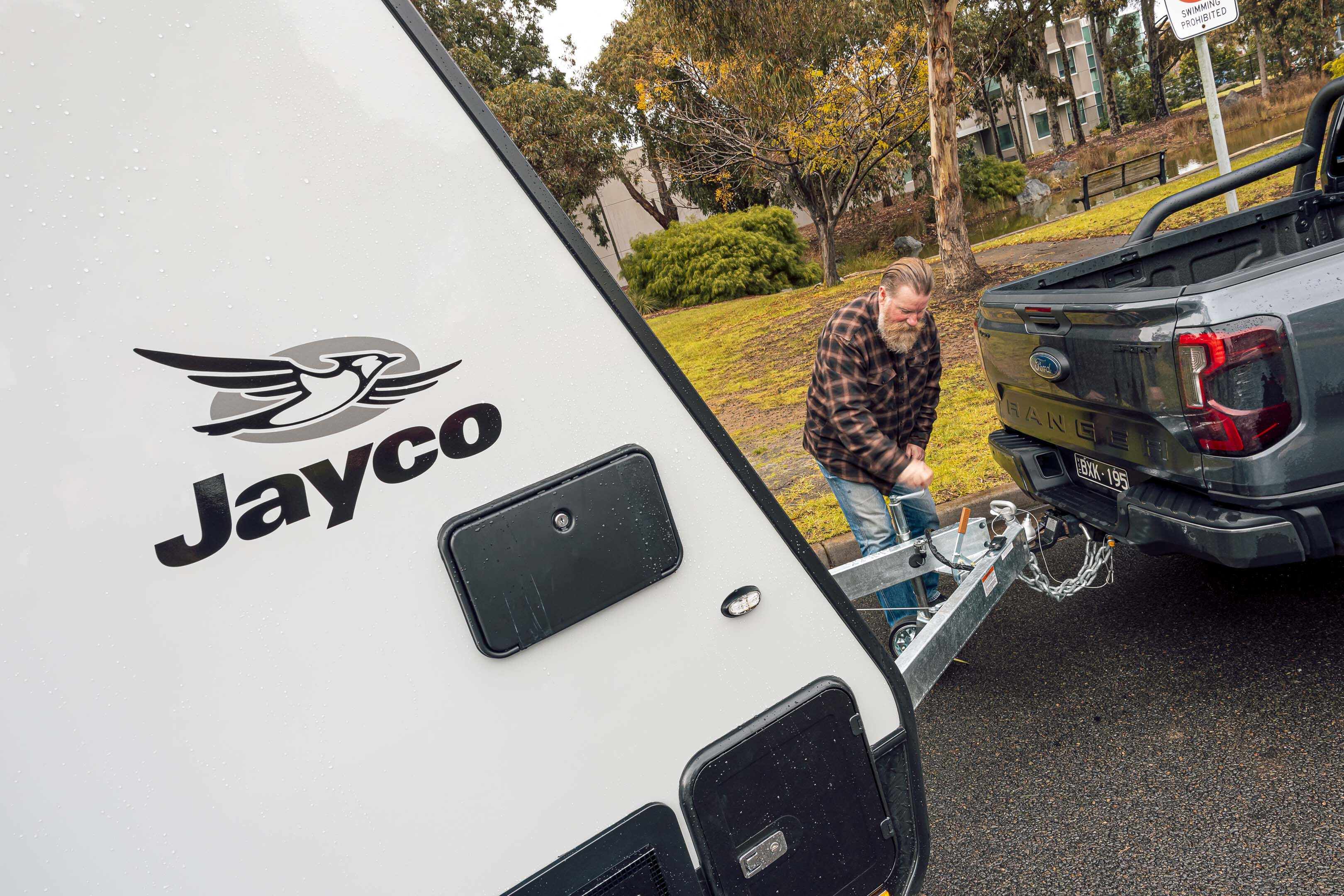
It was a scorcher of a day, with temperatures of 43°C and winds that grew stronger as the day went on. Not the sort of day you’d want to be stuck on a four-wheel drive track.We’d spent the morning at Masons Bay, an idyllic spot for a swim or a paddle in crystal-clear water, near Hopetoun on Western Australia’s southwest Southern Ocean coastline. There were only a couple of other cars on the beach and some kayakers out on the water.
When we visited to check it out in early February, there were still a few camping spots vacant. The road to get in was a bit corrugated but nothing a D-Max couldn’t handle. We parked on the beach, had a swim, then drove to nearby Starvation Bay before heading back to Hopetoun.
The tracks around Starvation Bay are a four-wheel driver’s heaven, but the hot gusty winds on our visit weren’t conducive to being out on the tracks, so we headed back to our beachfront caravan park at Hopetoun.
That afternoon, we smelled smoke, and the fire seemed to come from nowhere. We learned afterwards that a haystack had caught fire and lightning sparked more spot fires. Within minutes, the sky was black, and smoke and flames could be seen from our caravan park.
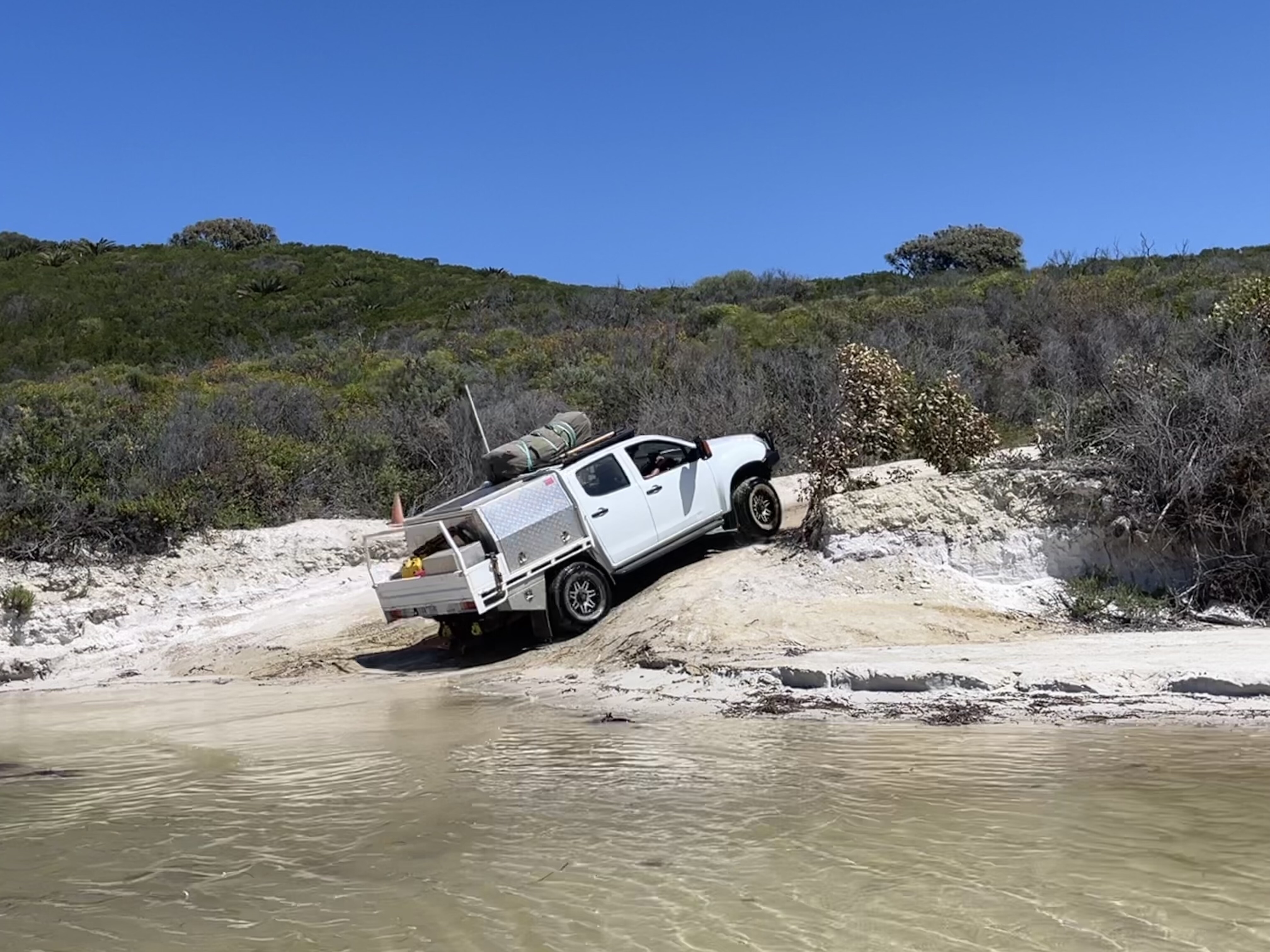
Hopetoun is on the doorstep of Fitzgerald River National Park, one of the largest and botanically significant parks in Western Australia. It’s a quiet little town that wasn’t on our radar, but it’s off-the-beaten-track location and surrounding attractions make it a worthwhile detour when travelling along the south-west edge of Australia.
Along with Ravensthorpe and Munglinup, Hopetoun makes up what’s known as the Fitzgerald Biosphere Coast. The Hopetoun Beachfront Caravan Park is basic, but has a great vibe and ticks all the boxes. It’s nestled within the bush and beachfront, within walking distance to the pub. It’s also just a stone’s throw to the Fitzgerald River NP, which is accessed via Hammersley Drive.
Fitzgerald River National Park
Within the park you’ll discover a rugged coastline, mountains, viewing platforms and a ton of adventure. There are many turnoffs to coves and beaches and they’re all worth a look, but Barrens Beach and Mylies Beach in particular are worth a visit. Climb East Mt Barren for spectacular views of the coastline and the surrounding National Park.
It’s a steep, relentless climb, so choose a day when the wind is low and the temperature is mild, as it was on the day we climbed it. You can also walk the Hakea Trail to the breathtaking Quoin Head.
For an exciting off-road adventure head to the Hamersley sand dunes for some of the most fun and challenging tracks in the area. Nearby Ravensthorpe is a patchwork of rolling hills, natural bushland, history and a 29km 4WD journey that takes you along the top ridge. The range has the most eucalyptus species in the world for its size, and explodes with wildflowers and mining history.
From Hopetoun, head up to Munglinup via Springdale Road, turning right at Munglinup Beach Road. Back in the floods of 2017, more than 300mm of rain fell in a 24-hour period, devastating this area, destroying bridges and cutting off the towns of Hopetoun and Ravensthorpe. It has taken years to repair all of the infrastructure.
Fast forward to February 2022 and fire is now on the doorstep of Fitzgerald River NP. The Hopetoun caravan park we stayed at wasn’t evacuated, but most people had packed up and left for the groyne area out on the jetty, or the town oval. W
e stayed on high alert, hitched up our van and were ready to leave if necessary. We learned the next day that a few homes were lost, and a mini tornado had blasted through at the same time, tearing off a house roof near Hopetoun’s Farm Gate Art Trail. However, quick action by firefighters and aerial water bombers prevented the fire from spreading too far.
By the following morning the smoke had dissipated, and we ventured in to town to support the small community with a few dollars spent along its Main Street.
Esperance
A couple of hours from Hopetoun are the white sands of Esperance. We spent a week in the area, meeting up with friends and enjoying the beaches that make the town such a popular destination. We drove along Lucky Bay, famous for its local kangaroos, swam at Hellfire Beach, and then drove to Wylie Bay at low tide.
If you get there at the right time, it’s possible to drive right on to the headland between two beaches and walk to the rocks on the other side.
One of the highlights on a cool day is a walk up Frenchman Peak, a sheer granite mountain clamber that requires sturdy shoes and good balance. It’s challenging, but the rewards at the top including breathtaking views and a fantastic cool cave to explore make it well-worth the effort.
Duke of Orleans Bay
Head another 90km east and you’ll come to Duke of Orleans Bay. The jewel in the crown is Wharton Beach, and even on a grey day it’s dazzling with its white sand and turquoise waters. It’s also one of the smoothest, hardest beaches we’ve driven on.
The Duke of Orleans Caravan Park, or The Duke as it’s affectionately known, is three kilometres away from Wharton Beach and has plenty of spacious powered and unpowered sites. There’s fish and chips available at the kiosk and a Wi-Fi hotspot outside on the veranda. It’s a great base to explore this coastline.
From Wharton Beach it’s four kilometres on the sand to the turn-off towards Cawrie Beach, a protected cove popular with fishermen. Farther along, the sand gets soft and deep, but once across to Victoria Harbour it’s fairly compact and hard. Victoria Harbour is more secluded than Wharton and is a spectacular place to spend a day.
Back on Wharton Beach there’s a rugged but short 4WD track that leads to Little Wharton Beach. Watch out for the kamikaze goannas who have a habit of sunning themselves in the middle of the track.
Cape Arid National Park
The deeper you explore this coastline, the more remote it becomes. Cape Arid National Park is accessed from Fisheries Road or Melville Road and offers plenty of side tracks, remote beaches and camps to discover. There are also a range of walks, from the two-kilometre Len Otte Nature Trail to the 10km-return Tagon Coastal Trail.
Plus, you can take the Mt Ragged Walk Trail to the top of Tower Peak and up Mt Arid. This four-kilometre walk to the summit offers incredible views of the coastline, islands of the Recherche Archipelago and the park’s vast interior. You get to the start of this walk by 4WD, along Yokinup Beach.
To get to Yokinup Bay, head down River Road until you reach the end. It’s a bit of a drop down to the sand and a high-clearance 4×4 is needed to navigate the Thomas River, which varies in depth depending on sand erosion. Once on the beach it’s possible to drive right around to Cape Arid, but on the day we visited the tide was rapidly rising so we turned back early. It always pays to be careful and mindful of tidal times.
There are loads of places to camp within the NP, including two-wheel drive access to the Thomas River and Seal Creek camps, and for those who want to head farther in to the park there’s 4WD access-only to Mt Ragged, Point Culver, Point Malcolm and Israelite Bay.
Israelite Bay is one of the most remote spots in Cape Arid National Park. Access is from Fisheries Track and Telegraph Track from Condingup, east of Esperance. Be prepared and completely self-sufficient as this is a rough track with soft sand followed by clay and limestone outcrops and soft clay bog holes.
It’s challenging in the dry and often impassable in wet weather. However, keen adventurers will be rewarded with excellent fishing and the sight of some of the best ruins in Australia including the Old Telegraph Station, with walls that have been there since 1896.
Before the telegraph line and stations were built, it took around three weeks for news to travel from Adelaide to Perth. Once the telegraph was in full operation, the news was suddenly a same-day event. At its peak, this remote settlement was home to around 150 people. The old jetty was built shortly after the telegraph station to supply the people working in the bay and the telegraph station; it was also used to export wool from the sheep stations near Israelite Bay.
The jetty is still there today, even after all those years, and is a great place to drop a line. With white beaches, remote destinations and secluded camp spots, travelling on the edge of the south-west of Australia is awe-inspiring and makes you feel like you’re on the edge of the world.
5 Highs of the Great Southwest
1. Fitzgerald Biosphere Coast Taking in the towns of Hopetoun, Ravensthorpe, Munglinup and Fitzgerald River National Park, this section of the WA coastline has a wealth of natural beauty including 2500 wildflower species, ancient mountain ranges, rocky hills, rugged river valleys, estuaries and large inlets, and beautiful remote beaches. Wildflowers can be found year round and are most abundant in spring.
2. Off-roading Go four-wheel driving or trail-bike riding through the famous Ravensthorpe Ranges that surround the namesake town, the tracks around Hopetoun’s Starvation Bay, the sand dunes at Fitzgerald NP’s Hamersley Beach, and beach runs at Duke of Orleans Bay, Cape Arid NP and Israelite Bay.
3. Fitzgerald River National Park Regarded as one of the most botanically significant national parks in Australia, Fitzgerald River contains almost 20 per cent of WA’s floral species, many of which occur only within its boundaries. The park features a variety of landscapes from rolling plains, rugged peaks and headlands, to stunning bays and inlets. During winter, southern right whales shelter close to shore with their newborn calves.
4. Cape Arid National Park A beautiful and biodiverse area featuring coastal sand heaths, mallee and low granite hills extending inland to Mt Ragged and on to woodlands dominated by saltbush and bluebush. A near-pristine wilderness, it’s an important conservation area for 1100 plant species and more than 160 bird species. Migrating whales pass close to the headlands in late winter and spring.
5. Telegraph Station Take Cape Arid NP’s Telegraph Track from Esperance to Israelite Bay, where you’ll find the ruins of the National Trust-classified Post Office and Telegraph Station, some graves, an old cottage and a fishing shack. The telegraph station was part of the Intercolonial Telegraph Line (South Australia to Western Australia). Originally built with wood in 1876, the station at Israelite Bay was replaced with a stone structure in 1896.
It’s early Saturday morning, before first light in fact, and you’re in your new 4×4 heading off for a weekend in the bush. Once you meet up with your mates, the plan is to tackle some gnarly tracks on you way to a beaut camping site.
The tracks involved are interesting and demanding enough, but generally nothing too difficult. But this time it could be different as there’s been rain on and off for months so the ground conditions will be damp, if not wet, even if it’s not raining on this glorious dawning day.If the track does get slippery and tricky it will come down to your tyres, the inherent off-road ability of your rig, most notably its ground clearance and wheel travel, and your driving skills. But you also won’t be alone as a whole team of chassis electronics engineers are along for the ride, even if they are not there in person. They are the people who have programmed your vehicle’s electronic traction and stability control and associated systems, and the quality of their work will play a major part in how your day progresses. So how did we get here?
Anti-lock Brakes
It all started with anti-lock brakes. Electronically controlled anti-lock brakes to be precise. These first appeared on the heavier and faster passenger aircraft that arrived in the 1950s to help them stop on the wet or icy runways common in European and North American winters.The first anti-lock brake systems on planes and those debuting some ten years later in cars, were mechanical. That technology was soon superseded when electronic anti-lock brakes appeared on the groundbreaking faster-than-sound Concorde passenger jet in the 1960s, and the technology was soon adopted by the automotive industry by the early 1970s and became known as ABS.
ABS comes from the German term ‘Anti-Blockier System’ as first used by German automotive-systems manufacturer Bosch.ABS, as the name suggests, stops the brakes from locking up the wheel and the tyre skidding on the road surface. ABS can module the braking pressure to provide the maximum braking effort in an emergency without the wheel locking more than momentarily. This provides the shortest possible stopping distance on a wet or otherwise slippery road and, more importantly, allows the driver to maintain some degree of steering control, which is not possible with locked front wheels and is even difficult with locked rear wheels.
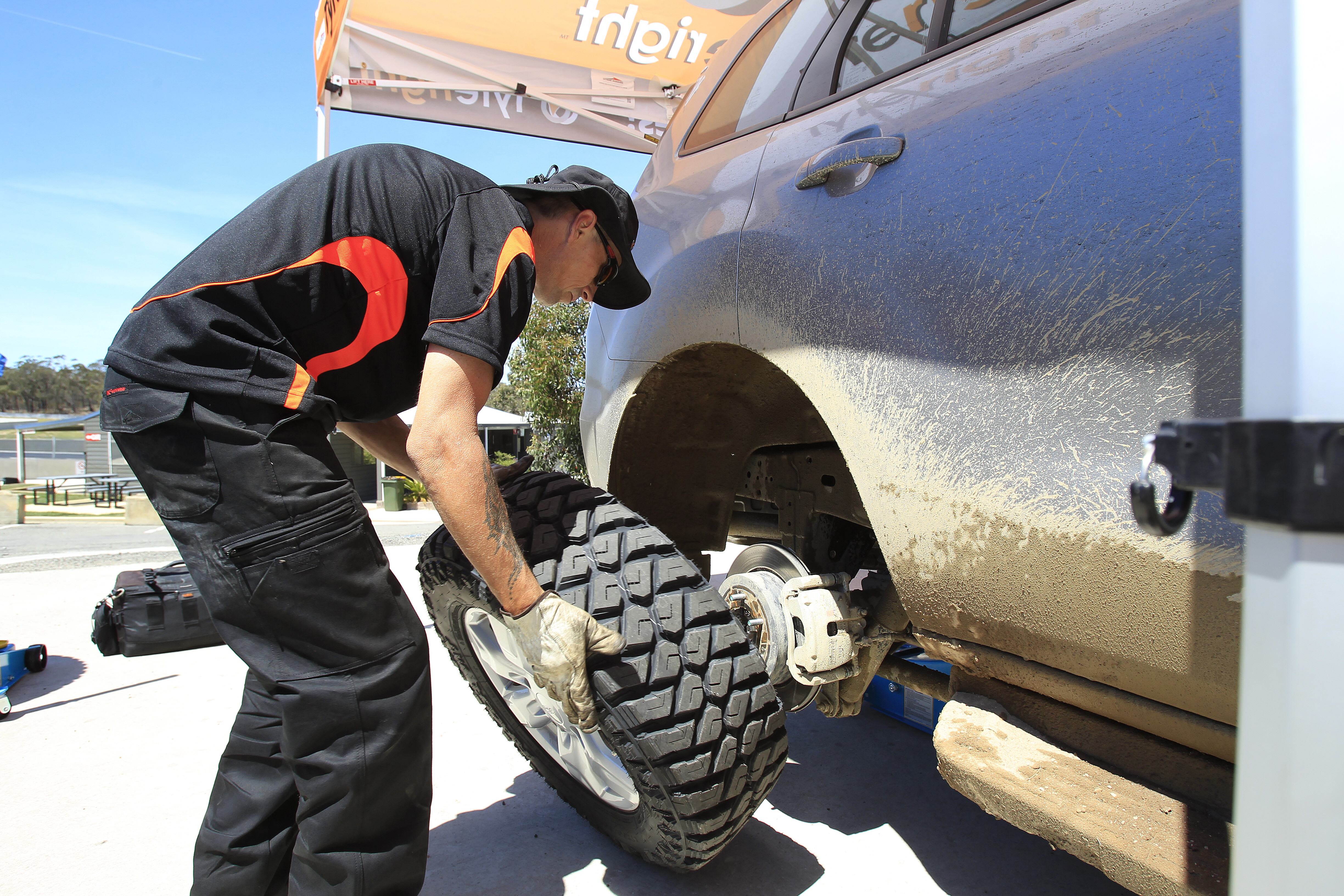
ABS uses wheel-speed sensors to monitor the rotational speed each wheel is doing and how quickly it’s slowing down under brakes compared to the other wheels. And critically, whether it’s slowing that down much that it’s about to lock-up completely.The information from the wheel-speed sensors is fed to an electronic control unit (ECU), which is the ‘brain’ of the system and regulates the hydraulic pressure being delivered to the brake on any given wheel, and if it’s about to lock up the wheel, the hydraulic pressure and therefore the brake pressure is eased off by closing a valve in the pressurised hydraulic system.
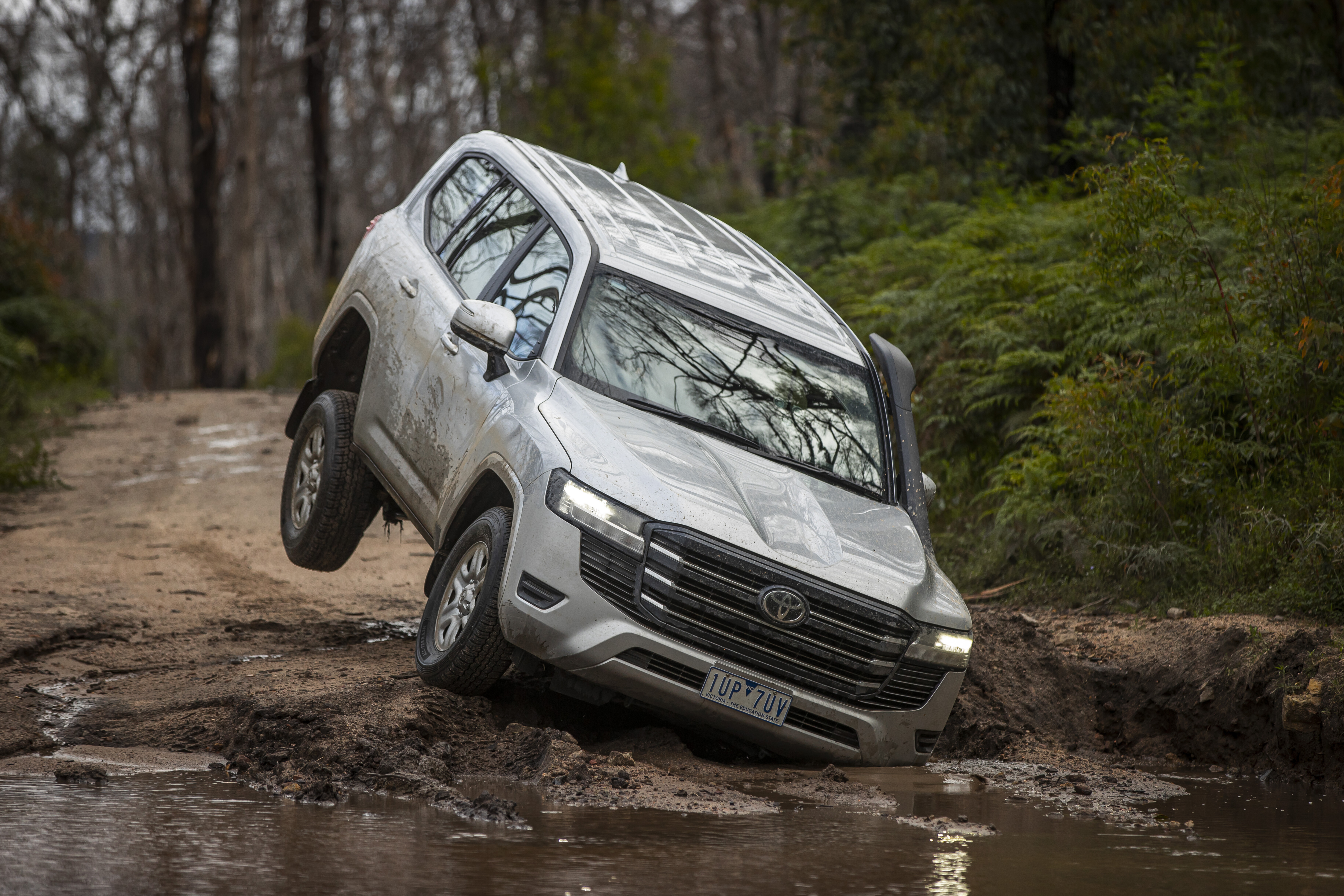
Electronic Traction Control
Electronic Traction Control was in many ways the logical next step from ABS as it – in its most simple form – is just a reversed process of ABS. The development of Electronic Traction Control (ETC), starting in the 1970s, followed hard on the heels of anti-lock brakes. ETC uses the same basic hardware as ABS in wheel-speed sensors, and hydraulic pump and valving systems, it just requires new software programming. For where ABS stops a wheel from locking under braking, ETC stops a wheel from spinning under acceleration. ETC also modulates engine output and reduces it if need be to limit wheel spin, a simple feat once cars adopted electronic rather than manual throttles.ETC came about as a response to increasingly more powerful cars and their propensity to break traction under acceleration on slippery, wet, snow- or ice-covered roads common in winter in the big North American and European car-buying markets.
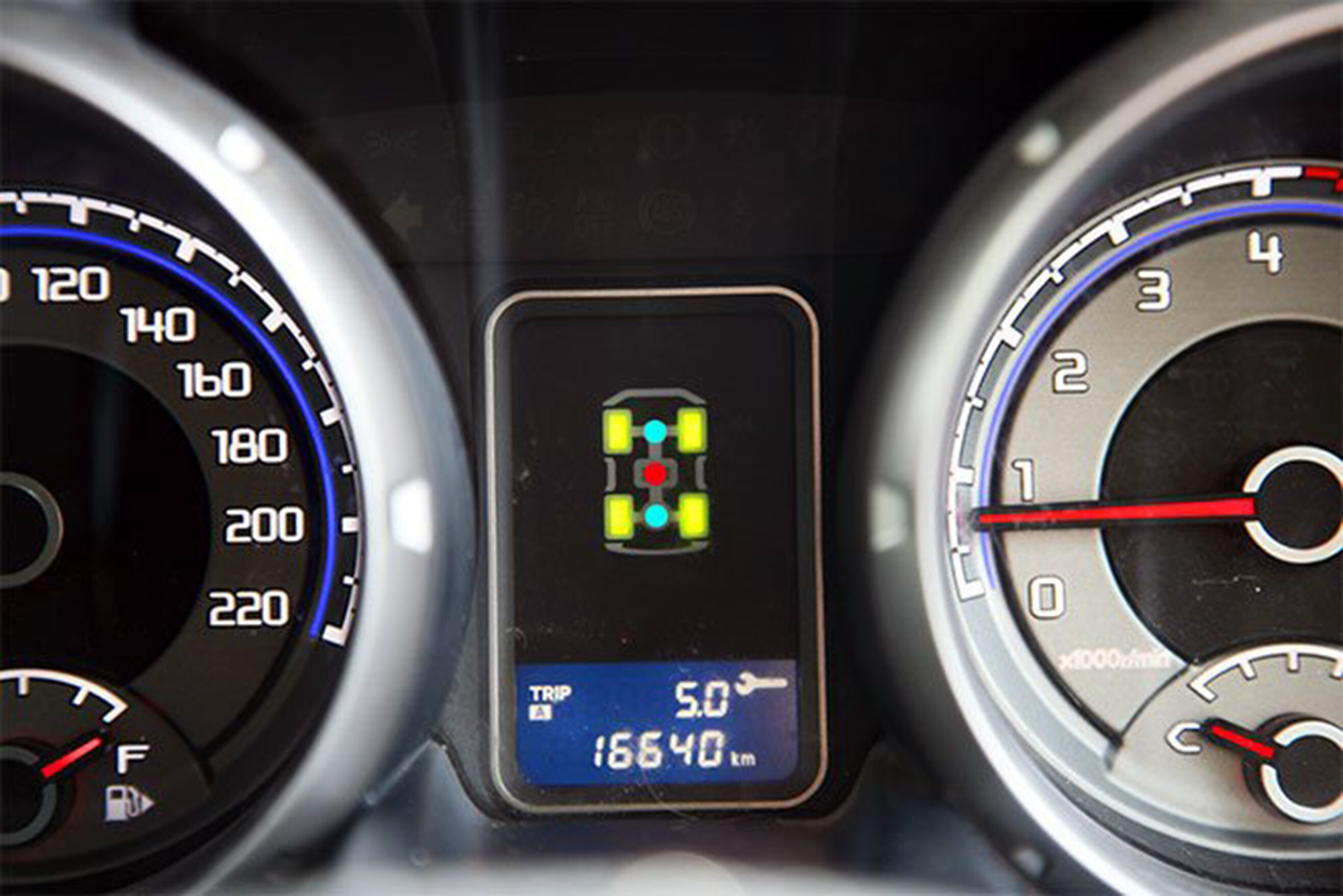
While ETC was originally designed as a slippery-road safety feature, it also brings notable benefit off road. It’s like having what is effectively a limited-slip differential at both ends of your 4×4.From systems initially developed to limit the loss of traction on wet bitumen but still helped off road, ETC has evolved in (some) 4x4s to have off-road specific programming, often triggered when low range is engaged. Off-road specific ETC is less likely to cut engine power as severely as on-road ETC and so can provide power to the wheel or wheels that have the best traction to help maintain forward progress. In effect it transforms a conventional open differential in to an active power-distributing differential.
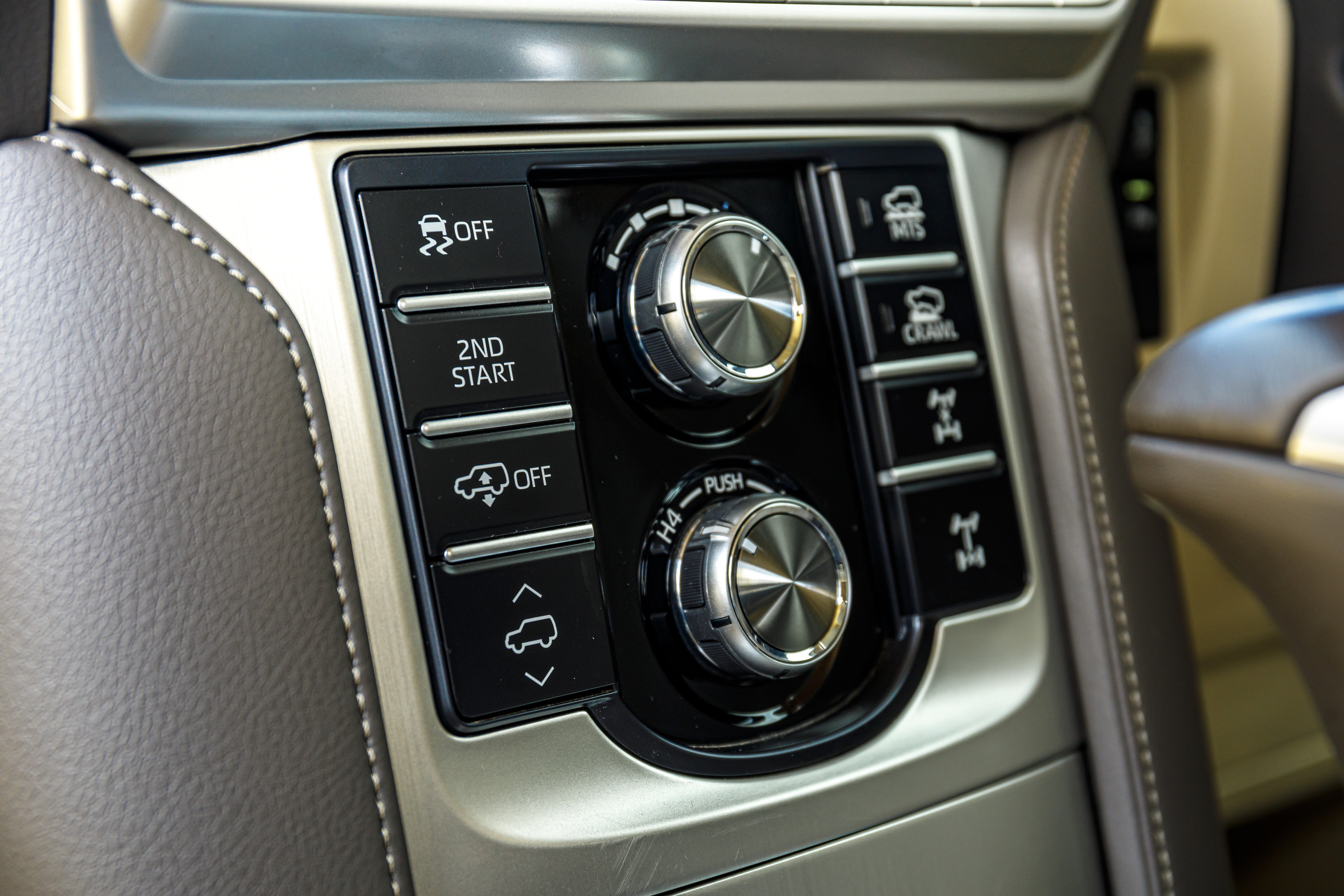
The development of off-road specific electronic traction control has been led by Land Rover, Jeep and Toyota, with other 4×4 manufacturers following suit. Not all off-road specific ETC is created equal and is very much dependent on the quality of the programming and the depth and breath of its development. And if you doubt how effective off-road specific ETC can be, look no farther than a late model (2010 onwards) Jeep Grand Cherokee with fully independent suspension. Despite having quite limited suspension travel (by 4×4 standards) these Grand Cherokees are surprisingly capable off road, thanks largely to their very clever ETC.
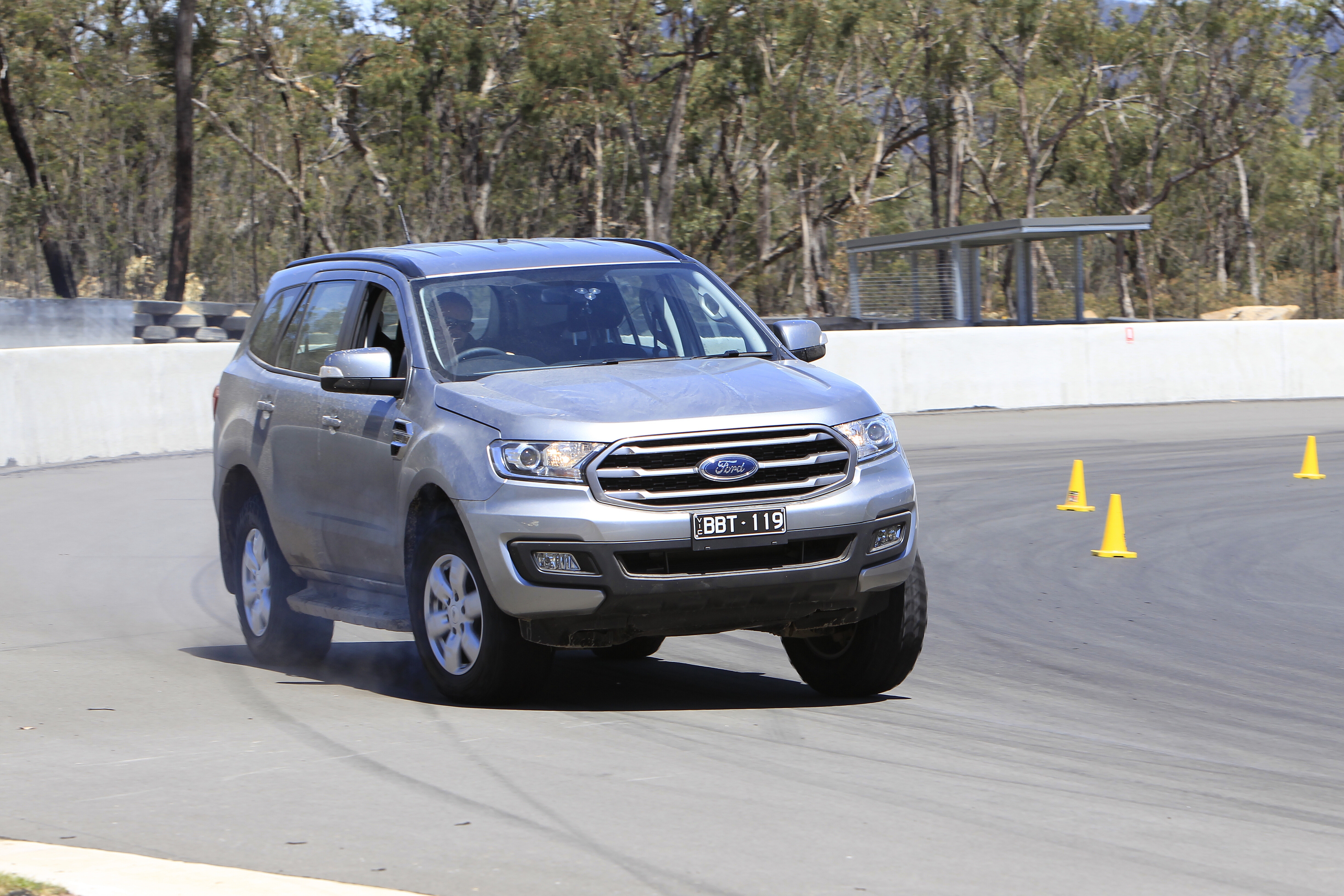
Electronic Stability Control
Despite being often confused with electronic traction control (ETC), electronic stability control (ESC) is in fact a very different thing. More significantly, while ETC is a great help off road, ESC can be a major nuisance. So while ETC will help you not get stuck, ESC can have the opposite effect and be the very thing that stops you in your tracks.ESC goes under a large number of brand-specific names such as Electronic Stability Program, Vehicle Dynamic Control, Dynamic Stability Control and others, but these are just different names for essentially the same thing, as all attempt to do the same thing. It’s a shame the auto industry can’t adopt a standard name for such an important safety system to provide more clarity to consumers.ESC first appeared on production cars in the 1980s and built on ABS and ETC by using all of their essential components such as wheel speed sensors. However, ESC introduced several crucial new components in the mix in the form of steer-angle, yaw and lateral-acceleration sensors.
A steer-angle sensor simply measures where the front wheels are pointed in relation to the vehicle, the yaw sensor measures the rotation of the vehicle around its vertical axis, while a lateral-acceleration sensor measures sideways movement.With information from those sensors, the ESC is able to work out if the vehicle is heading in the direction steered by the driver, as determined by the steer-angle sensor, or heading somewhere else as determined by the yaw and lateral-acceleration sensors. In other words, when going in to a slide or skid. More sophisticated ESC systems then added roll and pitch sensors to measure sideways body roll and fore-and-aft pitching to determine if the vehicle is becoming unstable.
If the ESC determines this is the case, which it can do often before the driver realises anything is wrong, it will work to counteract the skid or slide or roll by applying the brakes on one or more wheels, often to varying degrees on each wheel, or by cutting the engine power.While ESC is well-proven as one of the most significant on-road safety advances, it can be a hindrance off road, so is not what you necessarily want in a 4×4. The problem with ESC off road shows up most in soft sand or mud and when you’re constantly counter-steering to correct small slides back and forth. I’m sure you know the feeling.ESC doesn’t like it when you’re steering in one direction and the vehicle is heading in a different direction and reacts to this by applying the brakes and/or cutting the engine power, neither of which you want when momentum is critical, as is the case in soft sand or deep mud.That’s why all 4x4s have an ESC-off switch even if the default position is ESC-on and ESC will always switch back on once a certain speed threshold – typically around 30km/h – is exceeded.
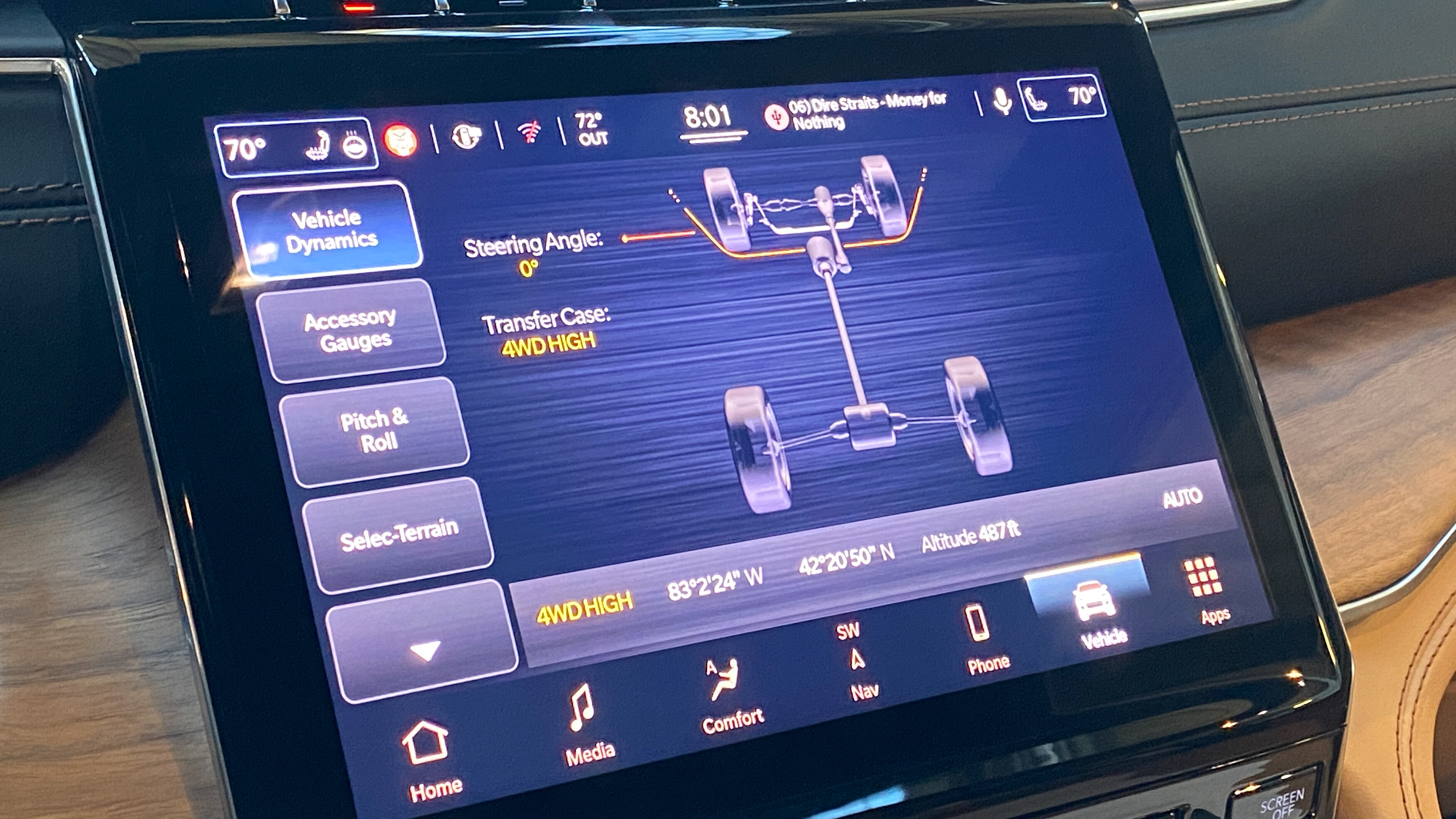
Terrain Electronic Controls
The compromise imposed by having a simple on-or-off ESC system is the prime reason why terrain-specific control systems, starting with Land Rover’s groundbreaking Terrain Response, and now adopted by several 4×4 manufacturers with varying brand names, have come about.What these systems do is tailor the response of the ESC and the ETC to suit different driving surfaces such as sand, mud, gravel, etc. Depending on the terrain and vehicle speed, some degree of ESC may be helpful from a safety point of view, so it’s beneficial in having an ESC program that is adaptive rather than being simply on or off. Typically, when you select a terrain program such as sand or mud, the ESC’s activation threshold is raised so it will tolerate some slipping or sliding before it starts to cut engine power or apply one or more wheel brakes.
ESC intervention can even be a problem on gravel or dirt roads, where what is a normal amount of understeer or oversteer can have the ESC applying brakes and or cutting the engine power. So having a ‘gravel’ mode switches the ESC to a more tolerant and less intervening level while still retaining some degree of back-up safety.However, terrain-specific electronic control systems are not just about the integration of ETC and ESC but they also regulate the engine throttle mapping, automatic gearbox shift protocols, and the locking and unlocking of electronic differentials in those vehicles thus equipped. The more sophisticated the powertrain, the more it can be ‘controlled’, hence four-wheel drives with electronic diffs are better off in this regard than 4x4s with purely mechanical diffs.
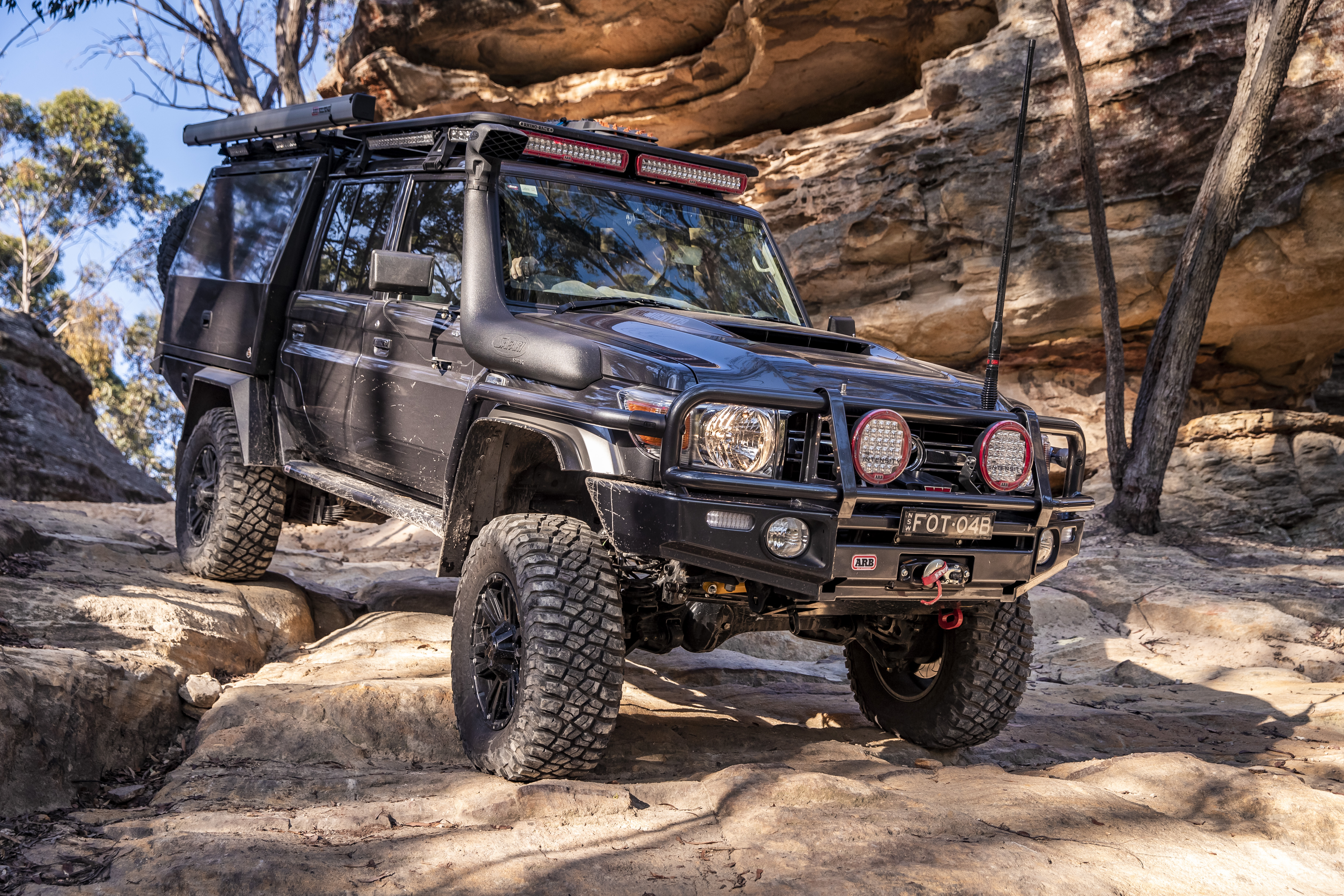
Terrain Speed Controls
The basic engineering hardware of ABS and ETC also underpin the near-ubiquitous hill-descent control (HDC) where automatic brake application limits speed on downhills to a set level. Newer HDC systems allow the driver to adjust the downhill speed, usually via the same toggle or switch that is used to adjust highway cruise-control speed.HDC control has also been taken one step further with Toyota and Jeep’s Crawl Control and Land Rover’s Terrain Progress Control, both of which maintain a fixed speed downhill, on the flat or even uphill by bringing in automatic throttle application. All the driver has to do is steer!
There’s been a seismic shift over the last few years. In a world that never shuts off, surrounded by constant notifications and interconnectivity, the latest generation to get their driver’s licences are shunning the big city lights and heading deep in to the heartland of Australia.
Fluent in diff locks. At home in a swag. They’re not just keeping 4WDing alive for generations to come, they’re responsible for it exploding in popularity.
The owner of this once-in-a-lifetime Cruiser you’re looking at is just 21. Every spare dollar Jack earns goes in to this rig, and every spare moment he has the spotlights pointing towards the bush. His weekends spent far beyond where mobile reception runs out.So how does a 21-year-old bloke build a Cruiser? Like most builds these days, the heavy lifting was done before the Sandy Taupe dual cab had ever been registered. A shopping list worth of modifications are all made 100 per cent legally through the Second Stage Manufacturing scheme.
The stretch
Before work even began on the suspension, Jack had the team at Ultimate Stretches in Sydney’s west slice and dice the factory frame, bumping the wheelbase out an additional 300mm. The popular modification not only has the obvious benefit of allowing a 300mm longer tray to be fitted, but it also means that tray can carry its weight directly over the rear axle, rather than entirely behind it like the stock configuration. Those who have driven a stretched rig would know the end result is a 4×4 that’s far less twitchy at freeway speeds, and far more planted when towing.
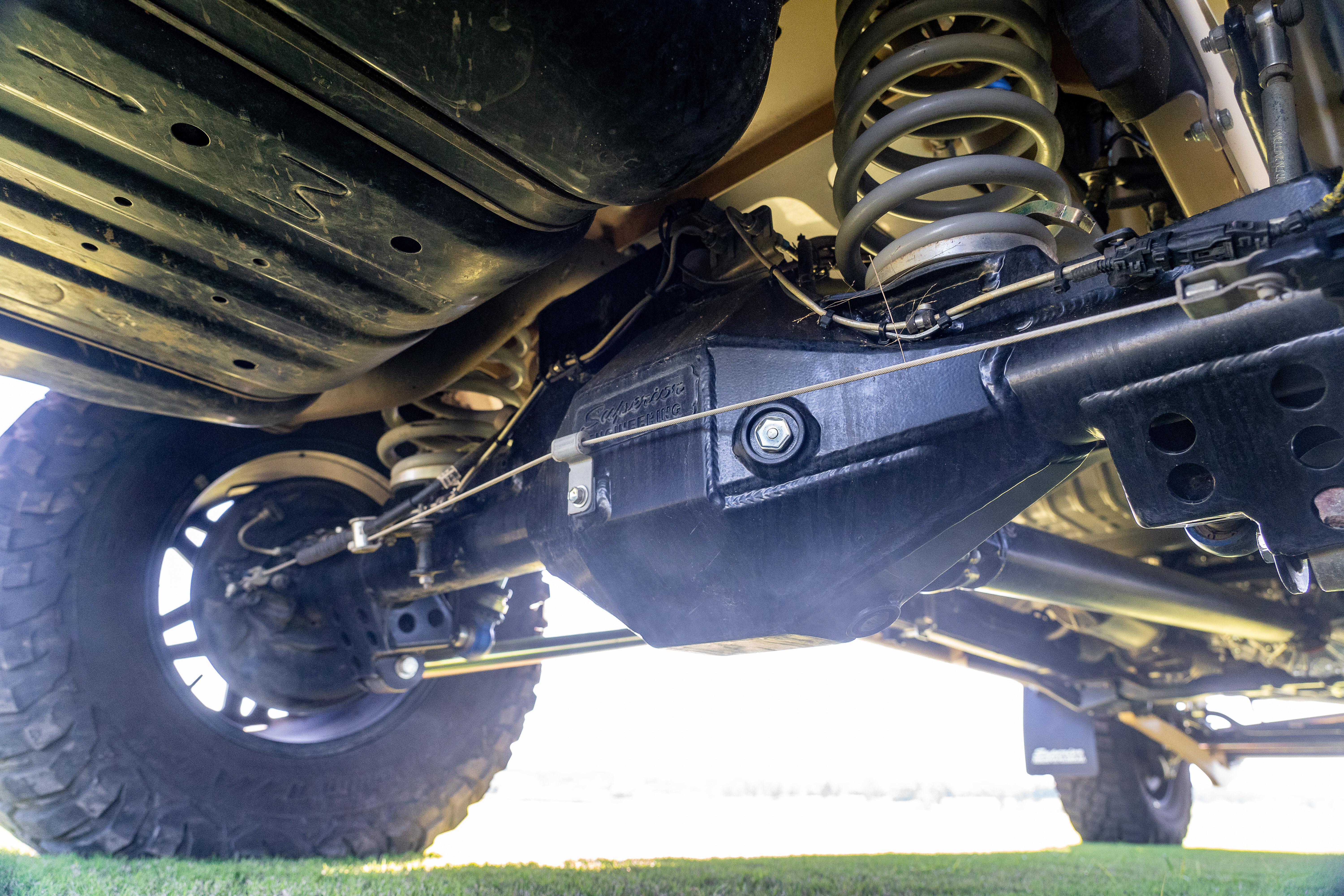
Thinking laterally
If you’re not a suspension guru, then the differences between a triangulated or parallel four link probably aren’t the kind of thing you discuss at Sunday barbecues, but there’s a reason people pay thousands to convert from one to the other. The set-up most factory coil-spring rear-ends run is known as a parallel four link (also a five link, but let’s not complicate things yet, yeah?). Four arms go forward from the rear diff. The two lower ones hold the diff in location. The two upper ones stop it from flailing about under acceleration and deceleration. You’ll need a way to stop it going side to side too, that’s known as lateral support and is done with a fifth arm called a Panhard.A triangulated four link works similar, but with a few differences. The two lower arms still hold the diff in location, and the two uppers still stop it from flopping around. The key difference is, instead of the two upper arms going straight forward, they’re angled in to a triangle. That provides the lateral support letting you do away with the Panhard rod, and with less binding in the suspension bushes allows for more and easier articulation off road. So why don’t they come that way from the factory? Quick answer, packaging. To work properly, a triangulated four link needs to occupy the real estate where the exhaust and fuel tank would normally live, so it takes far more work for the welder to package.
Suspension
From here the crew at AE Co 4×4 got to work installing the full suite of Superior Engineering kit. Up the back, a whole new diff housing is in place. The Diamond Diff housing bumps the rear track out to match the front, it also houses the factory rear locking differential and sports huge 300M RCV chromoly axles, making for one hell of a package. Ditching the factory leaf springs, the set-up also upgrades the rear end to a smooth-riding coil-spring arrangement. Heavy-duty lower arms do the lion’s share of the work, with adjustable triangulated uppers dialling in the pinion angle. A set of front and rear Superior Engineering 2.5-inch body remote-reservoir shocks help keep the ride floating like a butterfly.
Up front, Superior Engineering radius arms free-up articulation on the factory front axle. They also correct the castor back to stock after four-inch lifted coil springs threw it all out of whack. A Superior Engineering Panhard rod, comp-spec tie rod, and comp-spec drag link ensure things stay where they should even after big wheel lifts.
With new real estate in the wheel arches, a set of Method Race Wheel 312s were spec’d up and wrapped in 35-inch BFG KM3 mud tyres – they punch in at 17×9-inch with a -12 offset. A Bendix dual-diaphragm brake booster and braided lines all around rein in the new weight better than stock.
Combined, this set-up not only increased the Cruiser’s Gross Vehicle Mass to a portly 4T, but does so completely legally in all states, even with the big lift and bigger tyres.
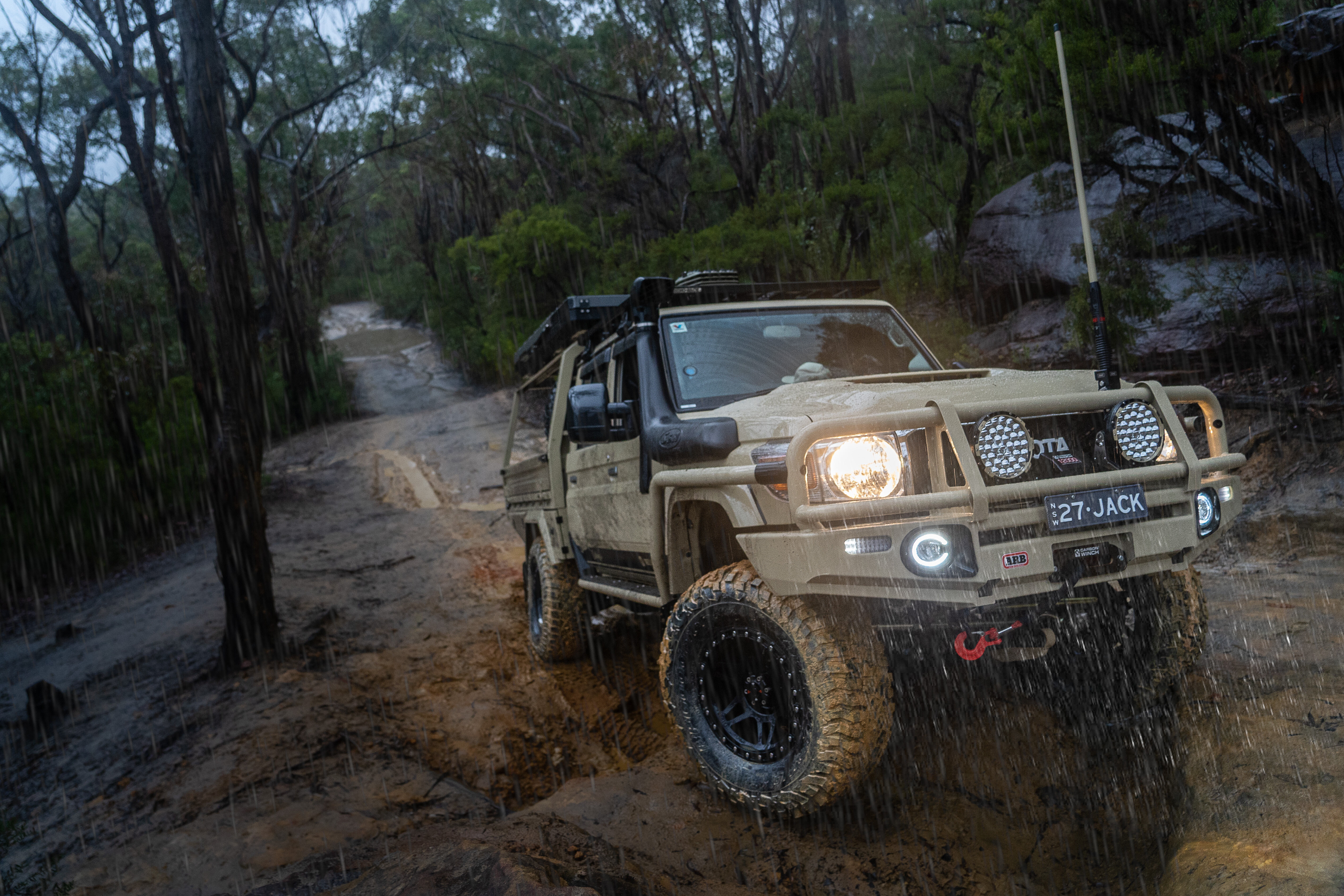
Exterior upgrades
As good-looking as all that kit is, no outback tourer is worth its salt without a solid bullbar up front. To that end, an ARB Deluxe unit proves more than worthy of the job. With large tubes and colour-coded scrub bars feeding down in to heavy-duty side-steps, it’ll perform as good as it looks. The factory ARB foglights have been swapped out for a set of LED units from Stedi. They team up with Stedi’s Type-X Pro spotlights for a nearly 30,000 lumens worth of roo-spotting power. A Carbon 12,000lb winch also got the nod.
Moving backwards past the Pioneer roof rack and Clearview Next Gen towing mirrors, a mammoth steel tray from Hunted Engineering is serving duties. It’s designed to be just as good at taking a hit off road as it is to make touring easier, with ample storage options. With the additional 300mm of wheelbase, front storage boxes have been added to match the rear, while a full trundle tray slides out from the back for bulk storage. The tray floor itself is rubber-lined and covered in tie-down points, the space cases giving dry storage that can be easily removed. A water tank hides underneath, while weatherproof 12V outlets on the headboard link to a dual-battery system.
Up top, an Aussie-built hard-shell rooftop tent from Camp King Industries ensures Jack always has a comfortable spot to lay his head after a long day on the tracks. A huge Bush Company free-standing awning provides 12m² of covered area, without a single pole in sight.
Creature comforts
On the inside, Jack has kept things looking neat while still making a comfortable place to punch out big kays. A full Car Builders sound-deadening kit massively drops internal noise as well as insulates the cab, making it warmer in winter and cooler in summer. Department of the Interior is responsible for a full-length centre console, speaker pods, door pockets, and a sub enclosure behind the rear seat. A pair of One Stone armrests cover the door tops, while an extensive stereo set-up with Pioneer, JL Audio, Focal and Audio Control components brings the noise.
Under the bonnet
Of course, with all the extra weight from touring mods, a little extra oomph when you squeeze the loud pedal is always going to be welcomed. Up front, the factory 4.5L V8 turbo diesel sucks cool, clean air through a Safari Armax snorkel; a high-flow Unifilter air filter ensures it stays bulldust free. A Legendex three-inch stainless-steel exhaust handles the spent gases, while an NPC 1300Nm clutch and Down Under Diesel tune put as much power to the ground as possible.
While there’s no doubt there are a swag-full of differences between the way Jack’s built his Cruiser and how some of our older readers would, it’s hard to deny how good it is seeing the younger generation getting out and exploring the far reaches of this country. If the future is stretched V8 Cruisers and mud tyres, the future is looking bright.
I have had my BioLite 2 CampStove for a few years now, I actually bought it the second I spotted one online, and have brought it with me on basically every camping trip since. If you haven’t seen the BioLite 2 before, it is a mini gasless cooker with a twist.
To use the stove, I simply pop in a fire lighter and some kindling, then work up to slightly larger pieces of wood or even a pine cone as my fuel. It’s amazingly simple to light and operate, and pumps out more than enough heat to cook a meal or boil some water. You can even get an optional grill for cooking burgers and so on, that is definitely on my wish list.
This is possible because the clever unit actually has a built-in battery pack powering a small fan which is adjustable for output levels. This not only makes starting a fire easy as pie, it results in a smokeless burn and a much more efficient fire.
This is where things get even more interesting, as you can use that battery pack to charge your phone or plug in a small LED light (which is included) to light up your table while cooking a meal. This all sounds pretty sweet, right? Well, it gets even better.
So not only can you charge your gear via the inbuilt USB point, when the fire is lit, this unit somehow converts heat from your fire in to electricity. Meaning your fire is now not only cooking your meal, it’s powering the fan and charging your phone at the same time. Now tell me that’s not an awesome idea, especially in such a little package.
The whole unit packs down to a small carry pouch, and is so small you can fit it basically anywhere. But is it any good, I hear you ask? Well, yes and no. If I’m in a rush, it’s so much simpler to pop out a portable gas cooker, and you’re away in seconds. Because you do have to actually light a fire, this can take a bit longer, and if you are in a rush to get the day started it can be a bit of an inconvenience.
If that’s not an issue for you, there are certainly many benefits to the BioLite 2 CampStove. Like, you don’t have to carry or pay for gas, you can charge your phone for free essentially, and everyone at camp will want to ask you about your cool gadget. And it is a cool gadget, I’ll be hanging on to this for a few more years to come, I reckon.
AVAILABLE FROM: www.bioliteenergy.com RRP: $279