
Get your New Year started in style, by picking up a copy of our January 2023 issue of 4X4 Australia.
If you’ve earmarked 2023 as the year to dip your toes into the wild world of 4x4s – or to further your travels and expand your 4×4 build – then we’re here to help. Hell, 2023 may be even the year for a lap of the map?
To this end, we’ve loaded the January 2023 issue with plenty of off-road goodness.
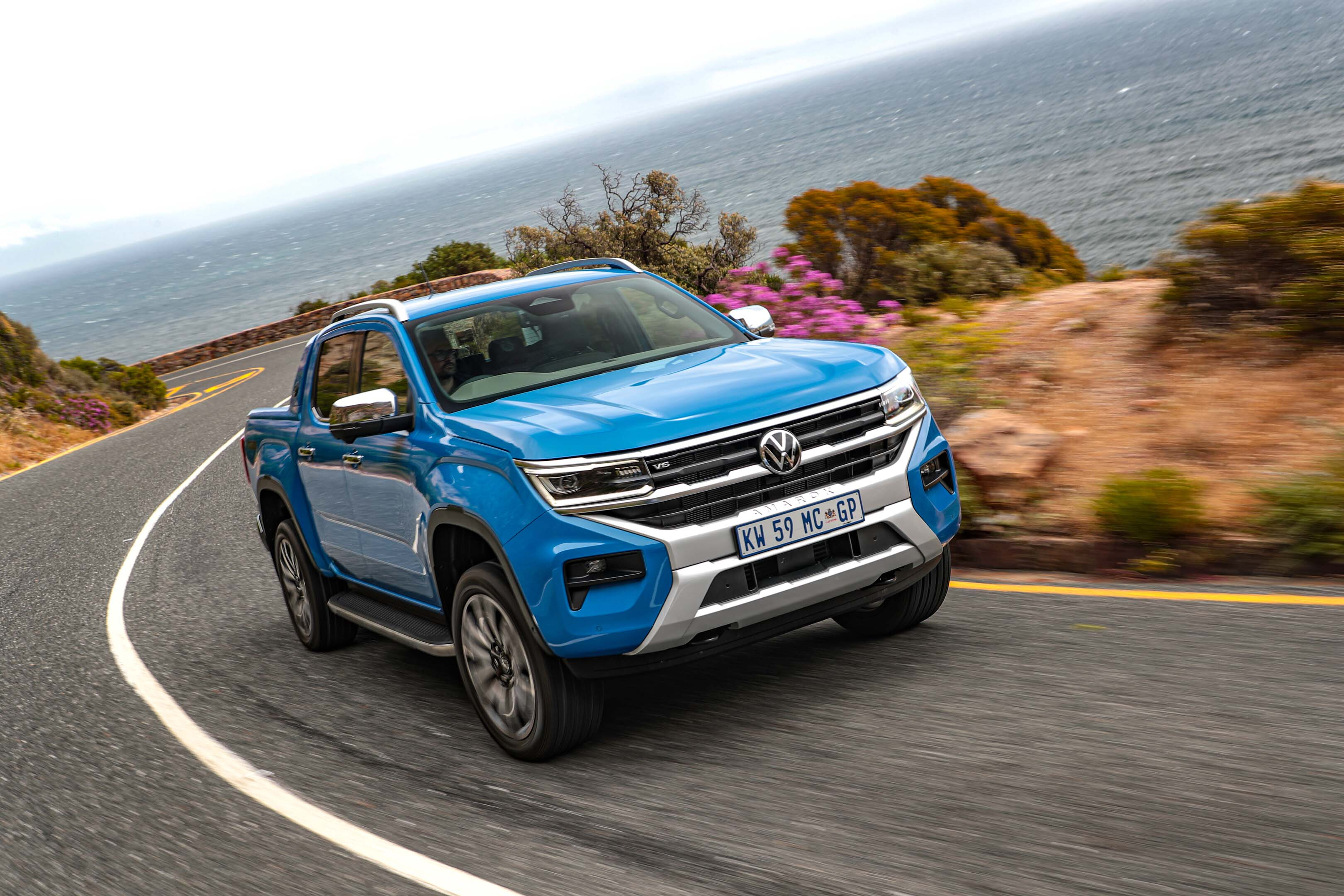
With the imminent local launch of the next-gen Amarok, we took the VW for a test drive in South Africa and included our initial impressions in this issue.
Co-developed with the Ford Ranger, does the Amarok take the dual-cab segment to yet another level?
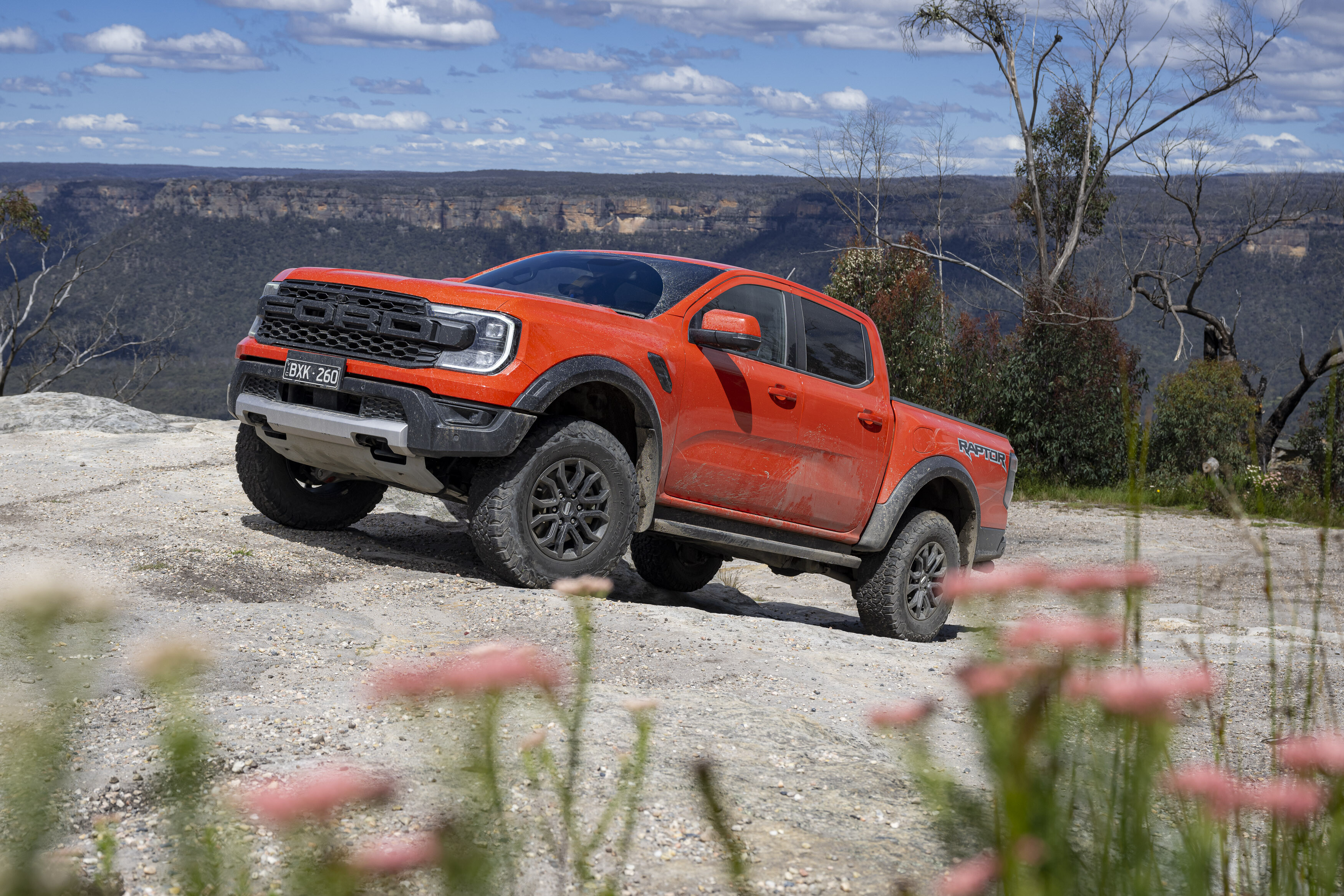
The previous-gen bi-turbo-powered Ford Ranger Raptor was a lot of fun to throw around a high-speed off-road circuit, but the new model gets a 3.0-litre twin-turbo V6 petrol engine producing 292kW and 583Nm of grunt. Shock horror, the 2023 model is in another league. Read our full review in this issue.
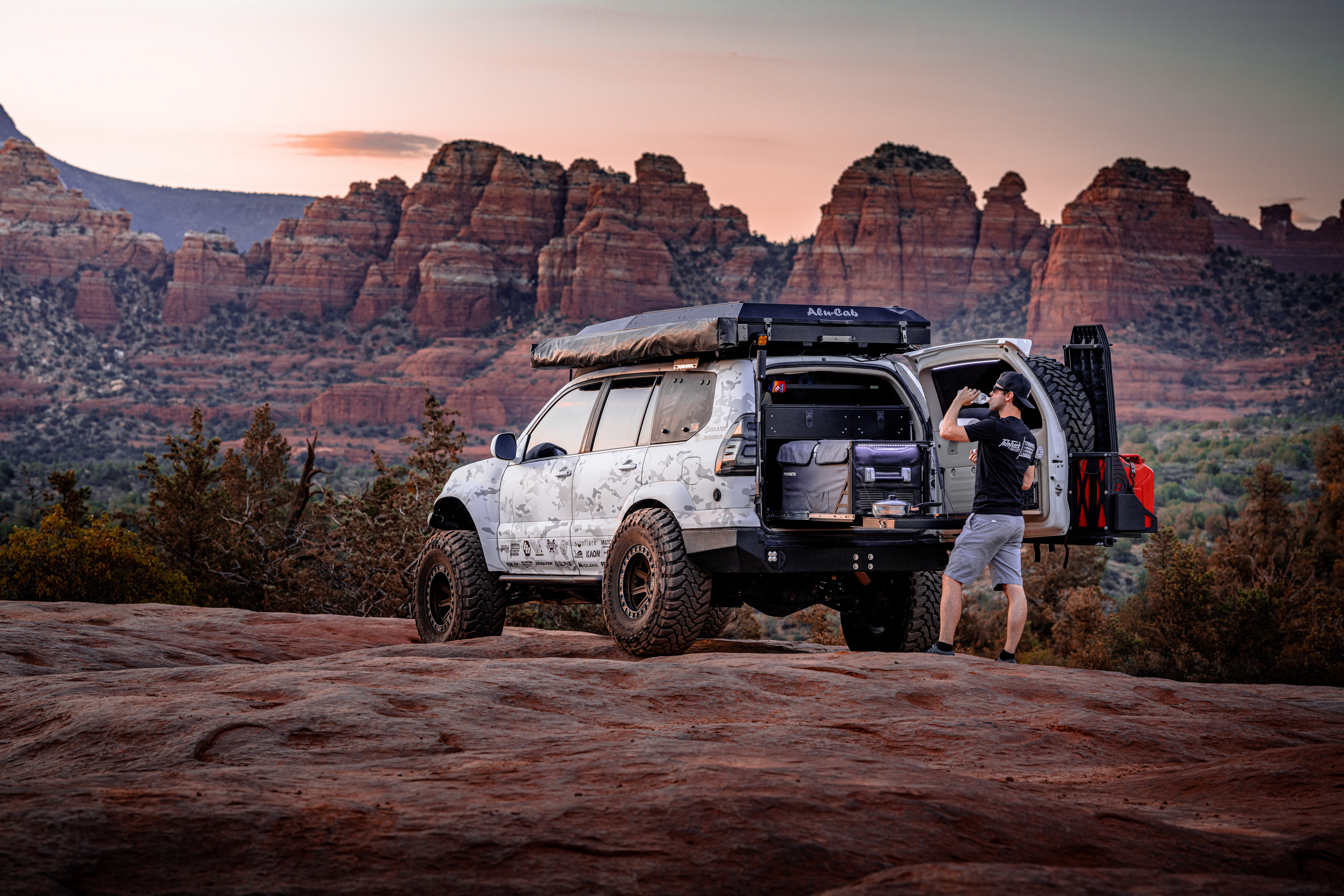
On the custom front, we run a microscope over a cut-down GU Patrol with a flash Trig Point canopy; and it’s not often we talk about Lexus builds at 4X4 Australia, but this GX470 was too good to pass up.
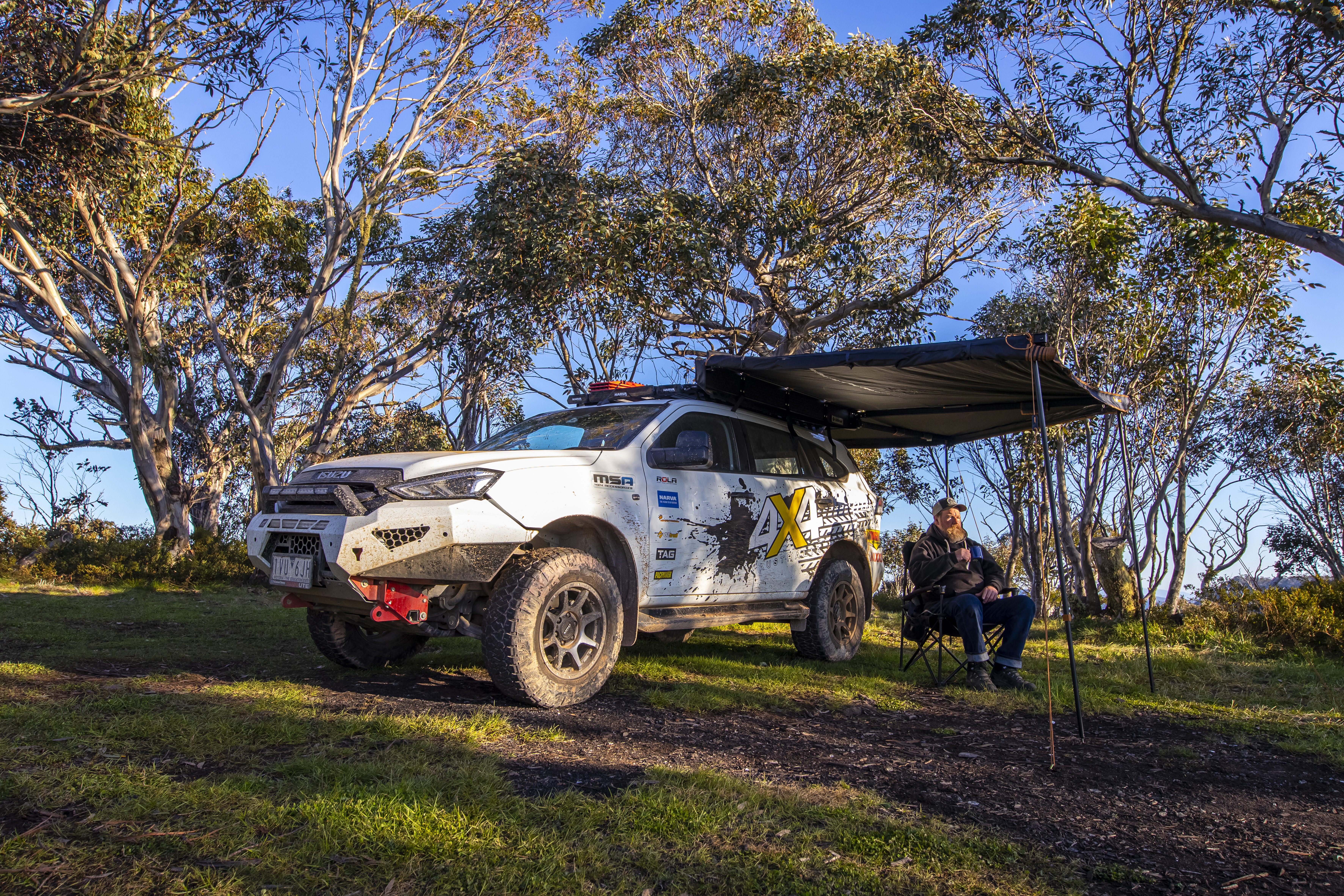
As our Isuzu MU-X project build comes to an end, we introduce our new vehicle for 2023: a 2022 Ford Ranger V6 Sport. We have big plans for our Ranger this year, so stay tuned to stay on top of all the action.
We also tested some quality new products this month, including an Ironman 4×4 Ridge Pole swag, a Razed MaxTrax MKII mount kit, and a Yuasa Overlander 4×4 battery.
What else is there?
- Pajero Sport GLS in the shed
- Davenport Ranges NP, NT
- Limmen NP, NT
- Narva Ultima light bars tested
- New products, opinions + more
Snapshot
- New-generation Ranger notches up another monthly victory
- HiLux wins 2022 battle by big margin but trend points to tight 2023 contest
- GWM Cannon Ute sales continue to climb
The Ford Ranger was the biggest-selling vehicle in December as its arch-rival the Toyota HiLux claimed its seventh consecutive title as Australia’s most popular model.
Ford Australia sold 4663 units of its new-generation ute last month compared with 4271 units for the Toyota when combining 4×4 and 4×2 segments. The Ranger 4×4 beat the HiLux 4×4 by 1001 units.
HiLux sales for 2022 were comfortably ahead of the Ranger – 64,391 registrations versus 47,479. Or considerably tighter when looking solely at 4×4 sales: 47,329 (Hilux) versus 43,128 (Ranger).
Compared with 2021, overall HiLux sales increased by 11,590 units (up 22 per cent). Ranger sales fell slightly from 50,225.
Less than 5000 sales separated the two utes in the second half of the year, following the release of the latest-generation Ranger in July.
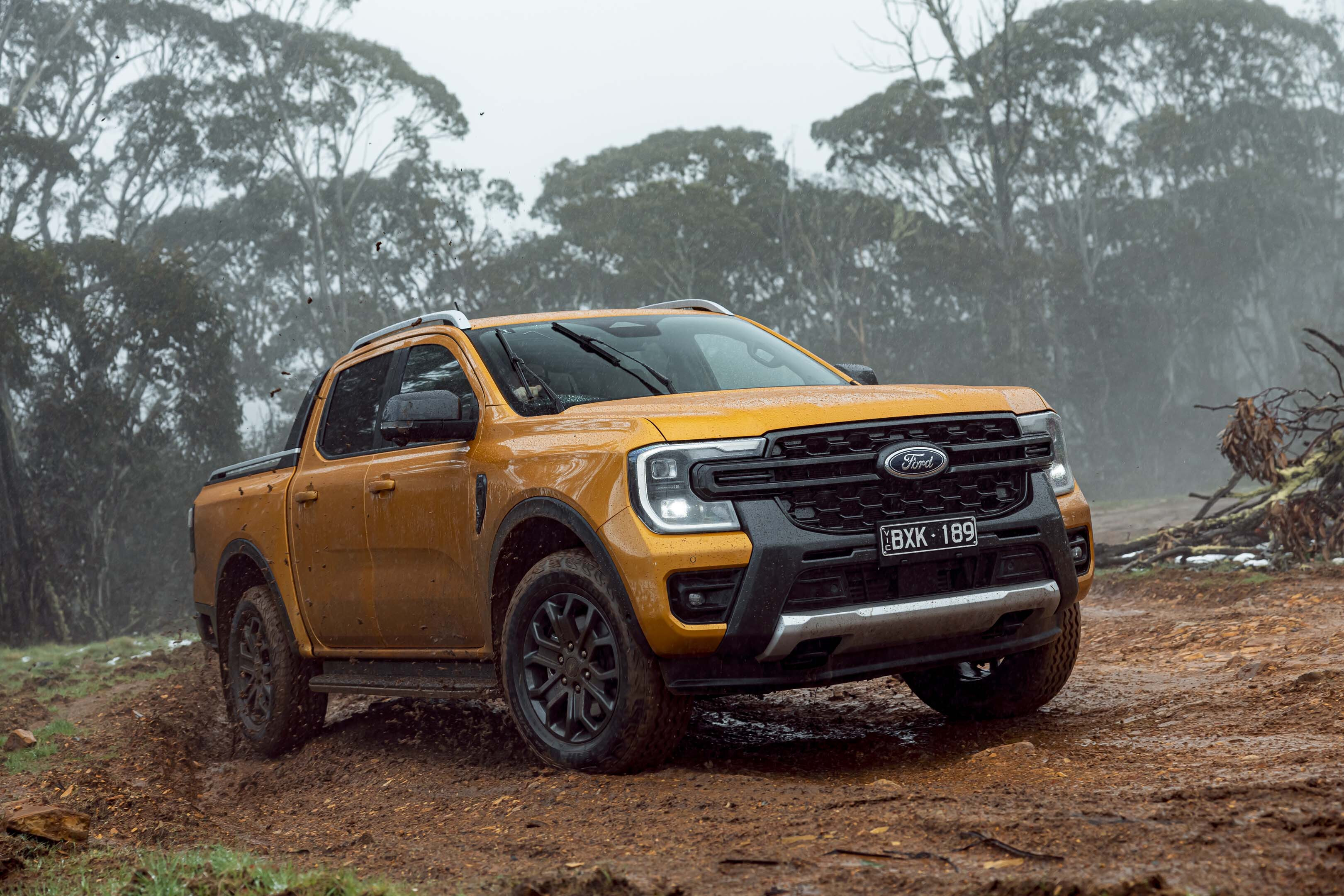
In a sign of the Ranger’s growing threat to the HiLux, Ford Australia increased sales of its ute by 40 per cent in the last six months of 2022 compared with the first six month.
The HiLux’s biggest advantage continues to be found in the 4×2 segment, where it led the Ranger by 17,062 to 4351 units last year.
The Ranger and HiLux were the only utes to feature in December’s Top 10, with rare omissions for the Mitsubishi Triton and Isuzu D-Max.
The Triton placed fourth in 2022’s Top 10 vehicle sales with 27,436 registrations. Still, the Triton was the third best-selling 4×4 variant in Australia in 2022, notching up a total of 23,953 sales.
The D-Max finished seventh overall last year with 24,336 units. Other mid-sized utes to reach double figures last year included the Mazda BT-50 (12,937 sales; 10,533 4×4 sales) and Nissan Navara (10,526 sales; 8832 4×4 sales).
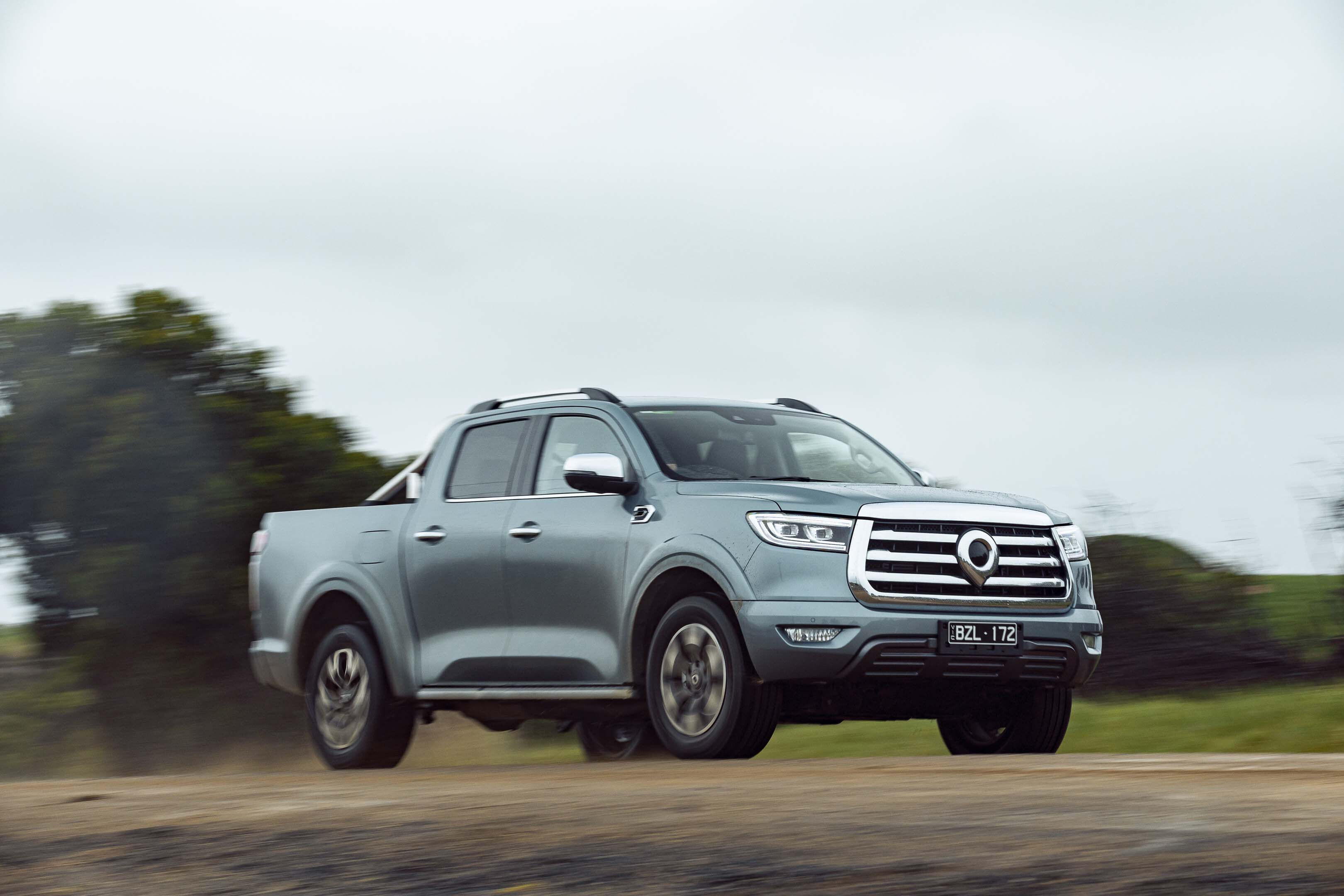
GWM’s progress with its Cannon Ute continues, with sales growing to 7806 in 2022 (of which 7555 sales were the 4×4 variant).
Sales of the other Chinese ute, the LDV T60, dropped below 6000 units.
Toyota’s LandCruiser 70 series finished the year with 11,390 sales, while the RAM 1500 won the battle of the big trucks with 5481 sales.
December 2022: Top 10 new 4×4 sales
| 1 | Ford Ranger | 4113 |
|---|---|---|
| 2 | Toyota HiLux | 3112 |
| 3 | Toyota LandCruiser 300 | 1544 |
| 4 | Isuzu D-MAX | 1380 |
| 5 | Mazda BT-50 | 1061 |
| 6 | Toyota Prado | 970 |
| 7 | Isuzu MU-X | 944 |
| 8 | Toyota LandCruiser 79 | 938 |
| 9 | Ford Everest | 926 |
| 10 | Mitsubishi Triton | 914 |
Top 10 New 4X4 Sales: 2022
| 1 | Toyota HiLux | 47,329 |
|---|---|---|
| 2 | Ford Ranger | 43,128 |
| 3 | Mitsubishi Triton | 23,953 |
| 4 | Toyota Prado | 21,102 |
| 5 | Isuzu D-MAX | 20,124 |
| 6 | Toyota LandCruiser 300 | 13,152 |
| 7 | Toyota LandCruiser 79 | 11,390 |
| 8 | Isuzu MU-X | 10,987 |
| 9 | Mazda BT-50 | 10,533 |
| 10 | Ford Everest | 10,314 |
The 79 Cruiser has had a hard time over the last eight months, crossing the Simpson three times along the acclaimed Madigan Line, doing two Coast to Coast trips from Ceduna in South Australia to Pardoo Station on the Indian Ocean, and then completing two Cape York trips that not only saw the OTL track each time, but also the Starke River track, Frenchman’s Track and the Old Coach Road from Laura to Maytown.
In-between those jaunts were the intervening kilometres along gravel roads linking start and finish points, and while they weren’t difficult they still add to the wear and tear the vehicle is subject to.
There would be few vehicles in Australia doing as many hard four-wheel drive kilometres as this rig. As you’d expect, such distances and the wear and tear of these tough iconic tracks comes at a price.
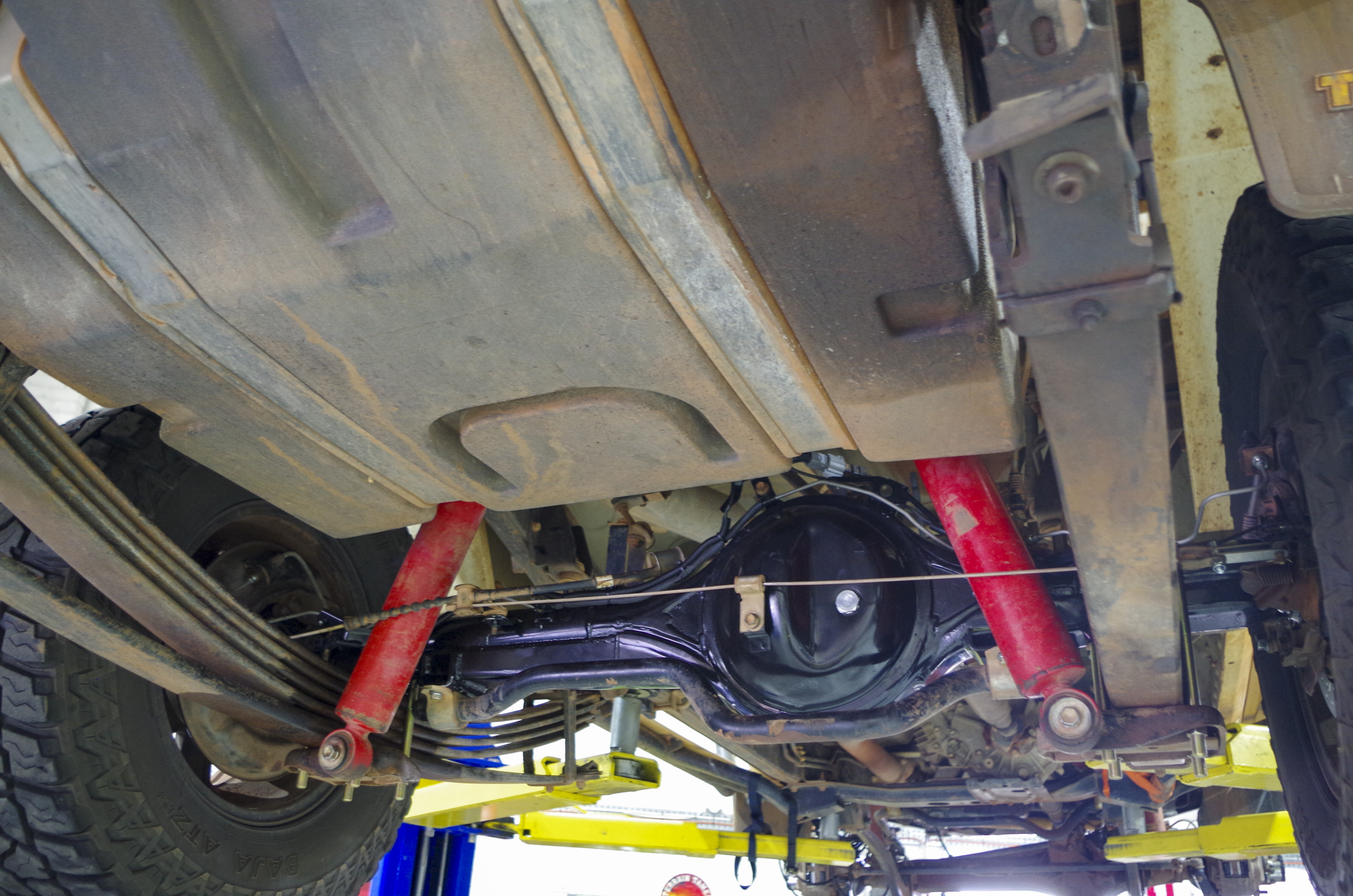
Once we started looking, the mechanical carnage was more dramatic than what we had first envisaged. One of the diff breathers had let go somewhere along the line and had let a slurry of water and mud into the rear diff, destroying axle bearings and the housing, allowing the bearing to spin inside the axle housing.

There was so much carnage to the diff, axles and axle housing that we decided to bite the bullet and replace the whole lot with a Multidrive Technology heavy-duty diff housing that corrects the anomaly between the track width between front and rear axles.
This engineer-approved mod includes dedicated longer heavy-duty axles with a GVM upgrade, if fitted with the properly approved spring pack. We opted for a Terrain Tamer parabolic spring pack which took the GVM up to 3780kg, while other TT spring packs can take your GVM up to 3950kg.
The front diff wasn’t much better; the CV joints and axle shaft assemblies, along with the swivel housing bearings and seals, were showing definite signs of wear and tear. We blamed the slurry you often plough through when on a Cape York trip, or when you splash through a long mud puddle in the desert, for that wear and tear.
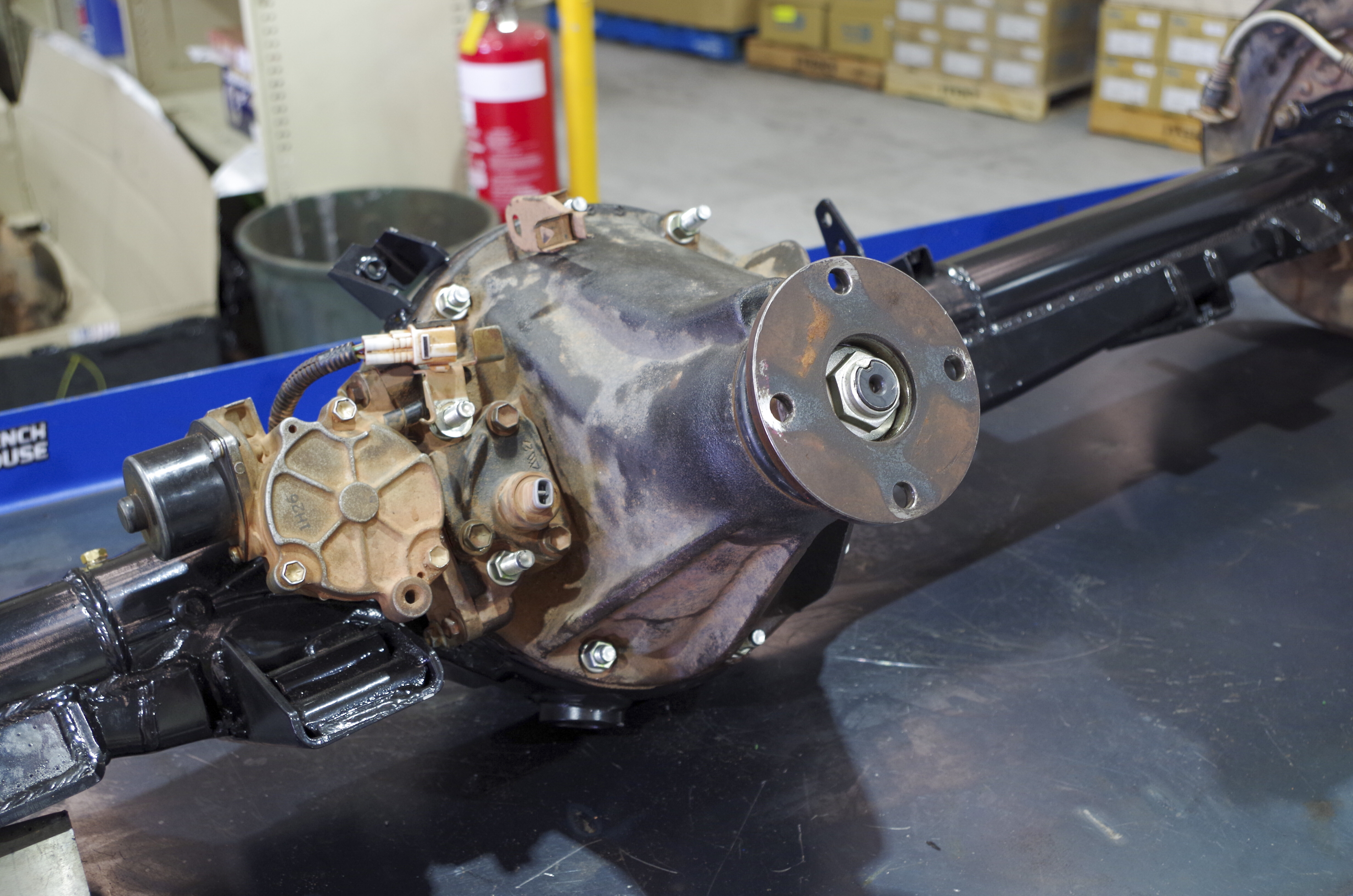
We replaced all these shafts, bearings and seals with Terrain Tamer kits and bearings. All the bearings in the TT Cruiser kits are made in Japan, have a Rockwell hardness rating 2.5 points higher than the OE bearings, and are designed and manufactured for a longer service life. The seals are also the very best you can get, with improved sealing surfaces and construction to prevent oil loss and protect against ingress of unwanted substances.
We also replaced the front and rear brake rotors and their pads, again using Terrain Tamer’s extensive parts list that cover every eventuality. While repairing the brakes, we replaced the ABS wiring to the rear brakes; again this had been ripped out somewhere on our travels.
Staying under the vehicle, we replaced front radius arm bushes and sway bar bushes all around, while running a TT diff breather kit to each diff. This brings the breather outlet up to the top of the engine firewall and will offer some safeguard against water and slurry ingress.

Once we had finished at Terrain Tamer’s workshop, we headed over to our normal service centre, Outback 4WD in Bayswater, Vic, and had the rig serviced with new engine oil, oil filters and fuel filters. While the vehicle was up on the hoist, I got the crew to fit a De-Bug filter to the fuel system. I’ve had one of these units our Patrol for years and they – in varying sizes – are often fitted to big diesel engines in ships and trucks.
The De-Bug unit contains a series of magnets which the fuel flows through and which kills any bacteria, yeast and fungus that can exist in diesel fuel and block up your normal fuel filter. There are a number of these different bugs that can exist in fuel and all are referred to as Hydrocarbon Utilising Micro-organisms (HUM-bugs), and while that name may seem a little cute, what they do is anything but.
Anyway, having proven the worth of these units in the Patrol, I wanted one fitted to the Cruiser. This was a pretty simple job, with more time and effort going in to finding a spot that was close to the original fuel line and somewhere where the De-Bug unit was protected from flying rocks and the like. As it was, a small protection plate had to be fitted to ensure the unit was out of harm’s way.

As you may suspect, the tyres have had a hard time during these forays where, for nearly all the way, we are towing an AOR Sierra camper trailer. To get over the desert dunes, tyre pressures were pretty low on both the tow tug and the trailer, and I’d be lying if I said we didn’t suffer any sidewall damage.
That being said, with more than 40,000km on this set of six Mickey Thompson tyres, we’re bloody happy with the way they have performed, both in the scrub and on the blacktop, and the small amount of trouble they have given us.
With all those repairs and service behind us, we’re hitting the road again soon. First to the desert country of north-western Victoria and then to the Victorian High Country for a couple of trips before heading into our vast western deserts and doing it all again.
We’re confident the new diff housing and wider track at the rear will offer a more stable experience, especially in the creek crossings on Cape York when side angles can get extreme.
All-in-all we’re also expecting a little trouble from our revamped diffs and brake set-up. Time will tell!
More info
Multidrive Technology: https://multidrive.com.au Terrain Tamer: www.terraintamer.com Outback 4WD: www.outback4wd.com.au De-Bug: www.morison.com.au Mickey Thompson: www.mickeythompsontires.com.au
I have had a very solid run out of my 13-year-old Evakool fridge, but sadly it just won’t fit in the back of my FJ Cruiser.
You might have read previously that I used an Esky on a run to Queensland and back, and after it leaked through my vehicle I decided I’d never travel without a fridge again. I started researching on the spot, taking measurements and seeing what would fit. So how did I decide on the myCOOLMAN 47L Roamer?
First of all, price was a leading factor, as I bought the fridge on sale for just $499 with the cover included ($300 off retail). Secondly, it would fit in the space I had allocated for a fridge. I was a little concerned the 47L would be too small, but according to the myCOOLMAN website it can carry 56 cans, so I think I will be right.
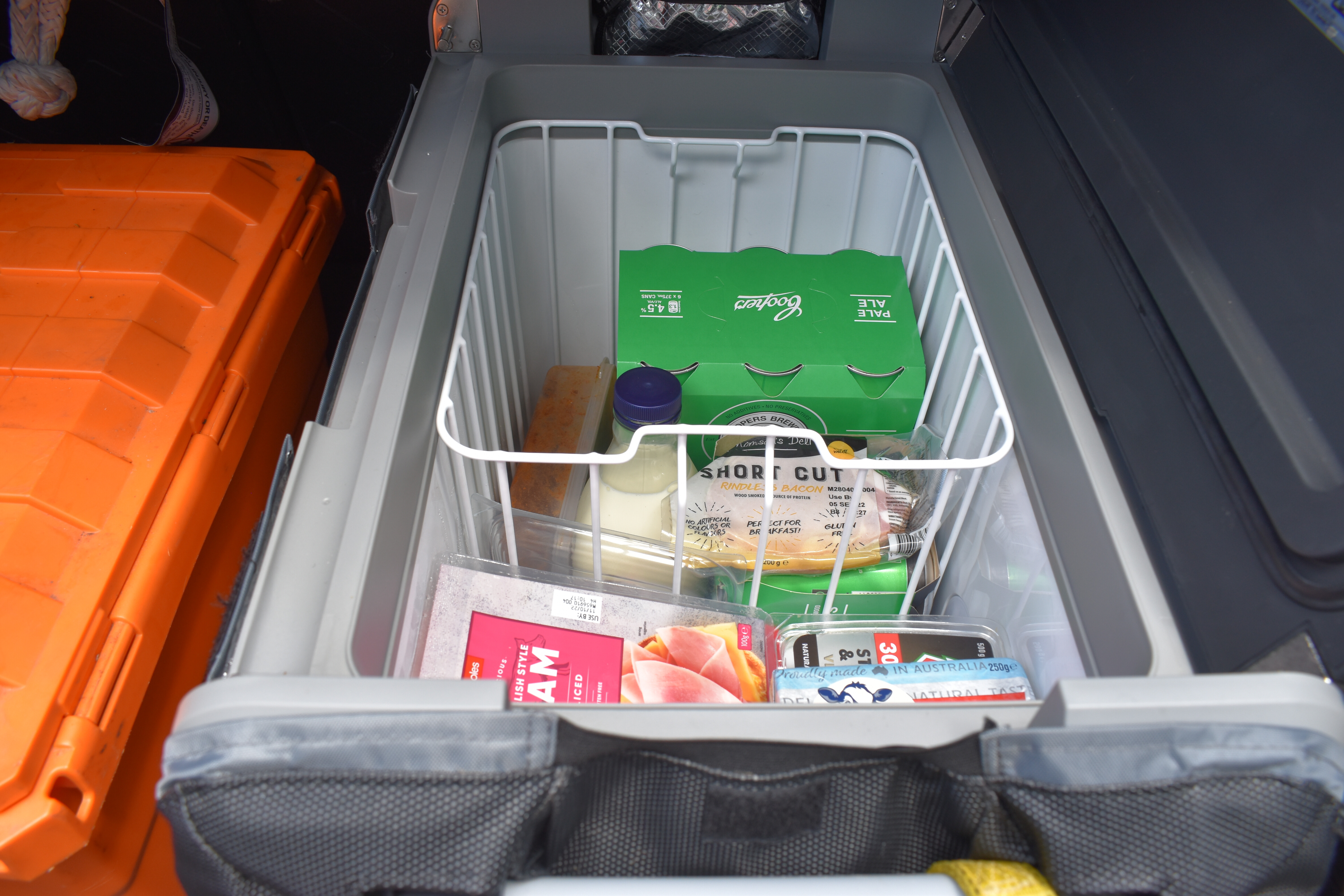
The lid is easy to remove and is reversible, meaning you can set it up for the side you will be opening it up from in your vehicle. The seals running around the inside of the lid are really good quality too, and I rate the built-in LED light which is a handy feature.
Something else I like are the sturdy carry handles that also double as the tie-down points; you have to install yourself but it’s easy using a supplied Allen key.
“For the money, I don’t think I could have done better”
According to the digital display on my Companion lithium battery pack I have been running the fridge off at camp, when cycling it uses 40W of power. The fridge cycles every 15 minutes or so, and usually for five minutes.
By my quick calculations, that means the myCOOLMAN 47L fridge uses an average of 1.1amp per hour in best-case conditions. That’s an impressive result, but I imagine this figure will increase once the weather warms up. I also like that the fridge is 240V-compatible, so I can cool it down at home before heading away.
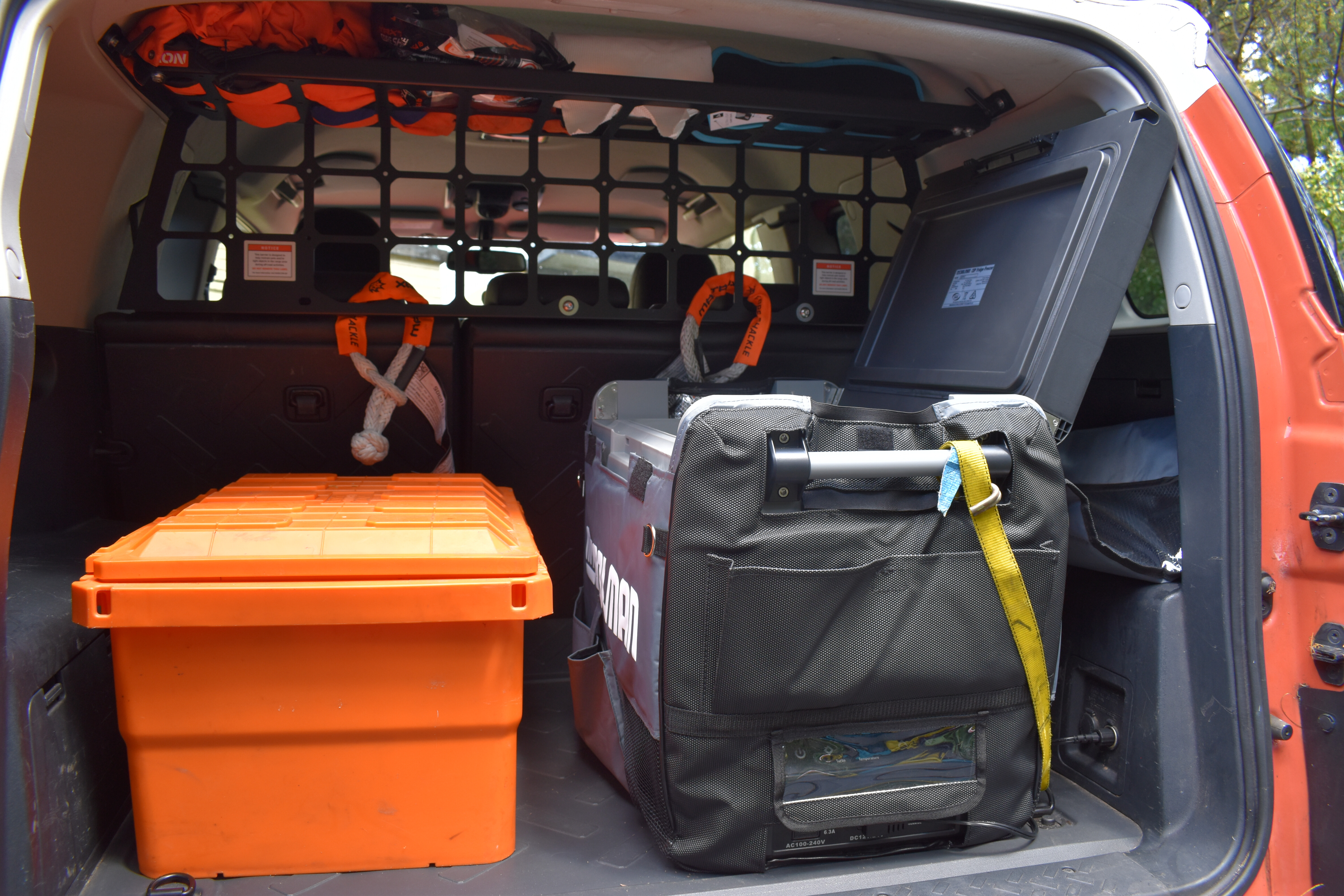
One negative is that there is a fair amount of condensation that appears on the side of the fridge, which then pools at the bottom. It’s not a deal breaker, as there is a drain bung at the bottom of the fridge to let this out.
Overall, for the money, I don’t think I could have done better. I was really keen on doing what every four-wheel driver seems to be doing these days and going with an upright fridge, but for now the 47L does what I need it to do just fine; there’s something to be said about keeping things simple.
I’ll be sure to check in down the track to see how it’s holding up after a few years of use. Hopefully I don’t have to need the three-year warranty but it’s reassuring to know it is covered.
Available from: www.mycoolman.com.au RRP: $799 (I paid $499 at Anaconda)
The latest generation D-Max has remained largely unchanged since launching in 2020, with only minor visual tweaks and some finessing of the safety systems between years.
The 2023 range, however, brings bolder aesthetics, functionality improvements, and three new model variants, without messing with the proven formula underpinning the ute’s success.
Isuzu’s revered 3.0-litre turbo-diesel powers most of the 2023 range, with the same six-speed auto, so performance is unchanged. That’s not a bad thing, though, because the bulletproof 3.0-litre is what gets many buyers over the line.
For those willing to consider a smaller engine, Isuzu’s 1.9-litre turbo-diesel will be available in the base-spec SX 4×4 model from next year, as well as two more 4×2 SX crew cab models. The smaller engine option has powered 4×4 D-Max variants for quite some time in markets like Europe, before earning its Aussie stripes this year in the 4×2 SX single cab model, so it’s a proven runner.
Around 50,000 current-gen D-Max’s are on the road in Australia, proving the dependable package is a popular one. A fresh colour palette, better looking wheels, tougher grille and a general freshen up should only improve its appeal.
JUMP AHEAD
- How much is it, and what do you get?
- Interior comfort, space and storage
- What is it like to drive?
- How is it on fuel?
- How safe is it?
- Warranty and running costs
- VERDICT
- Specifications
How much is it, and what do you get?
2023 D-Max pricing remains the same across the range for all 4×4 and 4×2 model variants, including special drive-away prices for the budget SX single cab chassis 4×2 ($31,990) and the top-spec X-Terrain ($64,990).
The new range goes on sale from December this year, but Isuzu is also offering a no-charge upgrade for anyone who’s ordered a 2022 model that hasn’t yet been built — news any prospective owner will be glad to hear.
The models we drove were the X-Terrain with its ‘special offer’ $64,990 price tag, and the barely cheaper LS-U+ at $63,500. The premium LS-U+ is a slightly different beast to the lairy X-Terrain, and the two really sit parallel to each other depending on what you’re after — but more on that later.
Sadly the 1.9-litre SX 4×4 budget off-roader wasn’t yet available for testing, but at $52,200 — $2000 cheaper than its otherwise identical 3.0-litre SX sibling — it offers compelling value for fleets, young families, or tradies keen on saving a few dollars at the dealer and the fuel bowser.
For 2023 the improvements don’t necessarily equate to ‘more value’, but they’re all sensible improvements that any buyer — especially those being upgraded to the new model free of charge — will appreciate.
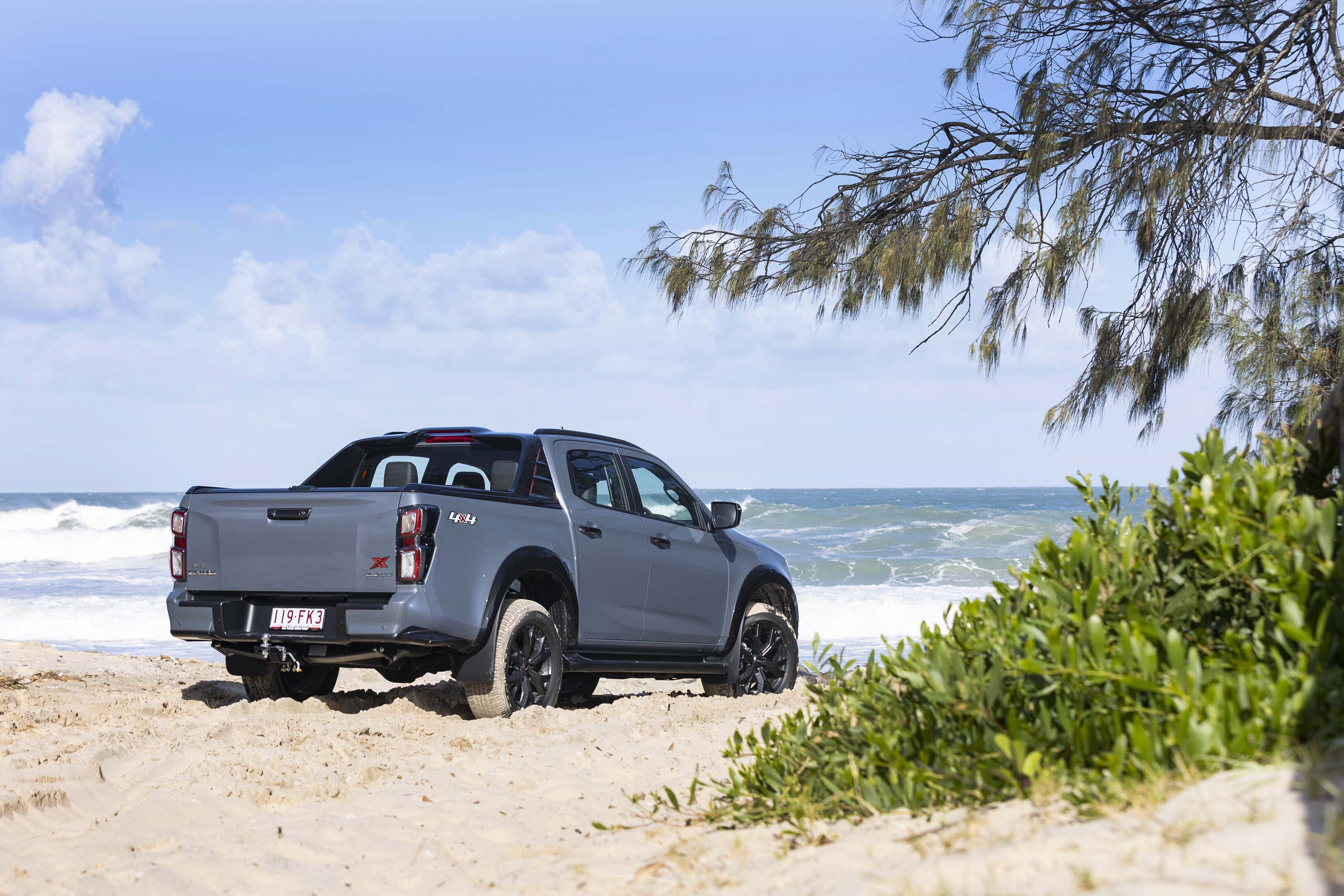
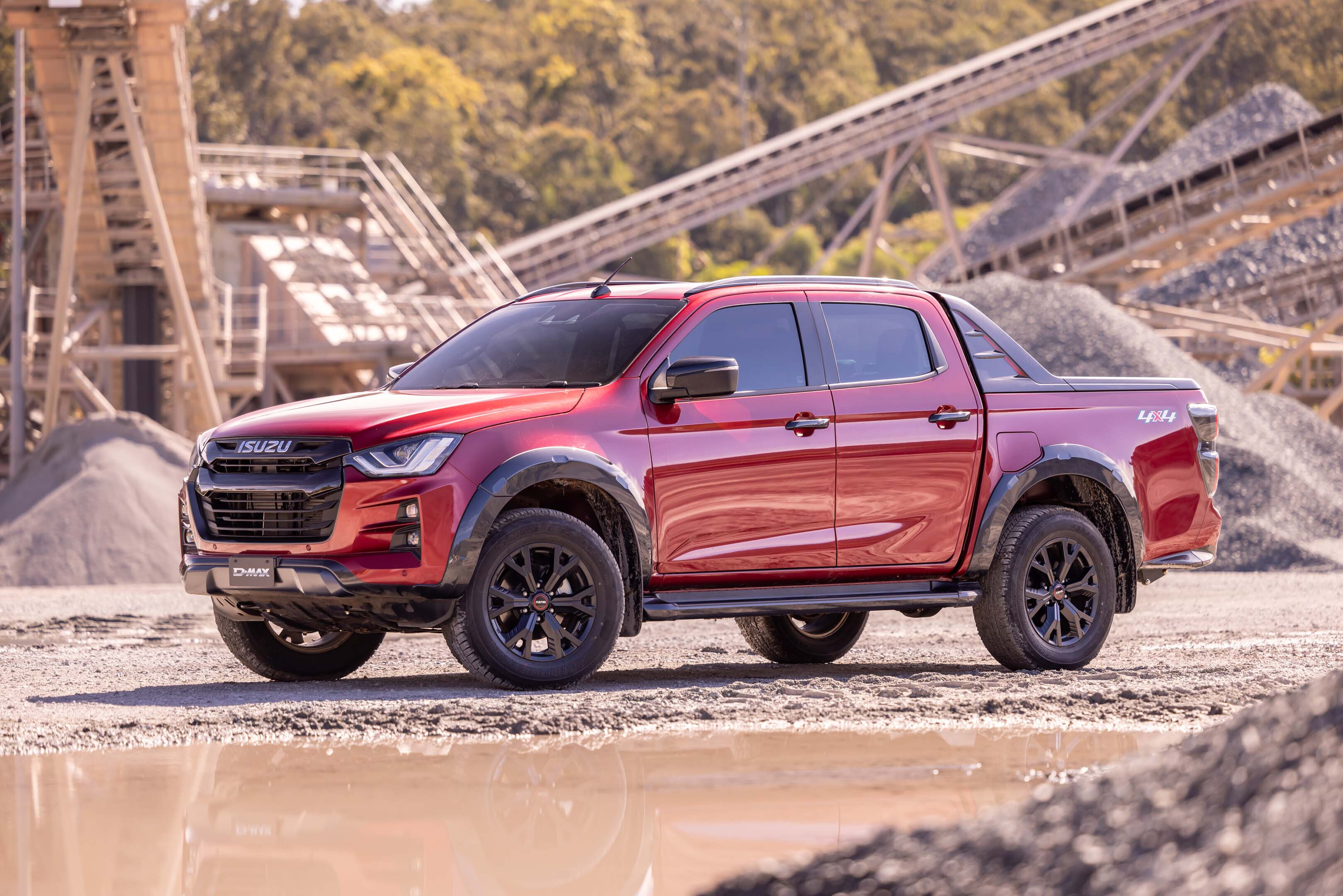
As the photos will show, a few new colour options were added to the range including Neptune Blue, Moonstone White, and the suitably gruff Granite Grey for the X-Terrain.
Wheel design is subjective, but the D-Max has had some polarising wheel options this generation – and off the back of customer feedback, Isuzu has introduced new designs across the board.
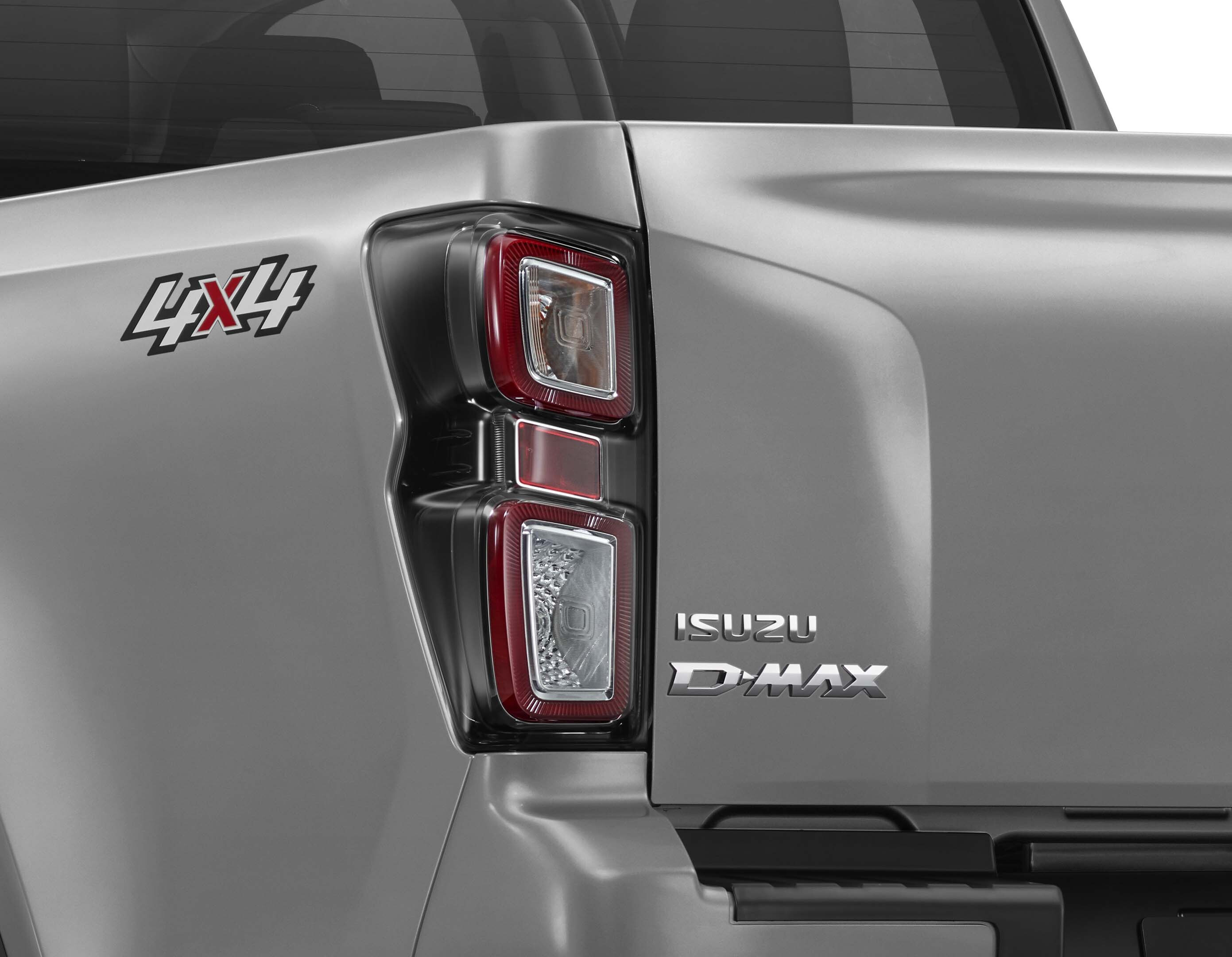
A new grille design is finished in a range of two-tone colour schemes from black and grey for base models, to different shades of grey-on-grey for the LS-U and LS-U+ and the top dog X-Terrain. The darker design theme carries over to the rear too, with grey inserts for the LED taillights.
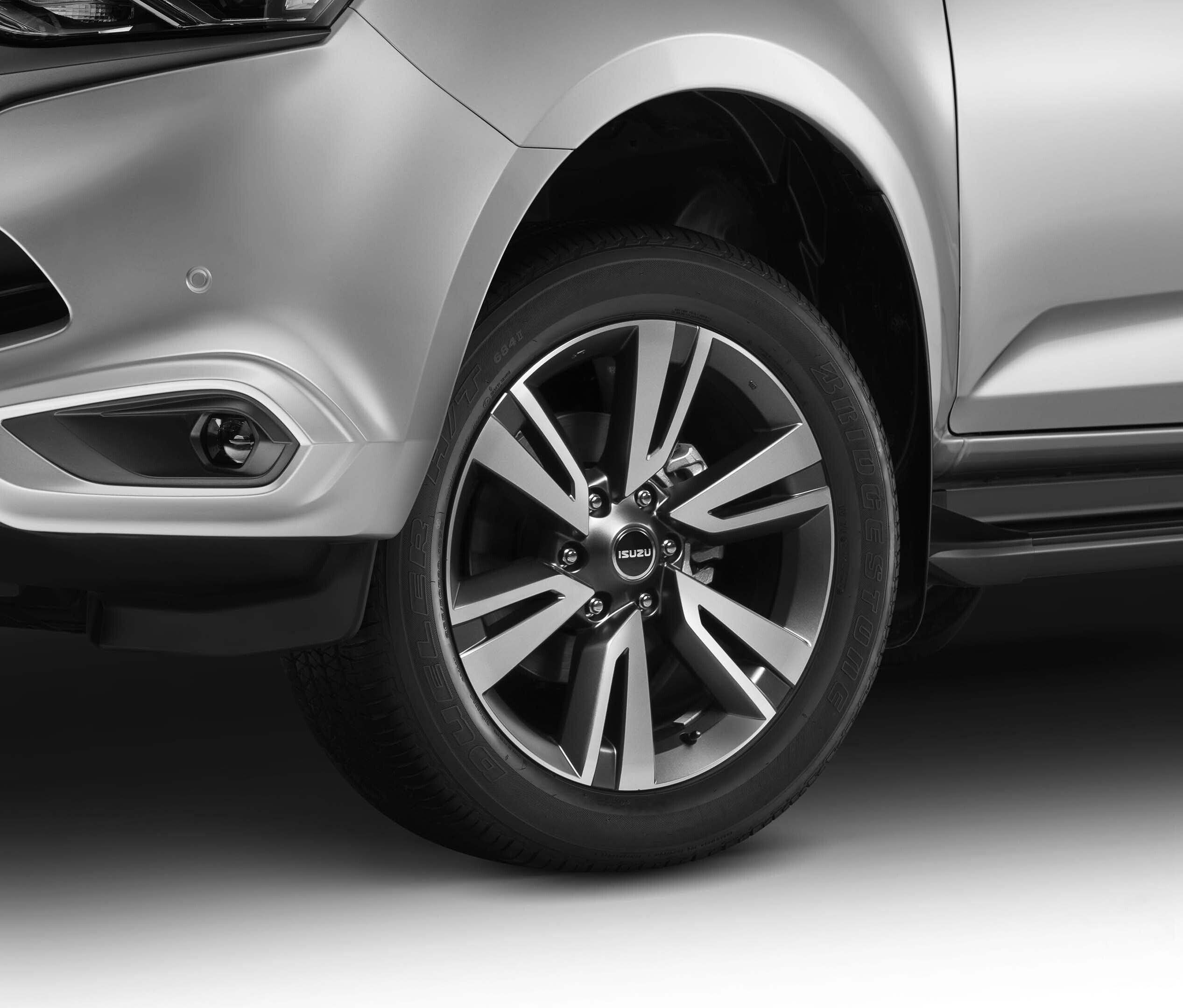
Our favourite visual change are the better wheels. Of course, wheels are subjective, but the latest generation D-Max has had some polarising wheel options, and off the back of customer feedback Isuzu introduced new designs across the board. The X-Terrain’s 18-inch dark grey alloys, wrapped in Bridgestone Duellers, were our pick of the bunch.
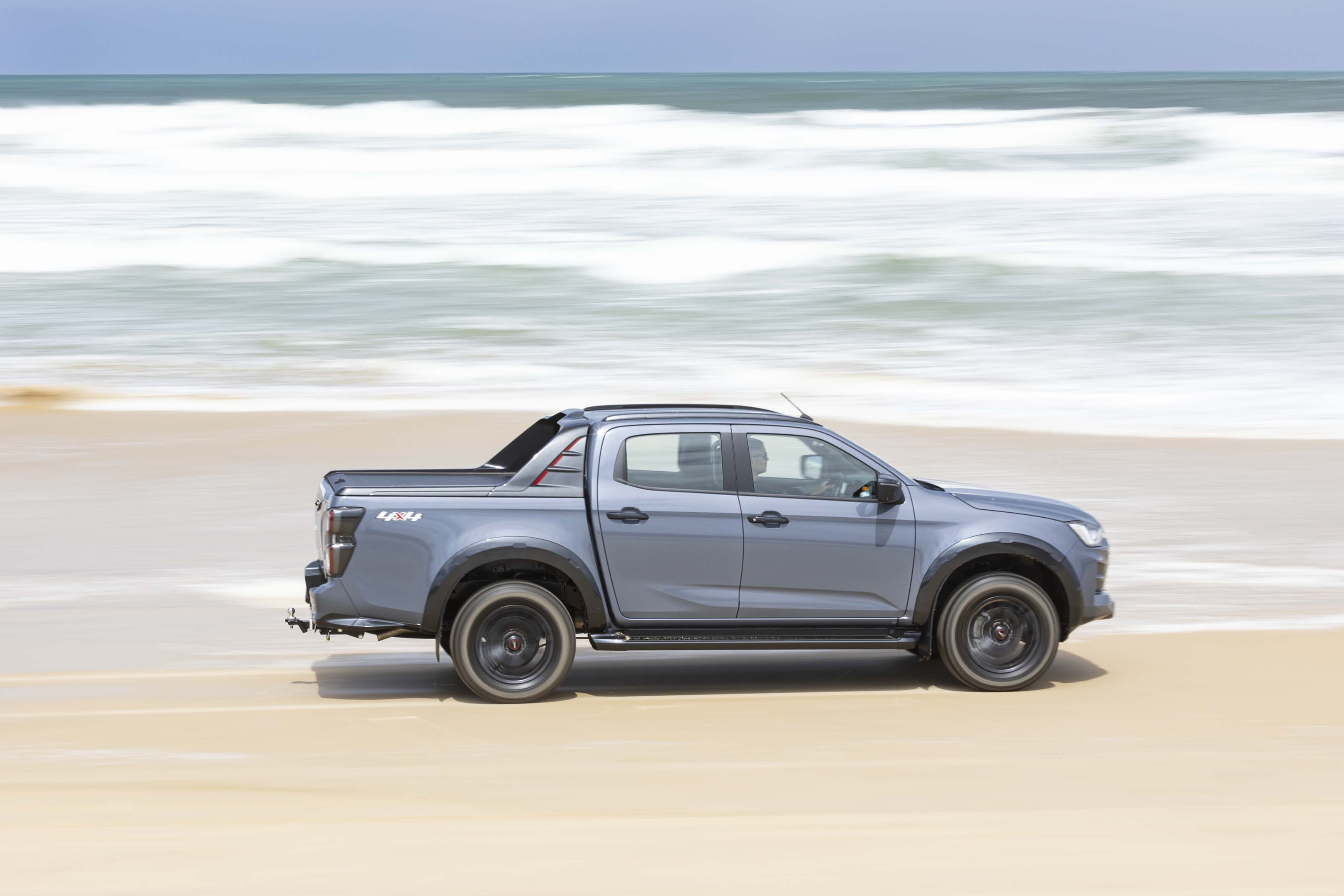
While on the topic of wheels, our favourite tech upgrade is the addition of tyre pressure monitoring — although when beach driving with the pressures down, you lose the use of the centre driver display for things like fuel economy.
It’s no big deal, but it would be good if there was a way to tell the car you’ve deliberately dropped pressures or navigate away from the low-pressure warning screen.
A handy safety system tweak is the automatic disabling of blind-spot monitoring and rear cross-traffic alert functions when a trailer is hitched. Isuzu isn’t the first to think of this, but considering half of all owners tow (according to Isuzu), it’s a smart move.
The only other noteworthy change, and a rather obscure one, is the tailgate ‘assist’ feature.
Apparently, customers were complaining about heavy tailgates, so Isuzu fitted two gas struts — one for lowering, one for raising — to significantly lighten the load. It’s not until you feel how light it is that you realise this should be the norm on all modern utes.
Interior comfort, space and storage
We tested the most luxurious LS-U+ and sportiest X-Terrain, and they really highlight the best of what Isuzu offers.
Inside each, it’s leather as far as the eye can see compared with the cloth and wipe-down vinyl finishes of the lower grade SX and LS-M.
Isuzu says it updated the selection of seat upholstery trims, but really the interiors feel about the same as the current models, bar an additional 2.1Amp USB port in the second row of SX models.
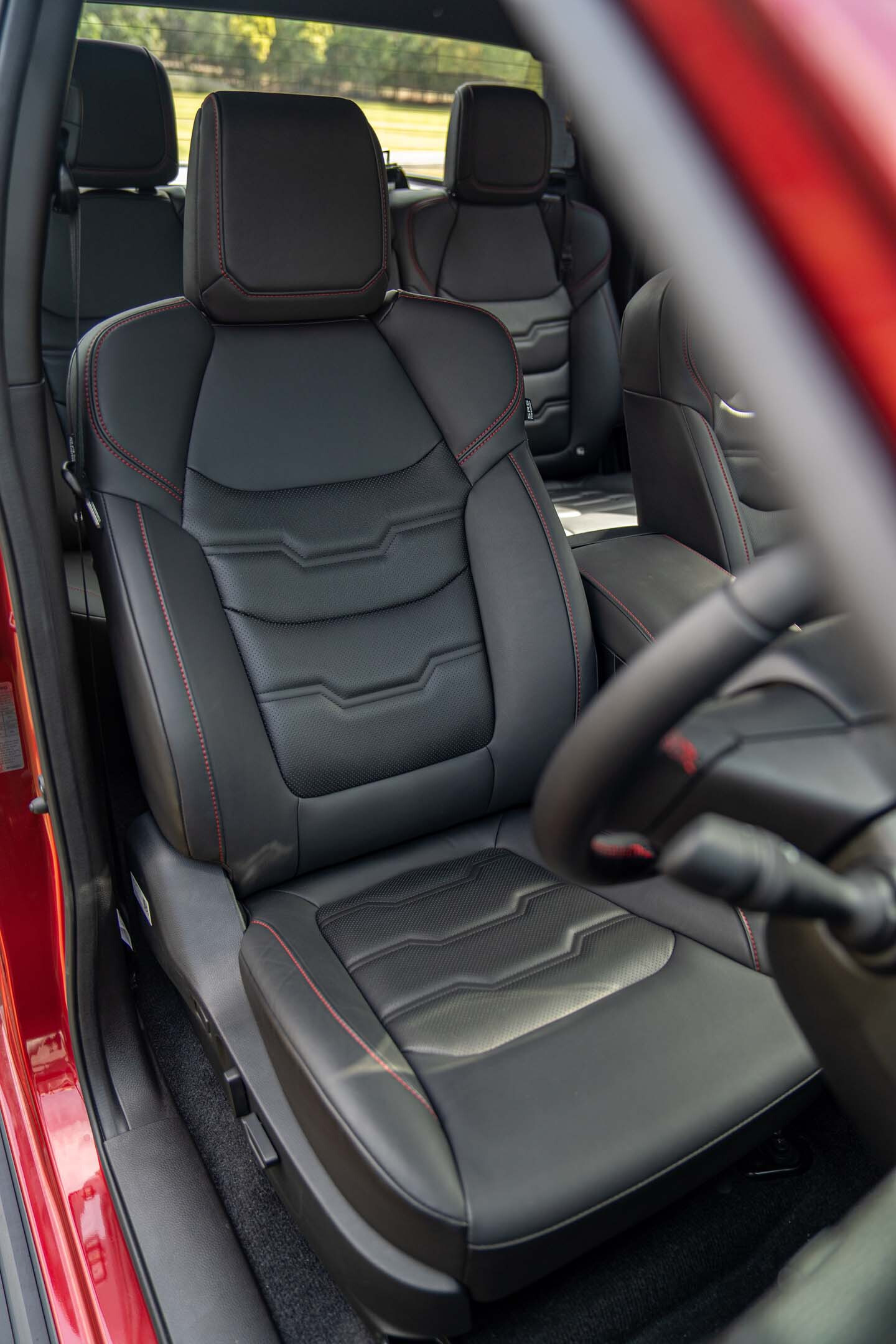
The X-Terrain stands out a little over the LS-U+, with red stitching and a slightly sportier feel, but the seats appear to be identical under the leather. They offer sensational bolstering, comfort, and eight-way electronic adjustability. Isuzu’s seats are a winner, plain and simple.
Smart entry and walk-away door lock feature on LS-U, LS-U+ and X-Terrain models and they also get bush-button-start. Lower spec LS-M and SX models are a good old-fashioned key-in-ignition job.
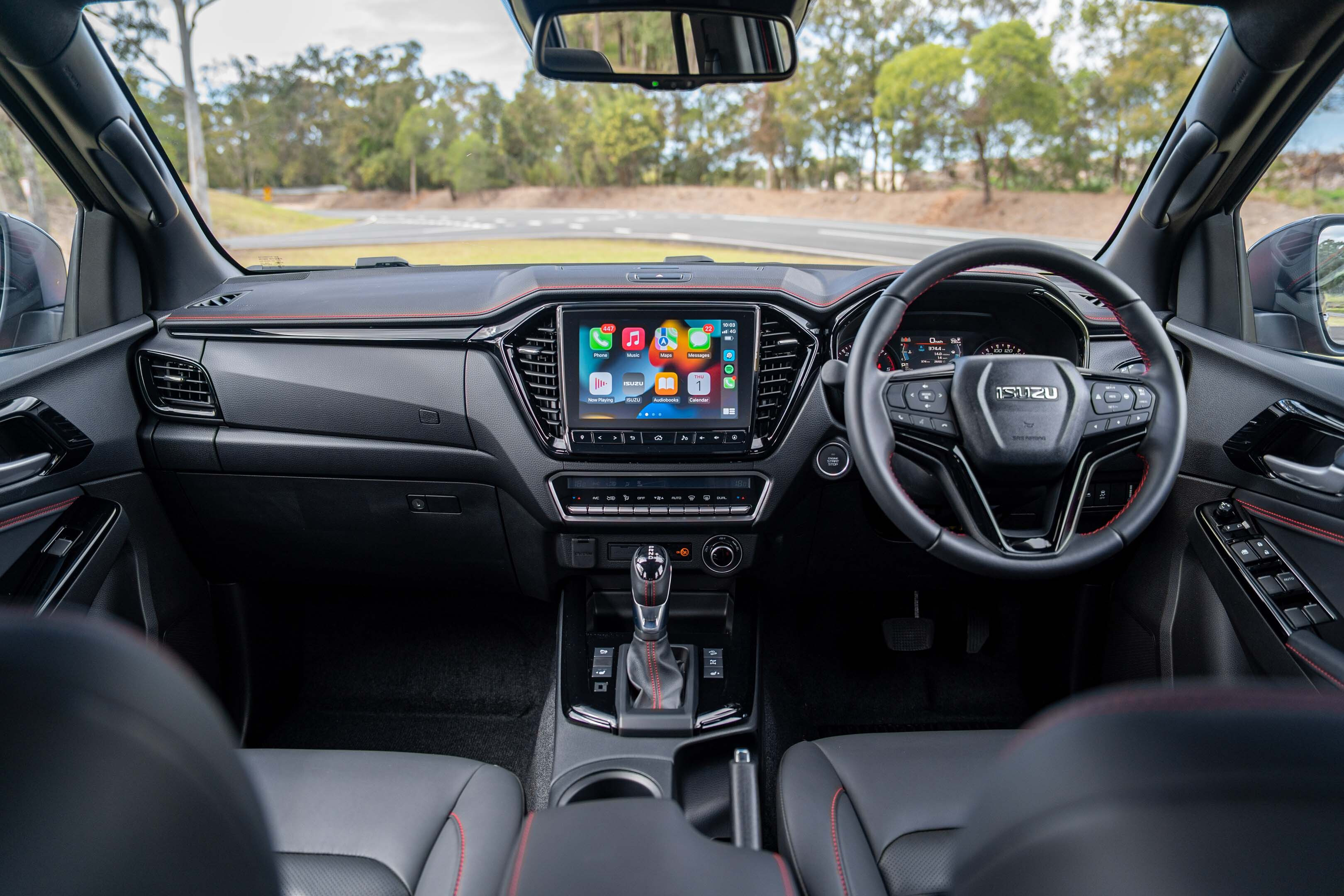
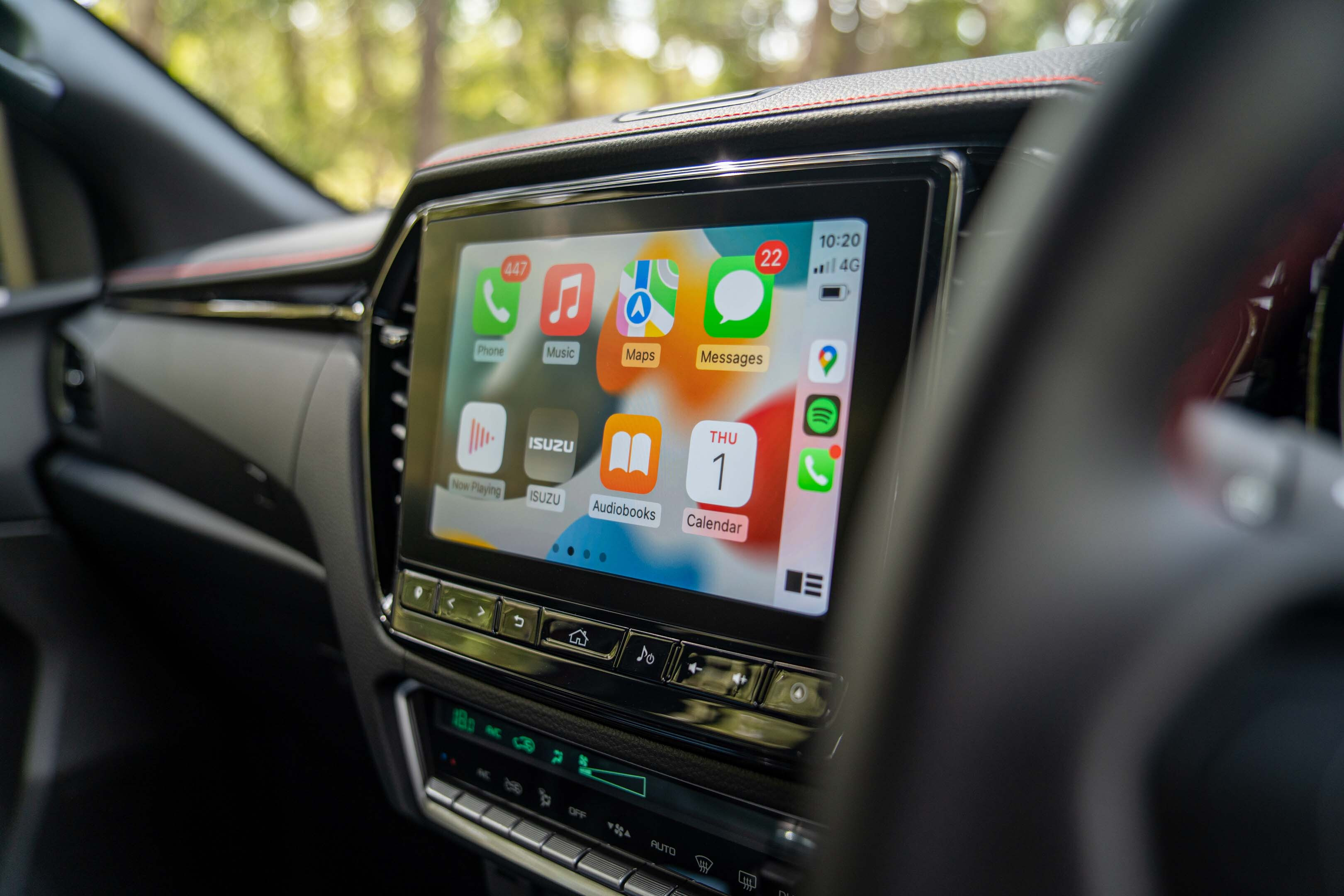
The LS-U, LS-U+ and X-Terrain get a 9-inch centre display, while the LS-M and SX still only get 7-inches of screen to play with. The infotainment system comes with DAB+, navigation, wireless Apple CarPlay, and Android Auto is still wired for 2023.
It might not be the most sophisticated interior, but it’s the ‘cargo pants of cabins’ with its endless storage options.
Front and rear USB charging points should keep phones juiced, but there’s still no wireless charging pad.
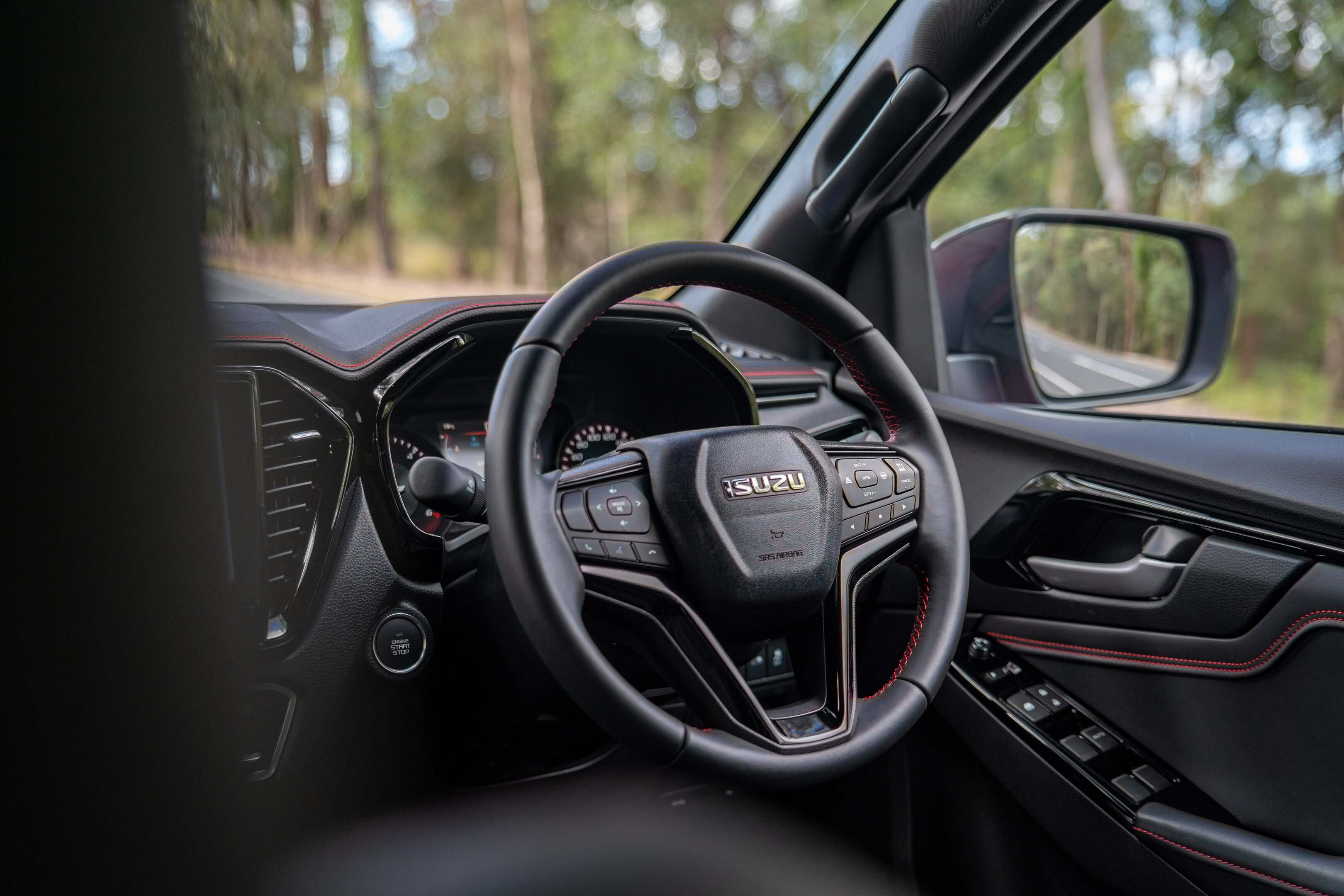
The cabin isn’t overly tech rich, but between the infotainment screen, dedicated climate controls, and steering wheel controls, it’s a very simple vehicle to operate on the fly.
It might not be the most sophisticated interior, but it’s the ‘cargo pants of cabins’ with its endless storage options. The wildly handy D-Max side cupholders remain, as do the huge door pockets, top storage box, and cavernous centre compartment.
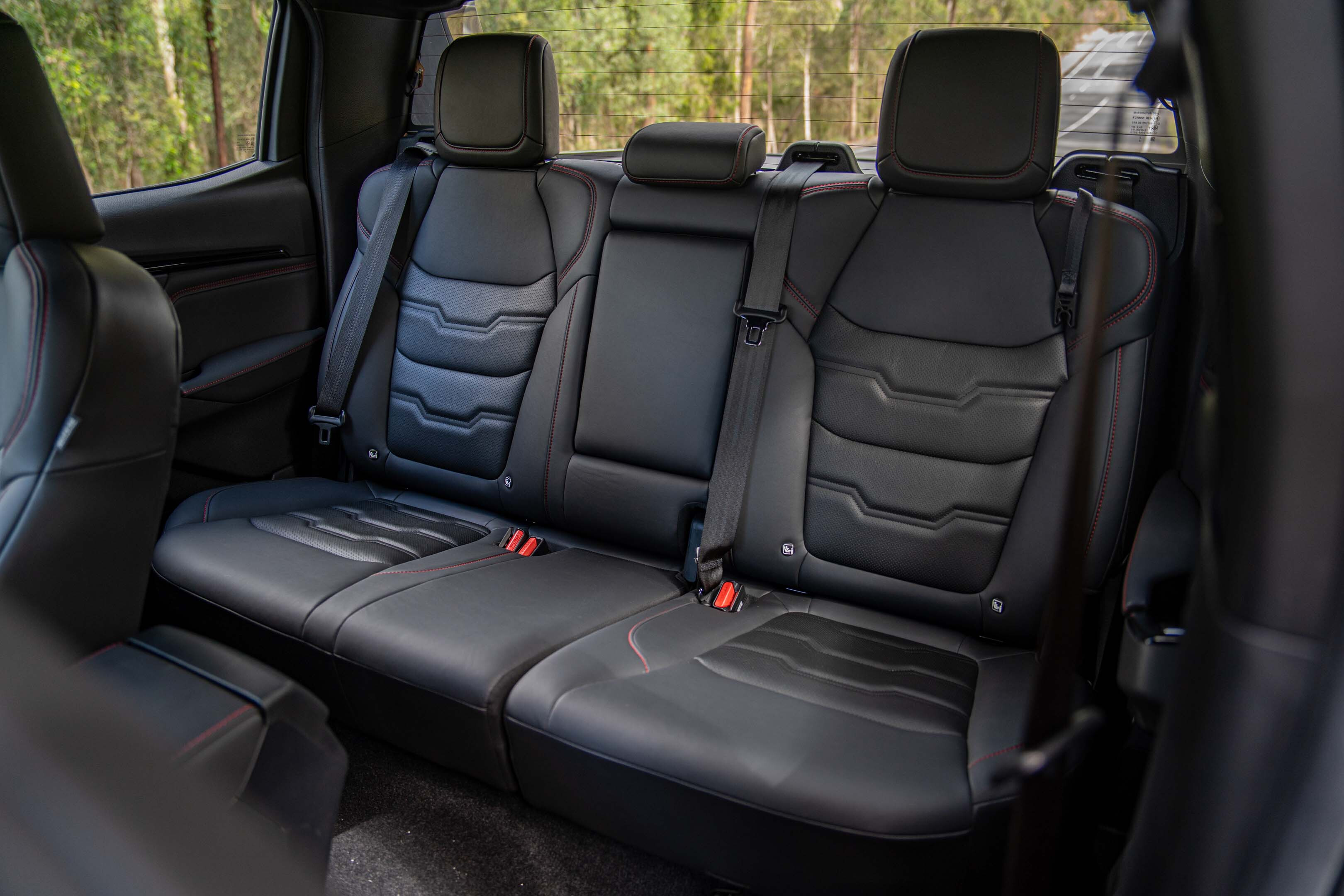
Legroom and overall comfort is up there with the best, but like all dual-cabs the second row is a tad cramped. It’s a utility, so the 1495mm (L) x 1530mm (W) x 490mm (D) tray offsets any comfort woes with its 970kg payload. Provided you carry some straps, there’s no shortage of carrying capability.
What is it like to drive?
| Engine | 3.0L turbo-diesel |
|---|---|
| Power @rpm | 140kW @ 3600rpm |
| Torque @rpm | 450Nm @1600-2600rpm |
| Transmission | 6-speed automatic |
The D-Max is a solid performer, no matter the model variant, but the LS-U+ and X-Terrain – with 18-inch wheels and a little more weight over the back with roller covers fitted – ride the best.
Without a load, the leaf-sprung rear can get a bit jolty on rough roads or off-road tracks, but Isuzu has the setup dialled and it’s a small price to pay for good load carrying ability.
The D-Max is an all-rounder that’s equally happy dawdling around town, stretching its legs on the highway, or throwing roost on the beach. Much of that comes down to the engine, and its sheer flexibility.
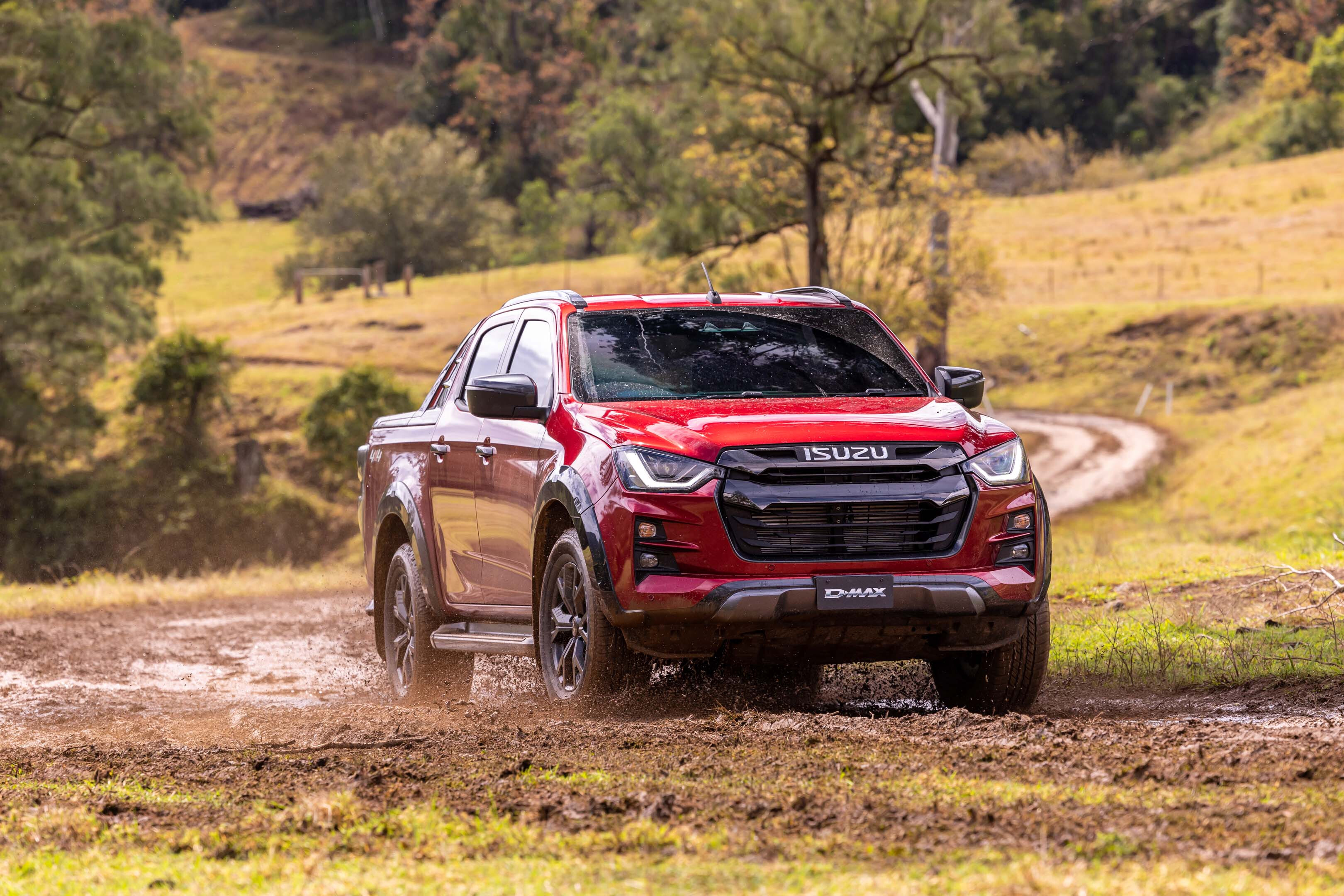
The under-stressed 3.0-litre turbo-diesel delivers 140kW and 450Nm, with peak torque from just 1600rpm. Its meaty torque spread can be used to lug along or pile on pace without the six-speed auto fumbling for the right gear.
And on that, many will argue the six-speed auto is a bit outdated as seven- and eight-speed gearboxes become the norm. Mated to the torquey 3.0-litre, which produces 300Nm at just 1000rpm, the six-speed works.
Steering has always been a strongpoint for the D-Max since Isuzu moved to an electronic system in 2020. It’s light at low speeds, but firms up considerably by the time the speedometer is into triple digits, and the feedback off-road is fantastic.
It’s a surprisingly fun ute on b-roads, and across our testing there were plenty.
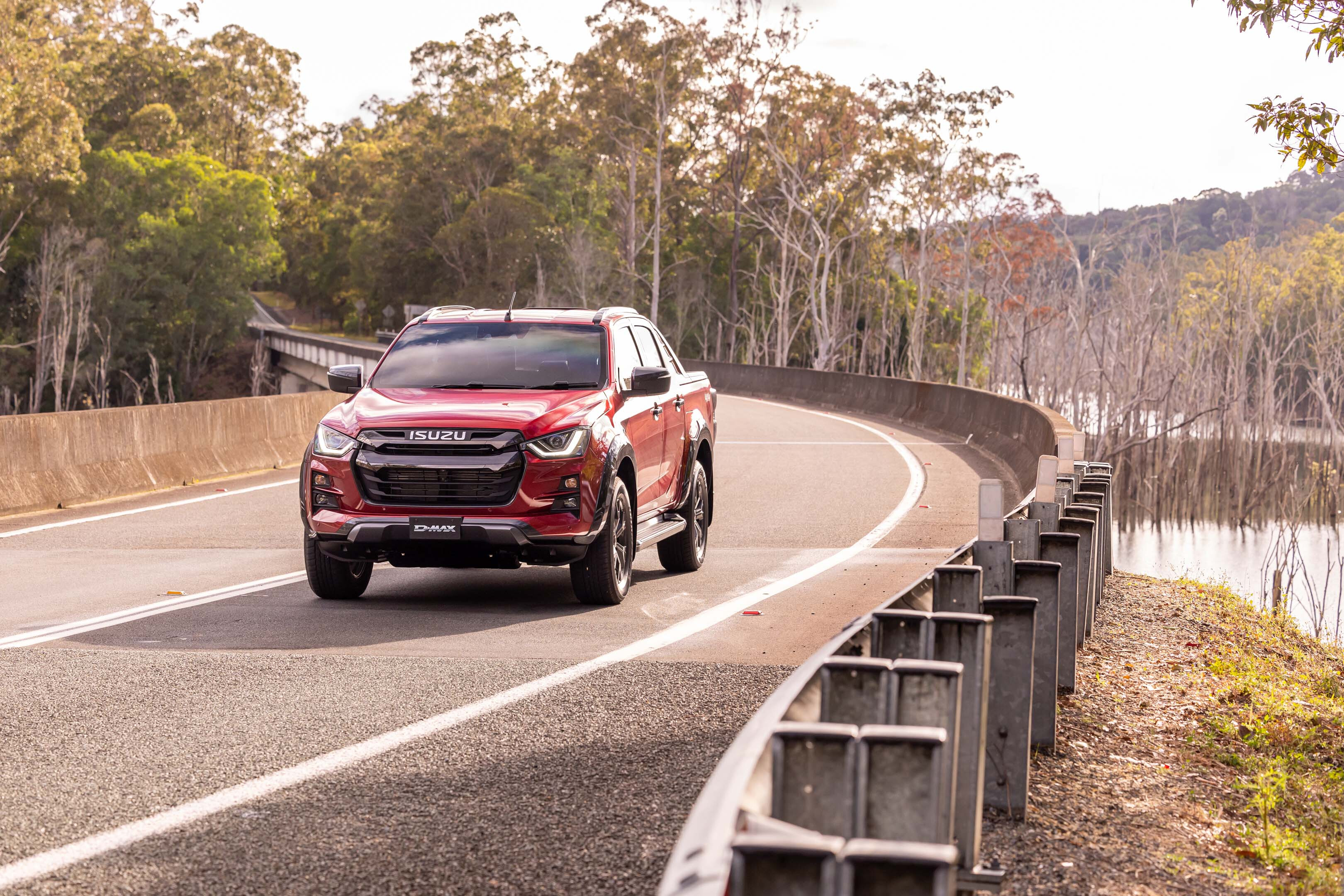
Yes, it wallows and rolls, and no it doesn’t stop with the urgency of a similarly heavy performance SUV, but it’s enjoyable on-road.
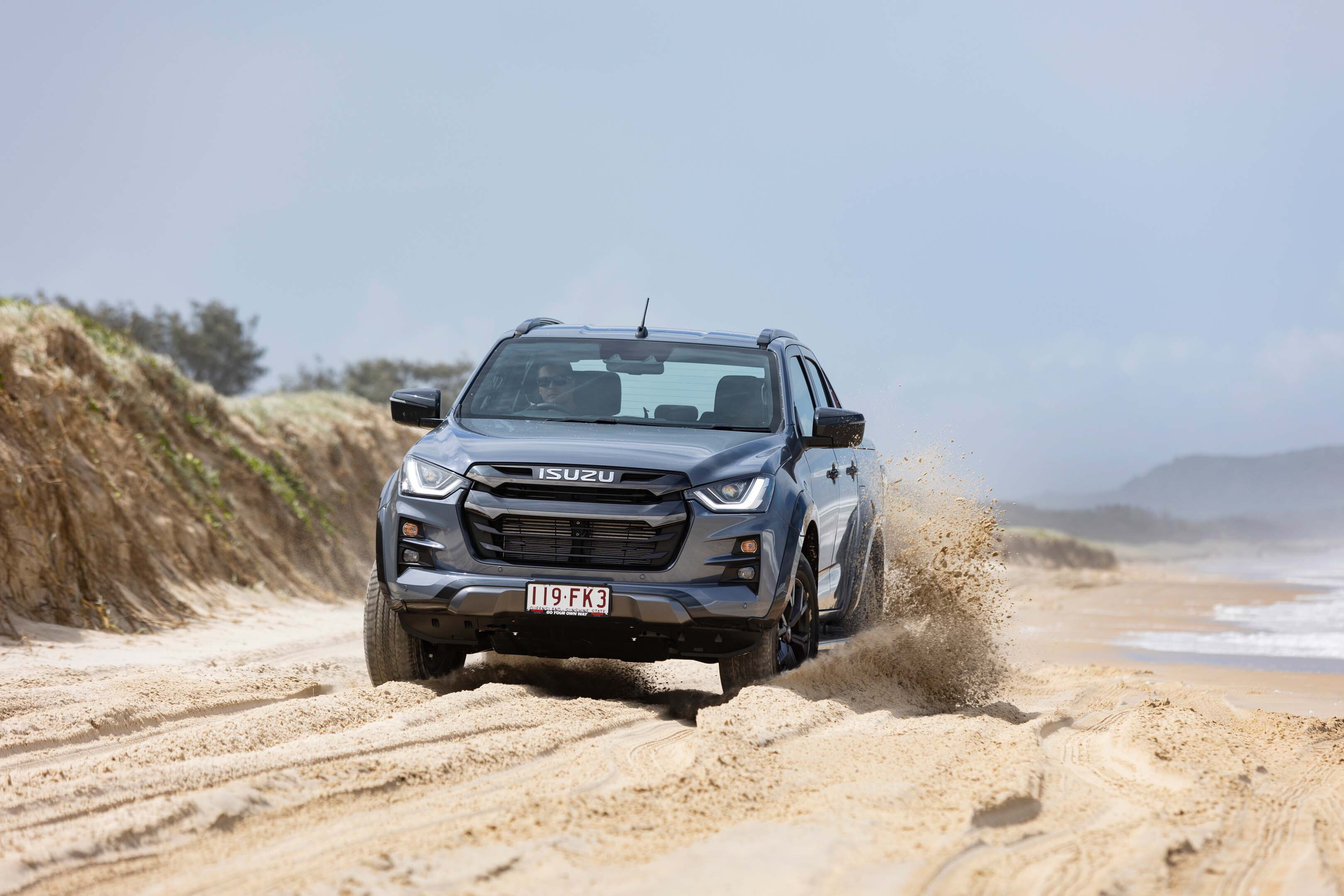
Off-road the D-Max shines, but the same could be said of any true 4×4. It’s the analogue experience, though, with a good old fashioned transfer case and not a drive mode in sight. Across a day of beach driving all there was to do… was drive.
For those wanting the SUV experience in a ute, the D-Max may be a bit gruff. It’s refined, but it’s louder than some other diesel competitors and it’s bumpier too. Its appeal lies is in its value, and do-it-all ability.
The 2023 D-Max offers small refinements that go a long way on an already great ute, and it’s a hard one to fault after two days of on- and off-road driving.
How is it on fuel?
Across two days of on- and off-road testing, results were consistent across the two models.
The X-Terrain used 9.5L/100km and the LS-U+ showed 9.6L/100km — bearing in mind those figures were taken after a decent bashing on the sand.
With more highway use, and kept away from lead-footed journos, the current generation D-Max tends to hover around the high-eight to low-nine litre mark.
How safe is it?
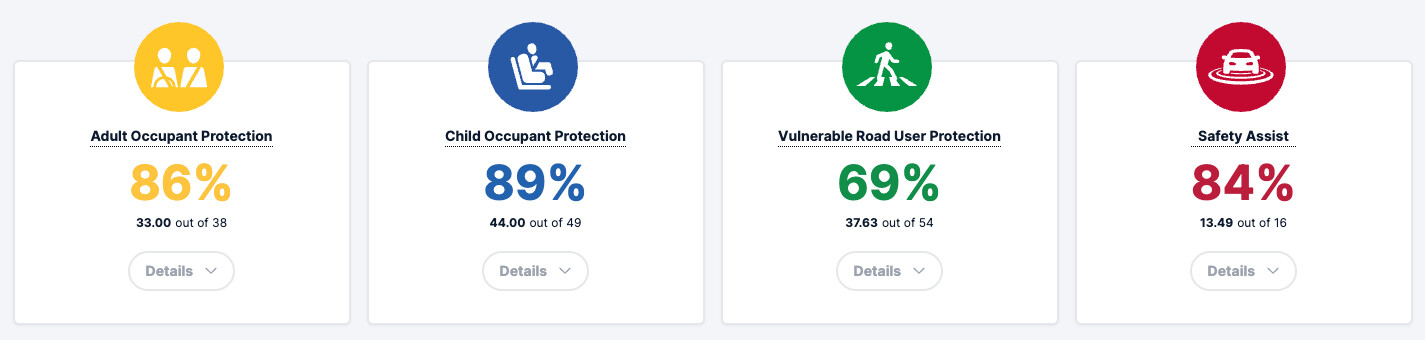
All D-Max variants scored a full 5-star ANCAP safety rating when the latest generation launched in 2020 and were again tested recently, achieving the same result.
All models boast eight airbags and Isuzu’s safety system as standard across the entire range.
Isuzu puts its Advanced Driver Assistance System (IDAS) in every model, even the budget 4×2 SX workhorse, with autonomous emergency braking, blind-sport monitoring, forward collision warning, rear-cross traffic alert, traffic sign recognition, lane departure warning and emergency lane keeping.
It’s an unintrusive system for the most part, but there is also the lane support system switch on the steering wheel that turns the systems off at the press of a button.
ANCAP crash safety results
Warranty and running costs
Isuzu’s ‘Service Plus 6-7-7’ warranty will remain for 2023, comprising a 150,000km six-year warranty, seven years’ capped-price servicing, and seven years’ roadside assist.
Trips to the dealer for an oil change will roll around every 15,000km or 12 months, and capped price servicing ensures a fixed cost for the first 105,000km.
VERDICT
Isuzu has developed a ute that’s very good at the things it needs to do well.
It isn’t quick like a Raptor, it won’t rock crawl like a Wrangler, it mightn’t have the luxury of an Amarok, but it’s arguably the best all-rounder.
The X-Terrain and LS-U+ that we tested sit parallel to each other in the D-Max line-up, we think, aimed at slightly different buyers.
It’s clear the LS-U+ is the slightly fancier of the two, appealing to those who favour an understated dual-cab ute, but with all the trimmings.
There’s no denying, though, that the X-Terrain brings the value with its special drive-away price ($64,990) and, with the new Granite Grey paint option, the toughest looks too.
2023 Isuzu D-Max specifications
| Engine | 3.0L turbo-diesel | |
|---|---|---|
| Power @rpm | 140kW @ 3600rpm | |
| Torque @rpm | 450Nm @1600-2600rpm | |
| Transmission | 6-speed automatic | |
| Body | Four door utility | |
| L/W/H | 5303mm | |
| Wheelbase | 3125mm | |
| Weight | 2165kg | |
| Fuel / tank | Diesel / 70L | |
| Fuel use L/100km | 8.0L (claimed) | 9.5/9.6L (on test) |
| Suspension | double wishbone (f) / leaf (rear) | |
| Steering | electric power steering | |
| Brakes | disc (f) / drum (r) | |
| Wheels | 18-inch alloys | |
| Tyres | Bridgestone 684II HT | |
| Tyre size & spare | 265/60 R18 with full-size spare | |
I had never heard of ‘torque sticks’ until a mate of mine pulled them out of his bag while we were changing a wheel somewhere on the Gary Highway.
They’ve been around for a while by all accounts and when I saw them, I thought, ‘what a good idea’. When I got home I went looking for them and found them at a Total Tools outlet. You generally won’t find them at Bunnings and the like.
Torque sticks are meant to be used with an air-powered impact wrench; if you are using them with a battery-powered wrench, then the more powerful the wrench is, the better and more accurate the torque stick will be.
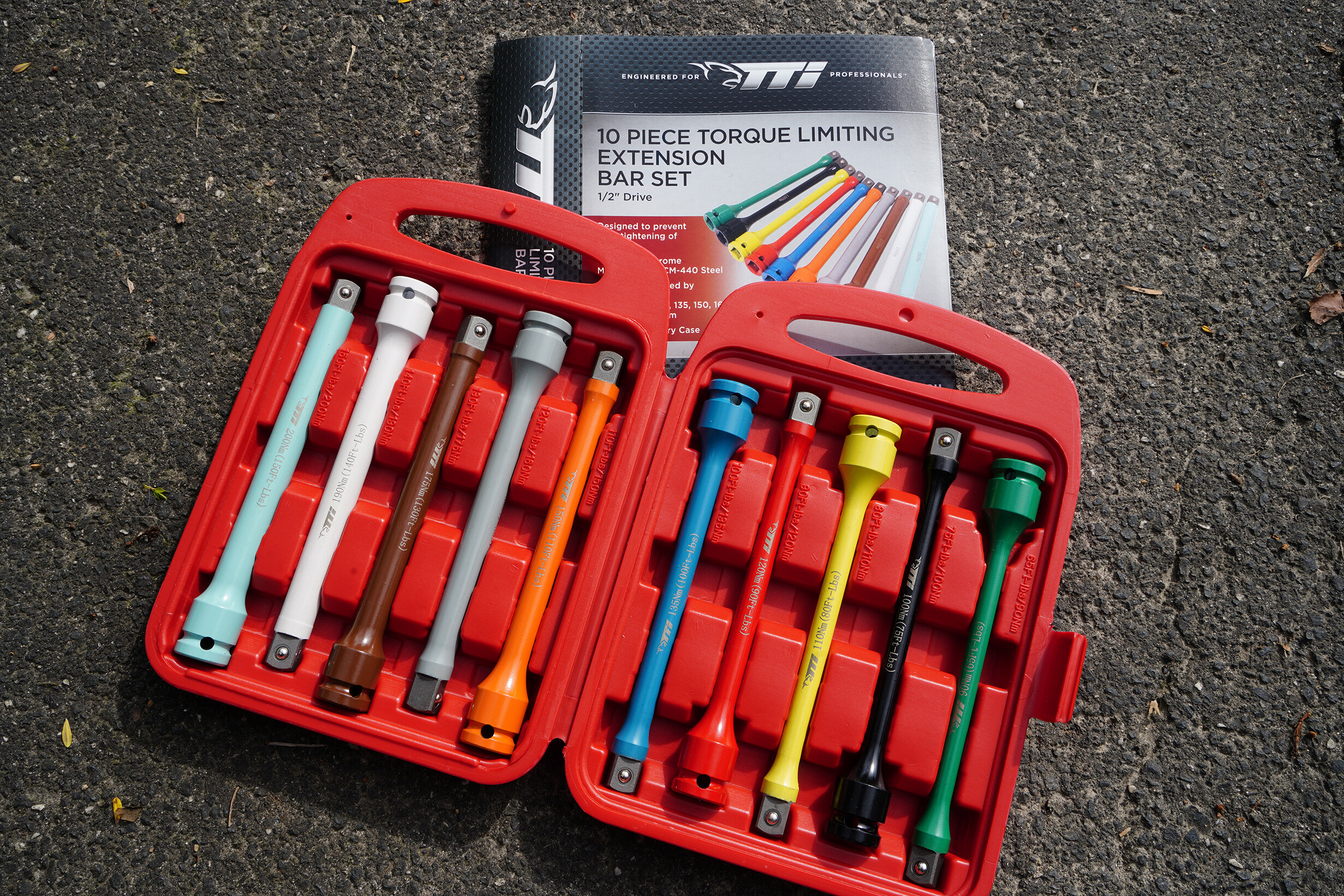
I’m still not sure how they work as they just look like a socket-extension bar, but the higher value torque sticks are thicker.
Nobody would recommend these for tightening head bolts of an engine, for example, as that’s more in the realm of accurate (and expensive) torque wrenches. However, for doing up wheel nuts, they seem to work fine.
We tested ours against a high-quality hand-held wrench and found them to be pretty accurate, and certainly good enough for tightening wheel nuts.
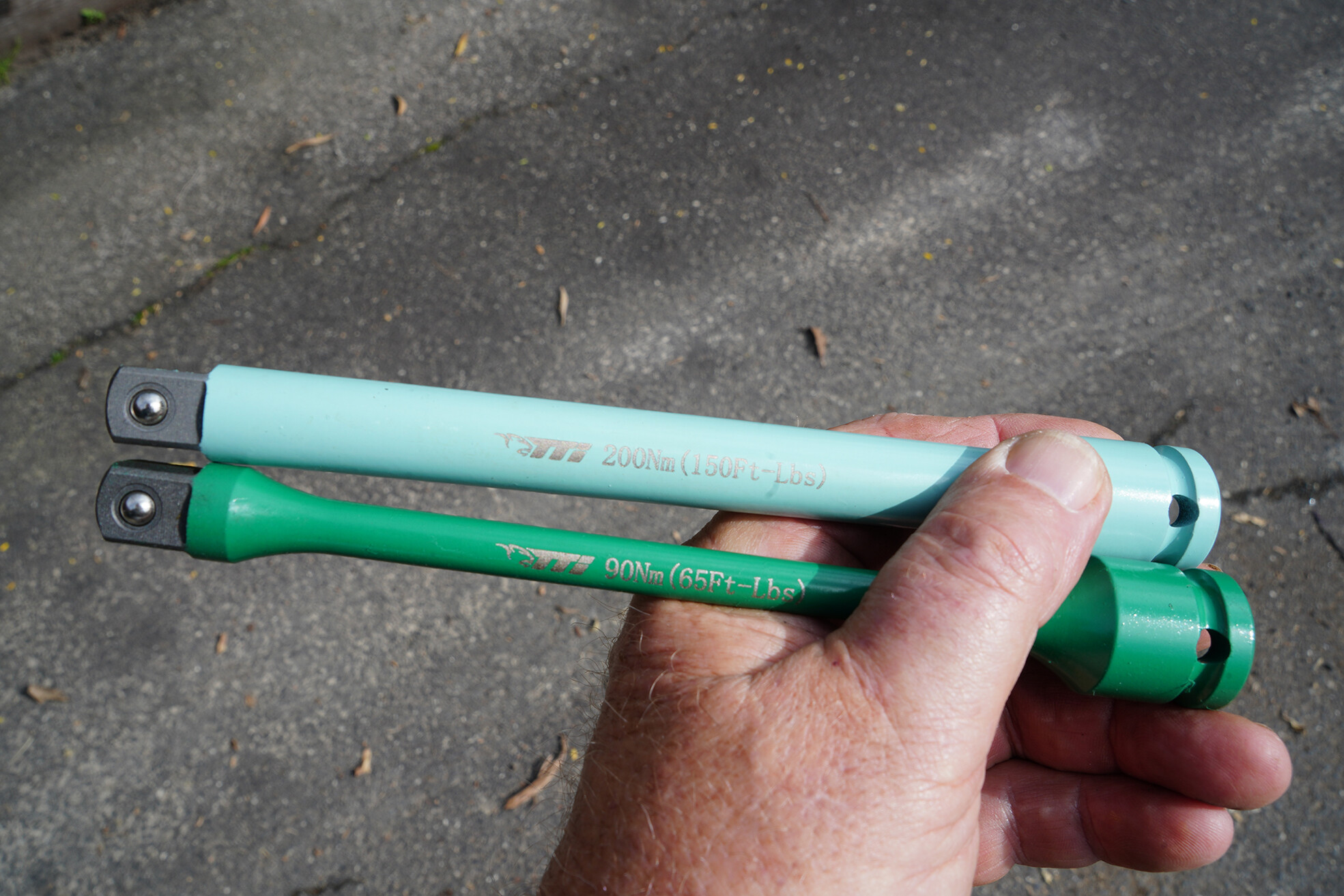
While the 10-piece kit may seem a little expensive, you can find single sticks on the web for $30 to $40 each. As we have a couple of 4WD vehicles and we are often touring with clients who have a wide range of vehicles, we went with a 10-piece kit with torque sticks ranging from a rating of 90Nm to 200Nm – that should cover every wheel nut on common 4WD vehicles we’ll ever come across.
High-quality torque wrenches will set you back more than 300 bucks, and they need to be looked after and aren’t ideal for carrying around in a tool bag in the back of a bouncing 4WD – that’s the main reason we went with torque sticks.
Plus, if you only have one vehicle, you can throw the appropriate stick in a tool roll and not carry the whole kit, which is heavier than you may think.
Available from: www.totaltools.com.au RRP: 10-piece kit $183

Within 10km of driving the 2022 Ford Bronco, I had to ask: “Why the hell isn’t Ford bringing these to Australia?”
Let’s be honest, Ford can’t go wrong with any 4×4 riding on the T6 platform at the moment and the Bronco would complement the Ranger and Everest models in Australia as being a better off-road and lifestyle alternative.
I must admit that I was a little disappointed when the kind lady at the counter at LAX handed me the keys to the big red Bronco Black Diamond as I was expecting a Bronco Raptor for this drive. While the Raptor is the off-road hero of the Bronco model range with its 37-inch tyres, lockers and 3.0-litre V6 engine, the Black Diamond version was much lower and slimmer than the Raptor which would have been a rather tight fit in the hotel car park.
Upgrade your 4×4
-
Bullbars
-
Underbody Protection
-
4X4 Tyres
-
Canopies
-
Roof Racks
-
Storage
The plan for the Bronco was to do a road trip that would be every car junkie’s dream run to the SEMA show in Las Vegas and Raptor or not, this Bronco would get the job done. So after three days of seeing the sights around LA, heading to Malibu, I jumped in the car and headed east.
The drive from LA to Vegas takes about a five hours on the highway, with some stops I was able to take in some of the scenery, as well as checking out some very cool and interesting vehicles that were also heading the same direction.
Being a soft-top, the Bronco did have some road and wind noise, but that’s really unavoidable when there isn’t a sheet of metal separating you and the sky.


The Bronco does come with a hardtop option, but this particular model not only has a fully removable roof, but you can also unbolt the doors completely and the process is very simple. If you check out the Bronco section of the Ford website, there’s nothing short of seven different options for soft- and hardtop variants. Nobody is going home unhappy with their choice!
It’s no secret that Ford has targeted the Jeep market with the Bronco so there are many similarities the Jeep Wrangler in its features.
JUMP AHEAD
Powertrain
Although the Black Diamond doesn’t have the same 3.0L V6 of the Bronco Raptor, it does come with the option of a more-than-capable 2.7-litre EcoBoost V6 that also has twin turbos.
As standard, they come with a 2.3L EcoBoost inline 4-cylinder which makes around 220kW and 440Nm of torque on premium fuel, but if you chip in an extra USD $1895, you get the V6 which makes an extra 22kW, not to mention an 122Nm.
For the manual gearbox lovers, the sad news though is that the 7-speed manual transmission is only available with the 4-cylinder engine.

Once you step up to the V6, the only gearbox option is the 10-speed auto, but to be honest, with so many cupholders and buttons to press, having to manually shift gears just adds to the driving effort in a car which is already pretty easy to drive.
There is an option to go for full-time or part-time 4×4, but the car I had was part-time. The Black Diamond comes with a 4.46:1 ratio locking diff, but for an additional USD $5290, you can go to a 4.7:1, but it means you have to option for full-time 4×4.
To be honest, it felt very good and I doubt very much that unless you were planning on going full SEMA spec with a set of 40-inch crawlers that you’d need to change it.
On-road
Overall, I was impressed with the power and the way it drove. One of the big selling points with the Bronco is the seven GOAT modes, which stands for ‘Goes Over Any Terrain’.
The GOAT modes consist of everything from Normal and Eco which are great for when you just want to cruise and chill out (Eco for when the next gas station is a little farther away), right through to Rock Crawl, for when there’s a closer gas station, but you have to take that scary canyon pass to get there.
The modes are all tweakable to suit your own style, but the whole system is intuitive and works very well at taking the thinking out of it. Note though, unlike some other models, namely the Raptor, the Bronco does miss out on Baja mode, yet it is very similar to the sand mode.
Off-road
I’ll be honest in saying that I didn’t really allow myself enough time to properly experience the Black Diamond off road.
Having said that, on the handful of opportunities I did get it into Rock Crawl mode, it seemed quite effortless to drive and more than capable.
Also, the fact that almost every second booth in the 4×4 hall at SEMA had their own variant of a heavily modified Bronco, there’s no doubt that with the aftermarket parts available already, that you could pretty much pick up a car on the Monday and have it ready to compete at King of the Hammers by the Friday afternoon. With or without carbon panels!
Interior
I think it’d be hard to find a late-model Ford with a bad interior and given the Black Diamond is very much focused on heading off road, it does come ready for action with some great features.
The first thing you noticed are those great chunky Bronco grab handles which are a big help off road, not to mention for getting in and out once you’ve fitted a suspension lift and big tyres. The dash itself has a more modest eight-inch touchscreen than some other model Fords such as our Ranger and Everest, but has everything you need.

Without going into details too much about all off the electronic bells and whistles, as well as the safety features and CarPlay options, it’s important to notice that that Ford’s intention for this car was to aim it at people who like adventure and who are also not afraid to get a bit of mud here and there.
On the inside, there’s rubberised flooring and removable drain plugs, so you can easily wash away your sins after a big weekend. Then, for those who like to carry rechargeable gadgets and tools, there are 12V charging points and USB ports in the front and rear of the car, including 12V points in the cargo area.
Right at the back when you open the swing-out door, there’s also a really clever retractable shelf which would come in handy for all manner of activities and can handle 120kg.
Exterior
When Toyota released the FJ Cruiser, I was lucky enough to head off on a magazine shoot where it was put it through its paces against an old BJ40.
Toyota’s attempt at making somewhat of a retro version of the old 40 was definitely a good attempt, but I think Ford nailed it better than Toyota did, albeit being a few years farther down the track. You have to admit they have had plenty of practice with designing retro-looking Mustangs.


Features wise, aside from the big and unmissable BRONCO lettering on the black moulded grille, the factory-fitted Daytime Running Lights and LED fog lamps are a great touch, not to mention the blacked-out door handles and other non-chrome features.

Black Diamond buyers get a number of other cool features to suit their adventurous style.
Underneath, there are bash plates in the front, but then farther back, more protecting most of the vital components, as well as a set of what are surprisingly tougher than they look, rock rails protecting the sill panels.
On the front you can option up a heavy-duty modular bumper which is configurable to your needs and can accommodate anything from lighting and a dealer-fitted winch. It also comes standard with two tow hooks on the front and one on the rear.
I’m still not sure if I love or hate the fact that it also comes standard with steel wheels. Essentially, yes you’re not going to destroy them as much as expensive alloy wheels when you’re bashing round in the rocks, but they do look a bit cheap. They also come with much smaller 32-inch tyres than the Raptor which has 37-inch fitted standard, so there’s a big difference in ground clearance.
VERDICT
If I’m going to be honest, I’d still love to drive the Bronco Raptor. By all accounts it’s an absolute weapon and with those big, wide guards and 37-inch tyres, I would have looked like a total badass driving the streets of LA in it wearing my expensive sunglasses.
Regardless though, I really did enjoy driving the Black Diamond and it was much nicer than I expected, even though my expectations definitely weren’t low.
Would I own one? I’d say yes, but I definitely think I’d want to fit it with big rubber and option it up more, yet as a get-in-and-drive car that you can collect the groceries in on a Wednesday, then hit the trails in on the weekend, it ticks all the boxes.One small feature I really liked which doesn’t really add to the driving experience in any way are the small touches inside and out where it says “since 1966” (Jeep does the same but has a few more years bragging rights). Ford are obviously very proud or the Bronco’s heritage and I think they’d done a great job of doing it justice.
Aussie ownership
For now, Ford Australia say it has no plans to bring the Bronco to Australia. Yes, some people have spotted an oddly plated and LHD Broco making its way around the streets of Victoria, but Ford Australia did a lot of the engineering development of the Bronco here as the lead team on the T6 platform vehicles.
ARB also has a development LHD Bronco in Australia as the official factory-backed supplier for accessories for the Bronco in the USA, in much the same way as it is for the Ranger and Everest here.
Ford’s official line is that the Bronco was developed purely as a LHD vehicle, even though it does ride on the same chassis/platform as our Ranger and Everest. With Ford about to restart converting and selling F-150 trucks here in Australia, there’s no reason they couldn’t do the Bronco as well, providing there was enough demand for it.
Melbourne’s American Vehicle Sales has said that it will be looking at getting approval for and selling converted Broncos in Australia. It has already converted a few models at its Autogroup International facility for other right-hand drive markets, so watch this space for more details on the progress of that.
2022 Ford Bronco Black Diamond specs
| Price | USD$40,940 (starting price, 4-door) |
|---|---|
| Engine | 2.7L V6 EcoBoost |
| Max power | 243kW |
| Max torque | 556Nm |
| Transmission | 10-speed automatic |
| 4×4 system | Part-time 4×4 |
| Construction | Four-door ute on ladder frame |
| Front suspension | Independent via wishbones and coil springs |
| Rear suspension | Solid axle w/ coil springs |
| Tyres | 275/70R17 |
| Kerb weight | 2238kg |
| Seats | 5 |
| Fuel tank | 79L |
4X4 Australia's project builds
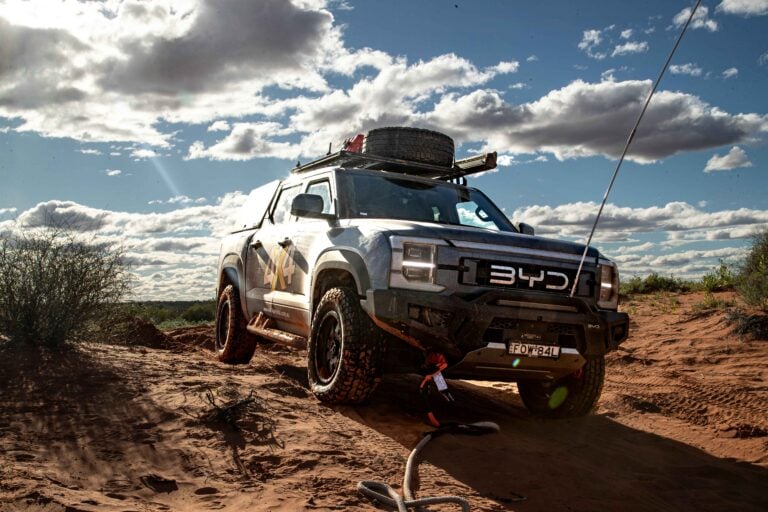
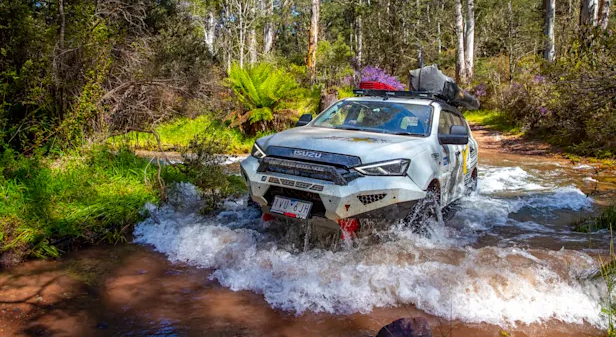
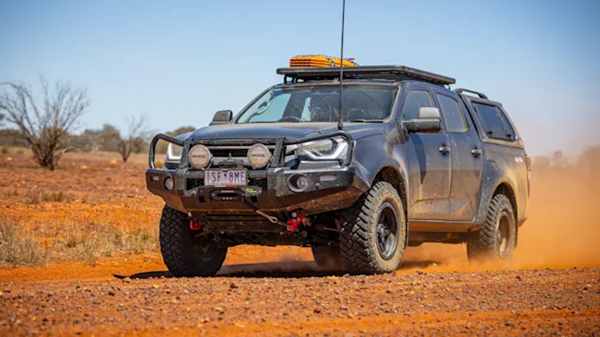
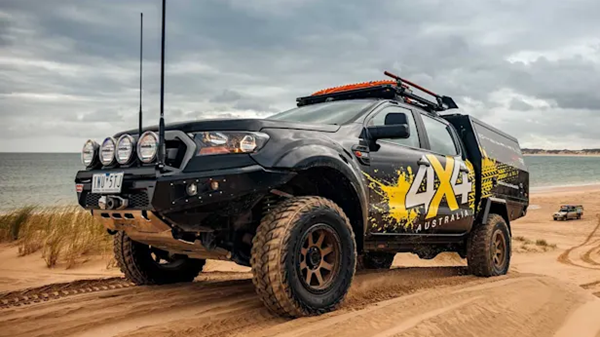
Nissan confirmed the launch of a Patrol Warrior in collaboration with Premcar back in September – but it’s no big secret this weapon has been under evaluation and testing for some time.
The Warrior formula has proven its success – the Navara Warrior ute is now sold in two variants with demand continuing to all-but outstrip supply.
Like the Navara, the Patrol – entering its 11th year on sale in Oz – is no spring chicken, but it is the last remaining bastion of V8 brutality in the Australian off-roader segment with the Toyota Land Cruiser 300 Series downsizing to a diesel V6.
Catch up on the Warrior saga
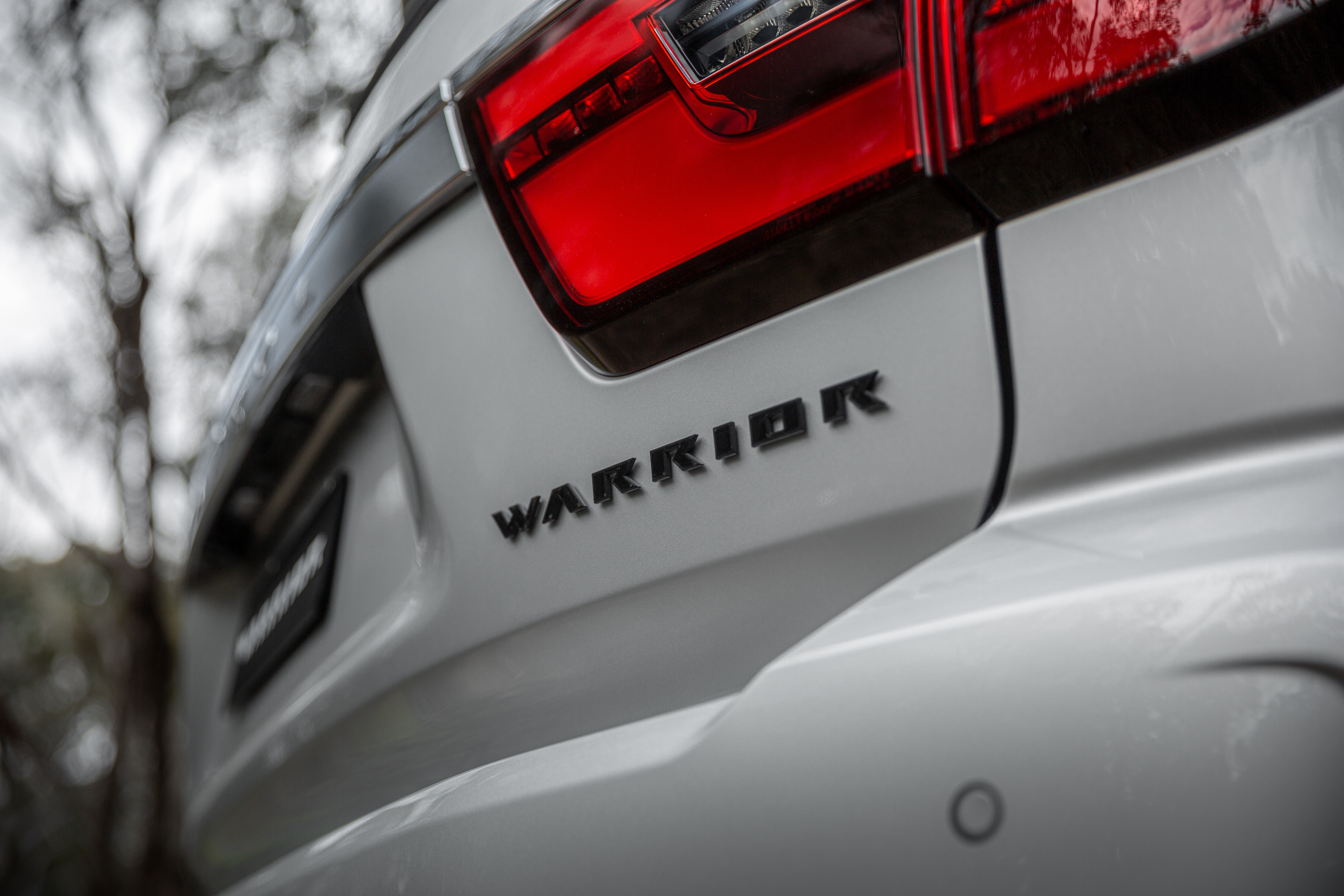
We tried to extract some more information about the Patrol Warrior program before the end of the year, but Nissan was keeping its cards close to its chest.
“We confirmed that it’s coming and we’re still working towards the arrival date, which is in the second half of the next calendar year”, Nissan managing director, Adam Paterson, told 4X4 Australia.
“Obviously, we’re doing everything we can to make sure that the car is here sooner rather than later. But there’s a lot of work being done to make sure we can bring something like that to market.
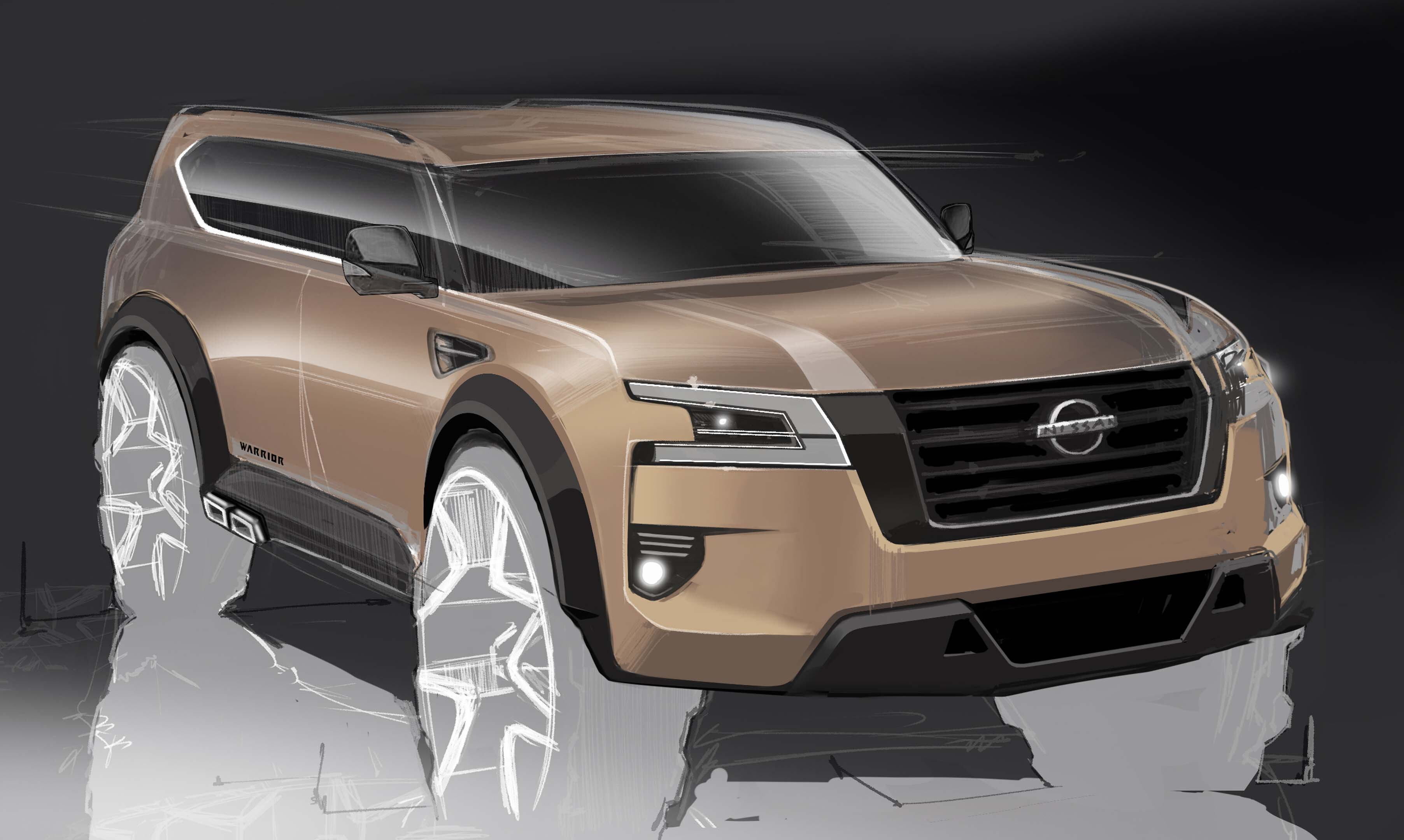
“So I think that’s what we can share on that right now. And hopefully, at some point soon, we’ll have some more concepts and images that we’ll be able to share as we move a little bit further down the development road,” Paterson added.
With little more to go off than some teaser images, insights into what the Patrol needs to make it sing, and rough guidance from the Premcar-developed Navara Warriors, we’ve written a wish-list for what we expect (and want) to see from the Patrol Warrior.
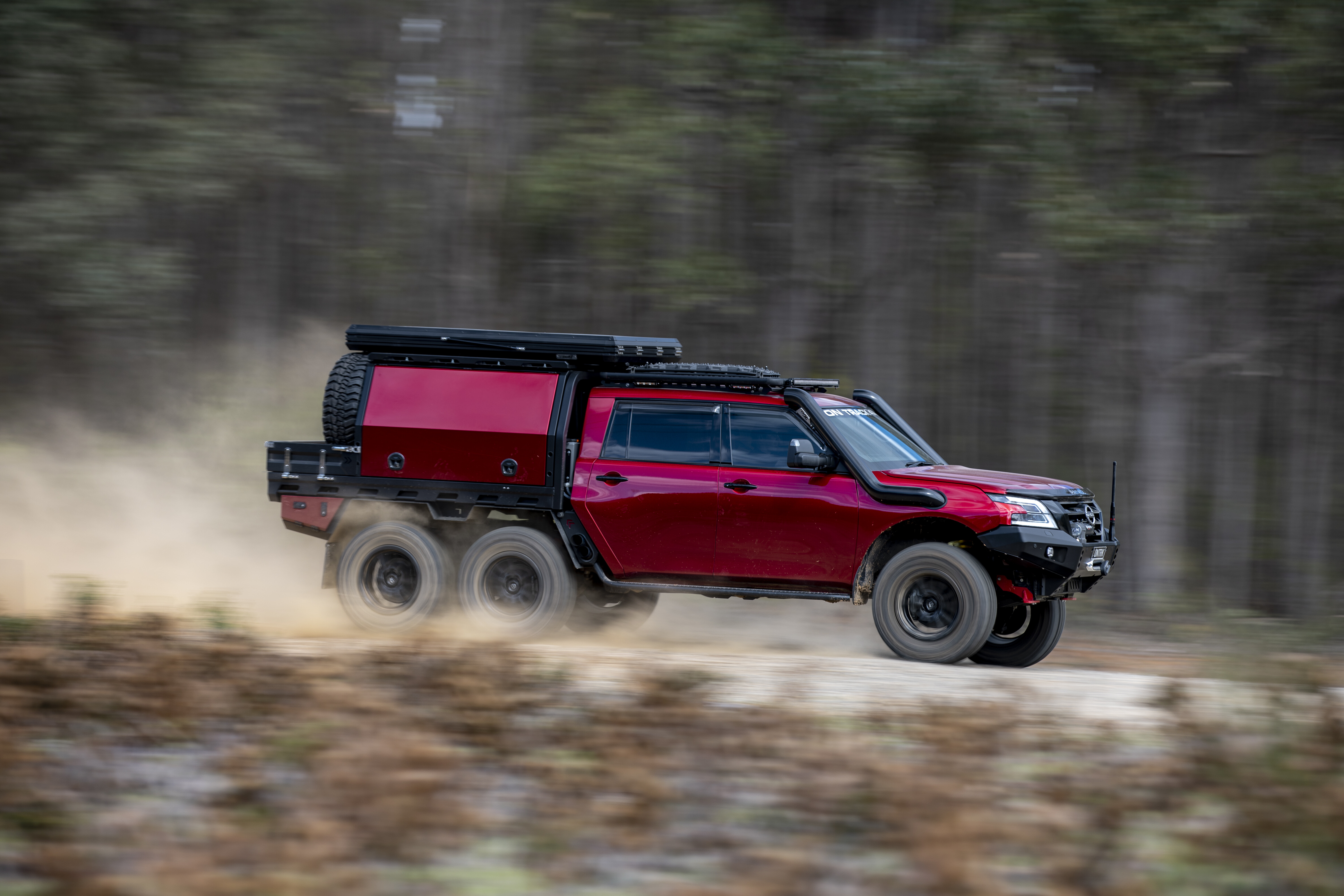
4×4 Australia’s Patrol Warrior wish-list
The Patrol is a pretty capable beast out of the box, helped by its 5.6-litre petrol V8 producing 298kW of power and 560Nm of torque, but there’s always more to do.
Underbody protection: Necessary for protecting the VK58’s exposed sump
Upgraded suspension: Better body clearance and firmer ride. Likely to be sourced from suppliers such as Monroe and Tenneco, potentially with a 15-25 millimetre lift from springs and more damping support
Bigger tyres: 35-inch rubber ought to do the job, something beefy along the lines of a Maxxis AT811 RAZR or Cooper S/T Maxx, or maybe Cooper Discoverers like the Navara
Frontal protection: An integrated bull-bar is a must, and you might as well put a winch in, too, and while you’re at it, why not a lightbar?
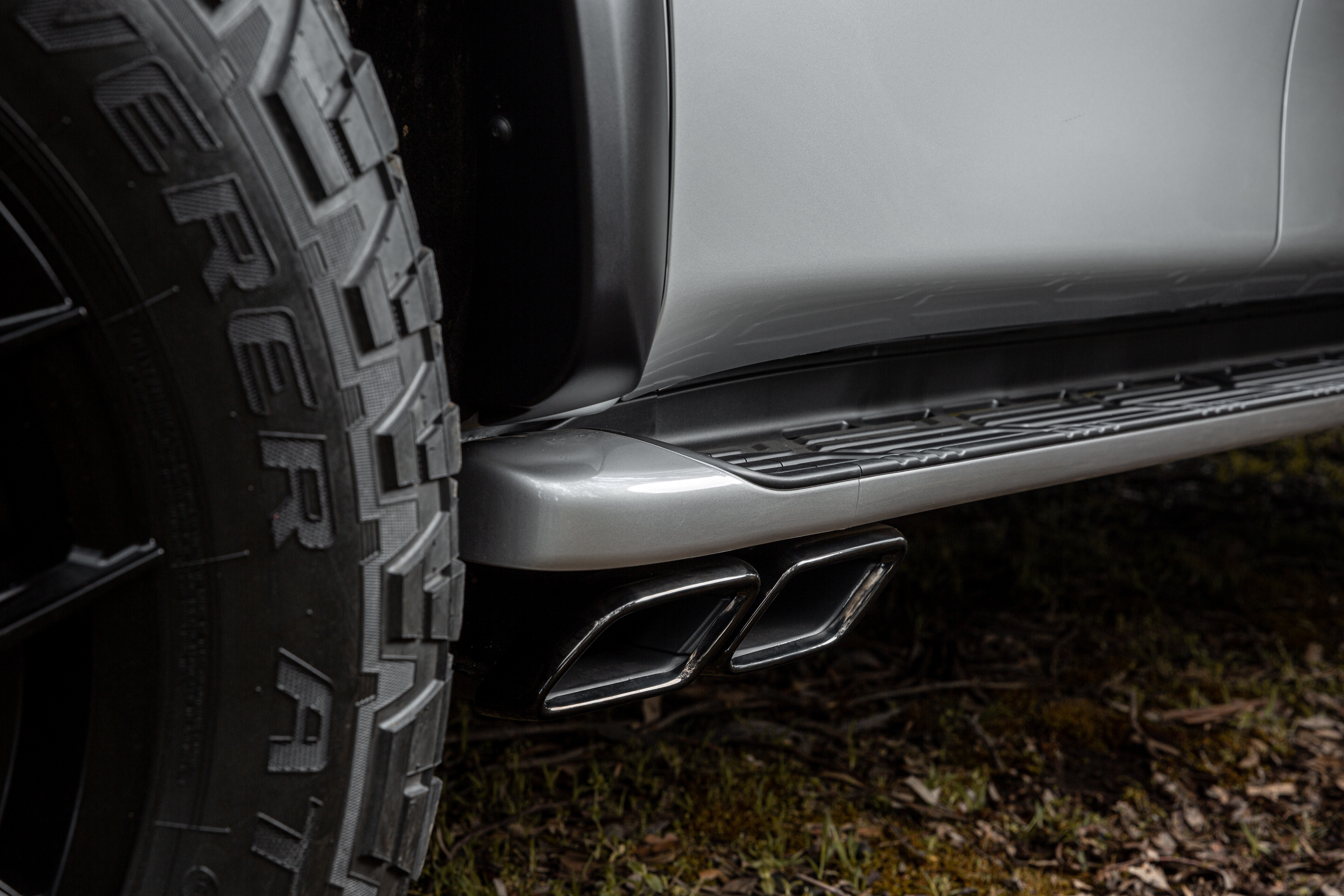
Exhaust upgrade: Because V8s should sound like V8s – Nissan has already teased us with a pair of G63 AMG-style side-exhaust pipes. Are they real? Will they pass ADRs? These are questions that need answering.
Snorkel: A four- or 5-inch set-up, because you want to hear your money being spent (and it improves wading depth… but who are we kidding, it’s the sound that counts).
A little something extra would be awesome
Being a more upmarket vehicle than the Navara Warrior, there’s also scope for Premcar to push the Patrol Warrior further with a couple of nice-to-have features.
Camping capability: A dual-lithium battery system for powering the camp site and devices
Freedom: A set of solar panels mounted on a flat roof platform to charge said batteries
More power, baby: This could be achieved with a supercharger kit – Harrop sells one – because supercharged V8s just make us happy
That’s a non-exhaustive list of what we think could, and should feature on the Patrol Warrior. But what do you think? Let us know in the comments how you’d have your amped Patrol.
What’s it going to cost?
The Patrol Warrior is still without a confirmed Australian release date, but the glossy teaser images suggest that vehicles are closer to production than test mules.
Pricing will certainly start above the Ti ($82,160) and Ti-L ($95,115) Patrol’s list prices. If Nissan and Premcar choose to keep the Patrol’s Warrior package close in execution to the Navara, expect it to be based on the top-spec Ti-L.
For Navara, the Warrior commands a $10.5K upcharge over a regular Pro-4X, which would put a Patrol Warrior at around $105,000 before on-road costs.
If Premcar chooses to go further for Patrol, though, this could climb to $110-120K – inching closer to the $136,981 Toyota LandCruiser 300 Series GR Sport.
Isuzu has seen record sales with its popular second-generation MU-X but, now in a neck-and-neck battle with Ford’s new Everest, it’s time for a 2023 model update.
While the Everest and MU-X duke it out, with less than 100 sales separating them in November, the top two contenders have both beaten the eternally popular Toyota Prado.
Customers are seeing the Isuzu wagon as a value proposition that is hard to beat, and sales numbers tell the story, with more than 12,000 MU-X models reaching Aussie customers since the latest generation launched in August of 2021.
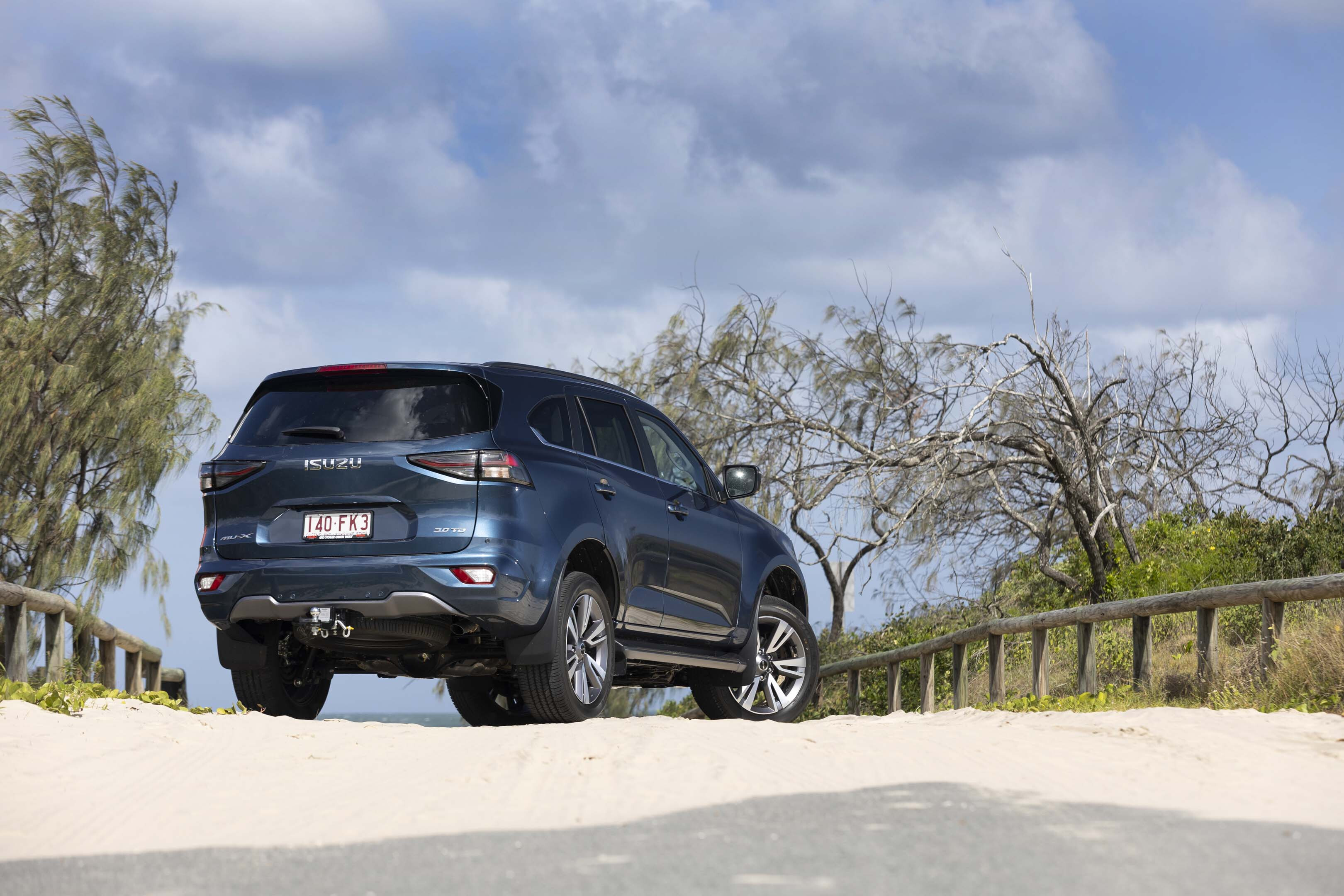
For 2023 Isuzu has kept changes to a minimum, although pricing remains the same and any outstanding orders are being upgraded to the new models.
The update amounts to minor visual tweaks, with some additional tech, but given the model is less than 18 months old, that’s to be expected.
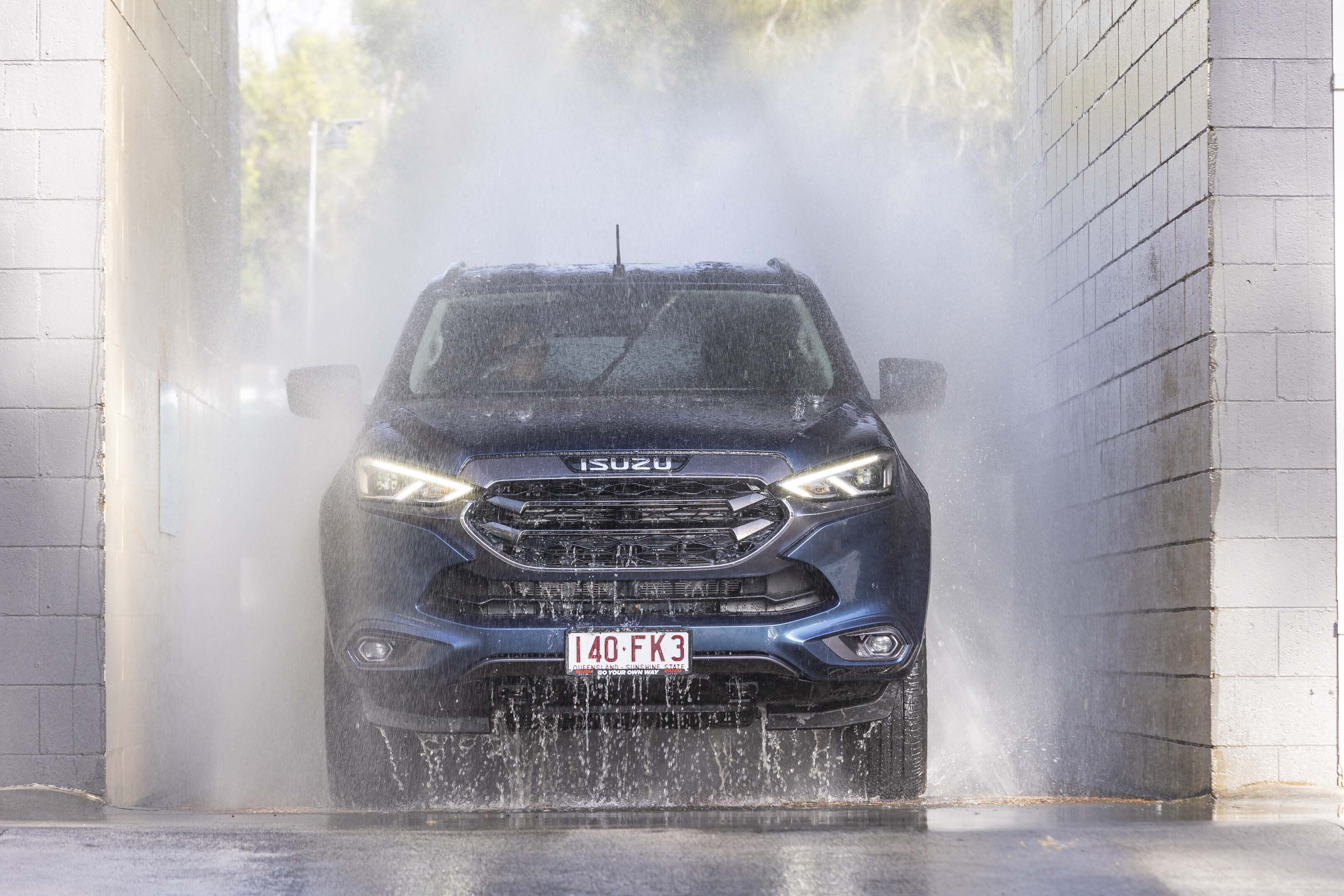
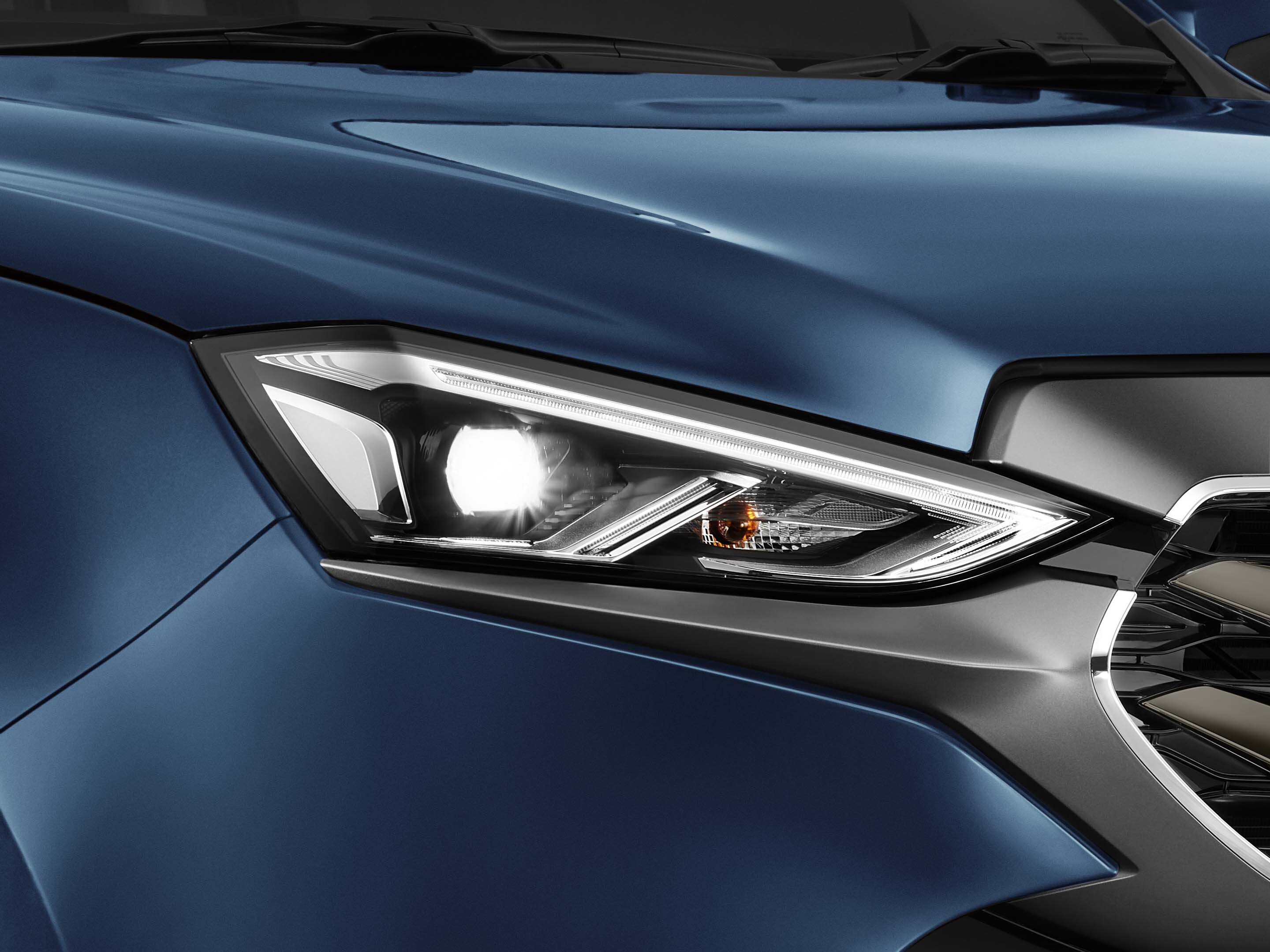
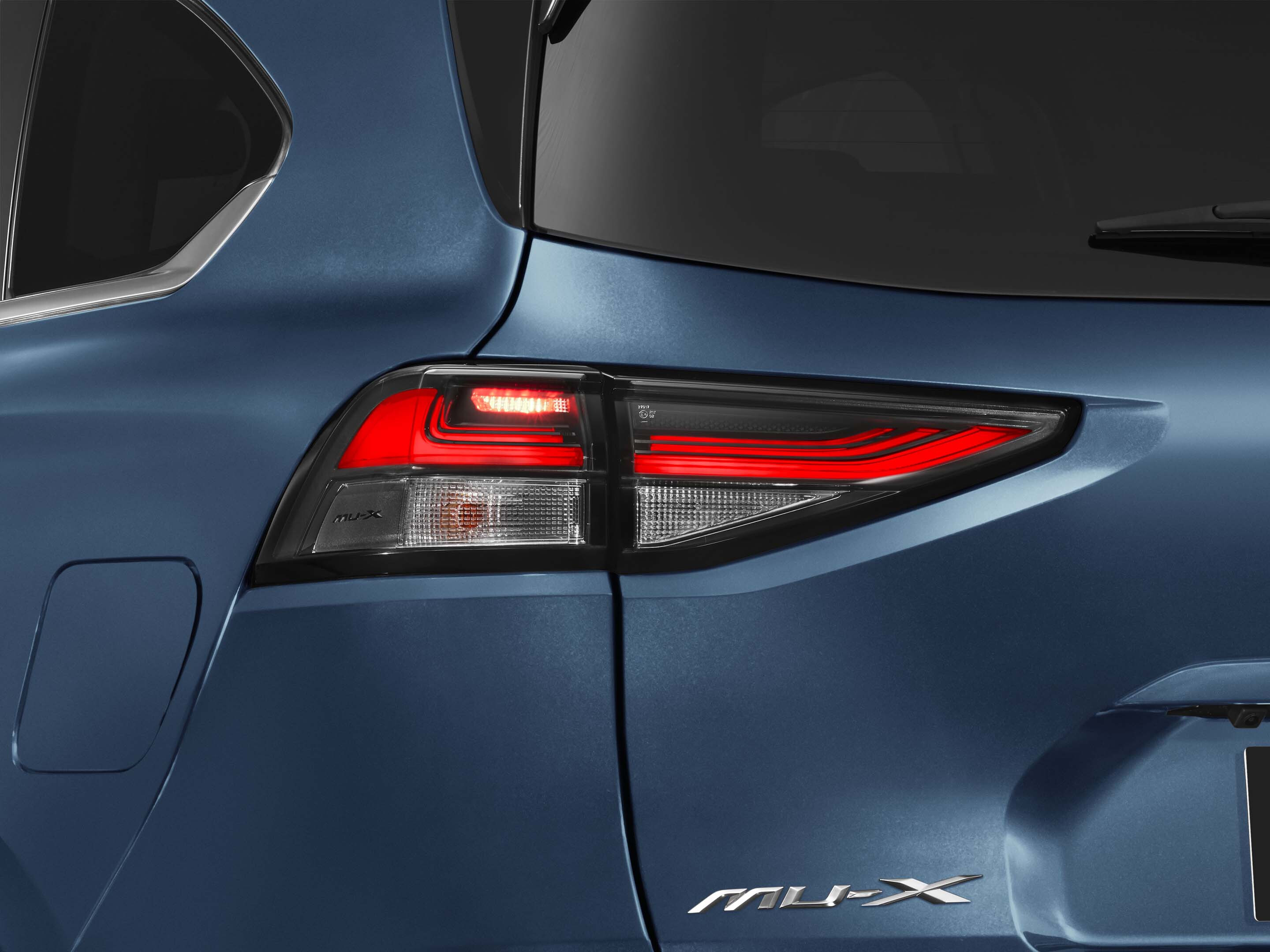
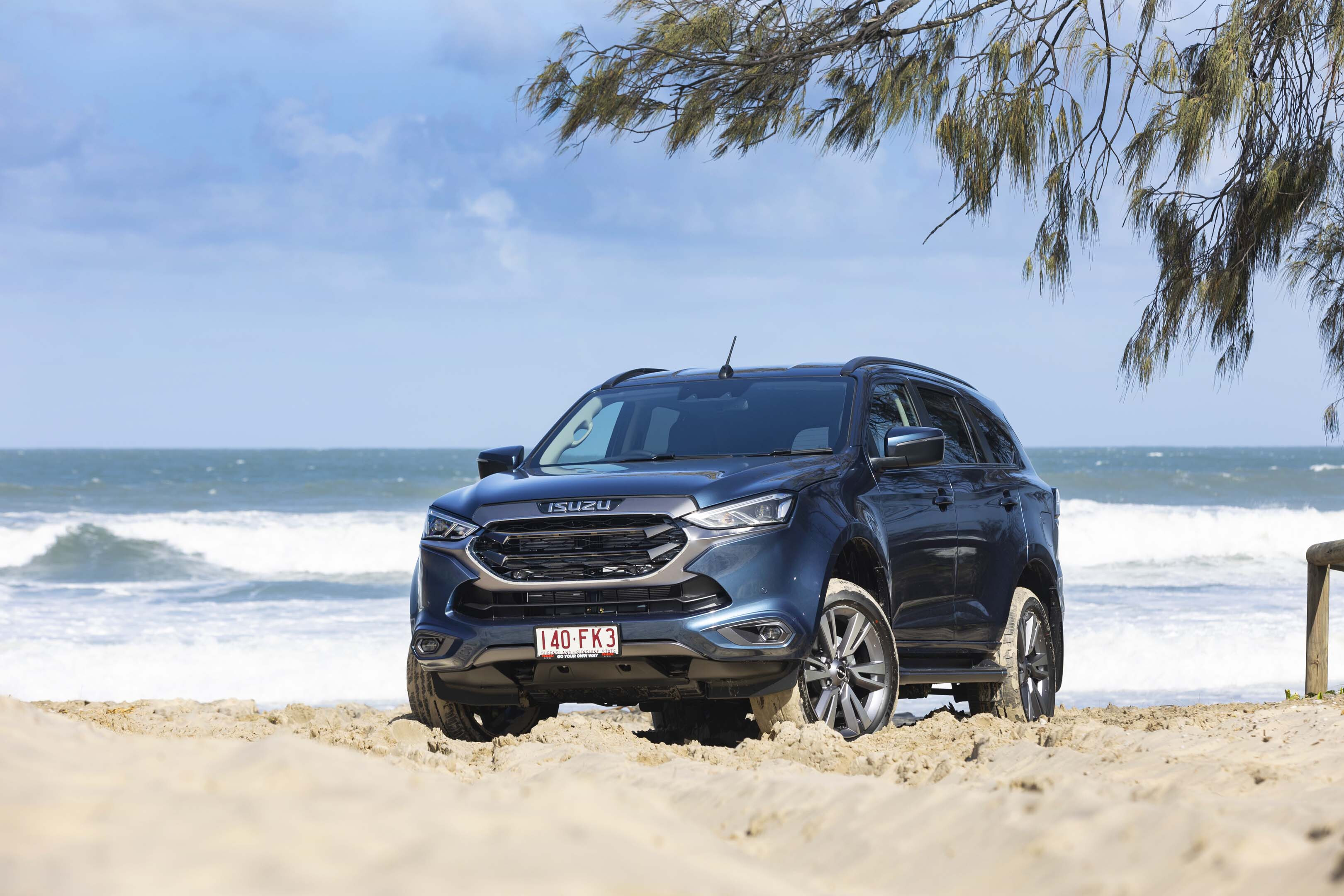
Visually, the 2023 model gets an updated grille and darker design aesthetic front to back, with a ‘magnetite’ grey finish used on side skirts, grille, lower front bar, roof rails and light surrounds.
A lot of the chrome and brushed aluminium look exterior trim has been ‘blacked out’ and it does make for a more dominant appearance.
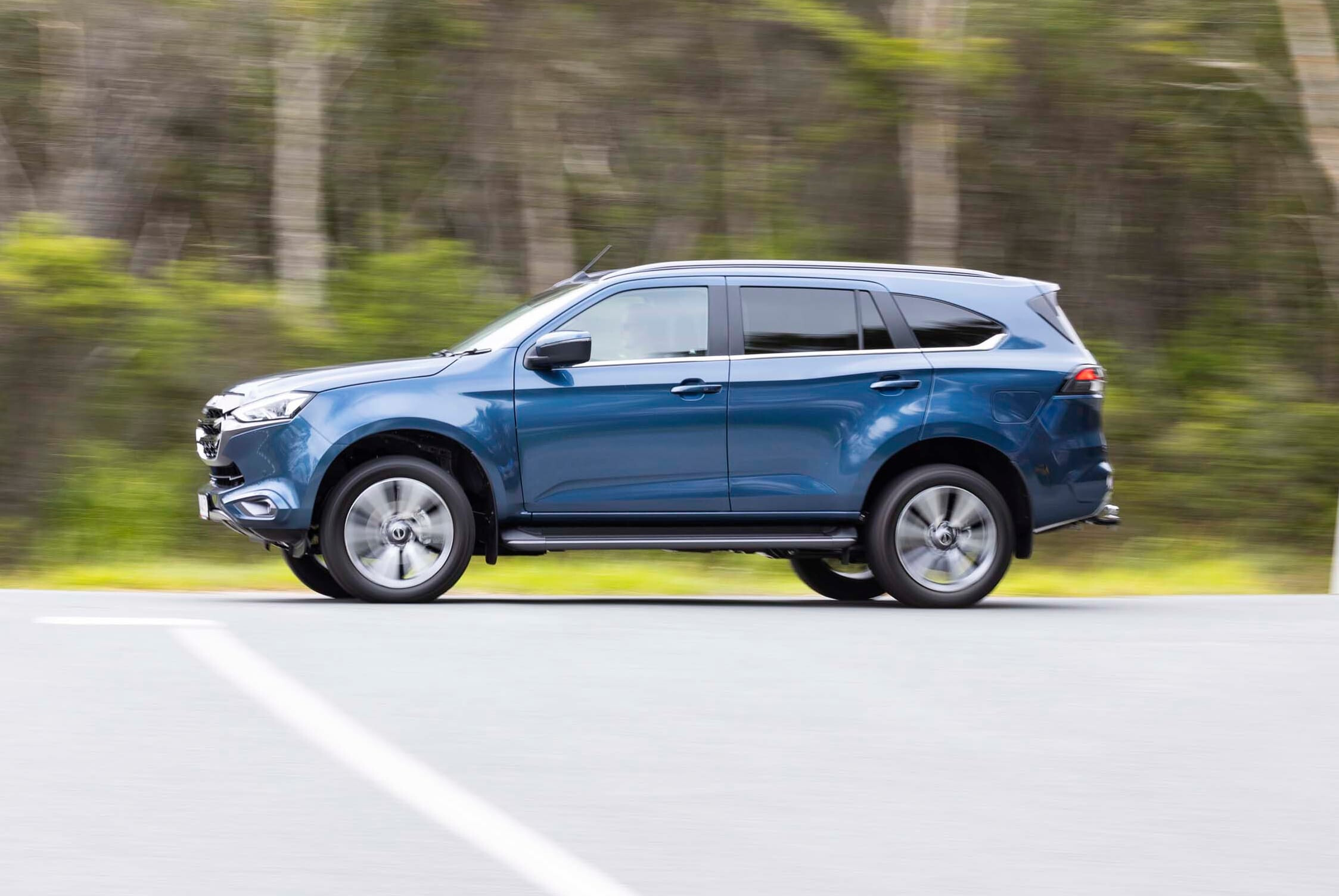
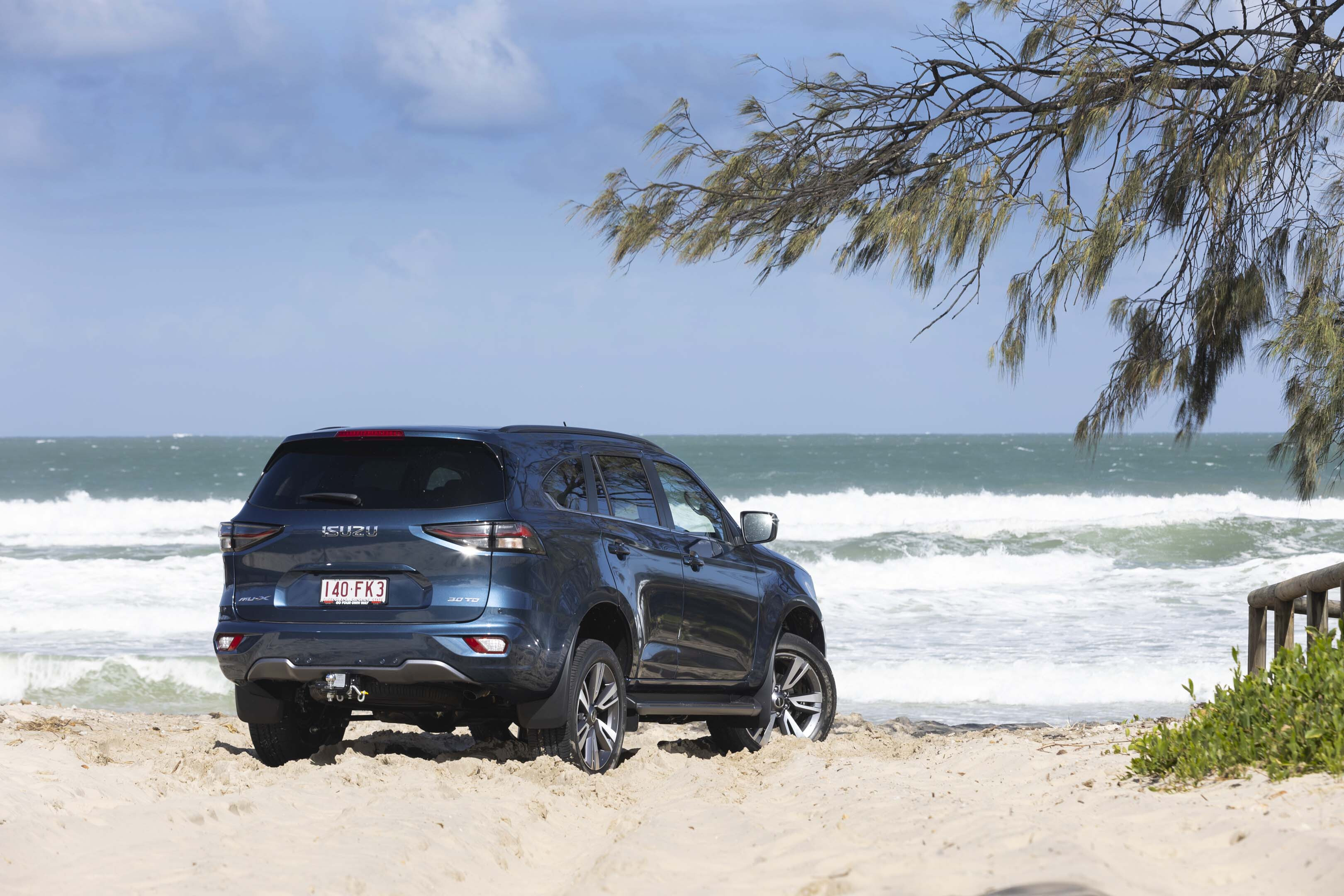
All models score new wheels, and a fresh Galaxy Blue colour option is available, to round out the visual changes.
The most practical of the changes, for owners who tow, is the blind-spot monitoring and rear cross-traffic alert ‘auto off’ feature. The vehicle will detect when a trailer is hitched and turn off the safety systems, which are redundant when towing.
Across the three MU-X models, being the LS-M, LS-U and LS-T in order of trim grade, the changes for 2023 do differ slightly.
The LS-M naturally scores the most conservative makeover, but the higher grade LS-U and top spec LS-T get useful additions comprising tyre pressure monitoring system and a hands-free tailgate.
JUMP AHEAD
- How much is it, and what do you get?
- Interior comfort, space and storage
- What is it like to drive?
- How is it on fuel?
- How safe is it?
- Warranty and running costs
- VERDICT
- Specifications
How much is it, and what do you get?
Pricing remains unchanged across 4×2 and 4×4 MU-X models and the new models are available from this month. The flagship LS-T 4×4 retains its $65,990 special drive-away price, while the rest of the range retains its standard pricing (excluding on-road costs).
| 2023 Isuzu MU-X pricing (before on-road costs) |
|---|
| MU-X LS-M 4×2 – $48,900 |
| MU-X LS-U 4×2 – $55,400 |
| MU-X LS-T 4×2 – $61,400 |
| MU-X LS-M 4×4 – $54,900 |
| MU-X LS-U 4×4 – $61,400 |
| MU-X LS-T 4×4 – $67,400 ($65,990 special drive-away pricing) |

All models are still powered by Isuzu’s revered 3.0-litre turbo-diesel, producing 140kW/450Nm, with a six-speed automatic transmission. The 4×2 versions are rear-wheel drive and the 4x4s have a part-time four-wheel-drive system.
The simplicity of the MU-X driveline, shared with the D-Max ute, is well suited to off-roaders and those wanting a proven package that won’t break.
A full 3500kg braked towing capacity is still on offer and the auto-off safety system function when towing should improve usability further; Isuzu claims around half of its customers tow.
Bi-LED headlights with LED daytime running lights remain, featuring auto-levelling and automatic high beam control, as well as LED combination taillights.
2023 Isuzu MU-X: Interior comfort, space and storage
The MU-X is the most luxurious car Isuzu makes, but it would be unfair to compare it to road-biased SUV competitors like the Toyota Kluger.
It’s nicer inside than any adventure vehicle needs to be, and for around-town use or family duties, it strikes the right mix of hardy and premium.
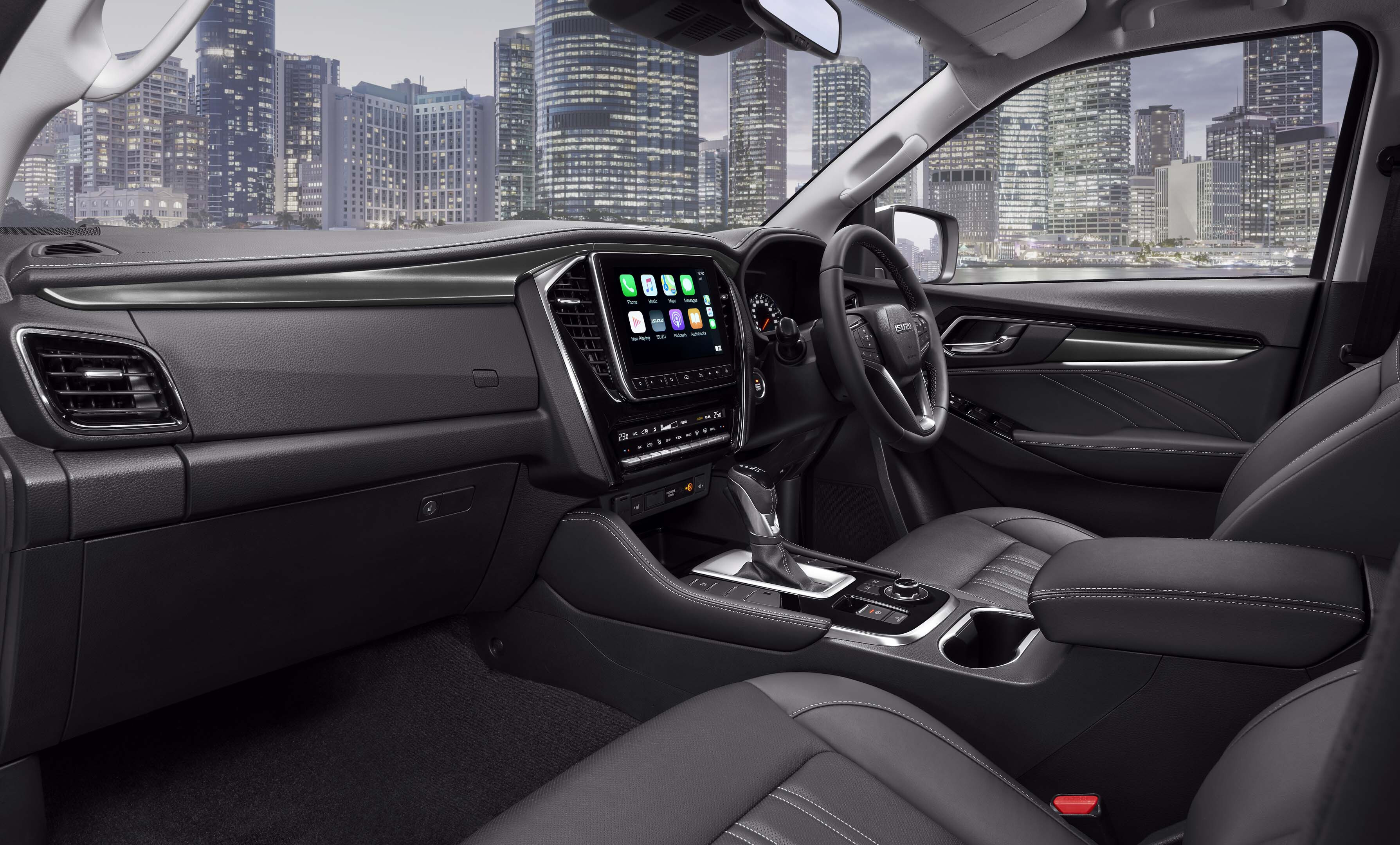
A combination of leather, piano black plastics and silver trim fill the MU-X cabin, and the seats are wonderfully comfortable.
You get 12 drink holders and more storage than you’ll ever find a way to use, which sets the MU-X apart from other ute-based wagons.
It’s the cargo space, with the seats down, that really makes the MU-X a practical wagon. You’ve only got 311 litres to work with if all seats are in action but fold the third row down and that number jumps to 1119 litres. Fold them all down, and the MU-X has 2138 litres of storage behind the front seats.
For perspective, that’s a few hundred more litres of storage than you get in a Toyota Prado.
Being a seven-seater, many will opt for passengers rather than folding seats down, at which point the second row offers plenty of legroom and adjustment. The third row is expectedly cramped, as many seven-seaters are, but suitable for kids or adults willing to squeeze in.
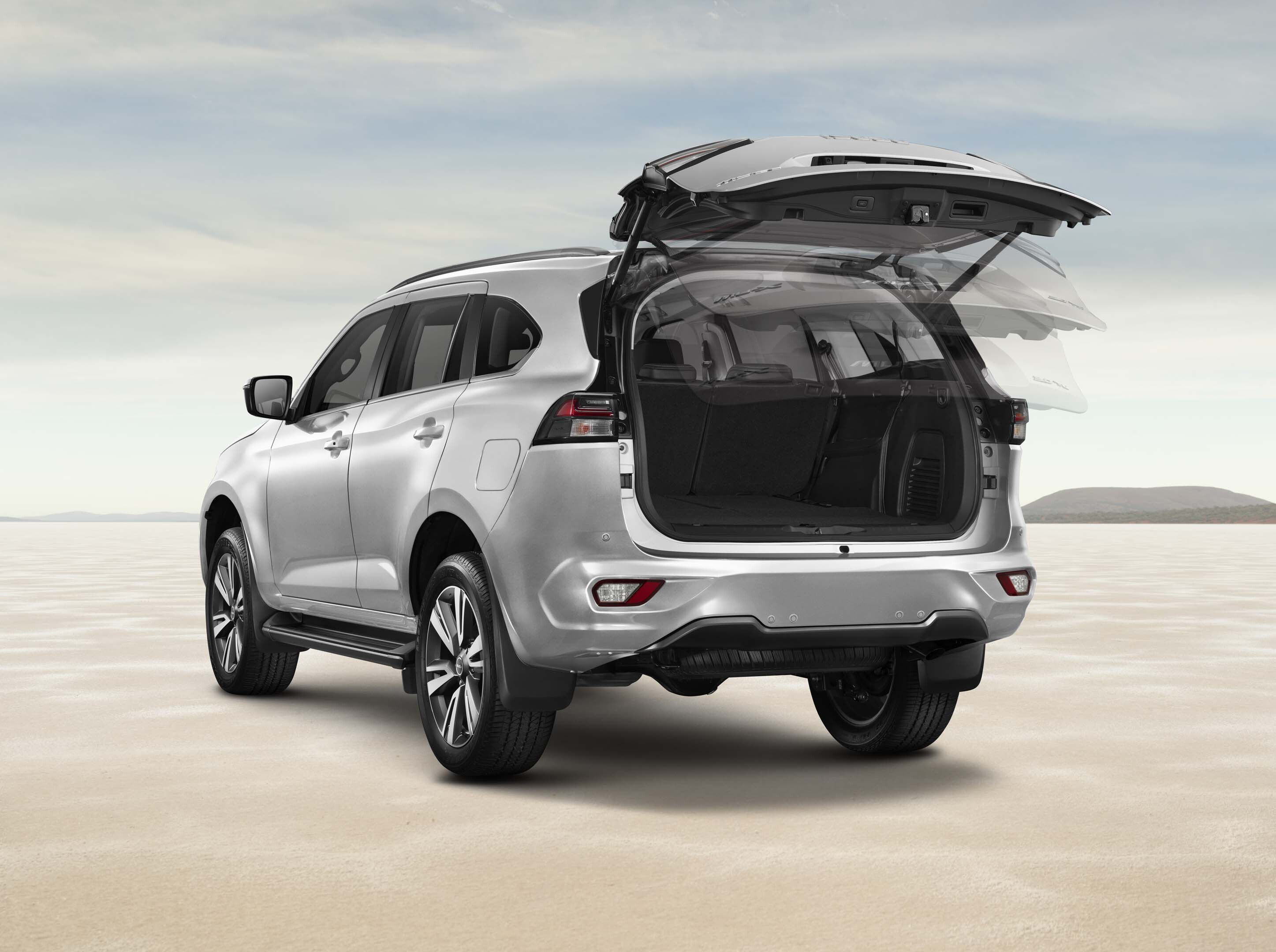
The new hands-free tailgate requires the driver to walk towards the tailgate, with the key on them, before taking a step back. It felt a bit finicky, compared to simpler ‘leg swipe’ options.
A 9.0-inch infotainment display for LS-U and LS-T grades, and 7.0-inch for the LS-M, offer wireless Apple CarPlay, wired Android Auto, sat-nav, DAB+ digital radio and eight-speaker surround sound (four speakers for the LS-M).
Every variant gets three 2.4A USB ports and two 12-volt/120-Watt accessory sockets, clearly geared at adventurers who want to run a fridge or compressor.
What is the 2023 MU-X like to drive?
The MU-X is undoubtedly more comfortable than its D-Max architecture sibling, and much of that is due to its coil-sprung rear.
A five-link coil-sprung rear and slightly shorter wheelbase mean the MU-X handles well, all things considered, offering a compliant ride on- and off-road.
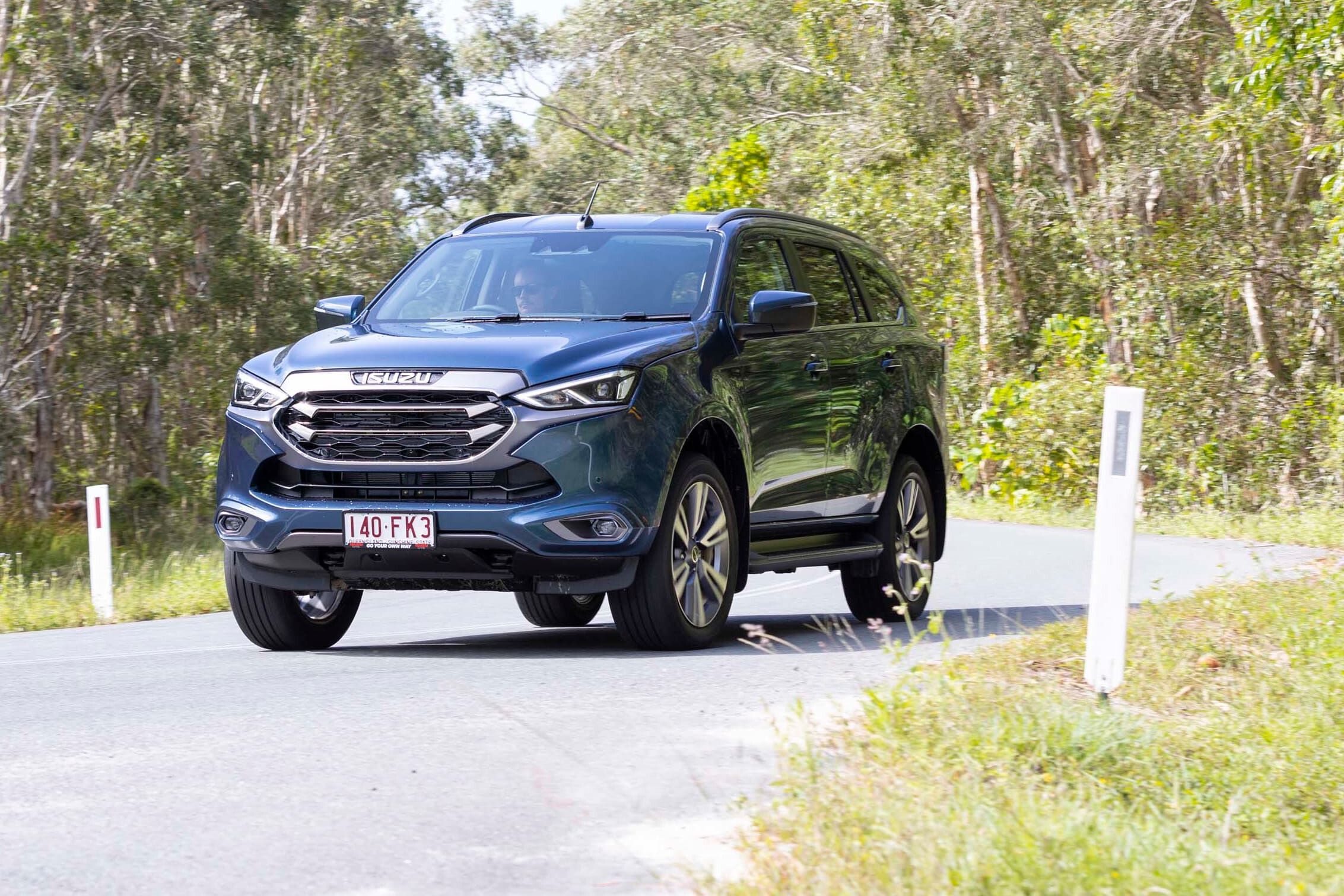
Its towering wagon stature becomes apparent in corners, but I doubt that comes as a surprise. Isuzu stiffened the spring rates and added a thicker anti-roll bar for this generation of MU-X and it’s clearly helped with body roll.
Steering is something Isuzu nailed in both the MU-X and D-Max, with an electric system that just works. It doesn’t feel like it’s making adjustments, but it’s always weighted just right.
The 3.0-litre turbo-diesel feels more than adequate as it propels this two-plus-tonne wagon, but it does run out of puff if you drive it like a petrol SUV.
Preferring to be encouraged with a steady throttle, this engine has one of the best torque spreads of any diesel on the market. It’s also on the noisy side if you start wringing its neck.
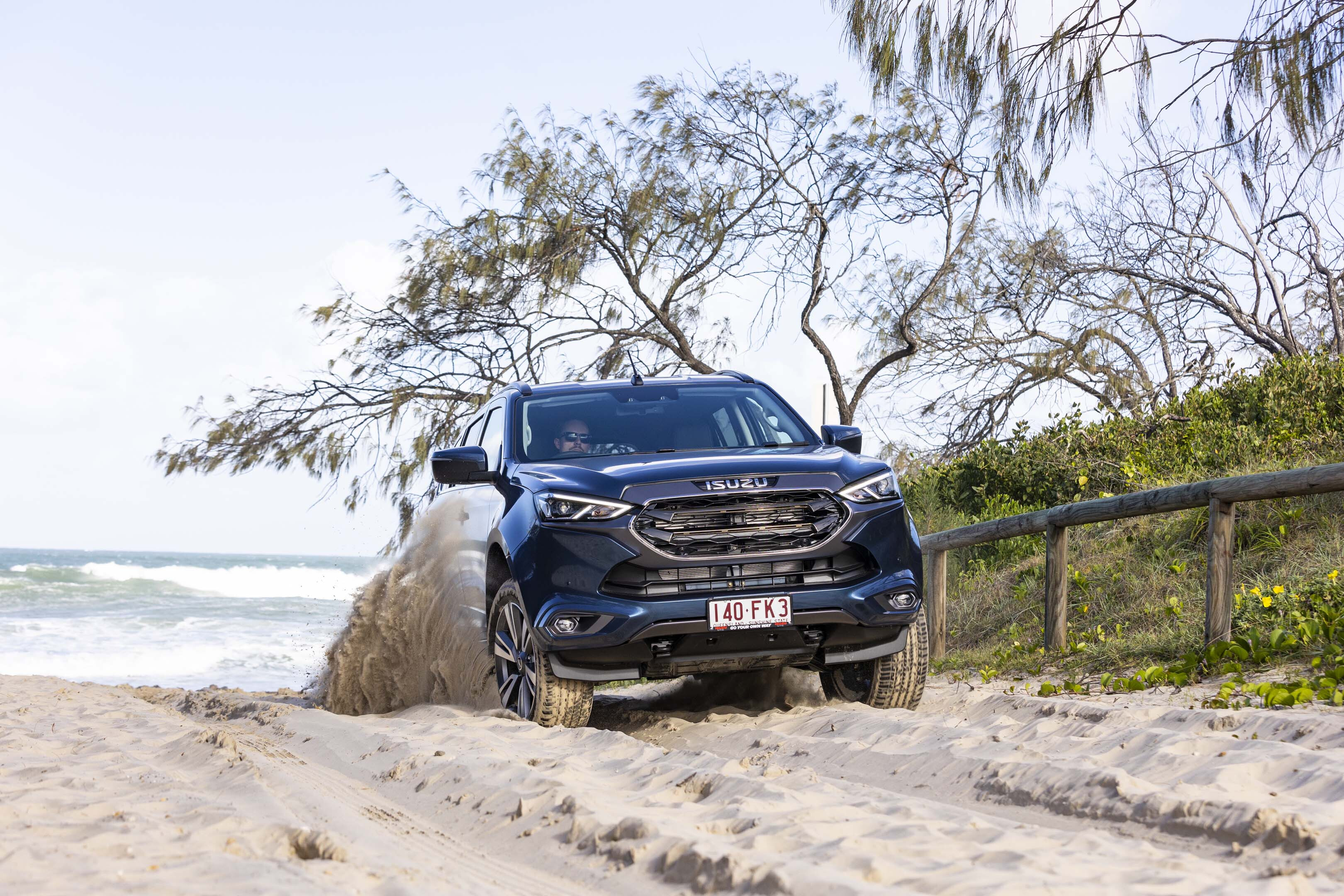
Although not the lightest sipping engine out, we loved using the ever-present torque to mosey on up hills and through soft sand on the beach. That’s a luxury that tends to come with displacement.
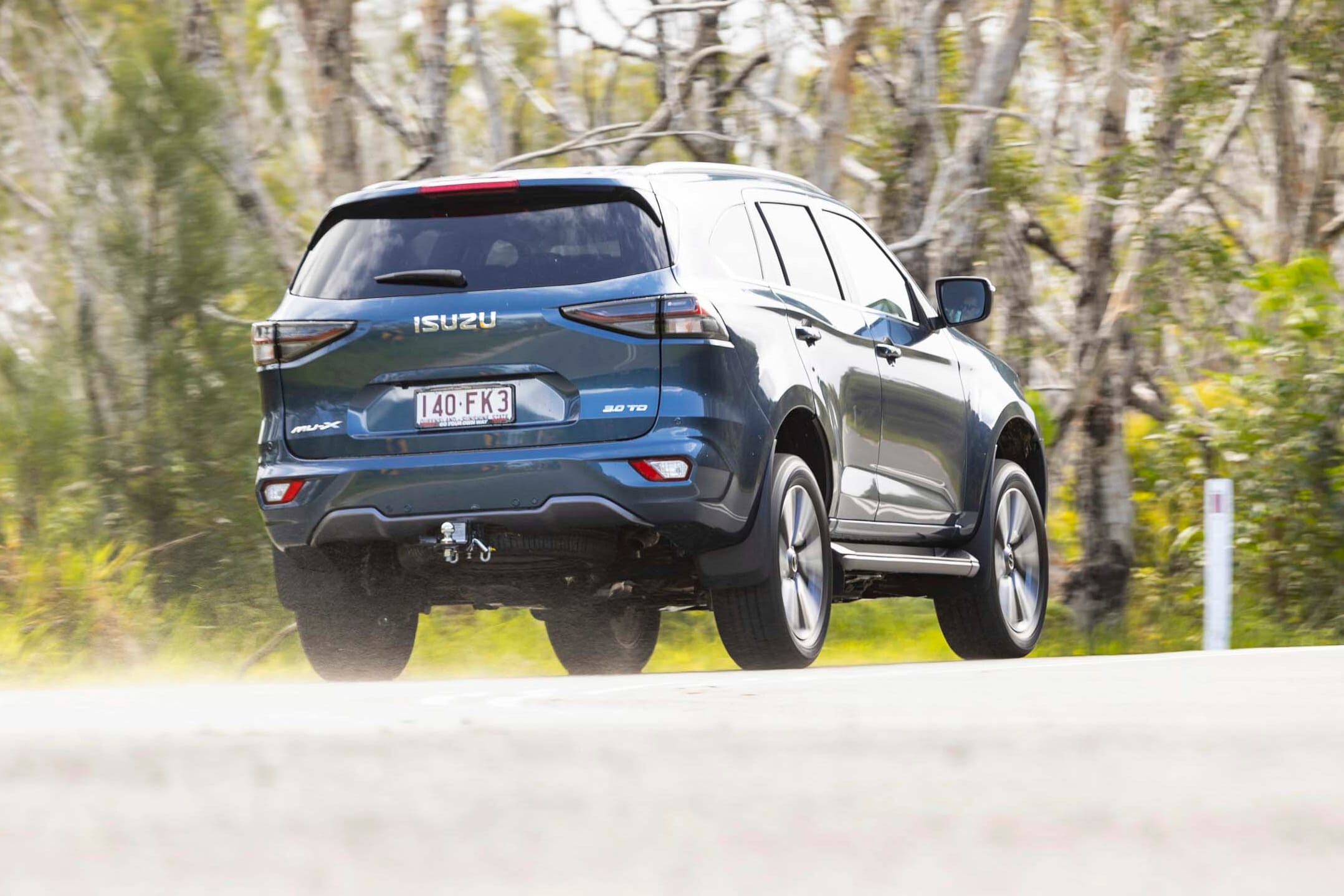
The second day of testing involved trying to outrun a storm homing in on us at Double Island Point, north of Noosa in Queensland. The MU-X is loads of fun on sand, and the 4×4 system is a winner.
It does have a rear diff lock, but the only time we’ve needed to use it on an MU-X in the past was when we had already explored the clearance limits. For beach work, it’ll charge through nearly anything in 4H.
This is a fun vehicle off-road, yet it is composed on-road and there really aren’t many compromises. The MU-X is a reminder of how far ute-based wagons have come.
2023 MU-X: Fuel consumption
The LS-Ts on the launch program all saw two days of pretty unsympathetic driving, on- and off-road, with a mix of speeds.
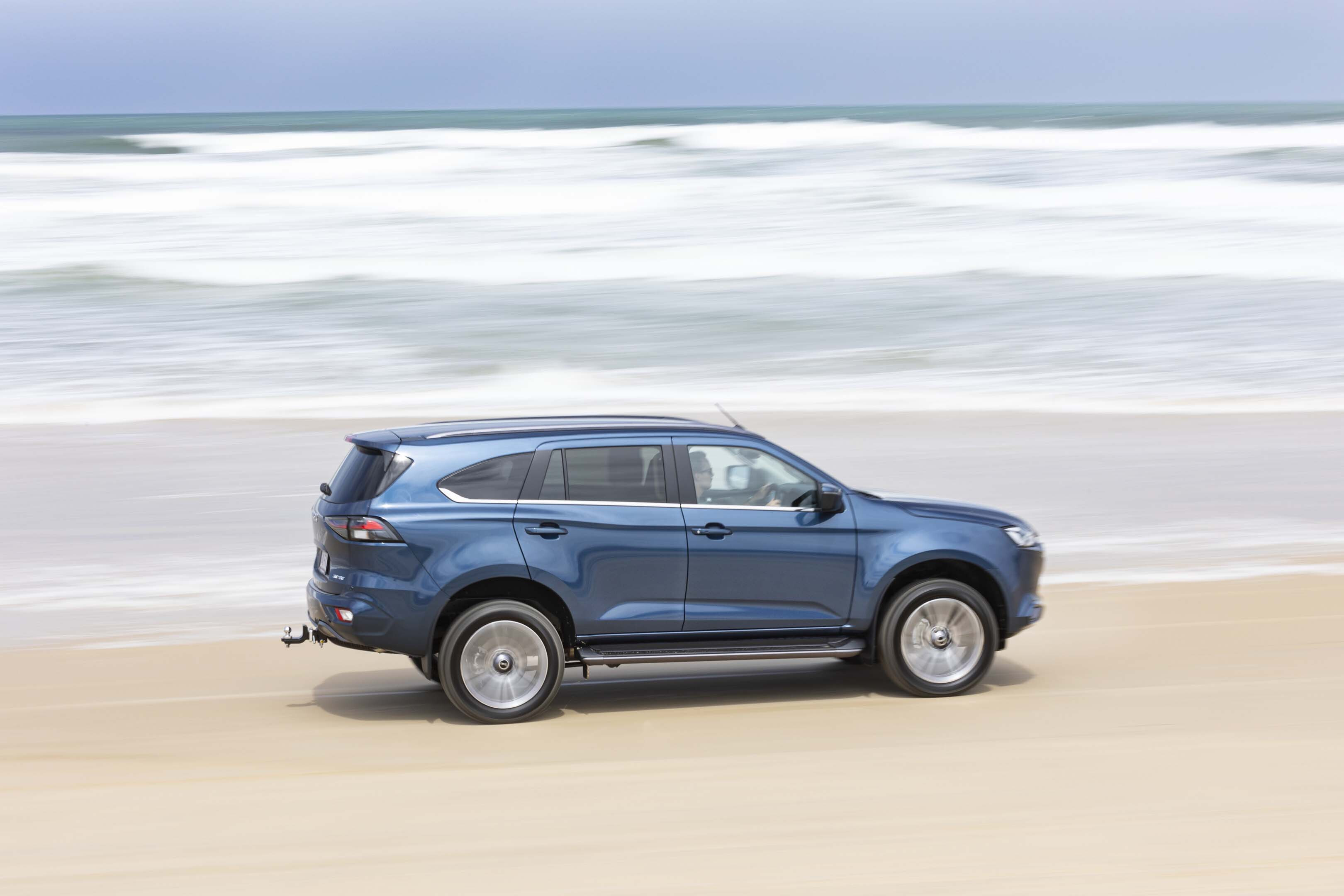
At the end, our car had averaged 9.6L/100km, which is impressive given we’d just finished having (too much) fun on the beach. Highway driving the day before likely pulled this average down.
With an 80-litre tank, and averaging 9.6L/100km, you’ll be up over 800km of range before needing to visit a fuel bowser. If you can achieve the official combined-cycle rating of 7.9L/100km you’d get even further.
How safe is it?
The MU-X line-up has a full five-star ANCAP safety rating, and was re-tested recently.
Eight airbags plus a suite of active safety and driver assist tech go a long way to making the MU-X a safe family wagon.
The so-called IDAS suite includes auto emergency braking, blind-spot monitoring, forward collision warning, rear-cross traffic alert, traffic sign recognition, lane departure warning and emergency lane keeping.
Warranty and running costs
All Isuzu vehicles get the manufacturer’s ‘Service Plus 6-7-7’ aftercare package, made up of a six-year/150,000km warranty plus capped-price servicing and roadside assist for seven years.
Service time comes around every 15,000km or 12 months, and capped-price servicing is offered for the first 105,000km.
VERDICT
It’s hard to think of a better 4×4 seven-seater for the money
Isuzu rightfully dominated the ute-based wagon segment with the latest generation MU-X, but are subtle improvements enough to fend off the new Ford Everest? Ultimately, it might not matter. The MU-X is cheaper, simpler, and has a formidable reputation for being dependable.
With a drive-away price of $65,990 for the top-spec model, it’s hard to think of a better 4×4 seven-seater for the money – even if it doesn’t have all the bells and whistles of the Ford.
The MU-X is an incredibly competent off-road tourer, while also being capable of handling family car duties. It isn’t a frontrunner by mistake.
2023 Isuzu MU-X specifications
| Engine | 3.0L, 4cyl, turbo-diesel | |
|---|---|---|
| Power | 140kW @ 3600rpm | |
| Torque | 450Nm @1600-2600rpm | |
| Transmission | 6-speed automatic | |
| Body | 5-door, 7-seat, large SUV | |
| L/W/H | 4850/1870/1825mm | |
| Wheelbase | 2855mm | |
| Weight | 2175kg | |
| Fuel / tank | Diesel / 80L | |
| Fuel use | 8.3L/100km (ADR combined) / 9.6L/100km (tested) | |
| Suspension | independent coil springs (f); multi-link coil springs (r) | |
| Steering | electric power steering | |
| Brakes | 320mm ventilated discs (f); 318mm ventilated discs (r) | |
| Wheels | 20-inch alloy (full-size spare) | |
| Tyres | 265/50 R20 Bridgestone 684 II Highway Terrain | |
Snapshot
- 2023 Mitsubishi Pajero Sport pricing and features
- GLS and above receive tyre pressure monitoring, new colours
- Price rises; now priced from $44,940 before on-road costs
The updated 2023 Mitsubishi Pajero Sport has been detailed for Australia.
Following a more extensive update for model-year 2022, which saw the addition of a pair of new two-wheel-drive variants and a blacked-out flagship GSR, Mitsubishi’s largest SUV has received a minor specification bump for 2023.
It is accompanied by price rises, with the entry-level GLX up $500, while the GLS, GLS Deluxe, Exceed and GSR are up $1000.
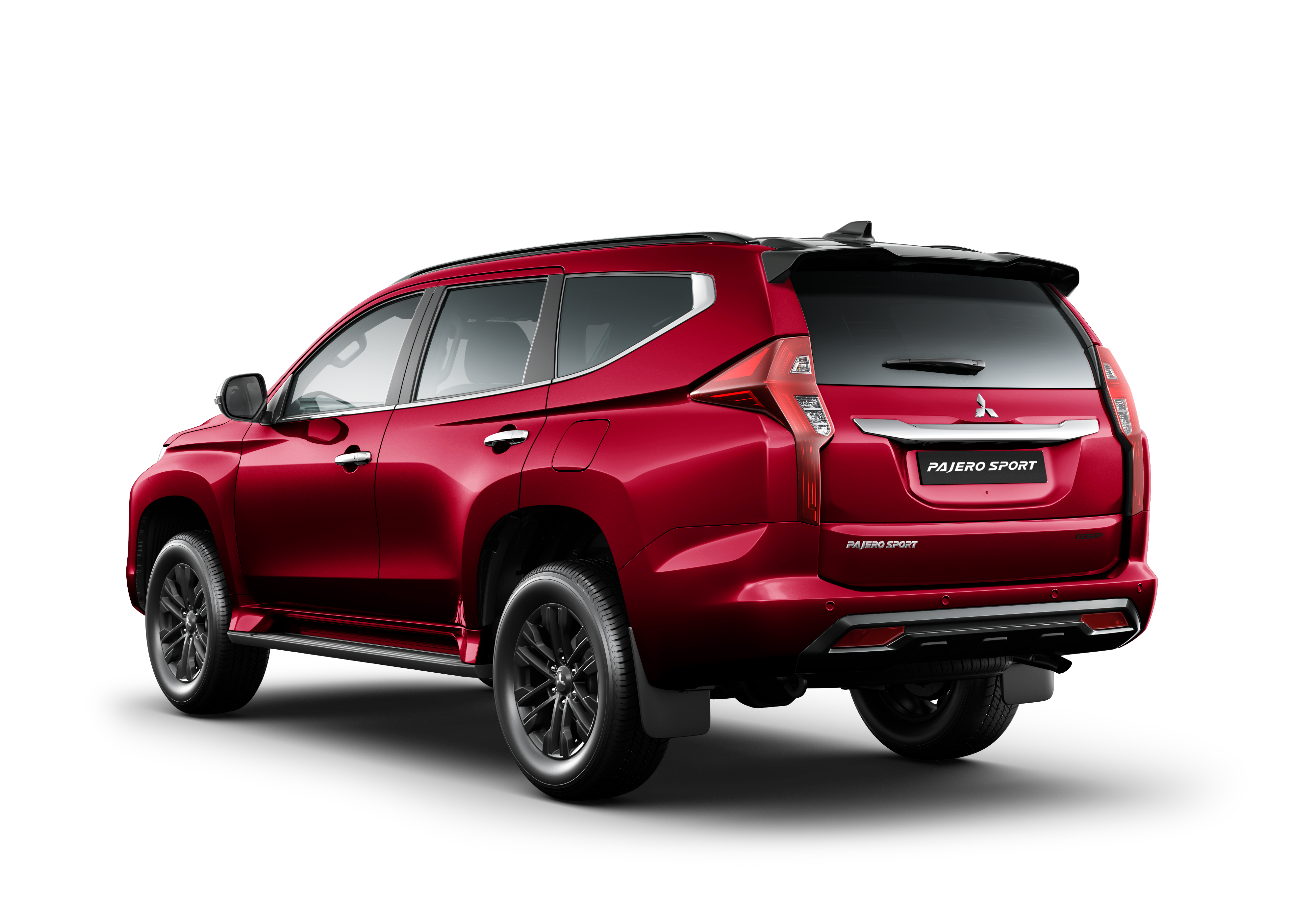
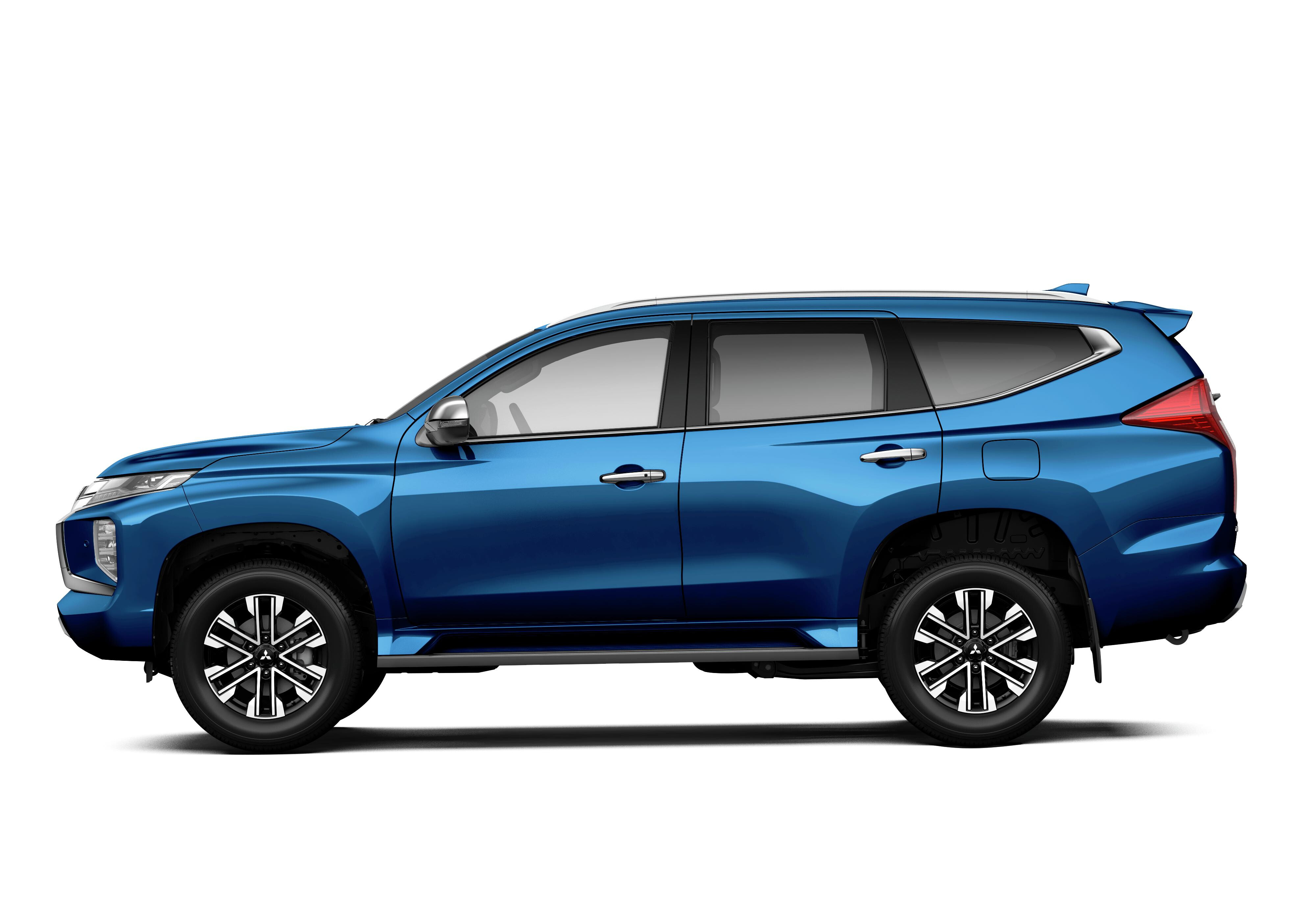
Tyre pressure monitoring is the only specification change for GLS variants and above, joining two new exterior finishes: Impulse blue for GLS and above, and terra rossa red with a black roof for the GSR.
Production will commence in February, with first deliveries expected in April.
To the end of November, 8194 examples of the Pajero Sport have been registered in Australia in 2022, placing it behind the Toyota LandCruiser Prado (20,132), Isuzu MU-X (10,043) and Ford Everest (9388) body-on-frame large SUVs.
JUMP AHEAD
- 2023 Mitsubishi Pajero Sport pricing
- 2023 Mitsubishi Pajero Sport features
- Colours
- Engine, drivetrain, and fuel economy
- Safety
- Dimensions
- Warranty and servicing
- Availability
2023 Mitsubishi Pajero Sport pricing
Prices exclude on-road costs.

2023 Mitsubishi Pajero Sport features
GLX
GLS
GLS Deluxe
Exceed
GSR

Colours
Metallic paint incurs a $740 premium. Black metallic is standard on the GSR; opting for white diamond or terra rossa red with a black two-tone roof costs $200.

Engine, drivetrain, and fuel economy
Under the bonnet, the Mitsubishi Pajero Sport is powered by a 2.4-litre turbocharged four-cylinder diesel engine. It produces 133kW and 430Nm, and is coupled to an eight-speed torque converter automatic transmission.
It has a maximum braked towing capacity of 3.0 tonnes on 4x2s and 3.1 tonnes on 4x4s.
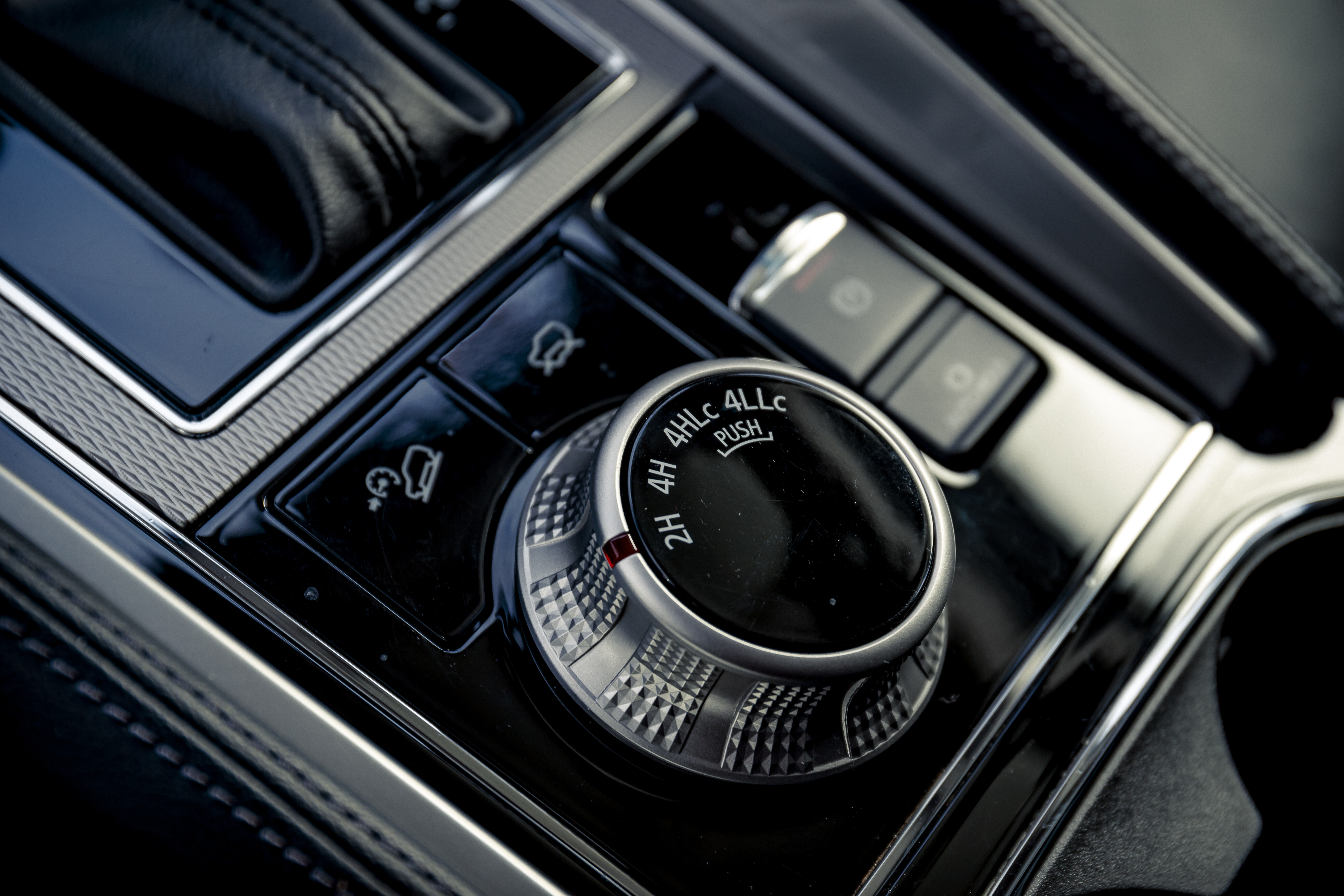
Four-wheel-drive models add Mitsubishi’s Super Select II system with selectable off-road modes, alongside paddle shifters and hill descent control.
A rear differential lock is also standard on four-wheel-drive GLS, Exceed and GSR grades, but is not available on the GLX 4×4.
2023 Mitsubishi Pajero Sport fuel economy
All variants have a 68-litre fuel tank.
Safety
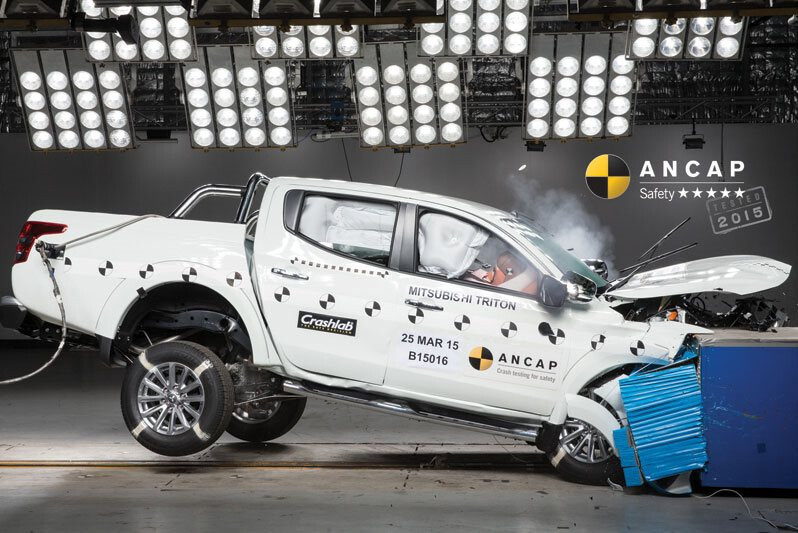
The Mitsubishi Pajero Sport was covered by a five-star ANCAP safety rating from 2015, based on testing conducted on the related Triton ute.
This five-star rating will be removed on December 31, 2022, with a newly-introduced six-year timestamp affecting its less-stringent 2015 credentials.
Existing models will retain this rating, but will appear under the ‘previous models’ section on ANCAP’s website.
Seven airbags (dual front, side and curtain, and driver’s knee) are fitted as standard.
Each variant includes the following active safety equipment as standard:
GLS variants add rain-sensing wipers, while blind-spot warning, rear-cross traffic alert and lane departure warning are exclusive to the flagship Exceed and GSR.

Dimensions
The Mitsubishi Pajero Sport has a 2800-millimetre wheelbase, and is 4825mm long, 1815mm wide and 1835mm tall.
2023 Mitsubishi Pajero Sport boot space
The five-seat Mitsubishi Pajero Sport GLX has a 673-litre boot.
With the rear seats up, the seven-seat Mitsubishi Pajero Sport has a 502-litre boot capacity.
Folding the second row increases luggage capacity to 1488 litres (7-seat) to 1624 litres (5-seat), while there’s 131L of storage with the third-row in place.

Warranty and servicing
Like the wider Mitsubishi range, the Pajero Sport is covered by the marque’s 10/10 Diamond Advantage coverage with a 10-year/200,000km warranty and 10 years of capped-price servicing.
If the vehicle is serviced outside of the Mitsubishi dealer network, the program reverts to a standard five-year/100,000km warranty.
A complimentary 12-month roadside assist program is available, with the service can also be expanded for up to four years – provided the vehicle is serviced by a Mitsubishi dealership.
Availability
The 2023 Mitsubishi Pajero Sport will arrive in Australian showrooms in April.