
In my last column I addressed the concern about the future availability of diesel and petrol fuels. The conclusion: there’s no need to panic! Both will be available for decades to come. No question about it.
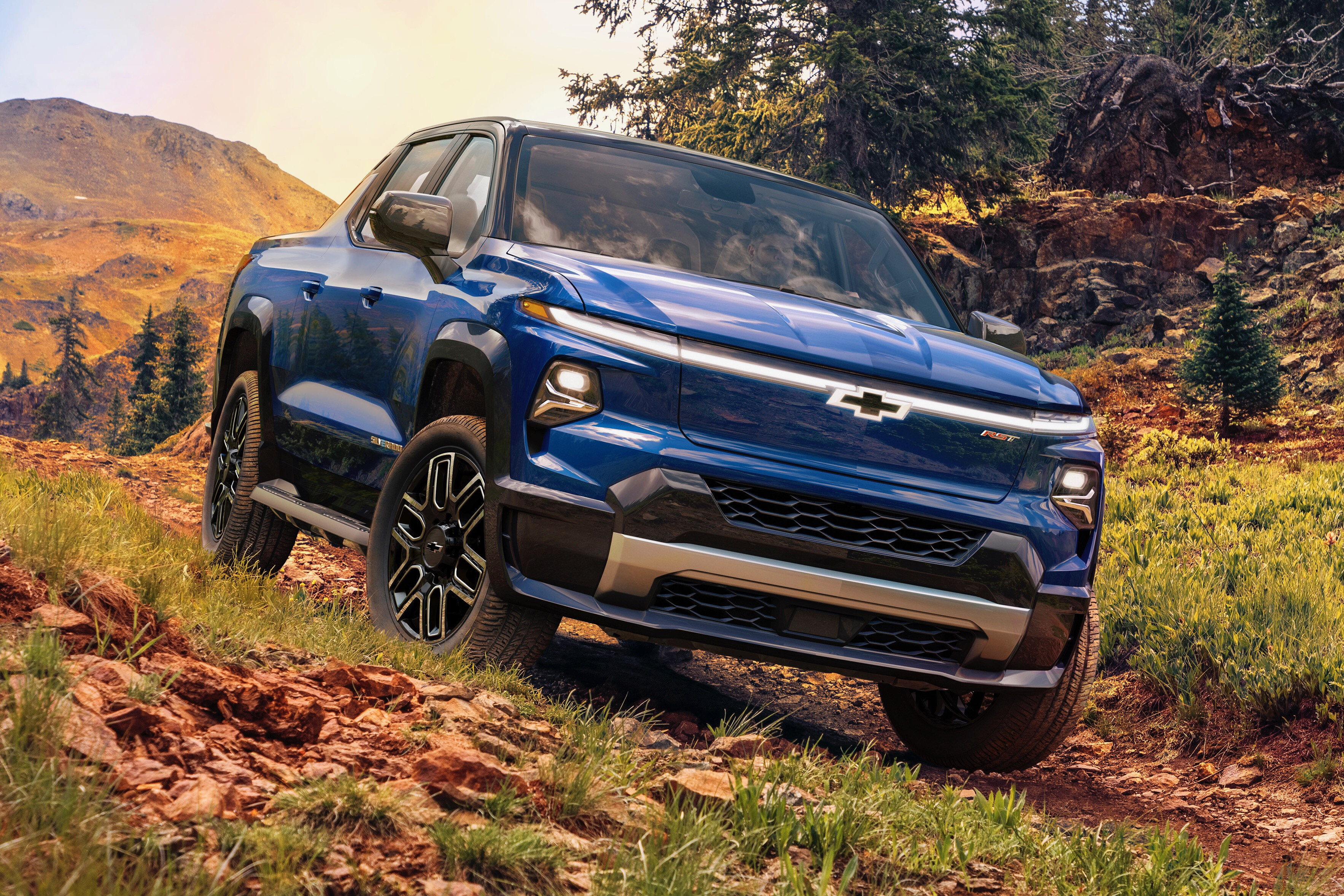
Next concern? Are we about to be swamped with EVs? Well, yes, they are coming, but probably not nearly as quickly as you may think. And is it a bad thing anyway?
The take-up rate of EVs will depend on many things, but much comes down to future political decisions both in Australia and more significantly globally. The total ban on the sale of diesel and petrol cars flagged for 2030 or thereabouts that would leave no option but to buy an EV, may happen in some smaller European countries and perhaps some individual states of the USA, but elsewhere in the world this is more political grandstanding than anything else at this point in time.
Right now, EV sales in Australia are enjoying a huge increase in popularity (a 500 per cent year-on-year increase by most recent figures) off the arrival of new EV models, but are still just 2.8 per cent of the combined passenger, SUV and light commercial vehicle markets.
Hybrids, including plug-ins, are nearly three times more popular than EVs and account for 8.3 per cent of sales, while the overwhelming new-car preference is still for petrol (53.7 per cent) and diesel (35.3 per cent).
Somewhat misleadingly, the Federal Chamber of Automotive Industries, the peak body representing the car industry here in Australia, lumps hybrids in with EVs when referring to ‘electrified vehicle’ sales.
The fact of the matter is that the popular hybrids (largely from Toyota) may be ‘electrified’ in as much as they have an electric motor to supplement their petrol engine but they are still 100 per cent a petrol-consuming car, as the only way to put external energy in them is by filling the fuel tank with petrol. The electrical component of these hybrid systems simply recycles some of the petrol’s energy and therefore makes the car more petrol efficient.
The growth in EV sales off this very low base will be slowed by many things, not least the fact that EV options for buyers are non-existent or limited in popular market sectors.
Right now, for example, utes lead the new-car market but if you want an electric ute, there’s nothing available until the Chinese-brand LDV eT60 arrives. And you’ll certainly be waiting for a very long time for an all-electric LandCruiser or Prado.
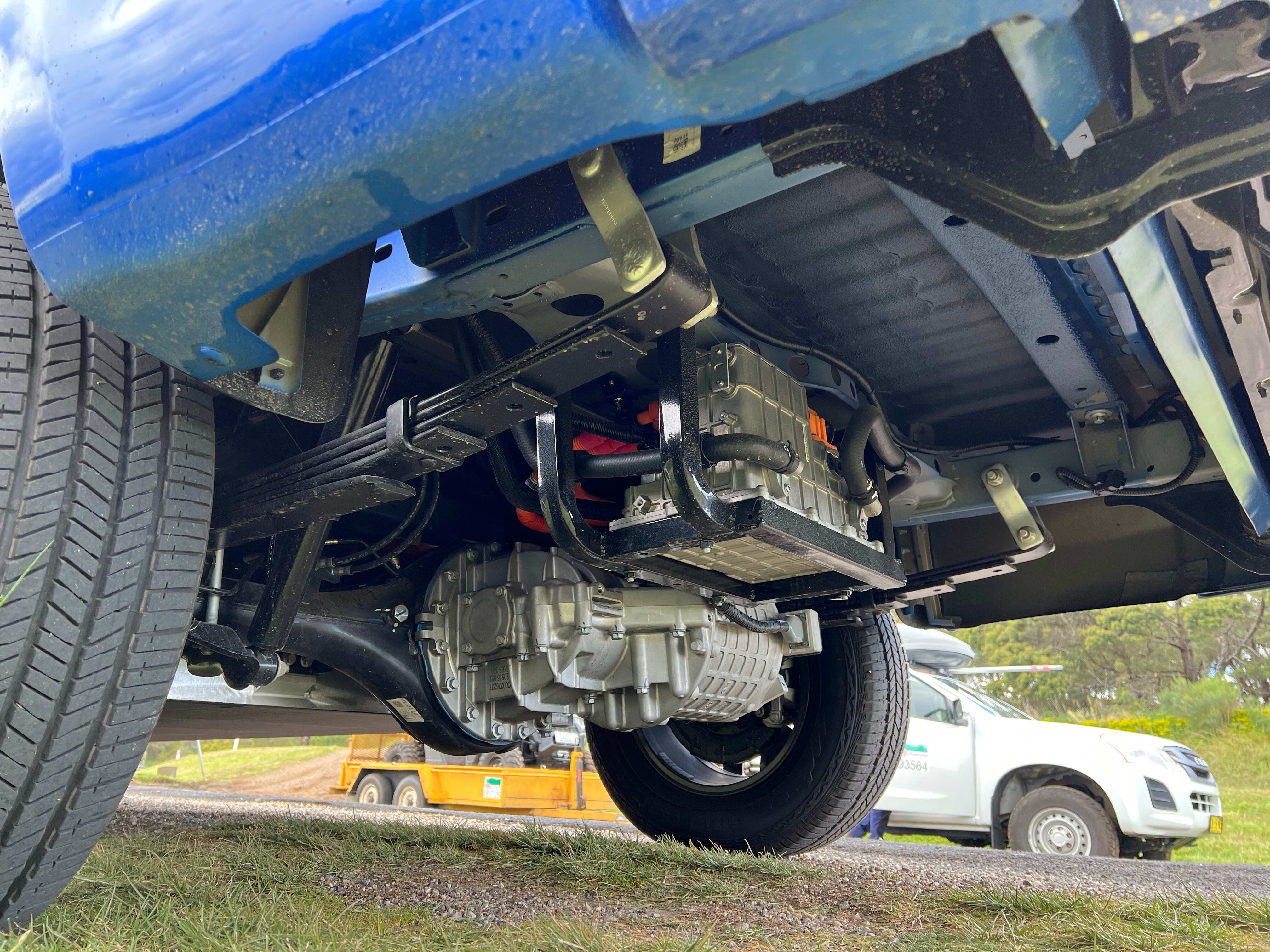
Everything also depends on the current global supply chain problems being resolved, so while a particular vehicle might be theoretically available, landing the same in your garage may still be a problem.
The sales traffic from petrol and diesel cars to EVs may also not be all one way. In the USA, a survey last year suggests that 20 per cent of first-time EV buyers wanted to switch back to a petrol car for their next purchase generally citing slow charging, access to charge points and the inconvenience of roadside EV charging stations as the main dissatisfaction issues. The growth of EV sales in Europe also appears to be slowing and is still only really strong in those markets with EV financial subsidies.
While EVs have an obvious appeal to so-called ‘early adopters’ and ‘green minded’ buyers, many potential buyers still see EVs as a big leap into the unknown after only ever owning and driving petrol or diesel cars.
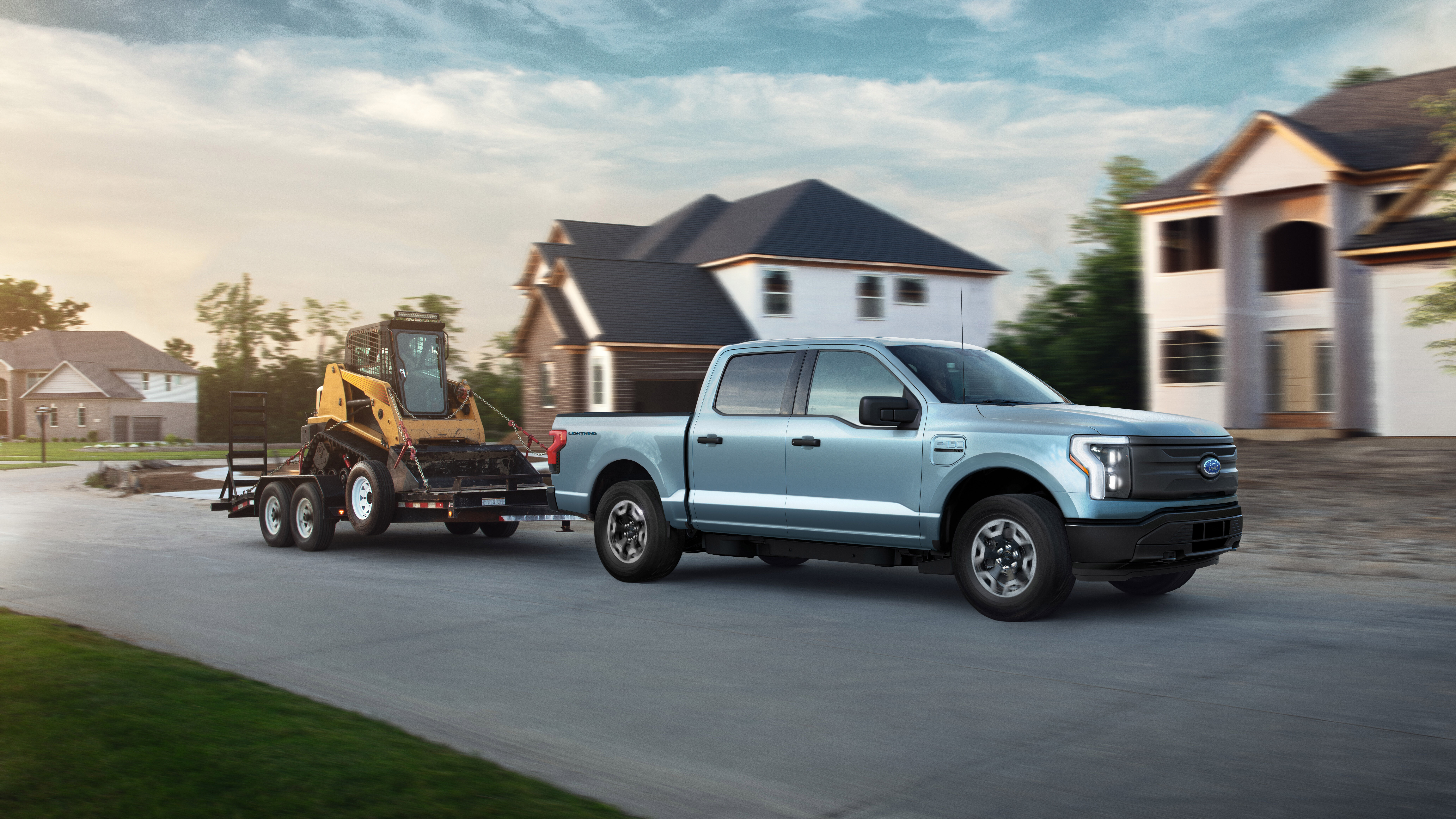
And what if we are swamped with EVs anyway? There’s much to like about them, not least their powertrain simplicity, low maintenance and torquey power delivery.
The tediously slow charging of battery EVs is the killer of course but this becomes a non-issue for most daily driving regimes if you can charge your EV at home in its garage or suitable off-street parking spot when it’s sitting around anyway not doing anything. That means you’re not effectively waiting for it to be charged as typically it will be charged overnight, nor will you have to visit a public charger unless you exceed the battery’s range.
If you do then all depends on the successful rollout of public EV charging infrastructure. Things seem to be going okay with this right now but if EV sales ramp up quickly the infrastructure will come under pressure unless its rollout also ramps up. And quickly.
The essential problem is that the slow charging times of battery EVs means you need many more charging points than you need fuel pumps to cater for the same number of petrol or diesel cars.
On our most recent desert jaunt leading a trip for my son’s tour company, Moon Tours (www.moontours.com.au), we came across a total of five burnt-out vehicles dotted along a couple of remote desert tracks. These had all succumbed to a spinifex fire and were not vehicles that had broken down and then got torched, as you often see on our more-often travelled outback roads.
Then, as I was writing this, I heard a news report of a couple having been rescued from the Gibson Desert after their vehicle had caught fire on the Talawana Track. While there were very few other details, I could hazard a guess of what went wrong!
Two of the vehicles we’d seen had been burnt-out many years previously (I had photographed one of them, a Landie, in the late 1980s on my first trip across the Talawana Track), but three of them were pretty recent – a Prado sometime between May 2021 and June 2022, a Prado and trailer in April 2022 (more of which later), and an FJ Cruiser sometime since 2018. While the FJ was petrol-powered, the two Prados were diesel-powered, which proves spinifex fires don’t discriminate between petrol or diesel.
Endemic to Australia, what we generally call ‘spinifex’ throughout our desert country is, in fact, Triodia, while the ‘real’ spinifex is restricted to coastal sand dunes and the like.

There are around 80 species of desert spinifex but four species are predominant: soft spinifex (Triodia pungens), hard spinifex (T. intermedia & T. irritans) and lobed spinifex (T. basedowii), the last three being the spiky ones we all hate to walk through.
In places, the sea of spinifex resembles a field of wheat with nothing else growing amongst the dense covering of golden grass, while in other places the spinifex forms an understory to an open covering of scattered mulga, other acacias, grevilleas, hakeas, and spindly gum trees and the like.
Lastly, and importantly for all of us to remember and be aware of, spinifex is highly inflammable.
Fire toll
Vehicle fires caused by spinifex are nothing new and we’ve seen plenty in our 40 years or more of travelling the Canning Stock Route, the Bomb Roads established by Len Beadell and his legendary Gunbarrel Highway Construction Party during the 1950s and ’60s, and other remote desert tracks.
The more recent fires destroyed some well set-up four-wheel drive vehicles that most of us would be proud to own and use. Modern vehicles with their Diesel Particulate Filter (DPF) and petrols with their catalytic converters are much more prone than the vehicles of old. Desert travellers take note!
Prado destroyed by spinifex fire
The owner of the 2018 diesel Prado towing the trailer, Jo Poole, has been in touch with me after I posted some pics on Facebook. Here is Jo’s story.
Friday, April 29, 14:15
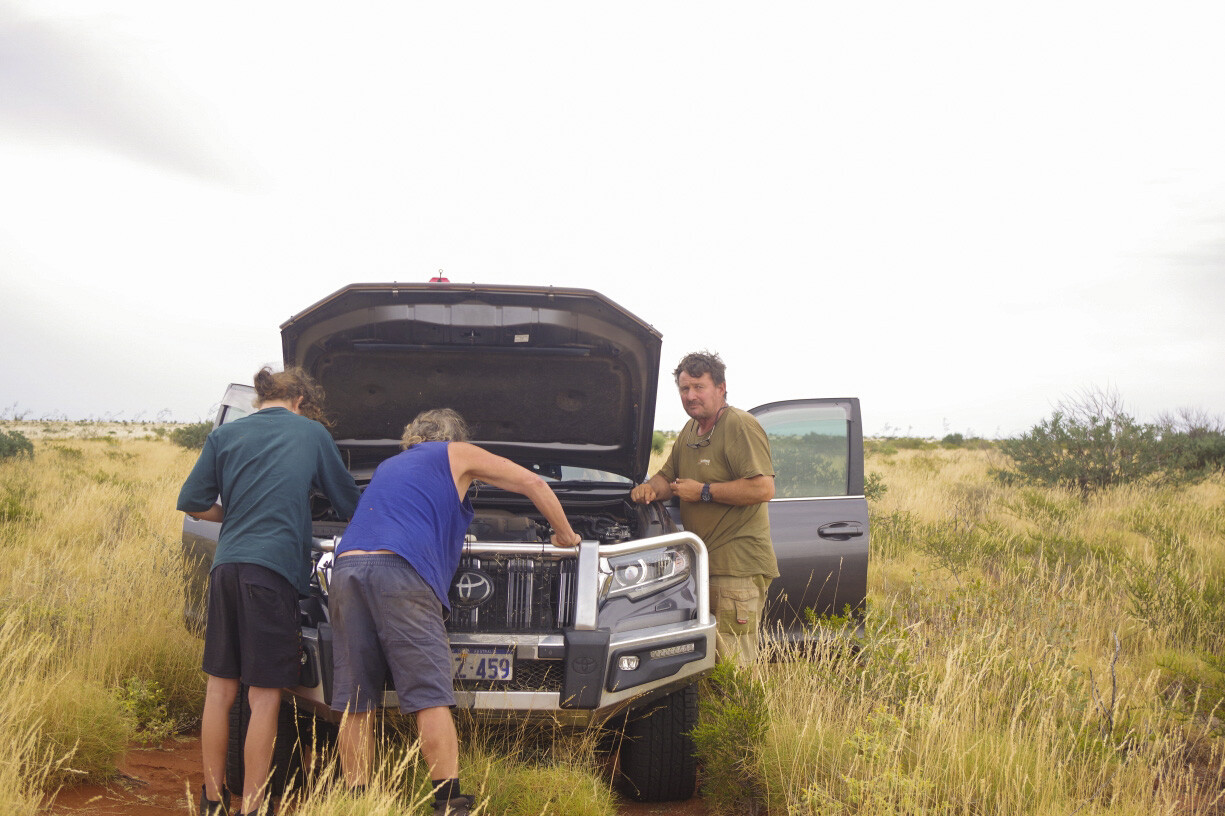
Stopped for a vehicle check. Lots of flowering spinifex and we were sometimes driving blind through patches two metres high. Had fitted flywire to the bullbar but it had little effect.
Friday, April 29, 16:00
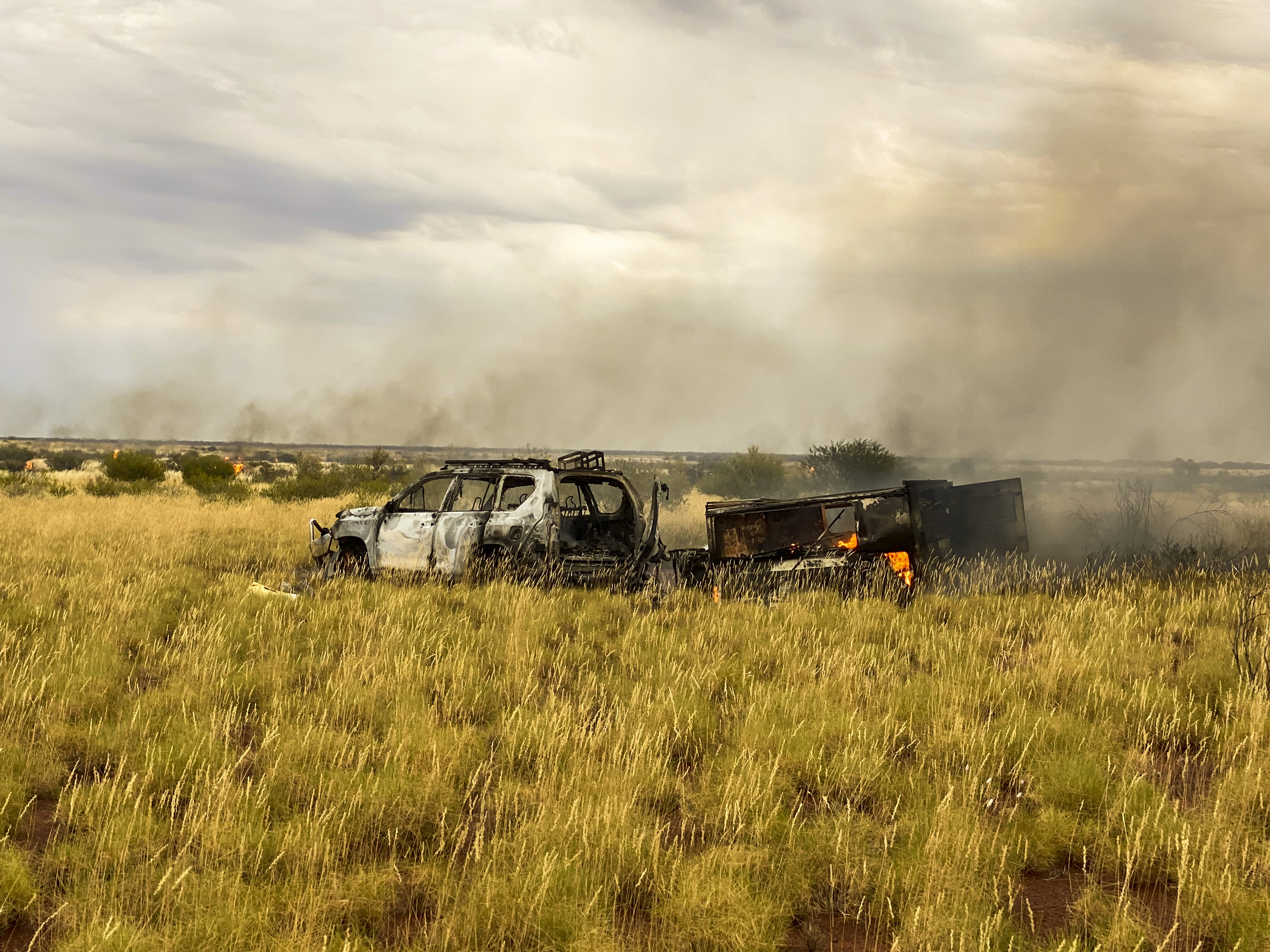
One of the kids said they heard a pop and there was smoke coming from the left rear wheel well. At the same time a warning appeared on the dash that said a rear suspension airbag had a fault.
I stopped the car and the kids got out with a full detergent bottle of water and the fire extinguisher. They’d been instructed to immediately lie down and squirt out the fire. First problem was that the spinifex was up to the bottom of the car so there was no access to see where the smoke was coming from.
I reached the back of the car to see the smoke turn to fire which immediately ignited the spinifex on the ground. Dylan our 16-year-old has, with no further instruction, found a second extinguisher and was using that. I’m so very proud of both the kids, Dylan and Cassia; they were amazing!
I jumped back into the driver’s seat and moved the car a few metres to try to get access underneath the car. It didn’t help in the slightest. Andrew, my brother-in-law, approached with a couple of extinguishers, as he had pulled up behind and could see what was happening.
I upended a 20-litre jerry of water over the tyre but you can’t direct it and it was taking too long. In amongst the turmoil and shouting, our sat-phone was already out of the car with my daughter, Cassia.
I shouted to Vicki, my wife, to move the car again another few metres. Flames are bigger and the smoke is bad and black, and it becomes apparent that if we don’t move back we will be burnt or suffocate. There’s fire inside the car!
Andrew upends another 20-litre jerry into the back. I jump in the driver’s seat and do a big U-turn on to the open next to the track. I grab my phone, camera and the wife’s phone, jump out and place them on the ground. I run around to the back left passenger door and the handle just comes off in my hand.
Dylan has hundreds of puncture marks on his feet from the spinifex, while Andrew’s fringe is singed but otherwise we are all okay.
Dylan and Andrew have finished all four extinguishers. We know there is no more we can do and move to a safer distance. It’s been less than 90 seconds since I stopped!
Andrew brings his car up and we use it for shelter and a quick escape in case the wind changes, as there is now a raging bushfire.
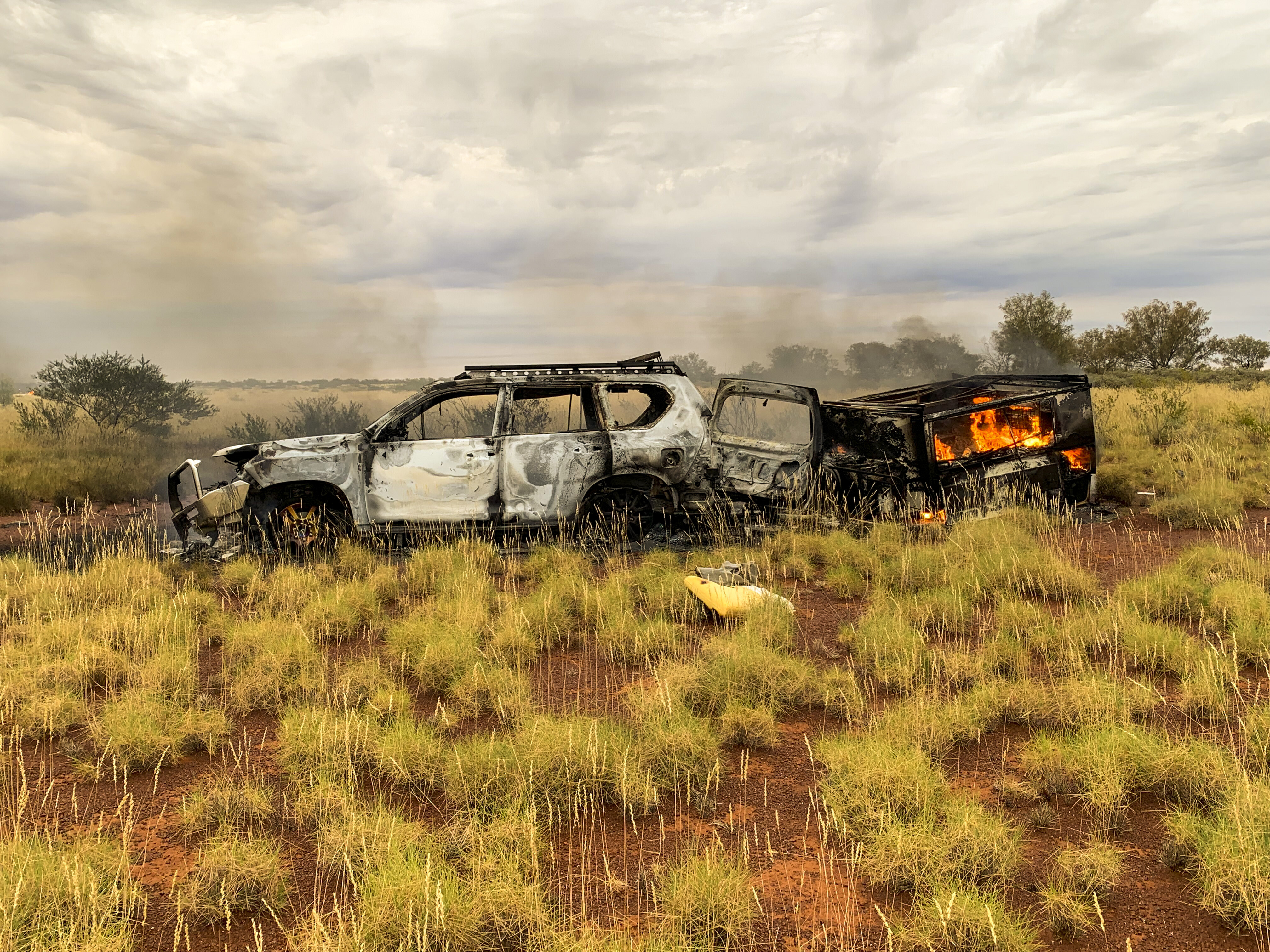
There is some discussion about approaching the trailer but we quickly decide that we don’t want anyone killed or injured. The jerry cans of diesel on the front of the trailer start streaming fuel out and the trailer is fully consumed.
We wait until the fire subsides enough and can get the phones and camera from where I put them; the strap on the camera was melted so we were lucky they survived.
I’m the only one from our car with shoes. Dylan has hundreds of puncture marks on his feet from the spinifex, while Andrew’s fringe is singed but otherwise we are all okay.
After the fire
We drive the 60km to the end of the Talawana Track and turn right, down the Gary Highway in the dark, thinking we can get 50km or so closer to civilisation. The track disappears and after a few attempts we give up and drive five or so kilometres back to Windy Corner (the name given to the intersection of the Talawana and Gary Highway).
We put Andrew in his swag and the rest of us catch an hour or so each of sleep over the next eight hours until it is light.
It’s during this time that I decide 500km in a single vehicle at possibly only 30km/h is going to be too hard and long. The Kunawarritji community at Well 33 on the Canning Stock Route is only 170km north and has a road out and emergency supplies if we need.
Leaving at 6.30am, we smash our way north (passing the turn-off to Veevers Meteorite Crater, our original destination) on a road that sometimes disappears completely.
We ring Newman police when we get close, in case we need to stop. They are very uninterested and remind me that it is forbidden to enter the community. I remind him that it is our only way to escape certain death in the desert and hang up.
To get to the water in the back of the now burnt-out Prado we had previously taken out a jerry can of diesel. This survived and we end up 15 hours later arriving in Marble Bar with only fumes in the tank.
We’ve rung ahead when we had reception near the Telfer Mine and have a couple of rooms at the Marble Bar Holiday Park. Cath (legend) finds some extra clothes for the girls as my wife had only some ripped old shorts on, while our daughter is in a tiny pyjama singlet thingy. Cath brings us extra milk and cereal packets which is all the dinner we have the energy for before we are all asleep.
The next day Cath’s boss and owner of the caravan park, Lang Coppin (major legend), suggests he will take us to Port Hedland and, as there is no accommodation available in town, puts us up in his house.
We fly home the next day. Andrew drives and nearly beats us back ’cos he is hardcore.
Since then, Jo told me, the RAC paid out the insurance on the Prado, trailer and contents, although they only paid out 16 grand on the camper and a grand on the contents, so the family lost out there by 20 to 30 grand they surmise. Still, they have a new Prado and are setting up to head out to the desert once again.
Lessons learned
I asked Jo what the lessons were. He replied: “I’d had a good look under the vehicle a couple of days before, as a general inspection of everything, but annoyingly not that time when we were clearing spinifex from the radiator; it was a bad oversight! I was a little complacent as I was now in a diesel!
“I did things like the Gunbarrel and the Canning in a petrol 1998 Prado and was much more vigilant. We had just passed the burnt-out FJ Cruiser, which I commented was petrol and then the old Land Rover, which suddenly freaked us out as my daughter pointed out that it was probably a diesel.
“I had our Prado programmed previously to show when it was doing a burn of the DPF. It had started one prior to the fire but I couldn’t tell you if it was an hour or 20 minutes. We timed a couple of the burns on this trip at 25 minutes!
“Interestingly, our replacement vehicle is a 2021 VX Prado and the DPF handbook says, in red, not to drive on long grass while it’s doing a burn, and comes with a manual button so you can do one on safe ground.”
When asked if there was anything he would change or carry next, Jo answered: “Absolutely. A 4kg extinguisher instead of a 1kg unit. A grab bag; we lost a lot of small expensive things, like cash.
“I’m also trying to think of a way to make a deluge/soaker extinguisher for just this purpose. Maybe a 20-litre jerry can-size with a battery and suitable pump, big hole so you can fill it as it’s operating and a long enough wand/sprinkler head to poke it under your vehicle through the brush/spinifex …”
Beadell’s truck

Later in our desert sojourn we visited Len Beadell’s Gunbarrel Road Construction Party’s burnt-out truck at the remote Aboriginal community of Kiwirrkurra, and I mused on the thought that maybe spinifex had played more than a passing role in the burning and subsequent destruction of Len’s ration truck that occurred back in 1960.
Now I could be wrong, and certainly Len in his book, Beating about the Bush, which details the incident, doesn’t mention spinifex, per se. But a lot can be deduced by what is not said and from Len’s pic of the truck which shows the front of the vehicle, where an electrical fire would have had a bigger chance of starting, relatively unscathed, compared to the rear of the truck which was near destroyed – possibly from spinifex building up around the exhaust pipe!
So, if that could happen to very experienced desert travellers as Len and his men, what are the lessons learnt for mere mortals such as you and I in more modern, and dare I say, more susceptible vehicles?
Modern diesels are just as susceptible to spinifex fires as are petrol vehicles; maybe with the DPF burn-off, even more so! Do your DPF burns – they burn at between 900 and 1200°C – on a pretty regular basis and in a cleared area free of any grass or spinifex.
When in spinifex country, check under your vehicle regularly; at least once a day! If there is a noticeable build-up, make it much more often. On some trips we’ve been checking and removing spinifex every hour or so. A pair of garden or welding gloves and a thick piece of wire will help remove the spiky stuff. This is most important – prevention is much better than trying to put the fire out once it has started!
Like Jo, we’ve found the small 1kg or 1.5kg powder fire extinguishers, commonly seen and fitted to vehicles, are, while not completely useless, pretty limited in what they can put out. Go for something bigger – we carry a 4.5kg powder extinguisher nowadays.

Secondly, a spray water bottle is a very good option; the bigger the better. Maybe, as I suggested to Jo, the Ryobi 15-litre water sprayer would be the go – they have a big lid for refilling quickly from a jerry can and a long wand for reaching under the vehicle … and you can use it at home in the garden.
Have a grab bag with your valuables in it, including a sat phone or satellite communicator. Finally, travel with somebody else, who can transport you to safety if your pride and joy goes up in smoke!
June 2023: Ineos Grenadier Quartermaster teased
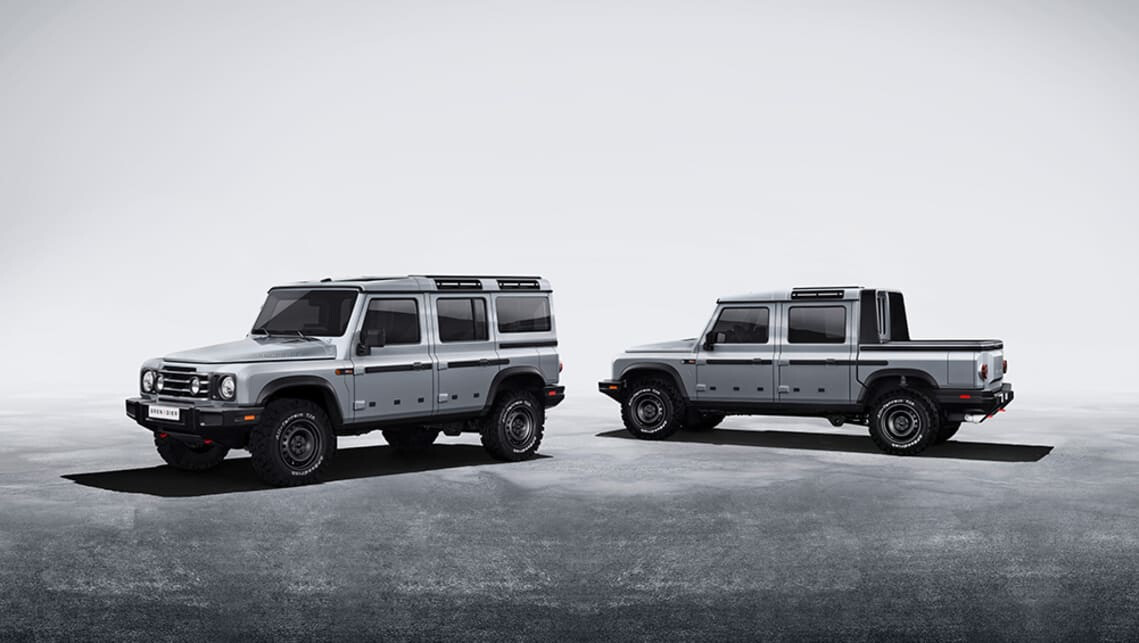
New British 4×4 brand Ineos reveals first image of production dual-cab ute that will carry the Quartermaster name.
Story continues
The 2023 Ineos Grenadier double-cab ute will follow its wagon twin to Australia later this year, if no further delays arise.
While the variant has yet to commence production – and only officially revealed in computer-generated renderings – Ineos Australia CEO Justin Hocevar said the first examples are hoped to land locally before 2023 is out.
However, recent production and delivery issues may also cascade down to the ute, potentially delaying it to early next year.
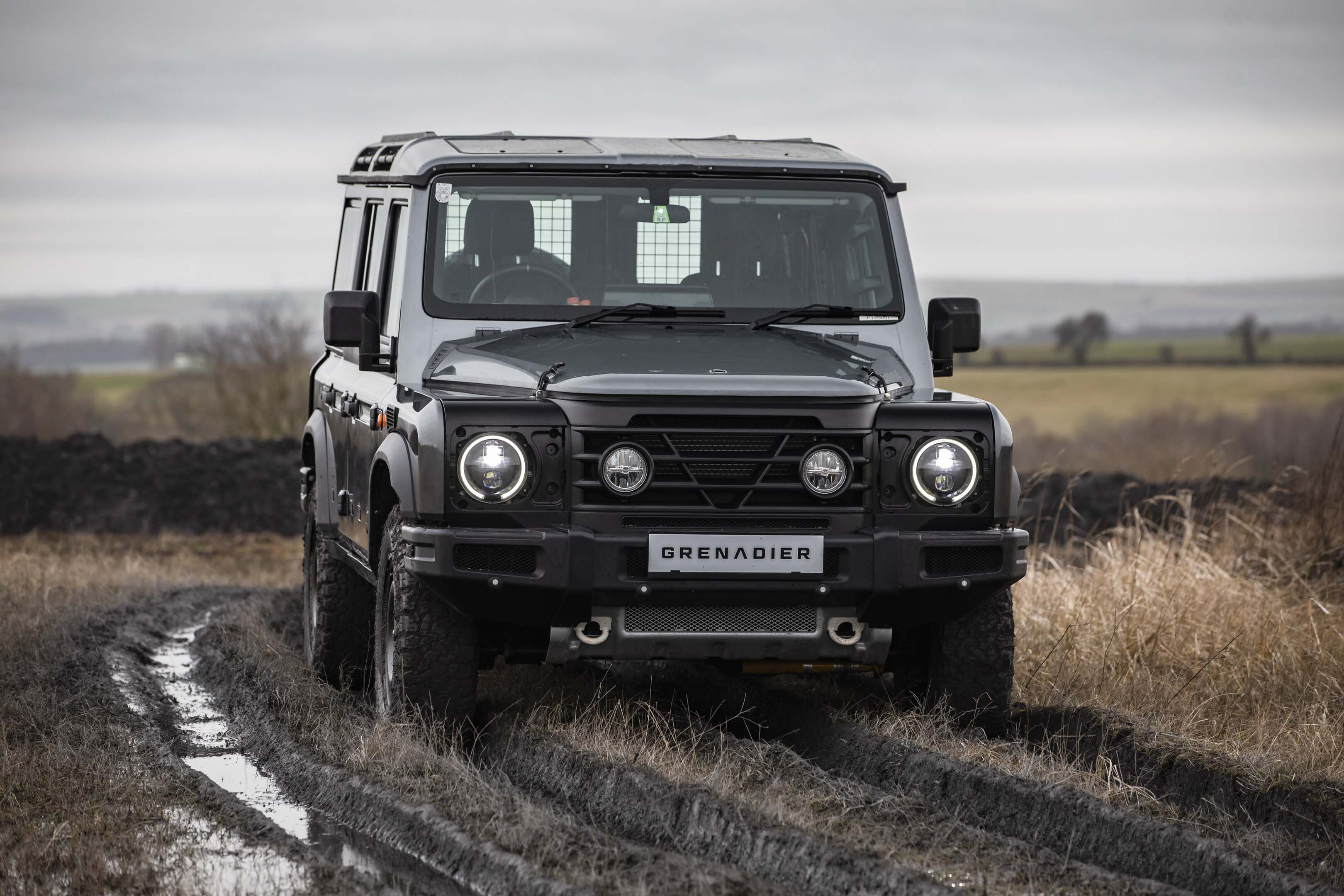
According to Hocevar, pricing will be made available closer to the Grenadier ute’s arrival in Australia.
“It [the ute] will be out before the end of this year, so the question is how quickly can we get our Australian production in and on boats. I’d love to see them before the end of the year, but we’ve got a big job still to launch the wagons.”
The four-door wagon is expected to arrive in Australia by May, with the first examples now produced and ready for shipping.
“Australian cars have already started to be built,” said Hocevar. “Once they’re on the water in January, they will turn up late March, and we should see them on the road in April.”
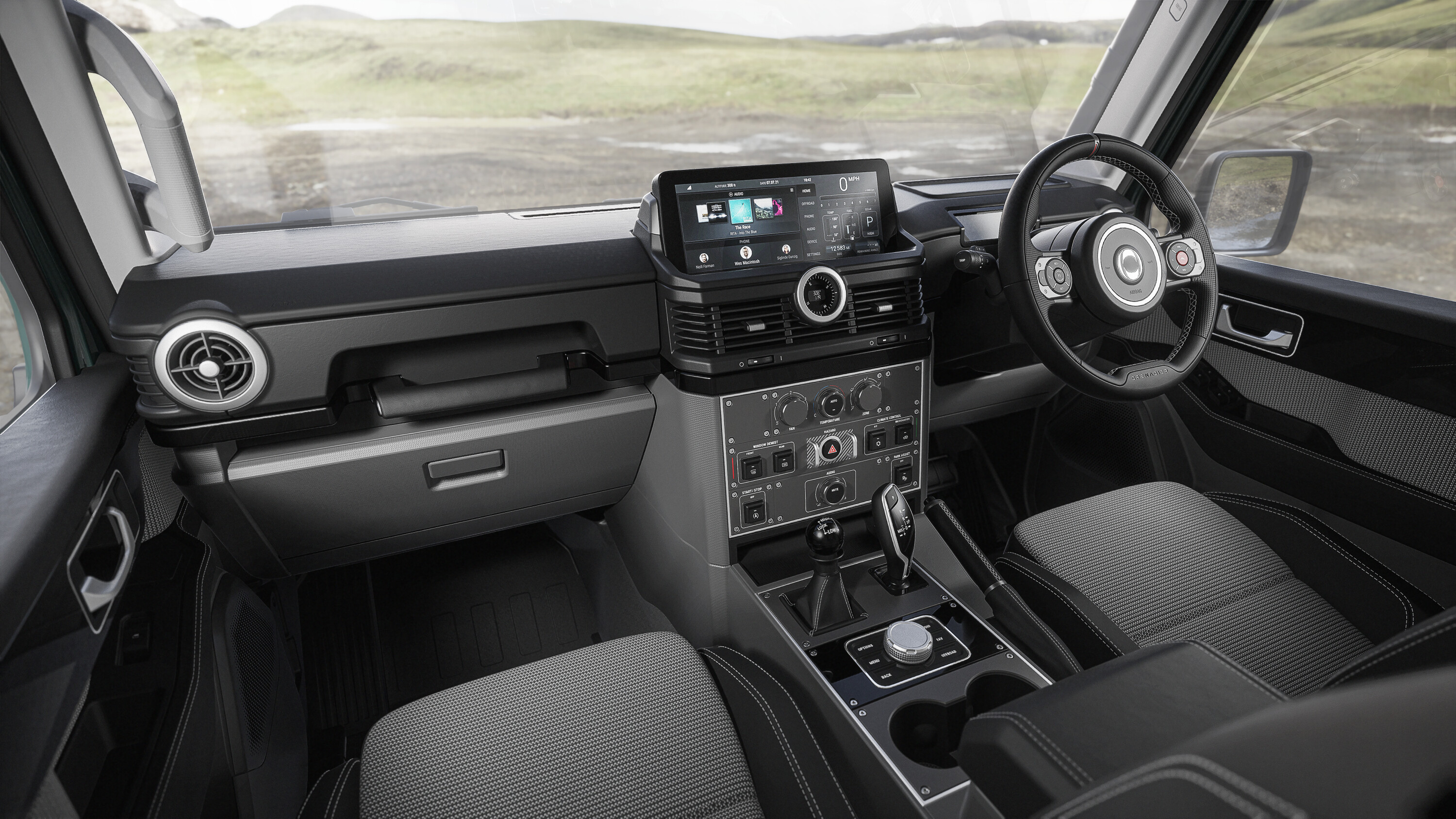
As reported by Autocar in 2021, the Ineos Grenadier ute will ride on a longer 3175-millimetre wheelbase set to be shared with a seven-seat version, versus 2922mm for the standard five-seat model.
It is expected to retain the choice of BMW turbocharged inline six-cylinder engines – the petrol B58, which develops 210kW and 450Nm, or the diesel B57, which makes 183kW and 550Nm.
Both are matched to an eight-speed ZF torque converter automatic transmission, with a Tremec two-ratio transfer case and permanent all-wheel drive with a lockable centre differential.
This week, Ineos Australia confirmed manufacturing and supply challenges facing many vehicle brands are also affecting its own production operations in Hambach, France.
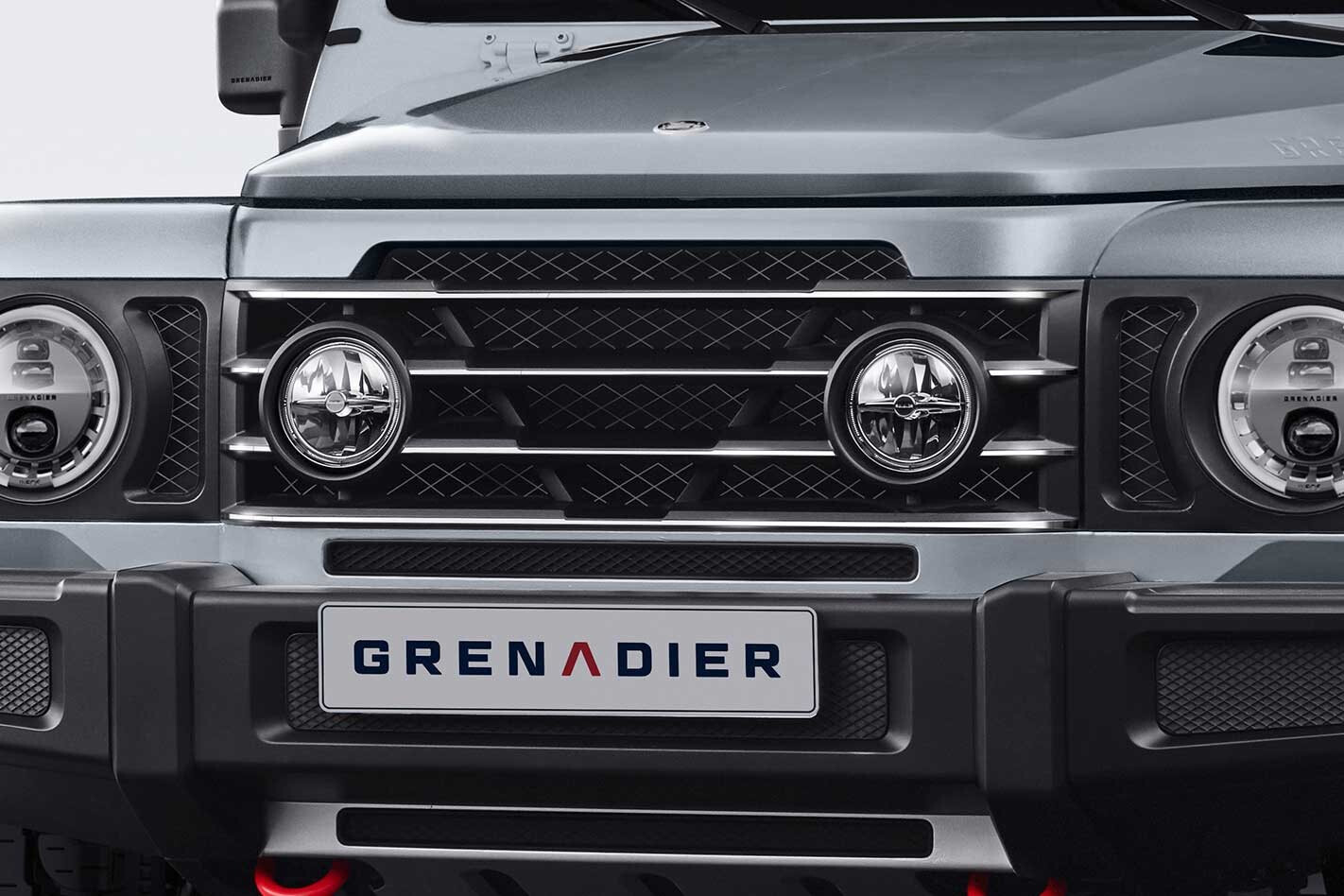
And, while the company had absorbed the extra costs for initial orders, it is now filtering through to customer orders in 2023.
Pricing for the entry Grenadier Utility Wagon and Station Wagon has now risen to $97,000 and $98,000, respectively, while the higher-spec Trialmaster and Fieldmaster now cost $109,525, all before on-road costs.
While early adopters can expect to see their cars arriving soon, strong interest in the startup brand has filled Ineos order books and the lead time for new orders is currently about 12 months.
The 2023 Ineos Grenadier double-cab ute is expected to launch in Australia before the end of the year, so stay tuned to 4×4 Australia for the latest information as it emerges.
The sun rose above Wolfe Creek Crater and Mick Taylor mustn’t have been out hunting, I was still alive. A short walk led to the base of the crater and, after a quick climb, I took one last look at this magnificent specimen of a meteorite crater. It must have been one heck of a piece of space rock that crashed here more than 300,000 years ago.
With breakfast done and dusted, the rooftop tent closed, and the dishwater emptied on the coals from last night’s fire, it was time to hit the corrugations again. Passing Mick Taylor’s ‘abattoir’, a small herd of Brahman cattle kicked up bulldust as they wandered to the watering point, I felt a chill go down my spine.
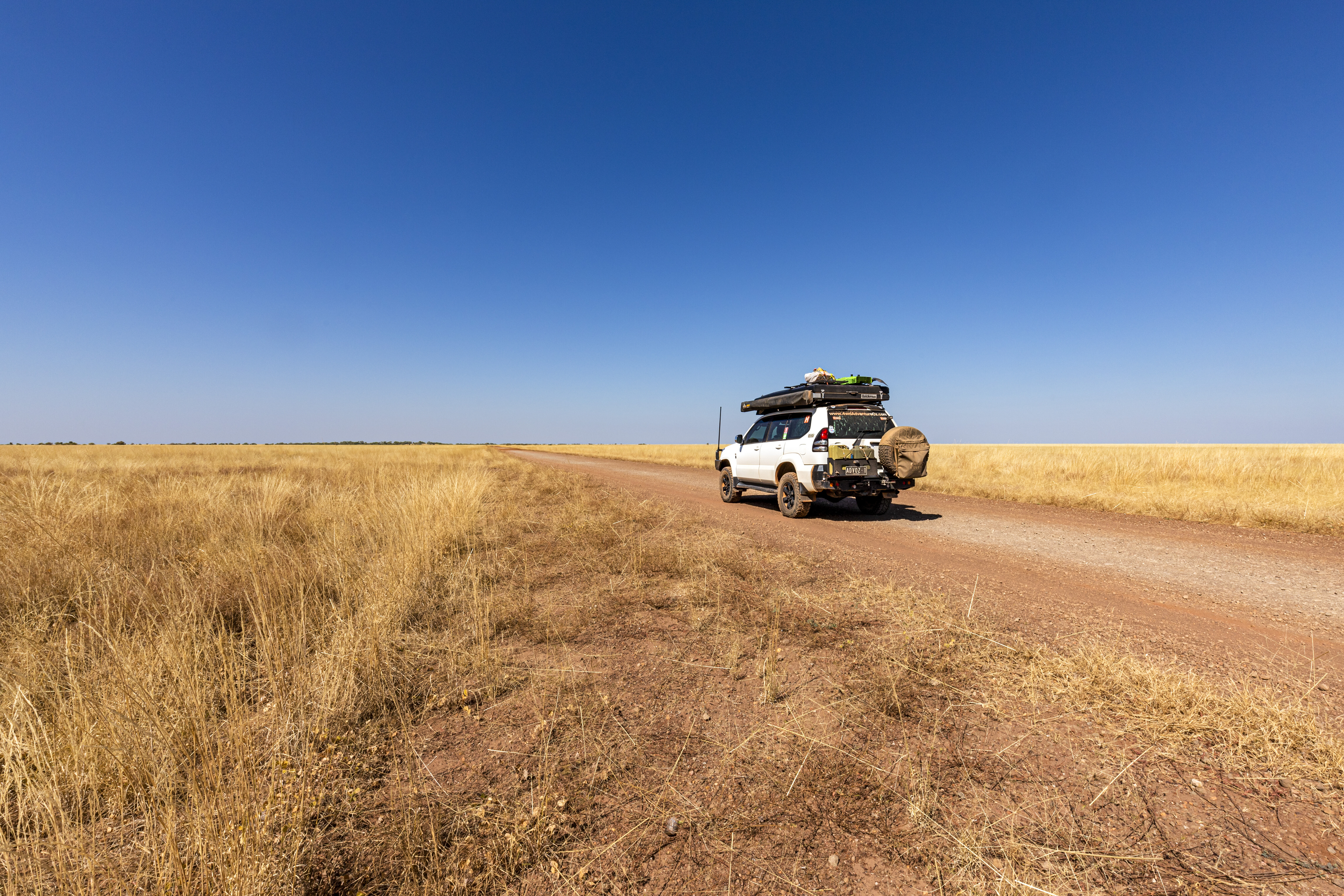
The southern Kimberley town of Halls Creek was busy with overlanders, the Shell servo had a queue of 4WDs waiting to fill up. I drove around the corner to the BP self-serve to fill the Prado’s tanks, the only soul there. With the bank balance smacked by the high fuel price, a quick visit to the IGA to stock up on some fresh supplies was the go.
Duncan Road leads to the Buntine Highway some 170km away and has several stunning sites to see on the way. The first stop was to check out China Wall, closing the gate as requested, before a short drive to the viewing area. The weather has eroded the hard rock, leaving the vein of sub-vertical white quartz exposed – it looks amazing and would pop during golden hour.
Taking the turn-off to Caroline Pool, there was still a little bit of water left in the popular swimming hole and a fair bit of rubbish too – it wasn’t attractive. You can free-camp here for up to 24 hours, with drop toilets and bins provided. There are better camping options farther along Duncan Road.
Kimberley gold
Old Halls Creek was once a bustling gold-mining town, the conditions would’ve been harsh. Prospectors travelled overland from Derby and Wyndham with everything they owned, to try their luck after Charles Hall found a 28-ounce nugget in 1885. This was the first gold discovery in Western Australia and, even though it was a short gold rush, the town stayed alive until the highway was built and the town was relocated.
Today, there is a discovery walk around the town site, while the old mud-brick post office is protected to preserve its heritage. Basic camping is available at The Lodge for $10 with solar showers and rudimentary toilets; it’s popular with fossickers who regularly still find gold in the area.
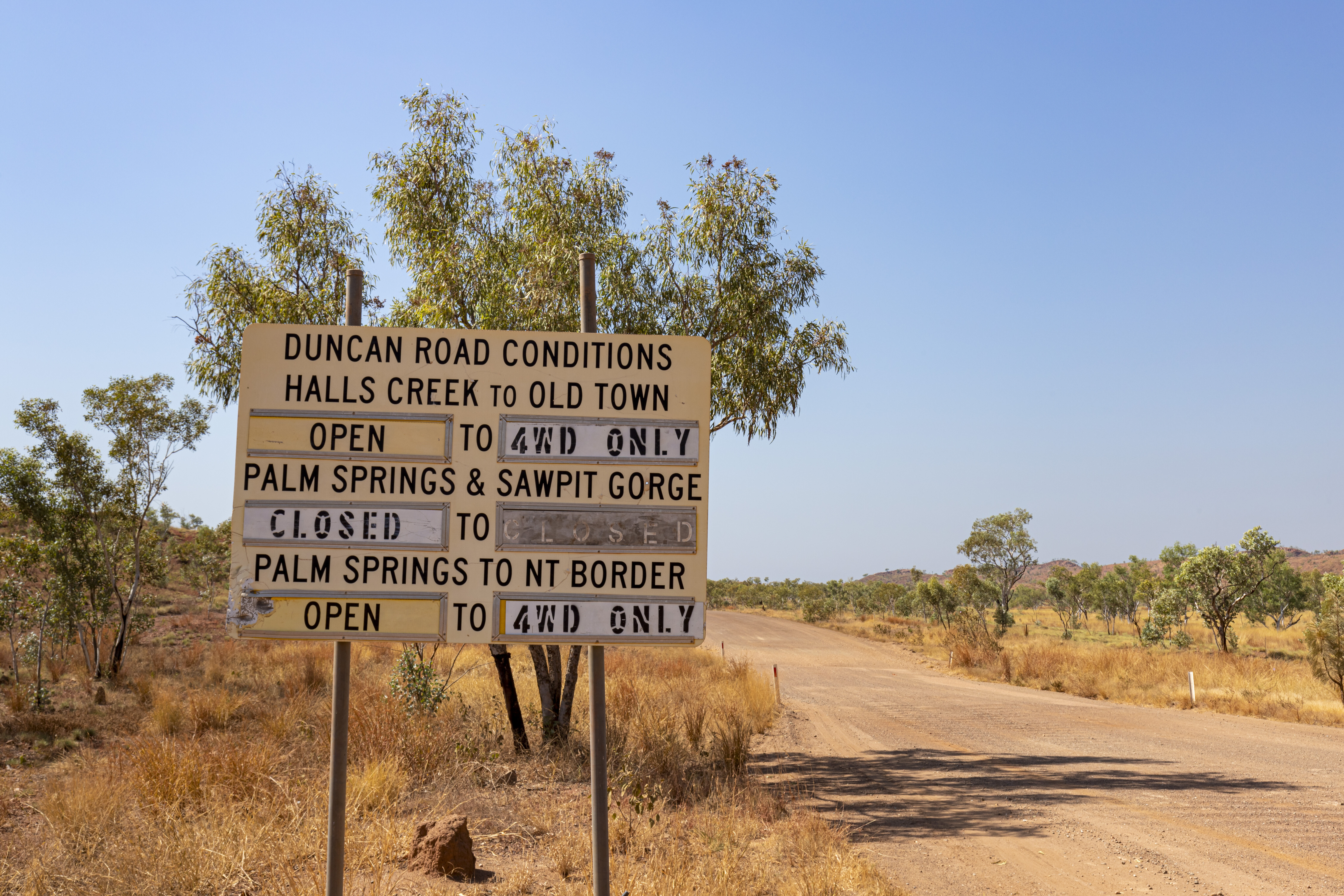
From Halls Creek, the going is slow through the Albert Edward Range with tight bends, washouts, blind crests and hearty corrugations. Crossing the Black Elvire River means you’re closing in on Palm Springs, a stunning oasis with palms and reeds and a great spot for a swim. The campsite is small and right on the road, so not ideal.
Just past Palm Springs is the turn-off to Sawpit Gorge, a cracker of a campsite. The road in is rough which seems to put off a lot of travellers, but the reward is worth it. The Black Elvire River is overlooked by a striking cliff face that would light up at sunset and, while the main camping area is high on the bank with bins and drop toilets, the best spots are down on the river bed. It’d be easy to spend a few hours with a relaxing swim, before sitting back to enjoy cold ones beside a warming fire.
It was time to move on though, as I wanted to reach the Buntine Highway and find a nice bush camp somewhere along the way. Once over the range, the road straightens and the valley is flat. The next 35km passes through the southern section of the Ord River Regeneration Reserve, which was created to revegetate bare and degraded sections of the Ord River catchment and reduce the amount of silt flowing into Lake Argyle in the north.
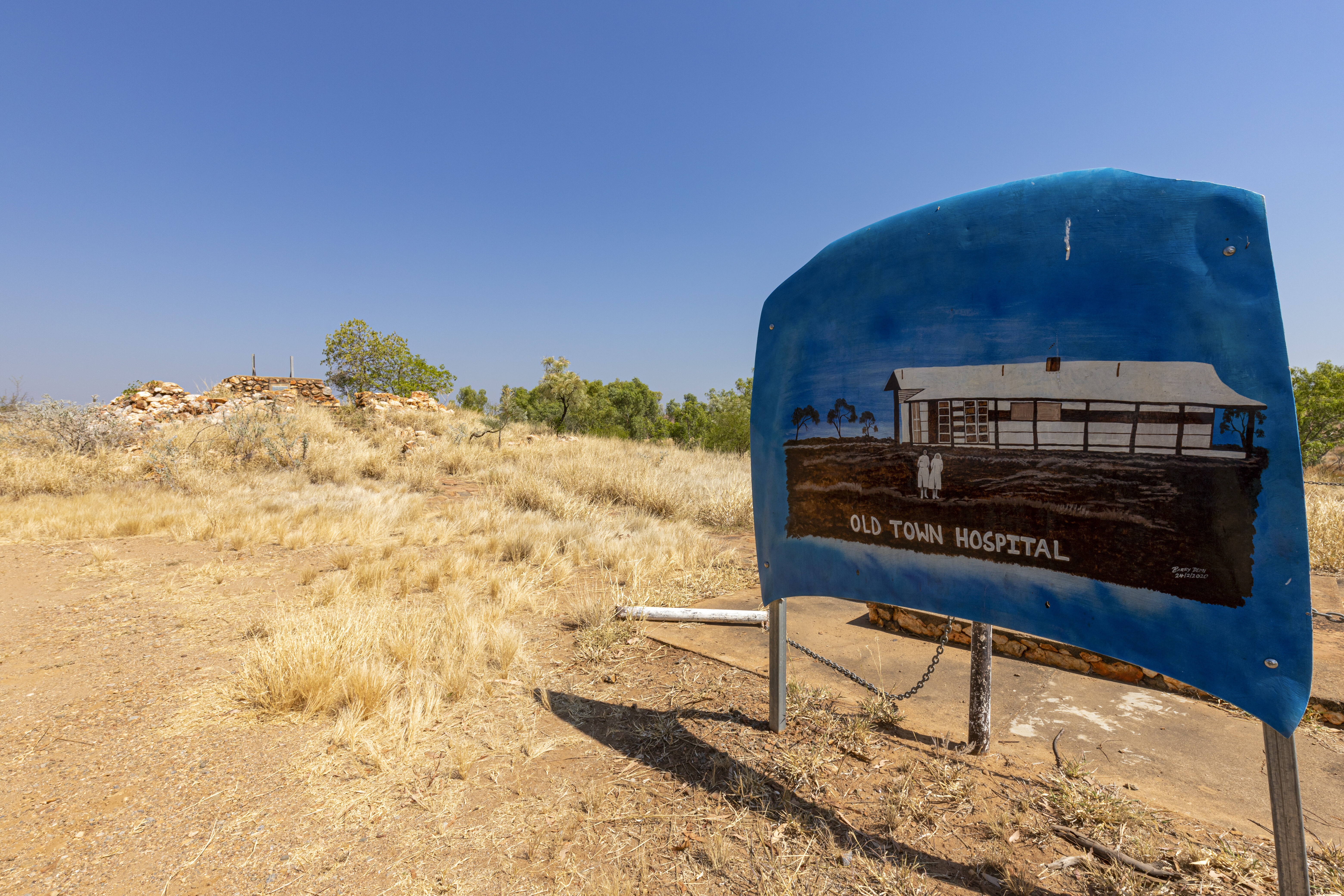
Once through this section, the flatlands were covered with Mitchell grass, good rains having helped in breaking the drought. I’m sure the Flora Valley, Nicholson and Gordon Down pastoralists are as happy as the livestock that graze these golden fields.
The landscape becomes bushier as the road runs alongside the Nicholson River when approaching the intersection with the Buntine Highway. The nearby Marella Gorge used to be a challenge to find, however a change in ownership has seen public access to this stunning gorge unfortunately closed.
I was spoiled by recent road maintenance when I turned on to the Buntine Highway, so the driving experience was great. It didn’t take long to reach the WA-NT border, devoid of welcome signs, and when I saw a recently refurbished roadside stop, it was time for a late lunch.
Trackers
With Kalkarindji a good four hours away, it was a challenge finding a place to camp as there aren’t too many designated sites along the Buntine. Wikicamps was a great help, and the sun was low in the sky when I pulled off the road to stealth camp behind a gravel pit. Having set up camp and prepped for dinner, I put in a call to my wife on the sat phone. Darkness had fallen and as I was talking, I heard a voice yell out, “Is anyone there?”
A torch lit up and moved closer and the voice asked, “Can you help us?” Three Aborigines appeared, they’d been out hunting a cow and were returning to Kalkarindji when the Commodore ran out of oil. After offering them some water, the sat phone was used to call for someone to come and tow them home. The boys thanked me, then headed off in the darkness on the long walk back to their broken-down chariot. How did they know I was there? They’d spotted my tyre tracks entering the gravel pit but not exiting.
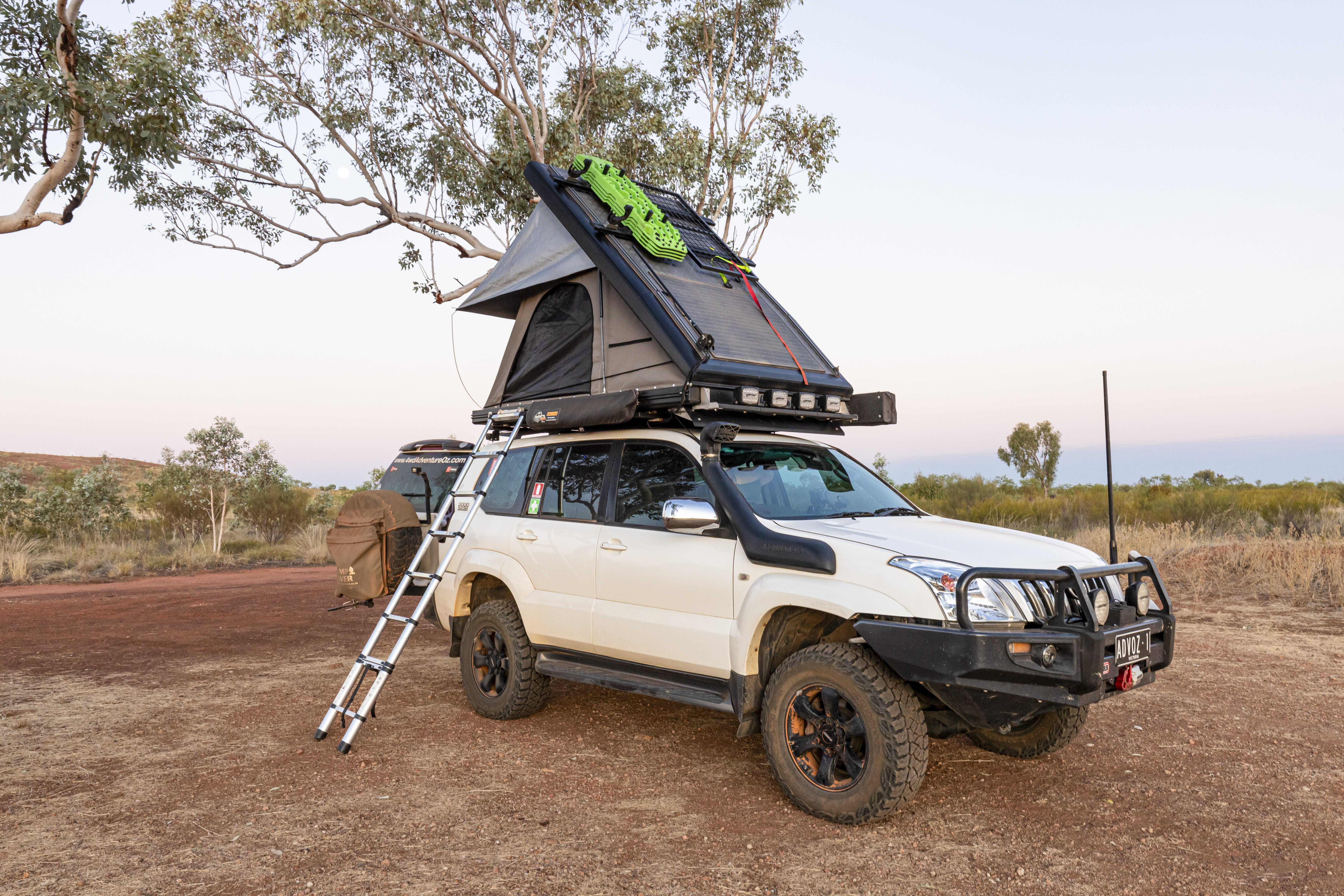
Rising early, it didn’t take long to get back on the road and it wasn’t long before I reached Kalkarindji and fuelled up. There is also a rudimentary caravan park here. This spot on the Victoria River is a place of national significance. On August 23, 1966, 200 Gurindji, Mudburra and Walpiri people walked off Wave Hill Station in a protest over conditions.
Led by Vincent Lingiari, it led to a return of homelands to the Gurindji people in 1974, the first legislation that allowed First Nations peoples to claim land titles if they could prove a traditional relationship with the country. From little things, big things grow.
Radio check
The single-lane bitumen road begins at Kalkarindji and heads north-east to Top Springs. The road is in poor condition, with plenty of potholes, washouts and blind corners, and I wouldn’t like to come across a road train on a bend, there would be nowhere to go to avoid a head-on. The UHF was on channel 40 and frequent radio checks went unanswered, so I assumed a truck wasn’t heading in my direction.
Thankfully there was a lot of roadwork in this section, a sign that a dual-lane road is in progress. The drive is scenic through the ranges and across the valleys, recent rains greening it all up. There are some big cattle stations out this way.
It was nice to pull up to the Top Springs Hotel, having camped out the back after exiting Gregory National Park a couple of years ago, the place felt familiar. A cold beer while chatting to the new manager was refreshing but unfortunately the kitchen was closed, so I missed out on a rump steak.
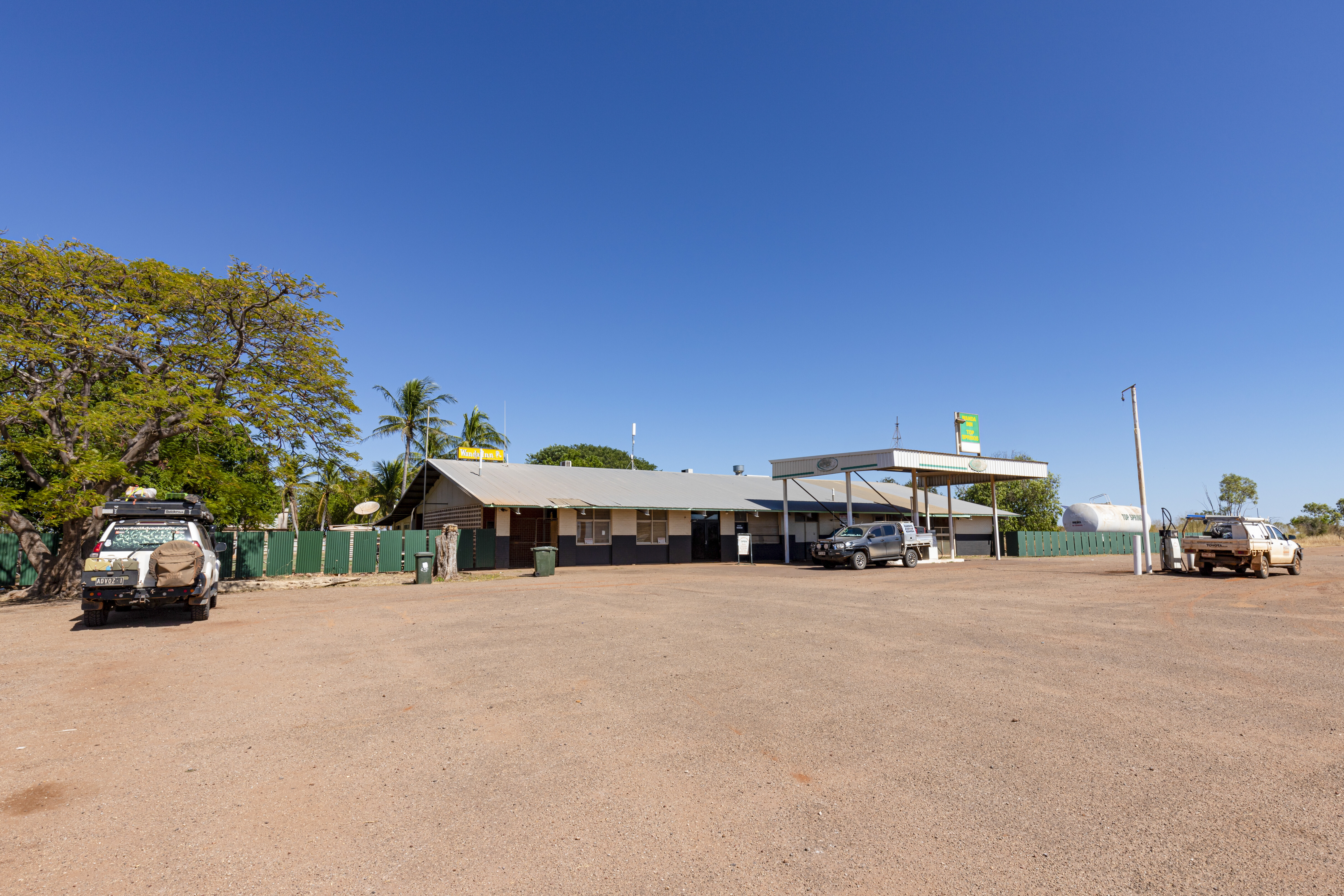
There is a storyboard out the front of the hotel that explains the vision of Noel Buntine to offer a reliable system of transporting cattle from remote stations to markets. It was the early 1950s, roads were bush tracks, seasonal weather was hazardous and meatworks owners thought trucking cattle caused bruising. Buntine helped legalise the use of triples (three trailers) and went from his first truck, a Model B Mack to eventually owning a fleet of 50 trucks. It was this vision that turned the Buntine Highway in to what it is today.
From Top Springs, the Buntine is often a dual-lane road as it heads 165km north to the Victoria Highway. There are recognisable termite mounds, golden grasses and sapling gums along the sides of the road, and if you’re with Telstra, the phone will start pinging as you pass the Delamere Air Weapons Range. You’ll encounter plenty of road trains on this section too, and a better place to meet them.
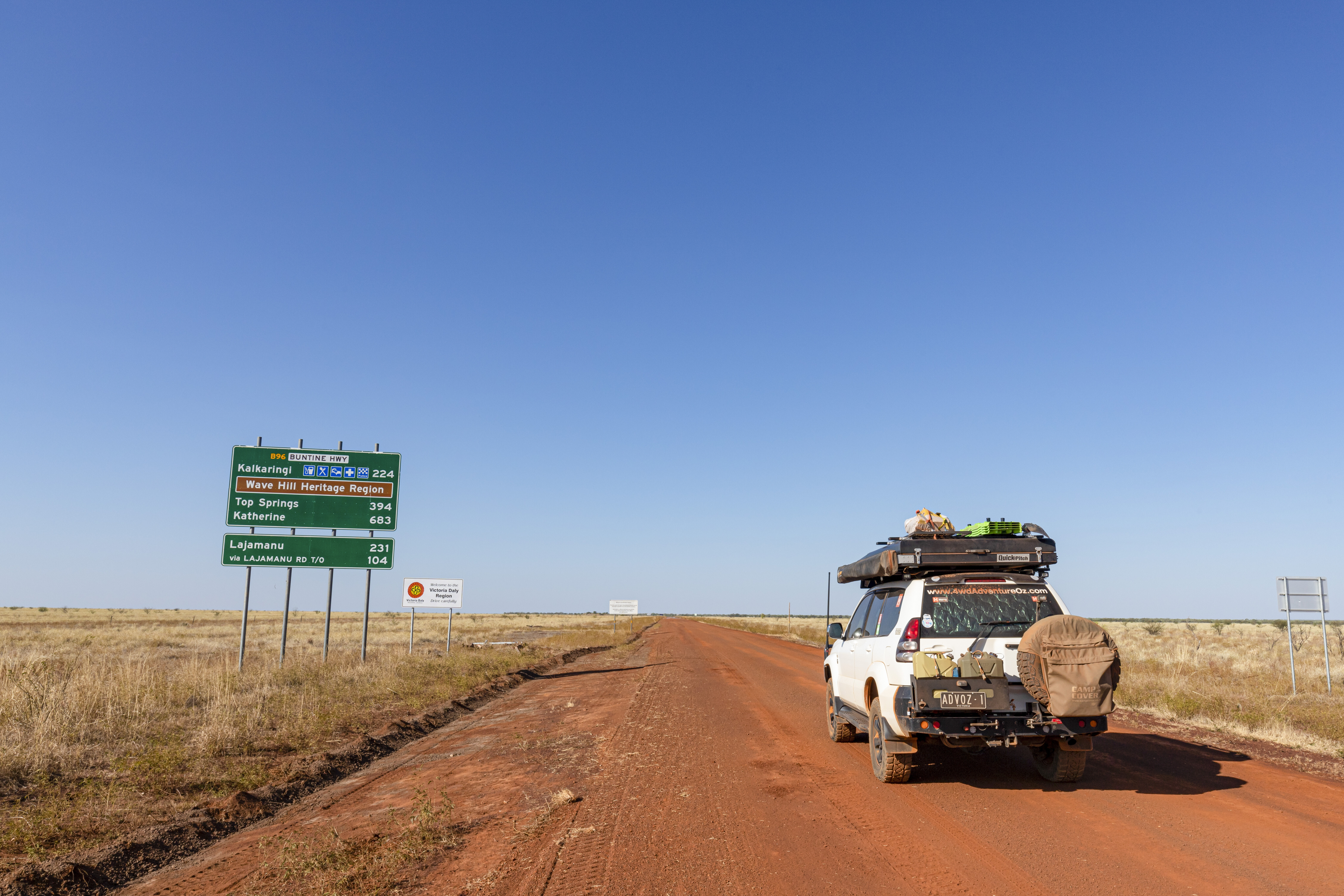
On reaching the Northern Highway, check out the monument dedicated to Noel Buntine, a bloke who helped make Australia a better place. From here you can turn left and explore the Victoria River and Gregory National Park on the way to Kununurra. Turning right leads 127km to Katherine, a great place to hang out for a few days and explore the hot springs, Nitmiluk National Park, Edith Falls and the Cutta Cutta Caves.
How bad is the Buntine Highway? Much better than I thought, with the gravel section well-maintained and nice and wide. The section between Kalkarindji and Top Springs is dangerous but a WIP for upgrades, and the northern section has all been upgraded. It is, in fact, a great shortcut between Halls Creek and Katherine.
Five fun facts
Noel Buntine
The highway is named after Noel Buntine, who revolutionised the way cattle were transported from remote stations to market via three-trailer livestock road trains. The highway traverses some 580km from the Victoria Highway in the NT via Top Springs and Kalkarindji to Nicholson in WA.
Kalkarindji
Kalkarindji is a place of national significance where First Nations people had their homeland returned to them for the first time, following the Wave Hill Walk Off protest by Aboriginal station workers led by Vincent Lingiari in 1966.
Top Springs
Top Springs is a great place to roll out a swag and enjoy a tasty home-cooked meal. The hotel and servo are located at the junction of the Buntine and Buchanan Highways, about 290km south of Katherine, and surrounded by several huge cattle stations.
Old Halls Creek
Old Halls Creek was Western Australia’s first gold discovery. Although short-lived, the gold strike contributed to the establishment of the ports of Derby and Wyndham as well as Halls Creek.
Free camping
Sawpit Gorge is a great free campsite with 24-hour camping, eco toilet and rubbish bin. Located 45km from Halls Creek and a few kilometres off Duncan Road, a 4WD is recommended to access Sawpit Gorge.
Keen observers of the global automotive market won’t be surprised to learn why the hotly anticipated Ineos Grenadier will cost more than originally planned, and why its local launch is taking longer than expected.
Key Points
- Grenadier pricing up by $12,500-$13,030
- Those who ordered early will have original price honoured
- First deliveries delayed four weeks
As reported in late 2022, ongoing worldwide manufacturing and logistics cost escalations have forced Ineos to pump up pricing of its hardcore four-wheel drive, with Grenadier ticket prices increasing between $12,500 and $13,030 in 2023.
In a story common to all brands and buyers since COVID arrived on the stage, the price increase and delays are being blamed on rising production costs and constrained global logistics.
There’s a silver lining for some buyers, though. Pricing for orders placed last year will not be slapped with the increase, but Ineos Australia CEO Justin Hocevar explained that the Grenadier’s debut been pushed back by about four weeks.
“Australian cars have already started to be built,” he said. “Once they’re on the water in January they will turn up late March and we should see them on the road in April.”
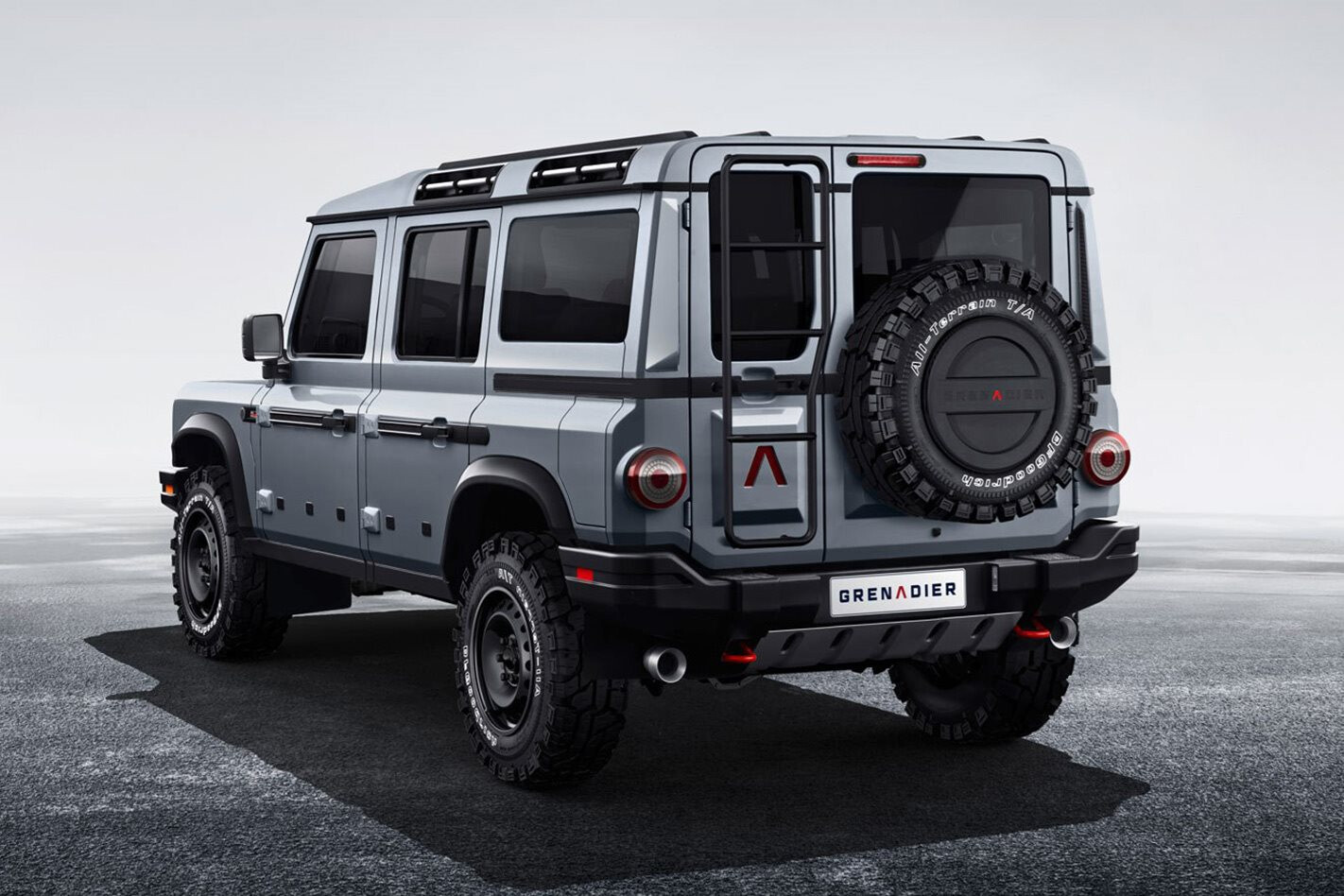
Hocevar confirmed the manufacturing and supply challenges facing many vehicle brands are also affecting its own production operations in Hambach, France. And, while the company had absorbed the extra costs for initial orders, it is now filtering through to customer orders in 2023.
“We’re always impacted by logistics timing which is protracted at the moment – there are not as many sailings, it’s a lot more expensive and it’s been really hard to get,” Hocevar said.
“Material cost, energy cost, the logistics cost had all gone up significantly so we had to take our medicine on that.”
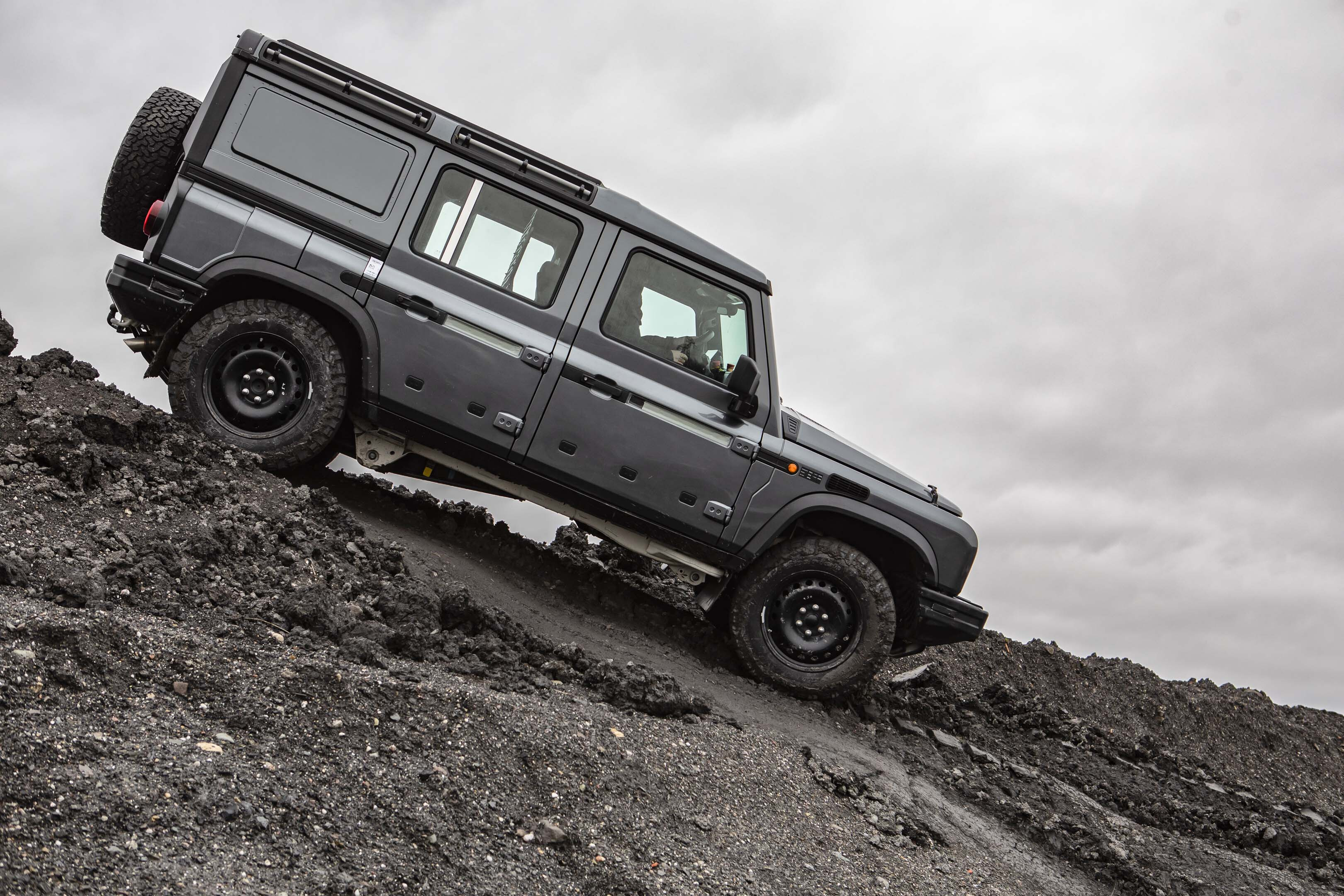
Pricing for the entry Grenadier Utility Wagon and Station Wagon has now risen to $97,000 and $98,000 respectively, while the higher-spec Trialmaster and Fieldmaster now cost $109,525, all before on-road costs.
The price of the company’s second key model – the Double Cab Pick-Up – is yet to be revealed.
The company has already established a network of 29 ‘agents’ across Australia with a focus on servicing more rural areas, with more sales centres and service workshops planned as the number of local Grenadier customers grows.
“We can’t just pop up in big urban islands like a direct-to-consumer electric vehicle brand. We had to have the credibility of a network. That’s why we’ve skewed it so heavily to regional areas.
“We don’t necessarily need sales and service in every location, but we’re certainly looking to open more service outlets”, said Hocevar.
Update: Where there’s smoke there’s fire – the LC70 scores HiLux four-banger.
Toyota revealed a 70 Series update alongside the new Prado, packing the HiLux’s 150kW/500Nm 2.8-litre turbo-diesel four-cylinder and, for the first time ever, a six-speed automatic. Get the full story below.
January 2023: The venerable Toyota LandCruiser 70 Series could halve its cylinder count, according to a new report.
Snapshot
- Toyota LandCruiser 70 Series reportedly set to return to Japanese market
- Could receive four-cylinder turbo-diesel and six-speed auto from the HiLux and Prado
- Long-running 4.5-litre diesel V8 expected to remain in Australia, with order books still closed
Japanese publication Best Car Web reports the popular workhorse – a mainstay in the Toyota Australia line-up for almost four decades – will return to its home market later this year with a HiLux engine.
It hasn’t been offered in Japan since a limited-run 30th Anniversary edition launched in 2014-15, which featured the same 4.0-litre petrol V6 as the FJ Cruiser – but demand for public and private use, especially in rougher terrain, could see it revived in the nation.
Under the bonnet, the resurrected 70 Series is expected to adopt the 2.8-litre turbocharged four-cylinder from the HiLux and LandCruiser Prado, with 150kW and 500Nm and a six-speed automatic transmission.
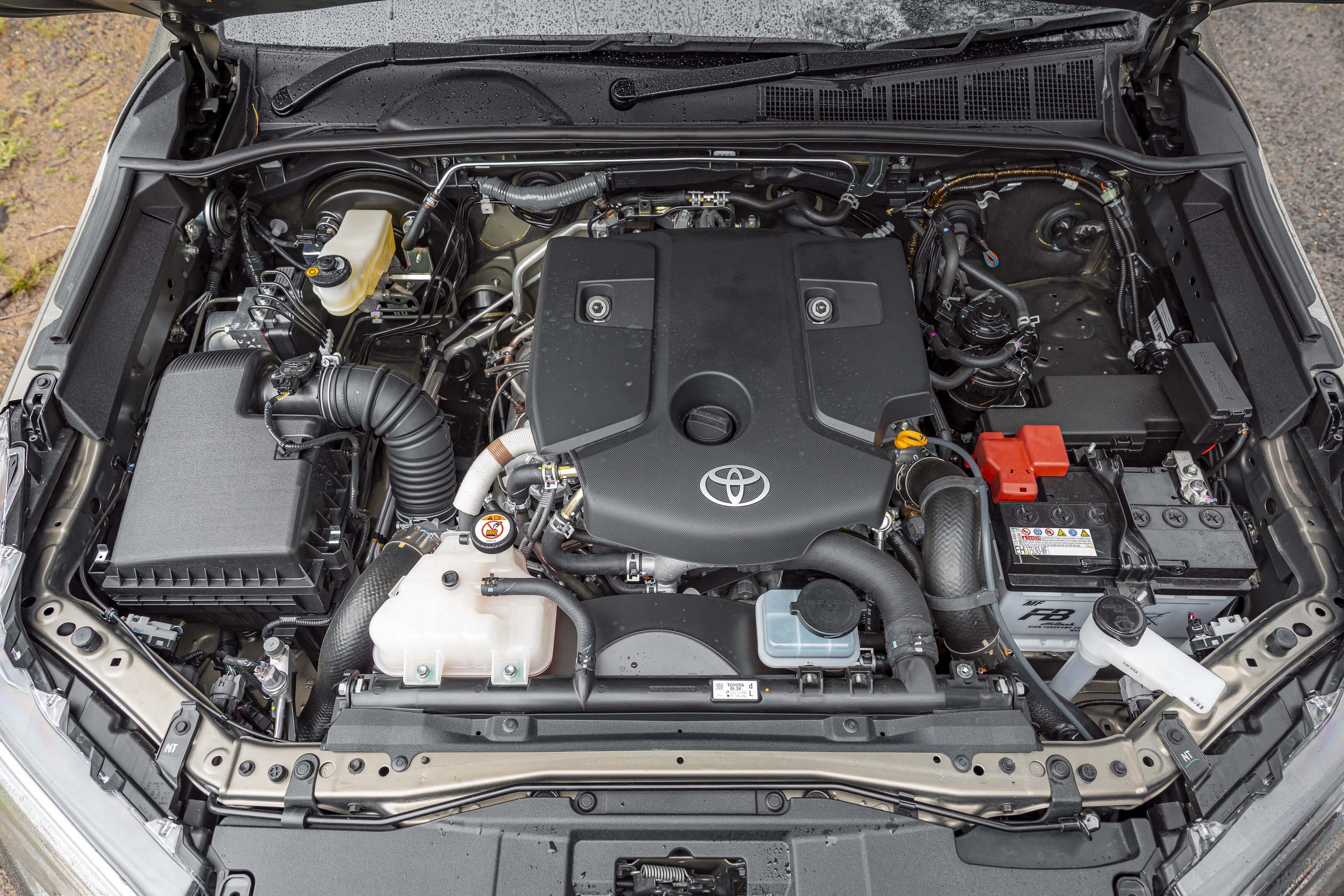
This compares to the large 4.5-litre V8 turbo-diesel producing 151kW and 430Nm, as found in Australian examples since 2007. It is exclusively matched with a five-speed manual gearbox.
If true, the switch will follow the long-running Toyota Coaster passenger bus, which shifted to a low-output version of the ‘1GD-FTV’ 2.8-litre turbo-diesel with a six-speed automatic transmission in 2022 to reduce its emissions output.
An automatic version of the LandCruiser 70 Series was last available globally in 1992 when the ‘FJ74’ and ‘BJ74’ fibre-reinforced plastic versions offered a four-speed unit, matched to a 3.4-litre four-cylinder diesel, a 4.0-litre naturally-aspirated inline-six petrol, or a 4.2-litre inline-six diesel.
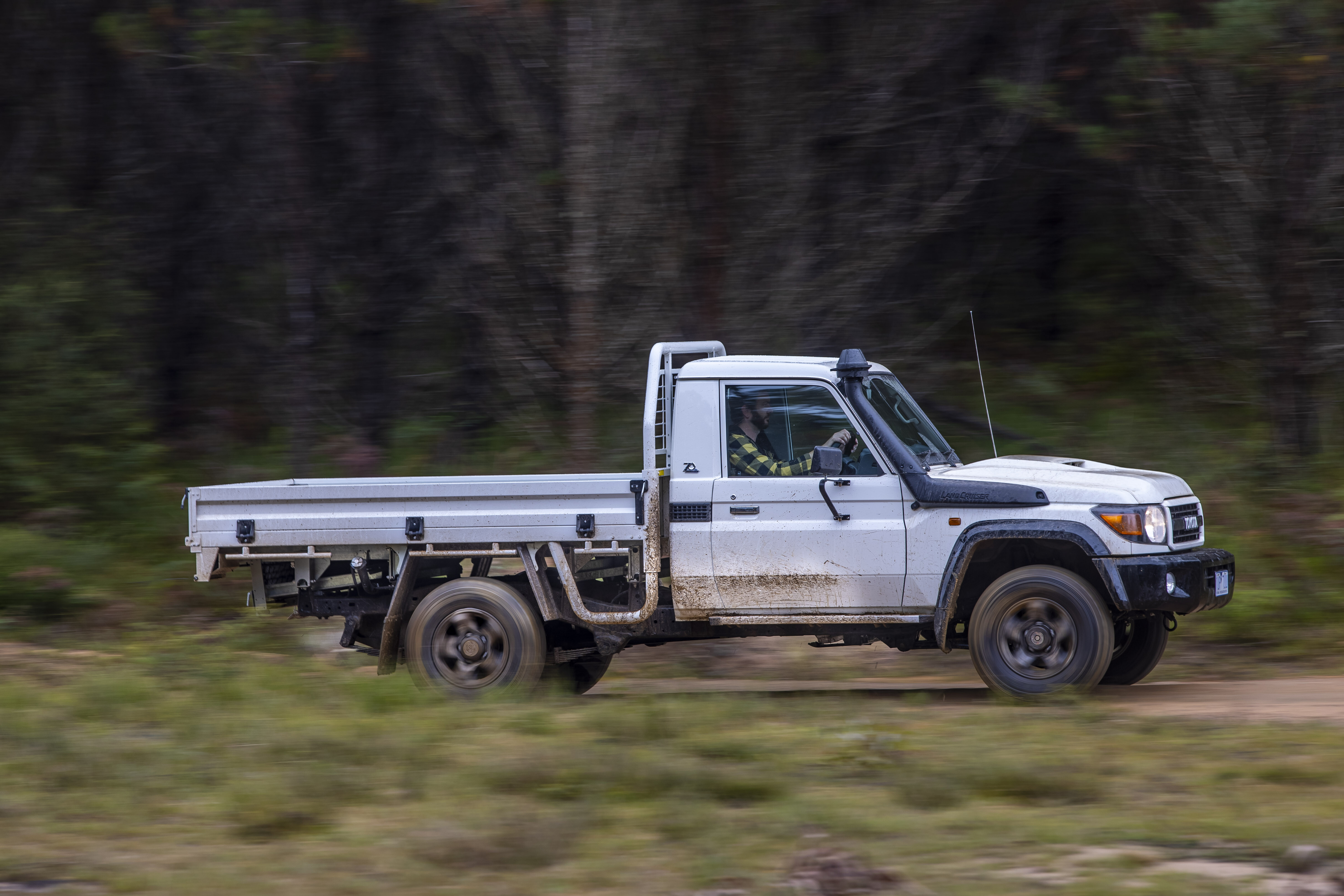
But while the engine and transmission are expected to be borrowed from the HiLux, the 70 Series’ four-wheel drive underpinnings will remain unchanged, likely including its 3500-kilogram braked towing capacity.
The future of the Toyota LandCruiser 70 Series is unclear for Australia – but it’s expected to retain the 4.5-litre turbo-diesel V8, at least for now.
A stop-sale in place since mid-2022 is expected to last for at least another six months, as supply constraints push estimated delivery times to as long as four years.
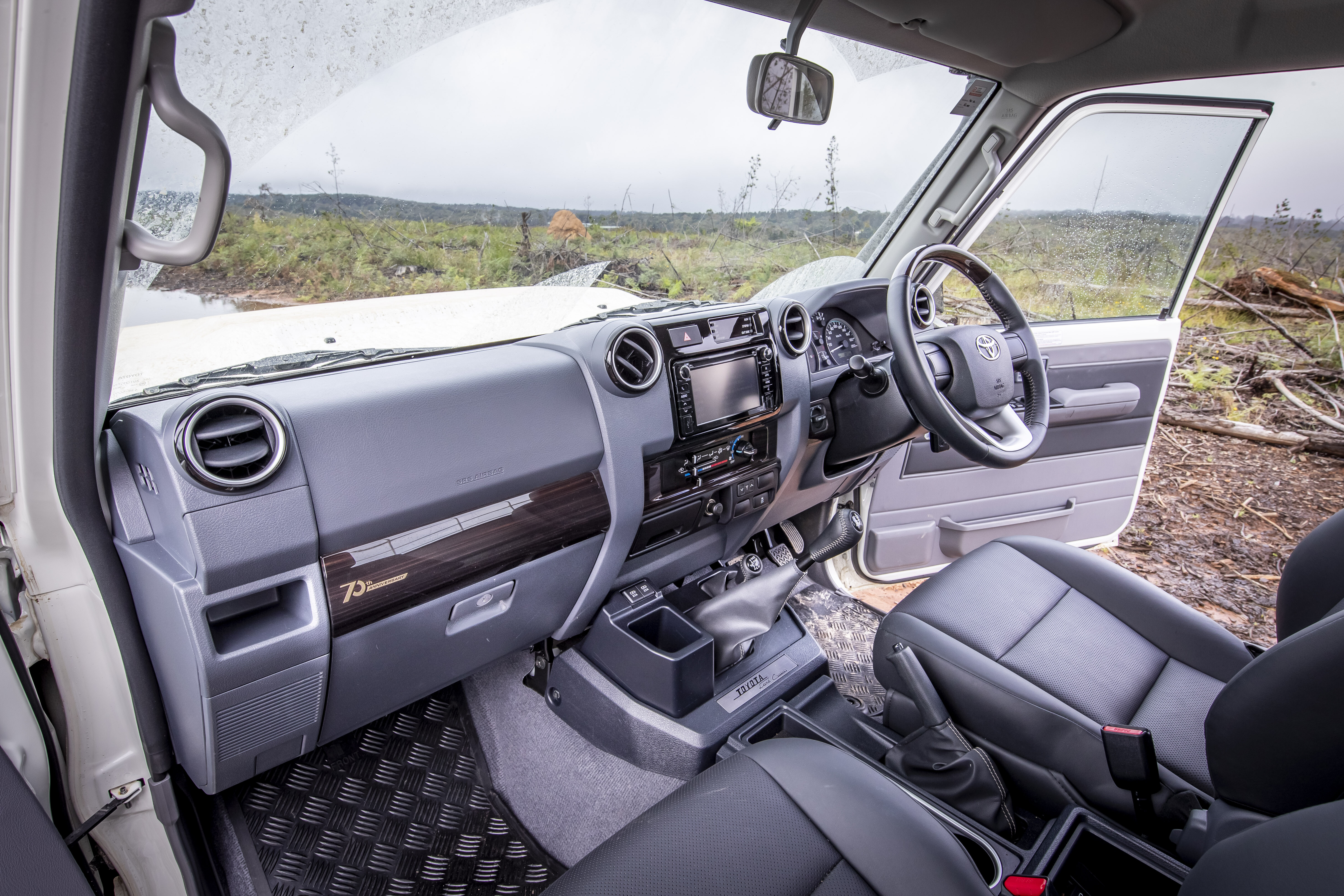
“We’ve paused that car. It’s part of the transparency for the customers. I wouldn’t see that car coming off [pause] for the next six months at least, and maybe beyond that,” said Toyota Australia vice president of sales, marketing and franchise operations, Sean Hanley, last year.
“If we can improve [70 Series] production then certainly, but until we clear the current order bank, we can’t do that.”
A minor update launched in Australia in late 2022, introducing structural changes – including a 3500-kilogram gross vehicle mass – to sidestep new side-impact regulations, potentially life-saving autonomous emergency braking technology, and minor price rises.
May 30: Tank 300 petrol models arrive, hybrids delayed
A more-affordable petrol-only GWM Tank 300 has been announced, with deliveries to commence before the hybrid variants. Full story below.
January 27: Tank 300 Hybrid driven in Australia
The GWM Tank 300 Hybrid is now in Australia, and we’ve driven it. Get John Law’s first-drive take on the new Wrangler rival at the link below.
January: 2023 GWM Tank 300 Hybrid pricing
Snapshot
- 2023 GWM Tank 300 pricing and features
- Hybrid off-roader joins local range from $55,990 drive-away
- Two grades available, with both powered by a 2.0-litre four-cylinder hybrid system
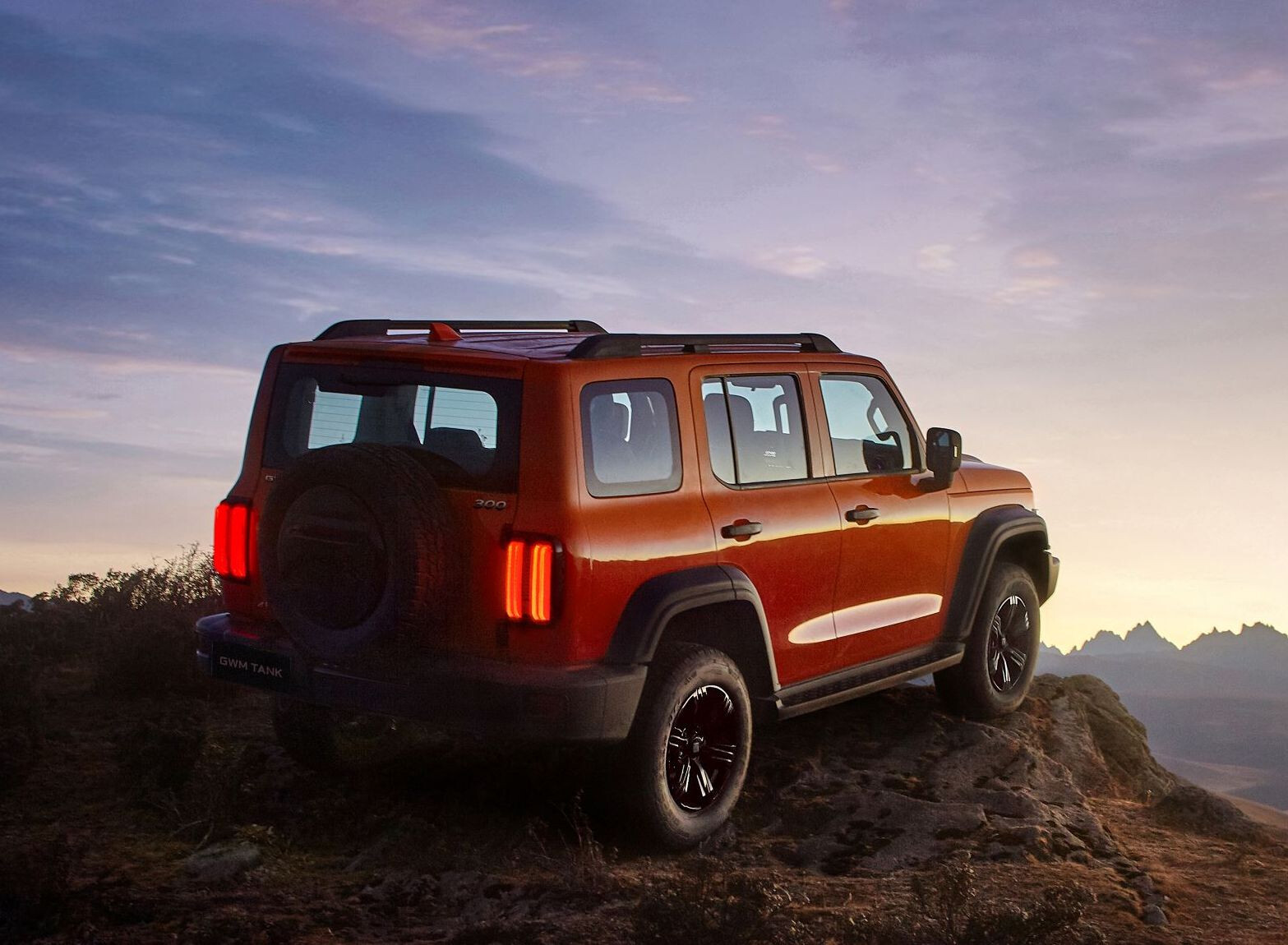
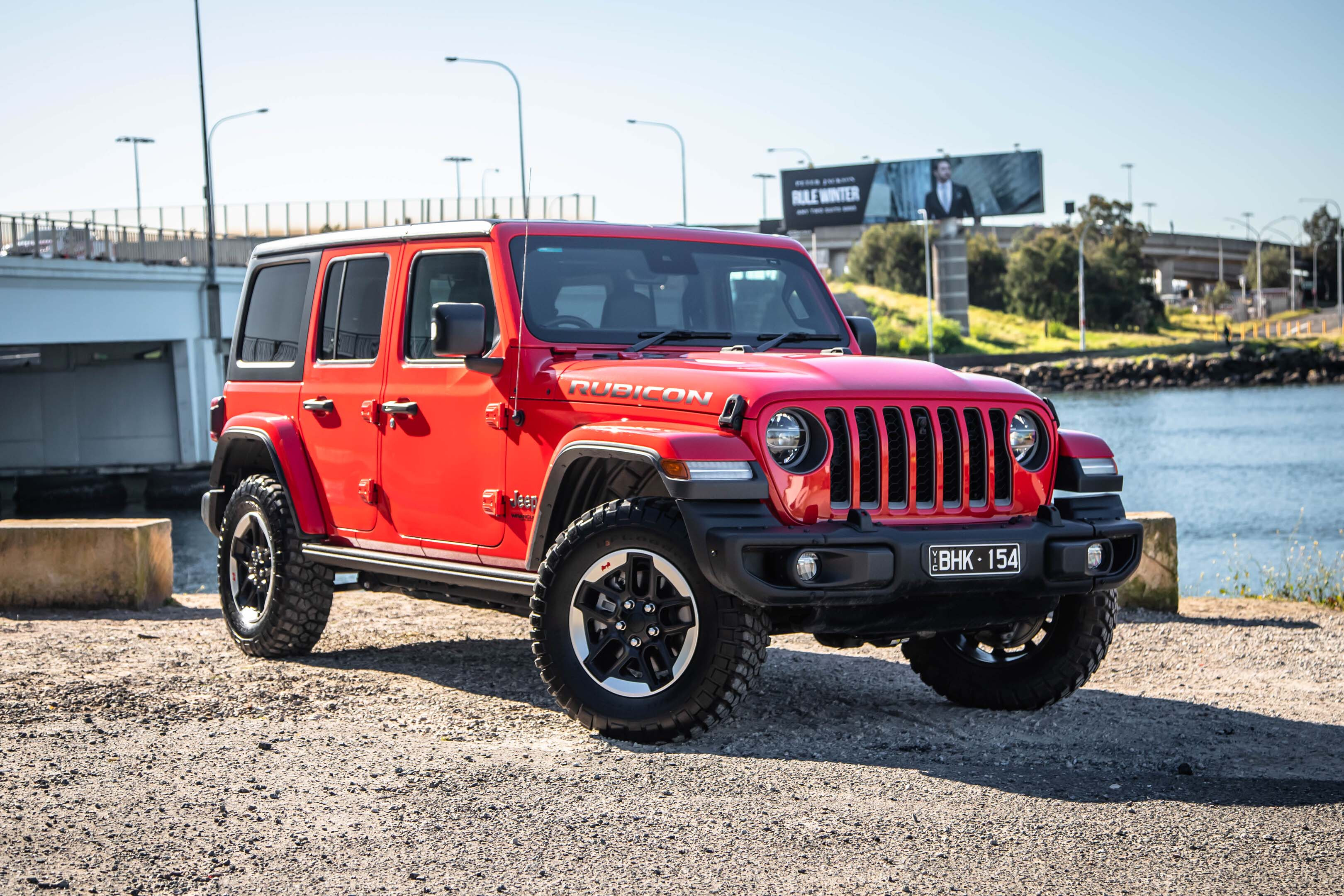
The GWM Tank 300 is designed and sized comparably to a four-door Jeep Wrangler, but with closer similarities to a body-on-frame large SUV – such as the Toyota LandCruiser Prado and Ford Everest – under the skin.
GWM claims the Chinese-built Tank 300 could “become a strong option for those looking to explore Australian roads, tracks and beyond,” with a 2500-kilogram braked towing capacity, a hybrid powertrain, and an on-demand four-wheel-drive system.
Two grades will be offered in Australia – Lux and Ultra – with the entry-level variant priced from $55,990 drive-away – making it similar to a base Isuzu MU-X and Mitsubishi Pajero Sport, but below the Ford Everest, Toyota LandCruiser Prado and Jeep Wrangler.
In addition, it sees GWM’s electrified vehicle line-up grow to three in Australia, with the addition of the Haval H6 and Haval Jolion hybrids earlier this year.
The brand plans to launch “more than 50” electric and hybrid-powered vehicles by 2025, ahead of a plan to dump petrol and diesel cars by 2030.
JUMP AHEAD
- 2023 GWM Tank 300 pricing
- Features
- Colours
- Engine, drivetrain, and fuel economy
- Safety
- Dimensions
- Warranty and servicing
- Availability
Video from Cars By ML
Watch for our video to come soon!
How much is the 2023 GWM Tank 300?
All prices are drive-away.

2023 GWM Tank 300 features
Lux
Ultra
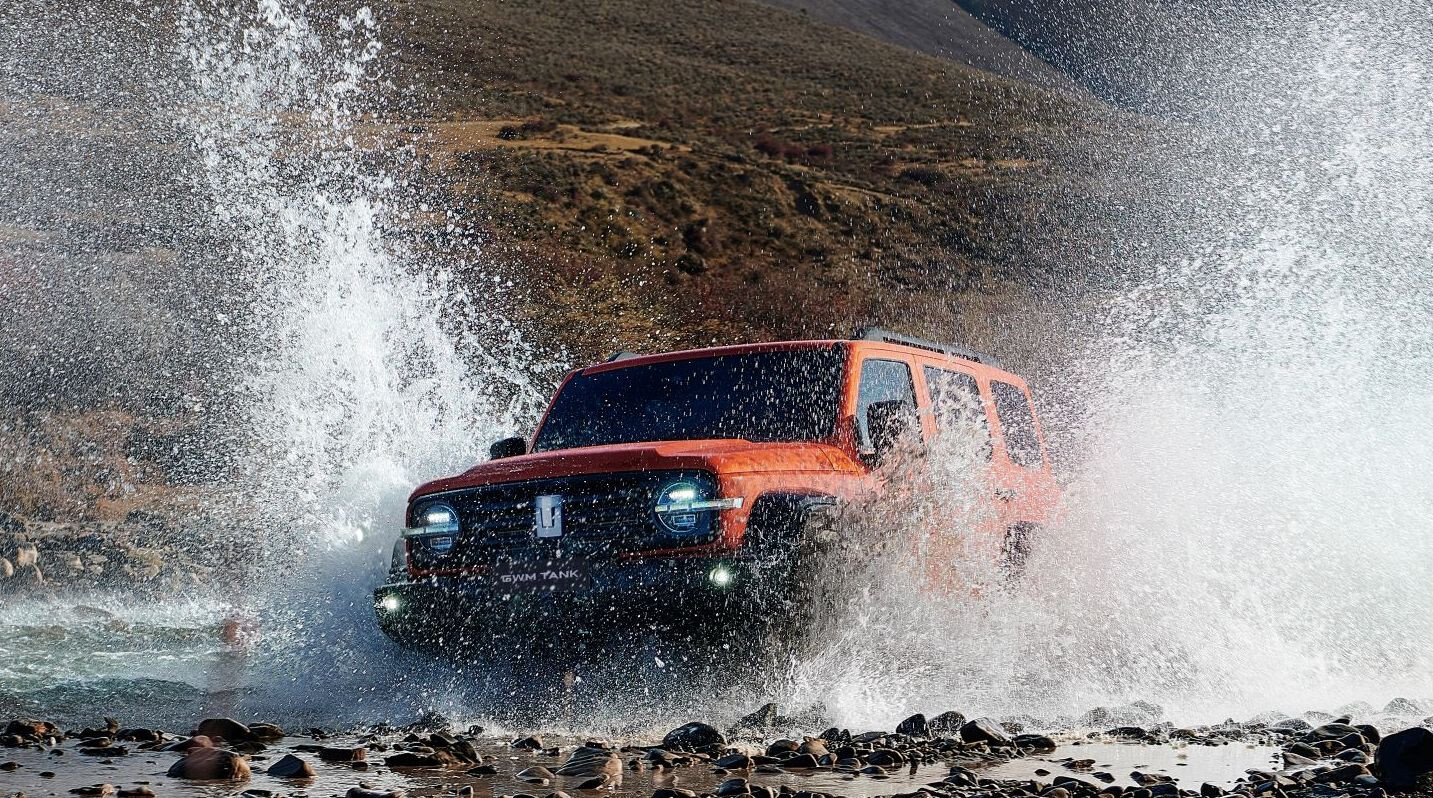
Colours
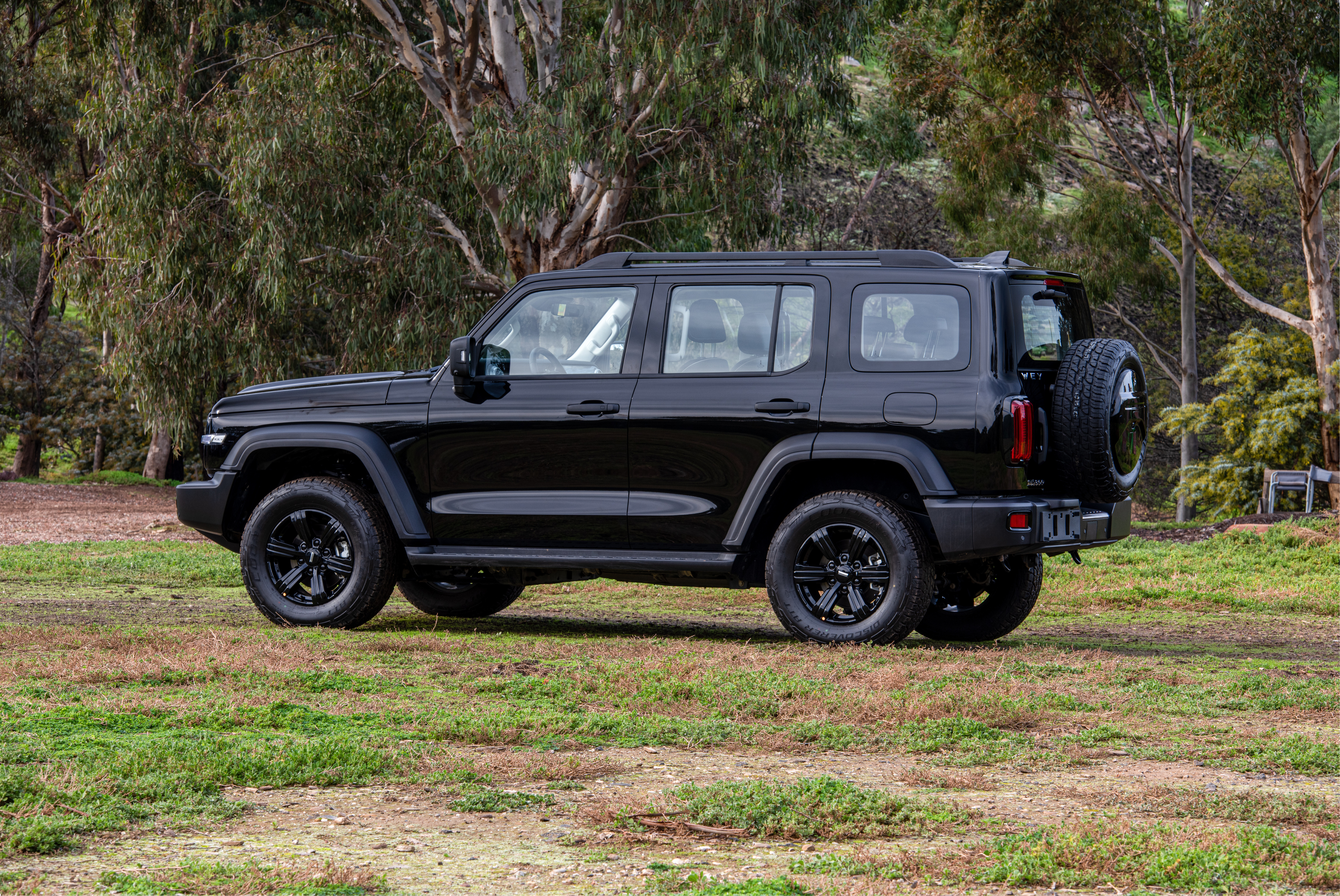
Engine, drivetrain, and off-road specifications
Under the bonnet, the GWM Tank 300 is powered by a 2.0-litre petrol-electric hybrid system.
The internal-combustion engine offers 180kW and 380Nm, with the electric motor adding 78kW and 268Nm, for a total system output of 224kW and 640Nm.
It is matched with a nine-speed automatic transmission sending power to all four wheels.
June 5, 2023: GWM’s Australian arm has now confirmed official fuel figures for the Tank 300 range, with the hybrid listed at 8.5L/100km and the petrol model at 9.5L/100km.
2023 GWM Tank 300 off-road specifications
The 2023 GWM Tank 300 has a 33-degree approach angle, a 34-degree departure angle, and a 224-millimetre ground clearance.
It has an on-demand four-wheel-drive system, with off-road-focused technology including a transparent under-floor view, crawl control, and an appropriately-named ‘Tank Turn’ function.
Safety
UPDATE, December 23: Tank 300 scores five stars in ANCAP testing
The 2023 GWM Tank 4×4 has been awarded five stars in ANCAP safety testing, becoming the last vehicle to do so under the current protocol. It may have been lucky to do so, with next year’s criteria set to be more difficult. Get the full story at the link below.

GWM Tank 300 Safety features
Seven airbags (dual front, side, curtain, and front-centre) are fitted across the range.
Each variant includes the following active safety equipment as standard:
Dimensions
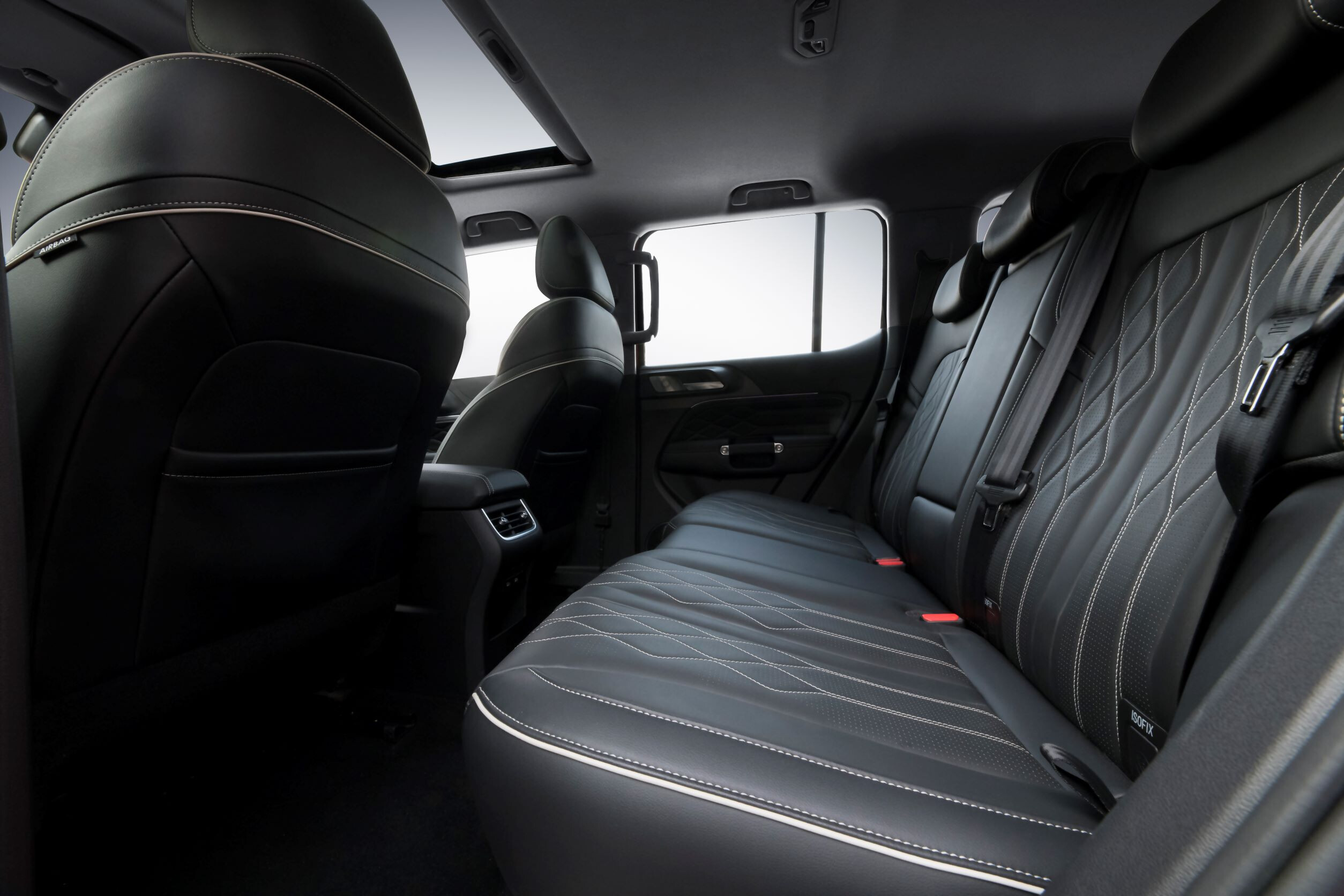
The GWM Tank 300 has a 2750-millimetre wheelbase, and is 4760mm long, 1930mm wide and 1903mm tall.
2023 GWM Tank 300 boot space
GWM has yet to detail the Tank 300’s luggage capacity.
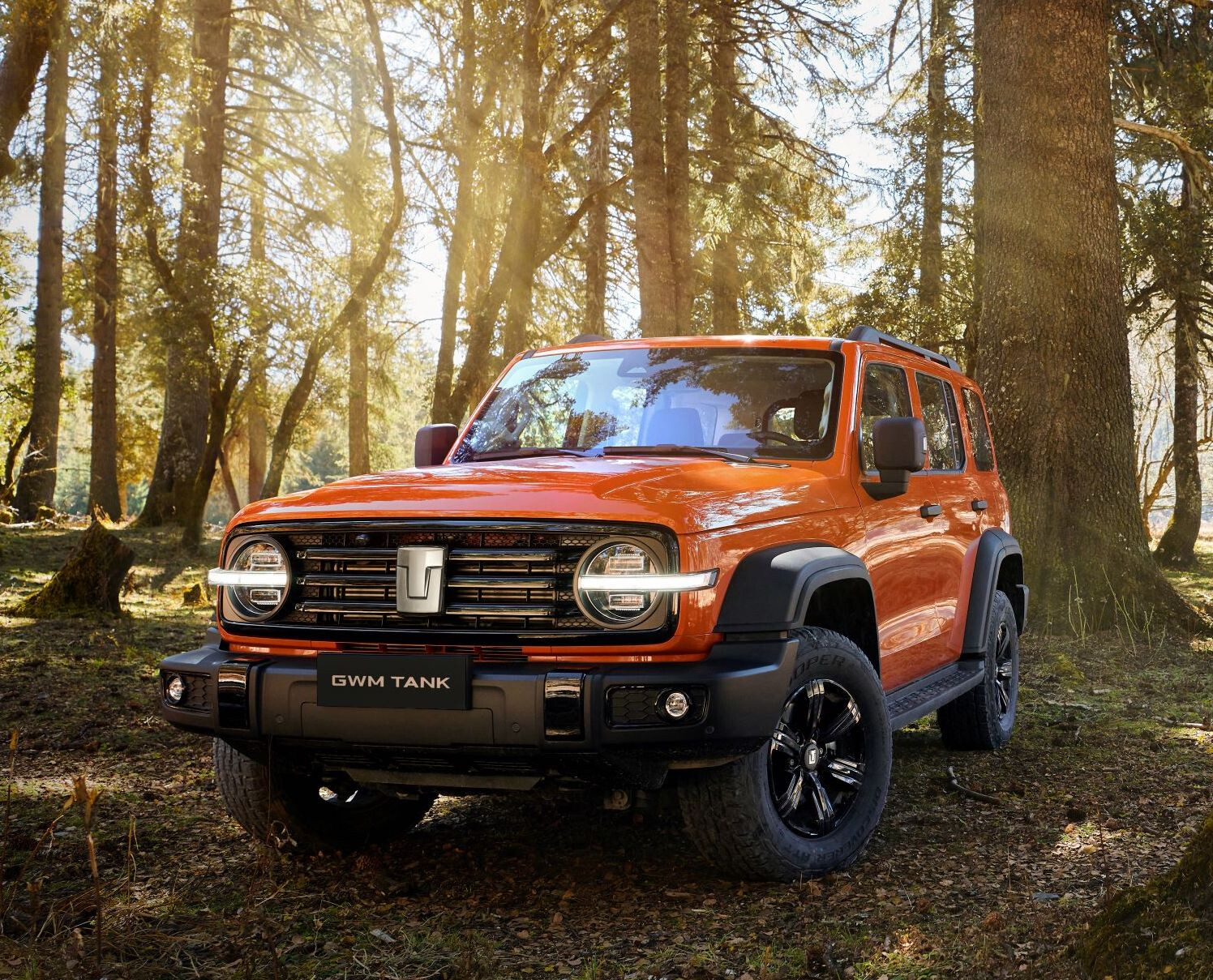

It has a side-opening tailgate with a rear-mounted full-size spare tyre – allowing for more interior space and a larger 80-litre fuel tank – as per the Toyota LandCruiser Prado.
Warranty and servicing
Like the wider GWM range, the Tank 300 is covered by the brand’s seven-year, unlimited-kilometre warranty.
Maintenance details for the Tank 300 have yet to be detailed, but it is included in GWM’s five-year capped-price servicing program.
Roadside assistance is complimentary for the first five years of ownership.
Availability
The 2023 GWM Tank 300 is on sale in Australia now.
July 20: GWM Tank 300 driven on-road and off
GWM’s Tank 300 is here, and we’ve had a proper run off-road. Get Tristan Tancredi’s thoughts here.
He mentions the Wrangler, like, SIX TIMES. Six!
May 30: GWM Tank 300 petrol on sale, hybrid delayed
A more-affordable petrol-only GWM Tank 300 has been announced, with deliveries to commence before the hybrid variants.
REVIEW: GWM Tank 300 hybrid driven in its market-ready form
The 2023 GWM Tank 300 hybrid is the first hybrid off-roader to hit Australian shores.
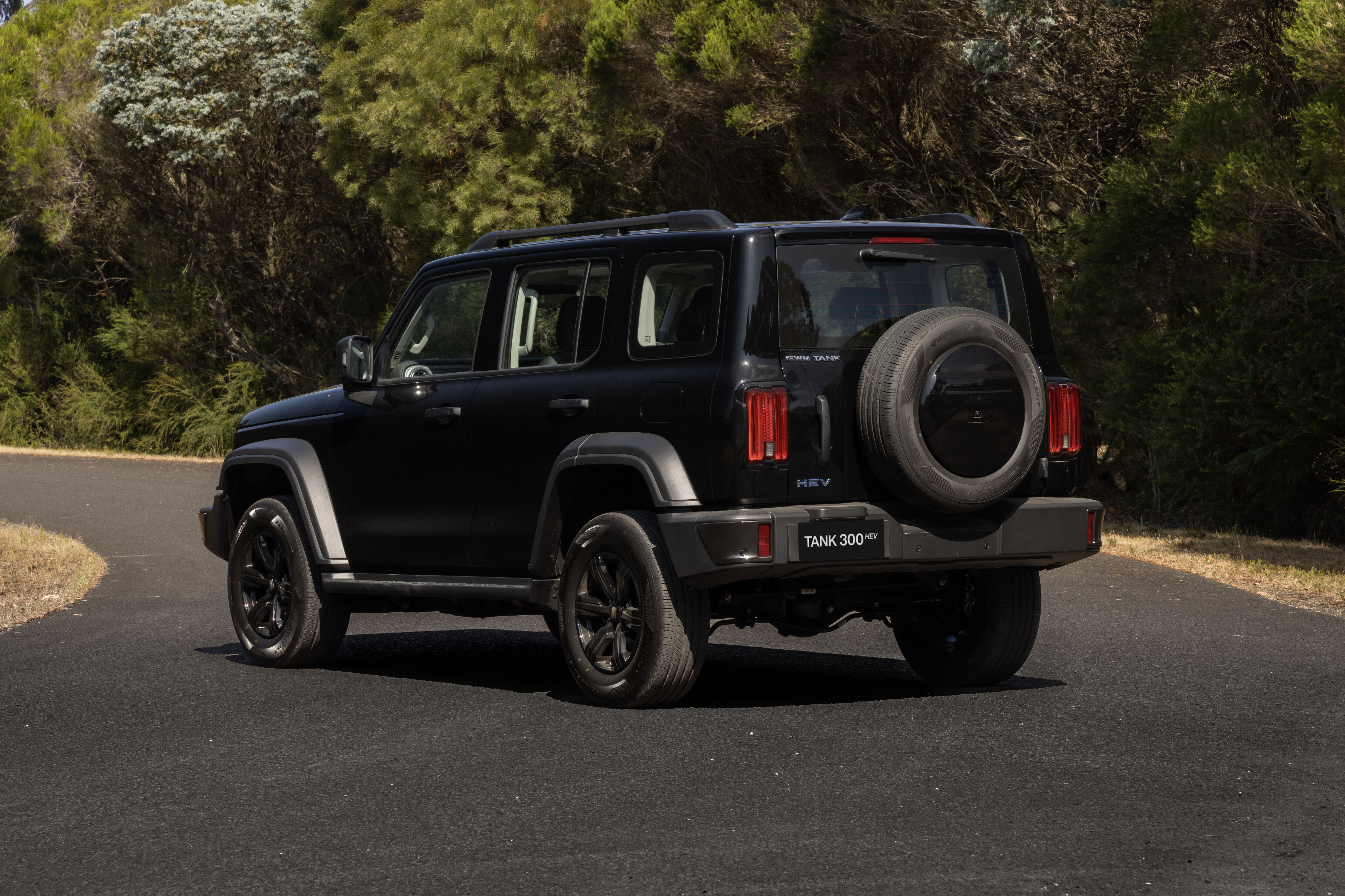
It’s priced from $55,990 drive-away, measures 4.76 metres long, rides on a 2.75m wheelbase – and is essentially China’s answer to the Jeep Wrangler.
In China, Tank is a GWM spin-off brand, but here in Australia it falls under the parent moniker and uses the same ‘P71’ ladder frame underpinnings as the GWM Ute Cannon range.
The Tank’s price and looks alone are pretty attractive for a recreational off-roader, but most headline-grabbing are the power and torque figures, at 258kW and 615Nm. This is a hybrid, but not one necessarily built with fuel efficiency in mind.
On-demand 4×4 with a low-range transfer case plus locking rear (and optionally front) differentials give the Tank 300 hybrid plenty of potential on paper, too. But what’s it really like?
| GWM Tank 300 hybrid: The basics | |
|---|---|
| Price (Lux) | $55,990 drive-away |
| Price (Ultra) | $60,990 drive-away |
| Engine | 4-cyl, 2.0-litre turbo-petrol |
| Motor | single 78kW/268Nm |
| Power | 258kW |
| Torque | 615Nm |
| Gearbox | 9-speed automatic |
| Body | 5-door, 5-seat large SUV |
JUMP AHEAD
- How much is it, and what do you get?
- How do rivals compare on value?
- Interior comfort, space, and storage
- What is it like to drive?
- How safe is it?
- VERDICT
- Specifications
How much is it, and what do you get?
In short, a shed-tonne. The spec sheet reads more like a 4×4 you can pose down at Bondi beach with than cross the Simpson in. The base Lux trim we drove costs $55,990 drive-away and ships with:
| GWM Tank 300 HEV features | |
|---|---|
| LED headlights | 17-inch alloy wheels |
| Heated steering wheel | Leatherette upholstery |
| 4-way power driveru2019s seat | LED headlights |
| 12.3-inch touchscreen | Apple CarPlay |
| 360-degree surround camera | Sunroof |
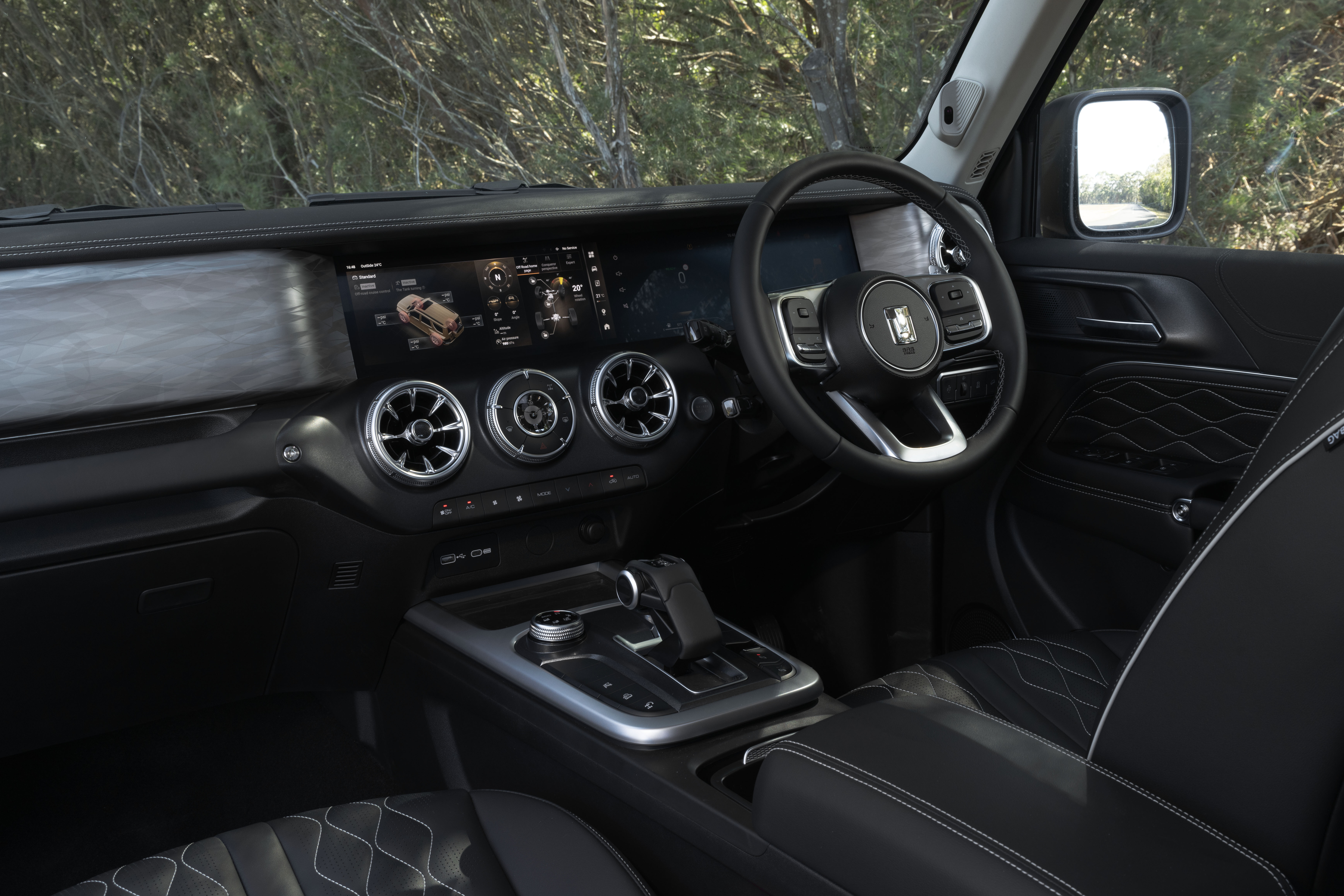
The touchscreen interface was typically frustrating, but you do learn the quirks of GWM’s systems over time.
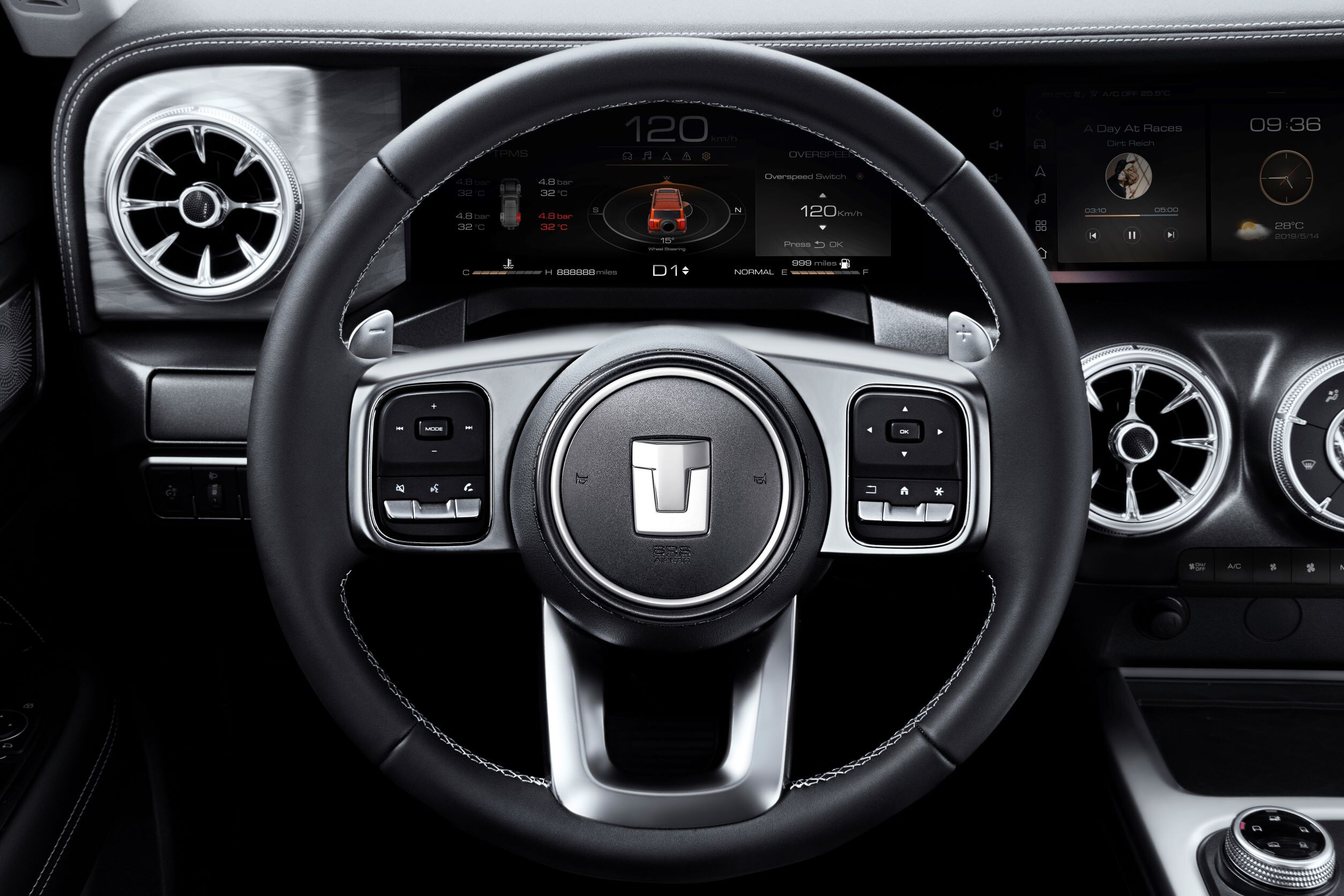
Apple CarPlay and Android Auto work using a cable. The 12.3-inch digital driver’s display gives all the info you need and more.
GWM’s Tank 300 hybrid doesn’t sacrifice off-road goodies either, with a low-range transfer case and locking rear differential as standard.
The $60,990 (drive-away) Ultra steps things up with 18-inch alloys and front locking differential, but also features:
| GWM Tank 300 HEV Ultra additional features | |
|---|---|
| 18-inch alloy wheels | 8-way power driveru2019s seat |
| Heated and cooled front seats | Nappa leather upholstery |
| Wireless charging | Infinity 9-speaker sound system |
| Front diff-lock | Auto park assist |
How do rivals compare on value?
Next to GWM’s intended target, the Jeep Wrangler, the Tank is stellar value.
With all the safety gear and a 2022 five-star ANCAP rating, it makes an $81,450 (before on-road costs) Wrangler Night Eagle four-door look like a rip-off on face value. Of course, GWM’s aftermarket is as-yet undeveloped, so those looking to mod will be stuck initially.
A Toyota Prado GX, meanwhile, starts from $62,830 (before on-road costs) – though that’s more a rival for the Tank 500, which is still under consideration for Oz.
High-spec utes and 4×4 wagons such as Ford’s Ranger Wildtrak ($71,190 before on-road costs) and Everest Sport ($69,590) – both before on-road costs – also fall into a similar price point to the Tank 300, though none can match the GWM’s heated and ventilated seats, Nappa leather upholstery and twin 12.3-inch screens.
Interior comfort, space and storage
GWM has clearly been listening to feedback, because the Tank 300 hybrid finally comes with under-thigh tilt for the front seat, a huge improvement for my leggy 188cm frame. The rear quarters are usable, too, with decent under-thigh support from the cushion and unimpeded view out.
Material and build quality are mostly good, but the chintzy Mercedes-Benz-esque air vents felt flimsy. The design is clumsy, too; like its Haval H6 and Jolion stablemates, the Tank 300 has a cabin that prioritises wow-factor over usability.

Cabin storage, however, is solid. GWM says there are 46 cubbies on board. We found the two decent bottle holders, sizable door packets and other storage spaces to be useful and generous in size.
The boot floor is dead flat and the load bay square, although the heavy, manual tailgate that swings outward may present a challenge in urban car parks.
What is it like to drive?
With only 15 minutes of off-road driving following our detailed look at the Tank’s interior and tech, it’s tricky to make any final judgements.
Things started positively, though. Unlike the Haval H6 hybrid with its two-speed dedicated hybrid transmission, the Tank’s nine-speed auto is more natural to use.
Power on tap is pretty spectacular with a 2.0-litre turbo-petrol motor and single electric motor powered by a 1.75kWh battery for a combined 258kW and 615Nm – certainly handier than a Jeep’s atmo V6.
The Tank 300 Hybrid can run in EV-only, series or parallel modes, depending on the situation. We don’t have ADR81/02 fuel economy ratings for the Tank 300 hybrid yet.
June 5, 2023: GWM’s Australian arm has now confirmed official fuel figures for the Tank 300 range, with the hybrid listed at 8.5L/100km and the petrol model at 9.5L/100km.
Nine (yes nine) selectable drive modes include Mud, Sand, Normal, Sport, Eco and more, with each getting a bespoke musical jingle. The indicator’s techno-bassline sound is totally unorthodox, too, but not necessarily in a bad way.
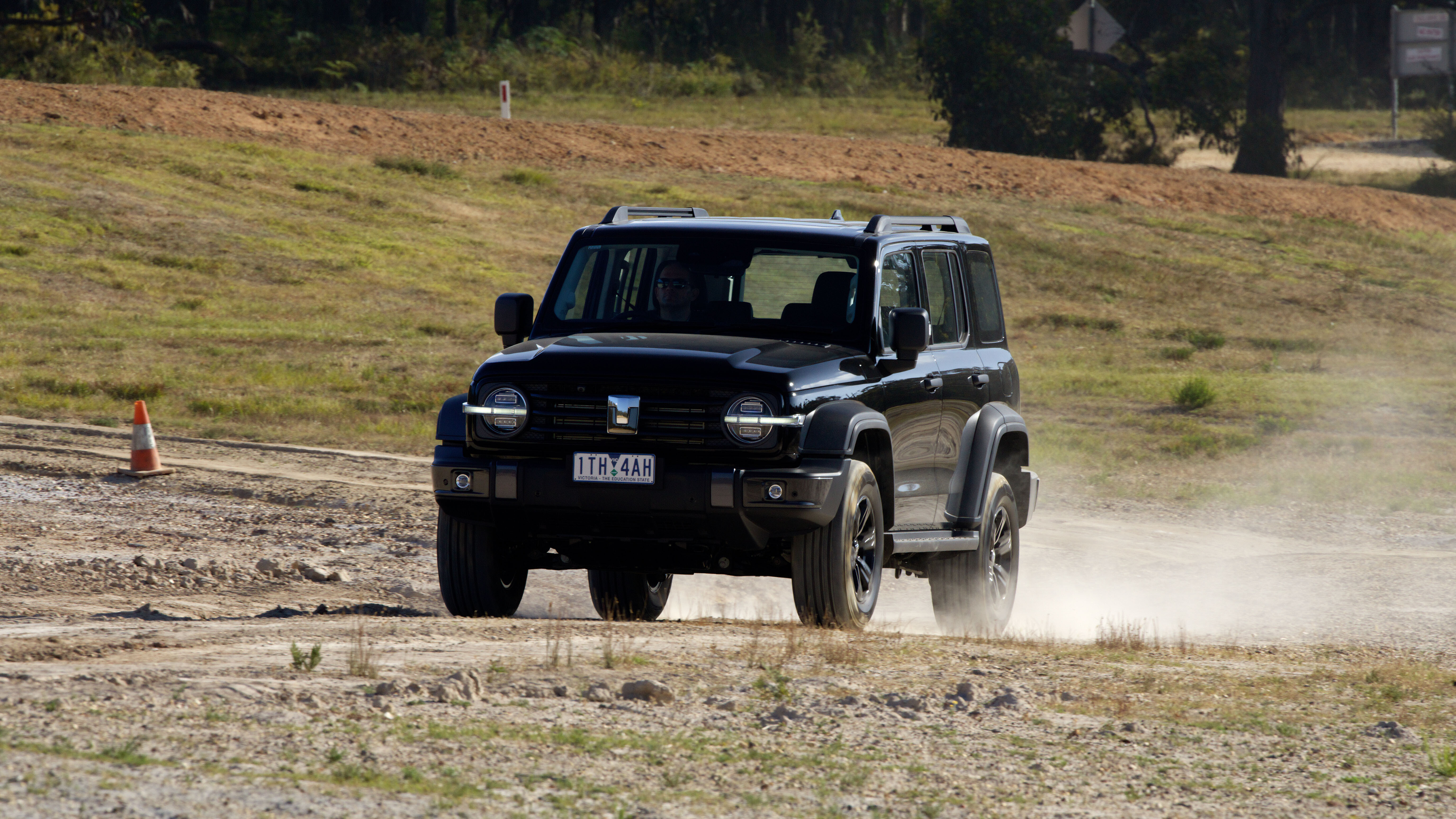
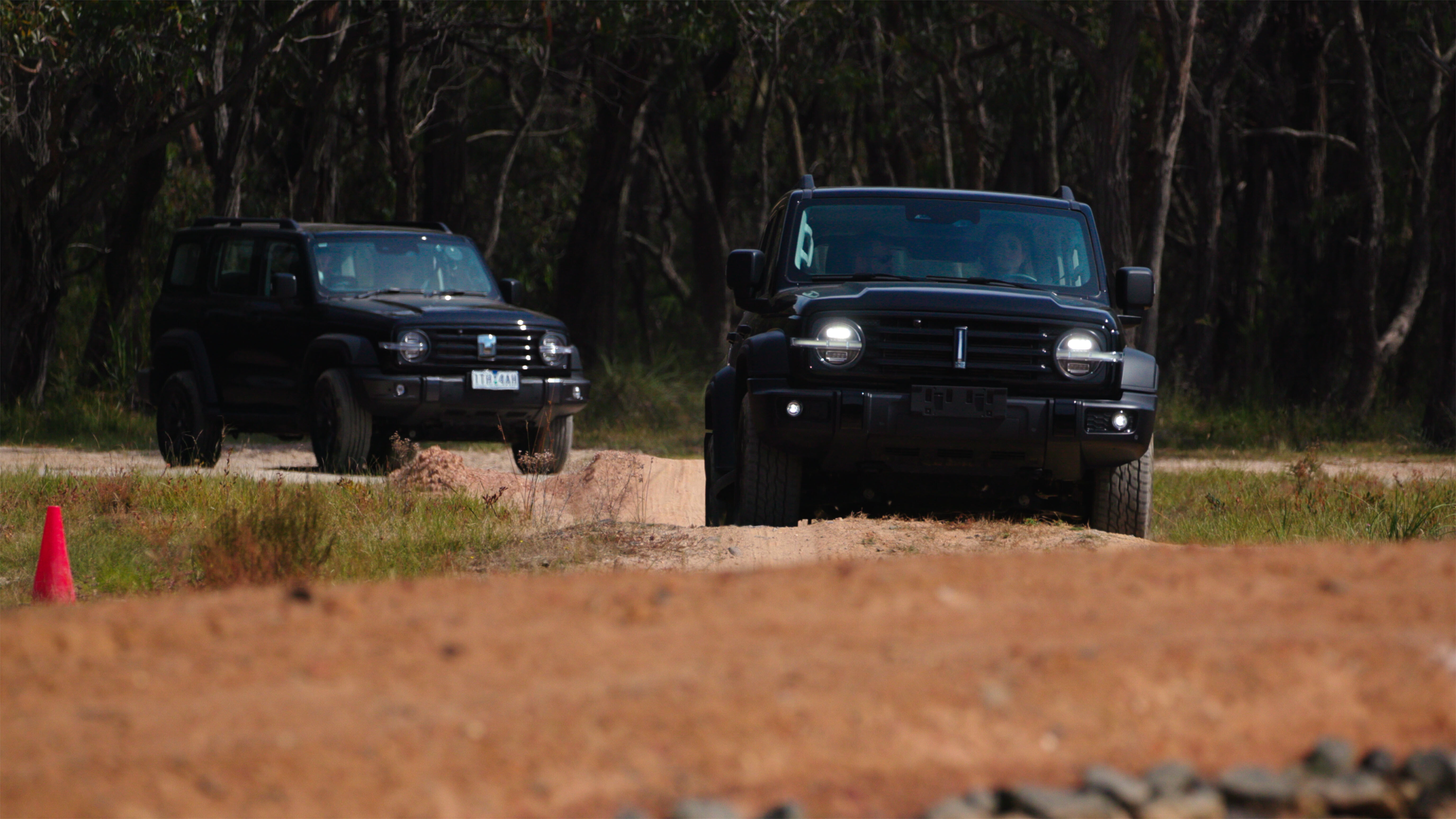
With the electric motor’s instant torque, the Tank was happy to crawl up obstacles in four-low, but it didn’t exactly struggle in four-high. The torque-on-demand 4×4 system didn’t slip up on the technical loop. Only a soft and uncommunicative brake pedal made pace tricky to manage.
Plush is the best way to describe the Tank 300’s ride. The travel is stiction-free off-road and even in the back seat there was minimal head toss with harsh edges rounded out admirably – this is no rattly Triton.
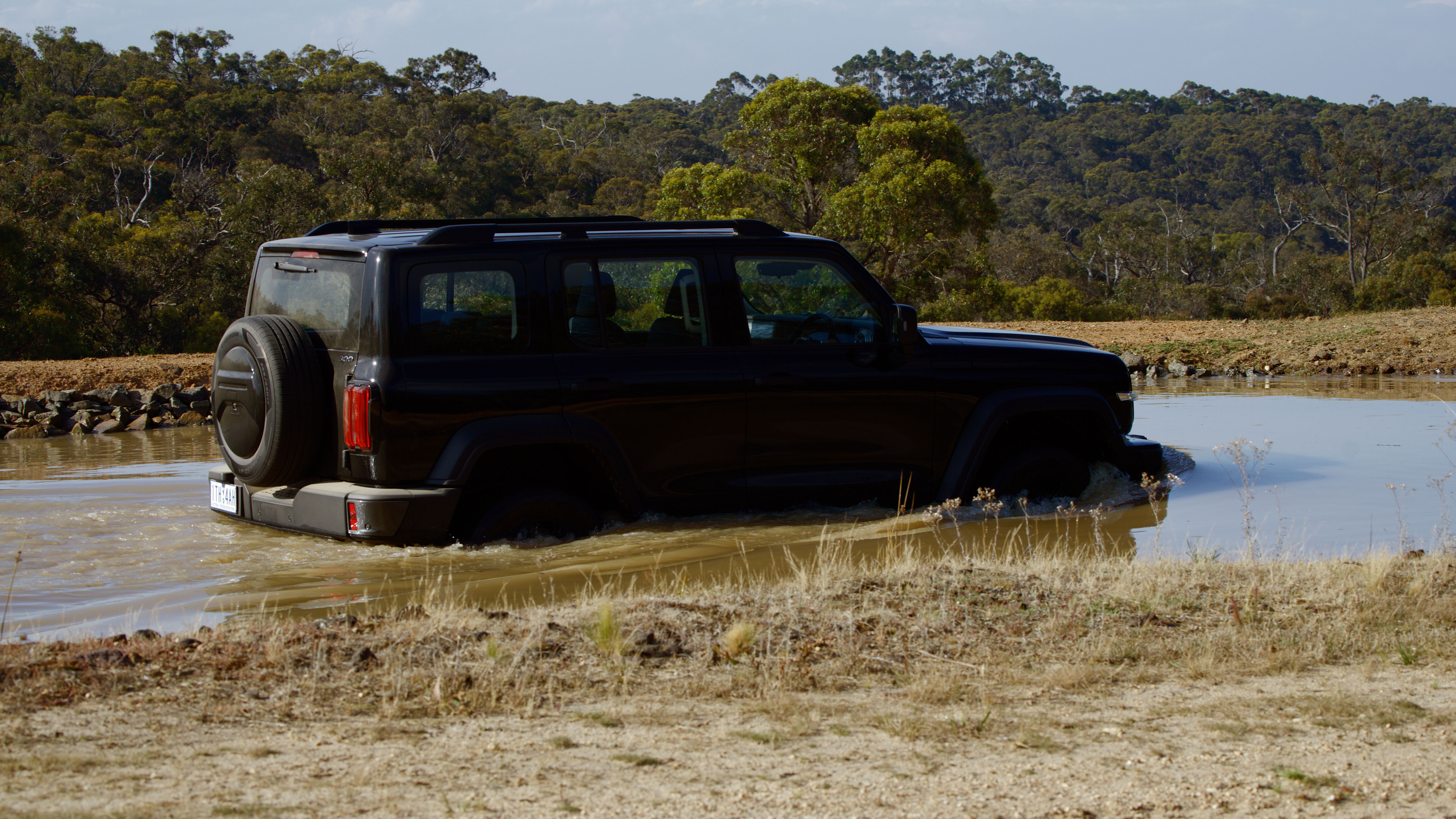
With 33-degree approach and 34-degree departure angles, and a 700mm wading depth, the Tank should be plenty capable.

Its 224mm ground clearance is also pretty close to that of a four-door regular Wrangler (232mm). The Tank’s 265/65R17 Hankook Ventus all-season tyres let it down a little in the slippy stuff.
During our brief drive, we did belly out a few times (potentially down to the soft springs) and a glance underneath revealed sway bars and other parts hanging down that looked ready to snag rocks.
Towing capacity for the GWM Tank 300 Hybrid is rated at 2500kg braked, or 750kg unbraked.
We’ll have a detailed road test, including an on-road component – which we fear the squishy Tank 300 may struggle on – online as soon as possible.
Our first sample of the Tank 300 shows promise. It’s not a Wrangler Rubicon replacement, but at $20K less than a Night Eagle, it’s a capable vehicle for entry-level off-roading.

How safe is it?
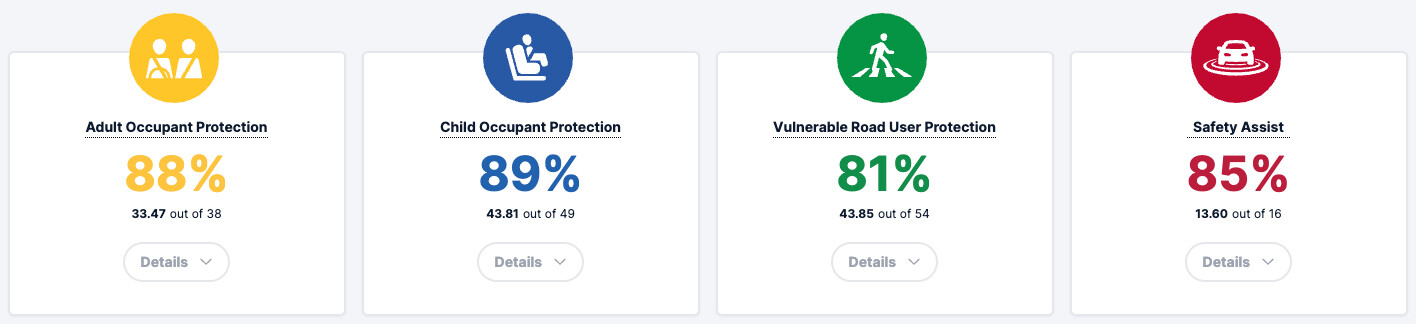
The GWM Tank 300 hybrid was awarded five stars in 2022 ANCAP safety testing.
We weren’t able to test the ADAS features, but we didn’t run into tigger AEB when tackling a 600mm wading pool or rocky break-overs.
It appears you can fully disable the smarts, too, and the excellent cameras include a 360-display that uses processors to remember what’s underneath the car – great for tackling tricky, rocky terrain.
| GWM Tank 300 HEV safety features | |
|---|---|
| Adaptive cruise control | Lane-keep assist with lane-follow |
| Front AEB with pedestrian, cyclist and junction detection | Rear AEB |
| Rear cross-traffic alert | Blind-spot monitoring |
| Tyre pressure monitoring | 360-degree camera |
| Traffic sign recognition | Six airbags |
Warranty and running costs
GWM covers the Tank 300 hybrid with a seven-year, unlimited-kilometre warranty in Australia.
A fuel efficiency rating is yet to be confirmed for the Tank 300 hybrid, as is service pricing and intervals. This review will be updated as that information becomes available.
VERDICT
GWM expects the Tank to sell well, amplifying the brand in Australia both in sales and image terms.
This is one intriguing vehicle. Its disco chimes on drive mode changes, bass-click indicator sound and bursting technology package will wow in dealership scenarios. That hybrid is pretty refined, too.
Will it be reliable enough is one of the burning questions. And, although impressively capable off-road, will the GWM Tank 300 hybrid be refined enough on-road to suit its likely predominantly urban dwellings? Time will tell.
GWM expects the Tank to sell well, amplifying the brand in Australia both in sales and image terms. What we can say is that the Tank is better value than a Jeep Wrangler, and performed more than admirably on the dirt.
GWM Tank 300 HEV specifications
| GWM Tank 300 HEV Specifications | |
|---|---|
| Price (Lux) | $55,990 drive-away |
| Price (Ultra) | $60,990 drive-away |
| Body | 5-door, 5-seat large SUV |
| Engine | 4-cyl, 2.0-litre turbo-petrol |
| Drive | On-demand 4×4, low range, locking rear diff |
| Max power | 258kW |
| Max torque | 615Nm |
| 0-100km/h (claim) | not stated |
| Fuel efficiency | not stated |
| Weight | 2313kg |
| L/W/H/W-B | 4760/1930/1903/2750mm |
If you want locking differentials front and rear in a new 300 Series LandCruiser, this GR Sport is the only model in the line-up to include them.
There is no other option box to tick. So if you want lockers in a 300 Series, it’s either pony up the money for the second-most expensive 300 Series variant, or pay a visit to your local four-wheel-drive shop to have some aftermarket diff locks installed.
While modern traction control systems are tremendously capable, especially the offerings from Toyota, sometimes there is no substitute for locking differentials for the ultimate in control when navigating technical terrain.
As well as having a centre, front and rear differential lock, the GR Sport LC300 also boasts E-KDSS – or Electronic Kinetic Dynamic Suspension System. This system allows for the vehicle’s swaybars to be disconnected when off-road for more articulation and a smoother ride on choppy ground, then reconnect when on-road for better handling.
Clever stuff indeed, making the GR Sport the most capable 4×4 in the LC300 range. But you are also paying for the privilege. We spent a week living with the GR Sport LC300 to get to know it better, see if the hype is real, and find out just how far can you take them off-road.
JUMP AHEAD
- How much is it, and what do you get?
- How do rivals compare on value?
- Interior comfort, space and storage
- What is it like to drive?
- How is it on fuel?
- How safe is it?
- Warranty and running costs
- VERDICT
How much is it, and what do you get?
The LandCruiser 300 Series GR Sport has a listed drive-away price starting at $146,654. As tested, with Graphite paint colour, the price increases to $147,364 not including any additional factory accessories.
For your money, you get a five-seat, full-size four-wheel drive wagon (no seven-seat option for the GR Sport), with the widely discussed 3.3L V6 twin-turbo diesel motor bolted to a 10-speed automatic transmission, and a rather special interior that is functional while still feeling luxurious.
The main talking point of the GR Sport variant is the fact it has manually selectable electronic diff locks, making it the only vehicle in the 300 Series range to come with lockers, creating an extremely capable off-roader.
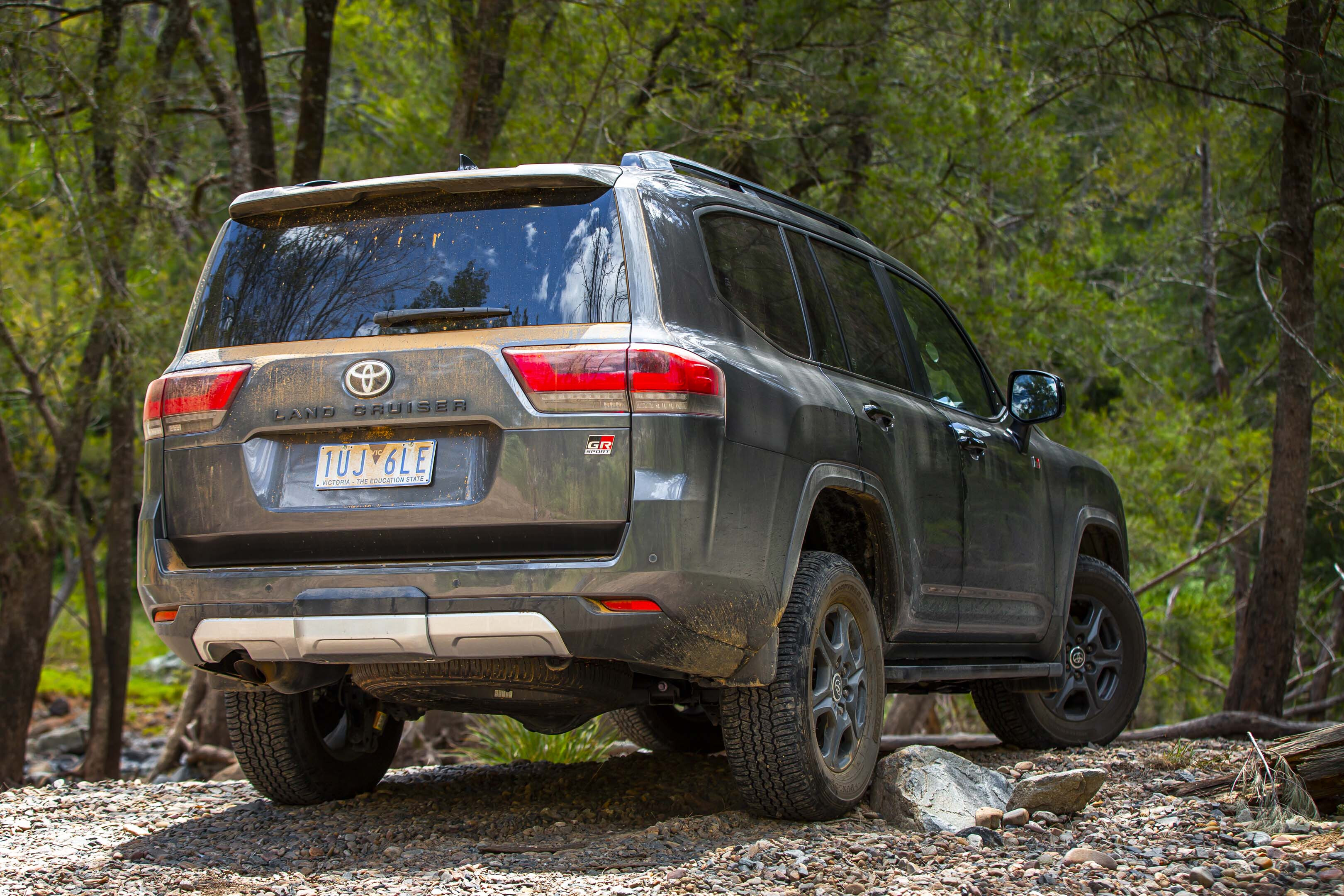
To further enhance its off-road chops, the GR Sport LC300 also boasts E-KDSS (Electronic Kinetic Dynamic Suspension System), which allows for the vehicle’s sway bars to disconnect when driving challenging terrain thus allowing more suspension travel, then engaging them when on-road to provide solid cornering ability.
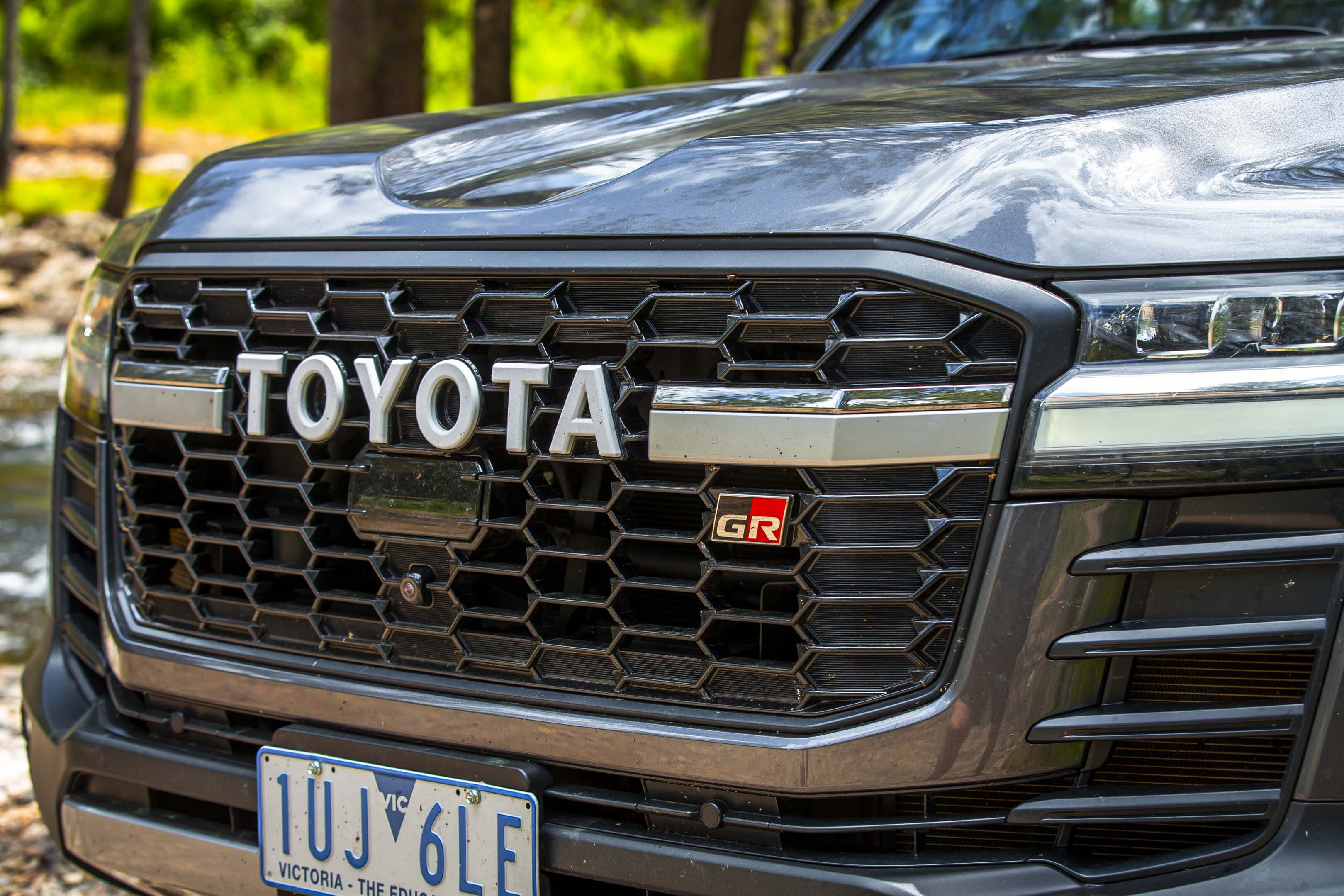
Multi Terrain Select is also included in the GR Sport’s suite of off-road goodies, offering traction control calibrations to suit a wide range of terrain with the twist of a dial mounted on the dash. It’s an effective system too, offering high levels of off-road ability that both new players and seasoned four-wheel drive veterans alike can benefit from using.
And if all else fails, don’t forget those front and rear diff locks that engage quickly and easily via push-buttons mounted near the driver’s left knee low on the dash – which in my opinion isn’t the best position for these vital controls; I’d prefer to see them placed near the gear selector.
How do rivals compare on value?
The main rival to the LandCruiser 300 Series is the Nissan Patrol. Pricing for the top-of-the-line Ti-L Patrol comes in at $103,202 drive-away, while the lower spec Ti is $89,602 drive-away.
Although this makes the GR Sport LC300 considerably more expensive than a Patrol, the big Nissan Wagon is starting to show its age.
Land Rover’s Defender 110 or more likely the Defender 130 is another option in this field, offering eight seats in the 130 and solid off-road ability as well as a luxury interior. Pricing for the 130 starts from $124,150 before on-road costs, so there’s still a fair chunk of change left over compared to the GR Sport LC300.
Interior comfort, space and storage
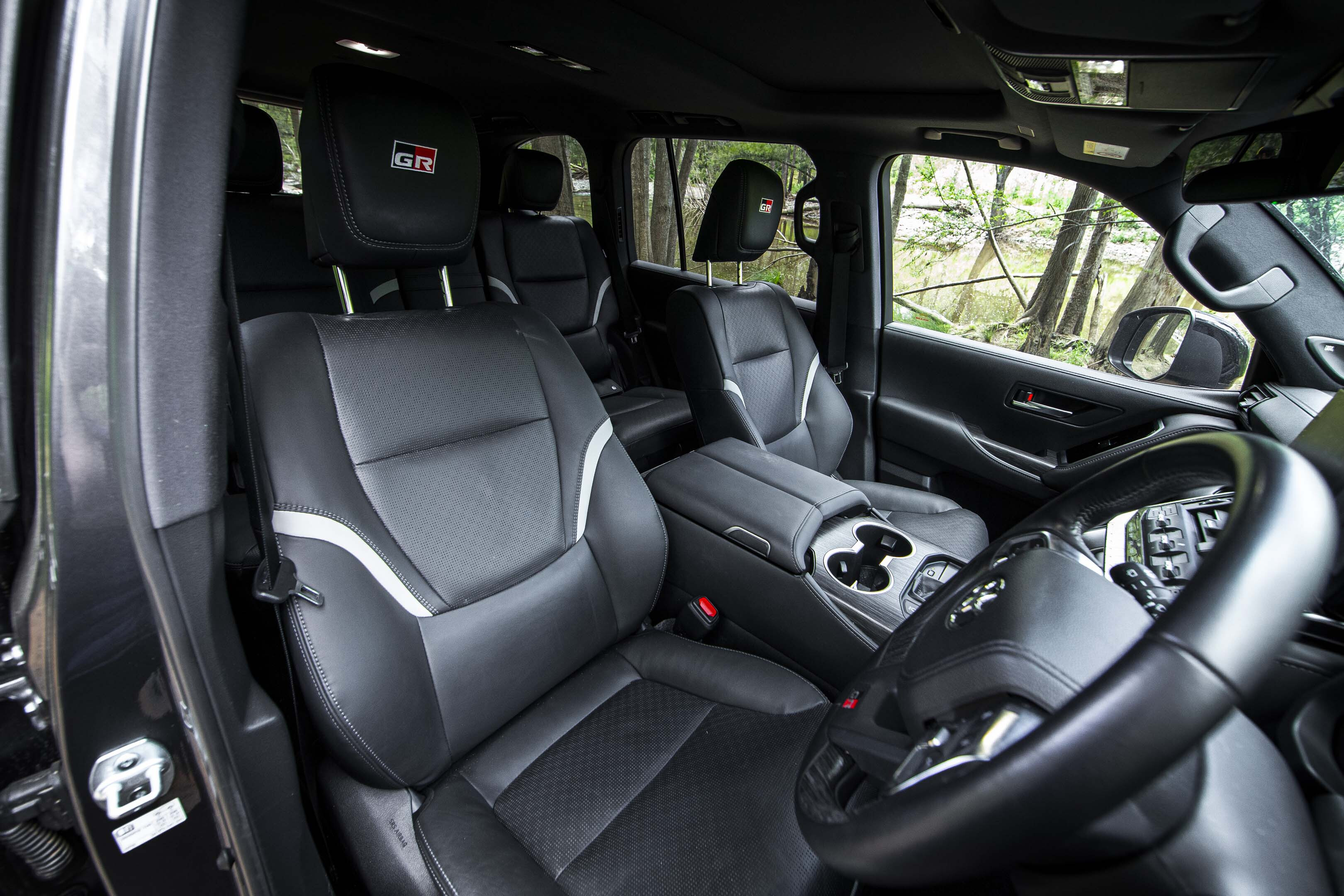
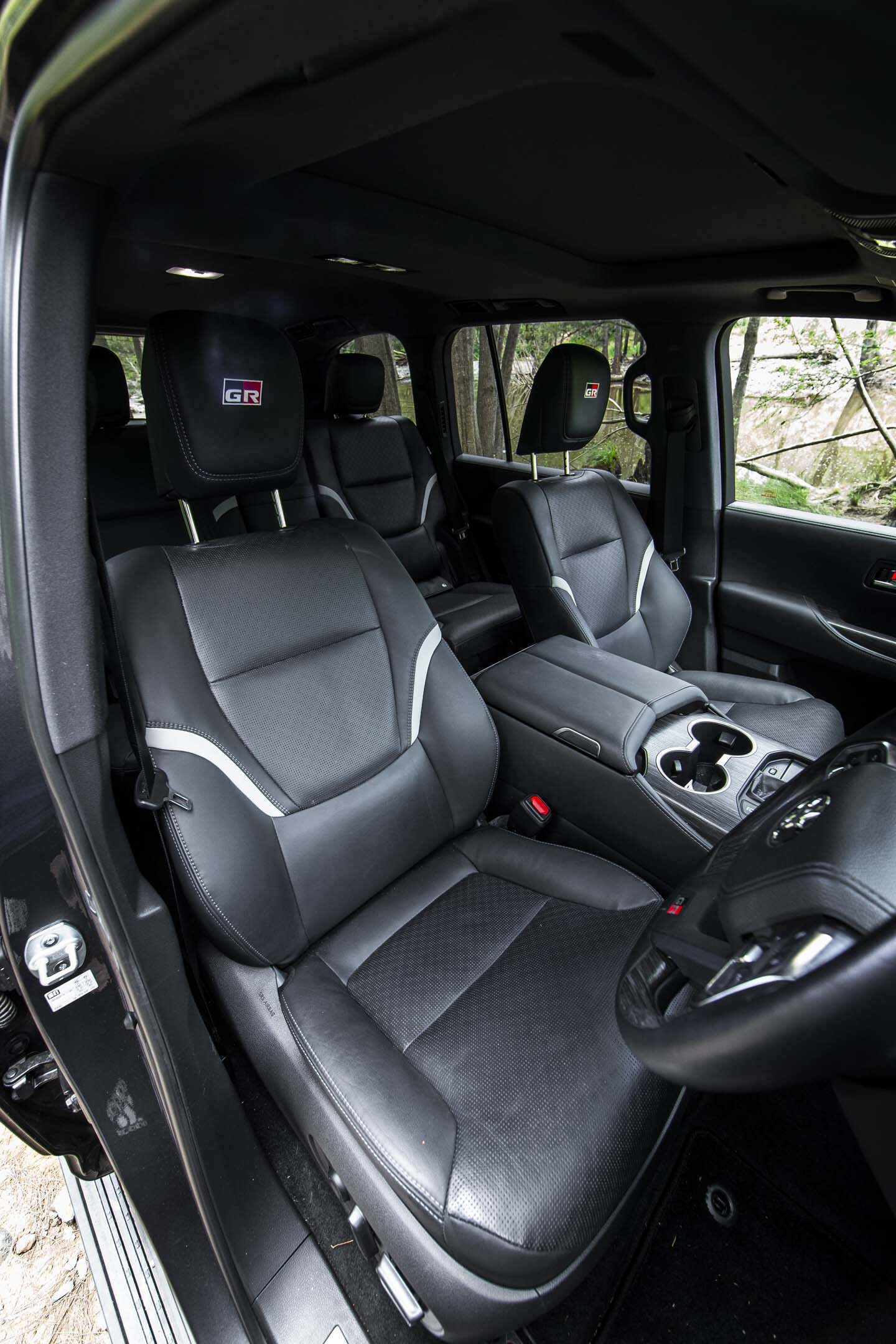
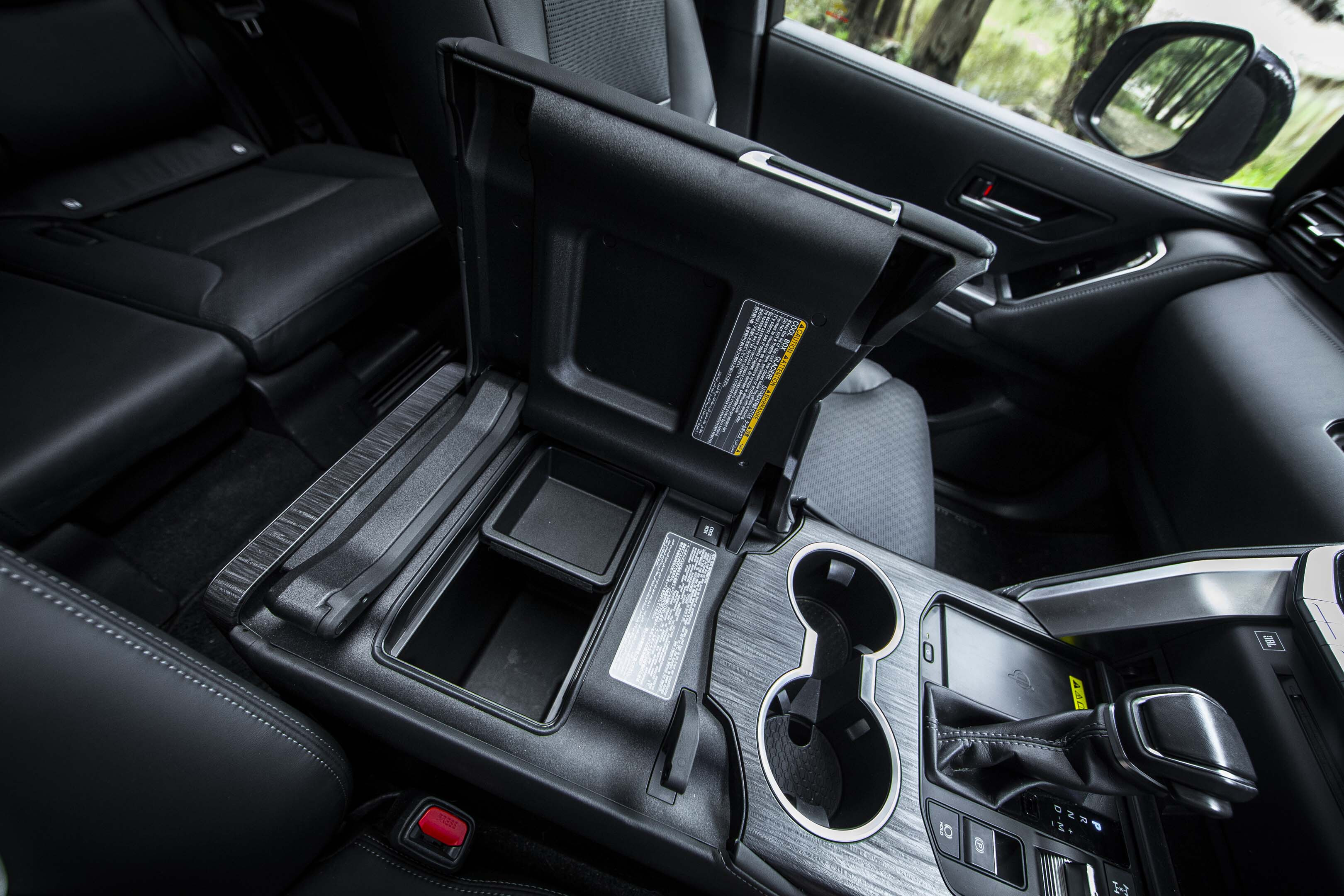
The GR Sport gets bespoke seats that have been embroidered with GR Sport logos, and are comfortable and supportive with plenty of adjustment.
Second-row seating is both comfortable and spacious, with my nearly two-metre lanky frame having no space issues when seated in the back with the driver’s seat set to my preferred position.
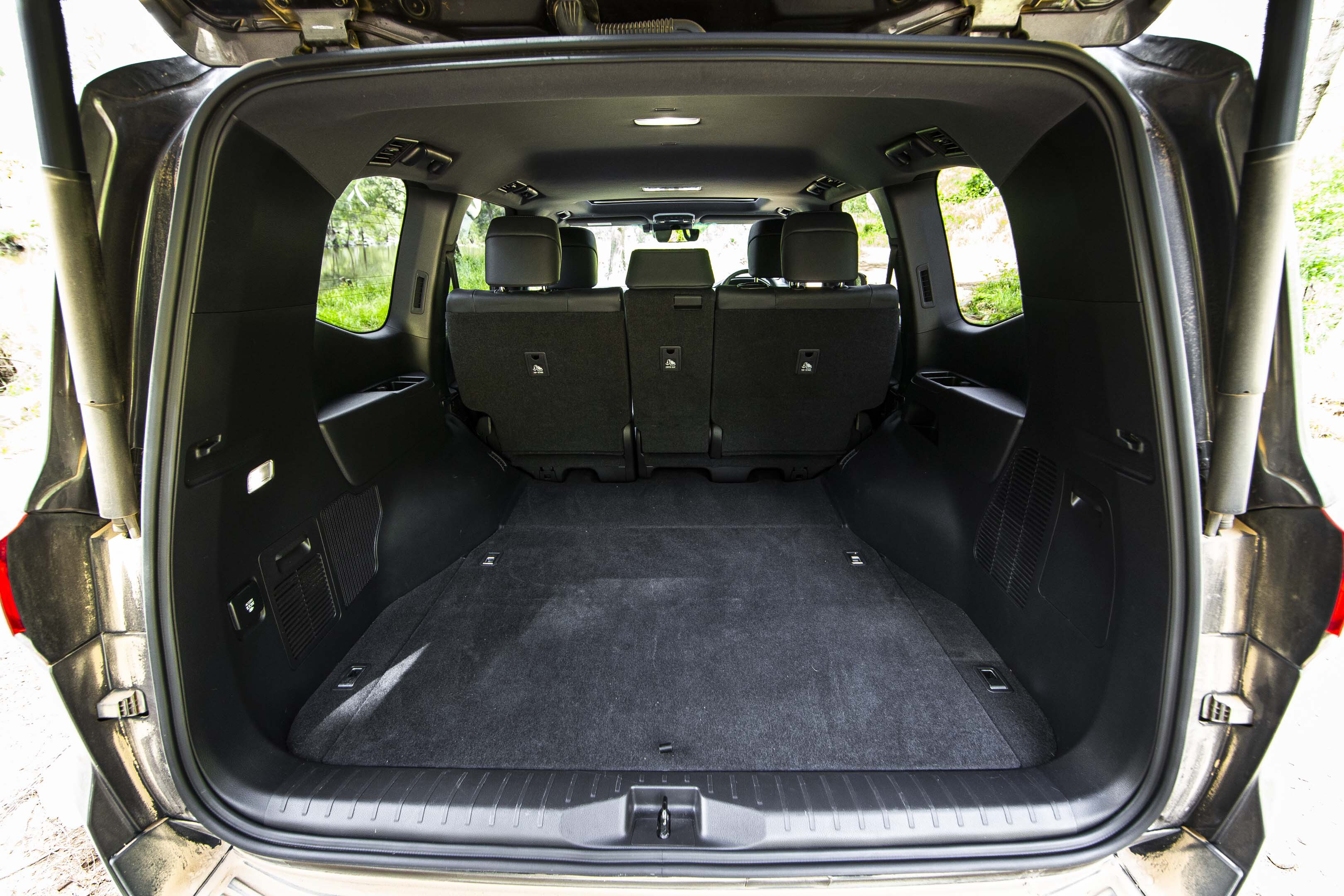
As you’d expect from a large wagon, especially one with no third-row seating, there’s ample space for touring four-wheel drivers or families with no more than three kids, and it would be an easy affair to accessorise the large cargo area with aftermarket storage drawers to maximise available space.
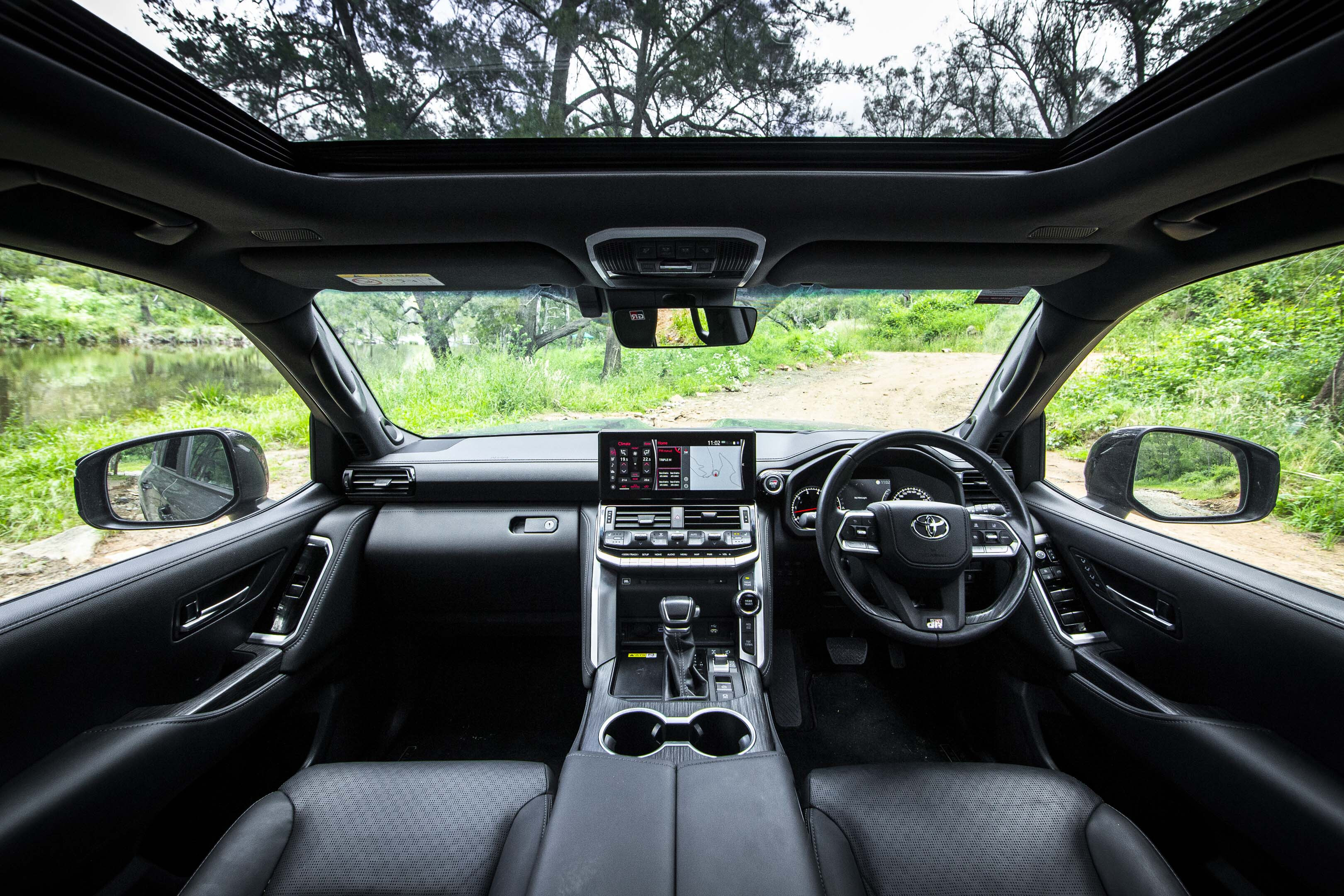
The dash features a 9.0-inch infotainment system that is Apple CarPlay and Android Auto compatible (both still wired rather than wireless), and pumps sound out via nine speakers that provide plenty of volume while remaining clear even when pushed. A sporty vehicle needs a good sound system, and the GR Sport has that in spades.
One peeve with this model compared to the previous 200 Series LandCruiser, is the single-piece tailgate. The split tailgate offered in the 200 Series ‘Cruiser provided a handy table space for preparing a meal or a spot to sit and is much missed.
After speaking with a mate who recently purchased a 300 Series, he explained that while he also misses the split tailgate, he can see why Toyota made the change as the single-piece tailgate allows no dust in (from his experience), whereas he couldn’t say the same for the 200 Series.
What is it like to drive?
The basics
| Toyota LandCruiser 300 Series GR Sport specs | |
|---|---|
| ENGINE | 3346cc Turbocharged V6 diesel |
| POWER & TORQUE | 227kW at 4000rpm, 700Nm at 1600-2600rpm |
| GEARBOX | 10-speed auto |
| CRAWL RATIO | 42.62:1 |
| 4X4 SYSTEM | Full-time; dual range; locking front, centre and rear diffs |
| FRONT SUSPENSION | Double-wishbone IFS with coils; E-KDSS and variable shocks |
| REAR SUSPENSION | Live axle on links and coils; E-KDSS and variable shocks |
| DEPARTURE ANGLE | 25u00b0 |
| RAMPOVER ANGLE | 21u00b0 |
| APPROACH ANGLE | 32u00b0 |
| WADING DEPTH | 700mm |
| GROUND CLEARANCE | 235mm |
The LC300 GR Sport really is an easy vehicle to drive, no matter if that’s bombing through the desert, towing on the highway or pushing through tough off-road obstacles.
Speaking of towing, while we didn’t hitch up a van for this test, the GR Sport offers a 3500kg towing capacity, and we have towed a large Kedron caravan with the LC300 platform before.
You can tell this vehicle has been designed with those that tow in mind; the brakes and suspension feel ideally suited to this task, as does the performance of the engine and transmission.
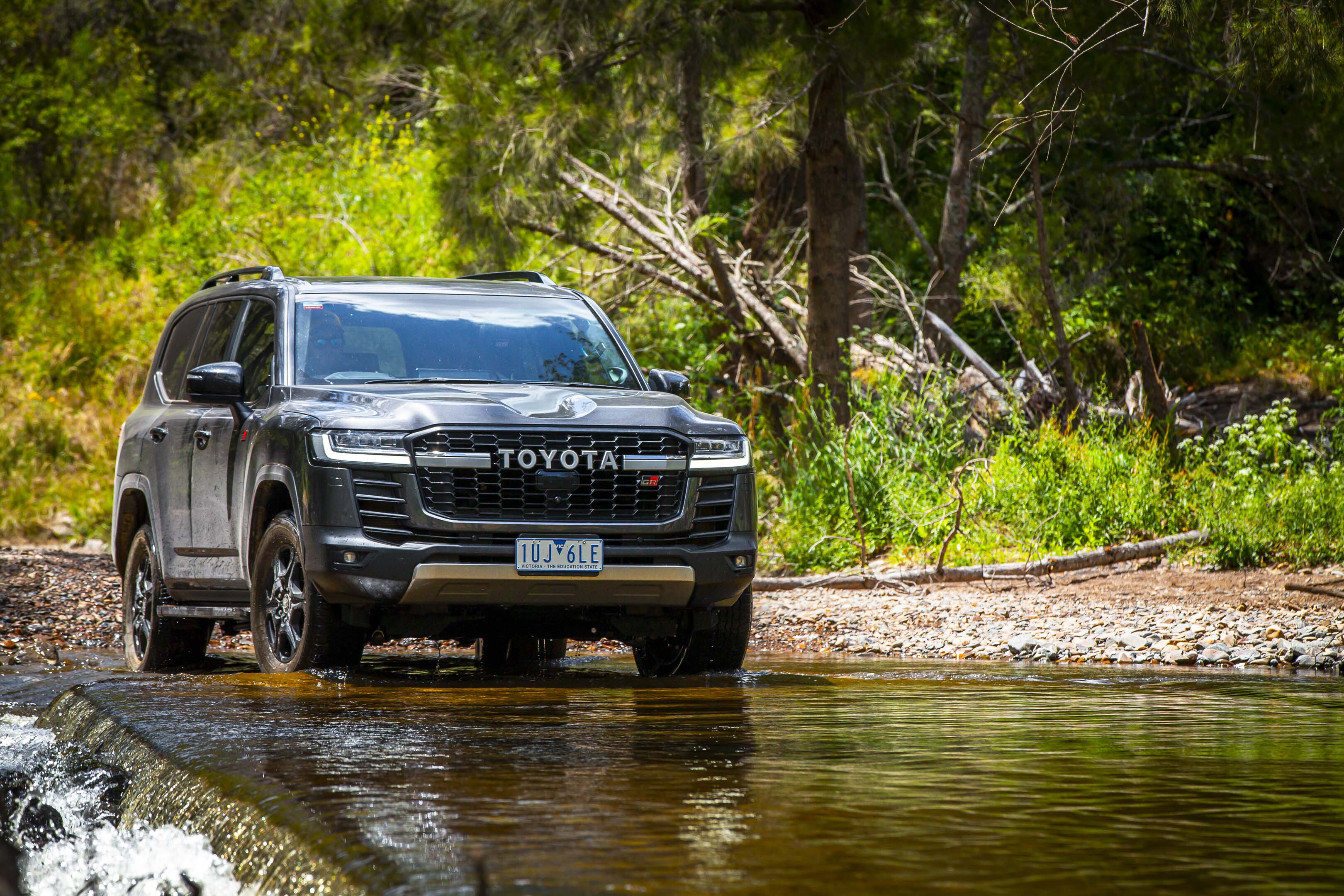
On-road, there’s nothing offensive about the way the GR Sport rides, handles and feels. Doing the posted speed limit of 110km/h, the ‘Cruiser sits on just 1500rpm, which offers a relaxed experience producing no noticeable wind noise; kind of what you’d expect in a vehicle that costs close to $150,000.
Off-road, the GR Sport is at right home on chopped-out dirt roads where the suspension compliance and levels of traction offered, combined with the plush comforts of the GR Sport’s interior, mean you could cover serious ground without feeling too fatigued at the end of the day.
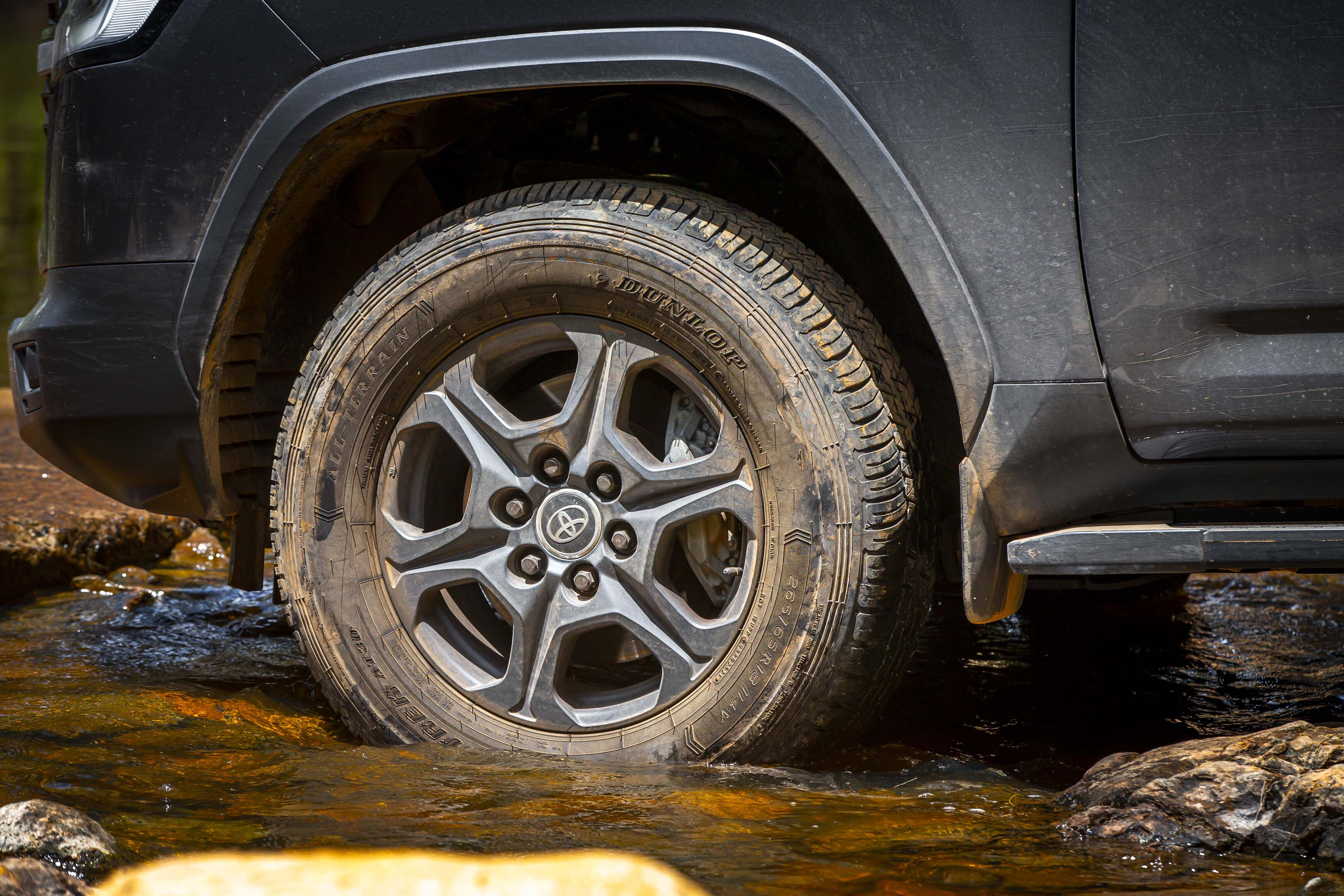
I really wish this GR Sport came with some more off-road-focused rubber, something that you’d have to assume new owners would be quick to have fitted up.
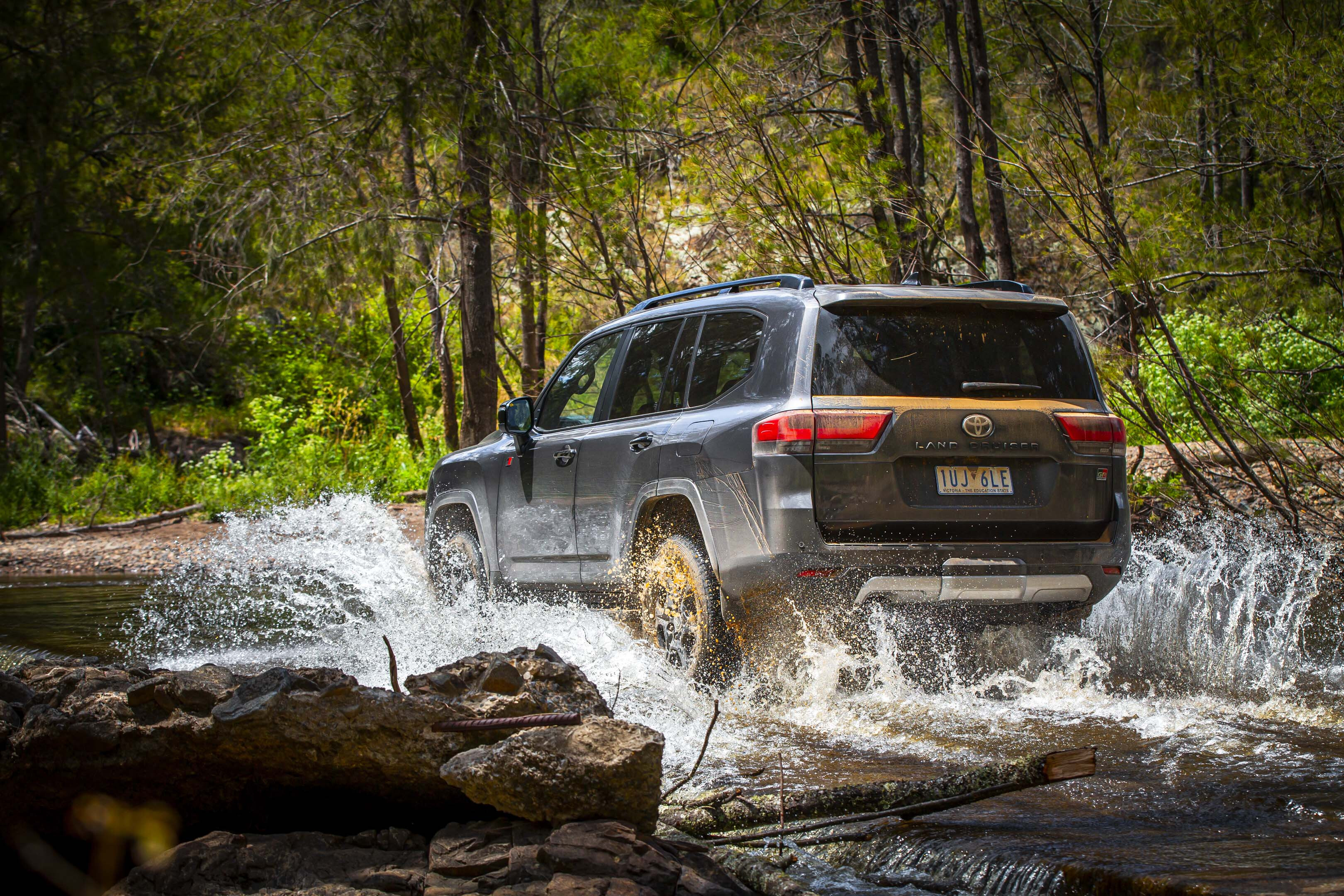
With the transfer case shifted to low range 4×4, which is simple to operate and engages quick smart (always a good sign), the GR Sport is a weapon. The traction system is effective, especially when you play with its Multi Terrain Select modes.
Engage the front and rear lockers, and the only things that will stop the GR Sport are a lack of ground clearance or the levels of grip and lateral stability offered by the stock highway-terrain tyres in greasy conditions.
I really wish this GR Sport came with some more off-road-focused rubber, something that you’d have to assume new owners would be quick to have fitted up.
How is it on fuel?
I managed to record a final fuel use figure of 11.15 litres per 100km, which I feel is reasonable for such a large vehicle.
This was recorded at the pump and was tested over a variety of terrain including slow technical off-roading, highway cruising and urban commuting.
For comparison, my recent stint in the similarly sized 2022 Nissan Patrol saw fuel consumption figures of 16 litres per 100km from its big petrol V8.
How safe is it?
Most of the 300 Series range has been awarded a five-star ANCAP rating.
The new LandCruiser received the second highest score to date for Vulnerable Road User Protection under their 2020-22 protocols receiving a score of 81 per cent and a score of 89 per cent for occupant protection.
In saying that, we can’t verify this for the GR Sport LC300 because it remains untested at this time and as such, has no official safety rating.
Warranty and running costs
The 300 Series is covered by a five-year, unlimited-kilometre warranty with a conditional seven years offered on the engine and driveline.
Service costs are capped across the 300 Series range, coming in at $400 per service for up to five years or 100,000km (whichever comes first). Service intervals are pretty short at six months or 10,000km.
VERDICT
In some ways, the GR Sport LC300 doesn’t make sense; I’m pondering why one of the top-tier LC300s is the only offering to come with diff locks as this is an option I would love to see across the range. For example, a base model GX with diff locks would make for a better value proposition as a touring four-wheel drive. One can dream, I suppose.
With that out of the way, the 300 Series LandCruiser GR Sport is a properly capable vehicle that really just needs a mild suspension lift and some bigger, more aggressive tyres to do impressive things off-road.
This is exactly what I’d do if I had $150,000 burning a hole in my pocket and wanted a luxurious vehicle that offers stellar off-road ability.
Sure, it is expensive but you are also getting a fair bit of kit for your money, and make no mistake this is a quality vehicle that will last the test of time in our harsh Australian conditions.
I’m genuinely stoked that Toyota has offered this vehicle to market.
With no option of seven seats for the GR Sport, this could rule the vehicle out for those with larger families requiring three seating rows, although there are other options in the LC300 range, for those needing more seats.
The ride on sub-par roads is impressive, offering enough compliance to soak up bumps while being planted on highway sections.
With both lockers engaged, there isn’t much that will stop the GR Sport LC300 off-road but the stock tyres will let you down first when the going gets rough; they are just too small and not aggressive enough to offer enough grip in sloppy conditions to capitalise on the GR Sports insane off-road ability.
Thankfully, that’s an easy fix, allowing you to select the light truck tyres that suit your needs and driving style.
Considering it only used 11L/100km on test, it’s pretty darn good on the dino-juice for such a large four-wheel drive wagon too.
Just what you want in a capable four-wheel drive that is built to tour our vast sunburnt country in comfort.
Specifications
| Toyota LandCruiser 300 Series GR Sport | |
|---|---|
| ENGINE | Turbocharged V6 diesel |
| CAPACITY | 3346cc |
| MAX POWER | 227kW at 4000rpm |
| MAX TORQUE | 700Nm at 1600 to 2600rpm |
| GEARBOX | 10-speed auto |
| CRAWL RATIO | 42.62:1 |
| 4X4 SYSTEM | Full-time; dual range; locking front, centre and rear diffs |
| CONSTRUCTION | 5-door wagon on ladder chassis |
| FRONT SUSPENSION | Double-wishbone IFS with coils; E-KDSS and variable shocks |
| REAR SUSPENSION | Live axle on links and coils; E-KDSS and variable shocks |
| WHEELS/TYRES | 18-inch / 265/65 |
| KERB WEIGHT | 2630kg |
| GVM | 3280kg |
| PAYLOAD | 650kg |
| TOWING CAPACITY | 3500kg |
| SEATS | 5 |
| FUEL TANK | 110L |
| ADR FUEL CLAIM | 8.9L/100km |
| ON-TEST FUEL USE | 13.62L/100km |
| DEPARTURE ANGLE | 25u00b0 |
| RAMPOVER ANGLE | 21u00b0 |
| APPROACH ANGLE | 32u00b0 |
| WADING DEPTH | 700mm |
| GROUND CLEARANCE | 235mm |
Wagon or ute?
Sure, dual-cab utes are more popular than cold beer at Mt Dare Hotel on a Friday night, but does that mean they are the right choice for you?
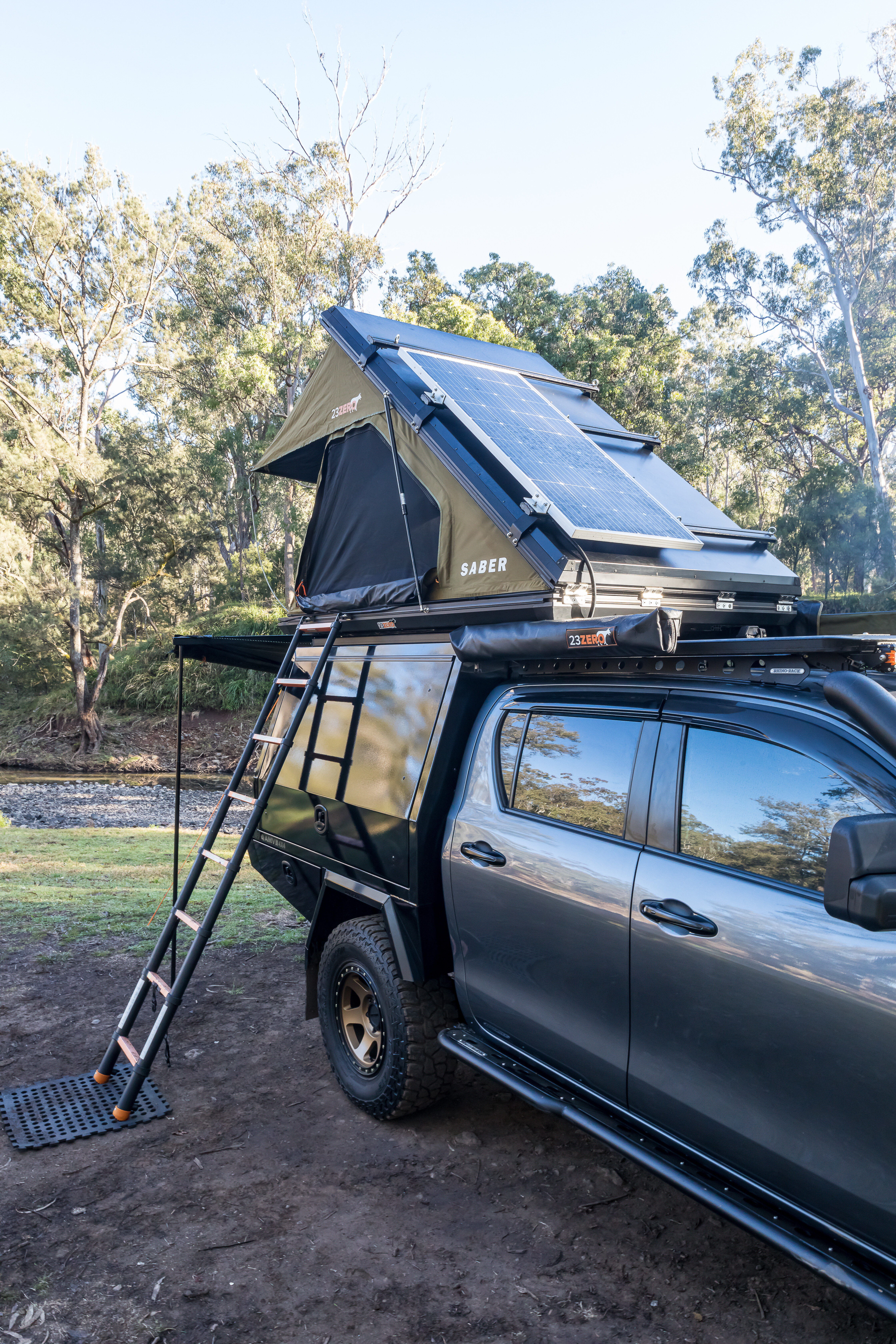
There are many fantastic canopy manufacturers in Australia these days, and for those needing a vehicle for work-and-play, a dual-cab with a canopy ticks many boxes. But they are also a compromise. They don’t ride that great unladen, they don’t handle that well either thanks to the majority of utes having leaf springs and let’s not go into drum brakes on the rear.
The majority of wagons will ride and handle better than utes, because they have coil springs on all four corners. This is why I personally have ditched my Hilux for an FJ Cruiser, and haven’t looked back. It does everything, except store gear, better than the ute.
How many passengers do you need to transport? Even if you only have two kids for example, you might need a seven-seater to transport their friends or family around to soccer of a weekend. How long are you planning on keeping the vehicle also, because you might not need seven seats now but you could in a few years’ time, thus ruling out a dual-cab ute.
There’s also some sort of irony about buying a dual cab, and then having to spend a few thousand dollars more on a canopy so you can stash gear in the tub. And no, I’m not having a go at canopies, their owners, manufacturers or dual-cab utes. They serve a brilliant purpose, but did you ask yourself if you might have been better off with the wagon?
I don’t want to come across preachy here, but I do want to stress the importance of buying the right vehicle for your needs, trust me, I’ve made this mistake more times than I’d like to admit over the last 20 years.
What are you using it for?
You don’t need a four-inch lift and 35-inch mud-terrain tyres to drive on Fraser Island, nor will highway-terrain tyres cut the mustard if the Glasshouse Mountains is your preferred playground. It’s fine to dream about the ultimate four-wheel drive, I do it daily, but it’s important to be realistic about what your actual needs are verses wants.
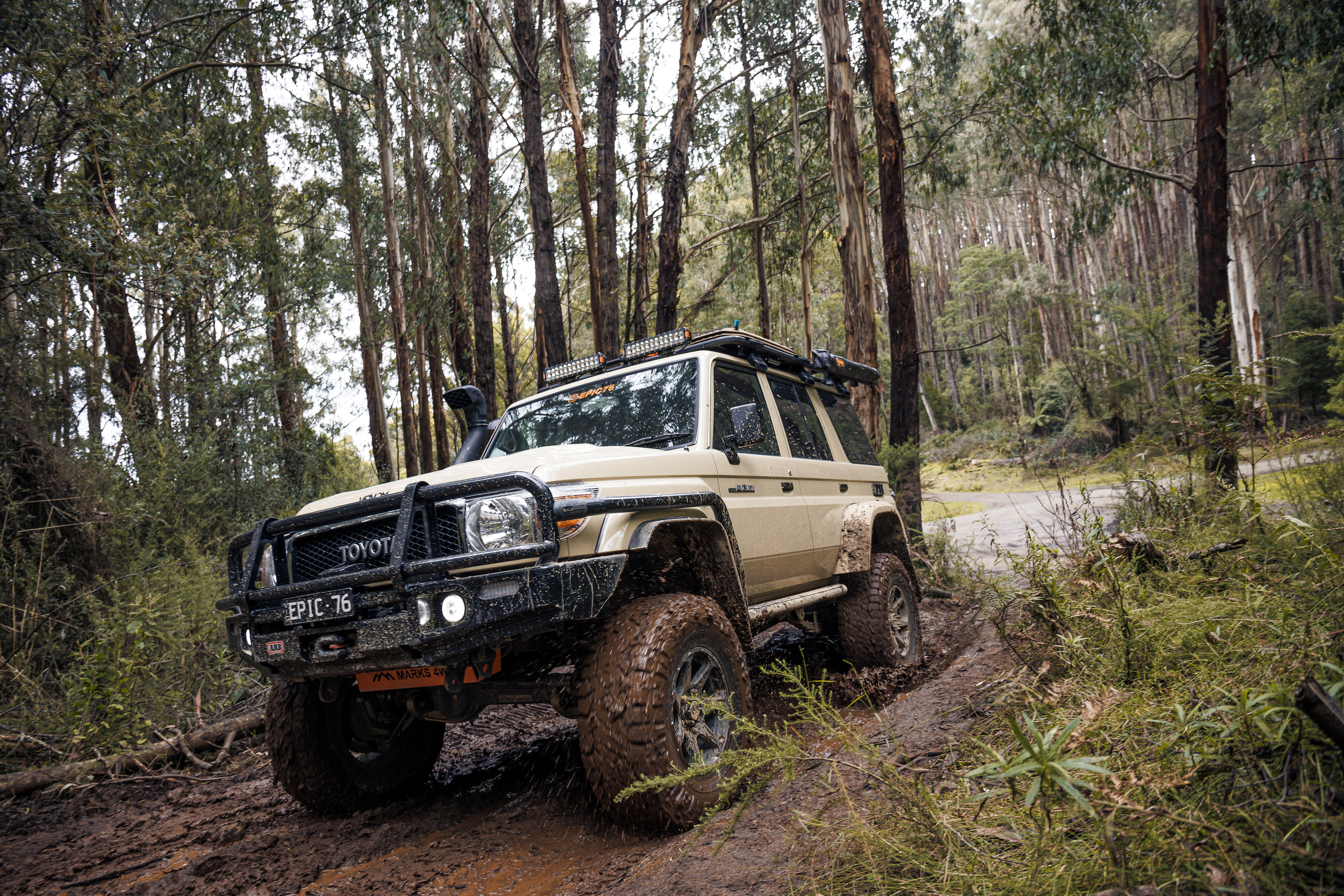
Is long-distance touring in your future plans? Or perhaps you need a vehicle for work purposes that can also be used on a weekend for camping and off-road exploration.
Coming up with a plan of attack for the build, and being honest with yourself about your actual uses for the vehicle is a big step, feel free to lean on industry experts for advice if you are unsure. The majority of people in the 4WD industry want you to be happy with your vehicle, so use their experience.
Work out weight
Do you know what your payload capacity is? This dictates how much weight you can carry, including the addition of aftermarket accessories such as a bullbar and winch. It is by far the most important factor when setting up a 4WD, and so many people get it wrong.
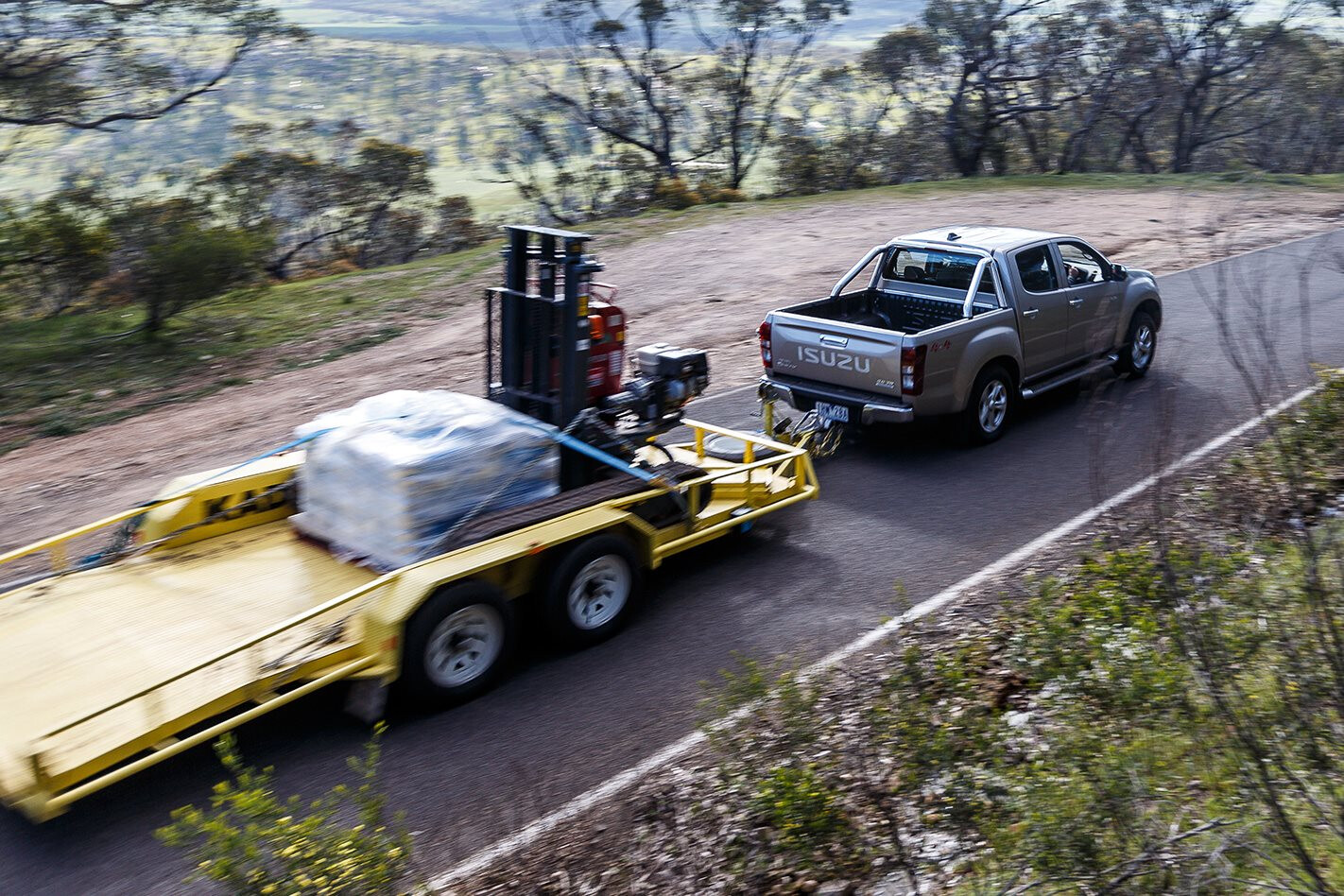
I like to physically weigh my 4WD loaded up ready for a trip to see how much payload capacity there is remaining. Not only does this keep you on the right side of the law and your insurance company, it also allows you to correctly set up your suspension if going with an aftermarket lift kit, which we’ll touch on in a bit.
If you decide the first thing you want to add is aftermarket suspension and some bigger tyres, once you add weighty accessories, there’s a chance you’ll have to redo what you’ve already upgraded, and nobody wants to spend money twice.
Safely does it
With the planning process out of the way, it’s time to talk about the first addition you should make to any 4WD. I’m talking about recovery gear and the knowledge to use it safely and correctly. Front and rear rated recovery points should be considered mandatory, with most 4WD clubs not allowing you to attend training or trips without recovery points front and rear.
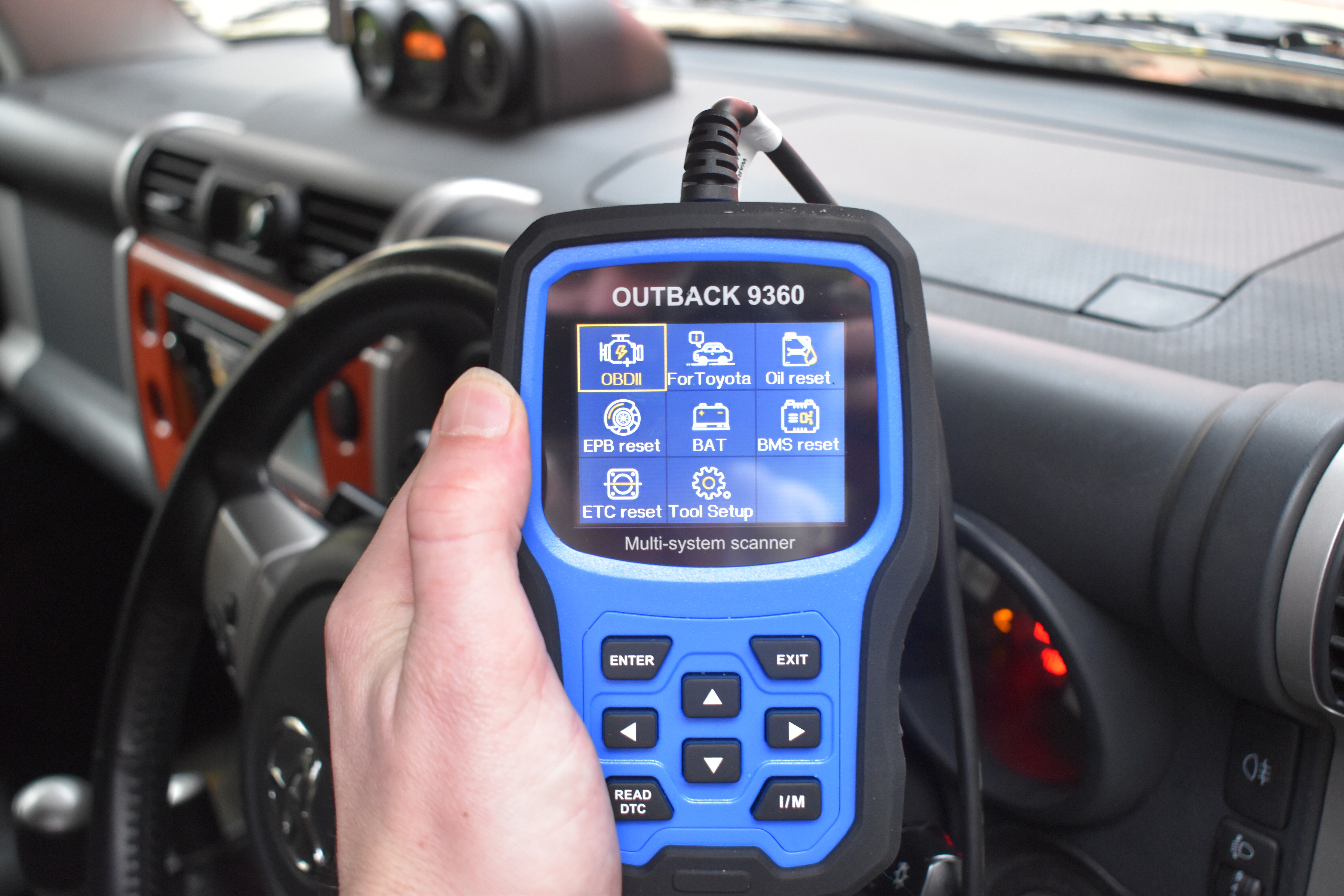
Speaking of training, if you are new to four-wheel driving and using recovery gear, do a course with either a registered training organisation or your local 4WD club. This will give you the confidence and some experience you need in a controlled environment, so you aren’t trying to figure things out when bogged on a beach with an incoming tide.
Tyre size
Larger tyres help when four-wheel driving, and fitting them is a modification many four-wheel drivers undertake for good reason.
There are legal limits as to how large you can increase your tyre diameter, which will vary from state to state, but let’s work with a fairly uniformed 50mm increase being the norm (i.e. going from the stock 31-inch tyres to 33-inch tyres).
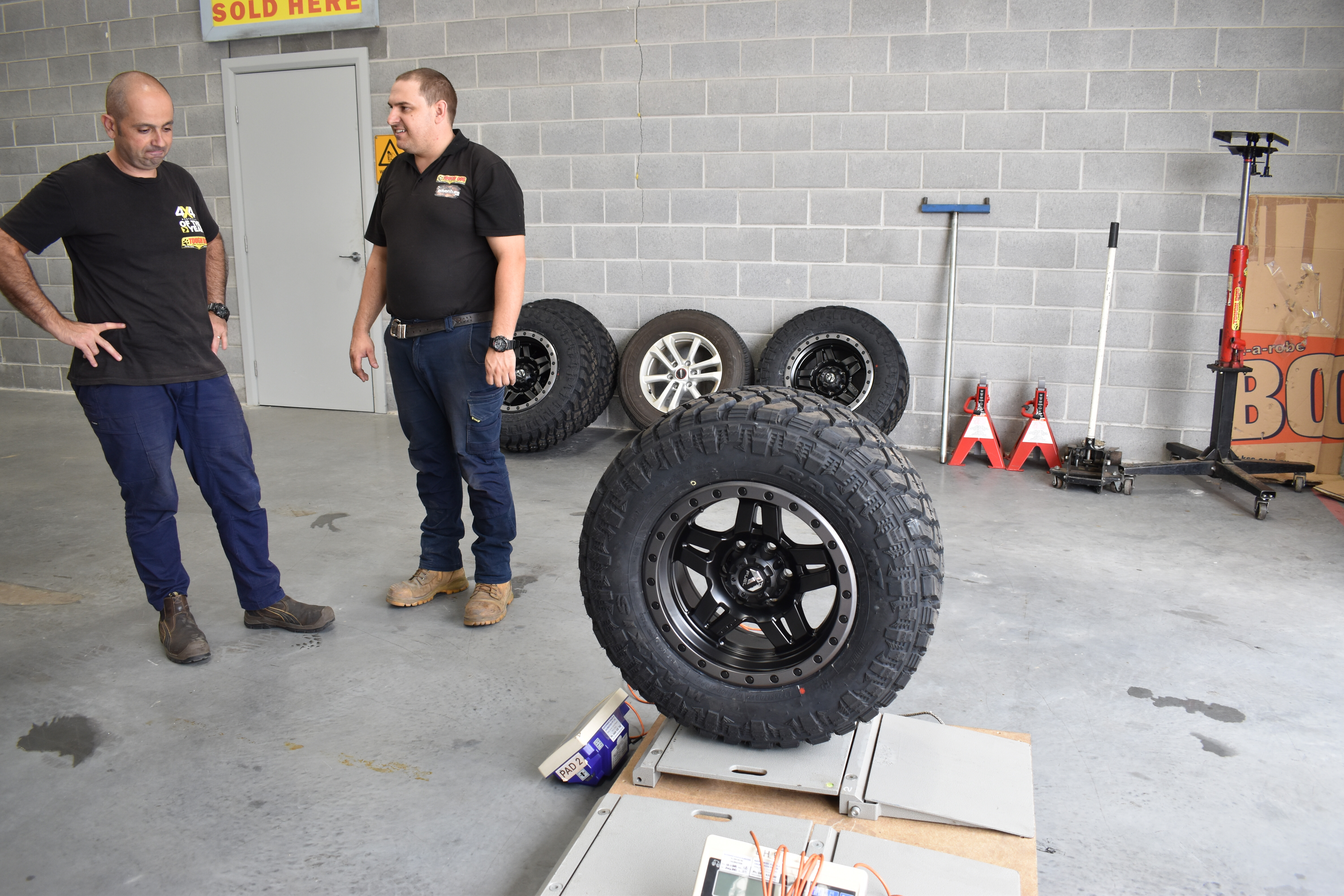
You need to decide if the amount of work required to make a tyre increase of this size is worth the effort to make them fit. In some cases, nothing is needed and you can slip them straight on, however, you could need new wheels with a different off-set to make the larger rubber fit. You might need to perform harder tasks such as body-mount chops to clear also, which will require approval from an automotive engineer.
Do plenty of research here, so you know what you could be up for when deciding to go up in tyre size. Once you do know what size tyre you want to run, they are legal and you are prepared to handle any of the fitment issues that arise, it’s all smooth sailing from here on.
With the weight added or calculated, tyre size determined, recovery points fitted as well as having recovery gear and the knowledge to use it, it’s time to look for some new suspension, exciting times.
Suspension
Suspension lift kits on their own do not allow for the fitment of bigger tyres, body lift kits do, as does bump-stop spacing. While many people believe that by fitting raised suspension you can fit bigger tyres, which is technically correct sitting statically, when the suspension cycles, it will still want to travel to the factory bump-stop positioning.
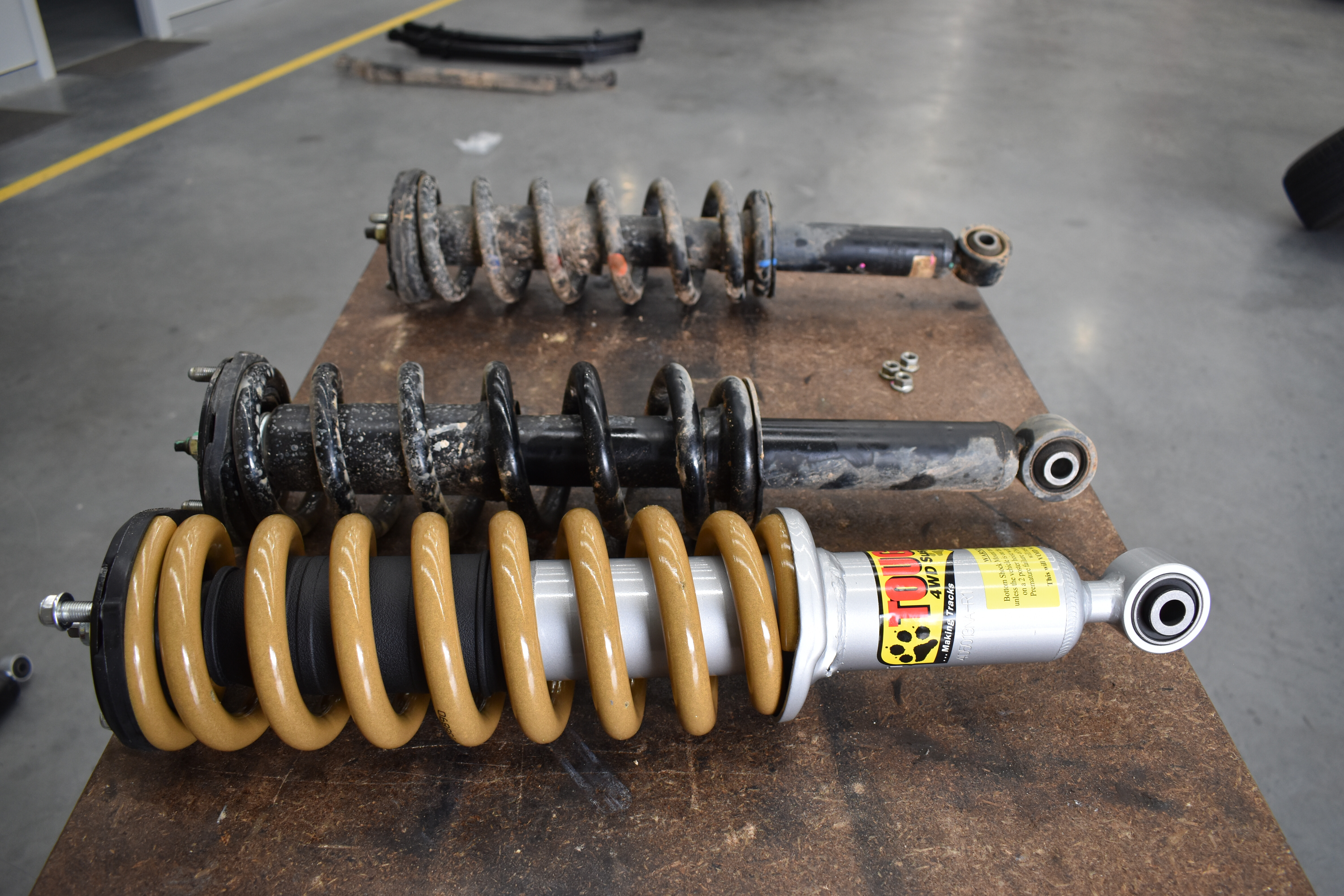
With that off my chest, fitting good quality aftermarket suspension to your 4WD is something you’ll enjoy every time you sit in the driver’s seat. Good kits will offer a better ride, more suspension travel, offer less shock fade when working hard over corrugations, and if you’ve followed my advice and know how much your now modified 4WD weighs after bolting on the accessories you need, the suspension kit can be correctly sprung to cater for this additional load.
Have a play around on a few different suspension manufacturers’ websites to see what spring rates they offer for your vehicle. A common mistake people make is asking for heavy-duty suspension, because they believe it to mean strong. Heavy-duty means a high spring rate to cope with massive loads, if you have just added a bullbar and a set of drawers to your vehicle, this will be overkill and ride terribly. Spend the time here to do this part right, it is absolutely worth the effort.
Time to make it your own
Now that you have a solid foundation, this is the time where you can add personality to your vehicle and make it your own. That could be a ripper 12V system with lithium batteries, or a roof rack with 270-degree awning and a place to store your kayak.
Perhaps camp lighting is important for your needs, or a snorkel and the most aggressive tyres you can find to make it through thick Tassie mud. There is so much available for Australian four-wheel drivers these days, it’s truly an exciting time to be involved in this scene.
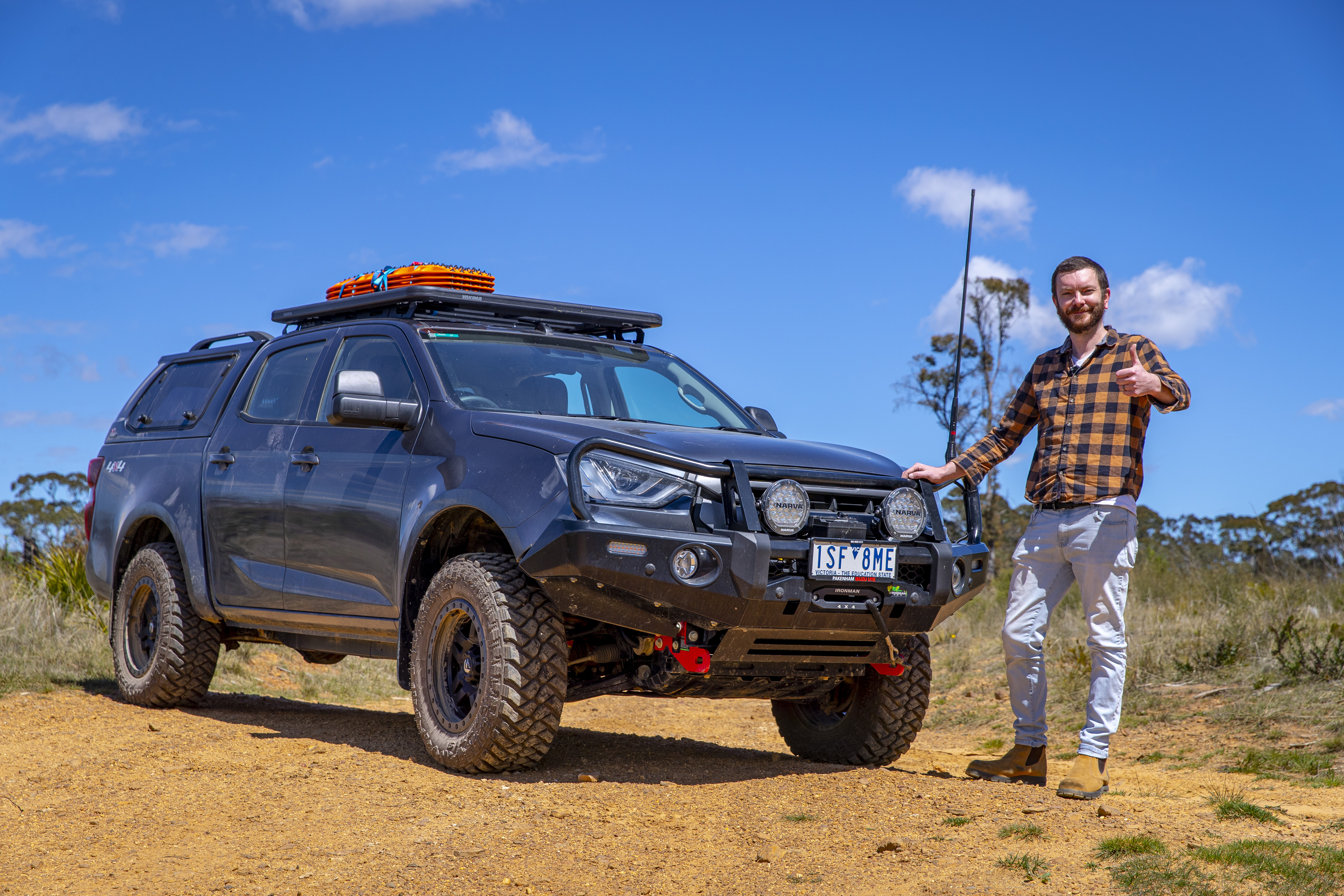
Get out there and use your vehicle so you can gain an appreciation for the work you’ve put into it, and learn what items would enhance your experience further for next time. By following the steps laid out before going to town making your 4WD your own, you’ve set yourself up for success and most likely saved yourself a bunch of cash in the process.
Lastly, it’s supposed to be fun. With the state of the world being what it is, there are massive wait times for certain products still. Walk into the process with patience, ask questions of experts in the industry, and set a budget.
By maintaining your expectations instead of getting stressed, you will achieve a far better outcome in the long run. Good things come to those who wait, and the wait is worth it when you get to see the amazing locations we have in Australia, that can only be explored with a well set-up four-wheel drive.