
Pros
- Ultra-portable flatpack design with durable stainless-steel construction
- Dual-fuel capability (gas and charcoal)
- Quick assembly without tools, and easy to clean
Cons
- Cooking surface size is limited for larger groups
- Charcoal tray accessory sold separately
When it comes to outdoor cooking, especially in Australia’s rugged terrains, having a reliable, portable and efficient barbecue is essential.
Enter the STOV Portable Gas BBQ – a game-changing flatpack barbecue for campers, overlanders and 4×4 enthusiasts seeking a compact yet powerful cooking solution. STOV founder Freddy von Oldershausen is a self-confessed fly-fisherman who set out to create a compact and lightweight barbecue on which he could grill his catch. He contacted me to tell me about his unique Portable Gas BBQ and now, having tested it for the past 12 months, this is what I think of it.
First impressions
The sleek design and lightweight nature of this barbecue immediately stand out. Weighing just 3.6kg and packing down to a mere 470mm x 290mm x 40mm, it’s evident that this barbecue is designed with true portability in mind. The brushed 304 stainless steel construction gives it a modern aesthetic and promises durability against the elements.
Design and construction
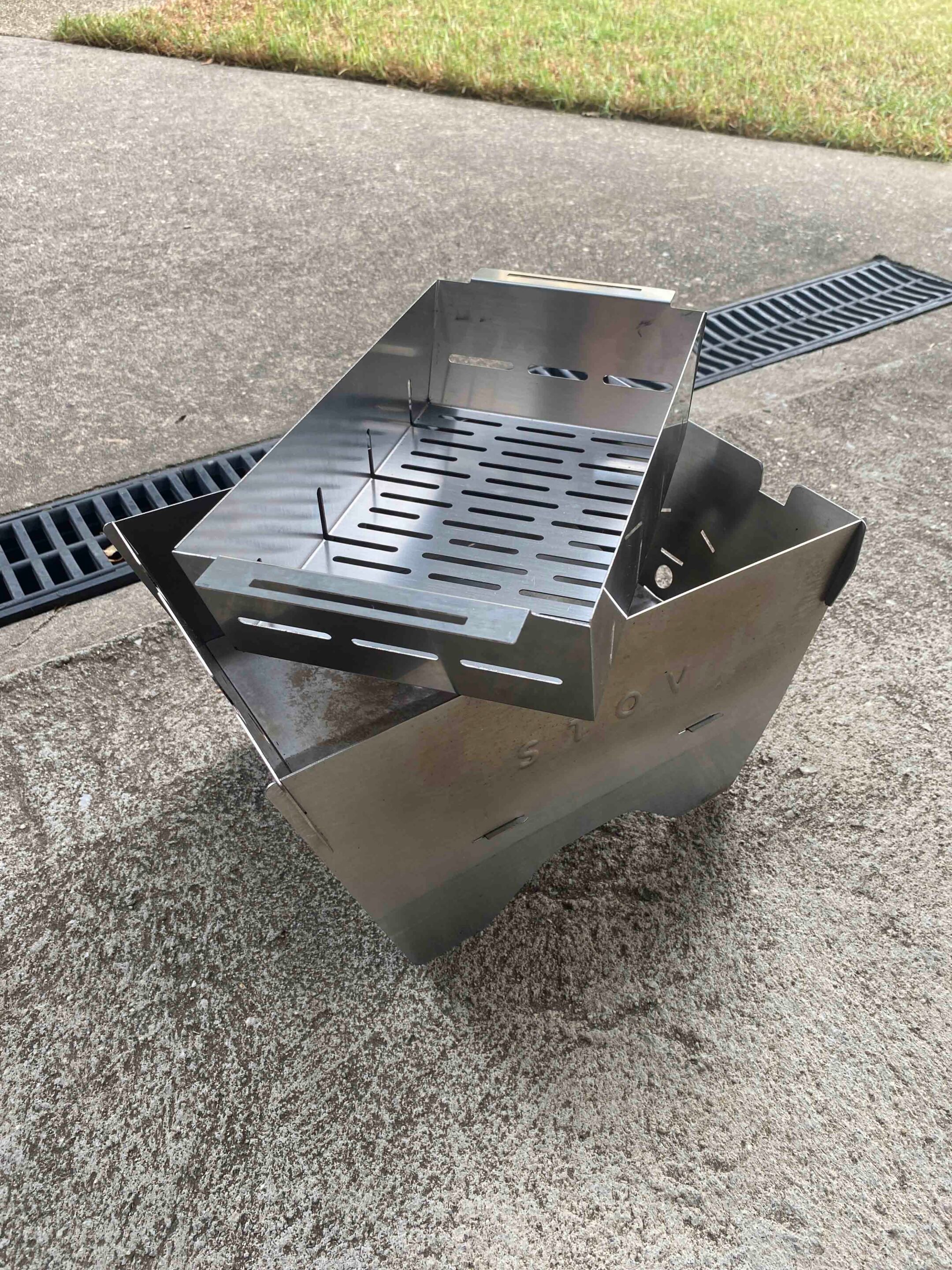
The Portable Gas BBQ’s flatpack design is its most distinguishing feature. Unlike traditional bulky barbecues, this unit disassembles into seven stainless steel plates, allowing for easy storage in the back of your vehicle. Assembly is straightforward, requiring no tools, and can be completed in under a minute. A heavy-duty carry bag is included, which doubles as a grilling mat, showcasing the thoughtful design that caters to the needs of adventurers.
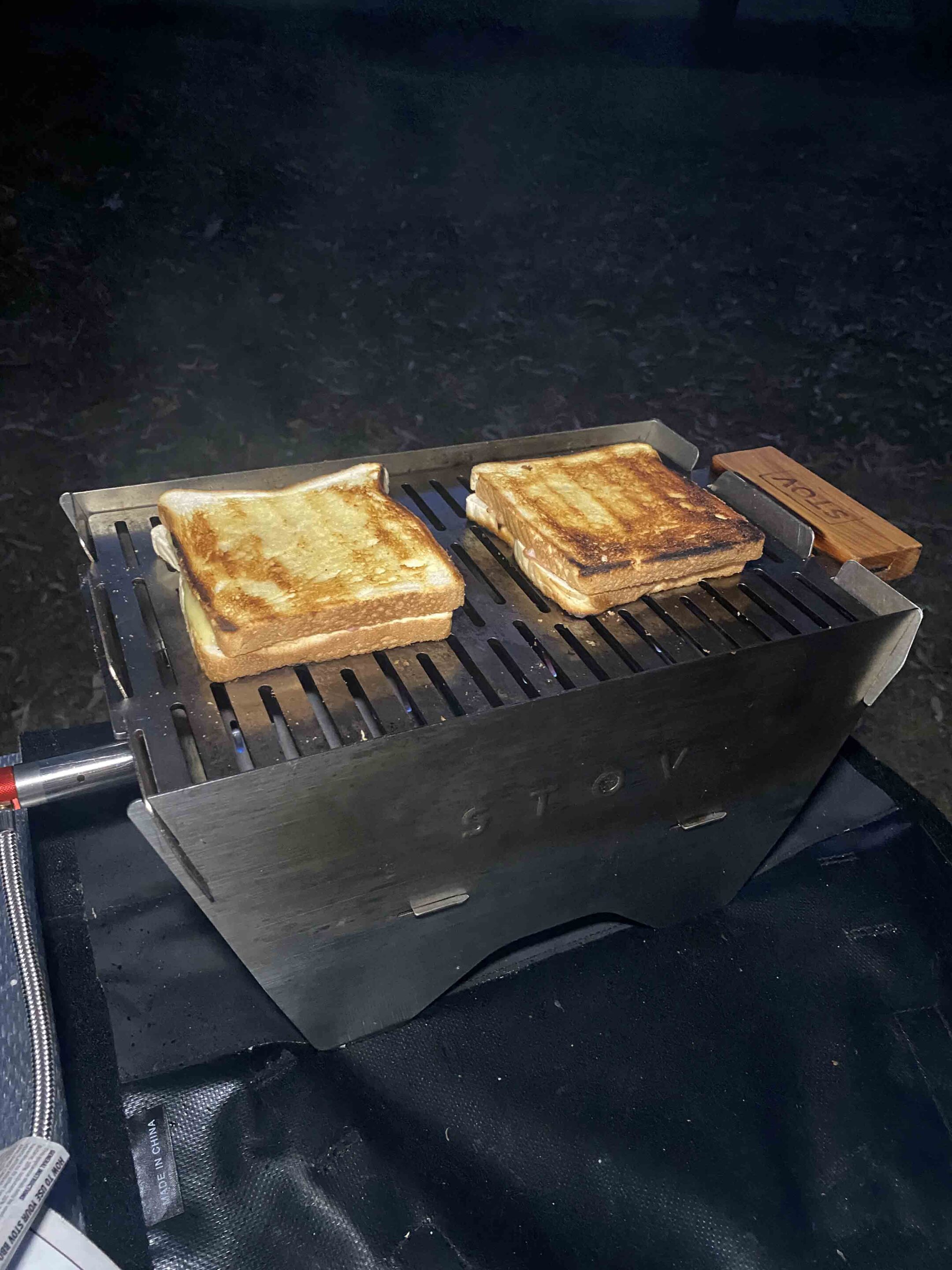
The grill grate measures 315mm x 210mm, offering 660cm² of cooking space, which is ample room to cook a deboned lamb leg, a couple of steaks and vegetables, or bacon and eggs (with the eggs cooked in a small pan heated on the grill plate).
High-quality materials ensure even heat distribution and resistance to corrosion, making it ideally suited to Australia’s diverse climates. With a five-year warranty on the grill and body, you can be confident that the STOV Portable Gas BBQ will last.
Performance and versatility
Despite its compact size, the Portable Gas BBQ doesn’t compromise on performance. It delivers 2.4kW of power, equivalent to about 8000 BTU, ensuring quick heat-up times and efficient cooking. A standard 460g EN417 propane gas cartridge provides approximately 200 minutes of grilling time, making it ideal for weekend trips without the need for frequent refuelling.
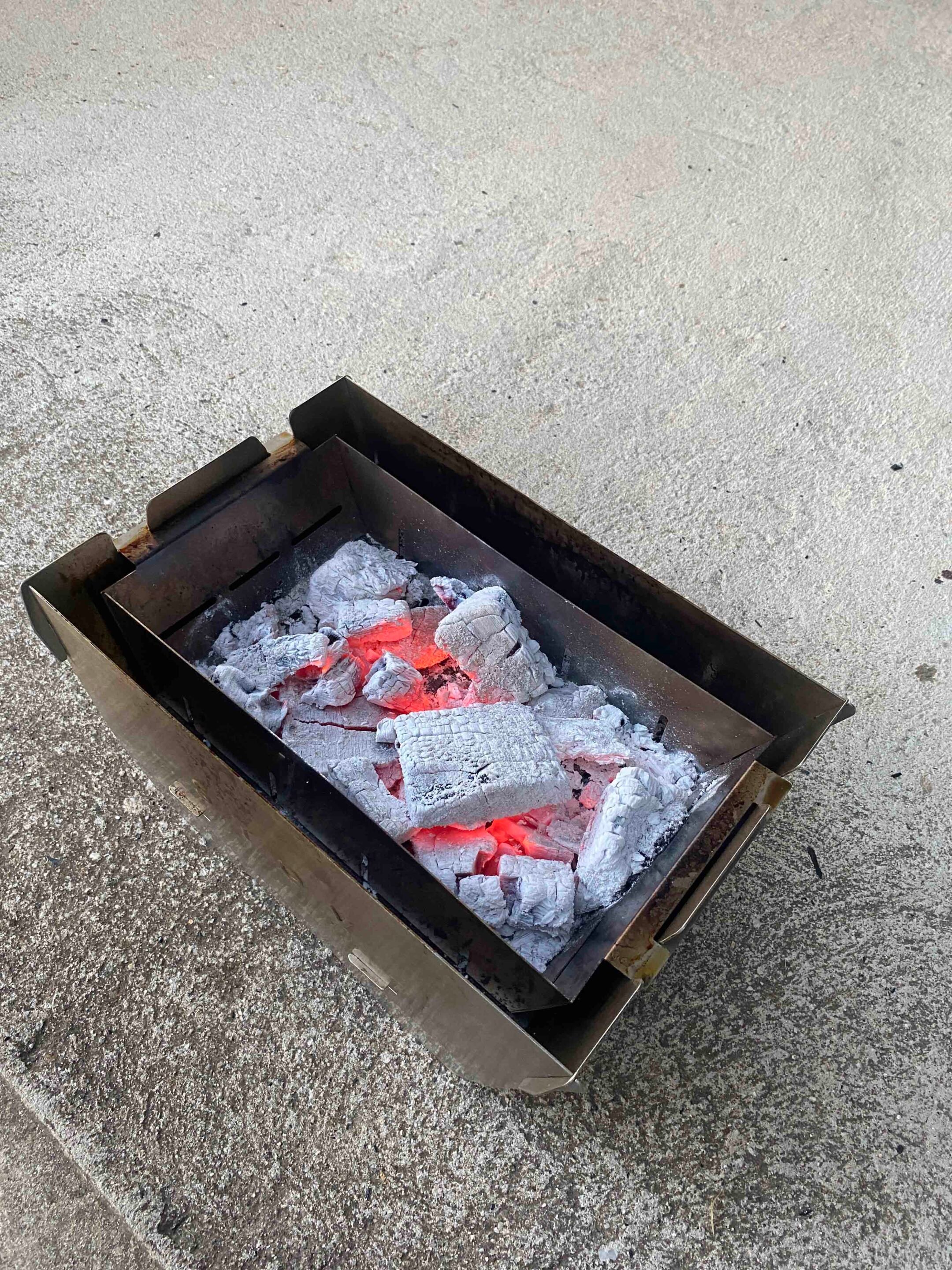
What sets the STOV design apart is its dual-fuel capability. While it primarily operates on gas, an optional charcoal tray accessory allows users to switch to charcoal or even small wood pieces, offering that authentic smoky flavour when desired. This flexibility is rare among portable barbecues and caters to varying cooking preferences.
Ease of use and maintenance
Setting up the Portable Gas BBQ is a breeze. The interlocking design ensures stability during use, and the absence of complex parts means fewer things can go wrong in the field. Lighting the barbecue is straightforward, and the heat control allows for precise cooking.
Cleaning is equally hassle-free. The stainless-steel components can be easily wiped down and, for a more thorough clean, the parts (excluding the wooden handle) are dishwasher safe. For those looking to minimise cleanup, lining the base with foil can effectively catch grease and drippings.
I’ve found that once the barbecue has cooled down, a good scrub with a scourer in hot, soapy water gets rid of the grease and most of the stubborn stains, while something like a Matador QCT Steel Pad Head removes the toughest of cooking stains.
Real-world application
During the time I’ve used this product, the STOV Portable Gas BBQ has proven its worth. Whether it’s a carpark lunch at an event or a relaxed evening cookout on the Murray River, the rapid set up and efficient cooking make it a reliable companion. The compact design means it occupies minimal space in my 4×4, leaving room for other essential gear.
Moreover, its design ensures compliance with fire regulations in many areas. While it is always essential to check local guidelines, the STOV’s gas operation often allows for use during fire bans, providing peace of mind for responsible campers.
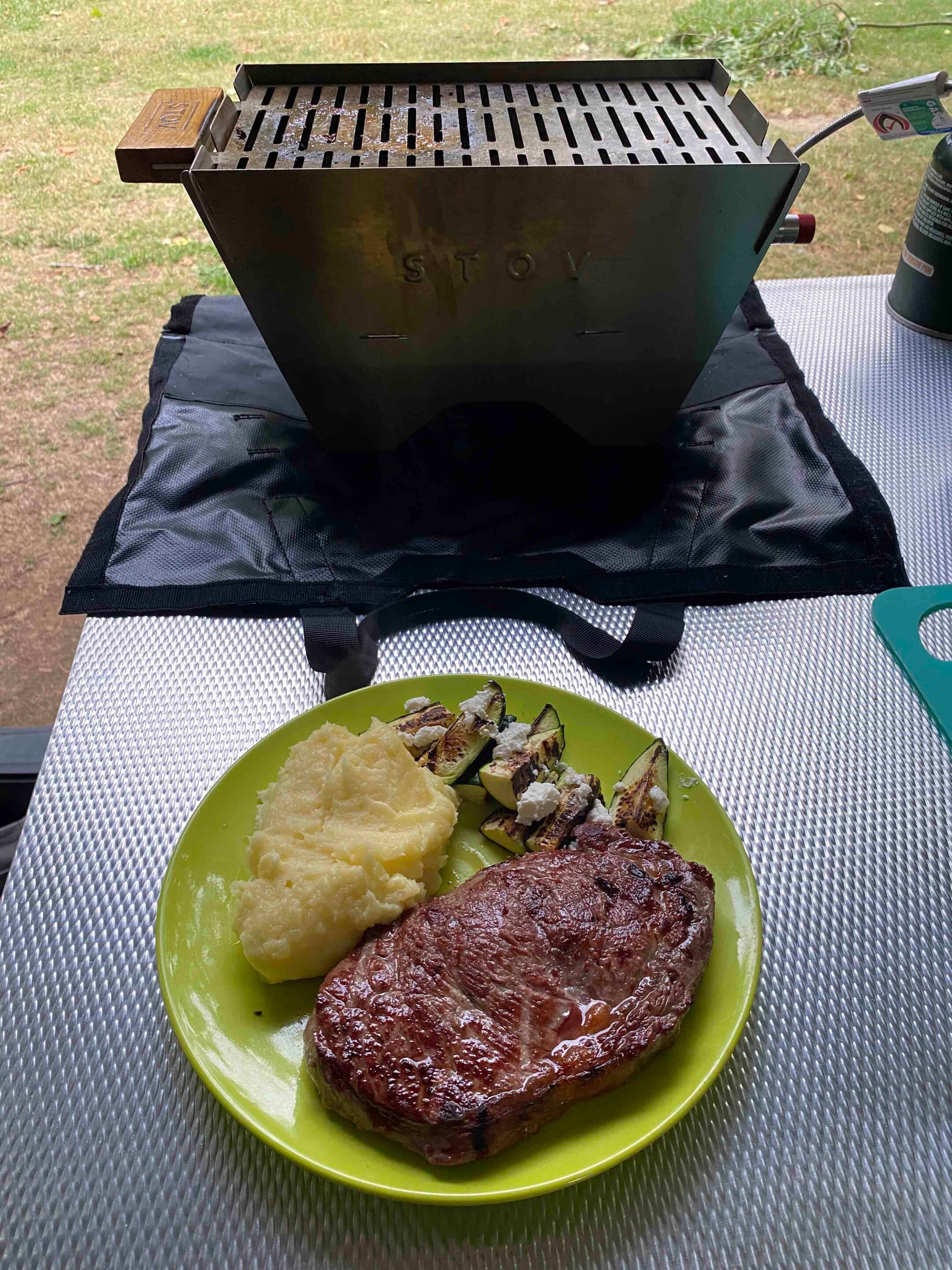
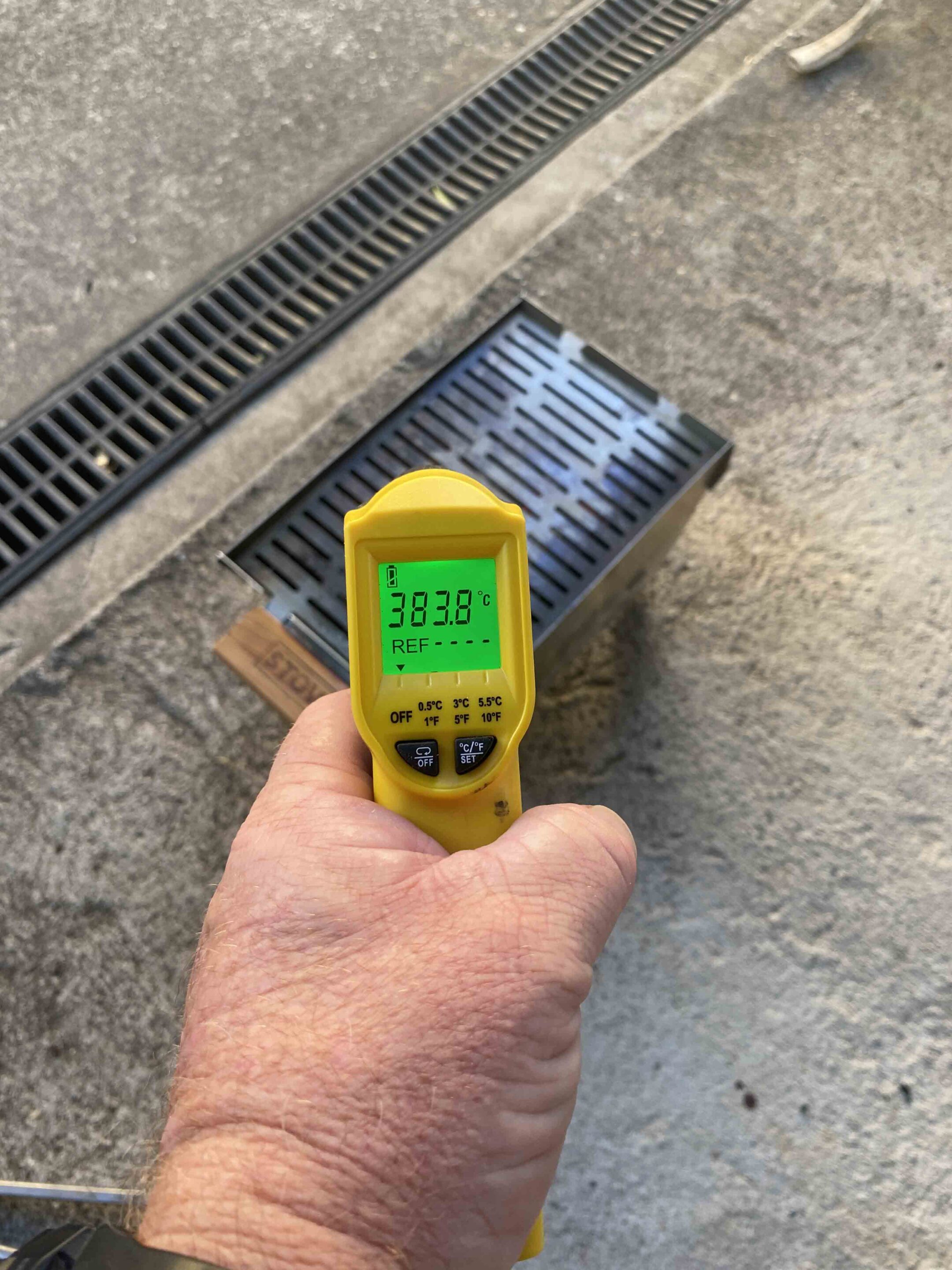
Freddy also sent me the STOV Charcoal Tray ($59) to play with, and while I’ve only used it once, the barbecue and the charcoal tray survived temperatures above the recommended 320°C – and the steaks were delicious with the added smoky flavour from the charcoal.
The STOV Windshield ($45) is a valuable addition that effectively blocks wind, helps maintain consistent cooking temperatures and is easy to clean, as fat splatters can be quickly wiped away. Additionally, the windshield packs flat, fitting conveniently into the Portable Gas BBQ carry bag.
Verdict
The STOV Portable Gas BBQ is a testament to innovative design meeting practical functionality. Its portability, performance and versatility make it an invaluable asset for any adventurer. Whether exploring the outback, setting up camp by the coast, or enjoying a picnic beside a river, this compact barbecue ensures you don’t have to compromise on quality meals.
RRP: $299
The massive advantage of the D-MAX is its supremely over-engineered powerplant. While the paltry stock figures could make you think this thing is yet another breathless wonder, the hidden abilities this thing possesses are magical. But I’ll get to that in a sec.
First, I have to decide which model I’m going with. Given my personal needs revolve around solo touring and hard wheeling, I’d be looking hard at the SX. At under $50K, I reckon I could build an any-track-in-Australia-ready ute for roughly the same price as a Ranger Wildtrak, HiLux Rogue, or D-MAX Blade (a touch north of $70K).
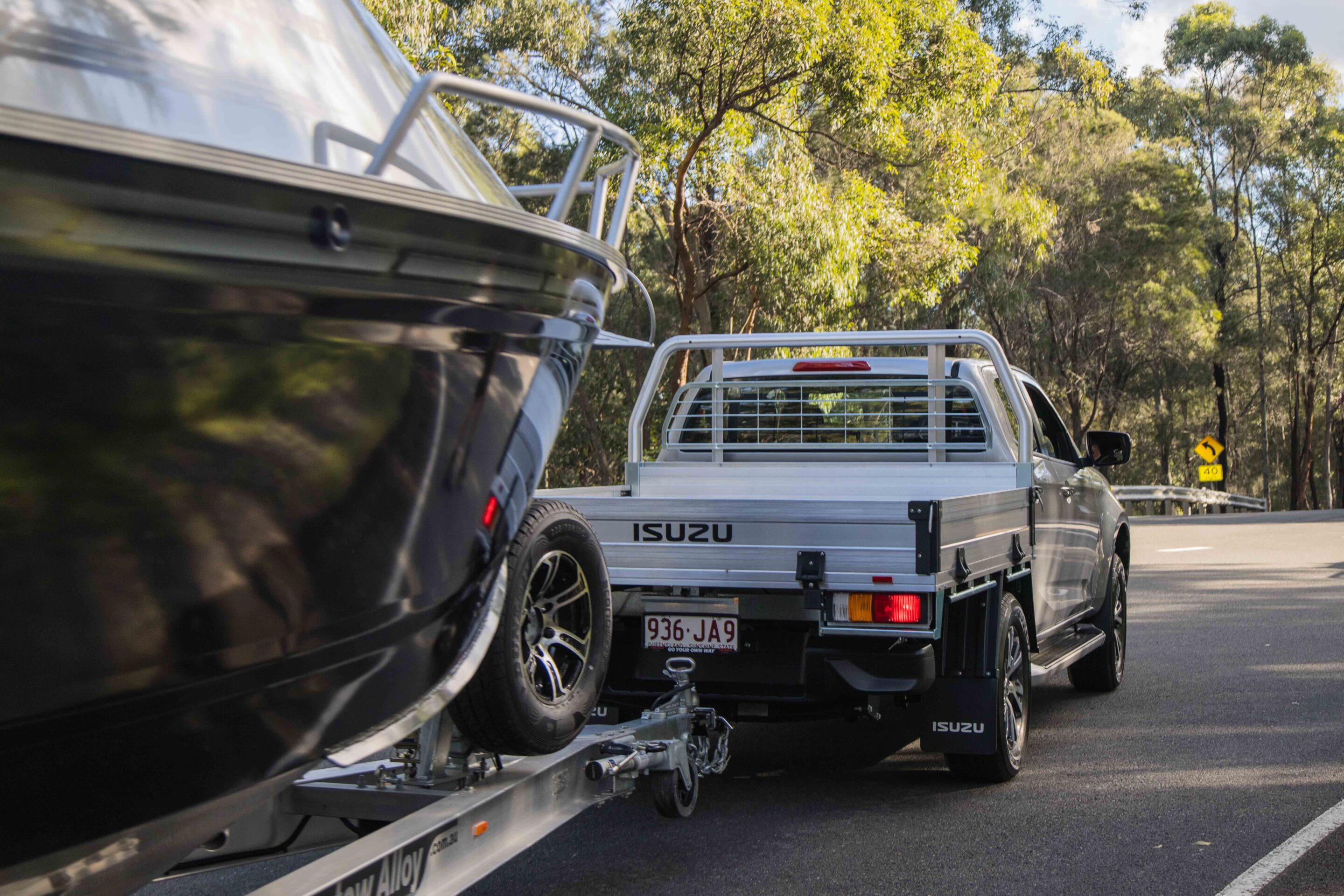
First things first, I’d throw a 2100 long canopy on the back from MW Toolboxes for $2900, which will give me plenty of space for a good 100Ah lithium set-up with Victron BMS ($3500), as well as all my camping, diving, and camera gear. I’d keep my fridge on the space cab’s back seat, if for no other reason than it will not have to work as hard while underway thanks to the AC, and is still easily accessed via the suicide door without needing the additional cost or weight of a drop slide.
From there, it’s engine time. We all know that 450NM from standard is hot garbage (yet so many manufacturers think it’s fine, whatever), but, as mentioned earlier, the beauty of the 4JJ3 in the Isuzu is its ability to produce and handle so much more. An upgraded factory turbo from G-Turbo, along with a PWR front mount intercooler and a custom dyno tune can (along with a few other bits and pieces such as a good catch can, like one from Process West) see power up around 280hp at the rims and torque slapping your lower back with a hefty 650NM—all while maintaining factory reliability. So yeah, I reckon that’s eight-ish gorillas well spent.
After that, it’s a Rival front bar, lightbar and winch ($4500), a 3in lift using Fox Shocks from CalOffroad ($3800), and a set of 33in Nitto Ridge Grapplers ($2500), and you’re ready for any gazetted track in the country—and most of the non-gazetted ones too, for that matter. And all for a similar cost of a stock D-Max Blade that won’t be able to even keep up, let alone follow you down half of them.
Oh, and if there were a few extra bucks left in the kitty, a Crashpad hard-shell roof-topper and 180º awning (both for $4200) would make camping that much quicker and easier—they’re hard to say no to.
That’s a keep-for-ten-years-ute in my eyes.
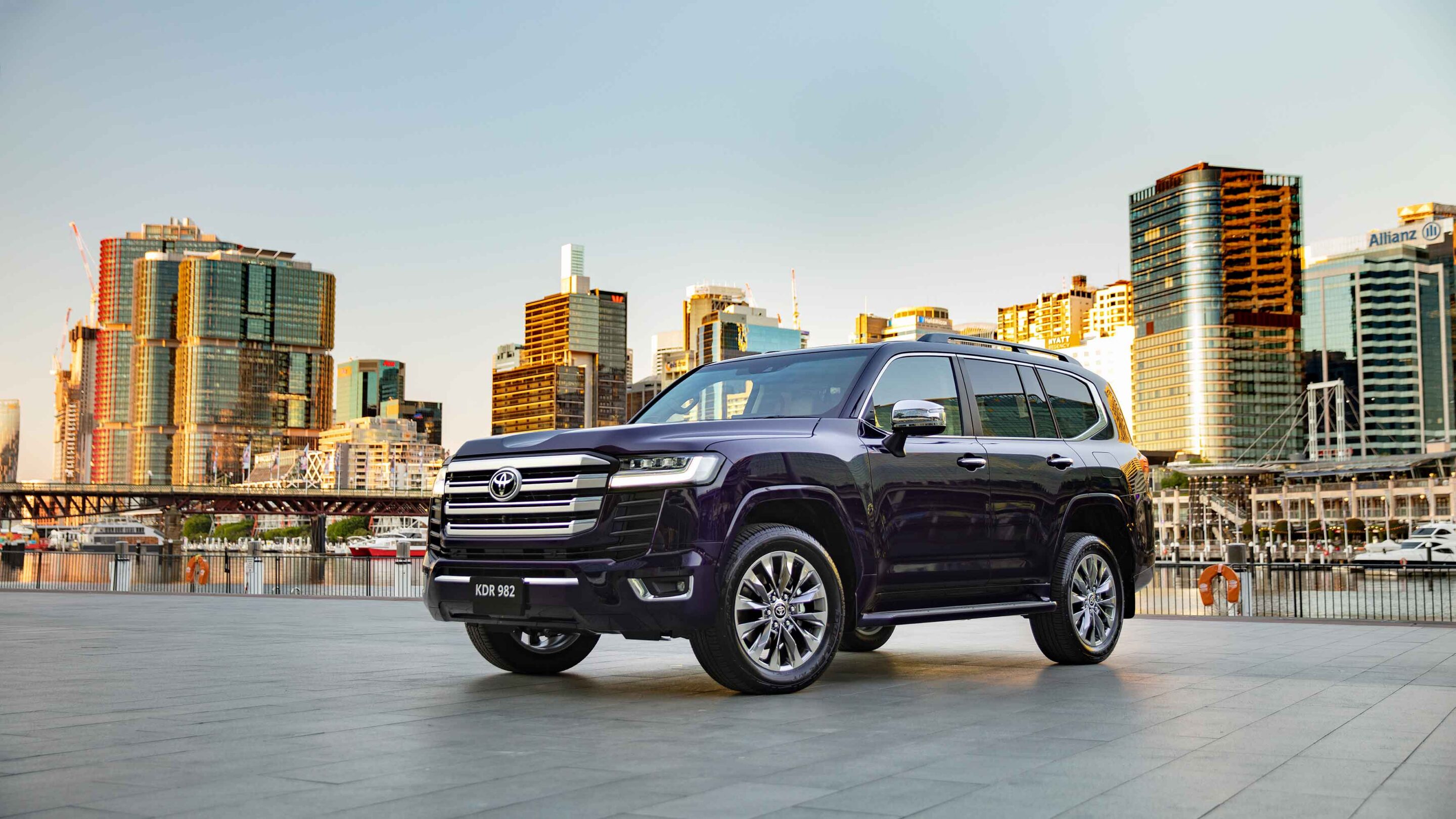
Toyota has officially revealed its first-ever hybrid LandCruiser, with the eco-conscious 300 Series slated to arrive in Australia in the first half of 2026.
The electrified 300 Series is poised to be the most powerful showroom-stock LandCruiser to date, with the large SUV to be propelled by a 3.5-litre twin-turbo petrol V6 engine paired with an electric motor generator in a parallel hybrid set-up.
While final performance figures are yet to be confirmed, Toyota says the new system will deliver more power and torque than the existing 3.3-litre twin-turbo diesel engine that produces 227kW and 700Nm.
Sean Hanley – Toyota Australia’s Vice President of Sales, Marketing and Franchise Operations – said the vehicle provides a level of performance never before offered on the nameplate.
“For decades, Australians have trusted the LandCruiser to get them to the furthest reaches of the country and back again – it is synonymous with Australian outback touring thanks to its incredible capability and dependability,” Hanley said.
“We have always said that Toyota aims to offer the right powertrains to suit our customers, and we are excited to introduce the first performance hybrid LandCruiser next year, which will offer a level of capability never before seen on our flagship four-wheel drive.”
This development marks an important step forward in Toyota’s broader push toward electrification. But for those concerned about its off-road potential, Toyota has reassured customers that the hybrid system has been engineered with, “true off-road capability and reliability in mind, with the electric motor able to provide smooth and even throttle response even in the toughest of terrain”.
In fact, Toyota says the powertrain has been rigorously tested in some of the world’s most extreme environments, including the deserts and mountains of the Middle East.
More detailed information is expected to emerge as the 300 Series nears its Australian debut in the first half of 2026.
Jayco, Australia’s largest manufacturer of caravans and RVs, is facing legal action after the Australian Competition and Consumer Commission (ACCC) launched proceedings in the Federal Court over allegedly misleading advertising around its “off-road” models.
At the heart of the case are Jayco’s Outback, All Terrain, and CrossTrak RVs, marketed to 4×4 and touring enthusiasts as built for rugged terrain, including 4WD-only tracks, beaches, and rocky, rutted outback roads. However, according to the ACCC, that’s not what buyers actually got.
The watchdog alleges that despite being promoted with imagery showing the RVs tackling unsealed tracks, water crossings and remote bush locations, the vehicles weren’t designed for such conditions – and crucially, weren’t covered under warranty if they were used that way.
“We allege Jayco misled consumers by advertising the RVs in terrain in which they were not designed to be used and were not covered by its warranty,” ACCC Deputy Chair Mick Keogh said.
“When a product is depicted in advertisements in a particular setting, or claims are made about it, consumers have a right to expect such images and words reflect the intended use of the product.”
The ACCC claims that Jayco’s own warranty documents state that the vehicles aren’t suitable for terrain with hard impacts, heavy landings or serious undulations. That includes the very conditions commonly encountered on 4WD adventures.
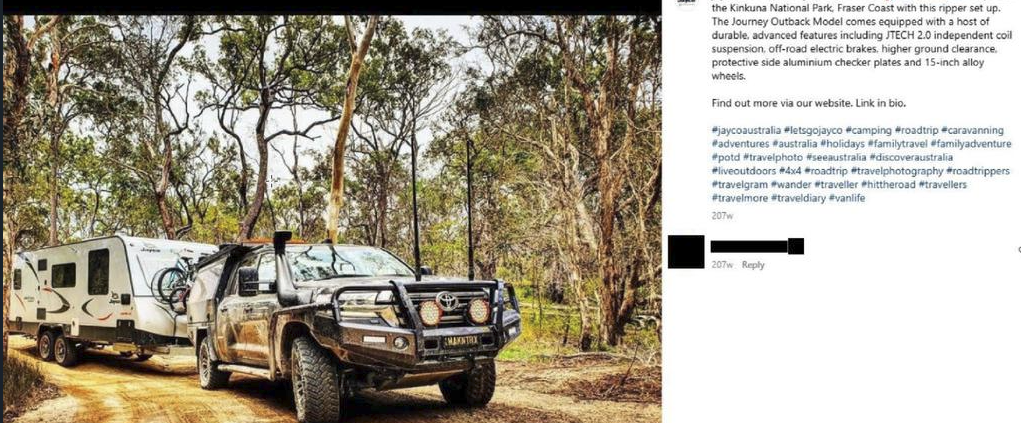
Instagram post depicting an Outback RV being towed by a 4WD vehicle through “Kinkuna National Park”, which is only accessible by 4WD vehicles – ACCC
Of particular concern is the All Terrain model, which, despite its name, allegedly isn’t built for “all terrain” at all. The ACCC saying, “the All Terrain RV was not designed for use on terrain with hard impacts, heavy landings, rutted roads, tight undulating tracks or roads or 4WD only tracks, and therefore was not designed for use on all types of terrain”.
The ACCC also alleges Jayco failed to properly disclose these limitations in its advertising, both online and at popular events like 4WD shows, potentially misleading consumers who believed they were buying a caravan up to the task.
“We are concerned that consumers were deprived of the ability to make informed purchasing decisions which might have led them to buy a different RV that was more suitable for their needs,” Mr Keogh said.
“RVs are a significant purchase for consumers, and as a result of Jayco’s ads, consumers may have paid a premium over and above the cost of other standard model RVs based on the alleged misrepresentation that they could be used ‘off road’.”
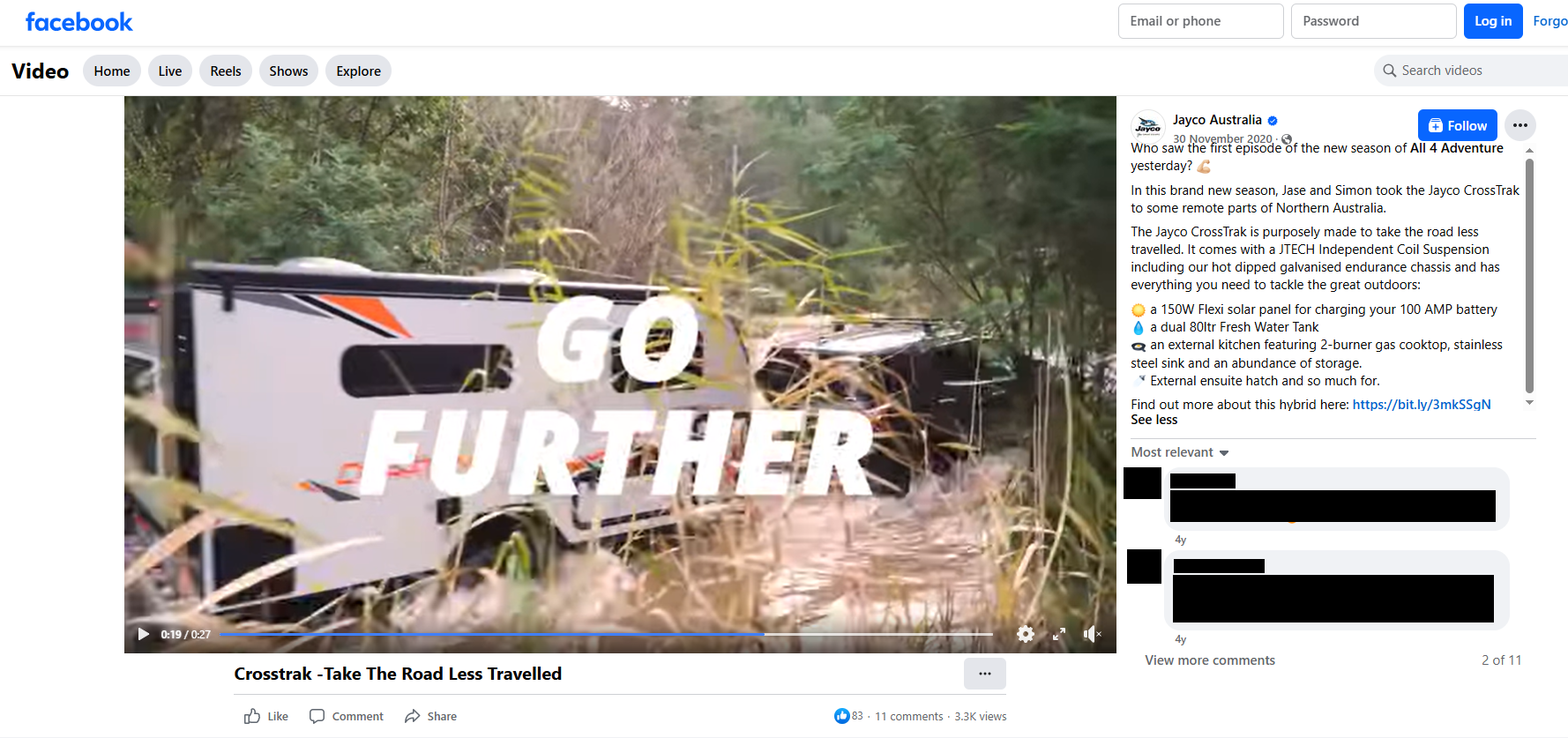
Jayco Facebook post and embedded video, depicting a CrossTrak RV being towed behind a 4WD vehicle through a range of off-road conditions including water crossings – ACCC
In response, Jayco has denied that any of its advertising or promotional materials misrepresented or misled consumers.
“After nearly 20 months of engagement with the Australian Competition and Consumer Commission (ACCC), and despite the ACCC seeking and being provided with detailed submissions and documentation from Jayco Corporation Pty Ltd (Jayco), the ACCC has decided to commence proceedings in the Federal Court of Australia alleging contraventions of the Australian Consumer Law,” a Jayco spokesperson said in a statement.
“Jayco categorically denies that any of its advertising or promotional materials misrepresented or misled consumers about the off-road capabilities of its Outback, CrossTrak and All Terrain recreational vehicles (RVs), when compared to the terms of the Jayco Warranty or otherwise.
“Jayco will vigorously defend the claims brought by the ACCC and thereby seek to vindicate its reputation as a manufacturer of high quality Australian products.
“Jayco has a proud legacy spanning over 50 years as Australia’s leading manufacturer of over 275,000 RV and caravans, with an unwavering commitment to quality, safety, and customer support. Jayco will continue to stand behind its products, its Warranty, its people and its customers as it defends the claims through the legal process.”
This isn’t Jayco’s first brush with the ACCC. In 2021, it was fined $75,000 for misleading a customer about their consumer guarantee rights.
The ACCC is seeking declarations, penalties, injunctions, compliance and publication orders, and costs.
Ford has added a plug-in hybrid to its top-selling ute range, and the Ranger PHEV is more than just a fuel-saver – it’s a refined, powerful and highly capable dual-cab ute that is effective for work, touring and off-road conditions.
At the heart of the new model is a 2.3-litre turbocharged four-cylinder petrol engine paired with a 75kW electric motor and an 11.8kWh battery. On its own, the 2.3-litre petrol engine makes a claimed 138kW at 4600rpm and 411Nm at 2700rpm, but combined output is a stout 207kW at 4600rpm and 697Nm at 2500rpm, fed through a 10-speed Modular Hybrid Transmission (MHT) and a full-time 4×4 system lifted from the Ranger Raptor. This includes a locking rear diff, low-range and an Auto 4WD setting that works well on mixed terrain.
Ford claims 2.9L/100km combined fuel consumption under lab testing, and a battery-only range of 45km (WLTP), but on our real-world drive – starting in Auto EV mode – we covered around 27km on battery alone before the battery was depleted and the petrol engine took over. Over a 60km mixed loop, our average fuel consumption was 6.9L/100km, which is still impressive for what is a fairly large dual-cab ute with serious off-road chops. A regenerative braking system helps charge the battery which aids efficiency in stop-start driving scenarios; there is an EV Coach in the instrument cluster aimed at helping drivers make the most of the system.
The addition of the battery and electric motor system means the Ranger PHEV is significantly heavier than its diesel siblings, with kerb weights ranging from 2527kg in the XLT to 2692kg in the fully optioned Stormtrak – around 240-400kg heavier than an equivalent 3.0L V6 diesel model. That extra weight eats into payload, with figures dropping as low as 808kg in the Stormtrak.
It should also be noted that the quoted payload figures are without the spare wheel/tyre hanging under the tub, as this vital component is now offered as a no-cost option; we can’t help but think the reason for this is down to marketing as the deletion of the spare as standard equipment means around 20kg can be added to the payload figure across the range. While still capable of towing a 3500kg braked trailer, prospective owners will need to pay close attention to gross vehicle mass (GVM) and payload calculations if loading the tub or hitching up a heavy trailer.
JUMP AHEAD
Model range
The Ranger PHEV is available in four trim levels – XLT, Sport, Wildtrak and Stormtrak – with drive-away pricing ranging from $71,990 to $86,990.
The XLT offers the essentials, including full-time 4×4, selectable EV drive modes, and Pro Power Onboard with up to 6.9kW of AC output. Stepping up to the Sport ($75,990 drive-away) adds leather-accented trim, heated seats, wireless charging and LED lighting.
The $79,990 Wildtrak introduces matrix LED headlights, power roller shutter, unique styling and a 10-speaker B&O sound system. At the top of the range, the Stormtrak ($86,990 drive-away) includes exclusive Chill Grey accents, a flexible rack system, unique 18-inch wheels, and factory-fitted auxiliary switches for powering aftermarket gear.
Power pack
Charging the Ranger PHEV is as easy as plugging in your smartphone.
The vehicle is supplied with a Mode 2 home charging cable and can be topped up overnight using a standard 240V wall socket. From empty to full, the 11.8kWh battery takes just under seven hours to charge on a 10A outlet, or around four hours on a 15A socket – ideal for those wanting to start the next day’s commute with a full charge and minimal fuel use.
The Ranger PHEV does not offer DC fast-charging, but if you’re away from a power source or just want to replenish the battery on the move, selecting EV Charge mode turns the petrol engine into a generator. This is ideal when you want to use the Ranger’s Pro Power Onboard system to run 240V appliances at a worksite or campsite – things like power tools, a bar fridge, a coffee machine or even a Travel Buddy oven. It also ensures you’ve got enough stored energy to charge up an electric bike or other kit when you arrive at your destination.
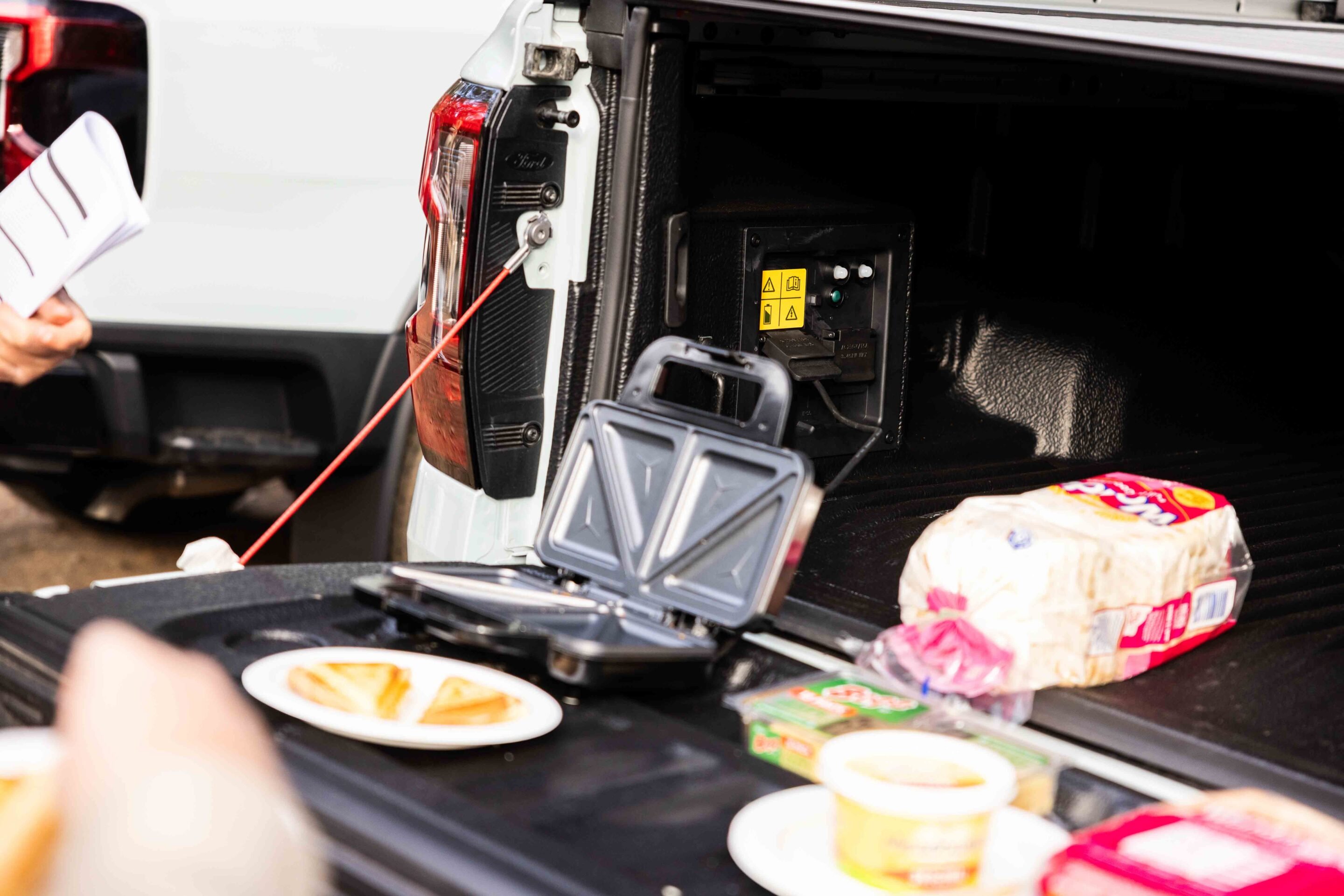
There are three AC power outlets; two 3.45kW (15A @ 230V) outlets in the tray and a 2.3kW (10A @ 230V) outlet in the cabin. Once the 11.8kWh battery is depleted, it can be recharged by simply firing up the engine and selecting EV Charge mode; Ford describes it as a portable generator with a 70-litre fuel tank.
Theoretically, if you were staying at the one campsite for an extended period, you could also charge the battery from solar panels, but you would need to use an inverter and charge through the standard AC input using the supplied Mode 2 home charging cable.
On the road
On bitumen, the Ranger PHEV feels more refined than its diesel siblings.
The petrol-electric drivetrain is smooth and quiet, with acceleration that easily rivals the V6 diesel. Put your foot down and this Ranger hauls. The electric motor fills in any gaps from the turbo-petrol engine and the result is strong, seamless torque delivery.
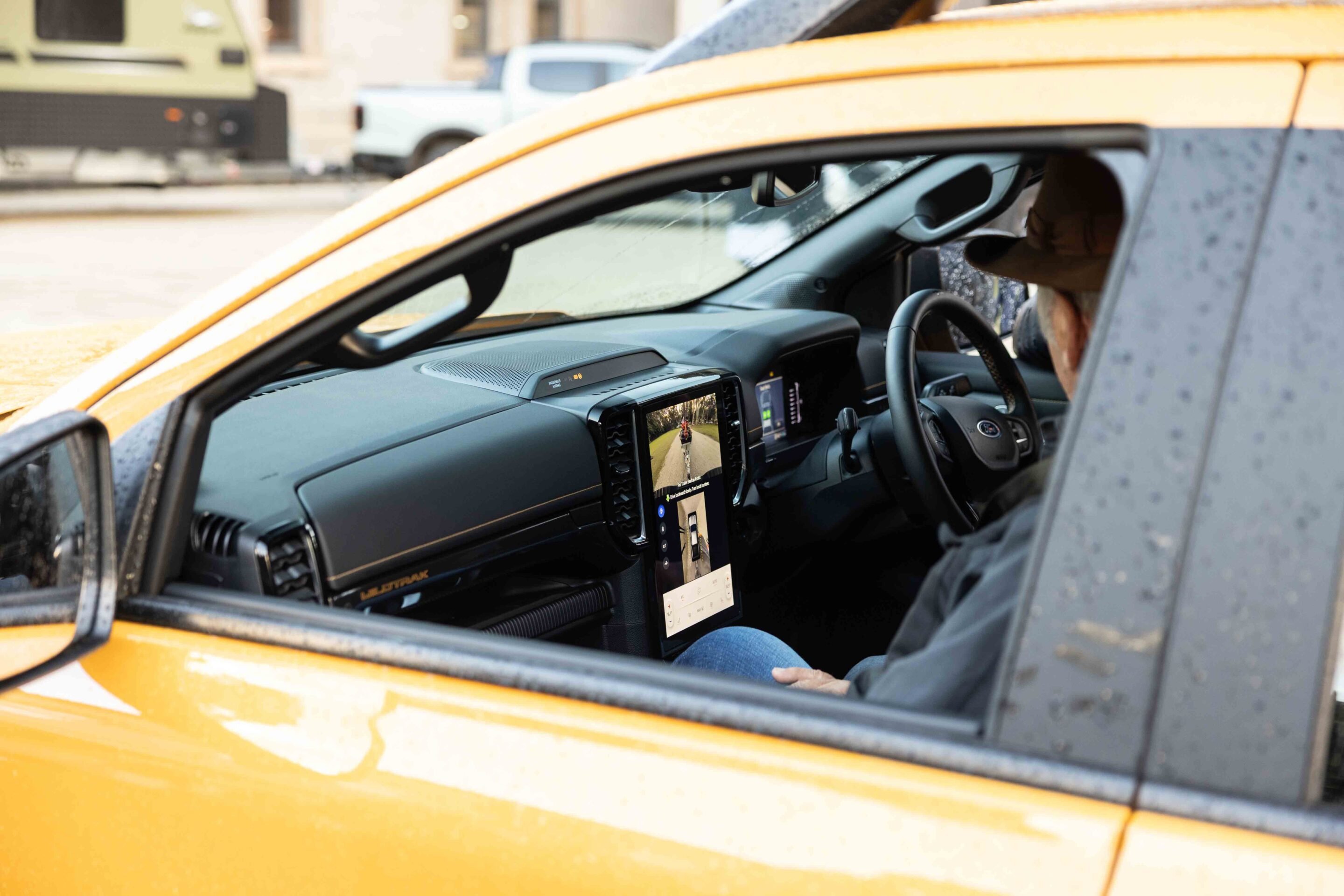
Even towing a 2.8-tonne trailer and digger combo, the PHEV felt untroubled. While we didn’t record fuel figures during towing, it’s clear the hybrid system helps with low-speed grunt, making for effortless take-offs and confident hill starts. There’s also a Pro Trailer Back-up Assist system on Wildtrak and Stormtrak model grades, with a dial in the centre console to aid reversing with a trailer attached.
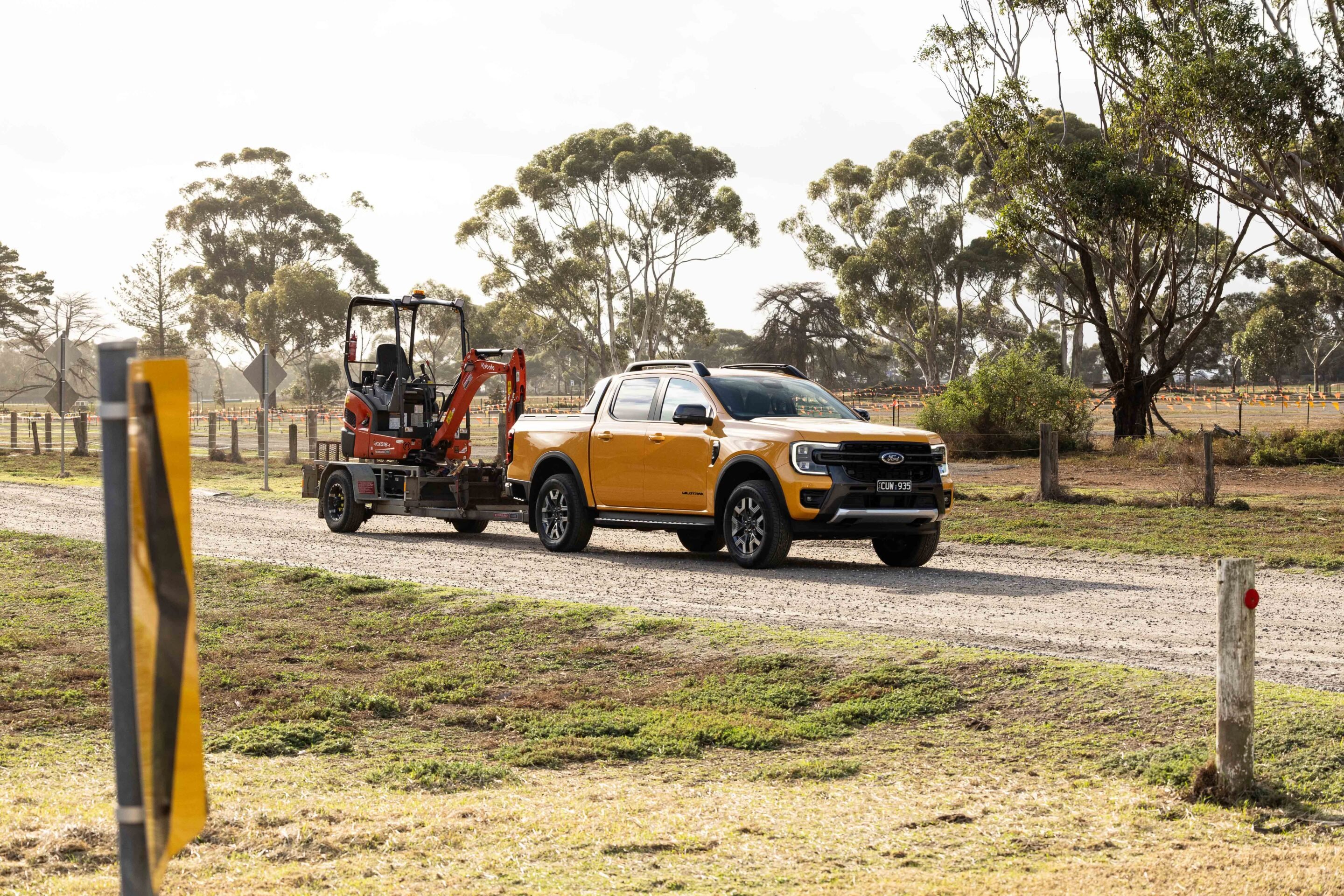
Handling is well sorted too. Steering is nicely weighted, body control is tight, and unladen ride quality is good. The Ranger PHEV is heftier than its diesel counterparts and much of this weight (the battery) is towards the rear of the vehicle, and this no doubt helps to settle the rear end when driving over bumpy roads. Lane-keep assist works unobtrusively and, unlike some rivals, there’s no incessant beeping.
The hybrid system offers four drive modes: Auto EV, EV Now, EV Later and EV Charge. In EV Charge mode – which uses the engine to replenish the battery – we recorded 9.6L/100km on a highway leg, and it would take around two hours of driving to fully charge from empty. This was on a vehicle equipped with optional General Grabber A/T rubber (255/65R18), so you could eke out a bit more fuel economy if you were on the standard Continental ContiCrossContact H/T tyres. Regardless, with a 70-litre tank, the theoretical touring range on the open road is more than 700km.
Speaking of the open road, Ford Australia was at pains to point out that it has the second-largest dealer network in the country; a subtle dig, no doubt, at the new Chinese players on the market that are eating into the market share of traditional nameplates.
Off the road
We tackled a few off-road challenges on the launch drive, including a short run on a tricky track in Lerderderg State Park on Day 1 and several off-road courses at the Australian Automotive Research Centre (AARC), a facility that 4X4 Australia has used previously for 4X4 Of The Year testing.
Like other Rangers, the PHEV variants feature driver-selectable modes (Normal, Eco, Tow/Haul, Slippery, Mud/Ruts, Sand and Sport) in addition to its EV Drive modes. The track in Lerderderg was steep and slippery in places and was good for testing the effectiveness of the Ranger PHEV’s drive modes, low-range gearing, rear diff lock, traction control, ground clearance and off-road angles. If you are familiar with the performance of a diesel Ranger off road, this will give you a fair idea of how the Ranger PHEV performs, which is to say it’s an impressive bit of kit.
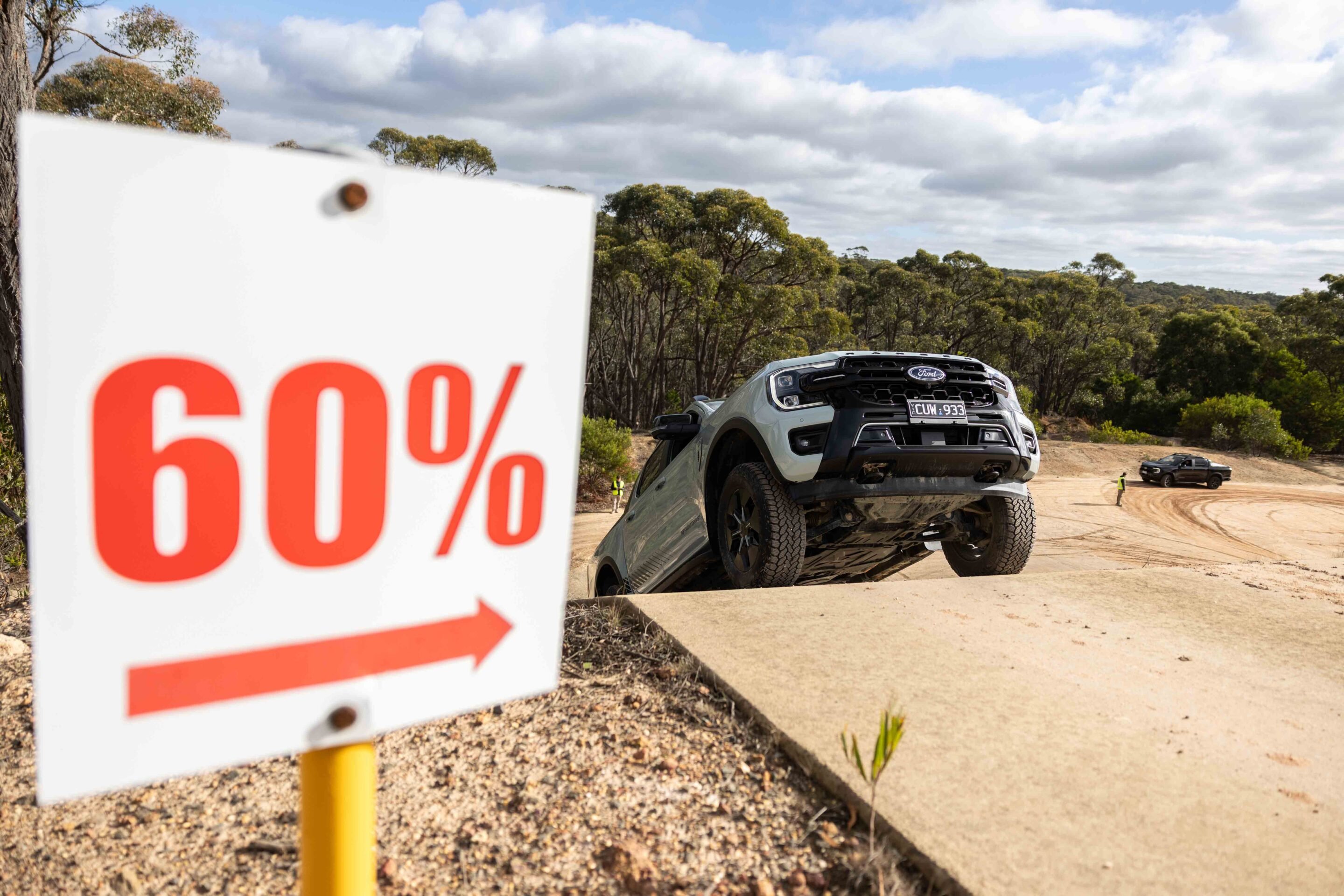
On the test loop at the Australian Automotive Research Centre, the Ranger PHEV clambered up 60 per cent grades in 4 Auto mode using EV power only. The petrol engine only joined in when needed, doing so quietly and smoothly. In really tricky situations you would obviously select low range and lock the rear diff, in which case the petrol engine would automatically fire up.
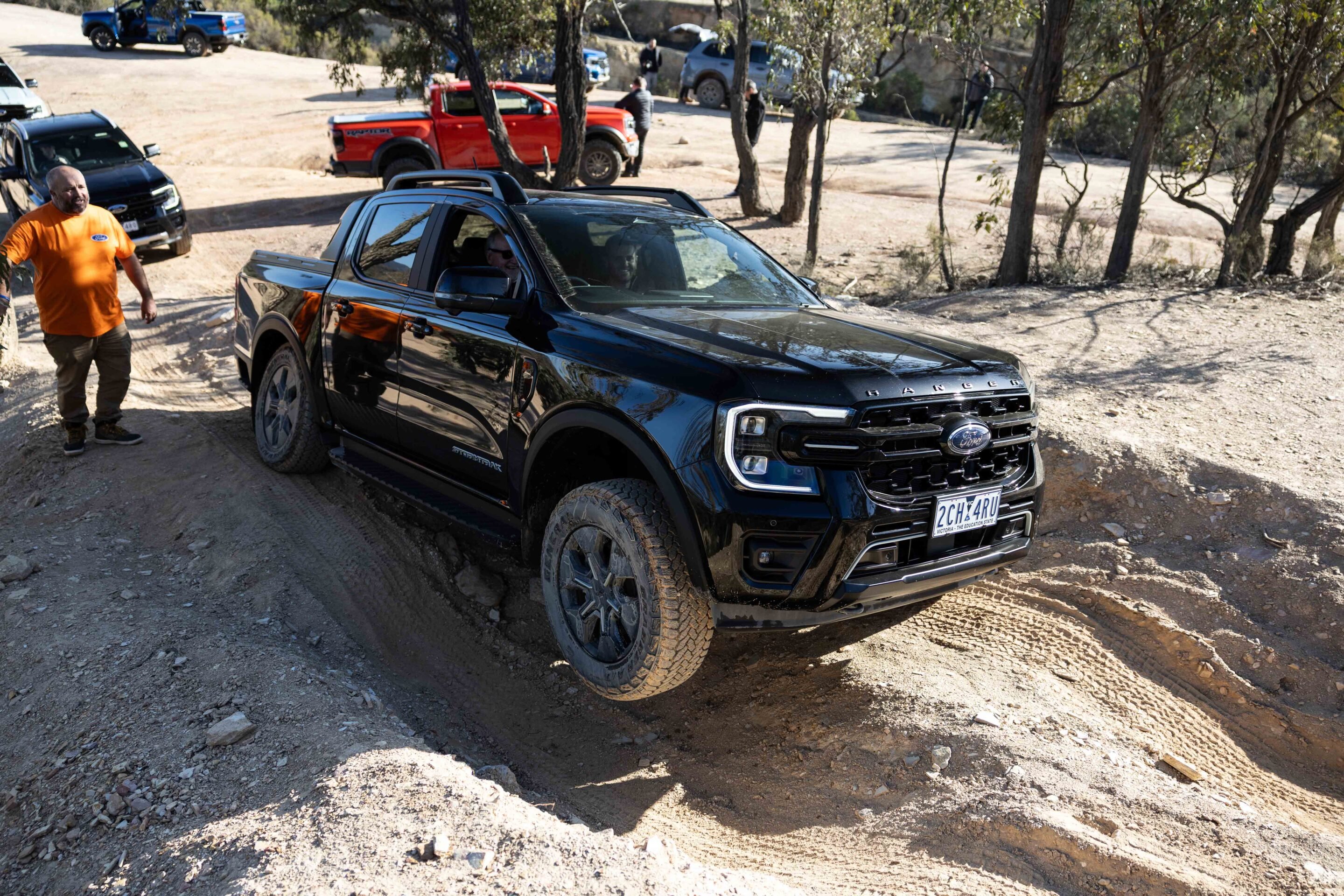
Hill Descent Control is excellent. Speed is adjustable in 1km/h increments via the cruise control buttons, and the system works quietly, without the whirring of older-generation systems. Forward camera vision is great for cresting hills, and Ford has thoughtfully added a washer jet to keep it clean.
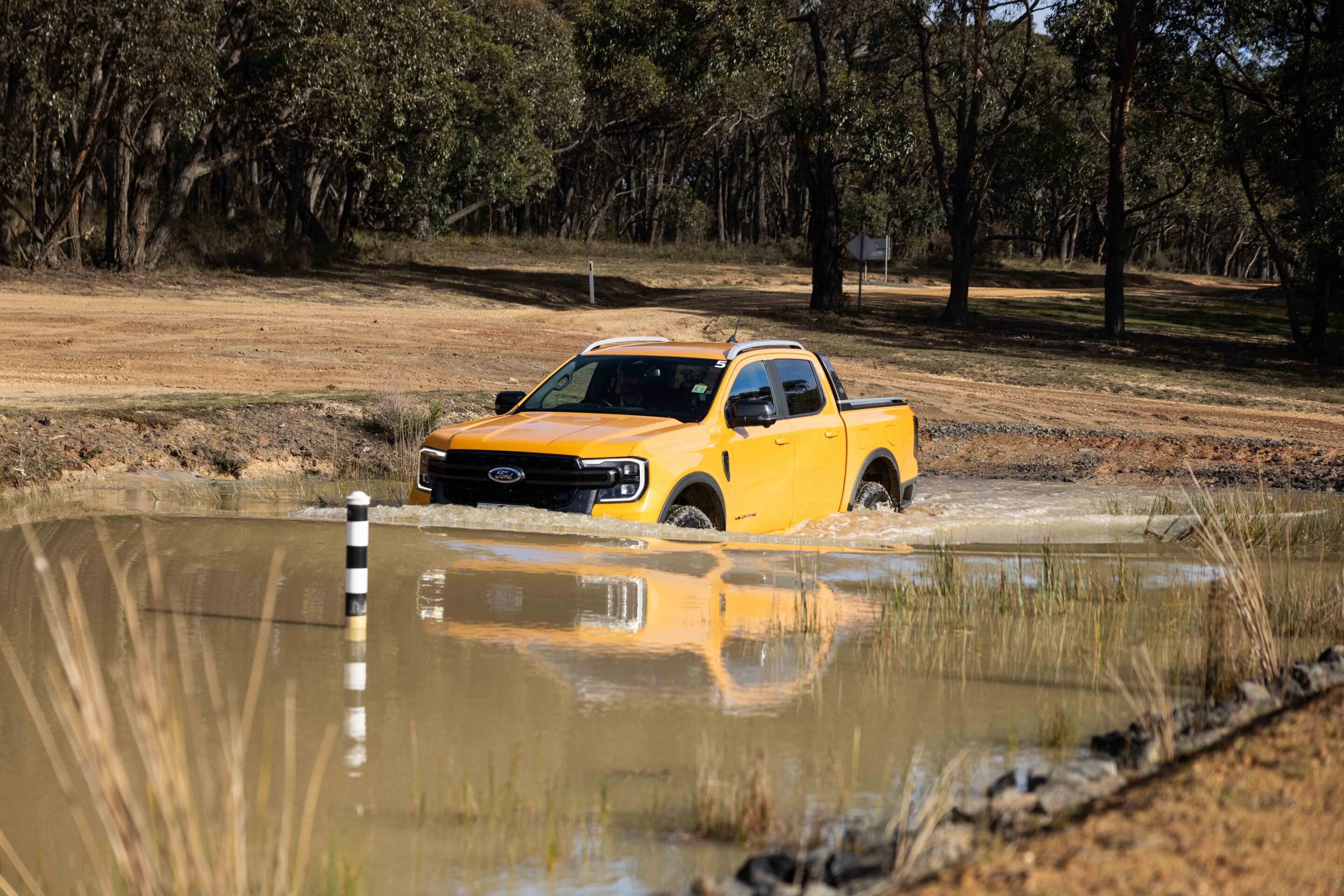
Like other Rangers, wading depth is quoted at 800mm. It should be noted that the engine air intake is forward facing just below the lip of the bonnet, so fitment of a snorkel would be a good idea for 4×4 touring.
There’s a unique joy to off-roading in near silence. With the windows down and the electric motor engaged, you hear only tyres on gravel and the sounds of birds and bush. It’s an entirely entertaining way to experience a track, and even when the electric engine kicks in, the Ranger PHEV is still quieter than the diesel variants, and it’s this refinement that many buyers will find attractive.
| Measurement | Value |
|---|---|
| Approach Angle | 28.9 – 30.2 |
| Ramp Over Angle | 19.6 – 20.4 |
| Departure Angle | 23.9 – 24.7 |
| Ground Clearance | 215 – 228mm |
| Wading Depth | 800mm |
Interior and exterior
Step inside and the Ranger PHEV feels familiar.
The interior mirrors that of the diesel Ranger, which means good ergonomics, supportive seats and a massive 12-inch portrait centre screen that thankfully retains physical dials for volume and climate control, making on-the-fly adjustments easier than systems buried entirely in menus.
New features include a dash-mounted button to open the fuel filler (necessary for the pressurised fuel system) and a charging port with a locking function on the passenger side.
Out the back you can’t remove the tub to fit a tray or canopy – the location of the battery, the integrated wiring and the 240V outlets rule that out – but the tub is otherwise well set up. There are cut-outs in the tub liner to accommodate long items, while a pair of adjustable top-rail tie-downs and a 31mm raised bed floor (to accommodate the battery) distinguish it from other Ranger trays.
Underbody protection has been fitted to prevent damage to the battery pack when driving off road, but take a peek beneath the passenger-side sill and you’ll spot an orange electrical conduit mounted on the outside of the chassis rail, and while it doesn’t hang low, it looks like it could be vulnerable to debris strikes – a small guard here would be welcome.
Model line-up and pricing
XLT – $71,990 drive-away
- Full-time 4WD with EV drive modes
- 17-inch alloy wheels, halogen lighting
- Cloth trim, manual seats
- Pro Power Onboard (6.9kW max output)
- Rear diff lock
- Adaptive cruise control
Sport – $75,990 drive-away
Includes XLT features, plus:
- 18-inch alloy wheels, LED lighting
- Leather-accented trim with heated front seats
- Power-adjustable driver’s seat
- Wireless charging
- Dark exterior accents
- Enhanced driver assist with Stop & Go
Wildtrak – $79,990 drive-away
Includes Sport features, plus:
- Matrix LED headlights
- Power roller shutter & roof rails
- Unique grille and sailplane design
- B&O 10-speaker premium audio system
- 360-degree camera
- Pro Trailer Backup Assist
Stormtrak – $86,990 Drive-Away
Includes Wildtrak features, plus:
- Chill Grey accents & exclusive wheels
- Flexible rack system and advanced cargo management
- Auxiliary switch bank (standard)
- Unique leather seats with Stormtrak trim
Specs
| Specification | Details |
|---|---|
| Price | $71,990 (XLT); $75,990 (Sport); $79,990 (Wildtrak); $86,990 (Stormtrak) |
| Engine | 2.3L turbo petrol four with 75kW electric motor |
| Capacity | 2.3L petrol + 11.8kWh battery |
| Max Power | 207kW (combined) |
| Max Torque | 697Nm (combined) |
| Transmission | 10-speed automatic |
| 4×4 System | Selectable full-time 4WD, dual-range |
| Construction | 4-door ute on ladder frame chassis |
| Front Suspension | Independent front suspension, double wishbones, coil springs |
| Rear Suspension | Live axle with leaf springs |
| Tyres | 17-18 inch (A/T optional) |
| Kerb Weight | 2527-2692kg |
| GVM (Gross Vehicle Mass) | 3500kg |
| GCM (Gross Combined Mass) | 6580kg |
| Towing Capacity | 3500kg |
| Payload | 808-973kg (no spare fitted) |
| Seating Capacity | 5 |
| Fuel Tank Capacity | 70L |
| ADR Fuel Consumption | 2.9L/100km (claimed) |
| On-Test Fuel Consumption | 8.3L/100km (predominantly highway; Auto EV/EV Charge modes) |
Verdict
Ford’s first plug-in hybrid ute is more than a stepping stone toward electrification – it’s a genuine dual-cab workhorse with real-world benefits.
Sure, it runs a much smaller-capacity battery than its obvious rivals, but the Ranger PHEV hauls, tows and climbs with ease. It brings strong performance, low fuel use and added refinement over diesel models, while keeping all the off-road gear intact.
While it doesn’t have quite the same electric-only range as some competitors, it makes up for it with a proper mechanical 4×4 system, full towing capacity (3500kg) and a well-integrated hybrid driveline. The onboard Pro Power system adds serious appeal for campers and tradies needing AC power on the worksite or at the campsite.
Until full electric utes catch up on range, and a comprehensive nation-wide charging infrastructure is in place, the PHEV powertrain looks to be the sweet spot – and Ford’s execution of it in the Ranger is very well resolved.
Of course, the Ranger PHEV will not be for everyone, particularly those who want to fit a tray or canopy, but despite not having the electric range of some of its competitors, including the new GWM Cannon Alpha, there’s no doubt Ford has done its homework and has developed a compelling hybrid ute for those looking at an alternative to diesel ute offerings.
The Ford Ranger Raptor has claimed its third consecutive victory at the iconic Finke Desert Race, winning the Production 4WD class.
While the result may have seemed inevitable – given that the only other vehicle in the Production 4WD class was also a Ranger Raptor – it remains an impressive feat due to the demanding nature of the 460km track that stretches from Alice Springs to Finke and back again.
The winning Ranger Raptor was driven by father-and-son duo Brad and Adam Lovell. The experienced Americans completed the race in a record-breaking time of 5:39:33.279, finishing ahead of the Ranger Raptor piloted by Geoffery Pickering (6:49:40.111). Overall, they placed an impressive 43rd out of 100 competitors.
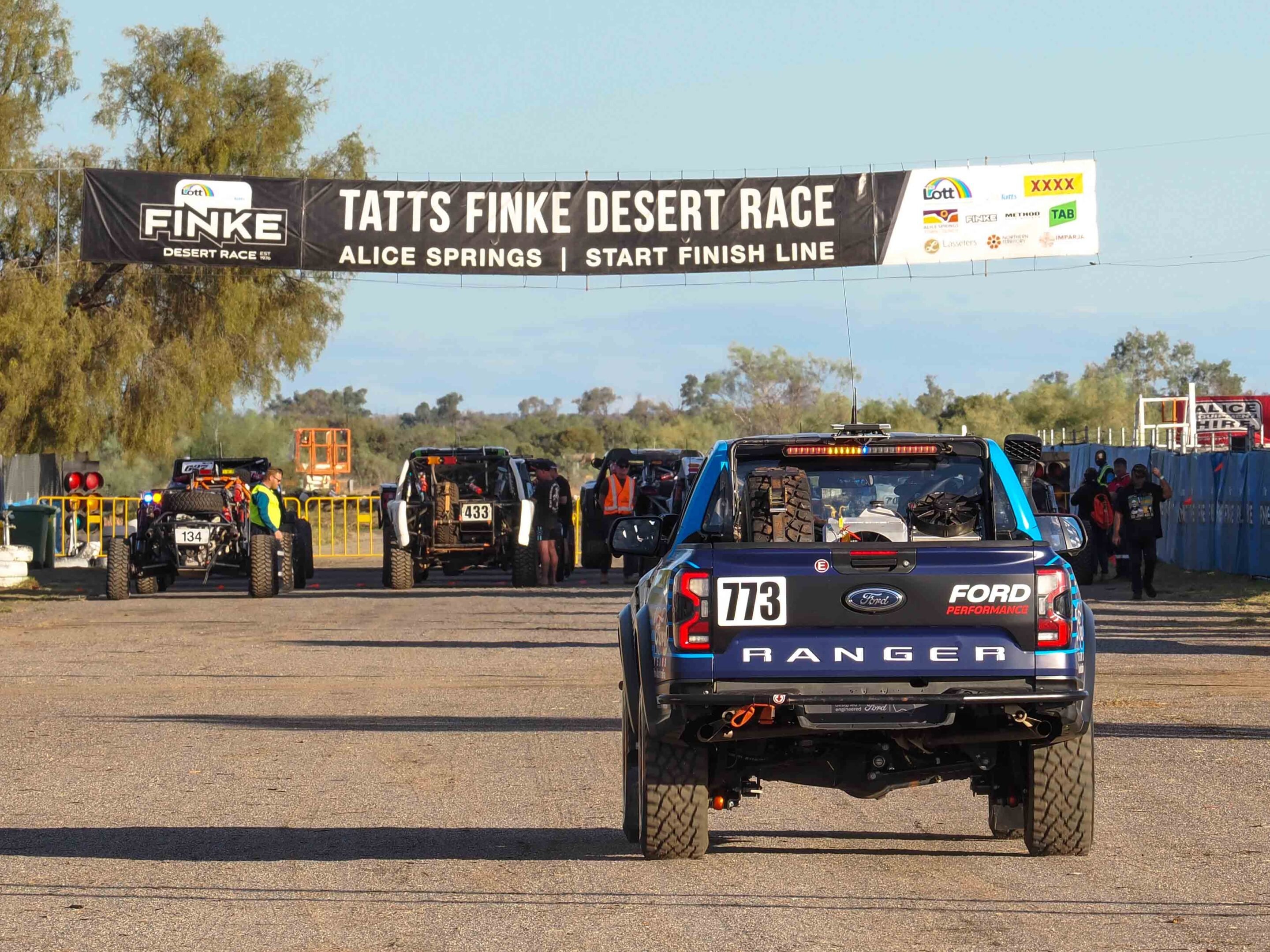
“Getting the third win here at Finke, especially on such a tough track and setting a new class record, is just incredible,” said driver Brad Lovell. “This Ranger Raptor is an absolute weapon. It handled everything we threw at it, proving its toughness and performance. I couldn’t be prouder of the team and this truck.”
Mark Rushbrook, Global Director at Ford Performance, added: “To see the Ranger Raptor achieve a three-peat at Finke is phenomenal. This truck is a testament to Ford Performance engineering and its ability to deliver extreme capability and durability in the harshest environments. Its undefeated record across Baja and Finke speaks volumes about its DNA.”
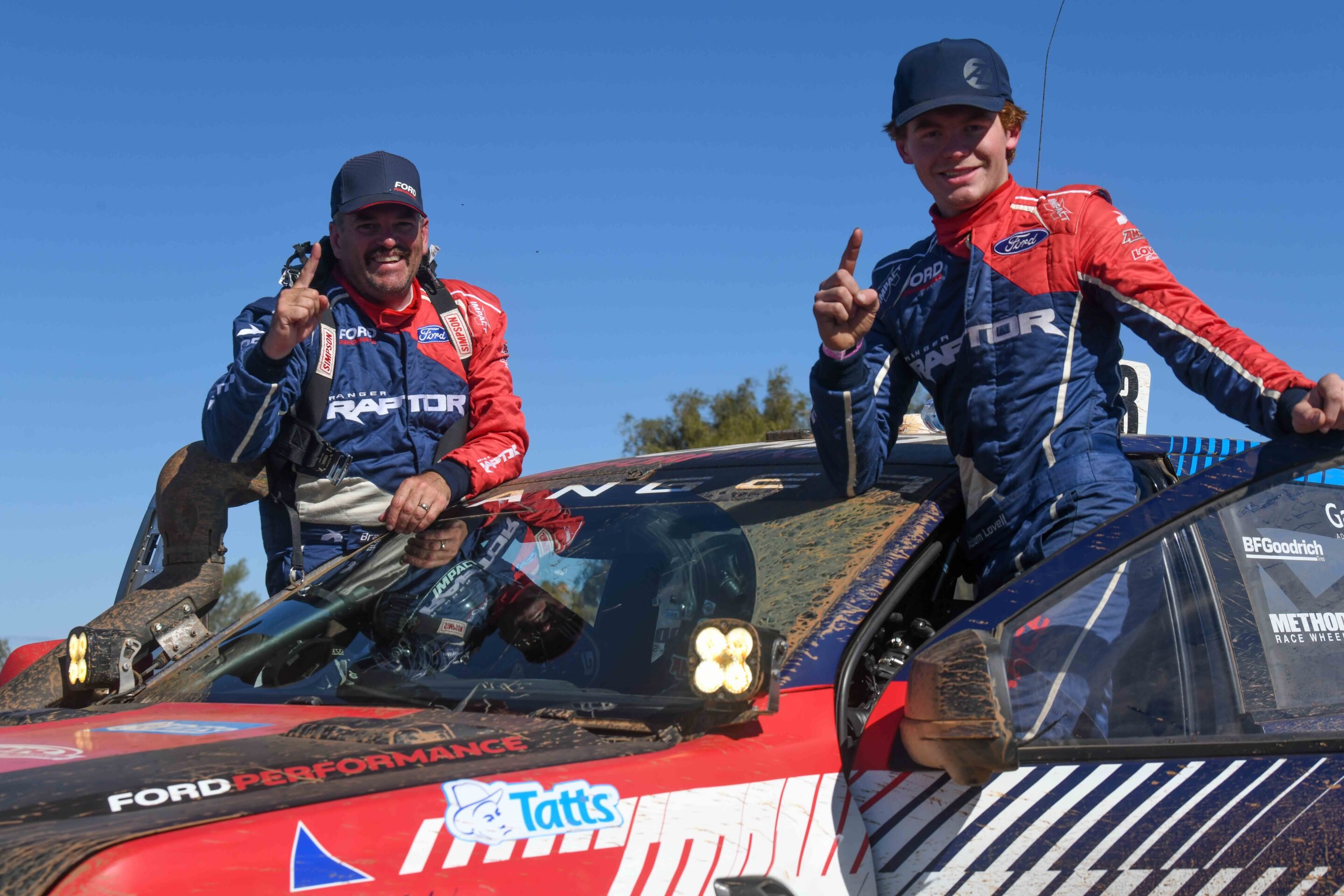
This result means the winning Ranger Raptor remains unbeaten in every event it has entered (per class). It also marks the vehicle’s third consecutive win at Finke (2023, 2024, and now 2025), following a class win at the 2022 Baja 1000.
“Designing a truck that can perform like this in production class racing is what we strive for,” said Justin Capicchiano, Special Vehicle Engineering Program Manager.
“The Finke Desert Race is the ultimate test, and for the Ranger Raptor to not only win three times in a row but also set a new record shows the strength and resilience built into the race-prepared vehicle.”
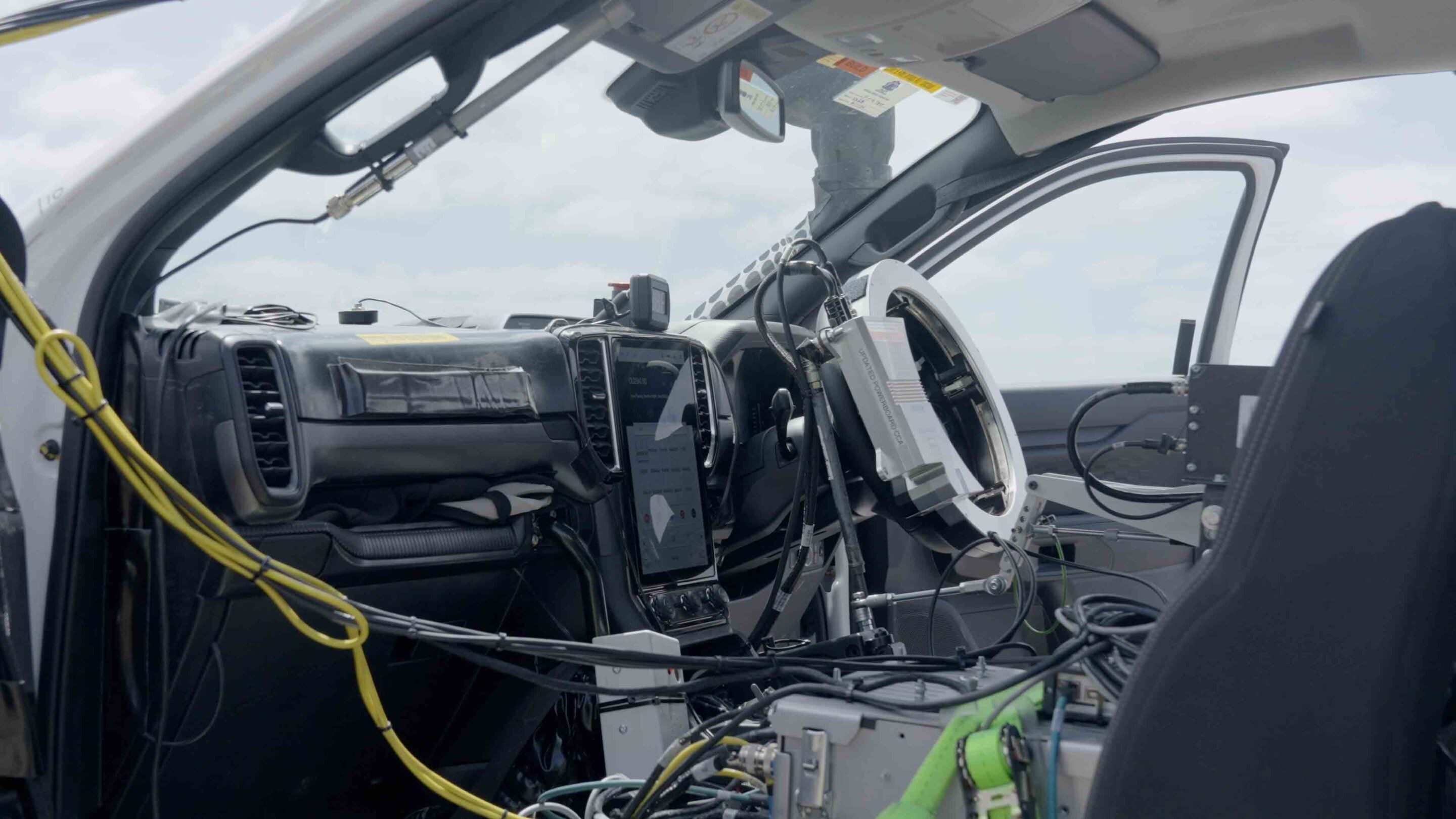
Ford has employed a robotic driver to put its upcoming Ranger Super Duty through a series of brutal durability tests.
To assess the robustness of the vehicle’s engine mounts, body mounts, joints, and connectors, the Ranger Super Duty was loaded to its maximum gross vehicle mass (GVM) of 4500kg and subjected to relentless, around-the-clock testing by an autonomous robotic test driver – including on the spine-shaking Silver Creek track.
Located within the You Yangs Proving Ground in Victoria, Silver Creek features 300 randomly placed bumps of varying shapes and sizes, replicating and condensing years of real-world punishment.
“Silver Creek is our toughest man-made durability track,” said Justin Capicchiano, program manager for Ranger Super Duty. “It stressed the Ranger Super Duty from the wheels to the roof, simulating the wear and tear you’d typically experience over a decade of driving on the world’s harshest road conditions.
“The forces hammering through the truck when unladen are immense, but when it’s loaded to its maximum GVM and tested on Silver Creek, they become even more brutal. This is a critical test for a truck designed to take on the toughest jobs and most extreme adventures in the harshest environments,” he added.
Set to rival the venerable 79 Series LandCruiser, the Ranger Super Duty is expected to launch in Australia in the first quarter of 2026.
The heavy-duty ute will be powered by a 3.0-litre turbo-diesel V6 producing 184kW and 600Nm, paired with a 10-speed automatic transmission. As noted, it will offer a 4500kg GVM and an 8000kg gross combination mass (GCM). It will be available in all current Ranger body styles, including double-cab, extra-cab, and single-cab variants.
While it will retain the standard Ranger cabin, the Super Duty will feature all-new front sheetmetal, including revised guards, bonnet, and grille. Ford is also working with Safari Engineering to develop a snorkel for the vehicle. Additional features will include a steel front bumper and underbody protection plates.
A 130-litre fuel tank will run the length of the vehicle, while the chassis will be reinforced with thicker rails, upgraded suspension mounts, box brackets, and tow bar mounts. It will also receive uprated axles and integrated onboard weighing scales. The XLT variant, arriving mid-2026, will come fitted with unique alloy wheels.
Early pricing estimates suggest the Ranger Super Duty will land around the $90,000 mark.
Out in the heart of the Hunter Valley, a quiet automotive milestone just thundered past the million-kilometre mark – and it’s not coming from some overbuilt American import or flash European badge. No, this story belongs to Mahindra. And it’s one hell of a yarn.
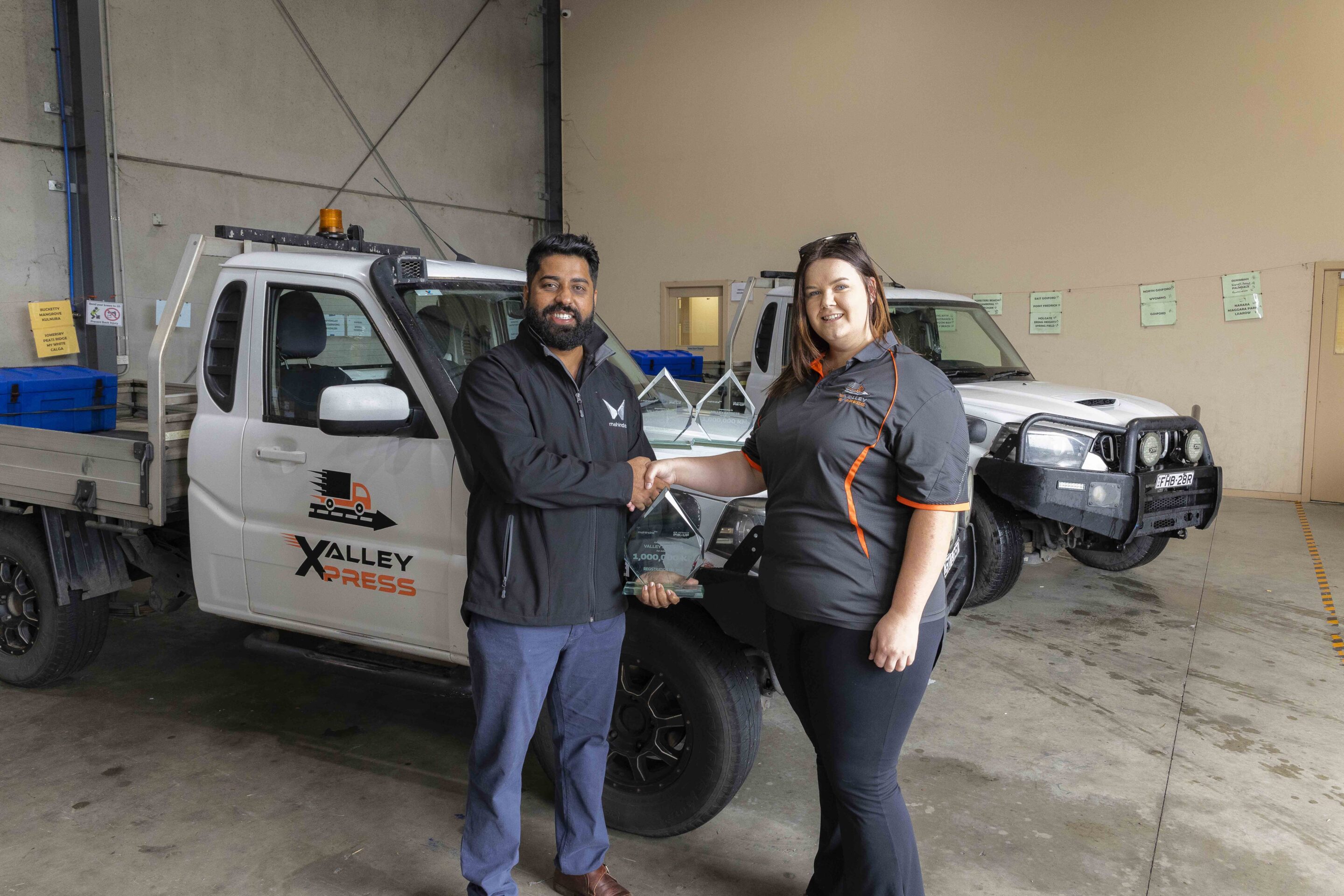
Valley Express, a no-nonsense freight outfit based in Rutherford, NSW, has turned heads across the country by clocking more than one million kilometres on not one, but three of its hard-working Mahindra PikUp utes – and they’re still going strong.
Let that sink in: more than 20,000km per month, per ute, for four straight years. That’s as much driving as most Aussies do in a year – every 30 days.
Valley Express isn’t some cushy city courier. These folks specialise in urgent, long-haul deliveries, often servicing the mining industry and sending their fleet as far as Alice Springs, Far North Queensland and Western Australia, from their Hunter Valley base.
From satchels to massive mining parts, the pressure’s always on. That kind of workload would chew up and spit out most vehicles. But not the Mahindra PikUp.
“We’ve been really pleased with the Mahindras,” said Megan Hinds, Valley Express director. “They’re reliable, they get the job done, and the value for money is unbeatable. You’re looking at two PikUps for the price of one of the big-name brands.”
Every ute gets a full service weekly by the local team at Hunter Valley Mahindra. It’s preventative maintenance done right – Aisin gearboxes swapped every 250,000km, tyres and brakes as needed. But the engines? Still original. So are the fuel injectors, turbochargers, alternators and power steering pumps.
To mark the occasion, Mahindra Automotive Australia turned up at Valley Express with custom glass plaques and a heartfelt thank-you.
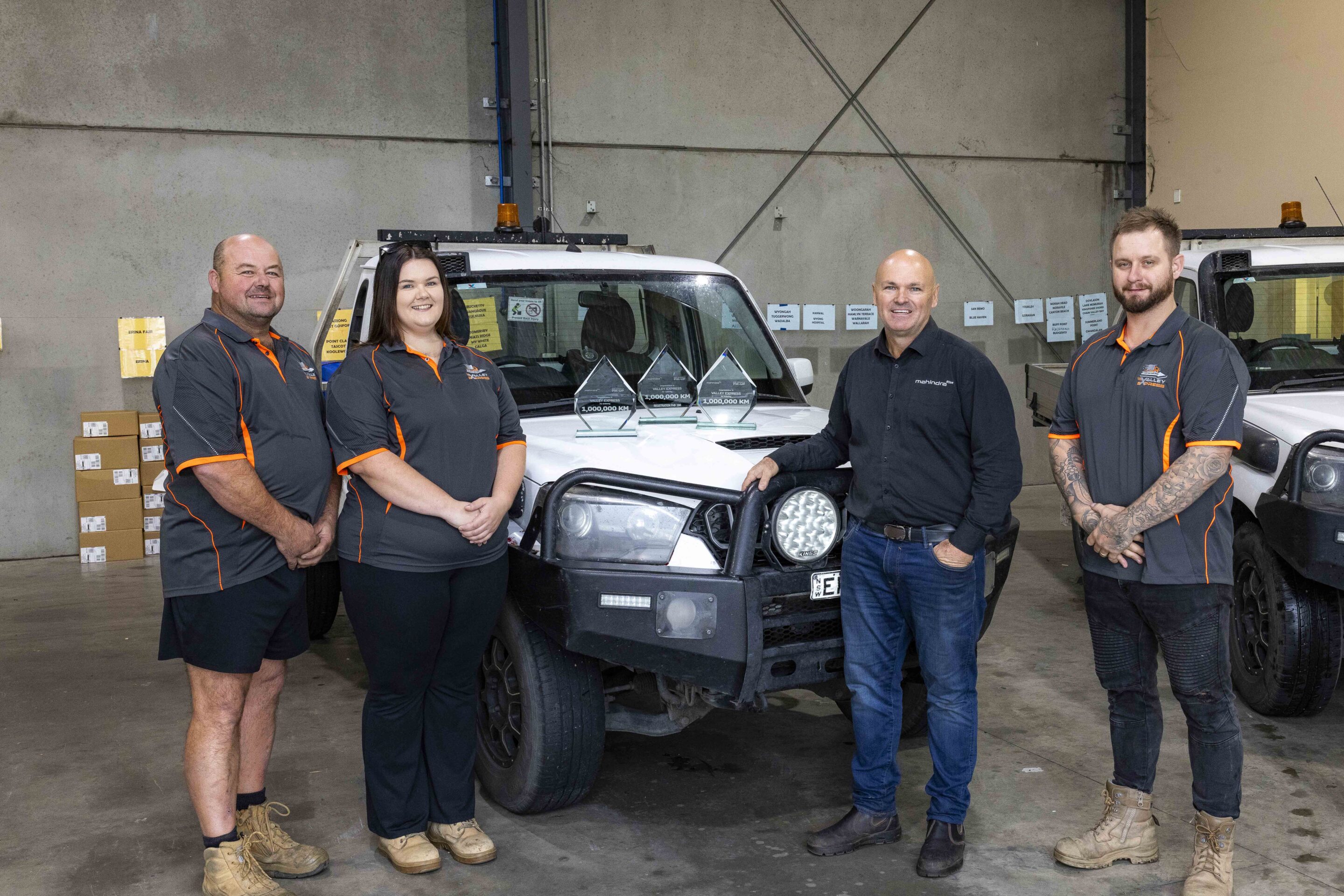
“This kind of longevity doesn’t happen by accident,” said Mahindra’s auto sales manager Shivank Bargoti. “It’s what the PikUp was built for – dependable performance and rugged value for real-world Aussies.”
In an age where utes are often sold more on lifestyle branding than bush cred, the Mahindra PikUp is proving its worth where it counts: On the job, under pressure, and across Australia’s harshest terrain.
It might not be the flashiest badge on the block, but for tradies, regional businesses, or anyone chasing dependable performance without the showroom premium (total operational cost is about 30 percent less than some other brands, meaning cost per kilometre has beaten all expectations), the Mahindra PikUp is making a persuasive case.
It’s a reminder that true 4×4 toughness isn’t about how shiny your wheels are – it’s how many kilometres you can clock without letting your team down.
And if three utes cracking a million kilometres doesn’t prove that, nothing will.
In this day and age of high-tech, computer-controlled, electronic diagnostic capabilities of modern 4x4s, it makes sense… and cents… to carry a diagnostic tool for roadside troubleshooting. But wait, there’s more.
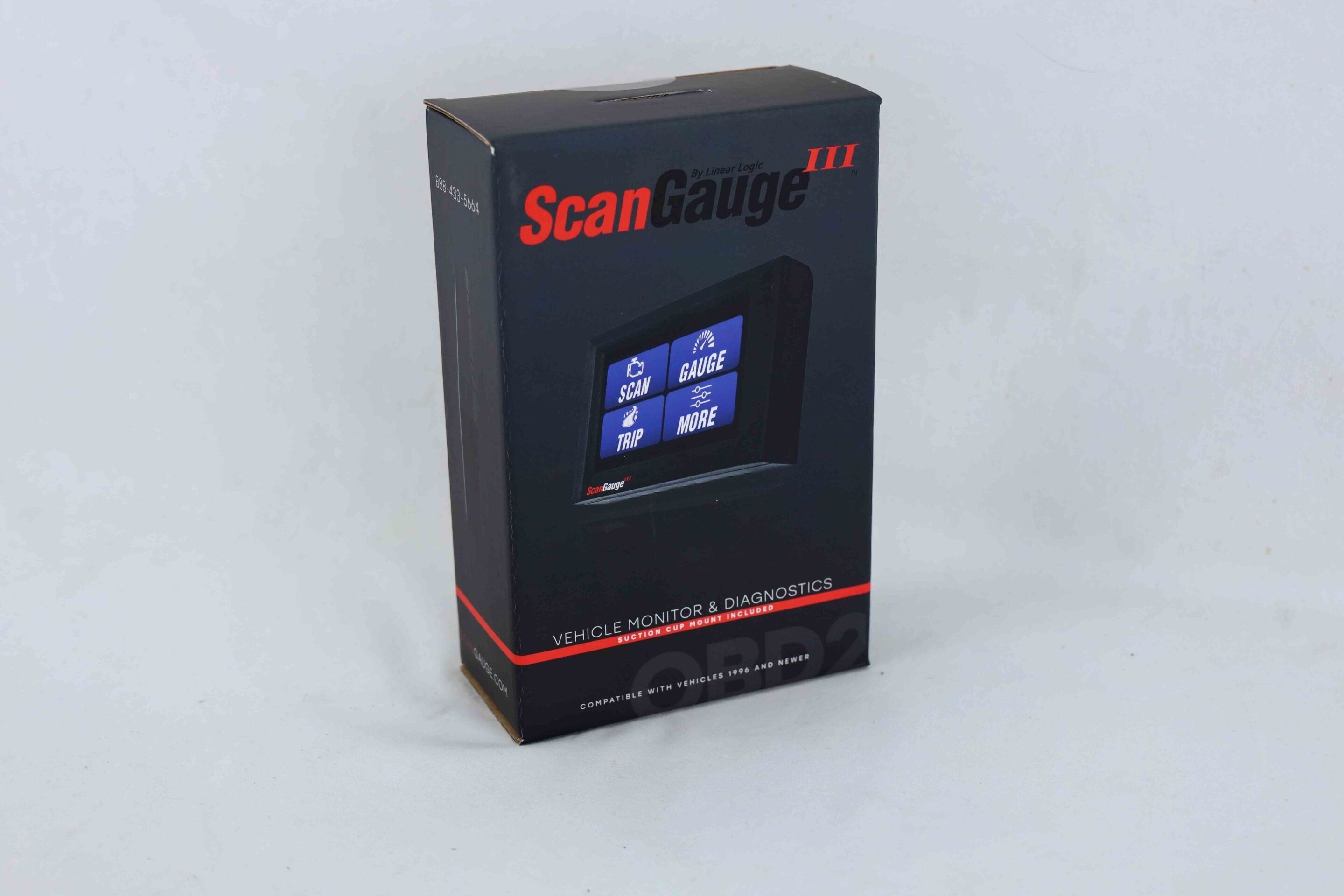
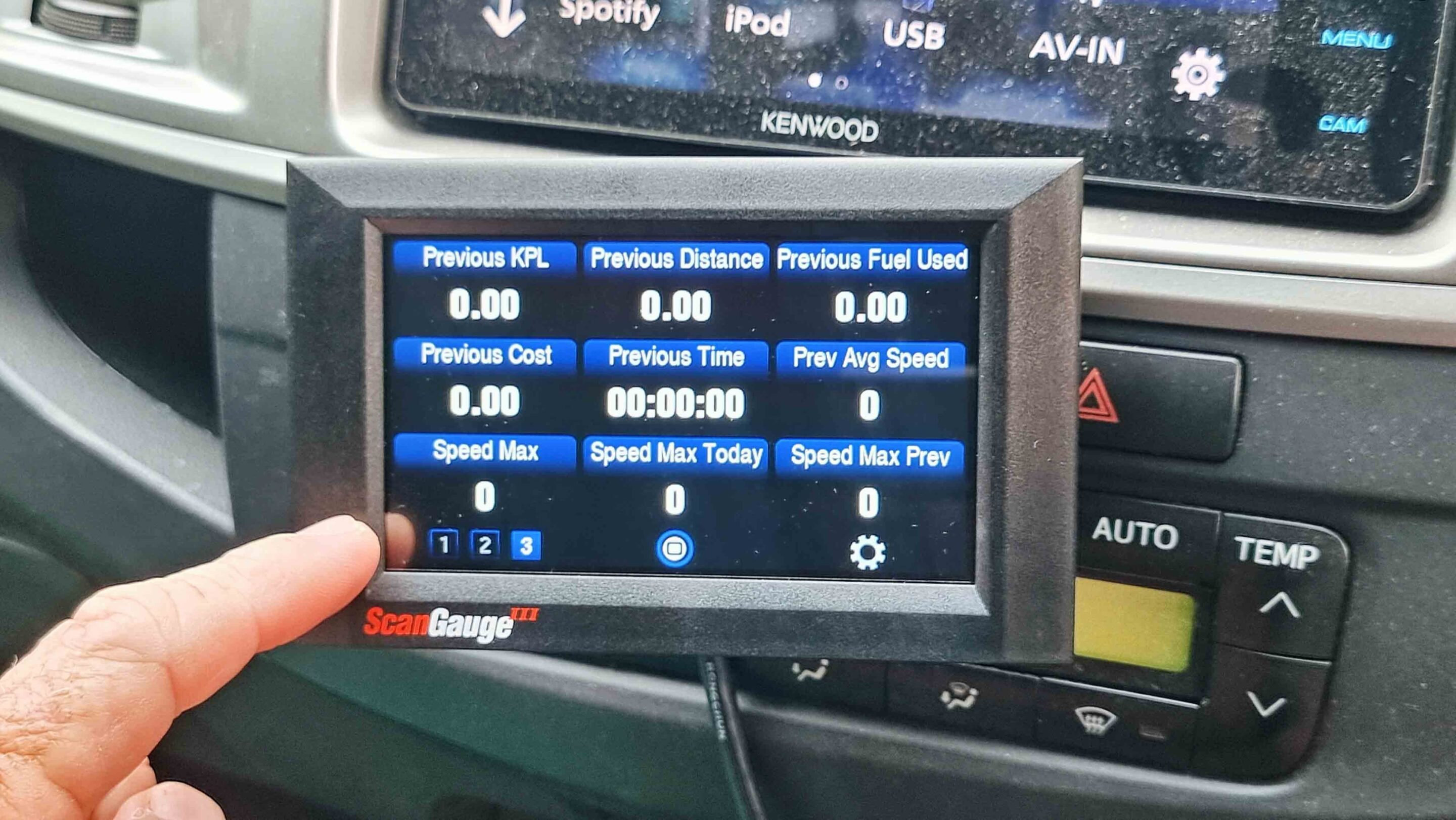
Not only is my new toy – okay, let’s call it a tool – capable of scanning my 4×4 for error codes, telling me what the code is and clearing that code, but it’s also a powerful set of gauges that’ll tell me everything about my vehicle while driving. For instance, ScanGauge 3 will advise me on my instant and average fuel consumption, distance to empty, MAF sensor readings, engine and air intake temperature, trip average speed, trip cost, throttle position sensor and more.
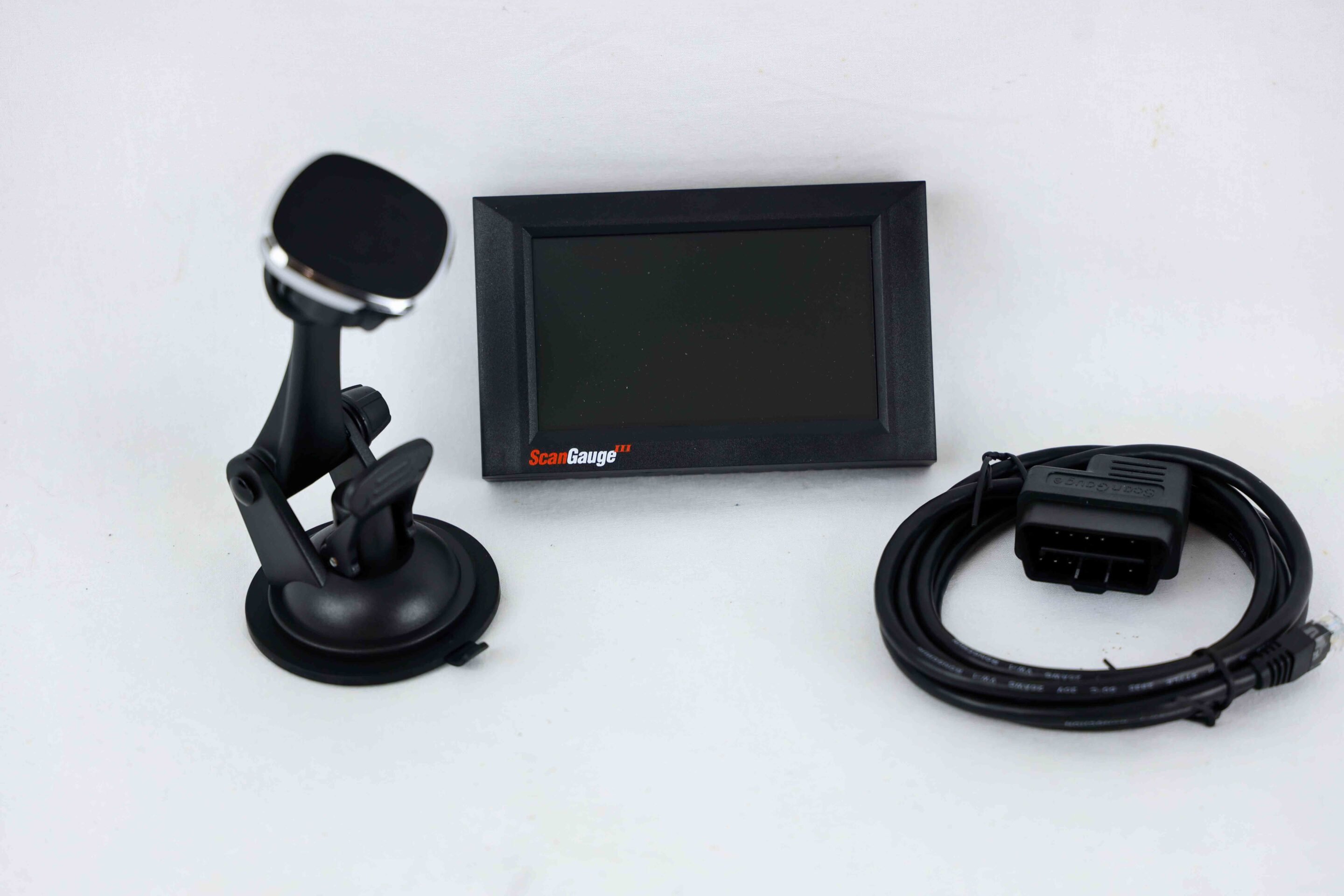
Vehicle-specific gauges can also be added to track transmission and oil temperature, extra trip data and other information. Once the setup is complete, you only need to scan your vehicle to access these extras – it’s automatic and it’s easy.
The capacitive touch screen is customisable for colour, various alarms and configuration of gauges, with up to nine gauges per screen to allow for personalisation. With visual and audible alarms, plus the ability to preset parameters, you won’t need to always watch the gauge. If something is amiss, it’ll let you know immediately with all the information required to assess the situation.
Multi-vehicle
Initially, I’ll be using my ScanGauge 3 in my 2013 turbo diesel HiLux. When I head out on a big trip in my home-on-wheels 4×4 converted HiAce campervan, I unplug the gauge from the HiLux OBD2 port and plug it into the HiAce port. Plus, I can also plug into my wild customised 4×4 Holden One Tonner – one man can never have too many 4x4s! While I’ll have to preset a few parameters on each vehicle to make the most of the tool, the same gauge can be used in most vehicles.
If, by chance, I’m out and about and find a stranded vehicle, I can plug the ScanGauge 3 into that vehicle’s OBD2 port (most vehicles built from 2010 onwards have one) for a diagnosis and to clear any error codes. That’s not to say we will be able to fix or rectify a major problem, but at least we might be able to make the vehicle driveable, to enable it to get to a mechanic.
Clearing not fixing
One thing we all need to remember when searching and clearing error codes is that by clearing the code, we are not always fixing the underlying problem. At times, when an error is cleared, the fault will not reappear. But, say it originated from a wet or bad contact in the wiring system and that moisture has dried out, clearing that code will more than likely ensure it does not reappear.
If the error is something major, the error code will most likely reappear. At least with ScanGauge 3, it’ll explain the error code, which points you in the right direction when searching for the physical fault. If you can then fix the actual problem, then bingo, the gauge is worth its weight in gold. Even if you can’t fix the underlying fault, having this testing and diagnostic tool on board is priceless.
Reducing anxiety
I’ve been reading the ScanGauge 3 outputs for fuel economy and distance to empty on both vehicles to date. It’s been a boon in the HiAce, as it sports a 175-litre fuel tank and the readout on the dash’s fuel gauge thinks it’s still operating with a standard small tank. Knowing exactly how much fuel I have on board and how much further I can push on through remote areas with few fuel stops is perfect, and it minimises stress and anxiety levels knowing the amount of fuel I have left.
No tools are required to fit this gauge. It’s simply a matter of plugging into your OBD2 port, running the 1.8m cable up to the dash or screen, or where you want to fit the gauge with the supplied suction mount. Power is taken from the OBD2 port, so no batteries are needed. Best of all, the gauge automatically determines your vehicle’s protocol and connects ready for use. That means there is nothing for the user to program in order for the unit to start working on your vehicle.
For the price of $445 (RRP), I can’t see why a tool like this shouldn’t be included in the list of accessories we add to our new 4x4s.
Our recent drive of the Defender D350 was done as part of the Defender Experience offered by Land Rover Australia to existing and potential customers and owners.
It’s a paid four-day experience on Arkaba Station in the stunning Flinders Ranges where participants not only get to drive the Defenders on the steep and rugged tracks of the property but also get to enjoy the luxury offerings of the station while learning about the land, its history and what the current owners of Arkaba are seeking to achieve.
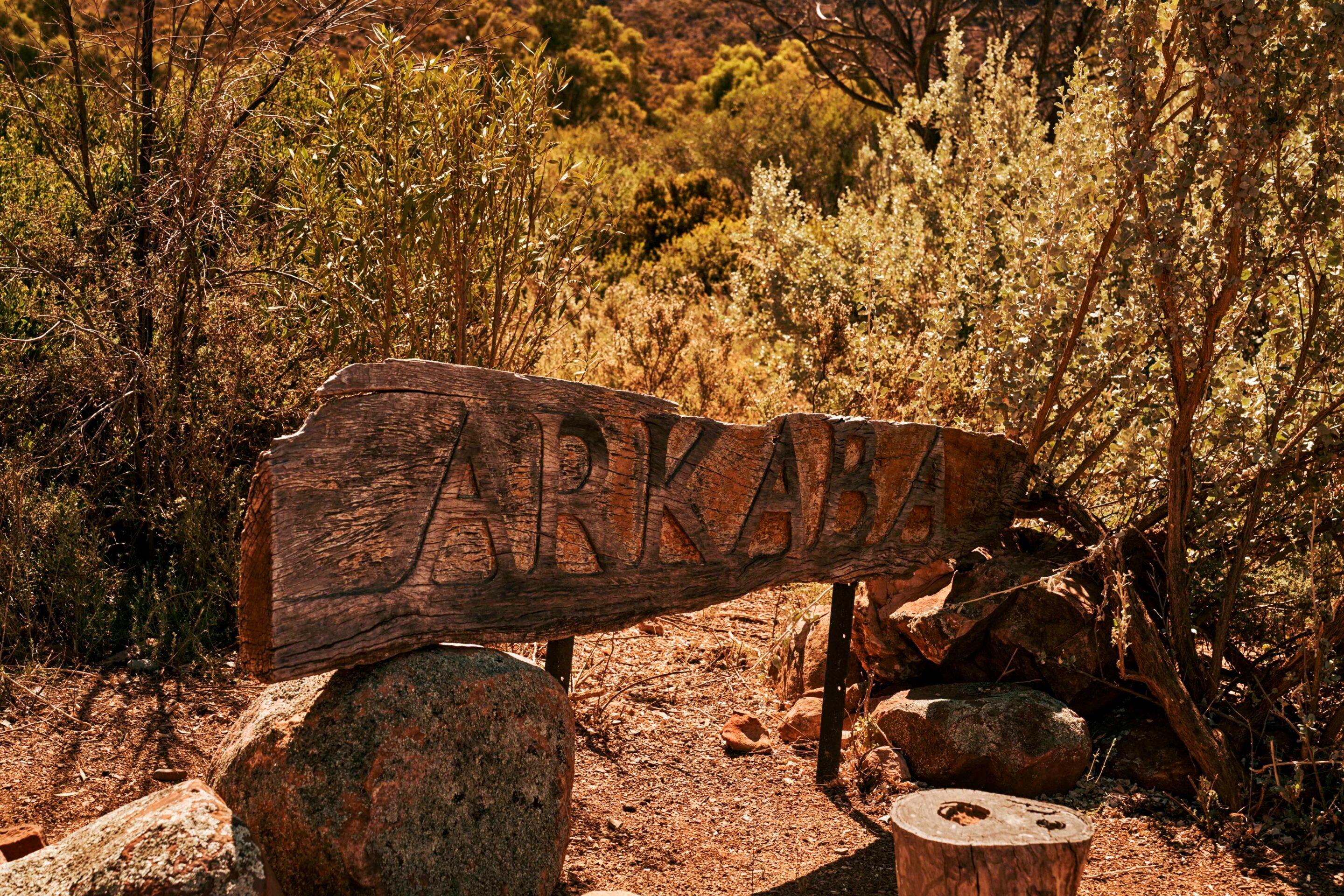
Arkaba Station is just a short drive from Hawker in South Australia and like most settled land in the Flinders Ranges, it was once a pastoral property running sheep in the harsh conditions. Today it is owned by Wild Bush Luxury, a member of Luxury Lodges of Australia, and farming has made way for conservation and low-impact visitation to allow the land to return to its pre-farming state.
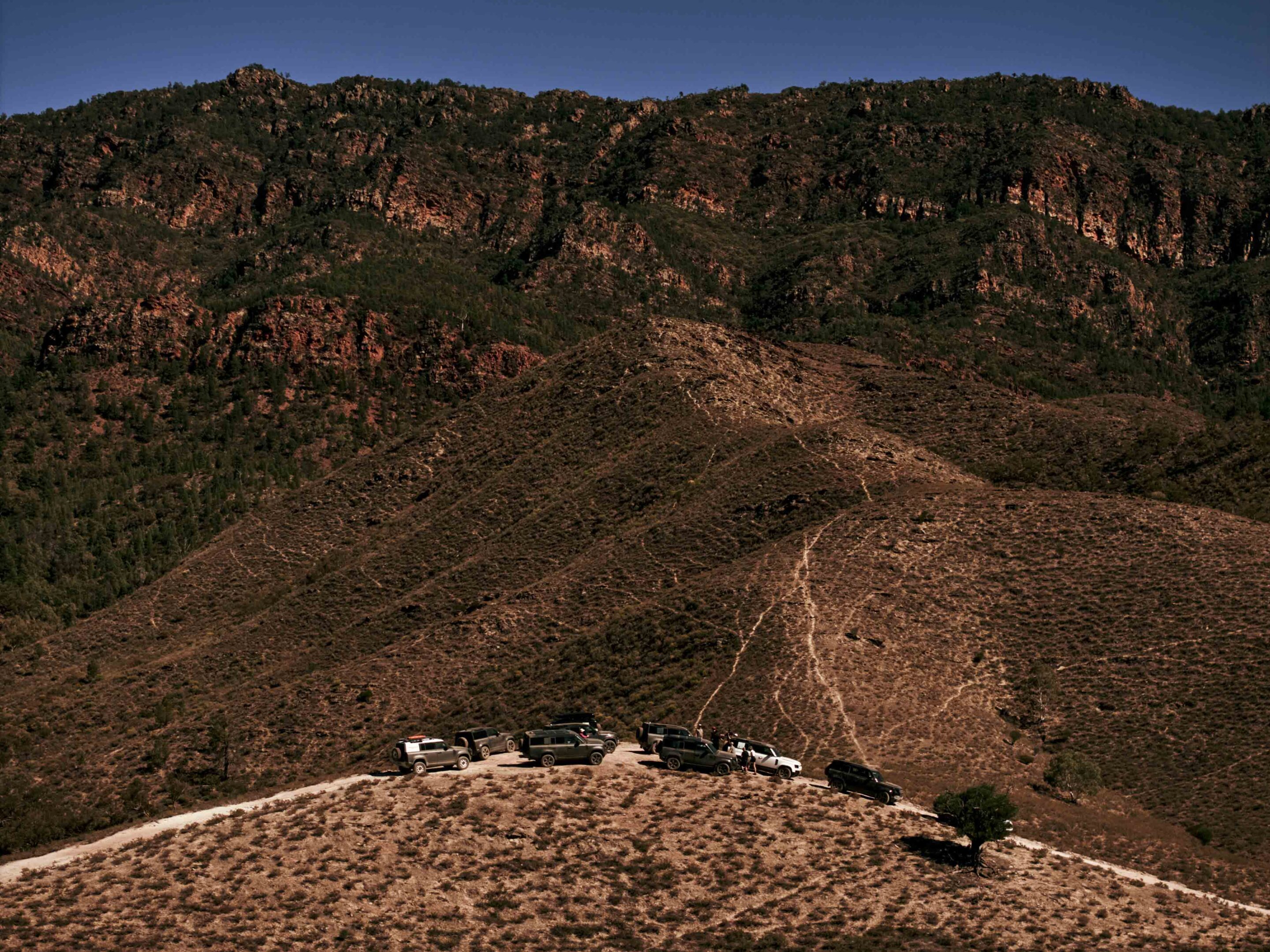
The sheep are long gone and goats, rabbits and other feral non-native animals are being eradicated as the team has turned to conservation and seeks to return the land of Arkaba back to what it was prior to settling and the damage caused by stock.
This conservation project includes maintaining fences only to keep ferals out, not stock in, replanting native trees, shrubs and grasses and reintroducing species that were thought to be lost to the area.
A visit to Arkaba can include guided walks where you learn about the country and what is being done to restore it, and guided drives to mountain ranges and ridgetops where you will enjoy spectacular sunsets (or sunrises if you are keen) and wildlife spotting.
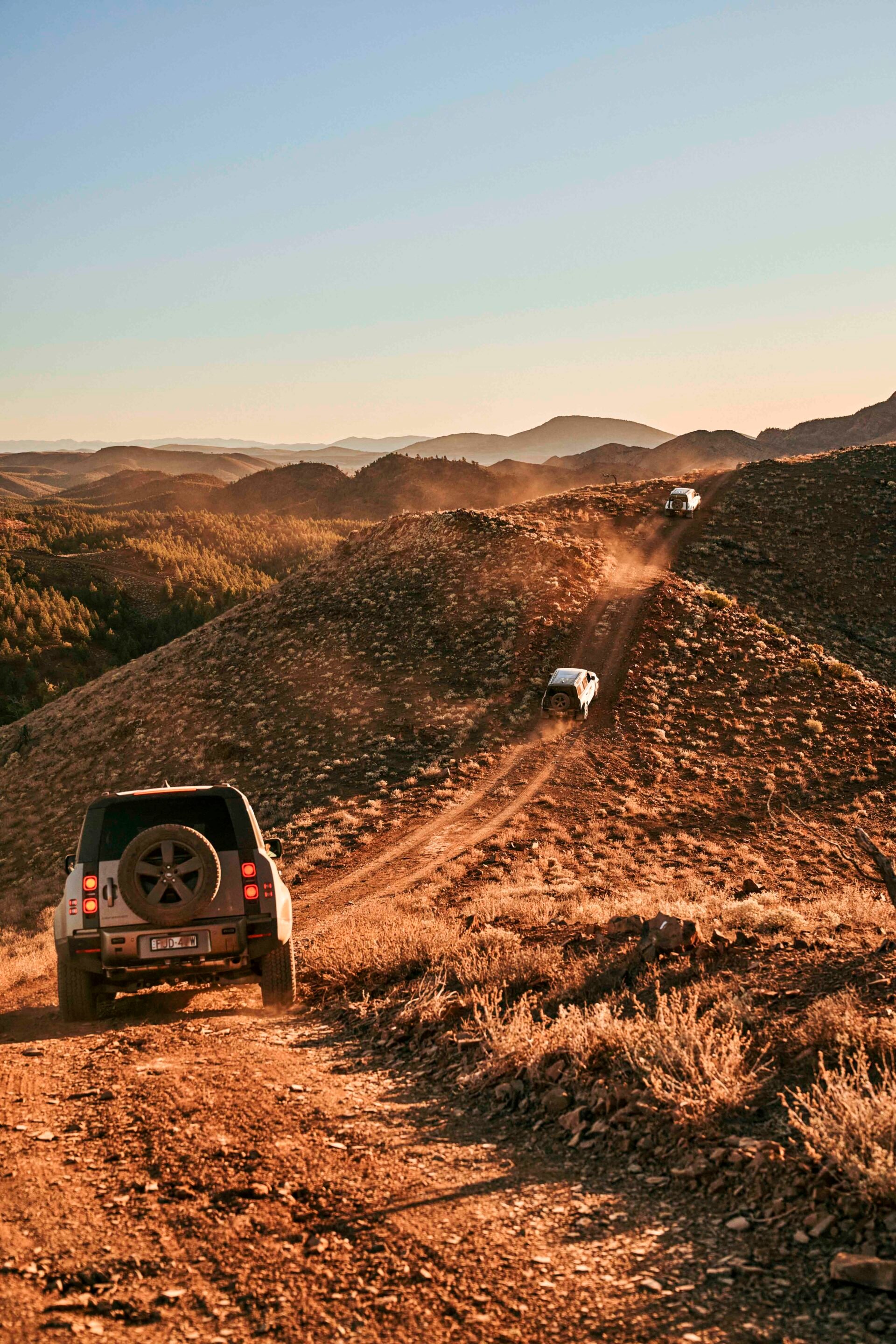
The Arkaba Homestead has been beautifully restored and includes just five rooms for guests so the numbers there at any one time are very limited. The homestead has a full kitchen with an excellent chef to prepare meals featuring local produce and native ingredients. Local South Australian wines are also a key part of the experience.
Away from the homestead are remote camps that are used when on multiday walks or guided 4×4 tours . Unfortunately there are no self-drive tours of Arkaba available to four-wheel drivers.
While you might not be able to drive your 4×4 around arkaba Station unless you are on a Defender Experience trip, a surefire way to fully experience the property and all it has to offer is by joining the three-day walks that run through the cooler months of March to October, which are the peak times to visit the Flinders Ranges.
Led by experienced and informative guides, the walk takes you from Wilpena to Arkaba taking in the sights, sounds and smells of the Flinders, where you’ll learn about the terrain, flora and fauna, as well as the conservation work being done. It uses the camps set up on the station and your bags and clothes are transported to each camp by vehicle so you don’t have to carry everything yourself. The walk is graded as moderate, meaning it should be accessible to most able walkers. The Arkaba Walk finishes at the homestead with accommodation in the luxury rooms and a farewell feast.
On our Defender Experience at Arkaba, we spent our first night at the homestead where, after a drive to a highpoint to watch the sun set, we learnt about the history of the property and the work being done there, which was followed by a delicious meal.
Day two saw us exploring the ranges and tracks before stopping at a remote campsite where accommodation was in swags in open-ended shelters that looked out onto the bush. Again, the meal was fantastic and we enjoyed it out in the open while the last rays of the sun disappeared with a golden glow on the steep rocky ranges.
After an open-air shower in the morning and a short but informative bushwalk, we were back in the Defenders exploring the furthest reaches of the property including its border with Wilpena National Park, where we were in the shadow of the amazing Wilpena Pound.
An interesting part of this day’s drive was where we stopped at a high point in the terrain that offered a view of the adjoining property that is still running stock as Arkaba had in the past. The difference between the two properties couldn’t have been more stark with the dry brown dirt of the pastoral property contrasting to the much greener and lush scrub on Arkaba. This demonstrates the great work being done by the team at Arkaba in restoring the land there.
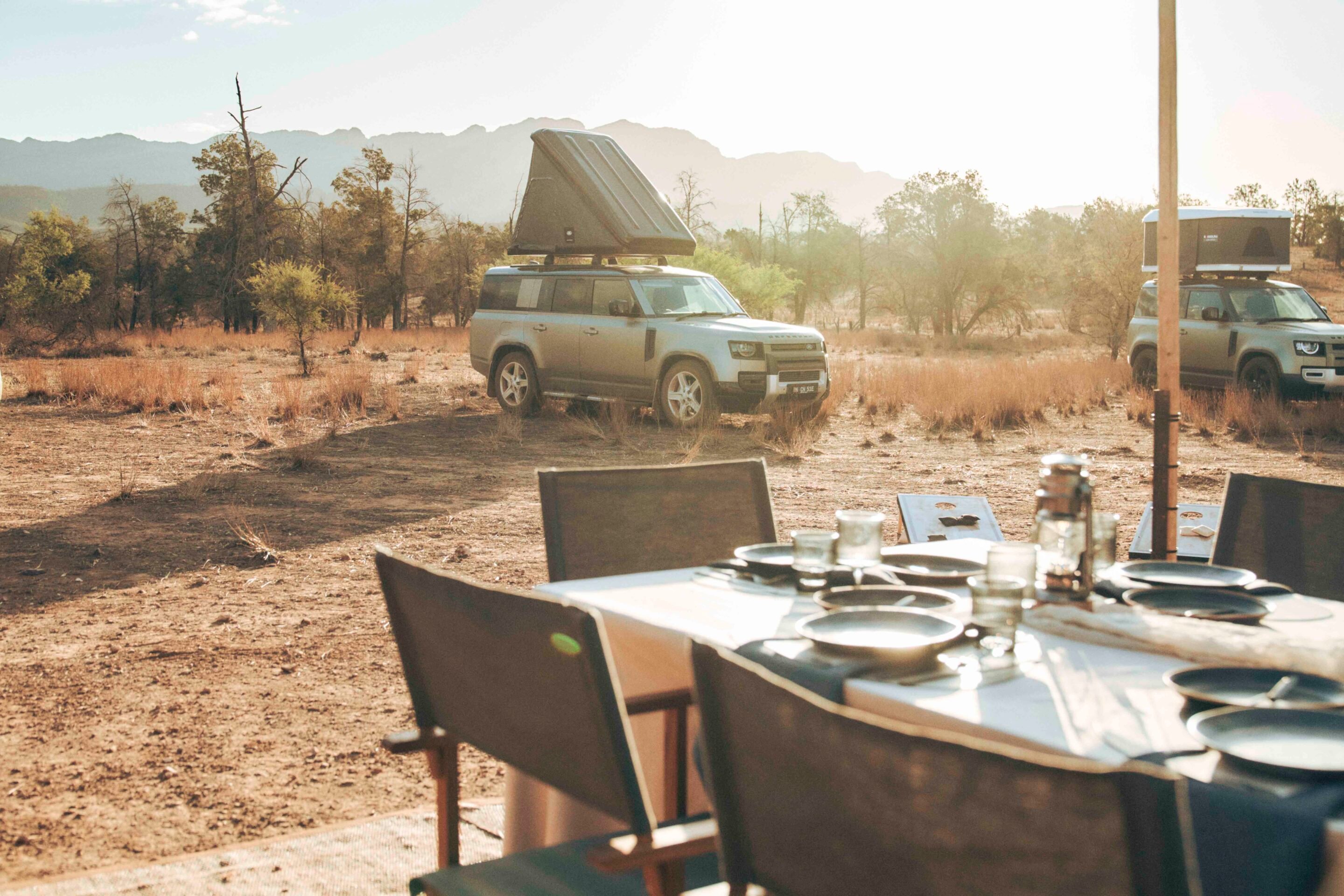
Our last night on Arkaba as part of the Defender Experience was a huge camp with large tables and plenty of food and refreshments. Again we slept under the stars, although this time it was atop the Defenders in rooftop tents. Certainly a great way to wrap up a few fabulous days.
You can do the Defender Experience at Arkaba as a standalone trip or as part of an extended stay in the Flinders Ranges, or when passing through on a longer adventure.