
FROM editing the famous Petersen’s 4-Wheel & Off-Road magazine to fronting Dirt Every Day on The Enthusiast Network, Fred Williams has become quite the big deal in the American four-wheelin’ scene, as he likes to call it.
But far from letting fame go to his head, Fred remains a humble bloke with a great sense of humour and, you might think from watching his videos, just the one jacket.
MAKING MAGAZINES FRED is no Johnny-come-lately on the four-wheelin’ scene; he has been an avid 4×4 fan since he was a kid growing up on the family farm.
“I grew up on a dairy farm, with a bunch of tractors and trucks, and that’s kind of where I got into four-wheelin’,” Fred explained. “I actually wanted a Jeep because I read the same magazine that I eventually worked for, Petersen’s 4-Wheel & Off-Road magazine.”
The transition from magazine reader to magazine contributor was much easier than Fred expected it would be. In the late 1990s Fred had just quit his job in Colorado where he was building sets for shows at an art museum. At the time he was driving an XJ Cherokee, and he tracked down a bloke who wrote stories for 4-Wheel & Off-Road because he wanted to talk to him “about Jeeps and trucks and stuff”. Fred then popped the question: “I asked him ‘How did you get into four-wheeling? Into writing for the magazine?’ and he said ‘Oh, you want to write for the magazine? Call this guy, and tell him I sent you.’
“I really didn’t think I was qualified at all to be a writer, because I was an enthusiast but I was kind of in between jobs. I left Colorado and was just driving around out west and I ran into this guy and, the way he said it, it just seemed a lot easier than I thought it would be.
“So I called the guy that he had told me to call, and I said ‘Hey, I want to write for the magazine’, and he said, ‘Alright, write something and send it to me’. I think I probably spent about a month and a half figuring out how to try and write my very first article,” admitted Fred.
“I actually wrote about a Land Rover. They never ran the story, but then he had me doing other stories… he needed a technical story, then he needed event coverage,” recalled Fred of his early days in magazine publishing. “Back then it took me weeks to figure out which photo I wanted… plus back then everything was still on slide film, so you would have to sort the slides, pick out the best one and write a caption. And when you haven’t done it before, it just seems so hard to figure out. It has definitely become easier over the years.”
After four years as a contributor to 4-Wheel & Off-Road, Fred signed up for a full-time gig as Feature Editor in 2002. “So I was Feature Editor for quite a few years, and then other guys that I worked with either moved on or went to different magazines, so I became Technical Editor,” explained Fred, of what was essentially a promotion. “Basically you’re a Feature Editor, then you’re a Technical Editor and then you’re the Editor, or Editor In Chief.”
After several years as Technical Editor, Fred assumed the head honcho role of Editor In Chief in 2014. “I did that for about two years and, just recently because of my video show which is taking up a lot of time, my title is now Editor At Large,” said Fred.
A NEW MEDIUM THAT video show is Dirt Every Day, and Fred has no one to blame but himself for the creation of this time-consuming beast which has grown in popularity at an exponential rate.
In addition to 4-Wheel & Off-Road, Fred’s publisher (The Enthusiasts Network) also produces a popular car magazine called Motor Trend, which had already started its own YouTube channel. “They were doing all these videos about cars, like two cars head to head or a car driving somewhere, and then they started a second show called Roadkill, which was kind of more of a hot rod, monster garage type thing, where they were modifying cars and doing shenanigans,” explained Fred. “But it was still all on the asphalt, it was all street-based drag racing and all that type of stuff.
“So one day I went to the guy in charge and said ‘You guys should do an off-road show’. Off-road stuff has this third dynamic where you have dirt and dust and hills, and the terrain isn’t always flat and it opens up a whole new perspective on something different for the viewers to watch. Plus we have a huge off-road group in The Enthusiasts Network, so I was like, ‘Why do we not have an off-road show?’
“They didn’t even respond; I sent this email and didn’t get any kind of response for about four to six months. Then they called me in and said ‘We want you to do this off-road show’, and I said ‘No. I don’t want to do the off-road show. I just think you guys should do it’, and they were like ‘No, no, no, we want you to do the off-road show’. “I guess they figured because I wrote for the magazine I could do an off-road video show, and after a while I said ‘Oh well, okay, I’ll do it, but I don’t really have time to do it, so I’ll just do one video a month’, and they said ‘No, you need to do two videos a month’.
“So be careful what you wish for… and what you suggest,” laughed Fred. “The next thing I knew I was the Technical Editor and was doing Dirt Every Day, two videos a month, and I had no idea what I was doing! And they didn’t have any idea what I was doing either, they just said ‘Here’s a cameraman; figure it out’.”
At the start Fred admits to hauling said cameraman up to his workshop where they would try to nut something out to make a video. “It kinda drove him crazy because I didn’t have a plan and I didn’t have a storyline or any of that… I just kind of winged it, and it seemed to work.
“There was a few times the cameraman wanted to kill me because I was so disorganised, but I also had no idea how it was supposed to work, or how to make it work better. I was just like ‘Show up, we’ll do car stuff, we’ll play with trucks’, and it just started to grow from there.
“When it really got crazy was when I was running the magazine. When I got promoted to run the magazine and do Dirt Every Day I was just pulling my hair out trying to get everything done. I mean, being the editor of a magazine is a full-time job, and doing the creative and hosting for a video show is also a full-time job, so I had two full-time jobs going on and not a lot of support, because we were kind of like the unknown off-road show and they just didn’t know what to do with us. So nobody really meddled with it, they just let us go off and do our thing, but it started to grow and grow and grow.”
THE SHOW THESE days Fred and his team put a hell of a lot more planning into producing Dirt Every Day, a show that is not afraid to broach any subject so long as it’s got something to do with off-roading.
“Dirt Every Day is pretty much anything off-road, from vehicles that we build and modify, to off-road adventures,” explained Fred. “We did a trip from coast to coast, border to border, in a brand new Toyota Tundra. We’ve modified vehicles like putting an ARB lift on a new Wrangler in the driveway, just to show people how to do it. And we’ve also done some more crazy stunts like where we turned a 24ft motorhome into a giant go-kart with 46-inch tyres on the back; you would sit on the rear axle, and this Chevy V8 gas engine was way up in the front and there was this giant steering column that ran the whole length of the thing… it was ridiculous.”
Other heavily modified vehicles that have appeared on Dirt Every Day include a twin-engine all-wheel drive Cadillac, an old Range Rover joined up with a Ford Ranger, and a Ford F350 that’s been transformed into a rock-crawling monster truck. And with a little help from his mates and industry contacts, Fred builds all of this stuff himself.
“Yeah, [I build them all] in my workshop and in my driveway,” Fred said. “I have a buddy, his name’s Dave Chappel, and he’s been on a bunch of the shows, but he also has a full-time job so every now and then we’ll get different co-hosts, we’ll bring people in who are my buddies who work on projects who are nearby that want to be on the show, or sometimes there will be somebody who’s a sponsor or an advertiser who wants to be involved and we’ll bring someone in to be a co-host.
“That [motorhome] episode, there was a local college, a university that had an off-road club, so I invited all of these kids over to help tear apart a motorhome; it was awesome, we had like 25 or 30 people just in the driveway ripping a motorhome apart. My neighbours thought I was nuts.”
It was that ‘Motorhome Mashup’ episode that really started to grow the Dirt Every Day audience. “That was our first one that took off, and we got a million views,” Fred said. “When [the show] started I had no idea what were good numbers – how many views meant that the show was doing well.
“One day we did this installation of an ARB suspension on a Jeep Wrangler in the driveway. I was going to do the install for a [magazine] article and I just said, well, bring the camera crew up, the cameraman, the one guy, and I said come on up here and we’ll just film me installing this and I’ll just kind of do it as an explanation, like a ‘how to’. And when Andy Brown, CEO of ARB, called me from Australia to thank me for running a video, I realised this show’s actually doing something; it’s not just my mum and my brother watching it, there’s actually people watching it, because we had got a few hundred thousand, maybe half a million views on it, so that’s when I kind of started realising this thing can go somewhere.”
“So this year we’ve done a bunch of shenanigans,” Fred told us. “We’ve raced a Volkswagen Kombi against a Ford Pre-Runner. And we put a Cummins diesel in a Jeep Wrangler, and in America you don’t get diesel Jeeps, so that was a big deal. After we did that we drove the Jeep underwater, like 12 feet underwater, and that show has just shot through the roof; I think we got over two million views in a week, which is definitely our biggest show so far.”
Fred said the audience for Dirt Every Day is not the same as it would be for a magazine such as 4-Wheel & Off-Road, and that a lot of kids watch the show on both The Enthusiast Network and YouTube, so he tailors it to suit. “We try to keep it pretty clean so that kids can watch it,” Fred said. “Because I’ll go to off-road events and families will come up and their little kids are stoked to ask me questions about Dirt Every Day, so we don’t curse on the show and we don’t swear and we try and keep it G-rated.”
OFF-ROAD ENTHUSIAST FRED Williams is undoubtedly a charismatic character, and one of the main reasons Dirt Every Day has proven so successful is undoubtedly because he comes across as the genuine off-road enthusiast that he is.
“I’ve built lots of project vehicles,” Fred said. “Full-size Chevy trucks, Toyotas, Land Cruisers, lots of Jeeps, Fords, Dodges, gas engines, diesel engines… so I’ve got to build a lot of different project vehicles, I’ve met a lot of different people. It’s kind of cool because it isn’t life or death stuff here; this is people’s pastime, it’s all about fun and adventure. It’s not like we’re curing cancer or teaching kids how to read, what we do here is not needed, it’s all extra credit.
“So it’s kind of fun to have a job where most of the time people are pretty excited to talk to you because the people you’re talking to are other off-roaders, whether they’re in Australia or South America or any different part of America, whether they’re mud boggers or rock crawlers or desert guys or overlanders, it’s a fun occupation because it’s not really that important…
“That’s what’s cool about the whole off-road scene. We’re just out here having fun and we get to meet people who do really cool stuff, really awesome photographers and really great drivers and people that are inventing random little widgets to make their trucks work better. Then the next thing you know, 40 years later, they’ve turned it into a multi-million dollar business. It happens all the time.”
Fred and Red
FRED even met the girl of his dreams while four-wheelin’.
“One place we go every year is Moab, Utah, for the big Moab Easter Jeep Safari,” explained Fred. “I was on this trip two years ago and there was a girl who was working in the Jeep booth. I said, ‘Hey, we’re doing a night run tonight. Do you want to go along?’ and she and her sister both worked in the Jeep booth and they were like ‘Yeah, we’ll come.’
“So a bunch of us piled into Jeeps and headed out. I was leading the group and this girl Ashley was riding with me. We got halfway through the trail and it was really dark and one of the guys radioed to us and said ‘I’m runnin’ out of fuel, I gotta turn around’. So we turned the group around and headed back to town, but now I was at the back of the group.
“Then I heard a funny noise coming from my Jeep… the left front tyre has fallen off. So I’m out in the middle of the desert, I’ve got this girl with me who I hardly know, everybody else has ditched us. So we’re out there with this broken Jeep, no spare tyre, no jack, barely any tools and it’s getting dark.
“So I say ‘Here, hold this flashlight’, and I run the winch line up into a tree, winch the front-end off the ground, steal some lug nuts off of the other wheels, bolt the wheel back on with three lug nuts, and we start heading back into town. Eventually the rest of the group figures out we’re not there, so they turn around and come back, and when they get back to us the girl talks to her sister and then she ditches me, she gets in another vehicle and they leave.
“So I’m like, well, that goes to show, your Jeep breaks, the girls are gonna ditch ya. But it actually turned out for the better, because I spoke to that girl that night, and just about every night since then for the past two and a half years.”
JEEP has officially revealed one of the world’s worst-kept secrets – the Grand Cherokee Trackhawk.
Pics and articles of the mysterious Trackhawk have been making headlines for more than a year, but now we can officially disclose exactly what it is.
A supercharged 6.2-litre V8, capable of generating 527kW and 874Nm, makes the Trackhawk the fastest and most powerful SUV on the market.
Those figures are thanks to a supercharger forcing extra air into the cast-iron block. To keep temps under control, the latter features water jackets between the cylinders, while the crankshaft is forget steel with induction-hardened bearing surfaces (strong enough to withstand firing pressures of 1600psi).
Forged-alloy pistons are also coupled to powder-forged connecting rods with high-load-capacity bushing carbon-coated piston pins. The supercharger is running a relatively conservative maximum 11.6psi of boost (and is sealed for life) and its drive system’s one-way clutch de-coupler improves refinement.
Read about the 2017 Jeep Grand Cherokee Trailhawk review
The muscular V8’s supercharger is fed air via a cold-air scoop in the lower facia, which replaces the driver’s side fog lamp and helps feed the 92mm throttle body. So it’s safe to say that the Trackhawk won’t be all show and no go.
This hardcore engine, mated to a TorqueFlite eight-speed automatic transmission, translates to rapid on-road performance. In fact (and thanks in part to Standard Launch Control) the Trackhawk swoops from 0-100km/h in a scintillating 3.6 seconds, performs a standing quarter mile in 11.6 seconds at 186km/h, and has a top speed of 290km/h.
Granted, these aren’t figures the average 4x4er usually chases, but you can’t deny how impressive they are.
“The new Grand Cherokee Trackhawk delivers astounding performance numbers, backed by renowned SRT engineering that combines world-class on-road driving dynamics with luxury, refinement and an array of innovative advanced technology,” Mike Manley, Head of Jeep Brand – FCA Global, said.
For punters not interested in racetracks, the Trackhawk has a towing capacity of 3272kg, clearance level of 205.4mm (25mm lower than non-SRT Grand Cherokees), wheelbase of 2913.7mm, approach angle of 18 degrees, ramp-breakover angle of 18.4 degrees, payload of 612kg, and a kerb weight of 2433kg.
Equipped on the Trackhawk is Jeep’s Quadra-Trac on-demand four-wheel drive system, with an electronic limited-slip rear diff and a single-speed active transfer case. A stronger rear driveshaft connects to a new rear axle, and for better load distribution, additional torque capacity and overall durability, the diff features revised housing design, revised ring-and-pinion tooth geometry and new four-point axle mounting scheme.
The Trackhawk also implements Jeep’s Selec-Track system, which includes Auto, Sport, Track, Snow and Tow modes. When the driver selects a mode the system separately controls the four-wheel drive system, transmission, paddle shifters, suspension and electric power steering. A Custom mode is also available and it allows the driver to personalise the vehicle’s performance.
Stopping power is afforded via 400mm Brembo brakes with six-piston callipers up front and 350mm Brembos with four-piston calipers down back. These stoppers are more than capable of pulling up this high-speed juggernaut.
Brembos would be useless without a decent set of treads, so Pirelli 295/45ZR20 Scorpio Verde All-Season tyres are wrapped around 20 x 10-inch Titanium wheels. Forged aluminium wheels are available and can save you 5.5kg.
The Trackhawk looks every bit as good as it sounds, and we can’t wait to drive one. It will debut at the New York Auto Show, April 14-23, 2017.
SINCE the Outlander PHEV launched back in 2014 Australians haven’t entirely jumped at the opportunity to own a plug-in hybrid SUV. Only 1650 of the units shifted from showrooms, meaning Australian demand for the mid-sized SUV hovered at around 800 units per annum.
Globally, however, 118,200 Outlander PHEVs have been sold, proving that Australia is behind the eight ball when it comes to embracing new technology. Put that down in part to the Australian government’s refusal to completely buy in and promote cleaner energy.
The SUV market has also seen steady growth to the point of it overtaking passenger car sales in February, 2017. According to Tony Principe, Mitsubishi’s executive director of marketing, SUV sales for the Japanese company are up 43.6 per cent year-on-year – thanks in part to record sales for the Outlander and Pajero Sport.
Read about the 2017 Mitsubishi Outlander review
So with Australians investing more hard-earned into the SUV segment, will we now see more buyers opt for the facelifted Outlander PHEV?
The PHEV arrives into the booming segment at $50,490 for the LS and $55,490 for the Exceed, so the price has gone up. But for that price premium you get a refined plug-in hybrid powertrain, new technology, as well as improved handling and NVH.
PLUG-IN HYBRID POWERTRAIN Much like its predecessor, the upgraded PHEV combines a front electric motor (60kW/137Nm), a rear electric motor (60kW/195Nm) and a 2.0-litre DOHC 16 valve MIVEC petrol engine (89kW/190Nm).
Read about the 2014 Mitsubishi Outlander PHEV
Getting a definitive maximum power output isn’t just a matter of adding up those figures, but 120kW is the accepted figure for most practical instances; though it can exceed that number. With all forces combined the PHEV has a 1500kg towing capacity.
The multi-purposed petrol engine can recharge the 12kW/h 300-volt lithium-ion, air-cooled battery pack that lives beneath the floor in the middle of the vehicle, it can drive the front wheels, or it can sit back and let the electric motors do all of the work.
CHARGING? A full charge via a 240v/10A household outlet is said to take 6.5 hours, while a Direct Connect Charge can put 80 per cent of juice to the battery in just 25 minutes.
A five-stage regenerative braking system, controlled via steering wheel-mounted paddles, charges the battery on-the-go. The system, probably familiar by now to most readers, triggers when the driver lifts off the go-pedal or when they apply the brakes.
A more efficient on-the-go charging method is the driver-activated Battery Charge Mode, which can be activated via an in-cab button. It can provide 80 per cent of charge in 40 minutes and is simple and effective in operation.
2017 Mitsubishi Outlander PHEV LS interior
ON-ROAD PERFORMANCE Acceleration has improved by 0.1g, yet floor the throttle and the combination of petrol and electric power leaves the PHEV feeling underwhelming. However, drive it as it is designed – smooth pedal work, for example – and the PHEV blossoms.
Swapping between drive modes – EV, Series Hybrid and Parallel Hybrid – reveals a seamless transition between electric motors, petrol engines or both. What once provided a noticeable shudder up the spine is now a barely-even-noticeable shift. This is due in part to increased structural rigidity in the body, a revised suspension design (new shock valves, rear tow link bushes, lower friction front struts, and larger rear shocks with new damping) and vastly reduced NVH throughout the vehicle.
The electric-only EV mode, powered by both front and rear motors, can function for up to 54km. So, in theory, you could drive it to and from work and charge it up at night, saving you a fortune in the long run. In reality, however, the battery depleted much earlier for us on the test route – and we followed the speed limits diligently and drove as we normally would. To maximise EV longevity, you’d have to change a few driving habits and drive it a lot smarter than we did.
What the drive route along Adelaide’s stunning hills, dirt tracks and freeways did expose was the SUV’s exceptional fuel usage, on-road dynamics and NVH improvements.
For added control, Mitsubishi’s drive-by-wire Twin-Motor Four-Wheel-Drive system is mated to the Japanese company’s S-AWC (Super All Wheel Control) which integrates 4WD, ASC, ABS and Active Yaw Control. While a 4WD Lock function straightens the PHEV up on dirt, snow or rocks. However, with a ground clearance of just 190mm (and goo instead of a spare tyre), you’d be brave to take the PHEV anywhere remotely off-road.
SAFETY TECH LS gets Electronic Brakeforce Distribution, Emergency Brake Assist System, Emergency Stop Signal Function, Active Stability Control, Active Traction Control and Hill Start Assist.
For a $5K premium, Exceed adds Ultrasonic Misacceleration Mitigation, Blind Spot Warning, Lane Change Assist, Rear Cross Traffic Alert, Lane Departure Warning, front parking sensors, Multi Around Monitor, Forward Collision Mitigation and a well-behaved Adaptive Cruise Control system.
2017 Mitsubishi Outlander PHEV Exceed interior
HYBRID FUTURE? When asked if the hybrid powertrain could make its way to other models in the Mitsubishi stables, in particular a future Pajero, Mitsubishi said it’s possible, but there are no current plans. With the Nissan Renault Alliance taking a majority stake of Mitsubishi in 2016, we may even see the Mitsubishi-pioneered technology spread across all brands.
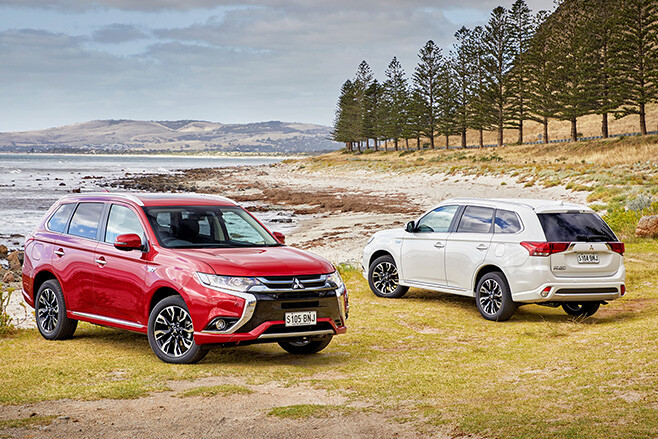
MORE: Mitsubishi Outlander Range Review MORE: Mitsubishi Outlander Specs, Range & Price
I don’t get a chance to cook rabbit much these days.
However, we’ve recently been wandering around northern Flinders with some friends and we were able to score a few rabbits for the larder.
As the rabbits were taken in bluebush country, I’ve named this recipe ‘Bluebush Rabbit Stew.’ It’s another recipe with a weird combination of ingredients, but it works.
For more tasty ideas, visit 4X4 Australia’s Bush Cooking recipes.
INGREDIENTS
- Oil
- 1 tsp dried oregano
- 2 rabbits – gutted, dressed and jointed (cut out the tail bone and neck)
- 2 onions – roughly chopped
- 4-6 garlic cloves – chopped (or 4 or more tsp minced garlic)
- 5 whole cloves
- 2 cinnamon sticks – broken in half
- 1 tsp ground cumin
- 2 bay leaves
- 1 small/med orange – zest
- 2 tbs tomato paste
- 2 cups red wine (approx)
- 1-2 cups beef or chicken stock
- Salt and pepper to taste
- ½ tsp ground cinnamon (optional)
METHOD
- Soak the rabbit joints in cold salted water (about one heaped teaspoon per litre of water) for one to two hours for young rabbits, or longer for older, larger rabbits. Remove and pat dry before browning.
- Heat some oil in the base of your camp oven or heavy-based pan. Add the oregano as this will flavour the oil and consequently the rabbit.
- Add the rabbit (in batches – don’t overcrowd the pot) and brown on all sides. Remove and continue until all pieces of the rabbit are browned. Remove the last batch of rabbit and set aside.
- Add a little more oil if needed, then heat, and add the onion and garlic and sauté for a few minutes.
- Add the cloves, cinnamon sticks, cumin, bay leaves and orange zest and sauté for a few minutes until the flavours are released.
- Add the tomato paste and mix through and then add the red wine.
- Return the rabbit pieces to the pot and season to taste. Add enough stock liquid so the rabbit is just covered.
- Bring to the boil, then cover the rabbit with some baking paper. This helps to keep the top of the rabbit from drying out and browning and it also helps keep all the moisture in.
- Reduce the heat, cover and simmer very gently for 1½ to two hours or until the rabbit is tender. Keep an eye on the liquid to make sure it hasn’t gone down too much. If need be, add more water.
- Just before serving taste the sauce. Add the ground cinnamon and stir through if you would prefer.
- To turn this into a one pot meal, add some potato, carrot and celery pieces to the stew for the last 45 minutes to one hour of cooking. Timing will depend on how large the vegetable pieces are.
- Not a fan of rabbit? Chicken also works for this recipe.
DIESEL and petrol engines work in arcs, building momentum with the engine’s RPM before petering off as the engine loses steam.
In every vehicle ever built with an automatic or manual transmission, engineers have laboured over power figures, making a perfect combination of transmission ratios and diff gears to give us usable power at every speed we’re likely to drive – from low-down grunt through to fuel-sipping low-rpms at freeway speeds.
We then go and bugger it all up by putting larger tyres on because, hey, we’re off-roaders and we spend half the time modifying our vehicles to make them better. Luckily, out of all the problems we cause for ourselves, the performance losses fitting larger tyres is one of the easiest to fix.
How to change your differentials oil?
Diff gears might seem incredibly complicated, but they’re one of the simplest components in any 4×4 and are surprisingly easy to get right. In their basic form they’re used to redirect the drive coming from your engine and transmission through to your wheels.
It does this by using what’s known as a ring and pinion gear arrangement, where the pinion gear, attached to the driveshaft, runs along the edge of the ring gear which is attached to the axles and eventually the wheels. Due to this design, the pinion and driveshaft need to spin significantly faster than the ring gear and axle, hence this is where we get diff ratios from.
In a typical Land Cruiser it’ll be a ratio of 4.1:1, where the driveshaft turns 4.1 times for every one revolution of the wheels. The benefit of this is it gives the driveline 4.1 swings of the hammer to turn the tyres once. The more the engine can turn for every revolution of the tyres, the more power it’s able to put down and the higher it’ll rev. Keeping this balance right is the key to a 4×4 having plenty of power throughout all driving situations, without destroying fuel economy in the process.
To help get to the nuts and bolts of gears and ratios we’ve enlisted the help of two men with gears for brains: Carl Montoya from world-renowned Nitro Gear & Axle in the USA, and Owen Honess from Western Manual Gearbox & Diffs in Sydney.
YOU’VE ALREADY CHANGED YOUR GEARING WHEN you start the conversation regarding gearing, a lot of people instantly glaze over and chalk it up as a rock-crawler modification and something that doesn’t impact them.
“It’s a really common misconception that re-gearing is for more hardcore vehicles with huge tyres and off-road use,” Carl told us. “Contrary to that, most of the newest vehicle models benefit from gears the most.”
Before a single panel is pressed for a new vehicle, teams of engineers will get out their slide rules and dyno read-outs to work out what RPM the engine should be sitting at for a given speed – to maximise usable performance and fuel consumption. To work this out they’ll take into account every gear ratio through the transmission, diff gears, transfer case and also the diameter of the tyres.
When you swap out the stock tyres for a set of 33s you can change the gearing by as much as seven per cent, dropping the engine out of that optimum RPM range with a whole host of negative results thrown into the mix.
In older vehicles, where fuel economy was a communist term, it wasn’t an issue as they were generally designed with plenty of leeway in either direction. Modern vehicles keep the RPMs as low as possible without the engine labouring to get maximum fuel efficiency. “With the added weight of aftermarket accessories such as camping gear, bumpers and roof racks, the vehicle no longer feels ‘right’ when you drive them.” Carl added.
“When a slightly larger tyre is fitted the RPMs are reduced below a tolerable amount, causing constant downshifting.” For context, the results of stepping up to a 33-inch tyre from a 30.8-inch stock tyre are similar to swapping out a set of 4.1:1 ratio diff gears for a set of 3.8s, or like strapping a set of 60mm clogs to your feet then trying to run with a backpack full of concrete.
THE HIDDEN DANGERS JOE Bloggs buys a late-model 4×4, loads it up with every piece of camping gear he can find online, hitches up a QE2-sized camper trailer, and then swaps out the tyres for a set of meaty muddies. Unsurprisingly, when old Joe goes to mash the loud pedal not a whole lot happens. Now, Joe might start thinking he needs to push the pedal harder or get some performance upgrades under the bonnet, but that doesn’t solve the underlying issue.
By throwing out the gearing you’re essentially increasing the load the drivetrain sees, it’s a little like moving the pivot point of a see-saw. The actual weight doesn’t change, but things become a whole lot more lop-sided with Joe’s driveline copping the brunt of it.
4×4 Vehicle Loading and GVM explained
“Overloading the clutch is one of the big issues I see all the time,” Owen said. “You’ll need to increase engine revs just to take off, which can cause the clutch to shudder.” While the negative effects are immediately obvious with a manual gearbox, automatic transmissions hide theirs better, still driving how you’d expect them to with only the slightly higher RPMs under acceleration hinting towards the overheating gearbox and failing torque convertor.
At cruising speeds, both manual and automatic transmissions will often be in between gears, where fourth is too low but fifth is too high, causing constant downshifting as the engine labours in top gear (or excessive RPM, increased engine noise and fuel consumption that comes from staying in a lower gear). The engine labouring can lead to overheating issues as well. Now, this doesn’t mean Joe Bloggs is going to eject his engine and gearbox the first time he hits the beach, but they will be under increased load.
Ironically enough, an area few people consider when fitting larger tyres is how it will affect their off-road performance. Yes, larger tyres will give you the extra ground clearance you’re after, but the reduction in gearing will effectively neutralise the benefits of low-range and kill engine braking downhill – the 4×4 version of robbing Peter to pay Paul.THE RIGHT GEAR THERE are no two ways about it – if you’ve fitted larger tyres to your 4×4, re-gearing will take the load off your engine and drivetrain as well as make it perform better both on- and off-road. “Many people live with it and think they don’t need to re-gear, but every person that does re-gear is happier.” Carl added. The upside is for around the price of a half-decent bullbar you can fix most of the issues caused by larger tyres, all that’s left to do is work out what options are going to suit your needs.
The easy solution is to speak to the experts like Carl and Owen, let them know your needs, and they’ll figure it out. For those a little more hands-on, the process is rather simple depending on the vehicle. On many older 4x4s a metal compliance plate under the bonnet would have an axle code, often telling you the ring gear size, axle ratio and how many spider gears inside the diff. Modern 4x4s have replaced that plate with a sticker that tells you nothing, which may complicate things.
Regardless, all the axle ratio tells us is how many times the driveshaft will spin for one revolution of the wheel, so jack the rear-end up, spin a tyre 10 times with the other chocked, and count how many times the driveshaft spins. If you have a 4.1 ratio it should either spin 41 times or 20.5 times depending on if you have an LSD or not. From here work out how much larger your tyres are than stock and then increase your ratios to get you back to stock gearing.
The final piece of the puzzle is to talk to the experts about what you’re trying to achieve: performance or fuel economy. “If you’re chasing fuel savings it’s something we can definitely do,” Owen said. “If you do a lot of highway cruising we’ll work out the RPM you want to sit at for highway speeds for the best fuel consumption, and what ratio is going to get you there.”
Unfortunately, gear manufacturers only make ratios in specific intervals, so you’re often stuck smack-bang in between two options. If you’re loaded up with accessories it’s almost never a bad idea to opt for the slightly higher ratio than the slightly lower version. If you need a 4.69 and can only get a 4.88 it’ll have you revving at 2288rpm at 110km/h instead of 2200 flat, hardly enough to worry about.
DIFFERENT STROKES SOME companies, like Marks 4WD, offer transfer case gears that can achieve a few positive outcomes.
The first is a lower low-range, generally in the vicinity of a 50 per cent reduction, which will make up for any increase in tyre size. The second positive thing they can do is change the high-range ratios.
In 4x4s that rev too high on the open road, an overdrive set-up of up to 10 per cent can be enough to settle RPMs at or around 100km/h and help with economy. Or in modified versions with larger tyres, up to a 10 per cent underdrive arrangement can help correct for larger tyres. It’s a more limited option and not available for many 4x4s, but it can fix the gearing from larger tyres while also giving you better crawling ability off-road with more engine braking for a similar cost as re-gearing front and rear axles.
GET IT RIGHT THE FIRST TIME THE bitterness of poor quality remains long after the sweetness of low price. It’s a saying never more true than with today’s current crop of so-called budget-friendly modifications.
However, as with most things, saving a dollar now will often cost you 10 later. There are two things to consider when re-gearing your 4×4. The first is the quality of the gears themselves, the second is the quality of the installer. Quality gears will not only be made of stronger materials than budget options, they’ll generally be more precise and make the installer’s job far easier.
The better the gears mesh and the more contact surface between the ring and pinion gears, the stronger the connection and the less likely you are to break them. “Some gears can look brilliant,” Owen added. “But when you set them up they’re impossible to get to mesh right. It really depends on who’s making them and where they come from. You get what you pay for.”
If you’re looking at re-gearing your 4×4 it’s worth eyeing off a diff lock or two while you’re at it. With the diff centres out and gears needing to be installed anyway, it’s a negligible price difference to get them in now. It’ll bump the total price up to around the $5000 mark for the full job, but for around the same price as decent bar work you’ll have a 4×4 that’ll tow better, accelerate better, use less fuel, handle steep hills better, and be nigh-on unstoppable in the bush.
CONTACTS Western Manual Gearbox and Diffs PH: (02) 4732 1800
Nitro Gear and Axle WEBSITE: www.nitro-gear.com
THE Toyota Hilux and Ford Ranger (4×2 and 4×4 variants combined) were the best-selling vehicles in Australia during March, 2017.
An impressive 4245 Hiluxes found new owners in March this year, an 8.9 per cent increase on March, 2016. While 3845 Rangers were sold during the same period, a whopping 29.9 per cent increase on March last year.
Also sitting pretty in the top five is Mitsubishi’s Triton, with 2670 4×4 and 4×2 vehicles shifting from the showroom – this represents a 2.6 per cent decrease in sales from March 2016. Mitsubishi puts this slide down to less sale days in March last year due to the Easter holidays.
The overall LCV and SUV segments remain the strongest growing in the market, with sales when combined accounting for 60.3 per cent of total vehicle sales. Specifically, LCV sales accounted for 20.9 per cent of the overall market, an 11.3 per cent increase on March, 2016.
In February, SUV sales overtook passenger-car sales for the first time in the industry’s history, and March sales consolidated that trend.
“Two months in succession, of SUV sales leading the market, is further confirmation of a trend we’ve been observing for some time,” Tony Weber, chief executive of the FCAI, said. “For the first three months of 2017 the SUV segment is now the dominant sector, whereas this time last year passenger cars led the market by around 10,000 sales. Clearly, the shift in market dynamics is accelerating.”
He continued: “Sales of medium-sized SUVs were particularly strong in March, up 18.3 per cent on the same month last year. That’s a very strong indicator of the vehicle size, versatility and value for money that appeals to a lot of Australian families.”
The overall best-selling vehicles for March were the Hilux (4245), Ranger (3845), Corolla (3574), Mazda3 (3039) and Triton (2670).
| u00a0 | 4X4 | MAR 17 | FEB 17 | YTD |
| 1 | Ford Ranger | 3304 | 2497 | 8022 |
| 2 | Toyota Hilux | 3115 | 2380 | 7459 |
| 3 | Mitsubishi Triton | 2350 | 1751 | 5075 |
| 4 | Holden Colorado | 1671 | 1098 | 4102 |
| 5u00a0 | Nissan Navara | 1409 | 931 | 3142 |
| 6u00a0 | Toyota Prado | 1383 | 1320u00a0 | 3766 |
| 7 | Toyota Land Cruiser Wagon | 1194 | 944 | 2851 |
| 8u00a0 | Isuzu Ute D-MAX | 1132 | 591 | 2221 |
| 9 | Mitsubishi Pajero Sport | 975 | 752 | 2158 |
| 10u00a0 | Mazda BT-50 | 856 | 747 | 2312 |
Ron and I have been camping all over Australia (and the world) for more than 35 years, so I think I can say we’ve got a little bit of knowledge as to what to take on a trip, and how to pack it.
This article was originally published in the January 2014 issue of 4X4 Australia.
But, what I need, and what someone else would consider necessary, may not be the same. There are some essentials, however, that I think anyone preparing for a trip should consider. The details and ideas in this feature will help you, whether you are a first-time camper, or a seasoned one.
KEEPING IT ALTOGETHER The ideal situation is if you have a camper trailer or off-road van which you keep packed at all times, other than for food items, ready to head bush at short notice. But for campers with tents or swags it means repacking and unpacking the vehicle each and every trip. So the very first thing you need to do is to keep all your gear together in one place and, where possible, collectively in marked boxes so that you know what is in each box.
GETTING IT ALL IN There are so many different ways to pack, and it all depends on whether you are just in a vehicle, have a camper, or an off-road van. Even if you have a commercial storage system with drawers, such as that produced by ARB or Black Widow, the following holds true.
The best advice I can give is to use sturdy, stackable, plastic boxes with clip-on lids to pack your gear in – you can also see what’s inside more easily. You can get different sizes and configurations – one drawer, two drawer etc, so it’s best to work out what suits the area you have. Use one for pots and pans and the like; one for cutlery and the like (and use a cutlery holder inside to keep the knives, forks, spoons, etc, separate); one for your plates, cups, etc; one for breakfast items, tea and coffee, sugar, etc; one for general food items you are more likely to use everyday; and one for your general food storage.
It’s also a good idea to label the boxes detailing the contents, or at least number the boxes and make a list of their contents. Make a note on the top of tinned food containers of what’s inside, so you don’t have to pull each tin out to see what’s in it. Bonus: if labels come off you won’t have to play a guessing game.
I find it’s still best to utilise plastic boxes, even inside a large-ish cupboard or drawer space, as I can keep food contained. Instead of pulling out lots of packages and cans – basically emptying the cupboard or drawer – to find something, I just pull out a box; it’s a lot easier. I know the containers take up a little bit more room, but the convenience of having items contained is, I think, worthwhile.
I also have a couple of good quality, heavy-duty small plastic drawers on top of the Black Widow sliding drawer we have in our Patrol, to make the best use of available space. I couldn’t let that space go unused. That’s the trick, use every available bit of space you have, as best you can and, in our case, these drawers are packed with everyday items we regularly use.
The most important thing while travelling on corrugated, rough, or bumpy roads is to stop items moving around and banging into each other as much as you can and therefore prevent any breakages. There’s nothing worse than opening a cupboard or box and finding a lid has come off a jar or bottle, or it’s broken, and there’s gunk everywhere. Pack everything firmly, especially if you have any glass containers. I use aprons, tea towels and the like to help fill in any gaps in storage boxes or cupboards. If it’s really rough, use packing tape around each lid to stop it unscrewing – believe me it does happen, even on a new, unopened jar or bottle.
I also like to pack glass bottles/jars into stubby holders, you only need to do every second one. Another great method is to use the strong cardboard six-pack beer-bottle carriers for storing sauces, jars and the like. They work well and stop glass bottles banging against each other. They will also survive inside the fridge for quite a while.
Use clip and lock, stackable plastic containers to store food supplies. They are clear (so you can see what’s inside), and secure, so there’s less change of spillage, and they keep food fresh. Great for rice, pasta, flour, cereal, biscuits and more.
Be aware of leakage from cardboard containers, such as long-life milk, custards and cream. There is nothing quite as bad as milk containers that have rubbed together and leaked; the smell of sour milk is very hard to get rid of, a lesson we learnt very early on in our camping trips. Put thin cardboard or something between each container so they don’t rub against each other or, at the very least, stack them in a plastic box that’s easier to clean and remove any odour.
Choosing pans and bowls that fit inside one another makes packing a lot easier. Stainless-steel pots are ideal. Saucepans can be used as mixing bowls, or for salads, such as coleslaw and potato salad.
STUFFING YOUR OVEN A big, heavy cast-iron camp oven will crack if not properly stored. Pack it in a strong, durable cardboard box, or use a robust plastic bin with a lid that is suitable in size for your camp oven. Place a piece of cardboard, bubble wrap or foam between the lid and the base. When carrying other pots inside your camp oven, put cushioning between the inside base of the camp oven and the pots to prevent them bouncing around, as well as stopping metal rubbing against metal.
An alternative to baking in a camp oven, is to use a stove top oven, such as the Coleman Camp Oven (www.colemanaustralia.com.au). This compact cube-shaped oven sits on top of your gas or fuel stove. Its metal lid and sides fold inwards and the oven folds into a neat little package, and it works a real treat. I don’t leave home without one.
One of the Coleman oven’s great advantages is that it enables you to ‘camp oven’ cook in areas where wood fires are prohibited, such as National Parks or districts which are under total fire bans during the summer season.
Take a couple of flat, light, round pizza trays that will fit into your camp oven – perfect as a base for your damper, bread or scones.
Also take a selection of tin enamel dishes (round or oblong) that will fit into your camp oven. They are prefect to cook a dessert in, cake or a casserole and will save a lot of camp-oven cleaning.
MENU PLANNING Preparing for a trip is quite a task, especially when travelling away from any shops because there will be no chance to restock supplies for a week or more between towns. Planning and preparation before you go are essential to make your trip an enjoyable experience.
How to plan food for a 4×4 trip
FOOD PREPERATION Here are just a few food packing ideas to help you get started:
- Get your meat vacuum-packed – it will keep a lot longer in the fridge, is easier to pack and keeps the fridge cleaner.
- Take plenty of spices and sauces – you can turn any meal into a flavoursome dish. Remove them from any glass containers and store in small clip bags – they’ll take up a lot less room.
- Take flat bread, such as Mountain bread or soft tortillas, as an alternative to bread, which is bulky and goes stale quickly. They’ll keep for sometime.
- Packing Bread – The following method of packing bread works really well, and I’ve had white bread still reasonably fresh two weeks after packing, with little or no mould. Leaving the bread in its plastic bag, wrap each individual loaf in a couple of sheets of newspaper and then wrap in foil. Seal with tape and place in cardboard boxes and store inside your vehicle in a cool spot. Note: different varieties of bread keep better than others — you’ll need to experiment as there are different brands of breads from state to state. Don’t use bread fresh from a bakery, there aren’t enough preservations in it.
- Remove all fruit and vegetables from plastic bags and repack in ‘long-life’ vegetable bags, wrapped in newspaper or hand towel. If using newspaper, make sure you wash the vegetables to remove any printers’ ink before using. Remember to store in a cool, dark place. Don’t store onions and potatoes together.
- Dehydrate food to save heaps on water, space and weight.
- Eggs: Keep in a cool, dry place if you can’t fit them in the fridge, and store in a solid plastic egg container. Don’t buy the large eggs that won’t fit into the containers.
- Make up a basic list of ingredients you would have for breakfast and lunch, and general everyday food items. Shop with this list to make sure you get everything you need.
I’ve detailed below some essentials I always have. I haven’t given you an exhaustive list of all items you would normally carry – these are just a few of my ‘must-haves’.
VIV’S CAMP KITCHEN MUST-HAVES
- Good kitchen knives of varying sizes and styles and a good sharpener.
- Sheaths for knives – either made of strong cardboard and heavy-duty tape, or neoprene cut to size and edges glued. They keep knives from being damaged.
- Set of measuring cups and spoons – make sure they are in Australian metric measurements.
- Meat thermometer – take all the hassle out of trying to guess if you roast is cooked to your liking or not. Probably best to get one that doesn’t require batteries.
- Military/army-style can openers – they are very small, flat and work every time, more than I can say for the ‘normal’ kitchen style can openers you buy. You could probably pick one up in an Army Disposals store or similar.
- Whisk – great for mixing powdered milk, custards, eggs, sauces, etc. I also have a mini whisk, which I find very handy for mixing in very small bowls and cups.
- Stubby holders – to hold that ice-cold can of beer. But, as with the general rule of things having two uses, stubby holders work well to store bottles in and stop them breaking.
- Aprons – decent sizes – an apron will help keep your clothes a lot cleaner for longer and save you washing – always a good thing.
- Welding gloves – an essential item for working around the camp fire and for picking up cooking pots and trays.
VIV’S HANDY HINTS Clothes Washing Tub – I’ve carried the same wash tub (a beer makers container) for over 32 years now. It started off as a nappy soaking/washing tub for travelling when our son was two on one of our very first Cape York trips. It’s still going!!! Fill with ¾ water, add some liquid clothes detergent, a little napisan or similar, add the clothes, put on the lid and put into the car and let it shake away all day. All you have to do at the end of the day is rinse the clothese and hang out to dry.
Handheld shower – 1 x large juice/drink container (2 litres) – pierce numerous holes into the lid and screw back on. Fill with water, up-end and use as a small handheld shower. This is great for remote desert trips or when water is scarce – works really well, and you only use a small amount of water. Plastic spray bottle for dishes – fill with water and a little dish detergent. It works well to clean plates, etc, for breakfast and lunch when you don’t need a sink full of water. Again its a great water saver.
How to choose the correct campsite
For lots more information on planning and preparing for a trip, and camp fire cooking, or cooking generally, as well as lots of great recipes, then check out Viv Moon’s OUTDOOR Cookbook, and Viv Moon’s TRAVELLER’S COOKBOOK, on the web.
MISCELLANEOUS ESSENTIALS
- A quality headlamp – ideal for working around the campfire at night and leaves your hands free.
- Anti-bacterial hand-wipes or liquid are a quick way to clean your hands before preparing food.
- Snap Lock plastic bags of varying sizes are ideal for storing just about everything, from leftovers for the fridge to dried herbs and toiletries, while ‘long-life’ vegetable bags help keep vegies fresher for longer.
- Cloth tape (heavy duty) – you can just about fix anything.
ON OUR recent outback trip we had with us a Coleman Mountain View Shelter, which came into its own when the flies were driving us mad and it was bloody hot in the sun.
We have used a few of these portable gazebos, and while some erect faster they are bulkier, heavier and not as flexible or as good at keeping pesky bugs and the sun away.
The Coleman shelter comes in its own carry bag and weighs slightly more than 12kg. The fabric used is 150D polyester taffeta, polyurethane-coated, and it is UV stabilised and rated at 1000mm water resistant. The four long white poles and two shorter black poles are all fibreglass – aluminium poles are more durable, but that would have had a significant impact on price. The size when erected is 3.6 x 3.6m² at ground level and 2.3m at its highest point.
Need Hot Water when out camping? Read about the Coleman Hot Water On Demand unit
When erected the tent has four mesh side panels, all of which can be zipped off to make the shelter an open-walled canopy ideal for those days when you’re looking for shade. Two shade panels are included that clip onto the inside of the tent, blocking the harsher rays of the sun (or wind or light rain) from whatever side you feel you need it, while also providing a touch of privacy.
The shelter is a bit fiddly to erect, but with two people and a bit of practice you can put it up in less than 10 minutes. It comes down quicker and fits back into the carry bag without too much effort. Being lightweight, we’d suggest you peg it down each and every time to stop it blowing away even in a light breeze. It proved to be an excellent shelter.
Find out the 5 things Ron Moon doesn’t head bush without
It provided sufficient shade, and when all the flywire was zipped up it was very insect-proof. It makes a great shelter for relaxing, cooking in, or even for throwing down the swag when the weather is looking a bit dicey. We’ll be taking it with us on most trips from now on.
RATED
Available from: www.colemanaustralia.com.au RRP: $329.99 We say: Versatile and effective, but quite fiddly to erect.
When is a Jeep not really a Jeep? When it doesn’t have low range or live axles? When it isn’t a Wrangler? Or when it thinks it’s a hot rod?
Jeep’s Quicksand concept for next week’s Easter Jeep Safari in Moab, Utah, fusions Jeep style with elements of a vintage gasser from the drag strips of the ‘60s. The body is from a chopped up Wrangler but cool things like the Warn winch concealed in the ‘Moon’ tank at the front are pure hot rod. We’re not sure how those mounts would hold up to any real winching though.
The Quicksand concept is powered by a 392 Crate Hemi V8 engine from Mopar with retro eight-stack EFI, backed by a six-speed Getrag manual transmission and Dynatrac axles.
The lower ground clearance might not be great for rock crawling but as the name suggest, the Quicksand would make a wild sand buggy. Its staggered tyre setup features 32-inch BF Goodrich Mud-Terrain KM2 tyres in the front and 37-inch KM2s on the rear all on 18-inch vintage alloy wheels with knock-off centers.
Inside, the minimalist interior features red accents, two front low-back bucket seats, flat aluminium door panels, tilt-out windshield glass and a chrome roll bar for a custom street rod style while a parachute at the back harks back to the Gasser look.
The Quicksand concept will be among the other wild concepts from Mopar when thousands of Jeeps from all over the USA converge on the off road Mecca that is Moab, over the Easter long weekend.
As a base for an outback tourer, it doesn’t get much better than Toyota’s 79 Series Land Cruiser dual cab. Straight from the showroom floor, this thing has what it takes to tackle Aussie offroad tracks. An urgent turbo-diesel V8 engine with decent low-range gearing and optional front and rear diff locks – live axles front and rear.
As well as its chassis and driveline goodies, the dual cab Cruiser also has the practicality of a decent-sized cabin that will comfortably sit five people and the big tray at the rear is perfect for hauling all that’s required on an extended trip away.
Read about the 2017 4X4OTY Winner: Toyota LandCruiser 79 Double Cab
As with any vehicle, there’s a lot that can be modified in the quest to build a better truck, and this trick Cruiser is a great example of what can be achieved by fitting the right gear.
It belongs to aftermarket accessory manufacturer MSA 4×4, and the company’s Matt Mason regularly pilots it. To say four-wheel drive enthusiast Matt is happy with it would be a huge understatement; “It would have to be the ultimate touring machine. You can cart the family around and you can get a whole heap of stuff in the back – fridges and slides – so it’s perfect all-round.”
Despite running around visiting MSA 4×4 stockists, Matt still finds plenty of time to get the Cruiser dirty.
“We’ve done Fraser Island, Inskip Point and Double Island Point. I’ve taken it up the back of the Gold Coast, up in the hinterland there, and the national parks down in NSW,” he said.
Shane Miles, an MSA 4×4 proprietor, added; “He goes out and hammers it around, and goes touring and camping.”
Far from concerned about how much offroad action the Cruiser sees, Shane encourages Matt’s forays into the bush, and joins him when he can.
“We’re taking it up the Cape soon, with a couple of other MSA company vehicles, probably around July,” Shane said. “Hopefully we’ll be going to the Kimberley later this year, before it gets too hot. That will be with other MSA company cars as well; our 200 Series and a new Prado we just got that we’re building up.”
The vehicles are put through vigorous field tests to develop better products.
“Our products have only ever gotten better. We go out and test them and try and break stuff. Then we try and make everything bulletproof. We use the best materials we can find.
“All of the MSA 4×4 gear on show on this Cruiser is off-the-shelf stuff, so anyone can buy it. None of it is custom,” he said.
There’s plenty of MSA gear on this Cruiser. Protecting the seats (Recaros up front) are MSA seat covers and for added comfort on the front seats are the MSA sheepskin lumbar support system that fits on top of the seat cover.
“It attaches from the headrest posts and goes down the centre section that sort of follows the bolster line of the seats, and straps around the sides,” Shane said.
“And inside there’s a fully adjustable air bladder, you can put up to four bladders in if you want, and it’s pneumatic – you can pump it up to whatever you want, let it down, adjust it during the day, and it’s easily installed and removed.”
For stowing small items there’s an MSA dash organiser and a pair of seat organisers – one with a drop-down table.
“When I’m travelling alone, I actually use one of the seat organisers on the front of the passenger seat to keep all my paperwork in check. But when I’m travelling with the family I put them on the back of the seats – they hold all the maps, small radios, winch remotes and stuff like that,” Matt said.
They’re also handy for Matt’s kids, aged eight and nine, to stow their own stuff on family trips.
Other interior accessories include a GME Electrophone 5W UHF, a Hema Navigator HN6 and an LCD monitor for the reversing camera, as well as a couple of MSA LED striplights.
“I carry a few striplights in the vehicle at all times. Two in the back of the cab and two in the gull-wing doors on the tray body – and then I carry two for setting up around the campsite. They come with a long 5.5 metre lead so they can reach from the truck to the tent,” Matt said.
“There are two brightness settings and they use absolutely minimal power, so you could run them forever and never worry about flattening your battery. They’ve got hooks on each end and eyelets so you can tie them up if you want. They’ve also got a full Velcro strap on the back and they come with a heap of adhesive Velcro tabs,” Shane added.
On top of the Cruiser’s cab there’s a custom alloy roof rack holding a 900 x 1200mm MSA 4×4 roof bag, ideal for stowing bulky items such as tents, swags, bedding, tables and chairs.
Behind the cab is a custom colour-coded aluminium tray body with gull-wing doors on both sides and at the rear.
“It was an off-the-shelf design but we got them to put the rear door in it, and then we got them to integrate some underbody boxes and an underbody slide-out drawer. We wanted maximum storage space and accessibility,” Shane said.
There are two MSA 4×4 drop-down fridge slides in the tray body, one holding an Engel and the other a sideways-mounted unit housing a Waeco.
“They are for demos, obviously, for when we do shows and visit dealers, but I also use them for personal use,” Matt said.
The dropslide design provides easy access to the contents of the fridge – or in this case, fridges – and Shane is particularly proud of this product.
“That’s our patented fridge slide. I personally designed it in 2007. It’s made a little bit sturdier and a lot prettier since then,” he said.
Fridge barriers are also fitted, which prevent items falling down behind them when they are pulled out.
“You can pile all your stuff up against [the barrier],” Shane said. “Before, if you filled the back of your vehicle, and then you wanted to get the fridge out, everything fell down into where the fridge was. Obviously, now you can pile all your stuff up against it and if you want to get the fridge in and out, then no problems.”
There’s also an MSA barrier organiser in the tray body that’s handy for storing small bits and pieces. “It’s designed to go on a cargo barrier but, as with this example, you can use it for whatever you need it for,” Matt said.
Finally, the tray body houses a 55 litre Boab polymer water tank from Opposite Lock, which is hidden under carpet. On top of the tray body there’s a Kimberley Mycube Roof Top tent.
“It’s a really good design,” Shane said. “It sits within the lines of the body, so it folds up quite neat and it looks good… and it’s got a lot of extras you can’t get with other rooftop tents such as under-mattress heating and internal LEDs.”
There’s also an ARB awning for shading quick roadside tea breaks, or for offering shelter overnight when conditions are less than ideal.
Powering all of the accessories is a Redarc dual-battery system with an Optima D34 55Ah battery – one of the few batteries on the market to combine deep-cycle capabilities with strong cranking power. A Redarc BCDC1240 charger keeps the batteries in an optimal state of charge.
Protecting the front-end is an ARB steel bullbar and side rails. “It’s a good-looking bar and it matches up to the vehicle perfectly,” Shane said.
A Warn 9.5XDC winch fitted with synthetic rope takes care of things if the big Cruiser can’t extract itself under its own power. Why synthetic rope? “After using cable all our lives, rope is just beautiful, so much more user friendly,” Shane said.
“It’s not so much overall weight you save by using the rope,” Matt added. “But when you’re actually using it, it’s so much easier. If you’ve got to pull that rope up the hill to get it hooked up, it’s a lot easier to use and you haven’t got to worry about frays in the cable.”
A pair of ARB Intensity LED driving lights cater for night-time driving. “At night, you don’t get the big reflections like you do with HIDs. It’s instant light; you haven’t got to wait for them to warm up. They have a great range and good spread,” Matt said.
In keeping with the ARB theme, there’s an ARB diff breather kit, ARB recovery gear and ARB air compressor on board – although Shane points out that MSA 4×4’s 200 Series Land Cruiser runs predominantly Opposite Lock gear and the company’s Prado runs mostly TJM gear.
Suspension-wise, the dual cab runs Old Man Emu kit. “We’ve run OME on our company cars, we’ve been all over the place with them, and we’ve never, ever had an issue with them,” Shane said.
While the Cruiser’s powerplant is stock, it breathes through a Safari snorkel, rather than the standard Toyota item. “The factory snorkel’s not watertight. It’s got two or three joins in it – one outside and one under the bonnet – so if you want to do water crossings…” Matt said.
The standard wheel rims have been ditched in favour of a set of trick-looking American Racing Wheels.
“They’re on all of our display cars and we like to keep everything matching. And the black goes with our tone of grey on all of our display cars. It’s just a really nice looking aftermarket rim,” Shane said.
The rims are shod with LT285/70R17 Cooper ST Maxx tyres Shane said they’ve never had a problem with them.
With all of this gear, both inside and out, the Cruiser is hauling a fair amount of weight, and you’d hardly describe it as aerodynamic, but with a Long Ranger 180L replacement tank fitted, Matt said he gets around 1300km between refills. “On a good run it probably does around 15L/100km – if you stay below 100km/h it’s a lot better on fuel,” he said.
“The only downfall we’ve found with the vehicle is it’s probably a little under-geared at freeway speeds,” Shane added.
Like most modified vehicles, this Land Cruiser is a work in progress, but according to Shane it’s nearly finished: “I’ll make a custom dual wheel carrier for the rear, but then it’s pretty much done.”
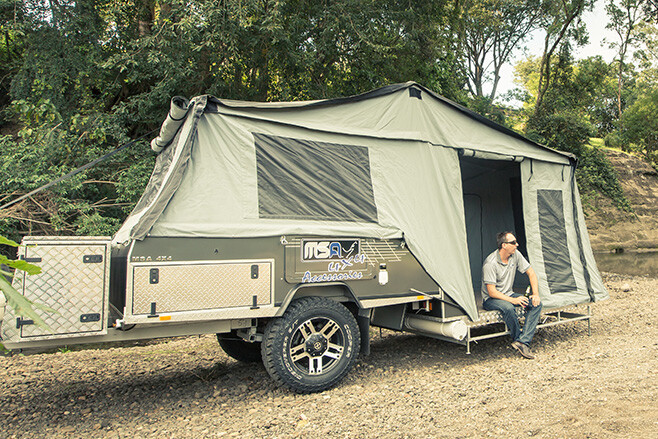
CUB SUPAMATIC CAMPER
When heading off on extended offroad trips in the Land Cruiser, Matt tows a Cub Supamatic Regal camper trailer.
“It’s all been matched and colour-coded to go with the Cruiser,” Shane said. “It’s a Supamatic Regal, with independent suspension. It’s got dual 110Ah batteries, a Redarc BCDC1240 charger, which when you hook it up to the car it charges the batteries properly. It’s also got adapters to hook it up to solar power, with a Redarc solar panel.
“It’s got the same wheels and tyres as the ute, a slide-out kitchen/pantry and a 47L ARB fridge. It’s a hard-floor model and very comfortable to sleep the whole family.”