
LAND Rover’s new-from-the-ground-up Discovery has won the 2018 4X4 of the Year award, in SD4 guise.
In the end it came down to the SD4’s game-changing shift in terms of weight versus size, and engine versus performance. The Discovery is comfortable and capable unit on the black-top, yet it doesn’t become fussed when the tracks turn nasty.
Apart from tyre sidewall vulnerability – which can be easily overcome – the Discovery is a great all-rounder and well-deserved of the 4X4OTY gong.
Judges independently scored each vehicle against a set list of criteria – value for money, breaking new ground, built tough, bushability and doing the job it’s designed to do – and after the votes were tallied, the SD4 narrowly clinched victory ahead of the Isuzu MU-X.
The MU-X was an unlucky runner-up, winning over most judges for being well-proven and just ‘getting the job done’. Ron Moon even said if he was to pick one to do a lap around Australia, it’d be the MU-X.
Why the SD4 and not the TD6? The TD6 asks for an extra $7K, but the extra cylinders don’t push it a hell of a lot harder than the SD4. It may be relaxed, but it also uses more fuel; somewhat levelling out its bigger fuel tank (85 versus 77 litres). Also, if you want the V6 with a coil-spring set-up you can’t get the rear locker.
Stay tuned to 4X4Australia.com.au this week for a complete run-down of the 2018 4X4OTY.
Final scores (out of a possible 350)
Land Rover Discovery SD4: 237
Isuzu MU-X: 235
Jeep Grand Cherokee Trailhawk: 230
Haval H9: 218
THE days of the ‘backyard’ job in the form of a home-made bullbar or bodged-up cargo drawer system should be long gone in Australia, but, frighteningly, that’s still not the case.
Sure, the days of welding up a bullbar ‘out the back’ are most likely finished, but the influx of cheap gear – easily available via online shopping at ‘half the price’ – with its unknown qualities in regards to strength, safety and ability to withstand load and force, shows there are still people who will sacrifice function and safety to save a few bucks.
Piranha Offroad’s Alan Johnson, an industry expert, put it a bit more bluntly. “If you go back 20 years ago, there wasn’t a cheap high-lift jack – a high-lift jack was a Hi-Lift jack,” he said. “Whether you bought it from me or whoever, it was the same product. Nowadays you can buy high-lift jacks that aren’t safe to jack-up a flea, much less a bloody four-wheel drive or a tractor. I mean, that level of poor-quality product didn’t exist, so nowadays you can see everything from exceptionally great products, to really substandard products.”
That’s where compliance comes in. The Australian aftermarket industry prides itself on the engineering and quality control of its products, and it backs that with compliance to the Australian Design Rules (ADR). This provides the parameters that result in a vehicle that, when fitted with additional accessories or modifications, still works within those ADRs that were applied to the vehicle when it first hit the showroom floor, in regards to all aspects of its functionality including performance and safety.
It may cost more, but that additional cash outlay is a small price to pay for the assurance of that safety. When you realise just how much work goes into testing each individual product to ensure it meets the compliance regulations, you won’t mind paying that bit extra. You also realise it’s far from just a matter of ‘bolting on stuff’ when it comes to fitting any – and we do mean any – accessory to your vehicle.
WITH GOOD REASON
Sit back and have a think about all the accessories fitted to your 4×4. This could include bullbars, cargo drawers, roof racks, spare-wheel carriers, replacement rear bars, long-range fuel tanks, driving lights, rooftop tents, bike/canoe/kayak/fishing rod carriers and more.
Now think about how much stress, force and strain (plus the chance of impact) some of these items are subject to when you’re out and about on that big trip, or simply driving to and from work. It’s a lot, thus making the whole regulatory process of compliance far more understandable.
It’s hard to know how many of us understand the benefit of compliance with accessories – this writer has always known they were ‘out there’ but had little understanding of the actual assurances given to consumers who purchase compliant gear. I’ve been fortunate enough to have always steered myself (and my cash) toward well-known and highly regarded Australian aftermarket manufacturers for any gear, all of whom ensure its products are compliant.
I don’t reckon I am alone, either, in terms of general understanding, as Luke Truskinger, TJM’s Engineering Manager confirmed. “From our experience, 4×4 owners know that it needs to be adhered to, but generally don’t have a full understanding of the details involved,” he said. “We believe that most people know it (the product) needs to meet compliance regulations and the default is ‘ADR’, but, again, I would say few people know the details of these compliance regulations.”
Ironman 4×4’s Adam Craze agreed, adding that the consumer is steadily increasing their knowledge. “I think most people are getting a better understanding on some of the rules and regulations, especially if they want to maximise accessory options on their vehicle,” he said. “Now more than ever with social media and magazines publishing the rules and regulations, the information is much easier to access. I believe they also put trust in the brand to ensure the products they buy meet all the rules, standards and regulations.”
Adam reckoned it’s not just the ADRs that are gaining the attention of buyers: “I would like to think if they are looking to purchase an item that they understand there are minimum requirements that need to be met, whether it is an Australian Standard, an ADR, or another set standard for each item. If they understand this, it may influence them on the product they select, knowing it has been tested and complies.”
ARB’s Product Manager Steve Sampson also brought up the point of confusion between what ADRs actually are and how they are applied, and what they are applied to in the first instance.
“On a broad scale I’d say customers are aware of the concept of compliance,” he said. “There is confusion as to what ADRs cover what aspect of accessories and what are the vehicle ADR compliance concerns. All new vehicles must comply with all of the relevant ADRs at the time of first registration. After a vehicle is registered, responsibility for the modification rests with the individual state road authorities, e.g. VicRoads.”
Steve made a huge point here: with accessories badged ‘ADR-compliant’, buyers know these have been tested to meet the original vehicle’s applicable ADRs, which ensures retention of performance and function of the vehicle. As he commented further, the term ‘ADR-compliant’ can be misinterpreted as applying to a particular accessory, rather than the fact it means the accessory is ‘compliant’ because it does not affect or alter the performance and safety of the vehicle as it was originally designed to meet a specific ADR.
“For example, there is often confusion regarding ADR 69 as having content regarding bullbars. ADR 69 is a vehicle occupant safety rule which many vehicle categories are required to comply,” Steve said. “ARB’s range of SRS air-bag-compatible bullbars, winch bars, side rails and nudge bars are designed, tested and approved so as not to affect the ADR compliance of the vehicle… and they comply with Australian Standard AS4876.1 2002- Vehicle Frontal Protection Systems.”
It’s this confusion of definition that means the education of the general buyer by the local aftermarket industry has been of great assistance for everyone concerned, in terms of helping explain the reasons why the ‘compliant’ product may be more expensive than an equivalent no-name product.
Opposite Lock’s Eddie Ziada explained this is for a specific reason. “We as an industry have taken it upon ourselves to educate the customers and explain, by fitting a specific accessory to your vehicle the vehicle will maintain correct functionality.”
It’s an assurance that costs a bit more than what you’d find with a non-compliant product but, at the end of the day, one worth the money. And it doesn’t come easy for the aftermarket industry, with the design and testing process for compliance taking varying amounts of time, depending on the product.
TJM’s Luke Truskinger explained: “Depending on the product, it can take anywhere from four to 12 weeks for just the ADR testing. We also rigorously test our own products to ensure it meets our standards and earns the TJM brand, which can take up to another three months.” Other brands quote similar times (and again, the process is always product-dependent) but the most assuring thing is that none wish to be rushed or want to cut corners, even with what can be a daunting number of regulations and tests to pass.
“TJM supports the domestic automotive and 4×4 industry authorities continuously to ensure that our regulations and compliance requirements keep the public safe, while providing suitable products for their needs,” Luke said. It’s hard to argue with that.
TESTING, TESTING, TESTING
Most Australian aftermarket brands have in-house facilities, but they also take advantage of external testing facilities when appropriate, as ARB’s Steve Sampson explained.
“The majority of ARB testing is conducted in-house by our engineering teams. ARB has Air Locker, Old Man Emu, fabricated product, canopy, electrical, Original Equipment and production engineering departments to cover all aspects of ARB’s various product groups,” he told us. “Custom jigs or test rigs are also designed and manufactured to test for specifics, e.g., cycles of opening and closing various components.
“Third-party testing is used to validate in-house test results where required. For example, ARB’s original airbag crash tests conducted through Monash University’s Department of Civil Engineering and the recent ANCAP crash tests conducted under ANCAP crash parameters for the off-set frontal crash test.
“Extensive third-party testing is also conducted for our Old Man Emu suspension range, particularly in relation to GVM upgrades.”
Luke Truskinger explained that TJM is similar: “We have a lot of test equipment, such as dynamic crash rigs to simulate vehicular impact, various hydraulic rigs for ultimate strength, vehicle testing rigs (static and dynamic), airflow and noise testing, durability testing, vibrations rigs, et cetera.”
I first experienced how stringent and dedicated the Australian aftermarket industry is in regards to rigorous testing and compliance when undertaking an ARB factory tour and watching engineers test ARB’s Air Locker diff lock. The amount of torque the diff lock was subjected to was enough to snap robust Nissan Patrol axles, with the locker itself still operating normally.
This wasn’t the end of the story, though, as the engineers then fitted a cheap, internet-sourced imitation Air Locker – made of mostly cast-iron, if I remember correctly – and then proceeded to destroy the thing. Before any test-set limits had been reached, it shattered into pieces big and small. It was a stark lesson in what can happen when you opt for the cheap, untested and non-compliant alternative product.
The number of ADRs that need to be met to achieve compliance can be overwhelming. Using the bullbar as an example, manufacturers have to meet a number of separate ADRs before they are stamped ADR-compliant.
Adam Craze revealed the behind-the-scenes process for frontal protection: “When designing the bullbar there are many factors taken into consideration during the design process. We have to meet all ADRs, Australian Standards and, now with more vehicles with camera, sensors and adaptive modules, we need to ensure our bars do not impact on the function of these items,” he said. “In complying with ADRs we are ensuring that safety systems like airbags are not affected and still work in accordance with the vehicle manufacturer’s specifications. We have to take into account that the bar does not obstruct the driver’s vision, must not cover any of the vehicle’s lighting, must not have any sharp edges, corners or items like brackets facing forward, nor should it lean forward. This is a very small sample of the regulations around designing and fitting a bullbar to a vehicle.”
So just how many ADRs need to be taken into account in the manufacture and design of bullbars for manufacturers wishing to ensure fitment of these accessories doesn’t compromise the vehicle’s relevant ADRs? And what do the various test rigs accomplish when testing the bars? We asked Grad Zivkovic, managing director and chief engineer of Automotive Safety Engineering (ASE), one of Australia’s major compliance testing facilities.
“Bullbars are covered by about half-a-dozen design rules and standards, including airbag compatibility, obstruction of headlights, pedestrian impact, sharp corners at the front, and how they affect engine cooling systems,” Grad said. “If the bullbar is massive – and there are additional lights fitted – it may inhibit airflow to the engine’s radiator and has the potential to cause engine overheating.”
Testing on bullbars can involve two test rigs: a pendulum test facility and a full-frontal test facility, the latter allows testers to crash either a complete vehicle (with accessory attached) or fit the accessory to a test trolley that replicates the vehicle’s chassis. The pendulum test involves – you guessed it – a huge weight swung into the bullbar to measure movement after impact and to ensure it doesn’t exceed ADR specifications for the particular vehicle and bar involved.
TJM’s Luke elaborated on one of the tests involved: “One of the physical checks we do for airbag compatibility is a low-speed, no-fire crash test. This test simulates the vehicle impacting a rigid, immovable object at a speed where airbags should not deploy. A poorly designed FPS may deploy airbags in these sorts of crashes. This is a safety risk for the occupants and results in a very high repair bill.”
The test is recorded using high-speed cameras and sensors fitted all over the test rig, and the results are checked to ensure the airbags only trigger when they’re supposed to and not earlier or as a result of an impact less than designed for.
The high-speed footage, when played back in slow motion, also allows the TJM testers to check deceleration rates. Measurements are also taken of the bar deformation and how far it has moved within TJM’s patented mount system. This mount system is designed to absorb the energy of the impact, thus minimising how much of the force of impact gets transferred to the occupants within the vehicle, as well as how much load transfers into the chassis itself.
More measurements are taken from the replica chassis post-impact, to see how much it has deformed and whether it stays within ADR specifications for this particular test and the associated vehicle.
DON’T TRY THIS AT HOME
A popular accessory many DIYers build themselves is the cargo drawer. MSA 4X4 is one of Australia’s premier drawer manufacturers, and its owner Shane Miles and his team are passionate advocates of vehicle occupant safety and the various ADRs that account for fitment of cargo drawers – all of which are met by the company’s drawer systems. An example is the process behind testing its Explorer Aluminium Storage Drawer System.
To meet the relevant ADR, Australian Standards (AS) and New Zealand Standards (NZS) compliance, MSA 4X4 supplied ASE with a twin aluminium drawer system for a Toyota Prado 150. The system comprised of a twin-floor storage frame attached to the test sled frame (used in place of the vehicle body shell structure), a partial cargo barrier, three child-restraint points, a drop slide and a separate fridge slide with fridge, plus the company’s fridge barrier and the Prado 150 base frame for the drawer system. The tare weight was, as quoted by ASE, 70kg.
It’s important to note just how dangerous a poorly installed drawer system can be to in-vehicle occupants; cargo inside a vehicle can weigh between 20 and 30 times its actual weight during an impact situation.
ASE used its sled-test facility to conduct what it terms a Horizontal-Full Frontal Sled Test, with an impact speed of 49km/h. This required, according to ASE’s description: “The cargo system to be tested for 60kg cargo barrier capacity, and 150kg cargo restrained by two aluminium drawers. The total mass of 250kg of the test load, plus drop slide, fridge full of 20kg of steel and the fridge barrier.” This test was used to ensure compliance of three separate ADRs, plus the AS/NZS 4034.2:2008 Partial Cargo Barriers for 60kg capacity.
The three ADRs covered were: ADR3/02 Seats and Seat Anchorages – Child Restraint Anchorages Test; ADR34/01 Child Restraint Anchorages (this was conducted for a Type E child restraint for a child weighing from 14kg to 38kg and using an adult lap/sash seat belt and upper anchor point); and ADR42/03 General Safety Requirements, where the cargo storage system must restrain specific loads without being detached from the vehicle floor, nor to have sharp edges that are likely to cause occupant injury in the event of an accident. The system passed all tests. That’s a lot of ADRs, but these have to be met to ensure the vehicle (with accessories fitted) retains its as-new safety levels and performance.
Think of the child-restraint anchorages as an example; moving these important safety items means new angles of force and tension, owing to the anchors now sitting ‘higher’ up on the drawer. So the testing has to confirm these still operate as per the ADR of the vehicle having the drawers fitted. It makes you think how unsafe those homemade cargo drawers could be if the anchorages were simply ‘moved up’ by the home handyman.
In regards to the benefits of testing and compliances, the proof is in the pudding. MSA 4X4 was recently contacted by a customer who had the misfortune of suffering a front and rear shunt at around 80km/h in their Hilux. According to the owners, the Explorer system stayed put and remained attached in the back of the vehicle. However, the second battery inside – only strapped to the fridge barrier – did not, flying out the canopy window.
It is frightening to imagine what may have happened had the cargo drawer system been a non-compliant, untested unit that came loose and crashed through the canopy and/or rear window.
LOAD UP WITH CAUTION
Other load-carrying equipment that can affect compliance with a vehicle’s ADR and/or AS includes cargo barriers, roof racks, roof platforms (and associated accessories), rooftop tents and luggage pods, and bike/watercraft carriers (roof-mounted or towbar-mounted). Cargo barriers are subject to ADR42/00, in which “any internal or external fittings are illegal if they are likely to increase injuries of vehicle occupant.”
Think of that spare tyre, portable gas bottle or Esky in the back of your cargo area and you can see the importance of meeting this regulation. Roof racks and canopies must be tested to loading requirements of AS 1235-2000 Road Vehicles – Roof Load carriers – Roof Bars Sec 5.1, 5.2 and 5.3.
The test is divided into three parts for this Standard: Resistance to lift, which involves a force being applied in a vertical ‘pulling’ direction for 10 minutes; slide resistance, which replicates a load up top sliding forward during a braking incident; and another slide resistance test under a quasi-static force at a 20-degree longitudinal axis (in the forward direction).
The testers then measure any movement of the rack/canopy’s position and it is passed if movement is within required Standard limits. The roof rack is also tested for compliance in regards to sharp corners; again, to ensure minimal risk to occupants in the case of an accident. Even load-restraint systems need to be compliant, which brings us to the humble ‘occy’ strap.
“One thing is fitting the roof rack that is tested and compliant, another issue is putting the load on top, like light gear or jerry cans and using a set of straps,” Grad said. “By straps I don’t mean octopus straps, but proper compliant ratchet straps, to restrain the load. In a sudden impact, not only the roof rack needs to stay attached, but also the load on the roof rack. This is where quite often real-life mistakes are made. I’ve seen a few crashes where people used octopus straps or only used a strap across – not longitudinally – and the load escapes. One, just a couple of years ago, was someone who had plywood on top of the roof and just had octopus straps over the top. The vehicle was in the lane next to me; the traffic lights changed to red and the car applied the brakes but the plywood kept going, hit the bonnet and ended up on the road.”
Occy straps aren’t advised for use with a moving load simply due to the fact they are flexible and elastic and obviously stretch, so cannot restrain a load. Even the humble surfboard atop your vehicle, tied down with occy straps, is a deadly weapon and an accident waiting to happen.
Rooftop tents, in particular, due to their weight – as well as the forces they’re subjected to during cornering, swerving and braking manoeuvres – must pass testing. These are tested as a complete package, according to Grad, so that includes every nut, bolt, washer and part that makes up the accommodation package you fit to the top of your roof rack.
The main focus of the testing is to check for stress on the attachment component and look for signs of cracking and movement outside the allowed parameters. Bike carriers – both roof-mount and towball-mount – are another example of the ‘unlikely suspect’ when it comes to compromising safety and standards.
Grad recounted how there is potential for, say, four-bike, tow-ball mounted bike carriers to effectively ‘twist off’ the ball part of the towball. It makes sense, too, when you think of a combined weight (the carrier and four adult bikes) of around 80kg, swinging off the towball – especially when most of that weight (in the form of the bikes themselves) is a considerable vertical distance away from the anchor point.
Bike carriers are also an example of state-by-state legislation, primarily in regards to display of number plates and brake/indicator lights. Some states are far stricter than others, but for those thinking of fitting a rear/towball-mount carrier, it is well worth checking if it has – or can be fitted with – a number plate and light bar.
ALL ACCESSORIES GREAT AND SMALL
A number of smaller accessories are also subject to compliance testing. For those of us with a less-than-modern 4×4, the thought of a compliant seat cover seems like a joke, but remember a number of modern 4x4s come standard with side airbags in the seats.
Fitment of non-compliant or compatible seat covers to these seats – as in, they directly inhibit the deployment of the side airbag – is a safety concern. The seat side airbags are activated within an extremely short timeframe using a certain amount of force, so if obstructed by an overlaying material that is not made to ‘give’ when the airbags are deployed, the end result could be a more serious side-impact injury.
Factors such as the fabric used, stitch length and the tension levels used to fit the covers to the seat have to be taken into consideration when manufacturing a compliant seat cover. To measure the deployment speed of the seat side airbag and ensure it is within required levels, a high-speed camera is utilised and then footage of the seat with and without the cover is compared to measure the deployment time.
Replacement aftermarket seats need to meet the requirements of ADR3, with two tests – Static and Crash (also known as Impact) – and five subtests: Seat Anchorage, Seat Back Strength, Anchorages for Seatbelt, Child Restraint Anchorages and Head Restraint.
A standard vehicle has passed all of these occupant safety-related tests and has been proven to withstand incredible forces and impacts. Therefore any seat (or other original part of the vehicle) that is replaced must be done so with a product that meets exactly the same standards.
Another oft-fitted accessory is a set of sidesteps. Again, the product seems innocuous enough, but think of the effect these may have on a side-impact collision and you realise why they are subject to compliance testing (as part of ADR 72/00). The side-impact testing on this product is designed to check “crash worthiness requirements in terms of forces and accelerations measured by anthropomorphic dummies, so as to minimise the likelihood of injury to the occupants in a side impact”, according to ASE’s testing procedure.
The potential risk of injury or death to not only you and yours but also innocent bystanders (imagine a roof rack and/or its contents hurtling forward and smashing into the rear window of the rig in front of you) is simply too high.
HEAVY WITH SUSPENSE
Upgrading a 4×4’s Gross Vehicle Mass (GVM) rating is slowly becoming more popular with off-road tourers (it is a common practice in the mining industry) and has come about, in part, due to the fact new 4x4s are, in standard form, quite a bit heftier than they were 15 to 20 years ago.
The result is a reduction in load-carrying capacity; once you throw in a family of four, plus all their gear, a spare wheel/tyre, recovery equipment, and then take into account fitted accessories such as bullbars, cargo drawer systems, roof racks and spare-wheel carriers, you can easily exceed a vehicle’s GVM.
A heavier-than-designed vehicle puts more stress on essential components such as suspension, tyres, brakes and the chassis, rendering the vehicle illegal and unsafe.
Compliance testing for GVM is one of the most time-consuming, with so many components affected by the additional weight. Automotive Safety Engineering’s Grad Zivkovic explained: “GVM is a major upgrade. The vehicle needs to be reclassified and another compliance plate issued. There are serious consequences (if GVM is exceeded on a standard vehicle) if it is, for example, upgraded too much and the brakes are not designed to dissipate the increased heat they generate during braking as a result of trying to pull up the extra weight. “Another design rule we use for testing GVM is the stability control test for when you’re changing lanes at different speeds – 60, 80 and 100km/h – where the heavier load would also affect suspension (springs and shocks) during a preventative manoeuvre.”
So the GVM upgrade and the compliance testing needs to look at all of the separate components – brakes, suspension, chassis – to ensure that the vehicle is just as safe and performs just as effectively as before the GVM upgrade. It also needs to perform as it was designed to in all conditions, including if the driver needs to swerve suddenly, which means testing needs to be done in a controlled location.
“This type of testing has to be done away from the general public,” Grad affirmed. “If you have very soft suspension, for example, with the higher centre of gravity and increased weight, the shock absorber may not be able to dampen in the time the vehicle moves or rocks sideways, and the vehicle can overturn. We usually use full helmets, race harness and things like that.”
Due to the complexity and the fact that the vehicle’s overall performance is affected, a GVM upgrade process always involves retesting to meet the relevant ADRs for the particular vehicle tested. The retest also provides a summary of evidence in relation to the upgrade, according to Steve Sampson of ARB. Steve sent me a copy of what ADRs are accounted for during this process (and it is vehicle-model dependent; as an example, a 200 Series GX is classified differently to the GXL, so required ADRs differ between models) and I counted more than 30.
It’s a serious business, but it provides assurance for those who pay for a GVM upgrade via an aftermarket manufacturer dedicated to the best and safest product.
RULES, REGS AND THE STATES OF MIND
The Australian Design Rules are, to quote the Australian Department of Infrastructure and Transport, “…national standards for vehicle safety, anti-theft and emissions. The ADRs are generally performance-based and cover issues such as occupant protection, structures, lighting, noise, engine exhaust emissions, braking and a range of miscellaneous items.”So, in short, ADRs do not govern the accessory produced, but rather the original vehicle as it first appears on the showroom floor.
To be ‘compliant’ in terms of accessories comes down to how that particular accessory does not affect, compromise or go outside the original vehicle’s ADR. Even though a product may be badged ‘ADR compliant’, the fitment of accessories and all vehicle mods are subject to state legislation, with not all states ‘on the same page’ when it comes to fitment of aftermarket accessories; most notably – but not exclusively – tyres and suspension.
Ironman 4×4’s Kristian Ristell elaborated: “Vehicle Safety Bulletin (VSB14), National Code of Practice 11. Sec LS-2015 is the key regulation with which we comply (for suspension mods). This is a federally established National Code of Practice. It sounds good except that now some states are introducing their own version. The industry and the Australian Automotive Aftermarket Association spent a substantial amount of money testing for compliance. The tests resulted in changes to VSB14 which now allows fitting of a suspension kit with a lift of not more than 50mm without the need for ESC testing, which cost upwards of $20K per vehicle.”
You can see what a minefield this can be for aftermarket manufacturers when states move the goal posts. You also realise just how big regulation adherence is when you see the section of VSB14 that affects suspension mods runs for 80 pages.
THE FINAL WORD
The good news is you don’t have to remember all the different ADRs and Australian Standards that apply to every accessory you’re contemplating fitting to your vehicle. If you’re looking to purchase a compliant or approved product then all that hard work has already been done by the aftermarket manufacturer.
In terms of what to look for when confirming a product is compliant and/or meets certain AS, that’s pretty straightforward: all products will be marked/tagged/branded as such, and that goes for anything from bars to tie-down straps.
For more assurance you can always chat to your local and knowledgeable aftermarket retailer, or you could contact your state’s vehicle certifying engineers – these folks are always up for a chat to offer advice and will be able to tell you whether that product is, in turn, affected by particular state regulations.
Compliancy takes time and costs money, some of which flows on to the consumers when it is time to lay down their hard-earned. However, the end result is the purchase of a piece of equipment that’s safe and functions as designed within the vehicle’s ADR parameters. Sure, we’ve banged on about safety throughout this story, but this preaching on the subject shouldn’t have any influence on the buying decision.
You just need to ask yourself one question: Is it better to go cheap and risk yours and your loved ones’ safety? Nah, we didn’t think so, either.
THE 2018 4X4 of the Year award will be announced tonight at the Australian Motoring Awards.
Held at the Forum Theatre in Melbourne’s CBD, the AMAs is an annual event that highlights the best motoring achievements of the year: Wheels Car of the Year, MOTOR Performance Car of the Year, the WhichCar Style award and, of course, the main event, 4X4 Australia’s 4X4OTY.
This year’s field of 4X4OTY contenders was limited to six vehicles: Haval H9 Ultra, Isuzu MU-X, Jeep Grand Cherokee Trailhawk, Land Rover Discovery SD4, Land Rover Discovery TD6 and Mercedes-Benz G-Class Pro 300D.
Our team of experienced judges spent a week discovering the strengths and foibles of the contingency, taking the rigs to the Melbourne 4×4 Training and Proving Ground (www.melbourne4x4.com.au) and then onto the rocks and dust of Eldee Station in outback NSW. A difficult set-piece hill-climb separated the pretenders from the contenders, while a range of tracks, climbs, woopty-doos and creek crossings provided great insight into each vehicle.
Tough Dog 4WD Suspension, the major supporter of 4X4OTY, brought along its highly capable Ford Ranger, and, had it been eligible, it could have taken home the award. The rig was equipped with a Tough Dog suspension set-up designed to carry a 0-300kg load in the rear, while the front-end was set-up to handle the weight of the steel bullbar.
To see the announcement of the year’s best 4×4 as it happens, log on to our Facebook page (@4x4Australia) where we’ll be running a live feed.
WITH a Raptor version of the Ford Ranger coming our way in 2018, we thought we’d take a look at the vehicle from which it takes its nameplate.
It was at the SEMA Show in 2008 that Ford SVT unveiled the first F-150 Raptor as a 2010 model, and it was on our annual visit to SEMA that gave us the opportunity to drive the 2017 model.
Very little is confirmed as to what shape and form the Ranger Raptor will take when it lobs here, but the original F-150 Raptor was built as a desert racer for the streets in the same mould as the pre-runner trucks that racers use to reconnoitre tracks such as the Baja 1000. That original Raptor was powered by a 230kW 5.4-litre petrol V8 engine, with a 302kW 6.2-litre engine taking on the role from 2011 to 2016.
The 13th gen of F-150 landed in 2015 with a new aluminium body, and the second-gen Raptor adopted this platform in 2016. Controversially, the traditional V8 engine was swapped for a twin-turbo 3.5L EcoBoost V6 which made more power and torque than the old-tech V8; and it’s what powers the vehicle we have here.
One thing we can be certain of with the Ranger Raptor is that, unfortunately, it won’t have this stonking 335kW/691Nm EcoBoost V6 engine. The F-150 Raptor’s mill mightn’t have the brutality and sound of a V8, but it doesn’t hold back on performance. Floor the throttle on the Effie and the speedometer needle swings clockwise rapidly and you’re soon exceeding freeway speed limits. US tests have found the 2700-odd-kilogram Raptor launches to 100km/h in around 6.2 seconds, so it’s no slouch, even if the acceleration is deceptive.
The engine is backed with a 10-speed auto transmission and a 4WD system that offers the options of rear-wheel drive, on-demand all-wheel drive and locked 4×4 with high and low range. Ten speeds might be around four more gear ratios than you need, but it’s good for fuel economy and keeping that turbocharged engine on the torque. Adversely, the abundance of ratios helps hide the performance of the truck.
The transmission also benefits from a multi-terrain system offering Sand, Rock and Snow modes, but the mode we like best is Baja. Baja mode switches the transfer case to four-high and desensitises the electronic traction and stability control system to allow more driver control without intervention. It sharpens the throttle response and transmission shift points to make the most of the available performance.
As the name suggests, Baja mode is the most fun in open desert terrain – with the gas pedal pegged across a desert claypan, this was the only time we really felt the usually subdued transmission slamming though its gears as the sandy expanse blew on by. But we were only so brave in a road car in the middle of nowhere, so setting any speed records were put aside.
In trickier off-road conditions, the Rock Crawl mode automatically selects four-low in the transfer and activates the rear diff lock for maximum traction. Combined with All-Terrain tyres, long-travel suspension and healthy ground clearance, this allows the Raptor to perform in the rough stuff as well as it does at speed.
The Terrain modes are selected via buttons on the steering wheel and, as mentioned, some of them automatically take you to high and low range (locked transfer case), so you need to be careful when playing with buttons in town to avoid damage to the driveline.
The EcoBoost engine is tame and easy to drive around city traffic and sounds just like any other uninspiring chump V6, but floor the accelerator on a freeway onramp and the note changes to something almost V8-like.
At first we thought this might be thanks to some sort of tricky bi-modal exhaust system, but after hearing it from the outside, it still sounds like a V6. What Ford has cunningly done is piped a fake, deeper sound into the interior via speakers. It’s not just a recording of a V8, but it takes the actual exhaust tone and runs it through a synthesiser that gives it a V8-like growl. It’s not unpleasant, but it’s not real, either, and like other things that aren’t real, it’s pretty disappointing when you find out about them.
The Raptor is more than just an engine and transmission; it gets its desert-dusting ability thanks to a Baja-inspired suspension package featuring 3.0-inch Fox coilovers at the front with Fox shocks supporting the leaf springs at the rear. The setup offers 330mm of travel at the front and 353mm out back, so the Raptor works just as well on uneven off-road tracks as it does on flat-stick desert dashes.
The bypass action of the Fox shocks allows them to adapt to the driving conditions by allowing oil to pass back through channels in the shock housing rather than through the piston dampener when the shock is in a partially compressed position. This applies when driving on paved or relatively smooth roads and gives a softer, more compliant ride. When the shock is further compressed into its ‘bump zone’, say in rough terrain, the oil is forced through the dampener piston to control the ride in the demanding conditions.
The Fox system works wonders. We detoured to the Mojave Desert, where we drove on rough, sandy tracks. Many of the tracks had washouts and ruts across them and, while we were far from race pace, the Fox-equipped Raptor covered them in a far more relaxed and composed way than most other production vehicles. This allows you to drive in a much more controlled manner with less risk of damaging the vehicle and less stress on both truck and driver. Drive any off-road vehicle thus equipped and you soon realise why many people are spending big on top-shelf aftermarket shocks for their own 4x4s.
Add the 35-inch BFG KO2 tyres to the impressive suspension package and the Raptor rides well over any terrain. Desert tracks, sand dunes and jointed concrete interstate freeways were all covered in comfort and confidence.
The comfort continues inside, with lots of soft-touch points, lashings of leather and all the features you would expect in any top-of-the-range truck. Power leather seats, massive sunroof, leather steering wheel with paddle shifters for the 10-speed, and adaptive cruise control are all features loaded into this truck, and with its acres of interior space it feels more like a luxury car than a load-hauling pick-up.
Speaking of hauling, the Raptor falls behind other pick-up trucks and even our own one-tonne 4×4 utes in this regard. Towing capacity is just 2721kg in the Super Cab model but 3630kg in the bigger Super Crew as tested here, while the max payload is just 544kg – this truck is for performance, not load-lugging.
The Raptor starts at US$51,310 but gets up to US$64,770 if optioned as this truck was; and then there are reports of US Ford dealers charging an extra $10K and up for Raptors because the trucks are in such high demand.
You can’t buy an F-150 Raptor or any F-Series truck through Ford Australia as they aren’t factory made in right-hand drive, but there are plenty of companies like Harrisons F-Trucks, Performax and American Vehicle Sales importing, converting and selling F-Trucks (including Raptors). But before you run out to grab a Raptor, be prepared to shell out around A$180,000 for a converted and certified new vehicle. Or you could just wait for the Ranger Raptor and see what Ford Australia serves up later this year.
Ford F-150 Raptor Capabilities Departure Angle: 23.1˚ Rampover Angle: 22.9˚ Approach Angle: 30.2˚ Wading Depth: 810mm Ground Clearance: 291mm
IF YOU were unfortunate enough to see the movie Fate of the Furious you may have noticed a tracked RAM pick-up in one scene. Ken Block of Hoonigan fame has even hit the ski slopes with a tracked Ford Raptor.
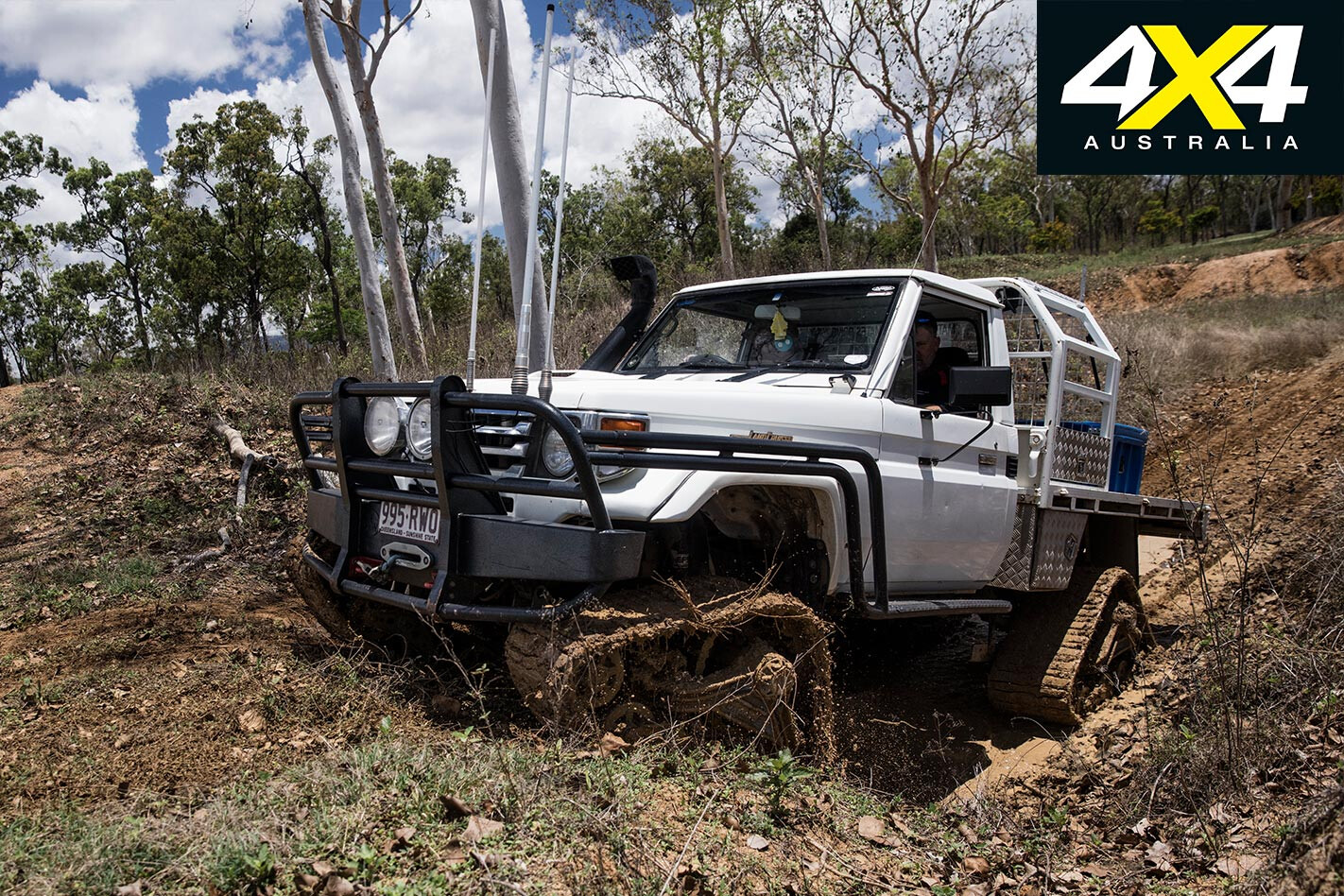
For us, however, it was an exceedingly cool Hemi-powered FC-Jeep shod with tracks – built by Daystar for SEMA 2014 – that had us contemplating a product called Mattracks. It turns out Mattracks are available in Australia, and we wanted to have a crack at these things off-road to see if they are as capable as they look.
Townsville-based Fire Express is the Australian distributor of Mattracks, and we caught up with Mark Dooley, the owner and director of Fire Express, to get the low down on converting a 4×4 to a tracked off-road weapon.
The Mattracks essentially bolt on to a vehicle’s existing stud pattern, and they can be removed any time and the wheels refitted reasonably easily. Some minor modifications are required to initially install the tracks, but then it’s up to you if you need to swap between wheels and tracks – these bolt-on mods don’t interfere with wheeled operation if you whack your wheels and tyres back on.
The main advantage of a tracked vehicle is low ground pressure and, as mud, snow and sand all pose challenges for wheeled vehicles, tracks basically provide a bigger yet lighter footprint. For example, the Land Cruiser you see here has a ground pressure of just 14kPa. To put that into perspective, while driving this set-up, I pulled up in a dry creek bed, hopped out and sank up to my ankles in sand, but the Cruiser barely broke the surface.
According to Dooley it was the aftermath of Cyclone Yasi in 2011 that sowed the seed for local Mattracks distribution. After Yasi had slammed into the North Queensland coast, leaving a trail of destruction in its wake, Dooley noted the emergency services were having difficulty getting around in flooded and waterlogged areas. Consequently, he thought Mattracks may have potential in the Australian market.
For our demo drive Dooley fitted a set of these tracks to his son’s lightly modified LC75, but before we could make some marks in the mud I got to have a look at the installation and what it requires. In the case of the Cruiser, you have to remember to lock the hubs before fitting the tracks, as failure to do so means you’ll have to pull the front track units off again to lock them.
To prevent the track units from rotating on their hubs when off-road, the brackets are fitted to the ball joints at the front and the rear spring hangers. A rubber torsion block within the unit’s housing ensures the tracks tilt upwards when confronted with an obstacle, rather than trying to rotate downwards on the hub.
There’s an optional power assist function you’d be mad not to opt for – it requires a pressure sensor and quick-release fittings to be mounted to the power steering box – as this makes turning much easier, as it raises the forward rollers as you turn the wheel, reducing drag and friction on the tracks.
Whether you can legally drive them on the road depends on your state or territory. Victoria’s Country Fire Authority has a Mattracks-equipped LC79 Workmate, complete with Fire Express firefighting unit, based at Mount Buller, and it’s road-registered within the resort area; although, it’s conditionally limited to 60km/h. Up in sunny Queensland, however, Mark will happily trundle into town in the tracked Cruiser for a latte.
The downside is you have to take it easy as the tracks can get quite hot, as Dooley explained. “Sixty kays an hour is okay,” he said. “You can do 80 but only for a five-kay stint or so.”
However, as I was to find out, the ride is pretty unforgiving on hard road surfaces. With the tracks fitted to the 1HZ-powered Cruiser the 50mm suspension lift becomes a substantial 200mm, and there’s an ARB compressor on-board with ARB diff locks (front and rear). An aftermarket turbo and intercooler has been fitted to the engine, along with a suitably chunky exhaust. It certainly sounded the part as we idled out of the shed, the subdued turbo whistle building in intensity as we picked up speed on the grass.
The ride may be pretty harsh on-road, but out in the paddock it was smooth, and the Cruiser just glided over lumps and bumps that’d usually have wheels juddering in their wheel arches.
I smacked the right pedal as we dropped into a slushy creek bed and was rewarded with a spray of mud up the side. The truck just rumbled over the top of slush rather than sink into it, hurling a couple of very satisfying muddy rooster tails into the air behind me. Unsurprisingly, I was grinning like a fool by this stage.
If the Cruiser was fitted with wheels it would’ve still made it through most of the places we took it, but it wouldn’t have done it as quickly or as easily. The only obstacles that posed any challenge to the Mattracks were large rocks, as the tracks tended to butt up against a boulder rather than roll over the top of it like an off-road tyre running low air pressures would.
On my drive we clambered down soft, sandy creek beds and river tributaries, as well as wallowed in a bit of mud and, with the diff locks only needed on a couple of occasions, the Cruiser was effortless, with the units planting the truck solidly on the ground.
The CFA’s aforementioned Land Cruiser was tested for lateral stability in Victoria, where it reached a cross-slope angle of 50 degrees before threatening to tip. This was very apparent while clambering through the bush, as it remains stable and inspires confidence. They aren’t cheap, though. Depending on the US dollar exchange rate at the time, you’d be looking at about AU$55,000 to fit a set.
Installation
Mark Dooley, the owner and director of Fire Express Australia, demonstrated how to install the units, adding that a flexi head on the rattle gun is a big help when it comes to doing up the track nuts due to clearance issues. Installation isn’t too big of a job, but the track units are quite heavy – Dooley manoeuvres the units into place using a wheeled mechanic’s creeper.
Rain, Hail or Snow It’ll Go
The tracks are most popular in snow applications – the Australian Antarctic Division uses them, as well as alpine fire and emergency services – but they’ve also found favour up in the tropics, where a couple of North Queensland stations use Mattracks-equipped Land Cruisers to get around during the wet season.
Storage solutions, tenting equipment, and canopies highlight January’s selection of 4×4 gear, just in time to complement your summer weekend plans.
MSA 4X4 HALF PACK ROOFTOP BAG
The gurus at MSA 4X4 have been busy, designing more new gear for off-road tourers such as this awesome rooftop bag. Aimed at all off-road tourers, the Half Pack rooftop bag is another brilliant idea; measuring 500mm wide x 1400mm long x 300mm high the bag is designed – as it is named – to take up half the space on the average roof-rack. This is super convenient as it allows you to fit your tent, shovel, gas bottle and/or any other camping gear up top as well. MSA 4X4 has used tough 15oz canvas, YKK chunky zips (with double metal sliders on three sides) so it will provide years of gear protection – and it is easily attached to your rack, via its attached seat-belt harness system. It comes with a lifetime warranty, too.
RRP: $378 Website: www.msa4x4.com.au
ARB SKYDOME SERIES II
The second incarnation of ARB’s SkyDome swag now offers even more ventilation than before, with extra canvas flaps and insect mesh over the legs and over the ‘top’ (head-to-waist) area. The freestanding swag includes a tough 970gsm PVC tub base (tub height is 70mm) with welded and sealed corners, while PVC anchor tabs ensure no water can enter through the seams. A rain-gutter channels water away from windows, the main entry door and all zippers (YKK zips feature throughout). The heavy-duty canvas (500gsm) is rot- and waterproof, while the 11mm aluminium bows are tough and make the swag easy to set up. The 75mm corrugated mattress includes an anti-microbial treatment and a washable cover, and the sleeping area is spacious; the single swag measures 900mm wide x 2150mm long (the double is 1400mm wide x 2150mm).
RRP: $437 (single) Website: www.arb.com.au
BLACK WOLF RIDGERUNNER
Combining the best of both worlds – a backpack and roller bag – the Ridgerunner (available in black or blue) offers excellent bang for your luggage bucks. Black Wolf has been building tough travel gear for years and the design of the Ridgerunner reflects that: the two-stage handle is easily deployed when used as a transit bag and the wheels roll smoothly across surfaces. The backpack harness is accessed via the back panel’s zip pocket and is designed to offer plenty of support and comfort when lugging heavy loads. The interior section is huge, allowing storage for bulky gear and clothing, all of which can be kept contained via the load control straps. There are also plenty of external pockets for gear storage.
RRP: $200 (60L); $220 (80L) Website: www.blackwolf.com.au
ROH BEADLOCK
A new addition to ROH’s Dakar Proven wheel’s range, the Beadlock is a deep-dish, eight-spoke design, with bright CNC-milled key lines on the beefy matte-black spokes. Other design highlights include the 20 black anodised aluminium bolts that run along the matte-graphite outer beadlock rim. Add in the stainless-steel centre cap screws and you’ve got a visually appealing wheelset. The Beadlock is available in two wheel sizes – 16×8 and 17×9 – and is available for a number of popular 4x4s such as the Hilux, Ranger, Colorado, Navara, BT-50 and Triton. The Beadlock is, as you’d expect from ROH, built tough, too; the wheel’s ROH Easyclean’s matte-black baked enamel finish offers excellent durability and resistance to weathering and salt-spray. The wheelset’s high load rating means it is also a great choice for those looking at a GVM upgrade.
Website: www.roh.com.au
ALLAN MOFFAT
One of Australian motor racing’s true legends, Canadian-born Moffat’s career went from the mid-1960s until the late 1980s and encompassed the true heyday of Aussie touring car racing, with ‘The Great Race’ at Bathurst its centrepiece. Moffat (with John Smailes) writes about his career in an honest style, detailing the successes he had, ranging from driving his all-conquering Trans Am Mustang to more than 100 victories, through to the brutal Ford versus Holden wars waged during the 1970s and 1980s at Bathurst. It’s not all about the good and bad times of Aussie motorsport, however; Moffat also recounts moving to this faraway land from Canada as a boy, weaving his own story in with the greater one that his career became.
RRP: $40 Website: www.allenandunwin.com
OZTENT CAMPER CUPBOARD
For those who like to set up a ‘base camp’ for a few days, OzTent’s new camper cupboard is the perfect addition to your camp-kitchen set-up. The cupboard’s frame is 28mm powdercoated box aluminium (read: strong), while the three shelves are aluminium-edged MDF and the exterior 600D polyester PVC. It’s designed to offer a secure, robust storage structure for camp. The cupboard’s No-See-Um mesh flyscreens keep insects away, the laminated resin bench top provides food prep space, and it all packs down fast thanks to the easy lock/release mechanisms. Packed size is 600mm long x 510mm wide x 90mm tall (set-up size is 600mm x 510mm x 800mm) and it weighs a paltry 8kg. A carry bag is also supplied.
Website: www.oztent.com.au
IRONMAN 4X4 PINNACLE CANOPY
This new canopy from Ironman 4×4 is constructed using vinyl-ester fibreglass for excellent durability and strength and, with its model-specific moulding, ensures the canopy matches the design of the vehicle it is fitted to perfectly. The Pinnacle includes large lift-up tinted windows on each side (with dual locks) for easy access, and a rear window that includes a central locking system. Other features include roof rails (the Pinnacle has a roof load rating of 80kg), over-lip mounting for enhanced water and dust protection, and an LED internal light. The exterior is smooth-finish and there is the option to colour-code the canopy. The Pinnacle is currently available for the Navara NP300 (2015-onwards), Toyota Hilux (2015-onwards) and Mitsubishi Triton.
RRP: $2640 Website: www.ironman4x4.com
BRACKETRON TEKGRIP VENT MOUNT
One of the best places to mount your smartphone or GPS to ensure easy viewing without affecting driver vision is on the air-con vents. Bracketron’s new TekGrip Vent Mount is compact and versatile, with one-click arm expansion and the ability to rotate your unit 360 degrees for either a horizontal or vertical viewpoint. It can also be tilted to the desired angle for optimum vision. The mount will fit to most vehicles’ horizontal and vertical vent set-ups, and it also includes folding support legs for additional stability. The TekGrip Vent Mount is also super-easy to move between vehicles and is built tough.
RRP: $49.95 Website: www.bracketron.com.au
SEA TO SUMMIT COMFORT DELUXE SI MAT
This self-inflating mat is ideal for vehicle-based campers keen to maximise cargo space. The Comfort Deluxe SI (Self Inflating) offers an awesome 10cm of air-sprung mat, while the mat’s vertical sidewalls maximise the sleeping area. The 30-denier (D) stretch knit fabric is comfortable without an over-sheet. The mat is made using tough 75D polyester and a laminated TPU on the base, so it will last many years of camping. The mat’s internal fill material also means it is warm, making it ideal for all-season camping (even those winters in the High Country). The Comfort Deluxe SI is available in three sizes: Regular-Wide (1830mm long x 640mm wide and 1.84kg); Large-Wide (2010mm x 760mm and 2.41kg); and Double (2010mm x 1320mm and 4.2kg).
RRP: $299.95 (Regular-Wide) Website: www.seatosummitdistribution.com.au
TJM PRO LOCKER COMPRESSOR
This all-new, compact compressor from TJM is designed to fit under-bonnet or in small spaces in your vehicle, thanks to its multiple-angle mount bracket. It’s designed for use with TJM’s Pro Locker diff locks. Features include an oil-less, non-lube piston and cylinder, an inbuilt check valve, and a two-stage air filter (moisture and dust resistant) to ensure fine particles cannot enter the internals during operation. The compressor has an anodised aluminium air tank, an 11amp max current draw and a 26LPM (litre per minute) flow rate, as well as a permanently lubricated motor shaft and connecting rod bearings. A simplified wiring loom is included and the compressor is balanced for low-vibration operation.
Website: www.tjm.com.au
EFS FORD RANGER LIFT KIT
EFS has released an awesome suspension kit for Ford’s ever-popular Ranger. The kit includes EFS Elite 35mm big-bore front struts and rear EFS Elite shocks, combined with raised heavy-duty coil springs (front) and raised heavy-duty complete rear leaf spring packs. Also included in this kit are the EFS poly bush kit, greasable pins and shackles, as well as U-bolts. EFS offers a wide range of different load-rated front coils and rear leaf springs for applications ranging from general touring through to towing and can customise the vehicle’s suspension to suit your exact requirements. This kit – like all EFS kits – benefits from lengthy development undertaken by the company here in Australia to ensure the suspension set-up is matched to our demanding conditions.
RRP: From $1745 (excluding fitting) Website: www.efs4wd.com.au
SHIMANO SUSTAIN F1 SPINNING REEL
Shimano’s new F1 is a reel that combines excellent rigidity with sensitivity, as well as shielded A-RB bearings and a drag output of 9 to 11kg, for optimum performance. The reel’s aluminium Hagane Body provides the stiffness of steel with impact resistance, while the Magnumlite Rotor ensures plenty of sensitivity to alert anglers to that ‘first nibble’, while also offering a fast response rate courtesy of the low-inertia rotation. Shimano’s X Protect tech combines a water-repellent treatment with a convoluted structure to block water ingress. Add in the cold-forged Hagane Gear and X-Ship for smooth gearing that brings effortless casting and you can see why this reel is rated ‘highly desirable’ by anglers.
RRP: $449.95 Website: www.shimanofish.com.au
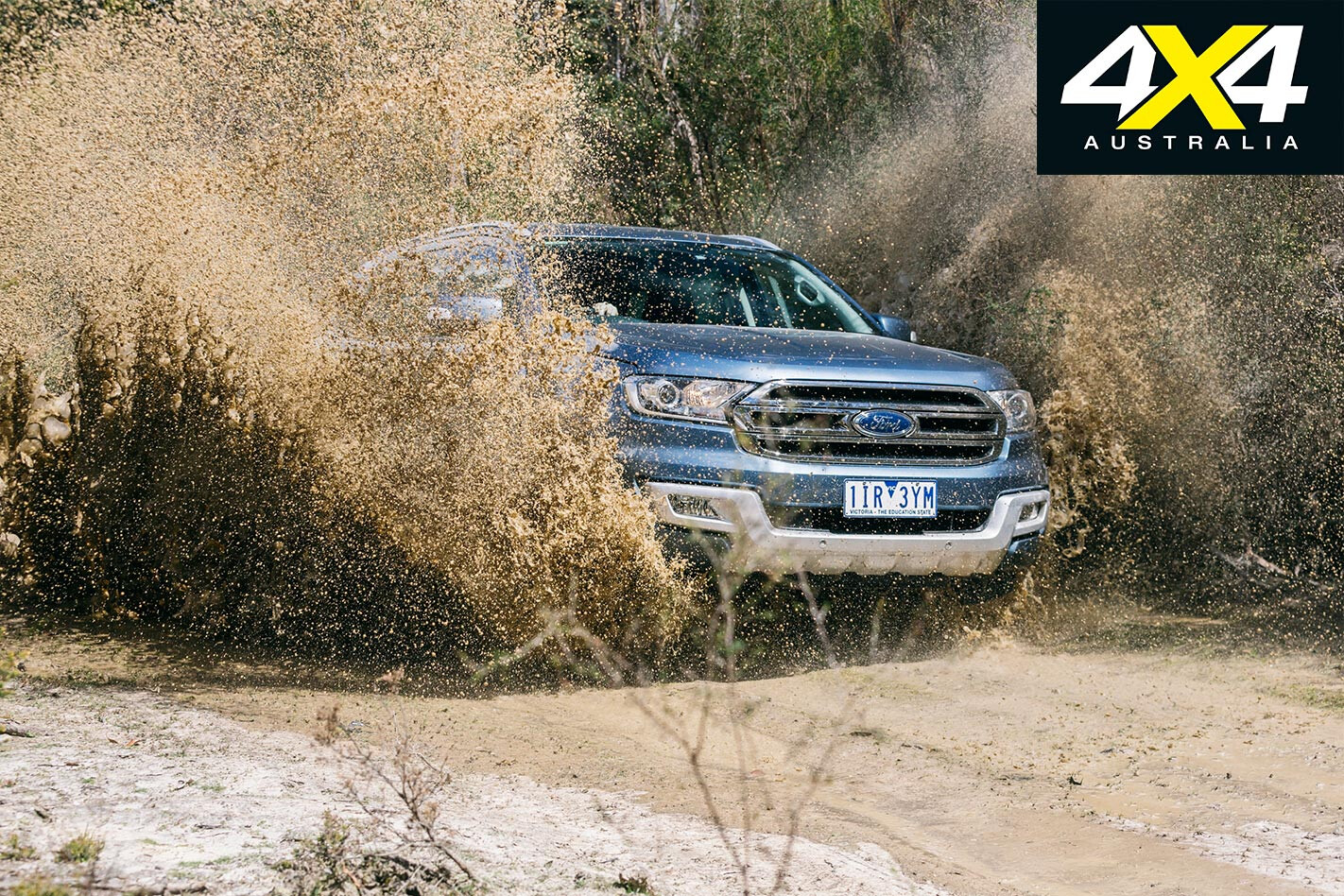
The premise was simple: prove a bog-standard Ford Everest could be mastered off-road by the brazen amateur and, in doing so, be a capable weekend warrior-cum-workday plodder. The location? None other than the Apple Isle, where journos were invited to bring along a family member or friend with little or no four-wheel driving experience for a weekend bash on backcountry roads.
The contingency gathered at Devonport Airport, where a selection of Everest Trends and a couple of Titaniums awaited. With the inexperienced eager to learn how to turn all four wheels on mud and dirt, those of us travelling solo were paired up and sent on our way – us in a mid-spec Trend.
A spurt along sealed tarmac from Devonport Airport lead to the picturesque Bakers Beach in Narawntapu National Park, which provided the backdrop for a quick lunch stop – where we sampled some fine campfire-cooked tucker – and the obligatory safety/how-to chat from the boffins at Ford.
Under the expert guidance of James Stewart and Ford Australia’s vehicle integration supervisor, Richard Woolley, the contingent of journos and partners – mums, dads, partners and kids (more eager to spot a Tassie Devil than learn about the Everest’s power-to-weight ratio) – were run through the ringer on the intricacies of the Everest’s off-roading nous.
Everything from tyre pressures, basic recovery techniques and the Everest’s Terrain Management System (Rock, Mud/Snow, Normal and Sand) were ticked off and, once everyone was comfortable with which dials did what and how to use a comms system, we rolled out to the first Ford Everest Experience challenge.
We arrived at Briggs Regional Reserve, where a makeshift off-road course had been set up by the Ford team. The course was sculptured to test the Everest’s departure (29.5°), rampover (25°) and approach (21.5°) angles, as well as ground clearance (225mm). In what was a blessing in disguise, my co-pilot had limited off-roading experience, which provided the perfect opportunity to see first-hand how easy it was for her to adapt to the various obstacles the set route provided – it also tested how intently we listened to the instructions given earlier in the day.
With low range selected and Rock mode engaged (and with the support of the cross-axle diff lock at the rear), the Everest calmly negotiated the relatively subdued track, overcoming the steep inclines and driving itself downhill with descent control activated. My co-pilot’s initial trepidation was soon replaced with confidence as she realised an unmodified Everest was highly capable at traversing mud, sharp rocks, and slippery ascents and descents.
As confidence in the Everest’s abilities piqued, we followed a rutted route littered with corrugations and potholes, where the Everest’s coil-sprung rear end, in combination with 18-inch Bridgestone Dueller H/Ts, tied the vehicle down nicely – countless hours of local testing will do that. The cabin is also a peaceful place to be due to soft-touch interior materials and improved NVH, thanks in part to active noise cancelling tech.
The broken tracks were soon abandoned as we took the paved path toward the town of Sheffield – famous for its murals – and then on toward O’Neills Creek for traditional Aussie damper and tea. A local bushman wooed us with his knowledge as we tucked into our afternoon snack, before we were whisked away to our overnight digs at the iconic Cradle Mountain Lodge (within the World Heritage-listed Cradle Mountain National Park) some 50 minutes’ drive away via some of Tassie’s famous winding roads.
Some of the weekend’s best fun was to be had on these twisties that are traditionally better suited to MX-5s and Subaru BRZs than 2.5-tonne Everests; not that this troubled the burly 4×4. Despite its hefty weight and considerable size the Everest remained planted through the tight 100km/h hairpins, its 147kW/470Nm 3.2-litre turbo-diesel engine feeling sprightly and unfussed.
An early start the following morning had us back on some fine examples of the Apple Isle’s switchbacks, heading towards the historic town of Waratah in the state’s north-west, with coffee in hand. The bitumen ended once more as we headed off-road to experience Savage River National Park’s stunning landscape – avoiding stranded pieces of tin strewn throughout the tall grass at Hellyer Gorge, which, apparently, is where you’re likely to find tiger snakes basking in the sun.
The Ford team then scoped out an old mining site with a couple of water crossings that’d make some pretty cool photos, and the group had a bit of fun with some high-speed puddle-bashing – not that the water was deep enough to test the Everest’s 800mm wading depth. A 98km bitumen run from Waratah north to Boat Harbour for lunch again showed off the Everest’s on-road credentials. From here, and with bellies full of pizza and soft drink, the weekend jaunt ended with a dash back to Devonport Airport.
The action-packed weekend provided ample time to sample the Everest over a range of surfaces, and it proved that you don’t have to throw the aftermarket catalogue at it; a stock-standard Everest is a capable off-road tourer sans any mod support. But can amateurs with no off-roading experience venture from the shopping centre to the outback in an Everest? Absolutely. The Everest is designed for ease of use; anyone should be able to flick it into low range and escape the bright lights of the city.
Granted, you wouldn’t take an Everest from the showroom floor straight to the remote regions of Australia or down Billy Goat’s Bluff, but, within reason, a stock Everest strikes a good balance between day-to-day chores and weekend adventurer. And, yes, this new-age of off-roading does take away the skill of old-school four-wheelin’, but if it gets more people on tracks and experiencing our great backyard, then that has to be a good thing.
INTO THE WILD
WE spent the night bunkered down in our overnight digs at Cradle Mountain Lodge, with a roaring fire but no internet or TV – a welcome change. There are a number of short walks from the lodge: Enchanted Walk (20-minute circuit); King Billy Walk (30 minutes); and Kynvet Falls (45 minutes to the top of Kynvet Falls). Dove Lake, a must-see attraction, is located 8km from the lodge and takes about 15 minutes to drive there – you’ll need a permit.
2018 FORD EVEREST TREND SPECS: Engine: 3.2L 5-cyl turbo-diesel Max Power: 143kW at 3000rpm Max Torque: 470Nm at 1750-2500rpm Gearbox: 6-speed auto 4×4 System: Dual-range full-time Crawl Ratio: 38.6:1 Tyre Spec: 265/60 R18 Kerb Weight: 2407kg GVM: 3100kg Payload: 693kg Towing Capacity: 3000kg Fuel Tank Capacity: 80L ADR Fuel Claim: 8.5L/100km Price: $58,990
Departure Angle: 29.5˚ Rampover Angle: 25˚ Approach Angle: 21.5˚ Wading Depth: 800mm Ground Clearance: 225mm
VOLKSWAGEN Commercial Vehicles has let loose its special edition Amarok Dark Label onto UK showrooms.
Much like what Nissan did with its Navara N-SPORT Black Edition last year, VW Commercial Vehicles has launched a can of black paint at its Amarok Highline to create the special-edition model.
Like the Nissan, the changes are aesthetic – 18-inch Rawson alloy wheels; matte black mirror housings, side bar and rear bar; black door handles; a black rear bumper; and all complemented by an exclusive Carbon Steel grey metallic paintjob – with a few practical additions thrown in: rain-sensing windscreen wipers; automatic headlight control; and power-adjustable, heated and folding door mirrors.
The interior also received a touch-up, with Alcantara and chrome silk gloss prominent. Other interior niceties include front seats with manual lumbar support, Dark Label floor mats and Discover Media with 6.33-inch touchscreen.
Not surprisingly, the powertrain remains unchanged, with Volkswagen’s V6 3.0TDI 150kW/500Nm engine pairing with an eight-speed auto and permanent four-wheel drive.
The Dark Label is priced from £33,650, with production limited to around 200 units. UK punters can order their dark steed now, with the first deliveries scheduled to arrive in May this year… Australians cannot.
THE Malloy family from the Gold Coast have just returned from their 10 month ‘Big Lap’ around Australia, where they (Craig and Kelly) continued to manage their business remotely, with the help of some very competent staff.
Australia may get a big tick for its amazing outback and culture, but it unfortunately has a red cross against it in regards to regional and remote mobile phone coverage. So, how did the Malloy family overcome their communication conundrum?
The Government recently funded almost $600 million in new investments to improve mobile coverage across Australia. The funding covers 499 upgraded or new mobile base stations, more than 68,000km² of new handheld coverage in regional Australia, and more than 150,000km² of new external antenna coverage. While this sounds substantial, it’s really just the start. The rough Australian terrain doesn’t lend itself to an easy solution for traveller communication, so many 4×4 drivers have to resort to alternative means to be able to run their business and keep in touch when on the road.
Craig states that one of the reasons they were able to do their ‘Lap’ was the ability to work and keep the business running while travelling. Installing Cel-Fi GO ensured they had great phone and data for much of their trip via the Telstra 3G and 4G network, and being able to keep in contact with staff and clients was a business lifesaver for them – and it was great for the children when doing their online schooling.
Cel-Fi GO is a mobile phone repeater that can boost a 3G or 4G Telstra signal. It requires an outdoor antenna to pick up the signal and an indoor antenna to provide signal to any Telstra mobile device in range. An inbuilt amplifier will boost a very poor signal and make it usable. The Mobile Cel-Fi GO version is perfect for vehicles and those on the move, and the stationary version is perfect for homes, offices and caravans.
Time and time again, right around the country, when the Malloy family parked at camps, beaches or rainforests, they were able to access mobile coverage. Without utilising a GO, accessing mobile coverage would be a struggle, as many of their fellow travellers could attest to.
Craig remembers one situation very clearly on a beach in Mutee Head, on the way to Cape York. A group of men camping close by were struggling to make a phone call, while Craig was able to run a video conference with a client from his car. The ease of set-up was also a bonus – once set up in an area with a sniff of a signal, you were connected. There was no hassle or dealing with giant aerials and accessories.
“The GO is really quite impressive. Several times we have been the only person in the camping ground or attraction with internet and reception of a level that is very usable for business,” said Craig.
For more information on Cel-Fi GO solutions for your vehicle, contact Powertec Telecommunications for details of the pack appropriate for your travels on (07) 5577 0500, or email [email protected]
Website:www.powertec.com.au/mobile-products/repeater-types/vehicle-repeaters
Relive the Malloy family adventure here.
THE January 2018 issue of 4X4 Australia is available in stores.
To kick off the new year, we drove Jeep’s new JL Wrangler, Toyota’s updated Hilux range, the HSV Colorado SportsCat and the all-new Disco TD6.
We also punted the 2017 F-150 Raptor in the Mojave Desert, and took a trip south to Tassie for the Ford Everest Experience.
Get your copy of 4X4 Australia from newsagents or by subscribing to 4X4 Australia in electronic or print format.
What you’ll get in the January 2018 issue:
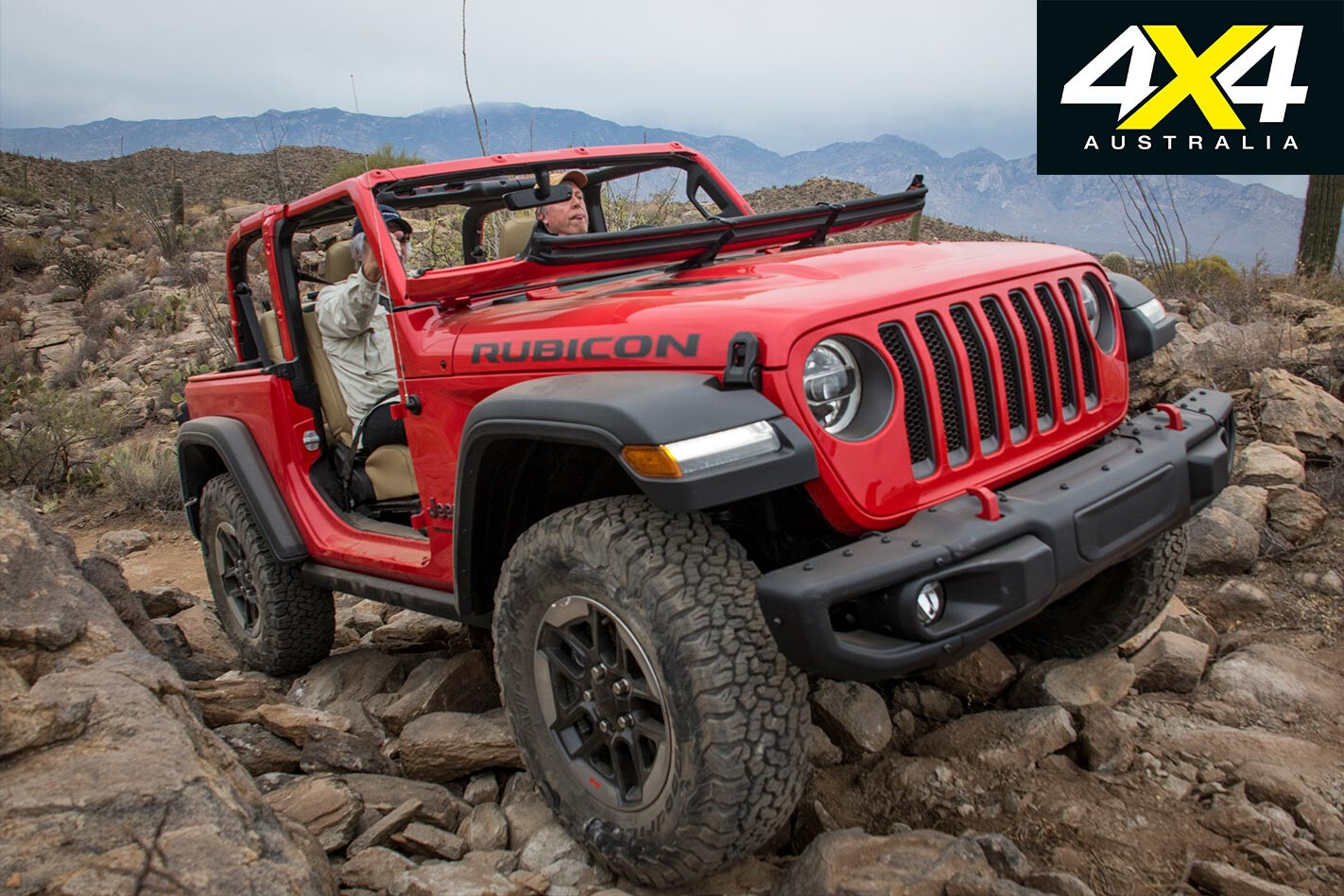
FIRST DRIVE: 2018 Jeep JL Wrangler In the US of A for the first fang of Jeep’s new Wrangler.
FIRST DRIVE: 2018 Toyota Hilux SR+/SR5+ Sampling the rejigged Hilux range.
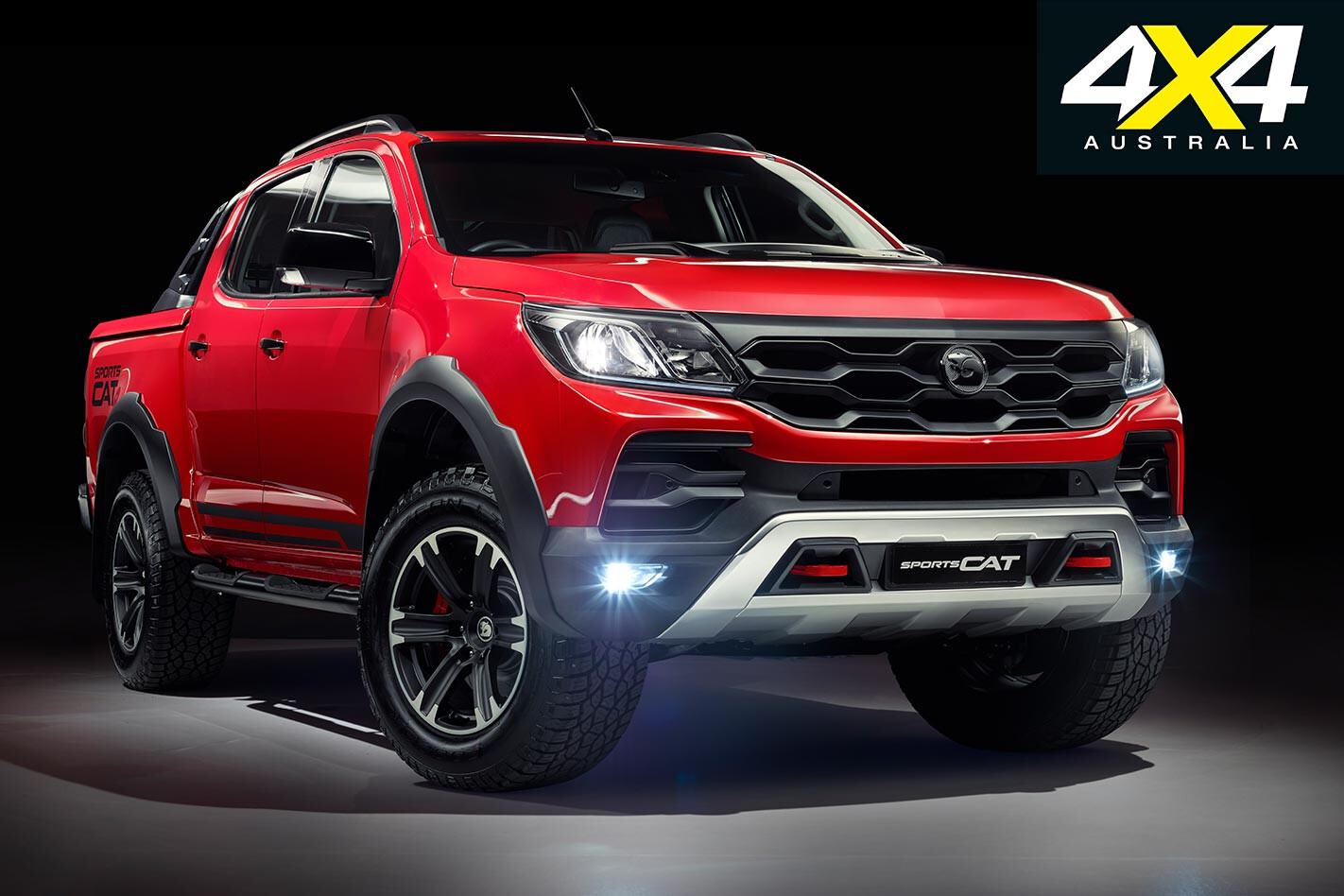
FIRST DRIVE: HSV Colorado SportsCat Dressed-up SportsCat puts the cat among the pigeons.
FIRST DRIVE: Land Rover Discovery TD6 Grooving in Land Rover’s new-from-the-ground-up Disco.
CUSTOM: Duramax V8-powered Ford Ranger 6.6 litres of V8 fury.
DRIVEN: Ford F-150 Raptor With a Ranger Raptor coming to Oz, we head back to the States to drive the F-150 that spawned it.
EVENT: Ford Everest Experience, Tasmania Off to the Apple Isle with a convoy of Ford Everests.
GEAR: Compliance Testing On why you should always try and buy compliance-tested equipment.
EXPLORE: Flinders Ranges, SA Tracking along some of the country’s best self-drive tracks.
EXPLORE: Jeep Heritage Museum, Georgia, USA Visiting the most complete seven-slot grille collection on the planet.
EXPLORE: Narrabri, NSW Much more than a gateway to the west.
GEAR: Fuel Tank Buyers’ Guide Why an aftermarket fuel tank will prove a lifesaver on remote-area adventures.
CUSTOM: Mattracks-equipped LC79 Swapping rubber for tracks on the uber-tough LC79.
WHAT ELSE?
We list and review a bunch of the best aftermarket gear currently in catalogues, including ARB’s Linx and Ultra Vision’s Nitro 140 Maxx lights. We also outline what’s necessary for a brake upgrade.
In the 4×4 shed this month we’ve got Matt’s 1985 BJ73, Ron’s 79 Series and our resident G300 Professional.
Plus, Dean Mellor explains the ‘Victorian Shuffle’, which anyone travelling along the Hume Highway will know all too well.
Enjoy the issue!