
ISUZU Ute Australia calls its new-generation D-MAX a ‘third generation’ model, but that undersells its heritage.
It may be the third generation Isuzu ute sold in Australia since the brand launched here in 2008, but it’s the latest in a long line of Isuzu utes that stretch back more like six generations and all the way to 1972. In Australia, the earlier Isuzu utes were sold for 40 years, mostly as the well-loved and well-regarded Holden Rodeo.
This new D-Max is not just of vital importance to Isuzu here in Australia but will have a wider impact in the overall ute market. Mazda’s soon-to-arrive new BT-50 is effectively a new D-Max also, just one with different body panels and interior fitout. It will end Mazda’s long product-sharing relationship with Ford in this market sector.
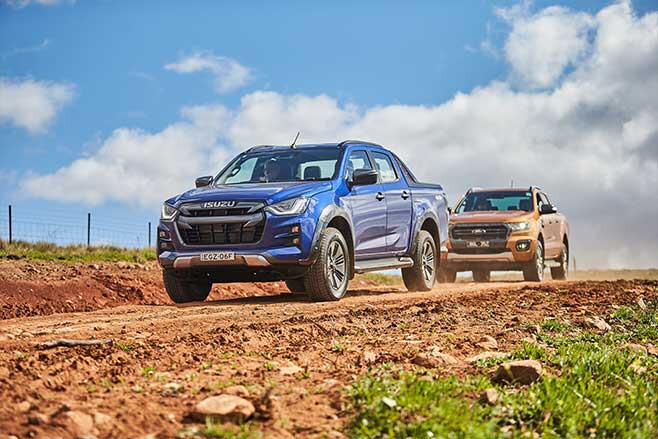
The new D-Max, and its Mazda twin, will also be the first entirely new-generation utes from any major manufacturer to arrive in Australia for five years, and will get the jump on soon-to-arrive new-generation models from Ford and Volkswagen.
To see how the new D-Max in the range-topping X-Terrain spec measures up we have pitted it against a Ford Ranger Wildtrak, one with the 2.0-litre four-cylinder bi-turbo diesel. We chose this powertrain over the Ranger’s older, more workmanlike 3.2-litre five-cylinder diesel for its superior refinement and economy. Being the newest powertrain across the popular ute segment it seemed a better benchmark for the heavily revised D-Max powertrain.
The Ranger is also at the pointy end of the current ute market in terms of its on-road ride and handing, off-road prowess and cabin comfort and space, so again a good benchmark.
2021 ISUZU D-MAX
AT first glance, Isuzu’s new D-Max may just look like a revision of the D-Max that’s been around in one form or another since 2012 but in this case, appearances are deceptive.
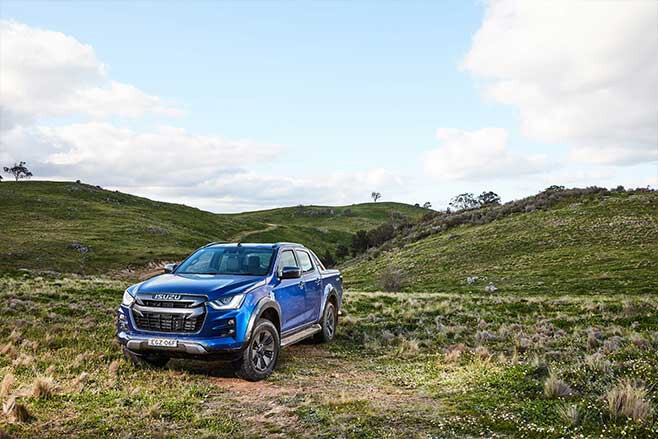
The new D-Max represents a full generational change and, importantly, is an all-Isuzu design whereas the previous generation D-Max started life as a joint venture with General Motors. Before that, Isuzu always designed its own utes from the ground up anyway (rebadged here as the Holden Rodeo), so this new model is a return by Isuzu to doing what it has traditionally done.
The least changed aspect of the new D-Max is the powertrain, but even that has been significantly revised. More important in the overall scheme of things is an all-new chassis and cabin, and a comprehensive suite of advanced safety features right across the model range.
D-MAX POWERTRAIN AND PERFORMANCE
THE new D-Max’s 3.0-litre four-cylinder diesel is the latest member of an engine family that dates back to 2004. In this latest iteration it claims 140kW (up from 130kW) and 450Nm (up from 420Nm). More importantly the extra torque is on tap at a much lower rpm and it also produced higher up in the rev range with the 450Nm maximum produced from all the way from 1600rpm to 2600rpm.
The extra power and torque comes courtesy of a more efficient variable-geometry turbocharger and a new higher-pressure common-rail injection system. Other changes run to revised combustion chambers, new pistons, and modified cylinder block and crankshaft. As with the last of the previous generation D-Max engines (from 2017-on), the new engine has a diesel particulate filter as part of its Euro 5 emissions compliance.
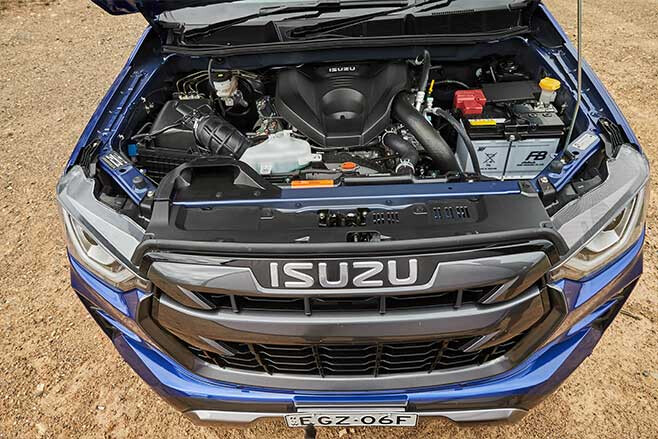
The D-Max is available with both revised six-speed manual and automatic gearboxes, although the X-Terrain is auto only. As before, the manual gearbox is an Isuzu in-house design, while the automatic comes from Aisin.
On the road the driving experience is both familiar and different. The new engine still has much of the feel and workmanlike character of the older D-Max, but is noticeably quieter and more responsive in general driving. Pedal to the metal and at higher engine speeds it’s still somewhat harsh, but not as much as the old engine. It’s also more muscular, everywhere.
Where the previous D-Max was a fair way off the performance of the Ranger bi-turbo, this new D-Max isn’t, even if the Ford is still a bit quicker once it gets into its stride.
The revised Aisin automatic is also much improved with faster shifting and far more proactive and sporty shift protocols. The extra torque at lower engine speeds also helps to counter the very tall but unchanged gearing, which means less shuffling between fifth and sixth on undulating country roads at legal touring speeds, which was a less than likeable trait of previous D-Max.
D-MAX ON-ROAD
THE new D-Max sports an all-new, more rigid ladder frame with notably larger-section side rails and additional cross bracing, and new-design front and rear suspension.
At the front the upper and lower wishbones are far more substantial and are much farther apart in the vertical plane, while the sway bar now mounts to the top rather than the lower wishbone. At the rear the three-leaf springs are claimed to be lighter, yet stronger. Bigger front brake rotors with twin-piston floating callipers and electric power steering are also highlights of this all-new chassis. With the bigger brakes, 17s rather than 16s are now the smallest wheels that can be fitted.
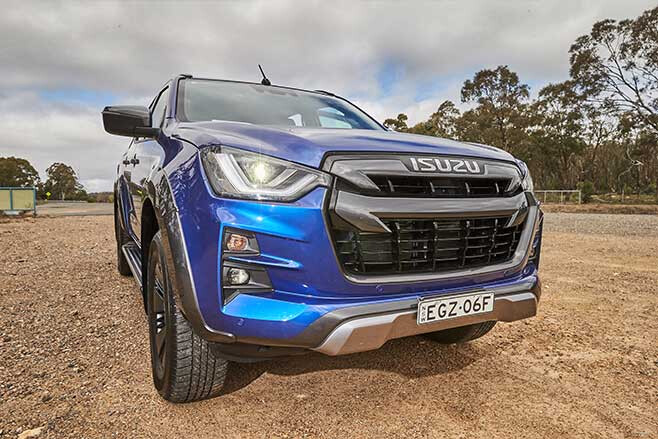
On the road the D-Max’s ride and handling is much improved and is a far more noticeable advance than the powertrain upgrades. Where the powertrain offers a still somewhat familiar driving experience, the new chassis makes the D-Max feel like a completely different ute, especially on poorer roads and at higher speeds where it is far more composed, confident and engaging to drive than before.
The electric power steering means a light steering effort at parking speeds while still providing decent feel and feedback at highway speeds. The only glitch here is that the lane-departure warning and prevention safety tech can be over zealous at times on some roads. And while you can turn it off via the settings menu, this can’t be done on the move and it always defaults to ‘on’ when the engine is stopped and then restarted.
D-MAX OFF-ROAD
THE new D-Max has fractionally more ground clearance, and despite a 30mm longer wheelbase the body is shorter, so the approach and departure angles are marginally improved although the ramp-over angle remains the same.
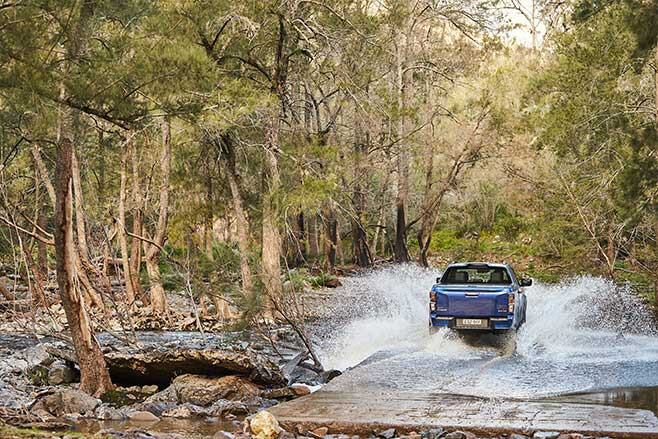
The fording depth is now a claimed 800mm (up from 600mm) despite the engine air intake now being under the bonnet lip. For those wishing to fit a snorkel, the Australian spec D-Max has a prefabricated air pathway in the inner guard to make things easier. All 4×4 D-Max models are now also fitted with a driver-switched rear diff lock as standard, although the part-time dual-range 4×4 system remains otherwise unchanged.
Wet weather and the mud-adverse highway-pattern tyres put a limit to what off-road testing was possible, but the D-Max feels a cut above what it could achieve before, thanks in part to the extra wheel travel of the rear suspension. The rear locker is a bonus too, but perhaps not as much as it could be given it cancels the electronic traction control on both axles when engaged.
D-MAX INTERIOR
INSIDE the new D-Max you’ll find an altogether different feel and presentation than the superseded model, and one that’s more akin to that of a passenger car rather than a commercial vehicle.
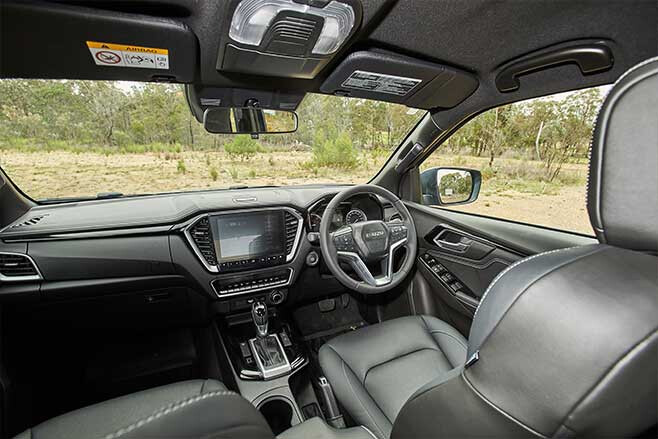
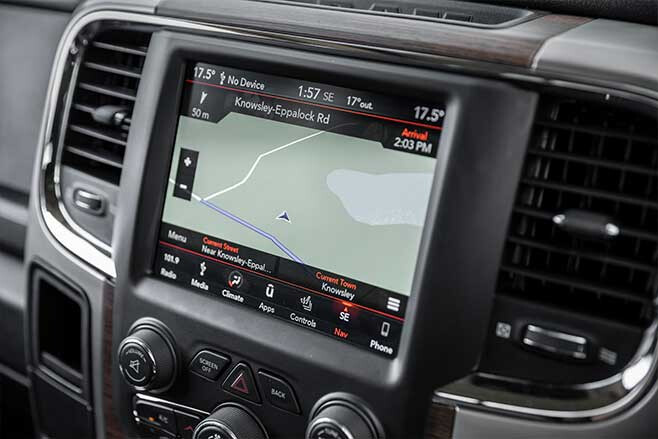
The cabin is bigger, better finished and more carefully detailed, and the driver now has the luxury of tilt-and-reach steering-wheel adjustment, something that the Ranger doesn’t have. On this very well-equipped D-Max there’s still no heated front seats however, so the Ranger gets one back. The high-tech dashboard with its big 9-inch touchscreen also means no simple knob to adjust the audio volume, which won’t please everyone.
The long list of high-end safety kit across the entire range (see ‘What You Get’ for details) has seen the new D-Max achieve a maximum five-star rating under the stricter 2020 ANCAP safety criteria. Other utes previously achieving a five-star ANCAP rating (such as the Ranger) may not do so now under the new criteria, given the ‘moving goal posts’ nature of the ANCAP system.
D-MAX PRACTICALITIES
THE new D-Max’s extra power and torque (and bigger brakes) bode well in making it a better heavy tow vehicle than before, but that’s something we need to test in the future.
In the meantime the towing rating remains the same at 3500kg, as does the Gross Combined Mass at 5950kg. The Gross Vehicle Mass is 50kg heavier than the old model, but probably just to compensate for the higher the kerb weight.
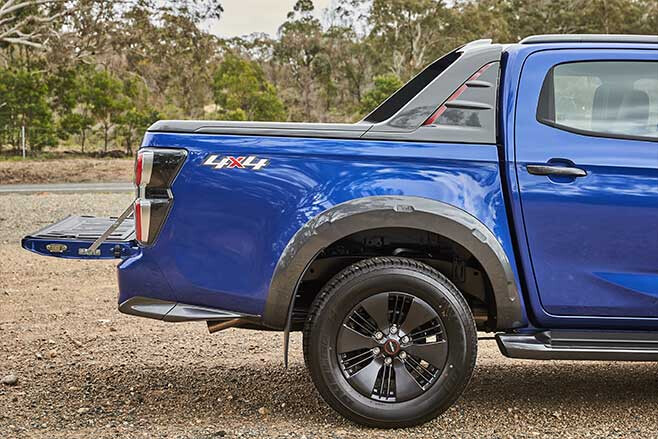
The factory tub is the same width as before but fractionally deeper and longer, while the X-Terrain’s lockable roller tonneau (much the same as fitted to Ranger Wildtrak) means lockable and reasonably weatherproof storage but with some compromise to carrying bigger, and especially taller items. Surprisingly there’s no 12-volt outlet in the rear tub.
D-MAX EQUIPMENT LIST
THE automatic-only top-spec X-Terrain, as tested here, is distinguished from the lower D-Max models by its smart-key entry and start, remote engine start, self-locking on walk-away, leather seat trim, electric adjust on the drivers seat, a tub liner, lockable roller tonneau and ‘aero’ sports bar.
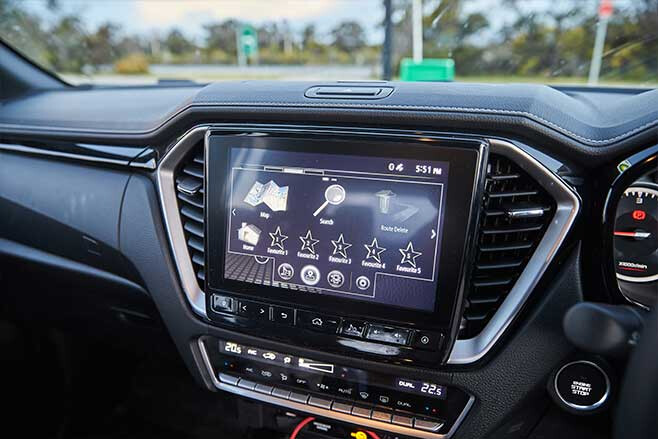
Like all D-Max models it has a long list of safety features headlined by autonomous emergency braking, lane-departure warning and prevention, emergency lane-keeping intervention, blindspot monitoring, rear-cross traffic alert and no less than eight airbags. Being an automatic it also gets adaptive cruise control (in addition to normal cruise control), and ‘Lane Keeping Assist’, which gives a degree of self-steering on motorways and the like.
As with the next-level down LS-U the X-Terrain also has a 9-inch touchscreen, sat-nav, Apple CarPlay and Android Auto, and rides on 18s. Like all 4×4 models it also has a driver-operated rear differential lock.
2021 D-MAX 4X4 PRICES*
SX MANUAL: $47,900 SX AUTOMATIC: $49,900 LS-M MANUAL: $51,000 LS-M AUTOMATIC: $53,000 LS-U MANUAL: $54,900 LS-U AUTOMATIC: $56,900 X-Terrain AUTOMATIC: $62,900 *Prices do not include on-road costs.
FORD RANGER WILDTRAK
THE Ford Ranger you see here is a mixture of new, and not so new. The powertrain, a sophisticated but relatively small 2.0-litre four-cylinder bi-turbo diesel backed by a 10-speed automatic, only appeared in late 2018 but the basic platform dates back to late 2011.
Significantly for Ford, this Ranger was a Ford design from the ground up and not just a rebadged Mazda as was the previous Ranger and all the Ford Courier utes before that. The design and development of this Ranger was also headquartered here in Australia.
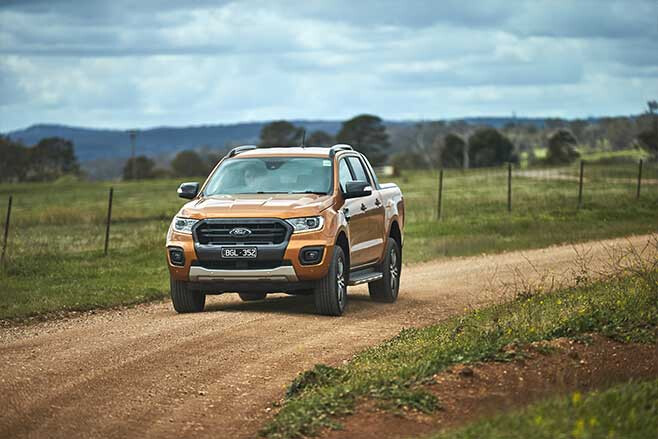
When the new powertrain was released in late 2018 for the 2019 model year, Ford took an each-way bet and retained the 3.2-litre five-cylinder diesel that dates back to the debut of this model although significantly revised for the 2016 model year. Of the two, the ‘little’ engine wins on refinement and economy, and is punchier in general driving.
This generation Ranger has proved so popular that it’s done the unthinkable and challenged and even bettered Toyota’s Hilux for sales supremacy in the 4×4 class.
RANGER POWERTRAIN AND PERFORMANCE
A two-litre four-cylinder diesel may sound like a small engine for a big ute but thanks largely to its bi-turbo arrangement it claims an impressive 157kW of power and 500Nm of torque, thus putting it ahead of the new D-Max by 17kW and 50Nm, despite the D-Max having a 50 per cent capacity advantage. The Ranger’s 2.0-litre engine even claims 10kW and 30Nm more than the 3.2-litre five-cylinder Ranger engine.
The bi-turbo arrangement is sequential and uses a small turbo to improve the low-rpm response before a bigger turbo gradually takes over at higher engine speeds and higher engine loads. The transition from small turbo working alone, to both turbos working together and then the bigger turbo working alone is totally seamless.
On the road the Ranger is quicker than the D-Max, but not by much and that’s probably more to do with having more closely spaced gearbox ratios, which helps extract the best from the engine.
The Ranger’s diesel is also smoother, quieter and more refined than the D-Max’s much-improved engine but the Ranger’s 2.0-litre also wins on refinement across the wider ute class, so the win here against the D-Max engine is not surprising.
On full noise the Ranger’s little engine actually sounds like a big engine in the way it hammers along and is more characterful and engaging than the blander and more workmanlike D-max engine.
For its part the Ranger’s 10-speed automatic offers slick and quick changes, which are often hard to pick especially on a light throttle but can occasionally be indecisive with gear selection, especially when going from light-throttle cruising to full-throttle acceleration. With all those gears to chose from, the Ranger swaps gears far more often then the D-Max, which makes it feel more frenetic at times even with the excellent shift quality.
RANGER ON-ROAD
FORD managed to achieve a high standard of ride and handling with the Ranger when first released and this is still evident today, helped by a few changes along the way.
In 2016 the Ranger gained electric power steering and then for 2019, alongside the introduction of the new 2.0-litre powertrain, the suspension was tweaked primarily for a better unladen ride, although at the time Ford also claimed better towing performance. We are convinced of the former, less so of the latter.
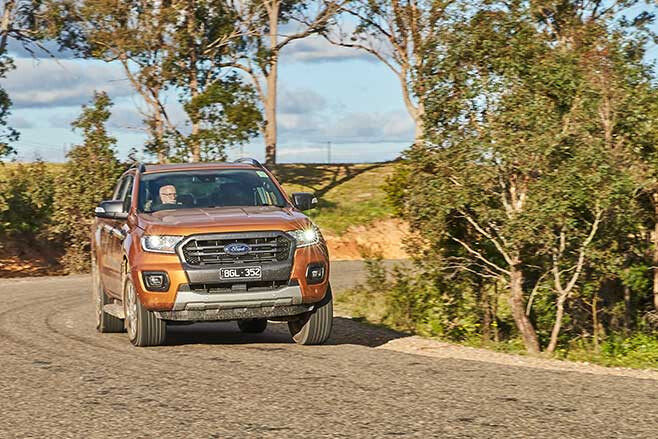
On the road the Ranger is still hard to go past for its steering feel and its general handing and ride quality but the new D-Max gets close, which is impressive given the previous D-Max wasn’t even in the same ball park.
Like all D-Max models, the Ranger Wildtrak gets lane keeping assistance, and while it can also be distracting on some roads by tugging the steering if you drive too close to the lane markings, as does the D-Max, you can easily turn it if off via a switch on the end of the right-hand steering column stalk.
RANGER OFF-ROAD
ALONG with Toyota Hilux and Volkswagen Amarok, the Ranger has always been a top-tier performer off road and, amongst the popular utes, there has been none better. This is largely thanks to its generous wheel travel and the fact that when the rear diff lock is engaged the traction control remains active across the front axle. With most other utes fitted with a rear locker, the new D-Max included, engaging the rear locker cancels the traction control on both axles.
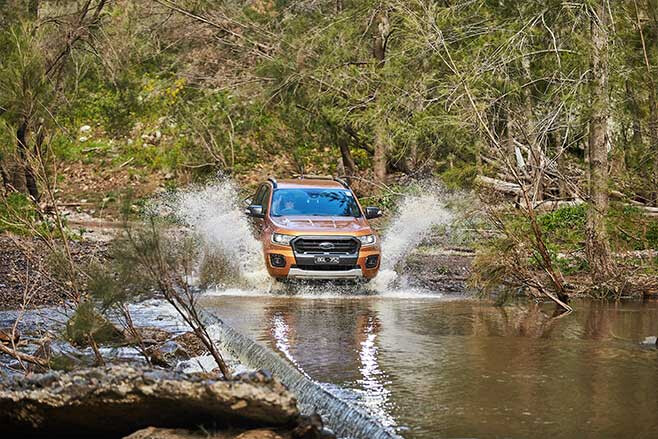
The 2.0-litre Ranger also has a low crawl ratio thanks largely to its very low first gear, one of the advantages of having ten gearbox ratios. On the negative side, the Ranger’s departure angle could be better and it’s also a long ute.
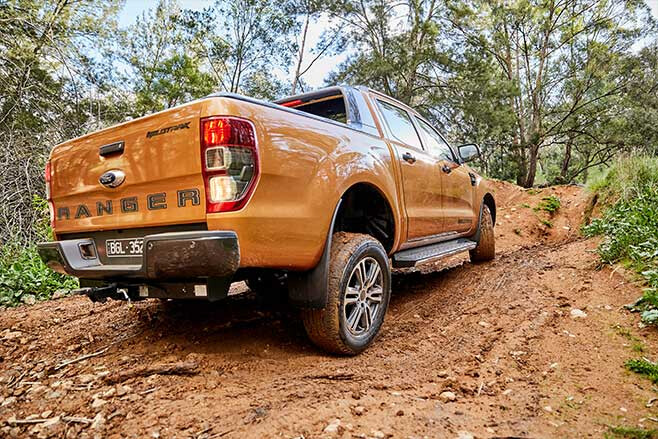
While our time off road in this test was limited, the Ranger still proved more capable than the new D-Max, even if the new D-Max gets much closer than did the previous model.
RANGER INTERIOR
THE Wildtrak’s leather-clad cabin is big and comfortable, and no other mainstream popular ute, this new D-Max included, can match it for combined front and rear legroom and rear headroom.
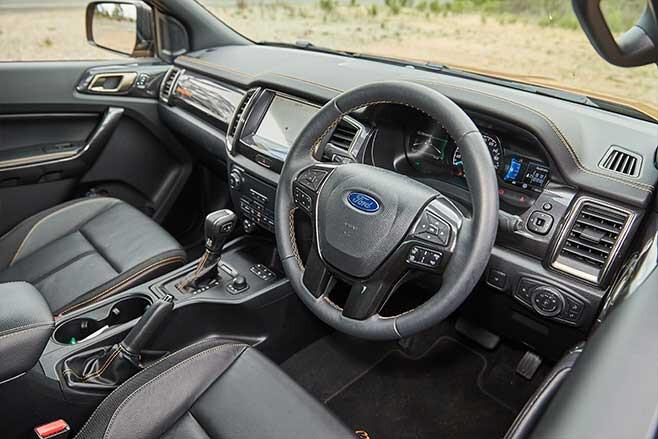
However the Ranger still lacks steering wheel reach adjustment (tilt only) and the HAVC controls are also small and difficult to use. For those living in colder climates, the Wildtrak’s heated front seats are however a welcome bonus but, unlike the D-Max, the Wildtrak doesn’t get rear-seat air vents.
Being a Wildtrak model, this Ranger comes with plenty of safety kit (See ‘What You Get’) including autonomous emergency braking, lane-departure prevention and adaptive cruise control but misses out some of the D-Max’s safety features, although it does get tyre-pressure monitoring, which the D-Max doesn’t.
RANGER PRACTICALITIES
THE 2.0-litre Ranger is rated to tow 3500kg, the same as the 3.2-litre Ranger and the D-Max. Our previous comparative tow testing has demonstrated, however, that the powertrain of the bigger-engined Ranger is far better suited to heavy-duty towing than the 2.0-litre Ranger.
And not that we have had the chance to tow-test the new D-Max as yet, we suspect it would also be a better tow vehicle than the 2.0-litre Ranger, at least in terms of powertrain performance.
Like the D-Max X-Terrain, the Wildtrak also gets a lockable roller tonneau and it picks up a couple of handy standard items that the X-Terrain doesn’t have in the form of a towbar and 12-volt outlet in the tub.
RANGER 4X4 2.0BT PRICES*
XLT: $60,940 WILDTRAK: $65,790 WILDTRAK X: $67,790 *Prices do not include on-road costs.
RANGER EQUIPMENT LIST
THE Wildtrak is top-spec in Ranger, save for the special-edition, accessorised Wildtrak X. The Wildtrak comes with optional powertrains, the as-tested 2.0-litre four-cylinder bi-turbo diesel being automatic only, while the 3.2-litre five-cylinder diesel is available as both an automatic and a manual.
The Wildtrak gets smart-key entry and start, leather seat trim, electric adjust for the driver’s seat, heated front seats, an eight-inch touchscreen, sat-nav, the usual phone connectivity features and self-park assist.
The Wildtrak’s safety features include adaptive cruise control (in addition to normal cruise control), autonomous emergency braking, lane-departure warning and assistance, and tyre-pressure monitoring.
The Wildtrak also gets a lockable roller tonneau, aero sports bar, a 12-volt outlet in the tub, a towbar, and rides on 18s. Like all 4×4 Rangers the Wildtrak also gets a driver-switched rear differential lock.
THE VERDICT
BOTH these utes start on the high side of $60K and by the time you get them on the road there won’t be much change from $70K. So, how does the new D-Max X-Terrain shape up against an established benchmark like the Ford Ranger Wildtrak?
Looked at from a value-for-money perspective in terms of features, the D-Max starts out just under $3K less expensive and has features the Wildtrak doesn’t get. These include tilt-and-reach steering wheel adjustment, rear cross-traffic alert, blindspot monitoring, a driver’s knee airbag, a centre airbag, remote start, automatic walk-away locking and ‘Lane Keeping Assist’, which is a next level-up technology from lane-departure prevention providing a degree of self-steering on motorways while still not allowing the driver to take his or her hands off the steering wheel.
Standard features that the Wildtrak gets but are absent on the X-Terrain include heated front seats, tyre-pressure monitoring, a towbar, a 12-volt outlet in the tub, and park assist, which self-steers the car into a parking spot. You can make you own mind up on what suite of extra features you’d prefer.
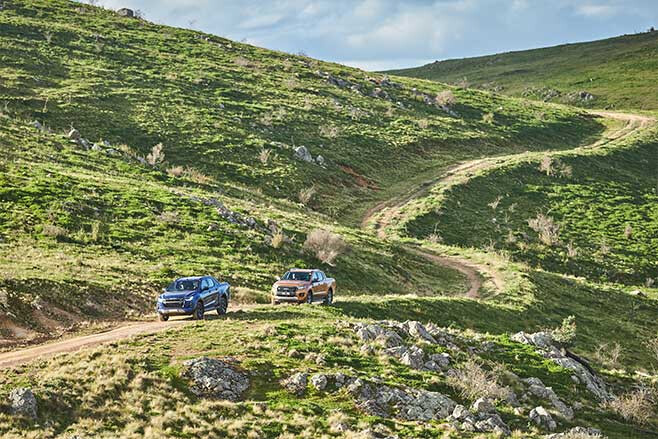
In more general terms, the new D-Max has come along way from its predecessor, and just not by offering a class-leading level of safety features right across the model range. More significant in terms of everyday driving is the far more composed ride and handling and the more confident road feel. The more muscular yet more refined powertrain also adds to the new-found driving pleasure. Off road it’s more capable too.
Still, for all that, the 2.0-litre Wildtrak with its more sophisticated and complex powertrain still shades the X-Terrain for on-road refinement, and while its chassis also has a few on- and off-road tricks the D-Max can’t match.
As a heavy-duty tow vehicle however, past experience and future expectation favours the D-Max of this pair, but if heavy-duty towing is your requirement you want a Ranger with the 3.2-litre five-cylinder diesel, not one with the bi-turbo 2.0-litre engine regardless of what the claimed power and torque numbers suggest.
SPECS: ISUZU D-MAX X-TERRAIN DUAL-CAB 4X4
ENGINE: 3.0-litre 4-cyl turbo diesel MAX POWER: 140kW at 3600rpm MAX TORQUE: 450Nm at 1600 to 2600rpm TRANSMISSION: Six-speed automatic 4X4 SYSTEM: Dual-range part-time CRAWL RATIO: 33.3:1 CONSTRUCTION: Separate-chassis FRONT SUSPENSION: Independent/coil springs REAR SUSPENSION: Live axle/leaf springs WHEEL/TYRE: 265/60R18 110S KERB WEIGHT: 2131kg GVM: 3100kg PAYLOAD: 970kg TOWING CAPACITY: 3500kg TOWBALL DOWNLOAD: 350kg (max) GCM: 5950kg FUEL TANK CAPACITY: 76L ADR FUEL CLAIM: 8.0L/100km TEST FUEL USE: 11.2L/100km GROUND CLEARANCE (CLAIM): 240mm APPROACH ANGLE: 30.5⁰ RAMPOVER ANGLE: 22.7⁰ DEPARTURE ANGLE: 23.8⁰ WADING DEPTH: 800mm
SPECS: FORD RANGER WILDTRAK
ENGINE: 2.0-litre 4-cyl bi-turbo diesel MAX POWER: 157kW at 3750rpm MAX TORQUE: 500Nm at 1750 to 2000rpm TRANSMISSION: Ten-speed automatic 4X4 SYSTEM: Dual-range part-time CRAWL RATIO: 42.5:1 CONSTRUCTION: Separate-chassis FRONT SUSPENSION: Independent/coil springs REAR SUSPENSION: Live axle/leaf springs WHEEL/TYRE: 265/60R18 110T KERB WEIGHT: 2246kg GVM: 3200kg PAYLOAD: 954kg TOWING CAPACITY: 3500kg TOWBALL DOWNLOAD: 350kg (max) GCM: 6000kg FUEL CAPACITY: 80L ADR FUEL CLAIM: 7.4L/100km TEST FUEL USE: 11.5L/100km GROUND CLEARANCE (CLAIM): 237mm APPROACH ANGLE: 29⁰ RAMPOVER ANGLE: 25⁰ DEPARTURE ANGLE: 21⁰ WADING DEPTH: 800mm
- Part 1:Take-Off
- Part 2: New Rubber
- Part 3: Tray and Tank
- Part 4: Weight Management
- Part 5: Smooth Ride
- Part 6: Air and Comms
- Part 7: Winter Wanderings
- Part 8: Trip Preparation
- Part 9: Ready and Able
Part 1: Take-Off
The wheels are in motion for Ron’s 79 Series, with some great Aussie-made accessories – 08/04/17
WE BOUGHT the 2013 dual-cab V8 Land Cruiser last year, but it promptly went into the garage while we were overseas in our Dodge Ram.
Finally, once we got back home and with a few bob in our pocket, we started to source some aftermarket gear for it. Then we headed to Outback 4WD in Bayswater, Victoria, who do all our service work, to get the first lot of goodies fitted.
First up was a bullbar to protect us from wayward animal strikes. We opted for an ARB Summit bar, which not only delivers airbag compatibility but also has a 60mm top tube, LED indicators and fog lights.
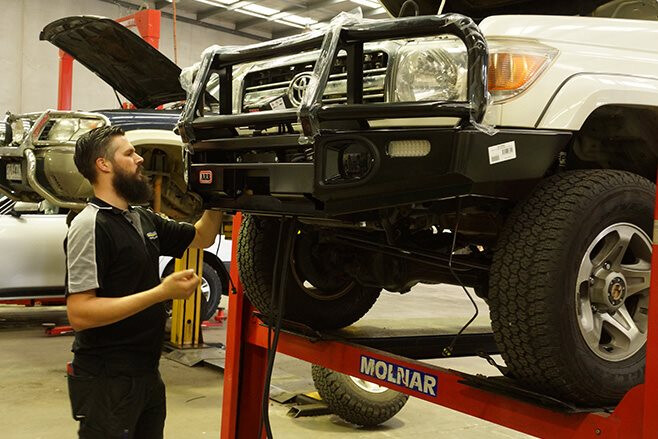
We also added a set of side rails and steps for extra protection; the OE alloy ones getting the flick for something that will give a lot more protection. The build quality and finish on this bar work is exceptional.
Tucked in behind the bar is a Warn XD9000-S winch with Warn Spydura synthetic rope. I thought long and hard about this as the Warn range of winches don’t come cheap, but their reputation is as big as the hills they help you climb, so reliability and durability won the day over any savings I could have made.
The synthetic Warn winch rope has a special braided-type construction, and it has a temperature resistant coating on the first few metres of the rope (which is the section that wraps around the drum of the winch) to set it apart from many other synthetic ropes.
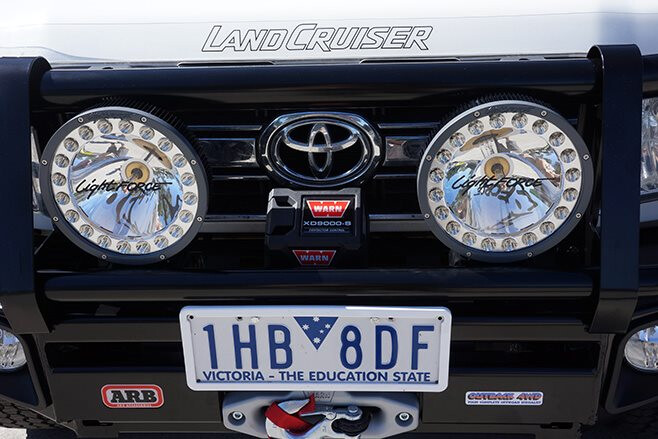
This helps protect the rope from the detrimental effects of the heat generated from when the winch is working under load. The synthetic winch rope has a few more advantages in the field: it’s lighter, safer to use (especially if it breaks under load), and if it breaks it can easily be joined together in the scrub.
Helping light the way is a pair of Lightforce DL230 HTX hybrid driving lights featuring a ring of 20 LEDs and a 70-watt HID light within a 170mm reflector. The LEDs provide an instant flood of wide-beam light, while the HID bulbs produce a far-reaching light that punches down the track ahead. It combines the best of both worlds in LED and HID technology, and they’re a dream to drive behind.
Combine that with Lightforce’s effective and sturdy mounting brackets and you’ve got a great light ideal for long outback drives. If there are any downsides to this light it’s that the size is too big in many situations – they just managed to tuck in behind the leading edge of the Summit bar.
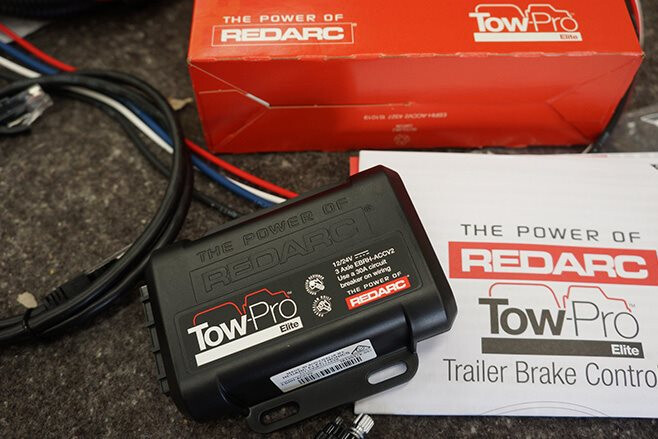
Wanting to tow our camper and/or van we fitted a Hayman Reese towbar to the backend of the Cruiser. Again, these are a well-engineered and Aussie-manufactured product that sit at the very top end of design and build quality. We completed the installation with a seven-pin trailer connection and an Anderson plug to bring 12-volt power to the trailer.
A Redarc Tow-Pro trailer brake controller was also wired into the system; we’ve had one of these on our Patrol for a few years now and I wouldn’t have any other electric brake controller, simple as that! Before we do any more work to the Cruiser, the bank account will need replenishing and the old wallet will need to be refurbished. I’m sure all who have built up a vehicle know what that is like!
Current mileage: 105,600km Date acquired: April 2016 Price: $59,000 Mileage since last update: 1100km Average fuel consumption: 15.4L/100km
Part 2: New Rubber
Moonie fits new wheels, tyres and mirrors to his Cruiser – 29/08/17
IT HAS been a slow start to our Project 79 Series Cruiser but, like most of us, I’m curtailed by a lack of finance and a desire to spend my hard-earned on travelling rather than vehicles and accessories.
‘Oh, poor you’, I can hear you mutter. Still, there’s been progress.
First up, we added a set of Clearview extension mirrors, which are the best set of towing mirrors I’ve ever used. These units have two mirrors in each housing – the top or main mirror (powered in some units) provides a clear view of the road behind; while the smaller, convex mirror eliminates blind spots.
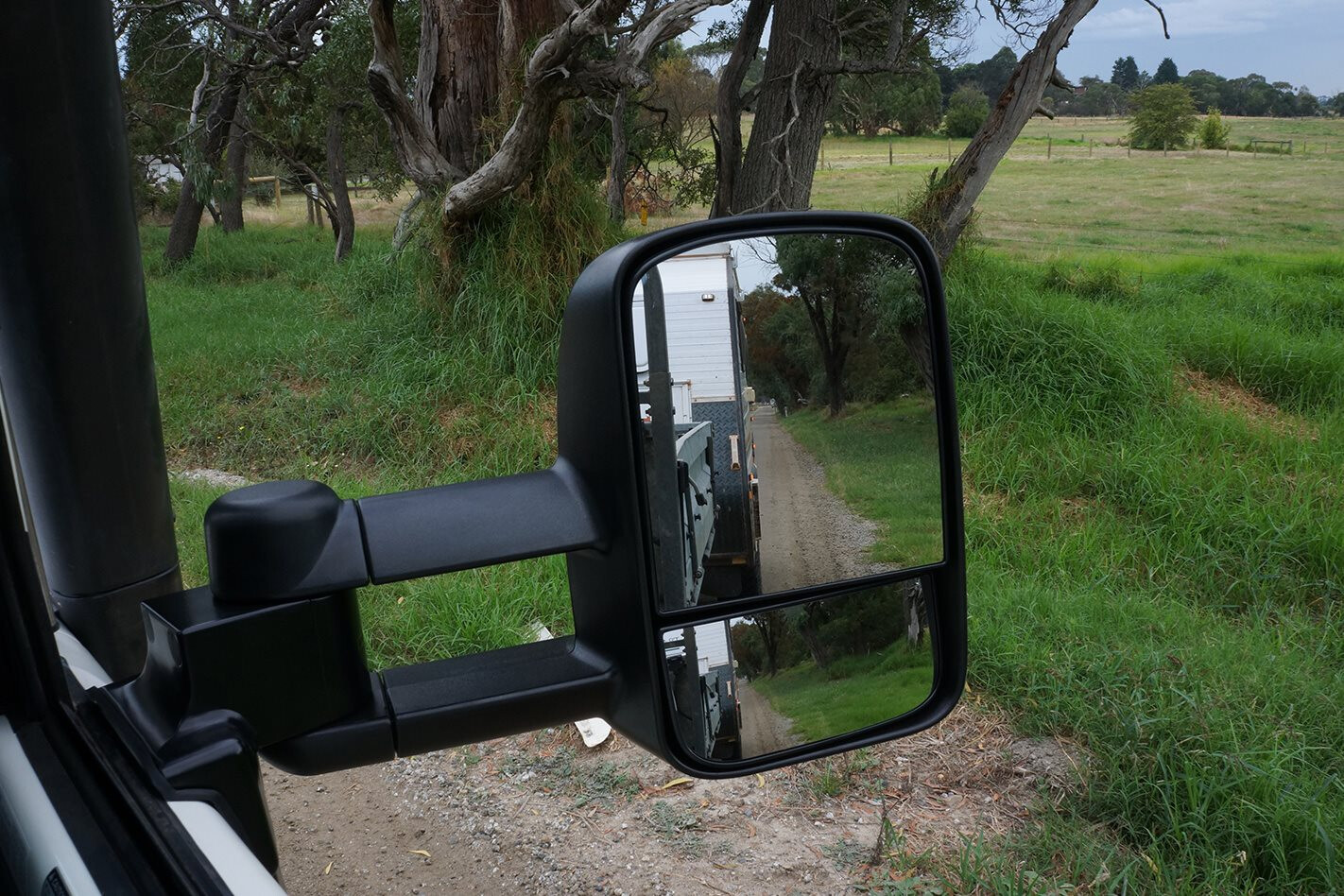
When towing, the mirror housing extends a further 100mm to give a better view down the side of the vehicle/caravan. Yes, they are big and, when folded inwards, still protrude some way out from the vehicle body, so you need to be careful on a tight, scrubby track. However, I still wouldn’t swap them for the originals.
Wanting to improve the rubber on the Cruiser, I decided on a bigger rim and, after a lot of procrastination, I settled on a set of 17×8.5 Pro Comp Series 29 Satin Black alloy rims. These aggressive-looking units feature a split five-spoke design, and the thick outer lip provides added protection and strength for travelling the backroads and tracks of Australia.
Pro Comp has a huge array of rims to choose from, with this particular style available in 15-, 16- and 17-inch sizes, 5-, 6- or 8-bolt stud fixtures, and load ratings that vary from 1133 to 1587kg per wheel. Not only do they look good, they do everything required of them.
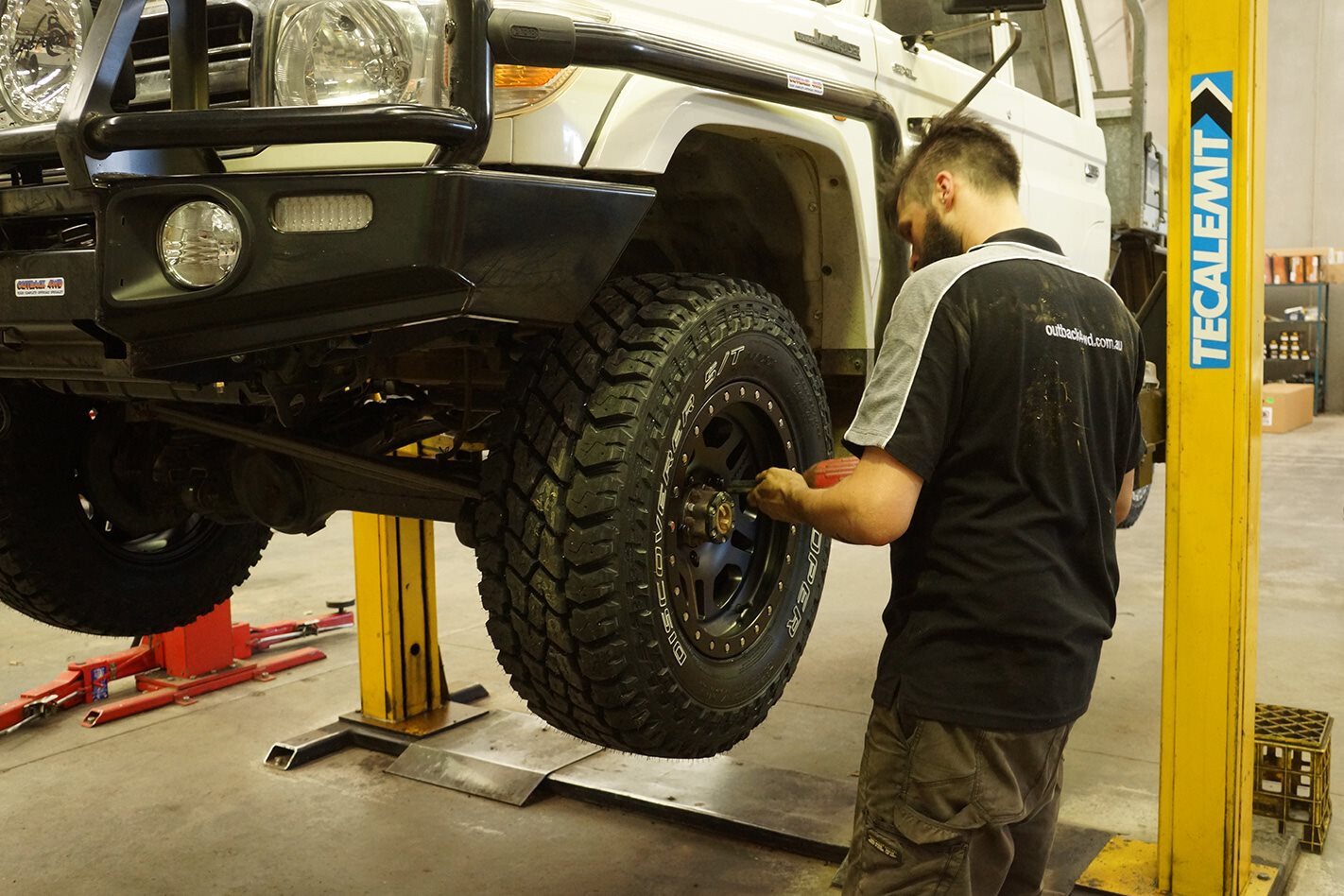
When it came down to what tyres I’d fit, there was no difficulty in choosing a brand. With the three other 4WDs in my garage wearing Cooper tyres, the only real choice was which particular model to choose. Once again, I settled on a set of Cooper S/T Maxx tyres and went for a slightly bigger tyre size than standard fitment, stepping up to a 285/70R17 with a load/speed rating of 121Q.
The ‘121’ means each tyre is designed to carry a maximum load of 1450kg, with a maximum speed designated by ‘Q’ of 160km/h. In all, there are 30 different tyres sizes in the S/T Maxx range suitable for 15-, 16-, 17-, 18- and even 20-inch rims, so we’re a bit spoilt for choice.
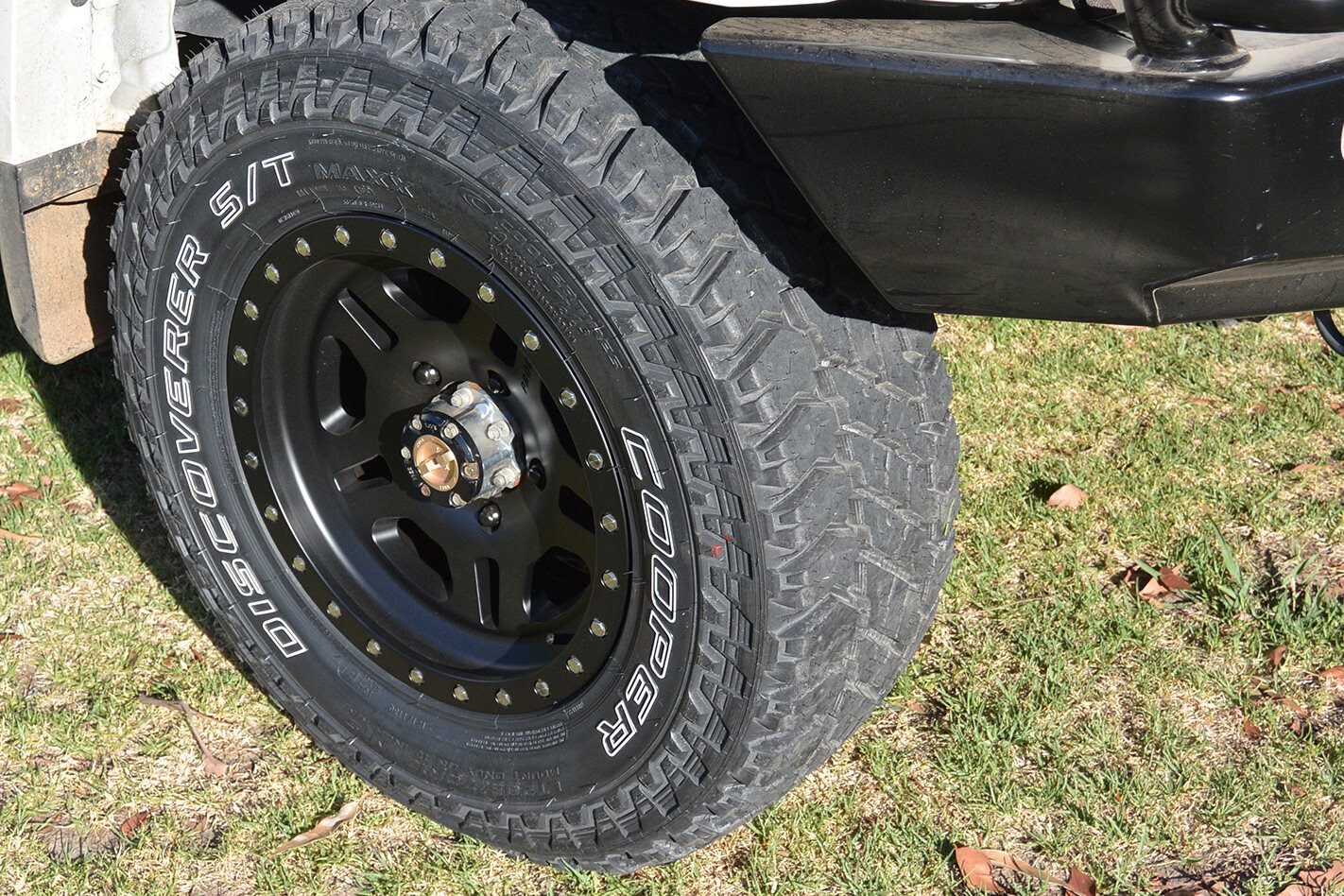
Why do I like the S/T Maxx so much? They have proven over the past 10 years or so on our travels around the world to be a tough, reliable tyre with good handling and wear characteristics. While I’ve had the occasional puncture, and even shredded one a couple of years ago (due to my own stupid fault and not having a tyre monitoring system on board), I can’t see any other tyre giving me the same off-road performance and long-time wear life.
As we write this, the 79 Cruiser has just had a new alloy tray and canopy fitted by Boss Aluminium in Bayswater, but that’s a story for next time.
PRODUCT INFO Pro Comp rims: www.dynamicwheelco.com.au Cooper tyres: www.coopertires.com.au Boss Aluminium: www.bossaluminium.com.au Clearview mirrors: www.clearviewaccessories.com.au
Part 3: Tray and Tank
Moonie’s dual-cab Cruiser gets a new tray and a 180-litre fuel tank – 12/10/17
WHEN I first looked at fitting a new canopy to the Cruiser, I was going to keep the original Toyota tray, but it looked shithouse.
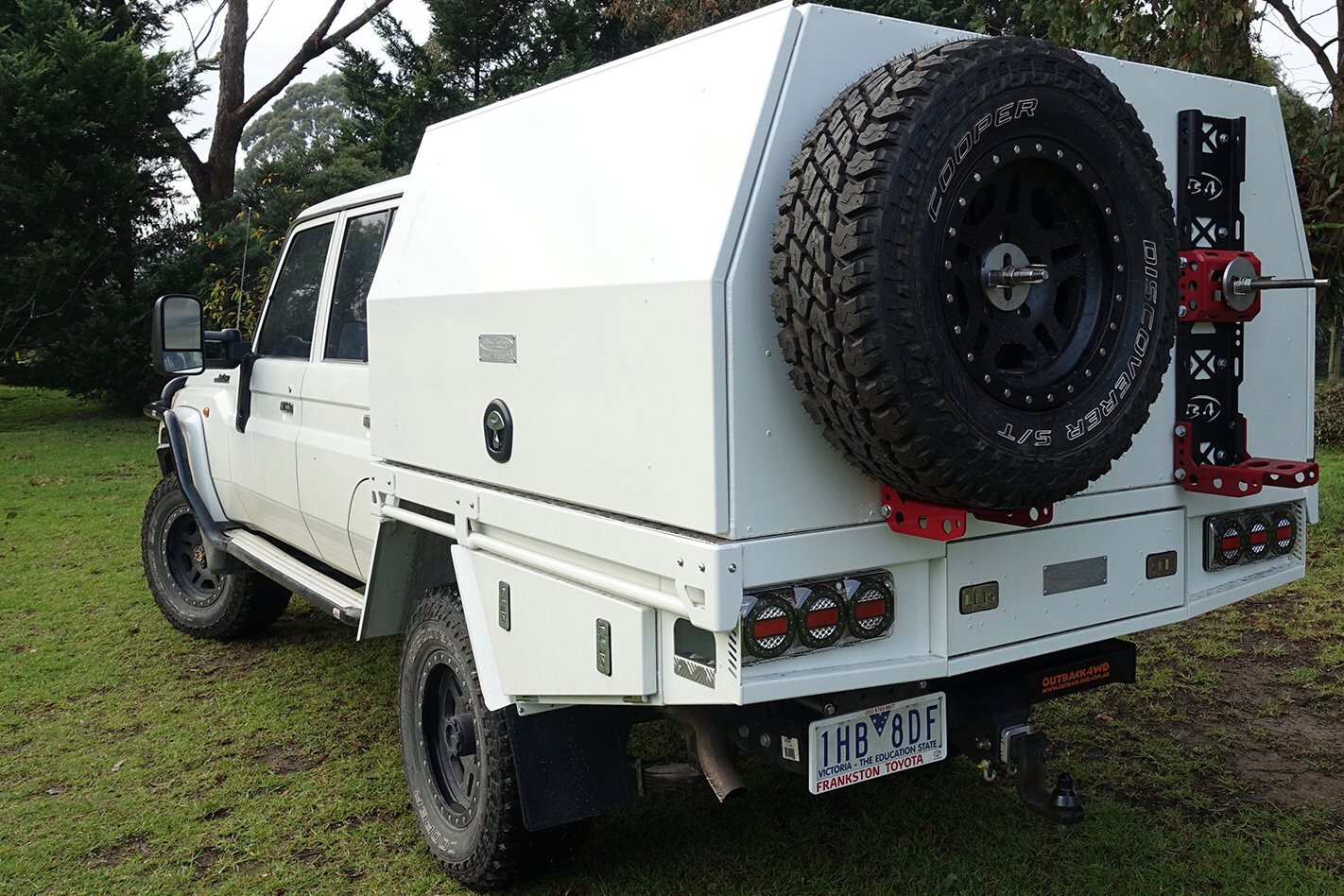
I was convinced a new tray would make the overall package better, so we bit the bullet and took the heavy galvanised steel tray off and fitted a brand-new custom-built beauty from Boss Aluminium in Bayswater, Victoria.
This is more a work of art than anything else and I’m super impressed with the tray; its design, construction and quality of finish. The tray is 1800mm long by 1860mm wide. We decided not to have a headboard, which allows the canopy to be 100mm longer and, as I don’t have any intention of removing the canopy when it’s fitted, we didn’t see the need for a headboard.
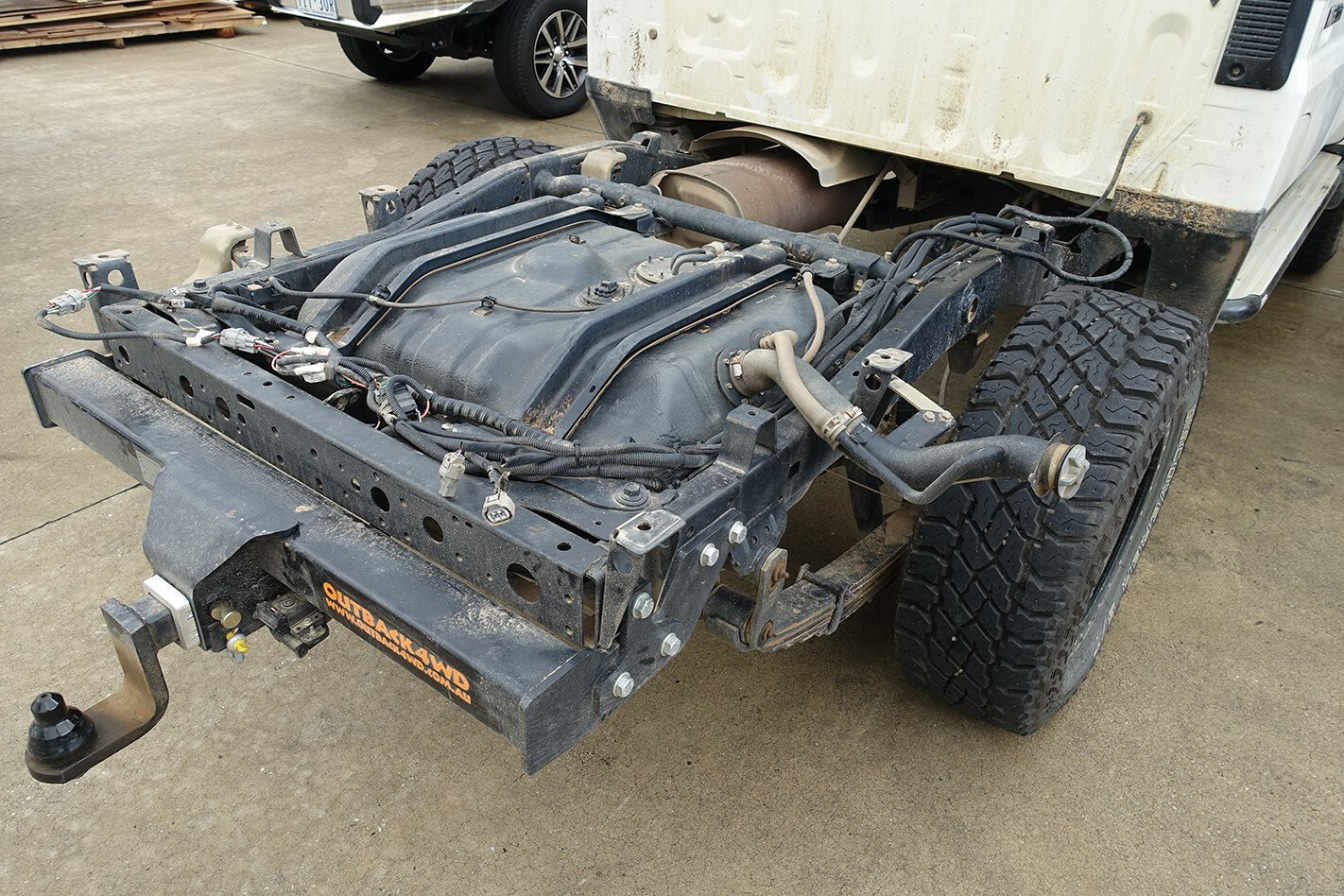
When we took the old tray off we found a few bent mounts, so all of them were replaced by heavy-duty 5mm-thick steel ones. Up front, a 57-litre water tank was fitted complete with filler hose, a 12-Volt SEAFLO diaphragm pump and a tap at the back end of the tray. Taking up the rest of the central under-tray area is a roller drawer complete with a handy sliding top that can double as a bench or table.
On each side of the tray is a pair of underbody boxes with a tapered shape to them to keep the departure angle where it should be. Like the under-tray drawer, the boxes are well-sealed from water and dust ingress by good rubber seals and effective lockable latches. Smart LED stop/tail-lights finish off the tray.
Its aluminium construction allows for a significant saving in weight from the previous steel tray, but some people may still be surprised at the weight of a good alloy tray. In the Boss case, the tray (which includes mounts, infill and guards) comes in at 105kg.
Each of the underbody boxes weigh 15kg, the under-tray drawer weighs 40kg, and the 57-litre water tank (when empty) weighs 5kg. Total weight of the tray and attached componentry is just 180kg.
Wanting to increase the fuel range of the Cruiser, I’ve opted for a replacement 180-litre ARB Frontier tank fitted by the crew at Outback 4WD in Bayswater. These tanks from ARB are made from a resilient cross-linked polymer and UV-stable plastic material and have a wall thickness of 7-9mm, which is much thicker than any of the OE plastic tanks I’ve seen.
They’ve proved to be strong and rigid, having been tested by driving a 60-tonne Centurion tank over them. They are also significantly lighter than a steel tank and, depending on the model of tank for a 79 Series, weigh up to 22kg empty.
The tank comes with all the fitting hardware required, as well as a fully machined filler neck made from aluminium, while the tank breather pipe is fitted with a one-way valve to stop any spillage in case of a rollover.
We’re sure to get years of effective and trouble-free service from both the tray and the tank and, while 180 litres is about the same as what my Patrol carries, like the Patrol, if the occasion demands more fuel capacity, then we’ll opt for a couple of plastic jerry cans.
PRODUCT INFO Frontier fuel tank: www.arb.com.au Boss alloy tray: www.bossaluminium.com.au Outback 4WD: www.outback4wd.com.au
Current mileage: 109,900km Mileage since last update: 150km Average fuel consumption: 13.5L/100km
Part 4: Weight Management
New fixtures in the endless quest for tourer greatness – 27/01/18
The LC79 has turned into a lesson in weight management.
When I fitted the alloy tray and canopy from Boss Aluminium in Bayswater, Victoria, I was wanting a good-looking, robust canopy and tray at the lightest weight possible… but I soon realised how quickly weight adds up.
The canopy (my fourth on 4×4 vehicles I’ve owned) fits all the criteria and is a work of bloody art; it’s so well designed, manufactured and finished off. However, I digress. Let’s talk weight.
The canopy, with its internal shelving, framework and drawers, weighs in at 200kg; the two spare wheel holders, without the wheels, weigh 15kg each; the drop-down fridge slide, without a fridge, weighs 37kg. So there’s another 267kg on the back of the Cruiser without even blinking, and I’ve yet to put anything into it.
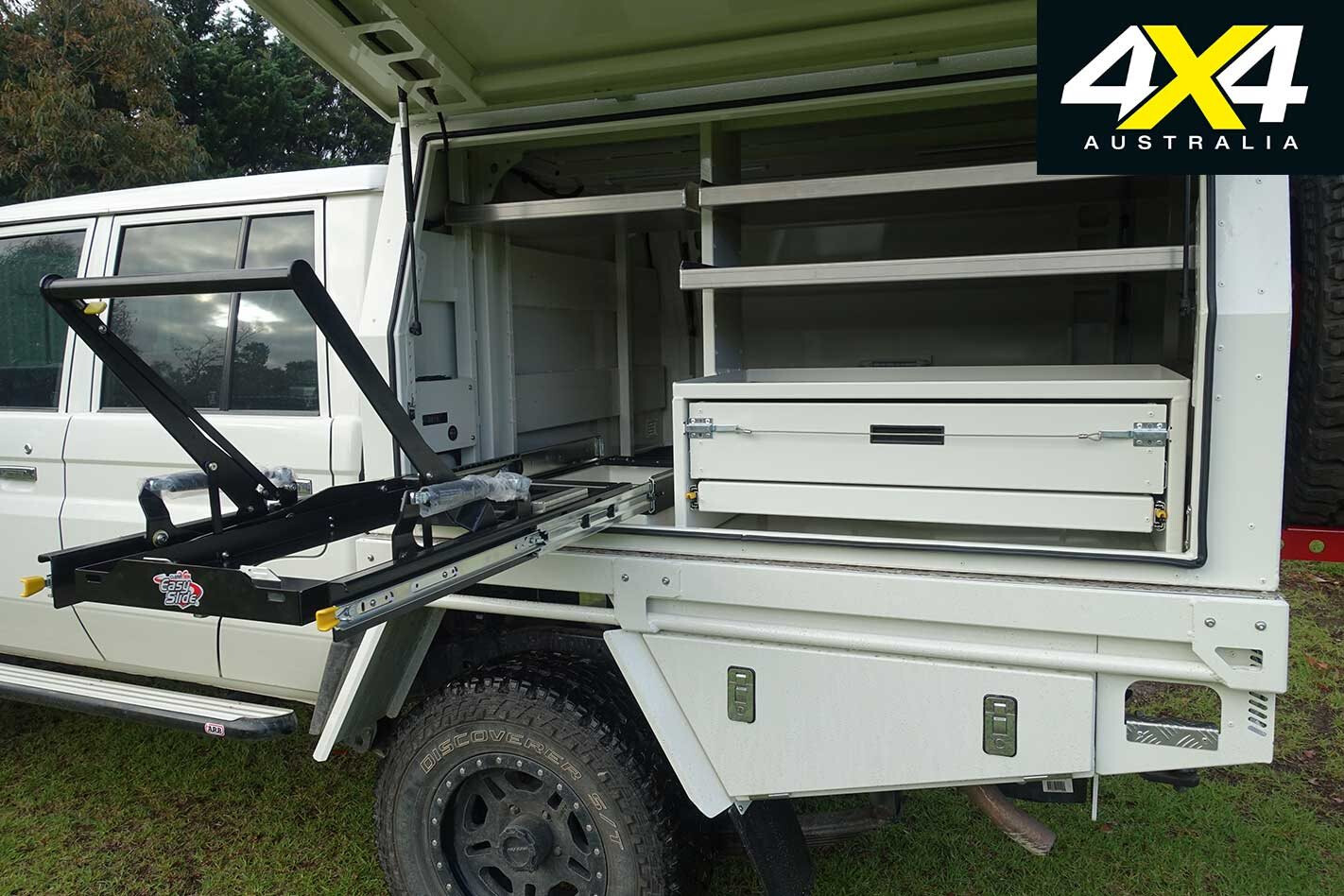
The canopy has been custom-built – like most from Boss – and comes complete with a robust frame, while the canopy is bolted to the tray. This, in turn, is mounted on heavy-duty steel mounts that connect the canopy firmly to the vehicle chassis.
Inside the unit is some internal shelving, which we’ve fitted with a range of Oates Smart Storage Drawers from Bunnings. We’ve used these lightweight units in the Patrol for more than 10 years and found them to work well and be durable (we’ve never replaced them). There’s a fairly large pull-out drawer and a slide-out table below that, while there’s also room for a fridge at the front of the canopy, all on the passenger side of the vehicle.
The driver’s side is a vast open playing field at present and I’m not even sure what I’ll be putting into it. My swag and tool roll will be the start. There’s some great LED lights, one on each lift-up door and two along the centre-line of the roof, and they do a great job illuminating the interior.
Up the front, close to where the fridge will go, is a power distribution box with light switches, 12-volt power outlets and fuses, and an auxiliary battery voltage read-out display.
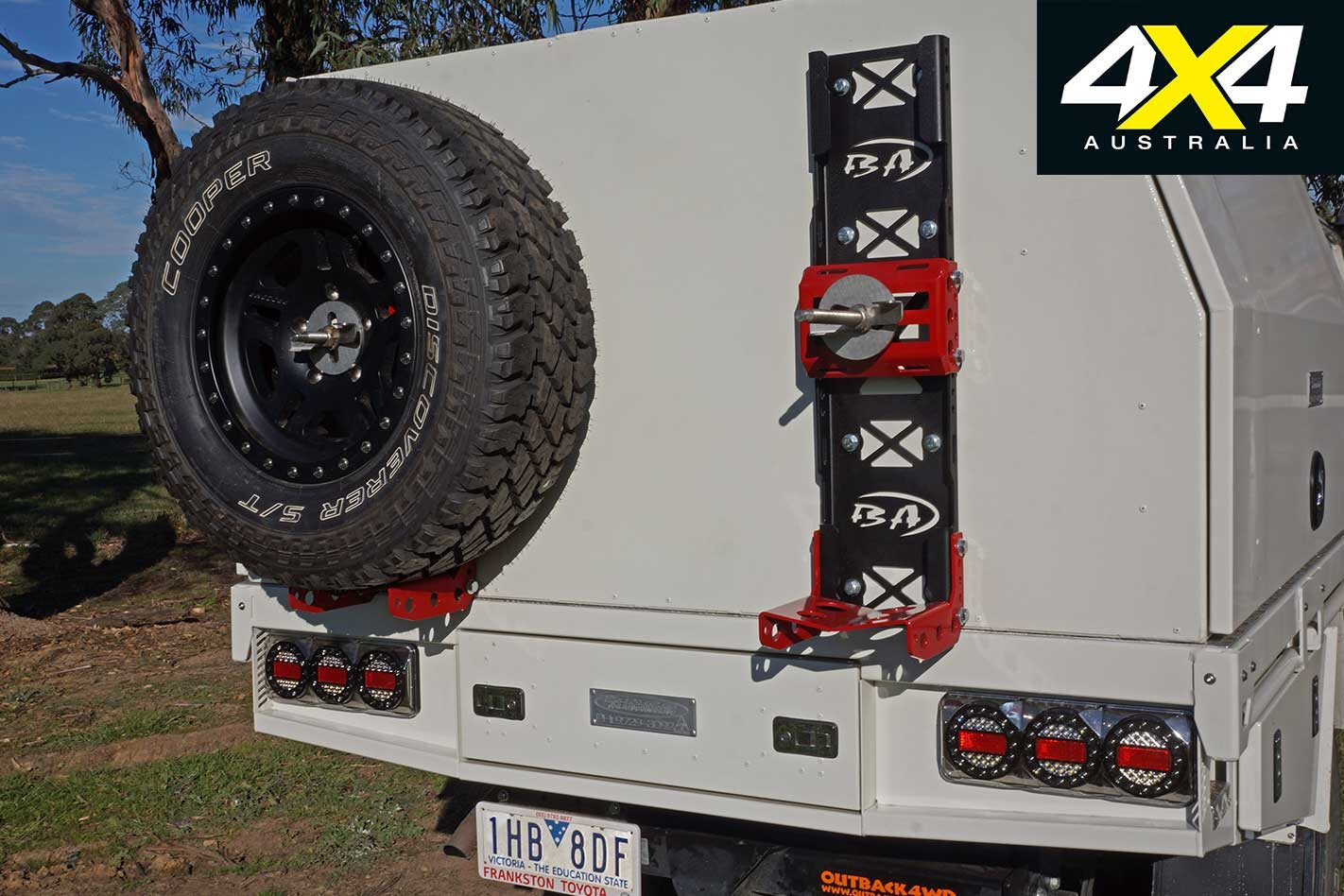
On the outside rear wall, connected into the framework of the canopy, are the two spare wheel carriers. These are adjustable so they can carry any size rim and tyre up to 38-inch in diameter, but we won’t be going that big. I could have fitted a roof rack or a set of roof bars to the canopy as well, but I’d have an access issue to my garage, so that is on the back-burner at present. We’ll see if we need one.
Back on the inside and the drop-down fridge slide is an Easy Slide from Clearview Accessories, which was also fitted by the crew at Boss. I’ve had the forerunner to this unit in my Patrol for years and it has been a beauty, so I knew what I wanted right from the start.
The Easy Slide lowers the fridge unit 290mm, making it a lot easier to get a coldie or some salad from the fridge. Designed in Australia, the unit has been improved since my Patrol’s early model, making it easier and safer to use and capable of handling up to a 180kg load. With its safety locking mechanism and additional travel lock the unit has been crash-tested and is ADR compliant, with a 36-month warranty on moving parts.
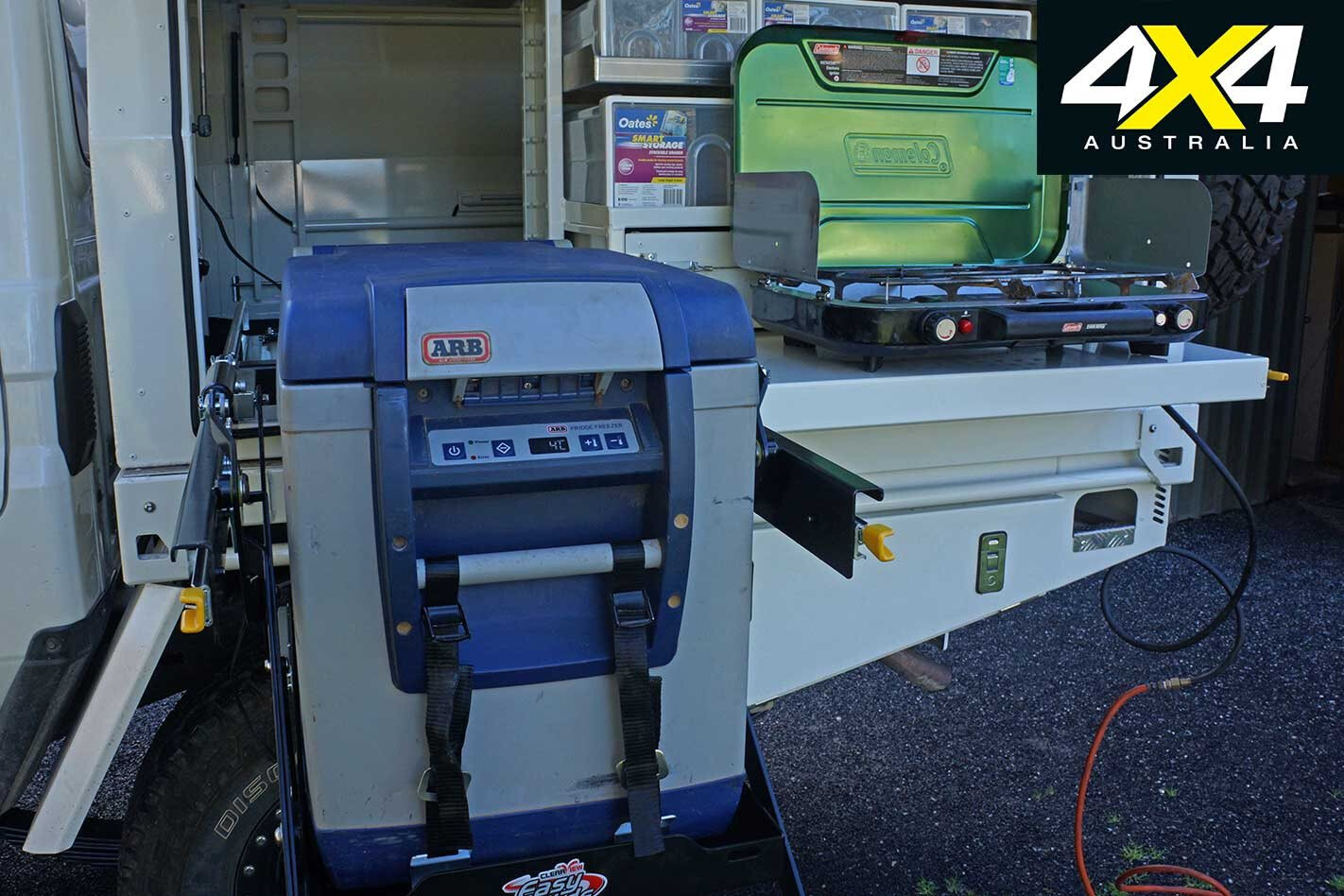
Available in three different sizes to suit myriad portable fridge/freezers, I opted for the ES-100Plus Easy Slide, which handles an ARB 47-litre fridge easily. It also fits the Engel 40-litre or the National Luna 55 Weekender.
As soon as the canopy was fitted I was back at Outback 4WD to fit a dual-battery system. We used an Auxiliary Battery Kit from ARB, the battery box being made from 2mm powdercoated steel, with well-designed supporting and holding brackets. This ensures the heavy battery doesn’t break away from the vehicle’s body work when on continuous rough roads or tracks. I have seen and used lesser quality battery kits which cause nothing but trouble once off the bitumen for extended trips.
To control the charge of the second (auxiliary) battery I’ve fitted a Redarc BCDC1240D DC-DC battery charger. This isn’t the cheapest option (I have a Redarc Smart Start SBI unit in my Patrol, which has worked just fine), but the DC-DC charger was considered the best option. Not only does this unit act as an isolator for the main battery, it ensures your second battery is fully charged at all times, whether it takes power from the alternator or from any solar panels you may have connected.
Now with an extra battery in the system I’ve added, yet again, more weight on top of the bar work and winch, along with the capacity of the bigger ARB fuel tank that has already been fitted. I’ll be running the rig across a weighbridge soon and then looking at better aftermarket suspension along with an increase in GVM.
Current mileage: 111,165km Mileage since last update: 1265km Average fuel consumption: 13.6L/100km
Part 5: Smooth Ride
A smoother ride and a quieter cab – 05/05/18
OVER the last few weeks we’ve been busy adding a few accessories to the Project 79 Cruiser because we’ve got some trips lined-up for the next couple of months.
Just after the new tray and canopy from Boss Aluminium were built and fitted, I installed an ARB dual-battery setup, having a timely reminder when I was up in the mountains of how important a well-mounted and supported battery tray is.
I had a friend whose bargain-priced battery-mounting system was tearing away from its mount on the inner guard and we had to bogey up a repair to make it last until we got back home. It’s not the first time I have seen cheap battery mounts break away and/or destroy the mount, what it is mounted to, as well as the battery and cabling.
I backed-up the auxiliary battery with a Redarc BCDC1240D DC-to-DC battery charger. This unit acts as an isolator for the main battery and will also ensure your second battery is fully charged at all times, whether it takes power from the alternator or from any solar panels connected.
To improve fuel filtration – a weakness in most modern 4WDs, especially when you are travelling in our remote country – I’ve fitted an extra Flashlube fuel filter, which will help save the injectors and fuel pump if (when) I get a gutful of contaminated fuel.
Because of ever-stricter environmental standards, modern engines feed some of the exhaust gases (containing moisture and oil fumes) back to the engine via the EGR valve and the engine’s air inlet. Those contaminants can cause issues with intercoolers, turbos, inlet manifolds and EGR valves, resulting in poor engine performance and leading to possible expensive engine repairs.
Fitting an oil catch can will help stop those issues and keep your engine running like new, so we’ve also fitted a Flashlube oil catch can. Both Flashlube kits come complete from Terrain Tamer, with appropriate brackets, cabling and hoses.
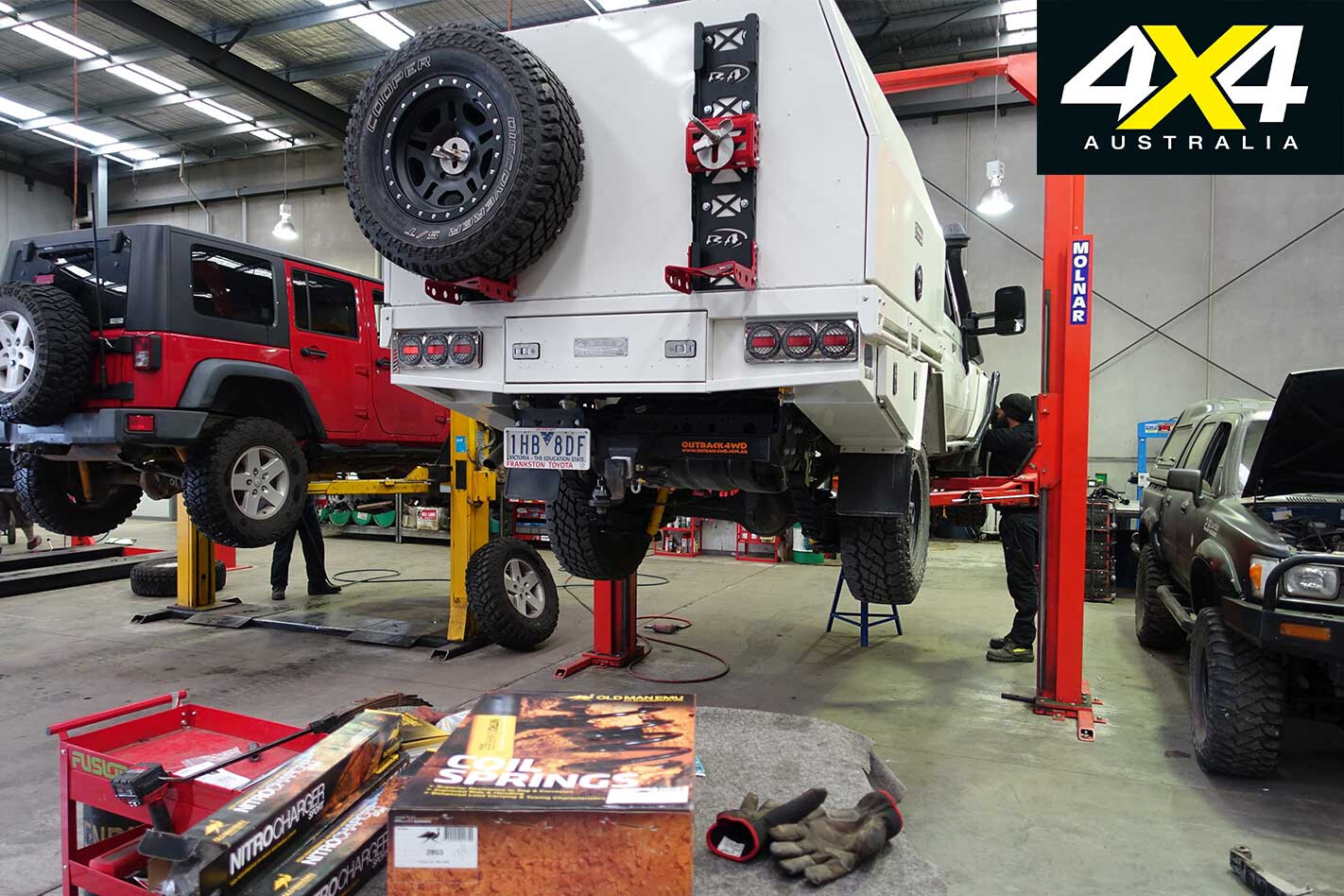
With the smaller jobs out of the way, the crew at Outback 4WD got down to the task of fitting a new suspension system. It’s important to know what you’re carrying, the weight involved and where it is distributed, so I waited until I had most of the heavy gear fitted before I looked at what suspension system and how heavy a spring set I needed.
It’s essential to discuss those facts and figures with your suspension specialist, and don’t blame them when the springs sag because you forgot to tell them about the winch or the 200-litre fuel tank you were about to fit for the next outback trip.
The 79 had an aftermarket suspension system already installed, but as this was originally a mine-exploration vehicle the spring set was a heavy mongrel and bloody uncomfortable, even with a fair amount of weight in the back. I wanted something that would ride better over the rough stuff, give good articulation in 4WD situations and yet handle on-road travel well while carrying the weight I wanted.
I settled on an OME suspension kit all ’round. OME has a choice of four different rear spring sets (the heavier two also available with an extra spring leaf for even more weight carrying) and with the weight I was carrying, I opted for the standard 700kg-rated springs. These are designed and manufactured as a two-stage leaf pack, which allows the spring to ride largely on the primary stage when unladen, while the second stage comes into play when loads are carried.
These leaf spring packs were fitted with greasable shackles and came with all the bushes and hardware required. The attention to detail is one of the reasons I like the OME kits so much, and it’s superb even with small brackets and spacers.
OME offers two different rated coil springs for the front and, again, because of the bullbar, extra battery and winch, I fitted the heavier of the two.
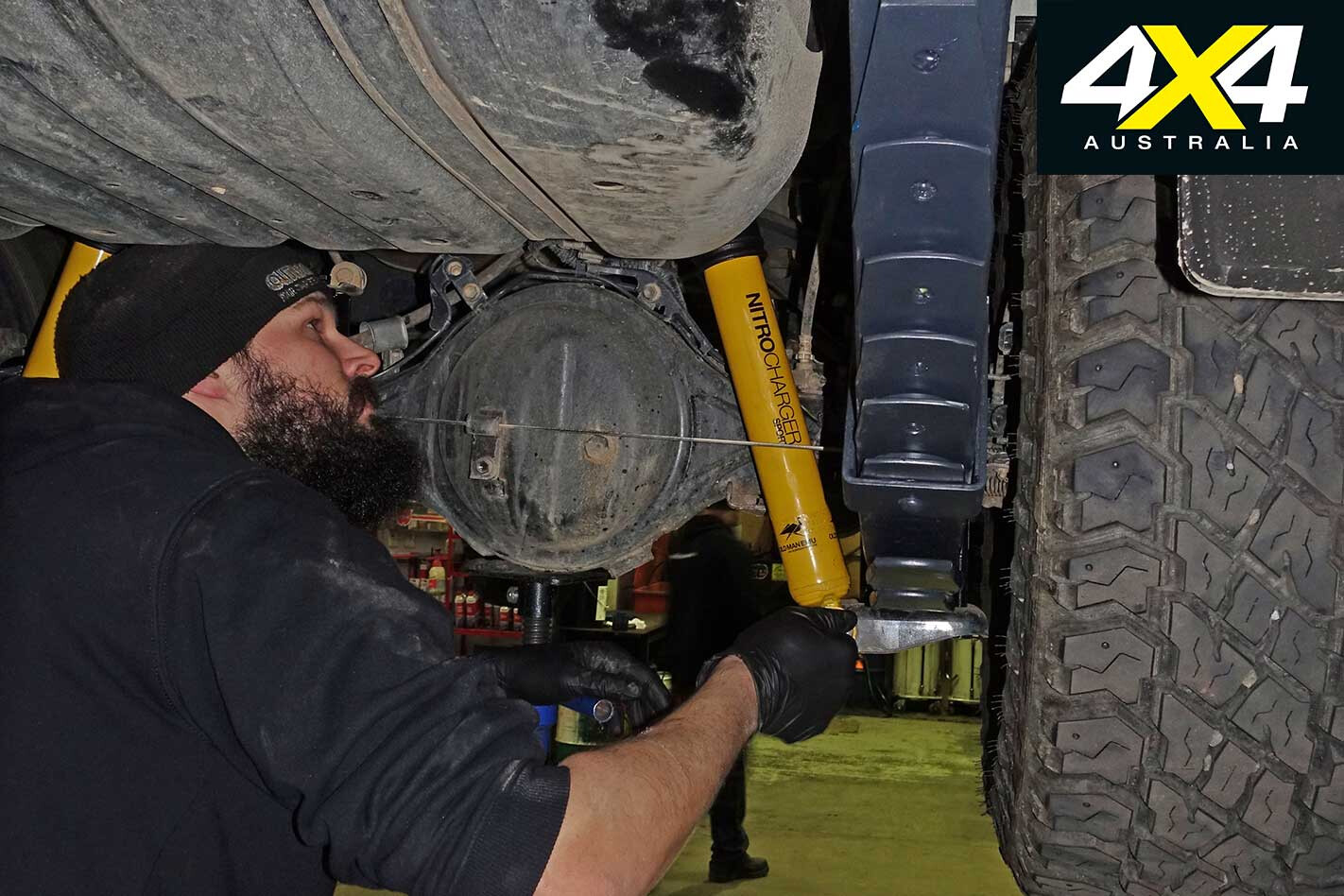
With a wide range of shock absorbers available from OME I opted for the Sports range, deeming the top-of-the-range high-performance BP-51 shocks a bit of overkill for a vehicle that drives, performs and handles more like a truck than a touring car. And, I also like the simplicity of twin-tube shocks which have proven time and again to be durable and reliable in the scrub.
A purposely valved OME shock absorber is available with each of the leaf spring sets, while the two different coils at the front can run the same valved sports shock.
I noticed the improvement in ride comfort on the very first speed bump I hit after leaving Outback 4WD, and the vehicle is more comfortable and the dampening well-controlled on corrugations. The vehicle now sits level even when loaded with gear, 60L of water and 180L of fuel, and I couldn’t be happier.
I started 2018 by stripping the seats and the basic, thin floor matting out of the cabin. Then we fitted sheets of Dynamat to the floor and front doors to help deaden some of the road, wind and engine noise prone to infiltrate 79s. This is a time-consuming process but not difficult; you’ll need a few basic tools including a roller, scissors, box cutter and a brush for cleaning the metal surfaces.
Some turps might come in handy, as will a good torch and tape measure. You may find it useful to use the mat’s backing paper as a template for the more intricate pieces of matting you’ll be laying. I ordered the Dynamat kit online and spent a couple of days cutting and fitting it. Now at least I can hear the stereo … and Viv.
Current mileage: 111,930km Mileage since last update: 850km Average fuel consumption: 13.8L/100km
Part 6: Air and Comms
More air and better comms for Ron’s resident Cruiser – 22/07/18
IT WAS a mad scramble getting a few things fitted to the 79 Cruiser before we set out to film the series of High Country videos for the mag.
You need good comms wherever you go in the scrub, so the crew at Outback 4WD in Bayswater fitted a GME TX4500S 80-channel UHF radio (RRP $540). Backing that up was a GME AE4705 heavy duty 6db antenna on a spring base (RRP $280).
I have a similar setup in my Patrol and have always liked the standard of the radio’s reception and the voice quality of the front-mounted speaker, while the antenna is flexible and robust.
For a bit more storage space in the cab of the 79, we fitted a 4WD Interior’s Top Shelf unit (RRP $495). The shelf imposes little on headroom and not only does it hold the UHF radio but it’s a handy place to throw a few small items such as maps and guidebooks. Still, I’d like to see a support located in the centre of the shelf just to make the shelf a little more solid so it doesn’t vibrate or flex on rough tracks and corrugated roads.
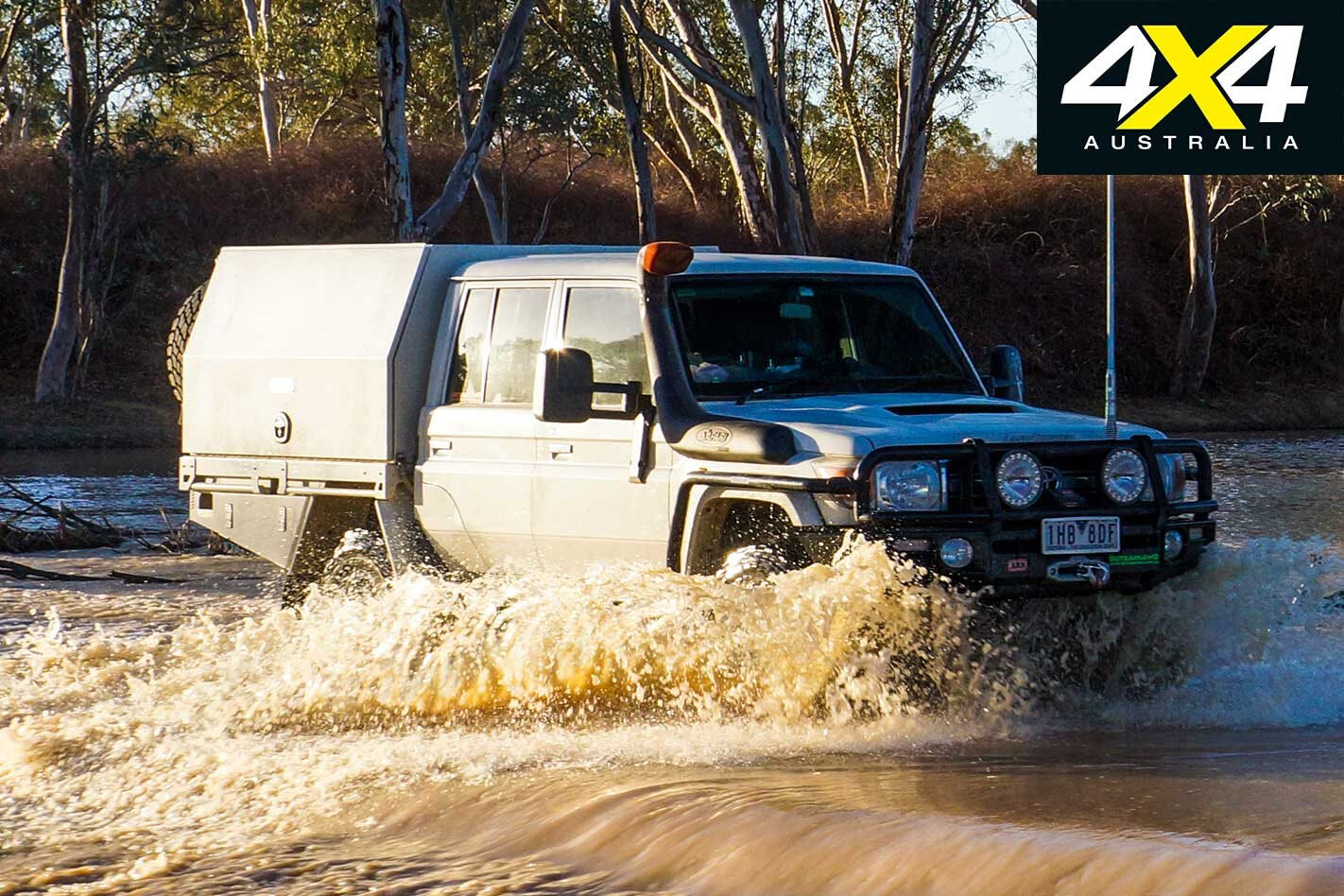
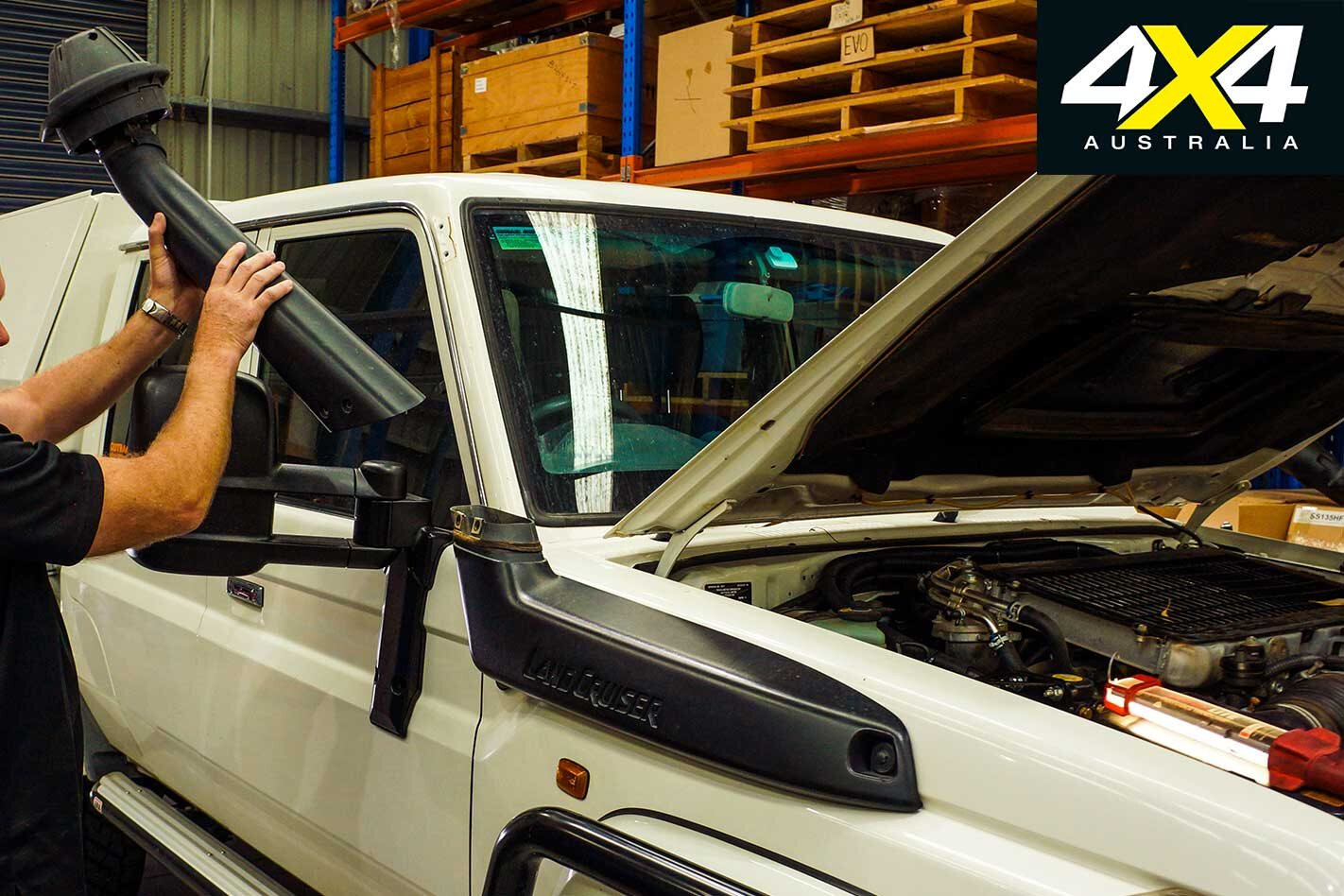
Last but not least, I fitted an Armax snorkel (RRP $594 for the complete kit, to suit 70 Series) from Safari 4×4 Engineering. Good, unrestricted airflow to the engine is one of the most important criteria for a proper functioning powerplant; while keeping the air that flows to the engine as free as possible from dust and other particles, as well as any water, is critical.
Safari has been building snorkels for a whole range of 4WD vehicles for darn near as long as I have been writing for 4X4 Australia … and that’s a few decades now. Now with the introduction of its Armax range of snorkels, Safari has three model line-ups of snorkel to choose from, with more than 250 models of snorkels to suit more than 300 models of vehicles, both old and new.
Its RSPEC range is made for non-current model vehicles only, while the VSPEC range covers most current models of 4WDs as well as the popular 100 Series Cruiser and GU Patrol. The Armax range is designed to deliver huge gains in airflow and engine performance, and Safari now offers 14 different models to suit the most popular four-wheel drives.
The 70 Series does come with a so-called “snorkel”, but it’s a sad piece of equipment comprising a number of separate pieces and joints that aren’t properly sealed against water entry. The raised air intake flows 265CFM (cubic feet per minute) while the replacement Armax snorkel flows a whopping 540CFM, so my best advice is to dump the OE ‘snorkel’ and get a real one-piece unit.
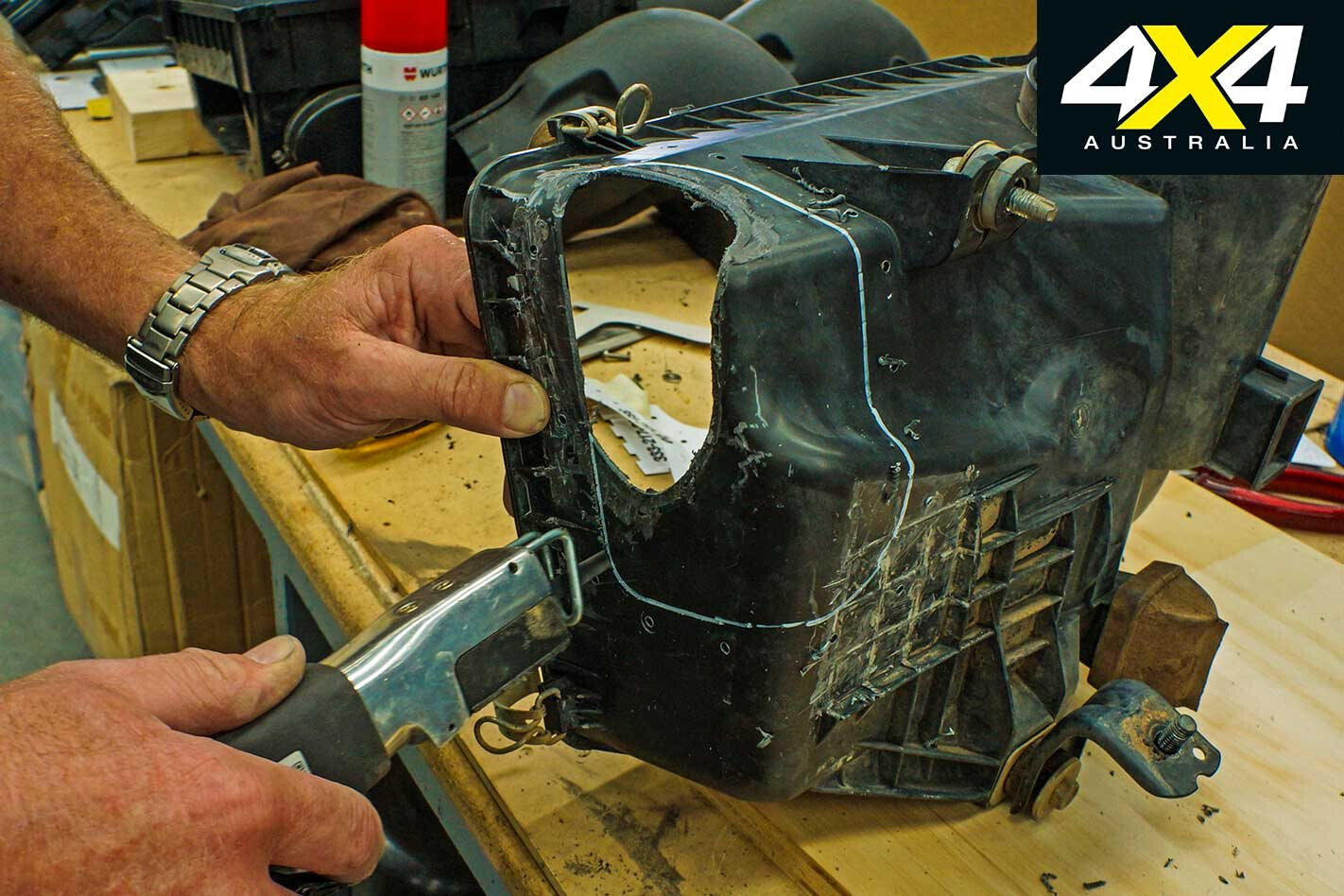
With the right gear and skill an experienced DIY mechanic could do this job, but, as there is a lot of panel-cutting, I’d be leaving it to the experts – if you know what you’re doing, it’s about a three-hour job.
With no other accessories or improvements to the engine, I can honestly tell you I felt the difference as soon as I drove the Cruiser out of the workshop; the engine was breathing easier and better, getting more cool air with less effort to improve performance.
Over the next few months we’ll bring you reports on how the Project 79 Cruiser and its accessories are faring, not only in the Victorian High Country but also in the Outback, where we have a long trip planned.
TOTAL KM: 112,800km KM THIS MONTH: 900km AVERAGE FUEL USE: 13.8L/100km
Part 7: Winter Wanderings
Ron preps his LC79 with a new compressor and roof rack – 23/01/19
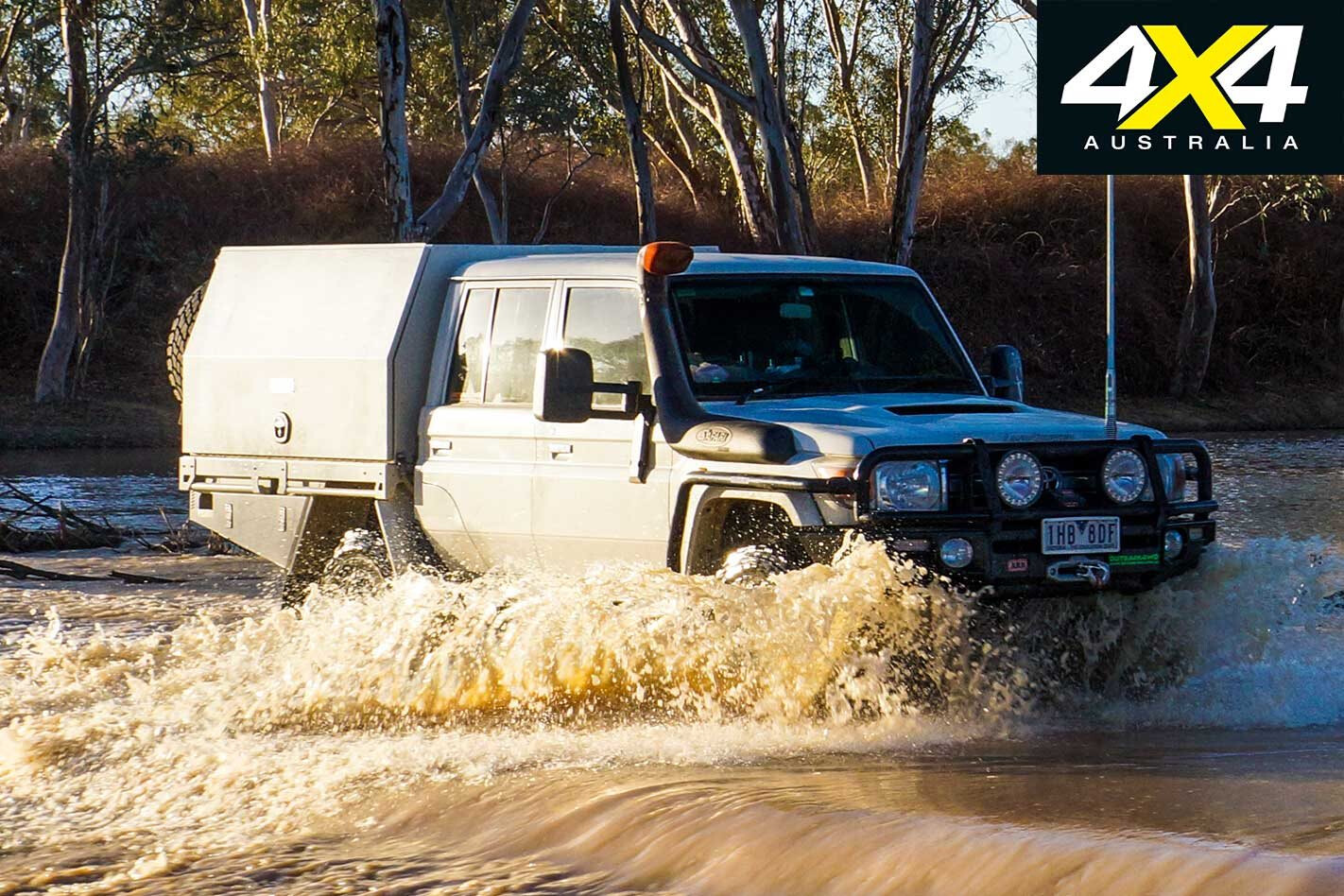
THE CRUISER has been wandering the backblocks of Australia for its annual winter sojourn, including a trip across the Madigan Line from Mt Dare to Birdsville. Before it went on the trip, though, we had it up at Outback 4WD in Bayswater for a pre-trip inspection, where among its general service requirements we changed the rear brake pads and skimmed the rear discs.
As a prerequisite for the desert trip we fitted an ARB twin compressor, which we shoehorned into one of the under-tray boxes of the Boss canopy. The twin motors of the high-performance compressor incorporate internal thermal protection, while in-line heavy-duty fuses offer protection from extreme current draw. The compressor draws up to 68amp at maximum pressure, so it requires heavy-duty wiring to cope with the current drain.
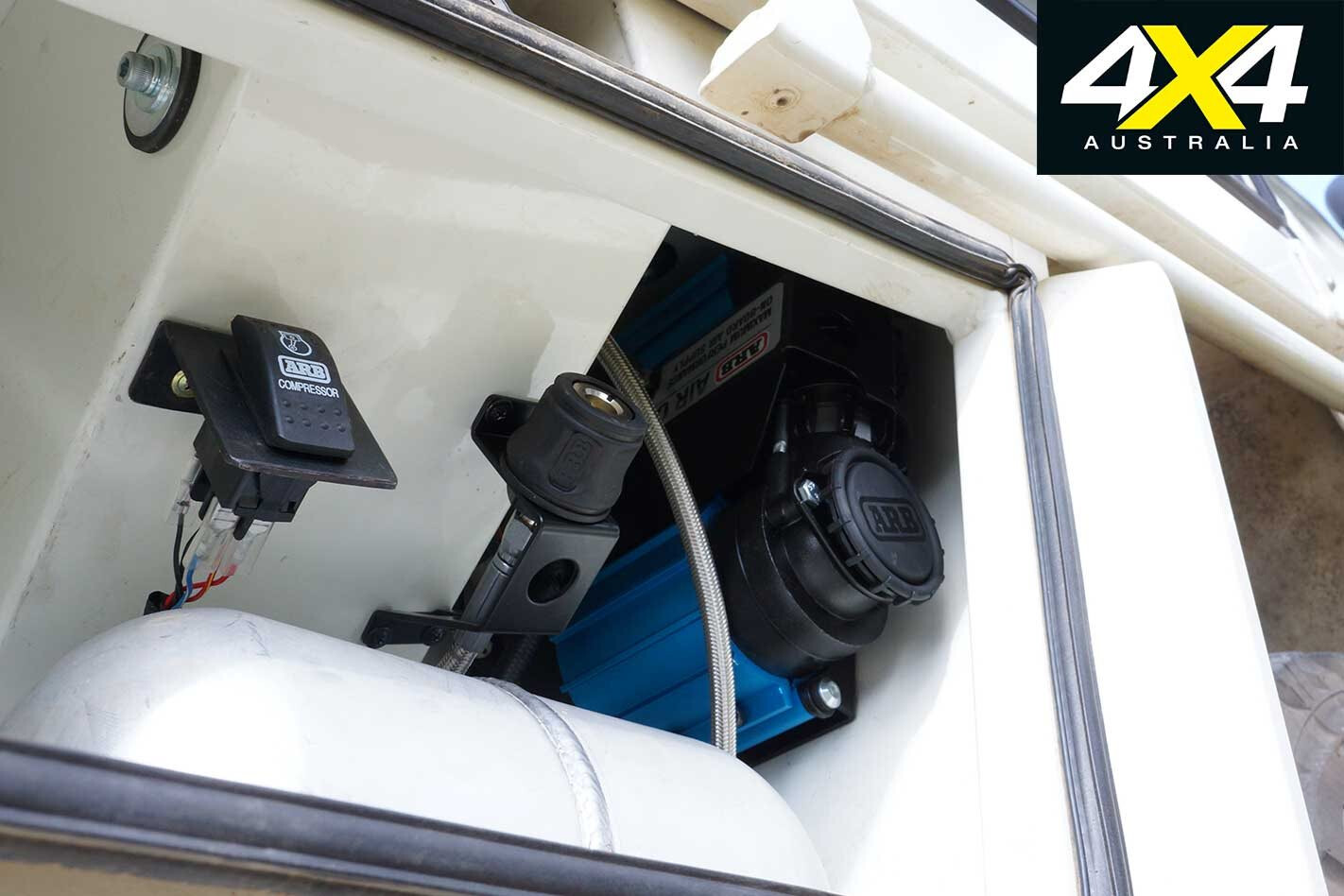
On the plus side it delivers up to 174 litres of air per minute at 0kPa and 131 litres per minute at 200kPa (29psi), which is bloody good. This makes short work of inflating tyres or running some air tools; the latter requiring an air tank for optimum operation. We fitted a four-litre tank into the under-tray box.
The setup, ready at hand all the time, makes it easy and quick to inflate tyres, and for even better tyre inflation we went all out and got ourselves one of those fancy digital tyre inflators. This makes obtaining the right tyre pressure that much easier, with a stated accuracy of +/-1psi at 25-75psi.
With a lot of sand running and half-reasonable outback roads in store, we swapped back to our Cooper ST Maxx tyres, as they perform extremely well in these conditions and you get better fuel economy on these than when running heavy-duty mud tyres.
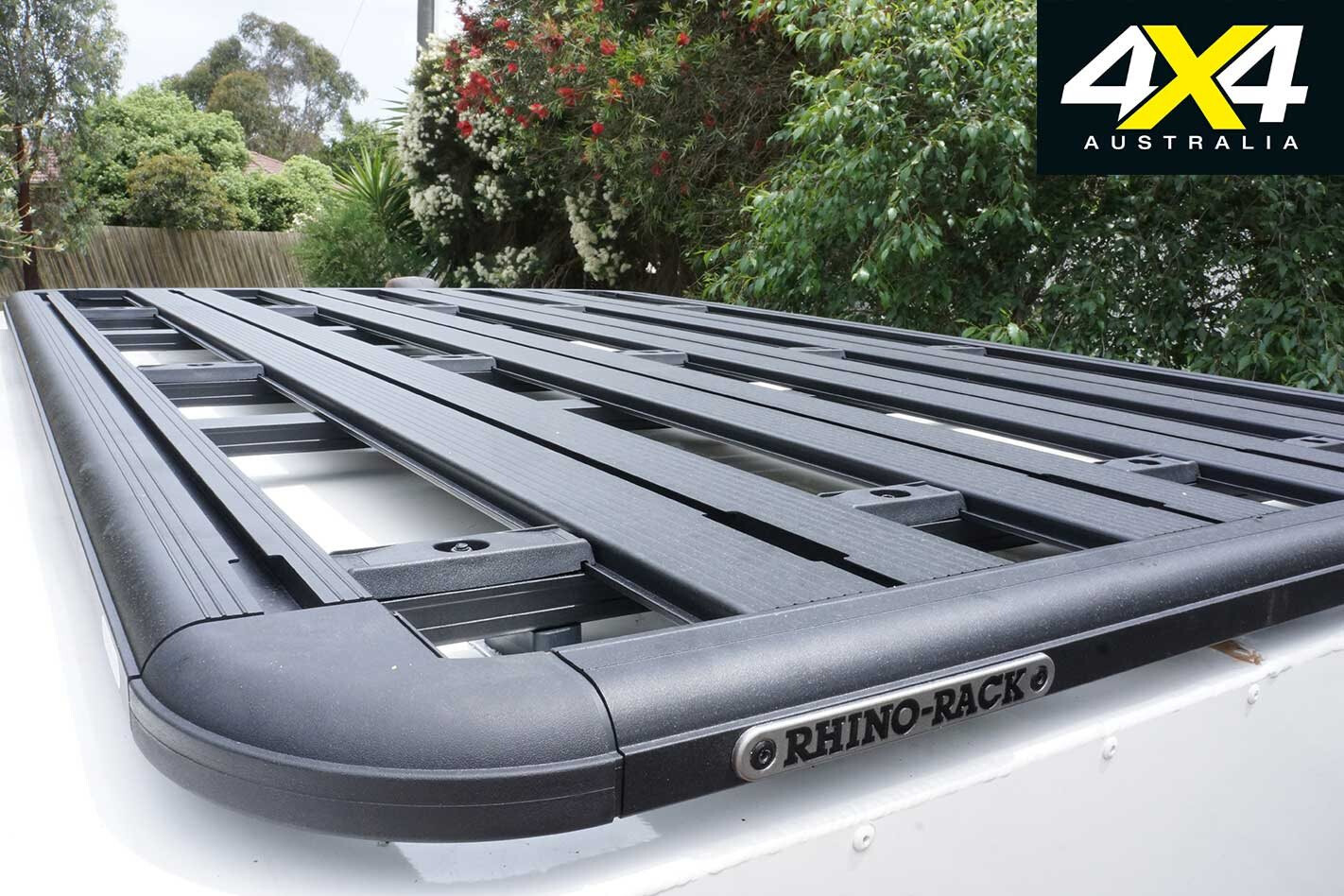
More recently, after discovering there was a shortage of space for long bush trips, we fitted a Rhino-Rack Pioneer Platform roof rack to the Boss alloy canopy.
Rhino has a heap of racks and support bars to choose from and we’ve used a variety for many years now and they’ve never let us down in any way, even when we load them past the recommended limits.
These platform racks come in a variety of sizes, from 928x1426mm to a mammoth 2528x1586mm, so there is one that will suit you and your vehicle’s roof; we opted for the 1928x1236mm, which should be capable of handling everything we want to carry.
I was limited in what I could fit to the Cruiser because of the roofline clearance getting into our garage, hence the platform design. With clearance being the real issue we couldn’t use roof bars of any sort, so we mounted the rack with just a few spacers, enabling enough room for ropes or tie-downs to be used but keeping the overall height as low as possible.
At home it was a tentative drive into the garage, with the new rack clearing by just one centimetre. The accessories I bought – a shovel holder and a gas bottle holder – will require fitting before the next trip, and they’ll also demand removal before I try and drive back into the garage. It’s not perfect, but I can live with it.
We also took the opportunity to fit a set of Narva LED globes, which come in a variety of fitments so you’ll be able to find one suitable for your rig. You’ll find the improvement over normal halogen globes to be more than worth the price, especially if you’re doing plenty of night driving and can’t use or don’t have a good set of driving lights.
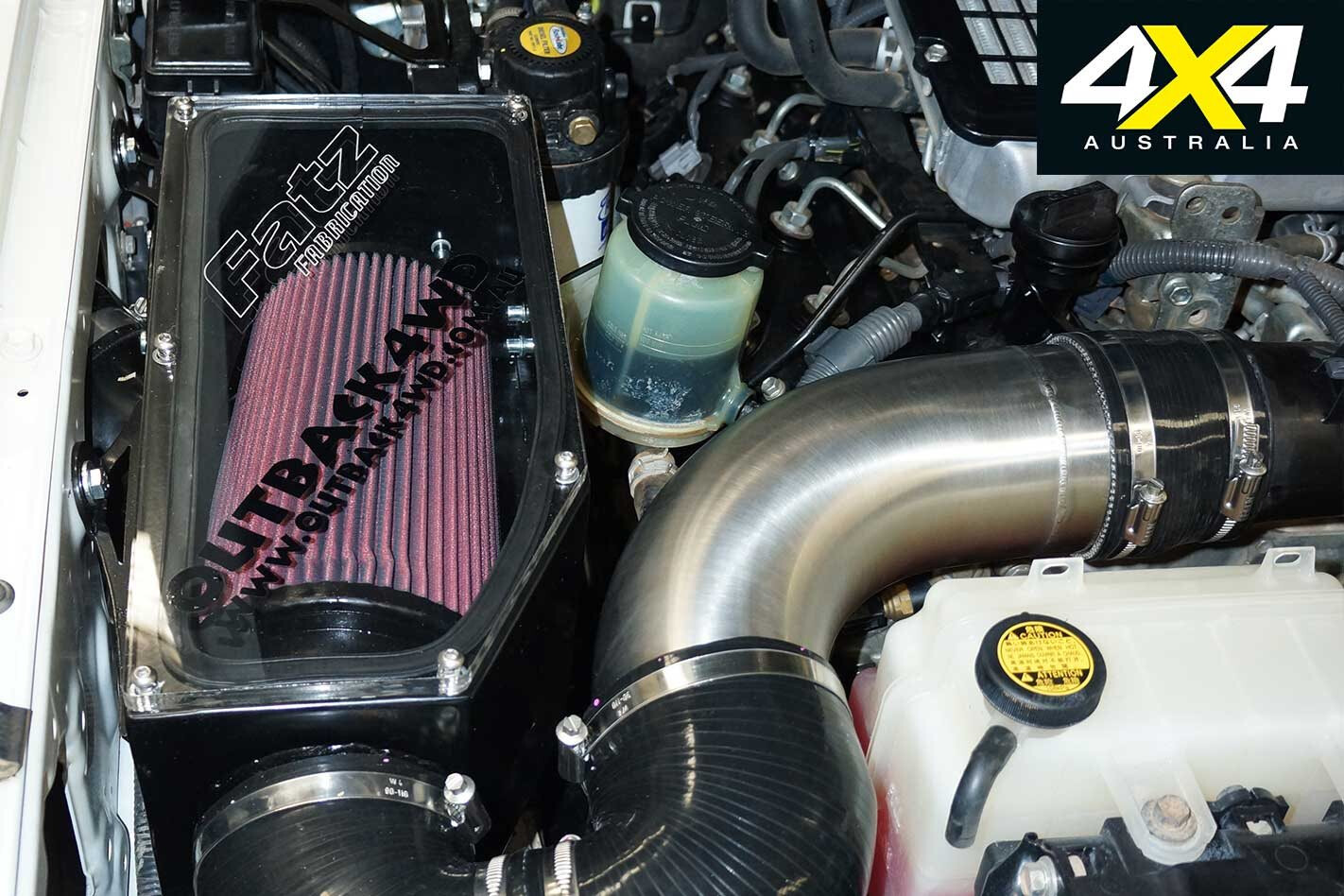
Then, with stories of dusted engines and extremely high repair bills circulating on social media and ringing loudly in my ears, we went searching for a better air box and air-cleaner system.
We settled on a unit from Fatz Fabrication based in Rockhampton, Queensland. These aren’t cheap, but if they save an engine from an early death then that will be a godsend. I’m not a great lover of flatbed air-cleaner elements, anyway, so this new smart-looking unit has already won me over. We’ll provide a full report on this when we’ve done a few dusty miles and seen how it performs.
TOTAL KM: 123,500km KM THIS MONTH: 300km AVERAGE FUEL USE: 13.7L/100km
Part 8: Trip Preparation
Project 79 gets air-lifted and monitored – 16/06/19
WE’VE BEEN preparing the Cruiser for its next sojourn, which will be a longish one of a few months up to Alice Springs and across to WA via the Gary Junction Road to Marble Bar and then up to the Kimberley for a month or so.
We’ll then head south to Central Australia and the Eastern Macs before arriving back in Birdsville. Not sure what we’ll do after that, but I doubt we’ll be coming home … maybe a run through the Gulf before heading to the tip of Cape York?
The crew at Outback 4WD in Bayswater, Victoria, where I get all my service and maintenance work done, has been busy giving the Cruiser a service and a pre-trip inspection (always a good idea, no matter where you are going), as well as fitting a set of airbags to the rear suspension.
Airbags as a suspension aid have been around for ages and I’ve got a set on our Dodge Ram in the States to help carry the load of the slide-on camper. My stretched Patrol has never needed them as the rig is so well sprung and balanced, even when towing a camper. But the 79 Cruiser is a different ballgame and, with its long rear overhang, we’ve had trouble keeping the truck level, even with a set of Old Man Emu springs in the back.
I could stretch the chassis like I did with my Patrol, but the turning circle of the Cruiser isn’t great and that would make it even worse. I could go heavier in the spring set or add another leaf, but that would affect the ride all the time, making it bloody uncomfortable when it’s lightly loaded. So I went for a set of airbags.
Polyair make a range of airbags for vehicles, and its Dominator Bellows are the toughest, biggest airbags in the Polyair line-up, designed with rigs like the 70 Series Cruiser range in mind and that have suspensions varying from standard to a three-inch lift. There are two kits available: one for standard to 30mm lift and the second from 30mm to 75mm lift. Both are made from heavy duty, four-ply material with steel end caps and are adjustable from 5 to 100psi. They come supplied with all fittings, hoses and brackets, and come with a two-year unlimited-kilometre warranty.
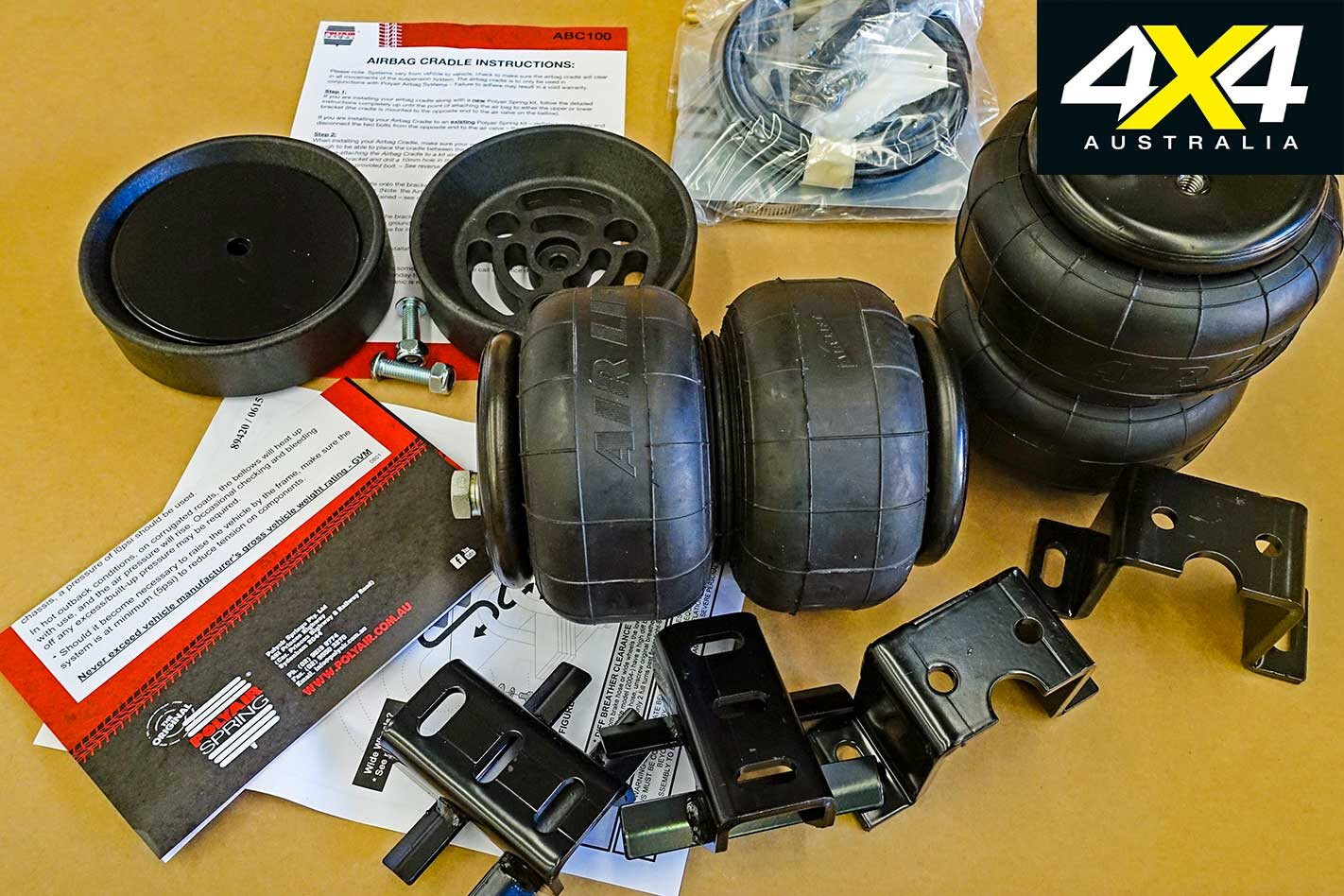
A good handyman could fit these, but I let the experts at Outback 4WD do their thing. No drilling is required as the kit is a complete bolt-on affair, taking about two hours to fit. Take care when running the airlines as they must be kept out of the way and protected as much as possible.
I also opted for the optional airbag cradle kit, which allows more movement in the suspension as the airbags aren’t connected to the axle (or chassis) at one end. The cradle allows the suspension to go to full droop without any hindrance; it’s something I should fit to my Dodge.
While airbags don’t change the GVM of the vehicle they help carry the load and are rated to carry 2200kg. The minimum air pressure in the bag is 5psi, but that comes with the caveat of only being suitable for an unladen vehicle on a smooth road.
For loaded situations a minimum of 20psi is called for, and we found 20 to 25psi was more than suitable for the Cruiser when it was lightly loaded and didn’t have a camper on the back. With a camper hung on the rear it requires about 40 to 50psi to keep the rig level and the shackle plates to be near upright, with just the slightest angle backwards.
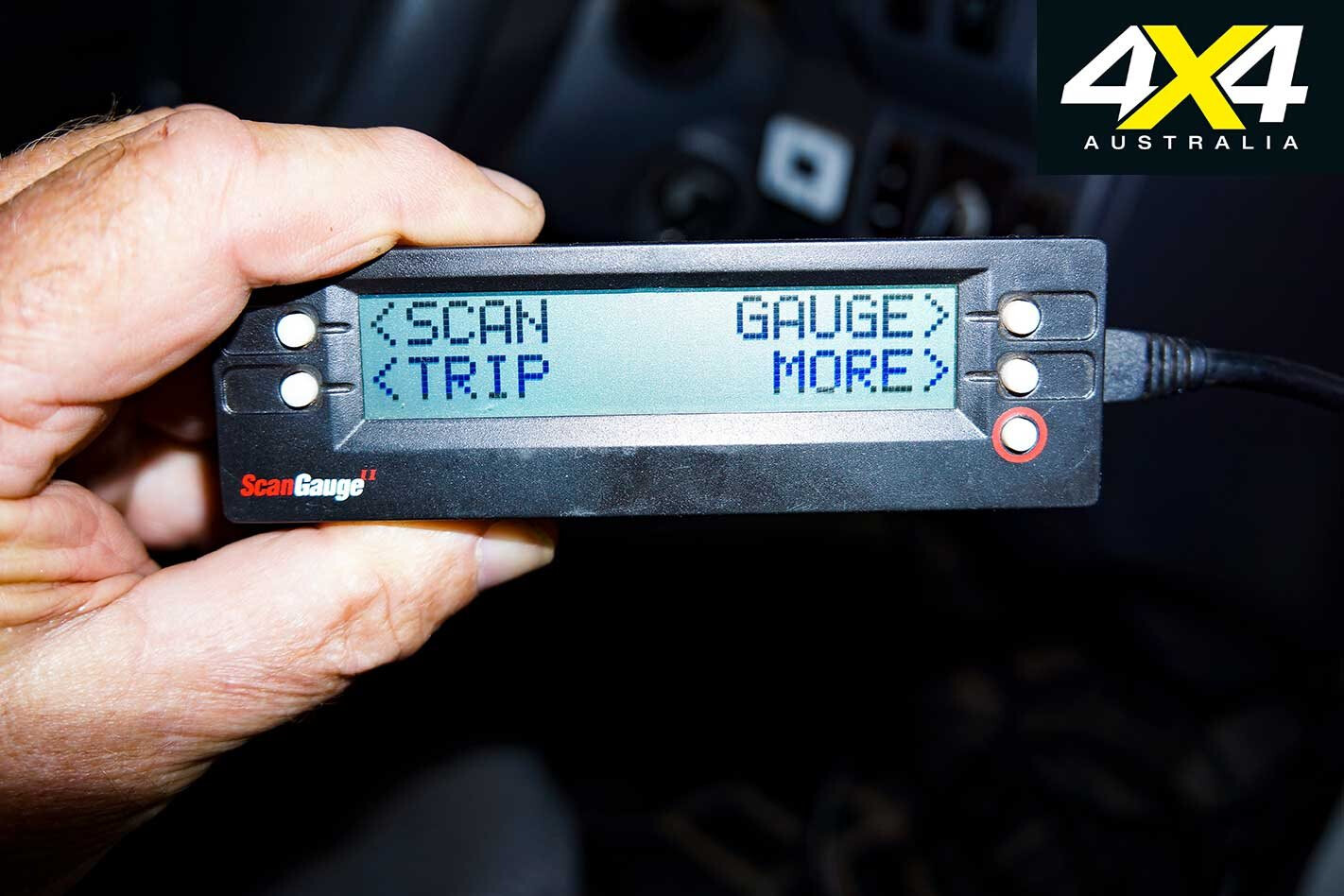
With all the electronic controls and sensors of modern vehicles, some form of code-scanning device makes a lot of sense; so I got myself a ScanGauge II for the Cruiser. These are simple to fit – the hardest thing is finding the OBD11 connector, which, in the 79’s case, is under the dash on the left-hand side of the steering wheel. Plug it in and run the cable to where the unit mounts – in the Cruiser’s case that’s on top of the steering column in front of the dash, which seems as good a place as any.
Once plugged in and the vehicle ignition switched on the ScanGauge will communicate with the vehicle. You’ll then need to calibrate it for engine size, fuel type, distance in kilometres, fuel tank size, etc., all of which is pretty easy.
Once all that is done the gauge will display a range of readings including engine revs, fuel usage, speed, intake air temperature and a whole lot more. Importantly it also has a scan tool, which you can use to view and clear diagnostic trouble codes, pending trouble codes, as well as being able to turn off the Check Engine light. The unit is also very easy to move from car to car.
There are many scan gauges on the market, but for the cost and peace of mind the ScanGauge II takes a lot of beating. I’m also much happier now that I’ve fitted the airbags – not only does the rig sit flatter and look better, it also rides better as the airbags allow the leaf springs to work to their fullest.
TOTAL KM: 132,250km KM THIS MONTH: 5700km AVERAGE FUEL USE: 16.3L/100km
Part 9: Ready and Able
The 79 gets a good going over – 8/10/20
I AM A firm believer in fixing or replacing things before they become an issue. The part in question may last a bit longer and save you some dollars in the short term, but whatever you saved by stretching your luck is going to cost you more if you break down in the scrub. Plus, it’ll take up valuable holiday time and generally stuff you around no end. It’s just not worth it!
So, in the last couple of months the Cruiser has been getting a good work-over. For starters, we rolled into Outback 4WD in Bayswater at the start of the year for a 140,000km service in preparation for a year of touring (which kinda never happened).
Apart from the normal full service and pre-trip inspection, the crew at Outback serviced the front and rear wheel bearings; replaced all hub seals axle gaskets and front brake disc pads; machined the front disc rotors; and replaced the rear spring shackle, pin bushes and all sway bar bushes.
A bit of ‘notchiness’ was noticed in the front-end swivel hubs and the clutch pedal was down a bit, indicating the clutch was on its way out. With assurances that both would last for at least 10,000 kays, we headed off on a little jaunt through Outback NSW, towing our Trakmaster camper. It wasn’t too strenuous a trip on either man or machine, but we did come unstuck on one occasion when we slipped off the road and into a quagmire of black soil.
With no MaxTrax (I’d left them at home as it was planned to be an ‘easy’ trip) and not a tree in sight, it was out with the shovel. Slipping the Cruiser into low range and engaging the front and rear diff locks, I managed to extricate myself from our silly predicament. The clutch got a hammering amongst all that though, and it wasn’t smelling really well after it!
Back in town I washed the mud from underneath the truck and rolled back into Outback 4WD for the two biggish jobs of clutch and swivel hubs.
For the replacement clutch, I again went for an Exedy Safari Tuff clutch kit (exedydirect.com.au). I’ve had these same units in my Patrol for the last 340,000km and, while I replaced one at about the 250K mark, I’ve found them to be a tough, durable and a very reliable replacement to the not-so-great original units. These Safari clutches are also easy on leg muscles and I haven’t had any issue with noise or any shudder from these units. I expect to get the same years of service and mileage out of this new clutch.
Having dropped a gearbox of an early model Cruiser while in my carport, it’s just amazing how quickly a well-trained mechanic with all the right gear can do such a job. It’s no wonder I now leave most of my mechanical work to professionals.
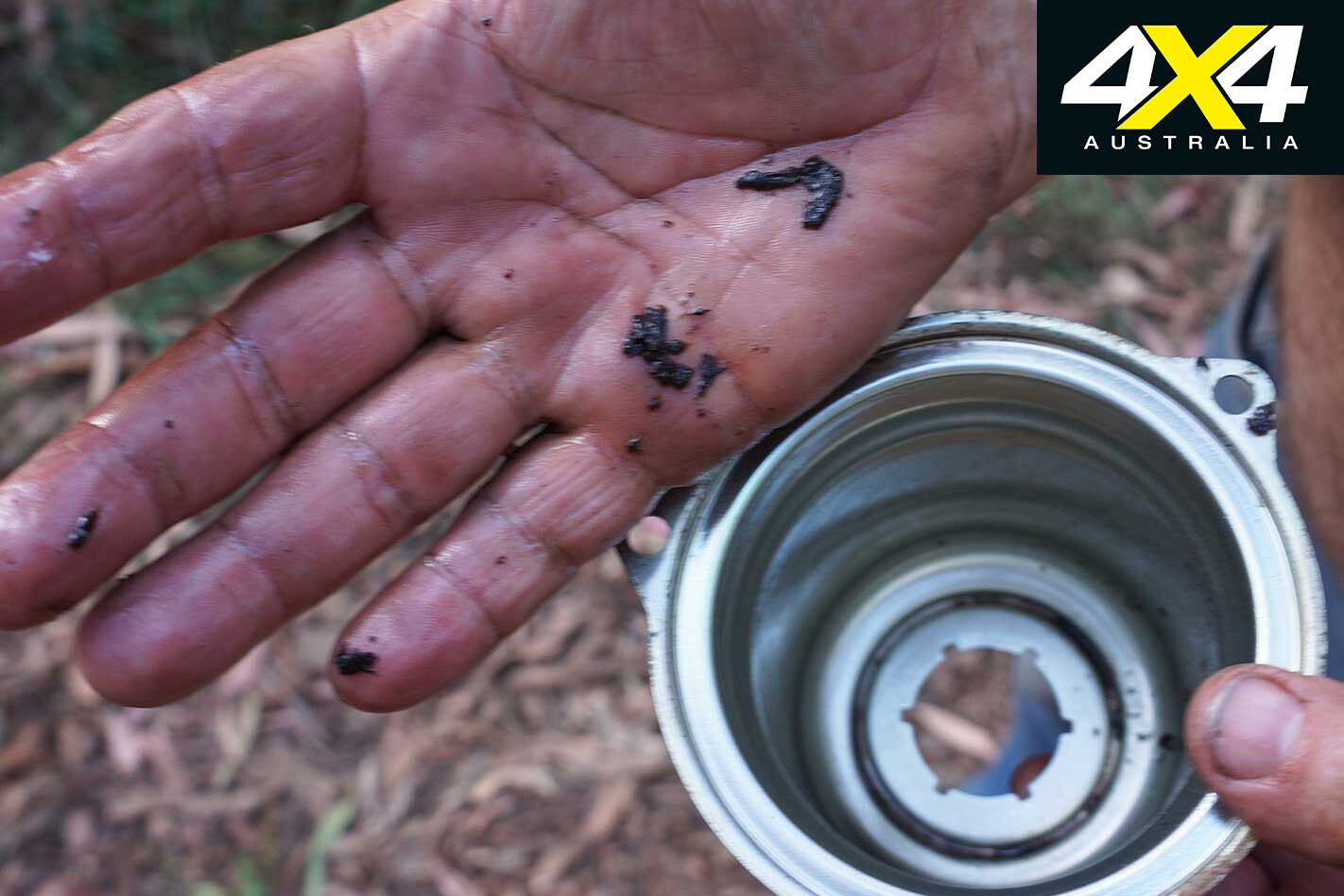
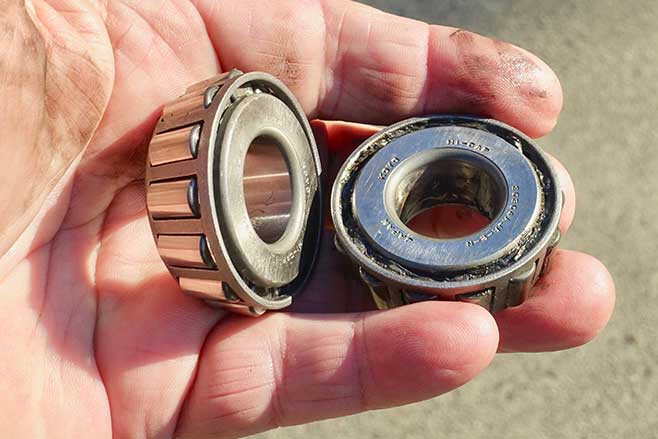
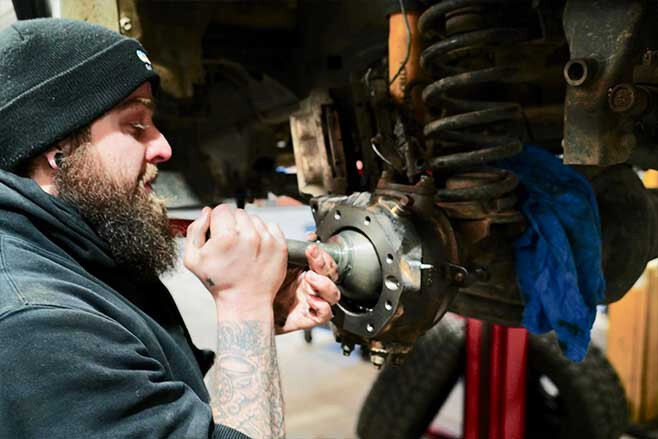
With the clutch done it was time for the swivel housing. This time I went for a Terrain Tamer kit (www.terraintamer.com). TT has a large range of wheel bearing and swivel hub kits for different model Cruisers and Hilux vehicles, and they come complete with all bearings, seals, washers and the like.
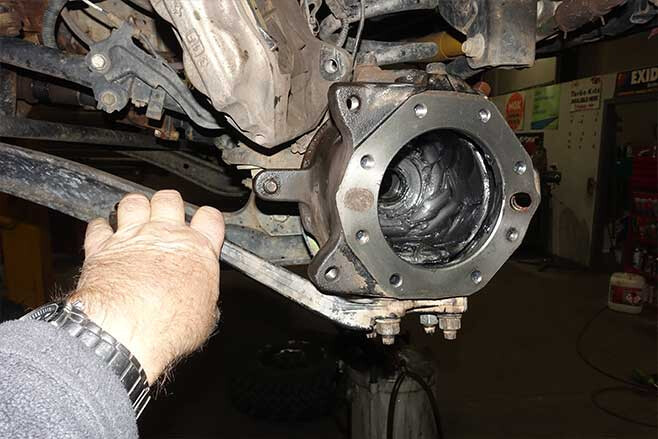
All the bearings are made in Japan, have a Rockwell hardness rating 2.5 points higher than the OE bearings, and are designed and manufactured for a longer service life. The seals are also the very best you can get, with improved sealing surfaces and construction to prevent oil loss and protect against ingress of unwanted substances. It was a job of a few hours to fit the new kit, but I knew if I had to do it the job would have taken a lot longer.
With all that work done, the Cruiser drives and steers better while the clutch feels healthier. Let’s hope we can do an outback trip before the year is out!
TOTAL KM: 156,500km KM THIS MONTH: 5200km AVERAGE FUEL USE: 15.9L/100km
ARB has released a Portable Power Pack to ensure beer remains cold and food stays fresh when your fridge/freezer isn’t hooked up to a four-wheel drive.
Perfect for bringing on the tinny or for lunch at the park, the lightweight ARB Portable Power Pack (just 1.65kg) utilises a 15Ah lithium-ion battery. ARB says the unit can run for up to 18 hours, a figure reached during a test using a 44-litre ZERO fridge/freezer set to 4°C and with an ambient temperature of 25°C.
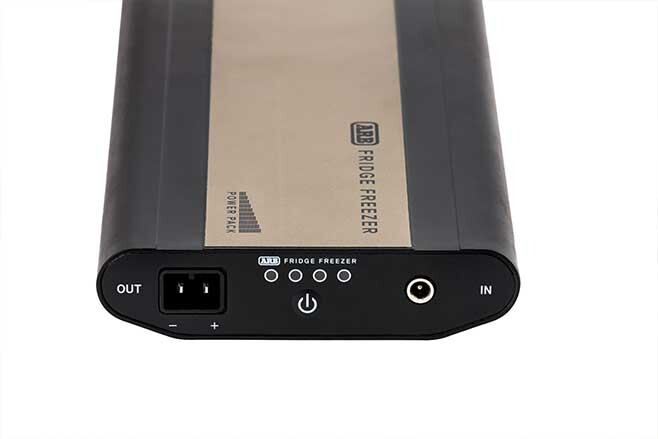
The pack features integrated high-power rubberised magnets, which enables it to easily affix to all fridge/freezers in the ARB catalogue. To power the fridge/freezer, it’s then just a matter of connecting the power cable to the DC outlet and pressing the ON button.
The pack can be fully charged in 5-6 hours, has an optimum operating temperature between 0°C and 43°C, and measures 330mm x 140mm x 6.5mm.
As mentioned, the Power Pack is compatible with ARB’s entire range of fridge/freezers, and it has an IP66 waterproof/dustproof rating.
Website: www.arb.com.au RRP: $399 (Australian East Coast Metro)
THERE’S no doubt getting stuck is a big part of the job when you’re out in the sticks; and for the most part some experience, a pair of recovery tracks, or a snatch from a mate and you’re on your way again.
But what happens when you’re bogged to the eyeballs, all the snatch straps are snapped, and, worse still, the tide is on its way in and you’re below the water line? That’s when guys like Shaun Barrett and his team at Westcoast 4X4 Creations & Recovery come in real handy.
They bring a tonne of 4×4 experience along with up to seven tons of off-road artillery to get you out, at any hour of the day or night anywhere along the left coast of Australia.
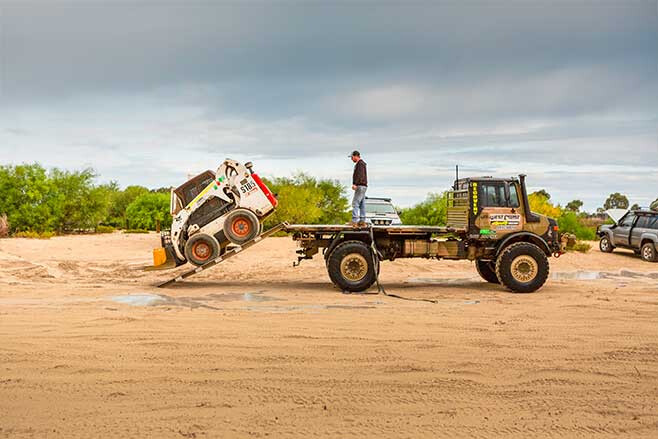
Case in point being quite possibly the ultimate recovery rig right here. Shaun’s 1986 U1700 Unimog. Originally purchased from the Australian Defence Force’s surplus stock mid-2019 after doing around 13 years in military service, it has been rescuing stricken vehicles all over the Sandgroper state ever since.
One does not simply buy a ’Mog and start a recovery business, and Shaun is no stranger to the off-road life, with two suitably kitted-out Patrols doing the early recovery duties. But the need to go bigger had Shaun eyeing off the surplus auctions.
“We decided to do it, as that kind of service wasn’t available on the scale that we wanted. Back in the day when I was FIFO, I’d spend a lot of time out there (in the bush) and people would pay you for recoveries. The ’Mog was a personal want, so I decided to get it and let it pay for itself, but I didn’t expect it all to take off like it did,” Shaun says.
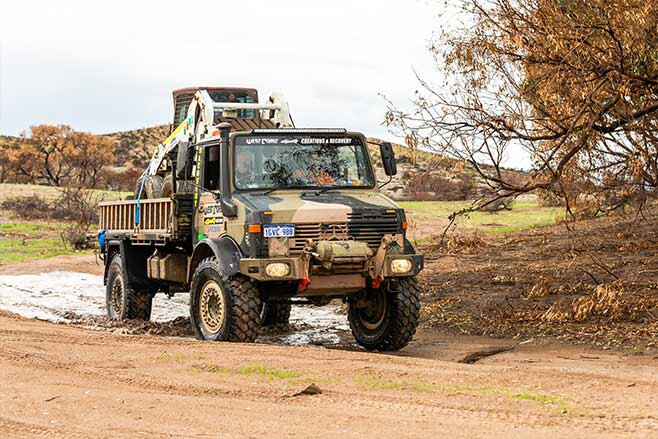
As capable as the Unimog is there’s always room for improvement, and given these trucks are designed to get the job done over everything else, some upgrades were needed to maintain some form of personal comfort. Simple comforts, like being able to hear or walk upright after a day in the saddle. A full eight boxes of sound deadener were spread throughout the Mog’s cab to start with.
“It’s good now,” Shaun said. “Two layers of sound deadener, carpet and ISRI (suspension) seats have made the world of difference, but doing 800km in it hurts. It’s mainly the vibration that gets to you. It’s not too bad once you zone out, but …”
BIGGER IS BETTER
ADDING more footprint than the standard ADF issue tyres, Shaun fitted some fatter Michelin 395/85/R20 XZL All Terrain donuts. At an eye-watering $2200 each they certainly didn’t come cheap, but after seeing the Unimog fully loaded with two wrecks while grinding all four tyres into the dirt trying to skull-drag another wreck from its resting place, the decision to opt for more traction was a simple one.
Having eight gears available in forward and reverse to put all the torque down from the 5.7L inline-six OM352A Mercedes-Benz engine helped, but when it comes to bigger is better, this monster has got it in spades.
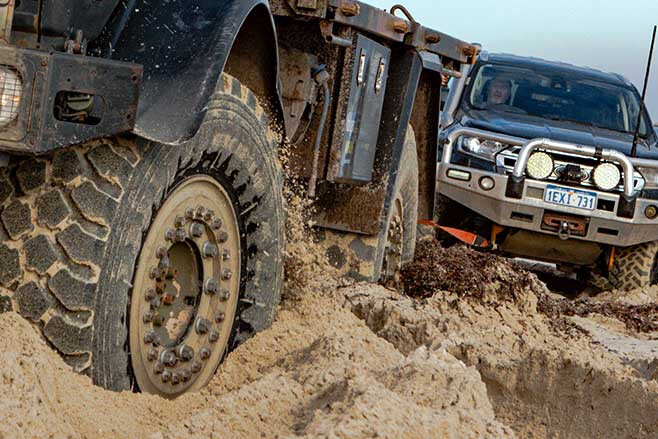
Keeping an eye on the Westcoast 4X4 Recovery Instagram and Facebook pages will show just how hard the team are at it.
“Some weeks I’m doing eight to 10 recoveries … with some weekends alone we’re doing six or seven,” Shaun revealed. “Some weeks I’m doing one every night. Sundays are usually a guarantee because everyone needs to get to work the next day.”
Demand has continued to increase with word of the ’Mog getting out. A lot of the team’s work keeps them within a 70km radius of home, however they aren’t averse to throwing a few miles under those gigantic 46-inch tyres to rescue a stricken 4WD, or getting on the tools if the recovery needs it.
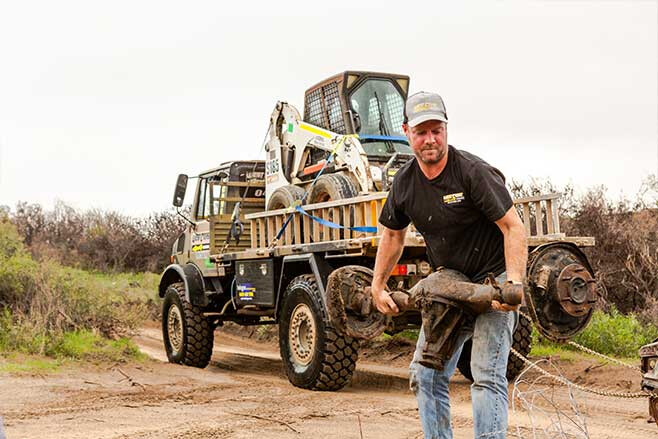
A recent example saw them dragging a broken Troopy out of the dunes around Bremer Bay way down along the WA south coast.
“It had just come back from a trip around Australia and had sheered the rear diff pinion off, so we had to pull the rear axles just to get it out over the dunes,” says Shaun.
CARNAGE CHAOS
IF you were wanting to hear stories of absolute 4×4 carnage then step right up folks, you’ve come to the right place.
“The worst recent recovery involved a Hilux which had sought help from a lot of private 4WDers before calling us,” Shaun tells us. “They basically dismantled the car trying to recover it from the mud with snatch straps, even ripping the tow bar out of the chassis.”
After being stuck in the mud for four days, Shaun and the ’Mog went out. To give an idea on how stuck this clearly non-unbreakable Hilux was, the initial attempt showed the extent of the situation.
“On the first (winch) pull we picked the whole front of the car right up off the ground while the rear diff stayed in the mud.”
Suffice to say, the ’Lux was a complete write-off, but it could very well have been a different story if the owners had called Shaun earlier than they did.
When you’re on to a good thing, they say stick to it, so Shaun has recently returned back from a trip to the northwest of WA to bring home a second Unimog.
“For these long trips I have Sarah, my partner, along, who’s always been in the passenger seat no matter what.”
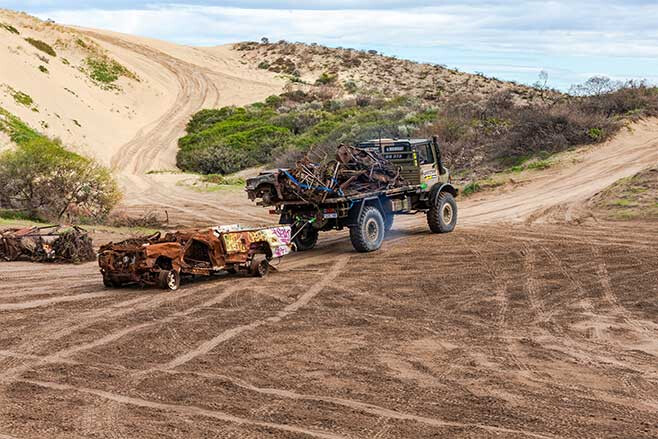
The up-spec Unimog comes equipped with an Hydrauliska Industri AB crane behind the cab. Future mods will see it copping a 15-tonne mechanical winch that’s currently waiting in the workshop, as well as mandatory layers of sound deadening and carpet.
It’s only been a year since kicking off the recovery service, but the effect has been a positive one for Shaun.
“Since we’ve been operating, we’ve seen a dramatic reduction in the amount of vehicles being recovered instead of being left on the beach,” says Shaun.
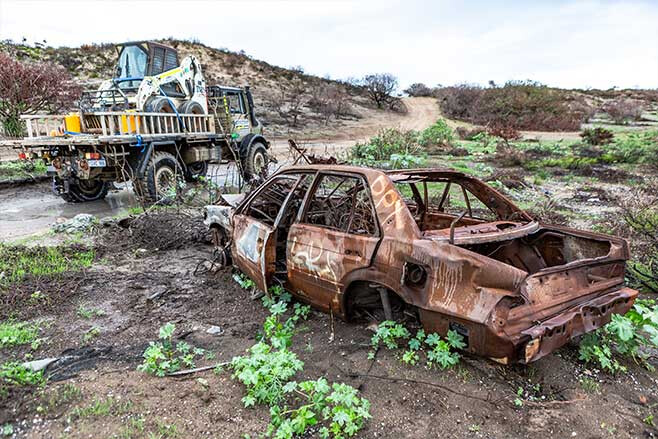
The day 4X4 Australia joined Shaun, he and his bobcat-driving mate Shaun (Core Contracting Services) were on a mission to clear a bunch of car wrecks around the popular Wilbinga area north of Shaun’s northern Perth suburbs base. Despite the wrecks being loaded up with sand and rubbish, the ’Mog was able to drag the wrecks to a staging area before being taken away for scrap. This took the entire day and was done free of charge after consultation with local government and rangers.
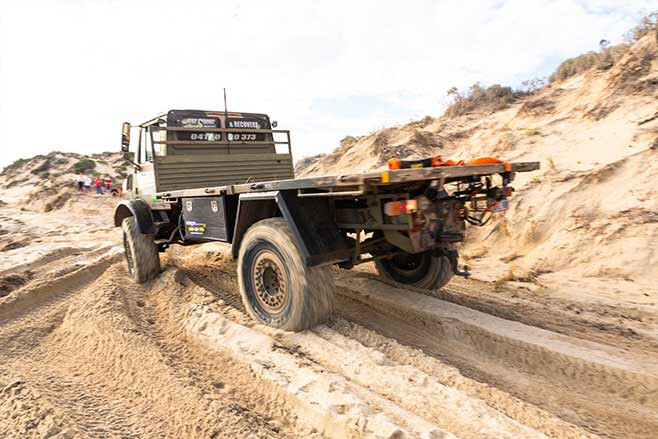
“We wanted to do our bit to keep areas open,” said Shaun. “When we want to go 4WDing and fishing, we use that area quite a bit and we’re sick of seeing wrecks.”
Dumped vehicles are a big problem for the off-road community, as the more wrecks the powers-that-be see left around, the easier it is for them to close tracks, set up monitoring cameras and hand out fines. Watching the team clear nine wrecks in a day is a highly commendable effort. You’d think a well-earned rest was in order come home-time, but not when there’s a drowned 100 Series in need of assistance in the southern foothills of Perth.
When there’s this much commitment to helping 4WDers, and with company policy maintaining “no-one gets left behind,” safer recoveries and happier off-roading is on the cards for the future of everyone involved.
MOG GENEALOGY
THE Unimog, or Universal Motor Gerat (Universal Power Unit), was first produced by Boehringer for 1948 as an alternative to the tractor, however the idea to use equal-sized wheels on all four corners was unique, allowing 4WD on a farm tool possible.
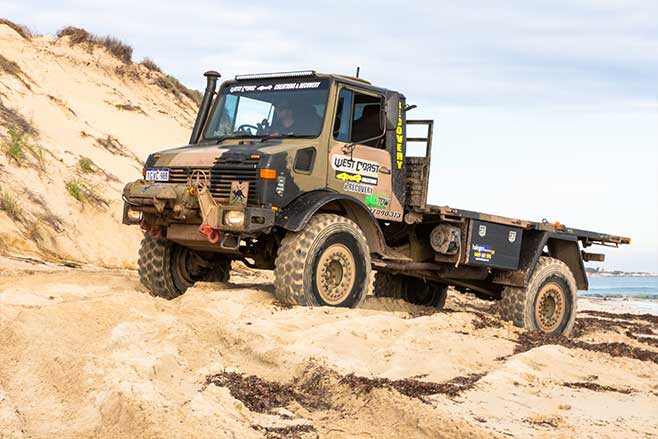
Daimler AG (formerly Daimler-Benz) took over production from 1951, selling under the Mercedes-Benz brand we know today. Not much has changed from those first post-war models sporting spartan interiors and fundamental theme of a do-it-all workhorse, however the legendary durability stuck and is still a mainstay of the brand to this day.
September new vehicle sales in Australia showed a slow but steady trend back up, with the total number of new vehicle sales down 21.8 per cent compared to September 2019.
One-tonne ute sales continue to lead the market, with the Ford Ranger and Toyota Hilux leading the charge – it’s the same two names at the top of the 4×4 sales ranks.
The Hilux began to claw its way back after the runout of the previous model resulted in its lowest figure for a long time in the month of August, but the updated Hilux was strong in September. Expect it to be challenging the Ranger for the number one spot by next month.
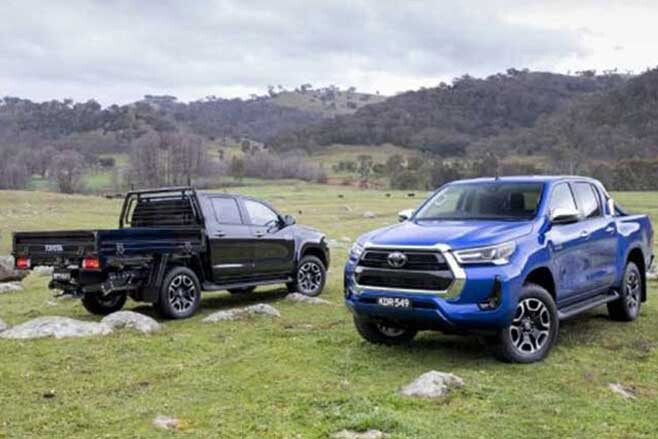
While Hilux sales mightn’t have been at their best, we doubt Toyota is feeling the pinch. No other company will come near it for total new car sales, and its latest Rav4 SUV has topped the sales for the previous two months, only slipping back to third in September.
Three of the top-10 selling cars in Australia and four of the top 10 4x4s are Toyotas, and the brand holds 19 per cent of the total new vehicle market.
Also making a comeback with a new model in September was Isuzu with its all-new D-MAX ute up to sixth place for the month. Expect more from this one as its sales hit full swing over the remainder of 2020.
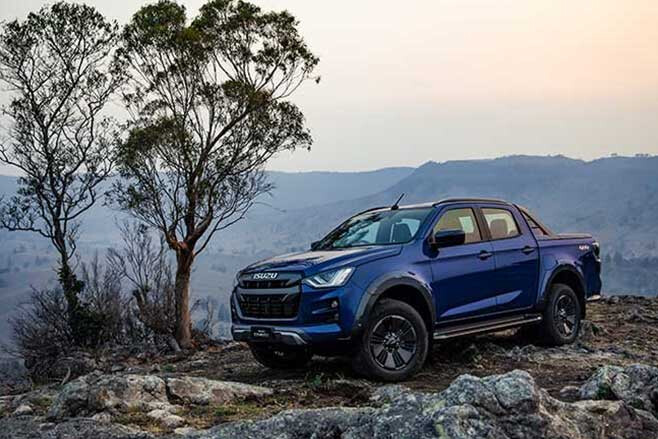
Utes might make up the lion’s share of 4×4 sales, but the LandCruiser 200 and Prado buck the trend with steady, strong sales each month. Isuzu’s MU-X is often up there on the charts but dropped back in September, while the Ford Everest made a rare appearance as the tenth best-selling 4×4 for the month.
While LC200 sales are strong and steady its only real rival is the Nissan Patrol Y62, and its sales are up 14.6 per cent in 2020. To put that in perspective, Nissan has sold 1671 Patrol so far in 2020, while Toyota has sold 9222 Cruisers.
A 4×4 wagon we haven’t seen in the rankings for a while is the Land Rover Defender, which registered 85 sales of its all-new model in September. The factory that builds the Defender was shut down for two months during the height of the pandemic in Europe, and the first batch of Defenders that arrived in Australia was limited in numbers. In fact, all of the diesel models were sold and only the P400 Defenders are available now until the next batch arrives next year.
We don’t expect to see the Defender selling Land Cruiser or Prado numbers anytime soon, but it’s good to see it back.
4X4 SALES: SEPTEMBER 2020
- Ford Ranger: 3454
- Toyota Hilux: 2790
- Mitsubishi Triton: 1234
- Toyota LC200: 990
- Nissan Navara: 919
- Isuzu D-MAX: 856
- Toyota Prado: 820
- Toyota LC79: 609
- LDV T60: 582
- Ford Everest: 517
4X4 SALES: YEAR TO DATE (SEPTEMBER 2020)
- Ford Ranger: 26,377
- Toyota Hilux: 23,053
- Mitsubishi Triton: 12,148
- Toyota Prado: 10,752
- Toyota LC200: 9222
- Toyota LC79: 6982
- Nissan Navara: 6911
- Holden Colorado: 6572
- Isuzu D-MAX: 6081
- Mazda BT-50: 5343
TERRAIN TAMER EXHAUST SYSTEM – TOYOTA HILUX
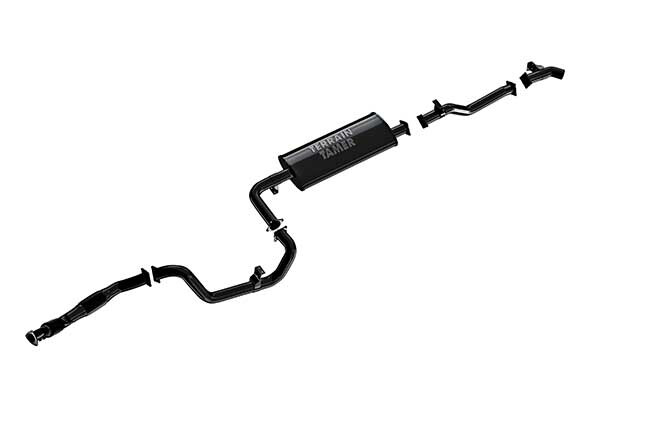
THE crew at Terrain Tamer has put to market their new range of High Flow Exhaust systems, suited to fit the Toyota Hilux and the V8 LandCruiser 79 Series.
The Australian-made system is constructed from 409 stainless steel and coated with black heat-proof thermal paint. To boost performance, the system features a double-braided flex joint and three-inch mandrel bent tube.
Other features include a large-diameter turbo dump pipe, a 200 CPI catalytic converter with a high-flow metallic substrate, and heavy-duty brackets and hangers. Terrain Tamer’s High Flow Exhaust Systems come with a five-year warranty.
Website: terraintamer.com
AMC CYLINDER HEADS
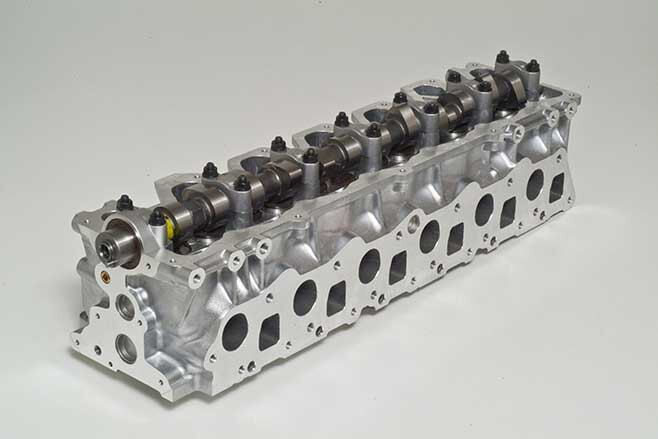
AMC is a European OEM approved manufacturer of cylinder heads, camshaft kits and head bolts, and the company has cylinder heads available to fit many popular four-wheel drives including the Amarok, Hilux, LandCruiser, Land Rover, Navara, Pajero, Patrol, Prado and Triton.
The cylinder heads, manufactured with the latest precision equipment and highest grade materials, will extend the life of your 4×4. The products ome with a two-year warranty.
Website: www.amc.es
SSANGYONG SUSPENSION KIT BY IRONMAN 4X4
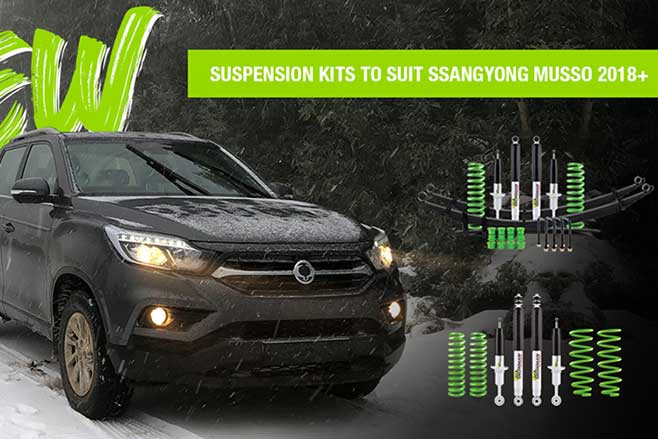
IRONMAN 4×4 is the official tuning partner of SsangYong, and the Aussie company has a full range of suspension kit for both the Musso and Rexton.
Suspension componentry includes performance and constant load springs that are designed to significantly boost loaded ride height, as well as Nitro Gas Shock Absorbers. Ironman 4×4 also has premium underbody protection specifically designed for both SsangYongs.
The equipment is available to order now via Ironman − head to the website for more information.
Website: www.ironman.com
YOU wouldn’t wear a pair of thongs to go bushwalking, nor would you wear hiking boots to the beach.
The same principle applies to 4×4 footwear, with off-road tyres specifically manufactured and constructed for an assortment of lifestyles, from long-distance touring to serious mud- and rock-crawling, and everything in between.
Installing a tyre that’s not fit-for-purpose increases the risk of damage, puncture and, quite simply, a loss of traction, so it’s important to attach appropriate rubber to each corner of your 4×4 – in fact, it should be one of your first aftermarket purchases as soon as your shiny new 4×4 departs the showroom floor.
“Good off-road tyres for your 4×4 are essential, and ensuring they are fit for purpose for your driving adventure is the key,” said Dean McCormack, product portfolio specialist at Goodyear and Dunlop Tyres.
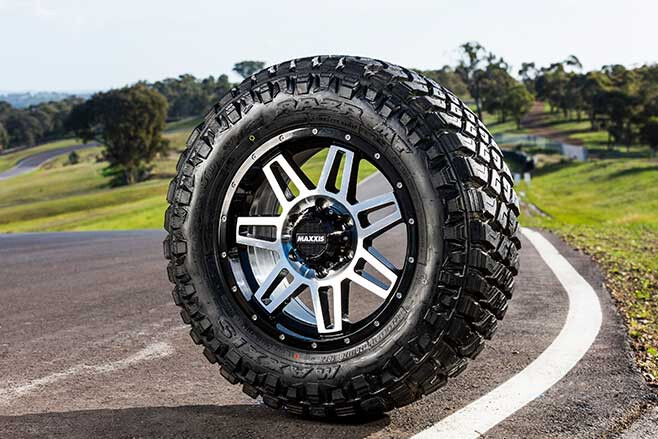
Simply put, 4×4 tyres can be broken down into categories – Mud Terrain (M/T), All Terrain (A/T) and Highway Terrain (H/T), and there’s also Light Truck (L/T) construction – each with its own strengths and compromises, depending on the kind of off-roading you have in mind.
So before you venture down to your local tyre centre to swipe the credit card for a brand-spanking set of new rubber, it’s important to establish what your intended purpose is and what type of tyre suits that purpose. Once that’s settled, you’ll be able to find a tyre that will suit the kind of exploration you have in mind.
Jeff Moorhead, project manager at Maxxis Tyres, explained to us that there are three essential questions someone must ask themselves before they contact a tyre retailer: “How often do I realistically go off the bitumen? What is the duration of the trip ‘off the road’? And how severe are the conditions I will encounter when I do go off-road?”
For example, a tyre with a wider block design with angled centre tread blocks is recommended for dry, sandy conditions; while wider grooves with self-cleaning shoulders and a more aggressive tread pattern will suit those in wetter climates.
“Hopefully after the owner has honestly considered the real use of the vehicle, the tyre selection gets a bit easier,” Moorhead added.
Let’s take a closer look at the types of off-road rubber on the market.
HIGHWAY-TERRAIN TYRES
HIGHWAY tyres typically have tread patterns similar to those on passenger cars, and they prefer bitumen to dirt and are developed more with a bias toward on-road comfort and ride quality – you’ll find them on most showroom-stock 4x4s. They are capable of occasional (light) off-road work (they’re not too bad on firm sand), but you’ll need to look elsewhere if you intend on tackling more serious tracks.
H/T tyres will have less space between the tread blocks, more siping to improve traction, and a reinforcing overlay between the steel belts to improve ride comfort. It’s all about low noise and improved wear life and ride comfort. They won’t, however, provide the levels of puncture resistance and traction afforded by A/T and M/T tyres.
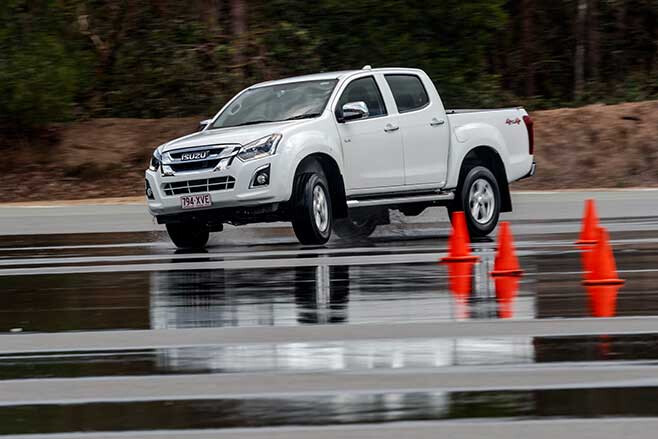
“HT tyres have good on-road handling, steering response, wet handling, braking, low noise generation and reasonable ride quality,” said Jeff Moorhead. “But they still offer some level of gravel road handling … (they’re) probably more aimed at high-speed, ‘formed’ gravel roads.”
In saying that, there is a place for the H/T tyre for a certain type of four-wheeler, as Remy Abonneau, product marketing and account manager at Continental Tyres Australia, explained: “I would advise any driver who spends the majority of their time on-road but enjoys an occasional off-road adventure to invest in a good set of highway tyres with off-road capability … usually called a 70 per cent on-road and 30 per cent off-road.
“These tyres ensure excellent wet and dry braking performance, high on-road safety and grip, and a comfortable and quiet ride when on the city streets and highways, but still provide enough grip to go on a soft dirt road,” he added.
ALL-TERRAIN TYRES
IF you’re looking for an all-rounder that offers the best balance for on- and off-road driving, then look no further than the All-Terrain. They’re often stronger in their construction than a Highway Terrain – they’ll deal better with rocks and ruts – and they also have a more open tread pattern.
They mightn’t be as quiet or comfortable as a H/T tyre, or as rugged and durable as a muddie, but they dabble a bit in column A and a bit more in column B. A quality A/T offers excellent capabilities for both outback trips and rock-crawling jaunts, and they’ll still have enough chops to keep things comfortable on tarmac.
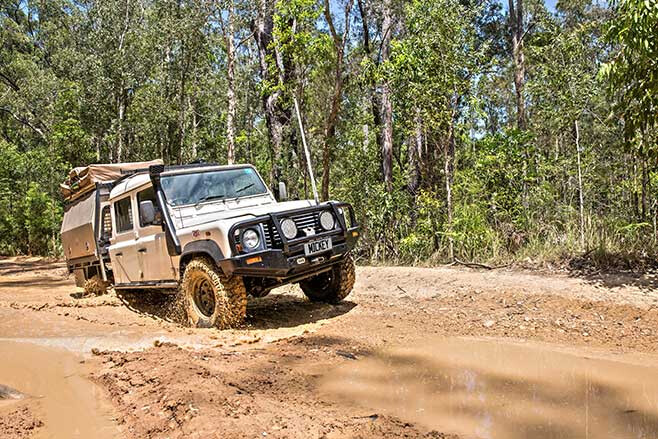
To maintain this balance between on- and off-road capabilities, an A/T should feature a deep, balanced tread pattern to deliver acceptable levels of safety and grip on a much wider array of surfaces. Something that is difficult to achieve, as Jeff Moorhead explained.
“Tyres designed for use off-road need thicker construction, deeper tread depth and wider channels in the tread to deal with the cuts, impacts, dirt, mud, stones and general rigors of off-road driving,” said Jeff Moorhead. “This thicker construction is not ideal for some on-road and general handling type properties.
“Thicker construction increases rolling resistance and reduces fuel economy, generally causes a harsher ride, and possibly reduced wet on-road performance. The deeper tread depth will negatively affect the way a tyre stops and turns because all of that tread rubber has a tendency to bend or fold under high stress. And there is an increase in unsprung weight,” Moorhead added.
MUD-TERRAIN TYRES
YOU’LL hear a muddie coming down the road before you see it, with an obvious compromise for increased bushability being its excessive on-road noise caused by its deep, blocky tread pattern and strong construction.
They’re designed to find grip when all hope seems lost, achieved by the implementation of clever design techniques. The open tread pattern, for example, is designed to dig for traction in loose surfaces while at the same time self-clean while the tyres rotate. The tyre’s heavy-duty construction and additional sidewall protection also prevents punctures, especially when a tyre’s exposure to potential piercing is increased by lowering tyre pressures.
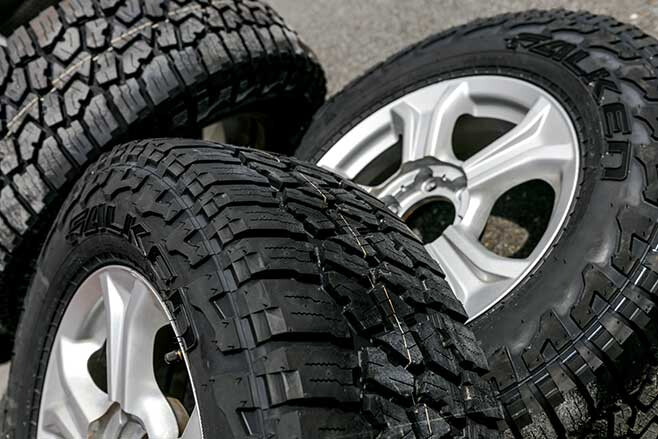
In addition to unsettling NVH (Noise, Vibration and Harshness) levels, a muddie also feels harsh to drive day-to-day, with the drone of fat rubber becoming onerous over time. Ideally, if budget permits, have a set of muddies stored in the shed for the weekend away.
Despite the increased noise and vibration levels and sub-par on-road performance, Jeff Moorhead said that M/T tyres are improving in that area.
“Our Maxxis Razr MT is reasonably quiet for an M/T and retains good on-road performance,” he said. “M/T tyre construction is not so different to A/T construction – just more extreme. Thicker construction of the tyre carcass, deeper tread depth and wider channels in the tread design all for the same reasons as for A/T tyres, but with more of a skew towards off and harsh off-road use. And, again, these increases in thickness that help in off-road conditions have the same effects on on-road performance, but to a larger extent.”
LIGHT TRUCK AND PASSENGER CONSTRUCTION
AN L/T designation stamped on the side of a tyre means it’s a Light Truck tyre built stronger to both carry more load and be more durable. L/T tyres have a more aggressive tread pattern, provide increased sidewall protection, improve traction, and are more cut-and-chip resistant than Passenger tyres.
“A Light Truck construction tyre will generally be a bit more robust, have more ply layers in the sidewall and are known to be more resistant to punctures,” said Dean McCormack. “However due to recent advancements in tyre technologies, this is now less of a concern to require LT construction tyres.”
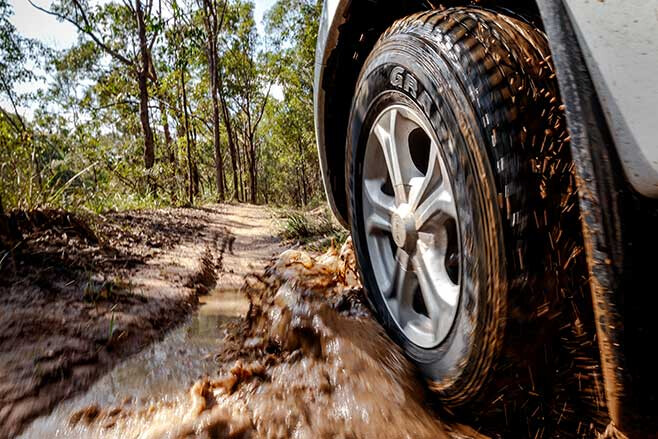
With 4x4s continuing to become bigger and heavier from the showroom floor, and most of us loading a 4×4 with a smorgasbord of aftermarket equipment – bar work, fridges, tents, etc. – it’s also more appropriate than ever to opt for an L/T tyre to cope with the extra heft.
“Buying a tyre that is of Light Truck construction ensures you have the best possible protection off-road. They will handle heavier weights especially for towing, and you can also run lower pressures in off-road conditions,” said Jeff Newick, National Technical Manager at Exclusive Tyres.
Still, there is a place for the Passenger tyre, recommended for those who travel light and aren’t prone to serious bush-bashing or remote-area travel. Despite the lower load ratings and limited puncture protection, the tyres are lighter, more flexible and provide better ride quality and fuel economy. They also bag-out better, perfect for that sand excursion.
WHAT TO LOOK FOR
IF it’s your first foray into the world of off-road tyres, the number of options and variations can seem overwhelming. However, there’s a simple trick to make the process a bit easier. When comparing tyres, remember the TCC: Tread Design, Carcass Construction and Compound, as it’s across these three areas where tyres will differ.
“The biggest compromise between tyre brands and patterns is tread design, carcass construction and compounding. You need to research and ensure all these match what you want to do and where you want to go,” said Jeff Newick.
For improved traction and further protection, important features of modern tread designs to look for when browsing for new tyres include flex grooves, mud scoops, release dimples and raised rubber ribs. There are also clever innovations, such as Micro Gauge Sipes, which are simply tiny cuts in tyres designed to suck water up and release on highways to prevent aquaplaning. Brands that don’t use Micro Gauge Sipes tend to cut and chip more as they provide a leading edge to ‘rip’ on rocks and stone.
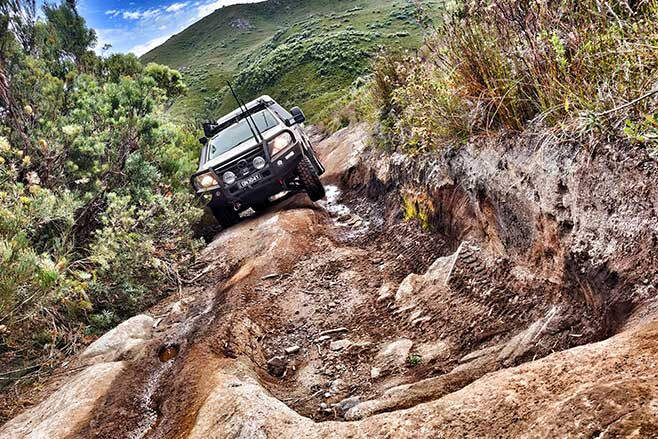
In regards to tyre carcass, consider the tyre’s tensile strength and whether it’s equipped with ‘angle ply’ technology. Also look at the construction of a tyre’s sidewall – whether it has sidewall biters and extra protection against obstacles (especially when aired down).
When asked what tyres to recommend for different driving conditions, Remy Abonneau said there are plenty of things to keep in mind.
“Driving purely on highway, I advise to keep your highway tyre to ensure a high level of comfort and best handling/braking performances in all conditions,” he said.
“If most of your drive is on the highway but from time-to-time you hit soft dirt road or gravel road, the best choice is to go for 70 per cent on-road / 30 per cent off-road.
“Then if you start to hit the toughest off-road tracks weekend after weekend, you will be better off going for an all-terrain, which will have a good durability and the toughest design.
“If your adventure takes you through mud, dirt or rock, go for some mud-terrains … tougher sidewall, heavier construction and aggressive block pattern design.”
And what about those owners who prefer the look of an aggressive tyre? “It’s always crucial to understand the compromise and what type of driving you will do,” Remy added.
SPEND SMART
“THE last thing you want when you are touring or off-roading (maybe a few hours from phone service) is for something to go wrong,” warns Dean McCormack. “While it seems like a bargain at the time, in the long run, it might end up costing you dearly.”
So when it comes to something as important as tyres, always buy a trusted brand from a reputable tyre dealer as an off-road tyre – something that could make or break your next 4×4 trip – is definitely not something you want to skimp on.
“The tyre market is full of many brands these days,” added Jeff Moorhead. “Not all tyres are created equal, there are significant differences in tyre performance. Research and development is what costs money, that’s where the bottom end of the market makes its saving.”
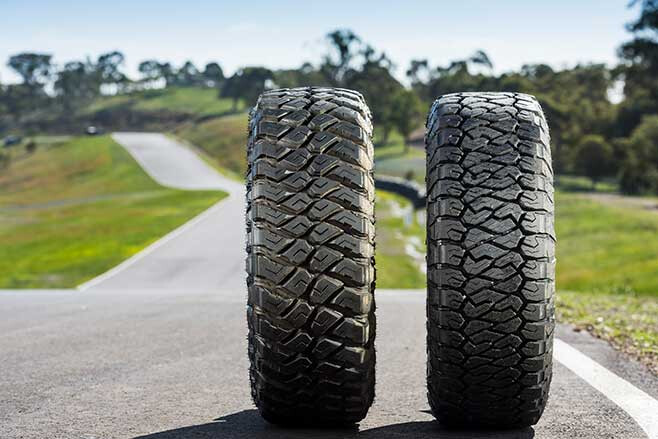
Not only will a reputable dealer be able to recommend a tyre that’ll suit your lifestyle, they’ll be there when it comes to after-sales support and service.
Saving a penny by opting for a low-cost online option also comes with a basket-full of headaches you’ll probably encounter down the track: lack of warranty; no guarantee of tyre age (tyres can sometimes sit in a warehouse for up to five years); tyres not built to cope with Australian conditions; and, of course, after-sales support.
“Tyre manufacturers like Goodyear spend tens-of-thousands of hours testing and assessing the different components of its tyres,” said Dean McCormack. “We have a dedicated engineering team located here in Australia who constantly perform testing to ensure the suitability of our tyres.” A good question to ask yourself before you click to purchase is ‘why is it so cheap?’
“There is always a reason,” said Jeff Newick. “The product could be old stock, discontinued lines and also parallel imports which do not carry warranty from genuine distributors. Most times when problems arise it is very difficult to get a claim.”
WHEN TO CHANGE TYRES
KNOWING when to hoist up your rig and change the tyres is just as important as getting the correct ones for your intended purpose.
A good sign that you’re due for a new 4×4 tyre is when the old one has worn down to the treadwear indicators (around 2mm remaining is a good time to start thinking about replacement), or they start to chip, crack or sustain any irreparable damage. Also keep an eye on the tyre’s block edges. Tyres should also be inspected regularly by your local tyre store after they get to five years of age.
“Modern day 4WD tyres will easily achieve 50,000 to 80,000km, but always be prepared to change them out prior to any big trip,” Jeff Newick said. “For example, I would not suggest heading off across the Simpson with tyres that are 50 per cent or more worn.”
WHEEL ALIGNMENT
A WHEEL alignment is recommended every six to 12 months, or every 10,000km. However, if your vehicle starts pulling to either side, get it looked at straight away. Another way to know if a wheel alignment is imminent is to see if the tread blocks have any raised edges developing – a good start is to simply run your hand across the tread face and feel for irregularities.
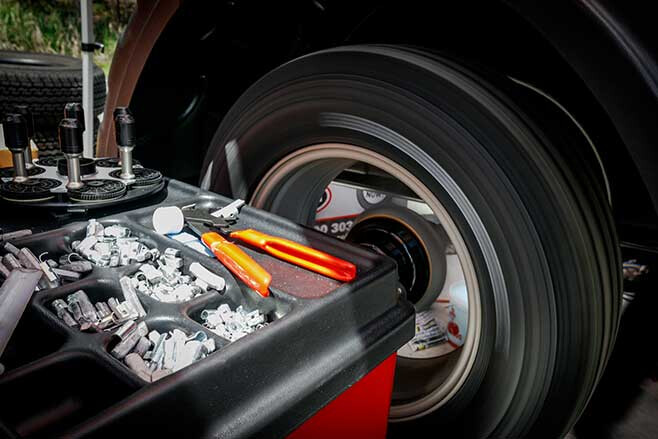
“I would recommend to get your alignment checked every six months, it only takes a pothole or a heavy hit off-road to knock it out of whack. You should also get into the habit of physically looking at your tyres each time the vehicle is washed. It is very easy to pick up any dramas quickly before too much damage is done,” said Jeff Newick.
AIR DOWN
THE optimal pressure for a tyre can broadly be categorised, but it really comes down to experience with your vehicle and its tyres. What may seem too high for someone, may be just right for someone else.
A loose rule, however, is to go between 18 to 24psi for firm sand, and down to 14/15 to 20psi for very soft sand, mud or rocky roads. You can drop the pressure further to increase a tyre’s footprint, but always keep speed to below 40km/h when aired down that low.
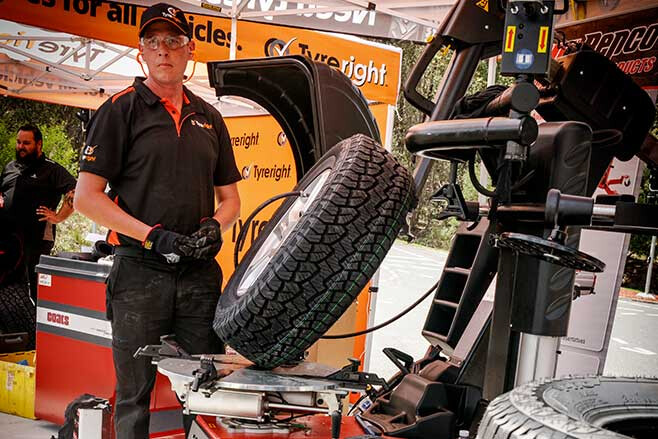
“When you are off-roading, you are constantly looking for traction. Keeping your tyres at an optimal pressure will allow you to balloon your tyres to gain the best traction,” says Dean McCormack.
“Always remember to reinflate before the cruising speed comes up,” Jeff Moorhead added. “If you don’t reinflate and run on the highway at high speed with low pressures you can and will destroy all four tyres, which is both dangerous, as they could blow out and cause an accident, and/or costly. From experience, you don’t have to go far to destroy tyres! Please remember to re-inflate.
“It’s important not to over inflate tyres – the tyre needs to be allowed to ‘deflect’ as it rolls over objects on the road. Over inflation makes the tyre much more rigid,” he said.
TYRES EXPLAINED
TYRES comes in all widths, sizes, and limits to fulfil any specific range of functions a user needs. The details of which are written out in numerical designations on your tyre sidewalls, which can be confusing. Here are what those numbers mean.
265/65R17 100T 265 = section width (in millimetres) 65 = sidewall aspect ratio (as a percentage of width) R = tyre construction (in this case, radial) 17 = rim diameter (in inches) 100 = load rating (in this case, 800kg) T = speed rating (see below, in this case, 190km/h)
SPEED AND LOAD RATINGS
Tyres are assigned a specific speed rating advising the maximum permitted speed of said tyre. For example, a 265/65R17 100T tyre has a speed rating of 190km/h. For safety reasons, it’s recommended to never exceed the max speed rating. And always double-check ratings when purchasing tyres, especially online, as they could invalidate your insurance.
| Speed Rating | u00a0Max Speed |
| N | 140km/h |
| P | 150km/h |
| Q | 160km/h |
| R | 170km/h |
| S | 180km/h |
| T | 190km/h |
| U | 200km/h |
| H | 210km/h |
| V | 240km/h |
Tyres are also assigned load ratings, which designates how much weight a tyre is designed to carry when operating at its maximum speed rating and inflated to maximum pressure, as the tyre’s load carrying capacity will decrease with reductions in pressure. For example, a 265/65R17 100T has a load rating of 100, which translates to a maximum permissible load of 800kg. Remember, it’s illegal to install tyres with a lower load index than the vehicle manufacturer’s original tyre.
| Index Number | u00a0Max permissable load |
| 60 | 250kg |
| 70 | 335kg |
| 80 | 450kg |
| 90 | 600kg |
| 100 | 800kg |
| 110 | 1060kg |
| 120 | 1400kg |
| 130 | 1900kg |
“All tyres come with a load-rating index and a speed-rating index,” said 4X4 Australia’s Fraser Stronach. “What’s important here is that the load rating has to be matched or bettered when replacing an Original Equipment Manufacturer (OEM) tyre while the speed rating can be lower than the OEM tyre. Laws regarding fitting replacement tyres with a lower speed rating vary state by state.
“Although it may seem counter intuitive, tyres with higher speed ratings have thinner sidewalls, which help limit heat build-up when high speeds are maintained over long periods of time. Unfortunately, thin sidewalls are also more prone to being torn open by anything sharp. As a general rule, anything from a H-rated tyre up won’t survive long off-road. Speed ratings down to ‘N’ are generally permissible when replacing the OEM tyres.”
ADVICE FROM A TYRE DEALER
OUR local tyre store is Competition Tyres & More at Murrumbeena, Victoria, and the team there has fitted rubber to a few of our projects in the past. The store also fits 4×4 accessories, so they get a lot of 4×4 traffic though there and specialise in 4×4 tyres.
We asked store manager Borey Ouk what he asks customers, to help them chose the right 4×4 rubber. “When a customer comes in and says he wants 4×4 tyres for his vehicle, I start with the make and model, and whether the vehicle has been raised,” Borey told us. “This will determine the biggest size we can legally put on, and then I ask what type of driving they will do and what percentage off- and on-road, as noise plays a big factor for many customers.
“Customers generally will have a brand preference and ask for any feedback we’ve had, or of customers I know who ran that particular tyre.
“Some customers want the biggest, most aggressive-looking tyres regardless of their intended use. However with vehicle restraints and what can fit, I try and point the customer in the right direction as we like to keep it legal for the safety of the owner and others as well as insurance purposes.
“(Most customers prioritise) construction, speed and load, as well as ply rating if using for mainly off-road. (Also) price, and we try and find a budget to suit all customers’ needs.”
GIVEN how much most of us spend on modifications and accessories to ensure our 4×4 rig is set up just right for our needs, getting the right insurance cover isn’t as simple as a regular car.
The challenge lies in how individual and customised each setup becomes, so that the outcome you want is an appropriate level of insurance cover against the unexpected, whether that be a minor bingle or having your pride and joy stolen or written off.
GETTING THE SUM INSURED RIGHT
THERE are two key things that should factor into your sum insured as a 4WDer: the value of the vehicle itself, and the value of the modifications and accessories. Ideally, the sum insured you choose should reflect the sum of both of these individual items if you want to be confident that you’ve got your sum insured right.
As far as the vehicle goes, there are a range of ways you can get a feel for the value, ranging from Glass’s Guide to Red Book, or even browsing websites like WhichCar.
Modifications and accessories can be a bit more difficult to value. One method is to consider the full replacement value of the items when new. At the other end of the spectrum, you could apply depreciation to get to what the item might be worth now (e.g. a set of driving lights cost you $800 three years ago, but are now $560 given they are three years old). Each method has its own implications outlined below.
Calculating the full replacement value is as easy as working out what you paid for each item. The benefit of this method is that if your vehicle is written off or stolen you could end up with a payout that is much closer to the cost of replacing everything. The downside is that you’ll pay a bit more for your insurance each year, but that is the trade-off for peace of mind.
APPLYING DEPRECIATION TO MODS AND ACCESSORIES
IF you choose this method, you’d be applying a depreciation of some kind (maybe split equally over 10 years?) to reflect the value today.
The upside of this is that your premium is likely to be lower because your total sum insured is lower. In the event of a claimable incident where the insurer chooses to repair the vehicle, generally the part will be replaced with a new one (although how this is handled depends on your insurer and their claims philosophy).
On the flipside, if the vehicle is deemed a write-off or stolen, with a lower sum insured, you may not be able to fully replicate your vehicle and all its accessories.
WHAT METHOD TO USE?
THIS is a personal decision – for some people with older vehicles in particular, they are prepared to wear more of the risk in return for a lower premium.
Others, sometimes with newer vehicles, are after the certainty that they can fully replace their vehicle like for like. The key is that you understand this dynamic and make the choice that works for you.
HOW DOES THIS APPLY TO MY INSURER?
THIS is a tricky question because, believe it or not, not all insurance products are the same. The key is to get to a place where you feel your total sum insured is fair and reflective of your vehicle. I’d recommend you do the following:
1.Work out the Sum Insured you think is fair for your vehicle considering the mods and accessories you have. Remember to consider whether you prefer a replacement or depreciated amount for the mods/accessories.
2. Speak to your insurer about that value. Find out whether: a. They’ll cover you to that amount, or what value they are willing to give you and why (some will; some won’t want to cover mods/accessories; and some will have limits). b. How they’ll treat replacing your mods/accessories in: i. A repairable accident (are you likely to get new, or do they specify secondhand parts?) ii. A total loss scenario.
To clarify, at Club 4X4 we are open to covering your mods/accessories for replacement value, or at a depreciated value depending on your preference. As always, if you are unsure about anything, make sure you ask! Better to know now rather than get a surprise at claim time …
THE Ford Bronco might be one of the classic American 4×4 vehicles, but there was a time in its 55-year history when they were made and sold in Australia.
Well, they were assembled here, at least, in Ford’s local factory between the years 1981 to ’87. But with a selling price of around $15,000 the Bronco was priced like a Range Rover in Australia, so it was never a huge success while the four-wheel drives from Datsun and Toyota were prominent.
Graham Cottam remembers the Aussie Broncos well and sought out a tidy example when he was looking for a 4WD in recent times.
“I always liked this model back in the ’80s,” recalls Graham. “The Bronco has a good reputation as a vehicle that can go anywhere.”
Graham found this 1983 Bronco XLT with a surprisingly low 60,000km on the clock and in very good condition.
“It had been resprayed and had a very clean chassis,” he says. “Someone had spent a lot of money on it before I bought it.”
CLEVELAND V8
DESPITE its good looks, the Bronco still needed some freshening up to get it to what you see here. The Australian Broncos were fitted with Australian-made engines, either the in-line six-cylinder or the 351 Cleveland V8. This one has the V8 and it was rebuilt by Lakeside Automotive in Melbourne.
Bored .30-through and fitted with new pistons, a Crow camshaft package, fresh 2V heads and a Holley four-barrel carb, the ‘Clevo’ now makes around 350 horsepower to motivate the vintage Ford like never before. The transmission is a GM TH700 four-speed that was fitted by a previous owner, and the part-time 4×4 system remains the original Ford/Borg Warner setup. Front and rear locking diffs were fitted by a previous owner.
While the Bronco might have been popular in the USA where it maintains a strong aftermarket support base, its appeal and lifespan here in Australia were limited, so getting the right parts for one locally is a bit more of a challenge.
“I considered importing gear from the USA,” says Graham, “but shipping costs proved prohibitive and then COVID came along and threw shipping into chaos. Fortunately I found Tom and Jay at All 4 Fabrications and I couldn’t be happier with their work.”
Tom and Jay took the typical Aussie approach of, if you can’t readily access something for a build just make it yourself, and they set about fabbing up custom bar work and accessories for the Bronco. “Pretty much everything on it is custom made,” Tom told us of the build.
Starting at the front, the original bumper was modified to accept a winch cradle, and light and aerial mounts. These are now home to a Warn winch, Bushranger Nighthawk LED lights and a GME antenna.
All 4 Fab custom rock sliders run down the flanks of the Ford to protect the sills from off-road damage, while the rear bumper was strengthened and modified to accept a spare wheel carrier and swing-out jerry-can holder.
All the custom bar work has been powdercoated for protection against the elements with Abraze Away blasting, cleaning up the products before Jager Coatings applied the powder.
The four-inch snorkel exiting through the front ’guard is also the work of All 4 Fab, and the boys also whipped up the custom airbox with a pod-style filter and adaptors to the Holley carb.
The custom work didn’t end there, though, with the boys fabricating the roof rack and a storage system for the rear of the cabin. The rack carries the James Baroud rooftop tent and it is, in turn, supported by a custom roll cage in the rear of the vehicle that mates up under the roof.
Also in the rear is a roller-drawer setup that houses the second battery controlled by a REDARC unit among other travel essentials, with an MSA drop slide and 65-litre Waeco fridge on top. A custom switch panel provides control of the LED internal and external work lights.
OFF-ROAD EQUIPMENT
BRONCOS might have been considered good off-road vehicles by American standards, but they never really clicked for the local version of outback touring we do here. Graham has improved his rig’s ability to take on rough tracks by fitting 35-inch Trail Grapplers on 18-inch wheels.
The third-gen Broncos of the ’80s had a unique front suspension that Ford called a Twin Traction Beam (TTB) design. While previous generations simply had a coil-sprung live axle, the TTB was independent but tried to keep the axle travel of a live setup by splitting the axle in two long sections that pivot at the outside ends; the axle supporting the right-hand side wheel pivoting on the left-hand side of the chassis and the left wheel axle on the right.
The axle leading to the right-side wheel also housed the Dana 44 differential, while a uni-joint in the left side axle allowed it to travel independent of the right. That’s the gist of the TTB idea, but it worked well and is still used by many vehicles in off-road racing today.
This relatively unique design didn’t pose too many problems when it came to upgrading the suspension on Graham’s Bronco. The two-inch-taller coils at the front are controlled by EFS Elite Series shocks, while another pair of EFS shocks are at the back working with reset leaf springs. Carrolls Springs also added an extra leaf when resetting them to help carry heavier loads over rough country.
While the updated suspension certainly improved the ride quality of the Bronco, it is still a relatively short wheelbase vehicle so the Broncos are known to buck a bit. Graham rides comfortable, though, in a pair of leather seats adapted from the local FPV Pursuit Falcon. An Alpine sound system and GME UHF radio add a bit of modernity to the retro rig.
While the Bronco might not be everyone’s cup of mud, we expect interest in these older models to increase as they become classics and the forthcoming 2021 model revives the nameplate. Graham has created a great example of the breed for himself and it’s one that should be capable of taking him wherever he wants.
“Driving the Bronco around relaxes me,” he told us. “Maybe I’ll tow a caravan around Australia with it when I retire.”
FOLLOWING the revelation of the updated 2020 Toyota Hilux, Aussie company ARB has released a range of aftermarket products to improve the Hilux’s off-road potential.
Key to the range of new products is the company’s matte black powdercoated Summit bull bar, which has been upgraded to match the Hilux’s new front end.
ARB says the Summit bull bar, “is engineered and designed not only to complement the vehicle’s overall appearance but also to work with the vehicle’s safety features such as Toyota Safety Sense, airbag deployment and parking sensors.”
The Summit comes fitted with two welded aerial brackets and provisions to fit a wide range of winches; plus the fitment of ARB, Bushranger and IPF driving lights.
In addition, the ARB Commercial bull bar has been redesigned to cater for the changes to the new Hilux’s sensor placement; while ARB boffins are currently working on redeveloping the Summit and Summit Raw rear step tow bar to suit the new model.
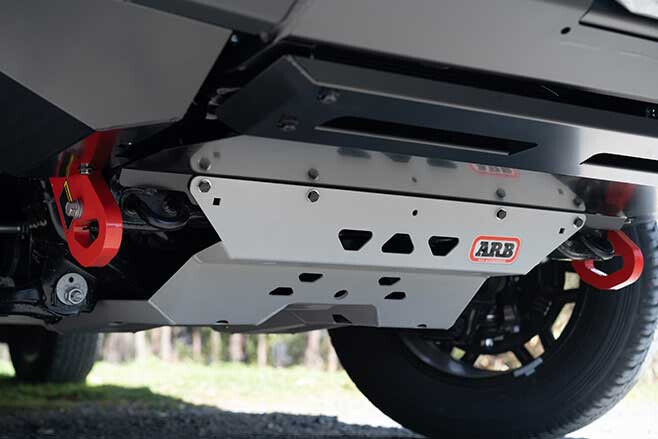
ARB has also released an Old Man Emu GVM upgrade kit for the 2020 Hilux, which runs Nitrocharger or BP-51 internal bypass shocks and springs. This lifts the GVM from 3150kg to 3180kg (stage one) or 3465 (stage two). The stage two kit also gets a front axle upgrade.
In a statement, ARB listed the range of products currently available for the new Hilux, which includes Summit side steps and side rails; all ARB canopies; Sportlid; Tailgate Assist; Ute Liner; Sportguard; Air Lockers; Recovery Points; UVP; Outback Solutions drawers; Frontier tank; Hayman Reese tow bars; Safari snorkels; and Old Man Emu suspension.
Website: www.arb.com.au