
GLEN Innes, located on the granite belt in northern NSW, is known for its wineries, Celtic culture and cool, crisp air. But did you know there is a great drive where you can explore several historical mines, spectacular scenery and check out some bushranger hide-outs, all with a great campsite tucked away?
With very cool winters up on the tablelands and stifling summers, I decided to explore the region north-west of Glen Innes in early spring, hoping for a little colour and to miss the extreme temps that frequent this area. Glen Innes is a funky little town with boutique gift shop and some great bakeries, but it has most of the services that you would find in larger towns. There are several tourist drives that run around the town, but a great drive is tourist drive number 11, but with a twist.
After restocking supplies and fuel at Glen Innes, the road north-west towards Emmaville is a nice introduction to the area’s wonderful grazing land. It is a typical English-looking area, with tree-lined wind breaks lining the fences and sheep-filled paddocks with the odd boutique winery hidden here and there. The road to Emmaville is tar for its 40km length, but as it leaves the flat, fertile grazing land it will twist and weave its way over several ranges where you need to be on the lookout for feral goats and the odd ’roo.
Closer to Emmaville you will come across the Y waterholes that grace both sides of the road. These waterholes are from the (now-closed) nearby Lead mine. Over time the water has become safe for birdlife to inhabit its waters and shore – from swans, ibis and a host of other birdlife, it was a nice change from the dry forests nearby.
Further down the road you come into the once booming town of Emmaville. Several places are worth checking out here: the mining museum (only open mid-week), the Emmaville lookout, and several old graveyards where some headstones date back to the late-1800s. A general store has limited fuel, if you really need to top-up.
Following the tourist drive out of town for just 5km, a turn-off will appear to your left towards Torrington. This is where we leave the tourist drive and the adventure begins. The landscape out here is harsh and is scattered dry timber, while granite boulders dot the landscape without much undergrowth. It’s pretty hard to miss, but after 6km the road narrows and passes through a gate and across a grid. It’s not signposted, but this is where you need to turn left to explore the old Ottery mine. The formed track will lead you to an open area where there is plenty of parking for several 4WDs. Adhering to the warning signs at the beginning of the track (no collecting rocks or going past the fences) it is an easy stroll into the old Arsenic mine and historic Ottery Tin mine site.
This historic tin mine was one of the first underground base metal deposits in the area and worked continuously from 1882 until 1905. During this period, it produced an estimated 2500 tonnes of tin concentrate and 2000 tonnes of white arsenic.
Several attempts to reopen the mine failed, and mining operations ceased in 1957. You can wander around freely, viewing old relics, such as mine buckets, an 80-metre-deep main shaft, the large flue, cooling chambers and furnaces. The white arsenic still leeching from the workings is one interesting sight. When the mine closed, it was left in an extremely damaged and dangerous state with open mine shafts and waste dumps – obviously posing a few health and safety risks.
The Department of Conservation and Land Management and Department of Mineral Resources carried out rehabilitation work in 1993. Thanks to these efforts, the site is now safe to visit, albeit from behind fences. This is a fun place to spend an hour or so, following the path around the mine, reading information boards and imagining what the toil was like here more than 100 years ago. We have to leave. Back through the gate, the tar winds for about 5km, then onto dirt that leads to an easy 30km drive towards Torrington.
You can’t help but notice the huge granite formations and cliffs that line the road. There are several bitumen sections over the steep ranges too – probably to prevent erosion occurring following the huge storms that rake this area from time to time. And to ease vehicle access it’s best to keep your travelling speed to a minimum. The roads here are granite-based, which means they can be very slippery due to the small ball-bearing type coverage on the surface. Turning your lights on for added safety is a good idea.
On the outskirts of Torrington, watch for the signposted Dutchmans Road on the left – this leads to Dutchmans camping and barbecue area. While ideal for setting up a tent or two, Dutchmans is really designed for a stopover rather than an extended stay. There are several pit toilets here as well as a great shelter if the weather turns nasty. It’s a pleasant area to kick back for a barbecue although a greater reason is to follow a short walking track to what was once a hide-out of the infamous 19th century bushranger, Frederick Ward (aka Captain Thunderbolt).
Thunderbolt was known to have roamed the area from Uralla in the south to Tenterfield in the north. A medium level of fitness is necessary for the 1km walk along the well-maintained track from the picnic area into the boulder area. This path leads to steps that wind their way around rocks and disappear into chasms between boulders that are as large as houses.
As you sneak between the rocks, it’s easy to see why bushrangers chose this area – it would have been a great spot to hide and use a higher peak from which to spy any approaching authorities. The walk passes through several dark sections between the rocks and eventually ends at a steel ladder. This 10-metre ladder is almost vertical and allows you to stand safely on a platform that provides 360-degree views. While the steep ladder might pose a worry for some, the views from the top are definitely well-worth the small fear factor that may come with the climb to get there.
Head back into the near-deserted town of Torrington, and you’ll find there’s only a handful of houses still occupied. In the 1920s, Torrington and the surrounding areas attracted a lot of mining activity; about 600 miners lived there at its peak. In that period, Torrington was a more lively place and provided facilities such as five general stores, two churches, a butcher, baker, courthouse, police station, post office and a hotel. These days, there are no such services. Surprisingly, however, there is limited mobile phone reception.
After leaving Torrington via Silent Grove Road, it’s a 15-minute drive to a great campground. As you enter Torrington State Conservation Area, a sign points towards Blatherarm campgrounds, 2km away. This spot has great facilities; each camp area has its own pit toilet and tables while a water tank is also available, offering unfiltered water for washing up or maybe even a quick scrub.
There are three camping areas here, aptly named ‘one’, ‘two’ and ‘three’. The first two have easy access but number three is across a creek, meaning you’ll need a 4×4, especially if towing a camper-trailer. The creek doesn’t contain a strong flow but, with a bit of traffic, it can be a bit rough.
No bins are provided so you’ll need to take all rubbish with you to keep the vermin away and the camp areas clean. An information board details interesting local history and wildlife and provides an insight into the area’s fossicking. If you’re lucky, you may stumble across gems, minerals or crystals in the dedicated fossicking site. Make sure you pay camping fees via the honesty system.
Leaving camp is as simple as heading back to the turn-off for a right-hand turn onto Silent Creek Road, where there’s 10km of granite cliffs and some interesting grunge sculptures along the roadside – it’s an eerie feeling as they watch you trundle towards your next destination.
Soon the landscape starts to open up, giving way to sheep and cattle stations where several mountain peaks and ranges in front of you rise to 1100m. The roads are narrow and sometimes faint as they twist towards Mole River. With the steep terrain, Mole River can at times suffer serious flooding – check out the amount of debris high in the trees and the curved tree trunks from recent deluges.
A further 3km along, two options appear: continue straight on to the Bruxner Highway, or turn right onto Upper Mole River Road. I choose the latter. This road passes more farms as you wind your way around granite tors and over easy creek causeways. And, the awesome backdrop of views towards the ranges means you won’t tire of the scenery.
Continuing through Gunya Station, there are more amazing granite outcrops, and it’s still hard to believe we’re 1000m above sea level. In winter, it can receive a covering of snow, so be prepared. In spring, though, it seems everything blooms out here with the odd prickly pear cactus and grass trees scattered among the rocks.
One last surprise awaits before we return to bitumen – a turn up to 1300m Mt Mackenzie affords stunning views over the Tenterfield area. It’s a great way to end a drive on the Granite Belt.
HERE’S another one of those clever Aussie inventions that leaves us thinking why anyone didn’t think of this before?
Pressure Perfect takes the simple set-and-apply tyre inflation system that you use at service stations and puts it into a compact unit that can be fitted to any portable 12-volt air compressor (or into your 4×4 vehicle).
A 12-volt air compressor and a quality tyre pressure gauge are two pieces of kit any 4x4er should purchase. The varied terrain we cover in 4x4s requires different tyre pressures for optimal driving conditions and protection of the tyres themselves, so it pays to keep tabs on what’s going on inside your tyres.
Designed and made in Melbourne, the Pressure Perfect module can be mounted direct to your compressor, in your engine bay, or elsewhere on your 4×4. The module has an LCD readout screen and simple up and down buttons that can be used to set the desired tyre pressure. When the set pressure is reached, an audible beep – loud enough to be heard from the other side of the vehicle – sounds. This is just like the systems you find in most service stations, and it gives accurate and easy-to-use tyre pressure adjustment.
By linking the tyres on the vehicle together you can adjust the pressure on two or more of them at the same time; however, the speed at which they pump up is dependent on your compressor and its capacity. A higher flowing compressor is going to give you faster results.
We trialled a couple of Pressure Perfect mobile units hooked up to an ARB and a TJM compressor. Firstly we simulated dropping road pressures down to 15psi, as you might for sand driving – set the display to 15psi, hook the hose up to the tyre and hit the start/stop button. The module takes an initial reading to see what’s in the tyre and then drops the pressure in stages until the set pressure is reached.
Deflating one tyre at a time by this method was tedious and certainly a lot slower than we would normally spend using a Currie-style EZ deflator that pulls the guts out of the Schrader valve. It made more sense with two tyres hooked up at the same time, but it was still slow – it would be worthwhile doing all four tyres at once.
Next we set the Pressure Perfect module to a road setting and pumped a tyre up. Again, the unit takes a pressure reading and then inflates the tyre to the set pressure before letting you know it’s there with a beep. It takes a little longer than the compressor would without using the Pressure Perfect module, but that time is made up because you’re not stopping to check the pressure as it inflates. And you don’t have to squat down by the tyre while it’s operating, so it’s easy on old knees.
Hooking two tyres up at once took a while to pump up, but as stated the limiting factor is the output of the compressor. A big pump like the ARB twin set-up or one using a storage tank would be quicker.
One of these units would be ideal when mounted in a vehicle with a high output compressor and an air tank, and you could then plumb multiple outlets to two or even four tyres to get the most of the hardware.
You’ll want to make the most of it, as the Pressure Perfect is not a cheap piece of kit. Just the module alone sells for $375 (or $425 when mounted in a hard plastic case with all the hardware, except the compressor itself). Complete, ready-to-use portable kits are available for $550 (with a 75L/min compressor) or $730 (with a 150L/min pump). There is a range of accessories available for setting up your own in-vehicle kit.
Rated: Pressure Perfect tyre pressure module Price: From $375 We Say: Simple and easy to use.
THIS is not the toughest test of a vehicle you’re going to read in 4X4 Australia. This story is not about taking the Nissan Y61 Patrol to the limit of its capabilities – in more than 2000km of driving, low range was engaged for all of two minutes on two occasions. No, this is about enjoying an old mate and doing something it’s always been good at: taking us away from our urban lives on to roads less-travelled and places seen less often.
It’s as good a way as photographer – and inveterate explorer – Thomas Wielecki and I can think of to celebrate and farewell the Y61 Patrol, an off-road icon killed off by ever-more stringent emissions restrictions its ZD30 3.0-litre four-cylinder turbo-diesel engine no longer complies with.
Sure, the Y62 Patrol is still with us, but that’s a luxury petrol V8 boat and not the turbo-diesel workhorse the Y61 – or GU – has been. Like the Y60 (GQ) was before that and so on right back to the 60 Series that became famous for being the first vehicle to conquer the Simpson Desert.
Our plan for this drive is straightforward: pick up our Patrol ST four-speed automatic from Nissan’s Western Australian office in Perth then head east until we intersect the legendary Rabbit Proof Fence. Then turn north to follow it at far as we can and for as long as we can before the demands of modern, urban life call us back to the big smoke.
You’ve almost certainly heard of the Rabbit Proof Fence, and most likely because of the 2002 film of the same name that traced the journey of three young Aboriginal girls who fled confinement near Perth and followed the fence to their home in the outback. In fact, those three girls followed all three fences during their epic trek. They first hit upon number three, the shortest of the fences that runs east-west from Yalgoo to the coast at Kalbarri. Then they walked for a short distance along number two which runs from the south coast at beautiful Bremer Bay to its junction with number one west of Wiluna. Then they followed number one, the original and longest of them all at 1834km. It runs from Esperance in the south to Eighty Mile Beach on the north coast.
As the name suggests, the fences were built to hold back the tsunami of wild rabbits surging across the Nullarbor from the east. Construction of the first fence started in 1901 and by the time the project was finished in 1905 the rabbits had already got past it. So, Rabbit Proof Fence number two was built and then number three as the WA government fought a losing battle against Australia’s most populous and damaging introduced vermin.
The effort, the privations, the hard-manual labour of the men who built the fences cannot be underestimated. Much was carved through virgin bush, and a trench had to be dug to bury the fence’s distinctive hexagonal wire to prevent the pests from burrowing underneath. Jam tree and Mulga were used for posts because white ants don’t eat them, and reinforced iron gates were installed at appropriate farms and public roads.
Our starting point is Cunderdin, the wheatbelt town on the Great Eastern Highway that was headquarters for the construction of fence number two. These days, passers-by on the way to Kalgoorlie or Perth probably best know it for the unexpected sight of an Ettamogah Pub in the main street.
It’s also the home of a determined group of locals at the Cunderdin Historical Society who have been campaigning for more than a decade to have the fence officially commemorated. They have a plan, they have enthusiasm, they have belief, they have official support, but they have gained no financial backing from the state government.
An ambitious strategy to mark the various fences with a series of sculptures by Irish-born WA artist Charlie Smith across many shires and towns has proven too much for this small, elderly group. But their leader, Allan Rogers, is a determined man who has farmed along the fence his entire life. Now in his 80s, even though he struggles to walk unaided, his desire to celebrate the people and places of the Rabbit Proof Fence remains undimmed.
“Why did we take it up?” he asks rhetorically. “It was a huge program; it took a lot of men and lot of very ordinary hard work in isolated places.
“They had to cut the wooden posts out of the bushland that hadn’t been taken up for agriculture at the time. They had to erect the fence, put the netting on and a single furrow plow went along the entire fence to dig a trench so the netting was buried at last six inches down so the rabbits wouldn’t dig under it. That’s why we thought something should be done to commemorate it.”
We drive with Allan south of Cunderdin close to his family properties where he shows us an example of the original fence. The original jam tree posts and hexagonal wire are still in place, but steel stakes have been added to support the now rotting wood.
As a fence itself it is unremarkable. But it is remarkable to realise it is more than 100 years old, and when it was constructed none of the surrounding farmland existed.
Allan also shows us an original 112-year-old gate, with its distinct angled support at the top. It’s impressively engineered and as solid as the day it was built.
“They were all built like that,” he explains. “The support stopped them sagging. They had to be close to the ground to stop the rabbits digging underneath. They put them at convenient distances so farmers could get to the back of their farms.”
We tell Allan of our plan to head north and see what we find, and he is vague. “There is a 10-mile gate and an 18-mile gate. But I don’t know what happens beyond that.”
Time for us to find out. The map tells us there is a Rabbit Proof Fence Rd North that intersects with the highway, but we cannot find it. Instead, we literally drive past a sign that marks the spot where the fence once crossed the highway.
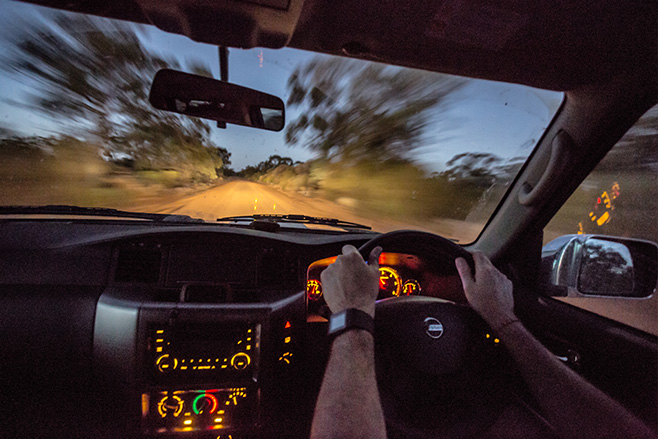
So, it’s back in the Patrol and west until we find a road north. It takes only five kilometres for us to intersect with the Three Mile Gate Road and we know what that means. Sure enough, a few kilometres east and we reach a five-way intersection. One finger board reads ‘Rabbit Proof Fence North’. We are on our way.
Our Patrol is absolutely bog stick. Nissan has slung us an extra spare tyre but that’s about all there is in the way of extras. It’s been a few years since I’ve driven one and initially the reunification has its issues. It’s the slowest vehicle I have driven in ages, it drops gears on alarmingly shallow inclines and the engine sounds like it’s tearing apart under acceleration. It steers approximately, has a massive turning circle and heavy low-speed steering. But as time goes by under a cloudless sky the Patrol makes more and more sense as we cruise north, an orange plume coating its rear-end and expanding into a huge dust cloud behind us.
Sitting on a steady 2400rpm at 120km/h, the long wheelbase Patrol eddies and rolls and soaks up the corrugationson this long straight-to-the-horizon dirt road, happily cruising in fuel-saving rear-wheel drive. It’s big, comfy and provides a chilled comfort zone away from the 35°C temps outside.
We are following the tracks of the patrolmen who maintained the fences for the first 50 years after they were built. These must have been tough men, tending to their allotted section of the fence alone for months at a time. Riding horses, camels or bicycles, their job was to patch any holes, repair any damage caused by such things as fallen trees or fire and make sure the locals were doing their part by closing the gates after themselves.
“There were very strict controls,” explains John Lynne, a third generation farmer who owns farms on either sides of the Rabbit Proof Fence north of Cunderdin. “You couldn’t go through the gate and leave it open or you would get fined. It was illegal to bring a rabbit to this [west] side dead or alive. The patrolman had a lot of powers.”
John is a friendly, chatty bloke, who is happy to take us to a well where a patrolman used to camp in the old days. It’s hidden away in a bush reserve. Someone has long since thrown fence wire down the hole.
John stands atop the water pipe that runs alongside the fence here: “See those trees down there? That’s where Mum’s parents came and settled and took up virgin territory in 1911.
“They had ground both sides of the fence and it was patrolled once per week by the patrolman. We are 20 miles out of town and they had to have water every 20 miles so they could make camp there. My grandparents used to nick water from the well. But not when he was there.”
Standing with John at dusk on the water pipe it’s easy to appreciate the beauty of this place. A cooling breeze has brought the temperature down, and the sunset is being exaggerated by the smoke from burning-off to the west. The flies have gone. The wheatfields of John’s farms surround us.
The morning brings a blazing sun, an endless blue sky and a return to the road north. For hour-upon-hour we seem stuck in a loop as the red road runs arrow-straight from one far distant crest to another. Within the vast valleys wheatfields stretch from horizon to horizon and dust clouds mark where GPS-guided headers are harvesting.
Crossroads invariably bear the family names of early settlers in the area: Mason, Keogh, Solomon, Lynne. Every now and then an original gate reassures us we are on the right track, but at times we have to divert away from the fence. When the WA government decided in the 1950s the fence was no longer worth maintaining it offered the farmers the chance to buy it and the chain-and-a-half (about 30 metres) of land next to it. Most didn’t, but where they did, detours are required.
Each time we find our way back to the ribbon of hexagonal wire. Then, near Dalwallinu, and for no good reason, a signpost insists Rabbit Proof Road North goes east. As we stand there debating what to do, Keith Carter pulls up in his Toyota Hilux and asks if he can help. He confirms the sign is pointed in the wrong direction, then explains we are lucky to be seeing it at all.
“I am on the local council and I don’t know why they haven’t thought about selling Rabbit Proof Fence signs in Dalwallinu because it wouldn’t be two weeks pass that this sign up here gets nicked.
“Oh yeah, signs gone again, ring up again ‘we need a new sign’.”
Keith’s a genial fellow. We’d intercepted him on his way up the road to a farm shed to get some parts for a header and we end up standing at that intersection talking for 30 minutes. Then we tag along to check out the original Rabbit Proof Fence gate on his property.
Keith’s parents shifted to their farm on the fence in 1928 from the Victorian town of Sea Lake. He’s lived his whole life next to it but admits he’s rarely thought about it.
“It’s just a name now really,” he ponders. “I don’t even know how long it kept the rabbits out for.”
There is no doubt the fence is fading away. It has been completely renewed in some places as time invariably takes its toll; or it is crumbling into the salt flats where no-one owns or cares about it. When we cross the Great Northern Highway east of Wubin there is a sign marking the grave of a worker who died building the fence. It’s a simple white cross and there are no details. Back then this grave would have been a lonely and isolated spot, now trucks and cars roar past just metres away.
Finally, the ground is changing. We reach Yalgoo, which describes itself as ‘where the outback begins’. Out here the bush is a stunted greyish green and we are encountering wildlife on the roads: big lizards, kangaroos, emus and, yes, even rabbits. In the evening, a massive mining site rears all lights ablaze out of the bush. The next morning, we walk hunched through an old mining tunnel infested with micro bats that flutter through our hair as we disturb them.
We are only 600km from Perth but it feels a million miles from that bustling metropolis. Some of the little towns we go through seem energised while others are struggling, rows of closed shops lining their long main streets.
Giant trucks roar through at all times of the day and night. Every second vehicle on the road is a crew-cab ute dressed with a set of flashing lights on the roof and the signage of a contractor on the door. Helmets and hi-vis vests are commonplace. At night, like worker bees returning to the hive, the utes and their occupants congregate at the motels in the towns of Cue and Mount Magnet.
It’s in Mount Magnet that the Patrol has its only issue. We pull up outside the pub looking for a place to stay, only to hear the distinctive hiss of a deflating tyre. After hundreds of kays on dirt roads we’ve picked up a puncture on the bitumen just outside town. The change is easily done and the next day in Yalgoo the helpful guys at the shire depot pump up our plugged reserve spare.
The fence is still with us, but now it’s officially maintained and that means it’s off limits. Now known as the state barrier fence and targeted at wild dogs and emus more than rabbits, the signs say there are cameras, there are fines and there are poison bates. It is regularly patrolled and, frustratingly for us, it looks to be in perfect condition.
Instead, we head off to explore Big Bell, a ghost town that was built in the 1930s to support a gold mine that closed in 1955. At its height, 850 people lived here. All that’s left standing are the shell of a church and an imposing two-storey hotel.
As dusk closes in and night takes hold, being in this place is unsettling. Thomas is casting shadows on the wall with his lights and flash and I am waiting for a ghostly piano to start playing or to catch a glimpse from the corner of my eye of a ghostly figure flitting by. Not until we are driving away does the uneasy feeling start to seep from me.
This is a tough and harsh landscape, searingly hot and baked hard. Damian Morrissey has lived out here all of his life; he is 62 and looks like he has been in the oven too long. We find him on Pindathuna Station, north of Yalgoo. We’ve come here because it seems to us that fences two and three intersect somewhere on this property. Time is running out and we want to see it before we have to head for home. Damian is initially cautious and reserved, suspicious of these city-slickers who have arrived unannounced at his isolated door on a Sunday afternoon. But he warms up, confirms we are in the right vicinity and points us along the track we need to follow to get to the junction.
Pindathuna was once a busy station, running many thousands of sheep. Now it looks neglected and a bit sad. Dilapidated and rusted machinery lays strewn about, and buildings are in a poor state of repair. Despite good weather in the last few years Damian says wild dogs have impacted this property like the rabbits never did.
“There have always been rabbits here,” he tells us as he rolls a cigarette. “It was built as a rabbit fence. But the rabbits had got through by the time it was finished. Now it’s used as an emu fence, but there are just as many emus on the inside as the outside. They just breed up.
“The biggest problem now is the dogs. Before they came here we had thousands of sheep roaming everywhere. People come up here and say we are going to go out and shoot those dogs. But you can drive around for six months and not see one. But they are there alright, you see their tracks.”
Damian’s instructions are straightforward, but we still manage to get lost following the wrong track down the wrong fence line. The Patrol’s low range is selected as we cross and re-cross a sandy creek bed. This is no challenge, and the Nissan almost sneers in contempt at the obstacle.
Eventually we find the junction. The well-maintained fence number three runs west to the coast, while fence number two heads north-east to hook up with fence number one. It’s a small clearing in the scrub, nothing that special about it really. Except for one thing, those three young girls walking home would have passed through here 85 years ago.
While they were headed north, it’s time for us to return south. Their journey took two months; we have driven two thirds of it in five days and seen some incredible places and met some great people. Our Patrol hasn’t missed a beat and has proven the most reliable and loyal companion.
There are parallels to be drawn. Like much of the Rabbit Proof Fence, the Y61 Patrol is officially past its used by date, but just like the fence, it would be nice to think many Patrols will survive for years to come. Renovated and upgraded, both will hopefully continue to be an important part of the Australian bush.
- TRAVEL PLANNER THE vast majority of time following Rabbit Proof Fence number two will be spent on graded and pretty-well maintained gravel roads. Occasionally, you have to be a bit of a detective to stay in contact with the fence, but that’s all part of the fun. In other places it is well sign-posted.
- FUEL & SUPPLIES THERE is no drama in this regard, as sizeable country towns are never too far away from the route. We topped off every morning to be safe. If you shop at the IGA in Yalgoo make sure you say hi to Raul and Ivonne for us. Note: once away from the metro area, Telstra is the only phone network that consistently works.
- GETTING THERE WE started from Perth because that’s where we collected our Patrol, but if you’re coming from the east or north there are plenty of alternative places to pick up the fence. Remember, we only followed fence two, but you could follow one or three.
- TRAVEL DISTANCES RABBIT Proof Fence number two is more than 1100km long, but we’re not talking about severe off-roading here. You won’t be able to follow all of it, as the working sections are off-limits to the public and other sections have been resumed as farmland. This gives you the opportunity to explore interesting places like the Big Bell ghost town near Cue.
- MAPS THE quality of mapping of the Rabbit Proof Fence varies enormously. We ended up buying plenty of different maps along the route – even then we had to wing it a bit.
- BEST TIME TO TRAVEL Late spring through early autumn.
- RESTRICTIONS AND PERMITS Working sections of the fence are off-limits to the public, although you can apply for a permit. We got knocked back.
The first few minutes of our relationship didn’t bode that well, though. Still in big-city mode I noted the lack of modern comfort features like sat-nav and Apple CarPlay. Then I noticed the sheer size of the thing and the weight of its steering as we launched into the Perth metro traffic. Geez, heavy steering or what!
But the farther we left the big smoke behind in our mirrors the more the Patrol impressed. This is where it belongs. Bowling along gravel country road at a steady 100-120km/h in the Patrol is a great way to look out on the world, as it strolls along soaking up the rough stuff.
The big armchairs up front are comfortable and there’s an ocean of room in the back to store our possessions and gear, as well as an extra spare tyre.
It’s by no means cutting edge: the ZD30 engine isn’t what you’d call a superstar of power, torque and refinement, and the four-speed auto is an early and frequent downshifter at any suggestion of an incline.
There’s no doubt the new Y62 Patrol would provide a more modern and chilled experience, but with that big V8 engine thirstily sucking PULP in the mid-to-high teens per 100km, even a 140-litre fuel tank sounds a bit underdone.
The Y61 by contrast has a 125-litre tank and during our 2000km-plus expedition swallowed diesel at a friendlier rate of around 11.0L/100km. That’s not cutting edge, but it is acceptable.
Apart from a flat tyre, the big fella never let us down. Firing up on the first crank, negotiating any challenge we threw at it – none were extreme it must be admitted – and taking us to some truly beautiful places in the middle of absolutely nowhere.
Lovable, reliable and, on a dirt corner, you can it get its tail wagging!
MEGA MUSTER (VIC)
This muster will be the main fundraiser for the 1st Kilmore Scout Group in 2017. Their aim is to break the world record for the largest gathering of 4WD vehicles at one location (3530 vehicles is the current record) to raise funds for a much-needed upgrade to their scout hall. Set for the weekend of April 22-23 it’ll be a bit of fun with camping on the Saturday night, kid’s entertainment, a food court, a band on the Saturday night, a swap meet and a whole lot more. For more info, search for: 4wdmegamuster on Facebook.
CANOE RACE (QLD)
The 42nd running of the Gregory River Canoe Race will take place on April 30. Thousands of people from all over Australia who are attracted to the idyllic tropical setting of the banks of the Gregory River will enjoy a weekend of canoeing, swimming, camping, fishing and partying. The majority of paddlers are novices, but the serious competitors are also catered for with the opportunity to win some major prize money. Come self-contained with all camping and cooking equipment. Check out: www.northwestcanoeclub.org.au
FUEL AT csr’s WELL 23 (WA)
Fuel deliveries at Well 23 on the CSR start in May, and Outback Fuel Distributors require a minimum of six weeks’ warning of your ETA. The cost per 200-litre drum is $595 for diesel, while ULP and PULP is $615. Please carry your own means of transferring fuel from the drum to your vehicle. For more info, visit: www.outbackfd.com.au
MATARANKA NEVER NEVER FESTIVAL (NT)
The Mataranka Never Never Festival is on again this year from May 19-21. There will be a lively gymkhana and campdraft, an action-packed rodeo, a cricket match, plenty of live entertainment, a family fun day, market stalls and much more. Visit: www.northernterritory.com
2017 BIG RED BASH (QLD)
The Bash runs from July 4-6, and if past events are anything to go by it’ll book out quickly. Set at the base of Big Red outside Birdsville, some of the biggest names in Australian country music, pop and rock will be there. Headliners include Lee Kernaghan, Missy Higgins, James Reyne and Mark Seymour. It’ll be plenty of fun. Pay a visit to: www.bigredbash.com.au
HIKING WITH CAMELS (SA)
Coward Springs Camel Safaris, based at Coward Springs on the Oodnadatta Track, are running two trips this year: June 28 to July 4, and July 12-18. The camels are gentle, well-trained and very expressive. Everything is supplied and the campfire-cooked food is exceptional. For more info, visit: www.cowardsprings.com.au
A NEAR-standard Hyundai Santa Fe has made history by becoming the first passenger vehicle to be driven across Antarctica, from Union Camp to McMurdo and back again (for those who know their geography).
Making the feat even more extraordinary is that the 30-day expedition was achieved with Patrick Bergel in the driver’s seat. Who?
Bergel is the great grandson of Sir Ernest Shackleton, the legendary polar explorer who, from 1914-1916, led the heroic Trans-Antarctic Expedition.
One hundred years later, this new expedition (spearheaded by Hyundai to make a short film), was timed to commemorate the centenary of Shackleton’s legendary journey.
Scott Noh, Head of Overseas Marketing Group, Hyundai Motor Company, said: “We were aware of Sir Ernest Shackleton’s story and as a company felt a resonance with his courage and pioneering spirit. Our film celebrates this spirit and through Patrick, his Great Grandson, completes his dream to cross Antarctica – just a hundred years later.”
The 2.2-litre diesel-powered Santa Fe was only slightly modified to fit giant low-pressure tyres. The car’s body was raised with new sub-frames and suspension, and gears were fitted inside the wheel hubs. The only other modifications were increasing fuel capacity, converting the car to run on Jet A-1 fuel (the only fuel on Antarctica) and installing a pre-heater for the cold climate. The engine, management system, transmission, front diff and drivetrain all remained standard.
Nitrous-based Hyundai Santa Fe SUV concept
The history-making 5800km icy journey, achieved in December 2016, saw temperatures drop to -28°C, but it was a memorable experience for all involved, especially Bergel.
“The journey was incredible and the car was a pleasure to drive. Sometimes it felt less like driving and more like sailing across the snow. It was a proper expedition with a challenge to accomplish what nobody else had done before,” he said. “It was about endurance not speed – we averaged only 27km/h – and success was about how we and the car handled it. I’m very reluctant to make direct comparisons between what my great grandfather did and what we’ve done recently, but it is quite something to have been the first to do this in a wheeled vehicle.”
THE Ford F-150 Raptor is an everyday pick-up truck turned desert racing machine.
Initially launched in 2010 on the previous generation chassis, we haven’t seen a Raptor since 2014. The all-new 2017 model is based on the significantly lighter, current-generation aluminium F-150. It’s up on performance, equipped with improved and virtually unmatched suspension, and it’s stuffed with enough technology for you to pretend you’re running the Baja 1000.
WHO IS IT FOR?
THE new Ford 2017 Raptor is one of the world’s most capable off-road vehicles, coming with factory-engineered options that would cost thousands to match with aftermarket parts.
For example, it would cost tens-of-thousands of dollars to make a new 4Runner or Tacoma match the 2017 Raptor’s stock level of performance, just in the suspension department. We won’t even get into the calamity-inducing power under the Raptor’s hood, and then there’s the fact that this goes down the highway without a single squeak, rattle, or worry – all with a warranty.
It also plays daily-driver duty better than most other off-road vehicles we’ve driven, with the advanced suspension giving it a high-end ride, and the fuel-efficient, all-new aluminium 3.5-litre EcoBoost returning acceptable fuel-usage figures – Ford rates it at 15L/100km. For a vehicle fitted with 35-inch tyres and a lift, that is an impressive figure. It’ll tow your trailers with ease and ensure that, no matter if the roads are snowed shut, you’ll get there.
DESIGN
IT might be based on a production F-150, but the Raptor features more than 400 changes from the standard truck. Ford didn’t cut corners, even being so specific as to re-route all of the brake and ABS lines thanks to the increased wheel travel and the dual exhaust. The new model has a tweaked frame to allow for more suspension travel.
Insane 6X6 VelociRaptor from Hennessey
It’s available in two different configurations, SuperCab and SuperCrew, both offering four doors, with only the latter having a dedicated door for the rear passengers. Most will opt for the SuperCrew and its longer wheelbase, though the SuperCab’s 3409mm wheelbase will be more agile off-road while still offering room for the occasional passenger. While both share the same driveline, the SuperCrew, with its 3708mm wheelbase, can tow up to 3629kg, 2000kg more than its smaller variant. Payload with either model isn’t terribly impressive, at 454kg (SuperCab) and 544kg (SuperCrew).
The 3.5-litre EcoBoost engine, putting out 331kW and 691Nm, shares nothing with the previous-gen engine, except that they’re both 3.5 litres and a V6. Ford’s done a great job with this motor; it is responsive and has almost no perceivable turbo-lag. It’s also lighter than the cast-iron brick it replaces.
When paired with the all-new 10-speed transmission, this engine becomes savage. It’ll skip gears when needed to keep it calm around town, but once it enters Sport mode it becomes fierce and aggressive. Ten gears seems preposterous, but it’s one of the reasons the Raptor is always in the power band and ready to attack.
Three-inch diameter, nine-stage, internal bypass shocks from Fox Racing ensure the Raptor is turned into something more than a mere pick-up truck. When combined with the healthy amount of power it has, this is the closest driving experience you can get to a Baja racer. It is six inches wider than the standard truck, about the same as the previous model, but its wheel travel has increased to an immense 330mm in the front and 353mm in the rear.
Both variants are offered with a 1676mm bed, and if you need more space, a bed extender is available.
USING IT
THE high-speed test course at Ford’s Borrego Springs off-road test centre was most-certainly designed to show off the strengths of the vehicle, but it gave us the opportunity to see what happens when the truck gets pushed a little bit too far. While the truck is capable, it’s also forgiving and easy to correct, something the Ford engineers worked hard to achieve. Big brakes allow you to slow down rapidly, and phenomenal suspension soaks up your mistakes with ease.
The Terrain Management System isn’t groundbreaking, but compared to other complex systems it’s relatively straightforward. There’s a Sport mode for the street, along with a Weather setting that engages all-wheel drive for pavement use and optimises the AdvanceTrac system and throttle response to ensure you don’t end up in a ditch.
The real winner here is the Raptor’s Baja Mode, in essence a Sport mode for off-road. It engages four-wheel drive high-range and locks the Raptor’s clutch-controlled centre diff. It allows you to dissect terrain at your own will at any speed, ensuring the Raptor’s engine is loaded in the right gear and ready to fire. Need to lift the front end for some incoming whoops? The throttle is right there, without delay.
Once you get out of the wide-open expanses of the desert, things get a bit tight for the wide Raptor. Ford took us on their ‘rock crawling’ test loop, consisting of a few steep climbs and a bunch of rugged terrain. It performed admirably on the technical sections, showing off the much-improved traction control systems which controlled wheelspin effectively. But this isn’t the vehicle for those intending to spend their time on technical trails; its wheelbase is still too long and it’s still too wide. It also seems that until the Raptor acquires some speed its suspension doesn’t really wake up.
The Ford Raptor has 35-inch BFGoodrich All-Terrain KO2s (available on bead-lock wheels), well-tuned Fox suspension with added clearance, skid plates, and front and rear recovery points tied into the frame. Aside from some auxiliary lighting, I honestly don’t know what else to change.
SHOULD YOU BUY ONE?
STARTING at US$49,520 it’s quite good value, but you’re looking at upwards of $150,000 to get a RHD one here. You’d have to spend tens-of-thousands of dollars on aftermarket performance parts to bring its closest competition into the same realm.
For what it is, the Raptor gets decent fuel economy, has respectable road manners, and has unmatched off-road performance. People think it’s just an F-150 with a different grille and some shocks they can add themselves – it isn’t.
THE Land Cruiser 79 was reduced to urban travel this month, as we didn’t leave Melbourne. That meant commuting to 4X4 Australia HQ in Oakleigh day after day and putting up with the city crawl when we’d rather be rock-crawling.
The LC79 is a bit big for city travel, and the long tray overhangs the marked parking spaces in most shopping centres. It would be nice to have a reversing camera fitted to warn you before you back that tray over anyone’s bonnet – this would be a handy aftermarket fit-up.
The wide turning circle also means you usually have to take a couple of bites at squeezing into the parking spots. The factory Toyota tray fitted to our single-cab has a couple of prongs on top of the headboard hoop that work as ladder racks, and they are a good marker for height when entering garage doors and undercover carparks.
Out on the streets the cab of the 79 is a great place to be. The line of sight is high through the big windows surrounding the driver. The new seats are comfy, the controls all fall easily to hand, and the gear shift is smooth and direct. The hill assist is nice and smooth when crawling in stop-start traffic through hilly suburbs – it holds the brakes for a few seconds after you lift off the pedal.
While we’re talking soft-cock stuff I have to admit I miss a couple of creature comforts, like a better sound system, power adjustment for the door mirrors and a factory sat-nav system. The HEMA HN7 has taken a permanent home on the dash to help us find our way around the tight streets of the big smoke.
The bottom-end torque of the V8 diesel engine and its low gearing means the Cruiser lopes along in fourth gear at 40km/h in the ’burbs, and it does that comfortably. Second gear take-offs are still the norm, even though second is now taller than it used to be, and it easily pulls away from low speeds in third or fourth when the traffic allows. Once you’re moving, it can be driven around town like an auto by leaving it in third gear.
As Bruce says of the GU Patrol in his Rabbit Proof Fence Drive (see p44), the 79 really comes into its own the further you get away from town. The open roads and bush tracks are the terrain the Cruiser was made for, and we can’t wait to get back out there with it again.
The only problem we have right now is the VDJ78 TroopCarrier sitting next to the 79 in the carpark – I can only drive one at a time!
HAVING an easy way to remove mud and dirt from a car’s footwell is a darn near necessity for a 4×4 and, while there’s long been a choice of rubber floor mats available for your favourite rig, the American-based Husky Liners are now available in Australia.
They’ve been around in the USA since 1988 and, as well as rubber floor mats, Husky specialise in mudguard flares, ute liners, mudflaps and more. In its range of floor mats Husky have four different styles: the Classic, the X-Act Contour, the WeatherBeater and the Heavy Duty models. In each range there is a wide selection to suit a huge variety of vehicles.
To get a set you have to order it online via a simple process – just don’t forget to choose ‘right-hand-drive models’ in the pop-down menu. All the prices are in US dollars and vary with the model of mat and vehicle. Postage adds quite a whack, with the cheapest being USPS at around US$85. Delivery takes about two weeks, but you can get them much quicker via UPS or FedEx (but it will cost a lot more).
We chose the WeatherBeater mats for both front and rear; the front comes as two separate mats, while the rear is one large mat which protects the entire floor.
The mats are easy to fit and remove, and being stiff you can easily get the sand or mud left on the mat out of the vehicle without spilling it back onto the carpets. The mats are robust and will provide many years of good service.
However, as we write this, Husky don’t have 2017-model Hilux vehicles listed.
If you need to contact Husky you can do so via its website, or Australians can phone direct on: 0011 1 620 221 2268.
RATED
Available from: www.huskyliners.com RRP: US$180 plus US$85 postage We Say: Durable, easy to install and remove.
Originally published in June 2013 issue of 4X4 Australia
READERS of this magazine would no doubt sit up with peaked enthusiasm when asked if they wanted a run to or through the Simpson Desert. But a run across the Simpson Desert – a place that’s been called the Devil’s Sandpit – on foot? Maybe not so enthusiastic now, eh? That’s what John Howe had dreamt about doing for years, and he wanted to do it in record time. He had decided to do it in March, just a few days after the desert re-opened from its summer closure. It’s closed due to the heat, don’t you know? John (33) is an Ultra Runner; someone who enjoys pushing his physical and mental boundaries to cover amazing distances often in extremely tight timeframes.
What this challenge entailed was running the Simpson’s 1100-odd dunes and covering a distance of 379km in less than three days. Non-stop. Of course the Simpson has had its conquerors. The first record run was in 1981 when Ron Grant managed the feat in four days, 11 hours and 44 mins. Pat Farmer almost died in his record-making attempt in December 1996 but set a time of three days, 17 hours 31 minutes and eight seconds, and it was this time that John desperately wanted to break.
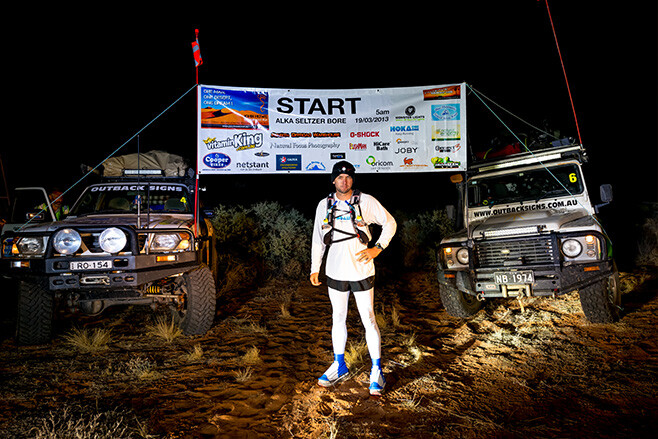
In preparation, John had been training intensively in the Hawkesbury region north-west of Sydney – where he works as an equine dentist – running close to 300km a week. And while that’s a lot of kays, it paled to the challenge of doing more than that non-stop. And on sand. Hot sand.
The challenge was a solo one but one that couldn’t be achieved with a solo effort. He had originally contemplated a solo, self-supported run but it was friend Brad Bell that had convinced John he would need a team to support the run with logistics, supplies and, importantly, morale for when things got tough, which they undoubtedly would.
It was the equine world that had introduced a few key people in Hawkesbury, and Brad, owner of Outback Signs and keen four-wheel driver, decided to become involved with helping the cause. Brad put a huge amount of effort and time into the project; developing relationships with sponsors and recruiting other off-roaders to join in the fun (run?). Everything had to be examined; from food and water delivery, to the problems of lighting the way at night. The crew would also need to be able to get along with each other in a challenging environment. Brad assembled a group of people that had all travelled together before.
Nights were spent at a whiteboard setting stage lengths, crew rosters and, most importantly, the best way for the vehicles to escort John in a way that would maintain the non-stop progress of the record attempt. And what of the night stages?
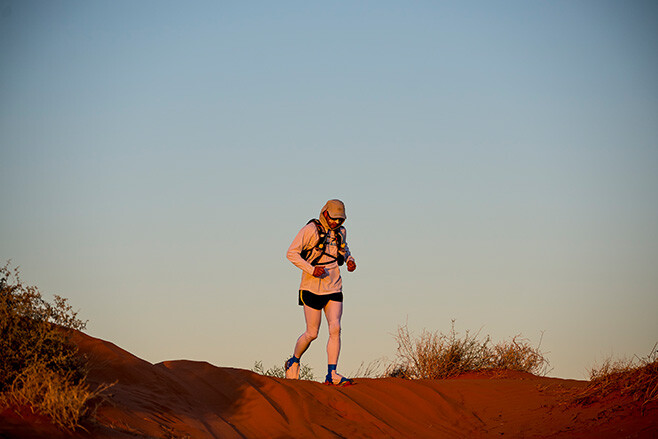
That little issue was worked out on the Stockton Beach sand dunes. Everyone taking part travelled up to Stockton to work out the plan. The first attempt revealed that the LED light banks courtesy of sponsor Monster Lights would need to be up-sized in order for the vehicles to light John’s path. They were and a second weekend’s training took place. There had to be adequate light to illuminate the track but not to dazzle John. A twisted ankle from not being able to see where he was going would be too silly an occurrence to unravel such a serious undertaking. Eventually it was decided that one vehicle would scout the track ahead, one would trundle along in front of John, far enough forward so as not to churn up dust for him to ingest and the last 4X4 would follow with lights bathing the dark sand in white light. John had a headlight but this on its own would be nowhere near adequate. The same positions it was deemed would work for the daytime sections, too.
It was also dramatically realised that in the event of a 4×4 bogging on a dune, hazard lights were to be displayed rather than an immediate reverse manoeuvre with possibly terrible consequences.
All the food and water, vitamin supplements and running gear would travel in the second or third vehicle to be ready when called for. The vehicle with the food could either run ahead or unload to the other to allow its preparation time before John caught up for a feed. John wore a harness with water bottles attached to keep hydrated, and they would be replaced as he progressed and emptied them. That last system would encounter a problem that was realised in the desert at the start point, Alka Seltzer Bore. The bore was the spot where Pat Farmer set off in 1996 and is recognised as the right spot to travel 379km, mainly on the French Line, to the Birdsville Hotel and, hopefully, glory.
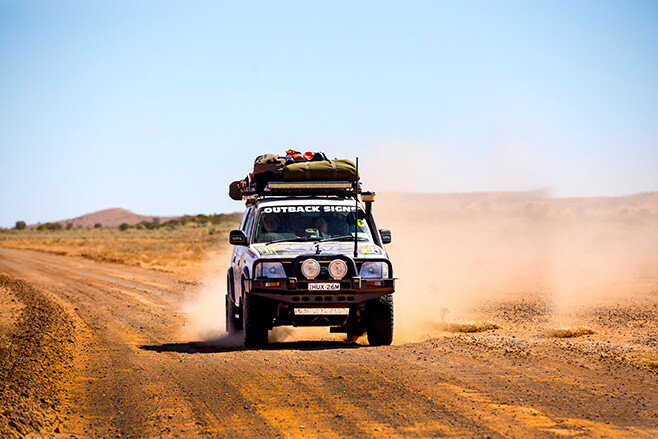
All up, eight 4x4s were assigned to this epic undertaking and everyone, including Jason Lindsay, the man charged with recording the challenge in pictures and on video, donated their time and efforts for free. Brad duly covered all the vehicles – a Defender, an 80 Series, a 150 and 95 Series Prado, a Navara ST-X 550 and three GU Patrols in the sponsors’ logo stickers he produced at work, and things were getting to the pointy end of proceedings.
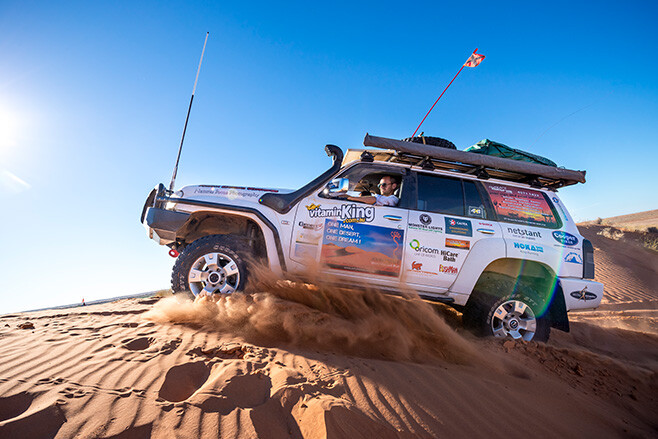
That just left the small matter of moving the convoy to the start point. The team decided to spend a leisurely week touring through the NSW outback and on to Alice Springs where John, his running mates Michael Cox and Ben Pascoe, and I would arrive by plane to join them.
With airport introductions despatched it was a rapid exit to start the journey to Mount Dare for the first night’s camp. A few of the convoy wanted to visit the Lambert’s Geographical Centre of Australia which required a side-trip from the main highway at Finke. Michael and I were riding in Nathan Bell’s Defender when the radio crackled with the call that Shamus Walsh had had an eagle through the windscreen. Not a good start. We’d passed a roo carcass in the centre of the track (we were running up front) and upon hearing the startled transmission returned to find that that roadkill had been the eagle’s launch point into the GU’s screen. It was a big strike right in front of the driver and had damaged to screen to the point that it would have to be replaced. No-one could locate the eagle but it was spotted later by one of the convoy who were returning from the Lambert monument. Still, the carnage allowed Shamus the opportunity to produce a cordless vacuum to remove the splinters and shards that filled his cabin. And he was away to Alice Springs for a new screen barely hours after leaving town.
Since the majority of the convoy had headed straight to Mount Dare and Shamus had left, the Defender pulled in to the campground later than everyone and the station outlet was closed. Once we’d sorted the swags and tents, a huge pasta feed was in order. According to Nathan “these were the meals we used to go out for”. Considering our location, how far out did he want to go? Since I had arrived with no way of carrying supplies the group had offered to feed and water me each day. I’d foolishly made a joke about being the camp dog, forlornly scavenging in search of scraps and mentioned the name Fido. I was going to regret that. Woof.
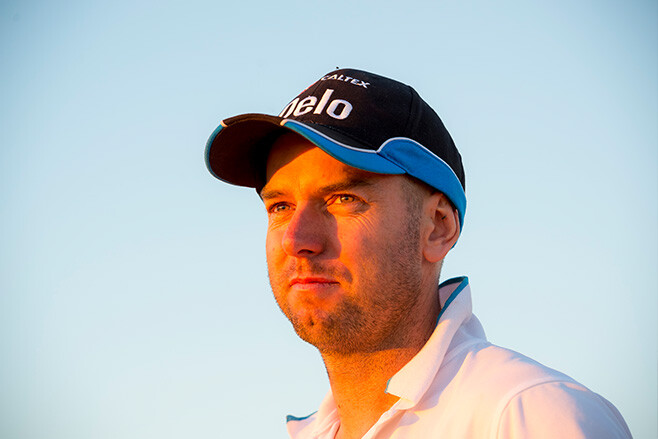
The vehicles took on fuel at the Mt Dare bowser in the morning, a fairly leisurely breakfast had been planned but it was decided to crack on considering a reoccurrence of the events of the previous day could potentially slow us down. And a stop at Dalhousie ruins and hot springs were also on the cards. We couldn’t be late to the next night’s camp at Alka Seltzer Bore – the start point – because the run was due to begin at 5am Tuesday morning. We’d need to be well rested and on time.
Lunch at Dalhousie, with me coated in flies more than anyone else – which oddly occurred for the whole trip – further spurred the dog jokes. Most enjoyed the hot springs but, as refreshing as they were, the memory that lingers is of the insane amount of National Park’s wire-rope fencing in the camp area. It was a huge eyesore and a hazard for night-time movements.
Everyone reached Alka Seltzer Bore in the late afternoon with little fanfare. The trumpet calls were reserved for Irishman Shamus and mate Phil who rocked up hot-foot from Alice with a new windscreen around nine o’clock – could he be of the County Cork O’Clocks?. However, prior to that, Brad had gathered us all around his Patrol for a briefing to make sure all knew what to do. Since this was to be a record attempt, an accurate timing method was required for each vehicle so everyone received and synchronised a Casio G-Shock watch. All except the camp dog – who skulked near the box with freeloading journalistic opportunism. He was, however, rewarded with a feed of steak and sangers at the camp kitchen of Ron Optiland and trip paramedic Wayn (no E) Patch – that name’s better than Fido.
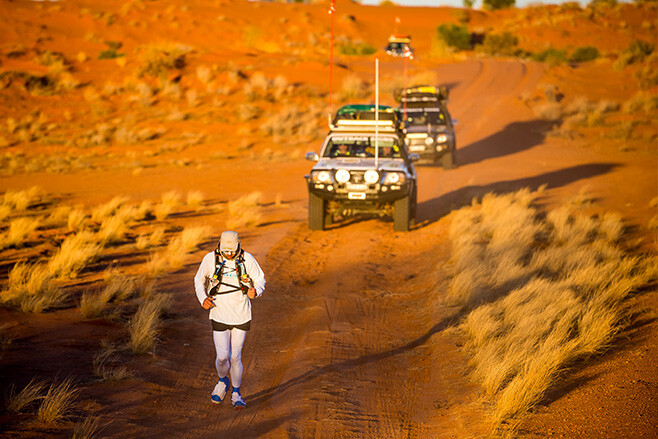
John had been itching to get going, understandably, and was often sat, always in running gear, foot eagerly tapping and looking pensive. Not long to go.
As the camp settled down for the night a lone Cruiser trayback pulled in to the site. It belonged to Cultural Ranger Dean Ah Chee. Dean was to lead John out of Alka Seltzer Bore in the morning as a sign of respect to the Lower Southern Arrernte and Wangkangurru people and as a representative of the Department of Environment, Water and Natural Resources. Casually adding in the morning that he had “a few star droppers to knock in”.
The day dawned, well, actually it hadn’t dawned at all yet – it was around 3am. The darkness was a hive of activity, though still quiet. Headlights flashed as camps were dismantled, no-one wanted to be tardy. The Defender and a Patrol were positioned either side of the track leading out of the bore and a ‘start’ banner was strung above, affixed on poles to the bullbars. John warmed up, stretched, and looked at his watch while the vehicles readied for their exit onto the French Line. One group, Nathan’s Defender, and two Patrols belonging to Shamus and Ron would let John start and then we’d slowly skirt him and go on ahead to the halfway point at the junction with the Knolls Track – the whole stage was to be around 80km. The idea was that we’d have time to feed and rest before the party following caught up and we’d take over escort duties.
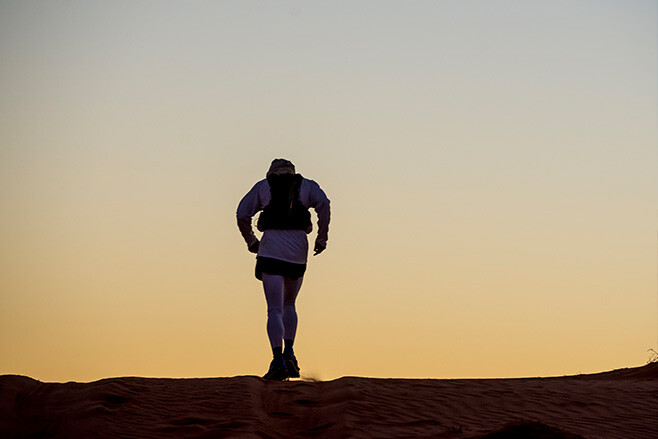
Five o’clock came and John went, the start of the biggest challenge of his life, although a little dustier than he’d anticipated in the wake of Dean’s Cruiser. Dean pulled off the track not much further on and started with the star droppers; we bade our farewells.
Blue Mountains Natural Spring Water had donated a large quantity of H2O for the effort, but since you can never be too careful with water supplies the team had stocked up with extra pallets. John had realised at the bore that the new bottles were not compatible with his drink harness so it was vital that the right water was in the correct part of the convoy.
A rhythm settled in with happy chatter across the airwaves on the UHF.
As dawn finally broke, our lead party stopped for photos of the sunrise and breakfast atop a dune. In the first beams of a desert sunrise a sausage and egg sandwich has never looked so good. Except the one I made for Nathan.
As the daylight grew brighter we could clearly see the wheel tracks of Vic Widman’s party who’d passed this way at the start of the desert’s open season. It was odd to note that the sand looking forward was yellow compared to a peek out the back, where it appeared the more expected red. Vegetation was, to this Simpson virgin anyway, abundant.
We arrived at our checkpoint and waited in the heat – and me in the flies – and readied for our stint with John. Around two o’clock the second party arrived. Michael was suited and ready to run with John. I would jump in with Shamus and Phil and we’d travel just ahead of John and Michael, trying to keep them in the rear-view. It’s amazing how strange it was travelling at that kind of pace and as the day wore on we realised it was going to be a long day. That point was not lost on Brad either. He decided to shorten the stage, for us at least. But, still, not until much, much later.
As far as the record was concerned John was around six hours ahead and looking good. He’d some soreness on his hip and unwashed new shirts had caused a little unexpected nipple chafing, however, a toe was heavily strapped that required Wayn to have a look while our roadside café had prepared the request for vegemite on toast and hot drinks for our little party. It was a surreal scene as night-time activities in the desert often appear. Not quite as surreal as they were about to become.
As the last vehicle, behind John, Nathan had been calling on the radio that things were slowing back there. Small breaks were beginning to be taken. To pass the time some of the most inane radio chatter pierced the night sky. Someone joked about what aliens picking up the rubbish might think as we peered into the milky heavens.
It had reached the mind-bending stupidity level as tired brains struggled with fatigue and making sense. We were unaware of the struggle taking place somewhere behind us in the gloom. A call from Nathan summoned Ron and Wayn to attend. It was low-key – Nathan’s sensitive attempt to not raise anyone’s, including John’s, concerns unduly – and as we tried to rest, the boys took off.
What happened next is blurred; we’d been in the Patrol for almost 24 hours when we were called to head on to that night’s camp. Via sat-phone Brad had been summoned back to try to convince John that it was all over! When Wayn had arrived John was in agony with a heart rate in the stratosphere that would have killed you or me. An average resting heartbeat is around 60-70 beats per minute (bpm); as an ultra-fit person John’s is 32. At this point his heart was pacing somewhere north of 200. It had come out of nowhere. John was hardly exerting himself and walking when; “bang, I was on me face” on it came. After two failed attempts to carry on, including one using tent poles to aid walking; Brad had to implore John to stop. This was after two hours’ rest as advised by medic Wayn. The decision was made to head straight to Birdsville and help. Brad took off. We were still a good 250km from Birdsville and so Nathan decided to accompany Brad, a feat that meant by the time they reached Birdsville, Nathan had actually driven across the Simpson Desert non-stop.
When we awoke at Poeppel Corner we were greeted with the disheartening news. There was nothing left to do but follow on to Birdsville and hope that John would be okay.
We arrived on Thursday to find that he was indeed okay, if in some strong discomfort and a little deflated, as you’d expect. The RFDS had happened to be in Birdsville and were able to thoroughly check John over. The cataclysmic chest pain was deemed a coincidence, not as a result of his efforts. Further tests back in Sydney would hopefully determine the cause because this is one man that hasn’t finished with the Simpson Desert. Even though it, like it did with Pat Farmer, almost seemed like it had him finished.
Over a light dinner at the Birdsville Hotel, John told us that Ultra Runners are selfish people, it’s a selfish sport. You spend huge amounts of time on your own; racing or training. John said we’d have been dealing with a different scenario had he been a single, childless man. “There’s no way I would have stopped,” he told us. So we waited. Two weeks after the event, 16 ultrasound and CT tests still hadn’t ruled anything more conclusive than an intermittent problem with a heart valve and the “system that charges the heart”, to quote John. His resting heart rate was still around 85bpm, which was exhausting for him. John still couldn’t run either.
Back in the Simpson, there had been the option of calling in a chopper and paramedics from the Moomba gas field for an evacuation in 10 minutes. John refused. He wasn’t going to fly out – that was too easy.
“I’d rather cop a bit of pain along the way. I still got across the desert, it just wasn’t on the mode of transport I wanted,” John said. “… That’s how Ultra people think; a mongrel breed.” Maybe so? We’d attach a certain pedigree.
Originally published in May 2013 issue of 4X4 Australia.
NISSAN’S sixth-generation Y62 Patrol has a tough task ahead if it is to prosper in Australia.
The big hurdle it has to face is a preference for diesel power that’s so strong in this market sector that last year 94 percent of LandCruiser 200 Series buyers opted for the diesel engine despite its substantial price premium over the petrol V8. And, if you don’t know already, the new Patrol only comes with a 5.6-litre petrol V8.To see how the Patrol shapes up we have lined it up against the popular 200 Series GXL diesel, the least expensive of the 200 diesels bar the commercial-grade GX. At this price point ($90K approx) the nearest equivalent Patrol is the mid-spec Ti.
POWERTRAINSThe Patrol’s 5.6-litre petrol V8 features quad-cam 32-valve architecture and is packed with the latest technology including direct fuel injection and variable valve lift and variable valve timing. The variable valve lift is both unusual and interesting as it is used to control the engine’s air intake instead of a rotating throttle plate in the inlet manifold. Of course, variable valve timing (only on the inlet side in this case) is more common and helps spread out the engine’s power delivery. It’s like having a mild cam (for better bottom-end power) and a high-performance cam (for better high performance power) all at the same time.
The end result is thumping 298kW of power (at 5800rpm) and a maximum of 560Nm of torque (at 4000rpm). More importantly the engine makes better than 500Nm from as low as 2500rpm. On the road this engine is a gem. It’s smooth, refined, and responsive and has a highly intoxicating V8 note. On full noise it propels the weighty (2800kg) Ti along like some monster racecar yet at the same time it can be relaxed and effortless, if that’s what takes your fancy. This sweet V8 is beautifully matched to a slick and quick seven-speed auto that is about as good as it gets, ZF’s superb eight-speed auto aside.
The 200’s 4.5-litre twin-turbo diesel V8 feels altogether different. In comparison it’s noisy and a little gruff. It’s great driven in isolation but back-to-back it with the Nissan’s petrol engine and it can’t hide the fact that it’s a slow-revving, lazy diesel. And with a peak of 195kW (at 3400rpm) it can’t keep pace with the Nissan pedal-to-the-metal although with 650Nm on tap from 1600 to 2600rpm it’s even more effortless at low to moderate road speeds than the Nissan’s already no-sweat V8. No complaints either about the Toyota’s tall-geared six-speed auto.
Unfortunately the rub for the Nissan comes at the fuel bowser. On this test, over mixed give-and-take secondary roads and with some off-road thrown in, it averaged 20.3 litres/100km against the Toyota’s 13.4 litres/100km. That means it used 51.5 percent more fuel. Even the Patrol’s ADR Combined-Cycle fuel-consumption figure of 14.5 litres/100km is over 40 percent higher than the LandCruiser’s ADR figure of 10.3 litres/100km.Given both have similar tank sizes (149 litres for the Patrol and 138 litres for the Cruiser), the Toyota has a significant range advantage, so it’s not just a matter of fuel cost. The Patrol also asks for premium 95RON although we have found that it runs on regular 91RON without any issues, although probably at a minor cost to the consumption.
ON-ROAD DYNAMICSUnlike every other Patrol in history, the new Y62 is fitted with coil-sprung, fully independent suspension. The mid-spec Ti (tested here) and the top-spec Ti-L also have what Nissan calls ‘Hydraulic Body Motion Control’ (or HBMC, for short), which uses active dampers to control the on-road body roll when cornering.The result is surprisingly flat handling that almost feels physics defying. You turn the Patrol into a sharp corner and you expect it to lean over but it just stays flat. It actually feels a little strange until you get used to it.
With its fully independent suspension, the Patrol is also largely unfussed on bumpy roads and maintains good directional stability. Over big bumps, and especially at speed, the ride quality is also excellent although at low speeds the small bump compliance isn’t great and the ride can be a little sharp, although never uncomfortable.In contrast, the 200’s ride is more supple and compliant but with its live axle at the rear can be more upset at speed on bad roads. Our test GXL (unusually for a Toyota media vehicle) wasn’t fitted with KDSS and, as a result, the body roll was noticeable and it lacked the sharp, positive handling of the Patrol. Even with KDSS (and we have driven lots of 200s with KDSS), the 200 can’t match the Patrol’s flat handling.
Both of these vehicles also have very light steering for their size but of the two the Patrol’s feels a little more direct and communicative. Along with the flatter handling it gives the Patrol a surprisingly sporty feel that the 200 just can’t quite match.The Patrol also has an on-demand 4X4 system whereas the 200 has a conventional full-time 4X4 system. With the Patrol’s system in ‘Auto’ the drive is primarily directed to the rear wheels and will only be directed, in part, to the front wheels when there’s rear wheel slip. On the other hand the 200 directs drive to all four wheels, even on a high-traction, no-slip surface.
OFF-ROADThese two bring completely different sets of ‘weapons’ to the off-road contest. The Patrol’s fully independent suspension is a theoretical negative, which is negated to some extent by its lack of sway bars that help maximise the available travel. It also comes standard with electronic traction control and a driver-switched rear locker. With the locker engaged the traction control is negated on the rear axle but stays active on the front axle.
The Toyota’s live rear axle is a significant positive in terms of wheel travel but, without KDSS on the test vehicle, the travel is reduced a little from what KDSS offers. Unlike the Patrol, the 200 doesn’t have a rear locker and instead relies solely on its electronic traction control.The end result of all this is that the Patrol just edged out the 200 in the gnarly stuff, doing things just a little bit easier. However, had the 200 been fitted with KDSS the result would have been reversed as we found in our recent 4X4OTY contest.
Aside from that, both of these are big vehicles that don’t offer great over-bonnet visibility and in tighter going can be demanding to drive. That said they are both very capable, even on showroom stock tyres.The 200 has a couple of positives in its more compliant, more forgiving ride – good for extended trail driving – and it also offers better engine braking. Not so good is the ever-present whine when in low range.
One negative with the Ti’s HBMC system is that it’s not amenable to aftermarket enhancement whereas the base-model’s non-HBMC system, with its standard dampers, can be modified.
CABINS AND ACCOMMODATIONBoth these wagons seat eight and are big and comfortable inside but the Patrol takes the prize for rear-seat room and luggage space. Third-row seating in both is however a little restricted and really only for kids, or small adults over short distances.
In typical Toyota fashion the third row seats fold up against the rear windows, which eats into luggage space while the Patrol’s fold into the floor. This raises the floor height but also means the floor is not completely flat.
Up front, there’s little to separate the two. Both have comfortable seats and reach and tilt adjustment for the steering wheel although the Patrol’s leather driver’s seat has full electric adjustment whereas the 200’s cloth seats are manual adjust, save for the lumbar adjust for the driver.
PRACTICALITIESIf towing is you go then both of these wagons have a solid 3500kg towing capacity. Both also have similar GVMs, 3300kg for the LandCruiser and 3450kg for the Patrol. Given the Patrol is also heavier than the LandCruiser (2800kg vs. 2675kg at the spec level) there’s nothing in it in terms of payload, which is not great in either case.Both also have bush-practical wheel/tyre sizes with the 200 on the familiar 285/65R17s while the Patrol has more unusual 265/70R18s. To find replacement tyres for the Patrol you will have to scratch around a little more, or possibly go to an alternate tyre size.
SUM UPThis is pretty simple really. The Patrol is a highly impressive vehicle but its thirsty petrol V8 is a fatal flaw. Not only does it make the Patrol more costly to run but also it compromises its touring range, a vital consideration for bush travel especially in more remote areas. All of which is a great shame as the Patrol is well equipped for the money and its chassis works a treat thanks to the very clever HBMC system. We are yet to test a base-spec Patrol without HBMC but stay tuned … it’s in the pipeline.All of which leaves the 200 diesel as the sensible and practical buy that it has always been. It’s not cheap, but it does the job.