
HALFWAY along the Dowling Track, which runs from Bourke in western NSW to Quilpie in Queensland’s outback, is a special national park with a host of natural and manmade phenomena.
Stunning landscapes and a vast lake system occupy Currawinya National Park – plus it’s the home of the endangered Bilby.
The park is located 20km north of Hungerford in outback Queensland, and you need to be self-sufficient with all camping, water and food supplies. The settlement of Hungerford comprises of several houses and an old pub, so the chances of getting supplies here are next to none – the nearest supply centre is 170km northeast at Cunnamulla, or 220km south at Bourke. There’s also no phone service out here, so getting help may take time.
Of the several spots to camp within Currawinya the most popular is the Ourimperee camping area beside the billabongs of the Paroo River system, where campers can relax under the shade eucalypts and red river gums. Other camp spots – with very basic facilities – can be found near the old shearing shed as you enter the park, or further north towards the old ruins of Caiwarro Homestead.
It’s easy to lose a day or two in the park simply by watching resident emus, several species of kangaroos, wild pigs and a host of birdlife. Fishing is allowed in the billabongs, but, unfortunately, European carp has infested the waterways – we caught a few using light gear. Once caught you do need to destroy and throw the dead fish away from camp, as feral pigs wander through at night.
Explore Conondale National Park: Queensland
The more adventurous can explore Currawinya’s unusual lake system, which is a 35km drive to the west along the sandy tracks that run parallel to Kaponyee Creek. The system is unusual as the nearby Lake Numalla has fresh water, while Lake Wyara (only 6km away) has salt water – researchers have found the water here can be up to 10 times saltier than the ocean. Both of these lakes are a haven for water birds – from coastal dwellers to inland varieties – and there are often thousands of birds here at any one time. There’s no camping at the lakes but there are several shelters where you can learn more about them, and swimming is permitted in Lake Numalla.
Located at the northern end of the park are the ruins of the old Caiwarro Homestead, built in the late 1880s. It’s still possible to wander among the ruins of several buildings and explore the levee bank that was built to protect the station from floodwaters. There’s also a tennis court, old machinery and several garden areas that once stood proud in this vast and remote area. It has been reported that back in 1906 there were 20 shearers working at Caiwarro, with about 60,000 sheep.
At one stage, when more than 100 workers were on the station, three cricket teams were formed and matches were played every Sunday. Caiwarro station was eventually shut down in 1971 after many severe floods and droughts, even though as many as 25 bores were sunk looking for good water. National Parks soon took over Caiwarro and Currawinya and placed a dog-proof fence around the properties. Currawinya is now home of the endangered Bilby, and an electrified Bilby compound has been set up in a ‘secret’ location to keep natural predators away. Funded by public donations, the breeding program is keeping these desert bandicoots alive.
The old shearers’ shed, located 2km inside the park’s entry, has several information boards where you can learn about the Bilby breeding program. Once in the shearing shed, let your mind wander and imagine the hardship that must have been endured out here in this remote location – summers would have been stifling hot in this big tin shed and, combined with flies and the stench of sheep and sweat, it would have been a tough slog. A 10-head shearing station, bale compressors and an old stone wheel to sharpen shears and knives all still stand. The shed smells like it was used recently and the timber decking feels like a sheep’s oily wool.
To extend your stay in the park, a 15km drive to the west will see you encounter a natural wonder called ‘The Granites’. The surrounding landscape has weathered away due to the effects of wind and rain over millions of years, but these huge granite boulders – some as large as two-storey buildings – have stood the test of time. The views from the top of these rock formations across the vast tree-lined plains are nothing short of spectacular. Keep an eye out for unfortunate animals (goats and kangaroos) that have slipped and fallen to their doom in the crevasses, leaving only their dried-out skin and bones.
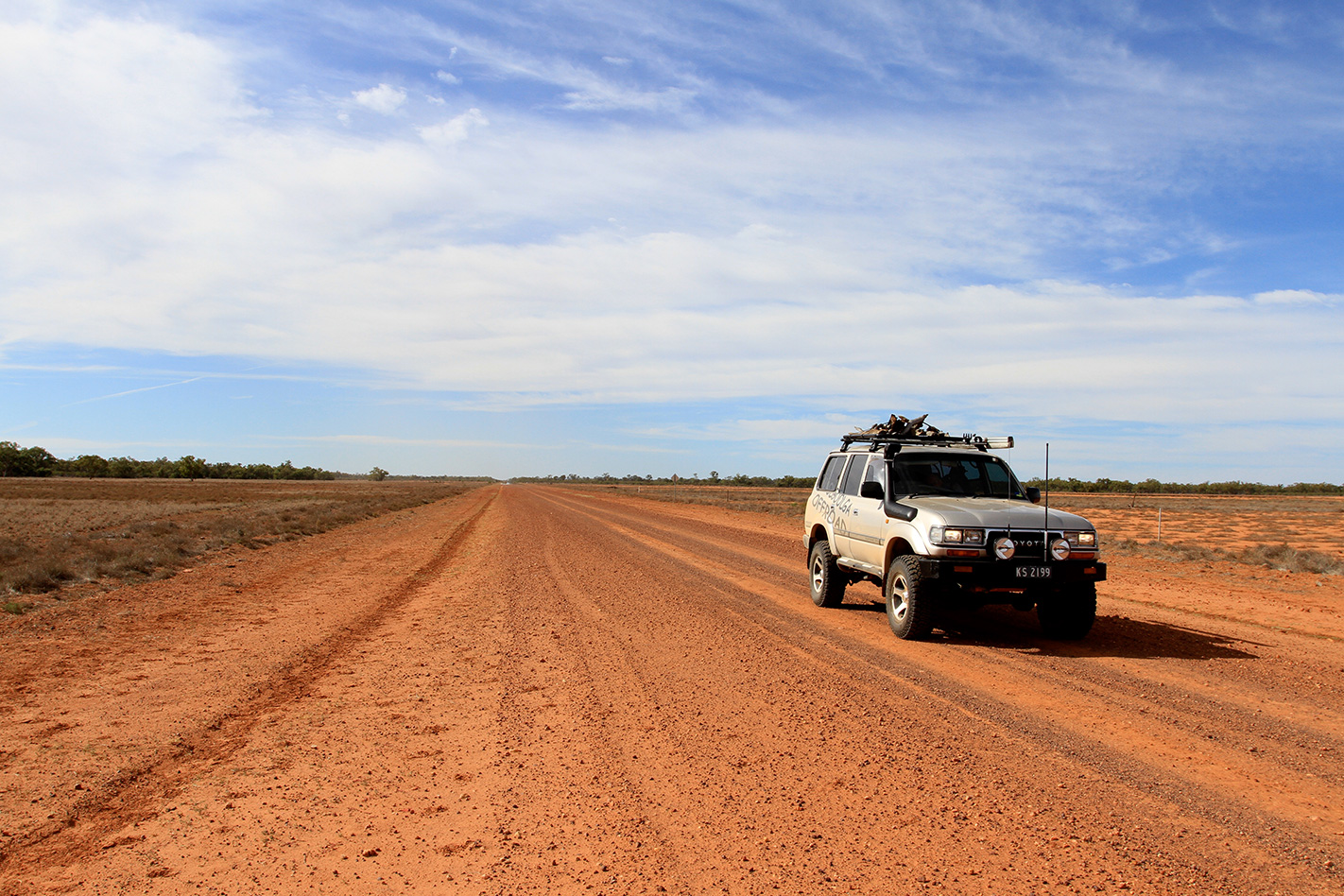
The roads within the park are recommended for well set-up 4WDs only, as maintenance is irregular and the corrugations will make your fillings fall out – this is true outback country. At times it can be extremely harsh, with long, sand-based roads cutting their way past mulga bushes, prehistoric gums and scrubland. However, when the rain arrives, billabongs and wetlands come alive to entice goats, dingoes and an array of birdlife.
Currawinya National Park is a special place and should be on every 4x4ers bucket list.
TRAVEL PLANNER
WHERE Currawinya National Park is located 220km north-west of Bourke, just inside the Queensland border. The park lies on the banks of the Paroo River.
CAMPING There are a number of camping locations – beside the Paroo River, beside Ourimperee waterhole, or near the Woolshed, where there are some basic facilities – and there’s plenty of room for camper trailers, tents and off-road caravans.
SUPPLIES AND FACILITIES You will need to be very self-sufficient with all food, water, fuel and accommodation. The nearest town of Hungerford is 20km away, but it has no facilities and unreliable fuel supplies. The nearest town with any supplies is Cunnamulla (170km to the north) and Bourke (220km to the south). Fires are allowed within the park, but please check local warnings beforehand. Flushing toilets and bush showers are available nearby at the Woodshed. All rubbish must be carried out. There is no phone service within the park.
TRIP STANDARD A 4WD is recommended for the park and its surrounding places of interest. The roads range from sandy, well-used tracks through to rocky creek crossings. After times of floods, be aware of washouts and corrugations. All roads are unsealed and are maintained on an irregular basis.
FURTHER INFORMATION The most comprehensive up-to-date details can be found at www.nprsr.qld.gov.au/parks/currawinya. Camping fees are payable at the nearby ranger’s station or at the honesty box near Caiwarro Homestead. Fees are a reasonable $5.45 per person per night. Discounts apply for families.
WHEN the first Discovery arrived in 1989, it turned Land Rover’s flagging fortunes around and sparked a revival of the marque that continues unabated today.
Without the Discovery, Land Rover may even have perished before the millennium was done.
Yet the first Discovery was more of a card trick than any real advance, as there was nothing new except for a spacious, practical cabin and a distinctive stepped-roofed body. The rest was a vehicle that was about to be pensioned off, at least in its then-current guise, as the Range Rover.
Fast forward to 2017 and there’s a brand-new Discovery unofficially dubbed Disco 5, but effectively it’s a true third-generation model given the original Discovery and the Series II shared the first platform while the Discovery 3 and 4 shared the next. Interestingly, this new Discovery is also built off the back of a Range Rover. But this time it’s not a design dating back 20 years as was the case with the Range Rover when it gave birth to the original Discovery, but a design that’s a mere five years old.
This new-generation Discovery also ties Discovery, Range Rover and Range Rover Sport together for the first time in the marque’s history in terms of commonality of the basic platform, in this case an all-aluminium monocoque. For the Discovery, this is also the first time there hasn’t been a separate chassis. The monocoque in question is not one piece as you may think, but it’s several different aluminium structures, some pressed and others forged, which are riveted and bonded together using techniques developed from the aerospace industry – think modern passenger jet.
The advantage of firstly doing away with the separate chassis and then switching from steel to an aluminium body structure pays enormous dividends in weight savings, up to a claimed 480kg. This brings the unladen weight down from the D3/D4’s beefy 2600kg (give or take a bit, depending on the model) to more like 2100-2200kg. That weight saving is also sufficient to see four-cylinder engines offered once again, something that didn’t happen with the heavier Discovery 3 and 4. Less weight is, of course, the universal solution for everything you want in a 4×4 – stronger performance, increased off-road ability, sharper on-road handling and lower fuel use.
What’s yet to be seen is if the new Discovery’s aluminium composite monocoque will match the impressively robust, steel separate chassis of the Discovery 3/4 for durability. Steel, of course, is an altogether different metal from aluminium and offers different properties in terms of elasticity and the like. The new Discovery does, however, have steel rather than aluminium sub-frames to carry the suspension components.
Land Rover Discovery in Australia
For its part, all-independent suspension brings more wheel travel on adjustable-height, air-spring models, more ground clearance and deeper wading than the D3/D4 – all worthwhile attributes.
Sadly, given the obvious effort that has gone into this new Discovery, Land Rover hasn’t seriously addressed the two key shortcomings of the outgoing Discovery when it comes to bush practicality: the fuel tank capacity and the wheel/tyre specification, although it has tweaked things here and there.
As Discovery 4 owners know all too well, the smallest factory wheel you can fit is a 19 that wears 255/55 tyres. The smallest factory wheel on the new Discovery is still a 19, but the standard tyre spec is a slightly taller 255/60, or an equally tall but narrower 235/65. This is a move in the right direction, but the retention of the 360mm front brakes rotors remains a problem in terms fitting smaller wheels and therefore more off-road-friendly tyres.
Video: 2017 Land Rover Discovery Range review
For the four-cylinder diesels, fuel capacity is also just 77 litres (down from the D3/4’s 82 litres); although the TdV6 gets 85 litres. While the lighter weight will bring better fuel economy and therefore a longer touring range, it’s a pity Land Rover didn’t see fit to bump fuel capacity to 100 litres (at the very least) or, ideally, the 140 litres you get in a Prado 150.
While the new Discovery brings a wealth of high-tech gadgets, the gadget I’d really like to see – but isn’t offered – is on-board tyre pressure adjustment, so you could quickly and easily drop the pressures for something like soft sand and then pump them back up when needed. If Land Rover wanted to be really clever this could be tied in with the Terrain Response, so selecting ‘Sand’ mode would automatically drop the tyre pressures while the ‘Highway’ mode would restore them again. A manual override would also allow the driver the tweak the pressures as the need arises.
SEEING photographer Brunelli’s fleet of cool, off-road, radio-controlled cars had me wanting to blow some dough on one myself.
It had been more than 30 years since my last RC car – and with King of the Hammers rock-racing event flooding my Facebook feed at the time, Axial’s RR10 Bomber looked like a great way to get back in to the hobby.
Not just any RC car, the RR10 is a replica of the rock-racer built by Bomber Fabrications and raced by Randy Slawson at events like King of the Hammers. Aside from Bomber Fab, other well-known off-road brands represented on this RC include Walker Evans Racing, BFGoodrich Tires, PSC, King Shocks and Advance Adaptors.
I went with the Builders Kit because that was how we did them back in the day, and building the buggy would give me a better understanding of how it comes together and works. If that’s not for you, you can get the RTR (Ready-to-Run) version. However, the Builders Kit has better hardware such as metal suspension links and a rear sway bar.
With a bit of research I learned the Bomber was a great rock-crawler but a bit slow at race pace, and I wanted some speed. With this in mind, I went to The Hobby Man in Melbourne for my electronics set-up.
Pistol-type transmitters and ESCs (Electronic Speed Controllers) were still new when I was last in to RC cars, and a lot has changed since then. With my budget and need for speed in mind, Matt at The Hobby Man sorted me out with a FlySky GT2B transmitter/receiver; a Hobby Works 3700kV brushless motor; programmable, waterproof ESCs; a high-torque steering servo; a 3S LiPo battery; a charger; and everything else needed to complete the build.
Just as the hardware has changed over three decades, so has building the car. The Axial has a lot more components than I remember old Tamiyas ever having, and it took a thorough read-through of the handbook and familiarisation of the parts before I screwed the first pieces together. Taking the steps slowly and checking everything twice before screwing it together certainly made the process time consuming, but it ensured the right screws were used for the right parts – there are hundreds of similar-but-different hex-head screws in the kit. Online help was handy, too, and methods for things like bleeding the shocks were easy to find.
I spent a couple of weeks putting it all together, and added some paint here and there to make it look different to what was on the box. It wasn’t difficult to build, but you have to pay attention to using the right nuts and screws.
With the battery charged, plugged in and with everything switched on, I tried the buggy in my hallway and it was instantly obvious that this was not for indoor use, especially when the throttle trim was out and it shot out of control. Outdoor testing (and tweaking) showed me I had the extra speed I wanted – in fact, it was wild! I tamed the throttle response to its lowest setting using the ESC program card, but the Bomber still does power wheelies on gravel on full throttle. On tarmac it does backflips! I might have to gear it down for more controlled rock-crawling, but flat-out blasting and jumping is a lot of fun.
It’s taken some time and practice to get the feeling back, but now I’m driving more controlled, attacking corners faster and landing jumps. The Bomber easily handles it all and has coped with some high-speed rollovers without any serious damage, just a scratch here and there.
The hobby is addictive, and there are more accessories and extras available for these than you will find for a Jeep Wrangler. In fact, Axial also has a wicked JK Wrangler RC in its catalogue. There’s plenty of money to be spent and fun to be had – the hardest part is keeping the kids away from it.
AVAILABLE FROM: www.axialracing.com; www.hobbyman.com.au PRICE: $580 approx. (RTR); $530 approx. (Builders Kit)
TIME flies when you’re having fun, and it’s hard to believe we’ve had the Toyota Land Cruiser for five months already.
What’s harder to take is that we’ll have to give it back to Toyota next month – it will be a tough truck to part with.
We did a piece with Yokohama tyres for the 4×4 Garage, and they wanted us to give an opinion of the tyres after a lap around the block in their rig. We suggested a bit more time on the new Geolandar A/Ts was needed and asked them to throw a set on our Cruiser. So the guys at A1 Tyres & More in Chelsea Heights rustled up a set of black steelies, fitted them with 285/75-16LT Yokies and sent us on our way. Steve at A1 Tyres & More is a 4x4er and owns the double-cab 79 in some of the pics in the Yokohama story, so he knows what 4x4ers want in a tyre.
Most LC70 owners will up the tyre size on their Cruisers, and the 285/75 is a popular choice for those who like to keep things legal while still gaining height and putting more rubber on the road. It’s a ‘plus-one’ size upgrade, so it’s not over the top.
Instantly noticeable upon leaving the driveway at A1 Tyres & More is the effect the taller tyres have on performance, as it took a further press on the skinny pedal to get the Cruiser going and keep momentum up. It doesn’t make the car a slug by any means, but it’s evident at first then soon forgotten.
Many people should think about this before they fit bigger tyres to their 4x4s, or at least consider a performance hop-up at the same time. The other thing to consider is the speedometer calibration. The 79 went from running at 97km/h at an indicated 100, to pulling 105km/h with the needle in the same place. It makes using the Hema HN7 GPS invaluable to staying on the right side of the limit.
With the tougher-looking black steelies and Yokies fitted we did a run up to NSW over Easter for some camping and a bit of light duty 4x4ing with mates. The tyre performed well over a variety of terrain, including one rocky climb back in Victoria. The same strengths we’ve mentioned before shone through again: nice highway cruising with the taller top gear; great tie-down points in the tray for fringe, swag and camping box; and that effortless lope of the 1VD V8 engine.
I really don’t think I’ll be able to give it back!
Total KM: 8271km Date acquired: Dec, 2016 KM this month: 1983km Average fuel: 14.87L/100km
OVER the years we’ve attached a number of mirror extensions to our vehicles for towing both smaller and bigger camper vans. Most mirror extensions – no matter how they connect to the mirrors – are pretty poor, wobbling like a flag in the wind and providing mediocre rear visibility.
Clearview’s towing mirrors have been on the market for a few years now, so we decided to fit a set to improve the rear vision down both sides of our narrow-bodied Project ’79 Cruiser – plus we disliked the Cruiser’s OE mirrors.
The model for the 70 Series is pretty basic, having no electric motor control or indicators wired in. We’re pretty happy with that as we like the simplicity, which means there’s a lot less to go wrong – and they’re cheaper.
The mirrors have been designed in Australia, with final assembly and testing done at Clearview’s factory in Craigieburn, Victoria. When folded out to their normal use position, each mirror – available in black or chrome – is held in place by a spring detent which stops the mirror slamming closed when a strong wind hits it, say from a 110km/h passing B-double.
The top or main mirror (powered in some units) provides a great view of the road behind, while the smaller, convex mirror helps eliminate blind spots. When towing, the mirror housing extends a further 100mm (ADR compliant) to give a better view down either flank.
The units are fairly big, and some people have commented that the mirrors make their vehicles too wide to park in garages. And when we backed into our garage we were aware how far they stick out, so we need to take care – but apart from that, there haven’t been any problems.
The mirrors are a huge improvement on the original equipment. The large mirror provides great coverage, while the smaller, convex mirror gives an even spread of vision that covers a number of highway lanes – due to this two-mirror set-up, the left-hand-side mirror is also extremely useful. Blind spots have either completely vanished or diminished to the point of being inconsequential, and vibration of the mirrors is barely noticeable, even on corrugated, dirt roads.
The mirrors were easy to fit with no wiring at all to worry about, so it could be easily done by any handyman. Priced at $695 for the all-manual versions, these mirrors aren’t cheap. Still, with a three-year warranty and a complete spare-parts back-up service here in Oz, we’d recommend these Clearview mirrors to anyone who regularly tows. When you look back you’ll forget about the money and just be super happy with the safer, more expansive view these mirrors provide.
Available from: www.clearviewaccessories.com.au RRP: $695-$1100 (pair)
IN THIS job, two questions stand out head and shoulders above anything else in terms of how often I get asked them.
The most common, by a long shot, is ‘what’s the best four-wheel drive?’ My standard answer to that is whatever model of 4WD I’m driving on that particular day. But, in all seriousness, it’s whatever 4WD gets you where you want to go.
Five tips for longer-lasting tyres
The second most common question is ‘what’s the best tyre?’ My answer: the one with air in it.
A tyre holding air and still attached to the wheels on your 4WD should get you where you want to go. To me, that’s the most important requirement of a tyre. I once read a tyre article that started with the line, ‘Tyres come in all shapes and sizes..’, the writer was right about sizes, but they last time I looked they were all pretty much the same shape – round and black. And if they continue to hold air (ie, don’t get punctured) they’re doing what I ask of them.
The second most important thing I look for is tyre feel. They’ve got to give a comfortable ride. It’s no fun if the tyres give a harsh and jittery ride when you’re driving long distances, as it fatigues the driver and makes driving a chore. Feel through the steering wheel is just as important, and the vehicle should track straight and respond well to steering inputs to ease stress and fatigue on the driver. This is where having the right tyres at the right pressures is vital.
A properly maintained vehicle is also important. Tyre pressures are the easy one, but consumables such as wheel bearings, ball joints, steering links, suspension bushes and shock absorbers all effect the way a vehicle feels and steers and how much effort a driver has to make to keep the car on the track.
The best tyres in the world won’t cover up a worn and loose front end, so having it checked over by a qualified mechanic before you replace your tyres is a good idea on any vehicle – particularly older, high-mileage vehicles.
Then, once your front end is right and the new tyres have been fitted, complete the job with a good wheel alignment, preferably by someone who knows 4WDs and the specific requirement they have.
Driving on fresh rubber can transform your vehicle, as we found when we put some new boots on the 79 recently – even though the OE tyres only had 6500km on them. They made the truck steer and point better, but the heavier constriction of the Light Truck tyre gave a harsher ride, so we dropped the presses a bit to smooth it out. This will require careful monitoring of the tyre wear to make sure they aren’t too low, but that’s something anyone can do.
JEEP Australia has confirmed its racetrack-tearing SUV, the Grand Cherokee Trackhawk, will land in local showrooms by the end of 2017.
Tailor-made for bitumen instead of the kind of roads our readers prefer, the supercharged 6.2-litre V8-powered Trackhawk generates a gutful of grunt – 527Kw/874Nm worth. And, when mated to a high-torque-capacity TorqueFlite eight-speed automatic transmission and Brembo brakes, it’s enough to get our attention.
“I’m very excited to confirm that the Trackhawk will officially join the new Grand Cherokee range,” said Jeep Australia President and CEO Steve Zanlunghi. “From the moment it was revealed in New York we knew we had to bring it to Australia. Public interest in the Trackhawk has been incredible – barely a day goes by when I’m not asked if it’s coming. Now I can confirm it.”
“The Grand Cherokee Trackhawk will be on sale in Australia in December, and it will shatter performance SUV benchmarks.”
Diesel warfare: Jeep Grand Cherokee vs Land Rover Discovery vs Toyota Prado
Mr Zanlunghi continued: “Australia is the second biggest market for our 344kW Grand Cherokee SRT, behind the USA – so we’re confident Australians will absolutely love the Trackhawk which has even more of what makes the SRT so popular – a lot more!”
The Grand Cherokee Trackhawk can hit 0-100km/h in 3.6 seconds, a standing quarter mile in 11.6 seconds (at 186km/h), has a top speed of 290km/h, and a 100-0km/h braking distance of 36 metres.
However, for numbers more appropriate to those who prefer dirt under their tyres, the Trackhawk has a towing capacity of 3272kg, clearance level of 205.4mm, wheelbase of 2913.7mm, approach angle of 18 degrees, ramp-breakover angle of 18.4 degrees, payload of 612kg, and a kerb weight of 2433kg.
The Trackhawk also implements Jeep’s Selec-Track system, which includes Auto, Sport, Track, Snow and Tow modes.
WHEN Marcus and Alexandra Haase knew they wanted to return to Australia for a prolonged and adventurous journey – after a previous sojourn in the 1990s – they knew what it would take to make a trip a resounding success.
As the owner and brains behind the German-based company, Off-Road Schmiede, both Marcus and Alexandra have a wealth of knowledge and experience at building up special vehicles for extended overland travel.
Apart from visiting Australia in a 75 Series Cruiser with their own custom-made camper in the ’90s, their travels have taken them through much of northern Africa (on numerous occasions), the USA, Mexico, and into central and southern America. And once you see this 80 Series you’ll appreciate the incredible workmanship Marcus brings to whatever he does, whether that is a gearbox or an engine re-build, carpentry work inside the camper, metal fabrication for fuel tanks, bullbars and sidesteps, or complete off-road trailer builds.
Starting with an 80 Series sourced from the UK (for a right-hand drive model), the vehicle was stripped down to the chassis. The chassis was then sandblasted, strengthened and extended by 500mm. Both the rear and front diffs were replaced with new units – with 5.29 gear ratios to make up for the tall, Cooper LT325/80R16 tyres that were going to be fitted to the 16×8 alloy rims. ARB Air Lockers were installed in both diffs, while axles were upgraded and the housings strengthened.
Suspension-wise, the heaviest duty OME springs the couple could find were used, and then more weight-carrying capacity was added by fitting Polyair airbags to the rear springs – the airbags being separately controlled by an ARB air compressor from inside the cab. Tough Dog Big Bore shocks control the spring and airbag configuration.
The standard factory 4.2 HD-T turbo-diesel engine was completely overhauled, while the only major mod to the engine was the addition of an impressive German-made Schweizer intercooler which Marcus added a fan to, to improve cooling at low road speeds.
Surprisingly, the only thing done to the fuel system was an additional in-line fuel filter, Marcus stating that the old HD-T engine could handle much dirtier fuel than modern common rail units – which is true.
As was to be expected with such a comprehensive rebuild, all ancillary items such as alternator, starter motor, water pump and the complete brake system were rebuilt or replaced, while the wiring was completely overhauled.
A Safari snorkel feeds clean air to the standard Tojo air cleaner, while an ARB dual compressor can be found crowding the under-bonnet area. An air tank is mounted under the body. Dual batteries can also be found under the bonnet, and these can be manually isolated (Marcus isn’t a great lover of electronic control units). The batteries can be manually isolated/connected to the battery installation in the camper and the solar panel charging system.
While a new auto gearbox was installed and the transfer box rebuilt in Germany, the auto ’box was strengthened once the vehicle arrived in Australia. This was done by Wholesale Automatics in Bayswater, Victoria, and in the process they upgraded the torque converter and replaced the standard ECU with an AGM Automotive Electronics ECU. This new ECU allows full control over the ’box, embracing individual adjustment of most parameters including shift speed and lock-up on all gears.
Three custom-made fuel tanks (2 x 125 litres and 1 x 70 litres) were built and added into the chassis – while a 70-litre water tank was also fitted at the rear, opposite the smaller 70-litre fuel tank.
With the body removed from the chassis it was chopped into a single-cab configuration, and every panel sandblasted and every nut and bolt replaced for good measure. A custom alloy roof rack with support beams extending deep into the A- and B-pillars of the cab was added to carry a spare wheel and box that is now home for the camper awnings. This is the only spare tyre Marcus carries (along with a plug kit), as on all his travels the Coopers have suffered very few punctures, let alone those that require a change of tyre.
The cab is fitted with a set of Scheel-mann seats, an overhead console and a range of instrumentation that would make anyone proud. Navigation aids come in the form of a Hema Navigator. A large centre console is a freezer/fridge box, with the compressor unit of the fridge mounted under the seat. Improving rear vision is a set of Clearview mirrors, fitted here in Australia.
Gracing the front of the 80 Series is Marcus’ custom-made alloy bullbar. The side fenders features small storage compartments for recovery gear, while the centre section houses a Dragon (Polish sourced) 9500 electric winch. An LED light bar sits above the winch, while two small LED driving lights tuck in close to the outside of the bullbar. Alloy side rails mount in neatly beside the wheelarch flares for added side-impact protection.
The camper module is again custom-made and is superbly built with an alloy frame and foam and alloy sheet composite body panels, while all the interior furniture work is made from lightweight marine plywood coated with an HPL covering. A lift-up roof with canvas side panels offering a lot of ventilation gives all the headroom you’ll ever need, while a large double bed, fridge, sink and a heap of storage space – both inside and outside the camper – can also be found. There is a place for everything.
A Coleman multi-fuel stove is carried in one of the storage containers and can be used either inside or out, while the tap to the sink, which is right beside the main lift-up door, doubles as an outside shower. A drinking water tap, backed up by an impressive Seagull-brand filter from General Ecology, filters down to 0.4 micron and has a flow rate of one gallon a minute, ensuring the duo will have safe, pure drinking water wherever they go.
A chemical toilet can be found in one of the inside storage compartments. Internal LED strip lighting and a number of USB power points are also found in the camper, while strip lighting wraps unobtrusively around the outside of the camper. Some people may consider this set-up a bit too spartan, but it is practical and easy enough to use, with less fancy stuff to go wrong on an extended trip.
There is a mammoth 400 watts of solar panels to keep the internal battery (and vehicle batteries) charged and keep the fridges running over extended stays, which the Haase’s are planning on during their trip around Australia. The LED lights draw so little current they are basically inconsequential. A couple of the solar panels, mounted on the side of the camper, can be quickly and easily removed to allow them to be erected in the sun – a great idea that should be followed by other manufacturers.
The camper can be removed pretty easily from the Cruiser if need be – say if they set-up camp for an extended stay somewhere and want to explore further afield on day trips. A unique ‘Marcus-designed’ set of legs are better and lighter than any similar legs we’ve seen on any slide-on camper.
Then there’s the trailer. Again, this is an alloy, custom-built unit which rides on an independent coil suspension and, as you can probably guess, it is all compatible with an 80 Series Cruiser. This is backed by OME shocks, while a Tregg coupling keeps the off-road cred-level high. The trailer has been designed to carry a four-wheeler and a 3.7-metre tinnie and outboard, as well as a 130-litre fuel tank – this time for petrol to supply the toys! A collapsible boat trailer is carried behind the four-wheeler so Marcus and Alexandra can launch their tinnie anywhere close to their camp without shifting the Cruiser and camper.
So what is this rig worth? Well, Marcus wasn’t saying, but you could probably buy two new Sahara Cruisers for the price of this impeccable 80 Series and still have some change left over. Marcus and Alexandra did confirm, with a laugh and a wry smile, that many thousands of hours of work – as well as a few headaches – had gone into this rebuild and set-up… and judging by the finished product, it looks like it.
The day after the photoshoot for this article, Marcus and Alexandra were hitting the road for South Australia and then WA. They are looking forward to finding some great fishing spots and roaming the desert country of our inland, which they love. If you see the distinctive rig on the road, give them a wave or stop and say ‘hi’!
BOWLER Motorsport, the team that has made and sold competition rally cars since 1985, has thrown a supercharged Jaguar F-Type V6 engine into a short-wheelbase Land Rover Defender double-cab.
The result? This Bowler Bulldog, a Defender rally car with forced-induction grunt.
Check out the video and see for yourself, but it’s safe to say it handles dirt roads and jumps with aplomb.
Bowler has had a rich history in off-road motorsport. In 1989, the ’88 Tomcat became favoured for national trial and hill rally events in the UK.
The Wildcat, an evolution of the Tomcat, was developed and made headlines at the 2000 Dakar Rally in Africa. It went on to be successful at events including the French Baja, the British Hill Rally Championship, and the British Baja National Championship.
The rally-focused company then built the Nemesis in 2008, which took design cues – grille, headlights and rear lights – from the Range Rover Sport. This also led to the EXR road-focused version.
The partnership between Bowler and Land Rover began in 2012 and the fruits of which are plentiful.
The Bulldog is claimed to generate approximately 440hp (328kW).
IT’S HARD to imagine an oversized wetland area tucked away in the northwest corner of NSW, yet it holds significant value for many birds and endangered animals.
Several threatened species have been recorded within the area, including varieties of snakes, ducks and bats.
Lake Pinaroo and the surrounding wetlands covers an estimated 2000 acres which, when in drought, can take up to six years to dry out due to not having an overflow. Listed as a Ramsar site in 1996, it is one of 12 located in NSW. These significant wetland sites are listed worldwide to protect the biodiversity of the wetlands, water birds and animals found within.
Lake Pinaroo is very important to the arid northwest area as it holds water longer than any other wetland within the region, allowing birdlife to survive for longer periods. It also allows migrating birds to ‘stop over’ on their way past. An estimated 61 species of birds have been recorded, as well as bats, rare snakes and endangered plants.
On the hunt for an inland sea, explorer Charles Sturt set up base camp and a stockade beside the lake in 1844 during his exploration of the Simpson Desert. These remnants can still be found, as well as those of the old Fort Grey homestead and windmill. The original homestead was closer to the water’s edge, but in 1974 when the lake was in flood, strong winds produced high waves and destroyed the homestead. It was moved to where it lies today, but was again destroyed by waves.
During Sturt’s time here the lake was dry, and on his journey he carved several letters – his name and the date of 1845 – into a Coolabah tree. The letters S and an arrow were an indication of Sturt’s travel. It’s only when the lake is in drought that this tree can be accessed by a 3km walk across the lake bed. The tree died during the 1956 flood, and in 1990 NPWS put up steel posts (to support several tree limbs and stop them from falling) in an attempt to save this significant part of Australia’s history. It’s only when you stand under this tree and see the watermark way above your head that you realise just how much water this lake can hold.
If you do decide to explore the Lake Pinaroo walking trail when the lake is dry there are sign-posted areas highlighting Aboriginal cooking hearths, and at the centre of the lake there are remains of The Well. This bore was sunk for the Fort Grey homestead when the area was in severe drought. All that remains now are rusty shells of boilers, tanks and plates. It was once a wood-fired boiler that was able to pump water to the surface using a walking beam.