
This is just the truck for GM truck fans to stick it to their mates in F150 Raptors and Ram TRX trucks.
There’s no denying the popularity of American pick-up trucks has grown in Australia since the demise of locally made 4×2 utes and the introduction of more affordable 1500 models and heavy-duty 2500 towing rigs.
But these trucks don’t make great off-road vehicles in standard trim, and the naturally aspirated petrol V8 engines can lack the torque that many of us prefer in a truck.
US Chevrolet tuning specialists Yenko has a long history with the bow-tie brand, dating back to the muscle-car era of the late 1960s when they produced and marketed some of the quickest and most desirable Camaros and Corvettes available on the street.
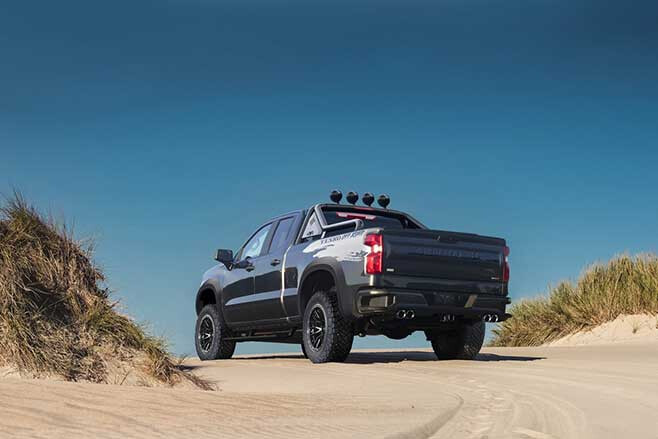
Yenko has applied its performance talents to the off-road segment in the form of the Silverado pick-up, with this supercharged beast of a rig, and it will be available in Australia in right-hand-drive configuration thanks to Melbourne’s American Vehicle Sales (AVS).
The near-on 600kW of power comes from a specifically built version of the 6.2-litre LT1 engine, with balanced internals featuring forged rods and pistons, CNC ported heads up top and fed by a centrifugal supercharger.
Yenko’s Specialty Vehicle Engineering (formerly SLP) has been a Second Stage Vehicle Manufacturer in the USA for more than 25 years, working closely with General Motors.
As such it is able to supply a three-year/60,000km warranty on the engine and driveline, including the specifically built six-speed auto transmission.
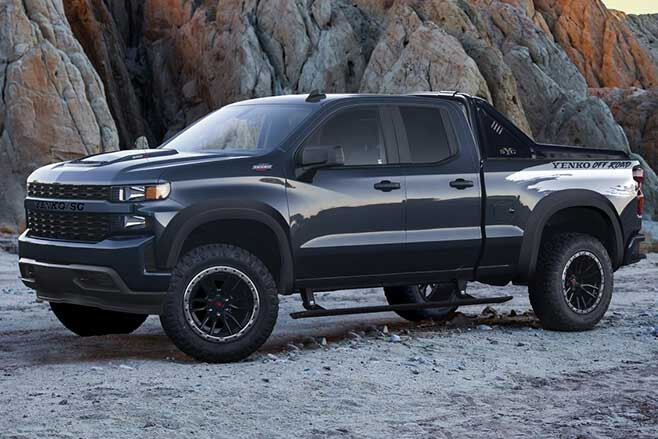
There’s more to the Yenko truck than just horsepower.
Off-road hardware has been addressed with a BDS four-inch, high clearance suspension system, with next-generation FOX shocks and HD Recoil traction bars designed to put the power to the terrain through Nitto on a choice of bespoke 20-inch alloy wheels.
Of course, the Yenko Silverado is loaded with plenty of exterior and interior kit to ensure it stands out from the crowd.
But all this kit doesn’t come cheap, and the Yenko off-road package will add $141,000 to the top of your Silverado purchase – so you’ll be looking at $250,000 to make one yours.
American Vehicle Sales imports, converts and sells a massive range of American vehicles including the various GM trucks.
The 2021 Yenko Silverado will be available to order as a complete vehicle direct from the US, or AVS can carry out the Yenko conversion in Melbourne to your own current model Silverado 1500. AVS can also tailor more affordable upgrades to your GM trucks.
SUVs and 4×4 utes continue to lead the recovery in the local new car market, but the overall market is still down 16.1 per cent for the year to November compared to 2019.
That said, November 2020 sales were up 12.4 per cent over November 2019, showing that the recovery is well and truly in full swing.
This comes as the government announced the country is out of the pandemic-created recession earlier than expected.
Look at the year-to-date numbers and it is clear the Ranger and Hilux are the biggest-selling 4x4s in the country, with each of them selling close to double the amount of units as the third-placed Prado. The Hilux is the biggest-selling vehicle in the country when you combine 4×2 and 4×4 sales, but it would take a miracle for the Toyota to topple the Ford in overall 4×4 sales this year.
The November success of the Hilux can be attributed to the updated model, with a gruntier 500Nm engine and revisions inside and out. The popularity of the updated engine flows on to the Prado, which took third place for the month and leaps ahead of the Triton for third spot on the podium year-to-date.
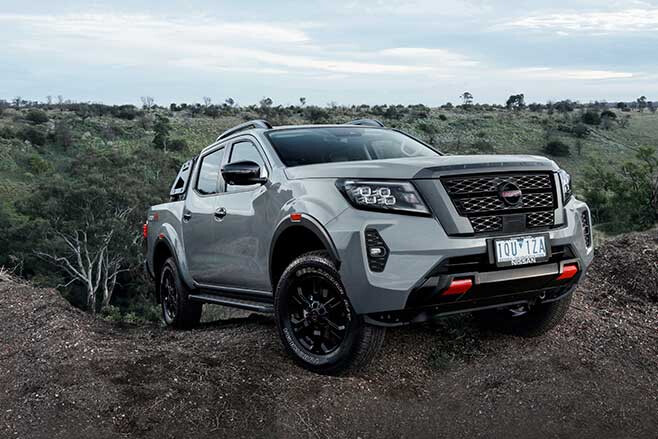
The big loser for November is the Nissan Navara, which is dropping down the table almost as fast as the Holden Colorado, a car that is no longer sold in Australia. Usually a top-five seller the Navara tanked to eighth in November, with the LDV T60 hot on its heels. The bolder-looking 2021 Navara that was unveiled back in October can’t come soon enough for Nissan Australia.
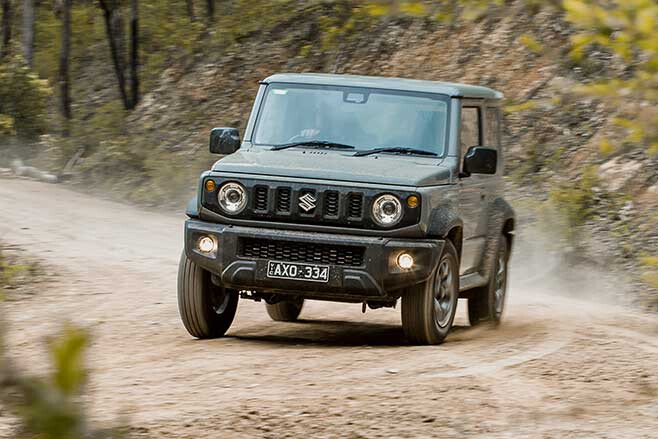
The smaller SUVs rarely get a mention here as there are so few of them that are genuine off-road-capable 4x4s, but the little Suzuki Jimny holds it own in the Light SUV category with 2180 sales so far in 2020. The top seller in this class is the Mazda CX-3, which dominates with 12,620 sales to November.
Just one more month of new car sales before we wrap up what has been a poor year in so many ways; let’s see if the positions change in December.
4X4 SALES: NOVEMBER 2020
- Toyota Hilux: 3854
- Ford Ranger: 3829
- Toyota Prado: 2602
- Toyota LC200: 1981
- Isuzu D-MAX: 1533
- Mitsubishi Triton: 1287
- Toyota LC79: 966
- Nissan Navara: 885
- LDV T60: 871
- Isuzu MU-X: 848
4X4 SALES: YEAR TO DATE (NOVEMBER 2020)
- Ford Ranger: 34,014
- Toyota Hilux: 30,313
- Toyota Prado: 15,534
- Mitsubishi Triton: 14,261
- Toyota LC200: 12,843
- Isuzu D-MAX: 8944
- Toyota LC79: 8737
- Nissan Navara: 8719
- Holden Colorado: 6687
- Mazda BT-50: 6304
BACK in the days when Corona was served with a wedge of lime on hot sunny days, our team at 4X4 Australia were launching into an in-depth look at the latest and greatest in roof platforms.
Low-profile roof trays had become all the rage but, truth be told, our evaluation plan was really an elaborate excuse to get out and play away from the office.
However, a sneaky bugger of a virus turned up uninvited on our antipodean shores and ‘just like that’ the entire world came to screaming halt, including our getaway plans. Now as doors begin to reopen there is increased interest in roof platforms and unprecedented demand for the adventure toys they transport.
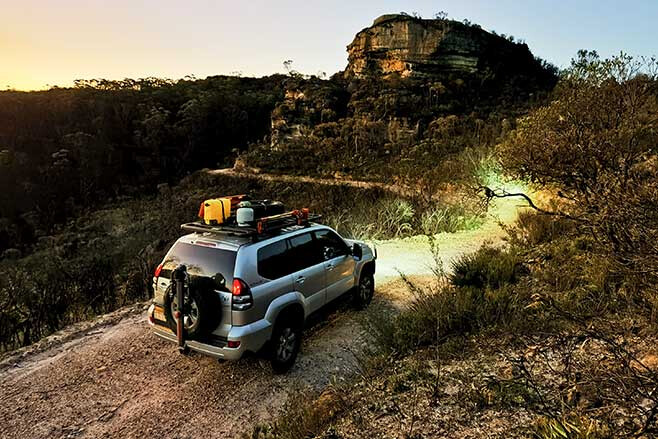
We agree, 2020 is a year we’d all like to forget, however it also brings the ten-year anniversary of Aussie engineers teaming up with US brand Yakima to deliver a rack designed to survive the Australian outback. As one of the largest roof rack manufacturers in the world Yakima’s unofficial motto has been “put gear on cars and friends in cars” and with domestic touring surging as we plan our post lockdown escapes, this motto is maybe more relevant today than it ever has been.
With this in mind we decided it was high time to fit its latest and greatest LockNLoad Platform to our trusty ol’ Prado 120. We then loaded her up with all the essential ‘adventure bits’ and buggered off for ‘a bit’ to examine the pros, cons and everything in between of the latest tech in roof carrying systems.
ONE FOR ALL
CAN a roof platform really do everything? Well in short … yes!
There is a reason low-profile roof platforms have become so popular in recent years. Rather than restricting roof-load placement upon vehicle-specific bars and rails, platforms offer increased space, load capacity and mounting options, along with a plethora of accessories for toys … and most importantly they look tough.
Yakima has a long history stacking stuff on cars and a brief history lesson reveals Otto and Jeanne Lagervall established Yakima as a small machine shop in Yakima County, Washington, USA in 1973. Otto, a tinkerer and inventor was a keen kayaker who began fabricating custom roof racks for paddle sports enthusiasts.
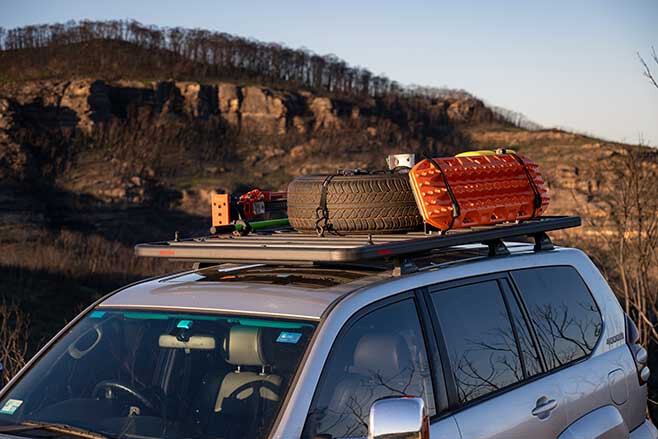
Outdoorsmen Steve Cole and Don Banducci saw promise in Lagervall’s venture and purchased the company in 1979 to relocate the brand to a remote but progressive region of California with a promise to, “put gear on cars and friends in cars.” Now based in Oregon, Yakima has delivered 50 years of doing just that, and continue to produce vehicle mounts for the attachment of sport, commercial and off-road equipment to vehicles globally.
Yakima’s cutting-edge modular e-coated aluminium LockNLoad platform is a long way from Ottos’ original tinkering, so we decided to fit a platform to our Toyota Prado 120 to test the brand’s paddle-sports heritage and see just how well it handled our five-metre, 30kg sea kayak, along with a load of other fun stuff.
The ‘Platform E’ arrives flat packed and immediately obvious is the robustness of the black powder-coated framework and the copious 21mm accessory slots on all slats, including a perimeter mounting track on the frame.
Clear concise instructions meant it took under two hours before two square metres of a fully assembled ‘vehicle adventure hub’ lay before us.
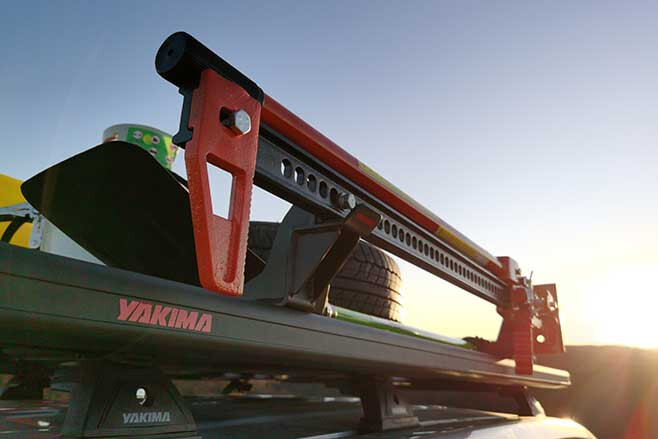
The LockNLoad platform offers track-mount, fixed-point mount or rail-mount options to suit most vehicle variations.
For the Prado we could use LockNLoad Raised Rail Platform Legs to fit to the roof rails or alternatively use LockNLoad Fixed Point kit to direct-mount to our Prado’s roof via the three ditch mounts (in which the factory rails are usually affixed). We chose to fix directly to the ditch mounts to offer a lower profile and deliver a maximum on-road/dynamic and off-road load capacity. (See ‘The Tech Stuff’ box for load details).
Fitting the platform to the roof is a simple process but best done with a mate and involves fixing a few mounting blocks to the legs and then fixing the legs to your vehicle’s mount points. The platform can then be lifted atop the legs before being secured to your ideal roof position with the provided easy-install slat clamps.
Once fitted, our platform was solid and secure, and throughout the entire evaluation period produced very little noticeable wind noise. The platform sits a little higher above the roofline than some competing manufacturers, but in part due to the bulk of the bombproof frame and in part to the slightly stacked leg and block fitment. One advantage to the heightened profile is extra clearance for those who have a tiltable sunroof, but we would ideally like to see an ever-so-slightly lower profile offering.
Our off-road adventures were adequately covered with Yakima’s extensive selection of 4×4 Accessories which secured firmly and solidly to our LockNLoad T-slots with a minimum of fuss. We combined eye-bolt kits, spare-wheel restraints, recovery track holders, shovel holder, high-lift jack clamps, gas bottle holder and jerry can holders to fill out our camping kit.
The installation and removal of accessories is where the small things matter, and we were excited to note T-Slot nuts with springs affixed to raise the nut off the T-slot base and assist with ease of installation. The SKS lockable Ace-O-Spades is a nice touch that kept not only our shovel safe but also our carbon kayak paddle, while the three-strap spare wheel restraint, eye-bolt kits and high-lift jack mounts all provided firm, solid securing of their intended accessories.
We chose to use the adjustable Corner Brackets and a tie-down strap to secure our jerry can horizontally rather than vertically and most importantly when we arrived at camp, we found the all-important bottle opener worked without a hitch, over and over again.
We discovered a few minor annoyances such as the gas bottle holder straps are too long to secure a regular 4kg camp-stove bottle, but a few twists in the strap shortened it enough to work. Also, the recovery track holder sits higher than we’d like when side-mounted but can be flat mounted for a lower profile, and both positions secure the tracks firmly in place.
Yakima’s heritage in car mounts for sport apparatus meant we had confidence in the LockNLoad platforms ability to fix our toys to the roof.
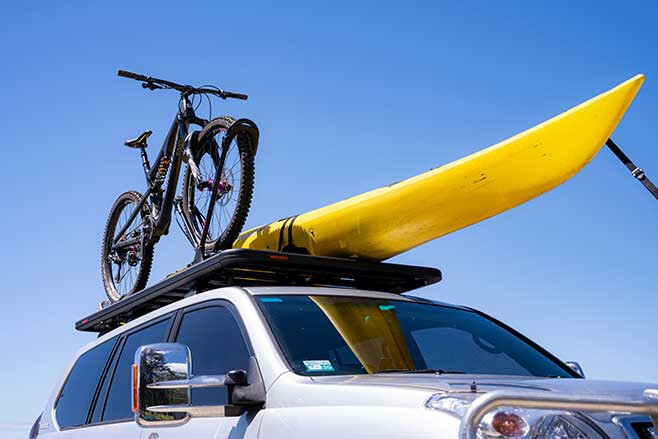
For the bike we fitted Yakima’s Front Loader bike mount. The front loader is tool-free, zero-frame-contact bike mount that secures the bike’s wheels rather than the frame and thus avoids potentially damaging carbon frames in particular. Tool-free attachment leads to quick installation and removal of the mount in just a few minutes by unlocking the SKS lock and tightening or loosening the clamps by hand.
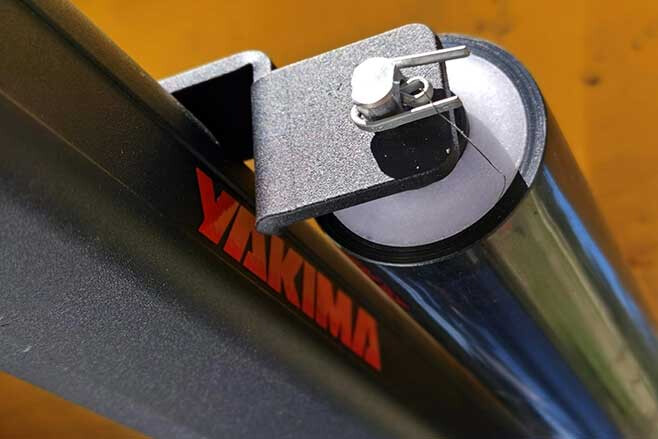
Yakima gets bonus points for this because when not in use we can simply whip the mount off to fit under those car park sprinkler systems. The Front Loader will accept a majority of road, hybrid and mountain bikes with wheels from 20 to 29-inch, tyre widths up to 3in and bikes up to 18kg.
Our only bugbear with the Front Loader is the clamp mounts offered only limited placement options on the LockNLoad Platform due to the placement of the fixed-point mounts. Fortunately, Yakima’s new HighRoad is a similar bike carrier but compatible with SmarT-Slot and so will fit to any of the T-Slots on the LockNLoad platform.
For our 5.13-metre, 30kg Exodus Sea Kayak we fitted Yakima’s rear loading ‘Sweet Roll’ kayak/ski mounts. The Sweet Roll’s neatest features are the small rollers embedded within the two rear hull-slides that allow the kayak to roll cleanly through the brackets. The brackets worked flawlessly and once again being tool free, allows for easy fixing and removal.
We fitted Yakima’s universal Load Roller to the rear of our platform to allow for an easier load and unload of the kayak but when we swapped the Dagger for our sit-on-top kayak, we found the 470mm width of the roller too narrow. We would like to see Yakima provide full-width rollers for the LockNLoad platforms.
We were excited to discover the AceO’Spades offered a very secure lockable paddle mount, but having such a low profile meant the paddle blade came in contact with the platform. A simple spacer should alleviate this issue. Bonus points go to Yakima however for its clever SKS Lockable Ripcord straps and Soft Strap system which provide a quality neoprene cover for those flailing loose tie down ends.
THE VERDICT
THE Yakima LockNLoad Platform is a solid, hard-wearing roof platform solution from one of the best manufacturers in the market. The system handled all abuse we threw at it, from loading timber for DIY to 4×4 accessories for a quick jaunt to the snow, and bikes and kayaks for local adventures.
The East West slats were one of our favourite features, allowing ease of attachment and removal of accessories. The design and build quality is of an extremely high standard and neither the platform or mounts failed us in any way throughout an extended evaluation.
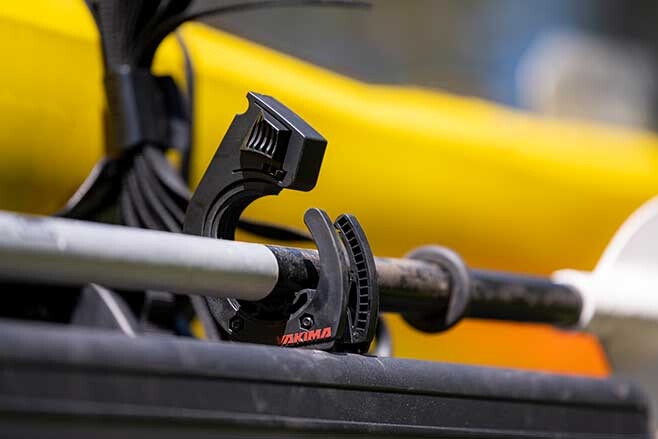
The Yakima LockNLoad system loses a few points for minor annoyances. Personally, we’d like to see a sleeker, lower profile mount and an ability to easily fix a roof box. We’d like to see some wider load rollers, height spacers for the AceO’Spades, more adjustment in the Gas Bottle Straps, a lower profile recovery track side mount … but all such requests are personal wants rather than a failing by Yakima.
In summary, the Yakima LockNLoad system does what it sets out to do, delivers a strong, durable, user friendly and stylish roof carrying system that certainly sits in the ‘best in class’ category when it comes to putting stuff on your car rather than in it.
THE TECH STUFF : LOAD CAPACITY
WE chose to fix directly to the Prado’s ditch mounts to offer a lower profile and deliver max on-road/dynamic load capacity. When fitted to the Prado’s existing ditch mounts, the Fixed-Point mount sat at 80mm above the centre mount and with the platform affixed atop delivered an overall height of 120mm above the roofline at the center mount.
The max load capacity of the E platform is 150kg and whilst each fixed-point leg can handle 50kg, the system is limited by the Prado’s max roof-load capacity of 120kg. If we deduct the platform, leg and mounts combined weight of 33kg then the max on-road/dynamic load capacity equates to 87kg. As soon as we venture off road we must deduct 30 per cent (for fixed-point mounts) and so we end with a max off-road/dynamic load capacity of 60.9kg.
Of note: Had we fitted our platform to the Toyota factory rails we would have raised our platform height farther whilst reducing our max on-road load capacity to 67kg. Deducting 50 per cent (for clamp-type mounts) would result in a rather limiting max off-road load capacity of 33.5kg.
RATINGS
BUILD: 5 / 5 Solid, durable with a confidence inspiring thickset profile
STYLE: 4 / 5 Smart, matt powder-coated finish slightly let-down by leg fitment which looks a little ‘stacked’. The fit-all-vehicle design is well considered but a flusher, lower profile vehicle-specific rail mounts like Rhino-Rack’s backbone generally fit and look better. Yes! We want to have our cake and eat it too.
FITMENT: 4.5 / 5 Easy to assemble from flat pack. Easy to fit platform to track legs (or existing roof rails). Universal fitment means for ease of installation on a variety of vehicles with roof rails, gutter mount, track mount, fixed point or crossbar. The assembly of x6 individual legs is more time consuming than some other brands … but we’re being picky.
DRIVE: 5 / 5 Excellent solid fit with very little wind noise on-road and no movement or creaking of mounts or accessories off road. Both tool-free and bolt-down accessories fix firmly and securely.
ACCESSORIES: 4 / 5 Well considered and large range of accessories for both 4×4 and adventure equipment, but a few accessories required some ‘tweaking’ to better accommodate our needs.
USE-ABILITY: 4.5 / 5 Extremely usable once set up but loses a few points for some minor annoyances, predominantly due to limitation of tool-free placement due to leg attachment points
OVERALL: 27/30
AVAILABLE FROM: www.yakima.com.au RRP: $1419 (LockNLoad Platform E 1235 X 2130 mm $979, Fixed Point Kit 3 Bar Toyota Prado 120 x 1 $149, Fixed Point & Track Legs mk2 (Pack of 6) $279, Height Packer Pack of 2) $12. WE SAY: Tool-free LockNLoad accessories are strong, sturdy and durable, and easy to fit and remove.
LEADING automotive distribution company Ateco Automotive has launched an online retail outlet – Upfitter – with all the gear you’ll need to kit-out your American pick-up truck.
As the company behind Ram Trucks Australia and the distributor of Ram here, Ateco has plenty of kit available for Ram. However, Upfitter also has products for Ford and General Motors trucks.
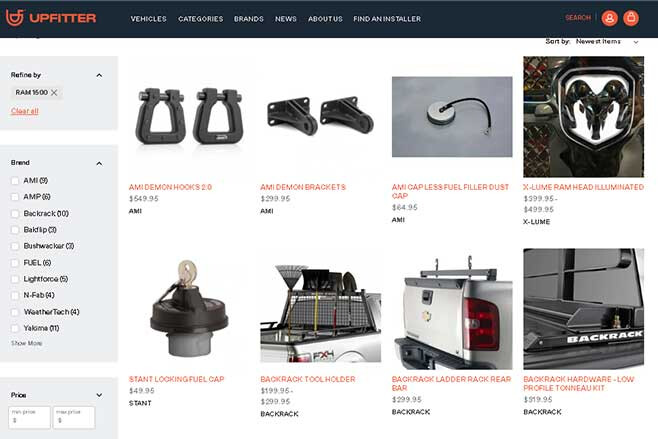
The list of brands represented on the Upfitter site reads like a who’s who of aftermarket US truck suppliers, including leading brands such as Warn, Katzkin, Lund Automotive, Lightforce, KMC wheels, Yakima and many others.
From bullbars to recovery gear and roof racks, Upfitter has assembled the world’s best truck and full-size ute accessories in one easy-to-access – and transact – location.
With access to more than 170 dealer and servicing points nationwide – via Ateco Group – installation and fitment of Upfitter products is simple.
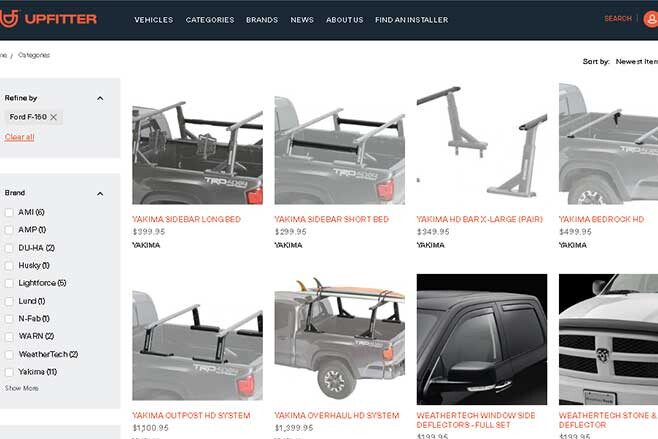
“Upfitter exists to empower full-size truck and ute owners in the customisation process of their vehicles by offering premium, highly-functional accessories and advice,” says David Smitherman, Chief Operating Officer of Upfitter.
“Camping, off-roading, road trips and fishing adventures – these are all activities rooted deep in Australian culture and require fit-for-purpose accessories. If the product comes from Upfitter, it means it’s an accessory we’ve tested and loved.”
Take a look at the full range of truck accessories on offer at Upfitter.
GET your 4×4 in tip-top shape for the end-of-year trip beyond the black stump, with this selection of quality 4×4 kit.
REDBACK 4X4 EXTREME DUTY EXHAUST: Y62 PATROL (02/2013-2019)
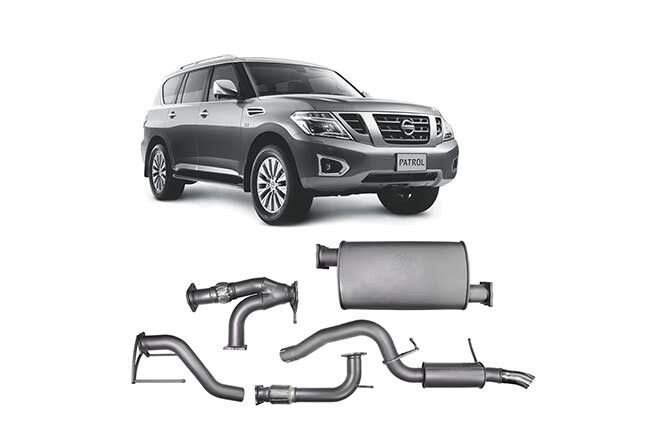
Redback 4×4 recently unveiled its Extreme Duty Exhaust system to suit Nissan Y62 Patrols built between 02/2013 and 2019. The system is designed and manufactured in Melbourne, and features three-inch pipework with four-bolt flanges (10mm, laser-cut), as well as mandrel-bent 409 stainless steel with premium heatproof paint protection. The Redback 4×4 exhuast system comes with a 10-year warranty. RRP: $1109 Website: redback4x4.com.au
SAFARI ARMAX PERFORMANCE CLUTCH
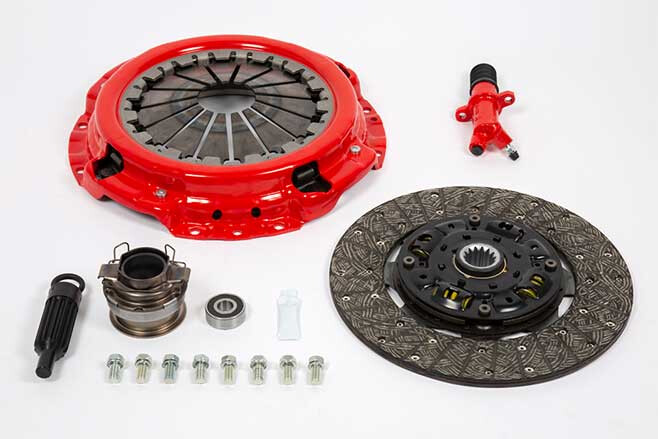
Give your 70 Series LandCruiser more grunt with a Safari Armax 4×4 Performance Clutch. Suited to the 1VD-FTV engine from 2007-on, the Performance Clutch provides a 250 per cent (1100Nm) torque capacity increase, but retains the standard vehicle clutch pedal feel. The uprated clutch also features a Safari ARMAX slave cylinder, with a long service life guaranteed – it comes with a 12-month, 20,000km warranty. Website: www.safari4x4.com.au
XD857 WHIPLASH
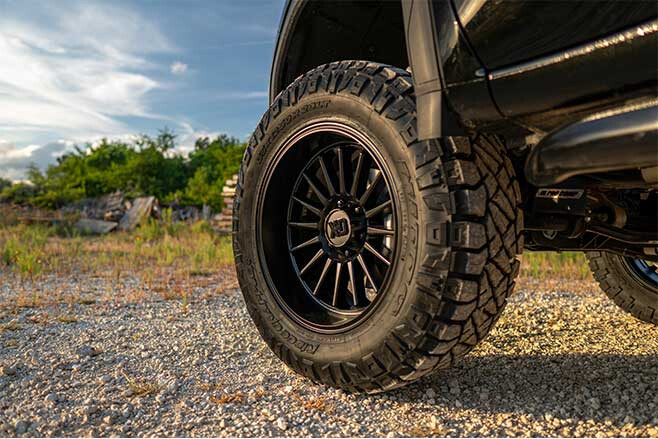
Wheel Pros has revealed the all-new XD857 Whiplash from XD Wheels is now available in a satin black finish. The 20-inch wheels feature a tinted, machined multi-spoke design (16 convex spokes, in fact), which combines with a deep, fat lip, giving it the neck-snapping aesthetics. The wheel also features a new XD cap with a removable logo and star, available in both black and red. Head to the Wheel Pros’ website to see the full wheel specs and size range. Website: www.wheelprosaustralia.com.au
THE 2020 Toyota Hilux has received the TJM treatment, with the aftermarket specialists releasing a range of products suited to the all-new model.
The upgrades start up front courtesy of TJM’s popular Outback and Chaser bullbars, which will both officially be unleashed on the Aussie market in December.
The Outback bar, designed to complement the Hilux’s new-look front end, features all-steel construction, 63mm-diameter tubing, all-new rolled cato straps and a multi-fold channel for increased safety.
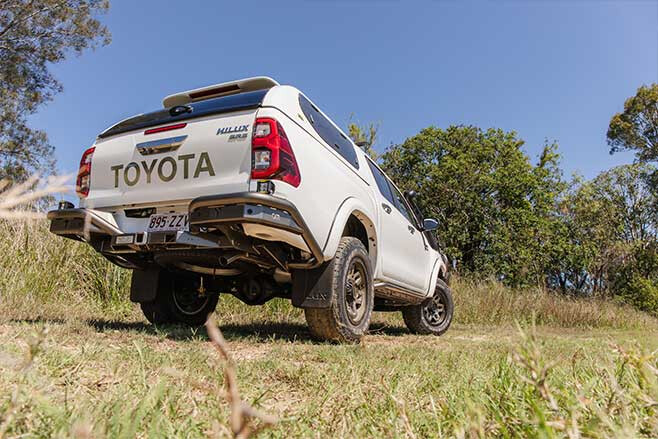
The Chaser’s point of difference is its aggressive angles, which is bound to turn heads on off-road tracks. Both bullbars feature 8000kg rated recovery points, and are ADR compliant and compatible with the Hilux’s safety systems.
Protect your Hilux further with TJM underbody protection, steel side bars, side steps, and a rear step tow bar. An Airtec snorkel will maximise engine performance.
Storage needs are catered for, too, courtesy of canopies, drawers, tailgate assist, roller cover and a ute liner – all from Aeroklas.
Hilux owners can also opt to improve their vehicle’s suspension set-up, with TJM offering upgrades for the Hilux via its XGS and Pace ranges.
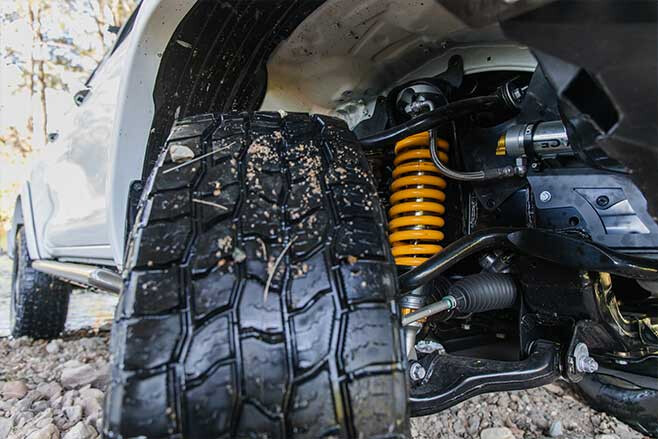
The XGS is a twin-tube shock absorber that features Multi-Stage Velocity-Controlled Valving, which “allows the shock to dynamically adapt to changes in terrain on the fly,” TJM says.
The Pace is a remote reservoir shock absorber, which features a large 52mm-diameter piston, single-wall monotube construction and steel braided hose – “Pace’s innovative eight-stage adjustability control over both compression and rebound allows you to easily alter the ride performance of your suspension to perfectly suit you and your 4×4,” TJM adds.
A TJM GVM Plus suspension upgrade, which lifts the Hilux’s legal GVM by up to 450kg, is available with both the XGS and Pace.
“The 2020 HiLux has bold new design cues and modern features that make it more capable than ever,” said Matt Logan, TJM’s head of customer experience.
“The TJM product range has been designed to complement everything that makes the Hilux so desirable, right the way through from its looks to its off-road capability.”
WHEN you’re the service manager of Australia’s leading brand of heavy-duty, oversize platform trailers, you get to know a thing or two about heavy loads and the rigs that haul them.
You know those massive low-loader trailers that have more tyres on them than the Lego factory makes per year; the ones that take up both lanes on outback roads hauling monster mining equipment – yeah? Well, Steve Collins is responsible for keeping those big puppies on the road.
With the time to retire from that job fast approaching, and with a plan in mind to spend a few years travelling Australia by road, Steve had some equally big plans for a vehicle and accommodation.
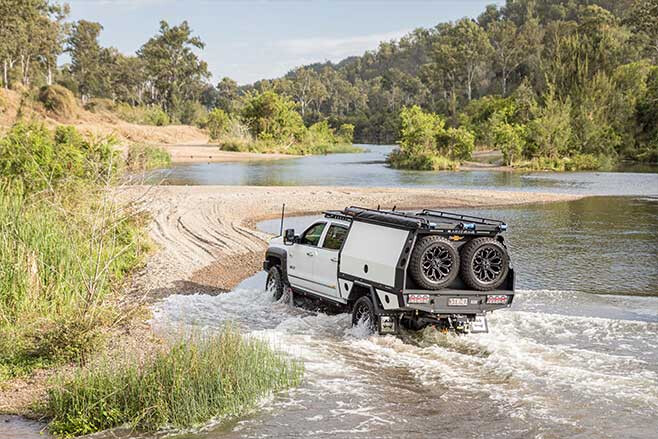
“We have a 22-foot Lotus Trooper caravan with a four-tonne GVM rating, so the 200 Series LandCruiser was starting to get to its weight limits,” Steve told us. “I wanted a good tow vehicle and HSV has a good reputation with service outlets over Australia. The Chevy was converted in Australia to Australian standards and optioned up for our road conditions, so I was happy with the package.”
The Chevy Steve speaks of is this 2019 Silverado 2500 LTZ which was imported and converted by the competent crew at HSV (now GMSV) in Melbourne. The 2500 is the smallest of the heavy duty (HD) range of Chevy trucks and in HSV-converted spec has 4491kg GVM and 4500kg (70mm tow ball) towing capacity.
Those specs are de-rated from what they are in the USA so that Aussies can drive one on a regular passenger car licence, but Steve knew he was going to push those limits. After years of working in the heavy-haulage industry he knew what was needed.
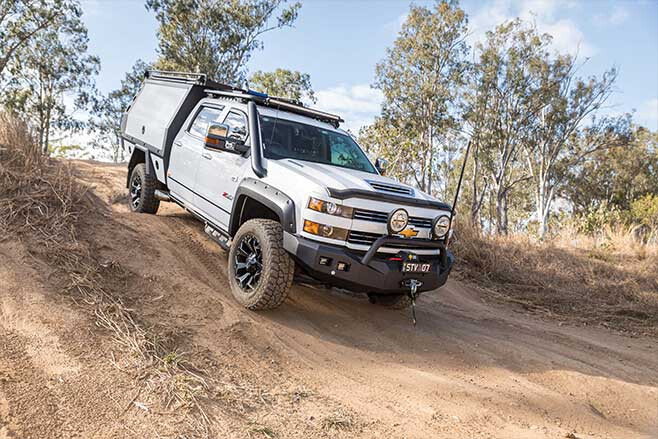
“We had to get a GVM upgrade to 5650kg, which means it’s classed as a truck,” he says of the Chev. “This means a Light Rigid truck licence is required and yearly machinery inspections.”
Steve saw Jamie Facer’s F250 when we featured it in 4X4 Australia and liked what he saw, so reached out to Jamie at Allsafe Mining Vehicle Equipment (AMVE) to do the build.
“Jamie looked after the custom aluminium canopy and full vehicle build,” Steve says. “Coming from a manufacturing background myself I could see the company’s (AMVE) ethics are first class and the finished product is something to be proud of.”
As well as towing the ’van the Chevy has to be able to cope with Australia’s gruelling outback roads and get Steve and his wife Marion in to those remote places the caravan can’t be towed in to.
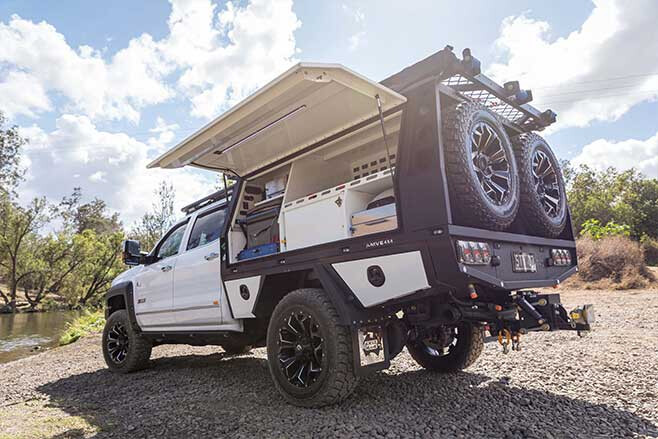
“When we venture where the caravan cannot go, we need camping equipment stored in the truck and canopy, including tent, stretchers, sleeping bags, chairs, table, fridge, cooking provisions and a water tank all onboard. We will be on the road full-time for around two to five years, so we need to have space to store our gear, tools, recovery gear, everything!”
Like the AMVE canopies on Jamie’s F250 and our own 4X4 Australia Ranger, the one on the Chev is made from aluminium and bolts directly to the chassis, not on a tray. This reduces overall weight, maximises interior space and allows for a lower floor to make access easier.
The massive canopy includes slide-out drawers on both sides, an MSA Drop Slide carrying an Engel fridge, a Travel Buddy oven, and a slide-out kitchen that includes the kitchen sink and a Weber barbecue. Toolboxes fore and aft of the wheel arches carry more kit including an ARB twin-pump air compressor. The compressor feeds an air tank underneath the canopy where there’s also a 100-litre water tank with electric pump, and a 250-litre fuel tank to keep that big Duramax V8 fed.
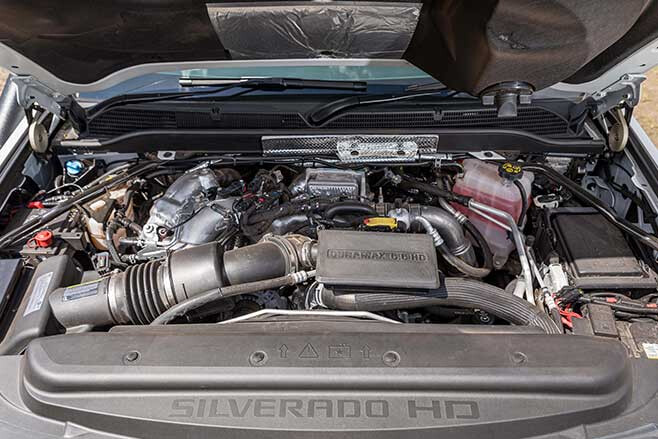
While we’re under the Chev it’s worth checking out the suspension. To achieve the required GVM and cope with all the Aussie outback could throw at it, Jamie fitted a kit from Icon Vehicle Dynamics using its shocks and upper control arms with the factory front torsion bars and reset rear leaf packs. The rear end is additionally boosted by Airbag Man bags to help with towing.
“We wanted the truck to be able to withstand the corrugations of the outback tracks so we had the suspensions upgraded and added a 17,000lb winch if we get stuck,” says Steve.
Power to tow shouldn’t be an issue with the big Chev; the 6.6-litre Duramax V8 puts out 1230Nm and 332kW as standard. Reece Hargrove at G&L Motor Repairs & Performance fitted a ‘Derringer’ tuner and Super Gauge from USA diesel specialists Banks to the engine. This clever unit provides power and torque boosts over six levels, selectable from the dash-mounted gauge which also gives readouts for vitals like EGT, boost and info from the OBD port so Steve can keep an eye on the engine.
The massive torque load goes through an Allison six-speed auto and on-demand 4×4 system. Plus there’s an Eaton auto locker in the rear diff from the factory.
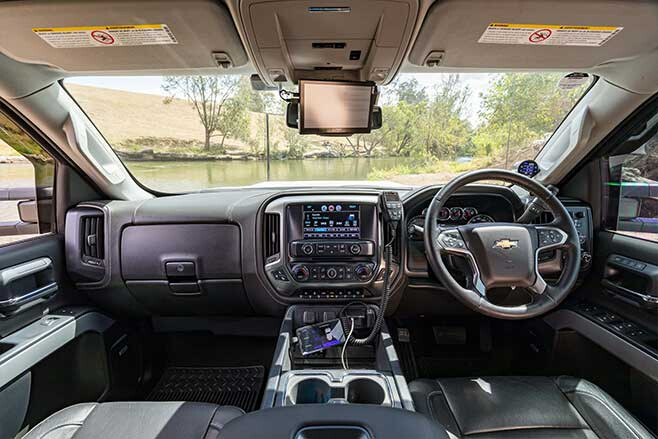
The fabrication skills of the crew at AMVE aren’t limited to the canopy, the front bumper was also made by the team and is now a part they offer for the big Chevs. On this application it is also home to the Sherpa electric winch, Hella LED lights and the antenna for the GME XRS Connect UHF radio. The bar includes its own rated recovery points, LED fog lamps and the factory parking sensors.
With the big white Silverado, which has appropriately been nicknamed Migaloo, complete, the only thing left to do is drive it.
“We went on a couple of trial trips with the van and it is a more relaxed, safer drive with the Chevy (compared to other 2500 pickups),” says Steve.
The plan is to hit the road in 2021 when hopefully there is lot more freedom across the borders, and make the most of the truck and van combo.
A FEW weeks ago a video went online that showed a local site that had been defaced with graffiti.
I rang around to see if anyone knew anything about it, but unfortunately that process proved fruitless. Thankfully, some kind-hearted and committed four-wheel drivers from a local club went and remediated the issue the next morning.
Generally 4WDers are interesting characters. Down to earth, knockabout, straight shooters who embody a camaraderie and willingness to get involved in every facet of the passion that is off-roading.
At the same time, the same attributes that exude that camaraderie can also be quite divisive. There are different sub-segments in our hobby: the tourer, the caravanner, the hardcore rock crawler, different age groups; and more than ever, brand-new entrants into the passion. As in any group, there are always some who can create issues on many different levels, unfortunately.
A short time after the graffiti had been removed, some more irresponsible activity was posted to a social media group. The group seems to consist of a younger generation which are more intent on challenging themselves and their vehicles; not really an issue because who doesn’t love to put their fourby through its paces?
However, the general 4WDing fraternity would clearly have a view on this sort of sub-segment. This activity quickly blew up for them in the shape of naming and shaming across other pages. Did they deserve it? I think they did, but what happened next is the point.
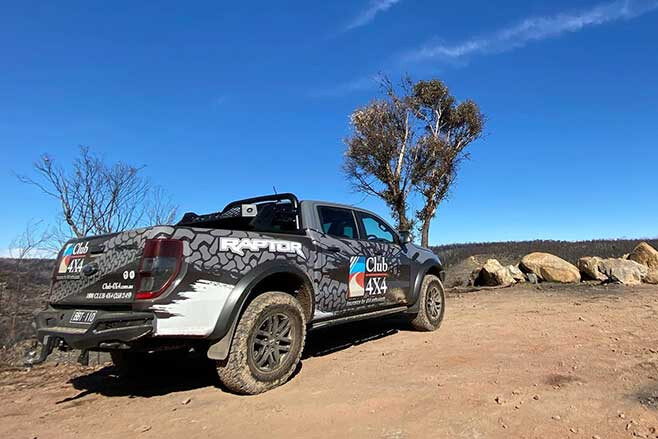
The administrator from that very page went out of his way to clearly and unreservedly apologise; taking complete responsibility for it in the process. Despite continuing to cop the brunt of criticism and sometimes unfair treatment, he continued, persevered and is really putting in an effort to improve the profile of this community he has built.
The proof will be in the pudding, but, as a risk-averse insurance business, this individual’s actions deserve some recognition and cred. When an mate of mine reached out to invite me along to meet with this individual, I was happy to oblige as I’d love to understand more about what he’s trying to achieve and to see if there is an opportunity to help him also understand different ways for all of us to contribute to a more safe and responsible 4WDing community.
There’s an old saying that goes something along the lines of “help people excel and so will you”. In a time when most 4WD-related businesses are seeing strong interest and growth, presumably being driven by more people wanting to see our countryside, these words can see us grow as a community.
Imagine if we could let go of judgement and typecasting? Imagine how powerful a force we would be if we focused more on educating and helping each other, espousing the mateship and camaraderie that is on the surface of our community?
A united 4WDing community, all supporting each other regardless of the age group or experience would do a lot better in getting the eyes of pollies to get our needs met – Kalen Ziflian, Club 4×4 Insurance
AS a four-wheel drive destination, the Grampians has some of the most scenic tracks in Victoria and, whilst not overly challenging, they offer spectacular views and memorable driving. An easy touring route can quickly turn into a remote track in this rocky wonderland.
Our love affair with the Grampians began way back, pre-kids, with a borrowed tent from the in-laws and loads of youthful enthusiasm. Over the years we’ve returned many times with family and friends, and I reckon we’ve tackled most of the walks, from easy lookout strolls to challenging treks. We’ve explored the major touring routes, but as we discovered recently there are always exciting new tracks to be found.
This time we’re back with two first-time Canadian visitors to Australia and our base is Lakeside Park on the edge of Halls Gap. We’d normally free camp, but we feel like offering a bit of mountain comfort for our overseas guests. It’s run by owner operators Josephina and Rohan McDonald, an enthusiastic couple who have transformed this once basic park into one of the most awarded in Australia. Its location is picture-perfect, nestled between Lake Bellfield on one side and a peaceful valley on the other.
Our international guests were enthralled with the amount of wildlife in the adjoining valley their swag opened to, as well as the cheeky cockatoos and crimson-coloured rosellas that are quick to steal a lunch. The biggest plus within the park is the wood-fired swimming pool, the only one of its kind in Australia, which is heated all-year ’round and the best tonic for tired muscles after a hard day’s bushwalking.
And bushwalking is what the Grampians is all about. Dominated by the craggy peaks of the Wonderland Range, Mt Victory Road and the Mackenzie River, it’s in the Central Grampians area you’ll find the largest selection of day walks, including the well-known trek to the Pinnacle, the Balconies and the majestic Mackenzie Falls.
It was to all these places we took our guests; as well as a mandatory trip to Boroka Lookout, an easy way to enjoy a spectacular view with the carpark only 25m away from imposing cliff tops. Later that night we ventured out for an easy sunset walk to Reeds Lookout and the Balconies.
GRAMPIANS PEAKS TRAIL
On the other extreme is the Grampians Peaks Trail, a project which when completed in late 2020 will be one of Australia’s premier long-distance walking trails. The 144km trail connects some of the Grampians most spectacular peaks, and links Mt Zero in the north to Dunkeld in the south. The walking is designed to be tackled in stages to suit each walker’s level of experience. The first completed section features the Halls Gap, Wonderland and Mt Rosea area and includes a three-day/two-night loop walk from Halls Gap to Borough Hits towards Mount William.
For those who enjoy remote camping there are 12 campsites run by Parks Victoria scattered throughout the park. One of the best free campsites is Plantation Campground found off the Mount Zero Road. It’s also known as The Pines and has about 30 free spots, ranging from tent-based sites through to large areas where you can park a camper or van. There are shared fireplaces, picnic tables, drop toilets, bucket showers and plenty of wildlife to keep you company.
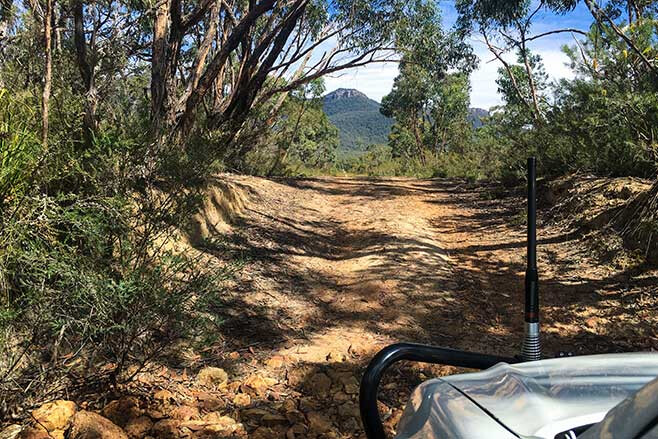
Less than five kilometres from Plantation Campground is Mount Difficult Quarry, one of the most fascinating and overlooked sites in the National Park. Located at the base of Mount Difficult, the Quarry (also known as the Heatherlie Quarry) provided a massive amount of freestone, used in some of Melbourne’s most historic buildings including Parliament House, the Town Hall and the State Library.
A tramway was built to link the quarry to the main railway line at Stawell. Today you can follow the signposted trail and see remnants of the equipment, accommodation houses and rock faces that still show the marks of the operations of the quarry.
In the southern part of the park you’ll find the small, secluded Wannon Crossing campsite, adjacent to the tranquil Wannon River. This campground is more suited to tent camping and is a short and easy drive to start the walks to the dramatic peaks of Mount Abrupt and Mount Sturgeon.
Mt Abrupt is a relentless climb but an absolute ripper. It rises steeply over 3.25km (one way) to the 827m summit and isn’t for the fainthearted. Thankfully, it doesn’t take much before the views are worth stopping for. And at the top, several hours later, as the terrain gets steeper and rockier the scenery is magnificent. Views across the Victoria and Serra ranges, the southern plains and Dunkeld make the Mount Abrupt hike one of the most scenic, and underrated, in the National Park.
HALLS GAP
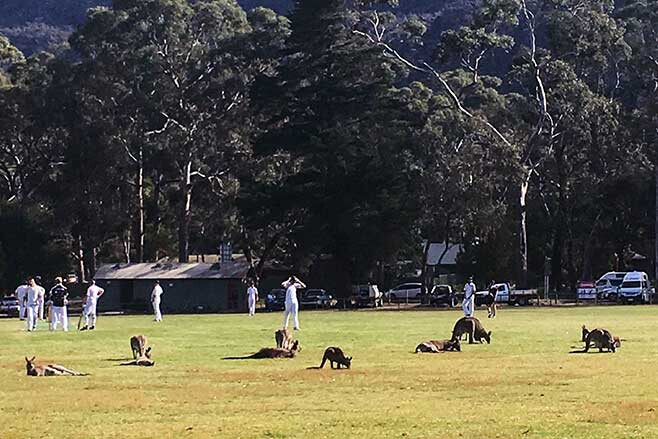
BACK in the hub of Halls Gap, you can stock up on supplies and fuel, and next door visit the Info Centre for local knowledge and maps. While you’re there you can also partake in a bit of wine tasting. Just keep an eye out for emus and kangaroos as you drive through town. At the cricket oval you’ll often find ’roos taking centre stage and playing extras in a local cricket match.
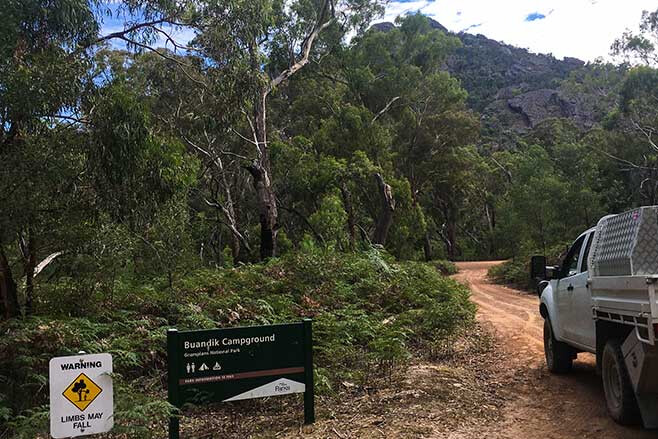
We were keen to do some off-road exploring away from the touristy spots so, once we refuelled and restocked, it was time to head out of Halls Gap, taking the turn off on to Glenelg River Road. After about 16km we arrived at the sheltered woodlands of Boreang Campground, a popular base for four-wheel drivers exploring the Victoria Valley and these more remote sections of the Grampians.
As we continued, in the distance we could see the peaks and craggy crevices of mountain ranges. Less than an hour later we were high up on top of the world on Goat Track as it winds its way over the Victoria Range, with spectacular views of the surrounding peaks. Goat Track is aptly named. It’s rocky and steep and, though it’s a relatively easy track in summer, with a bit of rain it could quickly turn challenging.
This track also gives northern access to Victoria Range Track and a few other seasonal tracks in the area, as well as a few Aboriginal sites. As we wound our way through the tracks that varied from dirt, clay, sand and rock we didn’t see another vehicle. We were hoping to tackle the more challenging Henham Track, but it was getting late. Keep in mind that while most of the main dirt roads remain open through winter, the tougher trails are subject to seasonal closures.
Coming back down and on the other side, venture beyond Roses Gap Road to Wallaby Tracks Road and enjoy a scenic route that has loads of interesting rock formations and a couple of places to stop and enjoy the views over the Wartook Valley. Within the Northern Grampians are tracks that head into the Mt Difficult Range and the Mt Stapylton area where there are easy walks to Aboriginal rock-art sites and other day walks to exposed mountain peaks. Hollow Mountain is one of the best walks in this area. To get there head up Plantation Road towards the Mount Zero area, passing the Mount Zero Olive Farm along the way.
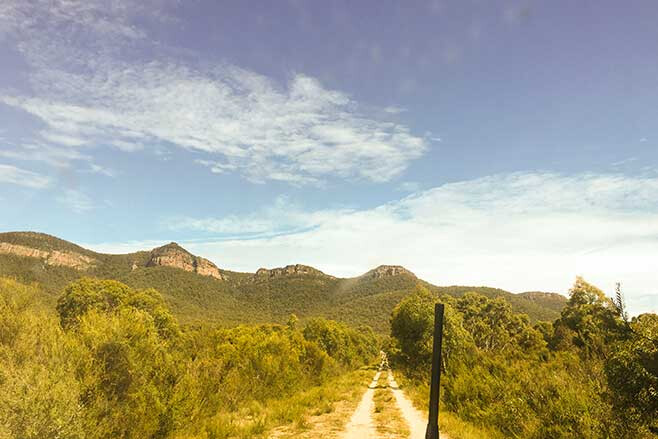
At the Hollow Mountain carpark, the walking track has a deceptively easy start with steps leading through a picturesque gully, however after about 200 metres you’ll reach the base of a cliff and from there onwards it’s all uphill. There are some nail-biting sections to this walk, before it levels out to breathtaking views of the Mount Stapylton Range and the Wimmera Plains. The wind-sculpted caverns of Hollow Mountain are truly stunning.
Getting lost, or even just a little bit immersed in the Grampians, is a perfect way to blow away those city cobwebs. In our uncertain times of travel, a weekend here, escaping the crowds in a remote campground will reignite your love affair with this spectacular part of Victoria. With just stars and birds and massive sandstone escarpments for company, it sounds pretty good to us. The best part is, with so many awesome tracks to explore, both on foot and by fourbie, it’s just three hours from Melbourne so you can come back and rekindle the love affair, all over again.
TRAVEL PLANNER
LOCATION: 250km from Melbourne or 460km from Adelaide
CLOSURES: Throughout the year Grampians National Park may have closures in place from natural events (storms, floods and bushfires), park operations and projects.
PARK INFORMATION: Phone: 13 1963
VISIT: Brambuk the National Park and Cultural Centre, 2.5km south of Halls Gap; Phone: (03) 8427 2258 or go online at Parks Victoria: www.parks.vic.gov.au
CAMPGROUND BOOKINGS: Brambuk The National Park and Cultural Centre, Halls Gap, phone (03) 5361 4000
OVER the years I’ve used a number of brands of different tyre-pressure monitoring systems (TPMS) but more recently I needed one that kept a check on my camper tyres as well as the tyres on my tow rig.
The importance of that came to light when we were up north a while back and I destroyed a tyre on the camper, which on investigation had been slowly deflating to the point of overheating and delaminating. With my old system limited to just monitoring four tyres, I went looking for something else that could handle at least six tyres.
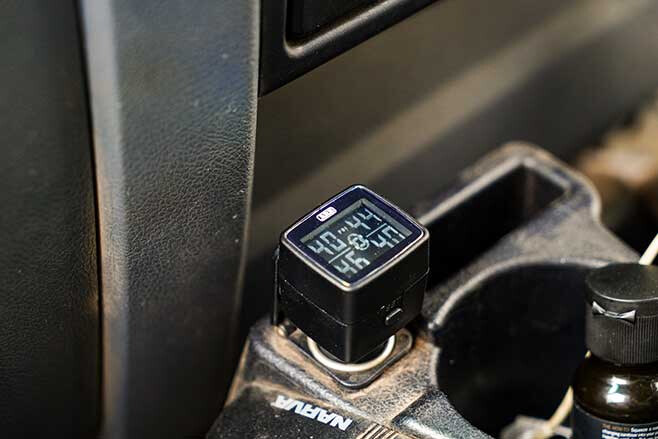
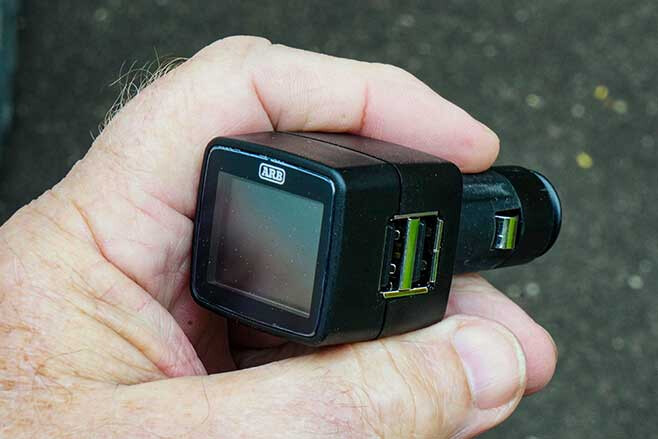
Nowadays there’s even more makes and models of TPMS around but after a bit of investigation I settled on the TPMS from ARB. They are not the cheapest you’ll find, nor are they the most expensive monitoring system, but I liked the way the display was part of the cigarette plug and you don’t have a separate display taking up space or vision at windscreen level. And there were other advantages.
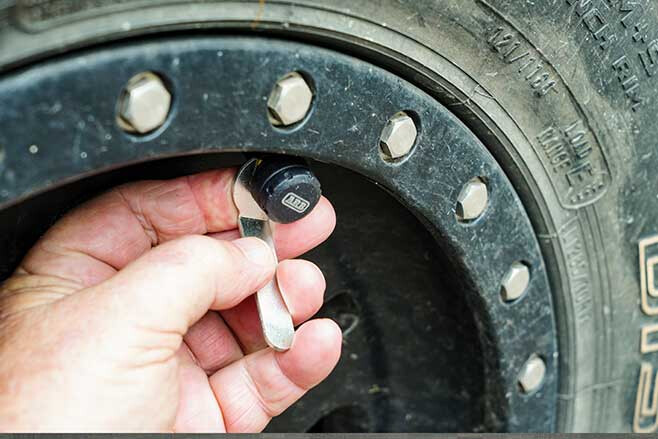
There are two different versions available in the ARB TPMS line-up: one with internal sensors or the one with external sensors which I chose. I’ve had monitoring systems before with internal sensors and they always seemed to get destroyed when some heavy-handed tyre fitter changed or repaired a tyre. I know these ARB units are different to the ones I had, but the suspicion remains and I’ve never lost or damaged an external sensor (yet?).
As previously indicated the complete kit comes with a display unit as part of the 12-volt power plug that also incorporates two USB charge port outlets. There are four tyre sensors in the standard kit which screw onto the tyres’ valve stem and the sensors powered by an internal replaceable battery which will generally be good for two years of operation. Also, a lock nut and a small spanner is supplied so that the sensors can be locked onto the valve stem to stop would-be thieves helping themselves.
For the camper trailer monitor kit there are two more sensors (up to a maximum of four) along with a transmitter extender, which is a small box that mounts somewhere on the front of the trailer’s A-frame. This extender needs separate power which can be either hard-wired into the trailer circuitry, or you can insert a couple of AA batteries to power up the unit.
I chose the latter and they have been working for some time now as the extender unit only powers up when it senses movement. With the trailer extender unit, the communication range is, by all accounts, good to at least 30 metres, which means it will handle everything up to a semi-trailer.
The TPMS kit also comes with four pages of instructions on how to set them up for the tyre pressures you normally run … and, I gotta say, I had difficulty initially with this. It turned out I had a faulty display unit and when that was replaced under warranty the set-up was pretty simple and straightforward, but a little too long-winded to go into here. And you need to follow the set-up correctly and holding the ‘Set’ button for exactly the right amount of time, as indicated in the different steps of the instructions.
The sensors use an audible and a visual alarm for tyre leakage, low pressure, high temperature, high pressure, low battery voltage and variations of +/- 25% of the set monitored psi. The kit can monitor up to five tyres as standard, and with the optional trailer kit it can monitor up to four extra tyres. As you’d expect you can set different pressures on the rear axle compared to the front wheels compared to the trailer wheels and still benefit from all the features of the TPMS kit.
One of the other great things about the ARB TPMS kit is that you can select one of two tyre-pressure profiles for on road and off road use, without having to go through the whole pressure set-up procedure each time. Pressure monitoring ranges from 5 to 30psi for off-road work and 23 to 80psi for on-road operation.
Once you have the sensors and display unit installed and set-up, the display unit will blink and then go to a solid readout as each of the tyre sensors connect wirelessly to the display unit. This normally takes a minute or less of driving and in my experience, all tyres are reading their appropriate pressures before I get out of my driveway.
So now I can drive our byways and highways safe in the knowledge that my tyre pressures are being monitored constantly with a visual readout to keep me informed, while any deviation from normal will sound an alarm to warn me of a problem. That’ll often save a tyre from being irreparably damaged, rescue a rim from irrevocable harm and safeguard some dollars, thereby paying for itself in just one saved tyre. And they could possibly save an accident or even a life!
Why would you not have one?
AVAILABLE FROM
RRP
Sensor kit (4 wheels): $169 Trailer Sensor kit (2 wheels): $85 Display unit: $139 Trailer Extender: $95 Extender wiring kit: $26
WE SAY
Ideal for the 4WDriver and cheap tyre insurance.