
Mount Isa in outback Queensland is widely regarded as a big, boring mining town, where travellers get supplies and pass through. Well, that’s what we were expecting as we headed towards this outback centre on our travels towards the Gulf.
Now, don’t get me wrong, Mount Isa is a huge mining-orientated city and the main mine has been in operation right in the heart of town since the early 1920s, extracting copper, lead, zinc and silver for the world’s markets. It’s regarded as one of the most cost-efficient mines in the world.
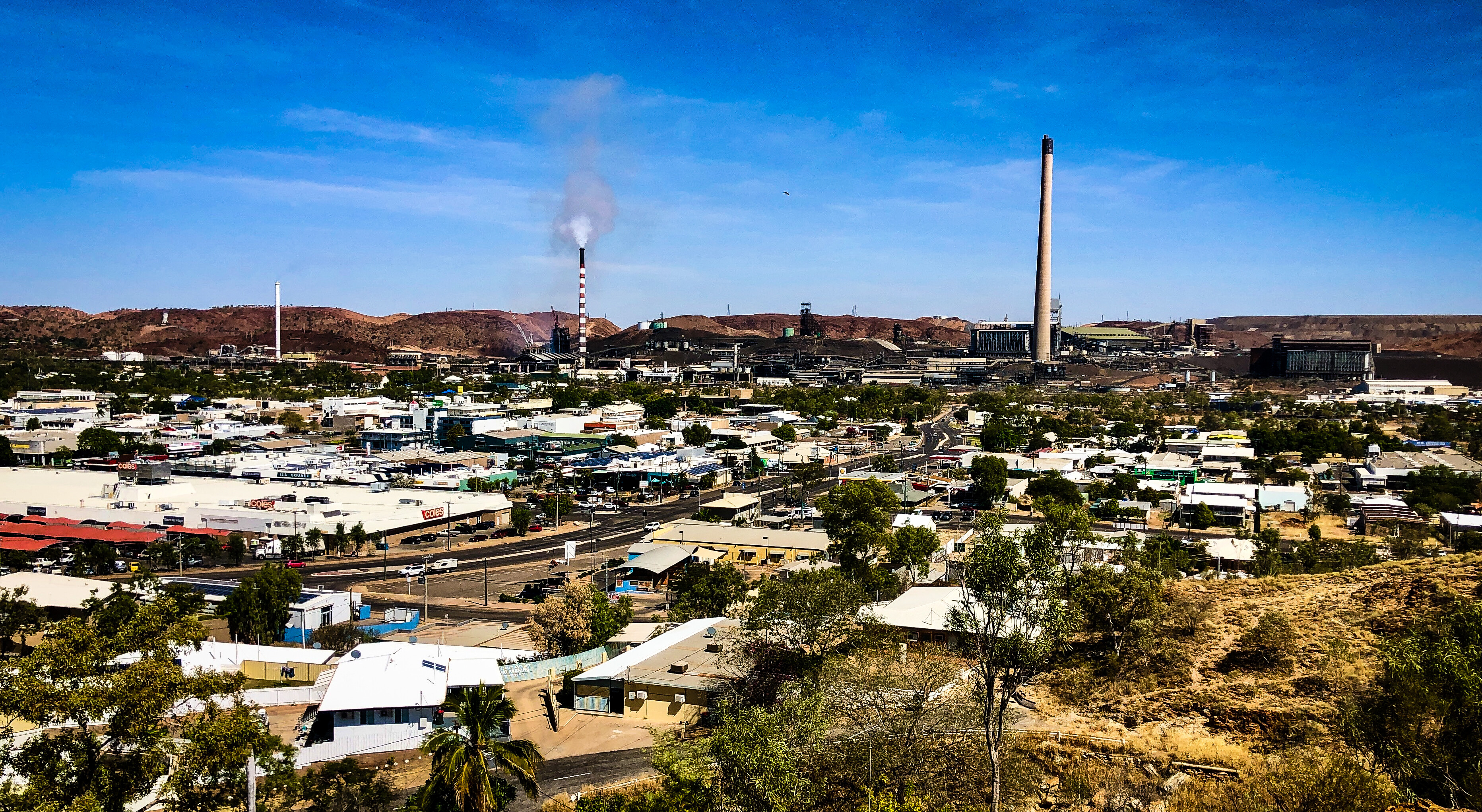
Mount Isa even lays claim to being the largest city in the world, as it covers a whopping 43,200 square kilometres; however, there’s no population in most of this area. In fact, just over 40 per cent of the town’s population works within the mining industry.
In town at the Isa Experience centre, there’s a mine tour, the Riversleigh Fossil Centre, and the standard coffee and gift shops. Just up the road in Camooweal Street you can visit the Underground Hospital and Museum, where back in 1942 this area was built just in case there was a threat from the Japanese.
To the north of town, the Leichhardt River was dammed in 1958 to provide a guaranteed water source for the town, forming Lake Moondarra where you can picnic, do a bit of birdwatching, slip a boat into the water, or simply rest under the shady trees around the shoreline. The lake has been stocked with barra and is a go-to place for locals trying to hook a big one. Finish the day with at the sunset lookout area, which provides views across the city.
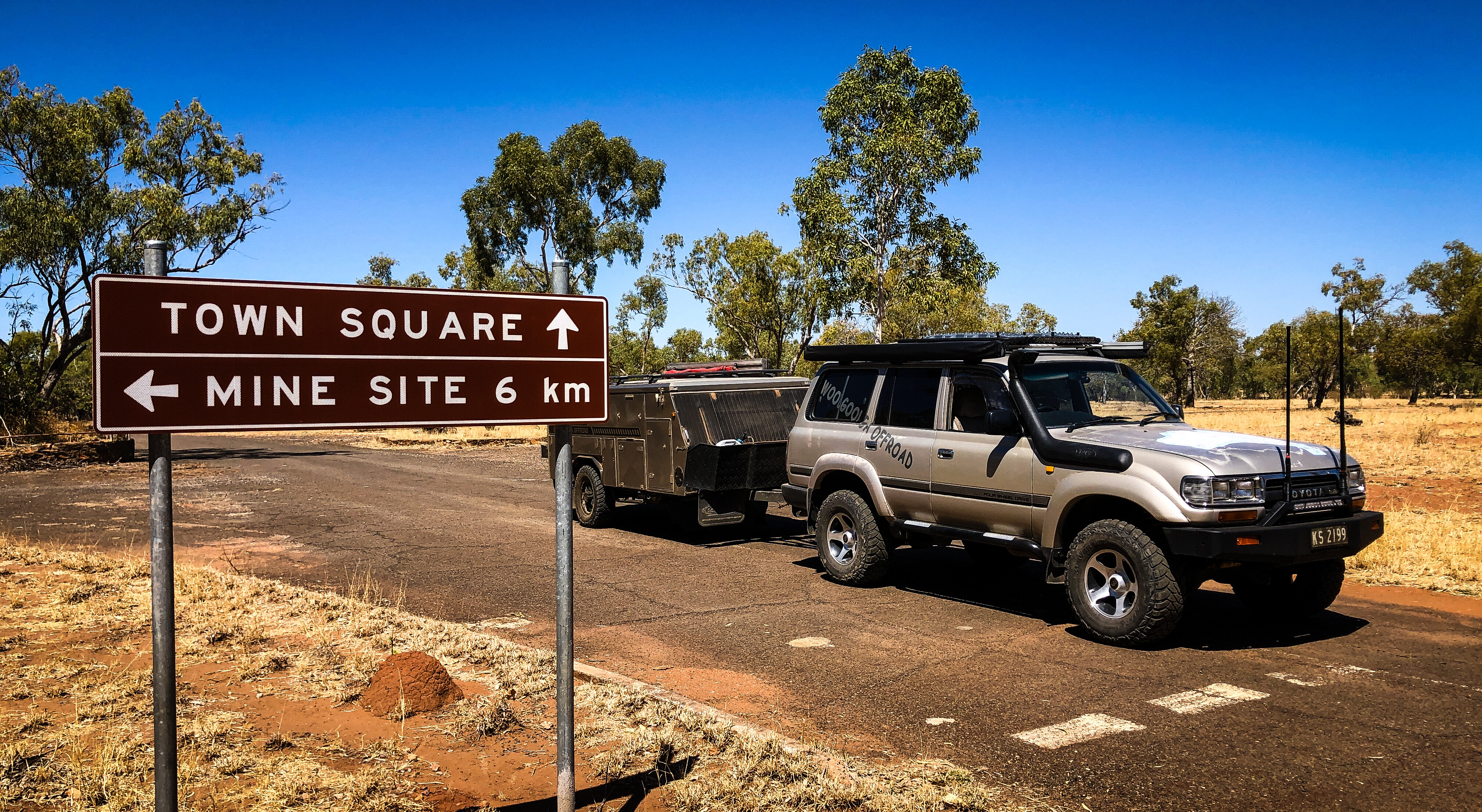
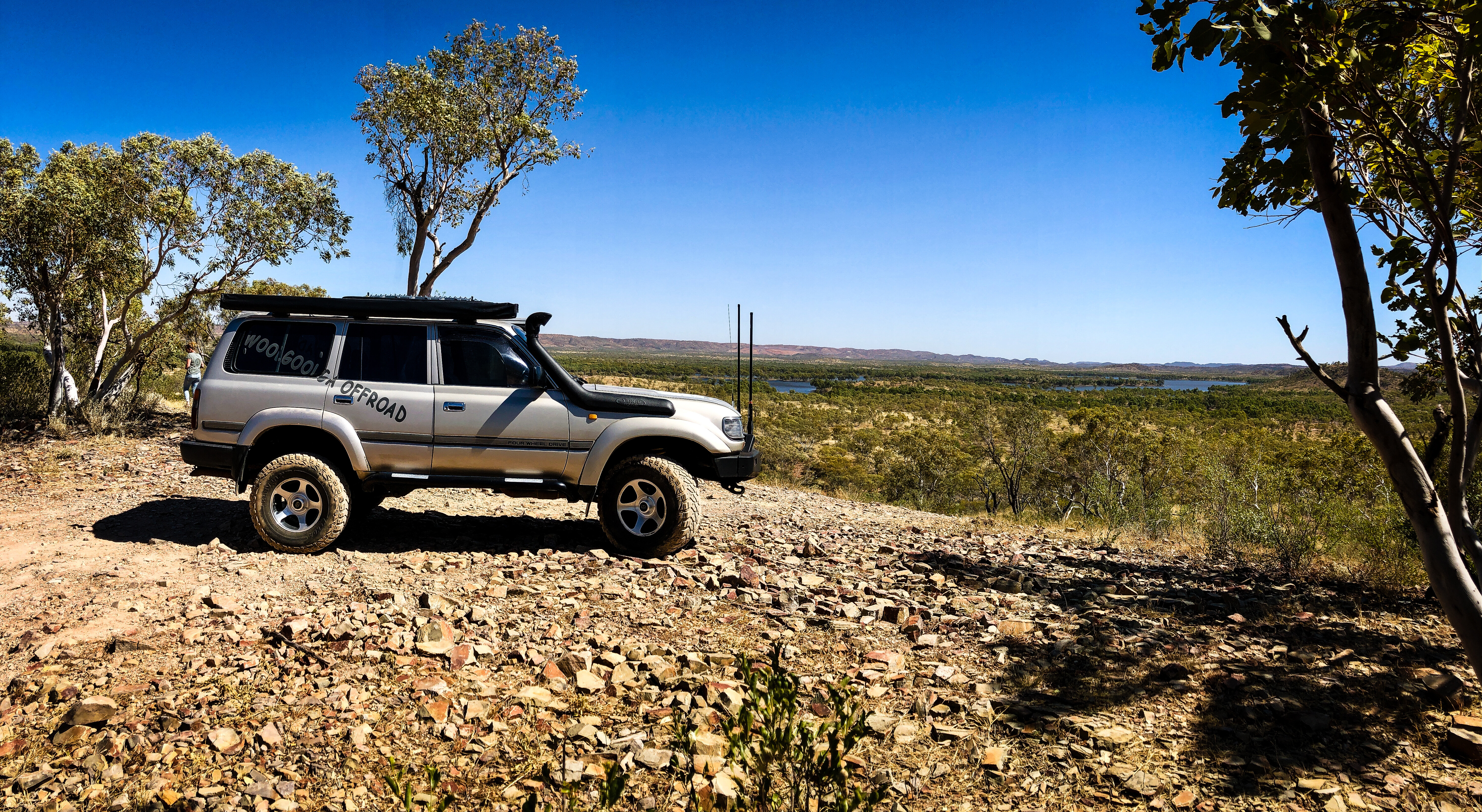
Gathering info from locals in town, we headed east for 65km towards Cloncurry along the Barkly Highway. Look for a dodgy roadside sign, where there’s beautiful free camping beside Corella Dam, which was built in 1959 for a nearby Uranium mine that’s now been decommissioned. Camping around the dam offers stunning waterfront views within the harsh outback environment which this area is known for. The road is in pretty good shape and leads to the dam’s boat ramp – where most campers seem to congregate – but we found with a little exploring there are even better spots if you follow the trails around the dam.
During the cooler months the dam gets packed with southerners escaping the cold winter to chase the redclaw crayfish that breed here. Redclaws are basically freshwater yabbies on steroids – they’re huge. However, you’ll need to read up on the regulations as there are bag and size limits on these mini-lobsters. We tried for days to catch some using meat, before learning they’re vegetarians and love over-ripe fruit and veggies.
“The road is marked as ‘extreme 4WD’ due to the narrow cuttings, rough terrain and sheer drops along the way, but if you’re game it’s totally worth the effort”
The dam isn’t used for commercial water storage anymore, so life around and in the dam is pretty good for the local birdlife and freshwater crocs. Apparently it’s a go-to place for many bird-lovers that roam the country looking for different species. We found the crocs prefer to stay away from the masses, and they’re best spotted at dawn or dusk in the more remote parts of the dam. It makes it easier if you have a tinny to explore, but there are plenty of 4WD tracks around the dam you can follow.
Surrounded by the stunning and rugged Selwyn Ranges, it’s hard to imagine this dam was once the lifeblood of a bustling town in the middle of nowhere. Just six kilometres away, the now abandoned township and mine area of Mary Kathleen has to be seen to be believed. Back in 1954, uranium was discovered by accident and, over the coming years, massive amounts of materials were excavated from the area and sent overseas. Reports say a staggering 9,000,000 tonnes of ore was processed through the plant.
After years of trying to stay afloat – and a few dodgy trade deals – the mine closed down in 1982. Despite rehab work, corners were cut and dangerous materials leached out of claimed safe areas. Today, it has all been fixed properly, and exploring the open-cut mine and processing areas is amazing. The buildings are gone but the infrastructure areas can still be seen, where huge concrete pads that once supported massive buildings and tanks remain. It’s the open-cut mine that takes your breath away, though, as staggering amounts of rock have been removed and the old roads that once circled the mine are still in place.
Over the years the mine has filled with water and the rich, mineral-based ground has turned it a stunning-yet-eerie iridescent crystal blue. The water is alive with small fish darting around trees that look like they have coralised in the water, where you can see down some 20 to 40 feet. Despite its beauty, you’d be a fool to jump in – just in case the impurities make you grow another arm or lose your hair.
A town was established nearby to support the mine, where more than 1000 people made a new life, and it wasn’t long before a school, post office, hospital, halls, shops and a movie cinema were built, giving life to Mary Kathleen. Life was good until the mine closed and the town subsequently died; despite efforts to reopen the mine in the early 1980s.
When the mine rehab work was in place the town also had to go; but instead of bulldozing the whole area into a big pit, the town’s buildings were auctioned off and taken away. Today, the only remnants are the concrete slabs, streets with curbs and gutters, and several monuments giving homage to those who once lived here. The good news is that it’s another area where free camping is allowed.
Digging a little deeper we soon discovered other mining interests pre-dated Mary Kathleen – in fact, there’s a mining trail nearby called the Ballara Heritage Trail. Starting midway back to Corella Dam and signposted right from the start, it’s a pretty cool trail to explore. The road in is pretty easy and stunning, with the Argylla Ranges towering over you as you wind your way along. Keep an eye out for the information boards on the way, where they’ll reveal POIs. After 20km you’ll arrive at where the old town of Ballara once stood. A walking trail through the ‘town’ leads down to a rail platform, where a narrow gauge line ran from Ballara to the mines almost 40km away.
Ore was found in the area in 1904 and another rush was on to stake a claim and hopefully become rich. With this came miners, families and infrastructure. At the peak of the boom, nearly 1500 miners battled the elements here and endured hot summers, the lack of water and cool winters.
Leaving the old town of Ballara, the road swings west as it follows the old tramway line. The going gets a little rough heading this way, but it’s well worth the effort as the road turns to 4WD country. On this drive keep an eye out for hand-stacked stone bridges, the old ore transfer stage, twisted pieces of steel and rough concrete pylons.
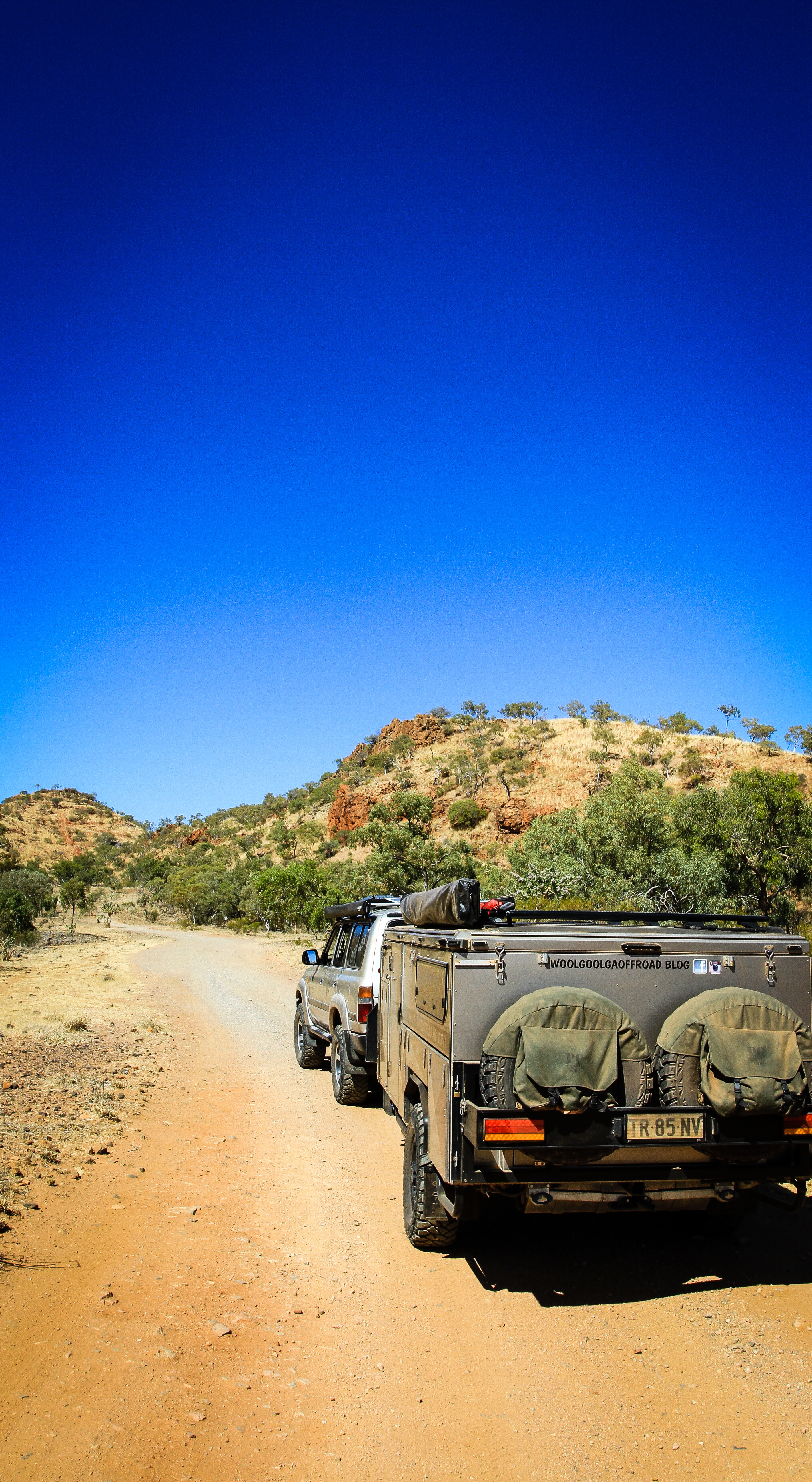
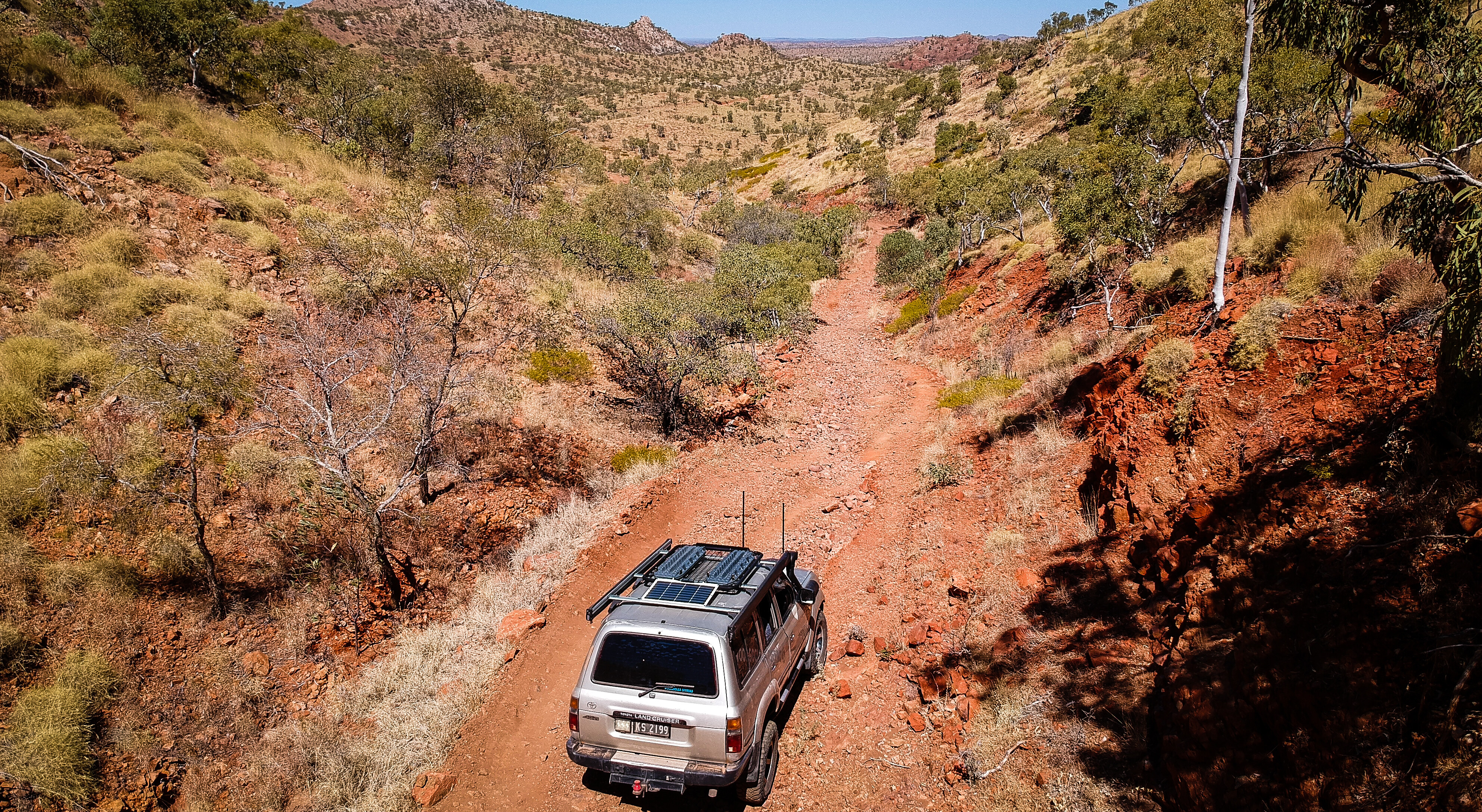
A lone grave on the side of the track pays respect to a miner who worked in the area; and made us reflect on how tough life would have been here. Not far down the track we came across the old settlement of Hightville. Again, there’s not much left, but a POI sign shows a picture of where there were houses, the local school, a hotel and several mines. Also highlighted on the information sign is a 100-metre-long hand-cut tunnel in the hills. The road is marked as ‘extreme 4WD’ due to the narrow cuttings, rough terrain and sheer drops along the way, but if you’re game it’s totally worth the effort to find the tunnel.
The tunnel was built by a gang of nine men, hired on a flat contract rate (plus dynamite costs). A small rockfall at the entrance doesn’t allow 4WDs to drive through anymore, but it’s pretty cool to walk through and gaze at this amazing piece of engineering. Inside you’ll find pick marks, blasting holes, communication wire and a few resident sheath-tailed bats. Thankfully, there is a heritage listing on the tunnel to preserve its history.
Out the other side is the huge Wee MacGregor Mine, where it looks like half the hill was moved to extract copper. The road down to the mine is classed as ‘extreme 4WD’, especially after storms pass through. Rehab works took place in 1975, but there’s still plenty to marvel at and ponder how they got the gear into this severe terrain. Several of the deep (nearly 100 metres) mines have had safety grates welded over the top, and looking down into them almost gave us vertigo.

It was a tough few years in the area: the tramway line took most of 1914 to complete; mine work was suspended in 1916 due to lack of water; and in 1917 the area was hit with extremely heavy rainfall, causing flooding and damaging the line. Sadly, in late-1917, the mine was closed due to diminishing mineral finds. The gear was sold off and the men paid out. Over the next few years the line was pulled up and the Wee MacGregor loco ended up on a cane farm.
Between Mount Isa and Cloncurry, across the stunning and often harsh ranges, there are a host of mines and related history dating back before the Mount Isa deposit was found. Random and isolated lone graves, open mine pits and tunnels, and relics from days gone by; it’s all part of our pioneering history that thankfully is being protected for years to come.
Almost a year after the first shipment of MY2021 Land Rover Defenders lobbed on Australian shores the 2022 models have arrived, and with them the introduction of the six-cylinder diesel ‘Ingenium’ engines.
There was a very small batch of four-cylinder diesels among those 2021 Defenders, but they were all pre-sold and most of the 2021 vehicles were powered by the petrol P400 six-cylinder drivetrain.
Australia is primarily a diesel market when it comes to large 4×4 vehicles, so many potential Defender buyers were keenly awaiting the arrival of the new engine which has landed in two states of tune: D250 and D300 variants.
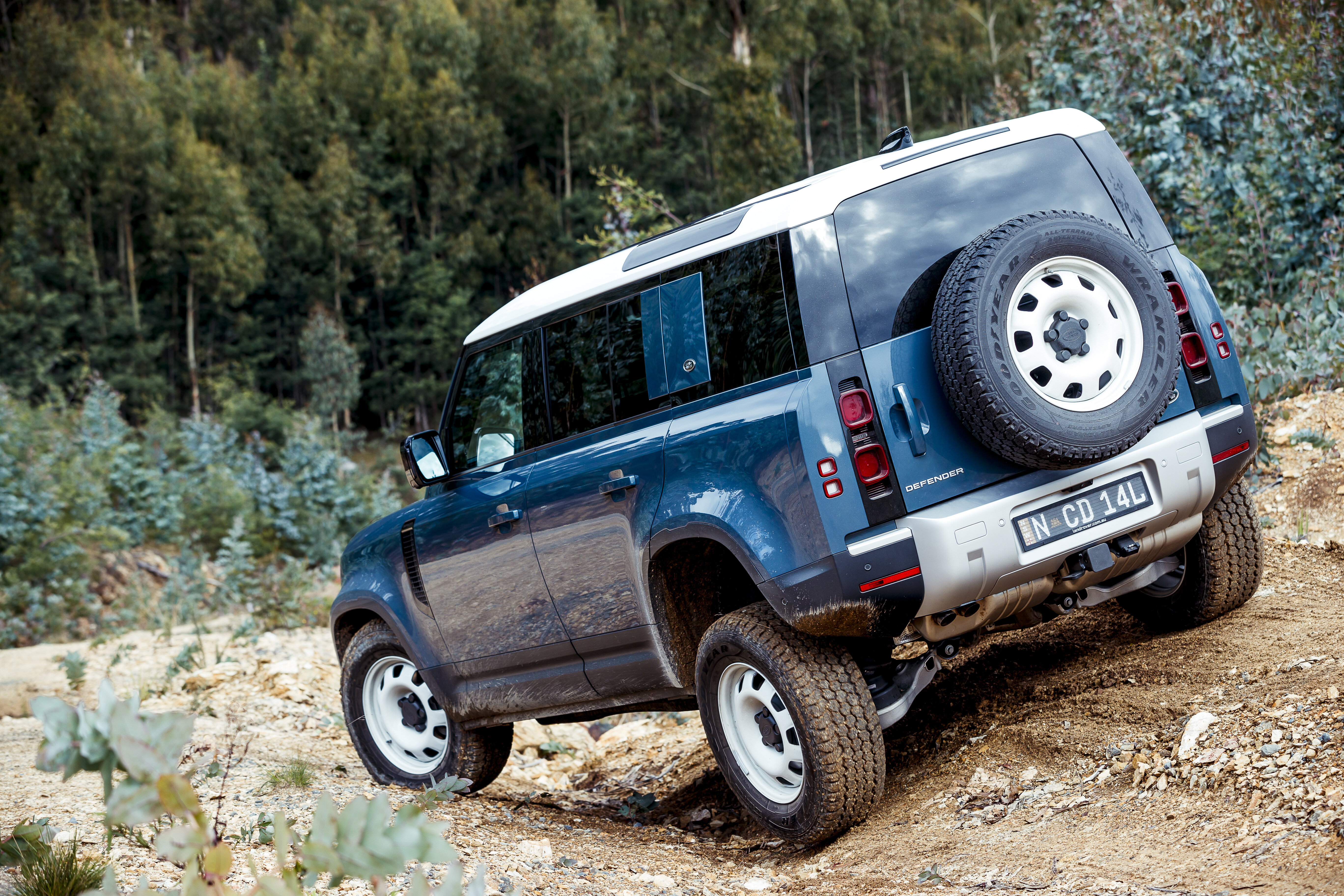
Our first taste comes with the D250, fitted here to a Defender 110 S along with a few options that are also new to the 2022 specification.
The base price for the car is $91,000, but start adding things like the height-adjustable air suspension ($1309); Off Road Capability pack ($2210); rear diff lock ($806); heated front seats ($806); white painted roof ($2171); and metallic blue paint ($2060) among others, and the price of this particular car climbs to $111,860 plus ORC.
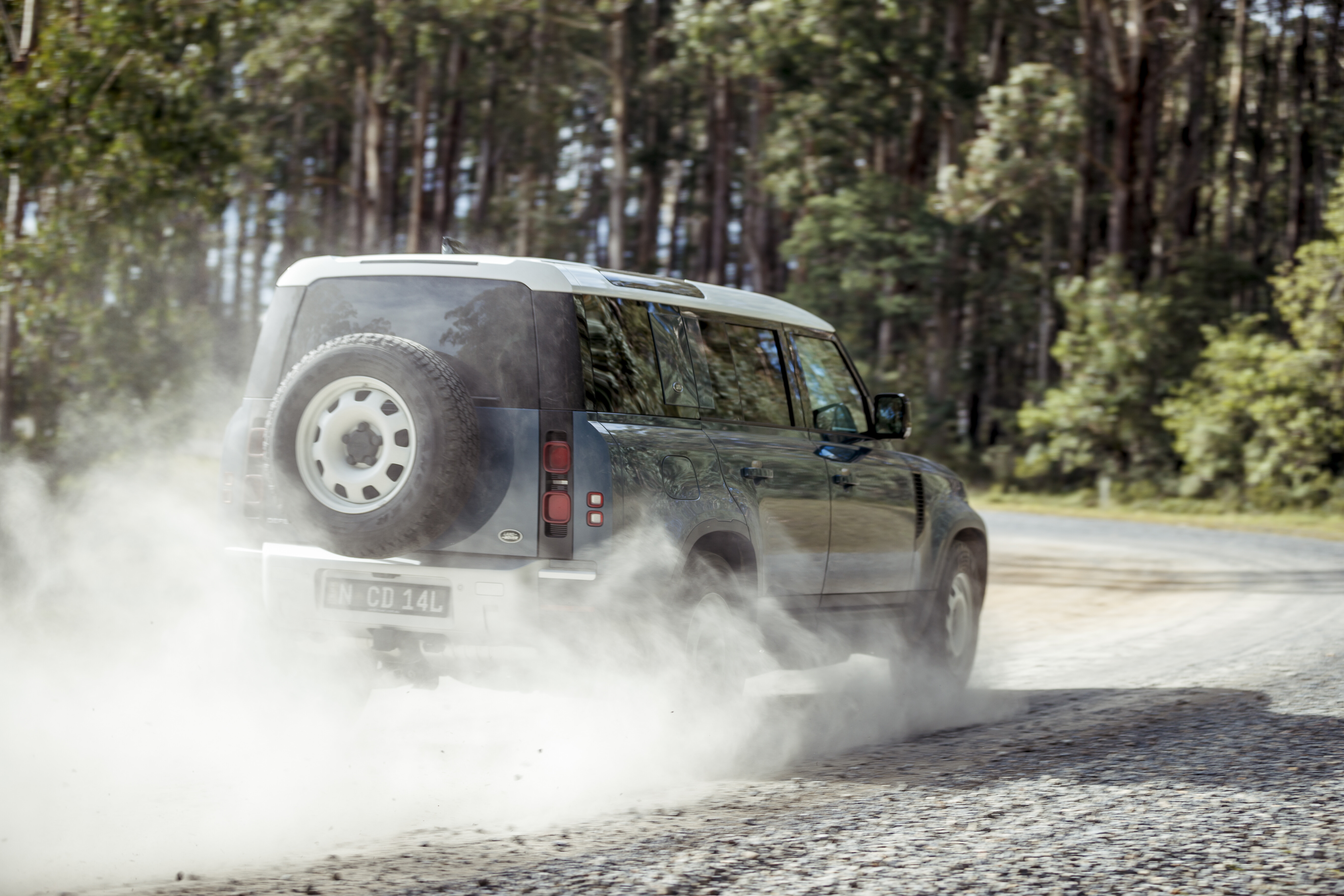
“Put your foot down on the throttle and hold the gears in the eight-speed auto and the six-pot puts out a sweet-sounding growl”
POWERTRAIN & PERFORMANCE
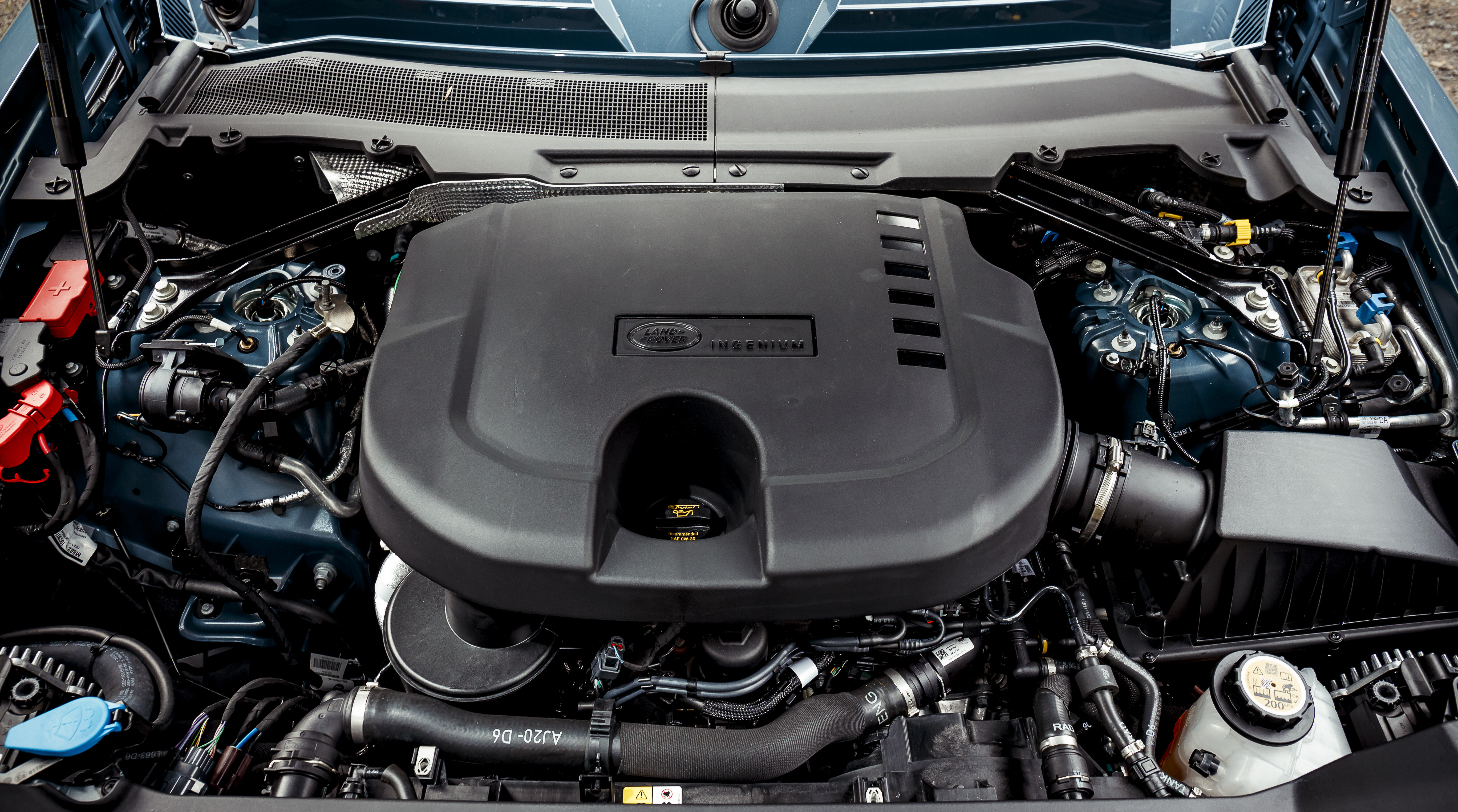
The new Ingenium diesel is a 3.0-litre in-line six with twin turbochargers set up in a sequential system. In this D250 trim it makes a healthy 183kW and 570Nm. Step up to the D300 engine, which is only available in SE spec and above, and you’re getting 220kW and 650Nm from the same hardware.
The Ingenium family of engines is modular so, put simply, the six-cylinder is the same as the four-pot, with another pair of 250cc chambers tacked on to the end. Like the other Ingenium engines, the six-pot diesel runs a 48V system in what Land Rover calls a mild-hybrid system; although, there is no electric-driven drive delivered back to the powertrain here.
The low tune of the D250 never leaves you wanting more in the 110. It’s a smooth and refined engine, providing a linear power delivery through its rev range. It’s also very quiet inside the cabin and, when compared to the P400 petrol engine, you’d be hard-pressed to pick that this is the diesel during normal driving.
Put your foot down on the throttle and hold the gears in the eight-speed auto and the six-pot puts out a sweet-sounding growl, again comparable to a performance petrol six.
During our week with the D250 it returned 11.37L/100km of fuel consumption, compared to high 16s previously recorded during similar drives in the P400 petrol Defender. If the P400 is the performance engine in the range and the D250 is the economical one, we can’t wait to find the middle ground in the D300!
ON ROAD RIDE & HANDLING
Everything we’ve said about driving the P400 Defender in the past applies equally to the D250. There’s no discernible difference in the weight over the front axle that you might find in many diesel-driven vehicles over their petrol stablemates, while the power is sufficient if not up to that of the P400.
The height-adjustable air suspension does a fine job of isolating the body from rough roads and irregularities in the surface, and controls the vehicle over harsh corrugations better than anything with a live axle ever could. If there’s any more lean in the taller tyres fitted to the 18-inch wheels on this car, we didn’t notice it.
OFF-ROAD
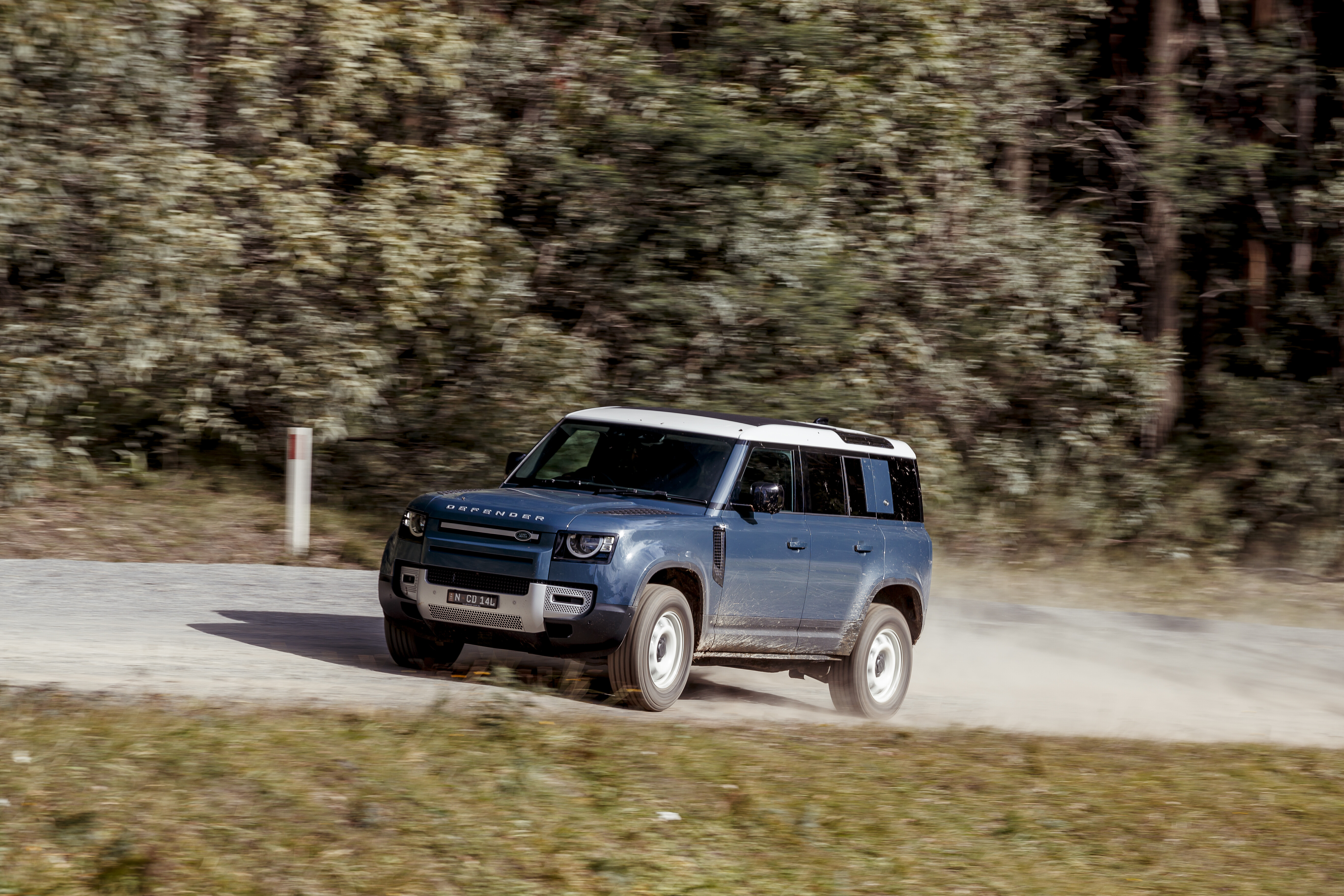
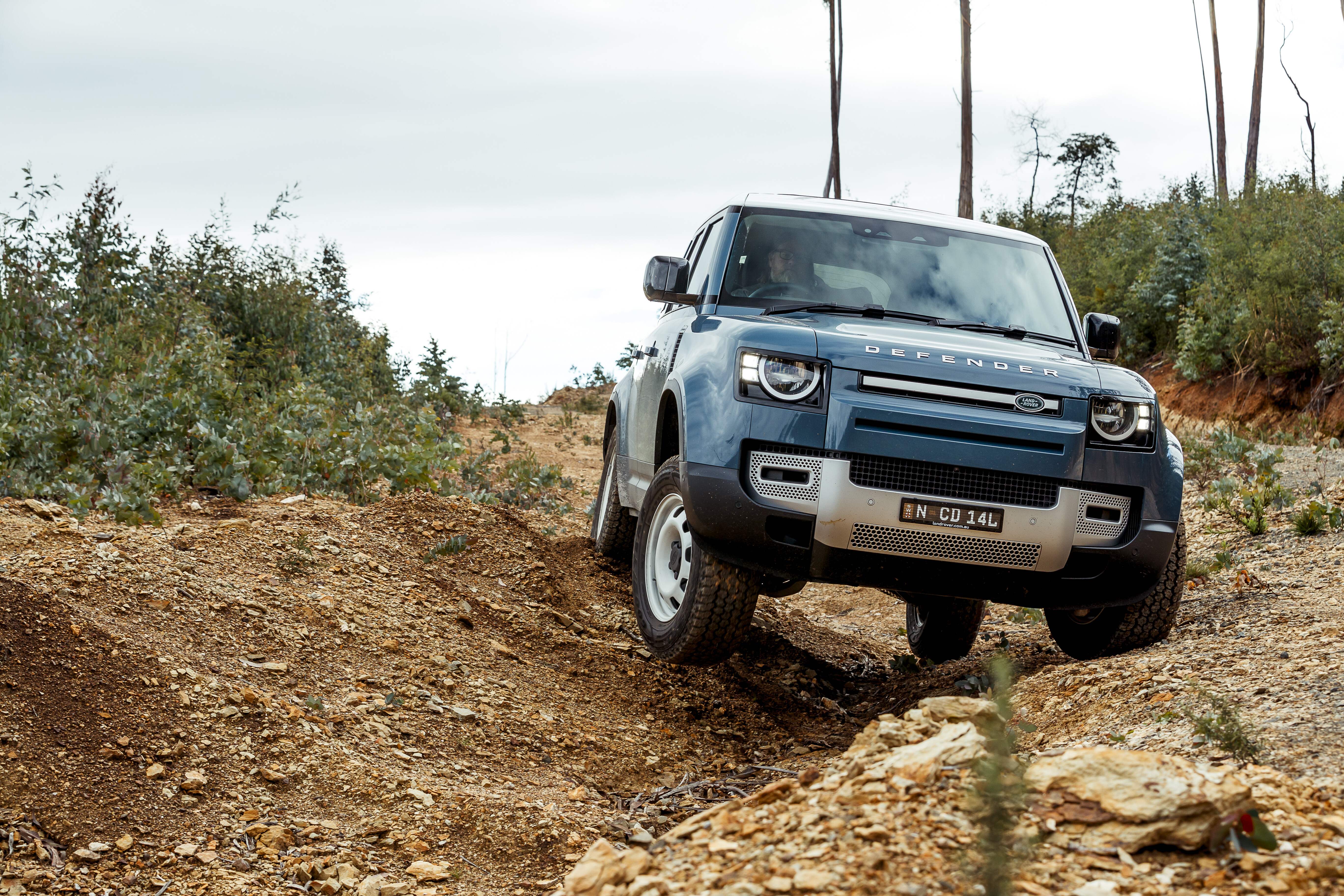
We’re yet to drive a new Defender on coil-spring suspension, and even this S-spec car is equipped with air suspension which is optional in this grade. Thus equipped, the Defender is one of the most capable off-road vehicles you can get from the showroom. Ground clearance, tractive ability, outward vision, wheel travel and technology are all class-leading. Fitted with a set of aggressive off-road tyres, the new Defender could be unstoppable.
Yes, you do need to keep the suspension up high to get the best of that clearance, and the ride quality suffers a bit at that level, but that’s something you can work around. The Terrain Response system isn’t as simple as it used to be, but the new ‘Auto’ setting means you can forget about it over all but the most specialised terrain such as sand or rugged rocks, when you can manually select the specific setting to suit.
There really is nothing else on the market that can combine this level of off-road ability with the on-road poise and dynamics of the new Defender.
One gripe for off-road driving is where the front towing point is mounted behind a plastic panel, which you need to remove before you head off-road if you think you might be needing quick access to said point.
CABIN & ACCOMMODATION
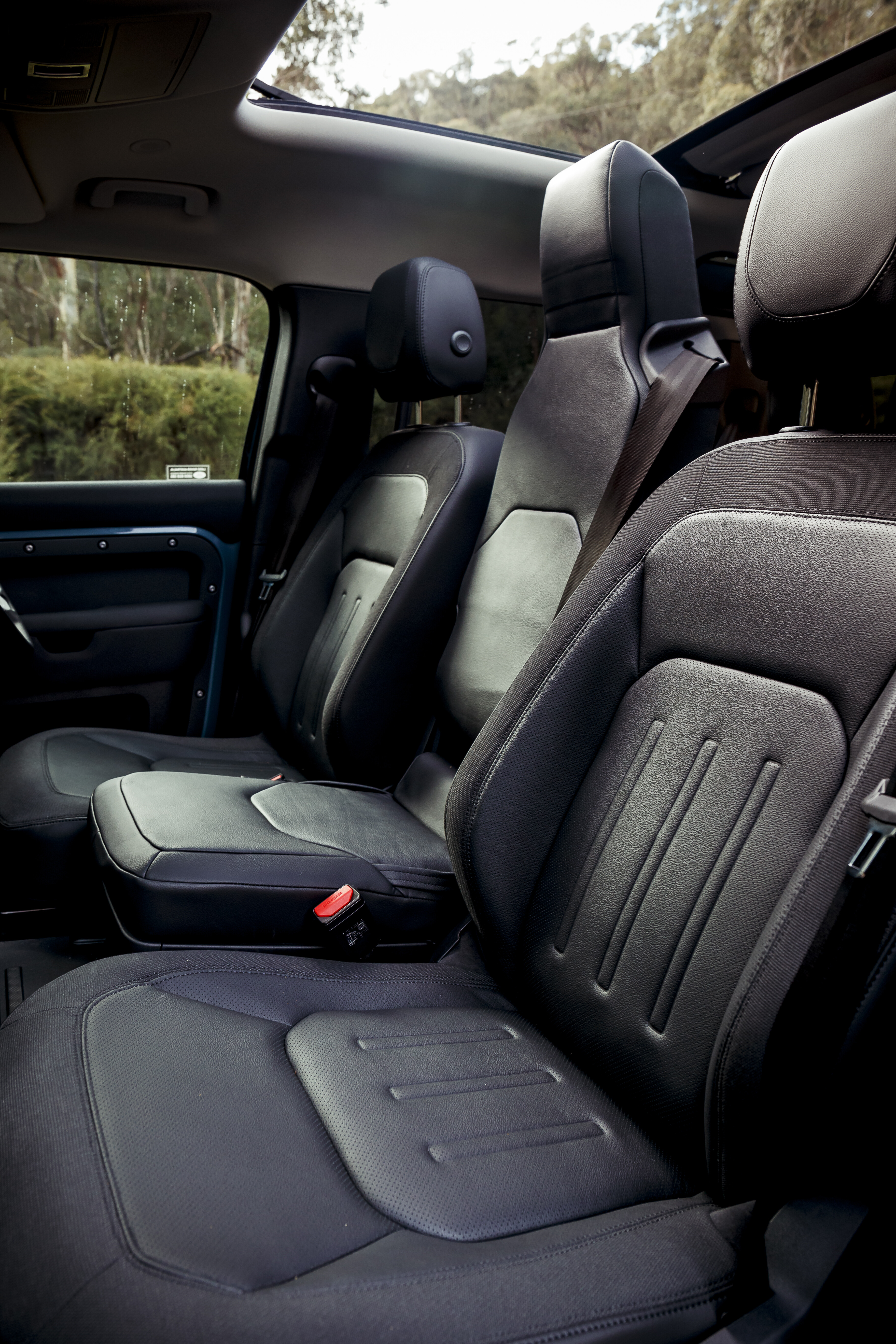
IT might only be the S model in the range but this low-grade Defender doesn’t leave you wanting anything inside. The seats are a mix of leather and textile materials and offer comfortable seating for six passengers over two rows.
Yes, that’s right, this car is fitted with the optional ‘jump seat’ up front which allows three across the front row. This is an $1853 option and choosing it precludes the possibility of equipping the car with a third row of seats. So no, you can’t have an eight-seat Defender because of the payload and GVM.
The centre front backrest folds forward when not in use to provide an armrest with cupholders for the outboard passengers. With the backrest upright, its headrest blocks any vision out the back of the car via the rear view mirror. This car is fitted with the ‘Clearsight’ rear-view mirror which projects an image of behind the vehicle from a camera mounted on the roof, but it’s a weird perspective I personally can’t get used to.
You’d have to really need the jump seat to order it, but I could see it being more useful in the Hardtop Defender models with just front-row seats.
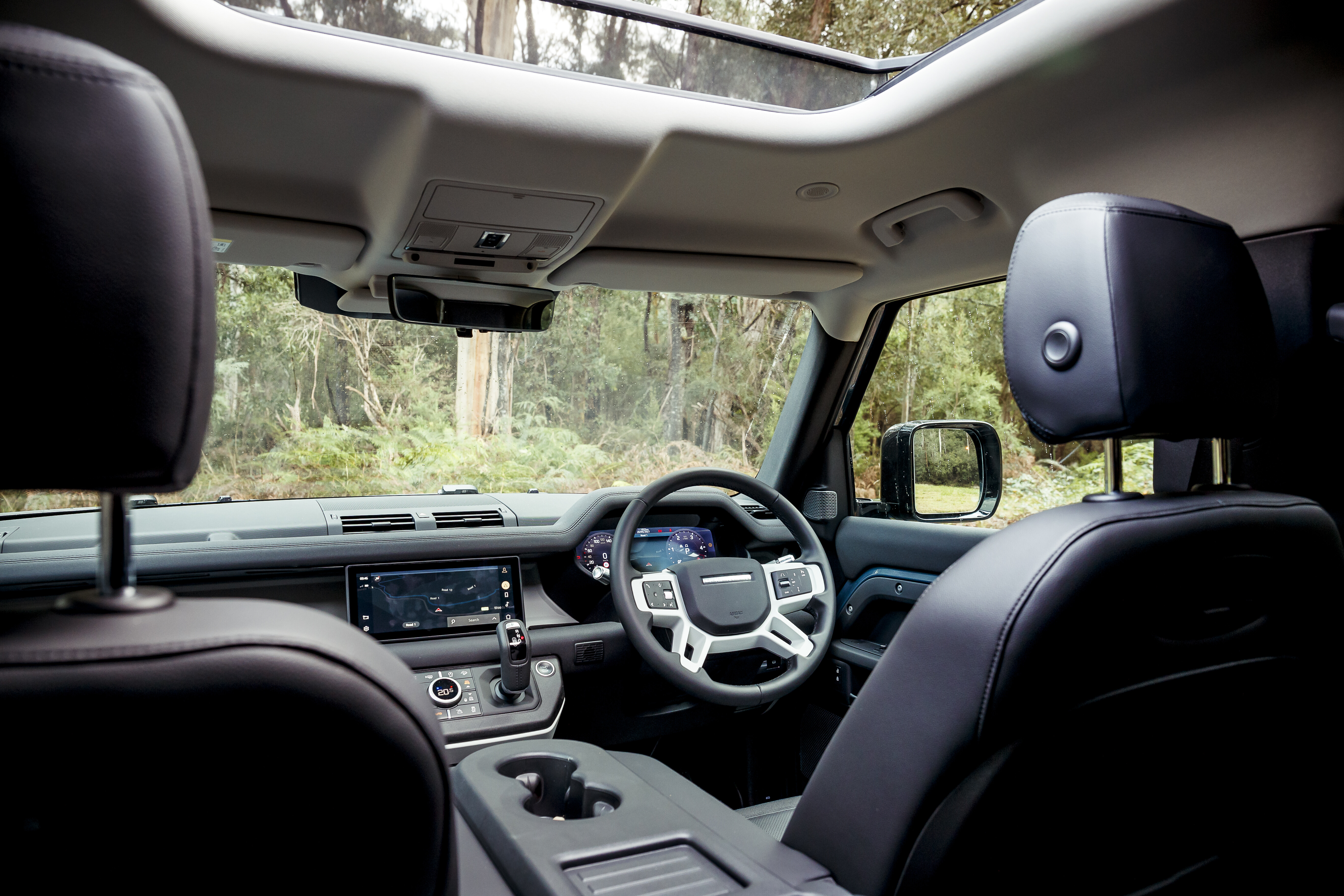
Another option on this car is the $4810 power-fold canvas opening roof. Sunroofs are something you either love or hate. Personally I like the fresh air and extra light you can get in the cab through an open roof, or just the clear glass roof of a conventional sunroof.
This canvas roof only offers open or closed options without the in-between of letting the light through a closed glass roof, but it should be lighter than having the weight off a glass panel up there. A sliding panoramic glass sunroof is a $4490 option.
As mentioned, this car has heated front seats, another option that I like. Unfortunately, operating the seat heating has fallen into the abyss that so many functions have in that you need to access the controls through a menu in the dash screen which takes longer than simply hitting a button.
It’s a little annoyance in an interior that is otherwise a functional and pleasant place to ride.
PRACTICALITIES
The Defender is nothing if not practical in every regard. Its ease of use for general day-to-day driving makes it easy to live with, despite a few interior niggles mentioned. While it’s no longer a commercial vehicle, the Defender remains the most practical model in the Land Rover range – as you would expect it to be.
The addition of the diesel engines amplifies its usability. Like other Defender models the D250 offers a full 3500kg towing capacity and in this trim gives a 785kg payload. With the suspension in its off-road setting, the wading depth is a massive 900mm and the ground clearance is ahead of any other new vehicle. The cargo area is massive and the seats fold flat to make it even bigger. There are tie-down points and a 12V outlet in the back for storing and powering your gear.
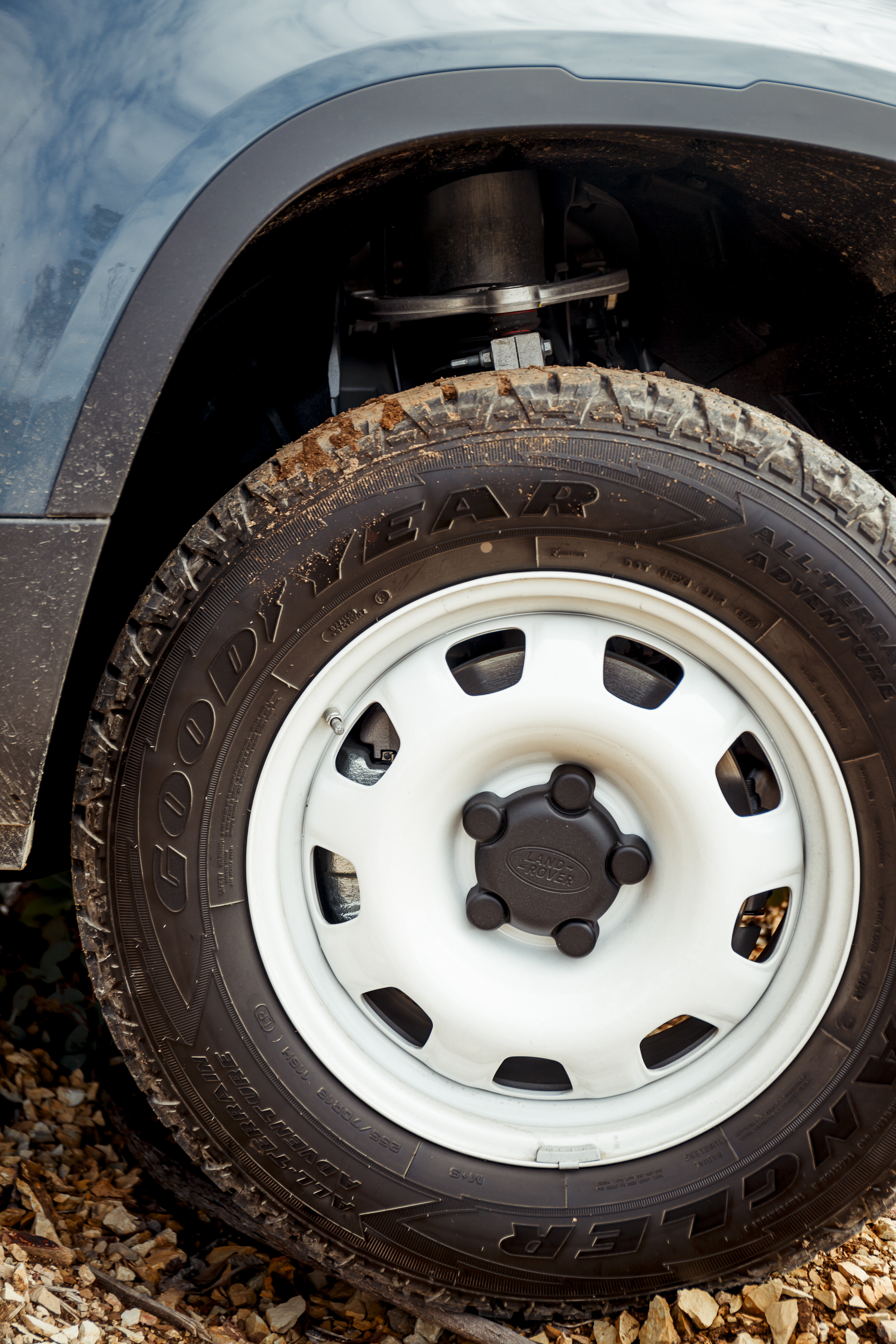
The steel wheels are a no-cost option and should theoretically be stronger than alloy wheels if you are concerned about durability. The 18-inch wheels can only be fitted to diesel-fuelled Defenders as they run a smaller brake size than the petrol models. The 255/70R18 tyre size isn’t massively common but you should be able to fit the more common 265/65R18s as a replacement if needed.
THE VERDICT
While options like a fabric roof, centre jump seat and steel wheels might be a cool, nostalgic trip back to the Land Rovers of old, they don’t necessarily make much sense on this all-new Land Rover. For me, a glass roof offers more functionality than the fabric one; the centre front seat is only something you would only use on occasions and costs you storage space; and a $100K-plus modern SUV deserves a set of nice alloy wheels in place of steelies.
These options are what you might call nostalgic, but they don’t take away from the fact the Defender is one of the best all-round 4×4 wagons you can buy. No other vehicle can match its breadth of ability; from its semi-luxury feel to its best-in-class off-road ability, it stands up to any competitor.
The introduction of the diesel engines to the range just adds further to the appeal, giving buyers more options, improved drivability and a longer touring range.
SPECS
Snapshot
- Seven dual-cab utes compete head-to-head
- Deluxe ‘Lux with the lot
- New kit for the 4X4 Australia D-MAX
IT’S new magazine day here at 4X4 HQ, with the June 2021 issue officially on shelves and in letterboxes.
If you’re in the market for a dual-cab ute – and recent VFACTS results suggest a lot of people are – then this issue is essential reading, as we have included a comprehensive examination of Australia’s most popular vehicle segment.
We tested seven of the most popular dual-cab utes in Australia to crown an overall champion, with each vehicle put through a series of exhaustive tests: straight-line performance evaluation, wet and dry braking, on- and off-road driving dynamics, payload and tow testing, level of interior and safety equipment, and overall running costs.
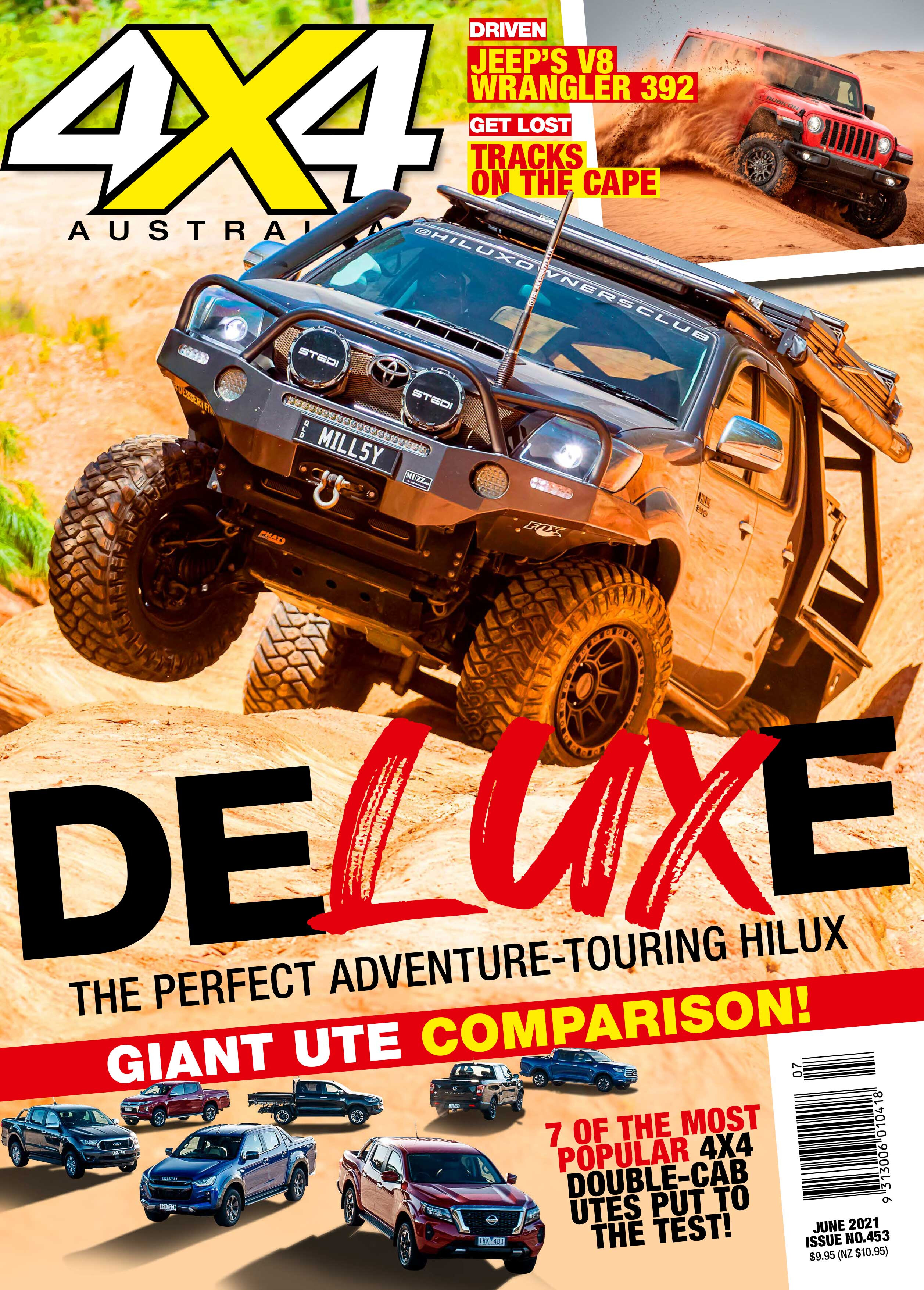
The June 2021 issue also comprises two custom 4×4 builds: a 2014 N70 Hilux (the Deluxe Lux plastered on the cover of this issue) and a D23 Navara ST. Both vehicles exemplify that when you mix know-how and quality equipment, the results can be extraordinary.
Our main man in the USA, Chris Collard, convinced Jeep to lend him the keys to a Wrangler Rubicon 392 – a vehicle we’ll never get here, unfortunately. Still, Chris blitzed Moab dust in the 350kW/637Nm 6.4-litre HEMI-powered Wrangler, and we have complete coverage of the adrenaline-inducing off-road experience.
We also lined up two family favourites – Toyota Fortuner and Mitsubishi Pajero Sport – to find out which seven-seat wagon is the better off-roader, and which is better for hauling kids.
Keen to find out how the 4X4 Australia 2020 D-MAX is tracking? Well, Evan has been busy fiddling with spanners and adding plenty of aftermarket kit to it, and you’ll have to pick up a copy to read all about the latest trick accessories we have installed.
WHAT ELSE IS THERE?
- EvaKool 40L fridge/drawer test
- 1988 Nissan Patrol GQ in the shed
- New product releases
- Travelling Tapin Tops
- Exploring North Queensland Tracks
- Monthly columns and shed updates
Snapshot
- Ranger leads Hilux by just 15 sales on the YTD 4×4 charts
- LC200 sales climb in May
- D-MAX sales surge, with stock shortages easing
Despite its age, the Ford Ranger was again the top-selling 4×4 vehicle in Australia in the month of May, edging out the Toyota Hilux by 420 units.
This was enough for the Ford ute to jump the Toyota in the sales race to date in 2021 by a mere 15 vehicles. The Hilux remains the best-selling vehicle in Australia when you combine its 4×4 and 4×2 sales.
May was a strong month overall for new vehicle sales with 100,809 sales making it the best month of 2021. May and June are traditionally strong months for business vehicles, like the popular 4×4 utes, as trades get in for the end of financial year purchases.
It will be interesting to see how June pans out with Victorian lockdowns set to have an affect on sales.
“While we cannot be certain about the future economic impacts of the COVID-19 situation, businesses and households are showing their confidence by purchasing new vehicles,” said Tony Weber, the Federal Chamber of Automotive Industries chief executive.“I expect this situation will continue to improve in the second half of this calendar year as confidence continues to grow, coupled with incentives such as the extension of the depreciation allowance for business which was announced in the Federal Budget during the month.”
The 4×4 utes may be the sales leaders, but Toyota’s 4×4 wagons continue to buck the trend. With the unveiling of the all-new LandCruiser just weeks away, sales of the LC200 were up in May and the big wagon leap-frogged Mitsubishi’s Triton in the monthly figures. In fact the Prado and LandCruiser both outsold the Triton, as did the Isuzu D-MAX ute.
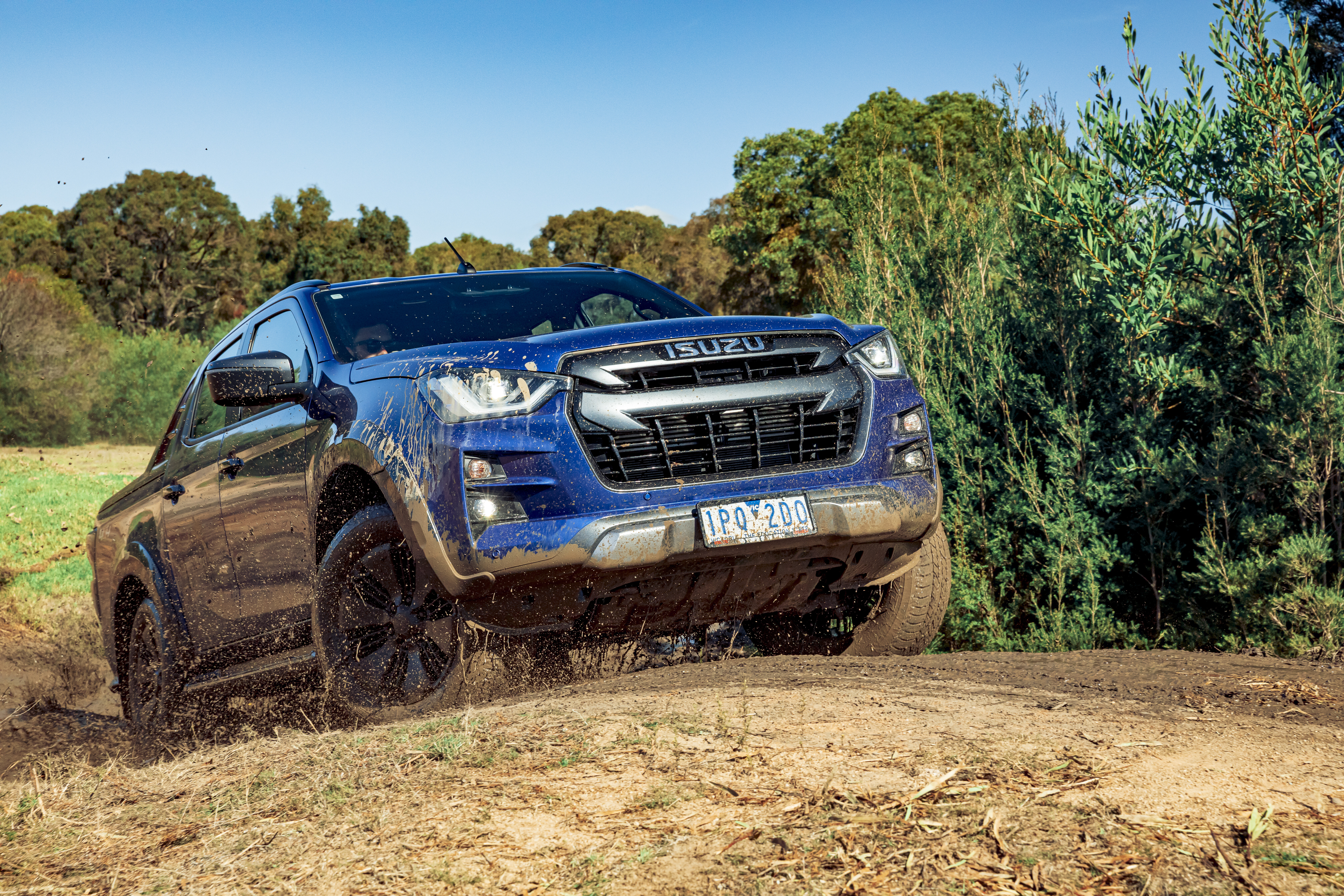
The D-MAX is a big mover on the sales charts as stock shortages ease off and more of the popular pickups get out to buyers. The D-MAX’s sibling, Mazda’s BT-50, couldn’t quite muster half the sales of the Isuzu vehicle it is based on. Nissan’s facelifted Navara also outsold the Mazda ute in May.
Supply issues continue to hamper sales on the LandCruiser 79 Series as it slips down the rankings, allowing the Great Wall Cannon to creep into tenth place for the month.
4X4 SALES: MAY 2021
- Ford Ranger: 3911
- Toyota Hilux: 3491
- Toyota LC200: 2795
- Isuzu D-MAX: 2533
- Toyota Prado: 2214
- Mitsubishi Triton: 2074
- Nissan Navara: 1332
- Mazda BT-50: 1225
- Isuzu MU-X: 888
- GWM Cannon: 747
4X4 SALES: YEAR TO DATE
- Ford Ranger: 17,697
- Toyota Hilux:17,682
- Toyota LC200: 10,439
- Mitsubishi Triton: 9836
- Isuzu D-MAX: 8143
- Toyota Prado: 7561
- Mazda BT-50: 5522
- Nissan Navara: 4739
- Toyota LC79:4418
- Isuzu MU-X: 4203
THE ARB Eldee Easter Festival is an essential family-friendly four-wheel drive event held annually near the rural outback town of Silverton, approximately 55km north-west of Broken Hill in NSW.
Each year, owners of the Eldee Homestead property, Naomi and Stephen Schmidt, open their gates to let families participate in a weekend full of fun activities and (often-intense) off-road events. And despite COVID-19 quashing the event in 2020, the Eldee Easter Festival was back in 2021 for its 10th anniversary, to help raise funds for the Childhood Cancer Association based in SA.
Taking place from April 2 to April 6, families gathered in front of the homestead restaurant for registration and scrutineering on the Friday afternoon.
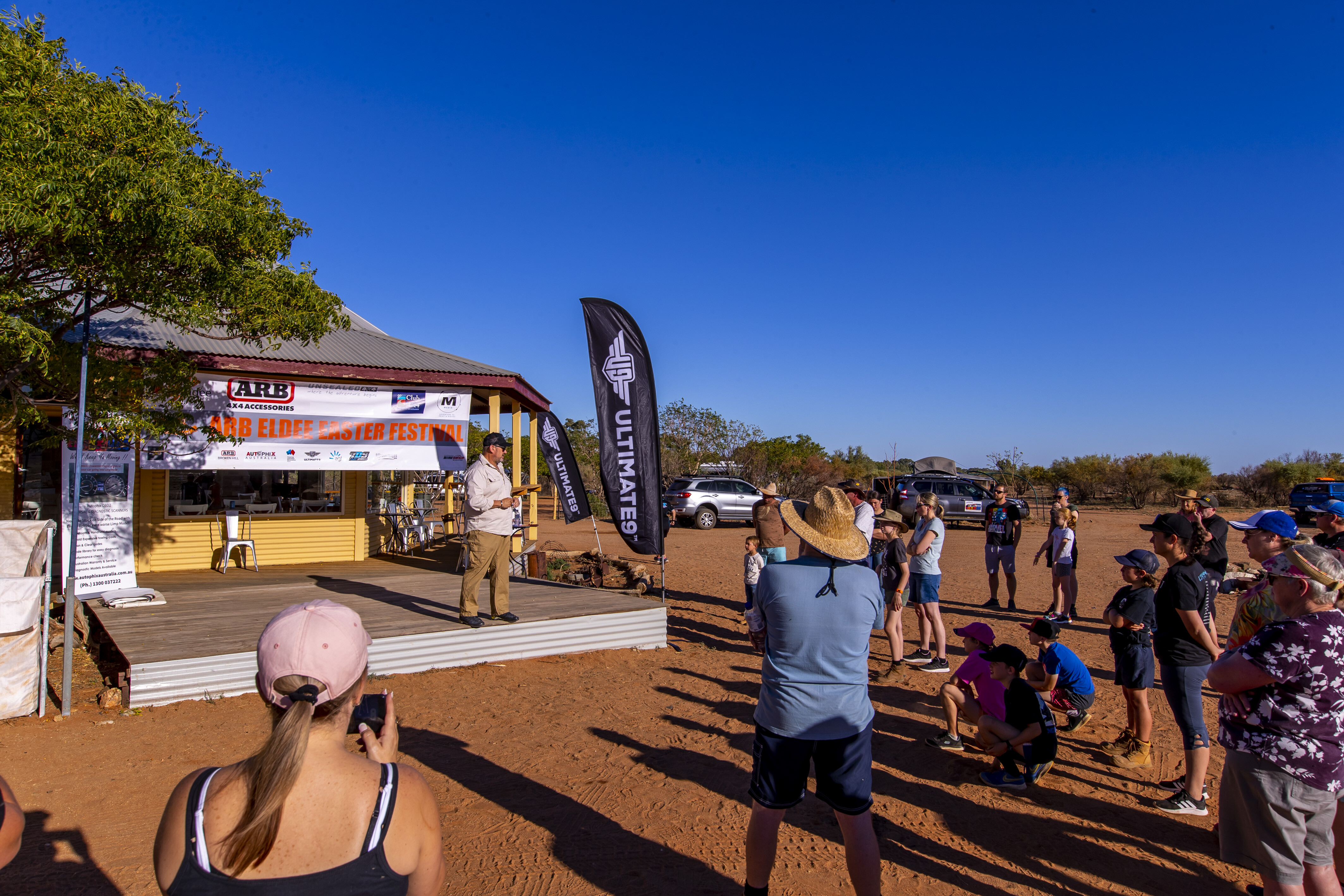
The competitive 4WD activities then took place over Easter Saturday and Easter Sunday.
“We Originally had 40 [competitors], but with rescheduling and COVID – and with the week before with the final COVID scare – we had 15 teams start, with 10 dropping out just days before the weekend started, unfortunately,” Naomi Schmidt said.
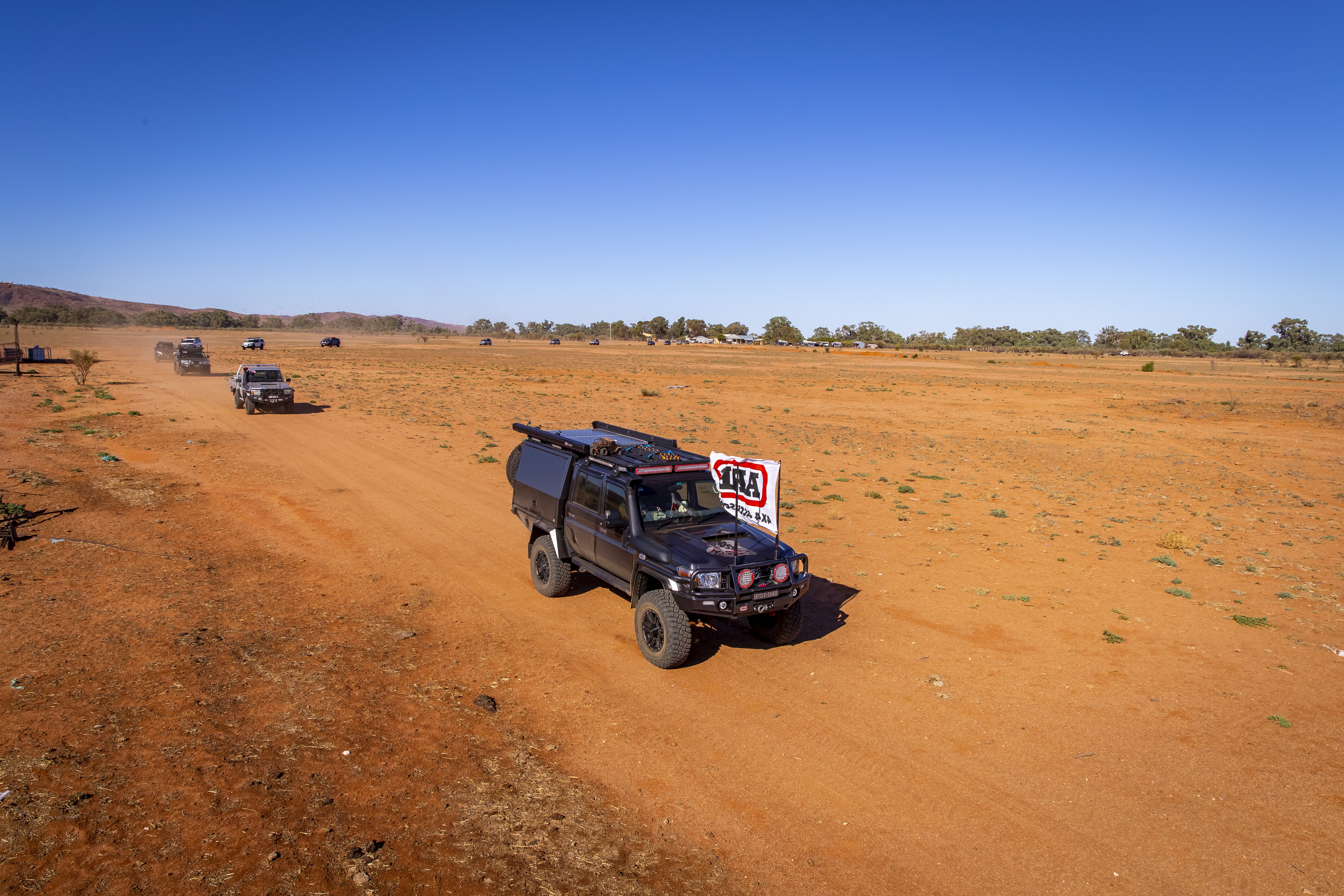
Activities this year included the ARB Mini Dakar, AGL Back and Forth, Silverton Bakery Paddy Melon Challenge Autophix Blind Man’s Run, 4×4 MotorKhana, Mad Max Museum Stump Up, ARB Broken Hill Swag Roll and Set up, John Dynon Water Carter, 7 Days Spares Toolbox Challenge, Eldee Station Easter Egg Hunt, Sheepyard Shenanigans, Ultimate9 All Terrain Challenge, and the R.A.B. Hobbies and Offroad Images Remote Control Car Mini Rally.
“The event went really well and the weather was really warm for an Easter Weekend,” Naomi said. “Both Saturday and Sundays events ran very smoothly and the participants were very impressed with the variety of challenges that the whole family got to try.
“All of the families also were generously rewarded with sponsors products worth many thousands of dollars at the presentation on Sunday afternoon.”
The event is proudly sponsored by aftermarket powerhouse ARB. A full list of event sponsors can be found here.
ARB’s Matt Frost told 4X4 Australia that despite a lower attendance than usual due to COVID-19, it was still a great event, especially the entertainment, in particular the band, fireworks and drag queen show.
The traditional presentation took place late on Sunday afternoon – where Kirk and Dior (and kids) were crowned winners – which was followed by the fantastic fireworks display and entertainment.
“The Charity Auction held for the Childhood Cancer Association for SA on Sunday night raised $5000”
Extra activities for the kids included an RC track, a colouring-in competition and an Easter egg hunt on Sunday morning. Adults were treated to a complimentary sunset tag-along tour on the Saturday night, a massive campfire and access to 4×4 tracks on the Southern Barrier Ranges and on the Mundi Mundi Plains on the Monday following the event.
“The Charity Auction held for the Childhood Cancer Association for SA on Sunday night raised $5000,” Naomi told 4X4 Australia. “We are really happy with this achievement and proud of everyone who attended and contributed to this amazing amount being donated to a group that supports so many regional families.”
For those not wishing to compete, spectator passes were also available over the weekend, with passes allowing spectators to view the challenges and activities scattered throughout the property.
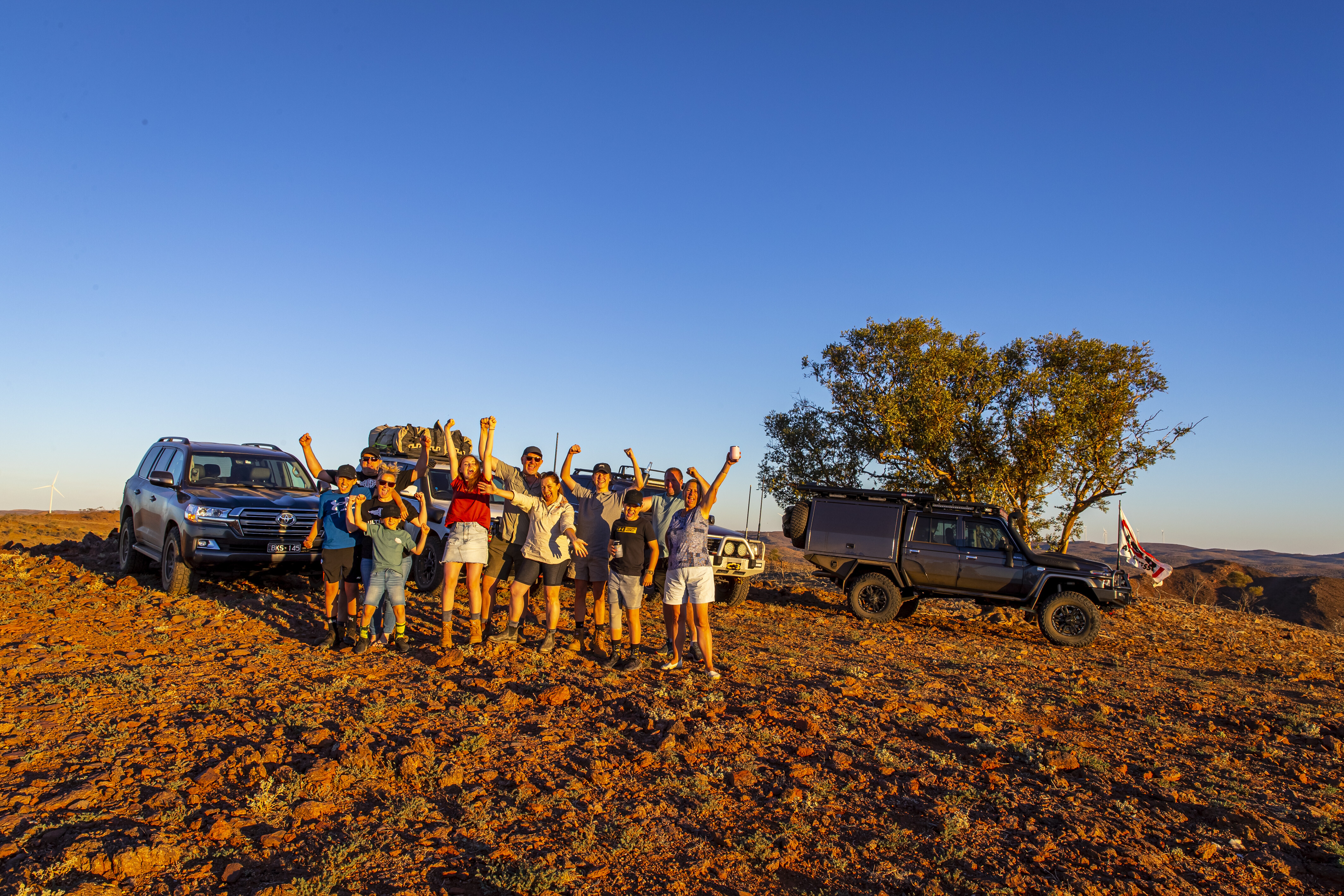
Eldee Homestead itself in an essential off-road destination, with 4×4 tracks (and guided 4×4 tours), mountain-bike trails, walking tracks and plenty more all within cooee.
Rooms are available, starting at $160 per night. Plus, there are a small number of caravan and campsites.
Eldee Station is located in Silverton, Outback NSW. From Broken Hill, follow the signposts to Silverton, which you’ll reach after 25km. Cut through Silverton for about 16km until you reach Umberumberka, and from here you then need to travel on gravel for 19.6km until you reach Eldee Homestead.
To ensure you remain on the right track, keep the Barrier Ranges to your right as you follow the road, before turning right to the homestead once you pass the unmissable large gum tree. Use this map as a reference.
The 2022 ARB Eldee Easter Festival is scheduled to take place from April 15 to April 18.
The last couple of years you’d be forgiven for thinking the only way to head off-road is with a ute. Tub, tray or canopy, it makes no difference; it’s the correct way to go camping, right?
Modern dual-cabs make a lot of sense, as they’re comfortable, reliable, powerful and practical. But not everyone needs a tub or wants the somewhat jarring ride of a set of springs designed to carry a full tonne in the back – or quite frankly, wants a ute as a family car.
That’s why manufacturers build wagons based off the same platform. The same basic rig, just a little more steered towards comfort and family duties, and a little less towards dirt bikes in the back and Monster Energy stickers.
However, are they good a platform for not only everyday duties but towing serious loads, driving serious tracks and doing anything you could with the ute variant? There’s only one way to find out.
This month we’ve added an Everest Sport to the 4X4 Australia long-term fleet, a seven-seat 10-speed auto with a 2.0-litre bi-turbo punching out more killerwasps and torque than it has any right to, and we’re going to put it through the ringer.
First impressions of the Everest kinda make a lot of sense: it feels a lot like a Ranger, only nicer. It’s quieter, smoother to drive, has a more car-like interior, and its cargo space is protected from the elements so it’s far easier to go grocery shopping without worrying your eggs will end up scrambled by the time you get home.
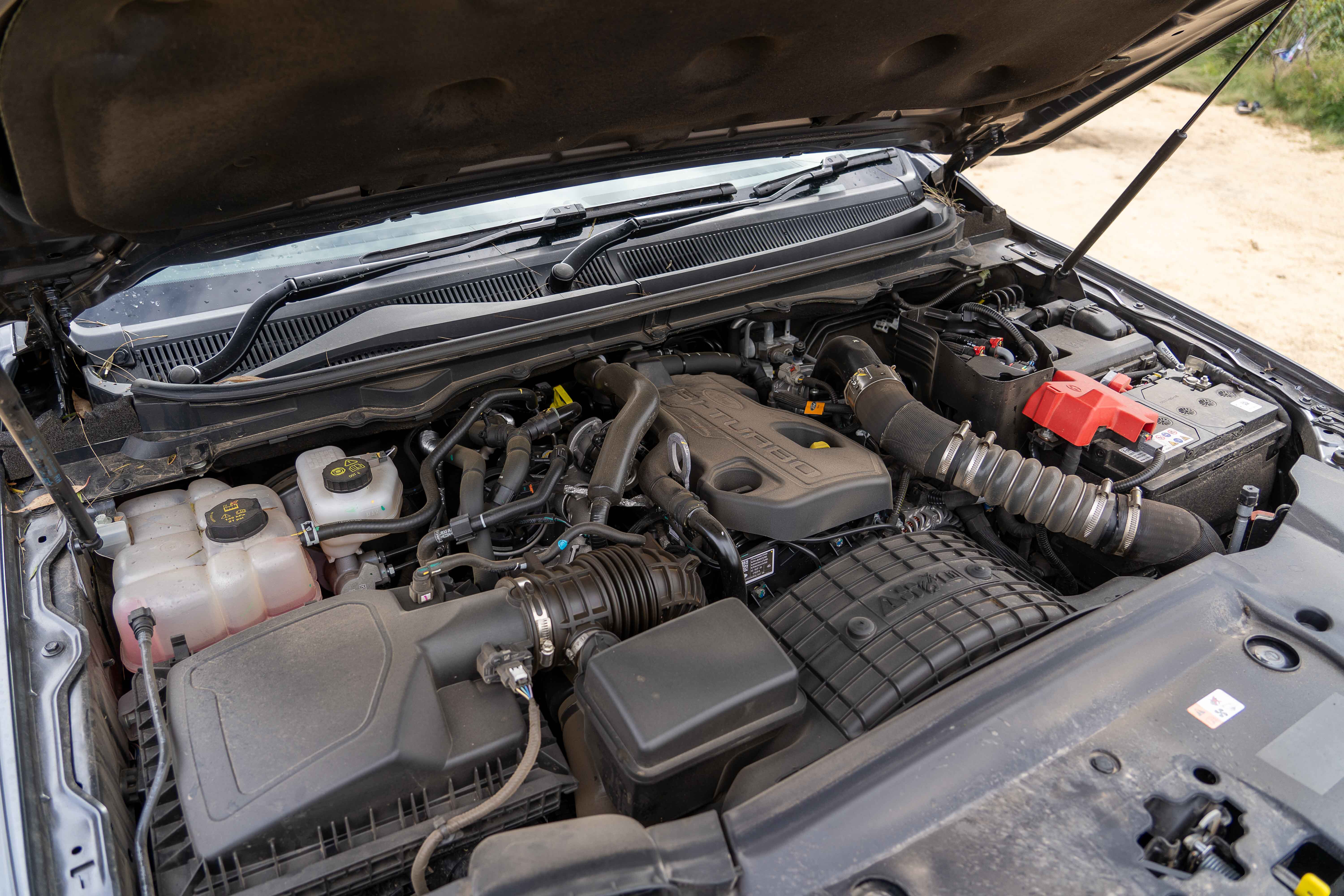
The 2.0-litre donk is surprisingly energetic for its size. It’s far more free-revving than the more work-orientated 3.2-litre, so it feels quicker off the mark and more effortless to drive around town. It feels more like you’re driving a truck and less like you’re driving something the size of an 80 Series LandCruiser.
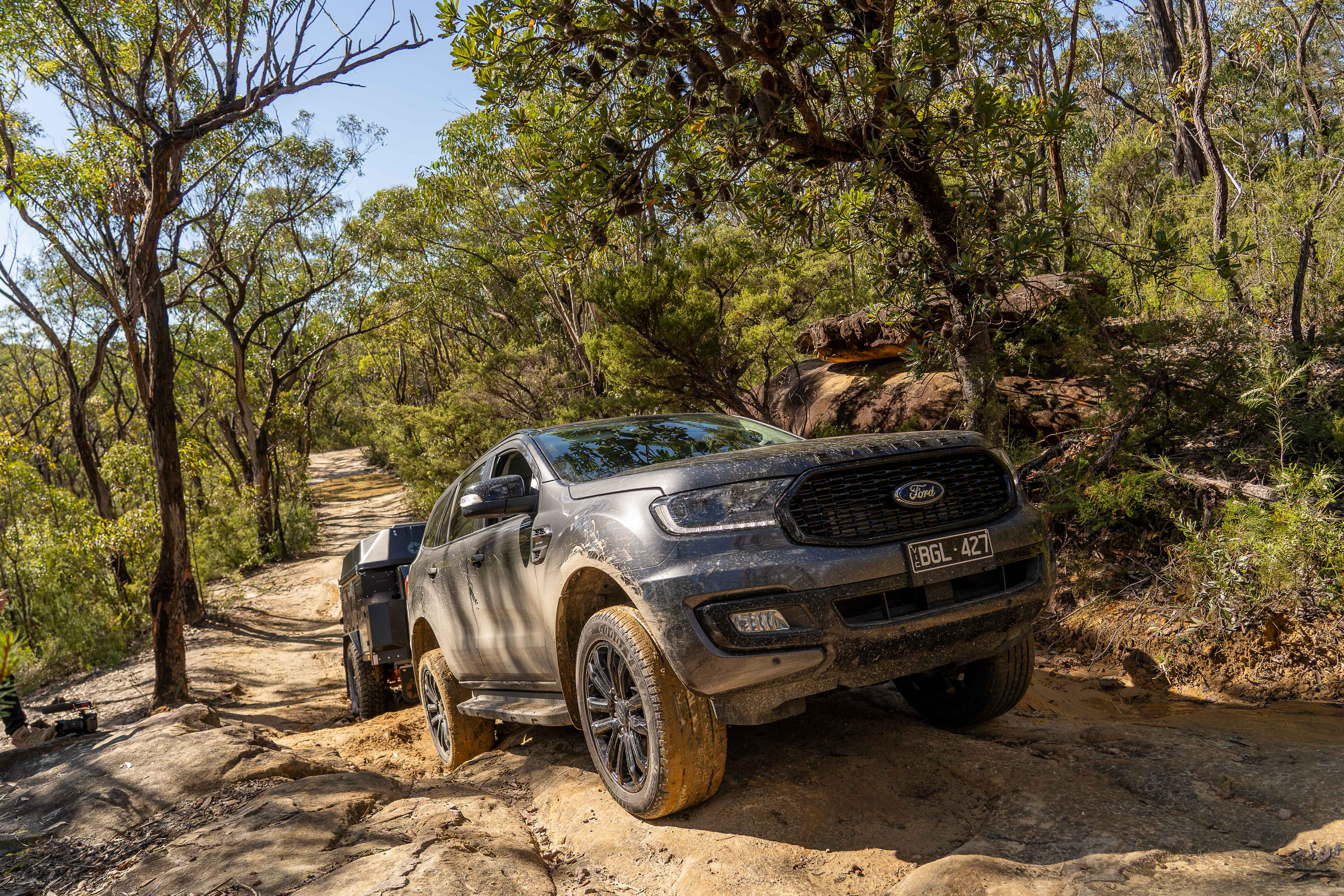
We had the opportunity to put it through its paces off-road, too, in a recent back-to-back with the current generation Prado. Much to the photographer’s horror, the Everest was easily able to drive through deep wombat holes despite considerable wheel lift.
The combination of the factory rear locker and effective traction control up front meant that, even with a wheel in the air, the Everest was able to claw its way forward. With a set of more aggressive tyres, the only thing that would stop you driving a track would be mechanical sympathy rather than a lack of capability.
We’ve also slung a half-dozen different trailers on the back, from dirt bikes to caravans. The biggest stand-out was the lack of sag in the otherwise supple rear suspension – coil-sprung wagons typically feel the effects of a heavy ball weight far more than a leaf spring vehicle. It definitely lost its punch off the line when loaded up, but it was still more than capable.
After a few thousand kays it feels like we’re only just starting to get to know the Everest, so we’re looking forward to putting it through its paces some more over the coming months. Perhaps Ford will let us install a set of Raptor guards and 33-inch mud tyres? Probably not, but a boy can dream right?
Snapshot
- Heavier duty chassis than LC200
- Platform to be shared with Tundra and Prado
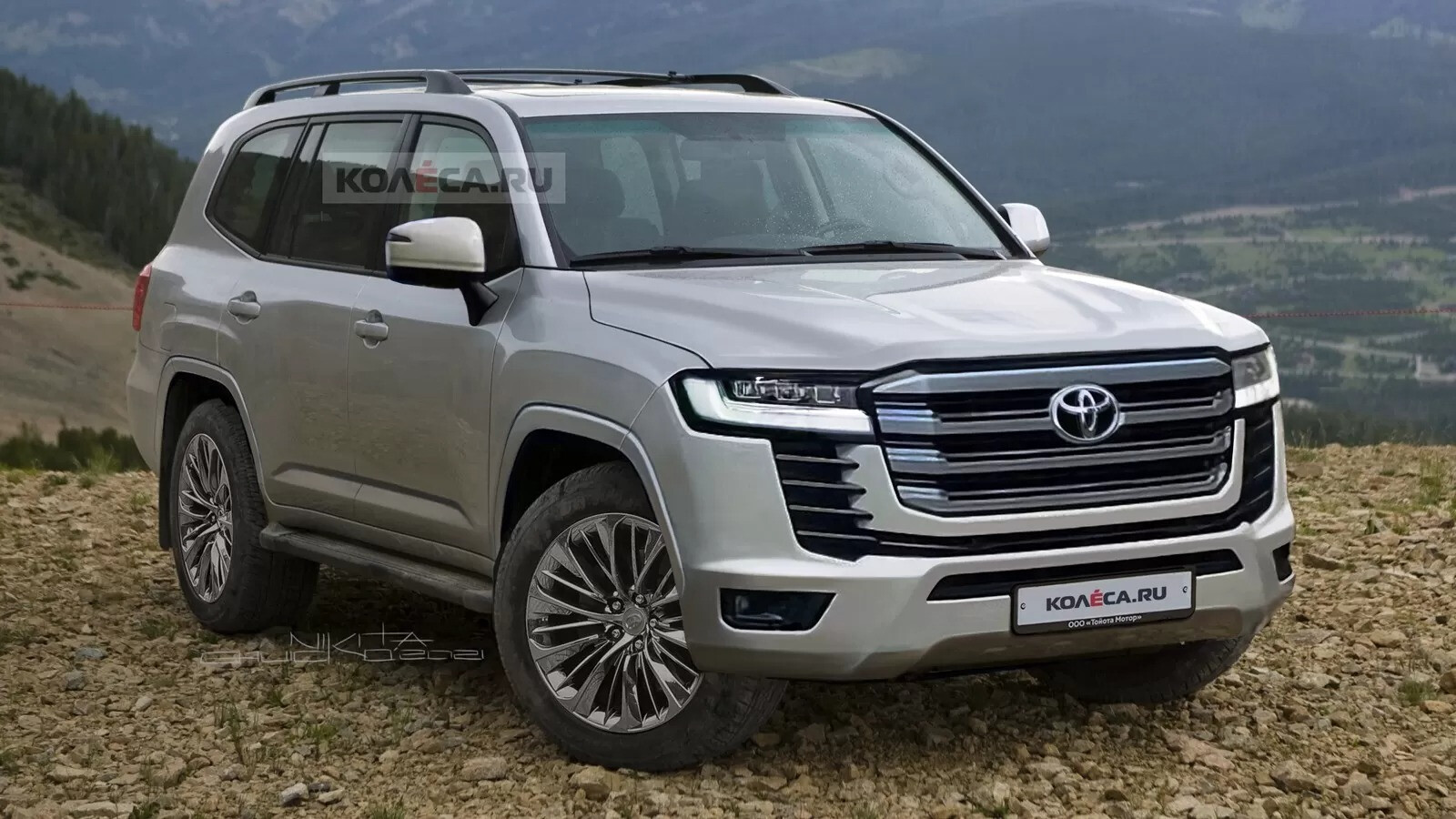
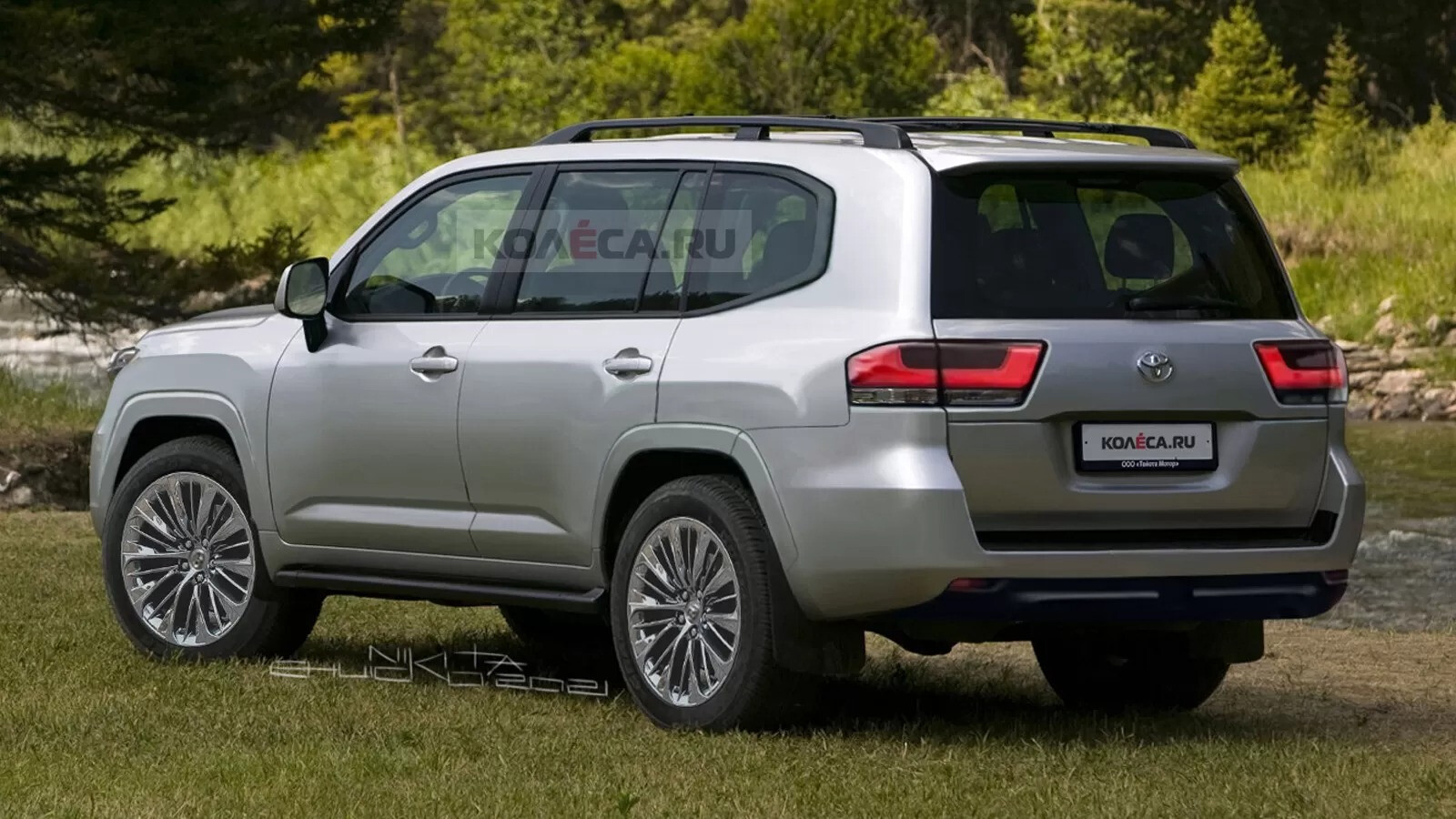
The next Toyota LandCruiser which is due to arrive before the end of 2021, is expected to get a higher payload than what the 200 Series currently has.
Payload has been an issue for owners of LandCruiser 200 Series vehicles, particularly those who like to load-up and equip their Cruiser for extended travels and those with high-specification models.
Despite its large size an LC200 Sahara has a payload of only 600kg, so by the time you’ve fitted a bullbar and winch, loaded up the roof rack, packed the cargo space, and have a family of four on board, you barely have the payload left to throw in a packet of Minties for your trip.
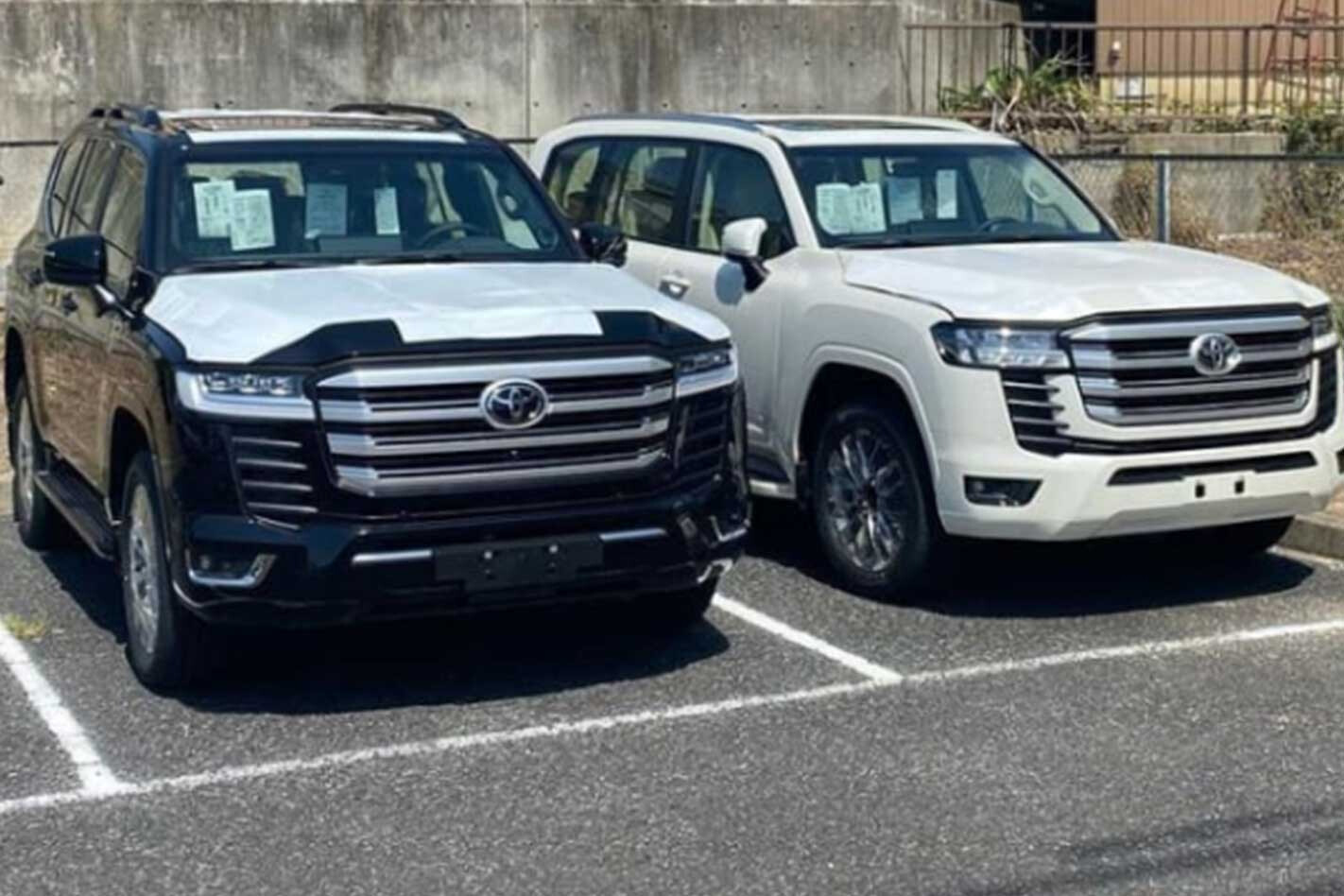
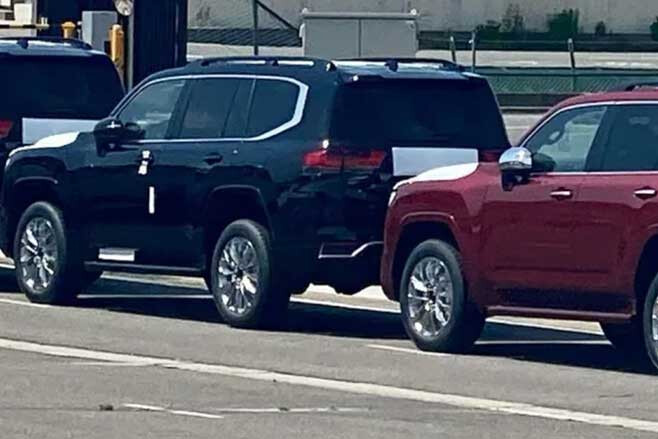
There has been plenty of leaked spy photos of the new LandCruiser, which many are already calling the 300 Series, and if you look closely at them, you’ll find something not seen on a LandCruiser since the demise of the 80 Series back in 1998.
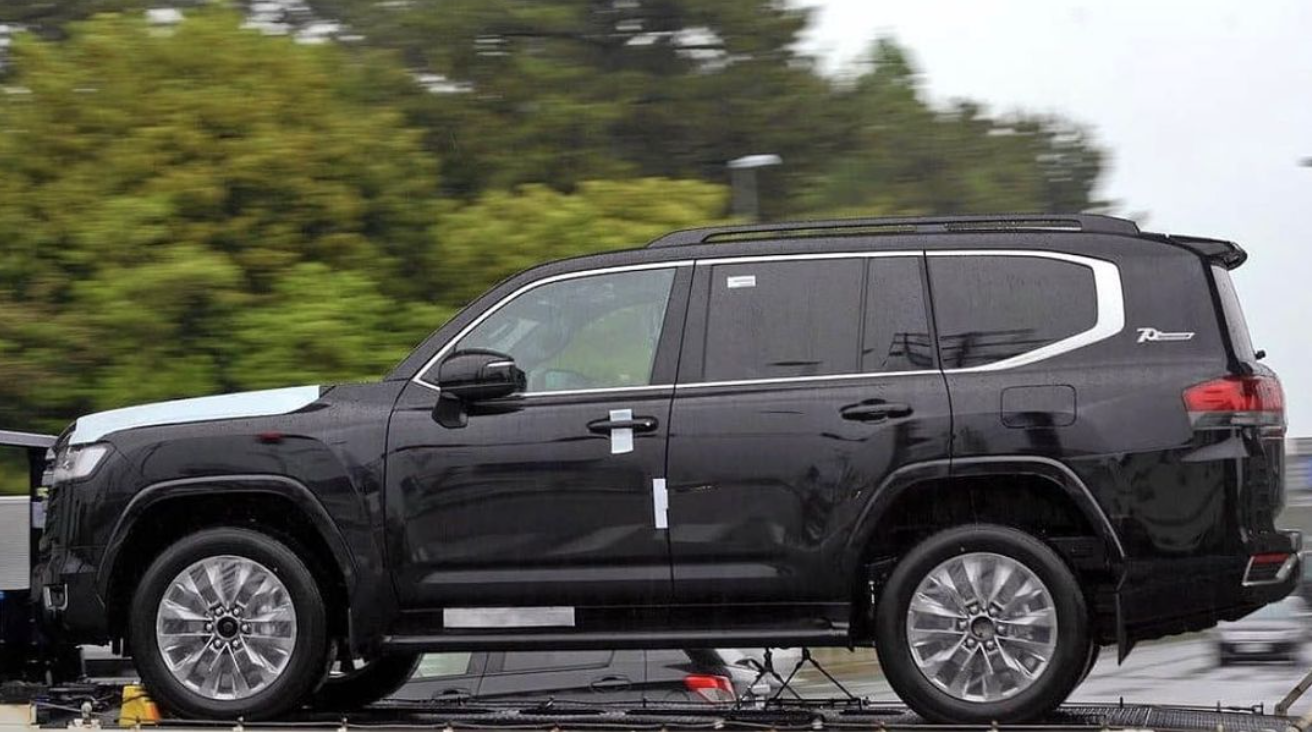
Zoom in on those big alloy wheels in the spy photos and you’ll see that the pre-production vehicles have six-lug wheels fitted. Toyota went to five-lug wheels on Land Cruisers with the introduction of the 100 Series in ’98.
The use of six-lug wheels indicates the possibility of heavier duty axles which would support a higher payload and towing capacity.
Across the Pond in the USA, keen American Toyota spotters have been encouraged by the sight of six-lug wheels on prototypes of the 2022 Tundra pick-up truck which have been seen out and about testing for more then a year now. They are claiming the new half-ton truck will have increased payload to better compete with the home-grown Ford F150, Chevrolet Silverado 1500 and Ram 1500 trucks.
It has been predicted that the 2022 Tundra will share its new platform with the next LandCruiser, and further spy photos in the USA have revealed the new Tundra to have a coil-spring, Panhard rod-equipped live rear axle under the back. Previous Tundras have always had a leaf-spring rear suspension configuration, while this coil set-up is similar to that under the current LandCruiser, further cementing the link between the two upcoming vehicles.
Even though it is a large (by Australian standards) pick-up truck, the current Tundra only has a 735kg payload, so fans of the model in the USA would welcome any increase, just as Australians would welcome any payload increase on LandCruiser. The current Tundra has a 4.5-tonne towing capacity compared to the LC200’s 3500kg.
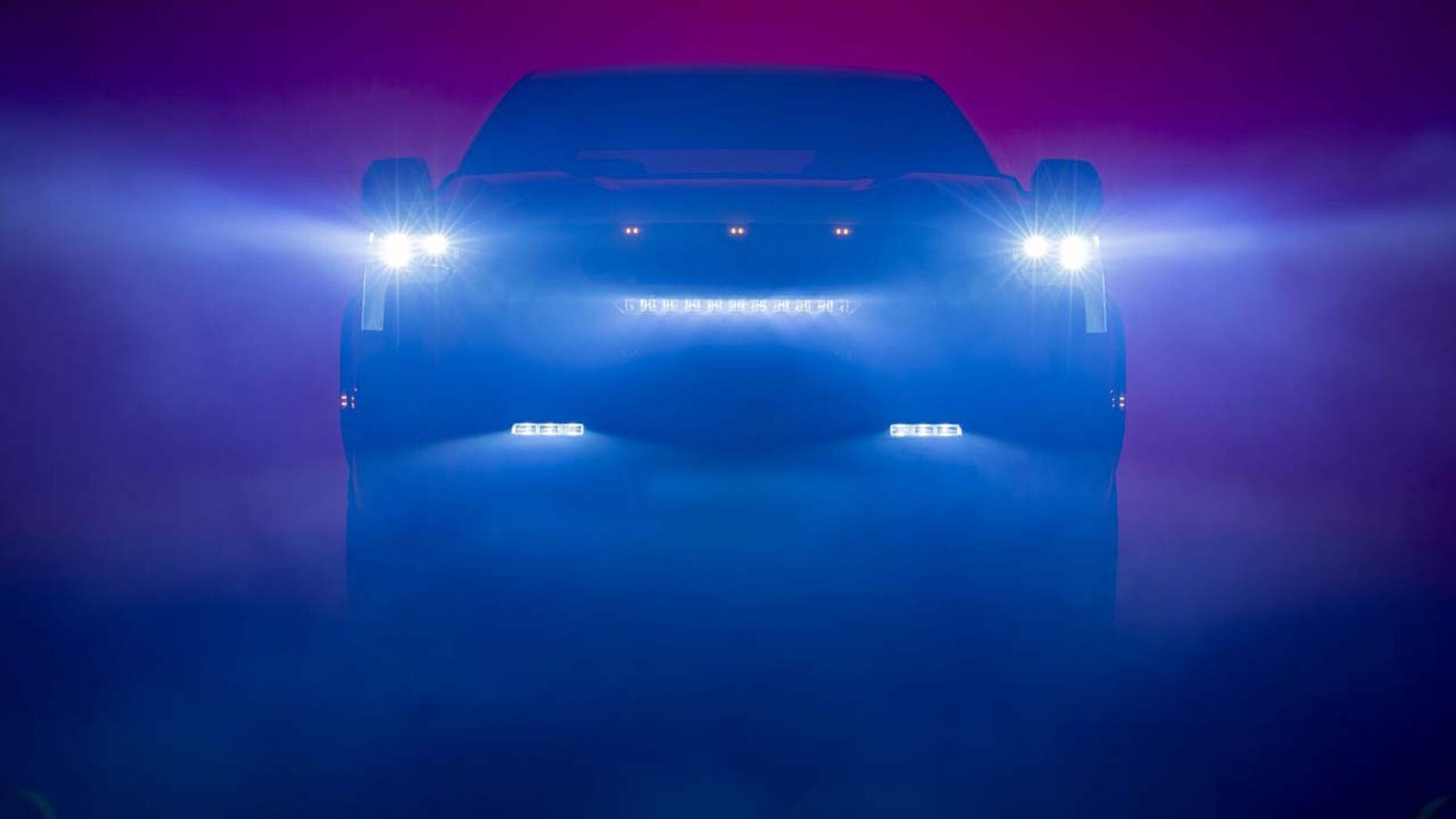
Toyota USA released a teaser image of the 2022 Tundra on May 18 hinting that a full reveal is not to far away. While it doesn’t reveal a lot, it does show a tall blocky front end with high-set slimline headlights, similar to that seen in the LandCruiser spy images.
With the shared ladder chassis platforms between 2022 Land Cruiser and Tundra, it again raises the question of whether we’ll see the full-size pick-up imported to Australia by the factory.
With the relative success of the factory-backed imports of Chevrolet and Ram pick-ups, both locally re-engineered to right hand drive by Walkinshaw Performance in Melbourne, it has been asked of TMCA if they plan to bring their own truck to our shores. Aside from confirming that the Australian arm is looking at a business case for Tundra, the company couldn’t say plans have gone any further.
“We’re definitely interested in a full-size pick-up… we see very much an expansion in that segment,” said Sean Hanley, Toyota Australia vice president of sales and marketing.
A new body-on -frame chassis for Tundra and Land Cruiser also poses the question of scalability. Could any such chassis find its way under the next Toyota Prado?
The current Toyota Prado mid-size wagon, the 150 Series has been on sale since 2009 so it’s almost as old as the Land Cruiser 200. But the 150 was really only a refresh of the 120 Series which first went on sale back in 2002, so it’s way overdue for a replacement and we are expecting one in the next year.
With the relatively limited number of Toyota vehicles built on a body-on-frame platform, it stands to reason that any new platform would be scalable to slip under a range of vehicles including the full Toyota 4×4 wagon and pick-up lines.
WE WERE closing in on the western side of the desert when spasmodic, light, misty rain started to fall. When we arrived at Dalhousie, South Australia, the weather was decidedly cool and overcast, and there were a few spits of rain.
That evening we arrived at the oasis of Mt Dare and were greeted by Graham and Sandra Scott, the owners and operators of this fine establishment. As we were one of the first across the desert for the 2021 season (after a very poor 2020 year because of you-know-what) and the only ones at the hotel at the time, we had plenty of time to chat and catch up on previous travels and to find out the latest gossip in the area.
But there was a word of warning amongst the gaiety with the knowledge that rain – heavy rain – was on its way. The next hour was spent poring over BOM weather maps on the satellite-fed internet and trying to judge when the rain would hit the lonely outpost.
“You’ll want to get out of here in the morning I reckon, otherwise you’ll be staying here for a week or more,” Graham advised.
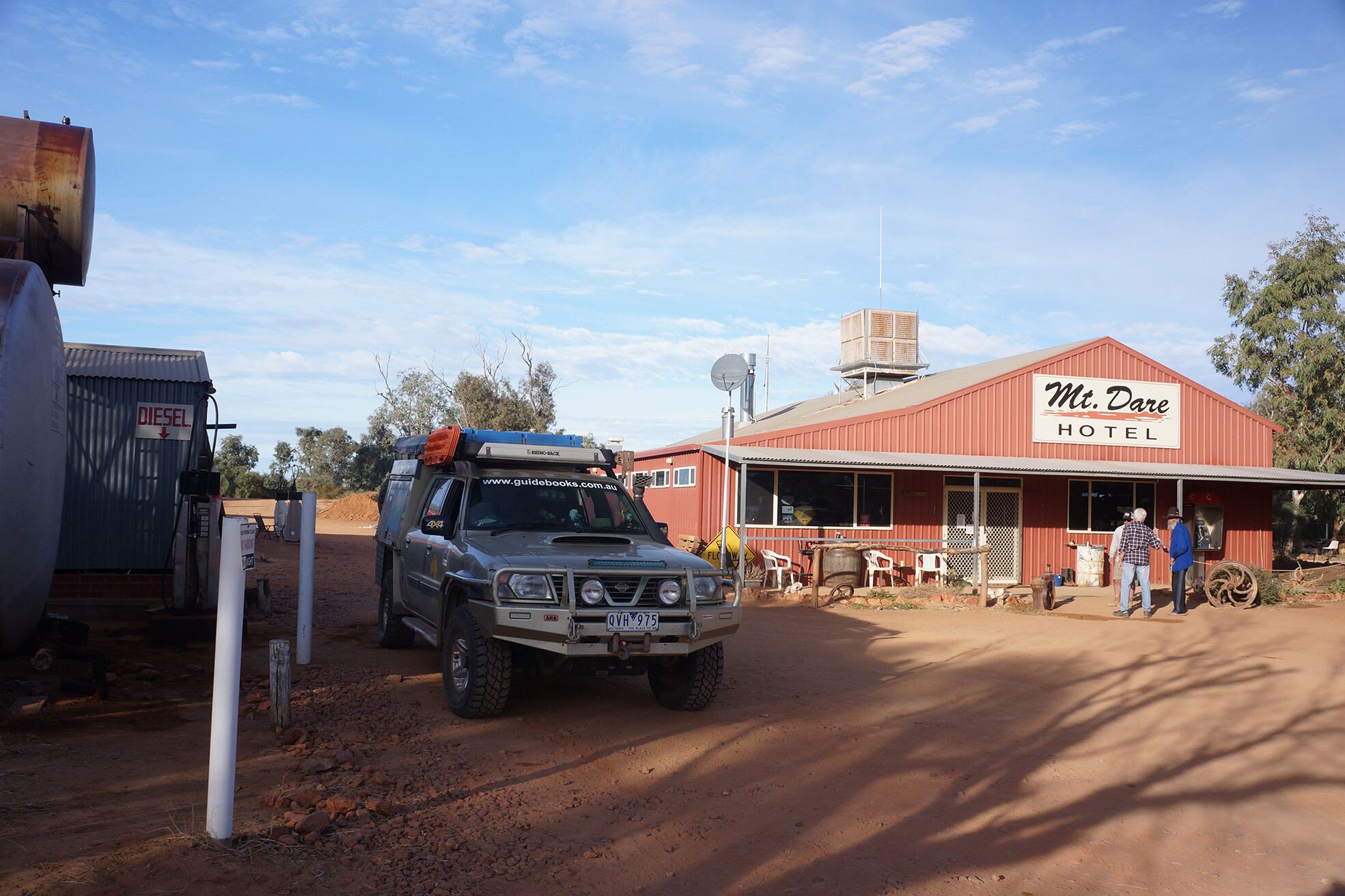
With those words of advice, all of us and our party of eight vehicles were packed, refuelled and on the road early, heading out over the flood levy banks at Mt Dare as a still misty rain – now near continuous – was falling.
We were the last of our group to head off, along with two others who had come to join us and Moon Tours at Mt Dare for a west-to-east crossing which, with the rain around, was not to be. The rest of that second group of adventurers we had advised to stop at Kulgera and we would join them there. How glad we made that decision – but there was a lot more drama as we headed to the planned meeting point.
By the time we got to the low lying country around the old telegraph station at Charlotte Waters, NT, water was pooling across the road and all over the pans and flood plains. Three of the last four vehicles were towing off-road trailers and in the slippery conditions we had them slithering and sliding all over the place, with some losing traction at times and needing a snatch to get moving again.
Even my rig, which was trailer-less but fitted with only fairly mild Cooper AT3 XLT tyres was finding it hard to gain traction, especially when trying to help someone else. When one vehicle slipped off the road it sank in the soft mud and somehow the hours flew by as we recovered it and others, using MaxTrax and even a winch on one occasion, as we struggled on.
It was 5.30pm when we pulled up outside Finke (Aputula) to find the road still open, so with hardly a stop to phone home (it has Telstra mobile) we turned west for the 170km dash to the bitumen. By now the rain was steady and heavier and as darkness descended, we were coming on frequent long-flooded areas of the road which we splashed through and deeper sections where floodways were now running strongly but still relatively shallow, across the road.
It was near 9pm when we pulled into Kulgera after a 12-hour drive and a mere 270km from Mt Dare. Now, I’ve been to this tiny Stuart Highway hamlet more times than I care to recount but I gotta say, I’ve never been more pleased to get there!
Ten days later we travelled some of the same roads we had travelled on that ‘Escape from Mt Dare’ episode and I was pleased and relieved to find that there was no visible damage done by our escapade. But the road was badly scoured for hundreds of metres in places by running water, there were numerous erosion gullies across the road and down any slight rise or hill, with sloppy mud occasionally laying across the track in low-lying places.
Every vehicle – every one of the eight – needed brake-pad replacements at the end of this little jaunt, testifying to the abrasion level of outback mud!
THE current-model D-MAX is a ripper of a ute, but there’s one thing I absolutely dislike about it: they ride like crap when unladen – to be blunt – and the stock suspension was never going to last long.
After a chat with Simon Vella and the team at Tough Dog Suspension, a plan was devised and a date locked in to fix my main gripe with the vehicle and gain some extra ground clearance in the process.
Simon explained that the reason the rear-end rides so rough is due to the three-leaf pack design. While a tapered or progressive leaf pack is usually a good thing, this one is essentially riding on the secondary spring at all times. This causes the rear to jolt on bumps instead of gradually firming up.
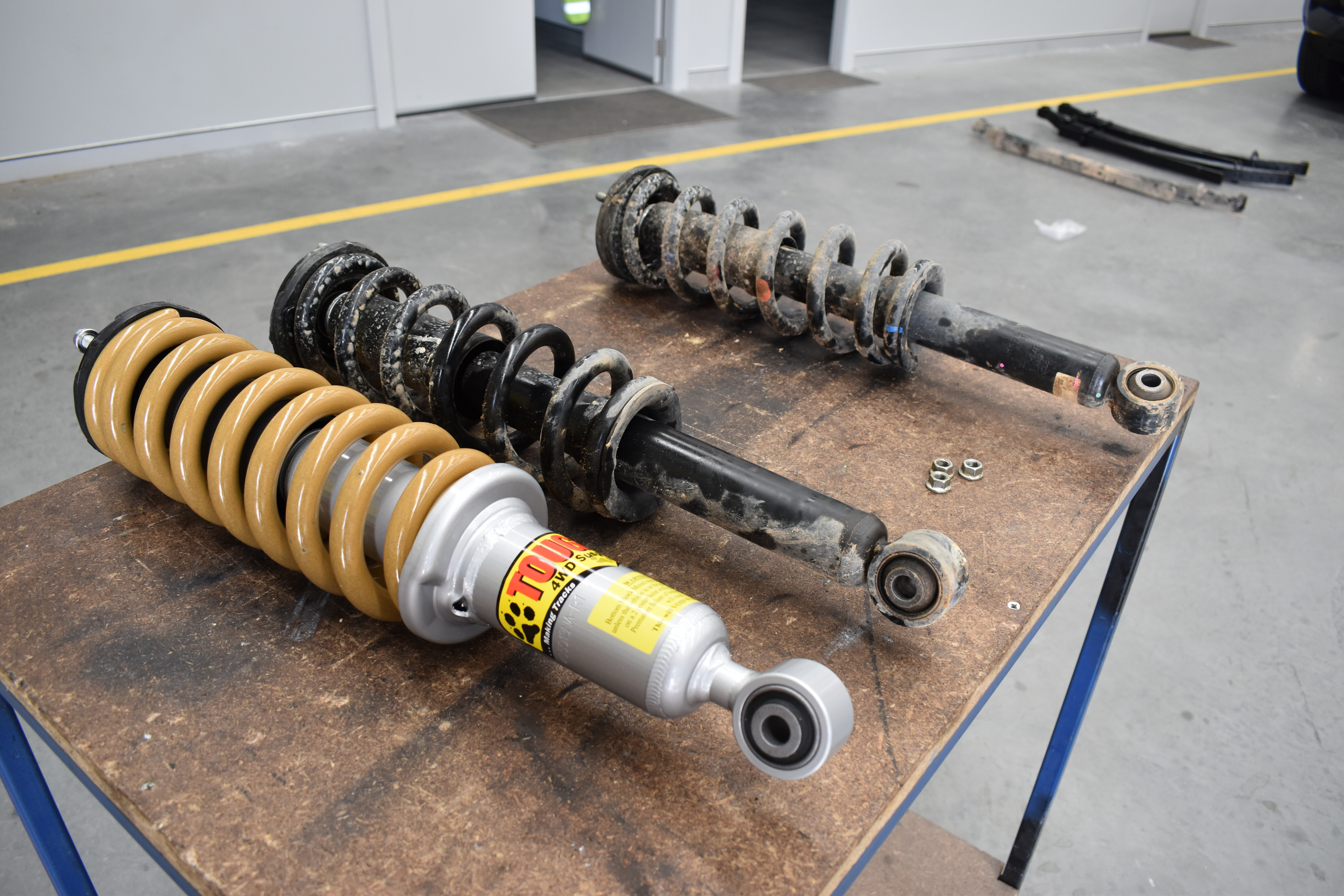
The solution for us was a more linear Tough Dog comfort leaf spring matched with its shock absorbers in the rear. A package that has been designed to carry a load between 0 and 300kg, while gaining 40mm in altitude.
This should be ample for our needs, but as we are adding a fair bit of weight to the tray in the upcoming months (stay tuned for that) we can revisit it later if required. New front struts and coil springs were also installed, which helped bring the front-end up after fitting the Ironman 4×4 bullbar and winch.
Simon and Peter from Tough Dog, who handled the installation for me, are absolute gurus that took the time to educate me on everything suspension. We started the day by weighing the vehicle on scales, to accurately determine how much weight we have added after fitting the steel bullbar and winch. This helped determine the correct spring rates front and rear, and the results are outstanding. Not only did we get our 40mm lift, but the ute rides and handles so much better now. No more jolting on bumps, and no more wallowing around corners.
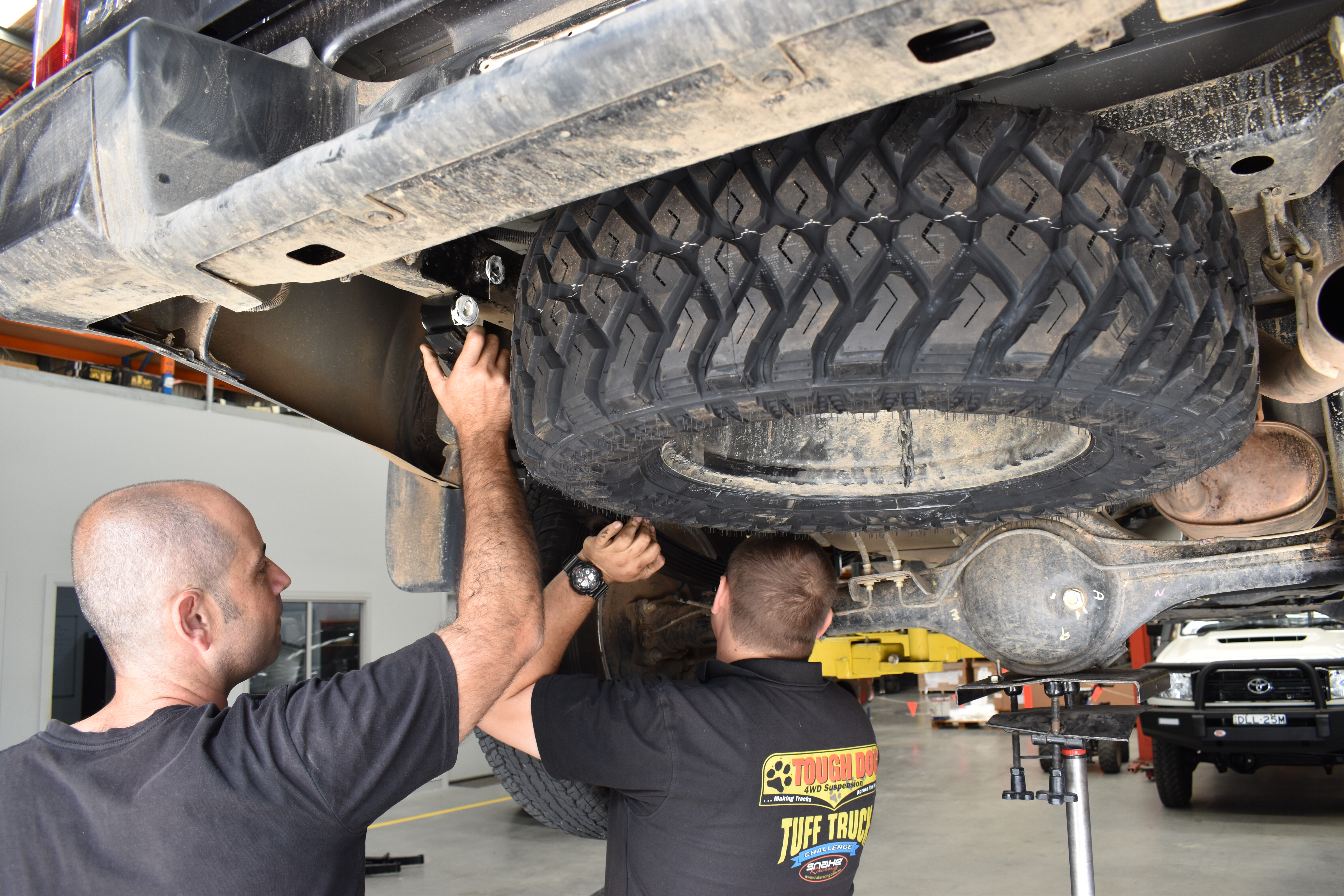
The installation was handled by the people who designed the suspension, so as expected it all went smoothly. The team started at the front, and had me rolling by lunch time. So far there are no negatives to report. No weird vibrations, no handling issues thanks to a proper wheel alignment (always have a wheel alignment done after playing with suspension) and it’s all fully legal for road use.
With a few key modifications, Project D-MAX now looks and drives like a proper 4×4. Watch this space for our next update, as we keep transforming this previously stock tradie-spec ute, into a touring machine.
Oh, you might have also noticed we’ve added some new wheels and tyres to Project D-MAX. We wanted them on to get a proper wheel alignment, which the Tough Dog team handled for me in-house. And we all know stock tyres look wrong after installing a suspension lift. You’ll have to check back soon as we reveal the details.
THE owner of this well-kitted-out Mazda BT-50, Jake Lawrence, is a self-confessed poker nut. He loves nothing more than a game of cards with mates, going camping and four-wheel driving. Jake likes doing things a bit differently you see, and he wanted to stand out from the crowd. He’s also never modified a four-wheel drive before now though; told you he was a gambling man.
Jake works in car sales, so is tempted on a daily basis to buy a new vehicle. Once he laid eyes on a BT-50 though, he thought bugger it … let’s buy one and build it up as a unique project.
“It’s something different to most other cars out there,” Jake tells us. “There really aren’t too many like it, or that get driven as much and as hard as mine does.”
“Although it’s set up to do tough tracks, it is also my daily driver and a reliable one at that – it hasn’t let me down. These BT-50s aren’t that common in the highly modified 4×4 scene, so I like that mine is unique and I doubt someone will ever make something the same.”
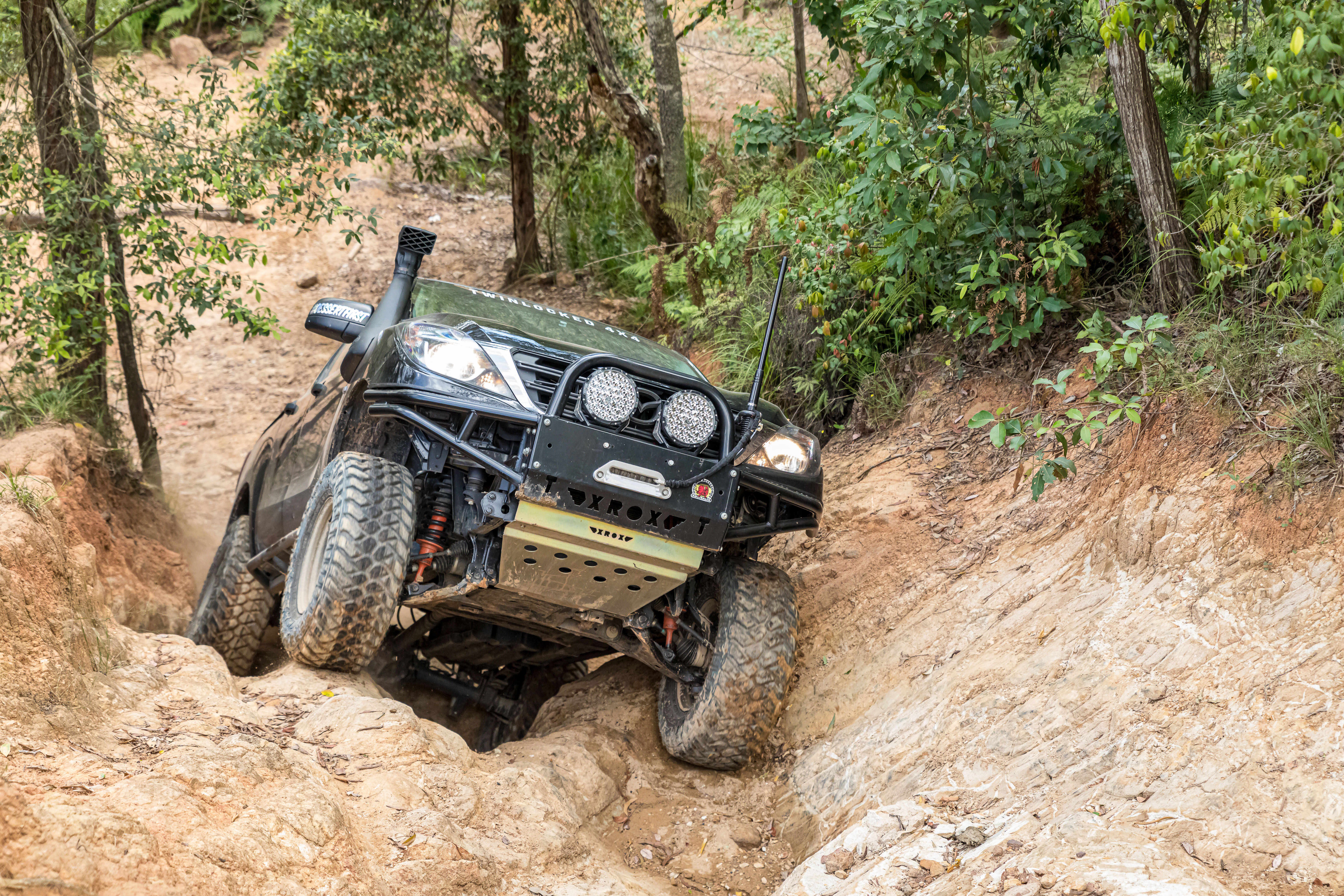
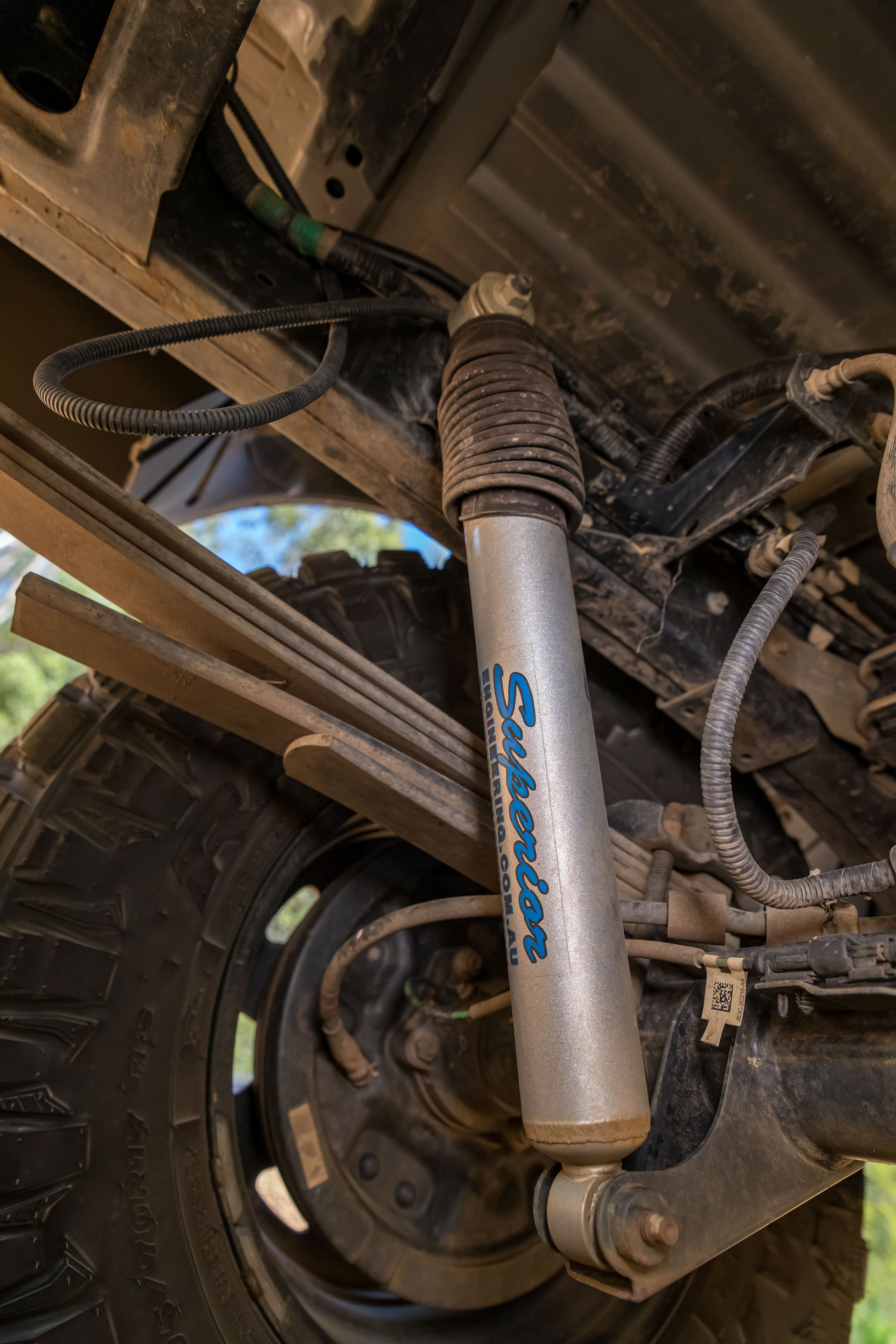
Talking about unique, Jake’s BT-50 is riding high thanks to a 4-inch lift. This is made up of a 2-inch Superior Engineering body lift, and 2-inch Outback Armour struts and coils in the front and Superior Engineering shock absorbers in the rear with Outback Armour leaf springs.
“Originally the modification list for the vehicle was short; pretty much a small suspension lift, 31-inch tyres, tub rack and rooftop tent,” Jake says with a familiar grin. “Once I did all that, I was well-addicted to wheeling and camping, and my car was smaller and not as capable as my mates. It was about April 2020 the modification bug bit and I decided I was going to take it up to the next level, fit a front locker and put a body lift in so I could fit the bigger tyres.”
Speaking of being twin-locked, Jake’s BT-50 came with a factory rear locker, so he had ARB install an air locker in the front taking away any traction limitations in wild terrain. With the 4-inch lift, there is enough space for a set of chunky 305x70r17 Maxxis RAZR mud-terrain tyres, which Jake is wrapped with performance wise. These have been mounted on a set of 17×9 King steel wheels, in a 0 offset.
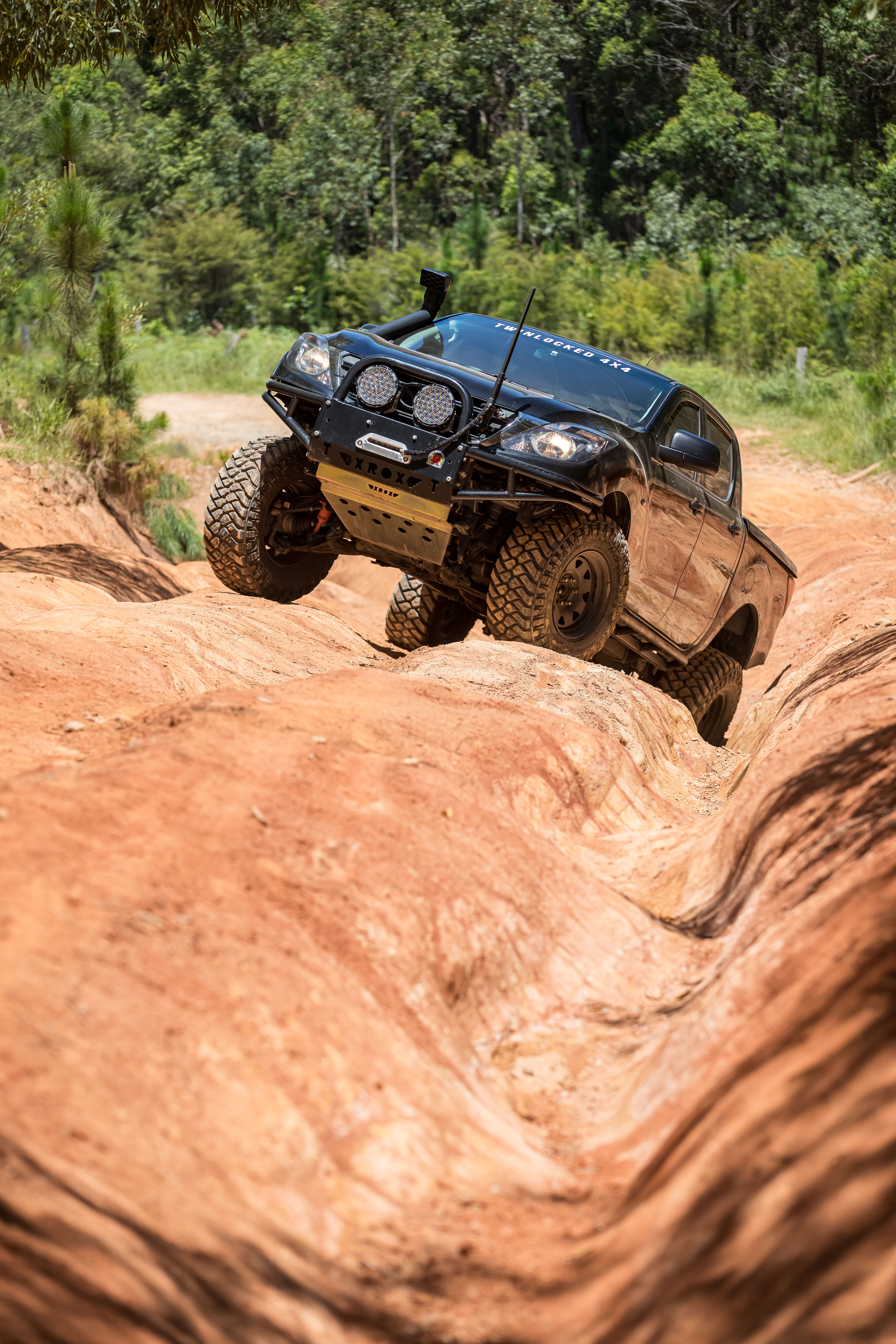
“When the warranty runs out, Jake would like to swap in a BMW M57 motor”
One area Jake has left stock, bar a K&N air filter and Safari snorkel, is the engine. It seems Jake has played the power-up game with vehicles in the past, and has a history of putting pistons through engine blocks. Once the warranty runs out though, it’s game on.
Inside the BT-50, Jake has kept things practical by installing an Alpine 7-inch head unit, a Uniden UHF radio for communications and an Ultimate 9 throttle controller to help get the Mazda moving off the line quicker. But he rates it for off-road use too, being able to dull down throttle response in technical terrain.
On the exterior of Jake’s ute, things definitely get a bit wilder. Starting at the front, Jake opted for an Xrox bullbar, as it could be made to suit the body lift and is winch compatible. The bar also came with a neat bash plate, which provides protection for vitals such as the radiator. Mounted to the tube front bar, Jake has selected a pair of Stedi Type X Pro spotlights. To get the party started when on the tracks or at camp, he also wired up a suite of Stedi RGB rock lights.
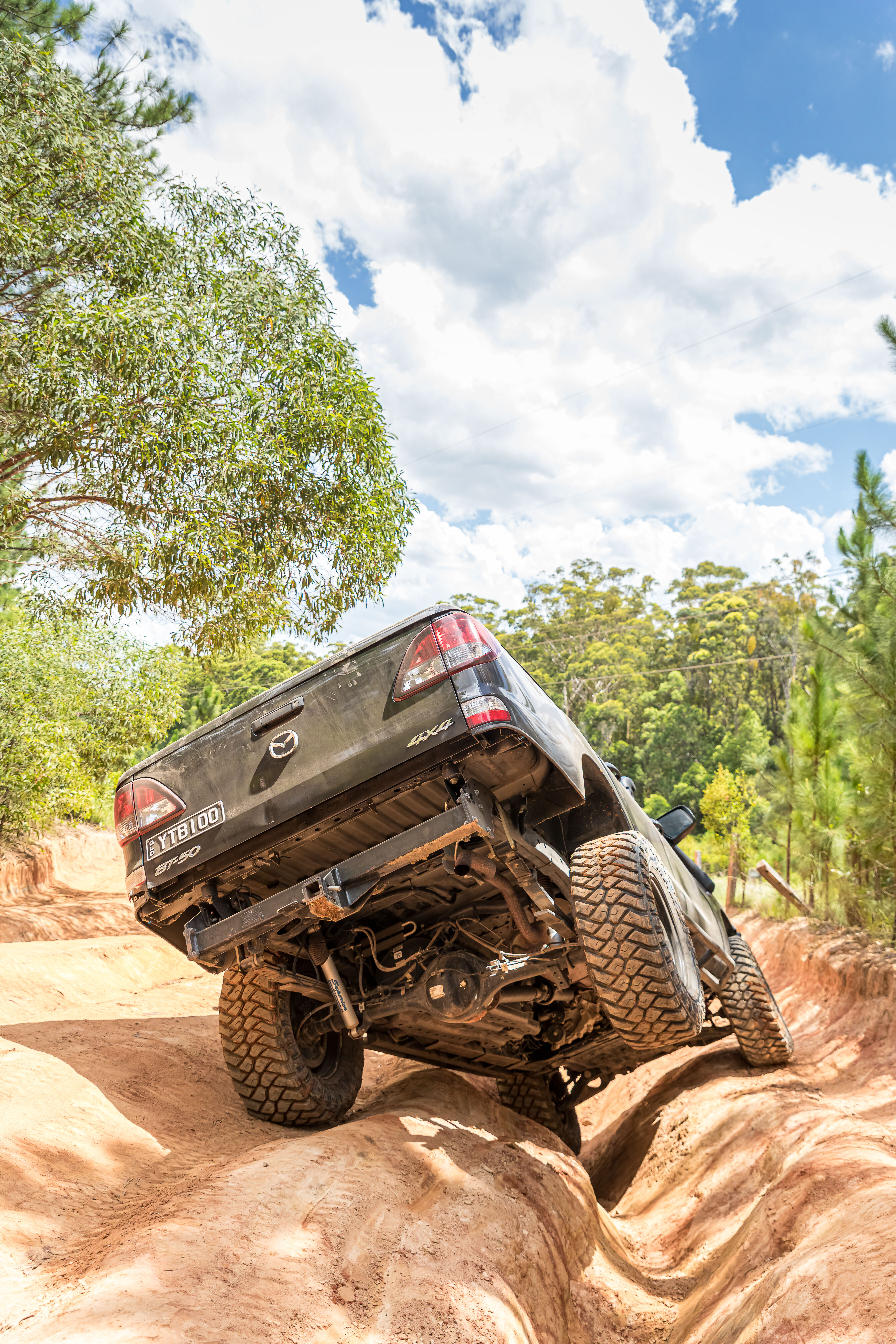
If you look closely at the rear end of Jake’s 4×4, you’ll notice a fair bit of space between the tailgate and the ground. This is because he has done a tub chop, providing a decent increase in departure angle. So much so, that he had to screw the numberplate directly to the tailgate as it wouldn’t fit anywhere else.
I reckon you’ll be seeing more and more dual cabs with this mod in the future. To protect the sills of the vehicle off road, Jake also bolted on a set of rock sliders from JTW. These were fabricated to suit the body lift also, so there’s no awkward gap between the sliders and sills.
Even though this is Jake’s first 4×4 build, it’s clear to see how hard the bug has bitten.
“At first, I just bought a 4×4 to tow my jetski and I simply just needed a new car,” Jake mentions. “It has very quickly turned into a lifestyle for me though, and I have made so many friends through owning a 4WD. It’s incredible. The community is so happy to help each other. The friends I’ve made through meeting people over Instagram, and the trips I’ve planned and done with complete strangers who are just happy to go wheeling and have some fun out on the tracks is why I will always have a 4×4 now.”
Jake estimates the entire build has set him back $55,000, which is a bargain considering what he’s achieved. He does have some regrets, saying he had to do a few things twice, but you have to make mistakes to learn at the end of the day. The build also took roughly eight months to get it to the stage it is today, which is a very reasonable amount of time.
So, while Jake has done an admirable job of building this BT-50, we all know these vehicles are truly never really done. Jake’s future wish list is a long one, with plans to undertake a solid axle swap. He’s eyeing off a set of 35-inch Maxxis Trepadors as well, which would make for a wild combination.
But wait – there’s more, with Jake saying when the warranty runs out, he’d like to swap in a BMW M57 motor. I’ll say it again, Jake’s a gambler. And we like that about him.