
The Isuzu MU-X is, in a nutshell, a tough-as-nails D-Max chassis dressed for success – an approach that’s worked well for Isuzu as it eclipsed all previous sales records last year, a big part of that success coming from the MU-X’s dominance within the ute-based wagon market.
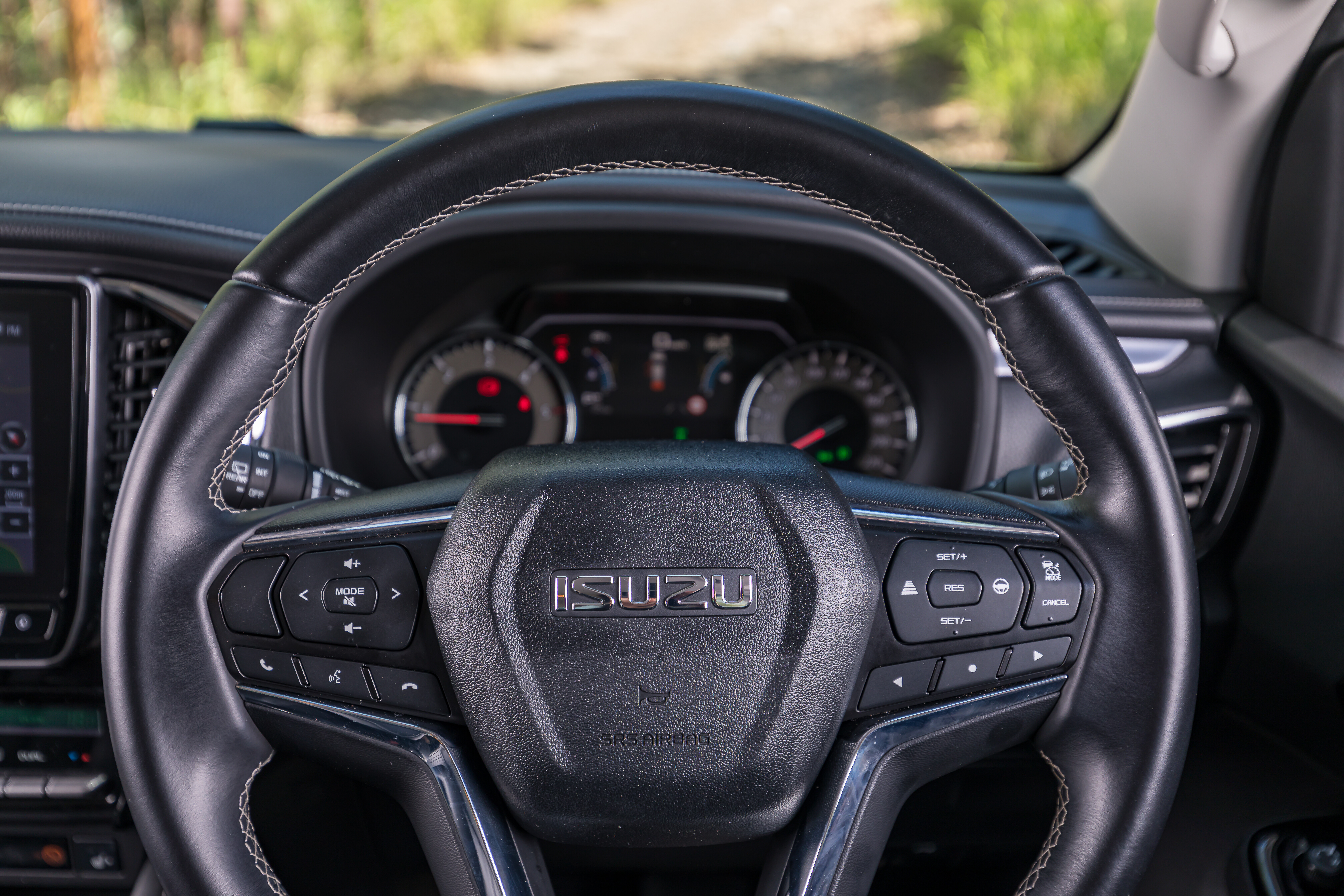
For 2022, the MU-X scores a lane support system switch on the steering wheel, allowing on-the-fly disabling of lane-keep assist, lane departure warning, lane departure prevention and emergency lane keeping – but the adaptive cruise will still work.
Aside from that, the only other change for ’22 is Isuzu’s decision to ditch the CD stack holder in the top glove box. Hardly something anybody is going to miss these days.

What you’re left with is essentially the same MU-X, off the back of its hugely successful redesign and launch mid-last year, albeit with those two small updates.
Hot off the back of three consecutive D-Max drive reviews, the latest MU-X was a pleasant upgrade in terms of comfort and refinement. And while it doesn’t feel much smaller, it’s just that tiny bit more city-friendly.
Priced at $65,900 drive-away for the top-spec LS-T we’re in, it’s significantly cheaper than the top-spec Ford Everest Titanium at $78,000 before on-road costs, and on par with a base-spec Toyota Prado GX at $65,336 (plus on-road costs). If you want a top-spec Prado Kakadu, though, you’ll be forking out more than $90K.

You can opt for a 4×2 MU-X LS-T, too, which while it seems like a big step down in terms of overall capability, it sips a little less diesel and saves you $6000 at the dealer.
Plenty of buyers won’t use their MU-X off-road, or at least not often, but still want a rugged 4×4-esque wagon to run around town in. It’s certainly a more adventurous looking package than most medium and large SUVs, regardless of whether it’s got a transfer case or not. We’ll get to why we prefer the 4×4 models later on, though.
Tech and Features

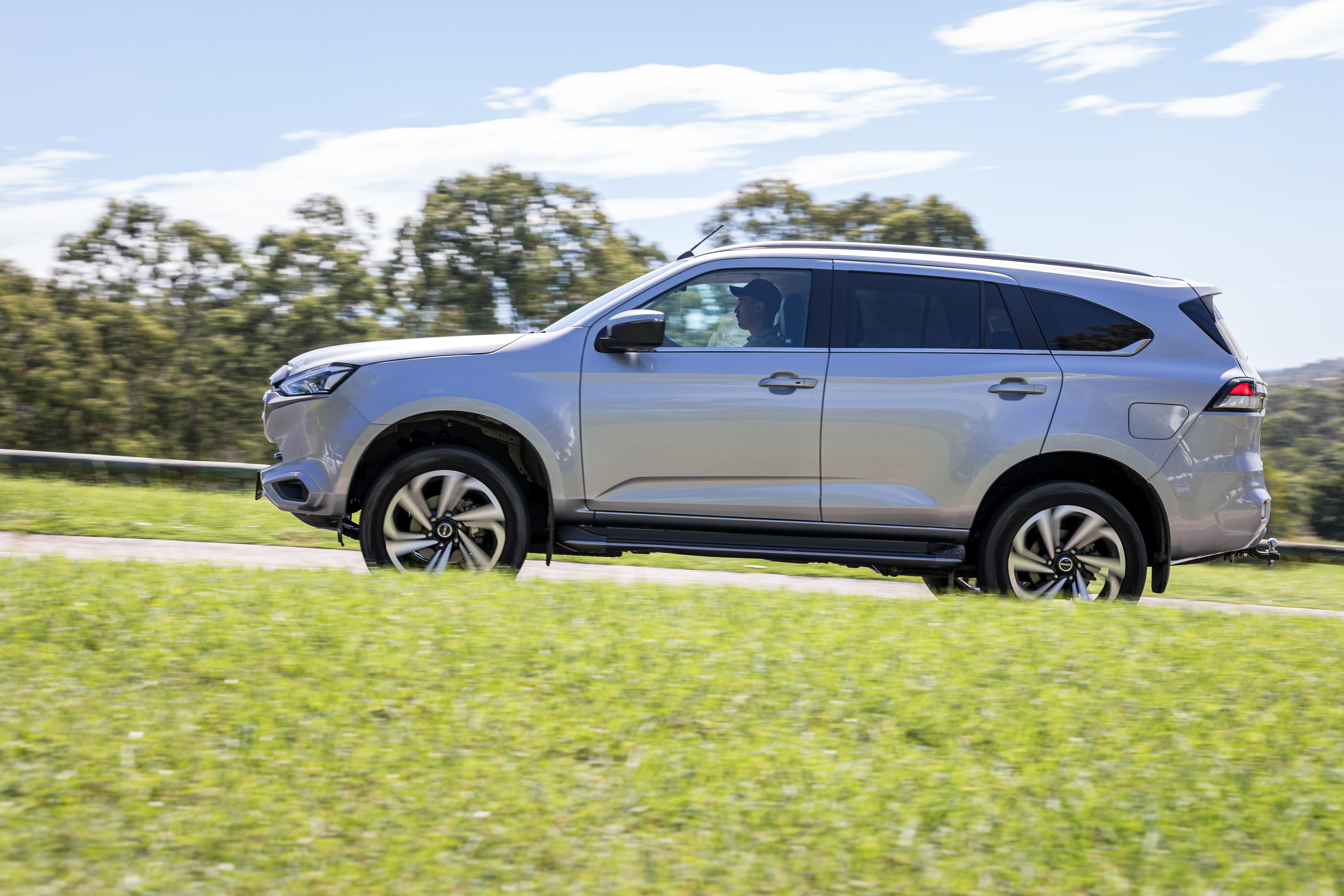
Visually, the MU-X is one of the best looking in the ute-based wagon segment, with its downturned nose and headlights, bulging arches, and 20-inch two-tone alloy wheels.
Adding to its dominant front-end presence, the auto-levelling bi-LED headlights with menacing daytime running lights look tough without being over the top.
Side profiles for ute-based wagons are always divisive, as is their overhanging rear end, but the MU-X strikes a reasonable balance. In saying that, it looks tall from just about any angle – but at 1825mm it’s actually 35mm lower than the previous generation and won’t pose an issue for underground carparks.
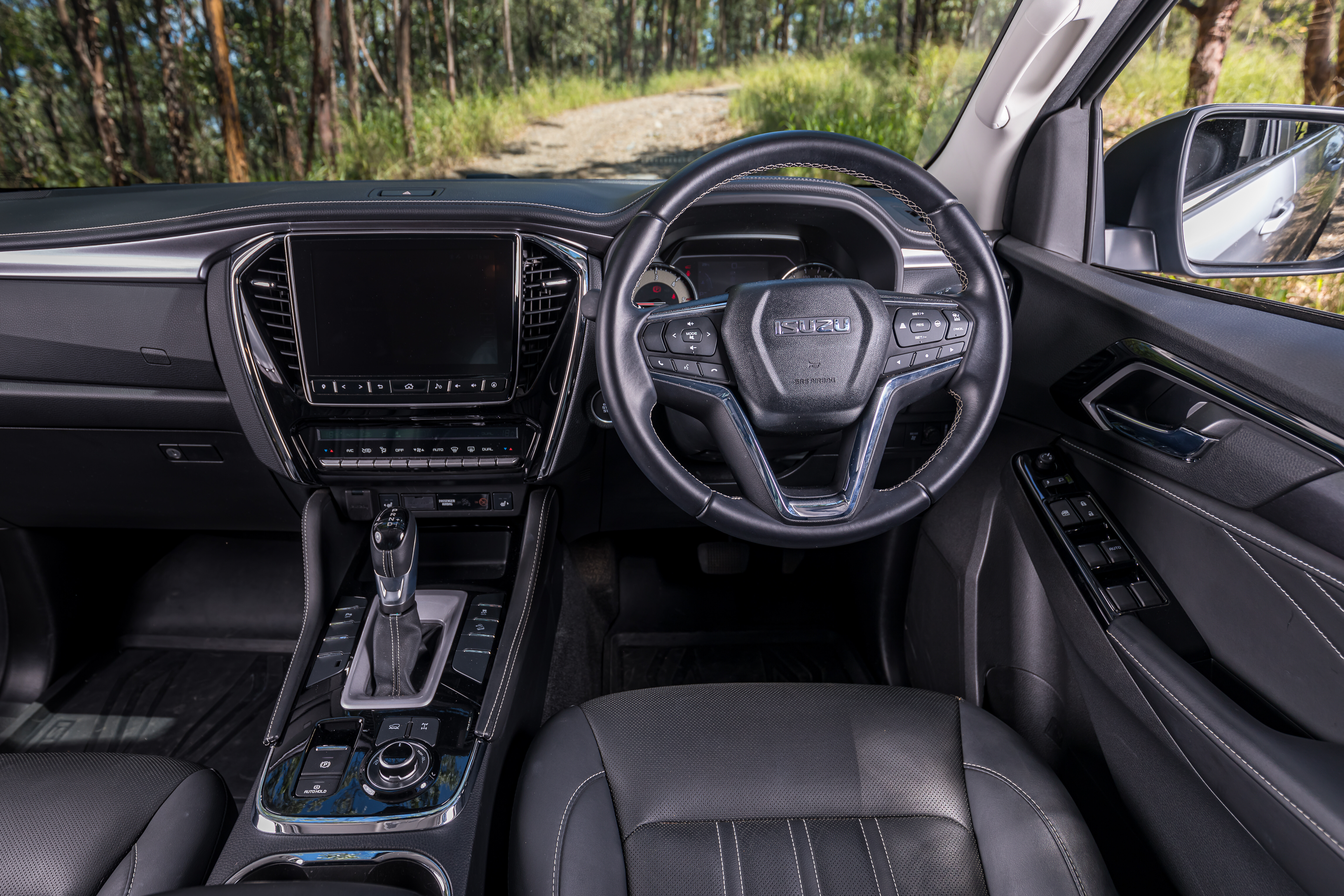
Inside the MU-X, there are plenty of soft-touch leathers and glossy plastics, making this LS-T one classy beast.
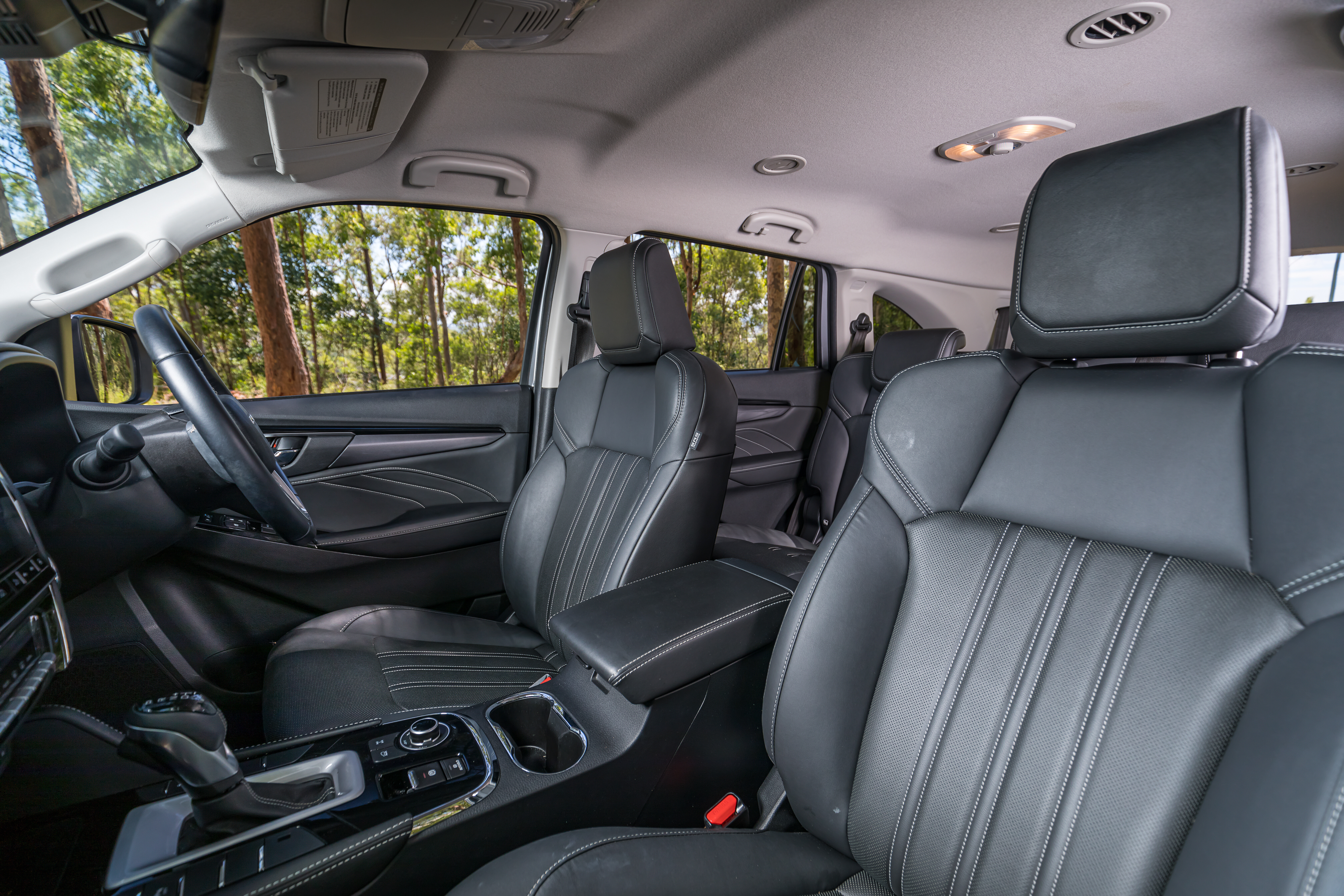
From the leather-wrapped steering wheel through to the quilted leather seats, it’s a swanky package. Speaking of seats, they’re well-bolstered, comfortable on longer trips, and the driver’s seat gets 8-way power adjustability. The passenger seat features 4-way power adjustability, which is ample.
While the front seats are heated, they don’t feature air-con vents. In Queensland, where we tested this MU-X, vented seats are heaven sent and far more suitable than heated seats – but whatever, we’re being princesses about it.
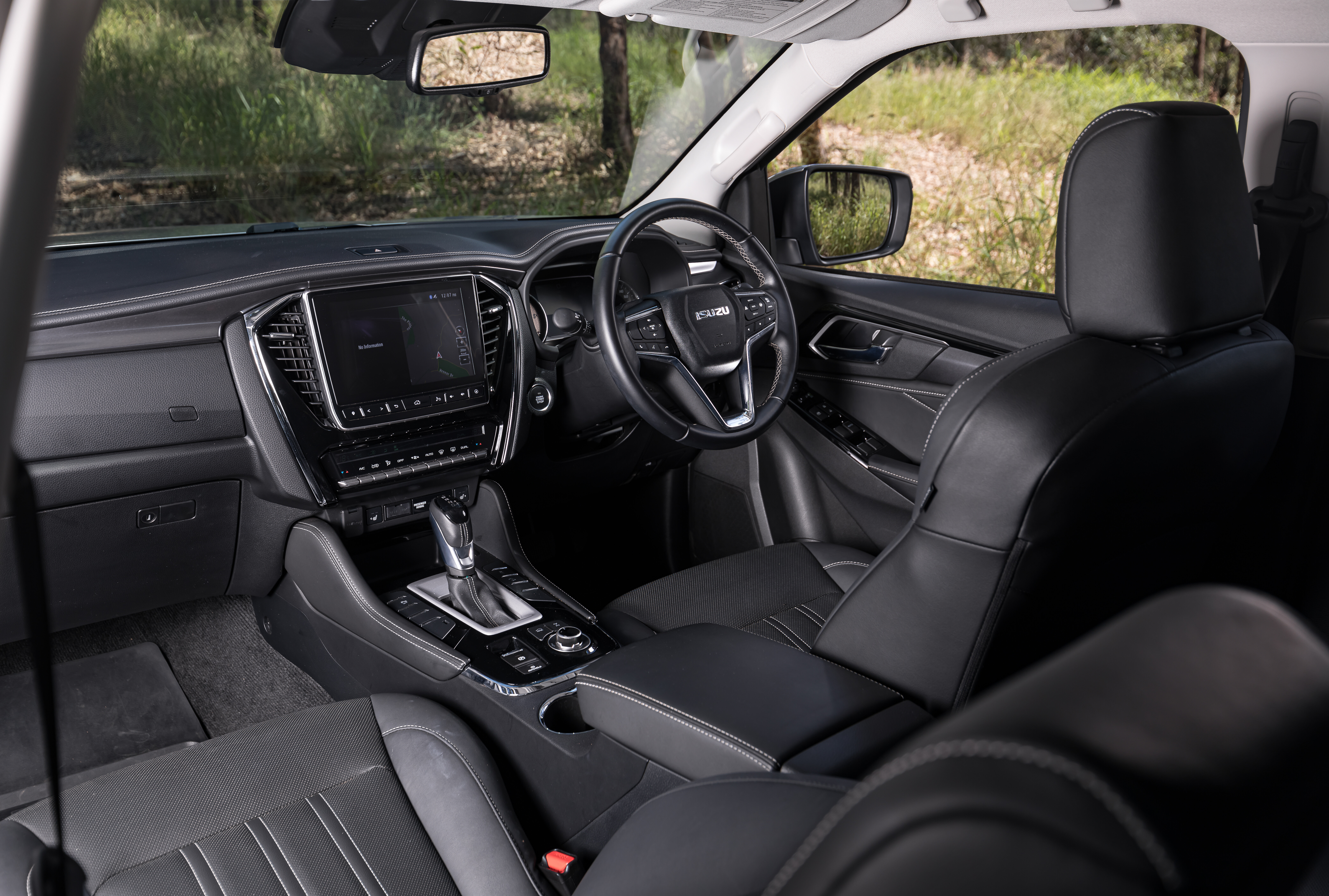
Wireless Apple CarPlay and Android Auto work a treat through the 9.0-inch infotainment system, though, as mentioned in my ’22 D-Max LS-U review and even more pertinent for the MU-X, a wireless charging pad would go a long way to adding a high-tech feel. In an SUV it’s come to be something you expect. It does have ample charging ports (3 USB and two 12V/120W sockets), which are sufficient.
There’s loads of storage in this cabin, so it’s definitely a family-suitable option. Up-front, a dual-compartment glovebox, large centre drink holders, and sizeable centre compartment provide plenty of stowaway options. Those trademark Isuzu pop-out side cup holders remain, too, which we applaud. Handy little things, those.
Safety is high on the agenda for the MU-X, with a five-Star ANCAP safety rating and eight airbags throughout
Safety is high on the agenda for the MU-X, with a five-Star ANCAP safety rating and eight airbags throughout the line-up.
The various autonomous safety features feel, in essence, the same as any other Isuzu. The Intelligent Driver Assistance System (IDAS) system used across the D-Max and MU-X range, offered as standard for every model, is up there with the best in class and the inclusion of a quick “off” button further enhances the system.
IDAS uses a windscreen-mounted Hitachi 3D binocular camera system and offers; autonomous emergency braking with turn assist, blind-spot monitoring, forward collision warning, adaptive cruise control, traffic sign recognition, rear cross-traffic alert, lane-keep assist, lane departure warning and emergency lane keeping.

This car does seem to have a touchier autonomous system; it could be configuration or could be in our heads. But it feels a tad bit more touchy than the D-Max range. Perhaps it’s just calibrated differently.
Exterior and Interior visuals, as well as the tech and infotainment, are incredibly similar to a D-Max until you use the side mirror and remember you’re in a wagon.
Comfort and Practicality

Isuzu claims that almost half of all MU-X owners tow with their wagons, which isn’t surprising. Its 3.5-tonne maximum braked towing capacity makes a lot of sense, then, made possible and safe thanks to a revised rear-end suspension set-up over the old generation.
With a kerb weight of 2175kg, the MU-X is no featherweight. A GCM of 5900kg, though, means that even if you max out the towing capacity, you’ve got 225kg left for passengers and cargo. And without anything hitched behind you, a GVM of 2800kg gives you a pretty decent 625kg payload on board, which should cover off most families and some luggage.

You don’t get a huge amount of rear cargo space with all seven seats up, at 311 litres, which is pretty normal for a seven-seater. Fold the third row flat, though, and storage jumps to 1119 litres.
When you then put both the second and third rows down, you get a gigantic 2138 litres of storage. Mind you, most people buying a seven-seater aren’t going to run around very often with both rows folded flat. If this was a family car, though, and you needed to pick up a table or a mattress, you’d be able to do it.
Like most seven-seaters, you’re really only fitting children up back. Second-row seating offers a healthy amount of space and you’d easily seat adults without complaints

It has keyless entry and walk-away door lock, which we love, but there isn’t an auto tailgate you swipe your foot under or anything. The tailgate is, however, electrically opened and closed using a button on the keys, dash or exterior button.
In terms of seating, like most seven-seaters, you’re really only fitting children, jockeys, or pets up back. Second-row seating offers a healthy amount of space and you’d easily seat adults back there without complaints. Space for the driver and front passenger is fantastic and the seats will accommodate those who are rather petite, through to the burliest of family dads – with all the adjustability you could want.
How’s it Drive?

On the road, the MU-X is the comfiest ride in the Isuzu family. The five-link coil-sprung rear is to thank for that and, while spring rates are stiffer than the previous generation of MU-X, it’s night and day compared with its leaf-sprung brute ute sibling.
Body roll is also admirable, given its towering height, improved thanks to a 23mm anti-roll bar and no doubt helped along by the stiffer spring rates.
Isuzu’s electric power steering in the latest generation MU-X and D-Max variants is a significant improvement over the old hydraulic setup, offering a light feel at low speeds but firming up plenty at highway speeds. It never feels too light, or too heavy – which can often be why electric steering falls short of good ol’ hydraulic setups.
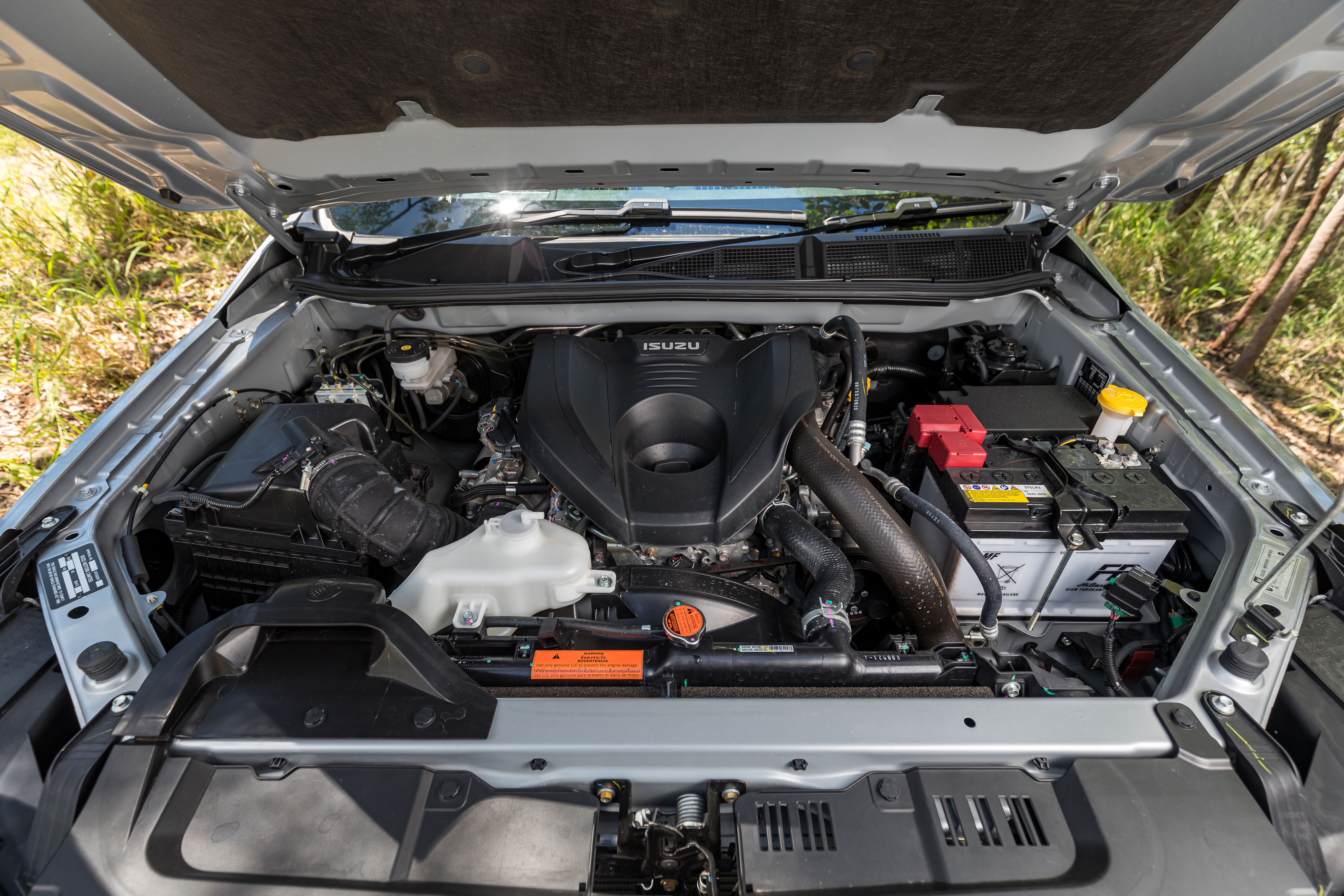
The revised 3.0-litre turbo-diesel 4JJ3 engine delivers 140kW at 3600rpm and 450Nm between 1600 and 2600rpm – enough to move the more-than-two-tonne MU-X with suitable haste.
I have said before, and I probably sound like a broken record by now, that the D-Max could benefit from a couple more gears in the six-speed Aisin auto box. Well, that’d be even more helpful for the MU-X, given its weight and the fact it’s going to spend a lot of time in the city.
It is by no means underpowered or lazy, but we are growing used to eight-speed, and even 10-speed boxes these days that get you up and going a bit quicker. The 3.0-litre engine makes up for this, though, with a torque spread meaty enough for six cogs to be sufficient.

We averaged 10.3L/100km around town across a week of predominantly city driving, with a lot of stop-start and peak-hour traffic. Impressively, our strictly off-road average on the first day was 9.9L/100km, with a decent amount of low-range use. Isuzu claims a combined 8.3L/100km, which with an 80-litre tank will get you nearing 1000km between fills.
It’s definitely not the most frugal sipper in its segment but with that, you get a big under-stressed 3.0-litre and you can expect a long, trouble-free life with this motor given its long service across the Isuzu range. Any pesky issues have well and truly been ironed out over the 14 years the ‘4J’ has been powering Isuzus in Australia.
The MU-X offers a refined driving experience, in terms of on-road compliance, noise suppression, and overall comfort for a 4×4 wagon
Around the city, given many families will use this MU-X on mundane traffic-ridden school runs and the like, it is a big car and you feel that. But it has a fantastic array of sensors and cameras, making tight city manoeuvring a simple affair.
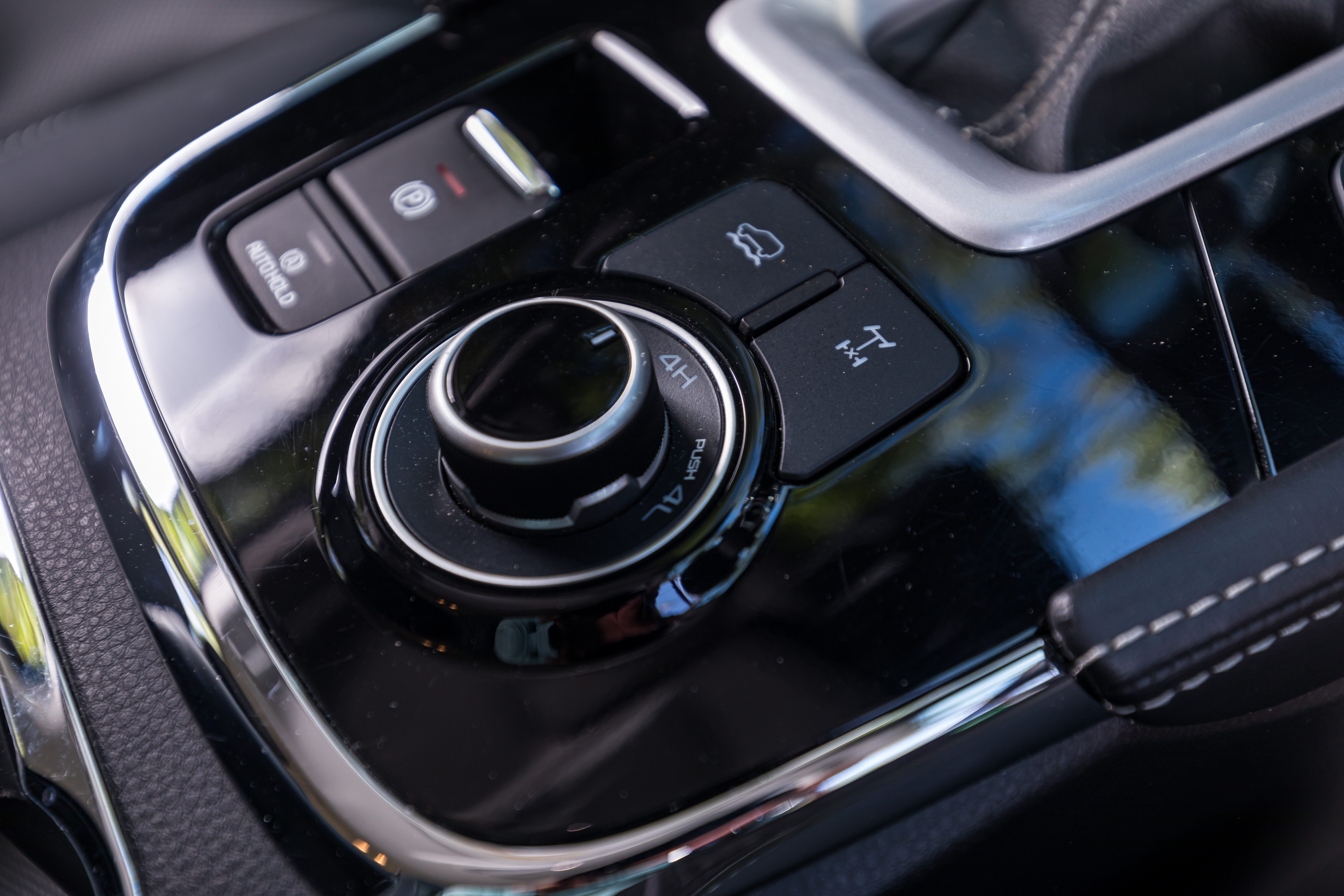
We will point out that the parking sensors go berserk in peak-hour traffic – which we did a fair bit of here in Brisbane with the MU-X. We turned the parking sensors off if the drive involved negotiating traffic, which is done with a simple press of a button next to the shifter. As cars slip in front or around you, and as motorcycles lane filter, it creates a constant symphony of beeps and it gets pretty distracting. When parking, the sensors do the job they’re intended to do. Maybe careless Brisbane drivers are the cause of this, who knows.
Overall comfort is fantastic, and my partner (a regular occupant and provider of feedback in all test cars) commented on this various times. The MU-X offers a refined driving experience, in terms of on-road compliance, noise suppression, and overall comfort for a 4×4 wagon.

This is not an all-wheel drive or permanent 4×4 vehicle but even in greasy conditions, the MU-X is surefooted. I wouldn’t let the absence of a constant 4×4 system deter you (as you get in a Ford Everest or Toyota Prado), because it isn’t noticeable and doesn’t limit the MU-X for everyday use.
A turning circle of 11.4 metres aids around-town manoeuvrability, but it’s still a big beast and feels better suited to longer adventures.
Visibility all-round is fairly good too, though the B-pillars are absolutely enormous. But that comes with the territory and you adjust quickly.
Water jets, like the D-Max now, don’t seem to reach quite as far as bonnet-mounted options, because they’re mounted on the wiper. An odd point to even mention, but maybe I just like a crystal clear windscreen after hitting the dirt.
The infotainment won’t match premium SUV systems but for a 4×4 seven-seater, it’s a solid system with enough refinement to keep the car feeling modern. We just wish there was a traditional volume dial, as buttons alone can be a little distracting.
The five-link rear end was more composed and offered more articulation than the ute this MU-X is based on

On the first day of testing, we took the MU-X to the Ormeau 4×4 tracks south of Brisbane, which after the rain left us with some fairly challenging terrain.
We ran around in 4H for most of the day between climbs but did engage low-range for the gnarlier stuff. The perks of having a photographer who runs a GU Patrol with all the right upgrades is that we have a scout vehicle we know won’t get stuck!
One particular track didn’t leave much between the ground and the right side step, but we made it out unscathed. The steps will be the first to go if you drop a wheel into a deep rut or get too ambitious on a climb, so just keep that in mind.

The five-link rear end was more composed and offered more articulation than the ute this MU-X is based on, and we didn’t need to use the magnetic diff lock at any point. While a locking diff is great standard kit, the combination of low range and traction control does an ample job in all but the roughest going.
This latest generation MU-X offers strong ground clearance (235mm), and improved approach (29.2 degrees) and departure (26.4 degrees) angles. Departure angle is particularly good, with a nicely angled front bar that sits quite high – with a lift kit this would be as capable as any. There were plenty of times I expected us to scrape, and the car didn’t.
It’s an old-school 4×4 system, not a ‘drive straight from bitumen to dirt’ constant 4×4 setup like others in this segment, but it features plenty of electronic wizardry to ensure just about anyone can get in and hit the trails.
It’s got heaps of grunt off-road, but manually shifting may help if in 4H and to keep it changing up at the wrong moment. We didn’t need to, but it may help to hold gears.
Nothing in this car, since the latest release, feels tired yet in terms of design or function, and the peppier redesigned engine helps the big MU-X along nicely both on- and off-road.
2022 Isuzu MU-X LS-T 4×4: VALUE AND VERDICT
The as-tested price for this MU-X LS-T 4×4 is $69,032.95, based on the special drive-away price ($65,990), Mercury Silver metallic paint ($650), tow bar kit ($1,100), electronic brake controller ($820), tow bar wiring harness ($359), and stamp duty ($113.95).
Bearing in mind this is the top-spec MU-X, that special drive-away price is a compelling offer, even with a few extras ticked at the dealer.
Isuzu’s Service Plus 6-7-7 aftercare offer gives owners a six-year/150,000km warranty across the entire range, seven years of capped-price servicing, and up to seven years of roadside assistance when serviced through Isuzu Ute Australia’s dealer network.
The MU-X will need servicing every 15,000km or 12 months.
You can’t go wrong with the D-Max DNA that underpins the MU-X, and the levels of comfort and liveability engineered into this platform make it a compelling seven-seater wagon

Where I’ve sung the praises of a 4×2 D-Max as a tradie workhorse, I tend to think in MU-X form, opting to omit 4×4 capability serious hinders the overall offering.
For that reason, the 4×4 MU-X models are the better pick as a family-friendly adventure-ready all-rounder.
If the $65,900 price tag of the LS-T deters you, the lower-spec 4×4 models may be a better option at $53,900 for the base spec LS-M or $59,900 for the middle-of-the-road LS-U (both prices before on-road costs).
You can’t go wrong with the D-Max DNA that underpins the MU-X, and the levels of comfort and liveability engineered into this platform make it a compelling seven-seater wagon option.

2022 Isuzu MU-X 4×4 LS-T specifications
- Part 1: Tour of Duty
- Part 2: Catching the Perentie bug
- Part 3: Improving the formula
- Part 4: Moreton bash
- Part 5: Oily Morning Coffee
- Part 6: Virus Escapee
- Part 7: 1976 LC FJ40 joins in at Moreton Island
- Part 8: Decisions, decisions
Part 1: Tour of duty
So I bought a Perentie. It’s all Robbie Emmins’ fault. If I hadn’t taken his 1956 Series 1 for a drive a while back, the Land Rover flame may not have been rekindled.
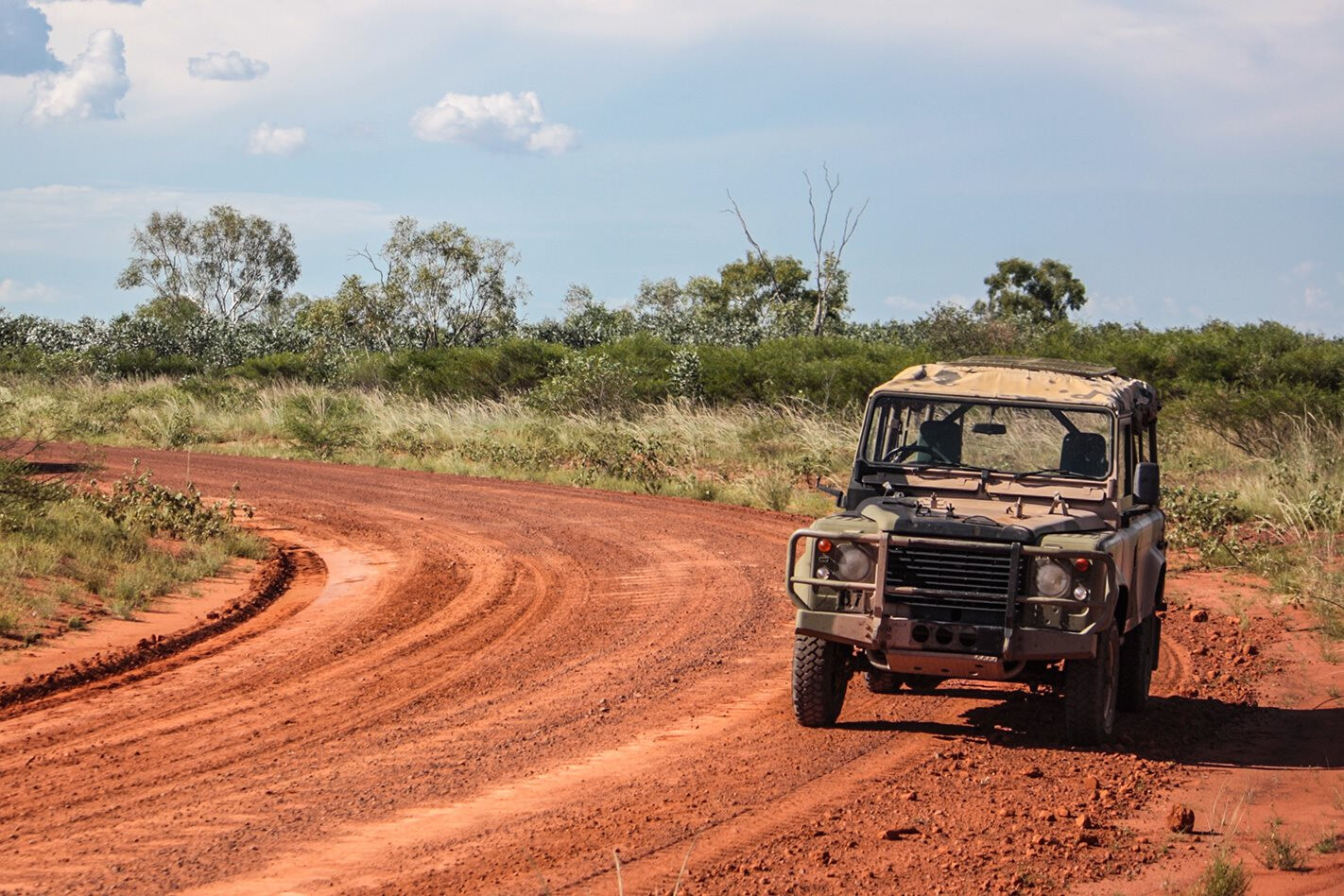
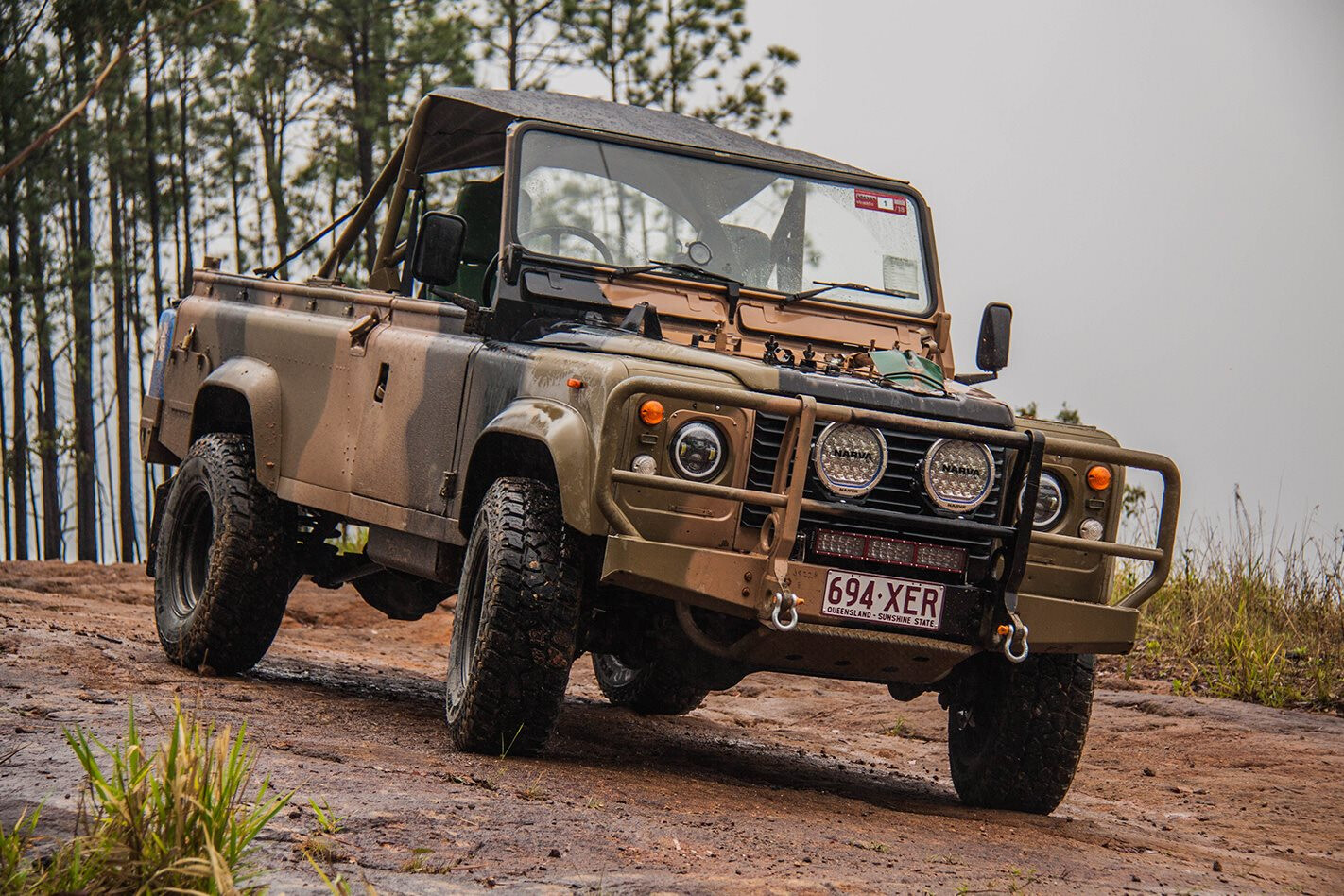
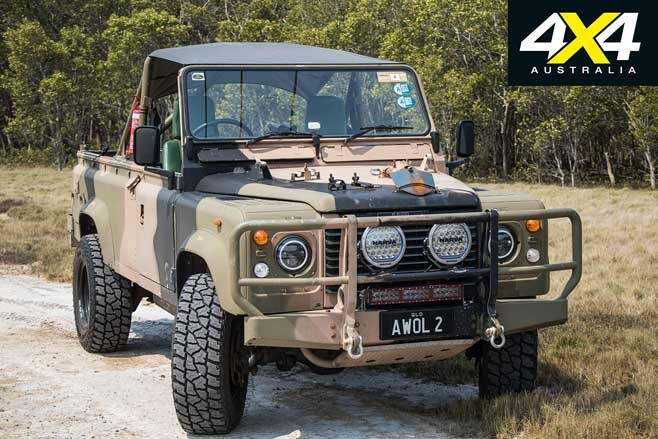
The Perentie 4×4 is actually a Defender 110 built in Sydney for the ADF. In soft-top form it’s a rough, tough, noisy, flapping tent on wheels that has all the ergonomic comfort of sitting in a hay shed during a hailstorm. They’ll happily sit on 100km/h all day long, but the sensation is similar to being in a low-flying crop duster.
However, the Perentie is quite possibly the most capable Land Rover ever built, and best of all they’re also part of Australian manufacturing history. And, for the beach bums out there, they sit on a galvanised chassis.
I’d been watching the Australian Frontline Machinery auctions on Grays Online, and the prices seemed to have stabilised somewhat. There were, after all, only 2500 Perentie 4x4s made and roughly 600 6×6 variants. As the clock ticked down on the auctions in Darwin and Sydney I couldn’t help myself and threw in a bid, and then another, and then got completely caught up in the hype.
The Minto NSW auctions make the most sense for east coast buyers. These vehicles come with a NSW blue slip ready for rego, and it’s an easier location to inspect the goods beforehand. As a result, these trucks always go for more dough.
I, however, did things completely arse about, and bought one for substantially less in Darwin, sight unseen – which, of course, you should never do. I then decided to do something even more inadvisable, I decided drive it back to Brisbane across the heart of the outback to give us some bonding time.
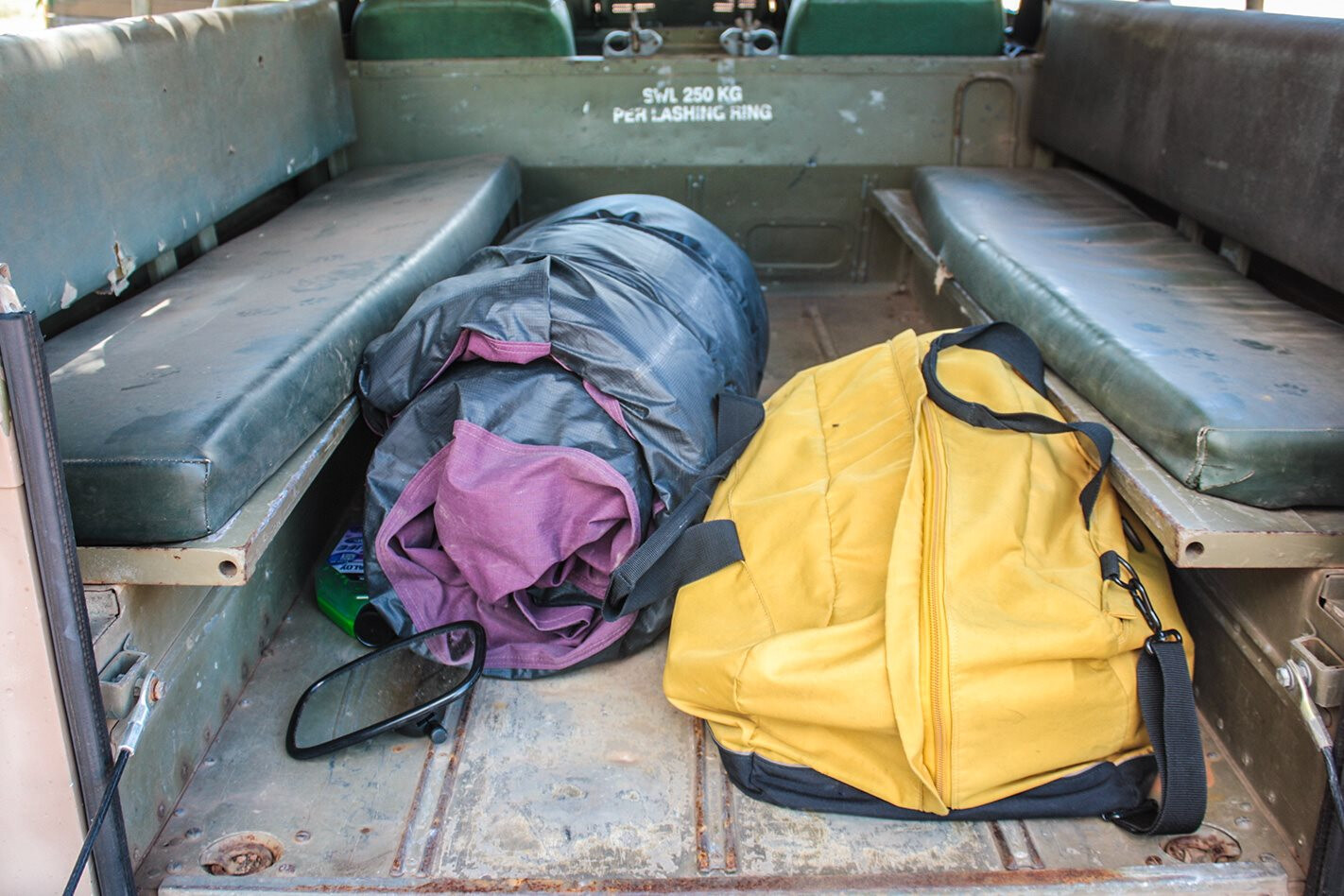
I checked over the new purchase on arrival. It was cosmetically a little shabby; sitting around in the tropics had weathered a few bits and pieces. But the 66kW/245Nm 3.9-litre Isuzu diesel coughed into life with no dramas. The coolant was where the coolant should be and so was the oil. I checked for anything that may be loose, threw my swag in the back and then hit the road south.
Perenties use a four-speed LT95A transmission and the gear ratios are quite tall, which is good for highway driving. They have a reputation for eating clutches if driven unsympathetically, though. Front and rear diffs are Salisbury and Rover.
4×4 models are naturally aspirated, but the 6×6 variants are turbocharged. That said, the unstressed Isuzu donk took the drive in its stride. I was even able to pass a triple road train or two. I was tempted to divert via the Savannah Way, but figured I was pushing my luck as it was.
On road these Landies handle like a bowl of porridge, but Perenties came standard with a 2.5-inch lift (over a standard Defender) and sit on coils all round, so show it a bit of dirt and it’s immediately at home.
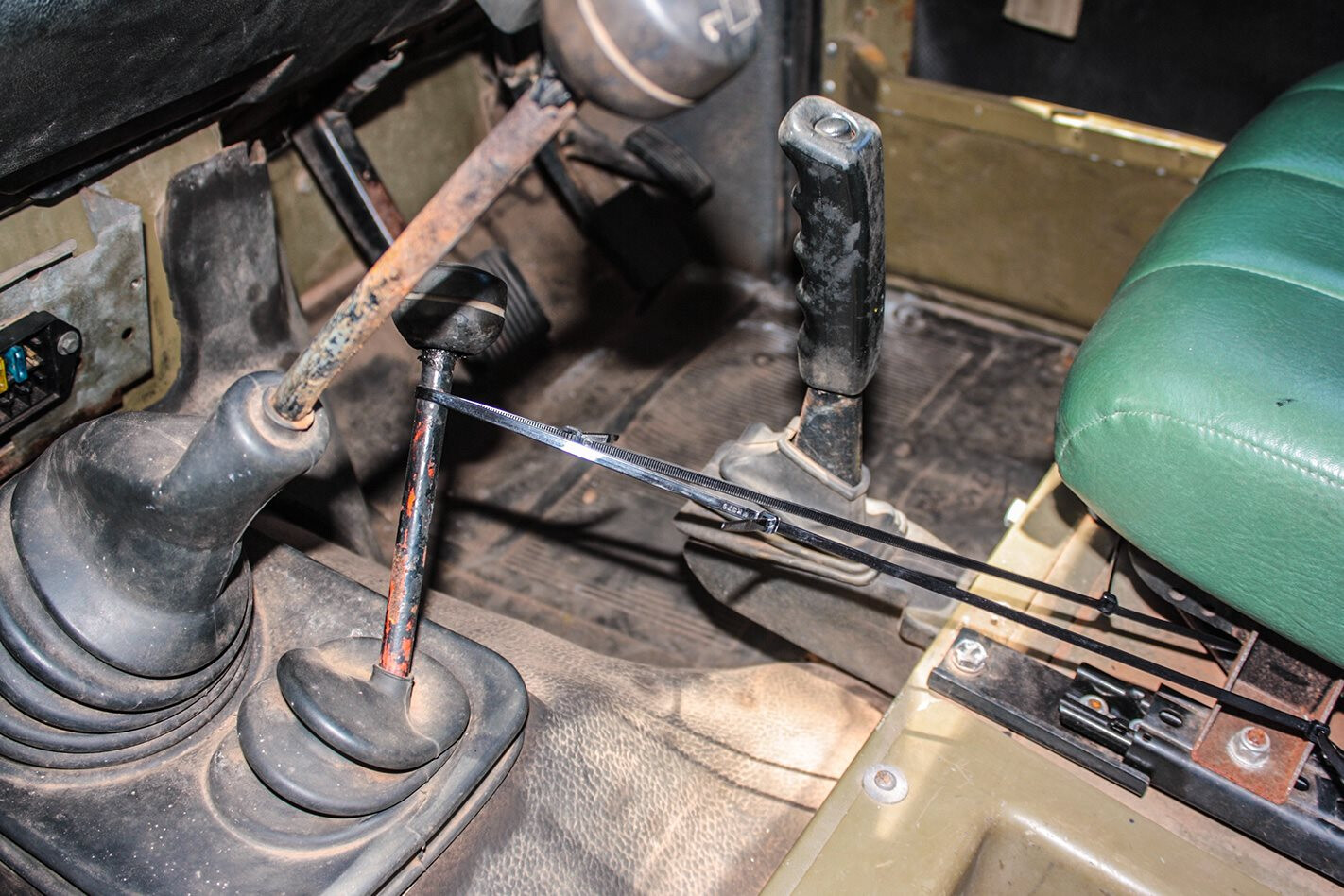
The trip wasn’t entirely without incident as I had some lighting issues, so I had to drive mainly through the daylight hours – the wiring is a dog’s breakfast. It would also occasionally jump out of high-range, but some zip-tie engineering got me home.
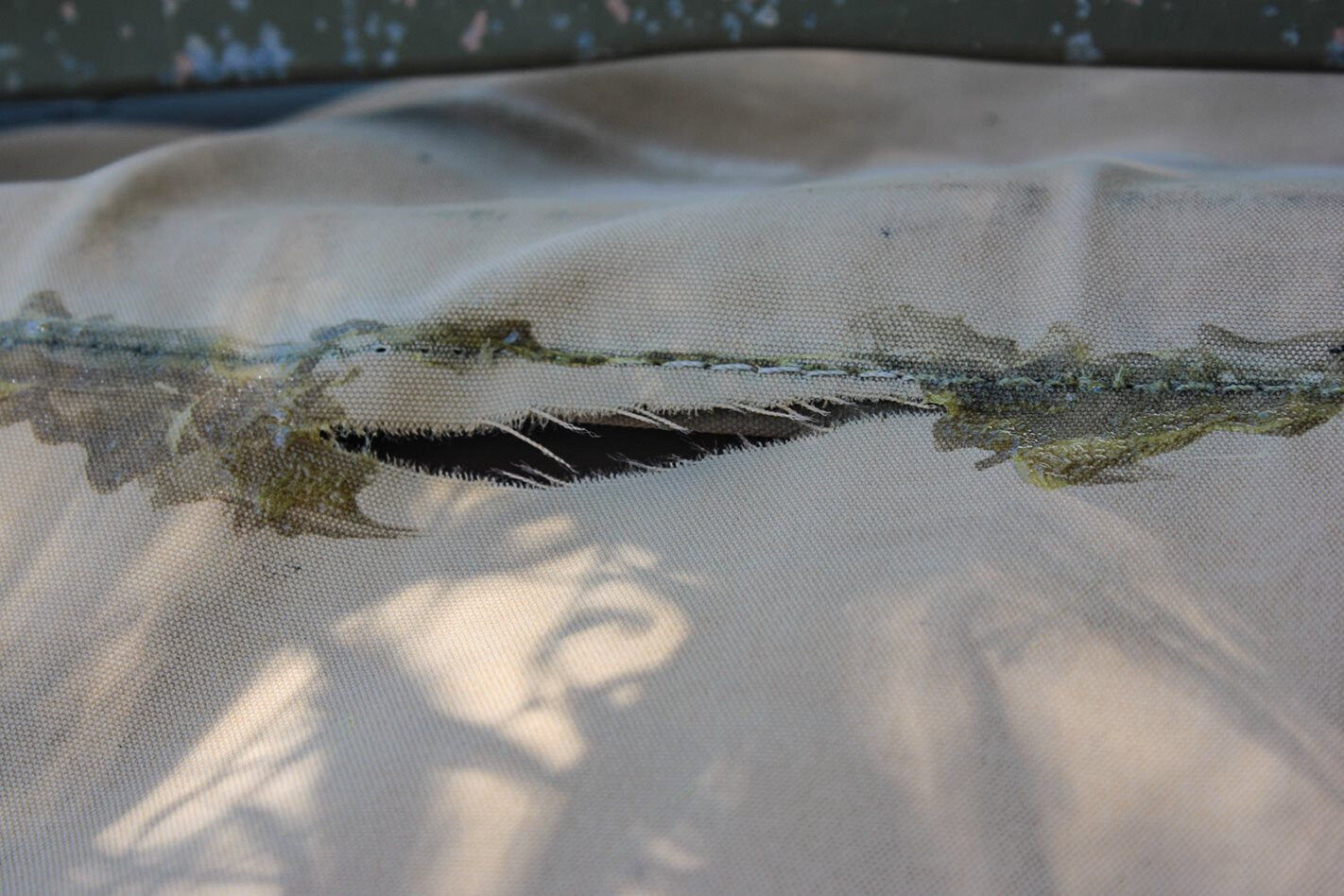
I may now be a little deafer, but I’ve well and truly succumbed to the Peretie bug. Now it’s time to get it ready for rego and perhaps the addition of a turbo. Let the fun begin.
DATE ACQUIRED: February 2017 PRICE: $7700 TOTAL KILOMETRES: 97,368km KM THIS MONTH: 3609km AVERAGE FUEL USE: 11.7L/100km
Part 2: Catching the Perentie bug
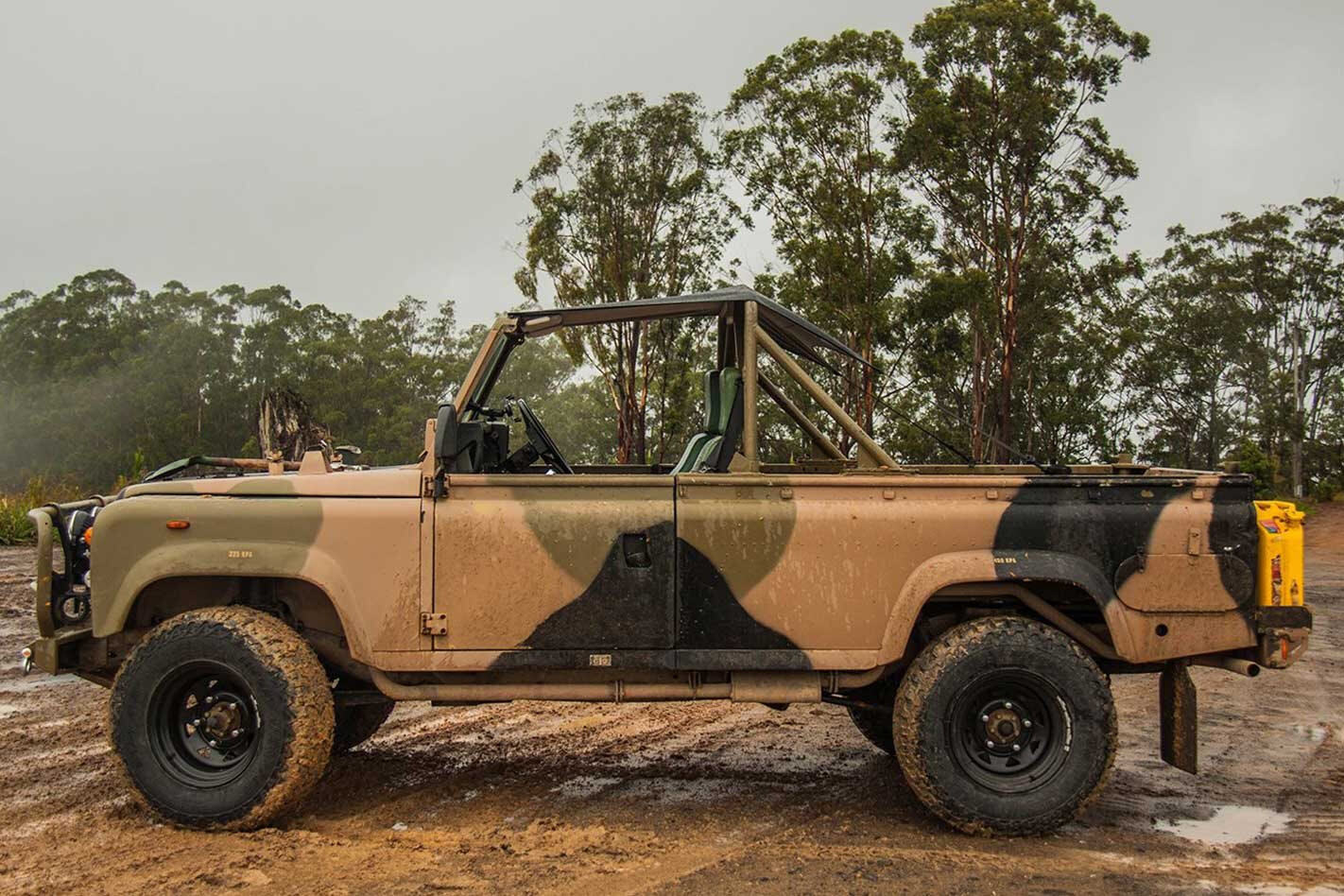
I’m afraid Perentie fever has well and truly taken hold.
That’s the thing about these Landies: they’re basically a big Meccano set that invites you to pull stuff off, bolt stuff on, and generally tinker with it. After the big shakedown trip from Darwin to Brisbane (June, 2017), it was time to get the old bucket of bolts roadworthy.
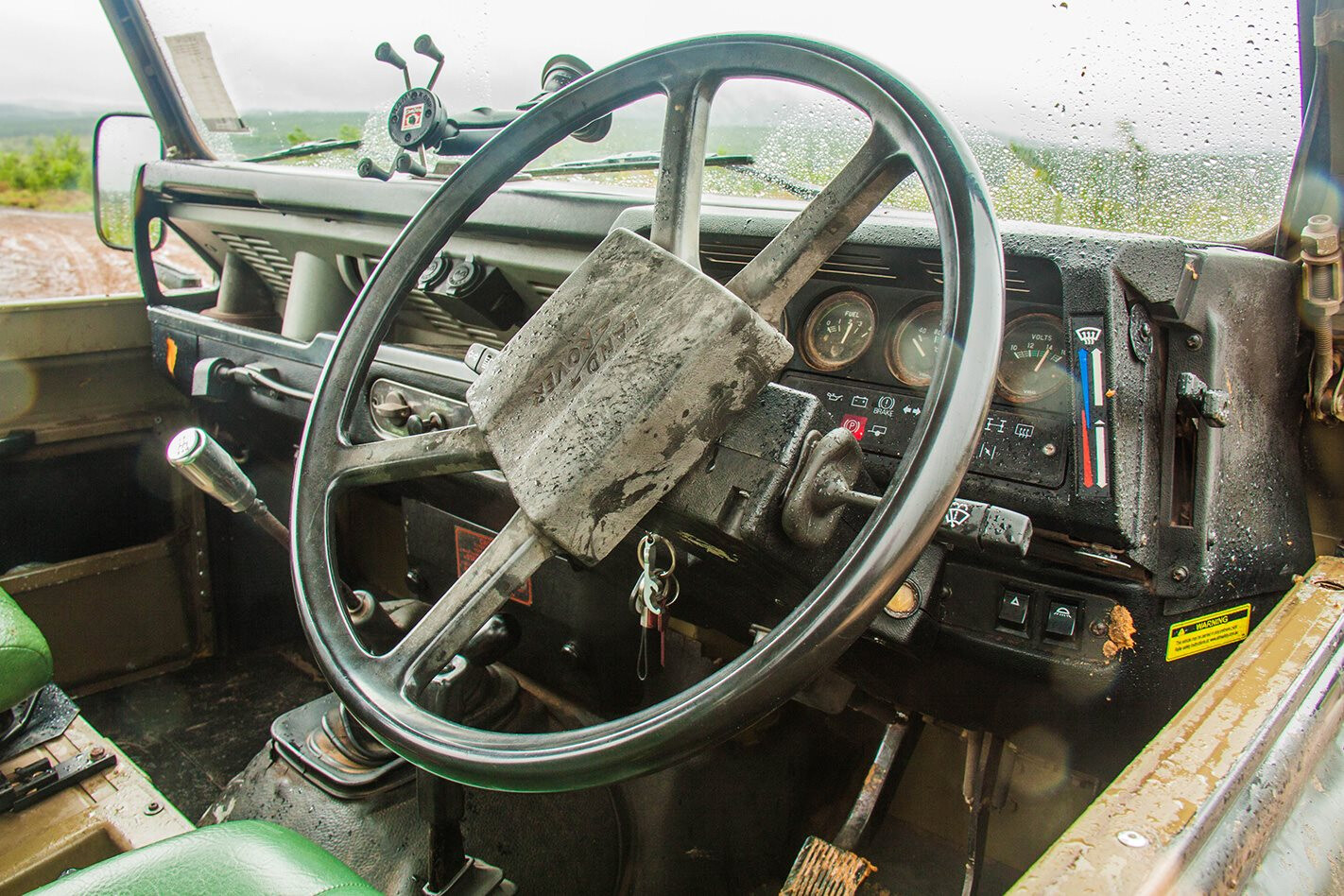
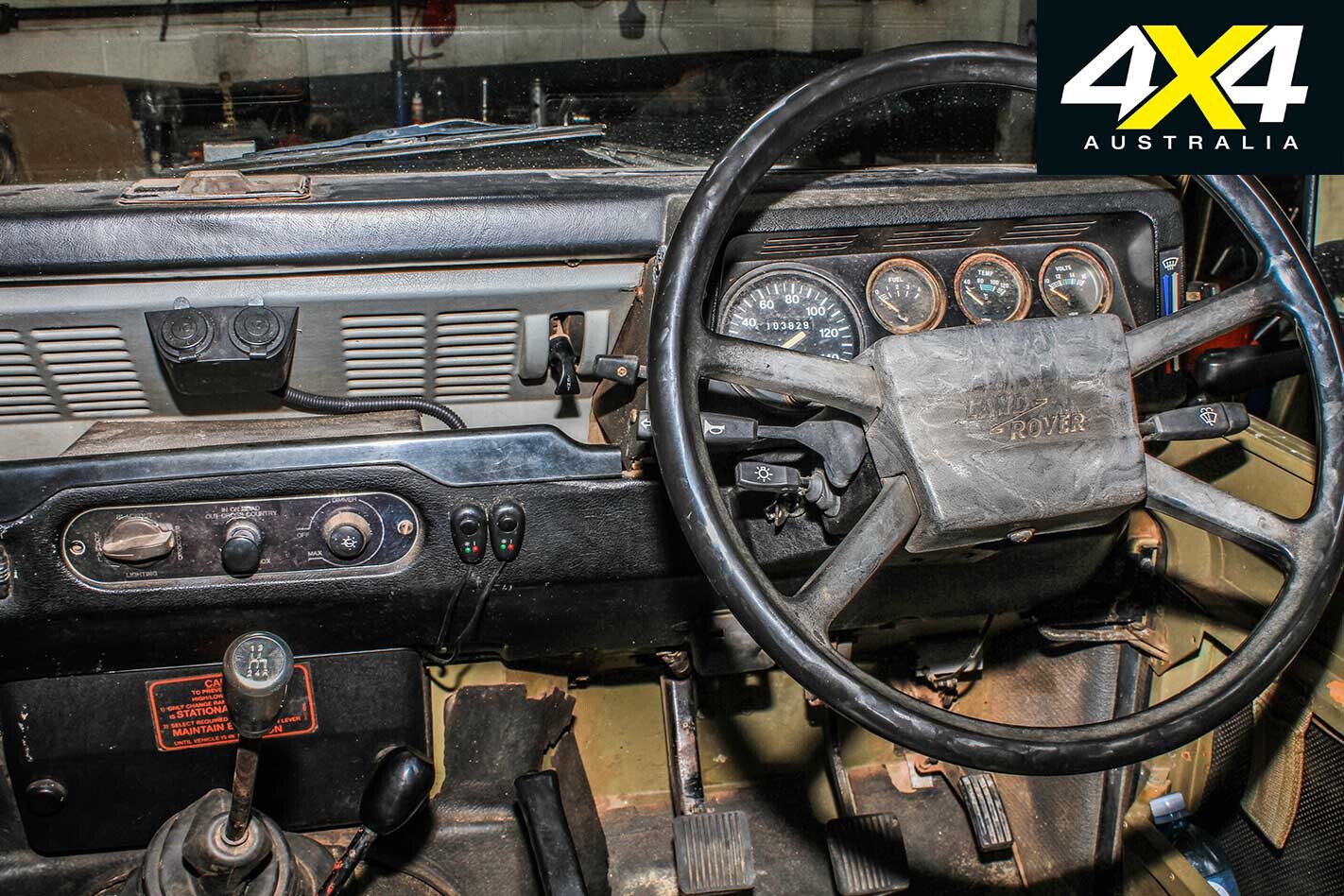
I tackled the obvious stuff: keyed ignition, light switches, wiper rubbers and shock absorber rubbers. The only issue that was presenting a real challenge was the intermittent jumping out of high range. And while I’m loath to treat specialist businesses as a free information resource, I finally bit the bullet and had a yarn with Brad at KLR in Sydney – these guys specialise in Perenties and really know their stuff.
I was changing the oil in the transfer case anyway so, while I was at it, I removed the locking plate on the main gear cluster shaft. Sure enough, there was some play in the shaft, so I nipped it up, put the plate back on, and the issue was solved. While I was at it, I changed all fluids and filters to ensure all moving parts were happy and healthy.
So, with a Queensland safety certificate in my hand, the Landy was soon wearing a set of shiny new number plates. It became clear after a camping trip to North Stradbroke Island that the military rubber had to go.
While the stiff army-spec run-flat Michelins will probably last forever, they are crap on sand and there’s very little bag to be had from dropping tyre pressures. Plus, being on tubed rims meant sand was getting between the sidewall and the tube, making annoying little pinhole punctures.
So a set of 16×8-inch steelies soon came my way, and I opted to shod them in 265/75R16 Mickey Thompson ATZs. A review set of Narva 215 LED spotties also landed on the Perentie’s snout, but some mounting tabs needed to be fabricated to get them into the right place, which wasn’t an issue.
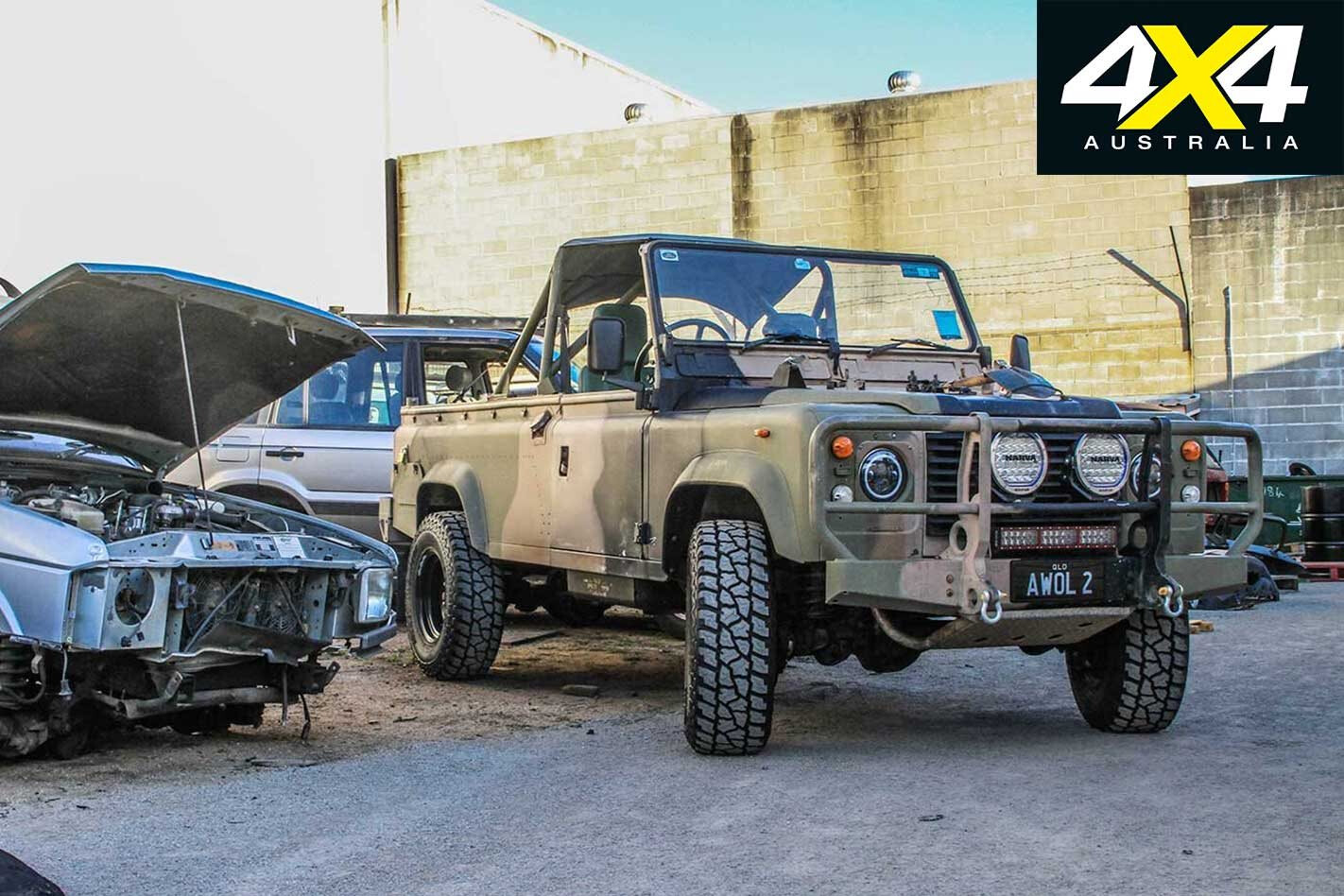
My attraction to the Perentie is based on it being a tough and reliable beast rather than any passion for military history, so the camo canvas top got the flick as well as a lot of the supporting bar work. Long-term plans are to ditch the camo paint job as well, but that will be a while down the track.
The 4BD1 Isuzu engine may be a bulletproof powerplant with a very usable torque curve, but it’s a pretty agricultural thing. It’s loud and lacking finesse, and the torsional stresses it creates means it’s essentially trying to destroy the rest of the vehicle.
New engine mounts are on the shopping list. On the other side the coin, the engine is pretty simple and easy to work on. I realise the Moab crawler meets Land Rover look I’ve gone for may not be everyone’s cup of tea, but it makes for a pretty awesome beach buggy. Mechanical upgrades are sometime down the track, but in the meantime I’ll keep on grinning every time I head out. Even if I do end up with bugs in my teeth.
Part 3: Improving the formula
As you stare at an invoice with lots of numbers and dollar signs on it you may find yourself asking ‘why’? As I was handing over a fair whack of my hard-earned recently, it occurred to me that there are probably much cheaper hobbies than farting around with old Land Rovers … pinning butterflies to bits of cardboard, for example.
The ‘why’ is most likely down to a childhood spent rattling around the family farm in my mum’s Suzuki LJ60, a bare-bones live-axle four-wheel drive that sounded like a thousand angry lawnmowers and had all the creature comforts of a sliced-open 44-gallon drum.
That bloody thing went everywhere, albeit trailing a stream of blue two-stroke smoke from an exhaust mounted on the front bumper. Mum shed more than a couple of tears when time and tin-worm saw it pass into other hands.
So now, I find myself embarking on the financially questionable journey of improving my Land Rover Defender 110 Perentie, code-named Project AWOL.
To date, I’ve been content to spin my own spanners getting the old girl into shape, but, for the sake of my neighbours (due to intermittent garage profanity), I elected to farm out the installation of a turbo kit and power steering to someone with much more expertise and patience than I seem to possess.
After dedicating valuable office time to scouring internet forums, I now know the correct colour code for a SWB Land Rover Series III Game. However, I was none the wiser on the best way to extract some usable, reliable grunt from the 3.9-litre Isuzu 4BD1 engine. So I had a chat with Brad at KLR Automotive in Sydney. These guys know Perenties inside and out and have put together a reliable yet rewarding turbo kit for the Isuzu donk.
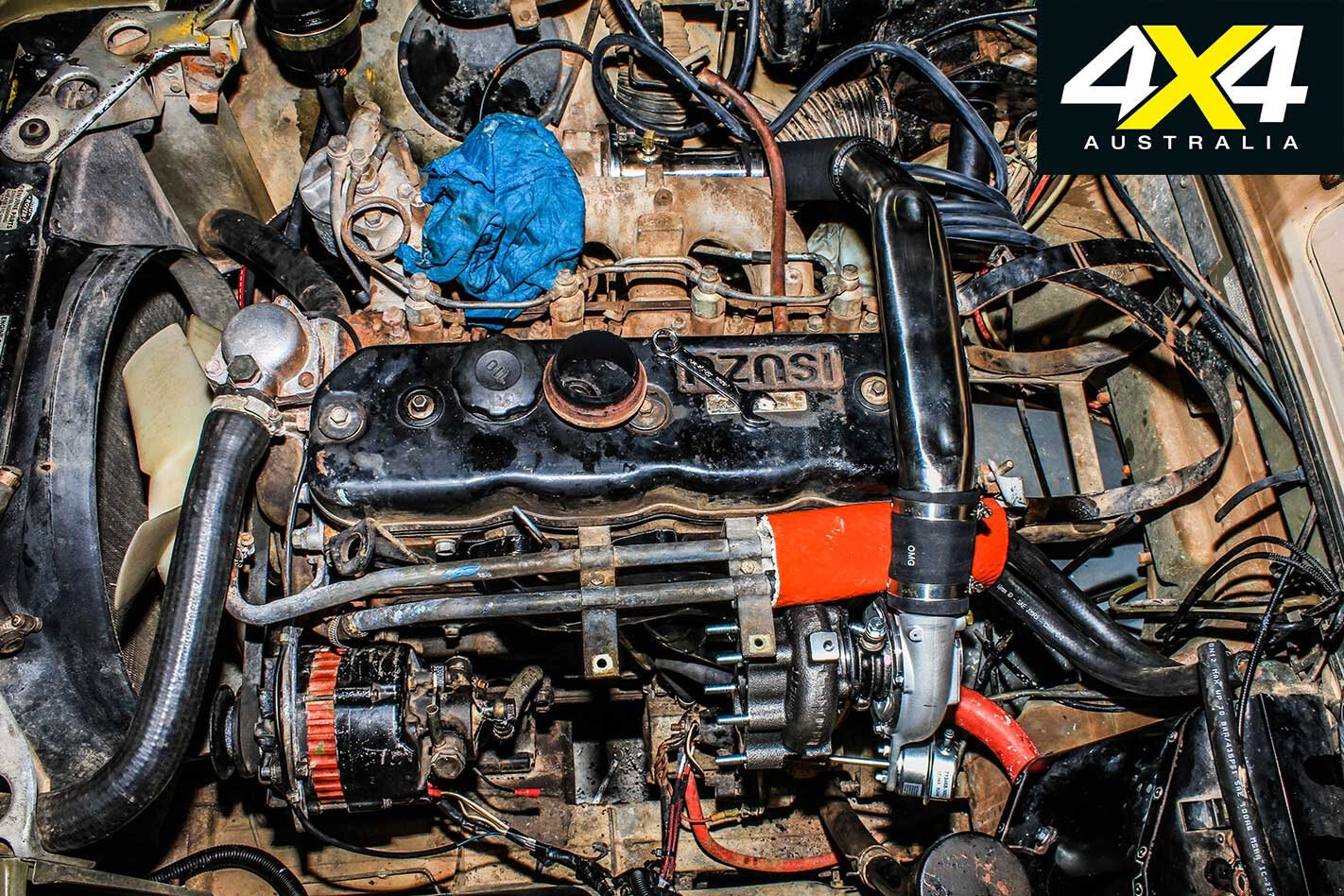
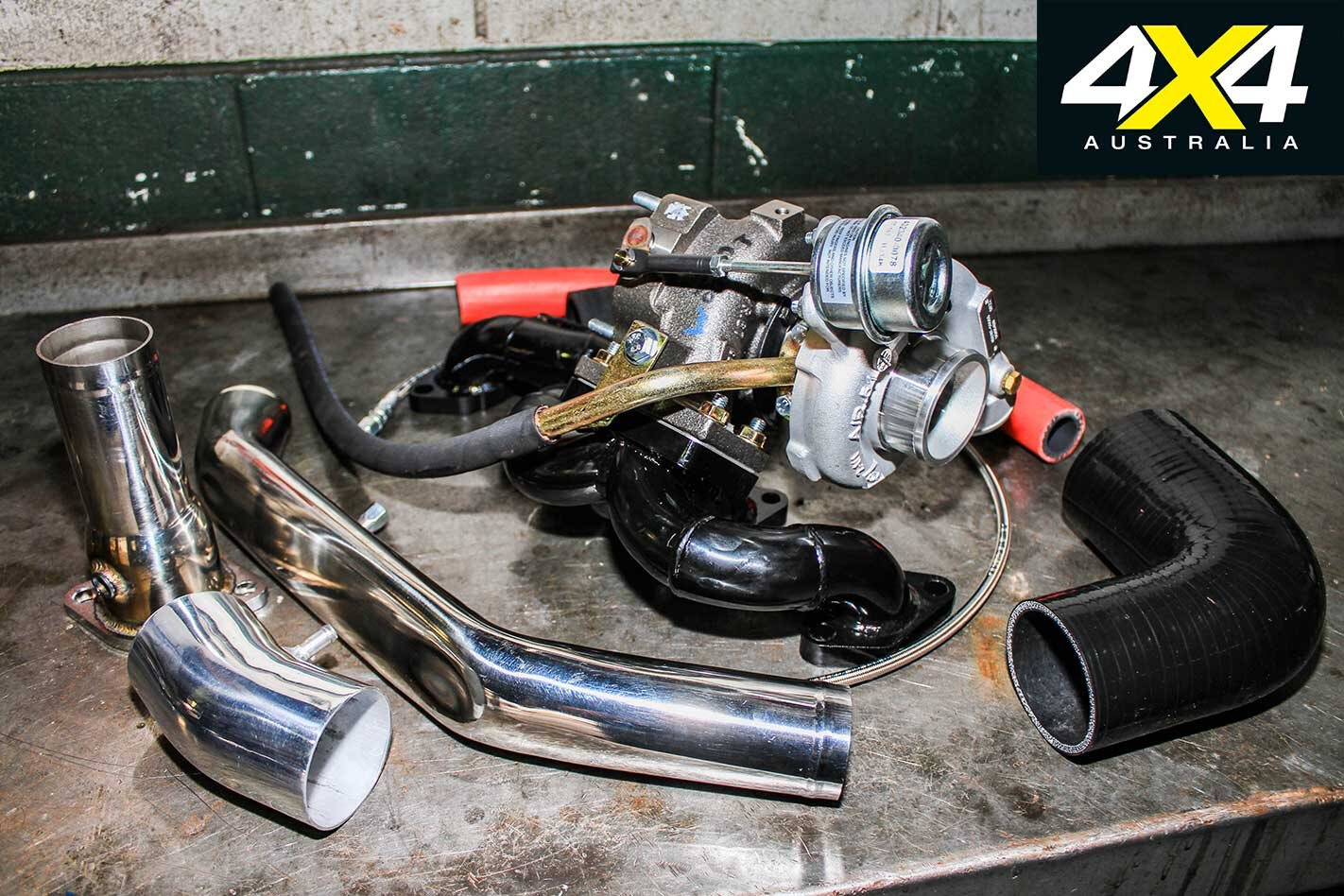
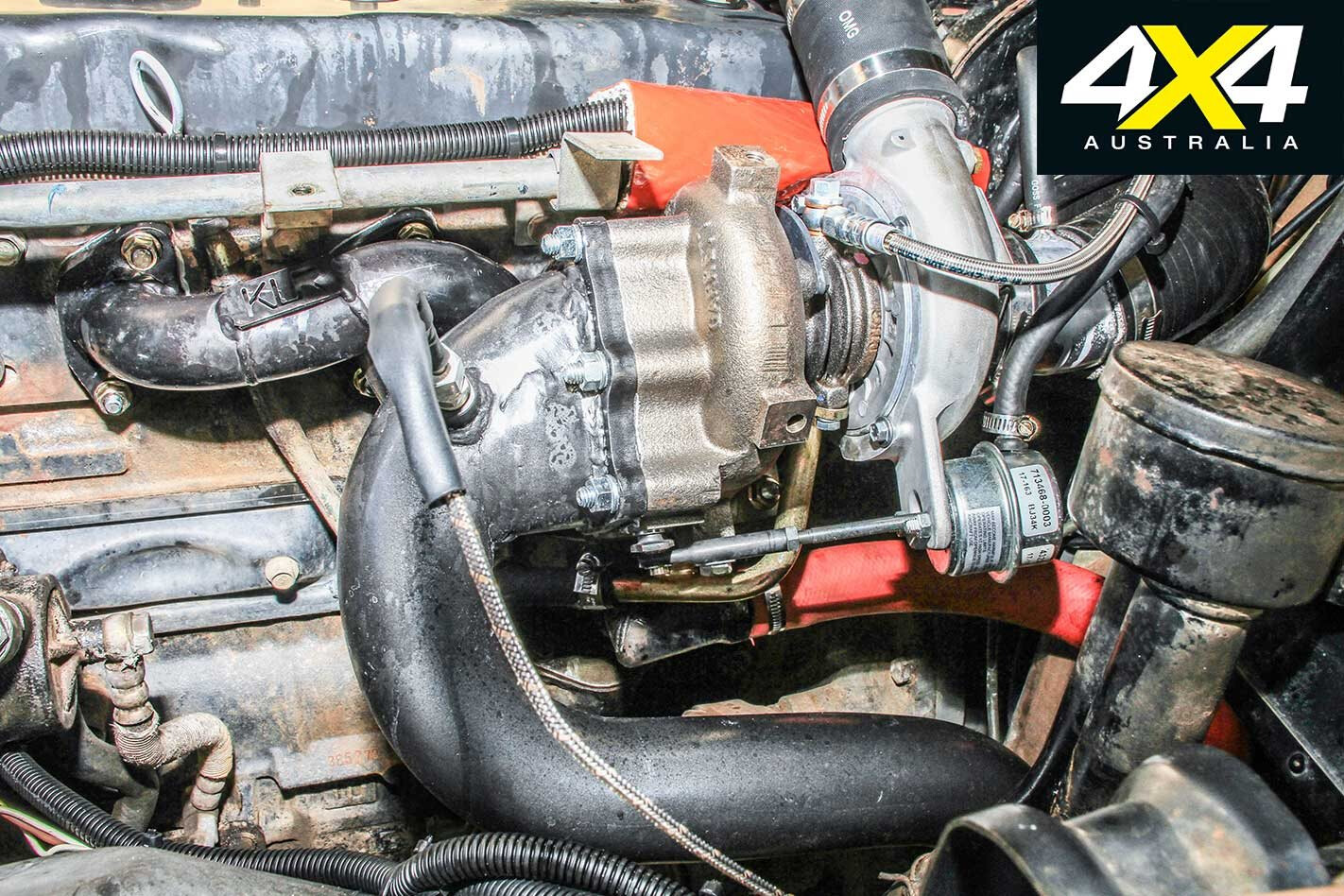
In naturally aspirated form this engine is only good for about 66 lazy kilowatts. The addition of a non-intercooled, relatively low-boost turbo is said to effectively double that output. The turbo in question is a Garrett GT22, and it manages to produce boost pretty much just off idle, which comes in handy in those mucky situations we find ourselves in away from the blacktop.
I then got onto Landy specialists MR Automotive in Redcliffe to see if they could handle the heavy lifting on my behalf. I was already using these guys as my go-to for parts, but they have a loyal following among Landy aficionados for mechanical work as well. The kit arrived complete with a crossover pipe, headers, etc.
The old-school truckie in me couldn’t resist also getting an EGT gauge and tacho installed at the same time. The EGT ended up being an easier ask than the tacho, as the Perentie’s alternator lacks a W wire to transmit rpm to a tacho. I persisted!
Anyway, it also gave me an excuse to get a leak on the alternator-mounted vacuum pump fixed, which also turned out to be the reason why I was having issues getting the centre diff to lock. All this disruption to engine-bay plumbing required a new exhaust system, so a new 2.5-inch exhaust system was also installed.
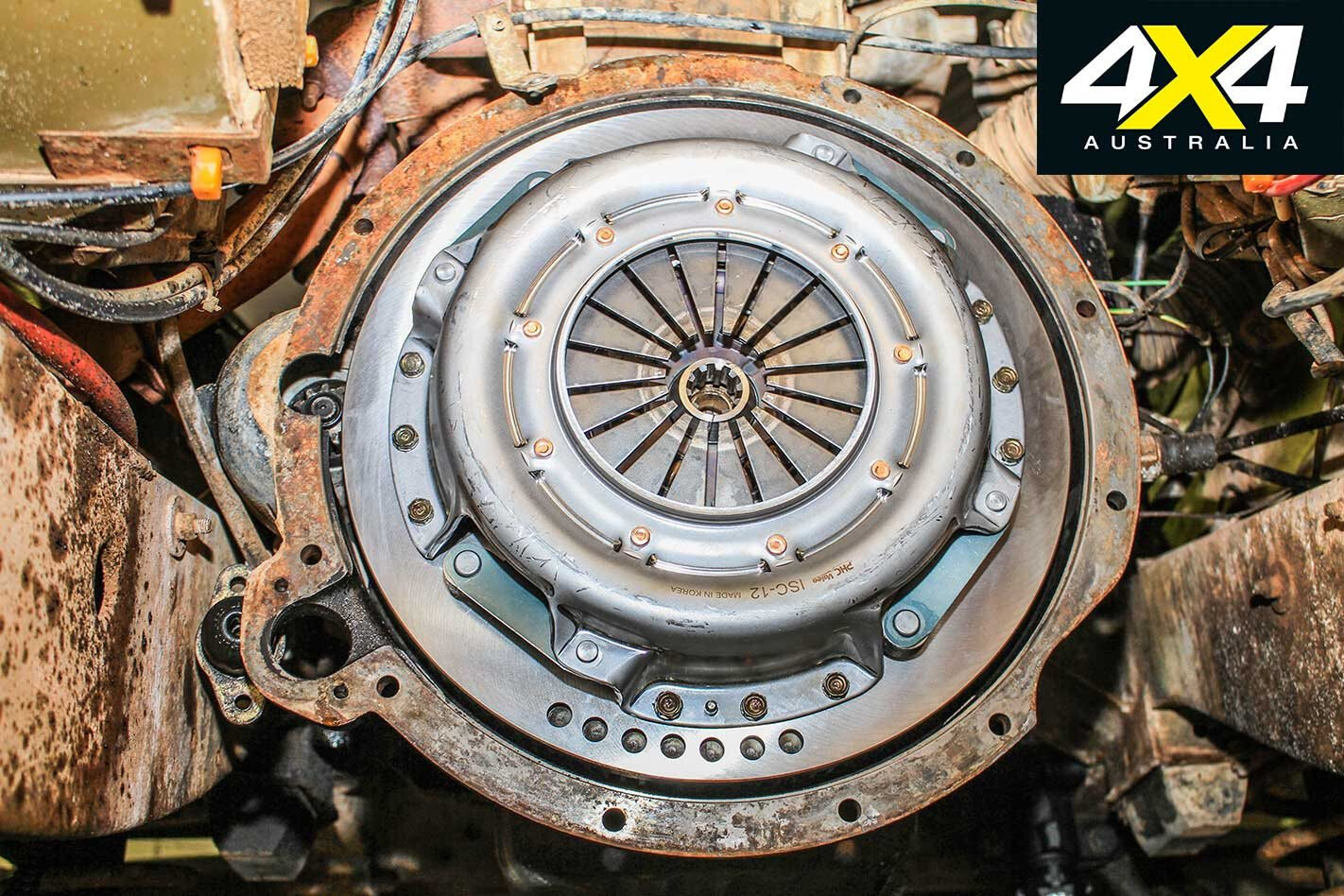
And then we reach the point many car nuts reach: where to stop? And in the case of the Perentie, what is the weakest link with the gain in power? The answer to that question is, without a doubt, the clutch. The standard clutch is barely adequate at the best of times, so I opted to go for a heavy-duty clutch while I was at it.
After a long week of unbearable anticipation, the day finally arrived to pick up my revamped rig. It was a revelation. As the 4BD1 is essentially a truck engine it has a long, flat torque curve from about 1000rpm, but take the revs above 2200rpm and you’ve pretty much run out of torque. That’s why the Isuzu engine doesn’t really need a very big turbo or a gutful of boost.
If you’re wringing the revs out to 3000rpm to get boost you’re not getting the benefit of the windmill where you need it the most. Not only that, you’re also thrashing it.
With just 15psi of blow and the addition of Isuzu power steering, my camo-clad 110 is in serious danger of becoming almost zippy. It has transformed the Landy to a usable and fun off-road animal.
I just can’t stop smiling when I drive it. The turbo has even quietened the engine to the point where an actual conversation is possible at speed. Not only that, it also manages to elicit an off-idle whistle that is reminiscent of an old 14-litre BC3 Cummins truck engine… it doesn’t take much to make me smile.
With all this new-found power and aural satisfaction, I’ve decided to head to Moreton Island for an extended weekend – the perfect environment to put my newly boosted Perentie to the test. That said, in the back of my mind I am wondering if this newly minted turbo powerplant will cause issues with the rest of the truck. Stay tuned, more money may be required… stuff may break.
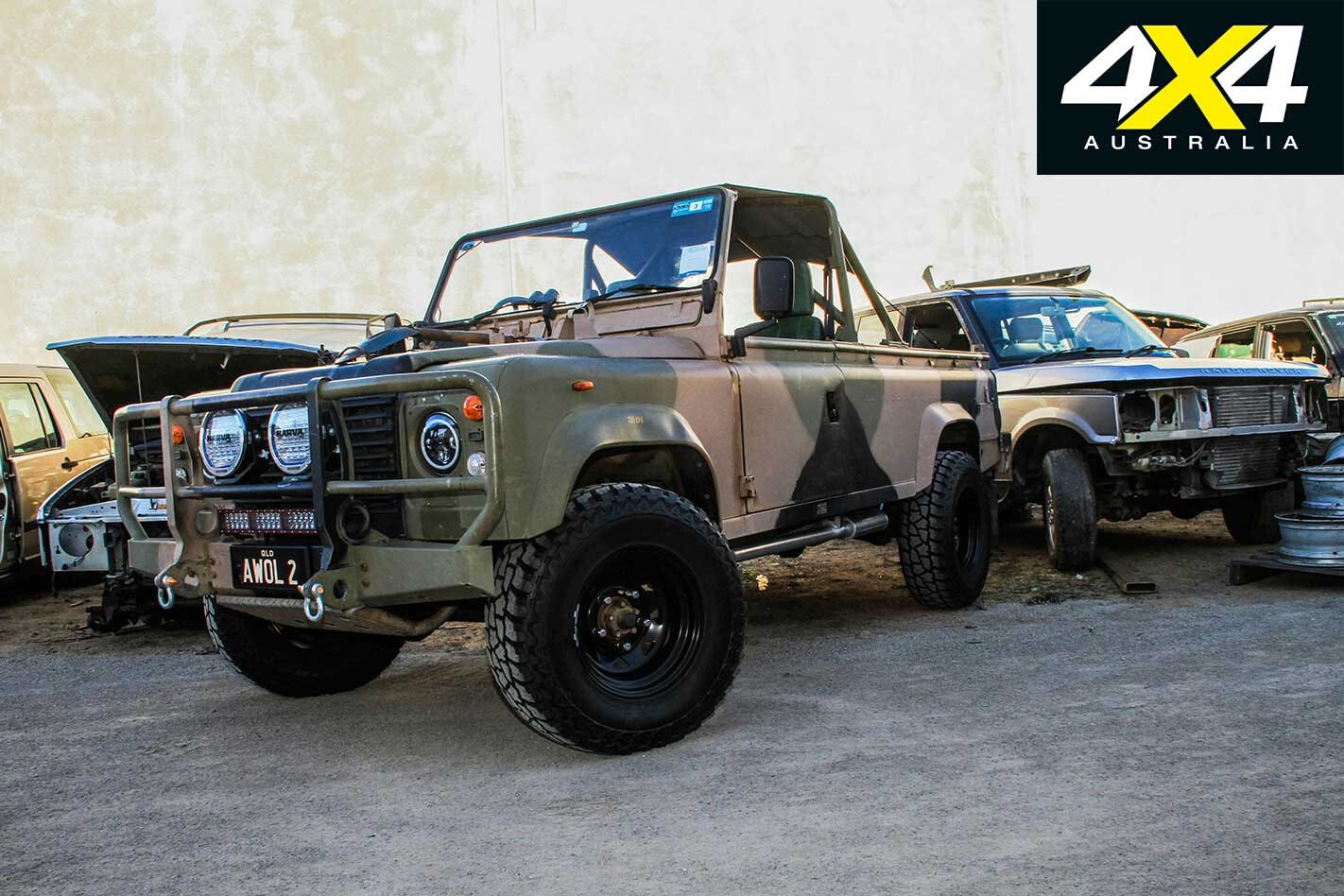
TOTAL KILOMETRES: 104,140km KM THIS MONTH: N/A AVERAGE FUEL USE: N/A
Part 4: Moreton bash
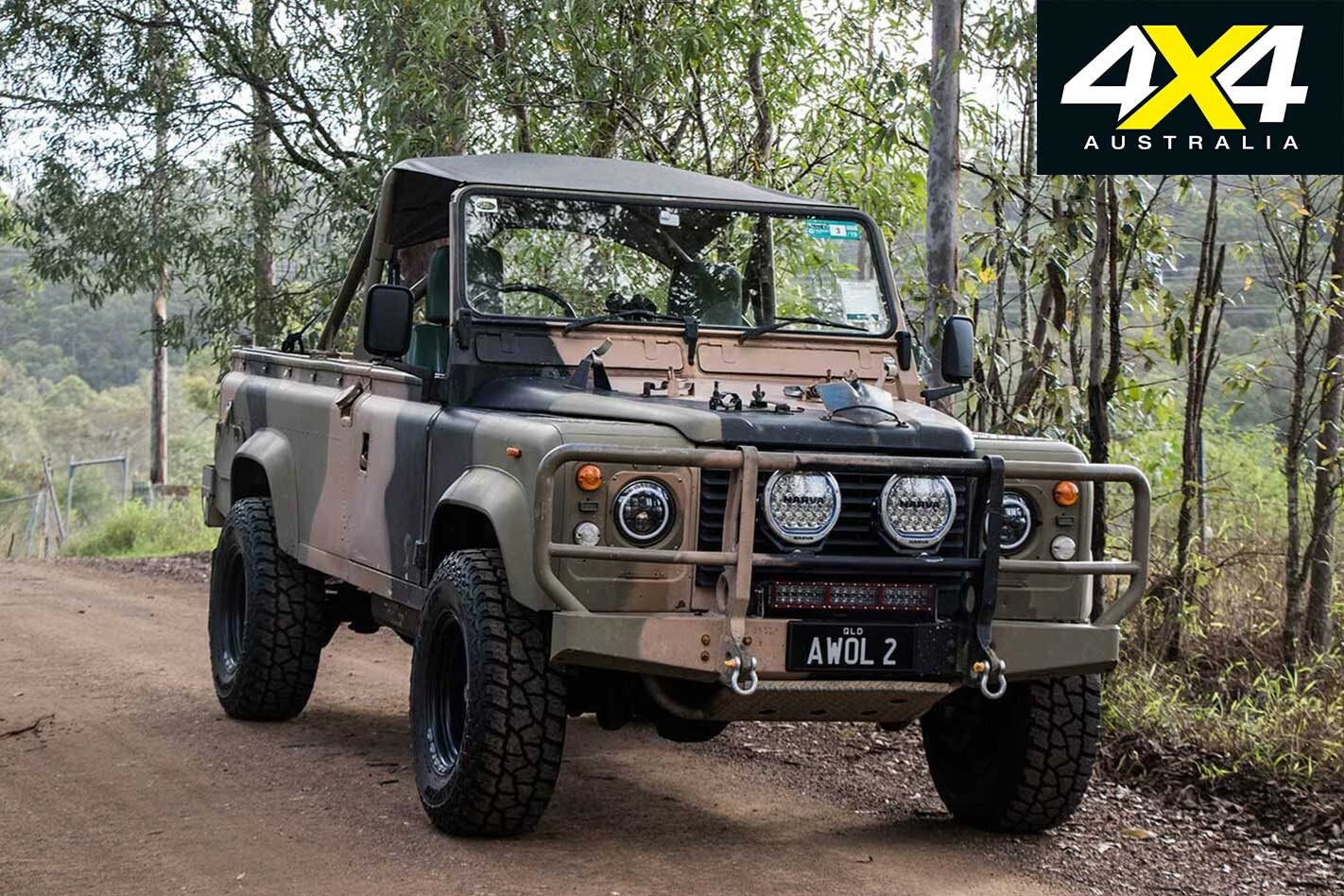
The long-time Moreton Island resident squinted at my Perentie as it sat in the sand outside the general store at Bulwer. “I suppose if you’re going to get stuck on Moreton with a two-wheel drive, a Land Rover is the one you want.”
As John trundled away in his weather-beaten Disco 2, I thought he was probably right, as my maiden off-road voyage post turbocharger, clutch and power steering upgrade wasn’t exactly going to plan.
A few days on Moreton Island had seemed like the perfect way to play with the newly upgraded Perentie. Plus, it had been too long since I’d ventured across the bay to one of my favourite weekend getaway destinations.
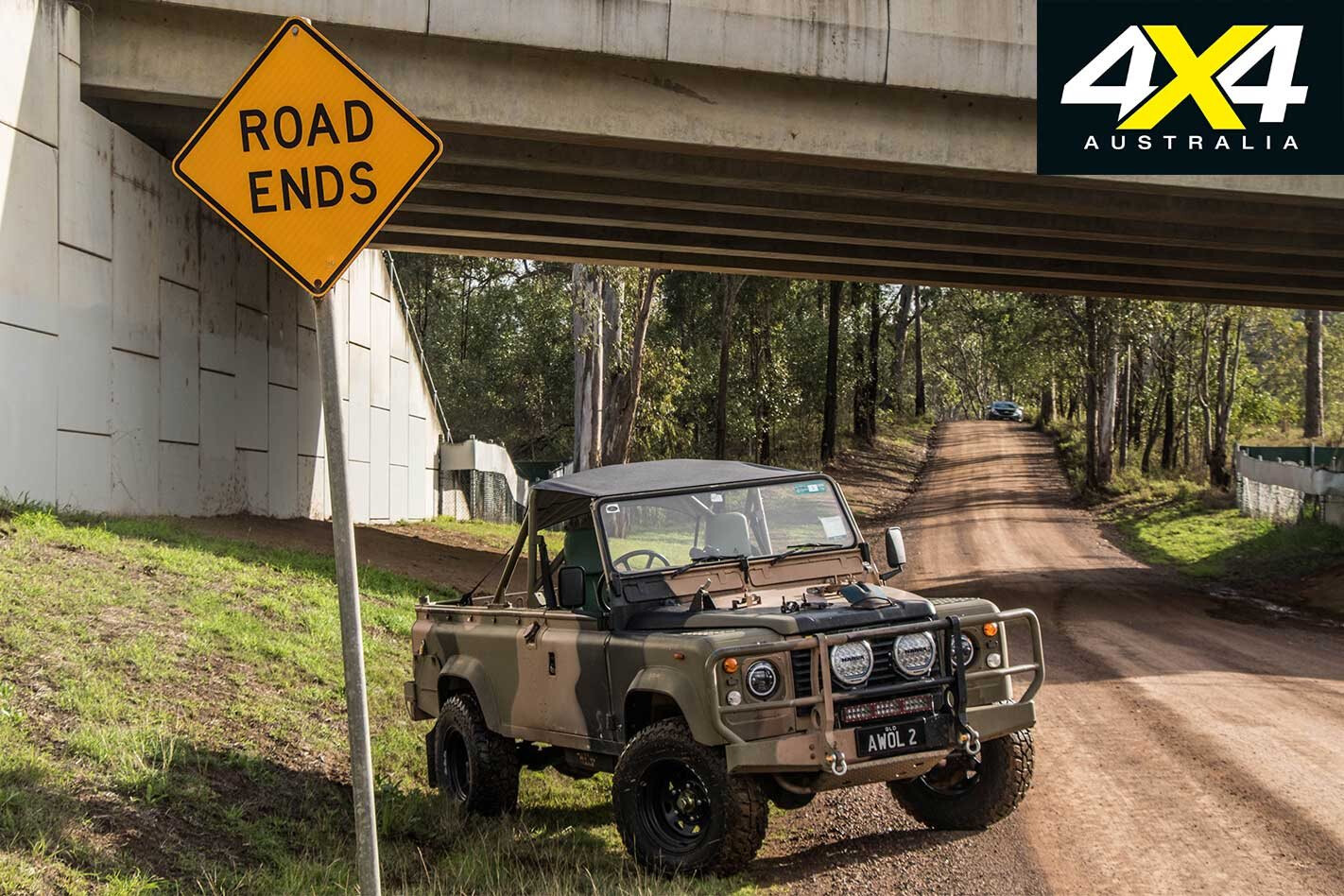
It’s hard to be in a bad mood as the ferry churns its way to the island – wind in the place where my hair used to be, a fresh espresso in hand and the glowing beaches of Moreton just peeking over the horizon. The warning signs on what was about to come should’ve been there, in hindsight, of course, but I was feeling way too cocky about the Landy’s capabilities.
After dumping our gear at Cowan Cowan I was pretty keen to explore the island, so we trundled down the beach towards the middle road that traverses the island, with the aim of running down the ocean beach to Karingal.
However, things didn’t exactly go according to plan. Warm weather and a long weekend for Queenslanders meant the sand was soft and badly churned up along the middle road. More than a couple of stock fourbies had given up and headed back to the beach; but not me, I was driving a Land Rover, after all.
As the going got tough I kept my foot planted to maintain as much momentum as I could muster, but the Landy started to bog down and then there was a cracking sound from the front end. I stopped. I may have even used a couple of bad words.
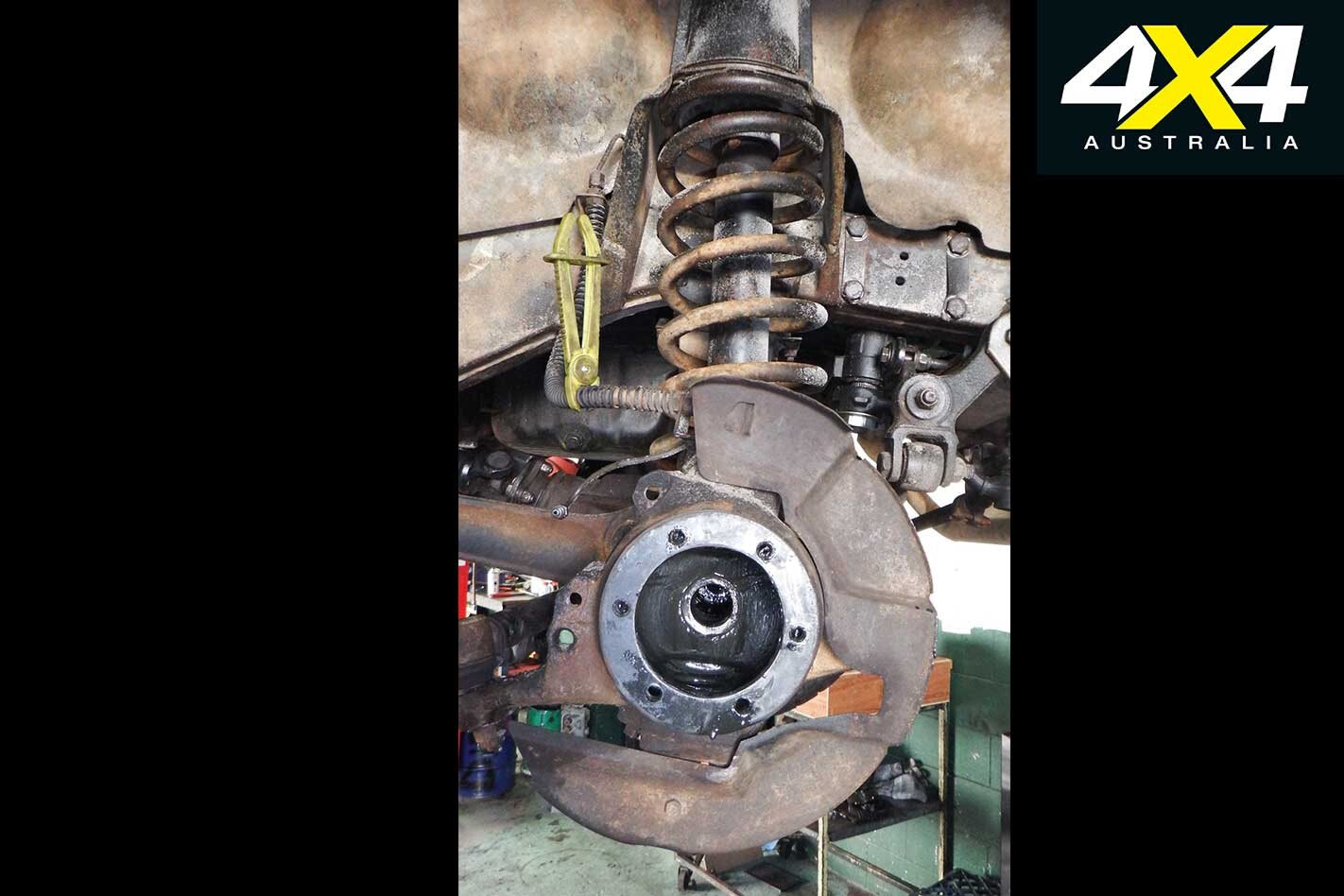
After crawling around in the sand to check if there was anything obvious, I tried to gently move. With the centre diff lock in, I had two-wheel drive; without the centre diff lock, I had no drive. It was pretty clear I’d snapped a front axle; there was the even worse possibility that I’d blown the front diff, but I figured that would be pretty unlikely for a Perentie.
Luckily, a well-kitted Triton soon idled up behind me. I explained my predicament and old mate kindly offered to tow me back down to the beach … not the most dignified of journeys.
I should’ve expected a development like this. After all, I’d just increased the power output of the Isuzu mill by a large margin, and if there was a slight weakness in the driveline somewhere, churning through the sand was going to find it.
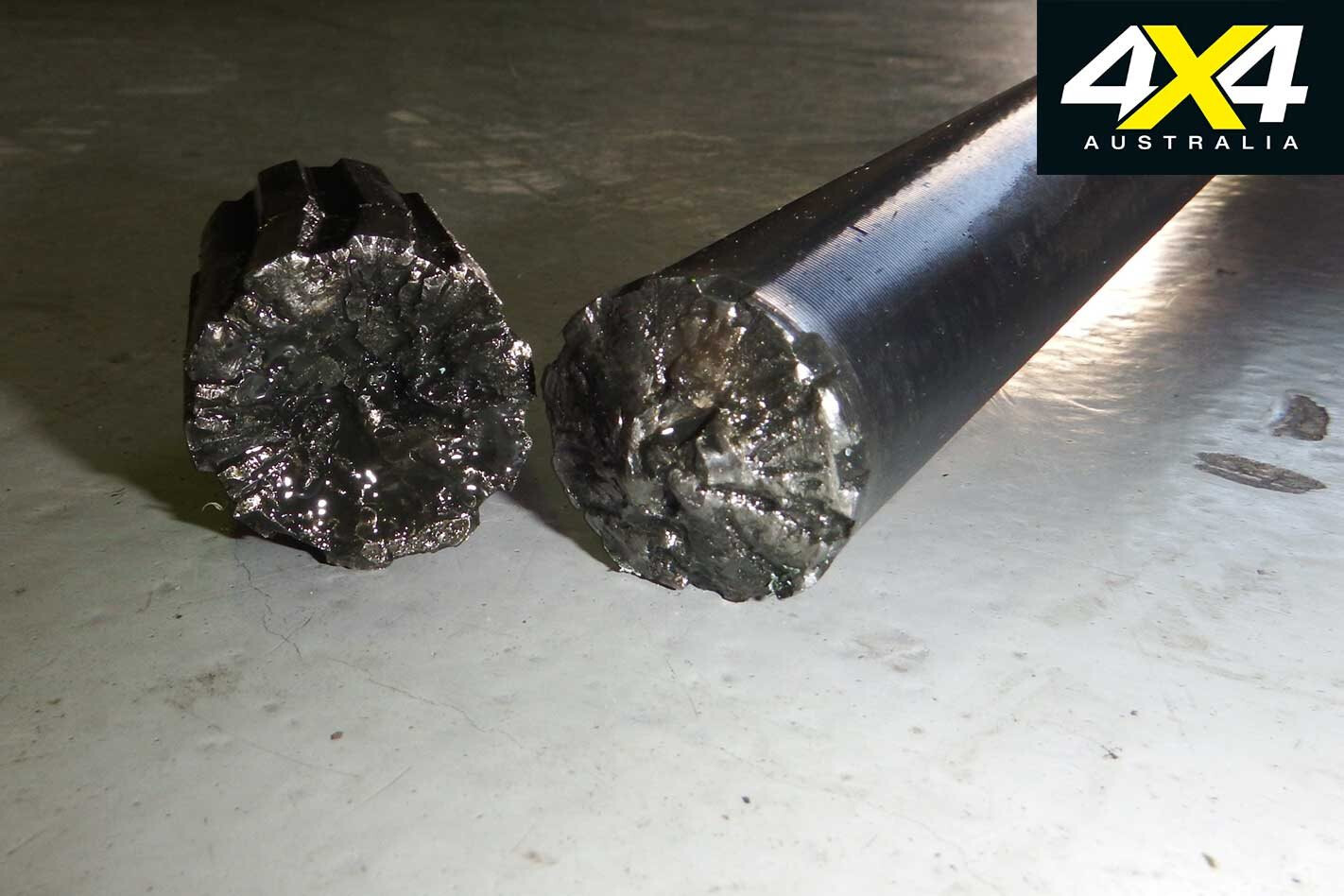
So while I sat under a tree contemplating what the next four days of two-wheel driving was going to look like for me, I thought I’d call ahead and book the Perentie in for an axle upgrade ASAP. The guys from MR Automotive were going to get another visit when I made it back to the mainland.
While its off-road capability may have been limited, I still managed to tackle the beach at low tide to get to Bulwer for supplies. In fact, the Landy did quite well as a 2WD; although, getting off the beach required a fair pace. I also managed to shred my Treds when I did get stuck; it’s safe to say that I’ll be replacing them with a different brand of recovery track.
After limping home and delivering it to MR Automotive, we discovered the front right-hand axle had indeed busted. So I bit the bullet and opted to replace both front axles with heavier duty Maxi-Drive items, as well as convert the hubs to oil bath. I know there are different schools of thought on greased bearing versus oil bath, but I’m definitely in the oil bath camp … maybe it’s the truckie in me.
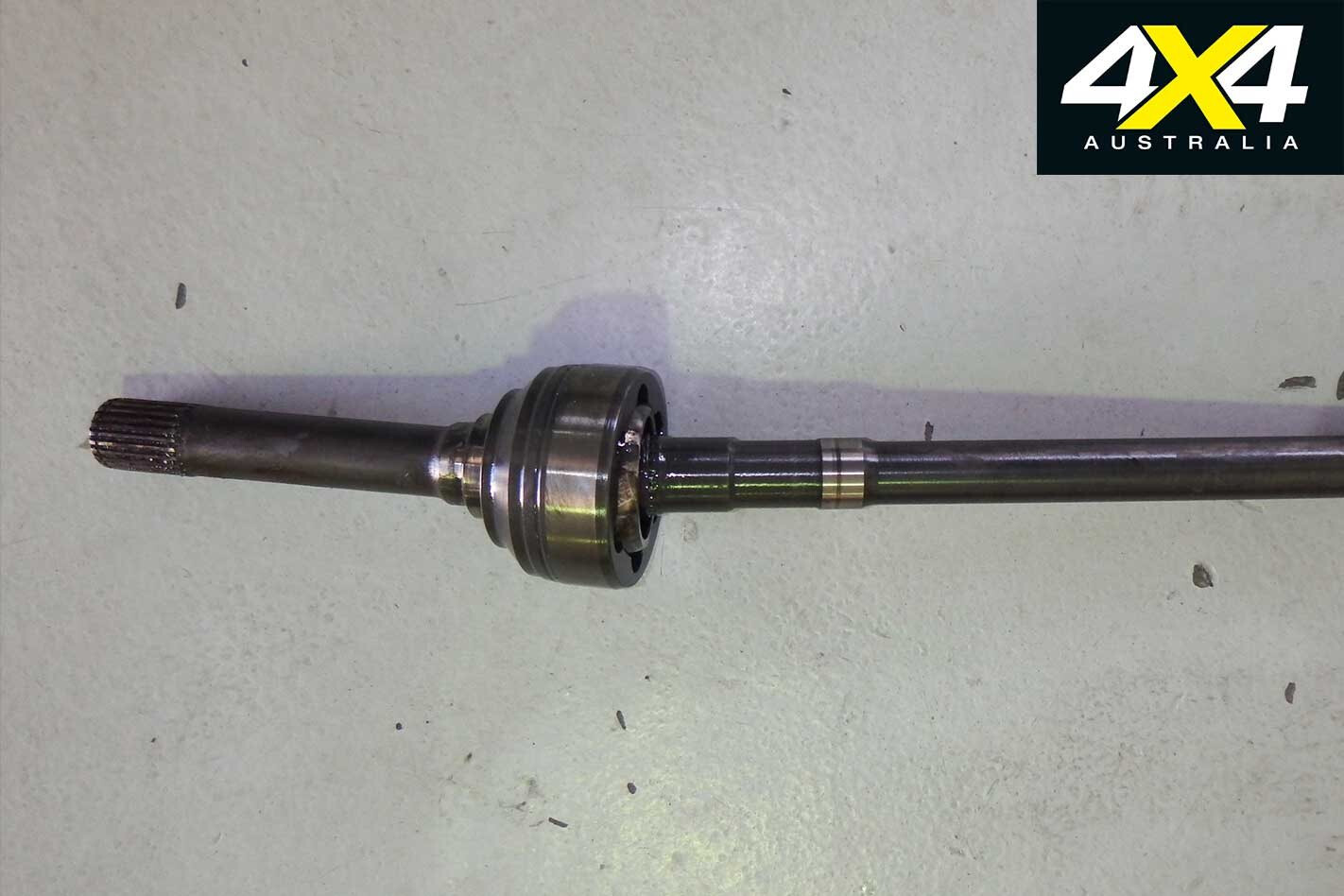
Unfortunately, I haven’t had a chance to head bush since picking the old beast up from the shop, however that doesn’t mean I haven’t been driving my camo-clad wheels around with a stupid grin on my moosh. It’s brilliant.
However, I have a trip to Fraser Island planned in the next couple of months, and this trip better be hassle-free as I’m heading up with a mate of mine and his Jeep Wrangler. If anything breaks on the Landy, I’ll never hear the end of it.
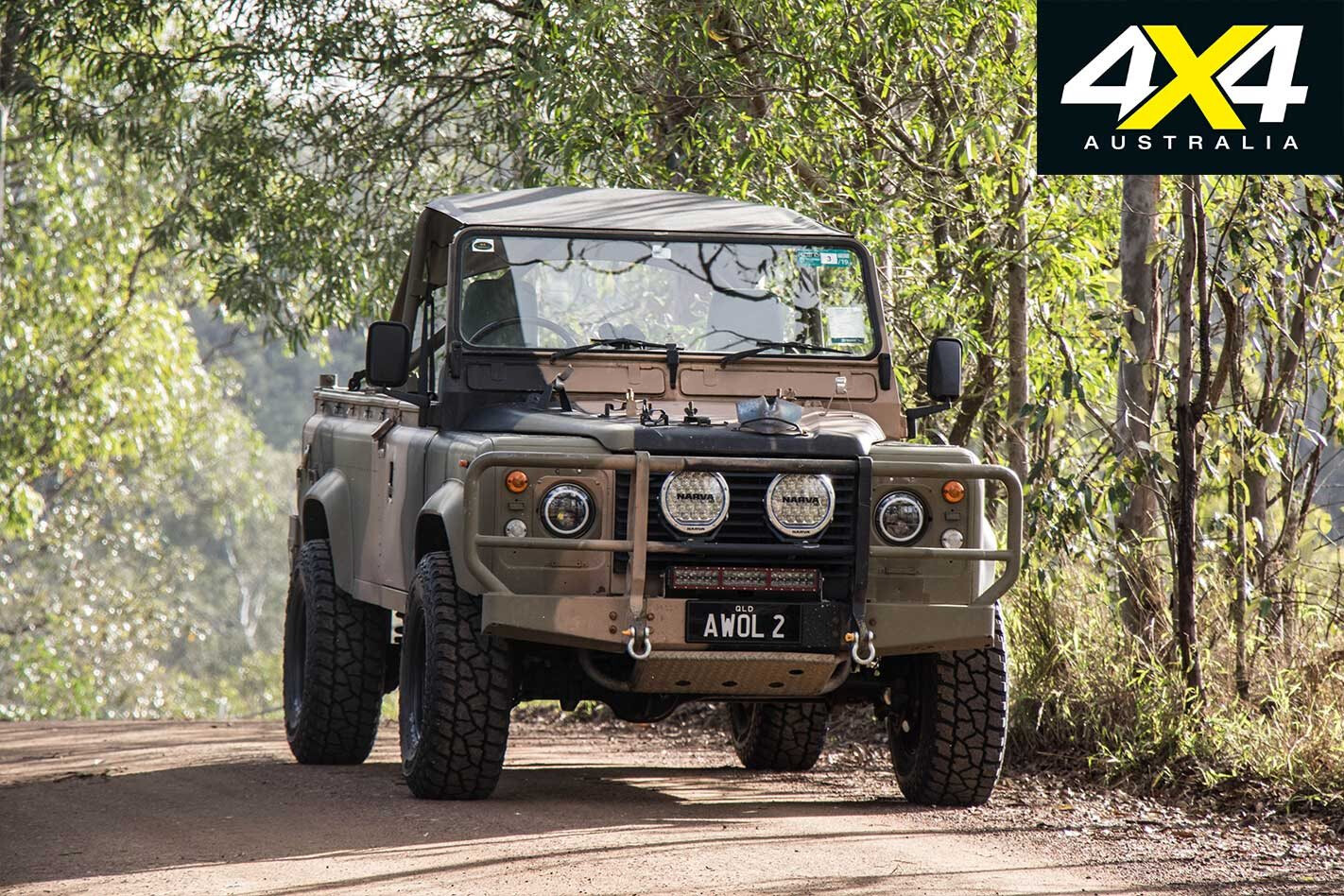
TOTAL KILOMETRES: 104,610km KM THIS MONTH: N/A AVERAGE FUEL USE: N/A
Part 5: Oily morning coffee
Caffeine is the capital letter, comma and full stop to my daily grind. At risk of sounding like a complete tosser, I even go bush with freshly ground coffee and a pneumatic espresso machine. So it’s kind of fitting that coffee was involved in the diagnosis of my latest Land Rover ailment.
A rarely touted feature of the Land Rover Perentie is the Steyr rifle butt cutouts between the front seats. They actually make excellent coffee cup holders as they are deep enough to stop lateral movement as well as being angled back to prevent my freshly brewed latte from pitching forward into the footwell.
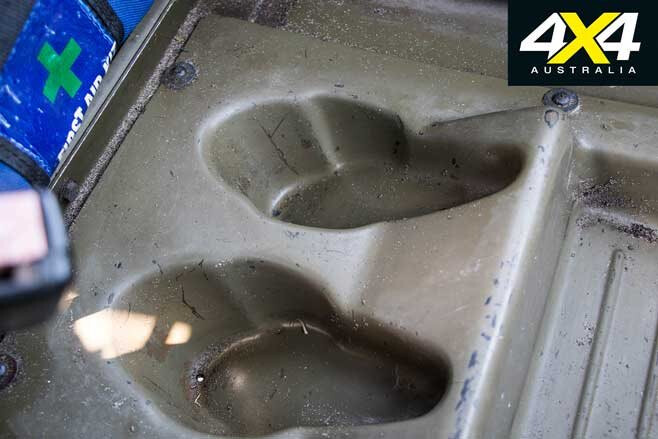
After finding the lower half of my morning-commute coffee soaked in transmission fluid while winding my way to work, it became immediately clear that I needed a new rear output shaft seal. You see, the rifle butt cutouts have little drain holes; so while the Perentie’s handbrake drum had filled with transmission fluid which was now being sprayed around the underside of Landy in a fine mist as the tailshaft rotated, this fluid was now seeping up through the drain holes and consequently desecrating my morning brew.
Cue Land Rover oil-leak jokes…
I considered tackling this job myself, except a couple of factors came into play. One, my tool kit is pretty much made up of the kind of cheap crappy tools that have a habit of rounding off/and or splitting when used in a harsh manner. Second, this truck spends a lot of time at the beach, and even with a lot of diligent Lanotec-ing, stuff underneath has a habit of rusting into place. Those two factors alone would’ve probably seen me with broken knuckles and buggered spanners.
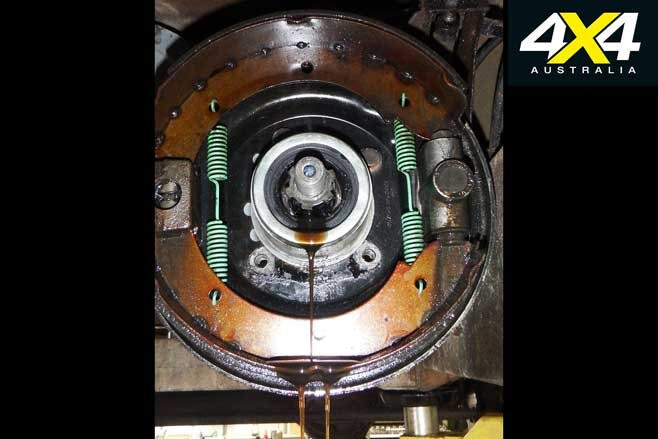
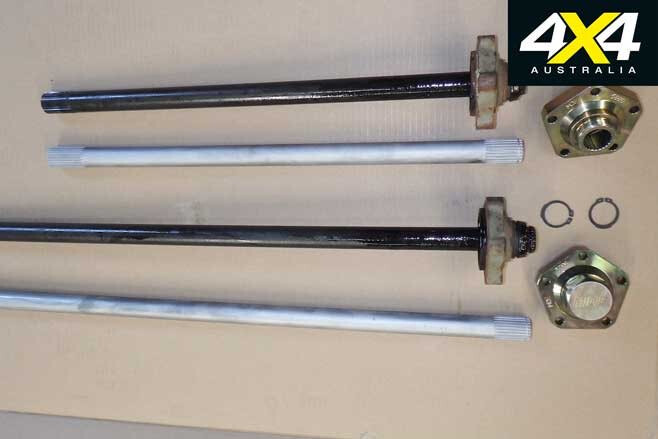
So back out to MR Automotive at Redcliffe my Landy went. And while I was at it, I thought I’d complete the Maxidrive axle upgrade process I’d started last year. The fact that I’ve been wrestling with some wiring issues and currently had no windscreen wipers or headlights didn’t rate a thought. You can’t put 35-inch tyres on wiper arms! It’s a matter of priorities.
The wiper and wiring issues are most likely a result of me taking the truck for an unplanned dunk in a lagoon on Moreton Island last year. The resulting bow wave rolled up the windscreen, through the bulkhead vents and saw my wife and I driving down the beach with both doors open to drain out the gallons of brackish swamp water and reeds. Yep, she’s a keeper. The wiper motor is probably now a solid block of rust.
I thought my headlight issue was a burnt-out light switch, but once replaced I still had no low-beam lights. I have a long and not-so-proud history of throwing parts at problems before being forced to use my noggin. I may have to dig out the multimeter on this one.
But, hey, I’ve now got heavy-duty axles front and rear along with heavy=-duty drive flanges and oil bath hubs all ’round. And the plan is to eventually go for 35s because … well, just because.
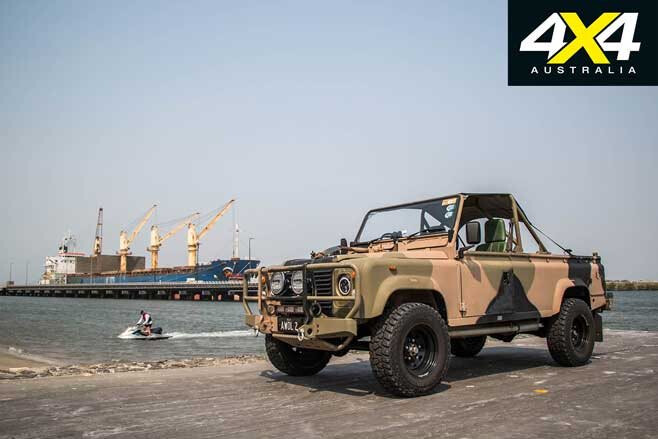
The 31-inch Mickey Thompson MTZ P3s the Perentie is currently sitting on are wearing pretty well and are a great choice for beach driving, though for an all-terrain they do have a definite off-road bias (noise, on-road traction etc.). They suit me down to the ground, so the new shoes may be a while off yet.
I’ve now got to get my butt into gear and fix all the small stuff, as we’ve got a trip planned. Busted knuckles ahead.
TOTAL KILOMETRES: 110,694km KM THIS MONTH: 720km AVERAGE FUEL USE: N/A
Part 6: Virus escapee
Some people should not be allowed to have the internet.
There’s the usual crowd of 5G-contrail, COVID-is-a-conspiracy-tinfoil-hat-wearing-types who lurk in the darker recesses of your favourite social media community. And then there’s me who should not be allowed to buy cheap, crappy automotive electrical products online.
I’m sure I’m not alone when I say the recent lockdown posed an opportunity to catch up on some garage jobs; in my case, the niggling and, for the most part, self-inflicted electrical woes that were plaguing my Perentie. I was missing a RHS park light, main beam lights and wipers, and it had an intermittent indicator fault.
Then there was the fact I’d mixed up cheap, crappy LED products with old-school filament globes. I’d also added relays and lots of nice, new wiring harnesses to power the Narva 255s and the Big Red light bar on the snout of the Landy. But all that nice, new wiring still had to get its energy from the old dodgy Lucas wiring that powers the rest of the car. I’d like to be able to tell you I completely rewired the Perentie to ensure maximum reliability, but I didn’t; I just fixed stuff, and patched where needed.
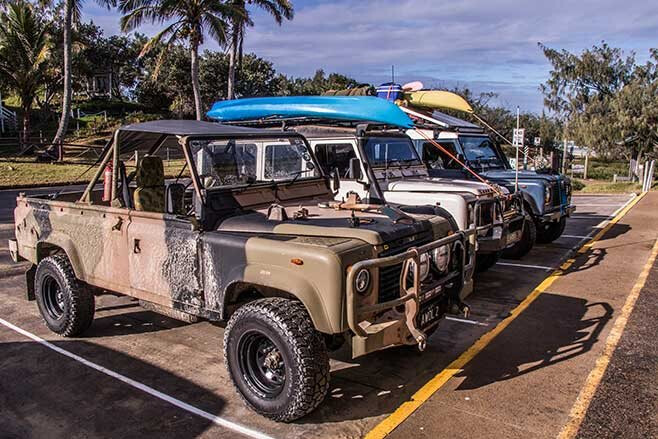
The park light was easy, a plug had just dropped out. The main beam headlights turned out to be a broken wire behind the fuse box. The wipers ended up being a bad earth where it joins the firewall.
However, I did take the opportunity to add some quality electrical components such as a set of Narva LED combination stop, tail, indicator light clusters. Which, luckily enough, just pretty much bolted on in place of the old clusters. Of course, adding so much LED into an old truck like this was always going to send the indicators haywire, so I stuck an 8ohm resistor into the circuit at the rear.
Being in Queensland during lockdown I didn’t have a great deal to whinge about, but after being in Stage 3 for a few weeks I was pretty quick to plan a weekend trip to Fraser Island as soon as I legally could.
The national park day-pass allocation system in place to ostensibly avoid creating COVID crowds at popular tourist spots meant that Fraser was the quietest I’d ever seen it (this was before the June school holidays). I was torn between feeling bad that so many tourist operators and local businesses were struggling in the absence of international tourists, and unbridled joy at not having to share the beaches with thundering convoys of 4×4 buses.
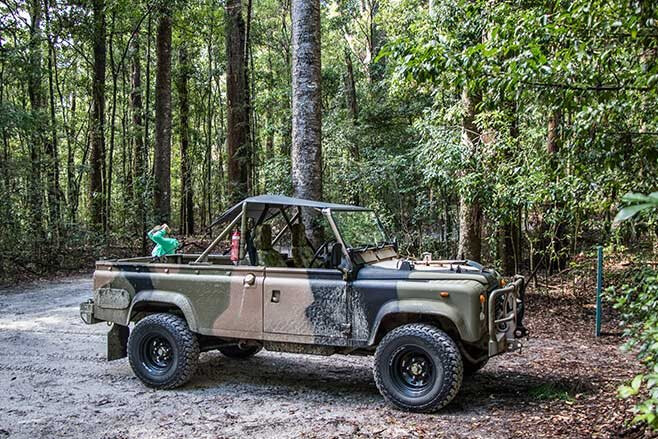
As we’d stayed overnight at Rainbow Beach, we had just planned a quick day trip. Although we’d been to Fraser a few times, I’d never taken my wife to see the turtles at Lake Allom. Seemed that maybe a few cute, little turtles bobbing around a lake in the middle of a rainforest on the world’s largest sand island was not a bad way to block out the outside world for a bit.
And sure enough, we had the lake and the turtles to ourselves. I’m not sure how long we just sat there on the edge of the lake with the silence only broken by bird calls and the plop of Krefft’s river turtles surfacing for a gawk. But after the movement restrictions I couldn’t think of anywhere else I wanted to be right there and then.
On the run back down the beach towards the ferry (and grown-up responsibilities), it started to rain, then my wipers stopped working again.
So, parked outside the Eurong Bakery, I pulled the left-hand corner of the dash out to expose the wiper motor and the resulting earth plug that had dropped off … again. I tried to squidge the connector up a bit tighter which then broke it. Which meant I had to jerry it up with a spare connector, which worked.
It’s not often that you find yourself on the Bruce Highway feeling good about life, but that flying post-iso trip had me smiling all the way home, that is until the indicators stopped working … again.
TOTAL KILOMETRES: 116,240km KM THIS MONTH: 600km AVERAGE FUEL USE: 11.3L/100km
Part 7: FJ40 joins in at Moreton
“AAARGH! I just landed on my nuts!”
The eldest had one hand clinging grimly to the Jesus bar of my FJ40 and the other clinging grimly to his nether regions. And that pretty much sums up off-roading in a classic, leaf-sprung, short-wheelbase 4×4. Regardless of testicular discomfort elsewhere in the Toyota, I was having a ball.
The loaded FJ was pitching and bucking its way through the soft Moreton Island sand with admirable aplomb. The ride for anyone not actually holding onto a steering wheel was admittedly pretty rough, though.
The idea for some time on Moreton had been brewing for a while. The only issue was we had three young adults to transport and the maximum seating capacity of my Cruiser was three and my Perentie two. So we decided to take both cars.
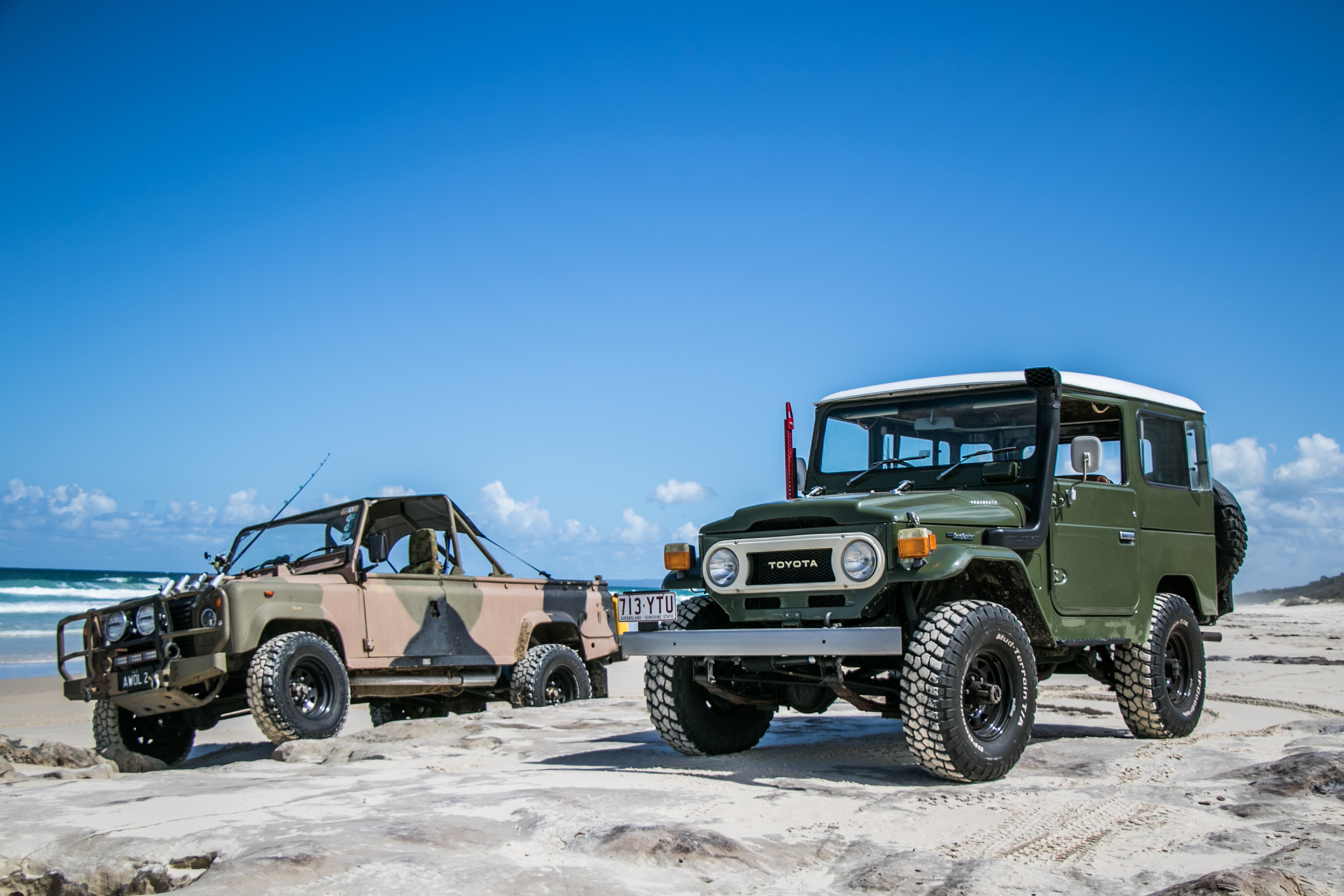
I was two-parts thrilled and part-terrified of taking my precious FJ to Moreton – thrilled to get it dirty, terrified of damaging it. I Lanotec’ed the crap out of it to reduce the impact of the salty environment on the chassis and panels of the Cruiser.
The other issue was fuel efficiency, or lack thereof in regard to the 2F petrol powerplant. That little under-seat fuel tank was not going to be enough to last a couple of weeks on a sand island with no servo.
I decided I would try using a 200-litre fuel bladder rather than jerry cans, as it seemed like quite an efficient way of carrying a lot of fuel. I figured I could carry this in the Perentie and use it to fuel the Cruiser.
My wife loves the Rover, but in the weeks before departing I decided to catch up on a couple of jobs, namely installing an Eaton Detroit Trutrack locker in the rear diff and replacing the shocks all ’round. I didn’t realise just how bad the old shocks were until I drove the Landy with new Terrafirma Pro Sport +2-inch long-travel shocks fitted. Don’t get me wrong, it still drives like a tractor, just a flatter-cornering tractor that nearly even stops better.
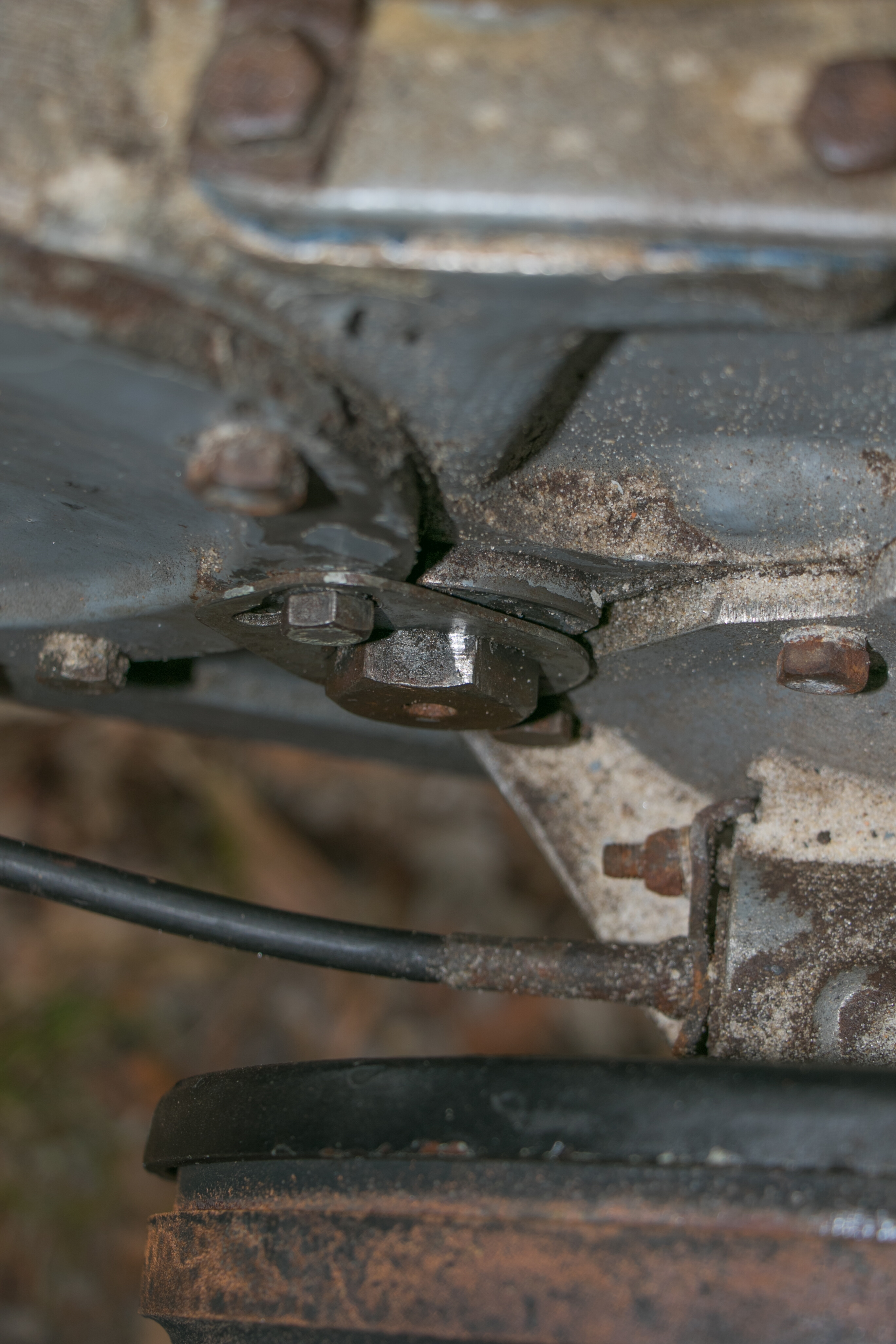
The addition of the Detroit in the rear transformed the off-road performance of the Perentie. I love the mechanical simplicity of the Trutrack. That said, they do occasionally bang and clunk on road as the diff unlocks, mainly at low speed when parking or going around a roundabout. While it doesn’t bother me, it may bother you if you’d just forked out for a 200 Series Cruiser.
While the Landy proved an absolute weapon on this trip, the big shout-out has to go to the little Cruiser. This thing never fails to make me smile. Everything you need and nothing you don’t. It went everywhere with ease.
My fuel average off road from the 2F was 38L/100km. To give that some rather terrifying perspective, I can get the same fuel from an 11-litre 450hp prime mover towing a tri-axle trailer grossing 42,500kg.
The main difference being that you can’t take an off-road beach holiday in a semi.
You’d think that this would be a deal breaker for the 2F, but I have to put my hand in the air and say I’m a fan of the venerable old F donk. A design that can trace its ancestry all the way back to 1928 and Chevrolet. The F performs much better on road than its diesel contemporaries and when in the rough stuff, its torquey enough to idle on through without much in the way of high-revving histrionics.
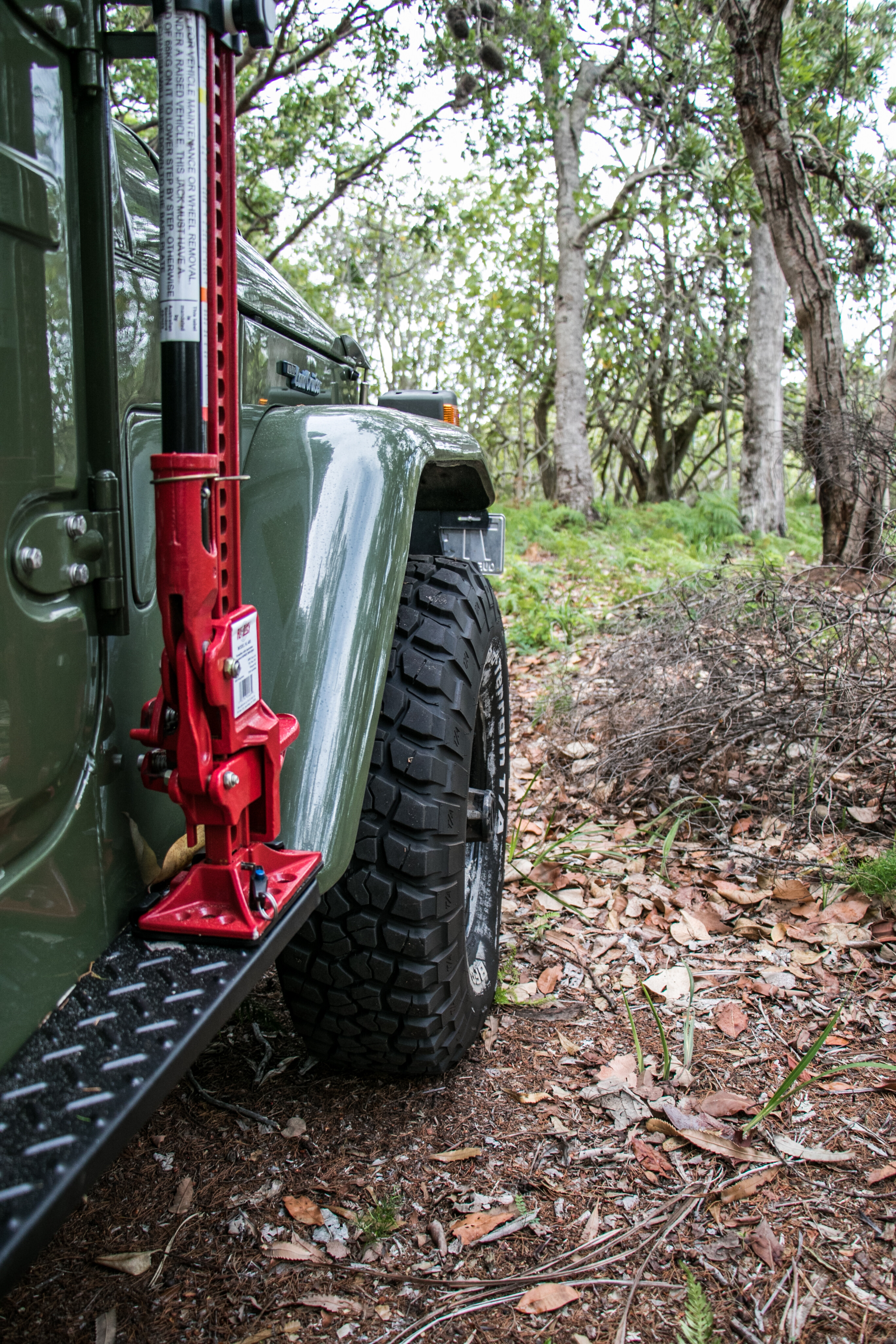
The off-road veterans out there will just smile and nod as none of this will be news. The idea of a fuel bladder, however? Turns out that it wasn’t such a great idea in an open vehicle, once it had some fuel out of it the bladder had a tendency to breathe like a fume-laden bellows and fill the Rover cockpit with fuel fumes. It also rocked the car around quite a bit once it was half empty.
So the guts of it is, the Cruiser needs a long-range fuel tank and a jerry can holder or two. The Perentie, however, decided to revisit it’s old jumping out of high-range habit, but regardless of tension on the intermediate gear cluster shaft, it has persisted.
Sadly, I think I need a high-range rebuild, roughly $2500 worth.
The Toyota just needs a new muffler. That’s the thing about these old trucks, Land Rovers are awesome when they work, LandCruisers just bloody work!
PERENTIE TOTAL KM: 118,188km KM THIS MONTH: 520km AV FUEL: 14.0L/100km
1976 LC FJ40 TOTAL KM: 82,680km KM THIS MONTH: 620km AV FUEL: 38.0L/100km
Part 8: Decisions, decisions
You’ll often hear the word ‘compromise’ bandied about when it comes to modifying cars. In the dirt-stomping world of off-roading that compromise usually comes in the form of off-road performance versus on-road performance.
The better your jigger is off-road, generally the crappier it is to spend long periods of time on the open road. Hence the spectacle of events like Ultimate Adventure in the USA where participants have to spend days living out of their purpose-built rock crawlers, often covering hundreds of kilometres by road between tracks.
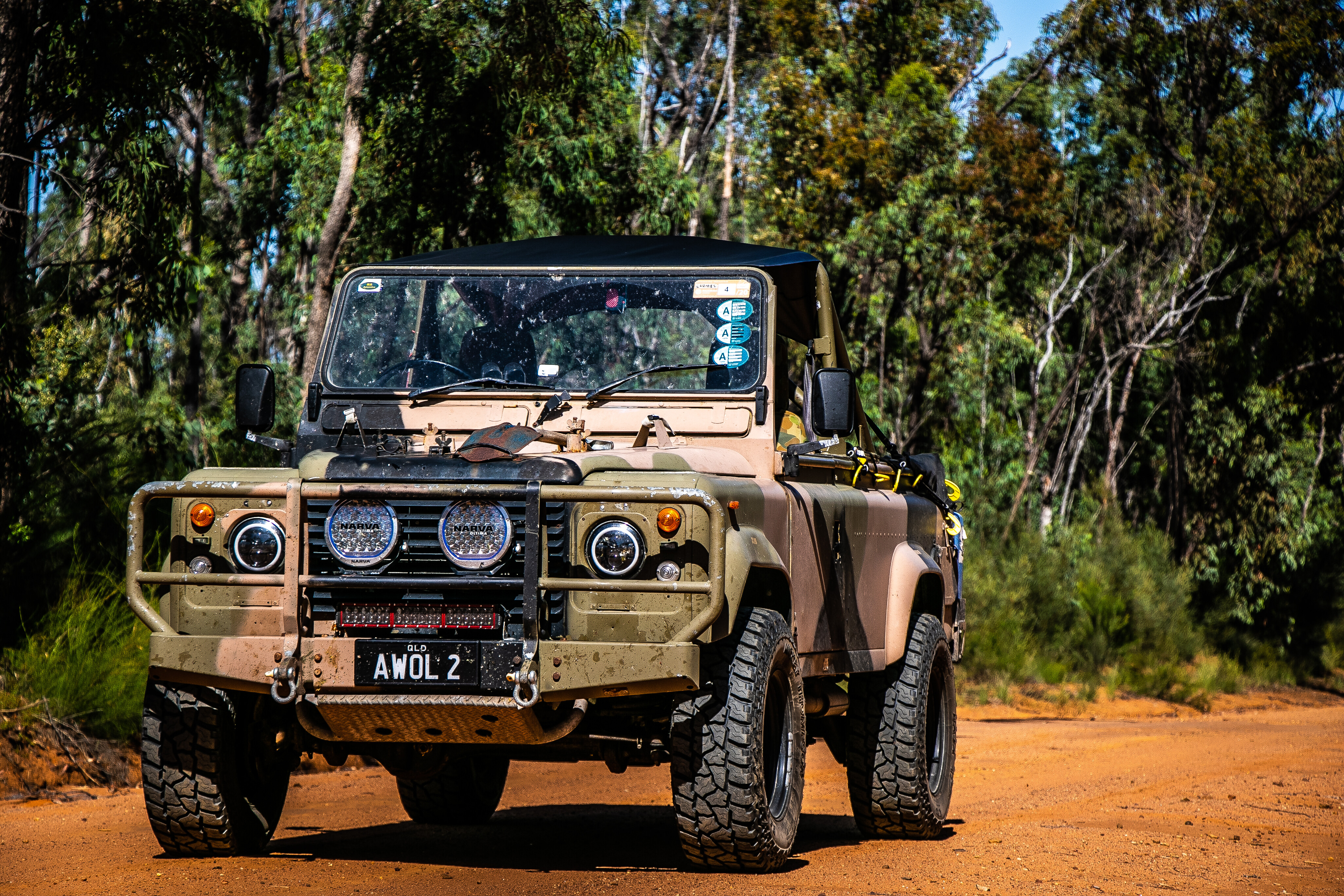
While not a built crawler by any means, a recent road trip in my Perentie over the New Year period highlighted some of the drawbacks of mods I’d made in an effort to build my best beach buggy.
My Perentie recently fell back in to its old habit of jumping out of high range unexpectedly. Rather than being organised and getting it fixed properly, I took the opportunity to change the oil in the ’box and transfer case. A little bit more adjustment to the slack on the intermediate gear cluster shaft and, hey presto, fixed. I do realise that I’m putting off the inevitable here!
Turns out driving from Brisbane to country Victoria, then to Melbourne, then back to Brisbane with some bush detours in a car with barely any roof and no windows was a character-building exercise. This really came to a head just north of Urana in the southern Riverina, when I drove in to a supercell thunderstorm. With no cover, violently shifting winds, hail bouncing off the inside of the windscreen and my raincoat hood laced up so tight I looked like Kenny from South Park, I was seriously questioning my sanity.
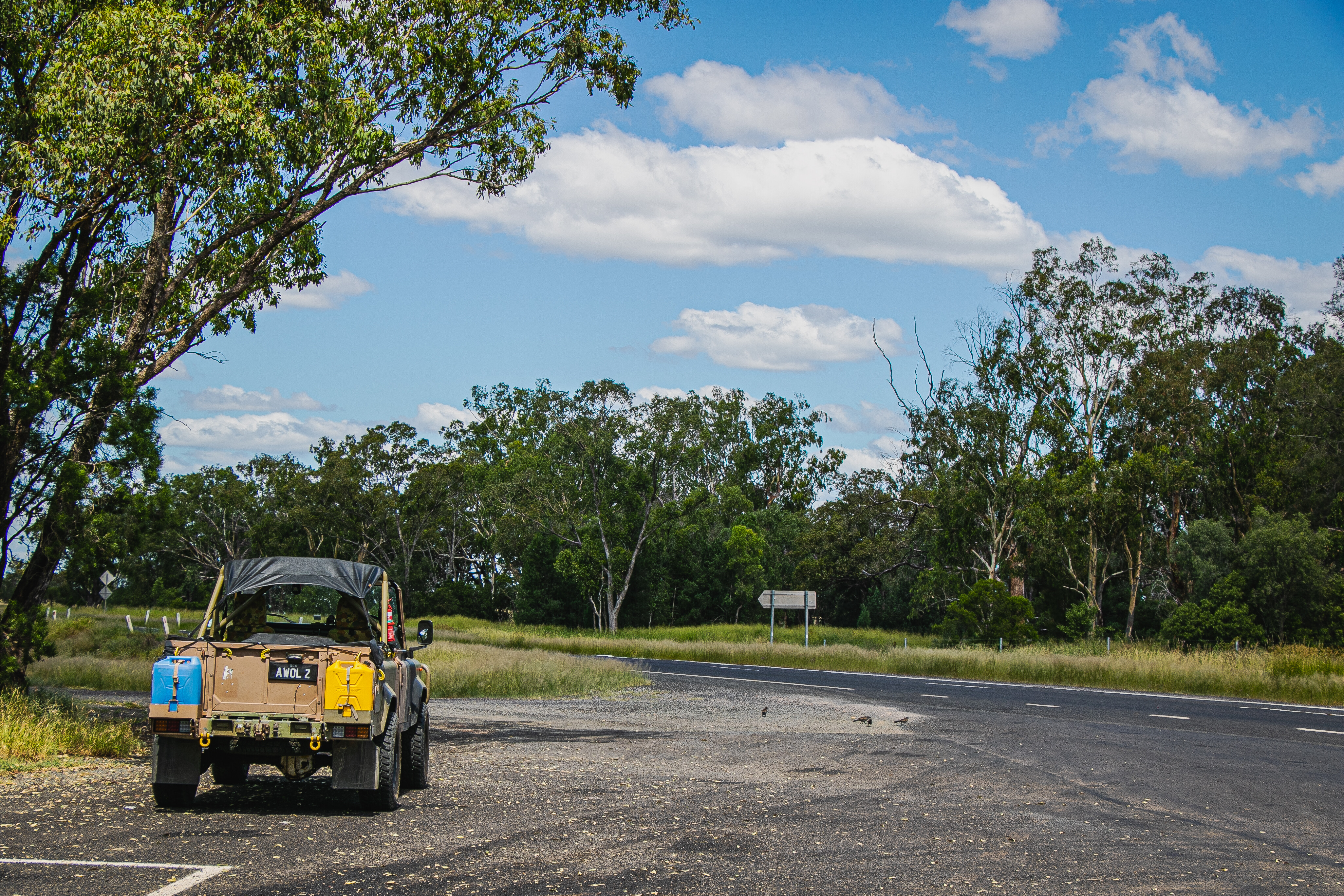
It’s been quite a while since I’d spent long days on the road in the Landy. In fact, I hadn’t really done a trip like this since I originally picked the Perentie up from Grays Online in Darwin and drove it back to Brisbane. A lot has changed on the old bus since then: more power, chunkier rubber, power steering, new suspension diff-lock, heavy-duty axles, lights that occasionally work … and fewer windows.
To be fair, weather aside, it handled the trip with ease; relatively tall gearing means it hums along at highway speeds with ease and enough grunt to overtake when required. Coil springs, the ADF-issued ISRI seats and a 110-inch wheelbase make for a pretty comfy truck.
To handle road tunes, I hung a Bluetooth speaker from the top of the windscreen and streamed through my phone. The downside of this is that at 110km/h between the flapping on the bikini top, the slap of the Mickey Thompson P3s on the road surface and the uncivilised yodel of the 4BD1 Isuzu engine, Rufus Du Sol sounds a lot like the McClymonts.
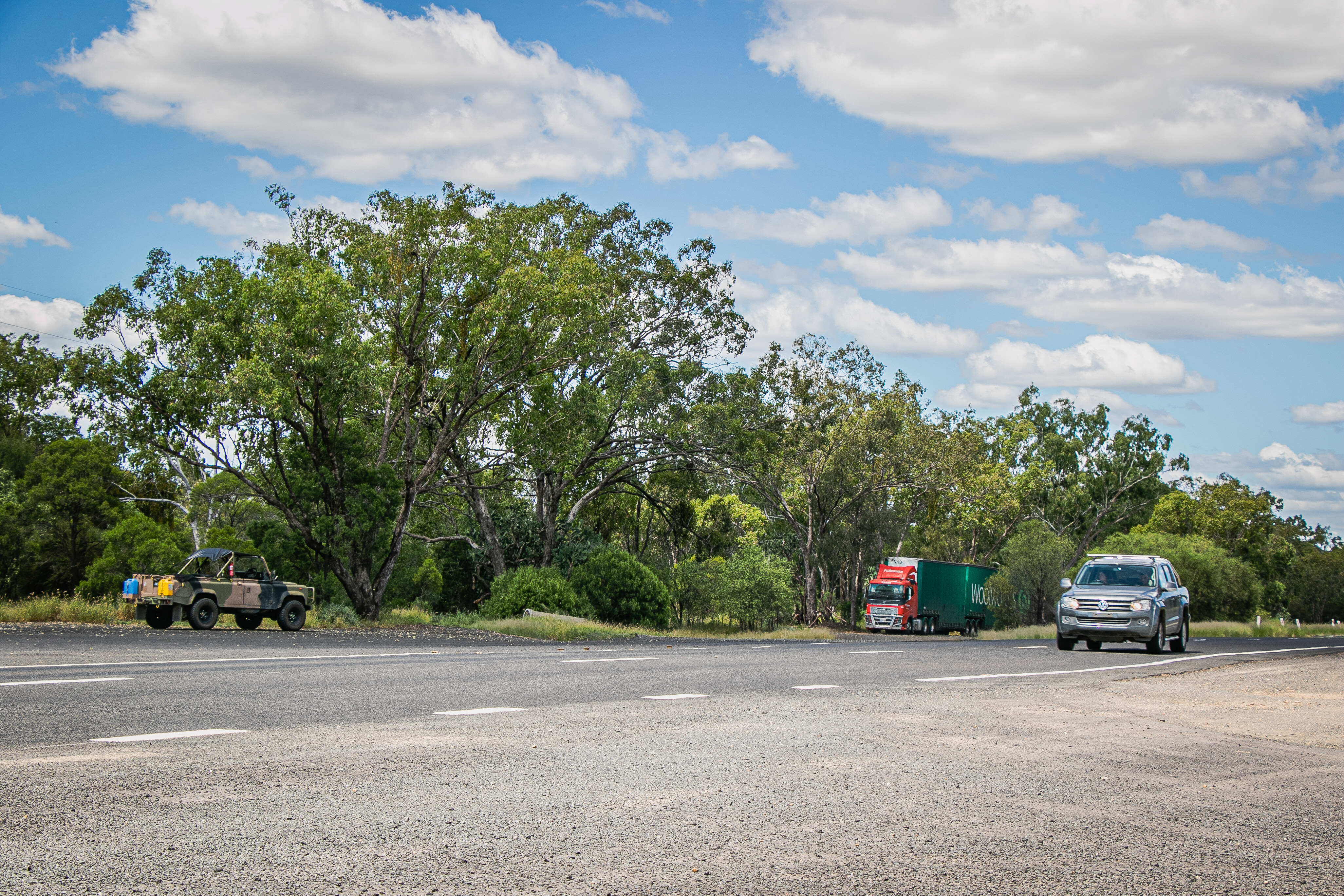
However, if this was a hearts and minds campaign, the Perentie made friends wherever it went. People in passing cars with fancy equipment like windows and air-conditioning and stuff tooted their horns and waved. I mean, who doesn’t love a sunburnt middle-aged, pudgy bald dude in a flapping camo shitbox? Perhaps don’t answer that.
But sunburn, chapped lips and hail aside, it was an overdue reminder of how much I love this old banger. Pesky Land Rover traits regarding Lucas electrics aside (I now know the right place to kick to get the indicators to work). The Perentie loves a road trip, in this case a total of 4860km.
My stripping down of the cab for beach and bush works for me most of the time, however I have been pondering getting my hands on a ute cab. Basically, a Landy ute cab will bolt on to the existing structure just in front of the Perentie ROPS. The downside, apart from claustrophobia and sharp edges, is that this mod has become quite popular and I haven’t been able to find a decent cab that doesn’t require a mortgage yet.
The trouble is that I just know that the experience of driving this truck along 75 Mile Beach on Fraser Island wouldn’t be the same sitting inside an aluminium can. The age-old dilemma of compromise rears its head again. Clearly there’s only one solution, a solution used by car nuts to the chagrin of their families the world over. I need another Land Rover.
We came upon the animal suddenly and he was as startled to see us as we were surprised to see him; but, still, he didn’t move. Looking at us over his shoulder, he was an animal in his prime and he was probably a little reluctant to give way to us as there was nothing in the forest that could really challenge his being or his domain.
I stopped the Patrol, wishing the camera with the long lens was closer, while we exchanged glances. Sun glinted off his antlers and shade speckled his glimmering coat, and then, as suddenly as we had met, the spell was broken as the two other vehicles

in our group came idling along and pulled up behind me. The sambar stag leapt in to the surrounding bush and within the blink of an eye had vanished from sight.
Just minutes earlier we had turned off the Buckwong Track, a through-route to the Davies High Plains and a relatively well-known track that passes along the edge of the Mount Murphy Historic Area, on to Greggs Track.
It was immediately obvious from the amount of leaf litter, twigs and branches that covered the two wheel marks of the faint track almost completely, the route was little used. The sambar deer, standing in the middle of the track and tolerating our appearance, further reinforced that lack of use.
Wheelers Creek Hut
Three days earlier we had left Omeo and driven through Benambra and up and over the Sassafras Gap, before turning on to the Wheelers Creek Logging Road to where Wheelers Creek Hut once stood. Destroyed by the most recent bushfires through this area in the summer of 2019-20, the bush has mostly regrown with a surprising verdancy about it, making it still a nice spot to camp.
Next day we headed around to Gibson Hut, discovering many of the tracks marked on the maps of the area are now closed and, going by the bloody huge rocks dumped across the entrance of each track, they will be permanently closed.

As we got closer to Gibson Hut, we came across a working logging coupe where timber cutters were salvaging magnificent alpine ash burnt from the fires. We slipped past their operation and got to where the old hut once stood on the edge of a pristine mountain stream.
The stream was still there, running clear and sweet, and while the old fire place was still standing and a new dunny had been built, the hut was just a burn scar on the bare ground. Word is though, that this famous hut will be rebuilt.
Mt Pinnibar Track
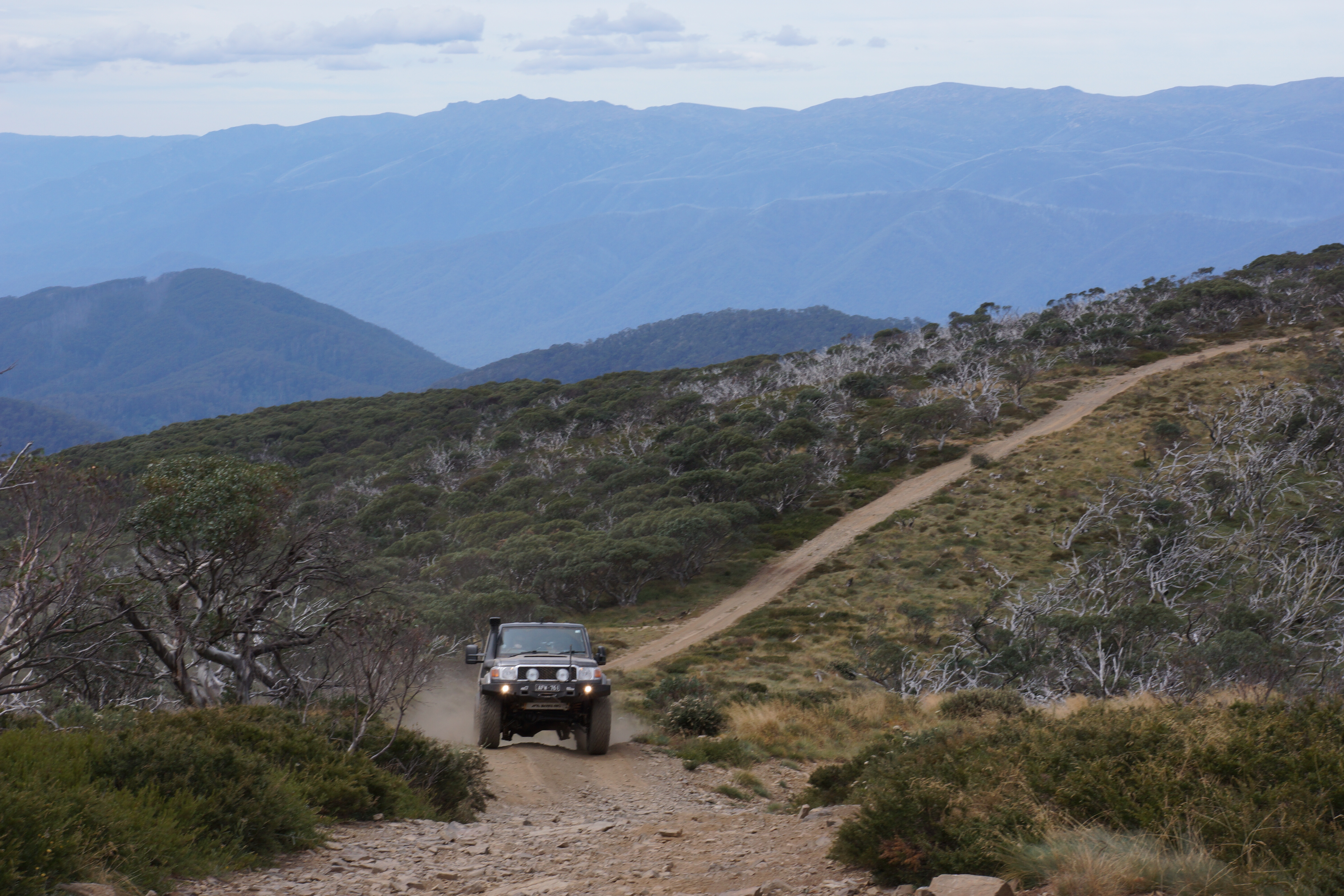

Backtracking past the logging coupe again because of more closed tracks, we took Dead Finish Track and then the long climb up the rocky and steep (in place) Mt Pinnibar Track, to the crest of one of the best peaks and viewpoints in the whole of the Victorian Alps.
After soaking in the view from Pinnibar’s crest that took in, across the deep wide valley of the Murray River from our standpoint, the Main Range of Mount Kosciuszko that was still dotted with snow in places, we turned and headed downhill to the boundary of the famous Tom Groggin Station.
This magnificent working cattle property, surrounded now by national parks, was once much bigger, its lease extending to the crest of the Main Range in NSW and taking in the Davies High Plains on the Victorian side of the border.
Established in the 1850s, the property and its some-short-time-later manager, Jack Riley, hosted the famous Aussie bard, Banjo Patterson, where he was inspired to write his famous ballad-come-poem, ‘The Man from Snowy River’. Today the property offers accommodation in a couple of traditional log cabins, but sadly there is no camping available.
We skirted around the station’s perimeter, admiring the rolling grassland and the Hereford cattle grazing on the rich fields, before checking out Dogman’s Hut, which stands right beside the station boundary and a short stone’s throw from the Upper Murray River.
It’s a nice spot to camp and a lot quieter than across the narrow scrub-bordered stream where the Tom Groggin Camping Area, within the Kosciuszko National Park, can be found. Normally, just up-river, a stony ford across the stream gives access to the NSW side, but with heavy recent rain the Murray was flowing fast and strong and we gave the challenge a miss.
Instead, we headed the short distance to Buckwong Creek and its small camping area, clearing timber as we went and walking the rushing waters over the track crossing before committing our vehicles to the fast-flowing creek. That night we were visited by a couple of grey kangaroos, who came again to check us out in the early morning.
Tom Groggin Track
We would normally have headed for the Davies High Plains, but with one of the vehicles towing a tough off-road trailer and the route to the high plains signposted as a non-trailer route, we dodged around and took the Tom Groggin Track south.
A short distance along this route, we came to a closed and padlocked gate surrounding another working logging coupe, again salvaging burnt timber from the fires nearly two years previously. Meeting the manager of the operation, we got permission to drive through the coupe before meeting with the Buckwong Track and our impressive stag.

Stopping near the crest of Mount Misery a short time later for a brew, we then took Mt Misery Trail past the Mount Pendergast helipad to the more major Limestone Road. After checking out one of my favourite camps in this area at Native Dog Flat, with its attendant mob of wild horses, we pushed south through dense forest to the wide expanse of grasslands at the Nunniong Plains. It was crowded … with just one camp, while a gathering of wild horses, 30 or more, were the most I’ve seen on the Victorian side of the High Country, ever.
After checking out the excellent Bentley Plains campsite (especially good if you have horses), which already had a group in residence, we backtracked a few hundred metres to ‘Moscow Villa’, one of our favourite huts in the High Country, and set the campers up outside and lit the fire in the expansive fireplace inside.
Moscow Villa
The name ‘Moscow Villa’ came about when Bill Ah Chow, who was working for the forest commission in those days as a fire spotter, built the hut so he had somewhere warm and comfortable to stay during the summer – he did a great job.

The Battle of Moscow was being fought at the time – the summer of 1941-42 – and Bill thought it would be a good name for his new home. Sometime later, with the Cold War at its height, Bill and his hut were visited by forestry officials and they questioned him about the name, indicating it was a little political. So, he told them it stood for “My Own Summer Cottage Officially Welcomes Visitors Inside, Light Luncheon Available”. Pretty good response, don’t you think?
Next day we headed west towards the small town of Swifts Creek and its somewhat famous bakery. The thing was, our simple plan was again to come unstuck!
Washington Winch

Along the way, the main forestry road passes the Washington Winch, a heavy hauling steam-powered logging winch that had been built in the USA and then shipped to the karri forests of Western Australia in the 1920s, before ending up in the Vic High Country after the 1939 Black Friday fires. After being shifted and owned by a number of different operators, the winch was brought to its final resting place here, in 1959.
Today, you can still see this big unit and the steel rope work spanning between tall trees. This was part of the ‘Skyline’ system used to haul and lift logs from deep down in the valley up to where they could be loaded and taken to the mill. The operation of setting the cables and pulleys was fraught with danger, with the men often working 60m or so off the ground and lunch being sent to their lofty workplace on a rope hauled upwards to their perch.
The advent of more powerful bulldozers and machinery along with chainsaws and diesel trucks, meant that the winch and its operation was redundant, and in 1961 it stopped operation and was left to decay in the forest. The winch remains a unique part of Victoria’s cultural heritage and logging history, and in 1999 the original spars, which had rotted, were replaced with messmate poles while new cables were also restrung. Looking at what was involved, you could have that job on your own, I reckon!

Searching for something a little more interesting than the main dirt road, we took a ‘shortcut’ on forestry tracks in and around Mount Hopeless towards Swifts Creek. As our coffee and cake at the bakery started to slip further and further away, our route became more and more interesting as we were diverted because of locked gates leading to private land and held up because of fallen trees, our battery-powered chainsaws working overtime to clear the tangle of timber and scrub.
At one creek crossing, the Hilux I was driving scrambled a bit and, while I didn’t take too much notice, I radioed the vehicles behind of the obstacle. They splashed through without an issue and I put my troubles down to bad luck, or poor driving, or choosing a bad line.
A few kilometres later on a wet, shaley slope, the Hilux was really struggling and getting deeper in to trouble as it side-slipped towards a steep-sided gully. That was when it was noticed the front wheels weren’t turning! It subsequently turned out that the CV drive shaft had been fitted incorrectly when we had snapped a CV up on Cape York a couple of months previously.
We were in a pickle, and to get the vehicle out of its predicament we connected the Hilux winch to a tree on the uphill side of the track; the Cruiser’s winch was run through a snatch block, again on the uphill side, and connected to the rear of the Hilux.
With judicious use of both winches and a light touch of the throttle, we got ourselves out of trouble and, with effort on the narrow track, turned around. With our tail between our legs, we headed back to the main dirt road and drove on to Swifts Creek, only to find the bakery had shut 30 minutes earlier; so much for coffee and a custard tart!
Friendly advice
The next day in the Cruiser, I joined my son who runs Moon Tours, as we headed down to Doctor’s Flat and wound our way in from that side of the range to where the Hilux had succumbed to the water and mud. The route took us through open farmland and, as marked on the map, looked decidedly private and poorly used.
We went looking for the farmer, who we found drafting cattle, and checked with her if the route was a public thoroughfare and if so, where it led to and what the gate situation was. She was pretty obliging and after a half-an-hour of idle chatter, we had her permission and she pointed the way we needed to go to get back in to the state forest.
With the route verified as passable for 4WD vehicles (it would be easy in the dry), we then headed for Dargo by the Birregun and Jones roads through the Wentworth State Forest, only to find this major forestry route was closed due to fallen timber.

We backtracked again to Omeo and then went, via the main Alpine Way to Hotham Heights, our plan being to head south on the Dargo High Plains road to the small mountain township. At the junction, just west of the alpine resort, we found the Dargo road closed and the phone number they said we needed to call was not answering.
Frustrated, we headed down the mountain and on to Mansfield, where after a night at a friend’s property, we headed to Bluff Hut and then over the high plains to Howitt Hut before exiting the region via Licola.
It had been a good trip, as it always is, but we had been frustrated by the amount of timber down and the closed roads where remedial work was going on.
Yep, I had checked the Parks Victoria website for track closures and the like, which is always a good thing especially early in the season, but hadn’t picked up on the road closures and logging closures outside of the parks. It was just another lesson to be flexible and well-prepared when travelling in the Victoria High Country.
Five essential highlights
MOUNT PINNIBAR Take the long, rocky and steep climb of the Mt Pinnibar Track to the 1760m summit of the eponymous peak and check out one of the best viewpoints in the whole of the Victorian Alps, looking across the wide valley of the Murray River to the Main Range of Mount Kosciuszko.
MURRAY RIVER AT DOGMAN’S HUT Dogman’s Hut is situated on the boundary of Tom Groggin Station on the Upper Murray River. It’s a nice, quiet spot to camp and a lot quieter than across the narrow stream where the Tom Groggin Camping Area is within the Kosciuszko National Park.
NUNNIONG PLAIN The Nunniong Plain features subalpine grasslands and heathlands interspersed with snow gum woodlands and stands of mountain ash. Cattle and feral horses graze these plains, and it’s also very popular with off-roaders.
MOSCOW VILLA & BENTLEY PLAIN Moscow Villa Hut is one of our favourite spots in the High Country and easily reached from Omeo, Swifts Creek or Ensay. The hut is in good condition, but we recommend camping a few hundred metres away on the Bentley Plain Reserve. There’s a shelter shed here, a bush dunny, fireplaces and a number of walking tracks across the surrounding snow plains.
WASHINGTON WINCH On the way to Nunniong Plains is the impressive Washington Winch steam-powered logging winch, when travelling from Bentley Plain, Swifts Creek or Omeo. Check out the info board on the winch and see if you would’ve been game enough to work as a logger using this winch set-up.
Snapshot
- Six-model line-up
- Starts from $84,500
- On sale later in 2022
Ineos has revealed the details and specification of its six-model Grenadier range of 4×4 wagons, which is set to go on sale in Australia later in 2022.
They include three models each of the five-seat Station Wagon and the two-seat Utility Wagon. All variants are offered with a choice of petrol or diesel BMW 3.0-litre turbocharged six-cylinder engines.
The models are the basic Grenadier, Grenadier Trialmaster Edition and Grenadier Fieldmaster edition. You might recognise the Trialmaster and Fieldmaster monikers as belonging to Belstaff jackets. Belstaff is an iconic English clothing brand best known for its waxed cotton outdoor jackets that were favoured by motorcyclists in years past.
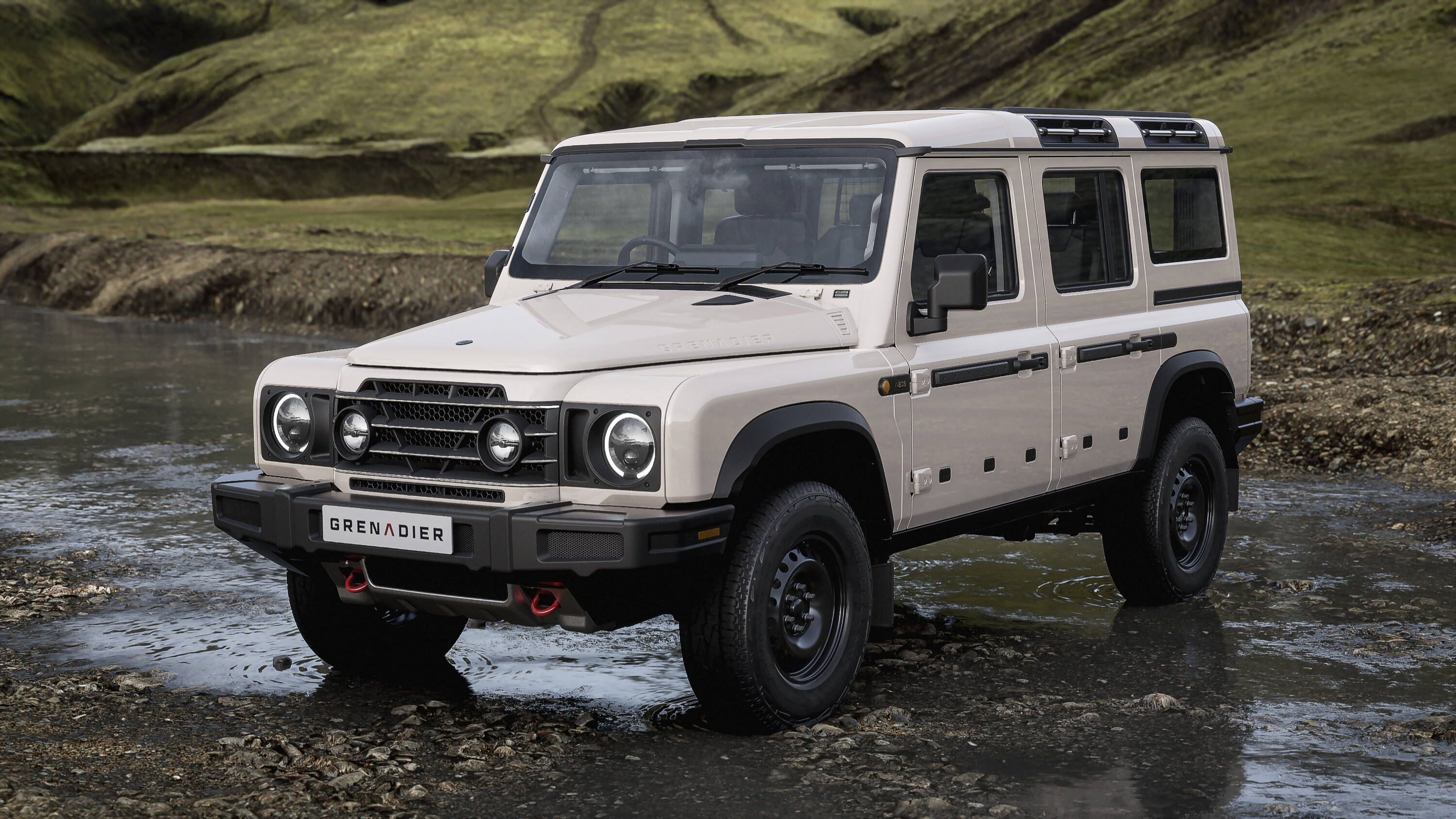
They are more of a fashion brand now, although the products are still hard-wearing, making them an ideal partner for the Grenadier vehicles. It helps that Belstaff is also owned by Ineos owner Jim Ratcliffe.
All Grenadier variants come with BMW six-cylinder engine, eight-speed automatic and full time four-wheel drive with a centre differential lock and high and low range. 17-inch steel wheels are standard, while alloys and BFGoodrich All Terrain tyres are optional.
A fully galvanised body rides on a box-section ladder frame over coil springs and live axles from Italian manufacturer Carraro. Front and rear Eaton E-locker differentials are also available as an option, or in the Rough pack which come standard on the Trialmaster Edition.
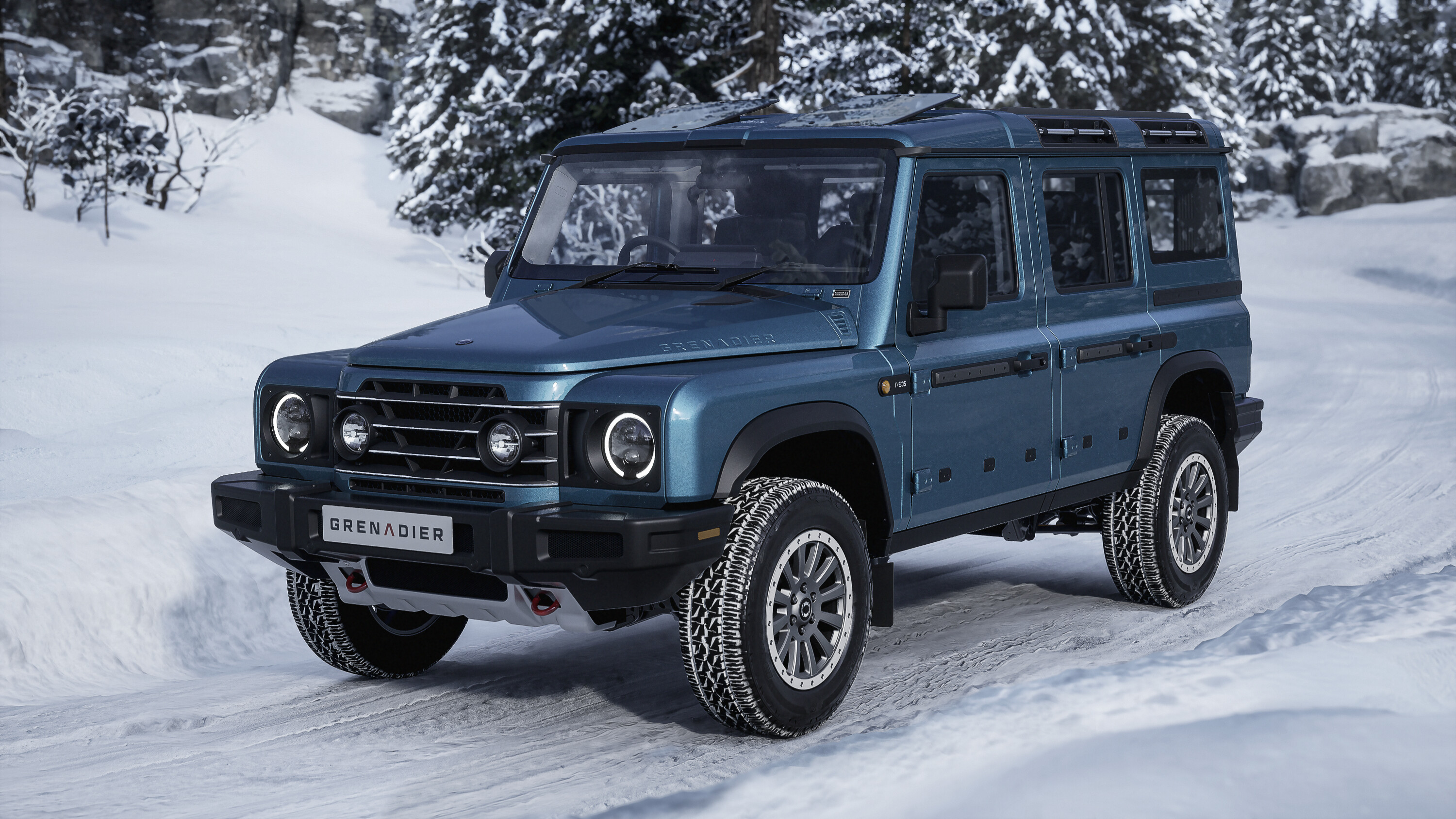
Headlights and spot lamps are LED while underbody protection and roof rails come standard. Inside there are Recaro seats; wireless Apple CarPlay and Android Auto; a tyre pressure monitoring system; an overhead control console that includes provisions for auxiliary switches for accessories; options of carpet mats; heavy duty floor coverings with drain plugs or carpet; and an off-road navigation system.
The Safari windows over the front seat passengers are standard on the Fieldmaster edition, but are a $2465 option on other Grenadiers. They can pop open to let fresh air in and be completely removed for more of an open cab feeling.
Option packs include the Rough Pack, which gets you the front and rear differential lockers and the BFG KO2 All Terrain tyres; and the Smooth pack, which adds front park assist, power heated exterior mirrors and heated windscreen washer jets, a lockable central stowage box, auxiliary charge points and ambient door lighting and puddle lamps.
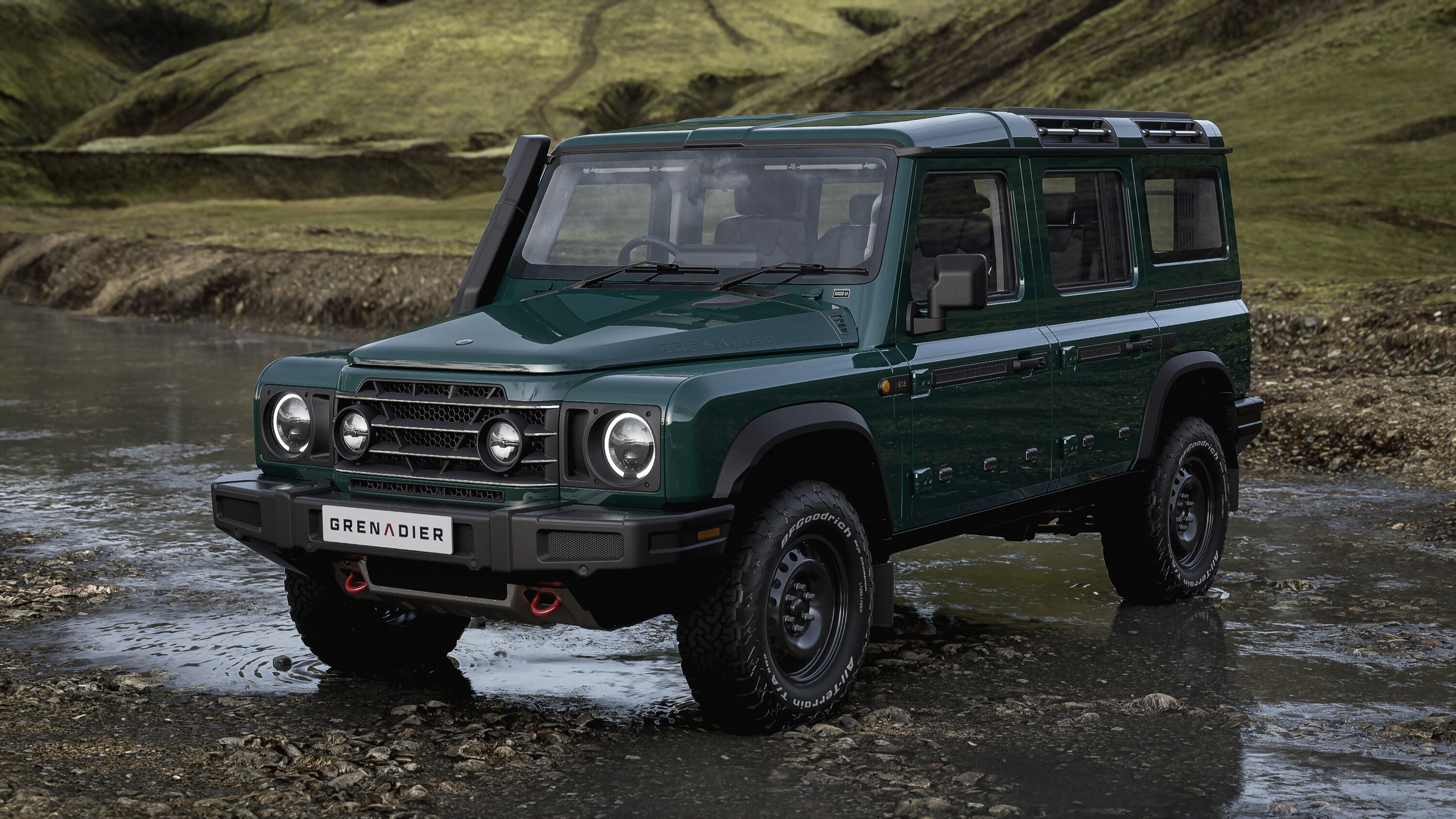
The Grenadier Trialmaster Edition is the model that is tailored for off-road use as it comes standard with both the Rough and Smooth option pack and adds a raised air intake snorkel, an auxiliary battery, interior utility rails, a roof access ladder on the rear door, high load auxiliary switch panel, and a compass with altimeter. The exterior utility belt runs along the doors and rear flanks and is basically an adjustable rail where you can attach accessories.
The Trialmaster Edition Grenadier also comes with a Belstaff Trialmaster Jacket.
It stands to reason that the Grenadier Fieldmaster Edition therefore comes with a Bellstaff Fieldmaster jacket but also adds heated front seats, the aforementioned Safari windows, alloy wheels and carpet floor mats. The Fieldmaster gets the Smooth option pack but not the Rough pack.
Bavarian power
The BMW six-cylinder engines offered in all grades are the B57 twin-turbo diesel and B58 turbo petrol units.
Long credited with engineering the best six-cylinder engines in the world, BMW’s petrol six produces 210kW of power and 450Nm of torque while the diesel makes a modest 183kW and 550Nm, so they are not highly strung power plants but well-suited to this application.
There is no difference in price between the petrol and diesel engine variants.
Ineos is quoting fuel consumption figures of 12.9L/100km to 15.1L/100km for the petrol engine and 10.1 to 11.7L/100km for the diesel engine. All Grenadiers come with a 90-litre fuel tank and the diesel utilises AdBlue exhaust aftertreatment.
It’s quite a heavy wagon at between 2644kg and 2740kg kerb mass and hardly built for performance, but Ineos quotes zero to 100km/h times of 8.6 seconds for the petrol engine and 9.9 for the diesel.
Built for off-road
The Grenadier is built solid to enable it to head off-road in any conditions. Offering locking differentials and a RED Winch from the factory shows how serious they are, and some clever features show that the engineers have listened to the needs of uses of such vehicles.
Things like an off-road button that when pressed disables the parking sensors, seat belt reminders and engine stop/start functions. The Wading Mode ensures the vehicle is optimally set up for wading, including monitoring engine temperature and disabling the engine fan when safe to do so. Wading depth is 800mm with or without the raised air intake.
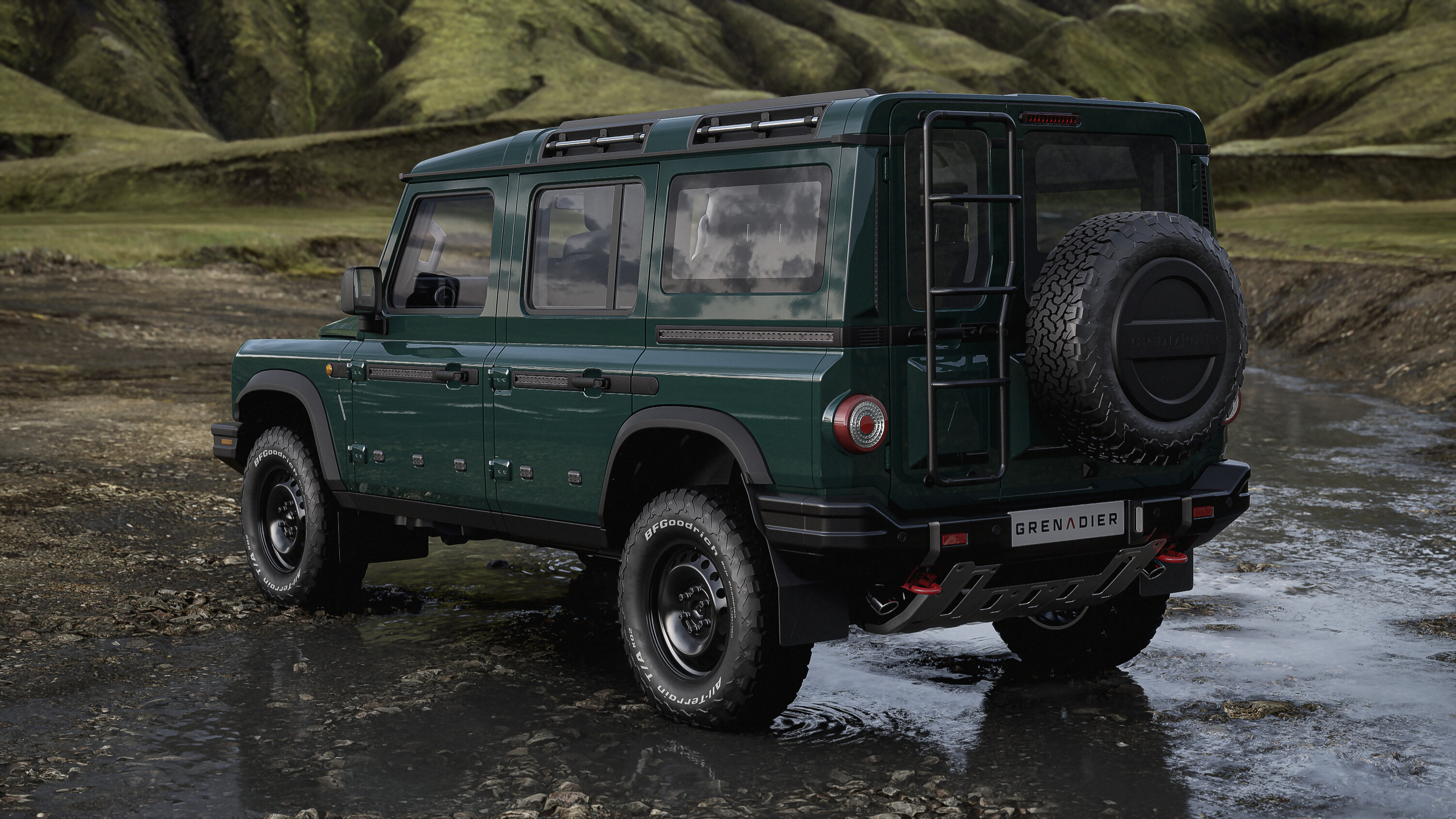
Other key off-road specs include:
- Ground clearance: 264mm
- Approach angle: 36.2˚
- Breakover angle: 28.2˚
- Departure angle:36.1˚
- Gradeability: 45°
Placing the wheels as close to the corners of the body as possible allows the engineers to achieve this. Each wheel is said to have 582mm of travel.
The Grenadier should also be good for hauling stuff. All variants have a 7050kg GCM and a 3500kg towing capacity. Payloads are not bad by wagon standards – between 810kg and 906kg, depending on the model. The two-seat utility model can accommodate a Euro pallet in its cargo area, while the load space has multiple tie-down points. GVM is rated at 3550kg.
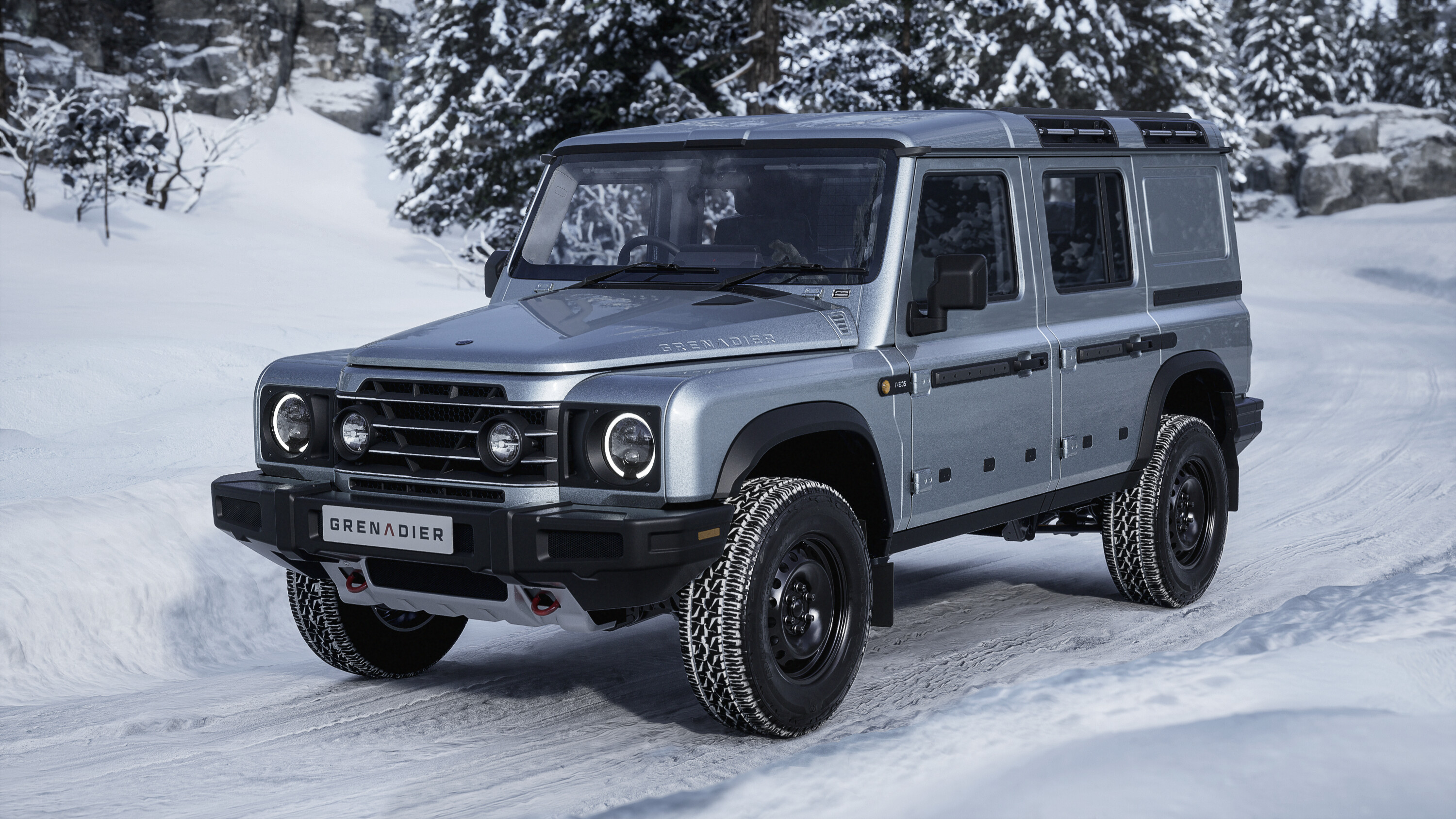
The roof is rated to carry 420kg static and 150kg when travelling, and Ineos is using Rhino Racks as the official accessory rack along with the many and varied accessory mounts from Rhino to carry anything you need.
Another quality brand in the Ineos accessory range is the RED Winch. Look in the hardcore and competition off-road scenes and you’ll find RED Winches mounted to the front of many well-equipped rigs. The winch kit is a $4050 option and is designed to fit in the standard front bumper.
The accessories list also includes a ‘Roo bar’ side rails, rock sliders, raised air intake, HD seat covers and various cargo management devices, although we are yet to see any of these.
Ready for action
The Grenadier’s gestation period has been a relatively fast five years from concept to reality, and when it goes on sale in Australia later this year it will be available from 28 sales and service centres around the country.
It will be backed by a five year/unlimited kilometre warranty.
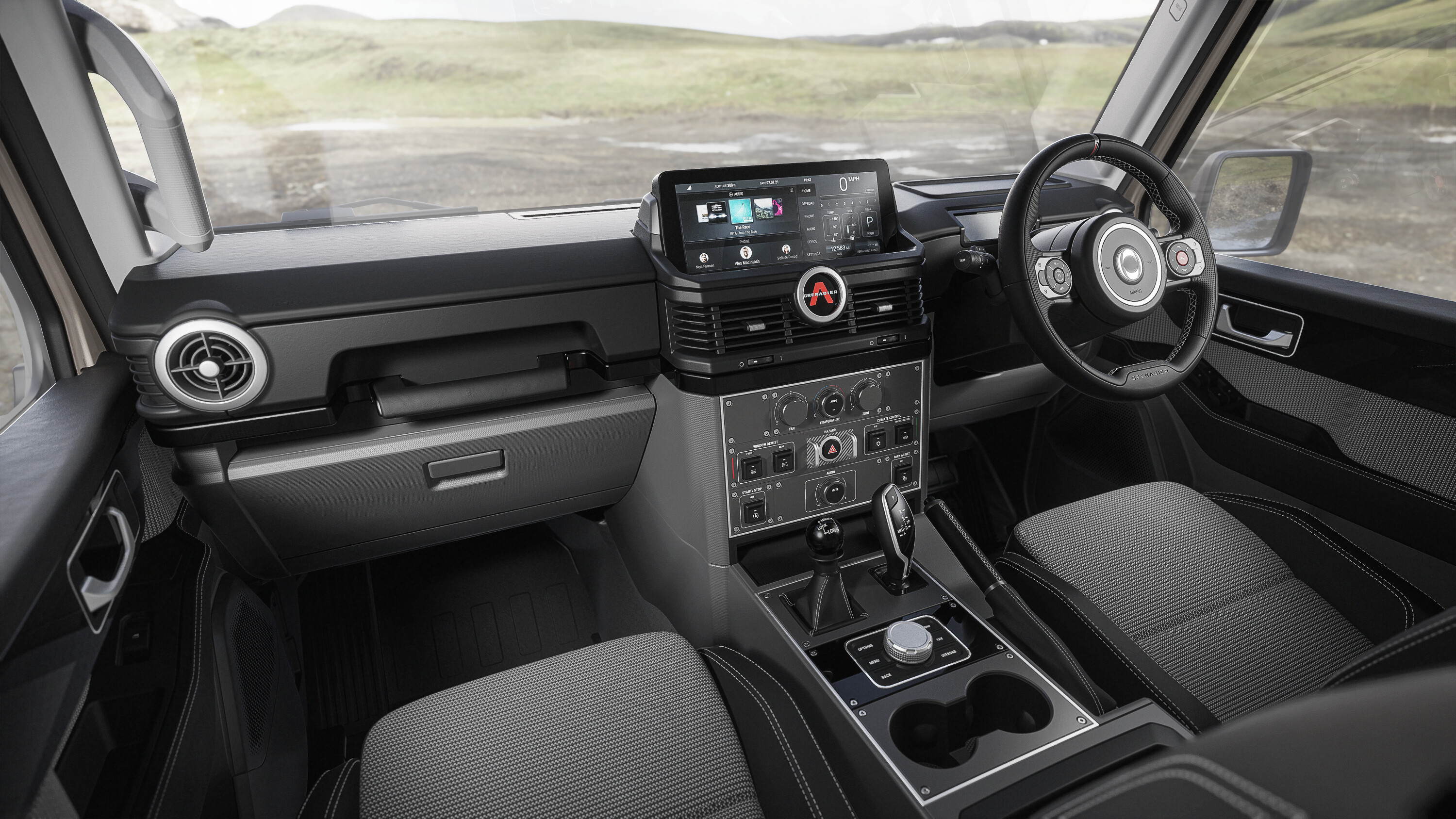
An online vehicle configurator will go live on May 18, so you can get on there and build your own Grenadier, just how you like it. This is the same time as the order books are open with the first deliveries of production vehicles expected late in 2022.
Production builds are set to commence at the Hambach, France, plant in July, with Australia among the first countries to receive the vehicle.
2023 Ineos Grenadier prices
| Grenadier | Trialmaster | Fieldmaster | |
| Utility wagon | $84,500 | $95,495 | $95,495 |
| Station wagon | $85,500 | $96,495 | $96,495 |
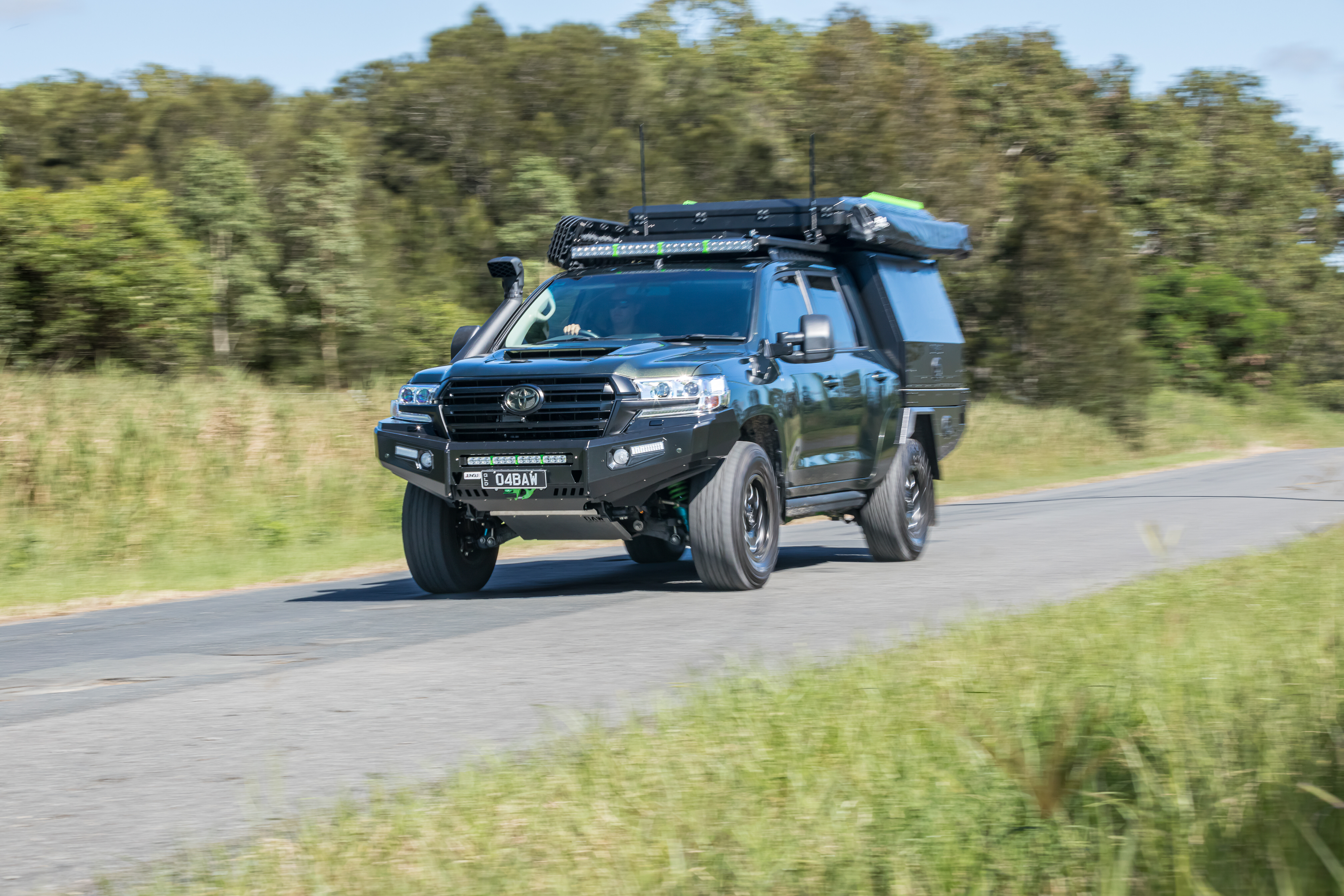
That mean and green machine plastered on our May 2022 cover is the work of aftermarket experts, BAW Automotive.
The mind-blowing chopped and lifted 200 Series is used as both a daily driver and off-road track tamer and is worthy of gracing the SEMA halls, with top-quality mods and equipment added inside and out.
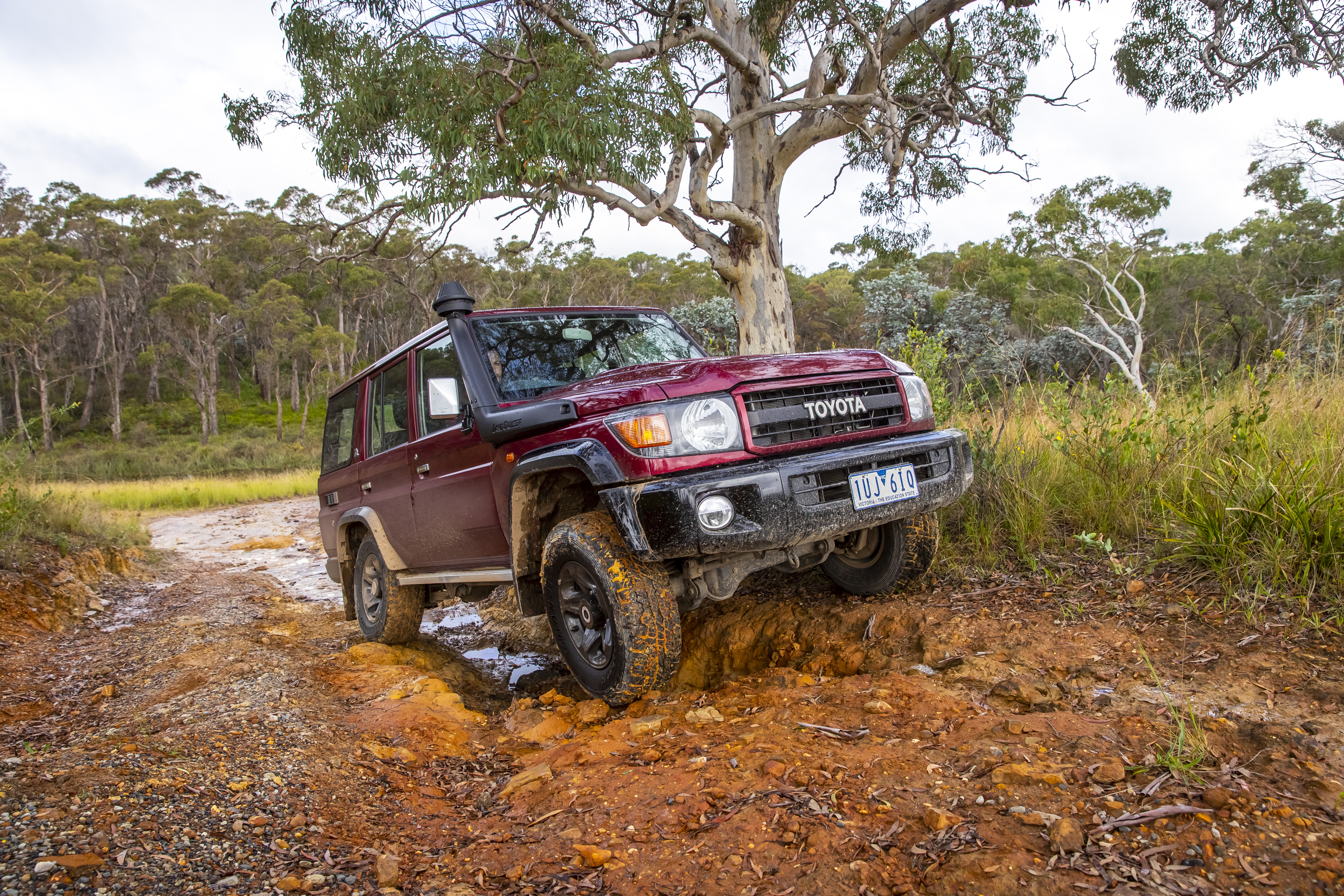
Toyota celebrated the LandCruiser’s 70th Anniversary in style, by releasing a limited-edition 76 Series Cruiser. Compromised and old-school but endearing to the core, Evan Spence took a stunning Merlot Red example off road to rekindle an old romance. Only 80 were built, so good luck getting your hands on one.
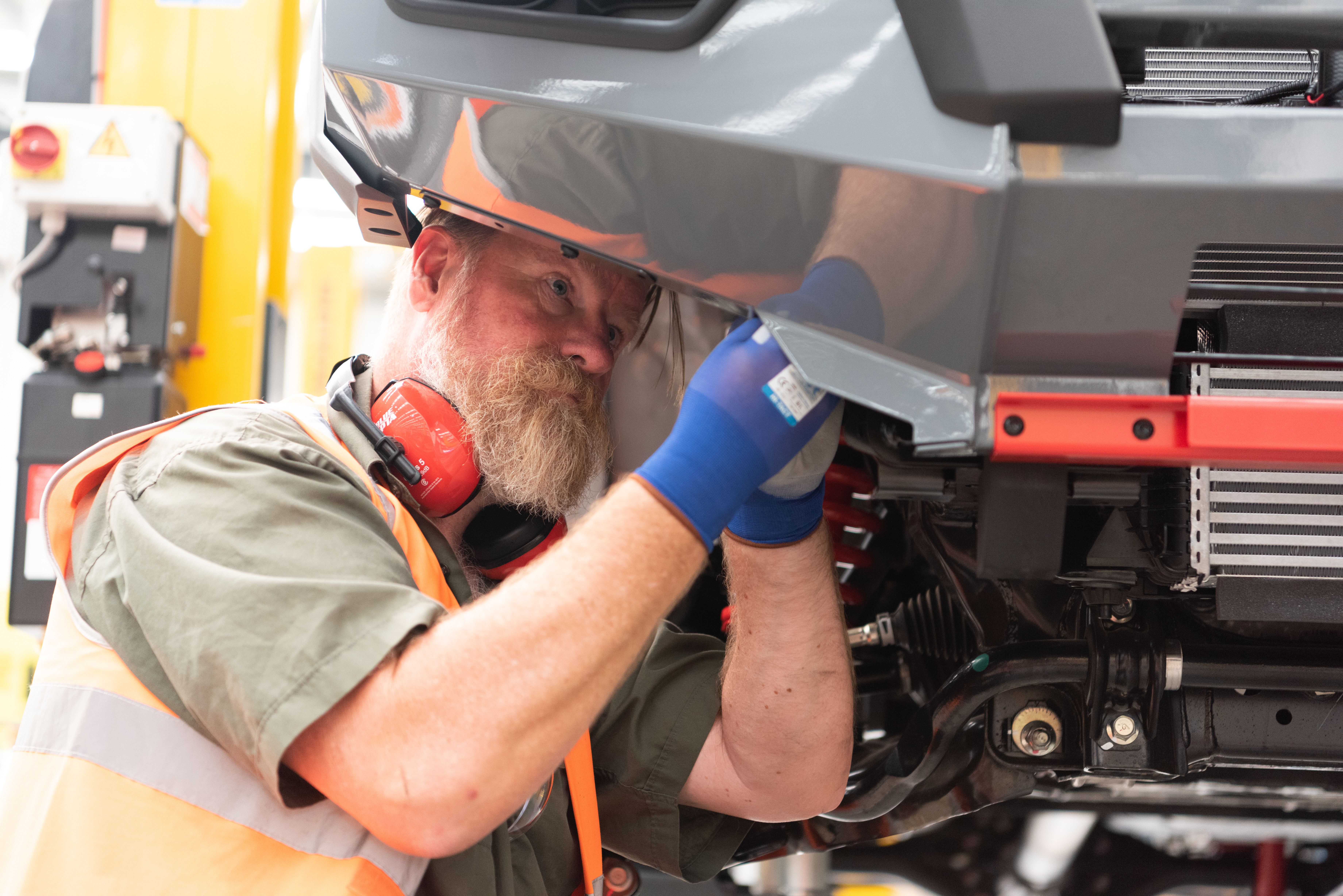
Editor Matt walks the line at Premcar, following a Navara PRO-4X Warrior down the assembly line as it receives the Premcar treatment. We’ve added a rare manual variant to our long-term shed, and we’ll get to drive it straight out of the factory.
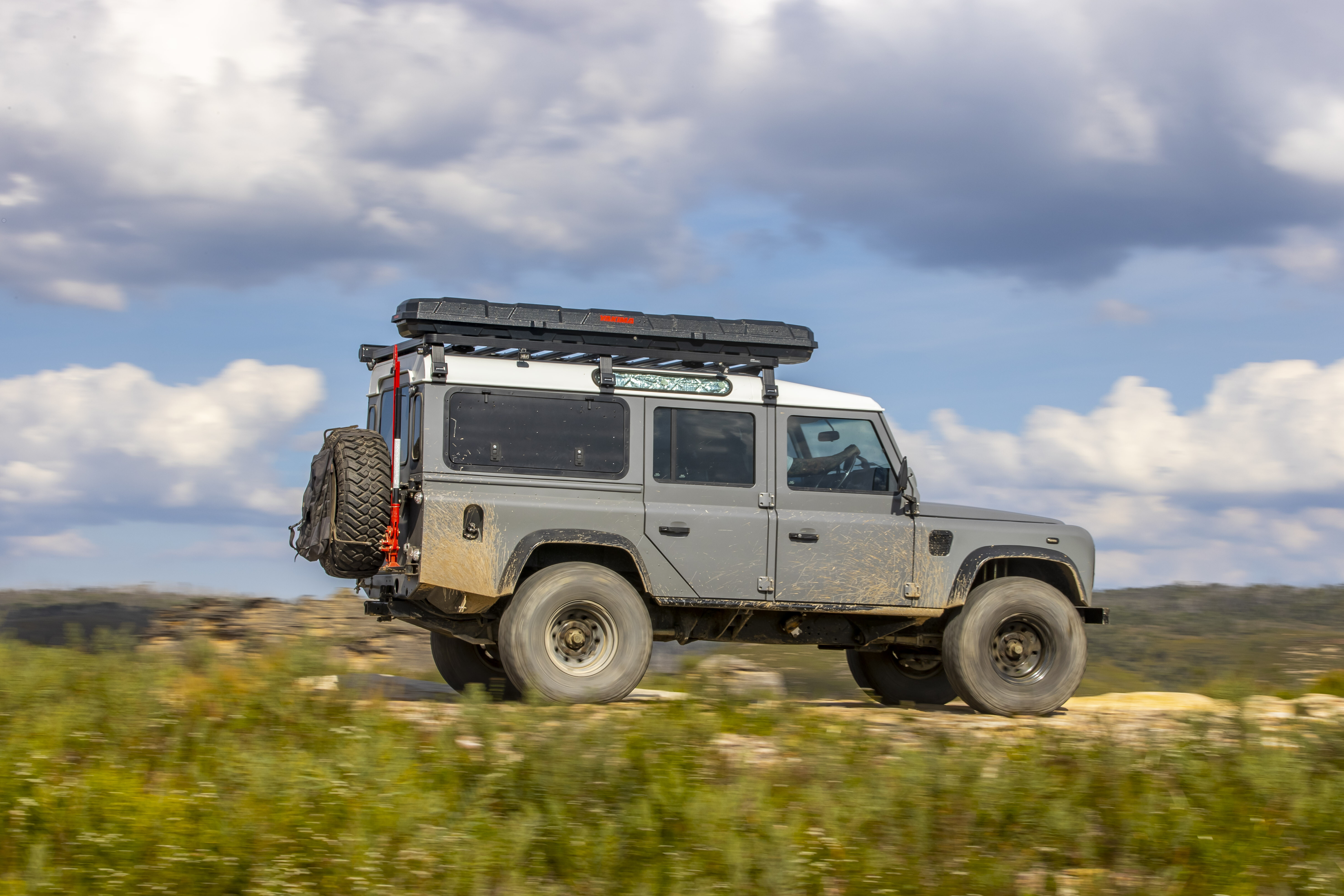
On the custom front, we run a microscope over a 2006 Land Rover Defender built for one purpose: to access hard-to-reach fishing spots across Australia. It has also been modified with fishing in mind, with a world-class tackle box compartment and slide-out kitchen. The engine has also been fettled for more power and the driveline has been substantially beefed-up.
Plus, our intrepid gang of travellers have explored a number of bucket-list destinations this month: the Grampians in Victoria, Savannah Way in both Queensland and the NT, and Torrington in NSW.
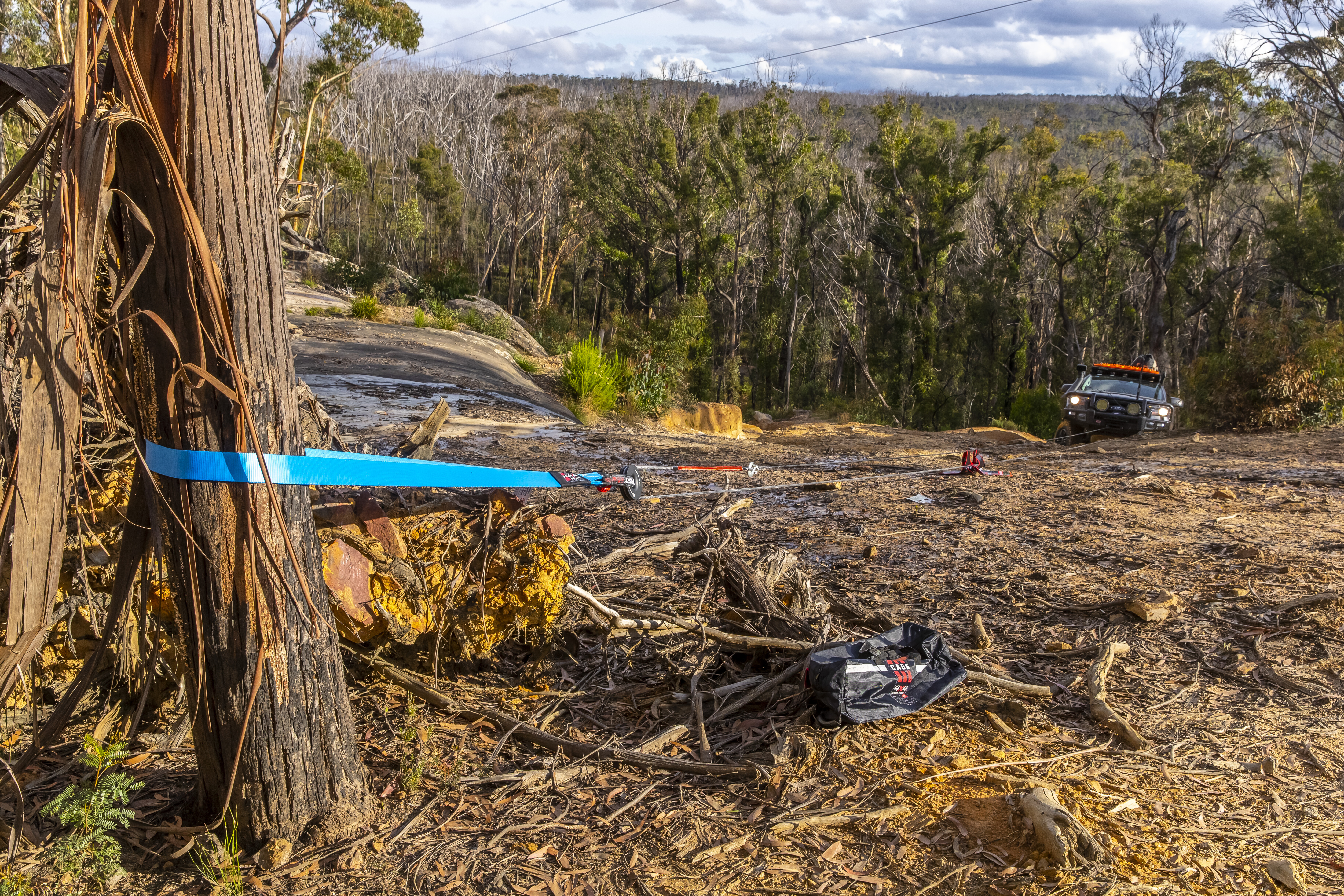
Last month Deano showed us all how to perform a basic winch recovery. In this issue, he dials up the difficulty level to explain how to escape difficult scenarios with complex winching techniques.
What else is there?
- First Aussie drive: 2022 Lexus LX
- Bush Lapa Hopper 3i camper trailer review
- A closer look at 12-volt systems
- Terrain Tamer brakes tested
- Ironman 4×4 winch update
- Opinions, news and product reviews
Armed with a bit of knowledge and a fair dose of common sense, extracting a vehicle from a stuck situation using a vehicle-mounted electric winch is often straightforward, but as with all things when driving off-road, complications are a part of the game.
Sure, there are plenty of scenarios where a straight-ahead, single-line winch pull will get you out of strife, but throw in some obstacles and pretty soon your winch could run out of puff, or the situation might mean you need to winch at an angle rather than straight ahead.
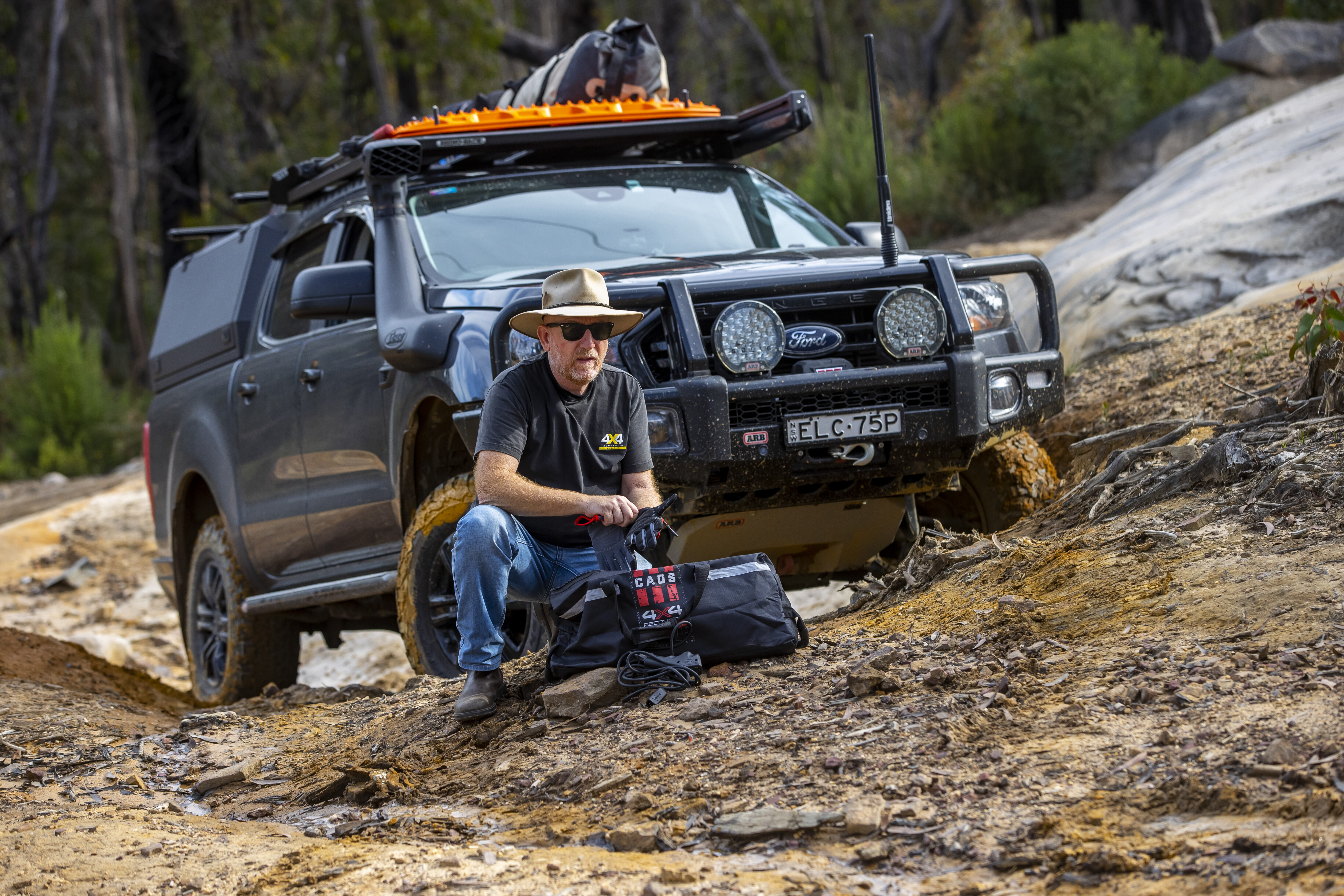
The further you drive off road, the greater the chance you’ll need to get a little creative with vehicle recoveries from time to time, so in this ‘How To’ instalment we’re going to look at a couple of advanced winching techniques where you’ll need to employ snatch blocks or winch rings to perform a vehicle recovery, as well as winch extension ropes.
Required gear
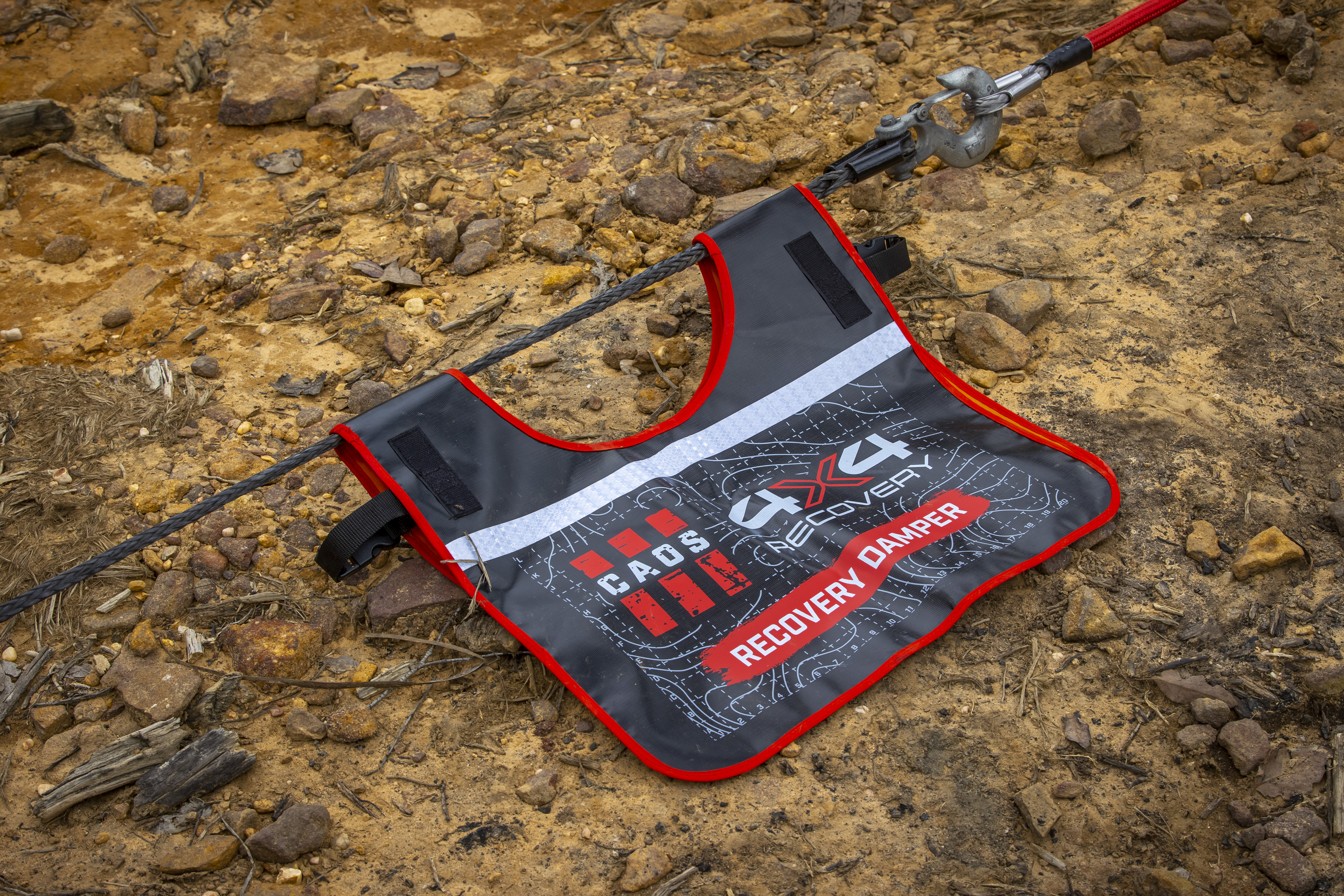
As with any winch recovery, you will need a winch on your vehicle equipped with steel cable or synthetic rope. You will also need a solid anchor point (often a suitable tree), a winch controller, sturdy gloves, a recovery damper, a tree-trunk protector and a rated soft shackle or bow shackle.
For a more complex double-line pull, you will also need a snatch block or a winch ring, a winch extension strap or winch extension rope, an additional rated soft shackle or bow shackle, and an additional recovery damper.
For the sake of simplicity, from now on we’ll refer to the use of winch ropes and winch rings rather than winch cables and snatch blocks, but these items fulfil the same functions, so if your vehicle is equipped with steel cable and you have snatch blocks in the recovery kit, the techniques described here are still relevant.
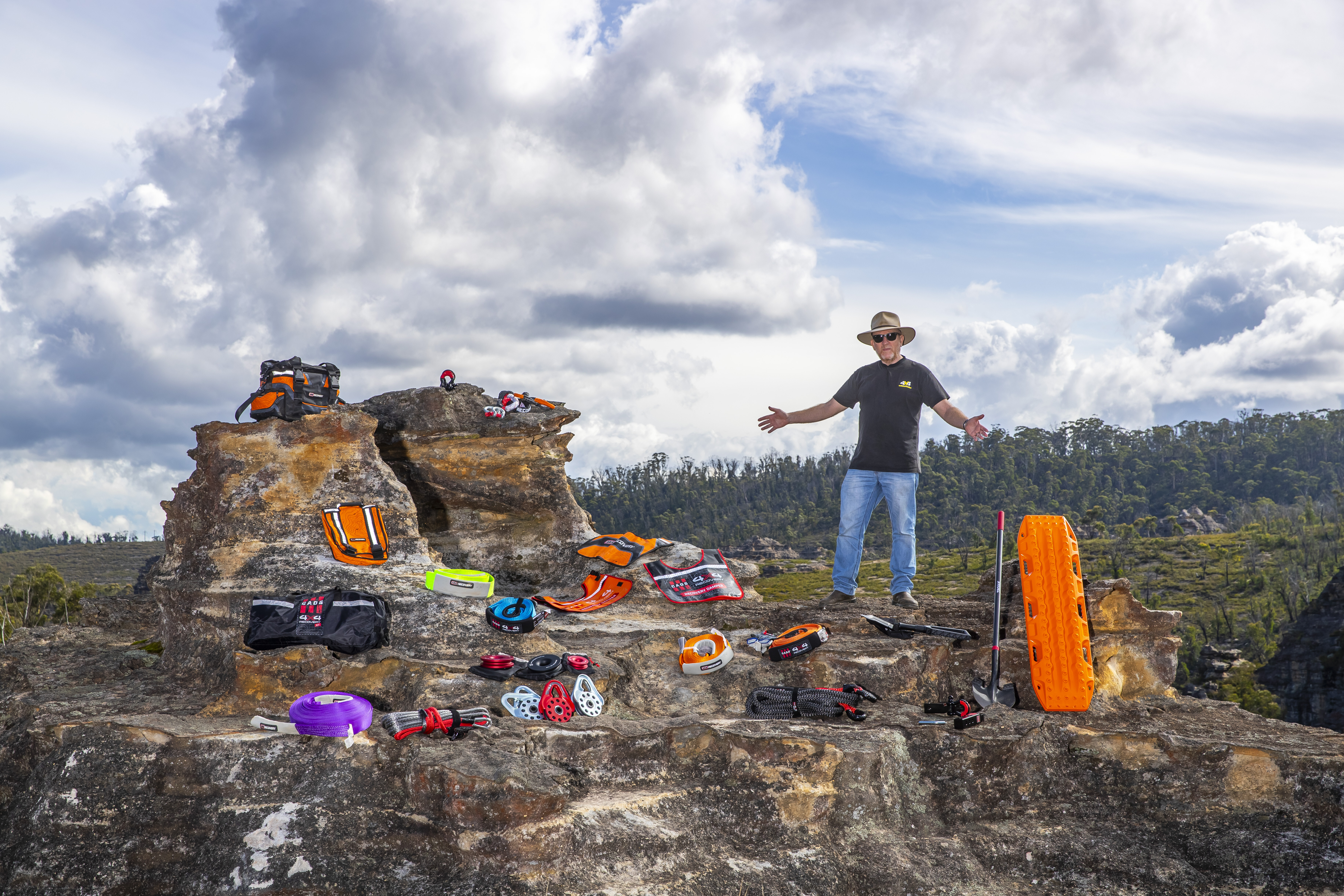
We’ll also refer to the use of winch extension ropes instead of winch extension straps, as the former is more versatile in that it can be fed through a winch ring if necessary.
All recovery equipment should be rated to suit the weight of the vehicle being recovered, and it should be clearly stamped or labelled. You will also need to have rated recovery points affixed to your vehicle, which are not to be confused with shipping tie-down points that are only to be used when vehicles are transported.
Another thing to note is that winch extension ropes are similar in appearance to kinetic recovery ropes, and the two are not interchangeable. Winch extension ropes do not stretch like kinetic recovery ropes, so they should never be used for snatch recoveries. If in doubt, always check the label to make sure you are using the right equipment for the job at hand.
In addition to the equipment outlined above, some other handy gear to have when performing a winch recovery includes a shovel, a machete and a handheld UHF radio.
The shovel can be used to clear away mud, rocks, sand and other debris around the vehicle before commencing winching, the machete can be used to clear away bushes, branches and scrub so you’re winch rope doesn’t foul on anything, and the handheld UHF can be used for communication between the driver and the person operating the recovery equipment.
Remember, whenever you perform a vehicle recovery, make sure that all non-essential bystanders are well clear of the operation. The only people who should be involved in any recovery operation are those driving the vehicle(s) and those operating the recovery equipment.
Double-line pull
The first advanced winching technique we’re going to look at is the double-line pull, which you usually employ when the vehicle that needs recovery is really stuck, or when you are travelling on your own and you want to minimise the load on your winch.
A double-line pull is where you run your winch rope up to an anchor point, through a winch ring and back to a recovery point on the front of your vehicle. Other than some minor energy loss through friction, a double-line pull doubles the pulling power of your winch by halving the load on it, so ideal if stuck fast in gooey mud or you need to winch up and over an obstacle. Also, as the winch will not have to work as hard when you employ a double-line pull, it will reduce the load on the vehicle’s battery.
Setting up a double-line pull is relatively straightforward if there’s a nearby anchor point such as a sturdy tree; remember, the winch rope will need to be long enough to run up to the anchor point and back to the vehicle. If the anchor point is not close enough, you will need to use a winch extension rope.
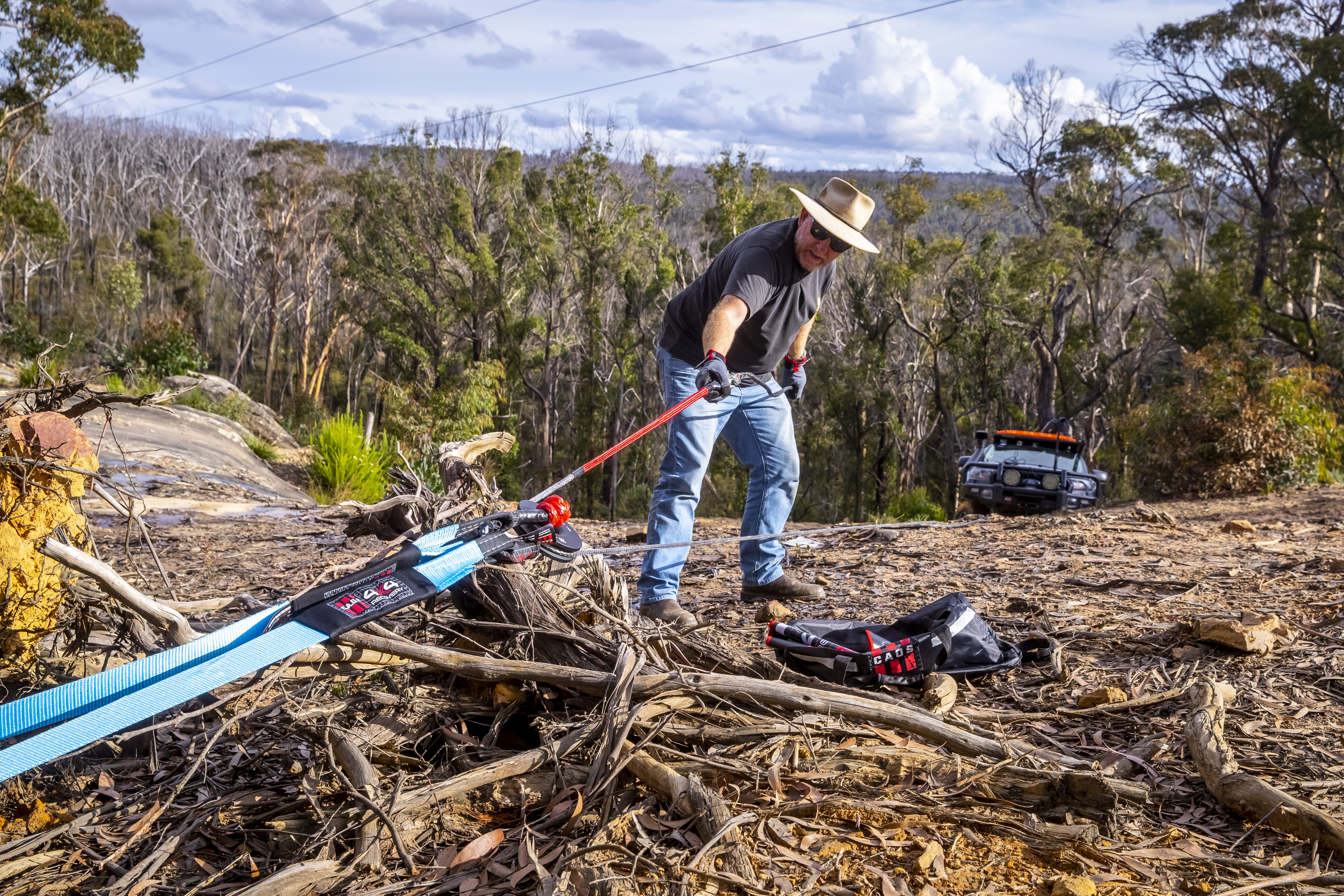
The first thing to grab out of the recovery kit is a pair of sturdy gloves. Gloves will protect your hands from frayed wire on winch cables and from friction burns when running synthetic ropes. Next, plug in the winch controller and if you are travelling solo, run it back through the driver’s window so you will be able to operate the winch from the driver’s seat.
The next step is to grab everything you’ll need for the recovery operation which, in this case, includes winch extension rope, tree trunk protector, soft shackle, bow shackle and two recovery dampers. If you only have one recovery damper, you can use a heavy jacket or your winch recovery bag as the second damper.
Move the winch’s clutch lever to the free-spool position and then pull out enough winch rope to reach the anchor point. If the winch rope isn’t long enough to reach back to the vehicle, unfurl the winch extension rope and run it back to the vehicle and attach to a rated recovery point with a rated shackle. If you’re using a steel bow shackle, tighten it, then back it off a quarter of a turn so it won’t bind up while winching, which can otherwise make it difficult to remove later.
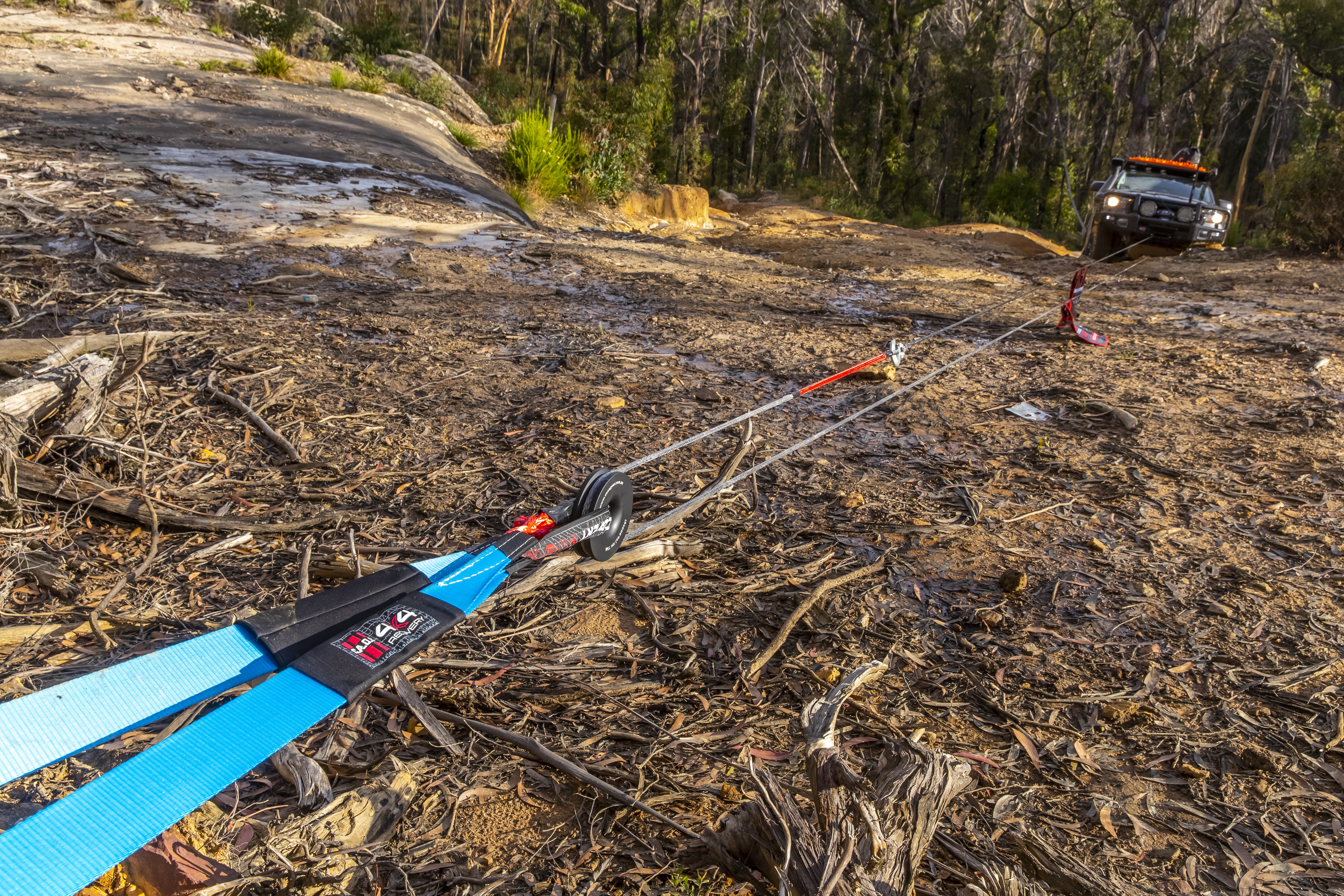
Back at the anchor point, run the winch rope (or in this case the winch extension rope) around the groove in the winch ring. Now run the tree-trunk protector around the tree as low as practicable and join the two looped ends with a soft shackle that has also been fed through the hole in the winch ring.
About halfway between the vehicle and the anchor point, place a recovery damper over the winch rope and another damper over the winch extension rope. Head back to the vehicle, re-engage the winch clutch and winch in slowly until there is a small amount of tension on the winch rope, ensuring that the rope hasn’t slipped out of the groove in the winch ring.
Also feed the winch rope back on to the drum as evenly as possible. Always keep your hands well clear of the fairlead while winching in. Once there is some tension in the set-up, check that all rigging is secure, but never step over the winch rope once there is tension in the rigging.
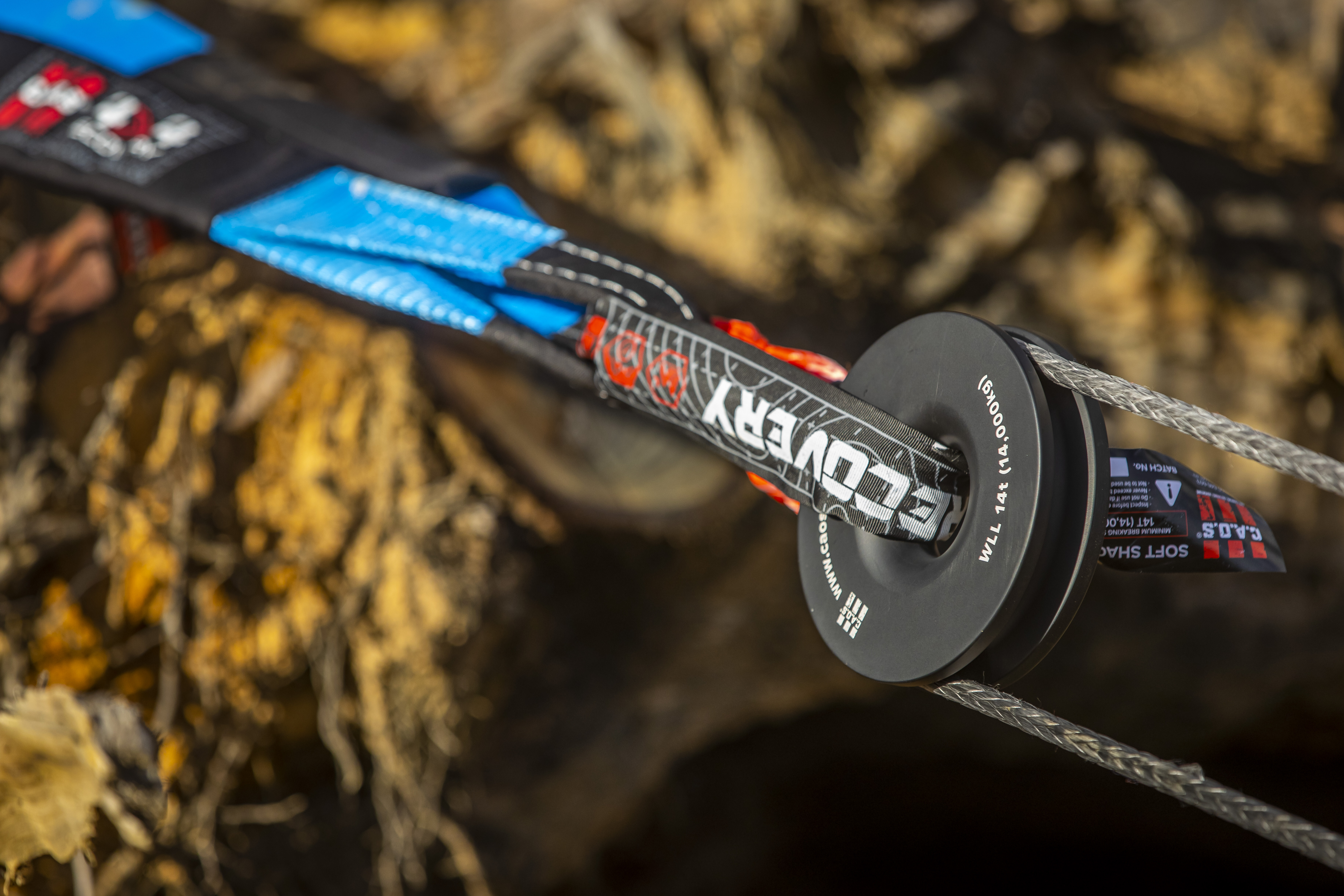
If you are happy with the set-up, make sure all bystanders are out of harm’s way and, if you are on your own, get back in to the vehicle with the winch controller. Start the engine, engage low-range first gear, release the park brake and ease off the foot brake; the tension on the winch rope will ensure the vehicle doesn’t roll backwards.
Steer towards the anchor point and begin to winch in, aiding progress with some application of the throttle. Always keep some tension on the winch rope to prevent it from slipping off the winch ring and keep an eye on the recovery dampers to make sure they don’t end up fouling in the winch ring or the fairlead.
Once out of your predicament and back on solid or level ground, winch out slightly to take the tension out of the set-up, secure the vehicle (put it in park or in gear) and turn off the engine.
Pack up and stow your recovery gear, feed the winch rope back on to the drum evenly and check the area thoroughly to make sure you haven’t left anything behind. While setting up a double-line pull may have taken longer than a single-line pull, it is well-worth it if you are really stuck, and if you want to minimise the load on your winch.
Winching on an angle
Snatch blocks and winch rings can be used for much more than a double-line pull. In our next winching example, we’re winching a vehicle up a track using the winch on the following vehicle thanks to some imaginative rigging.
Here’s the scenario: you’re driving up a narrow bush track in a winch-equipped vehicle and the vehicle ahead of you (without a winch) is stuck and blocking the track. To winch it forwards, you will need to run your winch rope past the stuck vehicle, through a winch ring and back to the stuck vehicle. The problem here though is that your winch rope might not clear the stuck vehicle.
The solution? Run the winch rope to a suitable anchor point that is directly ahead of your vehicle, then run it to a second anchor point that is directly ahead of the stuck vehicle, and then back to the stuck vehicle.
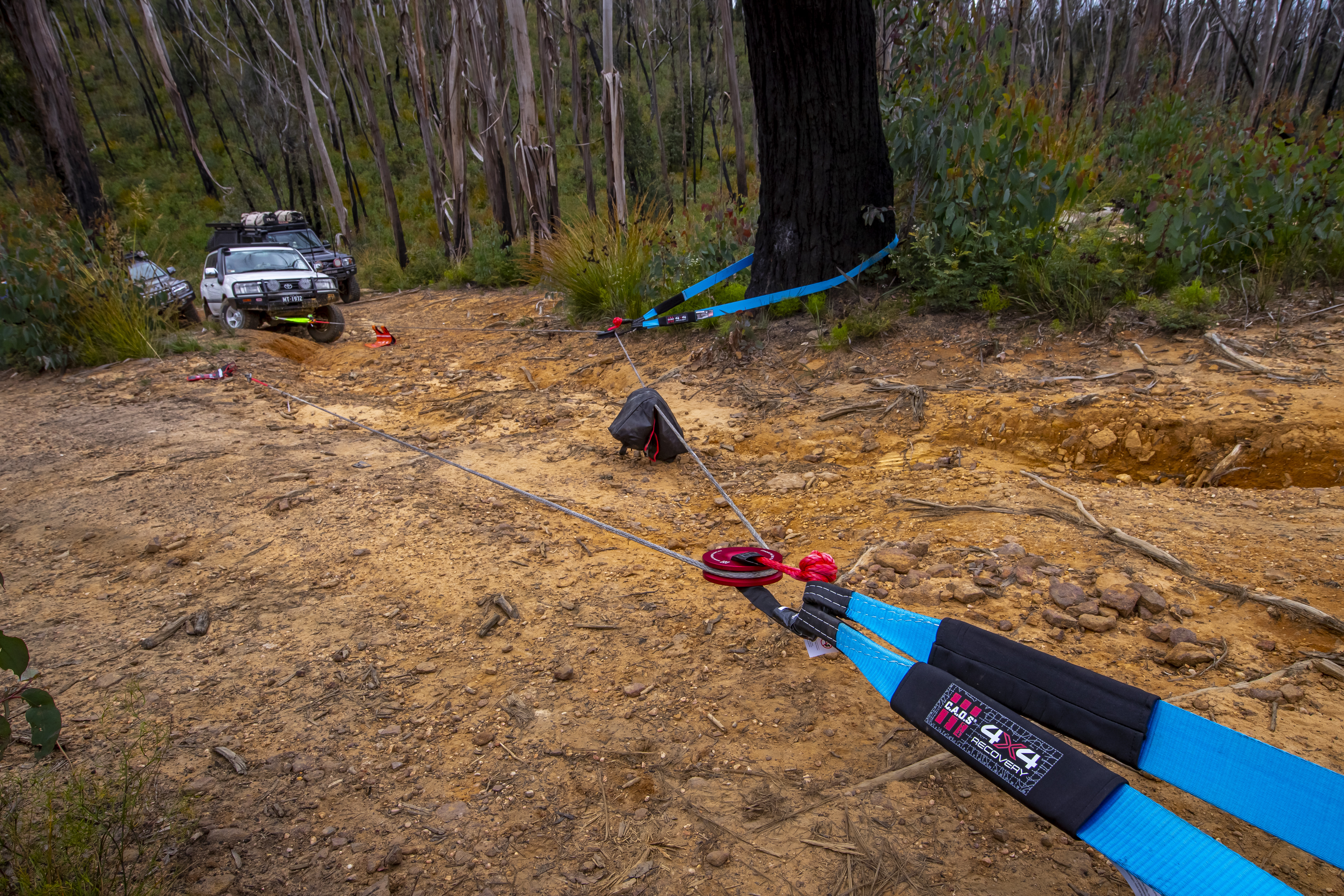
To achieve the above set-up, in addition to your winch and winch rope, you will need at least one winch extension rope, two strong and suitably positioned anchor points, two tree-trunk protectors, three shackles, two winch rings, three recovery dampers and, of course, enough gloves for everyone involved in the recovery procedure. It will make life easier if everyone has a UHF as well. We also used a third tree-trunk protector in this recovery operation to spread the load across both recovery points on the stuck vehicle.
The winch extension rope is attached to the front of the stuck vehicle and fed through both winch rings and then attached to the winch rope on the vehicle with the winch. The winch rings are attached to the two tree-trunk protectors using soft shackles, and those tree trunk protectors have been looped around the bases of two suitably positioned, strong trees.
Recovery dampers are positioned between the stuck vehicle and the tree ahead of it, between the two trees, and between the winching vehicle and the tree ahead of it.
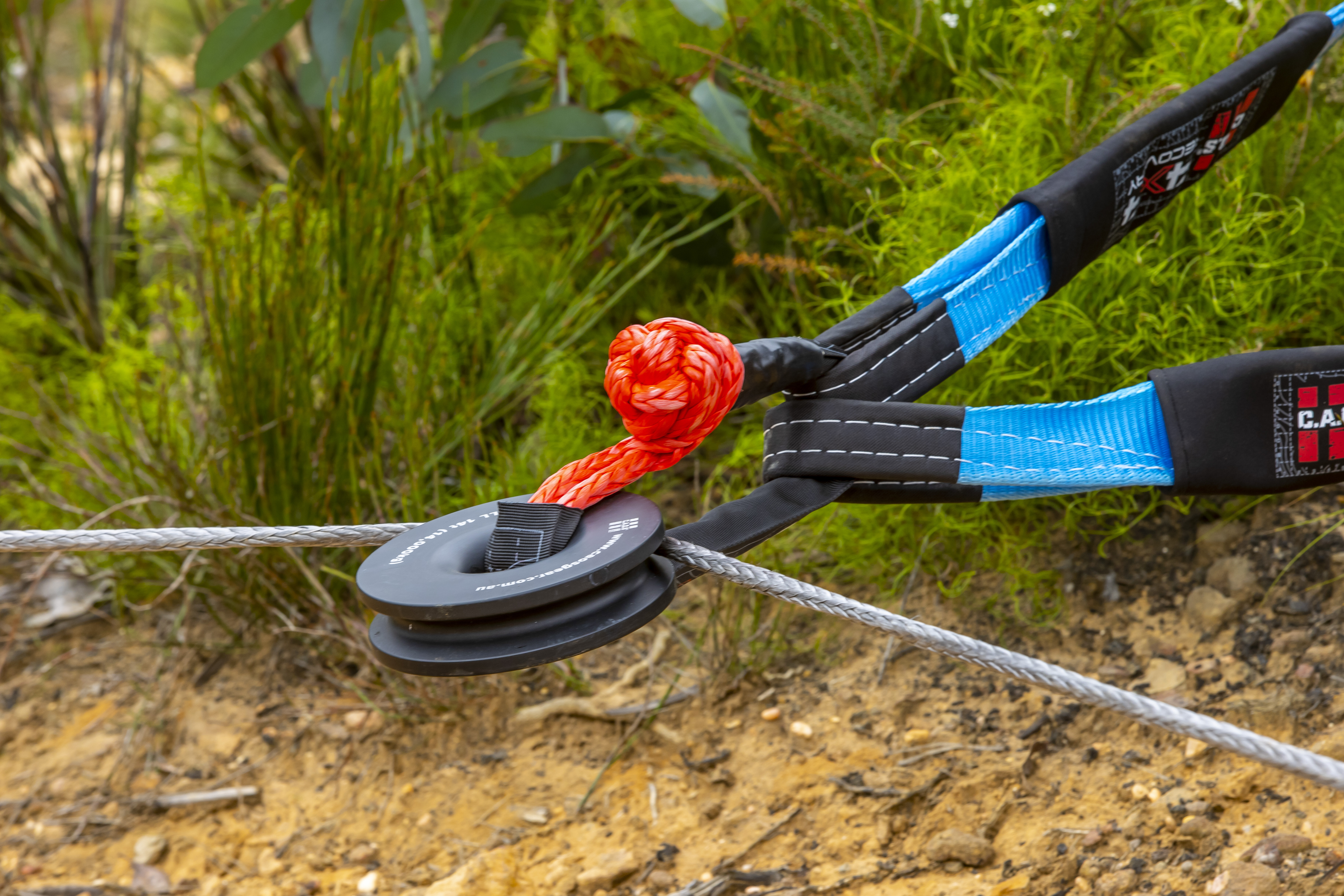
This is quite a complex winching scenario, and it requires more than one person to achieve a successful outcome, but it is important that there is only one designated person in charge of the winching operation.
Once everything is in place, bystanders are clear and everyone involved in the winching operation is in a safe position, some tension is added to the set-up by winching in. The rigging is then checked again to make sure everything is secure and that the ropes have not slipped off the winch rings.
If deemed okay, the drivers of both vehicles can start their engines and get ready to begin winching. If there are no UHF radios, make sure there’s another means of communication between both drivers, such as a toot on the horn to signal start winching and two toots to signal stop winching.
When winching begins, the driver of the winch-equipped vehicle should apply brake pressure and rev the engine to assist the battery to power the winch, while the driver of the stuck vehicle should drive forward in low-range first gear to aid progress, making sure not to exceed winching speed.
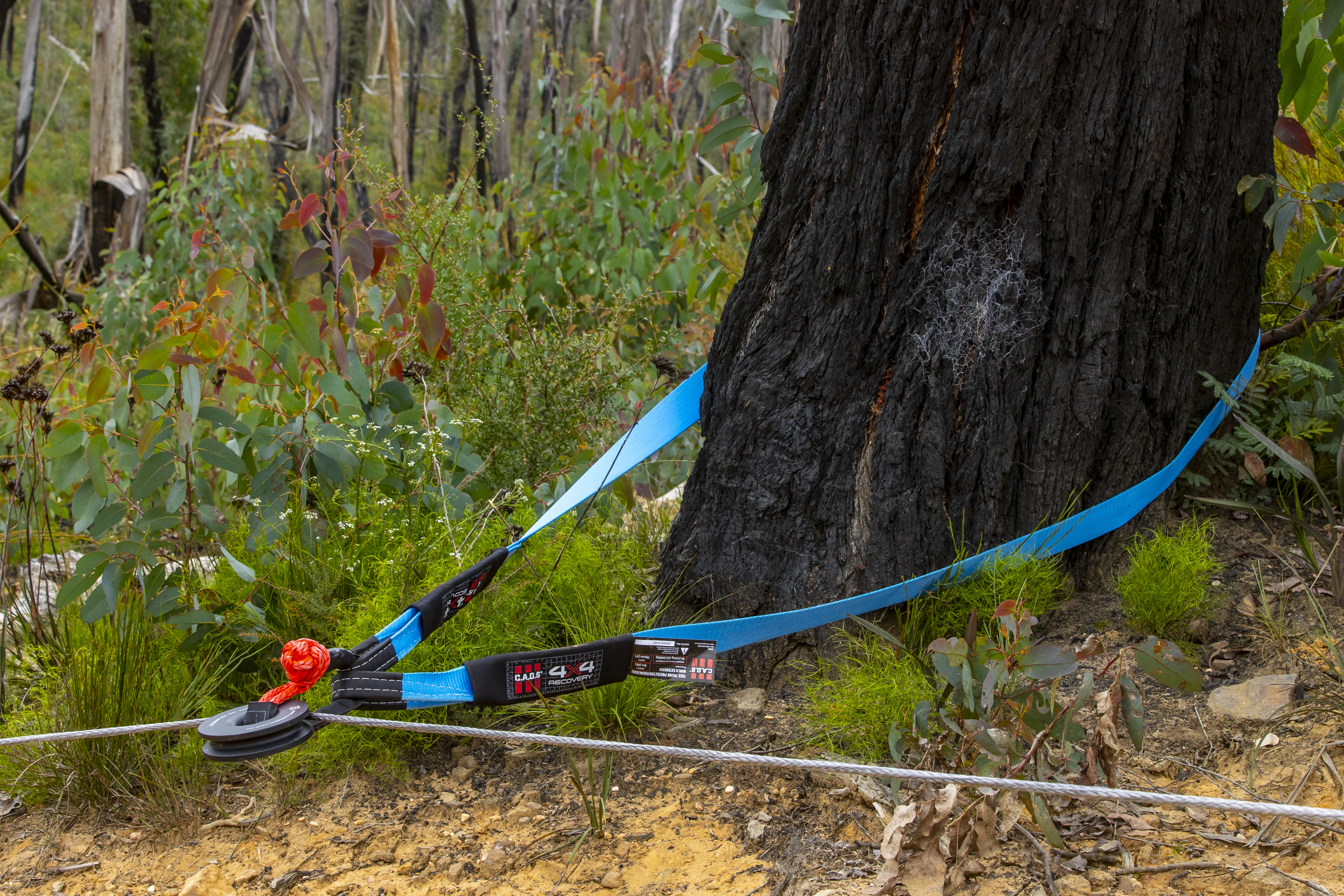
There always needs to be some tension in the rigging to prevent the winch ropes from slipping off the winch rings. Also keep an eye on the position of the recovery dampers to make sure they don’t foul in the rigging, and reposition them if necessary, but only after pausing the operation. Remember, never step over a tensioned winch rope.
Although there are two winch rings in play here, this set-up is not at all like a double-line pull, and there will be no halving of the load on the recovery vehicle’s winch. In fact, there will be slightly more load than a single-line pull due to the friction as the winch ropes pass through the winch rings, so if it’s a long and difficult pull, give the winch a rest every 30 seconds or so to prevent the winch motor from overheating.
Once the stuck vehicle is out of its predicament, the recovery vehicle can winch out slightly to take the tension out of the rigging so everyone can collect their recovery gear.
Looking after your gear
Ensure you clean your winch rope and recovery equipment as soon as you get the chance. If you leave winch ropes, winch extension ropes and soft shackles muddy, they will dry out, and abrasive grit will damage them and shorten their lifespan.
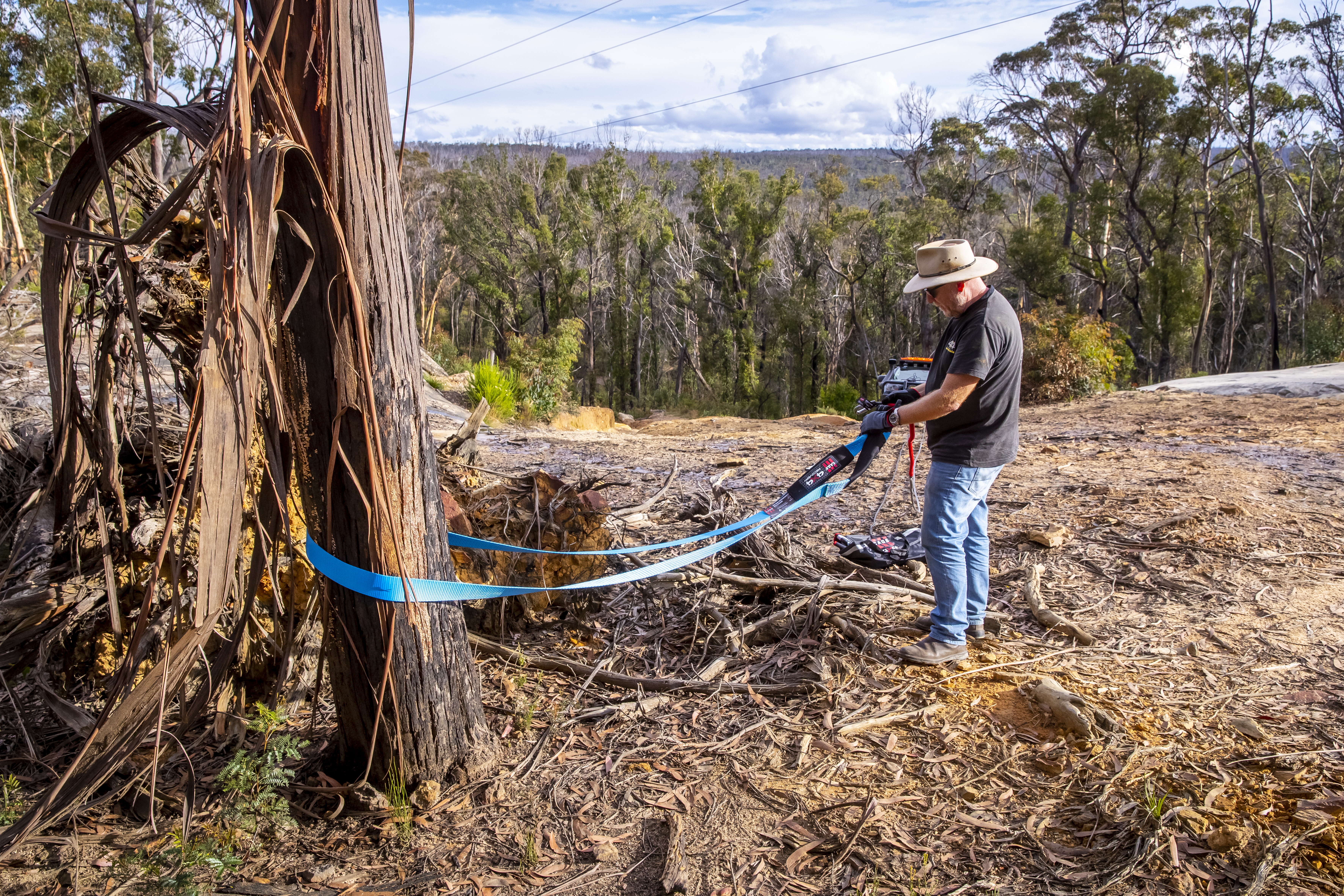
Make sure the winch rope is wound back on to the drum evenly with some tension on it.
Ensure that your winch recovery kit is complete and serviceable before you head off road again. Check the condition and operation of your winch regularly, and service it when required.
Do
- Wear gloves when handling recovery equipment.
- Run vehicle engine when winching.
- Check all equipment is rated for the job.
- Monitor cable dampers and reposition if necessary.
- Have clear communication between all involved in operation.
Don’t
- Step over a tensioned winch cable/rope.
- Allow spectators near recovery operation.
- Overload winch (give it a rest every couple of minutes).
- Use inadequate anchor points.
- Leave anything behind when you’re done.
A fencing company in Clontarf, Queensland, seems an unlikely starting point for one of the Australian four-wheel drive aftermarket industry’s continued success stories, but that is where the genesis of East Coast Bullbars (ECB) occurred.
Yep, that’s right – a humble fence post was, in fact, an integral part (really, the only part) of the birth of this iconic company, thanks to the original owners who, in 1972, ran a successful fencing company. So how does a fence post start Australia’s first bullbar manufacturer? Well…
A beginning takes shape
The original owners had a ute – pretty much an essential rig for any fencer – and saw the need for some frontal protection for the four-wheeled workhorse.
To this end, they decided to use some aluminium fence post material, which resulted in the first bullbar channel coming from a fence post extrusion they commonly used, with the upright posts and some tubes made from the same materials added to create an alloy bullbar.
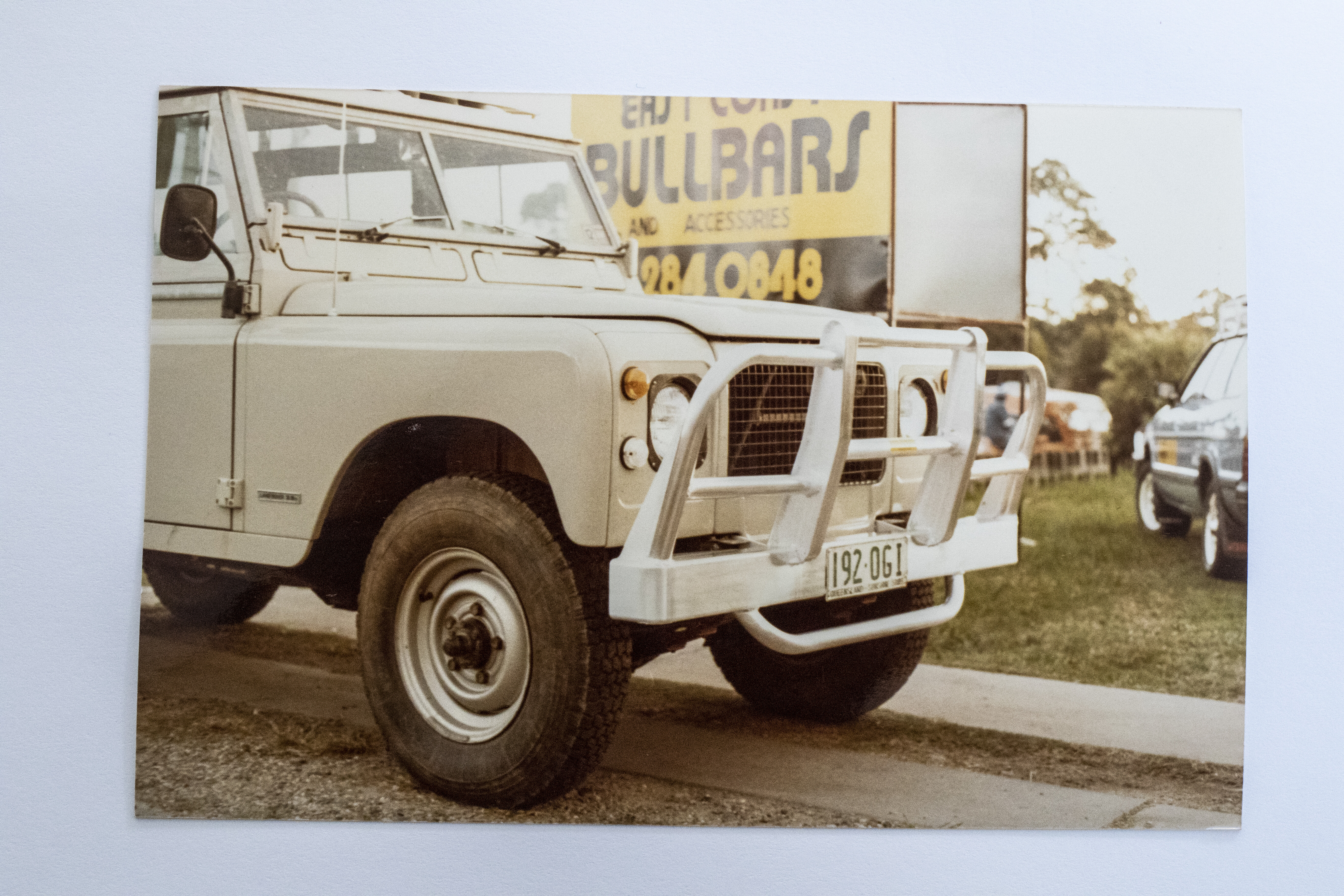
This led to a desire to expand the business to ‘bullbars’. Today, 50 years later, ECB is releasing frontal protection products for an average of 40 vehicles each year, all shaped, welded and polished (more on this later) at its Clontarf facility.
As the business began to grow, more new products were added, such as side-steps and roof-racks – all made from alloy – but the company found, later, that the time taken to produce these took time and attention away from ECB’s core business of bullbars. Thus, in the early 2000s, ECB moved away from side-steps and roof racks to focus directly on frontal protection.
A material choice
In today’s world there is an obvious focus on the environment, but ECB, with its use of alloy as its material of choice from its beginnings, could be viewed as well and truly ahead of the game.
Not only is alloy 30 per cent lighter, and thus ‘easier’ on the vehicle with tyre and brake wear and tear and improved fuel economy, plus in terms of carrying the additional weight of that accessory (which can, in some instances, mean you don’t need to upgrade your suspension to cope with too much additional weight). It is also incredibly strong and, notably, is resistant to rust and corrosion, of course.
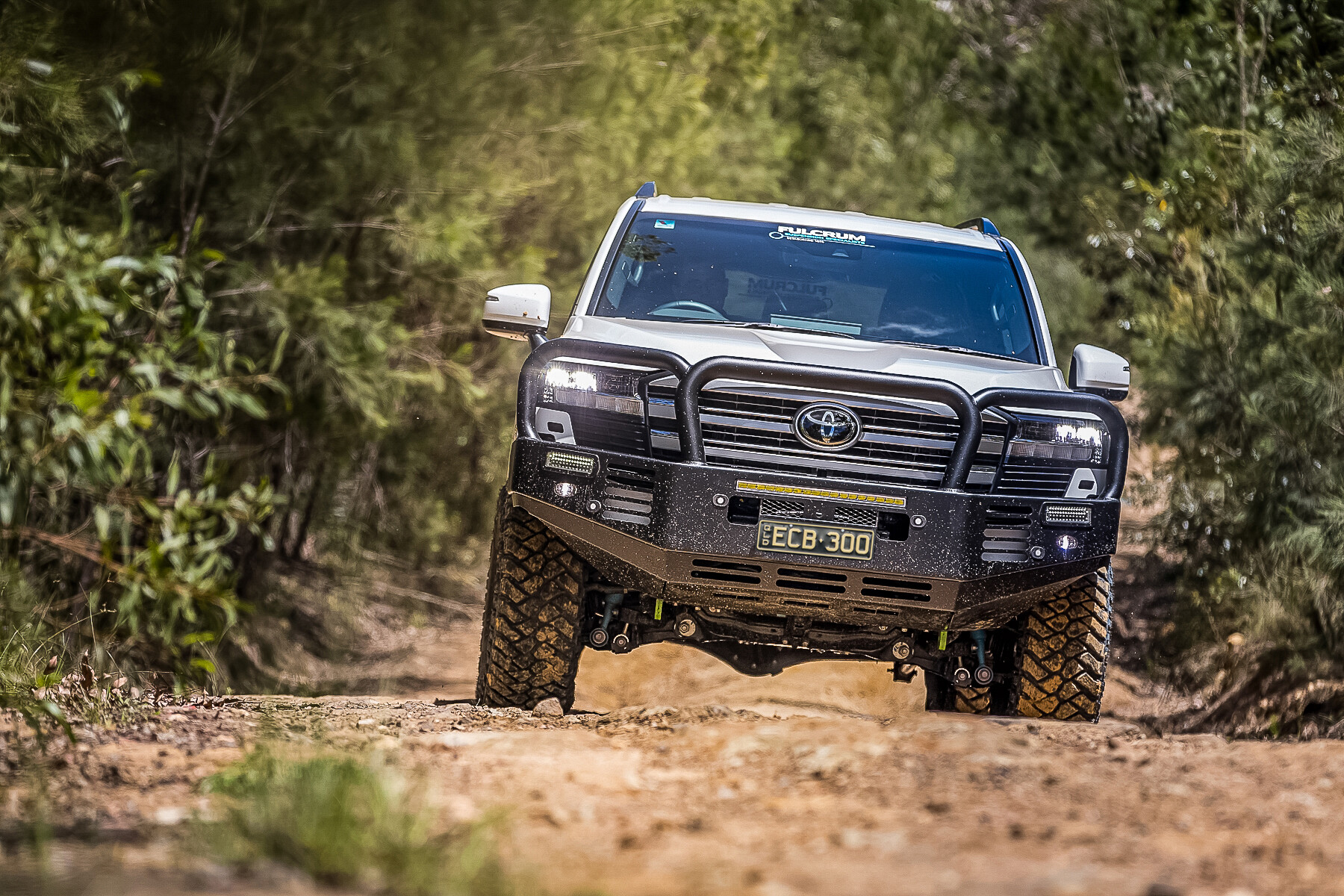
Add in the fact that alloy is more commonly recycled (and, if you want to get in to the real nitty-gritty, has a lower melting point, meaning less power is used when recycling it) and it’s not hard to nod your head when ECB states that it was ‘environmentally friendly before it was a buzz-word’, because it simply was.
The light weight of alloy is also the reason behind ECB’s impressively expansive product catalogue; sedans (back in the day, Holden’s Torana was one vehicle that ECB made a bar for, as was its market nemesis, the XB falcon), SUVs (think: Subaru’s Forester) and hybrids (that can have a lower carrying capacity than internal-combustion equivalents) all benefit from still being able to access the benefits of fitting a frontal protection system, without the heft of a steel bar.
Of course, the company is not the only brand making alloy bars, but its formidable reputation over the five decades has led to it being the first choice for a lot of vehicle manufacturers when they’re looking for OEM product, to the point that this market segment, along with the 4×4 aftermarket (and the transport industry) has led to ECB having the largest range of frontal protection products in Australia.
The power and the passion
In today’s world of international conglomerates and a global marketplace, it is heartening to see some brands still stick to their roots, and ECB is a great example, keeping all its Research & Development (R&D) and manufacturing in Australia.
The company’s Clontarf headquarters hosts more than 80 employees, and inside is an interesting mix of old and new in terms of how ECB bars are designed, constructed and then – still, to this day – hand-finished.
This homegrown ethos also means ECB is more often than not the first brand to market in terms of frontal protection for new-model vehicles and model updates; every part of the manufacture process being in-house provides the advantage of a fast response to any changes.
It sounds like bloody hard work when you think of anything with a manual-work element in today’s lazy world, but it’s something ECB considers integral to its success. And it must be pretty awesome working there as there are a number of employees that have clocked up multiple decades.
Bar-work ain’t simple
Kevin Aland, ECB’s R&D manager, has been here for 19 years now, starting on the factory floor as a tube bender, one of the first employees back then to use the new tube-bending machine (until that point, the tubes had been bent by a manual hand bender).
Kevin can remember some of the big changes at the company as he moved through different roles. From bender, he moved to welding, purchasing, production manager and then head of R&D, where he has been for the past 14 years.
“It was much smaller when I started,” he recalls. “When I first started, the R&D section was me, and now I’ve got five guys and we have a very comprehensive forward plan.”
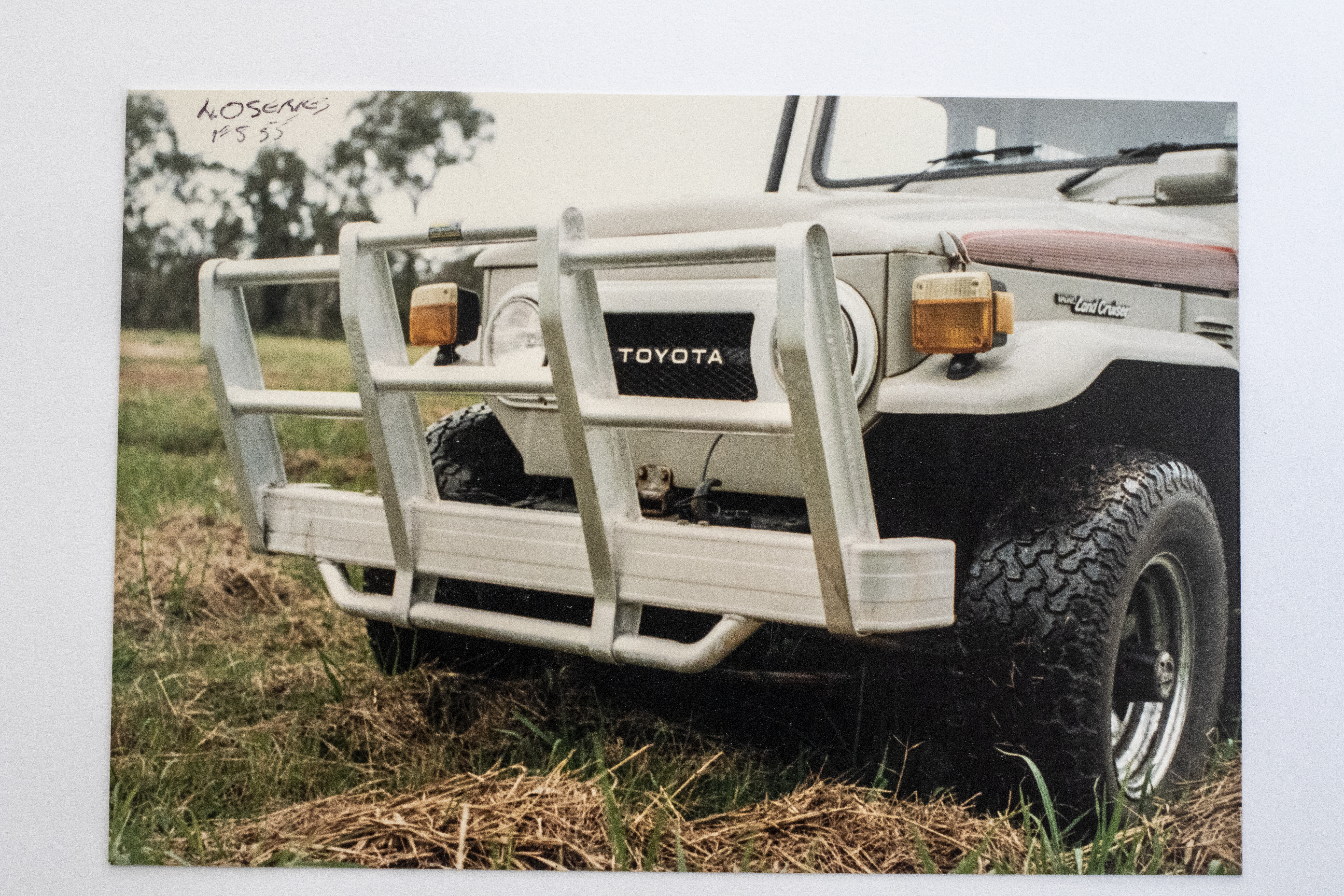
As the company grew, so did the demand on its designers and manufacturers, with Kevin noticing huge changes in his 19 years, including things like fabricators moving from building up a bullbar on a flat table by measurement (and taking 18 months to two years to get their head around the product) to now having specific jig set-ups for different bars. This totally transformed the building process and meant a qualified welder could just start at the company, work in a welding bay and be producing products straight away.
“Machinery has changed a little bit – and the method of building has changed a lot,” Kevin says. “It’s gone from hand built – literally built by hand – to building in jigs, where it’s pretty much drop it in the jig, check measure, and then weld. So, the way it’s been built has changed a great deal.”
Technology has not only assisted ECB in finessing its workflow and end-products, but it has also brought up a few more challenges for bar designers compared to the ‘old days’ of just fabricating a bar and bolting it to an old Landy or Cruiser, as Kevin explains.
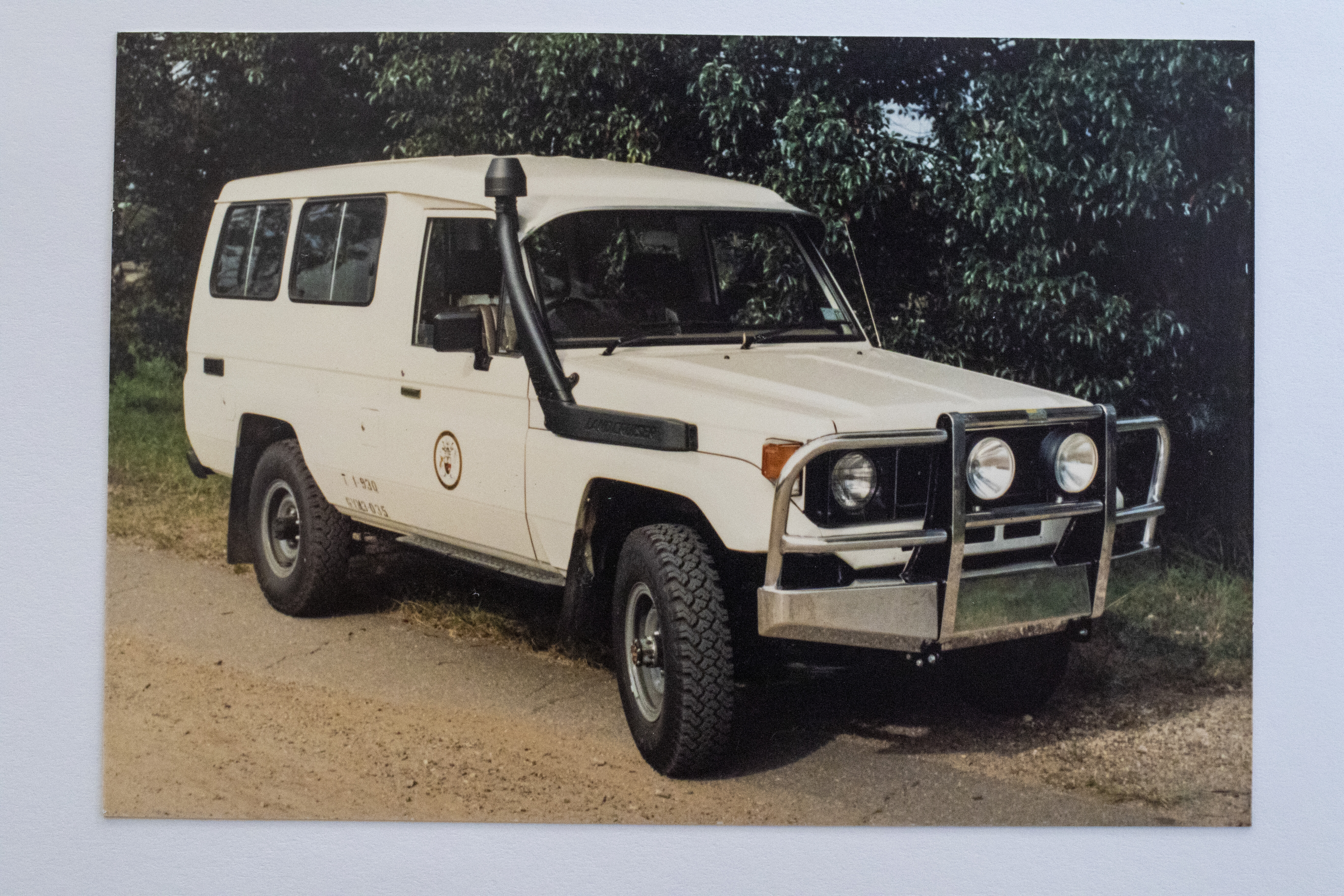
“I was around for the first time when a parking sensor went in … It was an absolute nightmare, and took an extra three to four weeks on top of the R&D,” he laughs.
Today, it’s a faster process, with the focus on ensuring the bar doesn’t impede any of a vehicle’s safety features.
Along with hearing about all the tech advances (CNC tube cutters and laser cutters, for example) in how ECB now produces its bars, it’s heartening to also hear that, even with all that, the company’s hands-on approach is still present throughout the manufacturing process (design, welding, etc.) and, literally, in the form of the hand-polishing teams who are responsible for that famous ECB shine.
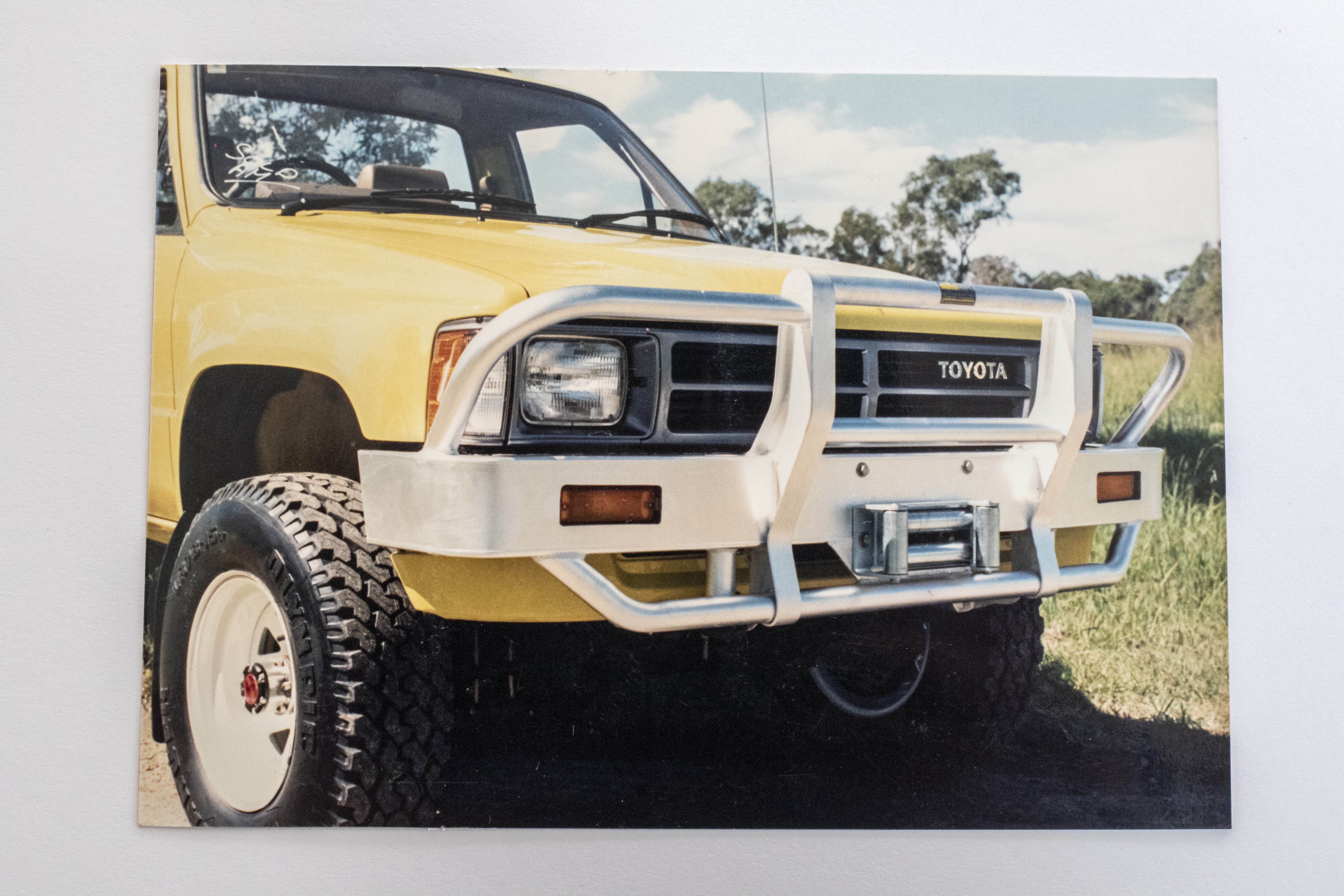
As Kevin explains, even that is now a faster process thanks to some new technology, with the constant focus being on the end-game of delivering top-notch products to customers. And that is simply a combination of hard-working teams throughout the stages of the bar-making process, combined with the implementation of new tech.
“ECB are continuing to invest in new machinery and manufacturing process capabilities that will take the business into the next 10-year phase,” he explains.
“This will ensure manufacturing ability continues to grow and develop as the vehicles change with the rise of EV and PHEV.” Yep, it’s all about improvement. And, now that you mention it …
Future changes
It would be easy for this well-established company to just forge ahead, continuing to produce the same high-quality products for years and years into the future, but that’s not how ECB has ever really worked in the past – or now.
Rather, the company has, instead, just taken a huge step in to a whole new design DNA for its bars – note the plural there – as ECB has developed a range of three separate bar designs, and is kicking off that range with a three-model offering for Toyota’s all-new LandCruiser 300 Series, with more vehicles to be covered very soon.
The three designs include a traditional three-loop winch bullbar, a two-post winch bullbar and a single-loop winch bullbar. Proving the company continues to not only innovate, but be smart and wily with it, the two-post winch bullbar design reflects what ECB has learned from its past products.
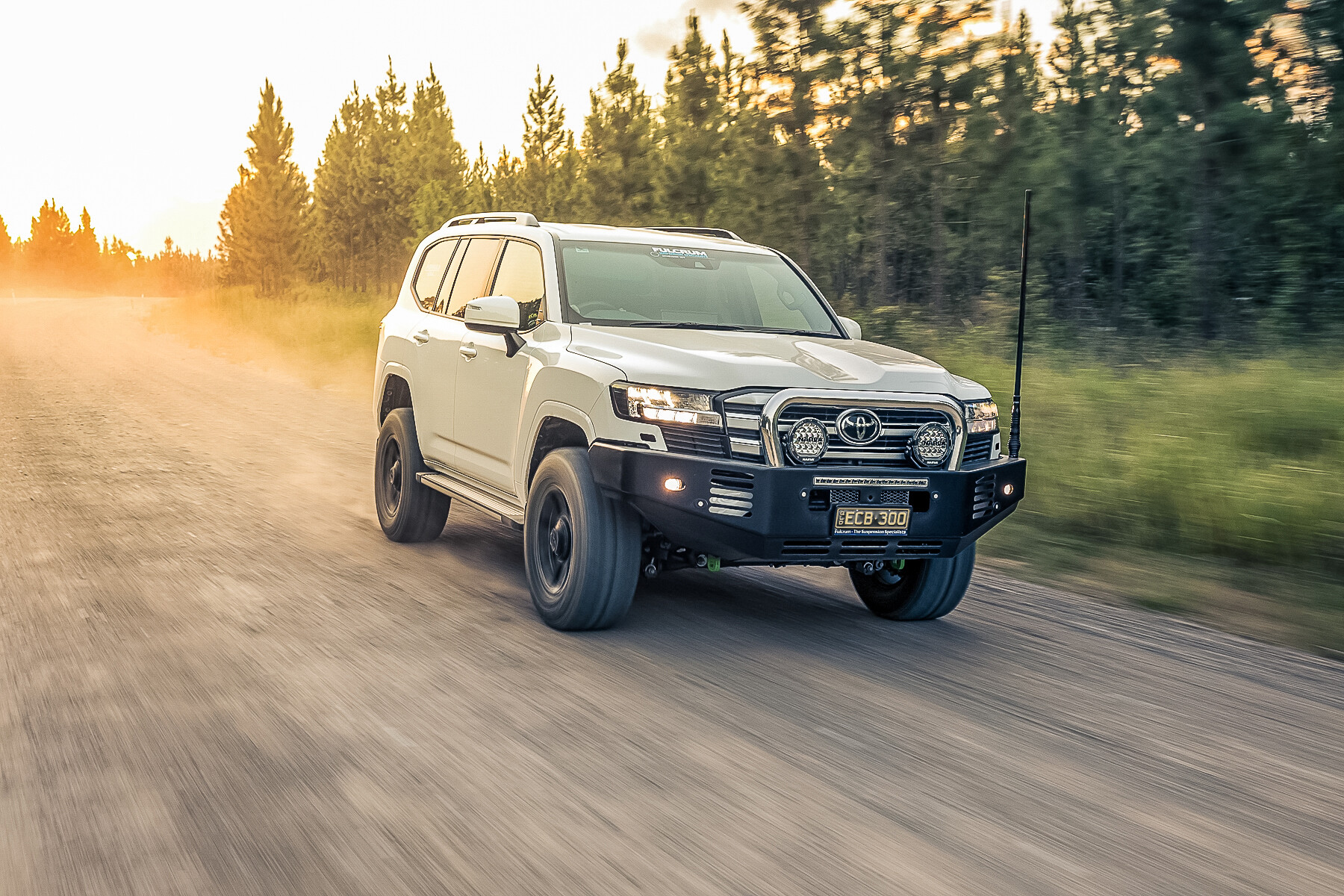
“If you look at the two-post bar,” Kevin says. “Its design was tested to the same strength as the three-hoop design, and used on Hinos and Canters that travel in high-impact areas”. That’s an impressive level of strength and is just what a lot of tourers (and other types of drivers) are looking for in terms of frontal protection for their vehicles.
This three-model range reflects ECB’s aforementioned thinking around different driving styles, needs and locations (itself the result of plenty of customer feedback). As Kevin says, it covers any driving scenario, “that is made for areas … outside Brisbane with small wallabies, all the way to grey nomads out doing the ring of Australia who may encounter a two-metre kangaroo in the centre of the road.”
Additional features in this new range include inbuilt rated recovery points, the ability to add a 22-inch LED light bar inside the bar’s main channel, underbody protection, and more.
Of course, ECB will continue to produce its lauded range of nudge bars, including the 76mm Nudge Bar and Series 2 Nudge, with new shapes and designs.
Fifty years strong, and growing stronger
Looking back over the five decades East Coast Bullbars has been in operation, there are any number of highlights, with a few standout moments and the company’s overarching ethos of quality, innovation and, above all, a sense of community within the walls of its factory.
Indeed, it is the passion of its employees that is most notable, with a far higher percentage of staff retention than a lot of Australian companies, across all industries, reflected in the amount of time some of its long-timers have been there – up to a very impressive 36 years.
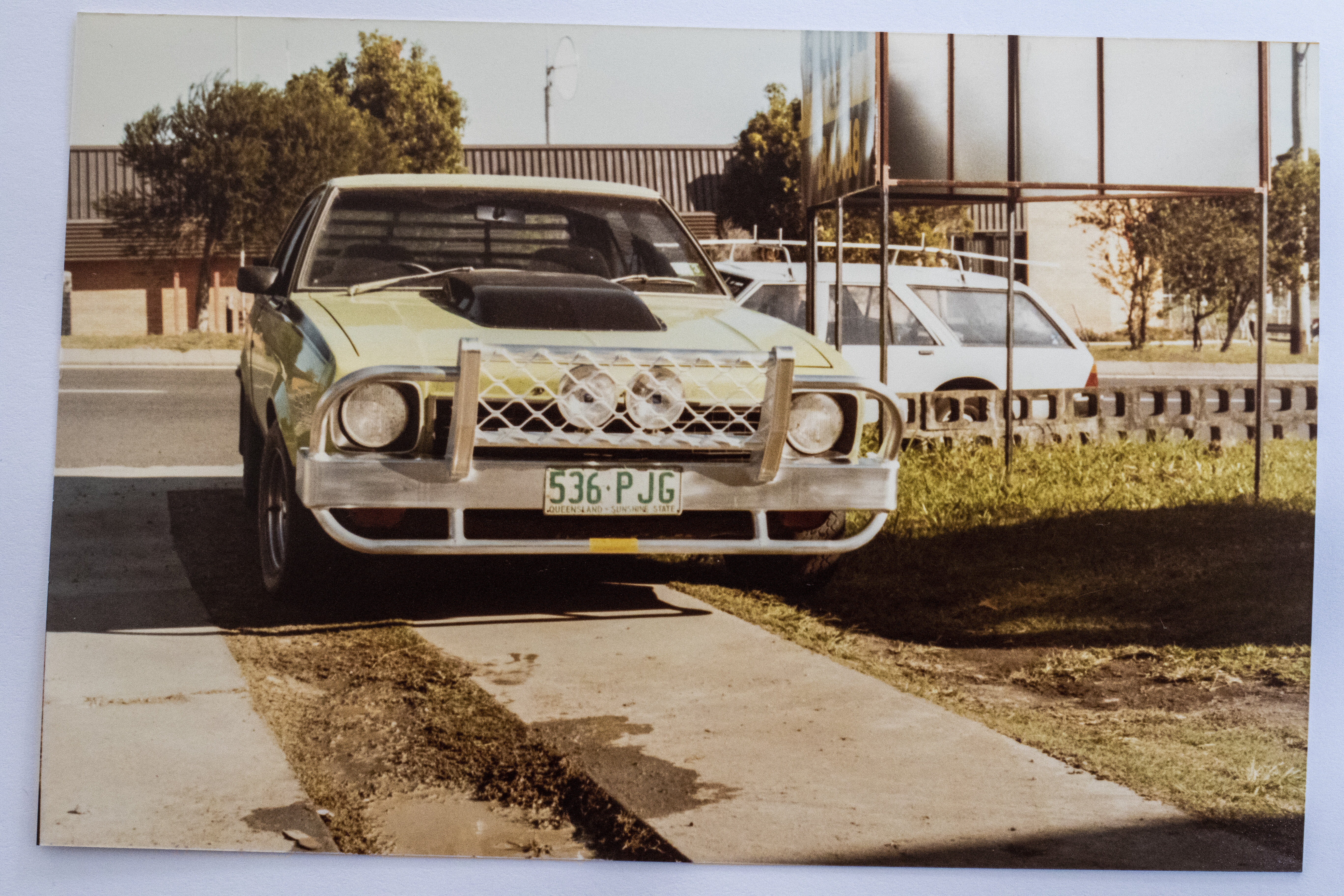
It is Kevin who sums up the whole ECB story perfectly, though, when he says how impressed and proud he is of all his fellow staff-members and how they really look forward to going to work each day and want to produce the absolute best product.
In short, with ECB, it comes down to passion. Looking back, that’s not hard to understand, either. After all, it was the original owners’ passionate belief that a fence post could be a hell of a lot more than what it seemed that started the whole thing, so it’s fitting that ECB keeps that passion and love for innovation and improvement moving for the next half a century.
It is funny how current COVID conditions can change a trip, not only for us but for a lot of others travelling state to state. The plan was to head across the Northern Territory’s Plenty Highway to remote areas of Queensland, but, with a border closure, this wasn’t going to happen.
The Plenty Highway is notorious for its remote 500km meandering route and for being as corrugated as hell, with bulldust holes big enough to swallow anything in their path. Not really suitable for caravans, the Plenty often sees 55-metre-long road trains and is closed when the rivers flood, often for days at a time.
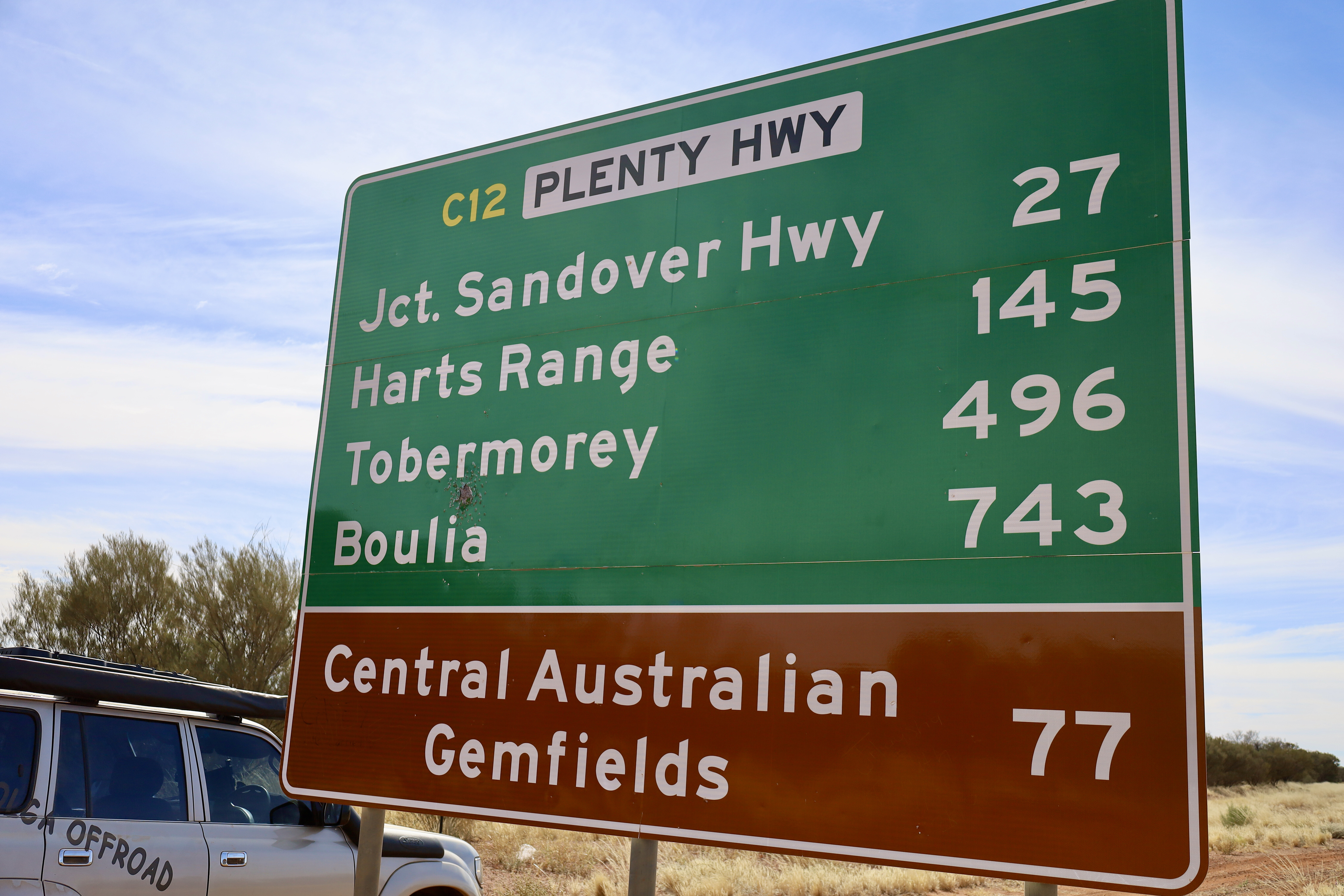
These days the Plenty is sealed for nearly 100km – from its starting point on the Stuart Highway 70km north of Alice Springs, across to Ovgeva Creek – but when we first tackled it a few years ago, it was an all-dirt narrow track and took several days. It used to be just a cattle property access road from western Queensland to the NT, but the road has improved for the general public and is slowly being upgraded.
Even though the Plenty has a State Route number (12), it’s still classed as a medium to hard track. Not because of any tyre-shredding hill climbs or winching sections, but due to the extreme remoteness of the area, and there are only a couple of spots where you can get fuel and camp.
From the Stuart Highway turn-off, the Plenty heads eastward passing through several stunning mountain ranges to Queensland, all heavily signposted and almost impossible to miss.
Gemtree
With our plans in disarray, we decided to still head along the Plenty but instead explore the mountains, fossick for gems and hit part of the iconic Binns Track.
Our first stop was just 70km along the Plenty at Gemtree, a place packed full of history, with its own store, fuel storage, caravan park and fossicking tours.
Wind the clock back to 1885 – just a few years after explorer Charles Stuart passed through – and David Lindsay surveyed the country between the Queensland border and the Overland Telegraph Line, which is around where the highway runs north-south.
A year later, gold was found east at Arltunga but ran out after 30 years, while huge amounts of mica were found at the same time. Keep in mind this was just before Alice Springs (originally called Stuart) was settled.
Over the next few years, 15 stations were taken up with pastoral leases where the present day Gemtree Park is, even property monger Sidney Kidman owned several stations nearby.
Times were tough back then, and just trying to survive due to the lack of water was the biggest concern. One station that had the Hale River passing by was named The Garden. Here, they grew crops to feed the nearby goldfields and to supply trade to the other stations.
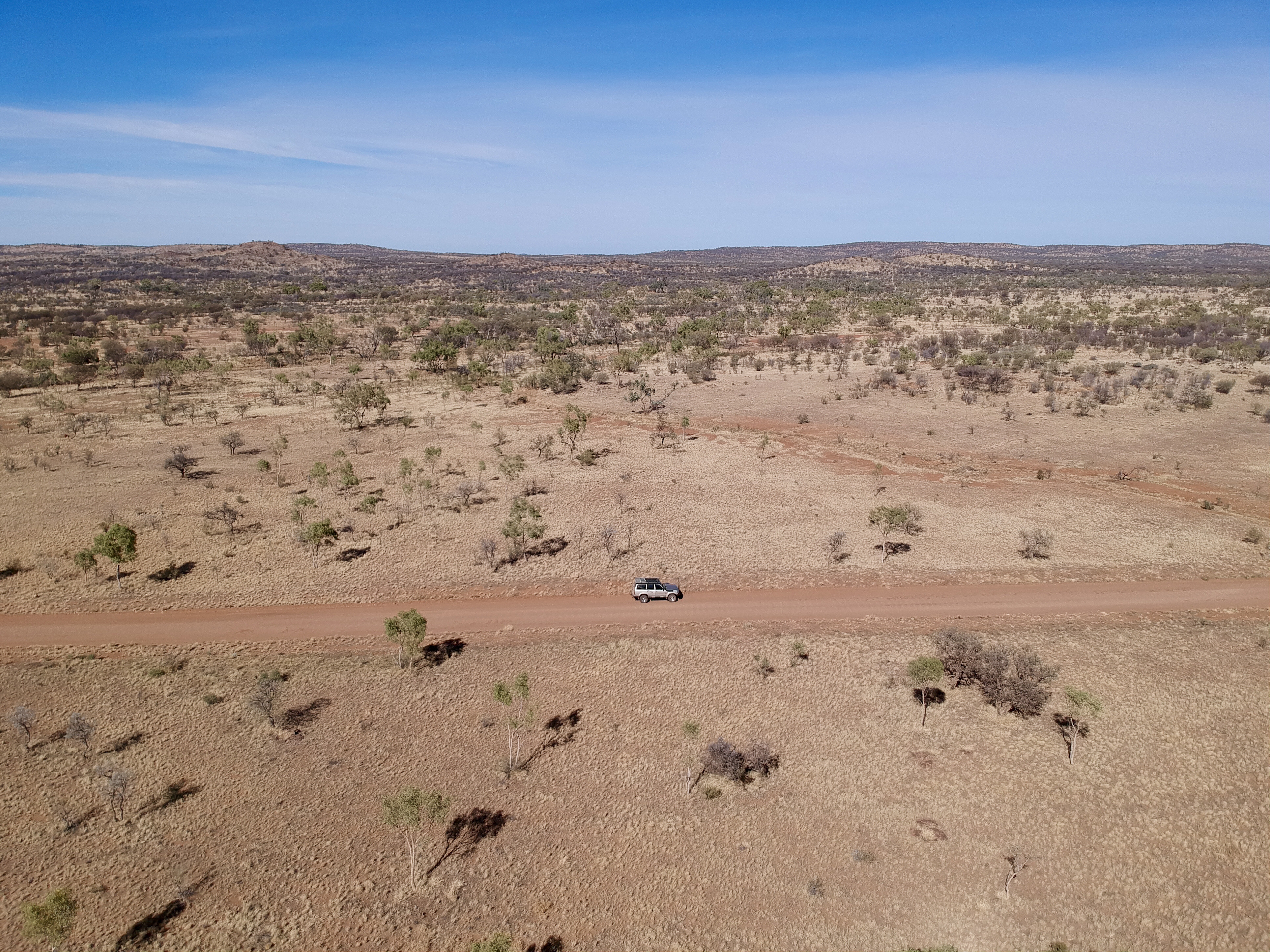
Another station, Yambah, had a home-made drilling rig that was hauled by 13 mules and, in the early years, sunk 27 bores to the depth of 300 feet, only finding water in two of them. Yambah Station had one of the first dams in the Red Centre, eventually running cattle, which it still does today, with some of the best cattle in the Territory.
At Gemtree is an original cottage from Mt Riddock Station dating back to 1928, which has been preserved and turned in to an historical museum containing an array of unbelievable history. There’s more than 100 years of family and station history listed, from early establishment through to good times, the extreme hardships and property maps from the early pioneers.
There’s a small shop, and if you’re hungry, try one of Gemtree’s home-made pies – they are to die for.
Mud Tank camp
Our camp destination was another 30 minutes to the east, just off the Binns Track, where you can free camp at the Mud Tank Zircon Field fossicking area.
This is true bush camping at its finest on Alcoota Station, with stunning views of the Harts Range Group to the south. There are no facilities, so you need to be totally self-sufficient within native bush and grasslands.
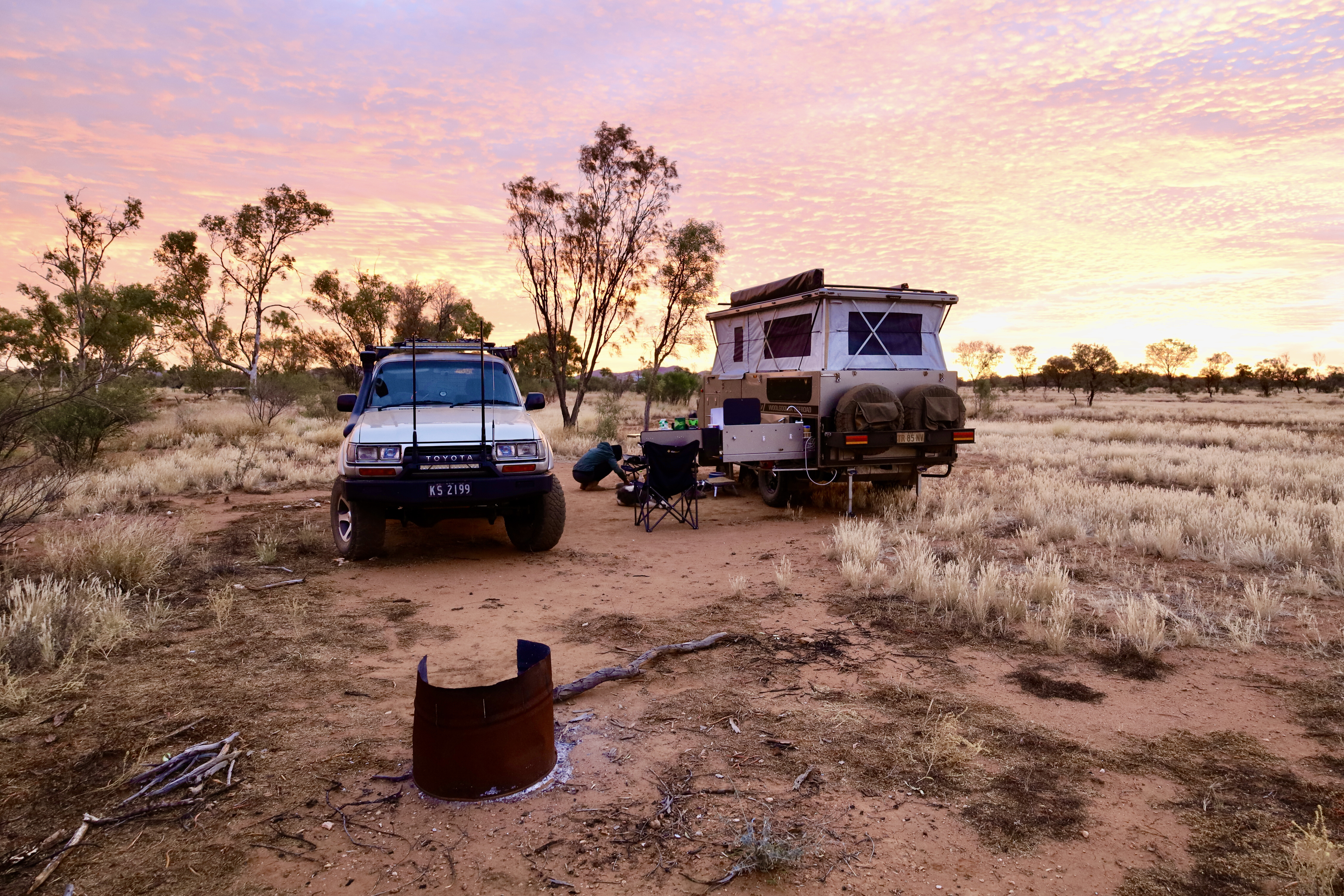
When surveyor, David Lindsay, was exploring the area in 1885, he found what he thought were rubies, and the story goes that a ruby rush happened here, but later it was realised these red stones were only garnets. In its heyday, more than 300 people trekked from Oodnadatta on foot to seek their fortunes, only to be disappointed with the sporadic gold activity at the time.
Today, the Mud Tank Zircon Field is on most fossickers’ bucket lists, with garnets and zircons that have been in the ground for millions of years. Most are alluvial (found just under the surface), so around the free fossicking area are dozens of shallow pits where people have been chipping away at the banks looking for coloured stones.
The zircons range in colours, from clear and white through to pink, and are similar to Argyle diamonds, just not as hard or expensive. One thing to keep in mind when finding zircons is that they have been crafted by nature and not man-made (i.e. cubic zirconia), so you’re the first person to ever lay eyes on it.
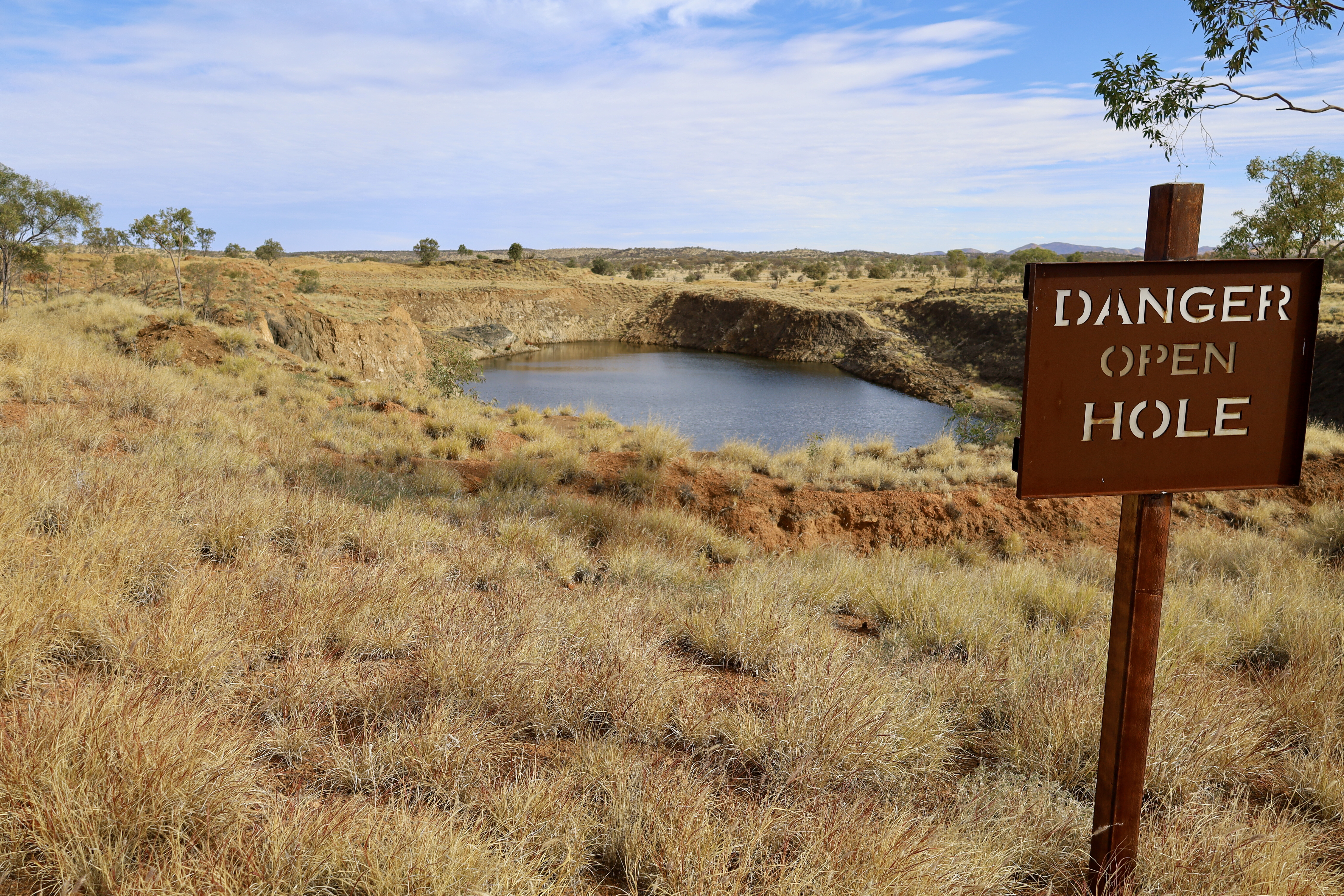
In the late 1880s, mica was found in sheets in the nearby areas. Mica is a mineral that is soft, often very flaky and is used in make-up, cement, the wrap that covers electrical equipment, and as a heat-resistant material. Back in the day between 1880 and the close of the industry in 1960, nearly all Australian mica came from this area.
A five-minute drive from the fossicking area leads to an old open-cut mica mine. While partly full of mineral-tainted water, the enormity of the mine can be viewed from several different spots. It’s hard to say how much came out of this one single pit, but the nearby tailing dumps give a suggestion it was significant for this area.
Mica was in demand during WW2 for use as heat shields, but by 1950 demand slowed and cheaper sources were found elsewhere.
The mining here brought a diverse range of nationalities to the area, namely Italians, creating foundations for today’s multicultural community at nearby Alice Springs.
Binns Track
If fossicking for a few days doesn’t reap any reward, the nearby Binns Track is a good way to get out and about.
It might take 10 days to complete the entire Binns Track – which starts at the NT-SA border and travels for more than 2220km north – but doing this section is simply stunning. Created by NT ranger Bill Binn, it was his dream for tourers to pass through remote and interesting areas including desert fringes, historical areas and mining sections, through to the north where barra can be caught.
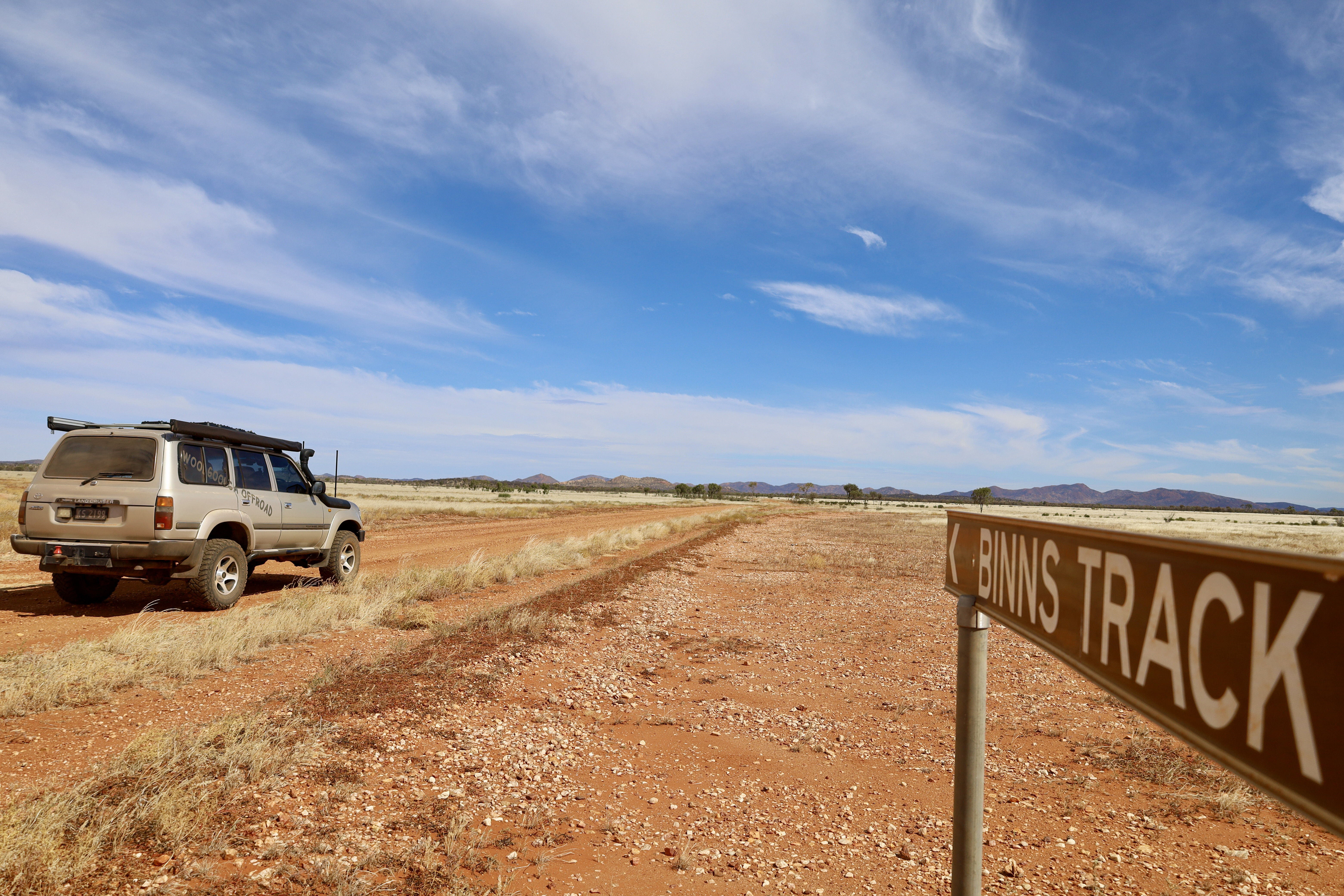
This section starting at the Zircon fields (and well-signposted) heads south and is named ‘Section Two – East MacDonnells’. Also named The Pinnacle Track, its 40km length is diverse, meandering across the landscape where it connects with Gardens Road. We departed early in the morning, when the sun was highlighting the different colours on the jagged rocky range in front of us.
The first part of the Binns Track runs through Alcoota Station, which covers an impressive 3000km². A working cattle station, it has also had significant fossil finds. Found back in 1962, an eight million year-old megafauna area was discovered, covering an area two football fields in size. Once a large basin, they’ve found huge mammal wolf-like creatures, wombats as large as cars, and many birds.
As with most outback or remote public roads that pass through stations, there’s no permission to leave the road unless you have a permit or the go ahead from the owner. When doing this section, there’s no reason to anyway, as the views are spectacular from the road.
The track isn’t overly difficult in the dry, but it’ll be a different story in the wet – with a couple of creek crossings and a section where the water obviously uses the road as a run-off. One section enters Aboriginal land and the signs are quite clear not to leave the road. Remember to leave the gates as you find them.
Binns Track will finally meet up with the Garden Road, and by turning left it’ll take you through Arltunga, Ross River and back to Alice or the southern part of the Binns Track towards the border.
Our option was to turn right towards the Stuart Highway along the Garden Road and loop back along the Plenty Highway. The sections along Binns and the Garden Road only took an hour each to fully enjoy the scenery, but it’s a great way to get away from camp.
This section of the Harts Range is certainly an eye opener and, if you have the time, spend more than a few days here to truly understand the area.
5 things to see and do
01: PLENTY HIGHWAY The Plenty Highway runs east for around 500km from the Stuart Highway, 70km north of Alice Springs, to the Queensland border, then becomes the Donohue Highway with another 250km to Boulia. Only the first 100km of the Plenty has blacktop, and it’s dirt and bulldust for the rest of the way. It’s among the most remote highways in the country, and the best time to traverse it is during the dry season from May to October.
02: GEMTREE Still on the sealed section of the Plenty Highway is the Gemtree Roadhouse and Caravan Park, incorporating a History Museum and award-winning Campoven Kitchen among the attractions. Caravan park accommodation includes sites, rooms and cabins, and booking is essential.
03: MUD TANK ZIRCON FIELD Access is from the Plenty Highway some 8km east from Gemtree. Turn right at Mud Tank Bore, follow the signs indicating the zircon fields, and try your luck at finding some fantastic and colourful zircon semi-precious gemstones.
04: THE OUTBACK WAY The Plenty Highway forms part of The Outback Way tourist route. The Outback Way is a series of roads and tracks that stretches for 2700m from Laverton, Western Australia, to Winton, Queensland, via the Red Centre. It’s remote touring at its finest.
05: FREE CAMPING You can free camp at the Mud Tank Zircon Field fossicking area on Alcoota Station. With no facilities, you need to be totally self-sufficient, camping within native bush and grasslands with stunning views of the Harts Range Group to the south.
Don’t talk about it, be about it. It’s a saying hung up in gyms and accounting firms all across the world. The concept is simple. Don’t talk the talk, walk the walk. Spend more time and energy on being the thing you want to be, and less on pretending you are.
It’s something that really rings true in 4×4 land the last few years. Drive past any car dealership and you’ll find rows of base model 4x4s, covered in sticker packs, filled with leather, and trotted out like they’re ready for Finke because they have big goofy side-steps. Camping accessory companies are fiends for it too.
Cheap gear flown in, badges sewn on stronger than the product they’re attached to. Don’t even get us started on camper trailer manufacturers filling out spec sheets with gear you don’t need, for places the camper won’t make it. Four bedrooms with an outdoor living space and ducted heating used to be how you’d describe a nice house, not what you’d try and tow up the Old Telegraph Track.
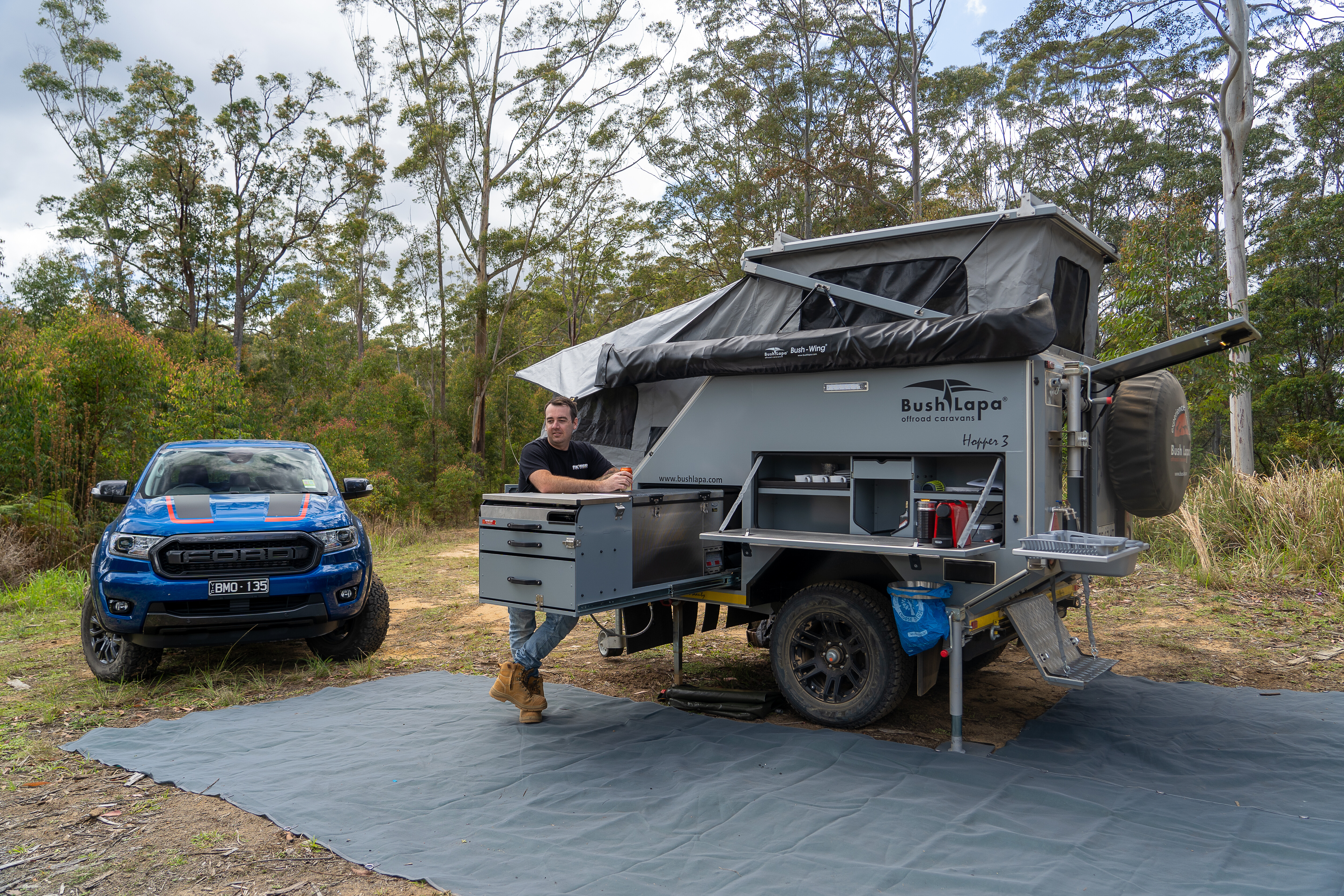
There are still a few shining beacons of hope, though. Gear that doesn’t claim to be anything, it just is. It walks the walk, and doesn’t just talk the talk.
In a world dominated by cheap, heavy campers with fold-out flatscreen TVs, Bush Lapa’s Hopper 3i is a breath of fresh air. Ruggedly simple. Bombproof construction. The kit you need to spend a month beyond the black stump, and no unnecessary bells and whistles weighing you down off-road or lightening your wallet for no reason.
It’s everything we’ve come to expect from South African camper trailer manufacturers. So how does it actually stack up on and off road? And is it possible to camp without an electronically operated bed? We got up close and personal to find out.
On the towball
Slip behind the captain’s seat of our FX4 Max tow-tug and the first thing you’ll notice about the Bush Lapa Hopper 3i is how unimposing it is to tow. If you didn’t have side mirrors, you’d almost mistake it for a box trailer. It doesn’t knock the Ranger around, and it doesn’t push coming in to corners or wallow around coming out of them.
There’s a few good reasons why, too.
The first is its diminutive weight. At a tare of less than 900kg the Hopper 3i is close to half the weight of some of its competitors. That leads to a towball weight around the 100kg mark as well. The result is that there physically isn’t enough mass in the camper for the tail to wag the dog like heavier units are known to do.
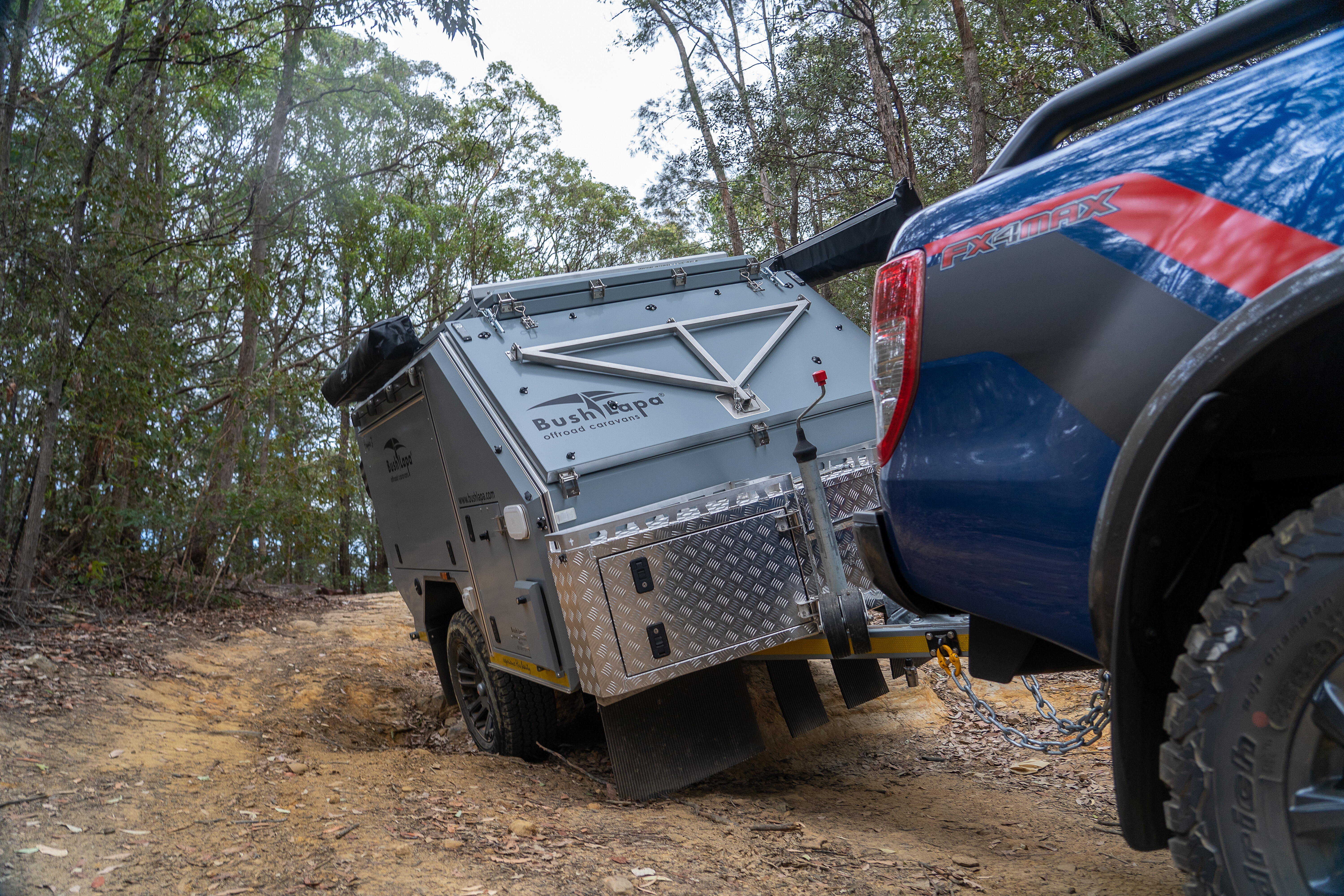
It settles in for a compliant ride and effortlessly follows the tow vehicle on road. Heading to the ruts and it’s even more noticeable how important low weight is in a camper.
We purposely zigzagged through bad lines and stopped in ruts so everything would be fighting against the tow-tug, but it was consistently compliant. That low mass meant that even when the camper would tilt on to a side angle or slip sideways, there wasn’t enough momentum for it to ever be an issue.
The second major factor that consistently helped was the Bush Lapa’s reasonably compact footprint. With a total length of near enough to four metres, it’s around 15 per cent shorter than similar hybrid campers.
The rear axle is quite far back too, which not only assists with the compliant nature of the camper but also means there’s bugger-all rear overhang and an impressive 44° departure angle. The front checkerplate box is aggressively angled too, allowing for some serious steering wheel action through tight trees without concern for jack knifing.
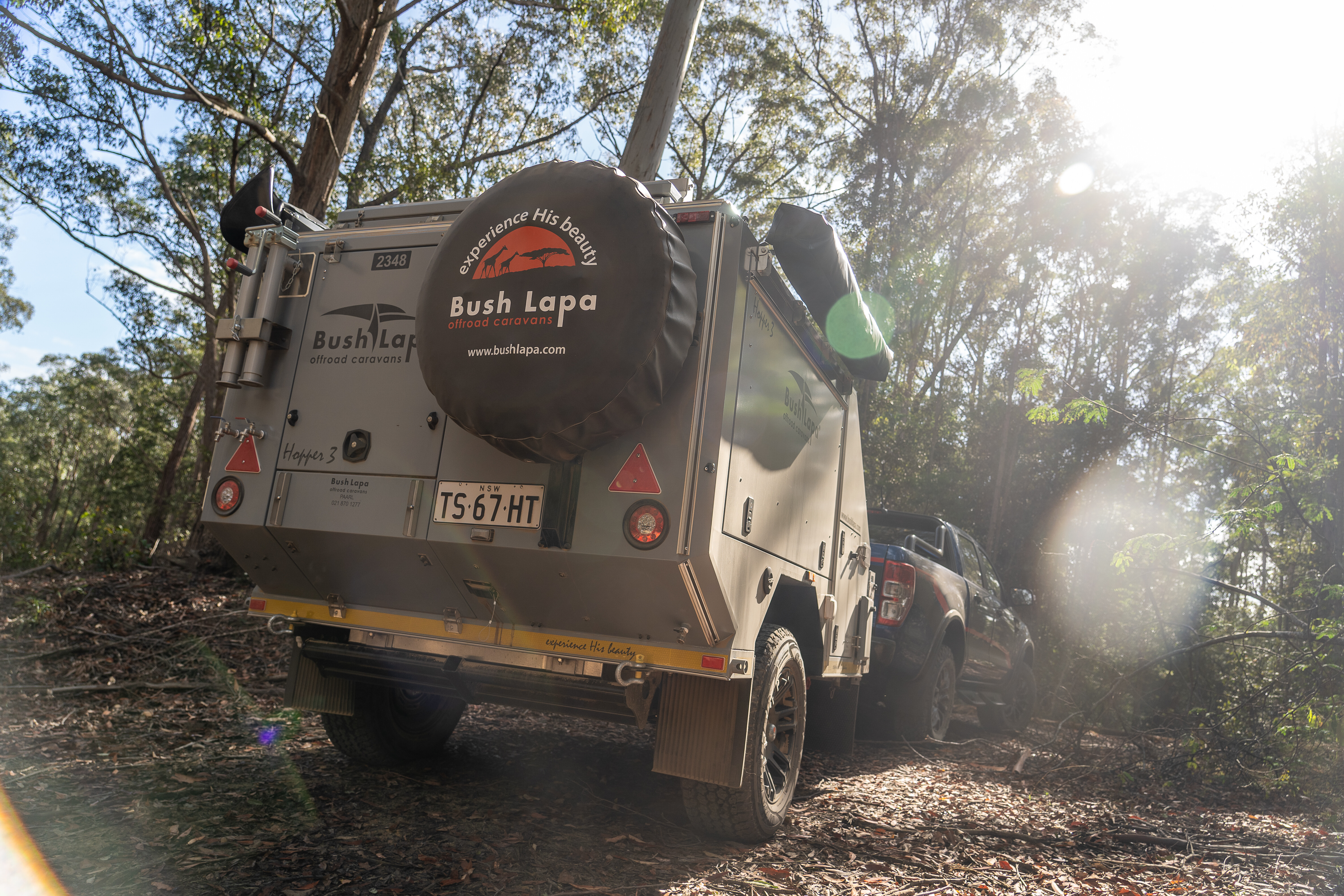
Moving underneath and the Bush Lapa Hopper 3i has a unique take on the suspension and chassis. Up front an Al-Ko off-road coupling attaches to a standard towball, but allows a full 360-degree range of movement. Moving back along the A-frame drawbar and the C-channel chassis is tied in to the body for a semi-monocoque construction. There’s a clever combination of boxing and cross members throughout to keep strength up and weight down.
Below that, a simple beam axle joins the two all-terrain tyres together. Riding on leaf springs with a single shock either side, it’s an unbelievably simple and robust set-up. The low weight means there’s no need for fancy multi-shock set-ups, and the beam axle is designed so that a bush-mechanic fix will swing it back in to action should it break in the middle of nowhere.
The only reasonable downside we found off-road is just the nature of a hybrid camper with the high roof height. At around two metres above ground level it doesn’t sit any higher than most tourers on the tracks, but it does mean you’ll need to watch low-hanging branches all the way until the end. Hardly a concern, but something we noticed regardless.
The set-up
It would be hard to say any South African camper trailer has broken the mould, but only because it seems there’s never really been a mould to begin with. As such, setting up the Hopper 3i is just as unique an experience as camping out of it.
For quick overnight camps the combination of a sturdy jockey wheel up front and rear axle so far back means you won’t need to wing the stabiliser legs down every time. It’s a huge time-saver. That said, if you’re on uneven ground, or parked up for a few days and want it solid as a rock, there’s a leg on each corner.
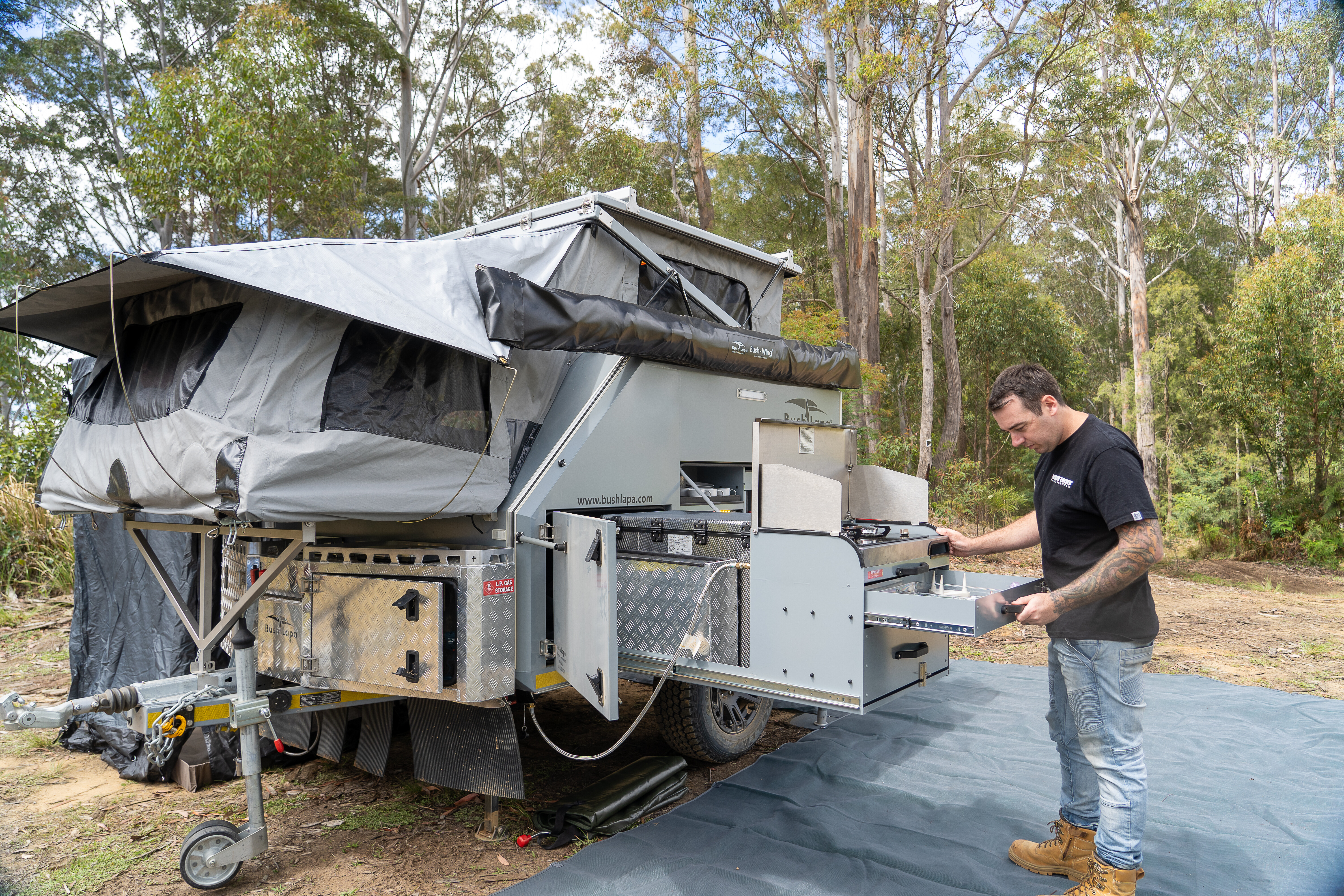
Underneath up the front are two traditional swing-down legs like you’ll find on most campers. Up the back, unique legs sit high on the back wall, out of the elements when not in use, then clip on to spigots on either side when required. The legs can hold the full weight of the camper, so can be useful if you need to change a tyre or lift wheels to get it stable.
Once the camper is up, there’s a 270° wrap-around awning that’s free-standing and covers both the kitchen and the camper’s door. It comes standard with a full suite of canvas walls, so if you find yourself bunkered down courtesy of wild weather you’ll have plenty of outdoor space.
On the offside, our test model was fitted with the optional shower wing and Smarttek hot-water system. It’s one of the most extensive shower set-ups we’ve come across, with a high roof and floor insert so you’re not showering in mud. Expect to spend around 10 minutes setting up the awning and shower on your own.
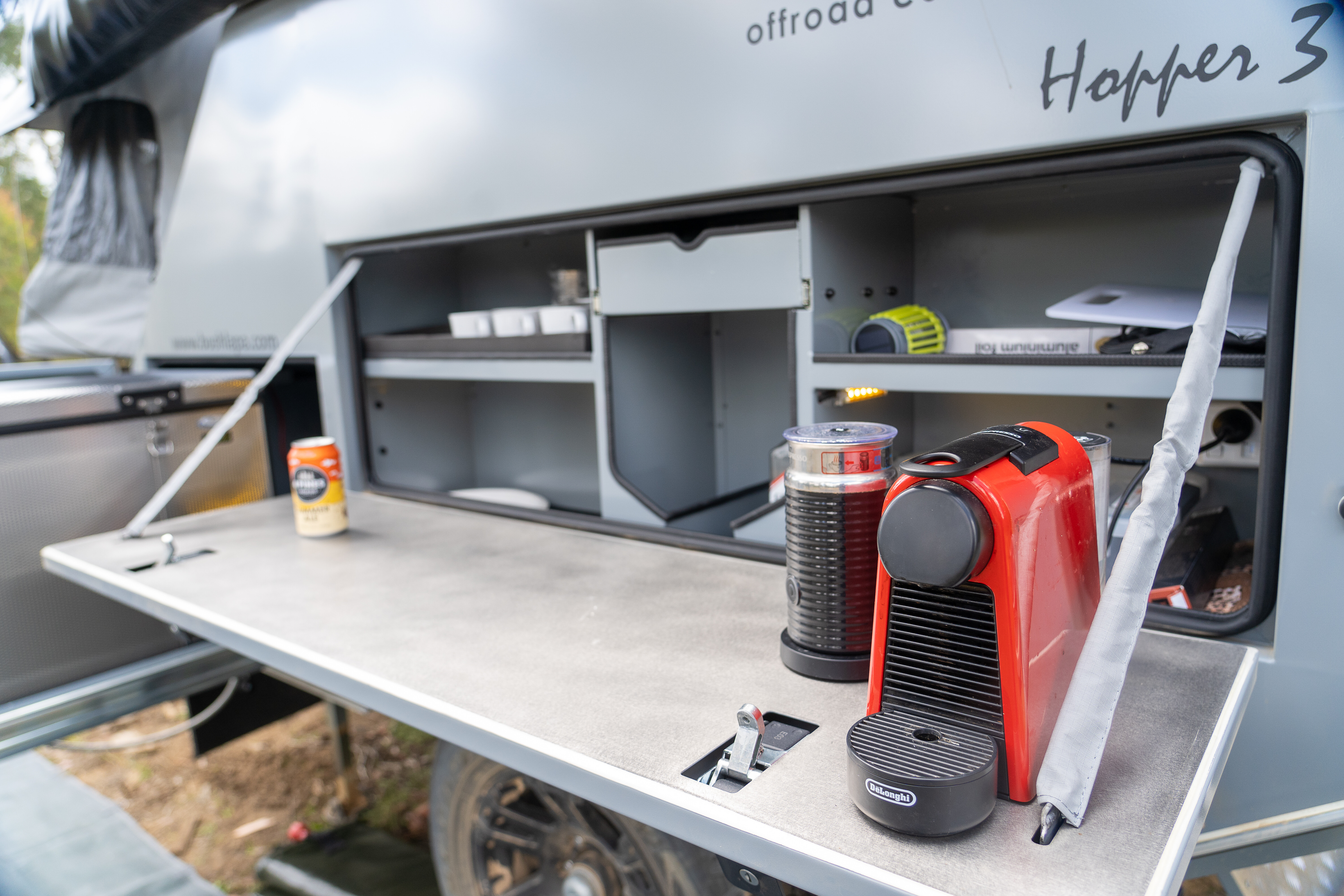
Before making your way inside there’s an extensive kitchen set-up on the nearside, although it takes a surprisingly short time to set it all up. Up front a pull-out drawer houses not only the optional 90L National Luna fridge-freezer, but also the optional Thetford two-burner gas stove top and storage drawers for everything from forks to bowls.
Along the flank, two clasps open, giving access to a drop-down table and huge storage space in behind; while up the back a simple bracket clips in to place below the hard-mounted hot and cold taps, giving both an external sink and a drying rack.
Moving on to the inside and a handful of over-centre clasps pop, allowing the double-fold roof to easily lift up and give way to massive head room, even at six-feet tall we had no issues standing upright inside.
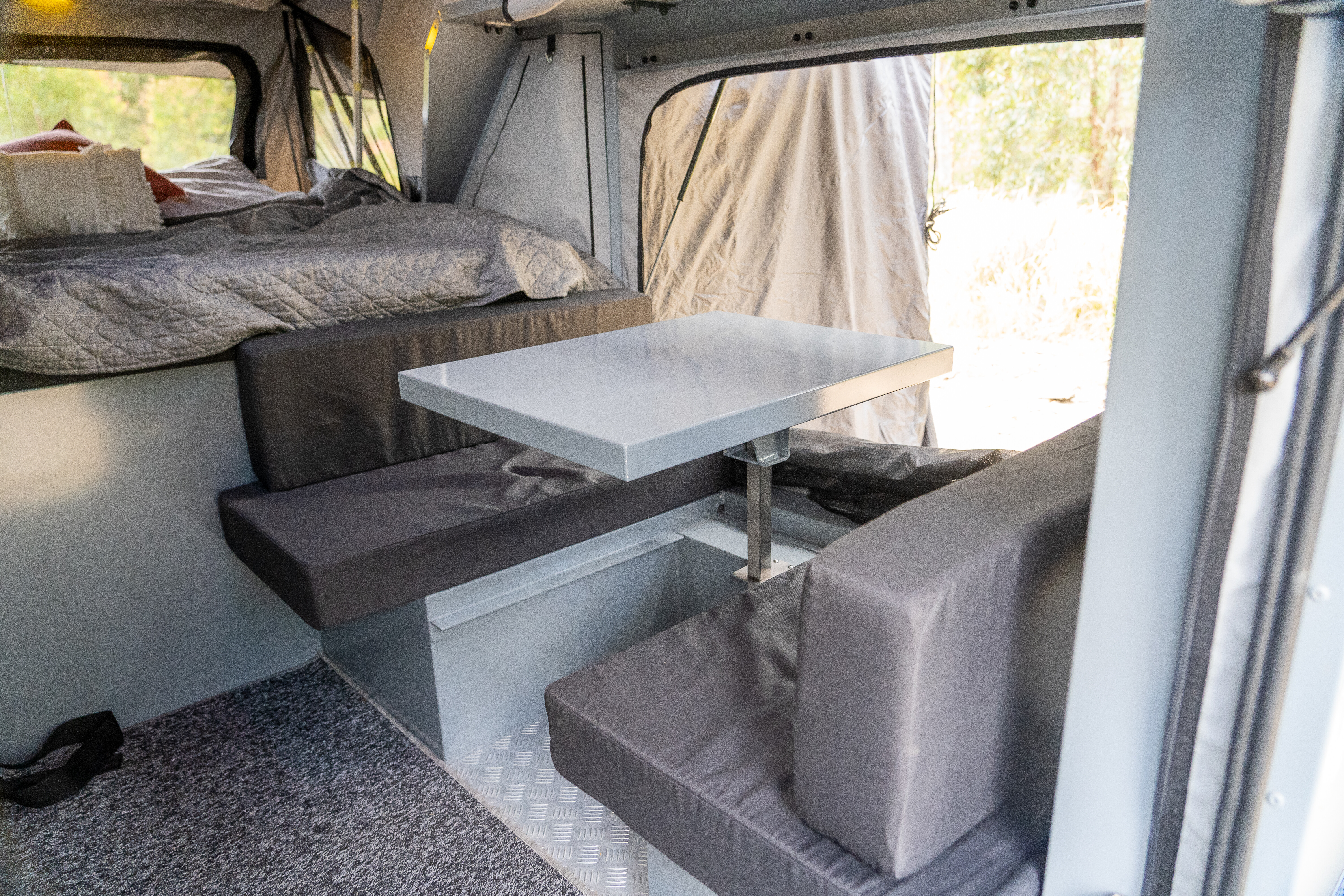
Up through the fold-down stairs and to your right, a small dinette folds down in to a child’s bed. It’s an easy conversion, but if you put a child any older than 10 in there for a night, you’re in for a long day the next day. The larger Hopper 4 is better suited to families.
Up front an external hatch pops open and folds down in to place on a secure mount. It provides room for the memory-foam double mattress to fold in to place as the master bed.
All up, from start to finish, you could expect a full set-up time of around 20 minutes for a single person, or 10 for a couple working together. If you pull up in the rain and just want to get to bed, that time could be cut down to just a minute or two.
Off the grid
If the overall vibe of the Bush Lapa hasn’t been made abundantly clear so far, the spec sheet should. They’re not loading it up with bush-doof stereos and electronically raising flatscreen TVs. It’s the bare minimum to head off the beaten path without weighing you down more than necessary.
The base camper itself comes incredibly pared down. You’ll pick up a 105L stainless-steel water tank, a jerry can holder, and a single 4kg gas bottle holder. That’s about it. You don’t even get the gas cooker unless you order it. The reasoning is pretty simple: Lots of people already have fridges, cookers, portable power packs, so why ramp the price up by selling people stuff they don’t need.
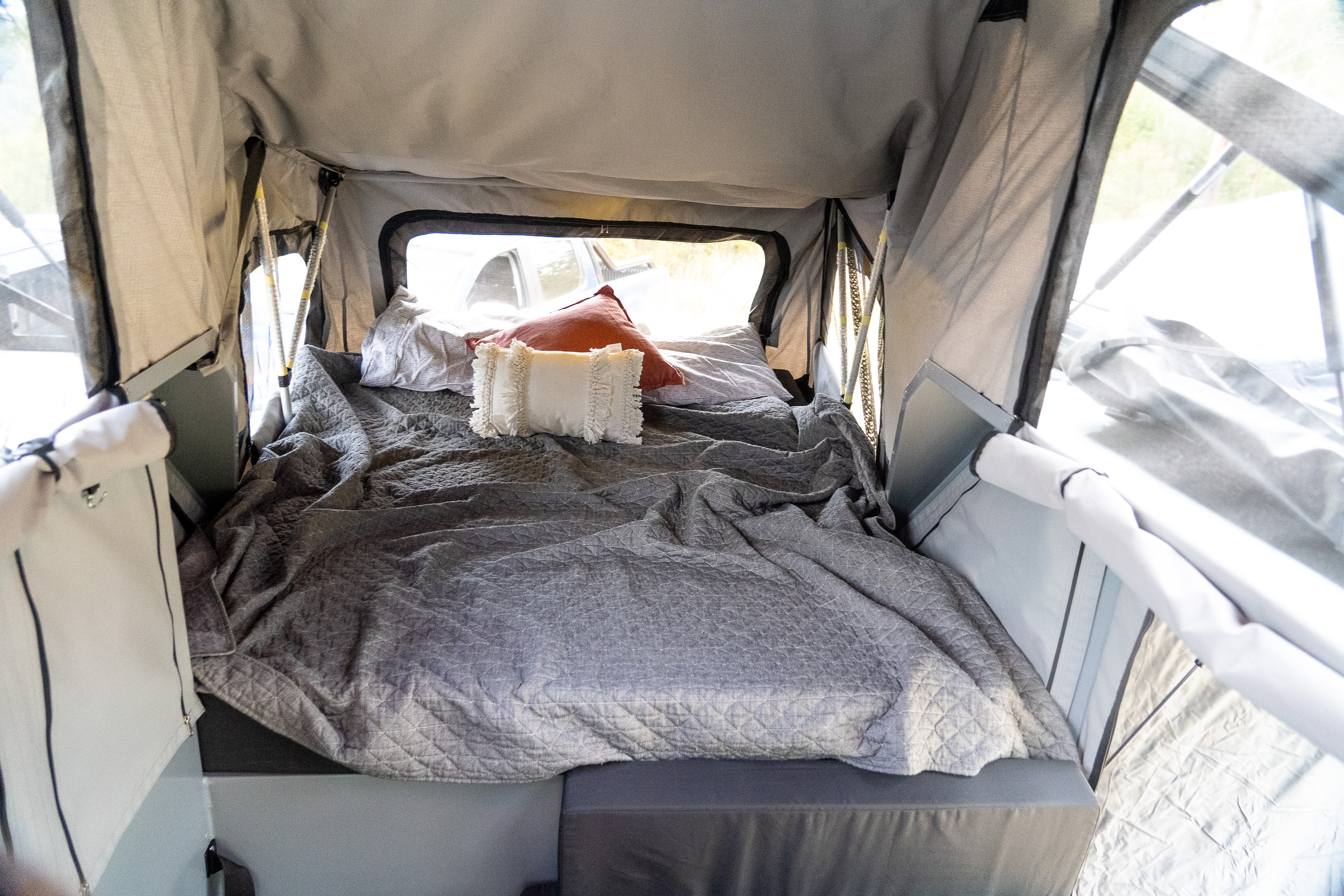
That said, you can spec the Hopper 3i up reasonably well, depending on your needs. There’s no expansion on the water tank, but you can spec-up a hot-water system and second pump to make the most of it.
Likewise, the pull-out kitchen is designed to perfectly accept a 90L National Luna fridge. The Thetford two-burner gas cooker can be optioned up if you don’t want to bring your own, and you have two choices of windshields depending on your taste.
On the inside, from stock you’ll get a handful of 12 and 240V outlets if you’re connected to the mains supply or your tow vehicle through the pre-wired Anderson, and that feeds in to a Victron charging set-up.
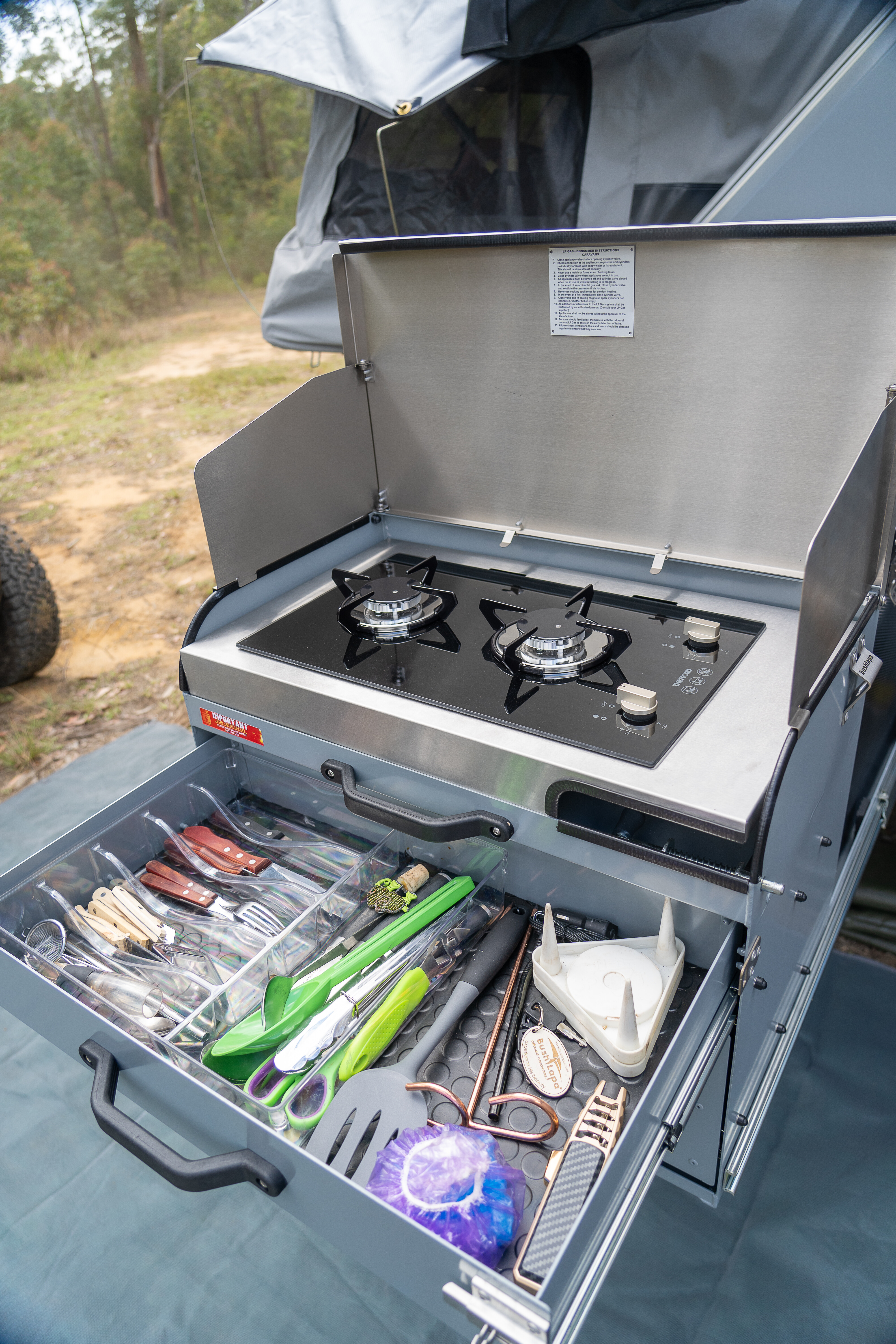
From there you have the choice on what battery you’d like to run. AGM batteries are available, or you can spec it right up with dual-lithium like our display model. A 3000W pure sine wave inverter was also optioned up from iTech with a 160W solar panel hard-mounted to the roof. Dual panels could be installed, or even just a simple 140W solar blanket depending on your needs.
The choose-your-own specifications method is a uniquely Bush Lapa approach and will certainly cause a little confusion among potential customers, but it does check out. Checking their options list against retail prices makes it clear there’s no upsell here, just letting you choose how you want your camper spec’d.
How does it stack up against the crowd?
Let’s get one thing clear right away. You’re not buying a camper trailer like the Hopper 3i to take to your local campgrounds once every few months. There are far cheaper and more comfortable options if you’re plugging it in to the campgrounds power, while the kids run off to play in the playground.
The entire Bush Lapa range, especially the Hopper 3i, are designed around serious adventure, and in Australia that means big days in the saddle, and campsites far beyond the amenity block. So, how does it stack up against the crowd?
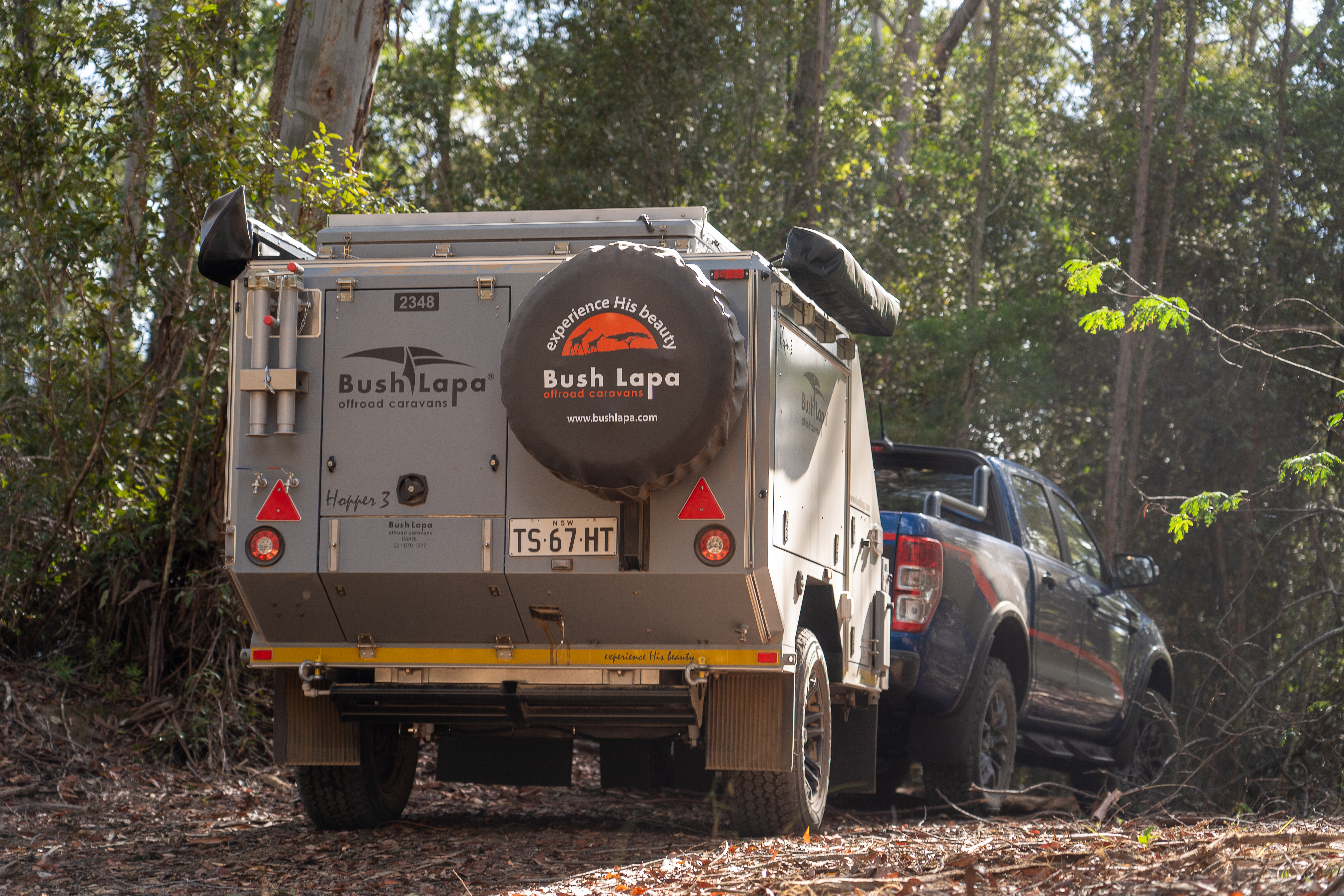
The first thing any prospective customer will look at is price. On that front it’s priced pretty comparatively against its competitors at around $50-65K. On the specifications and comfort front, those competitors are certainly in front. Going with another brand you’ll pick up extra goodies, more polished interiors and larger internal living space.
But those extra features and cheaper price come at a cost. Similar competitors will have far heavier offerings, nearly double the weight. They’re also nowhere near as repairable on the fly, capable off-road, or good on fuel to tow.
If your idea of camping is luxurious lounges and electronic gadgets, then the Bush Lapa range won’t excite you much. But if you’re a couple, or have a small child, and want to explore far off the beaten track, then the Hopper 3i should definitely be on your list to go take a look at. It won’t be the prettiest, but it’ll keep on kicking for years to come, no matter how much you ask of it.
As the sun peeked over the La Sal Mountains, washing Southern Utah with warm hues of ochre and crimson, we made our way down Main Street to the Moab Diner for breakfast.
It was opening day of the Easter Jeep Safari (EJS), and a steady stream of traffic flooded in to town for one of North America’s most popular off-road venues.
Although today’s event draws tens of thousands of participants from all corners of the planet, we need to look back half a century, and further, to understand the significance of origins.
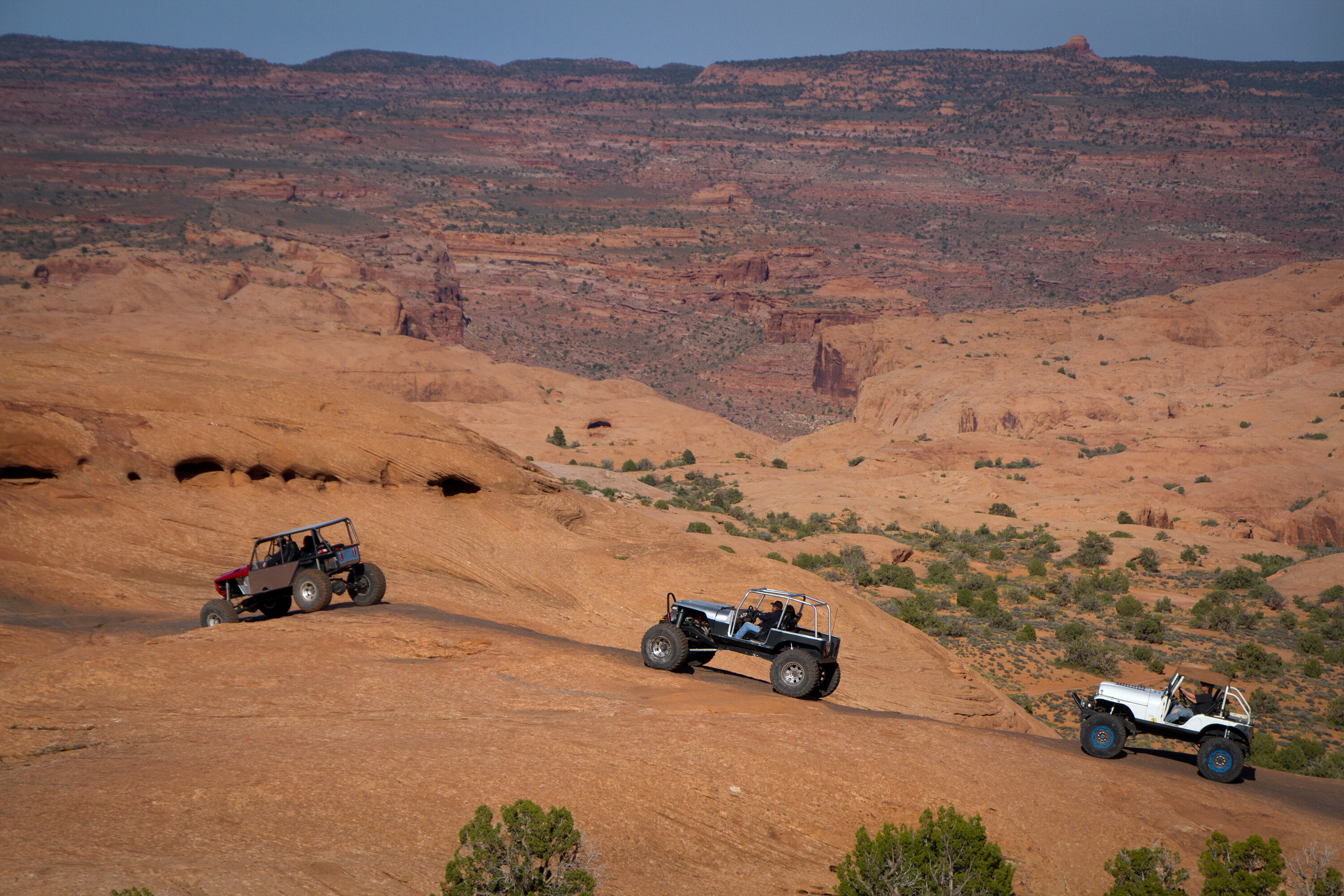
The year was 1967, and in an attempt to boost a lagging economy, the Moab Chamber of Commerce organised an event to draw attention and tourism to the area. It would be a simple affair and take place on Easter Sunday; a one-day trail ride in the backcountry with a few dozen participants.
Registration was free, and a highlight of the day was a Cessna flyover replete with an air drop of ice cream. The original route is now known as the Behind the Rocks Trail, and the event’s popularity required the addition of the Moab Rim Trail the following year.
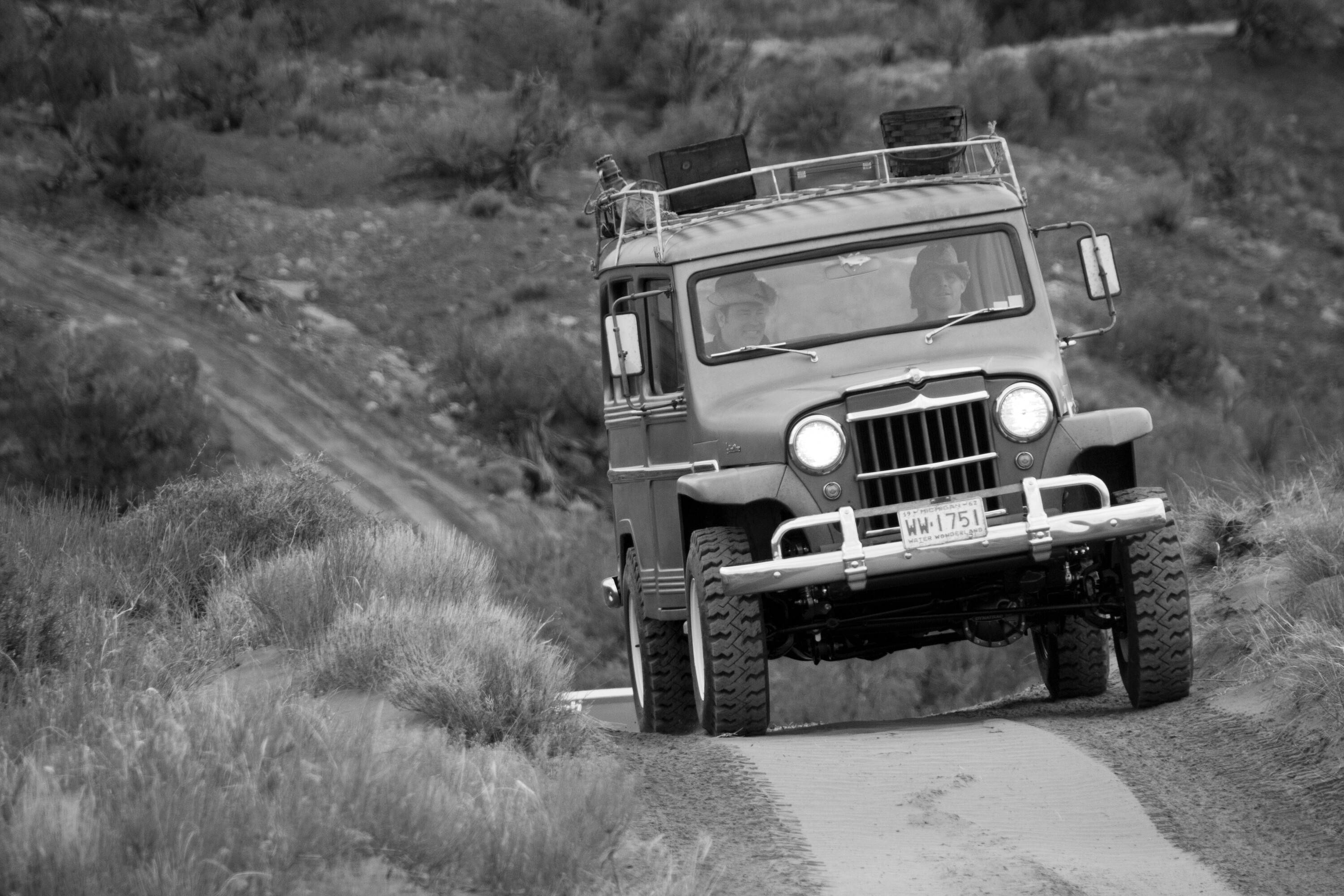
Meanwhile, steady growth strained the Chamber’s resources, and in 1982 management of the event was handed off to the club that had been volunteering as trail guides, the Red Rock 4-Wheelers.
My first experience exploring the fissured canyons surrounding Moab was in 1990. It was a non-EJS week mid-summer, and back then there weren’t any established maps of the web of trails that threaded their way up and down narrow ledges on precipitous cliffs.
I wondered why they were there and who created them? A buddy and I hiked up an eroded switchback to what appeared to be a cave, what we found was an old wooden crate full of dynamite and a mining claim tag. Miners, of course, but what were they looking for? For this, we need to turn the clock back to 1952 and the height of the Cold War.
Explosive exploration
In 1946, the United States passed the Atomic Energy Act, and in 1949 offered incentives to prospectors to help locate domestic uranium deposits.
Word of this prompted amateur geologist Charley Steen to borrow $1000 from his mother, pack up his family, and move to Moab. Living in a tarpaper shack, he scratched at the dirt for several years, exhausted all of his money, and his family nearly starving. Charley was ready to pack up and head home, and then he hit pay dirt.
Word of his success brought an onslaught of commercial mining companies to Moab, which in turn canvased every ledge, canyon, and fissure of the region. Yep, the trails we enjoy today, as well as the Easter Jeep Safari, are the result of the Cold War and Nuclear Age.
As for Mr Steen, his mine, affectionately named Mi Vida (‘my life’ in Spanish) produced enough uranium to make Charley a very, very wealthy man. There would be no more tarpaper shacks for the Steen Family.
If you are in Moab, his Willys Jeep can be found on display in front of the Sunset Grill Event Center … which was originally his palatial home on a hill above town.
EJS in the 21st century
Popularity of the event has seen exponential growth in the past 30 years, and it now draws enthusiasts from the world over. Featuring dozens of trail rides over a nine-day period, and a vendor show with more than 200 manufacturers, Easter Jeep Safari has become the North American spring gathering of the off-road world. It has also generated tens of thousands of dollars for land-use efforts to keep trails open for public access.
Moab has also become the go-to location for the testing of new vehicles, and in the mid 2000s Jeep began its ‘concept’ program. Each year since, it has revealed a fleet of one-off vehicles, some have been wild retro-modern creations but others have actually made their way to production.
The class of 2022
This brings us to this year’s rigs, and by the looks of them, Jeep is committed to joining the global trend of electrification. We spent two days driving them, and below is a brief recap. Enter Jeep’s 2022 Concepts.
Birdcage
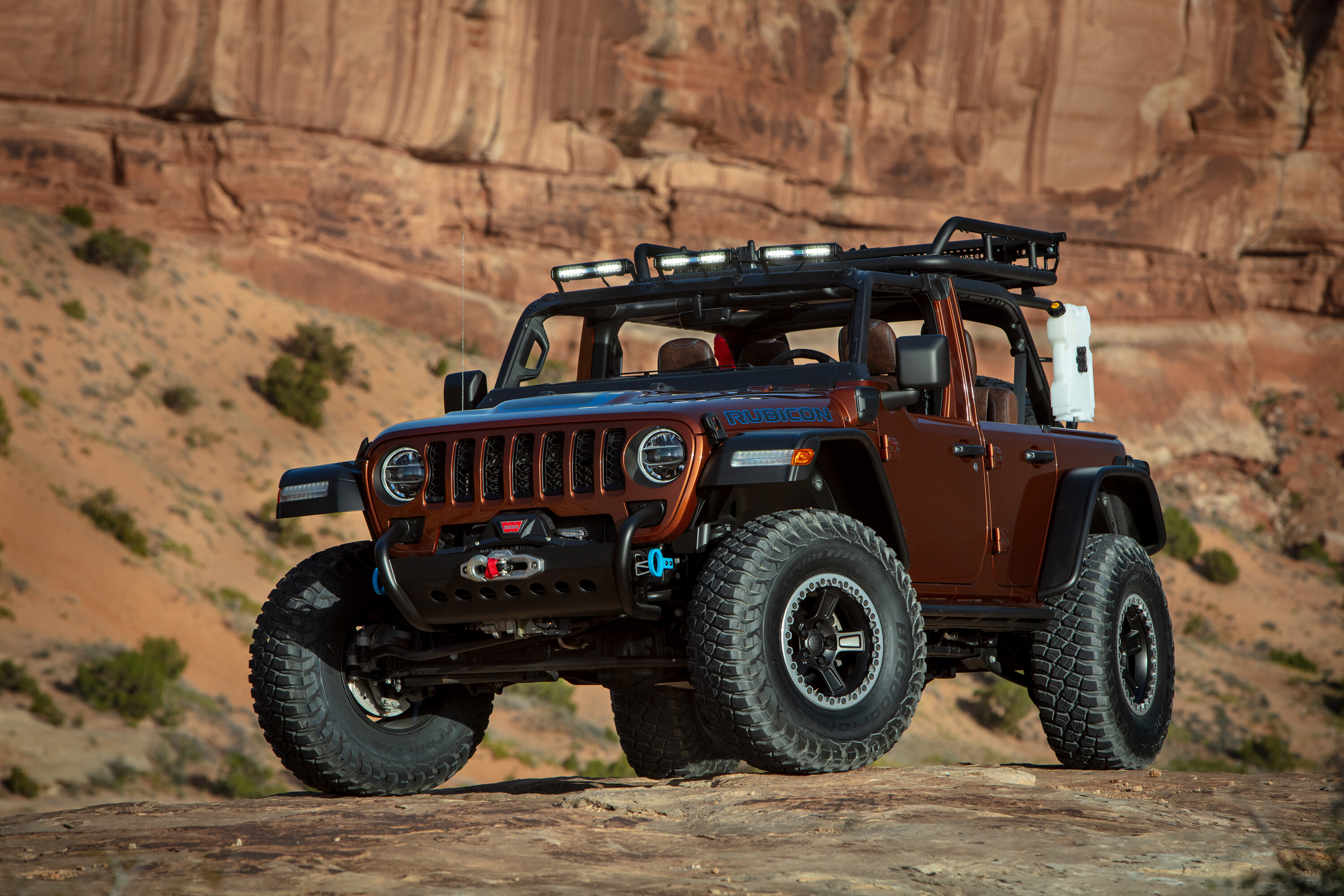
What’s cool? Open-air bugs-in-your-teeth driving experience (no windshield, windows, or top), flat fender flares, custom winch cradle, Granite Crystal metallic paint, Add-a-trunk rear deck system.
| Platform | 4-door Wrangler Rubicon 4x |
|---|---|
| Engine | 2.0-litre turbo-charged i4 dual electric-motor hybrid |
| Drivetrain | TorqueFlite 8-speed automatic, Rock-Trac 4:1 transfer case |
| Axles | Dana 44, electric locking differentials |
| Suspension | JPP 2-inch lift, Fox shocks |
| Tyres/wheels | 37-inch BFGoodrich KM3 / 17-inch JPP bead locks |
Bob
What’s cool? Bed bobbed 12 inches, open concept, Dynatrac Pro-Rock 60 axles, fastback canvas top, custom rear rack.
| Platform | Gladiator Rubicon |
|---|---|
| Engine | 3.0-litre EcoDiesel V6 |
| Drivetrain | 8-speed automatic, Rubicon transfer case |
| Axles | Dynatrac Pro-Rock 60s |
| Suspension | King coilover bypass shocks |
| Tyres/wheels | 40-inch Maxxis RAZR / 20-inch Raceline beadlocksu00a0 |
D-Coder
What’s cool? Prototype light bar, rack, leather seats, spray-on tub liner, and mesh bikini top. Scan any part on this Jeep with your phone – they all display a QR code – and it takes you to the product on Jeep Performance Parts’ website.
| Platform | Gladiator Rubicon |
|---|---|
| Engine | 3.6-litre Pentastar V6 |
| Drivetrain | 8-speed automatic, Rock-Trac 4.10:1 transfer case |
| Axles | Dana 44, electric-locking differentials |
| Suspension | JPP 2-inch lift, Fox shocks |
| Tyres/wheels | 37-inch BFGoodrich KM3 tires / 17-inch JPP beadlocks |
Grand Cherokee
What’s cool? Trailhawk PHEV is light on mods but heavy on style and comfort. In 3C° weather, we took refuge in the Grand and cranked up the heated steering wheel and seats. We also liked the ‘Rodney Dangerfield’ houndstooth interior color scheme.
| Platform | Grand Cherokee Trailhawk 4xe |
|---|---|
| Engine | 2.0-litre turbocharged i4 dual electric-motor hybrid |
| Battery | 400-volt, 17.3kW/h |
| Output | 280kW, 637Nm |
| Drivetrain | TorqueFlite 8-speed automatic, Quadra-Drive II, rear electric limited-slip |
| Suspension | Five-mode Quadra-Lift air |
| Tyres/wheels | 33-inch BFGoodrich KM3 / 20-inch alloy |
Jeep 41
What’s cool? Jeep 41 pays tribute to its Willys MB military underpinnings, but in a 21st Century way: OD green paint, sand-tan soft top, camouflage seats, Warn winch, alloy ‘plow-disc’ wheels.
| Platform | 4-door Wrangler Rubicon 4xe |
|---|---|
| Engine | 2.0-litre turbo-charged i4 dual electric-motor hybrid |
| Drivetrain | TorqueFlite 8-speed automatic, Rock-Trac 4.10:1 transfer case |
| Axles | Dana 44, electric-locking differentials |
| Suspension | JPP 2-inch lift, Fox shocks |
| Tyres/wheels | 35-inch BFGoodrich KM3 / 17-inch Fifteen52 alloy |
Magneto V2.0
What’s cool? Everything! Magneto V2.0 is a super-energised version of Magneto 1.0. Monster horsepower and torque, zero emissions, ultimate in EV off-road capability. What is not to love?
| Platform | Wrangler 2-door, stretched 12 inches |
|---|---|
| Engine | Axial flux electric |
| Battery | 800-volt, 70kW/h |
| Output | 485kW, 1152Nm |
| Drivetrain | Manual Hellcat 6-speed, hardened gears |
| Axles | Dynatrac 60 front, 80 rear, 5:38 gears |
| Suspension | Custom coilover, King shocks |
| Tyres/wheels | 40-inch Maxxis RAZR MT / 20-inch Raceline bead lock |
Rubicon 20th Anniversary
What’s cool? Introduced in 2003, the Rubicon model will celebrate its 20th birthday next year. Honouring that milestone, Jeep developed the 392 HEMI-powered 20th Anniversary concept. With custom graphics, anvil grey paint and red leather interior, full body armour and skid plates, and an air-compressor integrated in to the rear gate, we are hoping they will offer this one as a factory package.
| Platform | 4-door Wrangler Rubicon |
|---|---|
| Engine | 392/6.4-litre HEMI V8 |
| Output | 350kW, 637Nm |
| Drivetrain | TorqueFlite 8-speed automatic, Rock-Trac 4.10:1 transfer case |
| Axles | Dana 44, electric-locking differentials |
| Suspension | JPP 2-inch lift, Fox shocks |
| Tyres/wheels | 35-inch BFGoodrich KM3/ 17-inch JPP bead locks |
Power Wagon
What’s cool? This Kaiser Jeep M725 Power Wagon was originally revealed at the 2021 SEMA show, but it is so damn cool we need to take another look – Crate 392/6.4-litre HEMI V8, Dynatrac 60/80 axles, raised canvas roof, beer keg refrigerator, and original roof-mounted spotlight (now LED). This is one cool Wagon.
| Platform | 1967 Kaiser Jeep M725 military ambulance |
|---|---|
| Engine | 392/6.4-litre HEMI V8 |
| Output | 361kW, 644Nm |
| Drivetrain | TorqueFlite 727 automatic, NP200 transfer case |
| Axles | Dynatrac 60 front, Pro-Rock 80 rear |
| Suspension | Coil-link, Fox shocks |
| Tyres/wheels | 40-inch Maxxis RAZR / 20-inch Black Rhino Amoryu00a0 |