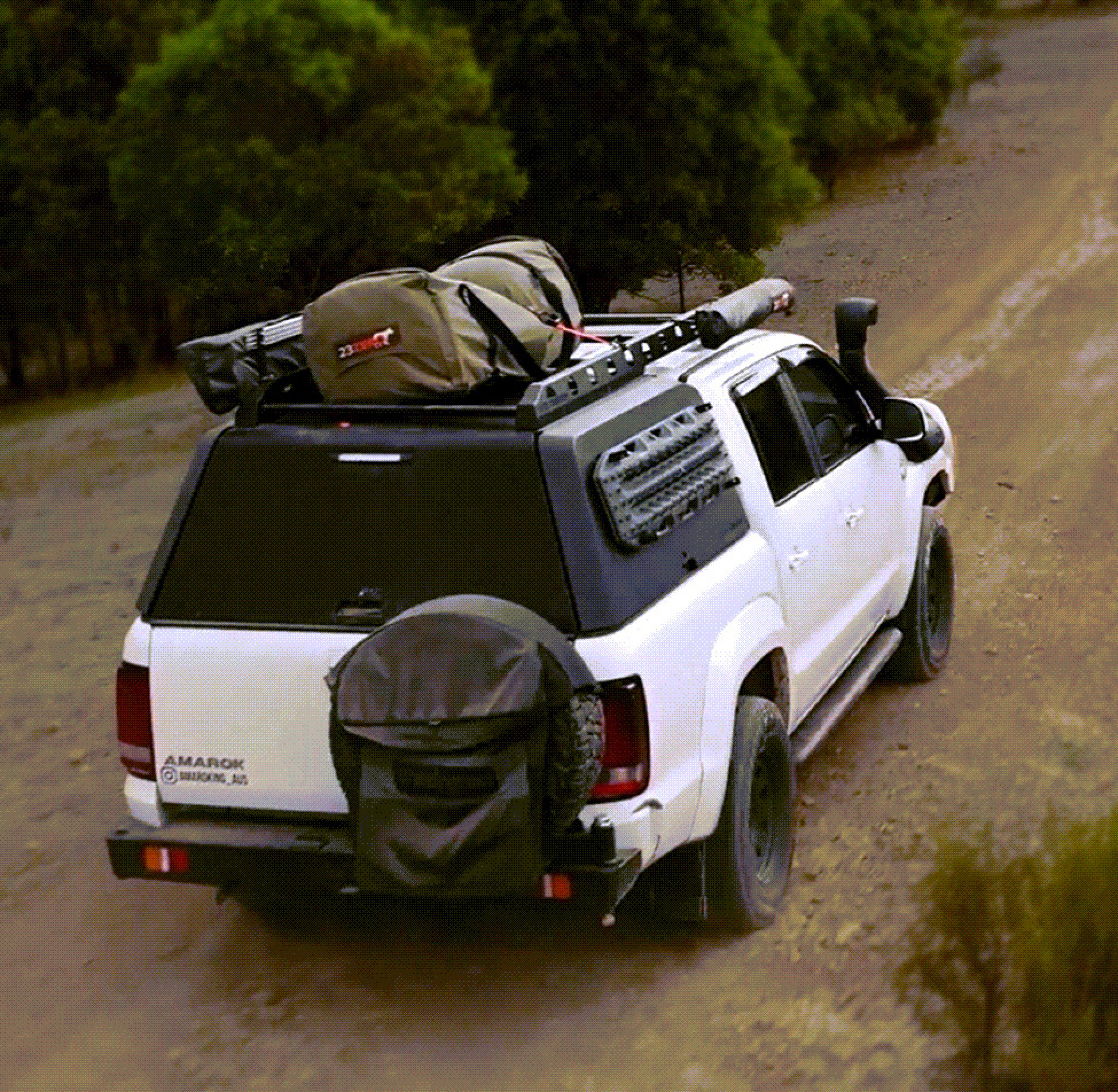
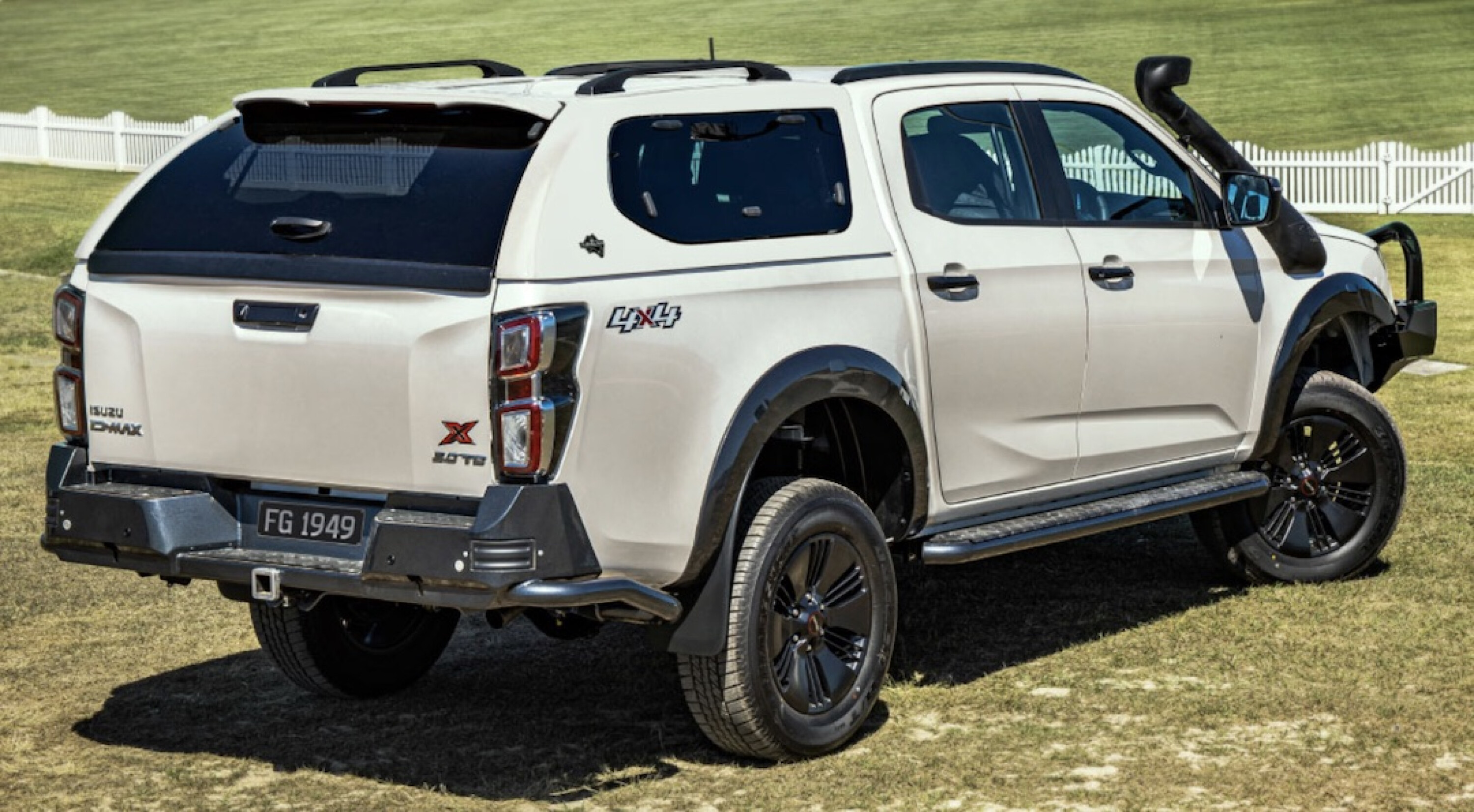
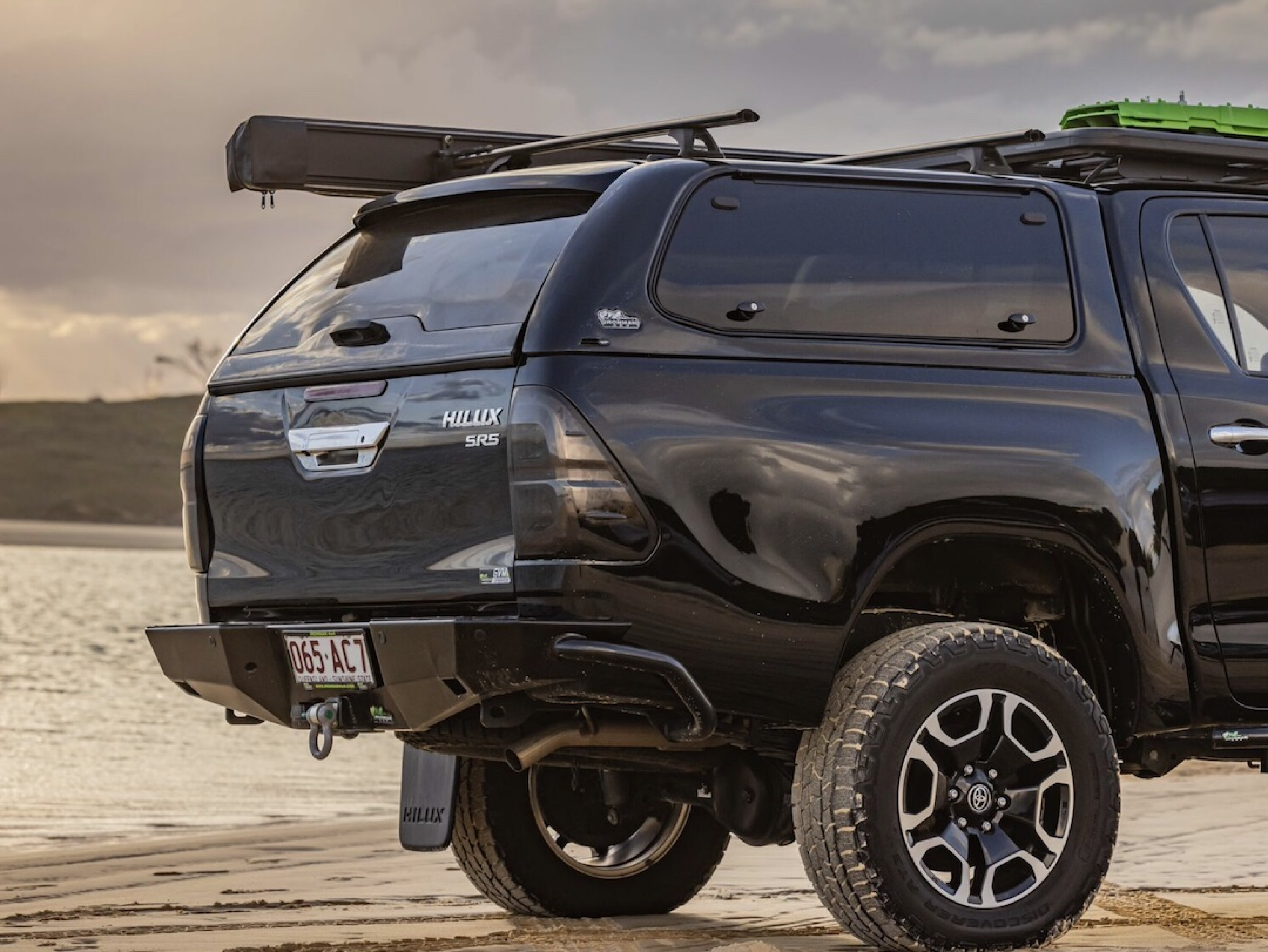
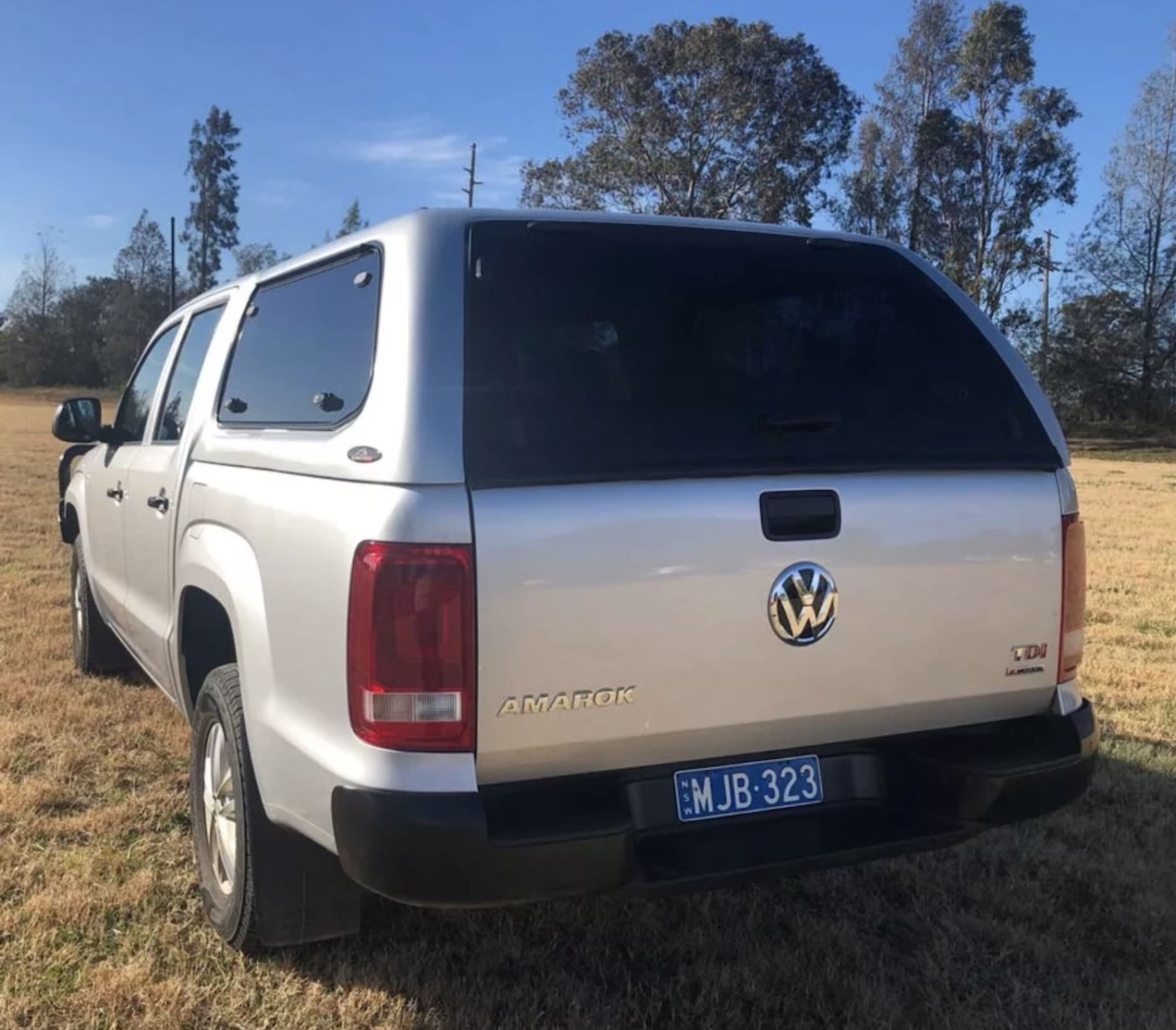
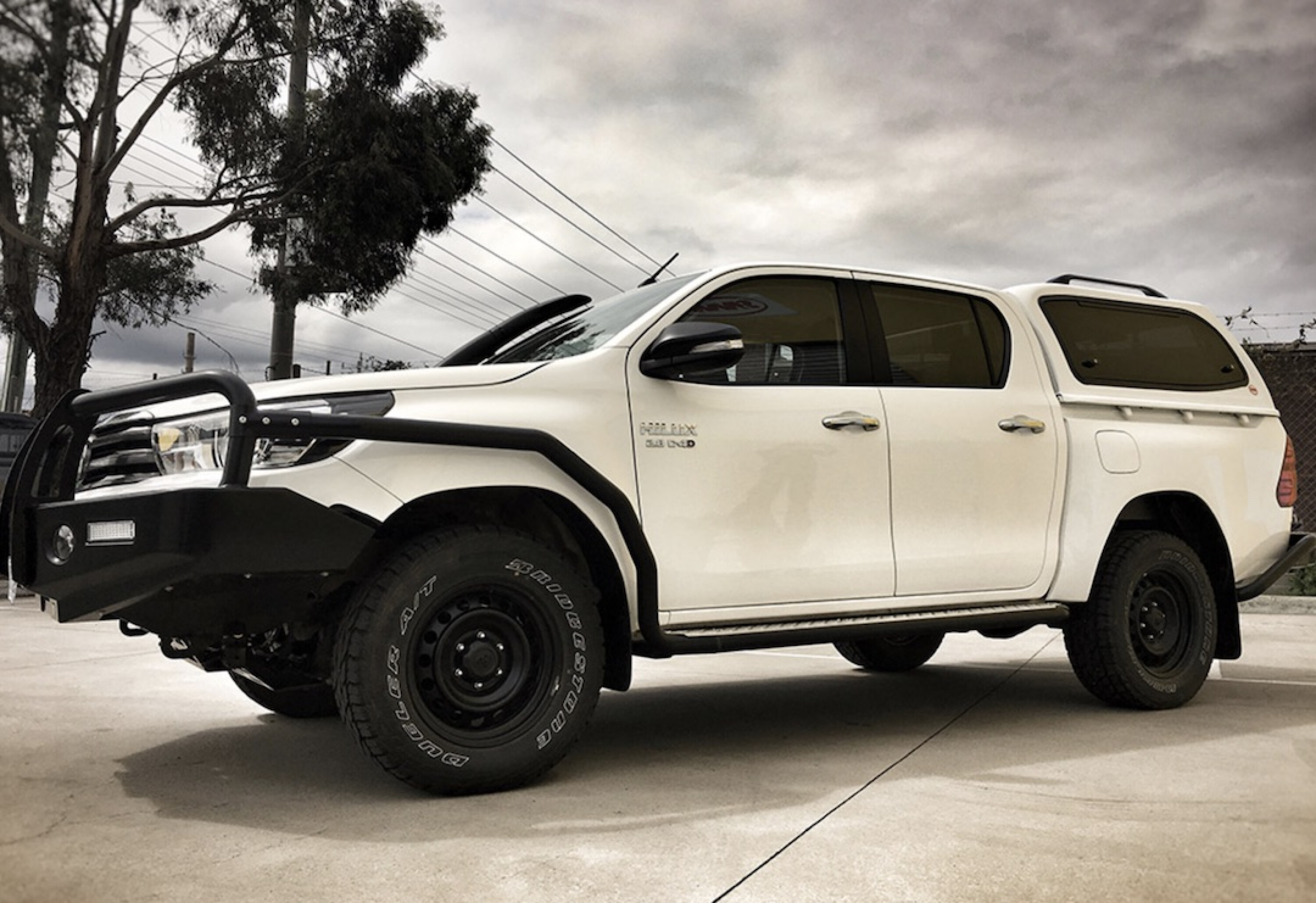
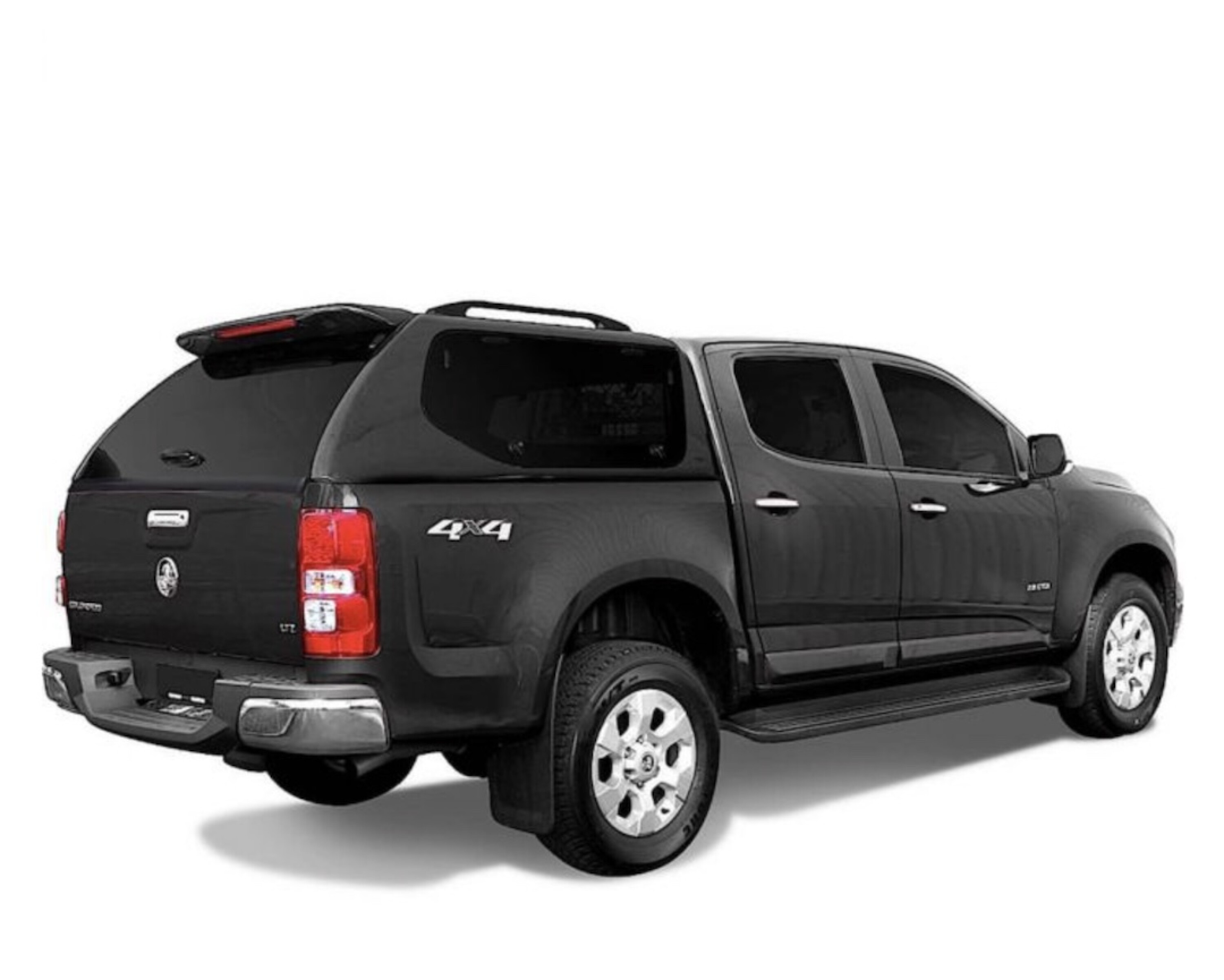
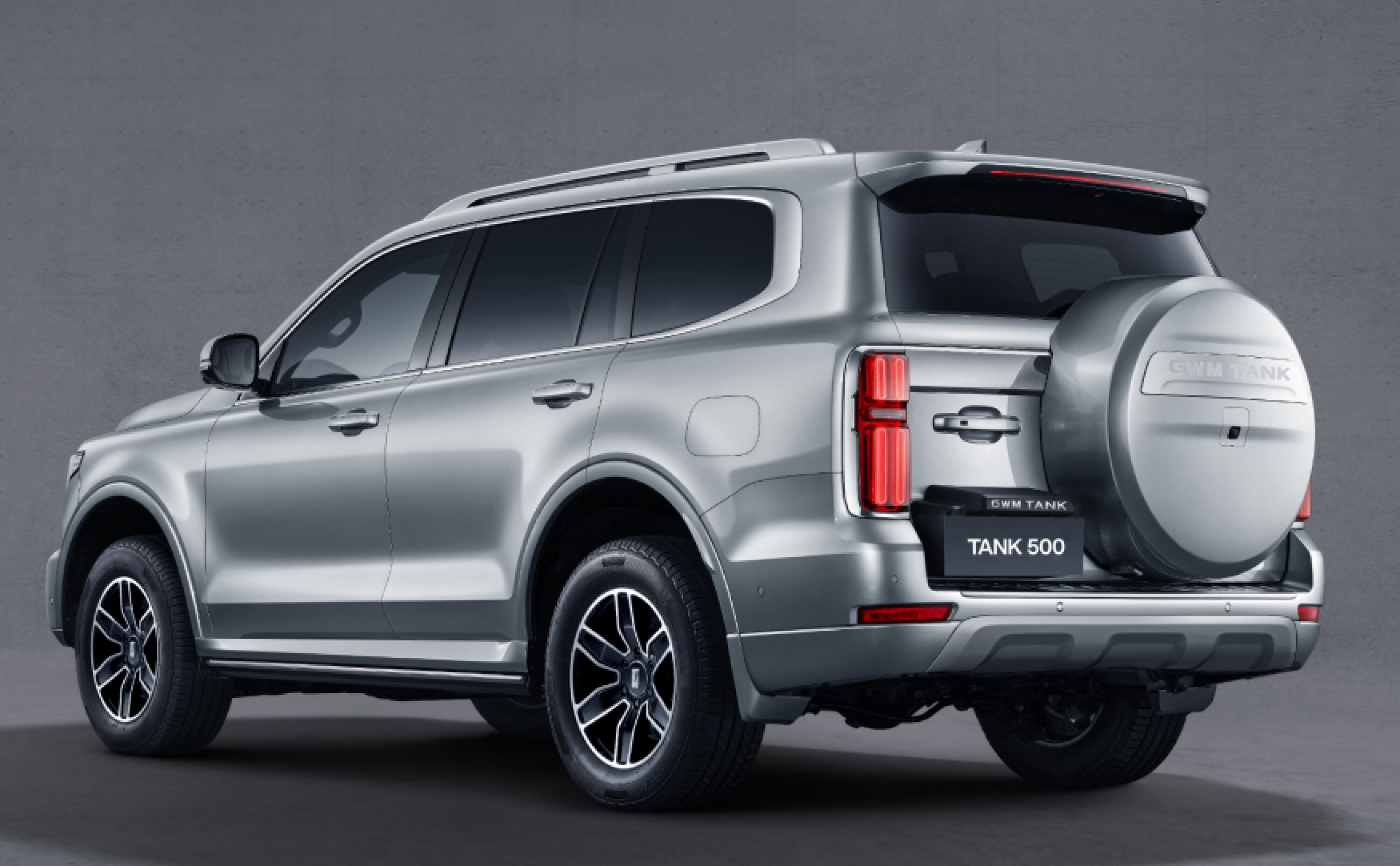
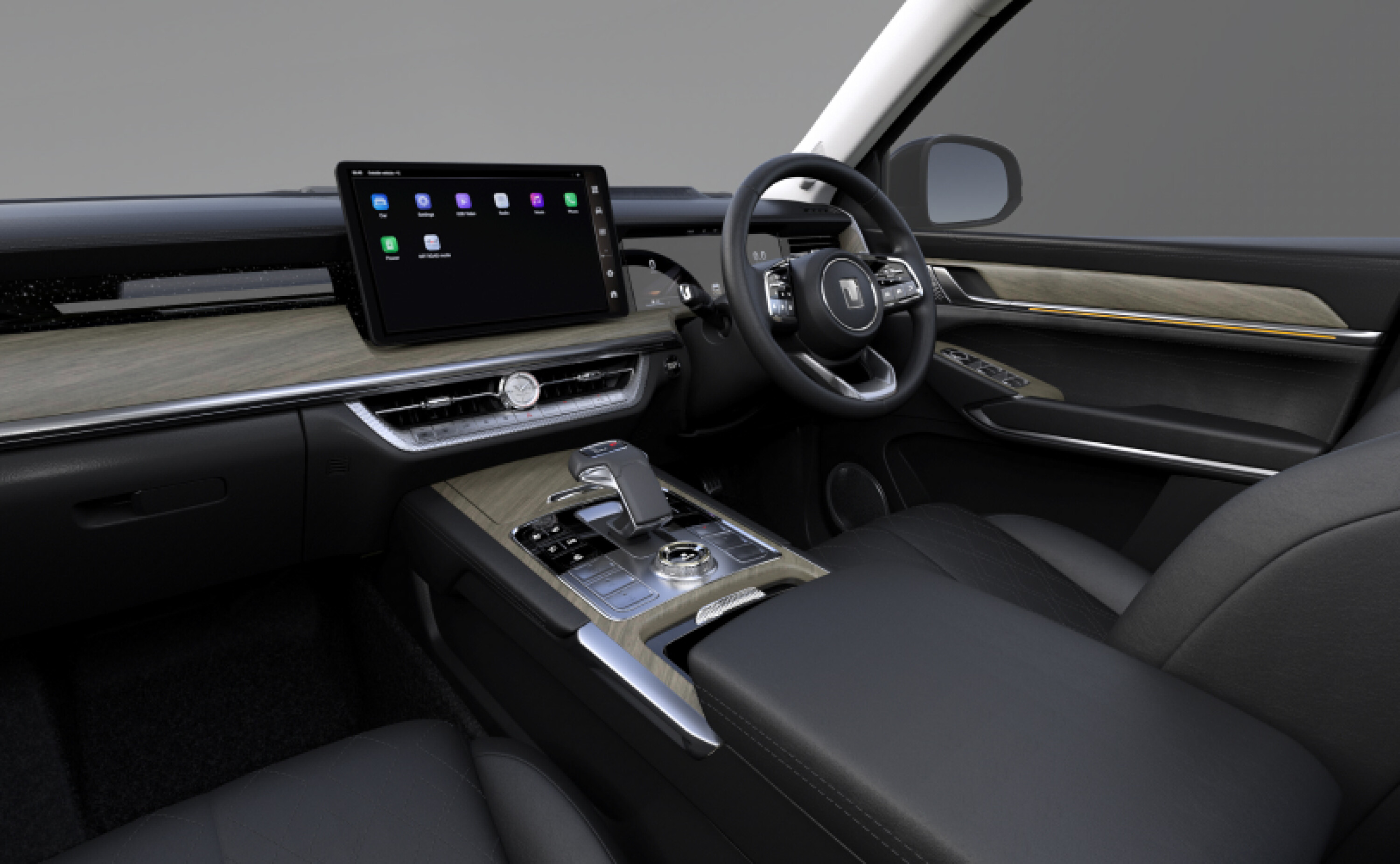
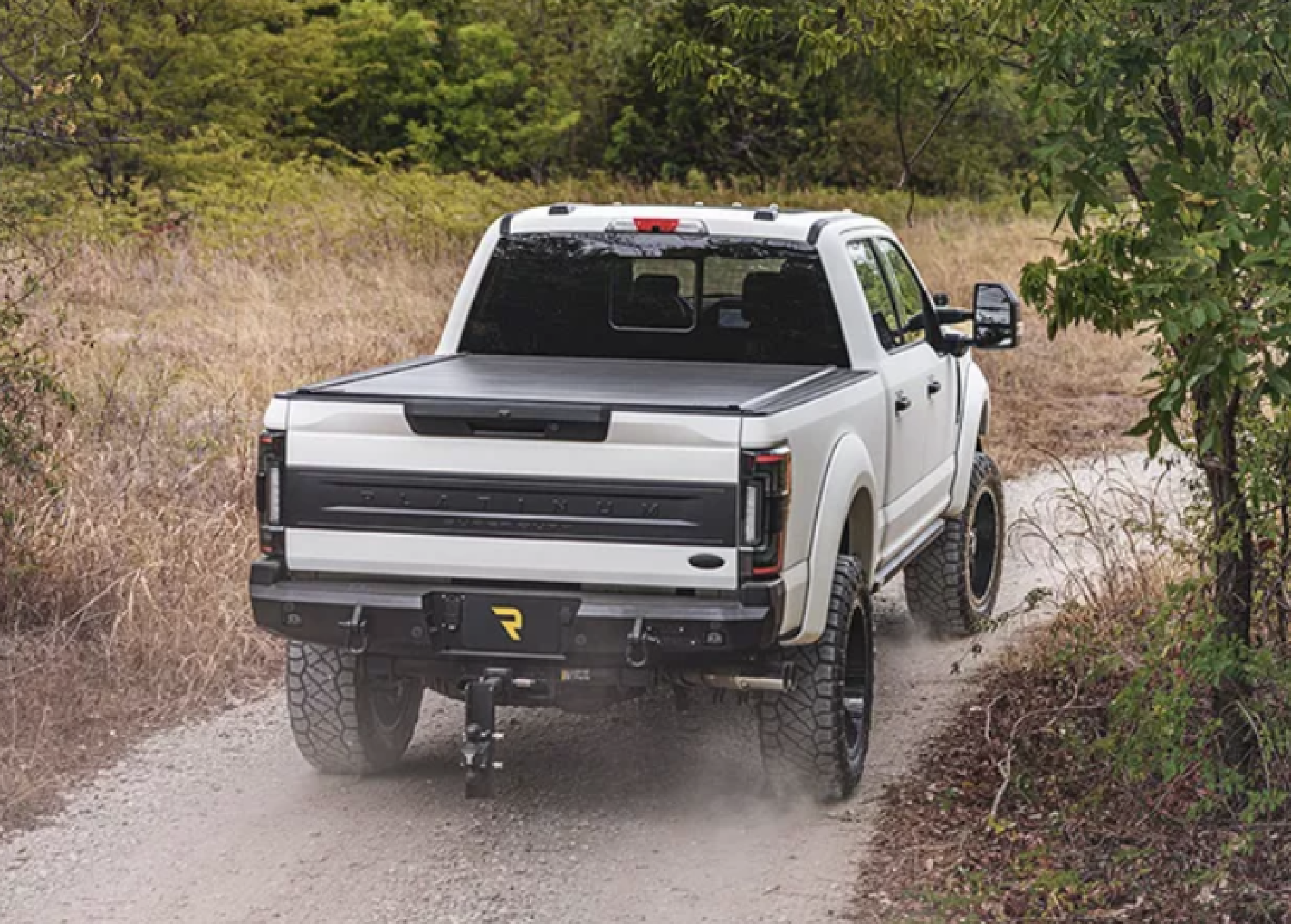
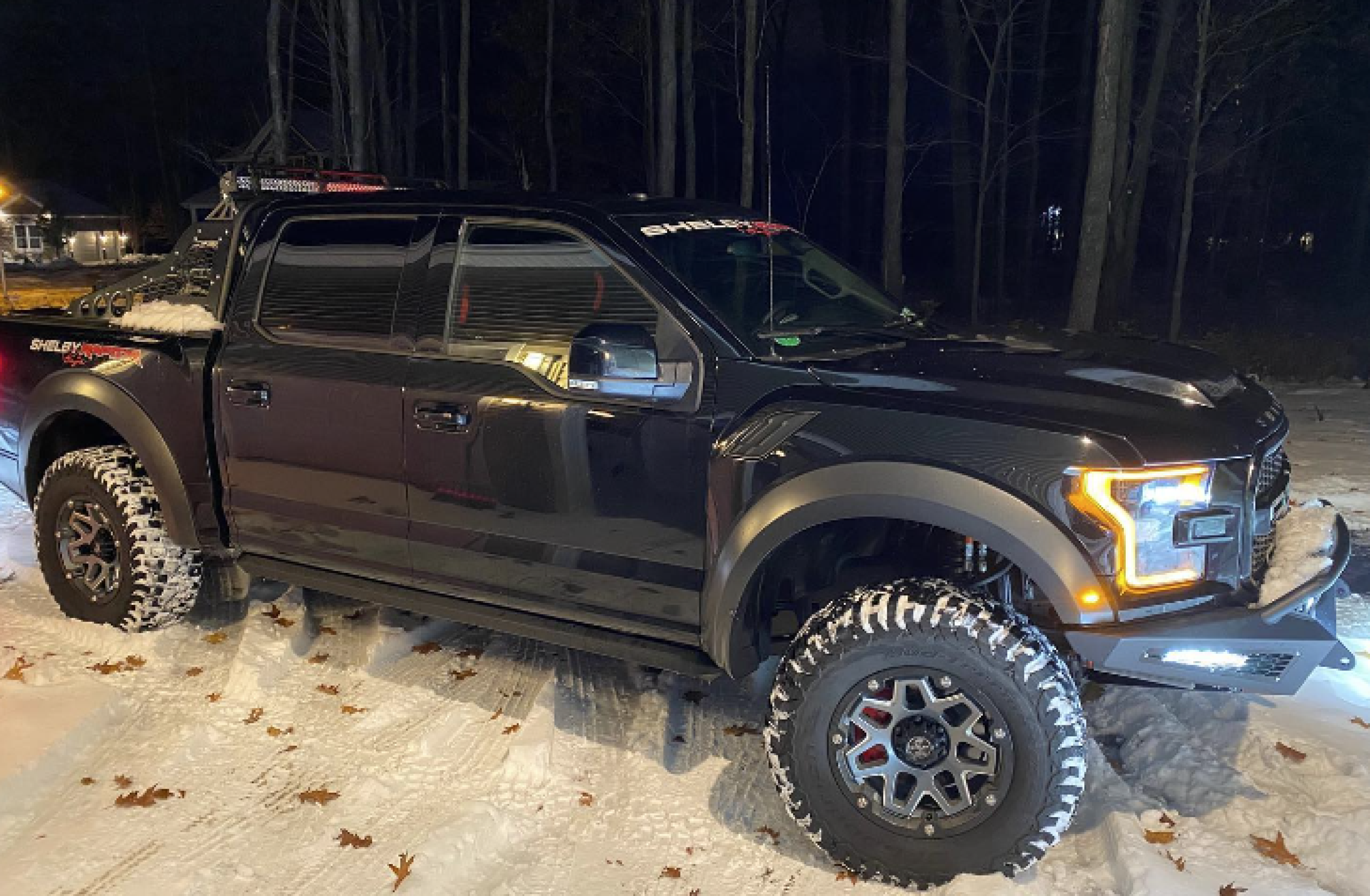
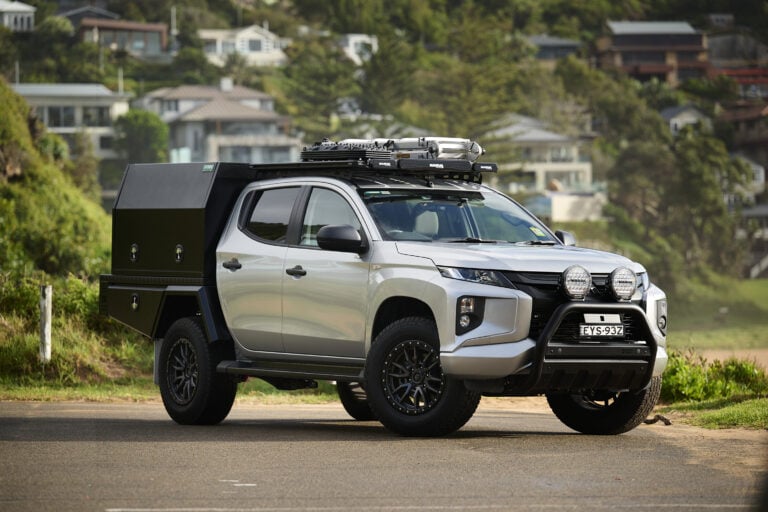
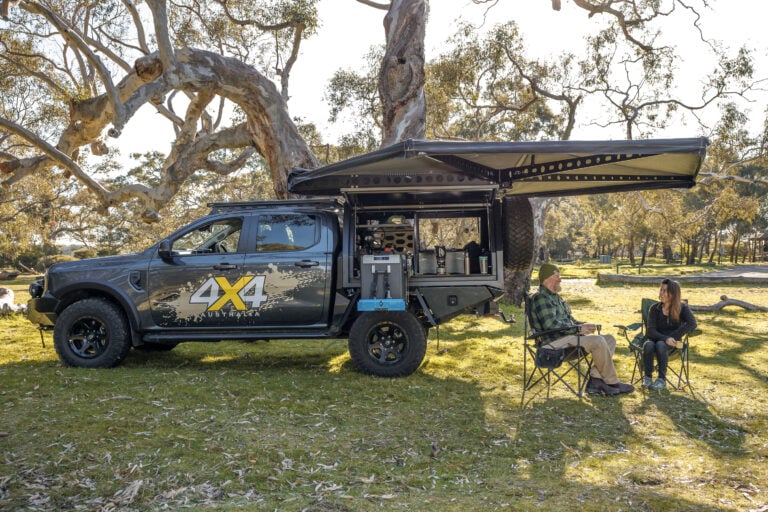
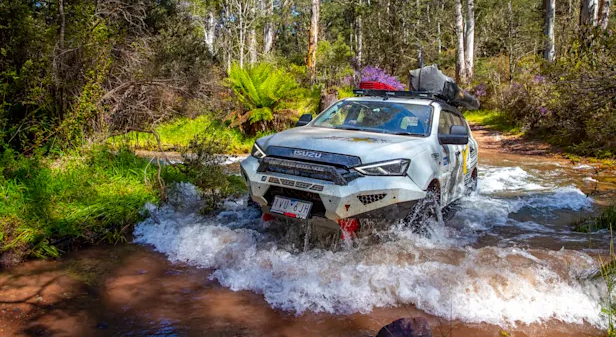
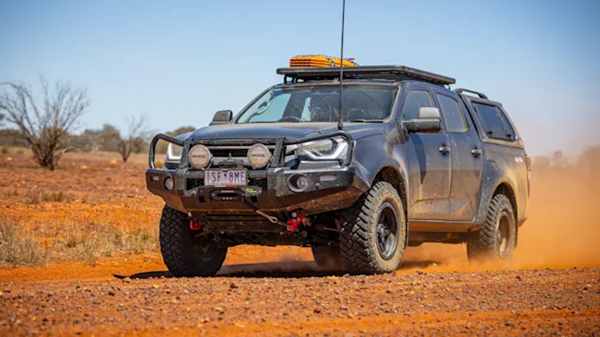
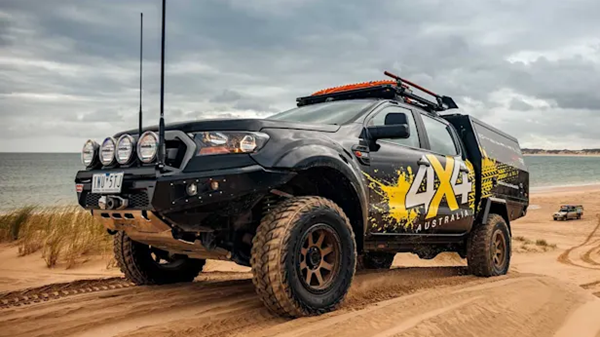
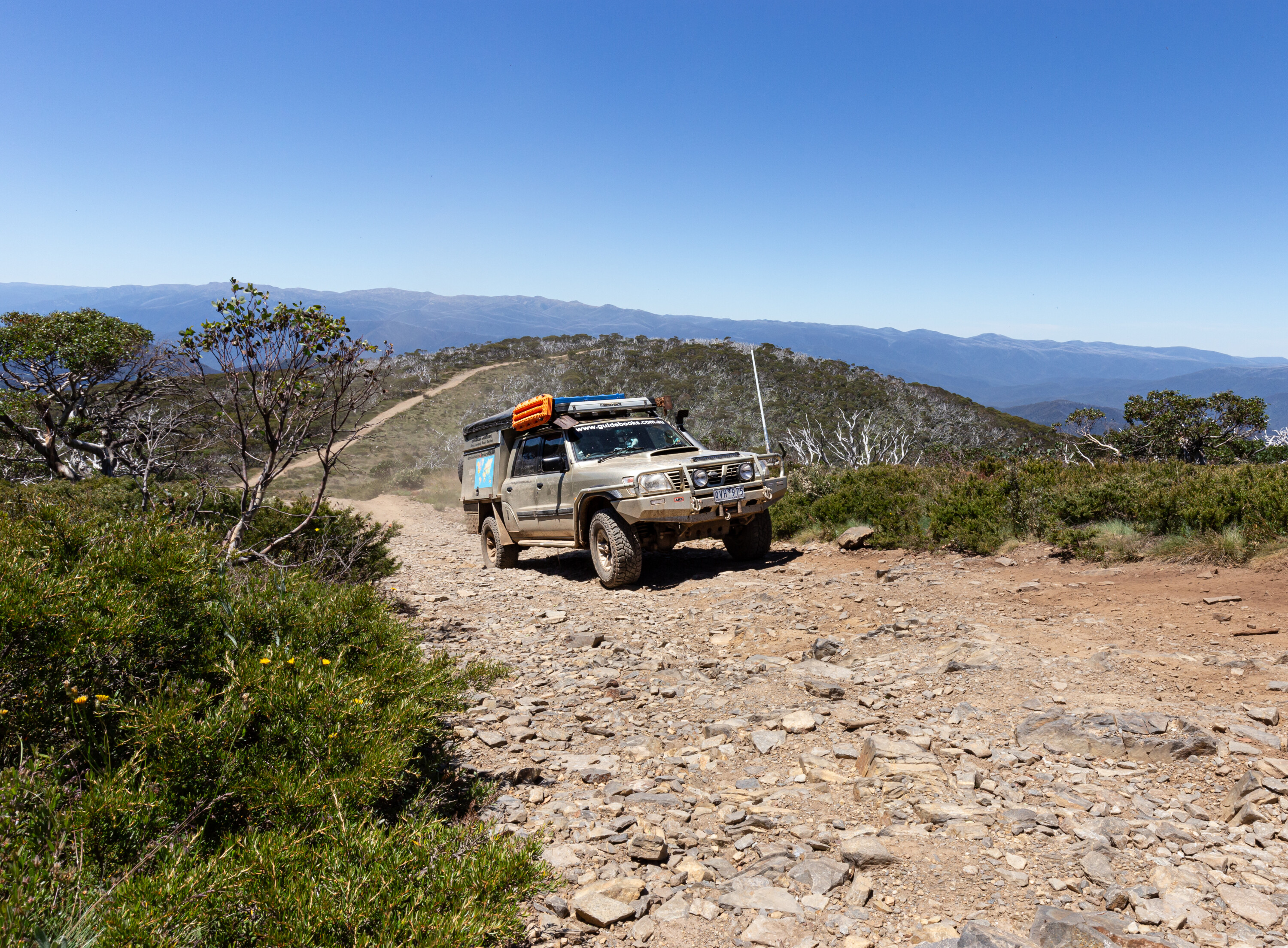
There are myriad options for the ute owner when it comes to storage, and a canopy is an effective and popular way to keep tools and off-road equipment securely stowed, sorted and protected from both the weather and prying eyes.
They also provide a great base to attach other accessories such as racks and rooftop tents, as well as installation of electrical systems and storage drawers.
A standard tub is great for carrying bulky items – throw in a wheelbarrow, three shovels, two crowbars, ten bags of cement, a pile of other random stuff and off you go – but standard tubs are not an ideal place to store camping and recovery gear, as they provide zero protection from the elements and zero security from thieves.
This is why a canopy is essential, but not all canopies are created equal. In fact, when the time comes to upgrade your storage set-up, your first choice will be whether to opt for a full-sized ‘tray-top’ canopy or dial things back a bit with a simple tub top option.
A full canopy will provide more versaility, better access to acessories like fridge slides, and allow for more weight to be added; a “tub topper” can help achieve the same space as a full canopy, but at nearly a quarter of the cost. Ultimately, though, the best canopy is the one that suits your individual requirements. Here are a handful of recommendations we’ve split into two sections: full and tub topper.
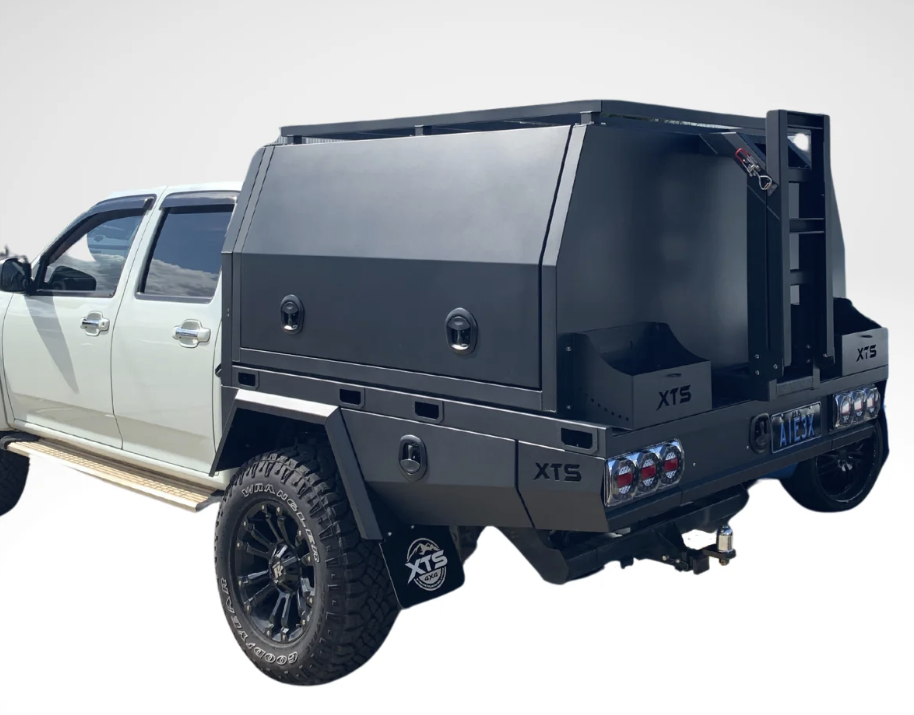
The 1600 Explorer bundle from XTS 4×4 is a comprehensive and customisable set-up guaranteed to enhance storage and functionality.
This starter package includes the XTS 1800 tray and 1600 canopy. The tray features a mesh headboard, large rear trundle drawer, slide-out side lockers and removable sides, making it highly adaptable. The 1600 canopy is crafted from corrosion-resistant 2.5mm aluminium, has dual wing doors with piano hinges, gas struts, and reinforced internal bracing for added durability.
Accessories in the bundle include a roof rack platform, jerry can holder, rear ladder, and spare wheel holder. Optional upgrades such as jack-off legs, central locking, a power system, battery, and various slide-out storage solutions allow for further customisation. Available in multiple sizes, and it can also include a dog box.
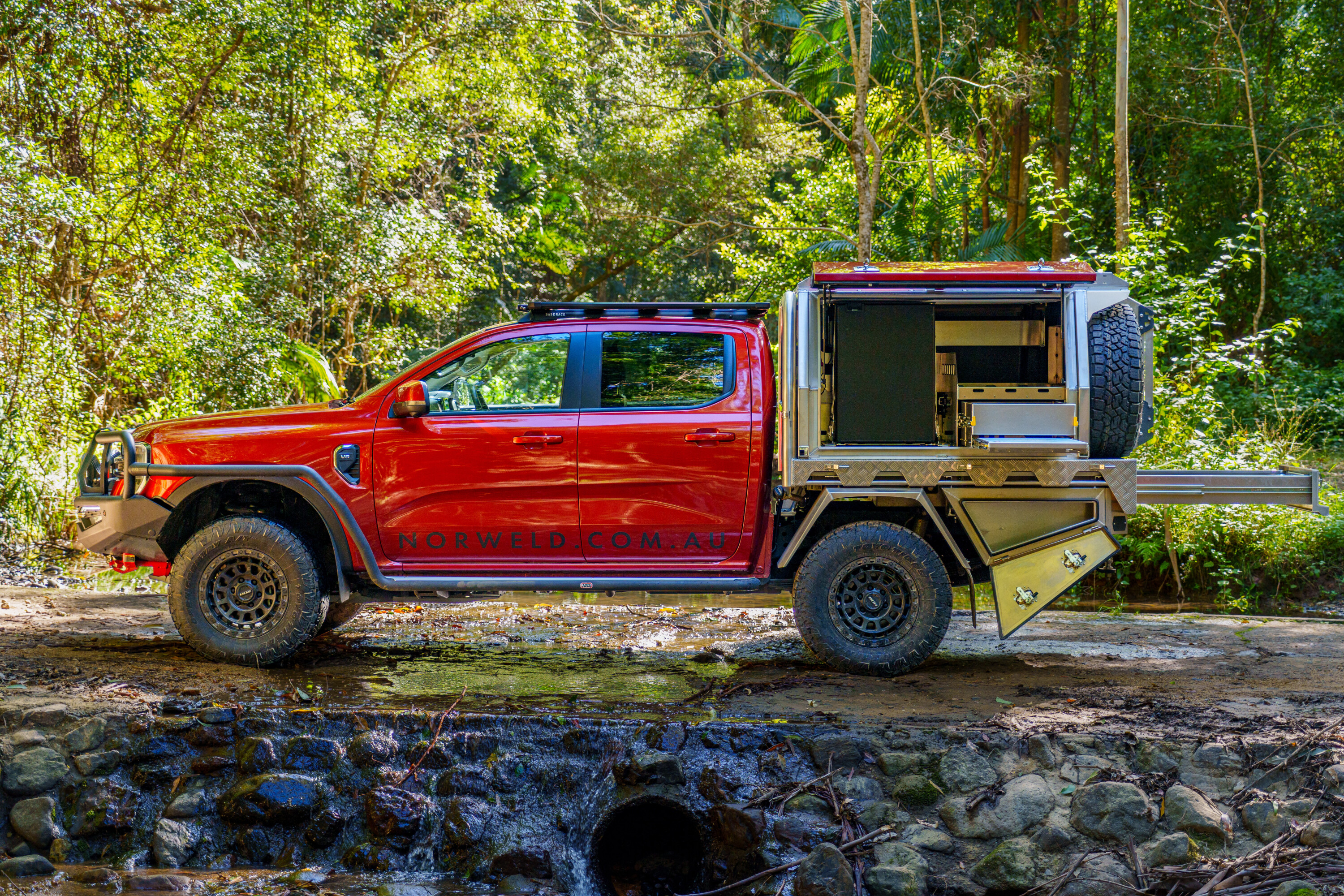
Norweld Deluxe Canopy Base + Deluxe Lite Compact Canopy
For a heavy duty full-time canopy option, look no further than Norweld’s Deluxe Canopy Base + Deluxe Lite Compact Canopy.
Built to Norweld’s highest standards, this turn-key option integrates all OE spec blind spot, reverse camera and sensor options and can be fitted out with a range of fridges, air compressors and electrical accessories that take your off-road adventures to the next level. It comes with a lifetime guarantee on all manufacturing.
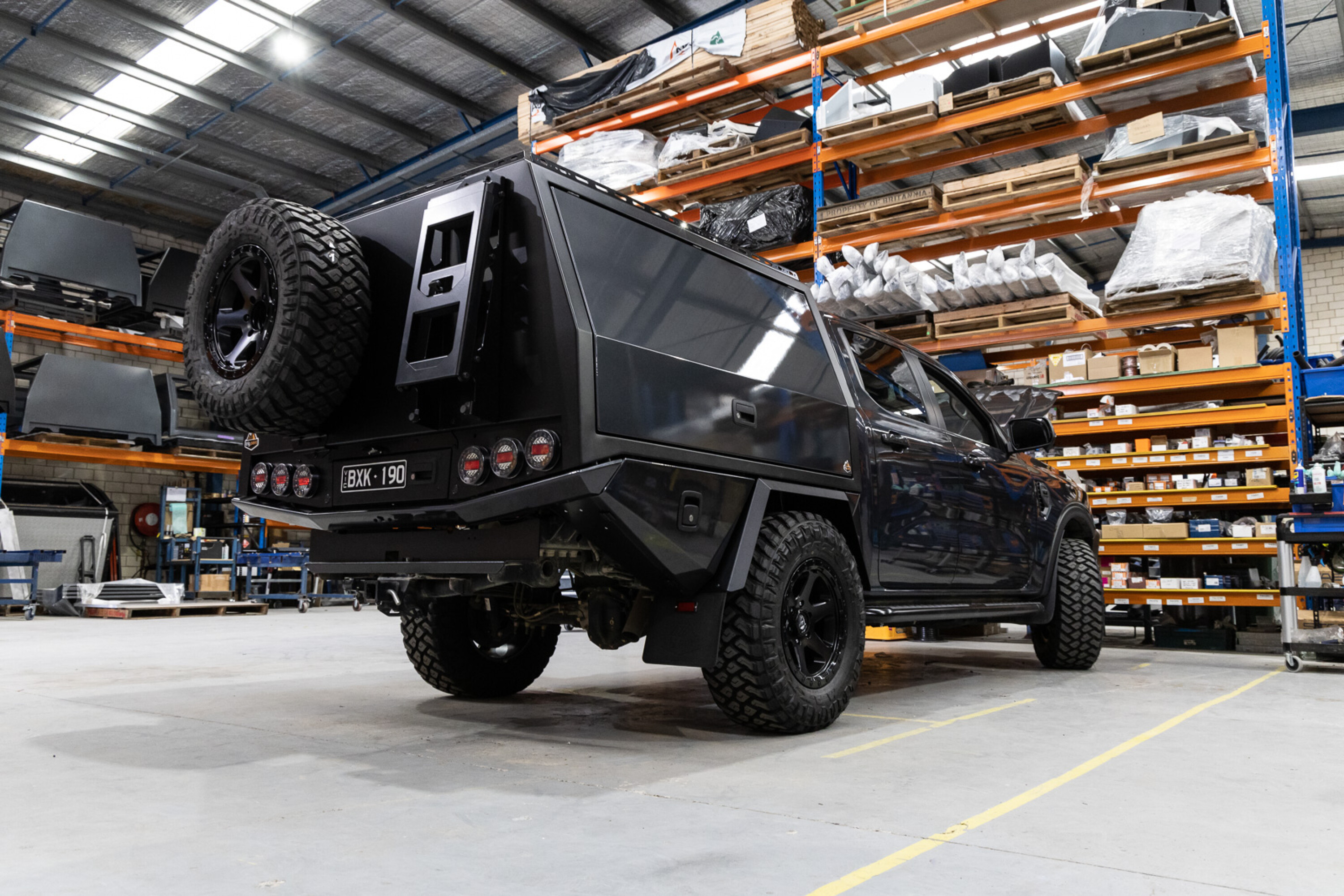
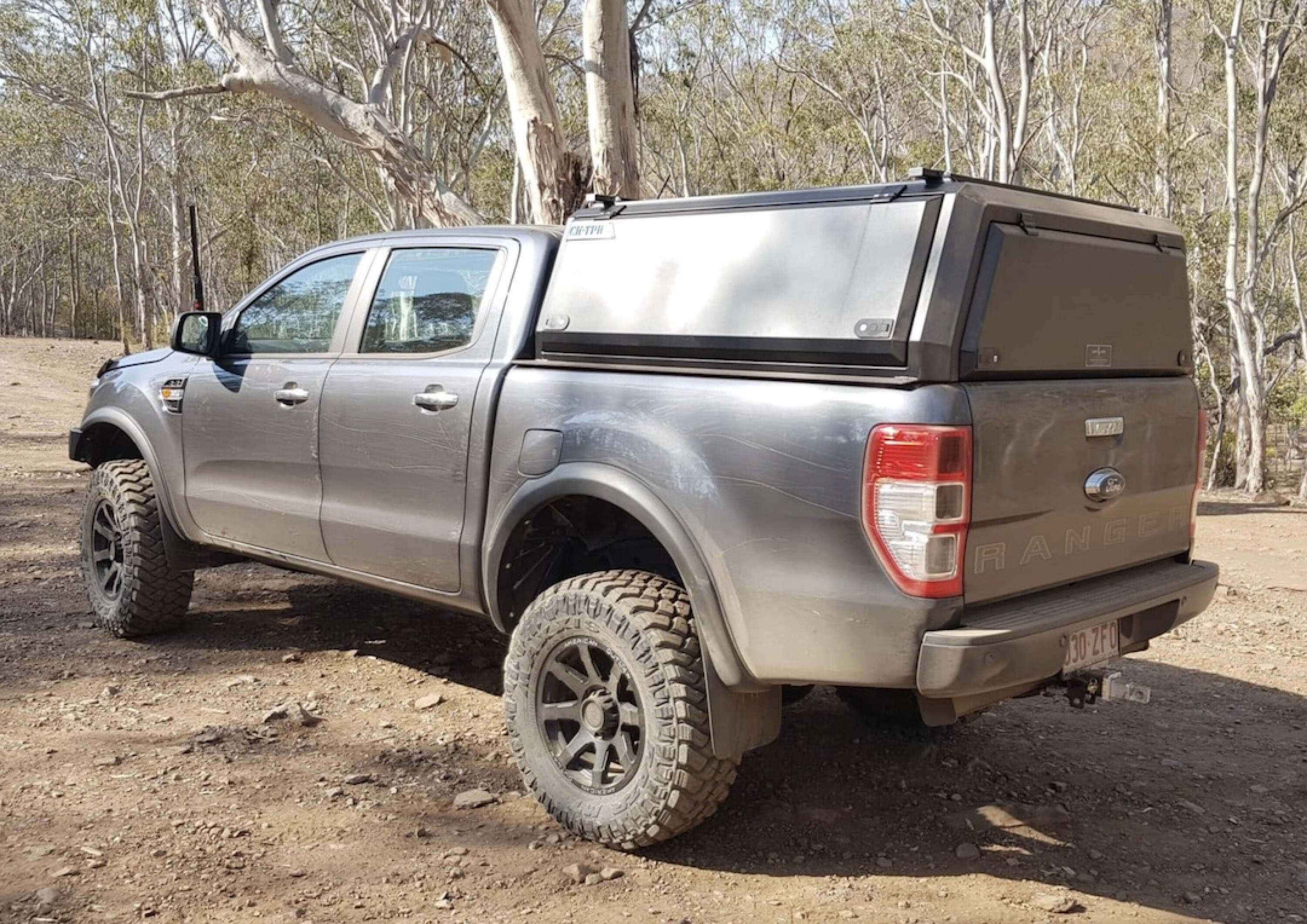
Trig Point is a relatively new player in this sector that offers canopies designed to replace the tub directly mounted to the chassis.
The canopy bodies are made of aluminium sheet with a steel frame base, and the design is simple with basic doors on each side and a fixed back. Trig Point offers canopies in sizes that cover popular vehicle models such as Ranger, Hilux, and LandCruiser 79. Standard features include LED tail-lights, a rear steel bar for protection, rear toolboxes, roof rails, internal touch-operated LED lights, full door seals, slam-shut door catches, rear wheel arches, and filtered vents.
Trig Point can also offer myriad options such as water tanks, internal dividers, upright fridge or fridge slides, and 12V systems. All canopies meet ADR requirements, and Trig Point offers a three-year/100,000km warranty against defects in materials and workmanship.
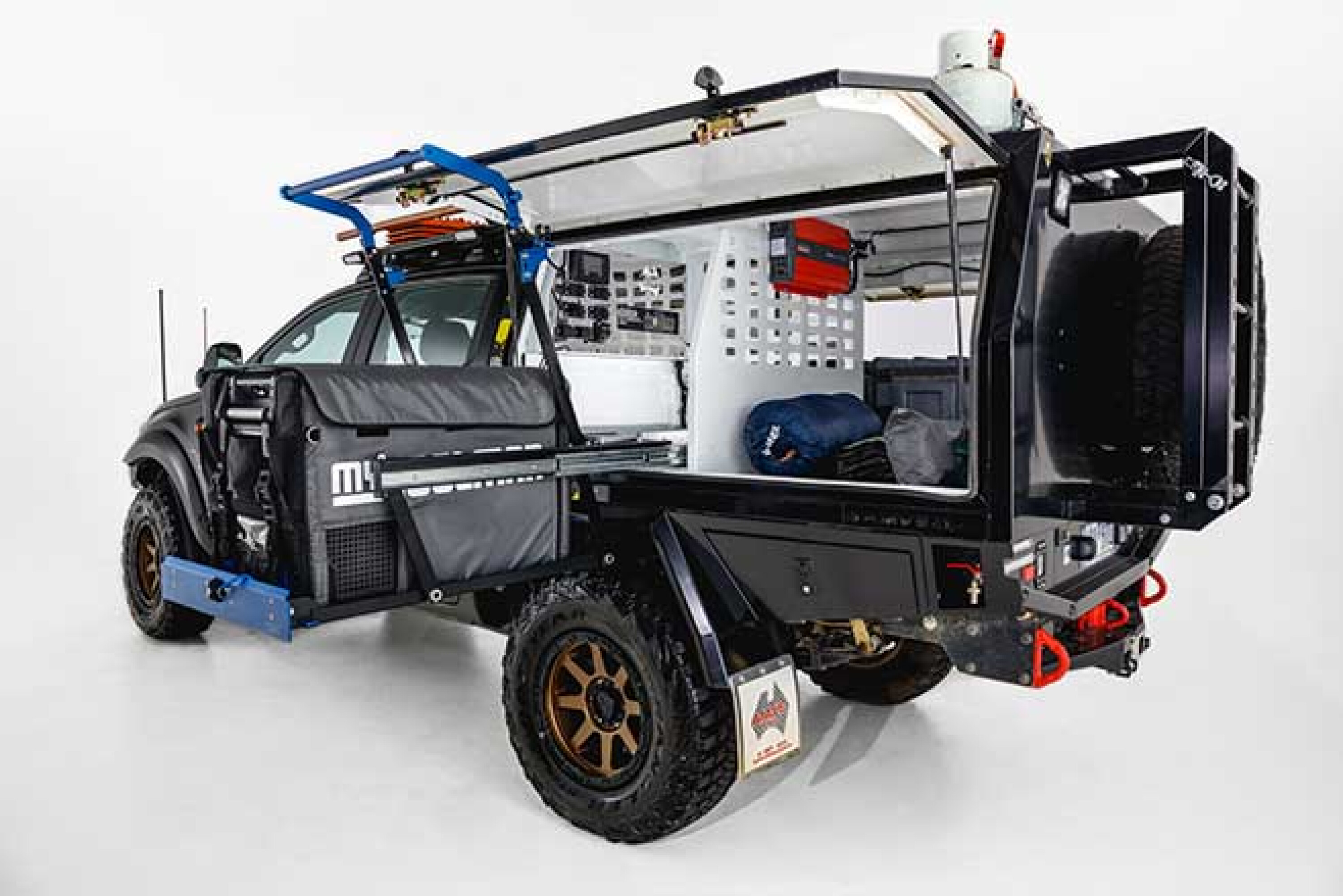
Due to AMVE’s mining experience, it became well-known for its high-quality and strong products.
Its canopies use high-strength aluminium with a minimum thickness of 2.5mm, with some items made with 3mm aluminium for durability in harsh conditions. The company designs and custom-builds its canopies using CAD drawings and laser cutting for a high-quality finish. Canopies are powder-coated or painted to match the required colour.
Features include three lift-up doors, an 80-litre drop-down fridge slide on the passenger side, a shelf for electrical equipment, a full-width centre partition to divide the open rear section, two spare tyres mounted on the rear, three carry racks on the roof, a solar panel mounted to the roof, flush-mounted locks, and a full lift-off jacking leg system.
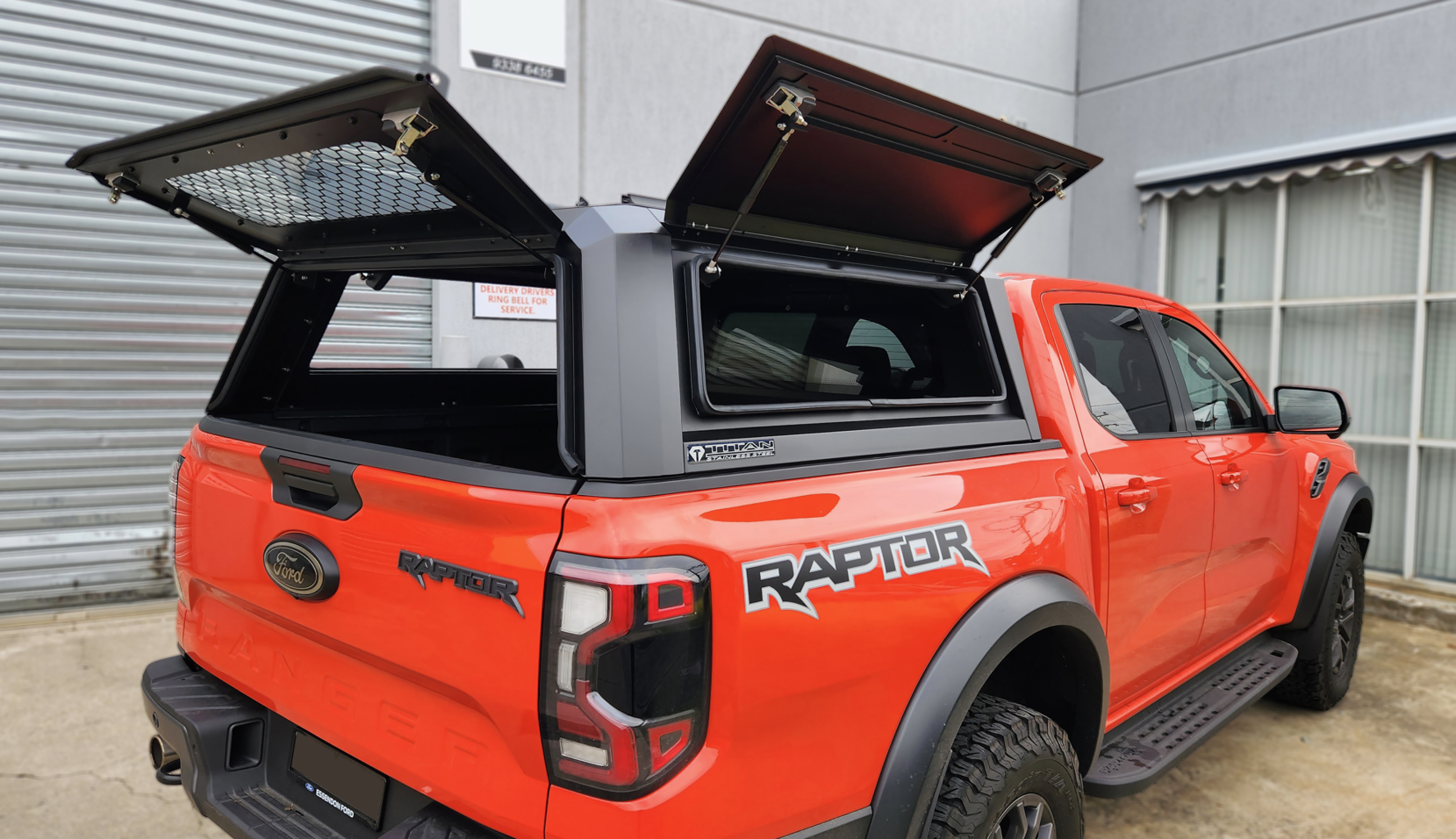
The Titan features a hybrid stainless steel and alloy design, which is different to anything else on the market and gives it incredible strength and corrosion-resistance. Plus, it keeps weight low.
Stainless steel is used for the frame and body, and structurally reinforced alloy is then used for the roof, side panels and rear door. The rear door features a honeycomb protection mesh that stops intruders but lets you view outside and inside.
The modular design makes assembly easy. It arrives in two boxes and assembly can be done in less than one hour with two people. No silicone is required to seal the panels on the canopy or the canopy to the vehicle, and pre-applied sealing tape is used on all panels and prevents any leaks. The high-quality black powder-coated finish is extra durable and looks great on any colour of ute.
Each canopy is specifically designed for the vehicle, with close to 20 models available including for Chevy and Ram trucks. It has a 125kg dynamic weight and 300kg static weight capacity, with integrated roof rails for universal fitment of any rack, platform and/or cross bar.
1
Material
Hybrid design (stainless steel and alloy)
Finish
Black powder-coated
Weight
Varies but Ranger DC ute is 70kg
Locks
6 Compression locks (2 per door) *central locking coming soon
Constructed using aluminium, the Utemaster Centurion canopy is a high-strength unit with a dynamic load rating of 200kg and a static load rating of 300kg.
Due to its tough construction the unit features full-width doors to maximise access, which doesn’t compromise the structural integrity of the canopy. This design means there’s no obstruction along the top edge of the tub, so loading and unloading gear is a simple affair regardless of size.
The canopy is highly customisable and features include 200kg dynamic load rating (300kg, static); full-width door access; secure locking system; built-in rain channels; concealed security latches; optional central locking kit; dog vent kit to increase airflow; high-quality hinges; and an optional Cantilever roof rack is available.
Utemaster builds canopies for a range of popular vehicles on the market today including the next-gen and past-gen Ford Ranger, Toyota Hilux, Isuzu D-MAX, Volkswagen Amarok, Mitsubishi Triton, Mazda BT-50, Nissan Navara, GWM Cannon and LDV T60.
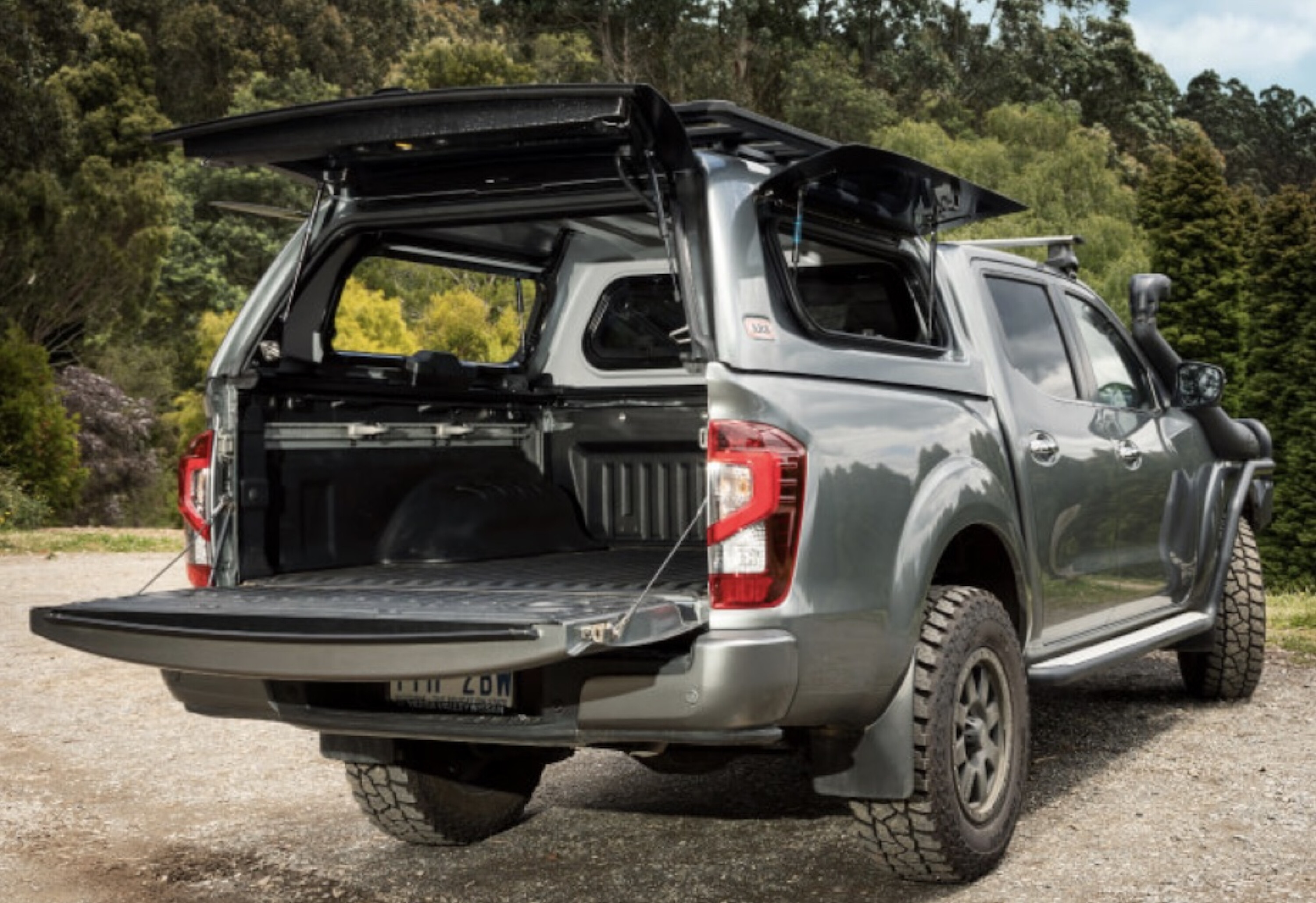
ARB has three canopy models: top-of-the-range Ascent; mid-range Classic Plus; and the original Classic.
ARB moulds it canopies from UV-stable ABS thermoplastic polymer, layered for maximum strength. Features and options include (they vary depending on the model) remote central locking, double-lock handles or twist-lock handles; tinted, lift-up windows with push-button opening; tinted sliding windows; roof-top canopy vent to pressurise canopy; rear-mounted spoiler with LED brake light; LED internal light; security mesh for side windows; vent catch to have window ajar, but still locked; canopy roof racks with internal stiffeners; and ute liners.
Camp King Industries manufactures ute canopies (or tub toppers) designed to carry heavy loads on top. With a 300kg load rating, these sturdy aluminium canopies will easily carry a rooftop tent plus accessories.
All canopies come supplied with instructions, all seals, latches and bolts needed for DIY installation. Camp King Industries also provides a fitting service at its Brisbane factory. Camp King offers four kits, each with a range of accessories: Travelling Companion; Tradies Choice; Day Trip; and Weekend Warrior.
Or if you prefer, specify your own accessories. Options include top rail kit; hard-shell rooftop tent; awning brackets; high-quality black windows; sliding windows; rear brake light; 270° free-standing awning; rear drawer unit; fridge slides; Expedition 134 storage boxes; solar panel and mounting kit; 12V Kit (1x LED Light, 1x 12V Round Socket and 2x USB Charging Points); and an extra ladder mounting bracket.
The canopy has a sturdy internal frame, made from 50x50x3 SHS (front to back), 50x25x3 RHS (across) rectangular tubing. This gives it the strength to carry heavy loads on top, yet still be lightweight. A high-quality, durable Australian-made product with tons of accessories … and the load-carrying capacity to match.
Flexiglass has four canopy models: FlexiSport Premium; FlexiSport; FlexiTrade; FlexiEdge. The canopies are made from reinforced fibreglass, designed to flex with the tub. This reduces the chance of damage to both the canopy and the tub.
Features and options include (they vary depending on the model): Remote central locking; push-button opening side windows; pop-up or rotary air vents; tinted, lift-up or sliding windows; security mesh for side windows; rear LED brake light; LED internal light; rear window demister; felt-lined interior; tailgate assist; canopy roof racks with internal stiffeners; mats; and tub liners.
This Western Australian company started in 1949, making its first canopies with timber frames and sheet metal panels for Holden FJ utes. It’s fair to say Flexiglass has a long track record of building ute canopies designed for Australian conditions.
Ironman 4×4 sells three different ute canopy products: fibreglass Pinnacle, aluminium Alu-Cab Explorer; ABS plastic Thermo-Plas.
Features and options for the Pinnacle (fibreglass) include track mount roof racks; lift-up and sliding windows; rear window central locking; sliding front window; rear LED brake light; and an LED internal light. The Alu-Cab Explorer (aluminium) includes built-in roof rails; full-length side doors; an internal frame; and tamper-proof locks. The Thermo-Plas (ABS plastic) features lift-up side windows; an Internal support frame; plug-and-play wiring loom; rear window central locking; and a rear LED brake light.
Ironman 4×4 lists the weight of the Pinnacle model as 100kg, which is a heavy unit considering it’s made from fibreglass. Unfortunately, Ironman doesn’t specify weights for the other two brands.
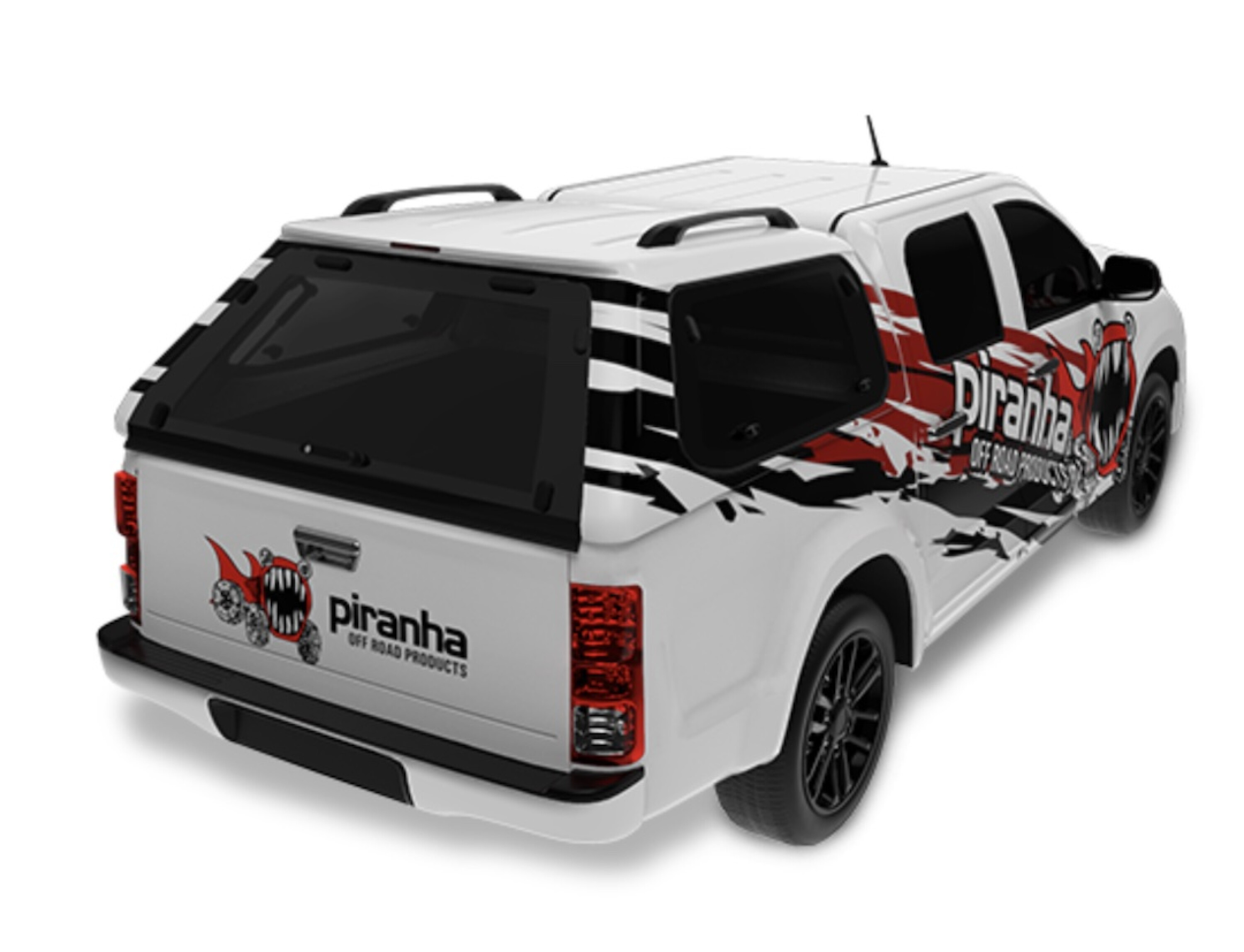
Piranha Off Road ute canopies are made from three-layer reinforced composite fibreglass. This results in a tough and durable canopy that’s designed to withstand punishing off-road conditions, making it a good all-round option for touring vehicles.
Features and options include a smooth external surface with integrated roof rails; tinted lift-up or sliding windows, or a combination of both; front sliding window; rear window central locking; heated rear window; internals lined with automotive carpet; rear-mounted spoiler with LED brake light; and an LED internal light with integrated power supply.
Razorback Canopies offers two premium canopy models: Fibreglass; and Zincalume steel. Both are lightweight, premium canopies. The downside of being lightweight is the relatively small roof loading which is100kg on-road and only 65kg off-road.
Features and options include (they vary depending on the model): remote central locking; single-hand opening rear window; LED internal light, battery operated; internal lined with heavy-duty vinyl; fully framed rear window (steel canopy); tinted, lift-up side windows; dliding front window; rear spoiler; rear LED brake light; and standard roof rails. Razorback uses double-stage rotary locks (the same ones used in car doors) in the rear window of its steel canopies, making them highly secure.
SMM is a Thai company with a background in manufacturing OEM truck bodies, trays and canopies for utes. It works with global vehicle companies, supplying equipment on a large scale. So, SMM is backed by an extensive R&D department with tooling needed for large-scale manufacturing.
SMM has three models: the premium SMM V4 Executive; the mid-range SMM V2 Executive; and the functional SMM V2 Tradesman. Features and options include (they vary depending on the model) remote central locking on rear door; single-hand opening rear window; interior fully lined; tinted, lift-up or sliding side windows (steel panels on tradie version); security mesh on side and front windows; rear window demister; interior light; rear spoiler; rear LED brake light; and standard roof rails.
SMM’s use of galvannealed steel means it has a base metal with a high level of corrosion protection. What’s galvannealing? The steel’s first galvanised, then run through a high-temperature annealing process. Annealing heats the base steel and the zinc within the galvanised coating, to the point where they start combining. This gives a tough, corrosion-resistant finish for maximum protection.
TJM offers premium fibreglass canopies and AeroKlas canopies made from a double-shell ABS. ABS is an impact-resistant thermoplastic, with high strength, rigidity and good insulation properties.
TJM has two models: TJM Premium and AeroKlas Stylish. Features and options include (they vary depending on the model): remote central locking on all windows; drop-down front window; sliding, lift-up or pop-out side windows; felt-lined interior; rear spoiler; canopy vent; wiring harnesses; LED interior light; rear LED brake light; and standard roof rails. TJM also supplies a huge range of accessories to fit-out your ute canopy for long-distance touring.
The standard ute tub is a basic bit of gear, but add a tub liner, canopy and a drawer system, and your ute becomes an ideal weekend adventurer or tourer.
A canopy adds security, protects your gear, and allows you to carry loads on top. Whether the load’s a rooftop tent, a load of timber for work or a second spare, choosing the right canopy is important. Which canopy you choose depends on what you plan to use it for.
As with any piece of aftermarket gear added to a 4×4 build, it’s important to first establish what your intended purpose is: Are you a tradie looking to keep your tools safe? Perhaps you’re planning your next Red Centre run?
Once that’s established and you’ve started the long, tedious process of browsing aftermarket catalogues, there are a handful of essential elements to keep in mind including materials, construction, fitment, roof-load capacity, access, accessories and aesthetics, to name a few.
As with any off-road purchase, ensure the supplier has a quality reputation and can back its product with aftermarket support and a substantial warranty.
Load rating
By installing a canopy, like a tub topper, and then loading it with tools and/or gear for your next camping trip, the kilograms will begin to rise. This is why it’s critical to always monitor your vehicle’s weight and not overload it.
Most canopies will easily cope with a couple of lightweight kayaks. On the other hand, a rooftop tent is heavy amd will need a sturdy canopy with a high load rating.
And you need to consider roof loading based on type of travel. As a rule of thumb, off-road loading should be 50 to 75 per cent of the rated (on-road) capacity. Most canopy manufacturers specify on-road roof loading.
A few quote both static and dynamic loading. Static loading is a useful number when you fit a rooftop tent, roof platform or similar. It tells you how much weight the canopy will take when you’re parked up, with you and your partner sleeping in it. Dynamic loading is the load rating when travelling.
Is dynamic loading the on-road or the off-road rating? It depends on what figures the manufacturer quotes. Without contacting them directly, it’s impossible to tell. Unfortunately, there’s no standard for specifying loadings.
If in doubt, assume dynamic loading is the on-road capacity, then down-rate the figure for off-road use. Why derate for off-road travel? Because twisting forces, vibrations and rough conditions mean your canopy will be subject to a whole lot of extra loads that will try to rip your canopy apart.
The 50 to 75 per cent load rating is a wide range. Use common sense here. If you’re planning on a trip on rough outback roads or a full-on crawl over the wild tracks of the Victorian High Country, then go with 50 per cent. On the other hand, 75 per cent will be okay if you’ll be driving along well-maintained gravel roads.
Say the canopy’s roof loading is 100kg, then you’re potentially down to 50kg when off-road … less the weight of the roof bars and roof basket or roof platform. That’s maybe a kayak or a couple of swags and no more. Forget about carrying a spare tyre or fitting a rooftop tent.
Generally, a steel or aluminium canopy will have a higher load rating than a fibreglass canopy, but not always. The load rating depends on how the canopy’s made and whether it has an internal frame.
Materials
Canopies come in a variety of shapes and sizes and are constructed using different materials, with your budget typically dictating what path you’ll head down when the time comes to swipe the credit card. Typically, you’ll have to choose between stainless steel, fibreglass, aluminium/metal, or a form of plastic construction.
A quick glance through the canopies we’ve included in our list reveals a wide variety of materials: fibreglass, ABS thermoplastic, mild steel, stainless steel, and aluminium.
Fibreglass is more the traditional material which canopies were made from. They generally have additives to increase strength and UV resistance. The biggest advantage of fibreglass is they’re lightweight. However, manufacturers are now making aluminium and even steel canopies at equivalent weights, qnd their roof loadings are usually (but not always) double or triple that of fibreglass equivalents.
The big advantage of steel or aluminium over fibreglass is window-opening sizes. Due to steel’s inherent strength, window mullions can be thinner. So the openings are larger, making them easier to access and easier to pack.
Keep in mind, however, that metal fatigue is more prominent in aluminium than stainless steel, so aluminium may have a tendency to crack more easily over time. Stainless steel is an extremely strong and versatile material and, contrary to popular belief, isn’t as heavy as you’d think.
One positive of fibreglass and ABS over steel are their insulation properties. As a rule, they don’t transmit as much heat into the canopy as steel and aluminium.
Security
One of the biggest benefits of a canopy is knowing the gear in the tub is safe, and that’s why you should pay attention to the window latches. Look closely at canopies with T-handles, as they can easily be pried open.
We had folding T-handles on a set of toolboxes once, and after several thousand kilometres of corrugations, they decided to snap all by themselves. It’s not a great feeling when you glance in the mirror and see your gear falling out on to the road.
The best latch is a compression latch, as they’re highly reliable and difficult to break in to.
Central locking
Most premium canopies offer central locking. Some include all windows, while others only have central locking on the rear window. Central locking is super-convenient, no doubt, but consider where the canopy will spend most of its life.
We’ve seen more than one canopy central-locking system fail in rough, dusty conditions. Sometimes they fail-locked, other times they won’t lock at all. Either one is particularly frustrating, especially when the keyhole’s plugged up with red dust.
If your ute will be spending its life traversing back blocks, central locking is probably not such a good idea. But if your ute spends most of its life in the suburbs, then central locking is a no-brainer.
Clamping or bolting?
Some canopies clamp to the tub lip with multiple clamps; others require bolts through the tub lip, which means you need to drill into the tub The strongest canopies tend to brace down to the floor of the tub – this way the canopy doesn’t rely on the sides of the tub for strength or support.
Some of you will be okay with drilling holes in the tub’s top lip, while others would rather the less-invasive clamping method – it depends on what you’re comfortable with. Either way, look for canopies which extend down slightly past the top of the lip on the outside faces, as this helps keep the rain and the dust out.
Other considerations
An air hatch is a useful addition to any canopy. It pressurises the canopy, minimising the amount of dust ingress, and it also helps keep the canopy cooler on hot days. Another consideration is whether the canopy is lined, as this adds a touch of luxury and helps to insulate it from cold and heat.
Internal lights are essential. Some canopies have the same system as vehicle’s internal lights – they switch on when the rear door opens. Some lights have their own battery, while others are powered from the vehicle.
If your canopy has the option of internal lights or central locking, check where the electrics connect. This can mean the difference between a simple installation and the need to run extra cabling to the starting battery.
4X4 Australia has been reviewing four-wheel drive vehicles, aftermarket products and camping gear for more than 40 years. When looking for the best swags in Australia there are some things that are essential to ensure you sleep soundly under the stars.
When we compared each of the swags in the list with hundreds out there we looked at the size, weight, durability and price. We also searched for additional features that make these swags stand out from the rest.
We looked at hundreds of user reviews and drew on our own experience sleeping in swags to make sure our recommendations are for the best on the market.
Disclosure: When you buy through our links, we may earn a commission. We also include products that we do not earn a commission from.
While it is closer in size to the Toyota LandCruiser 300 Series, the GWM Tank 500 will launch with a starting price undercutting the soon-to-be-replaced Prado, at $66,490 drive-away for the Lux Hybrid variant.
The range-topping Tank 500 Ultra Hybrid is priced at $73,990 drive-away, a $7500 premium over the entry variant.
UPDATE, 14/02/24: Drive-away pricing for the flagship GWM Tank 500 Ultra Hybrid variant has been confirmed.
1
Both variants are powered by a hybrid 2.0-litre turbo-petrol four-cylinder producing 258kW and 615Nm in total– equivalent to the smaller Tank 300 Hybrid – matched to a nine-speed automatic transmission and a low-range four-wheel-drive system.
A locking rear differential will be standard on the entry-level Lux Hybrid, while the flagship Ultra Hybrid adds a locking front differential.
Braked towing capacity for the GWM Tank 500 is rated at 3000 kilograms, equivalent to the current Toyota Prado but down on the 3.5-tonne tow rating of the diesel-powered Ford Everest and Isuzu D-Max.
1
It measures 5078mm long, 1934mm wide and 1905mm tall, with room for seven occupants.
More details on the 2024 GWM Tank 500 off-road SUV will be confirmed closer to its local launch between April and June.
2024 GWM Tank 500 pricing
1
2024 GWM Tank 500 initial features
2024 GWM Tank 500 Lux Hybrid features
18-inch alloy wheels
Eight-way power-adjustable driver’s seat with lumbar support
Wire up a set of Roadvision’s all-new, cutting-edge S8 Stealth Series driving lights to the front of your 4×4 and you’ll be well-equipped to navigate terrain when the sun dips below the horizon.
The powerful eight-inch units boast an impressive 7937 lumens per light, which will undoubtedly ensure class-leading visibility for a wide range of driving conditions – think a lap of the map, or weekend adventures with mates in pursuit of remote campsites. Each light features 24 x 6W Cree LEDS, which project an impressive beam penetration of 768 metres (1086 metres per pair) at 1 lux.
A key cog to this extraordinary performance is Roadvision’s Thermal Management Technology, which in tandem to maximising light output also plays an important role in dissipating heat and ensuring reliable and durable performance in Australia’s harsh and unforgiving elements.
Strengthening the units further is the use of robust, lightweight aluminium housing and polycarbonate lenses, which protects the lights from rocks and debris. Not only is the S8 Stealth Series practical and durable, it’s also contemporary in its design. The driving lights feature black mounting hardware and innovative dual colour (white/amber) HALO DRLs which feature a bezel-less design.
1
The lights also come with a low-profile mounting bracket to optimise bull bar space, as well as a unique light cover that allows the HALO DRL to remain visible when in use. The icing on the cake is that Roadvision offers a generous seven-year warranty on the S8 Stealth Series, so you can be rest-assured they’re up to the task for many years of hardcore off-roading. With 50,000-hour LED lifespan, that’s not surprising.
“Our commitment to innovation, durability, and performance is at the core of our product development,” says Andrew Bird, Product Manager, Roadvision. “We strive to redefine what’s possible in automotive lighting, and the S8 Stealth Series Driving Lights are a testament to that commitment.”
Roadvision’s S8 Stealth Series driving lights are available to purchase now from leading automotive retailers.
The 2024 Toyota Prado off-road SUV will be offered in five variants when it lands in Australia around May or June.
Toyota Australia has confirmed the 2024 LandCruiser Prado large SUV – the first all-new model since 2009 – will be offered in a new off-road-focused Altitude variant, which will slot between the familiar VX and Kakadu flagship grades.
It will also continue to be offered in GX and GXL variants, with five seats for the GX and Altitude or seven seats for the GXL, VX and Kakadu.
All variants of the 2024 Toyota Prado continue to be powered by a 2.8-litre four-cylinder turbo-diesel producing 150kW and 500Nm.
However, it is now matched to an eight-speed torque-converter automatic transmission – up from six speeds – and the same fuel-saving 48-volt system coming to the HiLux ute in March for improved fuel efficiency, a quieter engine startup, and smoother initial take-off.
Under the skin, all models offer a full-time all-wheel-drive system with a lockable torque-sensing Torsen centre differential and low-range gearing. Electric power steering is also added.
1
Toyota Australia has officially announced the new Prado will offer a 3.5-tonne braked towing capacity – up from three tonnes – matching the Ford Everest, Isuzu MU-X, and its full-size LandCruiser 300 sibling.
New features across the LandCruiser Prado line-up include a larger 12.3-inch infotainment system, a 7- or 12.3-inch instrument cluster display (up from 4.2-inch), wireless Apple CarPlay and Android Auto, Toyota Connected Services, a 360-degree camera system, front and rear parking sensors, USB-C ports, a 220-volt power outlet, and standard climate control.
The GXL adds an electric tailgate – which is now flat on all models with the spare wheel mounted underneath – standard leather-accented upholstery, an auto-dimming rear-view mirror, and a wireless phone charger over the outgoing model.
The VX now features 20-inch alloy wheels (up from 19-inch), a full-digital instrument cluster, adaptive variable suspension, a power-adjustable steering wheel, multi-terrain select, and a Toyota-first multi-terrain monitor to view the vehicle’s underfloor while driving.
1
The “adventure-focused” Altitude is a new permanent variant in the line-up, borrowing its name from limited edition Prado models offered between 2012 and 2017.
It replaces adaptive variable suspension with a stabiliser disconnect mechanism to provide “an extra 10 per cent of wheel articulation to help maximise traction on uneven surfaces” and reverts to 18-inch alloys with all-terrain tyres.
Topping the new Prado range is the Kakadu, which now sports a digital rear-view mirror, a heated steering wheel, heated and ventilated rear seats, a panoramic moon roof, illuminated side steps, a head-up display, and a rear torque-sensing limited-slip differential.
A full list of confirmed features is available below.
1
All Prado variants will be fitted with a full suite of active safety technology, including front and rear autonomous emergency braking, lane-trace assist, blind-spot alert and adaptive cruise control.
It also has nine airbags – up from seven – along with trailer sway control, active traction control, downhill assist control, and ‘crawl’ off-road cruise control with five selectable speed settings.
Up to eight exterior colours will be offered for the new Prado, including two Altitude-exclusive finishes: Tanami Taupe and Ningaloo Blue. Certain colours will be available with a two-tone white roof for the Altitude.
More details about the 2024 Toyota LandCruiser Prado large SUV, including pricing and full specifications, are due to be confirmed closer to its launch around May or June.
Bull bars are virtually essential for 4x4s in Australia … at least for anyone who travels out of the cities.
They’re cheap insurance against animal strikes, where an encounter with a kangaroo can take out your radiator. Far better to spend a few bucks on a decent bull bar than be stranded in the middle of nowhere. Even if you live just out of town, chances are you’ll have an unwelcome meeting with a stray animal sooner or later.
Bull bars also protect the front of your vehicle from wayward trees, branches, stumps, and even large boulders when you’re picking your way through a tight bush track. And they’re the perfect spot to mount winches, aerials and driving lights.
So what’s available on the local market? Plenty as it turns out. To help you narrow down your choices, we’ll go through the various bull bar suppliers. They each have stacks of models in steel and alloy … some even supply polyurethane bars.
AFN bull bars are manufactured in Portugal by a company which supplies military equipment. It supplies both a three-hoop and a no-hoop design.
All AFN bull bars are airbag-compatible, ADR-compatible and winch-compatible. They include dual aerial mounts, driving-light mounts and high-lift jacking points. These bars fit snugly to minimise front overhang and maximise front clearance angle.
ARB has a range of 11 bull bars including Commercial, Deluxe, Sahara, alloy and polyurethane bars.
Commercial bars are where functionality and cost are the highest priorities. A simplified manufacturing process makes these bars perfectly suited to fleet and government vehicles. Deluxe bars are ARB’s traditional bar, and they’re fully compatible with safety features like collision avoidance and adaptive cruise control. Sahara bars have all the features of a full bull bar, but only have one hoop to protect the radiator.
Alloy bars are for those seeking something lighter than steel, while polyurethane bars are rotational-moulded as one piece and are ideal for applications where weight is critical. Most bull bars are available as winch bars. All are airbag- and ADR-compatible. Fog and indicator lights are recessed for added protection, and some models are compatible with side protection rails.
Dobinsons bull bars are designed and manufactured locally by Outback Accessories, and it makes three models, all steel and all powder-coated.
The Classic Black is a functional design for fleets, government vehicles and tradies; the Classic Black Deluxe includes driving lights; and the Stainless Loop Deluxe features stainless-steel hoops. All Dobinsons bull bars are airbag-compatible, ADR-compatible and winch-compatible. They include dual aerial mounts, driving-light mounts and high-lift jacking points.
ECB starting manufacturing bull bars in Australia in 1971. It specialises in alloy bull bars for 4WDs, vans and trucks, and its bull bars range from lightweight nudge bars and ’roo bars to premium winch bars.
All its bull bars are designed to be compatible with safety features like adaptive cruise control, parking sensors, and so on. ECB’s Big Tube Bar is the signature product. It includes fog lights and is available with or without winch mountings. The Roo Bar sits over the OEM bumper bar, like a nudge bar, and it protects the bumper, grille and headlights. It has mounting tabs to fit driving lights. The Midi Tube Bar is similar to the Roo Bar, but it’s designed to protect the OEM bumper, grille and fog lights.
The Roo Bar and Midi Tube Bar are both low-weight and low-cost options if you don’t have the coin for a full bumper bar replacement. All bull bars are airbag compatible and ADR compatible. ECB uses an industry-leading mirror-polished finish or high-quality powder-coated finishes, depending on your needs.
EFS supplies two types of bull bars, the Adventure range and the X-Cape. Its bull bars are designed locally and manufactured overseas.
The Adventure range is the premium model and it is winch-compatible and features recessed fog and indicator lights, infill trims under the headlights, and lower bull bar skid plates. The X-Cape is a winch-compatible bumper bar replacement with no hoops. It has all the features of the Adventure range, minus the hoops. All bull bars are airbag-compatible and ADR-compatible.
Ironman 4×4 has seven bull bars in its range including Commercial Premium Deluxe and Proguard.
Commercial bars are designed for function and practicality, and they’re Ideal for fleets and government buyers where cost is a major consideration. The Premium Deluxe bars include extras like integrated fog lights and colour-coding. The Proguard bar is customisable as a no-hoop, one-hoop, or three-hoop bar. And Alloy bars have all the features of the Premium Deluxe bars, with the advantage of lighter weight.
All bull bars are winch-compatible, airbag-compatible, ADR-compatible, and have high-lift jack points. Recessed fog and indicator lights are for added protection, and most models are compatible with side protection rails.
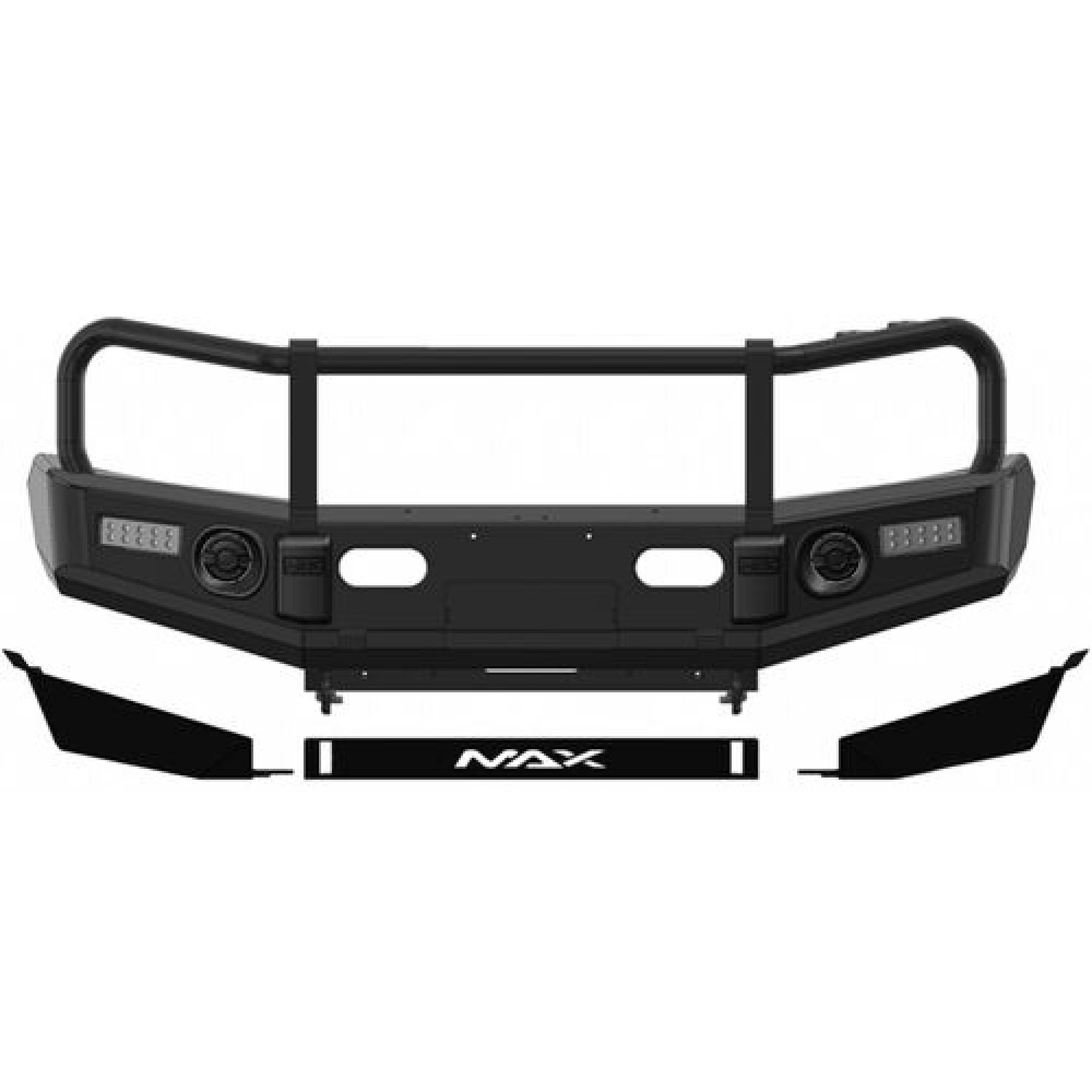
MAX bull bars are designed locally and manufactured overseas. The range includes four models which has one alloy option.
Features include mounts for driving lights; two mounts for aerials; two rated recovery points; two high-lift jacking points; and a provision for mounting fog lights. They’re airbag-compatible, ADR-compatible and winch-compatible.
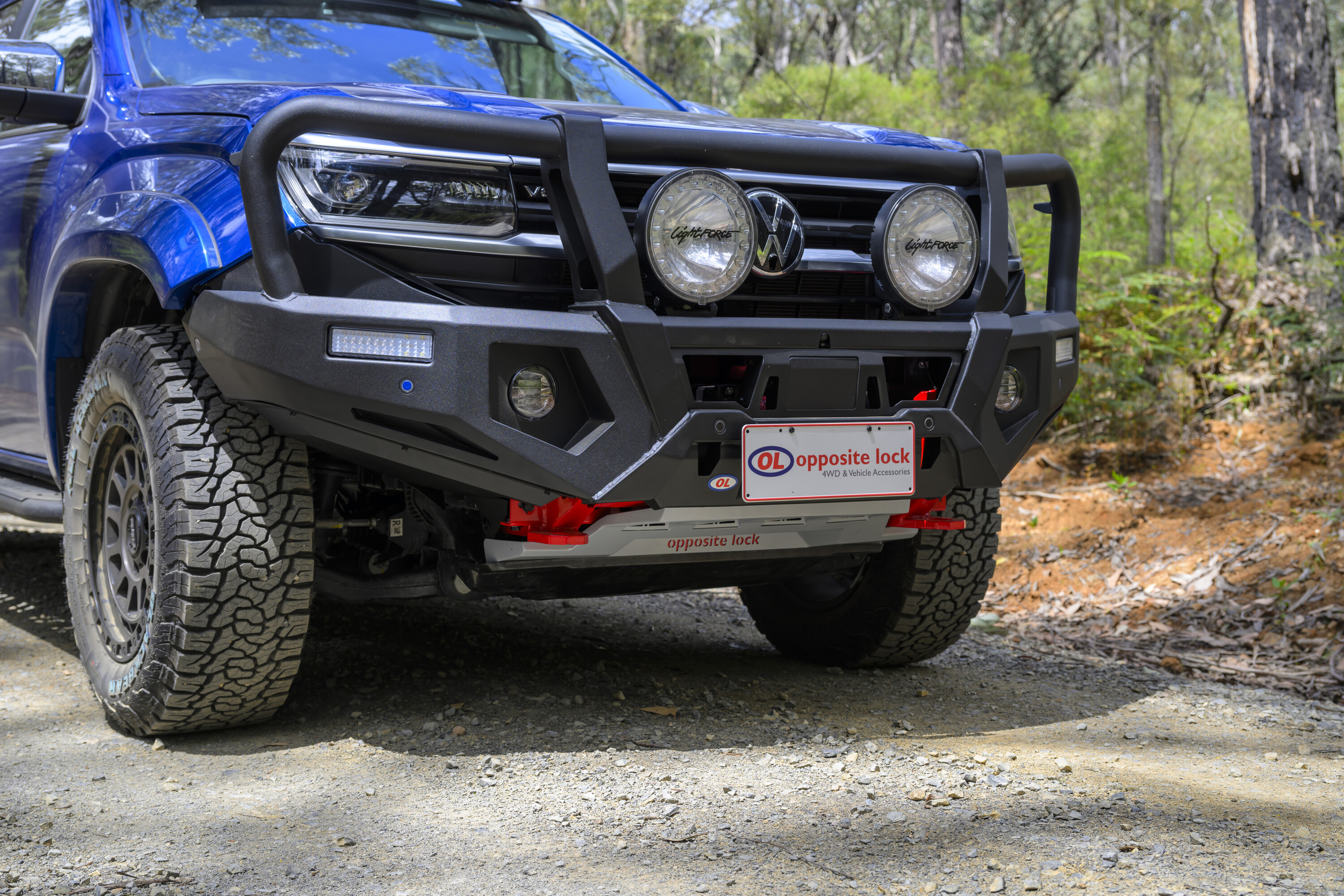
Opposite Lock’s spin on traditional frontal protection is that it’s uniquely designed and engineered in Australia to complement and enhance the vehicle’s original aesthetics.
Engineers have designed these bars to offer maximum frontal impact protection whilst being packed with features that allow the personalisation of your vehicle, ready to be equipped with a wide range of off-road accessories. The Opposite Lock Bull Bar has evolved to travel every journey from day-to-day driving to tackling some of the most extreme adventures. Made from high-grade steel to offer outstanding protection, functionality and good looks.
1
Materials
High-grade steel
Coating
Durable matte black powder coating – colour coding available
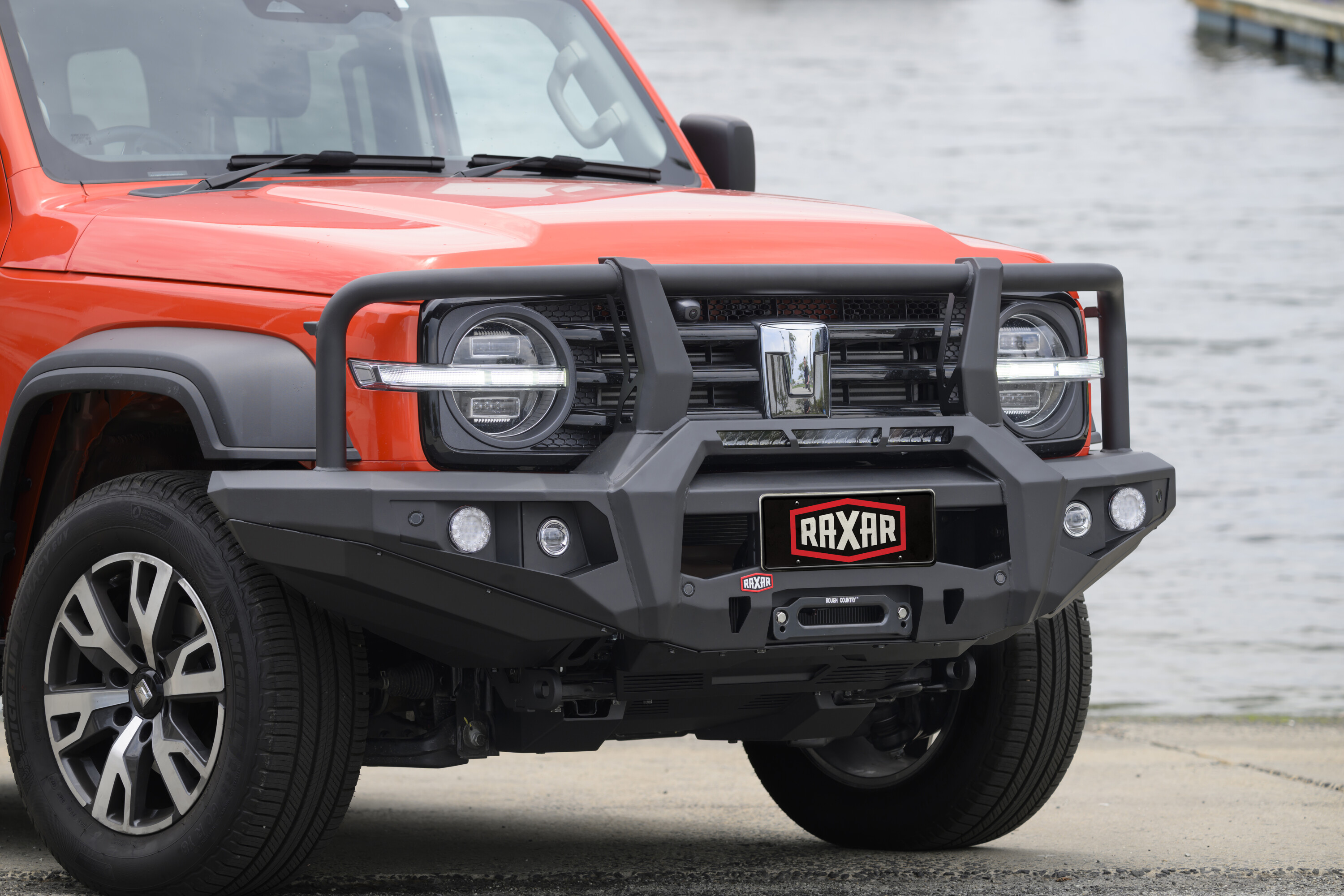
RAXAR bull bars, 4WD accessories and touring gear is for those who are passionate about their rig, enjoy the outdoors and take pride in their 4WD’s appearance.
RAXAR specialise in high-quality 4×4 accessories and equipment for off-road vehicles that is at the cutting-edge of design and innovation. The growing range of products is tough, reliable, functional and designed to meet your needs. Whether it be on the worksite, the street, or your next adventure, let RAXAR take you there in style.
1
Materials
High-grade steel
Coating
E-coated and Powder coated matte black for a durable finish
Opposite Lock offers a classic range of “no nonsense, value for money” products.
This includes 4WD bull bars, steps, rails, and under-body protection products that are designed for trade and fleet vehicles, as well as anyone looking for a quality bull bar.
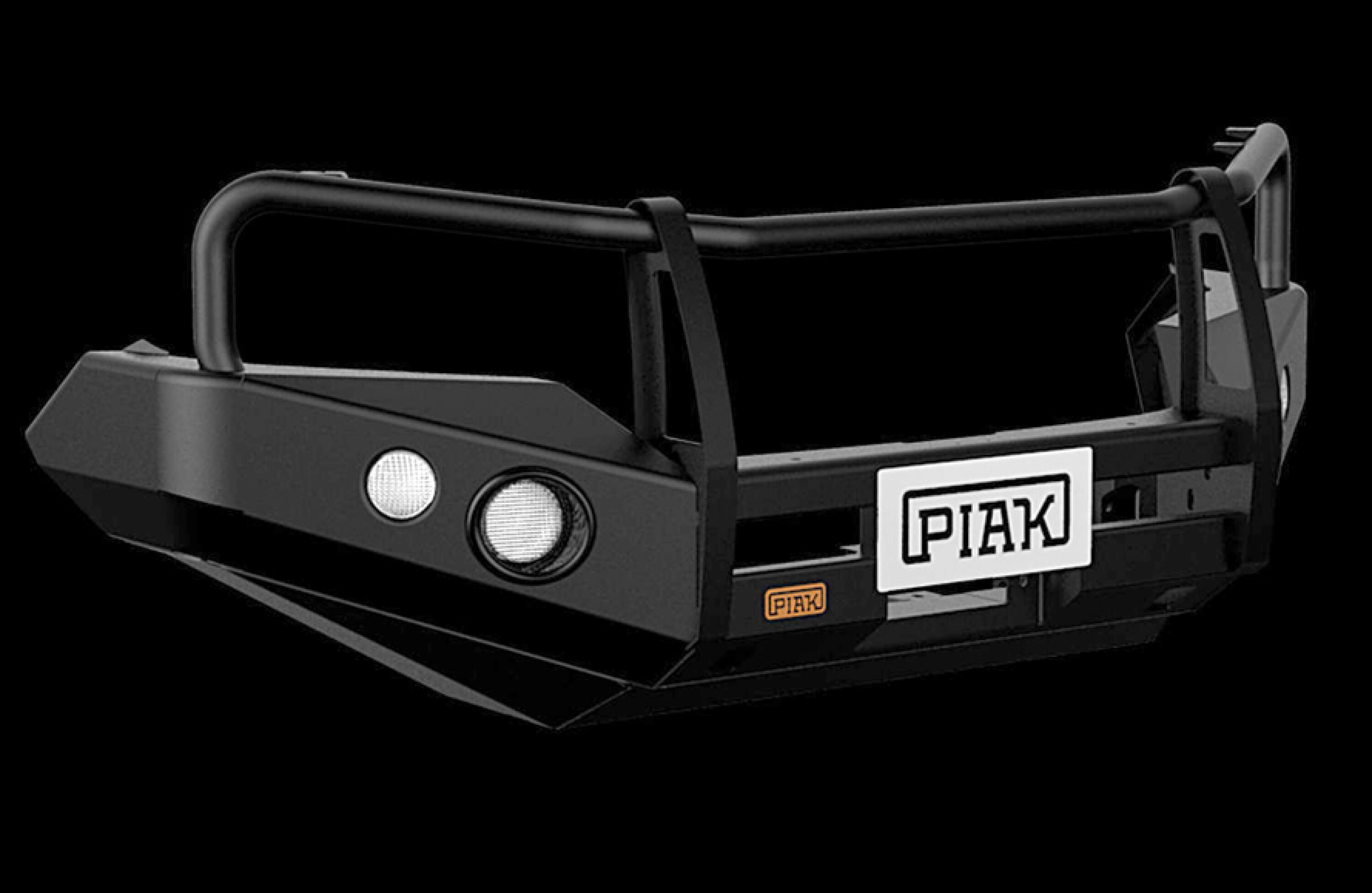
PIAK bull bars are designed and manufactured overseas, and the range includes two models which are both available as three-or no-hoop designs.
The Elite range is what PIAK calls ‘tech-compatible’, meaning they’re compatible with parking sensors, adaptive cruise control and the like. The Premium range are compatible with parking sensors and are designed for older 4WDs. All PIAK bull bars are airbag-compatible, ADR-compatible and winch-compatible.
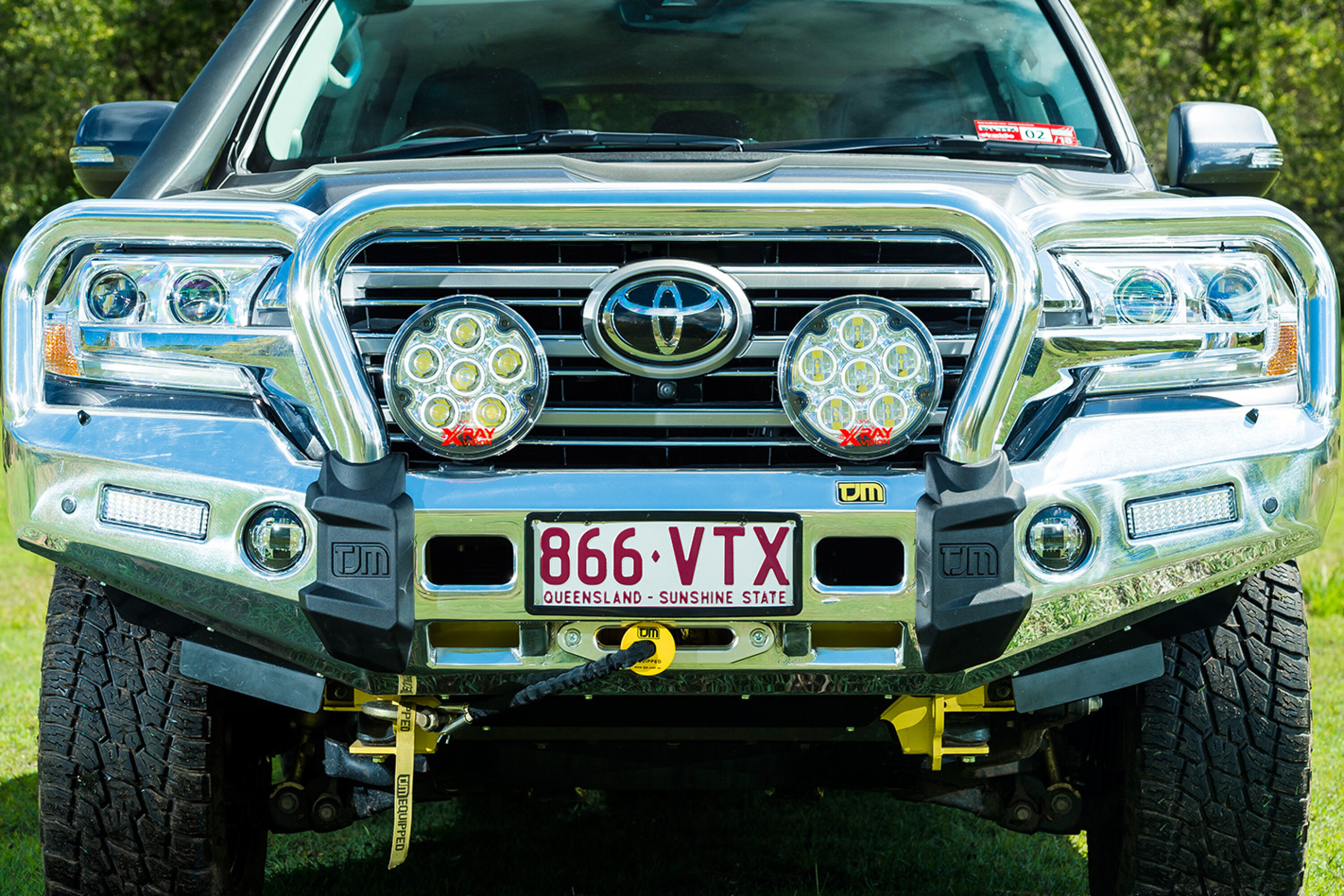
TJM bull bars are designed locally and manufactured overseas, and they cover a wide variety of vehicle makes and models, primarily with steel bull bars.
The range includes Tradesman, a functional three-hoop bar designed for fleet vehicles and tradies; the steel Outback and alloy Signature, TJM’s premium three-hoop models; the Explorer and Frontier, available with a steel or a polished alloy hoop to protect the radiator; and Venturer, Chaser and Covert no-hoop bars, replacements for the bumper bar with increased approach angle clearance over the OEM bumper bar.
Most TJM bull bars are winch-compatible and all steel bars have high-lift jacking points. A handy feature is the twin aerial mounts. All bull bars are airbag-compatible and ADR-compatible.
XROX bull bars were originally designed for comp trucks but have gained popularity in the recreational 4WD market.
Xrox have a range of features including two high-lift jacking points; four recovery hook locations; four mountings for spotlights and aerials; detachable side wings to allow easy replacement; and winch compatibility. All XROX bull bars are airbag- and ADR-compatible. Most are a one-hoop design to protect the radiator and to allow additional mounting points for aerials, sand flags and driving lights. The remainder are the no-hoop design, so you lose the extra mounting points but maintain all other features.
Its comp truck heritage means the bull bars have a massive approach-angle clearance, plus a super-solid construction. The replaceable wings are a great idea for those who love taking 4WDing to the extreme.
Why install an aftermarket bullbar? Two main reasons: protection and convenience.
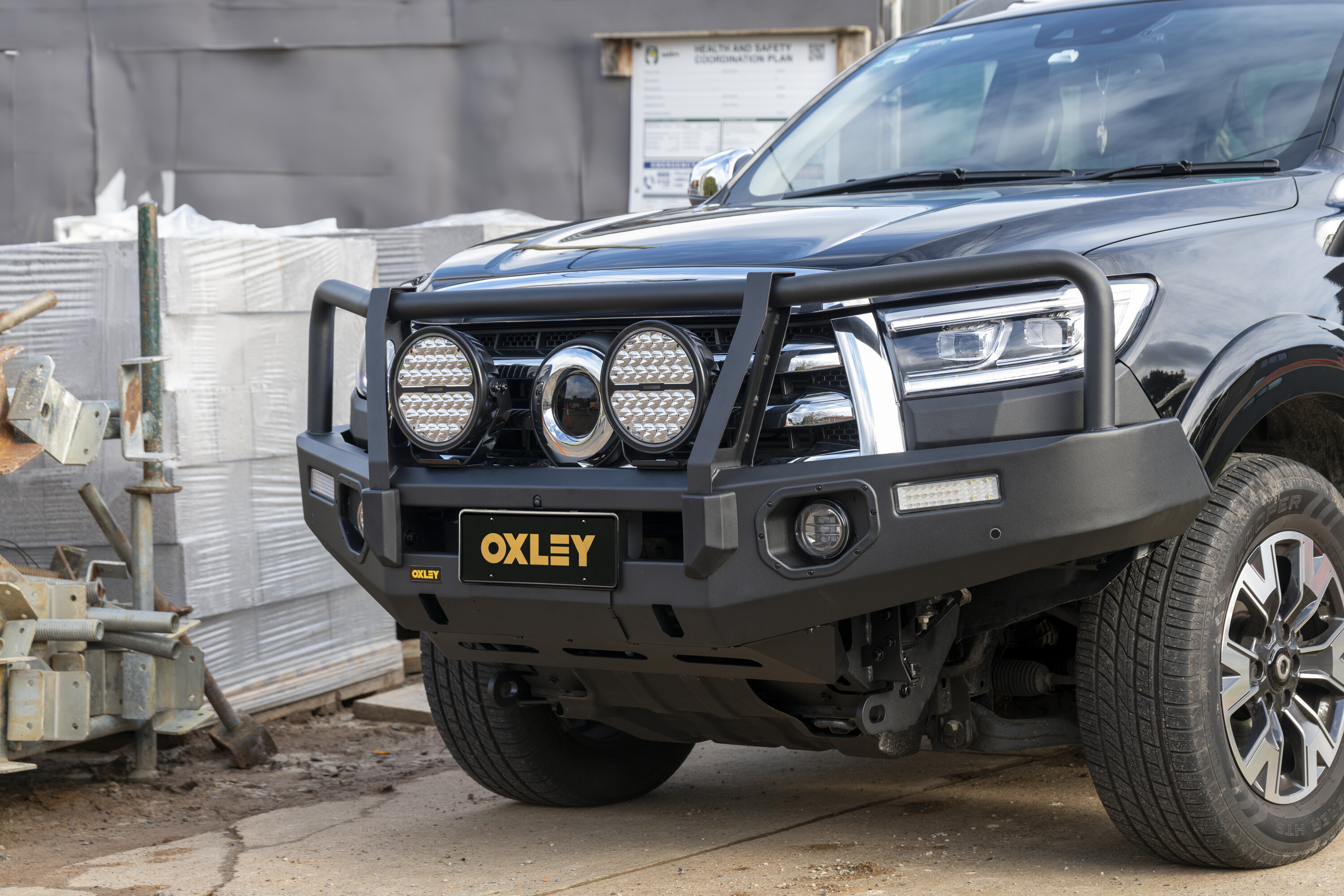
A quality bullbar will afford the front of your vehicle (and all of the important mechanical bits) superior protection from kamikaze animals and wayward drivers, but it will also protect in dense scrub when truly off-road on the hunt for an elusive, out-of-the-way campsite.
Depending on the type fitted and what it’s made of, a good-quality bullbar will absorb the majority of impacts and protect the bits of the car that matter – namely the radiator and cooling system. A good bullbar will also provide a great base from which to attach other essential off-road kit – winches, light bars, LEDs and antennas.
A by-product of a bullbar, but an aspect important to many off-roaders, is the aesthetic enhancements a top-quality unit affords. Get the right one and you’ll have a bullbar that not only does the job, but looks the goods as well.
Why you need a good quality bar
You may think picking up an eBay special will save you a few pennies, but you’d be wrong. It may save you a few bucks in the short-term, but it’ll come back to bite you on the arse in the long run.
While an el-cheapo bullbar may look like the real thing on the outside, appearances can be deceiving. Steve Sampson, ARB’s product manager, explained: “A lot of the differences won’t so much be on the parts you see of the bar, as the outer appearance of the bar will look similar [to a high quality one].
One of the most important things is how the bar is attached to the chassis, and whether airbags will still deploy at the same rate.
“We do a lot of testing to ensure that the crash-rate characteristics of the vehicle haven’t been affected by having a bullbar on the front, so there’s a lot of work and a lot of bracing in behind the bar which you don’t necessarily see,” he explained.
If you happen to bang your 4×4 into a tree on a steep descent down Billy Goat Bluff, then you’ll be wishing you spent a few extra quid on a better bar.
“If you were to have an accident, the bar’s not going to perform the way it should,” Sampson continued. “If the vehicle chassis mounts are made to a price point, as opposed to a function point, then that’s where the problems start.”
Opposite Lock’s general manager, Adam O’Sullivan, concurred: “Before an Opposite Lock (OL) bullbar can be released to the public, it must first pass through a series of complex design, build, test, safety and production phases.
There are many, many negatives to a poorly designed, developed and manufactured bullbar, including the fact of non-ADR-compliant hardware and accessories.”
That’s the key thing to remember when umming-and-ahhing over whether to cheap out on a crappy bullbar: will it do the job it’s designed to do?
Ironman 4×4’s product director, Adam Craze, reiterated that point: “We have them tested in Australia for the safety components and also out on the tracks to ensure they work the way we know they need to when in use. We use the best material and equipment to make our bullbars. There are no shortcuts along the way.”
TJM is an Australian company that has been designing and manufacturing a range of steel and alloy Frontal Protection Systems (bullbars) since 1973.
“When a bullbar that doesn’t comply with relevant ADRs or hasn’t been tested to be airbag-compatible is installed on a vehicle, the safety of all occupants are at risk due to the chance of airbags not being deployed when required, as well as the possibility of costly repair bills if airbags deploy incorrectly when not required,” Albert Swanepoel, TJM’s Vehicle Protection Category Manager, told us. “Properly designed and meticulously tested TJM Frontal Protection Systems ensure airbag deployment when necessary as well as prevent unnecessary activation.”
Albert added: “Poorly designed mounting system may not handle winching loads well and cause damage to the bullbar and/or vehicle. The same poorly designed mounting system (and lack of proper testing) may result in vehicle damage through everyday use due to lack of sufficient clearance between the bullbar and vehicle. This is one of many issues that may arise with poorly designed vehicle protection systems.
“TJM Frontal Protection Systems are tested and proven to be able to withstand more than reasonable loads during winching operation, with the mounting system rated to loads of up to 12,000lb.”
A well-designed bullbar will also absorb the impact of a collision with a 100kg+ animal and, in doing so, protect the vehicle’s occupants.
ECB’s executive sales and marketing manager, Gaven Paterson, said: “Most animal strikes happen suddenly and unexpectedly, and the exclusive triangulation design and our reinforced 6mm channel will protect the front of the vehicle every time, even against the biggest animal.”
“Every bullbar should be designed to protect the entire front of the vehicle, including the grill, bonnet and, most definitely, the front wheels.”
Serving a purpose
You have confirmed you need a bullbar and you’ve settled on a good quality product, so what next? Now it’s time to decide what sort of bullbar you want. Do you need a full bumper replacement or a cut/over OE bumper?
Do you want full, single, or no hoops? Are you after a tube or a competition-style bar? Does it have recovery points and mounts for lights and aerials? And, crucially, is it ADR and airbag compliant?
The most important thing to remember is the intended use of your 4×4. Alex Surwillo, from ARB’s marketing team, said: “It depends on what level of protection, functionality and aesthetic appeal the customer is looking for.
Our Summit and Deluxe bullbars are a popular choice for those who want premium protection and functionality, featuring integrated jacking points and the ability to mount lights, antennas and a winch. We also manufacture a range of other bullbars to suit different aesthetic preferences and budgets.”
There’s no point opting for a full-hooped bar if you don’t plan on partaking in any off-roading, but a single-hoop bar could be more up your alley if your route involves dark country roads and ’roos with death wishes.
If greater approach and departure angles take precedence over all-out protection, then a lightweight and simple tube bar (such as the XROX) should be atop the wishlist.
Mounting points for aerials and lighting are also important for some buyers, so it pays to research.
“TJM bullbars incorporate and are designed to function properly with vehicle features (parking sensors, radar systems),” Albert Swanepoel from TJM said. “They’re also a quality platform to mount accessories like driving lights and aerials without any modification.”
All TJM bullbars are designed and tested in Australia and feature a quality designed and engineered patented mounting system to ensure the bullbar is securely fastened to the safest and strongest parts of the chassis.
“[With our bars] all the loads from winching and kinetic recoveries are directed equally into the chassis rails without compromising the airbag compatibility,” Albert said. “By not sending the winch loads through the airbag crumple zones TJM can provide incredible strength in the mountings, while reducing load on the chassis rails thanks to minimal overhang.”
Steel, alloy or plastic?
That same principle – the intended purpose of the vehicle – also applies when deciding on a steel, alloy or plastic bullbar. Each material has its individual pros and cons, and each is tailored to suit very different purposes.
“Alloy bars are generally lighter, which means you can pack more gear in and are less likely to need a suspension upgrade. Alloy bars can be higher maintenance due to their finish, as they do require more care to keep them looking shiny,” explained Adam O’Sullivan.
“Steel bars are heavier and you need to take the bullbar weight into account when calculating your GVM. Due to the increased weight, you may also need to upgrade your suspension when installing a steel bullbar. Steel bullbars are heavier, yet have less give and flex due to their construction.”
Adam Craze added: “Aluminum bars don’t rust so are perfect for beach drivers, but do require regular maintenance to maintain their shine. On the other hand, steel bars offer better protection, a stronger platform for accessories and are easier to manufacture. Steel is also easier to repair.”
However, just because alloy bullbars are lighter doesn’t mean they’re necessarily weaker. “Don’t be fooled thinking just because alloy bullbars are lighter that they’re weaker, as most modern, quality-made alloy bullbars are extremely tough and durable,” Craze said.
“Steel bullbars are built around the concept of strength and function, with an old perception that aluminum is made for shiny looks and lightweight protections. But now with better grades of aluminum, we can design an aluminum bar with the strength properties close to that of a steel bar but with a weight saving of around 30 per cent.”
ARB has been designing steel bullbars in-house for more than 40 years, but with market demand shifting – and modern vehicles becoming more dual-purpose – there has been an obvious requirement for a lighter product.
Not that alloy is new to ARB. “We have a long history manufacturing alloy bullbars dating back to the 80s, and we have also been making alloy roof racks for about nine years,” Steve Sampson told us. “So we have significant experience in dealing with alloy.”
Sampson went on to explain the assembly of an ARB alloy bar: “Compared to a steel bar, the alloy bar assembly is lighter, however the mounting system and winch cradle is still manufactured from steel so that the weight and stress of winch forces is transmitted to the chassis, not the alloy. An alloy bar with a winch fitted can be a comparable weight to a steel bar without a winch.
“As the lower pan of both bars is essentially the same style – both steel and alloy bars have the same approach angle. There’s no difference with how the vehicle gets used, it comes down more to appearance on the vehicle and maintenance – a polished alloy surface will need to be cleaned more regularly,” he said.
East Coast Bullbars (ECB), based in Queensland, specialise in alloy frontal protection for vehicles built from 1980-2017. It has manufactured alloy bars since 1971, making it the oldest bullbar manufacturer in Australia.
“East Coast Bullbars are 100 per cent Australian made,” Gaven Paterson told us. “Our DNA is in manufacturing high quality products that offer superior strength whilst still being half the weight of a steel bullbar.”
“With our products being half the weight of a steel bullbar, fuel usage, tyre wear or the general handling of the vehicle won’t be affected like it would by fitting a steel bullbar.”
The average weight of an East Coast Bullbar is approximately 35kg (a steel bar is approximately 80kg).
The majority of ARB’s bullbars, however, are steel. “We have about 10 vehicles which are covered by an alloy bar, but our steel bars cover a couple of hundred vehicles,” Steve Sampson told us as we toured ARB’s Kilsyth facility (see Manufacturing Process below).
He admits, however, that the trend towards alloy bars is growing, but an obvious obstacle to fitting an alloy bar is price. “Because the materials cost more for an alloy bar, it is more expensive than a steel bar.”
EFS also research, develop, design and test (manufacturing is conducted overseas) a range of Adventure Series premium steel bullbars.
Why steel? According to James Don, EFS’s branch manager, “It’s tougher and up to the task for heavy-duty work.”
EFS bullbars are made from 63mm steel tube, are winch compatible and come with a winch cradle mounting bracket, have lower bullbar bash plates, twin aerial mounts and CNC headlight infill trims.
“The most popular vehicles we fit bullbars to are Rangers, Colorados, Hiluxes, Land Cruisers, D40s and Tritons,” Don said. “Our bullbars comply with ADR 69 standards and meet airbag safety regulations.”
An alternative bullbar is the ARB-owned SmartBar, a lightweight bar made from roto-moulded polyethylene.
“The lightweight properties of the polymer and the hollow construction consequent to the rotational moulding manufacturing process minimises the weight added to the vehicle when fitted, mitigating the effect the Vehicle Frontal Protection System (VFPS) has on GVM, which in turn has long-term positive effects on fuel consumption along with reduced wear and tear on tyres and suspension components.
Not only benefiting the customer’s pocket, but the environment, too,” SmartBar’s General Manager, Kevin Baker, told us. “The SmartBar also has what could be described as ‘muscle memory’ and generally returns to its original shape after impact.”
Upon impact, a SmartBar can compress up to 85 per cent of its depth, and then return to 95 per cent of its original shape within minutes. The SmartBar offers unrivalled occupant and pedestrian protection, and has been independently tested to ADR standards.
Ready to buy? Key things to remember
Get a top-quality bullbar from a trusted manufacturer and ensure it fulfils your personal off-roading requirements and has the capacity to house the accessories you want to fit to it (and they work as they should). Hardcore outback expedition rig? Then get a serious bullbar!
Ensure the bullbar meets ADR requirements and is compatible with airbags. No point getting the duck’s guts of bullbars if it makes your rig illegal or unsafe to run.
As Adam Craze explained: “All of our bullbars are designed and tested by Ironman 4×4. We have them tested in Australia for the safety components and also out on the tracks to ensure they work the way we know they need to when in use.”
Double-check it has recovery points and that it doesn’t hinder ground clearance or other functions (sensors, etc.).
“With the release of modern vehicles, new systems, radar systems and headlight washers, we have had to incorporate these systems into our bars,” said Craze. “This extends the testing period, as we need to fully complete testing on each of these components as well as the standard tests. We make a sample bar from the design and test-fit each bar prior to starting the manufacturing process.”
ECB’s Gaven Paterson added: “Our internal R&D team work tirelessly with the various vehicle manufacturers and dealerships around Australia to ensure our products are designed to work with the very latest technology in new vehicles.”
Finally, does the bullbar come with a factory warranty? Ironman 4×4 offers a 12-month warranty for its bullbars; ARB and Opposite Lock provide two-year warranties; and ECB offers an unmatched lifetime warranty.
Manufacturing process
We popped in to ARB’s Kilsyth facility to see the build process of a bullbar from go-to-whoa. The manufacturing process for the steel bars begins with a flat sheet of steel that’s cut to shape using computer-aided laser cutters.
The steel then works its way down the production line, is bent, cut and welded to shape, before being powdercoated and packaged for delivery.
Steve Sampson said: “We design, develop and manufacture. We do every stage of the process.”
Additional bullbars are also produced at ARB’s Thailand plant, which predominately services ARB’s international market. “The Thai plant is fully owned by ARB, and the quality of the product is no different. We use the same machines, same process. There’s no less quality coming out of overseas than what is produced in Kilsyth,” Sampson added.
4X4 Australia has been reviewing four-wheel drive vehicles, aftermarket products and camping gear for more than 40 years. When looking for the best swags in Australia there are some things that are essential to ensure you sleep soundly under the stars.
When we compared each of the swags in the list with hundreds out there we looked at the size, weight, durability and price. We also searched for additional features that make these swags stand out from the rest.
We looked at hundreds of user reviews and drew on our own experience sleeping in swags to make sure our recommendations are for the best on the market.
Disclosure: When you buy through our links, we may earn a commission. We also include products that we do not earn a commission from.
Four-wheel drivers know the importance of in-vehicle communication, especially when travelling to remote areas. It allows communication within a group and with other road users such as truck drivers.
But what about out-of-vehicle communication? Think trailbikers, guiding another vehicle up a tough track, a part-time four wheel driver without the need for a vehicle-mounted unit, or maybe just someone who wants the versatility of a portable unit.
Handheld UHF radios offer a flexibility car-mounted units can’t match. They do present a downside in terms of range due to the lack of a fixed antenna, but for some, the versatility may well be worth this limitation. If you’re the type of 4WD tourer who will drive somewhere, jump out of the car and set off on a hike to a waterfall or mountain top, then a handheld UHF may be just what you need.
Typically, the performance of 0.5- or 1-watt units is only suitable for the kids around camp. So to make sure your hard-earned goes towards something that will do what it says on the box, we will avoid units with less than two watts of transmit power and will only be looking at Australian Communication and Media Authority (ACMA) approved units that have been programmed with Australian channels and meet legal requirements.
So the “fully programmable” special won’t be considered here, but if you’re looking for a portable communication option for all outdoor activities, then read on. We’ve included both two- and five-watt units below.
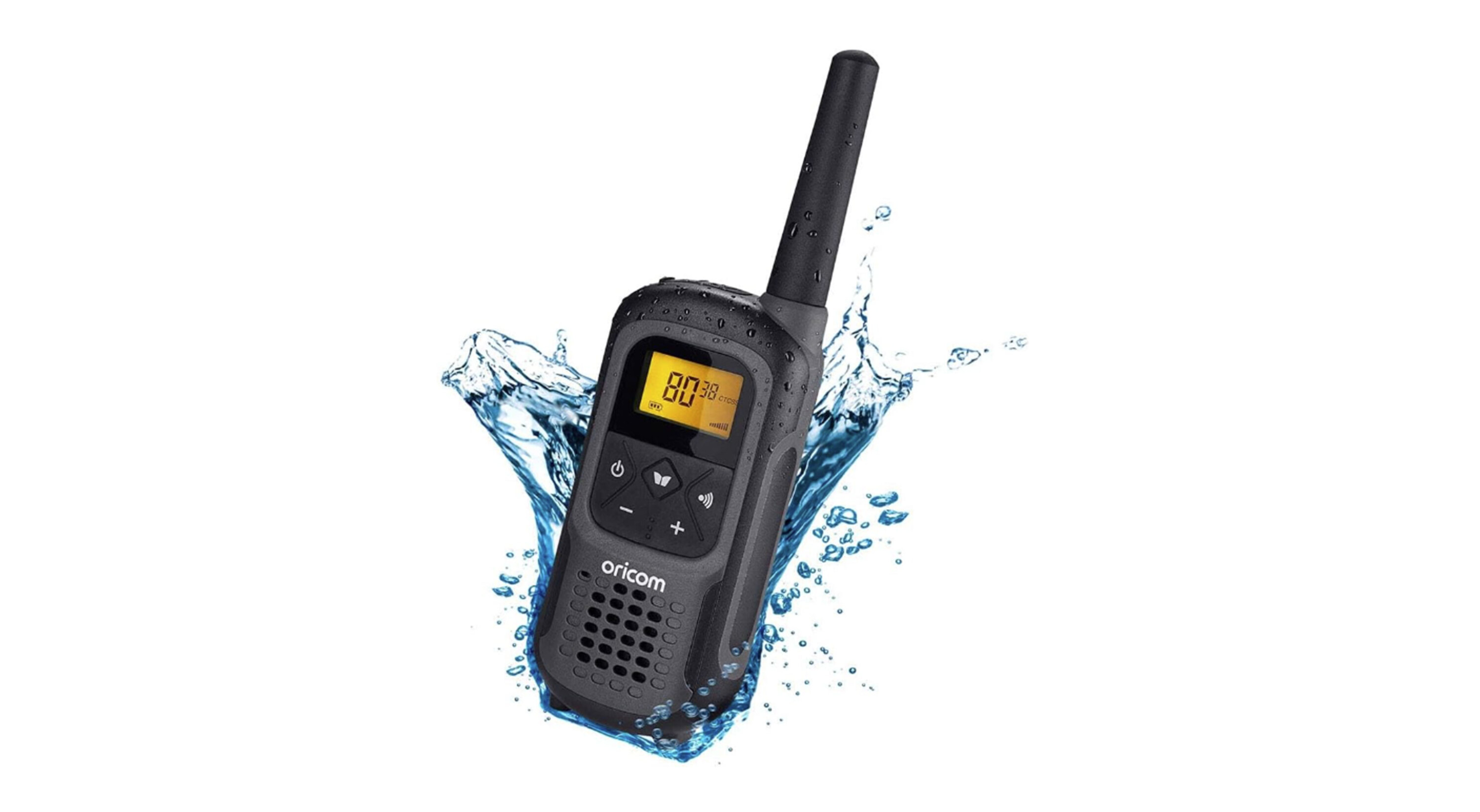
This cheap and cheerful 2 Watt UHF CB radio is a basic, tough little unit that features a waterproof rating of IPX7 (waterproof to 1m for 30 minutes) and a super handy float-and-flash function when dropped in water.
1
This means if it’s dropped in water it will float and an indicator light will flash, so it won’t be lost to the depths of a bottomless bog hole. This unit is ideal for fishing or kayaking, and it also includes a Micro USB jack for charging. It comes with a three-year warranty that excludes the battery, but it runs on AA batteries and can use disposable batteries in a pinch.
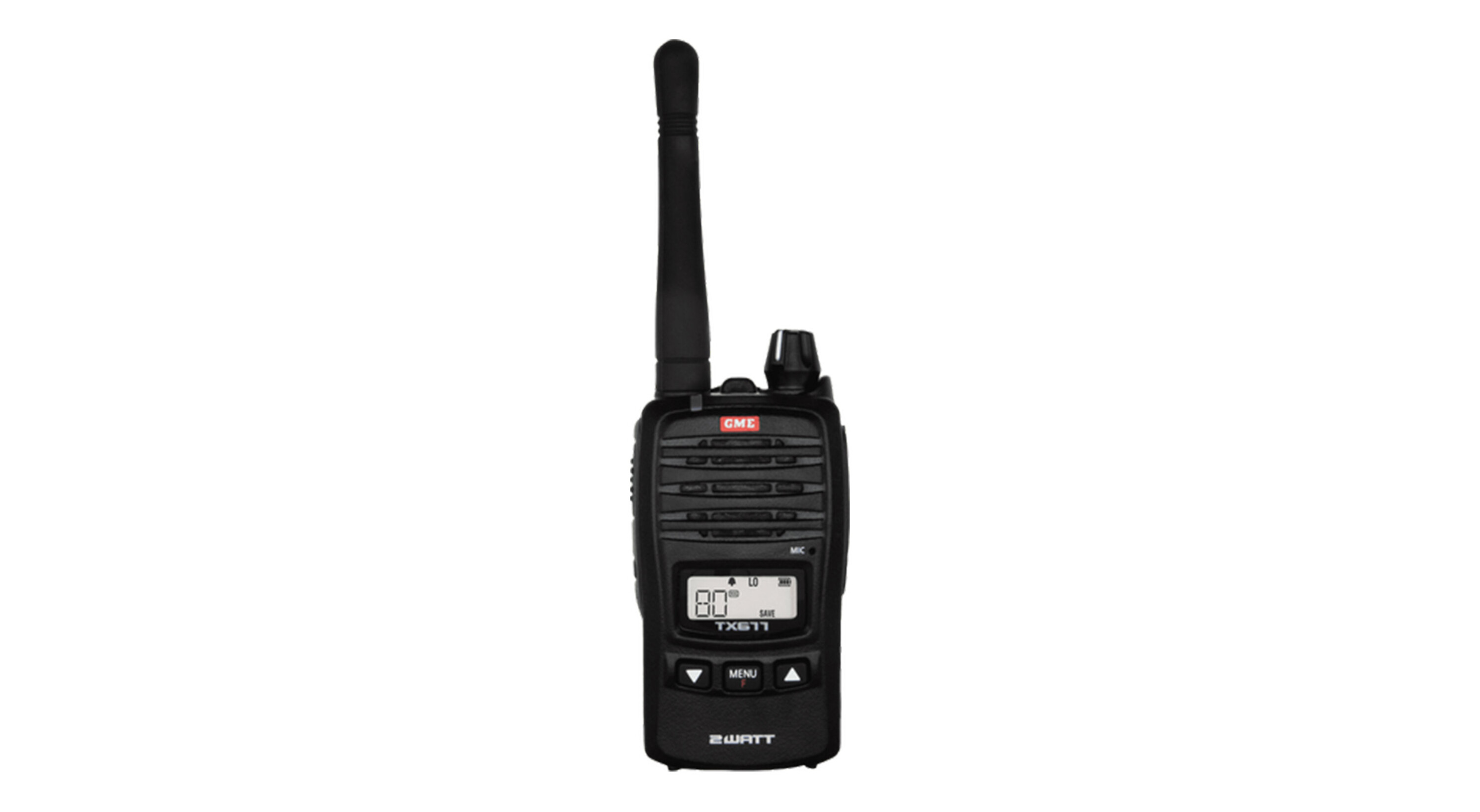
The TX677 is a two-watt UHF CB radio that is compact and lightweight.
1
The radio features up to 14 hours of battery life, or up to 20 hours of battery life if utilising the switchable transmission power option (2/0.5 watt). The unit features USB charging and a rotary power/volume control for easy operation. It comes with a two-year warranty, with one-year on the battery, and is a very compact unit compared to the competition.
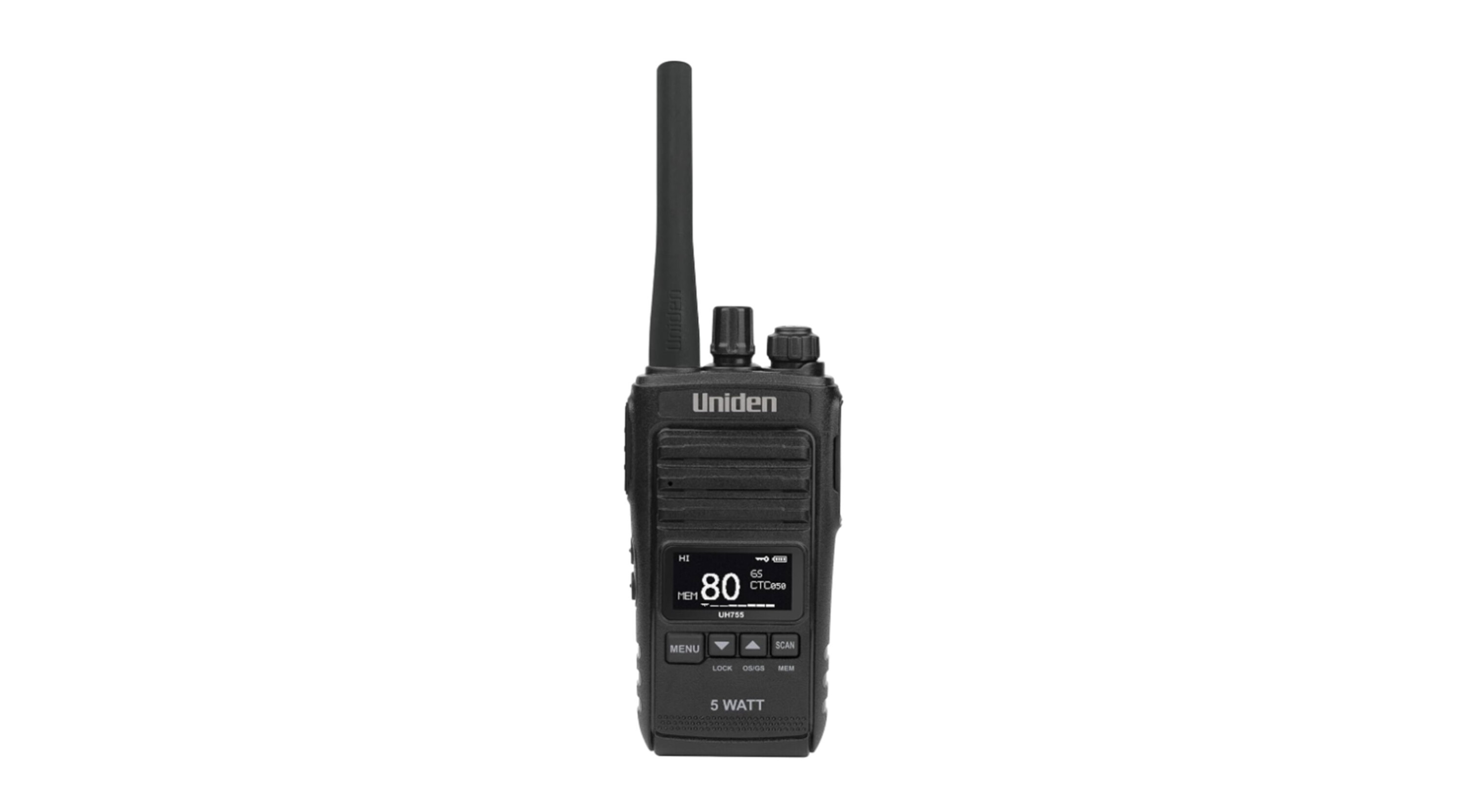
The UH755 UHF CB handheld radio is a Japanese-made unit, designed for those who need a rugged and heavy duty radio suitable for various conditions.
1
The unit features an alloy body which is splashproof to IP54 (limited dust protection and splash-resistant from any angle). The radio may only offer fairly basic functionality, but it’s ruggedly tough and reliable. It includes selectable power of 5- or 1-watt, a battery saver mode, and a three-year warranty.
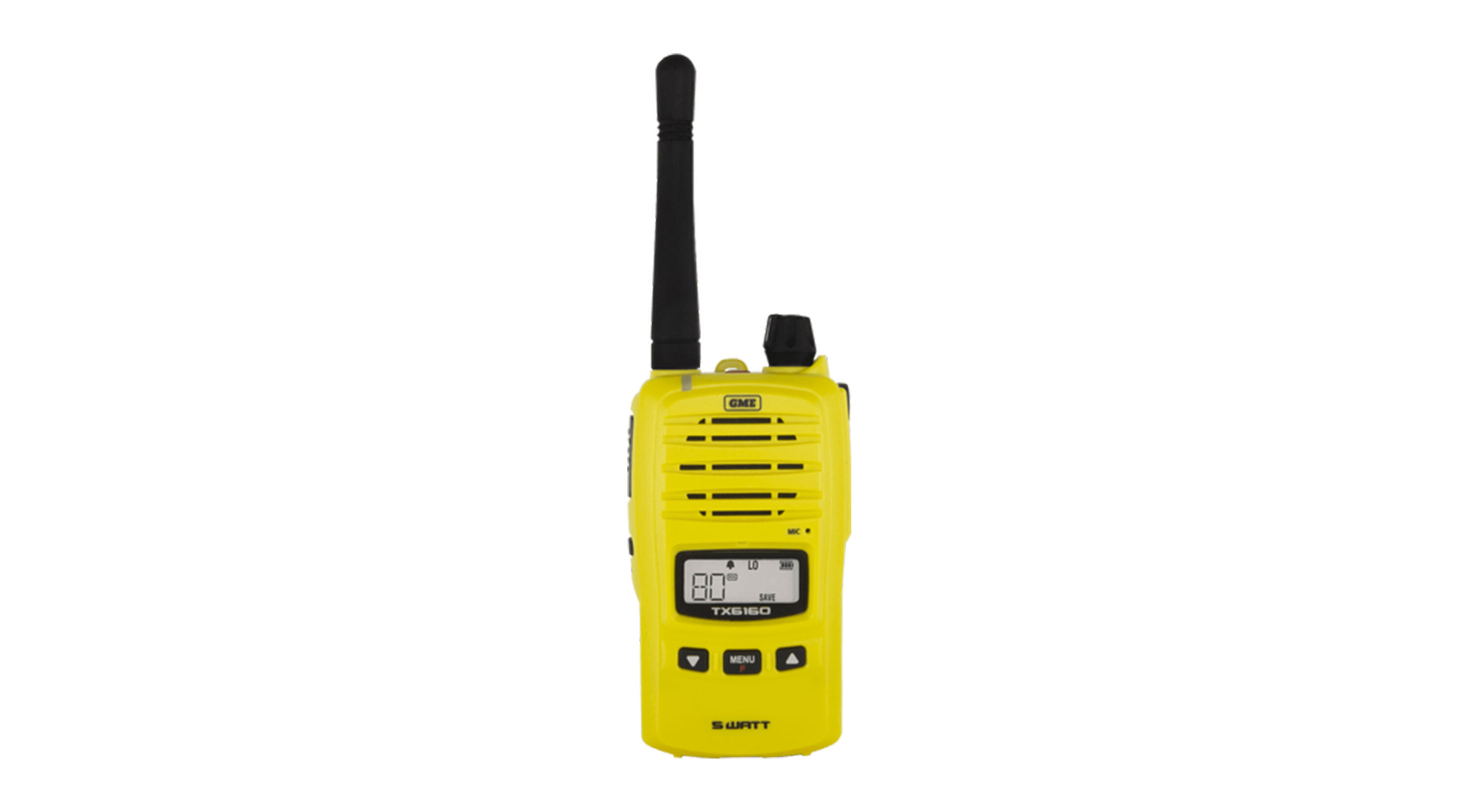
This unit from GME features a full IP67 waterproof rating, a rugged metal chassis that comes in three colour options, and a handy LED torch.
1
This combination makes this unit ideal for those who play in the mud or spend time on the water and in the elements. Boasting a lightning fast channel scan speed and a rotary power/volume knob, the unit is user-friendly and easy to operate. A three-year warranty will give confidence in your purchase.
A heavy duty commercial-spec unit designed for farming and mining industries, which makes it well-suited to the abuse outdoor enthusiasts will put it through.
1
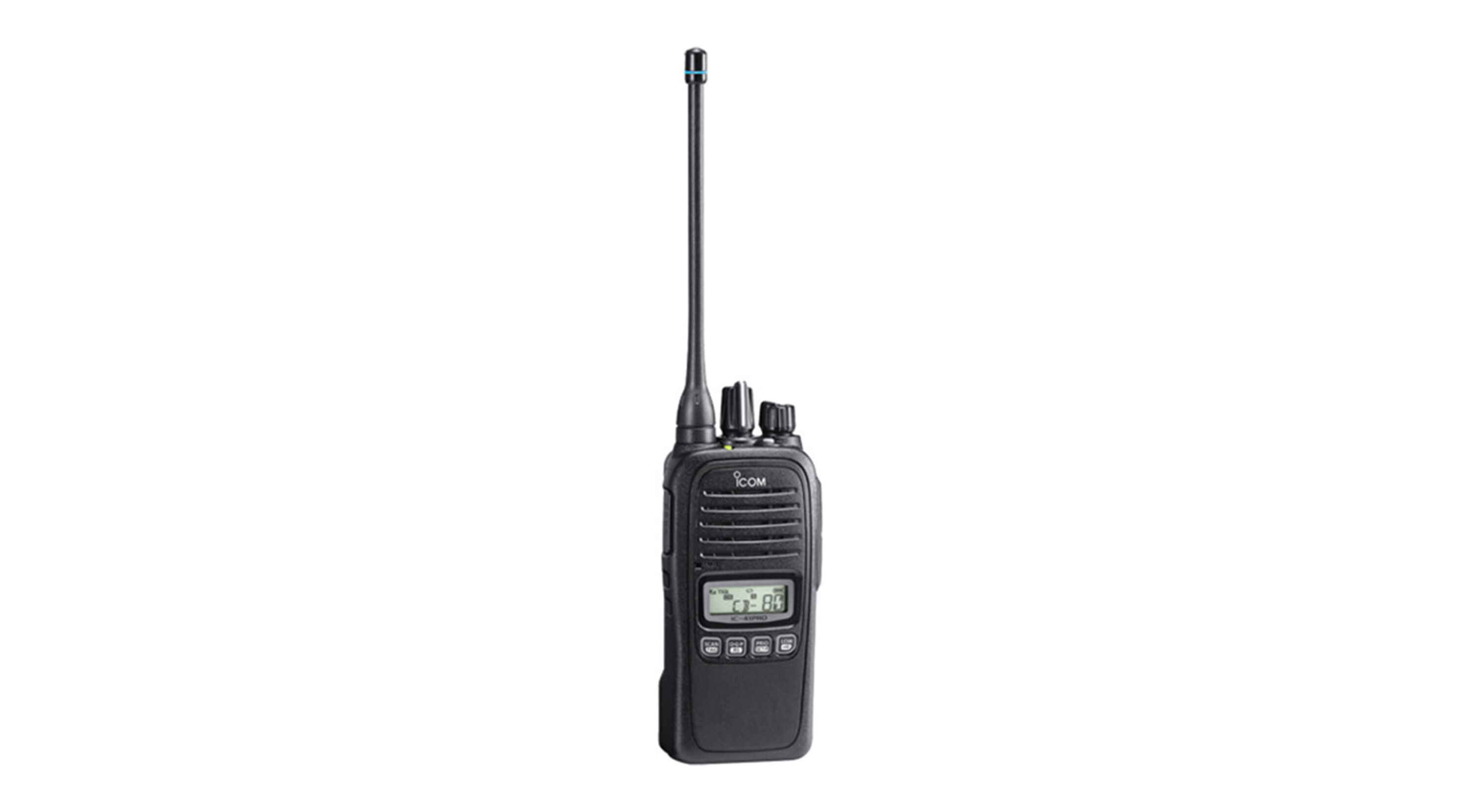
It features a tough metal chassis with IP67 waterproof rating, and it comes with a class-leading five-year warranty. The unit comes programmed with the standard 80 channel for consumers, but as it’s a pro level unit sold all around the world, it is also fully programmable and includes additional ‘private’ channels. It also features either a stubby antenna for those who want to strap it to a belt, or a longer whip antenna for those seeking additional range. Plus, for those who play in mud, there are red and orange colour options.
Another rough-and-tumble UHF CB radio with an aluminium chassis and full IP67 waterproof rating, this unit suits those who want something simple and reliable.
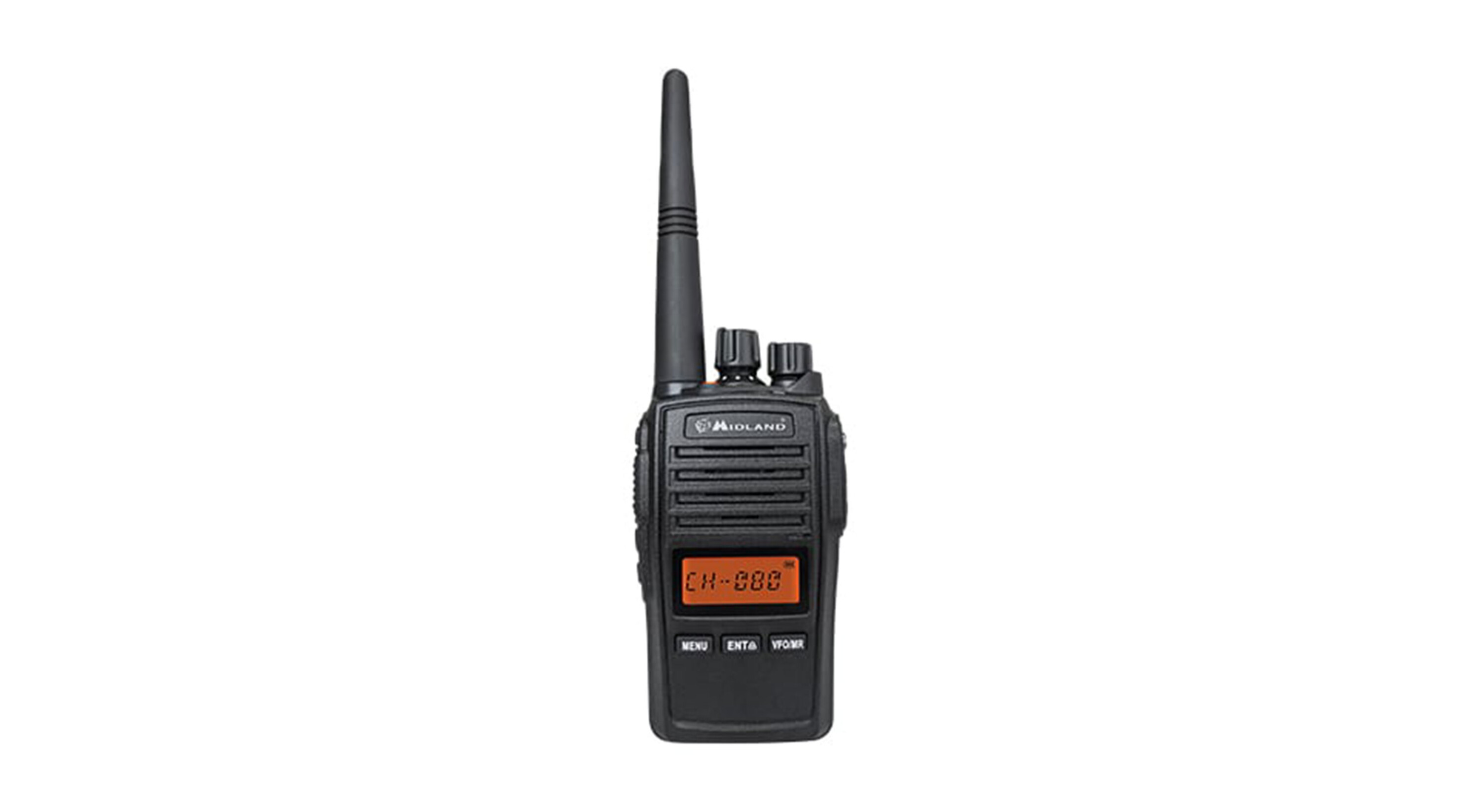
1
This no-frills unit has basically no add-on features. No battery life has been quoted by the manufacturer, but reports indicate good battery life that easily lasts more than a day of use. This radio comes with a two-year warranty and, though a European company, the radio has been built for Australasian conditions.
This unit claims a battery life of a whopping 39 hours. It also features a car kit that transforms the unit into a mobile car-mounted unit.
1
It suits those who are away from charging options for long periods or those who want a temporary car-mounted unit. The Deluxe package includes 12v charging and a magnetic antenna, to increase transmission range. This radio is IP67 waterproof with a tough chassis, and the included accessories have been built specifically for Australian conditions and come with a one-year warranty.
These radios include an innovation called Master Scan, which allows users to communicate on a group of channels. If your current channel is interrupted by outsiders, all radios in your group will automatically jump to a new clear channel.
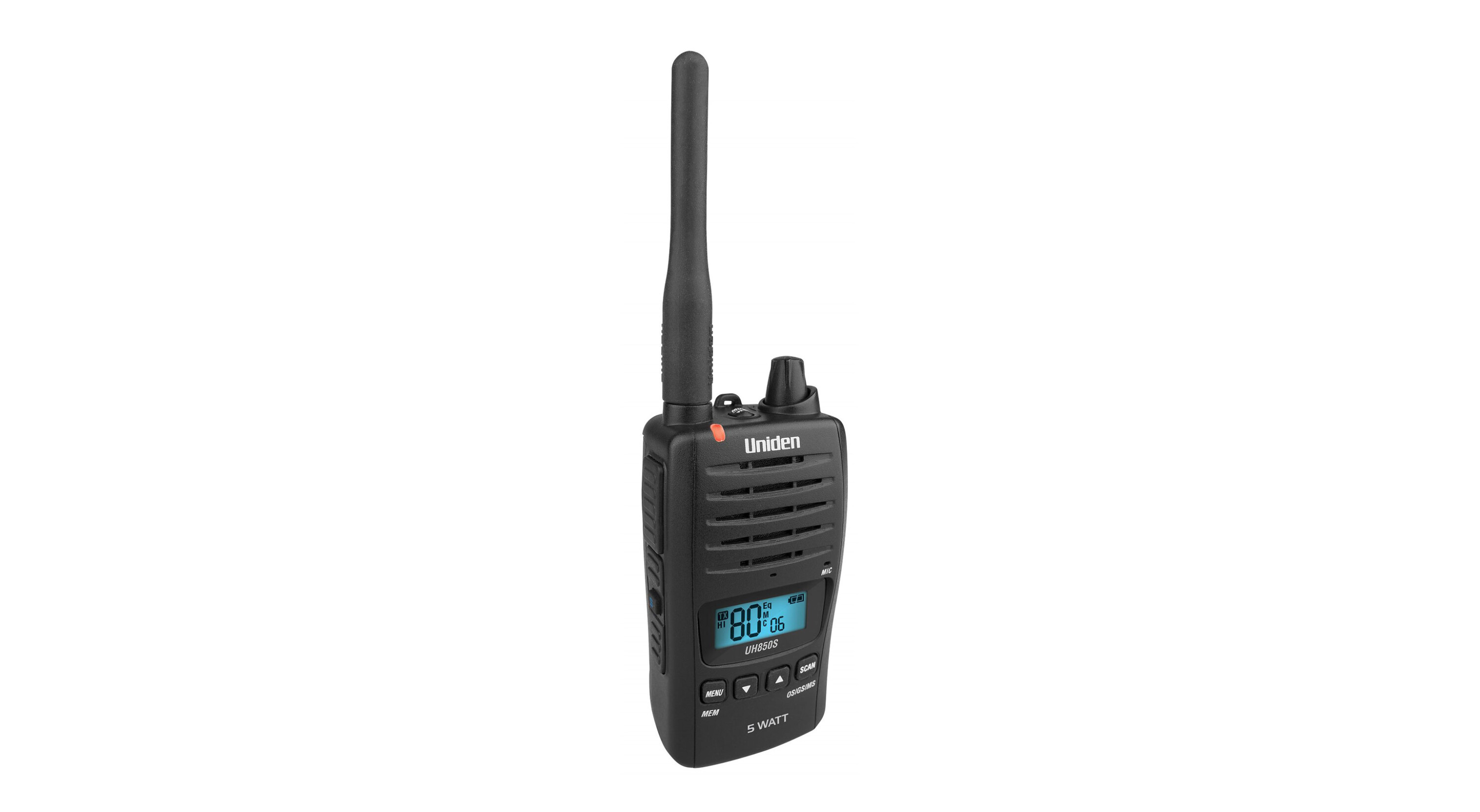
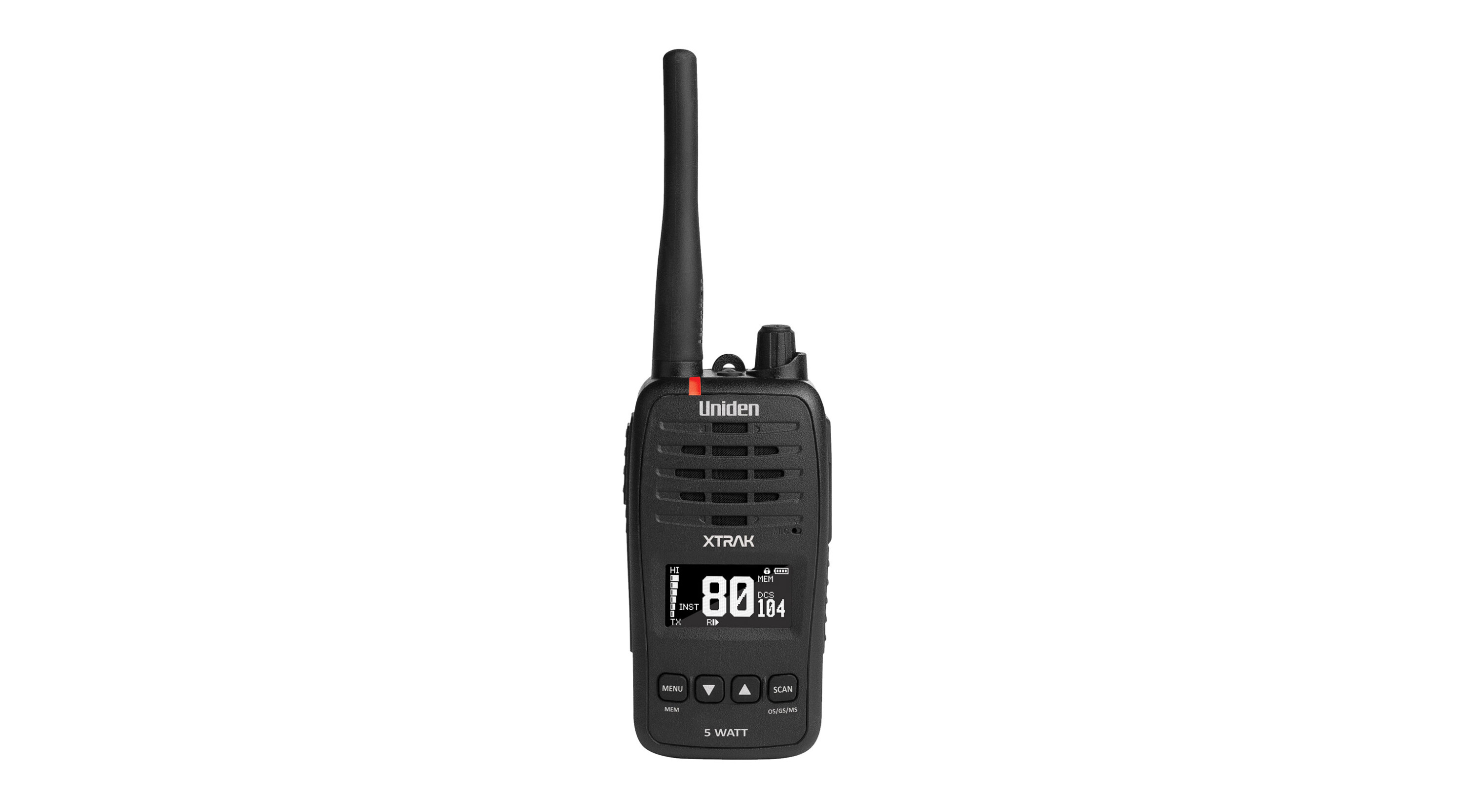
The latest UHF radios from Uniden now include features that were, until now, limited to vehicle-mounted units.
1
The XTRAK range includes an instant replay function, and the XTRAK 50-PRO version also includes location sharing. The replay function allows you to record and replay up to four minutes of conversation. The radios are rugged, waterproof and built to IPX7 standards, and a 2W speaker ensures crystal clear communications. They come with a three-year warranty.
Handheld UHF CB radios have massive scope for application across numerous outdoor pursuits.
The portability of handheld units makes them significantly more versatile than car-mounted units. Their application isn’t limited to four-wheel drivers, but extends to trailbikers, mountain bikers, hikers, fishers, kayakers and anyone who spends time in the great outdoors.
A handheld UHF provides safety away from the vehicle, as well as communication around and at camp. However, they only provide all of this if they can be relied upon to work when you need them most. For this reason, a quality unit is far better value than a cheap and nasty product.
So, if you’re any sort of outdoor enthusiast, then a reliable handheld UHF CB radio is essential for your kit bag.
Transmission power and range
The most important factor that determines the range of any UHF radio, be it handheld or vehicle-mounted, is the transmission power.
In Australia, our radios are limited to a maximum of 5 watts of transmission power. This means that 5-watt units are effectively the bees knees and can be expected to have a transmission range of at least 15km.
Lower transmission power units in the 2- or 3-watt range can still have a useful transmission range in the order of 10km line of sight. These units are typically cheaper than 5-watt units, and can be smaller and lighter.
Battery life
When looking at buying a handheld UHF radio you’re likely to see a battery life quoted in hours, but what does this mean?
The majority of these figures are based on a 5% receive, 5% transmit and 90% standby time. For a quoted 30 hours of battery life, this means 1.5 hours of receiving, 1.5 hours of transmission and 27 hours of standby time.
In addition to the estimated life, consideration should be given to the type of battery. While ‘built in’ lithium batteries are great, once they are flat there’s no backup option without charging. Units that use AA or AAA rechargeable batteries can utilise disposable batteries in a pinch, which is handy for those away from charging options for long periods.
The final piece of the battery puzzle is the charging method. Some units allow USB charging, which is super simple for in-vehicle charging. Others include in-cradle charging with AC power (240v) only. Some also include 12v leads for the cradle, while some have optional 12v leads or adaptors.
Toughness
Many higher quality units come with an alloy or aluminium chassis, which means they are extremely tough and can handle the rough and tumble of outdoors pursuits. Chances are, if the unit you’re looking at doesn’t specify the type of construction, then it’s plastic. Not that plastic is necessarily a bad thing, as it can be lighter and, in some cases, will even float.
Waterproof rating
When you’re using a handheld radio outdoors there’s a fair chance water will be involved. Be it mud holes, water bodies or rain, you don’t want a radio to fail when it gets wet.
The highest typical ratings are IP67 and IPX7, both of which mean waterproof up to 1m deep for up to 30 minutes. Various lower class ratings exist and are typically associated with dust-proofing and splash-resistance.
Price and value
A low price is great, but you will generally forget about the purchase price and remember the value of something that does its job time and time again. For this reason, we’ve excluded any ‘programmable’ units despite them typically being much cheaper. A good handheld UHF radio should be ready to go straight out of the box. We’ve also excluded 0.5- and 1-watt units, as these are more like toys than useable radios.
Where does value begin, then? A well-known manufacturer that designs and builds UHF radios for Australian conditions is a good start. Thoughtful features like floating units or proper waterproofing can add great value. A solid warranty ensures peace of mind and adds to that value, too.
What to look for
Searching the web for a handheld UHF radio might seem overwhelming, but the place to start is with your own requirements: what are you going to use the unit for?
Is it going to be thrown around and dropped frequently? Then something with a solid chassis is a good start.
Is it going to be used on open bodies of water? Then a floating unit is probably your pick.
What kind of range do you need? Hiking the Overland Track in Tassie and you might want something with the maximum range possible. Just using them around camp or to guide other vehicles? A lower power unit might be all you will ever need.
After-sales support
Always opt for a well-known and respected brand, with a good warranty and manufacturer support. Cheap-out and chances are you will be buying again in near future.
Be sure to check what the warranty covers, as many will have separate warranties on batteries or accessories.
4X4 Australia has been reviewing four-wheel drive vehicles, aftermarket products and camping gear for more than 40 years. When looking for the best swags in Australia there are some things that are essential to ensure you sleep soundly under the stars.
When we compared each of the swags in the list with hundreds out there we looked at the size, weight, durability and price. We also searched for additional features that make these swags stand out from the rest.
We looked at hundreds of user reviews and drew on our own experience sleeping in swags to make sure our recommendations are for the best on the market.
Disclosure: When you buy through our links, we may earn a commission. We also include products that we do not earn a commission from.
North Queensland has an amazing history of mining, some endeavours of short duration and others that continue to operate today.
Many mine sites are closed to the public due to being on private or restricted Aboriginal land, and while others can be accessed at your own risk, the tracks can be treacherous and dangerous due to washouts and their isolated locations.
I love old mine sites and their once-bustling but now abandoned townships, and the legends and history of rags to riches for those who dared, finding the ore, mining and processing it, reaping the financial rewards or enduring the loss of bad investments.
The silent, often ghostly ruins tell tales about the people who settled the most remote locations in the country; men, women and children who dared to challenge the wilderness, walking and carrying their possessions on their backs, or on a pushbike or wheelbarrow. Some rode horses, or drove drays and wagons loaded with lengths of galvanised iron that would become their new homes.
1
Droughts and floods dogged their way while the unfortunate fell victim to long spears or were waddied to death as they slept by hostile tribal people who objected to their country being overrun by the newcomers.
Mining ruins and towns are about our history, the hopes and the ambitions of our pioneering settlers, and the dwellings and settlements they lived in under trying conditions.
Children died from heat stress, men and women went mad, and they endured sorrow and sadness beyond the imagination of modern people. They were heroes who made such an amazing contribution to building our nation as we know it today.
Here are some of North Queensland’s old mining sites…
1
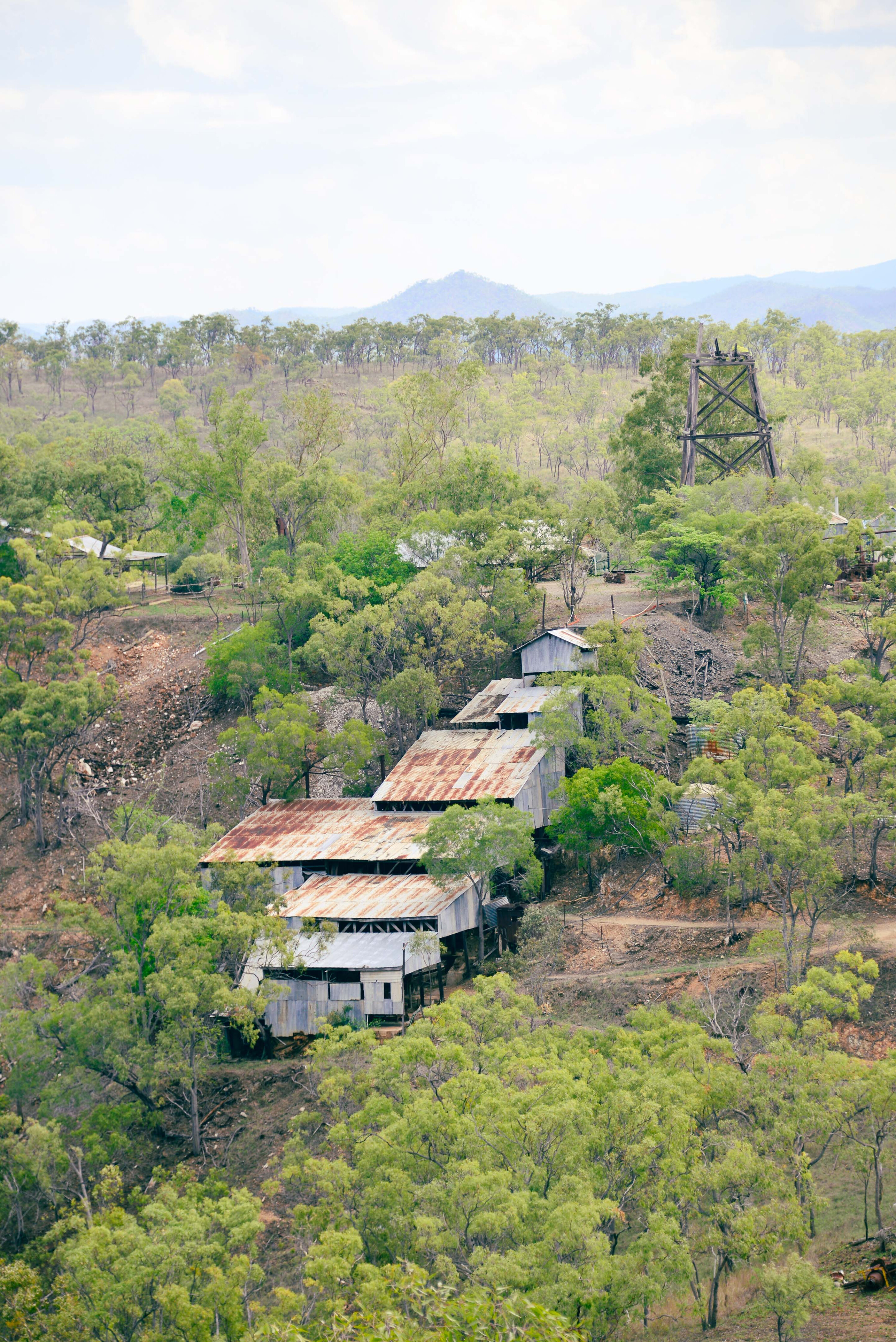
Cumberland gold mine
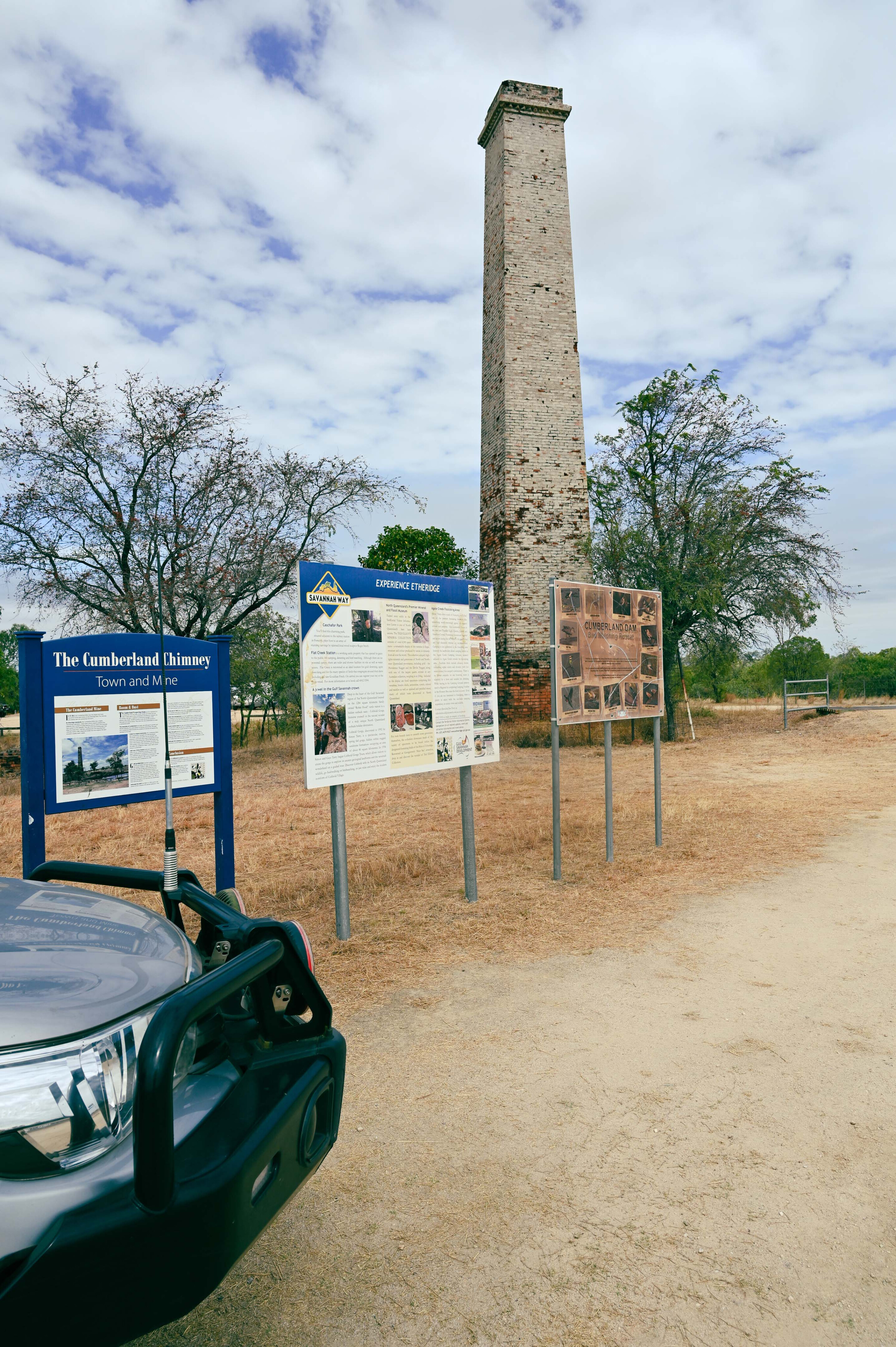
Located along the Savannah Way, west of Georgetown, Cumberland is easy to locate as you can spot its tall chimney rising out of the open woodlands and above the hills before you arrive. It’s only several hundred metres from the busy highway and is well signposted.
Today the dam that once provided water for the mine is alive with waterfowl that frolick about colourful water lilies where melaleuca and gum trees provide shade for the annual invasion of dry season grey nomad travellers.
As in other places along the Savannah Way, councils have established unofficial campsites with no facilities and it’s up to people to do the right thing with night soil and rubbish disposal, or these sites will be closed.
1
In its day Cumberland was the richest and largest gold mine on the Etheridge Goldfields.
It was registered by Parks, Smith, Hardie and Steele on 18 December 1872, and it sold 14 years later to the Cumberland Mining Company Ltd. The vendors were smart, because in addition to being retained as managers, they received £100,000 in cash and £60,000 in fully paid £1 shares.
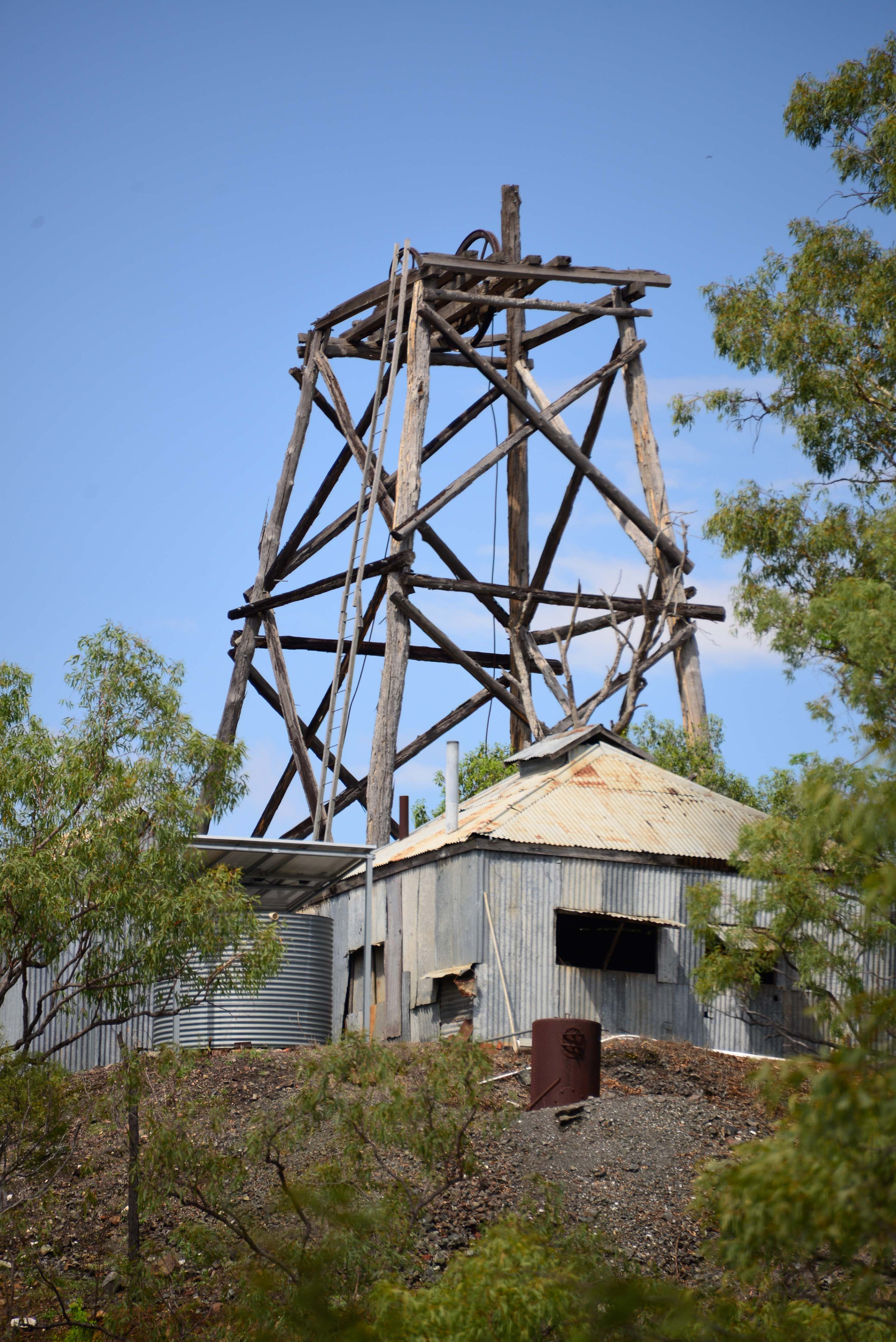
The new owners expanded and modernised the operation with steam-driven engines, tramways and winding gear that serviced the underground operation and its 380m shaft.
1
But today only the 25m high chimney and concrete foundations remain of what was once a bustling mine serviced by a nearby township of 400 people, one that had all the mod cons including shops, school, hospital, police station and three pubs.
A big flood in 1893 washed the tailing and water dam walls away, and with it the hopes of the mine, which was struggling at the time, with the best gold having petered out. Drought created a water shortage in 1888-89, and then a cyanide gold process was introduced in 1894 to recover fine gold.
By 1898 only one hotel remained as people walked away from their homes, though the school remained open until 1915 when no pupils registered. The company shut down in 1897, but others scratched about the mine until at least 1934.
1
The Palmer Goldfields region
Fredirick Walker, a member of the 1871-72 Hann Expedition to the Cape, discovered gold in the Palmer and Normanby Rivers in 1872, but James Venture Mulligan was given the credit for it when he followed up on Hann’s reports in June 1873.
It started an amazing rush that founded the Port of Cook’s Town, later Cooktown, while others came from Georgetown, Croydon and Charters Towers, people heading into the unknown, surviving floods and hostile natives.
Determined, they founded townships and large camps in the wilderness; Lukinville, Palmerville, Maytown, Uhrstown, Chinatown and Byerstown serviced dozens of diggings and mines along the Palmer River and its feeder creeks.
1
Another rush started to the Normanby River in 1874 as hopefuls packed up and headed to the new ‘El dorado’. Ephemeral settlements were quickly founded and abandoned even faster when the gold petered out.
A railway headed west from Cooktown, but the project was abandoned when it reached Laura. The Palmer gold had run out. These days the hills are silent and only the calls of the dingoes, crows and the raucous cries of blue-winged kookaburras break the silent torpor of the bush.
Some mining continues, but the best gold has gone, some say to China after the Chinese rolled over the field in what was said to be ‘like a yellow wave.’
1
The Palmer River diggings can be accessed from the Mulligan Highway at Maitland Downs and the Palmer River Road.
Keep in mind that prospecting may incur the wrath of a leaseholder who won’t take kindly to their grounds being poached. Some years back a prospector was shot, his body was never found but the then owners of Palmerville Station are doing life for the alleged crime.
Bush camping is available on the field, but the best way to avoid any trespassing problems is to camp on the comfortable grounds at Palmerville Station and do day trips from there. It is, of course, 4×4 country… and then some.
1
The Limestone Creek Rush
Gold was discovered in May 1889 on Limestone Creek, south of the Palmer River. The mines were sited in rugged and waterless hills, but two villages – Groganville and Harbord – were founded here.
Little remains of the townships today apart from broken bottles, rusted iron and discarded cans. The mine site can only be reached via a creek bed and it is not marked.
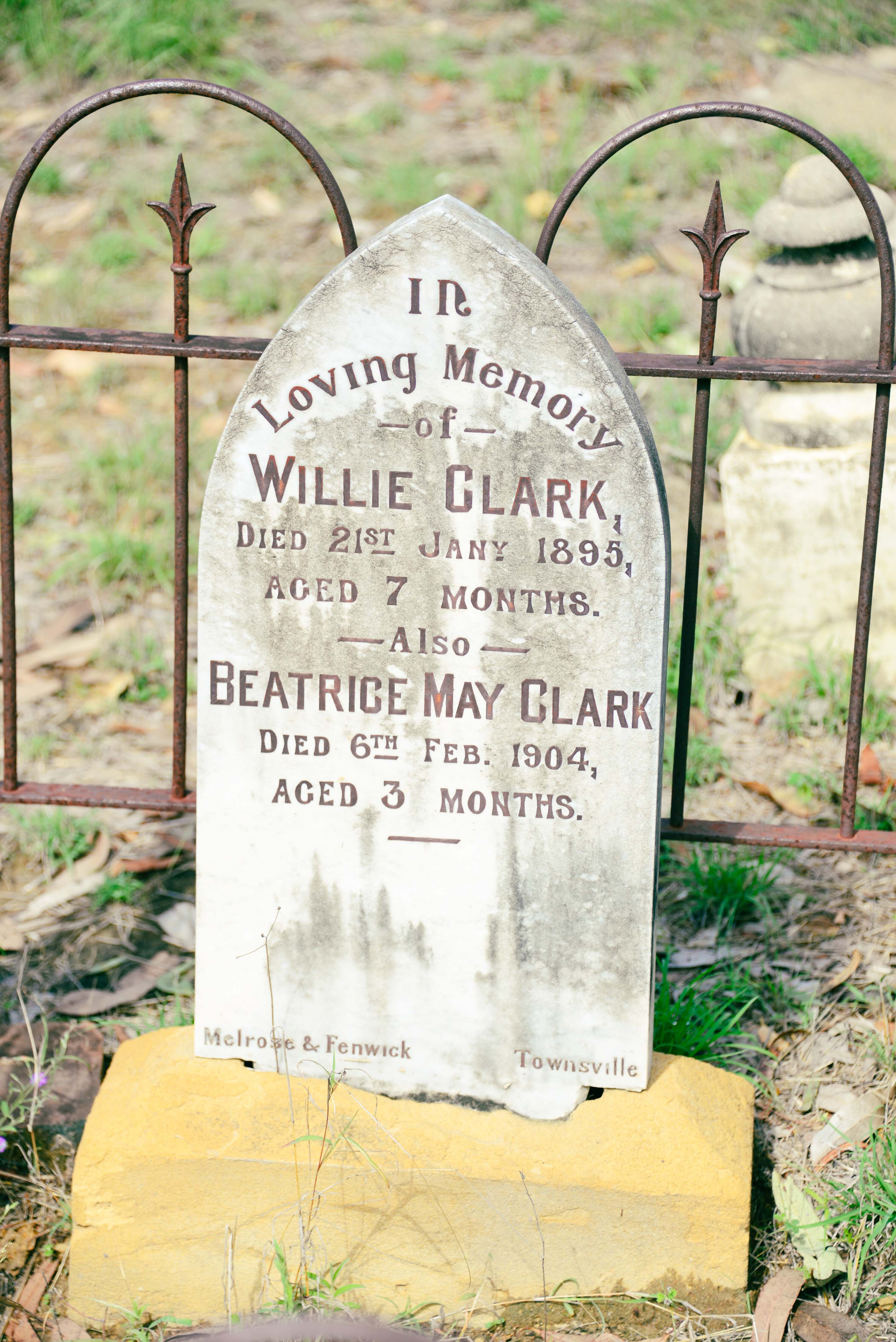
A nearby cemetery tells of the hardships that people faced here, including babies, some of whom died within days of being born due to the extreme heat in the hot valleys. Most dwellings were nothing more than rough shelters built from bush timbers that were no better than the gunyahs of the Aborigines.
1
Access is north of Mount Carbine, on the Karma Waters Station turnoff. Curraghmore Station and Karma Waters have campsites along the river, including on the old Cooktown Crossing, the original track that extended to the Palmer and to Cooktown from the south.
Mount Molloy and Mount Carbine are former mining towns that were once part of the mining trails of the region. Another route is from Chillagoe, which has more than its fair share of abandoned mines and relics. The original road turned north to the OK Mine and to the Palmer, via Groganville.
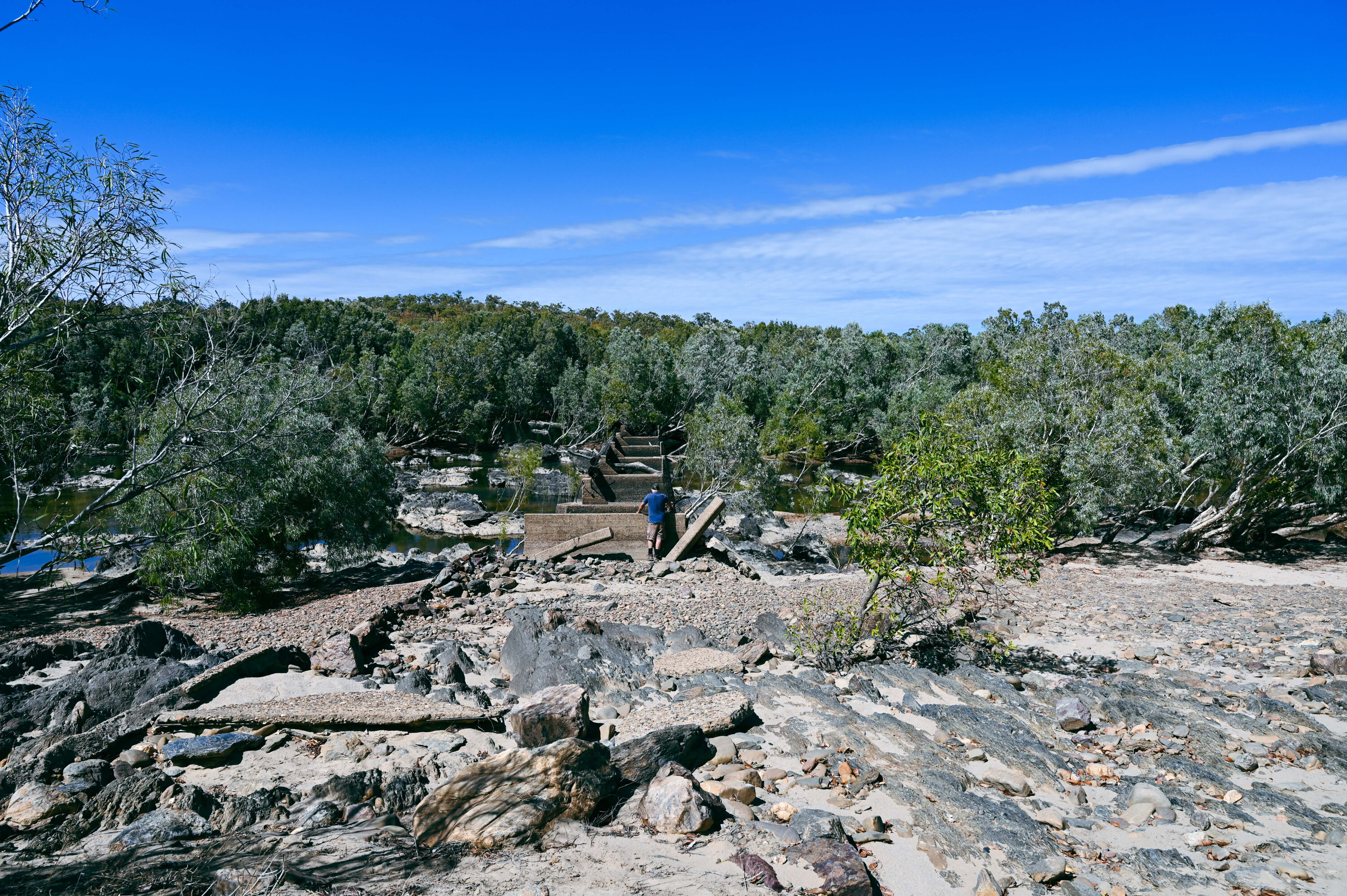
Part of the track runs through Bellevue Station, but it’s private and not open to visitors without permission. It’s an interesting route that cuts across hills and valleys, while the remains of an extensive concrete bridge built across the wide Mitchell River is worth seeing.
Only concrete pylons remain. It was constructed by the Burma-Singh Mining Company to access the Hannibal Copper Mine, but was abandoned when the mine closed in 1953.
1
The Hodgkinson Field
Situated south of the Mitchell River, the Hodgkinson Field came into prominence when gold was discovered there by James Venture Mulligan on 23 October 1875.
It led to a huge rush, but the new arrivals wanted to lynch Mulligan as they had believed that it was alluvial gold, but instead it was reefing gold that was beyond the means of the diggers. The first machinery arrived from the Ethridge Field, which was now in decline, while a track was cut down the impossible rainforest-clad coastal ranges to Cardwell.
Another tracked across the high ranges from Port Douglas, via Mount Molloy. It’s astonishing how people and pack animals managed to haul heavy and bulky mining machinery up these seemingly impossible ranges.
1
Today the field is silent other than the cries of crows that disturb the peace where once busy mines and smelters operated.
Thornborough, Kingsborough, Beaconsfield and Northcote were the first towns, and these housed almost 2000 people, while other smaller settlements grew up about the mines. But by the 1880s a rush for the tin mines at Herberton and Irvinebank saw the beginning of the end for the Hodgkinson Field.
Coal was discovered under Mount Mulligan, which overlooks the former goldfields, and a town plan was laid out in 1913. Unlike today, coal was rare in Queensland and the government constructed a railway line from Cairns to the mine.
1
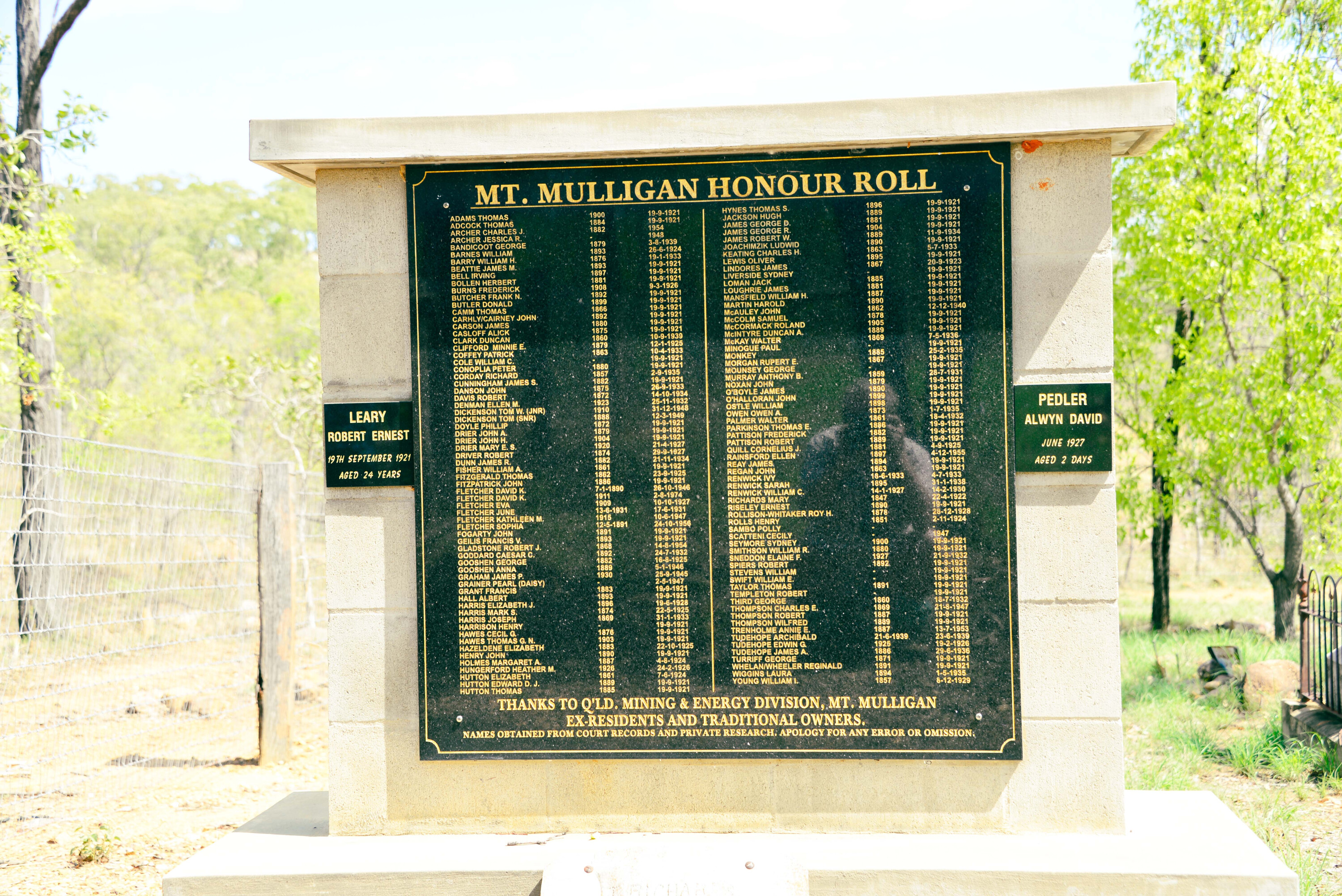
A terrible accident occurred on 19 September 1921 when the underground mine blew up killing all 75 men who had just started their shift, making every woman and child in town an instant widow and orphan respectively. To this day it remains the second worst mine disaster in Australia.
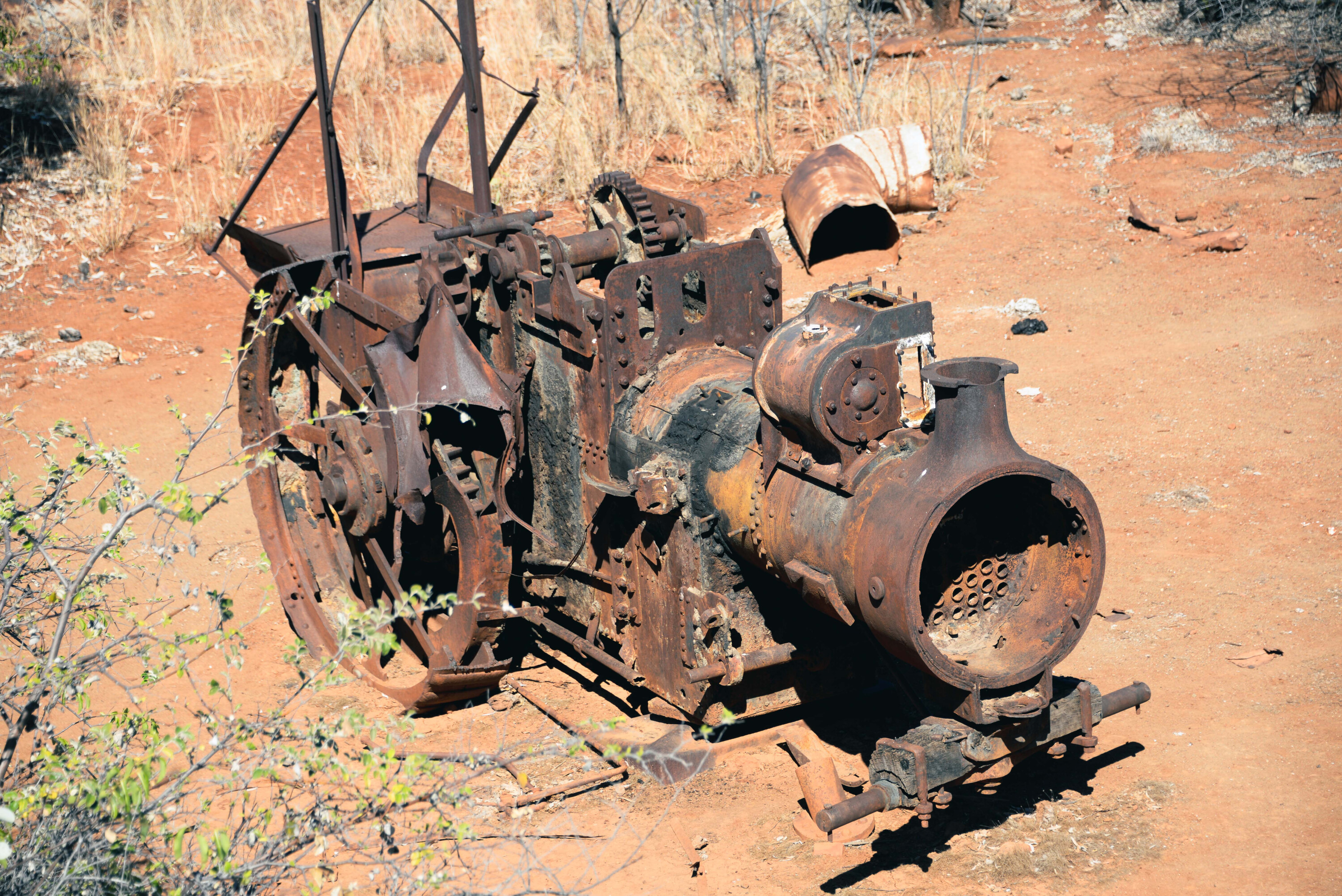
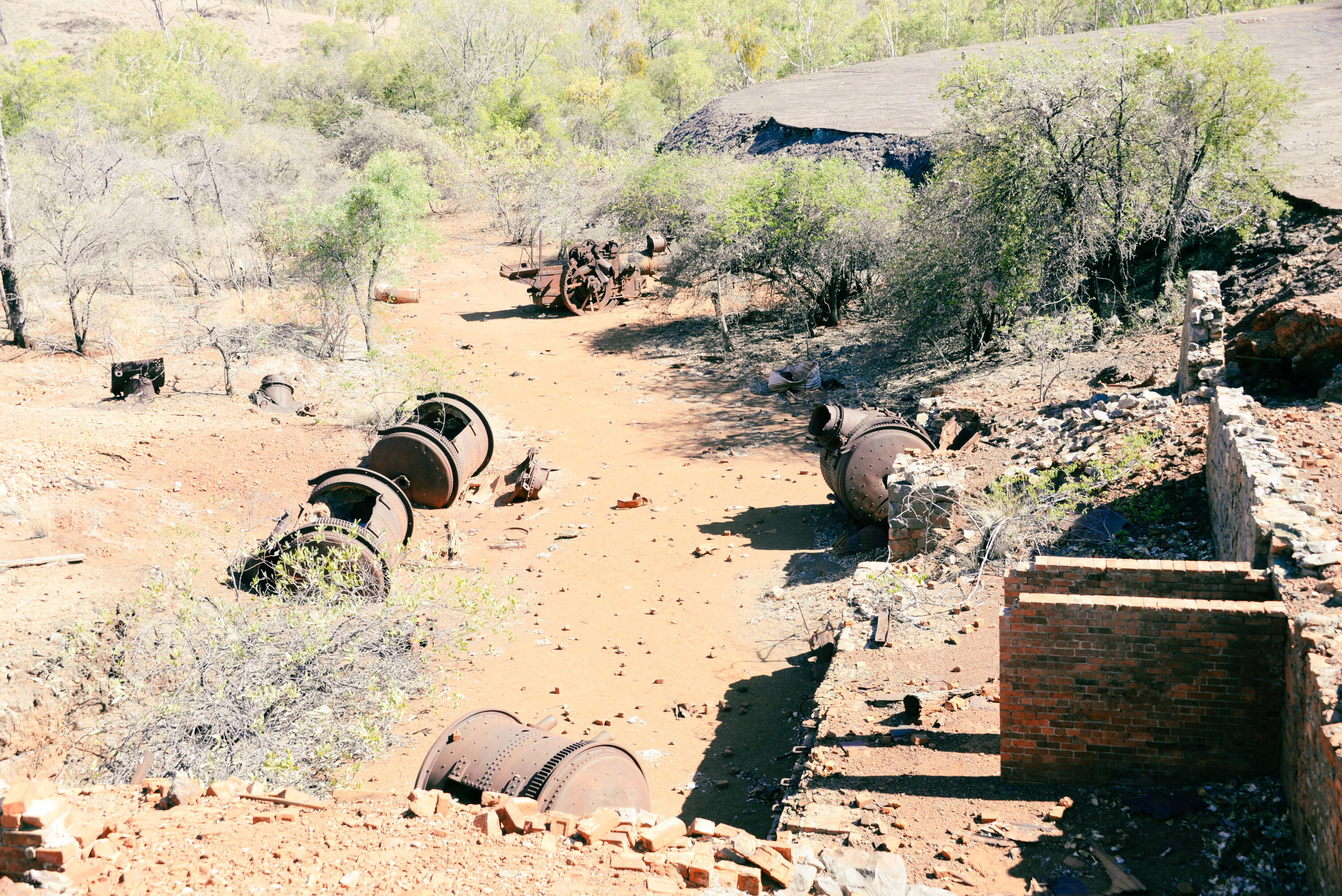
The mine reopened soon afterwards, the coal needed for the Queensland Railways, but it closed in October 1957. At its peak, Mount Mulligan had a population of 500. Only a tall chimney, foundations and relic machinery remains, and the nearby cemetery where 74 miners are interned.
1
A life of hardship
Often the only evidence of human settlement in many remote areas are the cemeteries and bush graves, simply marked ‘Killed by Black,’ or ‘Died of Fever.’
The former mining town cemeteries are a grim reminder of hardships and accidents that people had to contend with.
Nation building was tough as Australia struggled through its infancy, in harsh country that tried to kill settlers off with bushfires, floods, droughts, diseases, accidents and attacks from the natives who resisted the newcomers at every turn.
1
Make sure you don’t miss the graves on your mining trail quest; the country has not changed and the tracks are rough, the distances long and the isolation is real.
Leave things as they are and don’t take relics home with you – they belong where they are – and most importantly, don’t rubbish the bush. The greatest threat to the physical reminder of our history comes from those who pick things up and take them away, or the bottle collector who smashes what he can’t carry out thus increasing its value and scarcity.
Respect our history and enjoy the drive… and most of all, remember our brave and struggling pioneers.
Over a century ago the Karunjie Track in the far north of Western Australia was used by drovers to move cattle across the Kimberley from the south up to Wyndham for export.
My journey here started at the end of the Gibb River Road, where I had spent several days at the beautiful Home Valley Station on Balanggarra Country.
Home Valley is situated right on the Pentecost River where big crocs and big barra abound. There are two camping areas on offer, a great bar and grill, as well as tours on to country with traditional owners showing off their stunning waterfalls and rock art, with the majestic Cockburn Ranges as a backdrop.
1
I spent several nights at both campgrounds, one situated near the homestead and the other on the Pentecost River near Bindoola Creek.
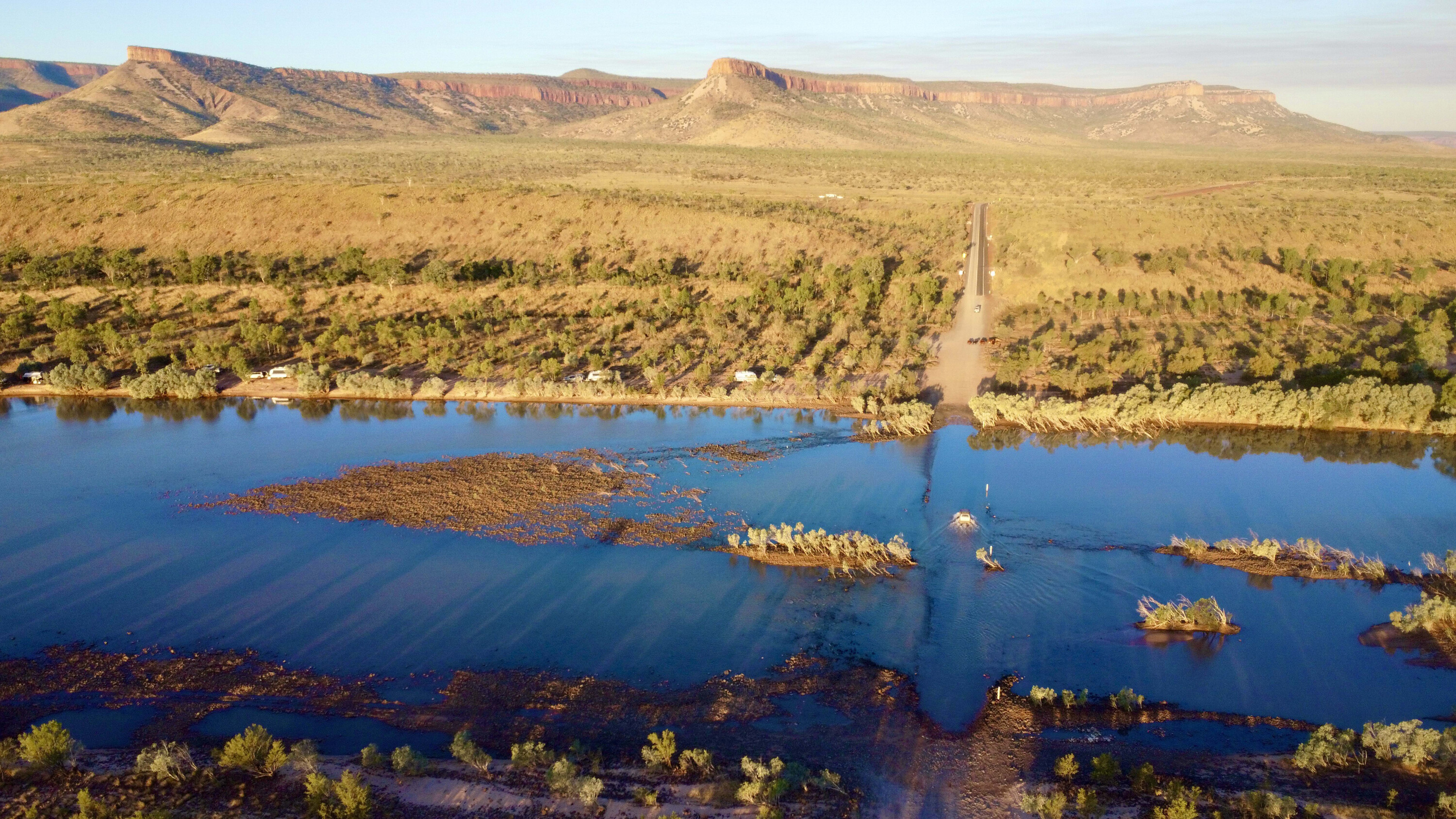
Leaving Home Valley Station it was only about a 10km drive before I was parked and standing in front of the wide Pentecost River crossing. The river was named in 1882 by expedition leader Michael Durack who was surveying it. The crossing is several hundred metres and with the thought of estuarine crocs lurking about, I didn’t consider walking it first.
But generally speaking the Pentecost has a hard rocky base and if the water isn’t too deep most 4x4s, tour buses and trucks get across easily enough in the dry season. On the eastern side of the river is where the blacktop starts (or stops – depending on your direction) on the Gibb River Road, all the way to the east coast.
1
The Karunjie Track
Having just explored the east Kimberley, I crossed the mighty Pentecost River and turned left to follow the river along the 80km-long Karunjie Track.
At the start of the track is a popular free camping spot where travellers pull up either before or after tackling the Gibb River Road. Here most people fish for barra, take in the stunning views of the Cockburn Ranges or just relax on the river. We not only caught some Barra here but also happened to hook a couple of endangered sawfish.
Once a stock route, today Karunjie Track is a remote 4×4 track that is only traversable in the dry season, and it is not maintained for its entire length. Departing the Pentecost River the track is slow going for the first 20km, following with deep ruts and plenty of washed-out sections.
1
It’s hard to keep your eyes on the track as you follow the river, passing beautiful old boabs and gazing at the majestic Cockburn Range to your right. The first gate you pass through signifies you are onto private property until you reach the end of the track, owned by El Questro Station.
Once down onto the huge moonscape like floodplains, the track smooths out and you can pick up the pace. The massive floodplains become an impassable quagmire in the wet season and trying to cross here would be simply impossible… and stupid. This location was used in several scenes for the film Australia.
The flats soon give way to some higher rocky country and the boundary gate signifies the end of the Karunjie Track. Officially, no camping is allowed between the two gates, only near the Pentecost River, as El Questro is still a working cattle station.
1
King River
Once through the last gate you’re now onto the King River Road where, if you turn left, will take you to Diggers Rest campgrounds, or straight on towards Wyndham.
Not far along this road, a brown historical marker caught my eye so we swung in for a look. What I had spotted was the infamous Boab Prison Tree, also known as Hillgrove lockup. Way back in 1890 this boab was hollowed out and used as a holding cell for Aboriginal prisoners on their way to Wyndham for trial, where they made them stay inside the tree overnight.
Used for about 30 years, the inside of the tree was dry during storms so the police officers would gather inside while leaving the prisoners chained up outside under guard.
1
Putting the grim history aside, this boab is huge, and is estimated to be around 1500 years old, with massive low-hanging branches and a girth of about 12 metres. Signatures and dates are carved in the tree from 130 years ago.
Crossing the King River the next point of call is Moochalabra Dam and some stunning cave rock art just 10 minutes down the road. Throughout the Top End, rock art tells a story of families, local animals and passing trade.
At Moochalabra Dam it’s no different, and the more you look the more you find, with a variety of rock art up on the ceilings and walls including depictions of animals, handprints and other shapes.
1
This site is important to the Balanggara people where there are also depictions of Wandjina Spirit ancestors, all painted with natural ochres found in the cliffs.
This is a peaceful place where quietly sitting and looking at the art, and down below towards the boabs and waterholes, one can only imagine how life was here for the thousands of years prior to European settlement. Moochalabra Dam is a further 5km up the road where you can laze around with a picnic and watch for birds, especially the Gouldian finch.
Follow the King River Road for about 30km beside King River, passing through areas of thick plain grass and more saltpans, you’ll eventually come to the Wyndham to Kununurra road.
1
Wyndham
My journey neared its end at the beautiful old town of Wyndham, where I wanted to see where the Pentecost River ends its journey into the Cambridge Gulf.
The best viewing point is up at the Five Rivers Lookout about 15 minutes drive out of town. From this stunning lookout there are literally five rivers that drain into the gulf: the Pentecost, Durack, King, Forrest and the Old rivers.
Down below the lookout is Wyndham Port, where drovers used to move their cattle after traversing the Karunjie Track. Established in 1885, the port was a hub with slaughterhouses, a freight centre and the nearby original town of Wyndham.
1
While the new town is situated away from the port, the waterways are still used for the export of fuel, freight and live cattle, and occasionally cruise ships visit here.
While the Karunjie Track may only be 80km long, it’s a fascinating and off-the-beaten-track part of the east Kimberley that is well worth exploring. Is it an iconic track? With its stunning views, its sheer remoteness and isolation, and the history along the way, I would say it is.
The Old Karunjie Track is 80km long and runs between the Pentecost River on the Gibb River Road and to Wyndham in WA’s far north. This remote dry-season track was once a stock route where drovers moved their cattle to Wyndham for export or slaughter.
Today it is a beautiful drive that runs between the magnificent Cockburn Range and the mighty Pentecost River. The Old Karunjie Track joins onto the King River Road at the Wyndham end.
What to see and do:
Apart from the stunning views towards the Cockburn Range and along the Pentecost River, the drive across the huge mudflats will have you spellbound on just how much water floods this area in the wet season.
There’s aboriginal rock art to admire, a picnic up near Moochalabra Dam, delving into the history of the Boab Prison Tree, the view to the Cambridge Gulf at Wyndham. And don’t forget there’s some of the best barra fishing in the country at the mighty Pentecost River.
Other info:
The most important things to remember when travelling in this area is that there are dangerous estuarine crocodiles in the rivers, and that the Karunjie Track can only be traversed in the dry season… and even then it is very remote.
The track is not maintained but is easy to follow. Leave gates as you find them. No camping is allowed between the two signed gates, however, camping is allowed at the Pentecost River Crossing at the end of the Gibb River Road, at nearby Home Valley Station, at Diggers Rest camp, or at the Wyndham caravan park.
We might be dubbed 4X4 “Australia”, but sometimes we like to branch out and inspect some popular vehicles abroad.
With the ever-popular Superbowl taking place on Monday, February 12 (our time), we thought we’d take a quick look at what some of the NFL’s best scoot around in. Unsurprisingly, prepare for super-sized builds and plenty of F-trucks.
Dallas Cowboys quarterback, Dak Prescott, has a customised 2022 Ford F-350 upgraded by the team at RealTruck, a powerhouse aftermarket source in the USA.
The formidable F-350 is off-road ready thanks to the addition of a 3.5-inch lift kit from Superlift, in combination with a set of Nitto Ridge Grappler 37s. A 12,000lb Warn Zeon winch up front is a safety switch in case of emergencies. Other mods include Road Armor Vaquero heavy duty bumpers; Bushwacker Extend-a-Fender Flares; Morimoto XB Black LED headlights and tail lights; 4Banger LED fog lights; AMP Research Power Step XL automatic running boards; Retrax’s PowertraxPRO retractable truck bed; and a Dometic powered cooler.
1
Josh Allen: Ford F-150 Shelby Raptor
Josh Allen, quarterback for the Buffalo Bills, has a decent car collection consisting of a Jeep Grand Wagoneer, Dodge Challenger SRT Hellcat, Range Rover Sport, Mercedes-Benz G Wagen and an Aston Martin Vantage.
Until recently, he also floated around in a twin-turbo V8-powered custom-built Shelby-tweaked F-150 Baja Raptor wearing 37-inch BFGoodrich KM3 mud-terrain tyres. Allen traded in the vehicle to the dealership he bought it from, and they in turn gave the truck away to charity.
1
Tyreek Hill: Ford F-250 Platinum
Tyreek Hill is a wide receiver at the Miami Dolphins, and his glitzy custom F-250 Platinum is packed full of kit.
None more eyeball-grabbing than the Stryker Off Road Designs 8-inch lift powdercoated in black. Other mods include 26×14 Candy Red Fuel Runner wheels inside 37x1350x26 AMP muddies; a 4 link upgrade long arm; dual stabiliser; Center Cradle Ladder Traction Bars; and 2.5-inch coilover Reservoir Sniper shocks.
1
Travis Kelce: GMC Hummer EV
A tight end for the Kansas City Chiefs, Travis Kelce is another NFL player with a spectacular car collection.
The line-up includes a Rolls-Royce Ghost, 1970 Custom Chevrolet Chevelle SS, Mercedes Benz AMG G63, Range Rover V6, GMC Terrain SUV and a Cadillac Escalade. He’s also been seen in a new all-electric GMC Hummer SUV that’s capable of the 0-100km/h dash in just 3.3 seconds.
1
John Burrow: Lordstown Endurance Truck
The quarterback for the Cincinnati Bengals owns a vehicle most people know little about: a Lordstown Endurance Truck.
The full-size battery electric pick-up truck can tow up to 8000 pounds (3628kg) and has a range of more than 400km on a single charge, and its rugged design combined with four in-wheel hub motors is said to give it an all-terrain ability.
1
Patrick Mahomes: 2019 Nissan Titan XD Rocky Ridge Edition
Until recently, the Kansas City Chiefs quarterback owned a custom-designed 2019 Nissan Titan XD Rocky Ridge Edition.
Auctioned off at the end of 2023, the limited edition Titan is powered by a 5.6-litre V8, and it was modified with custom bumpers, lighting and metallic paintwork. On the inside, it features a slick seat stitching.
Terrain Tamer has released its newest innovation in the form of Fortified Plus Clutch kits.
Arriving several years after the release of the brand’s original Fortified Clutch range, this new standard in clutch technology extends the company’s existing catalogue of standard replacement and heavy-duty clutch kits.
Superseding the previous Fortified range, the Fortified PLUS Clutches are OE-manufactured and exclusive to Terrain Tamer and follow the company’s legacy of producing stronger, improved parts for 4WD applications.
1
The Fortified Plus Clutch range was purposely designed with the extreme weight and engine capacity of armoured vehicles in mind. It offers up to an impressive 80 per cent increase in torque capacity, making it perfect for vehicles with GVM upgrades where the clutch is often the weakest point, or for those carrying extremely heavy loads or with increased power from upgrades such as chips, aftermarket exhausts and turbos.
After many years of developing and testing a variety of designs and friction materials, the Fortified Plus Clutch range employs exclusive Terrain Tamer tooling. All components have been made in Japan, including an innovative clutch disc design that utilises Clutchtex Kevlar material on both the engine and transmission facings to combat shuddering, a technology not previously used in the 4WD industry.
This Kevlar compound offers a significant increase in strength and a longevity of up to 2-3 times the OE counterpart, paired with smoother engagement and a softness that ensures the flywheel and pressure plate remain unmarked. This design also features an increase in damper spring capacity, friction material coefficient and the burst strength of the facing. Where applicable, it also features a three-stage damper design.
1
“We believe our new Fortified Plus Clutch is the first Kevlar 4WD Clutch on the market,” said Skye Kottachchi, marketing manager at Terrain Tamer. “This is exciting now only because it offers an unmatchable strength, up to three times as strong as the original, but it addresses the issue of shuddering that many users of heavy duty clutches report.”
The Fortified Plus Clutch cover assembly is anodised for maximum corrosion resistance and features a spheroidal graphite anti-burst pressure plate casting, to both assist in the extended life of the clutch and allow it to run cooler in extreme situations. It offers higher clamp loads and additional drive straps for strength, where required.
A small but growing range of Terrain Tamer’s Fortified Plus Clutches is now available. The pricing for the Fortified Plus kits ranges from approximately $1700 to $2700.