Gallery 1
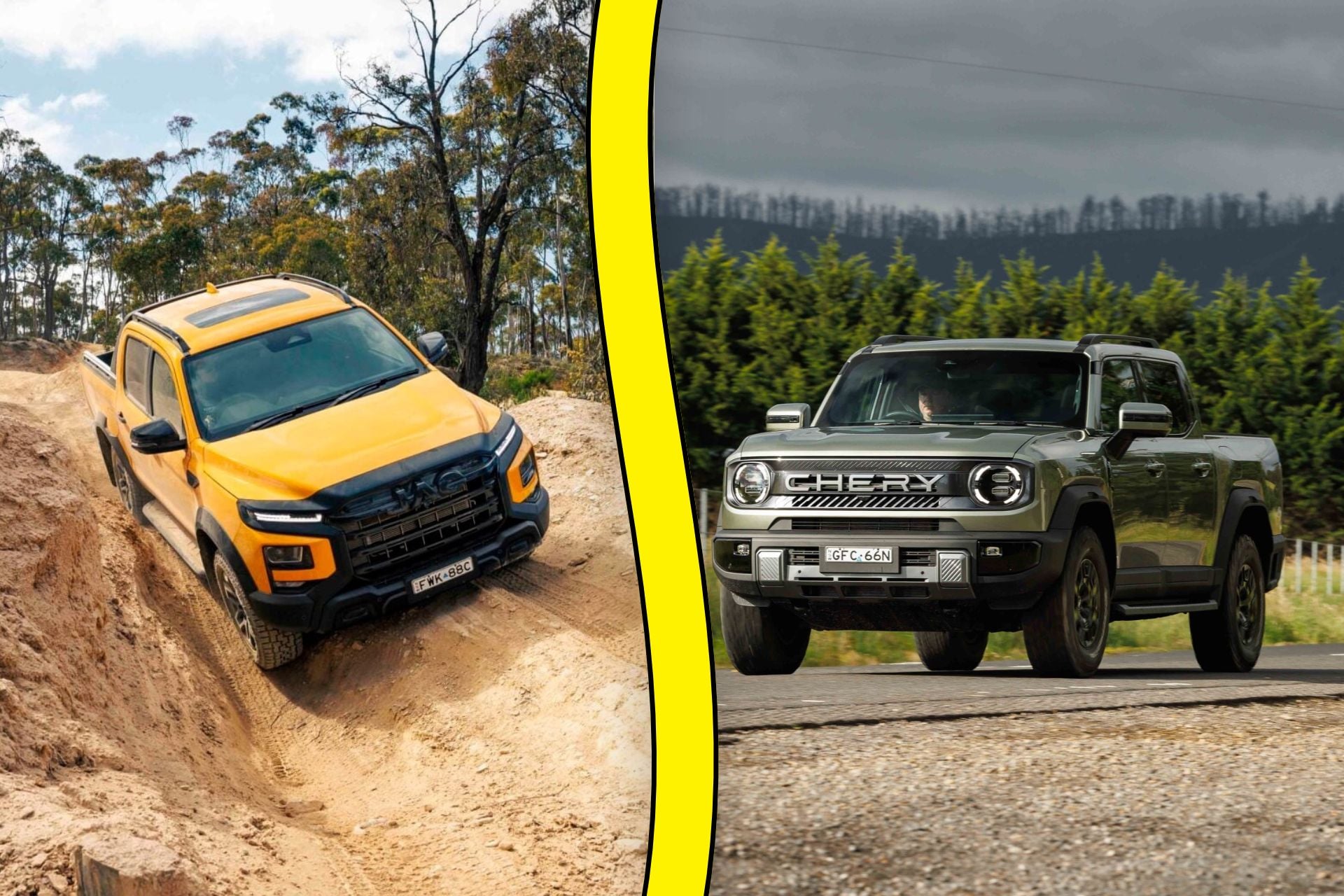
The plug-in hybrid ute market is getting more interesting, with the JAC Hunter and Chery Stockman taking two different approaches to electrified four-wheel driving.
The Hunter pairs a 2.0-litre turbo-petrol engine with two electric motors and a four-speed dedicated hybrid transmission (4DHT). The Stockman uses a 2.5-litre turbo-diesel plug-in hybrid system, also with a dedicated hybrid transmission. For this spec comparison, we’re putting the JAC Hunter X up against the flagship Chery Stockman Ultimate. The Hunter X is priced at $54,844, while the Stockman Ultimate costs $57,990. Both prices are before on-road costs. Chery also offers a cheaper Urban grade at $52,990, while JAC’s range includes the $49,988 Hunter Pro.
Both utes claim around 100km of electric range, but their towing figures aren’t quite equal. The JAC is rated to tow 3500kg, while the Chery Stockman falls just short at 3495kg. There are also key differences in payload, GCM and off-road hardware. Differential locks, low-range gearing and standard equipment also help separate the two. Here’s how the two flagship variants compare.
Quick verdict
- Power: JAC, with 360kW and 1010Nm of claimed combined output against the Stockman’s 350kW and 800Nm.
- Electric range: Both claim around 100km, although the figures use different test cycles and aren’t directly comparable.
- Towing and payload: The Hunter X is rated to tow 3500kg, just ahead of the Stockman Ultimate’s 3495kg. Its 915kg payload also beats the Chery’s 800kg H/T or 765kg A/T, giving the JAC a 115kg or 150kg advantage respectively. It also has the higher calculated remaining allowance when towing at maximum capacity.
- Off-road ability: Stockman Ultimate is equipped with low range, three differential locks and greater ground clearance on its optional all-terrain tyre package. The Hunter X gets standard front and rear lockers.
- Value: Hunter X priced about $3000 below the Stockman Ultimate, before on-road costs.
Specifications
| Specification | JAC Hunter X | Chery Stockman Ultimate |
|---|---|---|
| Price | $54,844 | $57,990 |
| Powertrain | 2.0L turbo-petrol PHEV | 2.5L turbo-diesel PHEV |
| Fuel type | E10-compatible petrol | Diesel |
| Engine power | 160kW | 140kW |
| Engine torque | 370Nm | 450Nm |
| Combined power | 360kW | 350kW |
| Combined torque | 1010Nm | 800Nm |
| Transmission | 4-speed dedicated hybrid transmission (4DHT) | 4-speed dedicated hybrid transmission (4DHT) |
| Drive | 4WD | 4WD |
| Battery | 31.2kWh LFP | 34kWh LFP |
| Electric range | 100km NEDC | 100km WLTC (H/T); 96km WLTC (A/T) |
| Combined range | 1005km NEDC | Not supplied |
| Combined fuel consumption | 1.6L/100km NEDC | 1.0L/100km WLTC (H/T); 1.1L/100km WLTC (A/T) |
| Fuel tank | 77L | 80L |
| AC charging | 11kW | 6.6kW |
| DC charging | 46kW | 70kW |
| Braked towing | 3500kg | 3495kg |
| Kerb weight | 2555kg | 2700kg H/T; 2735kg A/T |
| Payload | 915kg | 800kg H/T; 765kg A/T |
| GVM | 3470kg | 3500kg |
| GCM | 6430kg | 6500kg |
| Ground clearance | 200mm | 235mm H/T; 247mm A/T |
| Wading depth | 550mm | Not supplied |
| Approach angle | 28 | 30 |
| Departure angle | 23 | 25 |
| Rampover angle | 23 | Not supplied |
| Low range | No | Yes |
| Front differential lock | Yes | Yes |
| Centre differential lock | No | Yes |
| Rear differential lock | Yes | Yes |
| External / internal power | 6.6kW V2L; 220V internal power outlet | Two 230V power outlets |
Chery’s Ultimate comes standard with highway-terrain tyres. Its optional all-terrain package brings 17-inch wheels, 285/70 R17 tyres, 247mm ground clearance and a higher kerb weight. The JAC Hunter X also offers optional dealer-fit all-terrain tyres, with buyers able to choose between Pirelli Scorpion AT or Yokohama Geolandar AT4 rubber. Chery’s indicative specification sheet lists electric range and fuel consumption using the WLTC test cycle. Its Australian pricing announcement also quotes a 100km NEDC electric range.
Price and equipment
The JAC Hunter X costs $54,844, making it $3146 cheaper than the Chery Stockman Ultimate at $57,990. Both prices are before on-road costs. The Hunter Pro starts at $49,988, while the entry-level Stockman Urban is priced at $52,990.
The Stockman Ultimate adds a head-up display, heated and ventilated front seats, heated steering wheel, digital rear-view mirror and 14-speaker audio system over the entry-level Urban. However, several of its other features are also fitted to the Hunter X, including a 360-degree camera with chassis view, roof rails, front fog lamps, heated and power-folding mirrors and rear privacy glass.
Both utes also have large infotainment touchscreens, wireless and wired Apple CarPlay and Android Auto, synthetic leather upholstery and powered front seats. The Hunter X has standard front and rear differential locks, while the Stockman Ultimate gets three locking differentials: front, centre and rear.
The Hunter X’s suspension and handling have also been locally tuned by Multimatic’s Michael Barber, the vehicle dynamics engineer behind the development of several high-performance vehicles, giving the ute a chassis setup tailored to Australian conditions.
Powertrain and performance
The two utes take different routes to electrification.
The Hunter uses a 2.0-litre turbocharged petrol engine producing 160kW and 370Nm, backed by front and rear electric motors. The front motor produces 130kW and 300Nm, while the rear motor delivers 150kW and 340Nm. JAC quotes combined system outputs of 360kW and 1010Nm, making the Hunter X the more powerful of the two on paper.
The Stockman uses a larger 2.5-litre turbo-diesel engine producing 140kW and 450Nm. It is paired with a 34kWh lithium iron phosphate battery and electric drive components, with combined system outputs of 350kW and 800Nm. Both utes use a four-speed dedicated hybrid transmission (4DHT) and send drive to all four wheels.
The JAC has the higher quoted combined power and torque, while the Chery’s diesel engine produces more torque on its own. The combined figures are manufacturer-quoted system outputs, rather than measurements at the wheels.
Electric range and charging
Both utes offer a claimed electric driving range of around 100km, although their published figures need a little explanation.
JAC quotes 100km of electric range for the Hunter X on the NEDC test cycle, from its 31.2kWh battery. Chery’s Australian pricing announcement also quotes up to 100km on the NEDC cycle, but its indicative specification sheet lists 100km on the WLTC cycle with highway-terrain tyres and 96km with the optional all-terrain tyres. Those figures should not be treated as a direct comparison unless the same test cycle is used. The Stockman has a slightly larger 34kWh battery, with both vehicles using LFP chemistry.
JAC quotes a combined NEDC driving range of 1005km and fuel consumption of 1.6L/100km. Chery’s indicative sheet lists combined consumption of 1.0L/100km on WLTC for the Ultimate with highway-terrain tyres, rising to 1.1L/100km with the all-terrain package. A directly comparable combined driving-range figure has not been supplied for the Stockman.
Charging is another area where the Chery has the advantage on paper. The Stockman supports up to 70kW DC charging, while the Hunter X is listed with a maximum DC charging rate of 46kW. The Hunter X also has a 6.6kW vehicle-to-load (V2L) function for powering external appliances, along with a 220V power outlet in the cabin. The Stockman specification sheet lists two 230V power outlets, although it does not provide a corresponding V2L output rating.
Towing, payload and GCM
Both utes are designed to tow heavy loads, with the Hunter X rated to 3500kg braked and the Stockman just behind at 3495kg. The Chery also has a 750kg unbraked towing capacity and a maximum towball download of 350kg.
Payload is where the JAC has a clear advantage. The Hunter X is rated at 915kg, compared with 800kg for the Stockman Ultimate on standard highway-terrain tyres. Fitting the optional all-terrain package increases the Chery’s kerb weight and reduces payload to 765kg.
GCM is just as important as the maximum towing figure when working out how much weight a ute can carry while towing. Using the formula below:
GCM − trailer weight − kerb weight = remaining allowance
- Hunter X: 6430 − 3500 − 2555 = 375kg
- Stockman Ultimate (H/T): 6500 − 3495 − 2700 = 305kg
- Stockman Ultimate (A/T): 6500 − 3495 − 2735 = 270kg
On these figures, the Hunter X has 70kg more theoretical remaining allowance than the Stockman Ultimate with highway-terrain tyres, increasing to a 105kg advantage over the all-terrain version when both are towing at their maximum rated capacity.
This is a calculation based on GCM, trailer mass and kerb weight, not an additional payload allowance. Occupants, luggage and accessories all need to be accounted for, along with towball download. The vehicle must also remain within its GVM and front and rear axle limits.
The JAC has the higher payload and more remaining allowance in this calculation, while the Stockman has a slightly higher GCM. The difference in the Stockman’s kerb weight and its lower maximum towing rating affects the final result.
Off-road capability
The Stockman Ultimate has the more conventional four-wheel-drive setup, with selectable 4H and 4L, Intelligent 4WD and centre, rear and front differential locks. The front locker is the key difference between the Ultimate and the entry-level Urban, which gets centre and rear lockers.
The Hunter X has front and rear differential locks as standard, but it doesn’t have a conventional low-range transfer case. That’s an important distinction for buyers who regularly tackle steep, slow-speed tracks or technical terrain.
Ground clearance also favours the Chery. The Stockman Ultimate is listed at 235mm with its standard highway-terrain tyres, increasing to 247mm with the optional all-terrain package. The Hunter X has 200mm of ground clearance. The Stockman also has better quoted approach and departure angles, at 30 and 25 degrees respectively, compared with 28 and 23 degrees for the JAC. The Hunter X has a 23-degree rampover angle, but Chery has not supplied a corresponding figure for the Stockman.
The Stockman has the advantage in low-range gearing, ground clearance and published approach and departure angles. The Hunter X counters with its standard front and rear lockers, but the absence of conventional low range will matter to buyers who regularly venture onto more challenging tracks.
Warranty and ownership
Both utes come with a seven-year vehicle warranty, but JAC has a clear advantage for buyers planning to use their ute for work.
The Hunter X is covered by a seven-year, unlimited-kilometre warranty that includes commercial use, meaning there is no separate 150,000km cap for business buyers. JAC also includes seven years of capped-price servicing and roadside assistance, along with an eight-year/150,000km battery warranty.
Another useful inclusion is JAC’s Ute-for-Ute loan program. If a Hunter needs warranty repairs that take it off the road, JAC provides a replacement ute at no cost to the owner. For metro customers, a loan vehicle can be arranged the same day if ordered before 2pm, while regional customers can expect one the next business day, subject to ordering before 2pm.
Chery also offers a seven-year, unlimited-kilometre warranty for private use, but its terms limit coverage to seven years or 150,000km, whichever comes first, for vehicles used primarily as taxis, rideshare vehicles, hire or rental vehicles, driving-school vehicles, or for delivery and courier work. Its high-voltage battery is covered for eight years with unlimited kilometres. Chery also offers seven years of capped-price servicing and up to seven years of roadside assistance, renewable annually through scheduled servicing at an authorised dealer.
| Ownership coverage | JAC Hunter X | Chery Stockman Ultimate |
|---|---|---|
| Vehicle warranty | 7 years/unlimited km, including commercial use | 7 years/unlimited km for private use; 7 years/150,000km for specified commercial uses |
| High-voltage battery warranty | 8 years/150,000km | 8 years/unlimited km |
| Roadside assistance | 7 years | Up to 7 years, renewable annually through scheduled servicing |
| Capped-price servicing | 7 years | 7 years |
| Commercial use | Covered under the 7-year/unlimited-kilometre vehicle warranty | 150,000km limit applies to specified commercial uses |
| Replacement vehicle | Ute-for-Ute loan program | Not specified |
Which one should you buy?
The JAC Hunter X is the cheaper of the two, has higher quoted combined power and torque, and carries a useful payload advantage. Its 915kg payload and calculated remaining allowance while towing at maximum capacity will appeal to buyers who need to carry gear as well as haul a trailer.
The Hunter is also now in stock, with the added benefit of a locally developed vehicle dynamics tune. Multimatic engineer Michael Barber developed the setup in Australia, with JAC saying it applied every one of his recommendations to production vehicles.
The Chery Stockman Ultimate costs more, but brings a conventional low-range transfer case, three differential locks, greater ground clearance and a more extensive equipment list. Its diesel-electric powertrain will also appeal to buyers who prefer a diesel engine in a touring or towing ute.
The decision comes down to how the ute will be used. The Hunter X makes a strong case on price, power, payload and its local vehicle dynamics tune, while the Stockman Ultimate has the more traditional off-road hardware and a better-equipped cabin.
Quickfire FAQs
How much does the JAC Hunter X cost?
The JAC Hunter X is priced at $54,844 before on-road costs. The Hunter Pro starts at $49,988 before on-road costs.
How much does the Chery Stockman cost?
The Stockman Urban is priced at $52,990, while the Ultimate costs $57,990. Both prices are before on-road costs.
Which ute has more power?
The JAC Hunter X has higher quoted combined outputs of 360kW and 1010Nm, compared with 350kW and 800Nm for the Chery Stockman.
Which has the better off-road equipment?
The Stockman Ultimate has low range, three differential locks and greater ground clearance. The Hunter X has standard front and rear differential locks but no conventional low range.
Follow 4X4 Australia on Google
Get more 4x4 news, reviews and gear stories from 4X4 Australia in your Google feeds.