Reviews

Gallery 1
Things we like
- Supercharged V8 delivers 579kW and 919Nm
- Excellent Bilstein suspension with 330mm/355mm wheel travel
- Full-time 4WD, low range and rear diff lock
Not so much
- Heavy 2860kg-plus kerb weight
- Very thirsty on premium fuel
- 2235mm width limits access on tight tracks
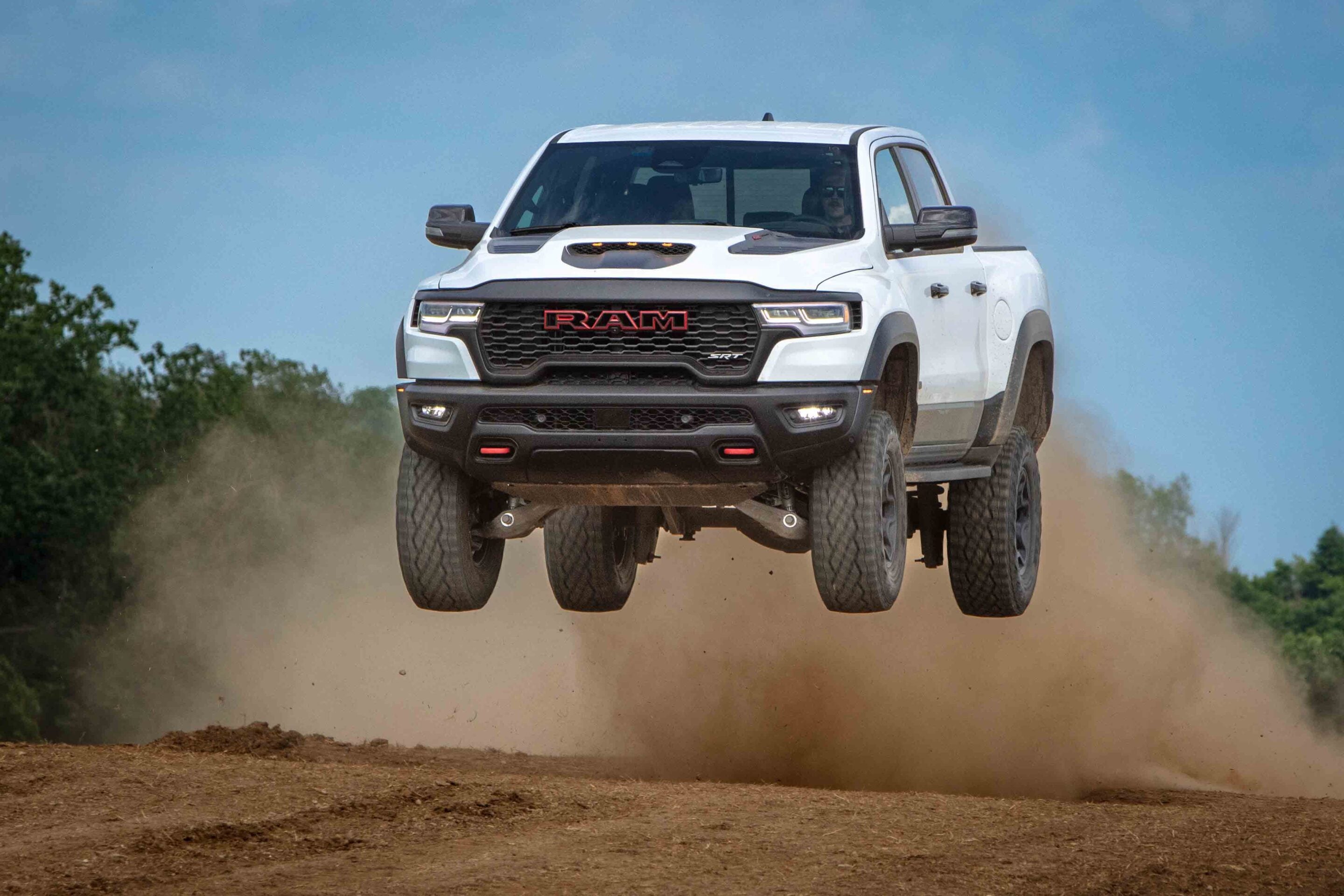
Like a theme from a Hollywood blockbuster, RAM has revived its TRX Apex Predator for a new age. It’s coming back to Australia in 2027 and we scored an advance taste of the off-road weapon.
Nicknamed T-Rex, it was the brand’s answer to Chevy’s ZR2 and Ford’s Raptor. RAM went so far as to hide Easter eggs and run campaigns depicting a Tyrannosaurus Rex devouring a helpless Velociraptor. Unfortunately for the TRX, in 2024 it followed its prehistoric namesake into extinction. RAM was being drawn into the whirlpool of electrification, replacing some of its V8s with six-cylinder engines and hybrids. That flew like a toothless T-Rex in a Raptor coop.
However, when Tim Kuniskis emerged from retirement to resurrect the brand, he turned electrification upside down. Burning the midnight oil through the 2025 Christmas holiday, the team figured out how to mate the 5.7-litre Hemi with Atlantis, an entirely new electrical architecture. RAM then jumped back into desert racing, dipped its toes into NASCAR and announced more than a dozen new models or variants. And that’s how the TRX landed back on its claws, this time with RAM’s SRT division (Street, Racing & Technology) backing it.
Kuniskis said, “Bringing back the nameplate isn’t enough. Ram set the bar five years ago with 702hp, and that benchmark has been challenged. SRT doesn’t limbo; we high-jump – and 721 wasn’t going to cut it. 777hp? That’s the mark. And it represents more than power – it signals an awakening and a new path forward.”
Under the bonnet
The cat is now out of the bag, with a power increase of more than 10 per cent and a five per cent bump in torque.
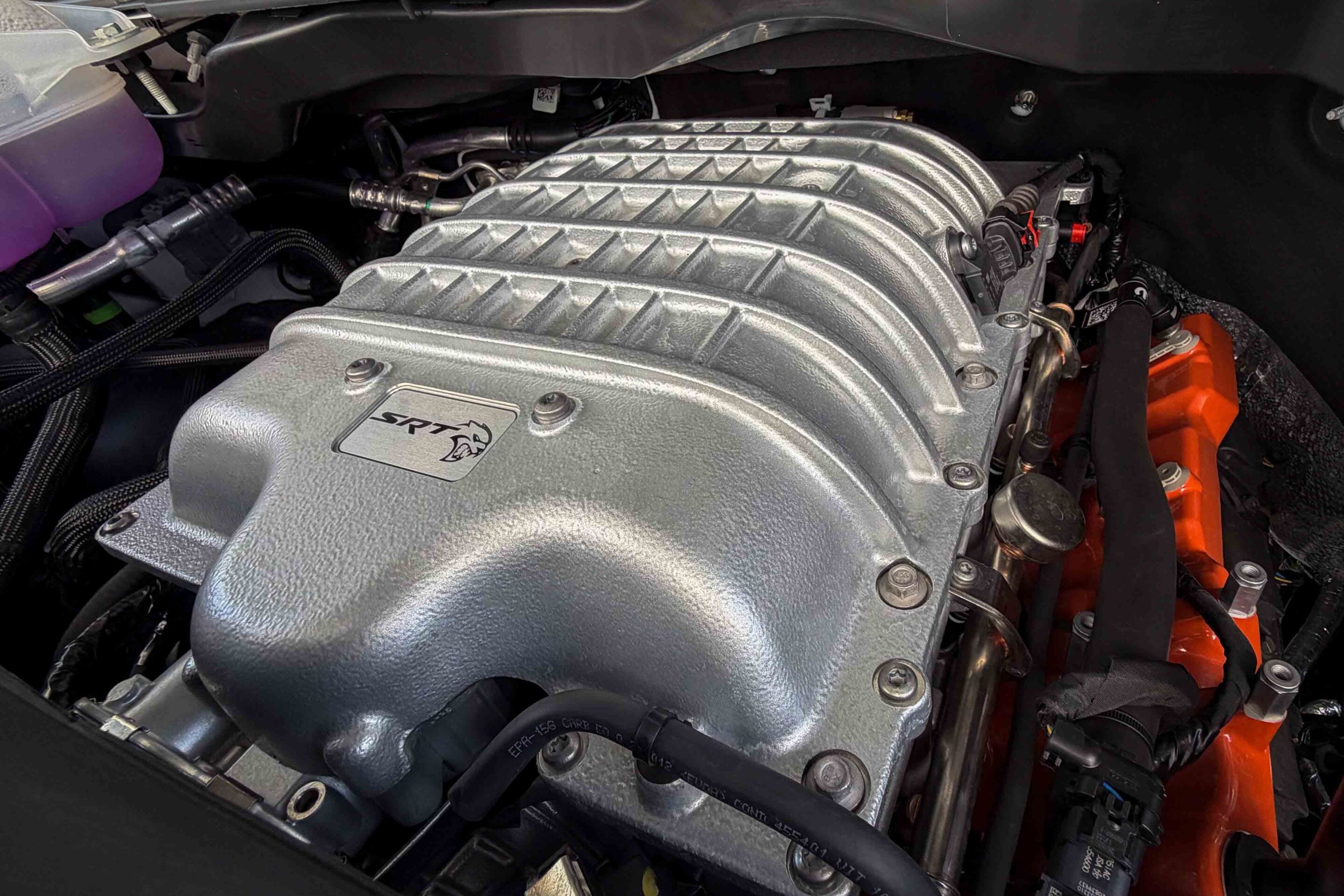
The 6.2-litre Hemi V8 is capped with a twin-screw 2.4-litre supercharger, or blower as we used to call them. Its core is a deep-skirt cast-iron block with a forged crank and rods, cross-bolted main bearing caps and aluminium heads with hemispherical combustion chambers.
The air induction system breathes via two sources: through the grille and from a centre-mounted bonnet scoop. They converge at a high-capacity, low-resistance radial air filter that provides even distribution, longer service life and improved performance. The bonnet has a duct system with relief flaps designed to drain water and debris – if you happen to dip the nose in a billabong.
Spent gases are expelled through a dual three-inch exhaust fitted with a crossover tube. Keeping things cool is a high-capacity radiator, while a 250-amp alternator tops up an 800CCA AGM battery. This mill also requires premium fuel (95RON or better), but the net result is a whopping 579kW (777hp) at 6500rpm and 919Nm (680lb-ft) at 4800rpm.
It is backed by the venerable ZF TorqueFlite 8HP95 eight-speed fly-by-wire automatic transmission, with a 4.71:1 first gear and a 0.67:1 top gear. Distributing power to the axles is BorgWarner’s 48-13 full-time transfer case, which, depending on mode selection, allows for a variable torque split fore and aft. This is the exact setup that came in the Gen 1 TRX, all the way down to the 2.64:1 low-range ratio.
1
2021 TRX vs 2027 TRX: Numbers compared
| Specification | 2021 TRX | 2027 TRX |
|---|---|---|
| Power | 702hp (523kW) | 777hp (579kW) |
| Torque | 650lb-ft (881Nm) | 680lb-ft (922Nm) |
| 0-60mph | 4.5 sec | 3.5 sec |
| 0-100mph | 10.5 sec | 10.0 sec |
| ¼ mile | 12.9 sec | 12.2 sec |
| Top speed | 118mph (190km/h) | 118mph (190km/h) |
Suspension and underbody
Down below is a typical ladder-box high-strength steel frame. Up front are forged aluminium A-arms, a 215mm differential and heavy-duty half-shafts.
Out back is a five-link setup securing a Dana 60 full-floating axle, coil-sprung and fitted with an electronically controlled locker. To help manage axle wrap, a damper rides between the differential and frame. The ring-and-pinion ratio is 3.55:1, and ABS disc brakes cap all corners (378mm rotors up front and 375mm at the rear).
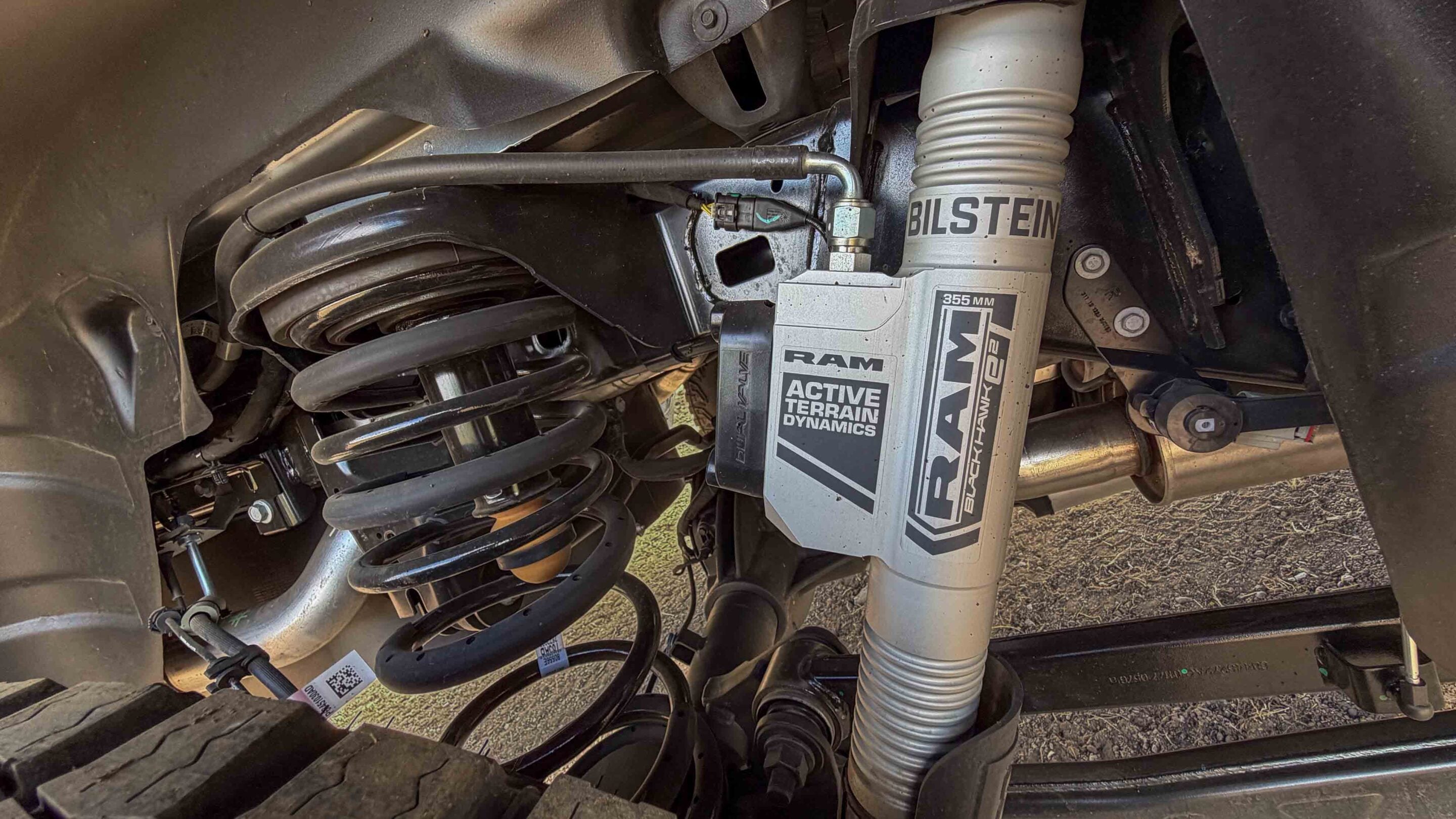
The magic lies in Bilstein’s updated Black Hawk e2 Active Terrain Dynamics dampers. Each is milled out of a single piece of cast aluminium and features cooling fins, dual electronic proportioning valves, nitrogen-charged remote reservoirs and stainless-steel braided lines. Every few milliseconds, the system evaluates 12 metrics (driver input, yaw, axle position, etc.) and adjusts both compression and rebound valving accordingly.
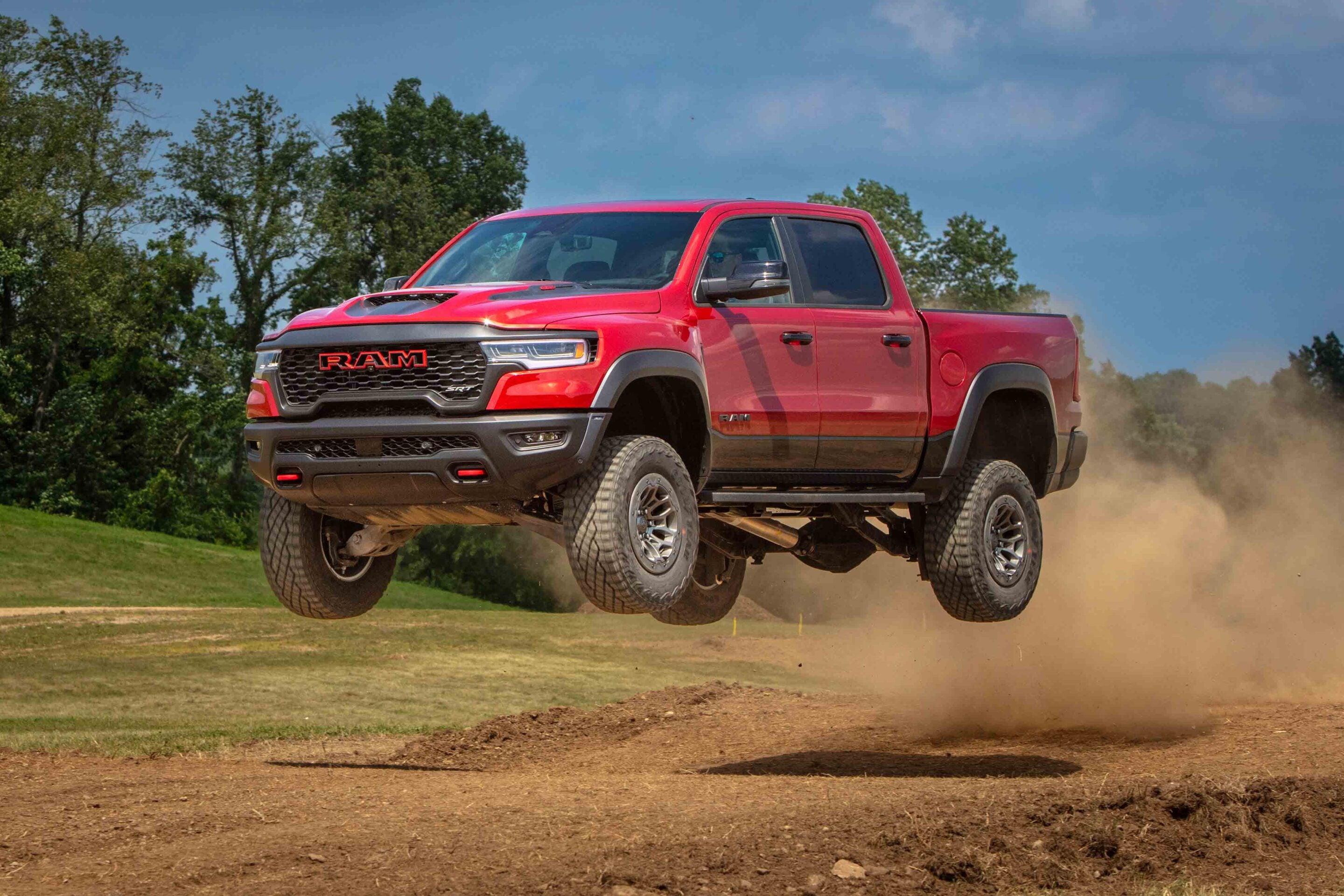
For example, if the axles are at full droop, the system detects that the vehicle is airborne and prepares for touchdown. It also talks with the ECM to cut engine revs, reducing the chance of an adrenaline-filled driver redlining the engine and snapping an axle when the tyres hit terra firma. Internal hydraulic bump stops (jounce stops) work in conjunction with traditional external urethane units. The result is 330mm (13in) of travel up front and 355mm (14in) at the rear, along with independent and instantaneous damping adjustments at all four corners.
1
Exterior and off-road equipment
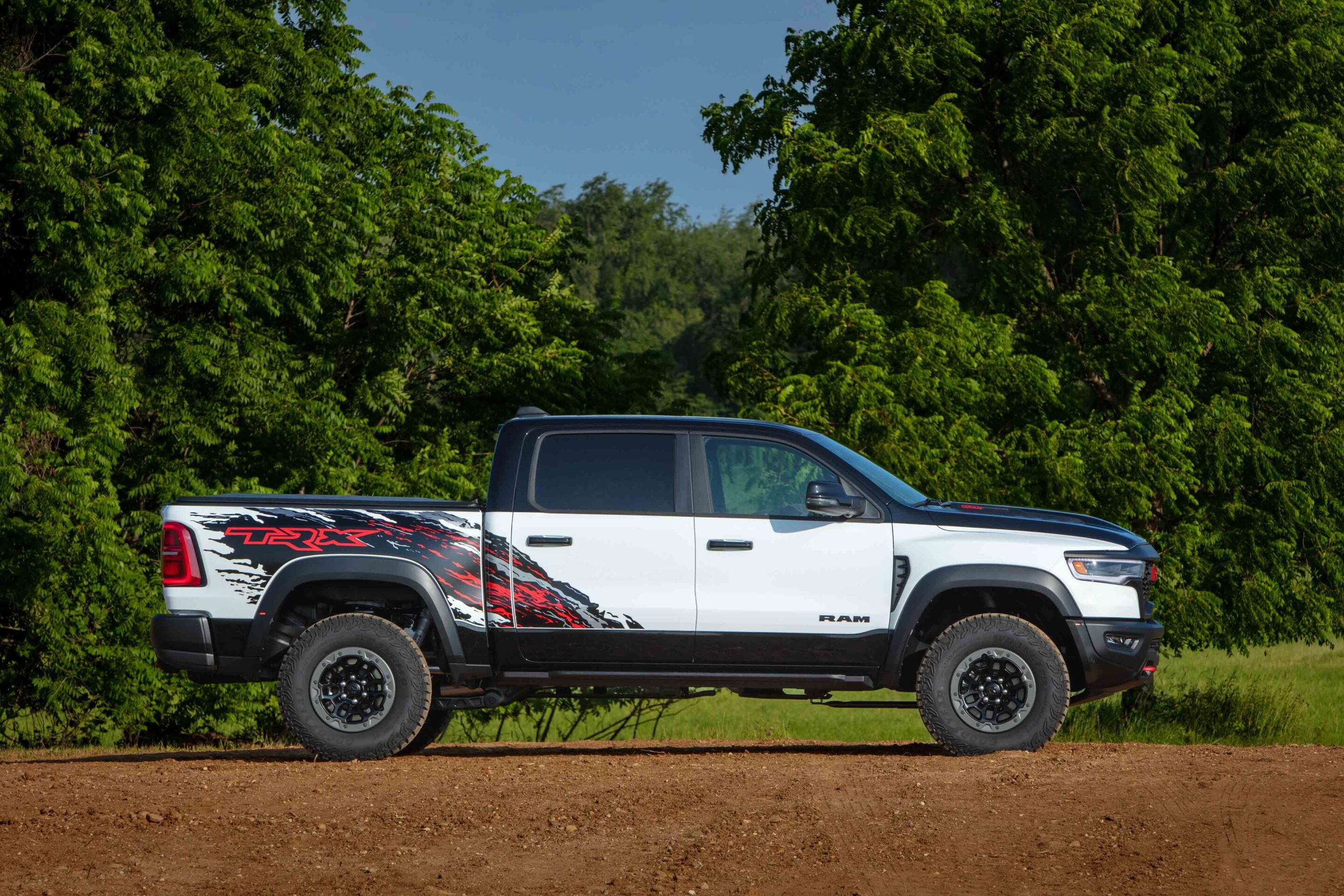
All TRXs use RAM’s four-door Crew Cab body with a 5ft 7in (1702mm) double-wall steel tub. Like the Gen 1, this is a big girl with an overall width of 2235mm.
Composite flares contribute to this figure, as do the wider front guards and tub. From a distance, it has a bit of a stock-car posture, low and wide, but this is mostly due to its proportions. Approach, departure and ramp-over angles are reasonable at 31, 25 and 16.8 degrees respectively, and ground clearance lands at 239mm at the front, 189mm at the rear and 300mm under the belly pan.
A heavy-duty steel front bumper cradles LED fog lights and proper recovery points, and bi-functional projector headlamps illuminate the trail ahead. Goodyear is RAM’s tyre of choice, and the TRX runs 325/65R18 Wrangler all-terrains wrapped around satin black alloy wheels, with a beadlock option. Full-length rock rails protect the sills, and a tonneau cover will help to keep your esky from flying out when you become airborne.
1
Interior and technology
If we are mortgaging our first-born son to buy a rig, we’d expect interior accoutrements to be top-notch, and the TRX does not disappoint.
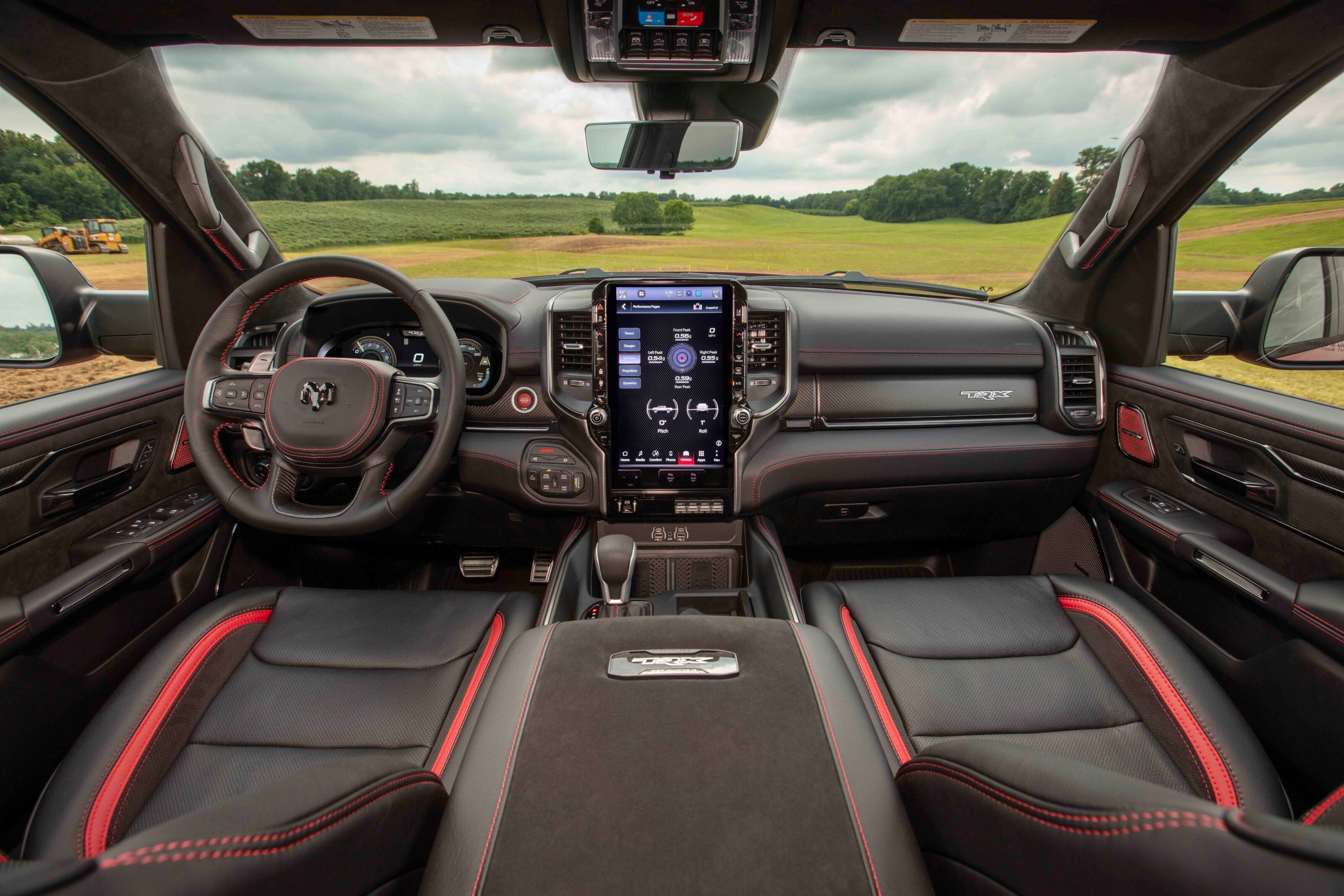
Leather, carbon fibre, alloy and suede abound, comfort is sublime, and ergonomics are excellent. The 12-way adjustable, heated and ventilated seats have thick bolsters to keep your bum and back where they should be, and the massage feature is an added bonus. LCD screens keep getting bigger: the TRX’s central command station measures 14.5 inches and the instrument cluster measures 12.3 inches. Countless menus and subpages monitor or control engine vitals, suspension configuration and performance, audio and comfort needs. At the driver’s eye level, a 10-inch head-up display indicates speed, engine revs, gear selection and other functions.
While everything is drive-by-wire these days, the TRX retains a proper floor shift lever for the transmission. Paddle shifters are within finger’s reach for those moments when you need to keep your hands on the steering wheel. Ahead of the shifter are dual wireless charging stations and numerous USB-A and USB-C ports.
For the audiophile in all of us, cranking up the 900-watt, 19-speaker Harman Kardon audio system might send us to the hearing aid guy much earlier in life than expected. As for Apple CarPlay, Android Auto, a 360-degree camera view and annoying electronic babysitters (adaptive drowsy driver alert, traffic sign recognition, etc.), the TRX has them all. As for Hands-free Active Drive Assist (semi-autonomous driving), I doubt I will ever relinquish control of my rig to a bot (no, I did not try it).
1
Driving the 2027 RAM 1500 TRX SRT
I’ll admit I had an infatuation with the original TRX. A racing buddy and I even pitched a project to run one in the Baja 1000, but RAM didn’t bite.
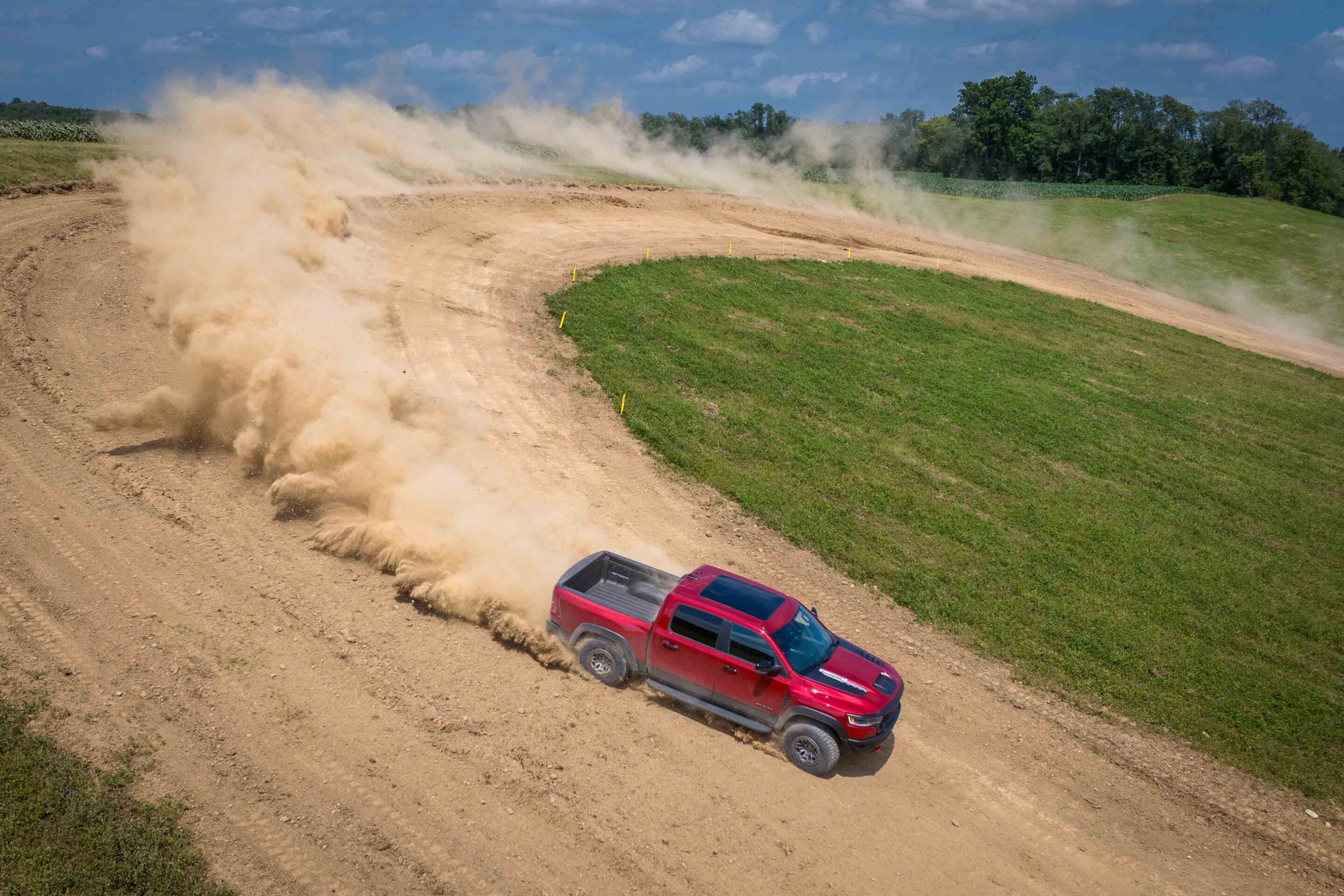
Having said that, the new SRT offering lived up to my expectations. The original Bilstein Black Hawk damping was exceptional to begin with, but what I noticed with the new system was its better ability to set up the back end for a hard drifting corner (stabbing the brakes with a quick turn of the steering wheel). If done correctly, the front wheels hit the intended departure azimuth and the countersteer required was minimal. Some of this can also be credited to being in the right drive mode. There are many (auto, tow, mud/sand, rock, snow, sport, Baja, valet), but Baja is the one you want for nearly free rein of the controls.
Touching down from an altitude of roughly a metre was not an issue. The TRX stuck the landing, settled quickly and let me prepare for the next turn. However, with a kerb weight of more than 2860kg, she’s a heavy girl and sufficient lead time must be allowed when shutting down for a tight corner.
1
As you might gather, much of this mirrors the SRT’s older TRX sibling. However, that extra 56kW (75hp) is noticeable any time you mash the skinny pedal. While grandpa could pull 0–60mph (96.5km/h) in 4.5 seconds, this new youngin’ beats the old-timer by a full second, doing it in 3.5. Zero to 100mph (161km/h) scores a head-snapping 10 seconds flat, and if you keep your foot on the happy pedal, you’ll pass the quarter mile in a blistering 12.2 seconds. Pretty incredible for a truck that’s nearly Baja-ready from the showroom floor. Top speed for old and new is 190km/h, which I’m guessing has to do with the tyres’ speed rating.
Now let’s talk fuel and economy. This mill requires 95RON fuel, the tank holds 125 litres and the EPA estimate lands at 14mpg city and 16mpg on the highway – approximately 16.8L/100km and 14.7L/100km respectively. Unless you drive like Grandma Eunice, you can probably knock 20 per cent or more off that fuel economy.
However, I doubt that anyone who ponies up US$103,000 (A$145k) for a truck like this is worried about sticker shock at the pump. If the 2027 TRX SRT was designed to induce an adrenaline rush, encourage spirited driving and inflate our egos a bit, job well done.
15
Quickfire FAQs
How much power does the 2027 RAM 1500 TRX SRT make?
The supercharged 6.2-litre Hemi V8 produces 579kW (777hp) and 919Nm (680lb-ft).
What engine does the 2027 RAM TRX SRT have?
It uses a 6.2-litre supercharged Hemi V8 with a twin-screw 2.4-litre supercharger.
What transmission does the 2027 RAM TRX SRT use?
A ZF TorqueFlite 8HP95 eight-speed automatic transmission.
Does the 2027 RAM TRX SRT have low range?
Yes. It uses a BorgWarner 48-13 full-time transfer case with a 2.64:1 low-range ratio.
What suspension does the 2027 RAM TRX SRT have?
It features Bilstein Black Hawk e2 Active Terrain Dynamics dampers, with 330mm of front wheel travel and 355mm at the rear.
When is the 2027 RAM TRX SRT coming to Australia?
It is expected to arrive in Australia in 2027.
Specs
| Specification | Details |
|---|---|
| Engine | 6.2-litre supercharged Hemi V8 |
| Supercharger | 2.4-litre twin-screw |
| Power | 579kW (777hp) at 6500rpm |
| Torque | 919Nm (680lb-ft) at 4800rpm |
| Fuel requirement | 95RON or better |
| Transmission | ZF TorqueFlite 8HP95 eight-speed automatic |
| Transfer case | BorgWarner 48-13 full-time |
| Low-range ratio | 2.64:1 |
| First gear ratio | 4.71:1 |
| Top gear ratio | 0.67:1 |
| Differential ratio | 3.55:1 |
| Front differential | 215mm |
| Rear axle | Dana 60 full-floating |
| Rear differential lock | Electronically controlled |
| Front suspension | Forged aluminium A-arms |
| Rear suspension | Five-link, coil-sprung |
| Dampers | Bilstein Black Hawk e2 Active Terrain Dynamics |
| Front wheel travel | 330mm |
| Rear wheel travel | 355mm |
| Front brake rotors | 378mm |
| Rear brake rotors | 375mm |
| Body style | Four-door Crew Cab |
| Tub length | 1702mm |
| Overall width | 2235mm |
| Ground clearance (front) | 239mm |
| Ground clearance (rear) | 189mm |
| Ground clearance (belly pan) | 300mm |
| Approach angle | 31 degrees |
| Departure angle | 25 degrees |
| Ramp-over angle | 16.8 degrees |
| Tyres | 325/65R18 Goodyear Wrangler all-terrains |
| Wheels | 18-inch satin black alloy |
| Kerb weight | More than 2860kg |
| Fuel tank capacity | 125 litres |
| Fuel economy (city, EPA) | 16.8L/100km |
| Fuel economy (highway, EPA) | 14.7L/100km |
| Central touchscreen | 14.5 inches |
| Instrument cluster | 12.3 inches |
| Head-up display | 10 inches |
| Audio system | 900-watt, 19-speaker Harman Kardon |
Things we like
- Supercharged V8 delivers 579kW and 919Nm
- Excellent Bilstein suspension with 330mm/355mm wheel travel
- Full-time 4WD, low range and rear diff lock
Not so much
- Heavy 2860kg-plus kerb weight
- Very thirsty on premium fuel
- 2235mm width limits access on tight tracks
Follow 4X4 Australia on Google
Get more 4x4 news, reviews and gear stories from 4X4 Australia in your Google feeds.

We recommend
-
 News
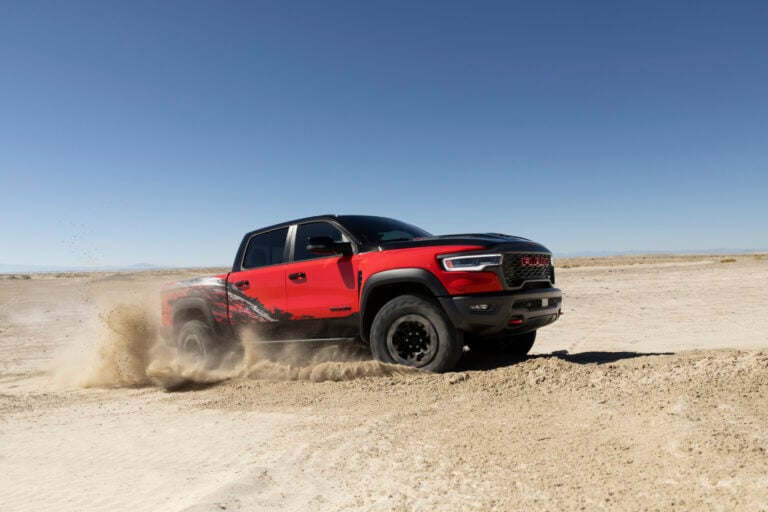
Ram TRX returning to Australia with supercharged V8
Ram’s supercharged V8 performance pick-up is coming back to Australia, with the renamed TRX SRT due in showrooms from early 2027
-
 News
Could the Ram 1500 TRX be making a comeback in 2026?
Speculation is mounting that the Raptor rival might return as early as next year
-
 News
RAM TRX tipped to return to Australia
The Ram TRX is back in the US with more power than ever, and Australia could be next