
The Freelander name is back, but not in the way many will remember it.
At a global reveal in China, the first model from the revived brand – the Freelander 8 – has appeared in production-intent form, signalling a new direction for the once familiar badge as it moves into the premium, tech-focused SUV space.
Rather than a nostalgic reboot, this is a clean-sheet repositioning. The Freelander brand is now a joint venture between Chery and Jaguar Land Rover, built through the Chery Jaguar Land Rover plant in Changshu. The partnership combines Chery’s advanced automotive technology with Jaguar Land Rover’s design expertise, forming the basis for the new-generation SUV line.
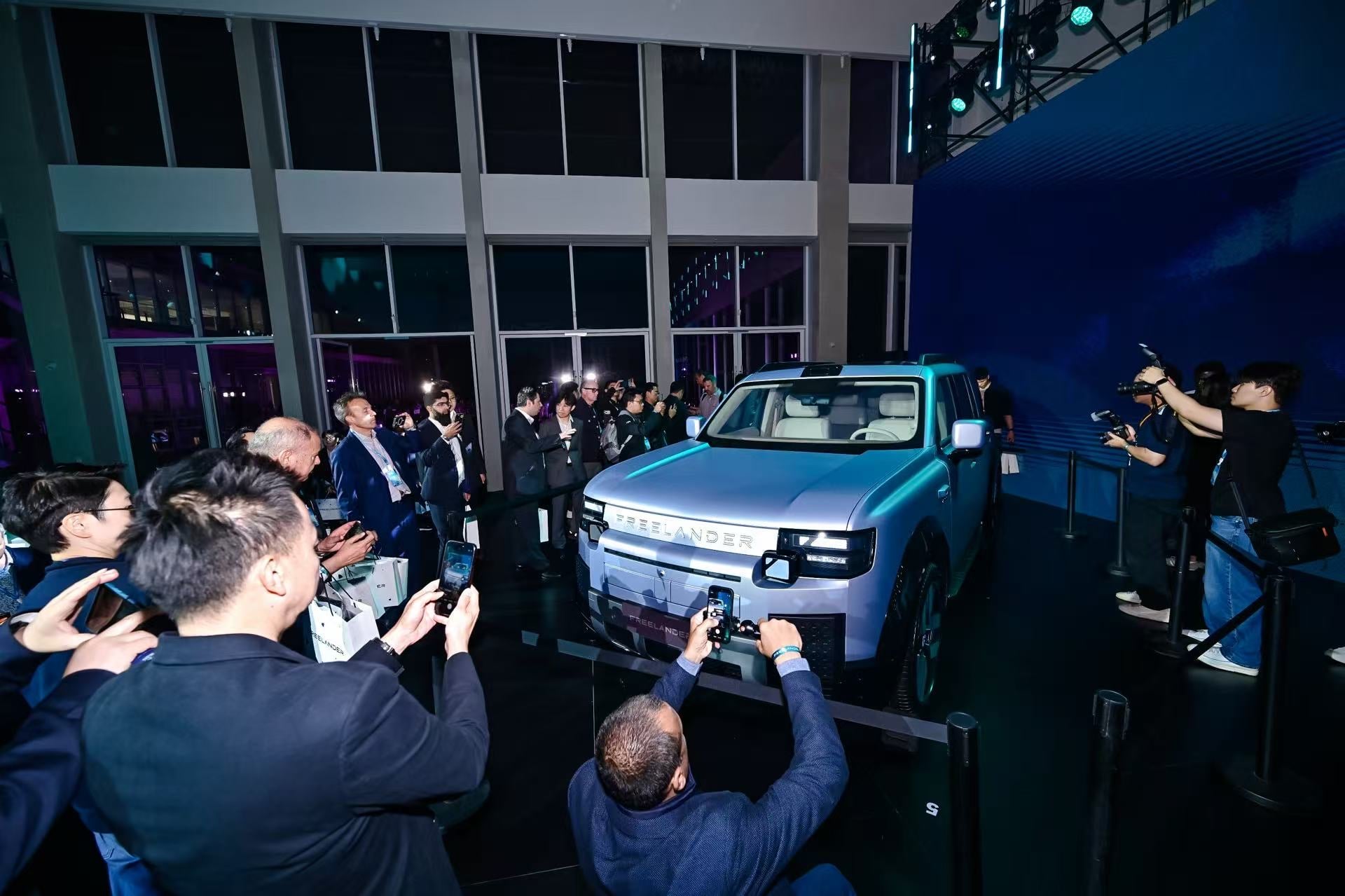
Visually, the design retains links to the original Freelander through its overall silhouette and signature rear-quarter window, but updates the execution with a more technical lighting signature and a stronger, more upright stance. A “castle body” design theme defines the exterior, pairing a solid lower body with a lighter, more refined upper cabin.
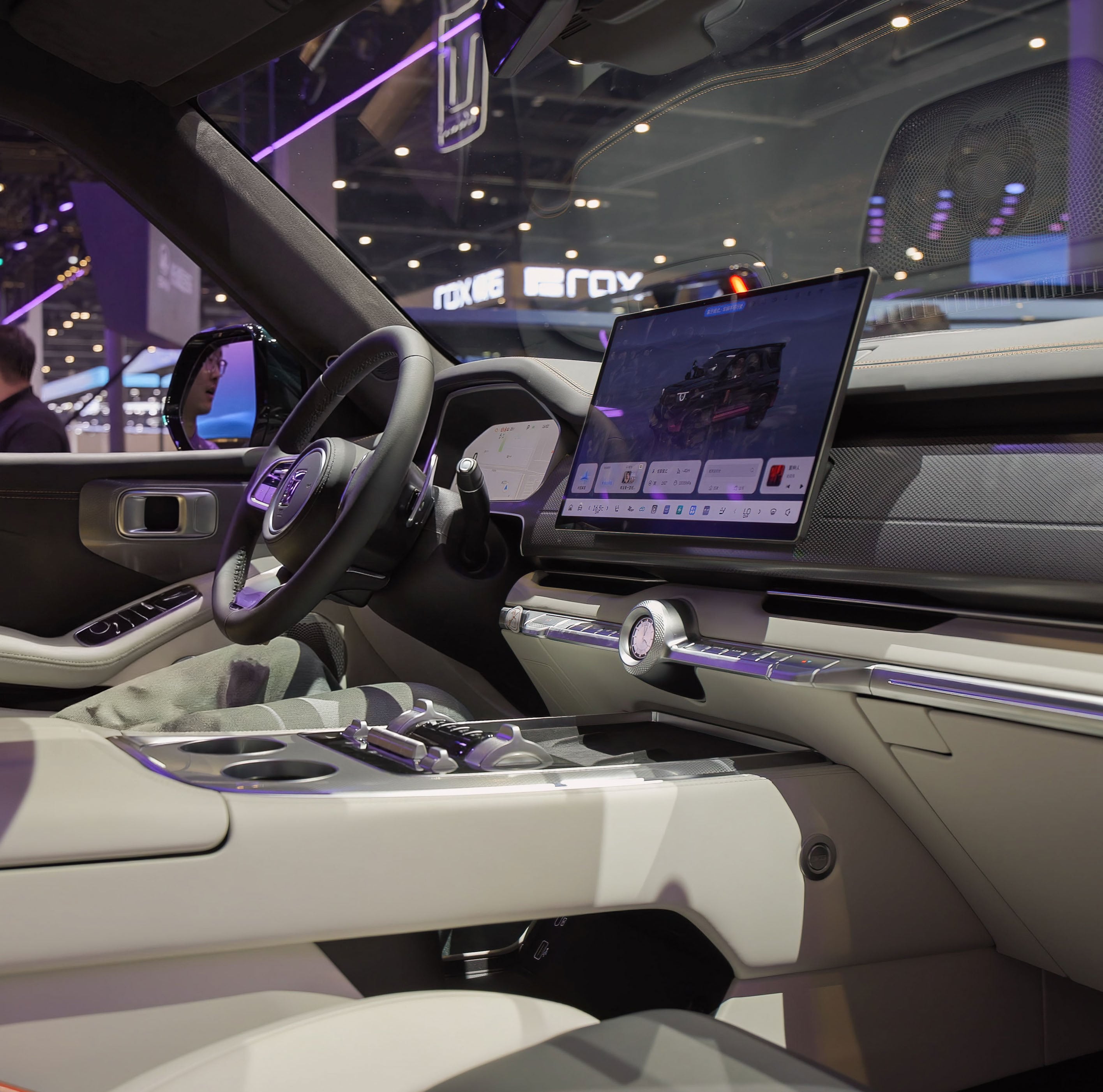
Inside, the focus is on digital integration and cabin openness. A large-format Mini LED display dominates the dashboard, bringing vehicle information, navigation and driving data into a single unified interface. The layout is said to emphasise space and visibility while reducing traditional visual clutter.
The Freelander 8 also introduces the Intelligent All-Terrain System (i-ATS), designed to automatically adjust vehicle settings based on changing surface conditions. It offers nine terrain modes and operates alongside hardware including an electronic limited-slip differential, air suspension and a virtual centre locking function.
Together, these systems position the vehicle as a flexible SUV suited to mixed driving environments, from city use through to regional travel and light off-road conditions.
The Freelander nameplate first appeared in 1997 under Land Rover as an entry-level SUV aimed at combining everyday usability with light off-road capability. It ran through two generations before being phased out in 2014, when it was replaced by the Discovery Sport. The original model played a key role in broadening Land Rover’s appeal during the early growth of the modern SUV segment.
The Freelander 8 marks the first step in the brand’s relaunch strategy, with further details – including Australian timing – still to be confirmed closer to production.
The PRO-4X is the top of the range for the new D27 Navara line-up for now. Nissan will be releasing a Warrior version of the PRO-4X in association with its partner Premcar later this year, but for now the $68,418 PRO-4X is the king of the hill.
It’s no secret that the new Navara is a product Nissan shares with its alliance partner Mitsubishi, and as a result the D27 is essentially a current-model Triton – a ute that has been on the market here for more than two years now.
If Nissan was going to partner with anyone, then Mitsubishi is a pretty good choice as it has been building utes and 4X4s for decades, and the current Triton is not a bad thing. Hence, the D27 Navara is also not bad.
JUMP AHEAD
Powertrain
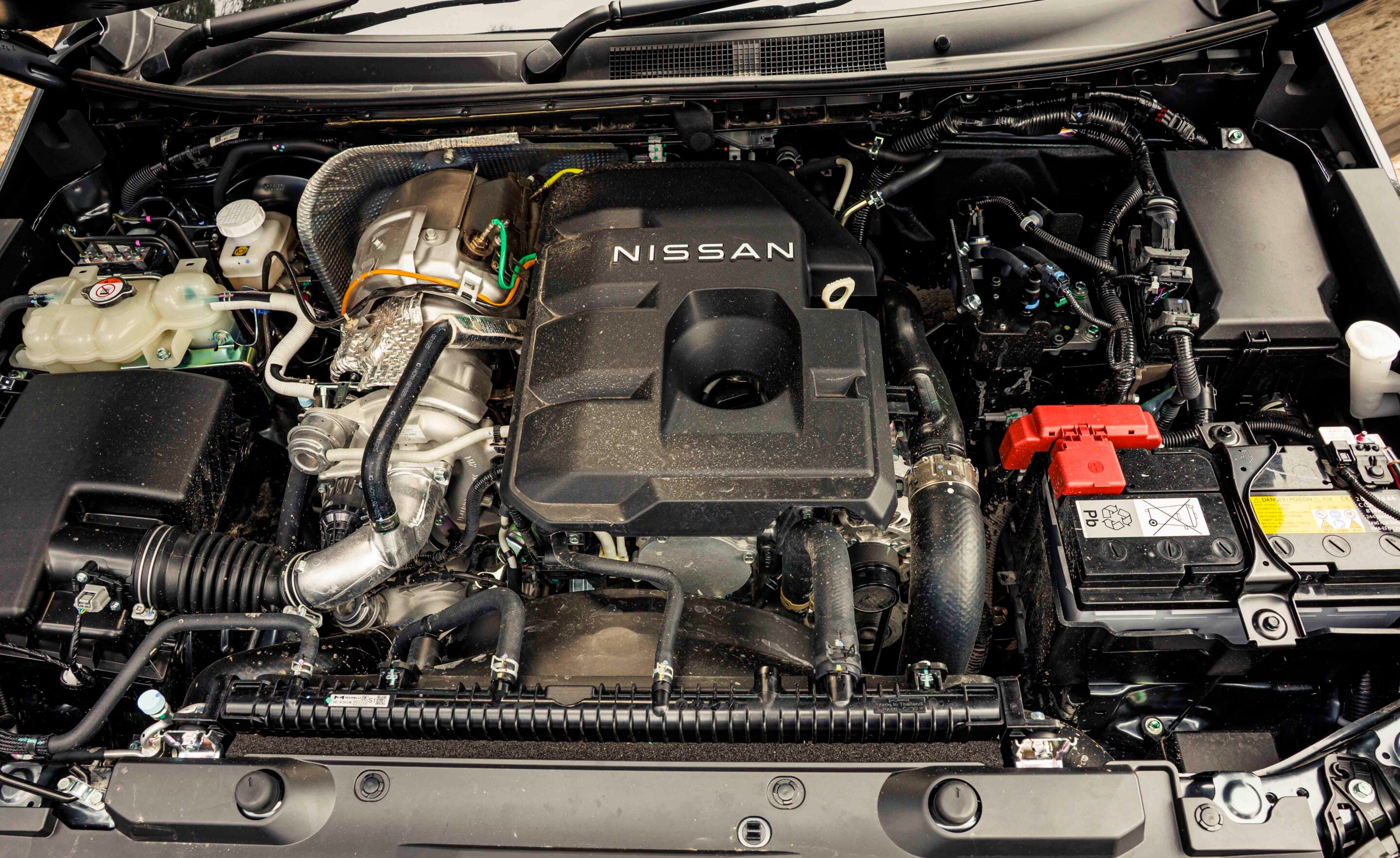
All D27 Navaras are powered by Mitsubishi’s 2.4-litre bi-turbo diesel engine, producing 150kW and 470Nm, with a claimed combined fuel consumption of 7.1L/100km. The engine is paired with a six-speed automatic transmission, with no manual option offered.
The lack of a manual gearbox is one of the key differences between the limited Navara range and the more extensive Triton line-up. Other options you won’t find in a new Navara are single- and extra-cab models, two-wheel drive or cab-chassis traybacks. That’s not to say you can’t remove the cargo tub and fit a tray yourself. The D27 Navara range is strictly double-cab 4X4 utes with an automatic transmission.
As the top of the range Navara, the PRO-4X gets the Super Select 4×4 system, which offers two- and four-wheel drive, high and low range and full-time 4×4 for on-road driving.
The engine’s peak torque of 470Nm doesn’t tell the full story of the Navara’s performance, as it’s the broad torque curve that gives the ute plenty of mid-range grunt where it’s most useful. It’s punchy and works well with the six-speed auto when you put your foot down to get on with the job.
On-road performance
Not so great is the performance of the transmission when driving around town at lower speeds.
Forty to 50km/h suburban meandering has the transmission overly busy shifting up and down through the ratios and being very annoying. Some drivers may not notice it, but for me, once I felt it I couldn’t miss it and it annoyed me every time I was driving around the local area.
Another annoyance that couldn’t be ignored is a vibration from the engine at low revs, particularly below 1500rpm. My co-driver and I both noted it on the launch drive when coming to a stop in traffic, but that drive was mainly open road and I didn’t mention it after that. Back in town and at low-speed suburban pace, in two different new Navaras, I felt it more often – when slowing down but also when the transmission shifts up to higher gears and drags the engine speed down. It’s something I feel the engineers should be able to tune out with transmission and torque converter calibration.
Off-road performance
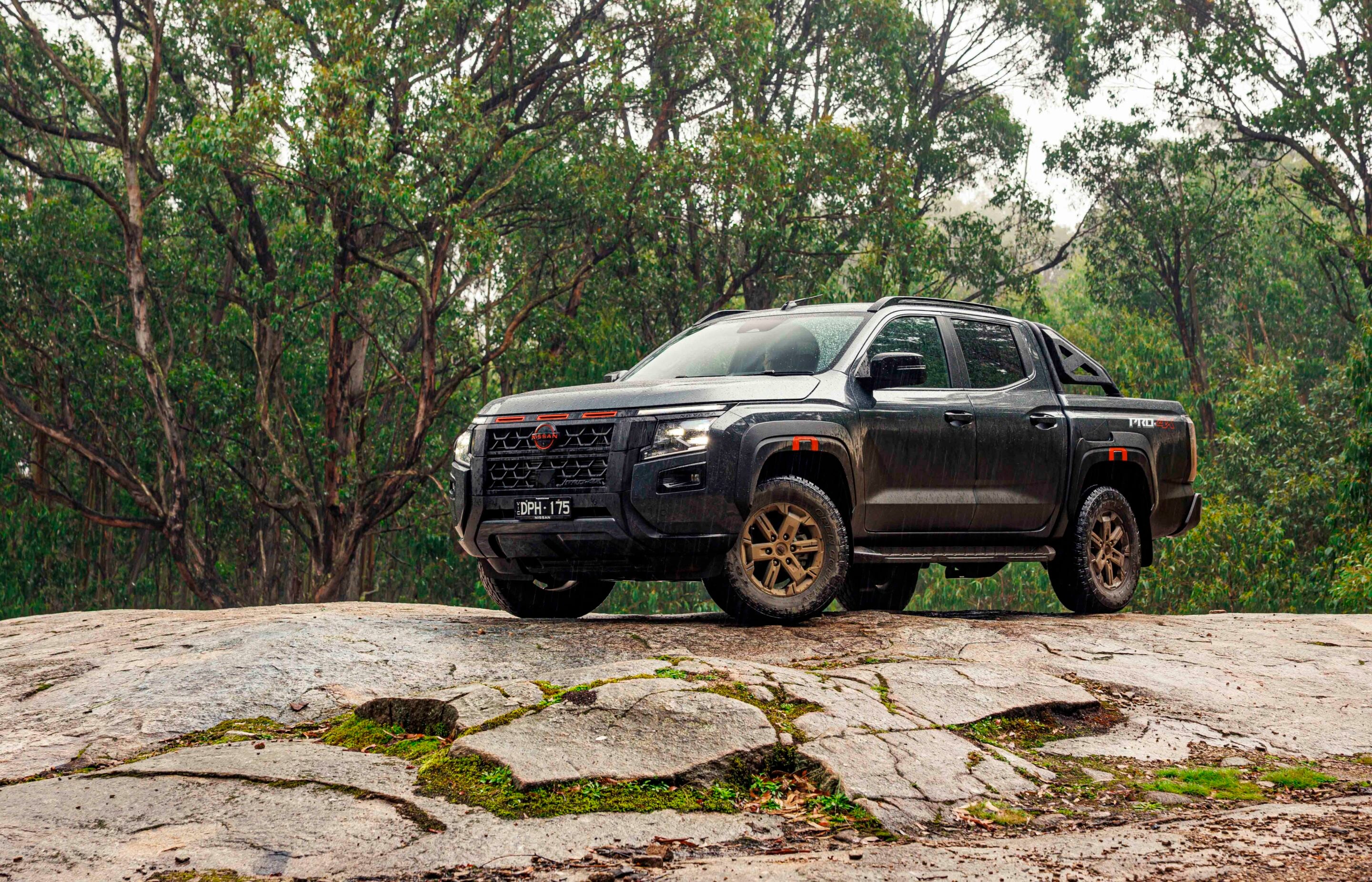
The Navara uses a conventional ladder-frame chassis with coil-spring IFS up front and a leaf-sprung live axle at the rear.
The two top models in the D27 range run a lighter rear leaf pack for improved comfort and drivability when unladen, and it gives the PRO-4X a composed and comfortable ride. Likewise, the front end does an excellent job on road and on snotty tracks to deliver precise and predictable handling.
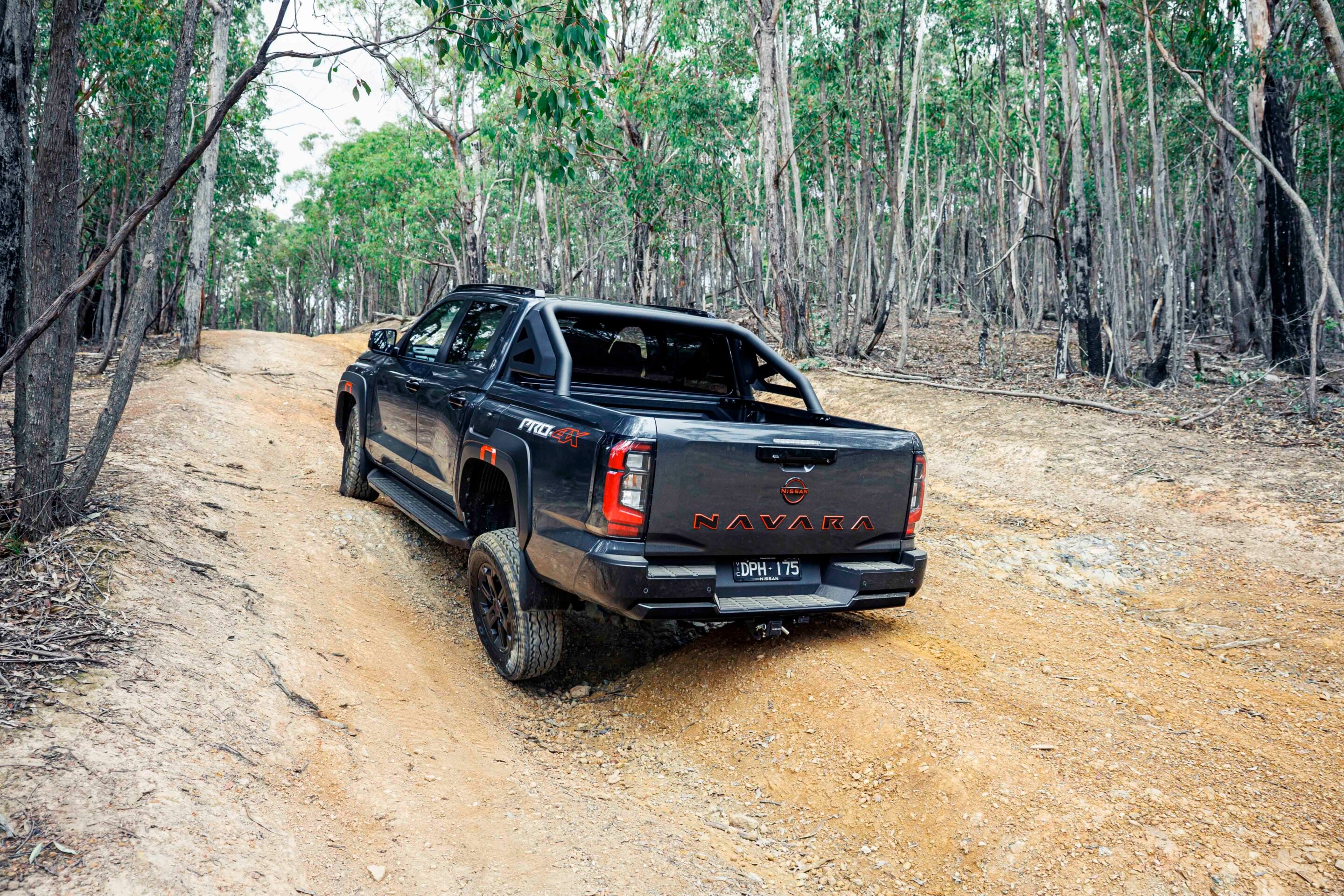
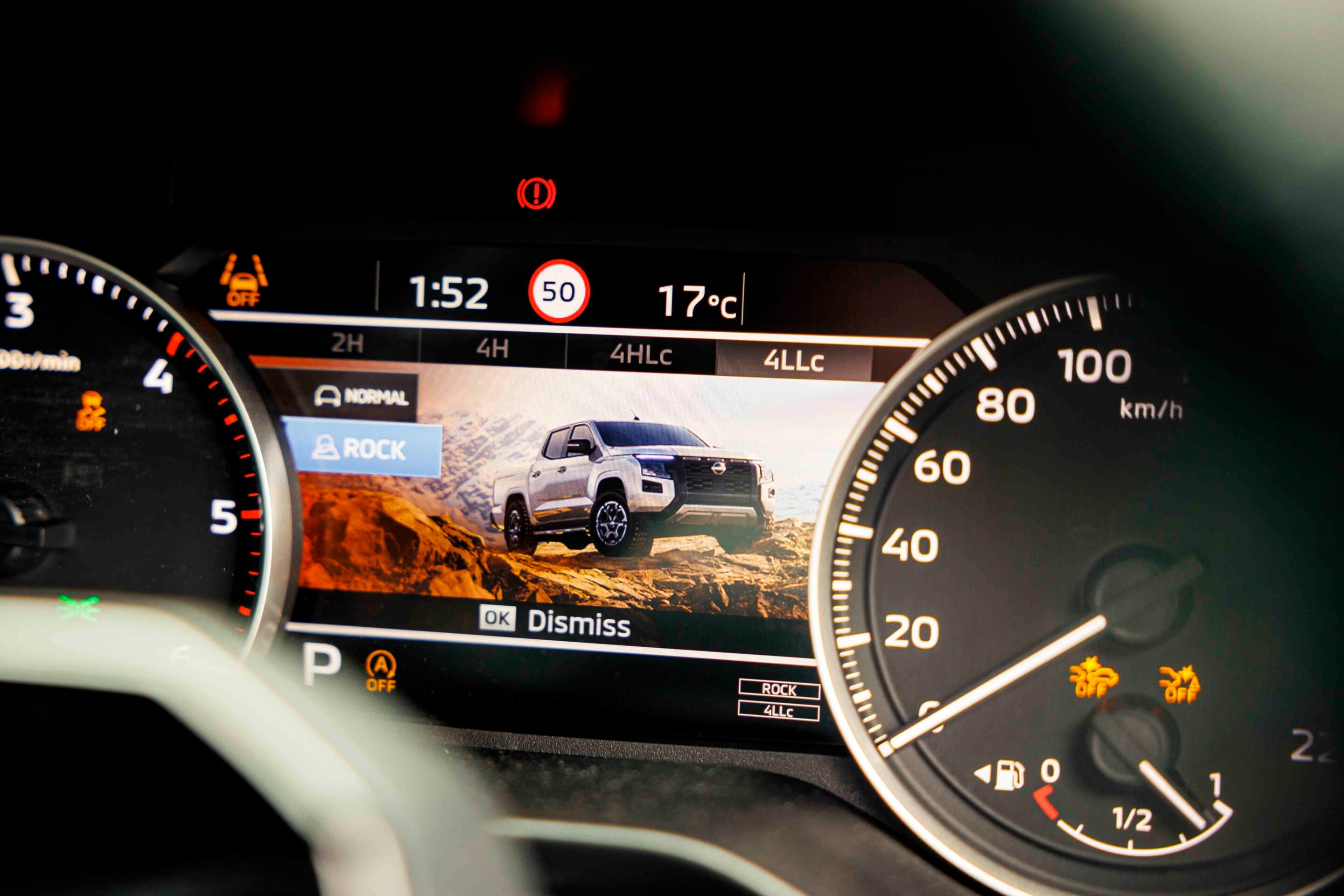
The Navara has a locking rear diff, which made the traverse of our wombat holes easy, but the ETC also does a very good job of distributing drive without resorting to the RDL. All D27 Navaras have a 3500kg towing capacity. GVM is rated at 3190kg and GCM at 6250kg, plus a payload of 964kg for the PRO-4X. The PRO-4X comes standard with a towbar fitted, fully wired and ready to go.
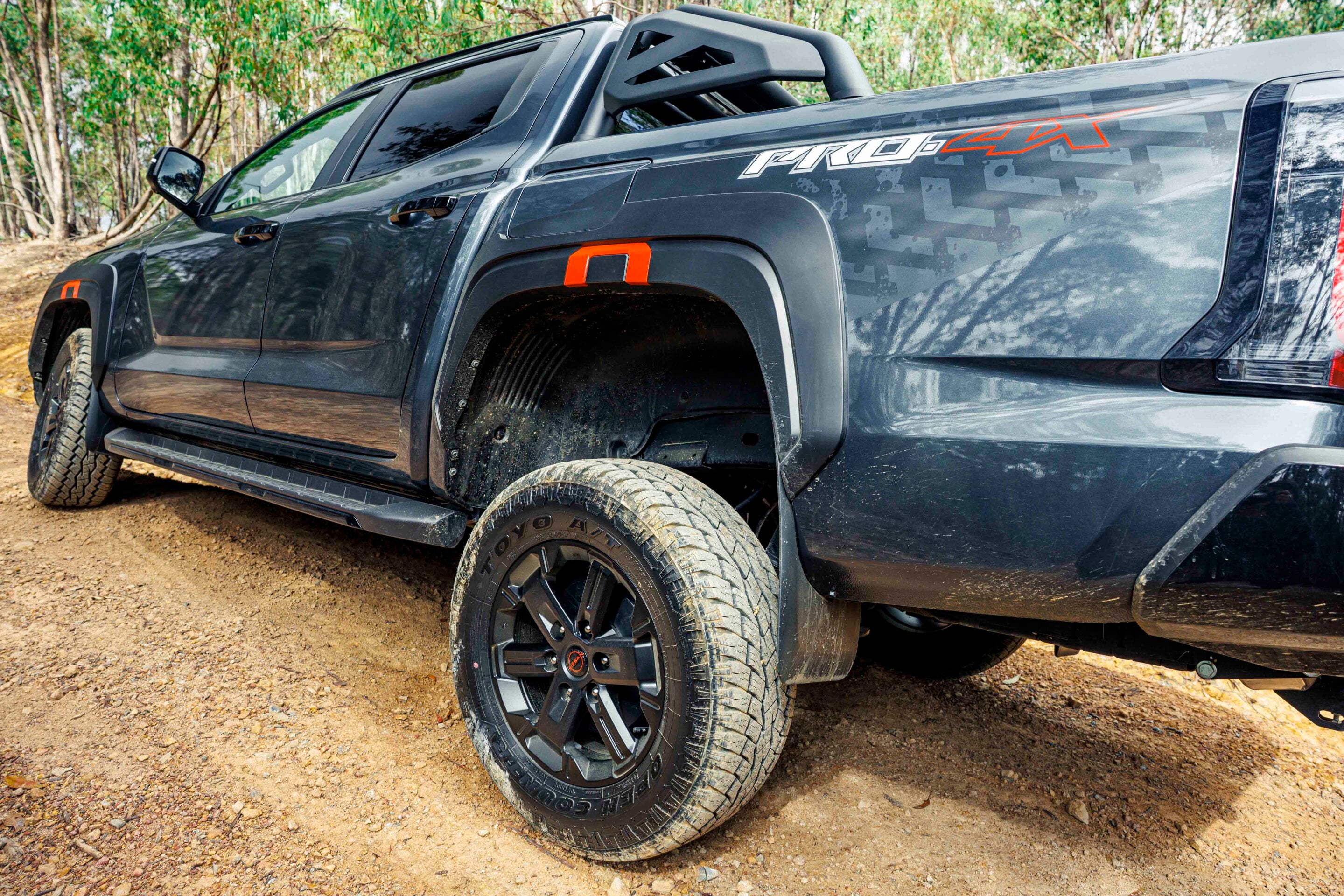
The PRO-4X is also the only model in the range to get Toyo all-terrain tyres as standard fitment, and their more aggressive tread pattern was appreciated in the wet and muddy conditions of our day out.
| Measurement | Value |
|---|---|
| Approach Angle | 30.4 |
| Rampover Angle | 23.4 |
| Departure Angle | 22.8 |
| Ground Clearance | 228mm |
Interior
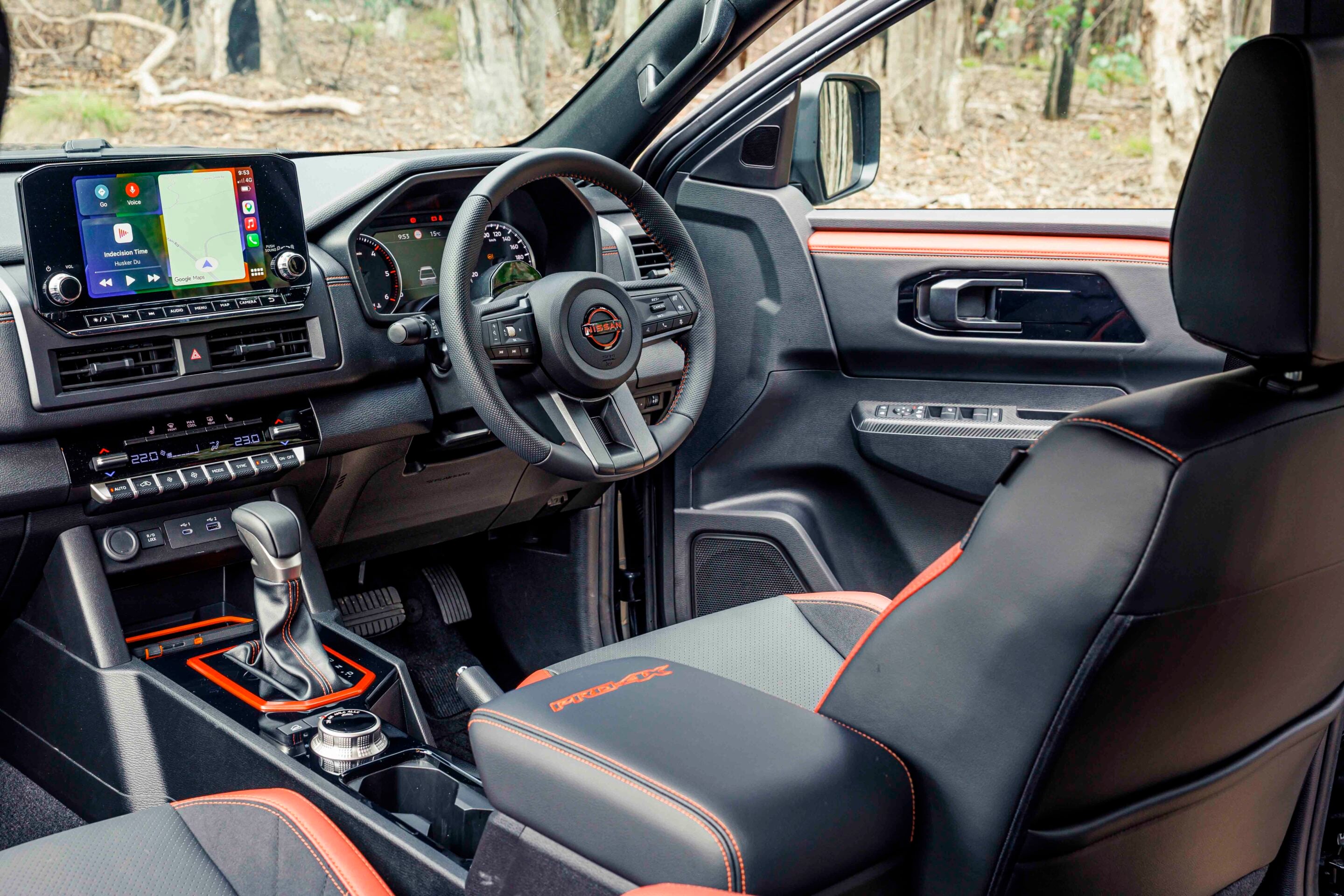
The PRO-4X’s cabin is well equipped and neatly laid out, with leather-accented seats featuring orange stitching and suede bolsters, a leather-accented steering wheel with matching stitching, and ‘PRO-4X’ logos embossed on the front seats. There are also black-painted inner door handles and orange accents on the centre console and door trims.
The 9-inch infotainment screen sounds small when compared to the 12.3-inch units that are popular in many utes these days, but the Navara screen is taller and squarer than those more horizontal ones, and it is well placed and easy to access and operate.
Safety
Safety-wise, the Navara gets eight airbags, autonomous emergency braking (AEB), lane departure warning with emergency lane assist, trailer sway control, front and rear parking sensors, a reversing camera, blind-spot warning, intelligent around-view monitor with moving object detection, driver monitoring, tyre pressure monitoring (TPMS), and front and rear cross-traffic alert. These features have earned the D27 a five-star safety rating, although this is based on 2024 testing.
Ownership and warranty
All D27 Navaras come with Nissan’s service-activated warranty of up to 10 years/300,000km (otherwise five years/unlimited kilometres). It also includes up to 10 years/300,000km of service-activated roadside assist (otherwise one year/unlimited kilometres), along with a five-year flat-price service schedule, with services priced at $499.
Verdict
The new Navara’s similarity to the Mitsubishi Triton with which it shares so much is not a bad thing. The Mitsubishi is a great base and the subtle changes to the Nissan give buyers more options and the ability to bargain with dealers when looking for a sale.
There’s nothing subtle about the PRO-4X’s orange accents and highlights both inside and out, and they won’t be for everybody, but those buyers might look at the ST-X Navara, which shares the same specification but with more subdued styling and different wheels and tyres.
The new D27 doesn’t raise the Navara’s standing among the ute rankings, and it remains a mid-class player. It is still no Ranger, HiLux or Tasman, but adds to the mid-range mix that includes Triton, D-MAX, BT-50, GWM and the emerging brands. It will be interesting to see what Premcar delivers when the PRO-4X Warrior arrives, especially in view of the recently unveiled Triton Raider, which was also developed by Premcar.
What’s great is that we are getting more choices when looking for a midsize ute and that ability to negotiate with dealers who all want your hard-earned.
Specs
| Specification | Nissan Navara PRO-4X |
|---|---|
| Price | $68,418 + ORC |
| Engine | Inline 4-cyl diesel, twin turbo |
| Capacity | 2442cc |
| Max Power | 150kW @ 3500rpm |
| Max Torque | 470Nm @ 1500-2750rpm |
| Transmission | 6-speed auto |
| 4×4 System | Part-time, dual range 4×4 with full-time 4WD |
| Construction | 4-door ute, ladder-frame chassis |
| Front Suspension | IFS with wishbones and coils |
| Rear Suspension | Live axle on leaf springs |
| Tyres | 265/65R17 on alloy wheels |
| Kerb Weight | 2105kg |
| GVM | 3200kg |
| Payload | 1095kg |
| Towing Capacity | 3500kg |
| GCM | 6250kg |
| Seating | 5 |
| Fuel Tank | 75L (17L AdBlue) |
| ADR Fuel Consumption | 7.5L/100km |
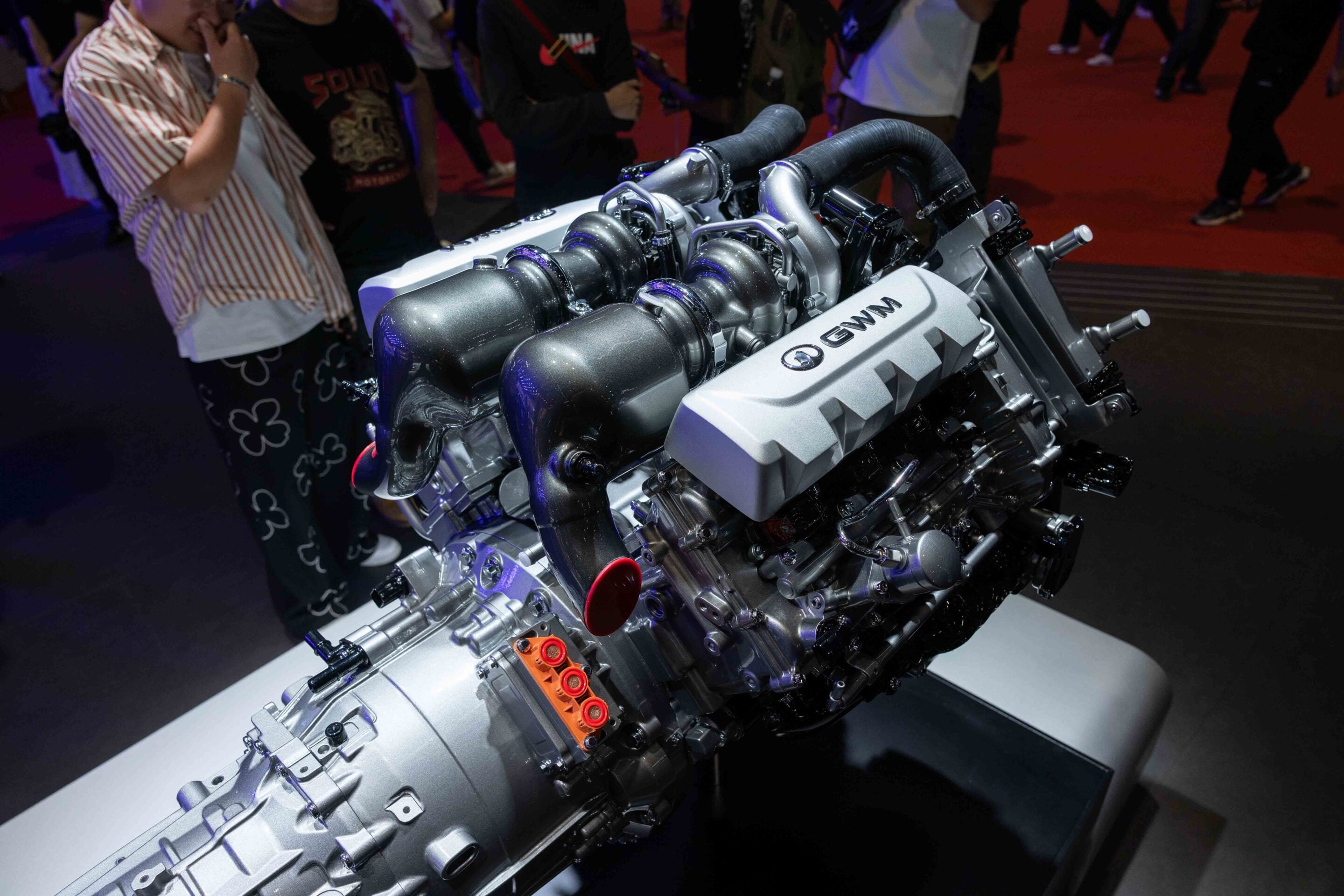
GWM has locked in a V8 for the Tank 700, signalling a more traditional, high-output direction for its flagship 4×4.
The Tank 700 sits at the top of GWM’s Tank lineup as a premium five-seat flagship, built on a body-on-frame 4WD architecture and designed to blend serious off-road capability with high-end cabin tech and long-distance touring comfort. It’s positioned above the Tank 500, pushing further into luxury territory while still maintaining the rugged hardware expected of a true off-roader.
It’s this positioning that makes the V8 decision significant. Rather than leaning fully into electrification, GWM is clearly carving out space for large-capacity performance in its global strategy – especially for markets like Australia and New Zealand where traditional towing and touring expectations remain strong.
The update came out of the Beijing Auto Show 2026, where GWM Chairman Jack Wei confirmed the new engine direction and reinforced the Tank 700’s role in the brand’s expanding performance lineup.
“In the future, the Tank 700 will also use a V8 engine. The supercar uses a high-performance V8, while the Tank 700 uses a normal V8,” said Mr Wei. “This is completely opposite to the current environment or trend in China; it does not fit the Chinese market. We developed this V8 to meet the needs of more global users, in markets such as Australia and New Zealand,” he said.
It’s not a left-field call either. The idea of a V8 Tank SUV has been floating around since the Shanghai Auto Show 2025, where GWM acknowledged growing demand for a more traditional high-capacity SUV in export markets. What’s changed is the level of commitment. GWM is now backing multiple V8 applications across its range, including a 4.0-litre twin-turbo hybrid V8 set for its upcoming GF supercar due in 2027.
Locally, the Tank brand is starting to get a stronger foothold. The GWM Tank 300 has led the charge as an accessible ladder-frame 4×4 with low-range capability, while the larger GWM Tank 500 pushes further into the touring and family SUV space with more size, tech and towing focus.
Underneath, the Tank brand is already expanding its drivetrain mix with platforms like Hi4-Z in China, leaning heavily into electrification alongside its traditional combustion options. A V8 variant would effectively sit above these systems, giving GWM more flexibility across different global markets.
There are still gaps – no timing, no confirmed rollout markets, and no final engine specs. But the direction is clear. GWM is preparing to broaden its premium 4×4 offering, and the Tank 700 looks set to lead that charge with eight cylinders.
Sharing of vehicle platforms – and even entire vehicles – is nothing new in the automotive industry. It just seems more prevalent these days as development and manufacturing costs escalate and some manufacturers run out of fresh ideas.
My first memory of it was riding the bus to school and seeing the shiny new Ford Mavericks on the lot at Fury Ford, and thinking, aren’t they Nissan Patrols? There have been many similar instances in the decades since, and as I said at the start, it’s far more common today.
Most recently, the new D27 Nissan Navara is essentially a Mitsubishi Triton; while the MG U9 is almost identical to an LDV Terron 9. And the D-MAX in past guises was sold here as Chevy LUVs, Holden Rodeos and Holden Colorados. Around that same era, Ford brought out the Courier ute, which was a rebadged Mazda B-Series. That sharing went on for years until Ford went its own way and developed the T6-based Ranger – now Australia’s best-selling vehicle – which is also shared with the VW Amarok.
While some of these shared vehicles seemed logical, given the brands were linked by ownership and partnerships, what about some of the more left-field collaborations?
Like the Mercedes-Benz MB100 van, which was made by a then-young upstart, SsangYong. The deal also saw Mercedes-Benz engines under the bonnets of the first Mussos. Who else remembers Musso owners – and even dealers – fitting the three-pointed star to the quirky-looking wagons at the time?
We never got the model here, but in Europe the Toyota HiLux was rebadged as a VW Taro in the late 1980s, long before the booming popularity of midsize utes or any thoughts of the Amarok.
Back in the 70s Toyota and Daihatsu shared a 4×4 called the Blizzard and Scat respectively, but these days Toyota protects its 4×4 products by largely keeping them to itself. There was also a time when the Big T shared its small and midsize passenger cars with Holden in the ’80s and ’90s in a deal that also gave us the Toyota Lexcen – which, of course, was a Holden Commodore.
In fact the ’80s and ’90s were prime time for product sharing, and around this time we also started to see wagons based on popular utes. I remember seeing Ford Everest-badged vehicles running around Ford HQ in Melbourne, based on an earlier Mazda platform. We never got that version here but eventually received the Everest on the T6 platform. We did, however, get the Ford Raider – a Courier/B-Series-based wagon. In name only, the Raider badge is back again – this time on a Mitsubishi Triton ute.
There are plenty more examples of product sharing in the automotive world, and I think we’ll see a lot more of it in future, particularly between the Japanese brands as they battle the horde of new arrivals from China.
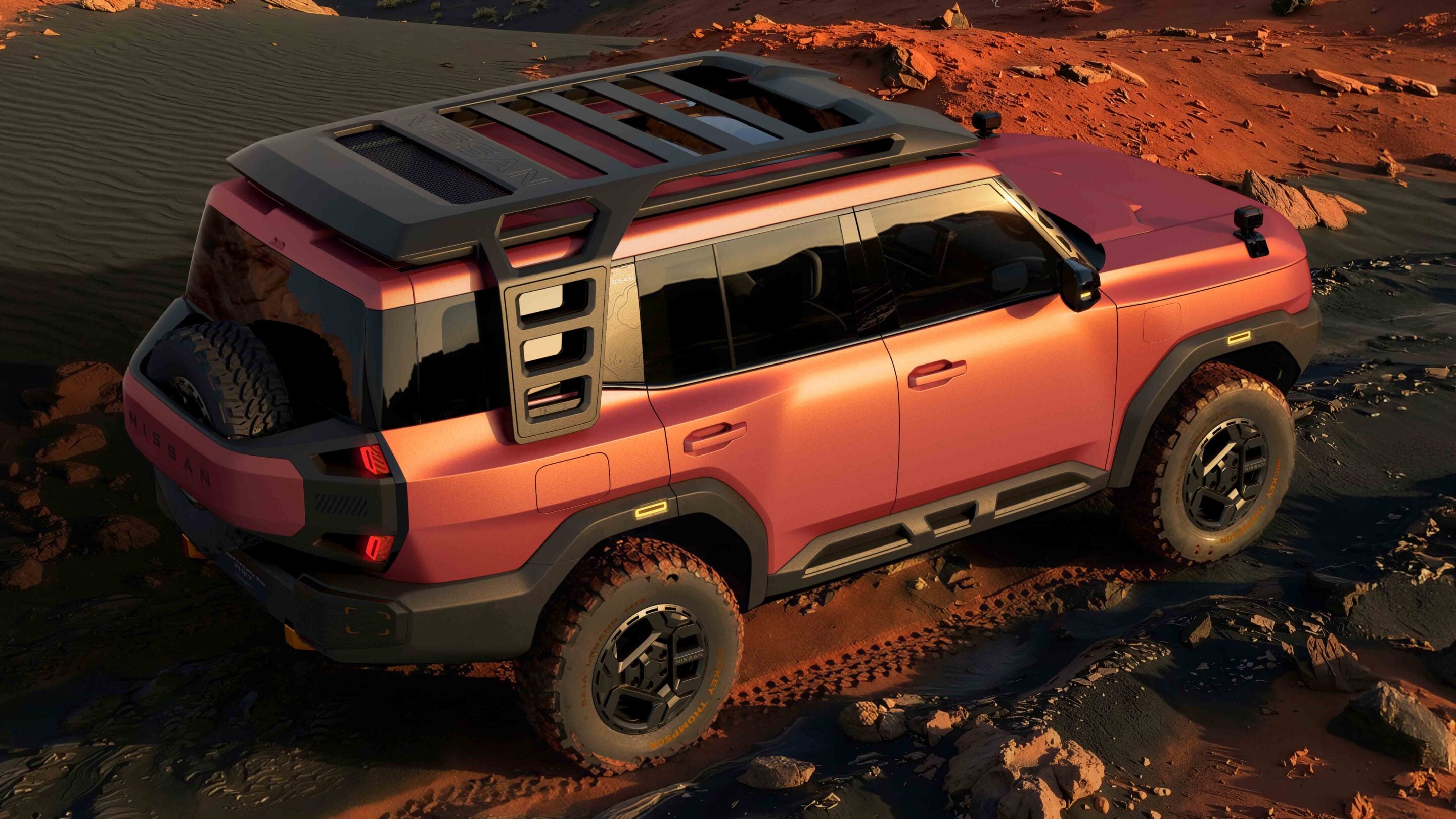
Nissan has brought back the Terrano name, revealing a plug-in hybrid SUV concept at Auto China 2026 with a clear tilt towards touring and off-road use.
The Terrano PHEV Concept gives a better look at how Nissan plans to tackle electrification in the 4×4 space. Instead of going all-in on EVs, it’s backing plug-in hybrid tech – offering short-range electric driving for daily use, backed by a petrol engine for longer trips and remote travel.
Nissan says the Terrano builds on its off-road heritage, which is a key point. The badge has traditionally been tied to proper, rugged SUVs, so there’s some expectation this won’t just be another soft-roader with tough styling. Full specs haven’t been released yet, but the positioning suggests it’s aimed at buyers who still want genuine capability alongside improved efficiency.
That approach makes sense in the current market. Full EVs still face limitations when it comes to long-distance touring and remote area travel, especially in Australia. A PHEV setup offers a more usable middle ground – electric running around town, with the range and refuelling convenience needed once you head bush.
The Terrano is part of a broader push from Nissan to expand its NEV lineup, with several new models planned through to 2027. China is central to that strategy, not just as a sales market but as a development hub for vehicles that will eventually be exported globally.
“Under our vision, China is not only a highly competitive domestic market but also a source of innovation, enabling us to create new value and experiences for customers in China and in the global markets. Advanced technology must serve a clear purpose and be experienced directly by customers through mobility that is safer, more intuitive, and more accessible. China is central to bringing this belief to life,” said Ivan Espinosa, President and CEO.
A production version of the Terrano PHEV is expected within the next 12 months, and Nissan has already indicated it’s being lined up for select global markets. That puts it on the radar for Australia, especially as more buyers start looking for electrified options that still suit real-world touring.
Also shown alongside it was an Urban SUV PHEV Concept aimed more at city buyers.
While many people are quick to criticise new automotive brands coming to the market – usually without any true knowledge or experience with the brand in question – some of those brands are better than others, and some offer vehicles that fill a genuine hole in the market.
GWM’s Tank 300 is a classic example of a vehicle that fills a niche in the market that has been left open, just waiting for the right product. The void in the 4×4 market was left when Jeep discontinued its Cherokee line in Australia. The XJ Cherokee was a relatively small 4×4 wagon that, unlike modern SUVs, was powerful and genuinely off-road capable.
While the Cherokee lost some of its ruggedness through subsequent model changes, it remained a unique vehicle in the 4×4 market until it was discontinued here. It filled a niche between popular wagons like the Prado and Pajero and compact models such as the Suzuki Jimny and Vitara.
With its boxy styling and rugged looks, the Tank 300 emulates the XJ Cherokee in many ways, albeit with a more modern spin on things. It’s small and nimble yet, with front and rear locking diffs as standard, genuinely competent off-road. Importantly, it’s affordably priced for anyone wanting to get into a new 4×4 wagon. Add in the choice of petrol, diesel and hybrid powertrains and the little Tank shows a lot of potential.
Built to explore
The global popularity of the Tank off-roader globally has seen strong support from the aftermarket for accessories and modifications.
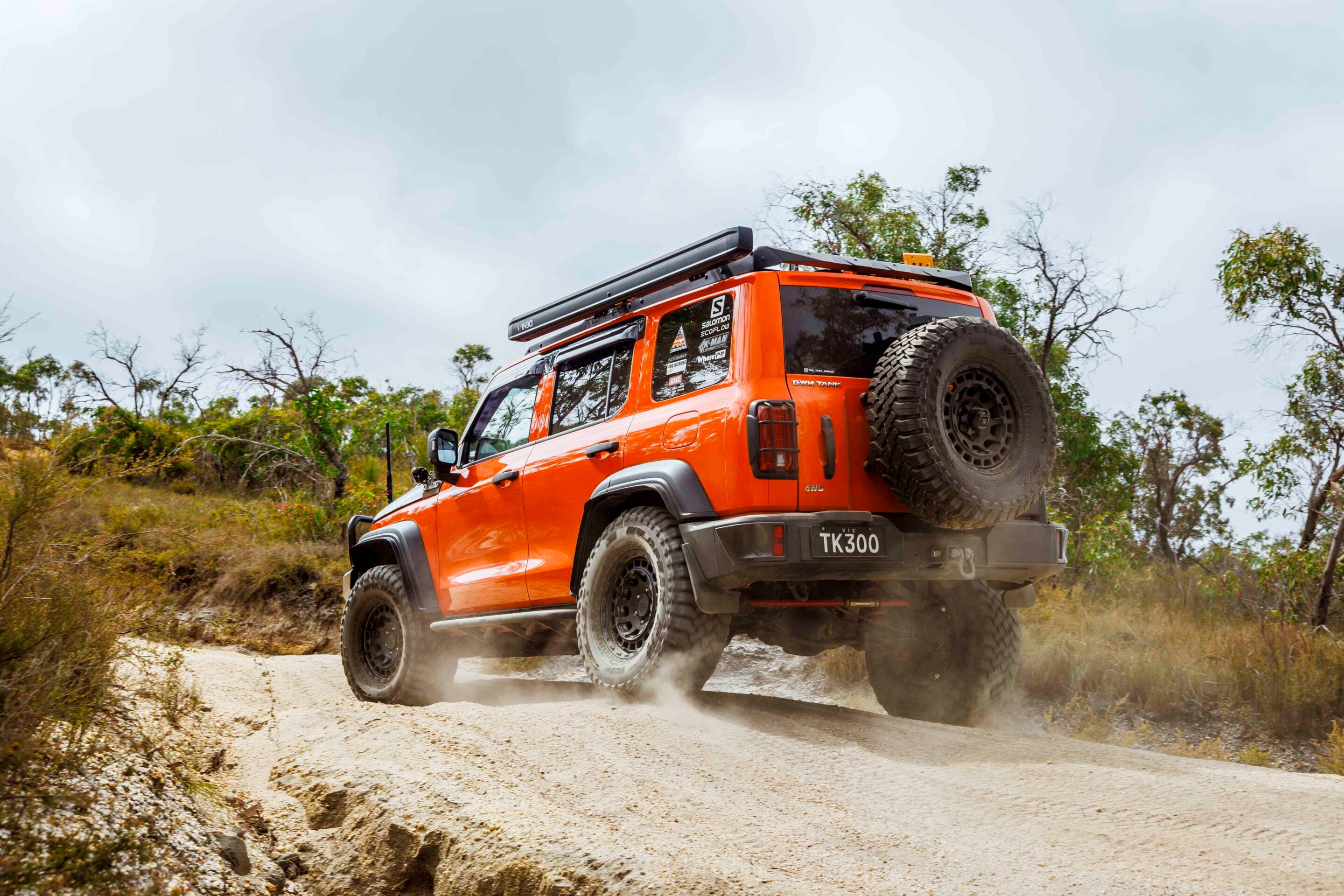
Leading the charge locally is Melbourne-based Tank Garage, which offers an extensive and growing range of products for the Tank 300 and its bigger sibling, the Tank 500. The Tank 300 you see here is Tank Garage’s own rig and was built to showcase what can be done with the GWM – and to get owner Jeremy up into the alps on trekking adventures.
“What really attracted me to the Tank 300 is its unique positioning,” said Jeremy Yu. “It’s a vehicle that offers a modern, high-tech interior and is genuinely comfortable for everyday driving, but at the same time it’s very capable when you want to push it off road.”
Accessories and upgrades
Jeremy’s vehicle is a 2023 model and was one of the earlier examples delivered in Australia.
As such, it is powered by a 2.0-litre turbocharged petrol engine, while the diesel and hybrid models have been introduced to the range since then. Making 380Nm and backed by an eight-speed automatic transmission, the little Tank gets along nicely. The only modification to the engine is the fitment of a Tank Garage intake snorkel.
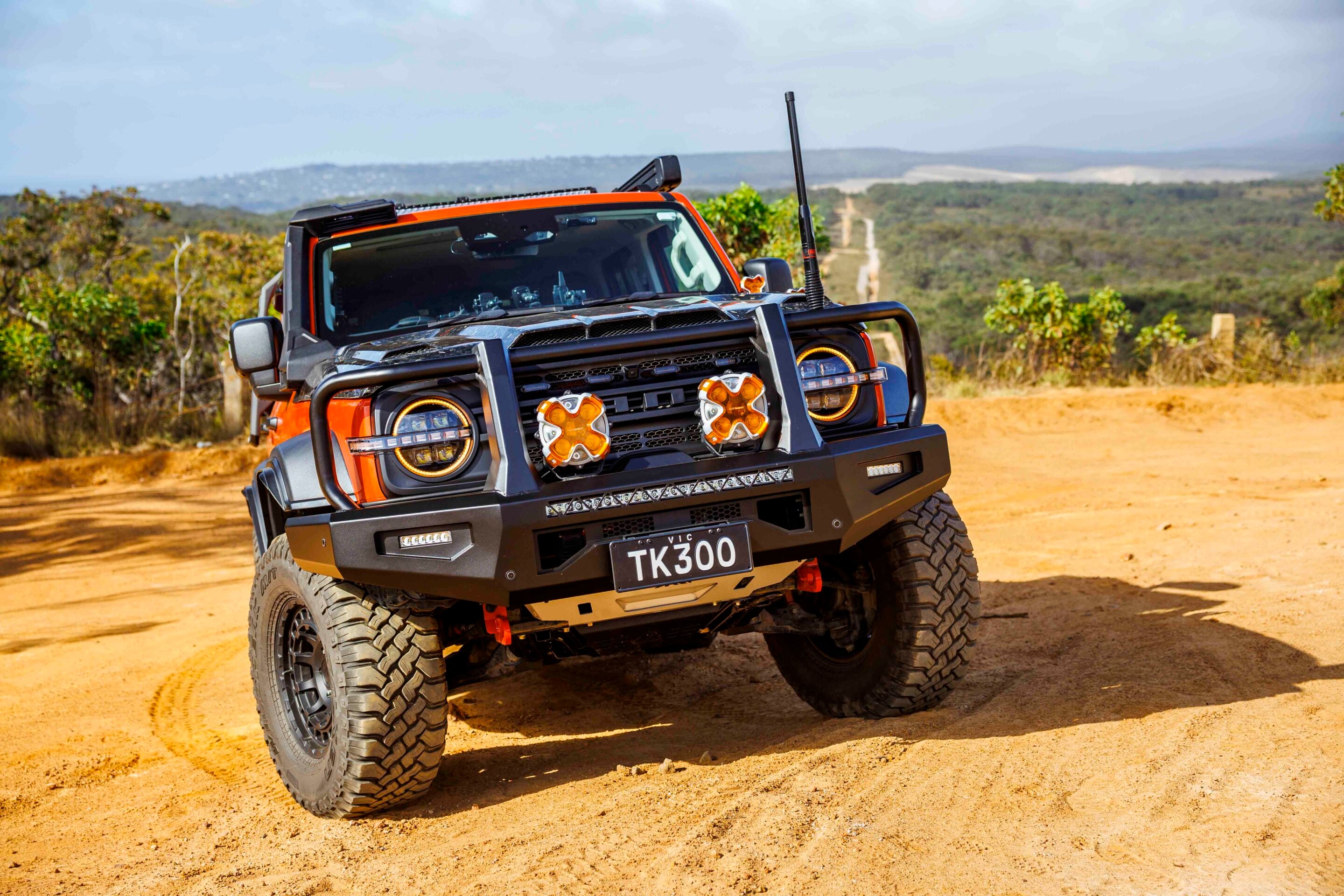
The bonnet covering the turbocharged mill is a carbon-fibre replacement with a broad weave that gives it a unique look – and yes, the bonnet is an ADR-approved piece. Ahead of the bonnet is a bullbar developed by Tank Garage. This is its Mk3 design and the vehicle shown here wears the prototype, but production versions should be available soon.
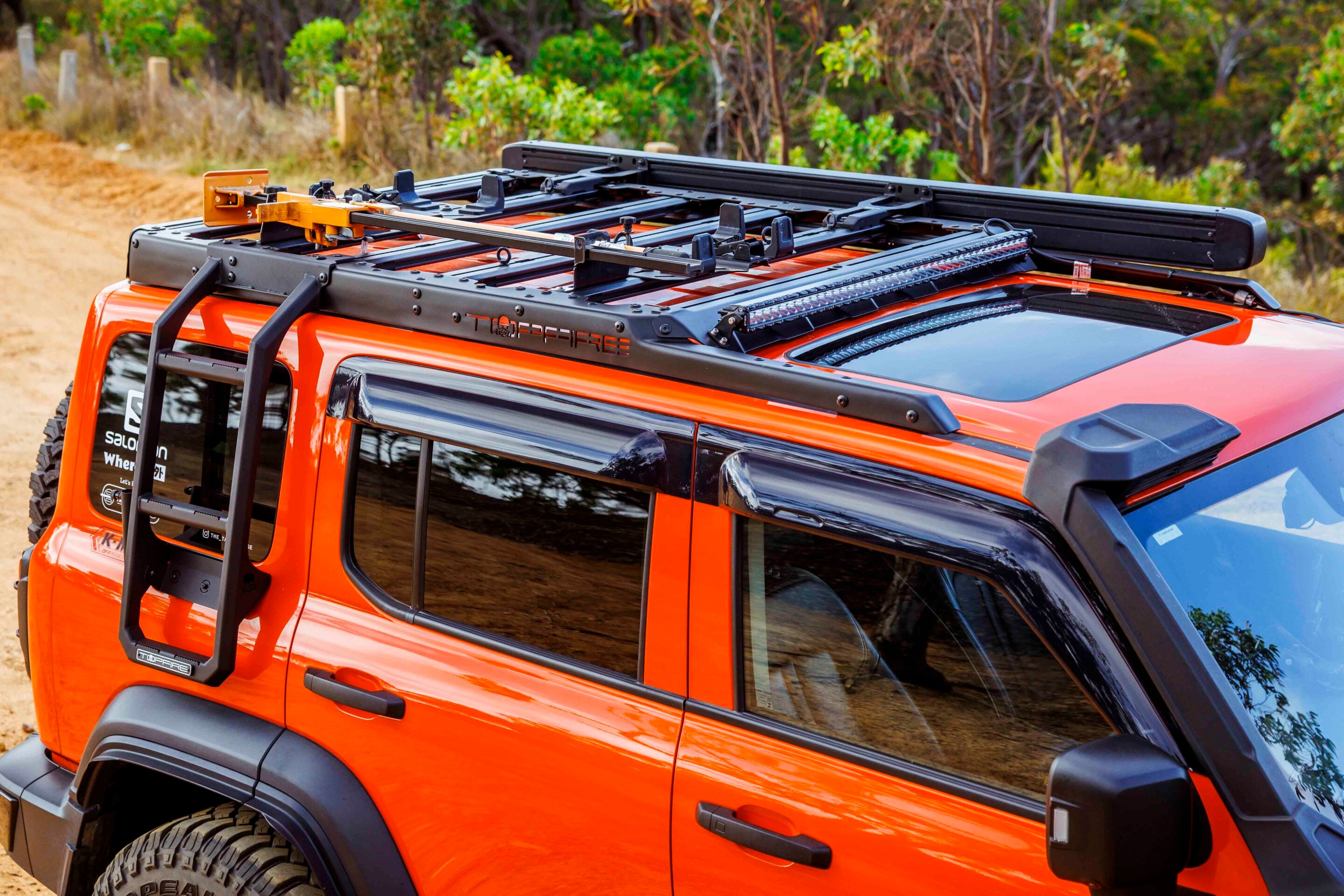
The bullbar not only provides protection but also mounts the 13,000lb winch and a set of Novsight Halo 8-inch driving lights. These are aided by Tank Garage’s upgraded headlight kit, while there’s a light bar within the bullbar and another on the roof rack. That roof rack is an aluminium unit from Topfire, another company specialising in products for GWM vehicles, and it’s available through Tank Garage.
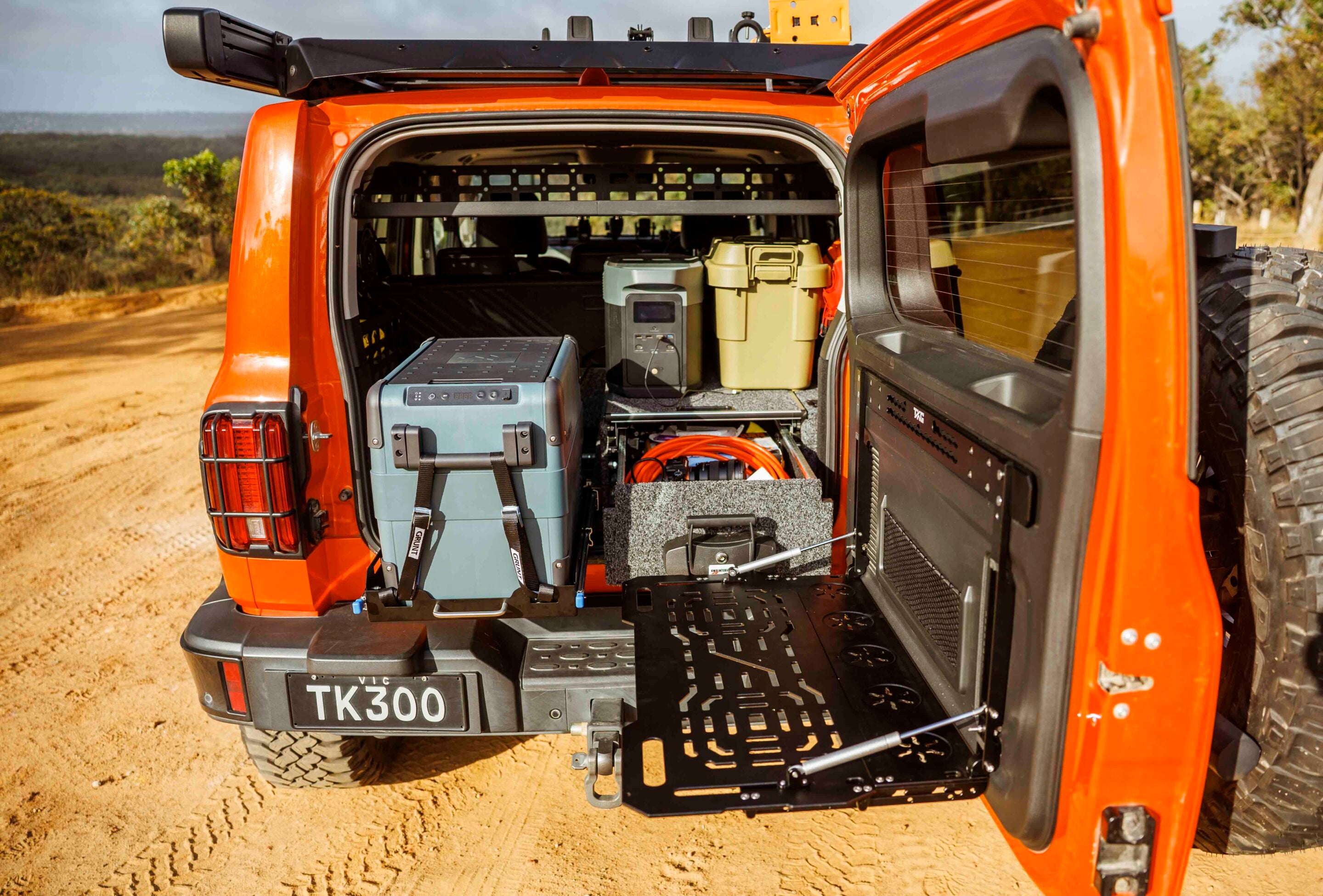
On a relatively compact wagon like the 300, the storage capacity offered by a roof rack is invaluable. But Jeremy has put in a lot of work designing and creating a lightweight and functional storage solution for the inside as well. As an avid camper, Jeremy knows only too well how much gear you can take away on trips, and it wasn’t just available space but also a moderate payload that limited his storage solutions. And after previously owning both a Ford Bronco and a Toyota FJ Cruiser, he knew all about living with smaller wagons.
“We moved away from older, heavier materials and focused on new materials with a much better strength-to-weight ratio,” Jeremy recalled. “We also switched to lighter accessories where possible. Personally, I’m into backpacking and mountaineering, and that lightweight outdoor mindset played a big role in how the vehicle was built.”
The drawer system, fridge slide, storage platform and aluminium drop-down table on the rear door were designed as an integrated solution from Tank Garage. Each component works together without interference, resulting in a clean, functional and well-balanced setup. With a single drawer on one side and the Dometic fridge and large power pack on the other, the back of the Tank is Tardis-like when it comes to loading up.
Carrying the load is a suspension package developed by Tank Garage featuring Kman shocks and raised coils to give a 2.5-inch suspension lift. Tank Garage replacement upper control arms help keep everything in line with the added ride height and taller mud-terrain tyres.
As the leading modifier for Tank 4×4 vehicles in Australia, Tank Garage can now offer a range of its products directly through GWM dealers pre-delivery, so new owners can get their Tank kitted up and ready to hit the tracks.
The Tank Garage 300 shows what can be achieved with a budget-priced 4×4 and clever design and development of accessories.
List of all accessories and upgrades
- Tank Garage intake snorkel
- Carbon-fibre replacement bonnet (ADR-approved)
- Tank Garage Mk3 bullbar (prototype)
- 13,000lb winch
- Novsight Halo 8-inch driving lights
- Tank Garage upgraded headlight kit
- Integrated bullbar light bar
- Roof-mounted light bar
- Topfire aluminium roof rack
- Custom drawer system
- Fridge slide
- Storage platform
- Aluminium drop-down rear door table
- Dometic fridge
- Large onboard power pack
- Tank Garage suspension package
- Kman shocks
- Raised coil springs (2.5-inch lift)
- Tank Garage upper control arms
- Mud-terrain tyres
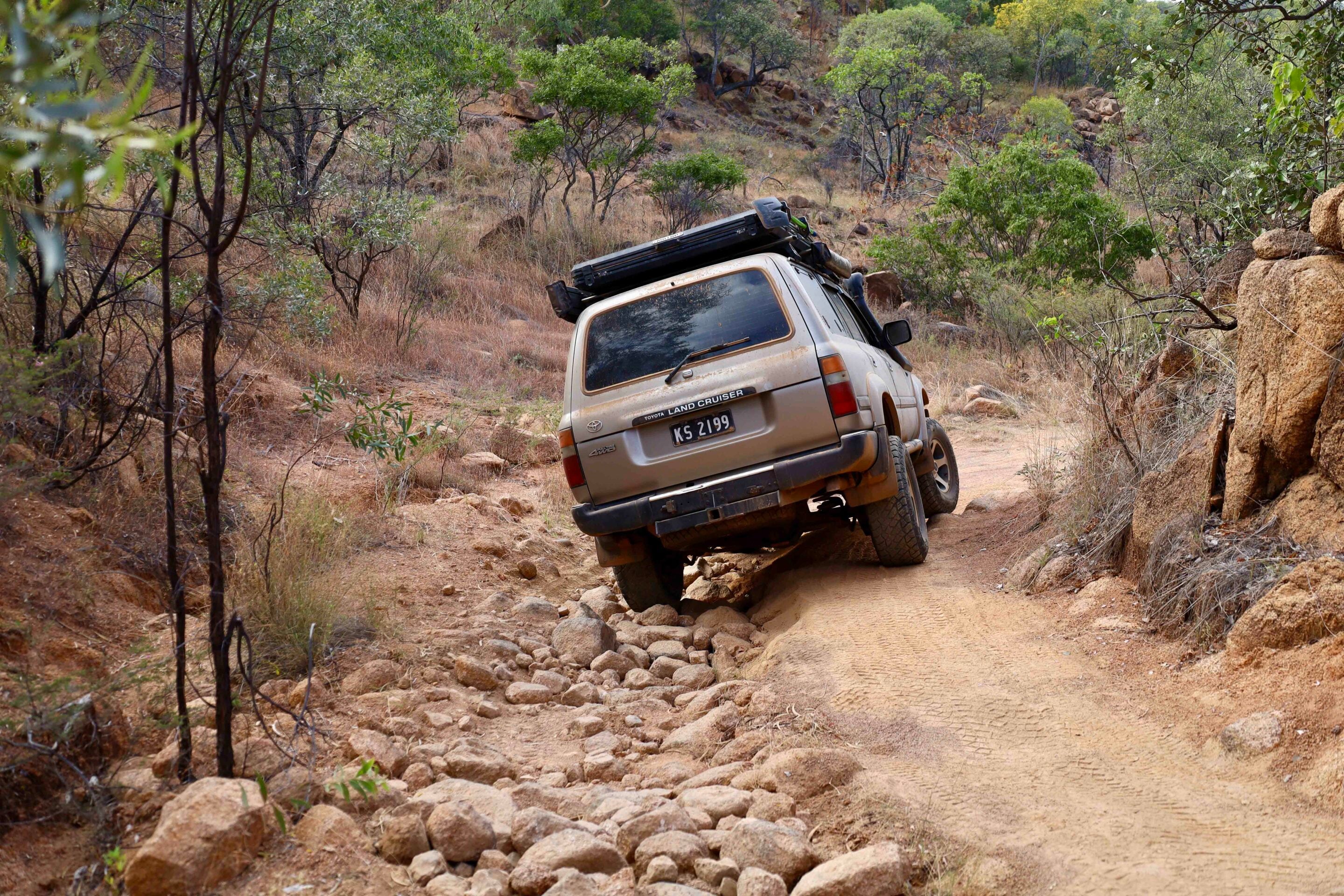
Being a seasoned traveller, I get asked a lot about what equipment I use on my 80 Series, including what suspension I run.
Well, a couple of years ago I changed to Outback Armour suspension components, and I can definitely say it’s some of the best gear I’ve used for the past 20 years, over which time I have clocked up tens of thousands of kilometres per year across multiple terrains Australia-wide.
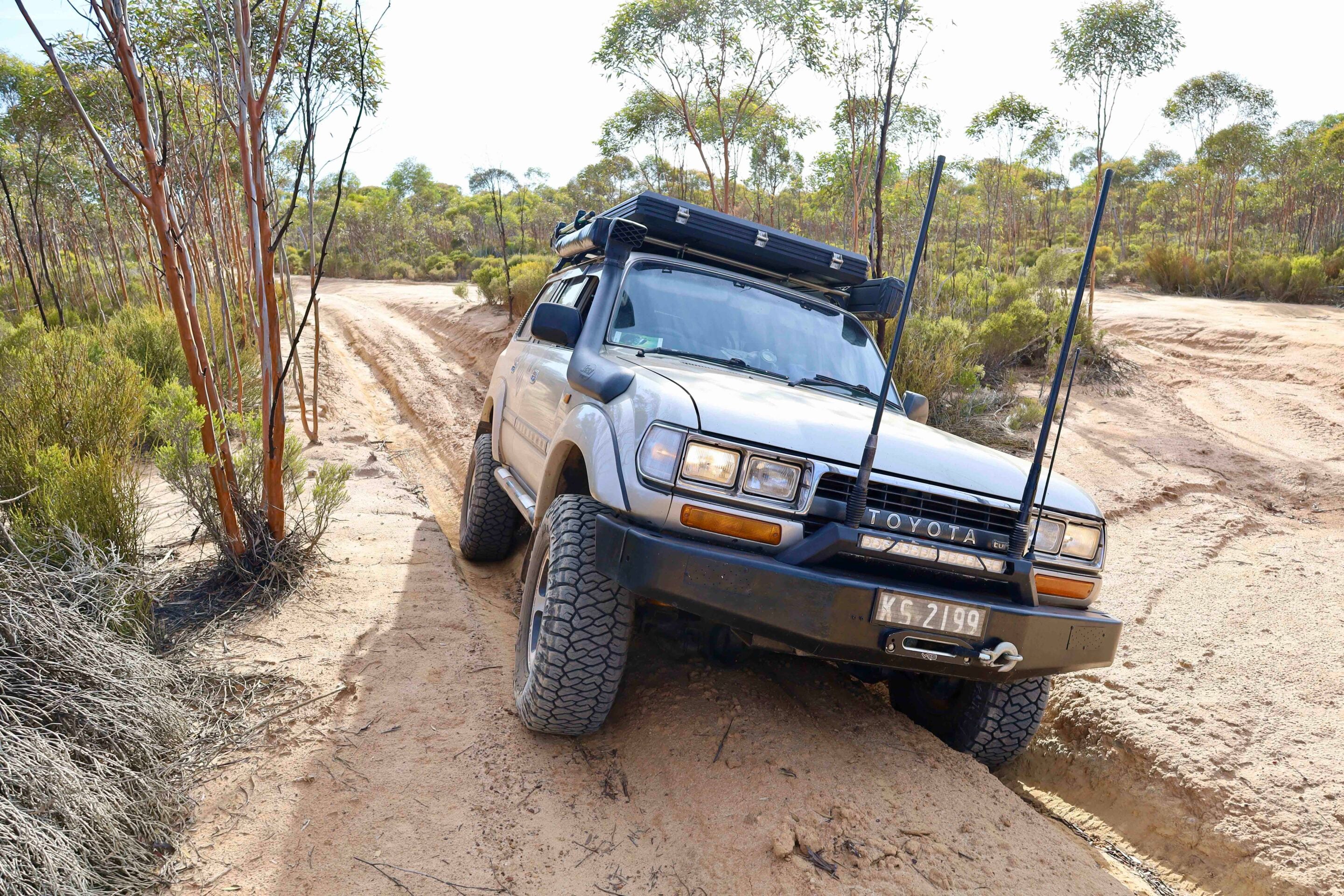
Jumping onto the Outback Armour website, I chose the Adjustable Bypass Expedition HD kit for my needs, as my 4×4 is set up as an outback tourer, configured for remote missions with drawers, fridges, recovery gear and enough equipment to be off grid for weeks at a time. The HD Expedition kit ticked all the boxes and was easy to install over a couple of hours. Supplied with coils, shocks front and back, a steering damper, correction bushes and a shock service kit, there was nothing else I had to worry about.

The Outback Armour story
It was in 2012 that Outback Armour started in a Queensland garage, where the founder first began making specialised suspension kits for armoured military vehicles that needed to be tough and durable to survive any terrain thrown at them.
These vehicles were heavy with ballistic plating on and underneath, and also loaded with gear inside and out. Thinking outside the box, the founder also knew that modern-day 4x4s needed specialised suspension to cope with heavy loads such as steel bullbars, winches, canopies and internal drawer systems, as well as the weight of equipment loaded into the back of working utes. This was the beginning of Outback Armour, the name derived from the focus on armoured vehicles and the Australian outback.
Brad Bernard and Richard Catelan have led the charge from the start, and the company now ranks among the best 4×4 suspension component suppliers on the Australian market. Today it also has branches in North America and the Middle East, which allow real-life testing in the military field across various weather and tough terrain conditions.
Suspension range, spring rates and GVM upgrades
In its range, customers can choose a variety of spring rates and shock variables to suit how much load a vehicle constantly carries.
There’s a nitrogen gas-filled shock, which is the next step up from a factory setup and is designed for improved on- and off-road handling. Next is a digressive foam-filled shock, which has high-flow pistons for improved handling, especially over corrugations, and lastly Outback Armour offers its top-of-the-range fully adjustable 20-stage shock, where customers can fine-tune their 4×4 ride.
This is done with a simple knob dial on the shock. The spring range is similar, with three different load rates. The first is the Trail Spring, which is better than factory, next is the Expedition for vehicles with only a few heavy add-ons, and last is the Expedition HD for 4x4s that have many options added. Outback Armour also offers a GVM upgrade for many 4x4s so owners can stay legal while safely increasing load or towing capacity.
Outback Armour backs itself with a three-year unlimited-kilometre warranty, and it is Australian owned and operated with its gear tested in the harshest conditions around the world. All of its products are designed and developed in house in Brisbane and go through rigorous testing on vehicles before being certified to Australian standards.
This gives us as four-wheel drivers the assurance that Outback Armour products have been built for Australian conditions, successfully bridging the gap between heavy-duty military engineering and civilian off-road performance.
Adjustable Bypass Expedition HD
I’ve never had adjustable shocks before and, to be honest, I really thought they were a bit of a gimmick, especially as the ones I ordered had a 20-setting range.
Initially I had the front and rear set midway (10 clicks), but found them a bit soft on the highway and outback roads, as I have a roof-top tent, 270 awning and a shower tent up top. Clicking them up to 15 made a huge difference, with less sway on the roads, better control and reduced rebound bounce when soaking up bumps and corrugations. The 20-click adjustable bypass control on the shocks definitely works, and I’ve fine-tuned the ride to suit my comfort across all types of terrain. It’s possible to dial the shocks right down to give the vehicle a really soft feel on harsh terrain such as when rock crawling.
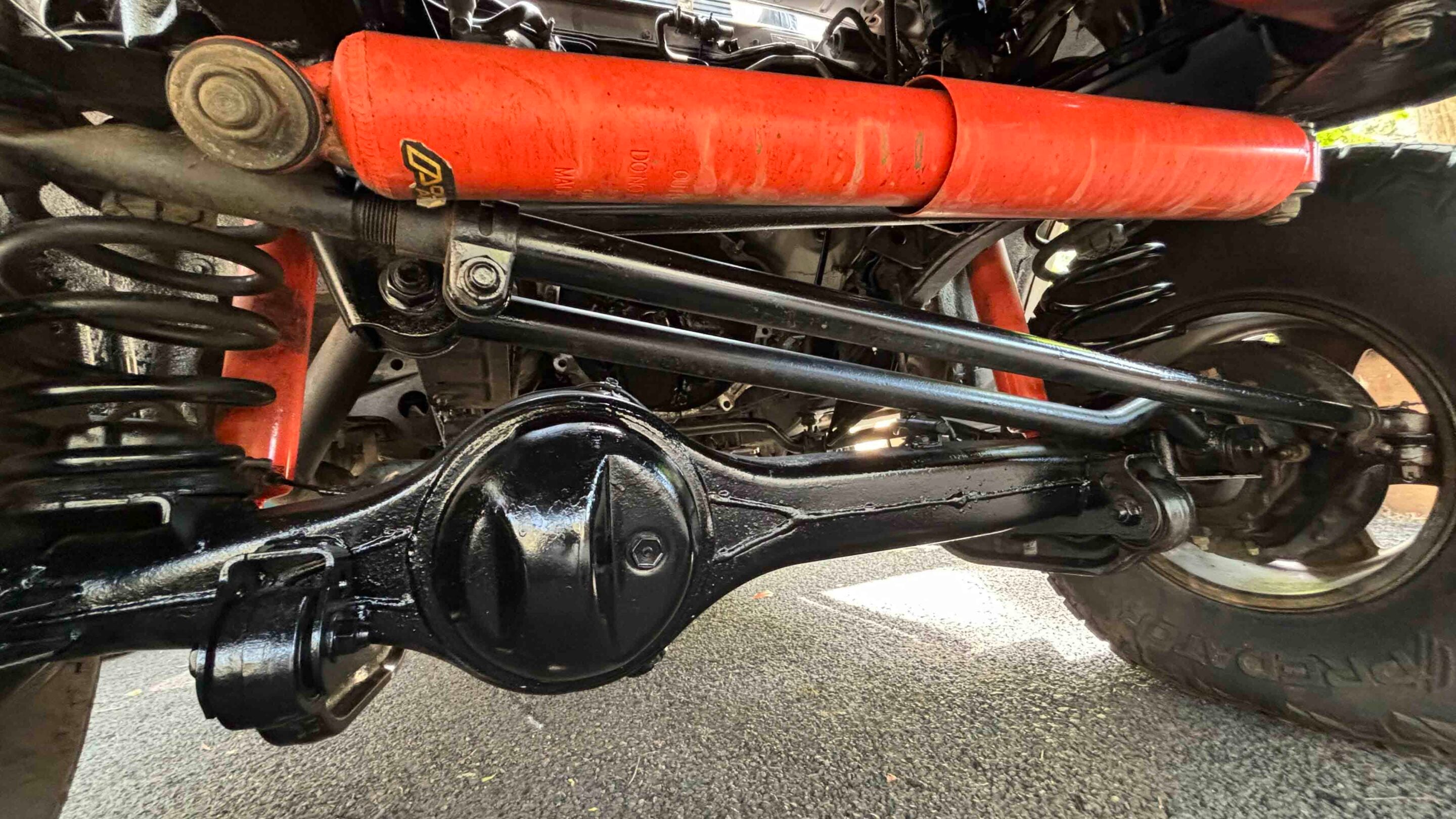
Over two years with the Outback Armour suspension fitted to my 80 Series LandCruiser, I’ve travelled extensively through Arnhem Land, across the rocky terrain of the Flinders, through deserts where roads are littered with corrugations, right down to Tassie, plus tackling hard tracks around the Coffs Coast. The only thing to date is that the suspension has suffered from sand and rock rash, but this is all part of travelling on outback roads.
It’s recommended that once a year owners check the shocks as part of a maintenance program and, if the shock dials feel notchy or clammed up, complete a service procedure. Online, Outback Armour runs through servicing and other suspension tips for its range of products. The adjustable bypass shocks that I chose have a massive 65mm body with a 40mm high-flow piston and heavy-duty internal valving, and they come with a toughened cover protecting the 18mm hard-chromed shaft to prevent stone or dirt damage.
I’ve tried multiple suspension brands over my extensive 4×4 lifetime, from ones that claim to be big bore to top-of-the-range brands, but I’m putting Outback Armour up there as the best.
Pricing and more information
I paid just over $2200 for my setup. There are cheaper options through the range, but you’ll need to assess what your needs are. All prices, suspension specifications, service requirements, dealer locations and other links are on the Outback Armour website.
Outback Armour also sells a range of 4×4 recovery kits, components and accessories that comply with Australian standards, and some to military specs. Prices and certification for all its gear are also available online.
BLUETTI has launched its FridgePower system on Kickstarter, with early bird pricing available until May 31.
While pitched at household refrigeration, the design also has clear relevance for 4×4 touring, caravan travel, and off-grid setups where reliable, compact backup power is increasingly part of modern kit lists.
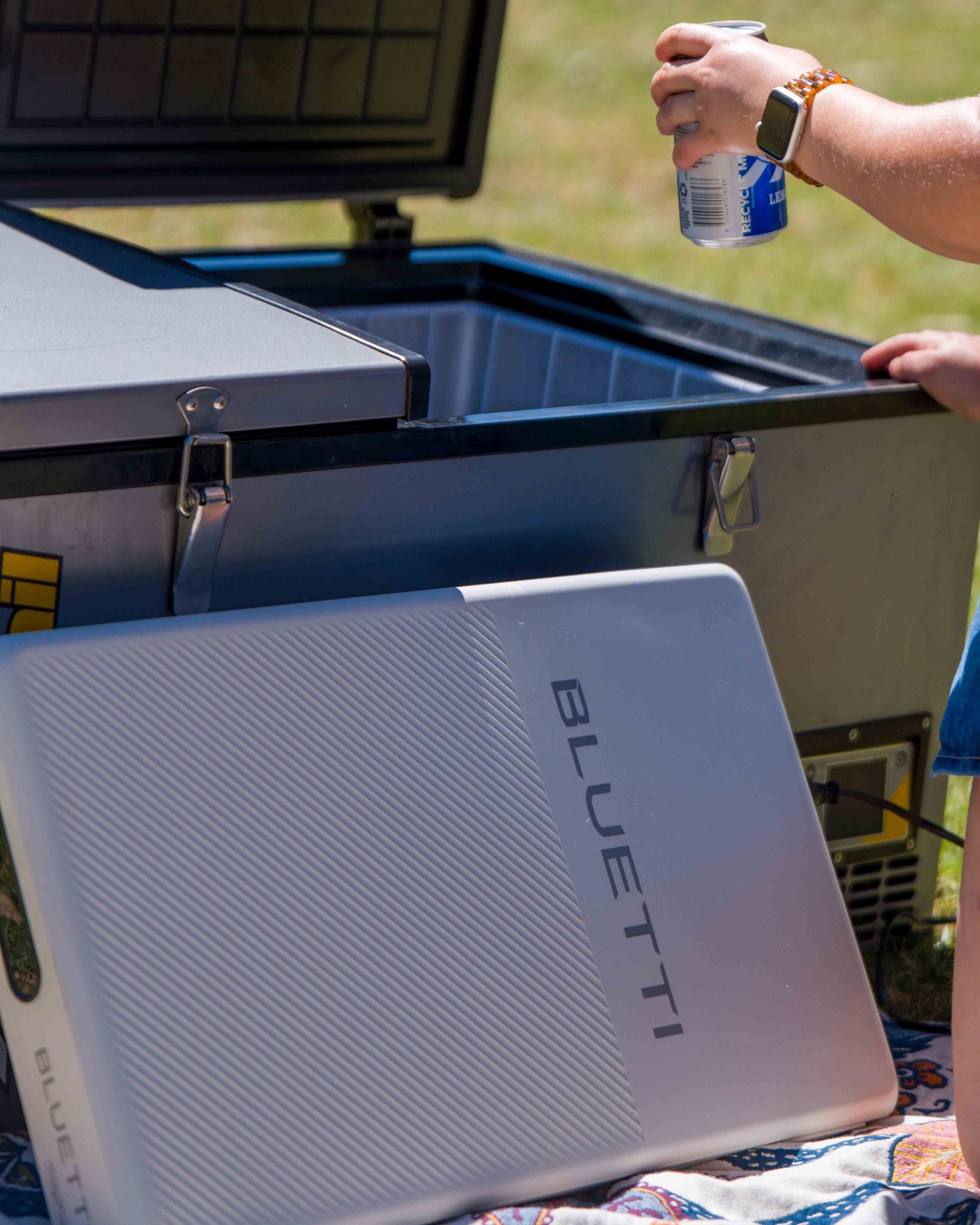
At its core, FridgePower is a plug-and-play battery system designed to keep a fridge running during outages or away from grid power. For touring applications, that translates directly into food storage security on extended trips, basecamp setups, and situations where a fridge failure can end a trip early.
The unit itself is compact, with a 75mm (2.95-inch) profile and support for flat or vertical mounting. That makes it easier to integrate into tight spaces in camper builds, canopy systems, caravan storage areas, or garage-based touring setups where every millimetre counts.
Built around extended fridge runtime
FridgePower is designed around a 2016Wh capacity and 1800W output in its standalone form. BLUETTI states it can run a standard refrigerator for around 21.6 hours, supported by a low 4W AC idle drain that helps stretch runtime when conditions are stable.
For longer trips or basecamp use, the system can scale up to 8064Wh using three BlueCell 200 expansion batteries, extending backup capability to around four days. A 3600W surge rating also covers high startup loads like fridge compressors, which is often where smaller power systems fall short in real-world use.
UPS protection for critical gear on the road
Powered by BLUEGrid technology, FridgePower includes a 10ms UPS switchover, allowing it to react instantly to power loss. While that’s relevant at home, it also translates well to touring setups where systems may be switching between solar, generator, or auxiliary inputs.
It’s designed to support not just fridges, but wider critical loads such as CPAP machines, Wi-Fi routers, lighting systems, and other low-draw electronics commonly found in touring and off-grid setups. Four operating modes – Standard, PV Priority, Time-of-Use, and Customised – allow users to prioritise solar input or manage charging around travel patterns. An automatic bypass also allows grid power to pass through directly when the unit is idle.

Quiet, low-maintenance power for camp life
FridgePower uses LiFePO₄ battery cells rated for over 4000 cycles, with a claimed lifespan of more than 10 years. For touring use, the key benefit is not just longevity, but low-noise operation – rated at around 30dB – making it suitable for enclosed sleeping setups, rooftop tents, and tight caravan environments.
Thermal sensors manage internal cooling automatically, keeping operation stable without the noise and fuel requirements of traditional generators.
Smart control for remote travel setups
Integration with Alexa, Google Home, and Home Assistant is included, but the more relevant feature set sits inside the BLUETTI app. For touring use, this includes:
- Weather alerts that can trigger pre-charging before incoming storms
- System diagnostics for monitoring battery and load status
- Scheduled maintenance cycles every three months
- Remote wake from a 0.3W sleep mode
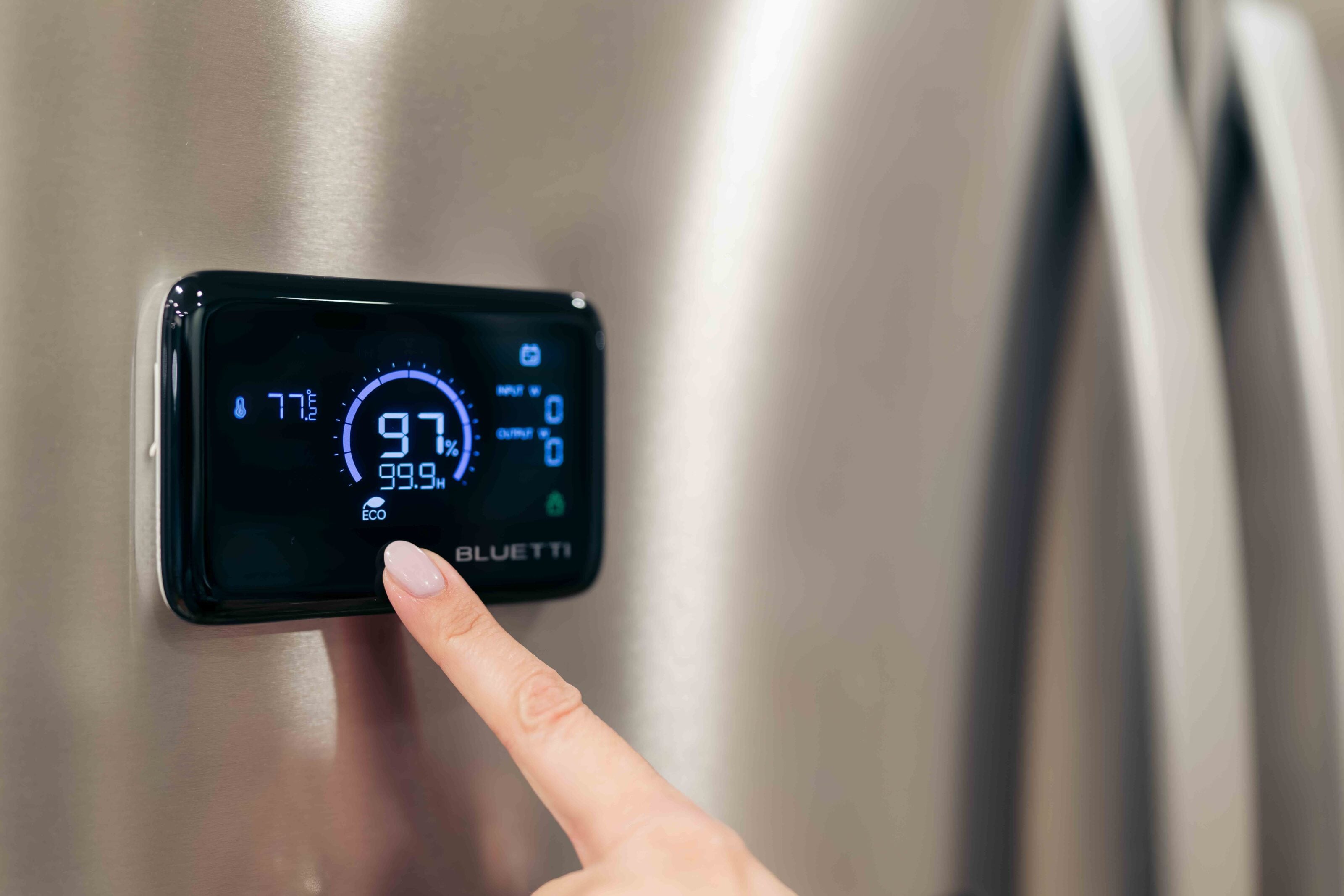
An optional Display 1 Magnetic Screen provides a quick visual status check, useful for mounted installs in caravans or canopy systems.
Pricing and rollout
FridgePower is live on Kickstarter from April 17 to May 31, with early bird pricing tiers that reduce as allocations sell out. Launch pricing is:
- US$759 for the standalone unit (roughly $1150)
- US$1398 for the FridgePower Plus bundle (roughly $2100)
Pricing includes tax but excludes Australian shipping. Units are production-ready, with shipments expected to begin in early June – timed ahead of the Australian winter storm period, when grid instability and outages become more common.
- UPDATE 1: From the showroom to the tracks
- UPDATE 2: Mods tested in the Vic High Country
- UPDATE 3: Bigger tyres give the Grenadier a boost in the bush
Part 1: From the showroom to the tracks
“What kind of car is that?” It’s a question I’ve been asked many times in the first month of driving the Grenadier.
Is it a Land Rover? Is it electric? Is it Chinese? Not many people seem to know exactly what it is. The only other vehicle I’ve driven that causes this much confusion is my 1968 Country Buggy. Yep, Google it.
By now, most people know the story of why the Grenadier was created. Man drives Defender. Defender stops being made. Man decides to build his own four-wheel drive to replace his much-loved Defender – but better. That man is Sir Jim Ratcliffe, owner of Ineos, Manchester United and a large part of the Mercedes F1 team.
I owned a 2015 Defender back in 2023 in the UK, and I’ve also owned a 1976 VW Kombi. In many ways, the Kombi and Defender feel like a closer driving experience than the Defender and Grenadier. Yes, the Grenadier looks a little like an old Defender, but that’s where the similarities stop. I was lucky enough to go on a few of the Grenadier’s Australian development trips in the Outback a few years back. These were all pre-production vehicles and not final spec. They were rough and still being worked on by engineers, but even then I could tell they were highly capable, and I was looking forward to driving the production model.
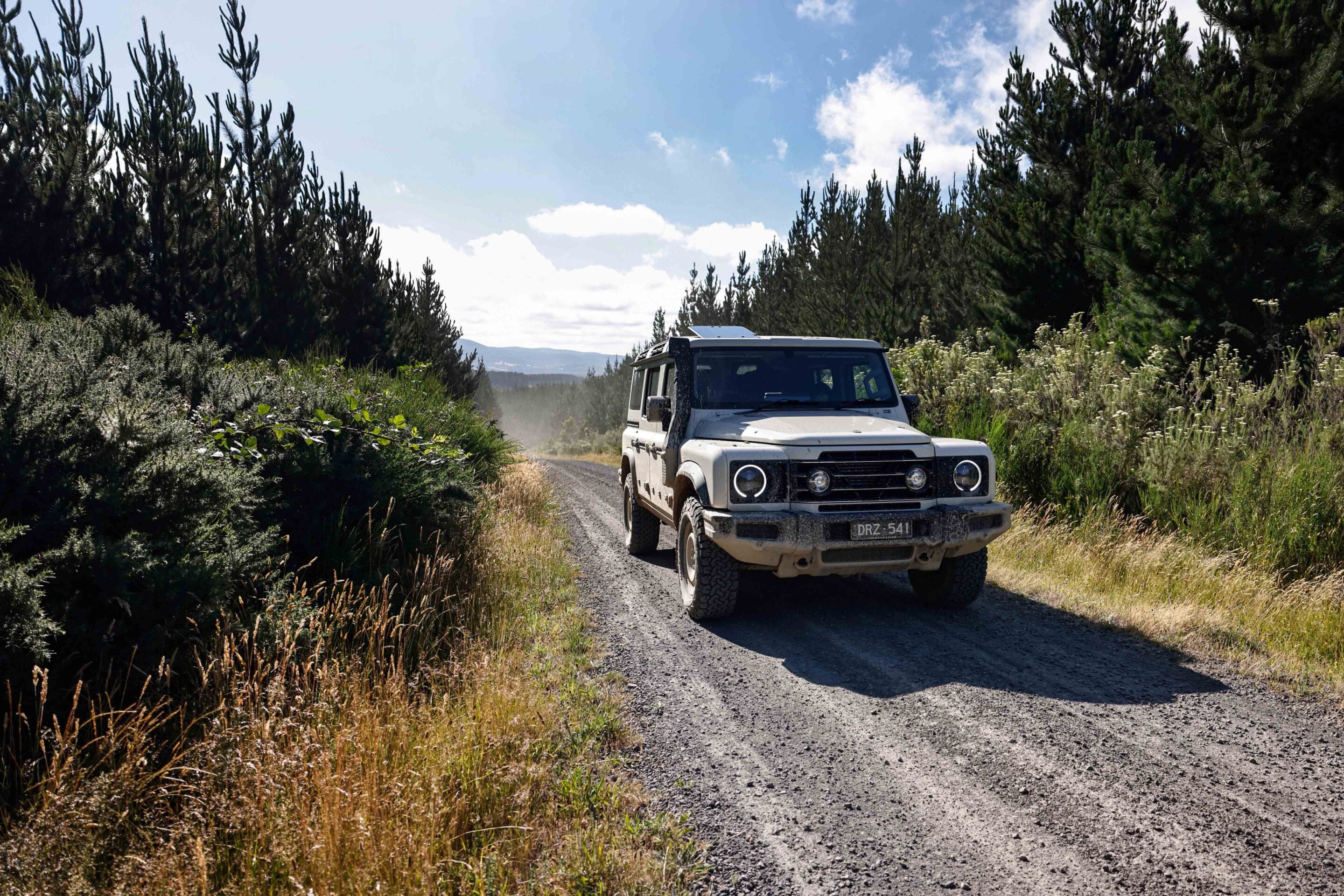
Fast forward to late 2025 and I’m picking up my long-term Grenadier. I’ve gone for a Trialmaster Station Wagon in Scottish White (apparently named after one of Sir Jim’s Scottish mates and his white legs), powered by the BMW B57 diesel engine. I opted for steel wheels, leather trim, heated seats and Safari Windows. The base price is $120,000, plus $8670 in options.
The Trialmaster comes standard with front and rear diff locks, a raised air intake, Class III 1-7/8” NAS tow hitch and electrics, and an access ladder. I also had factory rubber mats added. There are no carpets in this vehicle and that’s exactly how I like it – rubber mats and a vinyl floor are the best.
The very first thing you notice when you drive a Grenadier is the steering. It doesn’t self-centre very quickly compared to most other vehicles. Once you’re aware of this and get used to the steering technique required, it’s fine. Just be ready for it. The Recaro seats are very comfortable and help soak up the kays, plus they look cool. Rear passengers also get a Recaro bench seat, and I like how high it sits you in the back. It’s great for kids, as it makes it easier to look out of the vehicle, placing rear passengers at a similar head height to those in the front.
I picked up the Grenadier just before the start of the summer holidays, and it’s proven to be a great beach vehicle. Having no carpets makes it super easy to get sand out, and the interior utility rails work well when you’ve got lots of gear to tie down in the back.
I strap the surfboards to the roof, with four factory rails fitted. I’m planning to get a roof rack, but more on that later. Running to and from the beach is fun, and the kids have found it to be a great family vehicle so far. It’s not really what this vehicle is designed for, though. Yes, it will do the day-to-day tarmac stuff just fine. The 550Nm of torque that the BMW engine pumps out makes keeping up with traffic easy as well.
It was time to head off-road, so I pointed it toward Lerderderg State Park. I’ve photographed and driven many four-wheel drives up here, so it’s a great place to get to know the Grenadier. The first thing I do once I hit the dirt is flick the low-range selector lever across to lock the centre diff. This also automatically turns off the ESC.
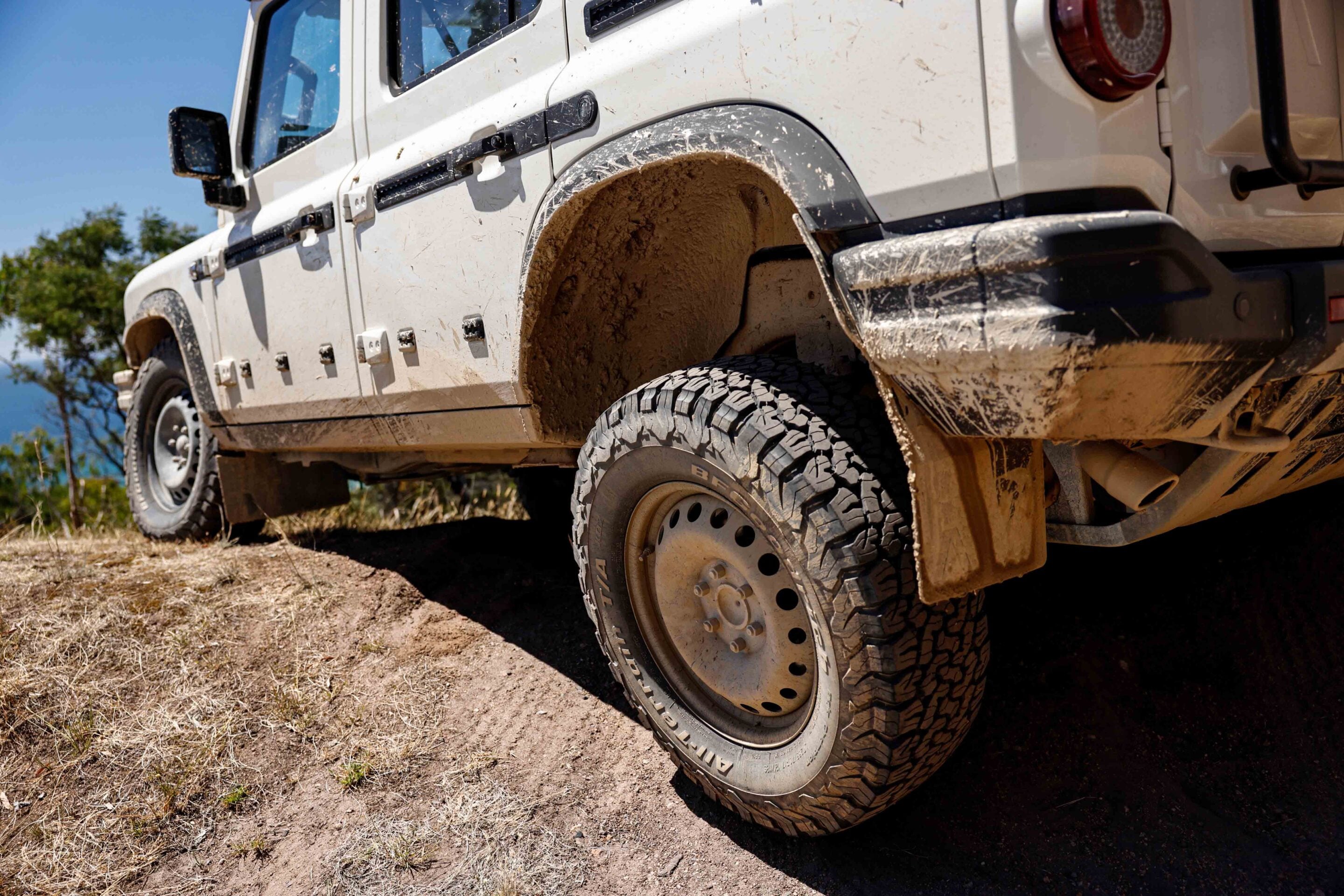
I leave it in high range to begin with. The ride on gravel roads is excellent and, as I start to push it a little harder, it actually feels light on its feet and keen to turn in sharply. I then head to some fairly steep, rutted tracks. I select low range and start driving up the first climb. The Grenadier has solid axles front and rear, which gives it excellent wheel articulation. I try engaging the rear diff lock and it just walks up the track. No need to even try the front diff lock – I need to find a harder track. That will have to wait until my next trip, though. My first experience off-road has shown that the Grenadier is highly capable, and I’m going to enjoy finding gnarlier places to drive it.
One thing that takes a while to get used to is having the speedo in the centre display rather than directly in front of you. Living in Victoria and constantly stressing about being 3km/h over the limit, I sort of wish it was straight ahead. My other small gripe is that the driver’s-side wiper misses a chunk of the windscreen near the A-pillar. It only becomes an issue if you really get the vehicle and screen super muddy, but I do notice it.
Plans? We’re going to throw some factory and non-factory accessories at the Grenadier while we have it, starting next month. Can’t wait.
- Kilometres this month: 4780km
- Average fuel use: 11.7L/100km
Part 2: Mods tested in the Vic High Country
The Grenadier wave is alive and well. I used to get the Jeep wave back when I had a JK Wrangler and was wondering if Ineos owners would do the same. Well, they do! I even got a wave from a guy in a 110 Defender – maybe the sun was in his eyes?
This month has seen quite a few kays racked up in the Grenadier. I wish I could say they were all off-road kays; sadly not. As a daily driver, though, I’m really enjoying the Grenadier. It has such a nice ride – comfortable on the tarmac and even better when you hit the dirt. I think they’ve done a great job with the suspension tune.
I headed up to Mt Disappointment in Vic this month to shoot a HiLux vs Ranger comparo. One of the tracks we drove was pretty gnarly and it was the first time I needed the rear diff lock. Once engaged, the Grenadier just walked up in low range – no issue. The way it moulds itself to the terrain is amazing to watch. It also does all the hard work for you. I tried picking the worst lines and it just ate them up.
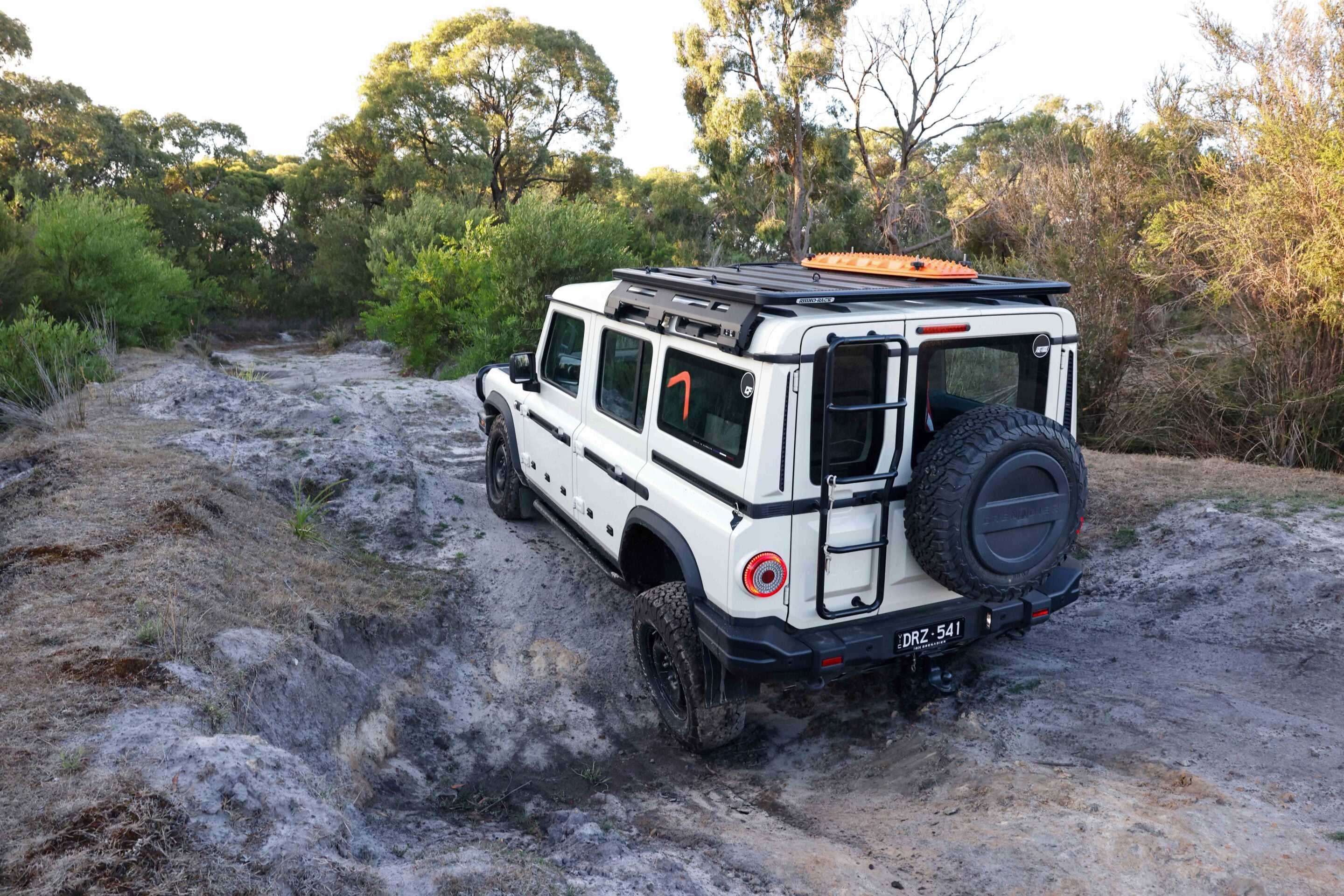
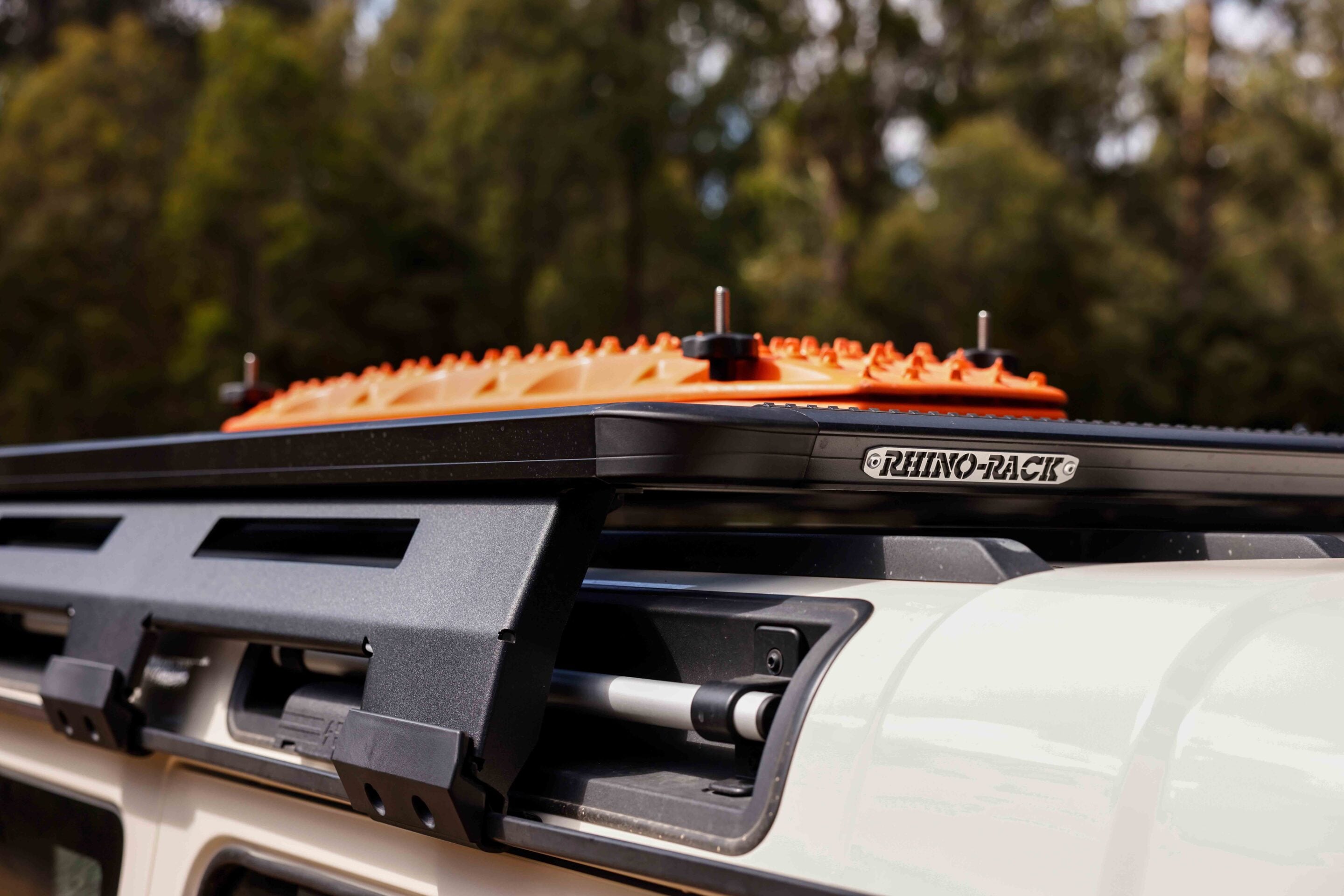
I used the freshly fitted Rhino-Rack Pioneer platform to photograph the utes from. I went for the three-quarter length option as it still allows me to open the safari windows. It was $3688 plus fitting. It’s great now – the factory ladder on the back door actually goes somewhere! I also fitted a set of MaxTrax up on the platform – thanks Matt.
A factory Ineos roo bar ($2720), rock sliders ($1921) and checker plates ($560) were also fitted. The roo bar is a smart design that works with the existing factory bumper. You just take a couple of caps off and it bolts straight on. Job done! The rock sliders are also well designed and solid. They bolt directly to the chassis rails and offer a twin-tube setup. The checker plates sit on top of the front guards and allow up to 120kg load. Luckily I’m only 103kg, so I’ve been up there quite often just because I can.
Hopefully I won’t have to test out the roo bar. The rock sliders, however, have had their first slide. Yes, it was a little painful, but I figure that’s what they’re for. They feel super strong and can take the weight of the Grenadier no worries. Plus, the scratches are underneath so I can’t see them.
I had to top up the AdBlue this month. It gave me a warning that it was running low, which was handy. The front parking sensors have been triggering at random. Apparently it’s some dirt stuck on the edge of a sensor that’s setting it off. No big deal, as you can manually turn them off and it stops the beeping. I might try giving them a proper clean.
Next mods? I want to try a bigger tyre size. The standard 265s are fine and do a great job, but I’d love to see those guards filled a little more. Maybe a 295? Mud-terrains? Let’s see what happens.
- Kilometres this month: 5300km
- Average fuel use: 12.4L/100km
Part 3: Bigger tyres give the Grenadier a boost in the bush
New tyres for the Grenadier this month. I had my local tyre store (thanks Tyrepower Mornington) fit five BFGoodrich Mud Terrain KM3s in a 295/70R17 size, at $590 each.
The original BFG All Terrains weren’t worn out and were still doing a great job; I just wanted to try a bigger size than the standard 265/70R17 tyres fitted as stock. I had a set of KM2s on a JK Wrangler about 15 years ago, so it is going to be interesting to see how the KM3s compare.
Standing the 295 Mud Terrains next to the original tyres, the size difference is noticeable without being extreme. I think it’s a worthwhile upgrade for the Grenadier, especially considering it’s on stock ride height and wheels. I also like that BFG has done away with the white lettering – I was never a fan. Clearance to the brake lines has reduced slightly, but I don’t think it will be an issue. There are also no signs of rubbing, even with the suspension fully articulated, which is reassuring.
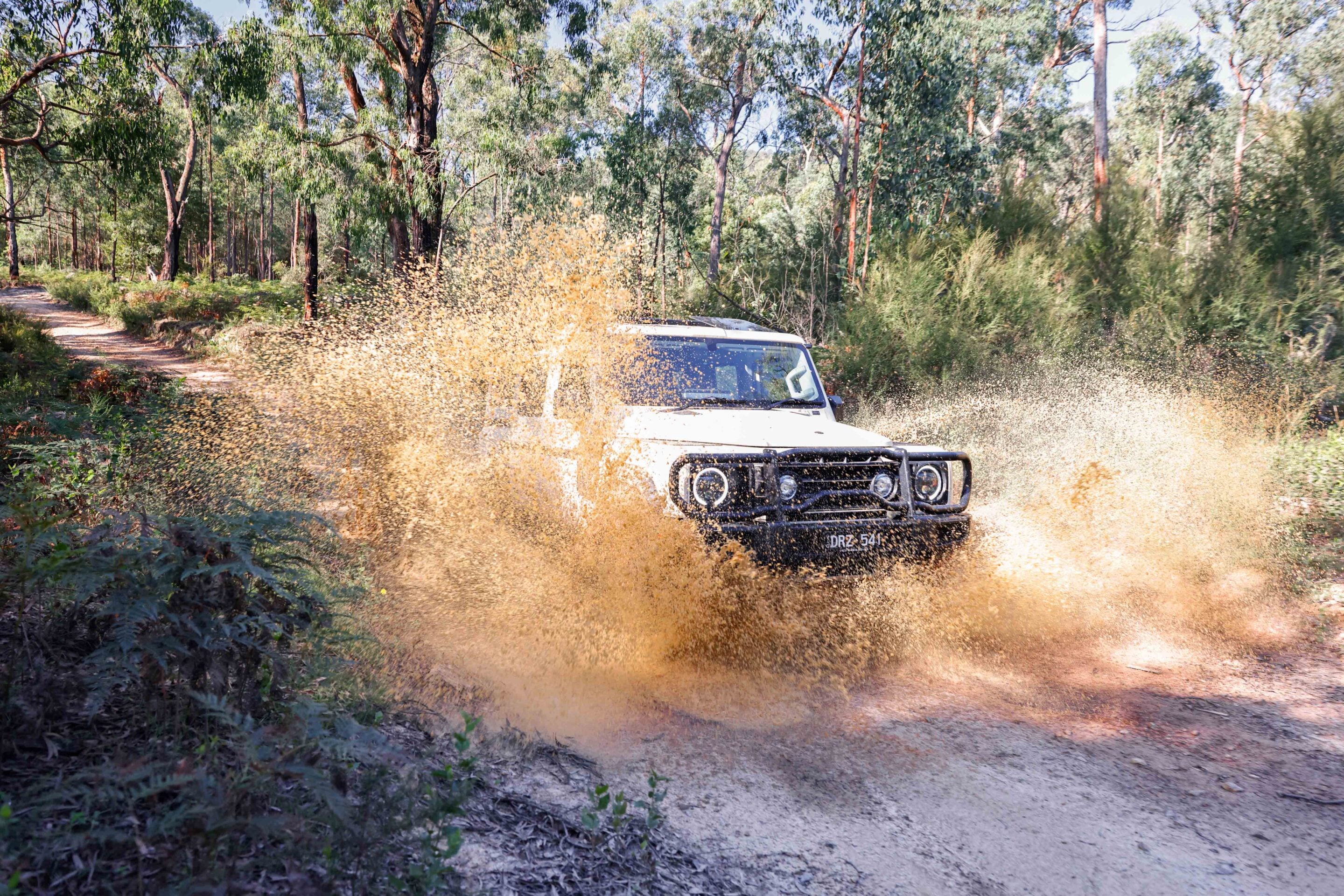
With the first opportunity, I headed to the Yarra Valley in search of mud. It’s been a dry summer in Victoria, so finding mud hasn’t been easy. The only option was to head to Toolangi State Forest, where I knew I’d be guaranteed to find some. To get there, I had a fair amount of highway driving to cover. The KM3s are definitely louder on-road than the ATs, but nothing you couldn’t live with, even as a daily driver. You do feel a touch more tyre roll through corners because of the taller sidewalls, but overall the ride is better. It’s simply a more comfortable experience now, both on- and off-road.
Before any mud could be sprayed, I found Rocky Track, dropped the Grenadier into low range and began the climb. If you’re familiar with Rocky Track, you’ll know it’s a very challenging drive. I completed the first section fairly easily with the centre and rear diffs locked. The aggressive sidewalls on the KM3s helped bite into the rocks and push the Grenadier forward.
The second section is much tougher, and line choice really matters. With the front locker engaged, I continued to make forward progress. The rock rails were taking a beating and things were getting pretty serious. I’m confident the Grenadier would have made it to the end of Rocky Track, but I chose not to push on. With just the two of us in one vehicle, it wasn’t worth the risk. If we got stuck – or worse – there was no one around to help. It’s a serious track.
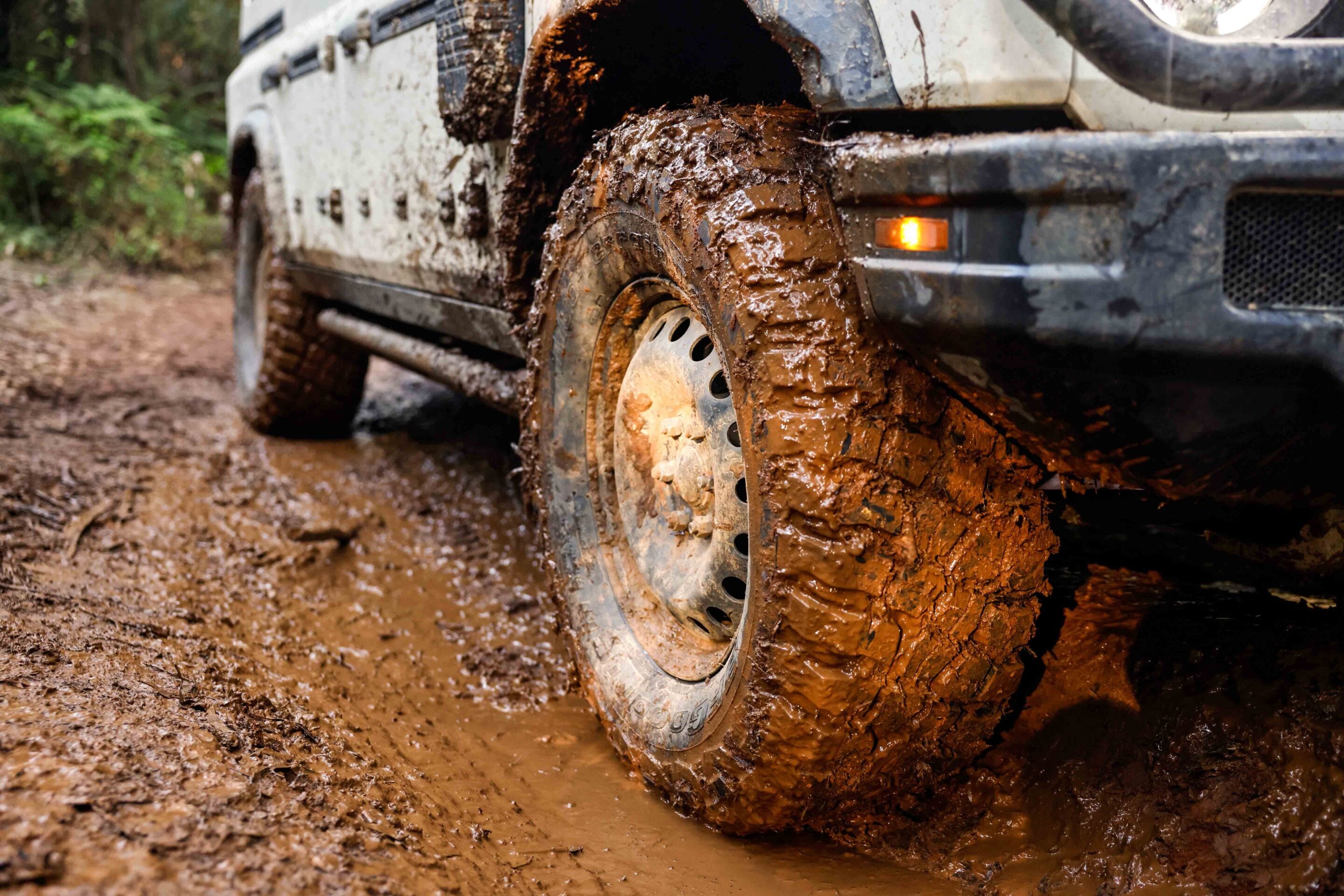
So my son William and I headed off in search of muddy tracks, and we found them. The KM3s performed exactly as you’d expect in sloppy conditions. Where the ATs would turn into slicks, the KM3s cleared mud far more effectively. I’m really impressed with the BFGoodrich Mud Terrain KM3s so far and happy I opted for the larger size.
They suit the Grenadier perfectly and make it an even more capable vehicle. I also fitted the new MAXTRAX Recovery Shovel this month. It’s a clever storage solution, with the shovel and extension handle integrating neatly with MKII and Extreme MAXTRAX boards. Hopefully I won’t need to use it too often.
One thing I would like for the Grenadier is a way to shade the safari windows. Don’t get me wrong, I really like them and at least one side is nearly always open, but there are times when the sun is directly overhead and some sort of shade system would be ideal. Maybe that’s my next mod?
- Kilometres this month: 4650km
- Average fuel use: 12.7L/100km
Last year we bought a BYD Shark ute to see how well the Chinese-made plug-in hybrid would perform in the real world.
To put it to the test, we planned a trip across the Simpson Desert – an iconic 4×4 adventure that sits on the bucket list of many Australian four-wheel drivers, if they haven’t done it already. To get it ready for the trip, we kitted it out with off-road hardware from some of our most trusted aftermarket suppliers before pointing it west.
Our BYD is now heading over the block at Slattery Auctions, but before it goes to a new owner, we’ll take a look at what was involved in the build and how it all performed.
Toughening it up with Ironman 4×4
First stop for the Shark was the team at Ironman 4×4 headquarters in Dandenong South. Ironman partnered with BYD long before the Shark was launched to develop a range of accessories to improve the capability of the ute in the Aussie bush, so the team had exactly what we needed.
For improved frontal protection, the crew fitted an Ironman Raid replacement front bumper, featuring a top hoop with an integrated light bar, cube side lights, a powder-coated finish, underbody protection and a pair of front 2.5-tonne-rated recovery points – which proved essential once the Shark hit the desert dunes. The Raid bar is winch-compatible and constructed from 4mm aluminium to keep weight down, and is ADR-compliant and crash-tested.
For added ground clearance and improved ride and control, an Ironman IM 2.5 ‘Heavy’ suspension kit was installed, comprising Ironman’s latest monotube shocks and matching raised coil springs. This resulted in a 30mm increase in ground clearance and improved driving both on- and off-road. It wasn’t available at the time, but in the months since our install, Ironman 4×4 has released a GVM upgrade suspension kit for the Shark, increasing payload from 790kg to 1140kg.
Rear-end set-up tailored for desert exploration
Rear-end protection came by way of a Hayman Reese X-Bar, with the added benefits of three built-in rated recovery points as well as an integrated tow hitch.
The Shark was starting to look more suited to the desert travel we had planned. It looked more purposeful again once we bolted on a set of Raceline alloy wheels wearing 285/60R18 Cooper Discoverer AT3 tyres. Not only did the bigger wheels and tyres look the part, but with their LT construction and rugged tread, they were less prone to damage and better suited to off-road desert conditions, where we were running lower tyre pressures for the sandy tracks.
A matching wheel and tyre wouldn’t fit under the back in the standard location, so it was strapped up top on a Rola Titan Tray roof rack, along with extra fuel cans, a set of Maxtrax and an Ironman awning.
Our good friends at MSA hadn’t seen a BYD Shark before we invited them on board, so they flew down to Melbourne with a toolbox and a truckload of MSA gear to see what would fit. It was no trouble for them and, in just a few hours, the Shark had a set of full-length MSA aluminium roller drawers installed, along with a drop slide to carry a dual-zone Evakool fridge.
While the Evakool fridge kept food and drinks at the right temperature, the drop slide made it easy to access over the tailgate. The MSA drawers are silent warriors, holding anything and everything securely inside while still being easy to access when needed.
Keeping everything in the back of the Shark secure and protected from the elements, the team at Ultimate Offroad fitted a Centurion canopy from Utemaster to the top of the BYD tub. The tough but good-looking Centurion canopy protects the contents of the ute while offering easy access via three large opening doors, making it quick and convenient to access gear wherever you take it.
Simpson Desert adventure
With our LandCruiser 79 along for support, the Shark left the security of the suburbs for the Australian outback, reaching the western edge of the Simpson Desert via Mt Dare.
Loaded with extra fuel and supplies, the two vehicles entered the dunes and it soon became obvious that the BYD would struggle when cresting the softer sand dunes. Using Icom UHF radios between the two vehicles and a Maxtrax recovery kit, the Cruiser helped it over when needed.
The real challenge came when it was time to cross Eyre Creek, which was flowing after recent rain in the desert. With the Cruiser and a recovery strap on standby, the BYD made the crossing.