
OUR 4X4 Of The Year test threw up an interesting mix of vehicles from 2016.
On the one hand we had the VW Amarok V6 that is loaded with the latest chassis tech, a clever and mischievous V6 diesel engine, and all the luxury fruit piled inside; while on the other there were two heavy duty cab-chassis utes that hark back more than three decades.
With their live axles front and rear and body-on-frame construction, we like to call these two old-school trucks traditional, but are they really any less tech savvy than the more modern vehicles on the test? Both the Mercedes G300 and the Toyota Land Cruiser are powered by electronically controlled, common-rail diesel engines, and they both employ electronic chassis controls such as traction and stability control to make them safer to drive. Just because the G300 has window winders and its ECUs are housed in a sealed console box doesn’t mean you want to submerge it in a river; although, admittedly, it would probably drive further and deeper than some of the other vehicles on this test.
So the G300 and LC70 aren’t the low-tech, traditional trucks they were 30 years ago, but are they any better now than back then? From an emissions standpoint they certainly are, but emissions don’t keep you relaxed after a 10-hour drive. Nor do they get you up a snotty hill that an old rig with open diffs and no electronics would ever scale.
Anyone who has driven one of the early 70s from the 1980s will tell you they are noisy, slow and agricultural vehicles – they were only a small step up from the old 40 Series. The cabins on those first 75 traybacks were short and cramped for anyone taller than 160cm and, if you could get them up to 100km/h, you couldn’t talk to your passenger over the noise. They were a lot like the G300 cab-chassis is today, despite the high-tech Benz engine under the blunt bonnet.
With its latest upgrades, however minor some of them may be, the LC79 is a refined and competent tourer and off-roader. In fact, we’d say it’s the best 4×4 on the market bar none. Possibly the best 4×4 ever!
THE annual 4X4 Of The Year event pits the newest offerings from all the major manufacturers head to head on some of the most technical terrain Australia has to offer. The idea is simple, push them until they can’t be pushed any more.
After a week living out of these vehicles we’ve got a solid idea of what works and what doesn’t; what rises to the top and what sinks to the bottom. Sounds great in theory, and it’s the only true way to get an accurate representation of how each model compares against its peers. However, in most cases, any new 4×4 taken to these locations is going to be decked out with good quality rubber, a versatile suspension set-up and your usual off-road kit including bar work and winches.
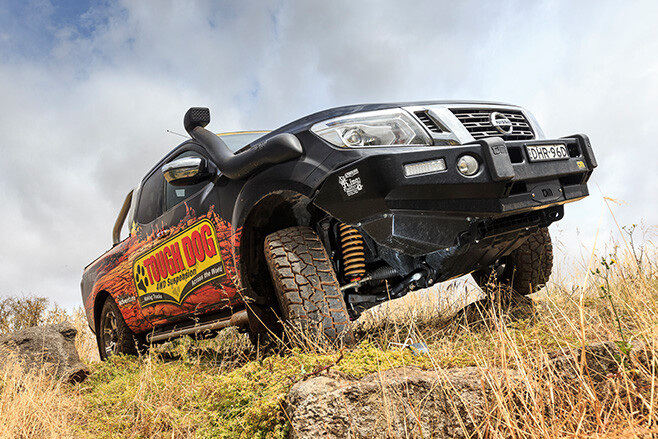
In order to see how each stock vehicle compares against a modified 4×4 with all the fruit, we included in the rotation Tough Dog’s decked-out NP300 Navara space cab.
Tough Dog has been attending the annual 4X4OTY event for a few seasons now, normally because it’s finalising R&D on a kit before it hits the shelves. This year was no different with its prototype leaf-sprung NP300 Navara.
So how did it perform, and how does it compare against some of the most capable vehicles you can find on the showroom floor? In a word, flawlessly. The combination of purpose-built suspension and aggressive tyres made the Navara one of the most capable vehicles in our fleet, despite its workhorse underpinnings and lack of technological advantages some had.
The Navara handled the High Country’s undulating, winding terrain with aplomb, giving a ride quality comparable to many coil-sprung 4x4s while still retaining load carrying capacity and increased articulation for improved off-road capability. It’s the best of both worlds.
So what exactly went in to making a basic leaf-sprung ute outperform coil-sprung 4x4s with far superior tech? We asked Tough Dog front man David Cook exactly that. “Our Navara is equipped with a 30mm lift sitting on foam cell shocks all ’round,” he said. “Up front the springs are rated to carry a bullbar, with our comfort springs in the rear for 0-300kg weight. All up it allows for a 265 tyre to be fitted to a 17-inch rim and push things as far as you’re legally allowed.”
While the fine-tuning happens in the field, the actual process to design and construct a system like this can take months. Up front the NP300’s strut arrangement is similar but subtly different to the outgoing D40 model, while the rear end is entirely new for this generation, which essentially means Tough Dog was starting from scratch. “The first thing we’ll do [when designing a kit] is duck down to our local dealer and place an order for the first black 4×4 on the lot so we can get on top of the R&D here in Australia as soon as possible,” David told us. “From here we’ll rack up a few thousand kays in the vehicle in standard form to give us a good base line.
We do all our testing on standard wheels and tyres so the size of the tyre, size of the rim, or the weight of both, isn’t affecting what we’re feeling through the car. Then we’ll take the standard shocks out of the car and dyno them on our in-house dyno as a reference point. Using our experience and the data we’ve gathered driving it in standard form, we develop and go on to fine-tune a replacement shock absorber with the valving changes we believe will get the most out of the vehicle.”
The space cab Navara also serves as an R&D platform for further development of Tough Dog leaf springs. “When we design the leaf spring pack, theory and on-paper designs can only take you so far. Real-world testing is where the knowledge is gathered,” David explained. “We can make changes to the camber (arch) of the spring, as well as the number of leaves, their thickness and the overall length of the spring to achieve the lift, load carrying and ride quality we’re chasing.
Working out the most effective changes that will get the results we’re after needs to be done in real-world R&D, so we endeavour to purchase every leaf-sprung car that we intend to develop a kit for because it’s the only way to get it right. Modern turbo-diesel vehicles punch out plenty of power and torque, which has changed how leaf springs are designed over time. The design of the spring plays a crucial part in guarding against vibrations from excessive axle movement.”
David told us: “The leaf-sprung Navara is really designed around load carrying; it does carry a load better than the coil-sprung one (which is perfect for towing off-road caravans or decking them out with a camper back). If you’re someone who’s looking to carry a load regularly then that leaf-sprung version is probably going to be the better choice, but fortunately with this car you don’t compromise too much in terms of comfort because of the way the leaf spring has been designed.”
Despite feeling planted in every situation we took it in (including a little sideways action on a rally course), Tough Dog still has a few more tweaks to make to the rear shocks before they’re released in the first quarter of 2017. The full kit will be available through Tough Dog’s website and through its dealer network.
While the market has become flooded with newcomers, the Tough Dog options represent true value for money with a guaranteed solution that’s going to work for 99.9 per cent of people.
HOME: 4X4 OF THE YEAR 2017
The seven most interesting 4×4 vehicles of 2016 get together for a week to determine the 4×4 Of The Year.
THE FINALISTS
Meet the seven most interesting 4×4 vehicles of 2016 battling it out to be crowned 4×4 Of The Year.
THE RESULTS
Only one of the seven best 4x4s from 2016 can be crowned 4×4 Of The Year 2017
4X4 OF THE YEAR HOME
Finding Australia’s Best 4x4s
LAND Rover’s 2019 Defender pick-up is likely to ditch a larger chassis for a mid-sized, one-tonne design.
This will put it smack-bang in the hot-selling 4×4 ute segment, along with the big-selling Toyota Hilux and Ford Ranger, as well as the new-to-the-scene Mercedes-Benz X-Class and Jeep Wrangler pick-up.
The launch of the new Land Rover Discovery heralds the first time in the brand’s 69 year history that all of its vehicles will ride on aluminium monocoque chassis, and last year the brand confirmed the next Defender will follow suit.
This got us wondering about how a new Defender would be as versatile as it was on a separate chassis. And how, for example, would you develop one or two different ute variants off the new platform.
It stands to reason that the most likely result will be a mid-sized ute to compete in the segment that’s dominated by the Toyota Hilux and Ford Ranger.
Land Rover has split its vehicles into three families that fall under the Range Rover, Discovery and (soon to come back) Defender nameplates. Range Rover has three (soon to be four) models under its luxury-focused brand, with the Rangie, Range Rover Sport, Evoque and the just-revealed Velar.
The new Discovery joins the Discovery Sport in the family adventure-driven group; while the Defender should encompass a range of functional and capable wagons and utes as it has in the past.
So, we can see how the Defender wagon/wagons will develop on the aluminium monocoque derived from that under the Rangie and Disco, but what about the ute? It needs a chassis right?
There has been a lot of talk from JLR about all-new models needing to earn their keep, and that the company can’t afford low volume or polarising vehicles that don’t carry their weight. The Discovery is an example of this, as its fresh design is aimed to attract a wider audience than the controversial D3.
Mid-size, one-tonne 4×4 utes are one of the fastest growing segments in the world. That is exactly why Mercedes-Benz is jumping in to the category with its X-Class, and the German brand is tipping the segment could grow up to 30 per cent over the next 10 years. Worldwide growth is so strong that Benz is now reconsidering its plans not to take the X-Class to the USA where there has been resurgence in the class from the Toyota Tacoma, Chevrolet Colorado and GMC Canyon. Ford USA has also announced it will be taking the Ranger back to the US in 2019.
On the other hand, more truck-like, heavy-duty utes like the old Defender 110 and 130 variants are going nowhere. The Defender is gone, as is the GU Patrol, while the Land Cruiser 79 hangs on by a thread as Toyota does all it can to keep it ticking along. Passenger-friendly, mid-sized utes is where the market is at, and it makes sense that this is the future for the Defender if it is to succeed.
We can expect to see the new Defender towards the end of 2018, and it will be very interesting to check out Land Rover’s entry into this highly competitive segment.
YOU would think that if there was going to be a museum dedicated to the Toyota Land Cruiser it would be in the vehicle’s home country, Japan.
If not Japan then Australia would be the next logical choice, as there is no place on earth that loves a Cruiser more than we do.
So you’ll be surprised to find what is possibly the best collection of Land Cruisers is actually in the United States. Salt Lake City, Utah, to be precise, and here you’ll find an amazing collection of Cruisers at the Land Cruiser Heritage Museum.
The museum is a private collection, and when we visited there were 72 Cruisers from all eras of the model on display. All bar one are owned by long-time Toyota dealership owner Greg Miller – the other Cruiser is his brother’s.
There are some rare beasts in the collection including FJ25s, a low mileage FJ55, a unique PX10 and a couple of Mega Cruisers. There are even a few in there that have come from – or at least visited – Australia, while an early Toyota BJ 4×4 that predates the Land Cruiser has recently been sourced from Australia and is about to be shipped to the museum.
The museum is open to the public and is usually staffed by a Land Cruiser enthusiast who will be only too willing to answer questions. We were lucky enough to have Cruiser Dan there when we dropped in and, as a 35-year Toyota parts man, there isn’t much he doesn’t know about Cruisers.
Check the museum’s websitefor the location in Salt Lake City, or to book a group visit.
Our camp on the bank of the creek is pleasant even if there isn’t a drop of water in it.
This article was originally published in the February 2014 issue of 4×4 Australia.
The mulga and acacia scrub crowds around us but the red soil has a mosaic covering of rich green where new grasses and small bushes were sprouting with new life and vigour. The dawn chorus of a multitude of different bird species greets us as we wake each morning and in the cool of the early hours and in the late afternoon and early evening the bush is alive with birds.
The creek, a minor tributary of the much greater Ashburton River which it joins some distance to the north, drains a line of rugged rocky ranges just a couple of kilometres away. We’ve spent time exploring the mouth of the wide gorge, the caves that dot the cliff faces high on the peaks above the creek and have wandered deep into the labyrinth of hills looking for more permanent water along the narrowing creek. We’ve found signs of old Aboriginal habitation in one of the bigger caves, and a few small water holes, but it’s obvious that the headwaters of this creek have missed out on the recent rains over the surrounding area.
We’ve been poking along the Gascoyne and the Ashburton Rivers for a while now, having left Carnarvon at the mouth of the Gascoyne a few weeks ago and headed inland away from the coast and the crowds. It’s incredible what a difference just a few dusty dirt kays can make: It thins the throngs of travellers no end.
We stop at the permanent stretch of water that is Rocky Pool (my first visit since 1978) on the Gascoyne River and then head east on what is the designated tourist route of the Kingsford Smith Mail Run to Gascoyne Junction. This small hamlet is slowly recovering from its inundation by the river back in 2010 with most of the new facilities being built higher than the old town site. It can be hard to believe that the river rose so high when you visit this small outpost in the more normal dry times as the river is quite a distance away. Further east, near Dairy Creek homestead, the route swings north, paralleling the great stream before the river again swings southeast. The road north crosses it at Yinnetharra homestead. This property is fairly well known by gem seekers as the area has produced tourmaline, beryl and aquamarine, and other minerals, from a number of mining areas in the surrounding hills.
We stopped at the historic Cobra Bangemail Inn which was, and still is to a much lesser degree, in the heart of the surrounding Bangemail Goldfields. Established in 1896 as the Euranna Hotel, it was renamed the Bangemail Inn in 1910 and today it offers accommodation and camping. But I’m not sure for how much longer, going by the comments of the leaseholder. A few modern maps show this whole area has now been taken over by the Western Australia Department of Parks and Wildlife (DPaW) like a number of former pastoral properties through this region. Heaven knows what will become of them as it seems the DPaW lacks the manpower to manage the parks it has already.
The next few days we spend exploring in and around the Mt Augustus National Park with our camp at the pleasant Mt Augustus Tourist Park homestead area, the only place you can camp close to the park.
This region of Western Australia was first explored by Francis Gregory in a couple of expeditions during the 1850s. He followed the Gascoyne River (named by George Grey in 1839) down from his meeting point west of present day Landor homestead to the sea. From the coast he headed back inland and followed the Lyon’s River upstream, naming the river, the Kennedy Range and then Mount Augustus before turning south and naming Mount Gould. The latter, about 160km northwest of Meekatharra, is now the site of the renovated Mt Gould lock-up while nearby Mt Gould itself wears the scars of modern day mining.
Our much easier and quicker travels take us south too, crossing the Gascoyne once more near Landor homestead before swinging east to parallel the river as we head to Milgun homestead. Travelling along these back roads we rarely see anyone else, pulling up for the night just off the track in absolute peace and quiet. And for the most part, the roads are in pretty good nick with little to disrupt the easy drive.
However, for the next week we are plagued by rain and spend a couple of days waiting for tracks to dry out before visiting the ruins of the old gold town of Peak Hill and its surrounding mines. As we drop off the high ground and head towards yet another crossing of the Gascoyne River, we encounter plenty of water oozing slowly towards the river on its quest to the sea. After tackling one flooded section of 500 metres or so, we happen upon another longer, more intimidating stretch. We turn back, not wanting to become bogged in a long stretch of water or to chew up the road too much. We spend the night camped not far from the abandoned Bryah homestead.
Forced out onto the blacktop, we cross the southern and middle branches of the Gascoyne south of the Kumarina Roadhouse, before taking a good dirt road west towards Mulgul homestead and camping on the edge of the Gascoyne, close to Tibingoona Pool, which surprisingly has little water in it. In fact, there is more water on the surrounding flat plains and in the small creeks than in the river itself and while I’m not sure how that works, we nearly get bogged on a side track while looking for a camp.
Crossing the watershed that divides the Gascoyne and its tributaries from the Ashburton River (somewhere between Mingah Springs HS and Mulgul HS) we head north and find our way to Bamboo Springs, a great little camping spot on the Ethel River, itself a tributary of the mighty Ashburton.
Nearby the Collier Range National Park grabs our attention. There’s very little info available on this national park that sprawls across 240,000ha of semi desert country. The low hills that the park takes its name from forms the catchment of a number of creeks; those on the northern and western sides flowing towards the Ashburton while those that flow from the eastern and southern sides flow into the Gascoyne.
Only a couple of little used tracks access the park, the easiest for travellers to use being the track that leads to Tangadee homestead, which lies north of the park. This track enters the park on its western boundary, crosses the Ethel River and heads across a vast sand plain; burnt bare shortly before our visit. Isolated hills stand proud of the red sand while in the distance a line of low hills marks the Collier Range. There is little wildlife in the burnt areas or the spinifex and mulga covered plains, the most common animal being feral cattle. However we spot a lone dingo trotting up one of the rare creeks.
Heading north on the main dirt road that first parallels the Ethel River and then the bigger Ashburton River, the route swings further around to the west. Past the Mt Vernon homestead the route begins to wind through some rugged range country and crosses Glen Ross Creek and Gorge Creek before zigging and zagging through a more prominent gorge-like valley, while off to our right, visible on the screen of the Hema but out of sight of our straining eyes, is Glen Ross. Immediately my inquisitive nature was prickled, the name Glen Ross harking back to an early explorer who I enjoy following up.
Later I found that my initial guess had been right. Ernest Giles had come this way in May 1876 as he pushed north to find a route east across the desert to the Overland Telegraph Line at Oodnadatta. A year earlier, he had set out from the historic station of Beltana in the northern Flinders Ranges, crossed the vast Great Victoria Desert, which he had named, and arrived in Perth after one of the greatest desert crossings in Australian history. Not satisfied with his success he headed north from Perth, exploring country missed by earlier explorers before turning east once more. His story is told in his very readable and many times reprinted book, Australia Twice Traversed. The names he sprinkled across the deserts he explored are like sparkling jewels compared to the many other drab names bestowed by other explorers. ‘Glen Ross’ had Giles’ undeniable stamp on it!
From Bamboo Springs we cruise north on a near deserted road to Ashburton Downs homestead only to find the river there to be in flood and flowing across the wide causeway.
Walking the crossing to make sure the concrete is still in one piece, we come across a tangle of wire and star pickets, remains of a fence washed away in the flood. We clear the route but with the sun sinking to the horizon we decide to wait overnight and let the river level drop even more.
In the morning the Ashburton is an easy crossing and with little to slow us we head north, taking to the bitumen for a short while before ducking into the Cane River Conservation Park. Once again there is little info available on this large park of around 186,000ha which straddles the Cane River, south east of Onslow. Rolling stony hills and gravelly sandy plains, both covered in spinifex and dotted with scrub, make up the majority of the park. The property was once part of a much bigger Peedamulla station with Cane River being established in its own right in 1949. The homestead, the ruins of which can be seen today, was built seven years later. After a number of owners, the property was taken over by the DPaW in 1996.
Few maps show any roads into this park but an old shire road leaves the Paraburdoo Road about 31km from the Nanutarra Roadhouse and cuts right through the park meeting with the NW Coastal Highway near the junction of the Onslow Road. A few kilometres east of the coastal highway a track (junction at GPS 22°10’32.4”S 115°33’48.8”E), heads north and crosses the Cane River at a wide sandy crossing a few kilometres south of the ruins of the Cane River homestead.
There is a trickle of water between long shallow waterholes in the river bed when we arrive and prop for a couple of nights to explore the area. The recent rain has also triggered an explosion of flowers and we find many carpets of Sturt Desert Pea, surely one of the most spectacular flowers of our semi arid and desert country.
However, rain is often a double-edged sword in these areas. The effects of the recent rain prevent us from heading to Old Onslow and the mouth of the Ashburton, while at the popular camps along the river at 3-Mile Pool, people are unable to move for a couple of weeks, with no one allowed in or out!
Stymied by the flood waters we head south, crossing the Ashburton on the blacktop and turning onto a little used station track to follow the course of the river east. With permission from the land owners we find our way to our isolated creek-side camp and spend a few days exploring the gorge and the caves in the nearby cliffs, but our efforts to follow the river further upstream are in vain. Time and the amount of water washing around the country side have foiled us, but we’ll be back to explore and enjoy this vast area between these two great rivers once more.
TRAVEL PLANNER
CARNARVON Carnarvon is located at the mouth of the Gascoyne River, about 900km north of Perth. It offers all that travellers might require. Visit: www.carnarvon.wa.gov.au
GASCOYNE JUNCTION Gascoyne Junction, 175km east of Carnarvon has an all new Tavern/Roadhouse/Caravan Park, which opened in late 2013. For more information, ph: (08) 9943 0988 or visit: www.uppergascoyne.wa.gov.au
COBRA BANGEMAIL INN Cobra Bangemail Inn, 240km NE of Gascoyne Junction, possibly has camping and accommodation this year – check before making your plans!
MT AUGUSTUS TOURIST PARK Mt Augustus Tourist Park, 300km from Gascoyne Junction and 340 NW of Meekatharra has accommodation, powered caravan sites, camping facilities, fuel and water. Ph: (08) 9943 0527; www.mtaugustustouristpark.com
MEEKATHARRA Meekatharra is a small but important town on the Great Northern Highway about 670km NW of Perth and 620km east of Carnarvon. See: www.meekashire.wa.gov.au
KUMARINA Kumarina Roadhouse – 250km north of Meekatharra has fuel & basic supplies. Ph: (08) 9981 2930.
ONSLOW Onslow is located on the coast a short distance north of the mouth of the Ashburton River and about 495km north of Carnarvon; see: www.ashburton.wa.gov.au/visit-ashburton/onslow
NANUTARRA Nanutarra Roadhouse is located 122km SE of Onslow and offers fuel & basic supplies.ph: (08) 9943 0521.
What’s your next off-road destination? Find out and explore.
WHEN regular 4X4 Australia photographer Cristian Brunelli isn’t behind the lens of his camera or driving his AEV-lifted Wrangler or slammed-in-the-weeds VW Country Buggy, he is building and playing with some wicked radio-controlled off-roaders.
When he recently sent us these pictures of this 1/10th scale XJ Cherokee we had to have a closer look.
The car is the latest version of Axial Racing’s SCX10 off-roader, equipped with a new Jeep Cherokee body (licenced by Jeep) and new AX44 (think Dana 44) hi-pinion axles. Other cool licenced parts include the Method wheels, BF Goodrich All-Terrain tyres and JCR Vanguard bumpers and rock sliders, all miniaturised to add scale realism to the rock-crawling Jeep.
Under the body of the Cherokee are scale reproduction steel C-channel chassis rails, front and rear metal four-link suspension, and coil-over shock absorbers at all four corners. For more licenced goodness, the shocks can be optioned for officially reproduced units from King or Icon Vehicle Dynamics.
The RTR (ready to run) Axial Jeep is powered by an electric motor that is geared to deliver a good compromise between low-speed rock-crawling torque and faster off-road-racing blasts. The RTR kit comes fully assembled with almost everything you need to have hours of fun (batteries not included). For those who like to build it themselves, there is a ‘builder kit’ of the same vehicle available that allows you to customise the car in your own colours and add more scale accessories such as lights, MaxTrax, Warn winches and other cool off-road gear.
Axial Racing produces a huge range of off-road RC vehicles, including a licenced Jeep-Wrangler-bodied version of the SCX10. Check them out online or search for a well-known RC specialist retailer in your area who can recommend the right kit for you and help you out with everything you need.
RATED
Available from: www.axialracing.com RRP: Approx. $650-700 (ready to run) We say: Hours of scale off-road fun.
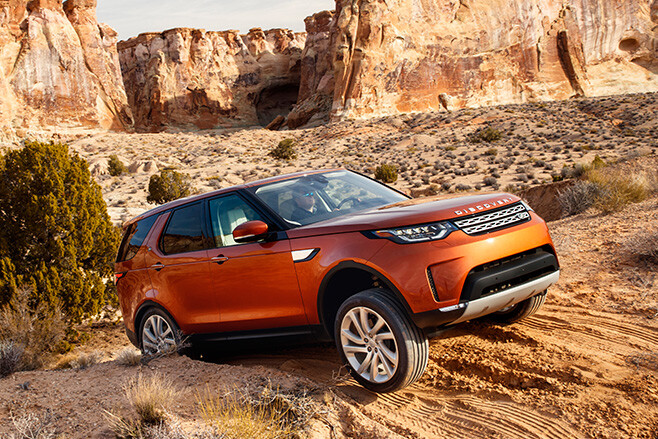
LAND Rover’s all-new Discovery promises higher levels of equipment and refinement and a model for all buyers from its 13 variant line-up.
For the first time in the nameplate’s long history the Discovery will be offered with a single-range transfer case, and a two-speed transfer case will be optional across most models.
Land Rover has always sold the Discovery on its breadth of ability; the fact that it could be a luxury wagon, suburban tourer and capable off-roader all in one. The Discovery 3 and 4 filled that role like no other 4×4, but for the fifth-generation model the brand seeks to broaden its appeal to a wider market and more buyers globally.
The purposeful, functional and, let’s admit it, boxy styling of the D3 and D4 weren’t to everyone’s liking, and that was the first thing the designers looked at when putting pencil to paper on the new model.
“That was a design that didn’t resonate with a lot of people, it was very polarising,” said Land Rover’s current head of design, Gerry McGovern. “All the vehicles that we create now need to sell a certain amount in order to create the volume so we can get the investment back and invest that in the future.”
So the new Discovery had to have more mass appeal and sit well within the ‘new’ Land Rover family, but the style of vehicle presents some challenges.
“When you’re doing a vehicle this size, with seven full-size adults, that is a big package, and to package that successfully and still make it look dramatic is a difficult task,” said McGovern.
So the new Disco looks more generic in a Land Rover way, with closer ties to the Ranger Rover, Rangie Sport and the smaller Discovery Sport vehicles. This is the new Land Rover, so you’d better get used to it.
In another first for the Discovery, the new model rides on a monocoque chassis made from aluminium. It shares this platform with the Rangie and Rangie Sport but, keeping more in line with its off-road-capable usage, the suspension components on Disco are steel and not alloy as they are on the Rangies. The use of lightweight alloys on the chassis and body contribute to a weight saving of up to 480kg on some specification variants, specifically the four-cylinder engine with single-range transfer case.
Yes, that’s right, we said four-cylinder. For the first time since the Series 1 Disco, a four-cylinder engine returns and is expected to make up the bulk of sales on the new model in Australia. It’s the latest version of Land Rover’s 2.0-litre Ingenium diesel engine and will be available in two states of tune for the Discovery. The base Td4 engine makes 132kW/430Nm, while the Sd4 puts out a handy 177kW/500Nm. There is also a traditional V6 diesel engine, which is an evolution of the ‘Lion’ TDV6 from Ford, and it makes 190kW/600Nm. All engines are backed by an eight-speed auto from ZF, and there will be no petrol engine offered in Australia.
Our first drive of the Series Five Discovery was limited to the Sd4 and Td6, both in HSE Luxury trim, at the international launch in the USA. The vehicles will go on sale in Australia in July – these two variants will be released first, while the entry level Td4 S models will land a couple of months later. That Td4 S will represent an approximately $4000 lower entry level price for the Discovery in Australia when it lands at $65,960 in five-seat trim.
A two-speed transfer case will add $920 to the price of your Disco; a locking rear differential adds $1080; Terrain Response 2 a further $2060; and height adjustable air suspension another $2060. So gearing the Discovery up for all-terrain use adds up pretty quickly, and there’s an extensive and complex list of options and packages available to blow the cost way out.
The Td6 remains the choice for 4x4ers looking for an adventure vehicle. The Sd4 is nice and will probably suffice for 80 per cent of buyers, particularly new buyers to the nameplate, but loaded up and/or towing we reckon the six is the go. All engines are rated to haul a 3500kg braked trailer, but after driving an unladen Sd4 on the highway we reckon it’ll be slow going with a load.
The Sd4 is a sweet touring engine and nice around town, it’s quiet and refined from inside the cabin and responds well to throttle inputs. It was only when overtaking at highway speeds that it felt wanting and, again, that was with just two passengers on board. Fuel use is rated at 6.3L/100km.
The familiar Td6 engine responds extra well to the lighter body and chassis of the new model. It gets along with urge and purpose and would cope much better with the demands of loads and long-distance travel. It is rated to 7.2L/100km consumption and the fuel tank is a paltry 85 litres for the Td6 (77 litres for the four-pots).
Our test vehicles were both fitted with two-speed transfer cases and all the off-road hardware on offer. Terrain Response 2 adds an Auto mode to the existing modes for Normal, Grass Gravel Snow, Mud & Ruts, Sand, and Rock Crawl. The Auto mode reads the terrain and driving style to select the right mode for the conditions and take the guesswork out of it for the driver. It’s a system that makes even the most inexperienced off-roader look and feel like an expert.
The suspension is fully independent and rides comfortably on the highway and sandy desert tracks we sampled it over. The test cars were fitted with 20-inch wheels and it looks as though the smallest offering from Land Rover will be 19s. Tyre choices for these 19s have a bit more sidewall height than in the past, with both 235/65 and 255/60 19s available as per the Range Rover Sport. We’re yet to determine if a smaller diameter wheel rim can be fitted to give better tyre choices.
With the suspension cranked up and low range selected the Discovery fared well on a tricky little rock-crawl course. The electronic traction control and automatic centre and rear diff locks are beautifully calibrated to maintain traction and forward momentum. Another huge plus over the previous models is that with the suspension in the raised position it now doesn’t automatically drop down until 80km/h, up from the previous 50km/h which was real nuisance. Also, with the suspension raised, the wading depth is a best-in-class 900mm.
The new Discovery is a very different vehicle than the one it replaces, yet it retains the accommodating seven-seat cabin, quality ride, high levels refinement and competent off-road ability the model is known for. It’s what McGovern calls “lifestyle enabling versatility”, and when you add these attributes to the wider range of variants which will appeal to more to non-off-road users, the new Disco should be a sales winner for Land Rover. We’re looking forward to driving it on familiar Australian tracks later this year to get a better feel for its abilities.
RANGE AND PRICING
S Td4: $65,960 / $71,560 (5-seat/7 seat) Sd4: $71,560 / $77,960 Td6: $78,560 / $84,960
SE Td4: $77,050 / $81,590 (5-seat/7 seat) Sd4: $83,450 / $87,990 Td6: $90,450 / $94,990
HSE Td4: $87,150 / $90,550 (5-seat/7 seat) Sd4: $93,550 / $96,950 Td6: $100,550 / $103,950
HSE Luxury Td4: $100,950 / $104,350 (5-seat/7 seat) Sd4: $107,350 / $110,750 Td6: $114,350 / $117,750
FIRST EDITION TD6: $132,160
I first came across this rice dish travelling through South America.
We ended up camped in the grounds of a small motel, run by an Australian woman, who was married to an Iranian man. He ran this wonderful little restaurant in the motel, with the menu based on Persian cuisine.
This is a version of the fabulous rice dish he made. I hope you love it as much as I do. I prefer it served warm, but it is just as nice cold. Add some cooked chicken and make it a meal in one. It’s worth the effort.
INGREDIENTS
- Large pinch saffron threads
- ¼ cup boiling water
- 2 cups Basmati rice
- 80g butter (it must be butter for the flavour, margarine won’t work)
- Zest from one orange
- ½ cup raisins – roughly chopped
- ½ cup diced dried apricots
- ¼ cup dried currants
- ¼ cup pistachio kernels – chopped
- ¼ to ½ cup slivered or flaked almonds – toasted
- ¼ cup pine nuts – toasted (optional)
- 6 fresh dates – sliced (optional, I wouldn’t bother unless using fresh dates)
- ½ to whole pomegranate – seeds only (optional)
- Salt and pepper to season
- Combine the saffron and boiling water in a small bowl, stir and leave to infuse for 15 to 30 minutes.
- Put the rice into a bowl and pour over some boiling water (enough to cover) and stir. Then drain and rinse.
- Bring a large pot of water to the boil, add the rinsed rice, give it a stir and cook until just tender.
- Drain and set aside. If you have the time, spread the cooked rice out in a large, shallow tray and put it in the fridge overnight to allow it to dry out a little before using the next day. Put half of the butter in a large frying pan and place on the heat; when the butter is foaming (but not burning) add the drained rice and the saffron along with the infused water and stir through thoroughly (the rice will become a gorgeous golden colour).
- Keep stirring until the water is absorbed then turn the heat to low.
- Add the rest of the butter and all of the remaining ingredients (except the dates, pomegranate, salt and pepper) to the pan and mix through until the ingredients are well distributed. Cover with a lid and continue to cook for a few minutes.
- Remove from the heat and add the dates and pomegranate. Mix through and season to taste.
- To get the pomegranate seeds from the fruit, cut the fruit in half, place one half fruit side down over the palm of your hand, fingers spread, and hold it over a dish and give the outer skin of the fruit a good ‘whack’ with a large wooden spoon, or something similar.
- If the fruit is ripe, the seeds should drop out easily and fall through your fingers into the bowl. If any of the ‘white pithy inner flesh’ drops out with the fruit, remove it. You can also add 1 tsp sumac, ¼ cup of fresh coriander or some cooked chicken.
HEADING in to a week-long trip of road testing for 4×4 Of The Year, a few of us were in need of new swags. Wanting to get top quality Australian-made products we turned straight to Mr Swagman.
You could say there is nothing more Australian than a canvas swag, but it’s amazing how few swags are made here. Even those sold by most of the big Australian companies are imported.
Mr Swagman swags are made on home soil right here in Victoria using 15-ounce, rip-stop cotton canvas. That’s heavy duty stuff, and you feel it in the size and weight of these swags and how stiff they are when new. The canvas is resistant to rot and mildew, and it’s UV-stabilised and waterproof.
Like any genuine canvas product these swags have to be ‘seasoned’ before use to get the maximum waterproofness. This means stripping everything out of it and soaking it with water, letting it dry out, then repeating the process a few more times. This allows the cotton fibres to expand and fill in any pinholes in the weave.
The zippers are all heavy-duty items designed to last for years, and the sewn-in insect mesh is fine enough to keep the tiniest of pesky midgies out while still allowing breeze through on hot summer nights.
Inside there’s a 70mm foam mattress that is antibacterial-treated and has proven to be comfortable on rough ground. Mr Swagman swags also feature a PVC base designed to keep out moisture when camping on wet, damp or even frozen ground. Like the canvas, it is made using rip-stop material.
Mr Swagman makes a range of different swags for different uses and in different sizes, ranging from minimalist swags for horse riders and motorcyclists to the Ultimate and Deluxe swags. We chose a Deluxe single and an Ultimate king single.
THE DELUXE AS I already have a well-used king-single swag I was looking for something smaller this time, so I chose the Deluxe single. This is a traditional dome-style swag using pre-bent aluminium poles that loop through each end to keep the canvas and fly screen up and off you. It only requires a peg at each end to pull the set-up swag taught lengthways.
Handy features of the Deluxe swag include meshed windows at both the foot and head of the swag that can he opened to allow more flow-through ventilation on hot nights. You can drop the canvas covers on these from within the swag if it starts to rain or get cooler during the night. The PVC flaps at the side and head of the swag make getting your boots off and sliding into the swag easier at night, and they also provide an easy cover to keep the rain or dew out of your boots.
Internal pockets to stow your wallet, keys and watch also come in handy. Just don’t forget to retrieve them before you roll your swag up and stow it in the 4×4 – it’s always very embarrassing when you go to pay for fuel and then realise you can’t find your wallet.
I’m a big bloke at 185cm tall, but the Deluxe single swag offers plenty of internal space for me. It provided comfortable, cool and dry sleeping quarters for the 4X4OTY test and subsequent holiday travel.
I also optioned the Mr Swagman PVC cover and groundsheet. This full cover is made from the same rip-stop PVC as the base of the swags and encloses the swag to keep it dry and dust-free if it’s in the tray of a ute or on the roof of your 4×4. I’ve always had to keep swags inside the car to keep them dry in the rain, but with this I don’t have to worry about it anymore. When unfurled, the cover makes a full-length groundsheet to provide an extra layer of insulation between you and Mother Earth.
The Mr Swagman Deluxe single is available in a choice of desert sand or bush green colours and retails for $500 (plus postage). The PVC swag cover is an extra $89.
Rated Available from: www.mrswagman.com.au RRP: $500 (Deluxe) We say: Quality Aussie-made product for a fair price.
THE ULTIMATE 4X4 AUSTRALIA photographer Ellen Dewar is about half my size but went for the bigger Ultimate king single to replace her no-longer-serviceable imported swag. At 210cm x 100cm x 80cm (LxWxH) Ellen could have had a party in the Ultimate. The Ultimate features the same quality 15-ounce canvas, PVC base and fine mozzie mesh as the other Mr Swagman swags, but it’s completely freestanding, requiring no ropes or pegs to keep it up.
It uses an aluminium pole that runs the length of the swag to tension the hoops at the end. This pole also extends to prop open the flaps at either end that cover the meshed ventilation windows. The Ultimate can be opened on either side with the canvas rolled up for maximum ventilation. Or, with a couple of optional tent poles and ropes, the canvas can be extended to create a small balcony, perfect to keep the dew off your boots.
Being free-standing, the Mr Swagman Ultimate can easily be lifted and moved without needing to remove any pegs or securing devices. It is available in tan or green and retails for $550 (plus postage).
You won’t find these quality Australian-made Mr Swagman products in stores or warehouses. They are only available direct from the manufacturer at www.mrswagman.com.au, where you’ll find the full range of swags, accessories and rooftop tents.
Mr Swagman always has products in stock and posts them out promptly. Support a 4x4er that makes quality products in Australia the next time you need to buy a new swag!
Rated Available from: www.mrswagman.com.au RRP: $550 (Ultimate) We say: If you’re looking for the best swag in the range, this is it.
The Land Rover Discovery TDV6 you see here is this magazine’s 2013 4X4 Of The Year. For more information read about the 2013 4X4OTY.
This article was originally published in the February 2014 issue of 4×4 Australia.
The Disco’s ‘TDV6’ designation means it has the low-spec 3.0-litre V6 bi-turbo diesel engine, the base model in the current Discovery 4 range. It made the starting grid in last year’s 4X4OTY thanks to that engine – which replaced the outgoing 2.7-litre V6 turbo diesel – and the new eight-speed automatic gearbox.
Meanwhile, this Prado GLX diesel auto is the facelifted model for 2014. It has the same powertrain as before, and the same chassis at this spec level, but comes with new exterior styling and interior detailing. The GXL is the second of four Prado specification levels but it’s still less expensive than the base-model Discovery.
POWERTRAIN & PERFORMANCE The Prado’s D-4D 3.0-litre four-cylinder turbo diesel and five-speed automatic appeared in late 2006, in the previous generation 120 Series Prado. With minor revisions to engine and gearbox, the driveline was carried over into the 150 Series when it launched in late 2009 and soldiers on today.
It claims a modest (by today’s standards) 127kW but a slightly more encouraging 410Nm of torque. On the road it performs better than the numbers suggest; the fact that maximum torque is available from just 1600rpm and doesn’t diminish until 2800rpm is a clue that this is a nicely flexible engine.
This flexibility gives more performance then the power figure suggests and makes life a bit easier for the five-speed automatic gearbox, with the two working in harmony to produce a fuss-free and generally refined driving experience. The engine’s impressively quiet at highway speeds too, the ambient noise helping to mask the diesel rattle you hear at lower speeds.
Drive the Prado in isolation and the powertrain offers little reason for complaint. However, drive it back to back with the Discovery TDV6 and its star starts to fade. The TDV6 is the low-power version of the Discovery’s 3.0-litre V6 bi-turbo diesel, yet it’s significantly punchier than the Prado’s engine despite having to cope with a 250kg-odd weight penalty.
The TDV6 not only has 22 per cent more power and 27 per cent more torque than the Prado but its superb eight-speed automatic makes far better use of the available power than the Prado’s five-speeder. And it’s faster to react, smoother shifting and generally more intelligent.
The Discovery’s engine is also quieter and more refined than the Prado, so the whole powertrain offers a level of sophistication and refinement that’s a cut above what’s on offer with the Prado.
It’s a pity that Land Rover saw fit to replace the conventional shift lever with a rotary dial with the new eight-speed. You get used to the dial but it smacks of gimmickry and means the only way to manually shift is via the steering wheel paddles. That’s fine on-road but isn’t great in the dirt, where you’re often using far more wheel rotation. The saving grace is that the sophisticated eight-speeder works just fine in Drive, making manual manipulation largely redundant.
While the Discovery clearly out-grunts the Prado, there’s little between the two for fuel economy; our test figures were as good as identical though the official ADR figures slightly favour the Prado. Fuel range is another thing; the Discovery’s barely adequate 82.3-litre capacity falls short of the Prado’s 150 litres.
RIDE & HANDLING The Discovery and the Prado are both separate-chassis designs but that’s about it for platform similarities. The Prado is relatively old-school, with a live-axle at the rear and conventional coil springs all around. In contrast, the Discovery has fully independent suspension and height-adjustable air springs.
Despite a firmer ride than the supple and plush-riding Prado, the Discovery is more stable and composed on crook roads, especially at higher speeds. It’s also a more engaging and enjoyable drive, with better feel at the wheel and more connectivity between driver and road. It may be bigger and heavier but the Discovery actually feels the sportier of the two.
On the down side, the Discovery can suffer from steering rack rattle on corrugated dirt roads and the low-speed ride on very rough secondary roads isn’t as good. The Prado does a better job of road-shock isolation and is almost always comfortable regardless of the road surface. On good quality roads there’s little difference between the two.
OFF ROAD The Prado’s on-road comfort is largely due to plush long-travel suspension and this is also the key to its considerable off-road prowess. In GXL spec, the Prado doesn’t have much in the way of special off-road kit – aside from electronic traction control. But that doesn’t matter, it does the job just fine.
In contrast, the Discovery has driver-selectable programs for different off-road conditions (the much-mimicked Terrain Response system) along with height-adjustable suspension and a self-locking, self-proportioning electronic centre diff and electronic traction control. Our test vehicle was also equipped with the optional ($1060) electronic rear locker.
Even with all the Discovery’s extra features, there’s not much between the two off-road; both have their strengths and weaknesses.
The rear locker is a major plus and it means that on broken ground the Discovery often does things a little more easily than the Prado, even if it is far more prone to lifting wheels. The height adjustable suspension is also handy as the Discovery has more clearance on full lift than the non-adjustable Prado suspension. Not so good is the fact that the Discovery’s suspension is hard-riding and prone to topping out when lifted from the standard position. But the Discovery has a better driving position with more all-around visibility.
The Prado’s main strengths centre on its simple, robust and soft-riding long-travel suspension. There are no airbags to rupture or complex control systems to worry about. Its wheel and tyre package is also more practical and offers a far greater range of replacement off-road-functional rubber.
The 255/5519s on the Discovery aren’t as practical and you can’t fit a smaller wheel due to the larger brake package standard on the Discovery 4 compared to Disco 3. There is a bespoke aftermarket 18-incher that will fit but we haven’t tested it and can’t comment on it with regards to brake caliper to wheel clearance and the potential for rocks or other debris to be caught there.
CABINS & ACCOMMODATION The Discovery has an advantage in terms of space and accommodation as it’s slightly bigger than the Prado; size-wise it’s more a competitor for the LandCruiser 200.
The Discovery 3, with its box-like body, set a new standard in cabin flexibility and space efficiency when it was released in 2004 (2005 in Australia) and the D3’s body and cabin architectures were retained for Discovery 4. In contrast, Toyota’s Prado 150 went backwards from the 120’s cabin functionality due to the redesign of the third-row seats.
In the 120, the third row seats folded up against the rear windows and, apart from rattling on rough roads and impairing some vision, they worked well. They were also easy to remove if not needed. The 150’s third row folds onto the floor, reducing the depth of the cargo area. From 120 to 150 series, the seating capacity was also reduced from eight to seven and the fuel capacity from 180 to 150 litres (no disadvantage here, given the Discovery’s seven seats and 82.3-litre fuel capacity).
In this base-spec Discovery (as in base-spec Prado GX) third-row seats are an option ($2500) but when fitted, they are more spacious and comfortable than Prado’s. There’s also more space behind the seats when the third row is in use.
Thanks to the Discovery’s horizontally split rear tailgate, that storage space is also far more useable as items stowed behind the third row can be held in place by the lower tailgate when the main part of the tailgate is opened. With the Prado’s side-opening single rear door, items stowed behind the third row tend to fall out when the door is opened. Despite the minor improvement in access to the Prado’s third row in the 2014 facelift, it’s still easier to get into the Discovery’s third row.
More points go to the Discovery as all seven seats fold individually, and the middle and third rows can lie completely flat. The Discovery’s second row is also more spacious for three adults than the Prado’s, and its front seats are more comfortable, though there’s not much in it and your personal preferences may be different.
PRACTICALITIES As mentioned, the Prado is ahead on tyre and wheel practicality, and fuel capacity – both important criteria for Australians. However, the Discovery counters with a 3500kg towing capacity against the Prado’s 2500kg. Both offer similar payloads but points for the Prado’s under-bonnet layout, with plenty of room for a second battery.
SUM UP Make no mistake, the Discovery 4 is one very clever, capable, enjoyable and refined vehicle. In most key areas it’s comfortably ahead of the Prado. Its powertrain is considerably more sophisticated and refined and outperforms the Prado.
The Discovery also handles better and is a far more engaging on-road drive. Perhaps more significantly, the cabin is bigger and far more functional. It’s also as good as, if not better than, the Prado off-road.
An extra trick up the Discovery’s sleeve is that it should be relatively simple to upgrade engine performance to the SDV6’s 183kW and 600Nm, a fair jump from the 155kW/520Nm TDV6 engine tested here. All the mechanicals are identical.
The Prado wins back points on pricing, wheel and tyre practicality, standard fuel capacity, and its simple and robust chassis design. Service in remote areas and resale value are also major attractions, as with all Toyota 4x4s. All this makes the Prado a sensible and sound purchase, even though it’s not as good a 4×4 as the Discovery.
SPECS: Land Rover Discovery 4 TDV6 Engine: V6 bi-turbo diesel Capacity: 2993cc Power: 155kW @ 4000rpm Torque: 520Nm @ 2000rpm Gearbox: Eight-speed automatic 4X4 system: Dual-range full-time Construction: Separate chassis Front suspension: Independent/adjustable air springs Rear suspension: Independent/adjustable air springs Tyre/wheel spec: 255/55R19 Kerb weight: 2570kg GVM 3240kg Payload: 670kg Towing capacity: 3500kg Seating capacity: Five (seven optional) Fuel tank capacity: 82.3 litres ADR fuel consumption*: 8.8L/100km On-test consumption: 11.0L/100km Touring range**: 698km
*Australian Design Rule Combined-Cycle claim **Based on test consumption, with a 50km safety margin
SPECS: Toyota Prado D4-D GXL (Auto) Engine 4cyl turbo diesel Capacity 2982cc Power 127kW @ 3400rpm Torque 410Nm @ 1600-2800rpm Gearbox Five-speed automatic 4X4 system Dual-range full-time Construction Separate chassis Front suspension Independent/coil springs Rear suspension Live axle/coil springs Tyre/wheel spec 265/65R17 Kerb weight 2320kg (approx) GVM 2990kg Payload 670kg Towing capacity 2500kg Seating capacity Seven Fuel tank capacity 150 litres ADR fuel consumption* 8.5L/100km On-test consumption 10.9L/100km Touring range** 1326km
*Australian Design Rule Combined-Cycle claim **Based on test consumption with a 50km safety margin