
THROUGHOUT the past 14 months the Bridgestone Dueler Mud Terrains have provided solid service on the sandy tracks of Hattah-Kulkyne National Park in the Victorian Mallee country.
They’ve also tackled some fabulous sandy runs on Stockton Beach at Port Stephens, traversed the rocky and rutted tracks of the Avon River, hit up the Murray River’s mud at Echuca, overcome the challenges of the Dargo High Country and, of course, the commute through suburbia.
The tyres have surprised as a daily driver. Even though they are muddies, they’re quieter than expected and they grip and handle well. In the wet they’ve performed much better than the old all terrains that were on their last legs.
I have no complaints when off-road, either. On High Country tracks – as well as on the wet, grease-like tracks along the Murray River near Echuca – they performed brilliantly.
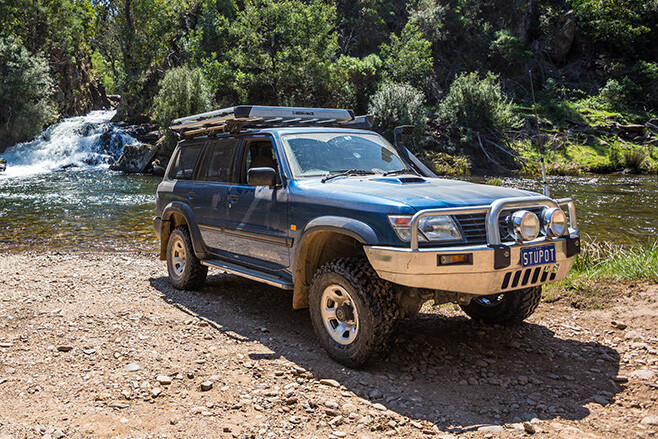
Where the tyres surprised me was on sand – on a Stockton Beach run they performed excellently. Now, let’s be honest, my faithful 3.0L GU Nissan Patrol is many things, but a power-laden, sand-chewing beast it’s not. We dropped pressures to 17psi and away we went. Surprisingly I didn’t have any issues on the sand at all, and I even managed to perform a snatch recovery of a Mitsubishi Triton, as well as rescue my mate Brad’s Pajero from a particularly soft patch.
Having travelled a tick over 12,000km, I think it’s time for a tyre rotation. The depth gauge discovered there’s 4.5mm wear on the front tyres and 3.5mm wear on the rears, so I reckon they’ve got another 25,000-30,000km of life left in them.
All is going well, although I do notice an impact at the bowser when filling up. I now return about 80-100km less from a full tank of fuel.
WE were confronted by several water crossings while driving through the Victorian High Country on the recent 4X4 Of The Year test. And, while none of them were particularly deep, we approached them all with a fair degree of trepidation.
Many years ago on a 4X4OTY test I watched in horror as a bow wave went over the bonnet of a Porsche Cayenne Turbo. I remember wondering how much money it would cost to replace the twin-turbo V8 if it copped a gob-full of water… and how I would explain the situation to Porsche’s PR Manager. Luckily the Porsche made it across, but the following SsangYong did not, spluttering to a halt in the middle of the creek and requiring a tow to the other side.
My heart nearly stopped when the bloke behind the wheel then attempted to start the SsangYong’s water-flooded engine. I yelled at him to stop, which he did, and we spent the next 30 minutes pulling the spark plugs, cranking the engine and pumping the water out of it. We then put the plugs back in and crossed our fingers as the ignition key was turned, and the little Korean sparked back to life. Another awkward phone call to a PR Manager had been averted, although later that week I told him what had happened so his mechanics could check out the vehicle when we returned it.
Fast forward to this year, and of the nine vehicles in our convoy there were four we didn’t have to worry about too much: the GU Patrol tucker truck, the Tough Dog Navara, the Mercedes-Benz G-Professional and the Toyota LandCruiser 79, all of which were fitted with snorkels (in fact, the latter two come standard with snorkels). The other five vehicles (all 4X4OTY contenders) were not snorkel-equipped. They were the Haval H9, Holden Colorado, Holden Trailblazer, Mitsubishi Pajero Sport and Volkswagen Amarok.
These snorkel-less contenders have claimed maximum wading depths ranging from 700mm down to 500mm, which is only about knee height, so our concern was real.
While the Haval H9 has one of the better claimed maximum wading depths of 700mm, you still have to be very careful crossing any body of water in a petrol-powered 4×4. It only takes a small splash to land in the wrong place under the bonnet to make the fire go out, potentially leaving you stranded up both the literal and proverbial creeks. The Pajero Sport also has a claimed maximum wading depth of 700mm, and with a diesel donk there’s a good chance its engine will keep running with water splashing about under the bonnet.
The worry levels increase slightly when fording a river in either of the Holdens, which both have a quoted maximum wading depth of 600mm. This modest figure is somewhat surprising, as a glance under the bonnet shows the air intakes on both the Colorado and Trailblazer are up quite high through their respective inner guards and that most of the electrical components are situated high in the engine bay.
Then there’s the Amarok with a claimed wading depth of just 500mm. The engine’s air intake looks vulnerable to water ingress (it’s behind one of the headlights) and the alternator sits quite low in the engine bay. In fact, for a photo shoot at a river crossing, we left the Amarok parked on the bank while the other 4X4OTY contenders crossed back and forth for an all-important splash shot. Nevertheless, driven carefully, the Amarok didn’t have any problems with any of the other water crossings we tackled on the 4X4OTY test and it made it through the week without a problem.
It’s strange that the Amarok’s wading depth is so limited on what is otherwise a well-engineered vehicle with surprising off-road capability. Of course, the best water-crossing solution for anyone who buys an Amarok, or any other 4×4 for that matter, is to fit a snorkel. Ensure it’s a good quality snorkel that’s been properly installed, as dodgy connections or cracked plastic will let water in. Other mods that will help your vehicle survive deep-water crossings include extensions on breathers for diffs, gearbox and transfer case, but bear in mind that water can still find its way past seals, especially when hot mechanical components are plunged into cold water. After any trip that involves water crossings, you should always check all oil for a milky appearance and replace if necessary.
Finally, good door seals are a great defence against water damage. I lost a camera recently when negotiating a deep-water crossing; it was in a backpack on the floor of ARB’s Off Road Icons Land Rover Defender. I should’ve known better.
THE PATH LESS-TRAVELLED
A variety of weather made this year’s route through the Vic High Country harder and more challenging than normal.
FOLLOWING the first two days of testing on the variety of tracks, obstacles and creek crossings at the Melbourne 4×4 Training and Proving Ground, situated just outside Werribee on the seemingly flat, billiard-like plains, it was time to head for the mountains of Eastern Victoria.
This year our trip took us along the Princess Highway then north on good bitumen roads to the small mountain enclave of Dargo, which always makes a great base for exploring the hills and valleys that surround this mountain township. We didn’t linger long, (not even for a pot in the pub!) just long enough to top up with fuel and supplies before we pointed the convoy west and took Shortcut Track across to Wonnangatta River Road. We followed this road to the flat, grassy patch of ground bordering the river at Kingwell Bridge.
Not content to merely sit down and watch the river meander past we hit the surrounding trails, taking the rocky, steep and scrambly climb up Conway Track. Luckily the weather had been dry and the track, while rough, tough and dusty, wasn’t too slippery. Surprisingly, all the vehicles in the group reached the top with hardly a worry; for most vehicles that’s a testimony to how good traction control has become in the last few years.
The next morning our route took us to Eaglevale and across the Wonnangatta River for the long climb to the top of Mt Cynthia, with the wind beating us mercilessly as the film crew and photographers worked tirelessly to get some action shots. It’s a pretty steep climb but the track is in good condition, so it’s a bit of a doddle. Once on the Wombat Spur track we cruised along effortlessly and, with the weather starting to spit rain, we headed down the very steep Herne Spur track.
I hadn’t been on this track for years and, while it is still steep, it isn’t what it used to be.
We then wandered up the valley, crossing the Wonnangatta River a few times before we got to the old historic Wonnangatta Station site and its big, old stand of trees. By now the spit of rain had turned to a steady drizzle and by the time we had lunch and headed off the rain was getting heavier. As we started the climb out of the valley on the Wonnangatta Track the rain became a deluge and very quickly the track became a running stream. Still, this is probably the easiest route into and out of the valley, linking up with East Riley Road before joining with the good but narrow dirt of the East Buffalo River Road.
Just when we thought we’d be in camp at a reasonable hour and in time to get organised, we came across nature’s roadblock, a fallen tree. Earlier we had to zig zag around a few fallen trees, but most had been cleared by work crews from 4WD Victoria and Parks Victoria before the official track opening a few weeks previously. Thanks to them for their huge and continual efforts.
That evening we pulled up at one of the pleasant little camps on the East Buffalo River, waking the next morning to a chorus of birds that were having a hard time competing with the full voice of the local kookaburras. A circuit of winding dirt roads capped off 2017’s 4X4OTY as we headed to the Hume Highway, some of us turning south while other judges turned north for places further afield. A week of testing to find the best new 4WD released in 2016 was over – well, until we do it all again next year.
MORE 4X4 OF THE YEAR
HOME: 4X4 OF THE YEAR 2017
The seven most interesting 4×4 vehicles of 2016 get together for a week to determine the 4×4 Of The Year.
THE FINALISTS
Meet the seven most interesting 4×4 vehicles of 2016 battling it out to be crowned 4×4 Of The Year.
THE RESULTS
Only one of the seven best 4x4s from 2016 can be crowned 4×4 Of The Year 2017
4X4 OF THE YEAR HOME
Finding Australia’s Best 4x4s
The criteria that allows us to determine who will be 4×4 Australia’s best 4×4 Of The Year 2017.
VALUE FOR MONEY What you get for what you pay. A particular vehicle may be expensive, but if it delivers on what it promises it can be good value. Conversely, a less expensive vehicle may not deliver at all and therefore be poor value.
BREAKING NEW GROUND Each vehicle is rated for the new technology or features it has and on the effectiveness of that technology or those features.
BUILT TOUGH Each vehicle is rated on how well it is designed and built.
BUSHABILITY Each vehicle is rated on how practical it is in the bush and in the outback, and how readily it can be made more bush and outback practical via aftermarket enhancement.
DOING THE JOB The vehicle is rated on how well it does the job it has been designed for. If it’s a ute, how good is it at being a ute? And if it’s a family wagon, how good is it at being a family wagon?
MORE 4X4 OF THE YEAR
HOME: 4X4 OF THE YEAR 2017
The seven most interesting 4×4 vehicles of 2016 get together for a week to determine the 4×4 Of The Year.
THE FINALISTS
Meet the seven most interesting 4×4 vehicles of 2016 battling it out to be crowned 4×4 Of The Year.
THE RESULTS
Only one of the seven best 4x4s from 2016 can be crowned 4×4 Of The Year 2017
4X4 OF THE YEAR HOME
Finding Australia’s Best 4x4s
Meet the industry experts that make up our 4×4 Of The Year judges panel.
DAVID COOK
- 1st 4WD: GQ Petrol wagon
- Current 4WD: GU wagon
- 4×4 Career started: 2008 as 4WD mag journo
- Current role: Marketing manager for Tough Dog
- Favourite Dest: Fraser Island
- Bucket List trip: Kimberley
DAN EVERETT
- 1st 4WD: 1986 Toyota 4Runner
- Current 4WD: 60 Series Cruiser
- 4×4 Career started: 2012 as 4WD mag journo
- Current Role: Freelance writer
- Favourite Destination: Cape York
- Bucket List trip: Siberia
DEAN MELLOR
- 1st 4WD: Series 2 Land Rover
- Current 4WD: D22 Navara
- 4×4 Career started: 1994 as 4WD mag journo
- Current Role: Freelancer; Tech Ed for ARB
- Favourite Destination: Northern Simpson
- Bucket List trip: Simpson Desert in topless LC
RON MOON
- 1st 4WD: 1955 Jeep Wagoneer
- Current 4WD: GU Patrol; LC79; Dodge Ram
- 4×4 Career started: 1981 as freelancer
- Current Role: Editor-at-Large for 4X4 Au
- Favourite Destination: Cape York
- Bucket List trip: Africa (again)
NORM NEEDHAM
- 1st 4WD: Series 1 Land Rover
- Current 4WD: 100 Series single-cab Cruiser
- 4×4 Career started: Early 80s (Traction 4)
- Current Role: Guru of all things Toyota 4WD
- Favourite Destination: Vic High Country
- Bucket List trip: Iceland
MATT RAUDONIKIS
- 1st and ONLY 4WD: BJ73 Cruiser
- 4×4 Career started: 2000 as 4WD mag journo
- Current Role: Editor 4X4 Australia
- Favourite Destination: Flinders Ranges
- Bucket List trip: South and Central America
BRYAN WELLS
- 1st 4WD: TD42 GQ Patrol
- Current 4WD: 79 Series dual-cab Cruiser
- 4×4 Career started: 1993, Mitsubishi mechanic
- Current Role: Top Of Down Under
- Favourite Destination: Nimbi Nimbi Sinkhole
- Bucket List trip: Rubicon Trail (USA)
PENNY WELLS
- 1st 4WD: Daihatsu Scat
- Current 4WD: 79 Series dual-cab Cruiser
- 4×4 Career started: Top Of Down Under
- Favourite Destination: Poppy’s Pools (NT)
- Bucket List trip: Tasmania’s west coast
MORE 4X4 OF THE YEAR
HOME: 4X4 OF THE YEAR 2017
The seven most interesting 4×4 vehicles of 2016 get together for a week to determine the 4×4 Of The Year.
THE FINALISTS
Meet the seven most interesting 4×4 vehicles of 2016 battling it out to be crowned 4×4 Of The Year.
THE RESULTS
Only one of the seven best 4x4s from 2016 can be crowned 4×4 Of The Year 2017
4X4 OF THE YEAR HOME
Finding Australia’s Best 4x4s
Only one of the seven best 4x4s from 2016 can be crowned 4×4 Of The Year 2017
THE RESULTS
7TH PLACE: HOLDEN TRAILBLAZER LTZ
Trailblazer is a new name for what was previously called the Colorado 7; a seven-seat wagon based on the Colorado ute, in this case the much-rev…
6TH PLACE: HOLDEN COLORADO LTZ
After several attempts at bringing the Colorado up to scratch, Holden has finally pulled the whole thing apart and started again.
5TH PLACE: MERCEDES-BENZ G-PROFESSIONAL G300 CAB CHASSIS
The G-Class is Mercedes-Benz’s longest running model and even outdates Toyota’s venerable 70 Series.
4TH PLACE: HAVAL H9 LUXURY
HAVAL is Great Wall’s SUV offshoot brand, and the H9 is the only proper 4×4 in the Haval range.
3RD PLACE: MITSUBISHI PAJERO SPORT GLS
The Pajero Sport is based on the Triton ute that arrived early in 2015 and was a finalist at last year’s 4X4OTY.
2ND PLACE: VOLKSWAGEN AMAROK TDI550 ULTIMATE
The first significant change to the Amarok since the eight-speed automatic four-cylinder.
WINNER! TOYOTA LANDCRUISER L79 DOUBLE CAB
Toyota LandCruiser 79 Series claims top prize by the barest of margins
TOYOTA LANDCRUISER L79: WHAT THE JUDGES THOUGHT
The 4×4 Of The Year judges share their thoughts on the awarding-winning Cruiser.
MORE 4X4 OF THE YEAR
HOME: 4X4 OF THE YEAR 2017
The seven most interesting 4×4 vehicles of 2016 get together for a week to determine the 4×4 Of The Year.
THE FINALISTS
Meet the seven most interesting 4×4 vehicles of 2016 battling it out to be crowned 4×4 Of The Year.
4X4 OF THE YEAR HOME
Finding Australia’s Best 4x4s
Meet the seven most interesting 4×4 vehicles of 2016 battling it out to be crowned 4×4 Of The Year.
THE FINALISTS
HAVAL H9
Can this year’s surprise contender take the crown?
HOLDEN COLORADO
Rebuild gives the Colorado a fighting chance
HOLDEN TRAILBLAZER
Could this revised wagon be Holden’s best chance at claiming 4X4OTY?
MERCEDES-BENZ G300
Can the Merc’s off-road ability justify its insane price tag?
MITSUBISHI PAJERO SPORT
Proven all-rounder struts its stuff against the world’s best.
TOYOTA LANDCRUISER 79
Trusty and reliable 70 Series workhorse gives the title shot a red-hot crack.
VOLKSWAGEN AMAROK V6
Can the addition of a V6 diesel donk give the Amarok its first 4X4OTY gong?
MORE 4X4 OF THE YEAR
2017HOME: 4X4 OF THE YEAR 2017
The seven most interesting 4×4 vehicles of 2016 get together for a week to determine the 4×4 Of The Year.
THE RESULTS
Only one of the seven best 4x4s from 2016 can be crowned 4×4 Of The Year 2017
4X4 OF THE YEAR HOME
Finding Australia’s Best 4x4s
The seven most interesting 4×4 vehicles of 2016 get together for a week to determine the 4×4 Of The Year.
INTRODUCTION
The seven most interesting 4×4 vehicles of 2016 get together for a week to determine the 4×4 Of The Year.
THE FINALISTS
Meet the seven most interesting 4×4 vehicles of 2016 battling it out to be crowned 4×4 Of The Year.
THE RESULTS
Only one of the seven best 4x4s from 2016 can be crowned 4×4 Of The Year 2017
TOUGH DOG SUSPENSION
4X4OTY sponsor Tough Dog Suspension brought along its leaf-sprung Navara to show the benefits of a suspension upgrade.
THE CRITERIA
As always, the vehicles were not judged against each other, but against the established 4X4OTY criteria.
MEET THE JUDGES
Meet the industry experts that make up our 4×4 Of The Year judges panel.
TESTING TRACKS
A variety of weather made this year’s route through the Vic High Country harder and more challenging than normal.
HOME: 4X4 OF THE YEAR
Finding the best 4×4 in Australia
WHICH vehicles are in contention for 4×4 Of The Year comes down to the simple expediency of being all-new – or significantly revised, mechanically – in that year.
Given this selection process leaves out even best-in-class vehicles if they aren’t new or haven’t been significantly updated in the previous 12 months, the field thrown up is often criticised and sometimes misunderstood.
For example, in this lot you’ll find no LC200, Prado, Hilux, Ranger or Everest, just to name a few of the obvious suspects. For that we make no apologies given our on-going best-in-class tests published regularly and recently.
However, what you will find is arguably the most diverse range of 4x4s we have ever assembled to battle it out over a week of take-no-prisoners 4X4OTY testing.
For the first time in 4X4OTY we have a Chinese-designed-and-built 4×4, the all-new Haval H9. Think Chinese Prado but petrol-only. It’s close to the least-expensive vehicle here – despite being the top-spec model – but arguably the best equipped. At the other end of the spectrum the most expensive vehicle here, the just introduced Mercedes-Benz G-Glass Professional cab-chassis, is the most utilitarian.
The technology on display runs from the highly sophisticated Volkswagen Amarok, sporting a new V6 engine similar to that used in the likes of the Porsche Cayenne diesel, right across the spectrum to the relative simplicity of the revised Land Cruiser 70 Series. In between these extremes of cost, features, technology and function are two Holdens – the significantly revised Colorado ute and new Trailblazer wagon – and Mitsubishi’s Pajero Sport wagon.
All up there are four utes and two wagons based on utes, all of which is a sign of the times in the four-wheel drive world.
All bar one engine in the field is a diesel, again a sign of the times. Ditto an almost exclusively all-automatic field with only one manual. And, interestingly, the only non-diesel, a very modern low-pressure turbo-petrol engine, could be the way of the future given the threat posed to diesels by end-of-decade emissions regulations.
As ever, our weeklong testing involves set-piece 4×4, trail driving and touring on a wide variety of roads, and pits the seven aspirants to the 4X4OTY throne not against one another but against our five award criteria, listed opposite. Each of our judges (in blind voting) awards every vehicle points out of 10 for each of the five criteria. All the points from all the judges are then tallied and the vehicle with the most number of points wins. Simple, really.
MORE 4X4 OF THE YEAR
HOME: 4X4 OF THE YEAR 2017
The seven most interesting 4×4 vehicles of 2016 get together for a week to determine the 4×4 Of The Year.
THE FINALISTS
Meet the seven most interesting 4×4 vehicles of 2016 battling it out to be crowned 4×4 Of The Year.
THE RESULTS
Only one of the seven best 4x4s from 2016 can be crowned 4×4 Of The Year 2017
4X4 OF THE YEAR HOME
Finding Australia’s Best 4x4s
THESE two legendary vehicles have, over the past 30-plus years, carved a place in the annals of four-wheel drive motoring history.
While the Merc has rarely been seen in Australia until recently, its reputation has been etched in stone. Meanwhile the Land Cruiser 70 Series has built on its forebear’s tough and reliable reputation, not only in the harsh outback of Australia but also in Africa and beyond.
Watch how these two heavy-haulers battled it out here.
MERCEDES-BENZ G300 CDI PROFESSIONAL CAB-CHASSIS
ON paper the Merc sounds pretty impressive, and in a 4WD and load-carrying sense you have to say it delivers the goods. However, there is absolutely no pandering to comfort, ambience or even on-road manners. But I’m getting a little ahead of myself.
The Mercedes-Benz G300 CDI Professional cab-chassis looks like it comes from a bygone era. In fact, the basic body and chassis design hails back to the 1970s, predating the 70 Series Cruiser by quite a few years. Still, you don’t buy one of these rigs for its good looks or modern styling, but, as you’d expect, there’s been a few upgrades in other departments since it first appeared. Benz’s global and far-reaching 3.0-litre V6 turbo-diesel engine has been detuned for its role in the G-Class, so much so that it can reportedly run on the world’s poorest quality diesel fuel. That’s probably a good thing considering the numerous complaints we hear about diesel fuel out in the Aussie bush.
The engine, crowded into its engine bay, produces 135kW at 3800rpm and 400Nm anywhere between 1600 and 2600 revs. Without a heavy load and with a mix of on-road and off-road driving the Merc returned a fuel economy figure of around 16.0L/100km, which isn’t particularly brilliant in this day and age. With a fuel tank capacity of just 97 litres you’d be game to drive anywhere close to 600km before fuelling up.
The engine produces a lot of heat (as all do), but the crowded engine bay means the hot air enveloping the engine has a hard time escaping from underneath the bonnet. Apart from nearly suffering first-degree burns when lifting the bonnet after an hour or two of 4WDing, I’m not sure how long the battery will last in those hot confines.
A basic five-speed automatic transmission sends drive to all wheels with a 50:50 split front to rear, and the centre diff can be locked by a switch on the centre dash. Low range can also be selected by a switch to deliver an impressive, tractor-crawling 41.0:1 in low first. For more 4WD capability, standard front and rear axle diff locks are also controlled by a couple of switches on the dash.
There are heavy duty coil springs all around designed to carry a payload (which includes the weight of any tray you fit) of nearly 2100kg, and a braked towing capacity of 2120kg is a much more realistic figure than what most utes on the Aussie market profess to have. With its heavy-duty chassis, and crossmembers that would do a truck proud, it’s surprising that the kerb weight is just 2410kg. Two spare tyres tuck under the aftermarket tray on this example.
Adding to the old-school-but-excellent diff locks, the G-Professional comes with a range of electronic driving and safety enhancements. There’s ABS, electronic stability control with selectable on/off function, brake assist and electronic brake-force distribution. A tyre-pressure monitoring system along with just two airbags are also standard fair and, while the G-Pro hasn’t received an ANCAP safety rating yet, the vehicle has won favour with a number of mining companies and government departments across Australia.
In the cab you get two basic bucket seats, a centre console that’s not for storing anything, absolutely no lining or sound deadening, and some cheap rubber mats. Switch controls, apart from the aforementioned 4WD and diff-lock buttons, are robust, ungainly and hard to use.
The G-Professional doesn’t come cheap, setting you back $119,900 plus on-road costs. For that you also get 16-inch alloy rims sporting 265/75R16 AT rubber, a bullbar, snorkel, radiator and sump protection plates, along with headlight and indicator light guards. The tray is an extra cost.
TOYOTA LAND CRUISER 79 SERIES V8 SINGLE CAB-CHASSIS
The 70 Series Land Cruiser may have been with us since the 1980s, but for many outback tourers, farm hands and mining exploration teams this is still the vehicle of choice.
The latest upgrade to the single-cab Cruiser is mainly the result of pressure from mining companies to improve the safety rating to ANCAP 5 standard (only the single-cab rates this high), while also correcting some other long-standing issues and improving environmental emissions.
The 4.5-litre turbo engine gets piezo injectors and a diesel particulate filter, but power and torque remain the same at 151kW at 3600rpm and 430Nm at 2000 revs. Fuel economy has improved slightly, but our real-world testing didn’t see much difference with a figure of around 14.0L/100km. Now with the smaller 130-litre tank (down from dual 90-litre units) range should be about 900km between refills.
The big mechanical change in the 70 Series is the gearbox ratios, with second and top gears being significantly taller. The taller top gear will be welcomed by many, with the engine spinning around 2000rpm at 100km/h. The proven and well-tried part-time 4WD system remains the same, with auto-locking hubs now gracing the front axle. Overall reduction in low first is also a very credible 45.9:1. GXL variants get front and rear diff locks as standard fare.
There are live axles all around with coil springs up front and leaf springs down the back end for carrying the load. Kerb weight is 2175kg while GVM is 3300kg, giving a payload of 1125kg. Braked towing capacity is a realistic 3500kg.
The biggest bugbear of the latest 70 Series Cruiser has been the difference in track between front and rear. Sadly, this hasn’t been addressed, which will keep some in the aftermarket industry happy, as conversions to widen the back end are seemingly proliferating.
The addition of electronic driving and safety features brings the 70 Series into the modern world, with this Cruiser now featuring ABS, vehicle stability control, active traction control, hill-start assist, brake assist and electronic brake-force assist. All this is designed to make a poor driver a reasonable one and, with the help of five airbags (driver and passenger, side curtains and driver’s knee) along with chassis improvements, ensures the vehicle receives an ANCAP rating of five stars. Cruise control is now standard in the GXL.
In-cab comfort has been improved with better seats and improved NVH, with the GXL model getting ‘almost plush’ carpet and cabin trimmings. Switch controls are sensibly laid out and easy to use. The GXL on test here has a price tag of $66,490 plus on-road costs. Optioned as it is here with painted steel tray and air conditioning ($2700) it sits at $74,715.
HEAD TO HEAD
YOU’LL notice the Spartan condition of the cabin immediately once you get into the G-Pro, which almost makes the Cruiser look and feel luxurious in comparison. You’ll notice it even more when you are moving, especially at 110km/h on the freeway.
Loading up both vehicles with 1000 litres of water sent the Cruiser to its maximum GVM (as standard, although there are many upgrades in the aftermarket), which resulted in its back-end squatting down quite a bit. The same weight on the Merc settled the suspension a little but, being only half the maximum allowable payload, did little else. Certainly the vehicle’s stance and drivability was hardly affected, with the longer wheelbase helping here. In fact, the suspension offered a much better ride with this weight being carried than when it was empty or lightly loaded.
On the other hand, when the Cruiser was loaded the steering was light and, on corners and roundabouts, it had a wallowing back-end. Still, when the trays were empty or close-to empty the Cruiser was much more comfortable and pleasurable to drive. The Merc was a pig of a thing when empty, especially on slightly bumpy or corrugated tracks.
While the Merc’s performance was hardly blistering it performed adequately, even though you had to be very positive with the accelerator to get it to go – the engine did feel the extra tonne on the back. In comparison the Toyota V8 hardly felt the extra burden and we often took off from a standing start in second gear. Mind you, the auto ’box in the Merc was a highlight, making the manual ’box in the Tojo feel almost archaic.
Lighting and air-conditioning controls in the Merc are woeful and the whole cab layout leaves a lot to be desired. The Cruiser mightn’t be the epitome of design and comfort, but it is way in front of the Merc. You’d also have to put this latest variant of the Cruiser in front of the Merc when it comes to safety, although both offer outstanding 4WD capability.
Then there’s the significant price difference. I never thought I’d say this but the 70 Series Cruiser is remarkably good value for money; certainly when compared with the Merc. For my money I’d take the Cruiser every time. The only time I’d consider the Merc is if I was hauling one-tonne or heavier load all the time… and I mean all the time.
SPECS
Toyota Land Cruiser LC79 GXL Engine 4.5-litre 1VD-FTV 8-cylinder turbo-diesel Power 151kW @ 3600rpm Torque 430Nm @ 2000rpm Gearbox five-speed manual 4X4 System dual-range part-time Crawl ratio 44.1:1 Tyre spec 265/70R16 115R Kerb Weight 2175kg GVM 3300kg Payload 1125kg (with no tray) Towing 3500kg Fuel tank capacity 130 litres ADR fuel claim 10.7L/100km Fuel consumption 14.0/L/100km Warranty 3-years/100,000km Price $66.490 Price As Tested $74,715
Mercedes-Benz G-Professional Cab-chassis Engine 3.0-litre V6 turbo diesel power 135kW @ 3800rpm torque 400Nm @ 1600-2600rpm Gearbox five-speed automatic 4X4 System dual-range full-time Crawl ratio 41.0:1 Tyre spec 265/75R16 Kerb Weight 2410kg GVM 4490kg Payload 2080kg (minus tray weight) Towing 2210kg Fuel tank capacity 97 litres ADR fuel claim N/A Fuel consumption 16.1L/100km Warranty 3-years/ 200,000km Price $119,900 (excluding tray)