Tourism NT has released a series of videos encouraging Australians to escape the hustle and bustle of city life and visit the Northern Territory.
The ‘get out of the state you’re in’ campaign enlists the help of three comedians to take the mickey out of the populated cities of Melbourne, Sydney and Adelaide, and then exposes the NT’s countless attractions: indigenous art and culture, incredible beaches, beautiful waterfalls, picturesque sunsets and, of course, stacks of four-wheel driving.
We had a chuckle – mostly at the Melbourne video – and, considering we’ll always encourage folk to load up the fourbie for a getaway, we thought we’d show them to you.
Radio host and comedian Harley Breen does a cheery job poking fun at Melbourne’s most obvious stereotypes, but at the same time enlightens viewers as to why the NT is better.
YouTube comedian Alex Williamson takes the piss out of South Australians. “What is this parallel universe where people swim in waterholes, and fish instead of work,” he says.
“I didn’t believe they had a rock the size of Uluru, but there it was,” he continues.
While Tanya Hennesey jokes about things Sydney-siders never say, and then explains how the NT offers so much more.
It’s all in good humour, and if it encourages people to hit the outback trails, then it’s a good thing in our books!
BACK in 2014, I spent three days in Baja, Mexico, testing the newest iteration of the BFGoodrich All-Terrain, the KO2.
The region was being hammered by the tail-end of a hurricane, which allowed us to put the KO2s through a variety of terrain ranging from sloppy mud and sandy beaches to rocky hill climbs and high-speed drifts on hard-packed two-tracks. I was impressed with the tyre and within a few months had a set on my long-term Tacoma project vehicle.
Since that time, the odometer has clicked off 55,000km and the KO2s have carried me back to Mexico numerous times, as well as on dozens of backcountry treks around Western USA. The company’s tagline for the new All-Terrain was Traction, Toughness and Tread Life, and I can say that in the past two years my new dogs have been given ample opportunity to pass or fail.
TRACTION
THE traction a tyre provides may be deduced with subjective or objective metrics, and there are numerous factors that play into performance on a variety of tractive surfaces. Tread block configuration, rubber compound, siping and sidewall construction are the key variables and must work in harmony with one another.
The new design has slightly wider voids, a broad, staggered shoulder, and a chevron pattern side-biter sidewall tread that wraps about a third of the way to the rim. Its full-depth siping spans nearly the full width of the footprint, and rather than a straight, vertical slice they are three-dimensional, descending from the surface in a wavy pattern like a piece of corrugated metal.
The general premise behind siping is to enhance mechanical keying at macro and micro levels. Micro keying is the ability of the tread face to comply with minute deviations in the traction surface. Macro keying has more to do with the deformation of the tread block and sidewall as a whole, and is most noticeable at low air pressures.
Under these conditions the block remains compliant with undulations in the terrain, while the 3D design of the sipes allows them to interlock, keeping the tread block together while reducing the possibility of chipping.
I live in the Northern Sierra Nevada, California, so in addition to forays over dry-traction surfaces such as the deserts of Nevada and Baja, these KO2s have seen a fair bit of wet roads, snow and mud. Voids feature small ridges at the base (mud-phobic bars) that help clear the tyre of interloping debris.
At low pressure (I usually run about 15psi on dirt and 10psi in soft snow or mud), considering that the KO2 is not a dedicated mud tyre, it does a pretty good job. Regarding Goodrich’s claim of a 10 to 19 per cent increase in traction, I can’t provide objective conclusions. However, the tyre has performed exceptionally well in all of the aforementioned environments and at all tyre pressures.
TOUGHNESS
AS A crew chief and navigator for legendary off-road racer Rod Hall, I’ve raced and chased several Mexican 1000 vintage rallies through more than 8000km of rugged two-tracks. In the process, I’ve had several “oh, shit” moments when I ran out of talent and nailed a boulder flat-out while drifting a corner.
It is during these times of brain fade that I appreciate the extensive research BFG engineers put into this tyre. I have yet to have a failure on my personal vehicle or the race truck.
The KO2 features CoreGard technology – borrowed from the race-only Baja T/A KR2 – which implements a rubber formula that is more resistant to splitting and bruising, while a thicker, more pronounced shoulder reduces sidewall failures. Rod runs KO2s on his competition vehicle (a 1969 Bronco) and we’ve completed each race on the same tyres that left the starting line. Enough said.
TREAD LIFE
ONE OF the major challenges tyre manufacturers face is balancing the aforementioned performance attributes with reasonable tread life. A soft rubber compound will stick like glue but wear to the core quickly. On the flip side, a rock-hard compound will provide extended life but will be as compliant as a steel rail-car wheel in the dirt. BFG claims the KO2 offers a 15 per cent increase in tread life on asphalt and a whopping 100 per cent on gravel roads over the previous KO.
I asked Senior Development Engineer Brandon Sturgis about the rubber/carbon cocktail. He said: “It’s kind of like grandma’s secret recipe for lemon cake… she’s not going to tell you.”
In short, the rubber compound has been engineered to reduce chipping and tearing without compromising adhesion. The interlocking tread block, which includes interesting little pyramids or stone ejectors at the base of each void, is designed to keep gravel from becoming wedged in and grinding away at the carcass.
Three-dimensional siping allows for compliance with terrain while keeping the tread block, as a whole, intact. The overall effect is uniform wear and extended tread life. As for exact tread life, I can’t say, as I would never run a set of tyres down to the DOT minimums – a pathetic 2/32nds. I will say that the average remaining tread depth is 13 of the original 20/32nds, or about 65 per cent.
A tread-life warranty isn’t offered, but at the current wear rate I’d guess 80,000km would be a reasonable expectation for the 50 per cent mark. Not bad, considering the real-world abuse I’ve put them through.
My last comment is in regard to noise. With more than 380,000km on the Tacoma, the rattles have now made my original baseline decibel readings obsolete. Generally, this All-Terrain will be louder than a street or generic SUV M/S-rated tyre. However, they are much quieter than any Mud-Terrain I’ve run and the benefits, in my opinion, make up for slightly less gonzo in the mud.
Overall, the KO2 has proven to be one of the best All-Terrain models I’ve run, and has upheld the company’s lofty claims of the three Ts – traction, toughness, and tread life.
CONTACT
Website: www.bfgoodrich.com.au
RRP: From $293 (per tyre)
PACKING for your next off-road adventure but you’re running out of valuable cargo space? MSA 4×4 Accessories’ extensive range of Tourer and Basket packs will avert the storage crisis.
This is advertiser content
The Tourer and Basket Packs – essentially weatherproof bags that sit on a 4×4’s roof racks – are manufactured from 100-per-cent breathable 15oz polyester and cotton canvas, infused with DuPoint Teflon repel.
The base of each pack is lined with 2mm laminated PVC and canvas, and each pack is secured to a roof rack via a seatbelt harness system.
Opening and closing the packs to load or unload bulky items (chairs, tables, swags) and smaller items (kitchenware, clothing, 4×4 accessories) is made simple thanks to a YKK chunky zip with double metal sliders on three sides. A 50mm Velcro-style dust seal then completely covers the zip for superior protection from the elements.
For added protection when the going gets rough, the range also comes with a removable rain and dust cover. Other features include additional 50mm Velcro-style tie-downs, and anti-flappers on all harness straps.
Whether it’s to increase overall storage capacity, or to free up space in the cabin for more passengers or the family pet, an MSA 4×4 Tourer and Basket Pack is a no-brainer for long-distance tourers.
MSA 4×4 Accessories’ Tourer and Basket Packs are available from more than 450 stockists Australia-wide, and each product comes with a lifetime guarantee.
Sizes for the Tourer Pack range from 90L to 210L; Basket Pack from 90L to 180L; and Half Pack 140L. For the full range of sizes available, visit www.msa4x4.com.au.
Picture this: you’re a bona fide car-guy with a love for off-roading.
Vote for the HSV-powered H3 Hummer to win the 2017 Custom 4×4 of the Year
You’ve had a staple of cars that range from AC Cobras to a rotary-powered 400kg Mini Cooper, and you’ve just been handed the keys to a H3 Hummer fresh out of warranty. It’s a safe bet your mind wouldn’t be racing with dreams of a roof rack and snorkel; a build like that isn’t going to cut it amongst your automotive hall of fame.
This is the exact situation Dean found himself in when it came time to trade in the wife’s soccer-mum-spec H3 – the last iteration of a 30-year-old brand, and the smallest by far. So, what exactly would you build? If you’re anything like Dean, the answer is simple: the best H3 Hummer in the country, and potentially the world.
Before we fall too deep into the rabbit hole, it’s important we address the elephant in the room. Why would you build an H3 Hummer? It’s about as common as an honest politician, so we had a few questions when we first came across Dean’s build a few months ago. “It was my wife’s choice,” he told us. “We’d always had seven-seat 4x4s for the four kids, but when they grew up she still wanted a 4×4. The H3 had all the bells and whistles and made a good family car.”
After a few years of family service, Dean figured the big wheels and chrome should take a back seat to a blacked-out look and tyres large enough to crush a Prius in one blip of the throttle. “I used to take it 4x4ing all the time when it was IFS, but it kept breaking CV joints and front diffs. Things sort of snowballed from there.”
First on the chopping block was the front independent suspension. While the stock set-up was more than enough for mild wheeling with 33-inch tyres, it quickly fell apart when pushed hard. Dean was changing CV joints so often he could get the job done in 15 minutes, and eventually this sparked a call to Matt Kinsela at Kinselas Kustoms to cut off the old set-up and install a new live axle in its place.
The new front axle is a Dana 44 out of a Chevy K20 pick-up, with a set of custom hubs adding tone rings to keep the ABS, traction control and stability control working. Matt sliced and diced the existing mounts and fitted the D44 axle with a set of 80 Series radius arms and a GU Patrol steering box, linking it all to the H3 frame.
From here, the chassis was extensively plated before sheet metal towers were added to house 10-inch travel King Shocks coilovers with external reservoirs and hydraulic bump stops. They were dialled in to give a three-inch increase in ride height over standard and allow the front end to articulate through a huge range of travel, while still retaining enough on-road performance to stretch the new engine’s legs through rolling back-country roads.
Hard on the bump stops, there’s just enough room to swallow the huge 37-inch Federal Couragia mud tyres for a balanced suspension set-up and low centre of gravity.
Ford Ranger gets ARB treatment
In the rear, things were kept a little more sedate. Its 50mm extended shackles were teamed to an add-a-leaf system from The Ultimate Suspension, with a set of its shocks increasing height over stock by three inches. The arrangement flexes similar to the front and stuffs the 37-inch tyres deep into the wheel arches. With most SAS Hummers State-side being in the realms of six-inch-higher-than-stock, Dean’s is inarguably one of the lowest and most stable Hummers on the tracks.
With the suspension sorted, Dean turned his attention to the lethargic I5 petrol engine under the bonnet. “It’d always jump in and out of top gear on the freeway when we were towing our camper,” he said.
“After doing extractors and a cold air-intake, we tried the turbo route to get it working. It melted piston number five not long after. We rebuilt the engine and it did it again, so we started looking at other options.”
In the States, the H3 was available with a 5.3-litre V8 version of the LS found here in go-fast Commodores – so slotting in an LS2 was the obvious choice for Dean. The engine in question was a 2008 HSV-tuned donk, which pushes north of 298kW (400hp) and 550Nm. To fit it, Dean approached custom extraordinaire Steve Etcell from Automotive Etcellence in Sydney’s west. With the H3 already running a 4L60E transmission, Steve pieced together a hybrid unit to slot in between the LS2 and the Hummer’s transfer case, with a few internal upgrades to cope with the extra power.
Custom engine mounts were required, as was a custom loom from Ultimate Conversion Wiring and a trick new exhaust system. With the larger engine in place, the stock airbox was squeezed out, so Dean rectified this with a slimline pod filter spliced into the snorkel. A K&N stocking also goes over the snorkel head for dusty conditions.
In a strange turn of events, the standard ECU was able to run the LS2, with a custom tune helping to simplify things. The result is an engine that easily lights up the tyres, has no troubles pulling ahead of traffic and more than enough low-down grunt for serious off-road work.
Until now, the build reads like the spec-sheet of an off-road racer, but Dean’s H3 has been fitted with more than its fair share of touring equipment. An ARB front bar houses a 10,000lb Warn winch, as well as a set of LED driving lights. Kinselas Kustom scrub bars help mate the ARB unit to OEM rock sliders, while under the bonnet an Optima yellow top powers the Engel up back as well as the ARB compressor under the bonnet. With the kids no longer tagging along for the ride, Dean has plans to yank out the rear seats and build a full-length storage system for longer touring trips, and he’s replaced the camper with a roof-top tent so he should have no dramas finding hidden campsites you won’t reach with 33s.
While there’s always a place in our heart for bare-bone tourers, it’s hard to ignore the rise of what we call Outlaw Touring – builds that push the boundaries of what’s legal and what defines a capable rig, while still being more than up to the job of covering serious kays. Dean’s H3 is the pinnacle of this new trend. A Frankenstein of a build that drives harder, faster, stronger and further than any traditional tourer can, and after riding shotgun while it weaved its way in and out of trees and up one-metre tall rock ledges, it’s hard to argue with it. Bring on the revolution.
BIG TYRES AREN’T THE ENEMY
Alright, there’s an insidious idea that’s taken hold recently and we need to put it to bed. Every time big tyres get mentioned we’re inevitably hit with an onslaught of complaints that big tyres rip up tracks, but it’s simply not true. Track erosion is caused by disturbing the hard-compacted layers of soil, allowing the next downpour of rain to wash it away. It’s spinning tyres that are the biggest culprit of this.
Large tyres, like the 37s fitted to Dean’s H3, are there specifically to reduce tyre spin. They have a large footprint, giving them more traction than smaller tyres and, with a better approach angle, they help the Hummer roll over obstacles that would have a smaller tyre’d rig spinning trying to climb. Sure, if you drive like a flip, they’ll dig a bigger hole than a smaller tyre, but that ultimately comes down to the driver’s mindset rather than the number on their tyres.
Ford Motor Company has unveiled the US police industry’s first pursuit-rated ute.
Based on the F-150 FX4, the Police Responder will run a 3.5-litre EcoBoost V6 engine (280kW/637Nm), Ford’s SelecShift 10-speed automatic transmission and the FX4’s off-road suspension set-up – so the chase won’t be called off when crooks high-tail it off the bitumen.
Utilising Ford’s high-strength, aluminium-alloy SuperCrew body, the crime-deterring F-150 sits on a high-strength steel frame.
With an ability to reach speeds of up to 160km/h, this tough ute will be able to snare law-dodgers right across the urban and rural lands of the United States.
“Ford’s 2018 F-150 Police Responder is the perfect all-terrain law enforcement vehicle,” said Stephen Tyler, Ford’s police brand marketing manager.
“Aside from its industry-first on-road pursuit capability, this purpose-built pick-up can comfortably seat five, while providing capability in off-road patrol situations for officers in rural environments patrolled by sheriff’s departments, border patrol operations and the Department of Natural Resources.”
Other notable performance enhancements of the Police Responder include a police-calibrated brake system (upgraded calipers and pad friction material), an upgraded front stabiliser bar, 18-inch alloys surrounded by all-terrain rubber, underbody skid plates, and a class IV hitch with a claimed maximum towing capability of 3175kg.
A high-output 240amp alternator supports all on-board electrical devices essential to a police vehicle, including a police-calibrated speedometer, and engine hour and engine idle hour meters.
THE Kennedy Range National Park in Western Australia sits approximately 830km north of Perth and 150km east of Carnarvon.
The steep rubble slopes of the south-eastern side are easily accessible via formed gravel roads from Gascoyne Junction. Already well developed by WA’s Department of Parks and Wildlife (DPaW), it has a designated campground with drop toilets, while signposts lead to highlights like Honeycomb, Drapers and Temple Gorges.
However, the western side is a completely different story. It doesn’t have the dramatic cliffs of the eastern side, but it does have permanent springs, shady river gums, creeks and water holes. Access is on unformed tracks via Mardathuna Station to the west or by crossing the Gascoyne River from the south.
There is also a rough 4WD track over the top of the range, and it’s this isolation that keeps the Kennedy Range’s western side in pristine condition.
Access to the south-west end of the range, across the Gascoyne River, can be fraught with danger and travellers should be aware that the riverbed’s sand is coarse and does not compact well when wet, so you risk your tyres sinking in the quicksand. Even when it’s dry it can be challenging.
Being up to 200 metres wide, if you do get stuck on the way across it could be a long reach to the nearest big tree or firm ground to winch yourself out.
Alternative access is from the west via Mardathuna Station. The Mardathuna Road passes the homestead, so it’s worth a courtesy call to the station managers to ask if it’s okay to pass through. From there, continue on to Mooka Station which will eventually lead to Pharoh Well at the base of the range.
The road starts off being reasonably well-formed as far as the homestead, but from there on it varies between soft sand and rough rock, with plenty of washaways thrown into the mix.
Heading south along Mardathuna Road from Pharoh Well, travellers will find numerous permanent springs, waterholes and creeks along the base of the range waiting to be explored. The largest of these is Chaffcutters Spring, which makes a lovely, tranquil place to camp among its pools of water and towering river gums.
Another point of interest a bit further south is the Mookaite deposit near Mooka Spring. This is the world’s only known source of this earthy-coloured Jasper rock. While it’s well worth a fossick for this colourful gem, the rights to the mine is held by lessees, so don’t be tempted to take any samples with you.
On paper, Mardathuna Road T-junctions with the Carnarvon-Mullewa Road, but you’ll have to cross the aforementioned Gascoyne River to reach it. If it’s too wet to cross, the area still makes a lovely spot to camp for a few days of swimming and relaxing in the shade of the huge river gums and paperbark trees.
When you’re ready to get back to exploring the Range, you’ll need to backtrack to Pharoh Well, which should take two hours, without trouble. From there, you can make the decision to travel back along the roads you came in on, or take the more adventurous route and tackle the 4WD track over the top of the range.
You’ll find DPaW signs along the way, advising that “the top of the Range is currently not safely accessible to visitors”, but people still attempt the crossing. It is not maintained and the runoff from any rainfall can have a significant impact on the state of the track, so a high-clearance 4WD is required, as well as lowered tyre pressures and locked diffs.
Be prepared for some track-building after recent rains, as the depth of the gullies made by runoff can make the track impassable.
It can be done, though, but it’s not for the faint-hearted. Those who are up to the challenge will be rewarded at the top of the range with a view of expansive red dunes and spinifex scrub.
In stark contrast to the rocky climb, once up the top it’s smooth driving along sandy wheel ruts as the track loops between the lines of dunes. Keep an eye out for the visitors’ book in its mounted metal box to make record of your crossing.
You’re not out of rocky territory yet – as you approach the eastern side, the track soon turns rough again, however, this is where you’ll find the crowning glory of the trip with the spectacular views it offers. Make sure to take it in.
The track traces right along the edge of plunging mesa cliffs, and the most difficult decision you’ll have to make is choosing which spot to set up camp so you can sit and watch the changing colours as the sun slowly sets.
It’s for moments like these, in locations like this, that you own a four-wheel drive!
THERE’s an easy way to avoid the old Toyota versus Nissan argument – and that’s to own one of each. Well, that was Craig Perry’s approach.
This article was originally published in the November 2011 issue of 4×4 Australia
See, Craig’s owned a highly-modified 105 Toyota LandCruiser for a while, but it wasn’t exactly ideal as a daily driver for his job as a project manager. He still needed to carry heavy equipment and negotiate sandy construction sites, so a sedan was out of the question, as was a 200 Series.
“A 200 Series would have been nice, but they’re getting pretty pricey and I purchase what is suitable at that time with regards to my budget and what the purpose required,” said Craig. That’s when he came across a pristine 2005 GU 3.0-litre Patrol that offered all he needed in comfort, space and toughness.
While enjoying the more refined on-road manners of the Patrol compared to his highly-modified LandCruiser, Craig decided that a couple of small improvements couldn’t hurt, just in case he needed to go a little way into the bush.
Keeping the mods simple, at least initially, Craig installed a set of BFG KM2 muddies on black steel rims and some heavy-duty covers to keep the seats clean for the weekday business duties.
From there, however, things started to escalate. A 50mm heavy-duty King Springs lift kit complete with Bilstein shocks seemed like a natural enough addition while, to take care of the geometry changes and to help keep things centred after the lift, Superior [Engineering] adjustable Panhard rods and a heavy-duty steering rod, were also added.
Having the new capability meant the Patrol could venture further into the bush, which might expose the new toy to sill damage, so Craig’s mate Daniel came up with a set of custom-made rock sliders.
But as able as the Patrol was off-road, it also needed a few creature comforts. So, in went a 40-litre Engel mounted on a Bushranger fridge slide. Then came some Frontrunner rear drawers to provide storage for recovery equipment and camping gear, some overhead LED lights and extra 12V sockets.
And, if Craig needs extra space on the longer hauls, he’ll just remove the rear seats and fit a second fridge (a 40-litre Waeco) and a 40-litre water tank.
For those overnight stops, the Patrol is fitted with a roof-rack-mounted full-length Outback Campers rooftop tent that houses a 150mm high-density foam mattress. There’s also a Foxwing awning fitted to the passenger’s side of the roof rack.
For entertainment on long drives, the Patrol sports an Alpine DVD head unit, a 900-watt five-channel amp, four Alpine door speakers, and a 12-inch subwoofer in a custom-made carpeted box at the rear. To keep in touch, there’s a GME UHF radio with concealed speaker in the upper dash compartment. Keeping everything powered up and also ensuring there’s sufficient starting power in the morning, Craig has added a second (deep-cycle) battery and a Redarc isolator.
To help Craig stay on course, he’s fitted a 180mm touchscreen on-board GPS loaded with OziExplorer, Hema maps, Australian topographic maps and the WA Land Management maps. And, given Craig and his Patrol can pretty much navigate to any remote location, he’s added some extra get-home ‘insurance’ in the form of a Warn Magnum 4000kg winch fitted with 30 metres of 10mm plasma rope and an extra heavy-duty winch hook.
Concerned about the weight of the 35-inch mud tyre hanging off the original back door mount, Craig fitted an Opposite Lock dual rear-wheel carrier, which also gave him somewhere to fit a shovel and an axe, plus a super-bright XRay Vision LED reverse light on a telescopic bracket.
So, by now the supposed daily drive was looking remarkably like a custom tourer. Luckily, Craig changed jobs and got a company car, so it just wouldn’t have been right not to finish off the Patrol, especially when a good mate offers you his Lock-Rite auto locker for your front diff at a bargain price.
While the GU’s auto-locking front hubs work fine in standard form, Craig found they got a little flustered when working alongside the more aggressive auto locker and replaced them with some quality manual locking hubs. But the rear was left alone; the Patrol has one of the best rear limited slippers in the business.
To ensure the GU didn’t run short on fuel on longer runs, Opposite Lock in Jandakot fitted a long-range fuel tank that increased the fuel capacity from 90 to 148 litres.
Unfortunately, after all the other mods, what lift the Patrol may have had previously was all but gone, so Craig decided that the suspension needed a little more tweaking – the front was upgraded to a 75mm King Springs lift and the rear to a 100mm EFS heavy-duty lift. The result was not only a more level ride, it also minimised the body lean around corners that tends to plague many of the heavier rigs.
The new lift eliminated many issues and provided better articulation, but there’s always a trade off. Changes to the front-end meant the Bilstein shocks were running the risk of insufficient travel when negotiating rougher terrain. Enter a new set of three-degree castor correction bushes and some Raw Nitro Max shocks which could easily accommodate the extra lift.
In the few months that the Raw shocks have been fitted, Craig said “they’ve performed extremely well both towing the caravan and traversing some hard off-road tracks”.
When Craig told me that the Patrol’s GVM can range between 2800 and 3000kg – depending on whether it’s set up for touring or day trips – I was impressed with the performance when driving on the road. The acceleration was strong and responsive and passing slower vehicles was effortless.
As I glanced over at Craig, he knew exactly what I was thinking. Without me saying a word, Craig responded with a chuckle: “No, it’s not a stock 3.0-litre”.
Having spoken to other owners of 3.0-litre GUs, Craig was keen to address the issues he’d experienced such as erratic over-boosting and the oiling up of the mass airflow sensor. A Taipan catch-can took care of the oiling problems, while a Dawes valve helped limit boost to a max of 16.5psi. After installing a few extra bits and pieces, the turbo now provides a linear delivery of power rather than the previous all or nothing delivery.
There’s also a Rapid performance chip, a 75mm Taipan mandrel-bent exhaust and a Cross Country 4×4 air-to-air intercooler with its own dedicated fan to help reduce intake air temperatures. So he can keep an eye on things, Craig has also fitted a boost gauge and a pyrometer.
So, what’s the Patrol pushing in numbers? Thanks to the lads at United Fuel Injection in Perth, the Patrol is achieving 125kW and 400Nm. We’ve heard of owners getting significantly more than this, but this Patrol is set up for reliability, not the dragstrip. Even the auto ’box got the once over.
There’s a manual override hooked up to the torque converter allowing him to engage the lock-up function in any gear. The upswing of this is he can lock up the converter when towing the van, minimising slip and reducing the overall transmission temperature. The final mod was to the control circuit. With increased line pressure the change points allow for a few more rpm keeping each cog swap right in the engine’s sweet spot.
Having waited out the rain multiple times for these photos, it was inevitable that the long trip home was going to be well after dark. Of course, that’s not a problem for this tourer. Up front there’s three new Britax 50W HID spotties, while the standard lights have been upgraded with XRay Vision H4 HID conversion kits.
Craig’s pretty pleased with the outcome: “The performance and useability of the Patrol has increased considerably, due to a combination of accessories working together. The suspension has improved both on- and off-road stability and capability, but the standout items would be the Rapid Chip, the Cross Country intercooler and engine performance equipment, which really unleashed the Patrol’s hidden potential.
The most significant changes were fitting the rooftop tent, which provides a quick and easy set-up that’s dry, warm and very comfortable. I’m very fond of good quality music and the Alpine stereo is a real bonus. Singing along to your favourite tunes is one sure way to stay alert on those long hours behind the wheel. And, thanks to the
XRay Vision lights, I no longer suffer from tension headaches that you typically get by straining your eyes peering into the darkness ahead.”
Craig is appreciative of all the help he’s had along the way. “The fitting of the long-range tank, Taipan exhaust and castor bushes were completed by Chris and Scott from Opposite Lock, in Jandakot. Many of the performance upgrades such as the Rapid Chip, the intercooler and engine tuning were done by Matt Craig at United Fuel Injection, while all the other work has been completed by me in my garage, sometimes with some help from my mate Daniel.”
Craig also wants to thank Mick and Dave from The 4wd Shop in Redcliffe, and Greg and Ross from XRay Vision Lighting.
This is one impressive outcome. It’s reliable, comfortable and more than capable of dealing with any touring duty Craig may undertake, with trips planned for the Holland Track, the Anne Beadell Highway and to the south-eastern WA coast along the Great Australian Bight.
I couldn’t resist asking if he had anything else planned for the Nissan. “A second long-range tank to replace the reserve tank would give me about 220 litres,” he began.
“Perhaps an Opposite Lock E-Locker to the rear differential. Oh, and I’d like to replace the steel rims with 16-inch alloys to help reduce the unsprung weight. Of course, fitting an LED light bar under the leading edge of the rooftop tent would provide a real boost to the lighting, but the big test will be getting my wife’s approval for the Duramax V8 turbo-diesel engine!”
A FEW weeks ago I was driving through the Flinders Ranges with my mate Michael Ellem and his wife Gab.
We were on very familiar roads and tracks, having travelled through this spectacular part of the world many times over several years.
We were both towing trailers for a photo shoot. Hitched up behind Michael’s BT-50 was his mobile office, which comes in the form of a Jayco Basestation; while I was driving one of ARB’s well-set-up 200 Series Land Cruisers with a single-axle Lotus Off Grid van.
Now, you’d think towing a couple of big trailers would preclude you from going too far off track, but I can assure you, we found some nice out-of-the-way campsites.
Our first night was spent at Waukaringa Ruins, just 35km north of Yunta. Even though it’s situated on private property, camping is permitted within the vicinity of the ruins, which consist principally of the old Waukaringa Hotel. If you haven’t been here before, it’s well worth the effort, if for nothing else but to meander about the ruins and read about the ghost town’s interesting history.
The following day we worked our way through some truly beautiful country, along winding gravel roads to Hawker, where we arrived quite late and so decided our best option would be to spend the night in the caravan park. While the convenience of toilets and a hot shower was appreciated, we were looking forward to getting back out in the bush the following evening.
We spent the next day taking in some of the sites throughout Ikara-Flinders Ranges National Park. We dropped our camping fees into the box when entering the park and found a nice enough spot where both trailers would fit and there were no other visitors in sight; although, we could hear some other campers not too far away.
However, we found the perfect spot on the fourth night. After another day’s driving, we neared the western end of Parachilna Gorge as the sun dropped towards the horizon. We scoped out a couple of campsites by the river and had almost settled on one not too far from the road when Michael noticed a track leading up a small tributary on the other side of the creek.
As we drove up the narrow gorge, sizeable trailers in tow, we started to wonder if we’d find somewhere suitable to turn around, let alone a decent spot to set up camp. To our surprise, we found both just a few hundred metres in.
There was still enough light for Michael and Gab to shoot some stills and video of the vehicle/trailer combos driving through the spectacular gorge, before we set about trying to find a way to access the slightly elevated campsite. Other than a tricky approach, it offered everything we needed: it was big enough, it was almost level, and it was covered in green grass.
Another vehicle drove up the narrow gorge as we were backing the second trailer into position; its occupants must have wondered why we’d bother trying to put two big vans into such a small and out-of-the-way spot. But once in-situ, we stood back and admired our handiwork. Yep, this was the perfect spot!
Ironman 4×4’s Flinders Trip: SA
As well as being well away from the road through Parachilna Gorge, this campsite offered another very important feature: a steep rocky track that led to a grassy lookout where we could photograph some other items on our shot list. That rocky track also proved the perfect challenge for the 1/10th scale rock crawlers we had brought along on our mini Flinders adventure.
As the last light of the sun vanished and the Milky Way lit up the sky with its celestial magnificence, we reflected that this truly was the perfect spot. Solitude, a warm campfire, cold beers and RC crawlers… what more could you want?
IN THE middle of the vast Gulf Savannah, that stretches from the Northern Territory to outback Queensland, is an oasis surrounded by Livistona palms, pandanus and white cedar trees.
Boodjamulla (Lawn Hill) National Park (NP) is a place of breathtaking beauty, with Lawn Hill Creek winding its way through steep sandstone cliffs and cascading down majestic waterfalls.
The magnificent landscape can be experienced on a challenging bushwalk or by jumping in a canoe. The Island Stack walk involves climbing a steep track to the lookout, where an adjoining 1.7km walk takes you around the ‘table top’ for impressive panoramic views. An easy walk to the Cascades leads you to tufa formations, where you can swim in the cool spas.
For those interested in Aboriginal culture, the Wild Dog Dreaming track provides access to Aboriginal art shelters.
One of the most popular walks would have to be the track to the Indarri Falls. Formed from delicate layers of calcium carbonate deposited by the river’s lime-rich water, Indarri Falls’ tufa wall extends up to 30 metres below the surface. The falls are a perfect place for a refreshing swim with the barramundi, turtles and archerfish in the icy, emerald-green water.
From Indarri Falls you can hike up to Duwadarri Lookout for an incredible vista over the impressive gorge, cliffs and surrounding country. Be prepared for a steep ascent or descent, depending on where you started this hike.
For most campers, hiring a canoe is the preferred method of enjoying the cool watersof Lawn Hill Creek. Pushing off through the purple waterlilies that crowd Duwadarri Waterhole, you glide upstream past palm-fringed banks where crimson finches flit amongst the pandanus.
Halfway through Middle Gorge, the banks recede to be replaced by soaring red cliffs that blaze with the rising sun. Paddling to the Indarri Falls, you then have to carry the canoe around the tufa dam to be relaunched in Upper Gorge. Once afloat in Upper Gorge, the creek narrows, disappearing into a maze of fan palms and waterlilies before dramatically emerging in a new landscape of spinifex slopes dotted with snappy gums.
For bird-lovers, there is plenty to enjoy. The rare and beautiful purple-crowned fairy-wren can often be seen among the pandanus lining the gorge, along with the buff-sided robin with its distinctive high-pitched call. In the open grassland, the deep red of the crimson finch is unmistakable.
If you’re walking or canoeing along the gorge, you will be amazed by the variety of water birds, including the great egret, Australian darter and cormorant. Varied lorikeets and red-winged parrots are a stunning sight as they streak overhead.
The colonial history of Lawn Hill NP can be traced back to the 1860s, when pastoral pioneers, including Page, Mytton and Cooper, brought the first cattle here. But this was soon followed by an outbreak of ‘gulf fever’ that caused many graziers to leave the area.
In March 1975, the famous cattle king Sebastiao Maia arrived from Brazil and the story goes that he paid a Sydney taxi driver to be his interpreter and chauffeur as he travelled the country in search of potential cattle stations. He took over the lease of Lawn Hill Station, one of the largest cattle stations in Queensland (11,000km²) in 1976. In 1984, Maia surrendered 12,200ha of Lawn Hill Station to the state government as national park.
Culgoa Floodplain National Park, Queensland
The story behind Adel’s Grove is a rather sad one. In 1920, French botanist Albert de Lestang took up the property as an experimental botanical garden; hence the name, Adel, from his initials. By 1939, he had some 1000 species of exotic and native plants, shrubs and trees growing on the property. He was also a blacksmith, carpenter and saddler, and bought and sold horses and cars.
Unfortunately, in the early 1950s, a devastating fire swept through the Grove while Albert was absent, destroying everything including his dwelling and trunk containing his research papers. His last years were spent in a nursing home in Charters Towers, where he died in 1959 at the age of 75, most probably broken-hearted.
Time permitting; you may want to pay a visit to the Riversleigh World Heritage Area, which protects one of the world’s richest and most significant fossil mammal sites. When travelling from Lawn Hill Gorge, it is a 51km drive. The fossils have been superbly preserved in limestone outcrops. Riversleigh’s fossil site has good interpretive displays, and the Miyumba Bush Camp is nearby on the banks of the Gregory River.
It is a long journey to Lawn Hill, but to experience an emerald oasis in the middle of dry savannah country needs to be seen to be believed, and it is a sight you’ll never forget.
READERS’ rigs has returned with a bang.
In this instalment we’ve got some wildly modified machines, some tamed weekend warriors and a few that are neat and tidy.
Check out more Readers’ Rigs here.
Get involved and shoot through some photos of your 4×4 to our Facebook page. Also, keep an eye on the Readers’ Rigs section of the magazine, as we may feature your pride and joy one day.
2014 JEEP WRANGLER JKU – OSCAR LISTER
Mods are too many to list all of them, but a few include: 3.5-inch lift, 35-inch tyres, Method Race wheels, AEV & Poison Spyder bars and armour, Runva winch with hardwired in-cab switch, 4.56 Yukon ratios, sleeved and gusseted front axle, twin-locked TJM Pro Lockers, Nitro rear axles, and Synergy adjustable control arms all ’round. Best places are pretty much anywhere off the bitumen, but Land Cruiser Park and Fraser Island are two of my personal favourites.
2007 NISSAN PATROL GRX – RODRIGO GALVEZ
It’s got an ARB Sahara bar, Thule roof rack and 285/75/17 mud tyres. IPF 900s are getting installed.
2000 NISSAN PATROL GU – RUSSELL OPPERMANN
I bought it off of my old man about three years ago. It was completely stock standard with a rebuilt ZD30 and auto, and it was a good base to build a tourer to my specs. Have added two-inch Kings Springs with Bilstein shocks, Fuel Off-road Revolver alloy wheels and 285/75/16 MT P3 muddies, a bullbar and 12,000lb winch, LED spot lights, and a 20-inch light bar. I’ve added a 42-inch light bar to the roof rack since the photo. It also has a full-length alloy roof cage, dual wheel carrier, Safari snorkel, drawers and shelf/divider, drop fridge slide, dual batteries and UHF. After tearing the flex plate off the back of the ZD30 coming home from the Northern Territory, I decided to ditch the grenade and put a 6.0-litre V8 and six-speed auto in to make touring and towing the camper a much nicer experience. Future plans are to upgrade the electrics and to dual-cab and chassis-stretch it. Best place I’ve been in it so far is definitely Lorella Springs; that place is incredible and I can’t wait to get back there.
2006 LAND ROVER DEFENDER 130 TD5 – SHAYNE YOUNG
I’m an Aussie who has been traveling the world for the past 24 years, and this is the truck I plan on driving back home to Australia in. It was purchased in the UK approximately three years ago and I’ve been doing everything myself. I upgraded pretty much everything and then some: VNT turbo, chipped computer, custom high-air intake, GKN electric overdrive, ARB locker differentials, electrically operated roof-top tent customised to allow entry from inside the truck bed, 1500km fuel range, 120 litres of fresh water thanks to custom-made auxiliary tanks, front and rear electric winches, underbody protection, custom external protection cage, full LED lighting, in-cab bilge pumps, three batteries, 160-watt solar panels, hot and cold running water, and an in-cab diesel fire heater… just the necessities.
2006 TOYOTA LAND CRUISER GXL 1HD-FTE – STEVE & BEC GUNSON
We’ve had it since new. It’s got two-inch OME suspension, with airbags inside rear springs to help with the weight when towing. It also has a diff drop kit, chip, three-inch exhaust, larger cross country intercooler, heavy duty valve body and torque converter lock-up kit in tranny, snorkel, drawers, cargo barrier, fridge, Long Ranger fuel and water tank, Kaymar rear wheel carrier, full-length roof rack with Foxwing awning, GME CB radio, Alpine stereo with sub, reversing camera, ARB Deluxe winch bar and side steps, Warn winch with synthetic rope, dual battery system, and front and rear ARB diff locks. We’ve done the Canning Stock Route, Gibb River Road and many tracks around the Pilbara with our camper trailer in tow. It’s been a great wagon… we love it.
2016 FORD RANGER – STEVE SHOTTON
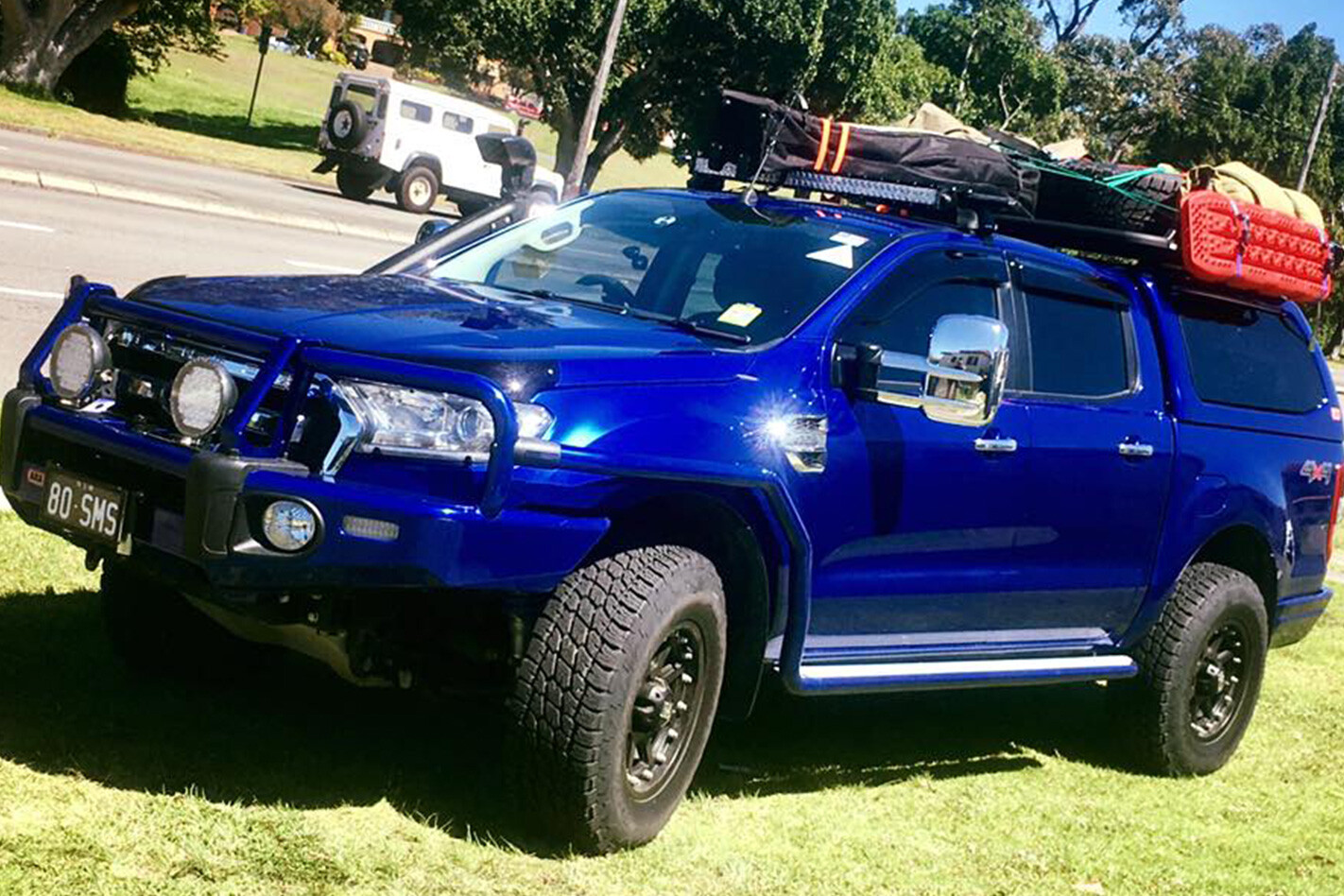
I bought it new in March, 2016. It’s an Aurora Blue XLT with the Tech Pack upgrade. It has an ARB Summit bullbar, scrub bars, side step/rails and rear step, ARB Ascent canopy, ARB underbody protection, Clearview towing mirrors, Rhino Rack and Tradie cage, two-inch lift with Lovells gear, Ironman 12,000lb winch, black KMC Addict wheels with 285/75X17 Nitto Terra Grapplers, tub-mounted dual batteries with Intervolt DCC Pro power management system, and a Tekonsha P3 electric brake system. I also removed the sunglasses holder and installed a custom switch panel for Waeco fridge, Stedi LED light bar, Penetrator LED driving lights and Narva rear-mounted work lights. Plans for 2017 include custom Drifta drawers and shelves, and a Foxwing awning. No plans for ECU and exhaust work until it’s out of warranty. So far I haven’t done anything too wild. It’s been mainly for towing our van, but we stayed at Bretti and spent some good days up in the Barringtons last year. We’ve just moved to Hallidays Point in NSW, so we’re looking forward to exploring between Gloucester and Coffs Harbour when time permits.