
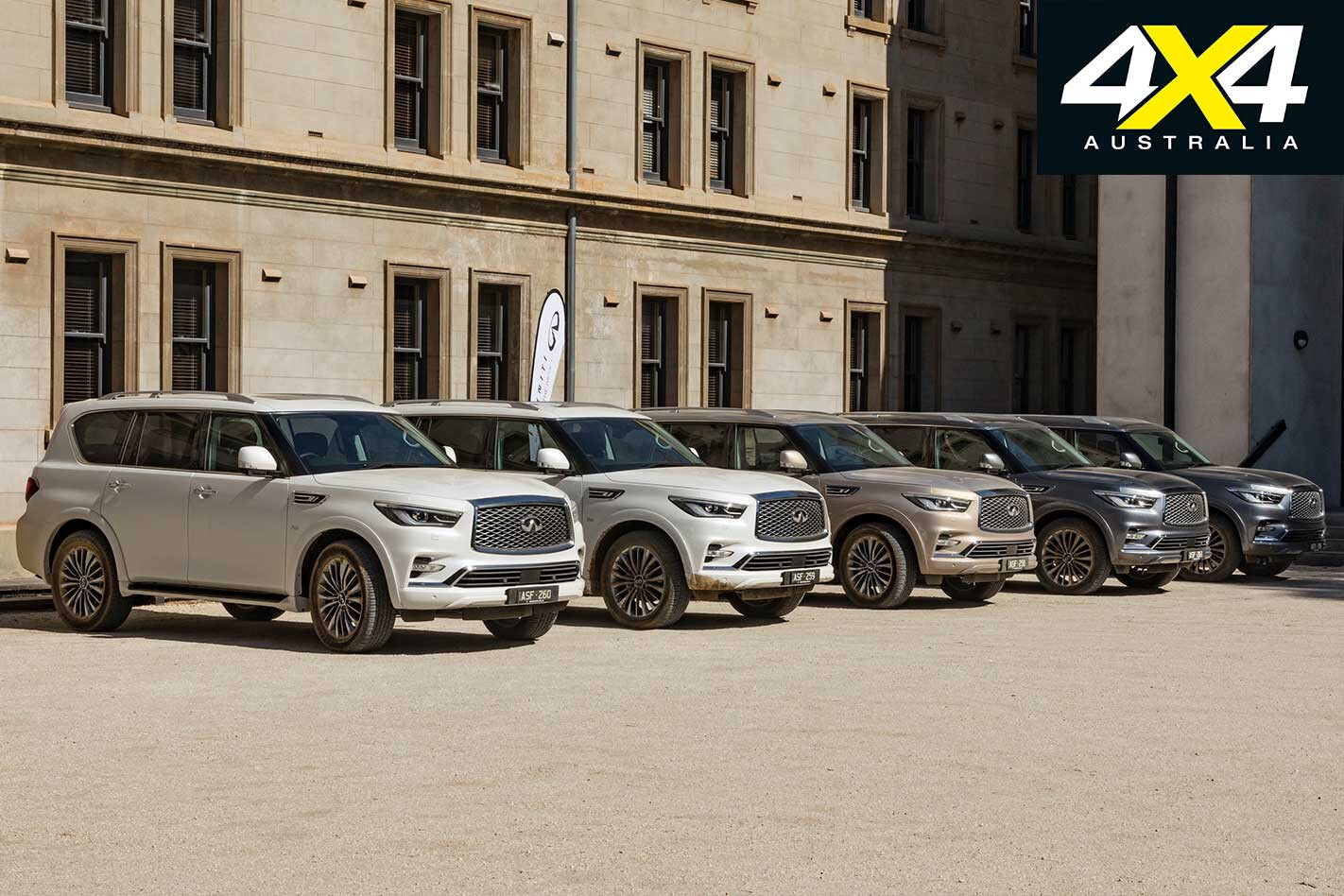
IT’S EASY to relate to the QX80: it’s big and bulky from the outside, and a little chaotic on the inside. Despite its reputation for being luxurious, its willingness and competency to kick up some dust gives it extra kudos.
The 2018 refresh of Infiniti’s off-roading SUV doesn’t offer much more than a facelift, doing away with its Beluga-styled nose and replacing it with a larger grille and LED headlamps that’ve had a slight lift. Its backside went under the knife as well, with a new tailgate, tail-lamps and bumper.
The inside has also been tweaked for a more luxurious feel, with quilted leather seats, larger 8.0-inch DVD screens in the back seats, and wooden trims. Still, the infotainment system isn’t great, with a busy-button facade letting it down.
The biggest change here is sound insulation, which provides a quieter ride – on- and off-road – than you’d expect of a vehicle this size. Even when rolling with hill-descent control, the crunch and grinding is calmer than many other 4x4s.
There’s only one model available and, with a price-tag of $110,900, you’d expect some pretty decent tech.
New to this model is the Intelligent Rear View Mirror, which is fed via a camera mounted to the top of the rear window. The footage provides drivers with clear views when the back window is blocked by people, ice, dust or cargo. But that’s where it ends for tech – despite its price tag, the QX80 feels lacking in the nerd department, missing out on standard features like smartphone mirroring and touchscreen control.
For some, the QX80’s size might be its biggest deterrent, but with its 5.6-litre VK56 V8 engine, which produces 298kW and 560Nm, the 2783kg SUV takes to the road with an elegance rare of a car its size.
On-road, the graceful giant glides through its seven-speed automatic transmission effortlessly, and, once it gets off-road, its full-time 4WD system shines. At the Melbourne 4×4 Training and Proving Ground it took to inclines, declines and water crossings without so much as a flinch, even with its stock 22-inch wheels. Offering further confidence is its locking rear diff and multiple drive modes: Rock, Sand, Dirt and Road.
It’s not all good news, though. The SUV’s flat and unsupportive seats lose it points for long-distance journeys, as does its thirsty 100-litre fuel tank which guzzles an uncomfortable 14.5L/100km to offer just 690km.
When it comes down to it, there wasn’t much we didn’t like during our soft drive to Mount Macedon and at the proving ground, and there’s no question the QX80 has dusted off its ugly-duckling feathers and started its transformation into a swan. However, although capable, it’s yet to prove itself as a long-haul off-roader.
WAVE Hill Station is a 50km² working cattle property positioned along the Clarence River within the foothills adjacent to the great Gondwana Rainforests, just out of Grafton in NSW.
The area is known for its excellent bass-fishing opportunities – more so at the waterfalls – as well as providing pristine views of the Clarence Valley.
Upon arrival at the property you’ll be greeted at the gate by the owner, Steve. If he isn’t home there are separate mailboxes labelled for every campsite and accommodation option, so you can grab all the info you need – especially the map of the property – from the correct box.
Once inside the property the terrain changes significantly, but the tracks are maintained and it’s easy to navigate. The campsites are approximately 9km from the homestead, and accessing all of them can take up to an hour because they are spread out.
On this trip we stayed at the Top Gorge Back Channel site, an open, grassy campsite with a huge, shady tree overlooking the back channel, located just downriver from the junction of the Mann and Clarence Rivers. It’s an incredible spot to pitch a tent for a week, and it’s within walking distance to the Safari Tents just over the hill.
Firewood is aplenty here, and some of the best views of the valley are on offer from where the fire-pit is situated. However, the campsite doesn’t have easy access to the water, and to go for a dip you need to climb down a slippery slope of rocks.
Kayaks can be launched a few hundred metres from camp, where the landscape is flatter; although, the current is very strong because you’re at the top of the waterfall, and Wave Hill Station strongly recommends wearing personal buoyancy devices and helmets at all times.
There is a walking track not far from the Back Channel campsite, which crosses just in front of the Safari Tents. The track is a thin, overgrown goat track with some handrails and stairs along the way.
It’s very steep in places, but when you reach the bottom you’re greeted by the pumping sound of water gushing over the rocks. This is a great place to cast a line, and the best spots for bass are in the backwash where the fish hide from the strong current, awaiting lunch.
The terrain can be quite difficult as you follow the edge of the river, so ensure adequate footwear is worn. Your best chance to catch a good one will be when you spot the waterfall, but fishing from the rocks here can be dangerous. Wave Hill Station offers catch-and-release fishing, so please abide by this request.
If camping isn’t your thing or you don’t have an adequate rig to explore the rest of the property, there are cottages located near the homestead, and while you’re there you can play tennis or arrange to see the property on horseback with a guided tour. There’s something for everyone here.
There is so much to do at this place that a couple of days isn’t long enough – if you’re planning to visit this spectacular piece of property, ensure you come for at least a week. It’s definitely worth it and, if nothing else, it’ll force you to put your phone down to take it all in.
Look this place up, book it and go; you won’t be disappointed.
Travel Planner
WHERE 543 Carnham Road, Fineflower (via Grafton), NSW, 2460
CAMPING There are three 4WD-access-only camping areas on the property, requiring high-clearance vehicles. During wet weather the tracks are closed for safety reasons.
FACILITIES Long-drop toilets are available at the campsites.
OTHER INFO Dogs allowed; fires allowed; no mobile reception; bring your own fuel and water.
CONTACTS Email: [email protected] Phone/Fax: (02) 6647 2145 Mobile: 0428 472 145 Website: wavehillfarmstay.com.au
RESTRICTIONS & PERMITS Strictly no motorbikes or guns are allowed on the property. Bookings are essential, and 50 per cent of the fee must be paid to secure the booking.
ACCOMMODATION If camping isn’t your thing there are four accommodation styles available, where you can stay in one of the cottages, lodges or Safari Tents.
FOLLOWING the successful Kickstarter campaign for the Dave Jr 2.0 Duffle, Brian Abrams, veteran military, tactical and government agency apparel designer for more than 25 years – and founder of Amabilis – returned with a campaign for the Responder tactical jacket and Responder hoodie, receiving more than 1000 per cent of the funding goal.
The Responder jacket is made from a nylon/cotton blend, the go-to for military garments for its strength and breathability. It’s available in military green or tactical black colours, with heavy-duty YKK zippers and stretch-woven soft shells around the cuffs and underarms for a closer fit and to allow freer movement.
On the shoulders and down the front there is a welcome addition of coated neoprene armour plating to prevent abrasion while wearing a backpack. Laser cut into this is a military “MOLLE” pattern that can be used to clip accessories like pouches, torches and pocket knives.
A great feature of the Responder jacket is the side-vent zippers that allow access to pant pockets without needing to lift the jacket above the waist.
Speaking of pockets, there are 10 in total, positioned all over the jacket, inside and out – most are zippered, with some big enough to hold a tablet. Particularly useful are the two quick-access pockets on the chest, concealed behind the neoprene armour plating and big enough to hold a wallet or phone. Quick access is possible thanks to a magnetic clip.
There are a few other military touches on the ‘Responder’ jacket, with both a lanyard ring on the front and Velcro loop patches on the arms for attaching ranks, flags or name patches. Amabilis offers both flags and custom name patches from its online store.
The Responder hoodie is more casual, but it still has the rugged, high-quality feel of the jacket. Made from Polartec, the hoodie is warm and comfortable and comes in a moss green or asphalt grey colour.
Just like the jacket there is stretch built into the sides, back and cuffs via a stretch fleece. There are also nylon shoulder patches to resist abrasions while carrying bags.
The hoodie is quick to slip on with its deep front opening, and it clips closed with cool gunmetal oversized buttons. The stand-up collar is quite tall, so it’ll help keep your neck warm, and the substantial hood can be pulled up over the collar to keep your head warm.
Pockets on the hoodie are restricted to just two, but the front chest pocket is big enough to take a large phone, with a hidden button to hold it closed. A massive front kangaroo pocket is big enough to store large items for quick access, and it’s lined to keep your hands toasty.
Both garments ooze military heritage, functionality and ruggedness. Both are a great addition for camping, four-wheeling, fishing, or just when the weather turns bad, and both the hoodie and jacket are available now in half sizes from small to XXXL.
A recall has been issued by the Australian Competition and Consumer Commission (ACCC) in relation to defective Takata airbag inflators on 72 models of the Chevrolet Silverado 2500 and 3500 Heavy Duty as well as the GMC Sierra 2500 and 3500 Heavy Duty pick-up trucks from the manufacture year of 2007 and 2008.
The VIN of the vehicles affected by this recall is listed here.
The vehicles in question were sold nationally from American Vehicle Sales between December 1, 2006 and December 31, 2008.
American Vehicle Sales representatives will contact the owners of affected vehicles to confirm their address, after which a letter advising of the recall will be issued. Owners should then contact American Vehicle Sales via its website to arrange for a replacement airbag inflator – free of charge.
The Takata airbag recall, which is said to have affected 2.7 million vehicles in Australia alone, has been linked to at least 23 deaths and 230 injuries globally. In Australia, it is known that at least one person has been killed with another seriously injured in separate incidents involving defective Takata airbags.
The danger stems from defective airbag inflators which, as it gets older, a combination of high temperatures and humidity causes the propellant in the airbag inflator to degrade and become volatile.
Instead of a controlled explosion during an airbag deployment in a collision, the unstable propellant may explode too quickly causing the metal inflator housing to explode or rupture, potentially propelling out metal fragments through the airbag cushion and towards the vehicle’s occupants. These flying fragments could cause serious injury, which can prove fatal.
In February this year, the ACCC has issued a compulsory recall for all vehicles with defective Takata airbags with car manufacturers having till December 31, 2020 to amend the issue.
OFFICIAL pricing has been released for the upcoming Ranger Raptor, with Ford slapping a $74,990 (manufacturer’s list price) price tag on the hotly anticipated ute to woo would-be punters.
The Ranger Raptor was unveiled to the world in Thailand, back in February this year, where it was confirmed it’ll be running a 2.0-litre, bi-turbo diesel four-cylinder engine capable of 156kW and 500Nm. That engine is backed by a 10-speed automatic adapted from the F-150.
“We’re unbelievably excited and delighted to be able to confirm that the Ranger Raptor is coming to Australia in 2018,” said Graeme Whickman, President and CEO of Ford Australia.
“The response to our announcement in September, and the interest from the global reveal back in February to bring it to market at such a sharp price only adds to the anticipation ahead of its arrival in local showrooms.”
The Raptor has a locking rear diff, as well as low- and high-range 4WD. Plus, the ute’s six-mode Terrain Management System features Baja mode for spiked off-road performance.
Off-road credentials is bolstered by the fitment of Fox suspension, aluminium upper and lower control arms, heavy duty skid plates, wider front and rear tracks, increased ride height and approach and departure angles, and an 850mm wading depth.
“Aussies have a passion for performance cars, and an appetite for pick-ups, and the Ranger is a direct response to that,” Whickman added.
“Our local design and engineering team has worked incredibly hard with Ford Performance on this truly unique program to deliver a product that brings Raptor DNA and meets the needs of Australians who’ve called for such a vehicle.”
We were lucky enough to partake in a development drive of the Ranger Raptor on Oz soil last year.
An exact 2018 on-sale date has yet to be confirmed but it is expected to be somewhere in the fourth quarter. Stay tuned to 4X4 Australia for more information when it lands.
WE WERE stepping off on a six-week run through the mulga, the desert and the Gulf country when, on day one, we struck a problem.
Travelling along the Sturt Highway on the Hay Plain, the entire instrument panel simply turned off. Happily, we had full control, but it was still off-putting.
So we stopped for some roadside diagnosis, where we couldn’t see any blown fuses or other obvious causes. So we gently cruised into Balranald, settled into the town’s caravan park, and went in search of a mechanic. It didn’t take long for the guys at Balranald Diesel Service to identify that the Denso 85amp OEM alternator was shorting and had blown the fusible link.
With no suitable spares on hand, parts were ordered from Swan Hill and Mildura. It was pretty obvious we were going to be looking at a layover of more than 24 hours or more, so we headed to the Shamrock Hotel around the corner to reacquaint ourselves with Schnitty Night.
Over beers and dinner we chatted about whether we may have put the alternator under undue pressure, or whether it had simply reached the end of its natural life. After all, an alternator typically lasts around seven years or 100,000km.
For the previous nine years it had happily fed our Redarc BCDC 1240 that served our twin Optima D27F Yellow Top 66amp/h batteries. Since 2013, we’d also connected the unit to our Echo 4×4 Kavango camper, which carries twin Ultimate Xtreme 12V 120amp/h deep-cycle AGM batteries.
In addition to these four batteries, the other obvious accessories feeding off the system were two fridges (a 40-litre Engel in the back tray and an 80-litre ARB in the camper). So while the 85amp OEM alternator seemed small, she’d been doing a decent job … until now.
When the only replacement available within a 200km radius was an aftermarket 85amp alternator, we didn’t have much choice but to slot her in and get back on the road. But when the alternator packed-up a second time after just six months (25,000km), we were ready to ask some hard questions.
We’d hit the Hume Highway for a quick dash up the east coast to catch up with mates for Australia Day, when just two hours from home the charging system warning light came on.
A quick call to the local blokes at Berrima Diesel confirmed that they were closed and booked out the following day, but they suggested we were okay to push on to Mittagong Auto Electrics, 15 minutes down the road. As we travelled, however, it was clear we were dealing with another alternator problem.
The Redarc dual-voltage gauge was tracking the battery’s charge and it was diminishing before our eyes. So we turned everything off and switched on the second battery to link it with the crank battery. It was 5.30pm, two days before a public holiday, and the prospect of getting to Forster any time soon was in real jeopardy.
Our spirits improved as we pulled into the electrician’s forecourt and saw the lights on in the workshop. Things were looking up. The guys agreed to check us out the following day and they let us set-up overnight in the carpark.
A quick look around the vehicle showed only too clearly how much we were expecting of our alternator.
Every 12V port had something plugged into it, either charging or running. This included phones, cameras and a third fridge: a Waeco CDF–11. On top of that, the Engel was set to freeze mode to store meat and ice blocks. Any wonder, then, that the alternator had been overloaded with the flow of high currents causing the stator to wind and heat up. Too excited to get out the door, it seemed we’d blown it – literally.
It was clear the aftermarket 85amp alternator wasn’t comparable to the OEM and unable to cut the mustard under this sort of sustained pressure. The following morning our concerns were confirmed, but luck was on our side. Of the two models of alternators that can be fitted to a 2008 KUN26 Hilux like ours, the Repco store across the road stocked just one. But was it compatible with our needs?
It was much bigger than the 85amp factory-fitted model that was under the bonnet when the rig rolled out of the showroom in 2008, and bigger than the one that was fitted at Balranald six months ago.
Enter the OEX DXA552 130amp. This is a light commercial alternator with a further 45amp capacity over our previously installed units. The blokes at Repco knew the OEX DXA552 would be suitable for the Toyota Hilux and Prado, but there’s a trick: different alternator models are made for Hiluxes manufactured in Japan compared to those made in Thailand.
They may look the same, but plug in the wrong one and your warning light will come on almost immediately. So there was a bit of ‘keep your fingers crossed’ involved here.
The Balranald 85amp alternator cost around $350, and the more powerful OEX here at Mittagong was about to set us back $488. As for warranty, we’d need to keep an eye on things. For the new OEX alternator we’ve been promised a three-year/90,000km warranty for road use.
However, take our 4WD off-road (of course we will) or use it commercially and the warranty drops to 12 months/30,000km/1500 hours.
Once installed we were back on the road and we reached our mates by late afternoon, with plenty of time left for camping and fishing. It wasn’t until we got home again that we had a chance to spend some proper time reviewing the alternator.
For one, we’ve found that OEX also has a 160amp version that could have been fitted. As for the manufacturer itself, OEX has been around for 20-odd years and boasts the largest range of light commercial units in the Australian and New Zealand markets, as well as a host of models to suit marine, agricultural, heavy-duty, light industrial and passenger vehicles. So this mob is no lightweight in the aftermarket alternator stakes.
The units are made overseas, but OEX tests each at its in-house testing facility in Brisbane before they’re released. So, with a decent reputation behind the brand, and with no sign of unwanted warning lights in the 2000km since installation, we’re back on track.
RANGE Rovers are divisive machines; some swear by them, others won’t touch ’em with a barge pole. For our mate Ben Sumbloke, there was no dilemma – buy a decent Rangie, then make it 10-foot tall and bulletproof.
“I’ve always loved Range Rovers,” Ben explains. “I had a 1976 short-wheelbase as my first car and never really looked back.”
He followed up his P76-powered shorty with an ’88 and an ’89, before moving up to the 1993 long-wheelbase LSE you see here. “There were only 150 of these sold in Australia, so they’re hard to find and very sought-after.”
Having said that, Ben didn’t pay drug money for it: “I offered the seller something stupidly low which they rejected; then made another offer slightly less stupidly low and they let me have it,” he laughs.
While the Range Rover hadn’t copped much abuse or ill-conceived alterations when he bought it, that didn’t stop Ben shipping the car directly to Les Richmond Automotive (LRA) in Melbourne for its hardcore ‘Firestorm’ build.
“Some guys take their cars to LRA for an engine conversion or suspension upgrade, but the ‘Storm Series’ cars are fully re-engineered from the ground up,” says Ben. “That being said, I may have gone a bit crazy.”
And crazy Ben did go.
LRA’s regular Firestorm features an amazing amount of kit, including an LS V8 conversion for serious off-roading adventures, but Ben was among the first to go with the heavy-hitting LSA supercharged V8.
Normally reserved for the Camaro ZL-1, Cadillac CTS-V, or late-model HSVs, the 6.2-litre Gen IV LSA is a Caddy-spec unit good for 556 horses out of the crate, which is almost three times that of the stock Rangie V8.
LRA has been developing and modifying Rangies for decades, so Ben’s desire for all those horses came as a welcome challenge. Andrew Richmond was the main contact on the build, liaising with Ben on every aspect, from the body to the suspension, paint, interior and the install of that mighty blown motor.
“I was the most annoying customer ever,” admits Ben. “I’d be researching stuff, then changing things up as it went along; some things worked and others didn’t, however LRA was always respectful of my vision.”
The changes Ben suggested en route sought to elevate the build rather than cut corners for cost or convenience. “I figured that if I was going to do it, I would do it once and do it right!” A sound philosophy and one that saw this Classic Series Range Rover go from mild to absolutely wild.
Included in the ‘regular’ LRA Firestorm upgrade is the removal of the body for a full chassis overhaul. The front-end is strengthened and the rear coil towers extended to allow for taller springs. Shock and body mounts are also raised, but Ben went a step further chasing perfection.
“When you’re off-road, you don’t want swaybars; they prevent your axles from getting full articulation,” he explains. “But on the road, you want them back or they drive like boats.”
For many fourby owners this means getting out and laying in the mud to disconnect the swaybars, but Ben’s desire to combine civil on-road manners with brutally effective off-road performance required a bespoke solution. “LRA built a pair of swaybars from scratch, much like torsion bars, and fitted a pair of Nissan free-wheeling hubs to the ends,” he says.
Powered by compressed air they disconnect and reconnect at the press of a button. In fact, the onboard compressor powers several systems, including the front and rear diff lockers and high/low range selector, all selectable from a custom control panel in the centre console. The panel also houses a button to engage the Ashcroft centre differential, which replaces the original viscous coupling.
“The Ashcroft has automatic torque biasing; it does the same thing the old coupling used to do, except it’s bulletproof. It locks up when you lose traction, but you can manually lock it, too,” Ben says. “With these LS builds, it’s really important to still have an automatic lock; you need it to deliver the power to both axles when you lose grip, which happens pretty frequently.”
As brutal as all this sounds, Ben’s LSA Range Rover is also civilised. The genuine walnut dash and door inserts remain, and LRA recarpeted the floor and retrimmed the original seats in leather.
“They’re just beautiful seats in the first place; there was no need to replace them,” Ben raves. “You can’t describe a Range Rover until you’ve driven one; the ‘command’ seating position looking over the bonnet is just perfect for a tall bloke like me.”
Of course, no decent four-wheel drive would be complete without a rear fitout, and Ben’s is no exception. “I emailed LRA with a sketch of what I was after: drawers; fridge slide; food-grade 50-litre water bladder; and space for an amp, sub and three different storage areas.” The boys surpassed Ben’s expectations, trimming it up and properly utilising the space available.
You can see from the pics that this Range Rover is no show pony; it’s built for off-roading and that’s what it does.
“It’s the places you can get to that just make this car so awesome: the Victorian High Country, Fraser Island, stuff like that,” advises Ben. “That’s why I did it; so my wife and I can get there in comfort, go hardcore four-wheel-driving, and then get home okay.”
Thanks to the quality of the build Ben can do that any time he wants, but, equally, he doesn’t look out of place rolling up to a nice hotel.
“It’s a really nice car to drive and I drive it as much as I can. Custom cars are never finished, but I’m really happy how it came together; the boys at LRA did such a great job.” Ben lets off a big sigh; it’s clear how he feels about the car. “And I love looking at it as much as driving it.”
Bold Eagle
The Rangie presents a familiar shape; the ‘Classic’ series was in production from 1970 to 1996 after all, but Ben’s LRA Firestorm features some significant deviations from standard. Lift kit and bashbars aside, the Fat Boy flares completely alter the profile of the wheel arches and, along with the custom Eagle alloys and 315-section BFGoodrich Mud Terrain tyres, give it a stance missing from factory.
Cool It
Not only does the mighty LSA heart require some serious cooling, so does everything else. The custom radiator houses an integrated engine oil-cooler to the left and a trans-cooler to the right. There’s another trans-cooler in front along with the water-to-air intercooler, plus one more radiator underneath for the hydraulic system. Ben can stop the thermo fans from a button in the cabin; crucial for when you’re crossing a river.
Tappity, Tap, Tap
“A lot of four-wheel drivers froth over the manuals,” Ben tells us, “But having driven both, the auto is just so much smoother. After all, even the most hardcore off-roader still spends most of their time on-road!” A world-first adaptation featured on Ben’s Rangie is the working tap-shift. He, LRA and Overline Technology worked together to get it working on the 6L90E auto. “It even blips the throttle on downshift; it’s unreal,” Ben says!
Techno
“We had a lot of issues with the gauges. We bought a loom from a firm in the USA who promised it would all hook-up and work, but nothing did,” says Ben. “In the end I found Overline Technology in Melbourne; they provided the screen and got the tap-shift function working for the 6L90E. The screen replaces the tacho and provides engine temp, trans temp, oil pressure and the intake temp. Overline even customised the colours and display.”
Into the Black
As well as installing some monster mechanicals, Les Richmond Automotive handled the full body-off rebuild and respray. “The colour was a big decision; I was stalking car parks for months and kept seeing Carbon Black BMWs and loving them,” Ben says. “It’s one of the greatest automotive colours you can get; when the sun hits it, the blue pops right out.”
Ben did have reservations, but found a solution, “It’s probably not the most practical colour for a fourby, but it’s got a 3M clear wrap over it, so it’s not suffered too many scratches!”
1993 LSA RANGE ROVER SPECS: Engine: GM Gen IV LSA 6.2-litre Sump: Cadillac CTS-V Fuel pump: Twin in-tank Walbros Exhaust: Modified Hooker headers, custom twin 3-inch system, bi-modal mufflers ECU: Siemans E38 Gearbox: 6L90E Hydramatic Transfer: LT230 4×4 Front diff: Stock, Ashcroft diff lock, 24-spline Hi-Tough axles, 4.11 gears Rear diff: LRA 9-inch, Strange 4.11 centre, 35-spline ARB axles, ARB air-locker Springs: Custom 220psi (f), Custom 320psi (r) Shocks: Custom 88 Series long-travel (f/r) Brakes: Drilled & slotted discs (f) Wheels: Custom Eagle Series 102 16×10 (f/r) Tyres: BFGoodrich Mud Terrain 315/74 (f/r) Paint: BMW Carbon Black
Practicality comes in all shapes, sizes, and styles with this month’s assortment of new gear.
Carbon Winches 12K winch
The new 12,000lb winch from Carbon Winches is designed to handle the toughest recovery tasks when you’re off-roading.
The winch features a 6.2-horsepower wound motor, a 216:1 three-stage planetary gearbox and a hoist-style camming brake that engages through the geartrain, thus having no contact with the winch drum. The rotating ring gear free-spool clutch assembly is designed to minimise free-spool drag, while also doing away with any clutch engagement issues, making any recovery situation a fast and easy process.
The power in and out for the winch is via either a wireless remote controller or a plug-in hand-held remote. The 500-amp solenoid unit is sealed and has a three-position mount bracket that means you can mount the control box over the drum, the motor or remotely on your 4×4’s bullbar. The winch also comes with a pre-installed winch motor breather.
Website: www.carbonwinches.com.au
EFS XTR shock kit – Toyota HiLux
The brains trust at EFS has just released a speccy 40mm bore XTR shock kit for Toyota’s Hilux (dual-cab and single-cab, 2005-2015). The kit allows for an increase in fluid volume which assists in preventing the build-up of heat in the shock, and the resultant fade that you can experience on rugged corrugated tracks.
The shocks also feature Dynamic Motion Control Technology (DMCT), which alters the valve forces dependent on the velocity of the fluid as it travels through the piston valve. As oil speeds up through the valve, this technology slows that flow down for improved control in high-speed scenarios. When the oil is passing more slowly through the valve (during off-camber/slow-speed off-road conditions) it allows the oil through the valve at a higher volume to assist in suspension flex.
RRP: $269.50 each (XTR 40mm front strut); $180 each (XTR 40mm rear shocks absorbers) Website: www.efs4wd.com.au
Leatherman Wave+
Since its inception in 1998 the original Leatherman Wave has sold 10 million units, and now, in its 20th year, Leatherman has decided to update this iconic design, with the Wave+ now featuring redesigned pliers that incorporate removable and replaceable wire-cutters as one of the 17 tools available.
The company has also added a new and improved sheath (a metal snap replaces the original Velcro closure). The sheath is made of tough nylon webbing and includes reinforced stitching.
The Wave+ is constructed from tough HC (high-carbon) 420 stainless-steel and keeps all the features that made the original so popular, including the externally accessible blades that you can open with one hand, the impressive number of tools, and its compact size.
RRP: $219.95 Website: www.leatherman.com.au
Ironman 4X4 Colorado/D-Max towbar
The long arse-end of 4×4 utes means any way of lifting the departure angle of these vehicles is always welcome – especially if you have/want a towbar.
Ironman 4×4’s new towbar, designed for the 2012-onwards Colorado and 6/2012-onwards D-MAX, has been engineered to be compatible with your vehicle’s standard bumper bar, while maximising rear ground clearance. The beefy towbar includes a square-tube steel design, a 3500kg tow-rating, is ADR compliant for each respective vehicle’s relevant ADRs, and is finished in schmick black powdercoat, covering some impressive welding work to ensure this thing ain’t movin’.
The Ironman 4×4 towbar also includes a 50mm towball and tongue, so once fitted to your rig it’ll be all go for that next towing mission.
Website: www.ironman4x4.com
ARB soft-connect shackle
These soft shackles from ARB up the safety levels for vehicle recovery situations. Rated at 14,500kg breaking strength, the ARB soft-connect shackle will float in water and is UV-resistant to ensure many years of service.
Soft shackles are designed to eliminate the need for metal shackles in the recovery process and thus further reduce the chances of potential injury to those involved. Incorrectly attached (metal) shackles can be lethal to anyone nearby if the unfortunate happens and either the strap or shackle breaks. The last thing you want is pieces of flying metal coming towards you or your loved ones as you try and get yourself out of a stuck-vehicle situation.
RRP: $55.00 (Australian east coast metro pricing) Website: www.arb.com.au
Adina Amphibian
It’s not always easy finding a tough, reliable and reasonably priced watch. This new timepiece from Adina combines all three of those features.
The Amphibian is designed specifically for those outdoor and marine adventures that can test (and sometimes destroy) a watch. The Amphibian features a robust Nickel-free stainless-steel case and a sapphire crystal watch face that provides excellent scratch resistance.
The moulded orange polyurethane strap is both comfortable and (obviously) designed to withstand saltwater immersion for years. The Amphibian is water resistant to a claimed 200 metres and includes a Super-LumiNova index dial so you can still see the time no matter the amount of ambient light. The watch is Aussie-designed and made (which, in our opinion, is awesome) and features the expected high craftsmanship for which Adina is renowned.
RRP: $369 Website: www.adinawatches.com.au
A FRESH-LOOK Coral Coast Helicopter Services Gascoyne Dash was run and won over the 2018 Easter break, at Carnarvon in Western Australia.
New to the schedule this year was a point-to-point off-road race format, which comprised a 202km blast from Carnarvon to the iconic Gascoyne Junction – punters swagged it overnight – before a run back to the coast the next day.
Speaking about the new format, Ted Schultz, the president of Gascoyne Off Road Racing, said it’s something the committee has been considering for almost 10 years. “The GasDash had downsized over the last few years and we had just been doing some lap races locally,” Schultz said, “To kick it back into gear we needed to do something different and we think the point-to-point format is the way to go.
“It brings the towns of Carnarvon and Gascoyne Junction together, and there are the upsides of an excellent tarmac service road between the centres and mobile communication at the Junction. It’s all come together and the concept has been well received by the locals and competitors alike.”
The Moto division was won by local man Cody Upton, who also steered his Honda to claim the “King of the River” crown – awarded for the best overall time for all competitors (cars and bikes).
The Pro Buggy class title was won by the Elphinstone brothers, with Shane steering the duo to victory. In the Production 4WD Class, Travis Epis piloted his Patrol across the finish line in first place; while Mitchell and Owen Davies – in a tube-framed Navara – were the only competitors in the Extreme 4×4 class to finish both legs.
Click here for the full list of winners.
The 2018 format was a raging success, with no major incidents and with 46 motos and 17 cars completing the 404km event. The Gascoyne Off Road Racing Club is gearing up for an even bigger and better event in 2019. More info can be found on their Facebook page.
THE March 2018 VFACTS report has landed, and the Ford Ranger has reclaimed pole position on both the monthly and year-to-date 4×4 sales charts.
Ford shifted 3467 Ranger 4×4 variants in March to notch up 9457 YTD sales, while Toyota sold 3224 Hilux 4x4s for a YTD sales total of 9361.
The Mitsubishi Triton 4×4 yet again rounds out the top three, with 2788 monthly and 5735 YTD sales. There’s then daylight to the rest of the field.
The LCV market as a whole was down 0.4 per cent in March, but sales of ute and cab chassis models were up 3.2 per cent compared to March 2017. The LCV segment represents 19.7 per cent of the total market.
Speaking of the overall market, record sales (106,988) were recorded for the month of March, delivering 4.4 per cent Q1 growth (and 1.5 per cent growth was noted for March 2018 compared to March 2017).
“To have the market at 4.4 per cent ahead of last year’s record total is a clear vote of consumer confidence in the economy’s stability and low interest rates, both key factors which encourage private buyers and businesses into new vehicles,” Tony Weber, the chief executive of the FCAI, said.
The Toyota Hilux – 4×4 and 4×2 variants – remains the best-selling vehicle on the overall monthly sales charts (4348). It’s followed by the Ford Ranger (4064), Toyota Corolla (3218), Mitsubishi Triton (3109) and Mazda3 (2780).
| u00a0 | 4×4 | Mar 2018 | Feb 2018 | 2018 Total |
| 1 | Ford Ranger | 3467 | 3098 | 9457 |
| 2 | Toyota Hilux | 3224 | 3257 | 9361 |
| 3 | Mitsubishi Triton | 2788 | 1634 | 5735 |
| 4 | Toyota Prado | 1677 | 1323 | 4169 |
| 5 | Holden Colorado | 1295 | 897 | 3459 |
| 6 | Toyota Land Cruiser wagon | 1276 | 1085 | 3288 |
| 7 | Nissan Navara | 1260 | 1460 | 4043 |
| 8 | Isuzu D-MAX | 1233 | 851 | 2762 |
| 9 | Toyota Land Cruiser PU/CC | 872 | 703 | 2157 |
| 10 | Volkswagen Amarok | 835 | 573 | 1842 |