
HOW WOULD you like to go on the trip of a lifetime with some of the country’s most experienced 4×4 guides while raising much-needed funds for Northcott, to help support the organisation’s network of disabled clients?
In 2020 the annual Drive 4 Life tour will traverse a number of Len Beadell’s famous outback tracks on the western edge of the Nullarbor Plain, as it winds its way through spectacular country from Alice Springs in the Northern Territory to Balladonia in Western Australia.
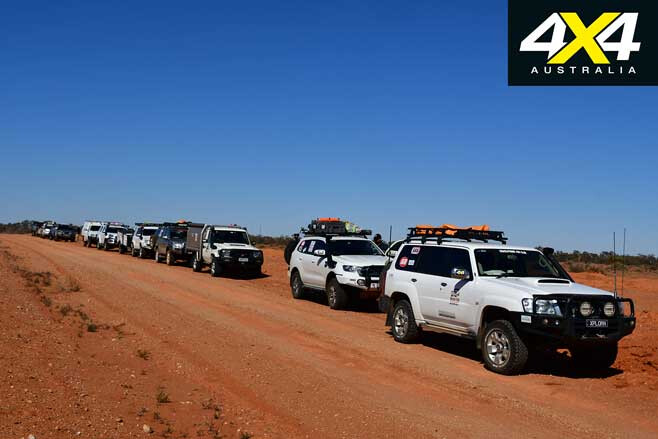
The tour kicks off in the red centre capital of Alice Springs on August 6, 2020, and participants will traverse the Sandy Blight Junction Road, the Great Central Road and the Connie Sue Highway, finishing at Balladonia on the western edge of the Nullarbor Plain on August 15, 2020.
The 10-day adventure will take in remote outback tracks with loads of historical points along the way. The Sandy Blight Junction Road is often described as the most scenic of Len Beadell’s tracks, whilst the Connie Sue Highway is another must-do for anyone who loves touring the great Australian outback.
Like all Drive 4 Life tours, a $1000 donation (tax deductible) is payable direct to Northcott. Every cent donated goes directly to Northcott, while all organising and running costs of the Tour are borne by sponsors and the tour organisers. Drive 4 Life is sponsored by ARB 4X4 Accessories, IGA, 4X4 Australia and HEMA Maps. To date, Drive 4 Life has raised a whopping $837,000 for Northcott.
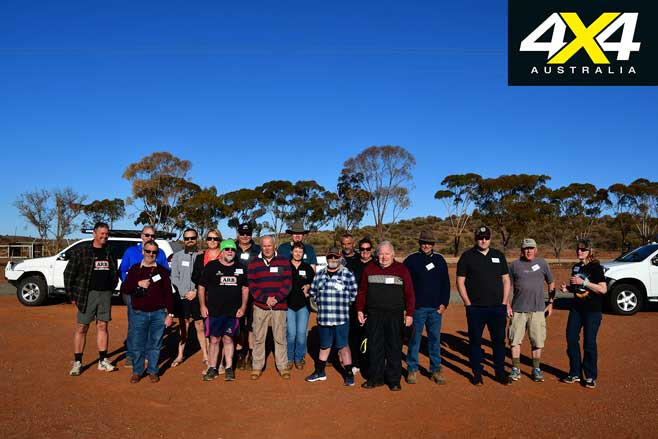
For more information on Drive 4 Life and Northcott, check out drive4life.com.au. You’ll also find more details on the upcoming 2020 tour as well as a booking form and information about what you’ll need to bring. You can also phone David Dennis on 0419 614 870 if you have more questions on the Drive 4 Life 2020 Outback Tour.
IF YOU’RE familiar with massive mining and drilling rigs, you’ve probably heard of MAN and its range of TGS trucks.
Well, a Queensland company, SLRV Expedition Vehicles, has built an unstoppable off-roader using the MAN TGS 8×8 platform as a base.
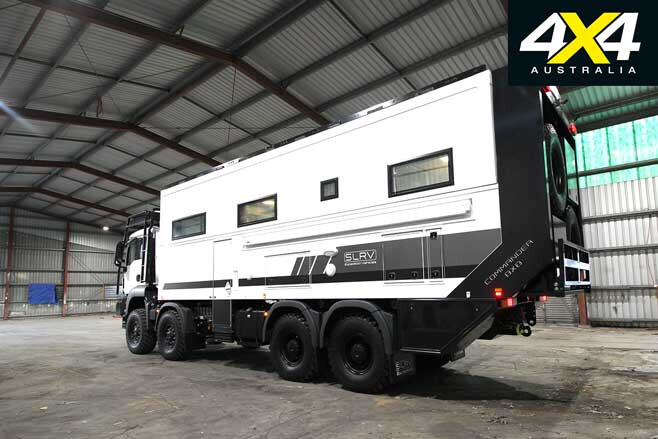
Called the Commander 8×8, the epic ‘tourer’ can comfortably transport a family of eight to most – if not all – corners of Australia for extended getaways.
The MAN TGS 8×8 – typically found on mining and drilling sites thanks to its high ground clearance and massive 42-tonne GVM – is powered by a 353kW/2300Nm MAN D26 12.5-litre engine and is bolstered by a low- and high-range transfer case, planetary axles and diff locks.
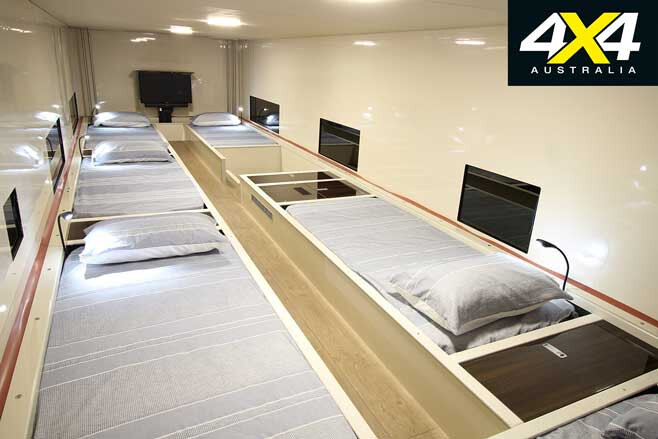
The Commander 8×8 includes space for 10 people to snooze, with a second storey – accessible by the touch of a button – providing room for six beds and under-mattress storage. Plus, there’s a separate master suite for parents.
The Commander 8×8 also features a fully appointed kitchen and dining area, a separate toilet and bathroom, a lithium battery system, solar panels, and a multi-tank cell set-up that can hold up to 1000 litres of water.
And now, Aussie lighting experts Narva – who has worked alongside SLRV for more than 10 years – has joined the party and sprinkled a range of its lighting products on the Commander 8×8.
“For the Commander range, we manufacture our own bullbars in-house and into these we integrate Narva LED headlamps and fog lamps. We also fit a Narva dual-row LED light bar onto the bullbar,” said SLRV Expedition Vehicles Director, Warwick Boswerger. “On these trucks we also fit four Ultima 215 LED driving lights to roof racks on the top of the cabin.
“Around the vehicle we’ve positioned a number of Narva work lamps and these are all operated via remote control. They provide additional security but are also very useful when manoeuvring and parking up at night in remote areas,” added Warwick.
Check out SLRV’s range of vehicles here.
A RECALL notice has been issued for Mitsubishi NL Pajero vehicles produced between May 31, 1996 and September 30, 1999, with select models fitted with a driver’s airbag containing a Takata NADI 5-AT driver airbag inflator.
MY1997-2000 CE Lancer, CE Mirage, and WA Express/Starwagons produced during the same period are also caught up in the recall, with the total number of affected vehicles listed at 8081.
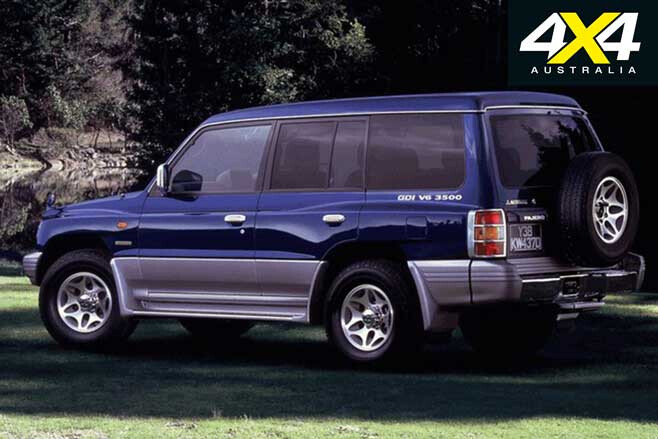
As the vehicles are now quite long in the tooth, replacement inflators aren’t available. Instead, Mitsubishi Motors Australia is offering to buy back affected vehicles at their current market value.
“If a recalled Mitsubishi vehicle is identified as containing the affected type of driver airbag inflator and it is registered for road use, Mitsubishi Motors Australia will offer to buy back the vehicle at current market value,” the ACCC report said. “Alternative transportation will be arranged to avoid consumer inconvenience while the buyback negotiations are taking place.”
To find out if your vehicle from that era contains the Takata NADI 5-AT driver airbag inflator, owners have been advised to, “stop driving immediately and contact an authorised Mitsubishi Motors dealer or call Mitsubishi Motors Recall Hotline on 1800 931 811 to organise a free urgent vehicle inspection”.
Immediate action is required as vehicles fitted with a Takata NADI 5-AT driver airbag inflator may allow moisture to enter the unit, which could degrade the airbag propellant – “if this occurs, the properties of the propellant may be changed so that the propellant does not react as intended during a collision, causing misdeployment of the airbag,” the recall report says.
“If an affected vehicle is involved in a collision, the airbag inflator could rupture, causing sharp metal fragments to enter the vehicle cabin at high speed, killing or injuring vehicle occupants,” the report adds. “There is also a risk that the airbag may underinflate in a collision and may not protect the driver as intended.”
For more information visit: www.mitsubishi-motors.com.au/
It was well past dark, and our headlights were punching holes through the black void ahead. For the past 10 hours we’d been bouncing over rocky tracks, diving bumper-first into powdery silt beds, and twisting our way through precipitous arroyos. My duties as navigator were to keep an eye on the road book and GPS, and watch for hazards on the track. General grunt work you might say.
That afternoon we’d lost time when we stopped to pull our friend Larry’s AMC Rambler out of a sand wash, and with a cut-off time of 10pm we were now in a race against the clock. I calculated our position and called out to Ned Bacon, my pilot, “We’ve got to average 20mph (32.2km/h) to make it.” We weren’t fast, but this ‘race’ was a tortoise-versus-hare pursuit.
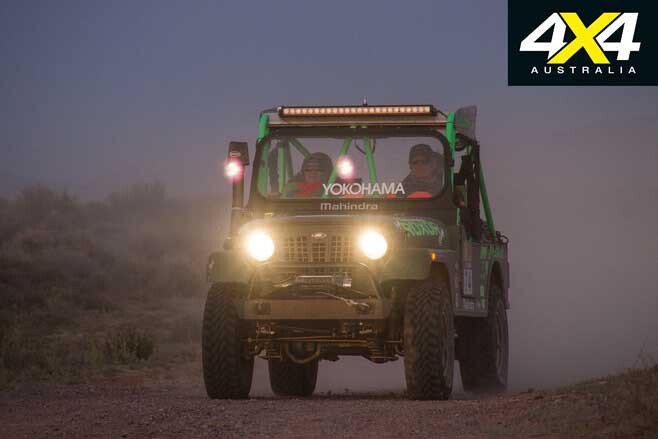
This was Day 4 of the NORRA Mexican 1000, a 1250-mile (2000km) off-road contest in the vast expanses of Baja, Mexico. We were characters in Chapter Three of a two-month chronicle of dirt tracks and red rocks. If we finished this stage on time, there was a possibility the “mighty” Mahindra Roxor under our butts was going to put us on the podium.
One might ask what the heck Ned was thinking … racing an underpowered UTV with a top speed of 55mph (88.5km/h) tyre-to-tyre with 400hp (298.3kW) Ford Broncos? Well, Ned is the kind of guy that if you put a green flag in one place and a chequered flag in another, if the opportunity arises he’ll don a helmet and jump on a pogo stick to get there first.
As with most crazy adventures, the opportunity arose over a coldy and a dare – could he finesse a rig with a 93-inch (2362mm) wheelbase and only 66hp (49.2kW) over some of the most demanding terrain south of the border? He upped the ante by adding to the pot the Easter Jeep Safari and Sonora Rally, another five-day endurance event in Mexico.
Before we delve into details, let’s examine this unlikely competitor’s backstory. A few months earlier, Mahindra delivered a bone-stock Roxor to Ned’s shop and he went to work getting it race-ready. The term “race-ready”, however, should not be confused with a complete strip down and rebuild.
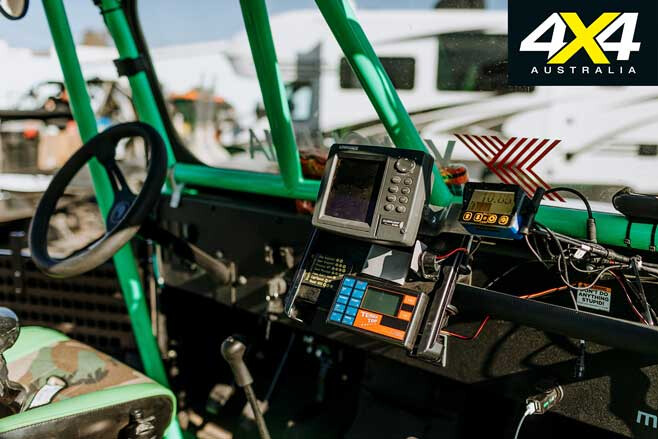
The boxy UTV came from an Auburn Hills, Michigan, assembly plant sporting Dana 44 axles, a rugged steel ladder-boxed chassis and a diesel engine. Mahindra was licensed by Willys Overland to manufacture the CJ-3A back in 1947, and has continued production for more than 70 years, but it is also one of the world’s leading producers of tractors, aeroplanes and military vehicles.
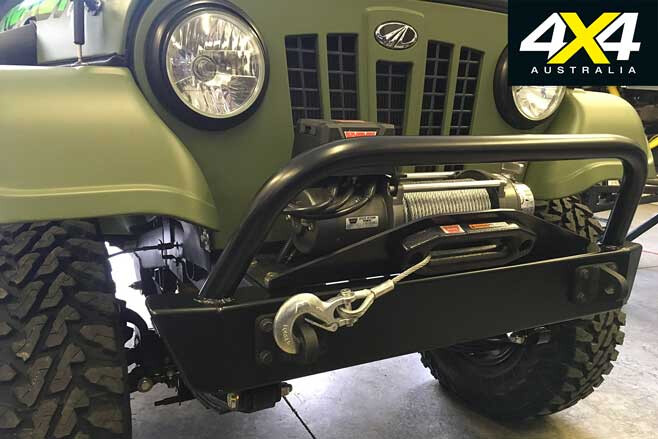
Racing protocol mandated the installation of a full roll cage, PRP Roadster seats and harnesses, RaceQuip nets and a few other items. Because stuff happens in the desert, a Mahindra Accessories front bumper and winch plate were added along with an 8000lb Warn recovery winch, Spydura synthetic line, and two sets of MaxTrax. The drivetrain and suspension were left alone, save the addition of Fox 2.0 remote-reservoir shocks, Deaver add-a-leafs, bump stops and a Spartan ‘lunchbox’ locking differential in the rear axle.
In an attempt to squeeze every ounce of juice from the 2.5-litre turbo-diesel, Ned had Vivid Racing re-flash the ECU which netted a solid 40 per cent increase in performance – to a whopping 90hp (67kW) and 200lb-ft (271Nm).
Other goodies included Mahindra doors and windshield, a snorkel and custom ‘wing’ on the roof … we’ll call that a shade feature. After wrapping a set of Yokohama Geolander MTs around the stock wheels, it was off to Mexico and Chapter One, an 800-mile (1300km) off-road shakedown at the Sonora Rally.
South of the Border
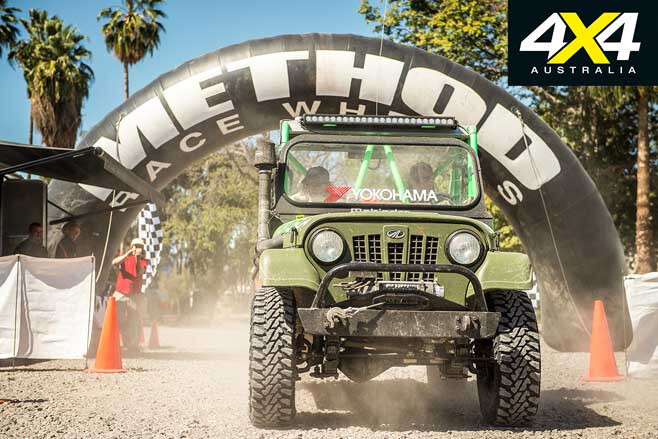
I chased Ned and wife Kat (his normal navigator) through the endless sand sea of the Altar Desert, down long sandy beaches, up rutted arroyos, and uphill and down dale. Admittedly, sometimes I sat for hours in the shade of a lonely tree waiting to capture a photo – they were always dead last. I must preface this comment by mentioning that being slow isn’t necessarily a bad thing; you make a lot of new friends when you’re the last guy on the track.
Case in point: On several occasions, hotfooted drivers who had whizzed by ended up on the receiving end of Ned’s tow strap. The mighty Roxor rescued one UTV from certain death by pulling it out of the surf in a rising tide. Another (with two broken axles) was indebted after a long tow from a remote arroyo – the usual payment for said services is an endless supply of coldies at the nightly bivouac. Bacon said, “The highlight was pulling other competitors off the course when they were broken down.” The Roxor didn’t see the podium, but it did ferry its human companions to the finish line with nary an issue.
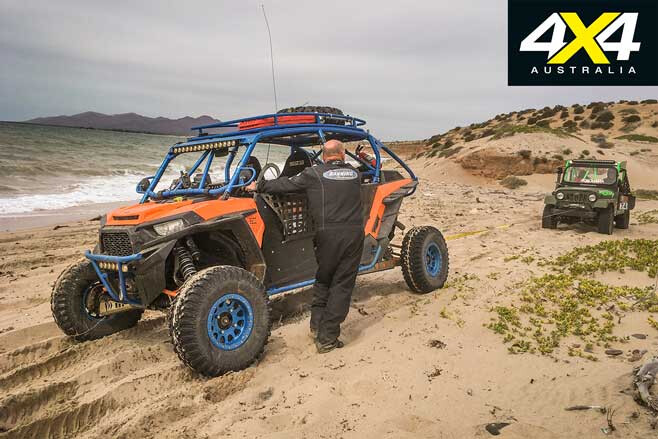
“In the dunes it was like we brought a knife to a bazooka fight, but that thing is a rock … or Roxor. Like a little tractor, it did everything we asked. Rough as a cob, but just kept chugging along. It had 200 miles (321.8km) on the odometer at the starting line, and the only issue we had the entire race was a stretched fan belt.”
Chapter Two in the epoch found our lead character traversing the backcountry slickrock of Moab, Utah. Ned was one of the pioneers in the sport of competitive rock crawling, and sissy routes were not on the agenda. But the little Roxor, with its torquey diesel, nimble size and rear locker didn’t flinch, putting from one hardcore trail to the next, day after day. From Moab it was loaded on a trailer (the Roxor is not street-legal in the US) and found itself back in Mexico facing a daunting task.
The Wilds of Baja
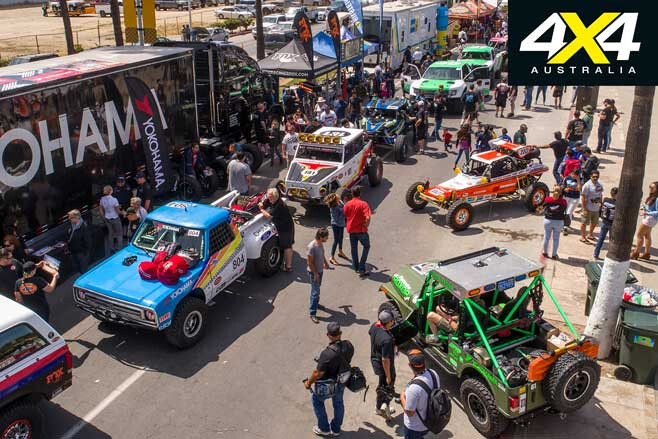
Hundreds of well-prepped four-wheel drives, dirtbikes and UTVs lined the streets of Ensenada for the start of the NORRA Mexican 1000 vintage rally. South by southeast as the crow flies, a chequered flag awaited in the 1730s mission town of San Jose del Cabo. While nearly all teams utilise a chase crew to carry extra tyres, fuel, spare parts and even backup drivers, Ned runs solo.
His steed must not only survive whatever conditions presented, but also transport him 1000 miles (1600km) back to a tow rig near the border. There was no way in hell they were going to win their class, but that didn’t matter. Life is about fun, and NORRA’s tag line is “The Happiest Race on Earth”.
Ned said, “Our goal is never to win any podium placement, just finish the race and have fun. So far that strategy has seen us on the podium three times.”
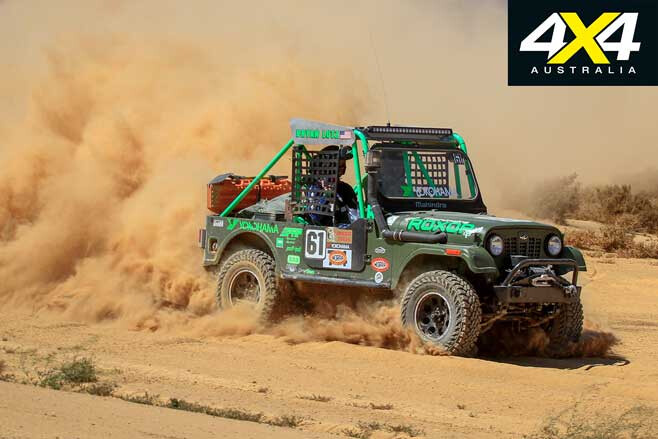
Three days later I slipped on my fire suit and helmet, and climbed in. I’m not proud of the fact I was Ned’s third choice. Kat had other commitments and his backup navigator, Brian Lutz, was spending the day praying to the porcelain god – he and Ned had dinner with Montezuma the previous night. Ned had peeled himself away from the toilet in time to make his start time, but looked like an emaciated corpse.
By the time the sun disappeared in the west, we still had 40 more miles (64.4km) of Baja’s rockiest, most miserable terrain to traverse. That day’s course was only 260 miles in length, but I’d wager we only put 130 (209km) on the odometer, as we spent half the time in the air … like a pogo stick. But the Roxor took it in its stride, chugging along at its own pace undeterred by delusions of podiums and trophies.
Reaching the chequered flag with 12 minutes to spare, we turned the wheels toward La Paz. Larry pulling up in his Rambler a few minutes later. Underdogs rejoice! Feeling like a couple of wet noodles, it was one of those days we might look back on through rose-tinted glasses and say, “We had a good time … didn’t we?”
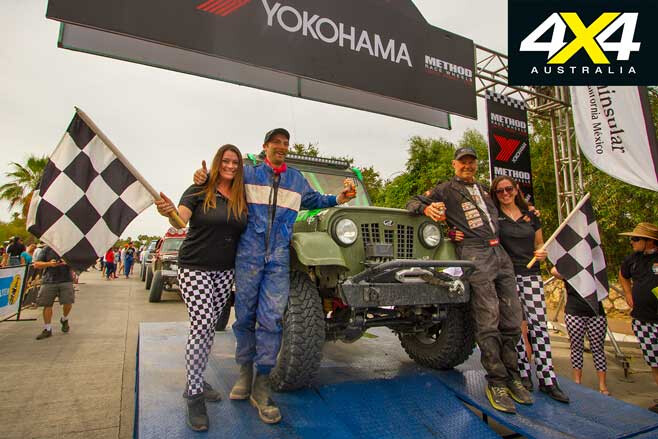
Ned fired up the mill the next morning, Brian climbed back in, and they drove like banshees (as much as a Roxor can “banshee”) to San Jose del Cabo and the chequered flag. When the dust settled after more than 1250 miles (2011km) of Baja’s best, Team Roxor had achieved a proud third in Class on the podium.
I overheard a patronising comment that, “yeah, but only three vehicles finished.” I had to laugh at the person’s naivety and chimed in, “exactly, you’ve obviously never run this race.” The roads in India are largely undeveloped, and the mighty little Roxor takes its cues from its brethren tractors; it just doesn’t stop.
Vehicles that finish a race like this have the fortitude to survive. As for the content of Ned’s toolbox, it never saw the light of day. When trophies and awards were claimed, fireworks flamed out, and cold cervezas ceased to flow, Ned turned the wheels north toward Ensenada for a few days of backcountry camping on the way home. The Roxor can definitely take claim to championing the ‘Utility’ in UTV.
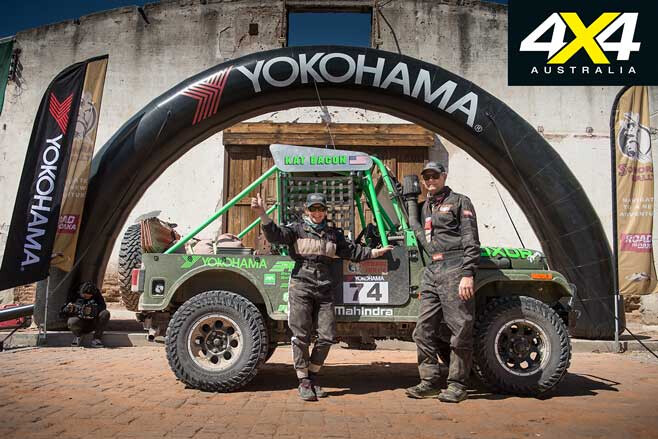
MAHINDRA ROXOR UTV SPECS: Engine: 2.5-litre turbo-diesel M2DiCR Max Power: 67kW Max Torque: 271Nm Transmission: 5-speed manual Transfer case: 2-speed manual Axles: Dana 44, 3.73:1 ratio, Spartan rear locker Suspension: Stock, Deaver add-a-leafs, Fox 2.0 shocks Wheel & Tyre: 265/75R16 Yokohama Geolander MT, stock aluminum wheels Bumpers: Modified stock Mahindra HD Recovery: Warn 8000lb winch, Spydura synthetic rope Fuel economy: 10.7 – 11.8L/100km
Coming from the small town of Munster in Germany, and having studied business and finance, in 1996 I moved to the big smoke of Emsdetten and took a job at Waeco as CFO. Six short years later the founder of Waeco, Theo Waehning, gave my family and I the opportunity to move to the sunny Gold Coast of Australia to assess the current business opportunities of the local market. Somehow a ‘short’ three-year stint to examine the local market ended up as a life-changing experience.
In early 2016 I decided to call it quits. After 20 years of working in the 4×4 and lifestyle industry, it was finally time for me to find my next adventure … retirement. As one can only play so many rounds of golf before becoming the next Tiger Woods, retirement proved much slower than I had thought. Over a few quality German beers, Theo also let slip that he was struggling with retired life, and he too needed a project, so we thought we would let our passion for the RV and 4×4 industry fly once again.
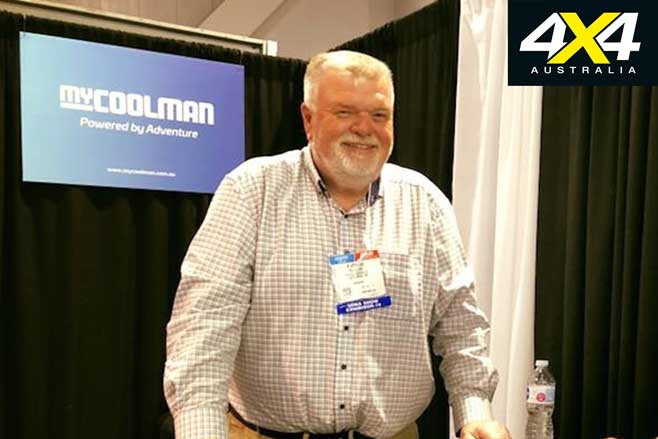
We both knew our expertise was in one specific area, so we decided to give it our all and started discussions about building a new portable fridge/freezer that would be packed with innovative features – and so myCOOLMAN was born.
Having been off-roading on Fraser Island a fair few times, camping with our kids at horse events, and fishing out at sea with the family, I envisioned something that was durable, functional and, most importantly, innovative. We thought of any and all possible features that people would look for and want in a portable fridge – something where power shorts are no longer an issue and, of course, a bottle opener. I am many things but skilled at opening a beer with a teaspoon is not one, so a built-in bottle opener was definitely a top priority!
We wanted a portable fridge that could handle anything you could throw its way; one that’s tough and rugged for the Aussie bush. But most of all we wanted to change the way people used their portable fridges – our thinking was, ‘how can we revolutionise the industry?’
It was this thought process that led to the birth of the newly released myCOOLMAN Power Pack, which is by far the most exciting product design and development process I have been involved in over my entire career. It has given way to a whole new range of opportunities in the 4×4 industry. Finally, adventurers can truly explore off the beaten track and not be dependent on their vehicle or a heavy cumbersome product for power and, most importantly, for a cold one at the end of the day.
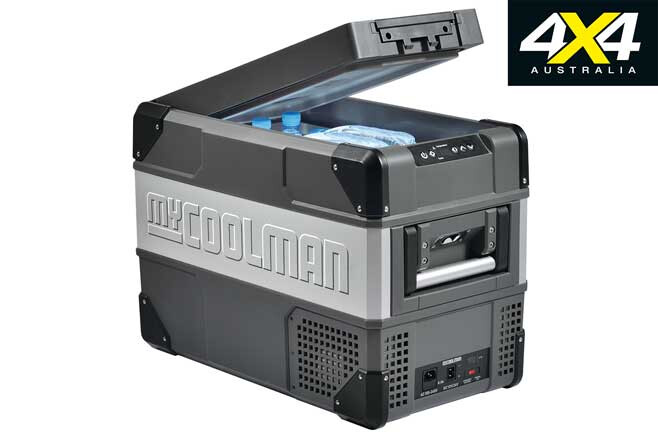
Without a doubt, myCOOLMAN has become everything I’ve ever wanted in a camping fridge. Having Theo’s unwavering knowledge of compressors and all things technical has enabled myCOOLMAN to build the best compressor and fridges the market has ever seen. Together with our years of experience, we were able to create and release an entire range of portable fridges in one hit (which no one has ever done before) – seven fridges in the beginning, to be precise, which has now quickly become 10.
Releasing our very own fridge onto the market was one of the most nerve-racking and exciting few months I’ve ever experienced, but, having the continuous support of lifelong business partners who have become friends, the business and our products have been met by the local and global industry with open arms.
We hope you love and enjoy our myCOOLMAN products as much as we do. Happy adventuring!
Meet the Expert Name: Andreas Bischof Role: Director, Leisure-Tec Experience: More than 24 years
LAND ROVER might have moved onto the all-new Defender, but the restomod industry certainly hasn’t let go of the original, producing increasingly creative renditions of the iconic off-roader.
The latest creation from UK-based Land Rover restomod specialist, Arkonik, the Reef D90, eschews the “adventure-ready weathering-the-elements outdoorsy” archetype for a “beach-ready” aesthetic.
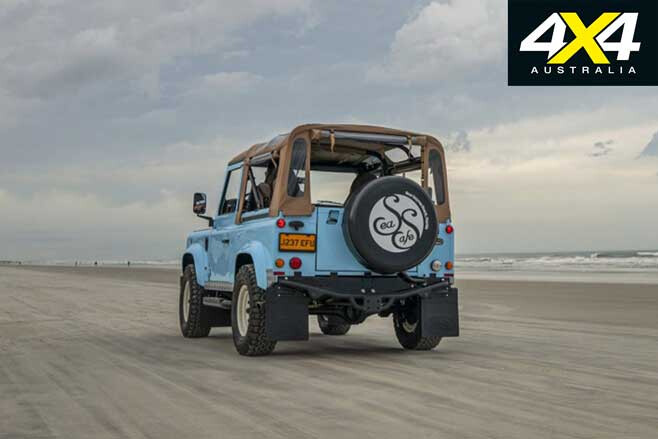
Built for a Floridian couple, the Reef is finished in a disarmingly charming sky blue paintjob with silver exterior trim, 16-inch white steel wheels, and a tan soft top hood.
As for the interior, the Defender’s seats and door panels are all reupholstered in cracked Aniline leather, complemented by polished wooden flooring and panels for the rear deck, and finished with a quaint wood-rimmed 15-inch steering wheel and alloy interior fittings.
Mechanically the Reef D90 is built off a 1992 Defender 90 chassis, which has been thoroughly restored with a full frame-off restoration.
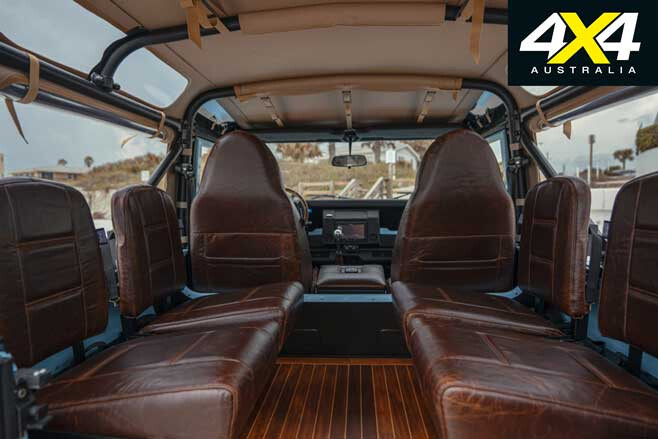
In the rebuild process, Arkonik primed and recoated its frame, reconditioned and rebuilt its 2.5-litre inline-four turbo-diesel and five-speed manual transmission, and replaced all of the Defender’s original wiring looms, brakes and suspension components.
All this work doesn’t come cheap. Arkonik quotes an estimate of USD$175,000 (AU250,000 approx.) for the Reef D90, which will vary depending on its final customer specification.
It isn’t cheap, but compared to the cliché adventure-ready 4×4 rigs, this unique take on the classic Defender is a stand-out from the rest.
WHEN the Bushranger Nighthawk surprised all-comers by winning our LED driving light comparison in 2019, we couldn’t wait to install a set to the front of our Project Ranger.
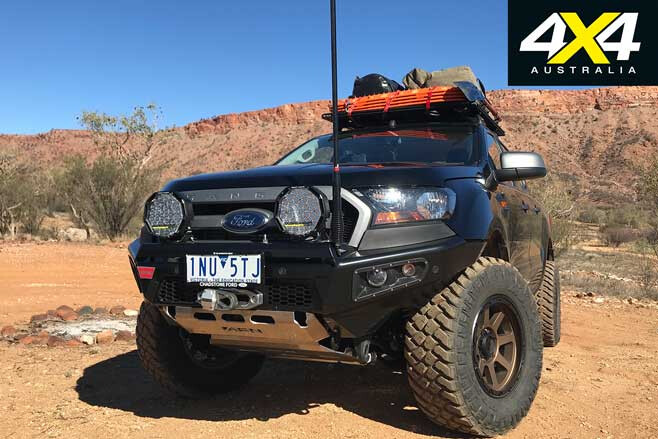
The 230mm (diameter) Nighthawks feature a claimed lumen count of 10,800 (effective) and are supplied with spot and combo lenses. Housed in cast aluminium, the LED has an IP69K water/dustproof rating and comes with a five-year warranty. The nominal wattage is 175W, with each light drawing 14.3 amps.
When awarding the Nighthawks the top gong, Mark Allen said: “the light pattern with the standard spot cover is superbly bright over long distances, and it combines with one of the better (not the overall best) wide-angle spread over short and medium distances. Plus it’s devoid of annoying, patchy shadows”.
He added: “The simplistic yet rugged design of the fitting bracket is impressive”, and “the Night Hawks are priced in the middle of this pack, making this formidable driving light near unbeatable when combining specifications, inclusions and potential pairing with spot and wide beams”.
For more information, visit Bushranger.
The Jeep Gladiator pick-up lands in Australian dealers midyear, but to give us a taste of what is to come Jeep shipped a handful of the muscular trucks to New Zealand’s South Island to see how they drive. While we did get a quick blast in a Gladiator Rubicon in the Nevada desert last year, it was great to spend a few more days with this much-anticipated model in extremely different terrain.
While the day in the desert was dry and sandy, the area around Queenstown copped a dumping of rain around the time of our arrival and many areas were flooded to the point that the planned drive route had to be altered; the group of Americans who were flown in a few days before us couldn’t even get to the remote campsite Jeep had established. Wild, flowing rivers prevented vehicular access and the campsite would have been a soggy mess. Lucky for us, the rain slowed on our arrival and we enjoyed a fantastic drive through the scenic countryside.
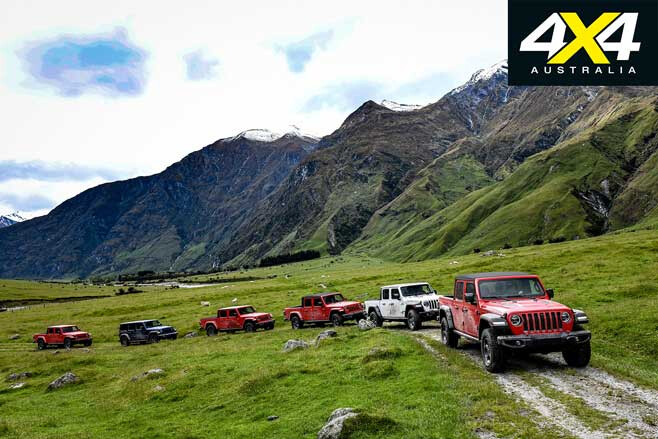
The vehicles on offer were American-spec Gladiator Rubicon models, so they were equipped with Jeep’s full arsenal of off-road weaponry. This includes Dana 44 live axles (front and rear) fitted with extra-low 4.1:1 gears and locking centres, plus 4.1s in the transfer case for extra-low crawling ratios; a disconnecting front swaybar; and 33-inch off-road tyres and suspension. Some of the vehicles were fitted with extra Mopar accessories including 35-inch tyres, taller springs and Fox shocks … one rig even had tube doors.
As with the Aussie-spec JL Wrangler, we will get an ‘international-spec’ JT Gladiator, which means the transfer case will offer 2WD, full-time 4×4, and 4×4 locked high and low range. Smaller 255/75R17 tyres are likely to replace the 33s and, much to the dismay of off-road enthusiasts, those 35s will not be offered as a factory option.
Full local specification and pricing is yet to be revealed, but we can tell you that when it lands here the JT will come in two model variants – Overland and Rubicon – and will be powered exclusively by the 213kW/353Nm 3.6-litre Pentastar V6 backed by the eight-speed ZF transmission. No manual transmission option and no diesel engine option (for now). This powertrain is backed by either a Command-Trac transfer case in the Overland specification, or the 4.1:1-geared RockTrac T-case in the Rubicon Gladiator.
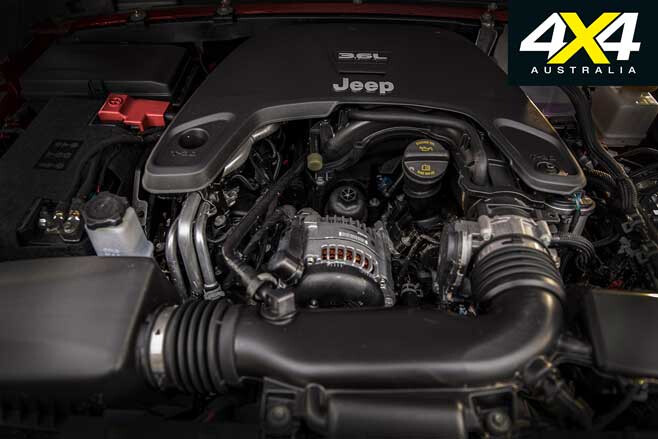
When quizzed on diesel engine options, Jeep officials were very quiet as to whether we’d get the 2.2-litre four-cylinder diesel available in the Wrangler Rubicon or the 3.0-litre V6 diesel the US market gets in its Wrangler, or if we’d get a diesel Gladiator at all. In a double-cab 4×4 ute market that is dominated by diesel engines it seems crazy not to offer one in Australia, but we’ll have to wait for news on that front.
Jeep may choose to not fit a diesel engine to the Gladiator at all, preferring to rely on its ‘4xe’ plug-in hybrid powertrain that was recently unveiled in Wrangler guise. This comes as part of the brand’s aim to be “the greenest SUV brand” and to offer electrified options on all of its models by 2022.
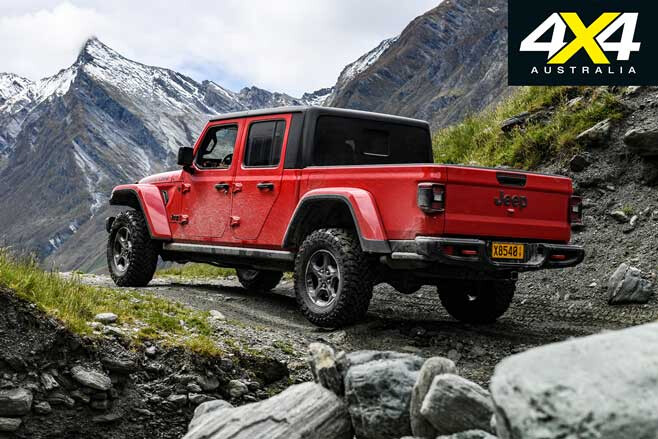
So, without knowing exactly what specification we’ll get or how much it will cost, how does the Gladiator drive? Queenstown bills itself as the adventure capital of the world and this, combined with inclement weather conditions, provided the perfect environment to test the Gladiator. Despite the conditions and against all sensibility, we chose to drive the Mopar-equipped model with Fox shocks, 35s and tube doors.
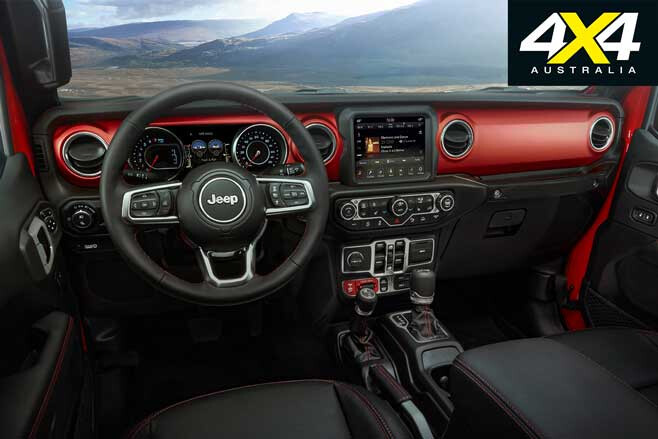
If you’ve ever driven a JL Wrangler you’ll be at home behind the wheel of the JT Gladiator; the view over the bonnet and the layout of the controls, audio and HVAC are identical between the two siblings. As is the sound, feel and performance of the V6 petrol engine and eight-speed slush ’box. It’s an engine that likes to rev to maximise performance, and it really rewards the driver when you get stuck into it. While this isn’t ideal for low speed off-road driving, it adds to the fun factor of driving the Jeep on open roads, sealed or otherwise.
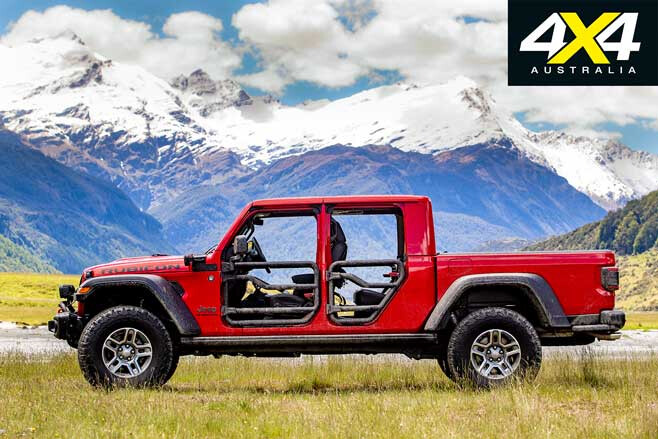
As expected, the Mopar tube doors do nothing to keep out the cold, but the Rubicon’s heated front seats were well-appreciated. Surprisingly the doors let in very little water, be it from the rain, creek crossings or muddy bog holes; although, it’s irrelevant to Australian buyers as they don’t meet ADR standards. We’ll have to be content with the Gladiator’s removable roof sections for the feel of open-air motoring.
Yes, just like the Wrangler, the Gladiator’s entire roof is removable, or you can simply remove the front sections to let the sun shine in. In a market crowded with same-same double-cab utes, the JT is the only one to offer a removable top.
The Gladiator’s rear seat is fairly upright like many others in this class of vehicle, but it still offers heaps of head and leg room for adult passengers, and they sit high to get a great view outside the car.
Mopar kit that was really appreciated on this Jeep includes the 35-inch muddies and Fox shocks but, again, they probably won’t be for Australian-market vehicles. We did speak with Mark Bosanac, head of Mopar parts and service, and he expressed his ongoing frustration with Australia’s modified vehicle regulations and state-by-state rules, but said he was hoping to find a working solution sometime in the future that would allow Mopar to offer factory-backed lifted suspension kits.
With the 50mm-raised Mopar suspension and taller 35-inch rubber, the Mopar-equipped Gladiator crawled across rocky rivers without touching down, while the stock-height models bumped and scraped their way through.
Like the Wrangler Rubicon, the Gladiator Rubicons have solid rock sliders running down their flanks to protect the sills against rock rash. Additionally, JT Rubis also have rock rails under the trailing edges of the cargo tub to protect the tub on departures. We did bump these on a non-Mopar-equipped JT on a particularly rocky descent, but their solid construction did the job of protecting the sheetmetal.
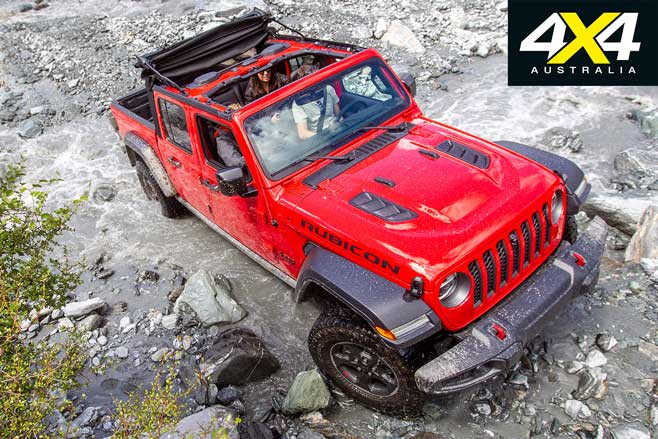
On the more open gravel roads the extra wheelbase of the JT Gladiator gives the truck a more planted and stable feel on the terrain than its wagon sibling, which also improves the ride quality on rougher ground.
The Fox shocks fitted to some of the vehicles delivered a notably more controlled ride and handling. The steering is still light and vague in places, typical of Jeep’s off-roaders, but it keeps the driver on his or her toes. The long 3487mm wheelbase didn’t give any notable troubles in terms of turning circle on the tighter rocky tracks.
Performance-wise, the Pentastar V6 still delivers its best when revved hard and lacks a little down low. Thankfully the extra-low gearing in the transfer case and final drive reduces that lack of low-down grunt when driving off-road, but it’s still nothing like the torque of a diesel engine, or an EV motor for that matter.
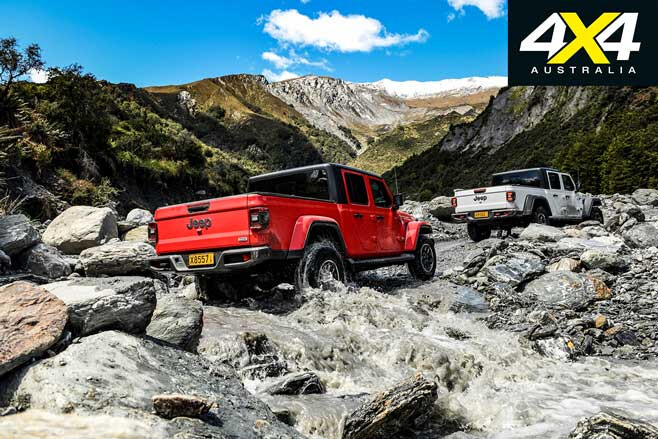
Should Jeep not offer a diesel variant, the lack of engine options could be a decisive factor to the success of the JT Gladiator. Whether you’re considering the JT for recreational touring, a work truck or off-road use, diesel is what most Australian buyers want. This is why almost every other double-cab 4×4 ute comes in diesel; certainly the ones that sell well.
Other factors will be load capacity and price. The international-spec JT Rubicon is rated to tow 2721kg and has a payload of just 620kg, both figures well short of the competition. We’ll have to wait until closer to its midyear launch for a definitive figure on what it will cost you, but our tip is you won’t be getting much change, if any at all, from $75K, to put yourself in a Gladiator Rubicon.
AFTER MORE than 12 months of catching Ford Bronco test mules fitted with Frankenstein Ranger body parts testing in both Australia and the United States, we finally catch a glimpse of one testing with the actual Bronco body on it.
Due to be revealed in just a few months as a 2021 model, the new Bronco is being billed as a genuine challenger to the Jeep Wrangler as an off-road vehicle, and as these images show, the five-door body shape is very Wrangler-esque.
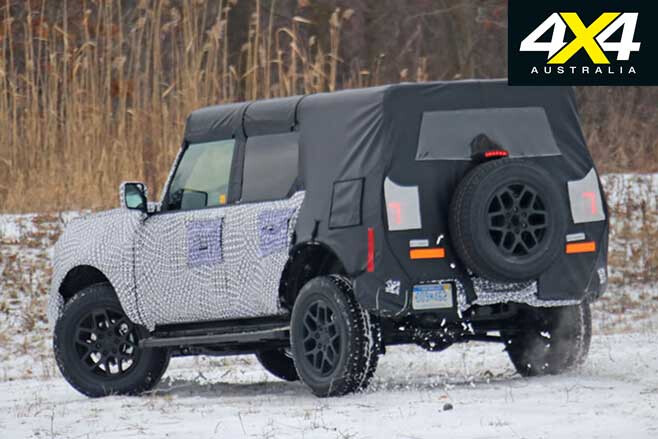
But far from being a copy of the Jeep, the Bronco will pay homage to the original 1968 Ford SUV which itself was very boxy. Unlike the original Bronco, but very much like the Wrangler, the 2021 version is expected to be available in both five-door long wheelbase and three-door short wheelbase models.
While this five-door prototype testing in wintery America is heavily disguised, it clearly shows the body will be boxy with short overhangs over the Ford Everest-based T6 chassis platform. That platform means IFS with coil springs up front and a live axle on coils under the back.
The camouflage is particularly heavy over the roof area to conceal what we expect to be a removable roof section, as was revealed in US patent documents seen last year. The patents also included removable doors, again much like a Jeep Wrangler; although, this test mule doesn’t appear to have those fitted.
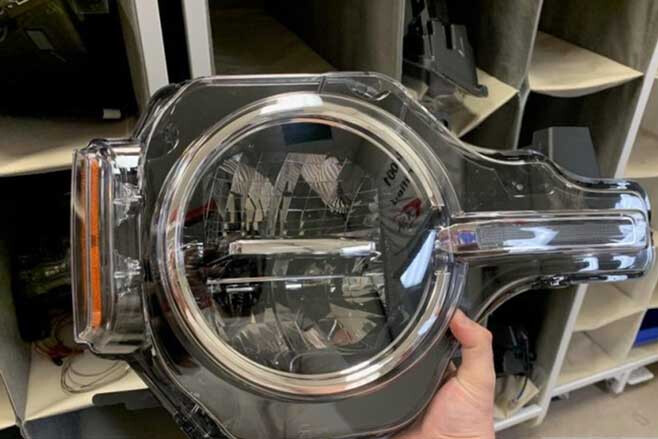
The camo also covers the front end of the vehicle, but online leaks have given us an indication of how the Bronco will look. It was always thought the new model would retain round headlights just like the original, and leaks to enthusiast website Bronco6g.com show what are claimed to be the headlights. These are round LED lights with horizontal marker lights that extend in to the grille rather than the separate marker lights of the original models.
These latest leaks have given the members of Bronco6g.com the ammo to update their ongoing renderings of how they imagine the new Bronco will look, and the renderings of the orange three-door car pictured here come from forum member TopRecon.
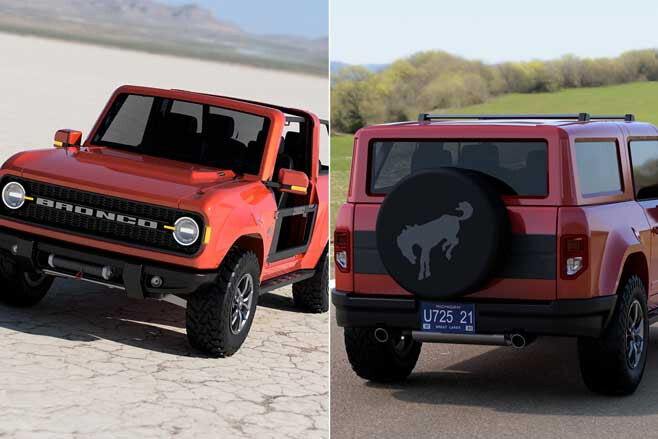
We’ll have to wait until the US-spring to see the actual vehicle, but don’t hold your breath to see the new Bronco here; Ford Australia maintains that the vehicle won’t be coming here, as it is slated for left-hand drive production only.
The annual Tokyo Auto Salon is best known for its wild sports and tuner-car concepts, but the one that caught our eye, as well as US-based LandCruiser specialists Cruiser Outfitters, is this short-wheelbase LC70. The current-shape Cruiser has the usual Auto Salon extras like bright paint and unique body adornments, but the real interest lies underneath.
This show special, which is said to be the work of LandCruiser Chief Engineer, Sadayoshi Koyari, features a coil spring rear suspension configuration and six-speed manual ’box. Before you say that the Bundera had coil all ‘round back in the day, this set-up uses the heavy duty 9.5-inch differential, not the light duty underpinnings under the Bundera and first-generation Prado 70s.
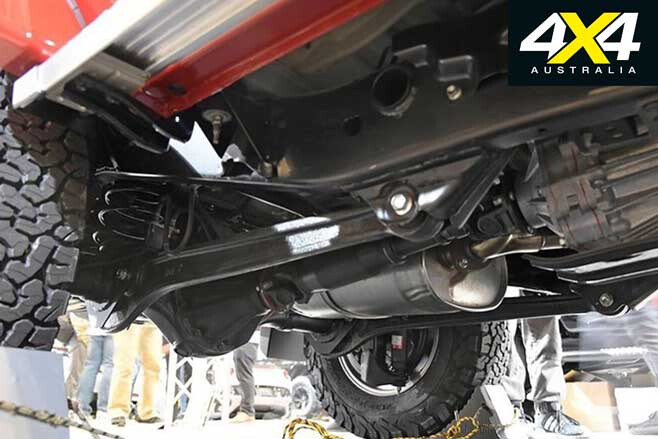
While we’ve seen custom coil set-ups using the 9.5 diff and 80 Series suspension components under 75 Series utes, this is the first time we’ve seen it in a semi-factory supported vehicle. This set-up would go a long way to improving the ride and dynamics of the LC76 wagon or 78 Troop Carrier sold in Australia, if it was ever to make it into production. One post we found on this vehicle even suggested that the front and rear diffs on the concept were actually the same wheel-track width, which would be much appreciated by buyers.
Something else that would be much appreciated by LC70 buyers would be a six-speed gearbox, as VDJ70s are screaming for an additional ratio when out on the highway, particularly if you still retain sub 35-inch tyres. Close inspection of the gear knob in this concept suggests it has a six-slotter fitted. Other notable things on this vehicle are the lack of a bonnet scoop, which suggests the 4.0-litre V6 petrol engine is fitted; a late-model Hilux steering wheel; and the LandCruiser Heritage badge taken from the US edition LC200s.
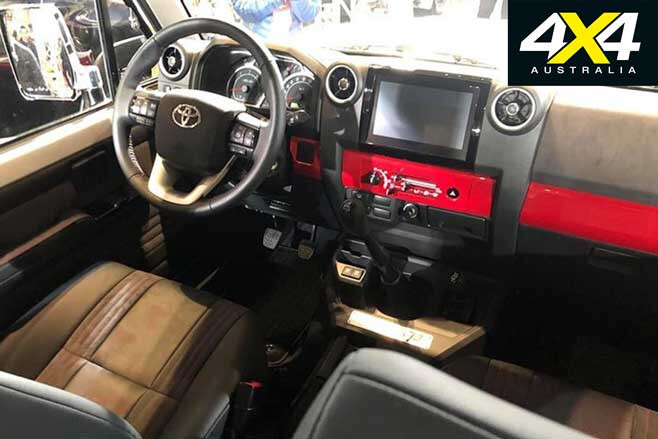
While no official information could be found on the concept, the list of companies labelled on the door includes Toyota Boshoku, which is the company’s components manufacturing arm; Toyota Auto Body, which is the factory body work team; and Gunma Toyota, which is a group of dealers in Japan. All of these names link to the notion that this concept is a factory supported vehicle.
Let’s hope some of these features make it to future production LandCruiser models.