I BOUGHT the iDrive for my 2005 Hilux around six months ago (they have since changed the name to Ultimate 9) and I paid full retail from my local 4WD shop. Right off the bat, I have been suitably impressed with its function and versatility.
First up, no, an iDrive doesn’t give you more power, it’s a throttle controller. It allows you to change the sensitivity of your throttle to suit a variety of terrain or conditions. No, you can’t just press your foot down farther or quicker to do the same thing either, as the vehicle’s computers are smarter than your foot – the iDrive acting as an adjustable interface between your foot and said computers.
SECOND OPINION: iDRIVE throttle controller
There are three modes: AC, E and U (Auto, Economy and Ultimate, with E and U having nine stages of adjustment). With the smallest amount of experimenting, you’ll quickly work out what works best for you.
Installation was a snap, literally! Unclip the throttle control cables from the accelerator pedal, clip in the iDrive, reattach the factory cables, and run the unit to your dash. If it takes you five minutes, I’d be surprised. Just make sure you wipe down your dash with Prepsol or something similar before sticking the unit in place.
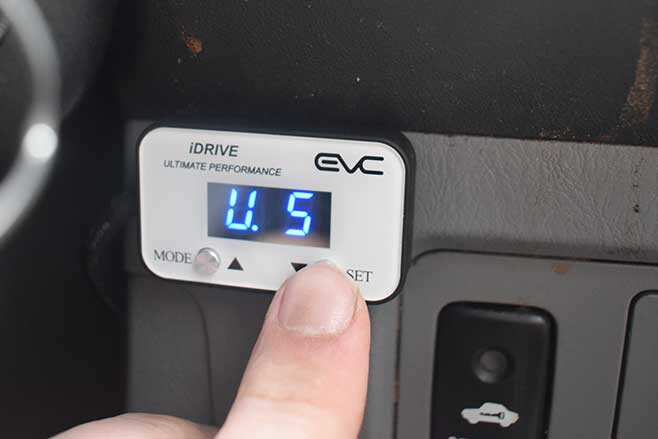
I found that after I did a custom dyno tune on the Hilux, the iDrive really woke it up. I played with the settings religiously, and found for on-road driving the sweet spot is U3 or U4 in Ultimate mode. The AC mode is automatic, and I can see the point of having the unit do all the work for you.
For me, it wasn’t hard to find the sweet spot and it has stayed on U3 or U4 ever since when on-road or sand driving.
Another huge benefit of the iDrive was using Eco Mode when off-road. This dulled down the throttle response, making the otherwise twitchy Hilux feel like an old Range Rover Classic – E5 seems to do the trick. It’s really handy, especially for those who reverse trailers and need a forgiving throttle. If your vehicle feels like its lagging down low when trying to take off from a set of lights and so on, the iDrive will help here, too, but again it doesn’t give you any more power.
For $265, I think it is money well spent. I hear people saying you shouldn’t need one if you have a custom engine tune, and I see that point. However, having this degree of versatility at your fingertips is pretty damn powerful.
Any negatives? Well, some people have told me they find the screen bright when driving at night, but this doesn’t bother me. And if you are creative in mounting the unit in a place that is accessible but out of the way, it’s a non-issue.
AVAILABLE FROM
RRP
$226
WE SAY
Easy install and provides the correct throttle response for most driving styles, situations and terrain.
TOYOTA’S Hilux ute was the top-selling car in Australia in 2020 in what was a tough year for the industry, but it didn’t have things all its own way. Ford’s Ranger beat it in the 4×4 sales ranks and we’re pretty certain that is a title Toyota would like back.
Along with highly publicised DPF issues, a problem for the Hilux was its lacklustre 2.8-litre engine, so the company addressed this and a few other smaller complaints late in the year. This saw sales numbers pick up again over the last couple of months in 2020.
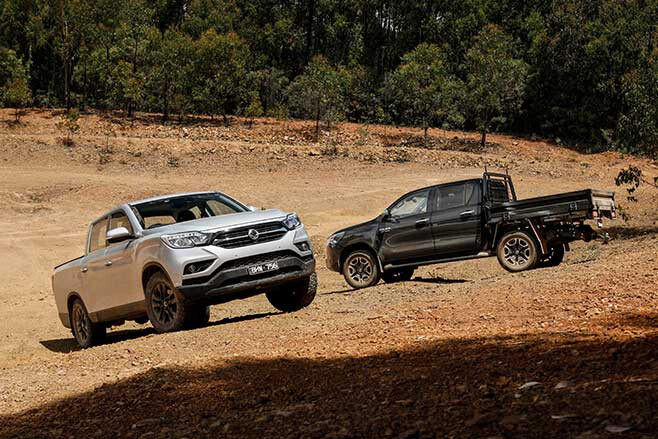
SsangYong can only dream about being anywhere near the pointy end of the new-car sales charts, but we’ve been mighty impressed with the comfort and performance of the Musso XLV Ultimate we had on long-term loan through the second half of the year. At more than $18,000 cheaper than the Hilux SR5, the Musso represents eye-opening value too.
With these factors in mind we took our long-termer out for a day in the woods with the updated SR5 auto, to see how they stack up and if the changes made by Toyota are enough to fix the complaints surrounding it.
TOYOTA HILUX SR5
THE updated Toyota Hilux lobbed in to showrooms in September and brought with it a new front-end design, fresh tail-lights at the back, interior upgrades, as well as much needed tweaks under the bonnet.
Toyota might not build any cars in Australia anymore but the company’s Australian designers and engineers played a big part in both the styling and mechanical changes for the 2021 updates, and it seems that it was work well done.
POWERTRAIN & PERFORMANCE
THE previous tune of Toyota’s 1GD engine had about as much life in it as 2020 a New Year’s party and felt totally outgunned by many of its competitors. Its claimed 130kW and 450Nm felt optimistic at best as it struggled to inspire with its performance.
The updated engine promises 150kW and 500Nm; matching the class-leading figures of any other four-cylinder diesel in the one-tonne ute segment. To get these numbers while improving fuel economy at the same time, the engineers equipped the engine with a new common-rail fuel system and a bigger, ball-bearing turbocharger, among other changes. A more rigid cylinder block is said to improve the NVH levels.
The changes have worked, giving Lazarus-like new life to the 1GD. There’s a noticeable improvement in acceleration right through the rev-range, but particularly in the mid-range where you use it most.
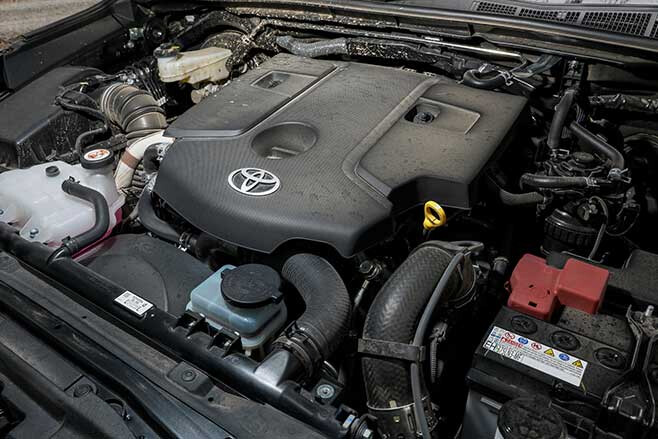
Toyota claims that maximum 500Nm of torque is now available from 1600 to 2800rpm when backed by the automatic transmission, as our test car was. Six-speed manual-equipped Hiluxes don’t get the same increase in torque and have to make do with 420Nm, which is on tap from 1400 to 3400rpm. There’s even a bit of turbo whistle evident when driving the Hilux now, which we don’t recall noticing in the past.
The six-speed automatic transmission has also been tweaked to match the engine’s performance, while the ‘Power’ mode button not only holds gears longer, it sharpens up the throttle response in much the same way as aftermarket throttle controllers do.
The changes to the engine and transmission have made the 2021 Hilux engaging to drive, something you could have never said about those with the earlier 1GD engine. It’s harder to discern any improvement in the engine’s NVH and it is still quite vocal when you put your foot down to appreciate the new-found performance.
ON-ROAD RIDE & HANDLING
THIS eighth generation of Hilux has been criticised since launch as having a harsh and choppy ride when unladen and, while this was warranted, it countered this with its ability with a heavy load on board – and isn’t this what a ute should be able to do?
Toyota has revised the spring, shock absorber and suspension bushes in 4×4 Hiluxes to improve the ride and handling; including the use of longer leaf springs to give a more supple ride without sacrificing load-carrying ability. The springs have also been moved outboard to improve handling stability.
Our test car was a cab-chassis model fitted with the factory steel tray and, driving it unladen, it was difficult to discern any improvement in ride and handling. This vehicle did feel softer and had better ride quality than the 2021 Rogue model we drove a couple of weeks before this SR5.
The Hilux handles as you would expect a workhorse ute to handle. The load-bearing rear end is stiff and a bit choppy, while the front end is soft and prone to wallow and pitch. The hydraulically assisted steering remains well-weighted with good feel, despite the changes made to the 2021 model, to make it lighter at low speeds and ease wheel effort when parking.
OFF-ROAD
ALL the things you might criticise a Hilux for on-road disappear when you leave the tar behind. The soft front suspension soaks up bumps and the cabin is well-isolated from road noise. Once you get off track and in to low range, the rear-end works wonderfully with better than average articulation from the leaf-sprung live axle. Water fording depth is quoted at 700mm and the engine air intake picks up from inside the fender.
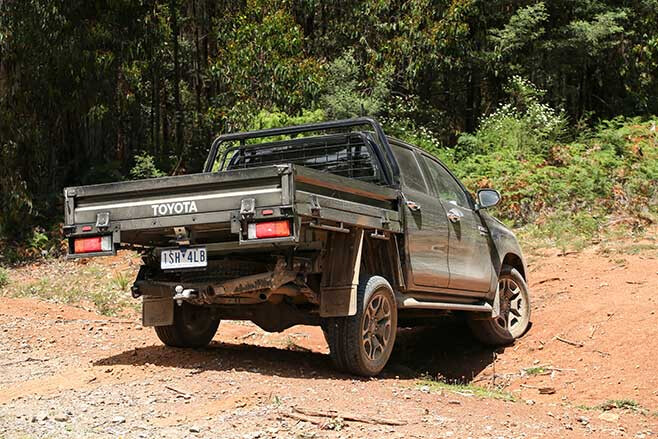
The calibration of the electronic traction control has always been excellent in the eighth-gen Hilux, and that hasn’t changed with the updated model. It is so good you’ll rarely need to use the driver switchable rear differential lock.
CABIN & ACCOMMODATION
FORGETTING about any other updates, the new Hilux is better than the previous model because Toyota has gone back to having knobs/dials for the audio system’s volume and station selection, instead of annoying buttons. This has been a personal gripe of mine, and the functionality is so much better now with fast-acting and tactile dials back on the radio fascia. Winning!
That audio system has a new eight-inch display (up from seven) and Apple CarPlay and Android Auto are now standard inclusions. The gauge binnacle is also new, with a fresh look on the dials and a digital information display in between the speedo and tachometer.
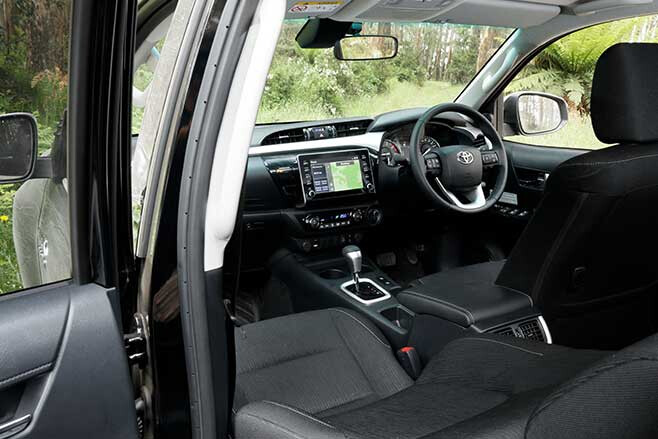
The front seats remain comfortable and accommodating and there’s good vision from the driver’s seat. On a side note, the JBL sound system that is fitted exclusively in the Hilux Rogue is a step above that of any in the lower-spec models and one of the better ones offered in 4×4 utes. That’s not saying much because across the segment they are all pretty average for sound quality.
4X4 HISTORY: 50 years of Hilux
The Hilux has all the common safety features including AEB, lane departure warnings, trailer sway control, pedestrian sensing pre-collision warning and lane keeping. Interestingly, as the Hilux retains hydraulic power steering, it can’t self-steer in the same way most other cars do to keep you in the lane. The Toyota steering assist is done through the brakes and, as such, is less intrusive than most of the similar systems that can pull the steering from your hands. The lane departure warning chime is also easily turned off via a button on the steering wheel.
The SR5 normally has a rear camera as well as parking sensors, but as this vehicle was fitted with a tray it misses out on these, and it’s surprising how often you now look to the AV screen for vision as well as the mirrors when reversing. Other ute manufacturers retain their reversing camera when fitted with a factory tray. A genuine Toyota accessories reversing camera for the tray is available as an optional extra.
PRACTICALITIES
RECENT problems aside, Toyota has been churning out 4×4 Hiluxes since 1978, so it knows a thing or two about building a working-class off-road ute. Things like the way it has retained hydraulic power steering for durability and the way the rear suspension works so well, comes from 40-plus years of evolution.
Even this high-spec SR5 double-cab spec has more than one-tonne payload, towing capacity is the 3500kg standard, there’s 700mm wading depth, a simple 4×4 system, excellent ETC and a host of Australian-designed genuine Toyota accessories. Consider the massive following from the aftermarket accessories industry and you can tailor a Hilux to do just about anything you need it to.
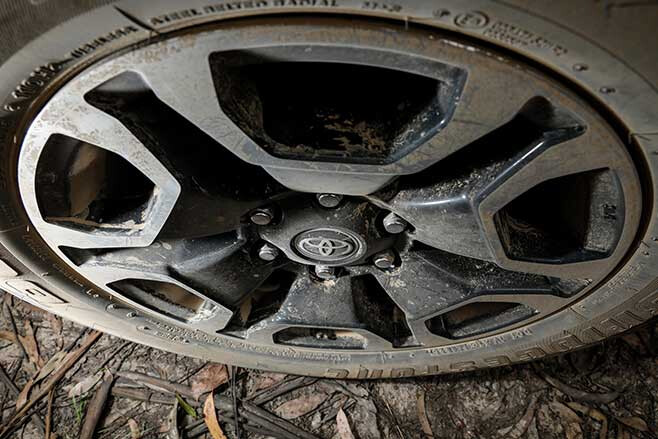
The SR5 rides on a 265/60-R18 tyre, which is fast becoming the standard size for this style of ute, so you shouldn’t have any troubles finding replacement or alternative tyres for it.
The genuine Toyota tray fitted to our test car adds a lot of practicality for load carrying, but the more popular ute tub holds plenty, even if its four tie-down points are mounted too high on the sidewalls.
With 18 models in the Hilux 4×4 range there should be a variant in there for everyone, so you can see why it remains so popular with buyers.
SSANYONG MUSSO XLV ULTIMATE
SSANGYONG mightn’t be the first name you think of when shopping for a 4×4 ute, but it has been selling 4x4s in Australia for more than 25 years and, like other South Korean auto brands, the products have come a long way in that time.
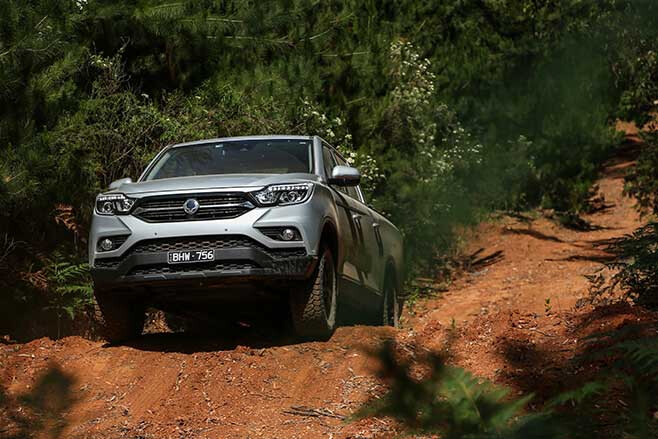
It’s been a turbulent time for the brand over the years with partnerships and owners including Mercedes-Benz, Daewoo, SAIC and more recently Mahindra throughout that time. Even as this is written, SsangYong is battling to pull itself out of receivership in its home country after Mahindra seeks to offload the brand.
Yet the latest Musso ute is a surprise package and well-worth any buyer’s consideration. It is available in two wheelbases and the longer XLV is what we have here in Ultimate, the middle of three available specification levels. The Musso XLV Ultimate starts at just $39,990, but there’s a lot more going for it than just being a value package.
POWERTRAIN & PERFORMANCE
MUSSO is Korean for Rhino, and the powerplant is a grunty, little 2.2L diesel engine that makes a modest 133kW and 420Nm. That’s a way off the class leaders with 500Nm but it gets along alright, even if you need to plan those overtaking moves very well.
What it lacks in performance it makes up for in refinement, and the Musso is arguably the quietest four-cylinder diesel ute in the segment; surprising some passengers who can’t believe it’s a diesel engine. It’s also pretty good on fuel use, bettering the Hilux on this test recording 11.85L/100km. It’s worth noting our Musso is fitted with aggressive LT all-terrain tyres that do nothing for fuel savings.
The engine is backed by a six-speed automatic transmission from Aisin, which is probably related to the one in the Toyota. It features ‘Power’ and ‘Eco’ modes, the former sharpens up the performance a bit, while full-manual control is via a toggle on the shift handle.
The 4×4 system is part-time with high and low range, and the rear differential has an effective auto-locking function.
ON-ROAD RIDE & HANDLING
SSANGYONG Australia teamed up with Ironman 4×4 to locally develop an approved suspension kit to improve off-road and towing performance, and this Musso is fitted with it. The kit is available from the dealer at the time of vehicle purchase or retrospectively and is covered by a factory seven-year warranty. Kudos to SsangYong for giving buyers this option.
Also credit for offering a choice of leaf or coil rear-suspension systems and equipping the Musso with four-wheel disc brakes, something you won’t find on many other new 4×4 utes. The XLV Ultimate has the all-coil configuration and, with the Ironman kit, it’s a well-sorted package.
The Musso rides firm and feels a bit jittery over small high-frequency bumps, but it’s not uncomfortable. More noticeable is how well-controlled the suspension is, something that only comes from quality aftermarket dampeners and very few OE setups will offer. The Musso steers and corners flat with that confidence-inspiring control.
OFF-ROAD
THAT rough-road jitteriness is amplified on gravel and particularly corrugated roads, prompting the driver to lower the tyre pressures to improve the ride for extended gravel and off-road driving. The superior control of the suspension comes to the fore again in these conditions and in low-speed off-road use.
The coil rear suspension doesn’t offer the axle articulation of the Toyota’s leaf-sprung rear nor is the electronic traction control as fast-reacting or effective. But when it hikes a tyre and breaks traction you quickly feel the rear diff lock kick in to maintain forward progress. Yes, this is slower reacting than a well-calibrated ETC system and you feel the momentum loss before the differential locks up, but, once it does, it is very effective.
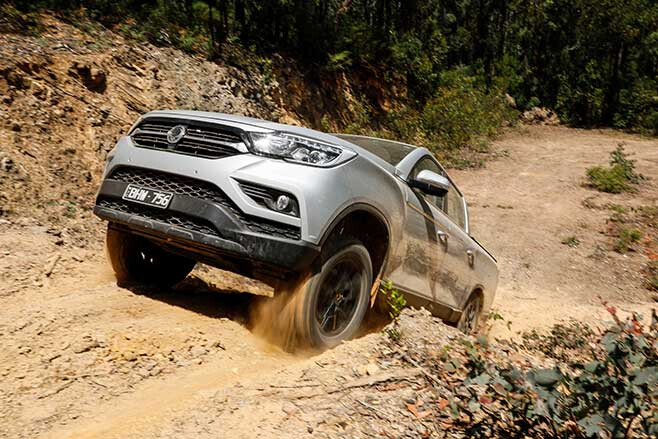
The off-road suspension kit raises the Musso some 40mm over stock, but it is still a low vehicle with plenty of overhang at the rear due to the XLV’s 300mm longer tray than the short wheelbase Musso. The XLV is 110mm longer in the wheelbase than a stock Musso, so the belly is also susceptible to scraping over erosion mounds. This car is fitted with dealer optional underbody protection, which again was developed by Ironman 4×4.
CABIN & ACCOMMODATION
The most appreciated feature of the Musso is its cabin, both for its size and features. Climb aboard after being in any other double-cab ute and you instantly feel the extra width of the cabin with plenty of shoulder room in both the front and back seats. Short of an American pickup, only the VW Amarok comes close to the feeling of space inside a Musso. The long dashboard accentuates the cabin and its large eight-inch AV screen includes Apple CarPlay and AA for all your mapping and entertainment needs.
There are three specification grades for the Musso XLV: ELX, Ultimate (as we have here) and the top-spec Ultimate+. The mid-spec Ultimate gets heated and cooled faux-leather seats for an instant feel of luxury, but as you dig deeper you find they are manually adjustable and the air-con is manual with no auto climate control. It’s now you remember this is a $39,990 drive-away vehicle.
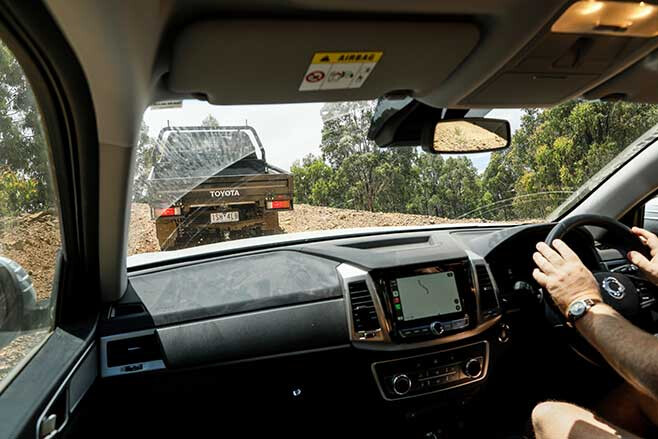
The driver’s aids/safety package is comprehensive, including AEB with front collision warning, lane departure warnings, radar cruiser control, blind spot indicator and rear cross traffic alert. That last feature is one we particularly like and you can’t get on the Hilux.
Also worthy of note is the excellent tyre-pressure monitoring system (TPMS) displayed in the information menu in the dash binnacle. It displays individual pressures for each tyre, gives warnings for both high and low pressure, and randomly displays the TPMS to keep the driver aware of a vital function.
PRACTICALITIES
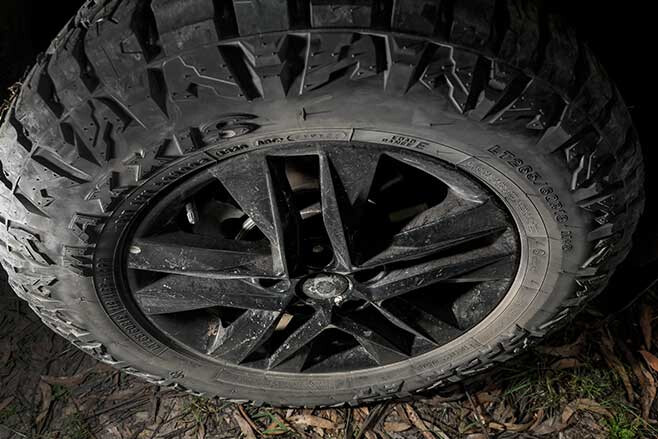
THE coil-sprung Musso XLV is limited to an 880kg payload, but the leaf-spring models are 1025kg, and both have 3500kg braked towing capacity. The XLV’s tub is one of the biggest in the business and swallows a heap of gear. There are four tie-down points inside plus a 12-volt outlet. The Musso XLV Ultimate’s tyres are also the popular 265/60-R18 size.
The engine air inlet is high on the forward edge of the radiator support panel so it’s not ideal for water crossing and the 350mm fording depth requires care; while the rear-view camera and parking sensors help with negotiating the big ute on tight tracks.
As a relatively small seller, the Musso isn’t overly supported by aftermarket kit, but SsangYong has partnered with some of the biggest brands such as Ironman 4×4, Carryboy canopies and Rola roof racks to offer a comprehensive range of factory-backed gear.
SUMMARY
THIS might seem like an odd comparison where we have what is one of the most popular cars in the country with decades of evolution and sales behind it, lined up against a virtual minion in the 4×4 ute segment. However, they both compete in the same category and each of them has their plusses and negatives; yet the clincher is one of them is around $18K cheaper to drive out of the dealership.
The Musso XLV comes in swinging with its affordable pricing, seven-year factory warranty and roadside assistance, comprehensive safety kit, large cabin and cargo tub, well-sorted optional suspension package, and premium interior feel; but it is let down by its modest engine performance, limited off-road ability and a ride quality that could be better.
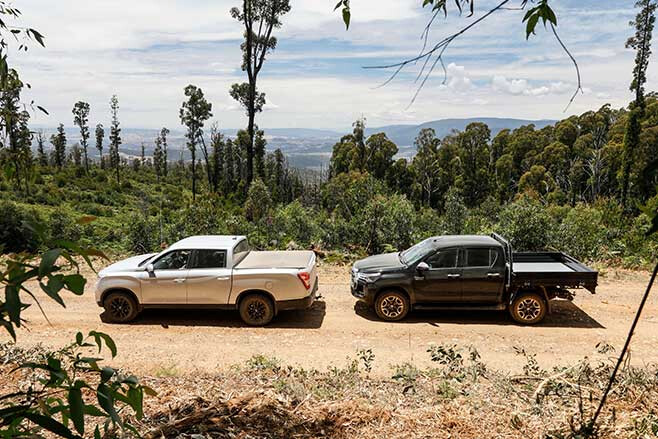
The Hilux, as always, has its well-earned reputation of dependability, quality and workhorse capability, and there’s nothing to say this has been compromised. Toyota has taken note of recent criticisms and addressed them with a massive improvement in engine performance, as well as an updated and improved interior fit-out. Toyota does claim to have addressed its DPF issues as well, however it’s too early to tell how successful that fix has been.
The question remains, is that 40-plus years of 4×4 Hilux development worth the considerable amount of extra money?
If you were looking for a 4×4 ute to equip for an off-road adventure around the country, we’d say it would be money well spent choosing the Toyota. However, for general family use around town and the occasional bush getaway, it is very hard to look past the SsangYong with its bigger cabin, extra equipment, longer warranty and more affordable purchase price.
TOYOTA HILUX SR5 SPECS
ENGINE: 2.8-litre 4-cyl turbo diesel MAX POWER: 150kW at 3400rpm MAX TORQUE: 500Nm from 1600 to 2800rpm TRANSMISSION: 6-speed automatic TRANSFER CASE: Part-time 4×4 w/ high/low range STEERING: Hydraulic-assist rack and pinion FRONT SUSPENSION: IFS w/ upper and lower control arms, coil springs REAR SUSPENSION: Live axle, leaf springs, stabiliser bar TYRES: 265/60-R18 KERB WEIGHT: 2093kg PAYLOAD: 1105kg (cab-chassis) TOWING CAPACITY: 3500kg GVM: 3050kg GCM: 5850kg FUEL TANK CAPACITY: 80L ADR FUEL USE: 7.9L/100km TEST FUEL USE: 12.96L/100km APPROACH ANGLE: 29° RAMPOVER ANGLE: n/a DEPARTURE ANGLE: 27° WADING DEPTH: 700mm GROUND CLEARANCE: 216mm
SSANYONG MUSSO XLV ULTIMATE SPECS
ENGINE: 2.2-litre 4-cyl turbo diesel MAX POWER: 133kW at 4000rpm MAX TORQUE: 420Nm at 1400-2800rpm TRANSMISSION: 6-speed auto CRAWL RATIO: 34.95:1 4X4 SYSTEM: Dual-range part-time FRONT SUSPENSION: IFS w/ upper and lower control arms, coil springs REAR SUSPENSION: Live axle, coil springs, stabiliser bar TYRES: 265/60-R18 KERB WEIGHT: 2160kg GVM: 2980kg PAYLOAD: 880kg TOWING CAPACITY: 3500kg GCM: 6130kg FUEL TANK CAPACITY: 75L ADR FUEL CLAIM: 8.2L/100km TEST FUEL USE: 11.85L/100km APPROACH ANGLE: 21.5° RAMPOVER ANGLE: 21.3° DEPARTURE ANGLE: 27.1° GROUND CLEARANCE: n/a WADING DEPTH: 350mm
Missing the latest 4X4 Australia content in your Facebook feed? There are plenty of other ways to stay in touch with us.
Subscribe to the world’s best 4×4 magazine and save up to 39% off the retail price: 4×4.subscription.com.au
Bookmark our website, which is updated daily with news, reviews, tests and more: www.4x4australia.com.au
Sign up for our weekly newsletter: www.whichcar.com.au/4x4australia-email
Find us on Insta: www.instagram.com/4x4australiamag/
Check out our YouTube channel, which we’re ramping up in a big way: http://youtube.com/4x4Australia
Facebook might have had its day, but we’re 40 years strong and not going anywhere.
THIS is your last chance to win a Patriot X3 camper trailer, with the competition closing on February 28, 2021.
Jeep customers who purchase at least $100 worth of genuine Jeep accessories – or service their car – at an official Jeep dealership will go into the draw to win a brand-new Patriot X3 camper trailer worth $69,990.
Swipe the credit in one transaction for more than $1000 worth of goodies and your entries in the draw will double.
Released in Australia in 2020, the X3 is based on the chassis and suspension of the previous-gen X1 but adds a smorgasbord of new materials and luxuries, to ensure you’re the envy of other campers.
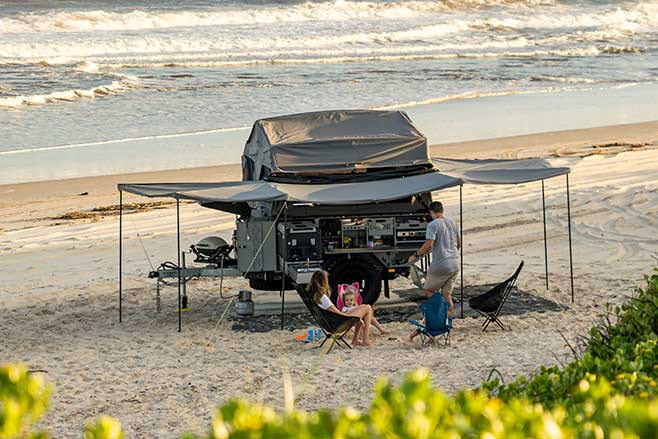
The X3 measures 3.75m long, 1.85m wide and can be expanded to offer approximately 30m² of indoor and outdoor coverage. It has a tare weight of 1120kg, 500mm of ground clearance, and a 40° departure angle.
Key features include a gel-top double mattress with an addition pull-out bed; a massive kitchen space fitted with a 75L dual-zone fridge freezer; a diesel heating system; twin water tanks; and a power system that comprises a 1500W inverter system and two 150Ahr AGM gel batteries.
“We’re delighted to align with a brand that believes in exploring and getting off the grid just as much as we do,” said Justin Montesalvo, Managing Director of Patriot Campers. ” I have no doubt that the X3 is going to make one lucky winner truly unstoppable off-road, thanks to their Jeep and their new Patriot.”
The competition closes on February 28, 2021, with the winner announced on March 16, 2021.
BEING the second largest sand island in the world, Minjerribah, as it is known by the traditional owners, the Quandamooka people, lies within Moreton Bay and is situated off the coast of Redland City, southeast of Brisbane. It’s colloquially known as ‘Straddie’.
A storm in the late 19th century caused the island to be split into two, forming North and South Stradbroke Islands, which are separated by the Jumpinpin Channel.
Main Beach runs down the east coast of the island, for 32km of beach frontage and an abundance of foreshore campsites to choose from. Who can’t pass up the opportunity to have pristine waterfront accommodation?

The campsites on Main Beach are scattered all along the dunes and you can find them by entering any of the track entrances directly from the beach. These are clearly sign written, and the choice is yours when it comes to selecting a site. There are heaps to choose from, either right on the dunes or farther back out of the wind, and keep an eye out for the perfect spot to erect a hammock for those lazy days.
BRISBANE ESCAPES: North Straddie
Common sense also prevails when beach driving, like anywhere really: let the tyres down, have recovery gear on hand, and don’t drive on the beach two hours either side of high tide.
For the keen fisherman, the best spot to wet a line is right down the southern end of Main Beach at a spot called Jumpinpin Channel, or ‘The Pin’ to locals. This bar is every boaties ticket to the open waters of Moreton Bay; although, it is driven by high tides and strong currents and isn’t the best spot for swimming – for land-based fishing from the beach, though, this is the spot you need to be.
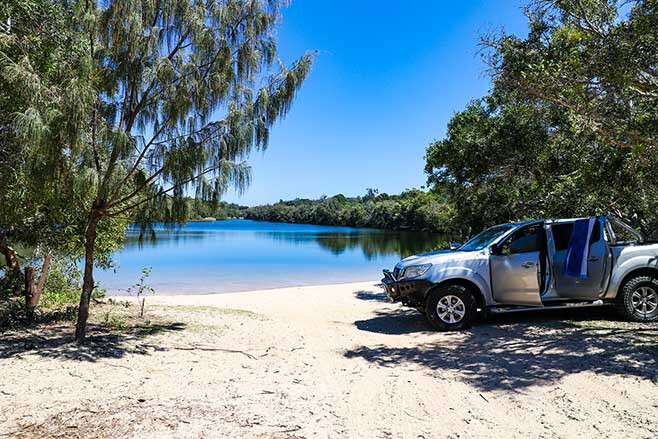
With a clear view south, you can see the buildings on the Gold Coast and it’s the ultimate spot to crack a cold one, wet a line, catch some dinner and watch the sun go down … there really isn’t anything more you could ask for.
After watching the sunset on the point, head back to camp and get that fire cranking and whack a casserole in the crock pot. The darkness lit up by the flames of the fire, eating cooked marshmallows off a stick and the sound of the waves crashing on the beach with the salty air surrounding you is everyone’s explanation of serenity.
Nothing beats going to sleep to the sound of the waves … well maybe one thing … if you’re an early riser, you will be in awe every morning as you catch the sunrise over the water. It certainly is a showstopper and be sure not to miss a single sunrise, it’s Mother Nature at her best.
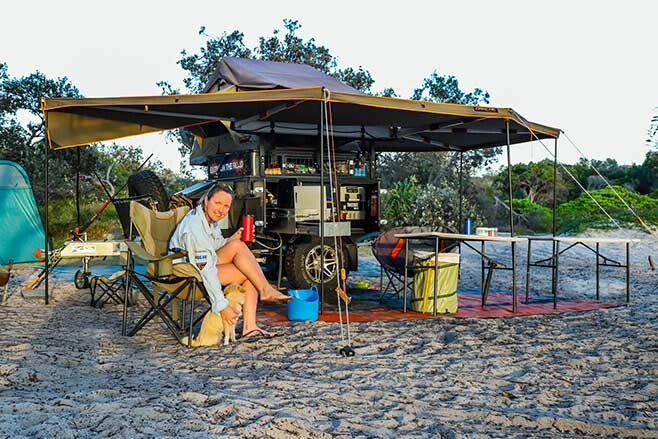
There are other camping areas on the island to choose from as well and they are situated on the northern part of the island. Flinders Beach offers sheltered, dog-friendly, beachfront-facilitated campsites, plus camping areas available at Amity Point, Cylinder Beach and Home Beach, to name a few.
QLD TRIP: Moreton & Straddie
For those that aren’t keen on roughing it, there are other accommodation options at Adder Rock Campground, which offers powered and unpowered caravan, trailer and tent sites, as well as glamping eco tents and cabins.
There are two townships on the island which have shops, bars, restaurants and cafes, providing options for restocking of supplies, fuel, water and air. You’ll find these at Dunwich and Point Lookout.
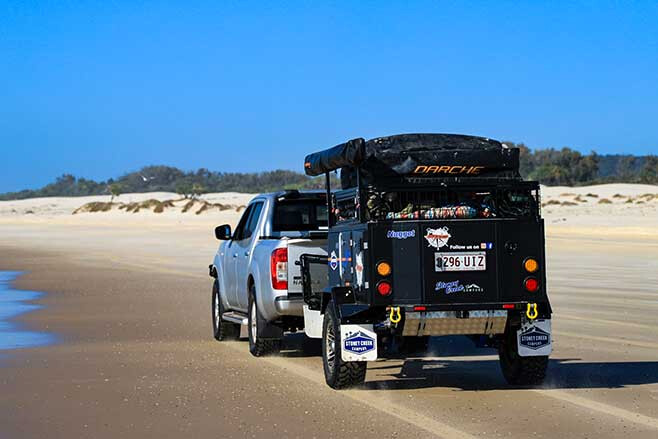
POINT LOOKOUT
THE North Gorge Walk at Point Lookout is a must-do when you visit Straddie, it provides superb views out to sea and a great way to spot some whales between June to October, so don’t forget the camera!
While out and about, you can’t go past Brown Lake. Known for its colour which is caused by the tannin in the water, Brown Lake is a freshwater lake with picnic areas that make for a good day trip and a great spot for lunch and a dip.
TOP 5: Best beach drives in Oz
Not far from Brown Lake, there is Blue Lake, known as ‘Kaboora’ by the Quandamooka people, meaning ‘deep silent pool’. There’s a 5.2km walking track to get to the lake, so bring your walking shoes as you’ll have to earn the swim at this one.
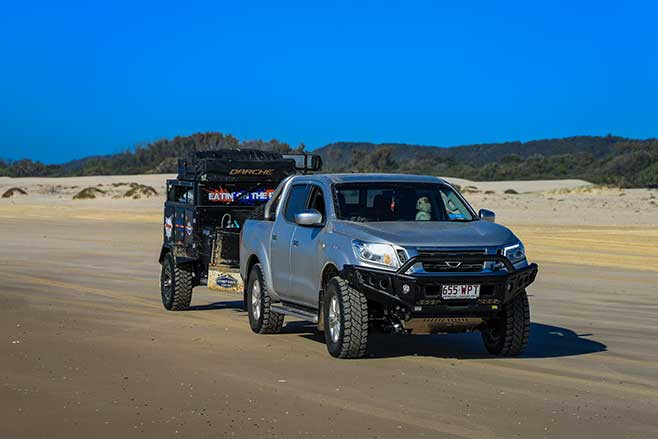
Straddie is truly spectacular, and while you have to do a little exploration to be able to see the special spots, there is an abundance of things to see and do that will keep the whole family entertained. Bring the kids, bring the dog, pack the fourbie and hop on that ferry, you don’t know what you’re missing out on, and once you make it to Straddie, you’ll be coming back for more.
There is so much to see and do that you may not get a chance to do it all in one trip, so it makes for a perfect excuse to return.
WHERE
Main Beach, North Stradbroke Island
CAMPING
Unfacilitated beachfront camping on the dunes.
CONTACTS & INFORMATION
Stradbroke Ferries: www.sealinkseq.com.au Camping: www.minjerribahcamping.com.au
RESTRICTIONS & PERMITS
Vehicle access permits are required to drive on the beach. Camping Permits are also required.
WATCH: Straddie Adventures
Development of the Grenadier off-road vehicle by British brand Ineos Automotive continues to gain traction, as the prototype stage moves from the 2A to 2B models and moves in to its new production facility.
The Grenadier is a no-frills off-road vehicle that will come in five-door wagon and four-door pick-up variants, constructed in the same vein as the old Land Rover Defender.
It’s using and all-new ladder chassis with live axles, BMW powertrains with dual-range transfer case, optional locking differentials, and a bespoke boxy but functional body.
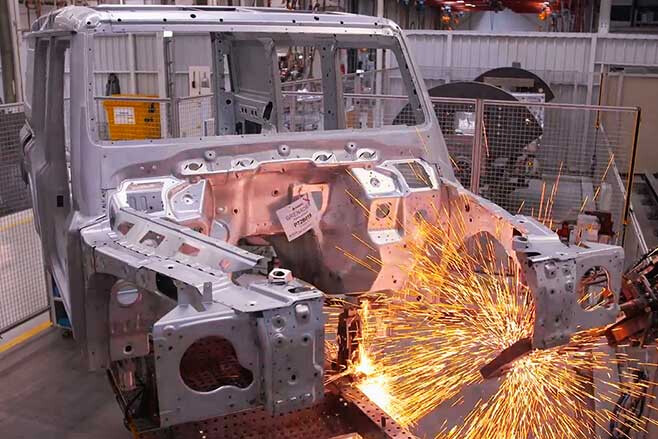
Ineos Automotive recently took the keys to a state-of-the-art vehicle manufacturing plant in Germany from Mercedes-Benz and is in the process of re-tooling to build the Grenadier 2B prototypes and eventually the production vehicles.
OPINION: Here’s why we need the Grenadier in Oz!
The plant also comes with existing staff and a contract to continue to build Smart Cars there, providing Ineos with a supplementary income stream while Grenadier ramps up.
The Grenadier 2B prototypes will be sent for testing at locations around the word, including Australia, and testing laboratories.
The Grenadier is being made for global markets and is planned to arrive in Australia in 2022, and it will provide a welcome addition to the traditional 4×4 off-road marketplace.
WINCH truck competitors are a special breed. They want to drive their 4x4s at tremendous speed, through insane obstacles, only to finish the course by running up a giant hill to see who can winch up it as fast as possible.
On paper it sounds sort of weird, but I can assure you it’s one of the most exciting forms of off-road motorsports out there.
The owner of this custom works-burger of an FJ45 LandCruiser, Scott Alison, is one of those special breeds, who would prefer to be knee-deep in mud on a weekend.
RESTO-JOB: 1966 FJ45 Troopy
As Scott is a vehicle body builder, he came up with a plan and was able to use his skills and those of mates in the industry, to create one extraordinary vehicle. One that’s as visually appealing as it is competitive, thanks to a long list of high-end components he’s grafted on to it.
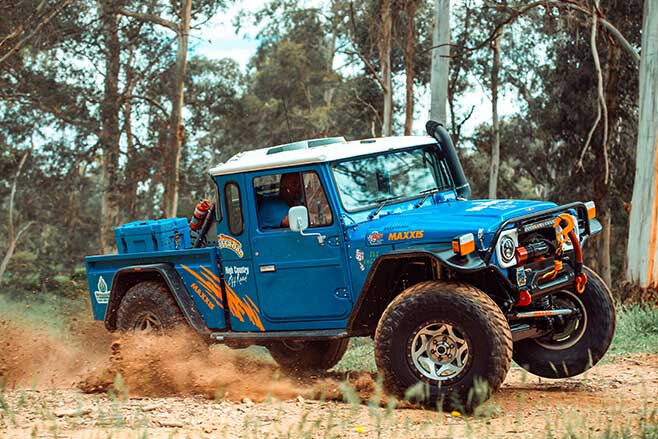
Scott is no stranger to 4x4s, owning an FJ40, GQ and GU Patrol and a PX1 Ranger previously. We had to ask why go back to an FJ, though?
“They are my favourite 4×4,” Scott replies. “The years of thought I put into making this, means this vehicle is unique … it just looks cool.” We can’t disagree with him there; this is one mean comp truck that goes as good as it looks.
LS1 GM V8 ENGINE
THE factory engine offerings from Toyota were never going to be enough to be competitive in the winch competition scene. Rather than reinventing the wheel, Scott went down the path well-trodden and had a 5.7L LS1 GM V8 engine built to suit. While it’s nothing too crazy in the scheme of things, Scott tells us the motor produces a healthy 400 to 500 horsepower at the flywheel.
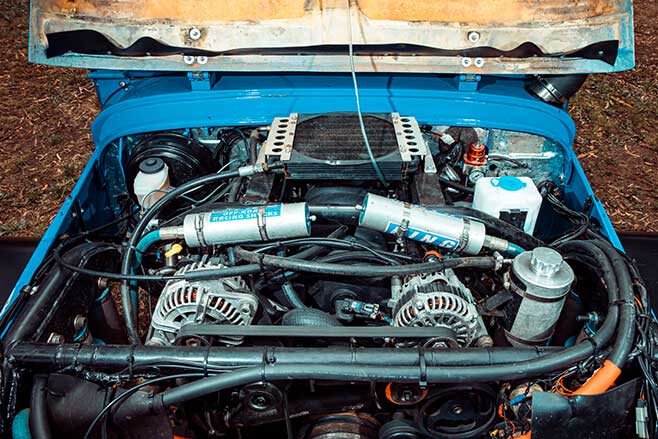
J&S Engines were given the nod to handle the build, which has been tickled up in the interest of reliability. The standard crankshaft remains, but H-Beam conrods, forged pistons, a Comp Cams camshaft and pushrods get the party started. Upgraded valve springs and LS7 lifters were also installed, with the stock LS1 engine management system left alone for now.
RESTORED: 1984 FJ45
A Bosch 044 fuel pump feeds the beast go-juice, with a twin 2.5 to 3-inch exhaust system fabricated to let you know Scott is coming. As this is a hard-working off-roader, Scott also had Patrol Doctor supply a four-inch snorkel mated to one of its high-flow air boxes.
If you look closely at the pictures, you might notice something a bit different at the top of the engine bay. Yep, there are two alternators bolted to the motor. This is due to the high demands of Scott’s Red Winch used in competitions. These winches need to work fast, and they suck plenty of power from the electrical system as a result. Scott has the option to run either 12 or 24V depending on requirements and how much he wants to win the race.
DIFFS
IT’S common knowledge that Nissan knows how to build a strong differential. Rather than throwing time and money at the factory Toyota diffs and axles from 1976, Scott decided to switch to Nissan Patrol units. The front end incorporates a H233 differential in a 4.3 ratio. RCV axles and CV joints have been installed as well, creating what is essentially a bulletproof combination.
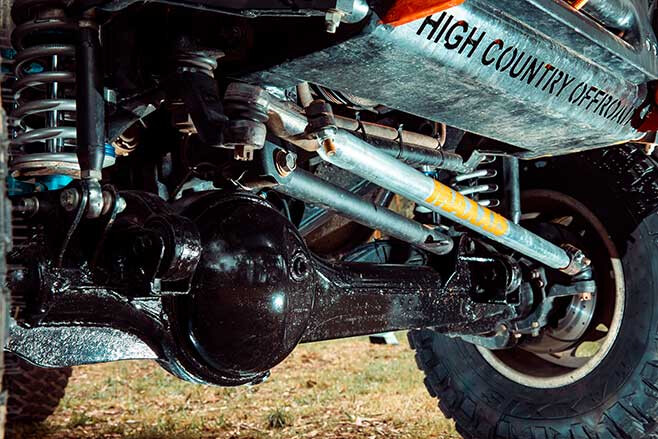
The rear end sees what Nissan folk dub the big diff; parts interpreters call it the H260. Stock axles in the rear have been retained, because, well, they are bloody massive. Both diff centres have ARB Air Lockers installed, allowing Scott to select what diffs he wants locked, and when.
Custom driveshafts from GJ Drivelines have been bolted in, built tough to handle the demands of a lively V8 and 37-inch tyres. To slow things down, which is important when racing, Scott decided on GU callipers from Road Runner Offroad, as well as rotors from DBA and RDA heavy-duty extreme brake pads.
WINCH OPTION
A STANDARD low-mount winch isn’t going to be up to the task of a winch challenge. Heck, even a decent stock high-mount isn’t going to be terribly competitive at lugging a few tonnes of 4×4 up a steep-arse hill quickly. Scott spared no expense when it came to winch selection, opting for a twin-motor unit, with +150 drum to house additional winch rope, from UK-based company Red Winches.
CRUSHED: Winch crushes Rodeo
One look at the fairlead on his custom bullbar, shows you this is a serious piece of kit. As mentioned before, it can be run on 24V and, in the heat of the moment, will pull the ’Cruiser to the top of a near-vertical gradient quick smart. Just what you want when the aim of the game is to get to the top first.
SHOCK SELECTION
TO be competitive in off-road racing, there’s no way the factory leaf springs would cut the mustard. While the grinder and welder were out for the diff swap, Scott pieced together a high-end suspension system designed to absorb the biggest of bumps. In the front, Kings 10-inch coil-overs have been adapted, with Superior Engineering 2.0-inch hydro bump stops. This provides decent wheel travel, while riding as nice as an FJ45 can.
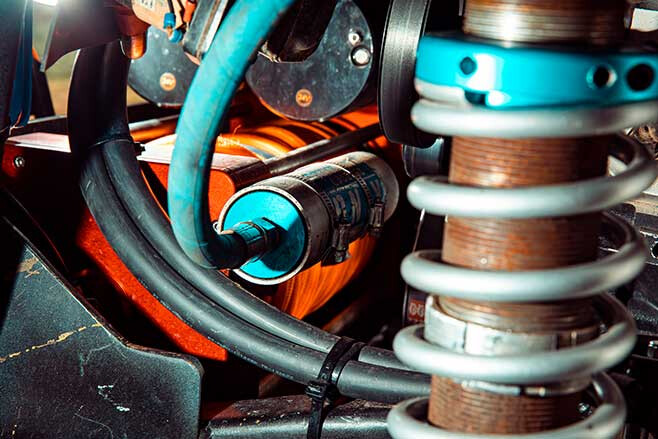
The rear end sees similar treatment in the suspension design with Kings 10-inch dual bypass shocks and hydro bump stops. Rounding out the suspension package, speciality sway bars from Design Fab work off a torsion bar design and have massively reduced body roll on fast corners without limiting wheel travel when the going gets rough.
BODY WORK
AS mentioned, Scott is a vehicle body builder by trade. So, there’s no way this area would go unnoticed from his evil eye. The rear tray is all custom and has been designed to be as light as possible, while housing key essentials. We’re talking an ARB twin compressor, the radiator, some space cases for tools and parts as well as the spare 37-inch tyre.
You might also notice the body looks different to most LandCruiser utes. Scott has gone for a custom extra-cab design, which allows for more interior space, with an additional window on the side for extra visibility.
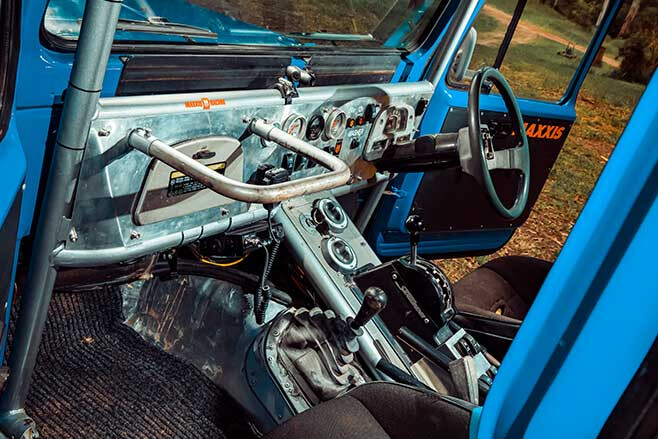
As safety is important when racing, Scott had High Country Off-Road build a custom roll cage to protect occupants in the event of a roll over. The team there designed and fitted the cage for Scott, and he’s stoked with the outcome. The team at High Country Off-Road also handled paint duties, splashing a few litres of 2K Pro Tech Blue on the previously tired FJ45 body.
For such a custom build, you’d have to think this would be a nightmare to piece together, but Scott is more upbeat about the process. “There were days where things did not go to plan, but nothing that couldn’t be fixed,” Scott tells us. “Overall, watching the progress each time I had time to work on it and seeing the finished result was extremely rewarding.”
After taking two years to build his LandCruiser, Scott reckons his only plans now are to keep racing and having fun. So far, he has already nabbed a second-place position in the Highmount Guy Ultimate 4×4 Challenge, so he is certainly a name to remember in the future of off-road winch challenges.
TYRES AND WHEELS
MAXXIS has gained a reputation as creating solid-performing tyres in the off-road competition scene. From rock crawling to high-speed endurance racing, it’s a fair chance you’re going to see a set of Maxxis tyres strapped to the vehicle on the podium.
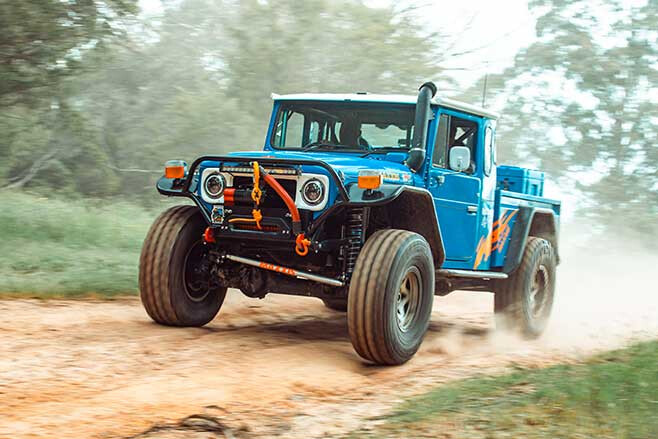
Scott saw no reason to buck this trend and had a set of 37×12.5R17 Maxxis Razr mud terrain tyres shipped out. “Those tyres were the best option available for my requirement,” Scott tells us. “No regrets either, they have done everything I’ve asked of them so far.”
As this is a comp truck, there was no point mucking around in the wheel department. Scott chose the popular (and downright sexy) Walker Evans bead-locked alloy wheels. These suit the FJ45 perfectly, and are a perfect balance between low weight and high strength.
SPECIAL THANKS
WE all know it can take a small army of helpers to get a build like this done, and Scott’s ’Cruiser is no exception. Thanks must go to High Country Off-Road, Maxxis Tyres Australia, Yukon Enterprises, JTX Lighting, Road Runner Offroad, Swat Suspension, Red Winch, Grant Fowler Signs and NJV 4×4.
Electric car start-up Rivian Automotive is inching ever closer to a public debut of its R1T and R1S EV off-roaders, with the Detroit-based company luring punters with videos of its electric rigs doing cool things.
Posted to Twitter by Rivian’s founder and CEO, RJ Scaringe, two new videos show the all-electric R1T pick-up variant successfully ascending and descending steep, rocky trails normally reserved for the more hardcore enthusiasts.
Another video released early in 2020 via Rivian’s official Instagram page showed the dual-cab R1T ute performing a tank turn.
If you’re not familiar with the term ‘tank turn’, it’s a manoeuvre that involves pivoting a vehicle – typically a tank – on an axis so that it can change direction in very tight confines.
The feature is available on the R1T and R1S models.
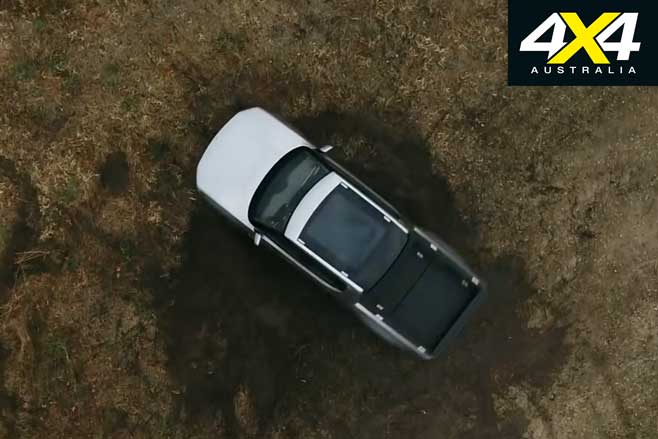
While it might seem like a cool party trick for an off-road vehicle, the tank turn actually has genuine off-road benefit. For example, when you can’t back up, you’re stuck on a narrow track and you lack the space required for a three-point turn.
Rivian first unveiled the R1T and R1S (the seven-seat SUV derivative) at the 2018 LA Auto Show, with the all-electric vehicles featuring a quad-motor system delivering 147kW to each wheel – hence the capacity to complete a tank turn.
At the time of the vehicle’s debut, the company’s Executive Director of Engineering and Programs, Mark Vinnels, said: “The beauty and elegance of our quad-motor setup isn’t just about brute power; this architecture provides instantaneous torque with extremely precise control at each wheel, which is completely game-changing from a dynamics perspective, both on- and off-road.”
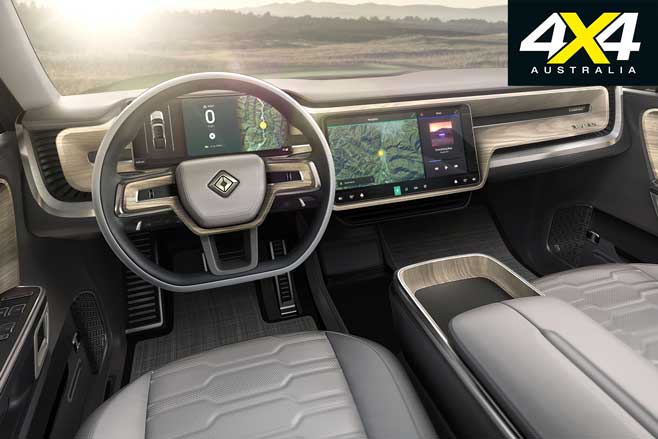
Three battery sizes are planned to power the electrified 4x4s: 105kWh (400+km range), 135kWh (480+km range) and 180kWh (640+km range).
American deliveries are expected to begin later in 2020.
For a full list of specs check it out here.
IT HAS been almost 18 months since we drove American Expedition Vehicles’ (AEV) Chevrolet Colorado ZR2 Bison in the USA.
In that time the Holden brand has been retired, taking away any access to a Colorado ute in Australia.
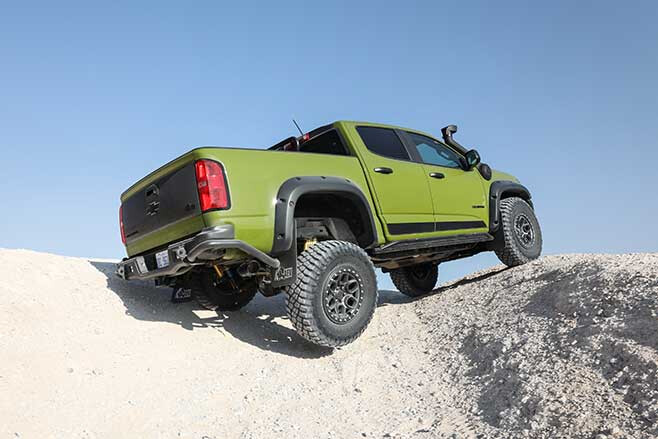
While we can’t see a viable business case for the recently established GM Specialty Vehicles (GMSV) to import, convert and sell a regular variety Chevrolet Colorado here, we do reckon there’s be a market for the hopped-up ZR2 Bison from AEV.
GMSV currently imports and converts Chevrolet Silverado trucks in Australia and will soon be the distributor of the Chevrolet Corvette here, so the ZR2 Bison could be the perfect addition to its fleet of specialised vehicles.
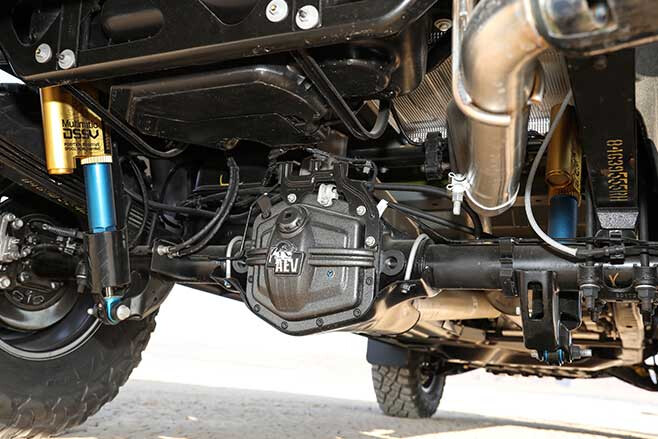
Fitted with the optional 35-inch tyres, front and rear locking diffs, Chevrolet Performance’s excellent DSSV dampeners and all the stylish ZR2 body add-ons, the Bison could be a true Ford Ranger Raptor challenger here in Australia.
Watch the above video to see what we thought of it after a day in the Nevada desert.
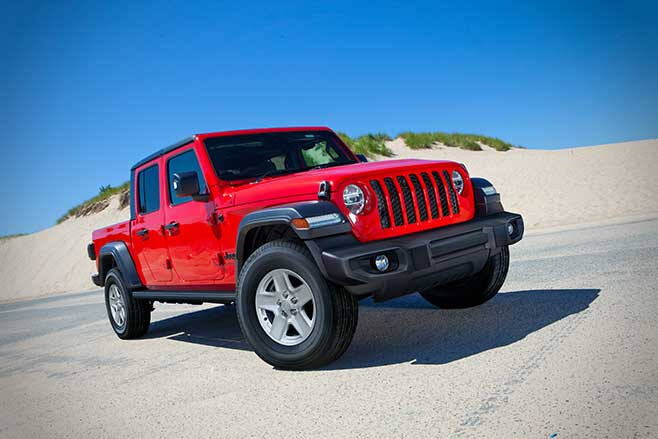
JEEP Australia has released a more affordable way to get in to its Gladiator pick-up, with the introduction of the Gladiator Sport S.
Starting from $65,450, the Sport S sits below the existing Gladiator Overland ($75,450) and Rubicon ($76,450) models already sold in Australia.
“The Jeep Gladiator Sport S creates a new entry-level price point into the Jeep Gladiator range, without compromising on safety, technology and Jeep’s renowned off-road prowess,” said Guillaume Drelon, Jeep Australia Director, Brand & Product Strategy.
Powered by the same 3.6-litre petrol V6 engine and eight-speed automatic driveline as the other Gladiator variants, the Sport S comes standard with a smaller seven-inch U-Connect screen; dual-zone climate control; 17-inch alloy wheels; three-piece removable hardtop; LED lights; and the Selec-Trac 4×4 system offering 2WD, underbody skid plates, on demand 4×4, full-time 4×4 and locked 4×4 in high and low range.
The full suite of Jeep safety equipment comes standard on the Sport S including Forward Collision Warning Plus, Adaptive Cruise Control with Stop, Blind Spot Monitor and Rear Cross Path Detection. The pick-up still has the three-star safety rating of all the Gladiator and Wrangler models.
An option to spruce up your Gladiator Sport S is the $2950 Lifestyle and Adventure package, which adds a roll-up tonneau cover, cargo management with Trail Rail system, lockable rear under-seat storage bin, spray-in bedliner, wireless Bluetooth speaker, auxiliary switch bank (four programmable switches), 240amp alternator, and a 700amp maintenance-free battery.
OFF-ROAD TEST: Gladiator Overland
The $2450 Comfort and Technology Group package includes the bigger 8.4-inch U-Connect screen of the upper model grades, deep-tint sunscreen windows, hard top headliner, security alarm and remote start system.
While the Gladiator Rubicon remains the off-road champion of the range thanks to its Roc-Trac 4×4 system with low gears, locking diffs, disconnecting front swaybar, Fox shocks, and rock rails, the Sport S gives buyers a more affordable entry point to Jeep’s lifestyle pick-up model.
The Gladiator Sport S arrives in Jeep showrooms in February.