The 2022 GWM King Kong has been shown off in China, and the dual-cab ute could end up in Australian dealerships.
Details of the GWM pick-up emerged in the database of the Chinese Ministry of Industry, with local media reporting the King Kong is due to be fully unveiled at the Guangzhou motor show later this month.
“We’re always open to new models, such as the King Kong Ute, that could expand the GWM product portfolio in Australia,” a spokesperson for GWM Haval told 4X4 Australia.
“While our regular discussions on product continue with our Head Office colleagues, it’s too early to say whether we’ll see it here,” they added.
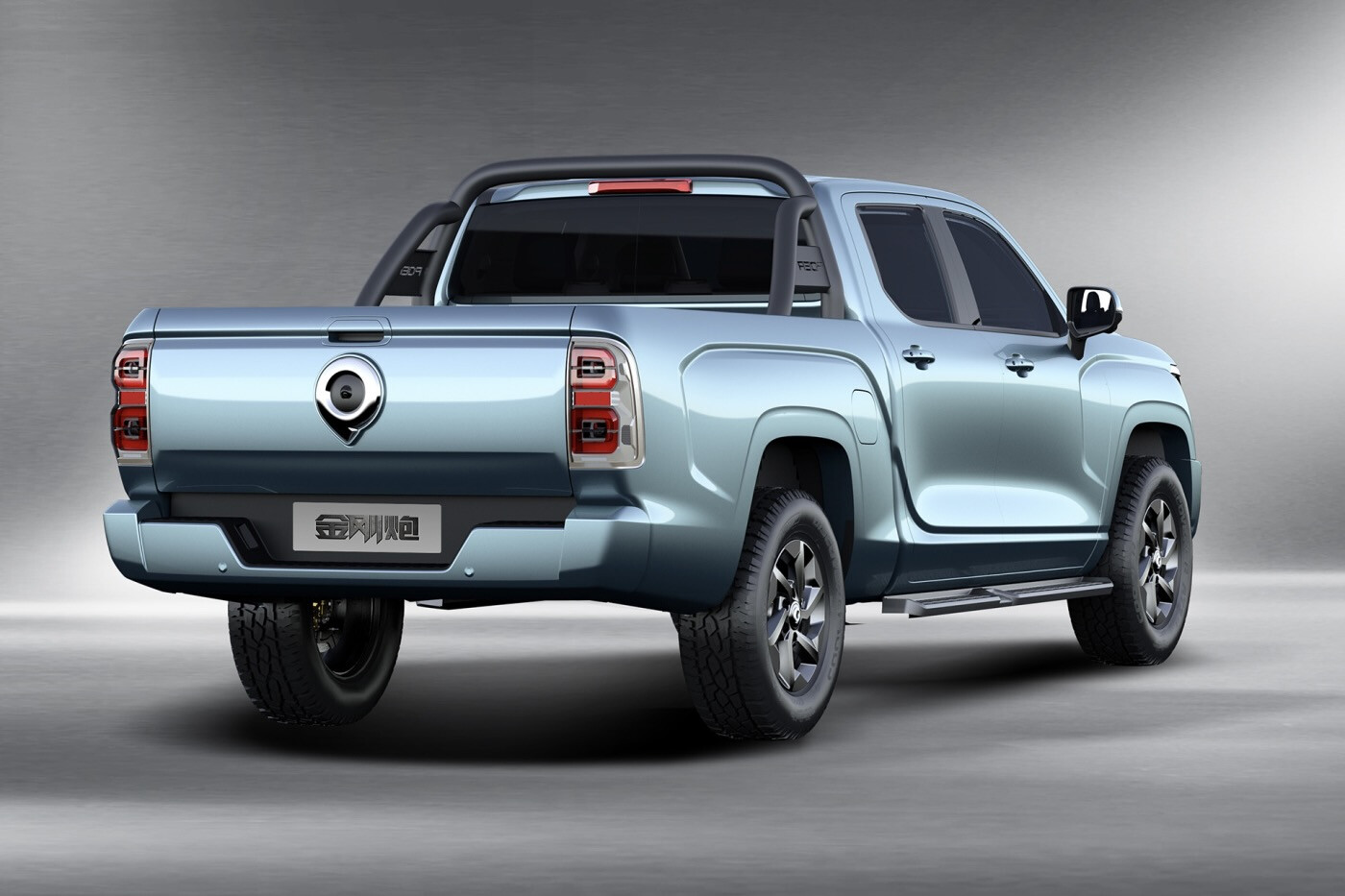
Some outlets are also referring to the King Kong as the Poer Diamond Cannon, with its stablemate – known in locally as the GWM Ute – being badged as the Poer Cannon in its native country.
Curiously, Chinese rival Geely also has a model called the ‘KingKong’.
GWM’s King Kong is available with two different tubs – a standard model with a length of 5365mm, or a long version with a length of 5635mm. Both have a payload of 500kg and a 3140mm wheelbase.
Despite the vehicle’s imposing looks, the standard version is actually shorter, narrower, and lower than the GWM Ute sold here.
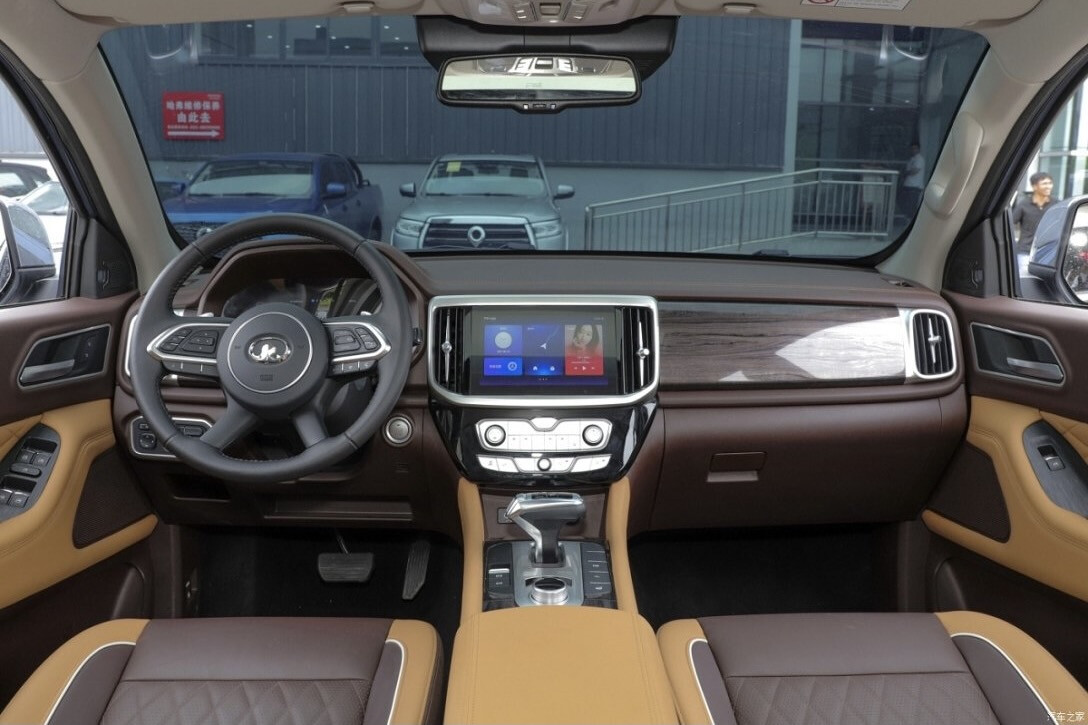
Reports are the King Kong will be offered with a 2.0-litre turbo-diesel four-cylinder engine producing 123kW and 360Nm. Buyers get a choice of rear- or four-wheel drive, with drive fed through either a six-speed manual or eight-speed automatic transmission.
Higher-grade models are expected to come standard with LED headlights, keyless entry, sunroof, rear-view camera, dual-zone climate control, and side-steps.
Expect more information about the 2022 GWM King Kong to emerge following the model’s public debut in the coming weeks.
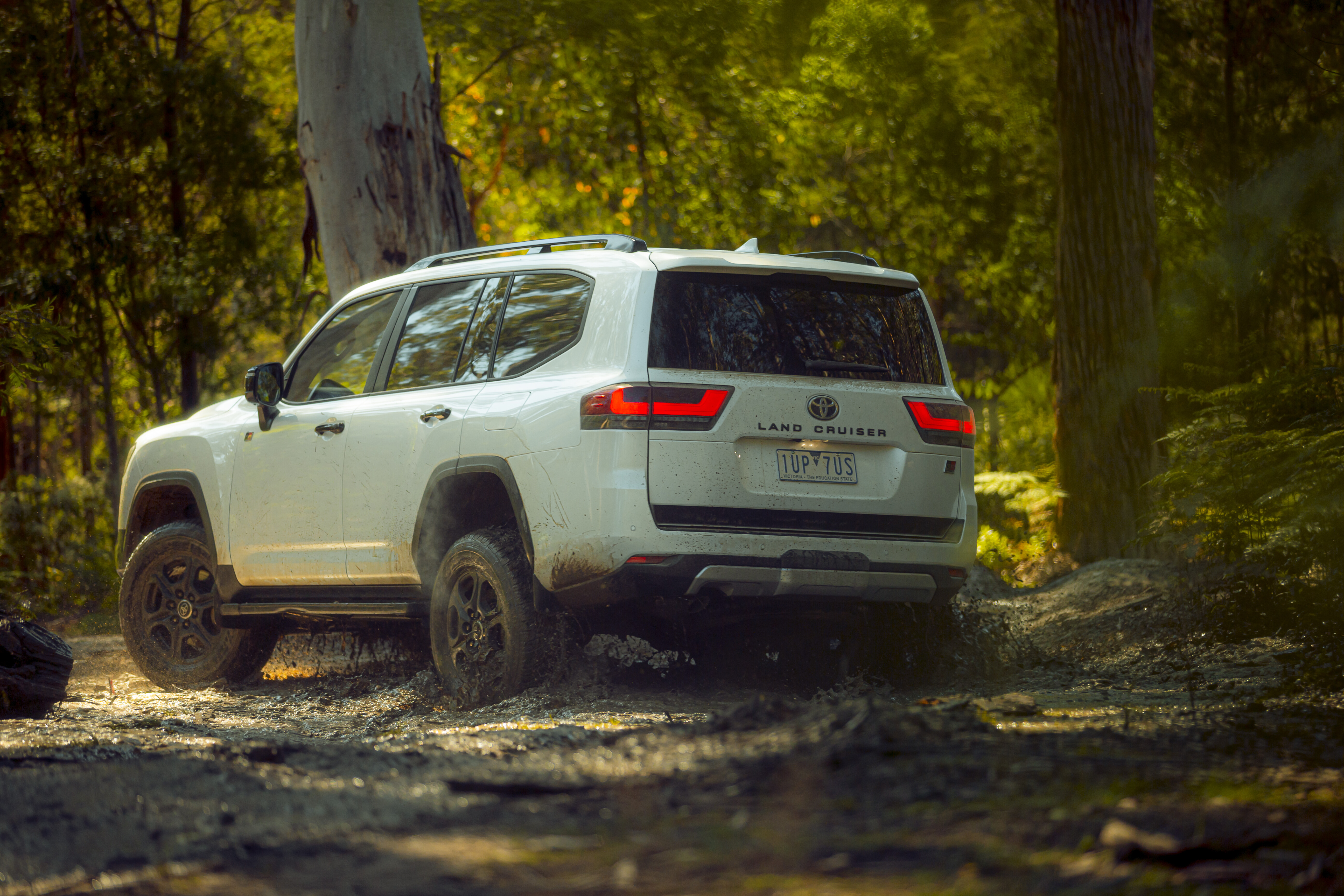
IT’S been a long time coming, 14 years in fact since the launch of the 200 Series, and even after its eventual launch Toyota’s 300 Series LandCruiser is still a hard vehicle to get in to.
While semi-conductor shortages have delayed production and limited supply to customers, we’ve managed to nab an LC300 for a few days to test its off-road mettle.As it is marketed as the more off-road focused model in the six-variant LC300 range, we’ve gone for the GR Sport model which, along with the range-topping Sahara ZX, is new to the nameplate. What makes the GR Sport the most off-road capable LandCruiser variant is the inclusion of front and rear locking differentials as standard and the addition of E-KDSS which is the latest generation of Kinetic’s clever suspension system.
The killer is that the GR S is the only model to get this off-road hardware and you can’t option factory lockers or KDSS in to the lower-grade models.The problem with the GR S is that, at $137,790 it’s the second most expensive model in the range, only beaten by Sahara ZX which adds another $1000 to the base price. The GR S comes with the equipment levels to match that price but all that kit adds weight, meaning that the GR S has the lowest payload in the range with 650kg available.
POWERTRAIN & PERFORMANCE
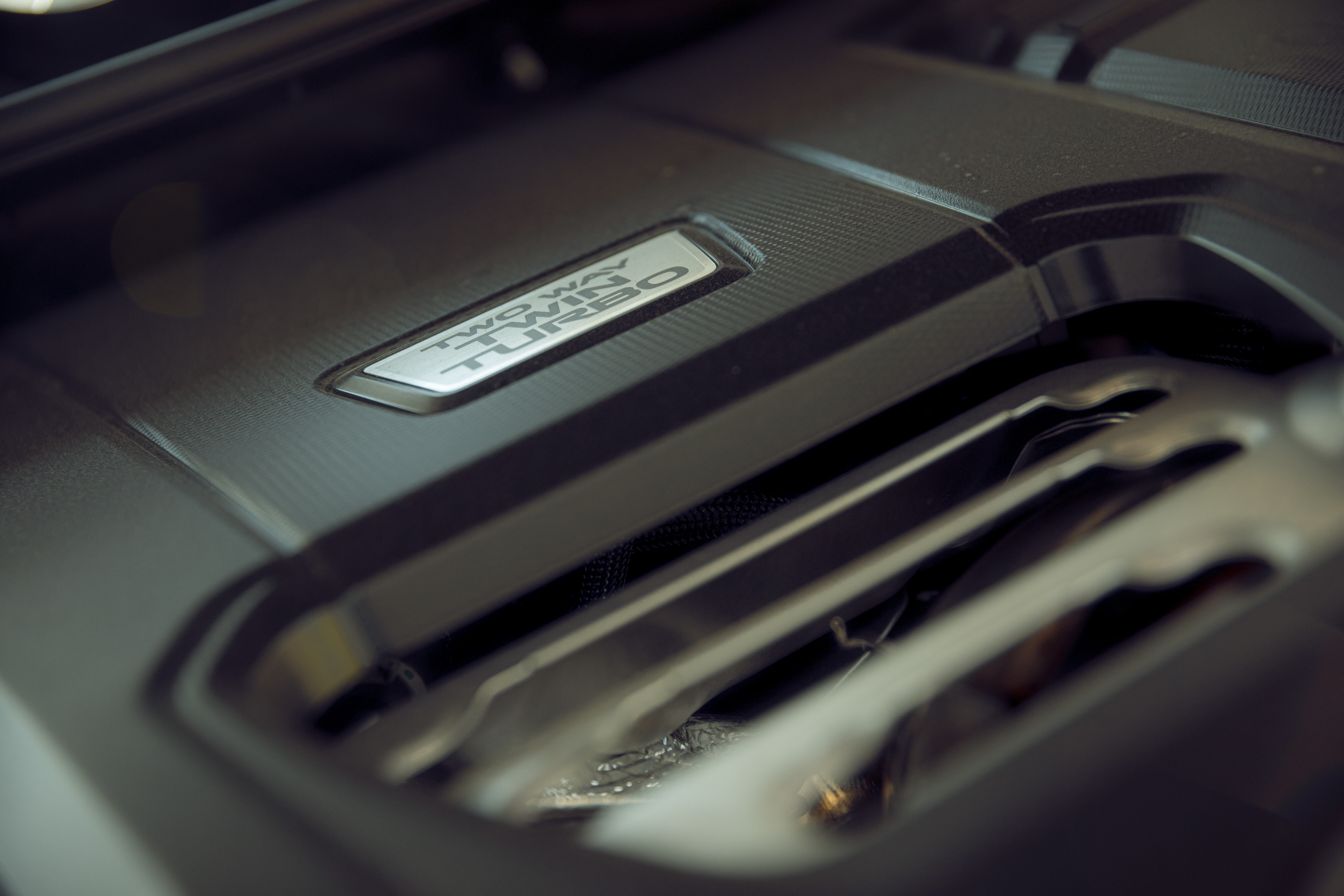
UNDER the Cruiser’s new aluminium bonnet is an all-new 3.3-litre twin-turbo V6 diesel engine. The V8 is gone but this engine makes more power and torque than the old 4.5-litre bent eight. The 700Nm of torque and 227kW of power are on tap under the go pedal and it propels the big Cruiser along swiftly when you put your foot down.The F33A-FTV engine employs what is known as a ‘Hot-V’ design. This means that the exhaust manifolds and the turbochargers are mounted in the 90° V between the cylinder heads and the intake manifolds are on the outside of the engine. This helps to make the engine more compact and puts the turbochargers closer to the exhausts ports to reduce lag and increase efficiency.With all that heat now at the top of the engine, Toyota has had to do away with the top-mounted intercooler as used on previous LandCruisers and moved them up behind the grilles, under the headlights. I say them, as there are two of them and they are now a fluid-to-air design so they should be more efficient.
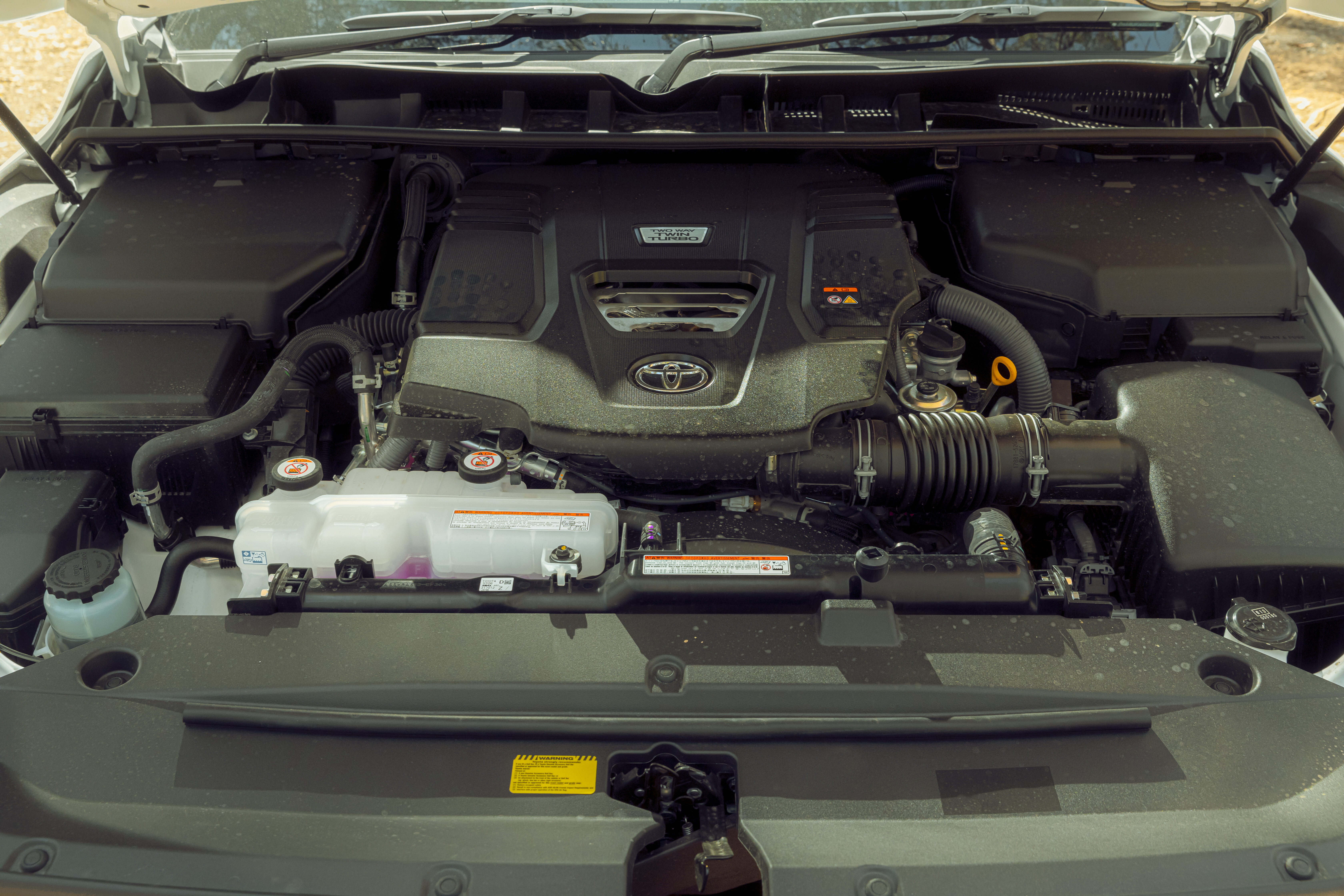
The problems of this set-up, particularly for off-roaders, is that they are more vulnerable to damage being mounted right up the front of the car and are more complex in design introducing another coolant system to the powertrain.
The engine is backed by a 10-speed automatic transmission and before your ask; no, it does not automatically shift through to top gear under normal highway cruising conditions. I found that cruising at 110km/h and moving the shift lever across the manual mode would shift it back a ratio to seventh gear and tapping it though to 10th you could get it to cruise at around 1300rpm. Shift back to automatic and the revs pick up as the transmission goes back to eighth for easy cruising.I don’t see this as a problem. The transmission is programmed to keep the engine in its optimum rev range for the speed, load and conditions the car is operating under. I’m pretty sure that if the engineers thought they could make it more efficient by allowing it to shift through to top at that speed they would have, in their never-ending quest for efficiency and fuel economy.Speaking of economy, the 300 is officially rated at 8.9L/100km on the combined cycle and we recorded 13.62L/100km during our stint of suburban, highway and off-road driving. The old 1VD-FTE engine was never particularly efficient and this new-tech V6 combined with the 10-speed auto should prove much more frugal in real-world conditions.
ON-ROAD RIDE & HANDLING
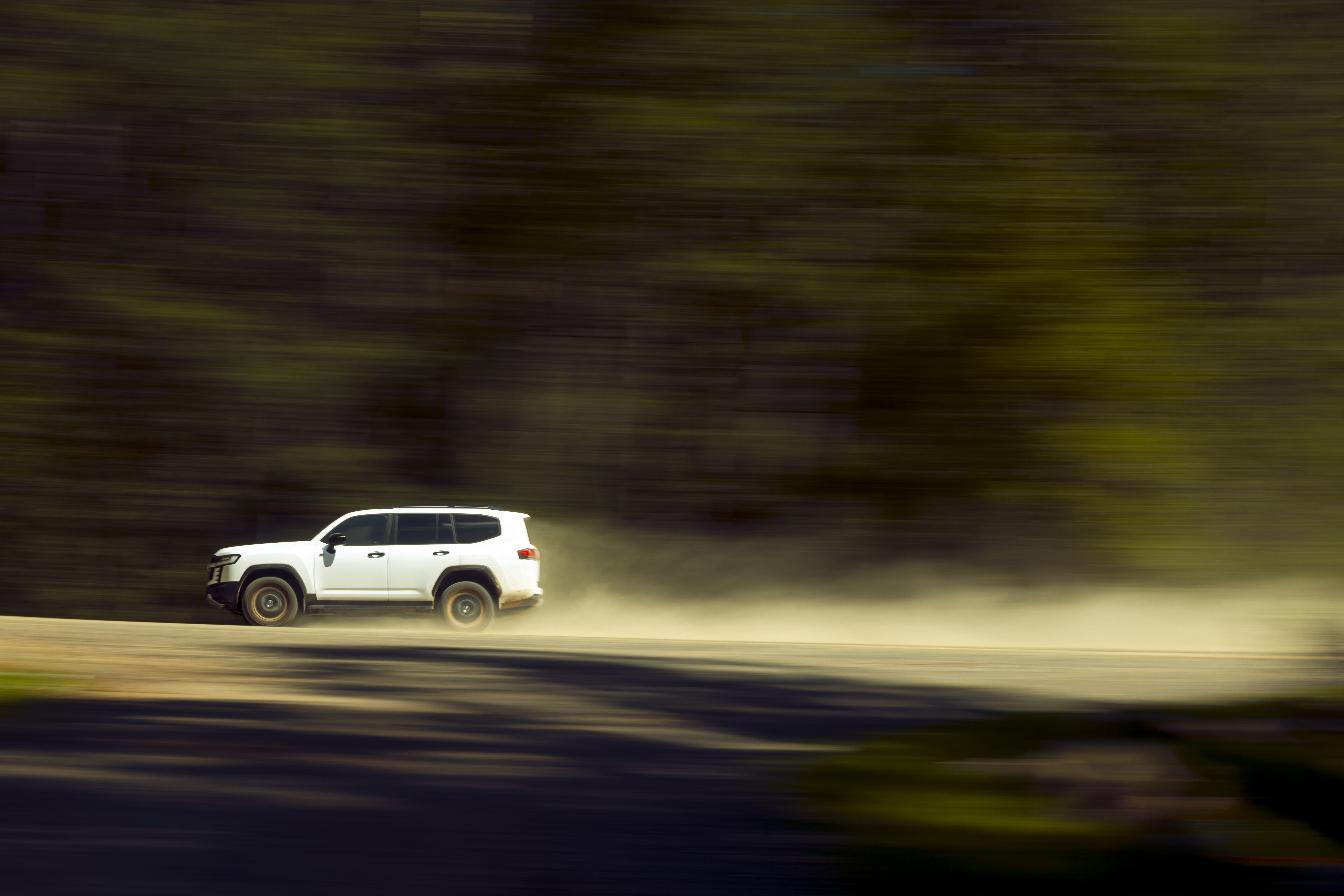
THE LC300 rides on Toyota’s new TNGA chassis which it shares with the Tundra pickup truck in the USA that was launched around the same time as the new Cruiser. It’s still a body-on-frame design but now employs more high-strength steel in key areas to improve stiffness, while using aluminium in some suspension components to reduce weight.The suspension is a double wishbone, coil sprung independent set-up at the front and live rear axle at the back, located by multi-links and riding on coils.
The GR Sport and Sahara ZX Cruisers get variable dampeners that allow you to select comfort, sport or sport+ settings to suit your driving preference and style.
The GR Sport’s E-KDSS system works on the front and rear sway bars to lighten the tension on them when driving at low speeds off road, and tighten them up for firmer body control at higher speeds on road. The system is a further development of the old KDSS to now automatically disconnect the sway bars when required off road to give the most axle articulation.All that kit delivers a ride and handling characteristic that is still instantly recognisable as LandCruiser. It’s soft and supple, soaking up road bumps, and pitches and wallows when pushed hard. Even in the Sport modes the handling is still soft and the LandCruiser has no sports car pretensions.
It’s a vehicle that’s designed to soak up anything the road can dish up to it while covering hundreds of kilometres per day and it does that very well.
OFF-ROAD
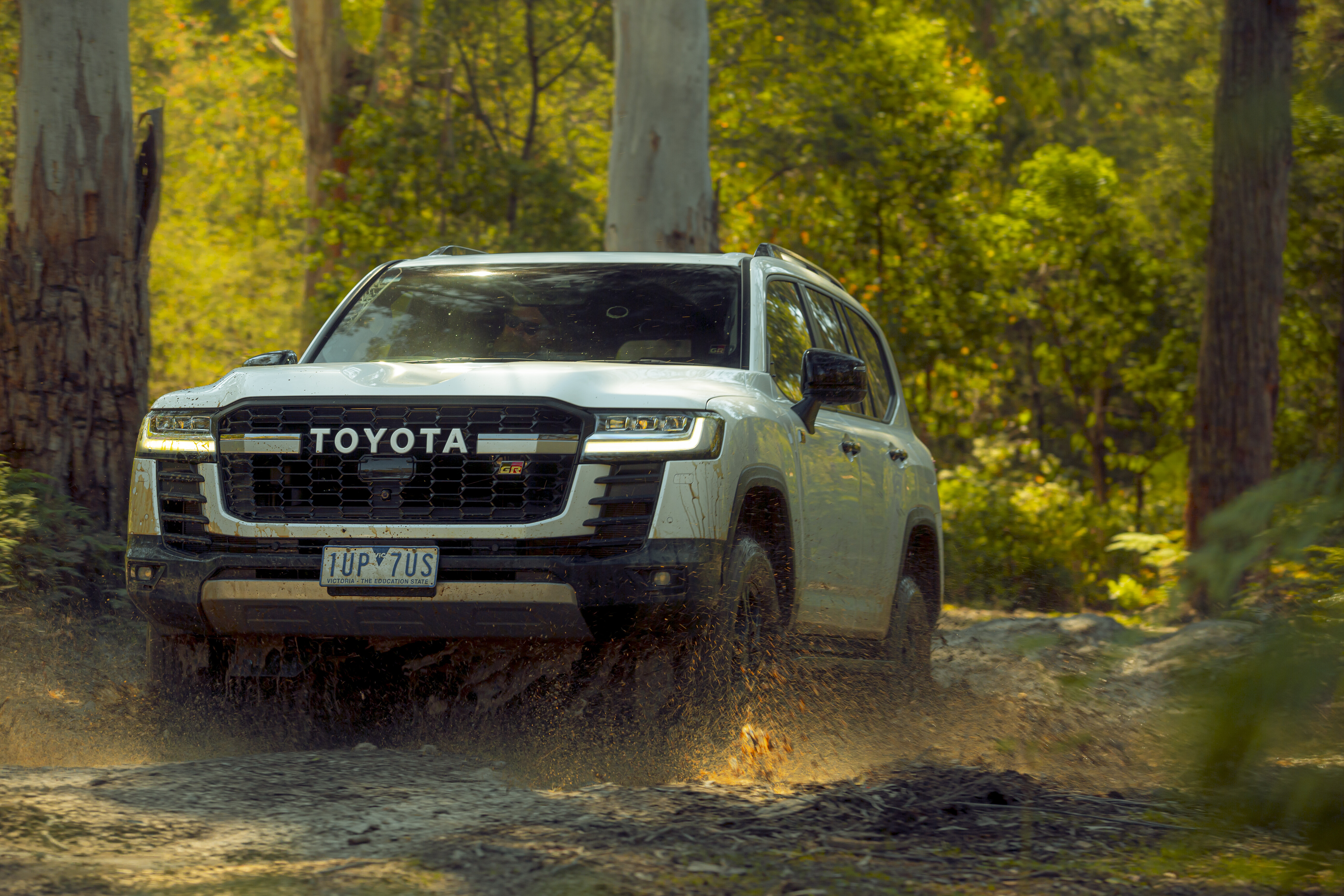
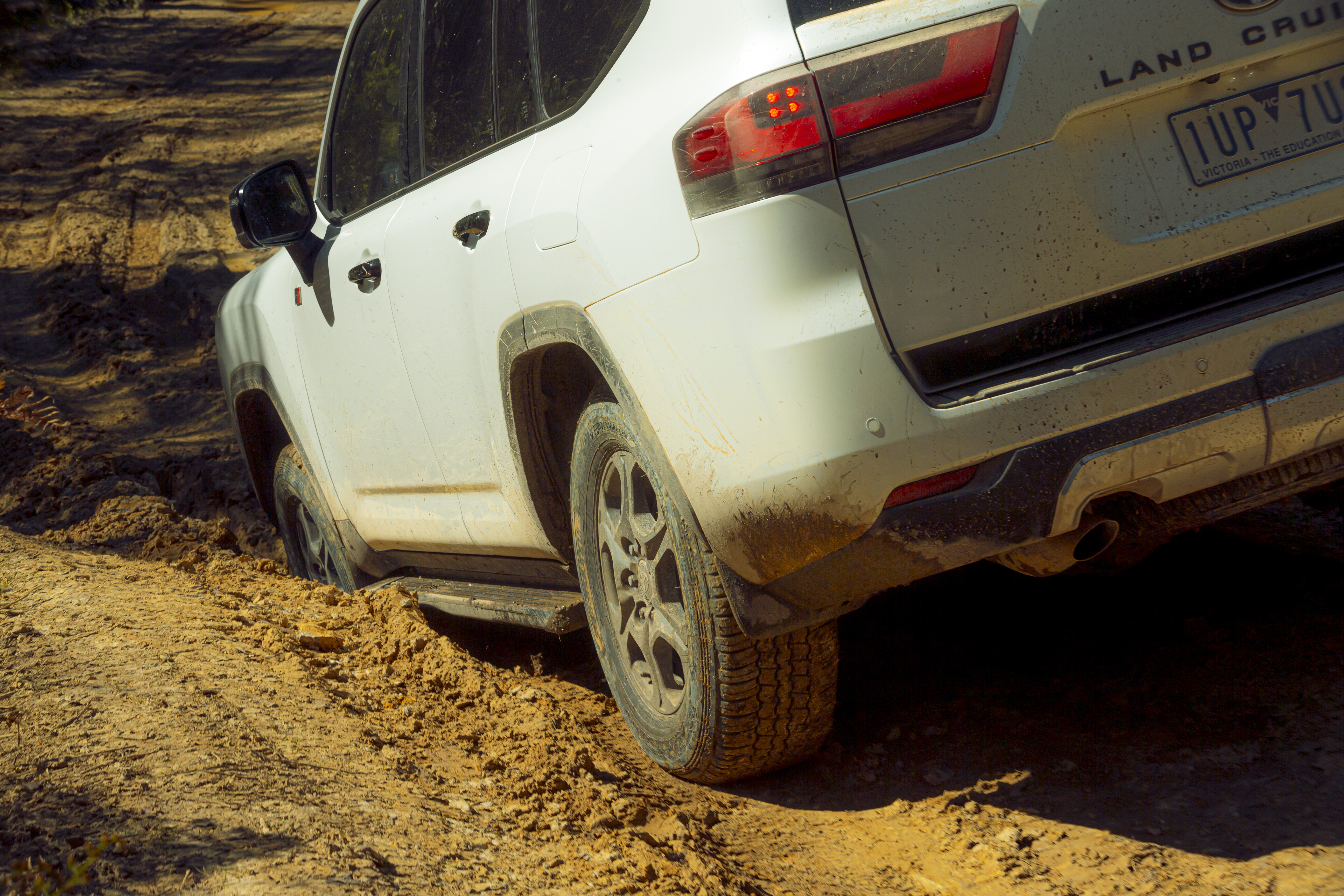
THE LC300’s four-wheel drive system carries over a full-time, dual-range set-up with a locking centre differential. As mentioned, the GR S also gets front and rear locking diffs and is the only model in the range to get them. When not using the diff locks, the car still has a perfectly calibrated electronic traction control system (ETC) and the refinements to the Crawl Control over the previous generation are exceptional and make it much more usable.We pointed the GR S LandCruiser up a particularly steep and rocky climb in the bush near Toolangi (Vic), which we thought would challenge it on its standard highway tyres. It is a hill we wouldn’t attempt in any standard 1-tonne 4×4 ute or the wagons built on those platforms.
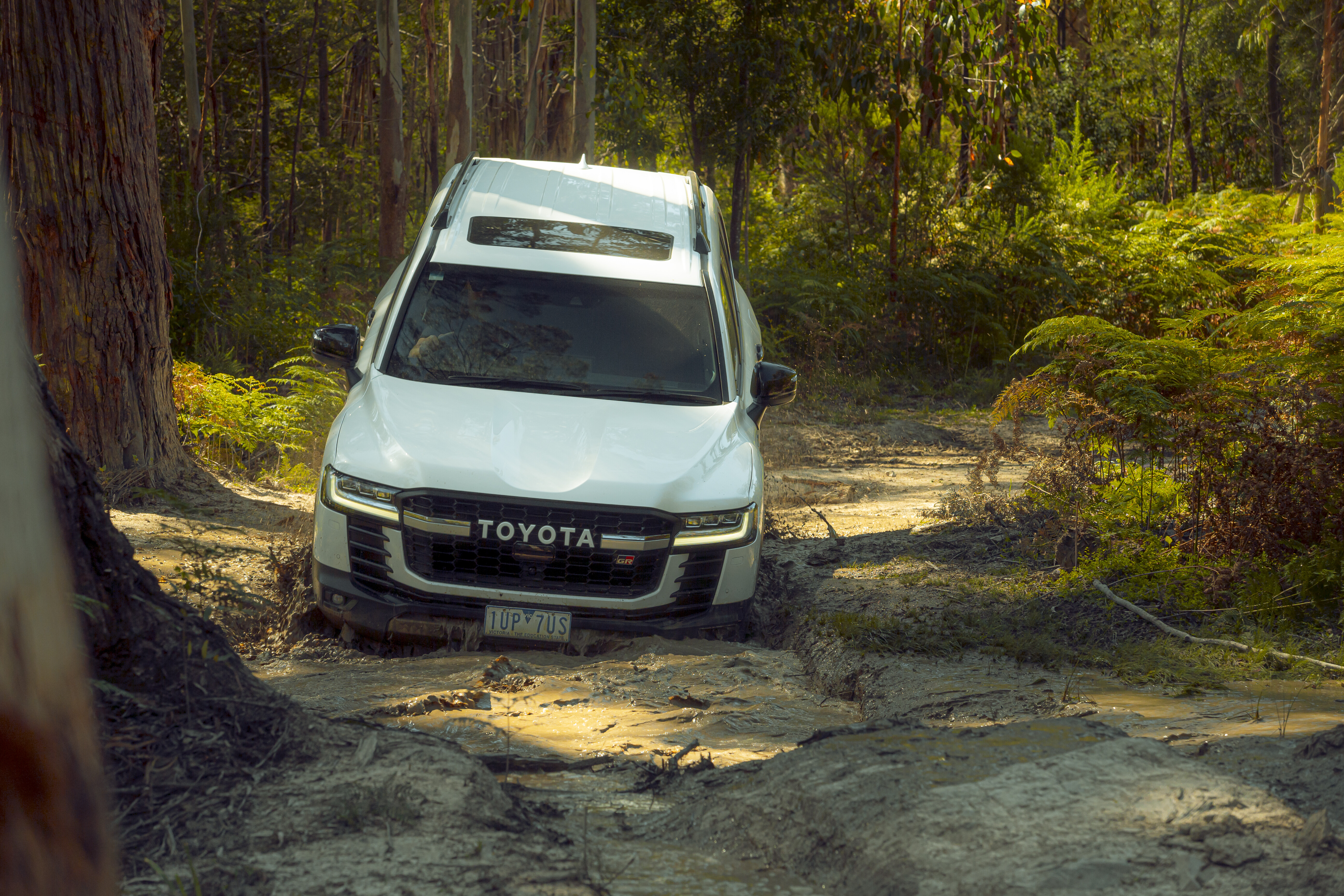
With the diff locks engaged, it walked up the first section far easier than expected and didn’t spin a tyre at all. The E-KDSS system gives the GR Sport 715mm of wheel travel which is 46mm more travel than the old 200 Series when equipped with the previous generation KDSS. This kept the tyres on the ground for maximum traction.I disengaged the front locker as I progressed up the hill and a few rock steps presented what could have been more of a challenge. Again, the Cruiser crawled up with relative ease, just scrabbling for front grip to get up the bigger steps and only lightly scraping one of the side-steps.The hill got steeper and the rock steps bigger, but there was no turning back at this point. I haven’t liked using Crawl Control or Hill Descent systems in the past but hit the button to switch CC on it lowest of five speeds and selected the Rock setting in the terrain selector (MTS).
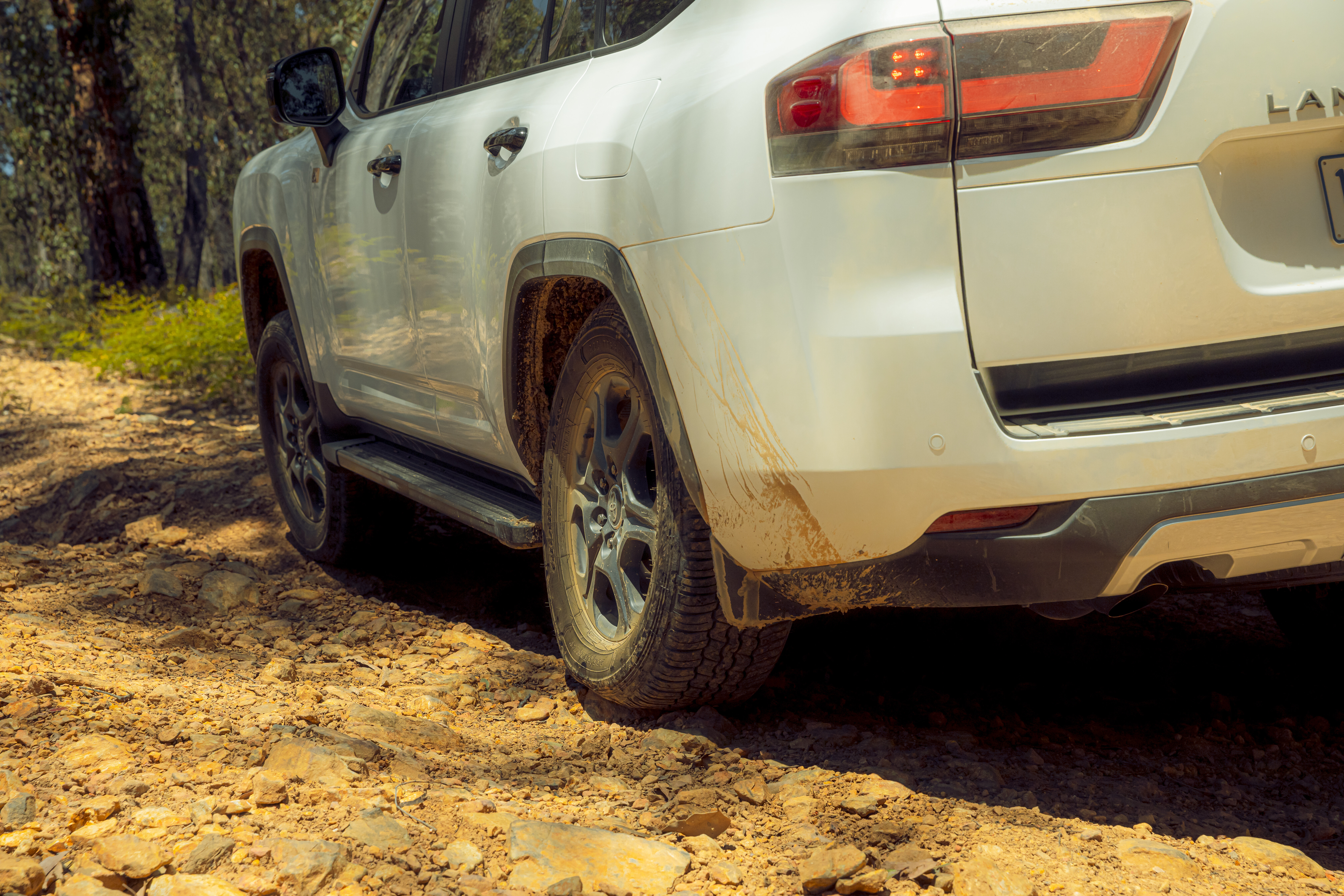
Employing larger pressure accumulators in the system has made CC much quieter and smoother than it was in past models and allowed the car to crawl slowly up with no driver input on the accelerator pedal, just steering the Cruiser to the best lines. You can feel the system applying minute amounts of drive to the axles while braking individual wheels to gain the most traction. It works brilliantly!I might not have liked such systems in the past but now that Toyota has refined it, I have to say the Crawl Control is exceptional both going up and down hills and will be of particular benefit in the lower grades of 300 Series that don’t have diff locks.
I still prefer to use the lockers and my own inputs but this system makes it easy for anyone who might feel intimidated by a situation they have got themselves in to. I was very impressed with the performance on this hill, considering the road tyres on the car.
CABIN & ACCOMMODATION
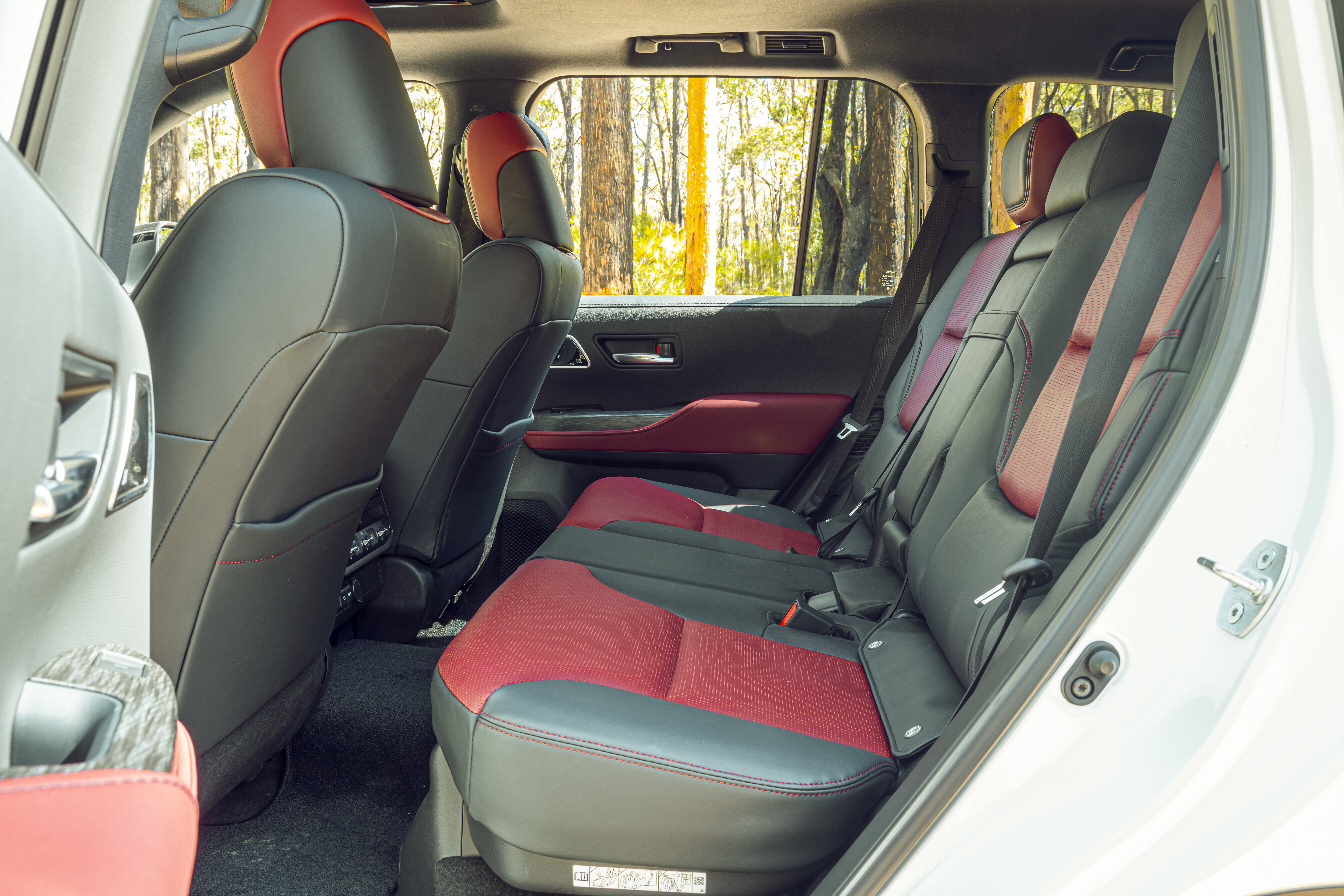
SLIP inside the GR Sport and you see why this is one of the more expensive LC300 models. Heated and cooled power-adjustable leather seats, power sunroof, plenty of bling, big configurable touchscreen that finally includes Apple CarPlay and Android, heads-up speed display for the driver, wireless phone charging and a drink chiller in the console are all fine appointments you’ll find in a luxury model.The GR S only has five seats, while other models in the range can have seven. This is as much to do with payload as anything, as the weight of the third-row seat plus passengers wouldn’t leave you with much. The lack of a third-row seat does leave plenty of space for cargo and there are four tie-down points here and a 220V-100amp power outlet, but no 12V outlet. I always like at least one 12V outlet here for powering a fridge and maybe some camp lights, while I’ve never gone looking for a household-style power plug in a car for anything during all my years of travels.
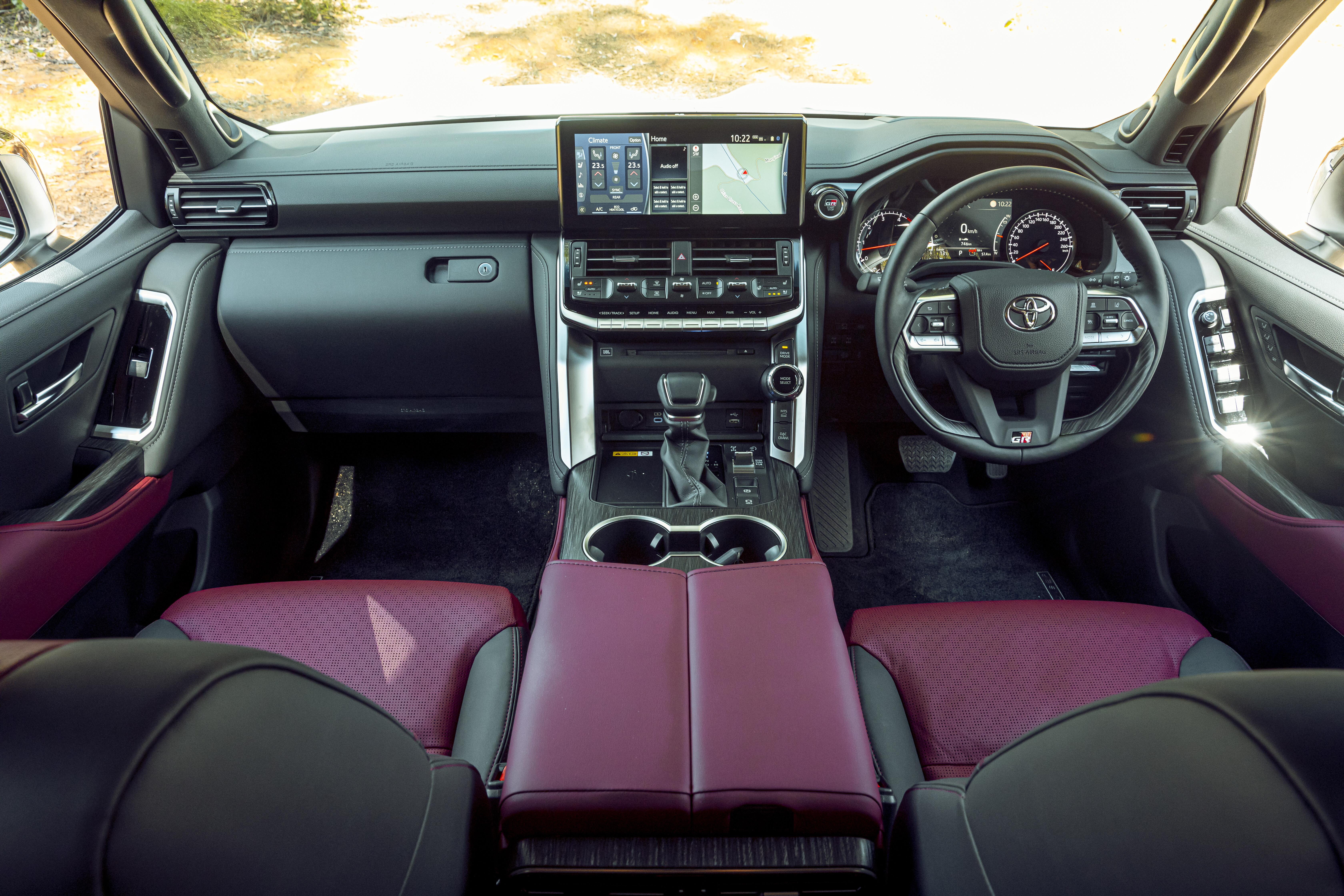
The old two-piece tailgate is gone and the now one-piece tailgate opens upwards.
The split tailgate design that used to be on LandCruisers and Land Rovers was fantastic as it gave you a tailgate which you could easily use as a table when prepping quick lunch on the road or simply a seat. As it was on the Land Rovers, it has been deleted to save weight but I wonder how much weight could be saved if the tailgate wasn’t powered. It is a feature that will be missed on the Cruiser wagon.The seating position is lower than it ever was in the previous model and this gives the impression of more space even though it’s really not much, if any bigger than an LC200.
At least I’m looking out the centre of the windscreen now and not through the top of it. The steering column is power adjustable for reach and height.
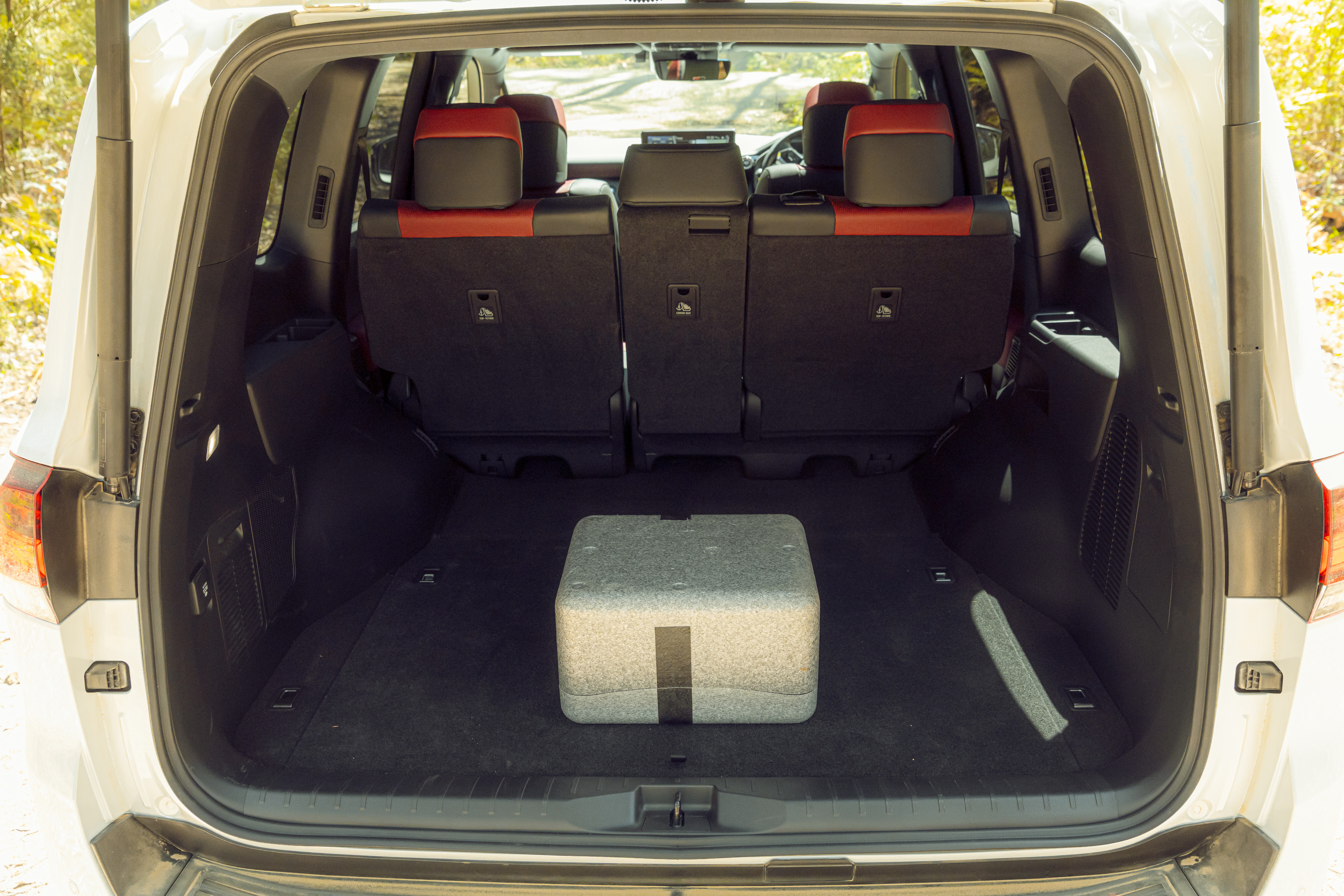
There’s plenty going on around the centre of the dash with lots of buttons but unfortunately, no easy-to-use dials for volume or station tuning.
One of the first things I found when driving the Cruiser was that whenever I looked to the dash to adjust something, I was blinded by the glare coming back at me from the silver switch gear. It only happens when the light hits them in such a way, but it makes all the black buttons extra dark so you can’t quickly focus on the labels on them. It’s poor design but hopefully will becomes less problematic with more use and familiarity.Like the 200 Series, the cabin of the 300 presents a large and comfortable place to make long trips easy. A sliding second-row seat to give more rear-seat leg room would be nice but isn’t available, and some tall adult passengers might not find the back seat too comfortable.
PRACTICALITIES
AS a five-seater, the GR S has plenty of luggage space in the back but owners will have to be wary of how much they carry, especially once they have fitted some heavy accessories or have a bit of weight on the tow ball.
The GR Sport has a 650kg payload, which is the lowest in the model range, while the entry-level GX model has the highest at 785kg. Towing is rated at 3500kg and having pulled a 3000kg trailer behind a 300 on another occasion, I have to say it does it easily.Tyres on the GR Sport are 265/65R18s which look small on it, while 17-inch wheels are available on the GX and at the other end of the range, the Sahara ZX wears 20s. There’s no reason you couldn’t fit any factory wheel 17-inch or above to any of the LC300 models to get the right tyres for what you do with the car. The 300 Series has reverted to six-lug wheels after the 100 and 200 Series vehicles had five-lug.
The standard fuel capacity has dropped from 138 litres to 110, with 80 in the main tank and 30 litres in the sub-tank.As it was on the 200, the tow bar is an integral part of the chassis and you just need to remove the panel in the bumper to insert the hitch and tow tongue. For the 300, Toyota has now incorporated the towing wiring in to the factory harness, simplifying installation.The engine bay doesn’t leave any obvious space for a second battery so the aftermarket guys will have to get creative to make that fit, while the air intake breaths through the near-side inner guard.Toyota has upped its game for genuine accessories and offers a choice of steel or aluminium bullbars, nudge bars, an LED light bar, roof racks, a Warn winch, underbody protection, rated front recovery points, a rear recovery hitch, and a raised air intake which is standard on the GX model.
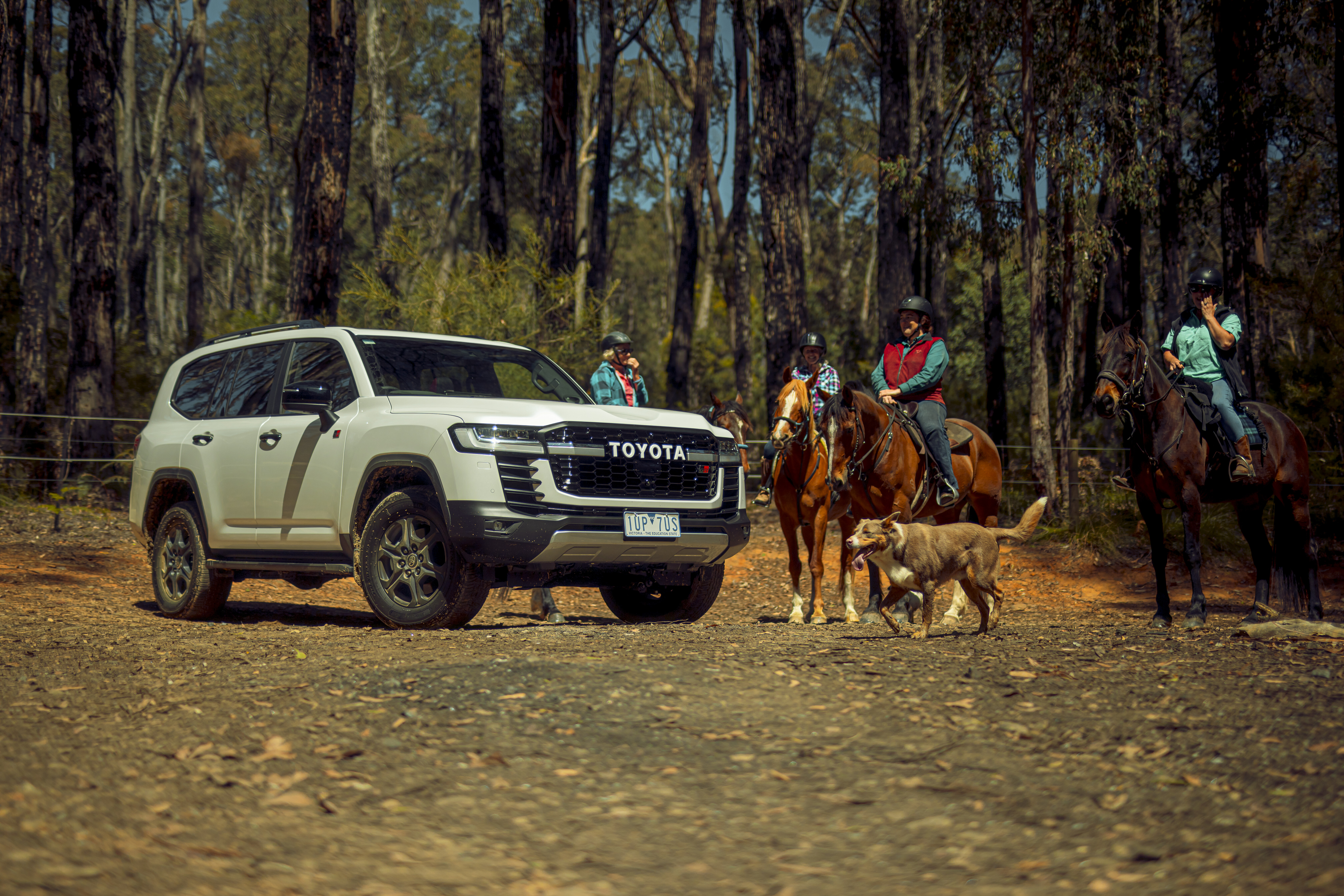
With the added vulnerability of those intercoolers up the front of the car, we’d recommend the fitment of a bullbar to any LandCruiser travelling in regional or outback areas to protect them as well as the car’s regular cooling system. A ’roo strike on either side of the front of the car could easily take out one of the coolers and leave you stranded.With the expected popularity of the 300, like any LandCruiser, you can bet the aftermarket brands will also deliver an extensive range of accessories, but you should also question the ability of any product to work with the safety systems on any modern car.
The radar and camera systems will provide challenges for the equipment designers. Thought also needs to be given to the GVM and payload when fitting any accessories.
SUMMARY
TOYOTA has raised the bar with the LandCruiser 300, although it’s only incremental. In its typical manner, Toyota only does as much as it has to to stay ahead of the pack and with no serious competition in terms of vehicle sales, it hasn’t revolutionised anything here. What it has done is refined the well-proven LandCruiser formula to deliver a car that is more efficient, more capable and easier to drive.The inclusion of the GR Sport model with its lockers and E-KDSS is to be commended as it creates a luxury 4×4 with capability we doubt any could match. The L663 Land Rover Defender would be the best comparison, as well as its traditional rival the Nissan Patrol.We’d love to see a model that delivers more of what 4WD enthusiasts would really like. That is, a lighter and cheaper GX or GXL model with the factory lockers and E-KDSS. By not offering this, Toyota has left a huge opportunity for the aftermarket to fill that void. The $30K saved off the price of the GR S would buy a lot of accessories to build a supreme touring wagon.In standard guise, the GR Sport is a supreme vehicle and will continue the marque’s dominance of the large 4×4 wagon segment once vehicle production is back to full tilt and it is able to deliver LandCruisers to customers.
2022 TOYOTA LANDCRUISER 300 SERIES PRICES
Prices exclude on-road costs
TOYOTA LC300 GR SPORT SPECS
| ENGINE | Turbocharged V6 diesel |
|---|---|
| CAPACITY | 3346cc |
| MAX POWER | 227kW at 4000rpm |
| MAX TORQUE | 700Nm at 1600 to 2600rpm |
| GEARBOX | 10-speed auto |
| CRAWL RATIO | 42.62:1 |
| 4X4 SYSTEM | Full-time; dual range; locking front, centre and rear diffs |
| CONSTRUCTION | 5-door wagon on ladder chassis |
| FRONT SUSPENSION | Double-wishbone IFS with coils; E-KDSS and variable shocks |
| REAR SUSPENSION | Live axle on links and coils; E-KDSS and variable shocks |
| WHEELS/TYRES | 18-inch / 265/65 |
| KERB WEIGHT | 2630kg |
| GVM | 3280kg |
| PAYLOAD | 650kg |
| TOWING CAPACITY | 3500kg |
| SEATS | 5 |
| FUEL TANK | 110L |
| ADR FUEL CLAIM | 8.9L/100km |
| ON-TEST FUEL USE | 13.62L/100km |
| DEPARTURE ANGLE | 25u00b0 |
| RAMPOVER ANGLE | 21u00b0 |
| APPROACH ANGLE | 32u00b0 |
| WADING DEPTH | 700mm |
| GROUND CLEARANCE | 235mm |
UPDATE, November 2022: MY2023 LDV T60 Max pricing, 7-year warranty announced
LDV’s Australian distributor has announced pricing and features for the updated MY23 T60 Max, including news of an upgraded 7-year / 200,000km warranty offering. Get all the details at the link below.
Original story continues: 2022 LDV T60 Max pricing
Snapshot
- 2022 LDV T60 Max builds on current T60
- New engine outperforms HiLux and Ranger
- Priced from $33,990 drive-away for ABN holders
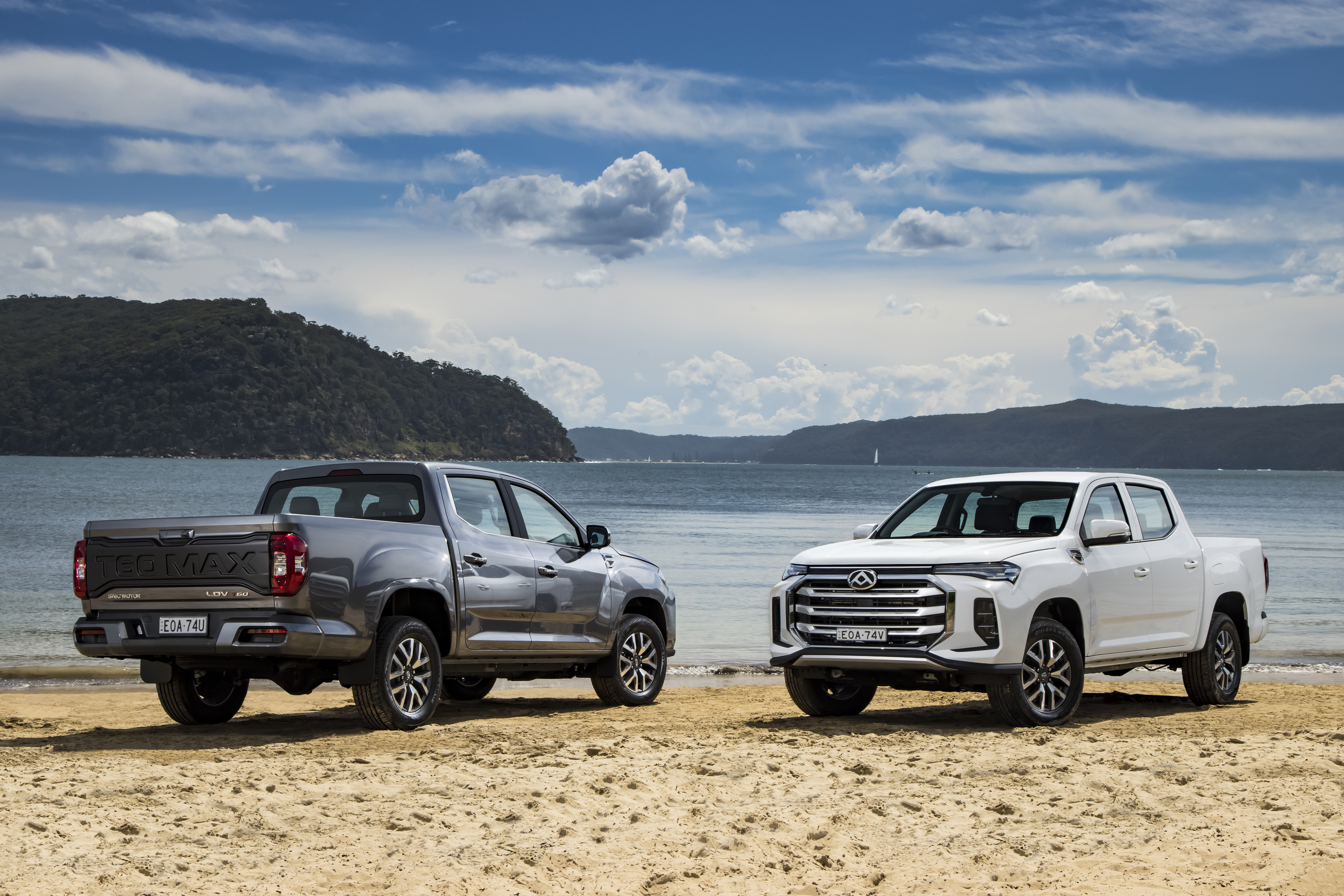
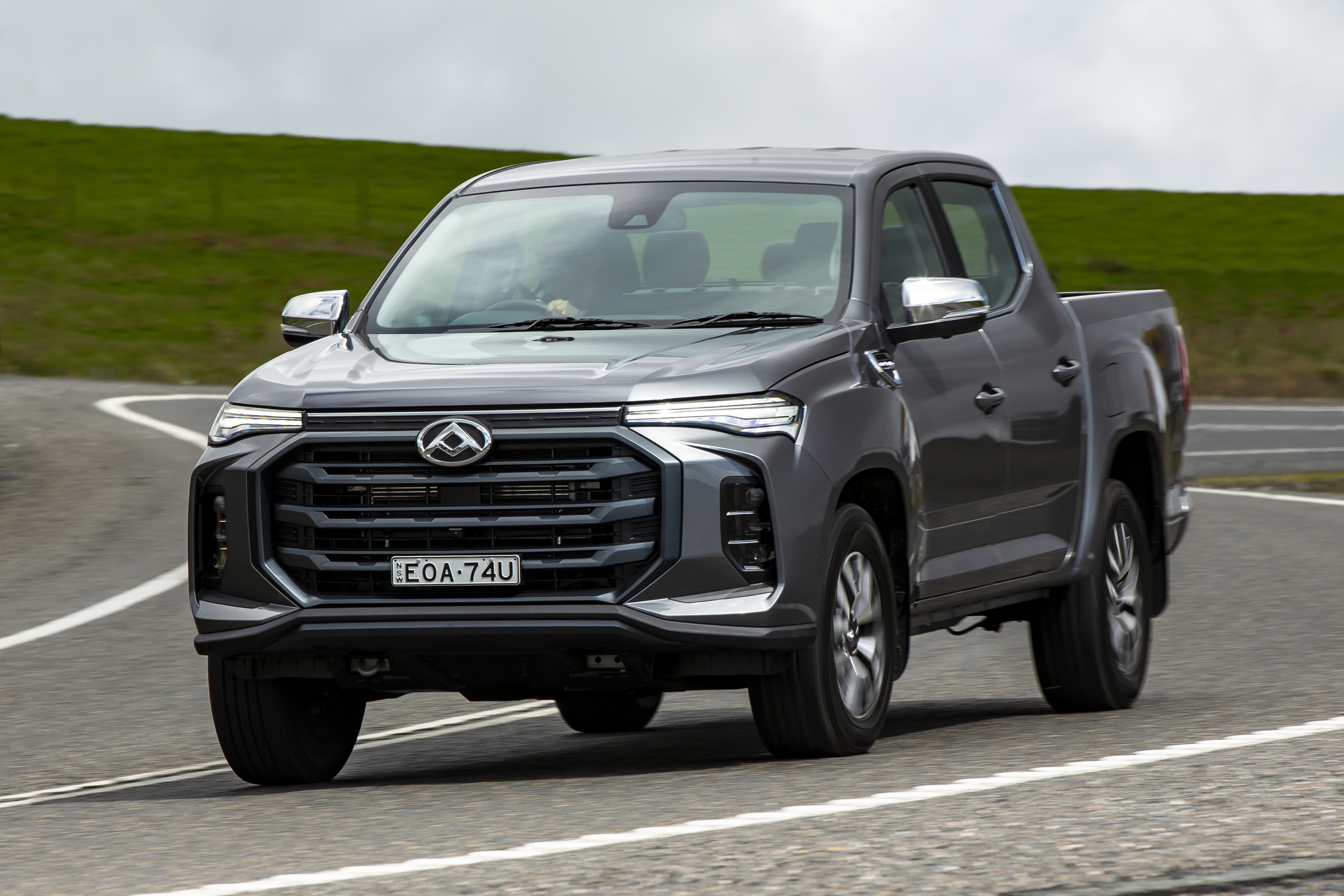
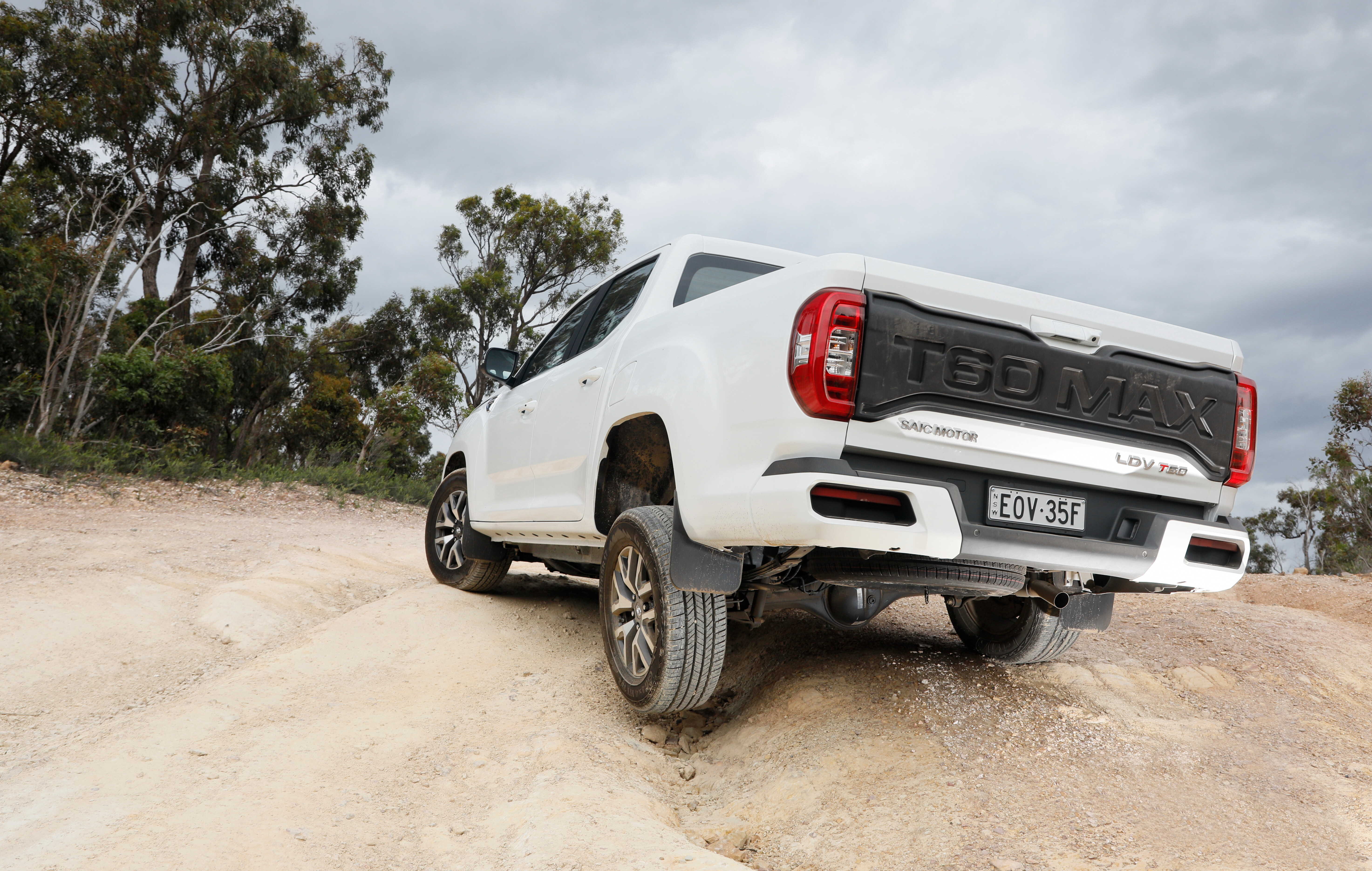
The 2022 LDV T60 Max has been unveiled, with the ute gaining a new look, better technology, and a more powerful engine.
The T60 Max is essentially a facelifted version of the T60 currently on sale, heavily revised by LDV as part of its mid-life update – but both utes will be available for sale for the time being.
Priced from $33,990 drive-away for ABN holders, the Max gets a 2.0-litre twin-turbo four-cylinder diesel engine putting out 160kW and 500Nm – outperforming the Toyota HiLux and Ford Ranger on power, and matching them on torque.
Opening the range is the T60 Max Pro with a six-speed manual transmission, followed by the Pro with an eight-speed ZF automatic, Luxe manual, and the range-topping Luxe auto at $40,490 drive-away for ABN holders.
The driver can manually select two-wheel drive, high-range four-wheel drive, or low-range four-wheel drive, with an on-demand rear differential lock for increased traction off-road on the Luxe model. Hill descent control is standard.
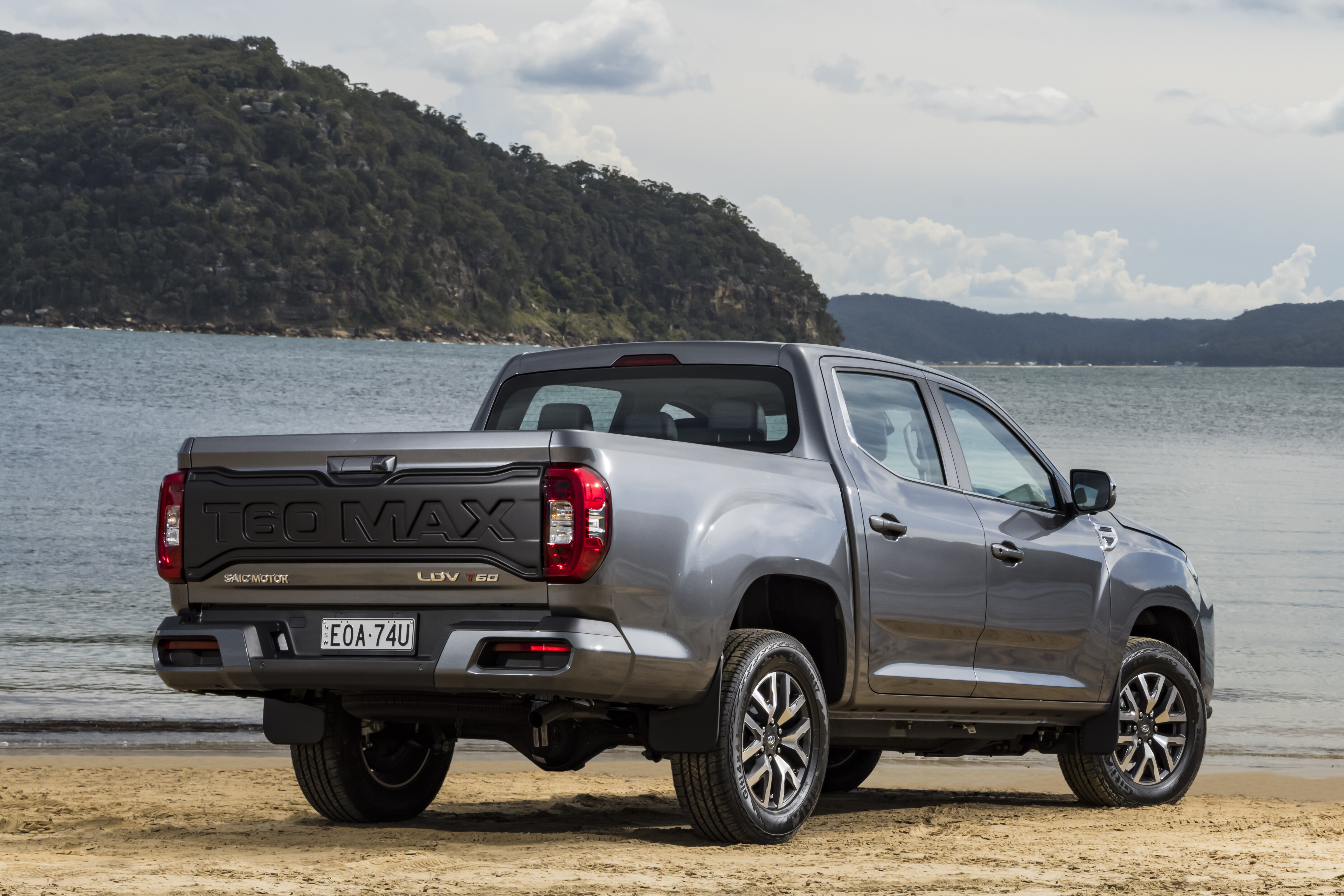
LDV says the Pro gets heavy-duty suspension, while the Luxe gets comfort suspension – both which have been tuned for Australian conditions by Walkinshaw.

Occupants get a new 10.25-inch centrally-mounted infotainment touchscreen with Apple CarPlay and Android Auto capability, along with a redesigned dashboard layout.
2022 LDV T60 Max Australian pricing
| Variant | Transmission | ABN holder | Private buyer |
|---|---|---|---|
| T60 Max Pro | Manual | $33,990 | $35,779 |
| T60 Max Pro | Automatic | $35,990 | $37,884 |
| T60 Max Luxe | Manual | $38,490 | $40,516 |
| T60 Max Luxe | Automatic | $40,490 | $42,621 |
Note: All prices are drive-away.
2022 LDV T60 Max features
T60 Max Pro
| Automatic wipers |
| Automatic LED headlights |
| Rear parking sensors |
| Climate control |
| 10.25-inch touchscreen with Apple CarPlay, Android Auto, and Bluetooth |
| Reversing camera |
| 2x USB |
| Tyre-pressure monitor |
| Cruise control |
| Full-size steel spare |
| 17-inch alloy wheels |
| Spray-in tub liner |
| 935kg payload |
The T60 Max Luxe adds
| Keyless entry |
| Rear differential lock |
| Auto-folding mirrors |
| Automatic rear-view mirror |
| 360-degree camera |
| Leather interior |
| Electric front seats |
| Lane-departure warning |
| 750kg payload |
Engine, drivetrain, and fuel economy
While the T60 is offered with either a 110kW/360Nm 2.8-litre or 120kW/375Nm 2.0-litre turbo-diesel engines, this new T60 Max gets a healthy bump to 160kW (at 4000rpm) and 5000Nm (from 1500rpm) from its twin-turbo 2.0-litre four-cylinder diesel engine.
Both the Pro and Luxe variants can be optioned with either a six-speed manual or a ZF-sourced eight-speed automatic transmission, with part-time four-wheel drive and low-range.
Fuel consumption is listed as 9.2L/100km for the manual, and 9.3L/100km for the automatic, while braked towing is rated up to 3.0 tonnes.
Safety
The 2022 LDV T60 Max inherits its 2017 five-star safety rating from ANCAP from the T60, and comes standard with:
| Six airbags |
| Brake assist |
| EBD |
| Hill descent control |
| Fatigue reminder |
Warranty and servicing
The 2022 LDV T60 Max comes with a five-year/130,000km warranty with roadside assist, but no details have been provided on servicing at this stage.
Availability
The 2022 LDV T60 Max is on sale now.
LDV has been making its presence felt in the hyper-competitive 4×4 ute segment with its T60 pickup.
The T60 has been embraced by buyers as a more affordable alternative to the bigger names with more established models and has occasionally poked its name in to the monthly top 10 selling 4×4 vehicles throughout the past year.Now the Chinese manufacturer of light commercial vehicles has upped the T60 ante by giving the ute a serious makeover with fresh styling inside and out and fitting the more powerful bi-turbo diesel engine from its D90 wagon model. It’s calling the new model the T60 Max and offering it in two specifications: the T60 Max Pro which is aimed more at the trade users, and the T60 Max Luxe that is hoped will have more appeal to recreational and family buyers.The T60 Max models are priced from $33,990 drive away for the Pro with a manual gearbox, up to $40,490 for the Luxe automatic which we have here for review.
POWERTRAIN & PERFORMANCE
A big claim for the T60 Max is that it is equipped with the most powerful four-cylinder diesel engine in the ute class, producing 160kW of power that’s 3kW more than Ford’s 2.0-litre bi-turbo diesel with an equal 500Nm of torque.Like the Ford engine, LDV’s 2.0-litre motor uses a bi-turbo arrangement to extract the most performance from its relatively small capacity. They have squeezed a bit more out of it for the T60 ute, upping the D90 wagon’s 158kW and 480Nm to beat the Blue Oval’s numbers. The ‘Bi-Turbo’ vent badge on the front guards looks very familiar too.Unlike most other bi-turbo arrangements where the engine will use a smaller turbocharger to provide boost at low speeds and then switch to or combine with a larger turbocharger as engine speeds rise to give a broader delivery of power and torque, the LDV engine delivers its powerload like a light switch.
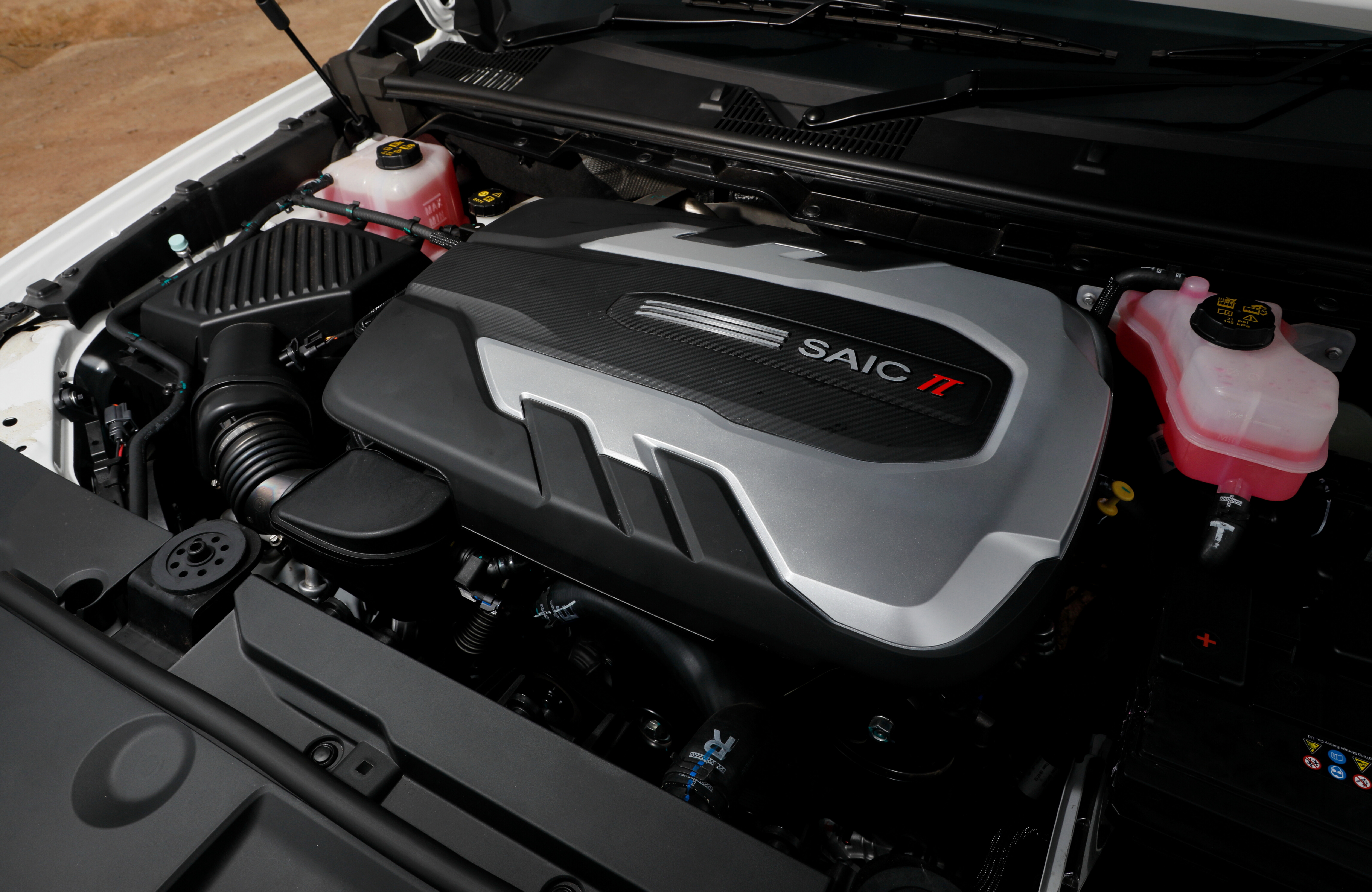
It is a two-stage system using a smaller compressor at low speeds and switching to a larger one as the load increases, but there’s considerable lag from when you put your foot down to when the power comes on – and when it does, it comes on strong, spinning the wheels and surging forwards.Whether or not this is a result of how the engine is tuned or how the throttle is calibrated is unknown, but the result is abrupt and something the driver needs to be wary of when negotiating tight tracks or pulling out of a side street in to flowing traffic. Yes, the T60 Max has plenty of grunt, but the way it delivers it is unrefined.The most refined part of the T60’s drivetrain is the ZF-sourced eight-speed automatic transmission, which works well and without complaint.A couple of points of difference in the T60 Max over and above most of the other utes in this segment: the four-wheel drive system has an on-demand mode, meaning you can leave it engaged over any road surface and the torque will be distributed to the front axle as needed; and the fitment of four-wheel disc brakes, while most one-tonne utes still have drums on the rear.
ON ROAD RIDE & HANDLING
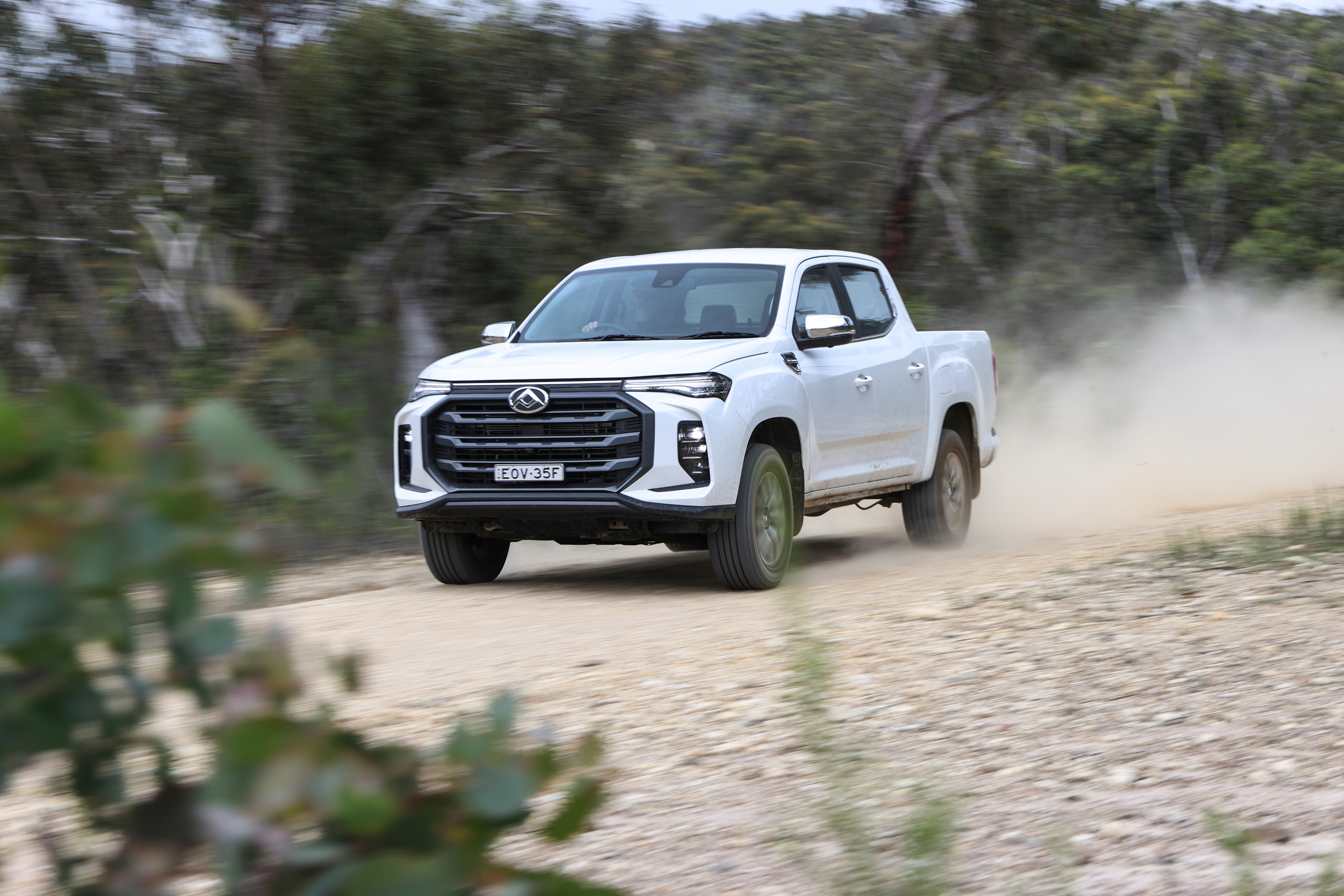
THE T60 Max comes with one of two suspension calibrations for either load carrying in the Pro model or comfort in the Luxe variant. I say comfort, as that’s what LDV calls it, but driving the Luxe unladen, it was anything but comfortable. The ride is bone-jarringly harsh and reminiscent of load-carrying double-cab utes of two decades ago.It’s a double-wishbone and coil-spring IFS arrangement, with a live axle under leafs at the back and the ‘comfort’ set-up sacrificed 175kg of payload compared to the heavy-duty package under the Pro model. I’d hate to feel an unladen T60 Max Pro over a bumpy bush track. As it is, it feels like it wants 500kg in the tub to soften the ride up.We can only hope that LDV sees fit to enlist the help of the Walkinshaw group once again to sort out the ride quality of the suspension. The Walkinshaw-fettled Trailrider model of a few years ago showed more compliance in the suspension resulting in a better ride, even on its 19-inch wheels and low-profile tyres.
OFF ROAD
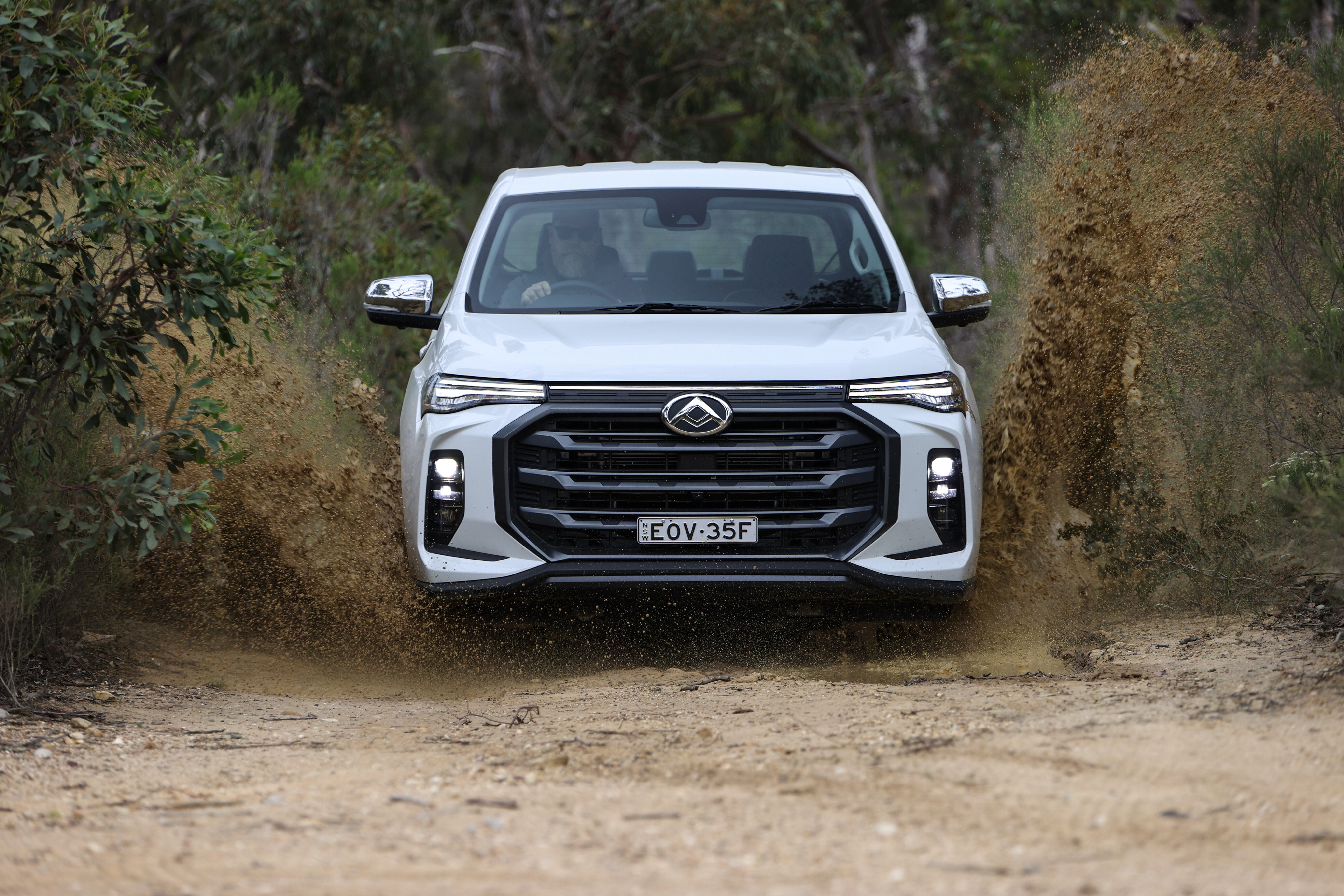
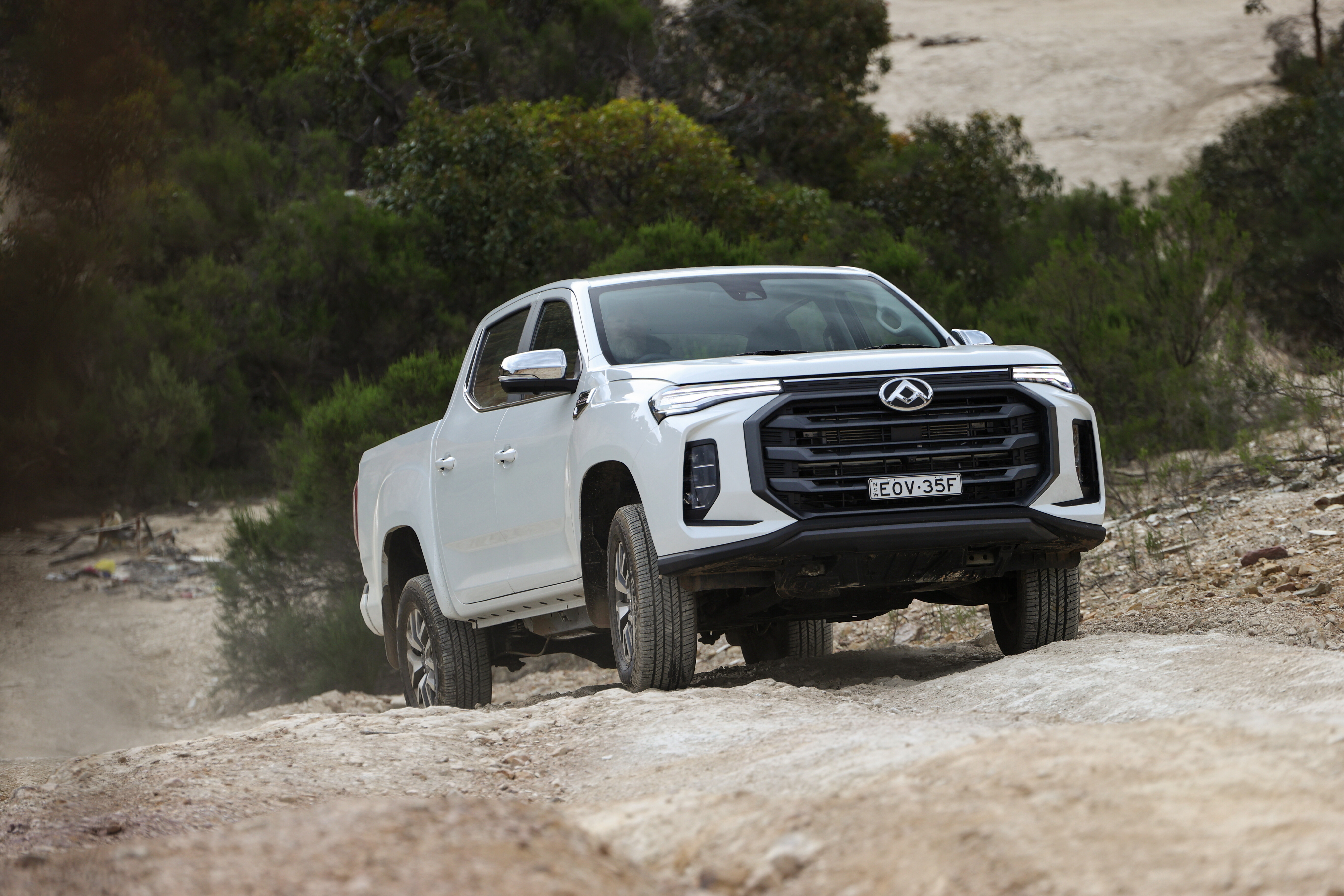
THE T60 Max uses a four-wheel drive system that offers 2WD, on-demand 4WD, 4×4 high and 4×4 low range, and that on-demand option is something that works well on varied terrain and low-traction surfaces. The relatively stiff suspension doesn’t offer a lot of wheel travel but when it picks up a tyre, the auto-locking rear differential is very effective in pushing forward to maintain progress over obstacles.The electronic traction control (ETC) feels like it’s a few generations behind that found in the LDV’s competitor’s utes and 4x4s. It’s slow-acting, noisy and jerky, but it gets the job done eventually.
CABIN AND ACCOMMODATION
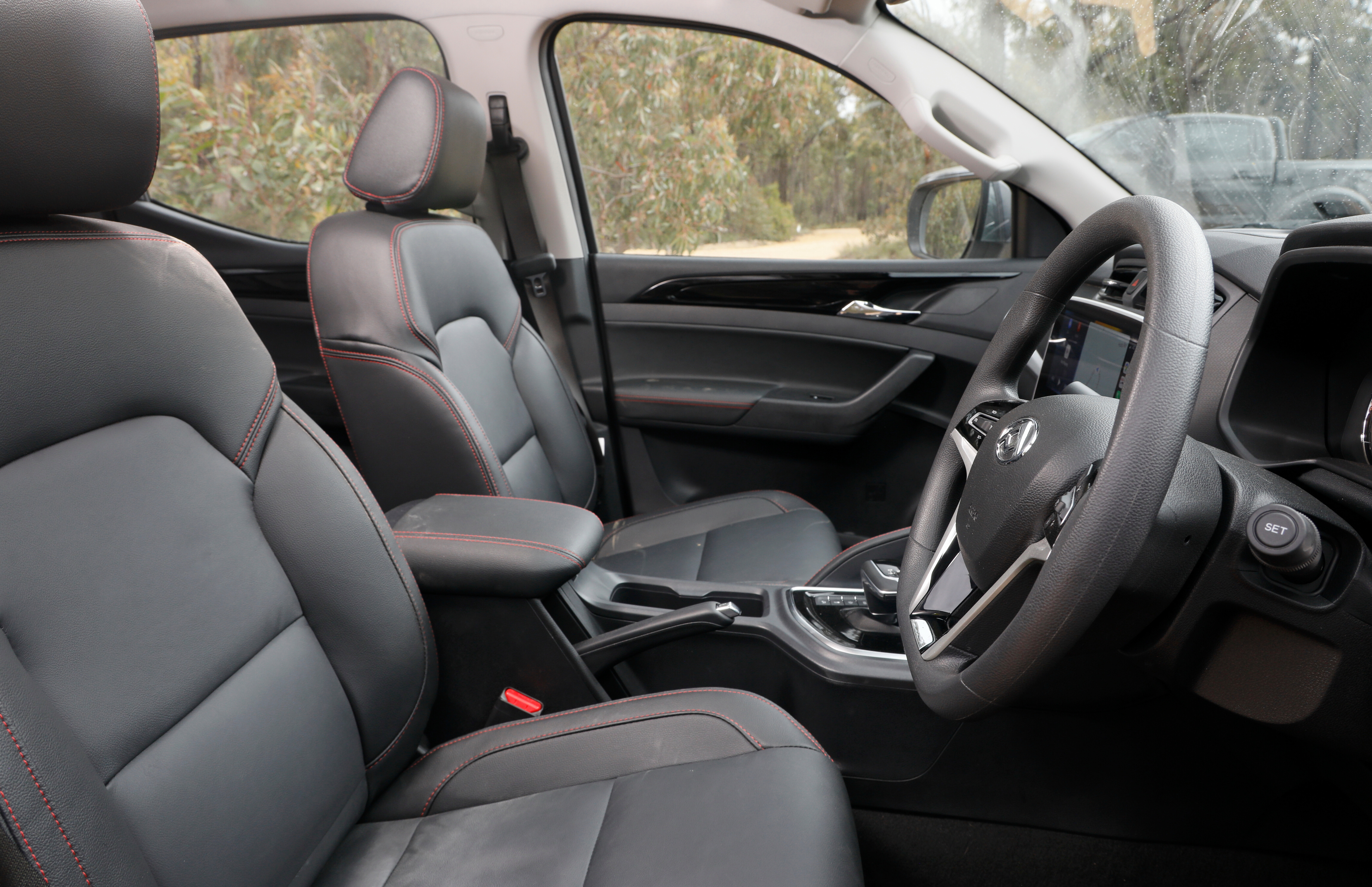
THE T60 has always offered an interior that looks better than its price point would suggest, and the Max raises that bar further. This Luxe variant gets power adjustable heated leather seats over the cloth pews on the Pro model and combined with the new 10.5-inch touchscreen, which comes in both variants, gives a more upmarket feel.The seats are firm and flat and the steering column is only adjustable for height but not reach. The screen is bright and clear and the audio system includes CarPlay connectivity. We did find the screen to be a bit slow to respond at times, sometimes taking a few taps to get it to select what you want, and there are no controls for the audio volume in the dash, just on the steering wheel. The Luxe model also has keyless entry and push-button starting.Space in the back seat is typical of the double-cab utes available, in that you can carry adults in there but they won’t be comfortable on long trips.The T60 Max relies on its 2017 ANCAP 5-star rating, so it has most of the safety features you expect but not some of the latest ones. Among those missing are autonomous emergency braking and rear cross-traffic alerts. Only the Luxe variant gets lane-departure warning, while both models get a tyre-pressure monitoring system (TPMS).
PRACTICALITIES
THE T60 Max has a large cargo tub with four tie-down points in the corners. As mentioned earlier, its payload is well short of the 1-tonne standard on the Luxe but comes up to 935kg if you opt for the Pro model with a manual gearbox or 925kg with the auto. The towing rating is 3000kg, so again down on many of the 1-tonne 4×4 utes but probably a more realistic figure for any vehicle in this class.The 550mm wading depth is another figure that’s below par for the segment, and while the 245/65R17 tyres might be small, they are a practical size and well-suited to the vehicle.LDV vehicles have a 5-year/130,000km warranty and roadside assistance, with a growing national dealer network.
SUMMARY
THE T60 Max might look more contemporary both inside and out but it remains a fairly rudimentary vehicle in the way it drives. The throttle lag and the way it delivers its power, the hard-riding suspension and the noise of the engine hark back to utes of yore, before they became more refined and family friendly. These are things that might not be a problem for some buyers but 4WD utes have come a long way in the last decade and the class leaders in the category are more refined and user friendly for whatever use you have for them.The T60 Max’s strong points are it’s engine output and the excellent transmission combined with its relatively low price and what you’re getting in a $40K ute.I was speaking with a tradie just a week before this drive who was telling me he had a couple of T60s (not T60 Max) and they have been absolutely no problems for him and his workers who love it. That sort of testimonial makes you think twice about brands you might not otherwise consider but for the price, the T60 Max is certainly worth a look-in.
LDV T60 PRO LUXE SPECS
| Engine | I4 turbo diesel |
| Capacity | 1996cc |
| Max Power | 160kW @ 4000rpm |
| Max Torque | 500Nm @1500 u2013 2400rpm |
| Gearbox | 8-speed automatic |
| Crawl ratio | 50.84:1 |
| 4X4 System | Dual range on demand 4×4 |
| Construction | 4-door cab @ ute tub on ladder chassis |
| Front suspension | Double wishbone IFS |
| Rear suspension | Live axle on leaf springs |
| Tyres | 245/65-17 on alloy wheels |
| Kerb Weight | 2150kg |
| GVM | 2900kg |
| Payload | 750kg |
| GCM | 5000kg |
| Towing capacity | 3000kg |
| Seating capacity | 5 |
| Fuel tank capacity | 73L |
| ADR fuel consumption* (claim) | 9.3L/100km |
| On-test fuel consumption | 11.2L/100km |
| Approach Angle | 27u00b0 |
| Ramp Over Angle | 21.3u00b0 |
| Departure Angle | 24.2u00b0 |
| Ground Clearance | 215mm |
| Wading Depth | 550mm |
UPDATE, November 10: Ford’s new Bronco Raptor has been put through its paces, with American publication The Bronco Nation providing insights into the Blue Oval’s off-road hero car.
In a post on its Facebook page, The Bronco Nation claims it was given exclusive access to test out the Bronco Raptor, flexing its massive 37-inch tyres, long-travel suspension and pumped guards for a significantly tougher stance than the existing Bronco.
While earlier information led us to believe it would be powered by a 3.0-litre EcoBoost engine, there is now a suggestion Ford’s 3.5-litre V6 EcoBoost from the F-150 Raptor is under the bonnet, punching out around 335kW and 691Nm.
https://www.facebook.com/106750224219808/posts/432805631614264/
The story to here
September 22: The 2022 Ford Bronco Raptor has been announced, with a short, 16-second teaser video posted on the company’s social media accounts.
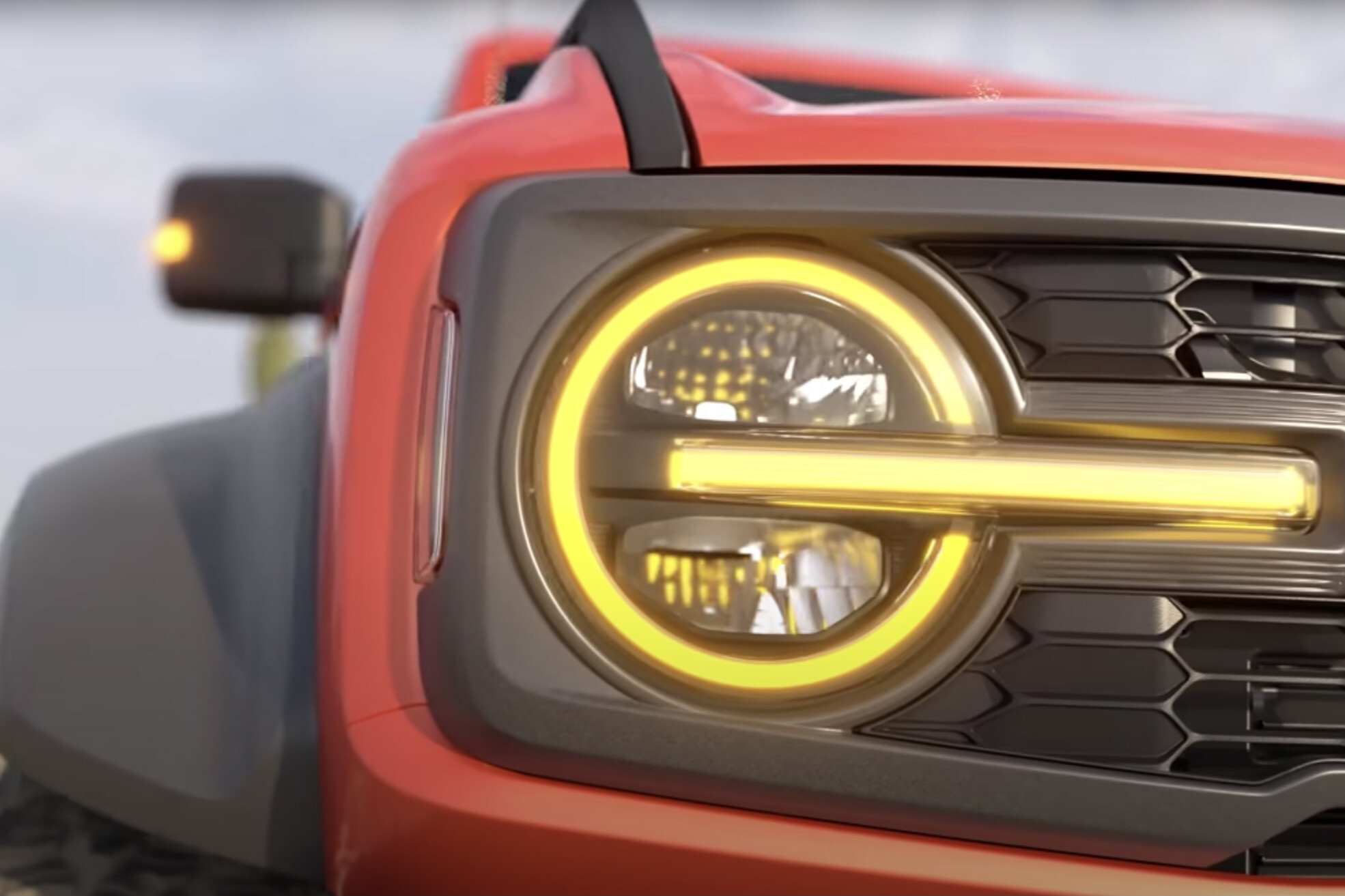
The video shows a glimpse of the Bronco’s new F-O-R-D grille – synonymous with Raptor models across the Ford range – with a cloud of dust to reaffirm the vehicle’s off-road character.
With the Bronco designed to compete directly against the Jeep Wrangler, for some time rumours have swirled of a performance variant intended to fight the Wrangler Rubicon 392 V8.
Early indications suggested it would be called the Bronco Warthog, following a trademark filing by the carmaker, but company sources told US website Ford Authority the name was a deliberate misdirection.
It’s widely reported the new Bronco Raptor will gain the 3.0-litre twin-turbo petrol V6 EcoBoost engine found in the Explorer ST performance SUV – the very same engine rumoured to be powering the 2022 Ford Ranger Raptor – with around 300kW and 600Nm said to be on offer. The 10-speed automatic transmission is expected to carry over.
The teaser comes just a week after a dealership leak was posted to the Bronco 6G forum, revealing the Raptor will only be offered as a four-door, with buyers given access to an exclusive ‘code orange’ paint colour – as seen in the video.
Though details remain scarce, it’s understood two trim levels will be available on the Bronco Raptor, with the higher-spec model offering a 10-speaker sound system, voice-activated satellite navigation, wireless smartphone charging, radar cruise control, and a heated steering wheel.
In the teaser video, we can see the Raptor gains unique amber daytime-running light signatures and revised plastic wheel arches.
The Raptor is also expected to feature Fox Live Valve shock absorbers, a wider front and rear track, higher ground clearance, and 17-inch alloy wheels with BFGoodrich KO2 all-terrain tyres in 315/70R17 – or 35 inches in the old money.
While reports earlier this week confirmed the Ford Bronco was being considered for European markets to compete against the Land Rover Defender, there’s no sign the Bronco will be produced in right-hand-drive – ruling it out for Australia for the time being.
Expect full announcement of the 2022 Ford Bronco Raptor in the coming months.
Four-wheel-drive accessory company ARB has revealed it has a Ford Bronco at its Australian headquarters.
In a post on the company’s Facebook page, ARB said the Bronco was in Australia to continue research and development – building on the limited number of accessories currently offered to its US customers.
But the Bronco isn’t the only vehicle it’s been working on, with ARB’s Chairman and Managing Director Roger Brown telling shareholders last month the company had secured a contract with US electric ute manufacturer Rivian, according to AFR.
“We’ve been in discussions with [Rivian] for quite a while now, and we are talking about the accessories program,” ARB COO Lachlan McCann told 4X4 Australia.

While McCann was tight-lipped about the relationship, he said the company was currently supplying a product for Rivian on the production line, and had another long-term project the two organisations were working on.
Under a standalone section about Rivian, ARB’s own Environmental Sustainability Report states: “ARB is involved in the development of a range of accessories that integrate and comply with the complex differences in this fast-growing market of electric 4WDs.”
“It’s just quite exciting to be working with an electric-based OEM … regardless of whether it’s a naturally-aspirated, a V8 turbo, or an electric product – the suite of accessories the customers are after is still there,” McCann said.
“So as the electrification of vehicles continues, we’ll certainly be working closely with either the vehicles in the aftermarket or hopefully upfront with the [manufacturers].”
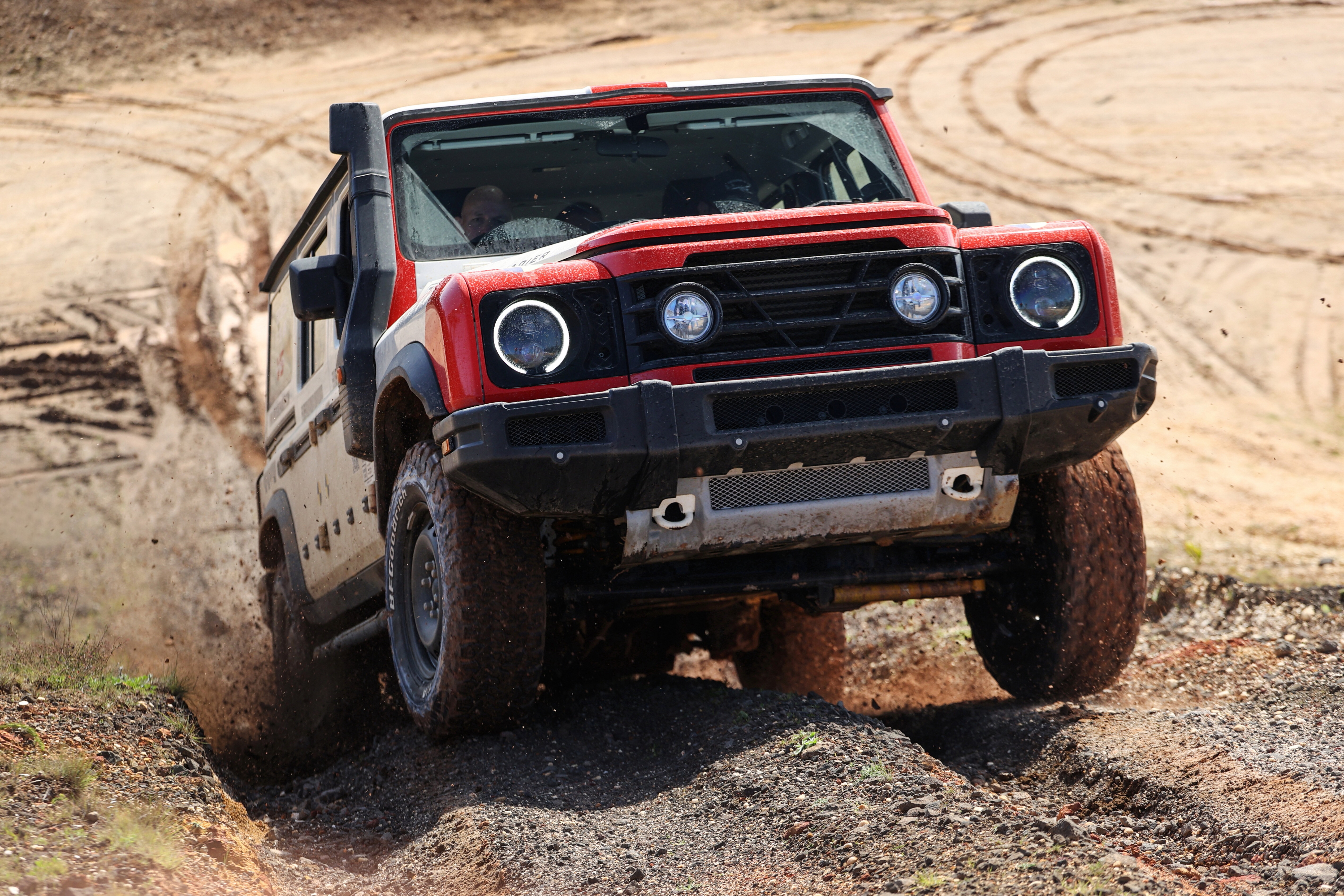
Along with Rivian, ARB is also working alongside Toyota on its all-electric LandCruiser 70 Series trial, and is understood to have a relationship with British newcomer Ineos.
At a recent media event, Ineos Australia’s head of sales and marketing, Justin Hocevar, said the carmaker was giving local four-wheel-drive accessory companies access to its Grenadier prototypes.
While Ineos and Rivian will be bringing their vehicles to Australia, there’s no word yet on whether Ford will be developing a right-hand-drive Bronco.
Australian made, the all-new TAG Extreme Recovery (XR) tow bar has been engineered and designed for both tradies and adventurous off-roaders alike.

The heavy-duty, three-piece bar for the 79 Series LandCruiser (MY2017+) features 89mm x 89mm extreme-duty crossbars; two heavy-duty and load-rated recovery points.
It also has maximum clearance for improved departure angles; extreme-duty powder-coated finish; and dual top-mount trailer and Anderson plug mounts.
A L4171 tow ball mount and UNT010ZP zinc tow are included. The unit is recovery load-tested to 4500kg.
MORE INFO: www.tagtowbars.com.au
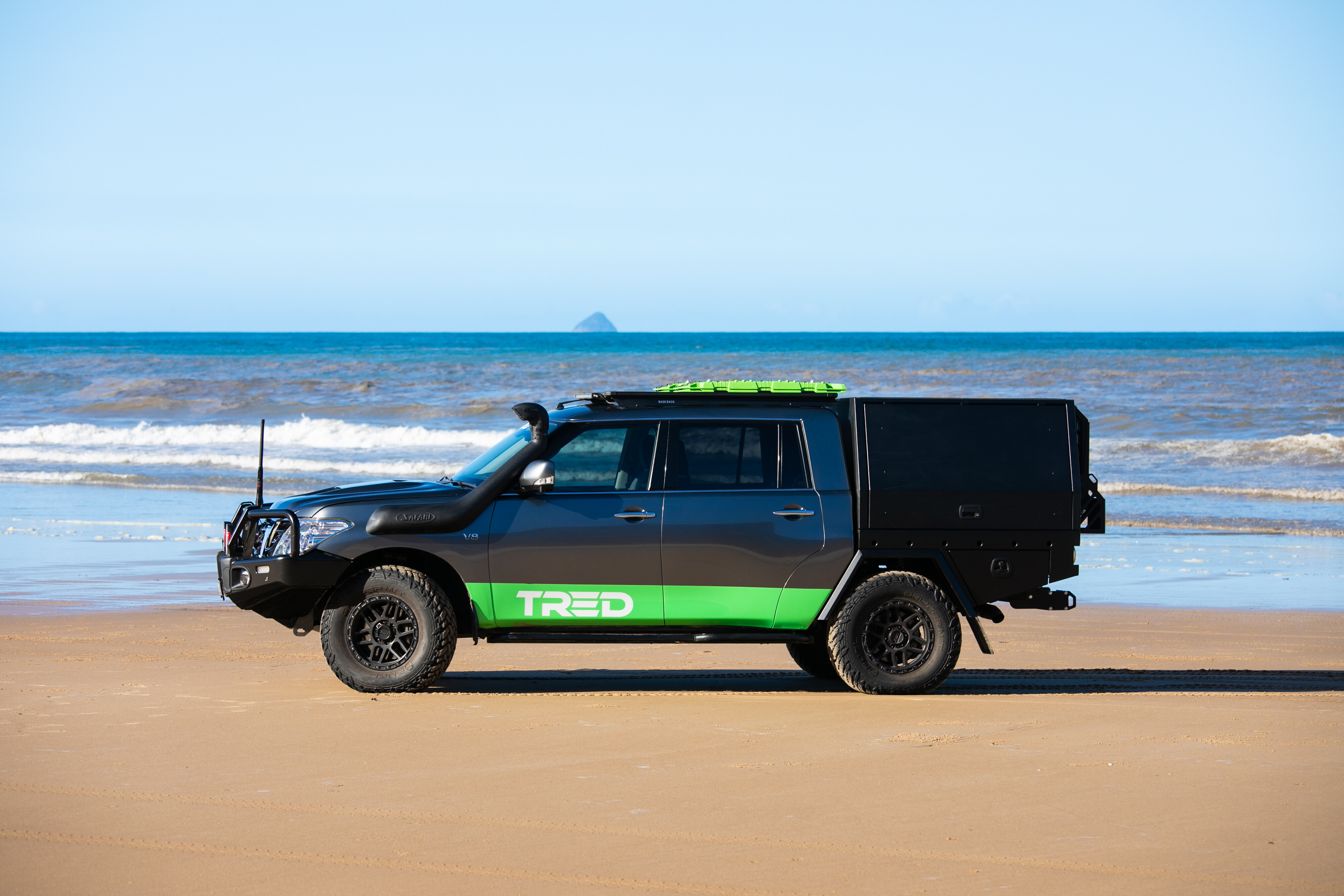
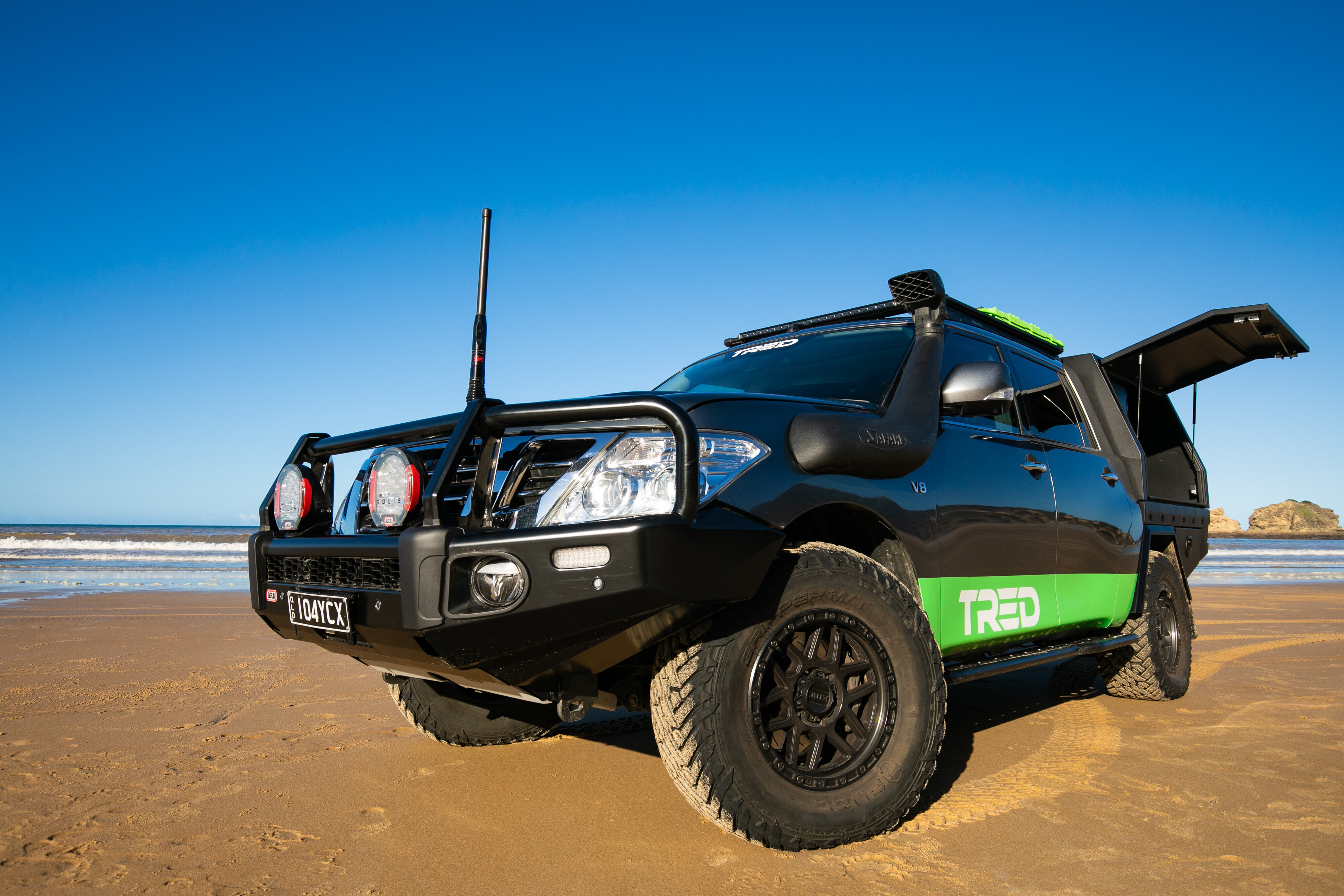
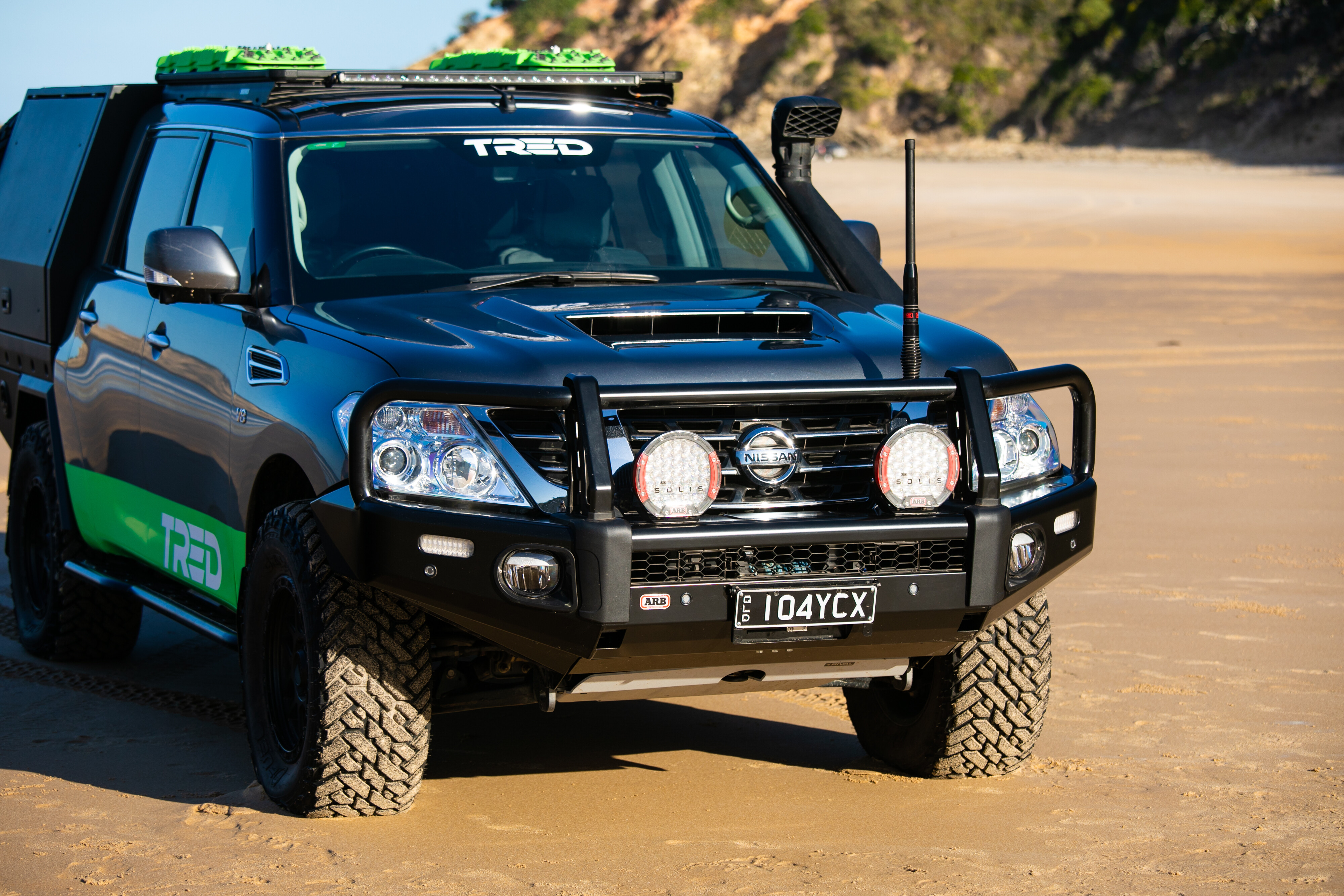
When Chris Roberts from TRED Outdoors went looking for a new 4×4 to take on camping and off-road trips, he was torn as to what it would be.
The plan was to always to get one of the big 4×4 wagons and cut and stretch it in to a double-cab ute, but choosing between two popular options wasn’t easy.
“I liked the Y62 because there was a supercharger option from Harrop, but the platform was not well-supported by the aftermarket at the time,” Chris recalled.
He even went as far as ordering a new LandCruiser 200 Series, but when the dealer called to say the delivery was delayed, it made Chris’s decision for him.
“Nissan not only delivered in time, but they were also substantially cheaper which left plenty of money in the bank to build this car,” he said with a smile.
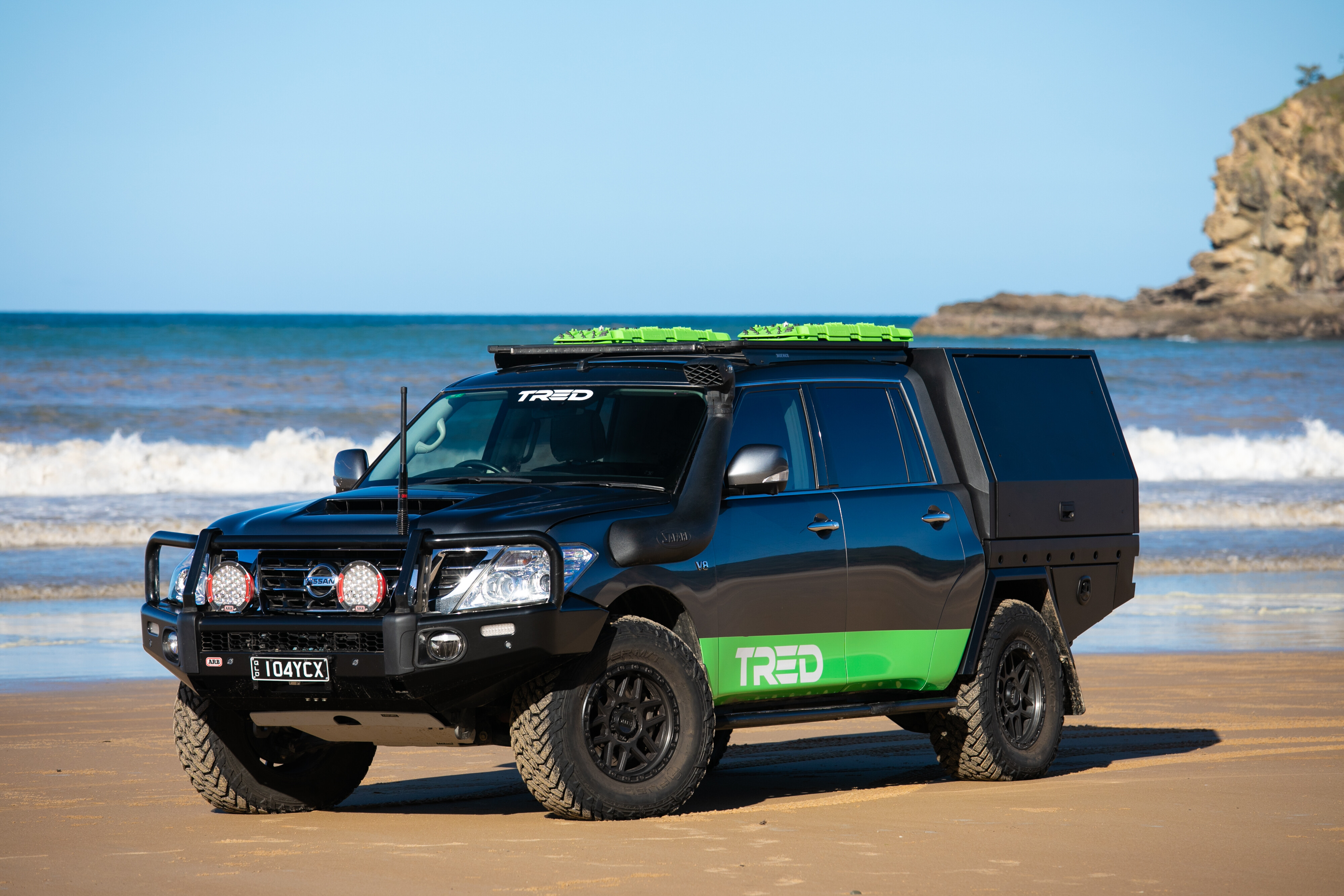
He ended up with a 2018 Patrol and set plans in motion to make it what he wanted.
“One of my frustrations when going away with the car as a wagon, was having to load and unload all the time,” says Chris. “My campsite was always quick to set up, however all the gear needs to be loaded and unloaded a lot. Having a canopy on the back is going to help massively with this.”
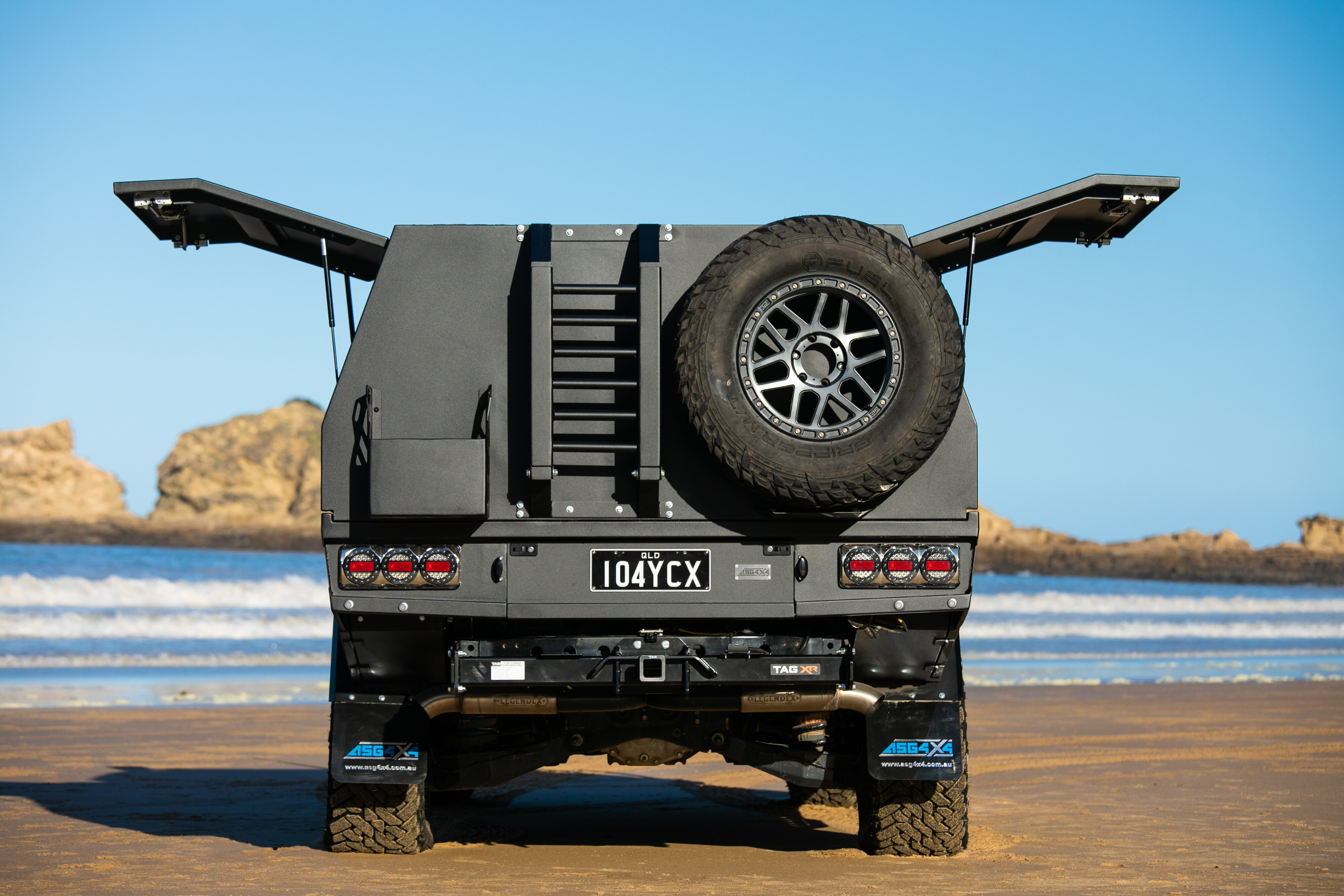
Chris enlisted the team at Queensland company ASG4X4 when it came time to get the chop-and-stretch job done. ASG has done a few of these conversions on the big Nissans, with a choice of chassis lengths available. They also manufacture a selection of different size and design trays and canopies, so they are a one-stop shop for these ute conversions.
For the Y62 specifically, with its independent rear suspension, ASG makes its own lower control arms that are much heavier duty than the Nissan arms, allowing for an increase of GVM to carry all of Chris’s gear. This solved one of the challenges Chris foresaw, with choosing the Patrol over a LandCruiser.
An advantage of choosing the Nissan was the ability to fit that supercharger kit to its petrol V8 engine. With the Harrop kit on board and tuned, this Patrol is now pumping out 542hp and 680Nm of torque at the hubs.
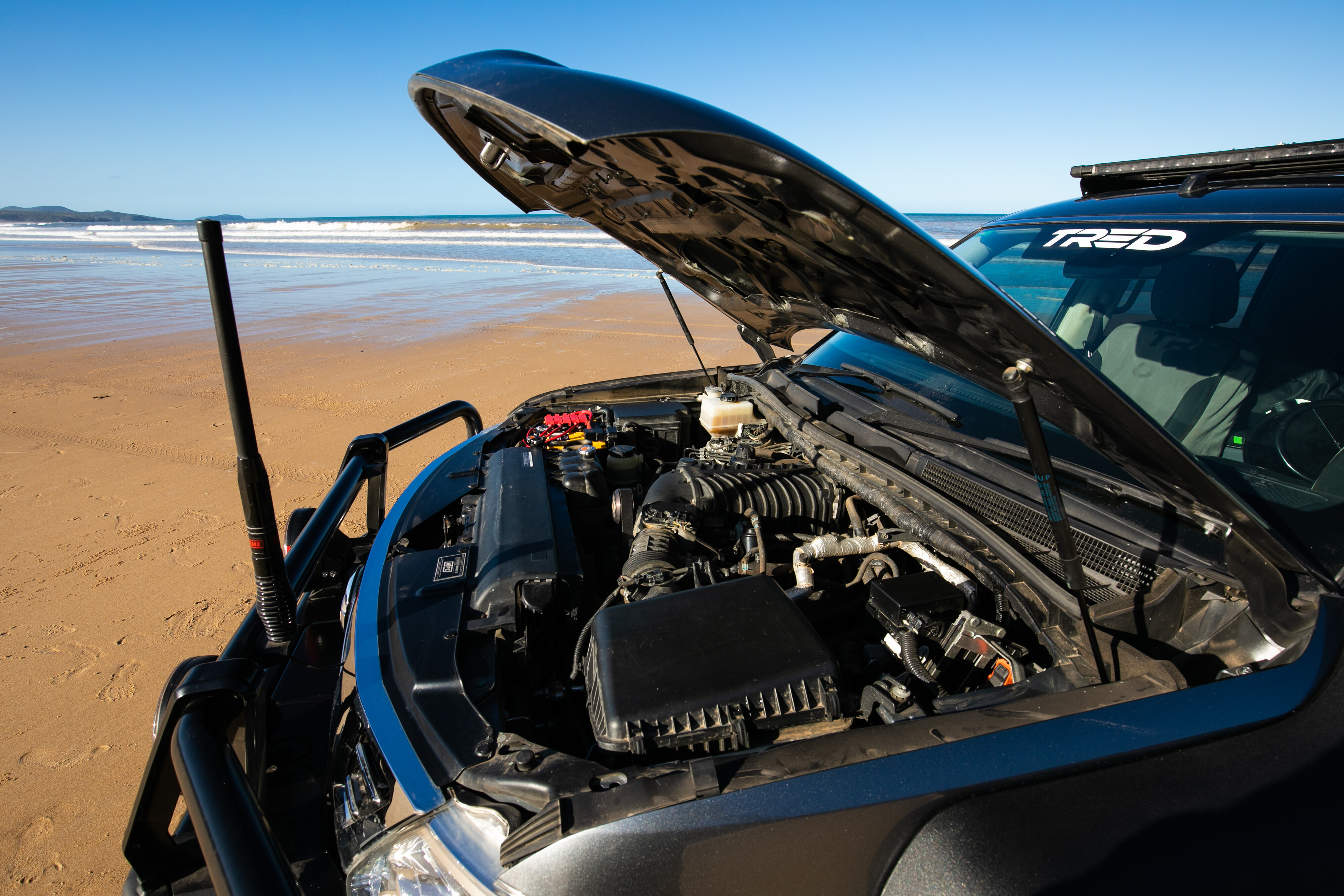
After overcoming the hassles of developing a vehicle that isn’t so well-supported with bolt-on equipment, Chris couldn’t be happier with the result.
“There was not much aftermarket support, straight bolt-up like you would get on say a 200 Series. So to make things work, as an example the suspension, there was lots of time spent in researching and planning.
“For me, the sign of a good car and build is when the owner has a story of how you need to drive it,” he says. “The owner knows each strange noise and anticipates what the car will do in certain situations, making it truly a custom build.”
KEY FEATURES
BLOWN AWAY
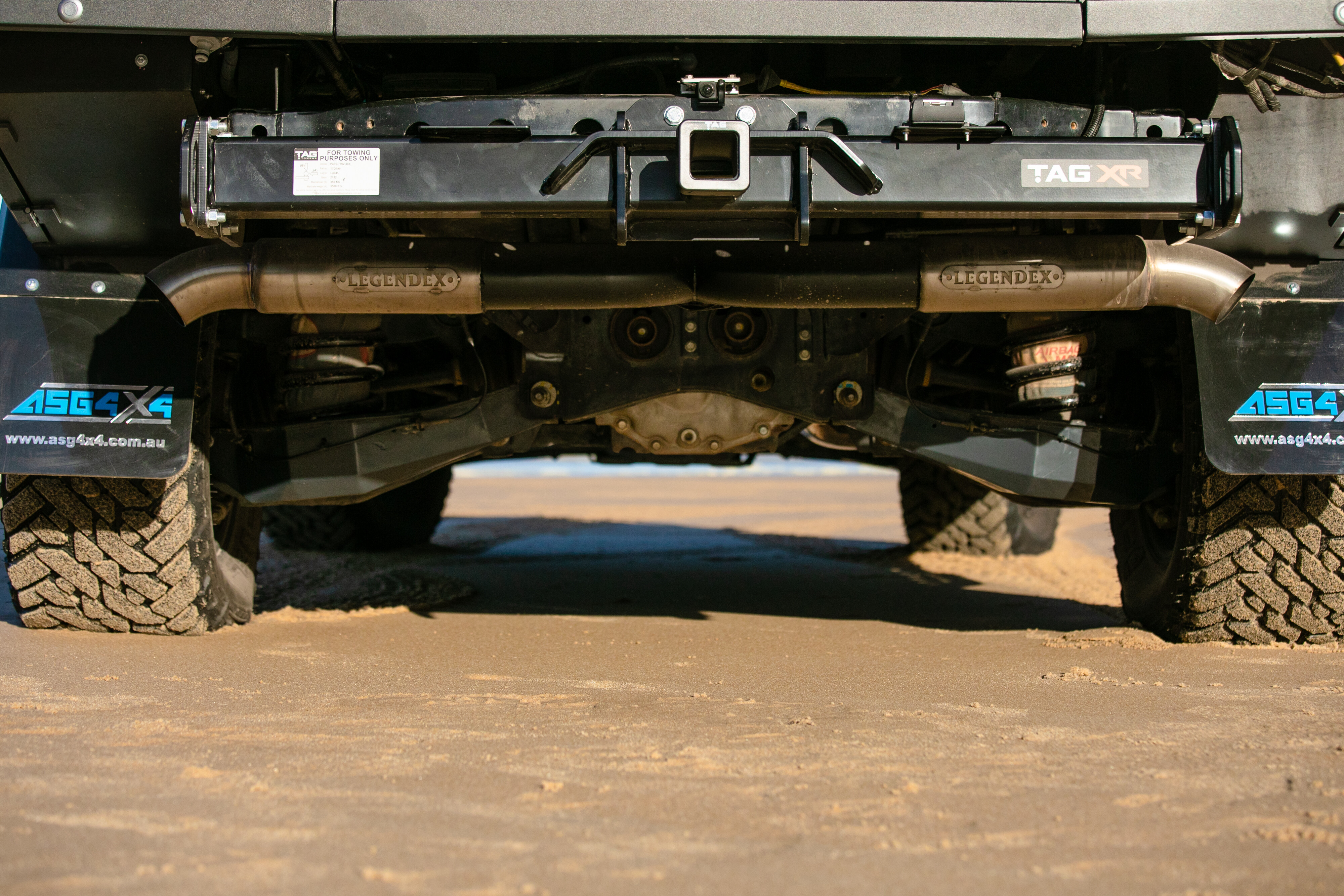
The Nissan VK56 V8 breathes heavier thanks to a Harrop 2300 supercharger kit and uprated fuel system, helping it pump out 542hp and 680Nm of torque at the hubs. The engine exhales loudly through a custom Legendex 3 to 3½ inch twin cat-back exhaust system.
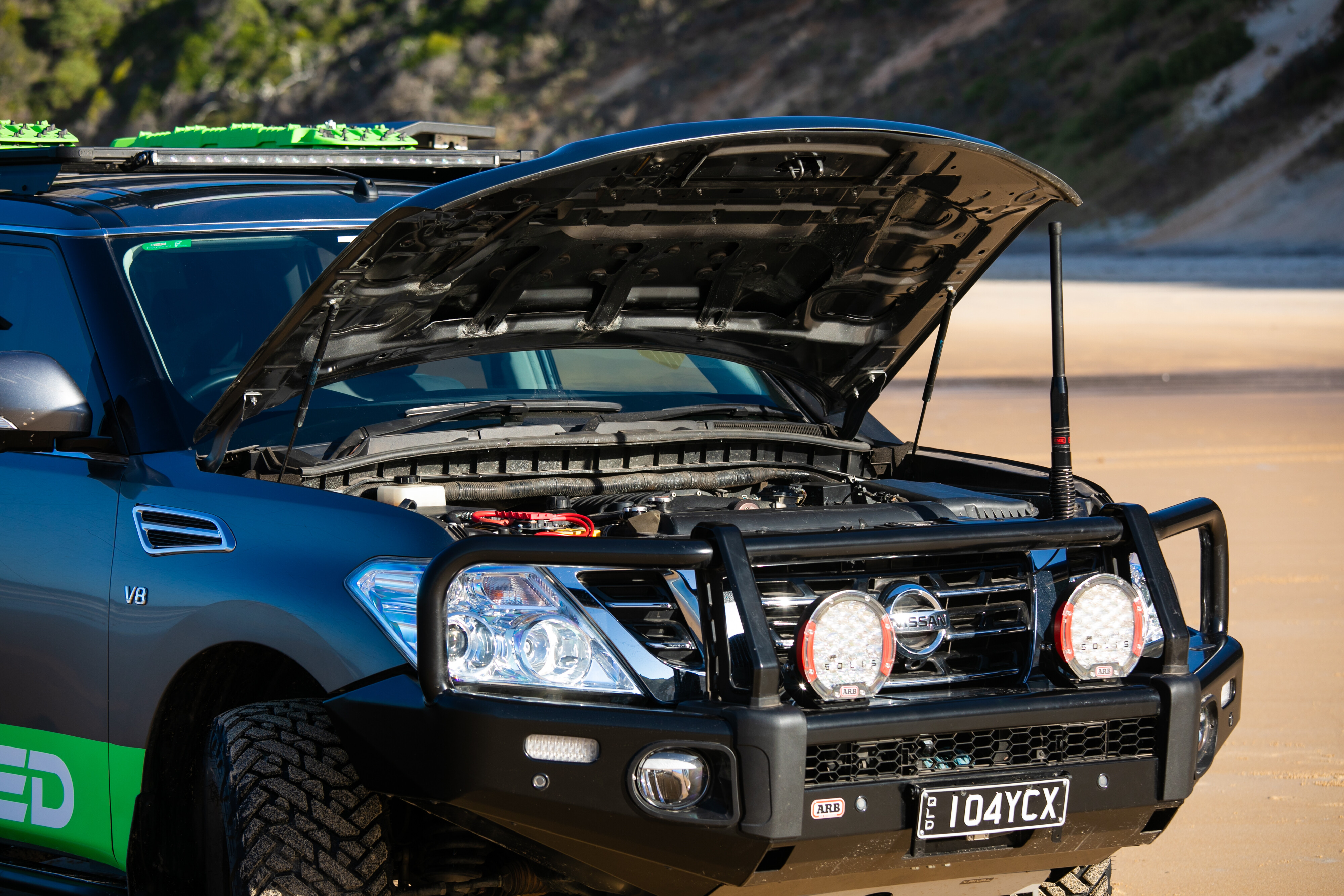
BULLBAR
Frontal protection comes via an ARB Summit bar (left) which mounts a pair of ARB Solis LED lights, a GME antenna and a VRS 12,000lb winch. The underbody protection plate is from Rival 4×4.
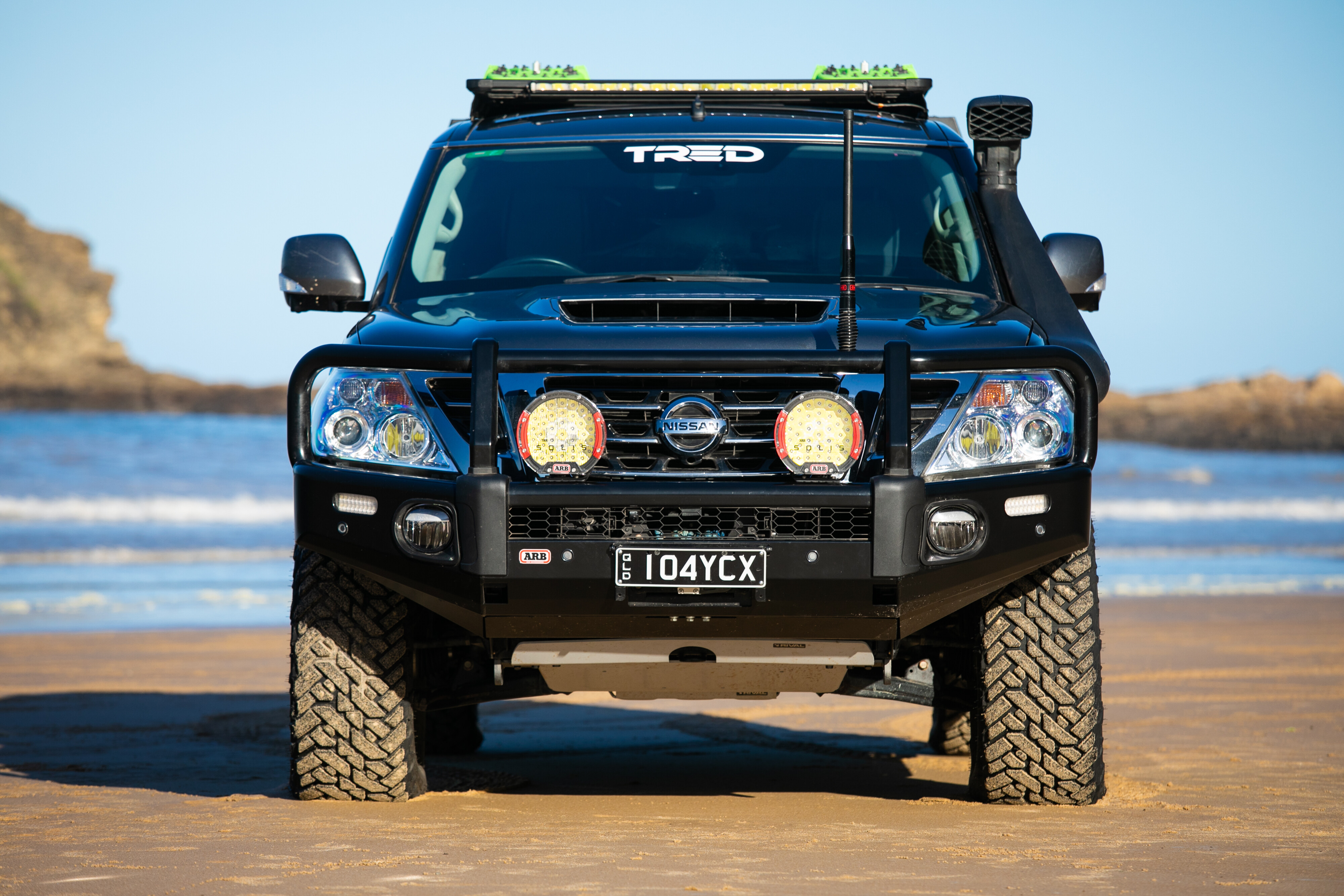
STRETCHED CHASSIS
ASG 4X4 cut the chassis and stretched it 250mm, reformed the back of the cabin with a flat-wall and built the tray and lift-off canopy. The re-engineered Patrol now has a 4200kg GVM to help carry the gear on board.
HD
ASG’s fabricated rear lower control arms bolster the rear end, allowing for heavier loads.
PLATFORM RACK
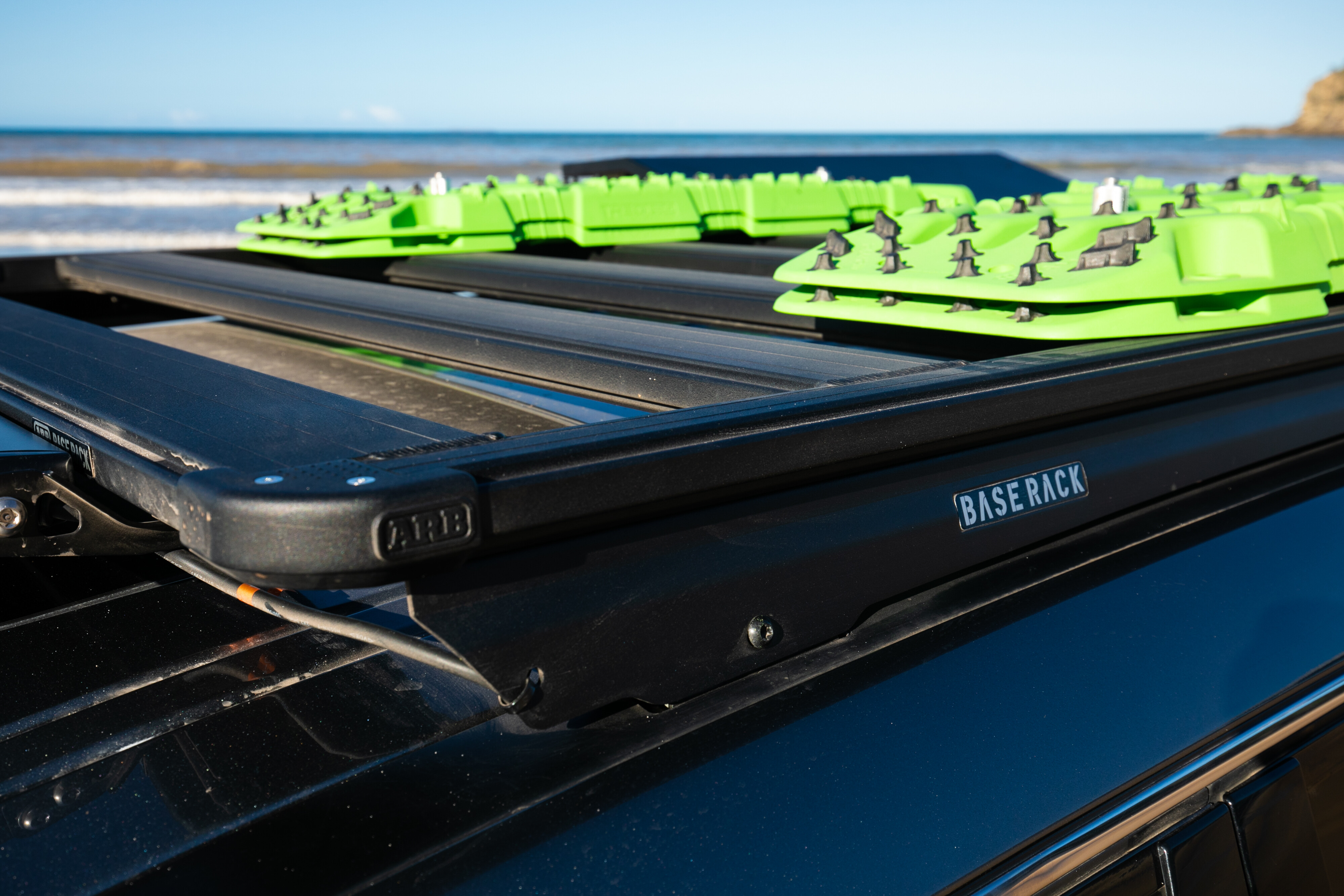
An ARB Base Rack system mounts atop the Patrol and, of course, there’s a set of bright green TRED Pro recovery boards.
POWER PLAY
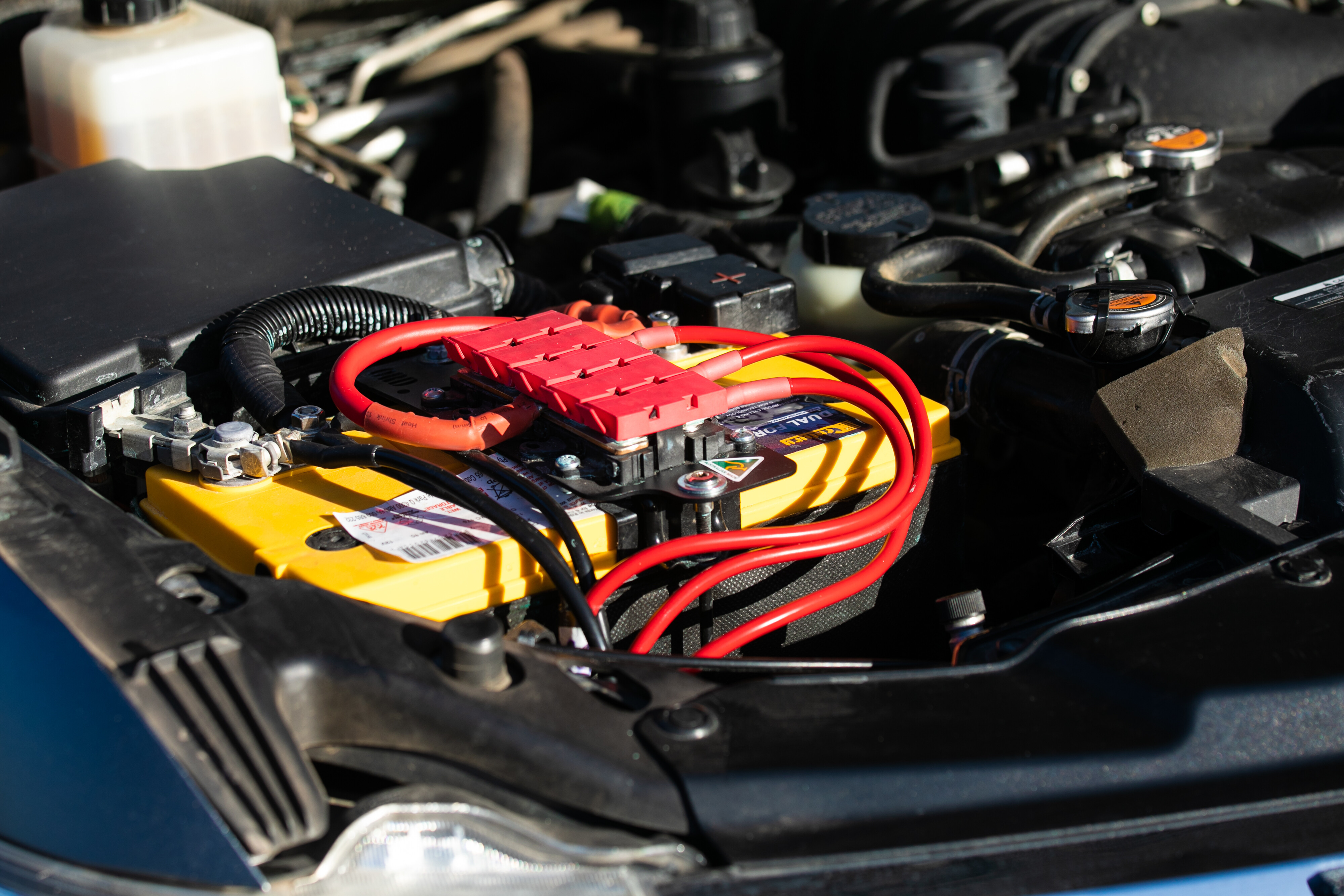
Inside the ASG canopy you’ll find a Bushman upright fridge; Projecta DCDC charger, Intelli-RV Power Manager system and Projecta Intelli-wave 2000W inverter; an Invicta 200amp/h lithium battery; and an ARB LINX module to control everything.
MUDDIES ON ALLOYS
KMC ‘Mesa’ alloy wheels and Fuel Gripper mud terrain tyres conceal a brake package using DBA rotors and pads.
EXTRA STORAGE
Tapered under-tray storage compartments house the ARB twin compressor on the passenger-side, with recovery accessories on the driver’s side.
TOWBAR PROTECTION
The TAG XR towbar provides a bit of protection for those neat-looking Legendex exhaust outlets that bellow out the V8’s supercharged symphony.
SPECIAL THANKS
ASG4x4, TRED, ARB4x4, Legendex, Projecta, Invicta Batteries, TAG Towbars, KMC Wheel
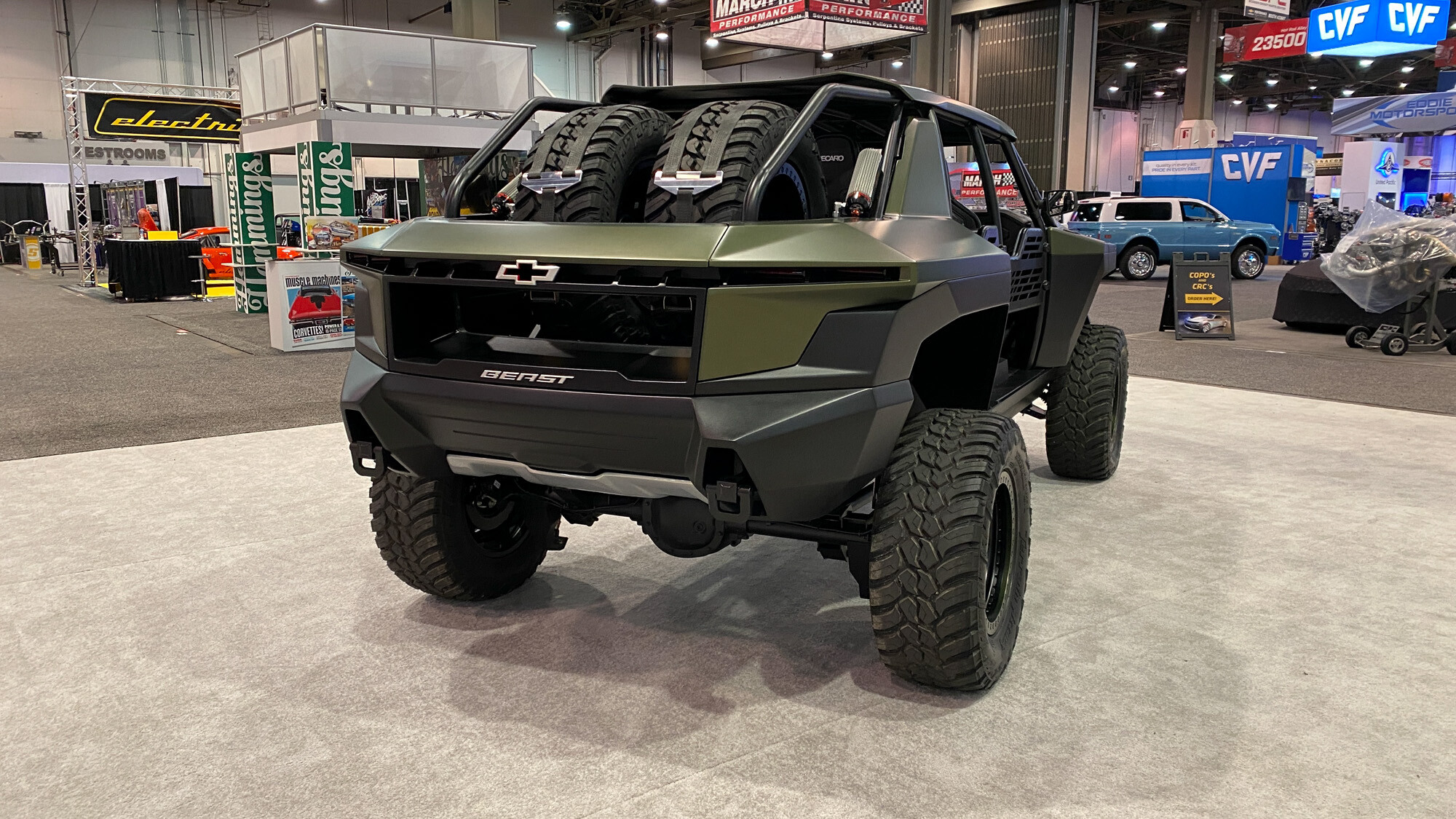
SEMA is always a hot breeding ground for seriously gnarly 4×4 concepts, so it comes as no surprise that Chevy went big this year with its Beast desert racer.
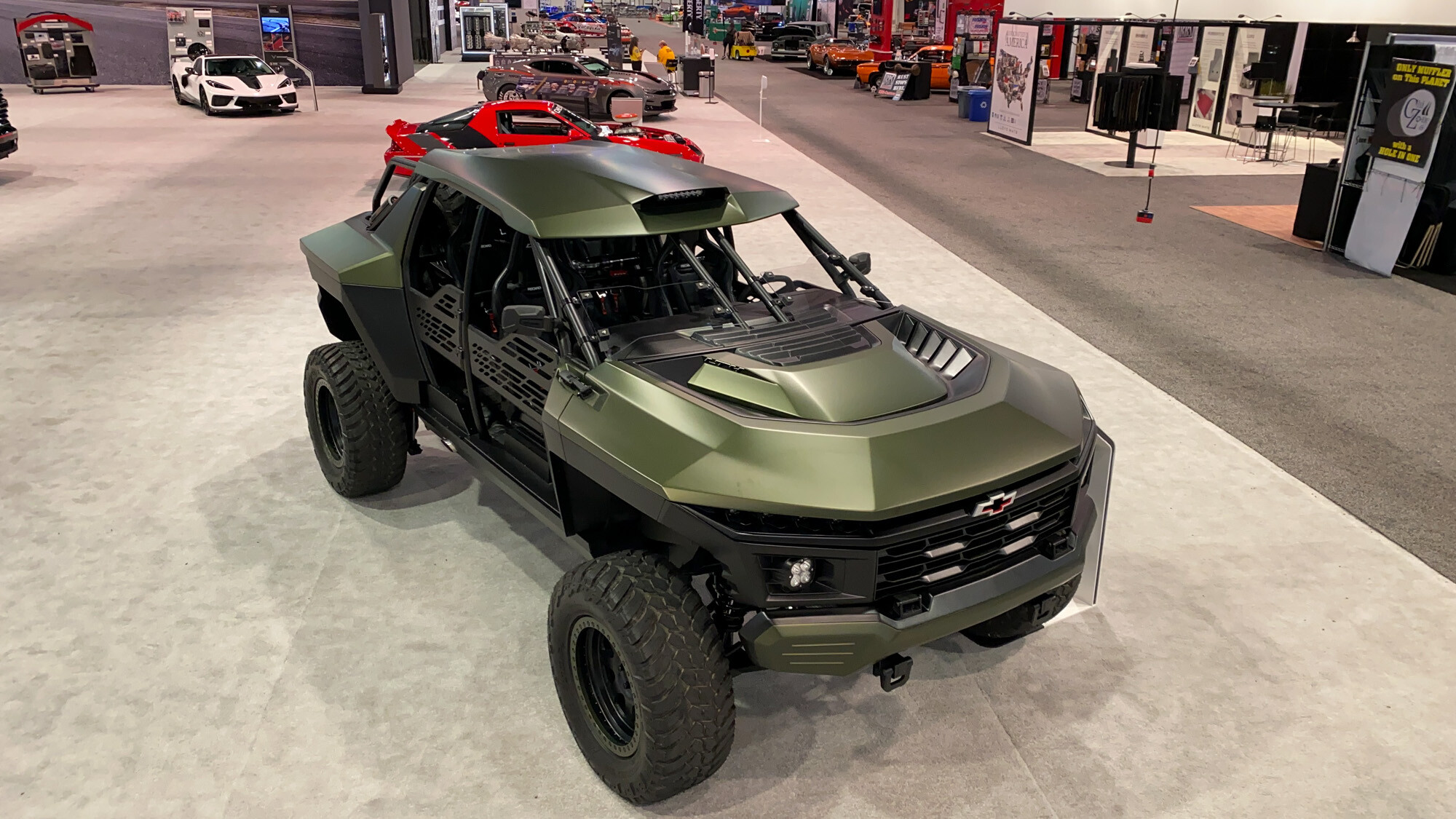
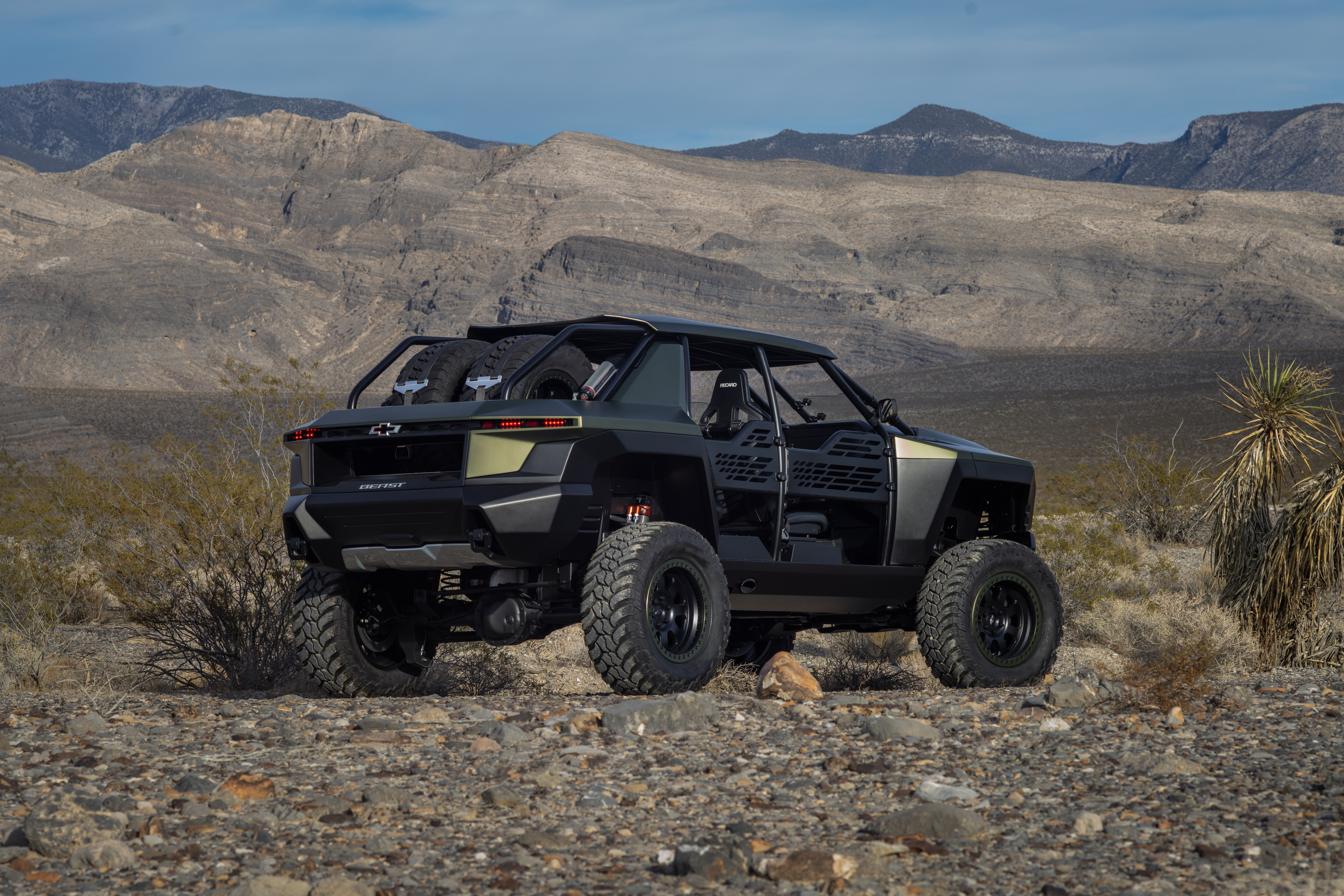
The concept car started out life as a basic Silverado short-bed chassis, before Chevy engineers cut even more off it and added structure using 4130 chromoly tubing top to bottom.
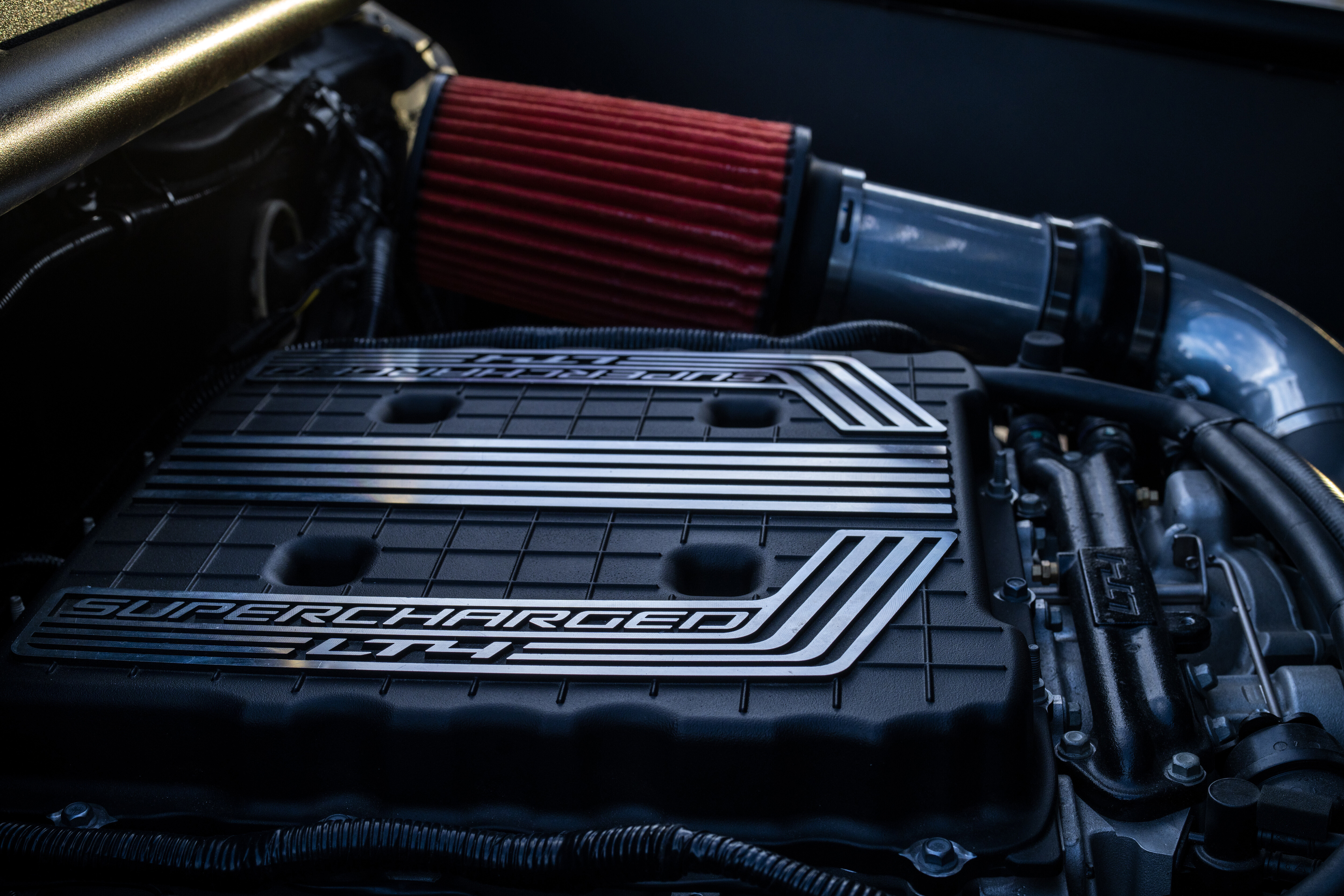
For power, the Beast uses the 484kW supercharged LT4 V8 from the previous generation Corvette Z06, mated to a 10-speed 10L90 automatic transmission that sends the power through a two-speed transfer case.
Despite being a racer, the concept car is actually a four-seater. That’s about where the practicality ends for space though, as the boot is filled entirely with two rear wheels.
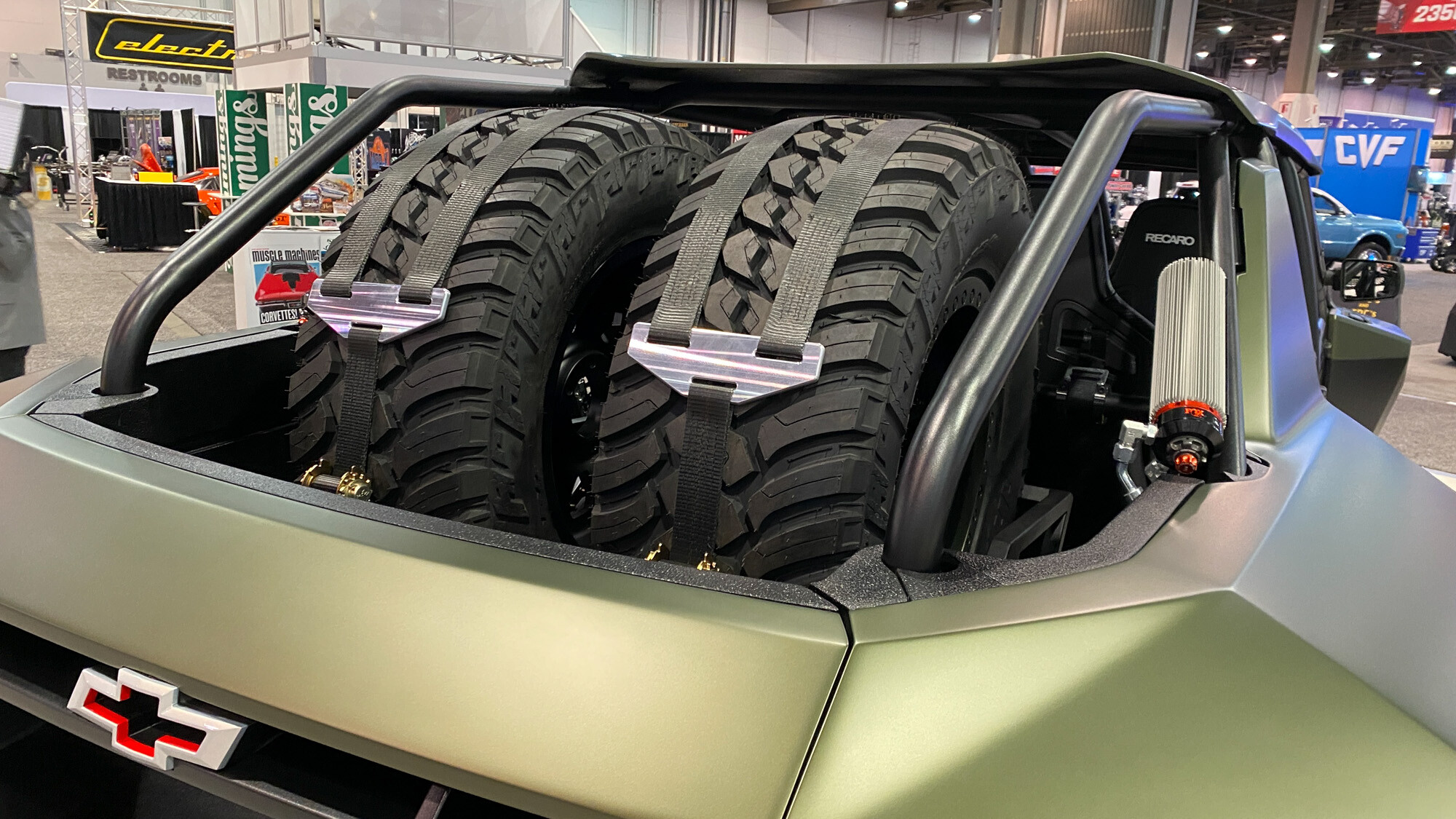
Speaking of which, the Beast uses appropriately massive 37×13.5-inch AMP Terrain Attach M/T tyres wrapped around 20×10-inch beadlock wheels.
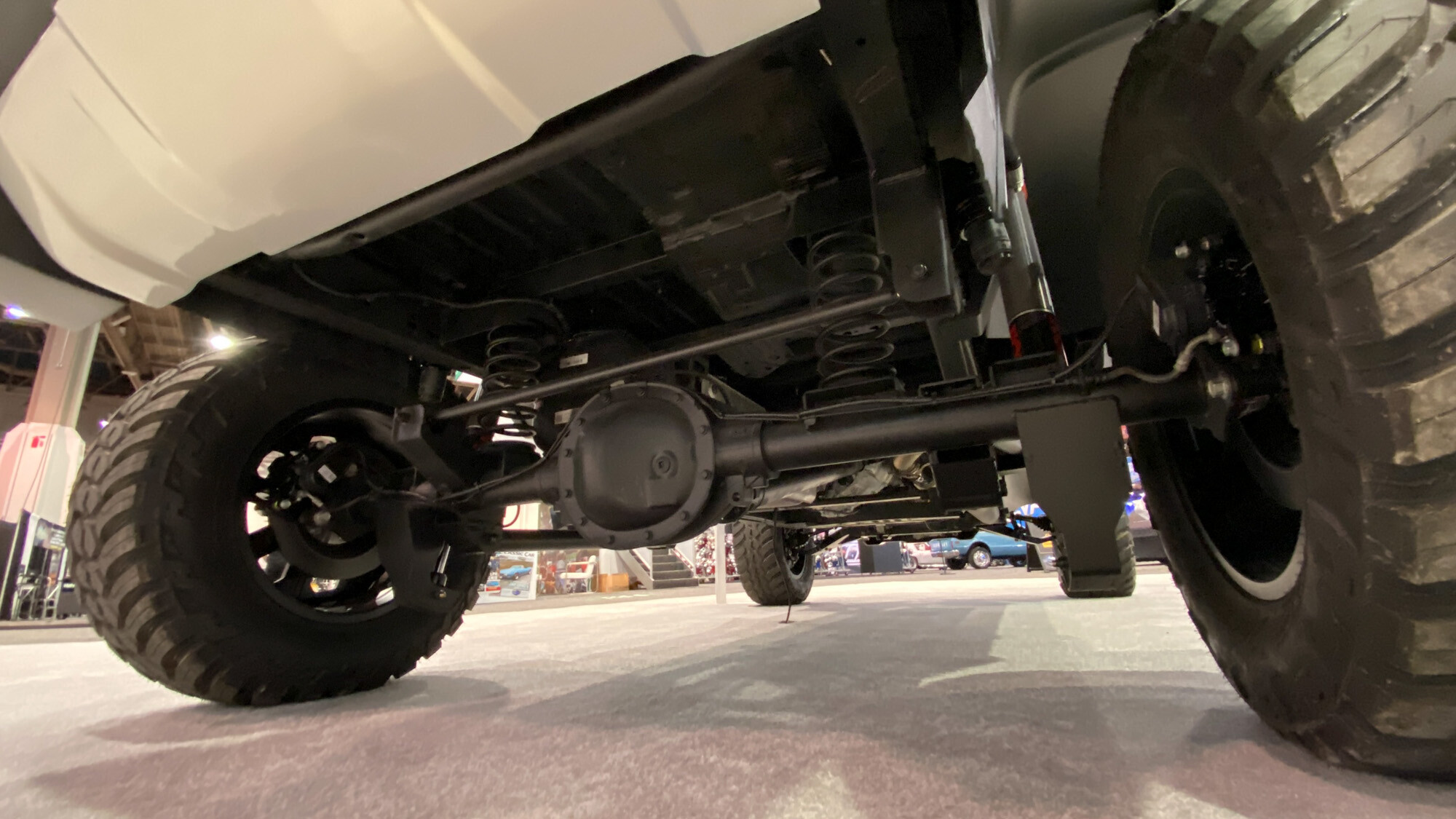
Suspension consists of a five-link setup in the rear – with fully adjustable racing strut units with remote reservoirs, combined with big Brembo brakes that boast six pistons, up front.
The combination of V8 power, massive 37-inch tyres, exo-skeleton exterior and being purpose-built for desert racing really does point to this being Chevrolet’s direct reply to Ford’s recently unveiled Bronco DR.
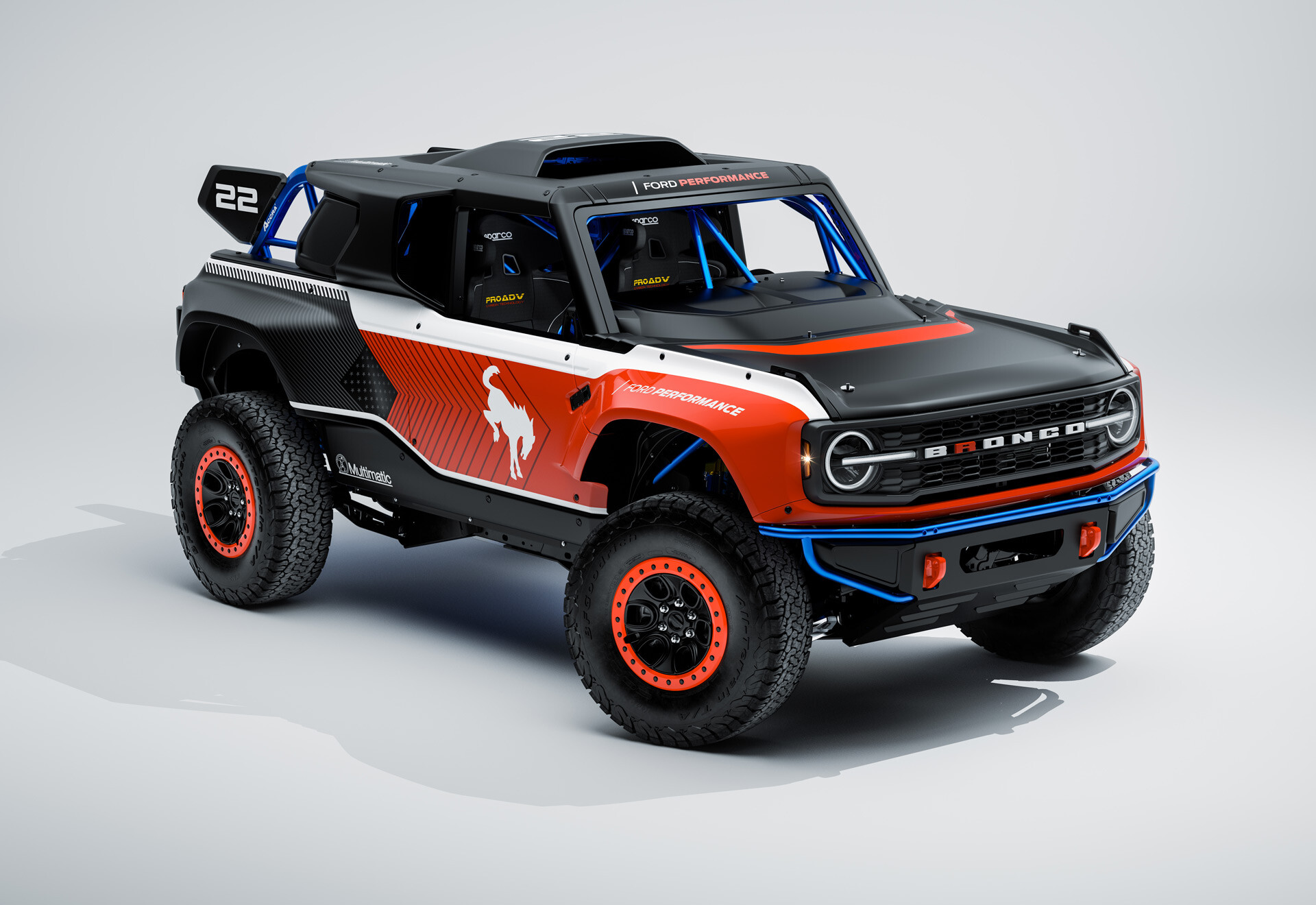
Like the Beast, the Bronco DR also uses V8 power pinched from a sports car (the Coyote V8 from the Mustang GT) with a 10-speed automatic, tubular roll cage, 37-inch off road tyres and race-built suspension.
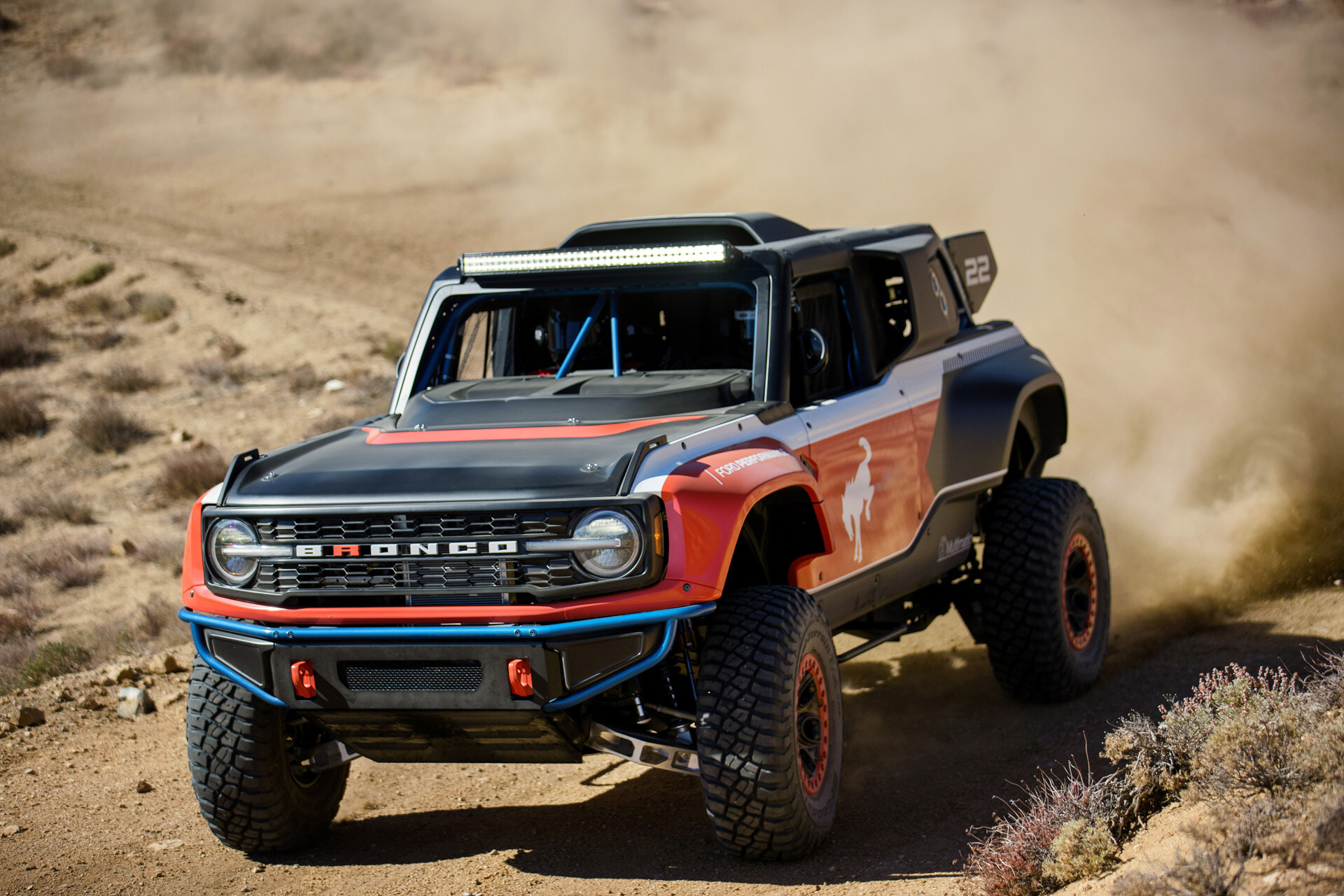
However, the biggest difference between the two is that the Bronco is no concept – but rather a prototype that Ford has full intention of building.
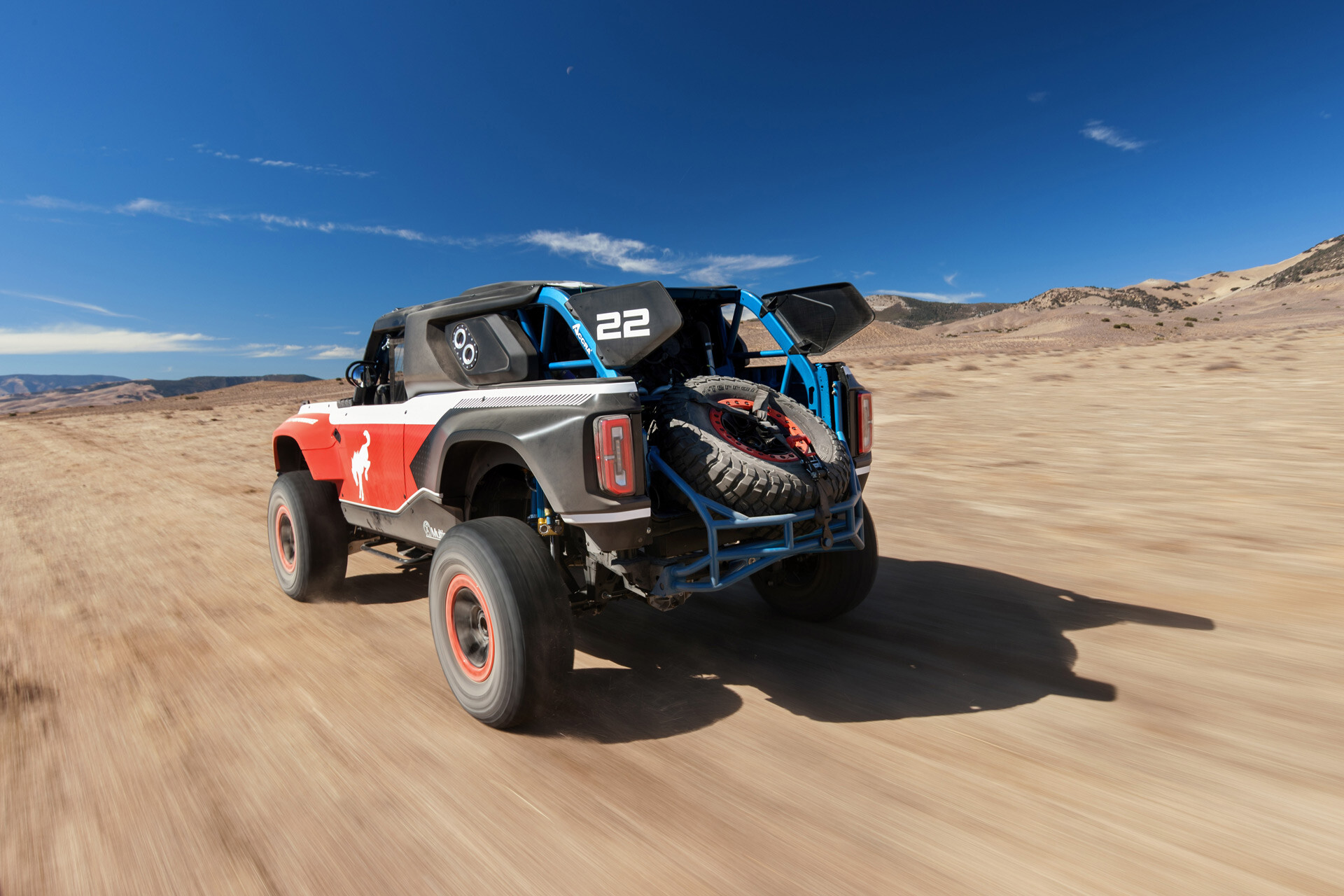
Ford plans on entering its own Bronco DR into the Dakar Rally next year, and while the latter won’t be legal for street use, a limited number of customers will be able to purchase one from the US firm by late next year – with prices starting at US$200,000 (AU$270,306).
Our resident US counterpart, Chris Collard, has been busy trawling the SEMA stands this year, and he has sent through a bunch of insane builds on display at this year’s event.
In the above photo gallery you’ll find a selection of the coolest metal on show at the Las Vegas Convention Center, including another Bronco custom, a resurrected 40 Series, a Honda (yep!), and a couple of mint Land Rovers.
The 2021 SEMA Show ran from November 2 to 5.
Have a favourite? Let us know in the comments section below.