
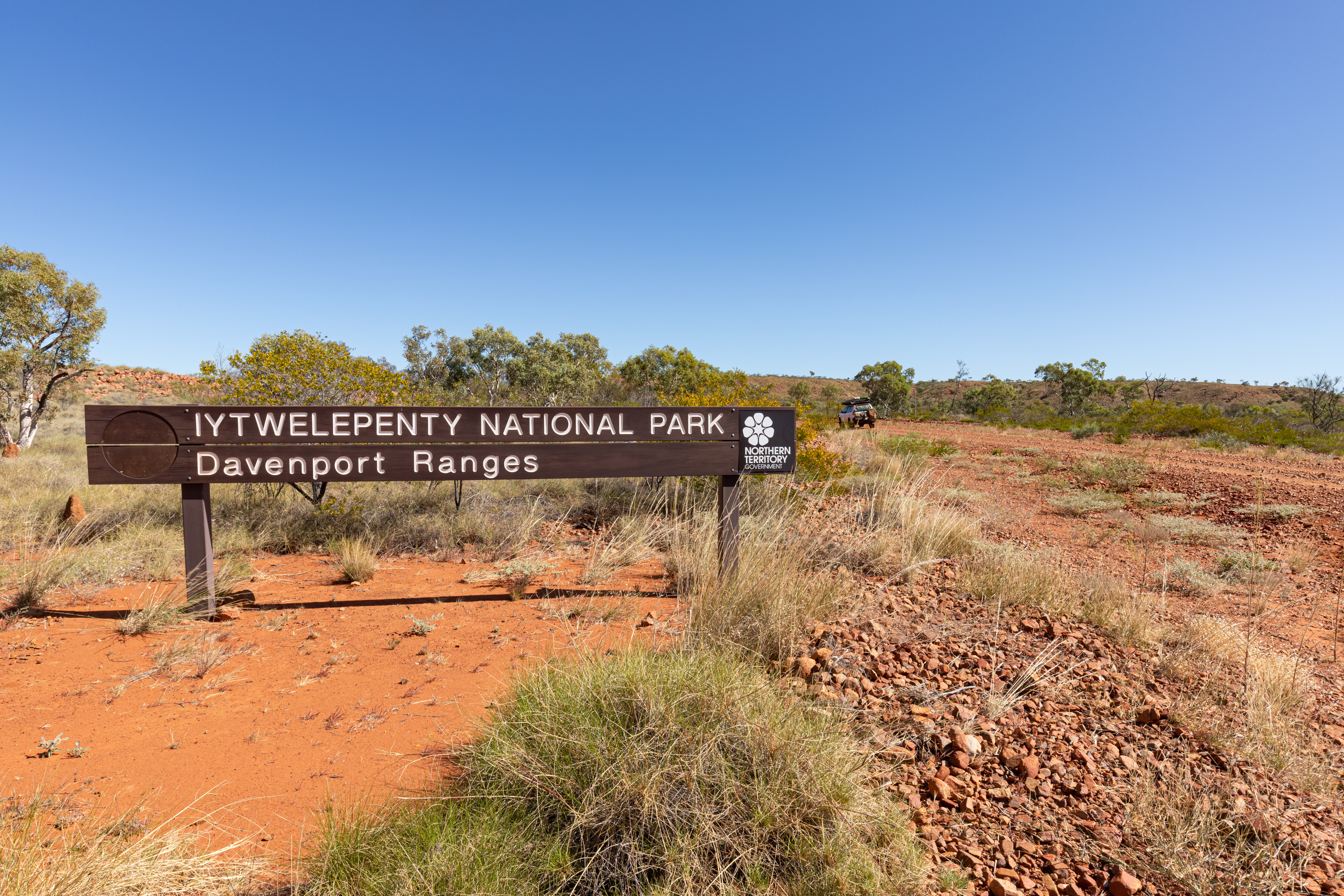
There’s a sign on the Stuart Highway, just north of Karlu Karlu (Devils Marbles), pointing to the Iytwelepenty/Davenport Ranges National Park and it’s passed by thousands of vehicles a day. Very few people take the turn-off and explore this stunning destination, which is a bonus for those of us who love remote destinations like this.
Kurundi Road leads to the scenic Iytwelepenty/Davenport Ranges NP, complete with permanent waterholes, great bush camping options and a challenging 4WD loop track. It’s also a haven for birds and fish.
The Davenport Range and nearby Murchison Range are unique to the other ranges in Central Australia because they receive relatively reliable rainfalls during summer. The Davenport Range also sits far enough north that it gets affected by the northern wet-season weather.
The region also enjoys warmer winters and a more humid climate than anywhere else in the Red Centre, which means there are several unique plants that include a mixture of tropical and desert species.
With its rugged beauty, Iytwelepenty is a photographer’s heaven, and its remoteness means you should be the only ones there.
Devils Marbles Hotel
I spent the night at the Devils Marbles Hotel, Davenport, where the beer was as cold as the pool, the chicken parma outstanding, and the bacon and eggs the perfect way to start the day. Hitting the road early is how I like to roll, avoiding the grey nomads towing oversized caravans slowly along the highway. There were plenty hanging out at Karlu Karlu and the Bonney Well Rest Stop.
Turning on to the gravel Kurundi Road, I dropped some air out of my tyres. In these conditions, I like to start the Kumhos at around 24psi in the front and 28psi in the rear, as the ride is significantly better, especially on corrugated sections.
As the road twists through a small range, the going is slow and rough. It’s only 50km to Kurundi Station, which has a store open seven days a week from 9am to 5pm with fuel, groceries, cold drinks and more.
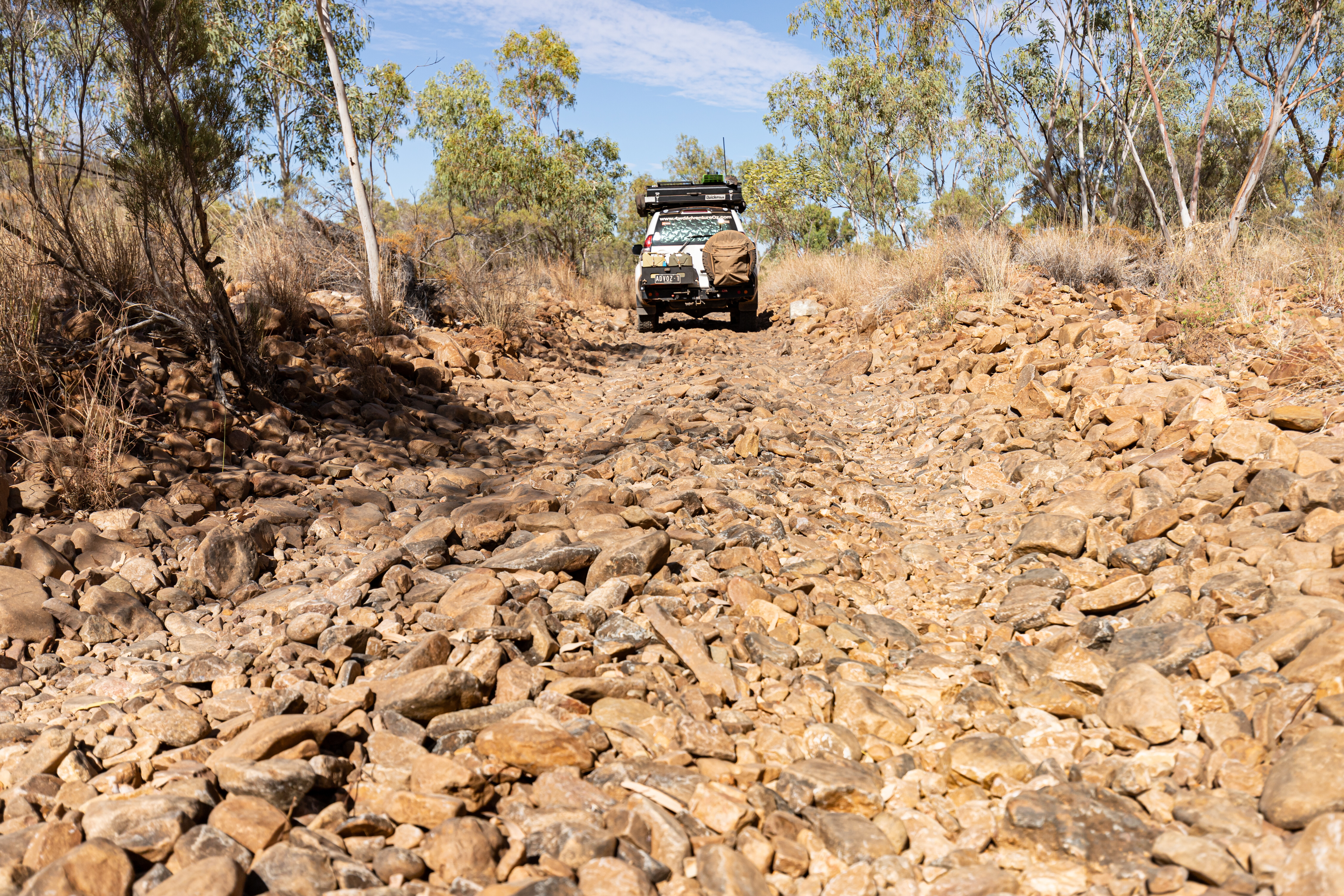
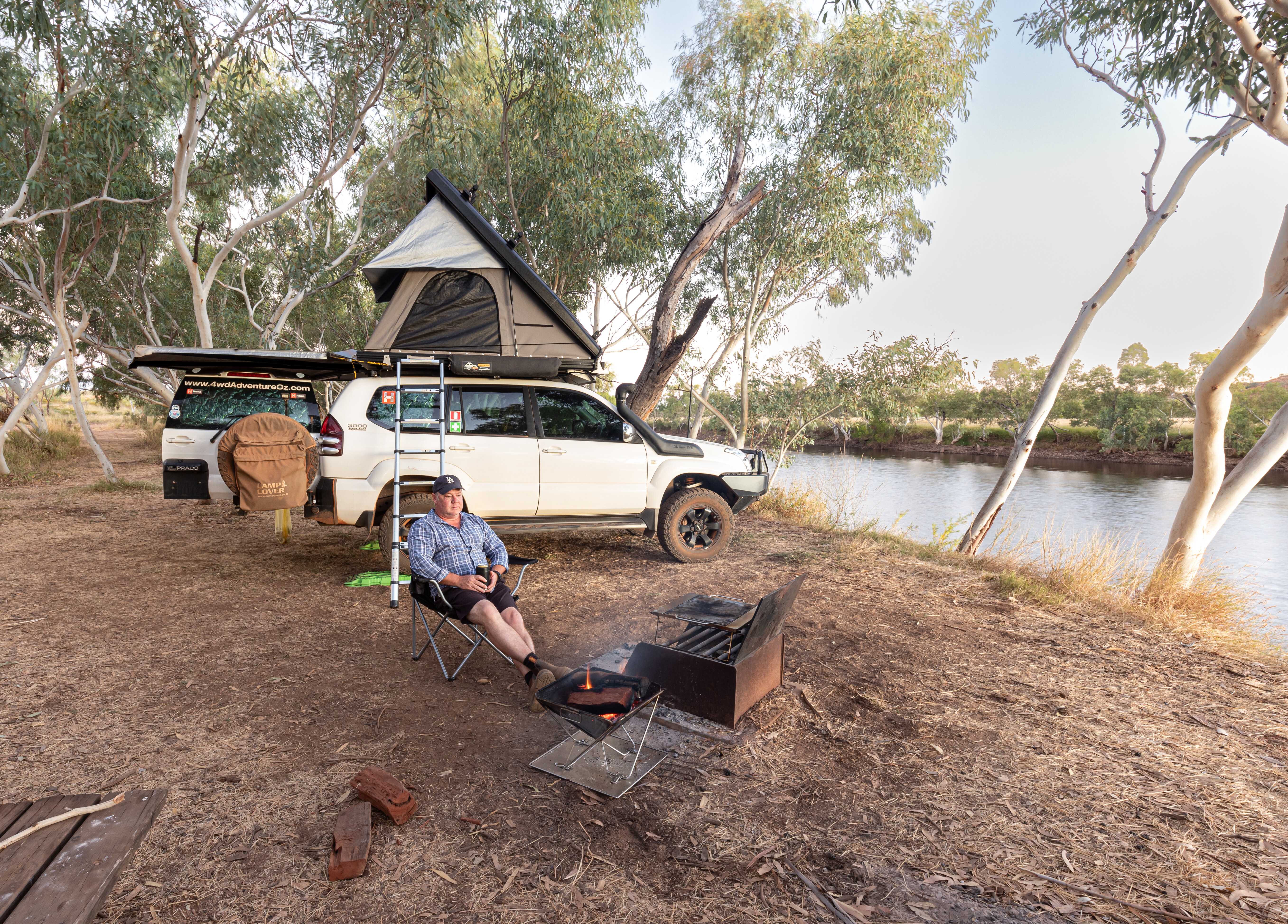
Once past the short bitumen strip through the pass, the dirt road widens as it turns east across the plains. Just 17km past Kurundi, the signpost for Whistleduck Creek Road leads to the campground and gorge. The campground is in two sections along Whistleduck Creek, with pit toilets, firepits and tables.
Remember to book a campsite online before you arrive. A day visitor area has a shelter and table, and is only a short walk to Irrmweng Rockhole, a place to enjoy the scenery and birdlife.
After spending a couple of days relaxing in the shade of the gum trees, it was time to move on. I hadn’t seen another soul in my time here, which is part of the magic.
360 lookout
Retracing my steps to Kurundi Road and turning right towards Epenarra, it was good to see the red dust billowing behind the Prado again. Just a short way before Epenarra is Cloughs Bluff Lookout, and the short, steep drive to reach the top is well worth it. The space is rather flat, with a table and chairs, but the 360-degree views make this a special place to stop.
The road from here was in the process of being graded, so whilst smooth, speed was restricted. On reaching a tight right-hand bend, the track to the left leads to Epenarra Station which offers fuel and a store with a good range of supplies, hot food and free camping.
The staff are very friendly and happy to direct you to some great bush camps next to the Frew River. Telstra 4G is available here, and you can find out what the conditions of the tracks ahead are like, as Binns Track follows this same route.
The turn-off to the Old Police Station Waterhole is approximately 33km from here and, once the Frew River had been crossed, the gravel road was in decent condition with some corrugated sections. I really enjoy the drive to the waterhole, especially in the late afternoon when the sun bounces off the rugged outcrops.
There were a couple of groups set up at the first couple of campsites, so I drove to the end of the track to find an excellent spot amongst the saplings. Each site contains a firepit and there are a couple of drop toilets a short walk from all sites. There was plenty of water in the waterhole, and I enjoyed watching a large flock of budgerigars diving in to take quick drinks as the sun began to set.
I was awoken during the night by the sound of a rogue cow trampling through the long grass along the stony riverbed, before slurping from the waterhole. By morning, it had disappeared with the only evidence of its existence being cow dung that the hordes of resident flies enjoyed.
Frew River
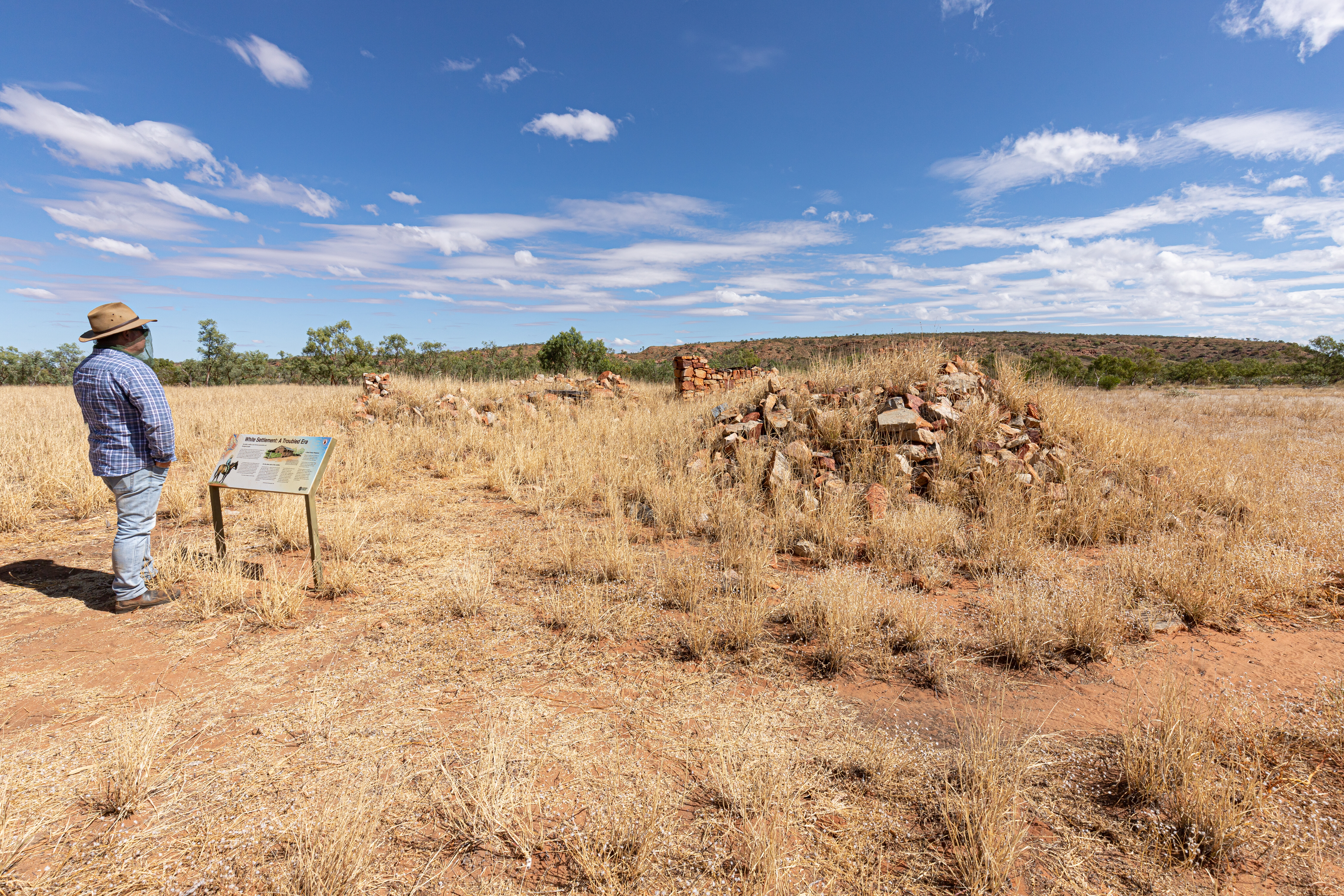
On the opposite bank and a nice walk from either end of the campground, are the ruins of the first Frew River Homestead that was abandoned in the 1890s due to continual conflicts with local Aboriginal warriors and a long drought. When cattle arrived in the Frew River area in January 1889, it changed the lives of the local Alyawarr and Wakaya people dramatically. This was an important place from which they camped, fished and hunted for thousands of years, so conflict was inevitable.
When tungsten was discovered at Hatches Creek, hundreds of miners arrived to work the fields. A police presence was proposed when troubles arose in the 1890s and a mining warden was needed for the mines.
Constable Jones arrived in December 1918 and a police station was soon built on the site of the old homestead. The police presence didn’t last long past the end of World War I, when mining at Hatches Creek petered out and on September 4, 1921, the last constable closed the station.
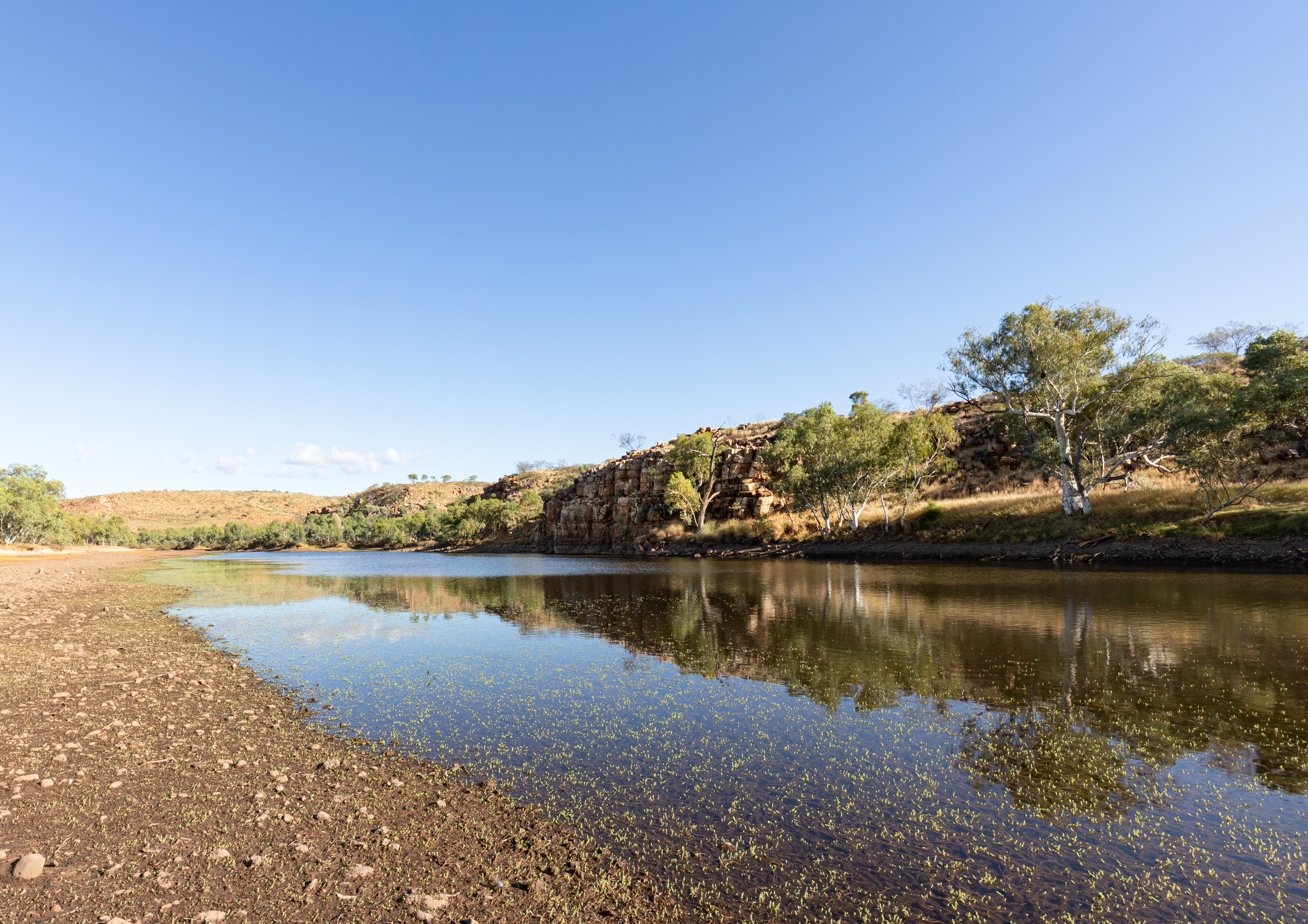
If you enjoy some 4WD action, the Frew River 4WD Track is a good challenge and trailers aren’t recommended. The loop track takes you through some dry creek beds before you reach the bush camping areas by the waterhole. There are no facilities, so leave the place better than you found it. The waterhole had receded since my last visit but the views across to the colourful cliff face on the opposite bank were still excellent.
Once past the camping area, it’s not long before you start to climb the range. One section is best to walk first to help in choosing the right line, as it’s quite steep with lots of small rocks that can increase the chance of wheel slippage. Past this section, you’re then following the ridgeline with outstanding views across the range. There are plenty of spots to stop to get a better look; don’t forget the camera.
The 4WD track may only be 17km but it is slow going, so allow at least a couple of hours to take in the epic landscape. The track ends at a gate before the junction with Kurundi Road. Take a left to head back to the Old Police Station Waterhole, around 51km away. This section of Kurundi Road is less well-maintained, with plenty of washouts, corrugations and bulldust holes to contend with.
There’s an old windmill at Bull Creek Bore just off the track that is worth checking out, and if you need firewood there are some good opportunities before reaching the turn-off to camp. Now that you’ve explored as much of the park as you can, why not spend a few days relaxing by the water. If you decide a swim is in order, the good advice is not to jump or dive into the water as there could be submerged rocks and logs.
When it was time to hit the road again, I ventured back to Kurundi Road and turned right towards Hatches Creek. Keep an eye out for wild donkeys, and if you don’t see them, stop and listen for them braying, especially near Hatches Creek Outstation. There is still evidence of mining activity in the area, but take care if you decide to take a walk around the ruins as there are backfilled shafts that are difficult to spot. Around the next corner, an old headframe is fenced off and looks like there has been some recent mining going on.
From here, the road becomes rougher and is hard-going on vehicles and camper trailers. You’ll cross the Frew River several times as the track follows its path and eventually reach another beautiful waterhole. Once through the rocky riverbed, you’ll reach a gate that indicates the border of the national park.
An excellent remote destination for those who love adventure and want to experience a place unique to the Territory
Once through the gate (leave it as you found it), be alert for cattle hiding amongst the trees, they are young and jumpy and ready to run in front of you. Upon reaching a second gate (the same rule applies) you’ll find yourself at the junction with Murray Downs Road. If you’re following Binns Track, turn left as the quickest way back to the Stuart Highway is via Murray Downs Road, with fuel available at Ali Curung/Warrabri if you head this way.
Iytwelepenty/Davenport Ranges National Park is an excellent remote destination for those who love adventure and want to experience a place unique to the Territory. Managed jointly by Alyawarr and Wakaya people and the NT Parks & Wildlife Commission, there is a whisper that more of the park might soon be opened up for us to explore.
Travel Planner
Where
Iytwelepenty/Davenport Ranges National Park is located south-east of Tennant Creek and can be accessed via Kurundi Road from the Stuart Highway in the north or Murray Downs Road in the south.
Camping
There are three camping areas: Whistle Duck Creek, Old Police Station Waterhole and Frew River on the 4WD loop track. All campsites must be booked and paid for online before you go: www.nt.gov.au/parks/find-a-park/iytwelepenty-davenport-ranges-national-park
Permits
No permits are required.
Fuel
Wauchope and Ali Curung provide unleaded/opal and diesel fuel. Expect to pay top dollar for fuel at the remote places, with $2/litre and more for diesel.
Best time to visit
From June to September, as the weather is generally cooler and the wet-season waters should have receded.
More info
Paper maps, with the Hema Maps range providing excellent coverage. Some form of electronic navigation/mapping hardware/software is also recommended. Wikicamps is excellent for showing where all the good campsites are.
With all the rain we’ve had on the east coast of Australia over the past couple of years, the thought of setting up the family tent or rolling out the swags in yet another muddy-brown puddle has put me off camping a bit, but with this new OZtrail Tarkine 1400 fitted to my Ranger, we can stay high and dry when the weather turns foul.
The Tarkine is the smallest and lightest rooftop tent in the OZtrail range, measuring 2.4m x 1.43m x 1.3m when open and weighing in at 59kg. I could have fitted it to the Rhino-Rack Pioneer Platform above the Ranger’s cabin, but this would have limited me to on-road driving only, so I instead mounted it on a pair of Yakima LockNLoad crossbars on the canopy.
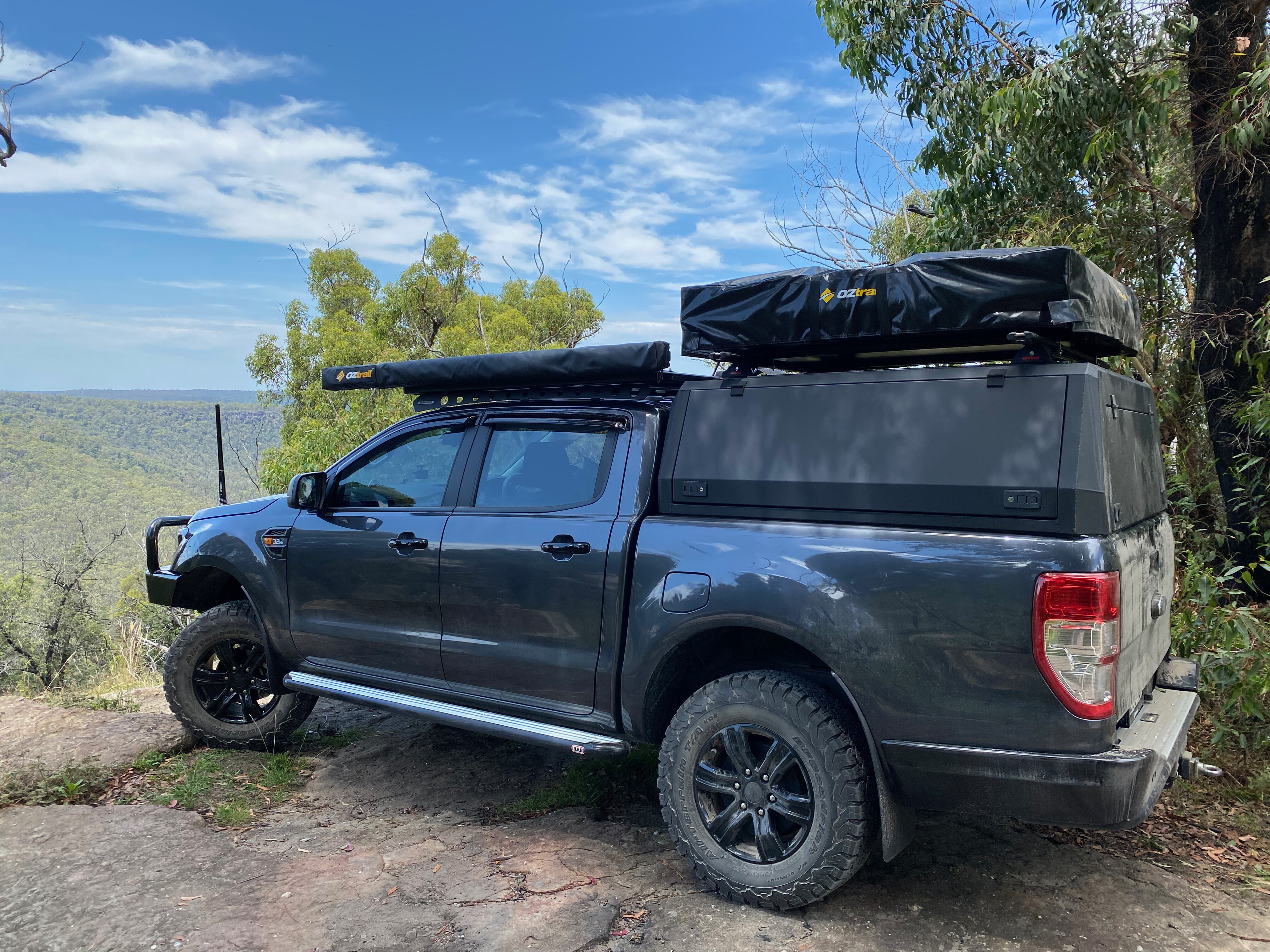
OZtrail recommends the Tarkine be fitted by a professional 4WD aftermarket store or a roof-rack expert, but I opted to fit it myself, and this proved pretty straightforward. Once unpacked, I removed the mattress so I could bolt the supplied rails to the underside of the tent’s base; I then lifted the tent on to the crossbars and attached it using the supplied brackets, nuts and bolts; once secure, I opened the tent up, attached the ladder and put the mattress back in.
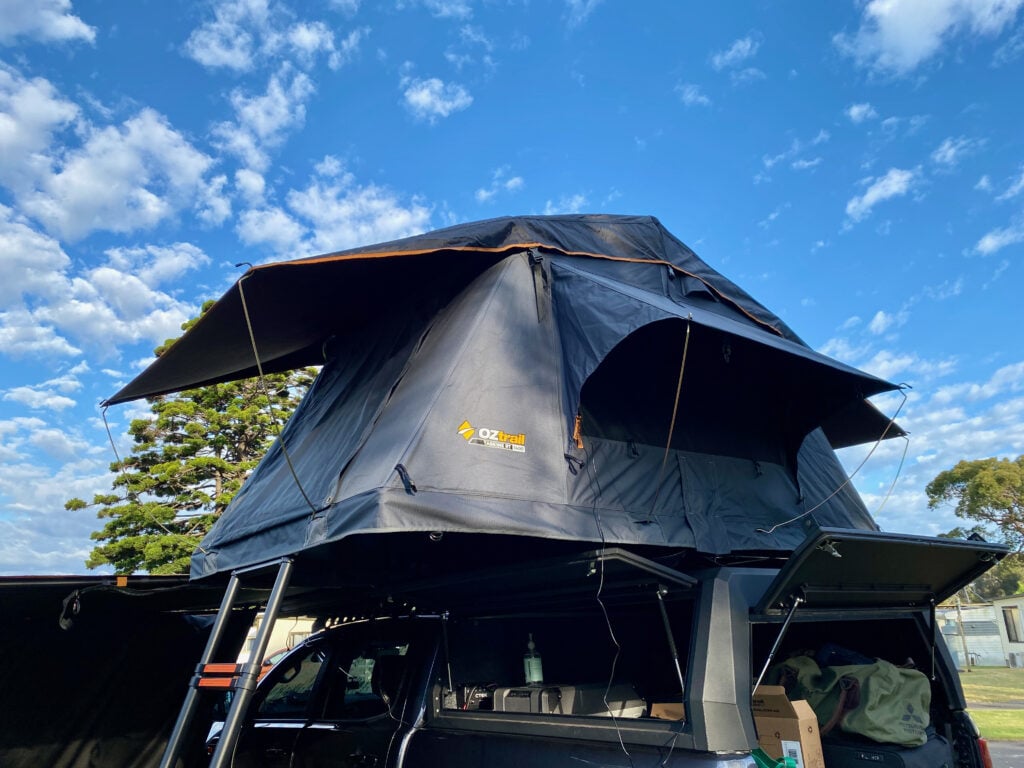
Top-quality rooftop tent that is easy to set up, is very comfortable and has a low profile when packed down.
I then closed it and fitted the PVC transit cover. The whole process only took an hour or so and I managed to do it on my Pat Malone; although, it would be much quicker (and easier) with two or three people in on the act.
One of the things I really like about the Tarkine is the design of the telescopic-retracting ladder, which simply pulls out and locks in place at any given height, up to 2.3m in length. Once closed and folded flat against the tent for travelling, it has a very low profile, so it doesn’t protrude excessively like some other rooftop tent ladders.
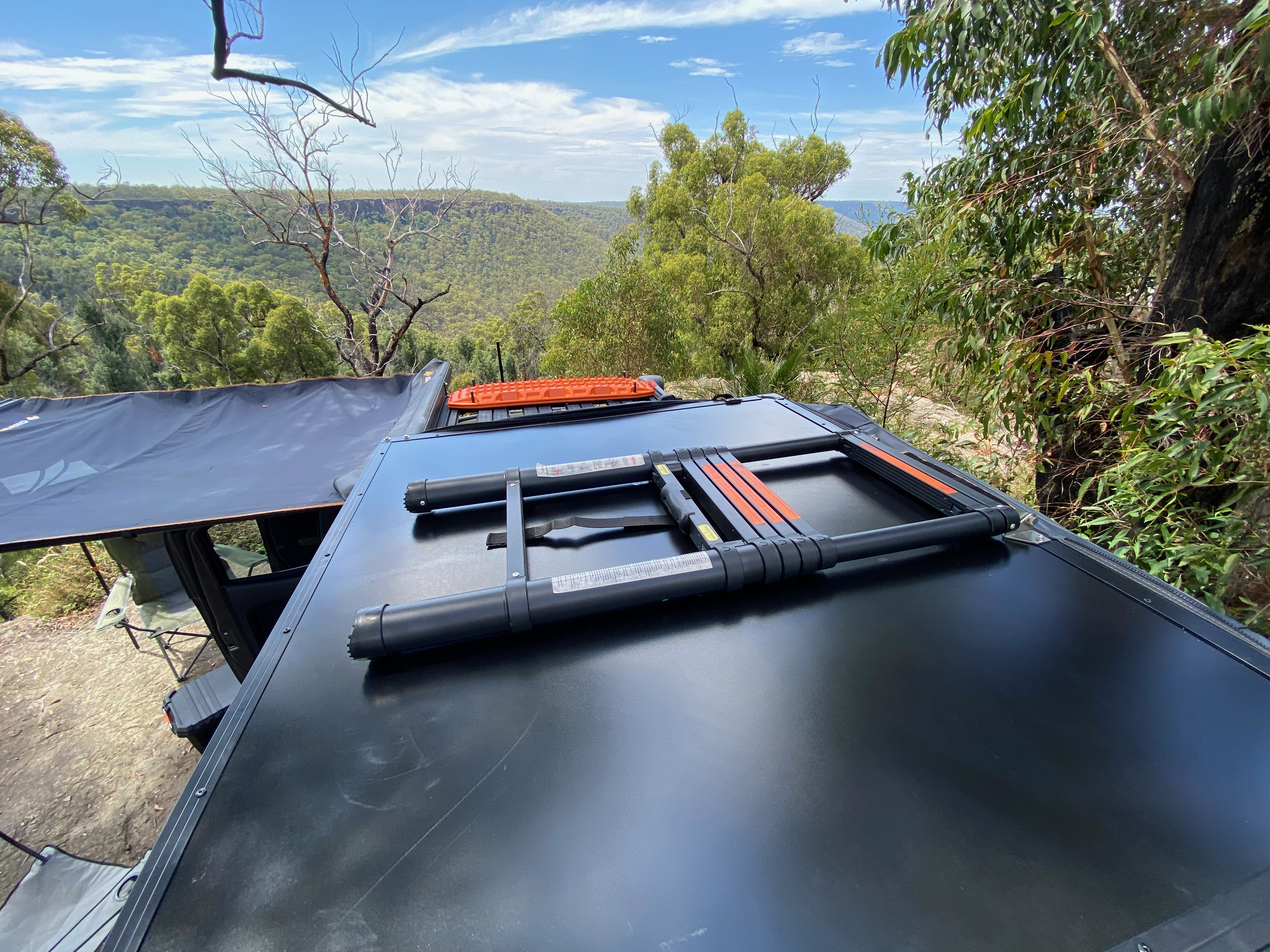
In fact, the packed height of the Tarkine is just 31cm, including the bit where the ladder sticks up, which is around a foot in the old language. Packed height is an important consideration when fitting a rooftop tent, as the lower the overall profile the less affect it will have on vehicle fuel consumption.
Once the Tarkine was secured to the canopy, I took the Ranger out for a spin. On suburban streets I could immediately feel the extra weight up top, but with the Ranger’s Tough Dog 300kg constant-load springs in the rear, it handles that weight well. In fact, ride quality is actually better with a bit of extra weight on-board, especially when driving over speed bumps or other road-surface irregularities, and the 41mm foam-cell shock absorbers ensure there’s plenty of damping control so the back-end doesn’t bounce around like a pogo stick.
Admittedly, body roll is more noticeable when cornering, but it doesn’t feel excessive. At highway speeds, performance is blunted slightly by the extra wind resistance, but I’m never really in a hurry when loaded up for a weekend away.
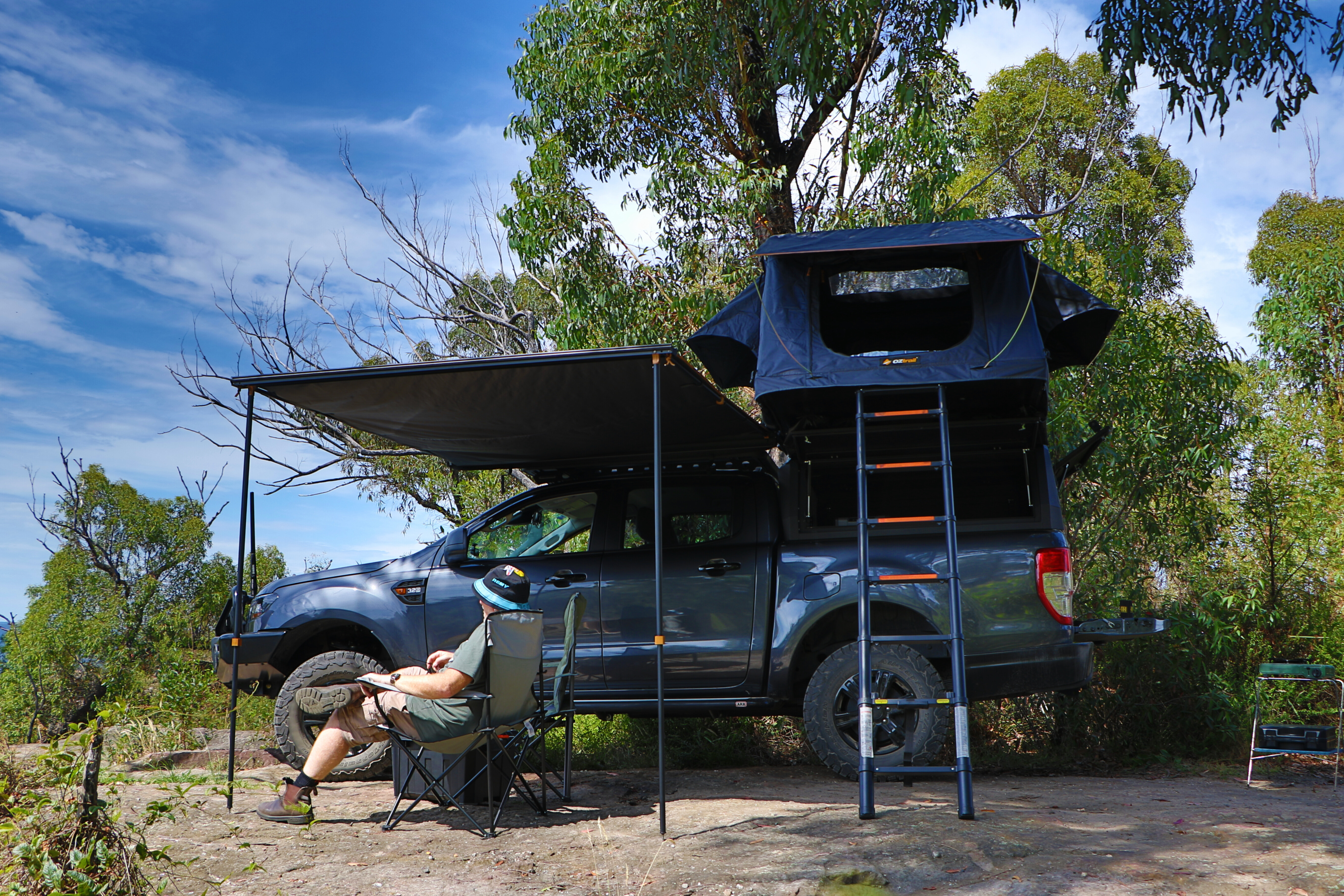
The first test of the Tarkine rooftop tent was a family camping weekend in a caravan park on the south coast of NSW. Considering my lack of experience with the Tarkine, I found set-up to be very quick and easy, which was just as well because I reckon you always feel judged when setting up camp in a caravan park full of onlookers.
The process involves removing the strapped-down and zipped-on PVC transit cover, undoing a couple of tie-down straps that secure the tent in place, extending the telescopic ladder and pulling on it to unfold the tent. The attached fly opens up with the tent, and the straps that secure it can be easily adjusted if necessary.
The tent’s front and rear doors are protected by the fly, while the side windows have generous awnings. The poles that hold the fly and awnings in place are durable anodised spring-steel items that are easy to attach, and there’s enough coverage that you can leave the window and door flaps open in inclement weather to maintain good ventilation, of which there is plenty.
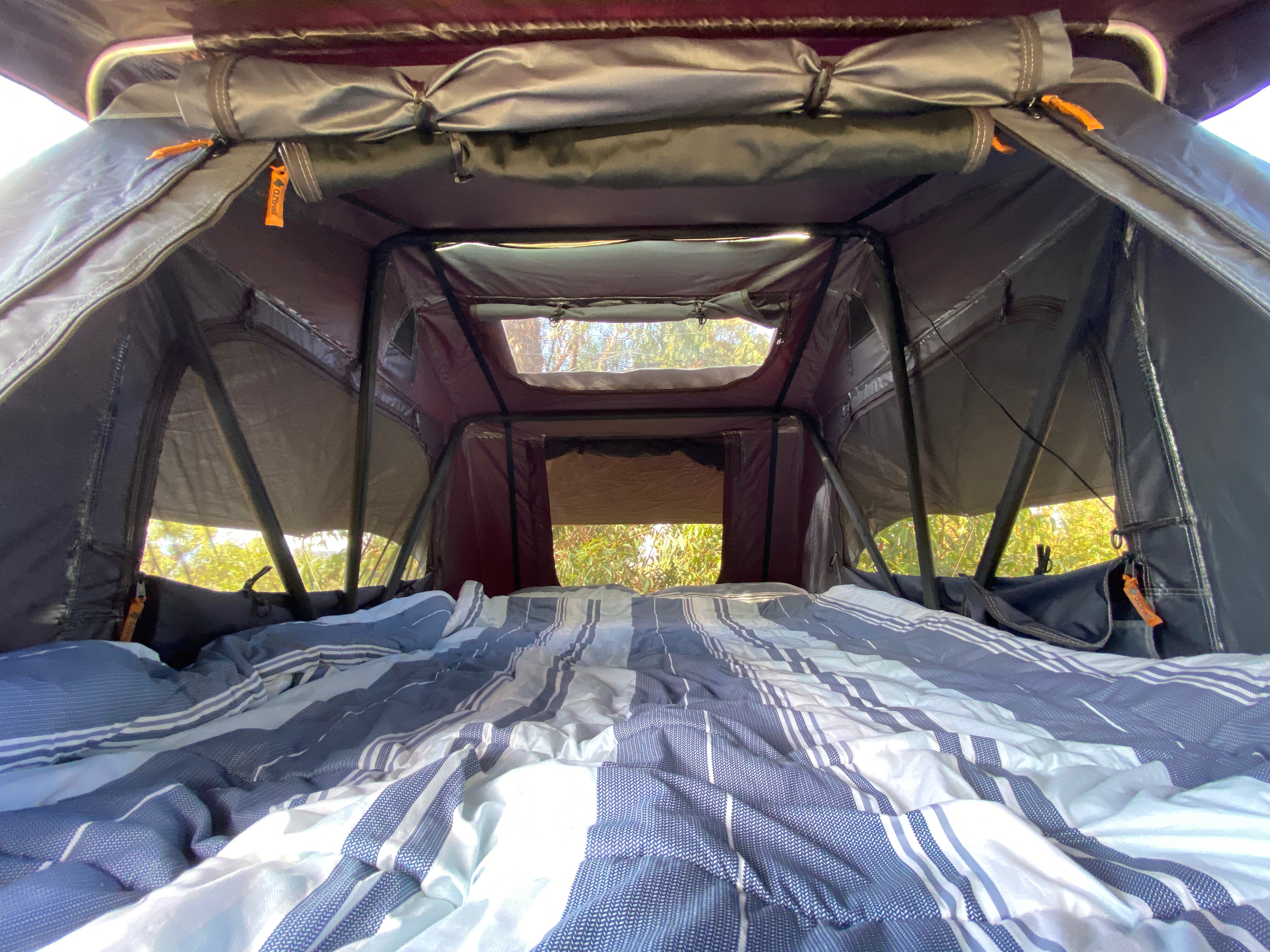
As well as the large doors at either end, the large side windows and small vents on either side up near the roof, there is also a ‘SkyMesh’ roof panel that can be opened to let heat out. This panel has a flyscreen and a corresponding clear panel in the fly, allowing you to look up at the night sky as you drift off to sleep.
Of course, the doors and windows have flyscreens fitted too, and shy types can rest assured that it is difficult to see into the tent when these are zipped closed, even with the removable LED strip light turned on. That strip light has a long enough cord to be plugged into the USB outlet I have fitted at the rear of the Ranger’s tub, but there is no switch, so you can’t turn the light on and off from inside the tent. The easiest solution to this conundrum would be to run the strip light off a handheld powerbank, so you could unplug it from inside the tent when you want ‘lights out’.
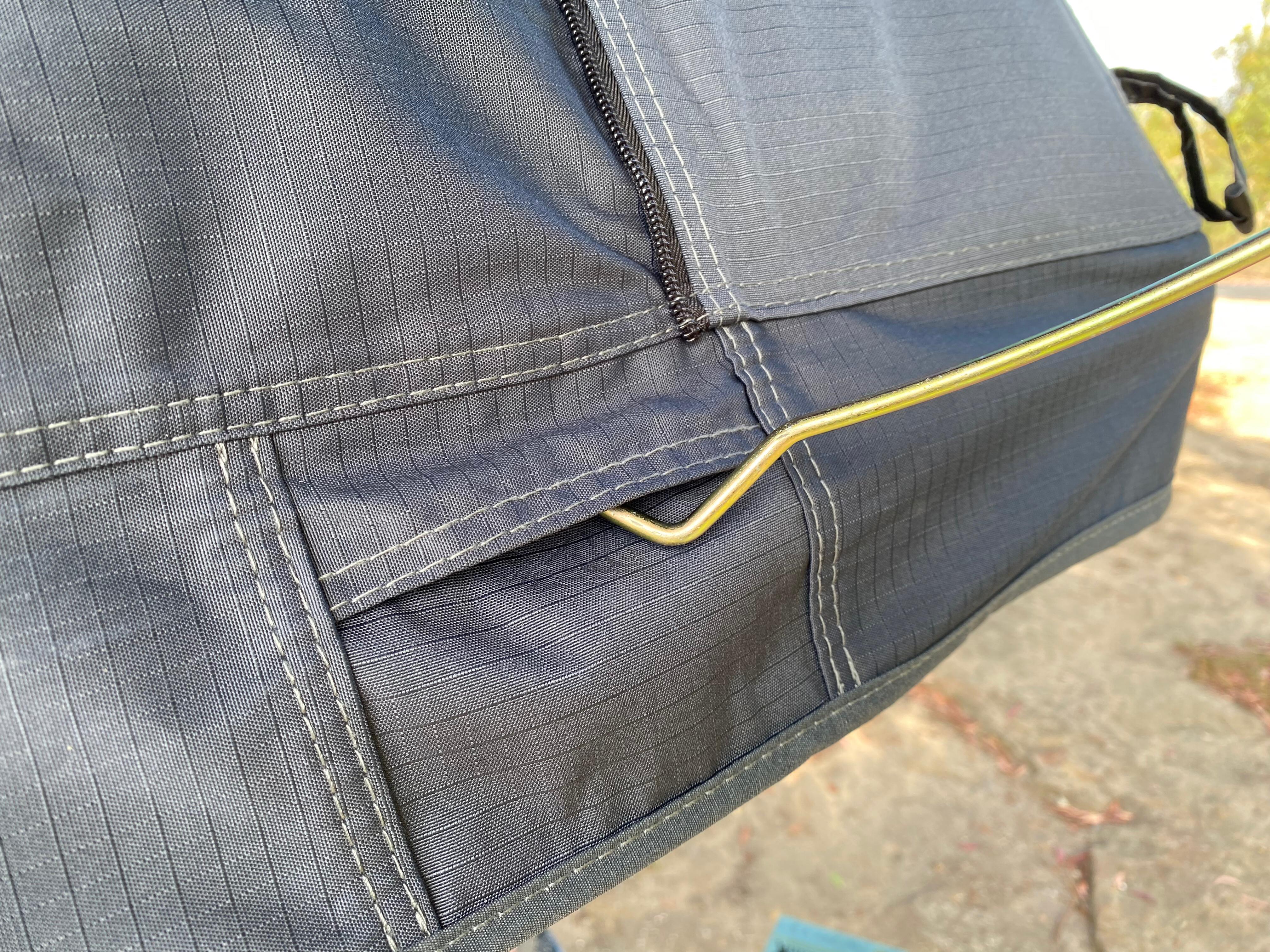
The material used in the Tarkine is a 280gsm ripstop polycotton canvas that ensures good insulation and breathability. The seams are all double-stitched and the zippers and flyscreens are of a high quality. The fly is made from waterproof 210D Polyoxford flysheet and it too looks to be a decent bit of kit, with quality straps and buckles for adjustment.
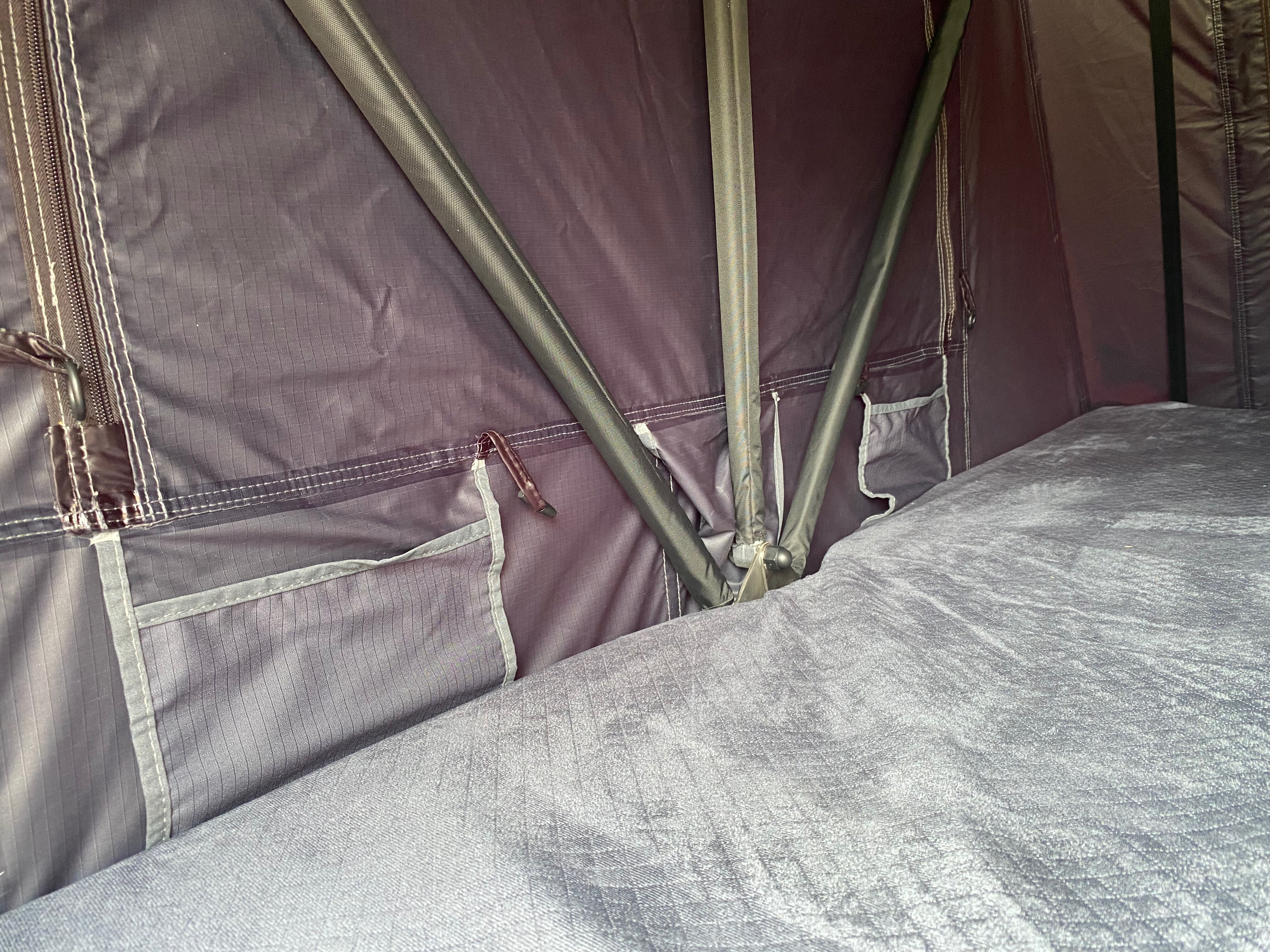
For someone more accustomed to sleeping in a swag, I must admit I could soon get used to the Tarkine’s 60mm-thick high-density foam mattress – it’s sooo comfy. The mattress has a removable and washable luxe flannel cover, and it sits atop an anti-condensation mat that is designed to allow airflow to help prevent moisture build-up and mould. The mattress itself is 2.4m long and 1.4m wide, so even tall campers will be happy campers.
On this first camp with the Tarkine, I didn’t get the chance to sample the comfort of the foam mattress – my wife Renata and I swagged it under the Ranger’s awning – but the following morning, we were greeted by two beaming and well-rested 12-year-olds who reported that the Tarkine was “the best tent ever”. As they made their way down the ladder for breakfast, I noted how they didn’t put a second thought into their descent, thanks to the relaxed angle and stability of the ladder, and its wide rungs.
After brekky, I decided to set up the optional annexe, which simply attaches via a sail track and a couple of zips on the underside of the Tarkine, and is then pegged into the ground at all four corners. You could use this annexe as an extra sleeping area or do what we did, and use it as a change room and for luggage storage.
It has a generous 2.3m x 1.7m floor space, three large fly-screened doors and a tough (and removable) 600gsm PVC floor with high sides to keep water out. Another internal door allows you to access your vehicle, which in the case of my Ranger’s set-up means access to the fridge through the canopy’s side door.
The large external doors of the annexe can either be rolled up or, with tent poles, used as awnings to provide additional shelter. As I have also fitted an OZtrail 2m x 2.5m awning (see ‘Blockout Awning’ breakout) to the Ranger, with optional side and front walls, I now have more than enough shelter for camping in crappy weather.
The OZtrail Tarkine 1400 costs $1500, which I think is excellent value for money for a good quality, well-designed and super-comfortable rooftop tent
When it was time to go home, packing up the Tarkine for the first time took a little longer than set-up. The process involves removing bedding, pulling in the cord for the LED strip light and closing the flyscreens, windows and doors. You then use the ladder to flip the tent over in to its closed position, retract said ladder into its transit position atop the tent, make your way around the tent to ensure all the tent and fly material is tucked away neatly, and then tighten the tie-down straps.
Once you reckon you have it all packed down nice and tight, throw over the PVC transit cover, zip it up and strap it down. It should be noted that you have to completely remove the transit cover to attach the annexe via the sail track, but if you haven’t used the annexe you can save some time by leaving the transit cover hanging; or in the case of my Ranger, stowing it between the underside of the tent base and the canopy’s lift-up side door.
A few weeks later, I got to sample the comfort of the Tarkine’s high-density mattress for myself. Tent set-up and pack-away was much quicker the second time around due to the fact I knew what I was doing … and I didn’t have an audience.
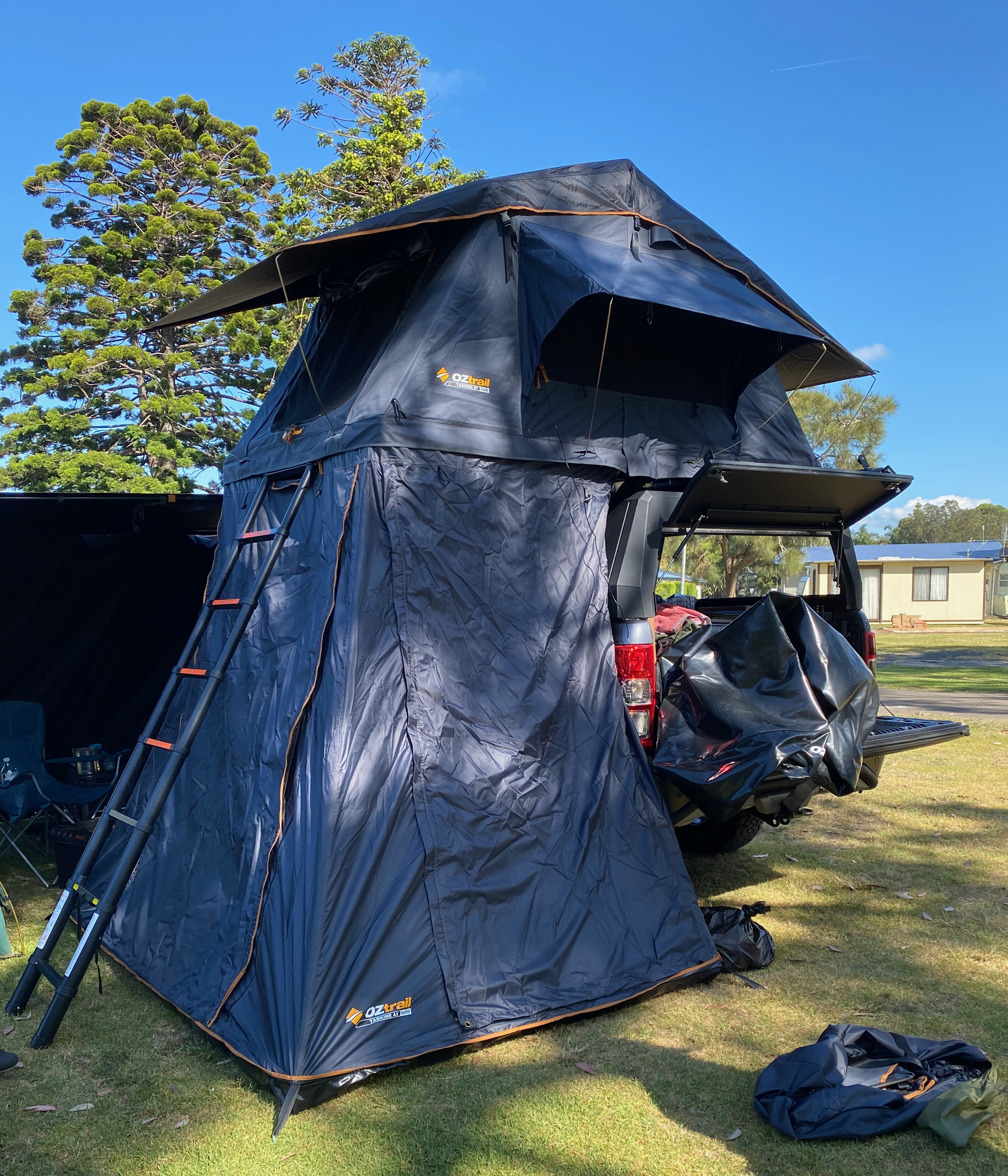
The tent alone only takes a couple of minutes to set up, and I can even have the awning attached and pegged down in another couple of minutes, which is great if you need to make camp under threatening skies. If you need to pack up the tent when it’s still wet, it’s advisable to dry it out as soon as possible to prevent mould.
I’ve had the Tarkine on top of the Ranger for just over two months now and, in that time, fuel consumption has increased from 12.6L/100km to 13.4L/100km. It’s less than I would have expected, but I’ll remove the Tarkine between camps rather than leave it out in the weather as fitment isn’t all that difficult or time-consuming.
The OZtrail Tarkine 1400 costs $1500, which I think is excellent value for money for a good quality, well-designed and super-comfortable rooftop tent, while the optional Tarkine 1400 ‘Annex’ is $380. If you’re after a rooftop tent, this one should definitely be on your radar.
Weighty issue
There was a fair bit of messing around prior to deciding which OZtrail rooftop tent (RTT) I was going to fit to my Ford Ranger, and that’s because the PXIII Ranger, like many modern vehicles without traditional roof gutters, doesn’t have a huge roof-load capacity at 100kg.
I have a Rhino-Rack Pioneer Platform on the Ranger, fitted via Rhino’s Backbone system, and this set-up weighs 27kg, so I can only put 73kg up on the platform. If driving off-road, Rhino recommends this capacity be divided by 1.5, so the actual roof-load capacity then drops to 48.6kg.
The Tarkine 1400 is the lightest of the OZtrail RTT range, weighing in at 59kg. As a big chunk of my driving is off-road, I couldn’t fit the Tarkine to the Pioneer Platform. That meant it would have to go on the aluminium canopy, which has a dynamic roof-load capacity of 100kg, and this is equipped with a pair of Yakima LockNLoad crossbars that are also rated to carry 100kg.
BlockOut awning
As well as the Tarkine, I fitted an OZtrail BlockOut 2m x 2.5m awning to the Ranger, and added optional front and side walls. The awning itself sets up like pretty much every other side awning on the market, providing quick and easy shade.
The material used for the Blockout is 280gsm ripstop polycotton canvas treated with OZtrail’s BlockOut technology, which is claimed to block up to 95 per cent of light to reduce temperature under the awning by up to 10°C. It also has a claimed 1500mm waterhead rating so it will keep you dry when it’s bucketing down.
The BlockOut side walls and the front wall are made from the same 280gsm polycotton canvas, and they attach easily and quickly via Velcro tabs and are pegged out at their respective bases.
With the Tarkine rooftop tent and the awning both set up – and one side wall and the front wall fitted – there is loads of weather protection down the passenger side of the Ranger.
Pricing
Tarkine 1400 RTT: $1499.99 Tarkine 1400 ‘Annex’: $379.99 Blockout 2m x 2.5m awning: $319.99
Top-quality rooftop tent that is easy to set up, is very comfortable and has a low profile when packed down.
While the mid-size 4×4 wagon segment continues to be dominated by the Toyota Prado, the minor placings are looking a bit more exciting in 2023.
Isuzu’s MU-X was consistently the second-best seller behind Prado, and in 2022 it finished the year with 10,987 sales to Prado’s 21,102. In third place for the segment was the Ford Everest; it tallied 10,313 sales with just a few months of the new model included.
In January ’23 the Everest jumped to the top of 4×4 wagon charts, shifting 1230 units to the Isuzu’s 828 and Prado’s 1182. Are we seeing a shift in the wagon segment, or is the success of the Everest just the momentum of a new model?
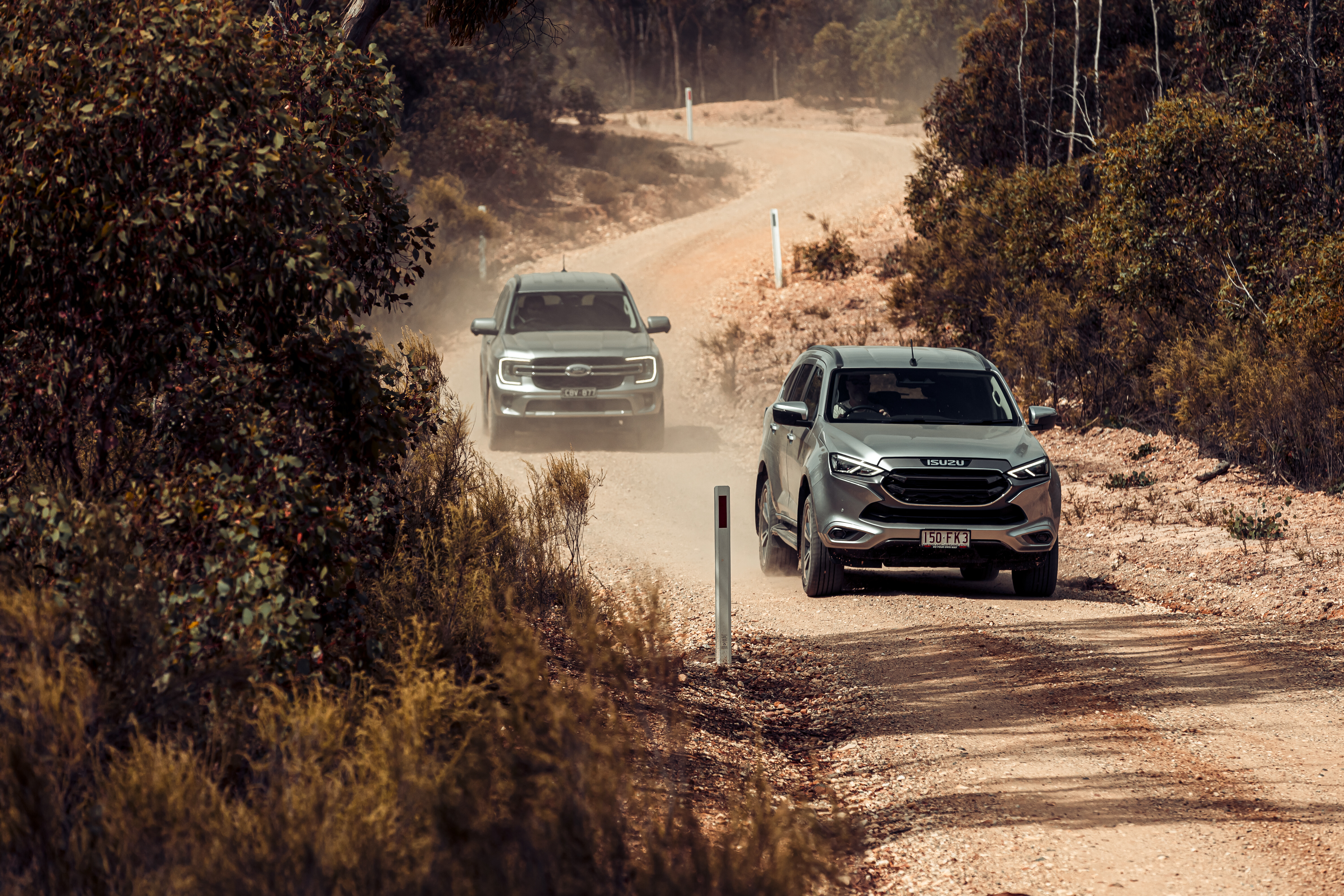
We lined the Everest V6 up with the Prado a few months back and found them to be very evenly matched and hard to pick apart. This time we have the Everest Trend with the 2.0-litre four-cylinder engine and pitted it against the Isuzu MU-X in top-spec LS-T guise.
The Trend is the highest spec Everest you can get with the four-cylinder engine and starts at $65,290 (+ORC) in 4×4 trim. The MU-X LS-T comes with a drive-away price of $65,990 and is only offered with the 3.0-litre four-cylinder engine, so the two are a good match on price.
JUMP AHEAD
- What you get
- On-road performance
- Off-road performance
- Towing
- Safety
- Ownership
- Practicality
- VERDICT
- Scoring
- Full specs
What you get
As high-spec models, both of these seven-seat wagons come very well-equipped for family use.
As the newer model here, let’s start with the Everest Trend. The Trend is the second of four models in the 2023 Everest line-up, but the highest spec with the four-pot engine. That engine is the 2.0-litre dual-turbocharged, diesel-fuelled mill that produces a healthy 500Nm and 154kW.
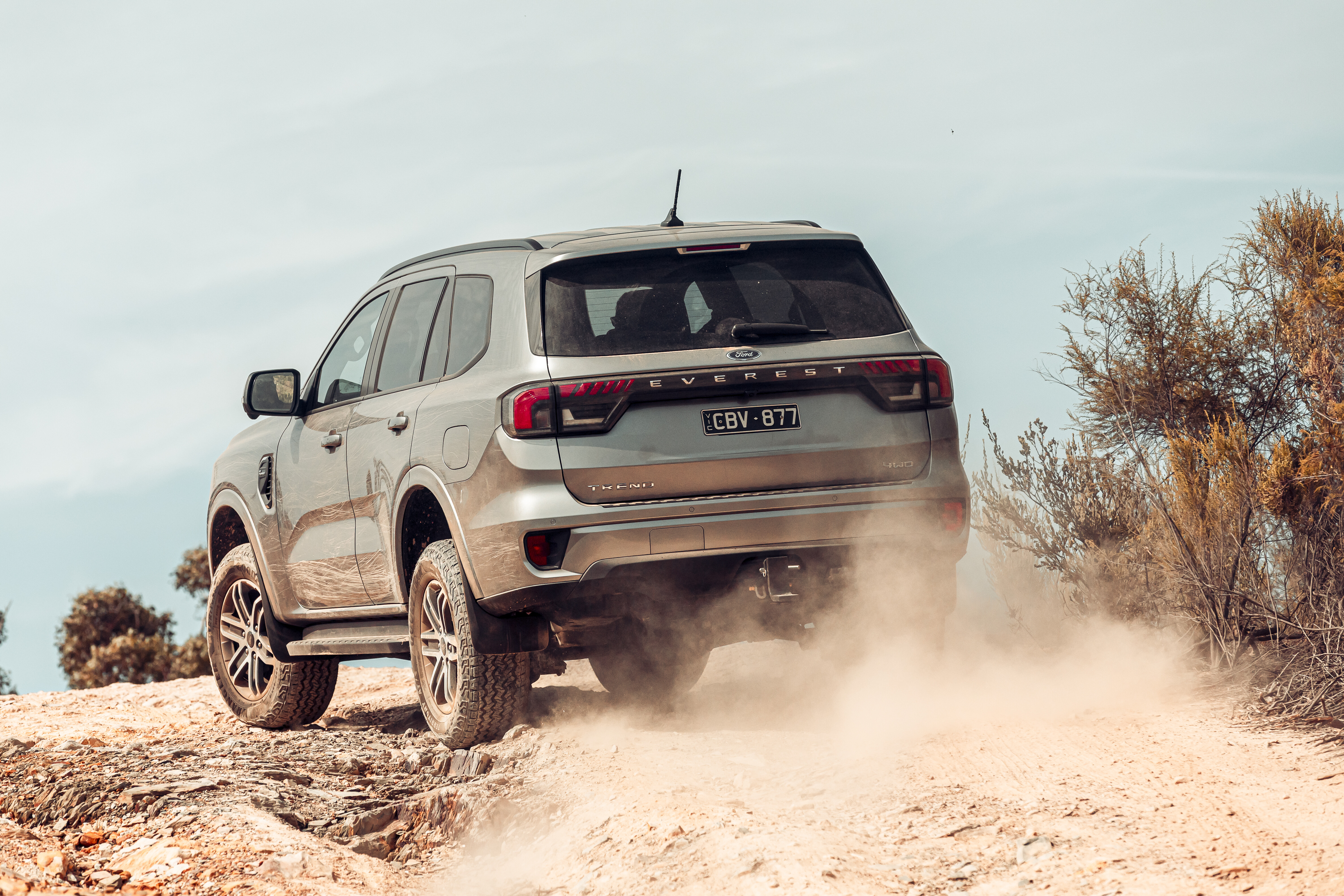
The engine is backed by Ford’s 10-speed automatic transmission which was heavily revised for this latest model, and a four-wheel drive system that offers conventional two-wheel drive, full-time 4×4 for all-wheel drive on any road surface, locked 4×4 high range, and locked 4×4 low range. There are six drive modes for various road conditions and a rear differential lock for when the off-roading gets real tough. The Everest Trend rides on 18-inch alloy wheels and 255/65R18 all-terrain tyres.
Inside, all seven seats are leather-covered with power adjustment for the driver’s seat (eight-way) but no heating or ventilation on any of them.
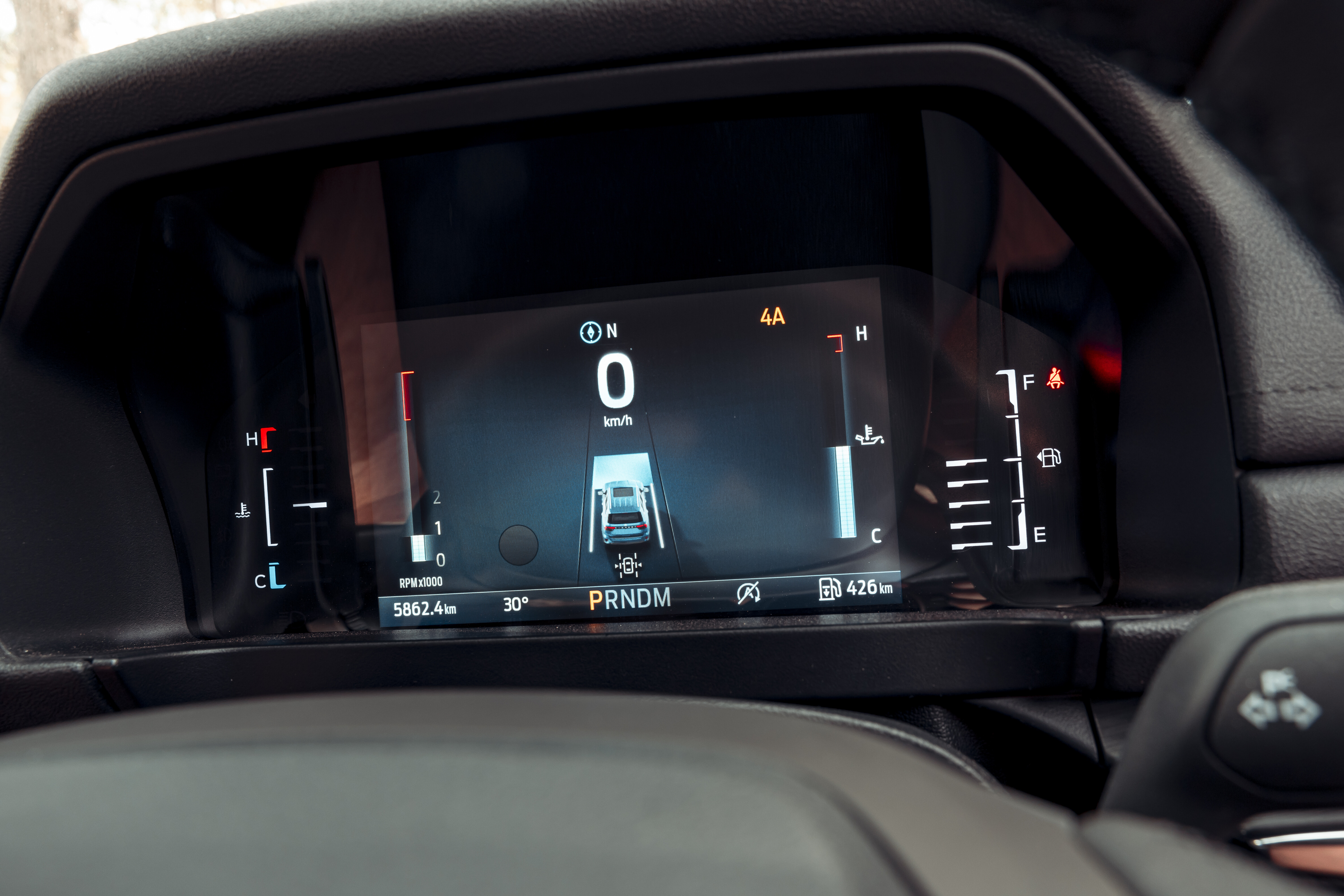
The 12-inch portrait-style centre screen houses the infotainment, sat-nav and off-road functions. Apple CarPlay and Android Auto can be wired or wireless, and there’s a wireless charging pad for compatible phones. The eight-inch digital gauge screen is configurable to show your favourite information but misses out on a tyre-pressure monitoring system which only comes with the Everest Platinum.
Everest: Factory extras fitted
| Prestige paintu00a0 | $675 |
| All-terrain tyresu00a0 | $500u00a0 |
| Touring pack | $1950 |
| Towing pack | $1700. |
It should be noted the Everest’s towing pack includes not just the towbar but also a 12-pin plug, integrated electronic brake controller and Ford’s excellent electronic towing modes and aids via the big screen.
Stepping into the Isuzu MU-X LS-T and the 3.0-litre diesel engine with a single turbocharger makes 450Nm and 140kW. It is backed by a six-speed automatic transmission and a part-time 4WD system that gives the driver 2WD, 4×4 locked high range and 4×4 locked low range.
The Isuzu offers no setting for AWD on sealed or firm road surfaces. The single drive mode in the MU-X is the ‘Rough Terrain’ button which effectively sharpens up the electronic traction control for off-road use. A locking rear differential is standard on the MU-X.
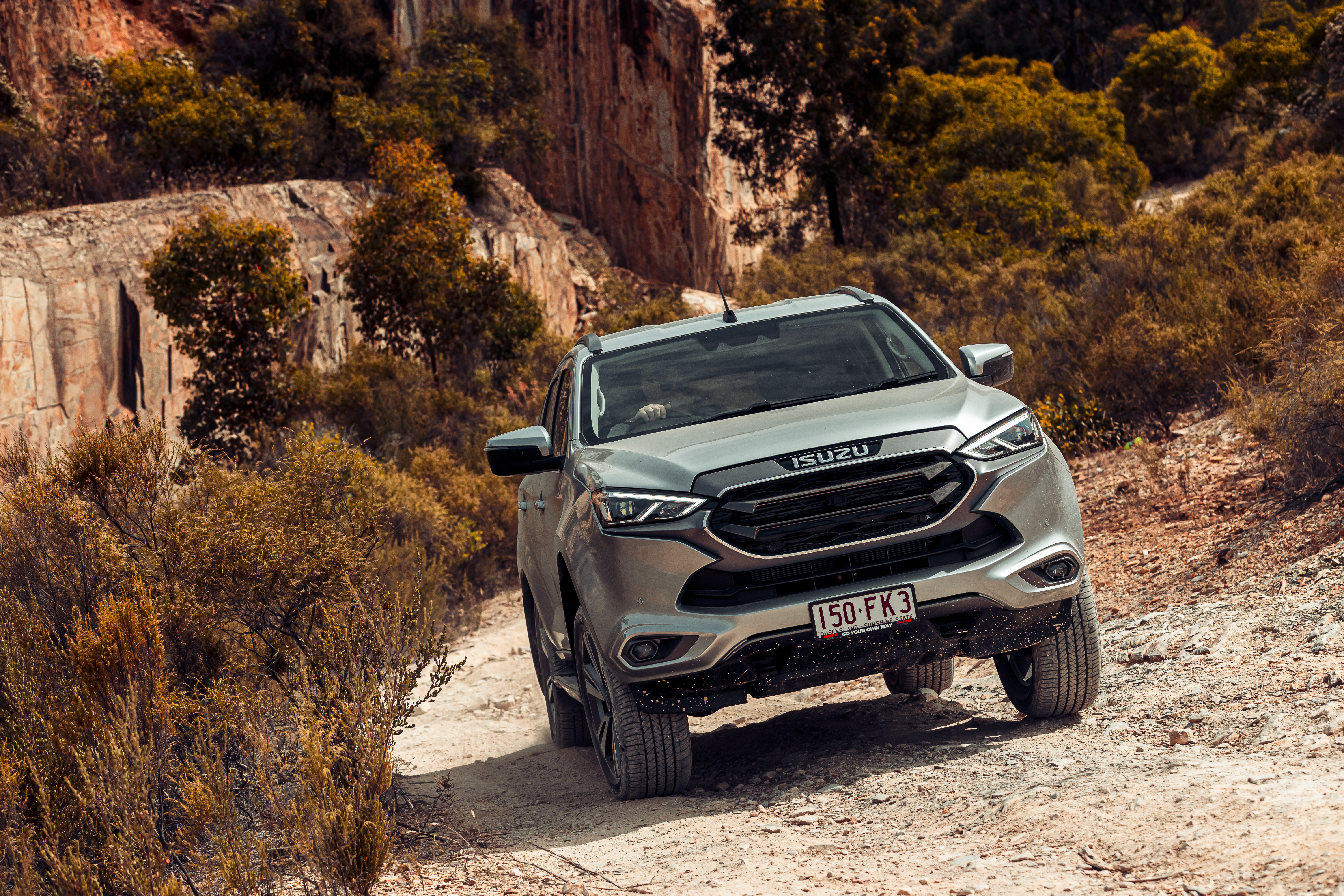
The LS-T’s alloy wheels measure 20 inches in diameter and are fitted with 265/50R20 highway tyres and a TPMS, which is exclusive to the LS-T in the three-model MU-X range. Both cars tested here have power tailgates, but the Isuzu’s gate is slower in operation.
Inside, the MU-X is a huge step up from the previous generation and it is well-equipped. All the seats are leather-covered, plus the front seats have a heating function but no ventilation. Both the front seats have power adjustment with eight-way adjustability for the driver and four-way for the passenger.
The MU-X infotainment screen measures nine inches, which against any other car would be deemed sufficient but seems small when compared to the Ford’s 12-inch screen. Screen envy is a thing, apparently. Apple CarPlay can connect wirelessly but you need a cable to hook up Android Auto or for charging with either system.
MU-X: Factory extras fitted
| Tow bar kitu00a0 | $1,182.25 |
| 12-pin plug | $393.25 |
| Electronic brake controlleru00a0 | $896.05 |
| Rubber matsu00a0 | $241.67 |
| Premium paintu00a0 | $650.u00a0 |
These extras take the LS-T’s drive-away price as tested up to $69,488.
On-road performance
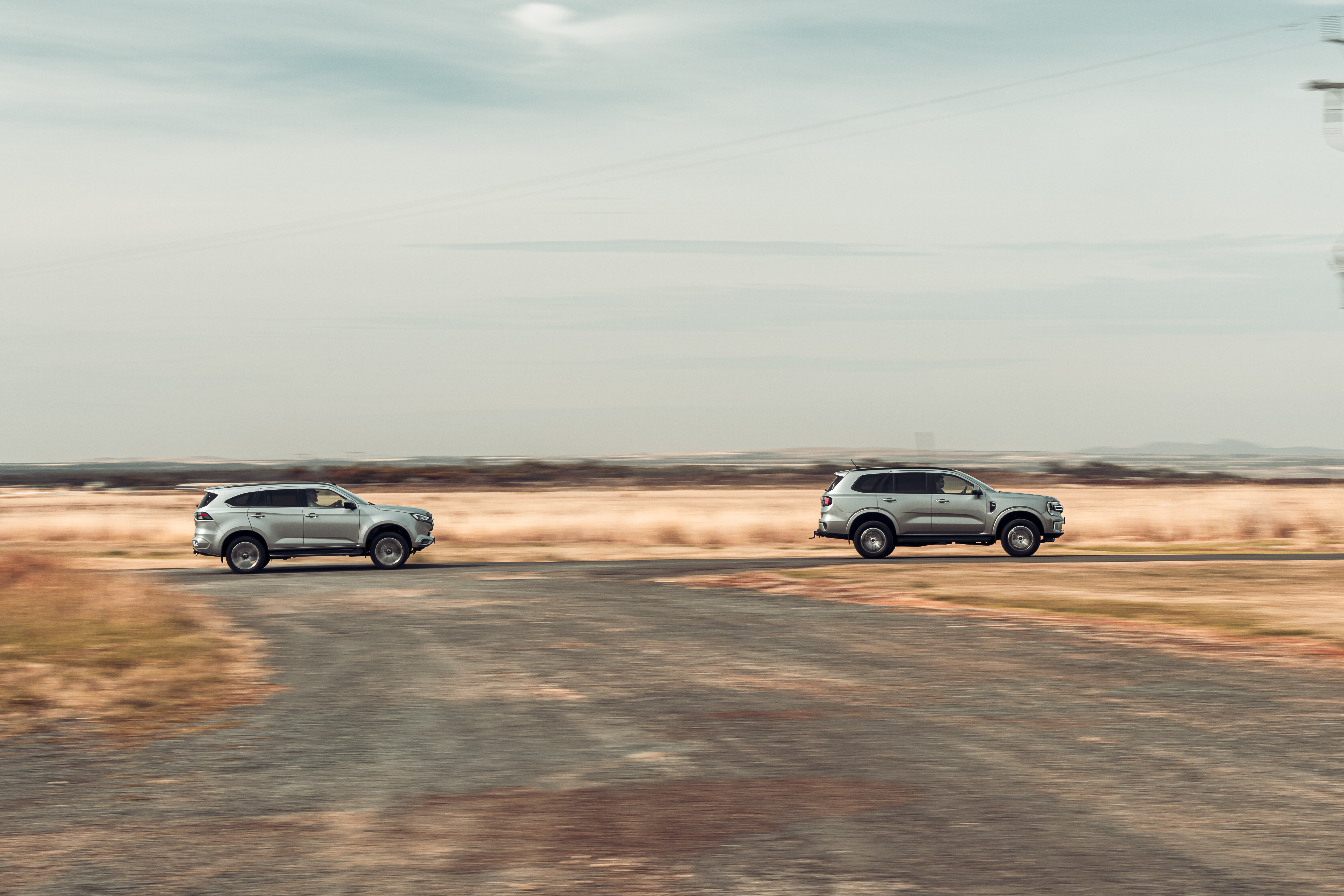
Despite being close to each other for the purpose of design, price and features, the distance between these two cars starts to show once you get behind the wheel. The MU-X feels older than its two-year difference to the Everest, not only with its big screen and technology but also in the way it drives.
The Isuzu feels much closer to its light commercial vehicle (LCV) roots, which it shares with its D-MAX ute sibling, than the Everest which, derived from the Ranger ute, is leaps ahead in terms of performance, refinement and driveability.
Isuzu’s 3.0-litre engine always lets you know it’s a diesel, whereas the Ford’s mill is quieter and more refined. Refinement is also the key difference between the way the respective transmissions perform, with the 10-speed in the Ford doing its thing seemingly unnoticed, while the MU-X six-speed transmission is more aggressive in its shifts.
Points against the Ford for the tiny and fiddly thumb buttons on the right side of the gear shifter, which you’re expected to use for manually selecting ratios in the transmission. The Isuzu allows you to tap the shifter across to the right and select gears using fore and aft movements, which is much more natural and easy to do without having to look down at the shifter. This is especially useful when driving off-road or towing.
Despite having 50 per cent larger engine capacity, the Isuzu is also left behind under acceleration and genuinely feels lacking in power and torque when compared to the newer breed of diesel engines. That’s the difference of a more modern design employing a bi-turbo set-up for optimal performance.
Hate to sound like we’re beating up on the MU-X here, but it can’t take a win in terms of driveability. Its suspension reveals its LCV heritage despite also having a coil-sprung rear axle and softer setting than the D-MAX ute.
It bounces the occupants around in the cabin, while the Everest remains smooth and composed on rough roads. The Ford’s ride can feel a bit choppy over high-frequency bumps on-road, but it’s barely noticeable most of the time.
Off-road performance
The MU-X crawled back some credibility on a nasty little off-road pinch we use to test wheel travel and tractive abilities. The deeply rutted track takes axle articulation beyond its limits and hoicks the front wheel in the air, testing out the ETC and the rear diff lock.
With its rugged-terrain button and diff lock engaged, the Isuzu felt to have a little more articulation in its rear axle than the Ford did, allowing it to squat down and get the drive to the ground and push the car onwards. Both cars scrambled for traction here, but the MU-X less so, even on its low-profile tyres. ‘Ruts’ mode and RDF were selected for the Everest.
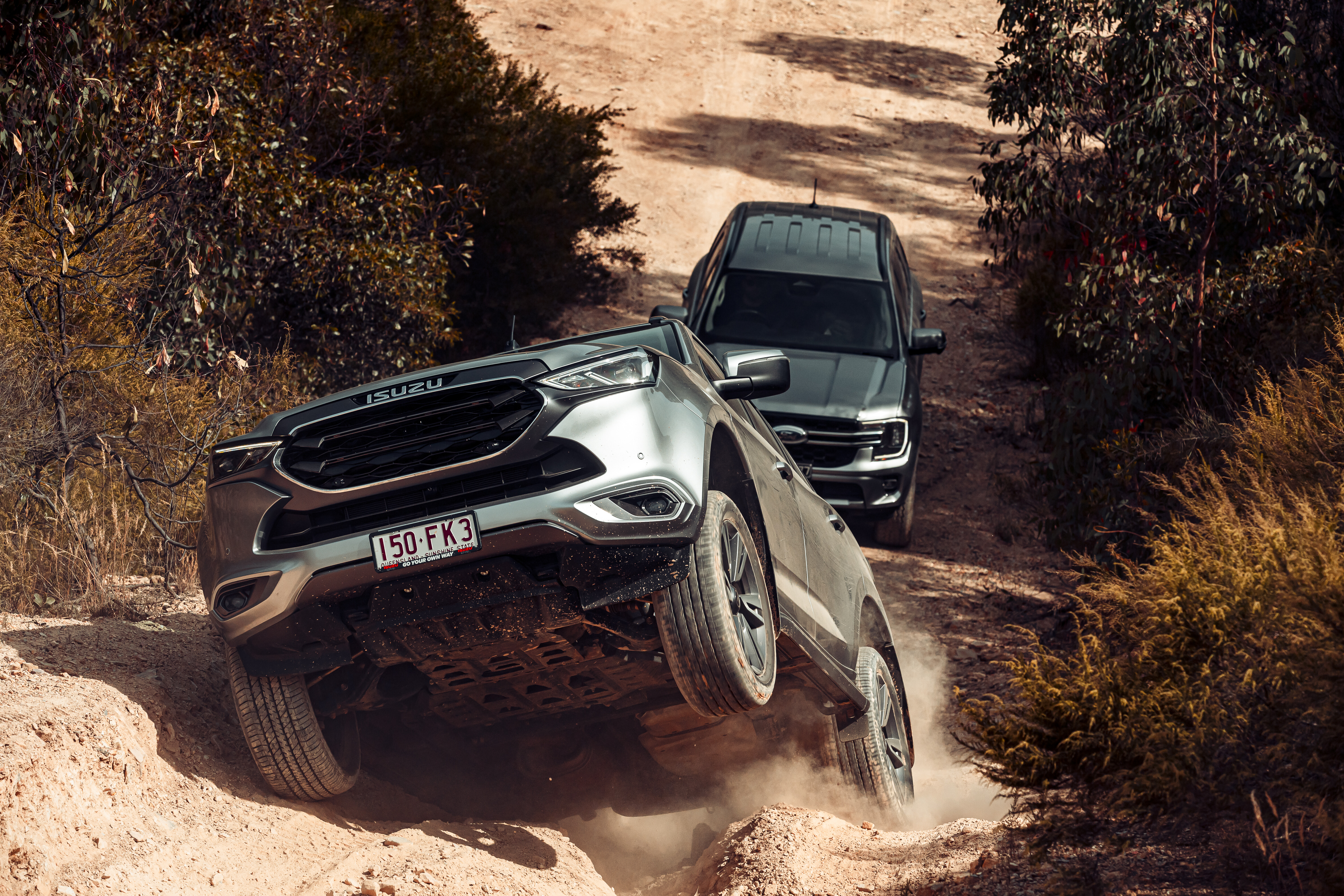
Both vehicles scraped their driver-side side-step against the bank, but the MU-X more so – the Everest barely rubbed against it. Both crested the climb, but the Isuzu was more composed, even if it did scrape harder on its step.
Another plus for the Isuzu when off-road is that the underbody protection plates are made of metal and extend right back underneath the fuel tank, to protect against rocks and scrapes.
The Everest carries its on-road composure over to rough, potholed gravel tracks, where it is sure-footed and never steps out of line. On these same tracks, the MU-X’s rear suspension is more inclined to step out of line when crossing bumps or corrugations.
Off-road specs
| Ford Everest Trend | Isuzu MU-X LS-T | |
|---|---|---|
| Approach angle | 30.2u00b0 | 29.2u00b0 |
| Rampover angle | 21.9u00b0 | 23.1u00b0 |
| Departure angle | 23u00b0 | 26.4u00b0 |
| Ground clearance | 226mm | 235mm |
| Wading depth | 800mm | 800mm |
Towing
Both the Everest and MU-X have rated towing capacities of 3500kg, which is the maximum for this type of standard vehicle. The MU-X advertises a GCM of 5900kg, while it’s 6250kg for the Everest Trend 2.0 – but you have to take into account the Everest is a heavier vehicle overall.
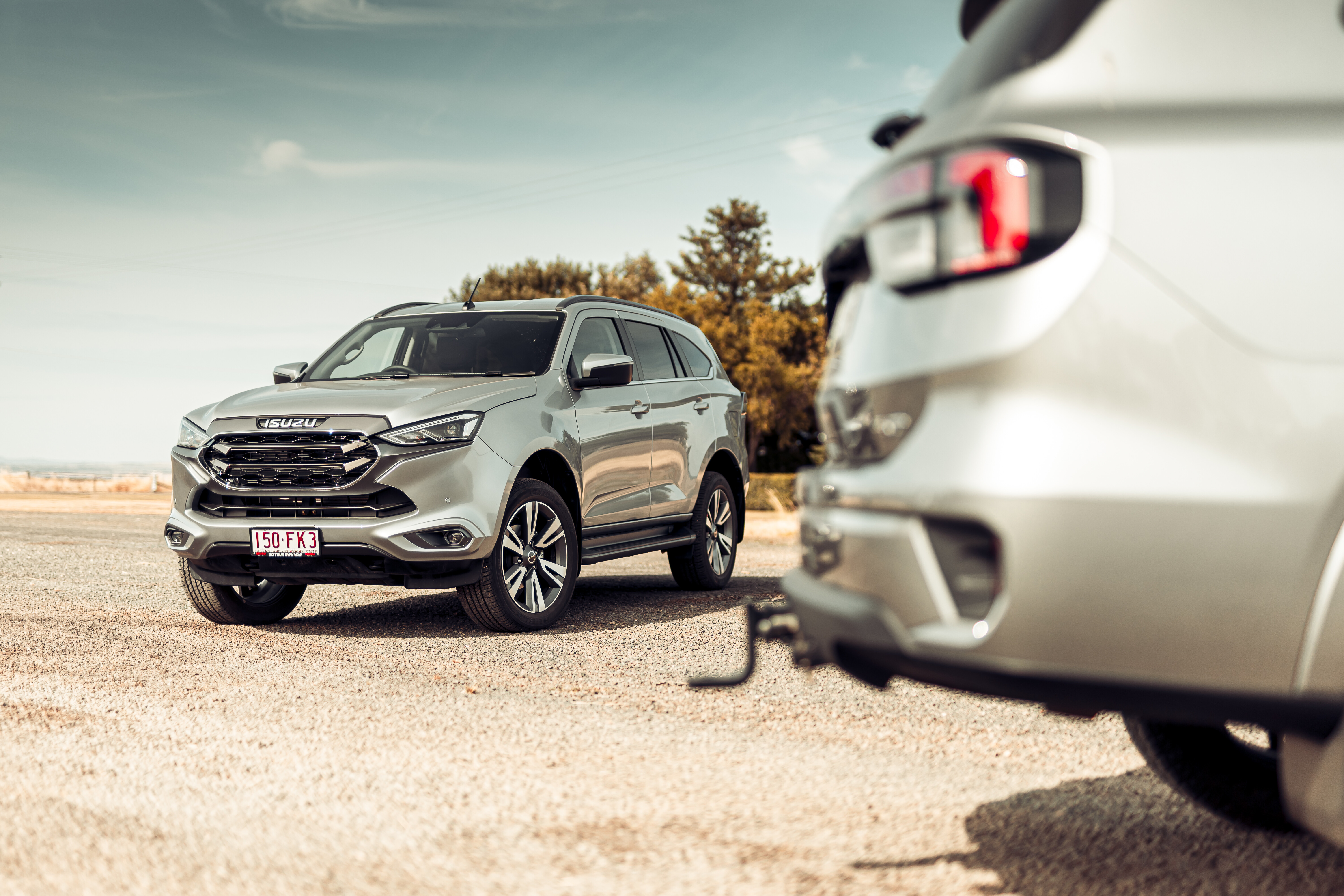
Countering this is the fact the Ford has a higher GVM; although, it does have a lower payload than the Isuzu. Owners will need to do their sums if they are thinking about pushing any of these weight limits with either on-board load or a trailer.
While we haven’t towed with these two wagons, we have towed with their respective ute siblings and with the same 2100kg ’van behind each of them. In that test the Ford’s powertrain pulled the load much better than the Isuzu’s, while the latter’s transmission was much better for manual shifting.
The towing tech that comes in both the Ranger and Everest is unsurpassed in the market and a bonus for those who tow, no matter their level of experience.
Safety
Both of these vehicles have a five-star ANCAP safety rating and include all the important features such as AEB, ESC, ABS, blind-spot indicators, rear cross-traffic alerts, lane-keeping assist, and enough airbags to build a jumping castle. Only the MU-X has TPMS, which is only available with the top-of-the-range LS-T variant.
As we’ve found when driving late-model Isuzus in the past, the calibration of these safety/assistance features is very sensitive to the point where they can be intrusive and you want to turn them off.
Case in point: When driving in traffic in this MU-X, AEB was applied even though I had my foot on the brake pedal and was a safe distance from the moving car ahead. The AEB actually pulled the brake pedal from below my boot which I felt increased the braking distance, even though a full stop was not required.
The safety systems in the Everest are far less intrusive, simply doing their job when they are needed and notifying you of traffic around the vehicle when required.
Ownership
The MU-X comes standard with a six-year/150,000km warranty and seven years roadside assistance, provided you service the car at an Isuzu dealer. To further entice you to do that, Isuzu offers capped-price servicing for the first seven scheduled services in line with the Scheduled Service Intervals.
Across at the Blue Oval you’ll get a five-year/unlimited kilometre warranty with roadside assistance for up to seven years. Service cost of $329 for the first four general services for up to four years or 60,000km, whichever occurs first. Check the fine print on each of these brands for total costs, as they do not cover everything.
Practicality
Both of these wagons are reasonably spacious inside, have good off-road potential, moderate payloads and healthy towing capacities, so they make great family touring 4WDs.
The MU-X has always offered one of the bigger interiors in the class, but the Everest has caught up with it with the latest model. The Ford has more front seat space but sacrifices in the second row, where passengers have more legroom in the Isuzu. The Isuzu also offers a bigger gap for entry and exit to the third-row seat for the kids.
Both cars have similar payloads and the same 3500kg towing capacity, but the Ford has a higher GCM.
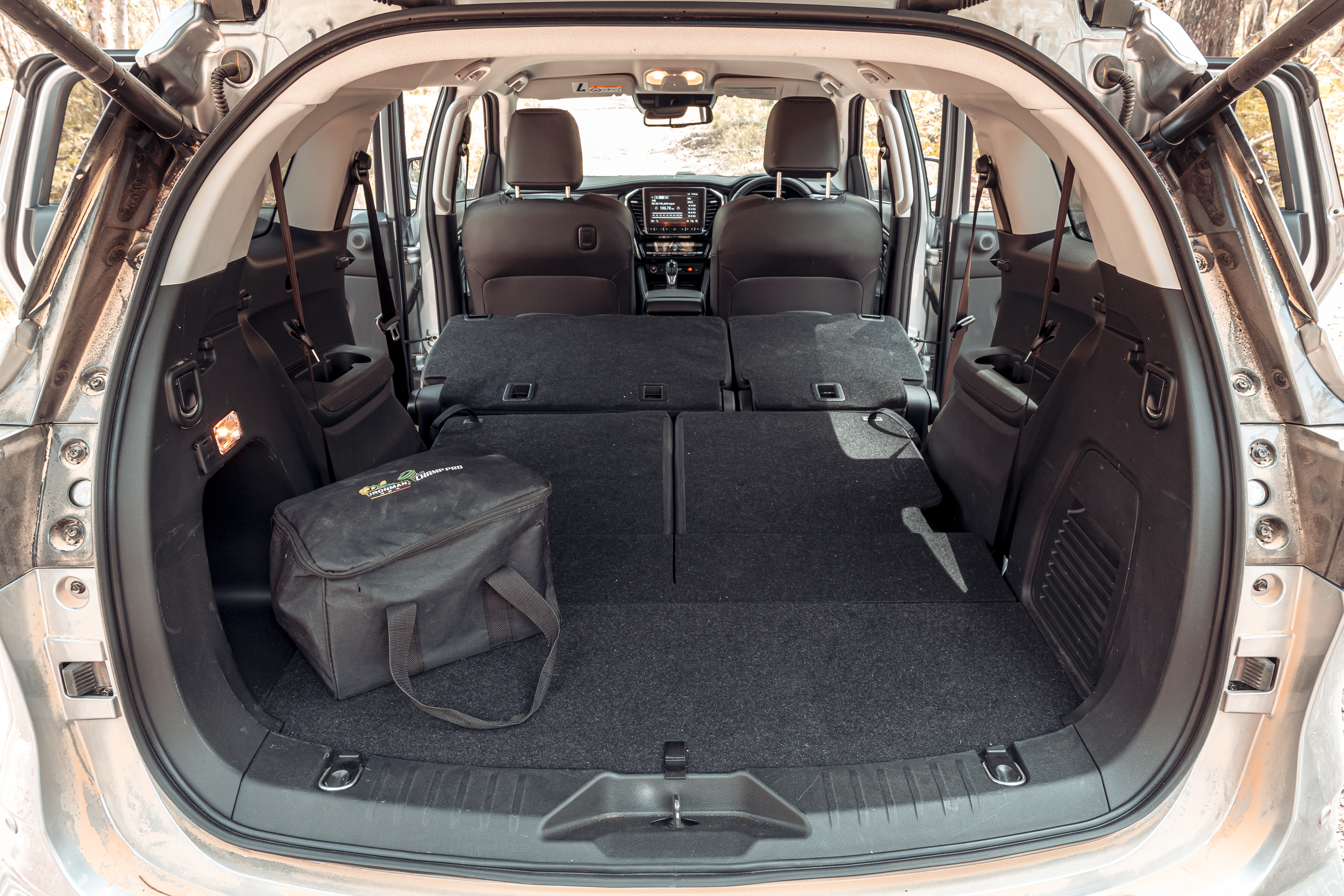
The MU-X’s 20-inch wheels and low-profile tyres are not suited for Australian tracks, but there’s nothing stopping owners from fitting the 17s from a lower grade model or the aftermarket. This will improve ride quality and durability. The Everest will also happily ride on 17s.
The manufacturers of both wagons quote the wading depth of the vehicles at 800mm, but they both have forward-facing engine air intakes directly above the headlight where they could easily take in a gulp of H2O on a river crossing. Extra care should be taken here or, better still, look into fitting a quality intake snorkel.
As popular models with many components shared with their respective ute siblings, both the Ford and Isuzu are well-supported by the 4×4 aftermarket, allowing owners to build a touring vehicle to suit their adventures.
Verdict
If the MU-X LS-T was at least $5K cheaper than the Everest Trend, this would be a closer race; but as they are similar in price and equipment, the Ford is a clear favourite here.
“The Everest is leaps ahead in terms of performance, refinement and driveability”
The performance, refinement, dynamics and the level of technology in the Everest all make it a more comfortable and enjoyable vehicle to be in, whether that is as a driver or a passenger. This is evident both on- and off-road, on the highways and around town.
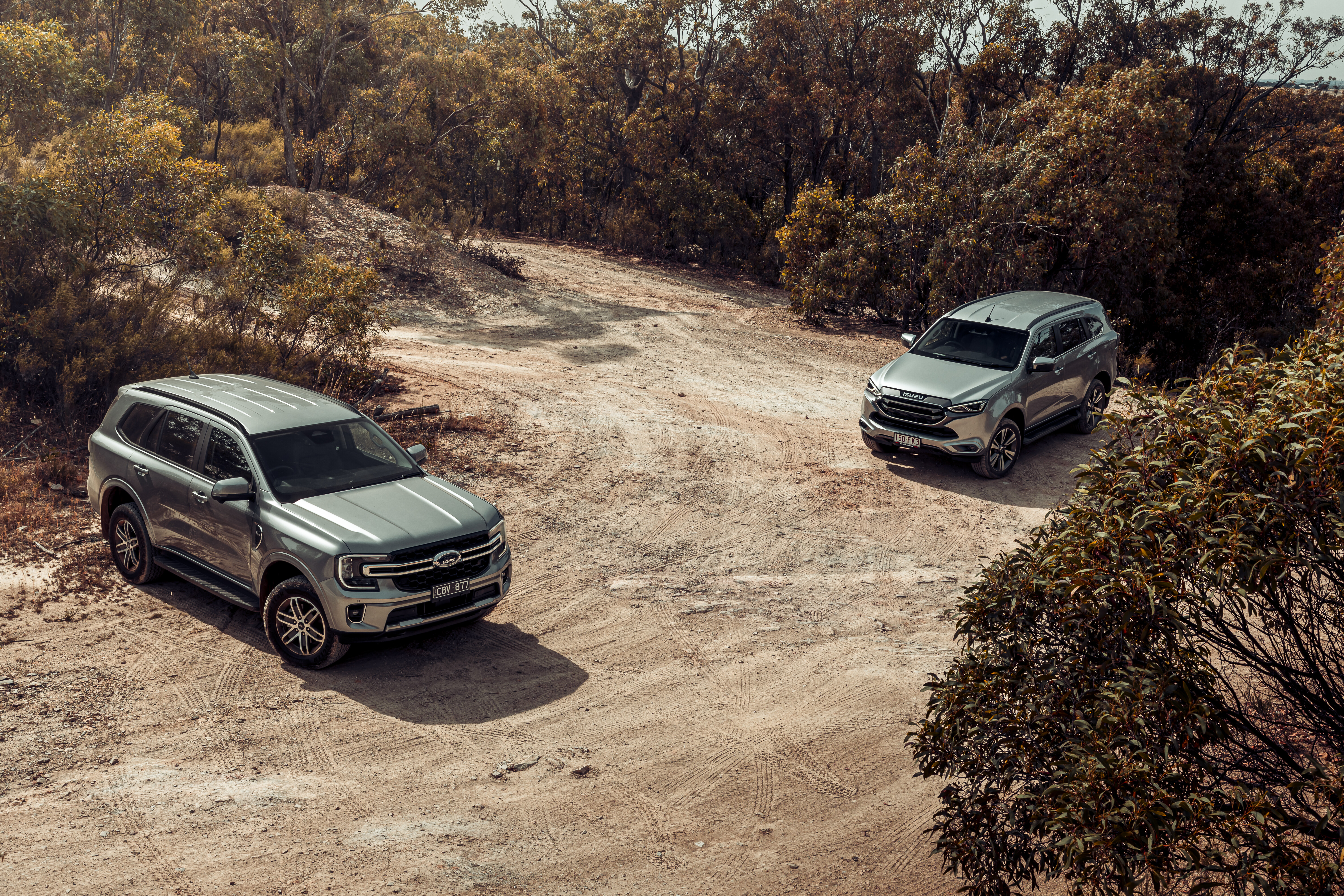
While some of the Everest’s advantages could be attributed to it being a newer model, it really is a generation ahead of the MU-X and everything else in that mid-size 4×4 wagon class.
Ford has raised the bar with its next-gen Everest and Ranger models and it’s now up to the other manufacturers to play catch up, let alone surpass the Australian-engineered Fords.
Scoring
Ford Everest Trend: 9.0/10
+ Performance + Cabin technology + Dynamics
– Small shift buttons – No TPMS – Rear seat legroom
Isuzu MU-X LS-T: 7.0/10
+ Interior space + Level of safety kit + Metal underbody protection
– Performance – NVH level – Ride quality
Specs
| Ford Everest Trend | Isuzu MU-X LS-T | |
|---|---|---|
| Price | $65,290 (+ORC) | $65,990 (Drive-away) |
| Engine | I4 dieselu00a0 | I4 diesel |
| Capacity | 1996cc | 2999cc |
| Max Power | 154kW at 3750rpm | 140kW at 3600rpm |
| Max torque | 500Nm from 1750 to 2000rpm | 450Nm from 1600 to 2000rpm |
| Transmission | 10-speed automatic | 6-speed automatic |
| 4×4 system | 2WD, full-time 4WD, 4×4 high and low range | Part-time, dual-range 4×4 |
| Crawl ratio | N/A | 33.3:1 |
| Construction | 5-door wagon on ladder chassis | 5-door wagon on ladder chassis |
| Front suspension | IFS w/ upper and lower arms and coil springs | IFS w/ upper and lower arms and coil springs |
| Rear suspension | Multi-link live w/ coil springs and Wattu2019s linkage | 5-link live w/ coil springsu00a0 |
| Tyres | 255/60R18 | 265/50R20 |
| Weight | 2274kg | 2175kg |
| GVW | 3000kg | 2800kg |
| GCM | 6250kg | 5900kg |
| Towing capacity | 3500kg | 3500kg |
| Payload | 726kg | 750kg |
| Seats | 7 | 7 |
| Fuel tank | 80L | 80L |
| ADR fuel claim | 7.2L/100km | 8.3L/100km |
| On-test fuel use | 11.3L/100km | 11.9L/100km |
| Approach angle | 30.2u00b0 | 29.2u00b0 |
| Rampover angle | 21.9u00b0 | 23.1u00b0 |
| Departure angle | 23u00b0 | 26.4u00b0 |
| Ground clearance | 226 | 235mm |
| Wading depth | 800mm | 800mm |
An off-road wagon to rival the Tank 300 could be incoming, if the recently revealed 2023 Jetour Traveller ever makes it to local shores.
With a boxy design clearly influenced by the Land Rover Defender 90 and Ford Bronco (just look at that Bronco-style JETOUR lettering on the front grille) it’s unlikely those in the market for a new Defender will consider this cut-priced alternative. Instead, the budget-priced Jetour Traveller will be aimed to compete with the likes of the all-new Tank 300.
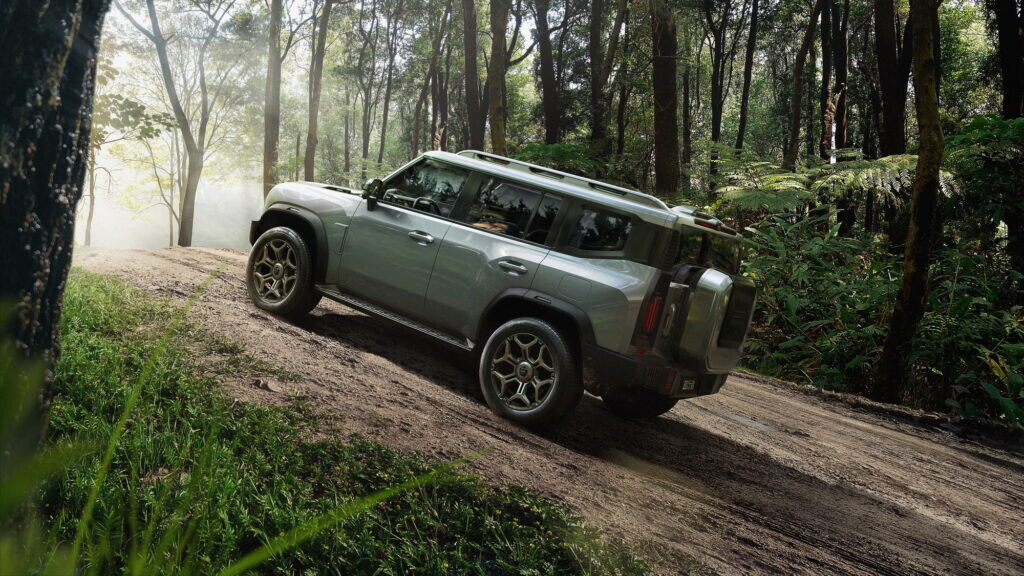
The Traveller will be sold by Jetour, a sub-brand of Chinese company, Chery, and is expected to be on sale in China in May. Chery officially reinstated its presence in Australia by recently unveiling its new Omoda 5 SUV.
Reports indicate all Traveller models will be 4WD and fitted with a BorgWarner 4WD system and a locking rear differential. Two wheelbases will be offered: a SWB with five seats, and a LWB option with seven seats.
Powertrain options are set to include 1.6- and 2.0-litre turbocharged petrol engines, as well as a plug-in hybrid utilising a 1.5-litre turbocharged petrol and an electric motor. Official figures and outputs are yet to be revealed.
In a boon for overlanders, the Traveller is seen wearing a rear spare-wheel carrier, roof rails and side steps. Plus, Jetour has said it will offer special touring packs to bundle off-road accessories and camping kit.
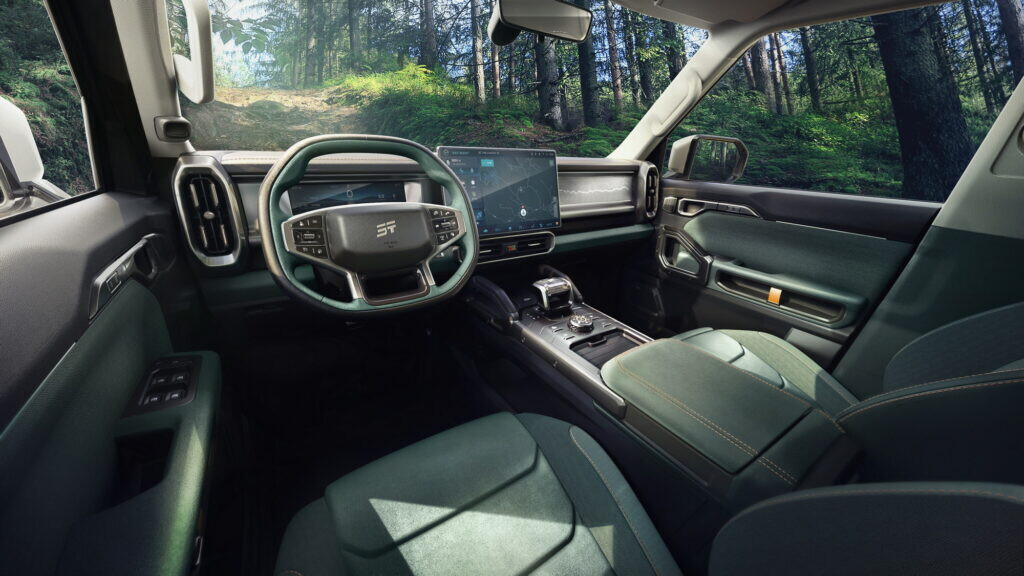
On the inside, a unique octagonal steering wheel stands out, as does a large infotainment screen and a rather chunky gear selector.
It’s expected to debut publicly at the Shanghai Motor Show in April, but it has yet to be confirmed whether the Traveller will come to Australia.
It wasn’t funny, even though most people laugh outright or at least chuckle when you first tell the story.
In this case it was a bug that crawled into my ear while camped on the Starcke Track, about a five-hour drive north of Cooktown.
I’m prompted to tell this yarn as bugs in ears have been hitting the headlines of late, and in every case it’s anything but funny and the first aid, especially out in the bush, seems to be little known. And from what I’ve read in recent days, camping, especially in summer or up north when it’s pleasantly warm, is the peak time for bugs to crawl into ears.

In my case it was the middle of the night when I woke with a bit of a start and the quick realisation that something had crawled in my ear. Within a few seconds it felt like a herd of Genghis Khan’s mounted warriors were charging around my eardrum, creating a hell of a lot of noise that was impossible to ignore, and the sharp little feet of whatever was in my ear was a little painful. Still, it was the noise and pressure on my eardrum that was quickly driving me insane.
Waking my son Trent up (we were on one of his Moon Tours up the Cape) we tried the old torchlight-at-the-end-of-the tunnel trick to try and lure said bug out of my ear. By this stage I was prepared to drive back to Cooktown in the dark to seek some help.
We didn’t have any tweezers, which in hindsight was a good thing as every expert and website on such matters strongly suggests you don’t use them as they can easily hole the eardrum – and then you are in more strife than a cat in a dog kennel.
If it happens to you, use some oil. Do not use tweezers to try and remove the bug
While I walked in circles shaking my head, Trent got on the satphone and in touch with the Royal Flying Doctor Service. The doc on call knew what to do, “Just pour some oil into his ear – the bug, whatever it is, won’t like it and it’ll go even crazier for a while, but the oil will kill it!”
Baby oil or similar is the preferred oil, but we didn’t have any with us so olive oil or cooking oil will do, we were told. At this stage I would have tried engine oil.
With a good dose of oil poured in my ear, the bug, as the doc had indicated, went a little crazy but then the noise subsided and stopped. Unless you’ve experienced it, you couldn’t believe the relief I felt.

Then it’s a matter of tilting the head to the affected side and letting the oil and hopefully the bug fall out. When it did, I was surprised how small it was. If such a little insect can cause so much angst I really felt for the people in the recent news stories that had a 2cm-long cockroach crawl in their ears; now that would feel very noisy and disconcerting. But maybe I’m just a wimp!
The moral of the story is, if it happens to you, use some oil; do not use tweezers or the like to try and remove the bug.
How to stop them crawling in your ear? Keep your tent, swag or camper closed up to keep bugs out; if there are any around, give the enclosure a spray with some insect killer. Apart from that and short of wearing ear plugs, you are at their mercy. Just keep some baby oil or cooking oil handy!
For more information, see: www.healthline.com/health/bug-in-ear
Electric vehicles (EVs) may be making all the headlines when it comes to the future of the automotive industry, but it will be hybrids making up the significant numbers in the future transition away from traditional petrol and diesel cars.
What’s more, hybrids are set to evolve away from the now relatively common non-plug-in models towards an increasing adoption of plug-in technology, which is the logical halfway step between cars that rely entirely on their internal combustion (IC) engines and EVs.
By EVs I’m referring to battery EVs, as it’s hard to see how hydrogen fuel-cell EVs will ever become mainstream given the difficulty in creating widespread hydrogen distribution infrastructure.
The problem ahead for the auto industry is the proposed ban on the sale of new diesel and petrol cars in many major markets around the world within the 2030-35 timeframe. Right now, this may be no more than political flag-waving but, nevertheless, the writing is on the climate-change wall.
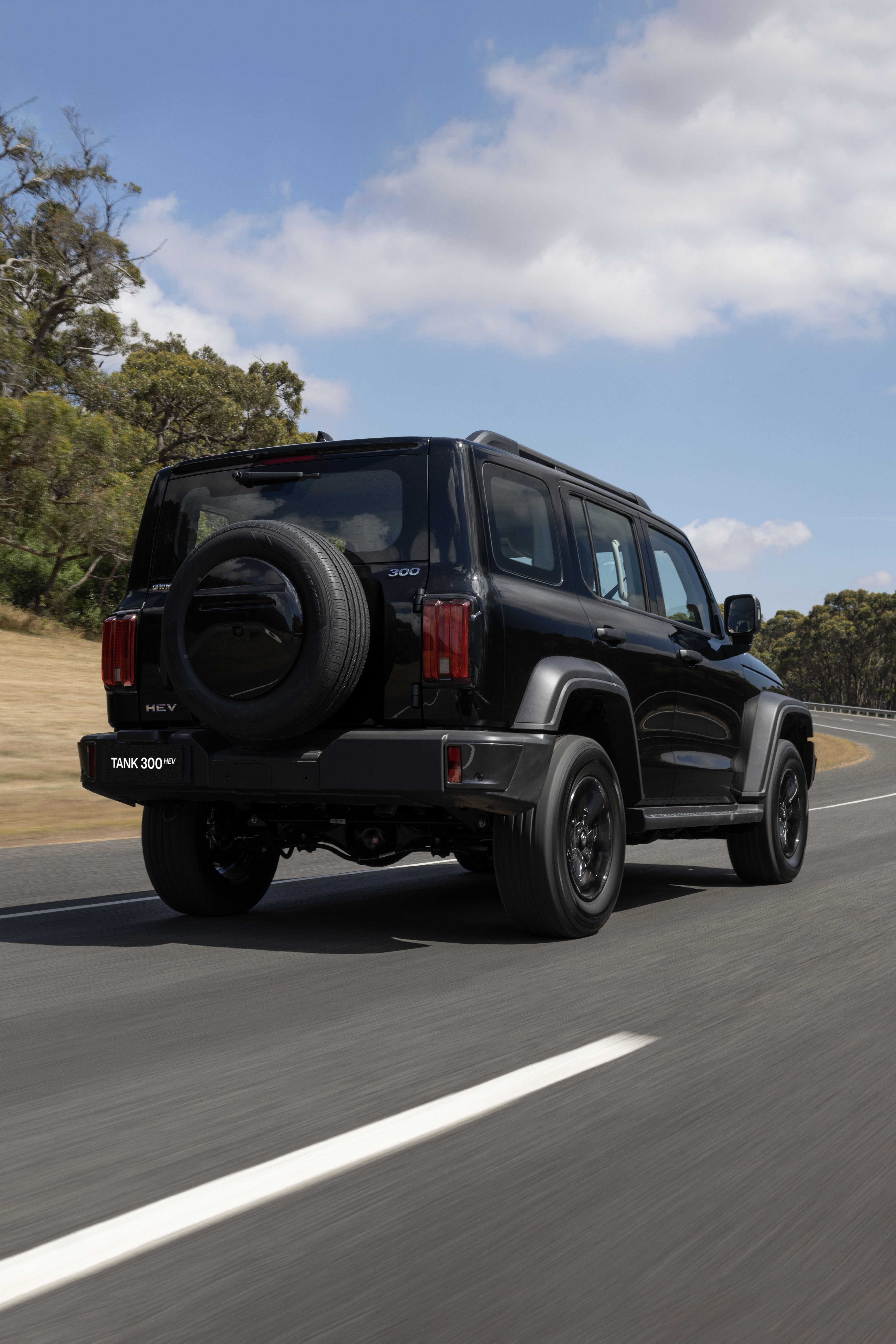
How things will play out in terms of hard legislation when the time comes is difficult to say but will essentially hinge on the treatment of hybrids.
Conventional non-plug-in hybrids seemingly won’t avoid the bans but plug-in hybrids that have a substantial enough EV-only range to satisfy a regulatory standard may be able to be classified as EVs.
Done right, a plug-in hybrid should be able to do most of what’s asked of it in terms of a daily, limited-distance driving regime without having to resort to using the IC engine, which would only come in to play for longer distance driving.
Hybrids that use a small IC engine to power an electrical generator to charge the battery and thereby extend the driving range – without that IC engine directly driving the wheels – may also get around any bans.
Thanks to Toyota, its Prius hybrids have been around for more than 20 years, but without a plug-in facility they can’t close the environmental loop where cars run on electricity generated via solar or wind power.
With ever-tighter emissions regulations, diesel’s days are numbered
Non-plug-in hybrids are essentially a more efficient version of a petrol (or diesel) car as they use the electric side of their powertrains to recapture, store and reuse some of the energy from their fossil-fuel source that would otherwise be lost.
Nevertheless, the union of an electric motor to an IC engine is a happy one in any sort of hybrid, as the electric motor is at its strongest where the IC engine is at its weakest and least fuel efficient, namely in the initial effort in getting a car moving from stationary. In effect, the electric motor is used to fatten up the IC engine’s torque output off idle and at low engine speeds.
A hybrid’s key problem is finding space for both the IC engine and the electric motor/generator, which is the key component of the hybrid’s energy recycling system. There’s also the problem of finding room for the hybrid system’s battery as well as the fuel tank, and all without compromising passenger or luggage space.
The fuel tank/battery packaging problem is compounded by the lithium-ion batteries in question being less energy dense than petrol or diesel fuels, so you don’t get as much energy from the battery as you would from a same-size diesel or petrol tank.
By their nature plug-in hybrids have much bigger batteries than non-plug-ins, given their external charging means you can make the battery as big as you like within obvious constraints, which brings the obvious benefit of more range in EV-only mode, a key goal in all this endeavour.
The positive in terms of packaging is that plug-in hybrids will get away with smaller IC engines with four or fewer cylinders and capacity capped around two litres, even for powering bigger and heavier vehicles, 4x4s included. Petrol will be the favoured fuel while turbocharging, which helps a small capacity engine produce the torque of a larger engine, and will be standard practice. Electric superchargers could be used, too.
Diesel-electric hybrids will most likely not be in the mix, even if the likes of Range Rover and Porsche (with its Cayenne) have gone down this road before thanks to a ready-made hybrid transmission with an electric motor/generator supplied by German transmission specialist ZF, which made it relatively simple to create these particular diesel-electric hybrids.
Diesel engines don’t hybridise as well as petrol engines as there is less energy to recoup given a diesel’s much higher compression ratios mean higher pumping losses. With ever-tighter emissions regulations, diesel’s days are numbered anyway.
The next-gen Ford Ranger continues its steaming start to the year, again pegging the largest number of new vehicle registrations during February 2023 on both overall and 4×4 charts.

The Ranger saw a combined 4473 new registrations in February, comprising 3782 4×4 and 691 4×2 Rangers; extending its lead over its Toyota HiLux sales nemesis.
The trusty Toyota continues its enduring appeal, securing second place outright on the national sales charts (3939), and within the 4×4 segment (2877).
Upgrade your Ranger
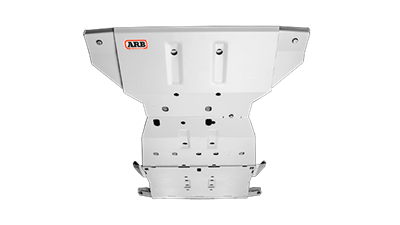
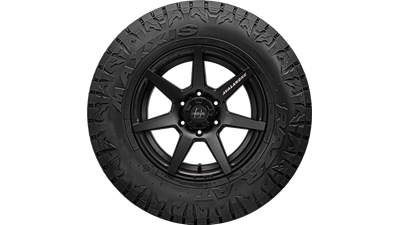
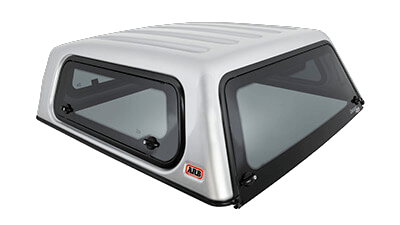
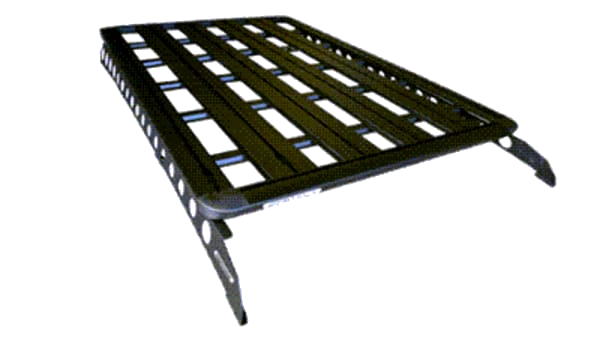
The Isuzu D-Max retained its podium position, finishing third for 4×4 sales with 1593 new registrations, up 11.5 per cent from the same period measured last year.
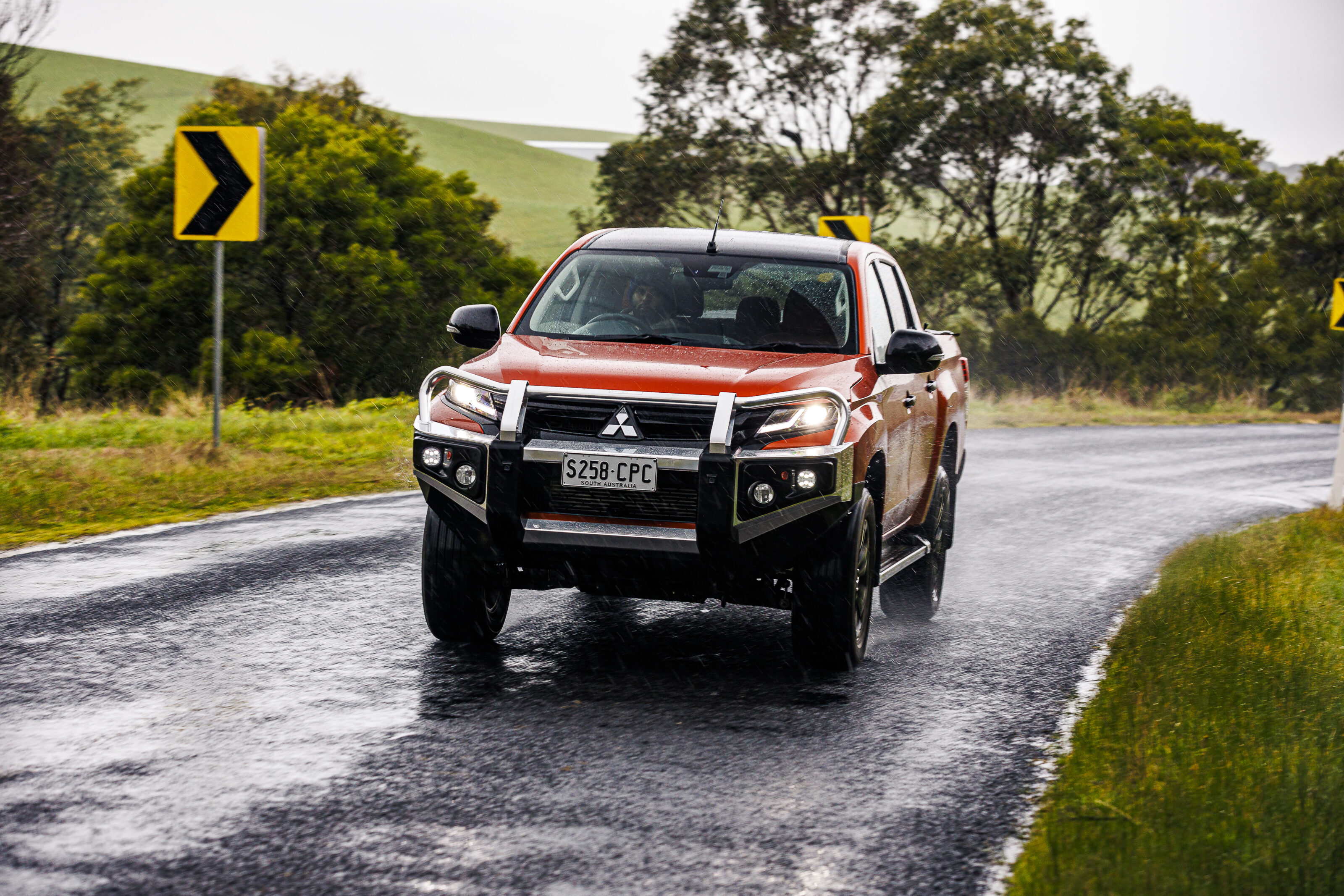
From there, the order shuffles with many familiar faces remaining. The Mitsubishi Triton leapt to fourth place for February, posting 1376 new registrations, ahead of Mazda’s BT-50 (1240) in fifth, and Isuzu‘s wagon-bodied MU-X (1225) in sixth.
Toyota’s pair of Prado and LandCruiser 300 Series large 4×4 wagons finished seventh and eighth, posting figures of 1123 and 1022 respectively.
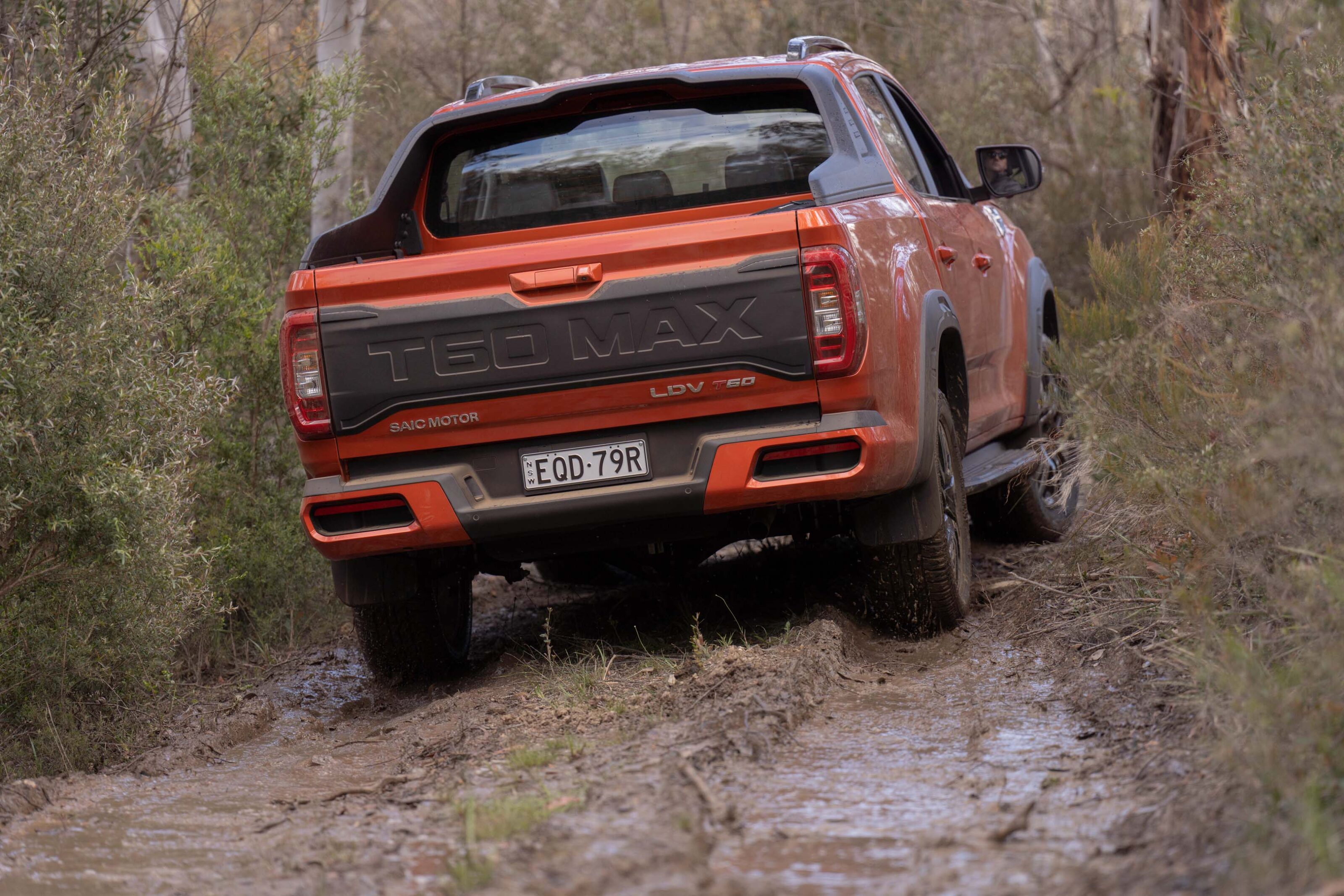
The LDV T60 makes its 2023 top 10 appearance, pegging 756 new registrations through February, while Ford‘s Everest rounds out the best-sellers with 752 new examples let loose across the nation.
In the American heavyweight sector, the Ram 1500 continues to prove more popular than Chevrolet’s Silverado, finishing February with a tally of 501 to 129 (906 to 313 year-to-date).
February 2023’s national new-car tally of 86,878 represents a 1.8 per cent increase, compared to the same period last year.
The SUV (47,888) and LCV (18,750) segments accounted for a staggering 76.7 per cent all new vehicle registrations in February 2023.
February 2023: Australia’s top 10 new 4×4 sales
| 1 | Ford Ranger | 4473 |
| 2 | Toyota HiLux | 3939 |
| 3 | Isuzu D-MAX | 1931 |
| 4 | Mitsubishi Triton | 1376 |
| 5 | Mazda BT-50 | 1240 |
| 6 | Isuzu MU-X | 1225 |
| 7 | Toyota Prado | 1123 |
| 8 | Toyota LandCruiser 300 | 1022 |
| 9 | LDV T60 | 756 |
| 10 | Ford Everest | 752 |
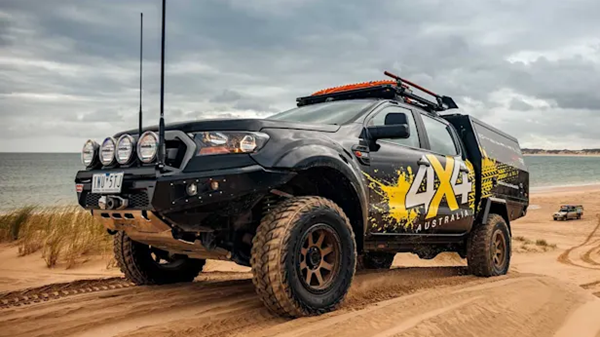
4X4 Australia's project builds
The 2023 Suzuki Jimny Heritage has launched in Australia to celebrate the model’s “vibrant 4×4 history.”
Snapshot
- 2023 Suzuki Jimny pricing: Heritage Edition added to line-up
- Limited to 300 units; due in Australia next month
- Priced from $33,490 before on-road costs
It is priced from $33,490 before on-road costs, with 300 units available to order.
Available exclusively in five-speed manual form, the Jimny Heritage Edition is $1500 dearer than the GLX variant it is based upon, with added equipment including:

“Strictly 300 units in total of this retro legend will be available. These vehicles will sell out quickly. With swift delivery to follow, I encourage all serious buyers to jump in fast,” said Suzuki Australia general manager, Michael Pachota.
Suzuki Australia said deliveries would “be based on the current queue process” – in line with the standard Jimny – with the first vehicles due next month.
Once a colour – jungle green, bluish black, medium grey and white – has sold out, the brand said announcements would be made to its social media channels and dealer network.

While the three-door manual Jimny remains available to order, Suzuki Australia has paused orders for the more-popular four-speed automatic variant.
The indefinite pause – in effect since mid-January – follows unprecedented demand for the off-road-capable light SUV in Australia, with 5697 units shifted in 2022 for a 10.8 per cent market share.
For those wanting an automatic Jimny, another option is to get in early for a five-door – the long-wheelbase model was revealed in January and is expected to arrive in Australia later this year.
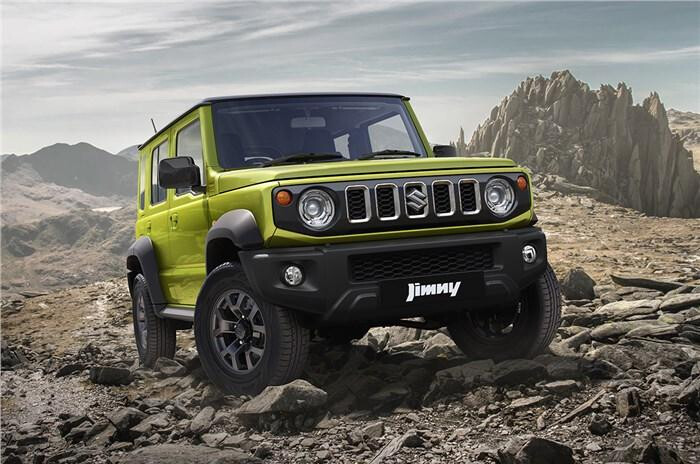
While the three-door Jimny is produced in Japan, the five-door model will be manufactured by Maruti Suzuki in India.
All variants use a 75kW/130Nm 1.5-litre naturally-aspirated petrol engine with selectable four-wheel-drive and a low-range transfer case.
2023 Suzuki Jimny three-door pricing
Prices exclude on-road costs.
The local 2023 GWM Ute Cannon lineup is tipped to grow with the addition of a new off-road-focused variant.
Local homologation information published this week has revealed Chinese brand Great Wall Motors (GWM) could introduce an off-road variant to its aptly-named Ute in Australia.
4X4 Australia has contacted GWM Australia for comment, and this story will be updated with its response.
Based on the Mount Everest Edition launched in China in 2021, the variant would be a cheaper alternative to the Toyota HiLux GR Sport and Nissan Navara Pro-4X Warrior.
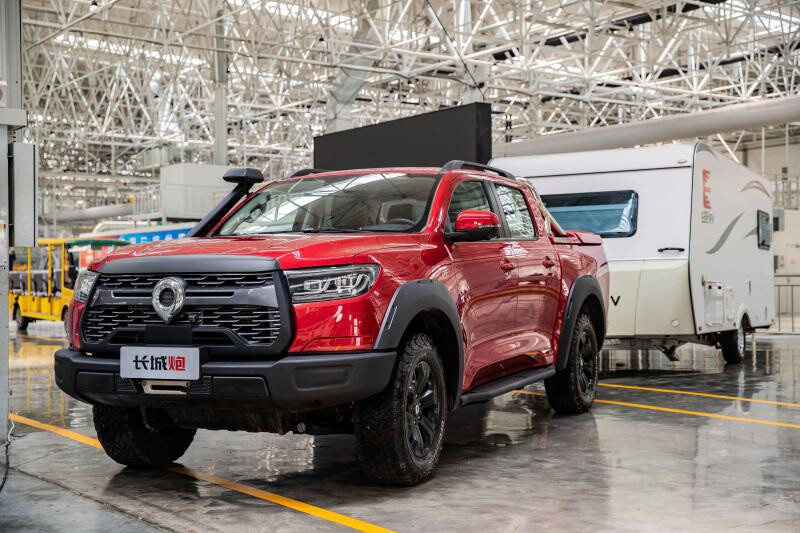
However, unlike the beefed-up Ford Ranger Raptor, the off-road variant retains the same 120kW and 400Nm turbo-diesel four-cylinder engine as the regular GWM Ute, matched to a ZF-sourced eight-speed automatic transmission.
The Government documents reveal the GWM Ute ‘Off-Road’ will gain a standard-fit snorkel and side steps, while it is also expected to feature unique alloy wheels, all-terrain tyres, chunkier flares, and a sports bar.
But towing capacity will take a hit, with the standard 3000-kilogram braked limit – below the three-and-a-half tonne capacity of its top-selling rivals – reduced to just 2.25 tonnes.
In China, the GWM Ute Everest Edition offers an ‘off-road expert’ drive mode to disable stability and traction control automatically, a creep mode, and four-wheel ‘tank turn’ capability.
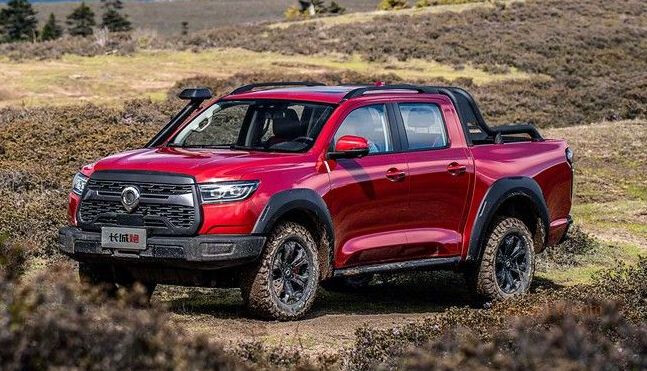
Under the skin, GWM has reinforced the chassis to allow for a 4300-kilogram winch, and a conventional system replaces the automatic four-wheel drive system to switch between 2H, 4H and 4L manually.
It also features three locking differentials and a 700 millimetre wading depth.
GWM has not detailed the approach, departure and ramp breakover angles for the Everest Edition, with the standard model offering 27 degrees, 25 degrees and 21.1 degrees, respectively.
It has a taller 228mm ground clearance versus 194mm for the standard GWM Ute.
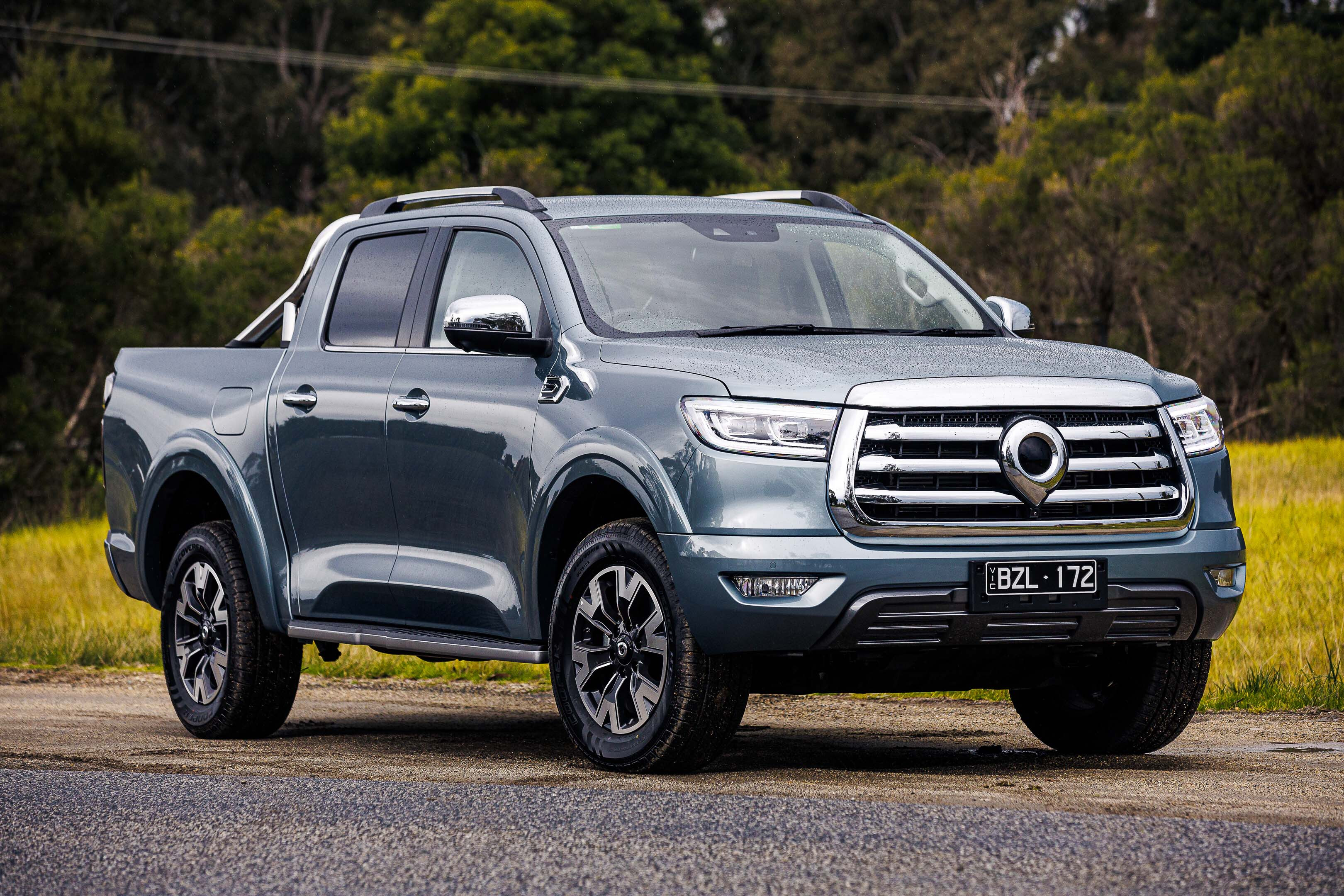
While the 2023 GWM Ute ‘Off-Road’ has yet to be locked in for Australia, the timing of the Government documents suggests it should arrive within the next six months.
GWM Australia has previously homologated single-cab, cab-chassis and manual transmission versions of the Ute for local sale – but these variants have yet to appear in showrooms.
Currently, the GWM Ute range is offered in the most-popular dual-cab automatic body style, priced from $35,990 drive-away for the entry-level Cannon 4×2.
With the range-topping Vanta 4×4 priced at $46,490 drive-away, the off-road grade should command a circa-$10,000 premium, suggesting an approximate $55,990 drive-away price tag.
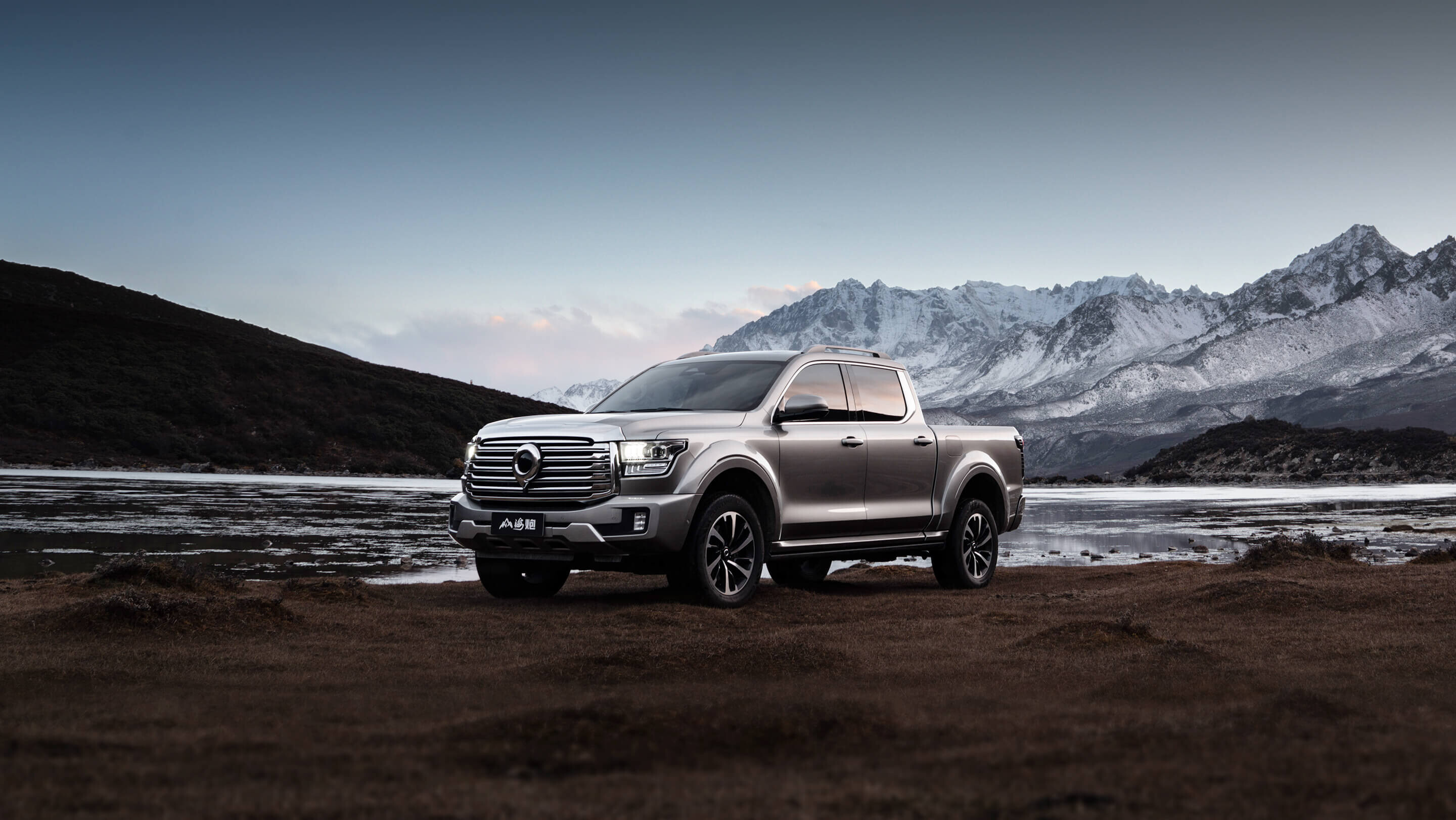
At the recent media launch of the Tank 300 off-roader and Ora electric hatch, GWM executives suggested the larger GWM Shanhai Cannon could reach local shores later this year or in 2024.
Currently, the Shanhai Cannon is only available in its home market with a mild-hybrid 260kW/500Nm petrol V6 or 2.4-litre turbo-diesel four-cylinder developing 135kW/480Nm – the latter more likely for Oz.
As for an all-electric GWM Ute to rival the LDV eT60 and upcoming JAC T9 EV, it is still under development, but GWM’s local arm remains keen on offering the model once it is finalised in China.
One of the most intriguing and anticipated vehicles in years will arrive on local soil very soon.
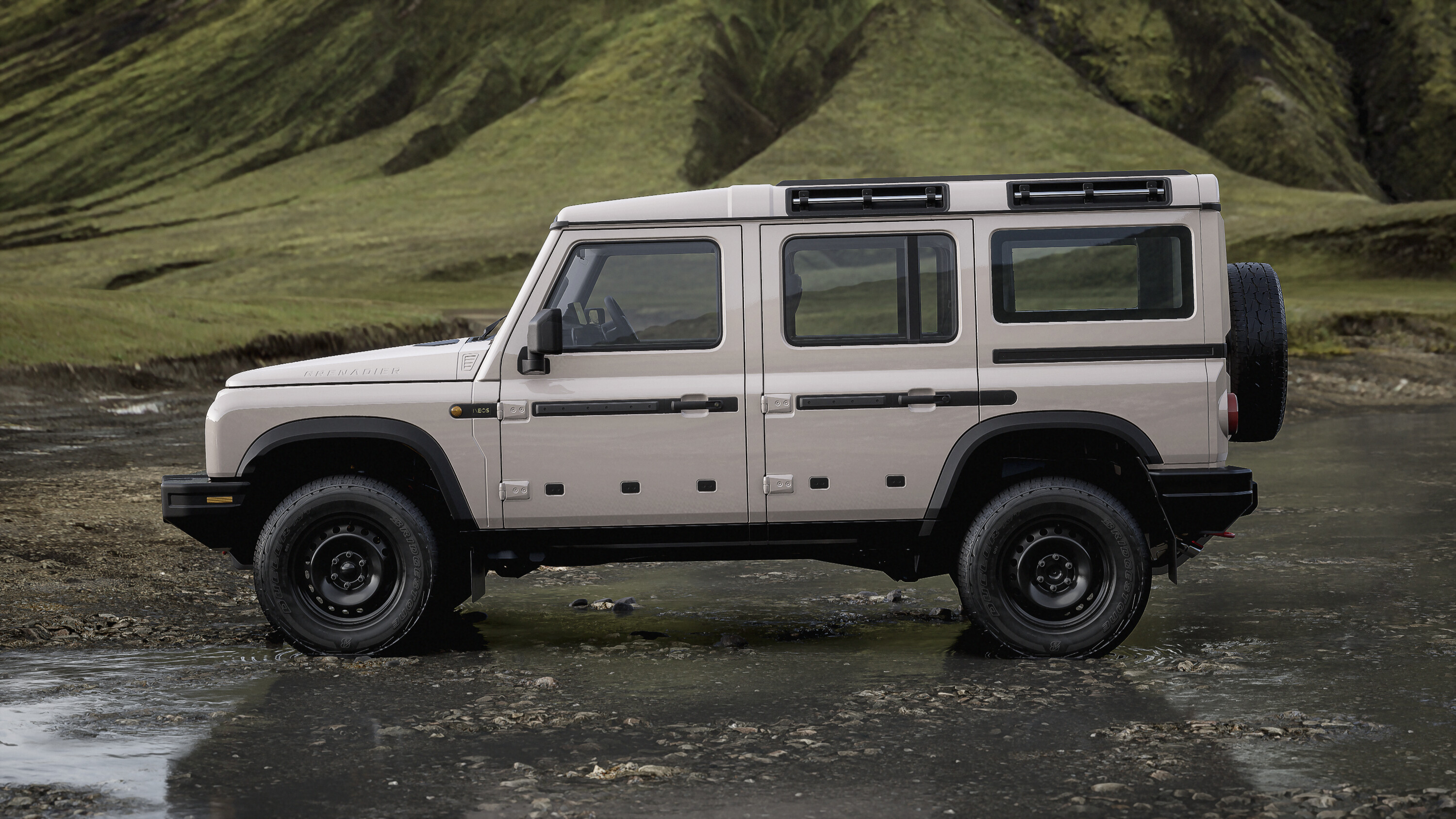
But before it does, we jet-setted to the Scottish Highlands – in winter, mind you – to drive the 2023 Ineos Grenadier on challenging terrain. Dan Gardner left the launch event expressing that there’s nothing else quite like it on the market today.
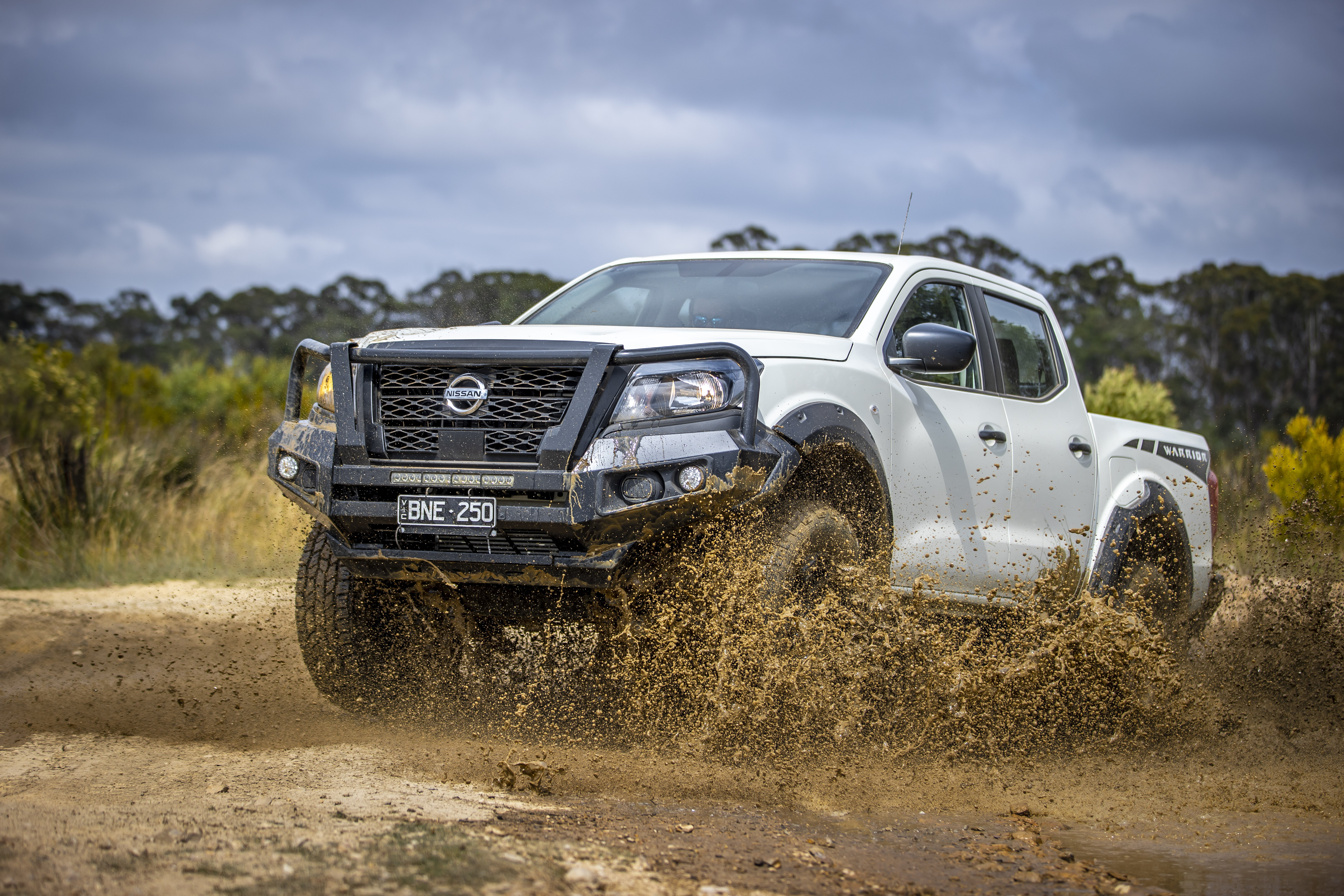
Closer to home, we took a Nissan Navara SL Warrior – the Pro-4X’s no-frills stablemate – to some wet and slippery off-road tracks in NSW. Does the Premcar-developed SL Warrior offer better bang-for-buck than the premium Pro-4X? For someone who wants an off-road-ready 4×4 from the showroom floor, it makes a compelling case.
The featured custom builds this month include an insanely cool backyard-built FJ45 LandCruiser and a race-inspired Navara.
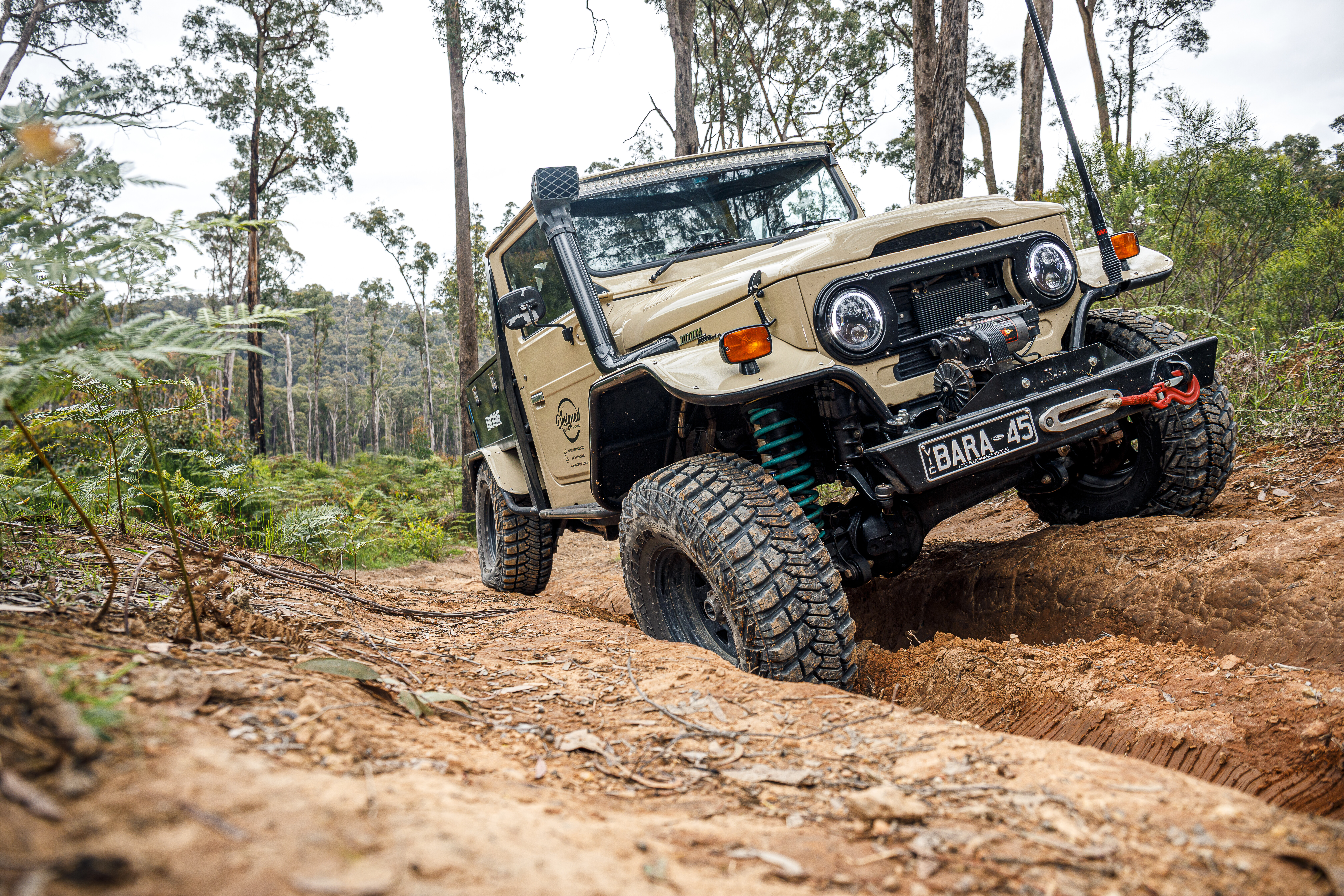
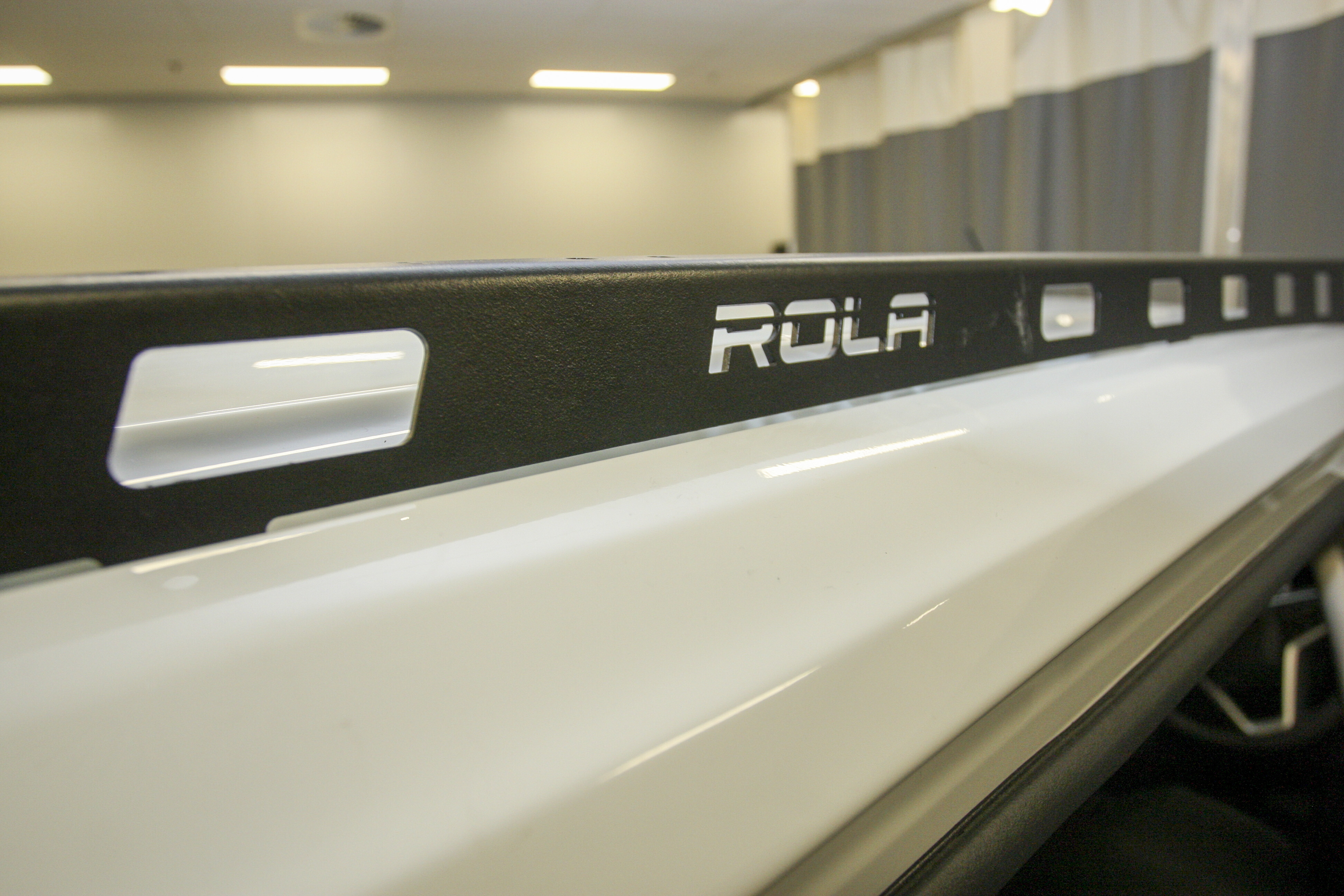
Our MU-X build gets some storage support with the addition of a Rola Titan tray and Ridge Mount system – perfect for securing a swag and set of Maxtrax.
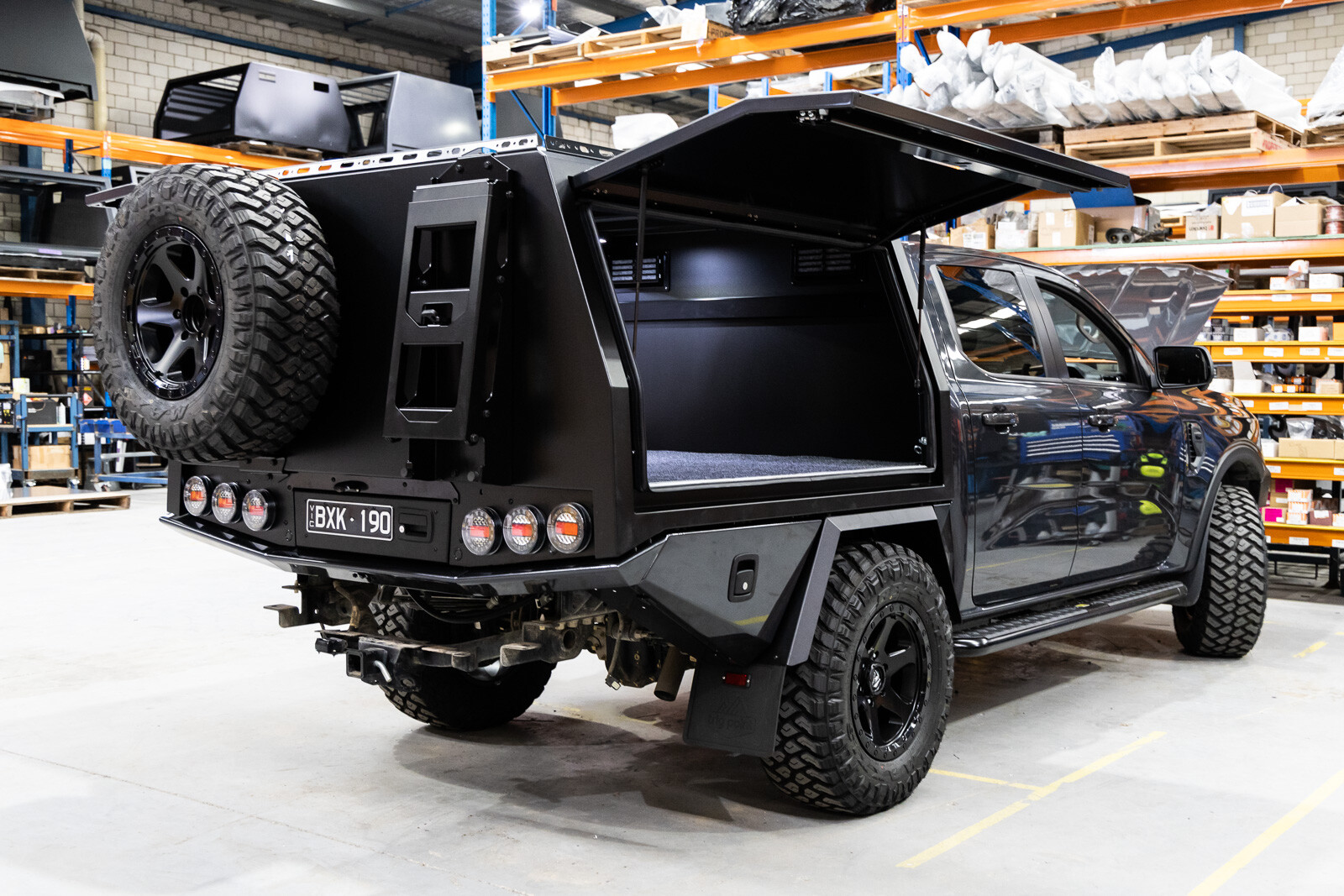
Plus, our all-new Ranger build reaches a milestone this month, with a top-quality Trig Point canopy replacing the factory tub. Plus, we’ve added new wheels and tyres in the form of Fuel Ripper wheels inside Maxxis RAZR mud-terrains.
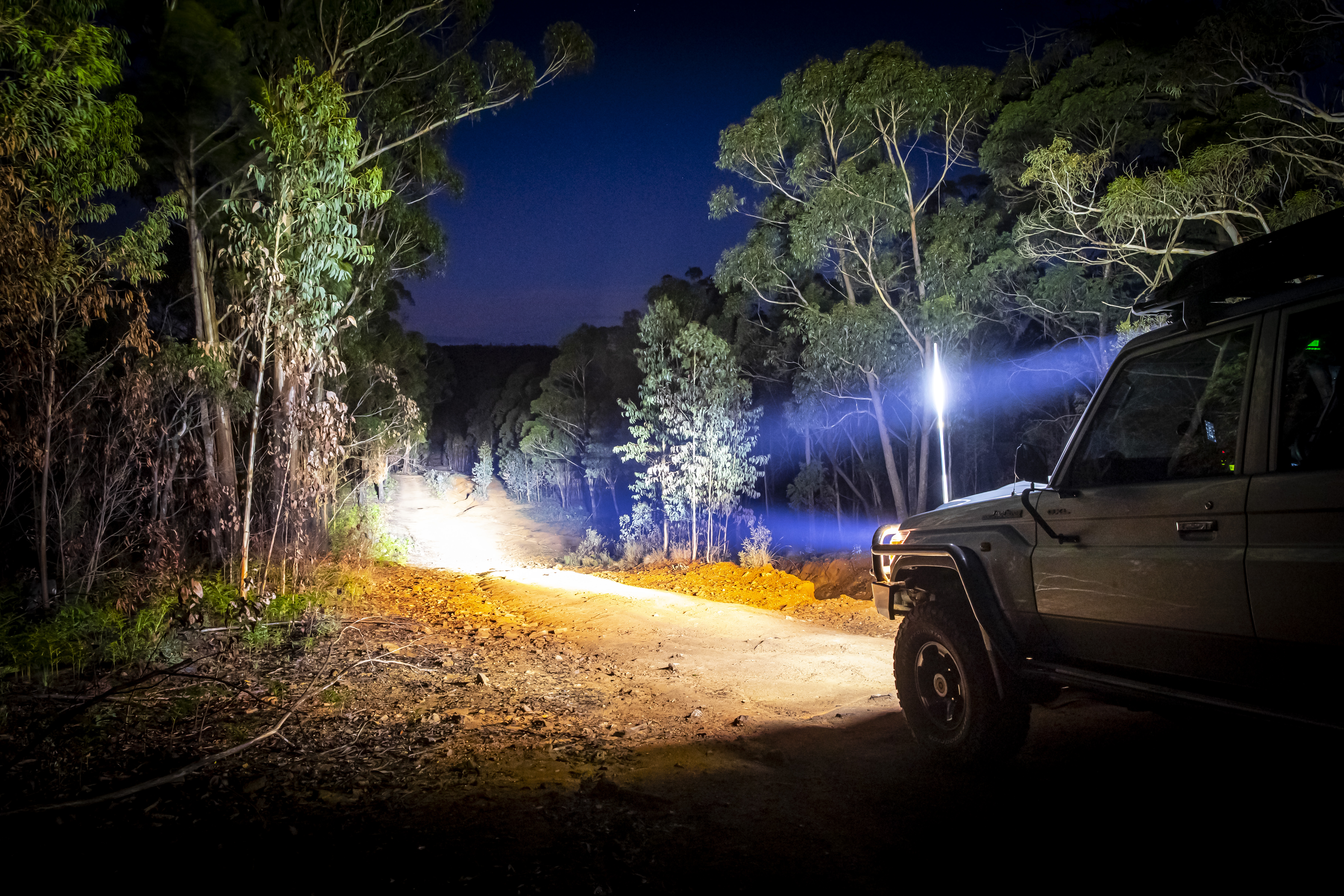
In the most recent ‘How to 4×4’ instalment, Deano reveals the tricks to staying safe on the roads at night – and it takes more than just a great set of LEDs.
What else is there?
- 4×4 trip to Googs Track, SA
- 4×4 trip to Cooper Creek, SA
- OZtrail Tarkine 1400 rooftop tent tested
- Front Runner Slimline II roof rack tested
- New products, news and more!