RRP
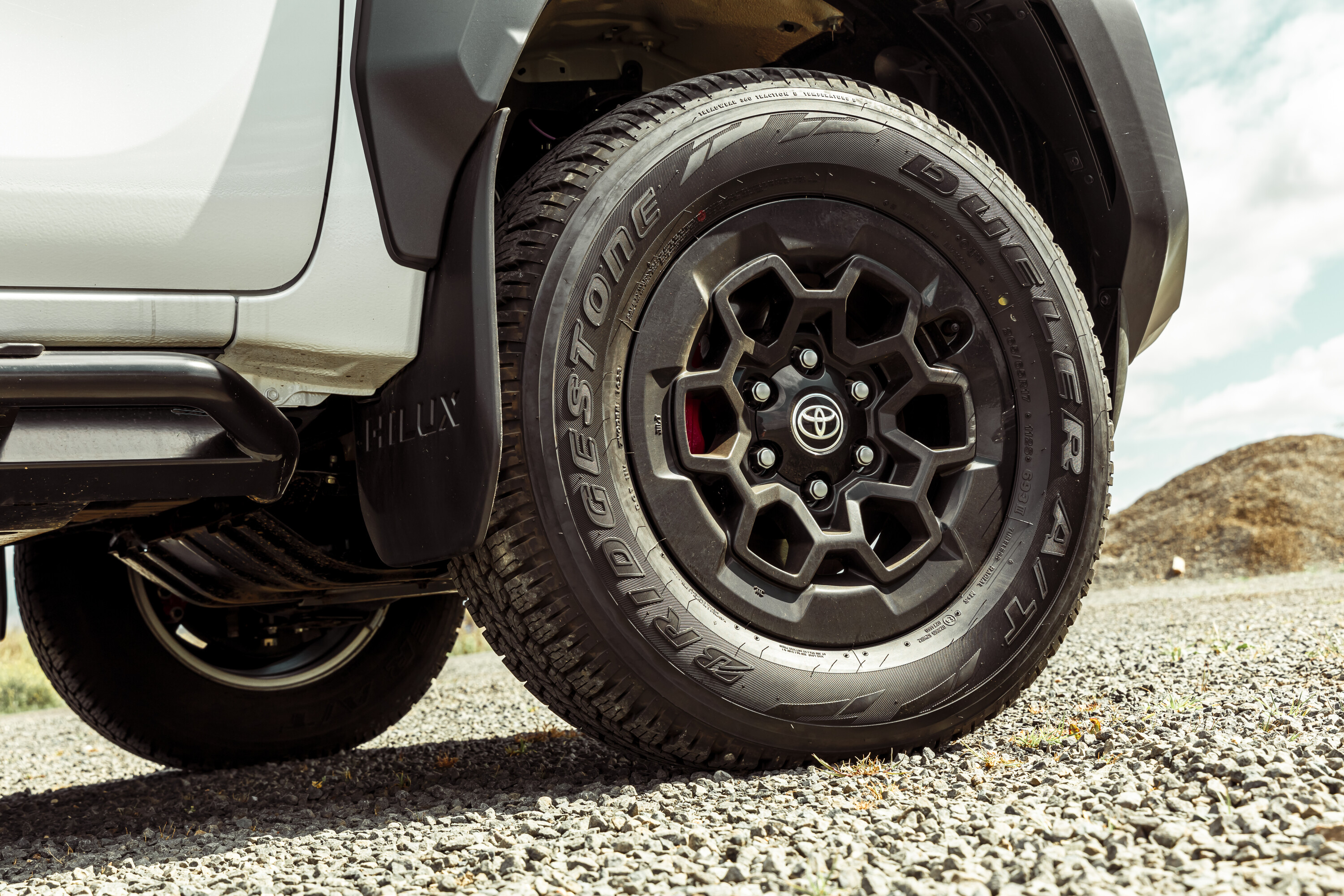
Fuel Vapor Wheels, 18×9: $535 each
Falken Wildpeak AT3W, LT285/60R18: $370 each
Available from: tyrepowersale.com.au [↗️]

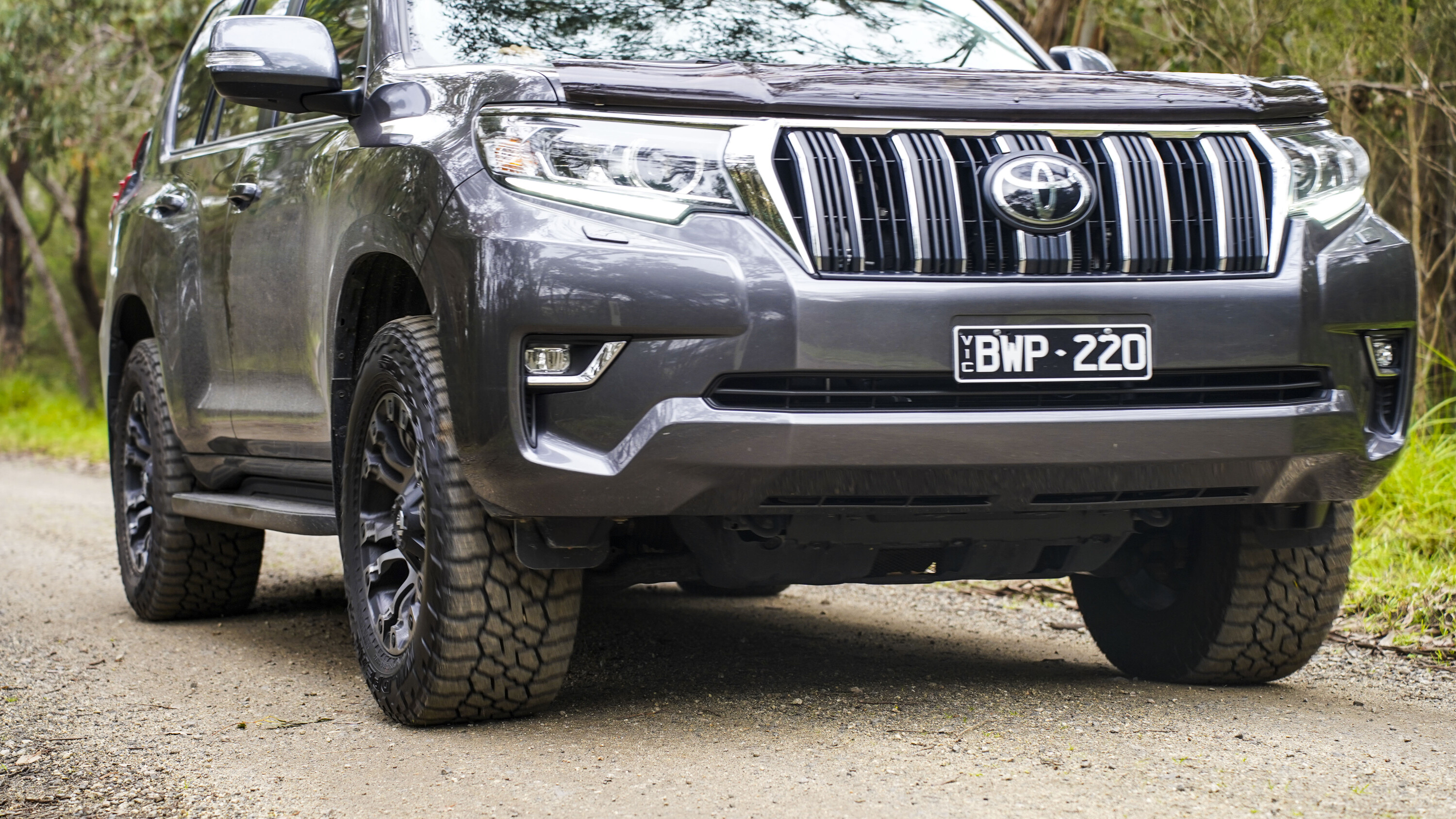
I live on the rural east coast of Victoria, so I wanted a tyre that offers a balance of on-road comfort with off-road traction, as the Prado sees service as a family wagon to take the kids to school but also needs to be equipped to handle summer camping trips.
I opted for a set of Falken Wildpeak AT3W tyres and from the first drive I noticed a slight noise reduction compared to the BFGoodrich all-terrains I had fitted on my previous 2016 Prado. Over the past few weeks, Victoria has experienced a deluge of rain, and while the Wildpeaks do hum a bit on wet roads, I’m happy to put up with that for the superb traction they provide in crook conditions.
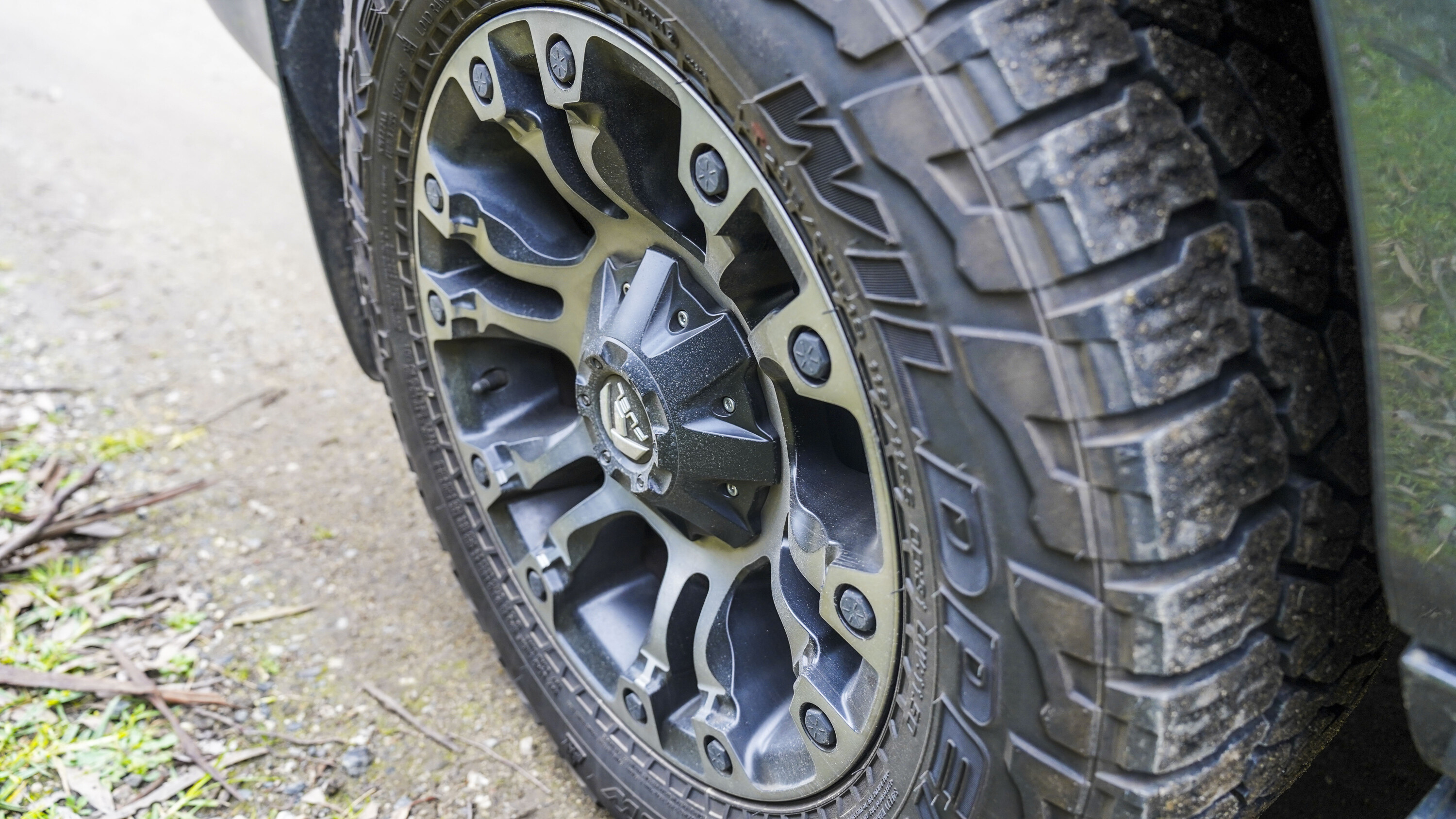
Crafted from high-quality cast aluminium, these specialised alloy wheels feature a dual six-spoke rugged concave design, and are available in matte black, black with machined spoke faces, and a dark tint finish.
With various sizes, widths and offsets, they are available to suit a range of vehicle applications; and whether you prefer the wheels to extend beyond your vehicle’s guards to complement your flares, or sit perfectly flush, you should be able to find the ideal configuration to suit your rig.
With the new wheels and tyres fitted, I am impressed by the braking, handling and acceleration of the Prado, especially in dry conditions. There is excellent grip in the wet, too. And thanks to the light weight of the Vapor alloys, I expect a slight improvement in fuel efficiency.
RRP
Fuel Vapor Wheels, 18×9: $535 each
Falken Wildpeak AT3W, LT285/60R18: $370 each
Available from: tyrepowersale.com.au [↗️]
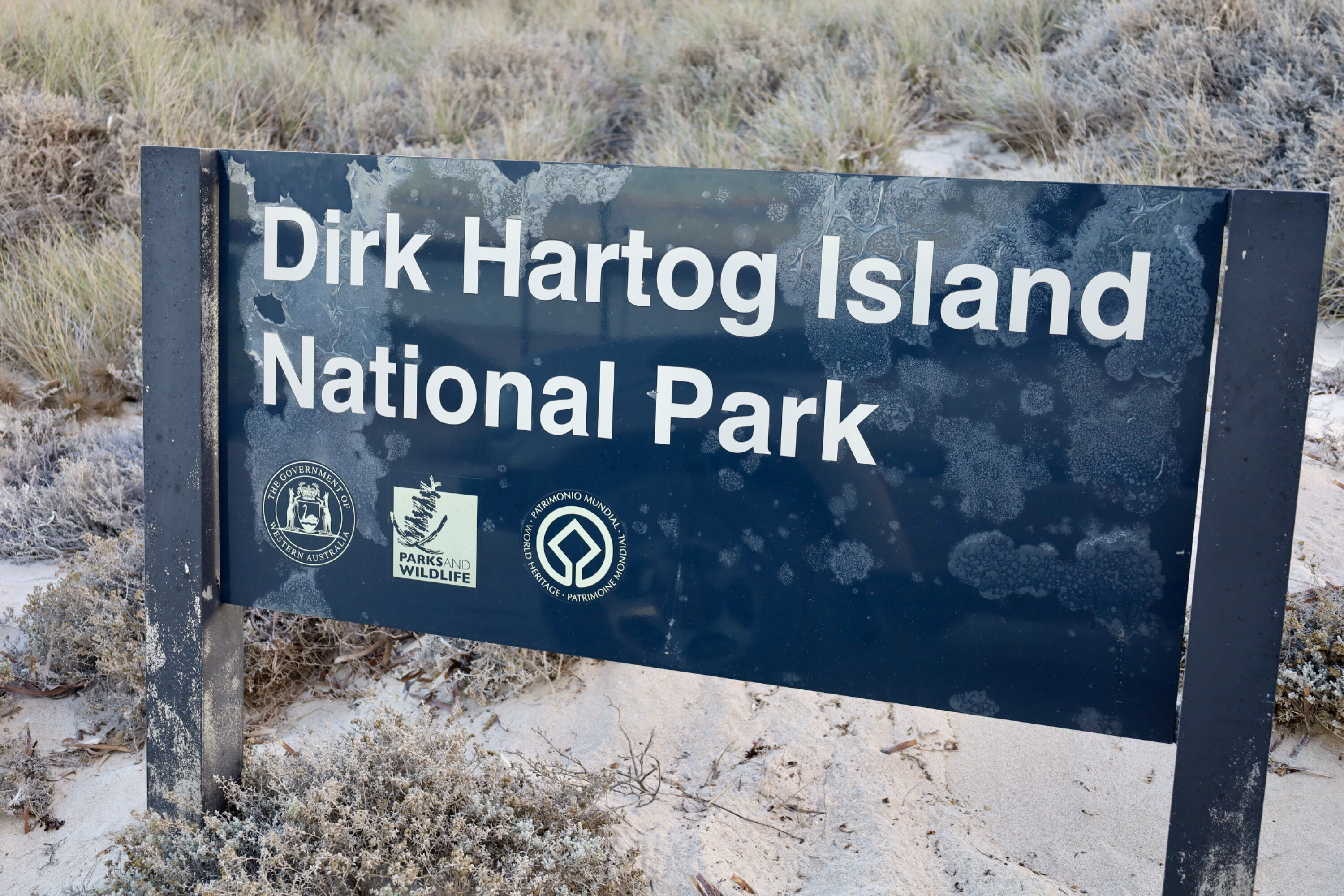
Nothing says ‘fun under the sun’ more than a 4×4 trip within Western Australia, and we’ve shortlisted the top five off-road adventures in Australia’s biggest state. From the Connie Sue Highway, to Dirk Hartog Island, and everything in between. There are so many memorable destinations within WA, that cutting it back to five was no easy task.
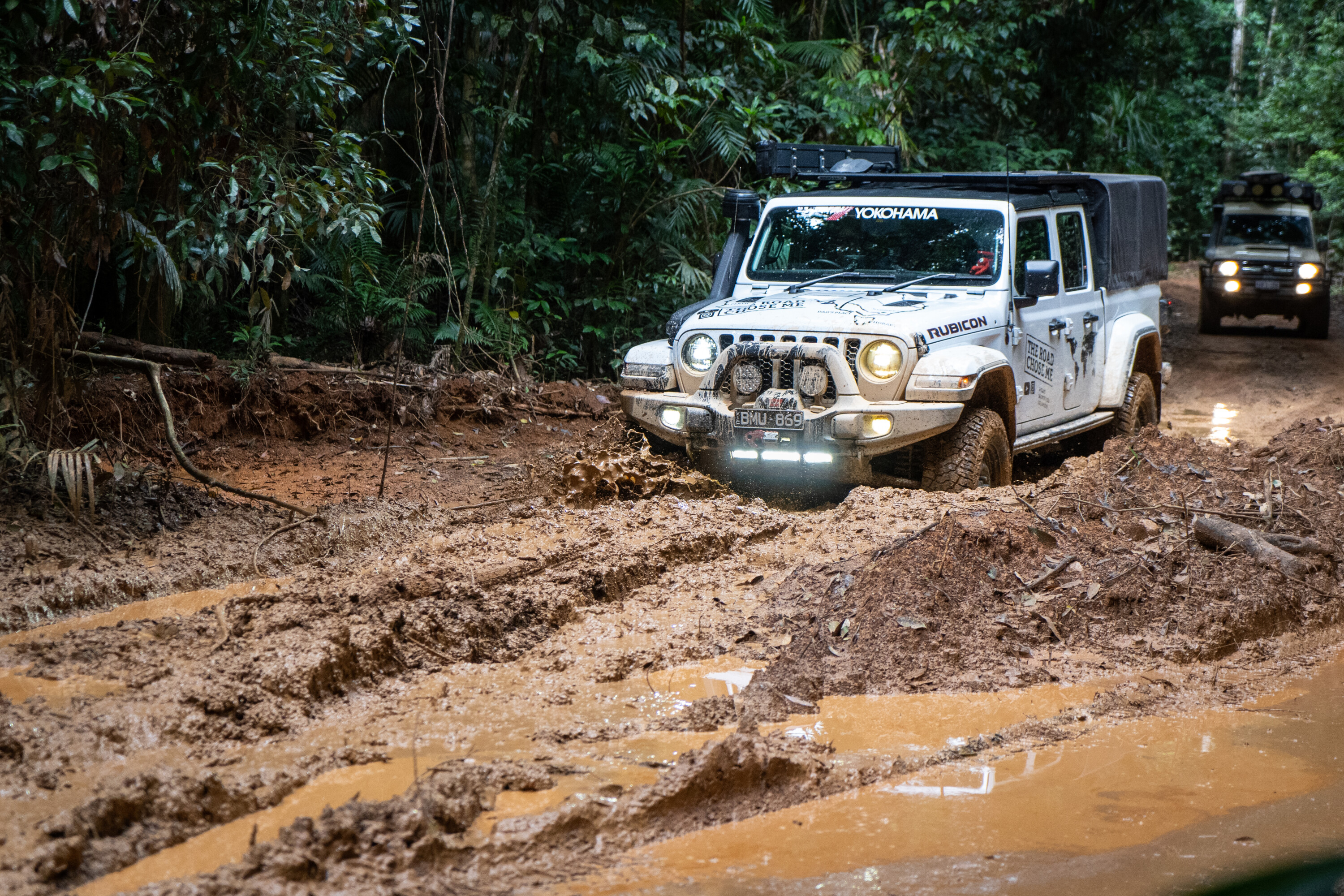
Also on the travel front, we explore the ancient rainforests along the daunting and challenging Creb Track in Far-North Queensland; and we wander the Oyala Thumotang National Park, which is situated between the Archer and Coen rivers on the Cape York Peninsula. Plus, we follow in the footsteps of Victoria’s most notorious bushranger, Ned Kelly, in the state’s north-east.
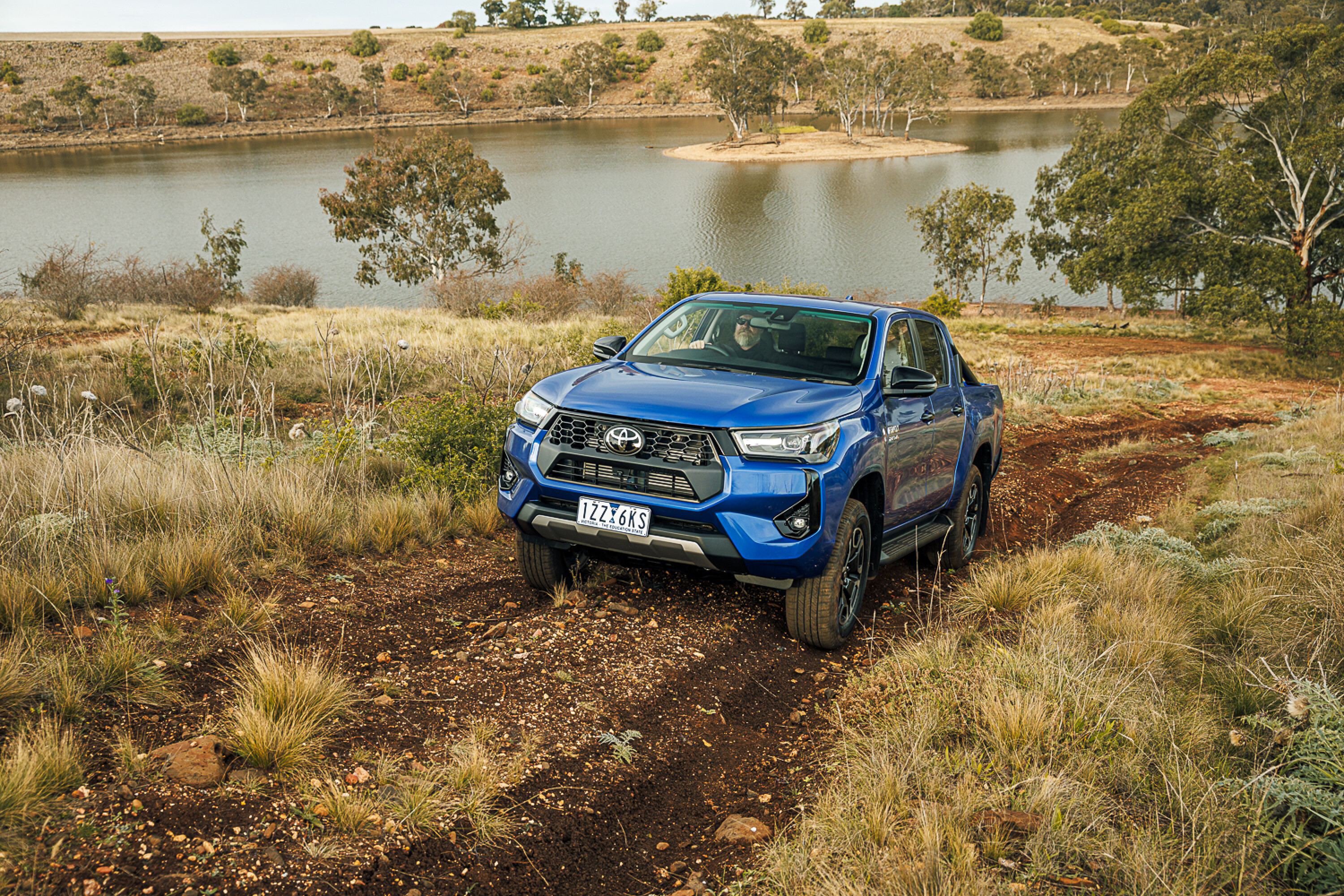
Matt Raudonikis spent some time in a HiLux SR5 with V-Active technology (just don’t call it a mild hybrid). The SR5 HiLux has always been a popular choice among buyers, but does the addition of 48V tech make it a better vehicle?
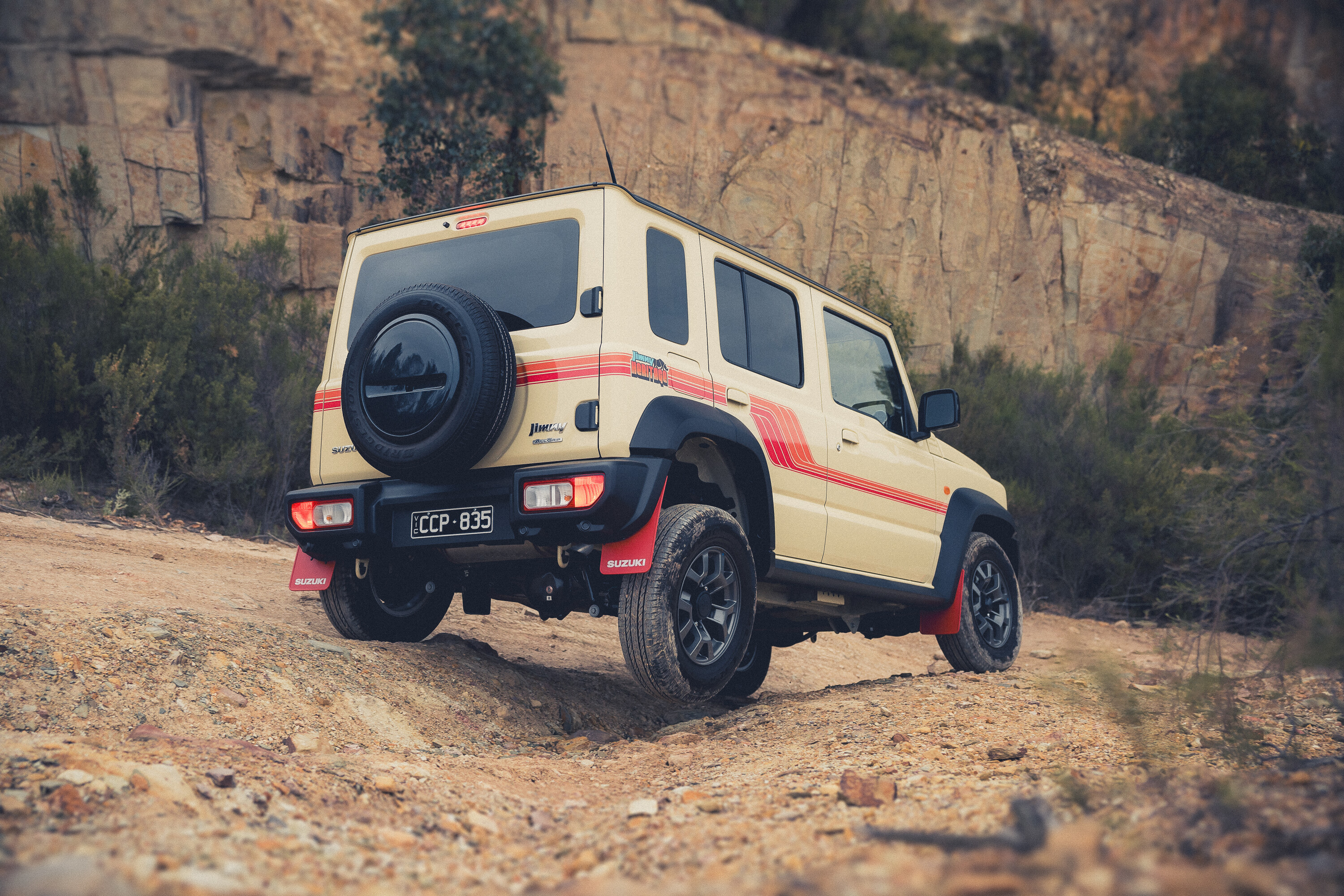
Matt then traded the HiLux for a Jimny XL in retro Heritage guise. The XL version adds more interior space and rides a bit better than the shorter-wheelbase Jimny, and its retro styling gives it a cool point of difference. There are only 500 XL Heritage models out there, so good luck getting your hands on one!
At 4X4 Australia HQ, Jamie Gray recently put the finishing touches on our Tradie Triton build, before selling it at auction! We’ve included a comprehensive run-down of the complete process, from go to whoa – and we reckon the end result is spectacular.
Our Ford Ranger is also in the hands of a new owner, so that leaves the Everest as the sole vehicle in the 4X4 garage at present. This month, we added an MSA 4×4 fridge slide, barrier and storage drawer, before installing a National Luna Legacy stainless-steel 50-litre dual-zone fridge-freezer.
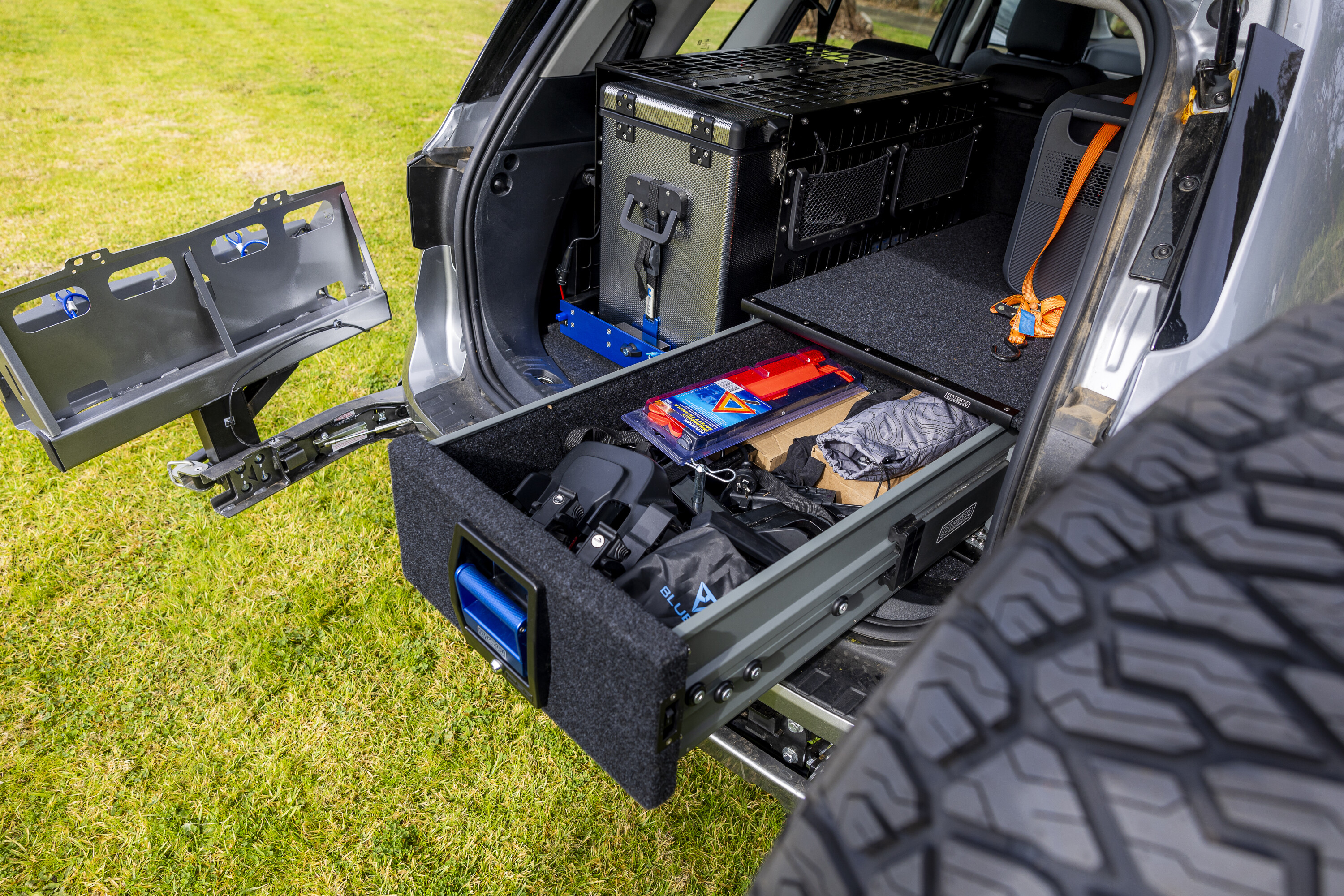
Speaking of fridges, Dex Fulton has taken a close look at the different styles on the market – chest, upright and drawer – and explains what you should be looking for to suit your needs and requirements.
Today it is Ford versus Toyota at the top of the sales charts headed by the brands’ respective midsize 4×4 utes, the Ranger and HiLux. The HiLux was always the class champion but in recent years the Ranger has taken over as the most popular new 4×4 ute in the country.
As the battle rages on the manufacturers strive to offer new and different variants of their utes and, with strong demand at the top-end of the segment, the car companies are only too happy to bring out new high-spec models as this is where the big profit margins are.
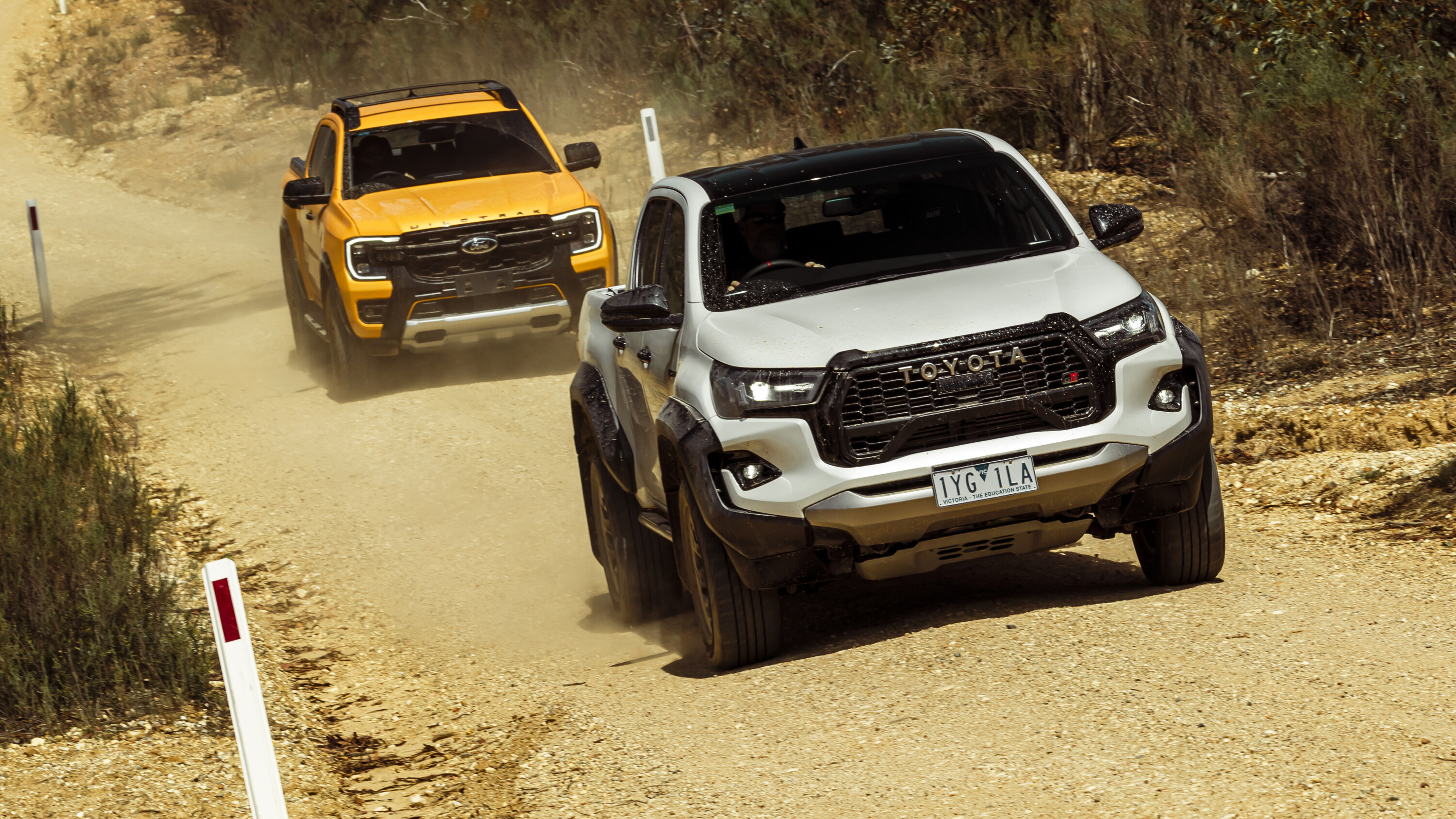
While the GR Sport sits atop the HiLux list in terms of both price and equipment, the Wildtrak X is only the most expensive and best equipped of the four-cylinder Rangers, with the V6 Platinum and Raptor models sitting above it.
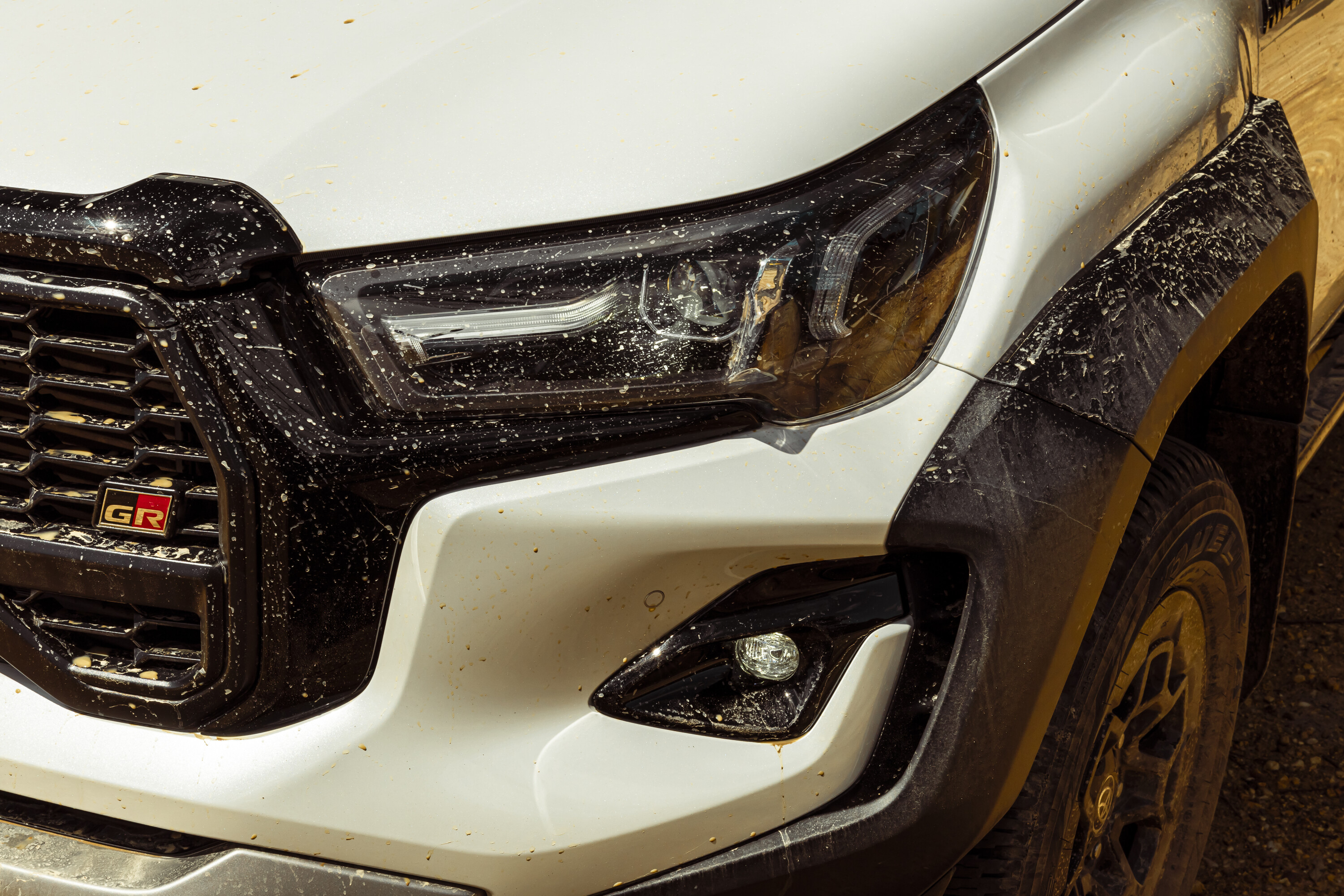
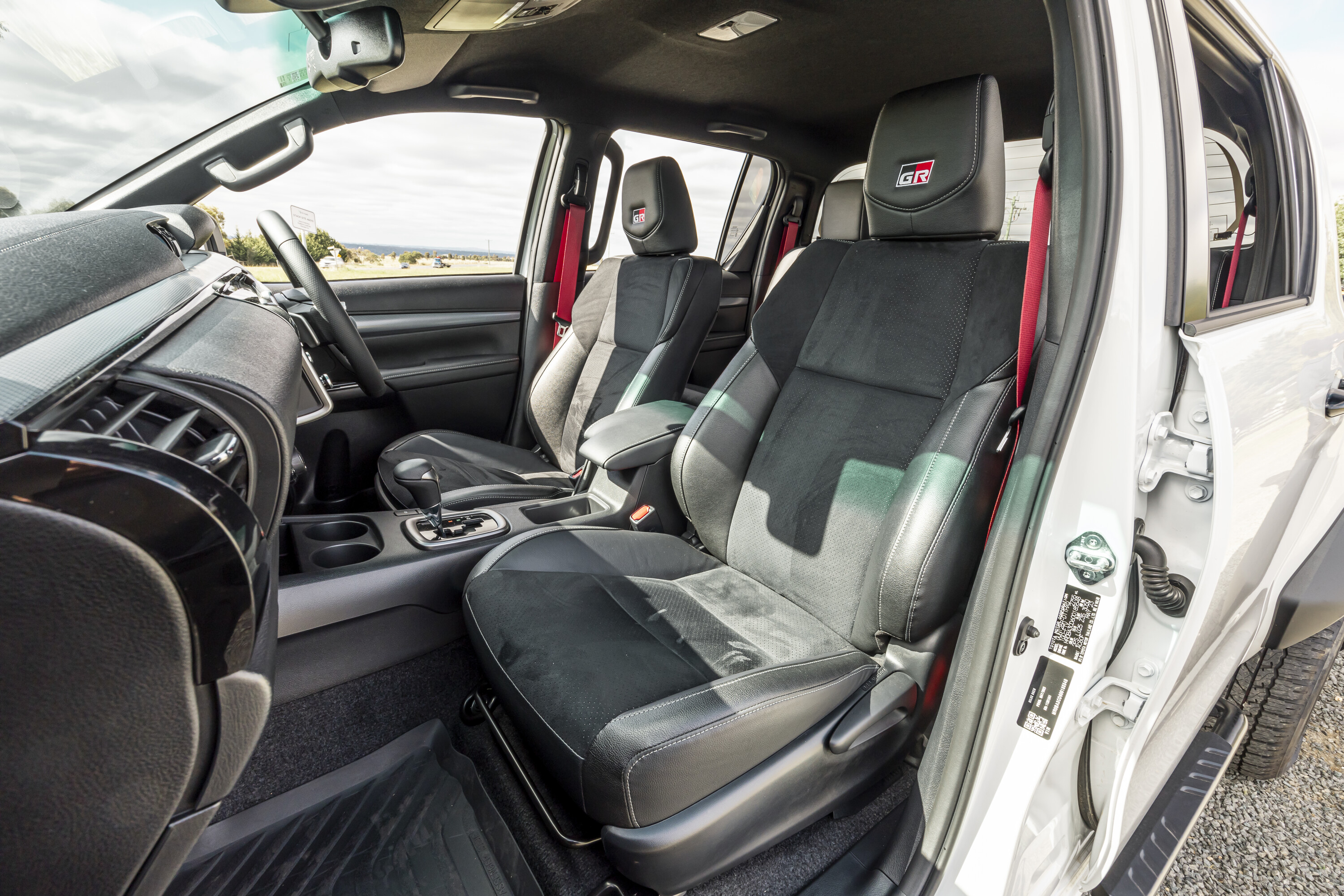
As such it gets heated leather front seats but with GR-S specific suede trim and colours, nine-speaker JBL sound system, an eight-inch screen with inbuilt satnav and audio controls, plus Apple CarPlay and Android Auto, and a 360° panoramic camera.
There’s aluminium driver’s pedals and red seat belts, which we guess will appeal to someone, but don’t really add anything to the driving experience.
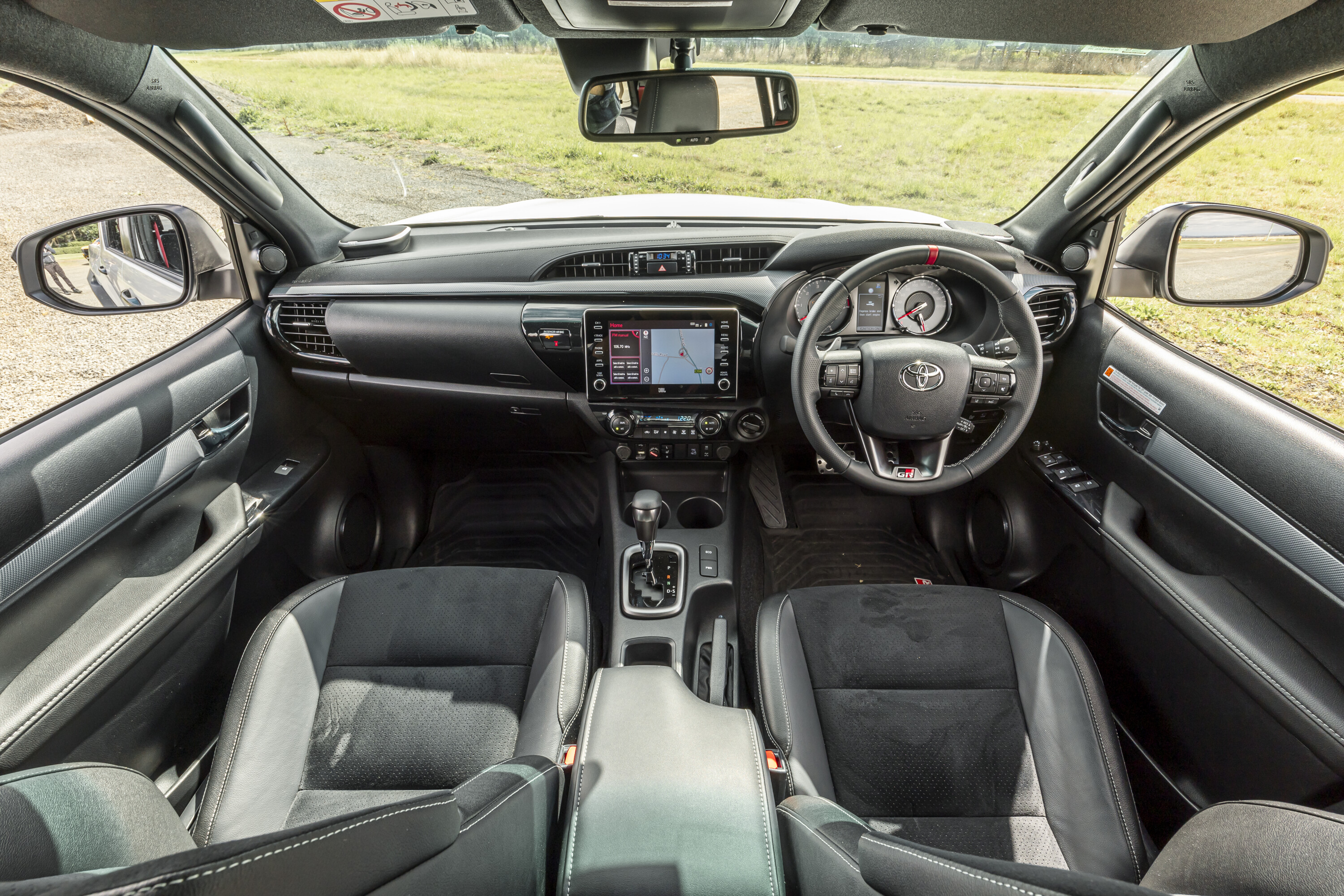
Toyota has dressed the HiLux interior in its Sunday best yet it remains basic and functional and that’s what we like about it. The only thing it’s really missing is reach adjustment on the steering column which is an indicator of the N80 HiLux’s age.
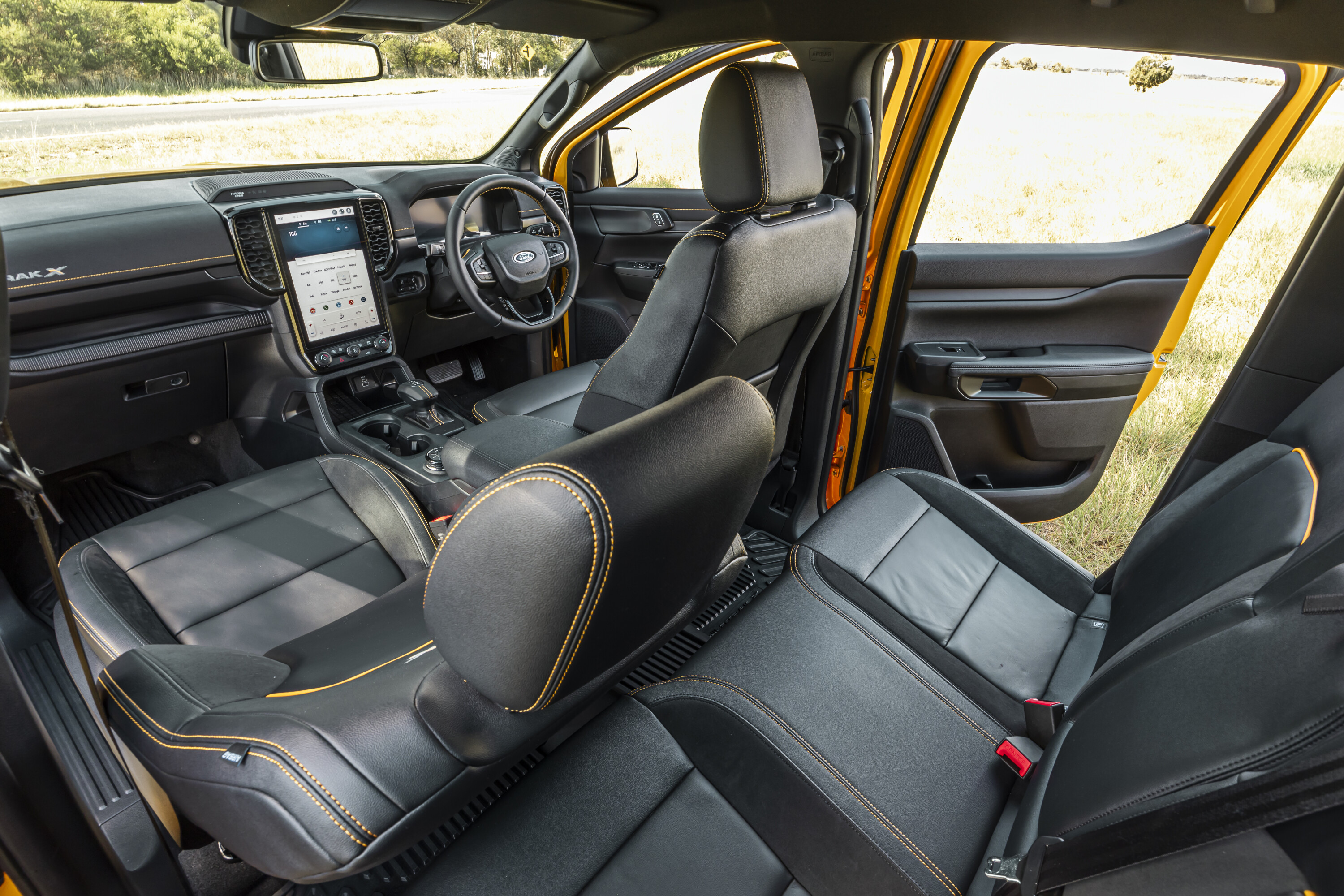
The Wildtrak X carries over the features you get in the V6 model Wildtrak including the big 12-inch centre screen, oversize configurable gauge screen, heated leather seats, wireless Carplay and Android Auto.
On the outside of the Wildtrak X you get matrix LED headlights up front and on the tub there is Ford’s new adjustable load bars that include a bar that slides back on the tub together with adjustable cross bars on the roof rails that combine to give a clever and useful, versatile load system for carrying longer items like surfboards.
The improved dynamics provided by the GR Sport’s uprated suspension and the excellent four-wheel disc brakes should do a better job of keeping you safe than all the chassis electrickery.
The Wildtrak X is likewise loaded with much of the same chassis safety sorcery but the dynamic safety of the on-demand four-wheel drive system shouldn’t be underestimated, and the inclusion of a tyre pressure monitoring system is a huge plus.
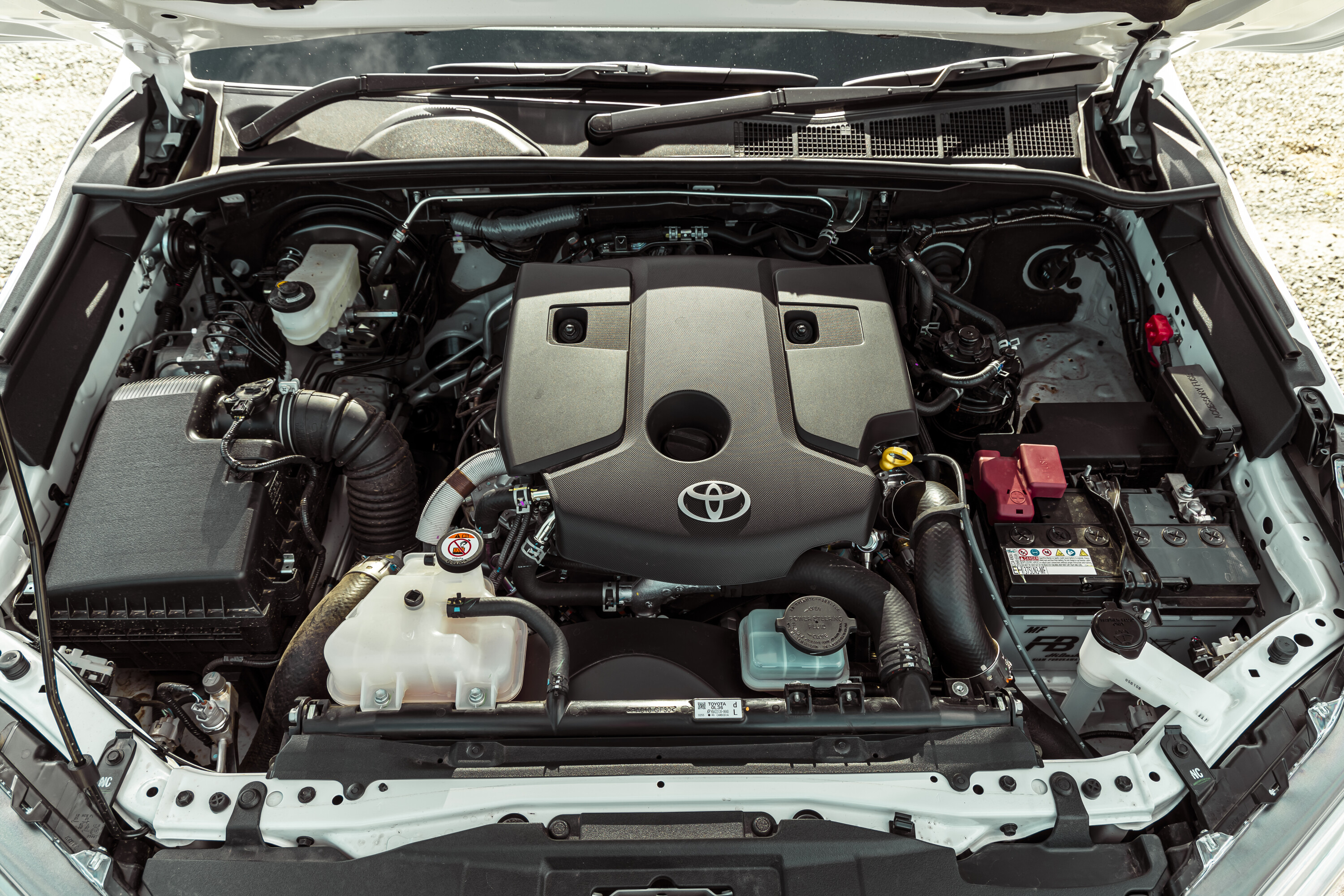
The HiLux GR Sport (GR-S) is powered by the widely used 1GD 2.8-litre single turbo engine as found across the HiLux range as well as in the Prado, Fortuner and soon the LC70 range of 4x4s, plus some van and bus applications. The GR-S exclusively gets the highest output version of the engine offered to date with claimed outputs of 165kW and 550Nm, up from the standard 150kW and 500Nm.
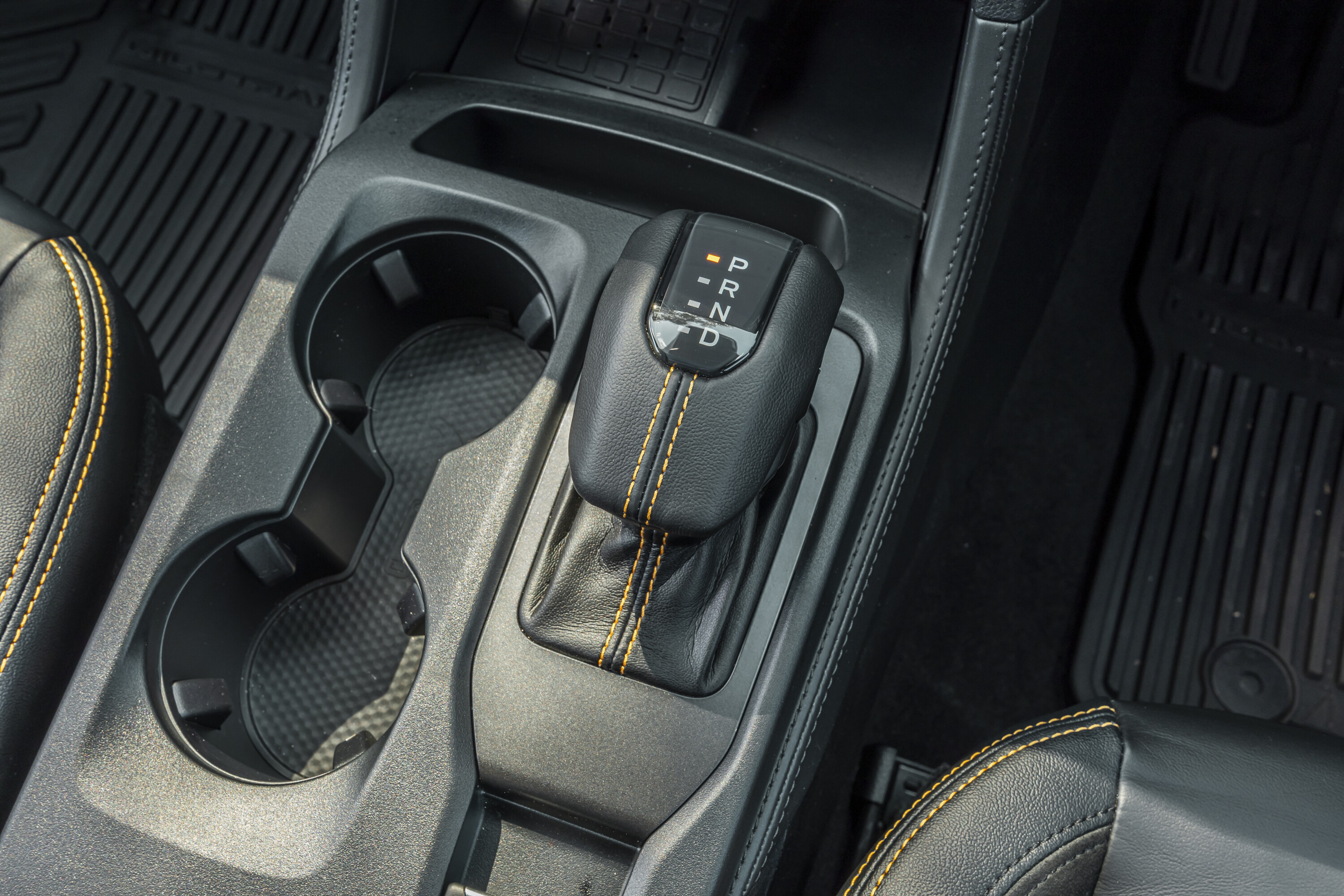
The Aisin six-speed automatic transmission has been tweaked to best match the enhanced outputs and the driver gets paddle shifters behind the steering wheel for easier manual gear selection.
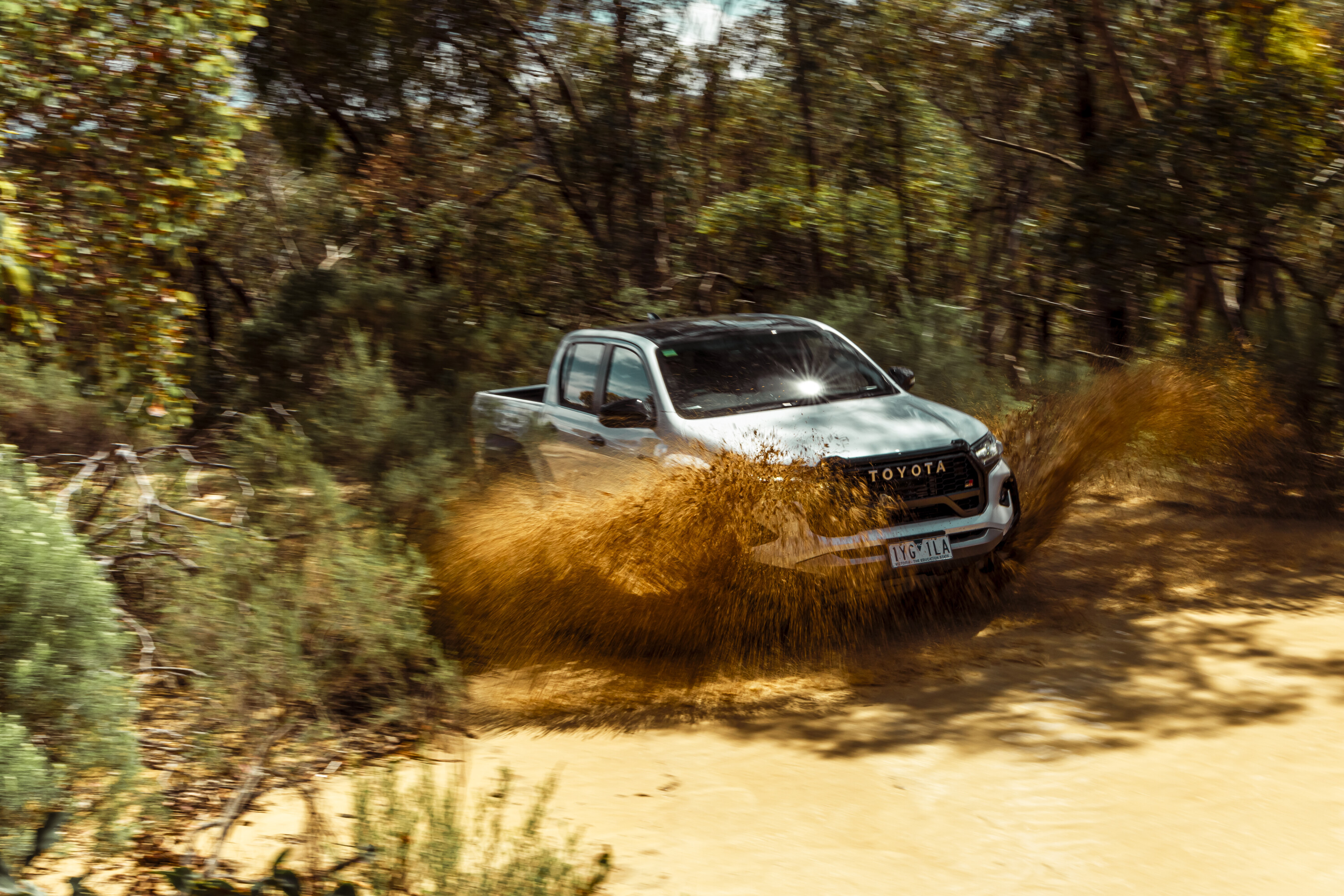
On gravel tracks where it was possible to select 4×4 in the part-time transfer case, it was stable and sure-footed, encouraging enthusiastic driving.
The 1GD has never been a slouch but the uprated outputs don’t go astray giving the GR-S plenty of punch when you put your foot down, with sharp response from the transmission. It’s a noisy and relatively harsh engine compared to newer and smaller-capacity diesels but this is a light commercial ute after all.
With fewer ratios in the transmission you really feel it when it kicks down or youshift back to make the most of the engine’s outputs, delivering an engaging and exciting driving experience.
We only drove it in unusually dry Melbourne conditions but I reckon it could be a handful on wet sealed roads. On gravel tracks where it was possible to select 4×4 in the part-time transfer case, it was stable and sure-footed, encouraging enthusiastic driving.
It’s a much smoother, quieter and refined combination than that found in the Toyota, and it gets along quite well, but lacks the spirited feel that the GR-S delivers.
The Wildtrak X does get a shorter 3.73:1 final drive than other Ranger models to compensate for its taller tyres but it still feels a bit lacking in pick up when driven alongside the GR-S.
The Ranger’s transfer case offers the option of using 4×4-auto mode on all road surfaces which is handy on varied road surfaces, in wet weather and especially when towing in stop/start traffic.
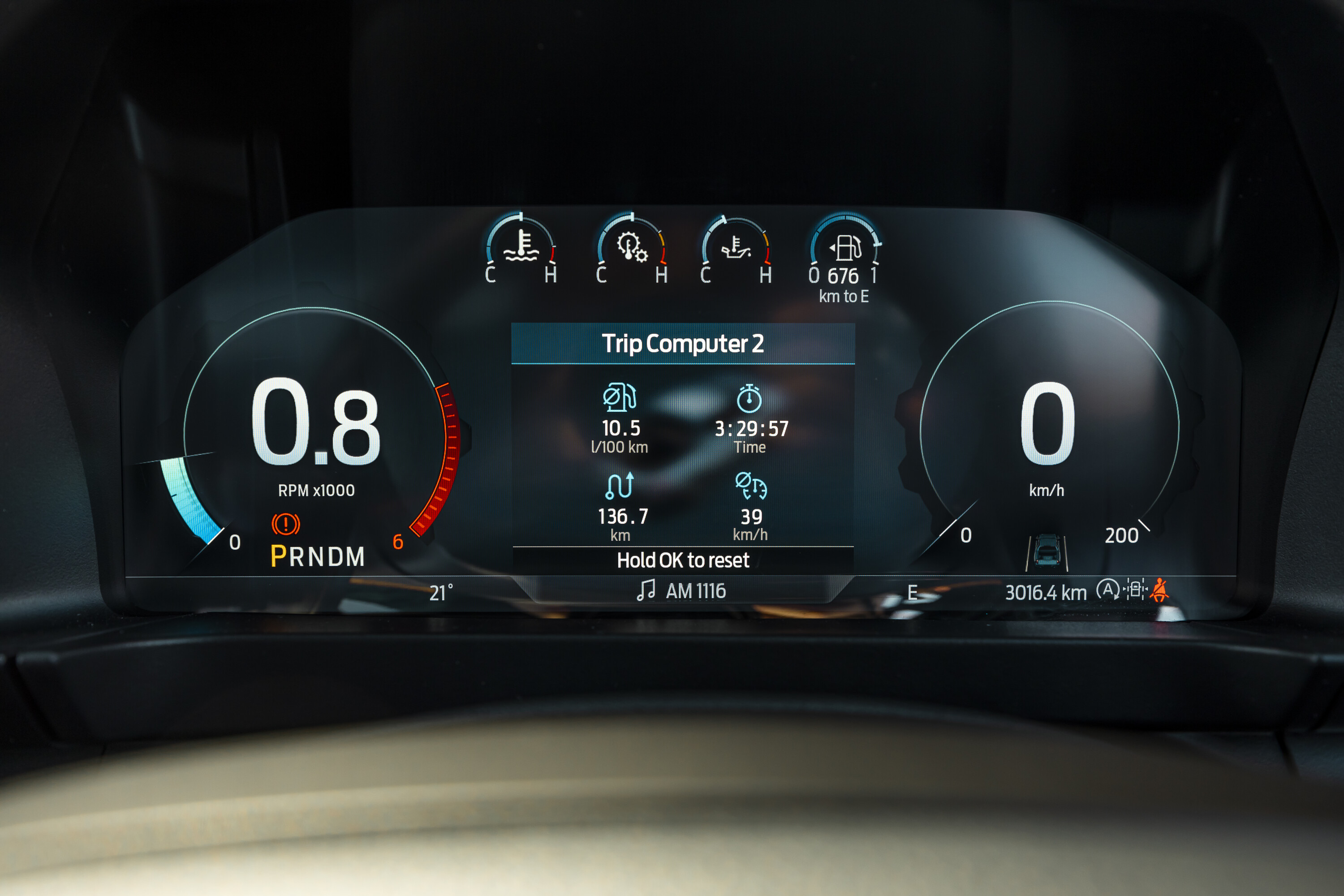
I terms of fuel consumption, Ford quotes a figure of 8.7L/100km on the combined cycle while Toyota rates the GR-S at 8.1L/100km which, interestingly, is better than the 8.4L/100km quoted for the similar but less powerful HiLux Rogue.
Its ride is more compliant and hence comfortable while also delivering superior dynamics and handling. It’s a more modern ute and feels more passenger car-like than the HiLux in every regard.
The HiLux GR-S, on the other hand, feels more like a traditional LCV in that it has a firm and sometimes jittery ride that can get tiresome on less than smooth surfaces.
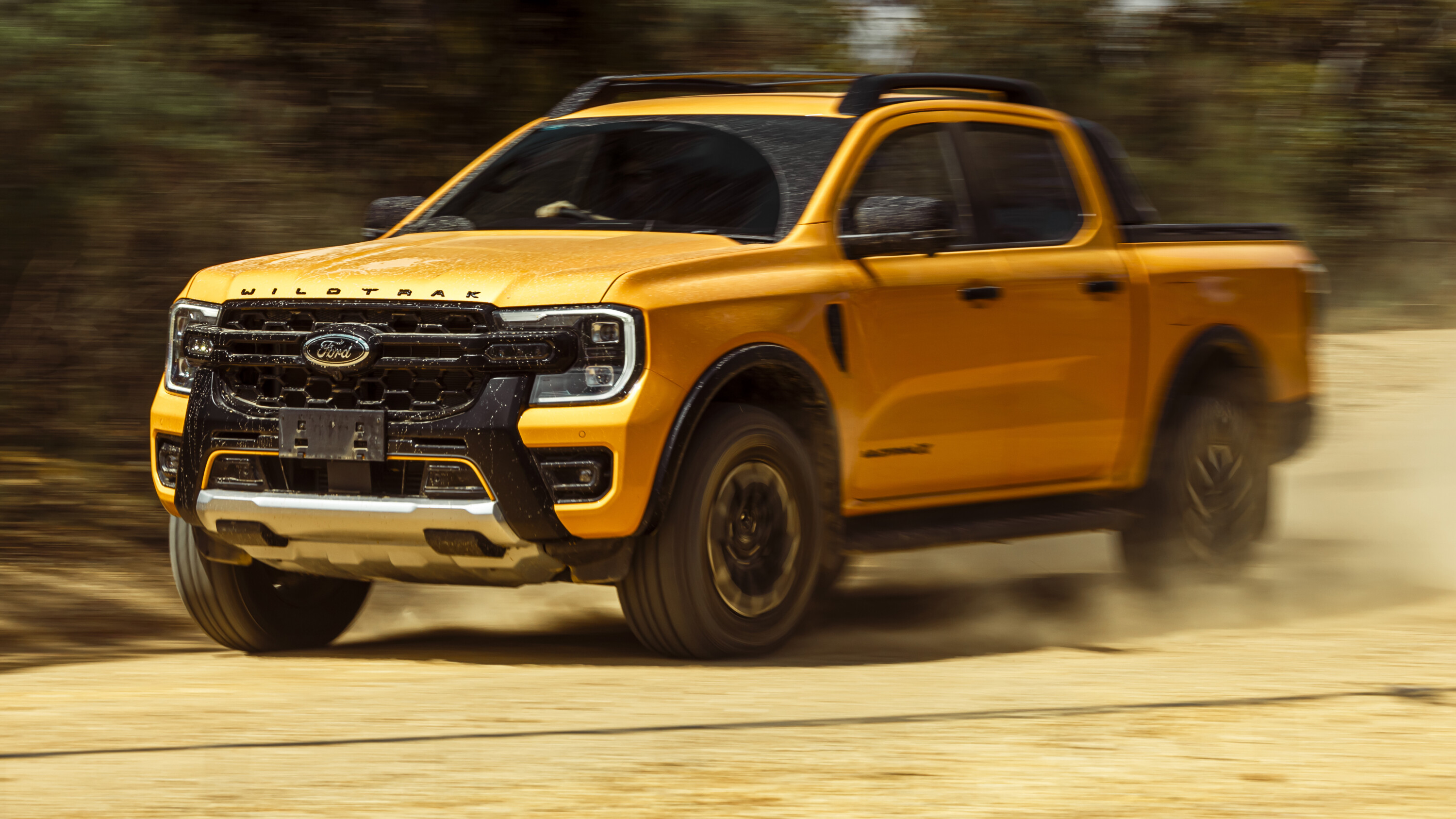
The HiLux GR-Sport gets the wider wheel track with extended front control arms and a wider rear axle that include disc brakes, that we first saw in the latest HiLux Rogue last year.
The difference between the two top-spec HiLux models is that the GR-S loses the Rogue’s rear sway bar to give it more rear axle articulation for better off-road performance and it comes with GR-S specific KYB monotube shock absorbers. They are matched to stiffer springs in the front and rear.
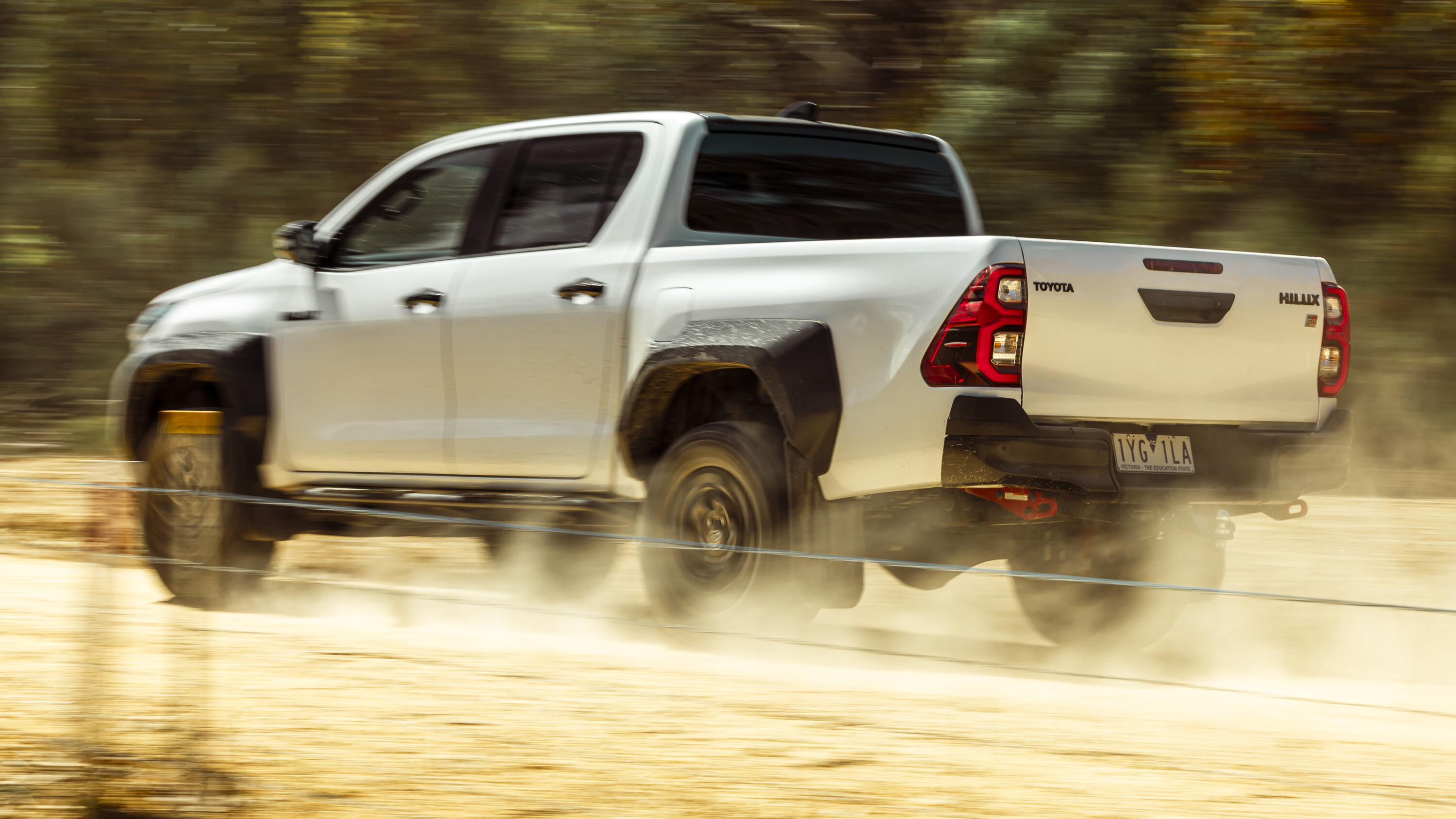
The Wildtrak X also benefits from bespoke dampers calibrated to give better rough-road performance. They come from premium shock specialist Bilstein and are position and frequency sensitive to give the best performance over any terrain.
The Ranger has superior ride, control and handling compared to the HiLux on most road surfaces and this carries over with these two model variants, but the GR-S delivers better control than the lower-spec HiLuxes.
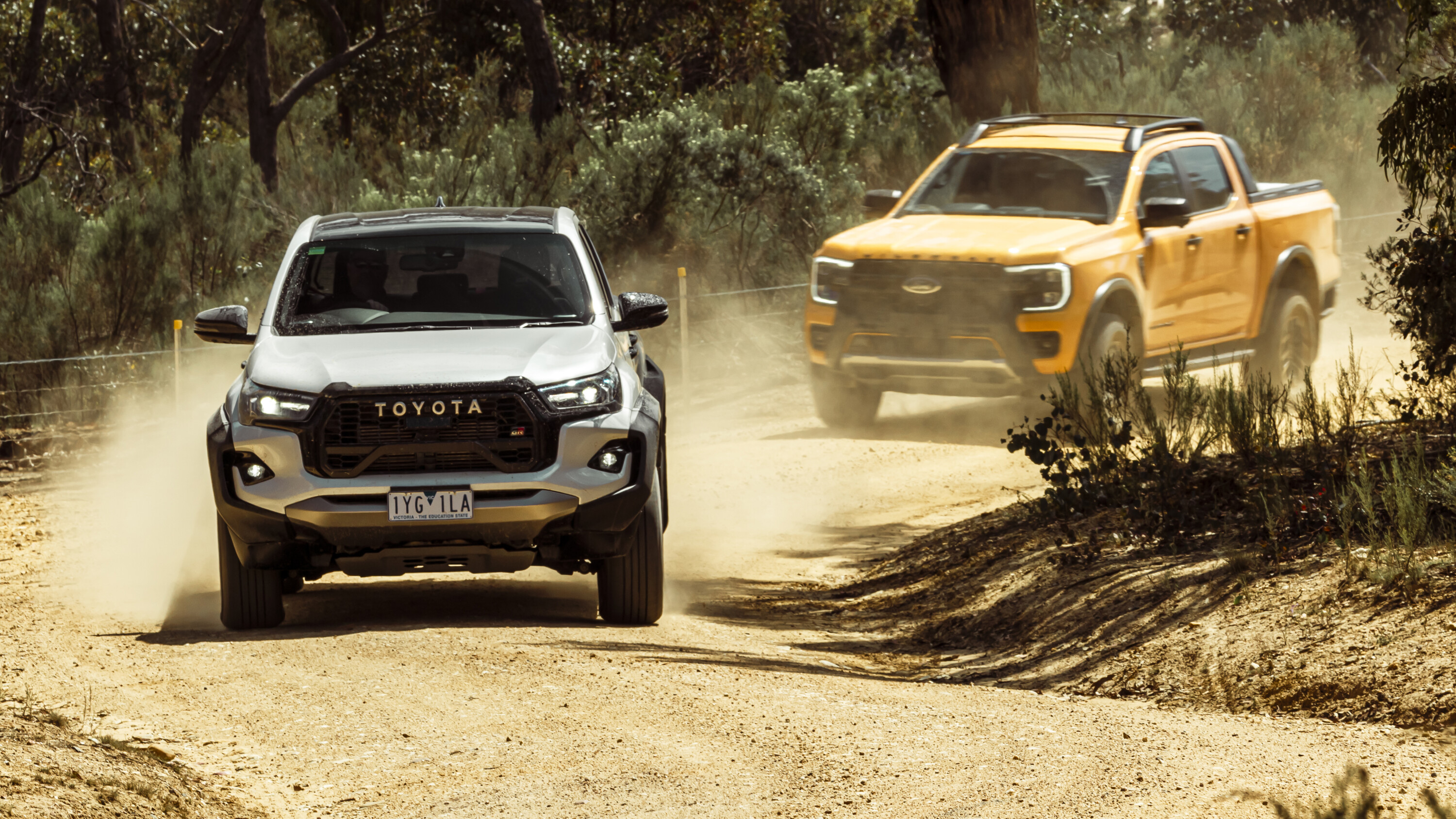
No they are not true competitors to a Ranger Raptor but they are considerably less costly and come with the more popular diesel engines.
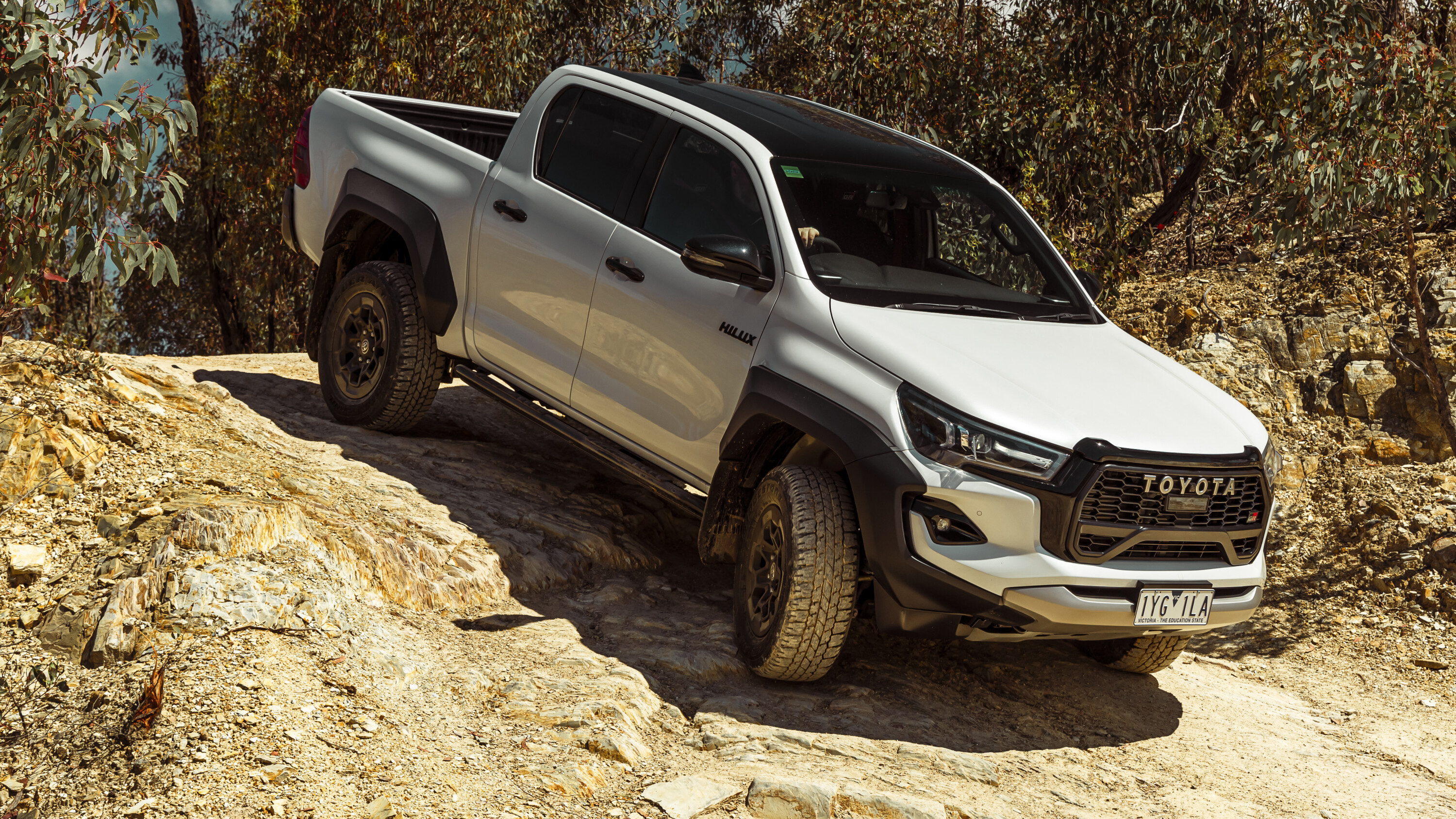
Without a Raptor-like model in the range the HiLux GR Sport is the off-road hero for Toyota’s midsize ute. As always its key attributes are relatively good rear-axle travel to keep the wheels on the ground and sharply calibrated electronic traction control. It also has a rear differential lock but the ETC does such a good job you rarely need to use it.
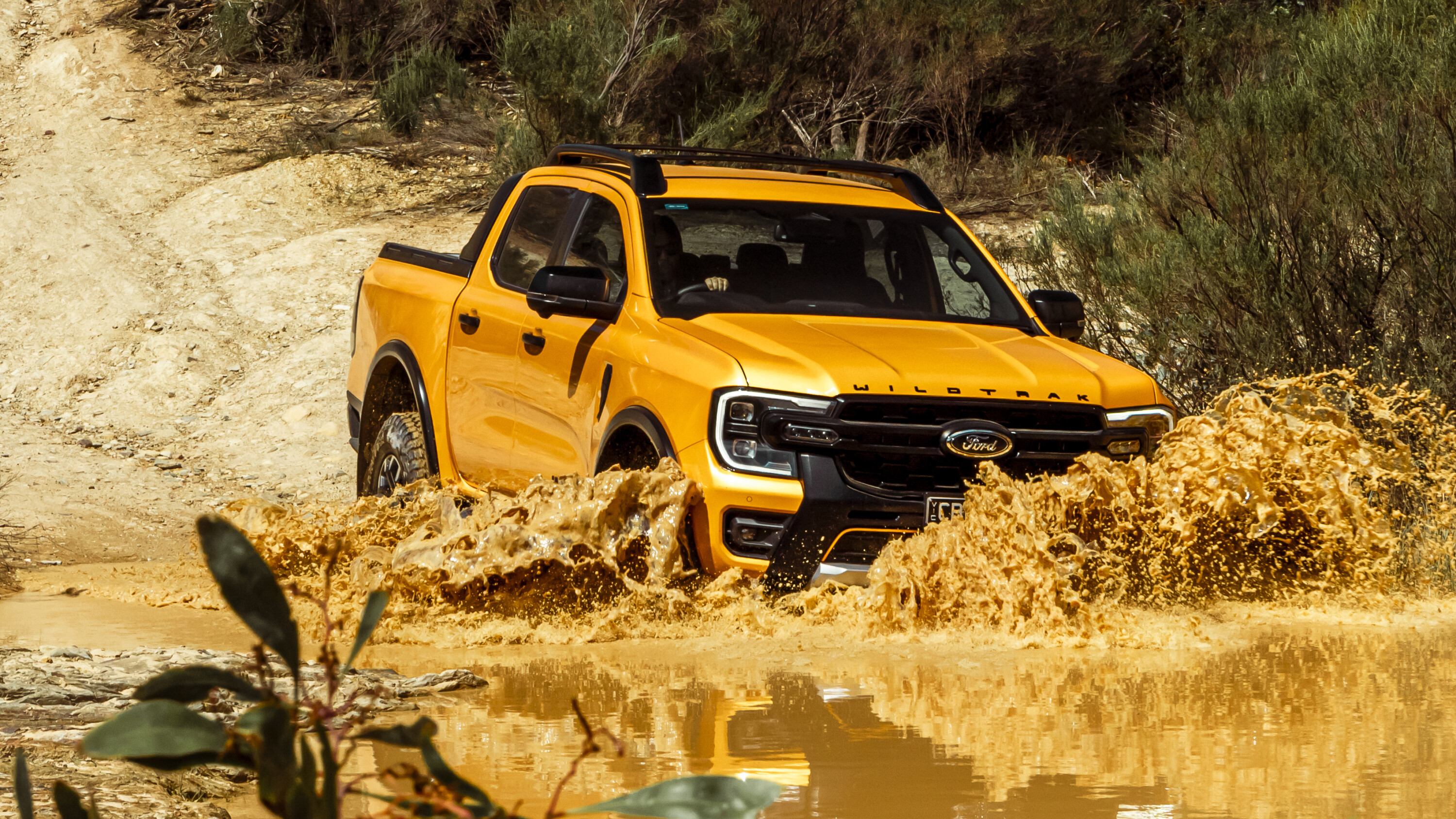
This helps the Toyota get over deep ruts and obstacles with little wheel slip or drama.
Additional off-road hardware for the GR-S includes a model-specific front bumper that offers more ground clearance, a 4mm-thick pressed aluminium front skid plate,2mm tube steel rock sliders in lieu of side steps, and front and rear recovery points.
The Wildtrak X Ranger also gets some off-road goodies on top of its bespoke Bilstein suspension.
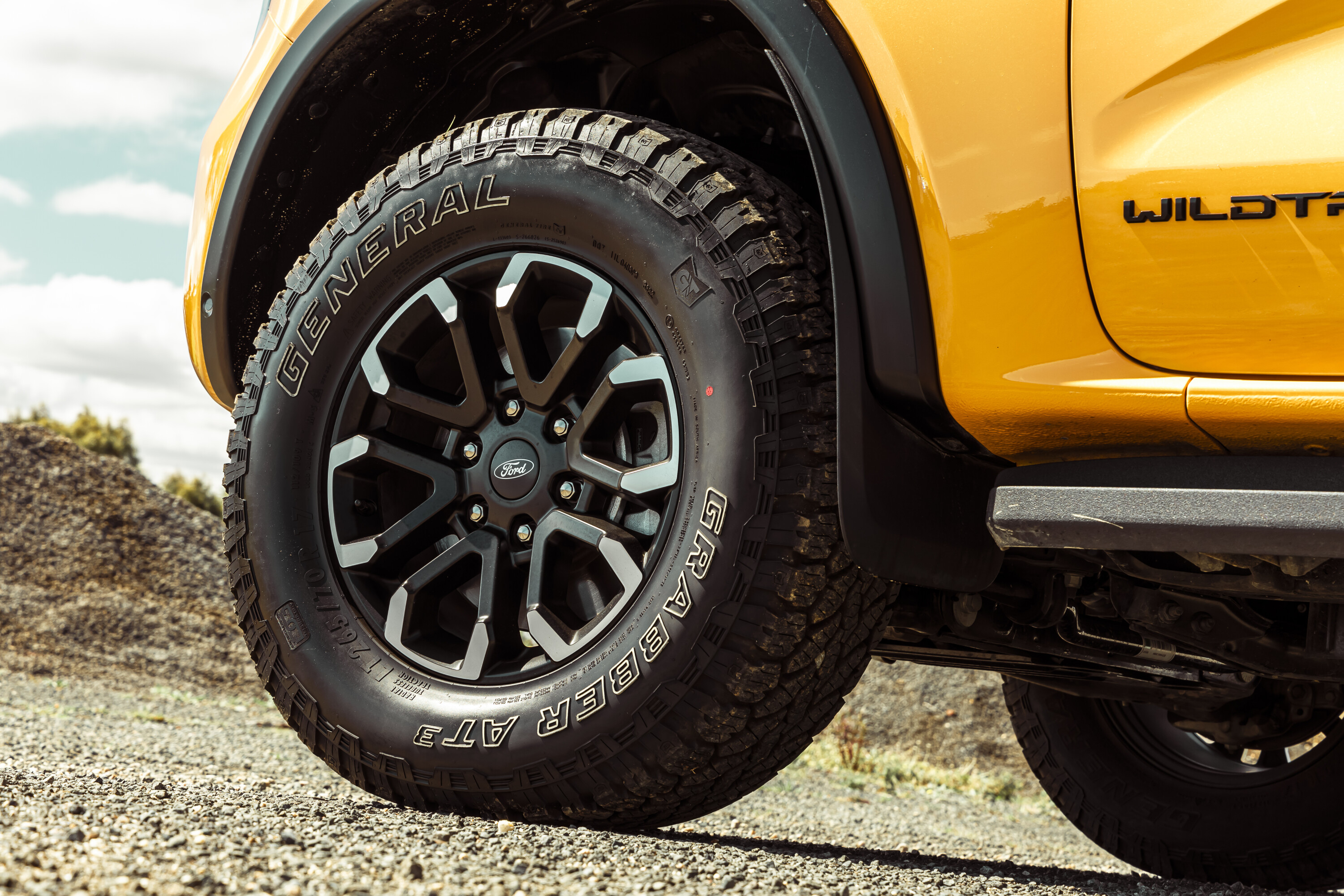
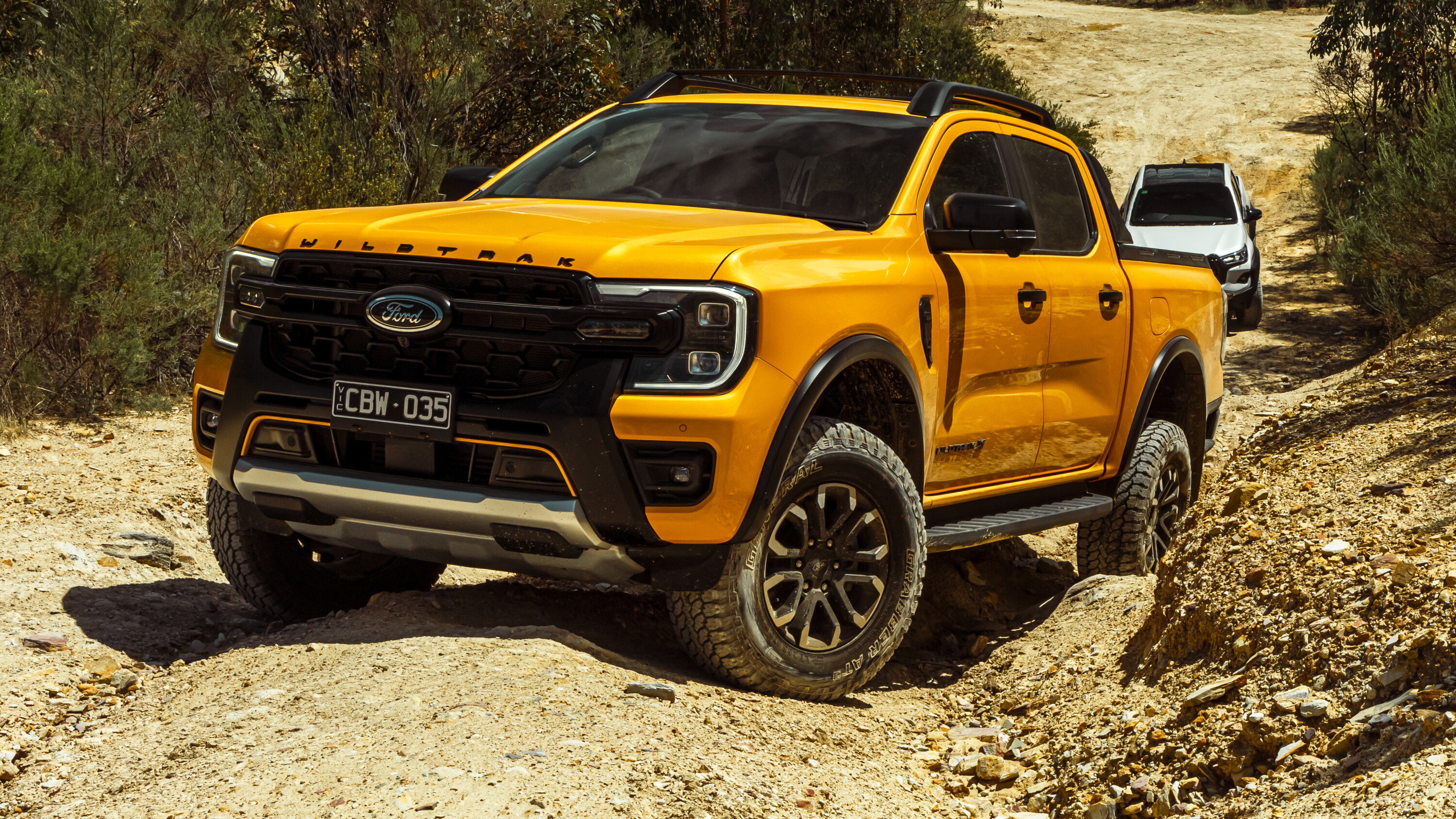
Immediately obvious are its 265/70R17 Grabber AT3 tyres on alloy wheels, with the more aggressive tyres and suspension combining to give a 30mm wider front and rear wheel track, and an extra 26mm of ground clearance when compared a regular Ranger Wildtrak, while a steel bash plate helps protect the undercarriage.
The latter of these is new to Ranger and, as it does in LandCruiser 300 and GWM Tank vehicles, it locks the inside rear wheels to help decrease the turning circle when off road.
More useful than Turn Assist is Trail Control which like Toyota’s Crawl Control system, and one used by Jeep, works like low-speed cruise control for pedal-free progress over rough ground.
It’s far more accurate in throttle application than the most experienced off-road driver’s right boot and it’s a shame Toyota hasn’t seen fit to add Crawl Control to the GR-S.
We set the Ford’s Trail Control to 2km/h when we pointed the X up a rutted climb and the Ranger edged its way up without a skerrick of tyre spin making light work of the drive much to the disappointment of photographer Al. Yes, the HiLux also drove up there using driver input on the accelerator but it wasn’t as smooth or controlled.
The braking and suspension improvements to the GR Sport make it the best-driving production HiLux both on- and off-road, while the minor increases in engine output don’t go astray either.
There’s also no hiding the fact the N80 HiLux is a generation behind the Ford Ranger… but that’s not such a bad thing. The Toyota 1GD engine might be rough and noisy but it’s punchy, and the six-speed transmission lets you feel what’s going on beneath the car. Yes, the Ford’s engine and transmission are more refined, but they don’t deliver the connectivity with the vehicle that you get in the HiLux.
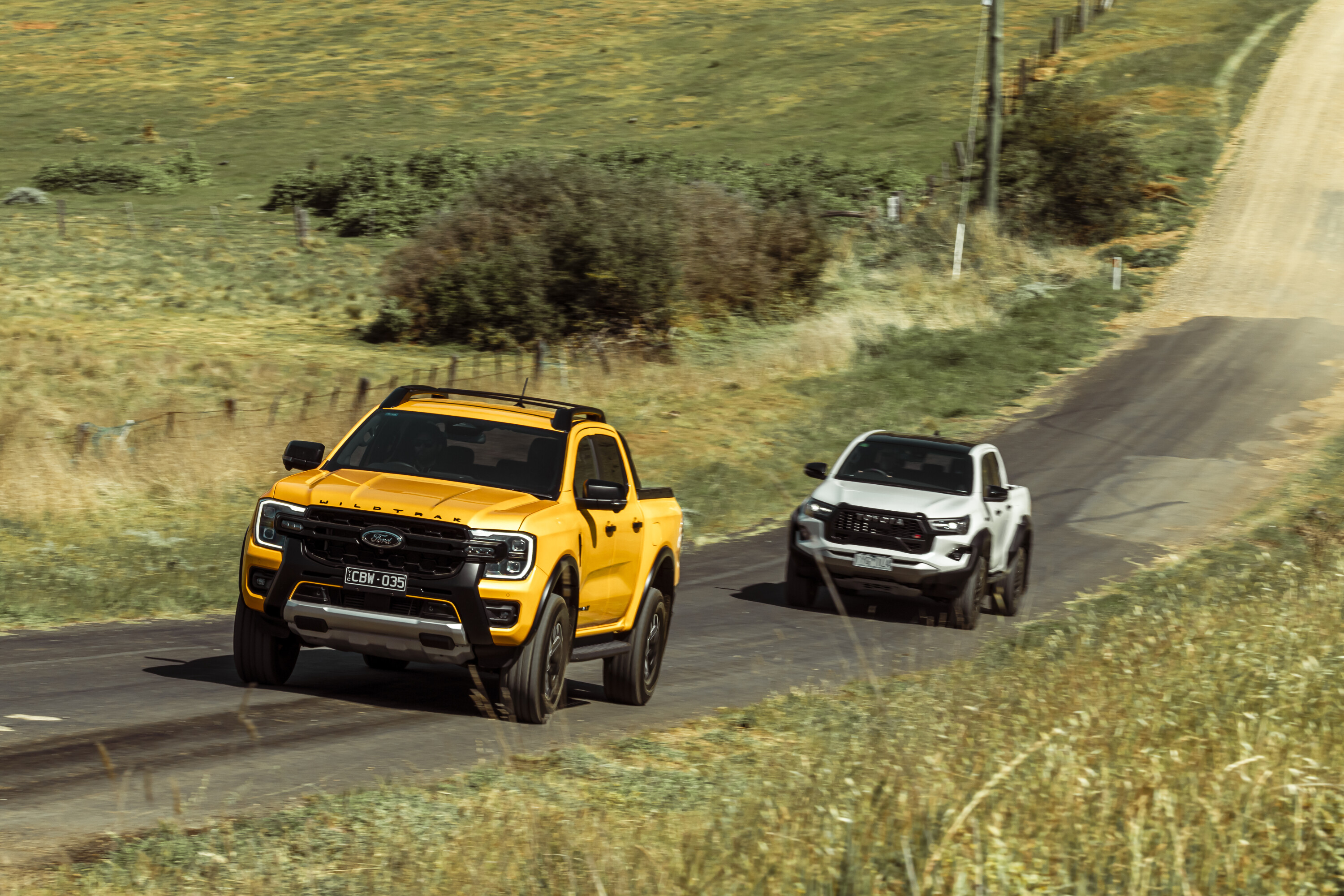
The HiLux does fall behind when you look at the payload in the highly equipped GR Sport model, and both of these utes retain their 3500kg rated towing capacity.
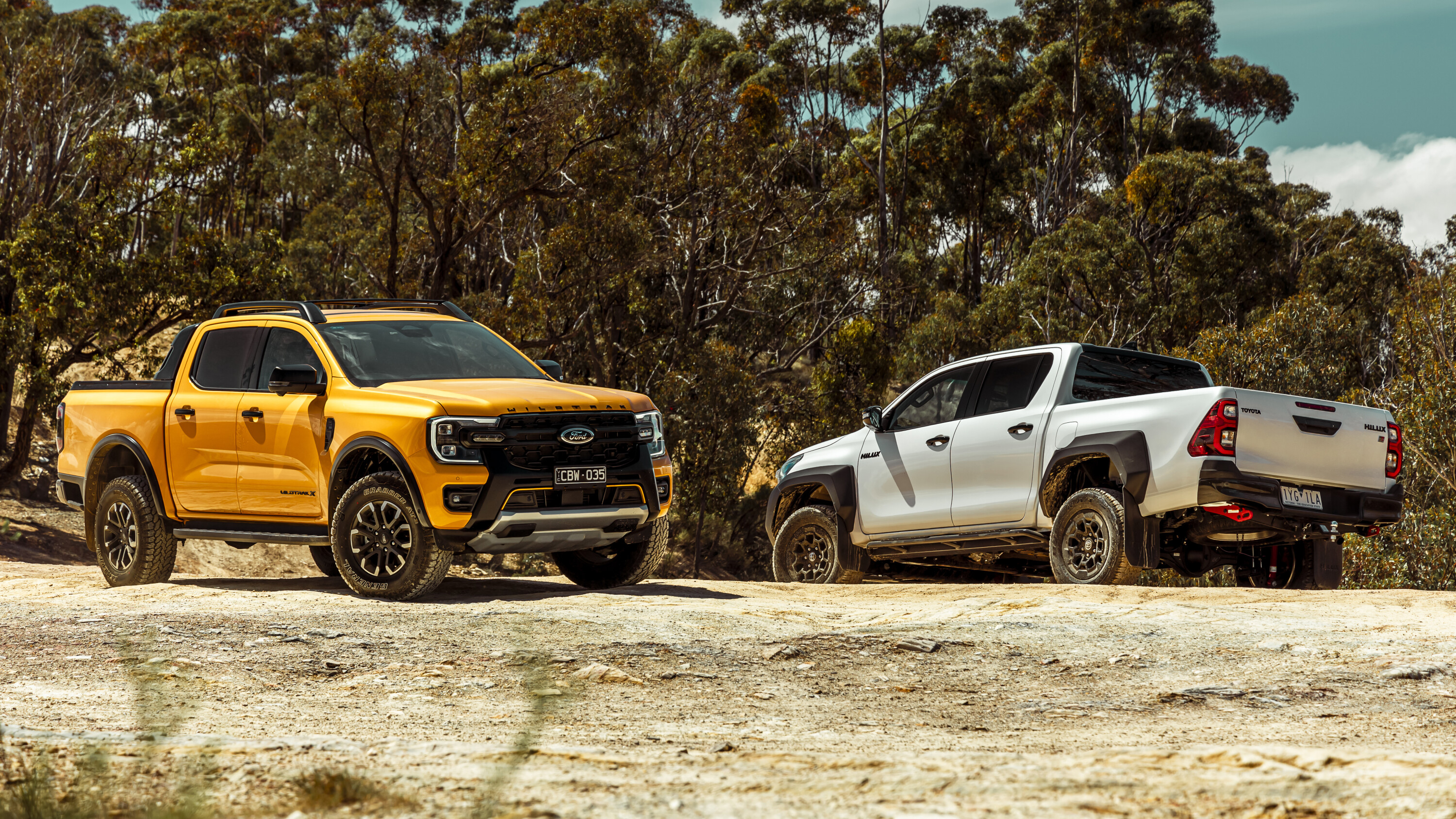
The Ranger’s newer design shines through in the interior space, the levels of equipment, safety features, on-demand four-wheel drive system, towing tech, dynamics and refinement. There’s no denying that this is the current leader in dual-sport 4×4 ute design with or without the V6 engine.
The GR Sport does bring the HiLux a lot closer to the Ranger in terms of modernity and ability but the Wildtrak X edges it out in this comparison.
| Ford Ranger Wildtrak X | Toyota HiLux GR Sport | |
|---|---|---|
| Price | $73,990 | $75,990 |
| Engine | Inline 4 u2013cyl diesel, twin turbocharger | Inline 4 u2013cyl diesel, single turbocharger |
| Capacity | 1995cc | 2755cc |
| Max power | 154kW @3750 | 165kW @ 3000rpm |
| Max torque | 500NM from 1750-2000pm | 550Nm from 1600-2800rpm |
| Transmission | 10-speed auto | 6-speed auto |
| 4×4 system | On demand 4×4 with auto and dual range 4×4 | Part time, dual range 4×4 |
| Crawl ratio | 36:1 | 36.1:1 |
| Construction | 4-door ute body on separate chassis | 4-door ute body on separate chassis |
| Front suspension | IFS with wishbones and coils | IFS with wishbones and coils |
| Rear suspension | Live axle on leaf springs | Live axle on leaf springs |
| Tyres | 265/70R17 on alloy wheels | 265/65R17 on alloy wheels |
| Weight | 2432kg kerb | 2270kg kerb |
| GVM | 3350kg | 3050kg |
| GCM | 6350kg | 5850kg |
| Towing capacity | 3500kg | 3500kg |
| Payload | 918kg | 780kg |
| Seats | 5 | 5 |
| Fuel tank | 80L | 80L |
| ADR fuel consumption | 8.7L/100km (claimed) | 8.1L/100km (claimed) |
| Approach angle | 32u00b0 | 30u00b0 |
| Ramp over angle | 24u00b0 | |
| Departure angle | 24.1u00b0 | 23u00b0 |
| Ground clearance | 261mm | 265mm |
| Wading depth | 800mm | NA |
The vehicle went under the hammer at Grays.com, with the auction ending on August 13. A total of 324 bids were registered for the Triton. Read all about the build below! ?
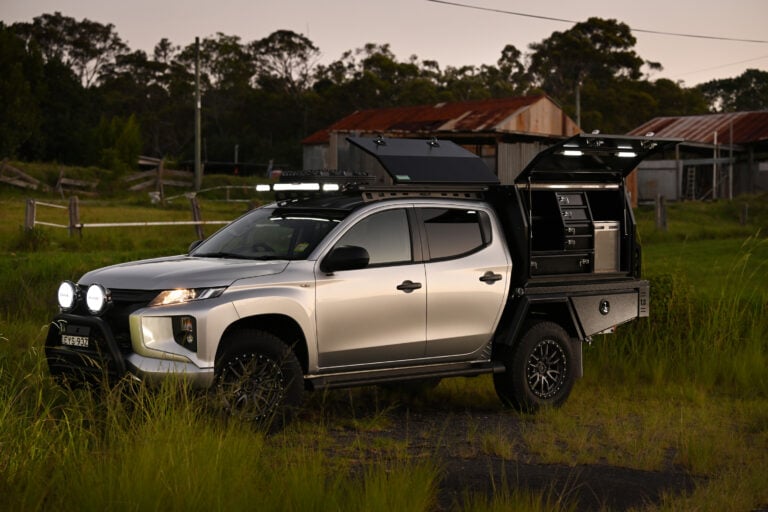
Watching each of them being transformed from factory standard vehicles into speciality equipped off-road beasts has been both inspiring and educational. The opportunity to work on this Triton build has been fabulous, especially as we not only wanted to not only transform it into the ultimate work ute, but also a rig that would fulfil the adventure/lifestyle role.
As a carpenter, I knew exactly where I wanted to start with this Triton build, and its ability to carry tools and materials safely was a priority.
Over the last eight years the TC Boxes range and quality has taken strides forward as the company has embraced the latest technologies, materials and design/construction techniques to produce some of Australia’s leading products in this space.
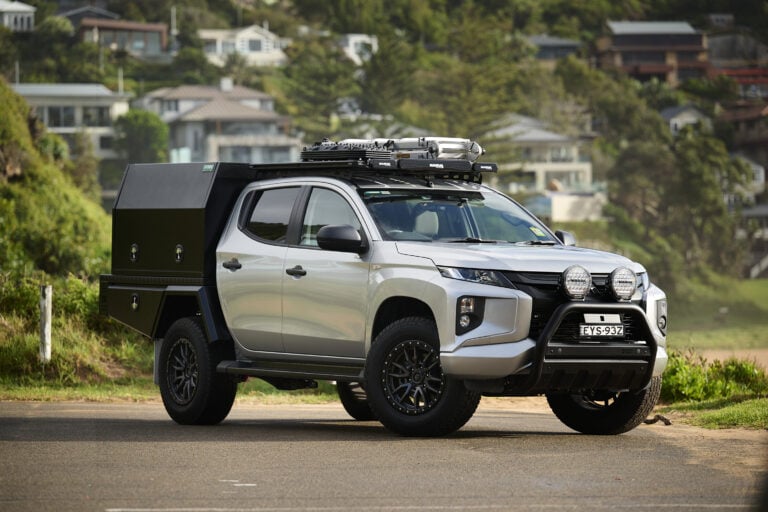
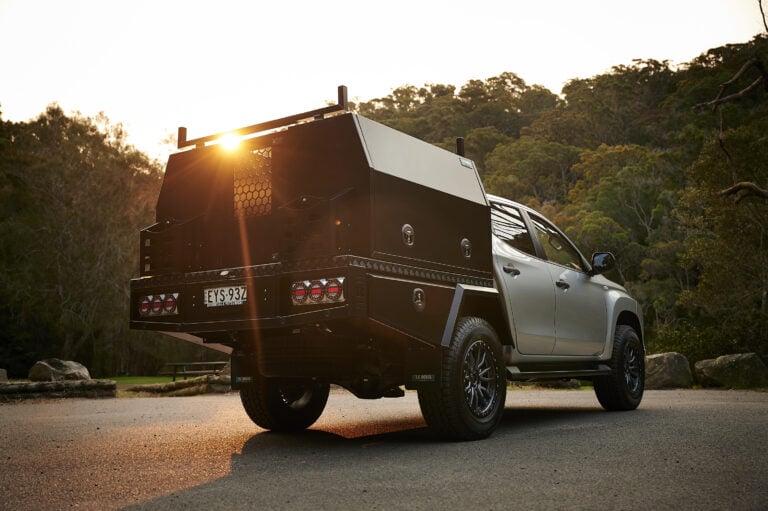
For the Triton we fitted one of TC Boxes 1650mm aluminium trays finished in a UV-stabilised black powder coat. Manufactured from rugged and lightweight premium grade aluminium, it features an 8mm aluminium C-channel main frame and a 40x40mm SHS subframe. The stylish appearance is enhanced by the flared guards that can accommodate up to 35-inch tyres. The tray also features a 1400mm trundle drawer.
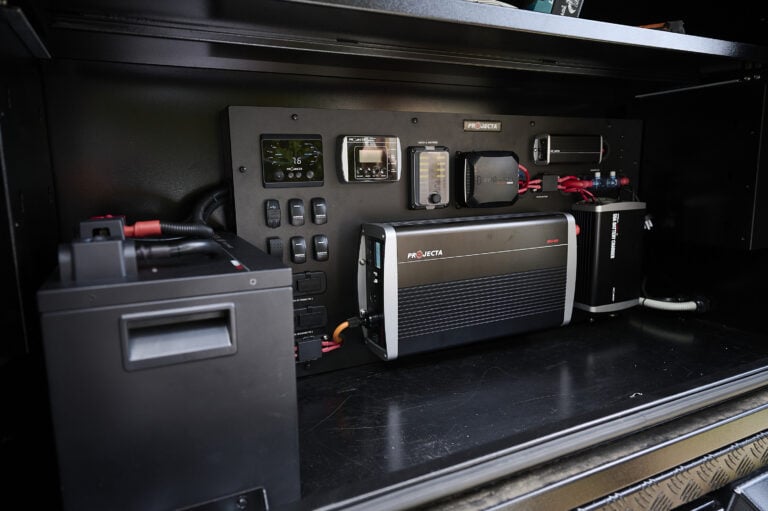
Sitting on top of the tray we have fitted two toolboxes to securely store tools, as well as somewhere for the Projecta 12V DC Power Management Board and the Dometic fridge. There is further storage thanks to additional under-tray toolboxes.
The tray features Maxilamp LED tail lights, and has facility for the retention of the Triton’s rear bar sensors and camera. A U Ladder Rack allows us to carry additional materials, tools and equipment on top of the toolboxes.
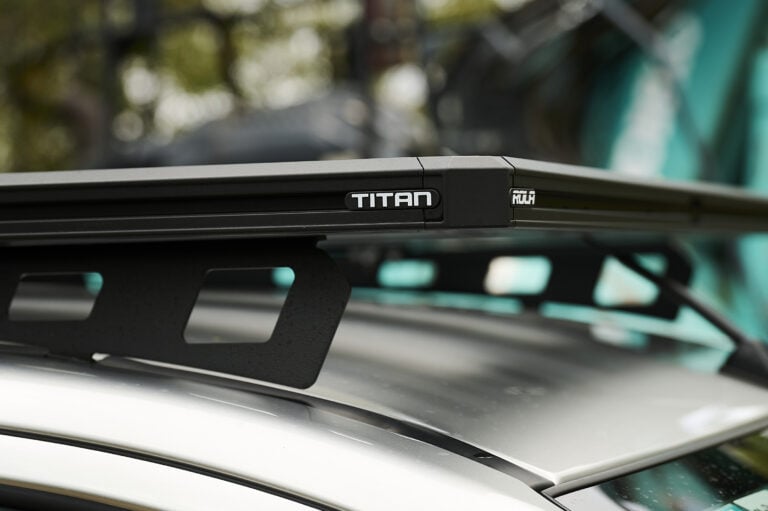
The Rola MKIII Titan Tray does the job on our Triton. It features a stylish low profile design, Rola’s versatile Ridge Mount System and a whopping 400kg capacity. The Titan tray features integrated channels, various entry points and an enhanced corner design to make adding accessories as easy as possible.
This makes crossing over from a midweek work setup to weekend lifestyle arrangement quick and easy so we can pack away the tools and load up the surfboards and canoes.
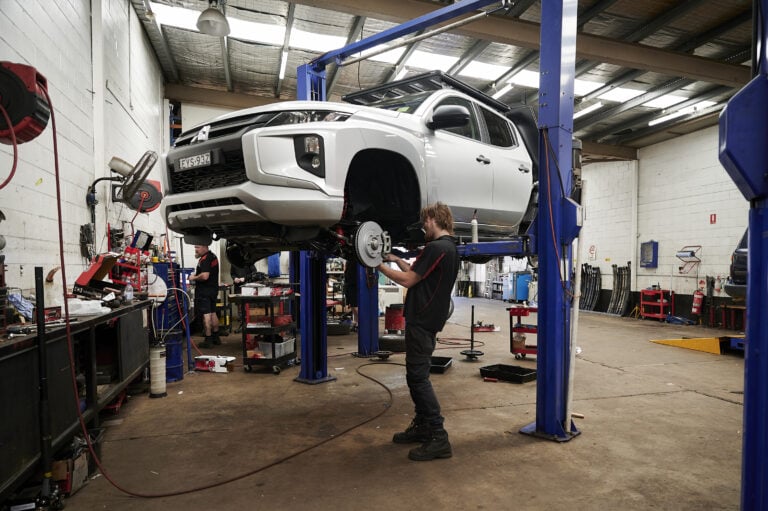
With our Pedders GVM and brake upgrades the Triton feels rock solid on the road and has plenty of stopping power, even when fully loaded.
On our previous project vehicles, we have focused specifically on improving off-road capability with lift kits, air bags and the like, but for the Triton we wanted to focus more on load-carrying capability, so we opted to fit a Pedders GVM + suspension and rear disc brake upgrade kit. The upgraded suspension results in a GVM rating of 3200kg on the MR Triton 4×4, which is 300kg above standard.
The Pedders rear disc brake conversion kit offers increased stopping power, improved pedal feel, and includes new brake rotors and TrakRyder kevlar ceramic brake pads.
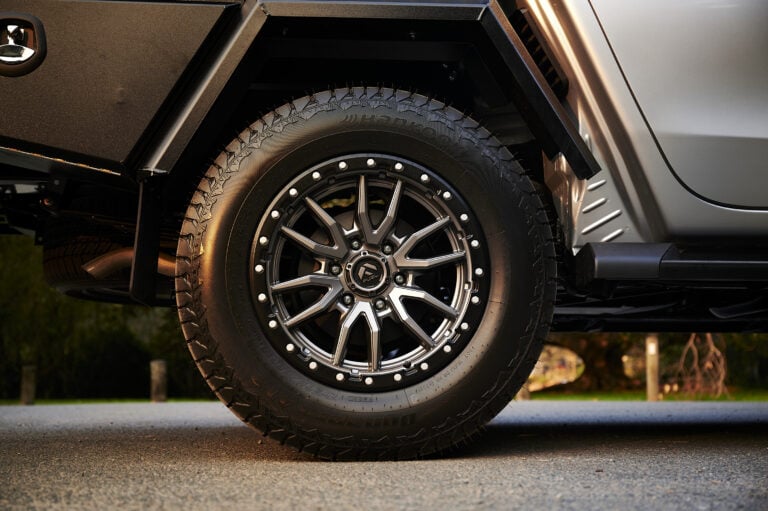
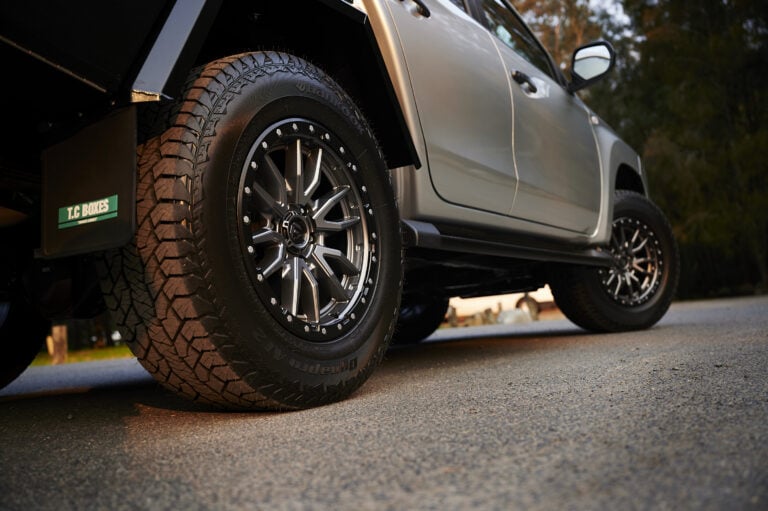
The Rebels are one the most popular wheels in Fuel’s extensive lineup and when you see the stance of the Triton it’s easy to see why. They feature high quality one-piece cast construction to minimise weight and maximise strength.
The Hankook Dynapro AT2s feature biting block edges and locking shoulder lugs that make them ideally suited to both work and play, whether that’s tackling rough, muddy worksites or driving on the road, or venturing off road and heading doing runs along the beach.
To test the AT2s in the field we headed north from Sydney to Stockton Beach near Newcastle, and tackled the notoriously soft sand there. The tyres performed well on the soft sandy trails and when driving along the beach, while on the highway heading up the coast the lack of road noise for this style of tyre was appreciated.
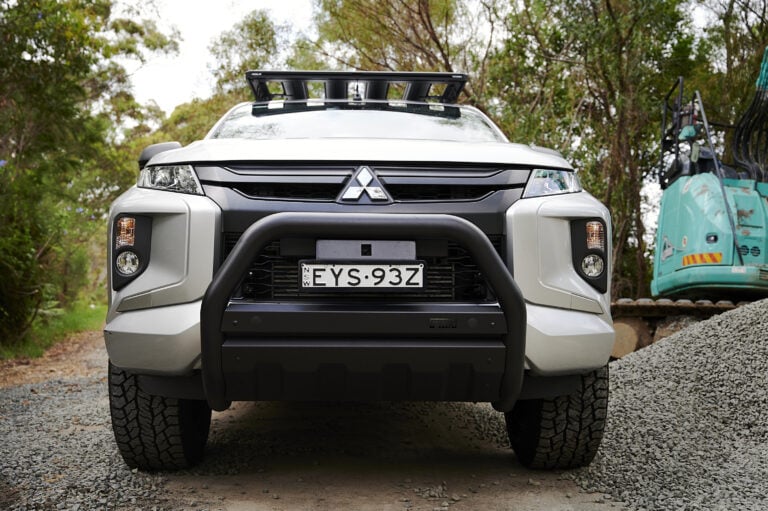
The PIAK nudge bar is made from robust steel and has a 3.5kg carrying capacity, making it the ideal platform for fitting our two Ultima LED 215 MK2 driving lights. The bar has also enhanced the Triton’s aesthetics, not only adding flair, but offering some protection for the front end when parked in challenging work environments, especially on sites where every trade might be working at the same time and parking can be tight and people are in a rush.
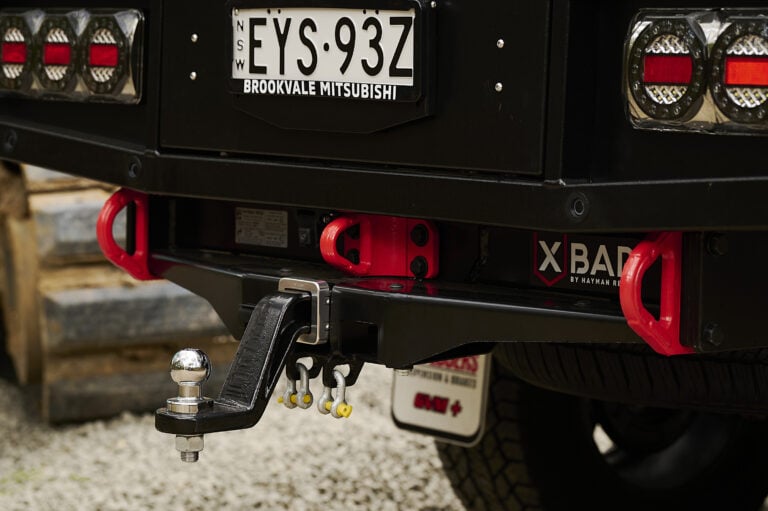
Down the back end of the Triton, the Hayman Reese X-Bar works in well with the look and feel of the TC Boxes setup. It also allows the vehicle’s maximum tow rating to be utilised, which is important for tradies who might need to tow anything from trailers loaded with sand, stone or gravel to heavy machinery like excavators and loaders.
Of course, it allows us to also safely hook up the boat or jet ski on the weekend, or to easily access the rated recovery points when out on the sand dunes or trails.
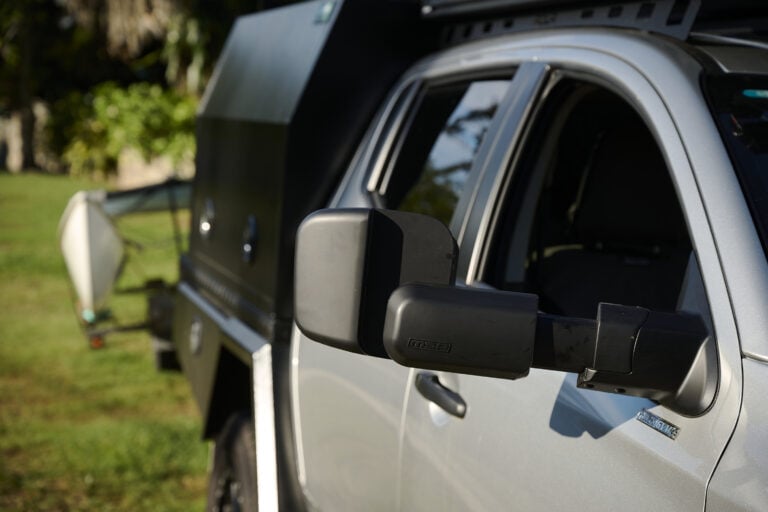
The functionality and design of these mirrors is fantastic; the extension and roll feature provides a full and clear view when towing that standard mirrors simply can’t match, and the fact that the electronic positioning is retained while in full extension only adds to their usability and appeal.
When towing a 45-foot outrigger canoe home from a regatta in Port Stephens the MSA 4X4 towing mirrors provided an entire view of the trailer and canoe, making the slightly stressful experience of towing such a long load considerably easier.
When not towing, the mirrors can be quickly and easily returned to the standard non-extended position, so they don’t stick out like many other towing mirrors.
So when looking for the ideal lighting system we considered one that would offer good visibility in a mix of driving conditions, from sealed suburban road use to highway and off-road driving conditions. After doing our homework we fitted a pair of Narva Ultima LED 215 MK2 driving lights.
As well as the driving lights mounted on the PIAK nudge bar, we have added an Ultima 24-inch LED light bar up above the windscreen, flanked by dual Ultima 8-inch LED light bars fitted using Narva’s innovative 40-inch joiner kit.
This front lighting setup can be controlled by the Ultima Connect+ system, which allows for easy adjustment of beam pattern and intensity to suit driving conditions, whether that’s on dirt roads, 4×4 tracks or the highway. The system is easy to use, and the controller fits neatly into the dash, and in the case of our Triton, the controller is situated in front of the gear lever where it’s easy to get at.
The brightness, range and spread of the Narva set up is impressive with more Lumens than you can poke a stick at to really light up those night time environments.
With this in mind we decided to equip the Triton with a Projecta 12v DC power management board with 2000W inverter. While Projecta offers a setup with a built-in 200Ah Lithium battery designed to work in conjunction with the power board’s 2000W inverter, we opted for a larger capacity 400Ah battery for the Triton’s system.
The 400Ah battery has overvoltage, undervoltage, overcurrent, high/low temperature and short circuit protection, and features include a top-mounted battery indicator and battery isolation switch.
This system is big enough to power items like our Dometic fridge, additional lights, cooking equipment (think microwaves, toasted sandwich makers and coffee machines), all of which are high current draw devices that tradies and campers alike require. And with everything built into the one system, it takes the hard work out of the installation.
It’s not just the performance of this power system that will impress but also the inbuilt safety and charging technology that maximises lifespan of components for optimum performance that will provide peace of mind.
So having reliable, safe and proven recovery gear is a must for those looking to keep themselves and their travel companions safe in off-road, bush or beach environments.
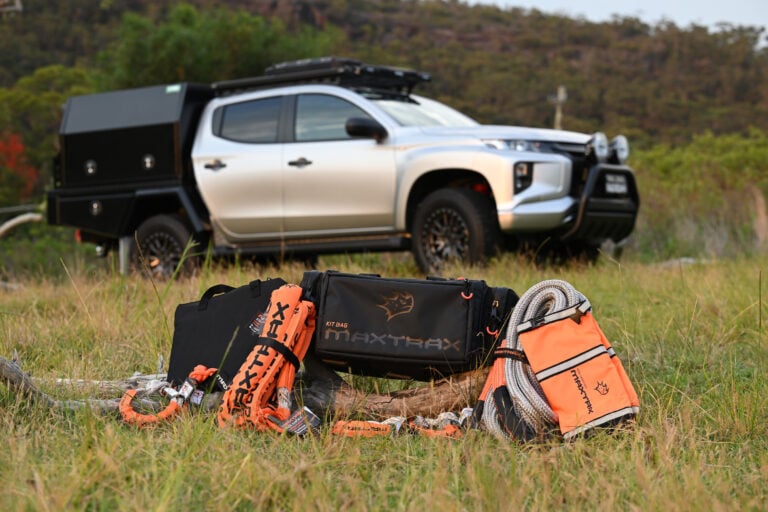
The MaxTrax Recovery Kit in our Triton has us covered. It is supplied in a bag to keep everything organised, and it includes two Fuse Shackles; five Core Shackles; three Kinetic Ropes (9.2m, 3m and 5m); a static rope; and a rope damper.
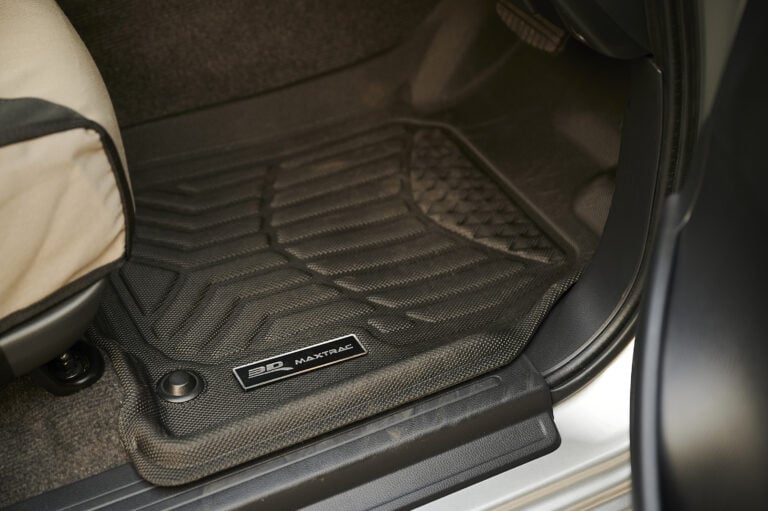
Their ability to fit like a glove and capture all the mud/sand is more than impressive. Made from a patented 3D-moulded rubber compound, these mats are designed to fit perfectly and capture everything, so they offer unparalleled protection and ease when cleaning the vehicle.
Every tradie knows how quickly you can trash new car carpets without a well designed and constructed car mat and these Truefit 3D Maxtrac Mats are some of the best we’ve used.
With its stainless-steel effect front and generous 45 litres of cool storage, including an optional 4.4 litres of freezer space, this smart refrigerator is a gamechanger for hot work days and weekend getaways.
No matter where we are, we can keep the drinks cold and the milk fresh, and it’s all easy to access. Cold drink, anyone? This is the type of luxury that will greet the lucky tradie who buys the Triton when it goes to auction.
While this system won’t provide a signal when there isn’t one, it will boost the signal in those areas where you’re on the edge of reception and you would likely experience dropouts.
The all-new Cel-Fi GO will allow you to make calls, pick up messages and send/receive emails where you previously would have dramas, so it really adds to the effectiveness of a mobile office that most tradies are looking for in a work ute these days. Being able to get in contact with contractors, or message/email clients/workers/architects, is simply a game changer when in poor reception areas.
Over the build period the Triton has covered less than 5000km running around for equipment fitting and photo shoots, so it is still virtually a brand new vehicle. Keep an eye out on 4X4 Australia’s next build for 2024 which is just around the corner.
One of the basic things that makes a vehicle tow heavy trailers well is if it is heavy itself, and has a long wheelbase.
That’s where a large US ute comes into play. These are utes that are rated to tow up to 4500kg, so on first blush would seem a shoe-in for the typical 3500kg maximum capacity caravan or even 4500kg maximum trailer boat. As we’ll see though, towing that much mass is still a compromise.
Not many tow vehicles permit a full trailer mass and full payload in or on the tow vehicle at the same time. Read more on this topic here:
These big North American utes have become a successful tradie’s work truck and family hold-all, as well as a solid, heavy basis for towing a heavy trailer. These are definitely not inner-suburb friendly trucks, with each about six metres long, two metres wide – on about four metres of wheelbase.
As you’d imagine, the turning circle of each ute is roughly a football field – well, around 14 metres – but large utes begin to make a lot more sense when their role includes lugging a heavy van or trailer boat.
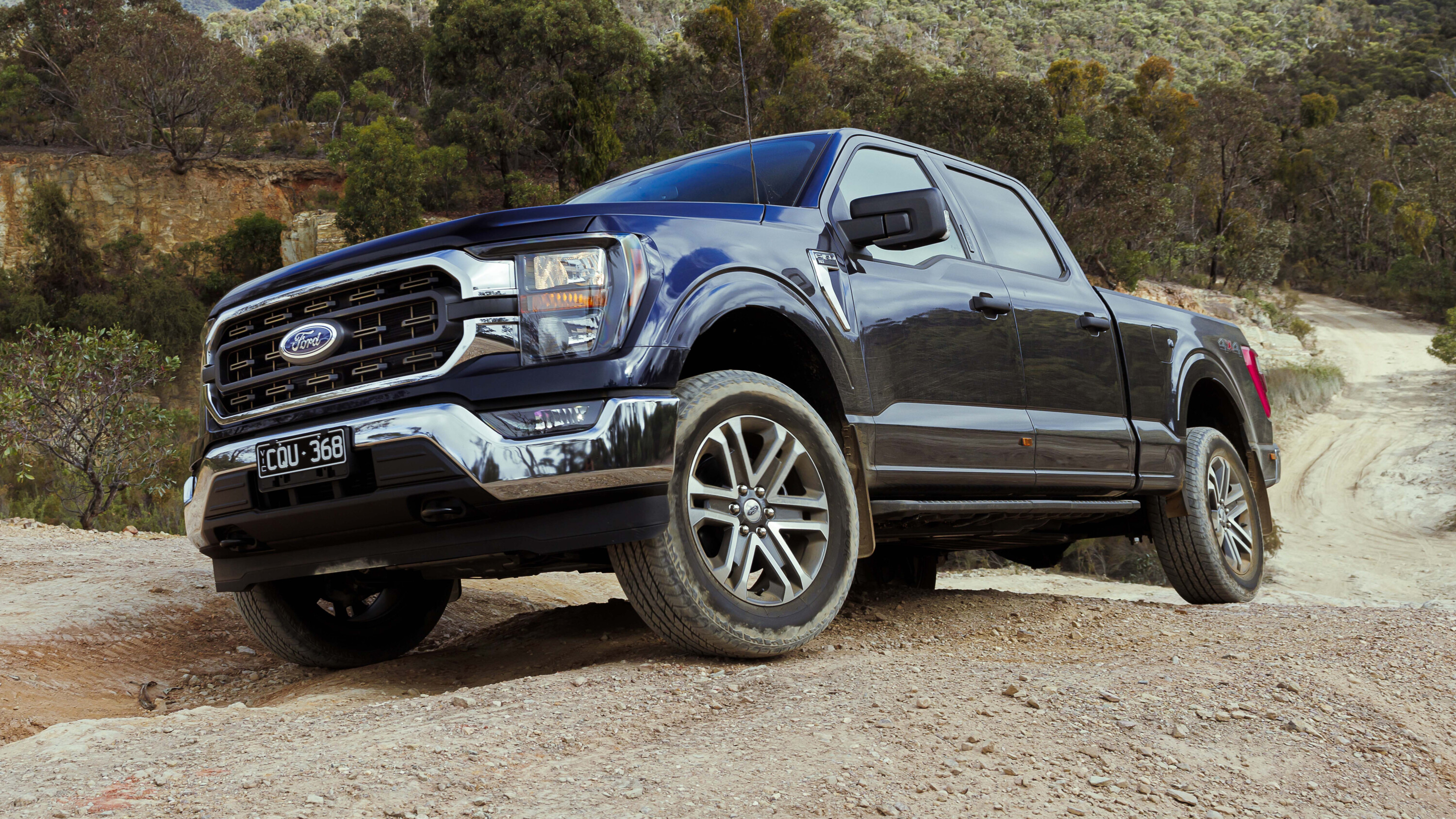
Arguably even better are some of their dimensions making them suitable for towing. Even in short wheelbase form (some are offered in a long-wheelbase version) these utes have acres between their wheelsets.
While not so good for turning circles, reversing a trailer in tight spaces or for sharp urban turns, a lanky wheelbase (and relatively short rear axle-to-towball measurement) goes a long way towards making a rig less prone to yawing or swaying.
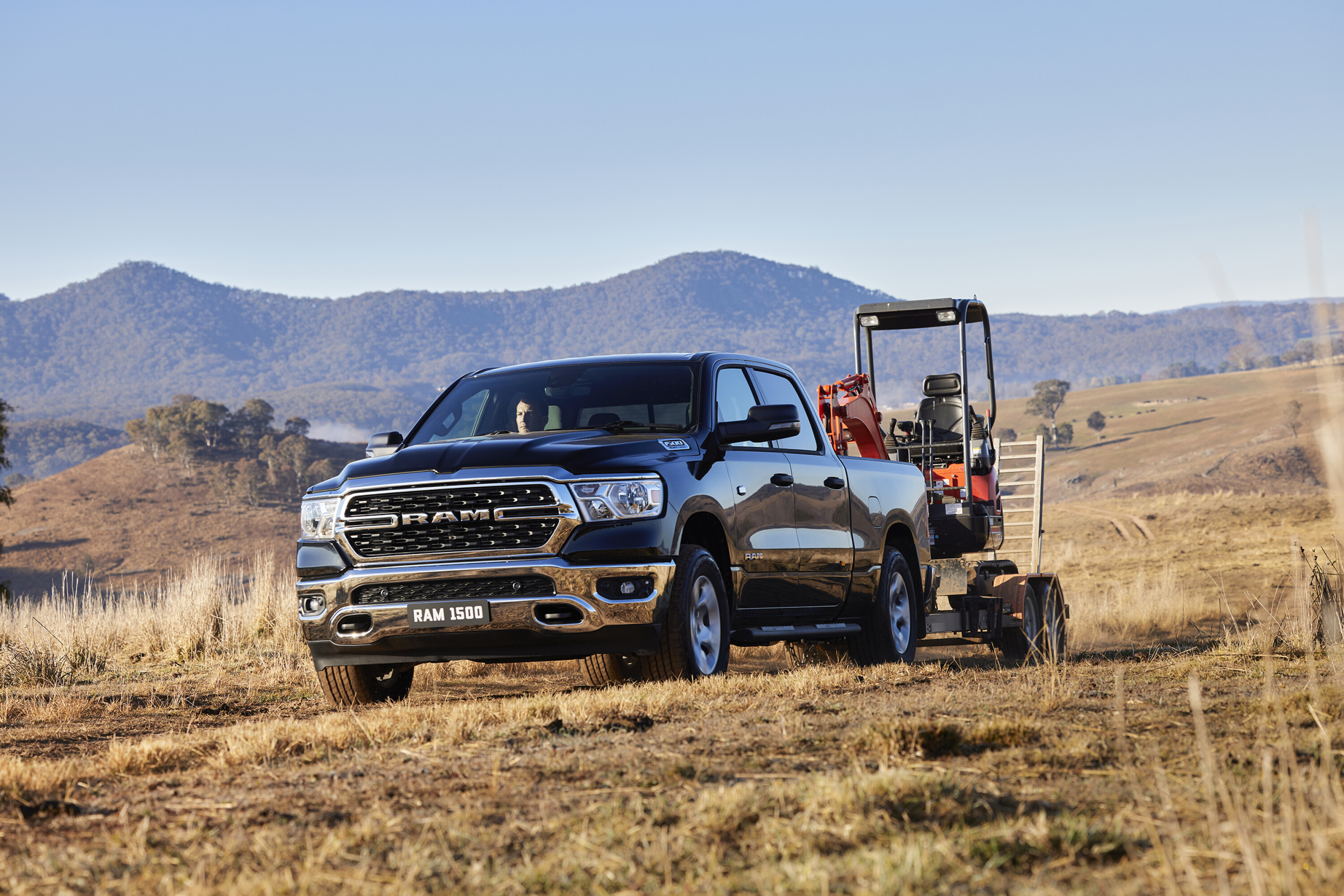
Even though there are bigger 2500 or 3500 variants of the Chev and RAM, we’re just rating the more popular, less load-capable (but smaller) Chevrolet Silverado, Ford F-150 and RAM 1500 – where a car driver’s licence is all you need. Even though we’ve rated these in order of the best, there is not a lot between these big utes.
We’re expecting the 325kW/790Nm 3.5-litre V6 petrol hybrid Toyota Tundra ute to arrive in early 2025, but it’s not officially on sale yet and we haven’t been able to properly tow test the big Toyota to know where it lands on the page here. It’s worth mentioning that the RAM 1500 will also see a new V6-powered model in 2025.
As a minimum, all these utes have a standard towbar and electric brake controller – they are built for towing in mind. Here’s our pick, in order, of the best large utes for heavy-duty towing.
It has a solid kerb mass (2519kg), with the ‘short’ 1712mm tray (instead of the 1937mm long tray), it has the best payload here (931kg) and with a 3450kg GVM and 7713 GCM, you can theoretically tow 4500kg while having 481kg payload remaining available (assuming 10 per cent tow ball download).
If you’re ‘only’ towing 3500kg, you’ll have up to 581kg to spare as payload (again, assuming 10 per cent of trailer weight is on the tow ball).
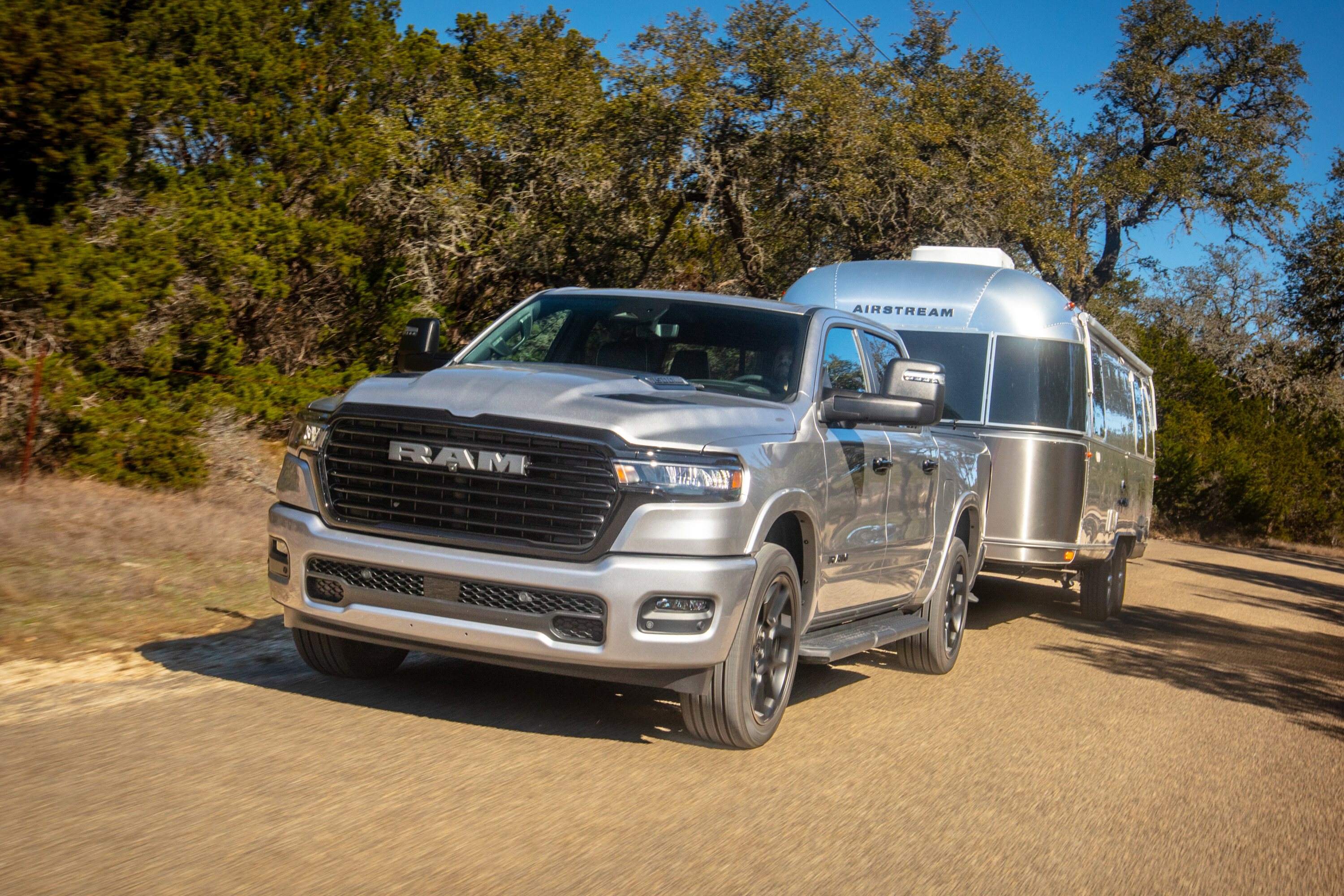
An 87-litre fuel tank won’t get you too far when towing (where 20L/100km is a realistic fuel figure), but to get the 98-litre capacity offered elsewhere in the RAM 1500 range, you have to spend more but lose some payload.
Towing-assist features are a bit sparse here, compared to the trailer guidance/checks party tricks offered by the others.
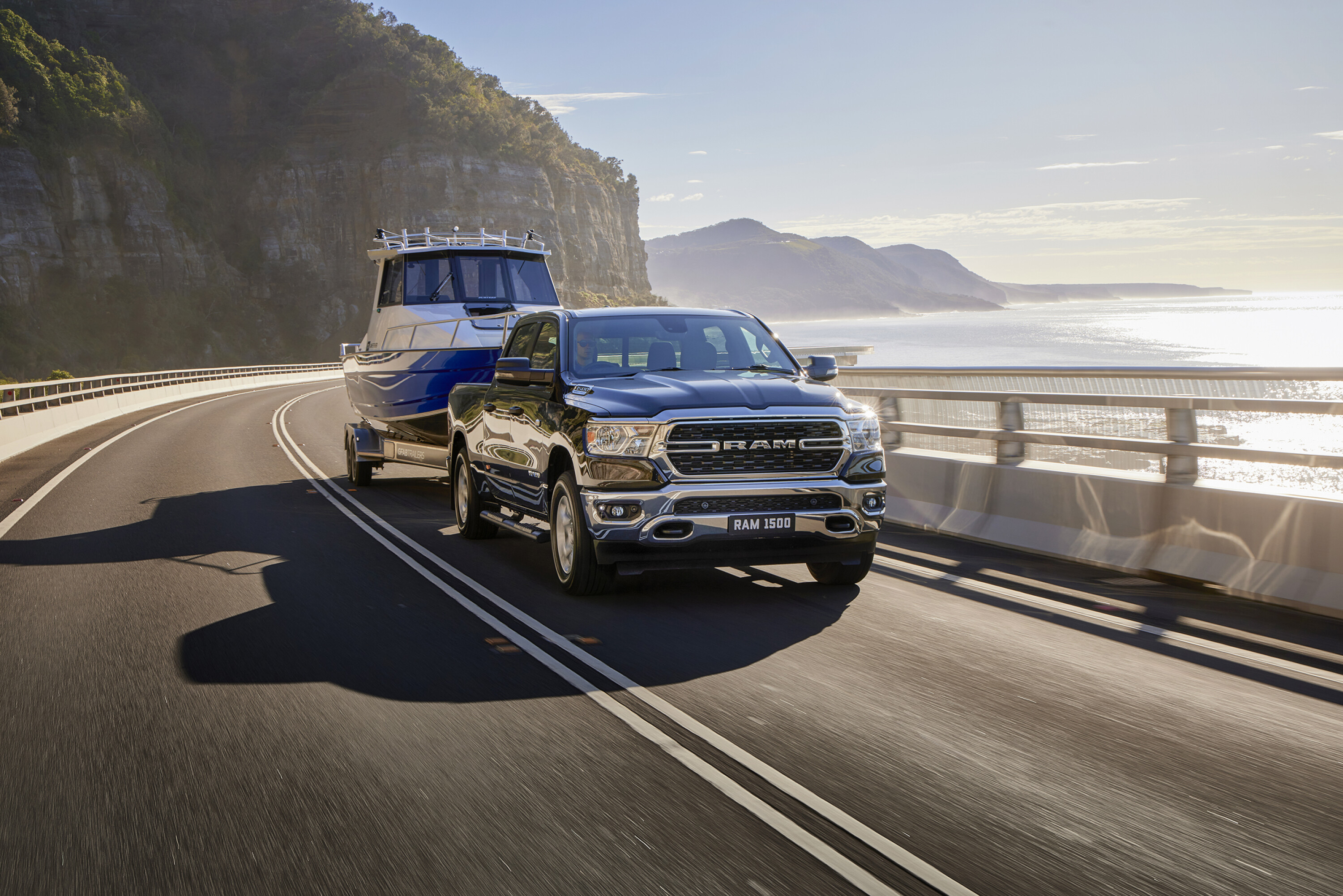
With a 2535kg kerb weight, 794kg payload, 3220kg gross vehicle mass (GVM) and 7720kg gross combined mass (GCM), you can tow up to 4500kg, but have just 235kg remaining for payload. That bounces up to 335kg, if you tow 3500kg with 350kg on the ball.
The Ford has a few towing tricks up its sleeve, with a trailer set-up menu to factor in trailer size for blind-spot warning and a trailer lights check mode. There’s also Pro-Trailer Back-Up Assist that, when set up, you twist a dial on the dash according to the direction you want the trailer to reverse.
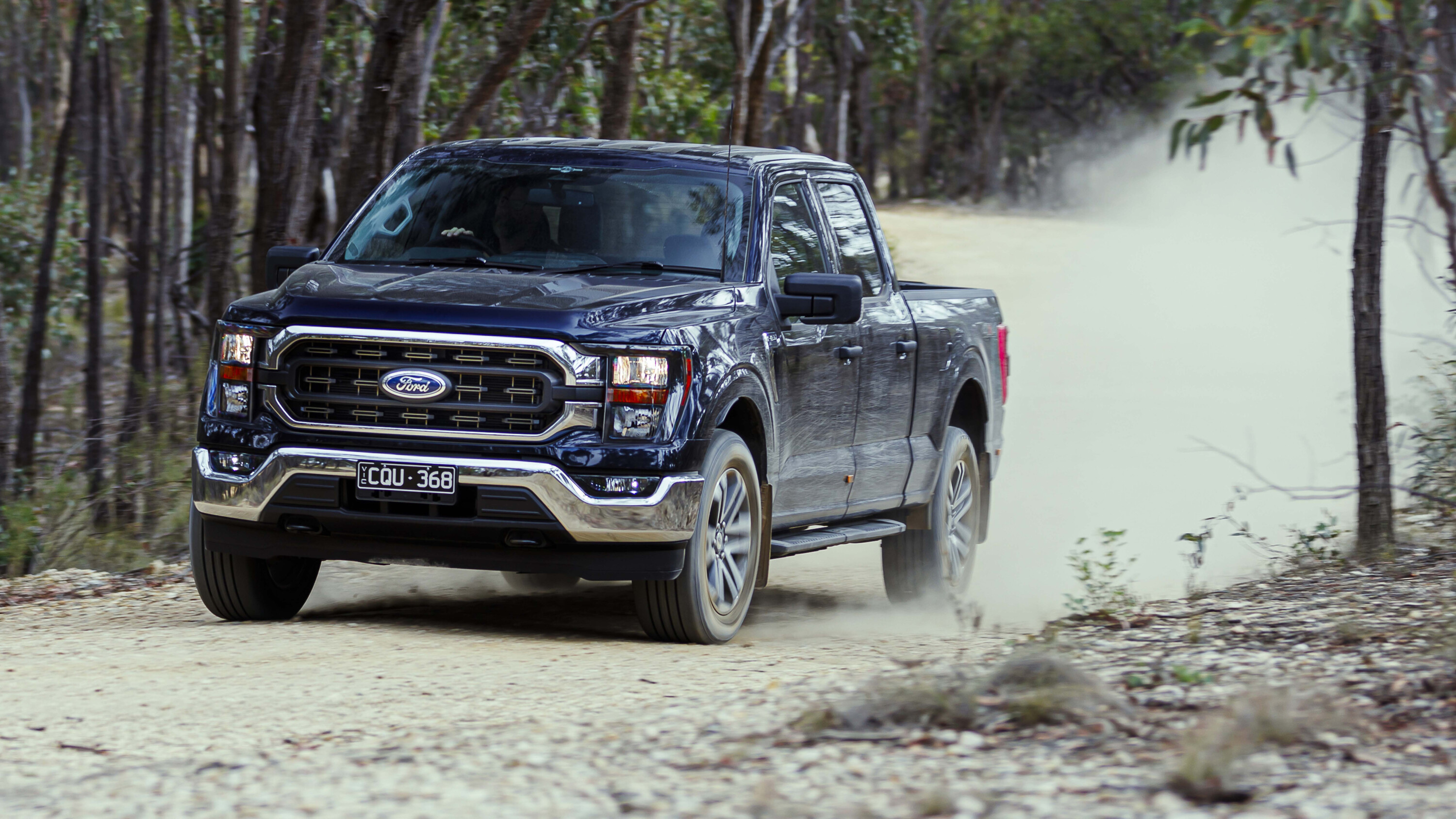
Even though it doesn’t have the V8 bellow of the others here, the F-150’s twin-turbo V6 is a strong engine – it’s down slightly for outright grunt compared to the V8s in the RAM and Chevy but it trumps both for torque – and it pairs well with the 10-speed auto, which shifts through cogs smoothly and decisively.
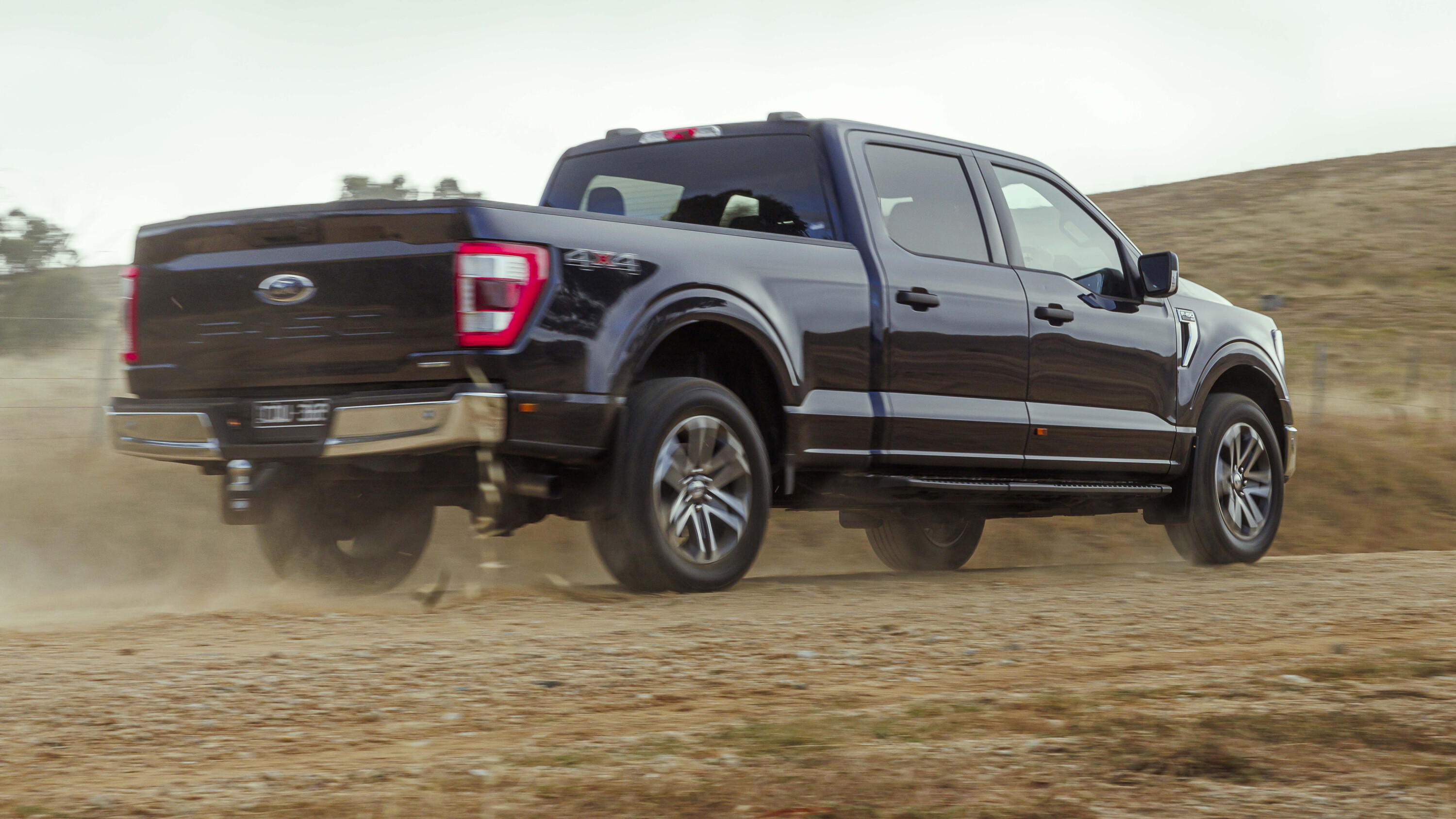
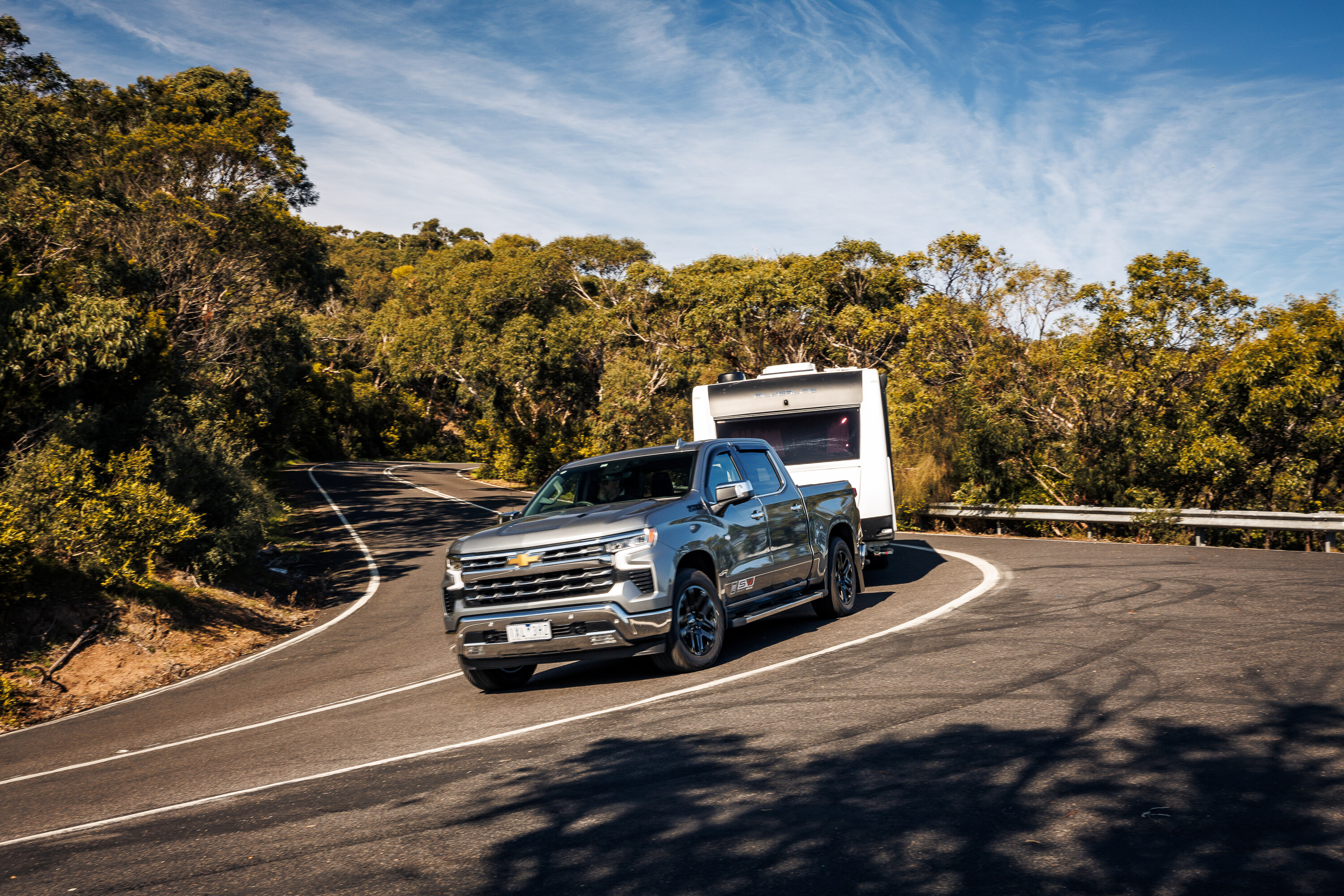
The Chevrolet Silverado LTZ has plenty of power, torque and trailering cleverness, but fuel range on tour is compromised with its 91-litre tank.
Weight are 2543kg kerb mass, 3300kg GVM and 7160kg GCM. That means you have a 757kg claimed payload, that reduces to 117kg when lugging a 4500kg trailer.
On the bright side, there’s lots of towing tech. The Silverado has 12 camera views as standard, with optional cameras you can set up to give you a view behind the trailer and in the trailer from the centre infotainment screen. The centre screen displays the full side view down past the rig when you indicate.
The big Chev also has a phone app called Advanced Trailer System. The system includes a pre-departure checklist, light sequencing, maintenance reminders, security alerts and more. The system also offers towing reminders, trailer electrical diagnostics and monitors tyre pressures.
Black editions are nothing new and it seems that every manufacturer has had a crack at them but this latest offering from Nissan adds style and value to the hard working Navara.
Nissan Navara 4×4 Black Edition sells for $60,455 RRP but is on offer from $59,990 drive away at the moment. It adds 17-inch black alloy wheels wearing Yokohama Geolander A/T tyres, black door handles and exterior mirror caps, a matte black radiator grille, black sports bar, soft tonneau cover, cargo tub liner and specific Black Edition decals.
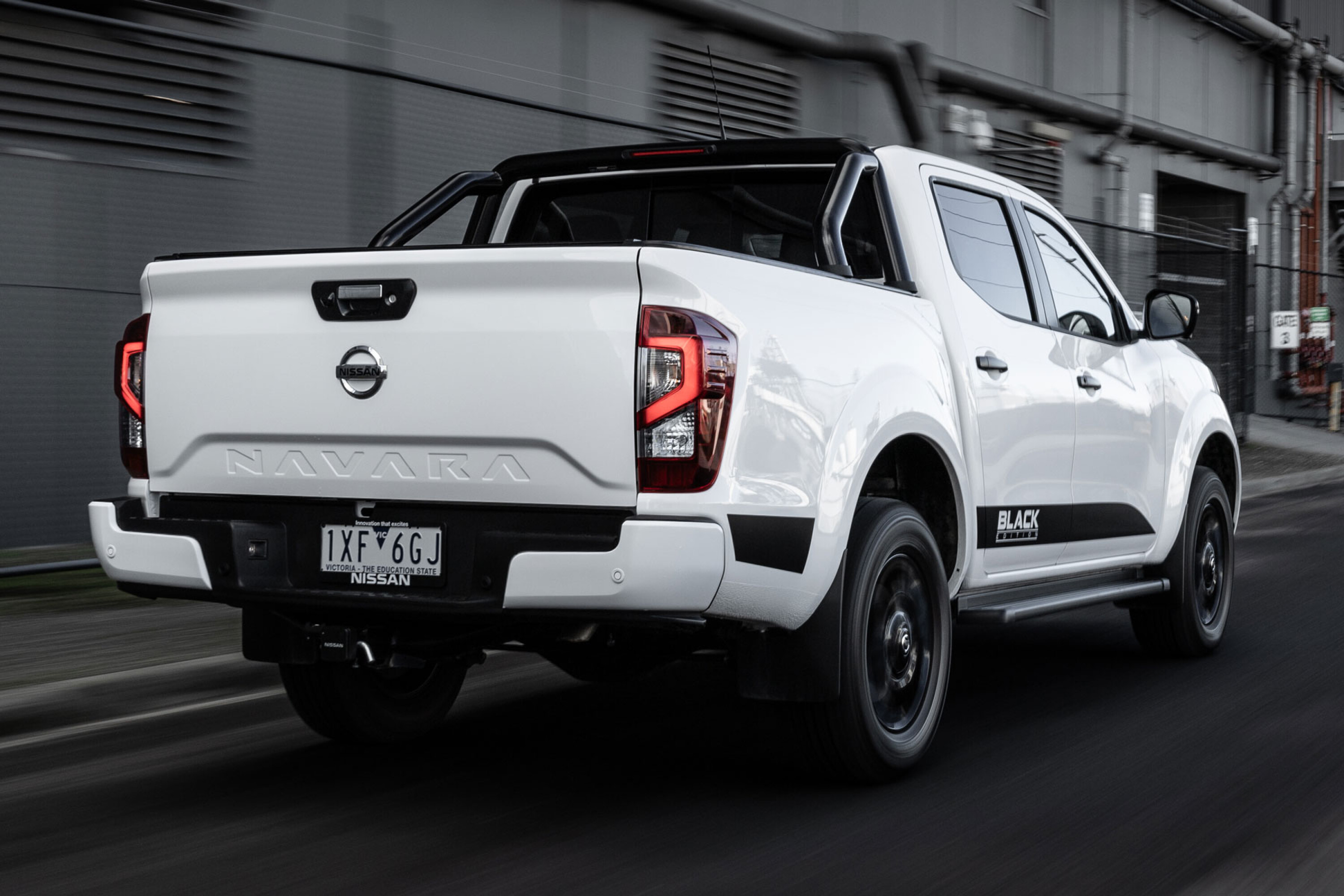
If you’d like to replace the soft over with a powered HSP roller shutter and central locking on the tailgate, the price jumps to $60,490 drive away while a factory Nissan tow bar package adds a further $1,030.42 to the tally.
The Black package is only offered on the double-cab ST 4×4 Navara model which is the second up in the Navara range making it a genuine workhorse.
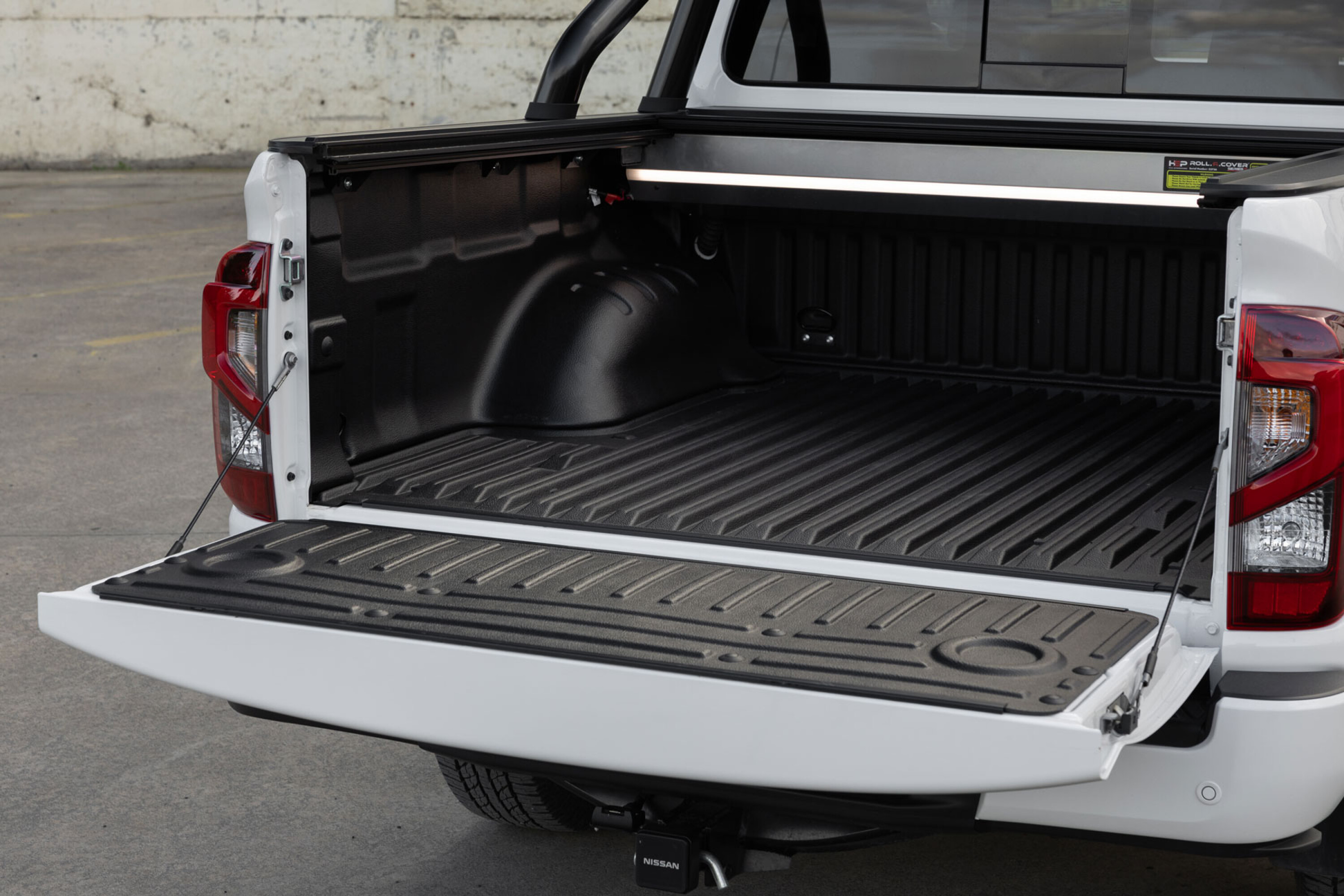
The Navara ST Black Edition is exclusively powered by Nissan’s 2.3-litre twin turbo-diesel engine that puts out 140kW and 450Nm, backed by a seven-speed automatic transmission, part-time-dual-range transfer case and a lockable rear differential.
Like the other Black edition ute recently released, the Navara ST Black Edition is only offered in Black, white grey and silver.
Just 400 Black Editions Navaras will be produced.
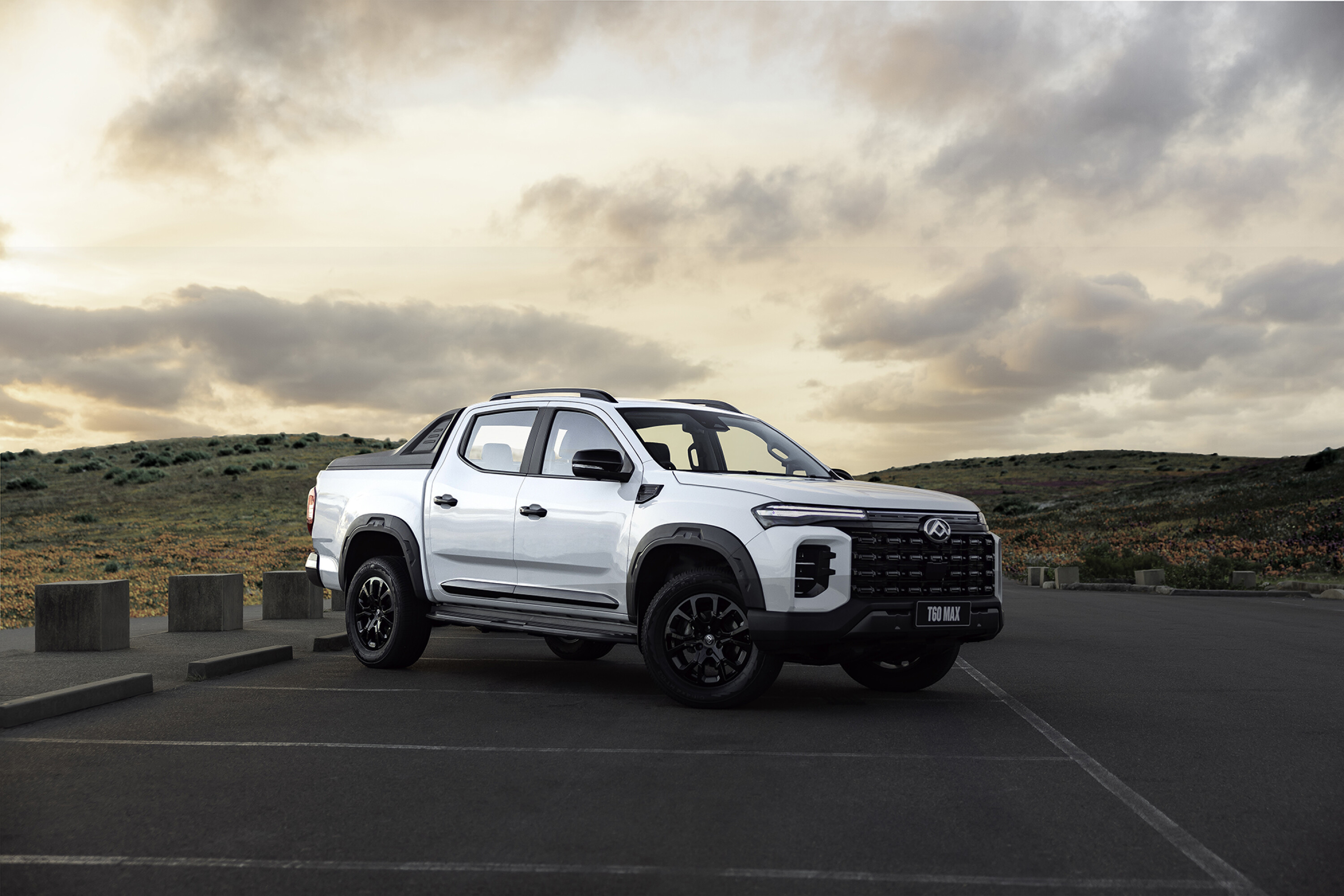
| Private buyer drive-away pricing: | |
|---|---|
| T60 Max Plus manual | $48,411 |
| T60 Max Plus auto | $50,516 |
| T60 Max Plus Mega Tub auto | $52,095 |
| ABN drive-away pricing: | |
|---|---|
| T60 Max Plus manual | $45,990 |
| T60 Max Plus auto | $47,990 |
| T60 Max Plus Mega Tub auto | $49,490 |
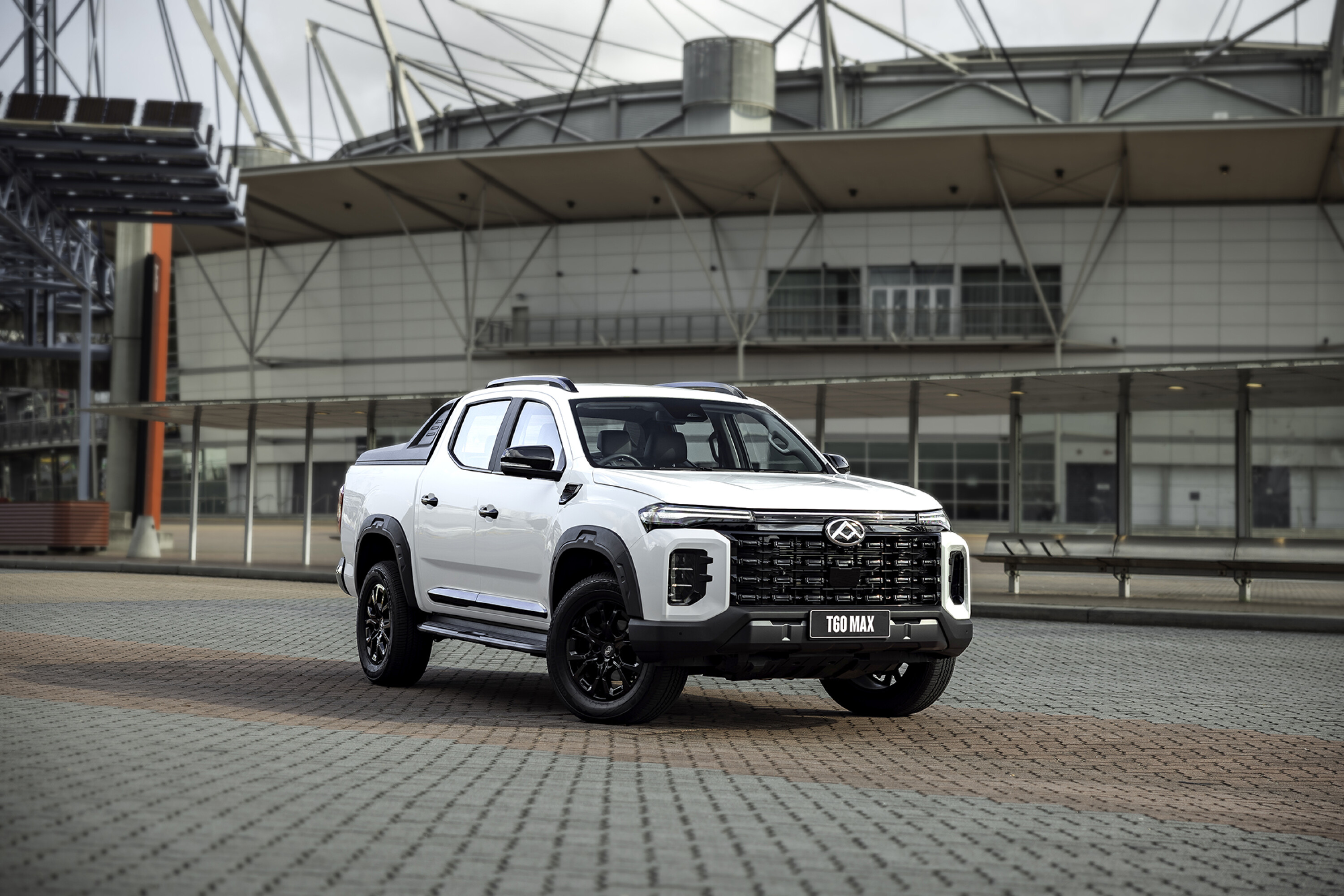
Without regurgitating an entire spec sheet, highlights include a revamped exterior design with new front-end styling. It comes standard with LED daytime running lights, LED headlights, 18-inch wheels (with Giti tyres, not the existing Continentals) and a steel spare wheel. Plus, there’s tyre pressure monitoring, a spray in tub-liner, a lockable tailgate (not connected to central locking), keyless entry and push-button start, auto wipers, auto lights, and auto high-beam.
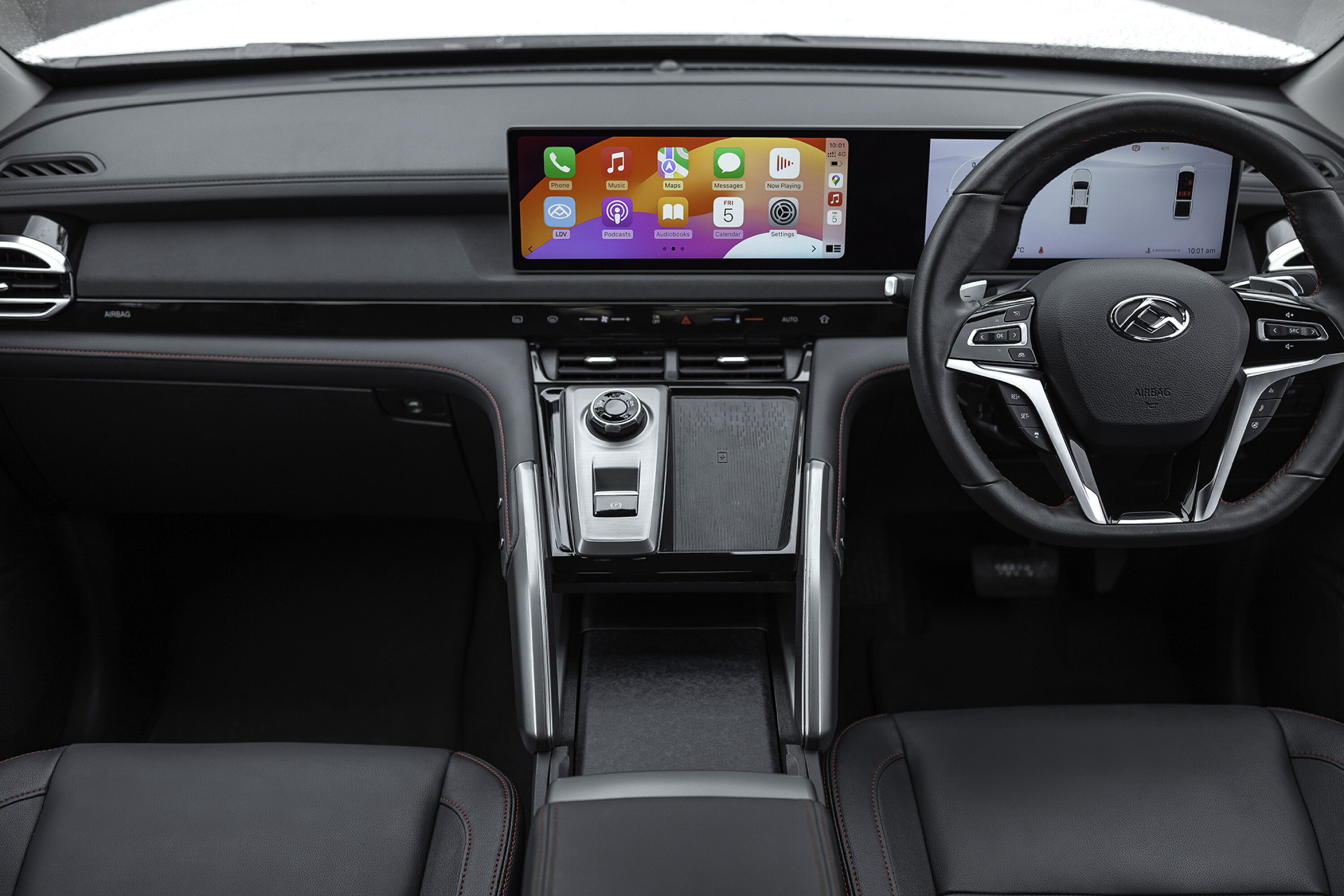
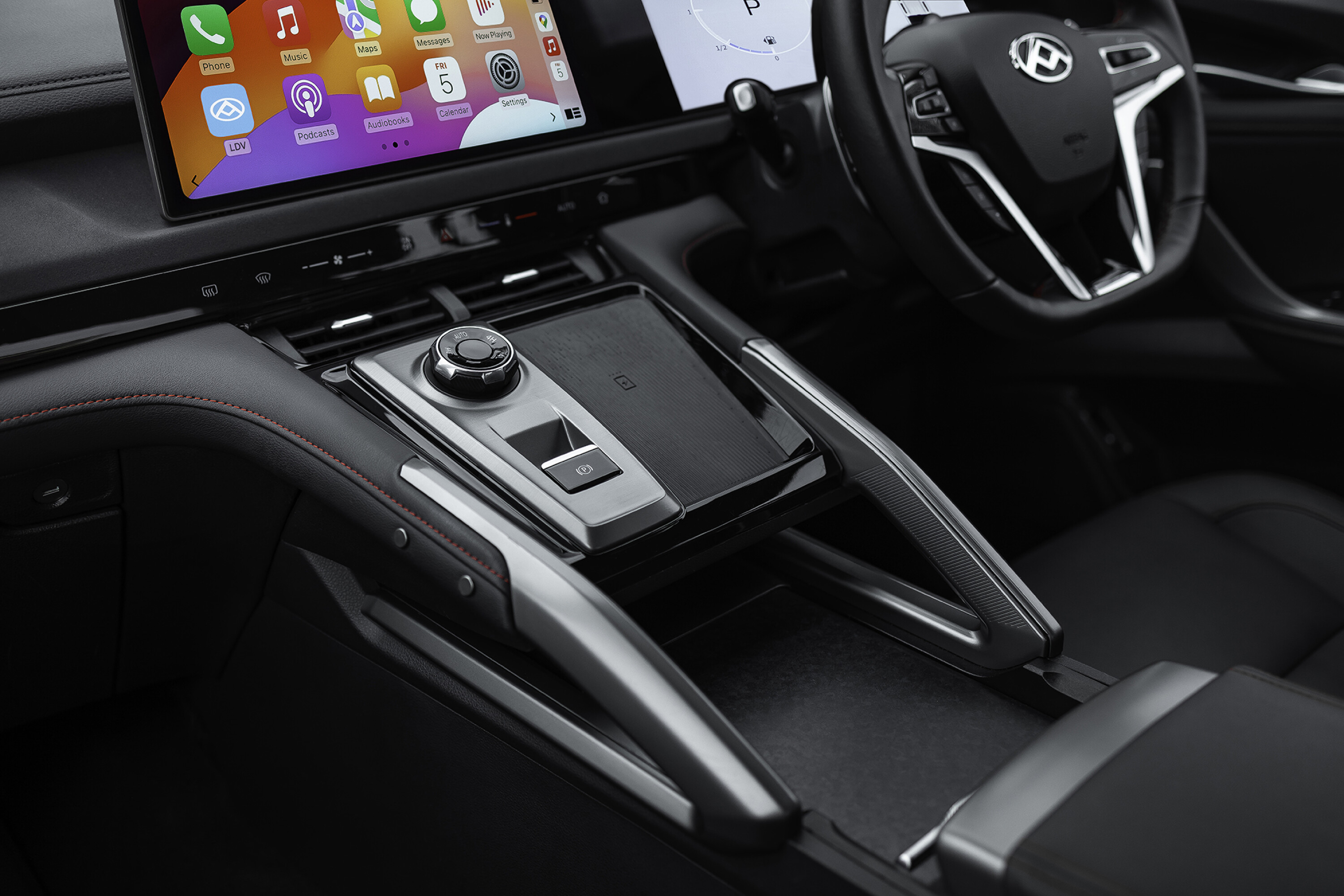
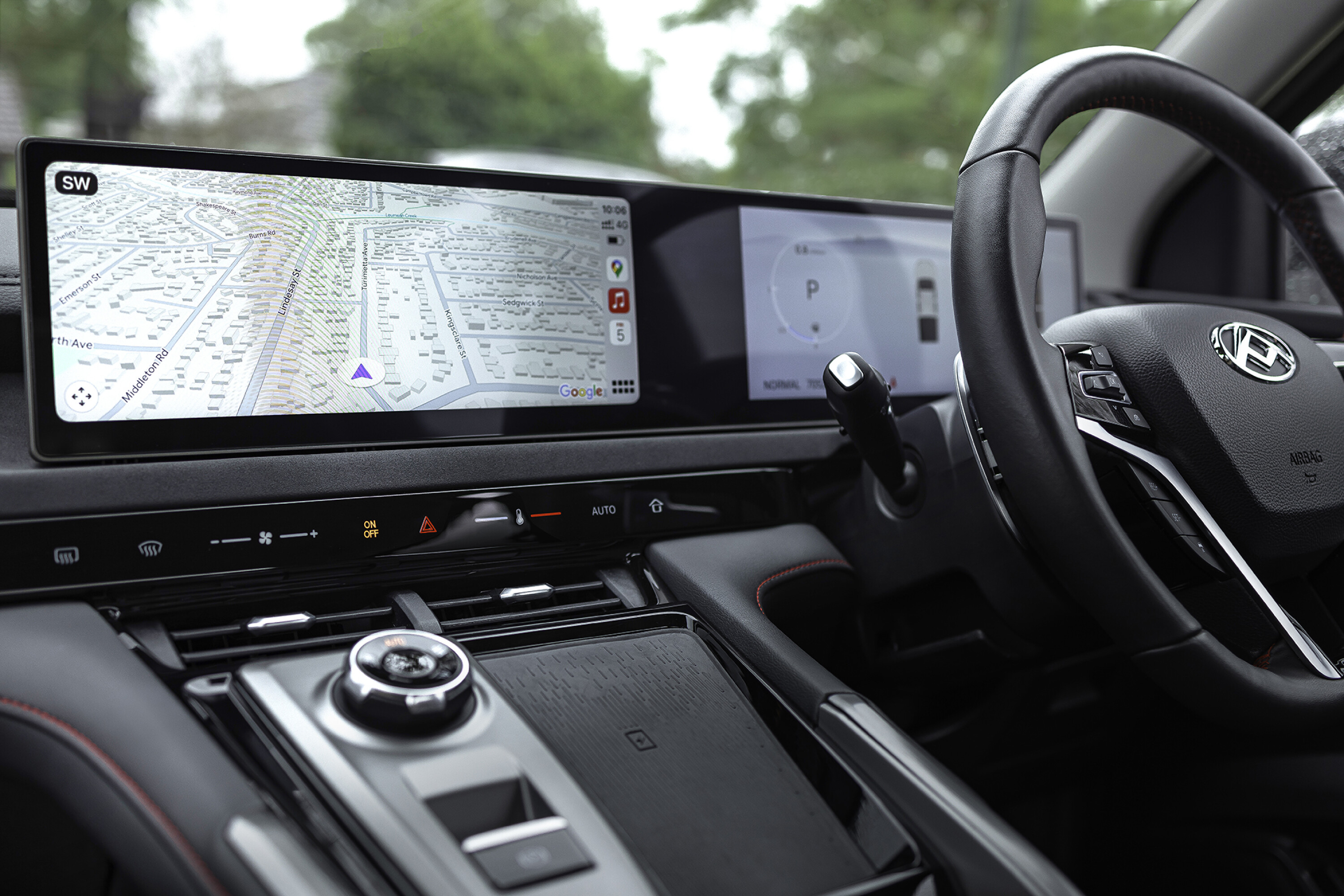
Inside there is a new 12.3-inch touchscreen including Apple CarPlay and Android Auto (wireless if you choose the auto ute; manual models get cable-connect). There’s also a wireless phone charger in the auto models that the manuals miss out on; plus another high-definition 12.3-inch screen for driver info.
There’s leather seat trim, power adjustable heated front seats, heated steering wheel, an auto-dimming rear-view mirror, and a poor quality surround-view camera – shadows throw it out badly.
There’s a surround-view camera, front and rear parking sensors, six airbags (dual front, front side and full-length curtain), hill descent control, hill start assist, stability and traction control, and an on-demand locking rear differential.
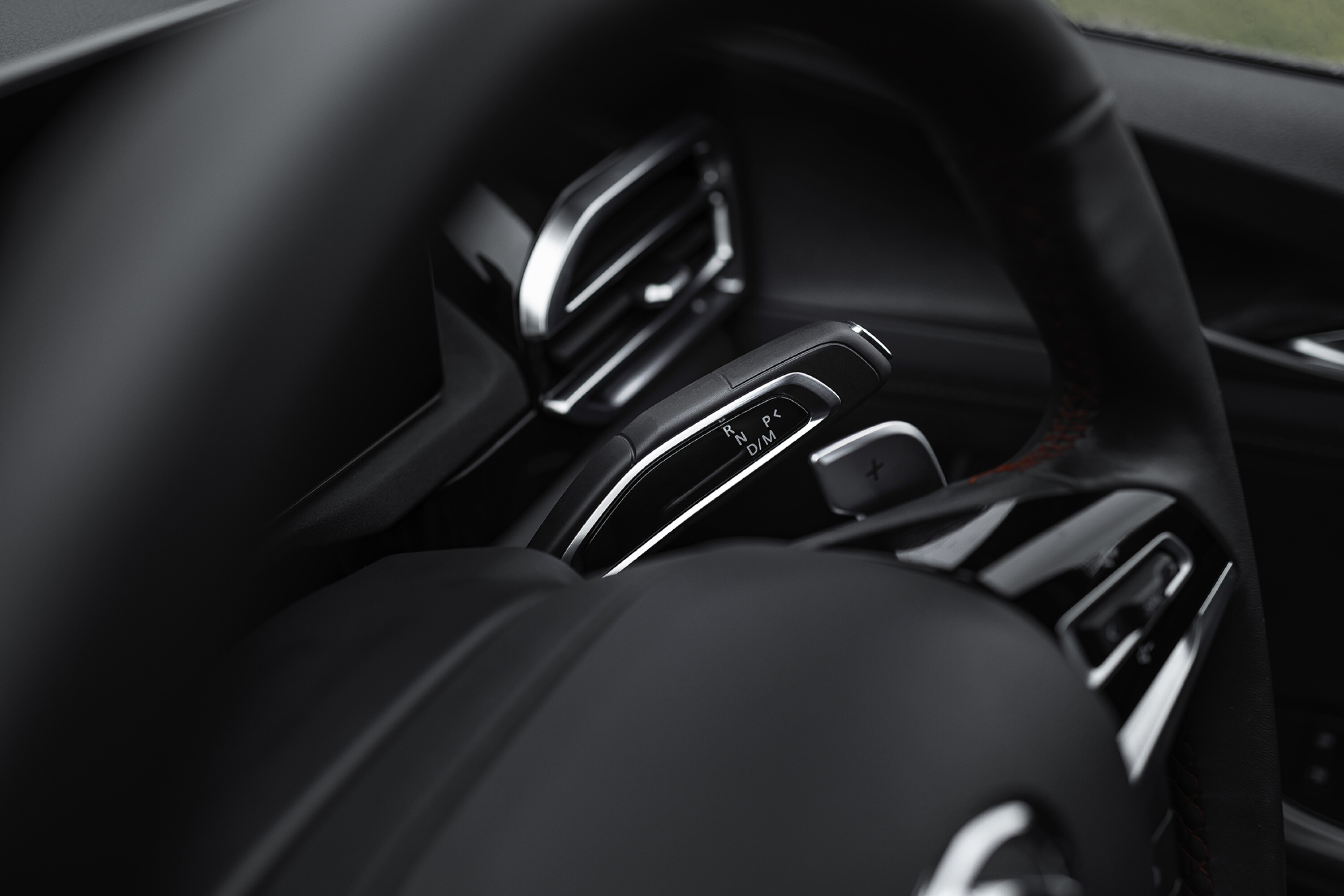
The ‘everything’ stalk on the left of the steering column controls high-beam lights, wipers and blinkers, while main lighting controls are accessed through the media screen. Really.
The haptic control panel for fan and air-con may be inconvenient for those who wear gloves. The 12.3-inch touchscreen media unit is a notable improvement, though it requires some learning. Seat heating is controlled through the screen, but there is a button for steering wheel heating.
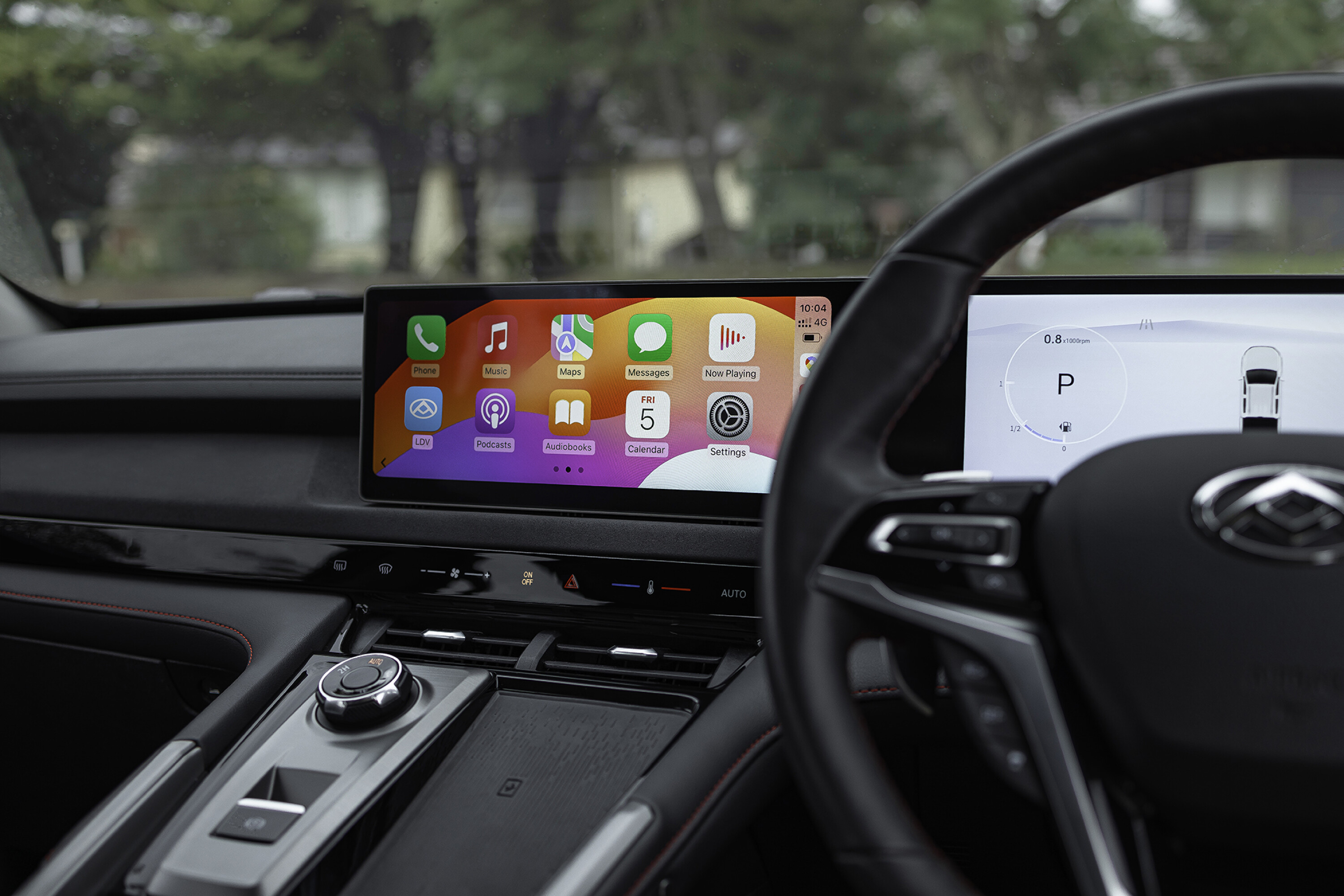
The cabin offers impressive space, with good knee room and head clearance for those front and rear, and the rear seats include ISOFIX points, directional air-vents, a USB-A charging point, and fold-up bench seats for extra storage.
The Mega Tub variant is significantly longer than standard versions, with a 5710mm length and a 3470mm wheelbase (standard model has a 3155mm wheelbase; 5395mm total length). The Mega Tub length is 1760mm, compared to 1485mm in standard models, while other measurements remain unchanged.
The new coil spring rear suspension still feels firm without a load, but provides a more predictable and more enjoyable drive. I put in 500kg of sandbags and the suspension felt surefooted and secure, handling speed bumps well with minimal rear-end sag. The steering and handling is enhanced by the better rear suspension, and the ute’s driving manners are better than before.
It’s smooth under light and mid-throttle and decent for overtaking, but struggles with stop-start driving, showing notable lag. The eight-speed ZF auto is well-tuned but sometimes holds gears longer than expected.
The engine is noisy, especially from a cold start and at low speeds, though quieter at highway speeds. With a load, the powertrain feels smoother and more responsive. The four-wheel disc brakes are better for non-loaded driving, with a squelchy pedal feel under extra mass.
Another top option would be the SsangYong Musso, which is great value and has a strong diesel. Plus it has long ownership cover, too.
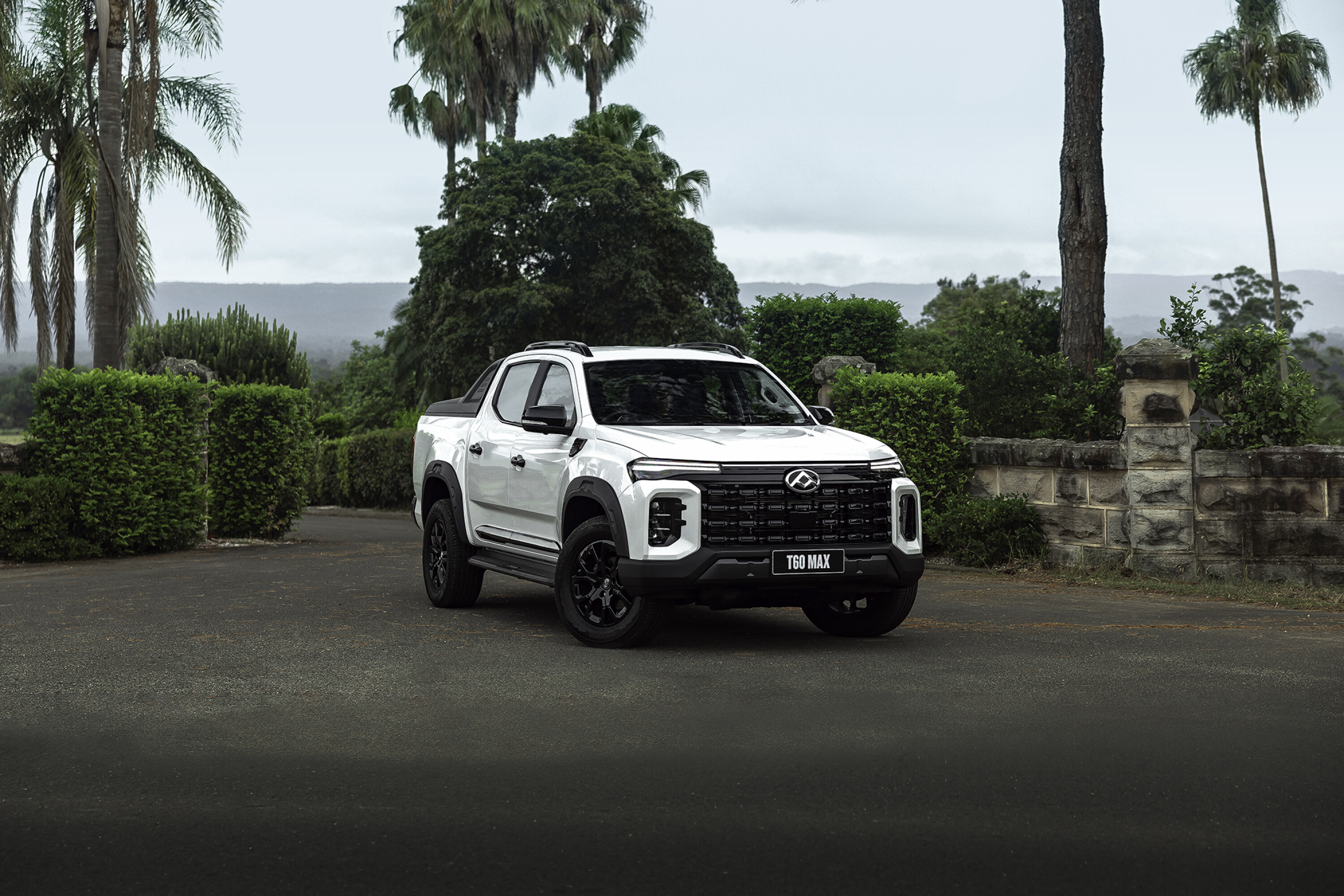
| 2024 LDV T60 Max Plus specifications | |
|---|---|
| Powertrain | 2.0L bi-turbo diesel 4-cyl |
| Max power | 160kW |
| Max torque | 500Nm |
| Drivetrain | 8-speed auto, four-wheel drive |
| Fuel consumption | 8.9 litres per 100km claimed |
| Price | ABN drive-away from $45,990 (m), $47,990 (a), $49,490 Mega Tub (a) |
The sheer amount of bull-plop out there regarding GVM upgrades, GCM upgrades, air bags and weighbridges is, frankly, scary. And yet setting your vehicle up to tow a decent-sized van or camper remains one of the great mysteries to a lot of people out there. It’s also something that you can absolutely not afford to gamble with.
It seems like just as there’s a bum for every seat, there’s an armchair expert for every opinion. So let’s give the keyboard engineers a wide berth and actually talk to the folks who do this stuff for a living.
Let’s clear up any confusion over what GVM and GCM actually mean, why air bags are not necessarily the evil invention of chassis repairers, and why the weighbridge at the local council tip might land you in serious trouble.
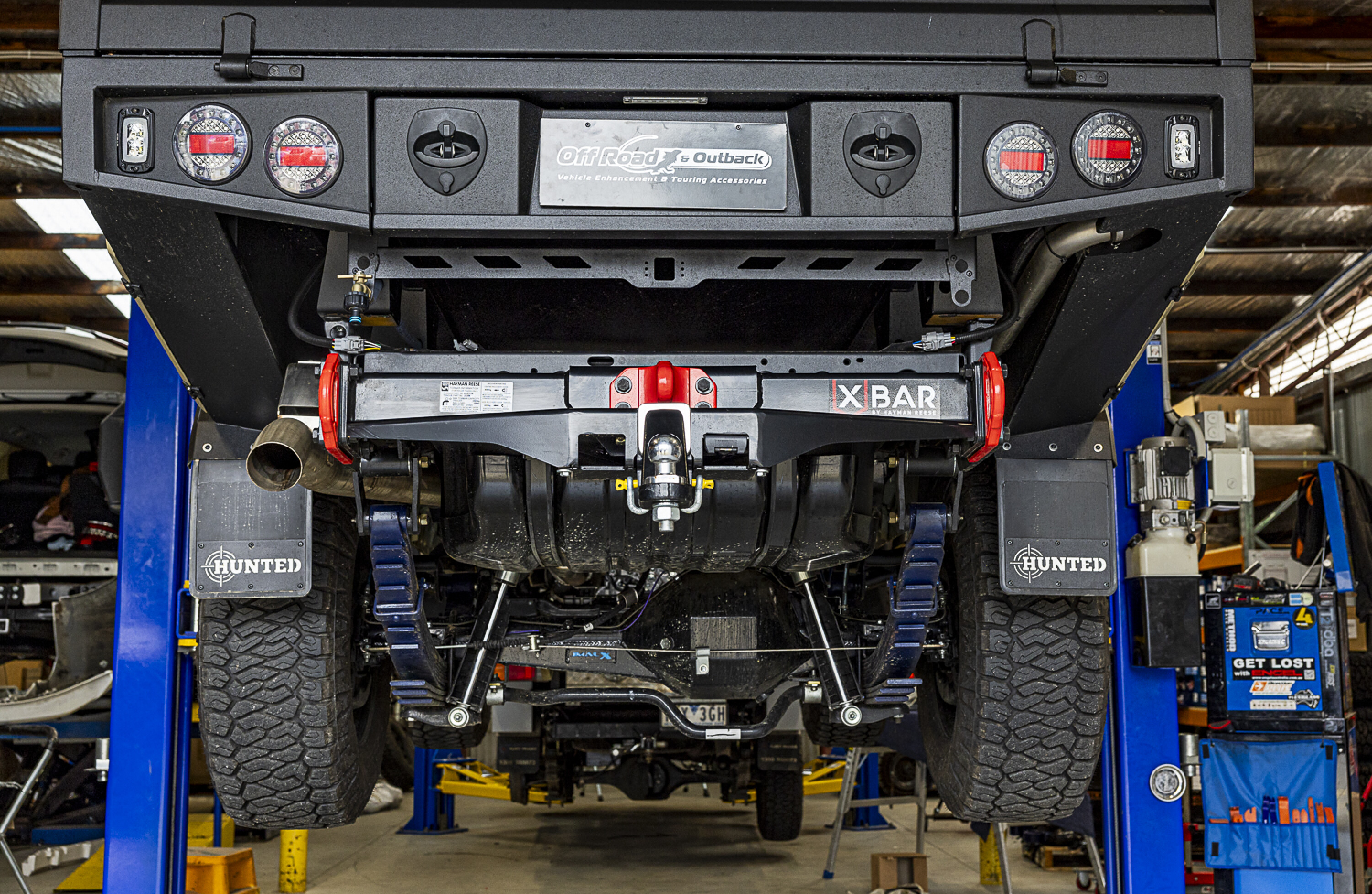
So let’s start with some house-keeping. How about a quick definition of GVM and GCM that doesn’t come from your mate down the pub. Gross Vehicle Mass (GVM) is, to put it as simply as possible, the most your vehicle can weigh and be legally driven on the road.
The important thing is that this number includes everything in or on the vehicle, including fuel, luggage, accessories and even passengers. If you’re towing anything, the GVM must also include the tow-ball down-weight.
Gross Combination Mass (GCM) on the other hand is the legal total mass of the vehicle and anything it’s towing. Which also includes not just the boat or van, but what’s in its water tanks, gas bottles, and storage areas.
In the real world, that could mean having your van towed back home by a third party (at your expense) or a big hole in your wallet when the insurance company won’t cover damage caused by your inadvertently overloaded rig.
Even worse, you could be jailed if your overloaded rig causes injury or death in the case of a shunt.
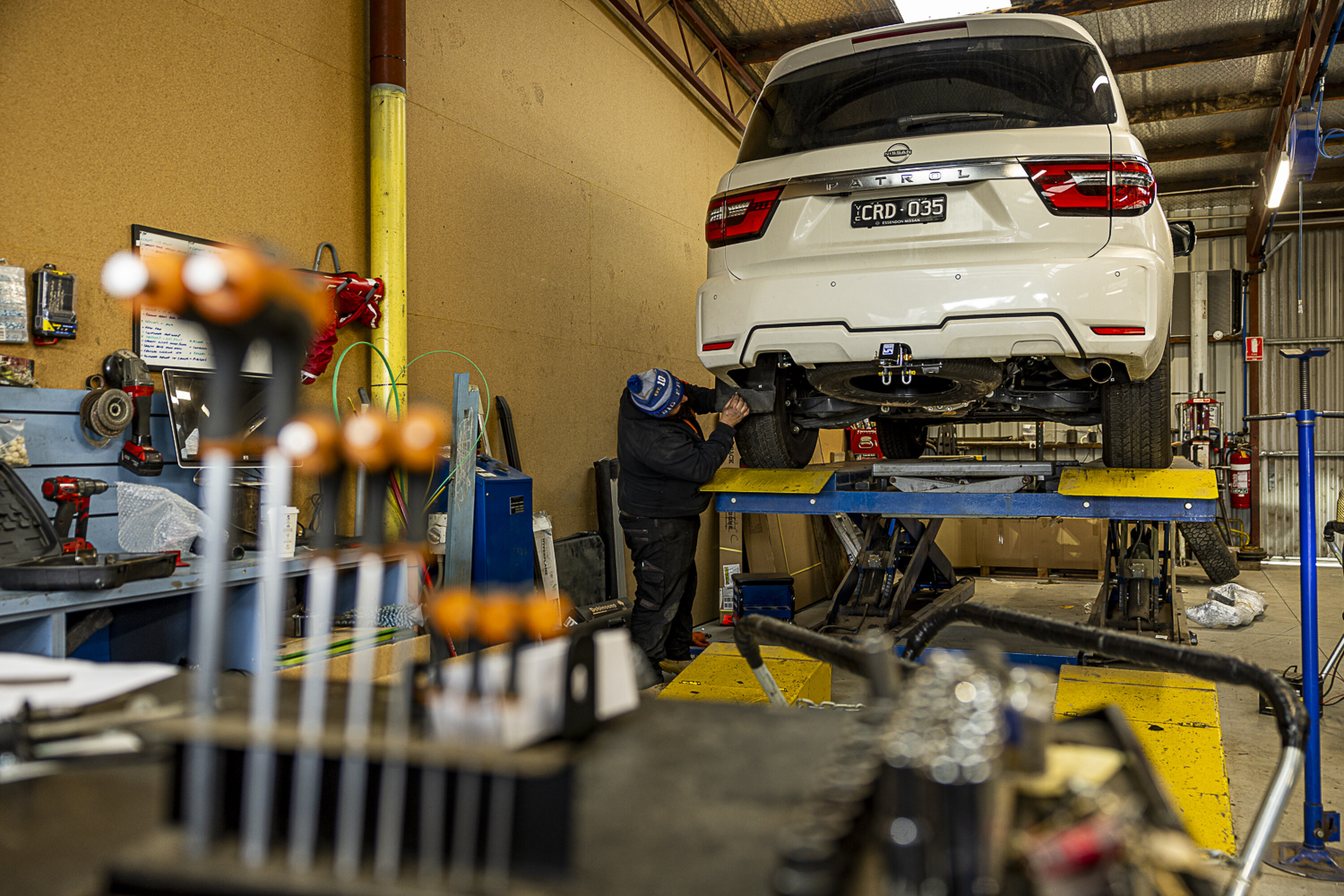
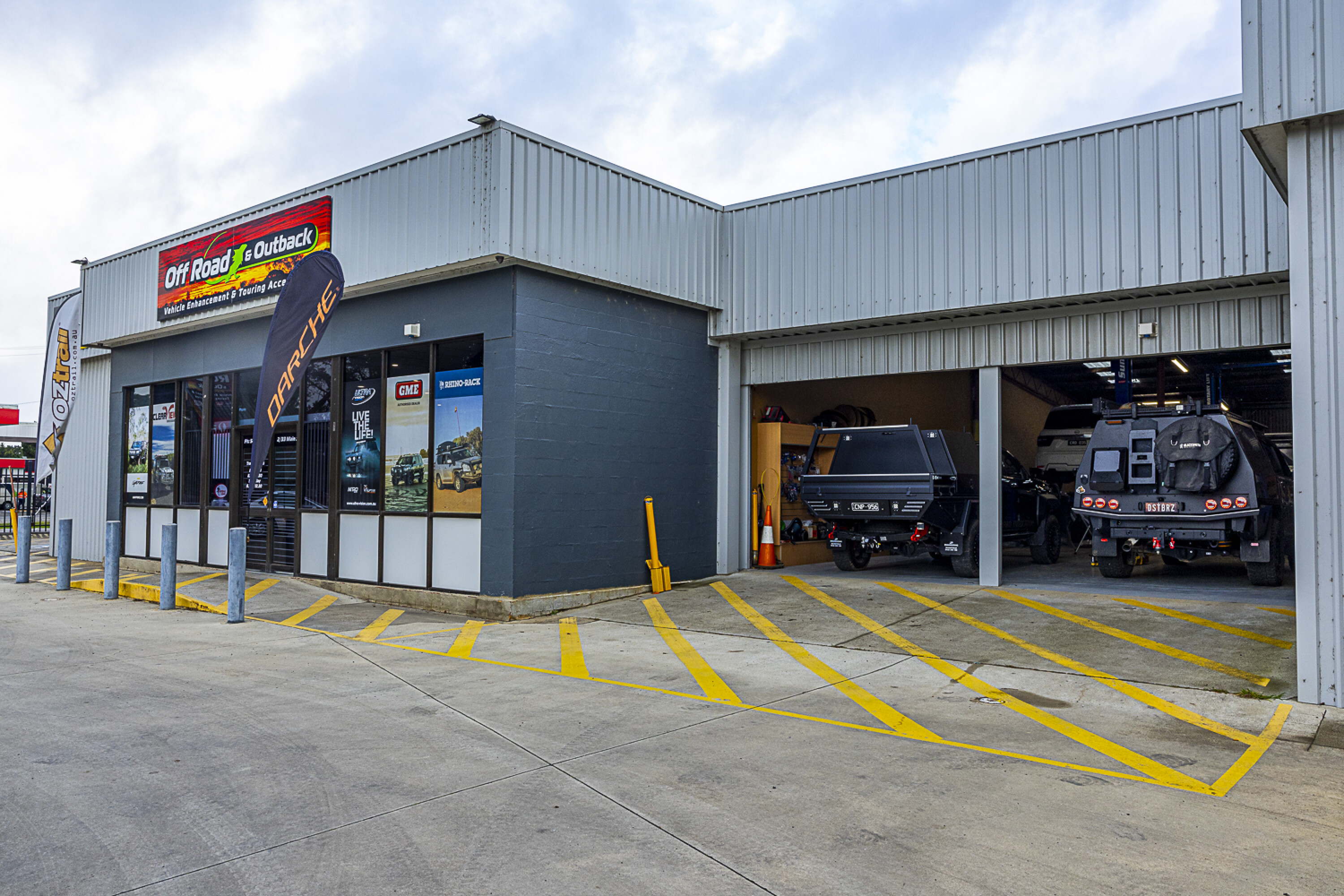
According to Off Road & Outback’s Bo Jackson, there’s a lot of confusion out there about the legalities as well as the best path to go down if you’re planning to tow big, heavy stuff. Bo understands that social media advice costs nothing, but reckons that in a lot of cases, that’s precisely what it’s worth. Or worse.
“There’s a lot of confusion out there,” she told us. “Some people – and it’s not necessarily their fault – have no idea, and social media isn’t helping at all. A lot of the advice you’ll see will be for a specific set-up that doesn’t even come close to suiting the next vehicle.”
Bo reckons the path to the right towing set-up is very vehicle-dependent and there’s absolutely no one-size-fits-all solution.
“Working out what people need is the first step. So we always recommend that they get their vehicle and van professionally weighed. Guessing weights is not a good idea.”
Even then, Bo says that the weighbridge (the usual online advice) at the local tip ain’t gonna cut it.
Such weigh-stations are set up with four platforms, each operating as a separate set of scales. The first one measures the weight on the tow-vehicle’s front axle, the second one the rear axle, the third platform takes the weight of the jockey-wheel (and, therefore, measures towball down-weight) and the fourth weighs the caravan or trailer itself, regardless of whether it’s a single or tandem axle unit.
“We’ve seen cars where the GVM is fine, but the way the vehicle sits and is loaded, the rear axle is way over (it’s weight limit). If they’d just chucked it on the weighbridge at the tip, they wouldn’t know that.
Linda Hitch, director at Hitch Engineering Services (and coincidentally a technical engineering advisor to the Australian caravan industry) agrees, adding that options for having a rig properly weighed include commercial weighbridges operating from some large service stations as well as special weigh-in days carried out by the various state caravan associations.
“But there are also mobile weighbridges that will come to you,” she points out. “They’ll usually cost between $300 and $400, but you’ll get a written report and they’ll be able to explain everything for you.”
In some cases, the authorities will only allow a GVM upgrade on vehicles that have never been registered, and not on ones that already wear number plates. And the internet is full of statements that no state will allow a GCM upgrade under any circumstances.
But, depending on where you live, neither of those statements is 100 per cent correct.
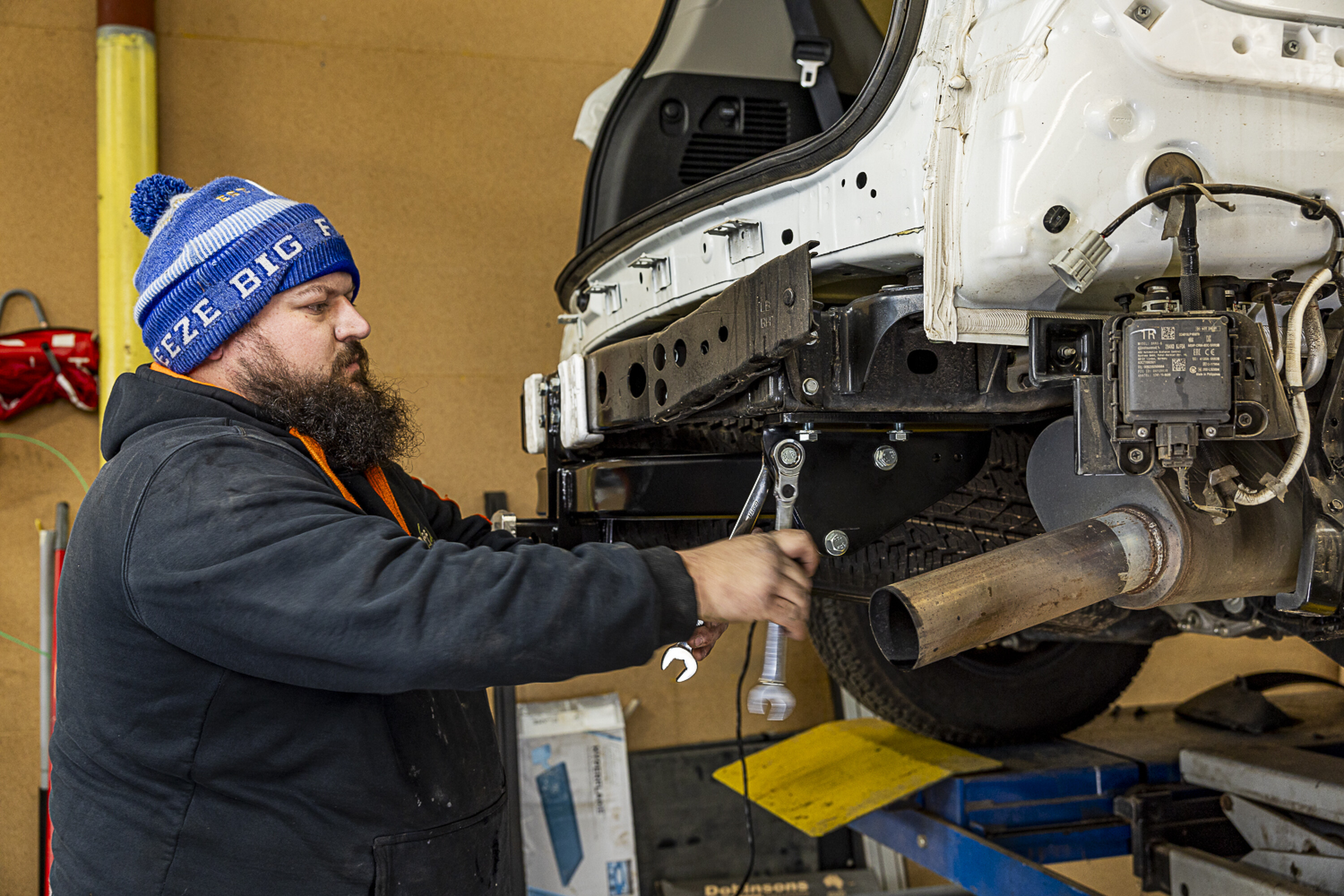
Since Off Road & Outback is Victorian based, Bo Jackon’s expertise relates to that state. And she’s quick to point out that both GVM upgrades on both brand-new and secondhand vehicles are allowable, as are GCM upgrades. That catch is that you must use a Lovell’s GCM upgrade kit, because that’s the only one approved (in Victoria).
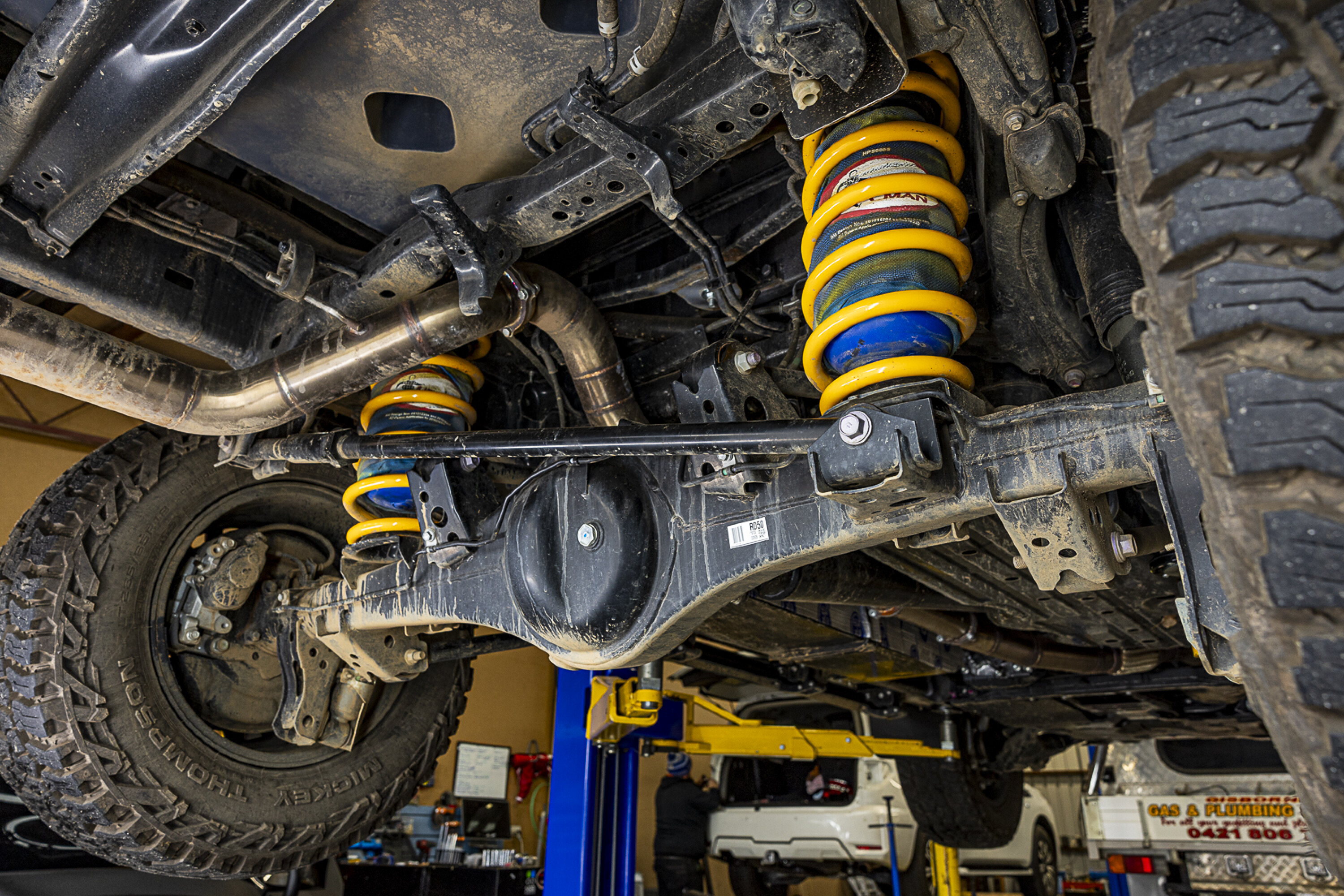
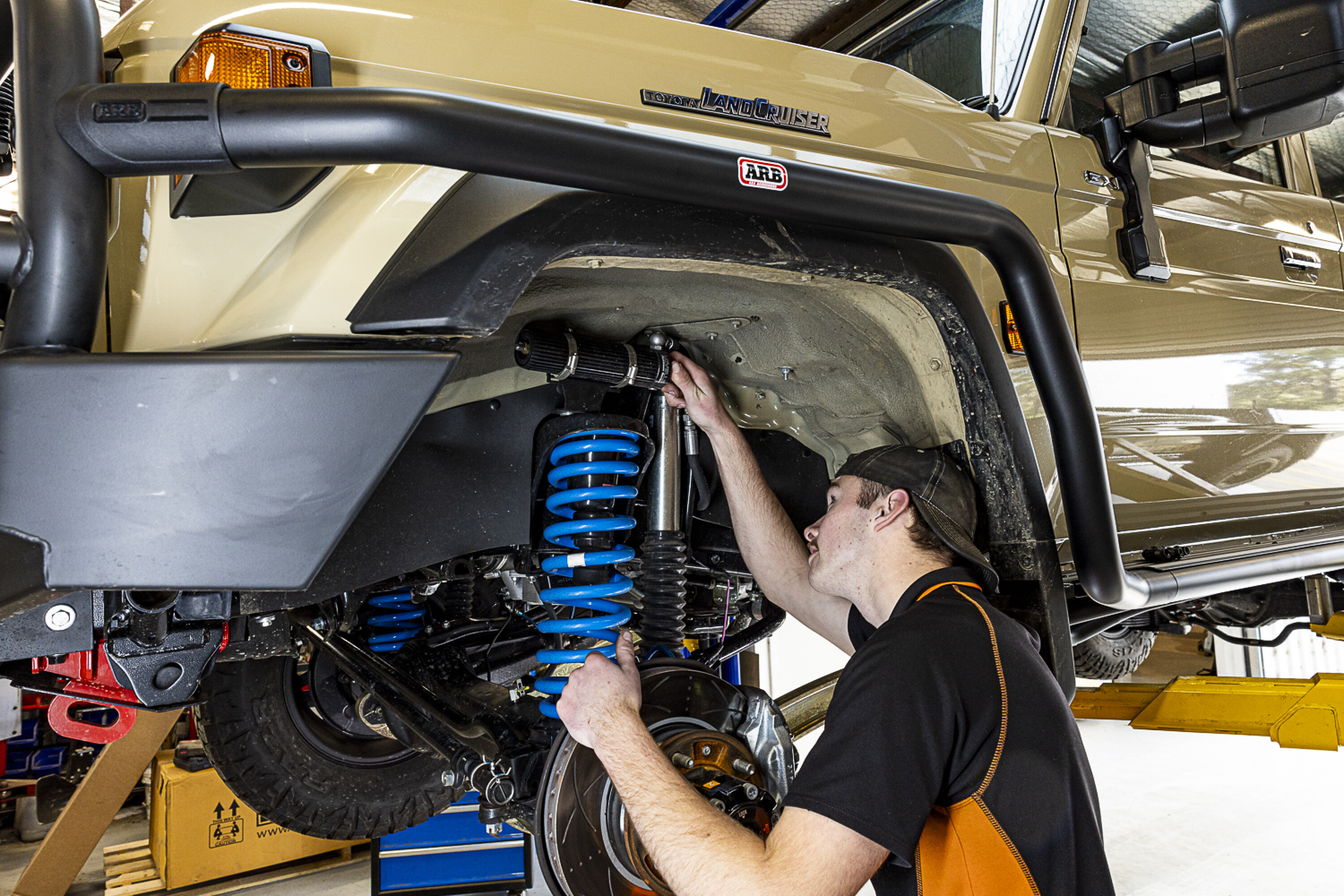
So, exactly what’s involved in a GVM or GCM upgrade? Fundamentally, it’s hardware. That amounts to heavy duty front and rear springs and new dampers all rated for the heavier load being carried. In some cases, you might find you need to add a different indicator-light on the front quarter panel.
But Bo’s advice is to be wary of a shop trying to upsell you to a set of bigger brakes because typically, you won’t need them; the approved kits have all been signed off with stock brakes. Unless you want bigger brakes, of course.
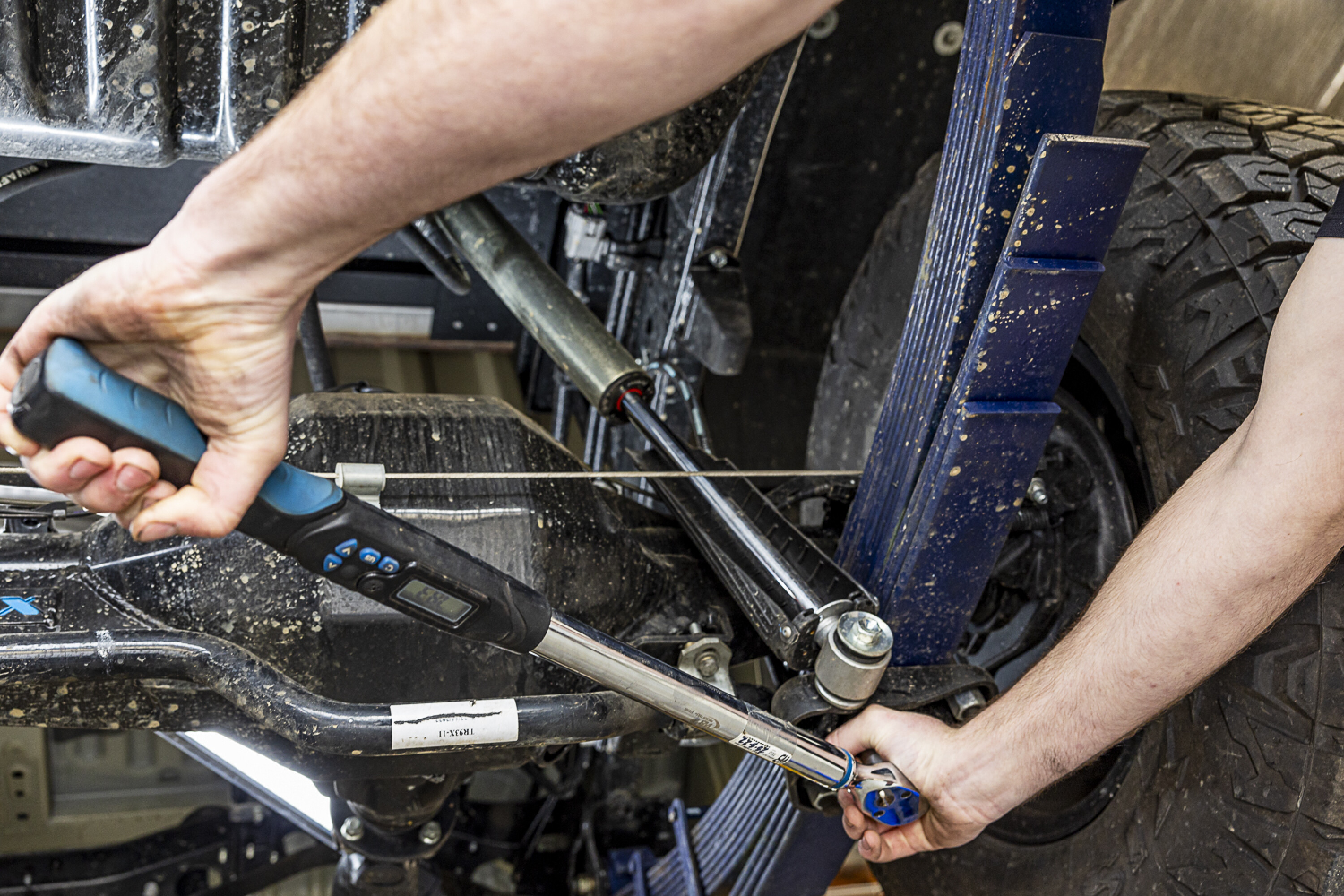
“When vehicles are designed, they’re tested for load capacity and towing, but I sometimes think brake capacities are overlooked. Manufacturer testing is done at full GVM to make sure the vehicle is able to stop within the regulations, but when you do a GVM upgrade, are you sure it’s been tested for braking performance with that new, higher weight? Some kits have, some haven’t, but people need to be aware of that.”
Ultimately, this will be the difference in using a trusted, reputable upgrade service, or calling the first number that comes up on your google search.
That’s because the vehicle might be able to carry extra weight on board courtesy of the GVM upgrade, but since the GCM stays the same, the towing capacity will actually be less if the tow-car is making use of that extra GVM allowance.
“Even then,” says Bo, “just because the weights are within legal limits, a lopsided vehicle is still not safe.”
“In a lot of cases, they haven’t distributed the weight correctly. Too much in the rear of the trailer or van creates an unstable towing scenario, where you get sway at speed. Or they load the front too much and then ball-weight is excessive and goes beyond the legal limits. That will also lighten the front and overload the rear axle. And this is all an issue because people don’t look at individual axle loads. They’re printed in the owner’s manual but people don’t look at them.”
The golden rules, then: “Keep weight low and around the axles. And don’t forget left-to-right balance.”
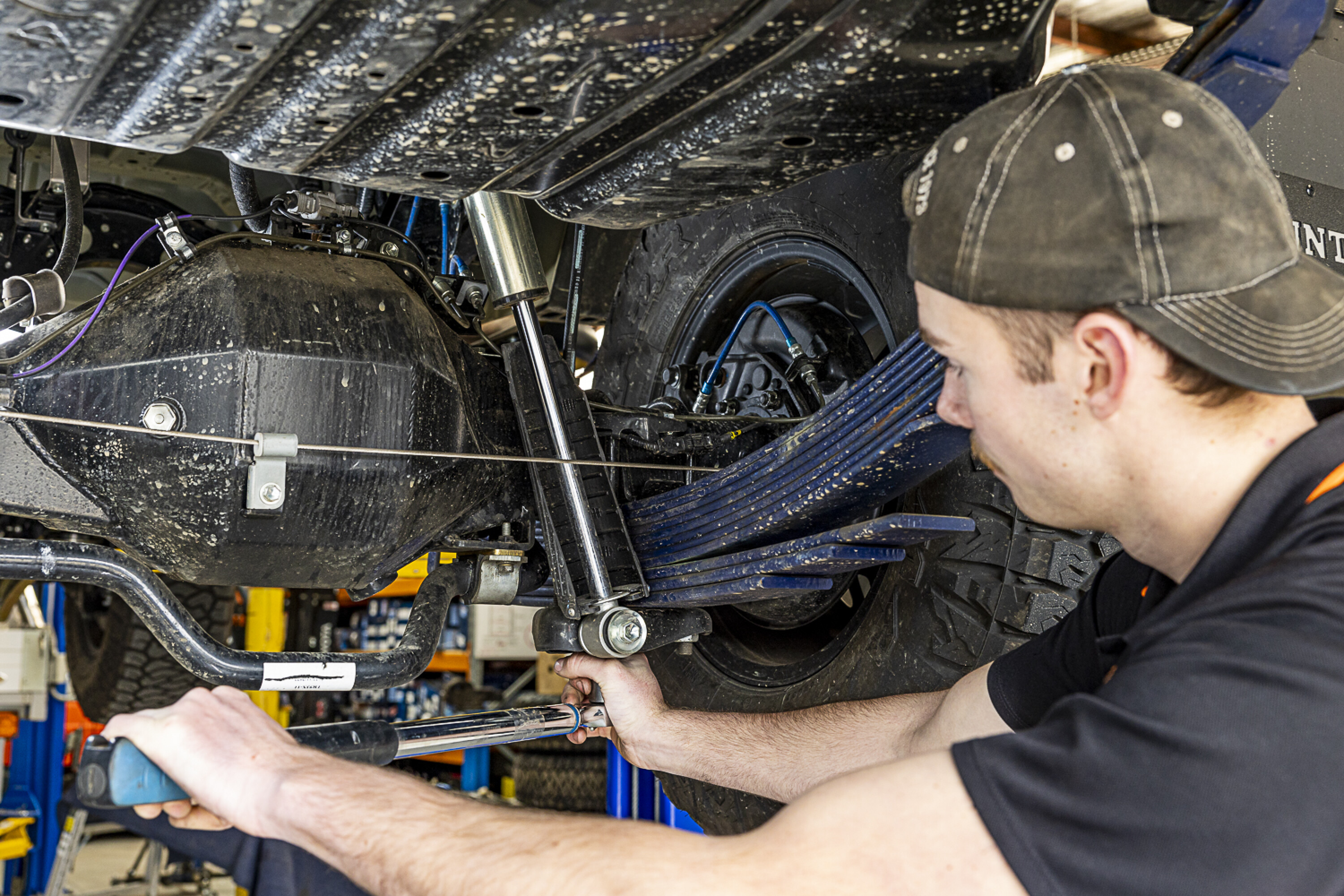
“You can’t go too big on a GVM upgrade with plans to add a heap of accessories in six months’ time. Because, in the meantime, the vehicle will be unsafe. A 4.5 tonne upgrade on a 2.8 tonne vehicle, for instance, is going to be seriously over-sprung, because it’s not carrying enough weight right now. Bigger is not always better. In some cases, we advise people that they don’t need a GVM [upgrade] at all.
That said, Linda Hitch believes that for every 20 customers she sees roll into her business, 19 of them would benefit from a GVM upgrade.
“A lot of that is because people are repurposing vehicles they already own. They can’t afford a new one, so the idea is to upgrade the one they have.”
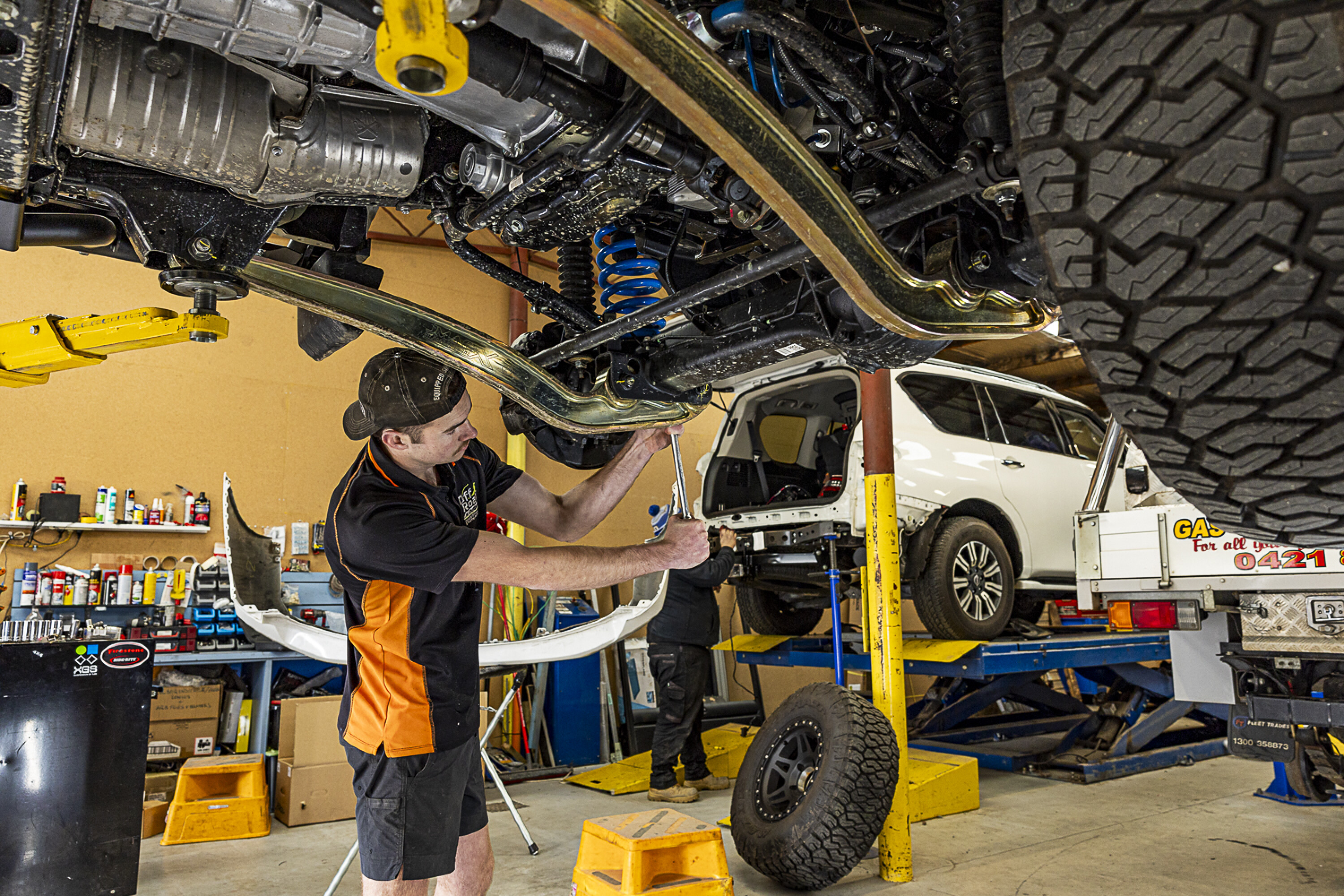
But Linda agrees that sometimes, a GVM upgrade and its expense could be avoided.
“If you don’t need it, don’t get it,” is her advice. “They’re expensive.”
“I always ask people if they really need to carry so much stuff in their caravan. Some do, others could do with leaving some stuff at home. If they did, they could avoid the 10 or 20-grand for an upgrade. It’s just not worth it sometimes. But when you see people who are going to be 200, 300 or 400kg over without it, then they definitely need it.”
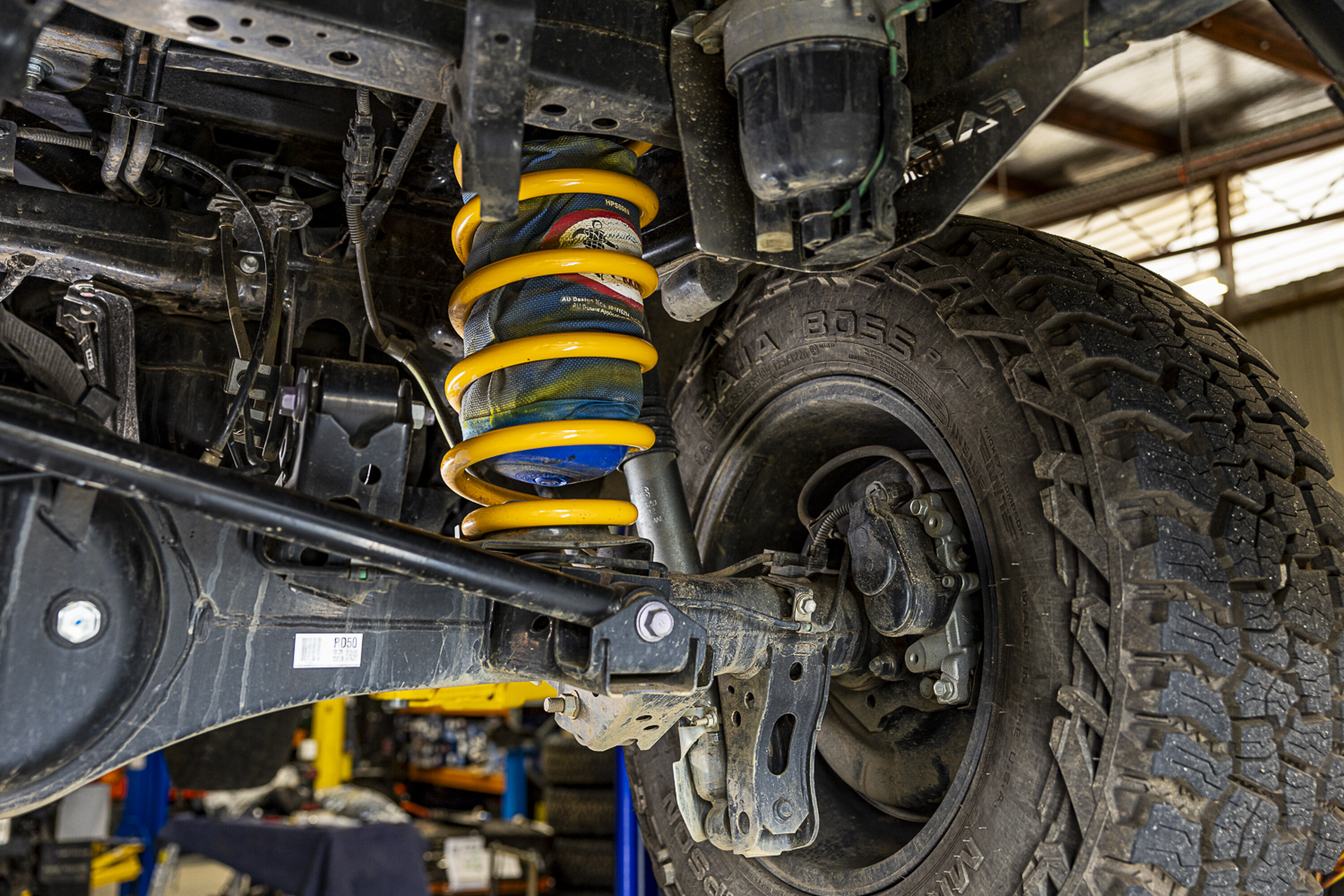
Bo says: “Air bags are very debatable. You’ll find one person telling you air bags are dangerous and rubbish, and the next telling you they’re fantastic. The reality is that air bags run into trouble when people think they’re a complete fix. They think they can just crank up the air bags and it’s all good.”
“The reality is bags are purely for ride levelling if you have a removable load. They’re not to carry constant weight. The chassis cracking you hear about is about overloading; the bags are not designed to take that one-tonne payload on their own.”
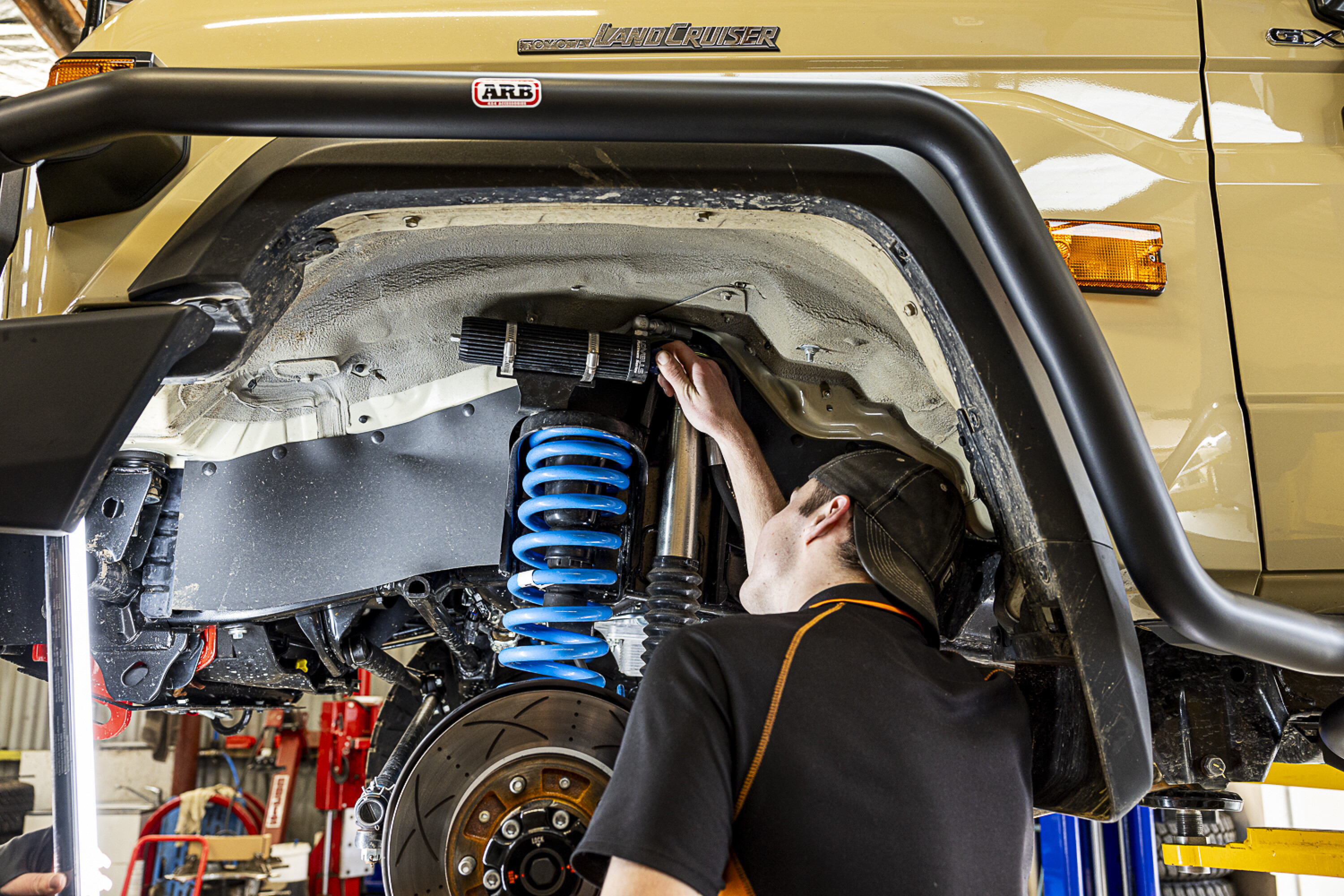
According to Bo, helper springs are different again and are aimed at vehicles that constantly cart extra weight.
“We rarely use helper springs for a GVM upgrade, and for a stock vehicle they’re not as popular as air bags. But they’re great for when you’re constantly carrying extra weight. It’s application based; air bags are probably a bit nicer in the ride department, but if you’re looking for something you don’t have to touch, then a helper spring is a good option.”
Linda Hitch also reckons air bags have their place as they offer a tow rig more control over ride height and loading options.
“If they’ve been installed correctly, a lot of people swear by them, but others don’t like them at all. If it hasn’t been done properly, an air-bag instal can really affect stability.”
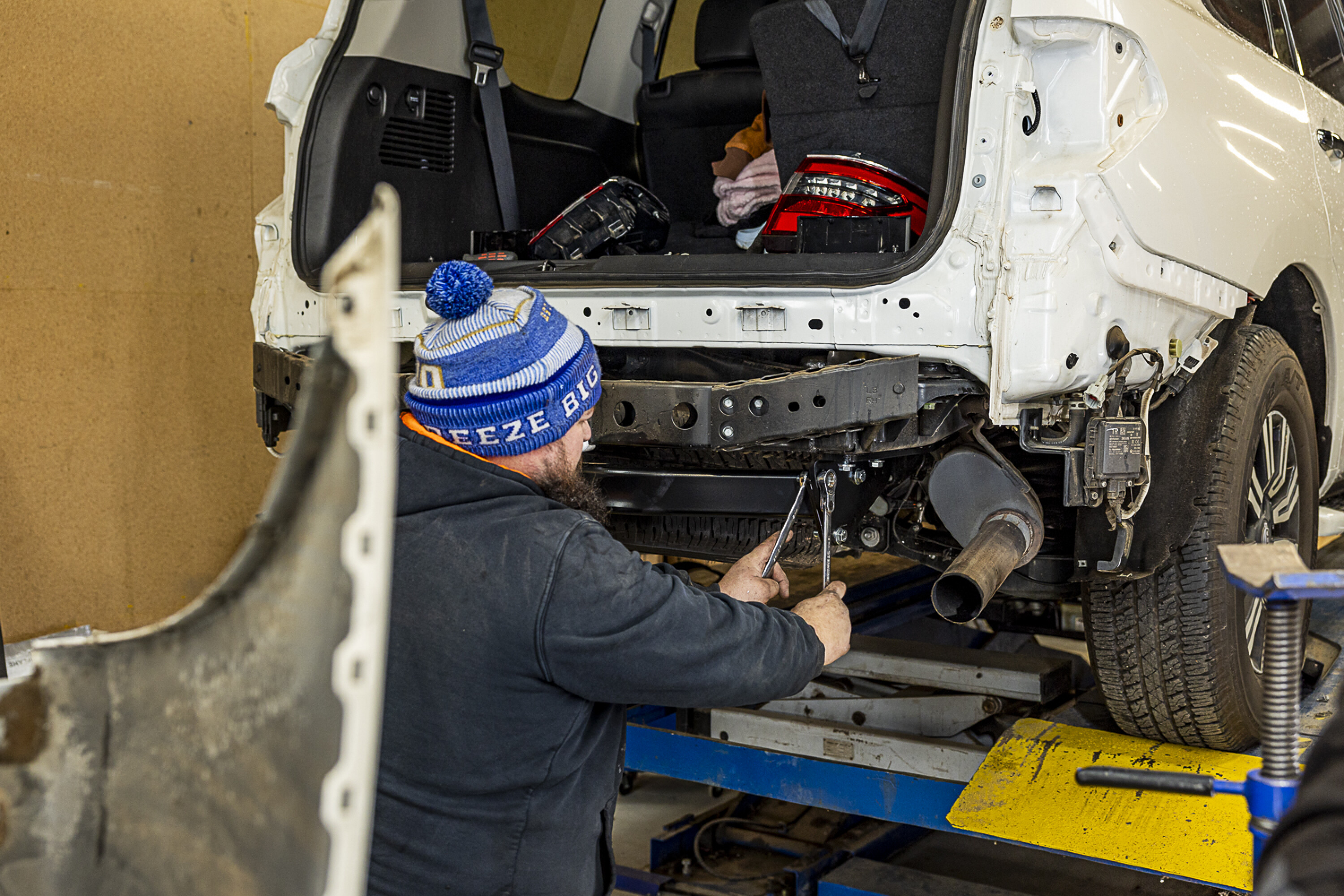
For starters, you’ve got to ask if you have got enough engine for what you’re towing. We’ve seen lots of dual-cab utes that are rated to tow 3500kg, but put anything like that mass on the towbar and, suddenly, they struggle with hills and headwinds. At that point, you can kiss goodbye to fuel efficiency and driving enjoyment… and you’ll be sitting behind a lot of roadtrains.
A car’s cooling system also gets a workout when towing, and regular radiator replacement is probably a better bet than having one go pop miles from anywhere. So, when was your radiator last replaced? And the coolant (it has a use-by date as well)? Are the hoses in good nick and the fan belts fresh?
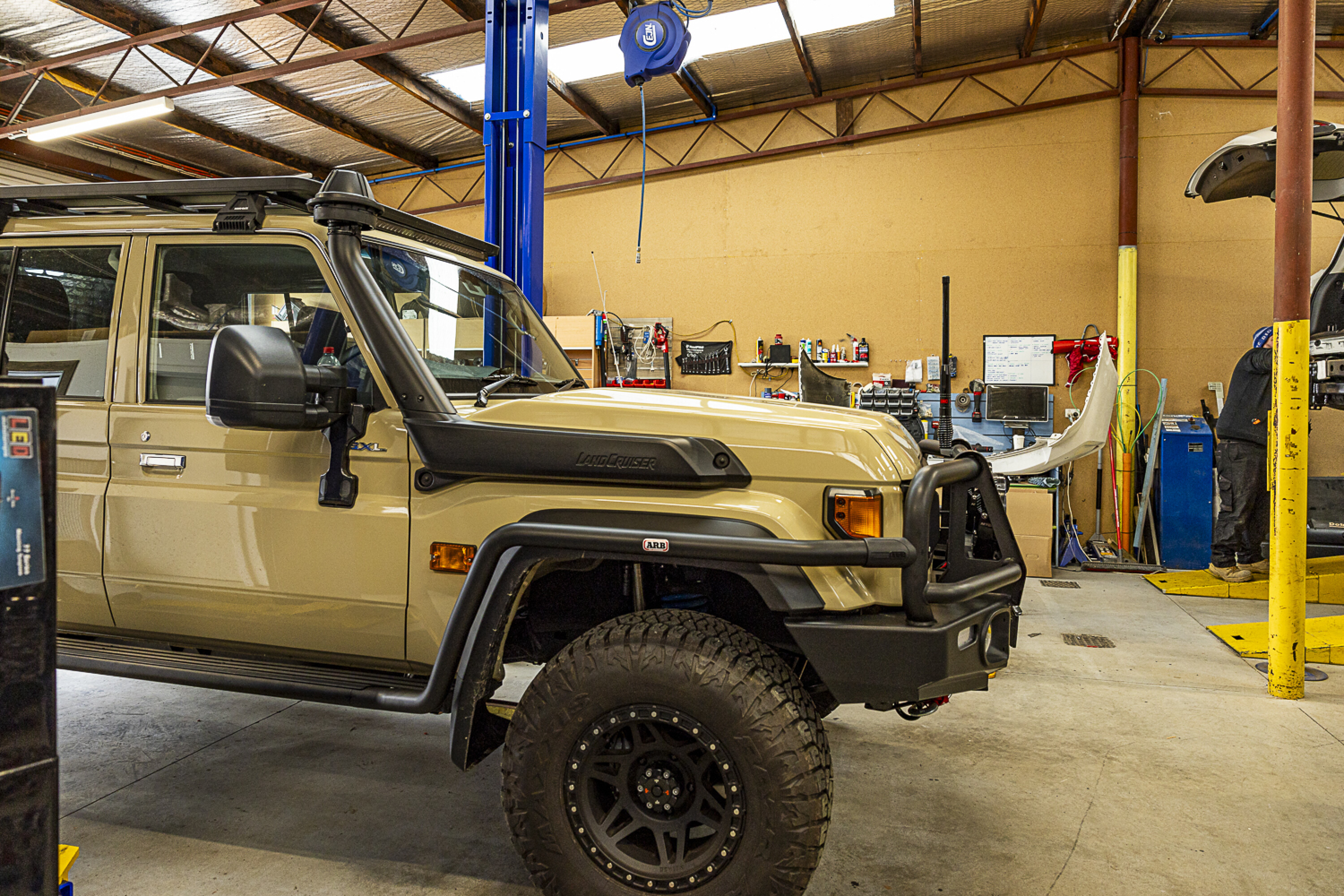
Does it need new fuel-injectors? Is it time to rebuild that mechanical fuel pump? How’s the DPF situation? Are the dampers leaking? How much life is left in the tyres? Do the spare tyres actually have air in them? These are all regular maintenance considerations that can cause an inconvenience 48 weeks of the year, or totally ruin your holiday thousands of kays from home when you’re on tour.
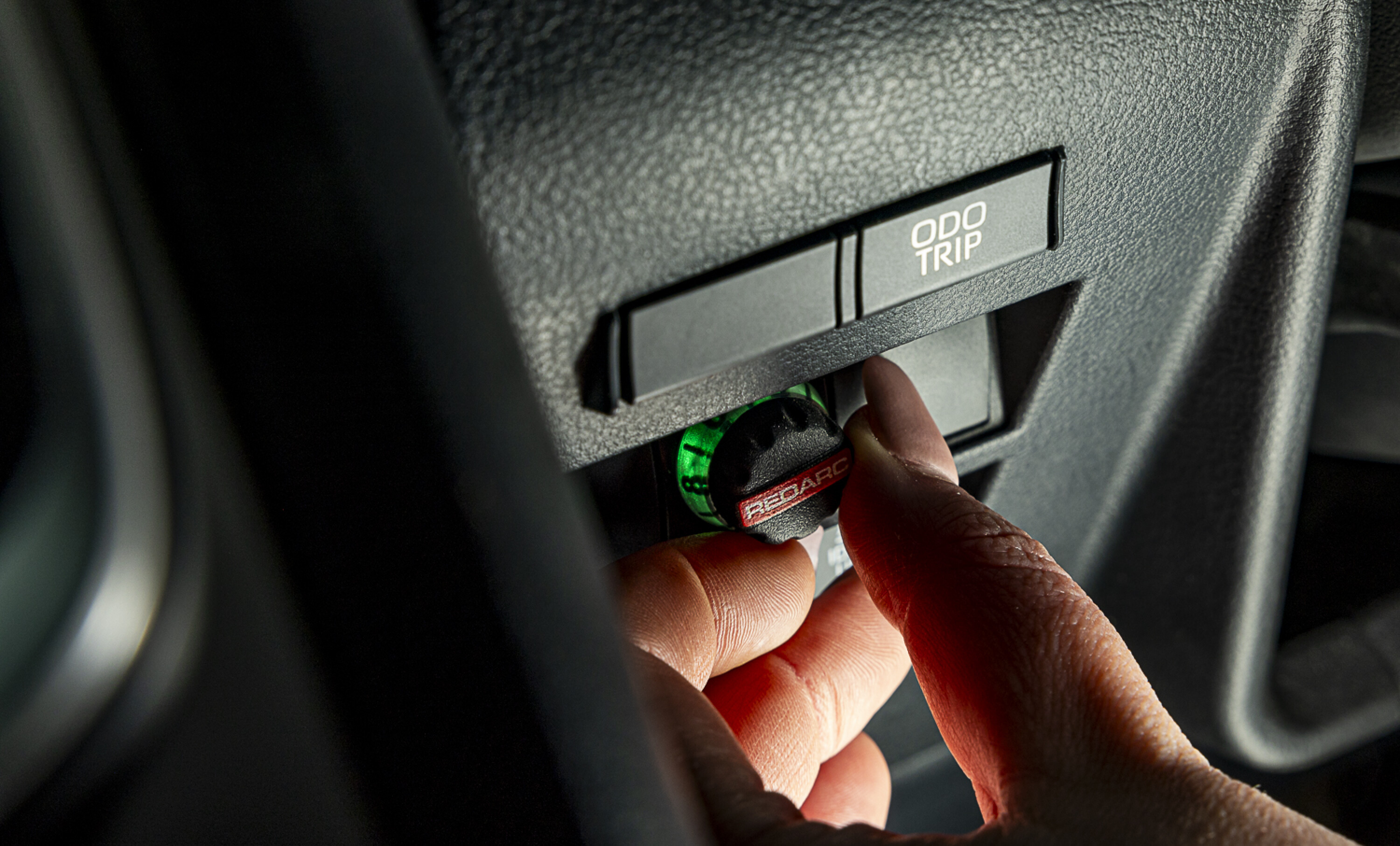
Bo Jackson also points out that if you plan to run your van off the tow vehicle’s battery, you’ll need some extra wiring taken care of.
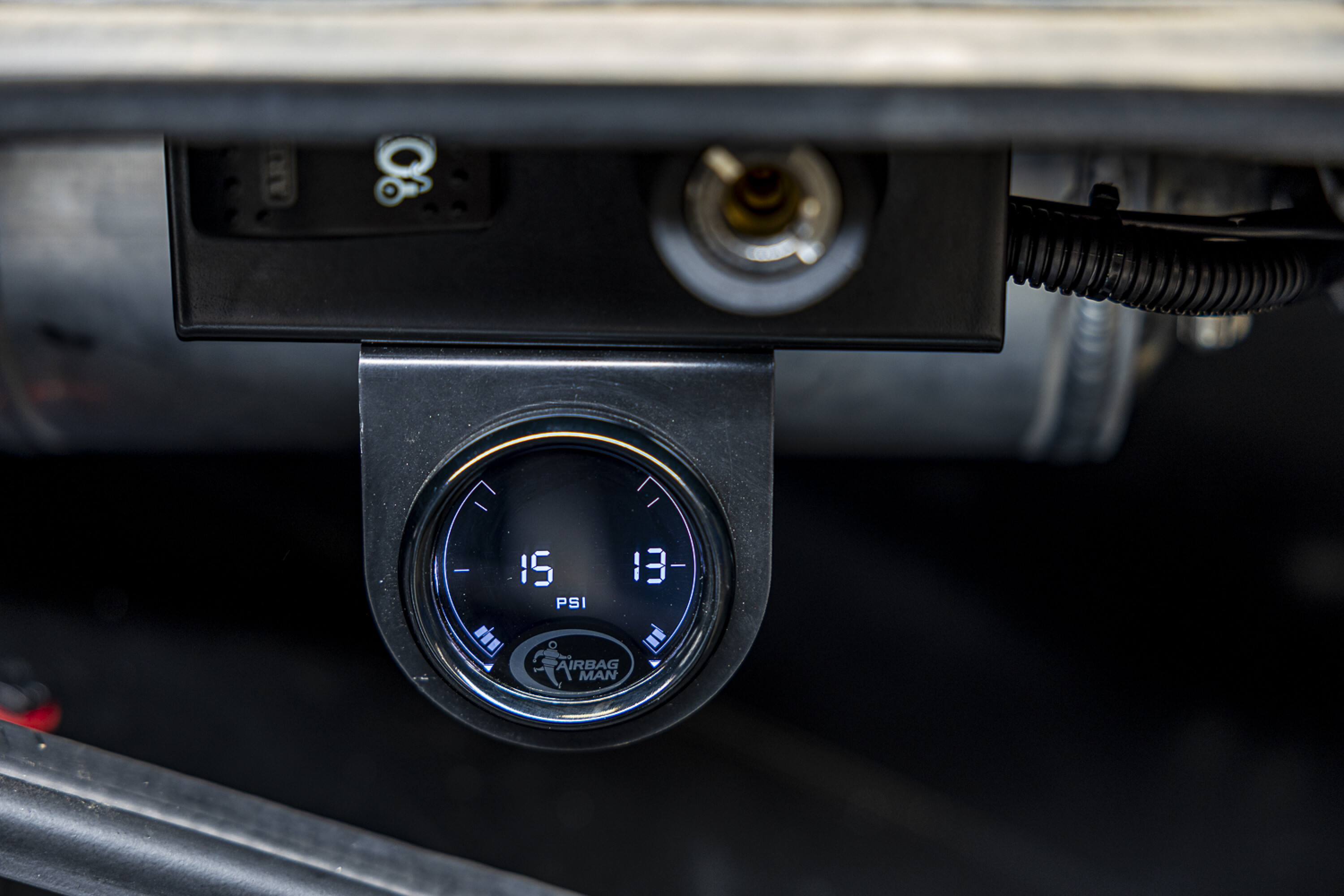
And do you know for certain that your brake controller is working properly? A dry run before you head off will let you know whether the controller is doing its thing and allowing you to adjust it to suit the load and conditions. But this is not something you want to be experimenting with on day one of the Big Lap.
And don’t forget about mirrors. Some vehicles have better standard mirrors than others, but all of them can do with a proper towing mirror when there’s a big van hitched up. The right mirrors take a lot of the guesswork out of carparks and traffic, and a lot of stress out of any other situation.
The various state caravanning associations often publish handy checklists you can use to make sure you haven’t missed anything.
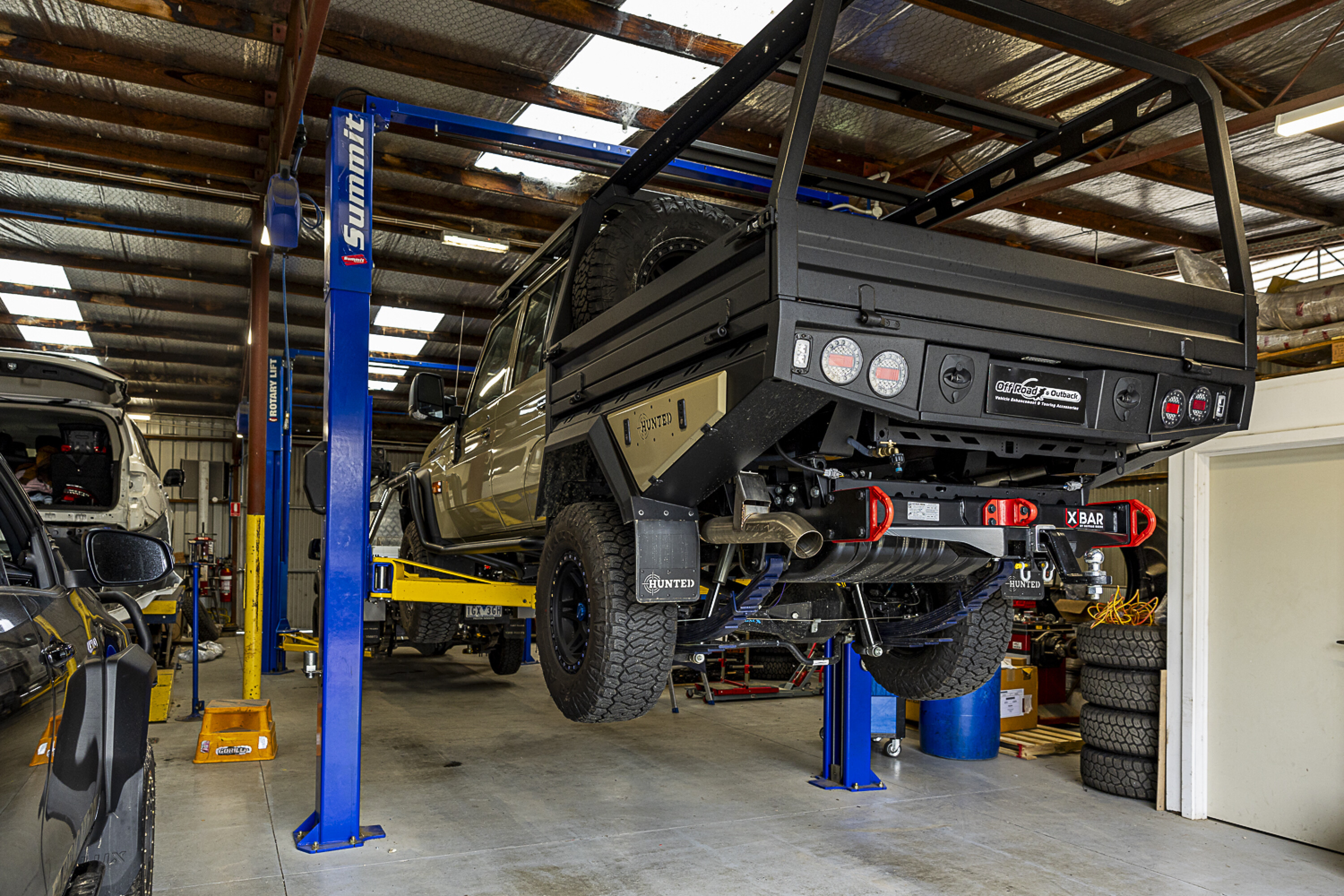
Long gone are the days when you could afford to be a little bit overweight or have some other technical glitch, and run the gauntlet with little chance of being detected. That was then, this is now. Oh, and don’t forget to keep the weighbridge certificate in the glovebox.
There have always been companies importing American trucks to Australia and converting them to right-hand drive, but Ateco paved the way with Ram Trucks Australia and a semi-factory operation to sell the RAM brand here. The success of RAM soon saw GMSV going down a similar route with Chevrolet trucks, Ford bringing in F-150s and we’ll soon see the Tundra here via Toyota Australia.
The volume of trucks coming into the Australian ute market has created a big demand here for accessories that will fit them, and like most things in America, the USA aftermarket for pick-up trucks is massive. Sorting through the junk from the quality equipment can be daunting, but thankfully one company has done all the hard work for Australian pick-up truck buyers and builders.
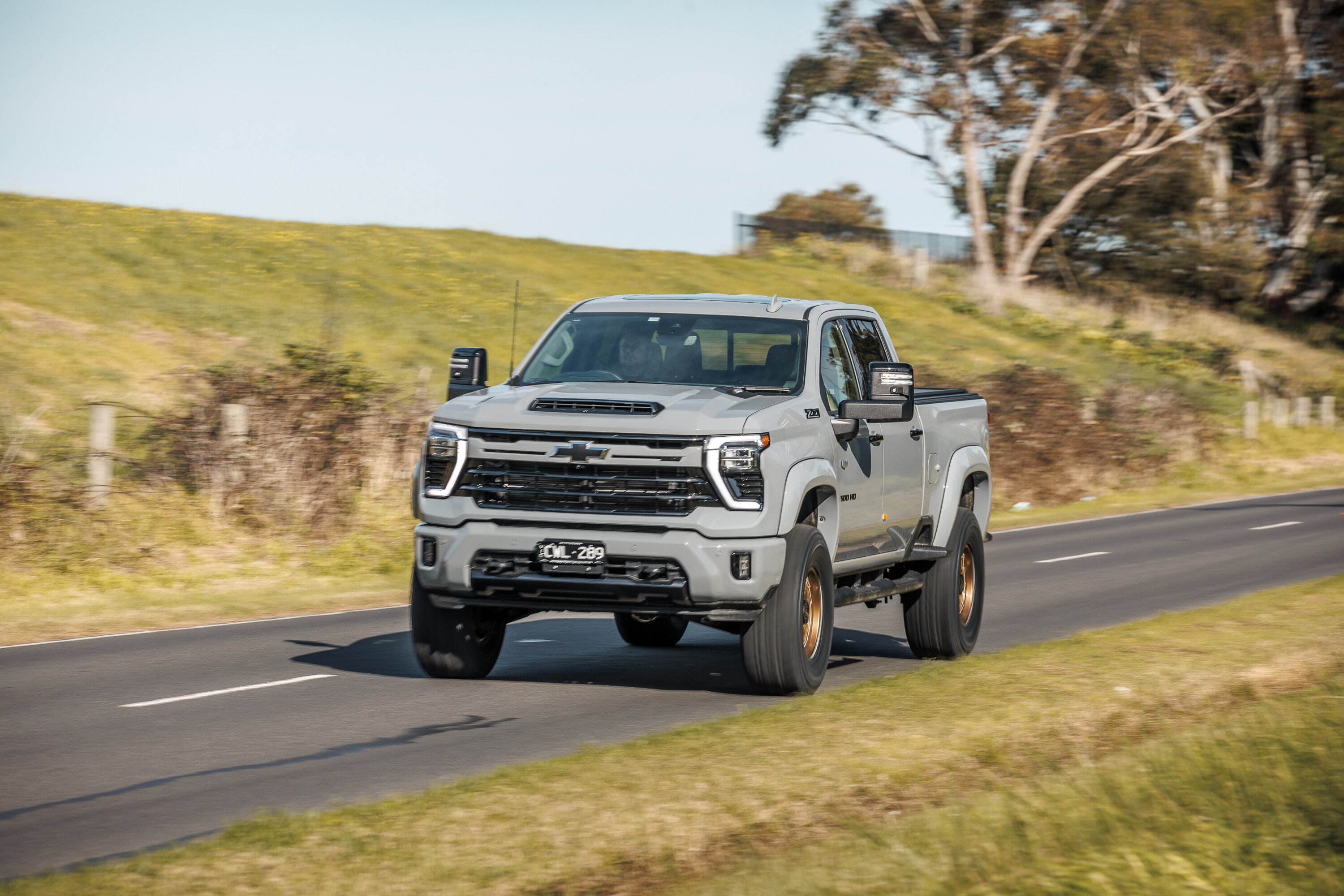
Melbourne’s Offroad Industries (ORI) saw the need for quality components for trucks in Australia and has focused its attention on the best brands to deliver high-quality products for your USA truck build. As the importer of brands such as Addictive Desert Designs, Baja Kits, BDS Suspension, Factor 55, Fox Suspension, Titan Fuel Tanks, Bushwacker and Stealth Lighting, among the products it keeps in stock, Offroad Industries has the best gear for your pickup, ready to go.
When we say that Offroad Industries has the products in stock, we mean it. The company’s 1000m2 warehouse in Melbourne is loaded to the rafters with stock, and James and his team at ORI pride themselves on having the products here rather than having to search for them overseas and worry about shipping them to Australia.
Offroad Industries is not a workshop and it doesn’t do vehicle builds, but the team does live the pick-up truck life, working with specialised shops and fitters to create incredible truck builds. ORI’s own F-150 and soon to be unveiled Silverado 2500 are testament to the effort James goes to in selecting the best parts for a build and tailoring them to owners’ requirements.
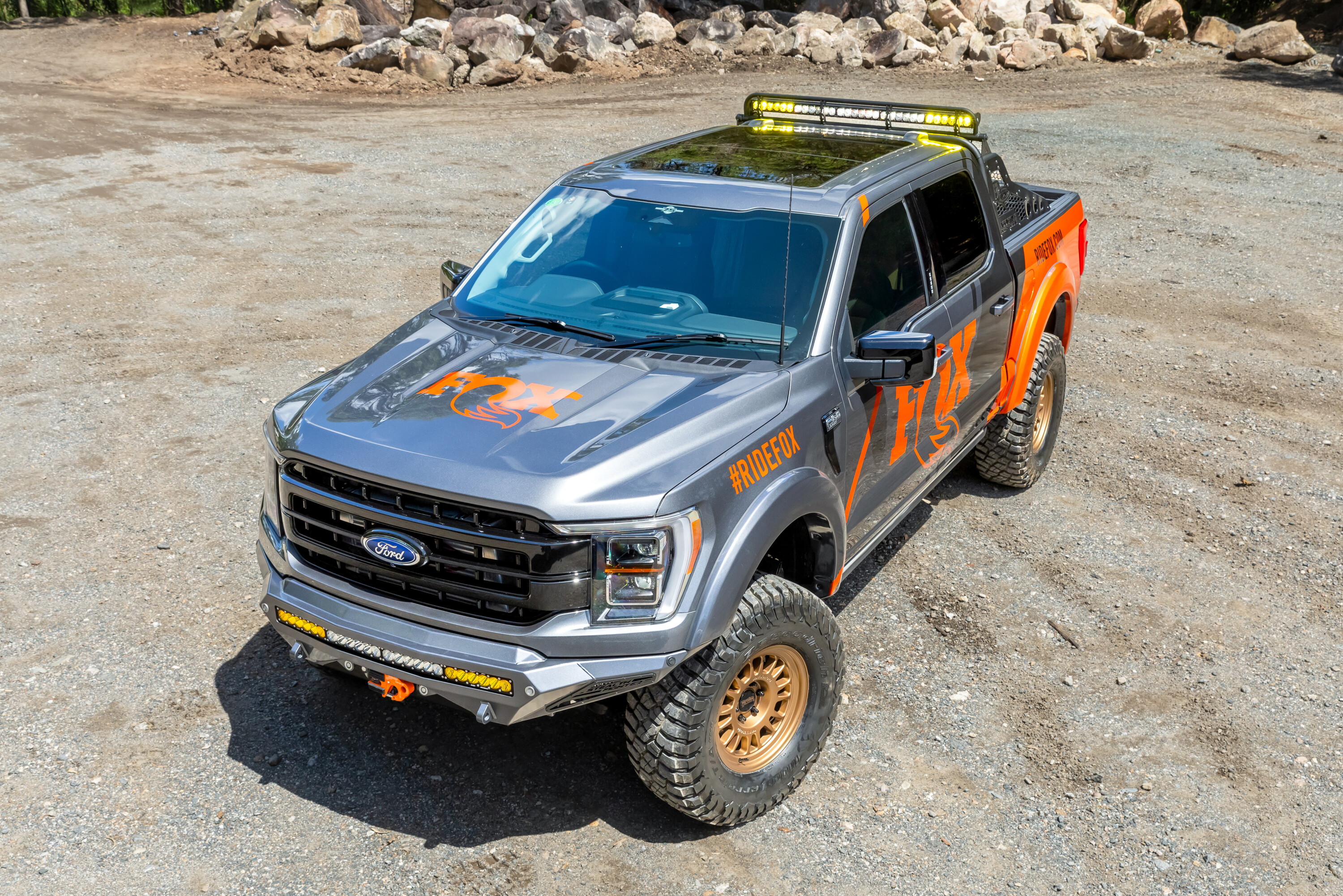
Kris Humphrys of Recre8 and Rambler fame has been dealing with James at ORI on a number of the company’s builds and he says, “The thing about dealing with James is that it’s not just about the products, it’s about the knowledge he has and ensuring that we get the right product for the build; and that he always has them in stock.”
James’s knowledge of the American truck accessories market comes from running ORI for the past 14 years, and during that time he has been dealing with USA brands directly, passing on what Australian owners want for their trucks to ensure he gets the best gear for his customers.
“We have been travelling to the States for 13 years and dealing directly with the guys at Addictive Desert Designs, Fox, BDS, Real Truck, and going to the SEMA Show every year for 13 years,” James says. “It’s this direct connection with the brands that allows us to get the right equipment for Australian buyers and have them in stock in our Australian warehouse.”
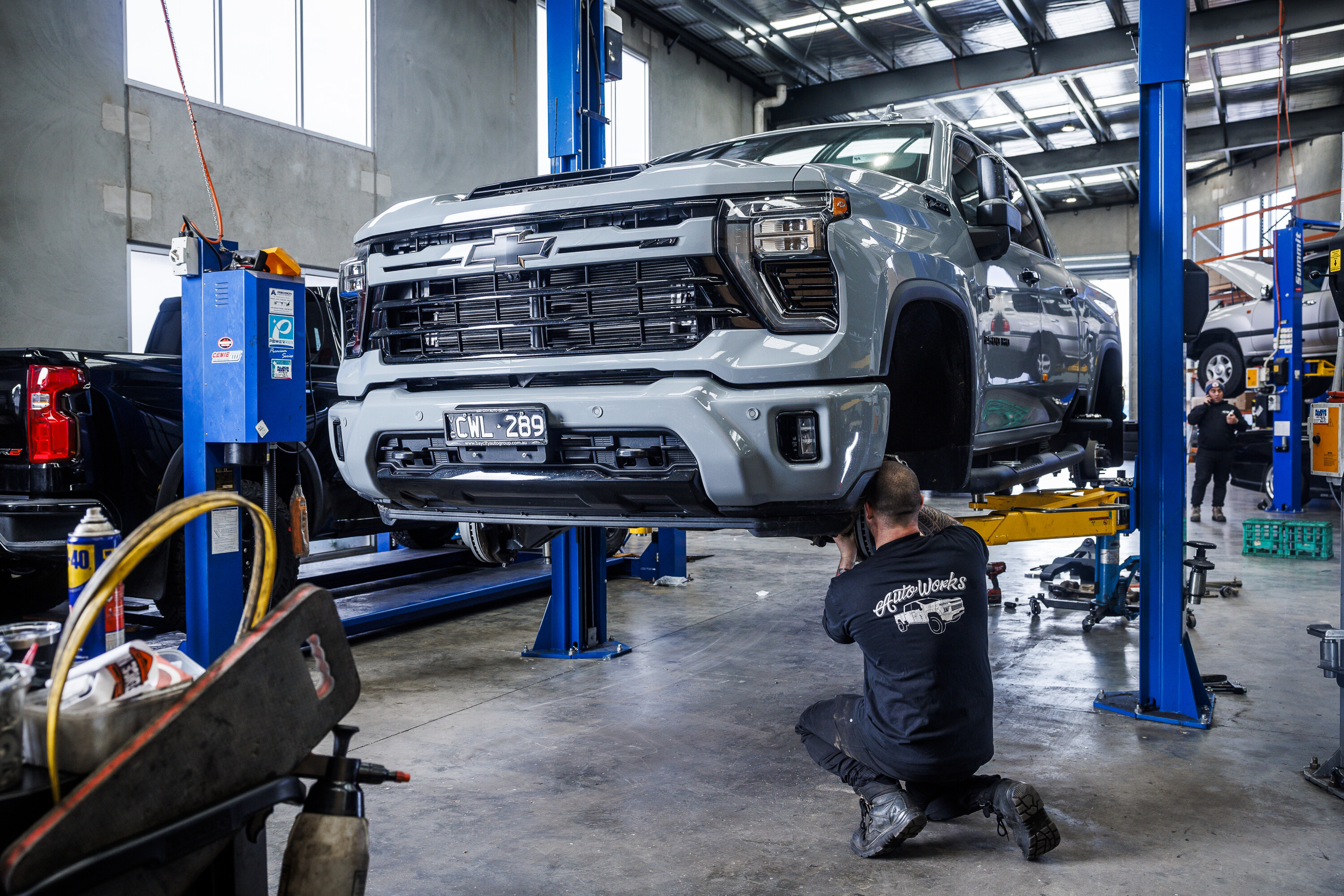
As well as Rambler/Recre8, ORI supplies the best gear to other leading workshops doing American pick-up builds including Autoworks Car Care in Melbourne and Big Dog Builds in Queensland. We dropped by the Autoworks shop where owner Morgan was outfitting ORI’s new Chevrolet 2500 with a full BDS/Fox torsion-bar delete suspension, using Fox Performance Elite 2.5 DSC shocks and Method wheels wearing 37×13.5-inch Toyo tyres.
The team has done plenty of such builds and James is looking to obtain SSM (Second Stage Manufacturer) approval for this suspension, wheel and tyre combination on HD trucks. This would allow owners to have the kit fitted to their new trucks pre-registration and have it nationally approved with a three-inch lift and 37s.
Other gear going on the grey Chev includes an Addictive Desert Designs Phantom Bar, Titan Long Range Fuel Tank, Bushwacker Extend-A-Flares, and ORI electric roller shutter, bed rack and rooftop tent over the tray. More than just a bunch of brand name parts being cobbled together and fitted to a vehicle, the gear selected again comes back to ORI’s knowledge of the products and what works best together.
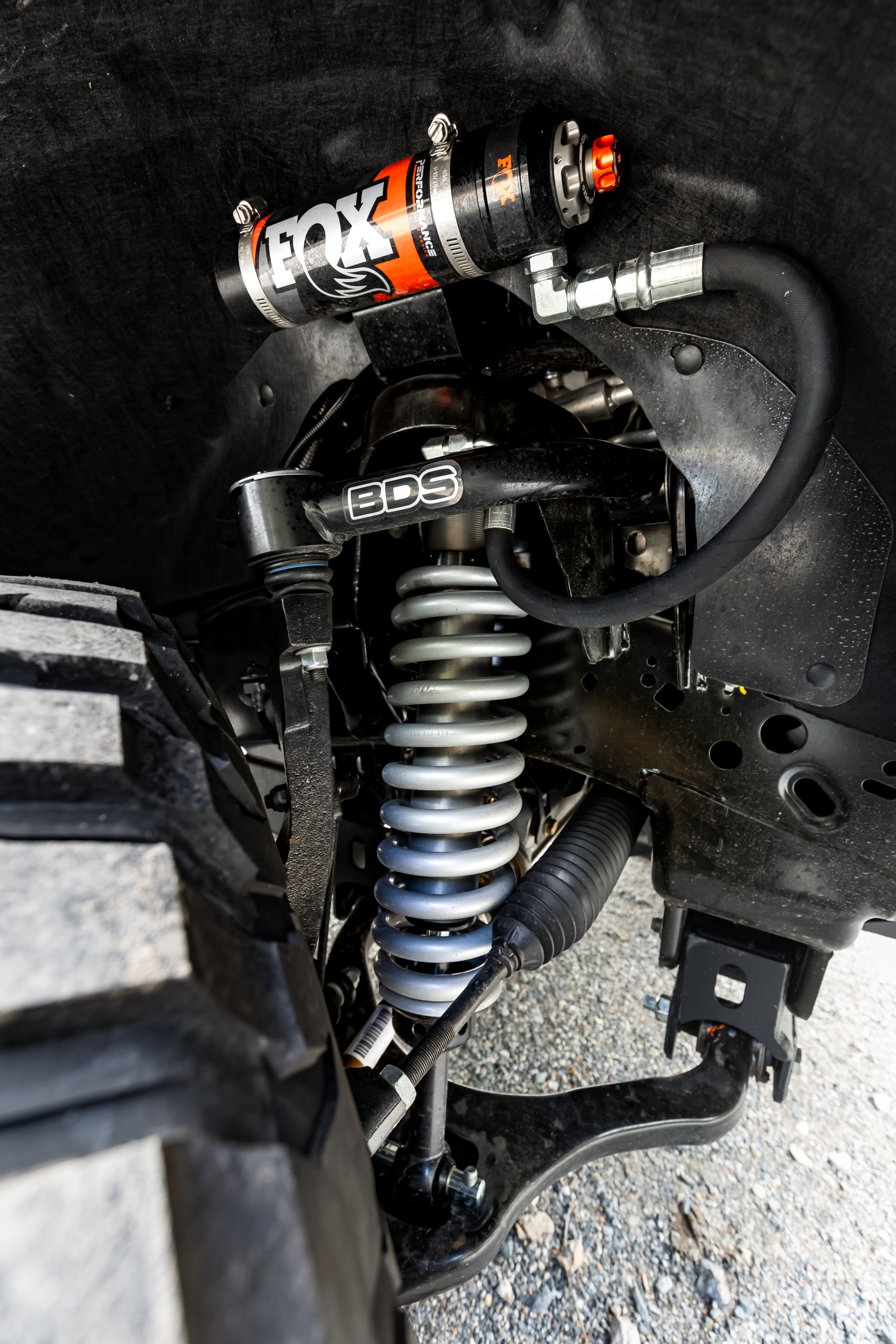
The BDS suspension kits combine the right hardware with the matching springs and shocks. As a division of Fox Shocks, the BDS kits are ideally calibrated to suit the vehicle and its application. Fox shocks can be found under Baja- and Finke-winning trophy trucks and buggies, the best off-road touring rigs as well as OE applications such as Ford Ranger Raptors, F-150s and Broncos.
It is this experience that gives the suspension specialist the knowledge to produce the perfect products for your vehicle, and again James has the relationship with Fox to get the best parts for you here in Australia. The BDS kit for the Silverado HD is so extensive that it does away with the factory torsion-bar front suspension and replaces it with Fox coil-over shocks and bespoke control arms.
Offroad Industries also carries its own range of products for the trucks it supports including the aforementioned bed rack and RTT, plus roller shutters and powered drop-down side steps. When you see some of the three- and six-inch lift trucks that ORI customers are running, you see why the drop-down steps are so popular.
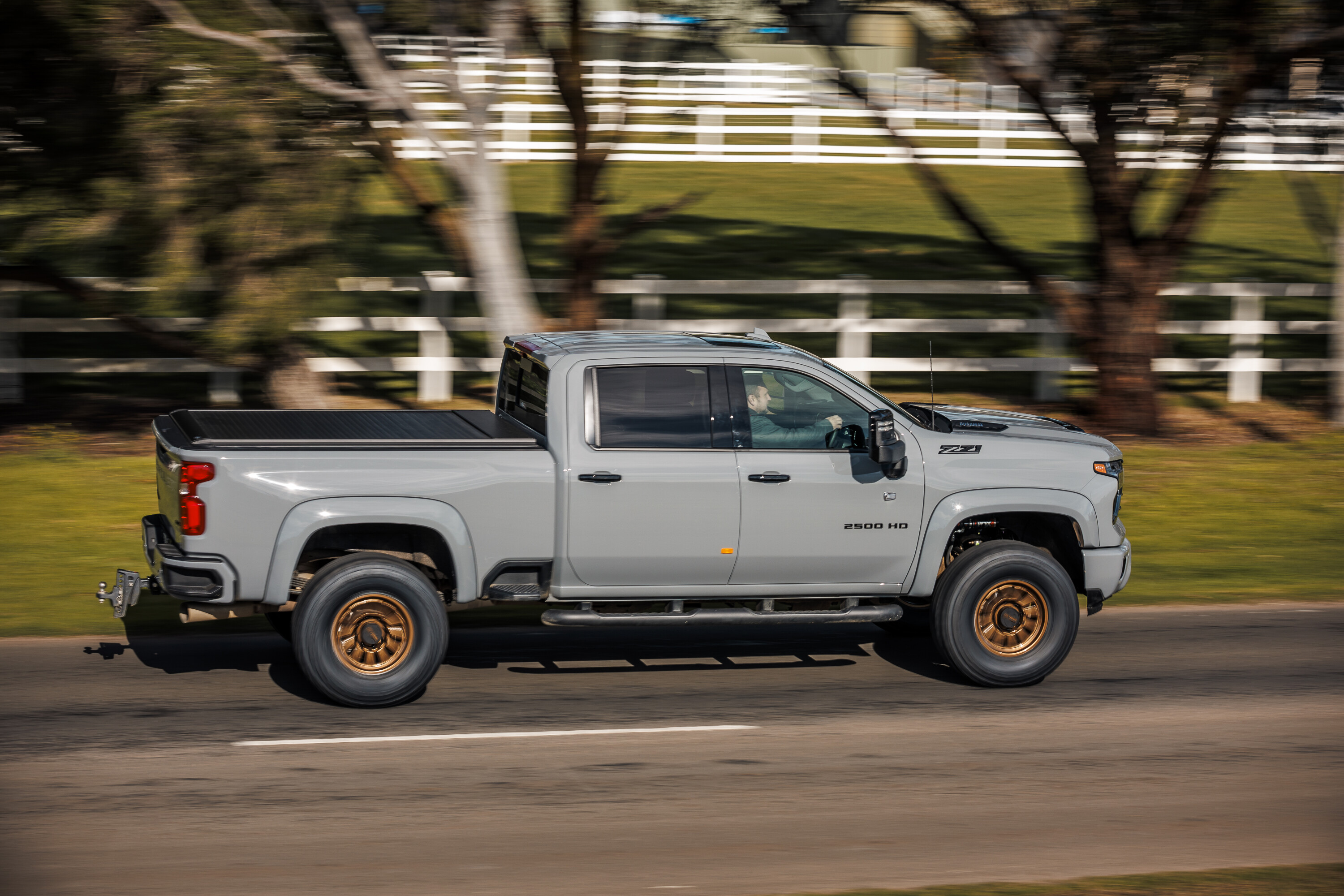
The Chev will be debuting on ORI’s stand at the Melbourne 4×4 Show at the end of August, so be sure to get along to see this stunning rig. ORI will also have its well-known Fox Shocks F-150 on display at the show, showing off the extensive range of products the company carries for the Blue Oval brand, as well as for Chevy and RAM trucks.
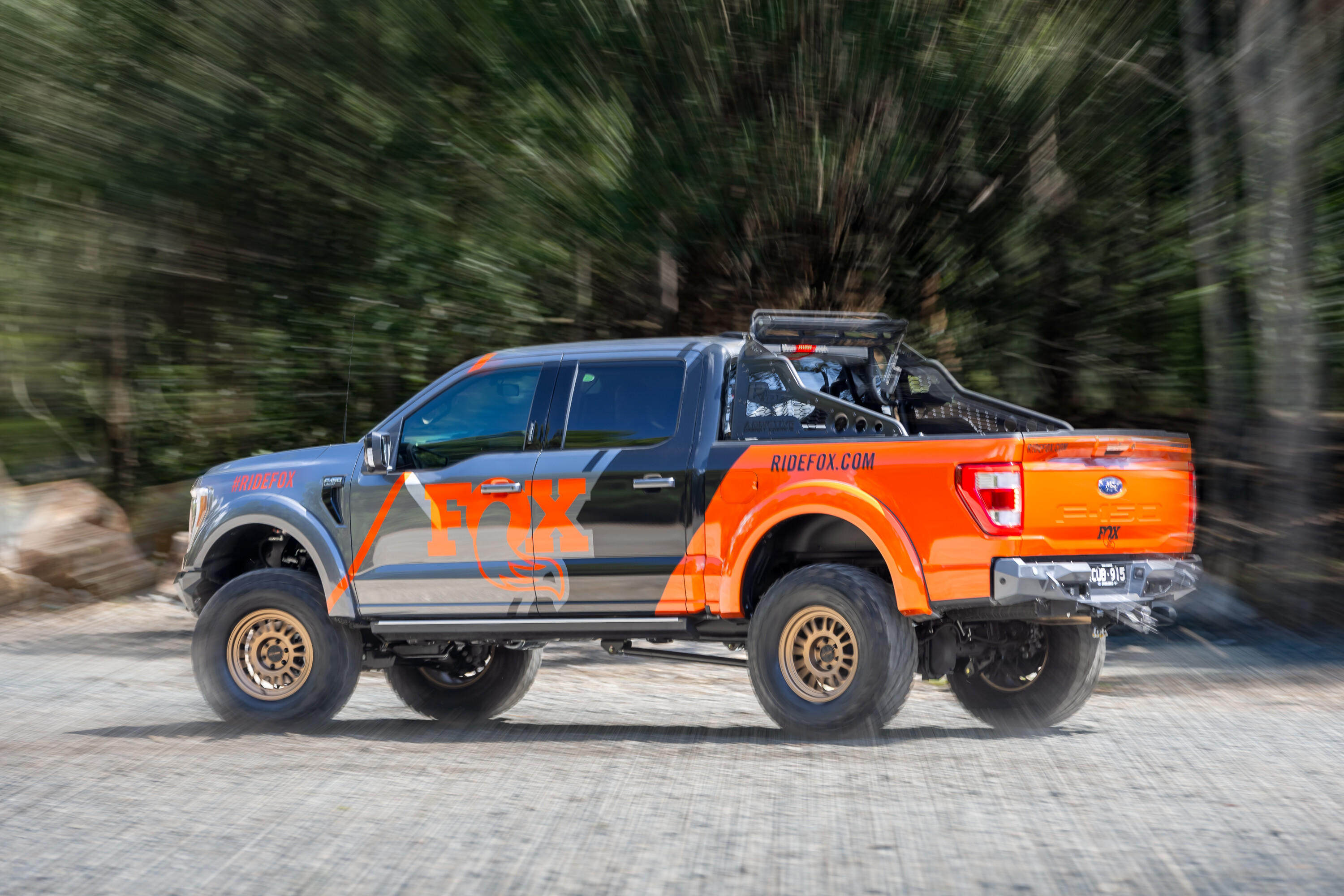
| 6″ BDS suspension kit with Fox 2.5 Performance Elite shocks | BDS Upper Control Arms |
| ORI Electric Steps | Bushwacker Extenda flares |
| Method 318 18×9 rims | Addictive Desert Design Stealth Fighter winch bar |
| BFG KM3 37×13.5×18 | BAJA Designs light bars, front bar and chase rack |
| Addictive Desert Designs AFE front mount intercooler | Addictive Desert Designs Race Series chase rack |
| Addictive Desert Designs Stealth Fighter rear bar | BDS Traction Recol bars in the rear |
| S&B AIrbox | Switch Pro SP9100 control panel |
| Full black-out package by Autoworks |
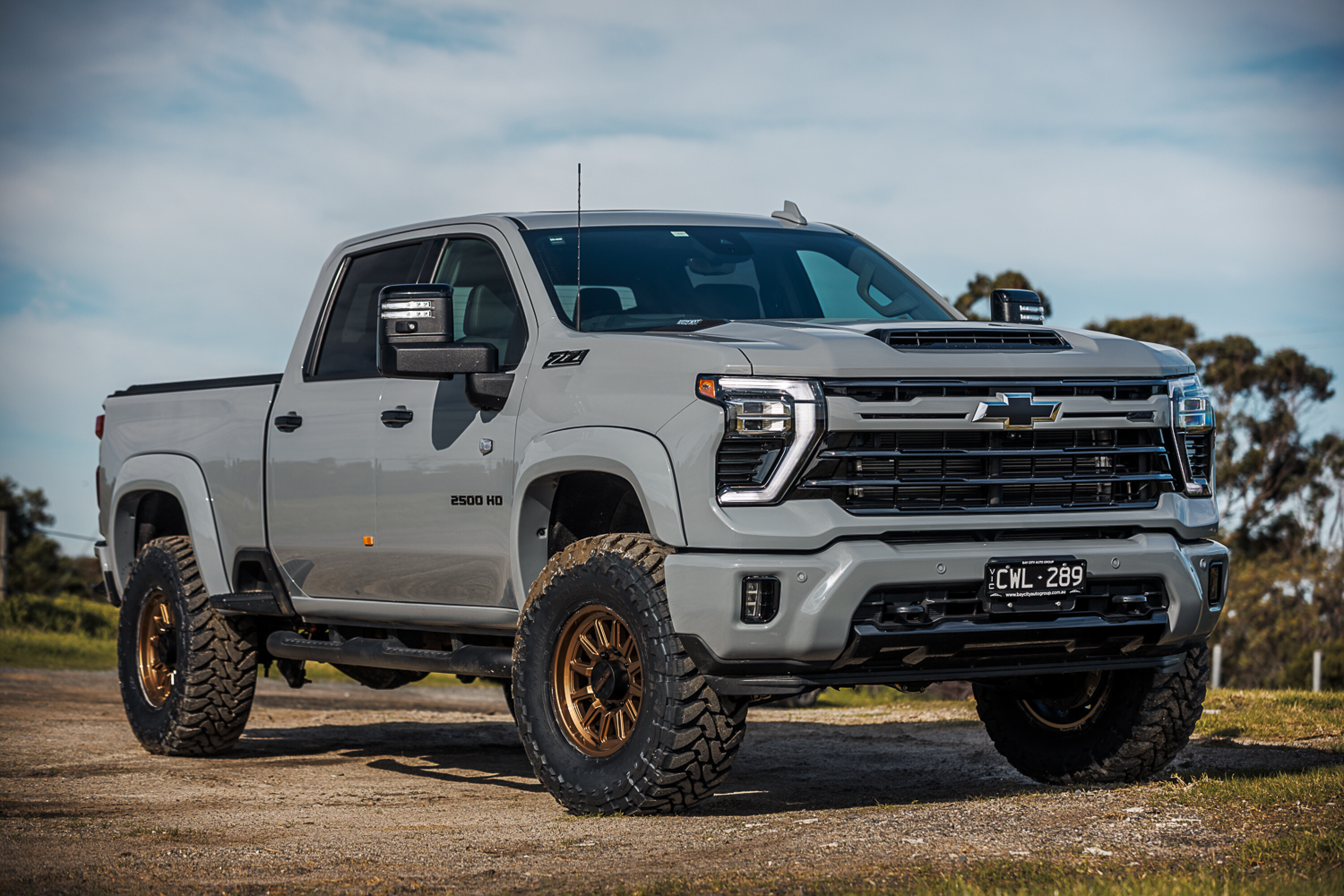
| Gear fitted | |
|---|---|
| 3″ BDS Coilover Conversion Kit Fox Performance Elite Suspension | Bushwacker Extenda Flares |
| Method 323 Bronze Wheels | ORI Electric Roller Shutter |
| 37×13.5×18 Toyo Mud Tyres | |
| Parts to be fitted | |
|---|---|
| AMP Research Power Vision Steps | ORI Roof Top Tent |
| ORI Awning | Kelderman Airbag 4 Link Suspension |
This Great North Road is soaked in the blood, sweat and tears of the convict road builders and the spirits of the past are strongly felt here. Visitors in years past used their imagination to conjure up the phantoms of the road but now those phantoms are real, and they speak to us.
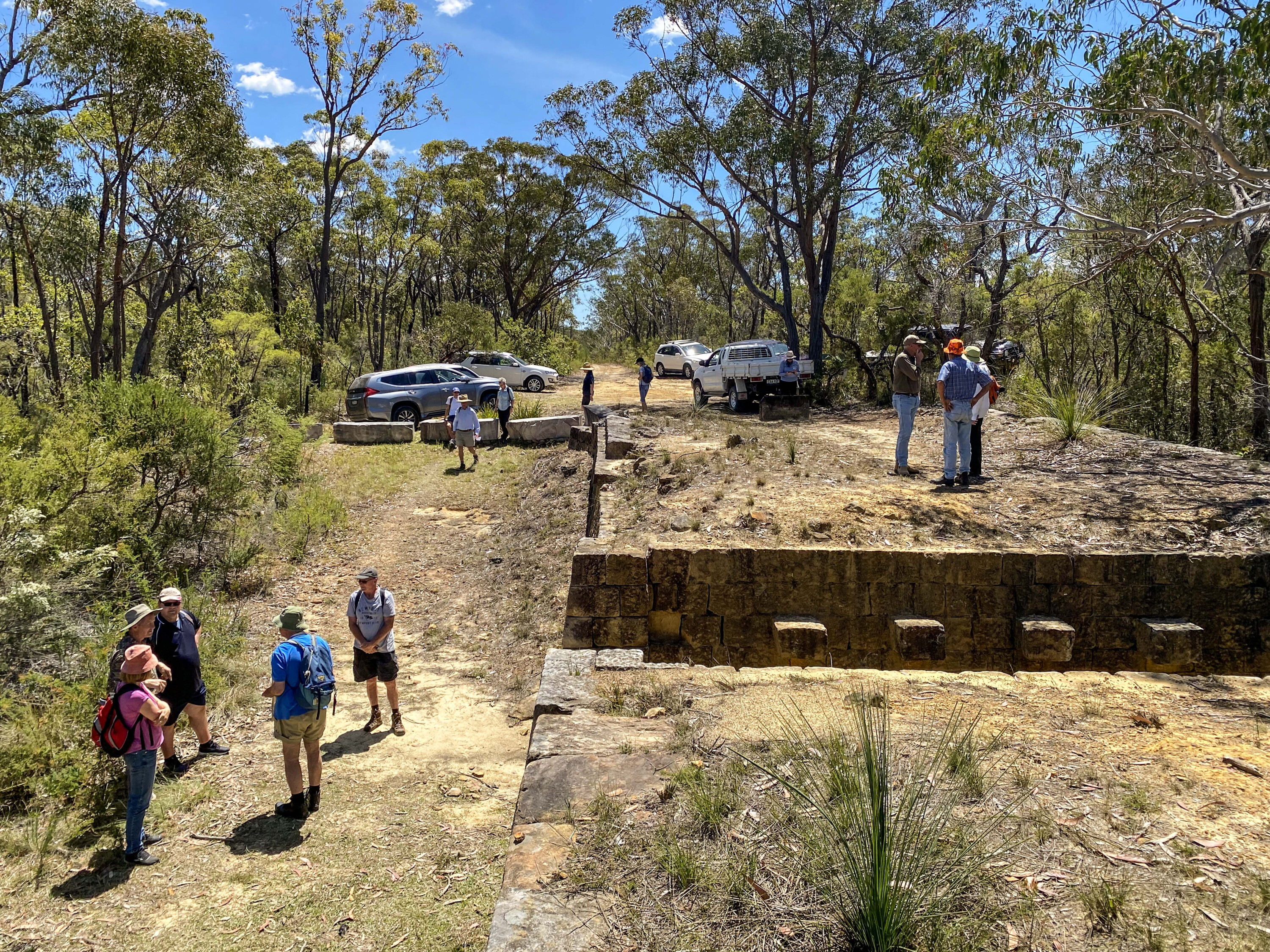
The convict engineering works on Devines Hill attract our admiration and wonder. Now, the National Parks and Wildlife Service has enhanced our experience with the inclusion of metal cutouts and sculptures which appear at regular intervals and speak to us by way of signboards.
The Great North Road from Sydney to the Hunter Valley was constructed with convict labour in the early 1830s. This section at Wisemans Ferry makes an excellent circular walk by ascending Devines Hill and descending via Finch’s Line with a 2km road walk back to the start.
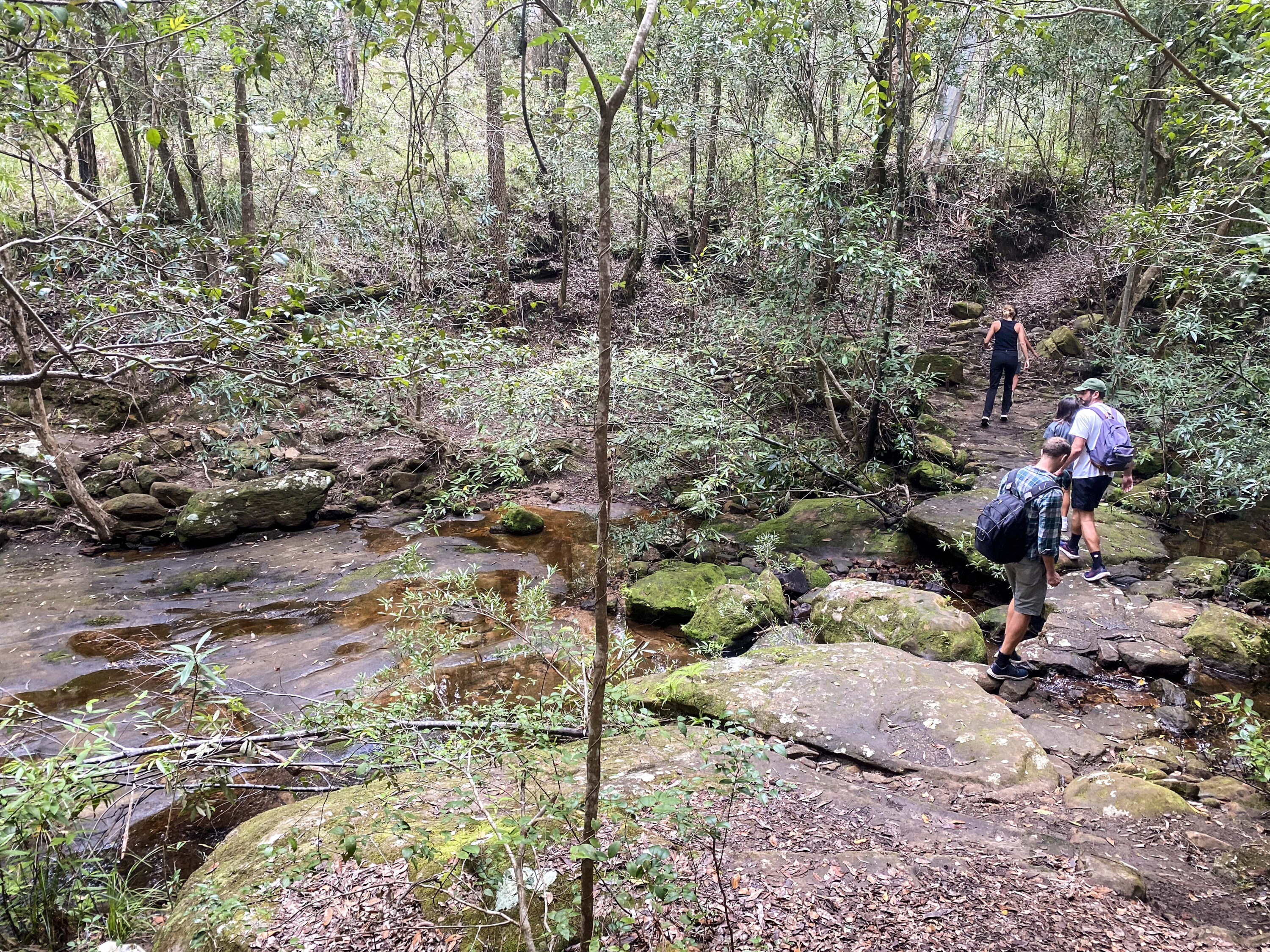
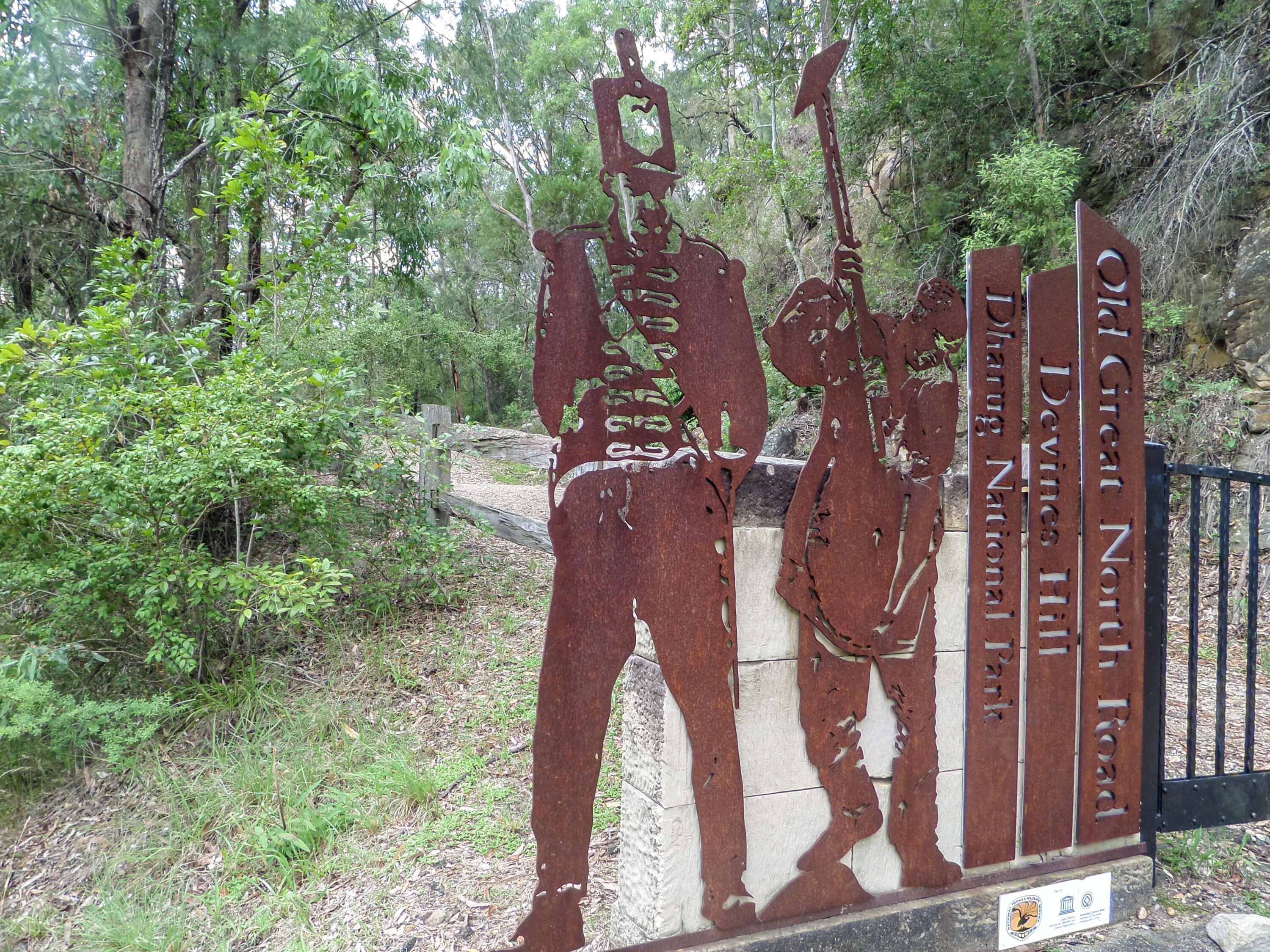
The small Finch’s Line roadside carpark, downstream from the ferry, has a metal entry sign. Not very far up the track you come to the first phantom figure which seems to emerge from a large mossy sandstone boulder.
This Dharug man offers us a welcome with ‘warami wellamabami’. He relates to us how his people had marked tracks and routes all over this country and how aboriginal families guided Surveyor General Thomas Mitchell on a route to survey his great road.
When Governor Darling visited in 1829, he was not impressed and ordered Mitchell to find a better route. Finch was replaced and Mitchell surveyed his ‘better road’ up Devines Hill.
Today’s walkers can continue up Finch’s Line or return to the cars and drive to the upstream carpark from the ferry to the start of the Devines Hill walk.
Extensive modern roadworks are taking place between the ferry and the start of the walk at Devines Hill and delays could be encountered. Recent landslips took out this section of road as well as the convict built retaining walls and the historic Thomas James Bridge.
Reconstruction work began in early 2023 and included photographing and labelling each of the huge bridge and wall stone blocks and removing them for later reassembly as a façade in front of new concrete walls and foundations.
At the start of the walk, a menacing soldier and a sweating convict meet you at the gate. Just beyond the gate another Dharug man welcomes us to his country.
Soon after, Surveyor-General Major Mitchell himself appears from the bush at the edge of the road and tells us of his road-building skills. This section of road is still a marvel of design, construction and drainage systems and is recognised as a National Engineering Landmark.
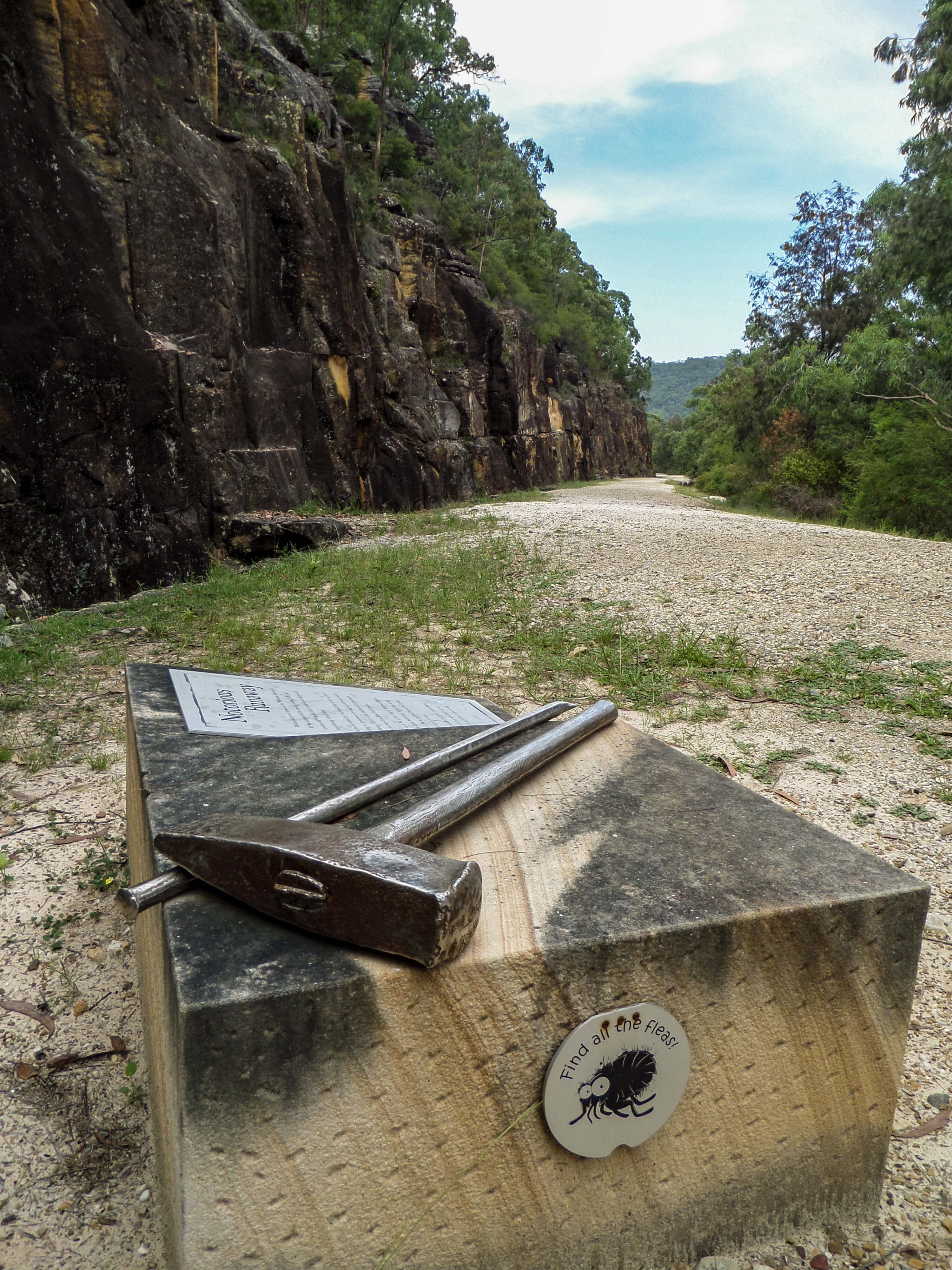
Two of those convicts were Owen and Mary Devine who eventually came to own the land where the road ascends the ridge. A sign here explains their story. This sign marks the first of the metal sculptures sitting on sandstone blocks. Metal leg-irons here can actually be worn.
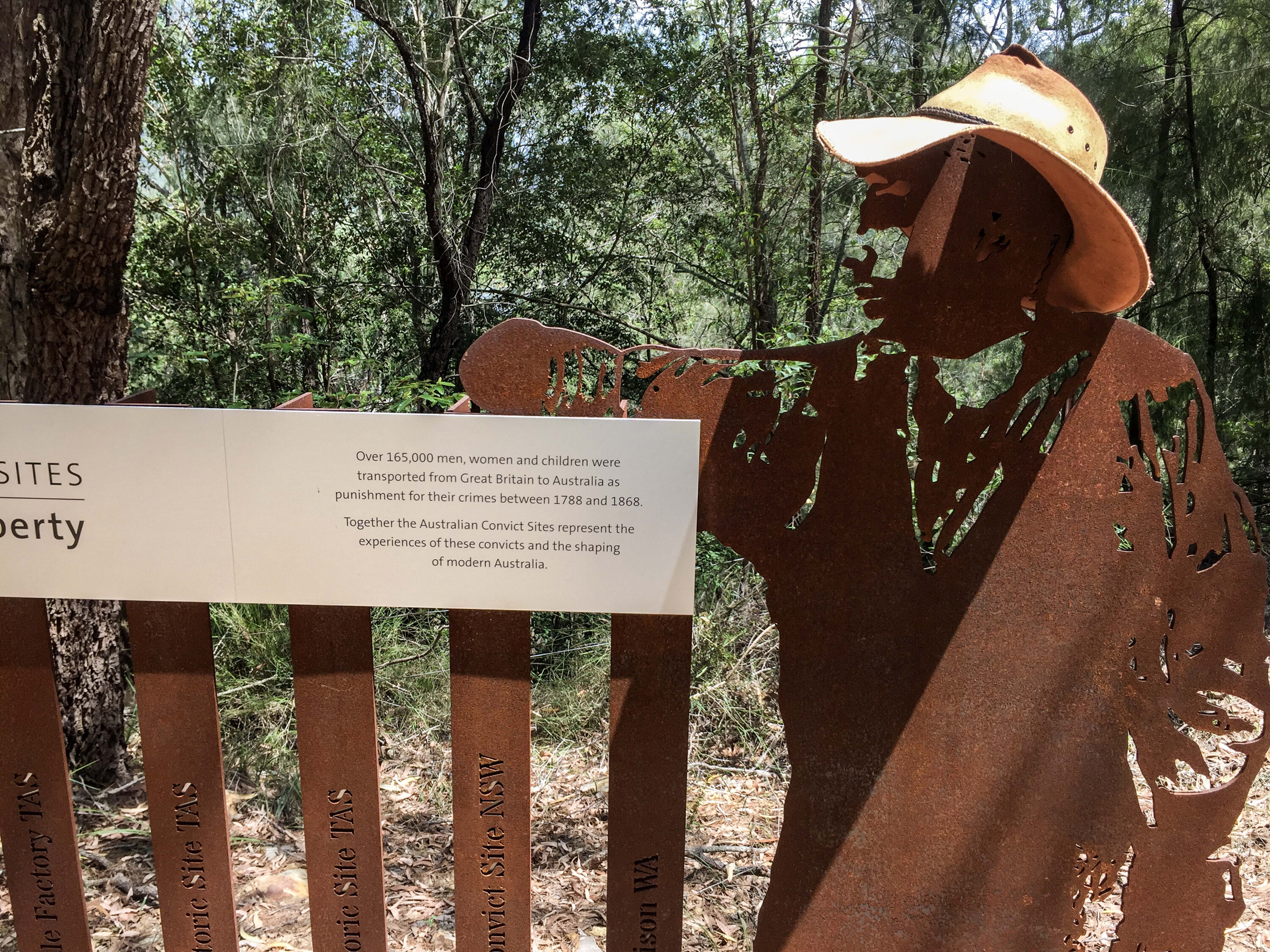
Children will love this walk for the phantoms and the sculptures. An added bonus are the ‘flea doors’ that are attached to the blocks. Children can open them to find interesting and gross facts. Other metal sculptures along the way include a poignant boot, tools, cat-o-nine tails and clothing.
Now two convicts work with hammer and bar on the rocky ledge above our heads. When the summer heat is reflecting off those sandstone walls, we can almost see the sweat dripping from their tired bodies.
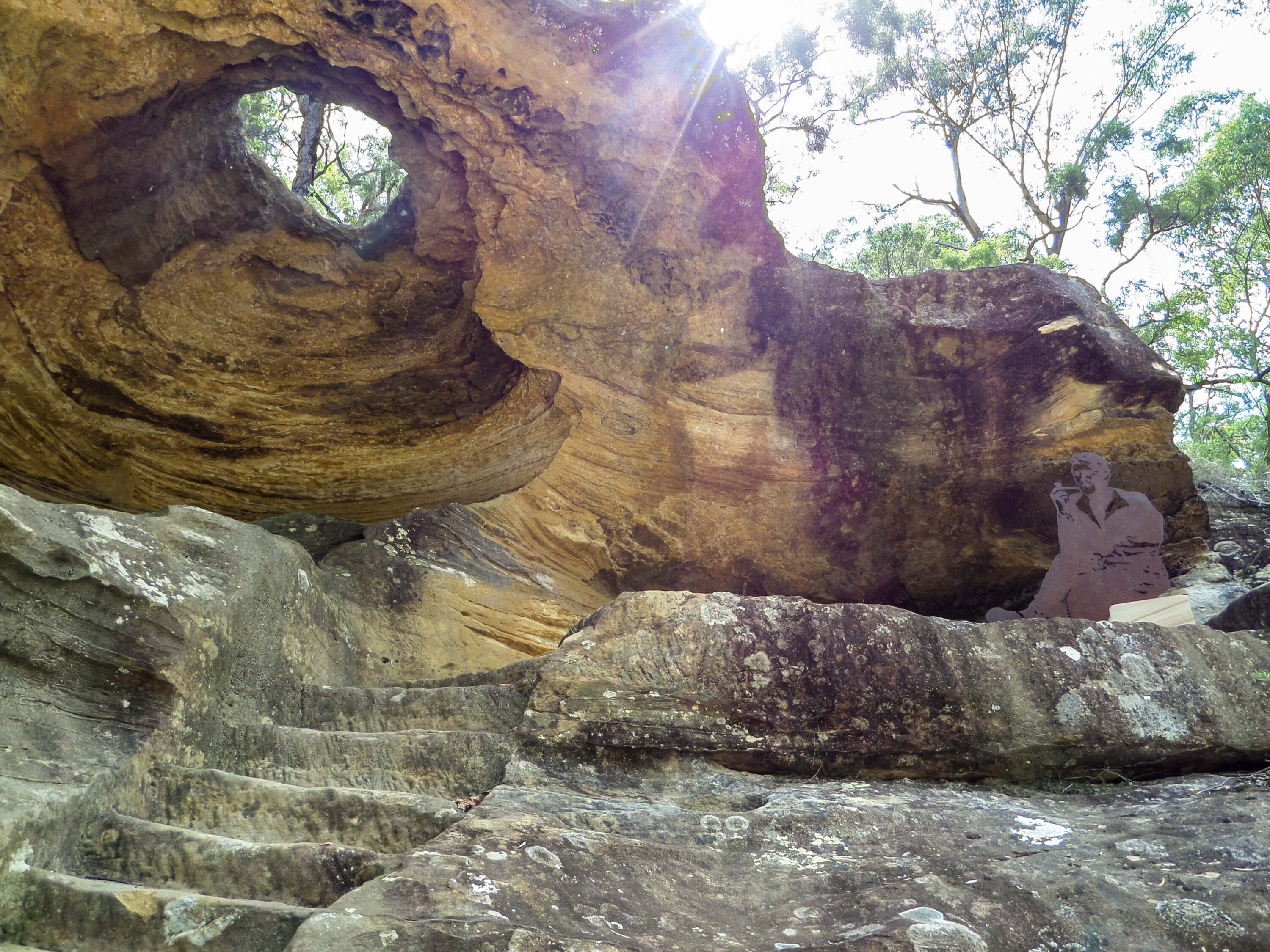
Around the bend is the ‘Hangman’s Cave’. The cave has a convenient hole in the top but was certainly not used for executions. Steps and a bench have been cut out of the sandstone here, possibly for storage or as an overseer’s observation post. We may never know what the cave was used for but look; there is an overseer sitting up there now smoking his long clay pipe.
The top of the ridge is not far off where the return descent can be made or continue to the right-hand turn which will take you out and down Finch’s Line, which takes the best part of a day.
From the top of the ridge, it is possible to walk the rest of the non-trafficable length of The Great North Road. This is a two-to-three day trek with a camping area at Ten Mile Hollow and bush campsites at Frog Hollow and Hungry Flat. Water can be scarce in dry times.
There are numerous examples of convict stonework along the way for the observant walker. Ten Mile Hollow and adjacent Clare’s Bridge are particularly noteworthy. This entire section of the convict road is no longer available to traffic.
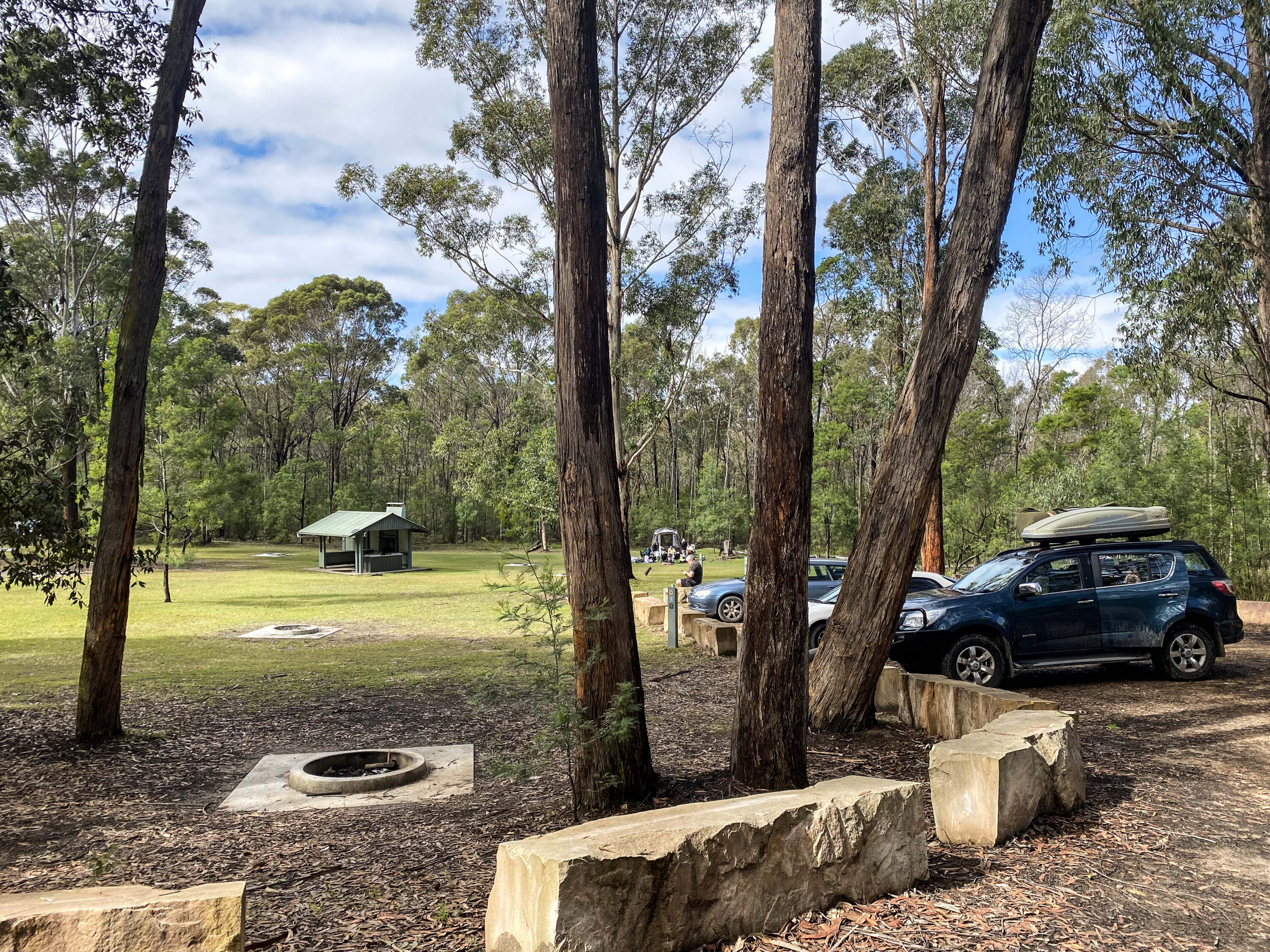
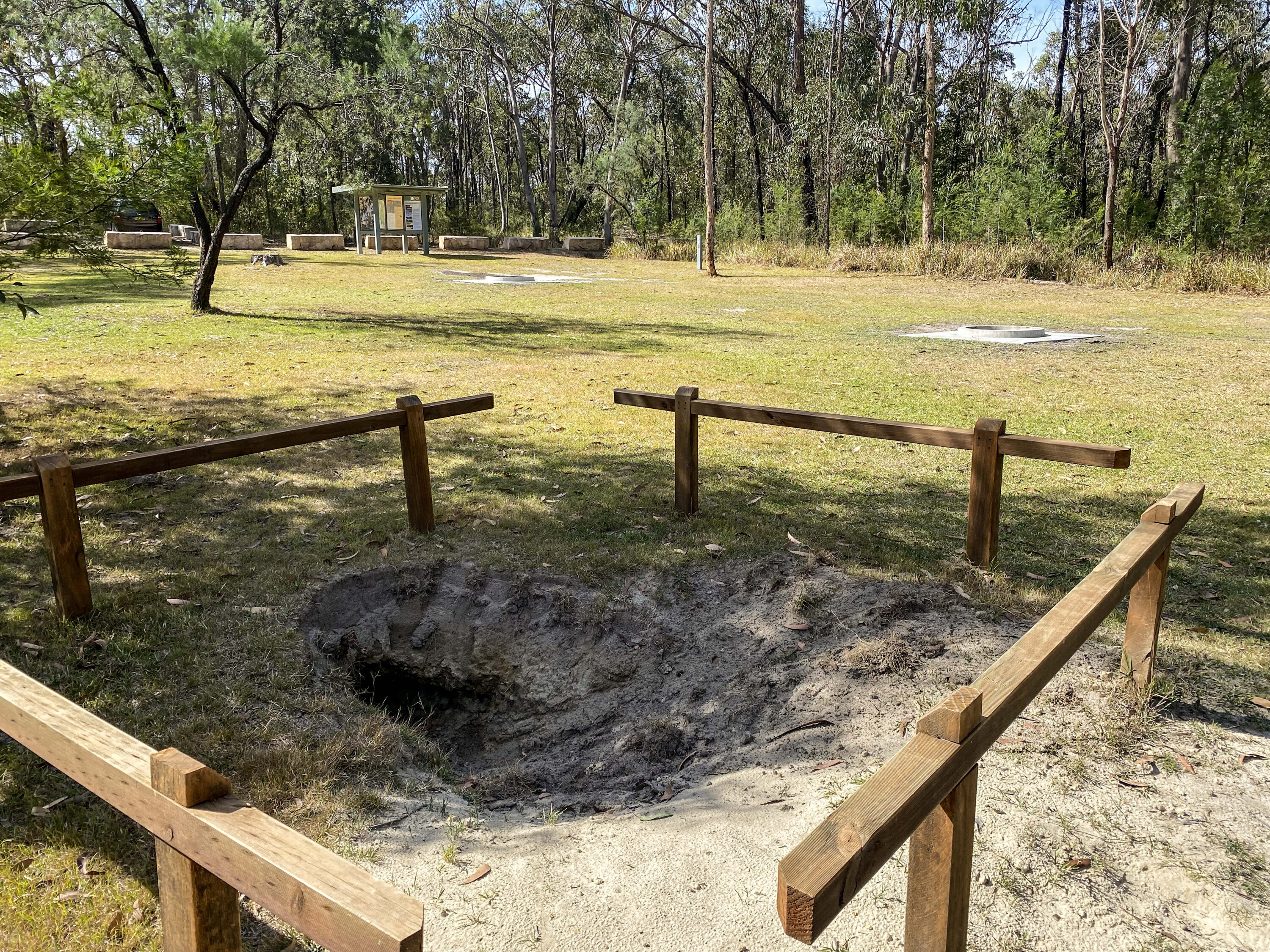
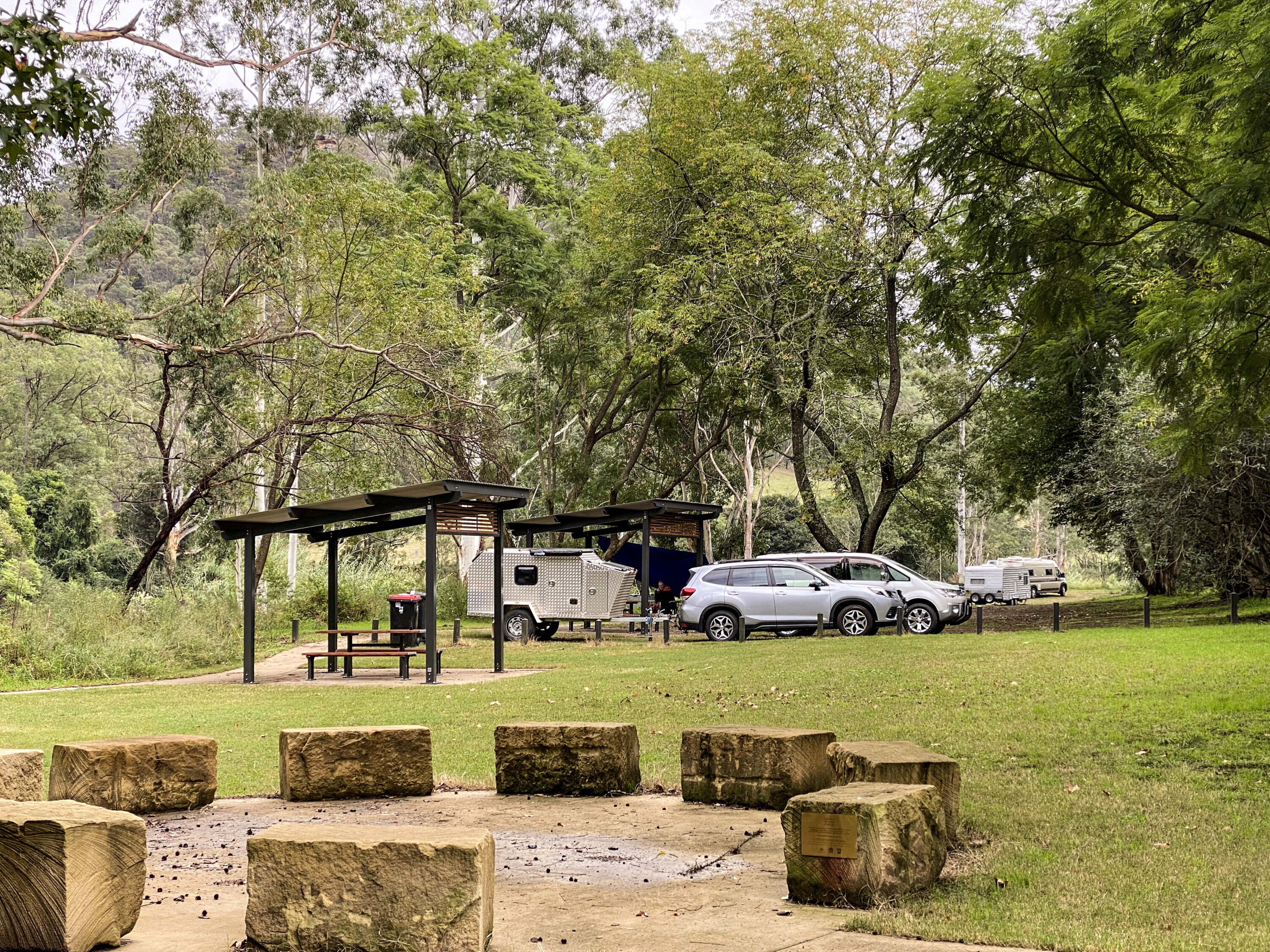
The camping area and the separate picnic area have composting toilets, picnic shelters, firepits; bring your own wood and drinking water. There are also long and short walking tracks with splashing holes in the creek for warm weather.
Campsites 1-8 have no carpark barriers and are best for vans and trailers. Sites 9-20 are close to the carpark barriers but not suitable for turning vans or trailers. Sites 21-30 are a very short walk from the carpark barriers. There is also a separate large group camping area. While in the Gunderman area, call at the Wombat Café for a six-pack of fresh mega-scones!
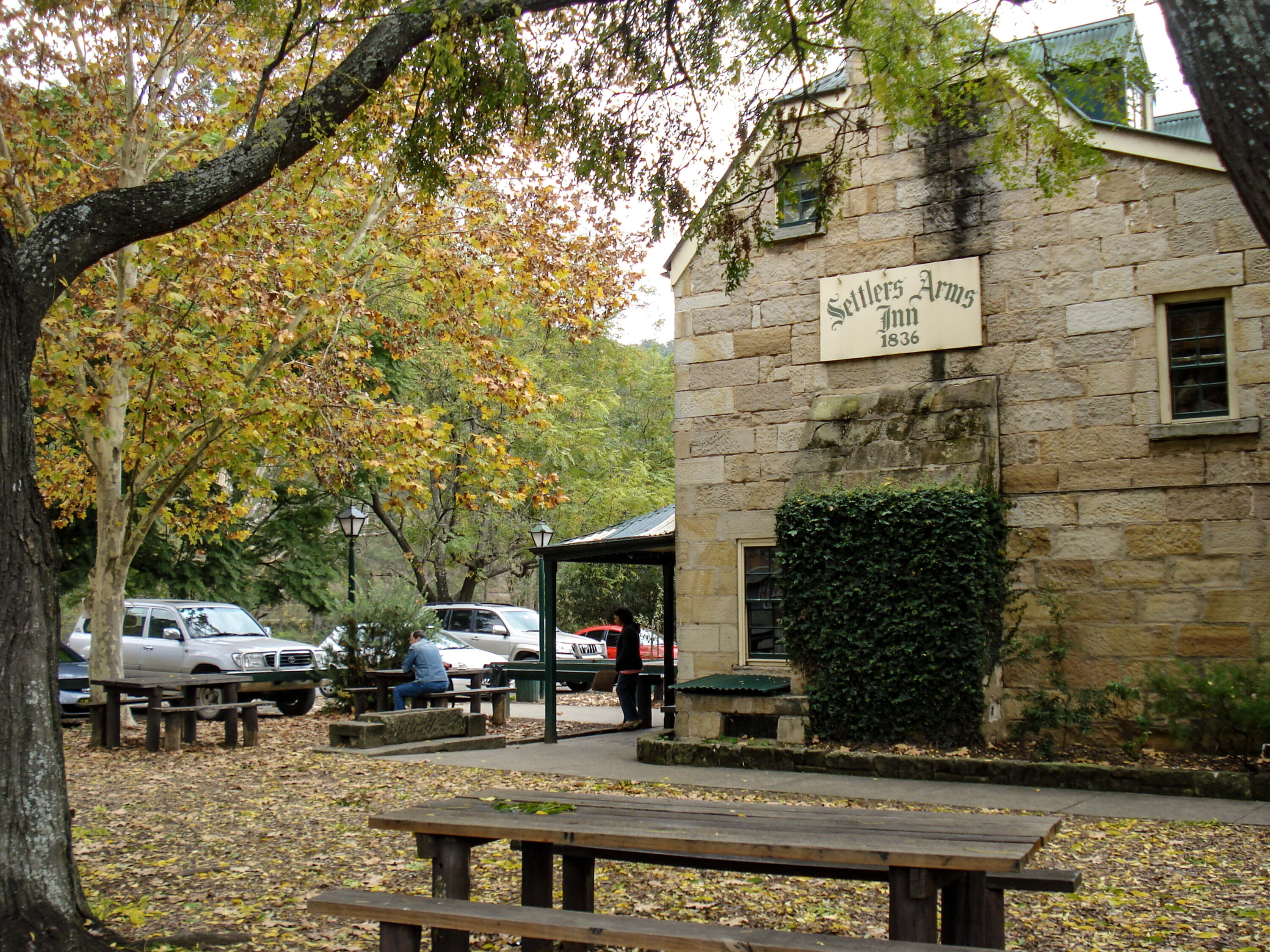
The historic village of St Albans has a free camping area opposite the Settlers Arms Inn above the Macdonald River. The camping area has picnic shelters, playground and flush toilets but no drinking water. The 1836 Inn is licensed and provides meals and accommodation. There is also a café nearby.
The old convict road emerges from the bush in the north near the Mogo Camping Area. Here is another wonderful daywalk, to inspect the Circuit Flat Bridge. No phantoms here though, but you might discover near the bridge, the roadside carving of naked ‘Collier out for a Dip.’ The walking track can be followed from the camping area, or the walk can be southward along the old road.
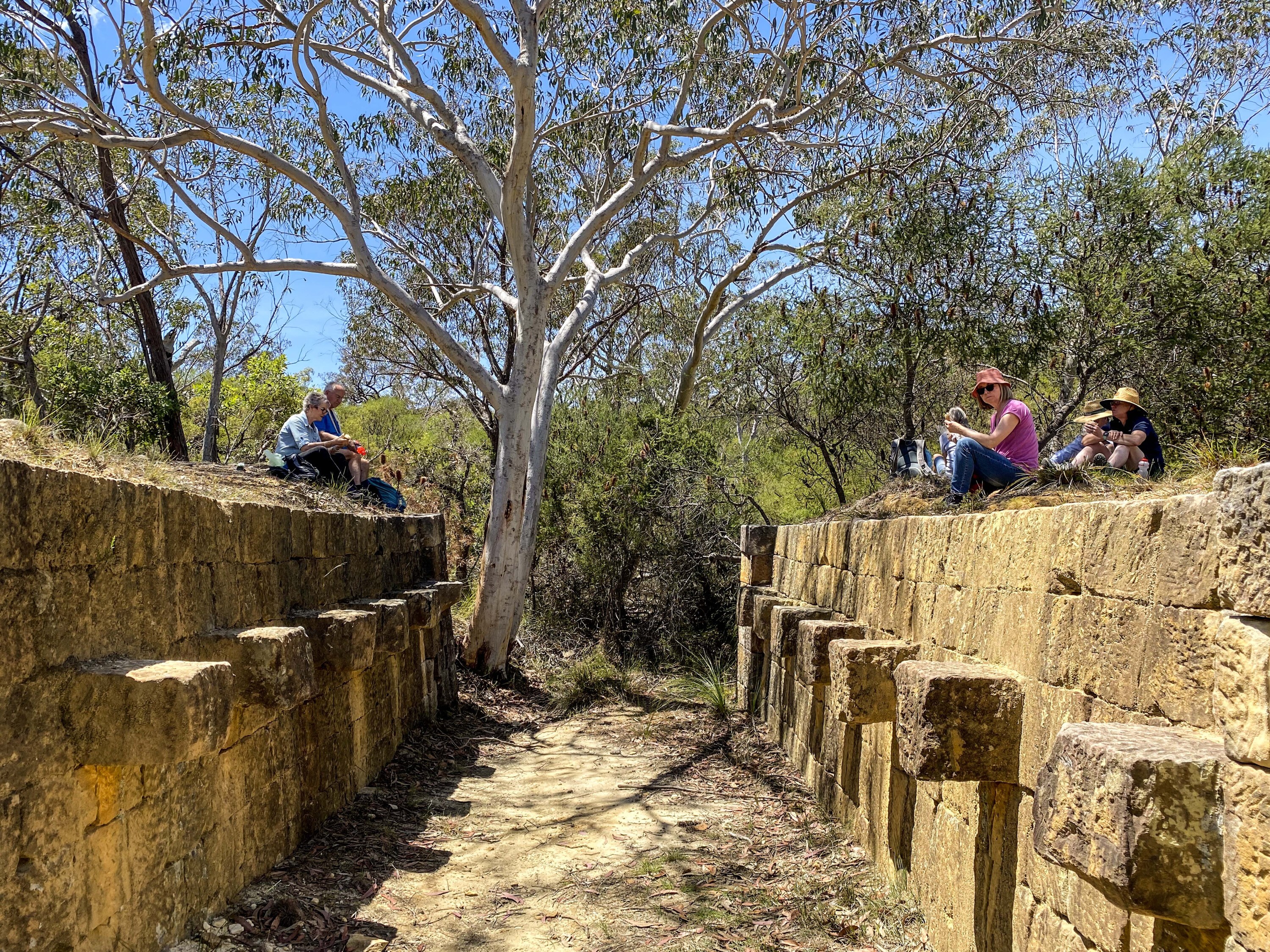
The walk to the bridge is flat and sandy, and wildflowers are a feature. The bridge has long stone abutments, but the wooden deck is now gone. The bridge was built by convicts in 1831 and is Australia’s fourth oldest bridge. The interesting features are the sandstone blocks that protrude from each face of the wall. These once supported the wooden struts that supported the deck.
If time allows, the road can be followed southward on foot, towards Sampsons Pass, taking note of stone carvings, gutters and walls along the way.
Ten grassy camping sites are located in a circle beyond a barrier fence from the carparks. Sites 1-2-3-10 are closest to the car park barriers, while the other sites involve a very short walk. In spring, the wattles are magnificent.
There are wood firepits – (bring your own wood), camp kitchen shelter, picnic shelter with tables, information boards, non-flush toilets and a water tank (bring your own drinking water). Bookings are online and there is a camping fee.
For vehicle touring along the Great North Road see the free Cartoscope Map which is available in the area.