
Like many of us with older vehicles, I service and maintain my own 4×4 – a 2005 Toyota HiLux. With 352,000km on the clock, it’s a little past warranty!
As well as being a travel truck and tow rig, my HiLux is my daily driver and I often commute between Sydney and Newcastle, so the kays rack up reasonably quickly. And with my preference for 10,000km oil changes on its dual-fuel LPG-injected 4.0-litre V6, every few months I’m flipping oil and filter in my garage.
I look after my tyres, too. I make sure to switch around the wheels and tyres after a few months of use, to even out the wear and prevent the saw-toothing of the tread that often occurs with more aggressive tread patterns. With a floor jack, safety stands and a wheel brace (or a rattle gun), it’s a 10-minute task.
I intended to flip my treads during the morning before editor Matt, my mate Batesy and I left for a week touring through the Victorian High Country over the New Year break. Matt was due at my place around lunchtime so we could get to the Snowies that evening.
So I wandered down and lifted my garage door. Would you believe one tyre was flat? I’m sure I frowned and began looking around for Matt – or another one of my crazy mates – to jump out from behind a tree or fence and say: “Hah! Just kidding!” But, no, I found a roofing screw through the tread of my drivers’ side front tyre. Bugger!
I carry an ARB/Safety Seal puncture repair kit and an ARB compressor in my HiLux, so fixing the tyre was a five-minute task without even removing it. If you don’t have a tyre repair kit, get one! I reckon this is the twentieth time it has come in handy for quickly fixing tyres, whether at a Bunnings car park, a racetrack, or in the middle of nowhere. Roofing screws seem to litter the planet!
As soon as the tyre was repaired, I moved my HiLux into my garage and placed it on axle stands so all four wheels could be removed and swapped around – front to rear and vice-versa. Checking the vehicle logbook revealed that the tyres had been worn for closer to 10,000km than 5000km, so they were long overdue for a rotation.
I gave the front brakes a quick check while the wheels were off. Lucky! My front brake pads were just about shot – less than 1mm remained. So it was off to the parts shop for a set of fresh front pads.
The front discs – more than likely the Toyota originals despite the 350,000km travelled – were above-spec. Rotor longevity is something I often muse over as I read comments from Facebook experts who sneer at Toyota’s ‘tax’ (parts pricing) … then have to replace their own ‘other brand’ discs at 40,000km.
I got my HiLux back on its wheels about 20 minutes before Matt arrived in his long-term test rig, a Mazda BT-50. I spent the seven-hour drive to the Snowies thanking my lucky stars that I’d checked things out, because 2.4 tonnes of HiLux with no front brakes in the Snowy River National Park could have been more of an adventure than we’d planned!
Back in the mid-1990s, the maximum braked towing capacity of most popular large wagons including the 80 Series Land Cruiser and GQ Patrol was 2500kg, while many of the dual-cab 4×4 utes such as the Toyota HiLux and Nissan Navara were, quite sensibly, rated to handle a maximum braked trailer weight of only 1500kg.
Today, if a 4×4 doesn’t have a braked towing capacity of more than 3000kg, it’s simply not in the game, dual-cab utes included. How has this massive increase in towing capacity been achieved?
Logic would suggest four-wheel drive manufacturers are now using stronger materials, cutting-edge design and beefier construction techniques to more than double the braked towing capacity of the latest generation of 4×4 utes, but poke your head beneath one and you won’t spot any significant changes to chassis design or suspension and braking components. Nope, most modern 4×4 utes are still running a separate chassis, leaf springs, live axle rear-ends and disc/drum brake set-ups.
It’s interesting to compare the modest payload increases achieved over the past 20 years to the massive towing-capacity increases. Comparing a base-spec 1995-model Navara dual-cab ute with its modern equivalent, payload has increased by just 24kg (from 1010kg to 1034kg) while braked towing capacity is up a staggering 2000kg (from 1500kg to 3500kg).
In the case of a base-spec HiLux over the same period, payload has decreased by a whopping 245kg (from 1165kg to 920kg) while braked towing capacity has more than doubled from 1500kg to 3200kg.
You might think the vehicle manufacturers use a specifically legislated formula to calculate a vehicle’s maximum towing capacity, but in truth they are left to their own devices to set towing weights.
Factors they take into account include vehicle design, engine output, axle capacity, tyre ratings and the effect that trailer weight will have on the vehicle’s stability and overall durability when towing. It’s likely the marketing teams have input as well – maybe not the final say, but definitely some significant influence.
While hardly anyone will ever hitch a 3.5-tonne trailer to the back of a Navara, Ranger, Colorado, D-Max or BT-50, the fact that the vehicle manufacturers say they can is a bit of a worry. After all, hanging that much weight off the back of a ute that only weighs two tonnes is hardly a recipe for a stable set-up, especially when you consider all that weight is connected to a hitch that is a metre or so behind the rear axle.
When I was first tasked with conducting a towing test back in 1995, I didn’t have a hell of lot of experience with trailers. Sure, I’d occasionally borrowed the old man’s box trailer to drag my dirt bike out to the scrub for a ride, but that was about it. Yet here I was, cruising down the Princes Highway with a two-tonne boat and tandem-axle trailer hooked up behind vehicles including an 80 Series Land Cruiser, a GQ Patrol, a Discovery and a Pajero.
Fortunately I had sense enough to know the key to successfully towing such a sizeable set-up was to keep things smooth – no hard acceleration, no stomping on the brakes and no sudden changes of direction.
Nevertheless, I had a few moments over the week of testing, and at one time almost got it all crossed up trying to stop at a set of traffic lights that were about to turn red. Luckily the braked towing capacity standard back then was 2500kg and not 3500kg, because I reckon if I’d had an extra tonne behind me I would have been stuffed.
On the positive side, modern four-wheel drives (even utes) are equipped with a number of electronic safety aids that greatly benefit towing, such as ABS, electronic traction control, stability control and, in many vehicles, trailer sway control. Trailer sway control uses sensors in the vehicle – such as for steering input and vehicle yaw – and a mix of engine output and brake control to suppress lateral movement that can be caused by a variety of factors including crosswinds, changes in road surface and steering input. It’s probably the greatest advancement in towing safety over the past 20 years.
Obviously, because it seems that nothing much else has changed.
Introduced in late 2015, the Renegade is Jeep’s new baby wagon. Jeep fans may not like the fact that the Renegade, a name steeped in Jeep history, is now a passenger-car based SUV, but that’s the price to be paid for being alive.
The Renegade is more Fiat than Jeep, and if it wasn’t for Fiat helping to bail out Chrysler (Jeep’s owners) from bankruptcy in 2011, Jeep mightn’t even be around any more.
In Australia the Renegade comes in five models, but only one – the ‘Trailhawk’ you see here – has four-wheel drive, which at least is the basis of a claim to being a Jeep. That claim is further strengthened by the fact the Trailhawk is powered by the only US-sourced (Chrysler) engine among a wide range of Fiat engines used across the rest of the range globally.
Thankfully, the Jeep ‘influence’ in the Trailhawk also runs to an additional 20mm of ground clearance (up to 220mm) over the other Renegade models, different front and rear panels for steeper approach and departure angles, substantial underbody protection, a full-size rather than a space-saver spare, and all-terrain tyres.
POWERTRAIN AND PERFORMANCE The Trailhawk’s Chrysler-family engine is a single-cam 16-valve 2.4-litre petrol four that claims 137kW, a decent amount of power given the Trailhawk’s reasonably trim 1550kg.
However, the engine needs plenty of revs to give its best. In fact, a heady 6400rpm is required to produce all 137kW. While the maximum torque, a modest 236kW, doesn’t clock on until 4400rpm.
If this sounds like a major shortcoming, don’t fear too much. The engine has a willing ally in the nine-speed ZF ’box. Having so many speeds allows close ratio gaps, which is what you want for a peaky engine.
On the road you have to keep the engine busy if you what good progress, but its balance shafts help to ensure it feels reasonably smooth and refined – even if it’s a bit noisy.
ON-ROAD RIDE AND HANDLING The Trailhawk’s lightweight, fully independent suspension and nice balance makes for a sporty on-road drive. This is helped by a compliant ride over lumpy bitumen and unsealed roads. Not so good is the generally high level of road noise.
OFF-ROAD The Trailhawk’s 4×4 system is called ‘Active Drive Low’, despite not having low-range. It even has a ‘4WD Low’ switch; although, the main thing this seems to do is cancel the ESC, which is what happens when you engage low-range on a dual-range 4×4. At least the single-range system has a respectable 20.4:1 crawl ratio.
Special programs for Auto, Sport, Snow, Sand, Mud and Rock tweak the throttle mapping, gearbox shift protocols and the like, while the off-road settings automatically lock the centre electronic ‘diff’, which can be locked separately via the ‘4WD Lock’ switch.
In what is a silly arrangement, if you try to select the ‘Rock’ program you are prompted to first engage ‘4WD Low’, as per the usual protocol with a dual-range 4×4. Who are they trying to kid?
Once you get past all this carry-on, the Trailhawk rewards with its decent ground clearance and steepish approach, ramp-over and departure angles. Thanks to the clever design of the rear wishbones there’s even a surprising amount of rear-wheel travel.
Not so good is the electronic traction control system that isn’t as effective as you’d expect, especially given the very effective ETC on the Cherokee Trailhawk – which also uses a fully independent (but larger) Fiat platform.
Regardless of the off-road effectiveness of the Renegade Trailhawk, it is very well protected underneath – much more so than your typical compact SUV. You might not get all that far, but at least you shouldn’t do any damage in the process. However, Jeep claims a modest 480mm wading depth due to the low-mounted air intake, so water crossings need care.
The full-size spare is also a practicality bonus, as are the reasonably aggressive all-terrain tyres – even if they look a little low in the sidewall. With the guard clearance it looks like you could fit something taller.
CABIN, ACCOMMODATION AND SAFETY The Trailhawk is smaller inside than something like a Subaru Forester, with a narrow, short-but-tall cabin that’s nicely detailed and finished. It feels quite luxurious with leather and all.
It’s also surprisingly accommodating for its size given a tall adult can still sit behind a tall driver, even if it’s a squeeze. The driving position is comfortable and has lots of adjustment, but the wide A-pillars are annoying, vision-wise.
The second-row seats benefit from deep cushions, but aren’t wide enough for three adults. While the modest cargo area has a high floor due to the full-size spare.
The Trailhawk has plenty of safety kit among a long list of standard equipment, but it hasn’t been ANCAP rated as yet.
SUM UP The Trailhawk is a fun and reasonably effective light-duty 4×4, but it feels expensive at $40K – even given its generous equipment.
It’s a shame it doesn’t come with one of the diesel engines fitted to Renegade models overseas, but that’s very much Jeep’s way when it comes to off-road specific variants in other model ranges.
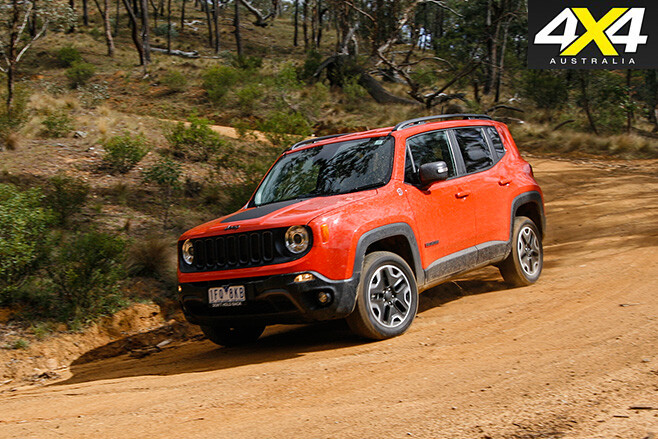
SPECS Engine: SOHC 16-valve petrol 4cyl Capacity: 2.4-litre (2360cc) Power: 137kW @ 6400rpm Torque: 236Nm @ 4400rpm Gearbox: 9-speed auto 4X4 System: full-time, single-range Crawl Ratio: 20.4:1 Construction: monocoque Front suspension: independent/coil springs Rear suspension: independent/coil springs Wheel/tyre spec: alloy/215/60R17 Kerb Mass: 1550kg Towing Capacity: 907kg Seating capacity: five Fuel tank capacity: 48 litres ADR fuel claim: 7.5L/100km Test fuel use: 10.1L/100km Fuel requirement: 91RON ULP Touring Range*: 425km Price: $40,000 (plus on roads) Based on test fuel use, claimed fuel tank capacity and a 50km ‘safety margin.
As our crew vehicle, the 2008 HiLux in the shed has seen some of Australia’s most well-known back country tracks. And, because of this, it was recently in need of some love and attention.
One shock was blown, two required new bushes and the fourth had outer casing damage. We thought we had done a bit of hurt when we struck a washout in the Flinders on its last outing – we were right.
So we started doing some research for a set of Aussie-made replacements that we could trust to get our rig and Echo 4×4 camper trailer safely through their next major outing. 5500km from the ACT through Murray Sunset country, Kangaroo Island, the Limestone Coast, Otways and back through the Victorian and NSW Alps on every back road we could find was on the agenda.
RALLY PROVEN We asked around a few trusted sources and discussed our plans. We settled on the new Outback Series from OzTec Suspension – OzTec is a trading name under GSA Wholesale Suspension. GSA is owned and operated by George Shepheard, a former engineer and team manager to Peter Brock and Jim Richards. Over a number of years, George was team manager for the Holden Dealer Rally Team, Mitsubishi Ralliart Australia and Volvo Racing, so his pedigree is self-evident.
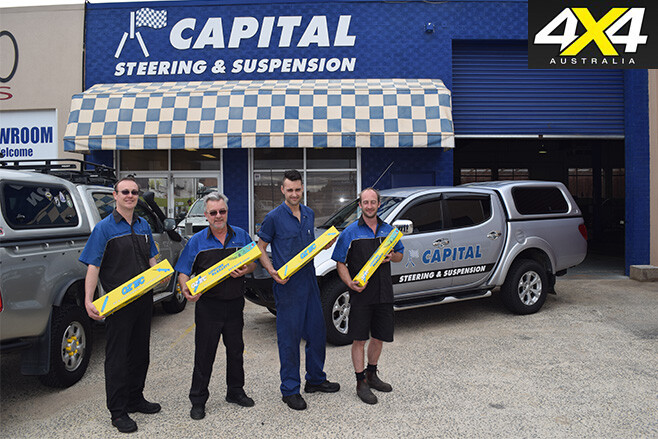
Supporting OzTec’s 4WD and light commercial suspension program, Jamie MacFarlane is the research and development manager. Jamie has more than 30 years of suspension industry experience and is a rally driver himself. So he knows both the technical and delivery side of suspension.
With this team, OzTec is able to research, develop, engineer and test its range of shock absorbers entirely in Australia. Testing involves more than just computer stress evaluations. OzTec physically road-tests each model across a range of road conditions prior to launch, which differentiates OzTec from many foreign imports.
The product itself is made from a mixture of Australian-made and quality imported components. The imported elements come from reputed companies like Cofap (Brazil) and ZF Sachs (Germany). Closer to home, OzTec Outback bushes are Australian-made, owned and designed. They are made from polyurethane for longer life and positive location.
Key features of the Outback shocks include a 64mm diameter body, 40mm piston and 20mm piston rod, and because the HiLux has a set of aftermarket slave springs, installing shock absorbers of this size was a bit of a squeeze.
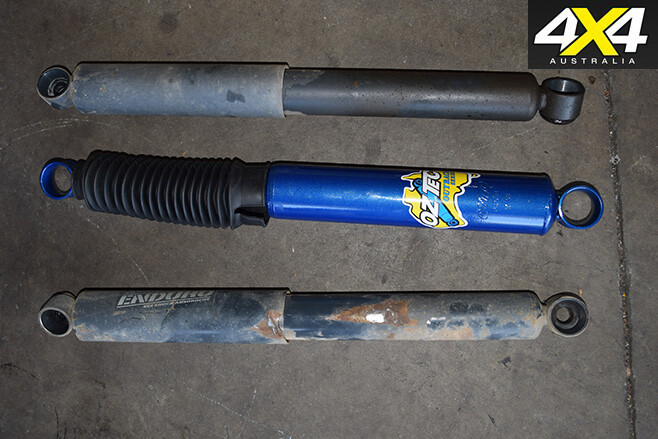
The U-bolt and flange of the slave spring interfered with installation until it was moved 10mm (still within tolerances). This process added only 10 minutes to the installation time and wouldn’t be an issue for vehicles with factory or full-spring upgrades.
ON AND OFF THE ROAD Since fitting the OzTecs, the ride has clearly improved – it’s firm but not at all uncomfortable. With a full load, the vehicle sits firmly on the road and handles well on both sealed and unsealed surfaces, including corrugations, sand and back tracks.
Notably, every time we have stopped the vehicle to check, we have been able to hold the Outback shocks with bare hands. This is important, as the prime thing a shock absorber does is transfer kinetic energy to heat energy and disperse it. With a robust construction and large oil volume, the Outback Series stays cool, which promises better damping control over a longer life span.
OzTec has marketed shock absorbers in Queensland since 2004 and went nationwide with stockists in 2014. Until release of its Outback Series in March, 2015, OzTec was known as a general purpose 4×4 and light commercial shock absorber manufacturer. However, with the introduction of the Outback model, OzTec has found itself a broader position within the recreational and professional four-wheel drive sector.
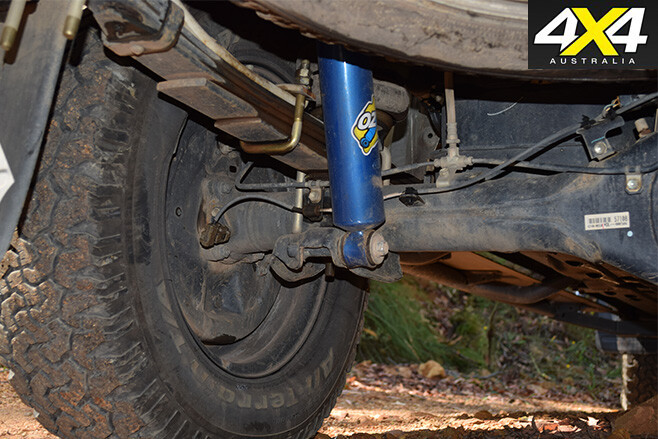
The model of OzTec shocks fitted to the 2008 HiLux is good-to-go for factory spec vehicles, as well as those with up to a 2in lift. Other models are available, so it’s best to check your local stockist for fitting options for your specific rig.
OzTec also offer complete suspension kits for many vehicles, and pre-assembled front shock and coil units for HiLux, Challenger, Colorado, BT-50, D-Max, MU-X, Navara, Pajero, Triton and Ranger. OzTec shock absorbers come with a limited life-time warranty (fair wear and tear).
We like the Outback shockies and reckon the camper trailer will also get a set before too long. As for those factory-fitted springs on the HiLux, well they might be replaced with some OzTec upgrades in the near future, too.
RATED Available from: www.oztecsuspension.com.au RRP: $600 (front and rear shocks) We say: Good value; Aussie-made; effective.
Quality four-wheel-drive gear isn’t cheap, especially when it comes to recovery gear such as winches.
In a perfect world we’d all be running high-mount winches with a slew of attachments and other recovery devices to get us out of any situation short of North Korea invading. But while the glorious leader’s army remains in Korea, things don’t necessarily need to get extreme.
In fact, depending on what 4×4 you own, it might even make financial sense to park it if you get bogged, hike back in to town and buy a new one, rather than maxing out the American Express on the required recovery gear.
With this in mind, it’s not surprising that we’re seeing traction boards like the MaxTrax popping up on every 4×4 both sides of the black stump.
They cost about the same as two to three tanks of fuel depending on your tank, are easy to store, and are more versatile than a Swiss Army knife, albeit with slightly fewer attachments.
As is often the case in 4×4-land, many owners gloss over the full capabilities of the equipment they’ve bought, or the intricacies required for a simple recovery. Think of it like trying to use a clutch after only being taught to drive an auto.
The odd savant might pick it up quickly but the rest of us would be bunny-hopping down the road like an L-plater juiced up on Red Bull and No-Doze.
So over the next few pages we’ll be running through the step-by-step of a standard traction-board recovery with a set of MaxTrax, as well as a few other handy tricks you might not be aware of.
1. DON’T PANIC You are stuck on the beach with the tide coming in, an irrational spouse in the passenger seat and the kids screaming in the back. It’s a pretty bad situation, but things can always get worse.
In situations like this, and most others, the old adage “slow is smooth, smooth is fast” always holds true. By rushing, you’re more likely to overlook the basic components that can make a world of difference.
2. ASSESS THE PROBLEM Before you even get started, assess the situation, see why you’re stuck and find what’s holding you back from forward progress.
An axle or chassis planted into the ground won’t take much fixing with a shovel but can leave you spinning your wheels on the traction boards if you don’t take care of the situation. Get out, look your 4×4 over and then get to work to set it free from what is holding it.
3. DIG A TRENCH Preparation is paramount. The amount of time you work on making it an easy recovery directly relates to how long it’ll take you to get unstuck. We’ve all seen muppets get stuck before; they quickly throw a set of MaxTrax somewhere in front of their wheels and then dump the clutch, ripping all the lugs off the boards without actually getting unstuck. In recoveries there are no shortcuts to success.
Grab a long-handled shovel or your traction boards if they have a built-in shovel, and start clearing a path ahead of the wheels. You’ll need to build a gentle ramp up and out of where you’re stuck. Sand is easy digging, so don’t hold back. With a trench, or ramp dug in front of each tyre, it should look like you could drive out on your own; the traction boards just give you the grip to gain your momentum back.
4. SET THE RECOVERY BOARDS With a trench dug out under each tyre and the diffs and chassis clear of any obstructions, it’s finally time to reach for the MaxTrax – it shouldn’t take more than a few minutes to get to this point. Lugged traction boards use the gaps between tread blocks to bite on and then spread the load out over a much larger area (the size of the board). To get them to bite you want at least two rows of lugs under the leading edge of the tyre, allowing it to pull the board underneath and you to drive out.
The downside of this design is, with too much weight or wheelspin, the boards can be pushed under the surface, never to be seen again. Some boards come fitted with straps that you can lay out to the side and follow back to the board after it’s been buried.
5. DRIVE OUT If you have four boards, fantastic, but you can get by with two boards in most recoveries. From here, you’ll need to keep a clear area behind the 4×4 and begin recovering yourself. The lugs on the boards are considered sacrificial. They’re made thin to ensure they fail instead of ripping your tyres to shreds. Because of this it’s vital to perform the recovery with as little wheelspin as possible, although it is sometimes unavoidable.
To keep wheelspin down, select low range and gently apply the throttle. One of a few things will happen: you’ll climb straight out; the boards will get pulled under and then you’ll climb out; or you’ll still be stuck. If you don’t climb out immediately, the trenches may be too steep or the boards may not be far enough under the tyres. Dropping tyre pressures to low double digits may also be required.
Getting bogged
It sucks. Getting seriously bogged sucks even more. The first thing most people do when they realise they’re getting bogged is push the accelerator to the floor and try to drive out. It might work; it also might bury you up to your axles adn sills in sand or mud, leaving you on the business end of a shovel for the next few hours.
Off-road tyres work like shovels; as the tread blocks spin around, they grab the terrain in front of you, pulling you forward. When you can’t move forward anymore, they grab the terrain underneath and pull you down instead.
You’ll normally stop when your axles or chassis rails hit the ground and you can’t go any farther down. This essentially anchors you to the ground, turning what could have been a mundane recovery into a day you won’t soon forget, and not in a good way.
Other uses for traction boards
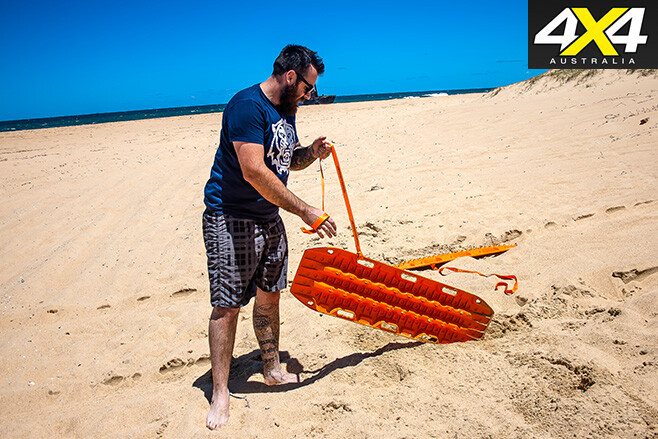
- Bridge over washouts
- Ramp over logs, rock ledges, undercut steps
- Slippery mud
- Base for jacking
- Levelling a 4×4 for a roof top tent or camping set-up
- Slippery hill climbs
- part 1 of our 4×4 recovery guide: the basics
- Part 2 of our 4×4 recovery guide: recovery kits
- Part 3 of our 4×4 recovery guide: the snatch
Production of Toyota’s FJ Cruiser is set to end in August, 2016.
Since its local launch in 2011, the FJ Cruiser has considerably exceeded expectations, with more than 11,000 of the rugged off-roaders finding Australian homes.
In its debut year, it also claimed the coveted 4X4 Australia Magazine Car of the Year award – in controversial circumstances, mainly due to its petrol-only engine.
The retro-inspired off-roader draws its DNA from the rough-as-guts FJ40 Land Cruiser, which was first seen in 1960. The FJ40 felt most at home on arduous terrain, and it was best known for its dependability in hostile conditions.
More than 1.1million FJ40s were produced between 1960 and 1984.
There were several concepts that led Toyota to produce the FJ Cruiser.
In 1999, Toyota’s Retro Cruiser stole headlines at the Chicago Auto Show. The concept vehicle – a converted 1967 FJ40, created by Rod Millen – combined the bodywork of an FJ40 with a modern Cruiser chassis and V8 donk. ICON 4×4’s Jonathon Ward also produced a prototype that was more akin to the original FJ40.
But it was the Rugged Youth Utility displayed at the 2003 North American International Auto Show as an FJ Cruiser concept that led to what we eventually got. It was a unique design that included several design cues of the original FJ40, but was identifiable as its own vehicle. It was more a homage than a retro FJ.
Tony Cramb, Toyota Australia’s executive director of sales and marketing, said that the FJ Cruiser built on more than 50 years of Toyota tradition in producing tough off-road vehicles.
“[The FJ] is renowned for its ability to traverse rugged outback trails, while offering plenty of utility for all types of activities…
“It will leave lasting memories as one of the most iconic vehicles in Toyota’s rich SUV history…”
The FJ Cruiser is powered by a 4.0-litre V6 petrol engine (200kW/380Nm), which is mated to a five-speed auto transmission, part-time 4×4, and electronically activated rear diff lock and Active Traction Control tech.
It also has the best approach and departure angles (36- and 31-degrees, respectively) in the entire Toyota 4WD range.
Originally built in left-hand-drive only, primarily for the US market, the production of LHD units stopped in 2014. Production of RHD FJs will cease August this year. Priced from $46,990, it could be a clever purchase.
THE LX 570 is based on Toyota’s 200-series Land Cruiser, utilising the same chassis and most of the body.
However, because it’s predominantly aimed at Middle Eastern and American markets, it comes fitted with a 5.7-litre V8 engine. Lexus seriously looked at bringing a diesel version to Australia, but it couldn’t make the numbers add up. The owner’s manual even gives a tantalising taste of how close it got, with the brochure containing details for the LX 570 and the LX 450d name. And since late 2015, Lexus has sold a Lexus LX diesel in Russia.
Still, for those not as concerned about the method of propulsion, the LX 570 essentially sits at the top of the Land Cruiser range. It creates a natural walk-up for those who are not satisfied with the near-$120K you’re shelling out for a diesel Sahara.
At $140,500 the Lexus is a decent step up, bringing with it unique front styling and a unique bonnet, as well as 20-inch wheels or optional 21s, as fitted to our car. The tail, too, has also been snazzed up, with different tail-lights, among other tweaks.
Plus it gets plenty of fruit – things like the beefy Mark Levinson sound system simply aren’t available in the Land Cruiser.
Lexus would rather the LX is considered a genuine Range Rover competitor – complete with eight seats – rather than a better Land Cruiser.
PRACTICALITY THE LX 570 has a big cabin with plenty of width, something that allows three child seats across the middle (they can’t be used in the third row because there are no anchor points).
And if you’re confining it to a five-seater, you’ll comfortably fit five adults in along with plenty of luggage (although the third row seats fold electronically against the side of the car, taking up some of that space).
There’s a unique dash layout with loads of leather and wood. Combined with the huge 12.3-inch colour screen, it makes for an inviting and space, with a deep centre console (it doubles as a fridge) and plenty of binnacles for odds and ends.
Less impressive is the Lexus Remote Touch controller, which is part mouse, part joystick – and pure frustration in the way you have to carefully modulate exactly where you place it, or else you’ll zip past the virtual point on the screen you’re aiming at.
Those into their sound systems will like the Mark Levinson sound system, which is lacking nothing in volume and punch.
In true Lexus style, the attention to detail is impeccable. It’s a beautifully put-together machine, and one that is suitably luxurious on a long drive.
ON THE ROAD THE LX is a big, heavy car, which takes its toll on manoeuvrability in the suburbs. While bodyroll is generally well contained, there’s still some leaning when you push on. But the 21-inch tyres provide better grip than the lower profile tyres on a Land Cruiser; there’s also a slight improvement to steering accuracy.
The 5.7-litre V8 is smooth and strong, ensuring good performance. It’s the best part of 2.7 tonnes, so you’ll sometimes need every kilowatt and newton metre to get the job done, especially if you’re going to utilise the 3500kg tow capacity. But it works well with the eight-speed auto to make decent progress.
Thirsty, though, and you can use close to 20L/100km around town. However, on our mixed on- and off-road route, it used a bit over 16L/100km. Keep in mind, though, it calls for premium unleaded. Thankfully there’s a 138-litre fuel tank, ensuring a typical range of about 700km before you spend up big on a refuel.
One area the LX really impresses is quietness and refinement. It’s super relaxed and well-shielded from outside noises, making for a fantastic long-distance tourer.
OFF-ROAD THE price, luxury appointments and petrol engine will likely ensure most LXs stay snugly confined to bitumen; which is a shame, because it’s a hugely capable machine.
The V8 engine has no problems overcoming the bulk of the body and makes light work of sand and steep inclines, although you’ll often find the engine revving higher than a diesel would. Thankfully, there’s downhill assist, which utilises the ABS functionality to reduce speed – as engine braking isn’t great.
Indeed, most of the Land Cruiser’s off-road artillery is there, including Crawl Control (off-road cruise control for maintaining a slow speed) and Turn Assist, for temporarily locking the inside wheel to tighten a turn. Each is noisy once operating, with plenty of grinding and graunching to accompany the good work being done.
Underneath, too, there’s solid protection, as well as a full-size spare.
Yet the tyres aren’t very well-suited to the off-road task. Both the 20- and 21-inch tyres come with a fairly low 50-profile design. While we haven’t tested them to the extreme, we’re prepared to bet they’re more susceptible to sidewall damage. Plus there’s less benefit to deflating them for sand driving, because the sidewalls won’t bag out as much.
At its regular height the approach and departure angles are nothing special. Up front, a Land Cruiser has a 32-degree approach, whereas the LX 570 makes do with 25 degrees. At the rear it’s 24 degrees versus 20 degrees.
However, that air suspension allows the ride height to be raised from its regular clearance of 225mm; the front can be raised up to 70mm and the rear up to 80mm. That in turn improves those approach and departure angles, which are close to the Land Cruiser’s.
There is genuine ability elsewhere, too. Great wheel articulation, for example, makes it easy to roll over jagged surfaces. However, the KDSS suspension of the Land Cruiser is missing, meaning the stabiliser bars are constantly part of the deal; whereas in the Land Cruiser they effectively disconnect temporarily to maximise travel.
The LX also gets the Land Cruiser Sahara’s four cameras as part of the multi-terrain monitor. It gives a good virtual overhead view as well as a view out the front and down each side.
VERDICT THERE’S plenty to like with the LX 570, including most of its Land Cruiser pedigree. But it’s not the type of car most people will head to the scrub in, partly because of the price, but also because it’s ultimately not quite as capable as a Land Cruiser.
But it makes up for it with on-road refinement and poise and loads of gear, in what is a beautifully put-together machine. If you didn’t have to worry about fuel prices, there would be much worse ways to travel.
[specs] LEXUS LX 570 Engine: 5.7-litre, V8 petrol Power: 270kW at 5600rpm Torque: 530Nm at 3200rpm Transmission: 8-speed auto 4WD system: permanent dual-range 4WD Braked tow capacity: 3500kg Spare tyre: Full size Fuel tank: 138 litres Fuel use (claimed): 14.4L/100km Fuel use on test: 17.5L/100km| Approach/departure angles: 25/20 degrees (at regular suspension height) Ground clearance: 225mm (at regular suspension height) Price: $140,500
4×4 Australia’s 2016 Utes Guide presents the best in Utes from showroom to sunsets.
Highlighting the best in gear for your Ute adventures, this is the ultimate guide for 4X4 enthusiasts!
Buy a copy today from your nearest newsagent or online at magshop.com.au.
Wanna see more? Check out the 4×4 Ute Mag highlights here.
When Justin Montesalvo was looking for a four-wheel drive to be the flagship for his company Patriot Campers, he had a checklist of things he needed it to be able to do.
He’s a family man and active in the outdoors, so a ute was a must. It needed a big turbodiesel to haul the oh-so-cool camper trailers that Patriot builds, and it needed to be comfortable enough so that the wife and kids wouldn’t be out for blood after the three-millionth corrugation along the Gibb River Road.
The obvious choice would be a yank tank – an F-Truck, a Silverado, or a RAM. They tick all the boxes with ease. But the deal-breaker for Justin was that it’s almost impossible to get parts should something go wrong a million kilometres from civilisation. So what do you do when the 4×4 you want doesn’t exist? Well, if you’re Justin, you build it.
Simple, really. With Being a Toyota man through and through, the 200 Series Land Cruiser was the perfect starting point for what was always going to be a wild build. It’d be an exercise in excess, pushing a 4×4 to its absolute limits to end up with not only a reliable vehicle, but something unlike any tourer on the tracks today.
Those with an eagle eye may spot that the 200 is smaller than a regular model, and it’s somehow longer as well. It’s what the Patriot guys call a Super Tourer.
After starting life as a 2014 GXL Land Cruiser, it was dropped off to the guys at Creative Conversions who cut, stretched and shrunk it until the wheelbase was out an extra 650mm and the body was the size of a dual cab ute’s. This arrangement made it possible to fit what was one of the most ridiculous yet practical trays you could buy.
At two-metres long and wide, the Patriot Super Tourer tray received the same build sheet as all of Patriot’s camper trailers. The tray was built in-house from lightweight aluminium before it was treated and powder-coated to match the vehicle. Then it was stuffed with modular compartments and accessories.
The tray now comes with all the gear you’d expect from a high-end tray, such as a sliding rear drawer, integrated tie-down points, a 3mm floor and side toolboxes – the side toolboxes hide a kitchenette. Think of it as a mini camper trailer that the guys take wherever they go, and one that doesn’t eat into any tray space.
Justin’s tray has been optioned up with all the extras, including an integrated 70-litre water tank with electric pump and tap, high-lift jack and mounts, 12-volt outlets on the headboard, a rear winch, and even built-in mounts to hold the four Maxtrax at the ready. It might sound like we’re just starting to rattle off modifications, but the reality is this is one of the most modified Land Cruisers in the country and we’ve barely even scratched the surface.
It will be a miracle if we were able to list half of the things done to this 200, without this article turning into an Excel spreadsheet. In fact, the tray is so far ahead of the game that it has its own completely weatherproof marine-grade stereo that can play music straight from Justin’s phone via Bluetooth connectivity. The double XRay work lights and Narva floodlight up back don’t sound as impressive after hearing that.
Up until now you’d be forgiven for thinking Justin’s 200 is nothing more than a chopped up 200 with a wild tray on the back. But that couldn’t be further from the truth. Justin’s the kind of bloke who likes to push things to extremes in everything he does, especially off-roading.
So it shouldn’t come as a surprise that he’s shoehorned 35.0-inch BFG KM2s inside the wheel arches of the Cruiser. They’re wrapped around 17×8.0-inch Gecko rims with a 25mm wheel spacer on each corner, giving the 200 its aggressive stance.
Of course, the 200’s wheel arches would never have accommodated a tyre of that size in standard form. And the solution to this was a little more involved than bolting in an off-the-shelf suspension kit.
Justin got on the phone to Darren from Icon Vehicle Dynamics Australia to talk about their Stage 4 kit. The deal was done and Justin’s 200 was soon fitted with Icon suspension, front to back. The deal was that if Justin wasn’t completely happy with it, he could have it for free. Needless to say, Darren ended up getting his cheque.
The kit saw Justin’s 200 fitted with Icon’s 2.5-inch CDC adjustable coilover shocks up front, with matching shocks and coils on the rear. The adjustable shocks allow the suspension to be dialled in to suit the exact weight of the vehicle. Plus, the shocks don’t have the harsh ride some adjustable shocks are known for. There’s also a built-in bump-zone, so the Cruiser never bottoms out.
The shocks have been fitted with Australian-spec spring rates to suit our heavier twin-turbodiesel engines and the multiple battery set-ups we often run. The valve rates are 30 per cent stiffer to account for our less-than-average quality roads. Rounding out the kit are tubular control arms to correct camber and caster, and heavy-duty rear lower arms.
With the serious kays Justin eats up on every trip, the 200 needed some serious barwork. Up front there’s a Deluxe winch bar from TJM. Colour-coded to match the 200’s silver paint, the bar feeds into matching scrub bars and side steps, but not before offering mounting points for the TJM 12,000lb winch, Great White LED spotlights and light bars, all powered by the Revolution lithium 100AH battery kit.
There are more Great White light bars mounted up on the Rhino roof rack, as well, but they share prime real estate with a wrap-around Supa Wing awning.
The twin-turbo V8 diesel under the bonnet would have been no slouch if it were left in standard form. But with the vehicle’s weight adding up, Justin decided to slot in a Torqit Power Module for a few extra ponies. There’s a PEDAL TORQ module that reduces the throttle lag for better response and a Beaudesert four-inch stainless-steel straight-through exhaust that gives the 200 the bark it deserves.
A 180-litre Brown Davis fuel tank ensures the bark doesn’t die down too soon. With around 800Nm coming from the V8, the standard auto holds up its part of the bargain, while forward momentum is maintained with ARB air lockers in the front and rear diffs.
With the exterior and drivetrain grabbing attention everywhere Justin goes, you might be surprised to find things are a little tamer when you open the driver’s door – a testament to the build-quality of Toyota. The standard seats are protected by Wet Seat seat covers, with Sandgrabba floor mats doing a similar job for the carpet.
There’s an Outback roof console and twin pillar mounts that provide ample mounting options for the GME TX4500 UHF, Redarc EGT, and gauge. Just reading it is enough to make you run out of breath, but it’s hard to argue with results.
For the penny pinchers and the naysayers, it would be easy to ignore Justin’s 200 as just another credit card barge with more accessories than kays under its belt. These people would be wrong.
Every aspect of this build was painstakingly debated before a decision was made. This Cruiser represents everything Patriot Campers takes pride in for their campers. It was built to do the hard yards, to take on creek crossings and desert dunes just as easily as it does tropical beaches and corrugated roads. This LC200 shows that, while money can’t buy happiness, the right amount of money spent in the right places can help you on your way.
THIS month, Ford’s Everest Titanium fronts up to Toyota’s Prado Kakadu and Land Rover’s Discovery SDV6, in a top-end tussle. Three massive American pick-ups have also landed on local soil, so we saddle up a Ford F-250 Lariat, a GMC Sierra Denali 2500 and a RAM Laramie 2500 for an all-Yankee stoush.
Plus, we drive the Crew Chief Concept from the 50th Easter Jeep Safari, and we give a super-tough Toyota HiLux an AFN makeover.
Grab the latest copy of 4X4 Australia from newsagents, or get it before everyone else by subscribing to 4X4 Australia in electronic or print format.
Here’s what’s in the June issue:
WHITE WOLF Our first look at a kitted-up 2016 HiLux, that’s a Wolf in AFN clothing.
EASTER JEEP CONCEPTS We head to Utah to belt the best Jeep concept vehicles at the 50th Easter Jeep Safari. We get an exclusive drive of the wild Jeep Crew Chief Concept.
TOP-SHELF STOUSH Top spec Everest Titanium enters the heavyweight arena to battle two range-toppers: Prado Kakadu and Discovery SDV6.
AMERICAN PICK-UPS Three massive American pick-ups – F-250 Lariat, Sierra Denali 2500 and Laramie 2500 – get an all-Aussie initiation. Yee-haw!
POWER RANGER Find out what happens when you strap a 2.5-tonne Avida Topaz caravan to the back of a Ford Ranger Wildtrak.
SECRET PARADISE To reach a secret beach on NSW’s mid-north coast, one must pass a series of off-road challenges.
ON TRACK You’ll need an off-road-capable rig to scale the Arkaroola Ridgetop Track in South Australia, but the views are worth the effort.
GOLDEN VALLEY Gold can still be found in Victoria’s Buckland Valley, but there are also many more treasures to discover.
BUCKLAND AND BEYOND 4X4 Australia tags along on an event to the Victorian High Country.
GUIDE TO CUSTOM CANOPIES A complete guide covering everything you need to know about custom canopies. We’ll tell you which one best suits your lifestyle.
HILUX GIVEAWAY Harrop Engineering installs a rear ELocker and drivetrain breathers to our giveaway Hilux.
THE REST The regular columnists give us their two cents’ worth, and we test and review a whole lot more gear. Plus, we show you how to easily service a winch, and how to pull off a double-line winch recovery.