
JEEP has announced it will produce a ute, or pick-up version, of the next model Wrangler, but there are plenty of enthusiasts not willing to wait until 2018 for the factory option.
Vote for Murchison’s Wrangler to decide this year’s Custom 4×4 of the Year.
As always, wherever there are folks looking for something the manufacturers aren’t supplying, you’ll find aftermarket businesses willing to build it for them.
American Expedition Vehicles (AEV) built its first TJ Wrangler ‘Brute’ pick-up for the 2002 SEMA Show in Las Vegas. Jeep was so impressed by the concept it took the Brute back to Detroit to investigate building one at the factory, but with the JK Wrangler already well and truly in the planning stages it decided it was too late to develop a TJ ute. Jeep said it would look at it again for the JK.
AEV took the initiative and began building TJ Brutes for customers who loved the versatility and ability of a Wrangler-based pick-up, especially when combined with one of AEV’s Hemi V8 engine conversions.
AEV’s business boomed with the launch of the JK Wrangler and a host of specialised products designed to make the Jeep more capable and functional wherever its customers’ off-road adventures took them. With rumours of a factory-built JK pick-up still in the background, AEV held off developing a Brute for the new model.
However, when the factory offering didn’t eventuate, the AEV double-cab Brute broke cover in 2011. AEV never officially developed a JK Brute single-cab, and Jeep’s factory JK ute didn’t eventuate either. On the other side of the world a Queensland company finally made it happen.
Murchison Products in Brisbane, a distributor of AEV gear, also builds, maintains and services all manner of Jeep vehicles, from mild to wild. Owner Stuart Murchison had built a couple of TJ Brutes over the years and saw the potential of a JK version. He built a few of what he calls ‘Overlands’, using the Mopar JK8 kit, but they didn’t have the true pick-up style
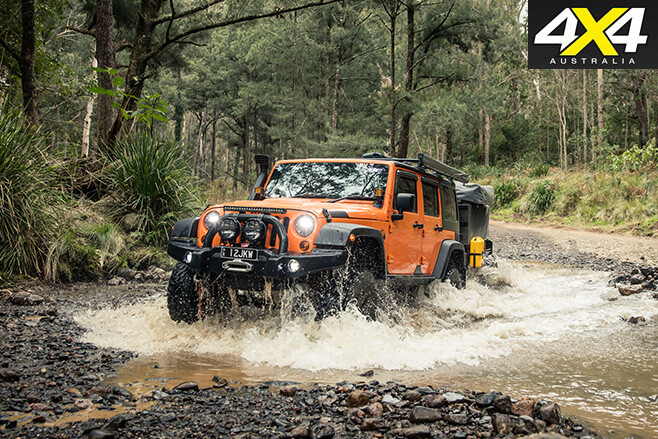
The gold nugget you see here was originally a JK Unlimited Sport that Stu picked up second-hand for the right price, before it went under the surgeon’s knife in the Murchison workshop.
The body was chopped in half behind the front doors and a new rear panel fabricated from scratch, utilising the JK8 rear window section. With a bit of extra space behind the doors this Overland is an extra-cab more than a true single-cab; although, the space really just allows the seats to sit back, rather than provide much space behind them. The roof section retains the JK’s ‘Freedom’ panels, which can be removed to give the unique Jeep an open-top feel.
The rear cargo tub is a modified AEV TJ Brute item. With no JK Brute available, Stu chose to section the steel TJ tub, widening it 150mm to match the JK’s proportions. Inside, the tub is protected by a spray-on liner, and it also houses the fuel filler for the custom 120-litre tank that sits in the chassis rails. The rear wheel-arch flares are modified Wrangler Unlimited pieces from the donor vehicle.
The cut-and-crafted ute body is accentuated by a host of AEV products, starting with the heat-reduction hood (that’s Jeep-speak for bonnet) that allows hot air to easily exit the engine bay. Helping to get clear air into the engine is an AEV intake, while up front an AEV premium bumper accommodates a Runva winch and a pair of IPF spotties.
You won’t find the paint colour in any Jeep catalogue, it is Range Rover Zanzibar Metallic, adding to this Wrangler’s one-off status.
When you look at the side profile of the JK Brute, you could be excused for thinking the chassis has been lengthened. It hasn’t, but the wheelbase has. With no factory rear wheel-arches to dictate where the wheels should sit, Stu was able to stretch the wheelbase 254mm longer than the standard JKU using Clayton long arm suspension. The cargo tub was modified to have the arches sit in the right place, while long suspension arms allow for longer travel.
The set-up is aided by remote reservoir Fox 2.5 Extreme Racing shocks both front and rear, with Murshison-tuned coil springs. The rear diff is the original Dana 44, albeit equipped with an ARB air locker, 4.10 gears and Dynatrac cover; the front diff is a complete Dynatrac Pro Rock 44 replacement, again featuring the ARB locking differential, plus RCV axles and a high steer arrangement.
Those sexy wheels are 17-inch AEV Salta alloys wrapped in 35-inch BFG muddies. Getting the grunt to those wheels and tyres is the original 2.8-litre turbo-diesel engine that has received a flash-tune tweak to give it some more berries when needed.
Flash-tuning modern 4x4s is a big part of the Murchison business and, even though they can do most brands of vehicle, Jeeps remain the shop’s specialty. Tuning this vehicle supplied an extra 105Nm to those massive 35-inch treads. The grunt feeds back through the factory five-speed automatic transmission, and the combination is sweet both on open roads and bush tracks.
Even though this vehicle has been built to a premium standard, it is all about the functionality of an off-road-capable pick-up. Stu Murchison handed us the keys to the Overland ute on a recent customer drive weekend in South East Queensland, and we were stoked with its quality fit-and-finish, on-highway ride and off-road capability.
From the outside the Jeep looks top-shelf. The quality continues when you slip inside and sit on Jeep seats that have been custom-trimmed in two-tone leather with complementary Overland logos.
Everything works as it should, and the cabin is well-insulated from road noise. Power for highway cruising and overtaking is always on tap, and there’s no noticeable loss pushing the big 35-inch muddies. In fact, when you combine the tuned engine with the lower weight of the ute conversion, this Wrangler boogies along better than any other diesel JK we’ve driven.
The ability doesn’t end where the bitumen stops, as the ute made easy work of the steep and rutted tracks at Swan Gully Off Road Park, where we took it for a couple of days’ fun. Murchison has created a vehicle that not only looks über-cool but functions better than standard in all disciplines – unless you want a four-door five-seater that is. But we all know utes are way cooler.
A good as this golden Jeep is, Stu has bigger fish to fry. A partnership with SCD American Vehicles has a RAM 1500 on the shopping list, so the Jeep has to go. This one-of-a-kind Overland pick-up will soon find a lucky new owner. Give Stu a call if you’re interested.
Vote for Murchison’s Wrangler to decide this year’s Custom 4×4 of the Year.
The launch of the 80 Series Land Cruiser was a big thing back in 1990. It was Toyota’s long-awaited answer to Nissan’s coil-sprung GQ Patrol that had taken the market by storm a couple of years earlier, and would soon become Australia’s biggest-selling four-wheel drive wagon.
This article was originally published in the June 2014 issue of 4×4 Australia.
It was also physically big, much bigger than the 60 Series Cruiser it superseded. Dubbed the breadbox by some because of its rounded edges, the coil-sprung 80 Series was a huge leap forward in both design and technology, and with an expected model cycle of eight years, it had to be.
The 1994-model 80 Series gracing these pages belongs to Darren Vassie and, despite this Cruiser turning 20 this year and with 380,000km on the odo, it’s still a more than capable and comfortable four-wheel drive touring wagon. And that’s exactly what Darren wanted: a reliable family tourer that would have no troubles off road, and would easily deal with mud, sand and water crossings.
Check out the video of Darren Vassie’s Conqueror 80 Series tearing up Fraser Island.
This Cruiser is far from standard. Darren, a fabricator by trade, and also a mechanic, has customised it to perfectly suit his requirements. Almost. The 80 has a turbocharged 1HZ diesel and he wants to change to a V8. “I don’t know when the turbo was installed,” Darren admits. “I’ve had the car for four years and I bought it with the turbo on it.
“I had my own fabrication business, and I now work for Conquerer Australia doing off road camper trailers, so I can use the workshop whenever I want.” This is where he has custom fabricated all sorts of goodies for the Cruiser.
“I’ve done the 50mm body lift, so the chassis rails are still sitting pretty low, but the body’s up,” Darren said. There’s also a 100mm suspension lift and the Cruiser runs Tough Dog springs and Tough Dog adjustable foam cell shocks.
Adding to the impressive appearance of the Cruiser, and its off road capability, are massive 37 x 12.5 Mickey Thompson Baja Claws fitted to Dick Cepek 17 x 9 alloy rims. You might think that the big rubber would take the edge off performance, but Darren’s done plenty of work on the engine.
He said this includes “a custom airbox, and then all the custom pipework, intercooler, that’s all my work, and the intake manifold is all mine as well”. Oh, and he made his own 304-grade stainless-steel exhaust system. Is it loud? “It is, because there’s no muffler in it,” Darren laughs.
Darren has had the Cruiser on the dyno and it makes a respectable 105kW and 456Nm at the wheels, more than enough to handle the big Baja Claws. Nevertheless, he’s also lowered the overall gearing to 4.5:1 from the standard 4:1. “It’s as if it has the standard 32.5-inch tyres on it,” he said. ARB Air Lockers are fitted front and rear.
Despite all the engine mods, accessories and big tyres, Darren said the Cruiser still achieves a touring-friendly 15 litres per 100km fuel use. With his owner-made 150-litre stainless-steel long-range fuel tank, he has a total fuel capacity of 235 litres, he has a touring range of more than 1500km.
Darren also made his own 45-litre water tank, which sits under the rear, along with the custom barwork, including front and rear bumpers, sidesteps and roofrack.
Fitted in the front bar is an Ironman 12,000lb wireless winch, running synthetic rope. Situated neatly atop the bar is a Narva LED light bar, and Narva HID lights also grace the front of the roofrack. There’s a Foxwing awning on one side and a shovel-holder on the other.
Darren also made a boat-loader that is often fitted on the back. “It holds an EzyTopper,” he said. “It’s got a little 4000lb winch on it that pulls the boat up. Once it’s up on the angle, there are a couple of bolts to undo, then the winch rope holds it, then you let the winch rope out.
When the boat hits the ground, you push it right over [so it’s sitting on its keel] and that’s it. To put it back on, just position the ass of the boat to the car, pull the winch cable right over the boat, and the winch pulls the boat back over and up on the boat-loader.”
There are plenty of custom mods on the inside of the Cruiser, too. “Everything is custom made. I’ve done all there is. The drawer system on the left is made out of steel frame – it’s got the fridge in it – and then the pantry drawer on the right is marine ply and the rest of it’s all steel mesh. It’s fully enclosed. There’s no cargo barrier, but the way I’ve made it, nothing can fly forward.”
One job Darren outsourced was the customising of the seats. “There are three TV screens. I’ve got an Axis head unit, which is a DVD player as well, and it feeds the two TVs in the back. They’re all custom-made headrests – of course, I didn’t do those – the seats have been reshaped and the lumbar support has been built up in them.” And sitting between the two front seats is an eight-litre Waeco cooler.
Darren reckons the total build cost of this vehicle is only about $20,000 to date. Not bad considering the amount of work done to it, but understandable considering he’s done 80 per cent of the work himself. However, as mentioned, it’s still not quite perfectly suited to his needs.
“I’m looking at going around Australia in three years time and building my own caravan. It’ll be a two and a half tonne caravan, so that’s why I want to do a V8 conversion.
“I’m looking at buying a rolled or a salvaged 76 [Series Land Cruiser], but I’m going to twin-turbo the motor. I’m an old drag racer. I build all my own exhaust manifolds, intake manifolds and do all my own intercooler systems and what not, so I’m looking at doing all that myself, and fitting it in the car myself. You can pick up a salvage [76 TDV8] for around 10 grand whereas you’re looking at around $25K for a 200 Series.
“I’ll be stripping the motor out of it. They’re coming out with aftermarket computer systems for diesels now, so I won’t use any of the original Toyota stuff. We’ll have a fully programmable computer in it, and that’s where we’ll get our power from. They reckon that 400hp (300kW) is going to be pretty easy with a twin three-inch exhaust system.
“I’m going to put in twin four-inch snorkels and twin air cleaners, so it’ll look pretty cool.” It looks like this 80 Series has plenty of life in it yet.
SPECIFICATIONS 1994 TOYOTA LANDCRUISER 80 SERIES
Owner: Darren Vassie, Qld Engine: 1HZ, 4.2L intercooled turbo-diesel Driveline: Five-speed manual, dual-range 4WD, 4.5:1 final gearing Power: 105kW Torque: 456Nm Suspension front: Live axle with coil springs, 4-inch lift, Tough Dog springs and dampers Suspension rear: Live axle with coil springs, 4-inch lift, Tough Dog springs and dampers Wheels: 17x 9-inch Dick Cepek DC2 Black Tyres: 37 x 12.5R17 Mickey Thompson Baja Claw TTC Exterior mods: Custom bar with 12,000lb Ironman winch, custom sidesteps, rear bar, roofrack, stainless-steel snorkel and bonnet scoop, Narva 5W light bar, Narva 55W HID driving lights, Foxwing awning, shovel holder.
Check out Darren’s new blue dual-cab Toyota LandCruiser 80 series.
ARE these family-friendly dual-cab utes up to doing the work of a truck? Can they tow a 3500kg trailer or carry a 1000kg load in the tub?
We’ve corralled the Toyota Hilux, Holden Colorado, Ford Ranger, Mazda BT-50, Isuzu D-MAX and the Mitsubishi Triton to find out.
To do this we have lined up a trailer loaded with a site forklift and a pallet of bagged cement, weighing 3500kg in total. To cater for the lighter-rated Toyota Hilux (3200kg) and Mitsubishi Triton (3100kg) we have a second trailer carrying an excavator totalling 2800kg.
To test load-carrying we have a pallet of bagged cement weighing 800kg, which when added to the other payload elements (driver and passenger, etc.) brings the total payload close to 1000kg, effectively the maximum payload in the class, give and take a little.
In each case the 800kg pallet was loaded up against the front of the tub, not an easy task given the tailgates don’t drop right down on any of these mid- and up-spec utes. Before and after loading, the ride-height (at the axle line) was measured to see how far the rear of each ute dropped.
The tow and load tests were conducted separately. For the separate load and tow tests the vehicle was driven over a set course encompassing an uphill winding road followed by a downhill descent, again with lots of corners.
The course was covered at least twice for both load and the tow tests, so four or more runs for each vehicle.
See the video to learn how they went. Some did it better than others, while some results were eye-opening.
IMAGES reportedly leaked from a Jeep dealer meeting in the USA have revealed what the front and back styling of the upcoming 2018 JL Wrangler and 2019 Grand Wagoneer models will look like.
As expected, the new models retain the traditional seven-slot grille and other hallmark Jeep attributes.
The JL Wrangler is expected to be seen in full some time in 2017 as a 2018 model and, to keep its unrivalled off-road ability, it will retain all the attributes that matter including a dual-range transfer case, body-on-frame chassis and live-locking axles front and rear.
New for the Wrangler range will be a four-cylinder turbocharged petrol engine, as well as the traditional petrol V6 and a V6 diesel engine from VM Motori. An eight-speed automatic transmission is also slated for inclusion.
Body styles will include the familiar two- and four-door, soft/hard- top variants, as well as a new ute that is expected to be a double-cab model.
The Grand Wagoneer recalls a name plate from the past and applies it to what is expected to be a range-topping seven-seat wagon based on the Grand Cherokee platform. Jeep bossman Mike Manley has said in the past that the Grand Wagoneer will be a luxury SUV that will rival the likes of Ranger Rover and will have corresponding levels of luxury and equipment, as well as a matching price tag.
Expect that to be around $200,000 if the Grand Wagoneer is produced in right-hand-drive and makes it to Australia. Would Australians ever pay Range Rover money for a Jeep?
The current Grand Cherokee is built on a platform that it shares with the Mercedes-Benz GLE (formally ML-class). Benz’s GLS (GL-Class) is built on a stretched version of that platform. A Grand Wagoner would ride on a stretched Grand Cherokee in the same way the Mercedes-Benz siblings do. Whether that is on the current platform or an all new one is yet to be revealed.
THE proliferation of new 4×4 vehicles that were launched during 2015 has kept the four-wheel drive accessories manufacturers busy in the months since.
There were half a dozen all-new models launched to market last year, and then there were countless model updates and facelifts to keep the engineers, designers and factory workers flat-knacker getting the products out there to feed the buyers.
Ironman 4×4 didn’t hold back, and at one point late in 2015 we spotted 10 brand new, mainly black, new vehicles at its Melbourne headquarters. They were being 3D scanned, pulled apart and crawled over in preparation for new bullbars, side steps, brush bars, snorkels, storage systems and all the other gear we love to fit to our rigs.
This represented more than $500,000 in vehicles alone and, once you factor in the development and engineering to get the product made, you can more than double that figure again.
Fast forward to 2016 and Ironman has its fleet of kitted-up 4x4s on the road and the products are all available to enthusiasts, yet the work never stops. There are still new and refreshed models to have products developed for them, and the existing gear has to be marketed.
Part of developing and selling 4×4 accessories means marketing them, and when the team at Ironman invited us on the trip to the Flinders Ranges to sample some of the new gear while they photographed and filmed them for marketing use, we couldn’t resist the chance to escape the office.
With a first-class crew on board we drove some of the spectacular Flinders gorges, trekked out to the edge of Lake Frome, and spent a day touring around the stunning Skytrek at Willow Springs. Keep an eye on a future issue of 4X4 Australia magazine for the full story, but check out this video for a sample of the amazing adventure.
OUR drive of the Murchison Products Overland JK pick-up (see November issue) took place during a weekend drive event put on by Stuart Murchison and his team.
The event was held at Swan Gully 4×4 Park, west of the Gold Coast. With eight well-modified customer Jeeps tagging along, plus a few of the shop’s own special vehicles, it was a great weekend to showcase the work done at MP and spend time with the customers doing what they love doing: driving Jeeps off-road.
Also in attendance for the weekend was global sales manager of American Expedition Vehicles (AEV) Chris Wood, in Australia to catch up with our two AEV distributors – Murchison being one.
Australia is one of the biggest markets for the Jeep Wrangler outside of North America – and we love to modify our Jeeps – so this makes us an important market for AEV. Chris uses any chance he can to head down here to see what’s happening and where the market is heading. Of particular interest on this visit was the growing popularity of full-size US pick-up trucks, as well as the growth of the RAM brand.
Notable vehicles in attendance included the silver TJ ‘Stockman’, which was Murchison’s take on the Aussie farm truck and is now owned by a customer.
Stuart’s black TJ Brute really lives up to that name. It rolls on massive 40-inch Treps and is set-up for crawling or hardcore touring. With a permit to drive it on-road for this event the black Brute made a scene driving down the highway to Swan Gully, and it took no prisoners on the most challenging of the tracks there.
The only non-Jeep on the trip was the RAM 2500, which was supplied by SCD American Vehicles in Brisbane. It is SCD’s demo truck, but the crew at MP waved the AEV wand over it and fitted a front bar, three-inch dual-sport suspension and Katla alloy wheels. AEV does a full range of products to suit the RAM, all available through Murchison Products.
After an early rendezvous at Murchison’s shop, the drive that Stuart and the crew set had us heading southwest of Brisbane to Boonah, in the Scenic Rim region – we followed the Cambanoora Gorge track south along the Condamine River to the New South Wales border.
This track is marked as 4WD only as it has a steep climb up the range, and once down on the Condamine it has 14 river crossings that vary in depth depending on recent rainfall.
From the southernmost point we headed back north along the spectacular Falls Drive to Boonah, before traversing in to Swan Gully. The Cambanoora Gorge and Falls Drive circuit is a great little 4×4 day trip within easy reach of Brisbane and is suitable for soft roaders if the river levels are low.
Swan Gully Park on the other hand is steep, gnarly and best-suited to well-modified 4x4s with experienced drivers – just what we had lined up here. With our late afternoon arrival some chose to hit the tracks as soon as camp was set up, while we sneaked off with the pick-up to shoot the feature photos.
The only vehicle left in camp on Sunday was the RAM, as its sheer size would have restricted it on the tight tracks. But the AEV-equipped Jeeps tackled them with relative ease, often ‘spotted’ by Stu on some especially difficult sections. There was one in particular that was the cause of some butt-clenching, as the JK crabbed into a rut on a very steep descent.
Murchison Products runs customer trips like this a few times a year as a way to build closer relationships with its customers. The trips would have to be good for business too, as drivers come away wanting more equipment for their Jeeps. Anything broken or damaged on the tracks will also find its way into the MP workshop for repairs the following week. There are also plans in place for a RAM-only trip with SCD in the future, too.
There was no such damage to any Jeeps on this trip, and it was enjoyed by all – a win-win situation for everyone.
A solar still provides a means to distil water using the heat of the sun. It works by extracting and purifying any available moisture.
Erecting a solar still can be a valuable survival technique if you’re stranded in the bush.
To get the job done, you’ll need a container and a sheet of plastic large enough to cover the hole you’re about to dig.
1. Dig a hole about half a metre deep and one metre wide. If the ground’s rock hard, search for an existing hole or hollow that’s in full sunlight. Place container in the centre of the hole.
2. Pack green leaves around the edge of the bowl then pour any available fluids over it.
3. Cover the hole completely with plastic and pile soil and rocks right around the edge of the plastic to totally seal up the hole.
4. Position a small stone directly above the container, so that the plastic dips in the centre.
The leaves will sweat out any fluid in them as the temperature increases. The water will then turn to steam and evaporate towards the plastic, leaving anything that is not pure water on the bottom. Condensation reforms the steam back into water droplets which will then drip down the angled plastic near the rock and into the container.
TOP TIP: You can use this method to desalinate a few litres of seawater when stranded at the beach.
For more survival tips when out in the bush, read the Australian bush survival guide.
THE decision of whether to take your dog with you or leave him at home needn’t overshadow the excitement of your forthcoming trip. With more information available than ever before, making the right choice for you and your furry friend has never been easier.
This article was originally published in the January 2014 issue of 4×4 Australia.
PAWS FOR THOUGHT
Your more familiar with your dog than anyone else so you know how suited he is to long-distance travel. Can he handle extended periods on the road? Or, will leaving your best mate behind ruin your holiday? We are all different — some people see time away from their pet as no big deal, for others even the prospect alone might be too upsetting.
Consider the sacrifices you will make in order to have your pet with you while travelling. Do you mind not being able to stay in certain campsites or caravan parks due to pet regulations? Will missing out on certain beaches or national parks ruin your trip? But there are also great benefits to taking your furry companions along for the adventure.
According to seasoned interstate traveller Susan McDonald, holidaying with her dog, Rip, never held her back and in fact it added to the fun of the experience.
“People often stopped and admired him,” she said. “We’d talk about good and bad places to stay with a pet. People tell you the parks to avoid.
“After a while, the staff would realise my dog was well trained and would sometimes even let me leave him at the park unattended. It was a case-by-case scenario.”
With careful planning, travelling with your dog needn’t restrict your holiday. If you want to visit a national park which doesn’t permit pets, drop your dog off at a kennel en route for a few days – this way you can visit great Australian attractions without leaving your best mate behind for an extended period.
Some parks offer pet-minding, which can differ slightly in service; Queensland’s Bedrock Village Caravan Park provides this service for guests who want to visit local sights. “We do daily tours into the Undara Volcanic National Park where pets are prohibited, so we are happy to look after them while our customers are on tour,” co-owner Jo Lockyer said. “There is no cost involved in looking after pets; we just ask for a donation for our Royal Flying Doctor tin.”
Once you give the above factors careful consideration, you will be better prepared to make the right decision. However, the first essential step in every good trip is good planning.
TRIP PREPARATION FOR PETS
Being on the road for long periods of time can be a drag for everyone, including dogs. So how can you make it more enjoyable for all involved?
Take regular breaks to let your dog relieve himself and stretch his legs.
If your pet uses something regularly at home, they will use it on the road too, so have a checklist of all the things they will require while away, including bedding, bowls, food, toys, leash, water and poo bags.
If you have a cat, chances are you will have thought twice about taking it on the road, otherwise you run the risk of them going walkabout. Cat owners should be mindful of their skittish feline friends and always err on the side of caution. If you take your cat, perhaps buy Feliway pheromone spray, which is claimed to help alleviate stress in felines and may be useful in transit. The spray “is a synthetic copy of the feline facial pheromone, used by cats to mark their territory as safe and secure”, according to the company’s website.
A well-made harness secured with identification, ensuring doors and windows are always shut tight and parking your 4X4 away from dogs are simple ways to avoid upsetting scenarios.
Again, you know your pet best and should question how suited they are to this kind of upheaval.
CARAVAN PARKS AND CAMPSITES
Don’t be put off by the formalities required by some caravan parks or campsites. Many establishments ask pet owners to sign an agreement and in some cases provide a refundable deposit as a condition of stay, but in most cases this is nothing more than a safeguard.
Secondly, you will almost definitely see the words ‘Pets on Application’ but don’t be alarmed — it is a standard phrase which gives the management the right of refusal. Another thing you may be required to show are vaccination certificates, so it is a good idea to bring copies to avoid being refused on arrival.
Despite the rules and regulations, many Aussie tourist parks genuinely welcome your pet. Parks such as The Best Friend Holiday Retreat in south-east Gippsland, Vic, are specially designed with dogs in mind and offer pet-minding as well as purpose-built doggie facilities.
DON’T BE CAUGHT OFF LEASH
Choosing a beach to take the dog to in Australia is no mean feat. Research where you can officially go to avoid copping a fine. Most beaches and parks remain dog-friendly throughout the year, but it is not uncommon to come across timeshare beaches or places where pets are only permitted out of peak times.
Contact the council or check beach or park signage on arrival for up-to-date information. Some states are more strict than others, so don’t assume rules are the same in all places. The Doggo website offers current information on places to take your dog.
SIT, STAY
You’ve weighed the pros and cons of taking your best mate with you and have decided leaving him behind is best. So, now what? Leave him with a friend or relative, employ a pet sitter or use a boarding kennel?
Obviously, the most ideal situation would be for Bonzo to stay at home with a reliable family member. It’s free, your pet is comfortable at home and you have peace of mind.
If you’re not lucky enough to have friends or relatives who could look after your pet, other possibilities exist. You could employ a pet sitter, some of which offer services that are affordable or even free. Based in Sydney, Esther’s Pet Minding Team offers a unique service in return for accommodation. Generally, there are two types of pet sitters: those who do day visits and those who stay in your house. Remember, the double benefit of having a pet sitter stay at your place is they will water your plants and be there to fend off robbers.
KENNELS AND CATTERIES
If taking your pet with you isn’t for you, find a kennel or cattery with a good reputation. Ask your vet – they’re a safe place to start. To minimise your pet’s fretting, you should leave familiar toys and blankets with them.
With more resources than ever to assist you and more caravan parks welcoming pets, the days of being forced to leave your pet at home while you go on holiday are now thankfully a thing of the past. The most important things to remember are: be well prepared, have fun and always park in the shade.
PET-FRIENDLY TRAVEL CHECKLIST
- Treat against ticks and fleas
- Feed at least two hours before travelling — don’t leave with a full tummy!
- Go for a walk before you set off
- Pack tick wash
- Pack wet wipes and tissues for sickness mishaps
- Pack plenty of poo bags
- Pack fresh drinking water and a non-spill bowl
- Pack plenty of your pet’s favourite food
- Pack your pet’s bedding
- Pack an extra leash
- Pack a copy of vaccination certificates
- Take regular toilet breaks
- Keep your pets leashed when you stop in unfamiliar places
- Make sure your pet is microchipped or has an ID collar (ideally both)
- Pets should be restrained in vehicles — don’t drive with a pet on your lap!
- Don’t leave your pets in the car unattended (especially in hot weather)
- Invest in a good car harness or cat carrier
- For cats, invest in some Feliway spray
Useful Links
PARKS WITH PET-SITTING SERVICES
ARMIDALE TOURIST PARK (NSW)
There is an enclosed dog kennel where guests are able to leave their pets. Guests have to provide food and water and are able to lock the gate and keep the key. This is a free service.
TOORAWEENAH CARAVAN PARK (NSW)
Pet sitting is available for a small fee.
ARNO BAY CARAVAN PARK (SA)
Pet sitting is available for $10 a day.
WINDSOR GARDENS CARAVAN PARK (SA)
Has a vet clinic that offers doggy daycare nearby.
BEDROCK VILLAGE TOURIST PARK (QLD)
Pet-sitting available for customers on tours. There is no cost involved in looking after pets — just a donation for the Royal Flying Doctor tin.
FLAMETREE TOURIST PARK (QLD)
Will check on guests’ pets and take them for a walk when they do a tour booked through the park.
SEABREEZE CARAVAN PARK (QLD)
A couple of ladies will pop in for a short time to pet sit; they charge anything between $20 to $30. This is good for appointments but not suitable if you are going on a day trip. Otherwise guests can use Whitsunday Boarding Kennel for longer periods.
BROOME’S GATEWAY CARAVAN PARK (WA)
There are two fenced kennels that have individual runs. Will feed and water, and walk if guests are on overnight tours. Pet minding negotiable with the caretaker.
BEST FRIEND HOLIDAY RETREAT (VIC)
This resort has luxury day-use kennels where guests’ dogs have their own little room with TV, DVD, heater and armchair with access to their own grassed area. There is a fee of $25 for up to three hours or $50 per kennel per day.
SUNNYSIDE CARAVAN PARK (VIC)
Offers pet-minding during office hours. The first two hours are free, then $5 per hour after that.
Tuna patties are an old family favourite and are a great standby when camping. But here is a recipe for fish patties with a difference using canned salmon and couscous. My carnivore of a husband enjoyed these – even after he said I should pour the couscous out of the packet, throw away the grains and eat the cardboard!
Ingredients
(Serves four to six people)
- 415g canned salmon – drained with bones removed
- 1/2 cup couscous
- 2/3 cup orange juice
- 2 eggs – beaten
- 2 cloves garlic – crushed (or use ready-made minced garlic)
- 1 tsp Moroccan spice mix (or more, depending on how much flavor you want)
- 1 tsp chilli paste – optional (or you could use some fresh red chilli, finely chopped)
- 1 tbs fresh parsley and/or mint – finely chopped
- Salt, pepper to taste
- Breadcrumbs or plain flour
- Oil
METHOD
- Prepare the couscous by placing it in a large bowl and add the orange juice. Leave for about five minutes until the liquid is absorbed (if you don’t have any orange juice, you
- can just use water or stock, but orange juice gives the couscous a lovely flavour).
- When the couscous is ready, add the salmon along with the remaining ingredients and mix well to combine.
- Form the mixture into patties. Cover and refrigerate for about 30 minutes or until they are firm. If you do this, the patties will hold their shape while cooking and not fall apart.
- Before cooking, coat the patties in a thin layer of breadcrumbs or plain flour.
- Heat a little oil in a large frying pan or BBQ plate (preferably non-stick if you’ve got it) over a medium heat. Don’t have the heat too hot or you’ll burn the patties. Fry the patties
- for about three to four minutes each side, or until golden brown, turning once.
- Serve with some sweet chilli mayonnaise (just mix mayo with some sweet chilli sauce to taste). They are even great cold in a sandwich.
VIV’S HINT
You could change the flavour and add some Thai or Middle Eastern spices. You could even add some finely grated carrot or maybe a little finely grated lemon rind. If you can get flavoured couscous, even better. It all adds flavor to the patties.
Many of us feel reasonably confident and competent with pure mechanical stuff, but electricity seems more slippery.
When you can’t hit it with a hammer or even see what’s what, it can start to feel frustrating, but don’t panic. Here are some tips, tricks and techniques learnt from years out on the tracks that might get you out of strife.
As with mechanical repairs, there are two sides to the coin – finding the problem and fixing it. Follow along as we spill the beans on the basics of 12V fault-finding and a few bush fixes to get you back in the game. Sometimes, the best way to avoid electrical problems out on the track is to keep your 12V set-up and accessories simple.
KEEP IS SIMPLE SILLY
The Troopy is running a pretty basic battery set-up. There’s one 800CCA cranking battery to power up the mighty 12HT diesel donk, and one deep-cycle battery with a simple isolator solenoid to manage the charging side of things. There’s also an ArkPak as a back-up battery.
Now for the fun stuff – all the accessories such as my CD/radio, interior lights, plus all the aftermarket gear now runs directly from my auxiliary battery, that way I won’t flatten my starting battery accidently – again!
I’ve wired the spot lights to run on a completely different circuit than the headlights. That way, if one lighting circuit fails, I can simply flick the other switch and light the place up in an instant. I’ve also got two separate circuits for the 60L Evakool fridge – one circuit runs off the auxiliary battery and the other runs off the ArkPak, so if I have a fridge wiring problem the beer doesn’t get warm!
I learnt years ago that you can’t have enough 12V auxiliary sockets in your 4WD, so I installed a multi-outlet 12V power panel from Bainbridge Technologies to the roof console. Each circuit is individually switched and runs directly to the battery, so you can charge all your electrical accessories without having the ignition on. Plus, there’s a volt meter so you can keep an eye on the battery’s voltage level.
Oh, and years back my winch somehow activated itself during the middle of the night and twisted up my whole bullbar like a giant Curly Wurly. Would you believe I actually heard the winch going but figured I was just dreaming about 4WDing again? It’s safe to say I’ve got an isolator switch in there now.
DOWN TO EARTH
When it comes to off-road vehicles, the most common cause of circuit failure is a bad earth, and you’ll find the main reason for this is dirty or corroded connections, resulting in poor contact. A bad earth can amplify the resistance in the circuit which, as you might have guessed, increases the current draw and eventually leads to it exceeding the rated amperage of the wiring and components. This is why fuses are absolutely vital for any 12V project.
BASIC FAULT FINDING TECHNIQUES
Let’s say the fridge or your 12V lighting has stopped working:
1. The first step would be to check that the fuse isn’t blown by ensuring there’s power at both contacts while the circuit is activated.
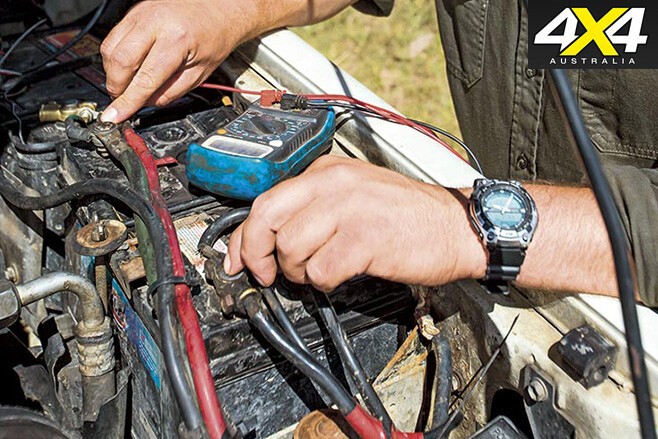
2. If the fuse is okay, use a multimeter at the exposed positive wire closest to the accessory to make sure it’s receiving 12V. If the accessory is still not working, despite a 12V reading, you know there’s a problem with the accessory itself.
3. If there’s no power at all, check the wiring for damage between the accessory and the fuse.
4. If there’s a relay in the circuit, check it’s working correctly by ensuring it has got 12V power at pin 87 (output) with the accessory turned on.
5. If there’s no power, check the relay has constant power to pin 30, signal power to pin 85 and ground at pin 86. If all of this is present and there’s still no power to pin 87, the relay is busted.
COMMON PROBLEMS AND EASY FIXES
ALTERNATOR LIGHT ACTIVATED Grab a multimeter and check the voltage at the alternator’s battery positive terminal is between 13.5V-14.5V with the engine running. If it’s not charging, for us 4WDers, it’s usually due to mud getting in and clogging the internal brushes of the alternator, so give it a thorough wash with clean water and see if it kicks back into life.
The bush fix If your alternator is completely stuffed, it’s time to turn all of your accessories off so your battery keeps your engine running for longer. Remember, most camper trailers have batteries these days so you can swap it with your 4WD battery to get back on the road and, if you’ve got solar panels, it’s time to get them out.
If you’ve got a 12V drill, there’s even a possibility of attaching it to your alternator pulley with the belt off and winding it over that way. You never know, it might charge the battery just enough to kick the engine over.
Some late-model engine management systems will cut the power if the voltage is too low (less than 12V). There are all sorts of solutions – some we recommend and some not so much. In fact, people have even been known to strap the generator to the roof and charge the battery via their camper’s battery charger while they drive.
TRAILER LIGHTS AREN’T WORKING Before you start pulling things apart, sometimes spraying the auxiliary plug terminals with WD-40 is all you’ll need to do.
Check for damage to the wiring and the auxiliary plug, as it’s prone to bottoming out. If there’s no physical damage, you’ll have to check each circuit is working at the plug by activating each output individually and checking for power. Then ensure there’s power at the lamps, and pay particular attention to the condition of the earth strap/points.
The bush fix If the auxiliary plug is damaged beyond repair, you can bypass it by attaching the corresponding wires together using scotch locks, spade terminals or, worst case, by simply twisting the wires together and wrapping them with electrical tape.
BATTERY TERMINAL REPAIRS Loose or corroded battery terminals are the leading causes of electrical problems out in the scrub. They can be responsible for things like the engine not starting, warning lights flickering on and off, and they can even cause fires.
The bush fix You can clean off corrosion by pouring boiling water over it. For loose battery terminals, you’ll need to shim the gap between the battery terminal and the clamp to get you out of trouble. One great little trick is to cut up an old Coke can and wrap it around the terminal before fitting the clamp back on. You could even wedge a self-tapping screw between the two.
STARTER-MOTOR DRAMAS A stuffed starter motor is bad news out on the tracks. Sure, you can usually clutch start a manual vehicle, but what if it’s an automatic? The first step is to diagnose what the problem is. For example, if the starter clicks when you try to start it, it’s usually either the battery is low, or the solenoid is sticking. If there’s no noise at all, you could have a wiring problem to the starter motor itself (wiring harness).
The bush fix If the starter motor is clicking, the solenoid is likely to be stuck. Try tapping the solenoid with a metal rod (preferably with a soft end) while your mate tries starting the vehicle. Another common problem is that the starter motor has got too hot, so let it cool down and try again a bit later.
If you’ve got no power to the starter motor and you can’t find the problem, you can use a set of jumper leads to bypass the original wiring by running the cable from the battery’s positive to the large positive terminal on the starter motor solenoid. Then, with the vehicle in neutral, use a wire or screwdriver blade to jump power from the solenoid’s main positive terminal to the smaller ignition positive terminal to actuate the solenoid until the vehicle starts. This is a last resort and should be avoided when possible, especially on modern vehicles.
12V BUSH MECHANIC ESSENTIALS
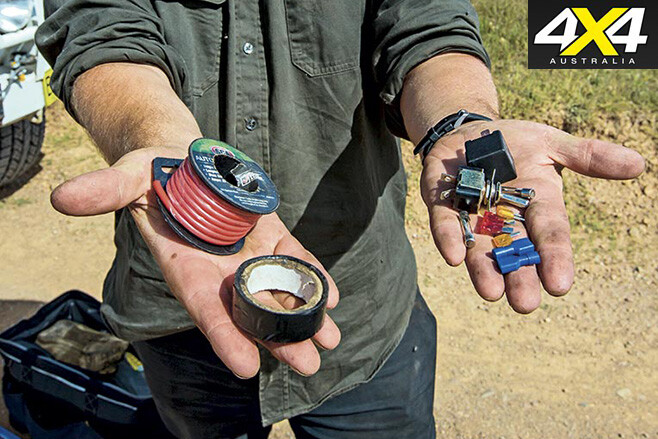
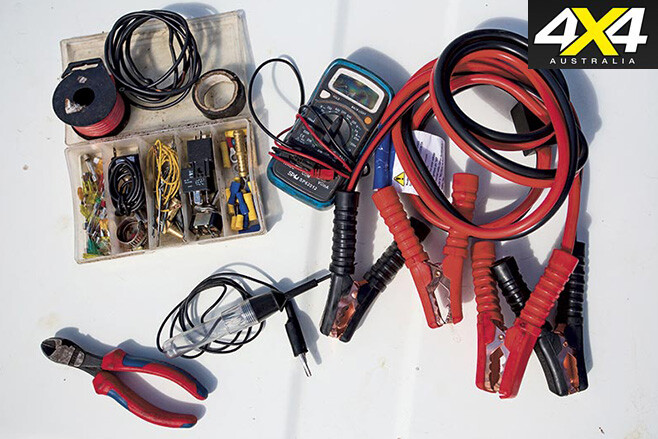
• Electrical cable • Jumper leads • Terminal kit • Spare fuses • Electrical tape (non-conductive, unlike other tapes) • Test light • Multimeter • Spare on/off switches • Spare relays • Crimper pliers • Test cables (length of cable with an alligator clip on each end) • Scan tool
WRAPPING IT UP
Well, there you go, electrical dramas on the tracks don’t always mean you’re going to be stranded. Believe it or not, with a bit of knowledge and creative ingenuity, there are few situations from which you can’t escape. In saying that, it pays to learn those little details about your set-up, carry enough practical spare parts and make friends with the towie in the closest town!
NEED A MAKESHIFT TEST LIGHT?
You can make a test light for trackside diagnosis with one 12V globe, two wires and some electrical tape. Simply tape one electrical wire to the terminal on the bottom of the globe housing, and tape the other to the side of the housing and Bob’s your uncle, you’ve got a test light. If it’s an electrical problem that’s stopping you and you need to diagnose it, everything else become secondary, so pop a globe from your vehicle’s rear lights if you need to, get the beast up and running and then worry about any recovery operations.