
CONCEIVED in the early 1970s and in production before the end of that decade, the G-Class is Mercedes-Benz’s longest running model and even outdates Toyota’s venerable 70 Series.
This G-Class Professional G300 is the latest in a long line of G-Class variants to be sold here over the years and joins the G350 and G63 AMG wagons introduced back in 2011.
There’s only one engine, an extremely low-tuned version of Mercedes-Benz’s ubiquitous V6 diesel that’s designed to run on the world’s poorest quality diesel. A five-speed automatic is the only gearbox offered and it’s mated to the G-Class’ trademark dual-range full-time 4×4 system with its triple diff locks.
The bullbar, snorkel, light protectors, all-terrain tyres and air-con are all standard. Options include a walk-on bonnet with a 100kg load rating and cyclonic pre-filter for the snorkel. The tray is aftermarket and not an official M-B accessory.
TOURING If you’re looking for a tough 4×4 cab-chassis to carry up to two tonnes of gear, then the G-Professional should be at the top of your shopping list. However, if you’re looking for a hardcore touring ute, then this probably isn’t the vehicle for you.
The G-Professional is a no-compromise workhorse and an ergonomic nightmare. It’s uncomfortable to sit in, tiring to drive, unladen ride quality is horrible, NVH levels are extreme, the dash is from a bygone era, there aren’t any cup holders, there’s no centre console, the seats offer little support, the driving position is cramped, and there’s no cruise control…
Partially due to its brick-outhouse aerodynamics and hefty 2410kg kerb weight, the G-Professional’s 3.0L V6 turbo-diesel engine proved lacklustre and thirsty, sucking down distillate at an average rate of 16.1L/100km, so you’d have to top up the 97-litre fuel tank every 550km or so on a trip that includes a mix of touring and off-road driving.
4X4OTY judge Ron Moon did more miles in the G-Professional than the rest of the judging team and, after a long stint behind the wheel, had this to say: “Just drove the Merc back from Wangaratta. Pig of a thing – you had to keep the foot pressed heavily into the floor to keep it going (got a cramp!). And in the bush every throttle input was initiated with a heavy push of the throttle.”
TRAIL DRIVING Get over the harsh ride quality and the apparent lack of rear-wheel travel (when unladen, at least) and the G-Professional is a very capable vehicle on the trails. It has excellent low-range reduction and a full-time 4×4 system with lockable front, centre and rear diffs. Locking the diffs is a simple affair too; simply press the relevant button and an orange light tells you the diff is about to lock, then, when the red light illuminates, you know it’s locked.
Ground clearance is excellent, although the super-long wheelbase results in a ramp-over angle of just 22 degrees, which can see the G-Professional bottom out on big mitre drains. Never fear, the chassis is rock solid and there’s nothing hanging down that could be damaged by a minor grounding. Approach and departure angles are much better at 38 and 35 degrees respectively, but the latter will obviously depend on your choice of tray.
Over-bonnet visibility isn’t bad but the view to the rear will be impeded by whatever you’re carrying in the back. On the other hand, the large external mirrors are excellent.
SET-PIECE HILL CLIMB With low-range selected and front, centre and rear diffs locked, the unladen G-Professional ascended the set-piece hill climb easily enough, but it didn’t look all that smooth doing it.
With stiff rear springs capable of hauling a two-tonne load, but with nothing actually in the tray this time, the G-Professional exhibited virtually none of its potential rear wheel travel, and the super-stiff chassis barely flexed. As a result, opposing rear wheels lifted high off the ground over the set-piece hill climb’s deep holes, and the G-Professional had to rely on its locked diffs to maintain traction and forward momentum.
The G-Professional exhibited a similar style when descending the steep hill, dropping its front wheels into holes while kicking its rear wheels high into the air. This resulted in an uneasy feeling behind the wheel. “Instead of walking through the holes, it walks over them, and bounces you around because of that,” explained 4X4 Ed Matt Raudonikis after tackling the set-piece hill climb. He was, however, impressed with the G300’s excellent low-range reduction and impressive engine braking.
CABIN, EQUIPMENT AND ACCOMMODATION Wow! $120K and you don’t even get cup holders! At least air-conditioning is standard, as are wind-up windows, a passenger grab handle and a floor plug with a chain so you can drain water out if necessary. Despite the centre console being bolted shut to house the G-Professional’s electronics, there are decent-size storage boxes under the seats and a lockable glovebox.
Safety gear includes dual airbags, ABS, brake assist, electronic brake force distribution and electronic stability control. The Benz also comes standard with a snorkel, bullbar, side rails, headlight and indicator light protector grilles, and a full-size spare (loose). The tray fitted to the test vehicle is an aftermarket item, as M-B supplies the G-Professional as a cab-chassis only.
PRACTICALITIES The standard snorkel, bullbar and side rails are great, as are the bright red recovery points front and rear that look like they could haul a Panzer tank out of the muck at any point in time.
The G-Professional is fitted with LT265/75R16 BF Goodrich All Terrains and there’s a tyre pressure loss warning system. As well as plenty of ground clearance, the Benz’s underbody components are tucked up and out of the way, so you’re unlikely to harm anything.
The huge mirrors are excellent, as is the passenger’s grab handle, which prevents them from being thrown around the cabin as you bounce over tracks.
SUMMARY The G-Professional had its fans and haters after a week in the bush. “I might be a glutton for punishment but the G-Professional was the one that had me smiling all week,” 4X4OTY judge Dan Everett said. Penny Wells, on the other hand, offered this: “The one vehicle I was extremely keen to test drive quickly became the one I disliked, partly due to not packing a kidney belt for the week.”
The G-Professional really proves the old adage ‘horses for courses’. If you had a heavy load to haul then the Benz would be up for the job. But if you had to occasionally drive it unladen, or over long distances, you’d probably struggle to last a full day in the saddle.
TOUGHEN UP A kit for the Benz cab-chassis has not been developed, but Tough Dog will be consulting with specific application users, such as the military, to establish what the vehicle will be used for so it can tailor suspension solutions to suit.
SPECS Engine: 3.0-litre V6 turbo-diesel Max Power: 135kW @ 3800rpm Max Torque: 400Nm @ 1600-2600rpm Gearbox: five-speed automatic 4×4 system: dual-range full-time Crawl ratio: 41.0:1 Tyre spec: 265/75R16 Kerb weight: 2410kg GVM: 4490kg Payload: 2080kg Towing capacity: 2210kg GCM: N/A Fuel tank capacity: 97 litres ADR fuel claim: N/A Price: $119,900 *Price excludes the tray and on-road costs.
MORE 4X4 OF THE YEAR
HOME: 4X4 OF THE YEAR 2017
The seven most interesting 4×4 vehicles of 2016 get together for a week to determine the 4×4 Of The Year.
THE FINALISTS
Meet the seven most interesting 4×4 vehicles of 2016 battling it out to be crowned 4×4 Of The Year.
THE RESULTS
Only one of the seven best 4x4s from 2016 can be crowned 4×4 Of The Year 2017
4X4 OF THE YEAR HOME
Finding Australia’s Best 4x4s
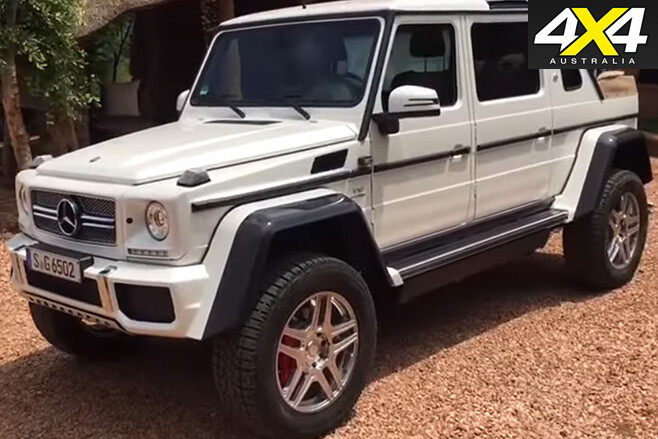
MERCEDES-AMG has released a teaser pic of its Mercedes-Maybach G650 Landaulet ahead of next month’s Geneva Motor Show. A quick 60-second video of the luxurious drop-top has also found its way onto the net.
The smartphone footage provides a 360-degree view of the G650 in all of its undisguised glory. A notable design cue of the ‘convertible’ is the rear fabric roof that is said to electrically fold behind the rear seats.
Of the limited details released so far, the G650 will utilise Merc-AMG’s 6.0-litre twin-turbo V12 engine that’s capable of producing a whopping 463kW and 1000Nm. The monster is also said to have portal axles, a wheelbase of 3428mm, carbonfibre wheel arches and Pirelli Scorpion ATR tyres.
Mercedes-Benz’s G-Professional G300 was a finalist at 4X4 Australia’s 2017 4X4OTY award, with its high price, lack of refinement, and gruff on- and off-round demeanour working against it.
Sources differ, but it’s believed only 99 or 100 units will be built, and these are expected to be snapped up by the uber wealthy – pricing is yet to be announced, but expect a price tag of at least US$300,000.
All will be revealed at the 2017 Geneva Motor Show, which runs from March 9-19. Stay tuned to www.4x4australia.com.au for complete coverage of the event!
WE LOADED two traditional rivals, Toyota’s LandCruiser 79 Series and Mercedes-Benz’s G300, with 1000-litre water tanks to see which workhorse handled the weight better.
Both of these work utes are steeped in 30 years of history, and both have carved a name for themselves as durable, tough and reliable.
See what we thought of the 2016 Mercedes-Benz W461 G300 CDI Cab-Chassis
However, there’s one major discrepancy between the two off-road monsters: price. The Merc starts from an eye-watering $119,900, while the LandCruiser GXL will set you back at least $66,490 (and that’s without air-con).
The Mercedes-Benz, while impressive in a 4WD and load-carrying sense, is bare-to-the-bones when it comes to comfort and refinement. Dan Everett said of it at 4X4OTY: “The doors might not seal and the sound might send you deaf, but in 50 years that light switch is going to be as solid as ever, even if the suspension will be too.”
The 3.0-litre V6 turbo-diesel engine produces 135kW and 400Nm, and you’d be a game explorer to push 600km from its 97-litre fuel tank.
The 4X4OTY-winning Cruiser on the other hand, while not a luxurious vehicle in any sense, feels comfortable following a jaunt in the Merc.
Only minor changes have found their way into the Cruiser, but these changes – a taller fifth gear, auto-locking hubs, safety improvements – have made a good thing even better.
The Cruiser’s 4.5-litre eight-cylinder turbo-diesel is good for 151kW and 430Nm, while a bigger 130-litre fuel capacity should see it go 900km between refills.
Watch the above video to see whether the Merc’s $50K price premium makes it a better on- and off-road performer than the Cruiser.
Or grab a copy of 4X4 Australia’s March edition to read the complete load-lugging comparison. In stores now!
There are a few potentially life-saving lessons to be learnt from the latest incident of a couple becoming stranded when their vehicle broke down in a remote region of southern WA last October.
There are also a few unanswered questions too, I reckon, from what I’ve read in the newspapers about the police search – its duration, adequacy and location.
Jeremy Sim and his wife, Marama, from the thriving township of Esperance, are both experienced campers. They headed off in their Nissan Patrol for a few days camping in the goldfields area west of the small hamlet of Salmon Gums, which is about 105km north of Esperance.
When they failed to return at their allotted time the alarm was raised and the police began a search for them. The focus of the air search was moved to the coast between Esperance and Hopetoun after one of the couple’s mobile phones had been detected by a phone tower near the small settlement of Munglinup, on the coast road east of Ravensthorpe.
After an “extensive search” (which lasted between two and four days, depending on who you believe), the police response was called off “pending further information”. A pretty poor effort in my opinion. At the time of going to press there was little other information as to why the search for the couple was so short; although a police spokesman expressed that the area they had to search was massive, and that until they could get further info they were going to have to suspend their response. Geez, if my family or I were lost I’d hope the police and official search groups would put more effort in than just a few days searching.
Despite authorities suggesting that the search should be left to them, friends of the couple refused to give up and, using the mud map the couple had left with them, continued to search on the ground. The police also had access to the mud map but seemed to ignore it – apparently saying the map was pretty rough. Mud maps generally are! Instead, the police seemed to put their faith in the mobile phone detection despite admitting it wasn’t 100 per cent reliable.
The couple were found by their friends near Peak Charles, 200km northwest of Esperance, just over 24 hours after their friends started looking for them. Jeremy and Marama were still with their vehicle, had some water left and had lit a large fire when they saw search aircraft (without success). The couple’s vehicle, which had been disabled by a stick puncturing the radiator, was towed back to civilization.
From reports it appears the couple did a lot of things correctly. Despite it being a relatively short trip into a not-so-remote region of WA, they were well-prepared with extra fuel and water in the vehicle. They told their friends where they were going, when they were expected back and left a mud map of their route. Most importantly, when they broke down they stayed with the car and prepared a large fire using the vehicle’s mudflaps to greatly increase the smoke when they lit it.
However, there are always lessons to be learned from any experience, good or bad. Relying on a mobile phone outside major metro areas and rural towns is a bad idea, while a CB radio is basically a short range communications device.
They should have had an HF radio or a sat phone for longer range communication, or just an EPIRB or a device like a ‘Spot’ for emergency notification, tracking and location. Of course, hindsight is a wonderful thing – usually experience comes just after you need it.
What really concerns me in this tale of survival is the police response. The police have been reticent in speaking to the media, however Jeremy is pursuing his own enquiries.
Questions need to be asked as to why the police search was called off so early and why the mud map was ignored by officials – especially when it proved vital to the couple’s rescue. Protocols clearly need to be changed in the wake of this drama.
HAVAL is Great Wall’s SUV offshoot brand, and the H9 is the only proper 4×4 in the Haval range.
While a ‘take’ on the Toyota Prado in general size and layout, thanks in part to Haval’s recruitment of former Toyota chief engineer Suguya Fukusato, the Haval H9 is petrol-fuelled only. The engine in question is a 2.0-litre turbo four-cylinder, reportedly designed in-house at Haval. The 4×4 system uses a self-locking and self-proportioning electronic transfer case (built under license from Borg Warner) much like that used in the Ford Everest.
The model supplied for 4X4OTY was the top-spec Luxury. The cheaper Premium loses the sunroof, leather, electric-seat adjust and has 17s in place of 18s and no terrain settings for the otherwise similar 4×4 system.
TOURING The Haval H9 delivers a surprisingly compliant ride on secondary and gravel roads and it displays good behaviour at touring speeds, as well as impressive road-shock isolation courtesy of its separate chassis architecture. However, at higher speeds it starts to feel a little untidy on rough roads and the steering becomes vague.
Despite its relatively small turbocharged petrol engine, on-road performance is more than adequate for a family wagon. Poking around town the engine feels smooth enough, but open the throttle and it becomes noisy and harsh as the revs rise.
The ZF six-speed automatic transmission delivers smooth shifts and the ratios are well-matched to the engine. Under full throttle there is little discernible difference between the Auto and Sport modes within the Haval’s All-Terrain Control System (ATCS), although the latter is programmed to hold on to gears for longer before upshifting.
The H9 recorded an average fuel consumption figure of 14.3L/100km on test, so touring range from the 80L tank is limited to a tad more than 500km.
TRAIL DRIVING The H9 is equipped with an impressive arsenal of traction goodies to assist when it ventures off-road. The Luxury model tested here has Haval’s All Terrain Control System with Auto, Sport, Sand, Snow, Mud and 4L modes – it automatically apportions torque to the axle that needs it up to a split of 50:50 (front:rear).
Selecting the required mode is by way of a dial, which is easy enough to operate but is a bit of an ergonomic miss as it’s set to the left of the centre console and is not clearly marked.
By selecting 4L the rear diff lock automatically engages, which is great if you have a gnarly and slippery hill to climb, but a bit superfluous if you don’t, in which case you can easily disengage it by pressing a button. Nevertheless, the diff lock, effective traction control system, good wheel travel and adequate ground clearance, combined with the engine’s decent low-rpm grunt and good low-range gearing, endow the H9 with surprisingly good performance on a trail.
Over-bonnet visibility isn’t great compared to its rivals and we had a couple of odd warning lights momentarily appear on the dash (such as “E-Handbrake System Fault”), but the H9 proved reliable and capable on bush tracks despite the sometimes-challenging conditions.
SET-PIECE HILL CLIMB As the judges stood around at the bottom of our set-piece hill climb expecting the Haval H9 to come unstuck at the first big wheel rut, there were soon gasps of surprise and admiration as the H9 made the climb look easy.
The H9 climbed the hill over and over again with barely a hint of wheelspin. In fact, the only complaint on the climb was the lack of over-bonnet visibility when cresting the hill. Coming back down, the H9’s engine braking wasn’t fantastic, and the Hill Descent Control was set too fast, but good brake feel made it easy enough to retard the descent without fear of an uncontrolled slide.
It didn’t bottom out on the set-piece hill climb, but the H9’s ground clearance is best described as adequate. Additionally, a fair amount of care must be taken to avoid damaging the wide sidesteps.
CABIN, EQUIPMENT AND ACCOMMODATION The H9 Luxury is absolutely loaded with gear belying its $50K drive-away price. Standard equipment includes leather trim, electrically adjustable front seats with heating, cooling and massage function, electrically folding third-row seats, sunroof, parking sensors, reversing camera, driver condition monitor, tyre pressure monitor, eight-inch TFT screen, GPS navigation, 10-speaker sound system, tri-zone climate control air-conditioning, and much, much more.
It’s not hard to get comfortable behind the wheel of the H9 and the cabin is generally a very pleasant place to be, with good quality materials and trim.
The electrically folding third-row seats are a great feature, but passenger access to the third row is compromised by the 60/40 split of the second row being set up for left-hand drive markets. In fact, without someone outside the vehicle to fold the second-row seat for you, you can only exit the third row on the driver’s side – which isn’t ideal for the Aussie market.
When the third-row seats are not in use, the H9 offers generous cargo space, with decent luggage tie-down points and a 12V power outlet in the rear. There’s also a comprehensive tool kit located in the cargo door.
PRACTICALITIES The H9 Luxury runs 265/60R18 Cooper Discoverer HTS tyres on alloy rims. This tyre size matches the Toyota Prado, so tyres should be easy to source outside of major centres when on a trip.
Haval has ensured the alternator and electrics are located high up in the engine bay and the air intake is through the right-hand inner guard, giving the H9 a claimed 700mm fording depth. If you wanted to, and with a bit of fiddling, you could fit a small auxiliary battery under the bonnet.
Up front the H9 has a pair of decent recovery points, and there’s one at the rear. Other than the aforementioned wide sidesteps, we didn’t have ground clearance issues on test and everything is tucked up and out of the way.
SUMMARY Loaded with gear, the Haval H9 represents good value for money. It’s also a comfortable tourer, has good off-road capability and appears to be well built, but without a diesel engine option we can’t see it becoming a sales success in Australia. And this means aftermarket accessory manufacturers are unlikely to develop bullbars, snorkels and other essential off-road equipment for it.
TOUGHEN UP A Tough Dog suspension kit has not been developed for the Haval yet, but watch for a release in 2017. The H9’s design similarities with other vehicles on the market means that there may be some components already developed and suitable for this vehicle.
SPECS Engine: 2.0-litre 4-cyl turbo-petrol Max Power: 160kW @ 5500rpm Max Torque: 324Nm @ 2000-4000rpm Gearbox: six-speed automatic 4×4 system: dual-range full-time Crawl ratio: 43.6:1 Tyre spec: 265/60R18 110H Kerb weight: 2236kg GVM: 2850kg Payload: 614kg Touring capacity: 2500kg GCM: 5350kg Fuel tank capacity: 80 litres ADR Fuel Claim: 12.1L/100km Price: $49,990* *Price are drive-away.
MORE 4X4 OF THE YEAR
- HOME: 4X4 OF THE YEAR 2017: The seven most interesting 4×4 vehicles of 2016 get together for a week to determine the 4×4 Of The Year.
- THE FINALISTS: Meet the seven most interesting 4×4 vehicles of 2016 battling it out to be crowned 4×4 Of The Year.
- THE RESULTS: Only one of the seven best 4x4s from 2016 can be crowned 4×4 Of The Year 2017
- 4X4 OF THE YEAR HOME: Finding Australia’s Best 4x4s
4X4 Australia’s readers have voted, and after tallying more than 2000 votes a readers’ choice Custom 4x4OTY of 2016 has been decided.
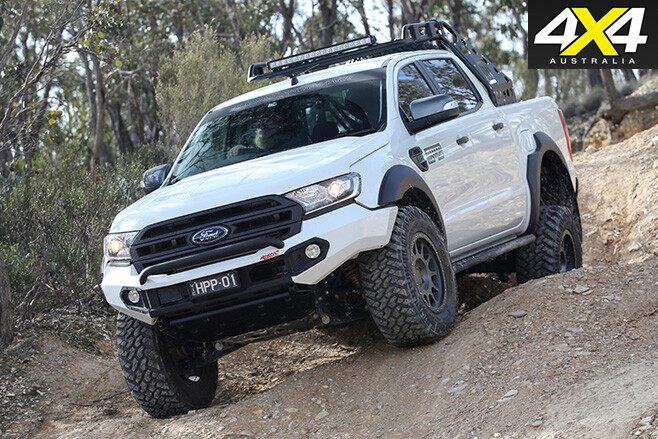
The inaugural award has been won by Harrop Engineering’s Ford Ranger in PXII XLT skin. Melbourne’s Harrop Engineering is known for setting trends rather than following them, and this example typifies the company’s innovation.
This Ranger mimics the pre-runner or chase-truck look commonly seen on American race trucks competing at events like the Baja 100. The attention-grabbing chase rack employed on the Ranger for carrying spare wheels, tyres and tools was made by Uneek 4×4.
The Ranger wears a set of 18-inch Method Race Wheels covered in Nitto Trail Grappler rubber. MCC side steps run the length of the Ford’s side, while a low-cut bar from Rhino 4×4 resides up front.
Tough Dog supplied the springs and shocks, and a Harrop ELocker has been fitted to the front axle.
An engine tune and the addition of a Unichip Q4 module has seen an increase in performance from the stock 3.2-litre diesel – there’s now more than 500Nm on tap at 2000rpm, where that figure was closer to 350Nm on the standard tune.
Bill McKinnon’s Toyota FJ 45 Troop Carrier was the second most popular Custom 4×4, while Andrew Cassar’s wild Nissan Y62 Patrol rounded out the top three.
With such custom vehicles on and off our roads, 2017 promises to be filled with plenty of aftermarket-enhanced goodness!
MAXTRAX PRIZE-WINNERS
Simply by voting for their favourite custom 4×4 of 2016, readers went into the draw to win one of four sets of MaxTrax, each valued at $299.99.
The lucky winners, who’ll now get de-bogged in no time, are: Regina C from WA, Millicent C from Victoria, Fred C from NSW, and David S from SA. All winners have been contacted directly.
Thanks to everyone who voted!
THE Toyota LandCruiser 79 Series was crowned the 2017 4×4 Of The Year at the 2017 Australian Motoring Awards (AMAs).
On the annual night of nights for the automotive industry, the Wheels Car of the Year (Mazda CX-9), MOTOR Performance Car of the Year (Porsche 911 Turbo S) and WhichCar Style Award (Audi A4) were also presented.
The awards ceremony took place at Crown’s Palladium in Melbourne, with comedian Shane Jacobsen (the bloke from Kenny) hosting the evening.
Australian actor and motoring enthusiast Eric Bana was the special guest, and he took to the stage for a Q&A with Jacobsen to discuss his love for all things automotive.
More than 200 industry folk were in attendance to witness the LandCruiser 79 claim the coveted trophy ahead of the VW Amarok by a solitary vote – the closest result in 4X4OTY history.
The remaining finalists for the 2017 4X4OTY were the Haval H9 (China’s first contestant at the award), Holden Colorado, Holden Trailblazer, Mitsubishi Pajero Sport and Mercedes-Benz G300.
To qualify for 4X4OTY contention each vehicle had to be all-new or significantly revised during the past 12 months, hence why there is no Ford Ranger (January’s 4×4 sales leader) or Toyota Hilux in the 2017 crop.
Reckon we hit the nail on the head with this year’s result? Or perhaps you couldn’t disagree more? Either way, have your say by voting for the 2017 4X4OTY Readers’ Choice award!
I HAVE been looking for an old Landy… again.
My preference is for an 88-inch Series IIA with its original 2.25-litre petrol engine, but I’ll settle for a Series III if the right one comes along.
I’ve been scouring various websites in my search for the right vehicle at the right price, and every time I think I’ve found a good one it’s usually located in some far-flung part of the country where I can’t look at it before I lay down the cash to buy it.
Now I don’t know about you, but I’m not too fond of the idea of handing over a few grand to someone on the other side of the country who I’ve never met before, where said Landy might not be in the condition described online, or may not even exist at all. Sure, I know most people are pretty honest, but I also know there are a few shonky types out there in cyberland.
Anyway, I’ve been compiling a folder of suitable vehicles on my computer, with details and photos of each and every vehicle that takes my interest. Some I have placed failed bids on through eBay and others I’ve made unsuccessful offers on through Gumtree or other sites. I’ve also signed up to all the relevant Facebook pages where I might eventually nab the bargain I’m after.
What I have found most surprising through all of my research into these magnificent machines is just how many short-wheelbase Land Rovers are listed for sale at any one time, and the wildly varying prices people are asking for them. I have seen basket-cases with rusted-out chassis and bulkheads priced at more than $6000, and then I have seen almost mint vehicles with more than six-months rego go for as little as $5000.
And then there are the sellers who think they’re sitting on a goldmine, asking up to $30K for a semi-restored Series IIA, or even $55K for a fully restored Series III. As Darryl Kerrigan would say in his laconic drawl, “Tell him he’s dreaming”.
So what brought all this on? Well, a Toyota, actually. Now I’ve owned a couple of old Landies before – a 1971 SIIA SWB and a 1978 ex-army SIII LWB – so you’d reckon I’d have the bug out of my system, right? Wrong. After driving ARB’s 40 Series LandCruiser part-way across the Simpson Desert, and then down the Birdsville Track and through the Flinders Ranges, I was reminded of the raw experience you only get behind the wheel of an old 4×4. Especially a leaf-sprung one with a short wheelbase and so many creaks and rattles you can’t hear the radio.
The 40 Series Cruiser had to be crawled through muddy sections so water wouldn’t get into its finicky electrics. It had to be towed about 230km across the desert when we couldn’t locate another electrical problem. You could feel every bump and corrugation through the seat of your pants. You’d have to fight the unassisted steering to keep it pointed in the right direction when it got all crossed up on slippery mud.
If you weren’t quick enough to flick the foot-well air vent closed, your leg would be sprayed with muddy water when you hit puddles. The windows rattled so loud in the doors you thought your eardrums would rupture. The rear door latch was so dodgy it needed a bolt from the hardware store to keep it closed. The door seals had no chance of keeping daylight out, let alone dust. But in a 40 Series without air conditioning, you drive with the windows down anyway.
And that’s the whole point. With the windows down you’re immersed in the environment around you. You know if it’s hot or cold outside. You can smell the sweet wildflowers and the pungent road kill. You can sense when it’s about to rain or the wind is about to pick up. Of course, you can do all that in a modern 4×4 too, if you drive with the windows down. But who does that?
We’re so used to being cocooned in our modern 4x4s with all of their sound-deadening airtight door seals, their windows wound up and their climate control set to a balmy 22°C, that we miss out on much of what’s happening around us.
I’ve just spotted a Series IIA on Gumtree. Bugger, it’s in Perth. Excuse me while I Google vehicle freight companies.
Orientation sounds like something you did at school or in Scouts. Finding your way through unfamiliar terrain (like the bush or your new grade-five classroom), and adapting to new ways of doing things and trying not to look too stupid while you muddle your way through.
Funnily enough, we orientate our trusty four-wheel drives every time we hop into it – whether we’re simply driving to the shops or navigating a new stretch of bush. Many of us have hard-and-fast opinions about how best to orientate our rigs in different situations. For example, the pros and cons of nose-to-kerb or rear-to-kerb parking.
Vehicle positioning is more than simply the approach you take to a bog-hole or ascent. After all, at the end of a good day behind the wheel, do you simply stop and turn off the ignition before making camp? Probably not.
We thought we’d explain why vehicle orientation can make a real difference around camp. You may find you practise some of these techniques already; others you might not have even thought about.
TIP 1 FOLLOW YOUR NOSE Consider the importance of parking nose-out. That is, orientating your vehicle for a quick and easy departure in case of a medical emergency or bush fire. An unobstructed line of departure – preferably slightly down hill – is recommended in case you have to roll start your rig because ‘someone’ left the interior light on.
TIP 2 EMBRACE YOUR INNER HIPPY When you set up camp, consider a little Feng Shui – the Chinese philosophical system of harmonising everyone with the surrounding environment. Before you choke on your own tongue, let us explain.
No one likes smoke in their eyes. So, when pulling up at your designated campsite, check out the predominant wind direction. The place for your swag, tent or camper should be sited upwind with the kitchen and fire downwind (or at least side-on) to blow away smoke, mosquitoes and other airborne vectors of disease. The place for poo should be further downwind, but reasonably accessible to you.
TIP 3 SOLAR SENSE We live in the Southern Hemisphere, right? So get the most out of your awning. If you’ve attached it to the passenger side of the vehicle (like most of us), orientate your 4×4 to point west/east. This will allow your rig to provide the most shade on the southern side of the vehicle during the hottest parts of the day.
If shade is not an issue, consider parking in a nose-north position. That way you can utilise your windscreen and its sunshade as a reflector (like a giant heliograph) in case of an emergency, for early detection by search and rescue teams.
TIP 4 BREAKING WIND Consider using your vehicle as a wind break by parking it perpendicular to, and upwind of, where you want to sleep. This will stop the buffeting of your tent during the night and allow the latest copy of your 4X4 Australia magazine to stay on the chair or table where you left it.
If shade isn’t a problem, ensure your awning is on the downwind side of the vehicle so it doesn’t catch the wind and act like a sail.
If you have a camper trailer, park it in an east-west orientation using your rig as the wind break. Now you have a shady and wind-protected campsite to enjoy.
TIP 5 PLAY IT SAFE Finally, remember to watch out for unexpected hazards. Never let anyone tie their swag to your 4×4, especially in front or behind it. We know this sounds basic, but we see it all the time.
Look up and try to avoid parking your rig under a tree. Falling branches can be a risk to your vehicle and your travel party – they’re not called widow-makers for nothing.=
So the next time you’re looking for that ideal camp spot, observe the points of the compass and understand your surroundings. You might find inner peace quicker than you think. After all, isn’t that why we’re there?
Want more recovery tips? We’ve got you sorted.
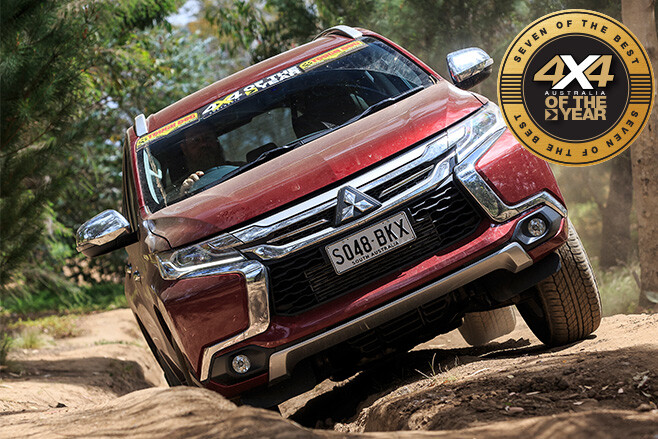
THE Pajero Sport is based on the Triton ute that arrived early in 2015 and was a finalist at last year’s 4X4OTY.
Aside from the body and the coil-spring rear suspension, the notable change from the Triton is an eight-speed automatic in place of the Triton’s five-speed auto. There’s no manual in the three-model range and all have Mitsubishi’s now unique Super Select 4×4 system that offers the functionality of full-time 4×4 but with the option of 4×2. Otherwise it’s Triton engine, Triton front suspension and a shortened and modified Triton ladder-frame chassis.
Our test vehicle was the Pajero Sport GLS. The more expensive Exceed gains autonomous braking, blind-spot monitoring, external view cameras and a rear DVD system. Below the GLS is the GXL, which loses the third-row seats but gains payload and luggage space.
TOURING
With its well-sorted suspension, strong engine, super-smooth eight-speed auto and selectable full-time 4×4 system, the Pajero Sport GLS proved to be a comfortable touring wagon. It’s also very well equipped, especially considering its sub-$50K asking price.
The soft suspension offers compliance on bumpy back roads and when driving on gravel. However, the Pajero Sport does exhibit pronounced body roll when cornering. Nevertheless, the fact you can engage full-time 4×4 on sealed or unsealed surfaces ensures there’s plenty of traction whenever you need it.
The Pajero Sport proved economical on test, recording an average fuel consumption figure of 11.2L/100km, but with a smallish 68L fuel tank safe touring range is limited to around 550km.
TRAIL DRIVING
The Pajero Sport’s aforementioned soft suspension results in a good ride over bumpy off-road tracks. Ground clearance is adequate for most tracks, although the rear overhang is compromised by the location of the spare wheel and furthermore when an OE towbar is fitted, as it was to our test vehicle.
The transmission’s paddle shifts are mounted to the steering column rather than the wheel, so you don’t have to fumble around looking for them when the wheel is turned, but the Pajero Sport was occasionally reluctant to shift down when manually prompted to do so.
Nevertheless, very good low-range reduction (45.9:1 in low range first gear) meant the hill descent control was virtually redundant and the Pajero Sport had no trouble climbing steep tracks.
The rear diff lock (standard on GLS and Exceed) engages quickly but once selected the traction control system is disengaged on both axles, so in many off-road situations you’re better option is to leave the rear diff open so you can take advantage of the traction control.
SET-PIECE HILL CLIMB
With the rear diff lock engaged, the Pajero Sport found the going tough on the set-piece hill climb. Rear-wheel travel is acceptable, but there isn’t a lot of travel up front, and without any electronic intervention the front wheels were left scrabbling for traction over even moderate undulations on the hill.
For its second attempt at the hill climb, the rear diff lock was disengaged to enable the electronic traction control system to do its thing; the Pajero Sport made it further up the climb in this configuration, but the driving line had to be altered to avoid the biggest holes in the track for it to eventually crest the hill.
The Pajero Sport’s impressive low-range gearing meant descending the set-piece hill climb was easy, with no need to apply the brakes or engage the HDC; very good stuff for an auto!
CABIN, EQUIPMENT AND ACCOMMODATION
It’s not the top-spec Pajero Sport, but the GLS is still very well-equipped and comes standard with features including leather seat trim, electric seat adjustment, dual-zone climate-control air-conditioning, Apple CarPlay and Android Auto connectivity, and keyless entry.
The front seats are supportive and comfortable, but all of the 4X4OTY judges complained about the design of the centre console which encroaches on leg room and makes the cockpit feel cramped.
Comfortably accommodating three adults across the second-row seat is a big ask. There’s not enough shoulder room and the outer-seat occupants feel as though they’re leaning towards the centre. Meanwhile, the centre passenger will be sitting atop his or her own seatbelt buckle.
With a tumble fold design, access to the third-row seats is good, there’s reasonable legroom and there are air-conditioning vents and cup holders, but the child-seat anchor points that protrude from the roof compromise headroom.
With the third-row seats folded into the floor, the Pajero Sport has a good-size cargo area, but the cargo-tie-down points are not particularly strong, and there are only two of them.
PRACTICALITIES
All Pajero Sport models are equipped with 18-inch rims shod with 265/60R18 Dunlop GT AT20 rubber, which is now almost the standard size for this class.
While the air intake is positioned up high up through the Pajero Sport’s inner guard, the alternator is down at the midpoint of the engine bay where it’s more susceptible to a mud bath in extreme conditions. All other electrics are located up high, and there’s plenty of space for those who wish to fit a second battery or an air compressor in the engine bay. If you get stuck in your Pajero Sport, you’ll be pleased to know it’s fitted with decent recovery points front and rear.
SUMMARY
The Pajero Sport GLS packs plenty of equipment and features, yet is priced lower than many of its direct competitors. It delivers good on-road performance, comfortable ride quality and reasonable off-road capability.
At the end of the week’s testing, the Pajero Sport pleasantly surprised everyone, but none of the judges were impressed with the console, which results in a cramped cockpit feel.
TOUGHEN UP
Tough Dog offers a 20mm lift using either 41mm non-adjustable foam cell or the nine-stage adjustable shocks option. The front end is susceptible to changes in weight so TD has developed three different springs for different weights – one for standard trim, one for vehicles with a bullbar, and a third for vehicles with both a bullbar and winch. It has also developed 0-300kg and 300kg+ constant load springs for the back. Price ranges from $1340 to $1680, depending on options selected.
SPECS
Engine: 2.4-litre 4-cyl turbo-diesel Max Power: 133kW @ 3500rpm Max Torque: 430Nm @ 2500rpm Gearbox: eight-speed automatic 4×4 system: dual-range full-time (+2WD) Crawl ratio: 45.9:1 Tyre spec: 265/60R18 110H Kerb weight: 2070kg GVM: 2710kg Payload: 640kg Towing capacity: 3100kg GCM: 5400kg Fuel tank capacity: 68 litres ADR fuel claim: 8.0L/100km Price: $48,500 *Price exclude on-road costs.
MORE 4X4 OF THE YEAR
HOME: 4X4 OF THE YEAR 2017
The seven most interesting 4×4 vehicles of 2016 get together for a week to determine the 4×4 Of The Year.
THE FINALISTS
Meet the seven most interesting 4×4 vehicles of 2016 battling it out to be crowned 4×4 Of The Year.
THE RESULTS
Only one of the seven best 4x4s from 2016 can be crowned 4×4 Of The Year 2017
4X4 OF THE YEAR HOME
Finding Australia’s Best 4x4s