
MANY off-roaders pack a chainsaw to deal with a road block or to cut firewood – so it’s common to see one strapped to a set of roof racks.
Commonly, these are mid-range chainsaws that weigh around 5kg and require a 5- or 10-litre jerry can of two-stroke that weighs another 4-7kg. So that’s a 10kg addition to a roof-rack load. But does carrying a chainsaw need to be such a weighty issue? These days, the answer is probably no.
Myriad chainsaw models are on the market for the homeowner, landowner, arborist, forestry worker or emergency service operator. And with chainsaws becoming smaller and cheaper, every amateur gardener anywhere could have a chainsaw by Christmas.
But have these chainsaws got what it takes to replace their heavier counterparts for duties in remote areas? While many of them are definitely great for light home duties, how reliable are they? The old adage ‘you get what you pay for’ generally applies across the commercial sector, so it may not pay to buy a tool that can’t clear a fallen tree on a remote track.
So we were excited to see a mate pull out a pocket-sized Stihl MSA 160T when we arrived at a favourite campsite a few weeks back. In this instance, our mate cuts firewood as a second job and has a shed full of ‘big-boy’ chainsaws back home, so it seemed only logical to ask him to put the MSA 160T through its paces. The MSA 160T is an arborist’s chainsaw that weighs 2.3kg minus the battery (yes, we did say battery).
How to use a chainsaw correctly
Being electric, it springs into life at the touch of a button – no messing around with fuel. Once started we were struck by the relatively noiseless nature of the MSA 160T, this thing zinged rather than roared. “You don’t need to wear hearing protection, and you don’t disturb other campers when you’re using it,” old mate said.
The MSA 160T’s short bar made it very easy to use, while the smaller teeth reduced kick-back. In terms of battery life, we chopped enough dead-fall in 15 minutes to last all weekend. The battery has four LED charge indicators, which told us we’d used just a quarter of the battery’s charge in this effort. Indeed, our mate told us he’d filled a box trailer in one session without the battery going flat. The battery we tested was an AP 180 (36-volt with a maximum 35 minutes of cutting time).
Using the AL 100 charger, getting from 3/4 to full power took no longer than the time taken to cook dinner and enjoy a few coldies in front of the fire.
Another feature of electric operation is that there’s little wear and tear. The chain still requires lubrication, but there are no other moving parts and the chainsaw has few vibrations, so servicing costs are reduced. The battery locks in from the top, so it’s unlikely to come loose as can happen with side-battery mountings. The top handle allows for single-handed use, but if you’re looking for a more traditional rear handle it has a bigger brother in the MSA 200.
Best of all, you don’t have to worry about two-stroke. So that’s one less jerry can to pack and, combined with the MSA 160T’s compact size, less weight on the roof racks. The downside is the price, as this little fella costs $349 for the chainsaw alone. It’s a further $269 for the battery and $54 for the charger. The same battery and charger can be used on other Stihl cordless products, so you could alleviate the burden by consolidating your hardware needs around the Stihl brand. But that doesn’t help if your garage is already kitted out with power tools.
AVAILABLE FROM:
RRP: $349 (chainsaw), $269 (battery) and $54 (charger)
WE SAY: Lightweight and quiet, but it’s not cheap.
SPY shots have surfaced on the internet of Jeep’s upcoming dual-cab Wrangler ute.
In April 2016, Jeep Australia confirmed its interest in a double-cab pick-up variant of the next-gen Wrangler. And, at the time, Zac Loo, head of product strategy and marketing at FCA, said: “We’re looking at extending that (Wrangler) line beyond just two- and four-door variants that we have today with the pick-up.”
Then at the 2016 Los Angeles Motor Show, Mike Manley, Jeep’s global chief, all but confirmed the Wrangler ute will come to Australia, when he said: “there’s no question on right-hand drive for the pick-up.”
Progress has since sharpened, with these spy shots of the camouflaged dual-cab Wrangler recently sprouting on the web.
Video: All-electric Jeep JK Wrangler at SEMA
As can be seen in the pics, the ute variant is similar to the current-gen Wrangler SUV – with a few noticeable design changes.
The upcoming JL Wrangler, of which it’s based, is set to gain a host of fuel-saving features, the option of a turbocharged four-cylinder petrol engine or a V6 diesel engine, an eight-speed automatic transmission, and weight-saving aluminium panels.
The ute version is expected to roll into showrooms early in 2019, with production scheduled at FCA’s Toledo’s assembly complex in Ohio.
REMEMBER the 2009 Shelby F-150 Super Snake concept? Well, the performance vehicle experts have again injected the Ford F-150 with a shot of venom.
Utilising the already-capable F-150 as a base, Shelby has sharpened the handling of the truck’s independent suspension, making the all-new Super Snake a capable road (read: not off-road) warrior.
Ford’s supercharged 5.0-litre V8 donk powers the road-focused serpent and generates more than 750 stonking horses (approx. 560kW). Other performance features include an oversized carbon-fibre air-intake tube, an aluminium heat exchanger, an upgraded billet throttlebody, upgraded injectors and spark plugs, a Shelby-tuned Borla performance exhaust, and a dual intake ‘ram air’ Shelby Super Snake hood.
“With the tremendous demand for our off-road focused Shelby F-150, fans of the classic Ford Lightning and our 2009 Shelby F-150 Super Snake have clamoured for a new generation muscle truck from Shelby,” said Joe Conway co-CEO of Carroll Shelby International and CEO of Shelby American. “Working closely with Ford Motor Company, Tuscany and other partners, we’re going to offer a limited run of super trucks designed specifically for street duty.”
Aesthetically, the Super Snake wears a new hood, rockers, spoilers, grilles, rear bumper panel and tonneau cover. Thematic stripes and badges adorn the panel work, and this continues throughout the interior seats, dash and floor.
“The Shelby Super Snake badge carries tremendous prestige because every vehicle that wears it represents the pinnacle of performance,” said Gary Patterson, Shelby American President. “Our new Shelby F-150 Super Snake is certainly worthy of the name. From the sharp handling suspension to the thundering 750 horses and pure American styling, it’s a remarkable vehicle. One of our goals was to offer the truck in limited numbers to preserve exclusivity and potential collectability.”
Exclusivity indicates getting one in Australia might be near-on impossible, but it will be available in two- and four-wheel drive with an MSRP of US$96,880 (approx. AU$130K).
Drop your tyre pressures, grab your cultural guide and journey to a hidden gem.
The humidity seeped in under the door and tried to invade the coolness felt from the air-conditioners, which were working relentlessly to combat the Northern Territory heat. When its hotter outside than the hinges on the gates of hell, a comfortable, air-conditioned room at the Darlala Motel is a welcome relief. That’s also because, other than bush camping, this is pretty much the only accommodation available in a place called Ngukurr. Situated on the Roper River, it marks the southern boundary of Arnhem Land – travelling south-east from Katherine you will arrive at this remote community in about three and a half hours.
Arnhem Land is fascinating, and for the Aboriginal people it used to be a lot like Europe, with different countries side by side. Each nation had its own language, law and government. These nations traded with each other, – and they also had overseas trade with the Indonesian people, called Macassans. These trades are depicted in many of the ancient rock paintings. If art is your thing, there is an excellent art centre in town with an eclectic array of carvings, paintings and basket weaves. In addition to this, the town also has a health clinic, general store and fuel.
The lure of Ngukurr is its unknown jewel – the Ruin City, 55km as the crow flies to the north-east. Hissing sounds added to the air of excitement as we let down the tyres on the Land Cruisers in preparation for the four-wheel-drive track we were about to embark on. On board was our Aboriginal guide Emanuel, who had graciously agreed to lead us to these mysterious sandstone formations.
Born and bred in Ngukurr, Emanuel informed me there are seven different languages spoken in the area. On the grander scale there are more than 200 Australian Indigenous languages, and there are words we use today that have indigenous origins. For example, kangaroo comes from Guugu Yimidhirr, which is a language of Northern Queensland and was first documented by Captain James Cook on his mapping expedition in the 1700s.
Heading north from Ngukurr on a dirt road, with crests that roll down into dry creek beds, you’ll pass the occasional deserted broken-down car, one of which Emanuel informed me belongs to his brother who intends to pick it up and get it going again. The bush mechanics that go on out here are priceless and the ingenuity astonishing.
On the way we passed Boomerang Lagoon, a large body of water to the west. After 60km or so we reached our turn-off from the main track. This track is less defined but clearly visible, and our next point of interest was Lake Katherine, roughly 10km away. This is Emanuel’s mother’s land, and so he has the authority to talk about this country – which tribe you are from depends on how much information the Indigenous are able to share. It’s a place close to his heart, and you could see his passion for the land as he explained how you can catch Barra and Saratoga in the muddy waters. As if on cue, a saltwater crocodile surfaced as he explained swimming is not a sport played in these waters.
Back in the vehicles and the tracks became harder to follow, and every time the convoy stopped Emanuel disappeared. Scratching my head and pacing around the Land Cruiser I looked up to see Emanuel walking towards me with a line of fire advancing towards him. Part of their land management is to burn sections of undergrowth. This gives the kangaroos and wallabies new shoots to eat which, in turn, also equates to plump meals for the Aboriginal people from time to time.
I noticed as we were driving that Emanuel was singing a song in a low undertone, and it turns out that this is how he remembers the way to the Ruin City. It’s a map in the form of a song, which is pretty clever because it means it won’t wear out or get coffee mug stains on it – like our paper maps do.
On the final leg of the journey the track diverted into a maze, some of which were old vehicle tracks and others game trails. There were moments where I had to be completely reliant on Emanuel’s amazing memory, as the track would blend in with the bare, dusty expanse.
Aside from the usual cautions that come with remote four-wheel driving, you will also have to contend with the wild buffalo. We crossed paths with an angry bull shaking his head at us. I half-jokingly asked our guide if they charged vehicles. His reply made me high tail it in high range to pass this aggressive beast.
Allow a full day to travel to this natural treasure, even though it’s only 55km in a straight line from Ngukurr. You will be constantly in and out of you four-wheel drive to a destination where only helicopters usually reach.
As the sun was sinking I laid my eyes on the lofty sandstone pillar formations, crafted by relentless change. The Land Cruiser door creaked open as Emanuel’s worn boots hit the dusty red dirt. This is a deeply powerful place for his people. There was no hiding his emotion as he triumphantly proclaimed that we were the first vehicles to conquer this track in three years.
The pillars are dense and form a wide outcrop with a length of about 14km, and it would be easy to get lost in here. There are many caves to comb through, cloaked in semi-darkness as you run your hand over the coarse red sandstone. Surrounded by the towering pillars I perched on a rock and took a moment to appreciate the amazing vista before my eyes. My mind went back to a comment Emanuel made earlier in the day that this was the location of a leper colony from many years ago. Leprosy is spread between people by coughing or contact with fluid from the nose. Unfortunately, generations ago the multi-drug treatments weren’t available or even developed.
The locals say there is still a non-contact tribe that live in the vicinity of these pillars, a remnant left behind by that colony. They say you can hear them singing at night. I had no intention of staying and testing that theory, as I knew we had a night run in front of us over some rocky, rough and challenging country to get ourselves back to the town of Ngukurr.
An extraordinary four-wheel drive destination packed with the culture and beauty you expect from the Northern Territory. A destination to appease the soul.
It’s always good to see Australian manufacturers going strong in the 4×4 world, and East Coast Bullbars (ECB) are one such company.
Turning 45 this year, ECB has been Australian owned and run for nearly half a century, and it has supported local suppliers wherever possible.
Proudly manufacturing Vehicle Frontal Protection (VFP) since 1972, ECB has stood the test of time with a large range of VFP systems to suit vehicles of all shapes and sizes.
“Part of ECB’s DNA is to source local suppliers and products that help to support many local businesses” said an ECB spokesperson.
“We not only provide a great stream of business for our supporting organisations, but these working relationships have also developed several unique outcomes providing beneficial solutions for both parties involved.”
ECB’s focus around keeping a strong relationship with Australian supply partners can sometimes contribute to higher operational costs, but, according to ECB, this is all part and parcel of guaranteeing a strong and competitive product each and every time.
These relationships continue to help ECB to do what it has been doing for 45 years, and that’s to give back to the Australian economy and make quality frontal protection gear.
Every product manufactured at ECB’s Brisbane headquarters is covered by a lifetime warranty, reflecting ECB’s confidence in its claim to make the “world’s best alloy bullbar”.
Today, ECB is in a better position than it has ever been. Operationally, it’s able to produce more than 110 Bullbars per day, with cutting edge manufacturing capabilities strengthening the company’s market position and reputation.
This 2014 Jeep Grand Cherokee is the cream of the crop.
Brand loyalty. It’s a funny thing, and something countless off-roaders swear by. They’ll only buy X model because everything else is garbage or Y model because it’s what their folks drove, all the while convincing themselves they’re in on some secret no one else knows about. The reality is, unless you happen to be the owner of a multi-million-dollar 4×4 manufacturer, brand loyalty is a short-sighted plan that’s never going to give you the best possible package you could own.
When it comes to choosing a 4×4, Paul Nagel prefers to weigh up his options, test drive as many different makes and models as he can, and then make an informed decision on what’s going to work for his needs. It’s a system that has seen him bounce around between various Land Cruisers, high-end German 4x4s and, more recently, behind the tiller of a Jeep Grand Cherokee (JGC) WK2 for one hell of an adventure.
By the time you read this he’ll be halfway across the Nullarbor and heading north to the Kimberley, after kicking off a big Aussie lap on Fraser Island. He knew for the long haul he’d need a vehicle that was not only incredibly capable when tourist traps turned to goat tracks, but would also be comfortable enough to live out of for months on end.
Enter the Grand Cherokee Overland edition, a wolf in sheep’s clothing, with the sedate road-going design of your typical Grand Cherokee, but with a whole heap of off-road goodies like a huge 220A alternator and Jeep’s trick Quadra Drive II system that can focus 100 per cent of drive to whatever wheel has grip. There are a few tricks up its sleeve in the suspension department, too. However, there will be more on that later.
While there’s a heap of trick gear underneath Paul’s JGC, the biggest visual changes are almost exclusively Australian gear. The most striking is a complete lack of bullbar up front. Rather than ruin the lines of the Grand Cherokee, Paul fitted a hidden winch mount and ‘pre-runner’ system from the guys at Uneek 4×4 in Victoria. It replaces the lower front valance, giving an improved approach angle as well as guarding vital components. Providing serious armour for the Jeep’s squishy bits is a combination of Uneek 4×4 and Mopar bash plates, with a set of beefy 3.2mm-thick Uneek 4×4 rock sliders replacing the oh-so-crunchy plastic sill panels.
As the JGC is a unibody construction the rails are attached to the body with nutserts, so they not only add protection but some much-needed chassis rigidity for lifting wheels. The rear bar has copped similar treatment with a Uneek 4×4 twin swing-out unit replacing the lower half of the bar, drastically improving the departure angle as well as storing the full-size spare on the back with a diesel jerry can for increased fuel range. Like most of the kit on Paul’s WK2 it’s a no-cut unit, so it can be swapped back to stock when the siren song of a new 4×4 calls Paul’s name.
The Uneek 4×4 treatment extends up onto the roof with one of its slimline 100mm-tall roof rack systems. The lightweight aluminium offering clocks in at just 25kg; although it’s rated to carry 125kg on the move or 250kg when you’re set up at camp, making it perfect for rooftop tents and the like. With that in mind, Paul has given a low-profile Darche unit with a matching Darche Eclipse roll-out awning the nod.
One of the most appealing aspects of the Overland addition is the Quadra-Lift suspension, a trick air-ride system leaps and bounds ahead of most Japanese marque offerings. Similar to systems in more expensive Range Rovers, the Quadra-Lift suspension uses an array of air springs on each corner, height sensors, and a closed loop compressor and reservoir tank to control the JGC’s ride height with a little more than 100mm of adjustability. It does plenty of boring stuff like lowering for ease of access when parked and auto adjusting to ride height, but more importantly it can raise up to around 70mm higher than stock for off-road use, then lower back down 80mm when Paul hits freeway speeds for better fuel consumption and ride quality. It gives him the best of both worlds, with a capable off-roader that won’t shake him to bits on long stretches of tarmac.
Because Paul’s racking up more kays this year than most of us combined, and doing it across every terrain Australia has to offer, he’s binned ideas of a full-blown mud terrain tyre, instead opting for a set of aggressive all terrains with 265/70R17 Goodyear Duratracs. How are they holding up? Well, you’ll need to check back in 12 months to find out. Jeep fans might pick the wheels as factory JK Rubicon alloy wheels, a more suitable off-road option than the stock 20in alloys originally fitted. These give the JGC some serious cred. To keep the whole lot covered, Paul called on the guys from Uneek 4×4 to install a set of bolt-on flares.
Supercharged Toyota FJ Cruiser: Custom 4×4
While older Jeeps often ran basic inline-four or six-cylinder petrol donks, Paul’s JGC runs a 3.0-litre V6 turbo-diesel. In factory form they punch out an impressive 184kW and 570Nm, which is more than enough to propel the wagon down the road, even with a trailer hooked on the back. To make life a little more exciting on his trip, Paul took the oil-squirter to the guys at Horsepower Factory for an ECU re-map. With a stock exhaust unit and a Murchison snorkel on the intake it’s now pushing out 200kW and 620Nm. For comparison’s sake, Toyota’s 4.5-litre twin-turbo V8 diesel produces the same power and just 30 more Newton metres. When you factor in that the JGC tips the scales at almost half a tonne lighter, it makes for a seriously potent package.
Of course, when you’re living off the beaten track for months at a time it’s not all about who has the hairiest chest or biggest tyres. So on that front Paul hasn’t held back, either. The biggest upgrade is a full set of drawers occupying the cargo space up the back. They’re a set of top-notch units from RV Storage Solutions, although the real boon is the extra storage space underneath freed up by moving the spare out from its normal hidey hole under a false floor and onto the rear bar. While the Overland’s huge 220A alternator means Paul could power the entire South Australian electrical grid, it’s not much use when the engine clicks off for the night. Hence a removable 130Ah deep-cycle unit has been thrown in the back to keep all the electrical goodies running long into the night.
Brand allegiance runs that deep in Australia there’s almost no 4×4 you could build without drawing sniggering comments. However, while the internet is awash with “he shoulda bought blah blah blah” Paul’s kicking back on whatever side of the black stump he sees fit in the perfect vehicle for his needs, and 4x4s don’t get much better than that to us.
The 2017 Ram 2500 can now double as an Esky.
Hidden among the many features of the Ram is the rear storage feature of drain holes, which gives the new truck the uncanny feature of doubling as an Esky.
This could be the ultimate Esky solution for a day in the Daintree or a night in the High Country, boasting twin 243-litre spaces – enough room for all the 4WD essentials, as well as a few beers.
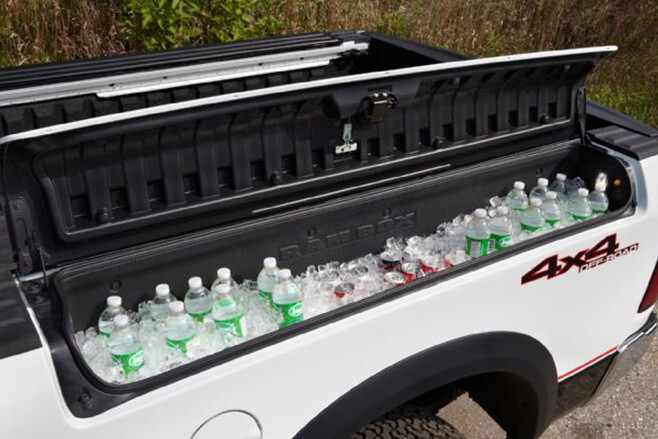
“The Water resistant/weatherproof and lockable RamBoxes keep items safe and dry” said RAM’s official Australian Importer website.
“Drain holes inside the RamBoxes allow this space to be used as cool storage with ice and space for up to 140 drink cans on either side.”
The ‘RamBox storage system’ is comprised of two vertical ‘lockers’ measuring 1.52 metres along the length of the loading area, and this gives the adventurous something new to be excited about.
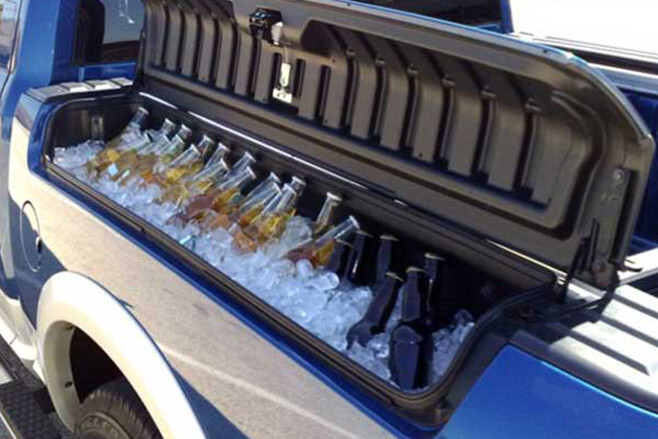
The lockers are large enough to hold a set of golf clubs, helmets, toolboxes, kayak paddles, fishing rods or chainsaws. You can also keep your drinks cold all day in the semi-insulated area.
Bed dividers placed in the storage compartments can separate equipment and cold storage areas, while adjustable and lockable bed extenders fit the lowered tailgate, adding up to 60 cm of additional length.
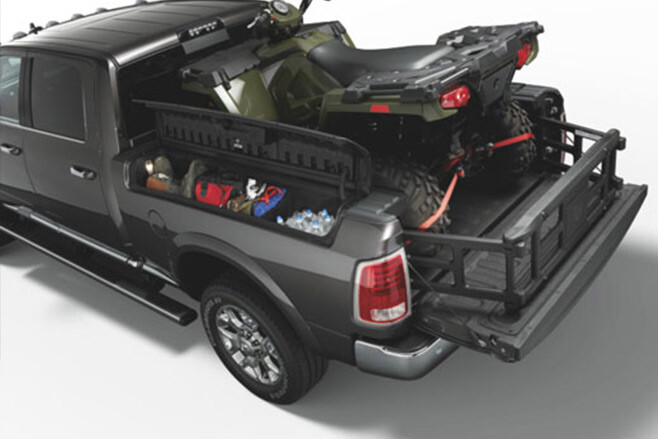
The extra storage space doesn’t change the base price of $139,500 for the 2017 Ram. Instead, it’s added as a $3400 option to the Ram 2500 Laramie.
This option adds utility for the truly dedicated, while sacrificing minimal bed space. Let’s be honest, a bit of bed space for a huge tinnie cooler is a small price to pay.
Here we go. I can hear Editor Matt’s rumbling guffaws falling out of that beard. ‘Roothy’s doing tech again!’ Hey, I’m pretty good with a hammer and chisel, so that gives me the right to have a go at any rate.
Last month we had a look into diesel fuel pumps because that’s what I was getting done for the new motor in Milo 2. But that’s a 12HT, so it’s a turbo-diesel motor from the factory. And turbos, as any fan of oil burners will tell you, make diesels go really hard.
But they’re not exactly great lumps of cast iron nailed together with said hammer. Actually, the first ones were… almost. Swiss engineer, Alfred Buchi, patented the concept of using exhaust-gas pressure to drive a fan that pumped air into the intake, which meant heaps more power back in 1905. It was another 20 years before they started tacking turbos onto diesel engines, but metallurgy and lubrication hadn’t advanced enough to cope with the speeds and pressures required in smaller engines so the technology was mostly used in big ships and a few stationary motors, which used low-revving, big-capacity diesels.
WWII saw the development of the gas turbine, which brought a whole new world of possibilities to building efficient turbochargers. That’s because, at its simplest, a turbocharger is a couple of gas turbines on the same shaft. One end gets spun by the exhaust gases shooting out the manifold, which in turn spins a fan at the other end, forcing air into the intake at a higher velocity. Done right there’s an increase in power and fuel economy because compressing the air squeezes more oomph out of the fuel. There, how’s that for a technical explanation?
Naturally aspirated diesels nearly always produce a lot less power for the same capacity as a petrol engine, and they’re heavier thanks to the need to use components strong enough to handle double the compression. That gives the old diesels a power-to-weight disadvantage straight away, as anyone who has tried punting an old 1HZ Toyota or 4.2 Nissan up a hill will tell you – although that’s if they even get a chance to talk between manic downshifting.
So add a turbo (generally a relatively light bit of kit) and you punch that power back into the diesel. In fact, when you need power – like climbing that hill with a trailer or caravan on the back – the first thing you do is open up the throttle which pumps more fuel into the motor, making it work harder which forces even more exhaust gases through the turbo.
Dirty Work: What’s Milo’s future?
It spins harder, you get more air, more power and more torque, and that’s why almost every manufacturer these days fits a turbocharger as standard to their diesels. Technology has advanced so far in lubrication, metallurgy, bearings and mass manufacturing that if you ain’t got a ‘hair dryer’ hanging off your modern oil burner it’s because it fell off.
Diesels and turbos go together like cheese and crackers. But when you start looking at the heat generated by slowing down exhaust gases and the revolutions these fans spin at – more than 80,000rpm isn’t out of the question – you can see how things can crack and turn to cheese pretty quickly if you get it wrong.
The turbocharger on Milo 2’s 12HT is a pretty basic bit of kit, but it still does all that and more and has done so for at least the 450,000km on the odometer. There are no signs of it having been apart, and it’s leaking a little oil which indicates it needs a freshen-up at least. So off I go to MTQ again to see what the go is. After a yarn with Mitch I was lucky enough to get the ‘special treatment’ again and got to go through to the air-locked, super-clean room where resident turbocharging expert Mark works his magic.
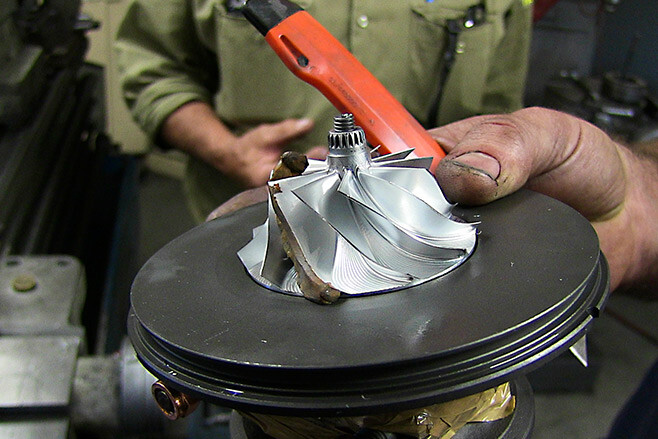
My wife had a totally different version of ‘special treatment’ reserved for me when Normie pulled up his tilt tray and dropped me and the truck off rather late that night. I’d been so excited by what I saw I had to drop by the Mudflats Hotel and let the lads know, too. And it was darts night and I might have stayed out just that bit too late.
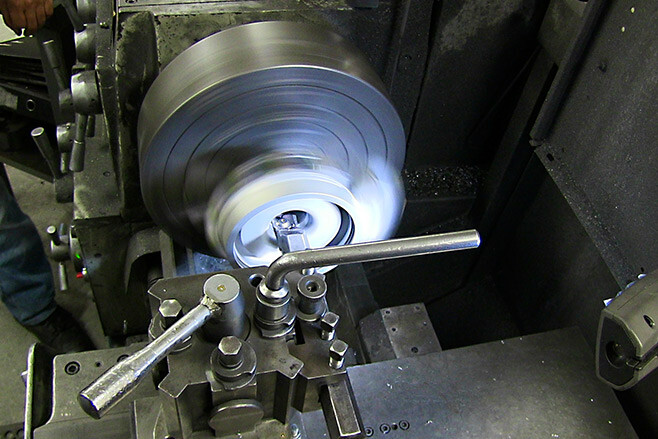
For a mug bush mechanic like me it’s truly extraordinary to see someone use a lathe with the degree of precision Mark exhibited. What he did was lathe out the chamber in the aluminium air-side of the turbo to accept a slightly bigger fan. It’s a known diesel hot-up trick that’s nicknamed ‘flowing’ because by pumping more air for the same sort of exhaust effort the whole process accelerates power and torque production exponentially again. More air makes more power, which in turn makes more air and more power – and so on and on.
Dirty Work: A new Hilux, an old Landie or a 40 Series?
This was achieved by using the new fan as a guide for what was essentially a hand-tooling job on the lathe. Mark’s done this a heap of times for many years so he’s probably got some natural starting profile anyway, but from then on it’s a slow and precise process with constant stops to check that the new chamber mates to the fan. Clearances are measured in hundredths of thousands of an inch, or whatever the ‘metric’ version of that happens to be.
That’s only part of the operation, though. The shaft has to be measured and checked for wear, the bearings replaced, and the whole plot put back together so it’ll make more power for even longer this time around.
Shaft wear is critical for obvious reasons, seeing as turbos usually spin about 20 times quicker than the motor. So 3000rpm on the tacho could mean 60,000rpm or much more on this shaft.
For a motor-head like me this kind of stuff is fascinating. It keeps teaching that same old lesson preached loudly last month, though, doesn’t it? With components like this performing in super-hot, super-fast environments, suddenly lubrication and cooling (which are closely related) is everything. Yep, it’s all down to quality oils and lots of regular changes with good filters fitted at the same time.
Roothy visits Front Runner, South Africa
If anything, that’s more critical for the modern diesels that make so much torque from such comparatively small-capacity motors. The brochure in the D-Max I was testing last week indicated 440Nm from its 3.0-litre motor, and it isn’t even the biggest donk in the dual-cab class. The Chev V8 in my old Jag has twice the cubic inches and makes maybe 380Nm on a good day. There’s a whole lot of stomping going on in those turbo-diesels, and heaps of revving, too.
My advice for the long haul? Learn to change your own oils and filters. It’s not hard and you’ll only make a big black mess of it for the first decade or so, unless you’re me, and then it’ll be a lifetime of spills and splashes. Worth it, though. You can choose your own quality oil rather than letting the mechanic’s accountant make that decision. The same goes with the filter, too. And with the money saved on labour you can afford to do it as frequently as required, and you can afford to bung in a fresh filter every time and still have something left over for a cleansing ale.
Hang on. That’s when the trouble started. I think I’ll stop right here.
FWH, RTM, PTO, LSD. What does any of that mean? If the last one was changed to £/s/d (pounds, shillings and pence, avoiding any possible reference to the psychedelic 60s) would that help?
Back on February 14, 1966, when Australia changed from ‘imperial’ currency to dismal guernsey, recreational 4WDing here was in its infancy – it hadn’t even graduated to pull-ups – but by the mid-70s it was burgeoning to become a major outdoor activity. However, it was a vastly different scene than it is today.
In mainstream 4WD vehicles, with the notable exception of the two-door Range Rover released at the 1970 Paris Motor Show, all were part-time four-wheel drive. Early Land Rovers, for example, had three transmission sticks to play with. One was for 4WD engagement, one was for low range, and the other was, of course, the gearstick. From memory, they all had different coloured knobs to avoid confusion.
Quickly supplanting the Land Rover as vehicle of choice, the Toyota Land Cruiser made do with two, with high and low range being engaged with the same lever. However, engaging low range took careful consideration because often you’d often have to reverse for what seemed like miles (as distance was measured in those days) to disengage it.
Often, the vehicles were fitted with permanently engaged front axles, which had owners scrabbling to fit aftermarket FWHs (free-wheeling hubs), supposedly to enjoy fuel savings created by no permanent mechanical drag on the front axles. So you’d see drivers leap out before obstacles to engage the hubs, and repeat the performance afterwards to switch back to ‘Free’, terrified that if they remained in ‘Engage’ they’d have axle splines flying all over the place. An army mate of mine told me that ADF vehicles fitted with FWHs were often left in ‘locked’ to keep the axles lubricated, and so I drove thousands of kays in my BJ40 with the hubs engaged, never once standing on the side of the road with my thumb out.
Driving long distances in these early vehicles quickly proved they’d been designed for short-haul agricultural, military and mining applications; not a comfortable private-owner touring experience. An early-1980s twelve-hour trip from Sydney to Enngonia (100km north of Bourke) in a four-cylinder diesel Land Rover proved the point. Max speed: 80km/h. Air-con: two manually operated dash vents. Seats: two flat cushions on metal bases. Steering: non-assisted. Engine noise: deafening. A photographer trying to treat a cold by constantly chewing stinking garlic pills, midsummer heat and a locust plague added to the glorious experience. Ah yes, those were the days.
Truck-derived suspension consisting of leaf springs and beam axles contributed to the problem, designed for toughness and longevity rather than ride quality. Independent suspension companies quickly sprang up, using techniques like progressive rate springs and multi-valved shock absorbers to civilise ride. After having an Old Man Emu aftermarket suspension fitted to my 60 Series Cruiser in the early 80s, I swore it rode like a Range Rover (almost).
Another factor was tyres. In the early days, there was very little choice in 4WD tyres. Military-style bar treads were an option for those who had absolutely no intention of driving long distances. Jeep Service were another largely agricultural alternative, and Toyotas came standard with 7.50×16 RTMs (Dunlop Road Trak Majors), a tyre with such a distinctive on-road howl that you could pick a Cruiser coming from blocks away.
All were cross-ply construction – a quick Q&A around the rec room of the Shady Rest 4WDers’ retirement home came up with the consensus that the first 4WD radial was the 7.50×16 Olympic Steeltrek (Frank Beaurepaire’s Olympic Tyre Company merged with Dunlop in 1980, so it probably appeared before then). All these tyres ran on split-rim steel wheels, and it was the devil’s own job to break the bead on these if you had a puncture. Farmers could lower a grader blade on them, and some of us actually drove over the edge of the tyres to get the flat off for repair.
15-inch well-based rims came next. By far the most popular of these were the Sunraysia brand; designed, developed and manufactured here in Australia by a bloke called Neville Harlow. Initially, serious remote-area travellers steered clear, knowing the chances of picking up replacement rubber in the sticks was equally remote. But Outback tyre suppliers quickly started stocking the new size, and practically everyone ran 15s in no time at all.
Choice of brands was pretty good, but they were all mainly all-terrain patterns picked for good wear characteristics rather than any particular feature – there certainly wasn’t the degree of specialisation (mud grubbers, rock hoppers) we see today. Magnesium alloy rims started appearing around the same time, prompting spirited campfire debates of pros and cons. They were certainly lighter, contributing to better unsprung weight, but if you bent one climbing rocks you couldn’t hammer it back into shape as you could a steel rim.
Serious 4WDers drove diesels. Not only were they less exposed to engine failure than petrol engines during water crossings, but the extra engine braking afforded for steep descents was a major plus. Longer range – a major consideration for true Outback tourers – was another attraction. Autos – archaic three-speeders in the main – were avoided because of a complete lack of engine braking downhill, necessitating constant use of brakes (something that’s avoided just as much today).
There were no disc brakes. All were drum types, meaning that after any half-serious water crossing, you’d have to accelerate away while depressing the brake pedal to dry things out. If you didn’t do this, there’d be zero retardation when you next really needed it.
Recovery equipment was limited to towropes and winches. Forget snatch straps; they didn’t exist. No Dyneema ropes, either. Winches used wire ropes, and in the very early days were PTO (power take-off) types. Because of their military and agricultural heritage, all early Cruisers (as an example) had PTO outlets coming out of the transfer case, and if you knew what you were doing, PTO winches were great.
By using the gears a variety of winching speeds were possible, but the winches were prone to breaking shear pins, and if your engine was kaput, so was the winch. Probably for weight- and cost-saving reasons, PTOs were dropped from manufacturing specs, bringing the electric winch to the prominence it enjoys today; though some aftermarket suppliers experimented with hydraulic and capstan winches along the way.
Communication with the outside world was difficult. This was a good thing. You could say to the office ‘I’m heading off to the desert for three weeks and won’t be contactable’. Mobile phones didn’t exist, so once you strapped yourself in for the journey, the peace began; the only means of comms were RFDS radios – Traeger systems that involved stopping, throwing an aerial over a relatively high tree branch, and fishing around for a frequency connection. Then came Codans (really complicated to use) followed by sat-phones (which should be banned).
Even back in 1996 when I was leading the Land Rover Calvert Centenary Expedition I was receiving, via sat-phone, faxed minutes of the board meetings back in Sydney – as if I could do anything about it in the Gibson, Little Sandy and Great Sandy Deserts. Sat-phones were pretty primitive then, requiring setting up a dish which you rotated to pick up satellite signals. Unfortunately, it’s now much easier.
Creature comforts like in-car entertainment were virtually non-existent, AM-only radio offered all the sound quality of a blowfly trapped in a pickle bottle, and there were no buttons to push for station selection. Battling steering that had its own idea of where the vehicle should be going, while fiddling with a dial to find a decent radio programme, was a game of Russian roulette that I’m glad has long gone. And, of course, aftermarket suppliers sprang up to fill a void. If you were flash (and flush enough) you could get a decent radio with an integrated cassette player. The Pioneer system I fitted to my BJ40 was ‘the duck’s guts’, as we used to say.
OE seats obviously designed by greedy chiropractors were another suitable case for treatment. Ed Mulligan’s Opposite Lock sold Aussie-made Stratos seats, and not being able to afford the aristocrat of automotive aftermarket seat – Recaro – I settled for Scheel seats in the Cruiser. These made long-distance travel a far more civilised experience, with plenty of lateral support and more padding.
Night driving was a dodgy experience with OE lighting. Headlights were still measured in candle power, but it didn’t take too long to count the candles. In the early days, aftermarket lighting came straight from rally cars, with French-made Cibié and Marchal being the picks with little else to choose from; though a mate of mine settled for an aircraft landing light to help avoid nocturnal grasshoppers. Lighting around the campfire was pretty primitive as well.
The BJ did offer a work-light that was hung under the bonnet, but torches looked after the rest of night-time navigation. Maglites and Dolphins were the favourites, with head lamps only coming onto the scene in the late 80s. An early convert, I tolerated the giggles and jokes about being the resident Martian, but they wore thin very quickly, and disappeared once everyone was wearing them. Camp lighting was originally provided by kerosene lanterns, known generically as ‘Tilley lamps’, named after John Tilley, the Pommy inventor of the hydro-pneumatic blowpipe that made the whole thing work.
The lamps were pumped to build up pressure in a reservoir, and then a mantle (made of chemically treated silk or more commonly, rayon) was lit and the lamp turned up to the required brightness. Once they’d been lit, the mantles became extremely brittle, so a holiday ‘on the move’ required a stack of spares. Fitting a new mantle was a fiddly, time-consuming process – give me LEDs every time. In our embryonic camping days of the 60s, I remember the Tilley living on a specially fashioned hook suspended from the centre pole of the tent.
And what a tent it was! Ex-army, big enough to house the entire sixth division, the proper khaki colour, full canvas throughout, it weighed a tonne… or at least was heavy enough to warrant my old man fitting heavy duty, load-bearing rear springs to the family Holden. Putting the damn thing up was a full family affair, with a tween-age yours truly always sent to crawl in under the spread-out monster to locate and raise the centre pole.
Character-building, I suppose, or at least bicep-building. When it was raining, my brother and I were told not to touch the walls of the tent, which we did once of course, finding out that it makes the canvas leak. Polyester and treated canvas tents were a long way into the future, and, of course, there were no fly-screened, fully-mattressed swags at that time either. I guess a lot of that came from a difference in attitude. I don’t want this to seem like a preamble to a ‘living in shoebox in middle of road’ routine, but our expectations of outdoor life were vastly different.
In the late 70s me and a mate and his wife regularly canoed the Macquarie River, using the then completely bush camp area at Bruinbun as a base. While they and the recent family addition luxuriated in an André Jamet – then the absolute top end of tents, with a kitchen area, a change room for Bubs and so on, I tossed down a rectangle of foam rubber (uncovered) in the tray of the HJ45, chucking a sleeping bag of top of it. My pillow consisted of the sleeping-bag cover stuffed with my jeans, socks, a towel and anything else that fell to hand. If it rained, I pulled up the ute tarp.
I was lucky my wife Sharon had similar Spartan ideas. On all camping trips our ‘digs’ consisted of a groundsheet, two closed cell-foam mats and a doona; though we were seduced by self-inflating mats when they came on the market. We packed a two-person tent in case it rained, but the thought of airbeds, for example, never entered our heads. For my solo trips, I still have a very basic swag with a thin mattress but no flyscreening. If it rains, I pull the canvas flaps over my head; it’s as close to an old-fashioned drover’s swag as possible.
I heard the other day about a bloke who reckons he couldn’t go camping without solar panels and power packs, and realised just how totally foreign our ideas of roughing it had become to today’s breed of 4WD traveller. But it poses the question that if you need all the mod-cons you have at home, why waste money for a change of scenery? If that’s all you want, then hire a cabin on the beach. The idea of having power so you don’t miss out on the latest ep of My Kitchen Drools contrasts strongly with the practice of sitting around a campfire having a few Scotches and good conversation under the stars.
How else have things changed? Well, there’s little doubt that we had access to more places than are available now, and pay-as-you-go 4WD parks can now be found all over the country. And to return to the original topic, vehicles are totally different, with the skill levels necessary to pilot those early 4WDs now completely redundant as vehicles do all your thinking for you. In the old days, to tackle, say, a really rough rocky slope, you had to pick the right range (high or low), the right gear, the right line, and know just how much throttle pressure you’d need to avoid scrabbling and loss of traction.
Good four-wheel drivers could do it, crap drivers came to grief. Differences in vehicle capability off-road were marked, with Landies, Cruisers and Patrols being ‘first tier’, and others like Pajeros, with very little rear-wheel droop, definitely second tier.
Then along came traction control to blur not only those differing vehicle capabilities, but to act as the great equaliser for drivers (I’m not suggesting little gutter-jumper SUVs can now compete in the rough stuff with G-Wagens, so please don’t write in). I am saying that very mediocre drivers can now look like experts. And that’s a shame. Increasing reliance on electronics has also meant it’s impossible to work on vehicles to fix things when they go wrong.
Certainly, a good bush mechanic can rig up a replacement suspension spring to get to the nearest town, but if it’s engine failure you’re buggered. And in the middle of a desert, 50km to limp home just isn’t enough. So it’s been a voyage of mixed blessings. Didn’t mean to finish up negatively, but before you dismiss this as the ramblings of a grumpy old man, I was grumpy in my 20s. You wouldn’t have liked me then, either.
A KEY aspect to the popularity of Toyota’s 70 Series Land Cruiser range is the versatility of the vehicles. Over the past 10 years the popular single-cab 79 Series workhorse has expanded to include the double-cab version, and then there’s the VDJ76 and 78 Series wagons.
The Troop Carrier has been part of the 70 Series range since 1985 when the 45 became the 75 Troopy, and during its time it has been available in two-, three-, five-, six- and 11-seat models, but always as a two-door, high-roof wagon. Today’s VJD78 only comes in two variants: the two-seat Workmate base model and the five-seat GXL, as tested here. The Workmate has a list price of $64,890, while the GXL starts at $67,990.
Updates to the 70 Series range at the end of 2016 brought improved safety and emissions features to the Troopy, including electronic traction and stability control, seatbelt pre-tensioners, electronic brakeforce distribution, and a diesel particulate filter and revised injectors to meet the latest emissions regulations. The age-old split steel rims and tall tyres that have been a part of base-model 70s since Moses drove one were replaced with single-piece 16×6-inch steelies and tall, skinny 225/95 tubeless tyres.
When we picked up this Troopy from Toyota’s office we thought we must have been getting a Workmate because of its wheels of steel, but we were surprised when we climbed inside to find carpet, power windows and front and rear differential locks. A check of the back door showed the GXL badge, and a look over the spec sheet told us GXL Troopies don’t get the alloy wheels and bigger 265 tyres found on other upper-spec models in the LC70 range.
INSIDE STORY
OUR test came at a time when an LC79 was in our long-term shed, so the inside of the Troopy presented a familiar place to be. There’s less support as the Troopy doesn’t get the updated seats of the ute, but the dash and controls are all pretty much the same. A pair of fuel gauges in the binnacle led us to find the sub-tank switch, as the 78 retains the two 90-litre diesel tanks from past models – unlike the 76 and 79 models that now come with a single 130-litre tank. The Troopy misses out on the extra airbags of the VDJ79 single cab and, as such, forgoes a five-star safety rating.
In the suburbs the softer suspension and higher centre of gravity immediately distinguish the big wagon from the tray-back. It pitches and leans more through bends, but if you’re looking for on-road handling a Troop Carrier is the wrong vehicle for you. You do, however, need to be mindful of the high mass when negotiating side slopes and steep tracks when off-road. The performance of the 4500cc V8 engine and five-speed gearbox are the same from 70 to 70.
The Troopy tours nicely out on the open road, with the taller fifth gear and addition of cruise control making it a more comfortable place to spend hours behind the wheel. The longer top gear drops engine revs by around 600rpm at 100km/h and, while a sixth gear would still be better, this is an adequate fix.
With its cavernous cargo area and healthy payload you can see why the Troopy is the choice of vehicle for so many global travellers and those doing a lap of the map. The Troopy has a handy 975kg payload, as opposed to the single-cab ute’s 1225kg. Even with the rear seat in place, the space is still as big as most ‘regular’ 4×4 wagons when the seats are folded. Sans rear seat and the space is enormous, and adventurous Troopy owners can customise this area with all sorts of cargo, camping and sleeping arrangements. We were loading up for a week in the Vic High Country and were disappointed to find no tie-down points in the cargo area – we assume Toyota expects owners to customise with their own points (likewise 12-volt power outlets).
The back seat in the Troopy is a very basic affair, with thin cushions, upright positions and no adjustability, and access to it is a real pain due to the lack of rear doors. The inwards-facing seats that were fitted to 11-seat Troopies have been axed due to safety. At its best, a Troopy is a two-up tourer with a cargo barrier behind the front seats to maximise use of the cargo hold.
OFF-ROAD
THE 79 lurches and rolls around town, but it makes more sense when you get to low-speed, off-road driving. The upright seating and large glasshouse provides great visibility around the car; although the glare off the back of the taller bonnet hump (of this white car in particular) was annoying to the driver, something we haven’t found when driving the dark-red ute.
In low range the Cruiser V8 growls its way up anything, and the calibration of the new electronic traction control surprised with its effectiveness on wet tracks, even when the wheels were lifted. Having ETC means you resort to the diff locks less than you would have in the past, but it was still nice to have them there just in case.
The skinny tyres offered no reasons for complaint during five days of off-road touring. With pressures dropped, the odd-sized 225/95-16s crawled without wanting for traction in the wet and dry. We followed vehicles with bigger tyres and raised suspension up tracks they scrambled on. That said, if we were building a Troopy for outback touring – as so many people do – we’d be looking for a more common tyre size, such as 265/75-16s on wider wheels, to ensure availability in remote areas.
While plenty of folk are quick the criticise the LC70 for its modest power output in relation to the size of the engine, the variation in its front-to-rear wheel track, and its purchase price, none of those factors posed a problem for us. There are a couple of causes for complaint, though: the aforementioned lack of tie downs and power sockets in the rear, and the comfort of the seats. My back was stuffed following a week of off-road driving in the 78, something that hasn’t happened at all in the 79 – I put it down to the older seats.
You could turf out the back seat, kit-out the cargo area, and update the wheels, tyres and suspension, and then set off around the country with little or no other major modifications. We’re not sure if the Troopy is the best tool in the toolbox, or the ultimate toolbox? There really isn’t another new 4×4 vehicle like it.
SPECS
Engine: 1VD-FTV single turbo, diesel V8. Common-rail EFI Capacity: 4461cc Max Power: 151kW @ 3400rpm Max Torque: 430Nm @ 1200-3200rpm Gearbox: 5-speed manual. Crawl ratio: 37.29:1 4×4 System: Part-time 4×4 with dual range transfer. F&R diff locks Construction: two-door wagon on a ladder chassis Front suspension: Live axle coil sprung Rear suspension: Leaf sprung live axle Wheel and tyre spec: Steel wheels with 225/95 16C tyres Kerb Weight: 2325kg GVM: 3300kg Payload: 975kg Towing capacity: 750/3500kg Seating capacity: Five Fuel tank capacity: 180 litres ADR fuel consumption*: 10.7L/100km On-test fuel consumption: 16.9L/100km (off road)
*Australian Design Rule ‘Combined-Cycle’ claim