
THE scent of spring is in the air; so dust off the fourbie, pick up an aftermarket catalogue, and prepare to return to the tracks.
YAKIMA ACEO’SPADES
YAKIMA continues to add accessories to its popular LockN’Load system. As the name suggests, the AceO’Spades is a spade/shovel holder (made from glass-reinforced plastic) that can also be used to carry canoe/kayak/SUP paddles. It attaches to the platform rack’s slats via a clever 21mm accessory slot that incorporates drop-in cut-outs for this purpose. The holder is operated by a unique ‘pop and drop’ mechanism, where you push in the ratchets on each side of the holder and it opens up. You then place the shovel on top of the rubber pads and clamp it back down. The AceO’Spades will hold handles with diameters of between 30-55mm. You can also lock the holder using the supplied key.
RRP: $69 Website: www.yakima.com.au
IRONMAN 4X4 PORTABLE POWER PACK
THIS new 44ah portable power pack from the team at Ironman 4×4 packs plenty of grunt – and features – inside its tough exterior case. The power pack’s features includes a digital voltage and amperage meter, the option to charge via 240V AC, 12V DC and solar panels, and a low-battery warning system. The pack has the ability to power 12V and 5V DC appliances such as mobile phones, camp lighting and fridge/freezers. The heavy-duty ABS case includes a folding integrated handle that makes lugging the unit around easy. Outlets include a 12V DC cigarette lighter socket and a merit socket, plus there’s a 5V DC USB port for electrical gadgets. The unit’s individual on/off switches include an LED indicator for ease of checking, and the power pack’s compact size means it won’t take up too much cargo space. It’s available from all Ironman 4×4 outlets.
RRP: $499 Website: www.ironman4x4.com
PROJECTA BLT BATTERY TESTER RANGE
PROJECTA’S BLT battery tester range has recently been expanded with the BLT500 and BLT700 added to the stable. The BLT500 is the entry-level model (for 12V batteries) with a Cold Cranking Amps (CCA) range of 100-1700. The LED display is easy to read and shows CCA, voltage and percentage of battery health. The BLT700 (pictured) adds suitability for use with 12V Wet, Calcium, AGM and EFG batteries and has a built-in printer for checking test results, plus a backlit LCD display to view the unit’s 40-2000 CCA range, usual voltage, percentage of battery health and general battery condition. The BLT700 can store up to 80 test results in its on-board memory. The BLT700 expands these capabilities by being able to test the alternator, starter-motor, earth and diode ripple, and it comes with included software, USB cable and everything else you need to keep an eye on – and record – your battery’s power. It’s available from aftermarket retailers across Australia.
Website: www.projecta.com.au
KUMHO CRUGEN HT51
FOR the off-road tourer who spends a chunk of time on bitumen before hitting the dirt, Kumho’s new all-weather/mixed-terrain tyre, the Crugen HT51, is well worth a look. Designed as a high-mileage, high-tread-wear tyre, the HT51 features a stiff centre block design for enhanced stability without sacrificing on- and off-road traction and handling. The lengthy 80,000km warranty is backed by a four-channel layout for optimum tread life, while the 3D sipes and a zig-zag groove design ensure ample drainage in wet weather – a great assurance for wet-weather and snow driving conditions. The Crugen HT51 is available in both regular and Light Truck construction, with the LT variants covering rim sizes from 16 to 18 inches. The regular construction tyre (SUV-oriented) is available in sizes ranging from 15 to 20 inches. The tyres are available from all Kumho stockists.
Website: www.kumho.com.au
OPPOSITE LOCK STEEL 3 LOOP & STEEL POST BAR – AMAROK TDV6
Oppy Lock has added two new premium bullbars for the TDV6 Amarok – the 3 Loop and Steel Post. The 3 Loop includes heavy-duty over-riders, provisions to install fog or driving lights and a low-mount electric winch, a central split air dam to ensure plenty of cool air flowing through to the radiator, and three radio aerial mounts. The bar is ADR and airbag compliant, and it’s powdercoated matte black. The Steel Post features two heavy-duty uprights in the bar’s centre for enhanced strength and has provision for fitment of spotties/fog lights and a low-mount electric winch. The Steel Post bar’s plate steel is laser cut as one piece to form part of the mounting bracket, ensuring optimum durability and strength. Both bars are covered by a two-year national warranty and are available from all Opposite Lock outlets.
Website: www.oppositelock.com.au
ARB DIGITAL TYRE INFLATOR
Including an accurate air-pressure gauge in your travel kit is a must, and ARB’s new digital tyre inflator fits the bill for those looking for accuracy and fast use. The unit’s display is big for optimum legibility, and you can set the display to your favoured unit of air pressure measurement (Bar, kpa, KgF or psi). ARB claims the inflator is accurate to +/-1psi across the 25-75psi range, and its maximum supply pressure is a lofty 350psi (approx. 2400Kpa). The supplied AA batteries offer a claimed 200-hour run-time, and there’s a handy battery capacity indicator to keep track of how much juice is left. The clip-on chuck attaches to the tyre valve quickly, while the 600m dual-swivel, PVC-coated, braided hose gives you enough length to easily access each tyre as you move around the vehicle.
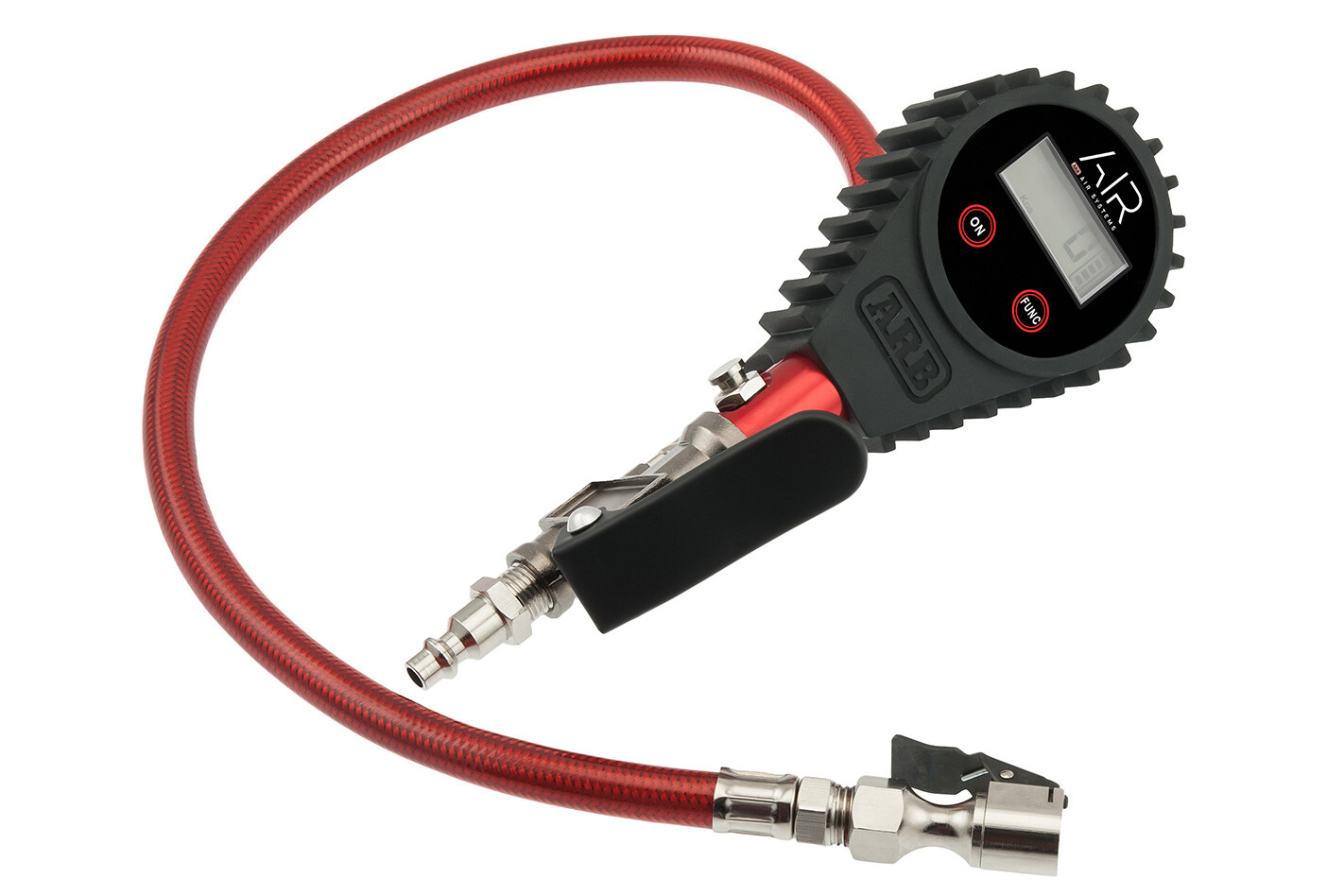
Website: www.arb.com.au RRP: $79
MOST modern 4x4s have a factory-fitted 70- to 90-litre fuel tank, whether that’s petrol or diesel models.
When rigs roll out of the factory, the salesperson will claim they’ll have an average fuel consumption of around 10.0L/100km. And, as long as we’re travelling light, there may be little standing between us and getting close to the factory’s promise; but we all know it’s a stretch.
So, standard tanks will see us in good shape for a great weekend away close to home – supplemented with a single jerry in case things go pear-shaped. However, all bets are off once we bolt on bullbars, rear bars and side rails and extend our range to remote country.
We’ll happily pack our rigs to the gunwales with fridges, spare tyres, recovery gear, recreational kit and perhaps a camper trailer skull-dragging behind, but now that we’re ‘loaded for bear’ our fuel usage has probably increased to around 20.0L/100km (or worse). That now means our rig’s 80-litre fuel tank might get us no further than around 400km.
So, it makes sense to plan ahead before leaving the fuel stations behind. While many roadhouses on major outback routes are spaced around 300km apart, this doesn’t account for the extra fuel we’ll use when we’re up to our axles off the beaten track. Besides, even some major outback tracks, like the Gunbarrel Highway, expect us to travel nearly 500km between drinks.
You could deal with this issue by strapping jerries to the roof, but this comes at a cost. Rack load limits can quickly be exceeded and, equally important, top loads like this can dangerously screw with a vehicle’s centre of gravity, especially when you have four jerries, a spare tyre and everything but the kitchen sink up there.
Aftermarket extended-range fuel tanks are a much better long-term solution, if you can afford it. And these days we are spoilt for choice with off-the-shelf prefab and custom options.
So, what do you do? We recently asked ourselves the same question while standing around the crew’s Hilux in the shed. The rig’s stock-standard tank wasn’t cutting the mustard, so it was time for a new approach. After some research, we figured we’d give the new ARB Frontier long range tank a go… and we’re glad we did.
This roto-moulded tank takes advantage of the nooks and crannies on the underside of the vehicle, and we particularly like how the new tank beds into the under-chassis and hardly lowers overall clearance (a rough look suggests approximately 5mm).
Noting there’s now no bash plate, we were concerned the new fuel tank may be too exposed in rough terrain. Sure, the manufacturer’s online video shows an empty Frontier tank being run over by a Centurion military tank, but we were planning on imposing heavier punishment.
The ARB Frontier long range tank’s maiden challenge would be a trip from south to north across Australia. This route would take in Lake Mungo and Cameron Corner before covering stretches of the Strzelecki, Sturt’s Great Stony and Simpson Deserts.
On the way, the Frontier tank would be peppered with millions of pieces of gibber rock, would negotiate hundreds of stony causeways, and would be dragged across a rollercoaster of sand dunes.
What damage has the Frontier tank sustained following this sort of punishment? The answer is absolutely none! And to be honest, apart from the dust, there’s nothing to see. Not a scratch!
The Frontier tank has effectively extended the fuel capacity of the ’Lux from 80 to 145 litres (the fuel capacity of Frontier tanks vary with different vehicle makes and models). Even with the rig fully loaded and towing a camper trailer, it’s now achieving 750km on one tank with little effort.
While the test run saw us carrying a spare jerry as a ‘break glass in case of emergency’ back-up, we didn’t given it a second glance. Even during a 240km detour to a mate’s property in the middle of the Simpson, we were in good order, easily achieving 552km between fill-ups including a trip across the dunes to the NT border.
However, one thing that left us scratching our heads was why the Frontier tank doesn’t come fitted with a drainage hole in the event of diesel contamination. Note to self: take a drill bit and a suitable plug (or a chewed Mintie) to fit on-the-fly in case of emergency.
Despite this, the tank is an impressive piece of kit, and being made of plastic it is significantly lighter (30-50 per cent) than its metal rivals. Being plastic, it also comes with its own heat shields, as the new shape takes it closer to the exhaust.
The guys at ARB looked after us, fitting the tank in a couple of hours. Chatting during the installation process, we were told the main problem the workshop faces is when customers arrive to have the ARB Frontier tank fitted without having first emptied their rig’s old fuel tank. Sounds like a rookie error to us.
Available from: www.arb.com.au RRP: Prices vary We say: Tough and durable, doesn’t hinder your clearance, takes you further
THE other day I waved goodbye to my Navara, and even though it didn’t quite sell for what I was hoping for, I did okay in the end.
In the four years I had it, the Navara proved to be one of the most versatile, reliable and economical vehicles I’d ever owned. It’s little wonder dual-cab utes are so popular.
Before I fitted the canopy, I used it to haul dirt bikes, take loads of rubbish to the tip, and shuffle furniture for mates (in exchange for beer). It was also pretty handy off-road, with decent ground clearance and low-range reduction, as well as a very effective limited-slip diff. And, after I’d fitted the canopy, some drawers and a fridge slide, it was transformed into a great family tourer.
Sure, it was a lot smaller and far less refined than today’s breed of 4×4 utes, but for our little family of three it worked a treat. Mechanically, the Navara never missed a beat, and services were always sub-$300. As for fuel consumption, the 2.5 CRD D22 averaged a tad over 11.0L/100km.
When I decide to offload a vehicle, I never look back until funds have exchanged hands, but then I occasionally experience regret when said vehicle disappears over the horizon.
Many years ago I almost shed a tear watching my Series IIA Landy being towed away; it had a cracked gearbox and various other faults, and at the time I simply didn’t have the cash to repair it. I was similarly upset several years later when I sold my Series III Landy, despite making a tidy profit on the ex-army beast after an enjoyable three years of ownership. It’s not just Landies.
I felt a pang of regret when I sold a well set-up Nissan Pathfinder many years ago called ‘Pathie’, and even when I offloaded a Toyota Townace I had imaginatively dubbed ‘Towny’.
But with the Navara? Nothing. The young bloke who took it off my hands was a diesel mechanic and, after a close inspection and drive around the block, he said it was exactly what he was after and he was happy to pay the agreed price.
There was no haggling, no pointing out of minor faults and no further negotiations. He just handed me an envelope full of cash in exchange for the keys and the signed rego papers, and off he went.
I didn’t bother to hang around and watch the Navara disappear into the distance. I just turned my back and walked away, thinking how strange it was that this very competent and cost-effective all-rounder failed to at all stir my emotions.
In retrospect, this was the very reason I sold it; basically, I was bored with it. Like a fridge that keeps beer refrigerated, a toaster that toasts bread, or a washing machine that washes clothes, the Navara did everything it said on the box, but in such a way there simply wasn’t any excitement. This problem isn’t exclusive to my Navara; I have driven plenty of modern 4x4s that are brilliant in many ways, yet they fail to excite.
Consider this: you jump in your new Toyota/Ford/Nissan/VW/Isuzu or whatever, turn the key, check the climate control is set to 22.5°C, and you’re on your merry, comfortable way.
Chances are it’ll have an electronically controlled auto ’box so you won’t have to shift gears, stability control so you won’t bin it in the wet, 200 per cent better NVH suppression than the previous model so you won’t have to hear or feel it, and smartphone connectivity so you can chat to your mates.
Cocooned in your modern 4×4, safe from all the other ‘crazy’ road users, you’re in your own little ‘safe’ world. But the problem is there’s no engagement between you and the vehicle or you and your surroundings.
The very things you used to like about driving are now gone – no more gear changes, no more engine sounds, no more requirements for mechanical sympathy, no more focus on your surroundings.
Sure, everyone wants a vehicle that’s going to start when you want it to, and one that’s going to go the distance when you need it to. And if it’s also cheap to operate, that’s an added bonus. But if you consider yourself a motoring enthusiast, then you’re going to want more than just practicality, reliability and affordability to keep you happy.
If you consider yourself a 4WD enthusiast, then you’re going to want to escape the automotive cocoon and see, feel and breathe in your surroundings.
That’s why I prefer rattly old vehicles to new ones; the kind where you have to shift gears yourself, take it easy in the wet so you don’t crash, put up with a deafening mechanical soundtrack and outrageous NVH levels, wipe the windscreen with a cloth when the demister fails to fulfil its stated function, put on a jumper when it’s cold, and crack open a window or a flap when it’s hot.
Of course, I wouldn’t mind a new Rangie too… for the missus.
HOLDEN has given the motorsport-loving public its first glimpse of the Colorado SuperUte, with an official rendering of the ute released today.
The Colorado SuperUte, currently under construction at Ross Stone Racing, will compete in the SuperUtes ECB Series in 2018. Replacing the current Holden v Ford V8 Ute Series, the SuperUte category will feature production-based dual- or twin-cab utes with turbocharged diesel engines and rear-wheel drive.
“SuperUtes is an exciting new racing series, and supporting Australian motorsport has been an important part of Holden’s heritage, so we are delighted to homologate Colorado for the series,” Emma Pinwill, GM Holden General Manager of Brand, Media and Sponsorship, said.
“Colorado has been engineered to handle anything thrown at it by our customers, from inner city and suburban roads to rural highways, dirt roads, and off-road. The racetrack is no different and we are confident Colorado will carry on Holden’s winning tradition.”
Supercars Australia has enforced strict regulations for the upcoming season to maintain an equal playing field. All engines are limited to outputs of 340bhp (254kW) and 500lb/ft (678Nm), and each model must weigh at least 1800kg.
Control extends to a range of components: CAMS-approved control roll-cage, pedal box, ECU, gearbox and ratios, rear axle assembly with control diff and ratio, brakes, tyres, wheels, springs and dampers.
2017 Holden Colorado out September 1
“Holden has been such an integral part of Supercars rich history, so it goes without saying that we are delighted to welcome it to the SuperUtes ECB Series,” Supercars Chief Executive Officer, James Warburton, said. “The Holden Colorado is now officially homologated and will take on five different manufacturers in what is shaping up to be an outstanding series.
“With official testing having commenced last week and six models approved for racing, the SuperUtes Series will commence in 2018 with a very strong field in what will be great racing.”
The six confirmed utes are: Toyota Hilux, Ford Ranger, Mitsubishi Triton, Isuzu D-MAX, Holden Colorado and Mazda BT-50.
The eight-round provisional calendar will see the SuperUte Series head to Adelaide, Darwin, Townsville, Ipswich, Sydney, Bathurst, Gold Coast and Newcastle.
ISUZU UTE Australia has provided a new MU-X to child safety education advocates Bruce and Denise Morcombe, continuing to help transport the duo across Australia as they deliver their essential child safety curriculum to children and parents.
Now in the fifth year of the partnership with the Daniel Morcombe Foundation, Isuzu UTE Australia continues to offer support to boost child safety awareness across the country.
“Isuzu UTE take their corporate social responsibility very seriously, especially in the area of child protection, and the Daniel Morcombe Foundation is extremely thankful for their generous sponsorship in providing us with a brand new MU-X,” Bruce Morcombe, the charity co-founder, said.
“For the last five years, we have relied upon Isuzu’s reliability to perform child safety presentations right around the country. From Brisbane to Broome and Ayr to Adelaide, we’ve clocked up an impressive 250,000km with no dramas – they’re the perfect partner for the work we do,” Denise Morcombe added.
The Daniel Morcombe Child Safety Curriculum – and with thanks to the efforts of Queensland’s Department of Education, Training and Employment – educates children on personal safety and awareness, with a strong focus on three key messages: recognise, react and report.
“The amazing and tireless efforts of Bruce, Denise and their Foundation has not only made our communities safer, but saved lives, so being able to play a part in this success gives everyone here at IUA a great sense of pride – helping people who help others is a very easy thing to do,” Dave Harding, IUA’s Assistant General Manager of Marketing and PR, said.
Website: www.danielmorcombe.com.au
IF YOU regularly travel to the New South Wales bush, you’ll be happy to know there’s a group of coppers ready to respond to a ‘help me’ when needed.
They’re the lads and ladies of NSW Police Rescue, and in 2017 they’re celebrating 75 years of operation.
The unit traces its existence back to the early 1940s, when the task of establishing what was then known as the NSW Police Cliff Rescue Squad was entrusted to an ex-Sydney Harbour Bridge rigger, Harry Ware.
Harry wasn’t a sworn-in constable with the NSW Police, but he was the ideal choice as he had prior involvement with the National Emergency Service of NSW (a distant forerunner to today’s State Emergency Service) and he trained the early rescue crew and was the first boss.
In reflection of his expertise, and with reference to his role in the squad, he was later appointed to the position of special constable with the rank of sergeant into the NSW Police.
By 1953, with the unit’s increasing role in attending car crashes (car ownership was increasing and, with negligible safety technology, proportionately more people were killed and injured) and other non-cliff-related tasks, the unit’s name had been consolidated to NSW Police Rescue Squad.
Over the decades the Rescue Squad has gone from strength to strength, and it has attended some of the worst accidents, incidents and disasters nation-wide (see Crush Syndrome). These days, the Rescue Squad in Sydney also includes the Bomb Disposal Unit and supports other police units in various incidents, from search-and-rescue operations to sieges.
OUTDOOR OFFICE
NSW Police shares the responsibility of Rescue with other entities within the state such as Fire Rescue NSW, Ambulance Service NSW, State Emergency Service, Rural Fire Service and Volunteer Rescue Association.
“There’s not really any such thing as a typical week,” said the department’s Leading Senior Constable, Marcus Backway, who has been with the NSW Police Rescue Squad for a total of 13 years.
“Can you believe I was inspired by seeing Gary Sweet and Sonia Todd running across TV screens on Police Rescue?”
Backway is based, along with more than 40 other officers, in inner-suburban Sydney. The Sydney unit is the central support for the other units (and another 120 or so Rescue officers) spread all over NSW including at Lismore, Springwood, Katoomba, Goulburn, Illawarra, Newcastle and Bathurst, as well as a western region unit.
The breadth of what NSW Police Rescue does is enough to make your head spin. It cuts bathroom plugholes out to free kids’ fingers, extricates car-crash victims from vehicles, and it performs height, depth, confined space and industrial rescues.
However, despite the range of work the Rescue Squad performs due to NSW’s topography, steep terrain and cliff rescue – what the Squad calls ‘vertical work’ – remains an important part of their methodology, even if the word cliff hasn’t been part of the squad’s signwriting since the 1950s.
Of course, it’s not just cliffs that require vertical access. Buildings, building sites, cranes and even the interior of bridge pylons may require abseiling (or other height-access work) for rescue or recovery.
THE VEHICLES
THE use of 4WDs is essential for rescue work, even in urban situations where something as innocuous as a steep driveway can make access difficult. The vehicles are organised and provided by what Marcus calls ‘fleet’, with input from the Police Rescue personnel who will be using them.
The vehicles are retained for 80,000km. There is a mix of Toyota Hilux and Ford Ranger dual-cabs on fleet, plus a scattering of Toyota Land Cruiser single-cabs, larger Isuzu 2WD and 4WD trucks, and a Yamaha Rhino side-by-side.
Rescue can also call for the assistance of the ultimate go-anywhere rig, the NSW Police helicopter.
Some people may be surprised, but the vehicles carry fewer accessories or modifications than your typical bush tourer. Suspension for the dual-cabs is usually standard, but requirements for carrying heavy equipment mean the Cruisers often receive a GVM upgrade.
Each vehicle is fitted with lights, sirens, in-cabin communication equipment, a frontal protection bar and a winch. The dual-cabs retain their factory tubs fitted with canopies which, with roof racks, are ideal for the task.
The Cruiser’s alloy work-bodies are custom-built and see service on two vehicles (160,000km) before being replaced. That’s good for the budget and minimises the time required for fit-out (performed by the Rescue personnel who use the vehicles) when new vehicles are required.
It also allows Rescue to incorporate any new ideas, technologies and equipment into vehicle fit-outs on a regular basis.
The use-twice strategy means you’re likely to see every second ex-cop Cruiser at auction with a bare back – the service bodies are stripped of the specialist equipment and left on the vehicles at the end of their second 80,000km rotation.
Equipment needs vary depending on the vehicle’s location and intended use. For instance, the NSW Police Rescue and Bomb Disposal vehicles we’re showing here are set up for off-road accidents and vertical rescue – two common scenarios for the Sydney-based crew.
“I’ve seen plenty of bad stuff happen in the bush,” Backway said, as the conversation during our photoshoot bounced around from suburban car crashes, to sieges and stolen guns, to the use of drones for inspecting sites and locating victims, to the topic of remote-area and off-road rescue jobs – nothing is left out.
“Often we will be called out to co-ordinate searches for bushwalkers or 4WDers who have become lost, injured, run out of fuel, or got bogged. Sure, people make mistakes, but some people are just not prepared. They lack the experience or knowledge.
“During floods, we do dozens of rescues of vehicle owners who have driven into floodwaters. Yes, this includes 4WDs. People think, ‘I have a 4WD, I can do this’ and they soon discover they can’t. It’s not like the ads on TV.”
There’s worse, too. In cop-speak, ‘recovery’ has a more onerous definition than the one most 4WDers understand.
“Tragically, the 4WD off-road accidents I have responded to during my career have been for the recovery of a deceased driver or passenger who wasn’t wearing a seat belt.
“People think safety doesn’t matter in the bush, but there’s just as much chance – maybe even more – of getting injured and killed out there than on the bitumen.”
“People think they don’t need a seatbelt on because they’re only going slow, but all of a sudden a wheel digs in, the vehicle rolls and they fall out a window and the vehicle rolls onto them, or they’re thrown out. Plus, in the bush, it’s not as easy to get to the patient … people may survive the crash then die later due to injuries while emergency services are on the way.”
“Riding in the back of utes is another situation. Even at walking speed people fall off and hit their head. That happens a lot.”
CRUSH SYNDROME
ONE of Australia’s worst transport accidents occurred in January 1977, when a train derailed and its locomotive struck the pylons of a road bridge at Granville in Western Sydney. People were killed and injured in the first carriage when a severed power pole sliced through it.
Seconds later, the concrete and steel bridge collapsed on two other carriages of the packed peak-hour commuter train. More than 80 people died. A significant factor in the death toll was crush syndrome, where trapped victims died from bloodstream toxins after being released from the wreckage.
After Granville, emergency services, including Ambulance and Police Rescue, changed strategies to better deal with crush syndrome.
NSW Police Rescue, along with other rescue services, also assisted with Cyclone Tracy, which all but destroyed Darwin early on Christmas Day in 1974, the 1997 Thredbo disaster, where two ski lodges toppled over as a result of a landslide, killing 18, and the 1989 Newcastle earthquake, which killed 13 people.
STILL CRUISING
TAGGING along on the Police Rescue photoshoot was Terry Psarakis and his HJ47 Land Cruiser Rescue tribute truck. Prior to leaving the cops in 1981, Terry was involved in Rescue and Highway Patrol.
He bought this Land Cruiser six years ago.
“The idea struck me to make it look representative of an old police vehicle,” he said proudly of his tireless 3.6-litre diesel-powered legend. “It’s actually not an old service vehicle, but finding and verifying one of those would be impossible. This is a tidy one that spent most of its time in Gunnedah [northern NSW]. I bought it in Sydney.”
Terry then restored the Cruiser’s paint and mechanicals, replicating the hardware such as lights and sirens of a working police vehicle.
“The canopy was built based on pictures and what I remember of these when we used them,” he said. “Some of the police-type hardware was donated, and sourcing other parts was a challenge. For instance, engine bearings are difficult. But we got there!”
As well as being an occasional cruiser, it’s used for functions like senior police personnel retirement ceremonies and memorial services.
WINTER wheeling for Victorians, and anyone who wants to travel down here, usually means a trip to find the slushy white stuff that falls from the sky during the colder months.
While most of the Victorian High Country is shut off for winter, there are still a few places to get some snow under your muddies.
We engaged the lockers with some of the guys from the Aussie JK Experience crew to head out of Melbourne for a day trip in search of snow.
The Aussie JK guys are Jeep-biased group on Facebook that love to get out and about. Let’s face it, the Wrangler is made for this style of wet, muddy driving.
Check them out at: www.facebook.com/groups/AussieJKExperience
Thanks to Stuart Gruchy and Benn Collings for making the trip happen.
THERE are many ways to squeeze more performance from a vehicle, and a bloke could get lost discussing the pros and cons of everything on offer, from minor performance upgrades to major hot-ups.
Usually your best bet depends on what it will be used for in the end. ‘Short distance’ vehicles – perhaps used for racing or weekend warrior stuff close to home – can be cammed up and hot-rodded to the point of blowing up, because if they do pop, it’s just a short ride home to the workshop.
It doesn’t matter what anybody says – in my experience, most performance modifications (with the exception of high-flow exhausts) come with a price in the reliability and longevity stakes. Squeeze more power out of something and you’re making it work harder than it was designed to.
Eventually that has to shorten its life, but there are plenty of people prepared to put up with that because more power means more fun! So the safest way to get more power is to fit another engine that was designed and built to make more power in the first place.
Thanks to companies like Marks Adapters, it’s possible to whack all sorts of high-powered motors into vehicles that came with more mundane lumps under the bonnet. However, once again, decisions like that should be dictated by what the end use will be. Yes, you could go touring with a blown big-block V8 in your GU Patrol, but it might not be the sensible choice.
With Milo, I went for an engine swap using a 13BT, a turbo charged from standard Toyota four cylinder diesels, and from the same family as the 3B diesels fitted to some of the short wheelbase models. By keeping to the same make and engine family, I figured I could minimise the need for ‘special engineering’ the custom bits you have to make to get an engine conversion working.
We got the 13BT donk – which came from a small dump truck imported from Japan – working in its new environment with standard Toyota bits and only a bit of fresh engineering. There was a fair bit of juggling and plenty of trips to see Fester out at Warrego 4×4 Wreckers, but in the end the gearbox was rebuilt using the longer 3B input shaft; a 3B bellhousing was sourced and the 24-volt components on the truck motor were replaced with 12-volt bits from a 3B.
We used standard 3B engine mounts, but had to shift the mounts on the chassis with some cutting and welding. And, once it was all in the fan, it was so far away from the standard radiator we had to lengthen the shroud by about four inches so it’d suck some air.The plan was to get the engine in with the minimum amount of disruption to the factory way of doing things. The thinking here was simple: in the future, when you break something, you can source the parts to fix it without having to get them made.
Thanks to Terrain Tamer and a number of old Toyotas all over Australia, there’s no shortage of parts, but it’s not always easy to get something made. Minimise that and you reduce the chance of a trailer-ride home. 750,000km later and the 13BT proved its worth. Being a diesel, it was twice as fuel efficient as the 2F petrol six it replaced, and as a mechanical injection diesel it didn’t depend on electricals. Good thing, too, because there were plenty of return trips where I had to park on hills to start her the next day.
You get that when you do your own wiring. But it wasn’t powerful enough, so I upped the turbo and fitted a non-standard intercooler. It took a while but eventually those big steps away from ‘standard’ wore both the motor and the body out… Err, that and some really lousy tracks.
So, for Milo 2, I learnt enough to choose another Toyota motor that produced a lot more power but still had mechanical injection. That’s the 12HT Terrain Tamer rebuilt while MTQ worked over the pump and turbo. The only problem now was fitting it. Seeing as 60 Series Toyotas used the 12HT, I figured it had to be possible, but a fair bit of research showed people using custom-made engine mounts and all sorts of cutting and welding to get the more powerful motor into the older truck.
Meanwhile, my mate Paul Reid (Mr. Land Cruiser) reckoned he knew a bloke who’d done it using nothing but stock components. We tracked down Chris McConnel, a diesel engineer who works on the big mine machines, and sure enough Chris knew it could be done because he’d done it.
The trick was to find the right combination of mounts and bellhousing. The engine is held in with a mount on each side of the block and one slung under the gearbox. We were also using a 60 Series with the five-speed gearbox instead of the old four, which added another level of complication.
No matter how many messages and photos Chris sent, it still meant assembling heaps of variants and doing some juggling. You see, the biggest trick to any engine swap is to make sure it’s all mounted without any stress. If anything needs bending, twisting or a bit of leverage to get a bolt done up, then that’s going to be a problem down the track. Metal fatigue starts with stress, right?
In the end, I got it in using a standard 2H bellhousing – different to the 12HT job that looks exactly the same by a few degrees of twist – and standard 2H mounts. Then, by taking the three-piece gearbox chassis mount to pieces and rearranging the bits to move the mount backwards, I got that to line up, too. The result? A 12HT from a 61 Series fits a 47 Series chassis with no welding or cutting.
Boy was it a juggle, though. My thanks to Chris who kept sending me texts saying it could be done, and to Paul who managed to find all the parts I needed. Most of all I want to thank Terrain Tamer who, once they knew exactly what year and model bit I was looking for, supplied the usual better-than-original type replacements.
So the motor and gearbox are in. You know what that means? Yep, just add a fruit box and Milo 2 will be out on the tracks before you know it. I can hardly wait. The original Milo was an absolute beauty, but the new girl is copping nothing but the best from the start.
IF YOU haven’t heard the name Mitch Thorpe, then you’ve never heard of Ultra4 racing.
For those who have heard the name, you’d know he’s spent the best part of the last few years soaring through the air, bouncing off the rev-limiter in the 6.0-litre V8-powered rocket-ship that he tries to pass off as an off-road race car.
Like most off-road racers, Mitch doesn’t just turn up to a race meet, get dirty and then head home to take his Prius down to the local organic markets. He’s a dyed-in-the-wool 4x4er whose tow-tug-cum-weekend-warrior puts most of our pride and joys to shame.
We recently had the opportunity to not only chew his ear over all the things we could never afford to do to our rigs, but point the shiny end of a camera at his trick NP300 Nissan while he beat on it like it owes him money.
While the coil-sprung NP300 might not be everyone’s first pick as a tow tug, Mitch told us he’s given it no quarter but it keeps on ticking.
“I’ve had Navaras in the past and liked them,” he said. “They’re great value for money, and saving $10K on the purchase price of the car is probably the best way to go. I liked the coil rear-end for day-to-day ride comfort as well.”
Mitch is known to play musical chairs with wheels and tyres, but there’s a very good reason why. He works for the crew at Ozzy Tyres in their ‘flying through the air’ division, so he gets his choice of shoes as new models become available.
Filling out the Navara’s huge guards are a set of custom Hussla Stealth wheels. The matte bronze units punch in at 17x9in, giving the Nissan its aggressive stance. Of course, wheels alone aren’t enough to get drive to the ground, so Mitch opted for a set of the new Terrain Grippers from Aussie-based Monsta Tyres.
While the rest of the build is reserved, the suspension is where Mitch really cut loose. Most of the magic has been cast by SWAT (Suspension Wheel and Tyre). The WA-based company has gone to town on the NP300, giving it a 3.5-inch lift in the front and a 1.5-inch lift in the rear, with King Springs progressive rate coils front and back.
To keep things working as they should, PSR upper control arms have been fitted in the front to correct geometry and PSR heavy duty lower control arms went in the rear after Mitch bent the factory offerings. The rear also copped extended swaybar links to cope with the new flex, though that’s not Mitch’s key to success.
“It’s running West Coast Suspension remote res 2.0 shocks all ’round,” he told us. “They’re eight-stage adjustable, with a clicker on the reservoir controlling oil flow. There’s a little bit of tuning left to do, but they’re tenfold better than the shocks I had in before and only take around 10 minutes per shock to tune.”
One of the big issues with lifting any IFS 4×4 is running out of down travel the higher you lift. The result is poor ride and handling, and lifted wheels on even basic tracks. Despite the front sitting 3.5 inches higher than stock, Mitch reckons the Nissan NP300 still keeps a reasonable CV angle with a few inches of down travel left in reserve, helping the Navara stay planted in the rough stuff.
With Mitch earning a ‘never-lift’ reputation on and off the track, it’s no surprise he’s gone to town on bar work for the NP300. “I haven’t been nice to this car, I’ve beat on it pretty hard,” he told us with a laugh.
Keeping the big Nissan’s nose in line, despite Mitch’s best efforts, is a comp-style tube bar from Xrox. The hoopless unit keeps weight off the front suspension, which is perfect if you’re not playing whack-a-mole with kangaroos every night.
Plus, it improves the approach angle in the process. Down the flanks, the NP300’s vulnerable sill panels have been armoured thanks to a set of sliders from Southern Cross Fabworks; while the rear bar is a towbar/quarter protection arrangement from Ironman 4×4.
If you’re eyeing off the rear cargo rack with credit card in hand, you’ll be disappointed to hear it’s a custom-built unit by Mitch. “I had a local engineering shop fold up and dimple the legs for strength, then made the rest out of tube myself,” he said.
Depending on where he’s pointing the spotlights, the rack can either hold a roof-top tent or a space case and spare tyre. The arrangement keeps the centre of gravity nice and low with the tent on top, while also keeping the tray free for spares for the race car.
On the electrical front, Mitch kept things relatively simple, throwing all in with the buggy rather than decking out the tow tug with trinkets; although, it has still copped a couple of essentials for those late night runs out to the track.
A set of nine-inch LED driving lights help light the way, while a Redarc Tow-Pro Elite trailer brake controller helps to stop the trailer pushing the NP300 around when Mitch jumps on the anchors.
While Mitch’s NP300 takes him wherever he wants to go (even if he probably shouldn’t), it’s doing it with relatively few modifications.
The right gear here and there turns an already capable platform into something that’d leave some wildly modified rigs for dead. At the end of the day, getting out there is far more important than having all the kit, especially when you’ve got a race car in the shed.
POLE POSITION
MITCH and his dad Brett both campaign fully fledged off-road race cars in the Aust4 Racing Series, so it’s no surprise to hear Mitch’s buggy is one of the most competitive in both the rocks and the wide-open paddocks it races in.
Rather than modifying an existing vehicle, car #127 was pieced together one stick of chromoly tube at a time by industry legend Matt Dunk, before it copped a list of go-fast parts that’d be right at home with the best of Baja.
Slotted inside the tube frame is a secret-spec 6.0-litre L98 V8 engine built from the rocker covers to the sump by Russo Performance. It’s backed by a race-ready TH400 (from the guys at Wyong Automatics) in a Reid Racing case.
From here, drive is sent both ways through a 2:1 ratio Atlas race case and out to twin custom diffs with Dana 60 outers and 14 Bolt Chev centres, with Reid Racing knuckles and Cs on the steer axle. Spidertrax drive flanges, Solid Industries billet hubs and 300M custom RCV axles all ’round also got the nod.
Allowing the buggy to twist its way up rock ledges then fly through the air is a trick suspension arrangement, with Fox 2.0 coilovers and bump stops on each corner.
They’re backed by Fox 2.5 three-tube bypasses on the front and Fox 2.5 four-tube bypasses on the rear. Huge one-inch diameter Aussie-made Design Fab Industries sway bars keep things flat through hard cornering, while the huge 39-inch Toyo tyres are held in place with KMC Machete bead-locked wheels.
THE Mitsubishi Pajero Sport has made it into the top-ten best-selling 4x4s for the first time and in doing so has fought off a host of other wagons including the Ford Everest, Holden Trailblazer, Isuzu MU-X and Toyota Fortuner.
It has also edged out two utes, VW’s Amarok and Toyota’s LC79.
Compared to the other wagons-made-from-utes, the Pajero Sport is smaller, generally less expensive and has some notable technical highlights including an eight-speed automatic gearbox (whereas the others have the ute-derived six-speeders).
Mitsubishi’s unique Super Select 4×4 system also brings full-time 4×4, a feature not found with Fortuner, Trailblazer or MU-X.
Powered by the same new and revvy 2.4-litre diesel of the Triton, and helped along by the slick eight-speed automatic, the Pajero Sport offers relaxed, effortless performance, a fair turn of speed when asked, and is reasonably quiet and refined.
Being a bit smaller and lighter than its immediate competitors, the Pajero Sport feels quite nimble on the road, even if the suspension tune is biased towards comfort.
The full-time 4×4 of the Super Select also brings convenience, safety, and effectiveness to the Pajero Sport in mixed driving conditions that its part-time competitors can’t match, and it still has the option of rear-drive-only for those long highway stints on dry roads.
The Pajero Sport’s star starts to fade a little off-road, where the modest wheel travel and ground clearance see it struggle in places where its competitors aren’t troubled.
While mid- and top-spec models get a diff lock, it’s not as effective as it could be as it cancels the traction control on both axles when activated.
All Pajero Sport models offer smart-key entry and start and tilt-and-reach steering wheel adjustment, but taller drivers will find a somewhat cramped driving position in what is a small cabin compared to its rivals.
SALES 2017 (to June): 3304 2016 (to June): 1874 Change: + 76.3%
REPORT CARD* Powertrain: B On-road: B Off-road: D Cabin & Equipment: C Towing & Practicality: D Final word: There’s a lot to like, even if it’s smaller than its competitors.
*Scored against class competitors. A= Excellent. B= Very Good. C= Good. D= Fair. E= Poor. F= Fail.