I’VE HAD the Duelers beneath my GU Patrol for a solid 14 months or so.
This is advertiser content
They’ve provided solid service on the sandy tracks of Hattah-Kulkyne National Park in the Victorian Mallee country; they’ve tackled some fabulous sandy runs on Stockton Beach at Port Stephens; traversed the rocky and rutted tracks of the Avon River; hit up the Murray River’s mud at Echuca and the challenges of the Dargo High Country; and, of course, the daily drive in suburbia.
With the rubber installed, the odometer has ticked over 12,000km. They’ve travelled across all types of terrain and shown no signs of excessive wear.
When I took the GU in for a tyre rotation, the depth gauge discovered 4.5mm wear on the front tyres and 3.5mm wear on the rears. The tyres have pleasantly surprised as a daily driver. They’re quieter than expected and also grip and handle well. In the wet they’ve performed much better than the old A/Ts that were on their last legs.
I have no complaints when off-road either. On High Country tracks – as well as on the when wet, grease-like tracks along the Murray River near Echuca – they performed brilliantly. Where the tyres surprised me was on sand – on a Stockton Beach NSW run they performed excellently.
Now, let’s be honest, my faithful 3.0-litre GU Patrol is many things, but a power-laden, sand-chewing beast it’s not. We dropped pressures to 17psi and away we went.
It didn’t have any issues on the sand at all, and I even managed to perform a snatch recovery of a 2015 Triton. I also secured bragging rights by rescuing my mate Brad’s Pajero from a particularly soft patch.
It’s time to start considering the Bridgestone Dueler A/T 697 or the M/T 674.
CONSTRUCTION
THE Dueler A/T 697 is the ultimate 4WD tyre, designed to withstand Australia’s harshest conditions. The tread pattern design has been optimised for increased puncture resistance, and the dual compound tread features improved heat durability to cope with the harshest summer day.
The super-tough boots are cut-and-chip resistant, feature a protective ply for an added layer of protection from staking, utilise two heavy-duty, high-tensile steel belts, and have an advanced shoulder-block design to improve NVH.
MUD OPTION
With its aggressive design, Bridgestone’s Dueler M/T 674 meets the demands of tough off-road driving – even through the heaviest of mud. Bridgestone reckons the tyres have been designed using 3D technology to deliver superior off-road performance and durability.
They also offer improved wear for better mileage, an advanced rubber compound to improve cut-and-chip resistance, and excellent braking performance. Other key features include improved grooves and buttress design for better grip in heavy mud; 3D shoulder lugs for durability, traction and handling; and a redesigned tyre footprint for improved wear balance.
ON JULY 26, 1928, the streets of Melbourne were crowded with thousands of people (mostly men, actually, going by the photographs of the day) as they waited patiently for their hero to arrive.
This was first published in 4X4 Australia’s June 2013 issue
When Francis Birtles drove his battered and tired 1925 Bean 14 car, which he affectionately called the ‘Sundowner’ because of his knack of arriving at sundown at some remote station homestead for dinner, the crowd went wild.
Feted at a civil reception soon afterwards, he and his travelling companion succumbed the next day to the rigors of their trip, not to mention malaria, and spent the next two weeks in hospital.
For Birtles, though, the nine-month trip from the UK across Europe, the Middle East and Asia to Australia, and then through the outback that he knew so well, was the crowning achievement of his illustrious career.
Born in 1881, Francis Birtles went reluctantly to sea at 15, but enlisted in the Cape Colonial Forces at the outbreak of the Anglo-Boer War in South Africa in 1899. Contracting black water fever he returned to Australia in 1904, and a couple of years later he set out on what was to become his lifelong career.
Just after Christmas Day in 1906, he peddled out of Perth on a pushbike to become the first person to bicycle the country from west to east across the Nullarbor, when tracks of any sort, for the most part, were non-existent.
Almost immediately, with the little fame he had gained from that first trip, he set out on a new bike to ride around the eastern half of the continent and to write a book on his exploits; Lonely Lands was published in 1909.
History: Talbot South-North crossing
With a book behind him and numerous newspaper articles written on him, Birtles was the best-known cyclist of his day. In that same year he set a new record for a west-east crossing, and in 1910-1911 he set off on a complete circumnavigation of the continent.
In 1912, with Syd Ferguson, a mechanic for the Australian importers of the Brush motorcar, he set out to become the first to drive a car from Perth to Sydney.
By now Dunlop Tyres was a near-permanent sponsor of his expeditions, but Birtles’ wasn’t putting all his faith in these newfangled mechanical contraptions; his trusty bike, shod, of course, with Dunlop tyres, was strapped to the back of the heavily loaded vehicle. Arriving in Sydney 28 days after their departure from the WA capital (and just 3 days faster than his bicycle ride), the pair were hailed as heroes.
In 1913 he set off again from Sydney, this time in a Ford Model T, and drove the vehicle from Burketown on the Gulf of Carpentaria through outback Queensland and south to Melbourne.
His next adventure in 1914 was with acclaimed Australian film maker, Frank Hurley. They set off in a Model T and drove from Melbourne to Sydney, onto Darwin, down the west coast of Australia to Perth, across the Nullarbor, which by then Birtles’ knew pretty well, to Adelaide and then Melbourne. The result of this trip was the film, Into Australia’s Unknown.
The following year he set of on a seven-month filming trip from Sydney to Broken Hill onto Quorn in the Flinders Ranges, before turning north to Cooper Creek. Reaching the Gulf at Normanton, he headed south to Melbourne across outback Queensland. The film, Across Australia in the Tracks of Burke and Wills, opened to audiences on Christmas Day in 1915.
For the next few years, Birtles wandered the outback and was more at home in the desert country than in the cities. With his brother Clive and an MH Ellis, a well-known journalist of the day, they set a new record for the Brisbane to Sydney run, and in 1919 he made another film, Through Australian Wilds. Sadly, this and his other movie epics no longer exist.
In 1921 the Australian government sent him out on a trip through the heart of Australia to find a route for the railway line which was planned to be built to Alice Springs and north. The trip ended in disaster north of Tennant Creek as the vehicle hit a stump, spilling fuel, which immediately burst into flames and the car exploded.
He finished his survey by an extensive air foray across the country – probably the first ‘official’ aerial survey in Australia.
In 1924, with two companions, Birtles set off to drive non-stop from Sydney to Darwin and back, as a promotional trip for a British vehicle, the Bean 14 car. It was Birtles’ first experience with a Bean and the heavily loaded machine, while it broke down a number of times, survived the harrowing trip which saw them at one stage, while crossing the Gulf country, travel just 300km in five days.
He followed that up a few months later by setting a new record from Darwin to Adelaide in an Oldsmobile 30 car. Two years later in a sporty two-seater version of the Bean 14 Tourer – the car that was to become the Sundowner – Birtles set out to break the record for the Darwin to Melbourne run.
Sponsored by the local distributor, Barlows of Melbourne, the Bean 14 had been rebuilt to Birtles’ own plans. That included drilling holes in the longitudinal chassis rails to reduce weight, and a second fuel tank and heavier springs were fitted. The two headlights were kept as standard, while the mudguards were replaced with lighter simpler units. Brackets were welded onto the outside for gear to be strapped on, and two spare tyres were mounted at the rear.
The route Birtles would take south from Darwin was to Katherine and onto Daly Waters, Newcastle Waters, east to Lake Nash and Djajarra then south to Boulia, Winton and Bourke to Sydney. From there they’d race to Melbourne on a half-reasonable road.
With Alec Barlow as the mechanic, Birtles drove the 5540km from Darwin to Melbourne via a menagerie of tracks and cattle pads in just 205 hours. They had just four punctures, and Barlow, it was said, didn’t even have to lift a spanner for any repairs.
The Bean car company was so impressed they took the car and Birtles to England to put the car on show. Birtles was then asked to drive the latest Bean car from England to Australia with MH Ellis and another companion. The new car was the heavier Bean Imperial Six, soon to be dubbed by Birtles, ‘Scrap Iron’.
Leaving London later than originally planned, the party got away in early February 1927 and raced across Europe, climbed the snow-filled passes of Yugoslavia and Bulgaria, then bogged down in the muddy fields of western Turkey, and all the time amongst a host of other mechanic problems, the radiator leaked like a sieve requiring daily repairs.
Arrested as spies in eastern Turkey, they were held for a few days before being allowed to continue onto Beirut, where they replaced the third diff in the Imperial before pushing on to Damascus.
In Persia (now Iran) one of the party was forced to leave because of dysentery, but by the time Birtles and Ellis got to India they were well behind time, the car was broken and the monsoon had begun. The trip was abandoned and Birtles returned to London.
Birtles was already planning another attempt on his own in a vehicle he knew well – the Sundowner. He hurriedly rebuilt the car from the ground up, procured some limited help from Bean, and got sponsorship from Dunlop, Shell and Castrol.
On the October 19, 1927, he left Australia House in London, while a small group of well-wishers, including the famed aviator Bert Hinkler and the 1927 Miss Australia Phyliss von Alwyn, waved him off.
He raced through France then slowed as the roads got worse through Yugoslavia and into northern Greece, but he was still ahead of his planned schedule when he arrived at the Shell offices in Athens.
With his experiences of Turkey behind him he shipped the Sundowner and himself to Alexandria in Egypt, crossed the soft sands of the Sinai Peninsula to Palestine and then into Syria. From Damascus, he headed east to Baghdad, where he was delayed by British-imposed quarantine regulations before travelling across the border.
Once in Iran he turned off the main road to Tehran, then blocked by snowdrifts, and cut across on a more direct but near trackless route to Isfahan in central Iran, where he turned north to Tehran. From there he tracked east towards Meshed before paralleling the Afghanistan border south into what is now Pakistan.
He was bogged on numerous occasions in sand, near frozen in snowdrifts at least twice, washed downstream in a snow-melt-flooded river and pursued by bandits. But worst of all he was now suffering from malaria.
At Sibi, in modern day Pakistan, he was forced to rest for a couple of weeks before crossing the desert to the Indus River and pushing on to Delhi, where the local Shell agent had given him up for lost.
In Calcutta he met a Canadian, Percy Stollery, who was peddling a bike around the world. Teaming up, and after rebuilding the Sundowner once more, the two intrepid adventurers set off for their crossing of the many channels of the mighty Ganges River, which back then had no bridges across it at all.
The man-powered punt they chose at one point almost sank, leaving both Stollery and Birtles soaked and the Bean half submerged. But that was nothing compared to what lay ahead: the Naga Hills, that which straddle the border between modern day India and Burma. Here there were no roads, and no vehicle had every dared to try and cross them.
They dug, sweated, and dug some more, as they built a road for most of the way up and over the high mountains, while local native tribesmen carried the extra fuel and oil but downright refused to dig or do anything else.
Birtles reversed the gearing on the Bean so the former reverse gear became their only forward, albeit low, gear, and they built windlasses to winch the Bean up impossible slopes. On one steep section, after removing the tyres and rims, he grooved the brake drums of the driving wheels so he could fit chains to them for more traction on the slippery slopes.
Harassed by the mud, the thick jungle and steep countryside, as well as marauding elephants, tigers and rogue water buffalo, the crossing of the mountains – a distance of some 60km, took 30 days!
They crossed the Irrawaddy River on a raft and then pressed onto Rangoon, where they arrived well behind time and already given up for lost or dead, as well as penniless and exhausted. Dunlop and the Bean Company cabled them money and their exploits south continued.
Timing was everything now and they rushed south towards Singapore, a relatively easy drive after what they had been through, but now their luck ran out. The flooding rains of the monsoon arrived inundating rivers, wiping away long sections of tracks and washing away bridges. Then, in an exhausted state, both men began to suffer again from malaria.
Needing rest they found a ferry and shipped their vehicle and themselves from Mergui in southern Burma to Penang in Malaya, a distance of less than 300 miles, where they continued their drive south to Singapore.
In Singapore, courtesy of their sponsors, they loaded themselves and the vehicle onto an oil tanker and sailed for Darwin where they arrived still both suffering from malaria. At this point a Customs official impounded the car until duty was paid, but again Birtles and his travelling companion were broke.
A telegram to the Australian Prime Minister released the car and two days later Birtles and his companion headed to Brisbane, Sydney and then Melbourne. It was an anticlimax to the adventures they had already had but they were feted at every town and city. The 25,000km journey from London had taken them nine months and five days.
After that historic trip, Birtles never again attempted such a hard journey again, but he still kept travelling. His fame though, hadn’t brought him fortune, so it was a stroke of luck that in the early 1930s he found, in Arnhem Land, what was to become a fairly lucrative gold mine.
Financially secure with more money than he really needed, in 1935, the same year as he published Battlefronts of the Outback, he married his second wife, Nea. For the next couple of years the couple travelled extensively through the outback in Birtles’ self-designed Ford Caravan.
Birtles passed away in July, 1941, his place in Australia and motoring history assured, but sadly little is known today. Depending on which record you believe, he had travelled around Australia, crossed it from north to south and east to west somewhere between 50 and 88 times.
His crossing from the UK to Singapore and onto Australia was the forerunner to every other attempt. It was a remarkable series of achievements by anyone’s standard.
The Sundowner, which he donated to the Australian National Museum in 1929, and about 50 years before a national museum even came into existence in Canberra, often takes pride of place in the rambling display halls there.
And, in the last few years, a couple of books have been written about him, while his early publications are reprinted (poorly) and are available via the internet; so his name and his achievements will not be so easily forgotten.
Books
Lonely Lands: Through the Heart of Australia, by F Birtles, 1909.
Battlefronts of the Outback, by F Birtles, 1935.
Grit – an Epic Journey Across the World, by Peter Wherrett, 2005.
Francis Birtles – Australian Adventurer, by Warren Brown, 2012
More Info:
The National Library and National Museum in Canberra have extensive collections on Birtles, while the State Library of NSW and the National Maritime Museum in Sydney have smaller collections.
FOR those who genuinely need a mud-terrain tyre, the Wildpeak MT01 is the Falken muddy that benefits the most from years of off-road competition development.
This is sponsored content
A three-ply ‘Duraspec’ sidewall with an extra two-ply that wraps around protects against the harsh impacts of rocks, sticks and other nasties that threaten to puncture tyres in the bush.
Like the A/T3W, the rugged tread blocks of the MT feature steps to support the tread and maintain contact patch when cornering for improved handling and braking on wet, dry, sealed or dirt roads. Ridges between the tread blocks are there to help eject rocks and mud that would otherwise press through the tyre and puncture it.
Tyre noise and road manners aren’t up to the standards of an all-terrain or highway tyre, but the tread pattern of the MT01 has been optimised to deliver the best on these fronts without compromising off-road ability. When the going gets real tough, the side lugs at the upper edge of the tread shoulder are designed to take full advantage of low tyre pressures and provide extra grip.
We took the Wildpeak MT01 through some mud and rocks and found it delivered what it promised. We only dropped to 20psi and it crawled nicely over rocks, squirmed through the mud, and cleared itself quickly with a bit of wheel speed.
The Wildpeak MT01 is available in a range of popular off-road sizes to fit 15- to 20-inch wheels.
Check them online at www.falken.com.au
THE Wildpeak A/T3W is the latest generation of all-terrain tyre from Falken and follows the trend of being a more aggressive AT tyre.
This is sponsored content
Bigger and more open tread blocks and protrusions on the upper shoulders for added protection are just some of the features that give the A/T3W the tough tyre look so many enthusiasts who don’t want an MT tyre seek.
But it’s not all about the look. Those chunky tread blocks feature supports and ramps to maintain tread stability when cornering on sealed and gravel roads, all while allowing an open enough design to eject mud and rocks from the tread.
Likewise, the 3D sipes interlock to add stability while still getting water away from the tread face in the wet. A unique silica compound enhances both traction and tread-wear to create a great all-purpose 4×4 tyre.
The benefits of an all-terrain over a mud-terrain tyre include improved on-road ride and handling, plus they’re a much quieter tyre. The A/T3W excels here, delivering a quiet and comfortable ride with predictable stability and braking performance.
That stability at speed is maintained on gravel roads, and the aggressive design will get you over most obstacles and protect against punctures when off-road. The A/T3W conquered a particularly snotty hill climb in our Ranger with relative ease.
The Wildpeak A/T3W is available in a range of popular sizes to fit 15- to 18-inch wheels.
RHINO RIMS
TO MAKE this test happen, we used a set of alloy wheels from Black Rhino. The 18×9-inch black Sidewinder wheels not only look the part but are engineered to carry the heavy loads of a 4×4 vehicle.
Black Rhino 4×4 wheels are fabricated from specific aluminium alloys that combine light weight with exceptional endurance, just what you want for an off-road vehicle. They are available in a wide range of styles, sizes, offsets and finishes, so you are bound to find one to suit your 4×4.
Find them at www.fuelautotek.com.au
Thanks also to City Discount Tyres in Moorabbin for fitting them to the Ranger.
So what do these four utes have in common? The luxury of leather for one, plus a heap of other kit and price tags around $60K.
Three of them sit at the top of their respective model ranges, and the fourth, the V6 Highline, is near the top of the Amarok range. Hence, they are all ‘flash’ utes, but also very different in other ways.
The Ranger Wildtrak and Hilux TRD head enormously popular model ranges, the others not so, especially the modestly selling Amarok.
Then there are the mechanical differences: four-, five- and six-cylinder engines with capacities from 2.8 to 3.2 litres and outputs from 130kW to 180kW; six and eight-speed automatics; part-time and full-time 4×4; bigger and smaller cabins; and varying tow- and load-carrying capacities.
And while all are effectively global designs, one hails from Japan, one from Germany and two from essentially American car companies (even if the Ranger’s design was based here in Australia and the Colorado’s in Brazil). Not surprisingly they are also very different to drive, but do they all justify their lofty price tags? Let’s find out.
TOYOTA HILUX TRD
TRD stands for Toyota Racing Development, but there are no racing or performance-enhancing parts on this TRD as found on the TRD version of the previous-generation Hilux sold in 2008/09.
This TRD does have new hardware, but that amounts to just the bash plate – in racing red – and bespoke black wheels. The rest is all style parts, also generally in black, but the overall result is a very distinctive look for what is effectively an SR5+.
POWERTRAIN AND PERFORMANCE
The TRD is powered by the now familiar 1GD 2.8-litre four-cylinder diesel in standard tune. This engine replaced the previous 3.0-litre four in the Prado before becoming the mainstream engine in this generation Hilux and the only engine in the Hilux-based Fortuner wagon. GD does, after all, stand for Global Diesel.
Despite the smaller capacity and a much lower compression ratio for quieter, smoother and cleaner running (less NOx), the 2.8-litre edges the 3.0-litre on power (130kW vs 126kW) and manages a good deal more torque, 450Nm as against the 360Nm the 3.0-litre had in Hilux tune.
All this plays out as you expect. The 2.8-litre is quiet, refined and nicely flexible from low revs, but also more than happy to rev when asked; although, at pedal-to-the-metal, it doesn’t go noticeably harder than the previous generation’s 3.0-litre.
Nor is it helped in this regard by the new six-speed gearbox that replaced the previous five-speed. The new ’box merely adds an extra overdrive ratio rather than tightening up the ratio spread. In fact, fifth is now taller than it was in the five-speed and there’s still sixth on top of that.
No doubt all this is done in the pursuit of fuel economy, but in many driving situations, especially at legal highway speeds on undulating country roads, sixth is too tall to hold and sees the gearbox swapping between fifth and sixth.
At least the shift quality of this new six-speeder is slicker than the old five-speed and generally on par with the six-speeders used in the Ranger and Colorado.
ON-ROAD RIDE AND HANDLING
In this company the TRD feels small and in some ways more nimble. In all of the key measures there’s less of it – smaller cabin, less weight, a narrower track and a shorter wheelbase – all of which often make it easier to drive and manoeuvre.
Still, for all that, the TRD feels quite ‘planted’ or confident on the road at all times and rides a little more sharply at the rear when unladen. The on-road dynamics are still good, especially compared to the last generation Hilux, but others are better in this company.
In keeping with the refined nature of the powertrain, the road and running noise abatement is better than the Ranger and Colorado and, in some ways, as good as the very polished VW.
OFF-ROAD
The Toyota’s more compact dimensions can also help off-road, but the main weapons it brings to the contest here are more than 50cm of rear-wheel travel, a class-leading figure and an area of design that saw a lot of attention in the development of this generation Hilux.
Throw in a very effective off-road-tuned traction-control system, generous ground clearance and good driver’s visibility, and the Hilux is as good as it gets in this company when off-road.
It could be even better if it wasn’t for the fact that engaging the rear locker automatically cancels the electronic traction control on both axles and not just the rear axle. All of which means the rear locker’s benefit is diluted and in some circumstances may not be of any benefit at all.
The traction control on the front axle stays active when the rear locker is engaged for both the Ranger and the Amarok.
CABIN, ACCOMMODATION AND SAFETY
Alone in this company, the TRD has the convenience and luxury of smart-key entry and push-button start. Along with the Amarok, it also has the luxury of tilt-and-reach steering wheel adjustment, a feature missing from the Ranger and Colorado.
Being based on the SR5+ also means leather and electric seat adjust for the driver, but no heated seats as per the other three – not even as an option.
As with all Hilux dual cabs, the TRD’s cabin offers five-star safety thanks in part to seven airbags, and it has a quality fit and finish that looks a class up from both the Ranger and Colorado. It’s more car-like than the other three, due in part to the large love-it-or-leave-it tablet-style touchscreen that dominates the dash.
Of the four utes here, it’s also the smallest cabin, feeling narrower up front and definitely tighter for three adults across the back seat.
PRACTICALITIES AND TOWING
The TRD’s standard towbar, tub liner and soft tonneau help build on the Hilux’s inherent practicality. If you want more kit there’s an extensive range of other factory accessories – the biggest ever for a Hilux, and aftermarket support is second to none.
The TRD’s 265/60 R18s are also now a common tyre size, which means a decent choice of options to replace the standard ‘highway’ tyres. Being able to fit 17s means an even wider choice of tyres more suited to off-road use.
As with all 2.8-litre diesel automatic Hilux models, the TRD can legally tow up to 3200kg, which is 300kg short of the Ranger and Colorado but more than the Amarok. If you wish to legally tow 3500kg you’ll need a manual TRD.
In last year’s ute tow test we put 2800kg behind a Hilux automatic and it did it without fuss. Likewise, it carried its maximum payload without a problem.
WHAT YOU GET
Signature features include a prominent red skid, bespoke 18s, TRD grille, mudguard flares, lower bumper, sports bar and other details, all in black. It features TRD floormats, auto shifter and leather, too. A towbar, tub liner and soft tonneau are also part of the package.
Like the SR5 it has keyless entry, climate control, sat-nav, driver’s seat-height adjustment, fog lights, DRLs and a rear locker. The TRD also comes with seven airbags, a reversing camera, tilt-and-reach steering-wheel adjustment, cruise control and trailer-sway control.
TOYOTA HILUX TRD SPECS: ENGINE: 2.8-litre 4-cyl turbo-diesel MAX POWER: 130kW at 3400rpm MAX TORQUE: 450Nm at 1600-2400rpm GEARBOX: Six-speed automatic 4X4 SYSTEM: Dual-range part-time CRAWL RATIO: 36.1:1 CONSTRUCTION: Separate-chassis FRONT SUSPENSION: Independent/coil springs REAR SUSPENSION: Live axle/leaf springs KERB WEIGHT: 2075kg GVM: 3050kg PAYLOAD: 975kg TOWING CAPACITY: 3200kg TOWBALL DOWNLOAD (MAX): 320kg GCM: 5650kg FUEL TANK CAPACITY: 80 litres ADR FUEL CLAIM: 8.5 litres/100km TEST FUEL USE: 11.7 litres/100km TOURING RANGE: 634km** *With standard towbar.
Prices SR $48,490 SR5 $56,390 SR5+ $57,990 TRD White $60,990 TRD Black $61,540
FORD RANGER WILDTRAK
The Ranger is Ford’s runaway success story. It’s currently Australia’s most popular 4×4, ending Hilux’s 12-year reign as the 4×4 sales champion. For Ford, the Ranger’s success is even better illustrated by how it sells against other Ford models.
To the end of June 2017 Ford sold 21,638 Rangers, including 3075 4×2 models. Ford’s next-best seller was the Mustang with 5048 sales, followed by the Focus with 3243 sales, and it’s all downhill after that.
What makes the Ranger so popular? Well, a few things, starting with its engine.
POWERTRAIN AND PERFORMANCE
Like most Rangers, the Wildtrak is powered by a 3.2-litre five-cylinder diesel; although, there is a 2.2-litre four-cylinder diesel available in base-grade models. This five-cylinder engine does much to define the character of the Ranger and is certainly the key behind most of the things it does well.
This is a big, low-revving engine; the biggest here despite having less cylinders than the Amarok, and the one least willing to rev. Not that it needs to rev to get the job done, as it’s so strong from idle and in the mid-range.
It also has a unique feel and sound, completely different from the two fours (which are also different from each other) and the Amarok’s V6. With an uneven number of cylinders you may think it wouldn’t be a smooth-running engine, but that’s far from the case. Aside from an initial lumpiness at idle it feels as smooth, if not smoother, than the two fours, which can be a bit buzzy in comparison at higher engine speeds.
The Ranger’s engine is backed by an agreeable six-speed ZF gearbox that generally does all you want and nothing you don’t want. The engine’s solid low-rpm torque and not overly tall final-drive gearing also means it holds sixth at touring speeds without question on undulating roads, and it even hangs on to the taller gears well in the hilly stuff.
If there’s one thing not to like about the Ranger’s powertrain it’s that it consistently uses around 10 per cent more fuel than most competitor utes; although, that may be more due to the fact the Ranger, along with the BT-50, is bigger and heavier than most of the opposition.
ON-ROAD RIDE AND HANDLING
The ranger’s electric power steering (EPS) makes light work of manoeuvring what is the longest and one of the heaviest vehicles here, and it’s especially welcome in tight parking situations. Once under way, however, the Ranger’s steering firms up nicely to provide plenty of feel and feedback at open-road speeds.
Nicely sorted suspension, too, which helps give the Wildtrak an agreeable ride – even unladen – and reassuring stability on bumpy roads, something no doubt helped by the extra-long wheelbase. Where the Wildtrak is more than 3.2 metres, all the others are less than 3.1 metres.
OFF-ROAD
The Wildtrak’s extra-light low-speed steering also helps in tight off-road situations and makes lock-to-lock wheel twirling a breeze. Still, the Wildtrak is a long ute in this company, so tight switchback trails aren’t its forte. Better vision from the driver’s seat would be a bonus, especially for shorter drivers.
Otherwise, the Wildtrak gets the job done off-road with little or no fuss. First up, the chassis provides substantial wheel travel at both ends and there’s also decent clearance; although, the factory-fit towball reduces the departure angle more than you’d like.
As with all Ranger dual cabs, the Wildtrak comes with a rear locker that, when it’s engaged by the driver, keeps the traction control active on the front axle, an advantage it holds over the TRD. The Wildtrak also claims the deepest fording depth, its 800mm being 100mm more than the Hilux, 200mm more than the Colorado and a significant 300mm more than the Amarok.
CABIN, ACCOMMODATION AND SAFETY
As expected, the Wildtrak’s cabin speaks luxury with its leather-trimmed and heated seats. It also doesn’t want for much kit (see What You Get), though there’s no reach adjustment for the steering wheel, keyless entry or push-button start – which is quite annoying given the price point of these dual cabs.
Still, that doesn’t stop the driver getting comfortable, and the extra-long cabin means a tall passenger can sit behind a tall driver in the Wildtrak and have more legroom than with any of the other utes here. There’s good shoulder room for three passengers across the back seat; although, the Amarok is still a tad better in this regard. Five-star safety, too.
PRACTICALITIES AND TOWING
If you want your flash ute to do a little hard work, then the Wildtrak certainly won’t shirk the task. Not only does it have a class-leading tow and payload rating, it also delivers on the promise, as we found out in a recent max load and tow test.
The Ranger has the advantage of a roller-style metal tonneau, which offers lock-up stowage, something the others can’t match. The Wildtrak comes with a towbar as standard and will also take the 17s off the lower spec models for a wider choice of off-road rubber.
WHAT YOU GET
The Wildtrak is the premium Ranger model and adds to the volume-selling XLT a reversing camera, front parking sensors, leather, heated front seats, power-adjust for the driver’s seat, 18-inch alloys, a tub-mounted body kit and a lockable roller tonneau.
Our test vehicle was also fitted with the optional Tech Pack, which includes radar cruise control, forward-collision warning, lane-departure warning and a driver-impairment monitor. This adds $600 to Wildtrak and $1100 to XLT (includes rear-view camera).
Like the XLT, the Wildtrak also has sat-nav, dual-zone climate, a centre-console cooler, rear parking sensors, auto wipers, tyre-pressure sensors, a 230V outlet in the cabin, a 12V outlet in the tub, a sports bar, sidesteps and a 3500kg-rated towbar. This adds to the six cabin airbags, cruise control, auto headlights, rear locker and trailer-sway control, standard on all Ranger 4×4 dual-cab pick-ups.
FORD RANGER WILDTRAK SPECS: ENGINE: 3.2-litre 5-cyl turbo-diesel MAX POWER: 147kW at 3000rpm MAX TORQUE: 470Nm at 1500-2750rpm GEARBOX: Six-speed automatic 4X4 SYSTEM: Dual-range part-time CRAWL RATIO: 42.3:1 CONSTRUCTION: Separate-chassis FRONT SUSPENSION: Independent/coil springs REAR SUSPENSION: Live axle/leaf springs KERB WEIGHT: 2200kg GVM: 3200kg PAYLOAD: 1000kg TOWING CAPACITY: 3500kg TOWBALL DOWNLOAD (MAX): 350kg GCM: 6000kg FUEL TANK CAPACITY: 80 litres ADR FUEL CLAIM: 9.2 litres/100km TEST FUEL USE: 13.0 litres/100km TOURING RANGE: 565km** **Based on test fuel use, claimed fuel capacity and a 50km ‘safety’ margin
Prices XL $49,565 XL Plus $53,235 XLS $50,865 XLT $57,415 FX4 $61,115 Wildtrak $61,590
HOLDEN COLORADO Z71
Its VM Motori engine is designed in Italy, the six-speed auto in the USA, the chassis and body in Brazil, with Australian engineers involved in bringing the whole thing together. Not once but twice, as what we have here, is the Colorado reborn.
In what was a global General Motors effort, the all-new Colorado arrived in 2012. (Confusingly, the Colorado name was also attached to the last of the Isuzu utes sold as Holdens, replacing the long-running Rodeo nameplate.)
The Colorado was then tweaked in 2013 and again in 2014 before being pulled right apart and put back together again with literally a truck load of new and revised parts for the 2017 model, launched late 2016.
While most of the changes applied to the Colorado globally, Australian models received additional NVH, auto gearbox and manual gearing upgrades at the behest of the local engineering team.
POWERTRAIN AND PERFORMANCE
Displacing 2.8-litres, the Colorado’s engine – along with that of the Hilux – is one of two ‘small’ engines here. It still claims maximum torque of 500Nm, a figure only bettered in this company by the Amarok’s V6; although, it revs harder than the other engines to deliver its best.
Most telling is the comparison to the big ‘lazy’ five-pot in the Ranger. Where the Ranger’s max torque of 470Nm is on tap by 1500rpm, the Colorado’s 500Nm doesn’t arrive until 2000rpm, and while both engines claim 147kW, the Colorado needs 3600rpm to achieve that figure, 600rpm more than the Ranger.
The good news is the Colorado delivers on its promise and, pedal-to-the-metal, it will comfortably better the Hilux and even nose out the Ranger; although, it is a bit lighter than the Ranger, which no doubt helps.
Aside from needing more revs on board and feeling a little ‘busy’ in this company, the Colorado’s engine also can’t match the refinement of the Amarok’s V6 or indeed the Hilux’s four. However, the MY17 upgrades now see it comparable to the Ranger’s engine in terms of noise control.
The Colorado’s cause is aided by what is the most proactive and sporty gearbox of the three six-speeders. Most noticeable is the way it will downshift on descents to provide additional engine braking, even at times without the driver needing to apply the brakes to activate a downshift.
ON-ROAD RIDE AND HANDLING
The Colorado’s 2017-model makeover included the adoption of electric power steering (EPS), though Holden insists it started down this track before Ford announced the Ranger would switch to EPS for the 2016 model. Along with EPS, the 2017 Colorado’s suspension was retuned, most notably at the front where the springs, swaybar and dampers were all changed.
The end result is a ute with light and easy steering, goodmanoeuvrability at parking speeds, and a confident and composed feel at highway speeds. Nice ride quality for a ute, too, on most roads – even unladen – and the front-to-rear suspension balance is nicely sorted.
The only complaint is that the Colorado’s front end isn’t quite as compliant or as absorbent as the other three on rougher gravel and dirt roads with big potholes and the like.
OFF-ROAD
The fact the Colorado’s suspension feels the big potholes and washouts on gravel roads more than the other three gives a hint to its off-road ability, or more its off-road limitations.
In this company, the Colorado has the least suspension travel – something that’s also evident with its platform-twin in the Isuzu D-MAX – and when the going gets particularly gnarly the Colorado is the first to struggle. When it does there’s no rear locker to come to its aid and help save the day, the only vehicle in this four not thus equipped.
All that’s not to say the Colorado isn’t a handy recreational 4×4. There’s still decent ground clearance, tidy approach and departure angles, good vision from the driver’s seat and a gearbox with clever off-road shift protocols. With all-terrain rather than the standard highway tyres, it would be better again.
CABIN, ACCOMMODATION AND SAFETY
The Z71 looks like an upmarket ute from the outside, and that impression is carried over to the cabin with its heated and leather seats. Like the Ranger Wildtrak there’s no reach adjustment for the steering wheel (only tilt) and, like both the Ranger and Amarok, no keyless entry or push-button start to match the TRD.
Regardless, the Colorado is roomy and comfortable up front, while the rear seat is roomier than that of the Hilux. However, it’s not as wide as the Amarok, nor does it have the combined front and rear legroom of the Ranger. Seven airbags help contribute to five-star safety and, as standard, the Z71 has lane-departure warning and forward-collision alert.
PRACTICALITIES AND TOWING
No standard towbar for the Z71, but the soft tonneau is part of the package, as is the rear ‘aero kit’ that looks good but affects access to the tub’s front tie-down hooks.
The Z71, like all Colorado dual-cab 4x4s, is rated to carry slightly more than a tonne and tow 3500kg. Our max load and tow test proved the Colorado does both with reasonable ease.
The Z71 runs on 265/60R18s and, if the 18-inch wheels aren’t to your liking, you can fit the 17s from the LT, which will open up your choice of all-terrain rubber; although, increasingly, there’s more AT options for 18s.
WHAT YOU GET
The Z71 is based on the volume-selling LTZ but adds leather, heated front seats, roof rails and a tub-mounted body kit. Like the LTZ it also has 18s, sat-nav, auto wipers, front parking sensors, tyre-pressure sensors, electric-adjust for the driver’s seat, soft tonneau, sports bar, lane-departure warning and forward-collision alert.
This builds on the standard equipment of all Colorado 4×4 dual-cabs, which includes seven airbags, a reversing camera, cruise control, rear parking sensors, a digital radio, Apple CarPlay, Android Auto and trailer-sway control.
HOLDEN COLORADO Z71 SPECS: ENGINE: 2.8-litre 4-cyl turbo-diesel MAX POWER: 147kW at 3600rpm MAX TORQUE: 500Nm at 2000rpm GEARBOX: Six-speed automatic 4X4 SYSTEM: Dual-range part-time CRAWL RATIO: 36.4:1 CONSTRUCTION: Separate-chassis FRONT SUSPENSION: Independent/coil springs REAR SUSPENSION: Live axle/leaf springs KERB WEIGHT: 2143kg GVM: 3150kg PAYLOAD: 1007kg TOWING CAPACITY: 3500kg TOWBALL DOWNLOAD (MAX): 350kg GCM: 6000kg FUEL TANK CAPACITY: 76 litres ADR FUEL CLAIM: 8.7 litres/100km TEST FUEL USE: 12.2 litres/100km TOURING RANGE: 573km* **Based on test fuel use, claimed fuel capacity and a 50km ‘safety’ margin.
Prices LS $47,190 LT $49,190 LTZ $52,690 Z71 $57,190
VOLKSWAGEN AMAROK V6
The Amarok is the oldest ute here, save for the fact it has recently been upgraded via its 3.0-litre V6 diesel. The basic platform dates back to 2010, so it’s a year older than the Ranger (the second oldest platform here).
That V6 may be new to the Amarok, but it dates back to 2004. Originally a VW family (Audi) design used in various Porsche, Audi and VW models, it has been strengthened and detuned for use in the Amarok.
POWERTRAIN AND PERFORMANCE
Detuned as it may be compared to some applications where it produces up to 200kW, the Amarok’s V6 still has at least 165kW on tap and an extra 15kW (180kW in total) when in ‘overboost’ mode.
Compare that to the 147kW of the Ranger and Colorado and the 130kW of the Hilux, and throw in the extra two ratios of its eight-speed automatic, and you have a whole different world of performance than what’s on offer with the other three.
However, the Amarok’s V6 isn’t all about its high power output, it’s also about being the torque champion with 550Nm available from just 1500rpm, bettering even the Ranger’s 470Nm at 1500km.
On the road the Amarok out-grunts even the notably torquey Ranger off the bottom end, but also loves to rev and in doing so offers a level of flexibility and performance that’s unrivalled here. It’s really Amarok first, daylight second.
The Amarok’s V6 offers refinement that’s more akin to that of a passenger-car engine when measured against the comparatively agricultural Ranger and gruff Colorado. Even the relatively polished Hilux engine feels ‘commercial’ in comparison, though none of this should be a surprise given variants of this V6 are used in high-end prestige brands.
In case you’re wondering about the overboost function’s 180kW, it’s achieved by the 550Nm torque maximum being available beyond the normal 2500rpm drop-down point, but only kicks with 70 per cent or more throttle and then only in third and fourth gears.
Effectively it gives stronger highway overtaking performance without any sense of the engine ever transitioning from normal overboost operation. It’s seamless.
Seamless is also a word that comes to mind with the eight-speed automatic, which in this company is in a class of its own in terms of shift quality and is also sporty and pro-active in terms of shift timing.
ON-ROAD RIDE AND HANDLING
If the punchy, refined V6 and slick eight-speed automatic don’t stand the Amarok alone in this company, the grip, security and functionality of its full-time 4×4 system certainly does. In mixed-surface driving conditions (wet/dry bitumen or sealed/unsealed) it offers a huge advantage compared to the relatively crude part-time systems of the other three.
This comes on top of the fact that the Amarok’s on-roaddynamics – even on dry bitumen – are a cut above the others. It feels more confident and competent on a windy road, and also offers a relatively compliant ride and what is arguably the best front-to-rear suspension match when unladen.
It’s also the best in terms of road noise suppression; although, the Hilux comes close. If nitpicking, then you could complain about the noise from the steering pump when on (or near) full lock at parking speeds.
OFF-ROAD
The Amarok V6 doesn’t have low range, but it doesn’t really need it. In fact, even without low range it can outperform the Colorado and is a match for the Ranger and Hilux on gnarly climbs. Towing a heavy off-road camper trailer on steep hills or in soft sand could potentially be a problem, but that’s something we need to test.
That aside, the Amarok gets by without low range thanks to a relatively low first gear and a torque convertor with a high stall ratio. The Amarok’s off-road armoury includes a self-locking centre diff, a rear locker that doesn’t cancel the traction on the front axle when engaged, good wheel travel, and excellent underbody protection.
Best of all, the Amarok can go from zinging down a freeway with ease and comfort to crawling along an off-road trail without having to touch a lever or a button, as it’s always in 4WD and there’s no low range to select.
If you want, there is a button to cancel the stability control (for sand driving), another for the rear locker (if it gets really gnarly) and a third to activate hill-descent, but most of the time none of this is needed.
On the negative side of the off-road ledger, the Amarok has the lowest fording depth (500mm) as it’s the only one not to draw its engine-intake air from the inner mudguard. As such, it’s the first candidate for an aftermarket snorkel.
CABIN, ACCOMMODATION AND SAFETY
There are a few important things to note about the Amarok’s cabin: it’s the widest here – especially handy for three adults across the back seat – and it’s notably bigger than the Hilux and Colorado. It also offers tilt-and-reach steering wheel adjustment and a notably comfortable driving position.
At this spec level, leather is strangely an option rather than standard as it is with the three other utes, but otherwise the Amarok’s cabin has a quality feel that the Colorado and Ranger can’t match – even if the Hilux can.
Significantly, it’s the only ute here without rear cabin airbags and, while it still carries a five-star ANCAP rating, it would probably only achieve four stars if tested now given these ratings are a moving target.
PRACTICALITIES AND TOWING
The Highline V6 is the only ute here without some sort of tonneau cover and, like the Colorado, doesn’t come with a factory towbar. It also has the lowest braked-trailer tow rating (3000kg); although, its 6000kg gross combined mass figure matches the best here.
That means it can carry and tow at the same time as much as the Ranger or Colorado – the point being, if you put a 3500kg tow-weight behind either a Ranger or a Colorado there’s effectively no payload left. While we haven’t tow-tested the V6, you’d have to assume its 550Nm would come in handy with big loads.
The Highline V6 comes standard with 18s and HTs, but our test vehicle had dealer-fit OEM 17s with Pirelli Scorpion ATs. The Scorpion isn’t a particularly aggressive AT tyre, but it’s still better than an HT tyre. The extra sidewall height is another bonus, too.
WHAT YOU GET
The Highline V6, the mid-spec model in a three-model V6 line-up, has dual-zone climate, automatic headlights and wipers, sat-nav, reversing camera, six-speaker audio system, CD player, digital radio, and Apple CarPlay and Android Auto. Bi-xenons headlights, DRLs, cornering lights, a cargo-area light and 12V outlet in the tub, front and rear parking sensors, a rear locker, tyre-pressure monitoring and trailer-sway control are all standard, too.
Like all Amarok dual cabs, the Highline V6 has front and front-side airbags (but no airbags in the rear of the cab) and tilt-and-reach steering wheel adjustment. Our test vehicle was fitted with the optional Alcantara (split leather) heated seats, which adds $1890.
It also had 17s with all-terrains rather than the standard 18s and their highway tyres, a dealer-fit price-on-application option.
VOLKSWAGEN AMAROK V6 SPECS: ENGINE: 3.0-litre V6 turbo-diesel MAX POWER: 165kW at 2500-4500rpm* MAX TORQUE: 550Nm at 1500-2500rpm* GEARBOX: Eight-speed automatic 4X4 SYSTEM: Single-range full-time CRAWL RATIO: 17.4:1 CONSTRUCTION: Separate-chassis FRONT SUSPENSION: Independent/coil springs REAR SUSPENSION: Live axle/leaf springs KERB WEIGHT: 2216kg GVM: 3080kg PAYLOAD: 864kg TOWING CAPACITY: 3000kg TOWBALL DOWNLOAD (MAX): 300kg GCM: 6000kg FUEL TANK CAPACITY: 80 litres ADR FUEL CLAIM: 7.8 litres/100km TEST FUEL USE: 12 litres/100km TOURING RANGE: 617km** **Based on test fuel use, claimed fuel capacity and a 50km ‘safety’ margin.
Prices Sportsline $55,490 Highline $59,990 Ultimate $67,990
THE VERDICT
Official list pricing, which doesn’t include on-road costs, has the Ranger Wildtrak ($62,190) and the Amarok Highline V6 ($61,880 inc. leather) as the two more expensive utes here. The Colorado Z71 ($57,190 list) brings up the rear behind the Hilux TRD ($61,540, but that’s a drive-away figure).
What’s probably more significant than the price difference is the way these four feel and perform both on and off the road and what they represent as an ownership proposition.
Of the four, the Colorado and the Ranger are the most alike, while the Hilux is off on its own (smaller; less performance; more refinement), as is the Amarok with its V6 performance and full-time 4WD.
Price aside, it’s hard to make an argument for the Colorado given it can’t match the other three in more difficult off-road conditions, particularly on steep, gnarly trails. Stepping away from that context, the Colorado is a fine general-duties dual-cab ute and, in terms of what it does on-road (towing included), is very much a viable alternative to the market-leading Ranger.
The Hilux’s strength in this company is its refinement, build quality and promise of reliability and durability. It’s also as good as it gets off-road in this company, while its remote-area service support is also second-to-none. Best real-world economy, too, though the Colorado and the Amarok aren’t far behind. However, it trails the field in performance and has the smallest cabin.
Conversely, cabin size, especially its class-leading cabin length, is a Ranger strong suit. As is its big, torquey engine, excellent road manners, towing and load hauling ability, and class leading off-road ability. Feels tough, too. In fact, there’s very little to criticise about the Ranger except its higher fuel use.
As a ute to drive, the Amarok Highline V6 is the best thing here, thanks to its performance, handling and grip. As noted by Editor Raudonikis on our test: “It feels like a rally car compared to the other three.” Given its refinement, it also feels like a “luxury car” in this company.
Throw in its excellent 4×4 ability, ease of operation, spacious cabin, big tray and 6000kg GCM, and you also have a very practical ute. No rear-cabin airbags, the position of the engine air intake, and no low range to cover difficult off-road towing are its main shortcomings, while the relatively thin dealer spread in country areas may count against it as an ownership proposition.
The aftermarket catalogues have been thrown at this next batch of off-road metal!
Flick through some cool photos of your 4×4 via email ([email protected]) or Facebook (@4x4Aus) – it may end up in 4X4 Australia one day!
2016 MITSUBISHI TRITON – ALISTAIRE MARSH
I’m the first owner and it’s done 21,000km. It’s got 3in Dobinsons adjustable suspension, an AFN bullbar, Kings winch, 32in Mickey Thompson ATZ P3s, 41in-9in LED lights, LED reverse lights, Tradie roof rack and canopy, Catch Can and secondary diesel filter, Safari snorkel, Kings awning, and more to come with the engine mods. The best place I’ve taken her is hard to say – so far, everywhere in the southwest of western Australia.
2012 FORD RANGER PX XL – ANDREW WILLS
I removed the tub and built the custom tray and canopy with stainless steel roof rack. It’s got a 2in lift kit with 300kg constant load springs in rear, as well as airbags to support the weight; 33in BFG KO2s; ARB bullbar with 12,000lb winch; spotties; light bar; snorkel; awning; solar set-up running through a Redarc BCDC unit, charging two 120amp/hr batteries recessed in floor of the tray between chassis rails; stainless water tank; and a centre roof console, which houses UHF and switches for lights, winch isolator and to change cranking battery – so no need to jumpstart if I get a flat battery. An oil catch and secondary fuel filter are about to be installed, then future mods are 3in exhaust and either a remap or a chip. Then I’ll get out and use it for some touring with the wife and kids.
2012 5.0 V8 LAND ROVER DISCOVERY – BRIAN ELLOY
It has the factory rear locker and a 2in lift by swapping out the control rods on the air suspension. The only mods are 18in Compomotive rims, BFG K02s and LED spotties. Probably the best fun I’ve had in it was at Lennard Track in Wellington Dam, WA, when she crawled right on up the hill climb and put a few other fourbies to shame. She loves a good beach run, too – Wilbinga dunes or Preston Beach.
1999 NISSAN GU PATROL 2.8 – BRYCE JAMES
I bought it in 2003 with 79,000km on the clock. First mod was the tyres to Bridgestone 10ply ATs. Second mod was the 2in lift. It just went crazy after that: Steinbauer chip, roof rack, awning, Engel fridge with slide, ARB dual battery, ARB bar up front with Tigerz11 12,000lb winch, no name LED spots, Kaymer with tyre, two fuel cans, 3in exhaust, Alpine stereo with four speakers, UHF radio, and a blocked EGR with Catch Can. Best locations are Warraweena, Arkaroola, Flinders Rangers and the Simpson Desert.
1994 TOYOTA LANDCRUISER 80 SERIES – FIONA HENDRY
We purchased this six-seater in August, 2007. It has a standard 1HZ diesel engine with extractors, and a dual battery system. Since our purchase we have added a 2in lift, Tradesman roof rack, Safari snorkel, light bar, driving lights, 12,000lb winch, Batwing awning, side steps, cargo barrier, DIY rear drawer system which also houses a 40L Engel fridge, 20-litre water tank, Polyair bags, 40-channel UHF, ARB air compressor, rear locker, Raslarr rear bar with spare tyre carrier and jerry can holder, and a set of 33in Mickey Thompson mud-terrain tyres. My husband, my four kids and I love going on trips anywhere in the Victorian High Country and camping in our Travelander double swags. Our best camp would have to be Currawinya National Park, Queensland, and our best place is the Canning Stock Route.
2012 JEEP WRANGLER JKU CRD – NICK SUTHERS
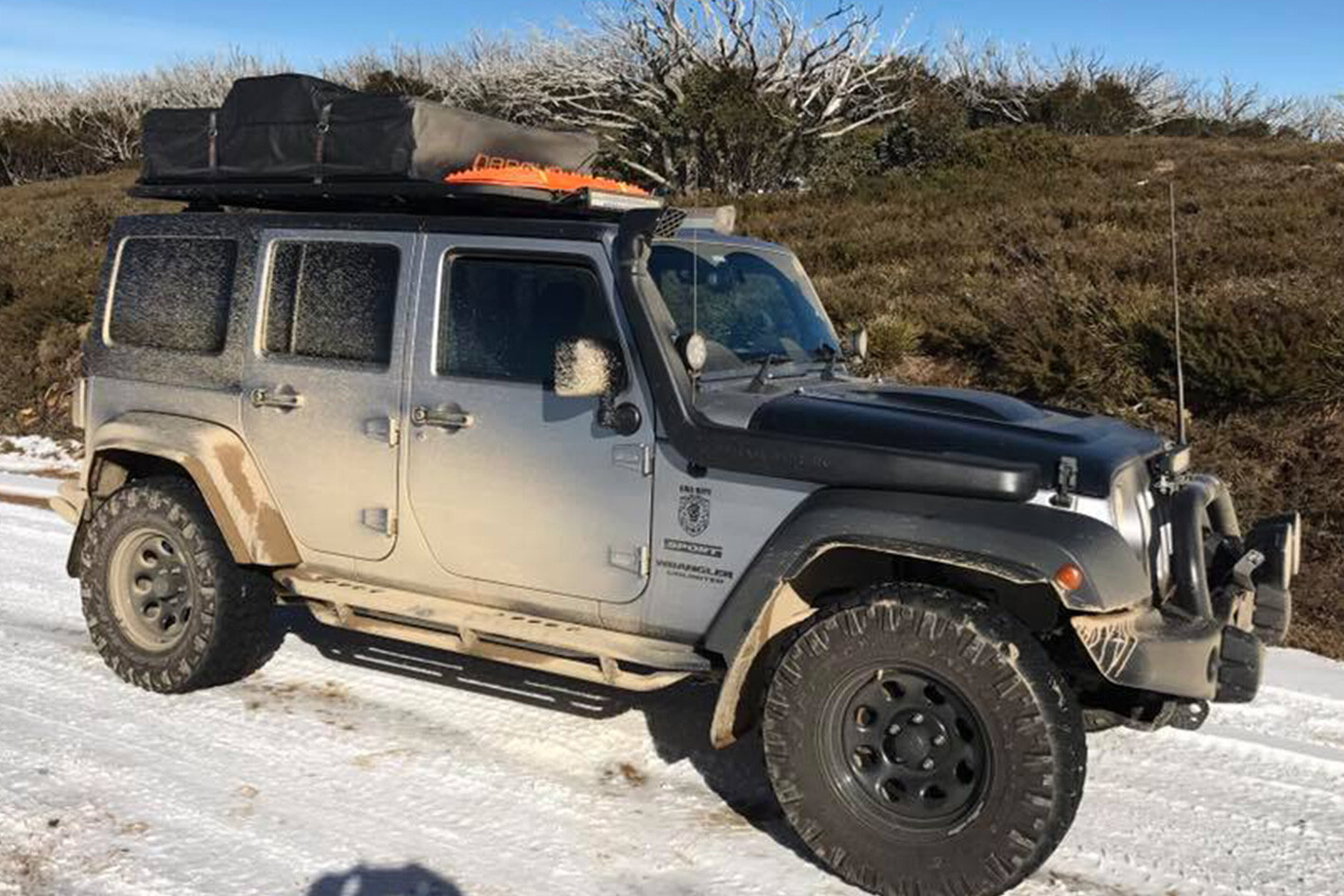
Had it for four years. It started as new stock JKU CRD, but since then I’ve built my own drawer system with Waeco fridge and Travel Buddy oven, and made a tailgate table. It’s got dual batteries, rear camera, AEV 2.5in lift, bullbar, rear bar with water storage and tyre carrier, fuel caddy, AEV bonnet, snorkel, Smittybilt rock rails, four LED spotties and roof light bar, AEV roof rack, Darche roof-top tent, ARB rear locker, ARB on-board compressor, twin UHF antennas, winch, side awning, and on and on! Favourite places visited are the Victorian High Country and Beachport, South Australia. On the list for next year are the Oodnadatta Track, Uluru and Kings Canyon… Oops, forgot the full Outlaw stainless steel performance exhaust.
Ron and Viv Moon’s latest news and info from Australia’s treks and tracks
SAT PHONE SIM CARD HIRE (AUSTRALIA-WIDE)
If you have an Iridium Satellite handset without a connection, quite often it is more economical to hire a SIM card and use your own phone. Short- and long-term hire is available. Satellite phone models suitable for SIM hire are the Iridium 9500, 9505, 9505A, 9555 and 9575. For more information: www.satellitehire.com.au/satellite-phone-sim-card
LAKE MOONDARRA FISHING CLASSIC (QLD)
Visitors, competitors and fans of this great fishing classic, held this year near Mt Isa from October 27-29, can expect to see the dragon boat regatta, live entertainment, and the hugely popular fireworks display. There are also trade and community exhibits, food and beverage stalls, and bar facilities. The Classic will also deliver thousands of dollars’ worth of trophies, cash and prizes. Full details: www.lakemoondarrafishingclassic.com.au
ONLINE CAMP BOOKINGS (SA)
From June 1 this year, entry and camping for Ikara-Flinders Ranges NP, Vulkathunha-Gammon Ranges NP, Innamincka Regional Reserve, Malkumba-Coongie Lakes NP, Witjira NP and Kati Thanda-Lake Eyre NP will need to be booked through an online booking system. The system has now been rolled out across South Australia. See: www.environment.sa.gov.au
CASTLEMAINE SHOW (VIC)
For a great country show that features art and craft, cooking, wood-chopping events, horses, a snake display, and lots for the kids to do, head to Castlemaine for its annual show. This year the show runs from Friday, October 28 to Saturday, October 29. For more details: www.castlemaineshow.com.au
BALRANALD 5 RIVERS OUTBACK FESTIVAL (NSW)
This festival, held October 13-15, promises three exciting days of fun, music, great food and fabulous entertainment. There’s plenty to see and do, with activities and events including market stalls, a fishing competition, a 4WD muster, a camp oven cooking competition and much more. For more details: www.5riversoutbackfestival.com.au
CEDUNA OYSTERFEST (SA)
This gastronomical delight, held from the Thursday, September 28 to Sunday, Oct 1, will be centred on Ceduna’s fabulous oysters. There’s an alfresco dining area with live entertainment, kids entertainment, cooking demos, and the ever-popular oyster-shucking competition. Check out: www.ceduna.sa.gov.au/oysterfest
CROOKED PLAIN (NT)
Crooked Plain is a 225ha working cattle and sheep property located about 100km south of Darwin. It’s just 14km from the township of Adelaide River and 10km off the Stuart Highway, not far from Litchfield National Park. You can hide away and be totally secluded, or you can partake in the normal day-to-day tasks of running such a property. The property is pet-friendly and has camping and cabins available. Bookings are essential: www.youcamp.com/view/crooked-plain
LONGFORD SHOW (TAS)
The 161st running of the Longford Show is due to be held on October 21. It gets off to an early start, with show-jumping commencing at 8.30am. Then there’s sheep and dog judging and even demos on how to rescue snakes. Of course, there will be a wood-chop competition and lots more. For details: www.longfordshow.com.au
FESTIVAL OF THE MINER’S GHOST (NSW)
Held in Cobar from October 27-29, the Festival of the Miner’s Ghost focuses on family entertainment. The festival has something for everyone to enjoy, which includes a spectacular fireworks display over the old Great Cobar Open Cut Mine. There are also markets in the park, street theatre, clowns, buskers, the police charity golf day, family kite-flying day, monster fancy-dress dance, and a mine open day.
FORD Australia today confirmed the worst-kept secret in the automotive industry: it’s working on a souped-up Raptor variant of its popular Ranger ute.
Countless spy photos have been seen of Ranger Raptor prototypes in testing in Australia and the USA, where the Ranger will go on sale as a 2019 model.
The camouflaged test mules reveal pumped front ’guards covering a wider wheel track than what is found under the current PXII Ranger.
Ford AU’s press release describes the vehicle as being “designed and engineered to deliver an adrenaline-pumping experience, Ford Ranger Raptor sports a head-turning exterior look that exudes toughness as well as a level of capability and off-road performance never before seen in the mid-size pick-up truck segment”.
The Raptor nameplate carries over from the Ford F-150 Raptor in the USA. That Baja racer-inspired vehicle is powered by a stonking 335kW twin-turbocharged EcoBoost V6 petrol engine backed by a 10-speed automatic transmission.
Suspension is provided by three-inch Fox Racing bypass shocks, with matched coil springs on a wider track than standard F-truck.
No details are available on what the Ranger Raptor might bring here, but we doubt we’ll see the petrol engine in Australia; instead, a ‘tuned’ version of Ford’s diesel engine is expected. The spy photos reveal the wider track and big tyres on the prototypes, so we’re hoping Ford continues its partnership with Fox for the suspension components.
“Combining the Raptor’s advanced off-road capabilities with the versatility of the Ranger is a significant accomplishment for Ford’s world-class engineering and design teams,” said Jamal Hameedi, chief engineer of Ford Performance. This suggests the Raptor might fall under the Ford Performance banner here as well.
The Ford Ranger will be relaunched in the USA next year as a 2019 model, and spy photos suggest this will be an updated model to the PXII currently on sale here. We‘re tipping Australia will also get the updated style and features of the US-model vehicles including the Everest, which will be badged as a Bronco in the US. No word on timing, but sometime in 2018 for sure.
RESPONDING to claims made by Mercedes-Benz that its X-Class ute will be the most powerful ute in the segment, Volkswagen will give its V6 TDI Amarok a power and torque upgrade.
To be displayed at the Frankfurt Motor Show next week, the Amarok Aventura concept is promising 190kW and an undisclosed increase in torque from its 3.0-litre V6 engine. The same VW V6 already produces 190kW and 580Nm in other Volkswagen Group vehicles such as the Porsche Macan.
The V6 TDI Amarok currently makes 180kW (only available on overboost) and 550Nm. The V6 X-Class, which won’t be on sale until the second half of 2018, is claimed to produce 190kW and 550Nm.
There’s no word yet if and when the boosted Amarok will go on sale, but the Aventura edition has been used as a top-spec model in the past so we’re expecting it sometime next year, possibly timed to steal some of the X-Class’s thunder.
VW Australia said at the time of the V6 TDI Amarok’s Australian launch that other variants of the V6 would come online in 2018, including a manual version with low-range transfer case, as well as the possibility of lower states of engine tune.
Currently, the V6 Amarok is only available with an eight-speed automatic transmission and full-time, single-range 4×4. The manual Amarok would be part-time dual-range 4×4.
In Europe, the V6 TDI is also available in 120kW and 150kW guises, and one of these could be employed in an Amarok Core model as an entry level to the V6 range in Australia.
One thing is for sure: the top end of the 4×4 ute class is going to be hot property in 2018, and we can’t wait to drive them.
JUST one month after unveiling the first Bollinger B1 full-electric 4×4 in New York, the start-up company has released a sketch of a four-door version of the purpose-built utility vehicle.
“We always wanted to make a four-door version of the B1,” said Robert Bollinger, designer and CEO.
“And our assistant designer Ross Compton and I developed a great sketch. The vehicle still has great proportions and its amazing off-road capabilities remain intact since we only had to stretch the chassis by nine inches (229mm).”
The four-door B1 has a wheelbase of 2896mm as opposed to the original B1’s 2467mm, yet maintains the same 394mm of ground clearance and 56-degree approach and 53-degree departure angles, while the rampover angle is now 31 degrees. Wheel travel for the height adjustable suspension is 254mm.
Bollinger’s in-house-made aluminium chassis employs full independent suspension, detachable swaybars, massive inboard-mounted disc brakes, and hub-reduction portal axles. Helping with ground clearance and traction are 285/70 17 BFG Mud Terrain tyres. Power comes from a pair of electric motors offering a choice of 60kWh or 100kWh, with 193km or 322km range between charges.
Bollinger is now setting up for production of the B1 in America and orders are being taken for the first vehicles. Unfortunately for us, there are no plans for right-hand drive production and we doubt the vehicle could be road-registered here in Australia.